Coast redwoods (Sequoia sempervirens) and sierra redwoods, often called giant sequoias (Sequoiadendron giganteum), are members of the Sequoioideae family, a sub-family of the Cypress family. Both are native to California. Dawn redwood (Metasequoia) is the third genus in the small Sequoioideae family. Although there is fossil evidence that dawn redwoods lived in California some 40 million years ago they are now native only to a small region in China.
Coast and sierra redwoods have a common ancestor that is now extinct. They evolved into different genera in response to the creation of microclimates by geologic changes that isolated their gene pools and gradually drifted apart in directions adapted to their respective regions. (1)
Coast redwoods live in wetter climates than sierra redwoods and they are heavily dependent on coastal fog that maintains a moist environment when interior regions of California are hot and dry. As our climate continues to change, the future of coast redwoods will depend on whether or not our coastal fog persists. In turn, the fog depends on the coolness of the ocean relative to the warmth of the land. The greater that difference in temperature, the more fog is created as water in warm air condenses when it meets cold ocean air.
Sierra redwoods tolerate a much drier climate than coast redwoods, but they have been tested by our prolonged drought. They are also threatened by wildfires that have ravaged California during our long drought. Only about 70 small, isolated groves of sierra redwoods still exist on the western slope of the Sierra Nevada. In 2020 and 2021, wildfires killed 13 percent to 19 percent of the world’s giant sequoias, according to the U.S. Forest Service. (2) The Mariposa Grove of giant sequoias in Yosemite National Park burned in 2022, but none of the sequoias were killed.
Public land managers are under intense pressure to do whatever is necessary to save our sierra redwoods. Extreme measures have been taken, such as wrapping their huge trunks in fire resistant foil, spraying trunks with water and canopies with gel when fires approach. (3)
The prevailing opinion about conserving sierra redwoods is that prescribed burns will reduce fuel loads and therefore fire hazards as well as kill shrubby understory that can carry fire from the ground into tree canopies. The understory is also considered competition for moisture in the soil. Kevin McCarthy, the speaker of the US House of Representatives, has introduced a bill titled Save our Sequoias Act (SOSA) that would enable logging to reduce fuel loads in giant sequoia groves without requiring environmental impact reviews. Many experts disagree about that strategy. We visited the sierra redwood grove in Calaveras Big Trees State Park at the end of May to see for ourselves and consider the pros and cons of the strategy that is being used there to save the big trees.
Calaveras Big Trees State Park
Calaveras Big Trees State Park is located near the town of Arnold at an elevation of about 4,700 feet. It is near the northern end of the narrow range of giant sequoias. The southern end of the range is near the city of Visalia in Sequoia National Park at about 6,000 feet elevation. Most of the big trees that were destroyed by recent wildfires are at the southern edge of the native range. Recent wildfires have not reached Calaveras Big Trees, but several giant sequoias in the park were badly damaged by prescribed burns and may not survive. These damaged trees are a testament to the risks of prescribed burns.
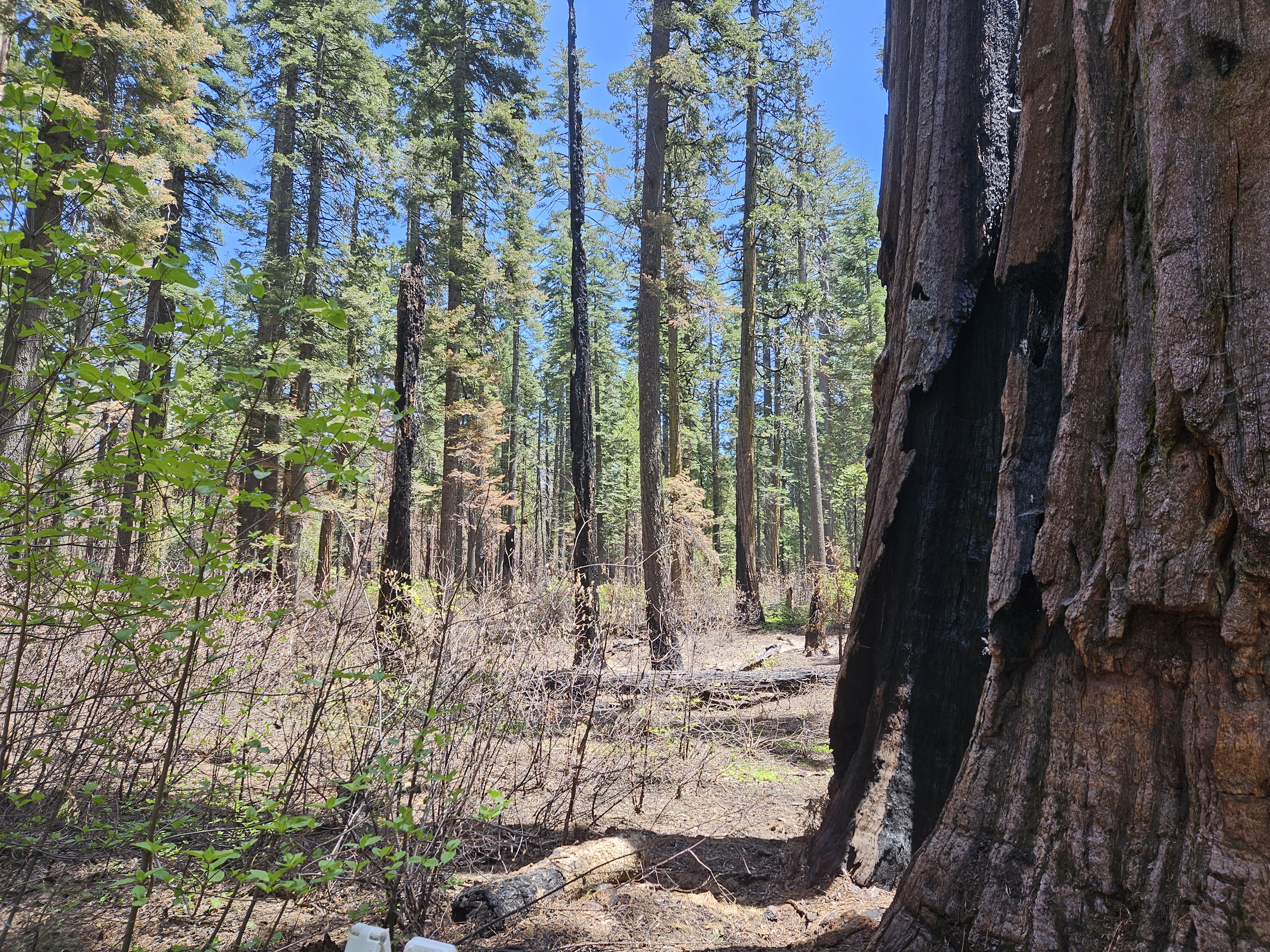
Below is a picture of one of the areas that was intentionally burned in 2022 to reduce fuel loads:
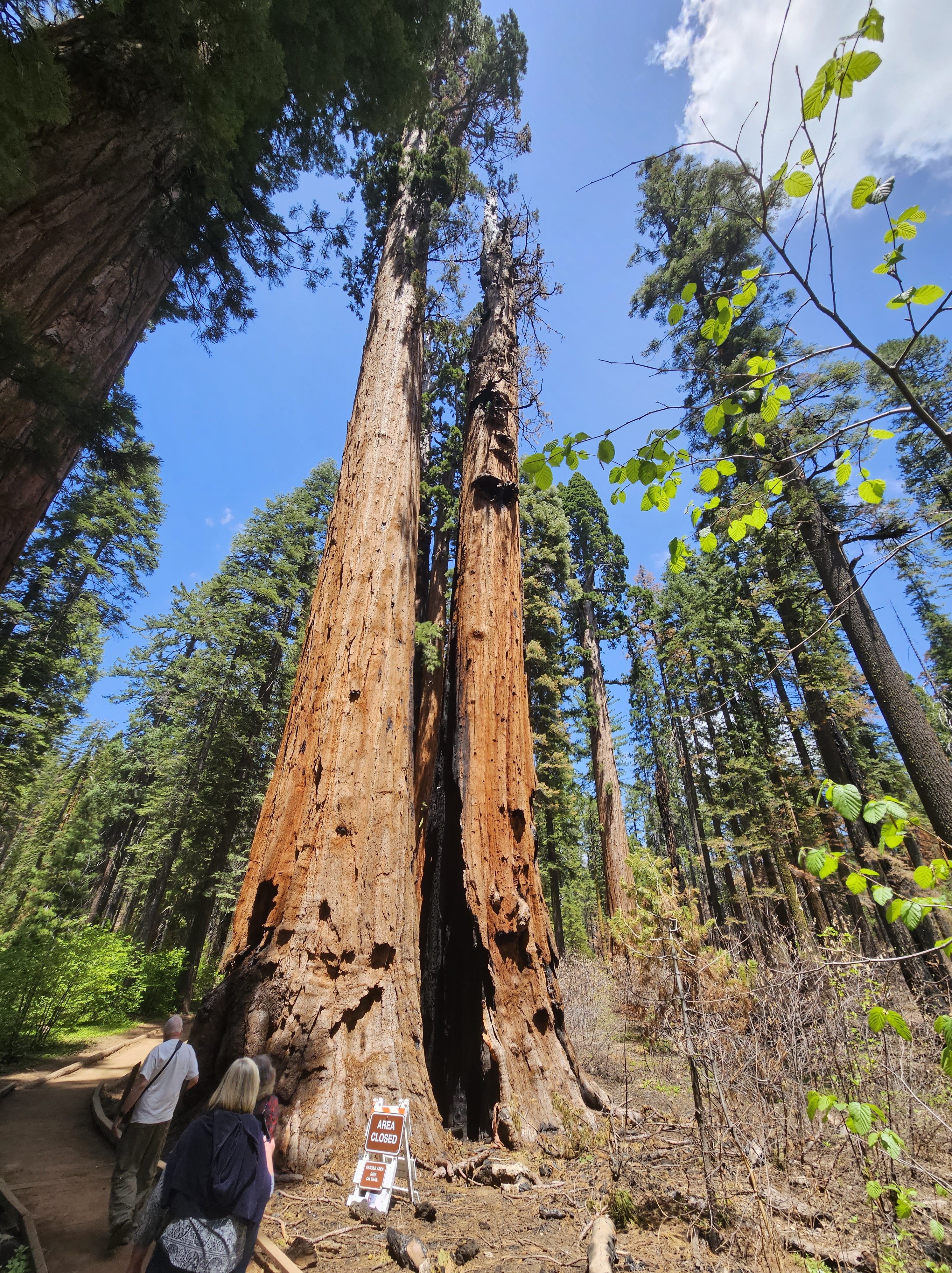
Below is a picture of a giant sequoia that was scorched by that fire. The right-hand side of the tree looks seriously damaged, suggesting that the tree may not survive:
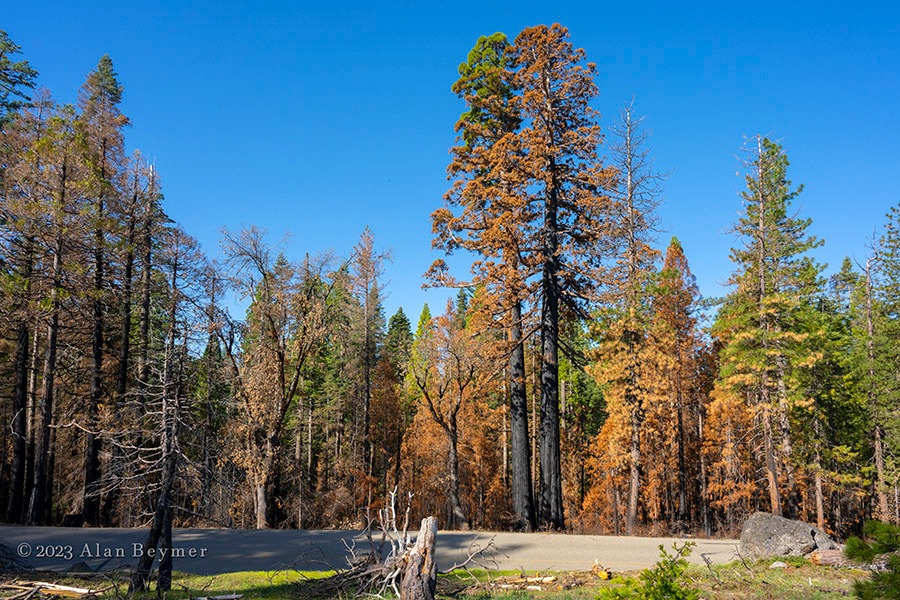
Larger prescribed burns were also conducted on the northern edge of the park, where there are few sequoias. Below is a picture of one of several large areas of the park that were intentionally burned:
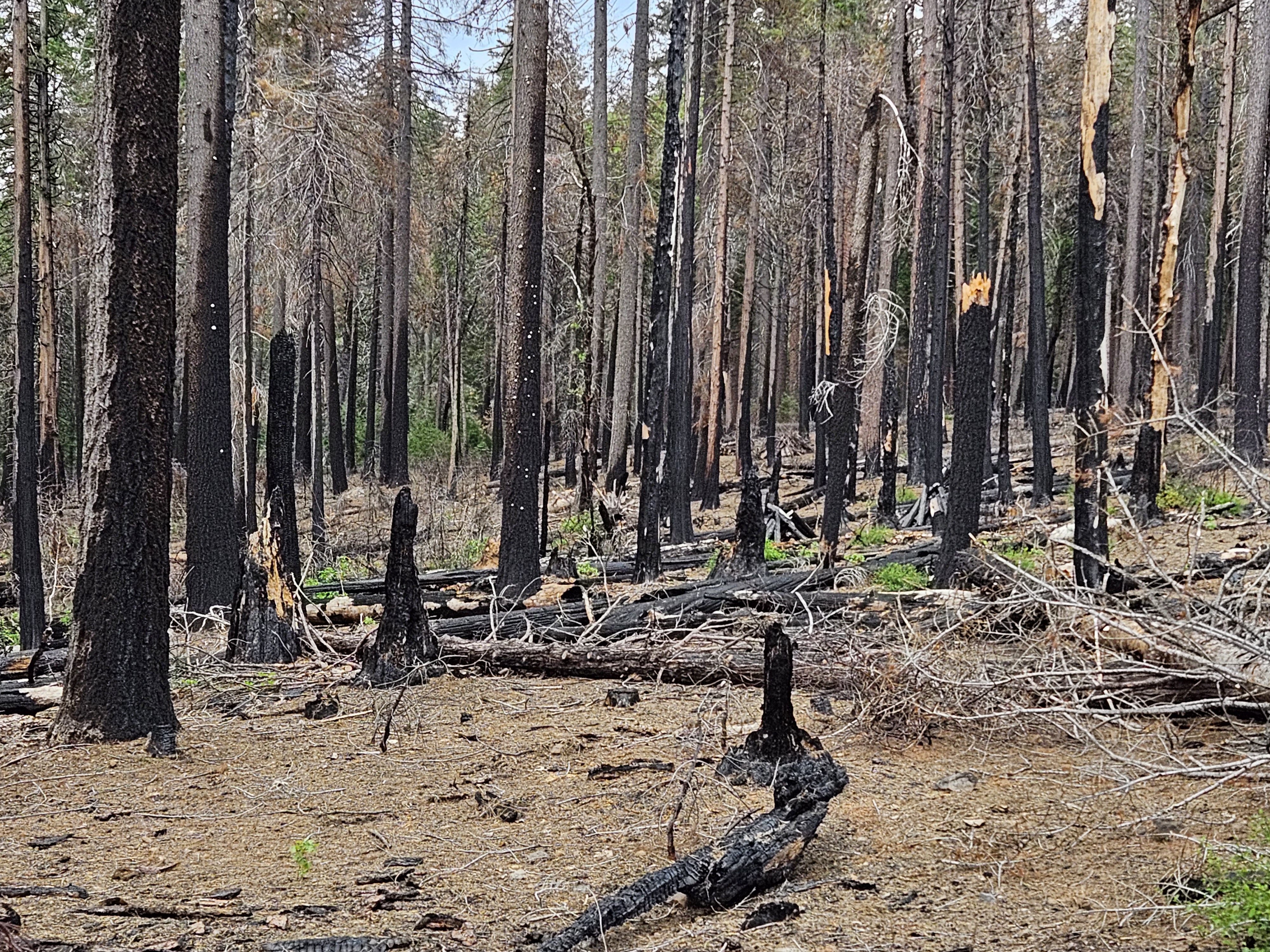
There are only two sequoias in this part of the park, named the Orphans because of their isolation from other sequoias in the park. The Orphans were severely burned by this fire. (see below) It isn’t clear if the Orphans will survive.
Land management or mismanagement?
The potential loss of a few giant sequoias at Calaveras Big Trees may seem trivial, but their loss must be put in the context of the small and shrinking population of giant sequoias as well as their very long lifespan of roughly 3,000 years. The survival of the species is threatened by these unintentional deaths that could have been avoided.
Many major wildfires have been started when burn crews lost control of prescribed burns. In April 2022, the US Forest Service conducted two prescribed burns in the Santa Fe National Forest in New Mexico that merged and became a major wildfire that burned for months, ultimately destroying over 341,000 acres of forest. Although it was one of the most destructive of wildfires started by a prescribed burn, it is only one of many.
Logging to thin the forest is another strategy used by public land managers to reduce fuel loads, but we did not see any evidence of logging at Calaveras Big Trees. The giant sequoias in Calaveras County reside in a mixed conifer forest of ponderosa pine, incense cedar, white fir, and sugar pine. These tree species are valuable timber and therefore vulnerable to pressure from the logging industry. It seems likely that the Save our Sequoias Act sponsored by Republicans is a gift to the logging industry, rather than to the sequoias.
In 2017, the National Academy of Sciences published an evaluation of fuels management projects in the US. The authors of this publication reported that managing forest fuels has been ineffective: “Mechanical fuels treatments on the US federal lands over the last 15 years totaled almost 7 million hectares, but the annual area burned has continued to set records. Regionally, the area treated has little relationship to trends in the area burned, which is influenced primarily by patterns of drought and warming.” Where fuels treatment was done, wildfires subsequently occurred:“10% of the total number of US Forest Service forest fuels treatments completed in the 2004-2013 period in the western United States subsequently burned in the 2005-2014 period.” This suggests that “most treatments have little influence on wildfire.” In any case, only 40% of wildfires occurred in forests since 1984, with most fires burning grasslands and shrublands.
The authors of the study published by the National Academy of Sciences, recommend a new approach to forest management. Whereas past policies were designed to maintain forest conditions to historical conditions, this is no longer considered a realistic goal. The recommended goal is now “supporting species compositions and fuel structure that are better adapted to a warming, drying climate with more wildfire.”
The other, equally important new goal is to reduce the vulnerability of communities to wildfire by “changing building codes to make structures more fire-resistant…and providing incentives, education, and resources to reduce vulnerability to future wildfire.” The only tree removals that make sense to the authors are those immediately around residential communities, “strategically located to protect homes and the surrounding vegetation.” That is the principle of creating “defensible space” immediately around structures: “fuels management for home and community protection will be most effective closest to homes…where ignition probabilities are likely to be high.” The strategies used in Calaveras Big Trees to protect giant sequoias may not be the best strategies for surrounding residential communities.
Land managers who conduct prescribed burns in sequoia groves also believe they are assisting forest regeneration because the heat of fires is said to release the seed-carrying female cones from the tree canopy and open the cones to release their seeds. The track record on forest regeneration after wildfires depends partly on the severity of fire, but the results of studies are mixed. (4)
The purpose of prescribed burns is to reduce fuel loads with low-severity fire in order to prevent more destructive high-severity fires. However, in the case of giant sequoias, high-severity fires may be necessary for long-term survival of the species: “High-severity fires create robust seedling establishment and survival. For example, in a report on sequoia ecology, NPS researcher Nate Stephenson concluded: ‘Before the arrival of European settlers, successful recruitment of mature sequoias depended on fires intense enough to kill the forest canopy in small areas. Thus, sequoia is a pioneer species, and this conclusion has specific management implications.’” (5)
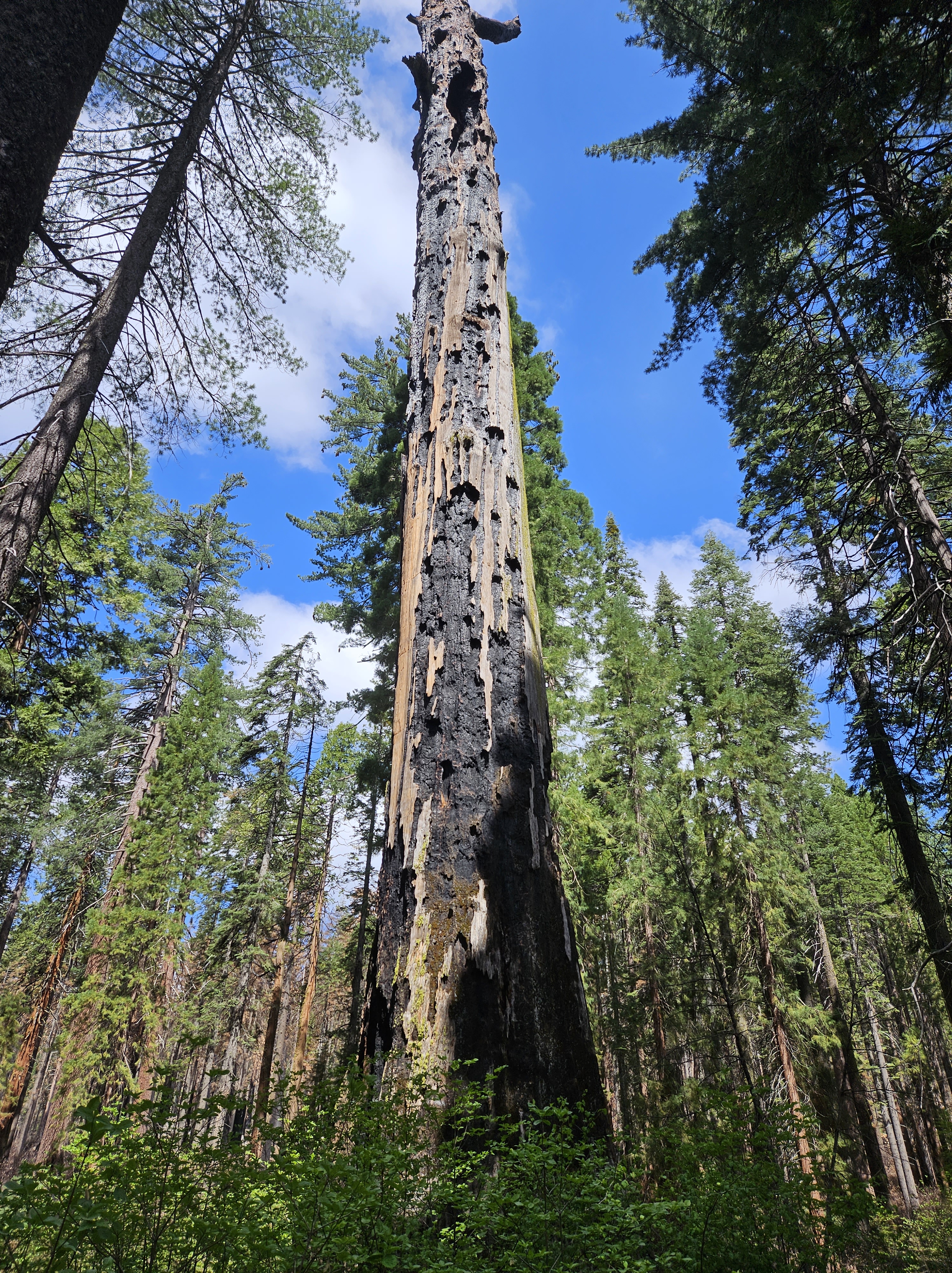
We saw an example of forest regeneration after a severe wildfire in the sequoia grove in Calaveras Big Trees. Below is a photo of the Mother of the Forest that was burned by a wildfire in 1908. That tree was particularly vulnerable to wildfire because the thick, spongy bark layer that protects sequoias from fire (as well as insects and disease) had been removed by entrepreneurs (more accurately called vandals) who reassembled the bark as a tree replica for display and profit.
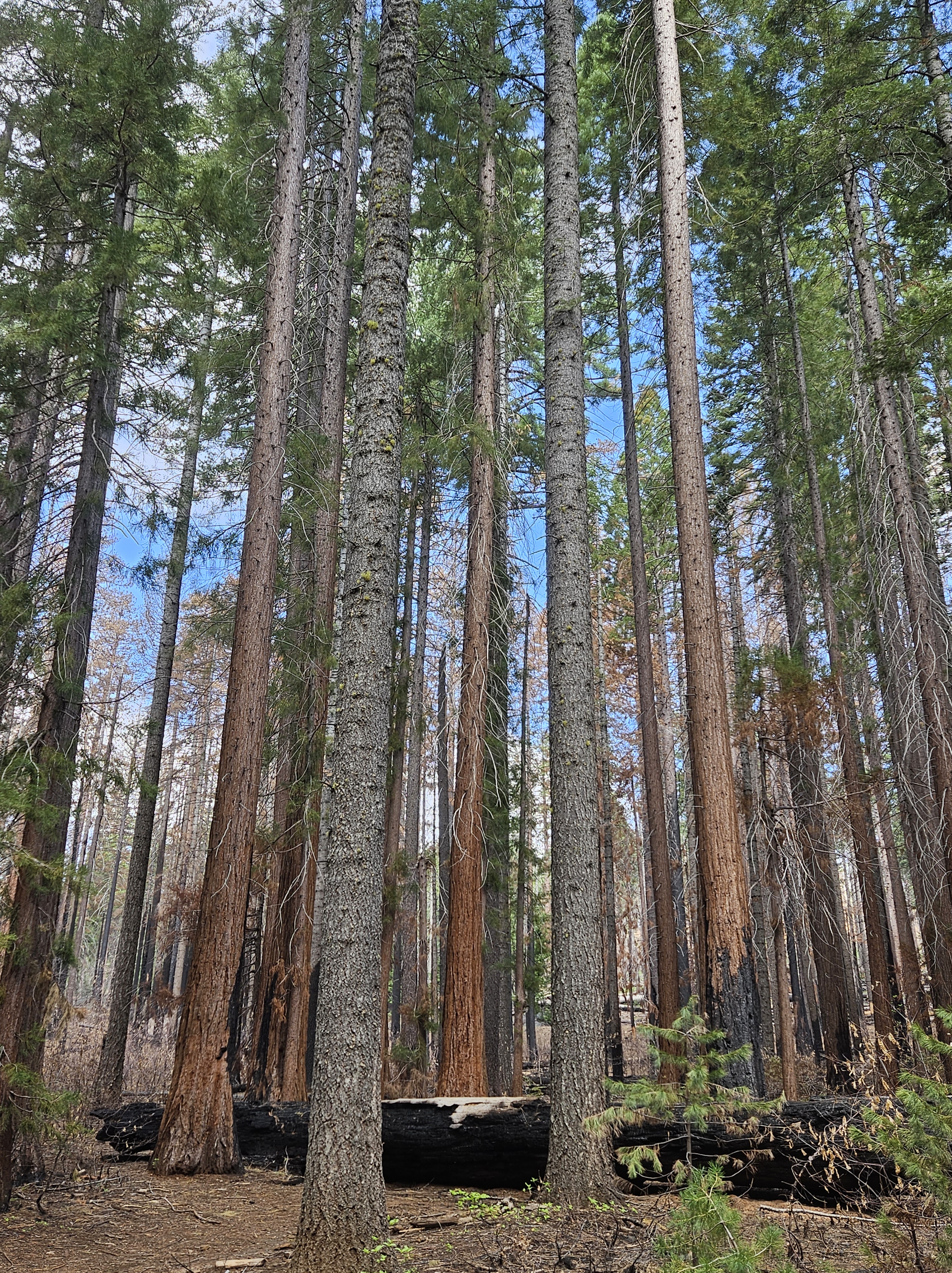
The Mother of the Forest is surrounded by a young forest of trees, including many giant sequoias. (See below. Trees with reddish bark are young giant sequoias.) “The [1908] fire created ideal growing conditions for giant sequoia seedlings and today there is a healthy stand of young sequoias there. Many of these trees are the result of natural regeneration that happens after a fire, while others were planted during the 1930s by members of the Civilian Conservation Corps.” (6)
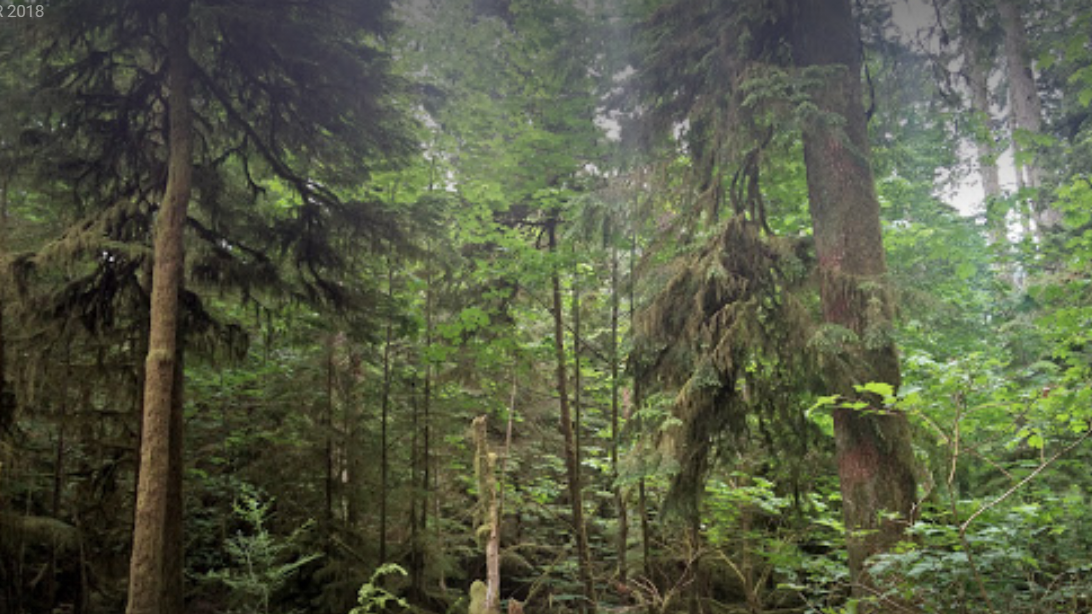
Mountain dogwood (Cornus nuttalli) and hazelnut (Corylus cornuta) are the predominant understory shrubs in the forest of Calaveras Big Trees. After an unusually long, cold winter most weren’t blooming yet at the end of May. A few dogwoods were blooming where sunshine penetrated the tree canopy. (see below)
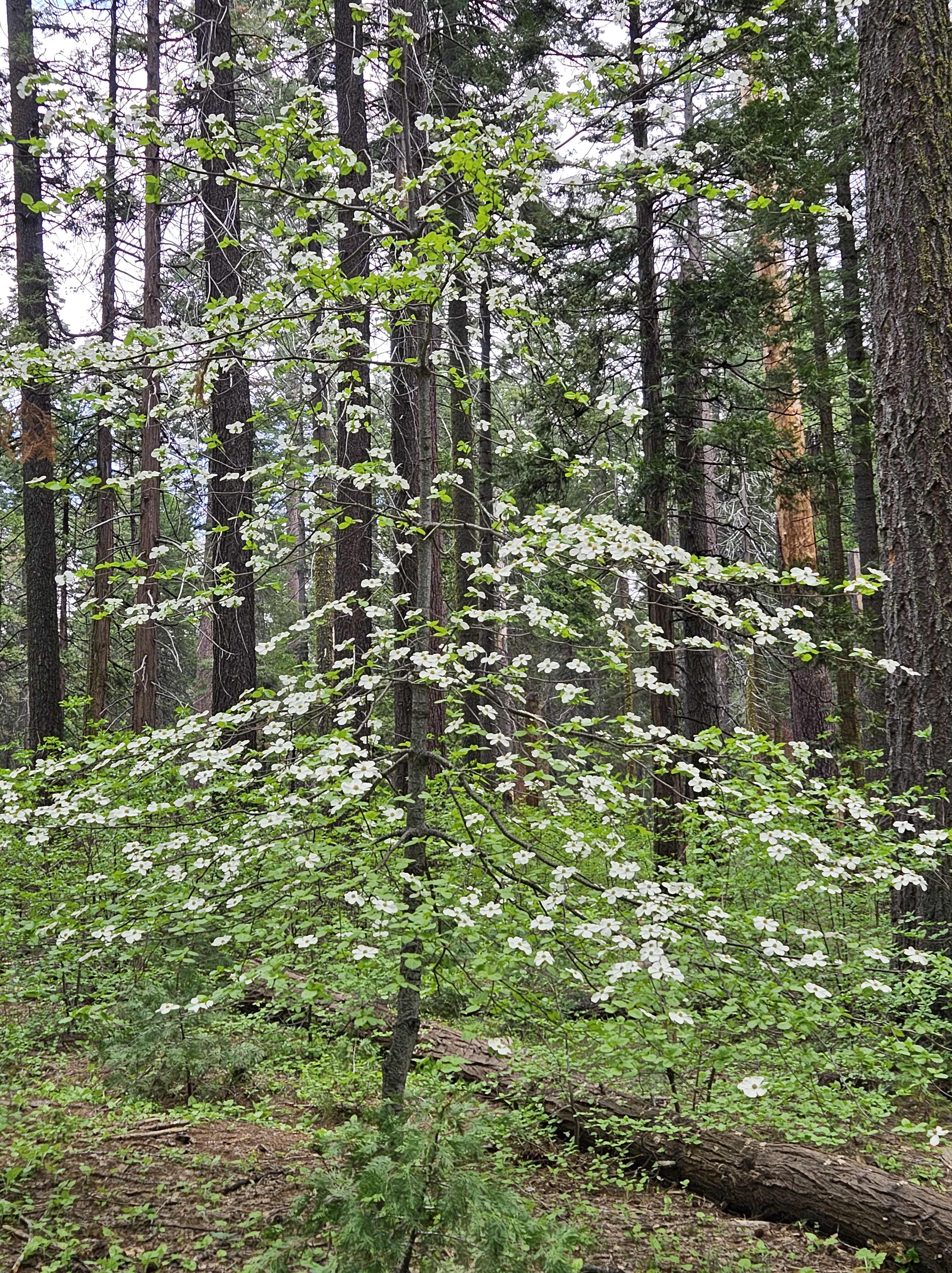
Unfortunately, these lovely small trees are seen as competitors of the giant sequoias for available water and nutrients in the soil. Therefore, destroying the understory in Calaveras Big Trees is one of the management goals. According to the Calaveras Big Trees Association, most of the dogwoods were chopped down by park staff about 9 years ago. Dogwoods are vigorous resprouters, so they quickly grew back more densely than their taller predecessors. Pesticides (including herbicides) aren’t used in Calaveras Big Trees, so resprouting was inevitable. I wonder if those who destroyed the dogwoods understood that would be the outcome of their effort.
Management strategies of the timber industry are based on an assumption of competition. When clear-cut harvests are done by the timber industry they are typically sprayed with herbicides from helicopters to destroy the understory that they assume competes with the tree seedlings they plant for the next timber crop. Public land managers often use the same strategy.
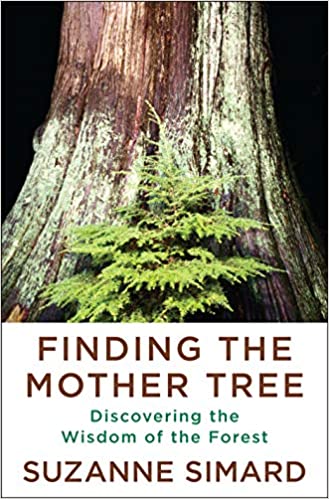
The research of Suzanne Simard has informed us that there is more cooperation in the forest than there is competition. A lifetime of observing healthy forests taught her that the soil is occupied by vast networks of fungi that connect the plants and trees. These mycorrhizal fungi transfer moisture and nutrients from the soil to the trees and plants, to their benefit. She speculated that the destruction of all vegetation in clear cuts was eliminating that support structure and she designed experiments to test her hypothesis.
The specifics of fungal associations between tree species varies, which requires that we describe a specific relationship. Simard’s original studies focused on the fungal associations between Douglas fir and birch trees in the understory. Birch trees were destroyed in the clear cuts that were then planted with Douglas fir seedlings that were not doing well. Simard’s experiments eventually revealed that birch trees and firs mutually benefit one another through their fungal networks. Carbon stored and the sugar produced by photosynthesis by firs are shared with deciduous birch during winter months while they are leafless. In summer months when birch are foliated, they store more carbon that is shared with firs. Birch is resistant to a root pathogen to which firs are susceptible. In a sharing fungal relationship between birch and firs, birch confers some of that resistance to the root pathogen onto their fir neighbors. Is there a similar relationship between dogwoods and sequoias and other conifers in the forest at Big Trees?
The understory also shades the forest floor, which retains moisture in the soil that would otherwise evaporate in the absence of shade. The canopy of giant sequoias is near the top of mature trees and doesn’t cast much shade. In other words, the shaded forest floor provides more moisture for all members of the plant community in sequoia groves. Furthermore, a shaded forest floor is less likely to ignite a fire because of the moisture it retains.
More questions than answers
I don’t know the answers to the questions I have raised about management strategies in Calaveras Big Trees:
- Is there a mutually beneficial relationship between dogwood and hazelnut and giant sequoia? Is it necessary or beneficial to destroy the understory in the sequoia groves of Calaveras Big Trees?
- Are there more risks than rewards in conducting prescribed burns in Calaveras Big Trees?
- Would thinning the trees in sequoia groves benefit the timber industry more than the sequoias?
- Are severe fires more effective than low-severity fires to germinate the seeds of giant sequoias and regenerate the forest after fires?
However, I am sure that when there is uncertainty and great risk, there must be caution. I also know that Calaveras Big Trees State Park is a treasure. If you haven’t visited, I suggest you put it on your bucket-list.
- Gary D. Lowe, “Geologic History of Giant Sequoia and the Coast Redwood,” North America Research Group, Beaverton, Oregon, 2013-2014.
- Twilight Greenaway, “In California, a race to save the world’s largest trees from megafires,” Inside Climate News, September 23, 2022.
- “‘It could be a big tree in 1,000 years’: tiny seedlings of giant sequoias rise from ashes of wildfire,” The Guardian, November 1, 2021
- Kristen Shive, et.al., “2021 Fire Season Impact in Giant Sequoias, National Park Service.
- George Wuerthner, “Save Our Sequoias Act: A Stealth Attack on NEPA-EAS and Our Sequoia Groves,” Wildlife News, May 21, 2023.
- “A Guide to the Calaveras North Grove Trail,” Calaveras Big Trees State Park. Much of the information in this article comes from this trail guide.


 Conservation Sense and Nonsense