Birds and butterflies in the eucalyptus forest

The deadline for sending comments to the California Invasive Plant Council (Cal-IPC) about their draft reassessment of blue gum eucalyptus is Thursday, July 31, 2014 (send to info@cal-ipc.org).  We are hoping to inspire you to write your own comment by sharing our personal favorites of some of the goofy statements Cal-IPC uses to justify its classification of blue gum as “moderately invasive.”

Eucalyptus trees do NOT kill birds!

Our regular readers have heard the absurd claim that eucalyptus trees kill birds by “gumming” up their noses or beaks with the nectar of the eucalyptus flowers.  We have published detailed critiques of this claim, so we won’t repeat them because you can visit those posts by clicking HERE and HERE.

Of course, all of this detailed information was provided to Cal-IPC when the original request to reconsider their classification of blue gum was submitted in December 2013.  In their draft reassessment, Cal-IPC now sinks to a new low by claiming Ted Williams as the source of the claim that eucalypts kill birds.  Mr. Williams writes an opinion column published by Audubon magazine, which is appropriately entitled “Incite.”  In 2002, Audubon magazine published Mr. Williams’s opinion of eucalyptus, which he called “America’s Largest Weed.” 

Ted Williams is not a scientist or a journalist.  He is a commentator. His column in Audubon magazine is not entitled “Insight,” because it is intentionally inflammatory.  It engages in rhetoric and hyperbole in support of Mr. Williams’s opinion.  In an article in High Country News, Mr. Williams describes “Incite” as a “muckraking column” and he calls himself an “environmental extremist.”  Citing Mr. Williams as a source of information undermines the credibility of Cal-IPC’s draft reassessment.  Quoting Mr. Williams on the subject of eucalyptus is a bit like quoting Rush Limbaugh on the subject of immigration.

But let’s be more specific with examples of the absurd statements Mr. Williams makes and the evidence that these statements are not factually correct.

The truth about Anna’s hummingbirds

Hummingbird in eucalyptus flower.  Courtesy Melanie Hofmann
Hummingbird in eucalyptus flower. Courtesy Melanie Hofmann

Cal-IPC’s draft reassessments says, “Williams reported that PRBO found that 50% of the Anna’s hummingbird nests [in eucalyptus] are shaken out by the wind, while only 10% of nests are destroyed by wind in native vegetation.”

Cal-IPC’s quotes from Williams are not found in any publication of the Point Reyes Bird Observatory (PRBO), which Williams claims as the source of the information.  Statements about the nests of Anna’s hummingbird are explicitly contradicted by Cornell Ornithology Laboratory, America’s preeminent research institution of bird biology and behavior:

  • “In the first half of the 20th century, the Anna’s Hummingbird bred only in northern Baja California and southern California.  The planting of exotic flowering trees provided nectar and nesting sites, and allowed the hummingbird to greatly expand its breeding range.”
  • “Anna’s Hummingbird populations increased by almost 2% per year between 1966 and 2010, according to the North American Breeding Bird Survey…The Anna’s Hummingbird is the most common hummingbird on the West Coast, and it has thrived alongside human habitation.  Its range has increased dramatically since the 1930s, when it was found only in California and Baja California.  Thanks to widespread backyard feeders and introduced trees such as eucalyptus, it now occurs in healthy numbers all the way to Vancouver, Canada.”
  • “Females choose the nest site, usually a horizontal branch of trees or shrubs 5-20 feet off the ground (occasionally higher) near a source of nectar.  They often build nests in oak, sycamore, or eucalyptus trees…”
  • “They [Anna’s Hummingbirds] are notably common around eucalyptus trees, even though eucalyptus was only introduced to the West Coast in the mid-nineteenth century.”

In other words, the nation’s most prestigious ornithological research institution tells us that Anna’s Hummingbirds have benefited greatly from eucalyptus trees, which provide both winter sources of nectar not otherwise available in California as well as safe, secure nesting habitat.  Since Anna’s Hummingbirds nest preferentially in eucalyptus, their populations would not be increasing if 50% of their nests were destroyed, as Mr. Williams claims.
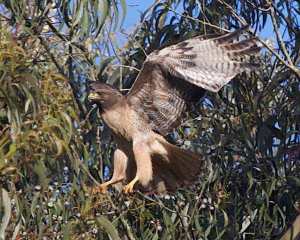
Red-tailed hawk nesting in eucalyptus.  Courtesy urbanwildness.org
Red-tailed hawk nesting in eucalyptus. Courtesy urbanwildness.org

Furthermore, the implication that eucalypts provide a less stable nest site than native trees is also explicitly contradicted by a study that Cal-IPC cites elsewhere in its draft reassessment.  Stephen Rottenborn studied the nesting choices and reproductive success of red-shouldered hawks in Santa Clara County.  He found that the hawks prefer eucalypts to native trees and that their nests were more successful when they made that choice.  He attributes that greater success rate to the fact that eucalypts are “large, sturdy trees” that provide “greater stability and protective cover.”

“Fourteen of 27 nests in 1994 and 38 of 58 nests in 1995 were in exotic trees, predominantly eucalyptus.  Nesting and fledging success were higher in exotic trees than in native trees in both years, owing in part to greater stability and protective cover.  Most nest trees in upland areas were exotics, and even in riparian habitats, where tall native cottonwoods and sycamores were available, Red-shouldered Hawks selected eucalyptus more often than expected based on their availability.  Of the habitat and nest-tree variables measured at each nest, only nest-tree height and diameter were significantly associated with reproductive success, suggesting that large, sturdy trees provided the best nest sites.  Red-shouldered Hawk populations in the study area have likely benefited from the planting of exotic eucalyptus and fan palms.” (1)

 Magic!  Turning 2 dead birds into 300

Cal-IPC’s draft reassessment says, “Stallcup reported finding two dead warblers and ‘about 300 moribund warblers with eucalyptus glue all over their faces’ over the years, including ‘a large number of gummed-up Townsend’s warblers, yellow-rumped warblers, ruby-crowned kinglets, Anna’s and Allen’s hummingbirds, and a few Bullock’s orioles. Anyone who birds around eucalyptus trees sees it all the time’ (Williams 2002).”

This particular quote from Ted Williams is easily discredited because Rich Stallcup published his theory about birds being harmed by eucalyptus trees (available HERE).  In this publication, Mr. Stallcup reports seeing just two dead birds (one hummingbird and one ruby-crowned kinglet) in the eucalyptus forest during his long, illustrious career as an amateur birder.  He says nothing about seeing “300 moribund warblers” in his publication.  A small measure of common sense enables the reader to evaluate Mr. Williams’s claim:  If Mr. Stallcup had seen 300 dying birds, why would he say he had only seen 2 dead birds in his published article in which he is trying to make the case for removal of eucalyptus?

Overwintering monarch butterflies use predominantly eucalyptus

Monarch butterflies roosting in eucalypus tree.

Cal-IPC’s draft reassessment says, “Natural experimental evidence from mixed stands (native trees mixed with eucalyptus) show that Monarchs do not consistently cluster preferentially on eucalyptus, and at times, appear to prefer native trees in some seasons and locations. (Griffiths & Villablanca 2013)”

This is a misleading statement because it implies that monarchs have the option of overwintering in native trees.  In fact, the reference cited by Cal-IPC is speaking specifically of three species of native trees with small native ranges:  Monterey pine, Monterey cypress, and redwoodsThe study is reporting observations of monarchs within the native ranges of these three tree species.  These tall trees provide a similar microclimate to overwintering monarchs.     However, the native ranges of these tree species are small.

Monterey pines are native in “three disjunct populations in San Mateo and Santa Cruz counties, Monterey County, and San Luis Obispo County.  The native population of Monterey cypress is significantly smaller:  “The native range of the species was confined to two small relict populations, at Cypress Point in Pebble Beach and at Point Lobos near Carmel, California.” Where Monterey pine and cypress have been planted outside their native range, they are being eradicated by the same public land managers who are eradicating eucalyptus.

For example, when UC Berkeley destroyed approximately 18,000 non-native trees over 10 years ago, many were Monterey pines.  Their plans to eradicate 80,000 more trees include all Monterey pines in the project area.  In San Francisco, the plans (SNRAMP) of the Natural Areas Program propose to destroy many Monterey cypresses on Mount Davidson.  The GGNRA has destroyed about 500 Monterey pines on Hawk Hill in Marin County and many Monterey cypresses throughout their properties.

Furthermore, both Monterey pine and Monterey cypress have much shorter lives than eucalyptus.  Monterey pine lives at most 150 years and Monterey cypress about 250 years, compared to E. globulus, which lives in its native range from 200-500 years.  Therefore, even where they are not being eradicated, they will die long before E. globulus and are unlikely to be replanted outside their small native range by public land managers who are committed to a “natives-only” policy.

We are unaware of any attempts to eradicate redwoods outside their native range, in the few locations where they still exist. They seem to have escaped the wrath of nativism. However, the range of redwoods is very narrow:  “The redwoods occupy a narrow strip of land approximately 450 miles (724 km) in length and 5 to 35 miles (8-56 km) in width.  The northern boundary of its range is marked by two groves…within 15 miles (25 km) of the California-Oregon border.  The southern boundary of redwood’s range is marked by a grove…Monterey County, California.”

Although native plant advocates may be willing to plant redwoods outside their native range, they do not have that option because of the horticultural requirements of redwoods.  Redwoods require more water than Monterey pine and cypress and they do not tolerate wind, which prevents them from being successful in many coastal locations, where monarchs overwinter.  Redwoods cannot be successfully grown south of Monterey County where the climate is warmer and drier than its native range.

In other words, monarchs do not have the option of roosting in native trees in most of the places in California where they overwinter.  This is a more accurate description of the behavior of overwintering monarchs and the alternatives that are available to them in about 300 locations along the entire coast of California, where they have overwintered in the past:

Three types of trees were used most frequently by roosting monarchs:  eucalyptus (75% of the habitats primarily Eucalyptus globulus), pine (20% of the habitats; primarily Pinus radiata), and cypress (16% of the Cupressus macrocarpa).  Twelve other tree species were identified…with a combined prevalence of only 10%…The negative sign for this indicator means that habitats had smaller populations when the roosting tree type was a species other than eucalyptus, pine, or cypress…our long-term analysis showed that abundance has historically been greater at habitats dominated by eucalyptus, pines, or cypress than at those with ‘other’ species.  Stands of these three signature taxa may be more likely to produce a community structure and associated microclimate that increases the residence time of monarchs.  Furthermore, these taxa may produce a more attractive landscape architecture in terms of sensory cues to migratory monarchs arriving in a certain region.” (2)

For the record, we will add that we would be happy to have more Monterey pines and cypress and if public land managers would quit destroying them, we would consider them attractive alternatives to eucalyptus.  However, for the moment, we must assume that the crusade against all non-native trees will continue unabated.

What is your personal favorite?

We have shared our personal favorites with you, but everyone comes to this issue from a different place.  We have been flabbergasted by the unfounded claims that the eucalyptus forest is devoid of life.  We wonder if the people who say that, really believe it.  Or is it just one of the many strategies used to justify their demands that our non-native landscape be destroyed?

Please choose your own personal favorite and write your own comment by Thursday, July 31, 2014.  Are you primarily concerned about the herbicides that are needed to prevent the trees from resprouting when they are destroyed?  Are you concerned about the loss of your protection from wind or noise?   Or do you value eucalyptus as a sight screen or for shade in an otherwise treeless environment?  Are you concerned about the carbon loss that will contribute to climate change?  Please help us to save our urban forest from being needlessly destroyed by telling Cal-IPC why they should take blue gum eucalyptus off their “hit list.”

Thank you for your help to save our urban forest.

Update:  On March 13, 2015, the California Invasive Plant Council published its final reassessment of Blue Gum Eucalyptus (available HERE).  Cal-IPC has downgraded its rating of invasiveness and ecological impact from “moderate” to “limited.”  Although the detailed assessment is less than perfect, the over all rating itself is an improvement.  Thanks to those who sent comments to Cal-IPC.


(1)    Stephen Rottenborn, “Nest-Site selection and reproductive success of urban red-shouldered hawks in Central California,” J. Raptor Research, 34(1):18-25

(2)    Dennis Frey and Andrew Schaffner, “Spatial and Temporal Pattern of Monarch Overwintering Abundance in Western North America,” in The Monarch Butterfly Biology and Conservation, Cornell University Press, 2004.
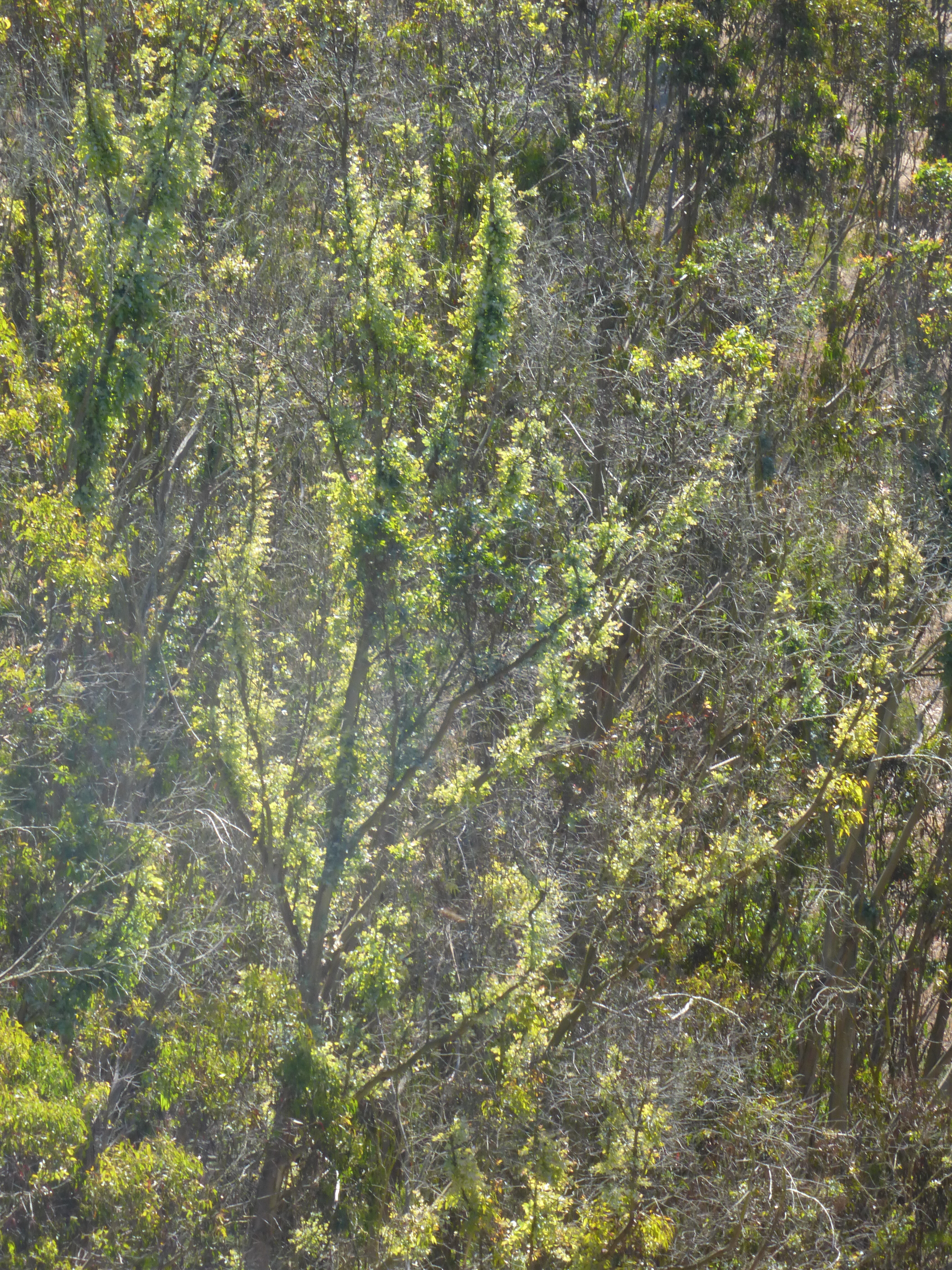
Tracking down the truth about blue gum eucalyptus

Last week, we told our readers about the California Invasive Plant Council’s (Cal-IPC) draft reassessment of blue gum eucalyptus, Eucalyptus globulus. (available HERE) Cal-IPC is accepting comments on its draft until July 31, 2014 (send to info@cal-ipc.org).  Although Cal-IPC now acknowledges that blue gum has “low invasive potential” and its population is stable in California, it proposes to maintain its over-all classification of “moderately invasive.”  You might wonder how Cal-IPC manages to accomplish this sleight of hand, so we will tell you how its scoring system enables it to maintain its overall rating of blue gum.

Cal-IPC has three main evaluation categories:  “Impact,” “Invasiveness,” and “Distribution,” which are combined to produce an over-all rating.  Cal-IPC’s draft lowers the rating of “invasiveness” to “limited,” but it has changed its rating of “impact” from “moderate” to “severe.”  These changes cancel one another, enabling them to reach the same over-all rating of “moderately invasive.”  In this post, we will focus your attention on Cal-IPC’s opinion of the “impact” of blue gum so that you can see how they arrived at their conclusion. 

Drought is on our minds

Epicormic sprouts on trees in Glen Canyon Park, June 2014

As we told our readers recently, the drought in California is making water use an important issue that is getting a lot of attention, as it should.  Native plant advocates have not hesitated to jump on that band wagon.  For example, they now claim that eucalypts in San Francisco are dying of drought.  With the help of a highly qualified arborist, we evaluated that claim in a recent post and reported that the trees are reacting to the loss of their understory and their neighboring trees, as well as the herbicides used to kill the understory and prevent their former neighboring trees from resprouting from their stumps.

Given this recent experience, we weren’t surprised to find that Cal-IPC has introduced accusations of extreme water use into their assessment of blue gum for the first time, and this new issue helps them to claim that blue gums have a “severe” impact on the environment.  Now let’s drill down into this claim, examine the source of the claim and tell you why we believe this is another bogus issue used to vilify eucalyptus.

Tracking down the truth about water use by blue gums was a bit like a game of gossip.  Starting with the final version of the rumor in Cal-IPC’s draft reassessment, we tracked that version back to its original source.  We found exaggeration at each iteration of the rumor, from its source to its landing in the Cal-IPC draft.  The final version bore little resemblance to the original version.  The original version is over 100 years old and therefore describes circumstances that have since changed substantially.

Exaggerated and outdated description of root structures

Cal-IPC’s draft assessment of “impact on hydrology” is: “Eucalyptus globulus is adept at tapping into deep groundwater, even under drought conditions (DiTomaso & Healy 2007), altering water availability to depths of 45 feet and distances of 100 feet from the trunk.”

The first distortion of evidence occurs with Cal-IPC’s exaggeration of its cited source.  Here’s what DiTomaso & Healy actually said about the roots of blue gum:   “In deep soils with high water tables or other deep soil water source, lateral roots grow toward the moisture source and can deeply penetrate soil to 14 m deep.”  In other words, DiTomaso and Healy say that such deep roots occur only in certain conditions of “deep soil,” “high water table,” or a “moisture source.”

The source of DiTomaso & Healy’s description of the roots of blue gum is a similar statement in Bean & Russo, who wrote an evaluation of blue gum for the Nature Conservancy in 1989:  “Large roots have been discovered at a depth of 45 feet below the surface, and surface roots frequently spread over 100 feet away from the trunk. (Sellers 1910)”

Bean & Russo provide a reference for their statement, which takes us to the original version of this rumor.  A book about eucalyptus in California by C.H. Sellers was published in 1910.  Here is what Sellers actually says about the roots of E. globulus, grown in the State of California

“The root system consists mostly of numerous strong laterals; the tap root rarely penetrates to a depth of more than 10 feet.  Abundant supply of moisture is demanded and as the roots grow quickly toward water Eucalyptus globulus should never be planted near wells, cisterns, water pipes, irrigating ditches or similar water impounding structures.  In loose, sandy or gravelly soils the large lateral roots penetrate to great depth, and extend almost incredible distances.  In digging wells large roots have been discovered at a depth of 45 feet below the surface and the surface roots of large trees frequently spread over 100 feet from the trunk of the tree.” (1)

In other words, the extreme root lengths reported by DiTomaso & Healy are an anomaly, only found in specific conditions and unusual cases.  The roots of E. globulus are “rarely” deeper than 10 feet, according to this original source of information regarding the roots of E. globulus

Contemporary sources which are not trying to make a case against E. globulus describe its roots in a less extreme manner: “Bluegum eucalyptus generally does not form a taproot.  It produces roots throughout the soil profile, rooting several feet deep in some soils.” (Esser 1993)  Also:  Bluegum eucalyptus generally does not form a taproot. It produces roots throughout the soil profile, rooting several feet deep on soils that permit it, or shallowly otherwise.” (Skolmen & Ledig 1990)  Esser and Skolmen wrote their evaluations of blue gum for the US Forest Service.

Bringing Sellers up to date

We will assume that Sellers’s observations are accurate, but we will now consider the possibility that an observation that is over 100 years old may not be relevant to present conditions. For a more contemporary perspective on blue gum, we turn to R.G. Florence, an Australian academic scientist who studies eucalyptus and was also a visiting professor at UC Berkeley.  R.G. Florence helps us to understand why the observations of Sellers may be very different from more recent observations:  “As a tree develops through the sapling and pole stages it will tend to form a main root which penetrates vertically downward, but this main root is rarely significant in a large tree.“ (2) Florence reports that E. globulus uses more water during early stages of growth, when it is growing quickly, than it does as a mature tree.  Sellers was reporting in 1910 at a time when most eucalypts in California were young.  Their roots may have been longer during these early stages of growth.  Since E. globulus has not been planted in California for decades and is no longer available for planting, its root structure at early stages of development is irrelevant to evaluating its behavior in California presently.

Is blue gum drought tolerant?

Cal-IPC denies that blue gum is drought tolerant:  “E. globulus is able to withstand prolonged dry summers by tapping into deep water reservoirs; they do not economize in the use of water but have far-reaching root systems and can extract water from the soil at even higher soil moisture tensions than most mesophytic plants (Pryor 1976, Florence 1996).”

Once again, Cal-IPC misquotes its cited sources.  R.G. Florence does not make the statement that Cal-IPC attributes to him.  Rather, this is how Florence describes the water needs of eucalypts:  “…the eucalypt might be generally characterized as being a drought-tolerant mesophyte, that is, it tends to maintain transpiration and cell metabolism under conditions of developing drought.”  (2)

Florence says drought tolerance and water use varies by species of eucalyptus.  He places E. globulus in this category of drought tolerance:  “coastal zone species with high rates of growth and water use, but with somewhat wider environmental [drought] tolerance.”  He makes these observations about water use by E. globulus:

  • Water use is greatest when the trees are young and generally tapers off as the tree grows, between 10-15 years of age.  As we have said, only mature E. globulus exists in California presently or will in the future.
  • E. globulus has been observed to regulate water use by opening and closing its stomata in response to temperature and moisture:  “Water use may be regulated in this way.” (2)

Pryor’s description of drought tolerance of eucalypts was published 20 years earlier than Florence at a time when variations in drought tolerance of different species of eucalyptus had not yet been studied.  He therefore, does not report on the ability of E. globulus to withstand drought, as Florence does in 1996.  He acknowledges some variability with respect to drought tolerance in genus Eucalyptus, which is consistent with Florence’s later report specifically about E. globulus, although Pryor says nothing specifically about E. globulus.

Self-watering blue gums

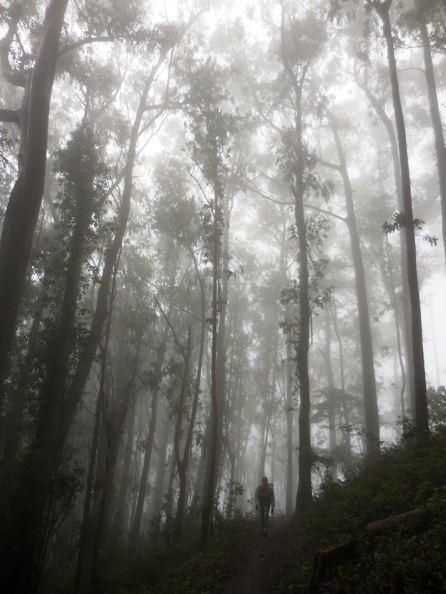
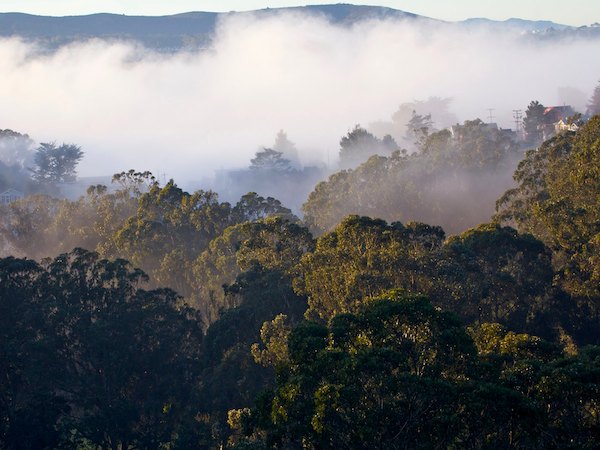
Sutro forest on a typical summer day.  Courtesy Save Sutro Forest.
Sutro forest on a typical summer day. Courtesy Save Sutro Forest.

E. globulus was planted most widely along the coast of California.  Most of the coast of California is foggy during summer months, when there is little if any rainfall.  Tall eucalypts are known to condense the moisture in the fog which has been measured to double annual rainfall. (3) In these regions, eucalyptus is essentially self-watering.  Ironically, Cal-IPC acknowledges this self-watering feature of eucalypts:  “The volume of water channeled down the stem is about eight times more than that of falling rain, so soil at the base of trunks receives relatively large quantities of water…” (May & Ash, see “allelopathy” section of Cal-IPC draft).

A recent study conducted in 24 parks in San Francisco measured moisture in the soil in the late summer months (August to September), when the soil would be driest in the absence of fog condensation.  That study reported that the greatest amount of moisture (15%) was found in the parks with eucalyptus forests.  Soil in parks vegetated with grassland or scrub contained significantly less moisture.  In other words, even late in the dry season mature eucalypts were not draining all available moisture from the soil.  Their water needs were met by the condensation of moisture from the fog during the dry summer season. (4)

Please come to the defense of our urban forest!

We hope that we have made the case that the draft reassessment is not a fair evaluation of the predominant tree in our urban forest, blue gum eucalyptus.  We ask that you write to Cal-IPC by July 31st about their biased reassessment.  Tell them why you think our urban forest is important to the environment and the people and animals living in it.  Ask them to remove blue gum eucalyptus from their “hit list” which is being used by managers of our public lands to justify the destruction of our urban forest. 

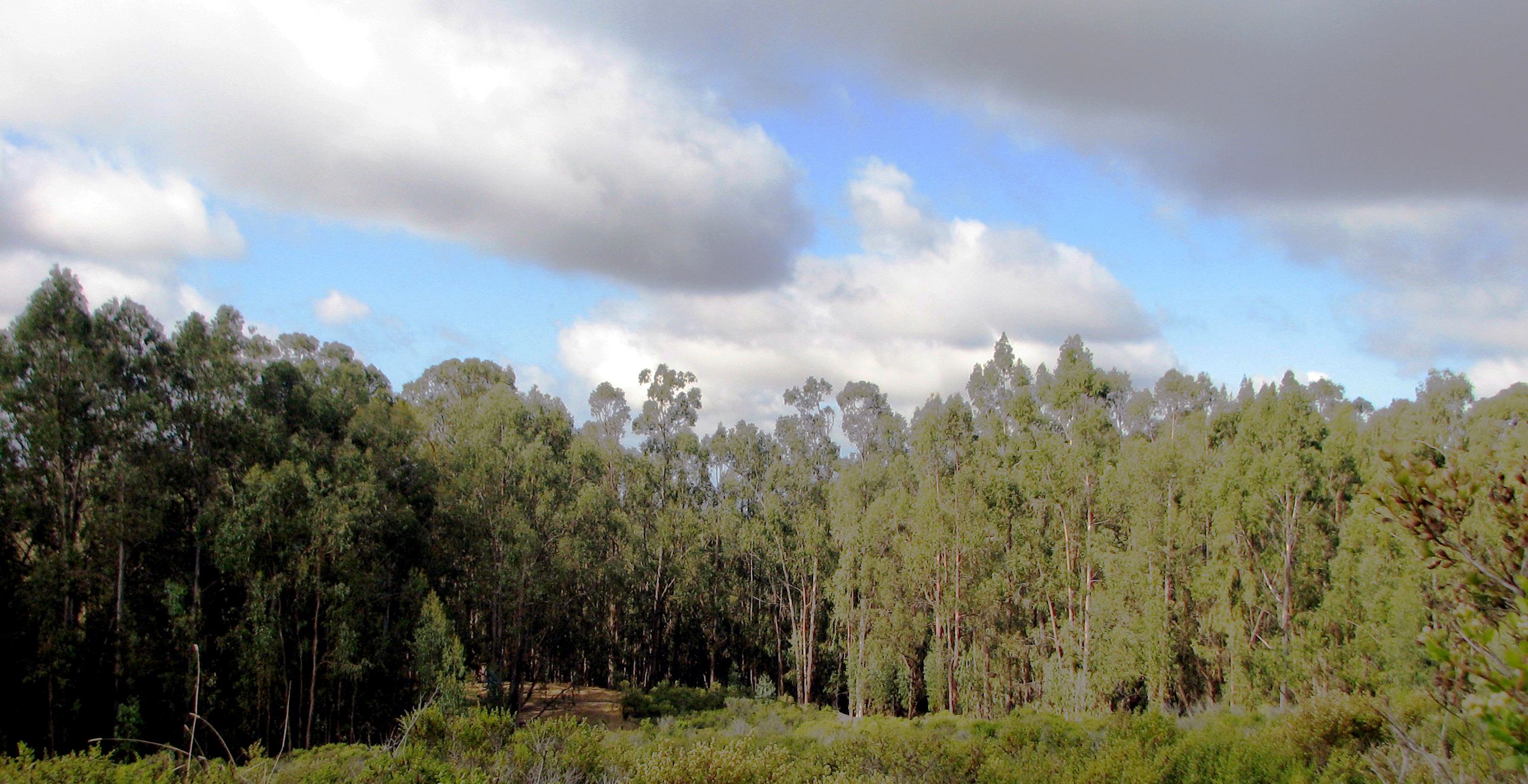
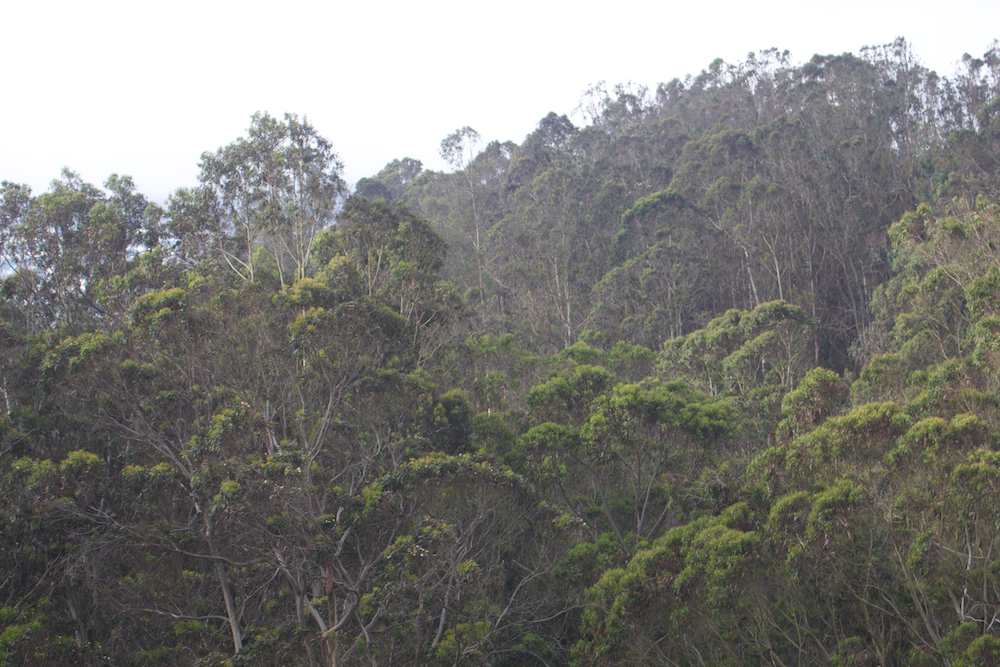
Eucalyptus forest, Lake Chabot

Thank you for your help to save our urban forest from being needlessly destroyed.

Update:  On March 13, 2015, the California Invasive Plant Council published its final reassessment of Blue Gum Eucalyptus (available HERE).  Cal-IPC has downgraded its rating of invasiveness and ecological impact from “moderate” to “limited.”  Although the detailed assessment is less than perfect, the over all rating itself is an improvement.  Thanks to those who sent comments to Cal-IPC.


(1)    C.H. Sellers, Eucalyptus:  Its history, growth and utilization, published by A.J. Johnston, Sacramento, CA, 1910

(2)    R.G. Florence, Ecology and Silviculture of Eucalypt Forests, CSIRO, 1996

(3)    Page 37, Weather of the San Francisco Bay Area, Harold Gilliam, 2002

(4)    Kevin M. Clarke, et.al., “The influence of urban park characteristics on ant communities,” Urban Ecosyst., 11:317-334, 2008


Citizens united against pesticide use in our public lands

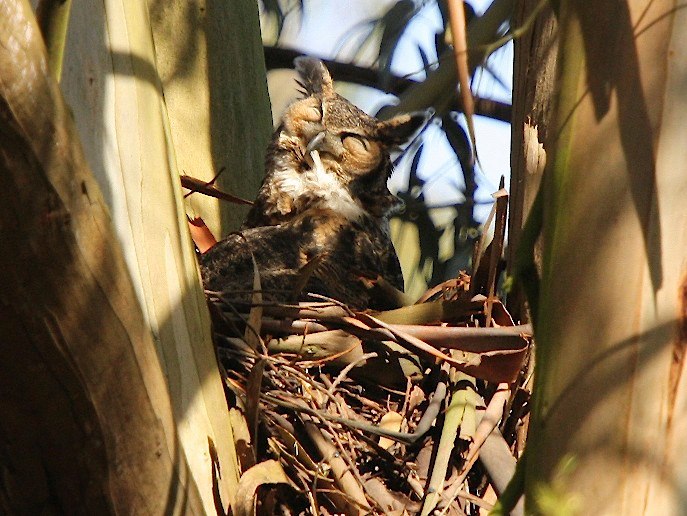
Owl nest
Courtesy urbanwildness.com

Some of the folks who are opposed to the use of pesticides in our public lands have written the following comment on the draft reassessment of blue gum eucalyptus by the California Invasive Plant Council.  Their organization is named Communities United in Defense of Olmstead [CUIDO) for a 1999 Supreme Court decision which affirmed the rights of disabled Americans. 

We are publishing their comment at their request and extending their invitation to our readers to sign their comment.  The deadline for comments is due by July 31, 2014.  They are planning to send their comment on July 29th.  Please let them know if you would like to add your name and/or organization to their comment.  Contact them at: sismhall1@aol.com or 510-654-1366.

Our next two posts will make more suggestions for possible comments.  So, our readers will have several options of topics to cover.  And you are free to sign as many comments as you wish.  It’s still a free country.  Exercise your rights to free speech.  That’s what makes them strong.


To: California Invasive Plant Council

Re: Public Comment, Draft Reassessment of E. globulus

July 29, 2014

We understand that you are now reassessing your listing of blue gum eucalyptus as an  “invasive species” in California, and that you are inviting public comments.

We represent some of the thousands of people who live near and recreate in East Bay area parks and who vehemently oppose the massive removal of eucalyptus trees in our urban forests.  These trees are not “invasive” as you yourselves have conceded; their population is stable. (“It is reasonable to conclude that there is no significant net change in cover statewide.”) Instead you now raise concerns about fire danger and water shortage as pretexts for continuing to scapegoat this species of tree.

Climate change is upon us, and deforestation (which contributes to climate change) in the name of mitigating fire and drought (which are exacerbated by climate change) makes no sense and is counterproductive. We observe every summer that these tall trees capture significant moisture from fog. We witness intense fires all over the west, mostly in areas that do not contain eucalyptus. The scapegoating of this species is a false solution to a very big problem. You are not seeing the forest for the trees.

Furthermore, as people with disabilities, including chemical sensitivity caused by exposure to pesticides, we object to the use of herbicides, which inevitably follow attempts to remove “invasive species.” We are alarmed by the recent dramatic increase in the application of poisonous pesticides to our public parks. This threatens our health and violates our right to access public spaces, a right which is guaranteed by the Americans with Disabilities Act.

Finally, as human beings who love the earth, we cannot allow to go unchallenged the hubris and ethical failings embedded in the idea that we humans have a right to destroy ecosystems. (If any species belongs on a list of “invasives,” it is homo sapiens!) Such destruction is the inevitable consequence of your decision to continue with this listing. The science does not justify keeping eucalyptus on your list of “invasive” species. It is rooted in xenophobic prejudice, and like all bigotry, will cause untold damage.

Sincerely,

Communities United in Defense of Olmstead (CUIDO)

(contact: sismhall1@aol.com or 510-654-1366)

Additional organizational and individual supporters:

Update:  On March 13, 2015, the California Invasive Plant Council published its final reassessment of Blue Gum Eucalyptus (available HERE).  Cal-IPC has downgraded its rating of invasiveness and ecological impact from “moderate” to “limited.”  Although the detailed assessment is less than perfect, the over all rating itself is an improvement.  Thanks to those who sent comments to Cal-IPC.


California Invasive Plant Council sticks to its guns aimed at eucalyptus

Monarch butterflies roosting in eucalyptus tree.

In December 2013, one of our collaborators in the effort to save our urban forest from pointless destruction submitted a request to the California Invasive Plant Council to reconsider its evaluation of blue gum eucalyptus (Eucalyptus globulus) as “moderately invasive.” 

The California Invasive Plant Council (Cal-IPC) has responded to that request with a draft reassessment which is available here:  http://www.cal-ipc.org/ip/inventory/eucalyptus.phpCal-IPC’s draft maintains the same over-all rating of blue gum as “moderately invasive.”   Cal-IPC is inviting “substantive comments and questions” by July 31st to info@cal-ipc.org.

Today we are publishing with permission the cover letter of a public comment that will be submitted by one of our collaborators.  We hope it will inspire you to write your own public comment by the deadline of July 31, 2014. 


From the perspective of humans, there are pros and cons to most species of plant and animal.  E. globulus is no exception to this general rule.  Cal-IPC reaches a negative conclusion regarding blue gum by exaggerating negative issues and de-emphasizing or omitting positive issues.  Cal-IPC now acknowledges that blue gum has “low invasive potential” only in specific conditions and that its population in California is stable, but it has introduced new issues and intensified others so that it can maintain its overall rating of “moderately invasive.”  I remind Cal-IPC that its name is Invasive Plant Council, not fire council or hydrology council.

Cal-IPC also fails to take into consideration the negative side-effects of attempting to eradicate eucalyptus.  There are environmental benefits associated with leaving blue gums alone.  These damaging consequences of eucalyptus removal should appear on the “asset” side of the ledger:

It is also not in Cal-IPC’s strategic best interests to continue to advocate for the eradication of eucalyptus in California:

  • As the eradication projects get progressively more destructive, the public’s negative reaction to the destruction becomes progressively more aggressive.  There are now thousands of us all over the State and all over the country, working to stop this destruction and we are often effective in preventing these projects from being approved or funded.  An op-ed in the New York Times in September 2013, expressed support for our opinion that the word “invasive” has become a destructive tool and is inappropriately applied to eucalyptus in California.
  • The scientific community has also become progressively more critical of the attempts to eradicate eucalyptus.  Last fall, Nature  magazine quoted several well-known academic scientists in an article that criticized plans to destroy 30,000 eucalypts on Mount Sutro in San Francisco.  In May 2014, the CEO and Chief Scientist of the Nature Conservancy expressed their opinion on TNC’s website that destroying eucalypts in California is unnecessary.
  • Since blue gum eucalyptus is no longer available in nurseries in California and has not been planted for many decades, it has no long-term future in California.  To the extent that eucalyptus is a problem, it is a problem that will resolve itself in time.

Cal-IPC’s continued support for these projects is no longer in the mainstream of scientific or public opinion.  Removing eucalyptus from Cal-IPC’s “hit list” would significantly improve Cal-IPCs chances of success with the plants that remain on its inventory of invasive plants.  The public is unlikely to expend the same amount of energy opposing the eradication of broom, for example.

Cal-IPC has an opportunity to defuse a controversy that is handicapping the success of its venture.  Cal-IPC would be wise to abandon its crusade aganst blue gum eucalyptus.

Update:  On March 13, 2015, the California Invasive Plant Council published its final reassessment of Blue Gum Eucalyptus (available HERE).  Cal-IPC has downgraded its rating of invasiveness and ecological impact from “moderate” to “limited.”  Although the detailed assessment is less than perfect, the over all rating itself is an improvement.  Thanks to those who sent comments to Cal-IPC.

Relentless war on eucalyptus

A new front has opened in the relentless war on eucalyptus in California.  The drought has given native plant advocates an opportunity to develop a new narrative to justify their demands for eradication of eucalyptus.  The opening gambit in this new strategy is an item in Jake Sigg’s “Nature News” of May 16, 2014:

“The prolonged drought of the last 2-3 years seems to be taking its toll.  The Tasmanian blue gums in Glen Canyon along O’Shaughnessy Boulevard strongly show drought stress.  The stress is more evident from the high cliffs above O’Shaughnessy than it is at ground level.  Thinning crowns and discolored foliage was striking.  And that was before the recent heat wave.

Barring substantial rains–unlikely, but not impossible–the trees are in serious trouble.  The City could have an emergency situation and no money to address it.”

 Recap of the war on eucalyptus

When public land managers began the war on eucalyptus in the 1980s it did not occur to them that the public would object.  So deep was their prejudice against eucalyptus, that they assumed the public shared their opinion.  The first two massive projects in the 1980s on National Park Service and State Park properties were greeted with angry public protests.  Land managers quickly learned that it was not going to be as easy to eradicate eucalyptus as they had thought.  They developed a series of story-lines to justify their projects, which were designed to convince the public that the eradication of eucalyptus is both necessary and beneficial.  This is a summary of some of their cover stories with links to articles that debunk them:

Based on our experience, we were immediately suspicious of the new claim that San Francisco’s eucalyptus forest is dying of drought.  We know that our predominant species of eucalyptus—Tasmanian blue gum—grows successfully throughout California, all the way to the Mexican border in climates that are much hotter and drier than the Bay Area.  We also know that the central and north coast of California is foggy during the dry summer months, which doubles the amount of annual precipitation in the eucalyptus forest.  All reliable sources of horticultural information describe blue gum eucalyptus as drought tolerant.  Frankly, we couldn’t see how our eucalyptus could be dying of drought.

What is wrong with our eucalyptus forest in Glen Canyon?

 The picture became clearer when Jake Sigg posted the following on his “Nature News” on June 12, 2014:

“The June 10 newsletter [see below*] included an editorial on an evolving catastrophe, mostly involving our numerous plantations of Tasmanian blue gums.  The editorial focused primarily on the plantations on O’Shaughnessy Blvd in Glen Canyon and on Mt Sutro, and included a photo of a grove of Mt Sutro dying trees.  Here is a photo of the Glen Canyon plantation, taken from above the high cliffs on O’Shaughnessy.  The damage is most visible from high, looking down.

The discoloration of leaves was very dramatic, but the foliage color and condition is not fully conveyed in the photograph.  Some trees defoliated entirely in the prolonged winter dry spell.  Look very closely at the juvenile blue leaves of the coppice shoots; anything that appears faintly bluish are new coppice shoots which grew in response to the late rains we had in February and March.  Once you see coppice shoots on old trees you know the trees are in trouble.  These trees are in double jeopardy, as they invested energy in new shoots, but were betrayed by another dry spell which, under normal circumstances, will last until autumn.  Note that you can now see the grassland through the trees; that slope was not previously visible.  Even a casual inspection of these groves reveals dead, dying, and stressed trees, and under normal circumstances we will have four or five months of dry.  The fire situation is serious right now and is likely to become worse.”

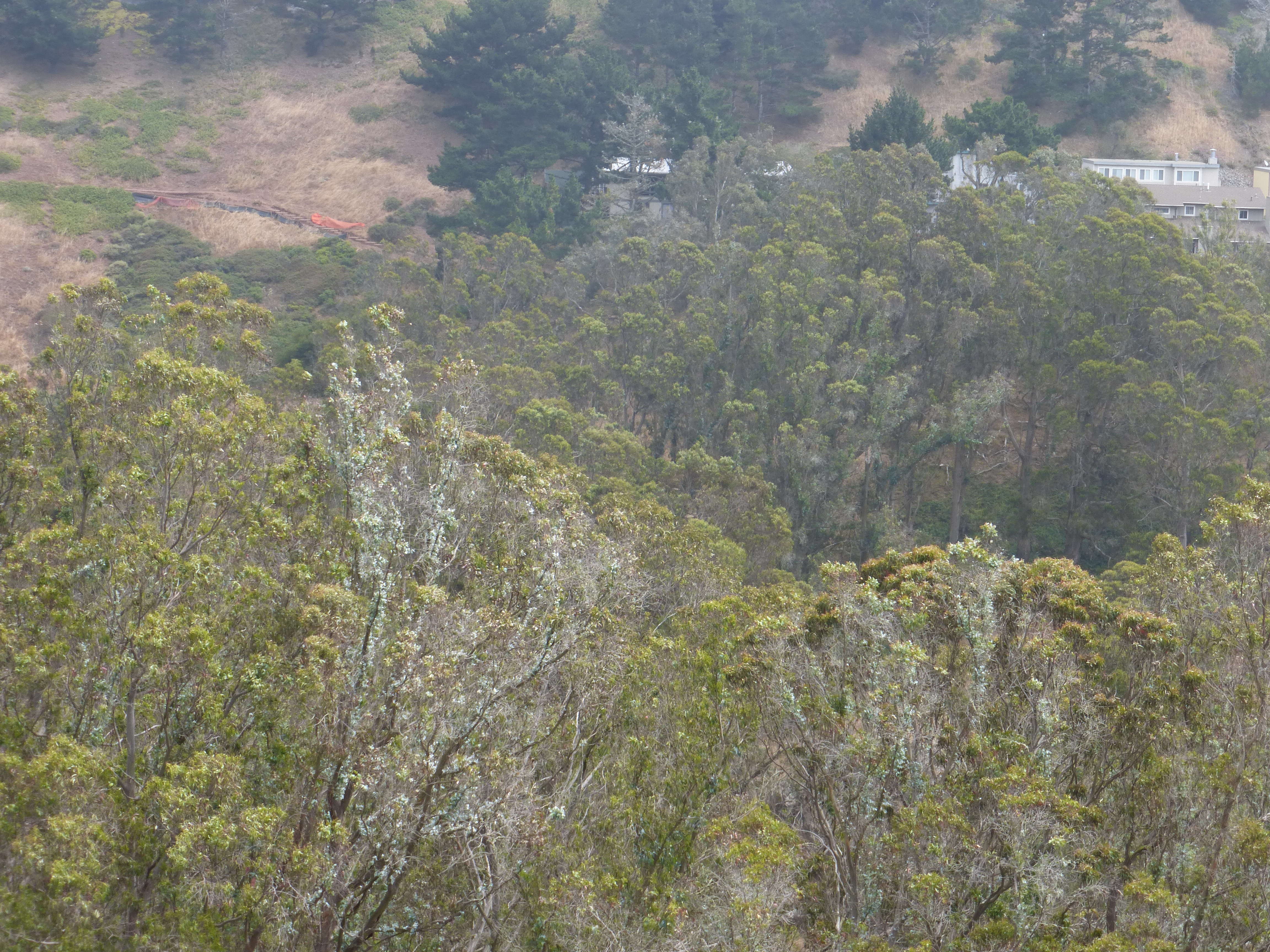
View of west side of Glen Canyon Park from Marietta Drive, June 2014

With more specific information in hand about what Jake Sigg is looking at, we went to see for ourselves.  We could see what he was describing from a vantage point on Marietta Drive, west of Glen Canyon Park.  We could see lighter colored leaves, but they were more localized than Jake Sigg’s description implied.  We didn’t feel qualified to speculate about why the leaves were lighter colored so we recruited an arborist to help us figure out what is happening there.  We were fortunate to enlist the help of a certified arborist who has been responsible for urban forests on public lands in the Bay Area for several decades.  This is what we learned.

Epicormic Sprouts

Looking through binoculars from our vantage point on Marietta Drive, the arborist said immediately, “Those are epicormic sprouts.”  The leaves of epicormic sprouts are distinctively lighter colored than the darker green of mature eucalyptus leaves.  They are also a more rounded shape than the long, pointed mature leaves of eucalyptus.  This is how Wikipedia describes epicormic sprouts:

“Epicormic buds lie dormant beneath the bark, their growth suppressed by hormones from active shoots higher up the plant.  Under certain conditions, they develop into active shoots, such as when damage occurs to higher parts of the plant. Or light levels are increased following removal of nearby plants.”

Epicormic sprouts on trees in Glen Canyon Park, June 2014

The remaining question was why some of the eucalypts, were producing these epicormic sprouts, when most were not.  We went down to O’Shaughnessy Blvd to get a closer look, hoping to answer that question.  This is what we learned:

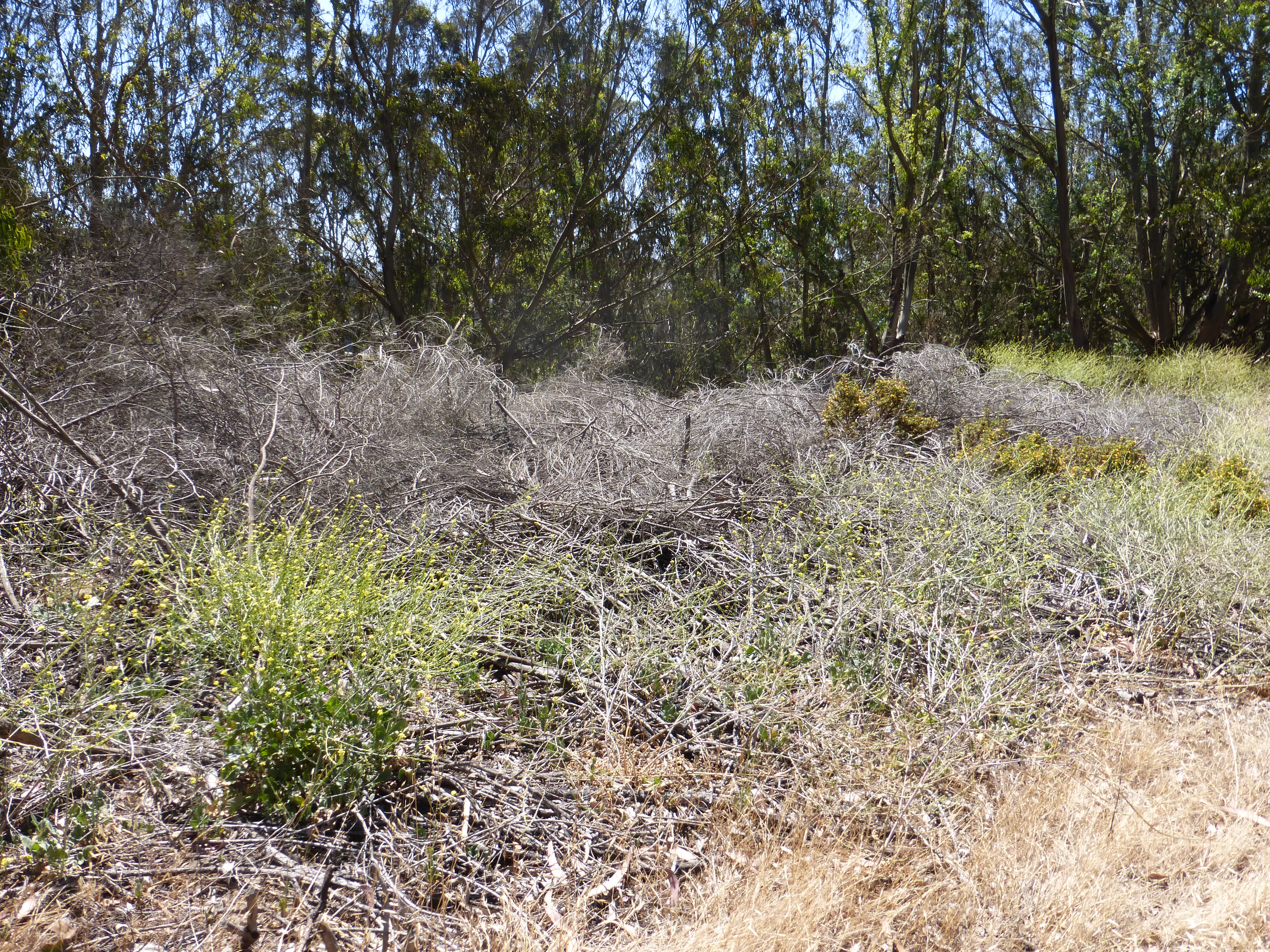
  •  The understory of non-native shrubs between O’Shaughnessy Boulevard and the trees with epicormic sprouts has been cleared in the past year.  We could see the dead brush piled up next to the trees.  We had to wonder how people who claim to be concerned about fire hazard could think such huge piles of dead brush were nothing to be concerned about.
Remains of dead non-native brush destroyed along O'Shaughnessy Boulevard, June 2014
Remains of dead non-native brush destroyed along O’Shaughnessy Boulevard, June 2014
  • We could see the stumps of some of the dead brush and we wondered if the stumps had been sprayed with herbicides after they were cut.  Pesticide use reports for Glen Canyon indicate that O’Shaughnessy was sprayed several times in the past year, twice with products containing imazapyrImazapyr is known to be harmful to trees if sprayed in proximity to their roots.  The trees with epicormic sprouts were downhill from the understory shrubs that were destroyed, in the probable direction of water and herbicide flow.
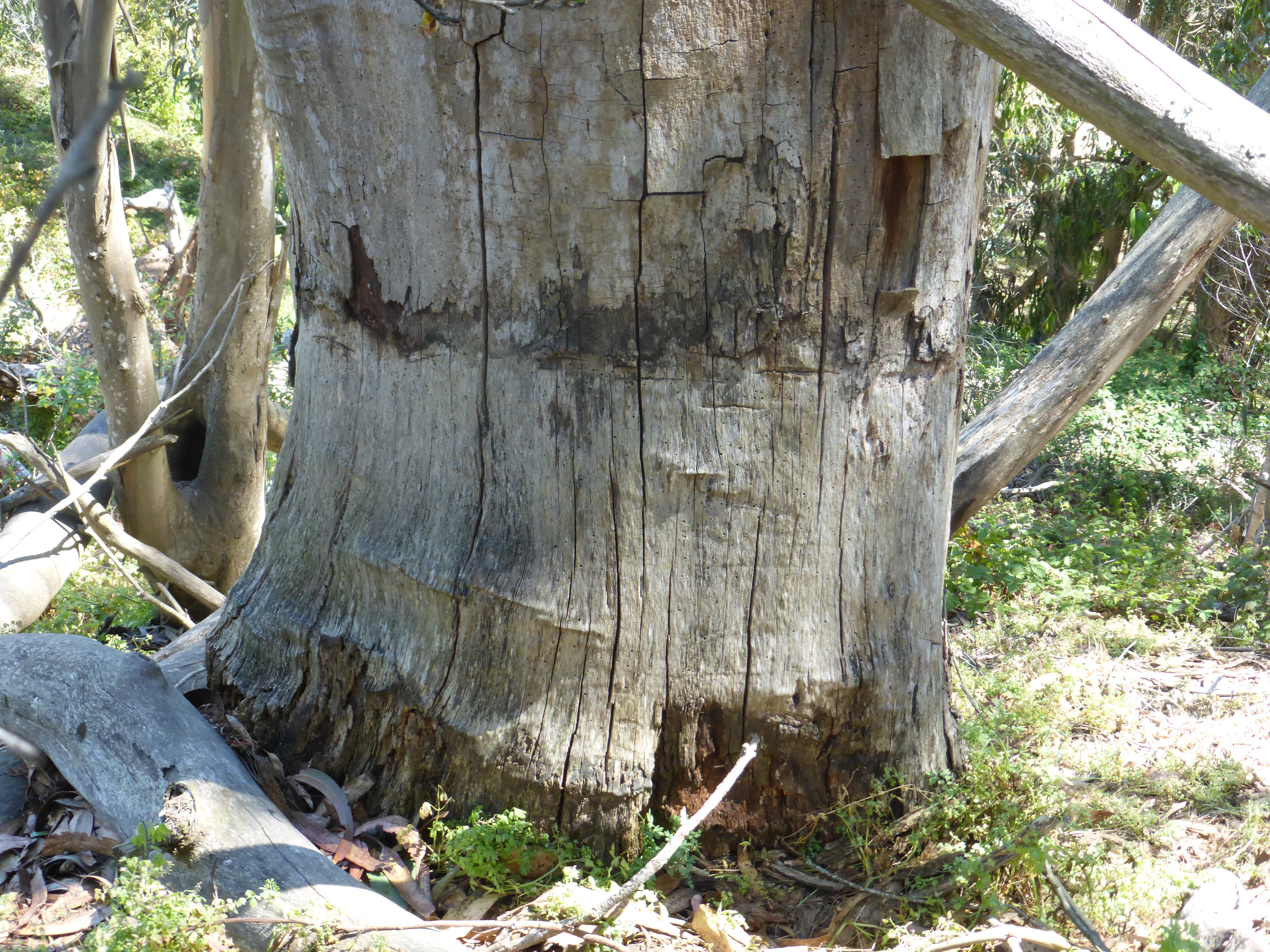
  • We found several trees that had been girdled in the past and are now dead.
Girdled tree in Glen Canyon Park, now dead, June 2014

The trees in Glen Canyon Park

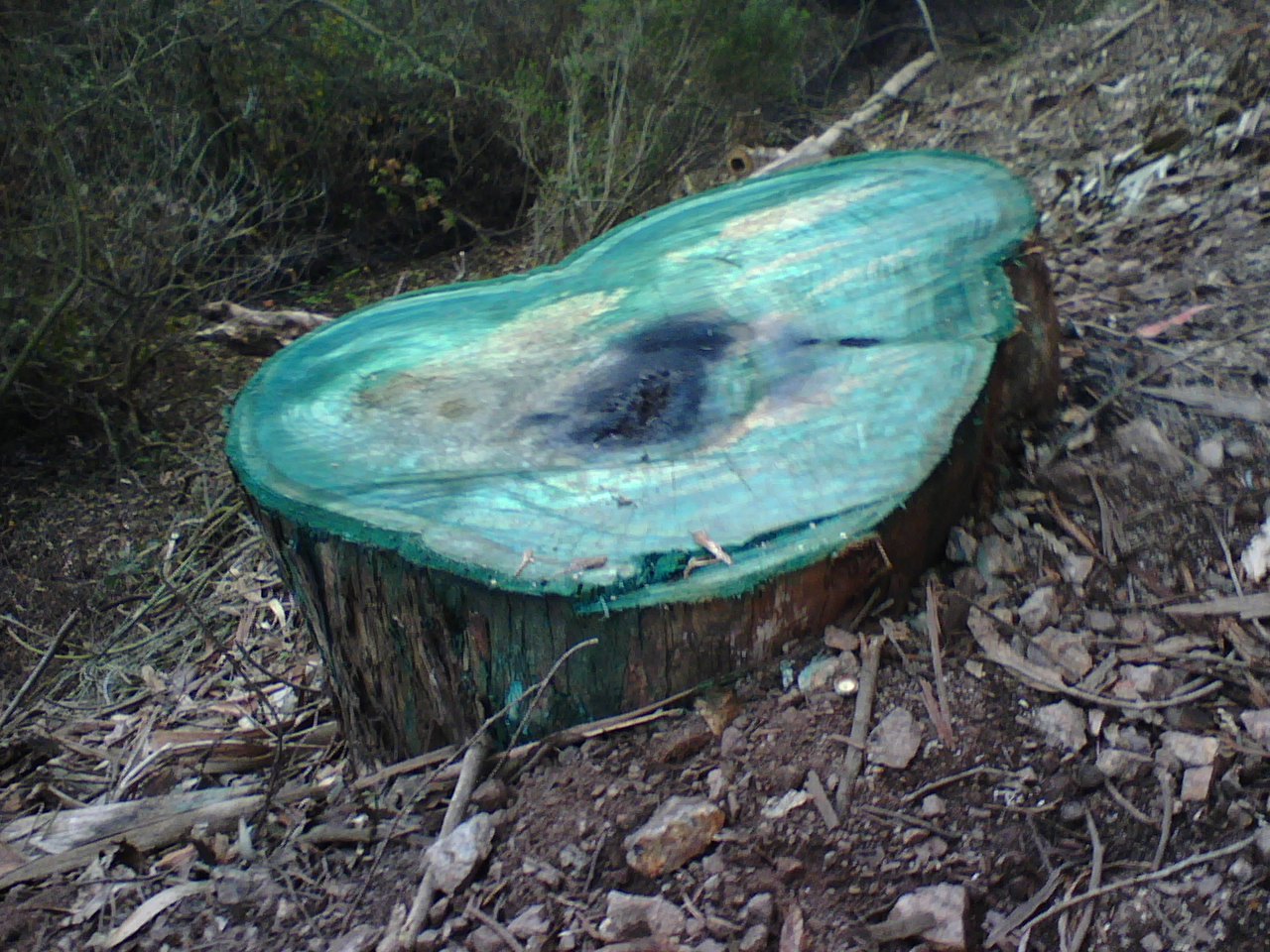
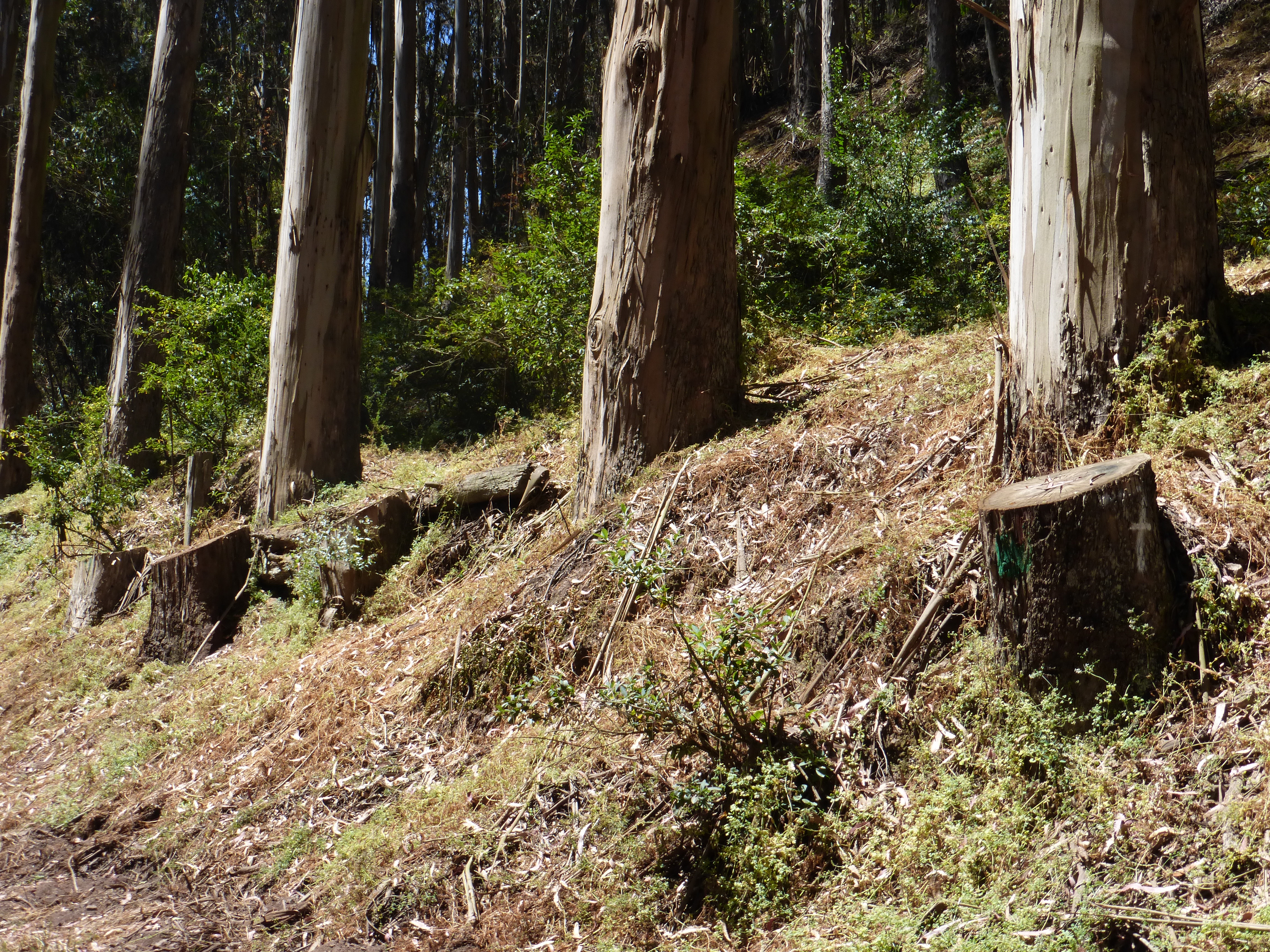
Then we walked into Glen Canyon Park from its southern end.  It’s not a pretty sight.  Many huge, old eucalypts have been destroyed.  When they were destroyed, their stumps were immediately sprayed with herbicide to prevent them from resprouting.  The stumps are simultaneously painted with dye so that workers can tell which trees have been sprayed.  The dye is no longer visible, but regular visitors took photos of the painted stumps before the dye faded.  The spraying of the stumps do not appear on the pesticide use reports of the Recreation and Park Department.  We assume that’s because the spraying was done by the sub-contractors who destroyed the trees.

Poisoned and dyed eucalyptus stump, Glen Canyon Park, 2013. Courtesy San Francisco Forest Alliance

The arborist who walked in the forest with us said, “The painting of stumps with RoundUp or Garlon in proximity to trees that are being preserved can kill the neighboring preserved tree. Stumps near living, residual (preserved) trees should not be painted with RoundUp or Garlon if the stumps are within 40’ of mature, blue gums that are slated for preservation.”  If the remaining trees are damaged by herbicides, their mature leaves fall and epicormic sprouts will then emerge as the tree recovers.

Some of the stumps of the trees that were destroyed in Glen Canyon Park in 2013. Taken June 2014

While the trees were being destroyed in 2013, the Natural Areas Program was eradicating non-native vegetation in the Canyon.  They sprayed ivy, blackberry, and valerian with Milestone, which is another herbicide that is known to damage trees if sprayed near their roots.  In addition to these official applications of herbicide in this park, there is a long history of unauthorized, illegal herbicide applications by “volunteers,” more appropriately called vandals.

We saw a lot of epicormic growth in the Canyon, sprouting from stumps that must be cut back and resprayed with herbicides.  It usually takes several retreatments to successfully kill the roots of eucalypts that are destroyed.  We also saw epicormic growth from eucalypts that had been severely pruned and were also exposed to a great deal more light because they had lost the shelter of their neighboring trees.

Epicormic growht, Glen Canyon Park, June 2014
Epicormic growth, Glen Canyon Park, June 2014

Wrapping up

The trees in Glen Canyon are reacting to the traumas to which they have been subjected:  the loss of their neighbors that were either girdled or cut down thereby exposing them to more light and wind, the loss of the shelter of their understory, the application of herbicides known to be harmful to trees.

The good news is that there are still plenty of trees in Glen Canyon that have not yet been destroyed and they are in great shape.  Here is the view of the tree canopy in Glen Canyon taken from the east side of the park near Turquoise Way.  The first picture was taken in December 2012 (before the current round of tree destruction in Glen Canyon Park) and the second picture was taken in May 2014.

Eucalyptus canopy on east side of Glen Canyon Park, taken from Turquoise Way December 2012, before tree destruction began. Courtesy San Francisco Forest Alliance
Same perspective of Glen Canyon tree canopy, taken May 2014. Courtesy San Francisco Forest Alliance.

These trees are doing just fine because the Natural Areas Program has not yet gone that deeply into the park.  But NAP intends to destroy many more trees in Glen Canyon (and elsewhere) when the Environmental Impact Report (EIR) for their management plan (SNRAMP) is finally approved.  Then we will see more consequences of the destructive practices of the Natural Areas Program and we will probably hear more bogus explanations for that damage.

We expect the EIR to finally be considered for approval at the end of 2014.  [Update:  now predicted for fall 2015] We will do whatever we can to convince San Francisco’s policy makers that they should approve the “Maintenance Alternative” which would enable NAP to continue to care for the native plant gardens they have created in the past 15 years, but prevent them from expanding further.   We hope that our readers will help to accomplish this important task.


*Jake Sigg’s Nature News of June 10, 2014, introduced the theories of Craig Dawson about the health of the Sutro Forest.  Mr. Dawson’s speculations are different from Mr. Sigg’s and we will not address them in this post.  You can find an analysis of Mr. Dawson’s theories on Save Sutro Forest HERE.