“Restoration is just horticulture dressed up to look like ecology”

Peter Del Tredici was invited to speak at a conference sponsored by the Presidio Trust in San Francisco, “Bridging the Nature-Culture Divide Conference by the Cultural Landscape Foundation,” January 23, 2015.  Professor Del Tredici recently retired as senior research scientist at Harvard’s Arnold Arboretum after 35 years of service.  He is an Associate Professor in Landscape Architecture at the Harvard Graduate School of Design where he teaches courses on soils, plants and urban ecology.  He advocates for a pragmatic approach to urban landscapes, which values novel ecosystems for the functions they perform and their sustainability in stressful environments.

Professor Del Tredici’s presentation at the Presidio Conference was entitled, “Saving Nature in a Humanized World.”  The presentation is available on YouTube.

We attended his presentation, which was warmly received by an audience of about 180 people.  We paraphrase some of his key points.

Update:  Professor Del Tredici has requested that the following statement be added to this post:  “Professor Del Tredici has graciously allowed us to paraphrase–for educational purposes only–some of his key points in his lecture. In no way should his permission to reprint the lecture on this website be considered an endorsement of the political or ecological agenda of “Death of a Million Trees”


Professor Del Tredici began his presentation by complimenting the Presidio for what it has accomplished in the past 20 years and congratulating the Presidio for “…what it has become.  But I’m going to do something very different today.  I hope you’re ready for this.”

Professor Del Tredici spoke about spontaneous urban nature, some of which we control but a lot we do not control.  What does spontaneous nature look like?  The reason why this is important is because it’s about the future.  What is the world going to look like 20 years from now?  The answer to that question is in urbanized nature.
Del Tredici 1 copy

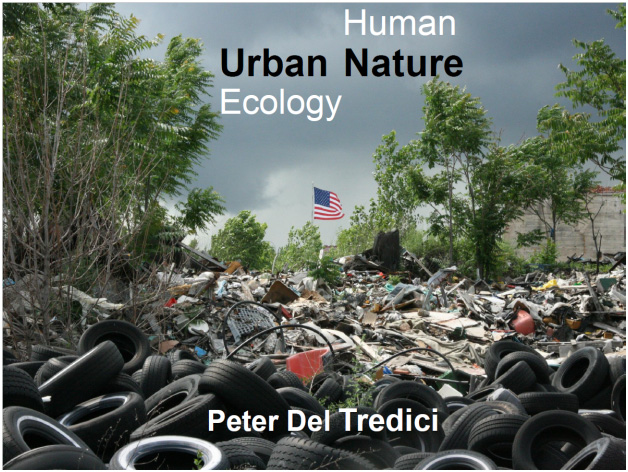
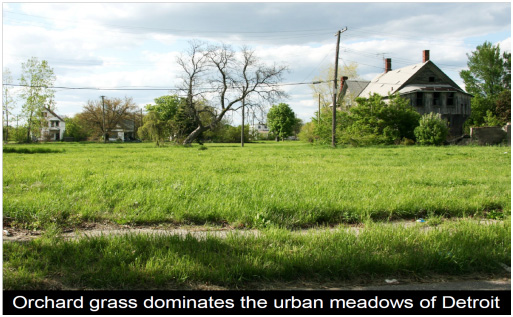
Detroit is a depressing place from a sociological standpoint.  It is so economically depressed that the land has lost its value.  Forty percent of the land is no longer occupied or managed by public or private entities. From the standpoint of a botanist, it is a fascinating place because we can see how nature develops without human interaction.  Detroit is a case study for urban ecology.
Del Tredici 2 copy

Globalized Ecology

The vegetation of most cities is as cosmopolitan as its human population.  Asa Gray’s “Manual of Botany” reports that 10.7% of plant species in Northeastern United States were non-native in 1856.  By the 1990s, 25-35% of plant species were non-native.  This number is not going down.  It’s a strongly upward trend over the past 150 years.  We can create little islands of native plants by eradicating non-native species, but the reality is that our ecology is becoming as globalized as our economy.  These changes mirrored the changes in the ethnic and racial composition of American cities.  The same forces that produce socio-economic changes in cities are also changing the biological environment.

Urbanized Environment

A significant portion of land area in the Northeast is fully urbanized.  Urbanization in the West is just as rampant as the Northeast.  Looking at an aerial view of Los Angeles, you can see that it is completely developed.  You can talk about what used to grow there, but the concept that there is a vegetation that is native to these current conditions, Professor Del Tredici said, “Personally I find that an absurdity.  I hate to be so harsh, but nothing is native to LA as it now exists.”

Del Tredici 3 copy

  • Cities have distinctive environmental characteristics, such as the urban heat island effect. Cities are significantly warmer than rural adjacent areas, which means they are important predictors of the impact of climate change because they have already warmed as much as other places are projected to in the future.
  • Urbanized areas can also be defined by the amount of impervious surface they contain. When 25% or more of the land is covered with an impervious surface such as roads, parking lots, houses etc., the environment is urbanized from the standpoint of the vegetation because impervious surface fragments the environment, compacts the soil, and interrupts the hydrology.   Using the definition of 30% impervious surface, urbanization describes not only our cities, but also many of our suburbs.
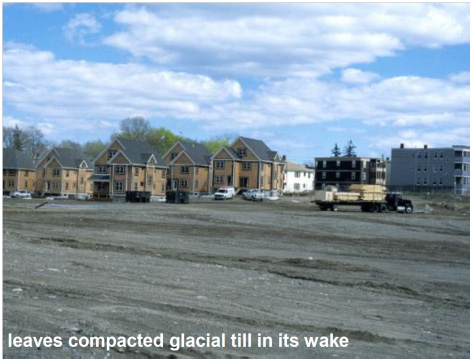
  • Glaciation is analogous to the urbanized environment because the heavy equipment that is used to clear the land leaves in its wake compacted glacial till. What you find after the glaciers recede is barren land; the vegetation has to come back from nothing—a condition known as primary succession.
Del Tredici 4 copy

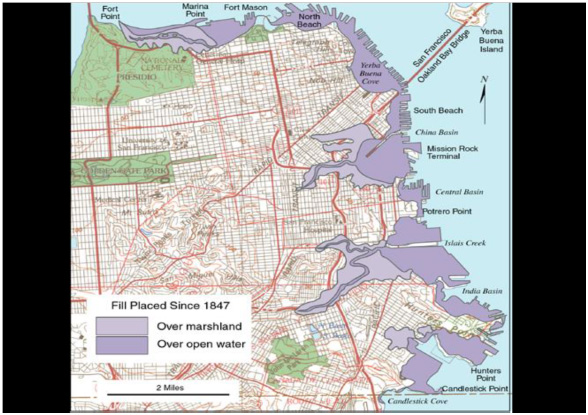
  • One-sixth of the city of Boston is built on land fill. What is the native vegetation of filled soil?  There is no going back when you’re talking about filled urban landscapes.  Not quite as much of San Francisco is built on landfill, but most of the eastern and northern edges of the city are on landfill.
Del Tredici 5 copy

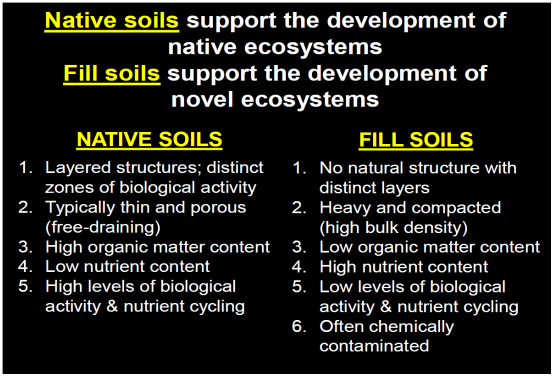
  • There is a huge difference between native soils and fill soils. Fill soils support the development of novel ecosystems. Native ecosystems cannot be created without native soils.  There are some native species that are adapted to urban conditions, such as roadside areas.  Urbanized vegetation is a cosmopolitan mix of native and non-native.  Urbanization favors species that grow well in soils that are relatively fertile, dry, sunny, and alkaline.
Del Tredici 6 copy

  • Where it snows, the roads are repeatedly salted to prevent dangerous, icy conditions. This creates alkaline conditions along roadsides to which many plant species are not adapted.

Urban Ecology

Professor Del Tredici studies modern urban ecology which was born in post-war Germany, where urban environments were reduced to rubble and ecologists began to study what was growing in that rubble.  That was the birth of modern urban ecology.  It’s important to study, not for what it used to be, but for what it is now and what it can become in the future.  Nature reclaiming the urban environment on its own terms is an interesting process, an evolutionary process that we should pay attention to.  Post industrial succession—the process of rebuilding ecology in an intensively urban environment– should be studied with the same level of academic intensity as we studied the post-agricultural succession in the Northeast.

Novel Ecosystems

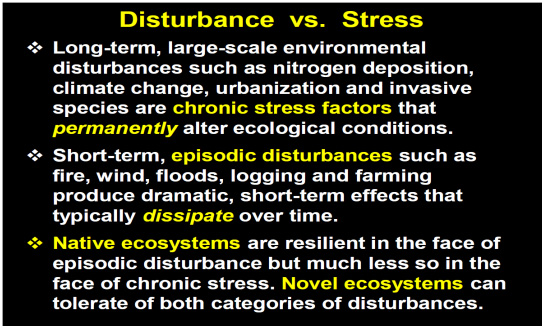
When native forests are converted to urban ecosystems and then abandoned—as seen in Detroit– they don’t go back to their original state, rather they become novel ecosystems.  There is no going back.  Once we achieve the level of compaction and impervious surface of an urbanized environment we have limited what the landscape can become in the future.  Some of these changes are permanent.  There are long term disturbances caused by chronic stress factors that permanently alter ecological conditions.  Professor Del Tredici said, “These conditions are not reversible.  Invasive species aren’t going anywhere.  If you remove invasive species you are gardening.  When you garden you are deciding who lives and who dies.  You are just playing god.  This gives you the illusion of control, but it is a never-ending effort to control a process that can’t be controlled.”
Del Tredici 7 copy

In 1996 the Arnold Arboretum was given a 24 acre parcel of derelict land, called Bussey Brook Meadow. In 2011, Del Tredici succeeded in preserving it as a site for research on urban ecology by leaving it alone.  The land had a 300 year history of use and abuse, all left more or less alone.  Plant species—both native and non-native–have sorted themselves out and restored a functional wetland in the middle of the site.  It doesn’t matter that it isn’t a native landscape if it is providing the necessary ecological functions.

The Bottom Line

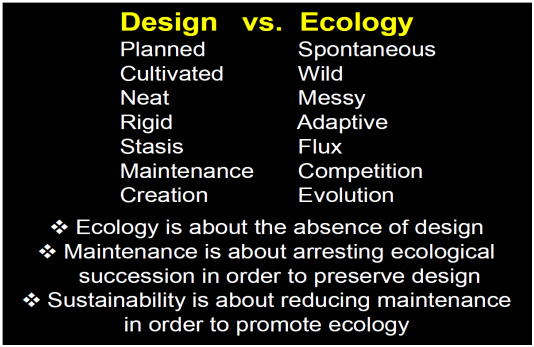
Ecology is not about stasis, it’s about flux.  Stasis is achieved by maintenance, but the natural state is flux.  Evolution is based on competition, which species is the best adapted to current conditions.  Sustainability is about reducing maintenance in order to promote ecology.  Landscape architects look at the Bussey Meadow site and ask, “When are you going to fix it?”  Professor Del Tredici’s answer is, “I’m not sure this site needs to be fixed.  It has value just the way it is.”
Del Tredici 8 copy


We have quoted Professor Del Tredici’s work in previous articles and we consider it important everywhere, but we bring this presentation to your attention today primarily because of where it was delivered.  The Presidio Trust has engaged in some of the most aggressive “restorations” in the San Francisco Bay Area and some of the most successful: Inspiration Point, El Polin Spring, Thompson Reach, etc.  All fish in Mountain Lake were recently poisoned in order to “restore” the lake to exclusively native species.  Pacific chorus frogs were recently reintroduced.  The intention is to reintroduce the Western Pond Turtle to Mountain Lake, a species that is notoriously easily disturbed and being considered for endangered status.  It is also a species that requires hundreds of meters of unshaded nesting habitat in proximity to its water source.
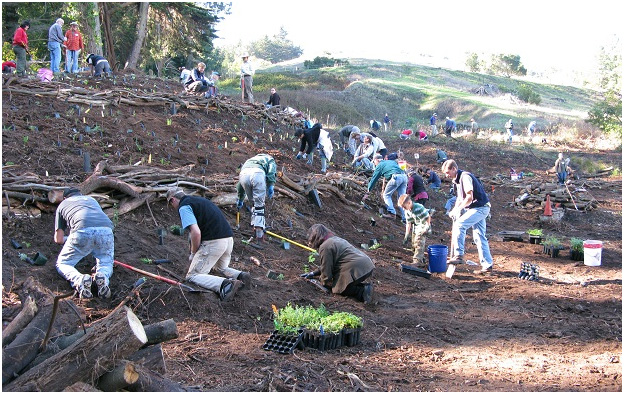
Tennessee Hollow
Tennessee Hollow “Restoration” is 270 acres, 20% of the Presidio. Presidio Trust photo.

These projects have required the destruction of thousands of trees because the native vegetation is grassland and scrub.  However, the Presidio has also made a commitment to the preservation of its historic, non-native forest which was planted by the military over 100 years ago.  Major investments have been made in reforestation of the aging forest with similar tree species.
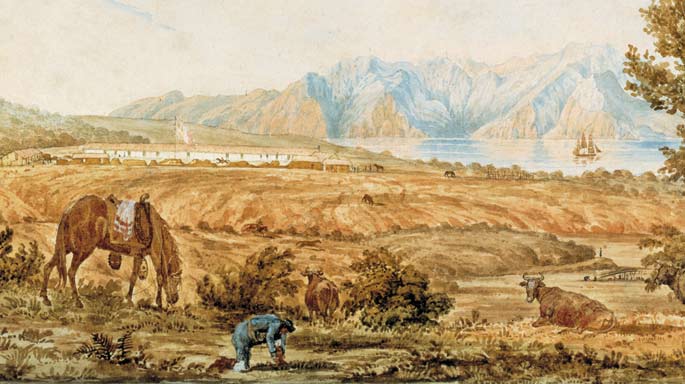
The San Francisco Presidio, painting by Richard Beechey, 1826

In other words, the Presidio Trust seems to have assigned itself a schizophrenic mission to simultaneously destroy an existing landscape in order to re-create it and preserve that same landscape: the re-creation of an idealized landscape vs. preservation of the novel ecosystem within the historic forest.   We suppose that is one definition of “balance.”  However, we would like to believe that the invitation to Professor Del Tredici to speak of the sustainability of urbanized novel ecosystems is an indication that the Presidio Trust will assign more value to what exists and less effort to attempts to re-create an historic landscape that may no longer be adapted to the real world.

“Five Reasons it’s Okay to Love Oxalis – and Stop Poisoning It”

The San Francisco Forest Alliance has published an excellent article about the pointless and harmful attempt to eradicate oxalis in San Francisco’s so-called “natural areas.”  We are grateful to SFFA for their outstanding research and permission to republish the article. 


The oxalis season is over, and the perky yellow flowers have vanished for another year. These Bermuda buttercups will be back next year to herald the spring, bringing joy to those who love them, irritation to those who hate them, and Tier I herbicides targeted at them in San Francisco’s so-called “Natural” Areas.

oxalis 1

THOSE WHO HATE OXALIS AND WANT TO POISON IT WITH GARLON

These flowers are so visible in spring that Bay Nature magazine did an article about them in March 2015: A Natural History of the Little Yellow Flower that’s Everywhere Right Now. It quoted Jake Sigg, the retired SF Recreation and Parks gardener who is considered the doyen of San Francisco’s native plant movement. He hates oxalis pes caprae, which he considers extremely invasive. The article quotes him as saying that, without intervention, “in X many years Twin Peaks would just be one solid mass of yellow, and there wouldn’t be any other plants there…” The article suggested that an oxalis-dominated  landscape “drives away coyotes, hawks and owls that feed on grassland foragers, and the situation is especially dire for endangered Mission blue butterflies, which depend heavily on native wildflowers.” Most of those ‘facts’ about oxalis are mistaken as we’ll explain below.

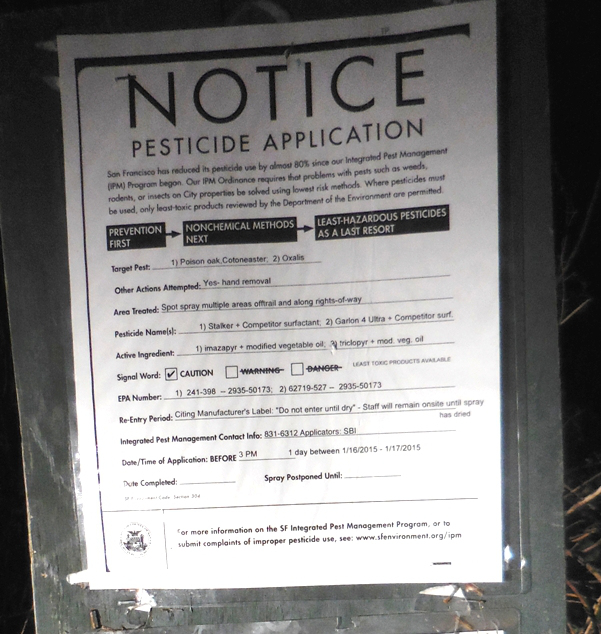
Mr Sigg’s theories align with those of the Natural Areas Program (NAP) of the San Francisco Recreation and Parks Department (SFRPD), which uses the herbicide, Garlon (triclopyr) to battle oxalis despite its dubious efficacy for the purpose.  San Francisco’s Department of the Environment classifies Garlon 4 Ultra as Tier I: Most Hazardous. It’s listed as HIGH PRIORITY TO FIND AN ALTERNATIVE (their caps). Since oxalis is the main reason NAP uses Garlonthe alternative we propose is – don’t use Garlon or anything else on oxalis.

An article on SaveSutro.com, based on a detailed study by the Marin Municipal Water Department, describes some of the issues with Garlon:

  • Garlon “causes severe birth defects in rats at relatively low levels of exposure.” Baby rats were born with brains outside their skulls, or no eyelids. Exposed adult female rats also had more failed pregnancies.
  • Rat and dog studies showed damage to the kidneys, the liver, and the blood.
  • About 1-2% of Garlon falling on human skin is absorbed within a day. For rodents, it is absorbed twelve times as fast. It’s unclear what happens to predators such as hawks that eat the affected rodents.
  • Dogs  may be particularly vulnerable; their kidneys may not be able to handle Garlon as well as rats or humans.  Dow Chemical objected when the Environmental Protection Agency noted decreased red-dye excretion as an adverse effect, so now it’s just listed as an “effect.”
  • It very probably alters soil biology. “Garlon 4 can inhibit growth in the mycorrhizal fungi…” (soil funguses that help plant nutrition)
  • It’s particularly dangerous to aquatic creatures: fish (particularly salmon); invertebrates; and aquatic plants.
  • Garlon can persist in dead vegetation for up to two years.
Natural Areas Program uses Garlon on oxalis

First, a little about the actual natural history of oxalis. This plant doesn’t set seed in California, and spreads entirely by sending out roots and forming little bulbils (like tiny potatoes) underground. It’s usually found where the soil has been disturbed by activities such as road-building, gardening, or trail-building. In some cases, the disturbance comes from landslides or something similar. It can’t stand frost. If we do nothing, it would tend to die down rather than spreading uncontrollably.

In disturbed landscapes, it can spread fast. For this reason it can be a nuisance in gardens. People don’t want to leave their gardens alone for years to let nature take its course with the oxalis, and not every garden design includes brilliant yellow as the dominant color for a few weeks. The only way to eradicate it in the short term is to dig it out carefully every time you see it, and make sure you get most of the bulbils. Or use strong herbicides, which may not work.

In a natural landscape, though, it’s a different story and here’s why.

1) OXALIS IS GOOD FOR BEES AND BUTTERFLIES

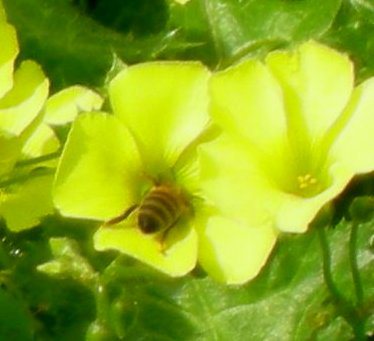
Honeybee on oxalis flower

Oxalis is actually an excellent plant for bees and butterflies.  When blooming, it provides “copious nectar.” In fact, it generously gives away its nectar. Since it doesn’t set seed, it doesn’t benefit from pollinators – but it’s a food source for honey bees, bumblebees and butterflies. (You can read a rather technical description of the plant HERE in a 2-page PDF note from UCLA’s Barry A. Prigge and Arthur C. Gibson.)

Bumblebee on oxalis flower

In fact, a recent 2014 study shows that plant communities with exotic plants had more plant species as well as more pollinators, that pollinators didn’t prefer native plants, and that even some specialist pollinators depended on introduced plant species.

It’s true the Mission Blue butterfly needs (native) lupine as its nursery plant. (It doesn’t depend on any other native wildflowers – only three varieties of lupine.  Incidentally, one of the key nectar sources for the Mission Blue butterfly is an invasive non-native Italian thistle: Carduus pycnocephalus).

Butterfly on oxalis flower

Lupine has been planted on Twin Peaks as NAP attempts to reintroduce the Mission Blue butterfly there. But lupine is also a plant of disturbed areas, which means that NAP must maintain it or it will die out as the area stabilizes. They have to keep planting it, weeding, and trimming the grass around the lupine patches to make it attractive to the butterfly. An SFRPD report on the reintroduction project said “unmanaged habitat deteriorates quickly.” Presumably, they don’t use Garlon near the lupine patches, since it would likely kill that too. Despite what is implied in the Bay Nature article, it’s not oxalis that’s the issue. The real problem is another native plant, the coyote bush which takes over grasslands in a natural succession.

2) OXALIS IS GOOD FOR WILDLIFE

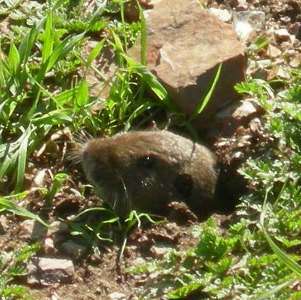
Oxalis bulbils are a food source for wildlife. Gophers and other rodents eat them. In fact, the Bay Nature article says, “Their spread is abetted by pocket gophers and scrub jays, which have been spotted carrying the bulbs and caching them in the ground—effectively planting them in new areas.”

Since gophers are a foundation species in the food web, being dinner for predators from hawks to coyotes to great blue herons, these plants actually provide habitat benefits whether or not they’re flowering, because the bulbils are there all year.

oxalis 6

Where there are gophers, the predators follow. Like the coyotes in these pictures, which clearly haven’t been driven away by a landscape dominated by oxalis.

coyote pouncing in oxalis field. Copyright Janet Kessler
coyote in oxalis field. Copyright Janet Kessler

3)  OXALIS DOESN’T LEAVE THE GROUND BARE

The article says that oxalis leaves “bare ground during the six months of the year oxalis doesn’t flower.” That’s not true either.

oxalis 9

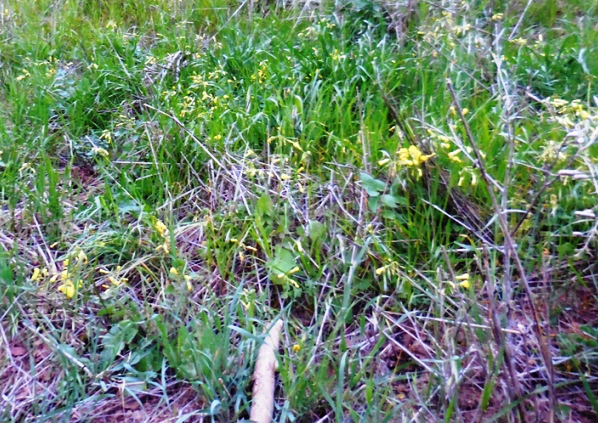
oxalis 10The spectacular yellow bloom of the oxalis – valuable because the mass of color attracts honey bees and bumblebees – gives the impression that it’s the only plant there.  But though it visually takes over the landscape when it’s in bloom, it naturally grows interspersed with grasses and other plants. Like in the picture above.

In fact, oxalis tends to enrich the soil with phosphorus, which is good for grass.

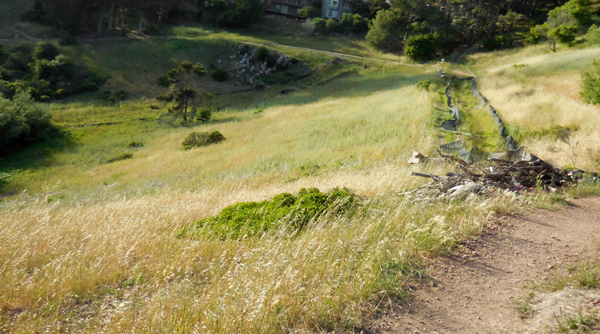
So when it finishes blooming, as it has by now – you don’t get bare ground. The picture below shows the same area as the first picture in this article – but it’s after the oxalis bloom is over. It’s grassland.

oxalis 11

4)  OXALIS HAS LITTLE IMPACT ON “NATIVE” PLANTS

One argument – related  to the ‘bare ground’ argument – is that oxalis takes over grasslands and destroys them, particularly the native grasses. However, grasslands in most of California including San Francisco are dominated by non-native grasses. The change occurred over 100 years ago, when these grasses were planted for pasture. So the grassland that NAP is defending with herbicides is primarily non-native anyway.

oxalis 12

But anyway, what’s the evidence that oxalis is actually damaging native plants?

It’s true some European studies do suggest that an increase in oxalis is associated with a decrease in native plants diversity –though whether it’s a cause is unclear. It may just be benefiting from human activities that disrupt the landscape. Another study put oxalis head-to-head with a native annual grass, lolium rigidum. The native grass tended to dominate. Their conclusion: “Oxalis is a poor competitor. This is consistent with the preferential distribution of Oxalis in disturbed areas such as ruderal habitats, and might explain its low influence on the cover of native species in invaded sites.

The California Invasive Plant Council rates its invasiveness as “moderate,” considering it as somewhat invasive in sand dunes and less so in coastal bluff areas.

In San Francisco, every place where oxalis grows is already a disturbed environment, a mix of non-native grasses and plants with native plants (some of which have been artificially planted).  Here,  oxalis appears to grow happily with other plants – including, for instance, the native California poppy in the picture above.

5) KIDS LOVE IT AND IT’S EDIBLE

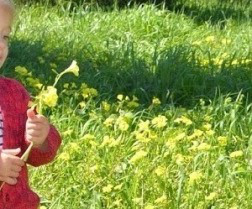
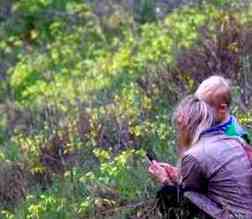
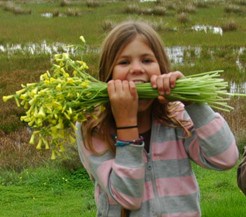
Children love oxalis, both for its pretty flower and for the sour taste of its edible stems.

oxalis 13

oxalis 14Even small children love gathering posies of Bermuda buttercups (though picking flowers is technically prohibited in Natural Areas). The flowers are surprisingly hardy for wildflowers, and in a glass of water last quite well as cut-flowers.

The plant is edible, and its tart leaves make a nice addition to salad. People enjoy snacking on its sour stems. Besides Bermuda buttercup, it’s also called ‘sourgrass’ and ‘soursob.’ It does contain oxalic acid (as does spinach, for instance), and so you probably wouldn’t want to make a meal of it. Though in South Africa it’s made into soup.

Adding Garlon to it is probably a bad thing.

Photo credit: Badjonni (Creative Commons – Flickr)

CONCLUSION

From our current evidence, there’s no sign that oxalis has a negative impact on wildlife, and plenty of evidence it’s already part of the ecological food web of our city.  The evidence also suggests it’s not having a negative effect on other plants in San Francisco either. Lots of people find this flower attractive; one writer described it as the city smiling with Bermuda buttercups.

In any case, even Doug Johnson of the California Invasive Plant Council doesn’t think it’s worth attacking at a landscape level: the payoff isn’t worth the expense. Removing it from the hundreds of acres in Natural Areas isn’t as simple as eradicating it from a small yard where it’s clashing with the garden design. It requires a lot of work, a lot of powerful herbicides, a multi-year effort – and for what?

The justification for using strong pesticides like Garlon to control it is weak. We call on NAP to stop using Tier I and Tier II herbicides altogether.


Science in the National Parks

We were so encouraged by our reader’s report about the conference of the California Native Plant Society (CNPS) that we decided to attend the conference of the National Park Service (NPS), “Science for Parks, Parks for Science” at UC Berkeley, March 26-27, 2015.  As we have reported many times, the National Park Service is heavily engaged in native plant “restorations.”  Their projects are some of the most aggressive in the Bay Area and some of the most successful, because they seem to have greater resources than other local managers of public land.  Therefore, we were curious about their assessment of those efforts.  Are they starting to have doubts, as expressed by some of the presentations at the CNPS conference?  This is a brief summary of what we learned.

The angry old guard

The keynote speaker was E.O. Wilson, the granddaddy of “biodiversity.”  He spoke of his desire to safeguard biodiversity by preserving one-half of the Earth as “protected areas” and the closely related goal to connect all protected areas. This lofty goal should be compared to the current figure of 13% of the earth which is presently protected and the internationally agreed-upon goal of 17%, according to the second speaker, Ernesto Enkerlin, Chair of the IUCN World Commission on Protected Areas.

The moderator, Steven Beissinger, Professor of Conservation Biology at UC Berkeley, asked Professor Wilson a few pointed questions:

  • “Can working landscapes play a role in conservation?” Professor Wilson said. “That is a stupid, dangerous way of looking at conservation.  Parks cannot be evaluated in terms of their value to humanity.  The natural world is valuable in its own right.  Emma Marris and Peter Kareiva of the Nature Conservancy are pushing this; they have the least experience with studying the natural world.  This dangerous thinking must be countered immediately.”  Granted, Emma Marris is a science journalist, but Peter Kareiva was an academic scientist at University of Washington for decades before becoming Chief Scientist at the Nature Conservancy.
  • “Must protected areas be devoid of people?” Professor Wilson said “Of course not.  Indigenous people might be included.”  In fact, indigenous people have been evicted from many protected areas around the globe.  Furthermore, virtually the entire population of the US is not indigenous.  Where does that leave us?
  • “Given the challenges faced by conservation, is triage necessary to prioritize projects to focus on the most important and threatened species?” Professor Wilson said with some feeling, “That’s ridiculous!  We CAN bring them all back, we must SAVE THEM ALL!”

Professor Daniel Simberloff, the well-known invasion biologist, was another speaker who believes it is necessary and possible to eradicate all non-native plants and animals in our public lands.  He also called out by name Marris, Kareiva and others for their criticism of invasion biology.  Frankly, we think these personal attacks are unseemly in the context of what should be considered a scientific debate about the most effective methods of conservation.  The moderator, Professor Holly Doremus (UC Berkeley, Boalt Hall), asked Professor Simberloff a few tough questions as well:

Most other speakers at the conference had a less sanguine view of our ability to “save every species” and “eradicate every non-native species.”  The need for “triage” was repeated in many presentations and descriptions of past and present projects were often pessimistic about the prospects of success.  Climate change and its impact on the environment was the dominant theme of the conference.

All loss, no gain

Mission Blue butterfly.  Wikimedia Commons
Mission Blue butterfly. Wikimedia Commons

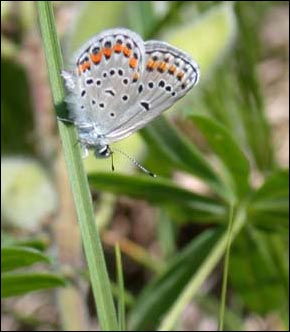
The endangered Mission Blue butterfly exists only in a few locations in the San Francisco Bay Area:  Twin Peaks, San Bruno Mountain, Milagro Ridge in San Mateo County, and the headlands of Marin County.  We recently reported that the 32-year effort to restore butterfly habitat on San Bruno Mountain has been plagued by natural succession to native coyote brush that competes with the butterfly’s host plant, 3 species of lupine.  The status of the butterfly population on San Bruno Mountain is unknown because of inadequate monitoring.  Save Mount Sutro Forest has reported that the butterfly population on Twin Peaks remains very small despite repeated attempts to move butterflies from San Bruno Mountain.  We learned at the NPS science conference that the effort to restore butterfly habitat in the Marin Headlands in order to increase the butterfly population there has experienced its own difficulties.

The restoration of butterfly habitat to the Marin Headlands was controversial because about 500 Monterey pines were destroyed to make way for the lupine scrub required by the butterflies.  The pines had been planted by the military over 100 years ago.  They were heavily used by raptors during their annual fall migration through the Bay Area.  The Marin chapter of the Audubon Society was therefore opposed to their destruction.  As usual, this opposition was ignored by the National Park Service, which manages that property, and the trees were destroyed in about 2009.

NPS has been engaged in the effort to restore the habitat needed by the Mission Blue since the trees were removed.  Those engaged in that effort presented a poster at the NPS science conference which reported:

  • In 2010, NPS and its collaborators attempted to promote the growth of the 3 species of lupine required by the Mission Blue by removing all vegetation mechanically and with prescribed burns, then seeding with lupine.
  • Neither burn nor mechanical treatments resulted in increased lupine species cover after one or three years. In fact, both mechanical and burn treatment resulted in increased cover of non-native forbs and grasses after three years.

In other words, 500 trees were destroyed, which were heavily used by migrating raptors, but Mission Blue butterflies did not benefit from the destruction of these trees because efforts to restore the habitat they require have been completely unsuccessful.  This is a familiar scenario:  all loss and no gain.

Karner blue butterfly - USFWS
Karner blue butterfly – USFWS

We also heard a presentation about a 20-year effort to “restore” the habitat required by an endangered butterfly (Karner blue) at Indiana Dunes National Lakeshore.  The complete failure of that effort is attributed to changes in the climate, considered “abnormal:”

Despite advances in our understanding of habitat needs of the Karner blue, and extensive management to meet those needs, Karner numbers at Indiana Dunes have fallen more than 99% over the past fifteen years, with precipitous declines associated with historically abnormal weather in 2012. We have documented a role phenological [seasonal] mismatching between the butterfly and its host plant plays in this population decline and the sensitivity of this species to habitat fragmentation.”

One wonders what “abnormal” weather means during a time of extreme changes in the climate, which are not expected to return to “normal.”  The speaker predicted that the likely outcome for the Karner blue at Indiana Dunes is its complete disappearance and probable replacement with a different butterfly species which is better adapted to the new climate.

Reality Check

Doug Johnson, Executive Director of the California Invasive Plant Council, made a presentation about new digital tools to identify populations of plants considered “invasive:”  CalWeedMapper and WHIPPET.  These tools will enable land managers to set priorities for attempts to eradicate these plants.  Using  a thistle species as an example, he showed a map that indicated this “invasive” plant is present everywhere in northern California, but there are isolated pockets of it south of there.  These small, isolated populations represent potential opportunities to prevent its spread before it is so widespread that eradication is impossible.  This is an example of triage, which was the dominant theme of the conference. 

Oxalis in Glen Canyon Park, San Francisco

Mr. Johnson was recently interviewed by Bay Nature about a non-native species of oxalis, which San Francisco’s so-called Natural Areas Program has been attempting to eradicate for many years by spraying it with Garlon.  Garlon is the most hazardous pesticide used by the Natural Areas Program.  Mr. Johnson expressed his opinion to Bay Nature that it is futile to attempt to eradicate oxalis: “‘It’s not a target for landscape-level eradication because it’s way too widespread.’”

On March 13, 2015, the California Invasive Plant Council published its final reassessment of Blue Gum Eucalyptus (available HERE).  Cal-IPC has downgraded its rating of invasiveness and ecological impact from “moderate” to “limited.”  Although the detailed assessment is less than perfect, the overall rating itself is an improvement.  We are grateful to our readers who sent comments to Cal-IPC on its deeply flawed first draft of the reassessment.

In other words, the California Invasive Plant Council seems to have entered a new era of realistic expectations.  This looks like a BIG step forward to us, because if that viewpoint is adopted by land managers it should mean less destruction and less use of pesticides.

The Take Away

The old guard is unprepared to compromise their firm belief that it is possible to save every species of native plant and animal and that every non-native plant and animal must be killed to achieve that lofty goal. They defend their indefensible opinion by attacking those who are looking for a more realistic approach to conservation. However, climate change is bringing more and more converts to this viewpoint, which was best expressed by one of the plenary speakers, Hugh Possingham, Professor of Mathematics and Ecology, University of Queensland in Australia.  He was asked how his model of “ecological parks” fits with the mission of the National Park Service to preserve the parks “unimpaired.”  We paraphrase Professor Possingham’s answer:

“The Australian conservation ethic is similar to the United States’.  We yearn for pre-invasion days.  When I grew up in Adelaide we had 7.5 hectares of pristine vegetation for the entire city, which had 750 species at one time and now there are 500 species left.  It’s a museum.  It isn’t a functioning ecosystem.  So, we have got to embrace the creation of ecosystems that are not particularly natural.  However, I’ve learned that the birds don’t care where the plants come from.  Where weeds have been ripped out, bird diversity has plummeted.  I have been converted to the European viewpoint of disturbed landscapes: that is, these new plants have value.  Australia is completely over-run with non-native plants and animals.  Australians would be willing to shoot all the feral cats, but the fact is it’s not possible because we don’t have the resources to attempt it, let alone succeed at it.”

Thank you, Professor Possingham, for your frank acknowledgement of the value of new species to wildlife and your acceptance of more realistic goals for conservation in the 21st Century.


Videos of the plenary speakers are available on the conference website, as well as abstracts of posters and presentations.