An epilogue to the saga of the San Francisco Natural Areas Program

On December 15, 2016, the San Francisco Planning Commission approved the Environmental Impact Report for the Natural Areas Program and the Recreation and Parks Commission approved the management plan for the Natural Areas Program.  The public hearing was over 6 hours long and is available for viewing HERE.  Although we watched the hearing, we won’t try to summarize it here because readers can watch it if they wish.  Rather we will comment on a few conspicuous observations about the hearing.

The most noteworthy feature of the hearing was that virtually all of the supporters of the EIR and the Natural Areas Program were allowed to speak first.  Critics of the program were called on last.  If you have spoken at such a hearing, you know that speakers submit a speaker’s card on which they indicate their support or opposition for the agenda item when they arrive.  Typically, speakers are called in the order in which they arrive at the hearing.  This usual procedure was apparently not followed in this case.

The main disadvantage of not being called upon in the order in which speakers arrive is that when a hearing is 6 hours long, many people with other responsibilities—such as work or family obligations—are forced to leave before their names are called.  In the case of this hearing, I heard a number of names called of people whom I knew to be critics of NAP, who did not speak, presumably because they waited their turn but weren’t called in the order of their arrival.

Another conspicuous feature of this hearing was that the vast majority of speakers in favor of the EIR and the management plan either work directly for the program or are affiliated with it.  Many supporting speakers were representatives of non-profits that conduct similar projects or they bring children into the parks to “educate” them about native plants.  Their presence at the hearing was therefore a work responsibility which enabled them to spend an unlimited amount of time at the hearing.

This is an illustration of the biggest obstacle to the realization that nativism is a destructive agenda based on outdated scientific hypotheses for which there is no empirical evidence.  In a word, “restoration” ecology is now a multi-million dollar industry in which many people are employed.  Therefore, there is vested economic interest in continuing such efforts whether or not they are successful or beneficial.

Criticisms of the Natural Areas Program and its EIR

The speakers who opposed the approval of the management plan and its EIR were members of the general public who are neighbors of the so-called “natural areas.”  They mentioned the destruction of trees (and the subsequent loss of sequestered carbon) and the use of herbicides as their primary objection to the plans.  Another important issue was the restrictions on recreational access such as the closure of 10 miles of trails and the requirement that all access be confined to the trails that remain.  These are issues with which our readers are familiar, so we won’t elaborate.

Comments based on personal experience with specific “natural areas” seemed most effective.  One fellow said he had participated as a volunteer in several big plantings of native plants in a natural area.  The plants died each time and presently few plants have survived several attempts to “restore” this so-called natural area.  This experience had led this speaker to conclude that attempts to “restore” this park to native plants were futile.

A neighbor of Glen Canyon Park showed pictures of the impact on her neighborhood of the destruction of trees in the park several years ago.  Her neighborhood has lost its windbreak and therefore dust from the bare ground is blowing into their homes.  Their beautiful view of the trees has been replaced by bare ground.

The Natural Areas Program began 20 years ago and has been fully staffed and funded since its inception.  Therefore, it should be judged by what it has accomplished.  It has closed trails, destroyed trees, and built fences.  It has repeatedly destroyed vegetation with herbicides and planted those areas with native plants.  The native plants have died, in some cases several times in 20 years.  In other words, it has little useful to show for 20 years of investment of effort and money.  Since it has not been successful after 20 years, it seems insane to invest another 20 years of money and effort.  Remember that one definition of insanity is doing the same thing over and over and expecting a different outcome.

Support for the Natural Areas Program

We hesitate to use the word “lie” to describe the justifications for the Natural Areas Program, but after listening to hours of testimony by its supporters, we will use that word to describe a few of their claims:

  • The most effective lie is that all the trees they destroy will be replaced with native trees. In fact, no such commitment is made in the management plan, which says explicitly that the natural areas will be converted to grassland and dune scrub.  This “replacement” fiction is mentioned in the EIR.  However, the EIR makes no commitment to planting the replacement trees in the areas or even the same parks where the trees are destroyed.  This important caveat to the commitment to replace the trees was not mentioned by any of the speakers in support of the plans, including NAP’s leadership.  In the case of the 15,000 trees that will be destroyed at Sharp Park, calling those removals anything other than a clear-cut is a lie.
  • Inaccurate descriptions of NAP’s use of herbicides also qualify as lies. The executive director claimed during the hearing that only 2.67 quarts of “active ingredient” were used in the natural areas in 2016. In fact, public records requests inform us that NAP used 1 gallon (4 quarts) of active ingredient from January 2016 to October 2016.  The “active ingredient” is only a fraction of the amount of the formulated product.  The “inert” ingredients in the formulated product are often considered hazardous.  In other words, reporting only the volume of active ingredient underestimates the amount of herbicide being applied.  The number of pesticide applications done by NAP is another way to evaluate the magnitude of pesticides used by NAP.  From January 2016 to October 2016, pesticides were applied in the natural areas 111 times, which is 85% of all pesticide applications in park areas other than Harding Park (which is a golf course maintained to professional competition standards with contractual obligations regarding turf maintenance).  A full report of NAP’s pesticide use is available HERE.
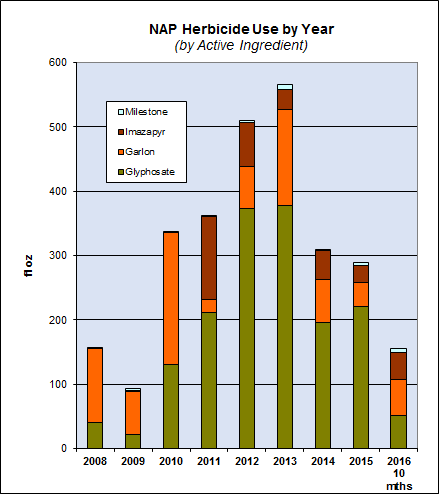
    Courtesy San Francisco Forest Alliance
    Courtesy San Francisco Forest Alliance
  • Claims that the forest in the natural areas will be “managed” for forest health are false. The management plan says explicitly that the trees will be removed for the purpose of expanding native plant gardens that require full sun.  These areas will not be “thinned” as supporters claim.  Rather they will be removed along the leading edge of the forest in order to create more unshaded ground for planting native plants.  The health of the trees is not the criterion for their removal.  These tree removals will not benefit the forest.
However, most of the statements made by supporters are not lies.  Rather they are faithful repetitions of an ideology that most of them probably believe.  Here are a few examples:

  • Nativists believe that native animals require native plants. There is no empirical evidence to support that belief.  All empirical studies find equal numbers of insects, birds, amphibians, etc., using non-native plants.
  • Nativists claim that native pollinators require specific native plants. With few exceptions this belief is mistaken.  The monarch butterfly, for example, is as willing and able to use one of the many non-native species of milkweed as it is a native species.  Some butterflies require a specific genus of plant as its host, but a genus is typically composed of hundreds of species of which many are not native.
  • Nativists believe that the immutable relationship between specific animals and specific plants has evolved over “thousands of years.” They are mistaken.  Animals adapt much more quickly to changes in the environment.  Many changes in plants and animals have been observed over a period of years, rather than a period of centuries, let alone millennia.

Many of the supporters of the NAP plans mentioned that native plants would somehow mitigate climate change.  This is a mysterious notion that I cannot explain.  If we are destroying tens of thousands of trees that store tons of carbon, how can we claim this will reduce climate change?  The grassland that is the goal of these “restoration” projects will store a small fraction of the amount of carbon stored by the trees.  Is this absurd claim a reflection of ignorance about carbon storage?  Or is it a strategy intended to confuse the public?  Whatever the motivation, the claim that native plants mitigate climate change is NOT true.

The nativists apparently do not understand that the ranges of native plants and animals have changed in response to changes in the climate and they will continue to change.  They aren’t stopping climate change by planting native plants.  In fact, climate change requires that the concept of “native” be redefined.  That’s why their projects are unrealistic and futile because they are based on a climate that no longer exists.

The epilogue

The San Francisco Forest Alliance has announced its intention to appeal the certification of the Environmental Impact Report to the San Francisco Board of Supervisors.  This appeal will be heard sometime in 2017.  You will be notified of the hearing if you will subscribe to the Forest Alliance website:  http//sfforest.org.

Meanwhile, the Forest Alliance will ask the City of San Francisco to prohibit the use of the most toxic herbicides in the city’s parks.  There will be two public hearings regarding the city’s pesticide policies and practices:

  • Monday, December 19, 2016, 5 pm. This is a public hearing by San Francisco’s Integrated Pest Management (IPM) Program.  Details about that hearing are available HERE.
  • Tuesday, January 24, 2017. The Commission on the Environment will consider the recommendations of the IPM Program at this hearing.  The Forest Alliance will publish the details of that hearing when they are available.

Best Wishes for a BETTER 2017

The certification of the EIR and the approval of the NAP management plan is not the holiday gift that we were hoping for.  In fact, the entire year of 2016 wasn’t much of a gift to those who believe government has an important and valuable job to do.  We look forward to a better year in 2017 and we wish our readers all the best for the New Year.

christmas-holly-4

An announcement from the San Francisco Forest Alliance about their plans

We are publishing the following email message from the San Francisco Forest Alliance.  They are thanking their supporters for their help at the public hearing about the Natural Areas Program and its Environmental Impact Report.  They are announcing their intention to appeal that decision to the San Francisco Board of Supervisors.  And they inform their supporters of an opportunity to ask the Integrated Pest Management (IPM) Program to prohibit the use of the most toxic types of herbicide in the city’s so-called “natural areas.”  That hearing will take place on Monday, December 19, 2016.  Please help them if you can.


San Francisco SFFA supporters / concerned residents:

Thank you for sending in your letters and braving the rain to sit through the hours long joint meeting of the Planning Commission and SF Recreation and Parks Commission.

Yes, we lost last Thursday and now, with a heavy heart, but with a sense of pride and integrity, please rest assured that we did everything we could to convince the two commissions to see our side.

Thank you for your efforts and for working together, in solidarity and with gratitude from the SFFA leadership.  We will appeal the decision to approve the EIR and will go before the Board of Supervisors next year with an emotional plea that they do the right thing. The City cannot implement the SNRAMP while the EIR is under appeal.

In the meantime, and because the SNRAMP cannot operate without the use of herbicides in city parks, there is something we can now do:

Attend an important hearing on Monday Dec 19th in City Hall at 5 PM.

San Francisco’s Integrated Pest Management (IPM) Program is hearing public input on the guidelines for Tier 1 herbicides and on the approved pesticide list for 2017.

This hearing on the Integrated Pest Management program will be at City Hall on Monday, Dec. 19th at 5 pm, room 408.

We hope you can come because this is our main chance to influence any policy decisions about herbicides for the coming year.

If you plan to attend and make public comment please use our email box  sfforestnews@gmail.com  and leave us your name and phone number so we can coordinate our public input – it is not too late

Important Reading Materials: For those who are planning to speak – those of us who are concerned about pesticide use in our city, please read Attachments B and C(click to access the documents)

B. Draft 2017 San Francisco Reduced Risk Pesticide List, including Draft Restrictions on “most hazardous” (Tier I) herbicides

C. Summary of issues raised regarding pest management for City properties, with agency responses

Note:  It is important that you read these documents prior to making any public comments!

Public opinion does make a difference!

San Francisco Forest Alliance

BE INFORMED – GET INVOLVED – TELL YOUR NEIGHBORS

If you’re on Facebook, please “like” our page: https://www.facebook.com/ForestAlliance

Please sign our petition if you have not already done so.


A tragic fire is an opportunity to revise our fire safety policies

When a warehouse in Oakland burned to the ground, killing 36 young people on December 2, 2016, we learned that the City of Oakland is not inspecting many buildings for fire safety, as required by law.  In fact, this particular warehouse had never been inspected because it wasn’t even on the database for such inspections.  If it had been inspected, “they would have seen what visitors and former residents called a death trap and a tinder box: piles of wood, shingles and old furniture, extension cords and often-sparking electrical wires running willy-nilly throughout the structure, welding equipment and propane tanks scattered about — the kind of fire code violations that could have led inspectors to shutter the building immediately.”  (East Bay Times, 12/8/16)

This tragic loss of young lives is an opportunity for Oakland to examine its priorities with respect to fire safety.  Oakland, like most cities, does not have unlimited resources to address every public safety issue.  Therefore, it must set priorities and in this case, Oakland needs to refocus its efforts where serious fire safety issues exist and where genuine economic need requires the city’s help.  Specifically, we should stop destroying harmless trees and spend our limited resources on identifying and repairing unsafe living conditions that create fire hazards.

Our letter (below) to the elected and city officials of Oakland asking them to revise their priorities regarding fire safety, speaks for itself.  If you agree with us about this issue, please write your own letter to your district council representative if you live in Oakland.

December 9, 2016

Dear Mayor Schaaf, (officeofthemayor@oaklandnet.com)

The recent fire in a warehouse that killed 36 young people should be a wakeup call for city officials who say they are concerned about mitigating fire hazards.  The City of Oakland wasted 10 years defending an indefensible plan to clear cut trees in the Oakland hills, based on the claim that it would reduce fire hazards.  After cancellation of the FEMA grants that would have funded that project, Oakland has made a contractual commitment to spend $800,000 to develop a new plan for “vegetation management.”

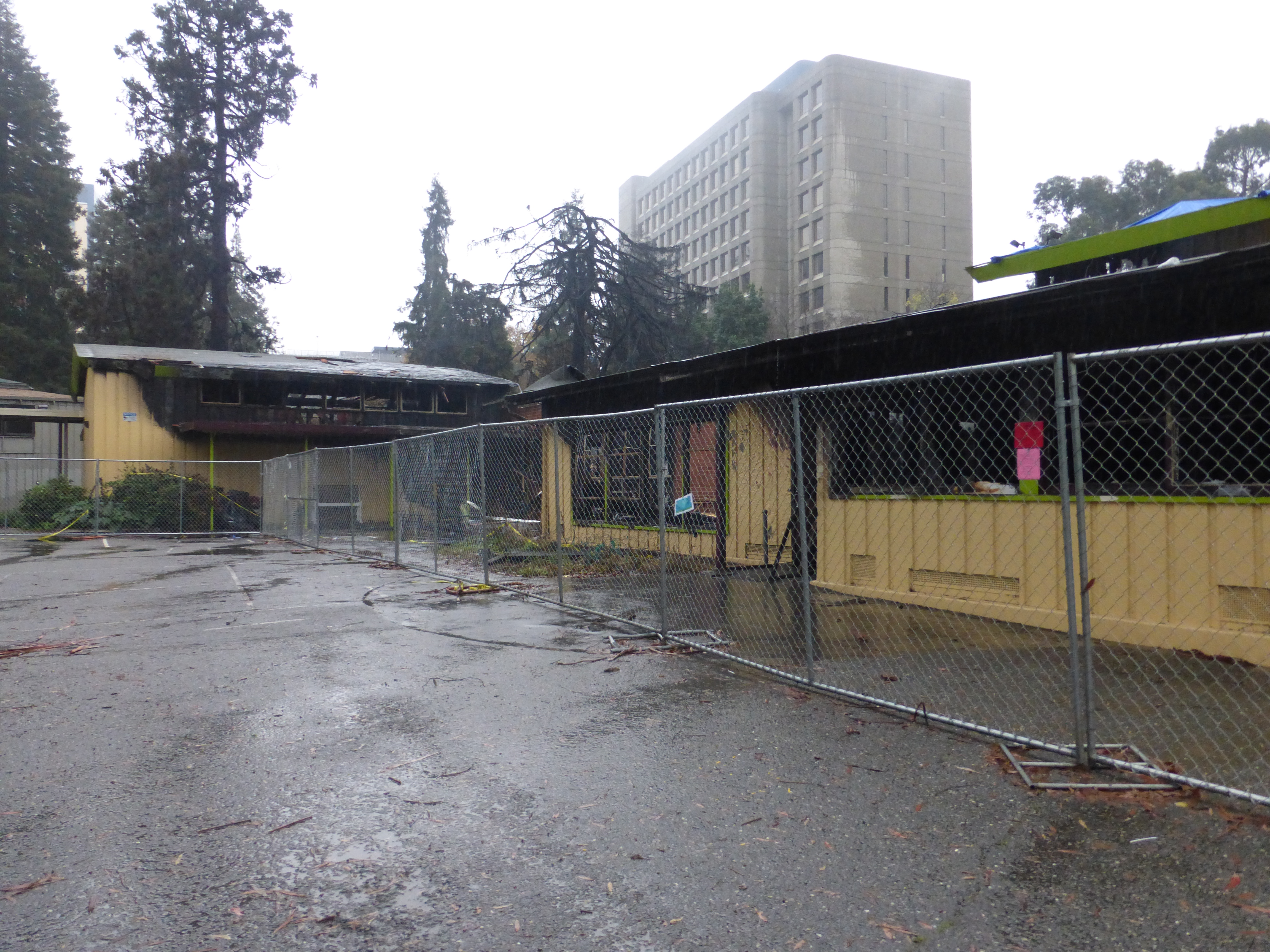
Mosswood Recreation Center was gutted by fire on November 26, 2016

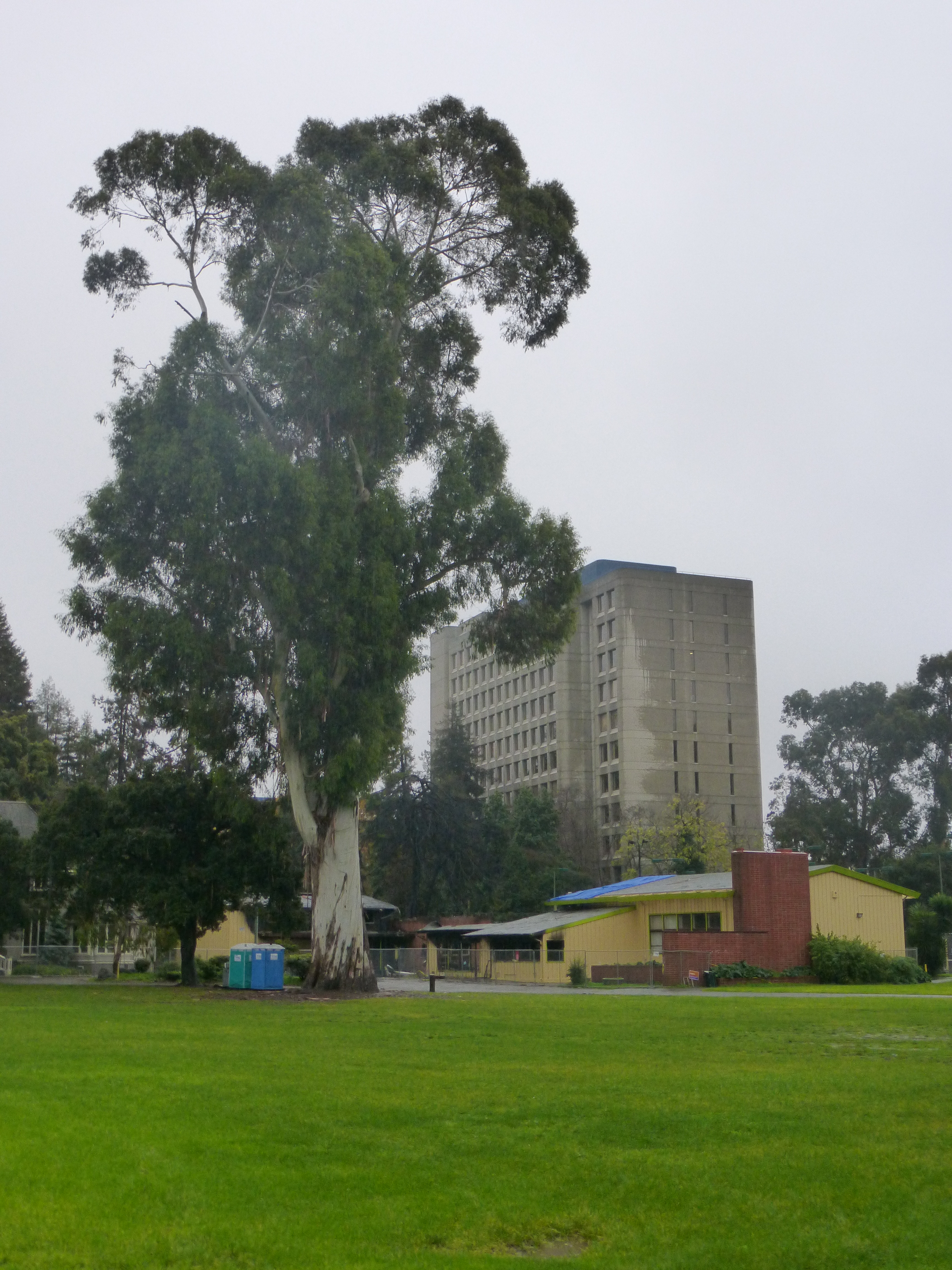
Meanwhile, we have had many major fires of residential properties in the flat lands where trees played no role in the fires.  On November 26, 2016, the recreation center at Mosswood Park burned to the ground, just 50 feet away from a huge eucalyptus tree that was not ignited by that fire.

Trees around the Mosswood Recreation Center were not ignited by the fire, including this huge eucalyptus tree.

And last Friday, a warehouse that should not have been rented to tenants and should not have been used to stage huge parties, burned to the ground.   Although many complaints had been lodged about that warehouse, no inspections or code enforcement corrected the many safety violations.  The media also informs us that there are many other warehouses in Oakland being used illegally with potentially unsafe conditions.  We also understand that the City of Oakland does not have the staff needed to conduct inspections or ensure enforcement of building codes.

In other words, when it comes to fire safety, the City of Oakland is focusing on the wrong issues in the wrong places.  Residents in the hills have the financial resources to create defensible space around their homes.  Young people in the flatlands, do not have the resources to pay for safe housing.  This is both a safety AND an equity issue.

Therefore, the City of Oakland should redirect its limited resources where serious safety issues exist and genuine economic need requires the City’s help.  I am writing to ask that the contract to develop a “vegetation management plan” be cancelled and the money be spent to conduct inspections and to subsidize the mitigation of real fire hazards.

 Thank you for your consideration.

Oakland, CA

Cc:  Councilman Dan Kalb (dkalb@oaklandnet.com) , Fire Chief Theresa DeLoach Reed (tdeloachreed@oaklandnet.com), Assistant to the Chief Angela Robinson Pinon (arobinsonpinon@oaklandnet.com)

The final episode in the 20-year saga of San Francisco’s “Natural Areas Program”

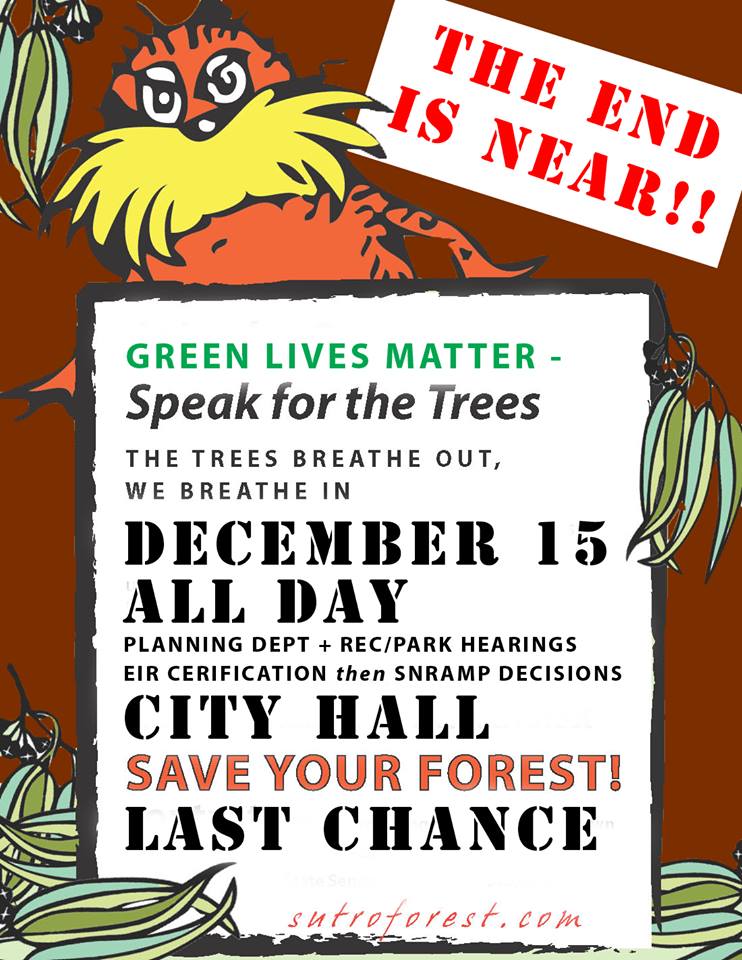
the-end-is-nearOn December 15, 2016, the San Francisco Planning commission will hold a public hearing to consider certification of the Environmental Impact Report for the Natural Areas Program. If the EIR is certified, the Recreation and Park Commission will consider formally adopting the management plan for the Natural Areas Program at the same hearing.  The Recreation and Park Commission will have the option of adopting one of the alternatives to the management plan.  The San Francisco Forest Alliance will ask that the Maintenance Alternative be adopted by the Recreation and Park Commission because it is the “environmentally superior” alternative which will destroy the least number of trees and use the least amount of pesticides. 

If you can attend this hearing and make public comment, please contact the SF Forest Alliance (sfforestnews@gmail.com) for the details about where and when the hearing will take place.  If you can’t attend the hearing, please consider sending an email to the Recreation and Park Commission (recpark.commission@sfgov.org) by Monday, December 12, 2016 (the deadline for submission of written public comments to be included in the agenda packet of the commissioners). 

We lived in San Francisco for nearly 30 years and our local park was designated a “natural area” in 1997.  Based on our experience with the Natural Areas Program, we have sent the following email to the Recreation and Park Commission.  We hope that our letter will help you write your own public comment.


Subject:  Approve the Maintenance Alternative for SNRAMP

Dear Recreation and Park Commissioners,

Since the Natural Areas Program was created 20 years ago, hundreds of healthy trees have been destroyed and over one thousand trees died slowly after being surreptitiously girdled by vandals calling themselves native plant advocates in the 32 so-called “natural areas.”  Hundreds of gallons of herbicide have been sprayed on harmless plants, many that provided valuable habitat and food for wildlife.  Trails have been closed and big signs installed instructing park visitors to stay on the trails that remain. Fences have been installed in some parks to enforce those restrictions.

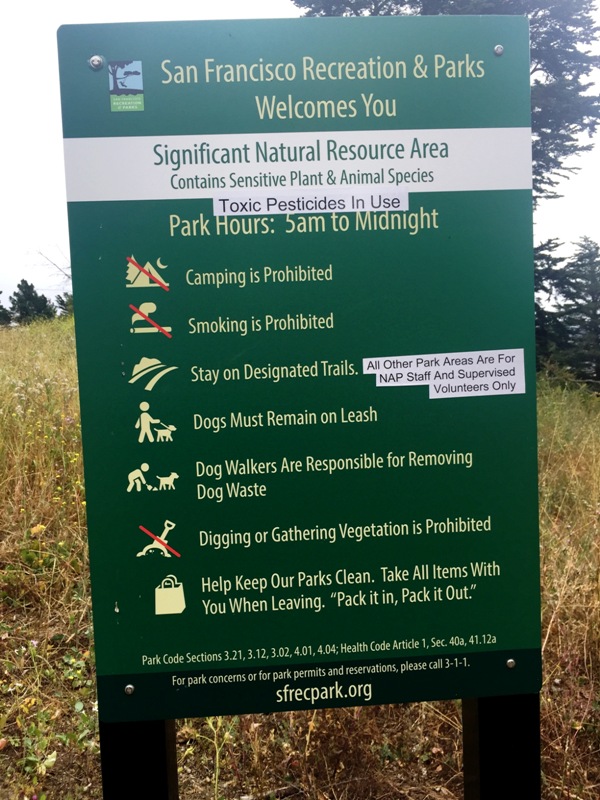
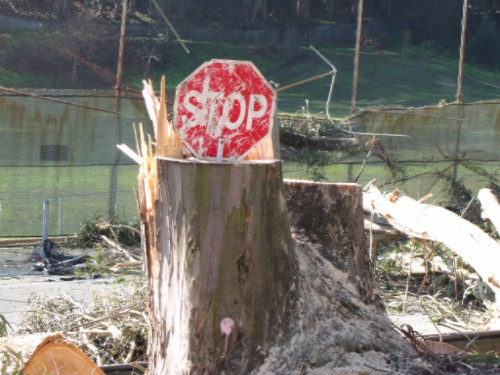
This sign in a "natural area" has been altered to express the public's opinion of the Natural Areas Program. Courtesy San Francisco Forest Alliance.
This sign in a “natural area” has been altered to express the public’s opinion of the Natural Areas Program. Courtesy San Francisco Forest Alliance.

After all that destruction and restriction, what has been accomplished?  Non-native plants have been repeatedly eradicated in the “natural areas” and native plants were planted.  These native plant gardens have repeatedly failed:  the native plants die and the non-native plants return, in some cases many times.  Native trees have been planted in a few “natural areas” but most have died, despite being irrigated during an extreme drought.  After wasting millions of dollars and the associated labor, there is little to show for that investment after 20 years.

Therefore, I am writing to ask the Recreation and Park Commission to vote to adopt the Maintenance Alternative as provided by the Environmental Impact Report that was 10 years in the making.  The Maintenance Alternative would enable the Recreation and Park Department to continue to take care of the “natural areas” they have already created, but it would prevent further tree destruction, further restrictions on recreational access, and require fewer pesticide applications.

Besides the obvious lack of success of the Natural Areas Program after 20 years of effort, there are many other reasons why it would be wise for the Recreation and Park Department to quit throwing good money after bad money.  Here are some of those reasons:

  • The Natural Areas Program was predicated on the mistaken assumption that native plants are superior to non-native plants as habitat for animals. In fact, in the past 20 years multitudes of empirical studies have been conducted that prove that wildlife has no preference for native plants.  Wildlife is just as likely to use non-native plants as they are native plants.
  • The Natural Areas Program also assumed that greater biodiversity would be achieved by eradicating non-native plants. They were mistaken in that assumption as well.  Studies have been conducted all over the world in the past 20 years that find no decrease in plant biodiversity resulting from introduced plants.
  • The climate has changed since Europeans arrived in the Bay Area in 1769 and it will continue to change. The plants that existed here in the distant past are no longer adapted to current conditions.  The ranges of native plants and animals must change if they are to survive in the long run.  Therefore, demanding that historical landscapes be re-created serves no useful purpose.
  • The native trees of California are dying by the millions. The US Forest Service informs us that 102 million native conifers have died in the Sierra Nevada in the past 6 years.  University of Cambridge recently published a study about Sudden Oak Death in which they reported that 5 million oak trees have died in California since 1995 and that the epidemic is “unstoppable.”  There are SOD infections in Golden Gate Park and the Arboretum.  The US Forest Service tells us that Coast Live Oaks will be virtually gone from California by 2060.  A study of redwoods predicts that its native range will shift north into Oregon by the end of this century.  In other words, if we want trees in California, many of them will have to be non-native trees adapted to a hotter, drier climate. 
  • Environmental conditions in a densely populated urban area such as San Francisco are also incompatible with the unrealistic goals of the Natural Areas Program. The heat island effect of urban areas exacerbates climate change.  Increased levels of soil nitrogen caused by the burning of fossil fuels promotes the growth of weeds.

The Natural Areas Program was a good idea that has outlived its usefulness.  We may try to keep it alive for sentimental reasons, but expanding it would be rewarding failure.  Please adopt the Maintenance Alternative.

Thank you for your consideration.

stop-destroying-trees

Embers start spot fires: The real and the imagined stories

Bay Nature recently published an article about the 1991 fire in the East Bay Hills and the closely related belief that such a fire can be prevented in the future by destroying all non-native trees.  To Bay Nature’s credit, it was a more balanced article than most.  Although the article was heavily weighted in favor of those who want to destroy all non-native trees in the hills, several defenders of our urban forest were also interviewed.

However, the article contains a fantasy about future fires that feeds into the fear of fire that has been fostered by those who advocate for removing all non-native trees:

“A strong wind begins blowing over the hills from the east. And then somehow—maybe a spark from a car, maybe a tossed cigarette—the whole dry, airy mess catches fire.  Now the flames on the ground are 30 feet high and even higher off the boughs, roaring like a jet engine. At the fire’s edges, trees appear to explode as the volatile oils in their leaves reach their boiling point and vaporize. The heat of the fire forms a convection column, with 60-mile-per-hour winds that rip burning strips of bark from the trees and toss them upward. This is another of blue gums’ talents—its bark makes ideal braziers. Tucked away inside a rolled-up strip of bark, a fire might live for close to an hour and fly 20 miles.” (1)

Although we have read many times in the plans to destroy trees that eucalyptus casts embers starting spot fires, we have never seen such an extreme description of how far embers could travel while still on fire and capable of starting a spot fire.  So, we tracked down the source of this theoretical scenario with the help of the author who cited this as the source of the theoretical scenario:  “The potential for an internally convoluted cylinder of bark to be transported tens of kilometres in a continuously flaming state is indicated by the sample that maintained flaming combustion for the entire experiment…This would correspond to a flameout time of almost 2000 s for a sample 2700 mm long, a lofted height of 9600 m and a spotting distance of ~37 km.” (2)

First let’s translate that quote into measurements we commonly use to appreciate how extreme this particular test was:  “This would correspond to a flameout time of almost 33 minutes for a sample 9 feet long, a lofted height of 6 miles and a spotting distance of 23 miles, traveling at 41 miles per hour.”  That is a very long ember, lofted a great distance at a great speed (but NOT 60 mph), staying lit for a long time (but NOT “close to an hour”).  

Theory vs. Reality

The study that was the source of the extreme prediction in Bay Nature about the distance that burning embers can travel was conducted on samples of Eucalyptus viminalis bark (NOT Blue Gum Eucalyptus, E. globulus) “tethered in a vertical wind tunnel.”  These are not real-world conditions.  So, how does this theoretical study compare to real-world conditions?

The FEMA Technical Report about the 1991 fire in the East Bay Hills contains a map of the full extent of the 1991 fire.  As you can see on this map, the maximum distance from the northern-most edge of the fire to the southern edge of the fire is less than 3 miles…not remotely close to 20 miles.  In other words, embers could not have started fires 20 miles away because the fire wasn’t even close to 20 miles long.

1991-fire-map-2

The FEMA Technical Report doesn’t tell us what the wind speeds were during the 1991 fire, although they describe the wind as being strong at several times during the fire.  If there is any evidence that winds were as much as 60 miles per hour, it’s not evidence we have been able to find.  We found a source of wind speeds measured on the Bay Bridge, including historical records.  This website says the strongest wind measured since 2010 was 31 miles per hour in April 2013.  That suggests that 60 mph winds are probably unusual in the San Francisco Bay Area.

The FEMA Technical Report doesn’t report any observations of firebrands or burning embers from eucalyptus.  The report mentions embers twelve times, but identifies the source of those embers only once.  In that one case, the source of embers was “a growth of brush”….not a eucalyptus tree or any tree, for that matter.  There are anecdotal reports of finding debris from the fire as  far as San Francisco, but no reports that the debris was still on fire or that it started another fire.

US Forest Service study of embers in actual fires

US Forest Service participated in a comprehensive study of “spotting ignition by lofted firebrands” based on actual wildfires all over the world, including the 1991 fire in the East Bay Hills. (3)  There is nothing in that study that corroborates the claim that eucalyptus bark embers are capable of travelling 20 miles while remaining lit and therefore capable of starting spot fires:

  • “In the wildland-urban interface fires in California—Berkeley in 1923, Bel-Air in 1961, Oakland 1991—wooden shingles which were popular in California as roof material, assisted fire spread. Wooden shingles increase fire hazard owing to both ease of ignition and subsequent firebrand production.
  • “Unlike the flying brush brands which are often consumed before rising to great heights, the flat wood roofing materials soared to higher altitudes carried by strong vertical drafts…”
  • The only specific firebrand found in the 1991 Oakland Hills fire was found approximately 1 km (.6 mile) west from the perimeter of the fire, “though it may have travelled several  kilometres [1.86 mile].” It was a cedar shingle.  Here is a photograph of that shingle:  ember-1991-fire-2
  • Cylinder shaped embers do not travel as far as flat particles. Firebrands in the shape of cylinders were found to have a maximum spotting distance of 2050 meters, because “cylinders always fall tumbling.”
  • “The increased burning time inherent in larger firebrands was cancelled out by an increased time of flight because larger firebrands move more slowly.”
  • In a study of 245 extinguished fires, experiments and simulations, and observing 48 wildfires, “The longest spotting distance was observed as 2.4 km.”

This comprehensive study of actual wildfires all over the world finds no evidence of embers capable of travelling 20 miles while still burning and starting spot fires.  It reports that wooden shingles were the only observed burning embers in the 1991 fire and that wooden shingles are particularly vulnerable to being lofted as embers in a wildfire.  There are countless houses in the East Bay Hills covered in wooden shingles, yet instead of addressing that obvious source of embers, we are destroying blameless trees.

Developing the Cover Story

Claims about the extreme flammability of eucalyptus have escalated in the past 15 years as opposition to destroying trees and associated pesticide use has escalated.  Nativists have become increasingly dependent on flogging the fear factor as their other storylines have been dismantled by empirical studies and reality:

  • Monarch butterflies roosting in eucalyptus tree.
    Monarch butterflies roosting in eucalyptus tree.

    The “invasiveness” of eucalyptus has been downgraded by the California Invasive Plant Council from “moderate” to “limited,” their lowest rating. There is little evidence that eucalyptus is invasive unless planted along streams and swales that carry their seeds.

  • There are many empirical studies that find that all forms of wildlife—such as insects and birds—are served equally well by both native and non-native plants. Some iconic species—such as Monarch butterflies, bees, hummingbirds, hawks, owls—are dependent upon eucalyptus for winter nectar and safe nesting habitat.
  • Huge global studies of biodiversity report that the introduction of non-native species has resulted in no net loss of biodiversity. This is particularly true of introduced plants.  There is not a single instance of extinction caused by a non-native plant in the continental United States.
  • Climate change is making nativism increasingly irrelevant. California’s native conifers, oaks, and redwoods are dying by the millions.  Unless we want a treeless landscape, we must plant tree species that are capable of tolerating changed climate conditions.

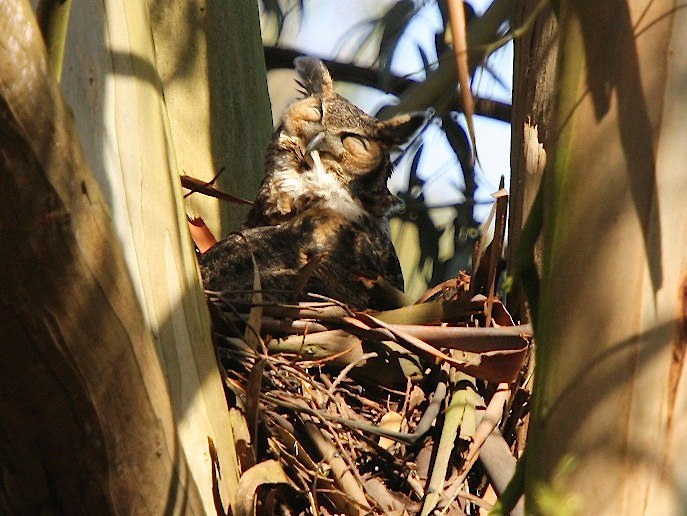
    Owl nesting in eucalyptus, courtesy urbanwildness.com
    Owl nesting in eucalyptus, courtesy urbanwildness.com

These studies have left nativists with few tools to justify the eradication of non-native plants.  We can see the development of the FIRE!! cover story in the archives of the conferences of the California Invasive Plant Council.  In 2004 Cal-IPC held a workshop regarding exotic trees and shrubs.  Over 30 representatives of major managers of public lands attended, such as National Park Service, San Francisco’s Natural Areas Program, Marin County Open Space, etc.  The record of this meeting reflects the dependence upon fire to justify the eradication of non-native shrubs and trees:  “Golden Gate National Recreation Area:  ‘inform public ahead of time; use threat of fire danger to help build support for invasive plant removal projects.’”  The Golden Gate National Recreation Area—a National Park–advises other land managers to frighten the public into accepting the loss of their trees. 

Subterfuge is also recommended to land managers to hide the eradication of shrubs and trees from the public:  “To avoid public upset, drilling around into tree buttress roots and injecting 25% glyphosate…Trees die slow and branches fall slowly, so won’t pose an immediate hazard.”  In other words, land managers were advised to kill trees using a method that won’t be visible to the public. 

Perhaps most disturbing of all is that those who attended this workshop admit that they don’t really know if eucalyptus trees are more flammable than native vegetation and some doubt that they are:  “People are afraid of fire.  Help them understand Eucalyptus trees and other invasive plants are very fire hazardous.  Is there any solid research about Eucalyptus and fire?  Are Eucalyptus and brooms any greater fire danger than native chaparral?”  In other words, even those who wish to destroy non-native shrubs and trees seem to understand that fire is a cover story for which no supporting evidence exists. The evidence has been fabricated to support the cover story.

We now seem to live in a fact-free world in which various interests can make things up and distribute them on the internet with impunity.  The mainstream press is dying and is being replaced by fact-free social media.  If we are to protect ourselves from such manipulation, we must drill down into these storylines.  In the case of eucalyptus, we have debunked the myth that it is more dangerous than the replacement landscape.  Now it’s up to us to disseminate that information far and wide as an antidote to fear-driven nativism. 


  1. Zach St George, “Burning Question in the East Bay Hills: Eucalyptus is flammable compared to what? Bay Nature, October-December 2016
  2. James Hall, et. al., “Long-distance spotting potential of bark strips of a ribbon gum (Eucalyptus viminalis), International Journal of Wildland Fire, 2015, 24, 1109-1117
  3. Eunmo Koo, et. al., “Firebrands and spotting ignition in large-scale fires,” International Journal of Wildland Fire, 2010, 19, 818-843