I was introduced to the nativist mindset about birds over 30 years ago by an ominous encounter with a birder in Florida. The sound of gunfire drew our attention to a man with a shot gun on the lawn of our motel. Starlings were falling around him, where he quickly finished them off with a vigorous stomp of his booted foot. We were unfamiliar with the hatred of non-native species at that time and asked him why he was killing the birds. He seemed stunned to be questioned. He explained, as though speaking to retarded children, that the starlings were “trash birds” that must be killed. Following a basic rule of survival, we walked away from a person wielding a gun.
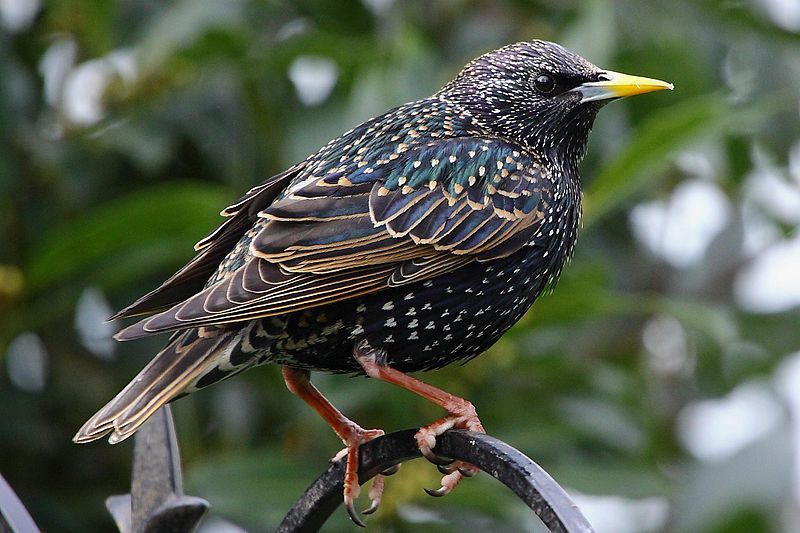
I was reminded of that incident by a recent article in the magazine of the Cornell Ornithology Laboratory. The author of the article studied starlings for her Ph.D. dissertation. She was well aware of their reputation as competitors of native birds and consumers of agricultural crops, but belatedly she was having second thoughts about their reputation as invaders: “Our national conversations about racial equity and political dissent in the last year reminded me that I must change my behavior in response to crises. It has also encouraged me to consider my impact on others, human and starling alike.” She wondered if calling starlings “aliens” might contribute to the negative opinion of human immigrants: “But I can’t help thinking of the parallels with countless stories about human “aliens.” Whether we intend this comparison or not, labeling immigrants “invaders” and “aliens” isolates those who cross a border in search of a safer, stabler life.”
Comments on the article dispel doubts that such a connection between humans and birds perceived as “alien” exists in the minds of at least some nativists. This is the concluding response to my attempt to discuss the issue with a nativist: “I am glad I will not live to see your crap filled America of endless third world suburbs, starlings, and house sparrows. I wish I could live long enough to see it gasp its last breath.” Strangely, this person seems to be angry about something that he fears will happen in the future, but isn’t visible to him now.
The recent fatal shooting of 10 African-American citizens by an 18-year-old self-avowed white supremacist was also an opportunity to witness the fear, hatred, and violence generated by the use of the word “invasion” to describe immigration, as reported by National Public Radio’s News Hour shortly after the shooting: “The alleged Buffalo gunman isn’t the first mass shooter to talk about an “invasion” of non-whites. Last week’s mass shooting in Buffalo has turned attention once again to something known as the replacement theory. It’s a baseless and racist conspiracy theory that powerful elites are trying to replace white Americans with nonwhites and that these elites are allowing a so-called invasion of nonwhite immigrants. That word, invasion, has been used a lot lately by some Republicans and immigration hard-liners”
This racist conspiracy theory bears a remarkable resemblance to the theory of invasion biology, which claims that the mere existence of non-native plants and animals is a threat to native species. Although there is little empirical evidence of that threat, the myth persists and is used to justify the destructive attempts to eradicate harmless plants and animals.
The consequences of fear, anger, and dread
The misnamed USDA Wildlife Services killed over 1.7 million animals in 2021, including 1,028,648 starlings and “dispersed” 10,631,600 starlings. Only 400,000 of the animals they killed were native; 1.3 million were considered “invasive.” The mission of USDA Wildlife Services is “to provide Federal leadership and expertise to resolve wildlife conflicts to allow people and wildlife to coexist.” Since 1886, Wildlife Services has killed millions of animals every year that are considered pests by humans.
Is all that killing effective? Does it actually reduce populations of the species perceived as a threat? What does it accomplish?
Farmers have been at war with birds for as long as humans have engaged in agriculture, some 10,000 years. Crows, grackles, blackbirds, and starlings are often targets of efforts to eliminate them in agricultural areas. Between 1939 and 1945 about 3.8 million crows in Oklahoma were killed by dynamiting their roosts. A study of that effort found no evidence that either the population of crows or crop production was affected by that campaign because nature adjusts: “Destroy a chunk of a population, now there’s more food for the ones who remain. Through a variety of physiological responses—shorter gestation periods, larger broods, delayed implantation—a well-fed individual produces more offspring than one that’s struggling or just getting by.” (1) This balancing act is known to be true of many other animal species, such as coyotes and rodents.
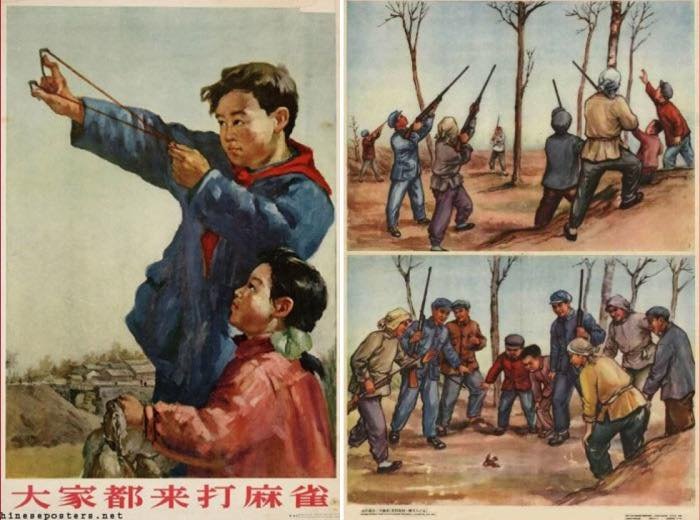
The Four Pests campaign was one of the first actions taken in the Great Leap Forward in China from 1958 to 1962. The four pests to be eliminated were rats, flies, mosquitoes, and sparrows. The campaign depleted the sparrow population nearly to extinction. The sparrows had eaten insects that killed the crops. In the absence of sparrows a plague of locusts contributed to the Great Chinese Famine, killing tens of millions of Chinese between 1958 and 1962. Ironically, the Chinese ended up importing 250,000 sparrows from the Soviet Union to replenish the population.
As is often the case with attempts to kill animals, the decision is usually made without understanding the role the animal is playing in the ecosystem. There are usually positive as well as negative impacts of every member of the food web. When we focus only on the negative impact, there are often unintended negative consequences of eliminating a member of an ecological community.
Starlings are considered an agricultural pest in the US, but they are not routinely killed in England or Europe where they are native, although they probably eat just as much agricultural crops there. The New York Times recently published an article about starling murmurations in Europe. The videos and photographs of these huge flocks of starlings moving in coordinated patterns are beautiful and remarkable. They draw crowds of people who are transfixed by the spectacle.
A study of the impact of starlings in Europe explains why starlings are usually not killed in Europe: “Starlings that cause damage on migration or in winter may have bred in countries, some of them outside the EEC, where the birds cause no damage and are held in esteem on account of their valued role as insect predators, their educational and their aesthetic values. Claims from countries where Starlings winter that breeding populations should, by some means, be limited are unlikely to be received sympathetically by those to the northeast who eagerly await the Starlings’ return in spring… On grounds of effectiveness, feasibility, cost, humaneness and environmental safety a population limitation strategy is unlikely to be an appropriate solution…The potential for Starlings to reestablish large flocks at good feeding sites after heavy mortality has been inflicted locally indicates that even local population reduction is only temporarily effective in reducing damage.”
The popular urban legend about starlings is that they were brought to the US in the 19th century by a dedicated fan of Shakespeare who wanted to introduce all the birds mentioned by Shakespeare to America. Over one hundred years later, scientists have used molecular analysis to disprove that myth. In fact, starlings were brought to America earlier by more than one person to more than one location, including to New York by a Shakespeare fan. This is a reminder that there is always more to know and that we must remain open minded to learn new information as science moves inexorably forward.
Words matter: Vagrants or Scouts?
Birders get excited about seeing birds where they don’t usually see them. When they do, they usually call them “vagrants,” a word that is a synonym for tramps, drifters, beggars, hobos, even homeless people. It’s not a surprising word choice in a crowd that is heavily biased in favor of natives.
An article in New York Times suggests that the word “vagrant” is no longer an accurate description of the birds being seen where they haven’t been seen in the past. The explanation for their surprise visit is often an indication that they are adapting to changes in the environment, including climate change and associated changes in vegetation and insect populations. They are in unfamiliar territory in search of what they need to survive. Perhaps their usual nesting site is now a parking lot. Or perhaps the vegetation they need did not survive a severe drought. Or pesticides have killed the insects they need to feed their chicks during nesting season. They are scouts, not vagrants. They aren’t lost. They are seeking a safe haven.
As the climate changes and human activities continue to encroach on the natural world, plants and animals must move, adapt, or die. The least we can do is stay out of their way. The fact that birds are the most mobile animal class is something to celebrate, not lament. Their mobility makes them more likely to survive changes in the environment. A recent study reported that 13% of bird species are threatened with extinction, compared to 25% of mammal species, 21% of reptiles and 40% of amphibians.
- Mary Roach, Fuzz, W.W. Norton & Company, 2021




 Conservation Sense and Nonsense