Macaylla Silver discovered Conservation Sense and Nonsense on Facebook. We instantly recognized one another as kindred spirits, battle scarred by our attempts to protect nature from pointless destruction in service of the ideology of invasion biology and the native plant movement it spawned.
When confronted with the destruction of wild places we love, our reaction was very similar, and responses to our efforts were also similar. First we turned to public policy for protection: Are they really allowed to poison our public lands with pesticides to destroy harmless plants? With a few targeted “exceptions” to policy, the answer was always, “We can do whatever we want.”
Then we both decided the best course of action was to become experts about the “science” that is used to justify destroying harmless vegetation with herbicides. And so, we took to the books and armed ourselves with the science that refutes invasion biology. Once again, we hit the brick wall of “We can do whatever we want.”
And there Macaylla’s experience as an activist diverges with mine. He has successfully stopped the poisoning of Leverett Pond (for the time being) by showing the neighbors of Leverett Pond with videos, the consequences of poisoning the pond.
However, he concludes his story with the astute observation that stopping the destruction of Leverett Pond is unlikely to be the end of the story. Life in the pond will continue to evolve, as it must. As long as people continue to believe that evolution must be stopped, the futile attempt to prevent change will continue. Macaylla is hopeful that mistaken belief will fade. I hope he is right.
We thank Macaylla for his efforts. We wish him luck in preventing more herbicide applications in Leverett Pond.
Conservation Sense and Nonsense
“Let the Pond Be a Pond”
Massachusetts Wetlands Protection Act was created for the protection of the state’s wetlands. The goals of the law are to prevent pollution, maintain habitats for plants and wildlife, and protect groundwater, public and private water supplies.
Our Town Bylaws in Leverett, Massachusetts also included a ban on the use of herbicides for any use outside of domestic and agricultural use since 1973.
There are five colleges in the area. The town is filled with highly educated academics and retired academics. Leverett is quite ecologically minded in my opinion, this hill town of 2,000 people.
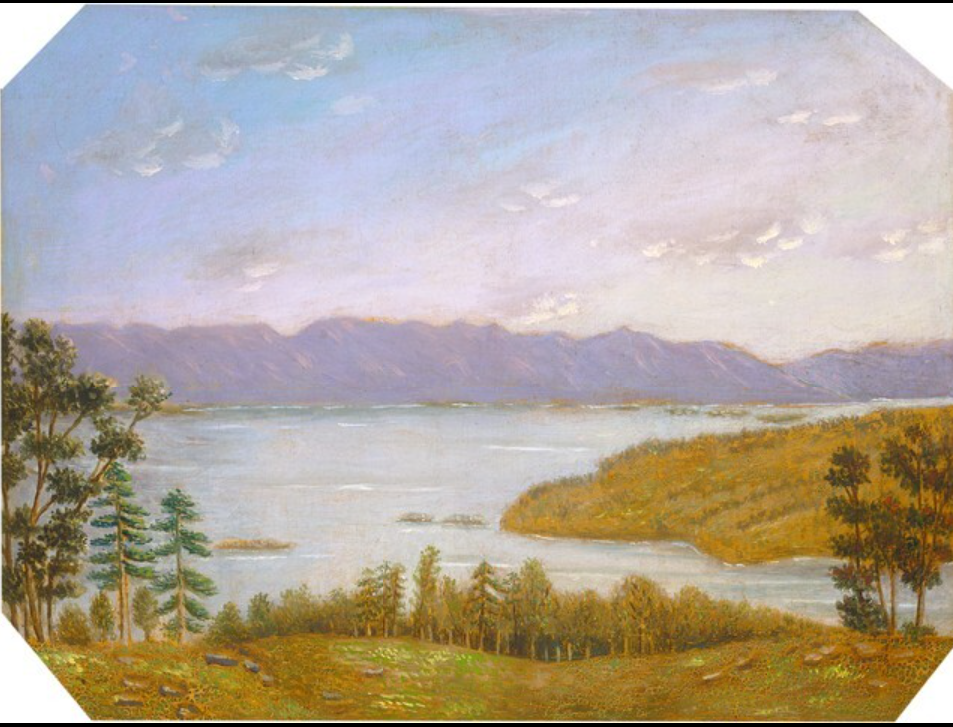
One day back in 2018, I found that the large body of water at the town’s center, Leverett Pond, was under ecological attack. Somehow, some way, a handful of land abutters on the shallow side of the pond were trying to rid the pond of “noxious weeds.” This included floating leaved Waterlilies and Watershield, plants such as rootless carnivorous plants like Bladderworts, submerged weeds like Coontail, Waterweed and Milfoils. Even Cattails and other plants growing on the pond’s edges were considered for removal.
Act One: Isn’t there a law against this?
I thought I could stop this. I thought once the town’s people knew what was happening they would be outraged. I thought the state would step in, prevent the further destruction and maybe even fine the people who were poisoning the area and dredging large sections, all so they could in their words “have crystal clear water to look at.”
I thought it would be easy. I have never been so wrong in my life.
It was five years of continual meetings, letter writing, publishing newspaper letters and articles, and a large portion of the town thinking that somehow I was just trying to cause trouble. Or maybe they didn’t think I knew what I was talking about. Sure, I saw the destruction, but I was misinformed. They believed in their intent and factual details of why they were on a campaign of eradication.
The details of destruction used to convince the town’s Conservation Commission, Select Board, and state agencies came from two retired professors, neither with a degree in Environmental Ecology. Their plan contained the curveball of being designed to show off knowledge of several obscure subjects unknown to nearly everyone:
1.Limnology: The science of fresh water systems
2.Pesticides and their application to aquatic environments
3.The botany and identification of aquatic plants
Act Two: Countering Pseudoscience with Science
While the wordsmithing of the two PHDs had merit and flow, my own research quickly showed that they had only a surface understanding of subjects. In order to counter their statements and proposals, I decided that I would deeply learn all I could about limnology, pesticides and the life of aquatic plants. I would become an expert, the old fashion way: I would purchase books. Lots of them. I read extensive science based articles on pesticide families, collecting hard data and staying away from anything that was too opinionated.
People began to realize that I knew more than expected, so much more that it was easy to forget that the vocabulary was rarely understood. I presented myself on equal footing with proponents of the project. I asked the community and its policy makers to consider that dumping herbicide on the pond might not be the best thing, creating aporia, lingering doubts that this handful of lakefront owners may have hidden motives.
Act Three: Invasion Biology at Work
Then came the videos. I purchased two kayaks, an underwater camera, and I used cameras I had purchased for bird photography. The videos contrasted the “before and after” of the years of degradation in 2019, 2020 and 2022. The videos got the state involved. The state permits for dredging that the project applied for in 2010 were never received. This meant that the project had to reapply for permits for any further work after 2020.
Up to this point, I thought I was fighting against ignorance and arrogance from a few landowners who came late to the pond’s available real estate and bought lots that were undesirable because of their shallowness and large amounts of aquatic flora and fauna. I would have been in heaven if I bought such an area, but they looked to “improve it.” So they had set out to “manage” the water’s surface.
The two professors contacted a professional who specialized in finding ways around what was allowed by the Wetlands Protection Act. Leverett’s Conservation Commission reviewed the law and found that there were no ways around the law because the plant abundance, oxygen levels and fish life were all healthy, vibrant. Graphs, data, reams of older regurgitated documentation pointed to the same conclusion I had reached: Let the pond be a pond.
To show the reason why no further “management” permits would be issued to continue the project, the head of the Conservation Commission submitted his own reason: the project violated Town Bylaws. Clearly.
Then it happened. Three members of the Conservation Commission had what I thought were very strange ideas about conservation. One had a pesticide license. One looked at the pond for recreation purposes rather than an interest in environmental issues. Another felt strongly about eradicating plants that they couldn’t identify if asked. One said, in defense of using pesticides, the blithe motto “If you can choose it, you can use it,” while the other two nodded in agreement. “We have to stop the growth of these plants before they destroy the pond. It will reach a tipping point where there will be no return,” said one, with great conviction. “It could in the future make the fishery less healthy,” said another, without a shred of data. I had no idea why such people would be put on such a Commission.
The Conservation Commission voted three to two to allow the project to continue for another five years. The state admonished but did not intervene. I had been angry at the professors and their allies for their lack of concern. Now the Conservation Commission had let me, and the pond, down.
The decision of the Conservation Commission gave the pond abutters cover, so they could remove all the plants they wanted. The Commission gave herbicide sprayers a welcome mat in Leverett to earn big money for the applicators and companies that make a variety of toxins.
The decision gave the Conservation Commission, not its local intended use, protecting wetlands and freshwater, but a zealous conviction that they were acting on a world saving mission. It was Invasion Biology at work, masquerading as “restoration,” AKA the “native plant movement.” Invaders needed to be destroyed, regardless of recklessness, collateral damage, complete destruction.
So destroying acres of plant life, to get at one plant, that is okay now. They were Crusaders with a capital “C.” And like all crusades…it rarely ends well.
Act Four: Pictures are worth thousands of words
In 2022, the herbicide sprayers came back, on a very windy day, on an airboat. It appeared that the targeted areas were being sprayed, yet large amounts were misted and blowing in the air as the airboat itself churned the water’s surface. It was, in a word, sloppy.
From my kayak, I videoed the spraying of the pond with herbicides from an air boat: the before, during, and the after of floating masses of dead vegetation. I got the resulting video shown to many. It had few words, an eerie soundtrack that suited the unreal transformation, from living beauty to full degradation, death and decay. (see below)
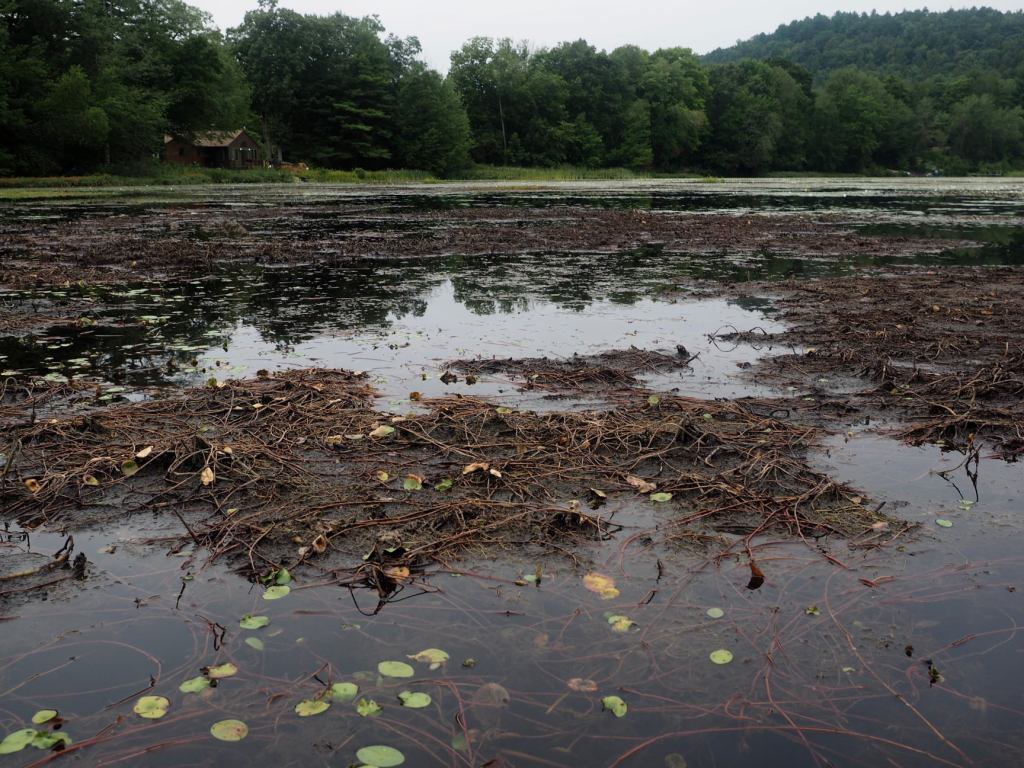
For the next year, and the next they stopped spraying. Sure, they hired an aquatic harvester to clean around the area of their docks, but that was it.
In 2024, the promoters of the deadly project were apologetic. They promised that “no herbicides” would be used. Even an attempt to hand pull marginal plants failed.
The pond will continue to respond to changing climate conditions, as it must. Plants are likely to return and the fear-mongers are likely to demand their destruction again.
Fear of so-called “invasive species” is being used as an excuse to use herbicides in the futile attempt to freeze ecosystems that replicate historical landscapes. As climate conditions continue to change, the fantasy that humans can prevent evolution is likely to fade. Perhaps the restoration movement will begin to realize the folly of trying to sort plants and animals into two simplistic groups: native vs. non-native.
As Charles Mackay said in a book written in 1841, ” Men, it is said, think in herds; it will be seen that they go mad in herds, while they only recover their senses slowly, one by one.”
Macaylla Silver
Leverett, Massachusetts
Contact: artargentia@gmail.com
 Conservation Sense and Nonsense
If this is a parting shot it’s a good one milliontrees and you will be missed. May I send this on to some folks “in charge” in San Francisco?
Thank you for all you do!
Lance Mellon next to McLaren Park (or whats left of it)
Please do. Thanks.
Thank you so much for sharing Macaylla Silver’s wonderful article. Heartbreaking, but he seems to have stopped them for a while. Still, how many plants and animals suffered and died, and we know the maniacs will never stop. His description of how he was treated and dismissed, and then how little those in charge knew or cared is so familiar and yet, how do we stop the death and destruction?
I never forgot your brilliant and needed posts about Spartina, but I hadn’t yet met a fanatic (they can sound so reasonable) who wants all the non-native Spartina killed until Friday when I went to look for birds with a group (I usually go with friends who love nature). One of the people there lectured us that their work killing non-native Spartina is so important, even though “the endangered Ridgway’s Rails like it.” I would think those beautiful, shy Rails (who I’ve seen many times including that day) should get what they want. But no, the fanatical nativist humans know best. I told her to read you important articles about Spartina. (Meanwhile, we also saw another Ridgway Rail who had oil on her and would likely die, so clearly they have enough to deal with, without being deprived of favorite food.) Let the animals decide since humans have already done so much damage to nature!
Thanks for this beautiful presentation. For those following the spotted/barred/sparred owl conflict, I hope you’ll read my novel at https://thedarksideofhungermountain.substack.com/ If you’re pressed for tijme, you can search by “owl” and Chapter 13 will be an eye-opener. Thanks!
Thank you. I will check it out!
This was so sad to read. Thank you for sharing. It’s a small comfort to know others are feeling this struggle in their own ways.