This is my last article of 2024, and the last for the foreseeable future. However, I still welcome guest posts that are consistent with the mission of my website. If you have a story to tell, please contact me at mildredtrees@gmail.com.
Clarification: I published this article prematurely on November 28th in error. I republish the article today to clarify my intentions.
Although I have accomplished little in 25 years of environmental activism, I can point to a few achievements that I am proud of.
- I was successful in getting the “invasiveness” of eucalyptus downgraded from “Moderate” to “Limited” by the California Invasive Plant Council. There were a few specific issues that were deleted from Cal-IPC’s assessment of eucalyptus. The assessment no longer claims that eucalyptus kills birds. Cal-IPC also removed the claim that eucalyptus leaves are allelopathic, i.e., they do not emit a chemical that suppresses the growth of an understory. However, these improvements in Cal-IPC’s assessment of eucalyptus had no apparent effect on the demands of native plant advocates to destroy all eucalyptus in California.
- I am proudest of our achievements to improve pesticide applications by the supplier of our drinking water in the East Bay, EBMUD. With the help of a video and a photo, a small team of collaborators convinced the leadership of EBMUD that their staff did not know how to apply herbicides. The leadership of EBMUD deserves equal credit for this accomplishment because they listened and they acted. EBMUD is now conducting annual training of its staff about proper application of pesticides, herbicide application notices are being posted, and an annual report of pesticide use is presented to the Board and posted on-line for the public to see. As a result of these efforts, herbicide applications were reduced by one-third, but have since plateaued.
- When the SelecTree website published by CalPoly San Louis Obispo claimed that blue gum eucalyptus lives only 50 years, it became another tool nativists used to support their demands to destroy blue gums in California. I was able to give CalPoly the evidence needed to disprove this inaccurate claim. Blue gums have lived in California since the 1860s and many of the original plantations are still alive. Eucalypts are known to live in Australia from 200-400 years. It’s difficult to determine the age of eucalyptus because trees growing in mild climates such as ours do not have clear growth rings used to determine age. SelecTree initially changed the lifespan estimate to 150 years, which was the maximum lifespan for the entire SelecTree database of trees in California. Since then, SelecTree has deleted all lifespan estimates because they weren’t able to find reliable sources of this information. The correction of blue gum lifespan on SelecTree relieved some of the pressure to destroy them.
- I also claim small credit for the final version of Oakland’s Vegetation Management Plan, which is a compromise with native plant advocates who wanted all non-native trees on public land in Oakland to be destroyed and replaced with native trees. The consultant who wrote the plan also deserves credit for listening and reading studies I sent to him about the flammability of trees. Non-native plants and trees are not inherently more flammable than native trees. We live in a Mediterranean climate in which vegetation is fire adapted and fire dependent. It took 7 years and 4 revisions to reach a compromise that satisfied the nativists. The plan will destroy all eucalyptus less than 31” in circumference on 2,000 acres of public land and 300 miles of roadside. The plan will also use herbicides on public land where it has been prohibited since 1998, when herbicide spraying was confined to road medians. Although the plan is destructive, its approval after 7 years of pointless delay will finally enable Oakland to mitigate fire hazards with fuels reduction without destroying all non-native trees on public land.
These were small victories and they were difficult to accomplish. I won’t bore you with a list of hundreds of my failed efforts to protect public lands from needless destruction. My most recent failure was an appeal to California’s Wildlife Conservation Board, which is theoretically responsible for protecting California’s wildlife. Despite the effort of a small team of collaborators, the WCB granted another 10 years of funding for an eradication project that has killed over 50% of an endangered bird species in the San Francisco Bay after 20 years of spraying herbicides, destroying the bird’s habitat and its food.
I hope these few achievements and multitudes of failures will help to convey why I am pulling back from my 25-year effort to defend our urban forest and our public lands. In a word, it is unrewarding work.
Good sources of information about invasion biology and the “restoration” industry
I have 535 subscribers on Conservation Sense and Nonsense and over 1,000 followers on Meta (Facebook). In addition, my articles on Conservation Sense and Nonsense have been read by over 500,000 people who found them with internet searches over the 15 years that Conservation Sense and Nonsense has existed.
I intend to keep posting occasional news items to Facebook and I welcome my readers to follow me there. I also encourage my readers to follow other sources of reliable information about the issues I have covered. I leave the field in the good hands of those who still have the courage to fight what seems like a losing battle:
- Beyond Pesticides is a reliable source of information about pesticides. I recommend that you subscribe to BP’s Action Alerts that inform us of opportunities to engage with decision makers about new policy decisions regarding pesticides.
- For home gardeners looking for advice about creating gardens that are beautiful as well as respectful of the environment and the animals that live in our gardens, I recommend that you subscribe to Garden Rant.
- For readers who love all plants, both native and non-native, I recommend the Substack of Kollibri terre Sonnenblume. His articles are deeply researched, informative, and beautifully written. His knowledge of plants far exceeds anything I have learned about plants because he works directly with them as an integral part of his life and he is an astute observer.
Right turn at the crossroads
After a long, bumpy trip to the crossroads of the 2024 presidential election, the American people made a hard right turn on Election Day. Voters have re-elected President-elect Donald Trump and given him control of all branches of government with which to implement his agenda.
As Trump approached the crossroads he also acquired some allies who will be influential in crafting his agenda. Wunderkind Elon Musk, who is already a major government contractor in space exploration and telecommunications, is likely to influence and benefit from policies in those—and other—areas. Billionaire “tech-bros” have convinced Trump to promote crypto currency. Robert F. Kennedy, Jr. is likely to influence the future of our policies regarding health, such as the availability of drugs and vaccines.
This is to say that although we can’t predict specific policy decisions, we can predict that there will be significant changes in the functioning of the federal government. We know that Republicans have been trying for years to defund, if not eliminate, many federal agencies.
The Environmental Protection Agency and the Department of the Interior have long been Republican targets for budget cuts. And the US Supreme Court has collaborated with this effort by reducing the power of federal agencies to implement policies that aren’t specifically authorized by federal laws.
We should probably expect that federal funding for many so-called “restoration” projects will evaporate, such as the USFWS plan to shoot 500,000 barred owls in Western Forests or the USFWS plan to dump rodenticides on hundreds of off-shore islands to kill non-native animals. Likewise, the theoretical ability of the EPA to evaluate new pesticides for access to the market is likely to end altogether, to the extent that regulation exists at all.
On the other hand, State funding of “restoration” projects is unlikely to decrease. California voters have approved Proposition 4, which will provide $10 billion of bonds for water, wildfire, and land protection in California. The federal government is expected to withdraw funding for ecological “restoration” while California state government is likely to replace the lost federal funding.
Becoming an observer
We are headed into a long period of radical change. It is an opportunity to hunker down and watch the changes play out. That is my plan for the foreseeable future.
Although environmentalism had little explicit role in the rightward shift in American politics, it probably played a role on the margins. The electorate’s rejection of environmentalism as a priority policy goal requires some deep reflection.
Does environmentalism contribute to the political divide between urban and rural voters?
- For example, urban environmentalists support the reintroduction of top predators, such as wolves, into rural communities, where they become predators of domesticated animals. Rural communities resent that their livelihoods are threatened by decisions made by urban policy makers who are not impacted by the decisions they make.
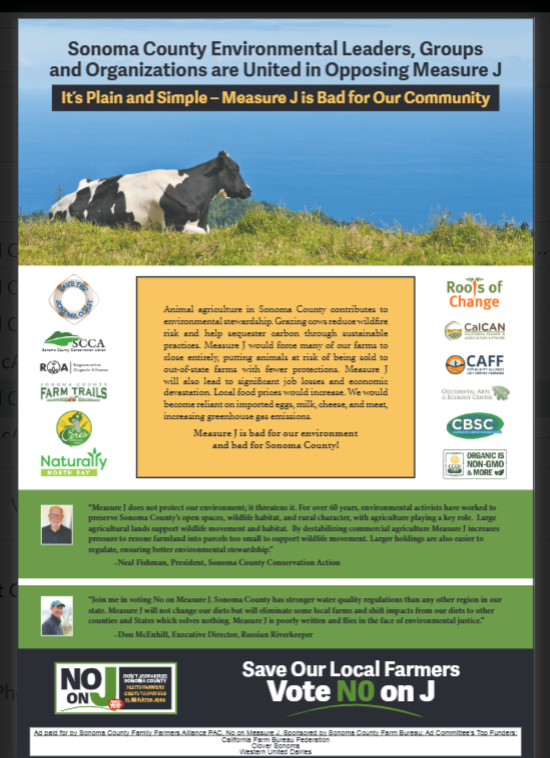
- Proposition J in Sonoma County would have shut down many agricultural operations that raise animals. Most of these agricultural operations are certified organic and they are central to the economy of Sonoma’s rural community. Proposition J was easily defeated by an agricultural community that could have been destroyed by an extremist version of environmentalism. However, a similar Proposition DD in Berkeley passed narrowly in a community with a more diverse economy.
Has environmentalism contributed to the high cost of housing and the growing homeless population?
- The San Francisco Bay Area Chapter of the Sierra Club has a track record of suing to prevent the building of new housing. The Chapter’s support for this agenda reflected the opinions of entrenched elected leaders who were recently displaced by a coalition of housing advocates. One of the displaced leaders explained how this coup has changed the Chapter’s approach to new housing. The changed leadership is now reflected in the Chapter’s political endorsements of housing advocates, such as State Senator Scott Wiener.
- The insurance industry in California is in trouble. Major insurance companies have left California. Some have quit insuring homes. The companies that remain have cancelled thousands of policies insuring homes. Premiums of the policies that remain have increased significantly and are expected to increase further. California’s wildfires have increased the costs of the insurance industry and California has not allowed the insurance industry to anticipate increased risks of wildlife in setting premium prices for home insurance. Insurance is required to finance new building and home buyers cannot get a mortgage without property insurance. The 7-year delay of Oakland’s Vegetation Management Plan is an example of how extreme versions of environmentalism have handicapped fire hazard mitigation.
Statement of Purpose
I am a moderate Democrat who voted for the Democratic candidate for president in 2024. I am disturbed by the sudden and extreme lurch to the political right. I also see it as an opportunity for all Americans to think deeply about how we reached this point. I intend to do more listening and less talking. I hope to find something more rewarding to do.
I leave the field knowing that nativism in the natural world will be defeated eventually by evolution, as natural selection “chooses” the plants and animals capable of surviving in a radically altered climate. Nativism in the natural world is ultimately a dead end. Nature moves forward, not backward. Activism, such as mine, will not successfully deliver that message to the ideologues who continue to destroy the plants and animals most likely to survive, but nature will, because nature always bats last.
Thank you for your readership. Best wishes for happy holidays and a more peaceful new year in 2025.
 Conservation Sense and Nonsense
this is heartbreaking news to read as i JUST signed up for your newsletters!! i respect your decisi
I will miss your emails. I have a folder of them in my email program. I believe you when you say this is unrewarding work. Please join bluesky; you will find many scientists and environmentalists there. I bet you’d have more than 1000 followers there within a month if not sooner. I don’t suggest this for the “likes”. Bluesky is a wonderful platform filled with people and content one is happy to encounter. Also no bs own the libs trolling. I do so hope you will consider joining. You could put out your previous writing serially. In other words you wouldn’t have to produce new work. You have my admiration for the fussy difficult work you have performed on behalf of our environment. Very truly yoursElizabeth Watts
Sent from the all new AOL app for iOS
Thanks for all your posts. I am a native plant advocate. It is good to hear an opposing point of view and to realize that you can things too far. Regards, Kirk Barrett South Orange NJ 973-313-1218 kirkbarrett64@gmail.com https://www.linkedin.com/in/kirk-barrett/
Thank you for explaining–with grace and considerable thought–your reasons for ending the Conservation Sense and Nonsense postings. Although you state that it was not rewarding work, in fact, I think you richly rewarded many other people who work against the nativist agenda, which destroys habitat, wildlife, trees, and other plants. You stayed with your efforts for so long, and the results benefitted not just plants and animals but also the many people, including me, who read your postings and became more educated into what is really going on in the world of so-called conservation and restoration. Without your astute observations, careful reading of scientific material, and persistent questioning of your sources, most of us would have a faulty understanding of the damage that has been and continues to be done.
But your list of “wins” is significant. To me probably the most important is the change in EBMUD’s policies and procedures on pesticides in the drinking water. That alone has long term significance for thousands, if not hundreds of thousands, of people. You should feel some level of vindication for these results!
Thank you. I have deleted some of the personal information after taking note of your kind support, which is appreciated.
Thank you so much for all the work you have done to protect the trees and other plants and animals and our environment! It’s been such a help to have your site to link to when fighting nativists who are trying to kill so much.
I’m seeing an increase in trees being planted by trails, park parking lots, etc. but most seem to be Live Oaks. I have no idea why they are ignoring one of the West Coast’s (up to Canada) and Bay Area’s most magnificent and long-lived trees that grows where it’s both hot and cold, including where it’s too hot for Redwoods, which are Douglas Firs (Pseudotsuga menziesii). (They are the predominant tree at Pt. Reyes and share Mt. Tamalpais with Redwoods, and are the tallest tree in the world next to Redwoods.) They also smell SO good. And the birds love them.
Another beautiful tree that lives where it’s warmer (so is well suited for the increasing heat), is the beautiful Grey Pine/Ghost Pine/Foothill Pine — Pinus sabiniana, which is the predominant tree at Tuystak/Mt. Diablo.
And then there is the largest tree in the world and among the oldest, also in the Redwood family, which is the magnificent Sequoiadendron giganteum, who naturally grows in the Sierras, but who has fossils in many parts of the world, and who tolerates both heat and snow. (They easily grow from seed, as do Redwoods, which I found out after leaving one of their seed cones on top of a window box filled with dirt and many baby trees sprouted.
Good morning,
I hope the holiday season is treating you well. I just wanted to say thank you so much for your blog posts over the years. They’ve inspired me many times. Your passion for common sense in conservation and the folly of trying to control the natural world speaks directly to my heart! I often feel exactly the same way, frustrated by arguments over how best to “maintain” our “disturbed” forested area which contains “invasives” (in my opinion those are human ideas/categories, with no real meaning to nature). I’ve always said, let the plants and animals work it out as nature is more qualified for this than we are.
Anyway, when I read the post below, I could completely appreciate how you’re feeling, it’s tiring to keep up this battle, both with those who think pavement is the new nature, and those who think that only certain species “belong” here. I’m sure you already know this, but just in case, your blog has surely inspired many others besides myself. We’re still out here! Thanks to your hard work, I am not ready to be an observer yet. And you deserve to pass the baton. Thanks again, and happiest of new years.
Nature always bats last. (love that!)
Sincerely,
Kate Wells, PhD
Environmental Program Supervisor
Rotary Park Nature Center
kathryn.wells@brevardfl.govkathryn.wells@brevardfl.gov
Brevard County Parks and Recreation
Central Area Parks Operations
840 Forrest Avenue, Cocoa, FL 32922
P: (321) 455-1385
C: (321) 302-1675
F: (321) 453-6554
http://www.brevardparks.comhttp://www.brevardparks.com/
[cid:image001.png@01DB5840.8536BD70]http://www.brevardfl.gov/ParksRecreation/Home
[cid:image002.jpg@01DB5840.8536BD70]https://www.facebook.com/BrevardParks/ [Twitter button – 10 free HQ online Puzzle Games on Newcastlebeach 2020!] https://twitter.com/brevardparks [1024px-Instagram_logo_2016] https://www.instagram.com/brevardparks/
The comments and opinions expressed herein are those of the author of this message and may not reflect the policies of the Brevard County Board of Commissioners.
Please note: Under Chapter 119 of the Florida Statute, email communications are Public Records and may be subject to public disclosure. If you do not want your e-mail address released in response to public record requests, do not send electronic mail to this entity. Instead, contact this office by phone or in writing.
Thank you for your kind comment and for defending the autonomy of nature as the Environmental Program Supervisor of Rotary Park Nature Center in Cocoa, Florida.
I’m glad to hear that you are not ready to be an observer yet. Please consider writing a guest post for publication on Conservation Sense and Nonsense. As the environmental program supervisor for a public park, you probably have a unique perspective on the issues that are discussed on CSN. Please tell us about your professional and personal experiences. Can you advise defenders of nature as it exists, rather than as some would wish it to be? Can you suggest strategies and policies that you have found effective in interactions with the public and policy makers?
Since publishing what I hope will be my last article on CSN, I have prepared a guest post for publication on January 1st and two others have expressed an interest in writing guest posts. Advocacy is often lonely work that is most effective as a team effort. In stepping aside, I hope that others will consider stepping up to keep the effort alive.
Please contact me at mildredtrees@gmail.com if you are interested in writing a guest post for Conservation Sense and Nonsense. I hope you are ready to carry the baton for the next lap.
Chemical regulations in Canada mandate safety measures like proper labeling, controlled use, and risk assessments. WHMIS and CEPA play a vital role in protecting workers, consumers, and the environment.