Although I have stopped writing original articles for Conservation Sense and Nonsense, I am still actively engaged in local environmental issues. When there are opportunities to influence public policies that affect the environment, I often participate.
Today, I am sharing my public comment on the update of the strategic plan of California’s Wildlife Conservation Board (WCB) in the hope that it might inspire you to write your own comment on the draft plan, which is available HERE. The deadline for submitting comments is May 16, 2025. Comments may be sent to this email address: wcb@wildlife.ca.gov
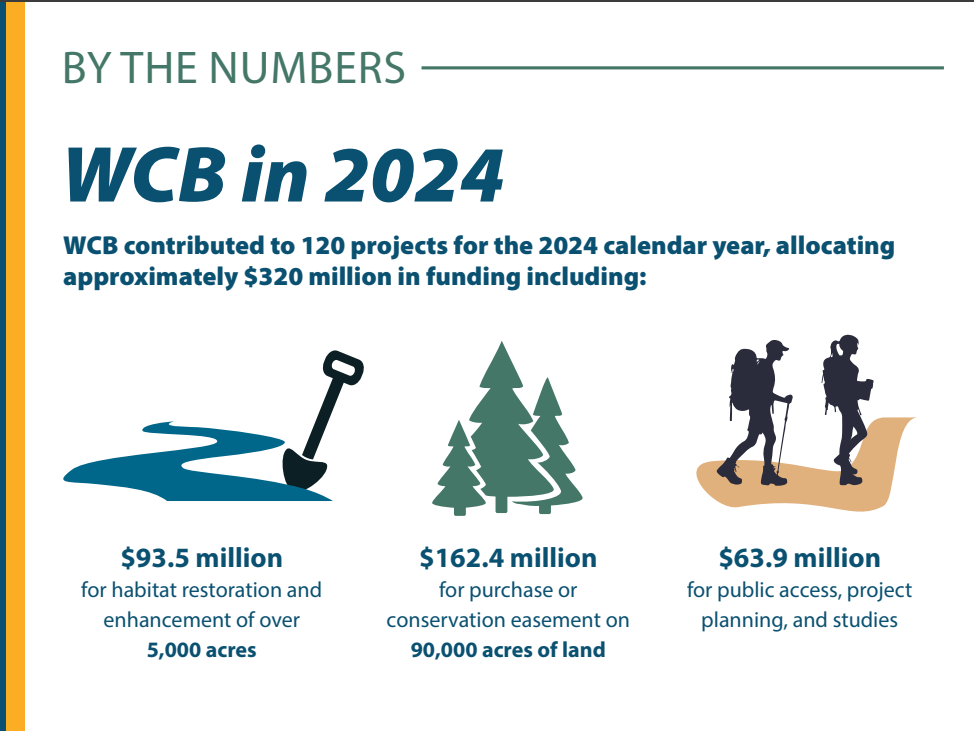
The mission of the Wildlife Conservation Board is to “protect, restore and enhance California’s spectacular natural resources for wildlife and for the public’s use and enjoyment…” In service of that mission, WCB awards grants of millions of dollars every year for “restoration” projects. According to WCB’s annual report for 2024, WCB awarded $93.5 million for “habitat restoration and enhancement of 5,000 acres” of land in California in 2024.
Over the life of the updated strategic plan, from 2025 to 2030, the Wildlife Conservation Board will distribute grants of $1.02 billion ($204 million per year) from funding made available by Proposition 4, the $10 billion “California Climate Bond,” which was approved by voters in November 2024. Because most federal funding of climate and ecological restoration has been cancelled by the Trump administration (and being litigated, as we speak), the “California Climate Bond” will be one of the few sources of funding for these projects.
This is my public comment on the strategic plan update for California’s Wildlife Conservation Board:
WCB Strategic Plan Update
Thank you for this opportunity to comment on the draft of WCB’s update of its strategic plan (SP). I am writing to suggest that WCB consider the addition of a few over-arching principles that would apply to all of its programs. These principles would enhance the plan’s stated goals of climate resilience and biodiversity protection by ensuring projects are evaluated based on their actual ecological outcomes rather than adherence to historical conditions.
- All projects funded by WCB should be more constructive than they are destructive. For example, a project that proposes to destroy more habitat than it creates should be less competitive than a project that will create more habitat than it destroys. A project that reduces carbon storage by destroying vegetation does not “reduce and remove carbon pollution,” as the SP proposes.
- Projects that do not propose to use pesticides to destroy habitat should be more competitive than those that use pesticides because pesticides damage the soil and are harmful to wildlife and human life. The success of projects is jeopardized by pesticide use.
- Projects that apply for additional funding for a continuing project must address the fundamental question of the viability of the project. In other words, if a project has been funded for 20 years, WCB should consider if the goals of the project are still realistic in a rapidly changing climate and environment (e.g., Invasive Spartina Project).
- Projects should be consistent with the basic principles of science, such as:
- The scientific definition of biodiversity includes both native and non-native plants and animals.
- Hybridization is one of the tools of evolution that enables adaptation and speciation in response to changes in the climate and the environment.
- The flammability of vegetation varies, but the variation is unrelated to the nativity of the plant. Native plants are not inherently less flammable than non-native species.
- The native ranges of California’s native plants have changed in response to the changing climate and they must continue to change if they are to survive.
- Our changing environment dictates that historical landscapes cannot be replicated. Humans cannot stop evolution, nor should we try.
I recommend that the WCB consider incorporating these principles into its project evaluation criteria to ensure that funded projects align with current ecological knowledge and maximize benefits for California’s biodiversity in a changing climate. Incorporating these principles into the SP would strengthen the plan’s objectives related to climate resilience (C2.1, C2.2), biodiversity protection (B1.1, B2.1), and program evaluation (D2.1, D2.2).
In support of these principles, I offer the following scientific studies for your consideration:
On pesticides damaging soil and harming wildlife and human health
- Wan et al. (2025): Pesticides affect a diverse range of non-target species and may be linked to global biodiversity loss. This study presents a synthesis of pesticide (insecticide, herbicide and fungicide) impacts on multiple non-target organisms across trophic levels based on 20,212 effect sizes from 1,705 studies. For non-target plants, animals (invertebrate and vertebrates) and microorganisms (bacteria and fungi), we show negative responses of the growth, reproduction, behavior and other physiological biomarkers within terrestrial and aquatic systems. Negative effects were more pronounced in temperate than tropical regions but were consistent between aquatic and terrestrial environments. Results question the sustainability of current pesticide use and support the need for enhanced risk assessments to reduce risks to biodiversity and ecosystems.
- Klein et al. (2024): New Roundup formulations are 45 times more toxic to human health,on average, following long-term, chronic exposures. The study identified eight Roundup products in which Bayer has replaced glyphosate with combinations of four different chemicals: diquat dibromide, fluazifop-P-butyl, triclopyr, and imazapic. All four chemicals pose greater risk of long-term and/or reproductive health problems than glyphosate, based on the EPA’s evaluation of safety studies. Diquat dibromide and imazapic are banned in the EU. Diquat dibromide – present in all the new formulations – is 200 times more toxic than glyphosate in terms of chronic exposure and is classified as a highly hazardous pesticide. New Roundup formulations pose significantly more harm to the environment. The chemicals replacing glyphosate in Roundup are significantly more likely to harm bees, birds, fish, earthworms, and aquatic organisms, on average. They are also significantly more persistent in the environment and more likely to leach down into groundwater, increasing the risk of contaminating waterways and drinking water.
On biodiversity including non-native species:
- Schlaepfer et al. (2011): This pivotal paper challenges the automatic negative classification of non-native species by documenting their potential conservation benefits. The authors present evidence that some non-native species provide ecosystem services, habitat, and resources for native species, particularly in human-modified landscapes where native species may struggle. They advocate for conservation approaches that evaluate species based on their ecological functions rather than origin alone.
- Mascaro et al. (2012): This study examines novel forests in Puerto Rico dominated by the non-native Castilla elastica tree. The research demonstrates that these novel ecosystems maintain key ecological processes such as productivity, nutrient cycling, and carbon storage at levels comparable to native forests. The findings suggest that novel ecosystems composed of non-native species can maintain essential ecosystem functions even after native tree species decline.
On hybridization as an adaptive mechanism:
- Hamilton & Miller (2016): This paper reframes hybridization as a potential adaptive resource rather than a conservation threat. The authors present evidence that hybridization can introduce genetic variation that helps species adapt to changing environmental conditions, particularly relevant in the context of climate change. They suggest that conservation strategies should sometimes protect hybrid zones as sources of evolutionary potential rather than trying to eliminate them.
- Fitzpatrick et al. (2015): This study examines how hybridization challenges traditional conservation approaches based on species preservation. The authors argue that hybridization is a natural evolutionary process that can generate biodiversity and adaptive potential. They present a framework for evaluating conservation value that considers genetic, ecological, and evolutionary factors rather than focusing solely on taxonomic “purity.”
On flammability unrelated to nativity:
- Zouhar et al. (2008): This comprehensive technical report examines relationships between non-native plants and fire regimes. While acknowledging that some non-native plants can alter fire behavior, the report emphasizes that flammability is determined by plant structure, chemistry, and arrangement rather than nativity status. It provides detailed case studies showing both native and non-native plants can increase or decrease fire risk depending on specific traits.
- Pausas & Keeley (2014): This study documents abrupt changes in fire regimes that occur independently of climate changes. The authors demonstrate that shifts in vegetation structure and fuel characteristics—which can be caused by both native and non-native species—are often more important determinants of fire behavior than plant origin. The research challenges simplistic assumptions about the relationship between native plants and fire resilience.
On changing native ranges:
- Pecl et al. (2017): This influential paper documents how species are naturally shifting their ranges in response to climate change. The authors present global evidence of species redistributions across latitudinal, longitudinal, and elevational gradients. The study emphasizes that these range shifts are necessary adaptations to changing conditions and argues that conservation strategies need to accommodate these natural movements rather than trying to maintain historical distributions.
- Bonebrake et al. (2018): This paper synthesizes research on climate-driven species redistribution and its implications for conservation. The authors highlight how traditional conservation approaches focused on preserving species in their historical ranges are becoming increasingly unviable under climate change. They advocate for more dynamic approaches that facilitate range shifts and species movements as adaptive responses to changing conditions.
On novel ecosystems and historical conditions:
- Hobbs et al. (2014): This seminal paper introduces a framework for categorizing landscapes as historical, hybrid, or novel ecosystems. The authors argue that many ecosystems have been irreversibly altered by human influences and climate change, making restoration to historical conditions impossible in many cases. They advocate for pragmatic management approaches that focus on ecosystem functions and services rather than historical composition.
- Stralberg et al. (2020): This study examines climate refugia in North America’s boreal forests. The research demonstrates that even supposedly pristine ecosystems will undergo significant changes due to climate change, with some areas serving as temporary refugia. The authors emphasize that conservation strategies need to recognize the transient nature of these refugia and plan for ongoing ecological transitions rather than static preservation.
In Conclusion
As you know, the mission of the Wildlife Conservation Board is to “protect, restore and enhance California’s spectacular natural resources for wildlife and for the public’s use and enjoyment…” In addition, the Wildlife Conservation Board “envisions a future in which California’s wildlife, biodiversity and wild places are effectively conserved for the benefit of present and future generations.” My suggestions for improvements in the draft strategic plan are consistent with the mission of the WCB.
There was a time when academic scientists believed that the goal of conservation was to replicate historical landscapes by destroying plants and animals that were not here prior to European settlement. Although many of these plants and animals found their way to California by natural means, without human assistance, they were perceived as “alien invaders” that didn’t belong here. The assumption was that ecosystems can achieve an equilibrium state that represents an ideal that can be sustained by preventing change. Science has long ago abandoned that notion in favor of acknowledging that nature is constantly changing in response to constant change in the environment.
The belief that destroying such “alien invaders” would restore the landscape persisted for decades. In many cases, no replanting was done after introduced plants were destroyed. After poisoning our public land for decades, it has become clear to those who are not ideologically committed to historical landscapes that the original goal is not attainable because the plants and animals that survive are those that are best adapted to current environmental conditions, particularly the rapidly changing climate that is expected to continue to change. In most cases, the newcomers are performing the same ecological functions of their predecessors and the harm that was presumed is usually balanced by benefits of their existence.
Most academic scientists acknowledge this reality, but cultural lag has left the public behind as science has moved on. Non-profit organizations that survive by the grace of their donors, have contributed to the pressure on public land managers such as the Wildlife Conservation Board. Academic scientists are unwilling to participate in such grass-roots policy politics and their publications are often incomprehensible and inaccessible to the public and public land managers, leaving public land managers at the mercy of those with the least amount of information and the most amount of passionate belief.
The Wildlife Conservation Board has a responsibility to the public to inform itself of the consequences of conservation practices that are damaging the environment and are no longer realistic. I respectfully ask that the WCB read the scientific studies I have provided and take them into consideration as it distributes over a billion taxpayer dollars made available by the passage of Proposition 4.
Conservation Sense and Nonsense
May 1, 2025
References for cited studies
On pesticides harming soil and damaging wildlife and human health:
- Wan, NF., Fu, L., Dainese, M. et al. Pesticides have negative effects on non-target organisms. Nat Commun 16, 1360 (2025). https://doi.org/10.1038/s41467-025-56732-xK
- Klein, K, Starman, S, “New RoundUp, New Risks: Bayer’s new weedkiller more toxic than ever,” Friends of the Earth, October 2024 https://foe.org/wp-content/uploads/2024/10/Roundup_Report_2025_final.pdf
On biodiversity including non-native species:
- Schlaepfer, M.A., Sax, D.F., & Olden, J.D. (2011). The potential conservation value of non-native species. Conservation Biology, 25(3), 428-437.
- Mascaro, J., Hughes, R.F., & Schnitzer, S.A. (2012). Novel forests maintain ecosystem processes after the decline of native tree species. Ecological Monographs, 82(2), 221-228.
On hybridization as an adaptive mechanism:
- Hamilton, J.A., & Miller, J.M. (2016). Adaptive introgression as a resource for management and genetic conservation in a changing climate. Conservation Biology, 30(1), 33-41.
- Fitzpatrick, B.M., Ryan, M.E., Johnson, J.R., Corush, J., & Carter, E.T. (2015). Hybridization and the species problem in conservation. Current Zoology, 61(1), 206-216.
On flammability unrelated to nativity:
- Zouhar, K., Smith, J.K., Sutherland, S., & Brooks, M.L. (2008). Wildland fire in ecosystems: fire and nonnative invasive plants. General Technical Report RMRS-GTR-42-vol. 6. USDA Forest Service.
- Pausas, J.G., & Keeley, J.E. (2014). Abrupt climate-independent fire regime changes. Ecosystems, 17(6), 1109-1120.
On changing native ranges:
- Pecl, G.T., et al. (2017). Biodiversity redistribution under climate change: Impacts on ecosystems and human well-being. Science, 355(6332).
- Bonebrake, T.C., et al. (2018). Managing consequences of climate-driven species redistribution requires integration of ecology, conservation and social science. Biological Reviews, 93(1), 284-305.
On novel ecosystems and the impossibility of recreating historical conditions:
- Hobbs, R.J., et al. (2014). Managing the whole landscape: historical, hybrid, and novel ecosystems. Frontiers in Ecology and the Environment, 12(10), 557-564.
- Stralberg, D., et al. (2020). Climate-change refugia in boreal North America: what, where, and for how long? Frontiers in Ecology and the Environment, 18(5), 261-270.
 Conservation Sense and Nonsense
Fantastic. Maybe Rupa could also add to the SFFA website!