We must tell our readers about the collateral damage of misguided attempts to manage nature more often than we would like. We prefer positive stories, but in the hope of a better future we must also inform the public of the unintended consequences of the many projects that are killing one species of plant or animal based on the mistaken assumption that another plant or animal will benefit.
Trumpeter swan by James Audubon
In this case, a project sponsored by the Nature Conservancy decimated the population of rare Arctic grayling fish in Centennial Valley, Montana, by damming the streams to create ponds for the benefit of the equally rare trumpeter swan. The grayling had spawned in those streams and the population plummeted when the streams were dammed.
Unfortunately, they ARE trying it again. Now the scientists are trying to compensate for the damage to the grayling population by killing cutthroat trout that is considered a predator to the grayling. The cutthroat is not native, so that also makes it a candidate for eradication. It’s as though we are on a killing treadmill. One mistake seems to lead to another.
Stop and think before you shoot!
Cockatoo. Creative Commons
A bird lover in Hawaii takes a more thoughtful approach to the suggestion that introduced cockatoos and African parrots should be shot, based on the assumption that they are competing with the dwindling population of native birds. He points out that the native birds nest in the ground, while the cockatoos and parrots nest in cavities in the trees. Most of the native birds are nectar eaters, while the cockatoos and parrots eat seeds and nuts. So, he wonders if the introduced birds are really a threat to the native birds.
The exotic birds are either escaped pets or the descendents of them. The author of the article urges pet owners to take care of their pets and make a permanent commitment to their care. Releasing them into the forest is making them a target for people who think killing them would benefit other birds.
The author is not opposed to killing non-native animals when absolutely necessary, but he is at least willing to carefully consider if it is necessary, in his opinion. He is comfortable with the killing of rats, pigs, and feral cats, for example.
Million Trees takes this question a step further. We don’t think humans should micromanage nature. We don’t have enough information to presume to know better than nature what is best. We also have our own anthropomorphic criteria for which species is more important than another. Our judgment is self-serving and is not a substitute for the even-hand of nature. Nature follows the simple rule of “survival of the fittest.” Nature is as likely to save the lowly spider as it is to save the beautiful trumpeter swan.
A parable to illustrate the point
This parable, retold in Fanaticism of the Apocalypse (1) illustrates the futility of man’s attempt to control nature:
“Noah, as he is loading the animals onto the Ark, is alarmed by the large number of candidates. Mammals, birds, marsupials, penguins, primates, and lizards have already gone on board. The ass, the ox, the giraffe, the elk, the stag, the lion, and the cat urge the patriarch to raise the gangplank and close the hatches. The boat is chock-full, the cedar hull is about to crack open, the Deluge is threatening. Outside, a crowd of harmful or misshapen pests—cockroaches, toads, slugs, spiders—asks to be taken on. The toad speaks on behalf of his unsightly comrades: he pleads their cause with eloquence, pointing out to the Patriarch that they perform a useful function in nature. In God’s design, nothing is ugly or repugnant: everything is ingenious, even invertebrates, mollusks are necessary. No one has the right to destroy these creatures of the Lord. But Noah turns on his heel and decides to raise the anchor. Then a cloud of insects and pests assails him: fleas climb on his legs, crabs crawl in his pubic hair, lice swarm on his head, leeches, stinkbugs, and mosquitoes stick to his skin without him noticing them. Snakes slip into his flowing hair, spiders take up residence in his beard. That is how the whole bestiary was spared.”
We fiddle with nature at our own peril.
*****************************
(1) Pascal Bruckner, The Fanaticism of the Apocalypse, Polity, May 2013
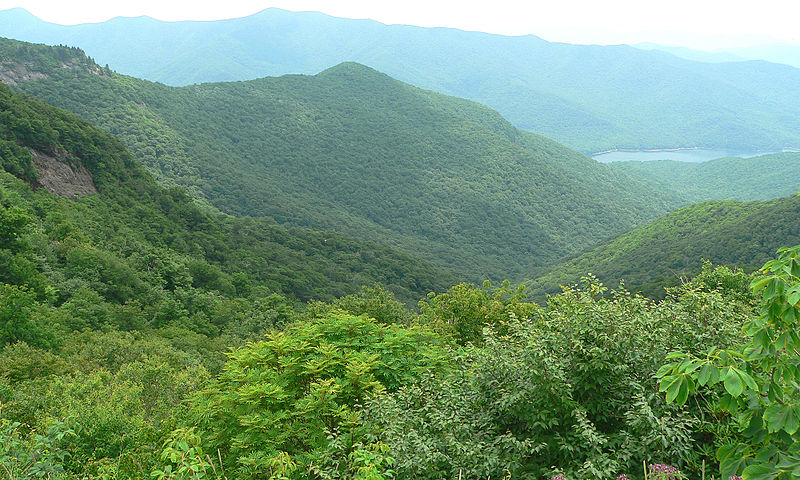
This is a story that passes for good news at a time of global warming. A new study based on data from 21 broadleaf forests in northern latitudes over a 20 year period reports that forests in some places seem to be capable of achieving normal rates of growth while using less water. For the moment, the assumption is that increased levels of carbon dioxide are essentially acting as a fertilizer, promoting growth with less water. This suggests that at least in some locations, it might be possible for forests to survive through the droughts caused by climate change.
Broadleaf forest. Blue Ridge Parkway
Like most changes in the environment, there are pros and cons to forests using less water because forests recycle the water into the atmosphere where it becomes rain clouds. If the forests take up less water, they will probably supply less moisture to agricultural areas downwind of the forests.
Where forests exist on the perimeters of their climatic ranges, they are not faring as well. In the American West, for example, there are massive tree die-offs caused by less rainfall and snow as well as beetle infestations where temperatures are no longer cold enough to kill them in the winter.
Scientists had predicted some growth benefit from higher levels of carbon dioxide, but this study found the benefit to be far greater than previously predicted. Higher growth rates also predict that forests will be capable of absorbing more carbon dioxide because carbon storage is mainly proportionate to biomass.
Trees absorb carbon dioxide through the pores in their leaves, called stomata. Scientists hypothesize that trees don’t need to open their pores as wide when carbon dioxide levels are higher. Since moisture is lost when the pores open, less moisture is lost if the pores don’t open as wide. That’s the working theory of this new research.
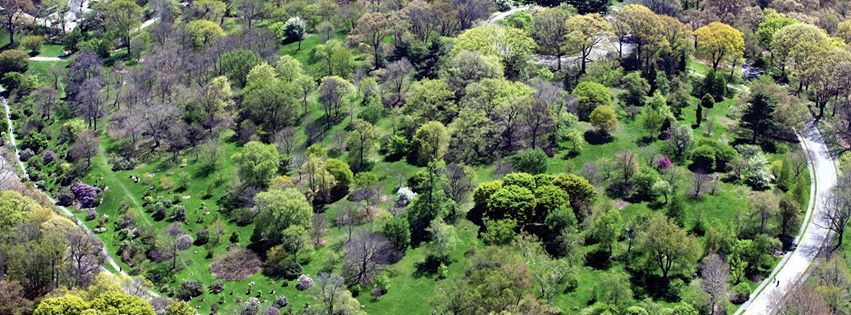
Harvard Arboretum
The forest at the Harvard arboretum was one of the forests included in this study. It has the longest continuous record of forest growth in the world.
Many questions remain. Which species are becoming more efficient in their water use? Are there intervening factors that are reducing water use? Will this trade-off between water use and carbon dioxide levels have an upper limit?
The Environmental Protection Agency (EPA) has published its comment on the Draft Environmental Impact Statement (DEIS) for the FEMA projects in the East Bay. It is available here: FEMA DEIS – public comment – EPA. We are pleased to tell you that the EPA shares many of our concerns about the environmental impact of these projects and they consider the evaluation of those impacts by the DEIS inadequate. The EPA has rated this project “Environmental Concerns – Insufficient Information.” These are the definitions of those terms:
“Environmental Concerns: The EPA review has identified environmental impacts that should be avoided in order to fully protect the environment.Corrective measures may require changes to the preferred alternative or application of mitigation measures that can reduce the environmental impact…”
“Insufficient Information: The draft EIS does not contain sufficient information for EPA to fully assess environmental impacts that should be avoided in order to fully protect the environment…”
EPA says, “The project could result in degradation of natural resources”
The EPA shares our opinion about the probable outcome of the proposed project:
“The document assumes that areas will naturally regenerate, once rid of non-native species. We are concerned that some of the aspects of the project would result in degradation of natural resources and may not provide for natural regeneration. Further, while the DEIS includes a discussion of climate change, it does not include a detailed discussion of the potential impact of climate change on the Project area. Current research indicates that climate change could impact the amount, timing and intensity of rain and storm events; increase the length and severity of the fire season; modify the rate and distribution of harmful timber insects and diseases; and aggravate already stressed water supplies. A significant change in the weather patterns could have important implications for the management of the Project area.”
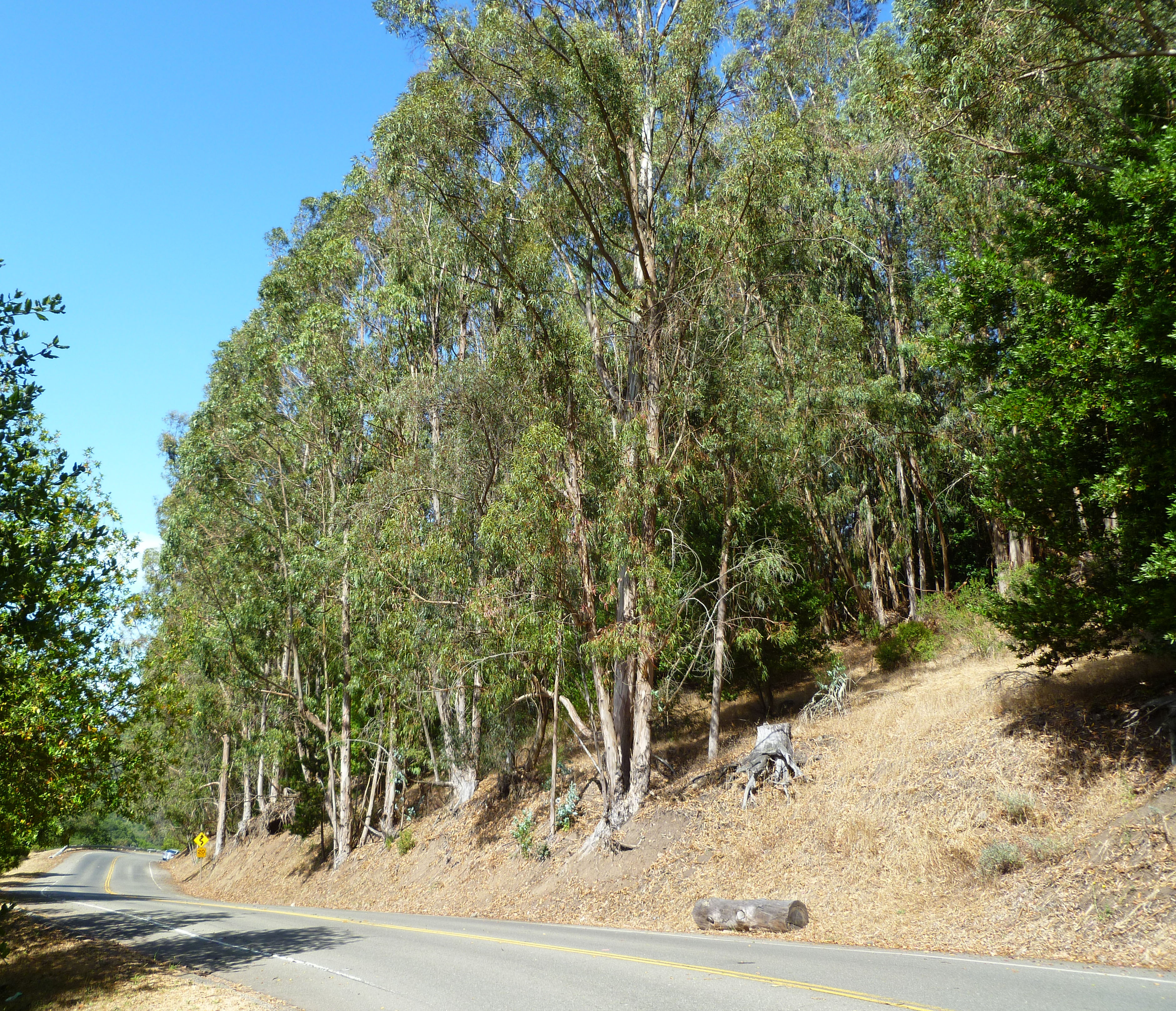
FEMA proposed project on the right. Claremont Blvd. westbound.
The EPA recommends that the final EIS take into consideration the impact that climate change will have on the success of the project. For example, as plants and animals move in response to climate change, they may no longer be viable in their historic ranges, which this project attempts to replicate. Ironically, the project contributes to climate change by releasing tons of greenhouse gases that cause climate change. The DEIS does not acknowledge or analyze these factors.
A completed project 10 years later. Southbound Grizzly Peak Blvd.
EPA says, “We note that extensive use of herbicides is proposed”
Yes, indeed, this project will require thousands of gallons of herbicide and we are delighted that the EPA has noticed this as well as the serious deficiencies of information in the DEIS regarding herbicide use:
There are many different formulations of Roundup with different properties, yet the DEIS does not identify which formulation of Roundup will be used. Therefore we cannot evaluate its toxicity.
The DEIS does not clearly state which herbicide products will be used for what purpose and in what locations.
The DEIS does not clearly state the method of application of herbicides.
The DEIS does not acknowledge that both triclopyr and imazapyr “can migrate through the soil” which will damage the native trees and vegetation this project claims to promote.
The DEIS evaluates the impact of herbicides only on endangered species which may or may not be the most sensitive species to herbicides. The final EIS must evaluate the impact of herbicides on the most sensitive species of animals, whether or not they are endangered.
The EPA is equally concerned about the impact of herbicides on human health and safety. It therefore notes the following deficiencies in the DEIS in that regard:
Reports of toxicity of herbicides in the DEIS are incomplete and inaccurate.
The DEIS does not acknowledge the “possibility of people and or animals entering the treated areas and coming in contact with herbicides already applied.” The Final EIS (FEIS) should therefore “clarify that there is potential for human exposure even if the chemicals do not move from the application site.” Further, “The FEIS should include a mitigation measure to remove fruiting or other edible vegetation.”
The EPA also noted many of the troubling inaccuracies andcontradictions in the DEIS that were also a concern to us:
The DEIS claims as “mitigation” the requirements on the labels of the herbicide products that will be used. These are mandatory requirements for legal use of the products, not voluntary measures that can be described as “mitigation.”
Likewise, the DEIS claims that requiring applicators of herbicides to wear protective clothing is a “Best Management Practice.” Wearing protective clothing is required for legal application of herbicides, not a voluntary measure.
Several contradictory statements are made in the DEIS regarding maximum wind speeds beyond which herbicides should not be applied.
The DEIS claims that the “Lowest Observed Adverse Effect Levels” of herbicides can be estimated from an experimentally derived “No-observed Adverse Effect Level” without providing any supporting reference. The EPA asks, basically, where does that claim come from?
The EPA points out inconsistent and incorrect use of the phrase “Certified Pesticide Applicator.” That may seem a small quibble, but it means that we have no idea what the qualifications will be of the people who will apply herbicides.
The DEIS announces that a specific adjuvant or surfactant will be used without telling us anything about the properties of that product. The adjuvant or surfactant is the inert ingredient in a formulated herbicide product that delivers the active ingredient (the poison) to the plant.
The DEIS uses an outdated EPA study about the effect of glyphosate on rabbits to report the toxicity of the product on rats. Whoops! Old data about the wrong animal! Picky, picky.
EPA asks, “Are the trees being removed for development?”
The EPA has apparently noticed that the DEIS mentions the long-term plans to build on some of the project areas of UC Berkeley. Therefore, it wants to know if that’s why the trees are being destroyed:
“Given that development is not included in the purpose and need for this Project, it is unclear whether the trees in these overlap areas would be removed for construction purposes regardless of whether they are removed as part of the proposed Project or not.”
Government is doing its job!
We are amongst the slim majority of voters who believe that government has an important job to do. We are often disappointed by government, but we aren’t inclined to kill it because it is sometimes incompetent. We are therefore very pleased to tell our readers that the EPA has apparently read the DEIS published by its sister/brother agency, The Federal Emergency Management Agency. Although they did not identify many of the important issues in the DEIS, they identified some of them. For that we are grateful as well as hopeful that the sponsors of these destructive projects will be forced to at least modify them, if not abandon them altogether. Thank you, EPA!
Hummingbird in eucalyptus flower. Courtesy Melanie Hofmann
Our readers know that one of many reasons why we object to the destruction of healthy trees is that they are sequestering and storing carbon which is released as carbon dioxide into the atmosphere when the trees are killed and as wood decays. Carbon dioxide is the predominant greenhouse gas that is causing climate change. We believe that addressing climate change should be considered our highest environmental priority.
Although we like native plants and would like to conserve them, they will not survive in their historical ranges in a changing climate. Therefore, native plant advocates should join us in making climate change a higher priority than destroying our existing landscape in places where native plants may no longer be adapted if that destruction contributes to climate change.
Federal and State policies and laws have been adopted to address climate change and the main point of an environmental impact study is to assure the public that the project complies with all laws. Therefore, the Draft Environmental Impact Study (DEIS) for the FEMA projects in the East Bay that will destroy tens of thousands of healthy trees stands on its proverbial head trying to deny that carbon loss resulting from these projects will not violate these laws. These projects are described in detail HERE.
The point of this article is to inform the public of some of the flaws in the DEIS with respect to its analysis of carbon loss resulting from these projects. (This will not be a complete list of omissions and errors in the DEIS regarding carbon loss. A complete list would be too technical and lengthy.)
Only 15% of carbon storage in the existing forest has been quantified by the DEIS
The DEIS quantifies only two sources of carbon dioxide emissions resulting from this project: the fossil fuels used by motorized equipment during the project and the trunks of the trees greater than 5” in diameter that will be destroyed. Calculating loss of stored carbon based solely on the trunks of the trees that will be destroyed excludes the following sources of stored carbon in the forest: the understory, the forest floor layer (e.g., duff and litter), the bark, roots, and branches of the trees, and the soil. RA Birdsey of the US Forest Service reports (1) that only 15% of total carbon stored in forest ecosystems in the United States is contained in the trunk:
Allocation of carbon in forest ecosystems and trees
US Forests, 1992
1%
Foliage
5%
Roots
15%
Bole (trunk)
9%
Other wood above ground
29%
Tree
61%
Soil
8%
Forest floor
1%
Understory
99%
Total
Although the soil will remain when the trees are destroyed, there is scientific evidence that there will be some loss of soil carbon as a result of this project: “…a major forest disturbance, such as a clearcut harvest, can increase coarse litter and oxidation of soil organic matter. The balance of these two processes can result in a net loss of 20% of the initial carbon over a 10-15 year period following harvest.” (1) The destruction of all non-natives trees on 400 acres of UC Berkeley and the City of Oakland properties and 90% of the trees on 1,600 acres of East Bay Regional Park District, surely qualifies as a “major forest disturbance” which will result in loss of carbon stored in the soil of the forest.
The DEIS pretends there is no carbon loss from prescribed burns
East Bay Regional Park District plans to chip the trees that are destroyed and distribute them on 20% of the project areas to a depth of 4-6 inches. They plan to burn the wood that cannot be distributed on the ground without exceeding these limits. This excess wood will be burned in piles. In addition to pile burns, EBRPD also plans to conduct broadcast burns for the purpose of destroying non-native vegetation and vegetation debris considered potential fuel for a fire.
The DEIS does not quantify the carbon that will be released by these burns, citing an EPA policy of 1996: “It should be noted that the emission of CO₂ from burning has not been calculated since the removal of the vegetation would allow new vegetation to grow, eventually consuming at least a portion [of] the CO₂ released during burning, as noted in EPA emission factor guidance (EPA 1996)”
This EPA policy regarding CO₂ emissions from prescribed burns has been revised to include carbon emissions from prescribed burns. In response to climate change, the EPA established an “Emission Inventory Improvement Program” (EIIP) in 1997. Since then, the EIIP has continuously expanded and improved the National Emissions Inventory (NEI). The NEI for 2008 is available on the EPA website.It includes reporting of CO₂ emissions resulting from prescribed burns. Data for each type of emission is available on the internet. It can be sorted by state. The 2008 NEI reports that the State of California emitted 2,156,547 tons of carbon dioxide from prescribed burns in 2008.
Obviously, the DEIS is mistaken in its outdated claim that the EPA excludes emissions from prescribed burns from calculations of greenhouse gas emissions. Furthermore, whether or not the carbon released by prescribed burns must technically be reported, that carbon is, in fact, released to the atmosphere. Such a legalistic quibble ignores the fact that carbon released by prescribed burns has the same harmful environmental consequences as any other carbon release.
Loss of the ability of the existing forest to sequester carbon in the future is not quantified
In addition to the grossly underestimated loss of carbon stored in the existing forest ecosystem, the DEIS does not quantify the loss of the ability of the existing forest to sequester carbon in the future. The DEIS acknowledges that the post-treatment landscape will be less capable of sequestering carbon than the existing landscape:
“The proposed and connected actions would also be self-mitigating to some degree in the absence of a wildfire, because native vegetation would partially replace the non-native vegetation removed. However, the planned growth of oak and bay woodlands and successional grassland containing shrub islands would not sequester as much carbon as the larger eucalyptus and pines and the denser coastal scrub that would be removed.”(DEIS 5.6-11)
The DEIS cannot claim that legal thresholds for carbon loss are not violated without quantifying this decrease in the ability to sequester carbon.
Blue gums live in Australia from 200 to 500 years. (2) They live toward the longer end of the range in milder climates such as the San Francisco Bay Area. Most Blue Gum eucalypts were planted in the East Bay between 1886 and 1913, according to David Nowak of the US Forest Service. (3) Therefore, they are not more than 130 years old. They can be expected to continue to sequester carbon for at least 100 years and perhaps 300 years.
The native trees that the proposed projects claim will occupy the ground now occupied by non-native trees are significantly smaller than the existing trees. Since carbon sequestration and storage are proportionate to biomass, the native trees will not compensate for the loss of the ability of the existing forest to sequester carbon. The DEIS reports in Table 4.7-1 that the oak-bay woodland in the project areas is storing only 8.97 metric tons of CO2 per acre, compared to 325.91 metric tons per acre in the eucalyptus forest and 184.61 metric tons per acre in the Monterey pines.
Furthermore, the predominant native tree is being killed by Sudden Oak Death (SOD) at an epidemic rate, so its future is both unlikely and unknown. SOD exists in the project areas, which is reported HERE.
Misinterpreting or misrepresenting science
The DEIS sets up a straw man to support its claim that the FEMA projects will not increase carbon dioxide emissions by offering a false choice between theoretical carbon loss from a wildfire vs. carbon loss from destruction of the non-native forest. This false choice violates both federal and state law regulating environmental impact studies because the measure of environmental impact as defined by those laws require that the study compare the existing, baseline condition to the potential impact resulting from the proposed project. In other words, the existing condition is the forest that exists now, not a theoretical forest that has been destroyed by fire.
Adding insult to injury, the DEIS tries to prove its theoretical straw man by misinterpreting or misrepresenting scientific studies:
“Studies indicate that if a wildfire occurs, the proposed type of vegetation management sequesters more carbon in the long term than leaving the sites untreated. Two wildfire modeling studies indicated that thinning would reduce damage caused by wildfires, allowing faster regrowth after a fire (Hurteau and North 2010; Wiedinmyer and Hurteau 2010). The Wiedinmyer and Hurteau (2010) study included the use of prescribed burning as a treatment method.” (DEIS 5.6-11)
In fact, these studies don’t say what the DEIS claims they say:
In “Prescribed fire as a means of reducing forest carbon emissions in the Western United States,” (4) the authors compare carbon loss from prescribed burns with carbon loss from wildfires in the same locations and reach the conclusion that prescribed burns result in less carbon loss than wildfires without prescribed burns. However, the prescribed burns they are considering were restricted to the understory and did not include any trees: “The fraction of fuel consumed in prescribed fires was applied only to the surface fuel fraction (including herbaceous, fine, and coarse fuels of the total fuel loading model…); no live or standing dead trees are assumed to burn in prescribed fires.” Therefore, this study is not applicable to the proposed project which intends to burn the remains of hundreds of thousands living trees which will obviously release far more carbon into the atmosphere than the prescribed burns in this study as well as reduce carbon sequestration into the foreseeable future.
In “Carbon recovery rates following different wildfire risk mitigation treatments,” (5) the authors compare several different methods of fuel reduction with respect to how long it takes for the forest to recoup the carbon loss from those methods. It finds that the forest is unable to recoup the loss of carbon when the destruction of the overstory canopy is the method used because of the large amount of carbon stored in large trees: “Overstory tree thinning treatments resulted in a large carbon deficit and removed many of the largest trees that accumulate the most carbon annually, thereby increasing carbon stock recovery time.” In fact, this is precisely the method that will be used by the proposed project. Therefore, this study makes the point that this project will permanently reduce the ability to sequester carbon by destroying large trees that will not be replaced. In other words, this study contradicts rather than supports the assumptions of the DEIS regarding carbon storage.
In “High-severity wildfire effects on carbon stocks and emissions in fuels treated and untreated forests,” (6) the authors compare carbon loss from wildfires in a thinned forest (both loss from treatment and loss from subsequent wildfires) with carbon loss from wildfires in the same locations without thinning. They conclude that such thinning results in more total carbon loss than wildfires without such thinning in the short run. However, because more trees remain after wildfire in a treated forest, the ability of the forest to sequester carbon in the long term can recoup much of the loss of the treatment. The forests they are considering have average densities of 1536 stems per hectare and thinning is limited to stems of less than 18 inches in diameter. This study is therefore not relevant to the proposed project because the forests in the proposed project are significantly less dense and are being completely destroyed by UCB and Oakland and more drastically thinned by EBRPD compared to the study. In other words, a much greater percentage of total carbon storage will be lost by the proposed projects in the short run because a higher percentage of total trees will be destroyed, including all large trees which store more carbon than smaller trees. In addition much more capability to sequester carbon will be lost in the long run because few trees will remain.
All of these studies have in common that they have measured all sources of carbon in the forest: carbon in the soil and roots, in the branches and leaves, in the understory, in the duff and leaf litter. In contrast, the DEIS quantifies only the amount of carbon stored in the trunks of the trees. All other sources of carbon are ignored.
It’s time to send your public comment on these projects
Remember that public comments are due by June 17, 2013. You may submit written comments in several ways:
These public lands belong to you and the money that will be used to implement these projects is your tax dollars. So, please tell the people who work for you what you think of these projects.
***********************************
(1) “Carbon Changes in US Forests,” RA Birdsey and LS Heath, US Forest Service Gen. Tech. Report RM-GTR-271, 1995
(2) Eucalypt ecology: Individuals to ecosystems, by Jann Elizabeth Williams, John Woinarski ,Cambridge University Press, 1997
(3) David Nowak, “Historical vegetation change in Oakland and its implications for urban forest management,” Journal of Arboriculture, 19(5), September 1993,
(4) Christine Wiedinmyer and Matthew Hurteau, “Prescribed fire as a means of reducing forest carbon emissions in the Western United States,” Environmental Science Technology, 2010, 44, 1926-1932
(5) Matthew Hurteau and Malcolm North, “Carbon recovery rates following different wildfire risk mitigation treatments,” Forest Ecology and Management, 260 (2010) 930-937
(6) Malcolm North and Matthew Hurteau, “High-severity wildfire effects on carbon stocks and emissions in fuels treated and untreated forest,” Forest Ecology and Management, 261 (2011) 1115-1120
We believe that addressing climate change should be our highest environmental priority because it is the cause of many environmental problems. For example, a recent study found that changes in climate accounted for over half of the significant changes in vegetation all over the world in the past 30 years: “The climate governs the seasonal activity of vegetation…In humid mid-latitudes temperature is the largest influencing factor in plant growth. In predominantly dry areas, however, it is the availability of water and in the high altitudes incident solar radiation.” (1) Animals are affected by both changes in vegetation and climate, as exemplified by the shrinking home of the polar bear as Arctic ice melts.
The consensus amongst scientists is that increases in greenhouse gas emissions are the primary cause of climate change and carbon dioxide is the predominant greenhouse gas. Although the burning of fossil fuels is often considered the biggest source of greenhouse gas emissions, in fact transportation is responsible for only 10% of emissions. In contrast, deforestation is contributing 20% of greenhouse gas emissions because trees store carbon as they grow and release it into the atmosphere as carbon dioxide when the tree is destroyed. For that reason—and many others– we are opposed to the destruction of our urban forest.
Mount Sutro Forest is threatened with destruction because it is not native. Courtesy Save Sutro Forest.
Because our urban forest is predominantly non-native, native plant advocates are committed to defending the projects that are destroying the urban forest, which puts them in the awkward position of claiming that its destruction will not contribute to climate change. Here are a few of the arguments used by native plant advocates and the scientific evidence that those arguments are fallacious:
Since the native landscape in the Bay Area is grassland and scrub, native plant advocates often claim that these landscapes store more carbon than trees. In fact, trees store far more carbon than the native landscape because carbon storage is largely proportional to biomass. In other words, the bigger the plant, the more carbon it is capable of storing. (Carbon storage in plants and soils is explained in detail here.)
In the Draft Environmental Impact Report for San Francisco’s Natural Areas Program, native plant advocates claimed that destroying the forest and restoring grassland would lower ground temperatures based on a scientific study about the arctic north at latitudes above 50°. In fact, the point of that study was that snow reflects more light than trees. The Bay Area is far below 50° latitude and it doesn’t snow here, so that study is irrelevant to the Bay Area. (That study and its misuse by native plant advocates are reported here.)
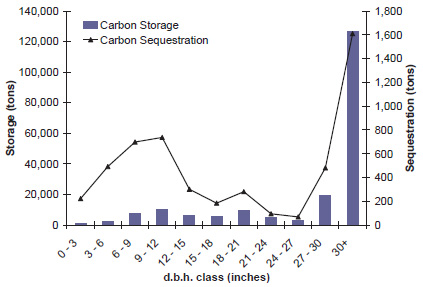
Since most of the urban forest in the Bay Area was planted over 100 years ago, native plant advocates often claim that only young trees store carbon. Since carbon storage is largely proportional to biomass, mature trees store more carbon than small young trees. That is illustrated by this graph from the US Forest Service survey of San Francisco’s urban forest.
Larger trees store more carbon at a faster rate
The claim that young trees store more carbon is often made in connection with the equally bogus claim that “restoration” projects in the Bay Area will replace non-native trees with native trees. None of the plans for these projects propose to plant native trees where non-native trees are destroyed because that wasn’t the native landscape. In any case, native trees don’t tolerate the windy, dry conditions in which non-native trees are growing. For example, a study of historic vegetation in Oakland, California reported that only 2% of pre-settlement Oakland was forested with trees. (2)
A new study about carbon storage in forests
Now that science has established the reality of climate change, most scientific inquiry has turned to how to stop it and/or mitigate it. For example, a recent study reports that planting forests where they did not exist in the past, quickly stores far more carbon in the soil than the treeless landscape. Scientists “…looked at lands previously used for surface mining and other industrial uses, former agricultural lands, and native grasslands where forests have encroached….[they] found that, in general, growing trees on formerly non-forested land increases soil carbon.” (3)
Here are their specific findings on each type of previously non-forested land:
“On a post-mining landscape, the amount of soil carbon generally doubled within 20 years and continued to double after that every decade or so.”
“The changes after cultivation of farm fields was abandoned and trees became established are much subtler, but still significant…at the end of a century’s time, the amount of soil carbon averages 15 percent higher than when the land was under cultivation…”
“In places where trees and shrubs have encroached into native grassland, soil carbon increased 31 percent after several decades…”
Mainstream environmental organizations such as the Sierra Club claim to be concerned about climate change, yet they are the driving force behind the destruction of the urban forest in the San Francisco Bay Area. When will they wake up to the fact that advocating for the destruction of the urban forest is irresponsible for an environmental organization in the age of climate change?
*******************************
(1) “A Look at the World Explains 90 Percent of Changes in Vegetation,” Science Daily, April 22, 2013.
(2) Nowak, David, “Historical vegetation change in Oakland and its implications for urban forest management,” Journal of Arboriculture, 19(5): September 1993
(3) “Soils in Newly Forested Areas Store Substantial Carbon That Could Help Offset Climate Change,” Science Daily, April 4, 2013.
This is a revision of an article that was published on May 5, 2013. In our haste to inform our readers of these projects during the public comment period, we published before we had read the entire Environmental Impact Study. We are forced to revise our estimates based on further reading of the document. We apologize for the confusion and thank you for your patience.
On May 29, 2013, we found an error in the number of trees that will be removed at Frowning Ridge. We show our corrections so as not to mislead our readers.Again, our apologies.
*******************************
The Federal Emergency Management Agency (FEMA) has been considering grant applications for “fire hazard mitigation” in the East Bay since 2005, when the first of these applications was submitted. After years of debate about whether or not the projects achieve the stated purpose and at what cost to the taxpayers and the environment, FEMA finally agreed to resolve the controversial issues by mandating an environmental impact review, which began in 2010. Although FEMA paid for the environmental review, the grant applicants conducted it and it represents their opinions of their projects.
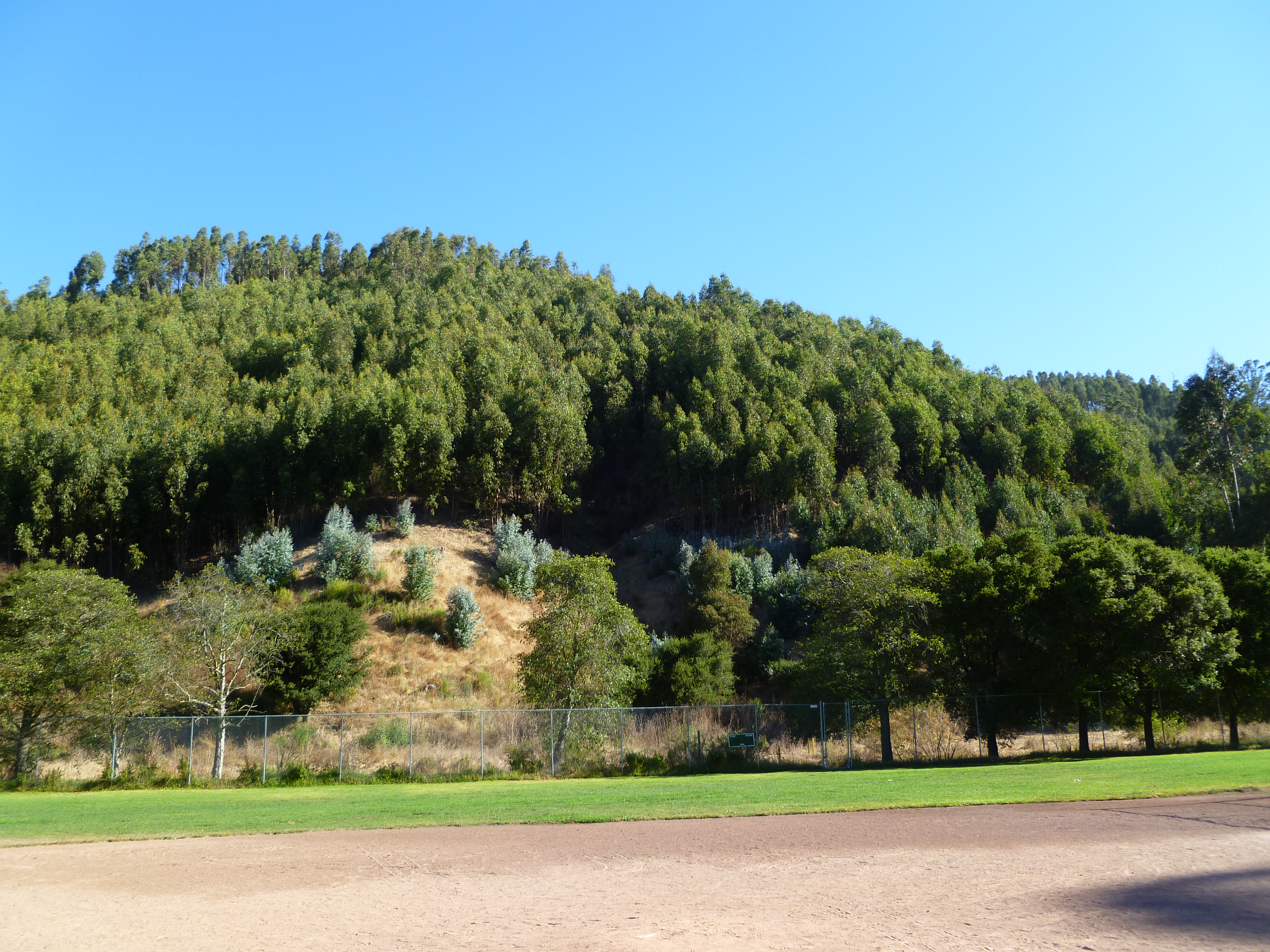
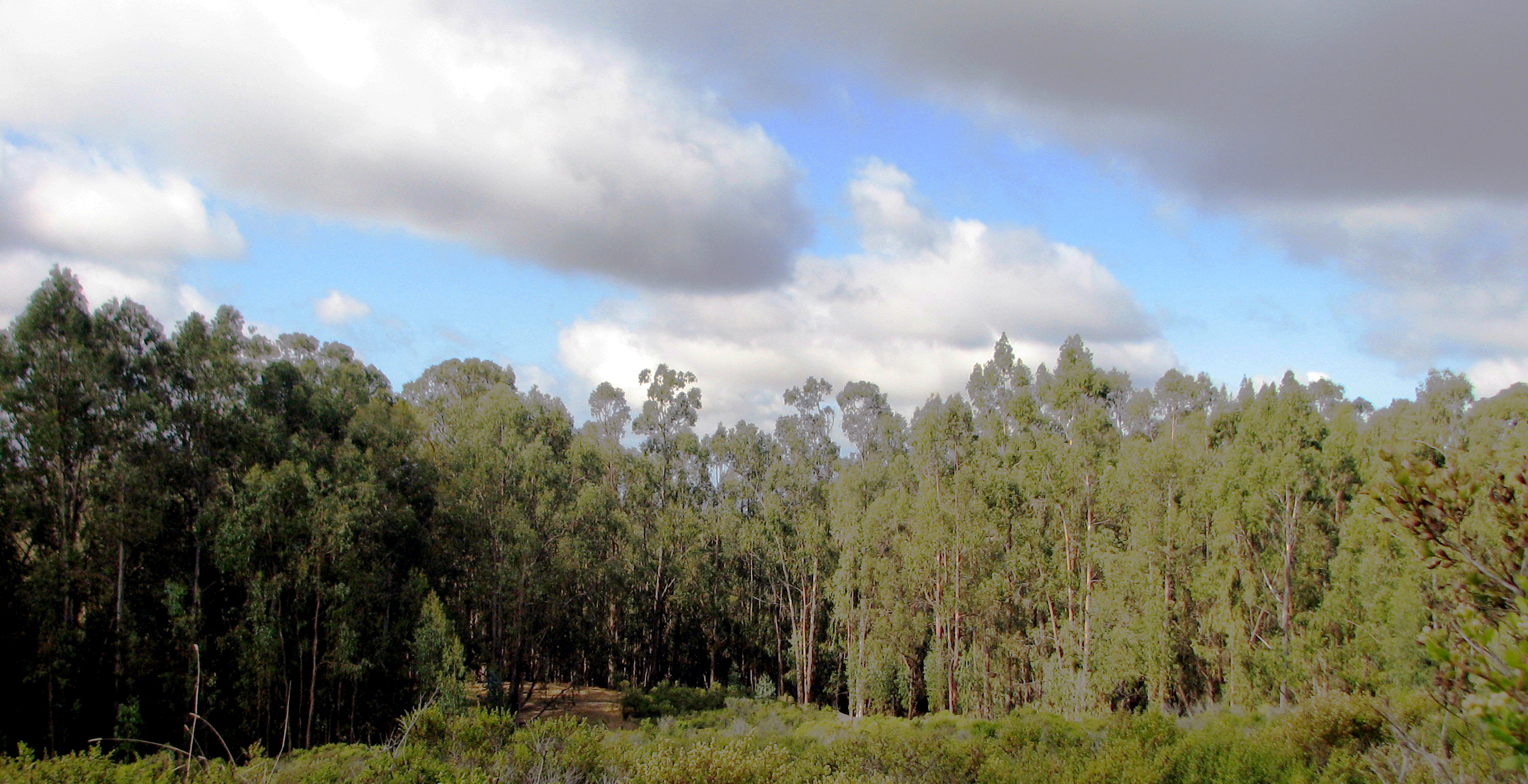
This eucalyptus forest at the North Oakland Sports Facility will be entirely destroyed.
These are the projects for which the Million Trees blog was created and for which it was named. Our opinion of these projects is unchanged by the environmental impact review. These projects will not achieve their stated objectives. Instead they will damage the environment and endanger the public.
The Draft Environmental Impact Statement (DEIS) for these projects was published by FEMA on April 25, 2013. It is available here. This is a brief description of the projects, our initial assessment of the DEIS, and information about how you can participate in the decision-making process which will ultimately determine the fate of these projects.
Description of the projects in the East Bay
Three different owners of public land have applied for these grants: University of California at Berkeley (UCB), City of Oakland, and East Bay Regional Park District (EBRPD). The projects of UCB and Oakland are similar and they are different from the projects of EBRPD, so we will describe them separately. These are the locations of the projects of UCB and Oakland, their acreage, and the estimated number of trees that will be removed by these projects:
Project Area
Project Acreage
Estimated Tree Removals*
UCB
Strawberry Canyon
56.3
22,000
Claremont
42.8
Frowning Ridge (in Oakland)
185.2
38,000 32,000
Sub-Total
284.3
60,000 54,000
Oakland
North Hills Skyline
68.3
Caldecott Tunnel
53.6
Sub-Total
121.9
25,735 23,161
TOTAL
406.2
85,735 77,161
*UCB estimated tree removals are provided by the DEIS; Oakland estimated tree removals are extrapolated assuming the same number of trees per acre (60,000 54,000 ÷ 284.3 = 211 190 trees per acre X 121.9 acres = 25,735 23,161 trees removed by the projects of the City of Oakland)
UCB and Oakland plan to remove all non-native trees (eucalyptus, Monterey pine, acacia, etc.) and vegetation from the project area. All non-native trees up to approximately 24 inches in diameter at breast height (DBH) will be cut into wood chips and scattered on the ground of the project area. They estimate that 20% of the project area will be covered with wood chips to a depth of 24 inches. The DEIS estimates that the wood chips will take from 5 to 10 years to decompose. Larger trees will be cut up and scattered on the site.
Although UCB and Oakland do not intend to plant the project areas (unless erosion subsequent to tree removals demands seeding of native grasses and herbaceous plants), they predict that the project area will eventually become native grassland, scrub, and forest of coast live oak, California bay laurel, big-leaf maple, California buckeye, and California hazelnut. They predict that this conversion from non-native to native vegetation will be accomplished by “recruitment” from areas where these plants exist, into the areas where non-native plants and trees will be removed.
The stumps of eucalypts and acacia will be sprayed with an herbicide (Garlon with the active ingredient triclopyr) soon after the trees are cut down to prevent resprouting. An estimated 1 – 2 ounces of formulated herbicide will be required for each stump. Based on an experiment conducted by East Bay Regional Park District, an estimated 5% of the trees will require retreatment of subsequent resprouts. They are therefore predicting that between 703 633 and 1,407 1,266 gallons of herbicide will be required to prevent resprouting if only 5% of the stumps require retreatment as they claim. Monterey pines will not require herbicide treatment which reduces this estimate proportionately, although we are not provided with enough information to make this calculation. Herbicide (Roundup with active ingredient glyphosate) will also be sprayed to control non-native vegetation, but no estimates of quantities required for that purpose are provided by the DEIS.
The fire hazard mitigation projects of the East Bay Regional Park District were described in detail in its “Wildfire Hazard Reduction and Resource Management Plan” of 2009. EBRPD has applied for FEMA funding for about one-third of the “recommended treatment areas” in that plan. The FEMA DEIS considers all recommended treatment areas on EBRPD property, including those for which FEMA funding has not been requested. The recommended treatment areas for which FEMA funding has not been requested are called “Connected Action Acres.” The “Connected Action Acres” have undergone environmental review under California law (CEQA) and are therefore approved for implementation, which has already begun.
Project Area
Project Acres
Connected Action Acres
Total Acres
Estimated Tree Removals*
EBRPD
Sobrante Ridge
4.1
0
Wildcat Canyon
65.6
46.6
Tilden Park
132
194.2
Claremont Canyon
35.3
130.4
Sibley Volcanic
47.5
118.4
Huckleberry
17.8
.3
Redwood Park
58.4
92.8
Leona Canyon
4.6
0
Anthony Chabot
200
478.2
Lake Chabot
4.8
0
Miller-Knox
22.2
0
TOTAL
592.3
1,060.7
1,653
400,602 409,176
*Estimated Tree Removals: Neither the DEIS nor EBRPD’s “Wildfire Plan” provides an estimate of the number of trees they plan to destroy. Furthermore their plans for tree removals are complex and variable. All non-native trees (eucalypts, Monterey pines, acacia) will be removed in some recommended treatment areas, but in most they will be thinned to spacing of 25 to 30 feet. The final Environmental Impact Report for the “Wildfire Plan” provides an estimate of the existing tree density of existing eucalypts on EBRPD property (page 392). Acres of eucalypts in the entire project area are provided by the DEIS (page 4.2-6). Our estimate of tree removals is based on those figures (1).
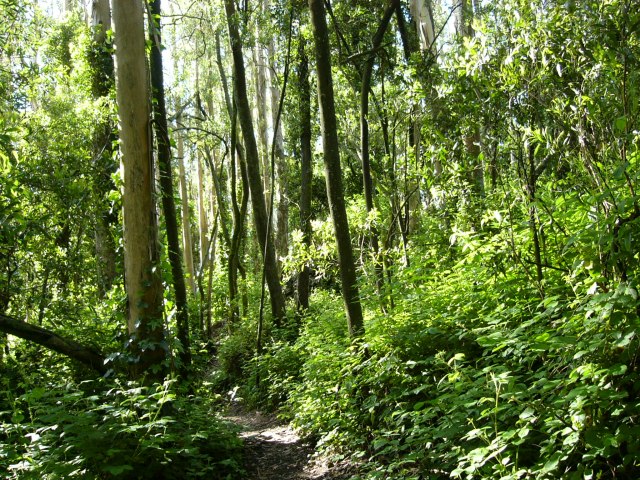
This eucalyptus forest at Chabot Park will be thinned to about 60 trees per acre.
This estimate does not include the Monterey pines and acacia that will be removed by EBRPD, for which inadequate information is available to provide an estimate.
EBPRD plans to cut the trees into wood chips which will be scattered to cover 20% of the project to maximum depth of 4-6 inches. The remainder of the wood will be burned in piles. Other non-native vegetation will be destroyed with herbicides and/or prescribed burns. These prescribed burns will not be funded by FEMA.
EBRPD’s plans to convert the project area to native vegetation are similar to the plans of both UCB and Oakland. EBRPD also does not plan to plant project areas with native vegetation. EBRPD also plans to use herbicides on the stumps of eucalypts and acacia which we estimate will require a mind-boggling 3,286 3,356 to 6,572 6,713 gallons of herbicide.
Million Trees’ assessment of these projects
We have surely exhausted your patience with the mind-numbing detail needed to describe these projects accurately. Therefore, we will provide only a brief outline of our assessment of these projects:
* These projects are more likely to increase the risk of wildfires than to reduce that risk.
By distributing tons of dead wood onto bare ground
By eliminating shade and fog drip which moistens the forest floor, making ignition more likely
By destroying the windbreak that is a barrier to wind driven fires typical of wildfires in California
By expanding the oak-bay woodland being killed by Sudden Oak Death, thereby adding more dead wood
* These projects will damage the environment by releasing hundreds of thousands of tons of carbon dioxide into the atmosphere from the destroyed trees, thereby contributing to climate change.
* These projects will endanger the public by dousing our public lands with thousands of gallons of toxic herbicides.
* Erosion is likely on steep slopes when the trees are destroyed and their roots are killed with herbicides.
* Non-native vegetation such as broom, thistle, and hemlock are more likely occupants of the unshaded, bared ground than native vegetation which will not be planted by these projects.
* Prescribed burns will pollute the air and contribute to the risk of wildfire, endangering lives and property.
* These projects are an inappropriate use of the limited resources of the Federal Emergency Management Agency which are for the expressed purpose of restoring communities destroyed by disasters such as floods and other catastrophic events and preparing communities for anticipated catastrophic events. Most of the proposed projects in the East Bay are miles away from any residences.
Update: Please visit THIS post for the current status of these projects. In summary: East Bay Regional Park District is implementing its original plans. City of Oakland is developing a new “Vegetation Management Plan.” UC Berkeley is suing to re-instate its FEMA grant funding so that it can implement its original plans.
How to participate in this decision-making process
The Hills Conservation Network has created a petition to oppose these projects. It is available HERE.
You can also participate in this decision. FEMA will host three public meetings in May 2013:
Tuesday, May 14, 2013, 2:00 p.m. – 4:00 p.m., Richard C. Trudeau Center, 11500 Skyline Boulevard Oakland, CA 94619
Tuesday, May 14, 2013, 6:00 p.m. – 8:00 p.m., Richard C. Trudeau Center, 11500 Skyline Boulevard Oakland, CA 94619
Saturday, May 18, 2013, 10:00 a.m. – 12:00 p.m., Claremont Middle School, 5750 College Avenue Oakland, CA 94618
Comments on this document must be submitted by June 17, 2013. You may submit written comments in several ways:
These public lands belong to you and the money that will be used to implement these projects is your tax dollars. So, please tell the people who work for you what you think of these projects.
*********************************
(1) Calculation of estimated tree removals by East Bay Regional Park District, Update: We understand the weakness of this estimate. Unfortunately, the DEIS does not provide sufficient information to improve its accuracy. Again, our apologies.
The San Francisco Chronicle recently published an op-ed by Joe Mascaro about the Sutro Forest (available here). He is a professional ecologist at the Carnegie Institution for Science who studies the ecological functions of forests (his research is described here). He is also a San Franciscan and a fan of the Sutro Forest. He tells us in his op-ed that the Sutro Forest is a unique, “novel” forest that is thriving and that destroying it will increase the risk of wildfire, contrary to the claims of UCSF.
As we approach the March 19, 2013 deadline for submitting public comments on the Draft Environmental Impact Report for UCSF’s proposed plan to destroy 90% of the forest and its understory on 75% of the 61 acres of the Mount Sutro Reserve, we appeal to our readers to take a few minutes in their busy day to write your own comment (see below for details of where to send comments).
About 200 people came to the community meeting at UCSF last night. Nearly 60 people spoke; the overwhelming majority spoke in opposition to UCSF’s proposed plans to destroy most of the forest. Everyone spoke respectfully but with passion about what this forest means to the community. Many spoke about the loss of trees and habitat where similar projects already have been implemented by the Natural Areas Program and the GGNRA.
Over 1,700 people have signed the petition to save the Sutro Forest. If you haven’t signed yet, please do so here. We’re going to quote a few of the astute and well-informed comments that people have written on the petition in the hope that it will inspire you to write your own comment. (Grammatical edits only.)
Comment #1575:
“Among many other reasons not to hurt this forest- it is healing to people in need of healing at the UCSF hospital. The sight of it sustained me through a difficult labor during which I gazed on it for 13 hours. It is a vibrant, healthy, and sacred forest, and the people who love it will not stand by idly and quietly if it is in harms way”
Scientific studies corroborate this patient’s personal experience. Here is a report of these studies.
Comment #1528:
“Please nooooo!!! do not destroy the habitat for hundreds of creatures. WHY the destruction FOR NOTHING!!! I live in the neighborhood and I am sick and tired to see the city and UCSF cutting down trees and not replacing them.. but only with shrubs and small plants”
This is another San Franciscan who has noticed that the UCSF project is one of many in San Francisco which is destroying trees in order to return the landscape to native grassland and scrub.
Comment #1519:
“The reasons for tree removal are inaccurate. The effort is a waste of resources. The forest is healthy and most importantly serves the needs of the population of the city. UC has indicated its willingness to destroy trees for its own gain, but what the people of SF need is the unique ecosystem that provides wind relief, beauty, and comfort. Native plant restoration is a myopic, militant effort that does not take into consideration the needs of the people who live in SF. This is another effort to waste and destroy for misconceived ideals.”
This San Franciscan understands that the Sutro forest is performing important ecological functions.
Comment #1518:
“The trees in Sutro forest provide immense value to the neighborhood and the city in which we live. It is a wind break, it is a visual stimulus, it is a wonderful place to walk, it is home to a large number of hummingbirds, it isolates a busy hospital from the neighborhood and it provides a tremendous source of ground water to neighboring houses. Save the forest.”
This Sutro neighbor understands that the loss of this forest will harm both the neighborhood and the animals that live in the forest.
Comment #1471:
“Destroying 90% of the trees will destroy the forest – its beauty, its Cloud Forest aspect, and its habitat value. The trees, which sequester tons of carbon, will no longer do so, and instead the dead chipped trees will release carbon dioxide into the atmosphere. PLEASE DO NOT REMOVE THESE TREES!”
This commenter understands that the forest is storing carbon which will be released into the atmosphere as carbon dioxide when the trees are destroyed. Carbon dioxide is the predominant greenhouse gas which is causing climate change.
Comment #1277:
“For environmental reasons please do not cut the forest of Mount Sutro. Risk of landslides (the old forest has intertwined and intergrafted roots that function like a living geo-textile and hold up the mountain, while the exposed rock on Twin Peaks has a rock-slide every year or two); Pesticide drift into our neighborhood, affecting us and our pets (right now, Sutro Forest may be the only pesticide-free wildland in the city; the Natural Areas Program, which controls most of it, uses pesticides regularly) Increased noise (the vegetation – the leaves of the trees and the shrubs in the understory are like soft fabrics absorbing sound) Changes in air quality (trees reduce pollution by trapping particle on their leaves until they’re washed down) Environmental impact – (eucalyptus is the best tree species for sequestering carbon because it grows fast, large, is long-lived, and has dense wood; but felled and mulched trees release this carbon right back into the atmosphere).”
This San Franciscan is aware of the pesticides being used by the Recreation and Park Department’s so-called “Natural Areas Program.” UCSF’s proposed project will use pesticides to prevent the resprouting of the trees that they destroy. Pesticides used by native plant “restorations” are described here. She also understands that trees stabilize steep slopes and reduce air pollution.
Here’s what you can do to help save the Sutro Forest:
• Sign the petition to save the forest. Available here.
• Submit a written public comment by 5 PM, March 19, 2013 to UCSF Environmental Coordinator Diane Wong at EIR@planning.ucsf.edu or mail to UCSF Campus Planning, Box 0286, San Francisco, CA 94143-0286. Include your full name and address.
• Write to the Board of Regents to ask why a public medical institution is engaging in such a controversial, expensive, and environmentally destructive act. Address: Office of the Secretary and Chief of Staff to the Regents, 1111 Franklin St., 12th Floor, Oakland, CA 94607 Fax: (510) 987-9224
• Subscribe to the website SaveSutro.com for ongoing information and analysis.
UCSF has sent an email to its neighbors about its plans for the Sutro forest in which they say, “Contrary to rumors being circulated, there is no plan to cut down 30,000 trees in the Mount Sutro Open Space Reserve, and it is unfortunate that this misinformation continues to spread.”
Our response is, Do the math!!
The Draft Environmental Impact Report (DEIR) claims that the thinned forest will have 62 trees per acre. (DEIR Appendix F) The DEIR arrives at this figure by assuming that each tree will occupy a circle with a radius of 15’. In fact, it is not possible to pack circles into another geometric space, whether it is a bigger circle, a rectangle or a square without wasting space. Therefore, this calculation arrives at a bogus answer which is larger than is physically possible.
We have calculated the number of trees remaining in the thinned forest based on the number of squares in an acre that are 30’ X 30’. Such calculations of tree density are found in books regarding arboriculture, which corroborates that we are using a standard calculation used by the timber industry and the DEIR is not. (1)
48.4
43560/900 = trees per acre if 30 feet apart (the proposed plan)
12.1
43560/3600 = trees per acre if 60 feet apart (the proposed plan)
45000
Total number of trees existing now on 61 acres (according to UCSF)
34040
46 acres X 740 trees/acre = Number of trees existing in project area
2112
44 acres X 48 trees/acre = thinned forest with 30’ spacing
24
2 acres (Demo Area #4) X 12 trees/acre = thinned forest with 60’ spacing
31904
Existing Trees – Thinned Forest = Trees Removed in Project Area
70.9%
Trees Removed/Existing Trees in total forest = Percent of Trees Removed in Total Forest
If UCSF wishes to reduce the number of trees that will be removed by the proposed plan, it can do so by reducing the spacing between the trees or the number of acres to be “thinned.” All other numbers used to arrive at an estimated number of tree removals are straight-forward mathematical calculations based on the information provided by UCSF.
UCSF would be wise to read the DEIR for its project, which says, “Under full-implementation or worst-case implementation of management activities under the proposed project, approximately 60% of all existing trees, including large and small trees, could be removed.” UCSF reports that there are 45,000 trees in the Mount Sutro Reserve presently. Sixty-percent of 45,000 is 27,000 trees. We think UCSF’s estimate of tree removals is just a few thousand trees less than what is actually planned. What are we quibbling about?
Once again, we invite UCSF to revise its proposed project to reduce the number of trees that will be removed.
****************************
(1) Ecology and Silviculture of Eucalypt Forests, R.G. Florence, CSIRO, Australia
We have been watching attempts to eradicate non-native plants and replace them with native plants on public lands in the San Francisco Bay Area for over 15 years. Few of these efforts have been successful. Non-native plants are repeatedly eradicated, then natives are planted. Within months the natives are dead and non-natives have returned.
The few projects that are successful are usually fenced, irrigated, and intensively planted and weeded. Few managers of public lands have the resources to achieve success. We have identified here on the Million Trees blog many reasons why attempts to return native plants to places in the Bay Area where they have not existed for over 100 years are often failures. Many of those reasons are related to the changes in the environment:
Higher levels of CO2 and associated climate change are promoting the growth of non-native plants. A USDA weed ecologist (1) studied the effects of higher temperatures and CO2 on the growth of non-natives (AKA weeds) by growing identical sets of seeds in a rural setting and an urban setting with higher temperatures and CO2 levels. Seeds grown in the urban setting produced substantially larger plants with much more pollen and therefore greater reproductive capability.
The growth of non-native annual grasses is encouraged by higher levels of nitrogen in the soil found in urban environments as a result of the burning of fossil fuels. (2)
The methods used by the projects undermine success
With the exception of the project on Mount Sutro in San Francisco, all of the projects use herbicides to eradicate the non-native plants and trees. Most of the non-native trees will resprout if their stumps are not sprayed immediately with herbicide and this must be done repeatedly to kill the roots of the trees. Many of these herbicides persist in the ground for years and probably suppress subsequent plant growth.
This problem is illustrated by a USDA study of the effects of a one-time aerial spraying of herbicides on grassland after 16 years. Although the herbicide is assumed to “dissipate” within a few years, the negative effect on the natives persisted 16 years later: “…the invasive leafy spurge may have ultimately increased due to spraying. Conversely, several desirable native herbs were still suffering the effects of the spraying,,,”
Anyone who is familiar with native plant restorations in the Bay Area knows that most are covered in a thick layer of mulch. When tree removals are required for a project, the mulch is usually composed of the chips of the trees that have been cut down. The projects of UC Berkeley for which UC is applying for FEMA funding (based on its claim that the clear-cutting of all non-native trees will reduce fire hazards) say specifically that the clear-cut areas will be covered with 24 inches of mulch composed of the chips of the destroyed trees.
The UC Berkeley projects also claim that native vegetation will return to these clear-cut areas without being planted based on an assumption that the seeds of native plants are dormant in the soil. One wonders how these seeds would be able to germinate when covered with 24 inches of mulch, or how the sprouts could penetrate it. Their proposal contains the fanciful suggestion that squirrels will plant the acorns of oaks in the mulch, which may be true of the oaks, but is an unlikely scenario for the many other native plants and trees which UC claims will populate their “restorations” without being planted.
Lack of horticultural knowledge is also handicapping these projects
One of 5 native oaks that survive on Tank Hill 10 years after 25 oaks were planted.
The managers of these projects often display a profound ignorance of basic horticultural knowledge. For example, we have seen them plant natives that require full sun in the deep shade of trees where they will not survive. We have seen them plant native trees that will not tolerate wind on the slopes of windy hills, only to watch the trees wither and die.
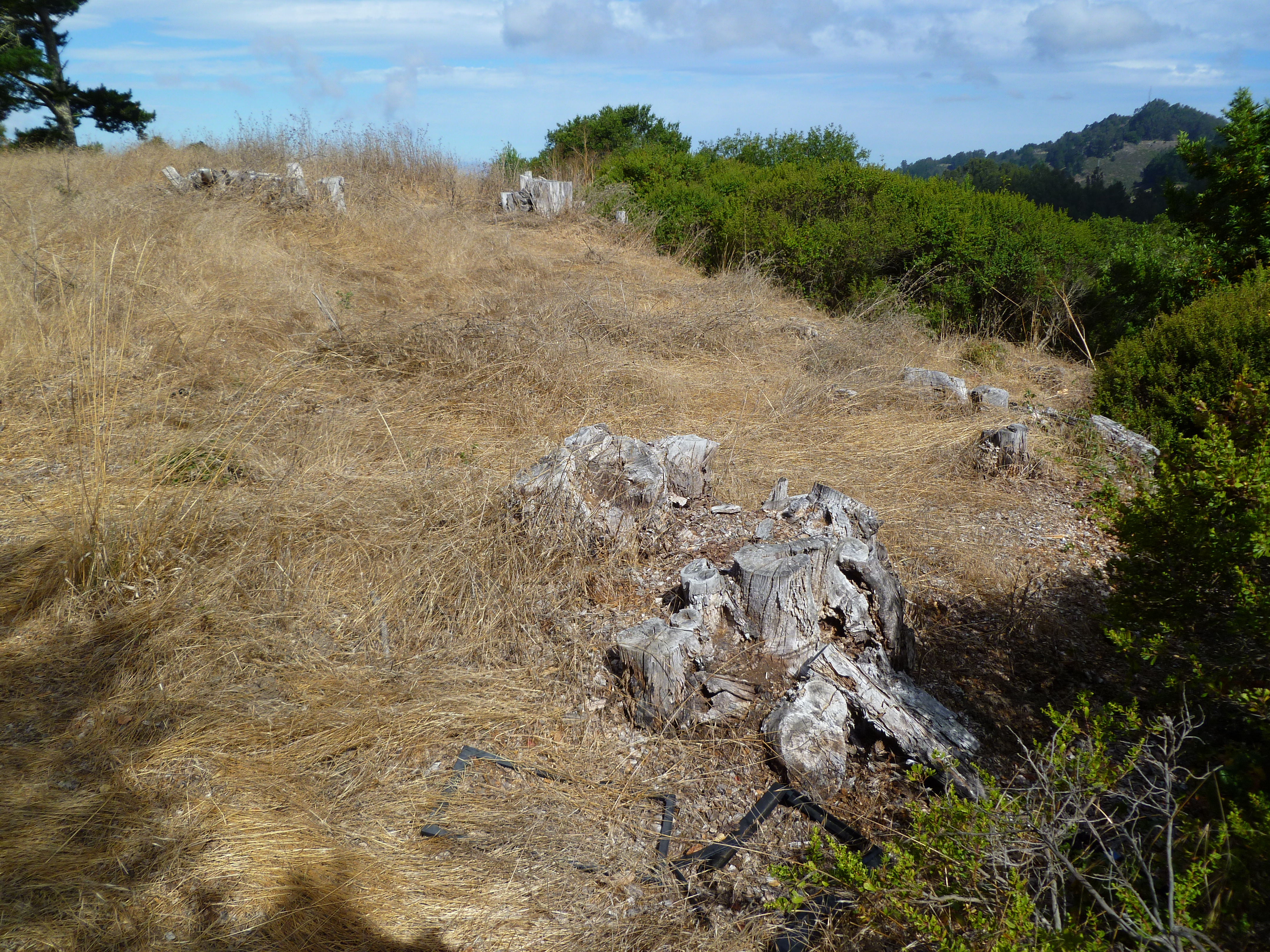
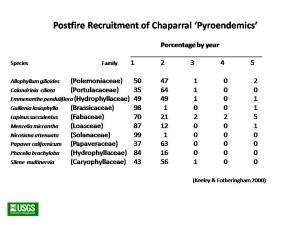
The managers of these projects are apparently unaware of the fact that hundreds of species of California native plants require fire to germinate their seeds and that most of the population will die within 5 years of the fire. (3) These are examples of such “pyroendemics” that sprout after a fire and are almost entirely gone within 5 years:
UC Berkeley and East Bay Regional Park District do not plan to plant any natives after eradicating non-native plants and trees. Their plans say that they expect seeds that are dormant in the ground to sprout when the ground is cleared of non-native plants. Unless they set fire to that ground, many seeds will not germinate and most of the plants that are germinated by that fire will disappear within 5 years unless another fire germinates another generation of plants.
UC Berkeley does not use prescribed burns on its property. East Bay Regional Park District (EBRPD) conducts only a handful of small prescribed burns every year, which they claim are solely for the purpose of reducing fuel loads. In an article about prescribed burns conducted by EBRPD, the District’s “Resource Analyst” is quoted as saying, “’This is not a restoration project. Our primary goal is fuels reduction.’” (4) Ironically, both of these owners of public lands claim that their objective in the eradication of non-native plants is to reduce fire hazard, yet they are trying to reintroduce a landscape that is dependent upon fire for survival.
The Natural Areas Program in San Francisco has never conducted a prescribed burn and the DRAFT Environmental Impact Report for their plan says they do not intend to do so in the future.
New and growing evidence that soil is altered by plants
In addition to these issues which have contributed to the failed attempts to reintroduce an historical landscape to the San Francisco Bay Area, we are reporting today on a new issue. Plants can change the microbial composition of the soil, including mycorrhizal fungi which have symbiotic relationships with plants.
Researchers tested soil for changes in composition after just three growth cycles. Several species of non-native annual grasses were grown in native soils. They reported that the non-native species reduced the population and changed the composition of the mycorrhizal fungi, which reduced the ability of native species to establish and persist in modified soils. (5)
The Berkeley Meadow is a 72-acre native plant garden on a former garbage dump on landfill.
How many more decades and how much more taxpayers’ money must we spend on these projects before land managers acknowledge their failures?
***********************
(1) Lewis Ziska, USDA Scientist, Beltsville, MD
(2) US Fish & Wildlife, Recovery Plan for Mission Blue butterfly
(3) Jon Keeley, et. al., Fire in Mediterranean Ecosystems, Cambridge University Press, 2012
(4) Wendy Tokuda, “Taming the Flames,” Bay Nature, July-September 2012
(5) Nicholas Jordan, et. al., “Soil-Occupancy Effects of Invasive and Native Grassland Plant Species Composition and Diversity of Mycorrhizal Associations,” Invasive Plant Science and Management, October-December 2012
U.S. Fish & Wildlife Service recently announced that after a 25-year effort, they are finally giving up on the fantasy that they can relocate otters from the coast of California to one of the Channel Islands off the coast. From 1987 to 1991, they captured and relocated 140 otters in a futile attempt to create a “no-otter zone.” (1)
Only 40 otters remain near the Channel Islands. Fish & Wildlife claims that most of the otters returned to the coast. We’ll never know how many otters died in the process of relocation and subsequent repatriation. Clearly, even if they survived the pointless ordeal, they didn’t benefit from it.
Otters were nearly hunted to extinction because of their soft fur. Their population plummeted from 16,000 in the late 1700s to only 50 in the 1930s. They were listed by the Endangered Species Act as a threatened species in 1977 and their population has stabilized at about 2,800.
Because of their status as a legally protected species, U.S. Fish & Wildlife decided to move them based on their belief that they would be safer. They claimed to be concerned that the otters might be harmed by off-shore oil drilling. One wonders if their concern might have had more to do with the fishermen who say that otters are depriving them of their catch of abalone and sea urchins.
Fish & Wildlife published a study of their project in 2005, which acknowledged the failure of the effort, yet it took 7 years for them to get around to officially ending it.
Killing one animal to save another
Such attempts to control nature and the animals that live in it are the stock and trade of U.S. Fish & Wildlife as well as their colleagues in state agencies with a similar mission. Here are a couple of local examples.
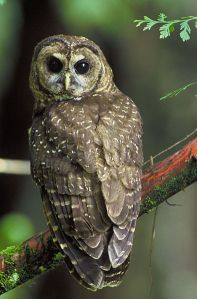
Northern spotted owl
The spotted owl was given endangered species status over 25 years ago. Logging was substantially reduced in the Pacific Northwest in an effort to save the habitat of the spotted owl, with devastating consequences for the timber-based economy. Despite that effort, the population of spotted owls declined over 40% in the past 25 years.
So, now US Fish & Wildlife has selected a new scapegoat for the decline of the spotted owl population. They have decided that another owl, the barred owl, is the culprit. The barred owl is larger and its range is apparently expanding. So, in its infinite wisdom, Fish & Wildlife recently announced that it will begin shooting barred owls where they don’t “belong” based on their assumption that the spotted owl will benefit from the removal of its competitor. (2)
Carpet bombing with rodenticides
As crazy as the plan to shoot barred owls is, here’s a plan that strikes us even worse. In April 2011, U.S. Fish & Wildlife announced its intention to evaluate a plan to aerial bomb the Farallon Islands off the coast of San Francisco with rodenticides to kill resident mice. (3)
Ashy storm petrel. Creative Commons
Here’s their logic for this strategy: the mice are eaten by burrowing owls which don’t “belong” on the Farallones, in their opinion. They claim that they don’t want to kill the burrowing owls because they acknowledge that they are just as rare in their historic range as the birds they claim will be saved by this bizarre plan. They claim that when the burrowing owls eat all the mice, they start eating the eggs of the ashy storm petrel which is an equally rare bird, but it “belongs” on the Farallones, so its perceived needs trump those of the equally rare burrowing owl. They believe that if the mice are killed, the burrowing owls will return to where Fish & Wildlife believes they belong.
There is so much wrong with this plan that it’s difficult to know where to start. The Farallones are an important bird sanctuary, home to many species of birds many of which are rare. Can Fish & Wildlife guarantee that the burrowing owl is the only species of bird that will eat the poisoned mice? How many burrowing owls will die from eating the poisoned mice? If they don’t die, won’t they eat even more eggs of the storm petrel? Will the death of the mice deprive other species of birds of their food? As the rodenticide washes off the islands into the ocean, will it kill the marine life around the island? Will it enter the food web of the entire island, killing unintended targets such as the birds that eat fish?
As crazy as this plan sounds, it is not a new strategy for Fish & Wildlife. In 2008, 46 tons of rodenticides were dumped on an island in the Aleutian chain off the coast of Alaska. That carpet bombing is known to have killed a total of 420 birds, including 40 bald eagles. (4)
Just as humans have moved around the Earth in search of more hospitable conditions—more food, better climate, less competition—animals have done the same. Now humans have decided that the animals must stay put. Wherever they existed in the historic past is where they “belong.” When animals move, man has decided they are “invasive” and they must be stopped.
Man’s war on invasive species is accelerating because as the climate changes there is greater pressure on animals to move to find the food and habitat they need and on plants to find suitable growing conditions. Humans are apparently unwilling or unable to do anything to stop climate change, yet they are willing and able to try to prevent plants and animals from adjusting to climate change.
As senseless as it seems to deprive plants and animals of their survival mechanisms, this harmful approach has been immortalized in U.S. law by the Endangered Species Act.The ESA is about 40 years old and was enacted at a time when the consequences of climate change were largely unknown. It defines endangered species as any plant or animal that becomes rare within its historic range. So, for example, if an animal or plant moves in response to climate change, it is often designated as an endangered species even though it may be plentiful in its new home to which it is better adapted. And Fish & Wildlife comes to its “rescue” by trying to force it to return to its historic range to which it is no longer adapted.
As we pondered this conundrum, we were reminded of a television commercial in 1970. Mother Nature is telling stories to her animal friends in the forest, when someone hands her a tub of margarine to taste. She smiles sweetly and congratulates herself on how delicious butter is. She is informed that it isn’t butter, but rather an artificial substitute. She rises from her throne, raises her voice to scold, shoots lightning from her fingers and warns us, “It’s not nice to fool Mother Nature.” (see this charming video here).
Will nature punish humans for their refusal to allow it to change as needed to survive? No, not literally, of course, but perhaps we will suffer the unintended consequences of our arrogant attempts to control natural processes we do not understand.
****************************
(1) Peter Fimrite, “Feds scrap ‘dumb idea’ of relocating otters,” San Francisco Chronicle, December 18, 2012
(2) Associated Press, “U.S. plans to kill Barred owls to save spotted owls,” San Francisco Chronicle, February 29, 2012
(3) Kelly Zito, “Pesticide bombing of Farallones mice stirs debate,” San Francisco Chronicle, May 12, 2011
(4) Peter Fimrite, “Concern over fallout of bombing mice,” San Francisco Chronicle, October 17, 2011





 Conservation Sense and Nonsense