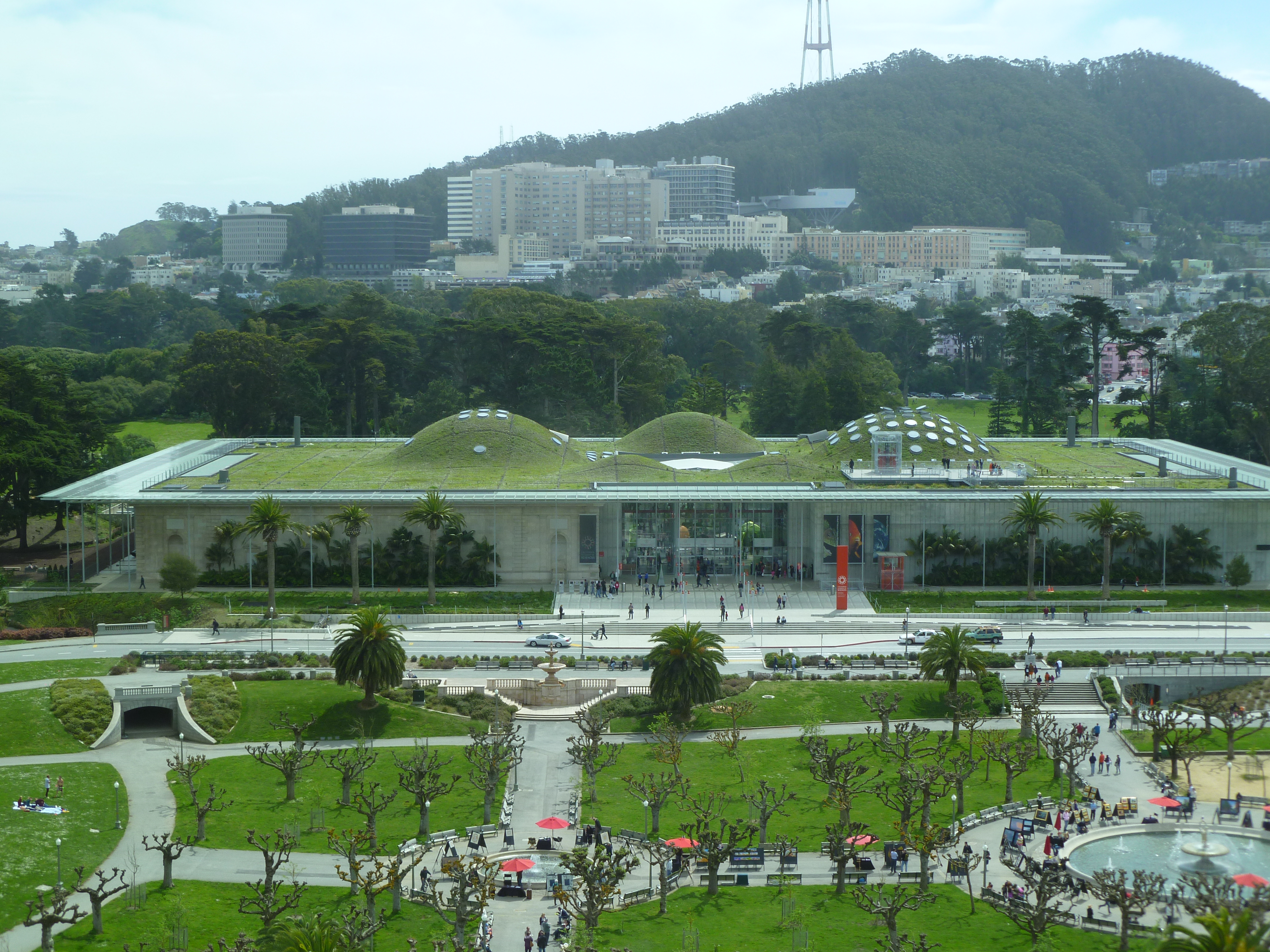
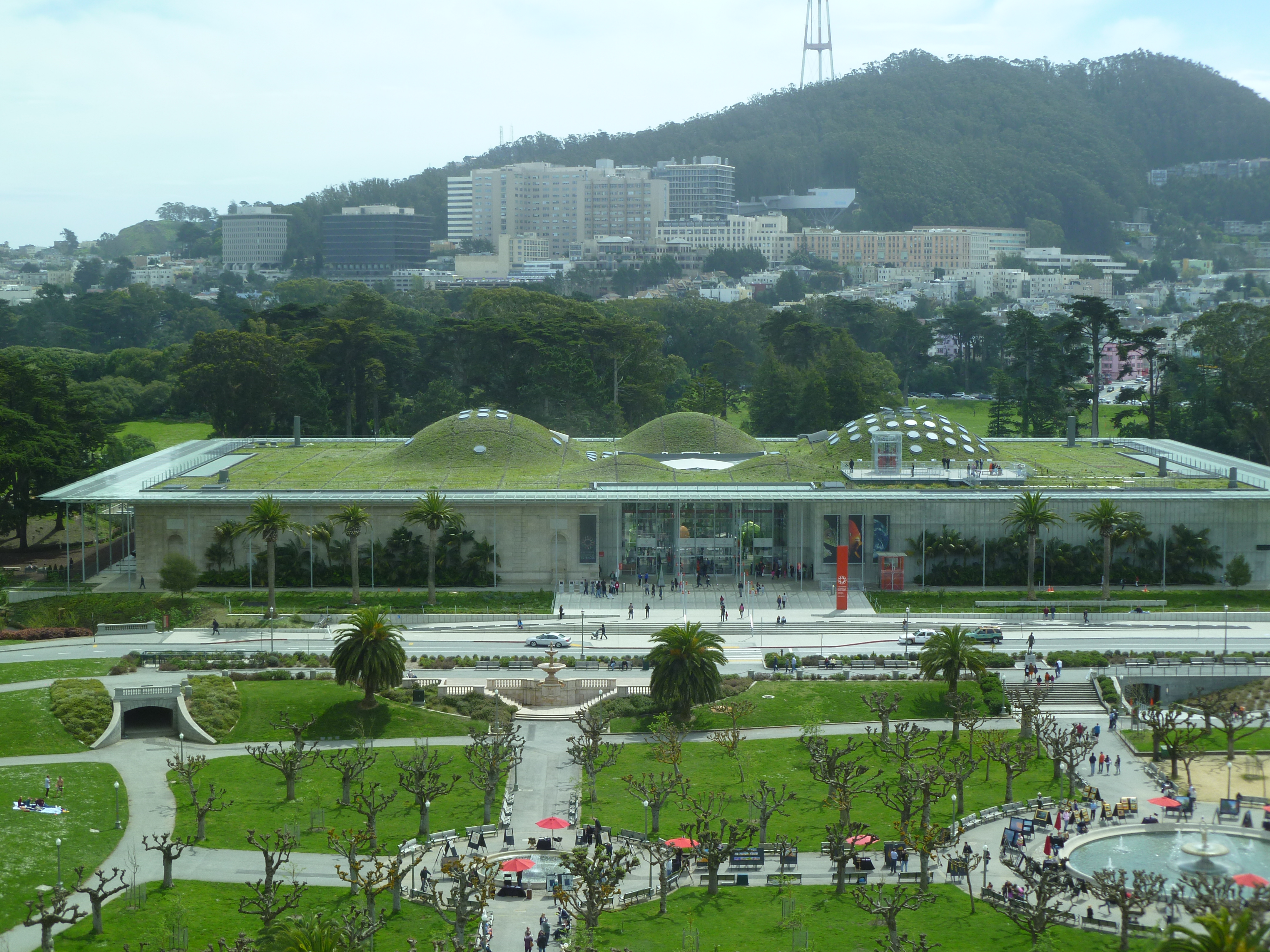
A dialogue about the living roof on the California Academy of Sciences

We encourage native plant advocates to comment on our posts because we learn from them.  We learn more about their ideology and the assumptions that support it.

These dialogues with native plant advocates are embedded in our posts and are therefore not as accessible to our readers as they often deserve to be.  Occasionally, we will create a post from these exchanges so that all of our readers can benefit from them.  In so doing, we hope not to discourage native plant advocates from posting comments, as they are essential to improving our mutual understanding of the complex issues we are debating.

We recently received a comment from someone who seemed to believe that our post about the green roof on the California Academy of Sciences is essentially fraudulent.   His accusations deserve a response.

California Academy of Sciences, April 2011

Comment from “Name Here”

May 6, 2011 11:43 am

Name Here:  “Since you don’t have the confidence to post your identity, I thought it only fitting to return the favor. Your argument would have much more strength if you were not anonymous.

You claim on your home page to provide citations, yet in this article you fail to tell us who “We had the privilege of meeting the ecology consultant who designed the plant palette for the living roof for the academy and many other institutions around the world.” is referring to. The “ecology consultant” does not have a name? By then throwing out Peter Del Tredici’s name it would appear as though you wish your reader to assume that he was the “ecology consultant” you refer to.”

Webmaster: The ecology consultant for the living roof on the Academy was Paul Kephart of Rana Nursery. He is the person we are quoting in our post about planning for the living roof.  Our readers can confirm Mr. Kephart’s role in the design of the roof by reading this article:  “High Maintenance Superstar,” Linda McIntyre, Landscape Architecture, August 2009.  This article is not available on-line, but the edition of the magazine in which it was published can be purchased on-line.  However, Mr. Kephart’s statement quoted in our post was made in a lecture to a group and does not appear in this publication. 

Our post did not state, nor did it imply that Peter Del Tredici was the ecology consultant for this project.  He is a scientist who has published articles about native plant “restorations,” particularly in urban settings.  We quote him in our post because his observations about native plant gardens are directly relevant to the living roof.

Name Here:  “On another note, you mention this third predominant species on the roof as “a moss” and then tell us it is non-native, yet offer no proof of this. Citing another blog with no standard of journalistic integrity is not a valid source. You might want to present the scientific name of this moss to prove your point, though I do not believe, judging by your writing, that you actually know the name, or you would have presented it.”

Webmaster:  At the time that we published our posts about the living roof, we did not know the names of the mosses on the roof, which is why we quoted the “From the Thicket” blog.  The author of the “From the Thicket” blog, Heath Schenker, is Professor of Landscape Architecture at UC Davis.  Her background and credentials are described on her blog.  She wrote her post about the living roof at the California Academy of Sciences after attending a symposium at the Academy about their monitoring project.  Our readers can judge for themselves if this was a credible source of information to document our post at the time it was published.

 Name Here:  “There are many different species of mosses out there, some native, some non-native. Many moss are very cosmopolitan in their range and therefore may occur natively all over the world. The actual quote from InTheThicket is as follows: “Nobody knows where the mosses came from, but they appear to be varieties of early-succession mosses, the types that commonly show up in disturbed soil.” I challenge you to show me where this says they are non-native.”

Webmaster:  After we published our post, the Academy made their monitoring report available on-line:  http://www.calacademy.org/pdfs/living-roof-project-results.pdf.  The report contained the names of the mosses on the roof: Bryum sp., Rosulabryum sp., Ceratodon purpureus, Leptobryum pyriforme.  We took that list to the Jepson Herbarium at UC Berkeley to confirm that our description of the mosses was accurate.  The staff at the Herbarium looked up those mosses for us and described them as “cosmopolitan,” which means they are widespread and cannot be considered either native or non-native.  Since these mosses were not amongst the 9 species of native plants originally planted on the roof, we felt comfortable with our original description of them.  They are clearly “volunteers,” not part of the original roof top planting.

Name Here:  “I think it is important for anyone reading this blog to be reminded that it is just that, a blog. It is written by an anonymous source who can say whatever they like with no fear of reprisal other than these comments, and with no need to live up to journalistic standards of any kind.”

Webmaster:  Yes, the Million Trees blog is “just a blog.”  However, I invite our readers to consider the difference between this accusatory comment from “Name Here” and the information we present.  We provide citations for most statements we make.  Those citations are usually of publications by academics at major universities, published in peer-reviewed journals or journalistic articles about their publications.  We often resort to journalistic articles because they are easier for non-scientists to comprehend. 

We know that we are confronting firmly held beliefs in the community of native plant advocates.  Therefore, we cannot expect to challenge their assumptions without providing well-documented information.  And since we have often been on the receiving end of ad hominem attacks by native plant advocates, we do our best to protect ourselves from such attacks by standing on firm scientific ground and by remaining anonymous.  (One wonders what “reprisals we should fear” for providing information with which “Name Here” disagrees.)

In contrast, “Name Here” questions our credibility without providing any evidence to substantiate his claim that we are fabricating information. Therefore, his comment seems more an attempt to discredit than to illuminate. 

Celebrating the first anniversary of the Million Trees blog

We are celebrating the anniversary of our first year of the Million Trees blog by reporting our progress and what we have learned. 

Our readership has grown steadily in the past year, particularly in 2011.  Daily visits have increased 200% since December 2010.

Of our 50 pages and posts, the three most popular posts, in descending order of visits, are presently:

A more recent post “The Living Roof:  A failed experiment in native plant gardening” is in fourth place, but gaining ground quickly.  There is apparently considerable interest in the green roof on the California Academy of Sciences.

We have had over 200 comments from readers, most in support of our perspective on the native plant movement, but many critical of our approach to this issue.  We have posted most, but not all of the critical comments. 

This comment is typical of those few that we chose not to post:  “This entire website is essentially just a cesspool of misinformation.”  We responded to that reader:  “If you would be more specific, we might post your comment.  You should also cite your sources as we do on Million Trees.  At the moment, your comment contains no information.”  He did not respond, so we did not post his comment.

Most native plant advocates who post comments are more specific, but they have never provided references for the generalizations that are the underpinnings of the native plant movement, such as:

  • Native grassland stores more carbon than forests (Since carbon storage is proportional to biomass, this is a physical impossibility.)
  • Native plants produce:  “Better soil function resulting in improved air quality and hydrology and pollination”  (We have seen no scientific evidence to support any of these claims.)
  • Wildlife prefers native plants (Most wildlife has adapted to non-native plants and is sometimes dependent upon them)

We responded to these comments with scientific references that contradict these claims and we invited the authors to provide us with scientific references that support their view.  We did not receive any replies to these requests for information about the sources of their statements. 

In one case, we had a long email dialogue with a native plant advocate who filled pages with such generalizations.  We repeatedly asked him to cite his sources.  Finally he sent us a 12 page bibliography, none of which he claimed to have read.  Nor did he make any connection between this lengthy bibliography and the statements he made in support of his arguments.  That was the end of the dialogue.

We conclude that these unsupported generalizations about the superiority of native plants are symptomatic of the native plant movement, which is an ideology, not a science.  The ideology persists because it is a victim of incestuous amplification, the sharing of misinformation by a group that isolates itself from dissenting views.  They hear their assumptions repeated so often that the assumptions are eventually transformed from fiction into fact in their minds. 

Unlike native plant advocates, we read all available literature on the subject, particularly publications in support of the native plant movement, such as the newsletters of the California Native Plant Society, Nature in the City, as well as Jake Sigg’s Nature News.  When we see new claims of the benefits of native plants, we research those claims by comparing them to the scientific literature. 

It is our research of the scientific literature that gives us hope that the native plant movement is losing its credibility.  In the past few years, more and more scientists have published their research refuting many of the assumptions of the native plant movement.  We have reported on Million Trees the research of some of these scientists:  Mark Davis, Peter Del Tredici, Hugh Raffles, and Dov Sax.   The publications of these scientists have enabled us to provide our readers with the evidence that many of the assumptions of the native plant movement are unsupported by scientific research.

Thank you to the readers of the Million Trees blog for visiting and commenting.  We invite our readers to correct any misstatements of fact, as we try our best to avoid the incestuous amplification that can accompany advocacy.  We provide citations of scientific literature whenever possible to avoid that trap.  We renew our appeal to native plant advocates to supply us with the scientific literature that they believe supports their ideology and we commit ourselves to reading and reporting such evidence. 

Our inclusive view of nature: native and non-native plants at Oyster Bay

For the record, we repeat Million Trees’ primary appeal to native plant advocates:  please plant native plants if that is your preference, but quit destroying non-native plants, trees and animals. 

Destructive "restoration" at Oyster Bay
 

Hybridization: “Genetic pollution” or a natural process?

 
Presidio variety of California poppy. NPS photo

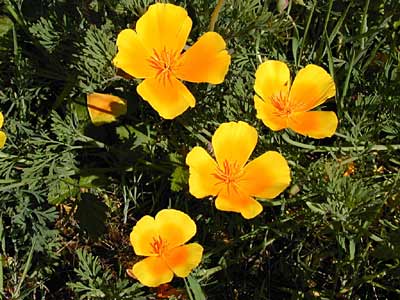
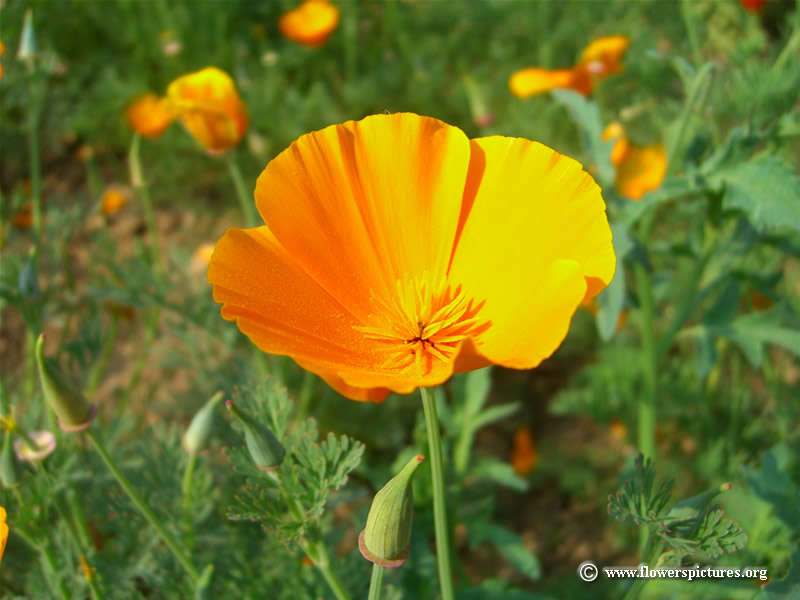
The San Francisco Chronicle’s gossip columnist, Leah Garchik, recently published a story about California poppies in the Presidio.  Apparently, someone planted the “wrong” poppy, or it migrated there.  The poppy that is native to the Presidio is small and yellow.  This “alien” poppy is the large orange poppy that most of us consider the classic California poppy.  The historical record indicates that this classic poppy grew elsewhere in San Francisco, but since it didn’t grow in the Presidio it must be removed because the Presidio’s Vegetation Management Plan “contains the requirement to remove any plants that could jeopardize the integrity of the genetics of native plants in the Presidio.” 

The “wrong” poppy

This incident reminded us of an article published in the newsletter of the local chapter of the California Native Plant Society several years ago, entitled “Contaminating the Gene Pool.”  In this article Jake Sigg instructs gardeners to beware of planting the wrong variety of a native plant because it will cause “genetic pollution.”  The California poppy is one of the examples he gives of a variety of California native being planted in San Francisco that doesn’t belong here.  It isn’t sufficient in his opinion, to plant a California native if that specific variety of the species didn’t historically occur in San Francisco.  He asks gardeners to “think in terms of preserving the genetic integrity of the local landscape.”  And he speculates many negative consequences of selecting the wrong variety, such as “genetic swamping, you’ve got all these foreign genes that are going to overwhelm the native population.”  We were reminded of Mr. Sigg’s vocal opposition to human immigration. 

For the benefit of our readers who aren’t gardeners, we should explain what Jake Sigg and the Presidio are worried about.  In a word, they are worried about hybridization, defined as “to breed or cause the production of a hybrid,” which is defined as “the offspring of two animals or plants of different breeds, varieties, or species.”  Hybridization is as likely to occur between two native plants as two non-native plants, but native plant advocates are concerned about the possibility of a native and a non-native plant producing a hybrid variety that is distinct from the native plant.  Hybridization is not inevitable, but it does occur naturally as well as through human manipulation.  The “From the Thicket” blog recently told the fascinating story of the development of a valuable garden cultivar variety of a favorite California native, ceanothus or California Lilac. 

Aside from the unpleasant association with eugenics, Mr. Sigg’s advice raises several practical questions.  How is the gardener supposed to know exactly which variety of a native plant “belongs” in San Francisco or even in a specific neighborhood within San Francisco, such as the Presidio?  And, in the unlikely event that gardeners might have such esoteric knowledge, where would they get the seeds of this specific variety?  Jake Sigg acknowledges this practical obstacle, but advises gardeners to get their seeds and plants only from the annual plant sale of the local chapter of the California Native Plant Society.  One wonders how many gardeners will follow this rather restrictive advice.

However, the more important question is the scientific question.  Is hybridization an inherently harmful process that always reduces species diversity?    We turn to Mark Davis for a less gloomy view of hybridization.  Like most scientific questions, there is evidence of both positive and negative effects of hybridization on species diversity.  Since you’ve heard the negative view from Mr. Sigg, we’ll let Mark Davis speak for the positive view.  Professor Davis reports in his book Invasion Biology* that “the fossil record generally shows that following the invasion of new species, the number of species resulting from adaptive radiations and evolutionary diversification exceeds the number of extinctions.”   And he concludes his discussion of hybridization and evolution by saying, “…a fair appraisal must also acknowledge that species introductions can enhance diversity as well, through hybridization, and the creation of new genotypes.”

The native plant movement has a narrow view of nature, which we do not share.  Their ideology is based on dire predictions of ecological disaster if we don’t follow their restrictive advice.  And when the managers of public lands choose to follow their advice, the consequences are usually the destruction of plants and animals that we value, in this case a field of California poppies. 


* Mark Davis, Invasion Biology, Oxford University Press, 2009, page 78-82.

Broom: “I’m ba-ack”

Leona Canyon, Spring 2011

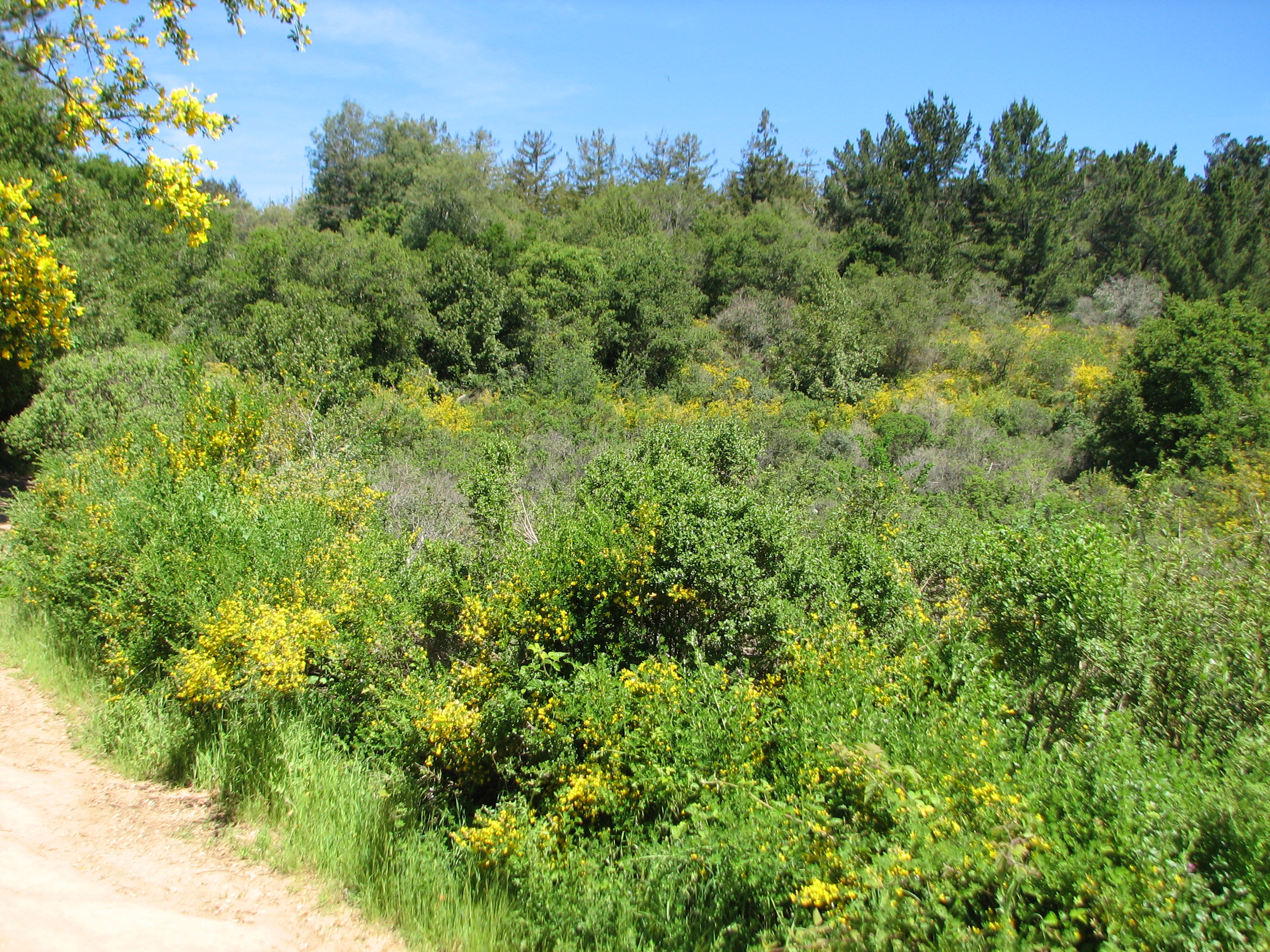
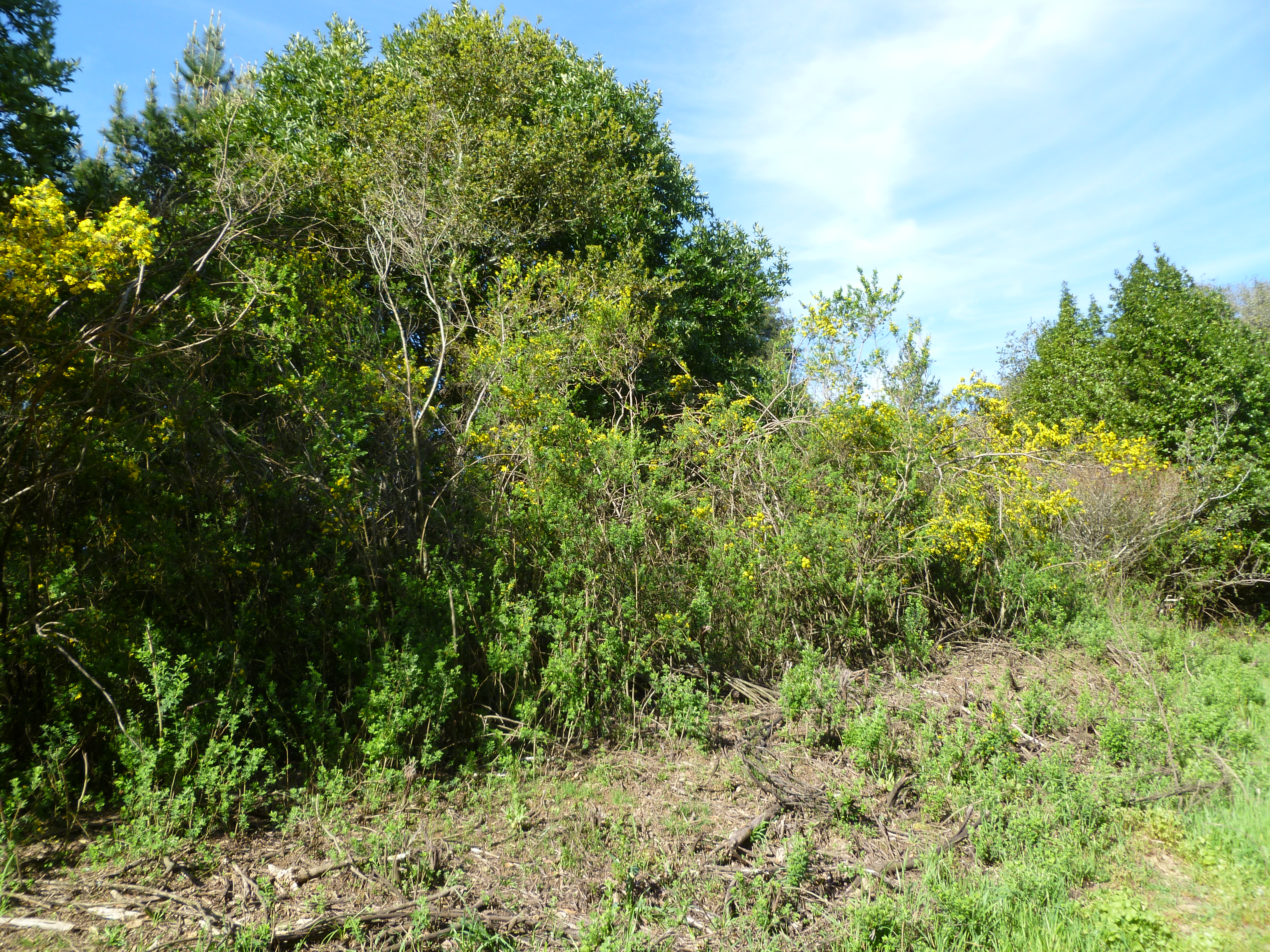
One of our first posts, nearly one year ago, was about attempts to eradicate broom (see “Broom:  I’ll be back!”).  It’s that time of year again, when the broom is blooming around the Bay Area, adding a dash of bright yellow color to our public lands.

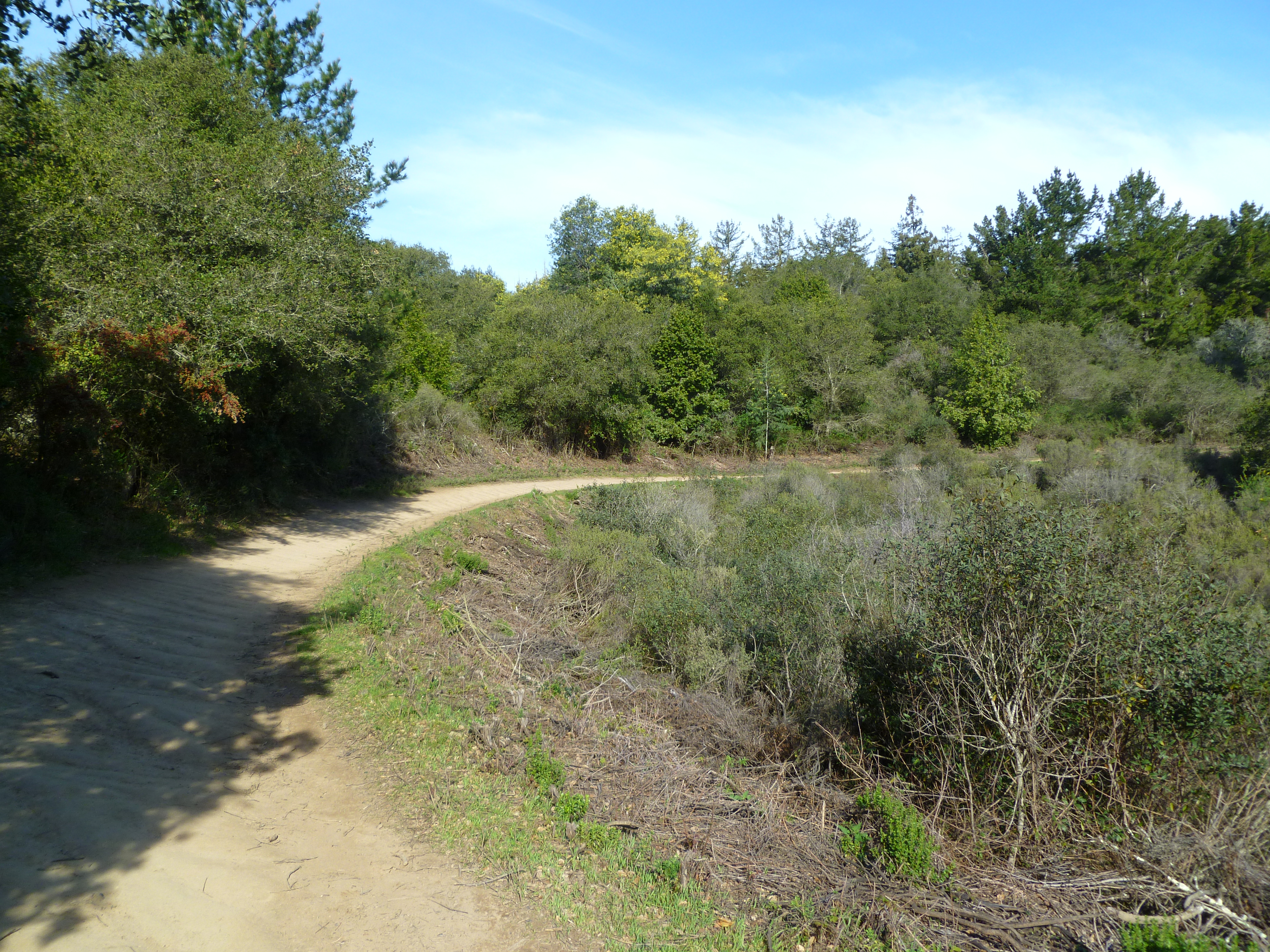
Despite continuing efforts to eradicate broom, it makes this annual comeback, regardless of the method used to kill it.  Mechanical destruction is one of the methods used.  In the photograph taken in fall 2010 of a trail in Redwood Park we see the unsightly result of such an attempt to eradicate the broom shown in our first post about broom in spring 2010.

Redwood Park, Spring 2010
Redwood Park, Fall 2010

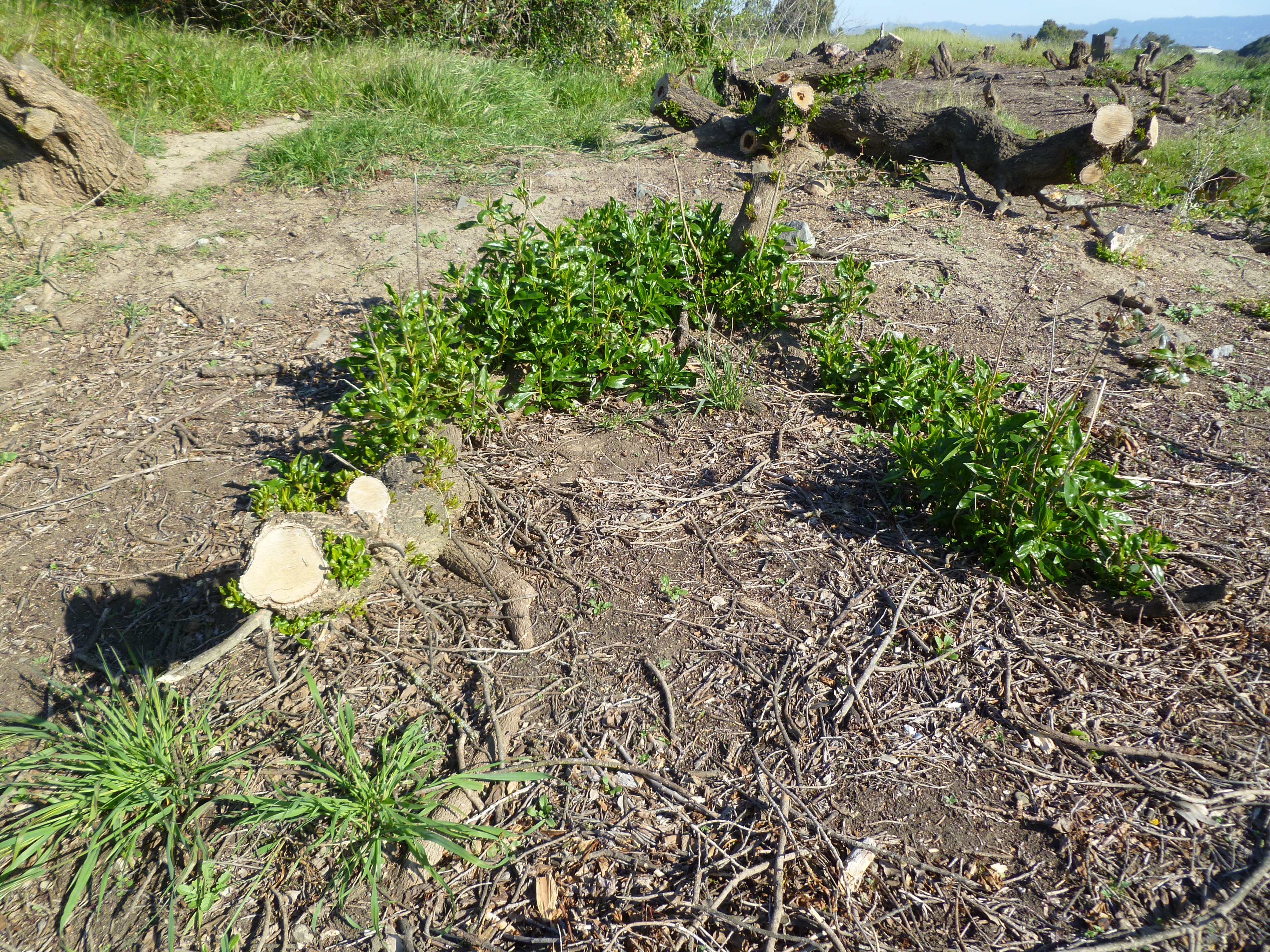
The UC Davis Statewide Integrated Pest Management Program  predicts the results of this effort to eradicate broom:  “Brush rakes and bulldozers often leave pieces of rootstalks that readily can resprout…using large equipment to clear land creates a perfect environment for new seedling establishment, making follow-up control essential.”  So, we shouldn’t be surprised when we revisit this same site the next spring to find that although it is still unsightly, it is also covered with the resprouts of the broom.

Broom resprouts, Redwood Park, Spring 2011

Herbicides are also used to eradicate broom.  The East Bay Regional Park District uses Garlon for foliar spraying of broom, despite the public’s concern about herbicide use in our parks.  In contrast, Marin Municipal Water District (MMWD) has not used herbicides on its properties since 2005, in response to public protests.  In December 2010, the Marin Independent Journal reported that MMWD is considering using Roundup (which is considered less toxic than Garlon) for broom control, but that a proposal will not be made until 2012 at the earliest, after an environmental impact study that will consider all alternatives for “pest management.”

Even if we are willing to accept the health and environmental risks associated with herbicides, they are not a guarantee of success.  According to UC Davis, “One application of an herbicide does not always completely control brooms…Watch treated areas closely for at least a year, and retreat as necessary.”


Since the seeds of broom are known to live in the ground from 50 to 60 years, we should expect that it is very difficult to eradicate.  Unless we make a commitment to kill the plant above the ground every year for as long as the seeds live in the ground, we cannot expect to be successful in that effort.

We were therefore amused by this exchange that Jake Sigg had with one of the readers of his “nature newsletter” (December 20, 2010):

Reader:  “…We have been up there every year for about 3-1/2 years now…It has been quite instructive about how flat out difficult it is to reverse the process [of “displacement” of native plants].  Like most invaders, the non-native plants like it here and want to stay.  The broom in particular are [sic] astoundingly persistent in holding whatever territory that they have gained.  It sounds strange to say, that sometimes I think the project is an exercise in futility while at the same time is extremely satisfying work and will continue it into the indefinite future.”

Jake Sigg:  “…It is such a lop-sided struggle…And yet, we all keep going.  It is a paradox that I don’t understand.  While working I’m fully aware of the seeming futility of what we’re doing, and yet keep going—and enjoying it!!”

Jake Sigg and his readers would benefit from the advice of Mark Davis in his book, Invasion Biology.*  Professor Davis suggests that unless a non-native species causes great health or economic harm, we adopt the “LTL approach” i.e., “Learn to love ‘em” or at least “Learn to live with them.” 

If it is futile to eradicate a plant we don’t like, if that plant isn’t doing us or any other plant any harm, and if we are damaging our environment in our futile attempt, let’s change our attitude toward that plant.  If we can’t change the plant, it is still within our power to change ourselves.  Surely we can find something more fruitful to do that is equally satisfying such as planting more native plants rather than destroying non-native plants.

Broom is an especially good candidate for LTL.  It is green all year around.  It requires no care whatsoever.  And in the spring it treats us to a lovely carpet of bright yellow.   What’s not to love?


* Mark Davis, Invasion Biology, Oxford University Press, 2009, page 150

Oyster Bay: A preview of plans for the Albany Bulb

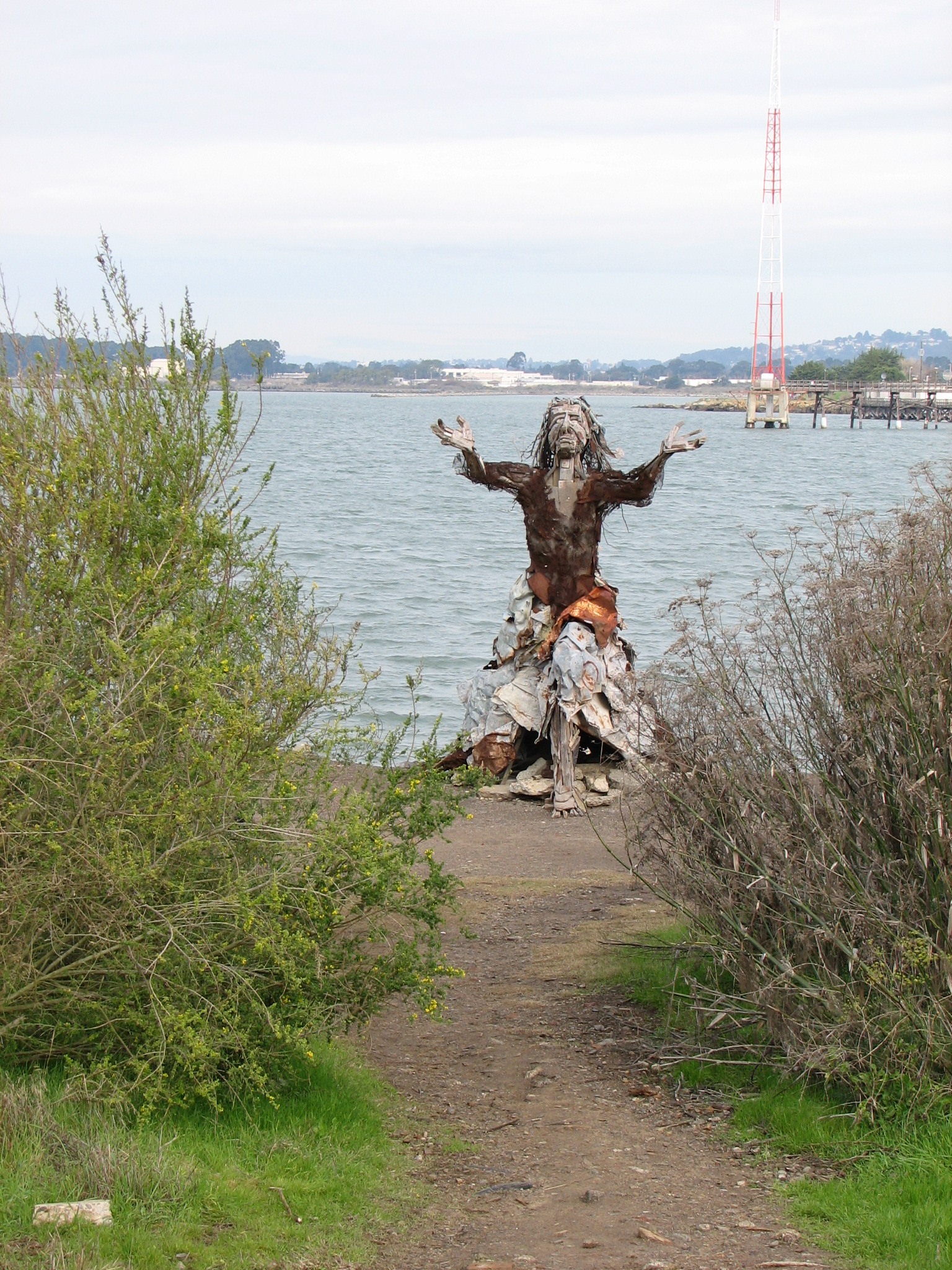
The Albany Bulb is the former dump of the city of Albany, CA.  It was built on landfill.  The East Bay Regional Park District (EBRPD) recently announced its intention to “restore” it as a native plant garden, though it admits that the word “restore” is a misnomer for a place that was never populated by native plants.  Presently, the Bulb contains an eclectic collection of art built from the junk that remains from the dump.  Non-native plants and trees thrive there with no care.  Please visit our post about the Albany Bulb for photos of this colorful and unique recreational and artistic resource. 

We recently had the opportunity to express our opinion of plans for the Albany Bulb in a conversation with the Assistant General Manager of Planning/Stewardship & Development of EBRPD.   We told the manager that it is pointless to destroy the Albany Bulb because it is an artificial place in which native plants are not more native than what grows there now without any care.  It is a heavily used place that does not require any “improvements.”  It is therefore a waste of money to destroy something that everyone loves just as it is.

The manager told us that we would also love the native plant garden once it is done.  He said that visitors often object to plans for changes in their park, but that when the project is done, they are always happy with it.  He urged us to visit Oyster Bay, a former dump for the city of San Leandro, also built on landfill.  He said it is now a beautiful native plant garden that everyone is delighted to visit.  And so, of course, we had to see this transformation because we want to know what is in store for the Albany Bulb.

This is what we found at Oyster Bay. 

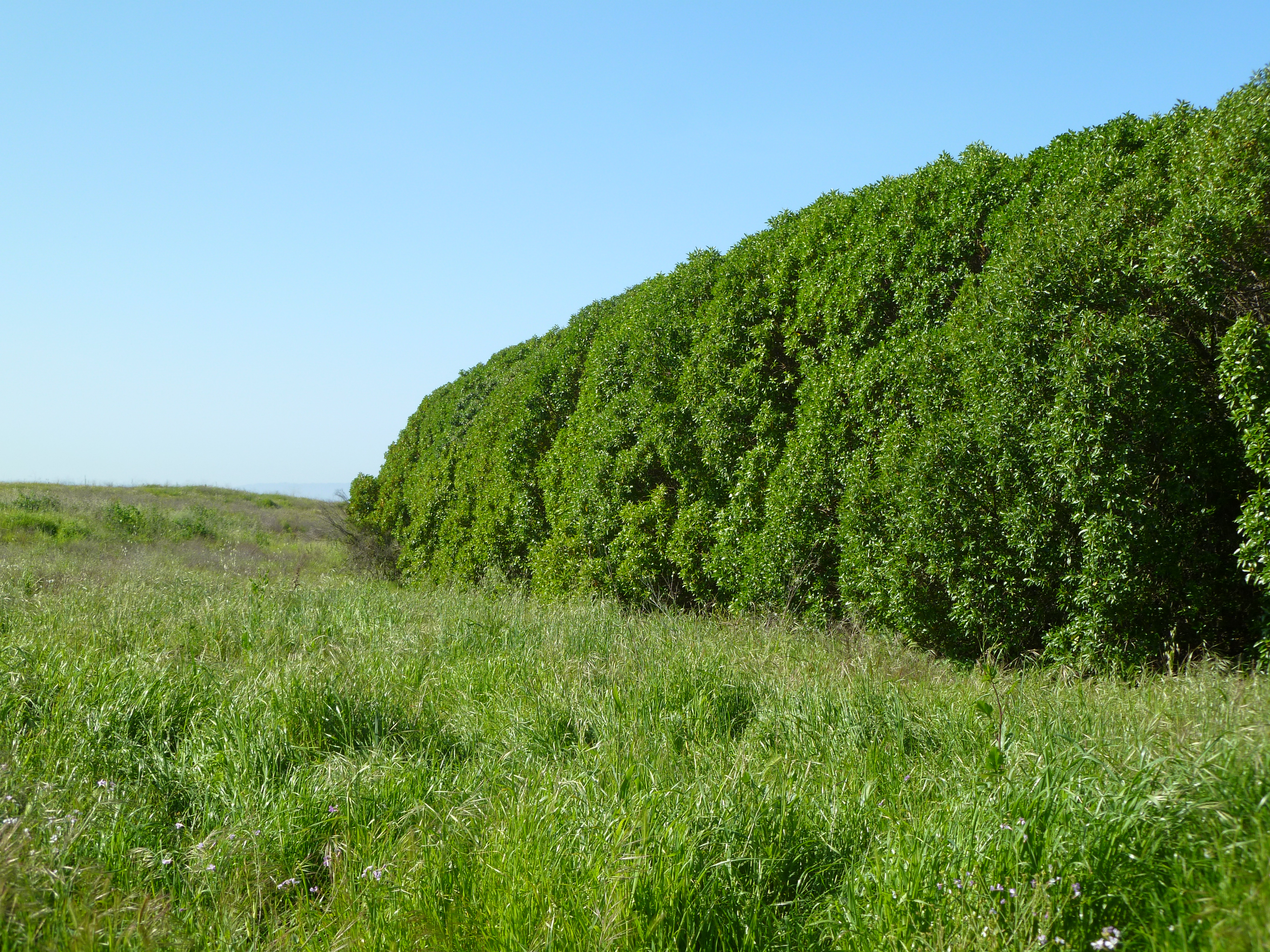
Oyster Bay, April 2011

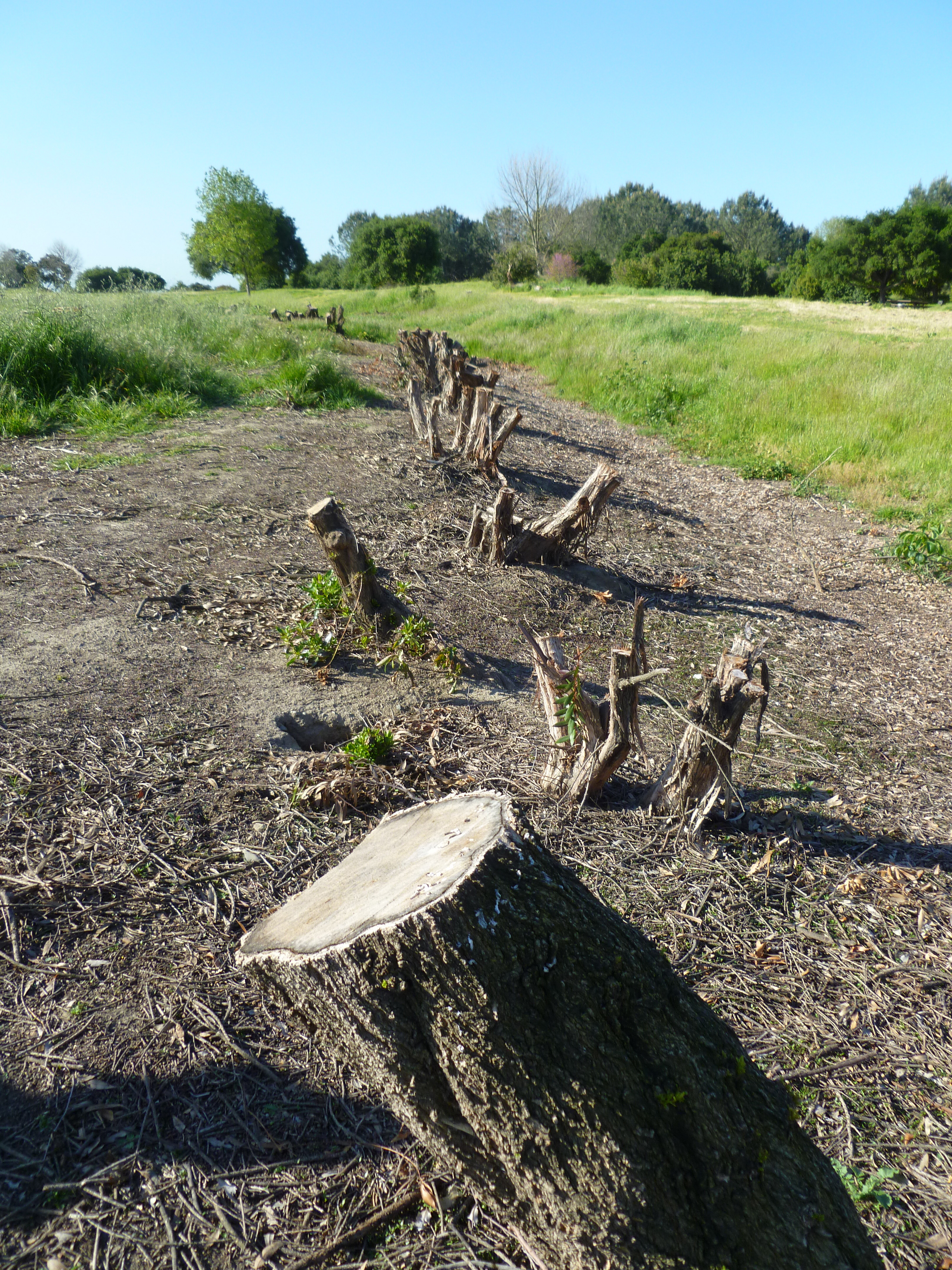
We found hundreds of stumps of trees that have been destroyed.  Many of the trees are now resprouting.  We wondered if the resprouts would be poisoned to prevent the trees from regenerating.  If not, we wondered how long it would take for the trees to return. 

Resprouts

The ground around the tree stumps was a labyrinth of the holes made by animals that had lived in them in the past.  The animals have moved on, perhaps to the cover provided by trees nearby. 

Pittosporum, Oyster Bay

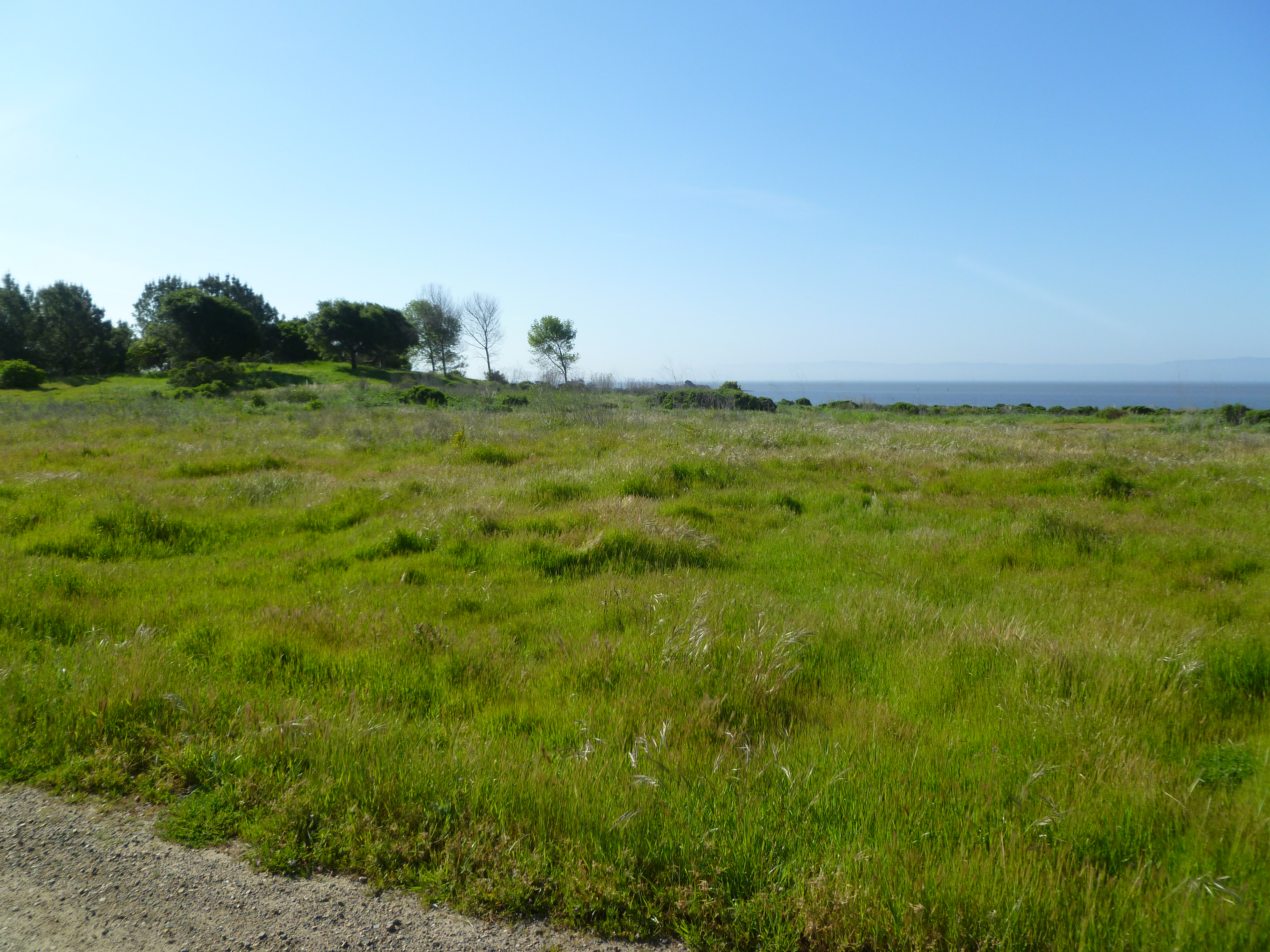
We found a green sea of non-native grass.

Non-native annual grass

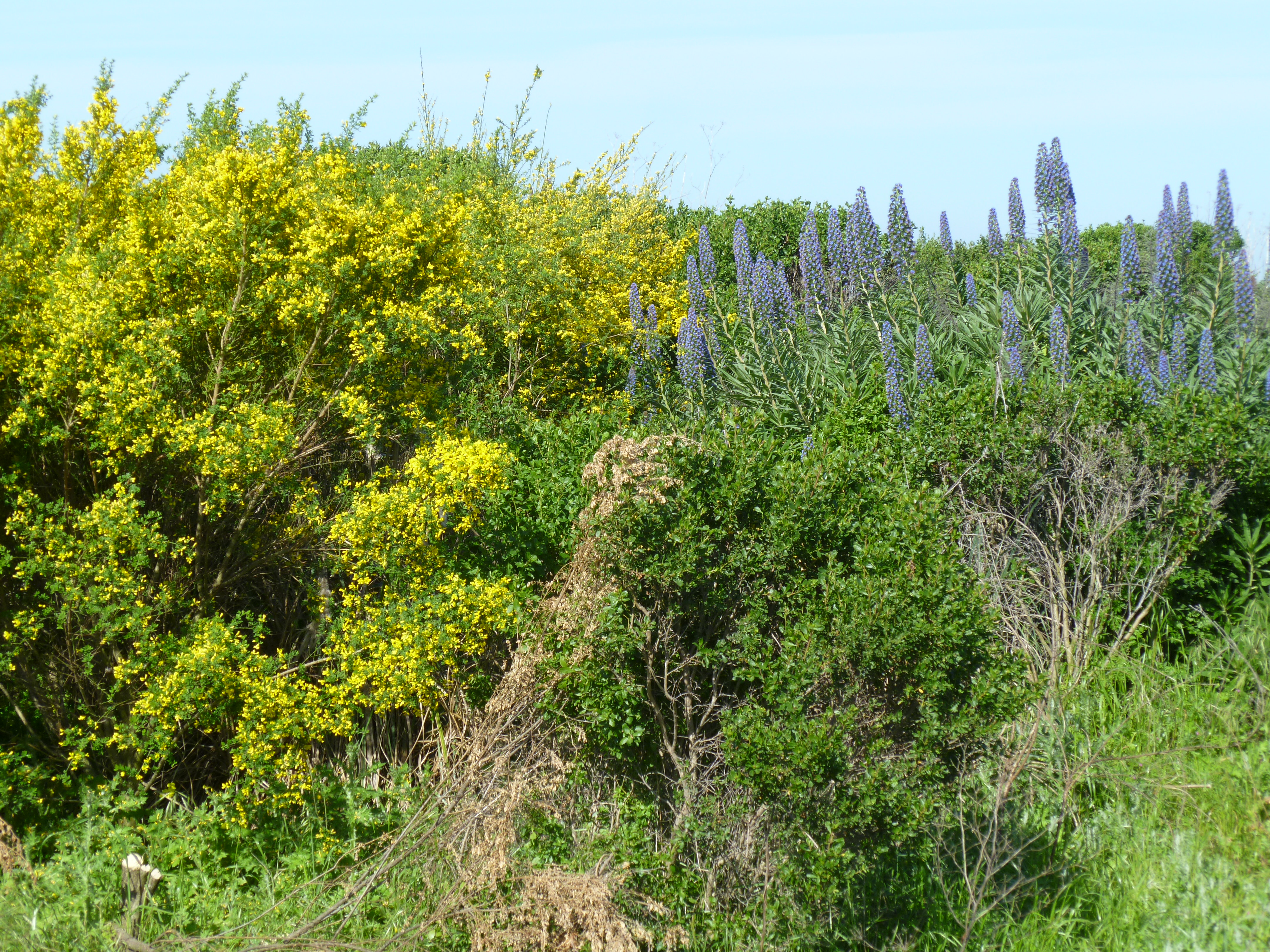
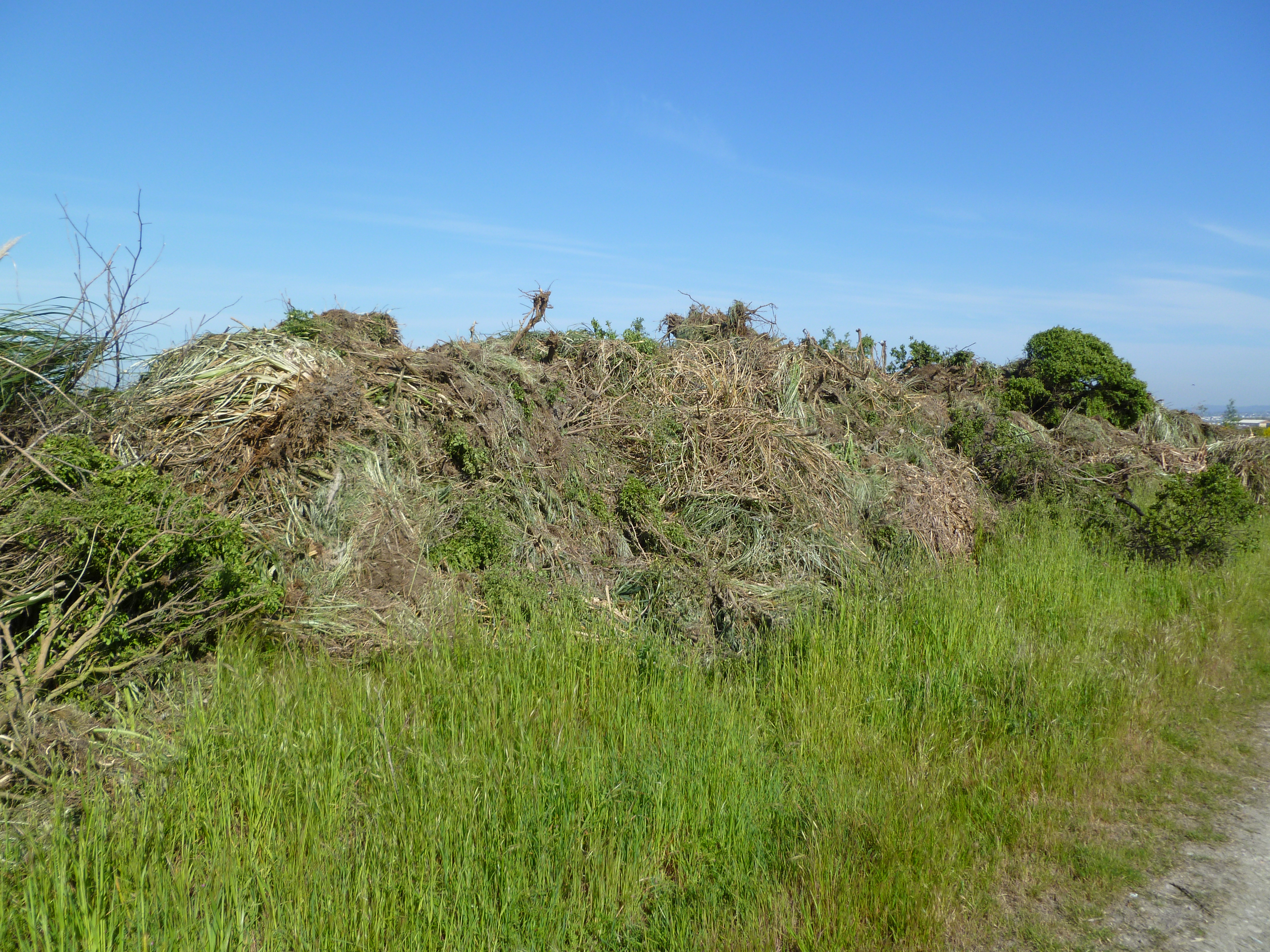
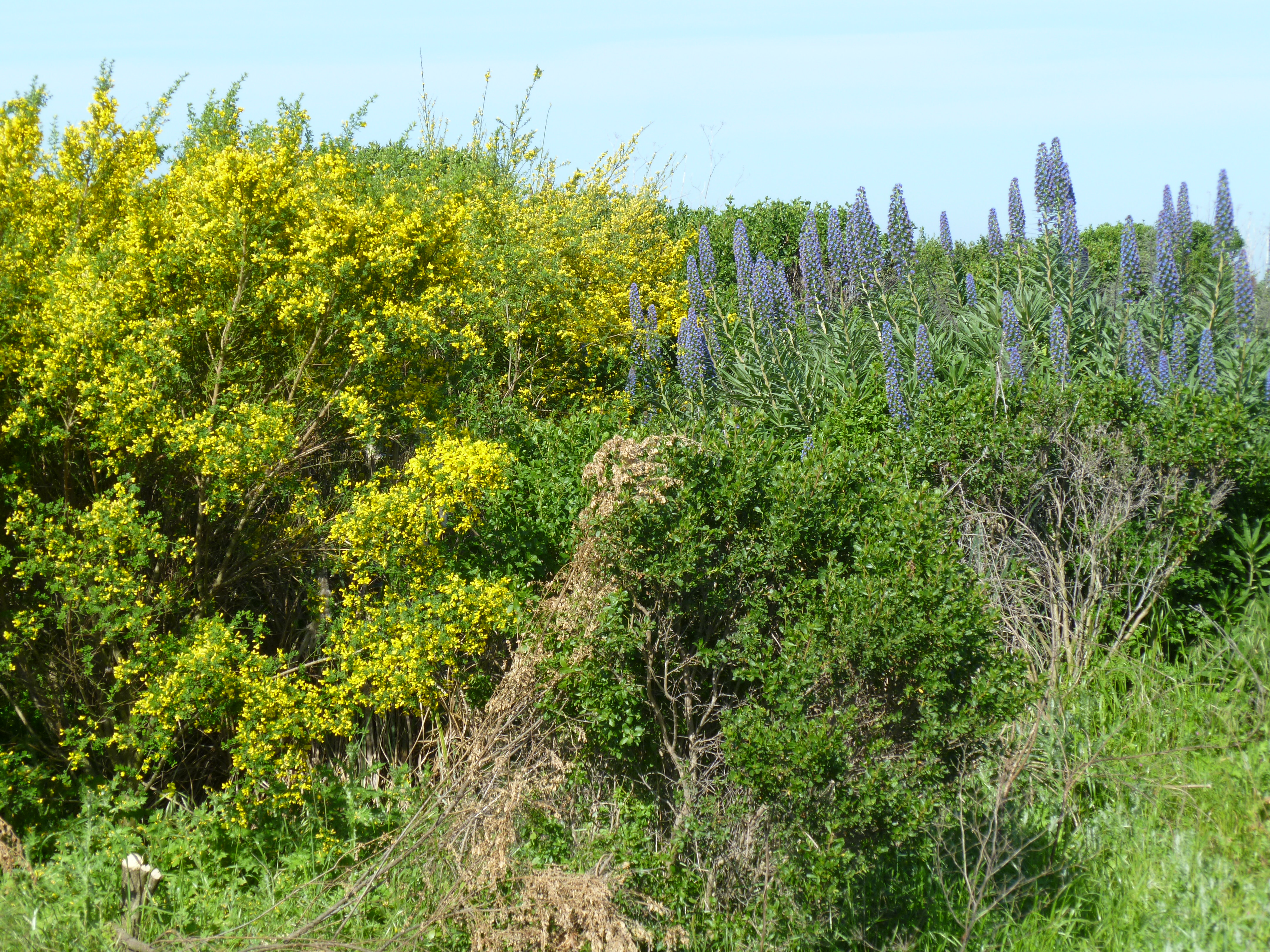
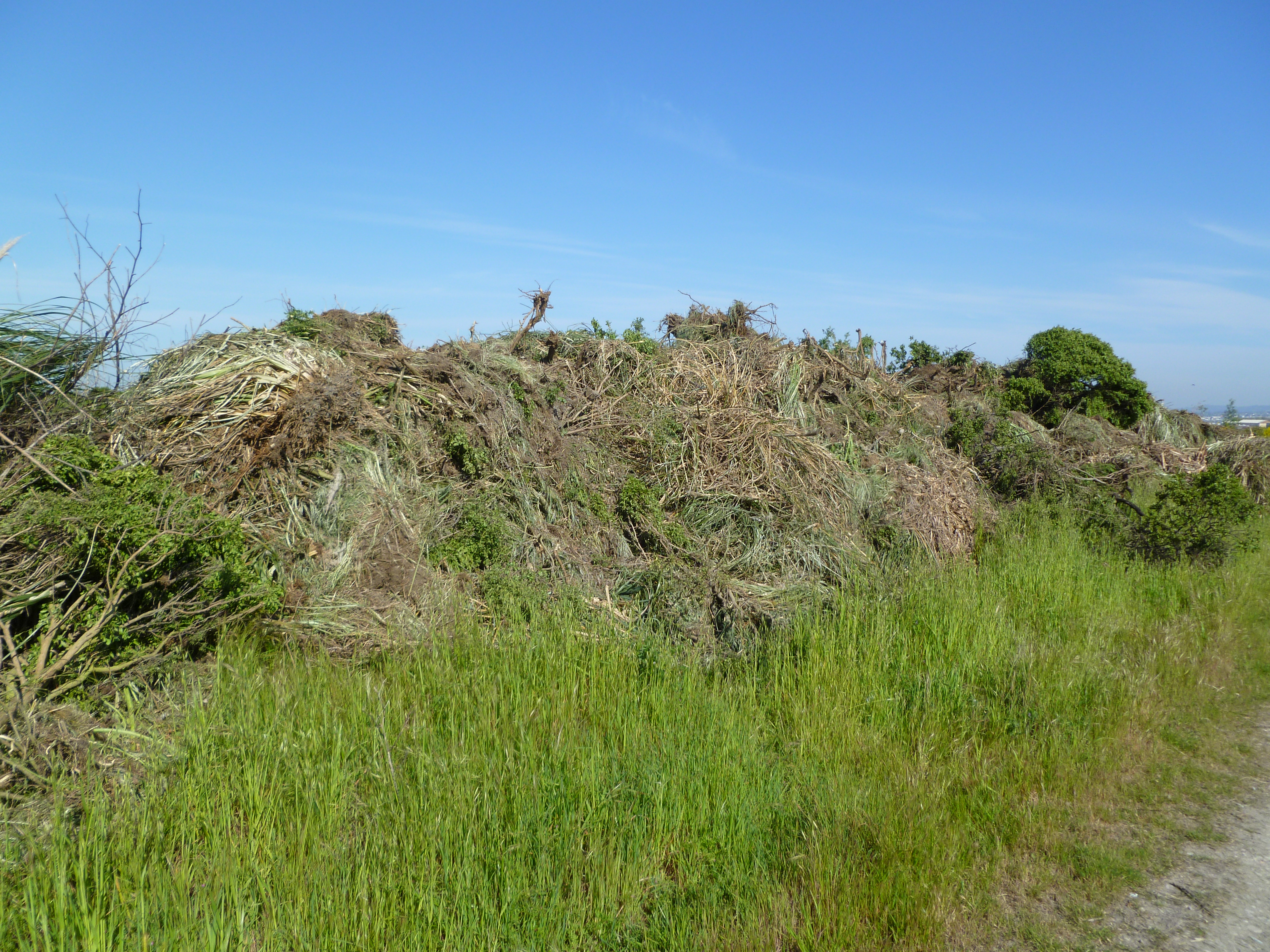
We found non-native broom and native coyote brush and close by huge piles of those same shrubs that have been mechanically cleared.  We don’t know why they have been mowed down.  We doubt that anyone would consider these debris piles a “park improvement.”

Non-native broom & Pride of Madeira, native coyote brush
One of many piles of destroyed vegetation

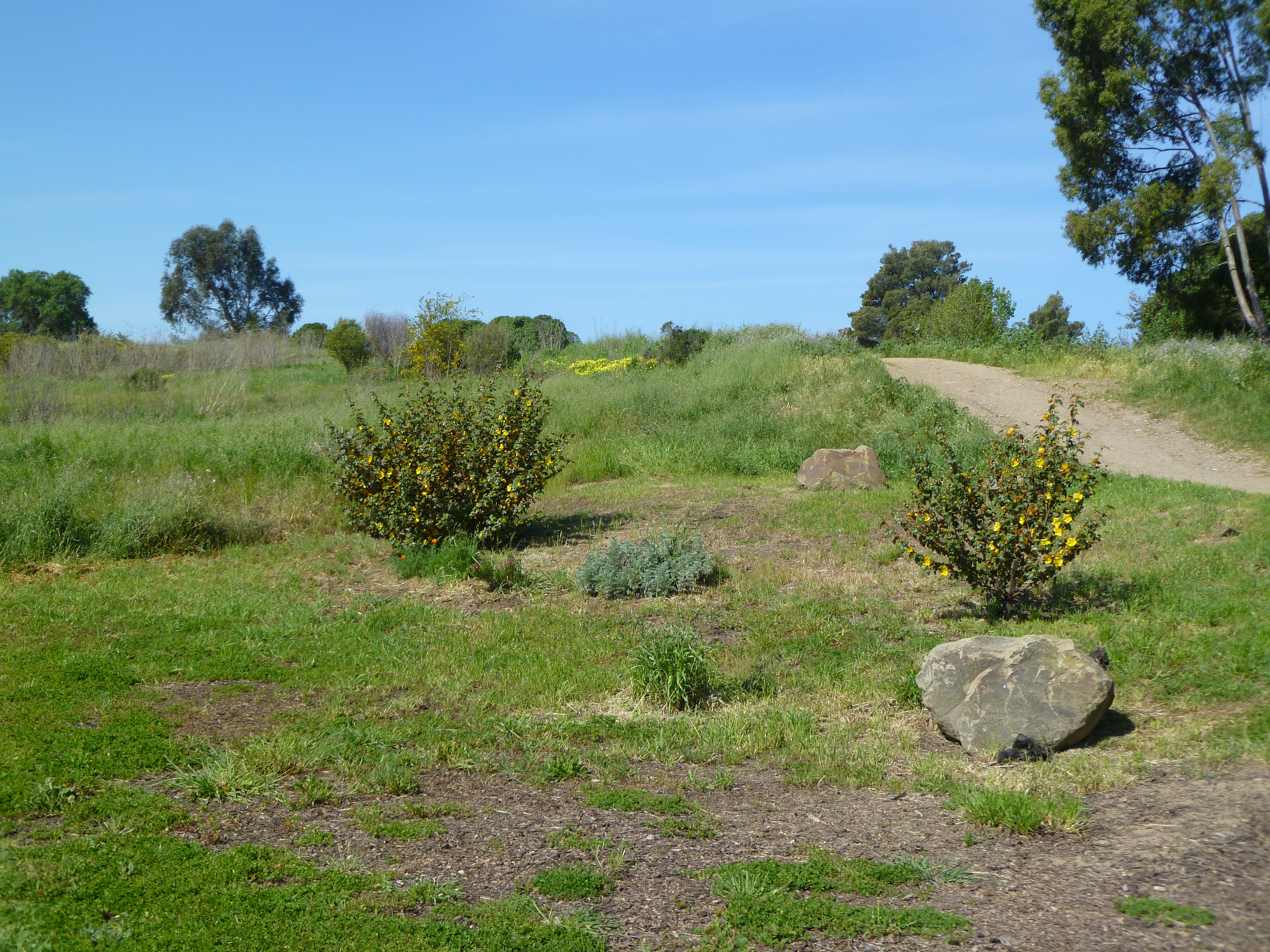
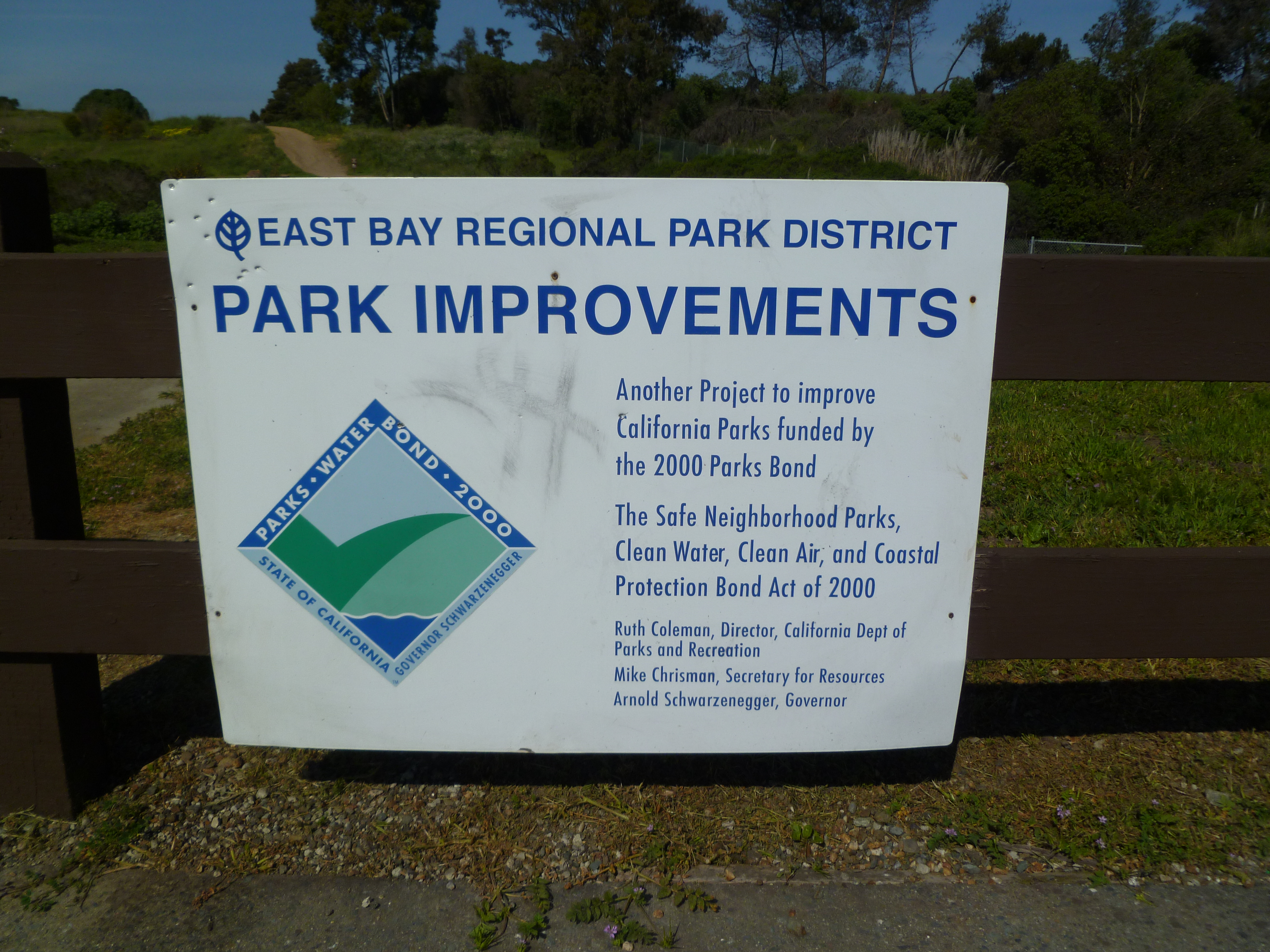
We found a small patch of native plants at the entrance of the park and a sign informing us that this scene of destruction is a “park improvement” project.

We also spoke to one of the few visitors we encountered on this beautiful spring Saturday.  We asked if they had been coming to the park for a long time.  They said that had.  We asked how they felt about the changes in the park, without giving them any clues as to our own assessment.  They readily volunteered that they didn’t understand why the trees were destroyed. 


A few native plants at the park entrance

Once again, we are reminded that beauty is in the eye of the beholder.  Assuming that the park manager with whom we spoke about Oyster Bay has actually seen this park, and that he sincerely believes that it is a lovely native plant garden, we must beg to differ.  Although it is a beautiful park, it has not been improved by the needless destruction of trees and vegetationThe beauty of this park derives from its diverse collection of predominantly non-native plants and trees.  We hope that it will not be further damaged by an agenda that is devoted to native plants, not to the enjoyment of park visitors. Likewise, the Albany Bulb is unlikely to be improved by destroying plants, trees, and art that is all doing just fine without any intervention by the East Bay Regional Park District.  We urge the Park District to LET IT BE! 

We don't think so!

“Mother Nature’s Melting Pot”

The Sunday New York Times of April 3rd published an op ed in defense of non-native plants.  In “Mother Nature’s Melting Pot” Professor Hugh Raffles (New School) reminds us that our country was built by immigrants.  Despite our origins, we also have a long tradition of opposition to immigration.  As each generation becomes established, it wishes to pull up the welcome carpet to new immigrants.  During times of economic crisis this anti-immigration sentiment is particularly strong.

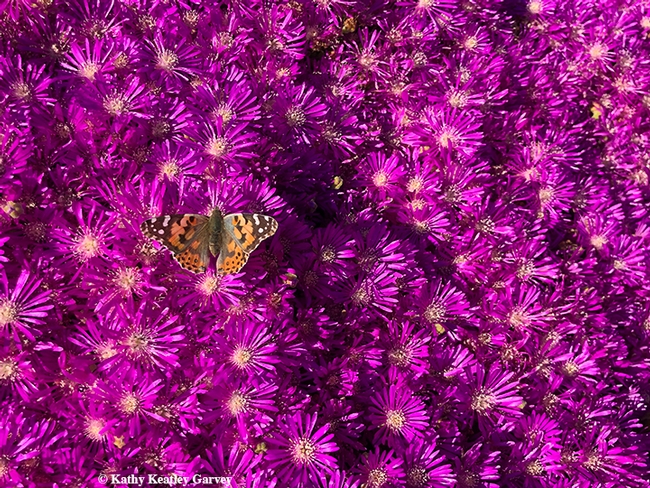
Professor Raffles notes the extension of this anti-immigration sentiment to non-native plants and animals.  Just as immigrants have contributed to the dynamism and creativity of our society, non-native plants are contributing to our natural world as, “They arrive unannounced, encounter unfamiliar conditions and proceed to remake each other and their surroundings.” (1)

He provides many examples of non-native plants and animals that benefit both humans and native animals, including several examples that are locally relevant.  He reminds us that the eucalyptus is a rare source of winter nectar for the honeybees that were imported in the 1600s and now pollinate about one-third of our food crops.  He also reminds us that ice plant can stabilize sandy soils that might otherwise inundate our roads and neighborhoods as they shift in the wind.

Painted Lady butterfly on ice plant. Bug Squad, UC Davis

He notes that attempts to eradicate non-native plants and animals are often futile once the species become firmly established and that attempts to do so often harm the environment.   Here in the San Francisco Bay Area we are acutely aware of the harm being done by attempts to eradicate non-native plants.  We witness hundreds of thousands of healthy, mature trees being needlessly destroyed.  We see acres of park land being sprayed with toxic herbicides.  We watch precious recreational space being fenced off for “restorations” in places that are completely artificial, yet also entirely natural in the sense that they are sustained without being actively gardened.

The most recent example is the announcement that the Albany Bulb (in Albany, CA) will soon be transformed into a native plant garden.  The Albany Bulb is composed of landfill that was used for decades as a city dump and is now a heavily used park, populated by art created from the junk that remains from the dump.  Non-native plants and trees thrive there without any care.  It is pointless to destroy this valuable artistic and recreational resource, yet native plant advocates demand its “restoration.”

Sculpture of “Albany Bulb Greeter”

Professor Raffles makes the logical connection between anti-immigration sentiment and the native plant movement’s commitment to the eradication of non-native plants and animals.  This connection is relevant in the Bay Area because a prominent leader of the native plant movement here is strongly opposed to immigration.

Jake Sigg has been an officer in the local chapter of the California Native Plant Society for many years.  He was a gardener in San Francisco’s Recreation and Park Department for 31 years.  He was awarded the “Jake Sigg Award for Vision and Dedicated Service” by the California Invasive Plant Council in 2003.  This award was named for him, “For years of tireless service and leadership on invasive plant issues in California.”

For many years, Mr. Sigg has published a “Nature News” newsletter several times each week.  This newsletter is widely distributed throughout the Bay Area and is a valuable source of information about nature-related activities.  It is also Mr. Sigg’s podium from which he expresses his opinion on a range of topics.  In most issues, he expresses his deep concern about immigration, both legal and illegal.

“Virtually All Of California’s Problems Can Be Traced Back To Too Many People…Virtually All Of California’s Population Growth In The Last 10 Years Was Due To Immigration…If We Don’t Do Something About Immigration, Our Problems Will Get Much Worse.”  April 2, 2011, Nature News

He is equally concerned about related issues such as granting visas to workers with unique skills and granting citizenship to children born to undocumented immigrants.

“The Ever Expanding Pool of Cheap Labor and the Case For Fewer Visas By Joe Guzzardi”  January 25, 2011, Nature News

“Current U.S. policy results in over 300,000 additional citizens from anchor babies each year.  The demographic impact is far greater because their families stay and bring in additional relatives. Anchor babies are eligible to sponsor their illegal alien parents and other relatives when they turn 21. Moreover, taxpayers pick up the tab for the medical costs and subsequent welfare outlays because of the child’s citizenship status. ACTION NEEDED  Please ask your Congressional representative to co-sponsor HR 140.”  January 13, 2011, Nature News

And so, we conclude that Professor Raffles is not making an idle philosophical connection between the native plant movement and anti-immigration sentiment.  There IS a connection because we see it discussed repeatedly by a prominent voice in the community of native plant advocates.  Occasionally, one of Mr. Sigg’s allies challenges his opinion on this subject.  However, such a debate is apparently rare in his community of interests.

We thank Professor Raffles for making explicit what is implicit in the native plant movement.  We believe that the connection between the eradication of non-native plants and animals and opposition to immigration should be acknowledged and discussed.  The desire to be rid of immigrants—both plants and animals, including humans—is grounded in a need to find someone or something to blame for problems that we are unprepared to face or are powerless to change. 

In the case of human immigration, our living standards are declining primarily because of the globalization of the economy.  Building a wall around our country will not isolate us from the fact that developing countries with lower standards of living are presently more economically competitive.

Likewise, eradicating non-native plants and animals will not prevent the climate change and associated changes in air and water quality that make those newcomers more competitive than the natives that thrived in a different environment, one that is gone and is unlikely to return.    In fact, the destruction of healthy, mature non-native trees is exacerbating the climate change that will ultimately exterminate many species of native plants and animals.(2)


(1) Hugh Raffles, “Mother Nature’s Melting Pot,” New York Times, April 3, 2011

(2) “Multitude of Species Face Threat of Warming,” New York Times, April 4, 2011

Photographic evidence that eucalypts are not invasive

One of native plant advocates’ favorite justifications for eradicating eucalypts is the claim that they are invasive.  But are they?  In one of our early posts (“ALIEN INVADERS!!  Another Scary Story”) we reported a scientific study, based on photographic evidence over a 60 year period, that eucalyptus and other non-native trees have not invaded public lands in Marin, Alameda and San Mateo counties.  In fact, the non-native forests in these public lands decreased in size, while native forests increased in size. 

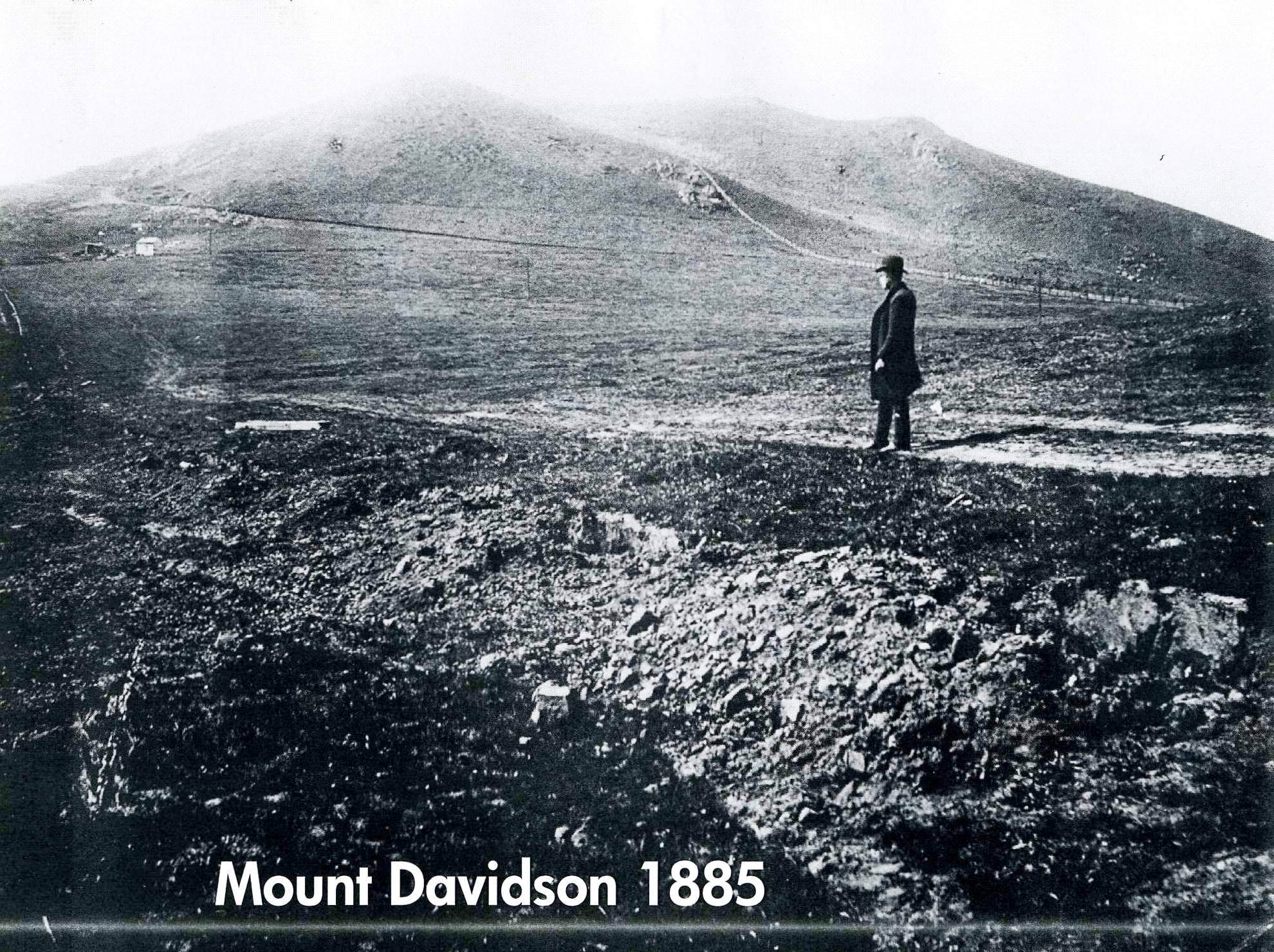
Now we have photographic evidence that eucalyptus has not been invasive when planted in San Francisco.  Adolph Sutro purchased Mt. Davidson in 1881.(1)  He planted it—and other properties he owned in San Francisco—with eucalyptus because he preferred a forest to the grassland that is native to the hills of San Francisco.  Here is a historical photo of what Mt. Davidson looked like in 1885:

Sutro foretold the future of his property:

“…people… will wander through the majestic groves rising from the trees we are now planting, reverencing the memory of those whose foresight clothed the earth with emerald robes and made nature beautiful to look upon.”(2)

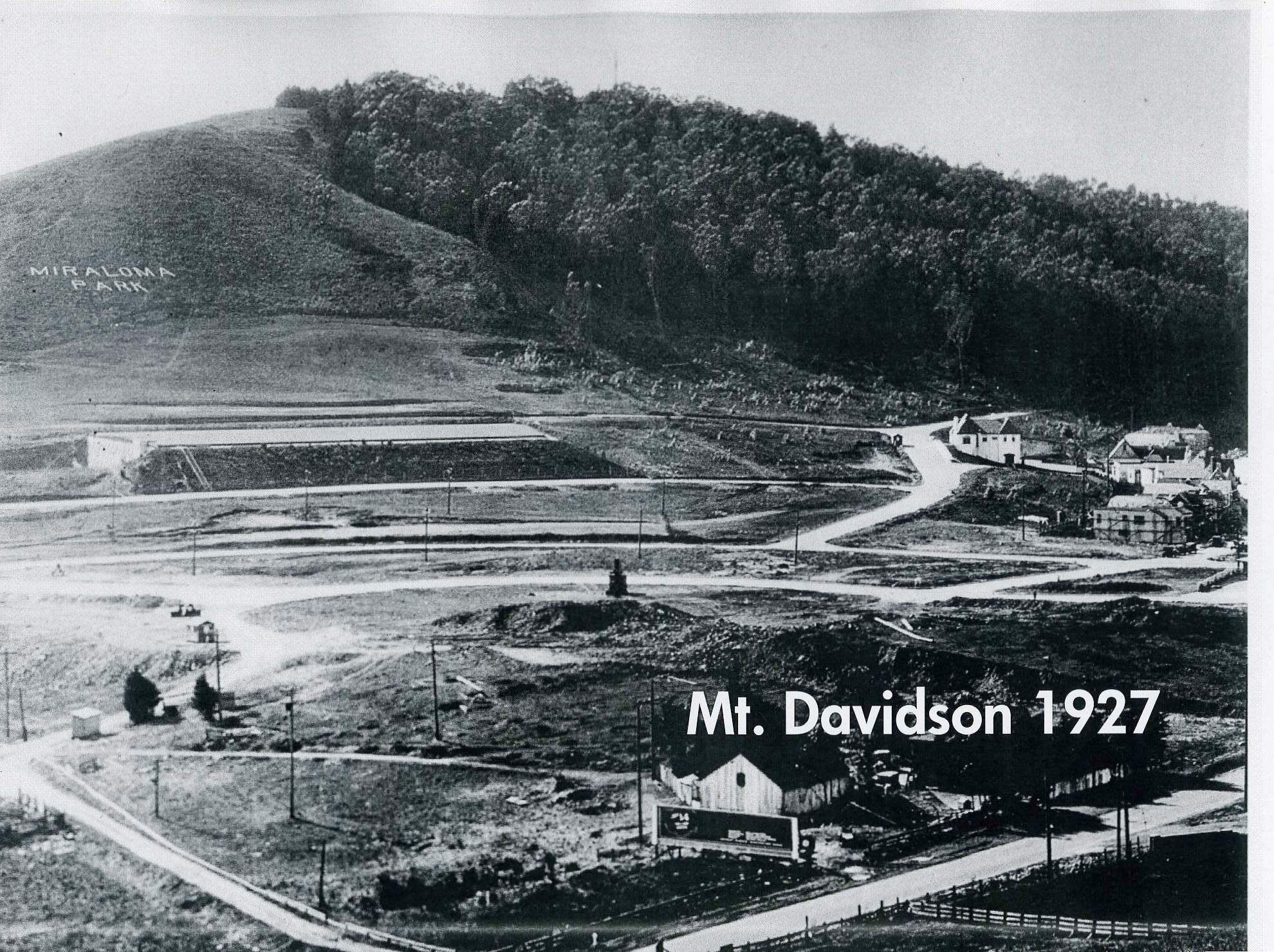
Since Sutro didn’t own all of Mt. Davidson, there was a sharp line between the forest he planted and the grassland when this photo was taken in 1927.

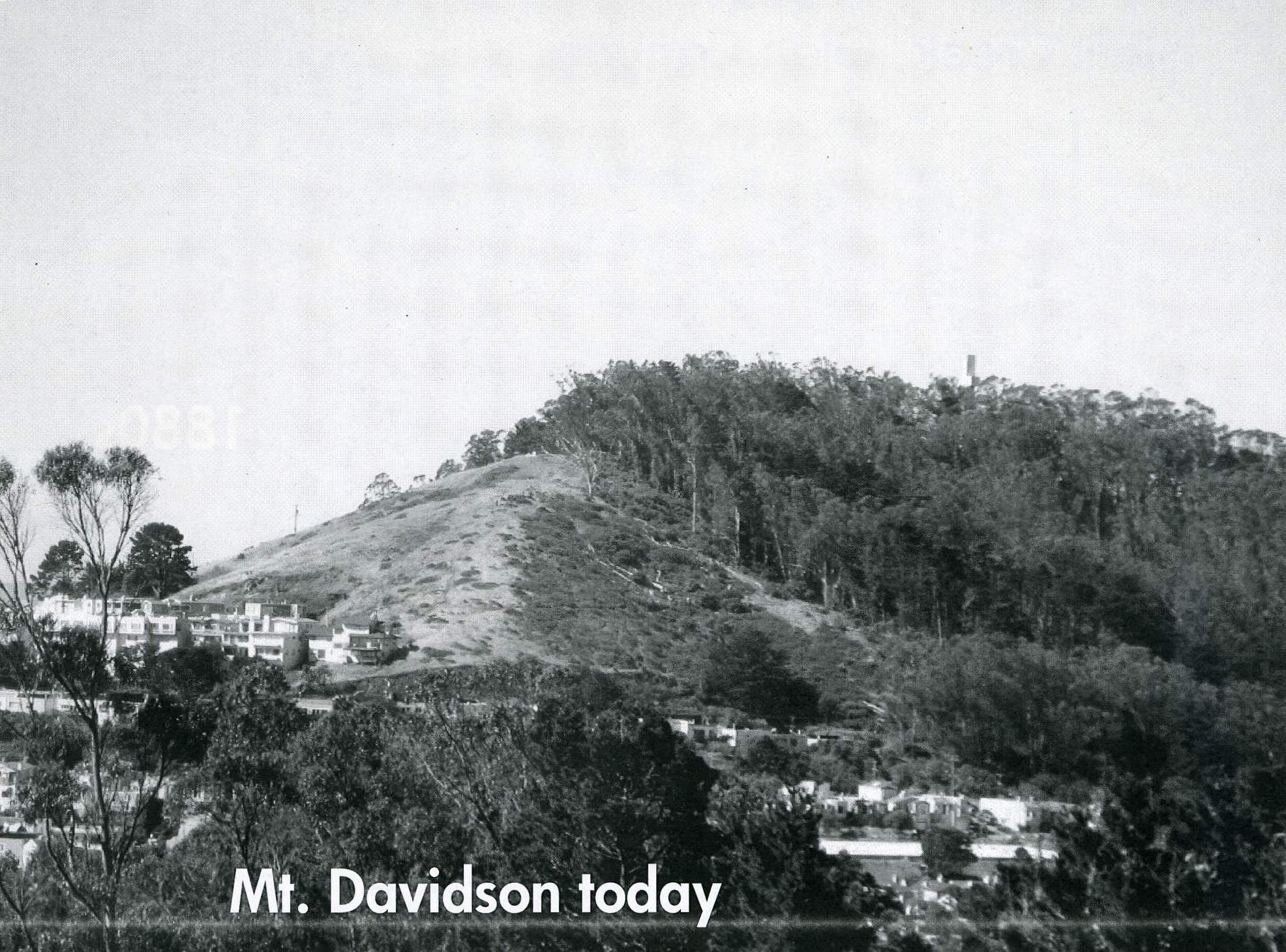
Over 80 years later, in a photo taken in 2010, there is still a sharp line between the forest and the grassland.  We see more trees in the foreground where residential areas have been developed and home owners have planted more trees, but the dividing line on the mountain is nearly unchanged.  The eucalyptus forest has not invaded the grassland.

Adolph Sutro would be saddened by a walk in the forest on Mt. Davidson to see over 50 dead and dying trees that have been girdled by native plant advocates.  And the Natural Areas Program’s management plans for Mt. Davidson also announce the intention to destroy 1,600 more trees over 15 feet tall.  Smaller trees to be destroyed are not quantified by the plan. 

Despite the lack of evidence, the California Invasive Plant Council (CIPC) has designated both the eucalyptus and the Monterey pine as “moderately invasive.”  There is even less evidence that Monterey pine grow where not intentionally planted.  These trees and many of the nearly 200 plants on the CIPC “hit list” are on that list because they aren’t native, not because they are invasive.  Few of these plants are truly invasive, but CIPC designates them as such so that their eradication can be justified.  

The Living Roof: A failed experiment in native plant gardening

Living Roof, California Academy of Sciences, March 2011

When the California Academy of Sciences reopened in San Francisco in August 2008, its “living roof” was considered its most unique feature.  Thirty species of native plants were candidates for planting on the roof.  They were planted in test plots with conditions similar to the planned roof and monitored closely.  Only nine species of native plants were selected for planting on the roof because they were the only plants that were capable of self-sowing from one season to another, implying that they were “sustainable.”  A living demonstration of “sustainability” was said to be the purpose of the living roof. 

So, 2-1/2 years later, what have we learned from the living roof about the sustainability of native plants in San Francisco?  The results of monitoring the roof since June 2009, are reported on the “fromthethicket” blog about Golden Gate Park.

Two of three of the predominant species on the roof after 2-1/2 years are native.  The third–moss–is not.  It is described by “fromthethicket” as “varieties of early succession mosses, the types that commonly show up in disturbed soil.”

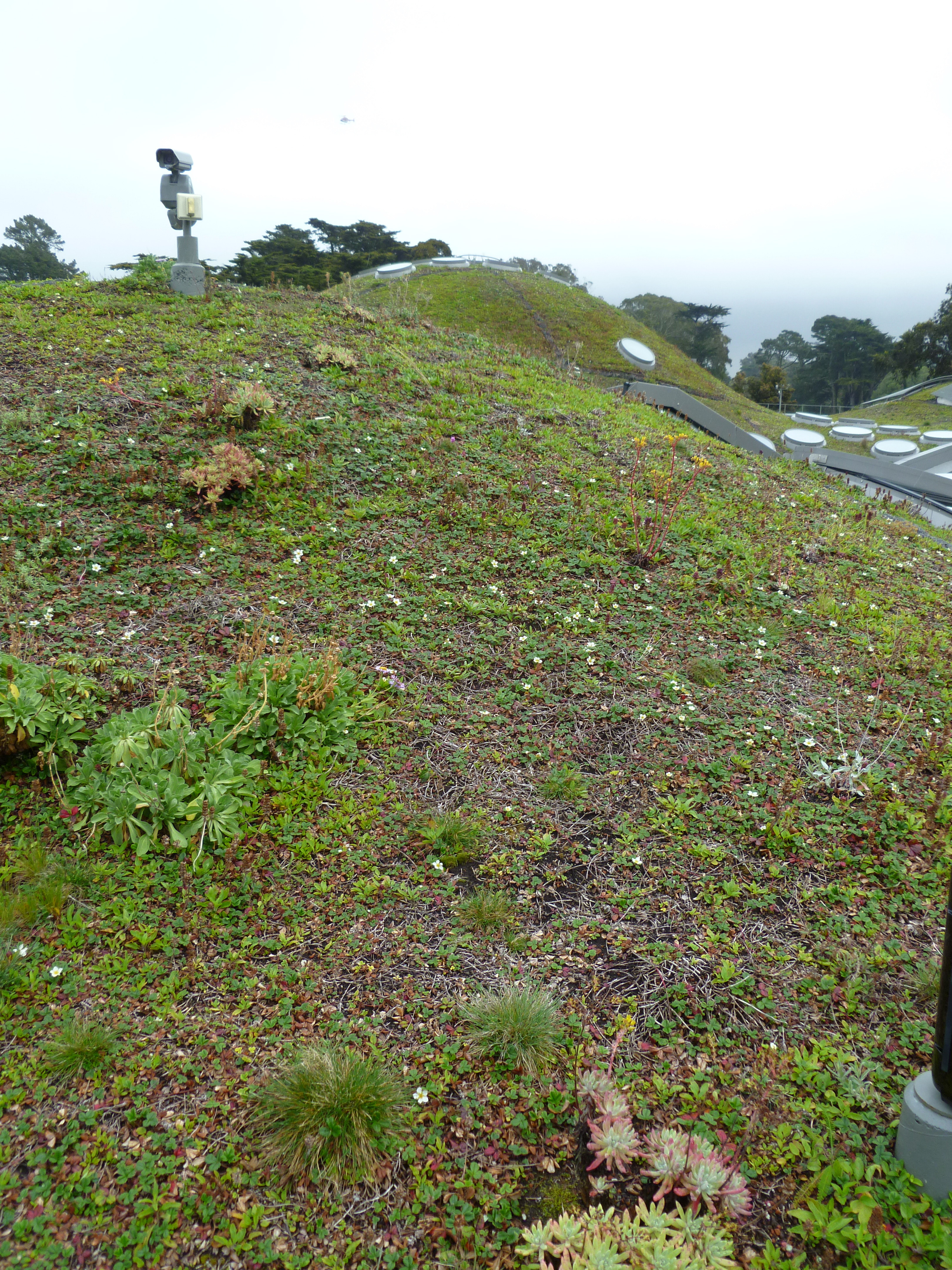
The monitoring project has divided the roof into four quadrants.  Non-natives now outnumber natives in two of the quadrants, those which are not being weeded.  Although natives outnumber non-natives significantly in the other two quadrants, non-natives are also growing in these quadrants.

California Academy of Sciences, April 2011

We had the privilege of meeting the ecology consultant who designed the plant palette for the  living roof for the academy and many other institutions around the world.  He would not be surprised by this monitoring report.  He advised the Academy to walk the streets of San Francisco and identify the plants growing from the cracks in the sidewalks.  These are the plants he advised the academy to plant because these are the plants that are adapted to current conditions in the city.  The Academy rejected this advice because they were committed to planting exclusively natives on the roof.

The designer also advised the academy not to irrigate the roof, because the point of the roof is that it is a demonstration of sustainability.  Again, the Academy refused because they knew that without irrigation most of the native plants would be brown during the dry season, roughly half the year.  They wanted the public to believe that the plants that are native to San Francisco are beautiful year around.

There is a lesson to learn here for anyone who is willing to learn from it.  The living roof is not natural because it is irrigated and intensively gardened (e.g., weeded, fertilized, replanted, reseeded), yet non-natives not only found their way there on their own, but are dominating it within only 2-1/2 years.  Native plants are not sustainable in San Francisco without intensive gardening effort.

Peter Del Tredici has been telling us this for several years.  He is a Senior Research Scientist at the Arnold Arboretum at Harvard University and a Lecturer in the Department of Landscape Architecture at the Harvard Graduate School of Design.

In a recent publication*, he advises the managers of public lands in urban areas to abandon their fantasy that native plants are sustainable in urban settings:

“The notion that self-sustaining, historically accurate plant associations can be restored to urban areas is an idea with little credibility in light of the facts that 1) the density of the human populations and the infrastructure necessary to support it have led to the removal of the original vegetation, 2) the abiotic growing conditions [e.g., temperature, salinity, moisture, etc.] of urban areas are completely different from what they were originally; and 3) the large number of non-native species that have naturalized in cities provide intense competition for the native species that grew there prior to urbanization.”

Sure, he says, we can grow native plants, but they require at least the same amount of effort as growing any other plant and are therefore just another form of gardening:  “Certainly people can plant native species in the city, but few of them will thrive unless they are provided with the appropriate soil and are maintained to the same level as other intentionally cultivated plants.”

He concludes that native plant advocates are making a “cultural value judgment:”

“…people are looking at the plant through the subjective lens of a cultural value judgment which places a higher value on the nativity of a given plant than on its ecological function.  While this privileging of nativity may be appropriate and necessary for preserving large wilderness areas or rare native species it seems at odds with the realities of urban systems, where social and ecological functionality typically take priority over the restoration of historic ecosystems.”

We hope that the managers of our public lands in the San Francisco Bay Area will soon catch up with the scientific literature as well as acknowledge the actual experience of years of failed “restorations.”  Aside from the waste of scarce resources, these efforts are poisoning our parks with toxic herbicides and destroying beautiful and healthy plants and trees to no useful purpose. 


* “Spontaneous Urban Vegetation:  Reflections of Change in a Globalized World,” Nature and Culture. Winter 2010, 209-315.

Chicago, another example of destructive “restorations”

We were first introduced to the native plant movement about 12 years ago when we began to notice that trees were being destroyed in our parks in San Francisco, but we couldn’t comprehend the scale of the project until we were finally successful in getting access to the first draft of the management plan for the Natural Areas Program in San Francisco.  Frankly, we were appalled by the planned destruction and restrictions on recreational access outlined in those plans. 

Hoping to understand the motivation for a project that didn’t make sense to us, we began to read about the native plant movement.  The first book we read was about “restoration” efforts in Chicago(1) which began in the late 1970s and apparently is one of the first projects in the country, influencing all others.  We were immediately struck by the similarities between our experiences in the Bay Area with those in Chicago.

  • The pre-settlement landscape was arbitrarily selected for replication in both places, despite an acknowledgement that the prairie and oak savannah were artificially maintained by frequent fires used by Native Americans.  Man had prevented the natural succession of grassland to shrubs and ultimately to forest.(2)
  • “Restorationists” in both places were essentially hobbyists, using trial-and-error strategies that rejected scientific methods of controlled experiments as too slow for their urgent mission.  The phrase “adaptive management” was adopted in San Francisco to describe these unscientific strategies.
  • Stealth methods were used in both places to hide controversial practices from the public.(3)  Trees (in Chicago, both native and non-native trees) were girdled to kill them and the scars hidden from view.  In Chicago, all activities (broadcast and brush pile burns, herbicide use, etc) were conducted behind visual screens.  In San Francisco, volunteers use herbicides they are not authorized to use.
Girdled tree, San Francisco
  • In both cases, “restorationists” developed a sense of ownership of the land that denied alternate views or even the authority of the theoretically official managers of the land.  As one of the local leaders said in a public hearing in San Francisco, “We know what to do and we want you to leave us alone to do what needs to be done.”

In Chicago and in the Bay Area, the criticisms of these “restorations” are also similar:

  • We do not want to destroy healthy trees whether native or non-native
  • We do not want to use toxic herbicides
  • We do not want to pollute our air or take the unnecessary risks associated with prescribed burns
  • We do not want to kill animals whether they are native or non-native
  • We value the landscape that exists and we do not consider a landscape that is exclusively native superior to it.  We have an inclusive view of nature, based on an acknowledgement of its dynamic quality.  We reject the arbitrary division of nature into “good” and “bad.” 
  • We believe that our public lands are owned by everyone, not just those who choose to volunteer in them

Ten years ago, we were encouraged to learn that the critics of the Chicago “restorations” were successful in getting a moratorium in 1996 on destruction in the areas being contested.  The moratorium was theoretically for the purpose of negotiating a compromise between “restorationists” and their critics. 

When we were recently contacted by restoration critics in Chicago, we weren’t at all surprised to learn that the effort to reach agreement had failed. The moratorium was lifted in most places in 1999 with the exception of a small, contested area where the moratorium was lifted in 2006.  We weren’t surprised because although we have participated in many efforts to negotiate with “restorationists” we have found that they are unwilling to compromise. 

Every scrap of park land originally claimed as a “natural area” in San Francisco is still under the jurisdiction of the so-called “Natural Areas Program.”  Nearly 15 years after the inception of the Natural Areas Program, there is still no environmental impact review, yet herbicide use continues unabated and trees are destroyed when funds are found to pay for their removal.   And in the East Bay, grant funding of restoration projects has been delayed for over 5 years because project managers will not budge from their demand to clear-cut all non-native trees.

Here are photos of the consequences of the “restoration” effort in Chicago:

Photos courtesy Natural Forest Advocates, Chicago

And here is a photo of one of the efforts to bring shame onto the destruction:

Since this photo was taken, the managers of public land have quit announcing prescribed burns and  work days in advance, hoping to prevent crowds such as this from gathering in protest.  Keeping their eyes and ears open, the critics gather as quickly as they can when they learn of a burn or a work day. 

We hope you will visit their website and sign their petition to encourage them in their challenging task. 

We are dedicated to preserving our public lands for the benefit of the animals that live in them and the humans who enjoy them.  We will use every means available to us to prevent as much destruction as we can.  We impatiently wait for science to catch up with our effort to bring this destructive movement to a halt by educating the public about the futility of trying to destroy deeply entrenched non-native species, the damage that is done in that futile effort, the value of a diverse ecology composed of both native and non-native plants and animals, and the changes in the environment that inevitably result in a changed landscape. 


(1) Restoring Nature, editors P. Gobster and B. Hull, Island Press, 2000

(2) Miracle Under the Oaks:  the revival of nature in America, William K. Stevens, Pocket Books, 1995

(3) Ibid.

Climate Change: Not just global warming anymore

When climate change first became a hot topic (pardon the pun) about 10 years ago, it was consistently described as “global warming.”  When scientists observed the effect that global warming was having on plants and animals in California, they reported that the ranges of native plants and animals were moving to higher elevations and northern latitudes in search of cooler temperatures. 

A study published in Nature magazine in December 2009 found that plants and animals must move as much as 6 miles every year from now to the end of the century to find the conditions they occupy now. When the plants move, the animals that depend on them must adapt or move with them to survive.  Professor Art Shapiro (UC Davis) has been studying California butterflies for over 35 years.  He reported (1) that native butterflies are moving to higher elevations, where temperatures are lower, but that ultimately, “There is nowhere else to go, except heaven.”

More recently we have experienced extreme weather that cannot be adequately described as “global warming.”  We have seen epic storms that have resulted in unprecedented flooding, while other places have experienced prolonged drought.  We are as likely to have an extremely cold winter as we are to have an extremely hot summer.  So the phrase “global warming” has evolved into the more accurate description:  “climate change.”  Aside from our anecdotal observations of these extreme weather events, science is beginning to catch up to provide an analytical understanding of our observations.  The story of climate change is now much more complex and the challenges it presents have become correspondingly more difficult and unpredictable.

Changes in Precipitation

Although places like Pakistan, Australia and some states in the US have recently experienced more rain and flooding than history has recorded, scientists have been reluctant to attribute this to climate change until very recently.  Computer modeling of nearly 50 years of weather data has finally enabled scientists to confirm that these increases in precipitation are the result of “…the effects of greenhouse gases released by human activities like the burning of fossil fuels.” (2)

And, like increases in temperature, changes in precipitation also result in the movement of plants and animals to “find” the conditions to which they are adapted.  Scientists have recently challenged previous assumptions about the movement of plants and animals to higher elevations.  They now report (3) that in some places in California in which precipitation has increased, plants have responded by “moving” to lower elevations.  Scientists acknowledge that the affect on the animal populations in their historic ranges is unpredictable because insects, for example, are more sensitive to changes in temperature and may not be able to move downhill with the plants they presently depend upon. 

Changes in Fog Patterns

Fog is another weather event that is important in California, particularly along the coast, where the warm air from the interior meets the cold air from the ocean.  The result of this confluence of cold and warm air is fog, particularly during the summer when the difference in temperatures is greatest. 

The redwood is our native tree that is closely associated with the foggy coastal conditions in California.  The redwood requires the fog drip to irrigate it during the dry California summer and its range is limited to sheltered areas because it does not tolerate wind.  The range of the redwood in California is therefore limited to a few hundred miles along the coast.  Its narrow range makes it particularly vulnerable to climate change. 


Redwood National Park, NPS photo


In Muir Woods, for example, higher temperatures have reduced coastal fog by 30% in the past century.  Scientists expect this loss of summer fog drip to result in a significant loss of water to the trees and they predict that it will affect the survival of the redwoods in the long-run.(4)

Implications of climate change for native plants?

Clearly, we still have much to learn about climate change:

  • Which weather events are indicators of long-range trends?
  • Climate change is apparently not just one trend, such as increased temperatures.  It is probably many different types of weather events, such as increases or decreases in snow and rainfall, hurricanes and typhoons, fog and wind.  Obviously, we don’t yet have the complete picture of what or where long-range changes have occurred or which are likely in the future. 
  • We know little about the affect that climate change will have on the natural world.  How will plants and animals respond to climate change?  Which plants and animals will survive and, if so, where will they survive?

We marvel at the confidence that the local native plant advocates have in their agenda.  How did they select the pre-European landscape of the late 18th century to replicate?  What makes them think that plants and animals that lived here 250 years ago are still sustainable here, let alone that they will be sustainable in the future? 

These are rhetorical questions, which we will presume to answer for our readers:  Native plant advocates may compensate for radically changed environmental conditions by using intensive gardening methods.  The use of herbicides, irrigation systems, prescribed burns, constant weeding, soil amendments, fences and boardwalks, etc., may artificially mimic the conditions of 250 years ago.  However, the result is a native plant garden that is neither natural nor more biodiverse than what can be achieved with less effort, with less toxicity and fewer scarce resources.  While we can see the value of a native plant garden to preserve our horticultural heritage, we find it more difficult to justify the large-scale efforts that we currently find in all of our public lands.  Is it realistic to garden all of our public lands in perpetuity? 


(1) Arthur Shapiro (UC Davis), Contra Costa Times, 1/19/10

(3) “Mountain plant communities moving down despite climate change, study finds,” Los Angeles Times, 1/24/11
http://www.latimes.com/news/local/la-me-climate-trees-20110121,0,4119552.story

(4) “Fog burned off by climate change threatens to stunt Muir Wood’s majestic redwood,” Marin Independent Journal, 2/5/11   http://www.marinij.com/marinnews/ci_17297751?IADID=Search-www.marinij.com-www.marinij.com