“Tending the Wild:” Our changing relationship with nature

We recently introduced our readers to a book about the land management practices of Native Americans in California, Tending the Wild:  Native American Knowledge and the Management of California’s Natural Resources.  (1) Drawing from this valuable resource, we will describe how the relationship of humans with nature has changed several times since the arrival of humans in California approximately 12,000 years ago.  We will conclude by raising questions about our current relationship with nature, as reflected in our land management practices.

The relationship of Native Americans with nature
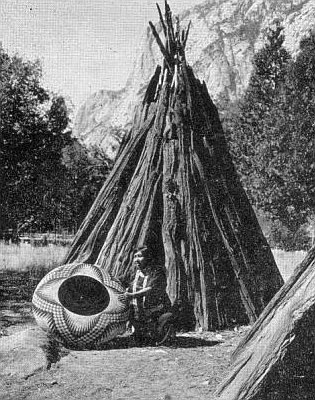
Basket CA Native AmericanWe will let the author of Tending the Wild speak for Native Americans, based on her extensive research of their culture and land-management practices:

“Although native ways of using and tending the earth were diverse, the people were nonetheless unified by a fundamental land use ethic:  one must interact respectfully with nature and coexist with all life-forms.  This ethic transcended cultural and political boundaries and enabled sustained relationships between human societies and California’s environments over millennia.  The spiritual dimension of this ethic is a cosmology that casts humans as part of the natural system, closely related to all life-forms.  In this view, all non-human creatures are ‘kin’ or ‘relatives,’ nature is the embodiment of the human community, and all of nature’s denizens and elements—the plants, the animals, the rocks, and the water—are people.  As ‘people,’ plants and animals possessed intelligence, which meant that they could serve in the role of teachers and help humans in countless ways—relaying messages, forecasting the weather, teaching what is good to eat and what will cure an ailment.” (1)

We emphasize that Native American culture considered humans a part of nature because this viewpoint provides contrast to modern interpretations of the relationship between humans and nature. 

Exploitation of nature by early settlers

When Europeans began to establish settlements in California in the late 18th century, they brought with them an entirely different viewpoint about their relationship with nature.  Natural resources were to be exploited and humans were the master of the natural world which was in their service.
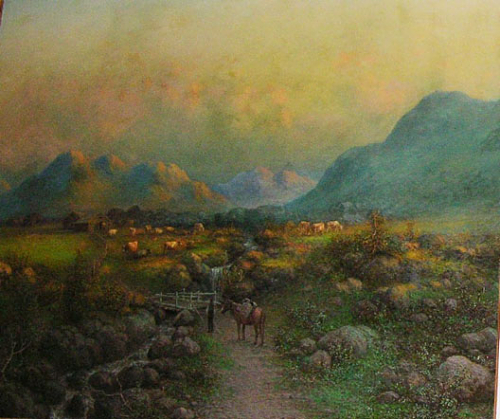
Western pioneer ranch
Western pioneer ranch. Painting by John Olson Hammerstad, 1842-1925.


The first phase of European settlement was the importation of huge herds of livestock by the Spanish coming from Mexico:

“During the Mission era…grazing was among the activities that caused the greatest damage.  Coastal prairies, oak savannas, prairie patches in coastal redwood forests, and riparian habitats, all rich in plant species diversity and kept open and fertile through centuries of Indian burning, became grazing land for vast herds of cattle, sheep, goats, hogs, and horses owned by Spanish missions and rancheros.  By 1832 the California missions had more than 420,000 head of cattle, 320,000 sheep, goats, and hogs, and 60,000 horses and mules…overgrazing eliminated native plant populations, favored alien annuals, and caused erosion…A great variety of alien [plant] species were introduced inadvertently during the Mission Period.  Research has shown that European forbs and grasses…were brought into California at this time, contained in adobe bricks, livestock feed, livestock bedding, and other materials.  Soon these alien [plants] overwhelmed the native species, markedly changing the character and diversity of grasslands and other habitats west of the inner Coast Ranges.”  (1)

Tending the Wild reports that during this early phase of European settlement, Native Americans were quick to adapt to the changing landscape.  They incorporated useful new plants into their diets.  Likewise, we see today new plants and animals quickly enter the food web.
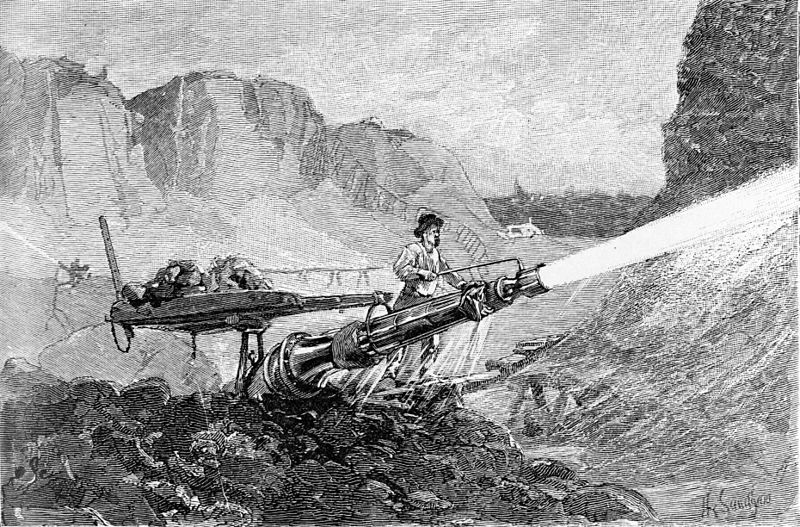
 

Hydraulic gold mining in California.

These changes in the landscape paled in comparison to the exploitation of the land that began in 1849 when gold was discovered in California and the huge influx of Americans of diverse European descent arrived.  Here are a few examples:

  • “…by the 1870s ‘more men made their living in the broader geography and economy of farming—48,000—than in all the mines of the Sierra footholls—36,000.’ To accommodate the acreage devoted to growing crops, marshes were drained, underground water was tapped by artesian wells, streams and rivers were dammed and diverted for irrigation, and lands were fenced.  In the process huge tracts of former native grasslands, riparian corridors, and vernal pools were converted to artificial, human-managed agricultural systems.” (1)
  • “Five million acres of wetland in California have been reduced by 91% through diking, draining, and filling for agriculture, housing, or other purposes.” (1)
  • By 1900, 40% of California’s 31 million acres of forest were logged.
  • “By the early 1900s, the numbers of marine mammals, wildfowl, elk, deer, bear, and other birds and mammals had been so drastically reduced that Joseph Grinnell would write, ‘Throughout California we had been forcibly impressed with the rapid depletion everywhere evident among the game birds and mammals.’” (1)
  • Between 1769 and 1845, the population of Native Americans in California dropped from an estimated 310,000 to 150,000. Between 1845 and 1855, the population of Native Americans dropped from 150,000 to 50,000.

Romanticizing Nature

Meanwhile, in Europe and the East Coast of the US, a new view of nature was being articulated.  The Romantic movement viewed nature as an escape from the stress of urban life, a tranquil retreat from civilization.  In California, John Muir was strongly influenced by Romanticism: 

“Muir and those with similar views responded to the destruction and exploitation of California’s natural resources with a preservationist ethic that valued nature above all else but which defined nature as that which was free of human influenceThus while he championed the setting aside of parks as public land, Muir also contributed to the modern notion that the indigenous inhabitants of the state had no role in shaping its natural attributes.” (1)

Muir was unable to fit Native Americans into his idealized view of nature.  He wrote this account of Miwok Indians in the Sierra Nevada in 1869:

“’We had another visitor from Browns’ Flat to-day, an old Indian woman with a basket on her back.  Her dress was calico rags, far from clean.  In every way she seemed sadly unlike Nature’s neat well-dressed animals, though living like them on the bounty of wilderness.  Strange that mankind alone is dirty.  Had she been clad in fur, or cloth woven of grass or shreddy bark, like the juniper or libocedrus mats, she might have seemed a rightful part of wilderness; like a good wolf at least, or bear.  But no point of view that I have found are such debased fellow beings a whit more natural than the glaring tailored tourists we saw that frightened the birds and the squirrels.’” (1)
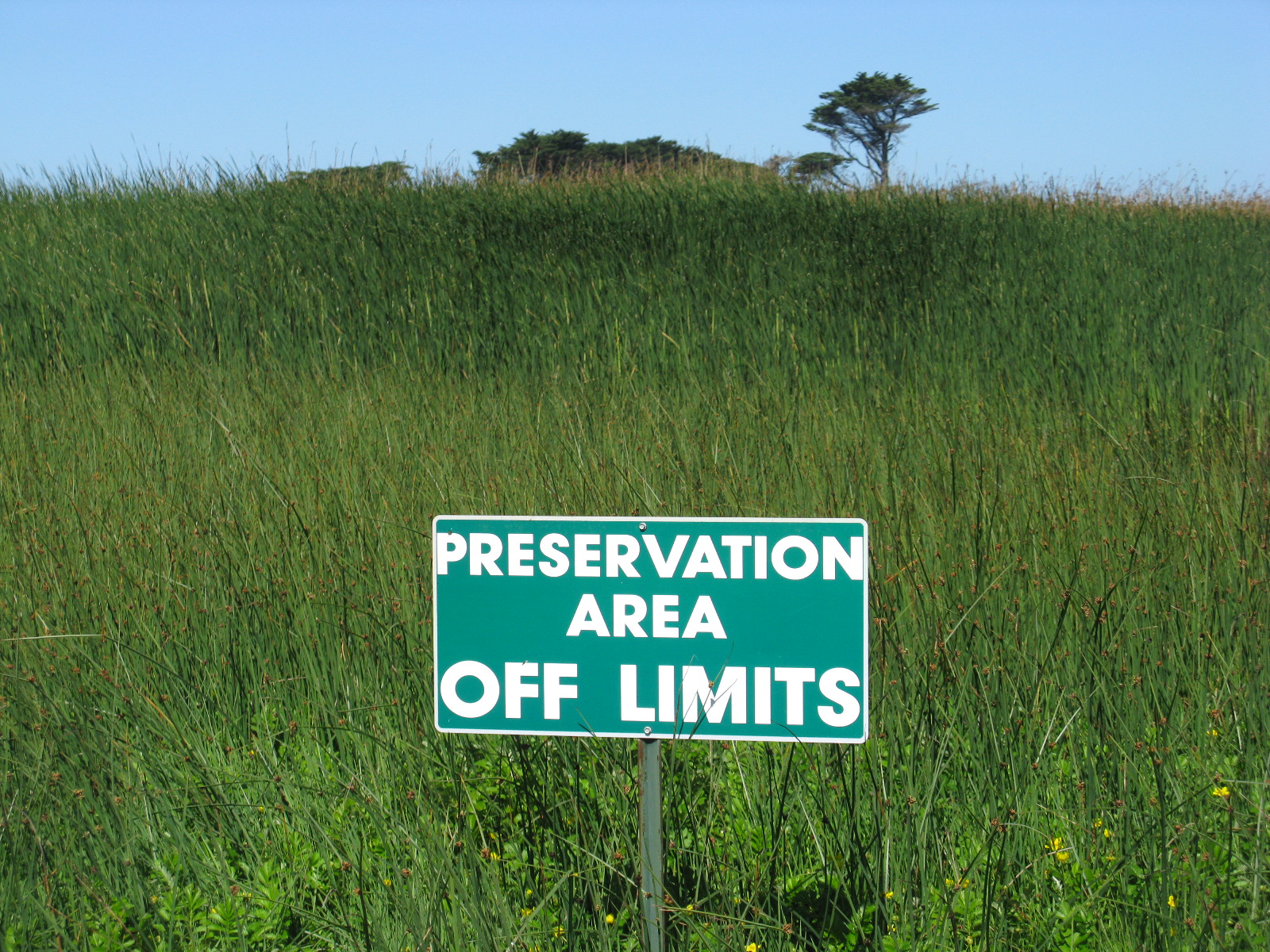
Sharp Park, Pacifica, CA.  Photo by Erica Reder, SF Public Press
Sharp Park, Pacifica, CA. Photo by Erica Reder, SF Public Press

In this romanticized view of nature, humans are not welcome Humans defile the purity of nature.  This is the prevailing viewpoint today among those who consider themselves environmentalists, park advocates, and conservationists.  They advocate for “wilderness” where “humans may visit, but not remain.”  They post signs, advising visitors to look but not touch.  Their “restoration” projects put nature behind a fence.  They complain about immigration.

The condescending attitude articulated by John Muir toward Native Americans was instrumental in our ignorance of their land management practices.  Europeans considered Native Americans primitive and therefore did not expect to learn anything useful from them.  Europeans imported and grew their own food from their original homes because they were unaware of how local food sources could be grown and used.  Our knowledge of Native American culture is recent and it comes too late to ever be fully informed because those who tended the land are long since gone.  Furthermore, this new knowledge of land management practices of Native Americans is not well known, certainly not among native plant advocates who are attempting to re-create a landscape which was created by methods they do not understand.

Redefining ecological “restoration”

The author of Tending the Wild admires Native American culture as well as the landscape that was created by their land management practices.  Therefore, she concludes her book with a proposal that we adopt their land management methods:

“What then, should be the goal of ecological restoration?  Restoring landscapes and ecosystems to a ‘natural’ condition may be impossible if that natural condition never existed…Restorationists must at the very least acknowledge the indigenous influence in shaping the California landscape.  This chapter advocates an additional step—using indigenous people’s knowledge and methods to carry out the restoration process, to return landscapes to historical conditions and restore the place of humans in this continuing management.”  (1)

In our previous post, we described some of the land management practices of Native Americans, particularly the importance of setting fires.  Adopting these management practices for ecological restorations would require us to make a permanent commitment to setting fires.  Fires pollute the air, release greenhouse gases into the atmosphere, and endanger lives and property.  Therefore, this is surely not a proposition that can be reasonably applied to our densely populated urban parks.  The maximum population of Native Americans prior to the arrival of Europeans is estimated to have been 310,000.  The population of California was estimated to be over 38 million in 2013.  Land management practices that were appropriate for a human population of only 310,000 are not appropriate for a population of over 38 million.

Furthermore, the land management practices of Native Americans were useful for their culture.  They tended the landscape in order to feed, clothe, heal, and house themselves.  If that specific landscape is no longer useful for those purposes, why would we consider it an ideal landscape?  In what sense would it be superior to the landscape that occurs naturally without setting fires or intensively gardening our open spaces?

A more realistic paradigm is needed

We believe a more sustainable paradigm for managing nature is needed.  Although we won’t presume to define this new paradigm, we will suggest some parameters:

  • Humans are as much a part of nature as any other animal. Therefore, conservation goals must accommodate the presence of humans.  However, humans must respect plants and animals as equal partners in achieving conservation goals.
  • Since we live in a free society, we must assume that human populations will grow in proportion to the choices of humans. And since we are a nation of laws, we must assume that immigration will occur as allowed by our laws.  Conservation goals must be consistent with the realities of human population density.
  • Conservation goals should look forward, not back. Goals should reflect the changes in the environment that have already taken place and anticipate the changes that are expected in the future.
  • The distinction between native and non-native species should be only one of several criteria to determine whether a species “belongs here.” If plants and animals are sustaining themselves without human subsidy, we should acknowledge and appreciate the functions they perform in the ecosystem.  This approach will reduce the use of herbicides, now being used to eradicate plants perceived to be “non-native,” in our parks and open spaces.
  • Conservation goals should be realistic within the confines of available resources and in competition with other priorities.
  • There are pros and cons to every change we make in the landscape. Whenever we alter the landscape, if our land management methods damage the environment by using pesticides, killing animals or destroying their food resources and homes, contributing to greenhouse gases, restricting recreational access, etc., we must have solid evidence that the benefits to the environment will be greater than the damage we foresee.  If there is no net benefit, we should leave it be.

Can you add to or suggest revisions of this list of a new conservation ethic?  Surely there are as many opinions as there are readers of Million Trees.  We would like to hear your ideas.


  1. M. Kat Anderson, Tending the Wild: Native American Knowledge and the Management of California’s Natural Resources, University of California Press, 2005 (This is the source of most of the information in this article.)

FEMA has published the final Environmental Impact Statement for projects in the East Bay Hills

Readers of Million Trees will recall some of the most controversial projects in the San Francisco Bay Area which propose to destroy hundreds of thousands of trees in the East Bay Hills.  The owners of these properties—UC Berkeley, City of Oakland, and East Bay Regional Park District—applied for grants from the Federal Emergency Management Agency (FEMA) to fund these projects, based on the claim that fire hazards would be reduced  by the projects.  Detailed descriptions of the proposed projects as originally planned are available HERE

The public comment period on the Draft Environmental Impact Statement closed in June 2013.  FEMA has announced the publication of the final Environmental Impact Statement (EIS), which is available HERE FEMA now reports that it received more than 13,000 public comments and informs us that the final EIS reflects the concerns expressed in the public comments as well as the analysis of “subject matter experts.”  We haven’t read either the public comments or the final EIS yet, so we are only quoting excerpts directly from FEMA’s announcement so that you have this information as soon as possible.  If you read these documents, we welcome your reaction to them. 


Here are excerpts from FEMA’s announcement of the final EIS (emphasis added):

“One of the major revisions to the draft EIS influenced by information gathered during the public process is that FEMA will not fund the proposed methodology of eradicating designated tree species without a phased approach.  The originally proposed eradication methodology to completely and immediately remove the “overstory” was deemed not to satisfy the purpose and need for the grant of fire reduction, and therefore did not meet hazard mitigation program eligibility requirements.

Identifying and analyzing implementation options is another required element of the National Environmental Policy Act (NEPA) decision-making process that must be explored before federal funding can be awarded.  Based on input and issues raised during the public comment process, and in consultation with the grantee, sub applicants, and cooperating federal agencies, FEMA revised the vegetation management methodology for two of the three sub applicants – City of Oakland and UC Berkeley.  The revisions align the majority of proposed projects with a thinning alternative, the approach originally proposed by East Bay Regional Parks District as described in the Draft EIS.

The thinning approach has been scientifically validated by subject matter experts to effectively reduce fire risk.   The revised vegetation management methodology will result in fewer trees being removed in any single year in certain areas, with the same total fuel reduction accomplished by the conclusion of the project.  The EIS considers the overall impacts to the environment based on the amount of land treated and consequent impacts to resources.  Each grant applicant is responsible for their ongoing land management practices and determination for how much vegetation will be removed to accomplish their fire reduction goals within the scope of the vegetation management approach defined in the EIS.  Clear-cutting, a logging practice, is not part of the methodology considered in the EIS for any of the projects.


The final EIS and response to comments are available on the web at:   http://ebheis.cdmims.com/FinalDocuments.aspx

and will also be made available at http://www.fema.gov/environmental-historic-preservation-documents.

The public also may view hard copies of the EIS at the following locations:

  • Oakland Main Library, 125 14th Street Oakland, CA 94612
  • Oakland Rockridge Library, 5366 College Avenue Oakland, CA 94618
  • Berkeley Main Library, 2090 Kittredge Street Berkeley, CA 94704
  • San Leandro Main Library, 300 Estudillo Avenue San Leandro, CA 94577
  • Richmond Main Library, 325 Civic Center Plaza Richmond, CA 94804
  • FEMA Region IX Headquarters, 1111 Broadway, Suite 1200, Oakland, CA 94607-4052
  • East Bay Regional Park District, 2950 Peralta Oaks Court, Oakland, CA 94605-0381
  • City of Oakland, Office of the City Clerk, Oakland City Hall, 2nd Floor, 1 Frank H. Ogawa Plaza, Oakland, CA 94612
  • California Governor’s Office of Emergency Services, Hazard Mitigation Grant Program Unit 10390 Peter A. McCuen Blvd First Floor Sacramento, CA 95655


Escalating war on trees in the East Bay

The Federal Emergency Management Agency (FEMA) has been considering grant applications for “fire hazard mitigation” in the East Bay since 2005, when the first of these applications was submitted. After years of debate about whether or not the projects achieve the stated purpose and at what cost to the taxpayers and the environment, FEMA finally agreed to resolve the controversial issues by mandating an environmental impact review, which began in 2010. The Draft Environmental Impact Statement (DEIS) was published in April 2013 and the public comment period on that draft closed in June 2013.

FEMA tells us they received over 3,500 public comments on the draft, so needless to say it is taking some time to analyze and respond to those comments. Based on questions raised by public comments, FEMA sent questions to the applicants in October 2013, requesting clarification of their project plans. The applicants responded in November 2013, by revising their project plans. UC Berkeley and the City of Oakland responded that they now plan to “thin” rather than to remove all non-native trees, consistent with the original intentions of East Bay Regional Park District. FEMA now predicts that the final EIS will be published around the end of 2014.

Grant applicants are champing at the bit

The applicants for these grants are getting restless for award of the grant which will fund the removal of tens of thousands of trees or more. We recently reported to our readers that UC Berkeley began to destroy trees on its property in late August 2014, before the grant has been approved. The trees that were destroyed are still lying on the ground, looking like bonfires waiting to happen.

Some of the hundreds of trees destroyed by UC Berkeley in August 2014

More recently, Claremont Canyon Conservancy has successfully recruited 12 East Bay elected officials to ask FEMA for immediate release of the grant funds, as well as “complete removal” of all eucalyptus trees, rather than thinning as originally proposed by East Bay Regional Park District and as revised by the City of Oakland and UC Berkeley in November 2013. This request was reported by the San Francisco Chronicle, Contra Costa Times, and ABC TV news. Based on these news sources, as well as the website of the Claremont Canyon Conservancy, we can report that the following East Bay elected officials have signed this request:

City of Oakland
Jean Quan, Mayor of Oakland
Dan Kalb, Oakland City Council
Rebecca Kaplan, Oakland City Council
Larry Reid, Oakland City Council
Libby Schaaf, Oakland City Council

City of Berkeley
Tom Bates, Mayor of Berkeley
Jesse Arreguin, Berkeley City Council
Laurie Capitelli, Berkeley City Council
Susan Wengraf, Berkeley City Council
Gordon Wozniak, Berkeley City Council

State of California
Nancy Skinner, State Assembly
Loni Hancock, State Senate

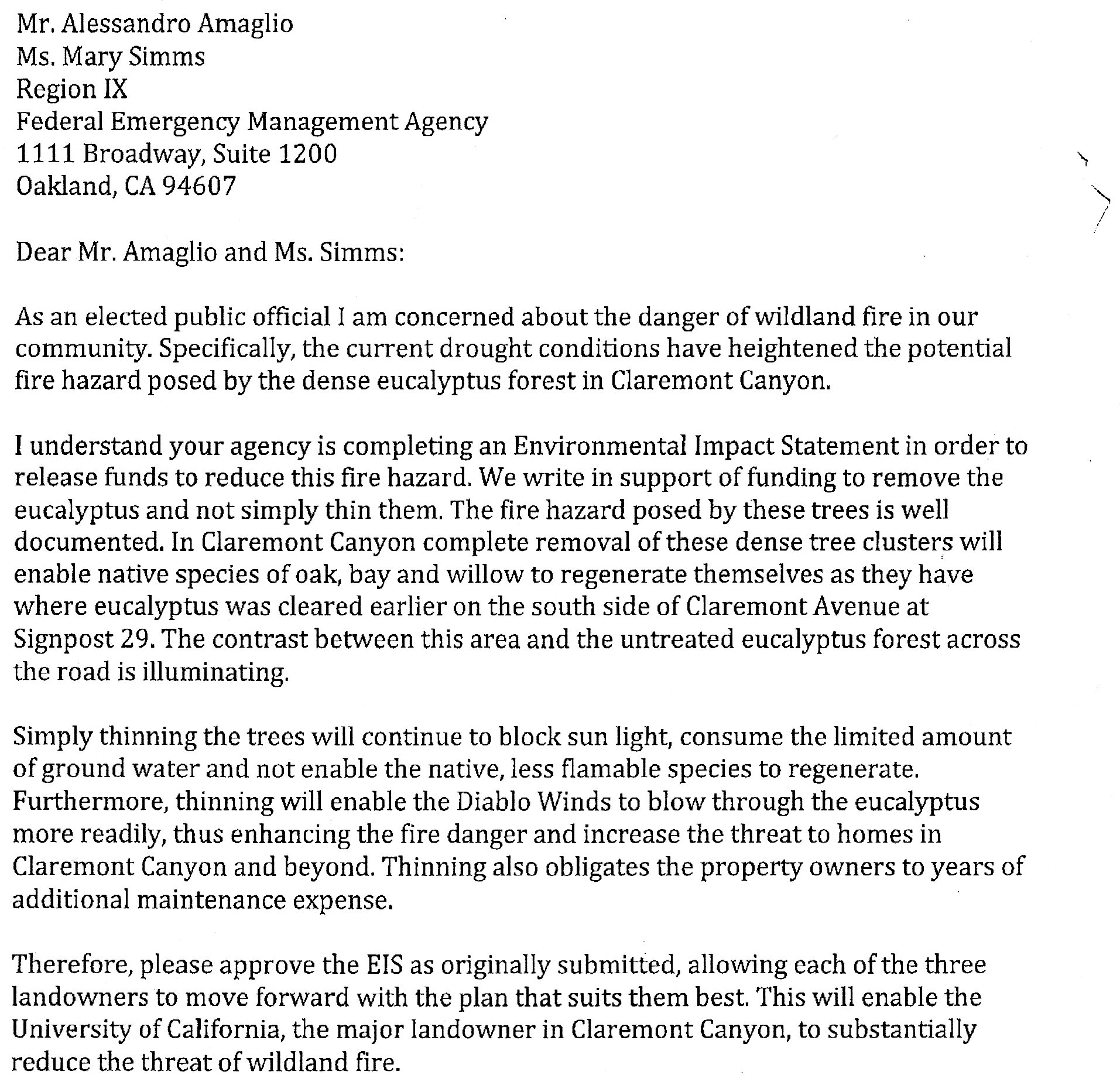
We have an unsigned copy of a letter to FEMA:

Pols letter to Amaglio

– end letter –

We cannot report with confidence that all these politicians sent the same letter because Oakland Councilman Dan Kalb is the only politician who has responded to our public records request. Mr. Kalb’s request is similar, but requests “funding to remove a substantial number of the eucalyptus trees.” Mr. Kalb’s letter seems to acknowledge that requesting removal of all eucalyptus trees would be inconsistent with the City of Oakland’s November 2013 revision of its original grant application; he says, “I know that the City of Oakland has submitted some revised language as requested by [FEMA].” The elected officials who signed the above letter do not seem to realize that their request contradicts the agreement with FEMA in November 2013 to thin rather than to remove all non-native trees on their properties. Or perhaps they have changed their minds.

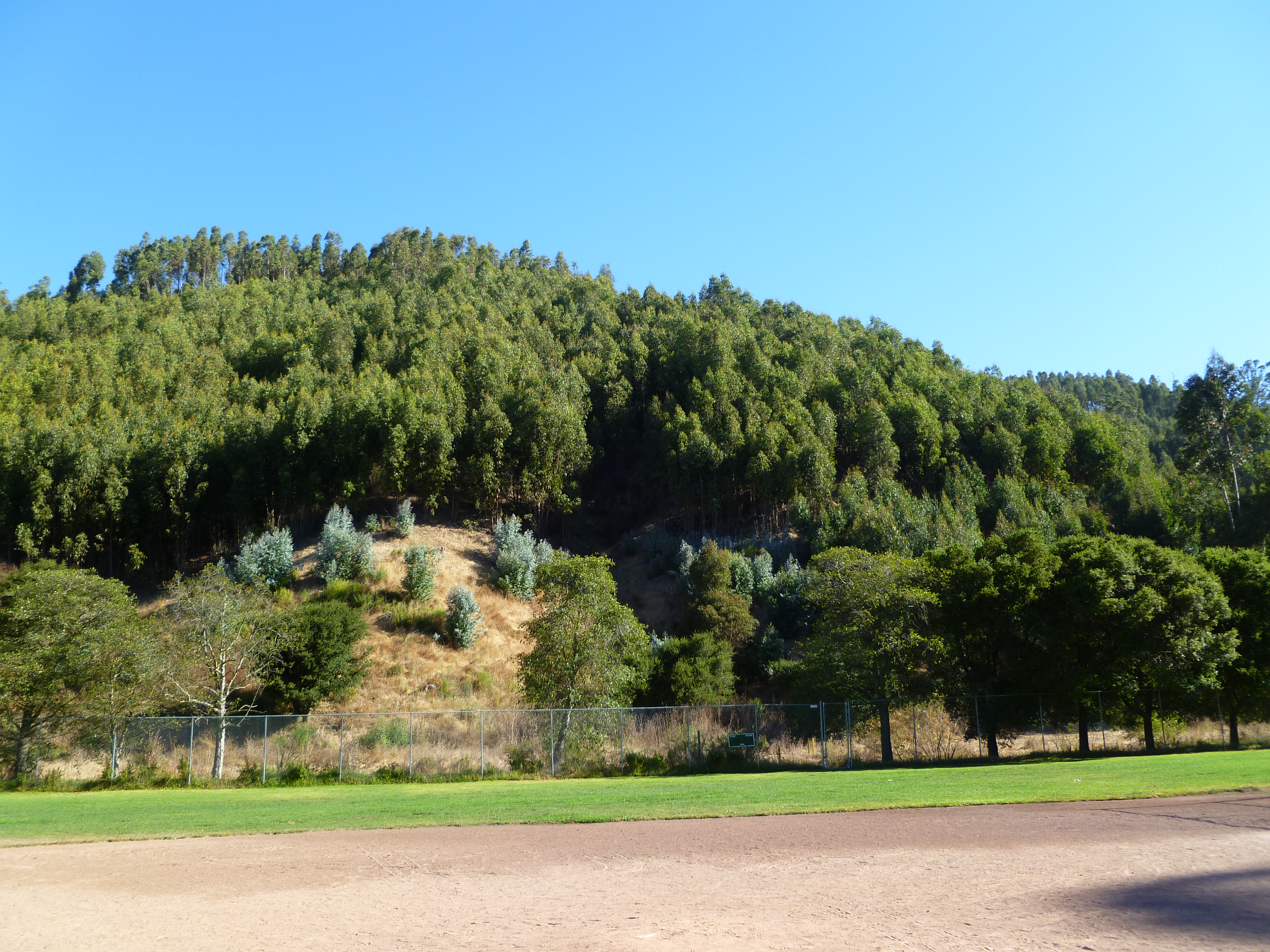
This eucalyptus forest at the North Oakland Sports Facility will be  destroyed by the City of Oakland.
The City of Oakland wants to destroy this eucalyptus forest at the North Oakland Sports Facility. Note that where they have destroyed eucalyptus in the past, they have not controlled the resprouts. The grey-green small trees near the base of the hill are eucalyptus resprouts.

Stunning display of ignorance

We are rarely surprised by the extreme views of native plant advocates, but the letter sent by East Bay elected officials is a stunning display of ignorance, mendacity, or both:

  • The claim that native plants are less flammable than non-native plants is entirely fallacious. The indigenous landscape of California is highly flammable as is demonstrated by wildfires throughout California every year. In virtually every case, those wildfires occur in native landscapes.
  • This statement is not even superficially logical: “thinning will enable the Diablo Winds to blow through the eucalyptus more readily, thus enhancing the fire danger…” Obviously, destroying ALL the trees will provide even less of a barrier to Diablo winds.
  • The public record does not support the contention that eucalyptus is more flammable than any other type of vegetation. HERE is a report of the public record of the 1991 Oakland wildfire.
  • Oaks and bays have indeed grown in Clarement Canyon since eucalypts were removed there because it is a riparian corridor where trees are sheltered from the wind and water is funneled to them. However, that is not typical of regrowth after removal of the tree canopy in most locations where eucalypts have been removed. The more likely outcome is non-native annual grasses, as explained HERE by the environmental consultant who evaluated the plans of UC Berkeley. Since fire ignites more readily in grass, fire hazards are not reduced by this transition.
Non-native annual grassland now occupies most of the area where UC Berkeley destroyed 18,000 trees about 10 years ago.

News sources also interviewed Jon Kaufman, a spokesperson for Claremont Canyon Conservancy who expressed his frustration that their desire for the destruction of non-native trees in the East Bay Hills is being delayed by FEMA: “With fire season approaching, it’s a good time to remind FEMA they need to get off their asses.” His insulting approach cannot be called a charm offensive.

Mr. Kaufman is quoted as making the following misstatement of fact: “But Kaufman said no spraying would be involved and that herbicide will be applied topically to the stumps with a brush.” We have heard native plant advocates make this claim many times. Perhaps some of them even believe it. FEMA asked for clarification from grant applicants about their plans for herbicide applications in October 2013. The applicants replied in November 2013 that they will apply Garlon according to the manufacturer’s label.

Mr. Kaufman’s claim that herbicide will not be sprayed is contradicted by the manufacturer of Garlon, DowAgra. The manufacturer describes the method of cut-stump application: “Treat the exposed cambium area and the root collar (exposed bark on the side of the stump) down to the soil line. Be sure to treat the entire circumference of the tree. To ensure effective control on large trees, also treat any exposed roots (knees) that surround the stump.” This method is illustrated on the manufacturer’s website by videos of the applicator using spraying equipment.

The herbicides needed to destroy non-native vegetation are also foliar sprayed, as described by the Draft EIS. It is a fiction that non-native trees and plants can be eradicated without spraying herbicides. The use of large quantities of herbicides is nearly as controversial as the loss of our urban forest.

Are you a voter in Oakland or Berkeley?

If you are a voter in Oakland or Berkeley and you care about the preservation of our urban forest and/or object to the hazards created by spraying our public lands with herbicides, you should know that some of the politicians who signed the letter to FEMA are on the ballot on November 4, 2014. You can take their support for clear cutting all eucalyptus in the Oakland/Berkeley hills into consideration in your vote. Better yet, you could write to them to tell them your opinion of their misguided support for removing all non-native trees on public property. We do not expect our public officials to be experts in horticulture or fire science. However, we think it is irresponsible for public officials to endorse the position of a particular interest group without making an effort to inform themselves of opposing viewpoints.

Here is a list of the candidates you will find on your ballot:

City of Oakland – Candidates for Mayor
Jean Quan http://www.oaklandnet.com/contactmayor.asp
Rebecca Kaplan atlarge@oaklandnet.com
Libby Schaaf lschaaf@oaklandnet.com

City of Berkeley – Candidates for City Council
Jesse Arreguin – District 4 – running unopposed

There is also a petition in opposition to these destructive projects available HERE.

The only logical resolution

One wonders how FEMA can now award grants to the City of Oakland or to UC Berkeley. In November 2013, these public agencies told FEMA, in writing, that they will thin rather than clear cut all non-native trees on their properties. In August 2014, UC Berkeley destroyed all eucalyptus trees on a portion of the project area, which should be a demonstration of UCB’s intentions. Actions speak louder than words, even written words.

In the case of the City of Oakland, elected officials in positions of authority, including the sitting Mayor of Oakland, have contradicted the City of Oakland’s written commitment to FEMA to thin rather than to clear-cut by asking FEMA to immediately release grant funds to clear-cut all eucalyptus from their properties.

How can FEMA trust these agencies to do what they have said in writing they intend to do? The only logical response to the request of these elected officials is to inform UC Berkeley and the City of Oakland that they have effectively rescinded their grant applications.

Is UC Berkeley building a bonfire during fire season?

If you are watching the news, you know that wildfires are raging all over California. One of those fires destroyed most of the small town of Weed a few days ago. The San Francisco Chronicle reported that fire and made a rare acknowledgement of the flammability of native California vegetation: “…the native fuels adapted over thousands of years to the lightning-caused fires that regularly broke out in California. The most problematic in a drought situation, he said, are manzanita, younger ponderosa pine trees and incense cedars. The three are all highly flammable and close to the ground, creating a fuel ladder from the grass to the overstory trees.” The article also noted that fires usually start in grasses and are then fanned by high winds into wildfires that destroy everything in their path.

Yet, the fiction continues in the San Francisco Bay Area that only non-native trees are to blame for wildfires and that they must all be destroyed to reduce fire hazards. In fact, when the trees are destroyed, the unshaded ground is quickly populated by grasses that are the type of vegetation in which virtually all of our fires start.

In the height of fire season, UC Berkeley has recently destroyed many trees in the East Bay Hills and left them lying on the ground to dry out. These huge piles of dead vegetation look like bonfires waiting to happen. We are grateful to our readers for alerting us to this new round of destruction. They have given us permission to publish their letter to the Federal Emergency Management Agency and UC Berkeley. We hope you will consider writing your own letter to express your concern.


Alessandro Amaglio [alessandro.amaglio@dhs.gov]
Region IX Environmental Officer
Federal Emergency Management Agency
Oakland, CA

RE: East Bay Hills – Environmental Impact Statement – FEMA – RIX

Dear Mr. Amaglio,

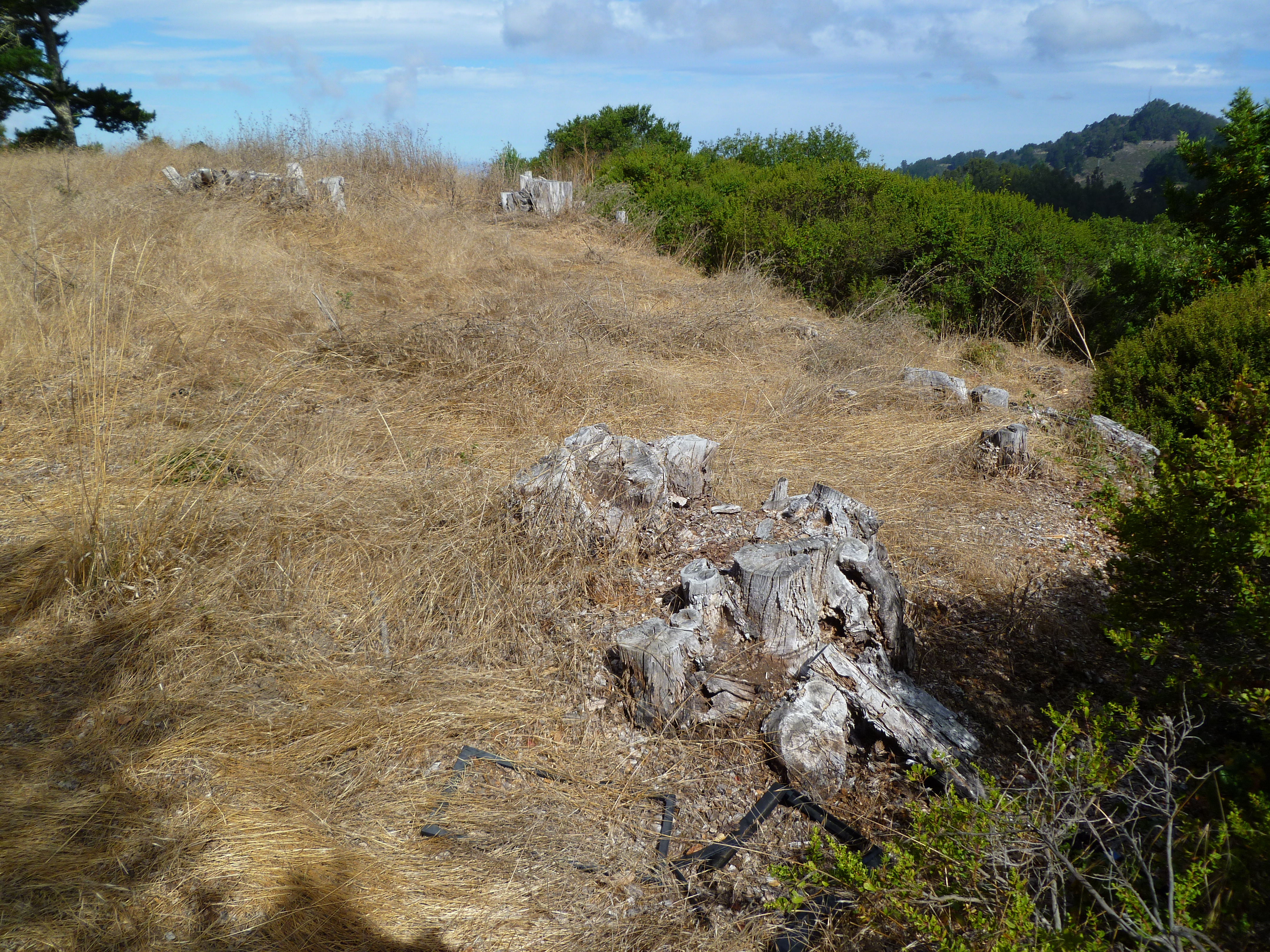
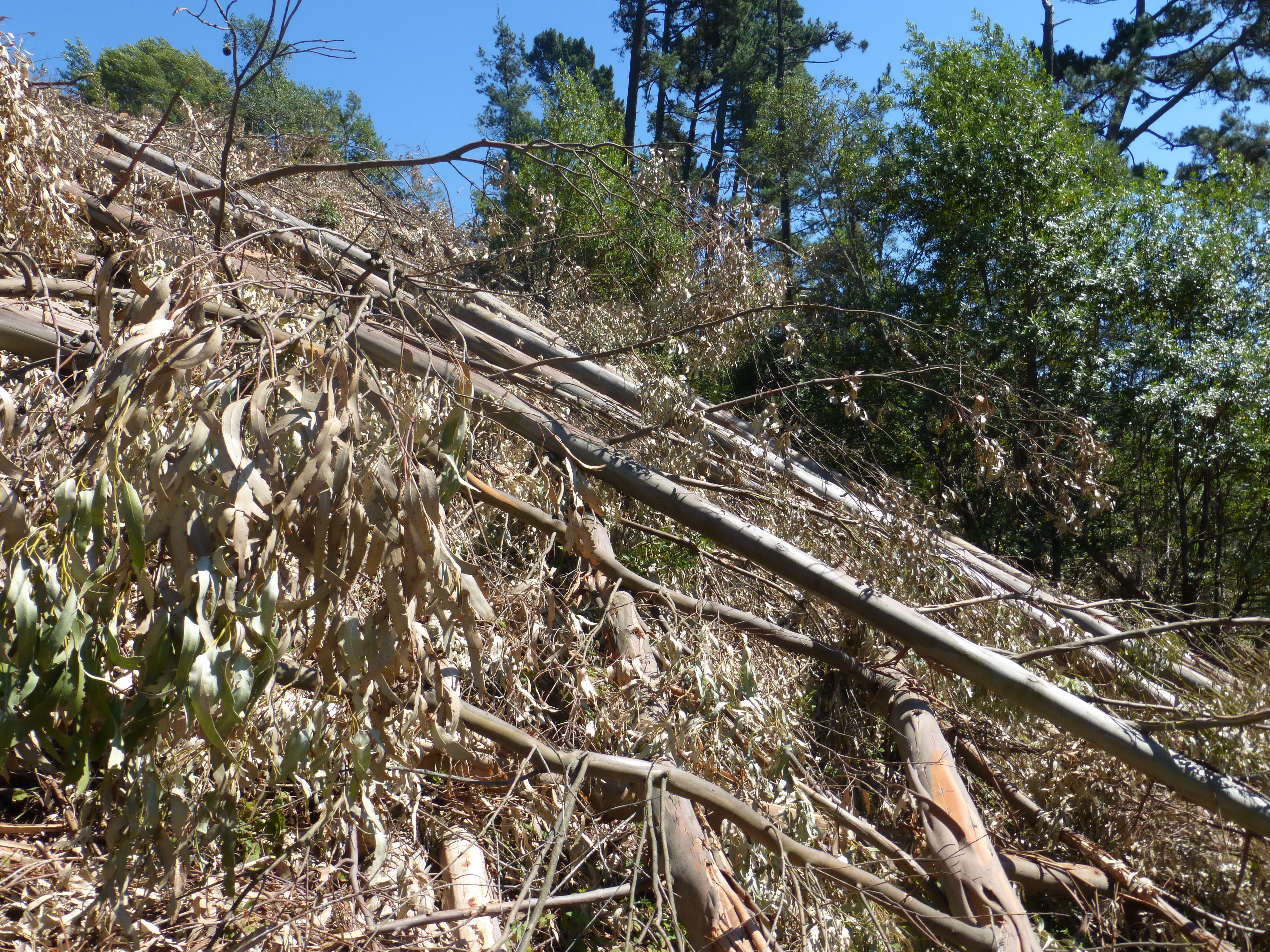
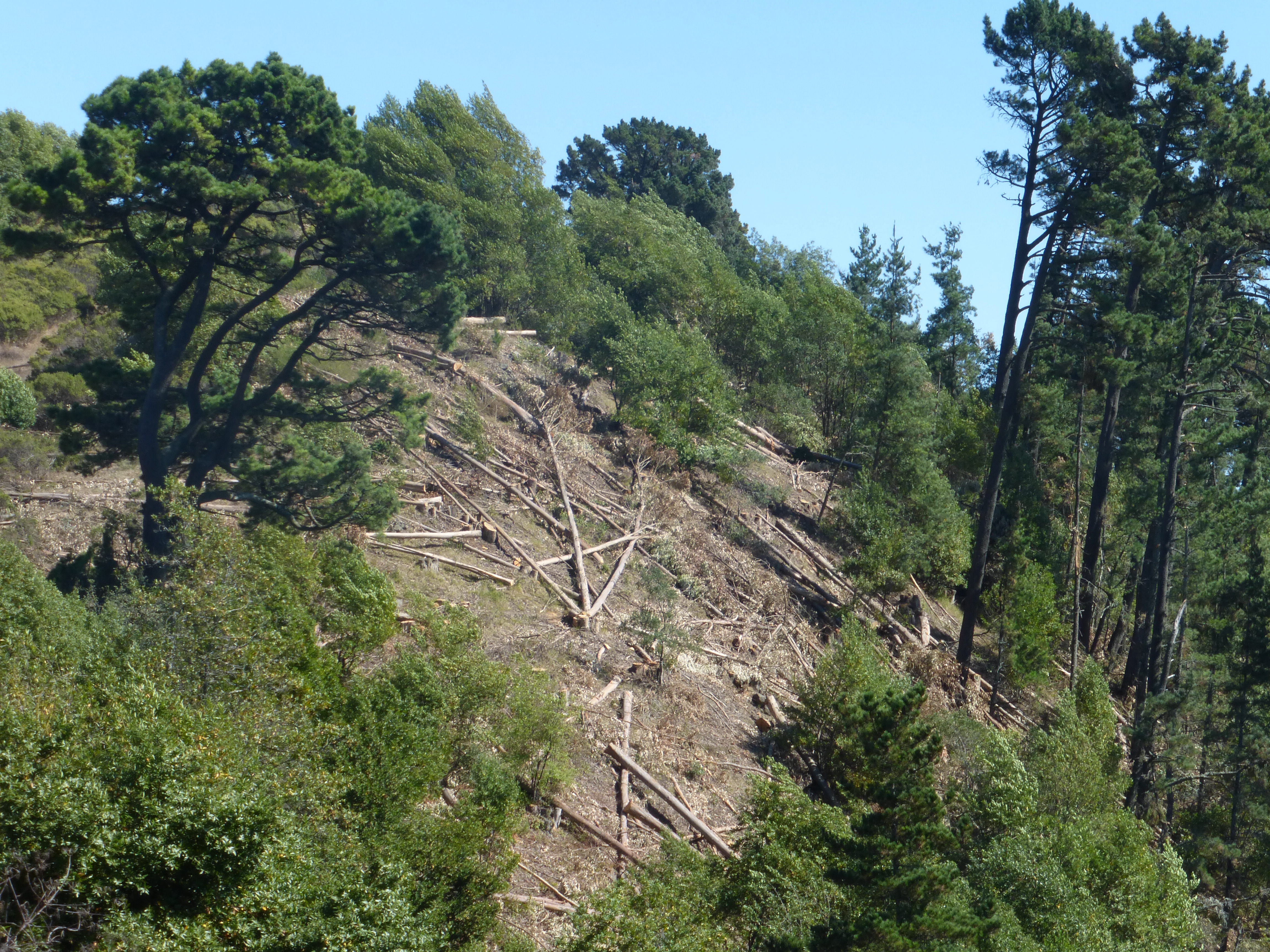
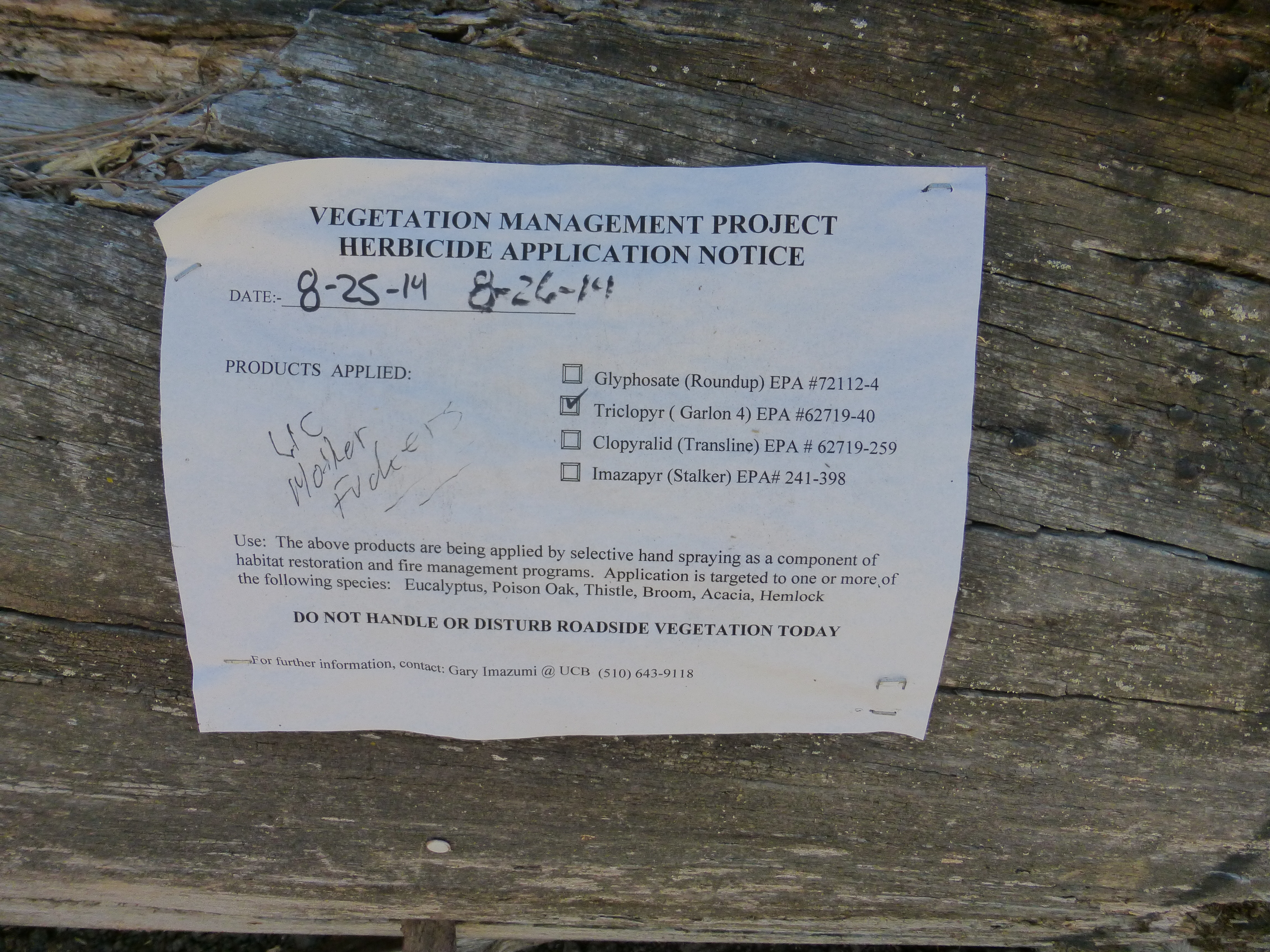
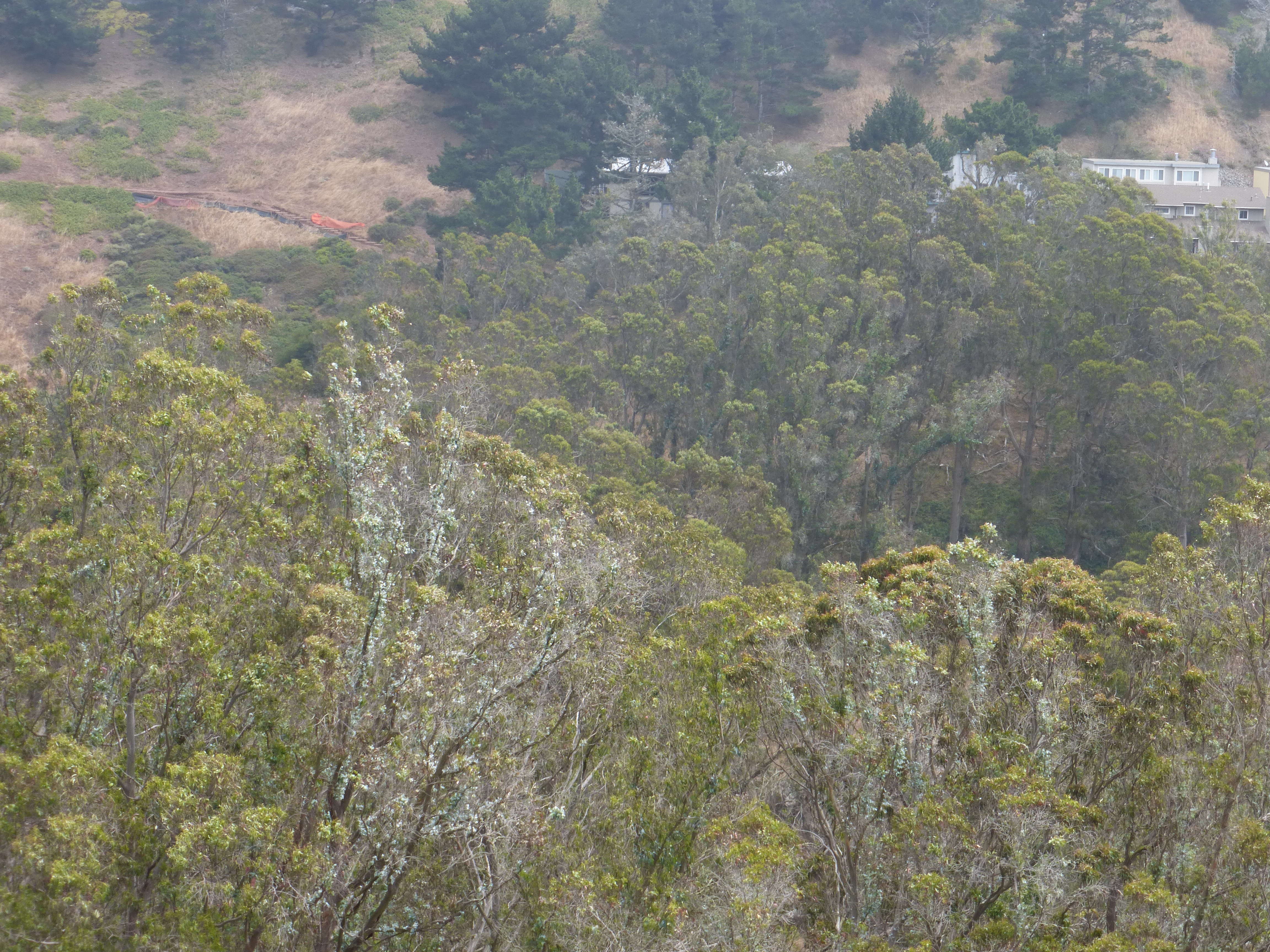
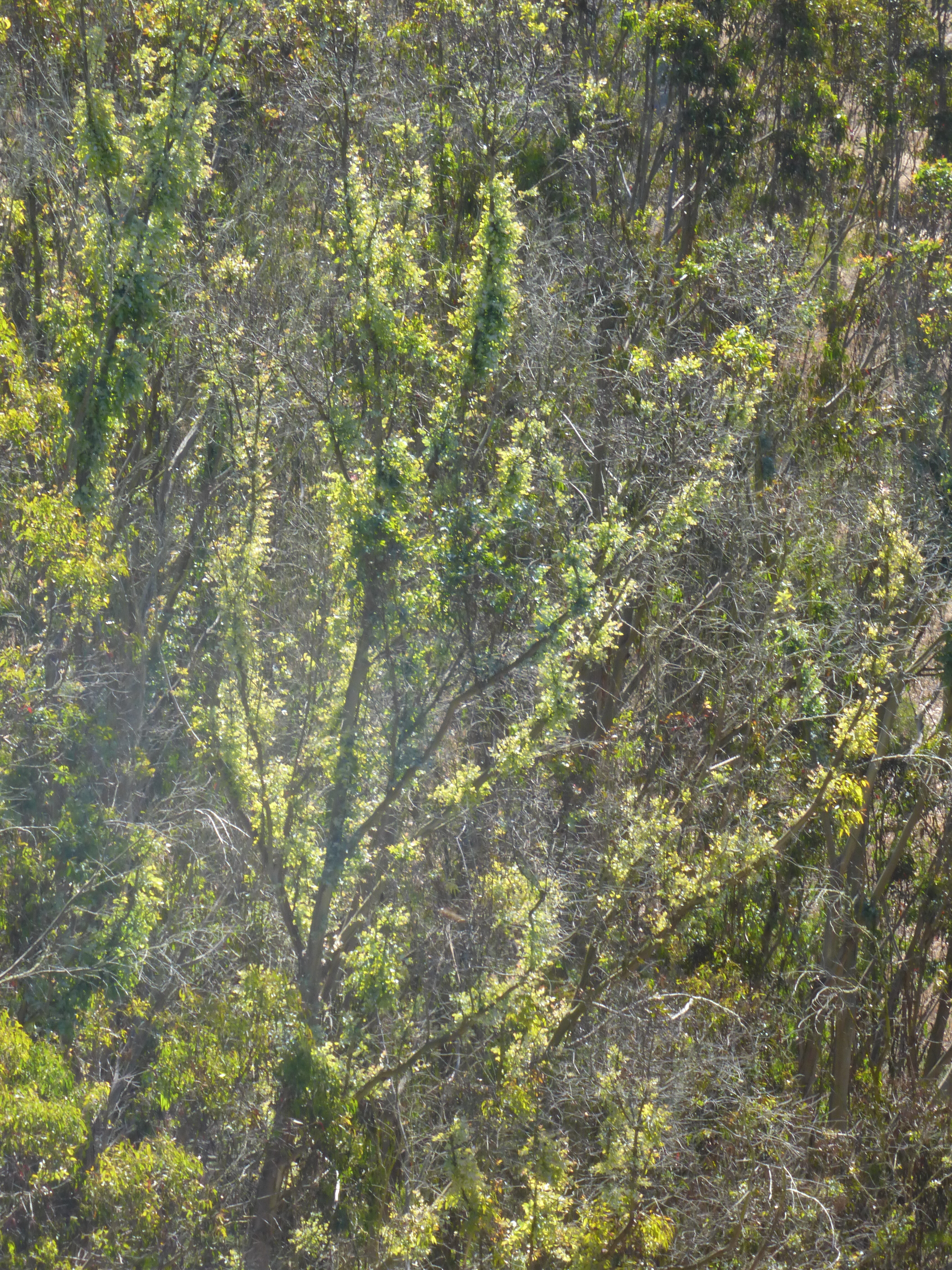
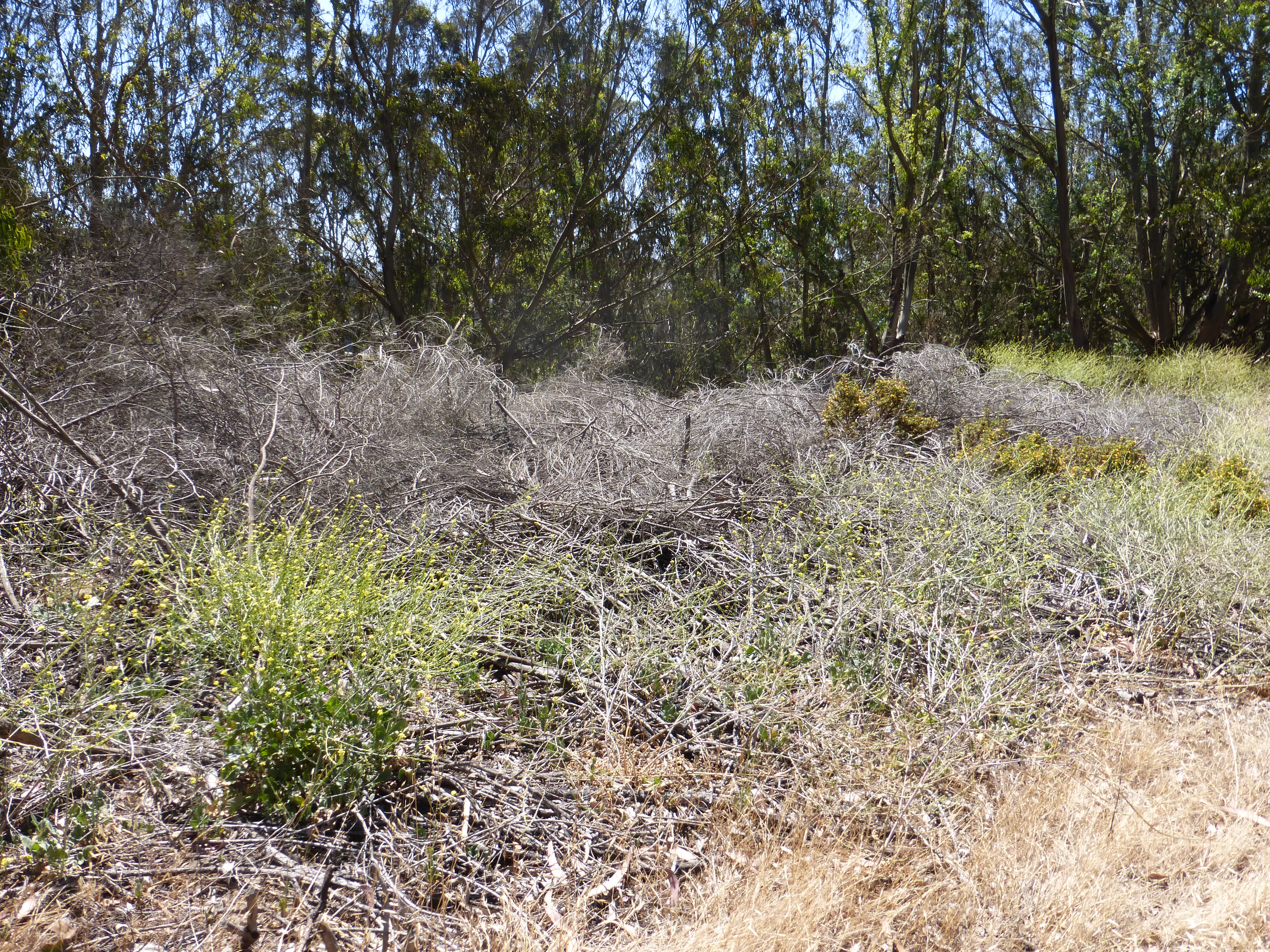
We are writing to tell you that UC Berkeley is in the process of destroying eucalyptus and some pine on its property. Judging by the Pesticide Application Notice posted on Grizzly Peak Blvd near South Park Drive, the trees were destroyed August 24-26, 2014. The scale of the removals is not entirely visible because the property goes down a steep slope that we could not cover. Based on what was visible to us, it appears that at least 100 trees were destroyed on a few acres.

P1010390

We believe the trees are being destroyed within the area for which UC Berkeley has applied for a FEMA grant to remove all non-native trees. We have used the maps in the Draft EIS to make this determination. Therefore, it seems appropriate that FEMA should be informed about this.

P1010400

While we visited the property on Monday, September 15, 2014, we could hear chainsaws in the distance but could not determine where the sound was coming from. Therefore, we suspect that more trees are being destroyed, but cannot determine exactly where.

P1010384

The Pesticide Application Notice gave the name of a person at UC Berkeley (Gary Imazumi) who is responsible for this project. (For the record, we are not responsible for the graffiti scrawled on that sign.) We have contacted him and asked for more information about the entire scale of the project and a timeline for its completion. We have also asked him what will be done with the huge piles of dead vegetation that are now lying on the ground. We have not received a response to our questions.

This incident raises the following questions and concerns:

  • Has the Draft EIS for the FEMA grants to UC Berkeley for tree removal been approved?
  • Has the FEMA grant to UC Berkeley been awarded?
  • If the EIS and/or the grant have not been approved, can UC Berkeley be reimbursed for expenses it incurs prior to the award of the grant?
  • The trees that UC Berkeley destroyed on August 24-26 are still lying on the ground several weeks after they were cut down. They have not been chipped or hauled away.  The Draft EIS made a commitment to chip the destroyed trees and distribute them on the ground.  Is there any time frame for this disposition of the destroyed trees?  Should the public expect dead trees to spend weeks or more on the ground after they are cut down?
  • As you know and the daily news confirms, we are now in the height of fire season. Does it seem consistent with fire hazard mitigation to use chainsaws at this time of year, particularly after several years of drought?
  • Does it seem consistent with fire hazard mitigation to leave dead vegetation lying on the ground during the height of the fire season? Does FEMA believe that dead vegetation is less flammable than living, standing trees?

P1010396

We understand that some of these questions are rhetorical and we don’t expect answers to any but the first three questions. The rhetorical questions are not intended to put you in an awkward position. They are intended to express our opinion of UC Berkeley’s hypocritical claim that destroying living trees will reduce fire hazards. We just want FEMA to know what is happening and to take it into consideration before finalizing the EIS and/or awarding the grant, if FEMA has not already done so.

Thank you for your consideration.

[Concerned citizens of Oakland]

Cc: Gary Imazumi, Manager, Grounds Operations, UCB [garyi@berkeley.edu]
Sal Genito, Associate Director, Grounds, Custodial, Environmental Services, UCB [salgenito@berkeley.edu]
R’obert Newell, Acting Assistant Vice Chancellor, Physical Plant, UCB [rbnewell@berkeley.edu]


Update:  On December 1, 2014, FEMA published the final Environmental Impact Statement for the “Fire Hazard Mitigation Grants” in the East Bay Hills.  As a result of UC Berkeley’s premature removal of trees in the project area prior to the publication of the EIS and prior to the award of the grants, the final EIS says that UC Berkeley will not be awarded grant funding for the Frowning Ridge portion of their grant application.  The following is an excerpt from the Executive Summary of the final EIS (page 17) which is available HERE.  However, we should not assume that this prohibition will remain when the EIS is officially approved by the “Decision of Record” on January 5, 2015, because we assume it is being challenged by those who support this project.

“In August 2014, UCB undertook environmental treatment measures on approximately 7.5 acres of the 185.2-acre project area at Frowning Ridge. According to UCB, they felled 150 eucalyptus, Monterey pine, and acacia trees, and applied an herbicide to eucalyptus and acacia stumps. In undertaking these actions prior to issuance of the final EIS, UCB failed to comply with both the specific conditions of the grant and also the NEPA requirement which limits applicant action during the NEPA process under 40 CFR 1506.1. Both required UCB to refrain from action until FEMA had completed its environmental review. As a result, the Frowning Ridge project area is no longer eligible for PDM program grant funding.

Nonetheless, the environmental analysis of the impacts of the proposed action at Frowning Ridge has not been removed from the final EIS because it is part of the review and consideration that FEMA has undertaken in concluding whether to fund the proposed actions. FEMA will continue to work with the U.S. Fish and Wildlife Service and the National Marine Fisheries Service to determine whether UCB’s unauthorized work at Frowning Ridge negatively affects UCB’s other projects at Strawberry Canyon and Claremont Canyon and will make further decisions regarding these projects in the Record of Decision.”


California Invasive Plant Council sticks to its guns aimed at eucalyptus

Monarch butterflies roosting in eucalyptus tree.

In December 2013, one of our collaborators in the effort to save our urban forest from pointless destruction submitted a request to the California Invasive Plant Council to reconsider its evaluation of blue gum eucalyptus (Eucalyptus globulus) as “moderately invasive.” 

The California Invasive Plant Council (Cal-IPC) has responded to that request with a draft reassessment which is available here:  http://www.cal-ipc.org/ip/inventory/eucalyptus.phpCal-IPC’s draft maintains the same over-all rating of blue gum as “moderately invasive.”   Cal-IPC is inviting “substantive comments and questions” by July 31st to info@cal-ipc.org.

Today we are publishing with permission the cover letter of a public comment that will be submitted by one of our collaborators.  We hope it will inspire you to write your own public comment by the deadline of July 31, 2014. 


From the perspective of humans, there are pros and cons to most species of plant and animal.  E. globulus is no exception to this general rule.  Cal-IPC reaches a negative conclusion regarding blue gum by exaggerating negative issues and de-emphasizing or omitting positive issues.  Cal-IPC now acknowledges that blue gum has “low invasive potential” only in specific conditions and that its population in California is stable, but it has introduced new issues and intensified others so that it can maintain its overall rating of “moderately invasive.”  I remind Cal-IPC that its name is Invasive Plant Council, not fire council or hydrology council.

Cal-IPC also fails to take into consideration the negative side-effects of attempting to eradicate eucalyptus.  There are environmental benefits associated with leaving blue gums alone.  These damaging consequences of eucalyptus removal should appear on the “asset” side of the ledger:

It is also not in Cal-IPC’s strategic best interests to continue to advocate for the eradication of eucalyptus in California:

  • As the eradication projects get progressively more destructive, the public’s negative reaction to the destruction becomes progressively more aggressive.  There are now thousands of us all over the State and all over the country, working to stop this destruction and we are often effective in preventing these projects from being approved or funded.  An op-ed in the New York Times in September 2013, expressed support for our opinion that the word “invasive” has become a destructive tool and is inappropriately applied to eucalyptus in California.
  • The scientific community has also become progressively more critical of the attempts to eradicate eucalyptus.  Last fall, Nature  magazine quoted several well-known academic scientists in an article that criticized plans to destroy 30,000 eucalypts on Mount Sutro in San Francisco.  In May 2014, the CEO and Chief Scientist of the Nature Conservancy expressed their opinion on TNC’s website that destroying eucalypts in California is unnecessary.
  • Since blue gum eucalyptus is no longer available in nurseries in California and has not been planted for many decades, it has no long-term future in California.  To the extent that eucalyptus is a problem, it is a problem that will resolve itself in time.

Cal-IPC’s continued support for these projects is no longer in the mainstream of scientific or public opinion.  Removing eucalyptus from Cal-IPC’s “hit list” would significantly improve Cal-IPCs chances of success with the plants that remain on its inventory of invasive plants.  The public is unlikely to expend the same amount of energy opposing the eradication of broom, for example.

Cal-IPC has an opportunity to defuse a controversy that is handicapping the success of its venture.  Cal-IPC would be wise to abandon its crusade aganst blue gum eucalyptus.

Update:  On March 13, 2015, the California Invasive Plant Council published its final reassessment of Blue Gum Eucalyptus (available HERE).  Cal-IPC has downgraded its rating of invasiveness and ecological impact from “moderate” to “limited.”  Although the detailed assessment is less than perfect, the over all rating itself is an improvement.  Thanks to those who sent comments to Cal-IPC.

Relentless war on eucalyptus

A new front has opened in the relentless war on eucalyptus in California.  The drought has given native plant advocates an opportunity to develop a new narrative to justify their demands for eradication of eucalyptus.  The opening gambit in this new strategy is an item in Jake Sigg’s “Nature News” of May 16, 2014:

“The prolonged drought of the last 2-3 years seems to be taking its toll.  The Tasmanian blue gums in Glen Canyon along O’Shaughnessy Boulevard strongly show drought stress.  The stress is more evident from the high cliffs above O’Shaughnessy than it is at ground level.  Thinning crowns and discolored foliage was striking.  And that was before the recent heat wave.

Barring substantial rains–unlikely, but not impossible–the trees are in serious trouble.  The City could have an emergency situation and no money to address it.”

 Recap of the war on eucalyptus

When public land managers began the war on eucalyptus in the 1980s it did not occur to them that the public would object.  So deep was their prejudice against eucalyptus, that they assumed the public shared their opinion.  The first two massive projects in the 1980s on National Park Service and State Park properties were greeted with angry public protests.  Land managers quickly learned that it was not going to be as easy to eradicate eucalyptus as they had thought.  They developed a series of story-lines to justify their projects, which were designed to convince the public that the eradication of eucalyptus is both necessary and beneficial.  This is a summary of some of their cover stories with links to articles that debunk them:

Based on our experience, we were immediately suspicious of the new claim that San Francisco’s eucalyptus forest is dying of drought.  We know that our predominant species of eucalyptus—Tasmanian blue gum—grows successfully throughout California, all the way to the Mexican border in climates that are much hotter and drier than the Bay Area.  We also know that the central and north coast of California is foggy during the dry summer months, which doubles the amount of annual precipitation in the eucalyptus forest.  All reliable sources of horticultural information describe blue gum eucalyptus as drought tolerant.  Frankly, we couldn’t see how our eucalyptus could be dying of drought.

What is wrong with our eucalyptus forest in Glen Canyon?

 The picture became clearer when Jake Sigg posted the following on his “Nature News” on June 12, 2014:

“The June 10 newsletter [see below*] included an editorial on an evolving catastrophe, mostly involving our numerous plantations of Tasmanian blue gums.  The editorial focused primarily on the plantations on O’Shaughnessy Blvd in Glen Canyon and on Mt Sutro, and included a photo of a grove of Mt Sutro dying trees.  Here is a photo of the Glen Canyon plantation, taken from above the high cliffs on O’Shaughnessy.  The damage is most visible from high, looking down.

The discoloration of leaves was very dramatic, but the foliage color and condition is not fully conveyed in the photograph.  Some trees defoliated entirely in the prolonged winter dry spell.  Look very closely at the juvenile blue leaves of the coppice shoots; anything that appears faintly bluish are new coppice shoots which grew in response to the late rains we had in February and March.  Once you see coppice shoots on old trees you know the trees are in trouble.  These trees are in double jeopardy, as they invested energy in new shoots, but were betrayed by another dry spell which, under normal circumstances, will last until autumn.  Note that you can now see the grassland through the trees; that slope was not previously visible.  Even a casual inspection of these groves reveals dead, dying, and stressed trees, and under normal circumstances we will have four or five months of dry.  The fire situation is serious right now and is likely to become worse.”

View of west side of Glen Canyon Park from Marietta Drive, June 2014

With more specific information in hand about what Jake Sigg is looking at, we went to see for ourselves.  We could see what he was describing from a vantage point on Marietta Drive, west of Glen Canyon Park.  We could see lighter colored leaves, but they were more localized than Jake Sigg’s description implied.  We didn’t feel qualified to speculate about why the leaves were lighter colored so we recruited an arborist to help us figure out what is happening there.  We were fortunate to enlist the help of a certified arborist who has been responsible for urban forests on public lands in the Bay Area for several decades.  This is what we learned.

Epicormic Sprouts

Looking through binoculars from our vantage point on Marietta Drive, the arborist said immediately, “Those are epicormic sprouts.”  The leaves of epicormic sprouts are distinctively lighter colored than the darker green of mature eucalyptus leaves.  They are also a more rounded shape than the long, pointed mature leaves of eucalyptus.  This is how Wikipedia describes epicormic sprouts:

“Epicormic buds lie dormant beneath the bark, their growth suppressed by hormones from active shoots higher up the plant.  Under certain conditions, they develop into active shoots, such as when damage occurs to higher parts of the plant. Or light levels are increased following removal of nearby plants.”

Epicormic sprouts on trees in Glen Canyon Park, June 2014

The remaining question was why some of the eucalypts, were producing these epicormic sprouts, when most were not.  We went down to O’Shaughnessy Blvd to get a closer look, hoping to answer that question.  This is what we learned:

  •  The understory of non-native shrubs between O’Shaughnessy Boulevard and the trees with epicormic sprouts has been cleared in the past year.  We could see the dead brush piled up next to the trees.  We had to wonder how people who claim to be concerned about fire hazard could think such huge piles of dead brush were nothing to be concerned about.
Remains of dead non-native brush destroyed along O'Shaughnessy Boulevard, June 2014
Remains of dead non-native brush destroyed along O’Shaughnessy Boulevard, June 2014
  • We could see the stumps of some of the dead brush and we wondered if the stumps had been sprayed with herbicides after they were cut.  Pesticide use reports for Glen Canyon indicate that O’Shaughnessy was sprayed several times in the past year, twice with products containing imazapyrImazapyr is known to be harmful to trees if sprayed in proximity to their roots.  The trees with epicormic sprouts were downhill from the understory shrubs that were destroyed, in the probable direction of water and herbicide flow.
  • We found several trees that had been girdled in the past and are now dead.
Girdled tree in Glen Canyon Park, now dead, June 2014

The trees in Glen Canyon Park

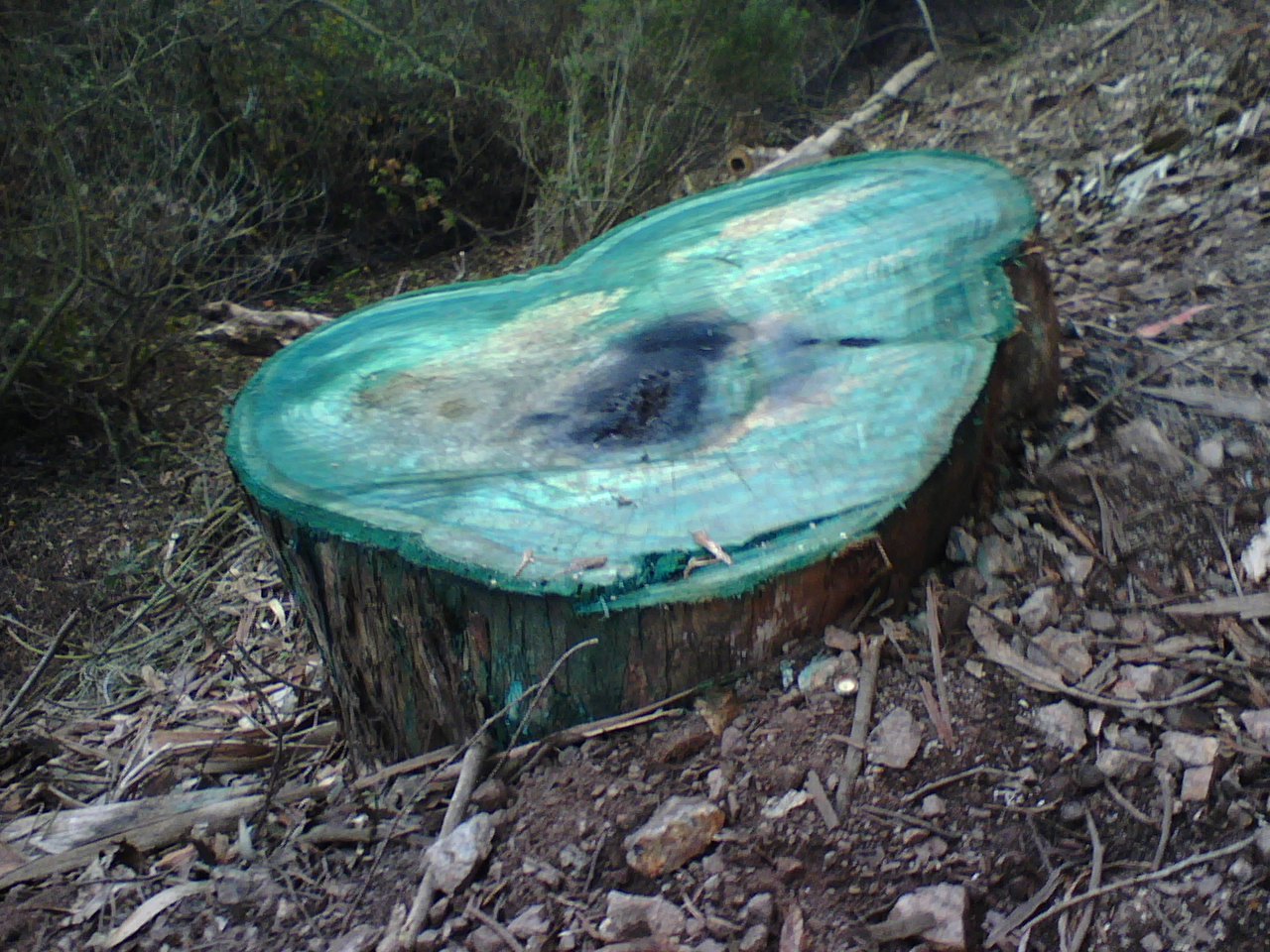
Then we walked into Glen Canyon Park from its southern end.  It’s not a pretty sight.  Many huge, old eucalypts have been destroyed.  When they were destroyed, their stumps were immediately sprayed with herbicide to prevent them from resprouting.  The stumps are simultaneously painted with dye so that workers can tell which trees have been sprayed.  The dye is no longer visible, but regular visitors took photos of the painted stumps before the dye faded.  The spraying of the stumps do not appear on the pesticide use reports of the Recreation and Park Department.  We assume that’s because the spraying was done by the sub-contractors who destroyed the trees.

Poisoned and dyed eucalyptus stump, Glen Canyon Park, 2013. Courtesy San Francisco Forest Alliance

The arborist who walked in the forest with us said, “The painting of stumps with RoundUp or Garlon in proximity to trees that are being preserved can kill the neighboring preserved tree. Stumps near living, residual (preserved) trees should not be painted with RoundUp or Garlon if the stumps are within 40’ of mature, blue gums that are slated for preservation.”  If the remaining trees are damaged by herbicides, their mature leaves fall and epicormic sprouts will then emerge as the tree recovers.

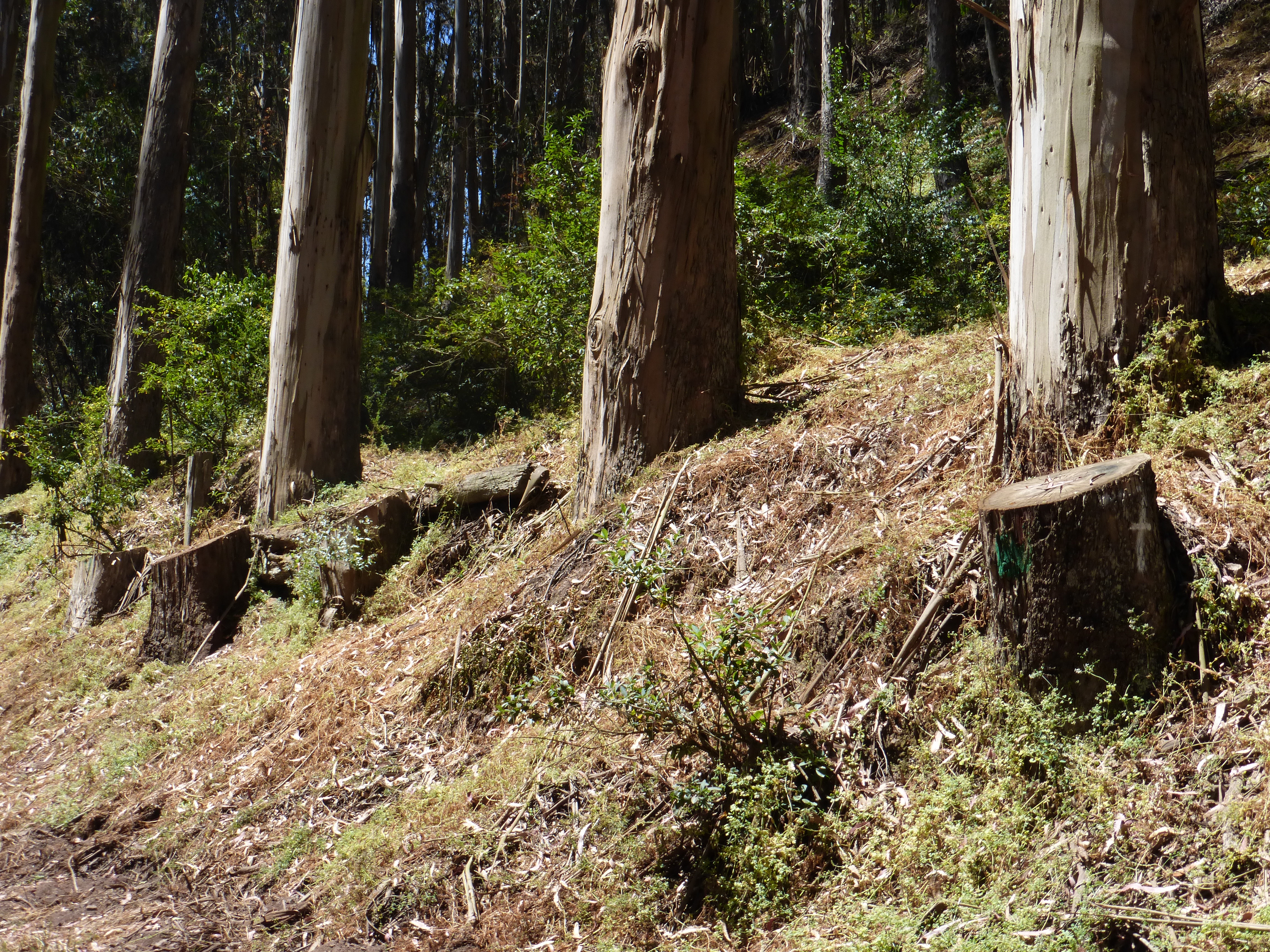
Some of the stumps of the trees that were destroyed in Glen Canyon Park in 2013. Taken June 2014

While the trees were being destroyed in 2013, the Natural Areas Program was eradicating non-native vegetation in the Canyon.  They sprayed ivy, blackberry, and valerian with Milestone, which is another herbicide that is known to damage trees if sprayed near their roots.  In addition to these official applications of herbicide in this park, there is a long history of unauthorized, illegal herbicide applications by “volunteers,” more appropriately called vandals.

We saw a lot of epicormic growth in the Canyon, sprouting from stumps that must be cut back and resprayed with herbicides.  It usually takes several retreatments to successfully kill the roots of eucalypts that are destroyed.  We also saw epicormic growth from eucalypts that had been severely pruned and were also exposed to a great deal more light because they had lost the shelter of their neighboring trees.

Epicormic growht, Glen Canyon Park, June 2014
Epicormic growth, Glen Canyon Park, June 2014

Wrapping up

The trees in Glen Canyon are reacting to the traumas to which they have been subjected:  the loss of their neighbors that were either girdled or cut down thereby exposing them to more light and wind, the loss of the shelter of their understory, the application of herbicides known to be harmful to trees.

The good news is that there are still plenty of trees in Glen Canyon that have not yet been destroyed and they are in great shape.  Here is the view of the tree canopy in Glen Canyon taken from the east side of the park near Turquoise Way.  The first picture was taken in December 2012 (before the current round of tree destruction in Glen Canyon Park) and the second picture was taken in May 2014.

Eucalyptus canopy on east side of Glen Canyon Park, taken from Turquoise Way December 2012, before tree destruction began. Courtesy San Francisco Forest Alliance
Same perspective of Glen Canyon tree canopy, taken May 2014. Courtesy San Francisco Forest Alliance.

These trees are doing just fine because the Natural Areas Program has not yet gone that deeply into the park.  But NAP intends to destroy many more trees in Glen Canyon (and elsewhere) when the Environmental Impact Report (EIR) for their management plan (SNRAMP) is finally approved.  Then we will see more consequences of the destructive practices of the Natural Areas Program and we will probably hear more bogus explanations for that damage.

We expect the EIR to finally be considered for approval at the end of 2014.  [Update:  now predicted for fall 2015] We will do whatever we can to convince San Francisco’s policy makers that they should approve the “Maintenance Alternative” which would enable NAP to continue to care for the native plant gardens they have created in the past 15 years, but prevent them from expanding further.   We hope that our readers will help to accomplish this important task.


*Jake Sigg’s Nature News of June 10, 2014, introduced the theories of Craig Dawson about the health of the Sutro Forest.  Mr. Dawson’s speculations are different from Mr. Sigg’s and we will not address them in this post.  You can find an analysis of Mr. Dawson’s theories on Save Sutro Forest HERE.

Voters in the Oakland hills must make an important decision

Wildfire in California, 2008.  BLM photo.
Wildfire in California, 2008. BLM photo.

Residents in the Oakland hills will soon have an opportunity to vote for (or against) a renewal of funding for the Wildfire Prevention Assessment District (WPAD). A map of the Wildfire Prevention District (WPD) is available here.  The Hills Conservation Network has described the WPAD in its latest newsletter and is asking some excellent questions about how the revenue has been spent over the past 10 years and why the special tax on parcels within the WPD is necessary. 

The Hills Conservation Network is a non-profit organization of residents in the East Bay Hills, many of whom are survivors of the wildfire of 1991.  They are deeply concerned about fire safety, but they are opposed to vegetation management that does not reduce fire hazards.  They produce a very informative newsletter which is available on their website (here).  We are reprinting their article about the Wildfire Prevention Assessment District with their permission.

*********************************************

Will You Vote “NO” or “Yes” for a Special Tax to Fund WPD?

That is the question Oakland residents registered to vote within the boundaries of the Wildfire Prevention District (aka Community Facilities District No. 2013-1-CFD-Wildfire District) must answer. The ballot measure will be mailed at the beginning of November. Voter information and sample ballots will be mailed in October.  If the ballot measure gets a “yes” vote from 2/3 of all registered voters (renters and property owners) within the WPD-CFD, a Special Tax will be levied for 10 years (until 2023-2024) on each taxable parcel of private property. Parcel owners will pay the $78 annual tax.  Condo parcels, multi-family parcels and undeveloped parcels will be taxed at lower rates.

Public and non-profit properties (such as those owned by EBRPD, UC, and Oakland), currently included in the WPAD, will be exempt from the Special Tax. The $78 Special Tax is an increase of $13.00 (20%) over the $65.00 per parcel that has been the WPAD annual assessment over the past 10 years.

That $65 per parcel doesn’t sound like much money, but it added up to approximately $1,700,000 each year, $17 million over the past 10 years. With the increase to $78.00 annually for each parcel in the WPD-CFD, if the Special Tax passes, the WPD will take in about $20 million over the next 10 years.

What will taxpayers get for that money? This is from info promoting the Special Tax: “Since the establishment of the Wildfire Prevention Assessment District, Oakland has not had a significant devastating fire in the hills, while other communities that do not have a dedicated service district have experienced large fires.”

Everyone who lives in the hills worries about fire. Although some properties are obviously not in compliance with Oakland’s Fire code, most property owners do their best to maintain defensible space. But it does no one any good to stoke fear of fire in an effort to renew a tax.

In fact, none of the communities surrounding Oakland (Berkeley, Albany, El Cerrito, San Leandro) have had a major fire since the tragic 1991 fire. Most of these communities are similar to Oakland in having wildland/urban hillsides.  None has a WPAD that takes credit for preventing a major fire during the past 22 years.  One might even consider the WPAD’s boast an insult to Oakland’s Fire Department [OFD], which is made up of skilled, professional firefighters.

Certainly the lack of a WPAD had little to do with whether there was a major hills fire before 2003. It’s more certain that narrow roads choked with parked cars, lack of water supply, extreme drought conditions, dry brush, and Diablo wind gusts exceeding 65 mph caused the 1991 fire to spread out of control.

Over the past 22 years, OFD’s performance has improved. Some examples: increased wildland training, mutual response area agreements, better communication with other fire agencies in the region, and annual response drills. We have new fire stations in the hills and annual inspections of residences and landscaping to make sure they comply with fire codes. OFD has a new fire chief from whom we can expect more improvements in fire fighting and prevention.

If the ballot measure to fund WPD passes, WPD services would be similar to WPAD services, including, but not limited to the following:

  • Goat grazing program on city property to clear weeds within district boundaries
  • Property owner incentives such as providing chipping and disposal of yard waste
  • Vegetation management to control weeds on city property; roadside mowing along major public roads; maintaining fire breaks
  • Roving fire patrols on red flag days
  • Public outreach; creating and distributing information and tips on fire prevention

In the year ending June 30, 2013, the WPAD spent $1,600,855. It’s difficult to find out from nontransparent WPAD records where the money went, that is, what your parcel tax pays for. Out of the $1.6 million+ , we know that about $357,600 paid for the goat grazing, and about $213,500 went to other activities. The lion’s share of the money (∼$1.1 million) went to “vegetation management.” We have asked for details of this $1.1 million expense, but at this point we have not received the information.

We believe that the OFD does the roving patrols and the housing inspections. We don’t know who does the roadside mowing; we assume it is done by Public Works.

Before you vote on the Special Tax, you might want to seek answers to these questions:

  1. If the inspections, roving patrols and roadside mowing are done by OFD and PW personnel already on the clock, why are we being asked to pay again for these services?
  2. Why are heavily wooded, brush laden nonprofit properties exempt from the Special Tax?
  3. Why should parcel owners pay the Special Tax when it will be used almost exclusively to clear City of Oakland land? We already pay taxes to maintain city property such as parks. Why should we be taxed again?
  4. Why should a Citizens Advisory Committee [CAC] have the power to direct OFD professional firefighters in programs (such as protecting native plants, even flammable ones) that the CAC (and its supporters) consider important, even if they do nothing to reduce fire risk?  Did you know that the WPAD/WPD wants to hire someone just to identify native plants?
  5. Why can’t the Special Tax funds be used to supplement OFD services in ways that might really prevent fires? Wouldn’t the money be better spent to hire more firefighters so there will be no need to have three “brownout” days each month when fire houses throughout Oakland—even in the WPD—are left empty and neighborhoods are unprotected? Wouldn’t the money be better spent to upgrade emergency communications, or buy emergency vehicles, or find a way to get more water for hills fires, help neighborhoods underground utility wires, or create a viable emergency plan for Oakland?
  6. The OFD has the experience, training and responsibility to prevent and fight fires. They stand ready to risk their lives for us. Why do we need another tax for services, such as residence inspections, roadside mowing, roving fire patrols, even the goat grazing program, that the OFD, PW or contractors could do without a WPD? Why should WPD money be spent on programs that have nothing to do with preventing fire, but instead promote agendas such as the dogma that native plants and trees resist fire? What will we really be getting for that $20 million?

Update:  Voters in the Wildfire Prevention Assessment District narrowly defeated the ballot measure to renew the tax that funds WPAD.  Thanks to those who participated in the effort to defeat this measure and especially to CFROG for organizing that effort.  Here is the article in the Oakland Tribune announcing the outcome:   http://www.insidebayarea.com/news/ci_24533813/oakland-hills-voters-reject-wildfire-prevention-tax

East Bay Regional Park District fuels management projects

Sibley "fuels management" 2012
Sibley “fuels management” 2012

On Thursday, August 29, 2013, the Executive Committee of the Board of Directors of the East Bay Regional Park District will consider the District’s plans for fuels management in 2014.  In April 2010, the District’s Board of Directors approved the “Wildfire Hazard Reduction and Resource Management Plan” and its Environmental Impact Report.  That plan provided for an annual progress report as well as budget and project planning for each forthcoming year. 

Here is the District’s report of what has been accomplished so far and the projects planned for completion by the end of 2013:

“In 2012, initial entry work was undertaken at Anthony Chabot and Sibley, for a total of 153 acres, including 140 acres of eucalyptus thinning in and around the Anthony Chabot Family Campground and 13 acres of eucalyptus thinning in the steep slopes of Sibley Triangle.  Approximately 1,500 tons of hazardous wildland fuels were treated.

 The District’s resource management prescribed broadcast burn program is continuing in 2013.  Approximately 50 acres of native prairie grassland in Point Pinole and 80 acres of invasive plants in Round Valley are scheduled for burning this year.

By the end of 2013, a total of 160 acres of initial entry work are expected to be completed at Anthony Chabot, Claremont Canyon, Kennedy Grove, Lake Chabot, Sibley, Tilden, and Wildcat Canyon. Approximately 900 acres across 16 parks will be maintained using goat grazing, prescribed burns, and chemical, mechanical, and hand labor as described in the 2012 report, and in accordance with the prescriptions and treatment protocols adopted in the Plan.” (1)

We would like to be able to tell our readers about the pesticides required to accomplish these tasks.  Unfortunately, the District has not posted an annual report of its pesticide use since 2010.  The District says it does not expect to complete the annual report of pesticide use for 2011 until late in 2014.  Meanwhile, you can see the latest report for 2010 that is available here.

Here are the District’s plans for implementation of fuels management projects in 2014 (Attachment B of report available here): 

Project Description

Estimated Cost

Estimated Acres

Annual maintenance of light, flashy fuels and eucalyptus sprouts in Fuels Plan area

$500,000

671

Annual maintenance of light, flashy fuels OUTSIDE of Fuels Plan area

$175,000

268

Periodic maintenance of heavy fuels (brush and ladder fuels) in Fuels Plan area

$250,000

70

Sub-Total Fuels Maintenance

$925,000

1009

Initial treatment of heavy fuels and eucalyptus in Fuels Plan area (Chabot, Claremont Canyon, Huckleberry, Leona, Redwood, Sibley, Sobrante Ridge, Tilden, Wildcat)

$1,200,000

544

Initial treatment OUTSIDE Fuels Plan area

$50,000

15

Sub-Total Initial Treatment

$1,250,000

559

Resource/habitat prescribed burns

$25,000

126


TOTAL FUELS MANAGEMENT

$2,200,000

1694

You can see exactly what will be done and where by looking at Attachment C of the report (available here).  All the “recommended treatment areas” are listed where the work is planned.  There are maps of the “recommended treatment areas” in the “Wildfire Hazard Reduction and Resource Management Plan” which is available here.

The District expects to complete initial treatment on all 3,000+ acres of the fuels management project in 2019.   The District estimates that the annual cost of maintaining those treated acres will be between $2,055,000 and $5,400,000 per year in perpetuity. If you read our recent post about the Marin County Parks and Open Space “Vegetation and Biodiversity Management Plan” you know that all managers of public land in the Bay Area report the mounting costs of maintaining the fuel breaks they have created because when vegetation is cleared, the ground is quickly occupied by non-native weeds.  Our readers will recall that the author of that report recommends that fuels management projects be sharply curtailed so as to reduce the maintenance problems that are created by them.  The report also states that fire hazards will not be increased by curtailing vegetation management projects as recommended.  The projected costs of maintaining fuel breaks in the East Bay Regional Park District are an example of the maintenance nightmare that is being created by these projects. 

The meeting of the Board Executive Committee will take place at 12:45 pm on Thursday, August 29, 2013, at District headquarters:  2950 Peralta Court, Oakland, California.  The public has an opportunity to comment at these meetings.  You could, for example, ask why the District’s annual report of pesticide use hasn’t been made available to the public since 2010.   Your tax money is being used to fund these projects.  So, you have a right to know how your money is being spent.

********************************

(1)    Background Information for the August 29, 2013 Board Executive Committee Meeting, 2014 Fuels Management Program of Work and Fuels Cost Analysis.

Comparing the Sutro Forest with Albany Hill

In a recent edition of Jake Sigg’s Nature News, one of his readers compared the Sutro forest unfavorably to the eucalyptus forest on Albany Hill:

“The [Sutro] ‘ forest ‘ is unmanaged, many of the trees are deteriorated and unhealthy, spacing is unusual and given the super invasive ivies and H. blackberry, overall habitat diversity is degraded.

For example , I look at El Cerrito Hill [officially Albany Hill] (near Central Av exit of east bay I-80 at Golden Gate Fields) and see a ‘ eucalyptus’ forest with fewer and larger trees , featuring an adjacent and penetrating coast live oak woodland and a ground cover that features wide species diversity.

Granted El Cerrito does not have the fog intensity of Mt. Sutro, BUT it also shows signs of management

Anyway, all of this is my un-scientific observation.  I think, with some thinning of eucs, control of ivy and blackberry spread, the establishment of habitat corridors and discreet regions and maintenance of trails, that Mt. Sutro could continue to provide a ‘ forest’ aesthetic and include much improved habitat diversity and fire potential reduction.”

We are always trying to understand the perceptions of native plant advocates in the Bay Area, so we went to take a look at Albany Hill.  We are happy to report that we found much to like.  However, the comparison with the Sutro forest is mistaken in many ways, which we will explain in this post. 

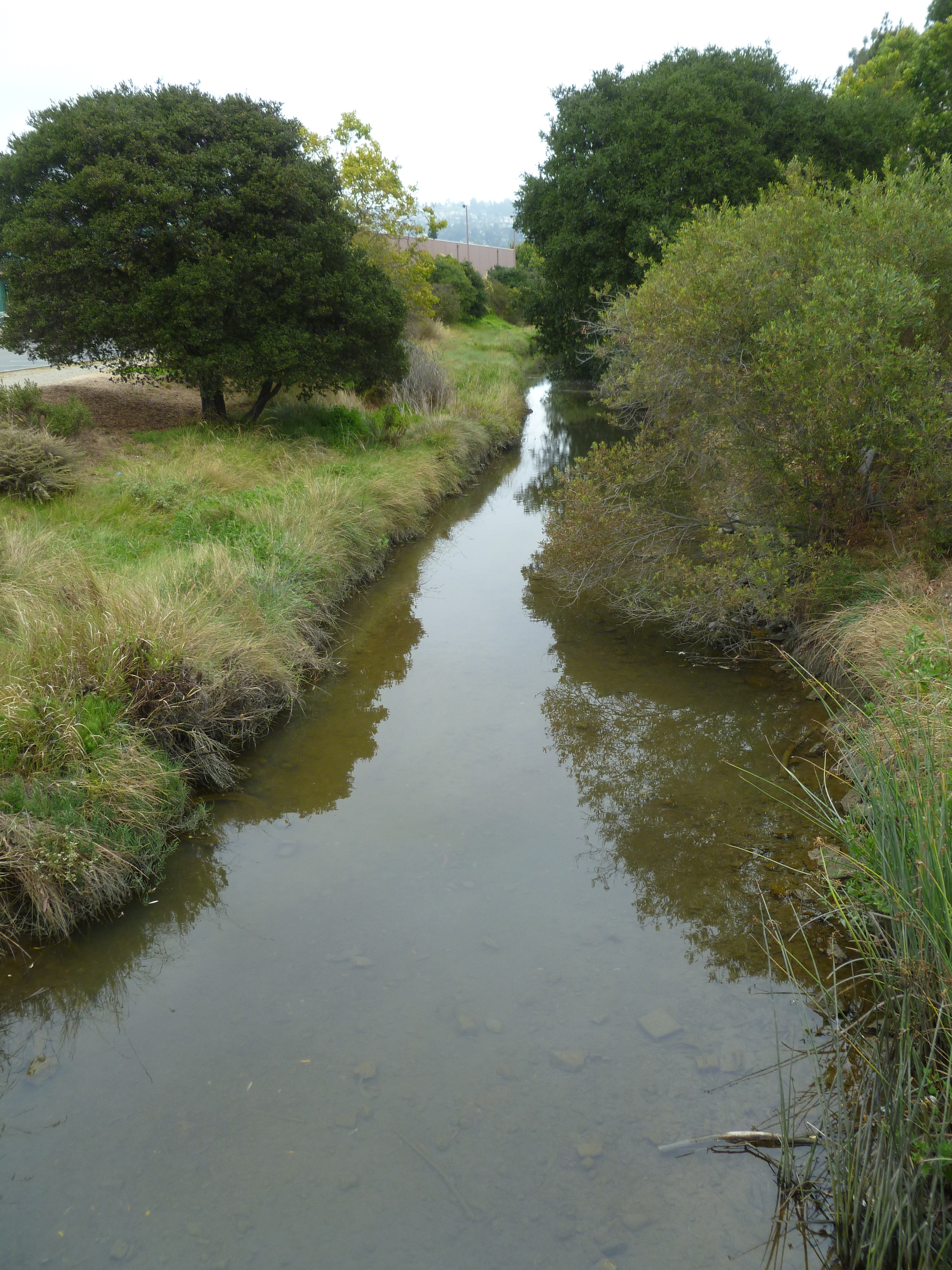
Creekside Park

Cerritos Creek
Cerritos Creek

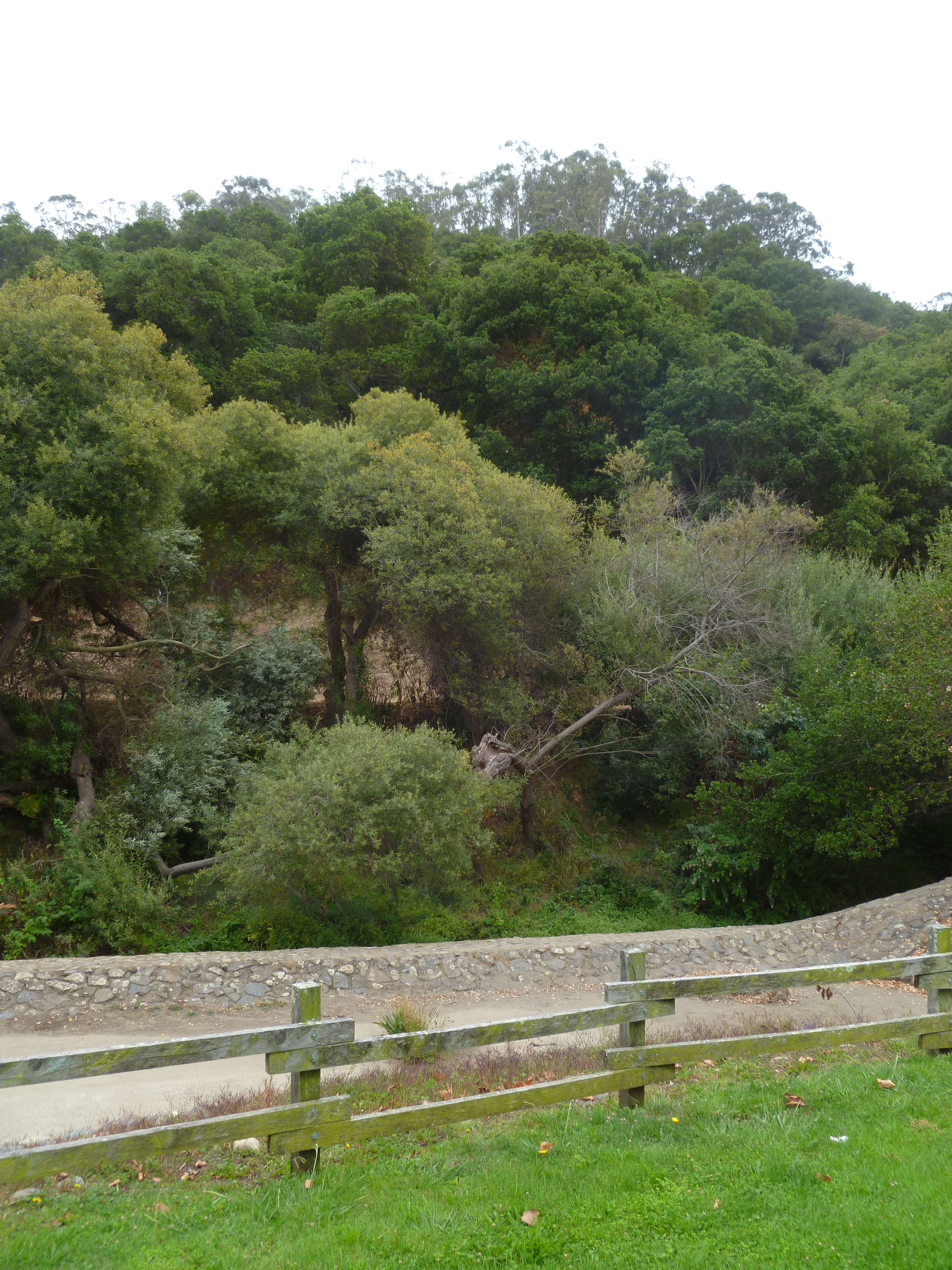
We started our walk at the Creekside Park on the north side of Albany Hill.  It is a riparian corridor created by the confluence of two creeks, Cerritos and Middle creeks.  The vegetation is almost exclusively native.  The Creekside Park is carefully tended by native plant advocates who have planted many of the natives, but the Coast Live Oaks that are the predominant tree species are said to have been here prior to settlement. (1)

The oaks cover the northern slope of Albany Hill, which was typical of native oak woodland in the East Bay .  The oaks benefit from the water provided by the creek and they also occupied north-facing slopes where there is more moisture in the soil than on the south facing slopes that are exposed to the sun.  The prevailing wind in the Bay Area is usually from the southwest, so there is also some protection from the wind on the north side of the hill.  There were never any oaks on Mount Sutro, and the assumption that there will be in the future seems delusional, given their horticultural requirements.

Creekside Park
Creekside Park

Looking up from the Creekside Park, we can see the eucalyptus forest on the top of Albany Hill which has not “invaded” the oak woodland.  The fact that the eucalyptus forest has not encroached on the oak woodland is documented by two planning documents.  The first “Albany Hill Master Plan” was written in 1991.  It included vegetation maps that can be compared to the second “Albany Hill Creekside Master Plan” which was written in 2011.  The second plan states that the eucalyptus forest had not expanded during that 20 year period.  It also states that the eucalyptus forest isn’t regenerating.  That is, it is not replacing itself, let alone expanding.  Yet, it is consistently called an “invasive species” in the master plan approved in 2012. (2)  “Invasive” seems to be the pejorative adjective used by native plant advocates to describe all non-native plants and trees, whether actually invasive or not.

During that 20-year period from 1991 to 2011, the eucalyptus forest was not “managed” as Sigg’s correspondent believes, because the plan was not funded. (1)  Hence, a second plan was written in 2011.  This is a scenario we often see played out on our public lands.  Elaborate plans are written.  Often they are not implemented.  Sometimes we are just as happy they aren’t.

Let’s enjoy a few of the beautiful native plants and trees before we leave Creekside Park to visit the eucalyptus forest on the top of the hill.

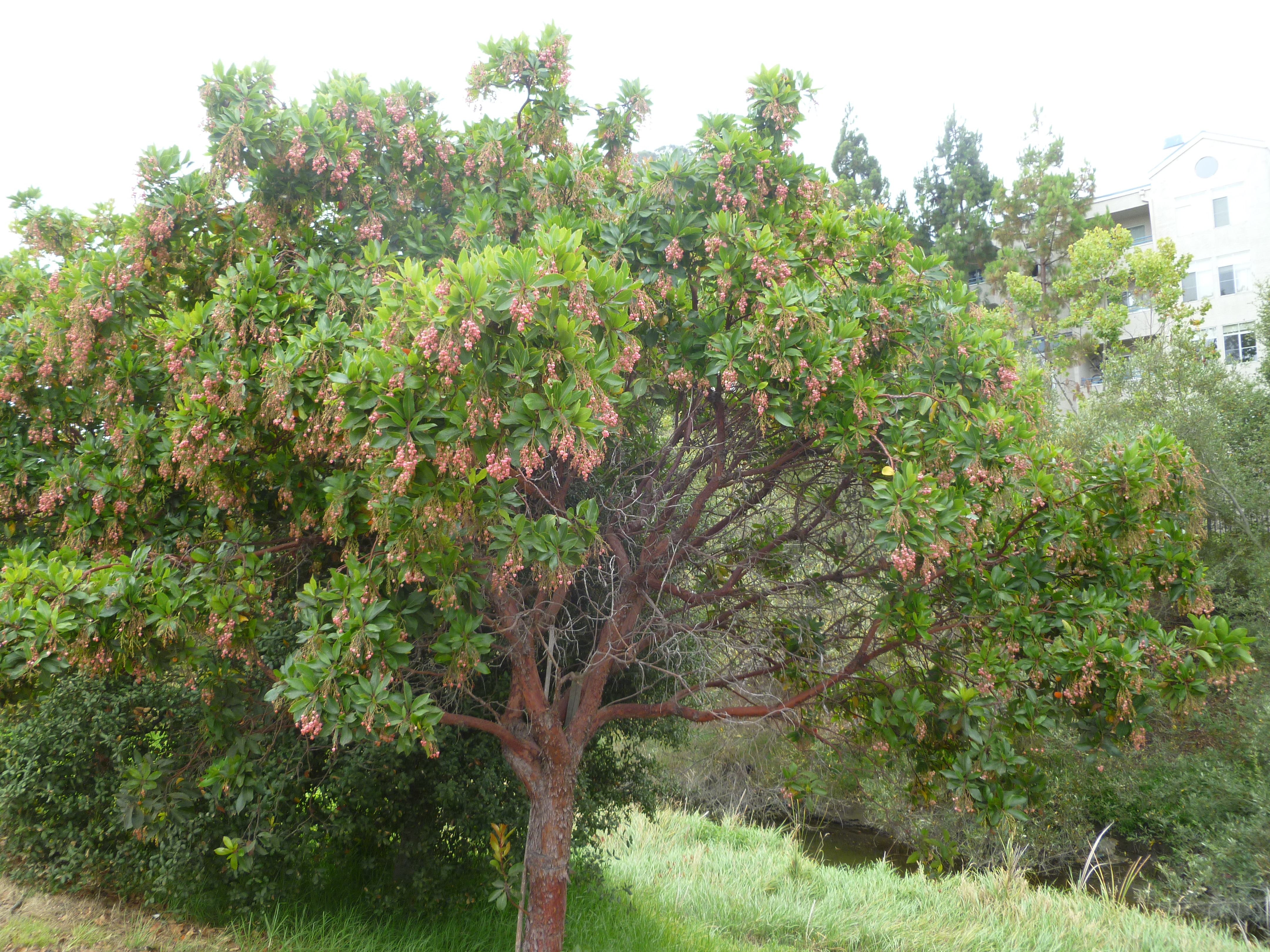
Madrone

This is a lovely little Madrone in full bloom.  We recall wanting to plant a Madrone in our backyard over 30 years ago.  They weren’t available in nurseries then.  We assume they are now, which is great.  But we digress.

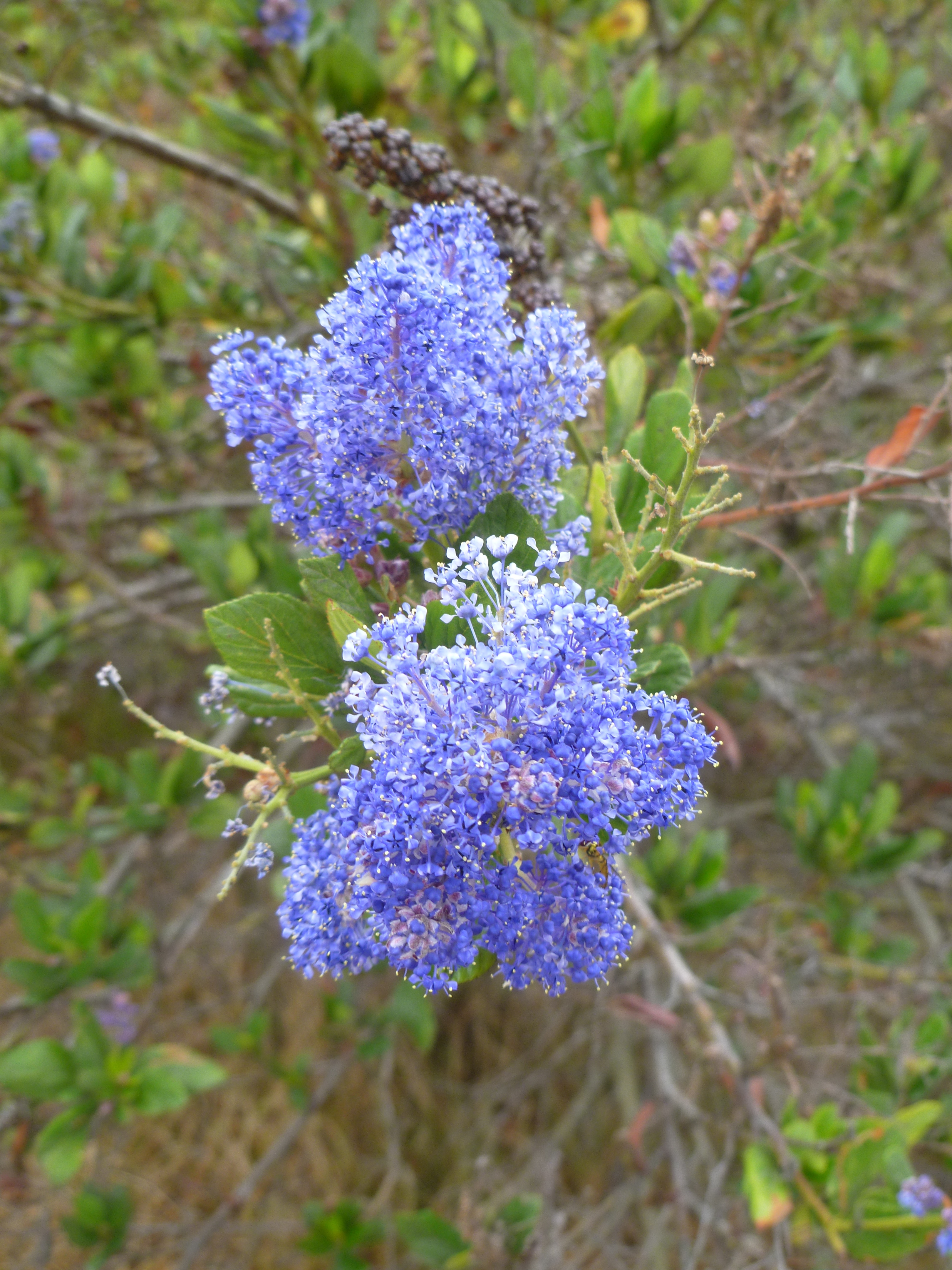
ceanothusThis is one of the few California lilacs (ceanothus) we saw.  Bumble bees were busy in the lilacs.  They are nesting close by in the ground beneath an oak.  If the bared ground on Mount Sutro is covered in the wood chips of the trees that are destroyed, as planned, native bees will not be able to penetrate that deep wood mulch.

Coast Live OakThis is one of many lovely oak trees, surrounded by ivy, which doesn’t seem to be doing it any harm.  In fact, the master plan for Albany Hill says there are no plans to eradicate ivy in the riparian corridor because it “…would require considerable cost and labor to fully eradicate and whose spread is often limited to areas in the immediate vicinity.”

The Eucalyptus Forest on Albany Hill

The eucalyptus forest on Albany Hill was planted by a dynamite company in the late 19th century.  The trees were planted to muffle the sound from frequent explosions, as well as provide some protection to neighboring residents. (1)   There were many reasons why early settlers to the Bay Area planted eucalypts.  Some were practical reasons, such as this, and some were aesthetic.

Albany Hill is much drier than Mount Sutro. It is further away from the ocean where fogs form and often hover for weeks on end during the summer.  In general, the East Bay is considerably less foggy than San Francisco.

toyon

Because it is a much drier environment, the eucalyptus forest on Albany Hill is less dense than the Sutro forest and it has considerably less understory.  The understory on Albany Hill is non-native annual grass and native toyon shrubs, which are said to have been planted either by man or by birds “carrying” seeds from other locations.  (2)   Hmmm….let’s stop to think about that.  The toyon is a native shrub that was “introduced” to Albany Hill and is thriving there under the canopy of the eucalyptus forest.  The 2012 master plan for Albany Hill says that the toyon understory has expanded since the 1991 master plan.

The future of the eucalyptus forest on Albany Hill

As we have said, the eucalyptus forest on Albany Hill has not been “managed” to date.  Since the master plan was approved in 2012, only $50,000 has been allocated for vegetation management on Albany Hill. So, what is planned for the eucalyptus forest in the future?  Here are the plans for the future, according to the master plan that was approved in 2012:

  • The eucalyptus forest will be “phased out” slowly over time by removing hazardous trees as necessary to ensure public safety, removing new seedlings where the forest interfaces with native oak woodland, and not replacing trees that die of old age.  Since the predominant species of eucalyptus in the Bay Area (Blue Gum) lives in Australia from 200-500 years, and it has been here for only about 100 years, it is reasonable to assume that this is a very long-term plan.
  • This plan should require a lot less herbicide than destroying 90% of the trees on 75% of Mt. Sutro, as planned there, because we assume a dead tree will not resprout.   A lot of herbicide is often needed to prevent resprouts after healthy eucalypts are cut down.
  • The forest will be managed for fire safety by mowing the annual grasses, where ignition is most likely to occur; by limbing trees up to separate the understory shrubs from tree limbs to remove “fire ladders” to the tree canopy; and by cleaning woody debris from under the trees on an annual cycle.
  • The plan acknowledges the benefit of maintaining a closed canopy, both in the eucalyptus forest and the oak woodland.  The closed canopy shades the forest floor and suppresses the growth of non-native weeds.

This all sounds eminently reasonable to us:  much less destructive than plans for the Sutro forest, yet addressing fire hazard and safety issues in a responsible way.

Neighbors on the leeward side of the hill will eventually lose their windbreak as the tall trees disappear, but that will happen so slowly that they are unlikely to react.  On the other hand, plans for Albany Hill could change many times in the next 100 years.  We hope the current preoccupation with the nativity of plants and trees will have faded long before the eucalyptus forest dies of old age.

And so, ironically, we agree with Jake Sigg’s correspondent that plans to manage Albany Hill are better than the plans to destroy the Sutro forest.  We just don’t agree about why.

************************

(1)    http://en.wikipedia.org/wiki/Albany_Hill

(2)    “Albany Hill Creekside Master Plan,” City of Albany, 2012

BREAKTHROUGH: Separating fuel management from resource management

Marin County hired an environmental consultant, Loran May, to evaluate its policies and practices regarding vegetation management in parks and open spaces for the purpose of reducing fire hazard.   The consultant describes the purpose of her report as follows:

“The primary purpose of this Vegetation and Biodiversity Management Plan for the Marin County preserves is to provide comprehensive, long-term guidance for a new science-based approach to vegetation management that will (1) maintain the natural biodiversity of the vegetation within the preserves, (2) maintain emergency and public access, and (3) manage fuel loads to reduce the threats of the spread of natural and human-caused fires.”

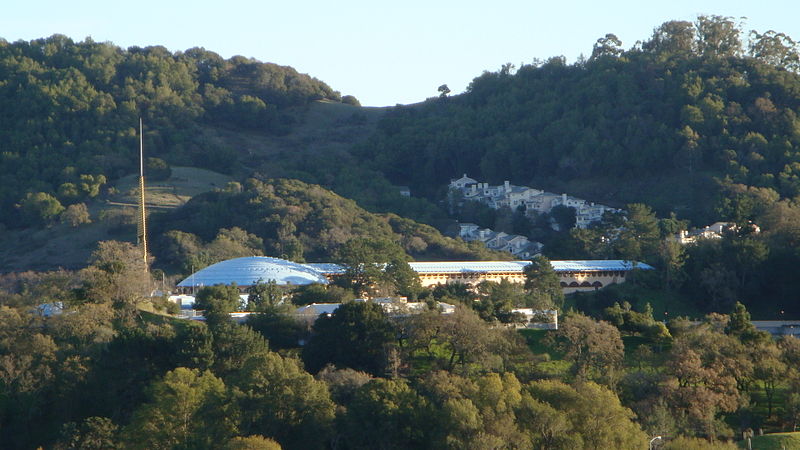
Marin County Civic Center

In other words, her report attempts to reconcile fire hazard reduction with resource management.  The report is therefore of interest to readers of Million Trees, because many of the ecological restoration projects in the San Francisco Bay Area with which we are familiar claim to achieve these goals simultaneously.  Loran May’s report acknowledges that there is a conflict between vegetation management for fuel reduction and the conservation of native habitat.  Separating these two goals is a big step forward, in our opinion, because reducing fire hazard has been the most influential argument with the public and decision-makers for destroying non-native vegetation.      

The consultant read the written policies regarding vegetation management of most of the owners of public lands all over the San Francisco Bay Area and interviewed the managers of those organizations regarding their experiences with the application of those policies.  The consultant’s report is based in part on what she learned from all the major owners of public land in the Bay Area:

  • Audubon Canyon Ranch (ACR)
  • California State Parks (CSP)
  • East Bay Municipal Utilities District (EBMUD)
  • East Bay Regional Park District (EBRPD)
  • Golden Gate National Recreation Area (GGNRA)
  • Marin Municipal Water District (MMWD)
  • Marin County Open Space District (MCOSD)
  • Midpeninsula Regional Open Space District (MROSD)
  • Shelterbelt Builders, Inc. (SBI)
  • Santa Clara County Parks (SCCP)
  • Santa Clara Fire Safe Council (SCFSC)
  • Santa Clara County Open Space Authority (SCCOSA)

Here is what she learned about the current status of policies and practices regarding vegetation management for the purpose of reducing fire hazard and the impact it is having on natural resources in the San Francisco Bay Area:

  • All agencies indicated that the eradication of non-native species is a high priority for their organizations and that a big portion of their resources is devoted to that task.  However,”They stressed that eradication of some well-established populations may not be feasible.”
  • Since total eradication is not considered a realistic goal, agencies prioritize removal of non-natives as follows:  new “infestations,” control at “leading edge” into wildlands, “noxious weeds” as defined by California law, and non-native plants considered threats to legally protected native plant species.
  • Mechanical removal such as mowing or brush cutting followed by herbicide application is considered the most effective and most cost effective method of destroying non-native vegetation.  However, organizations that are responsible for water supplies, have some constraints on the use of herbicides.
  • “… the interviewees overwhelmingly indicated that the most effective approach to reducing fire risk and protecting structures and adjacent communities is the establishment of defensible space zones along the wildland-urban interface.  Interviewees stressed that defensible space zones are an important and often underutilized tool in helping slow the spread of fires from or onto preserves.”
  • Land managers indicated that large fuel breaks distant from properties were difficult to maintain because they are quickly dominated by non-native plants:  “A recurring theme during interviews about fuel modification zones was the need to address and minimize invasive plant spread and establishment within these zones. Most agencies indicated that they have had to redirect a large portion of their fuel management funding away from construction of new fuel modification zones to controlling or containing infestations of invasive plants, such as French broom, within already constructed fuel modification zones.”
  • Public agencies agree that fuel reduction should occur only in the perimeter that separates developed from undeveloped land because ignition is more likely to occur in developed areas and buildings are more likely to ignite than wildland fuels.  Most agencies have adopted a 100-foot standard for creating defensible space around properties. 
  • In wildland fires, most structures are ignited by embers. Building an ignition-resistant structure is the most effective defense against structure ignition and loss, since there will almost always be numerous embers in a wildfire.”
  • The experience of managers of public land with wildfires indicates that fuel breaks are generally ineffective in stopping the spread of fireFires have been stopped by fuelbreaks only in instances where fire intensity was low.”
  • Agencies agreed that, “…ridgetop fuelbreaks typically have limited effectiveness for stopping the spread of fire during large fire events… Interviewees raised concerns that constructing and maintaining fuelbreaks is cost prohibitive and is a major cause of rising program costs for many land management agencies. All agencies noted that fuelbreaks are also strongly linked to the spread of invasive plants within their lands. For these reasons, interviewees strongly recommended that fuelbreaks be minimized, and resources reapplied to defensible space zones.”

This report sounds familiar!

None of these experiences of the managers of public lands in the Bay Area sound new to the readers of Million Trees.  We have been telling our readers about these issues for over three years.  We have written public comments on all of the written plans and environmental impact reports and statements for the plans many times.  Just for fun, let us itemize our agreement:

  • When vegetation is removed—whether it is native or non-native—the vegetation that will soon occupy the bare ground will be non-native vegetation because it is more competitive than native vegetation.  Unless the bare ground is intensively planted, irrigated, weeded, etc., native plants will not occupy land cleared of vegetation.  The projects on public lands that are clearing vegetation for the purpose of reducing fuel loads never plant or garden after the land is cleared.   When the goal of a project is to convert the land from non-natives to natives, some planting is sometimes done, but the gardening effort is rarely sufficient to achieve anything but a temporary result.
  • The huge projects in the East Bay for which FEMA funding has been requested, are based on the fantasy that eradication of all non-native plants and trees from hundreds of acres of public land with no subsequent replanting will magically result in a native landscape.  The Marin County report is evidence that this assumption is not realistic.
  • Reducing fuel loads far from property will not reduce the risk of property loss from wildfire.  Such vegetation removal must be close to the property to provide protection.  Most fuel reduction projects in the East Bay are far from any property and therefore will not reduce fire hazards to people or property.
  • It will not be physically possible to eradicate all non-native vegetation.  It is a fool’s errand to try because the most effective method of control requires herbicide use.  By the time the land has been sufficiently poisoned to eradicate all non-native plants, our watershed will be poisoned and our public lands will not be fit to visit safely.  In other words, it’s just not worth it to try to eradicate all non-native plants with herbicides.

We don’t wish to leave our readers with the mistaken idea that the Marin County report “Vegetation and Biodiversity Management Plan” is the silver bullet that will loosen the native plant movement’s tight grip on our public lands.  In fact, it is first and foremost, a plan that is devoted to the preservation of native plants.  All of its recommendations are aimed at that goal.  It advocates for the destruction of non-native plants and trees wherever they are considered a threat to rare native plants or occur in small enough populations that eradication is physically possible.

However, for the first time in our long experience with similar written plans around the Bay Area, this report acknowledges that destroying vegetation for the purpose of reducing fire hazard is not the same thing as conserving native plants.  This represents a significant reversal from previous plans which were based on the fictitious premise that fire hazards can be reduced by converting non-native to native landscapes.  Therefore, we consider it a BREAKTHROUGH!