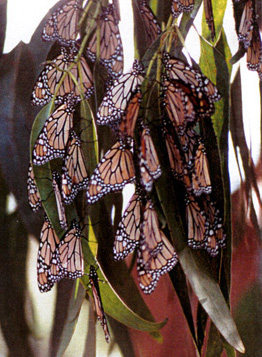
Monarch butterflies over-winter in California’s eucalyptus groves
The East Bay Express has published an op-ed in defense of the much maligned eucalyptus. “The Eucalyptus is Part of California” is by Gregory Davis, a Berkeley resident. We summarize the main points for our readers:
University of California, Berkeley’s plan to destroy all non-native trees—primarily eucalyptus, Monterey pine, and acacia—is characterized as a “meat-axe approach.”
Applying herbicides repeatedly to prevent regrowth of non-natives is “tantamount to opening a can of worms.” We don’t know the consequences of dousing our public land with toxic chemicals, just as we didn’t know that using Agent Orange during the War in Vietnam would permanently damage that country and its citizens.
The moderate approach advocated by the Hills Conservation Network is more reasonable. Thinning and selective removal will do less damage.
Flammability of eucalyptus groves has been greatly exaggerated.
Eucalyptus has lived in California longer than most of us have been alive. They are more native than we are.
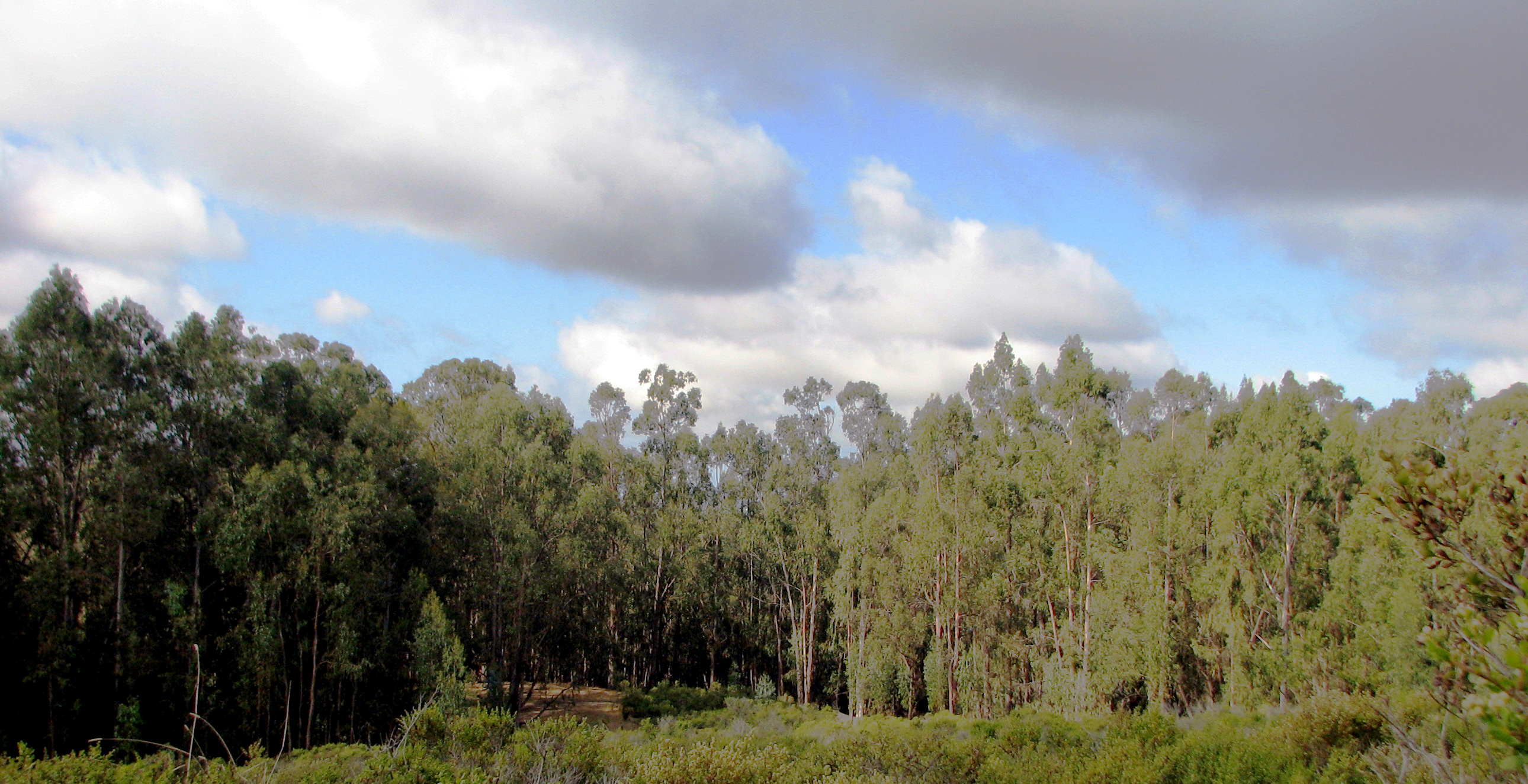
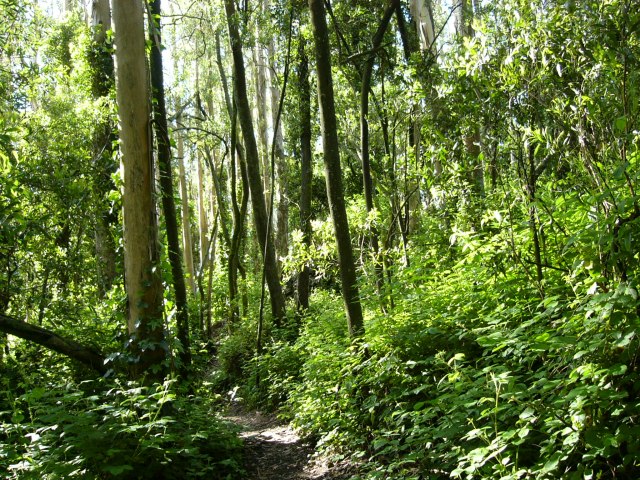
The loss of the “beauty and majesty” of eucalyptus in the hills will make hiking in the East Bay hills a less pleasant experience. “Anyone who has hiked up the trail under the green canopy of these tall, stately, plumed-top, evergreen trees knows how precious they are.”
Thank you, Mr. Davis, for writing this article and to the East Bay Express for publishing it. Critics of the native plant movement are learning that they must speak up if we are to save our trees. The projects that destroy our trees finally became so big and so visible, that more people are aware of them and are more willing to defend our trees.
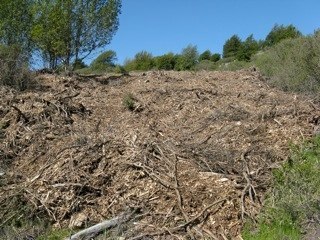
We described the projects that will destroy tens of thousands of trees on public lands in the San Francisco East Bay in recent posts available here and here. In this post we will focus on the projects on the property of the University of California, Berkeley (UCB) which will destroy 60,000 54,000 trees on 284 acres, cover 20% of those acres in 2 feet of chipped wood, and spray hundreds of gallons of herbicides on the stumps as well as foliar spray non-native vegetation.
The first consultant that was hired by FEMA to conduct the environmental impact review was URS Corporation. We know that URS Corporation was the consultant at the time of the scoping process in 2010 because we spoke to their representatives at that meeting. We were able to obtain the evaluation of UCB’s project by the URS Corporation with a public records request (Freedom of Information Act, AKA FOIA). In this post we will tell you what URS said about UCB’s project in a letter to FEMA dated May 27, 2009. FEMA posed 6 specific “issues” and we will briefly describe how URS evaluated these issues. (The issues are quoted verbatim from that letter.)
Issue 1: Evidence that the supposed habitat restoration benefit will occur, since no plans for revegetation is included in this grant.
URS agrees with UC that the “project will provide better growing conditions for plants in the understory because the plants will have increased access to resources (e.g., sunlight and soil nutrients).” But they emphatically do not agree with UCB that the post-treatment landscape will be exclusively native:
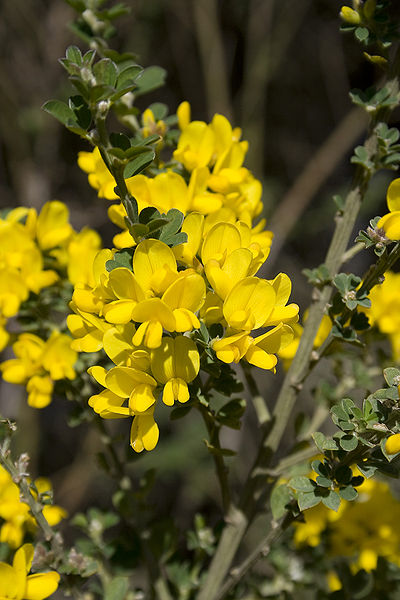
French broom in Oakland, CA. Beautiful but hated by native plant advocates. Share alike
“However, we question the assumption that the types of vegetation recolonizing the area would be native. Based on conditions observed during site visits in April 2009, current understory species such as English ivy, acacia, vinca sp., French broom, and Himalayan blackberry would likely be the first to recover and recolonize newly disturbed areas once the eucalyptus removal is complete. These understory species are aggressive exotics, and in the absence of proactive removal there is no evidence to suggest that they would cease to thrive in the area, especially the French broom which would be the only understory plant capable of surviving inundation by a 2-foot-deep layer of eucalyptus chips.”
URS also observes that wood chip mulch is unlikely to encourage native revegetation over non-native revegetation:
“As written, the current plan assumes native vegetation will reclaim the treatment areas but does not include any plans for native revegetation. Instead, in order to ‘reduce undesirable weed invasion’ and thus encourage the development of native grasslands, chaparral, and bay/redwood communities, UC plans to apply chip mulch to the ground…It is not clear how the mulch would prevent the proliferation of invasive species while simultaneously encouraging the growth of existing native species. Despite thorough research, we were unable to find documentation of the ability of exotic chip mulch to suppress undesirable species while encouraging favorable species.”
Issue 2: Relative fire risk of current vegetation versus chip dominated landscape: there is no scientific evidence to support the project as proposed.
Although URS agrees with UC that eucalypts are a fire hazard, they question that the eucalypts are more flammable than distributing their dead wood on the ground as wood chips, branches and logs:
“However, the comparative risk between eucalyptus in the form of a dense standing forest versus the form of a 2-foot-deep mulch layer on the ground is not well documented. Studies have shown that mulch layers actually can pose a fire risk depending upon the type of material, the depth of the mulch, and the climate of the mulch site….Fire Engineering Magazine recommends that, to reduce the potential for fire in mulch, one should recognize that mulches high in oils ignite more easily and that mulch fires start more readily in hot climates where rain is scarce…Eucalyptus material is high in oils, and the East Bay Hills are subject to long annual periods that are hot and dry.”
Issue 3. Potential for introduction of chaparral-dominated landscape and issues associated with fuel-driven fires versus climate-driven fires.
URS notes that the post-treatment landscape is unknown. However, if UC is right in predicting the return of a native landscape, this is URS’s evaluation of the fire hazard in a native landscape:
“…grasslands fuels burn cooler and faster than eucalyptus material, yet they are easier to ignite and carry fire quickly across a landscape. Chaparral is one of the most hazardous wildland fuel types in California due to the woody, persistent nature of the plants. A chaparral-dominated landscape in the post-treatment project area would create a fire hazard profile with its own suite of risks and concerns for fire protection, including flame lengths that far exceed those of the other possible vegetation types.”
URS concludes the analysis of this issue by repeating its concerns regarding the flammability of wood chip mulch:
“…it may be inaccurate to assume that the chip layer, given its depth, can be ignored as a potential fuel source. However, such a deep chip layer may have the potential to not only sustain a localized burn but to connect fuels in vegetation types located adjacent to the treatment areas.”
Issue 4. Justification of two species (Monterey pine and acacia) targeted for removal are a risk.
URS does not believe that Monterey pine and acacia will contribute to fire hazards in the post-treatment project areas:
“The UC inaccurately characterizes the fire hazard risk posed by the two species however…Monterey pine and acacia trees in the treatment area only pose a substantial fire danger when growing within an eucalyptus forest [where they provide fire ladders to the eucalyptus canopy]. In the absence of the eucalyptus overstory, they do not pose a substantial fire hazard.”
Issue 5. Complete analysis of other practical alternatives…
URS agrees with UC that the cost of annual clearance of ground litter would be prohibitive. They also agree that “creating strategic fuelbreaks” would not be effective. However, they say that “thinning targeted species rather than removing all and regularly clearing the understory”should be considered a viable alternative to the proposed project.
Issue 6. Document chips will decompose in 3 to 5 years.
UCB’s project intends to distribute wood chips on the forest floor to a depth of 2 feet. UCB claims that the wood chips will decompose in 3 to 5 years. URS does not think this is a realistic assessment:
“…literature search did not identify any studies documenting decomposition rates in eucalyptus mulch deeper than 4 inches, which notably is the maximum recommended depth for landscaping…Best scientific judgment suggests that a deeper chip layer would decompose more slowly than a shallow chip layer because it would be more insulated from moisture and less of its surface area would be in contact with decomposing bacteria and fungi found in the soil.”
UCB has ignored the advice of FEMA’s consultant
We have read most of the Draft Environmental Impact Study (DEIS) for this project. It is about 3,000 pages long, so we won’t claim to have digested it entirely. However, we can say with some confidence that UCB has ignored most of URS’s scathing criticism of their project. The only concession that we can see is that UCB now says they will cover only 20% of the project with 2 feet of wood mulch. However, they intend to cut the remainder of the wood into pieces 2-3 feet long and leave them lying around on the remaining 80% of the project area. That doesn’t seem like a significant improvement, with respect to fire hazard. Dead wood is dead wood and tons of it will be lying around when tens of thousands of trees are destroyed.
Why was the Environment Impact Study written by different consultants?
Given that URS was obviously telling UCB something they didn’t want to hear when the process of preparing an environmental impact study began in 2009, we aren’t surprised that URS was not involved in the final preparation of this document. According to the Draft Environmental Impact Study, the consultants who prepared the report are entirely different. (DEIS, Section Eight) URS Corporation is conspicuously absent from the list of preparers of the DEIS.
We rarely subscribe to conspiracy theories. We usually find incompetence a more realistic explanation for the strange things that happen in our messy world. However, in this case, let’s just say that this change in the consultants who prepared the DEIS smells bad.
Please tell FEMA your opinion of these projects
Comments on this document must be submitted by June 17, 2013. You may submit written comments in several ways:
These public lands belong to you and the money that will be used to implement these projects is your tax dollars. So, please tell the people who work for you what you think of these projects.
Please sign the petition of the Hills Conservation Network in opposition to these projects which is available HERE.
Although we are often accused of being “euc-lovers” by native plant advocates, we actually prefer native oaks to eucalypts. Unlike native plant advocates, we don’t think our preference justifies the destruction of eucalypts. Because of our fondness for oaks, informing our readers of the rampant spread of Sudden Oak Death that is killing our oaks is not a pleasant chore. But we want the public to understand that when we destroy all of our non-native trees, we may be dooming ourselves to a treeless landscape.
Hundreds of thousands of non-natives will be destroyed by FEMA projects
The projects of UC Berkeley, the City of Oakland, and the East Bay Regional Parks District (EBRPD) that are being evaluated for FEMA funding will destroy hundreds of thousands of non-native trees, as reported here. According to the Draft Environmental Impact Study (DEIS) that claims to evaluate those projects, “Oak-bay woodlands total 320.6 acres in the proposed and connected project areas and represent the second largest vegetation community identified in the proposed and connected project areas.” (DEIS 4.2-17) Also, the “vegetation management goals” for the Recommended Treatment Areas (RTAs) in EBRPD’s FEMA applications are predominantly oak-bay woodland. Thirty-seven of the 47 (80%) RTAs in the EBRPD’s FEMA grant application are destined to be oak or oak-bay woodland when this project is implemented.
Sudden Oak Death in the East Bay
The pathogen (Phytophthora ramorum) that causes Sudden Oak Death (SOD) was reported on the UC Berkeley campus in 2002. (1) At that time it also existed at the UC Botanical Garden, which is proximate to UC Berkeley’s FEMA projects. By 2011, the SF Chronicle reported that the infestation of SOD was spreading rapidly in the East Bay and had been found in North Berkeley, the Claremont district in Berkeley and the Montclair area in Oakland. That article predicted that 90% of the native live and black oaks in California will be dead within 25 years. (2) There is no known cure for oaks that are infected with SOD. A preventative treatment is recommended, but it is expensive and is therefore not being used on our public lands.
One year later, based on the sampling done by thousands of volunteers participating in the 2012 SOD Blitz, the California Oak Mortality Task Force reported these findings: (3)
“The USDA FS 2012 annual aerial detection survey for California mapped 376,000 new dead oak (Quercus agrifolia) and tanoak (Notholithocarpus densiflorus) over 54,000 acres in areas impacted by SOD.”
“Most of the Bay Area locations sampled had increased levels of infection, with the East Bay infestation found to have transitioned from a newly arrived status (in 2011) to epidemic levels on California bay laurel (Umbellularia californica) (in 2012).”
We participated in the 2013 SOD Blitz in the East Bay on April 27, 2013. This volunteer effort is led by Matteo Garbelotto who is a scientist at UC Berkeley studying Sudden Oak Death. He has organized the SOD Blitz throughout Northern California to determine the spread of the disease. Hundreds if not thousands of citizens attend his workshops to learn how to identify the disease and take leaf samples of native bay trees for testing in Garbelotto’s laboratory. Oaks aren’t sampled because that requires cutting into the bark of the tree which can damage the tree if not done properly. Based on previous studies, bays that are infected with the pathogen are assumed to infect oaks within 200 feet of infected bays. So, based on the SOD map that identifies infected bays in the East Bay, we should assume that all oaks within 200 feet of those infected bays are doomed to die eventually.
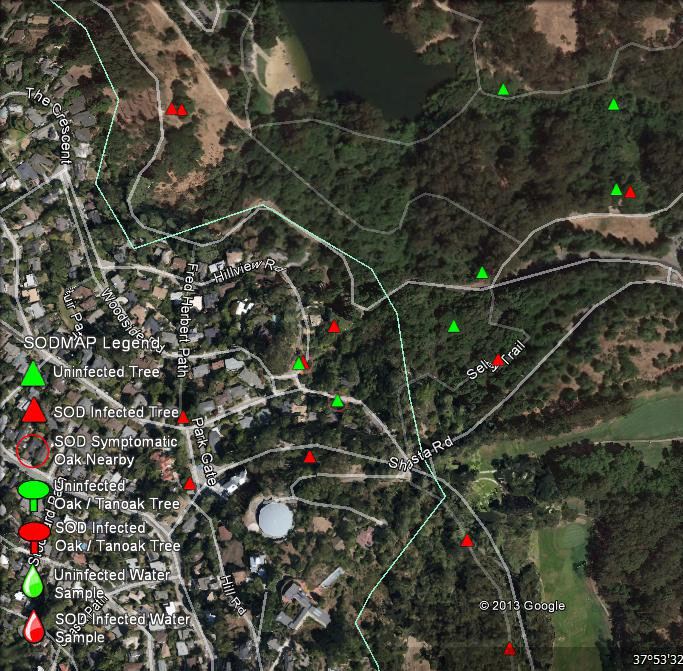
This is a detail of an area south of Lake Anza and west of the Tilden Botanical Garden from the SOD Map which is available on the internet. Infected bay trees identified by the 2012 SOD Blitz are indicated with red triangles. This small portion of the SOD Map shows that 6 infected bay laurel trees were found in 2012 in four of the FEMA project areas: TI010, TI020, TI011, and TI1012. This is not a complete list of the infected bays in all project areas. It is only an illustration of how the DEIS could have reported the existence of SOD in the FEMA project areas.
The oak woodland in the East Bay is called the oak-bay woodland for a reason. The oaks and bays grow together, in close proximity. Although bays are hosts of the SOD pathogen, they are not killed by it. However, bays are considered the primary vector of the disease to the oaks which are killed by it: “Bay laurels are not thought to die from P. ramorum infection, but these trees are a major source of inoculum for the pathogen and appear to play an important role in spreading disease to other plants in California.” (4)For that reason, property owners and managers of public lands are being advised by scientists to remove bay laurels growing in proximity to oaks:“Scientifically-tested recommendations for managing forests impacted by P. ramorum are still in development, although at least three promising directions have emerged: application of systemic fungicides, forest thinning to remove susceptible hosts, and targeted removal of the main carrier, California bay laurel, near coast live oak.” (5)
To summarize these reports: the spread of SOD in the East Bay has reached epidemic proportions and is expected to kill most of the oaks. Meanwhile, one of the few treatments being recommended by scientists to limit the spread of the disease is to remove bay laurels that grow near oaks. The future of the oak-bay woodland in the East Bay is indeed dim.
The cause and the consequences of SOD
Scientists studying SOD have determined that the spread of the disease is facilitated by warm rainy days, most likely to occur in the spring. And models of climate change, predict just such conditions in the future. (6) How ironic that the destruction of hundreds of thousands of trees in the East Bay will contribute to climate change by releasing hundreds of thousands of tons of carbon dioxide to the atmosphere.
SOD researchers have also reported that SOD deaths are increasing the risk of severe wildfire:
“Not only does SOD alter fuel quantity in these forest types, but it can also change the arrangements of fuels, posing serious challenges to firefighter response in infested stands. After trees die from the disease, they can remain standing with dry, dead leaves for several years, greatly increasing the likelihood of crown fire under extreme weather conditions. Likewise, the increased fuels on the forest floor can take a long time to break down, posing a long-term fire hazard and additional risks to firefighters. In many cases, modeled wildfire conditions in SOD-impacted forests exceed safety thresholds for hand crews, calling for changing suppression tactics and strategies, such as more heavy equipment, aircraft use, and indirect lines.” (7)
Putting our heads in the sand
The DEIS makes no mention of Sudden Oak Death. Seven written public comments submitted during the scoping process expressed concern about SOD, but the DEIS ignores the issue. (A word search of the 3,000 page DEIS finds SOD and Sudden Oak Death only in the Scoping Report (DEIS Appendix K1), not in the study itself.)
Since the scoping process in 2010, we now have overwhelming scientific evidence that Sudden Oak Death is rampant in the East Bay, that it is spreading rapidly, that its spread is associated with climate change, and that it is increasing the risk of severe wildfire, yet the DEIS ignores these serious threats to the oak-bay woodlands. This omission verges on incompetence, if not negligence. One wonders why the government bothers with a public comment period such as the scoping process, when the public’s concerns are obviously ignored.
If the consequences of Sudden Oak Death in the oak-bay woodland in the project areas are not adequately explained by the Final EIS, FEMA should assume that it will be legally challenged by the taxpayers. At the very least, taxpayers need to know if there will be any trees left in the East Bay hills, either native or non-native. If the expansion of oak woodland increases the risk of wildfire, funding of these FEMA grants would be entirely inappropriate.
Please sign the petition in opposition to these projects which is available HERE. Please send FEMA your public comment about these projects by the June 17 deadline. Information about how to submit public comments in available HERE.
UPDATE: The final version of the EIS has added a section about Sudden Oak Death, with this introductory paragraph:
“If SOD is present within the proposed and connected project action area, vegetation treatment could exacerbate SOD by causing it to spread to unaffected areas. A protocol for fuels treatment in areas with SOD was developed using information from U.C. Berkeley Forest Pathology and Mycology SOD workshops. The summary includes identification, mapping, and isolation of infected trees.” (page 5.1-34 Available HERE)
The final EIS confirms that the entire project “could” spread Sudden Oak Death. Then it describes how that spread can be “mitigated” by using certain methods designed to limit that spread. This is the technique used throughout the EIS to essentially dismiss our concerns. It acknowledges potential problems, then waves them away with elaborate “protocols” which even if they are effective, are unlikely to be followed by people in the field who are usually ignorant of them.
(5) Janice Alexander, Christopher Lee, “Lessons Learned from a Decade of Sudden Oak Death in California: Evaluating Local Management,” Environmental Management, 2010, 46:315-328.
(6)Kliejunas, J.T. 2011. A Risk Assessment of Climate Change and the Impact of Forest Diseases on Forest Ecosystems in the Western United States and Canada. Gen. Tech. Rep. PSW-GTR-236. Albany, CA: U.S. Department of Agriculture, Forest Service, Pacific Southwest Research Station. 70 p. (4/12)
(7) Valachovic, Y.S.; Lee, C.A.; Scanlon, H.; Varner, J.M.; Glebocki, R.; Graham, B.D.; and Rizzo, D.M. 2011. Sudden Oak Death-Caused Changes to Surface Fuel Loading and Potential Fire Behavior in Douglas-fir-Tanoak Forests. Forest Ecology and Management. 261:1973-1986. (3/12)
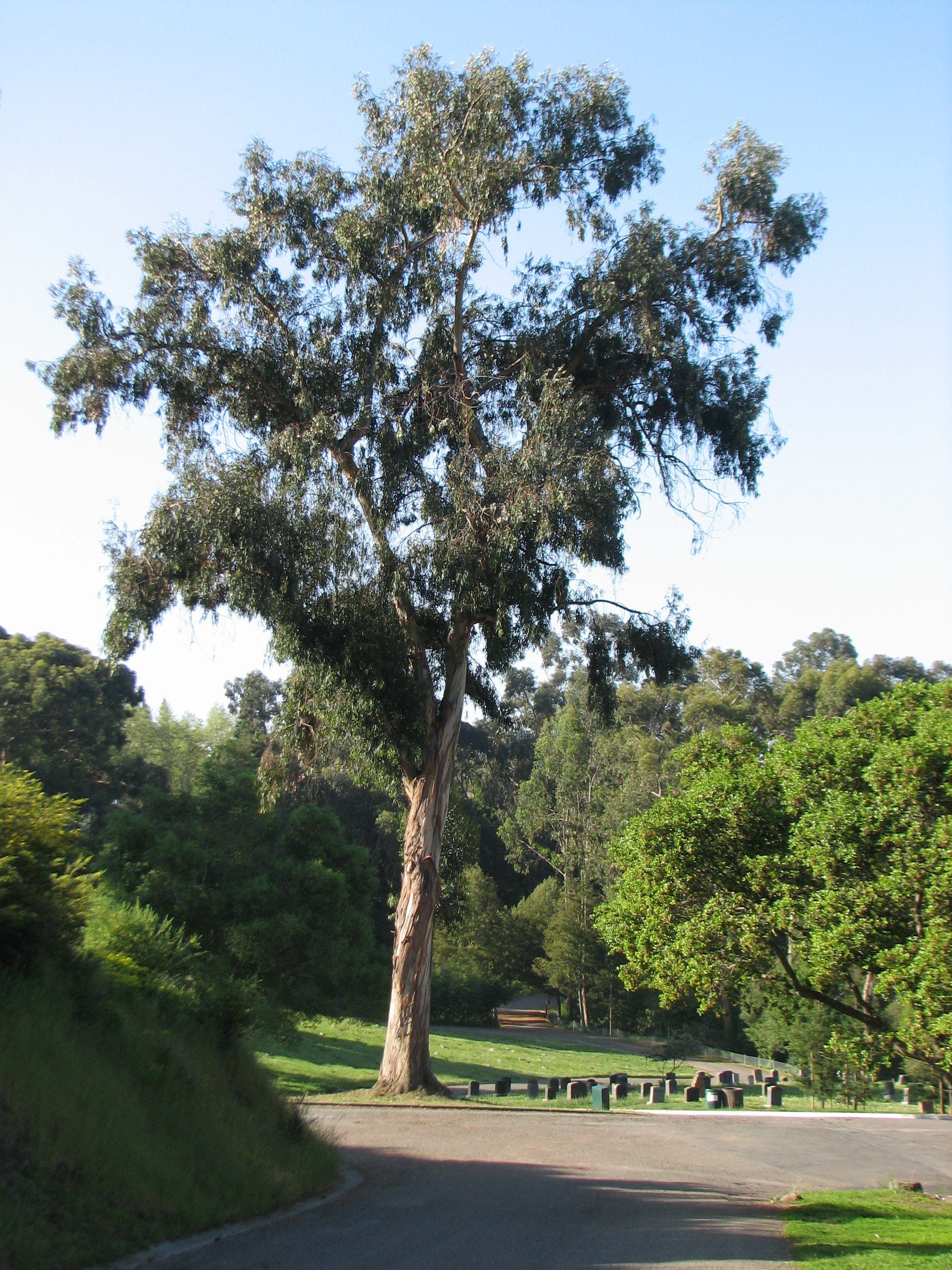
This is one of many trees in the East Bay that have already been destroyed because it is not native.
We have just received a link to a video about the FEMA projects in the East Bay hills. (Available here) The video was created by someone who attended the second public meeting on Tuesday, May 14, 2013.
We don’t agree with everything he says, but we certainly agree with his main point: VERY FEW MEMBERS OF THE PUBLIC IN THE EAST BAY KNOW ABOUT WHAT IS PLANNED FOR THEIR PUBLIC LANDS. THEY ARE NOT AWARE THAT TENS OF THOUSANDS OF NON-NATIVE TREES WILL BE DESTROYED.
We join the creator of this passionate video in urging you to attend the last public meeting about these projects which will take place on Saturday, May 18, 2013, 10:00 a.m. – 12:00 p.m., Claremont Middle School, 5750 College Avenue, Oakland, CA 94618.
For more information about these projects and other ways in which you can comment on the plans please visit this Million Trees post. Written public comments are due by June 17, 2013.
Update: The San Francisco Forest Alliance has posted a report about this hearing which is available here.
Update 2: A video of the hearing is now available here.
This is a revision of an article that was published on May 5, 2013. In our haste to inform our readers of these projects during the public comment period, we published before we had read the entire Environmental Impact Study. We are forced to revise our estimates based on further reading of the document. We apologize for the confusion and thank you for your patience.
On May 29, 2013, we found an error in the number of trees that will be removed at Frowning Ridge. We show our corrections so as not to mislead our readers.Again, our apologies.
*******************************
The Federal Emergency Management Agency (FEMA) has been considering grant applications for “fire hazard mitigation” in the East Bay since 2005, when the first of these applications was submitted. After years of debate about whether or not the projects achieve the stated purpose and at what cost to the taxpayers and the environment, FEMA finally agreed to resolve the controversial issues by mandating an environmental impact review, which began in 2010. Although FEMA paid for the environmental review, the grant applicants conducted it and it represents their opinions of their projects.
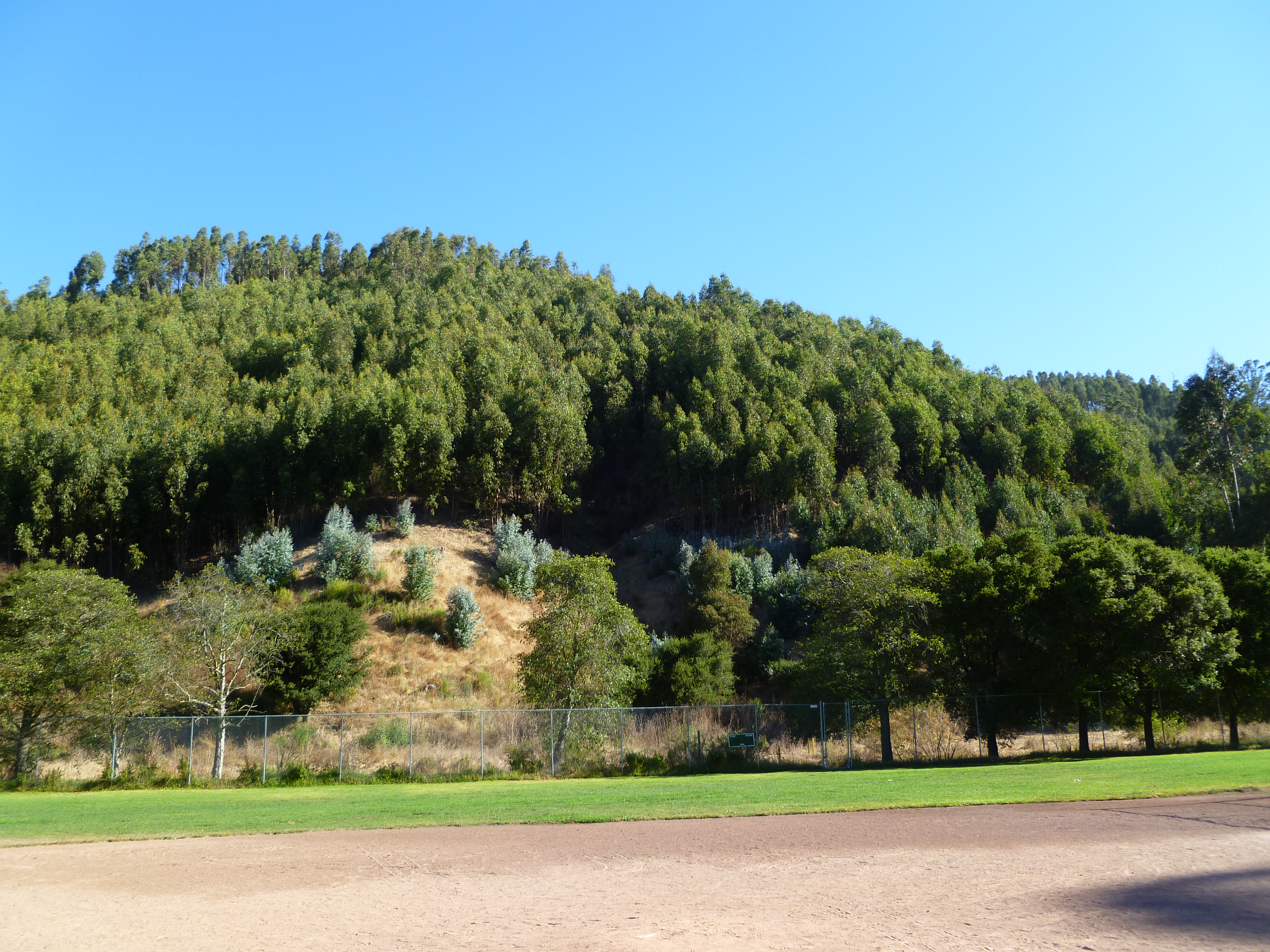
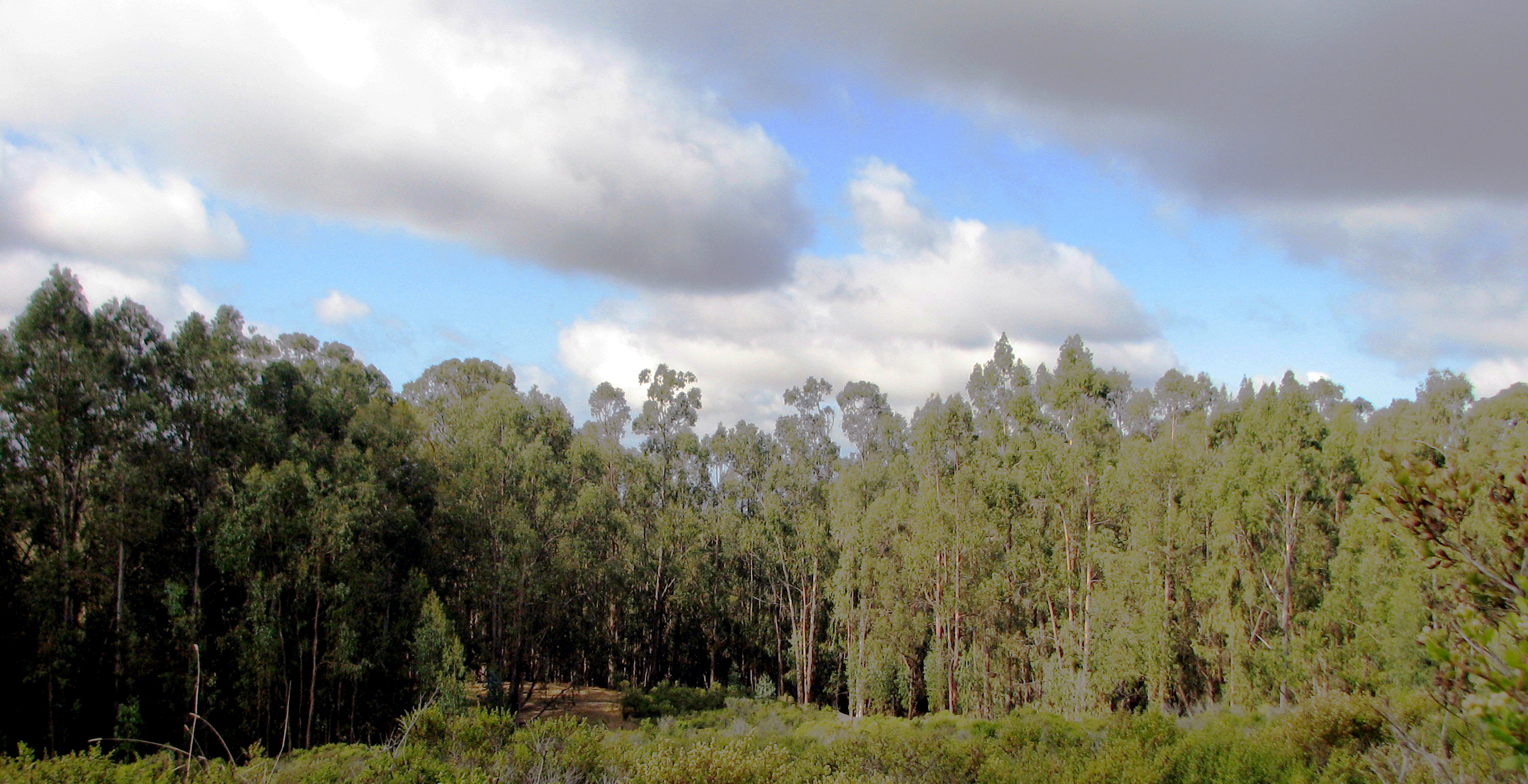
This eucalyptus forest at the North Oakland Sports Facility will be entirely destroyed.
These are the projects for which the Million Trees blog was created and for which it was named. Our opinion of these projects is unchanged by the environmental impact review. These projects will not achieve their stated objectives. Instead they will damage the environment and endanger the public.
The Draft Environmental Impact Statement (DEIS) for these projects was published by FEMA on April 25, 2013. It is available here. This is a brief description of the projects, our initial assessment of the DEIS, and information about how you can participate in the decision-making process which will ultimately determine the fate of these projects.
Description of the projects in the East Bay
Three different owners of public land have applied for these grants: University of California at Berkeley (UCB), City of Oakland, and East Bay Regional Park District (EBRPD). The projects of UCB and Oakland are similar and they are different from the projects of EBRPD, so we will describe them separately. These are the locations of the projects of UCB and Oakland, their acreage, and the estimated number of trees that will be removed by these projects:
Project Area
Project Acreage
Estimated Tree Removals*
UCB
Strawberry Canyon
56.3
22,000
Claremont
42.8
Frowning Ridge (in Oakland)
185.2
38,000 32,000
Sub-Total
284.3
60,000 54,000
Oakland
North Hills Skyline
68.3
Caldecott Tunnel
53.6
Sub-Total
121.9
25,735 23,161
TOTAL
406.2
85,735 77,161
*UCB estimated tree removals are provided by the DEIS; Oakland estimated tree removals are extrapolated assuming the same number of trees per acre (60,000 54,000 ÷ 284.3 = 211 190 trees per acre X 121.9 acres = 25,735 23,161 trees removed by the projects of the City of Oakland)
UCB and Oakland plan to remove all non-native trees (eucalyptus, Monterey pine, acacia, etc.) and vegetation from the project area. All non-native trees up to approximately 24 inches in diameter at breast height (DBH) will be cut into wood chips and scattered on the ground of the project area. They estimate that 20% of the project area will be covered with wood chips to a depth of 24 inches. The DEIS estimates that the wood chips will take from 5 to 10 years to decompose. Larger trees will be cut up and scattered on the site.
Although UCB and Oakland do not intend to plant the project areas (unless erosion subsequent to tree removals demands seeding of native grasses and herbaceous plants), they predict that the project area will eventually become native grassland, scrub, and forest of coast live oak, California bay laurel, big-leaf maple, California buckeye, and California hazelnut. They predict that this conversion from non-native to native vegetation will be accomplished by “recruitment” from areas where these plants exist, into the areas where non-native plants and trees will be removed.
The stumps of eucalypts and acacia will be sprayed with an herbicide (Garlon with the active ingredient triclopyr) soon after the trees are cut down to prevent resprouting. An estimated 1 – 2 ounces of formulated herbicide will be required for each stump. Based on an experiment conducted by East Bay Regional Park District, an estimated 5% of the trees will require retreatment of subsequent resprouts. They are therefore predicting that between 703 633 and 1,407 1,266 gallons of herbicide will be required to prevent resprouting if only 5% of the stumps require retreatment as they claim. Monterey pines will not require herbicide treatment which reduces this estimate proportionately, although we are not provided with enough information to make this calculation. Herbicide (Roundup with active ingredient glyphosate) will also be sprayed to control non-native vegetation, but no estimates of quantities required for that purpose are provided by the DEIS.
The fire hazard mitigation projects of the East Bay Regional Park District were described in detail in its “Wildfire Hazard Reduction and Resource Management Plan” of 2009. EBRPD has applied for FEMA funding for about one-third of the “recommended treatment areas” in that plan. The FEMA DEIS considers all recommended treatment areas on EBRPD property, including those for which FEMA funding has not been requested. The recommended treatment areas for which FEMA funding has not been requested are called “Connected Action Acres.” The “Connected Action Acres” have undergone environmental review under California law (CEQA) and are therefore approved for implementation, which has already begun.
Project Area
Project Acres
Connected Action Acres
Total Acres
Estimated Tree Removals*
EBRPD
Sobrante Ridge
4.1
0
Wildcat Canyon
65.6
46.6
Tilden Park
132
194.2
Claremont Canyon
35.3
130.4
Sibley Volcanic
47.5
118.4
Huckleberry
17.8
.3
Redwood Park
58.4
92.8
Leona Canyon
4.6
0
Anthony Chabot
200
478.2
Lake Chabot
4.8
0
Miller-Knox
22.2
0
TOTAL
592.3
1,060.7
1,653
400,602 409,176
*Estimated Tree Removals: Neither the DEIS nor EBRPD’s “Wildfire Plan” provides an estimate of the number of trees they plan to destroy. Furthermore their plans for tree removals are complex and variable. All non-native trees (eucalypts, Monterey pines, acacia) will be removed in some recommended treatment areas, but in most they will be thinned to spacing of 25 to 30 feet. The final Environmental Impact Report for the “Wildfire Plan” provides an estimate of the existing tree density of existing eucalypts on EBRPD property (page 392). Acres of eucalypts in the entire project area are provided by the DEIS (page 4.2-6). Our estimate of tree removals is based on those figures (1).
This eucalyptus forest at Chabot Park will be thinned to about 60 trees per acre.
This estimate does not include the Monterey pines and acacia that will be removed by EBRPD, for which inadequate information is available to provide an estimate.
EBPRD plans to cut the trees into wood chips which will be scattered to cover 20% of the project to maximum depth of 4-6 inches. The remainder of the wood will be burned in piles. Other non-native vegetation will be destroyed with herbicides and/or prescribed burns. These prescribed burns will not be funded by FEMA.
EBRPD’s plans to convert the project area to native vegetation are similar to the plans of both UCB and Oakland. EBRPD also does not plan to plant project areas with native vegetation. EBRPD also plans to use herbicides on the stumps of eucalypts and acacia which we estimate will require a mind-boggling 3,286 3,356 to 6,572 6,713 gallons of herbicide.
Million Trees’ assessment of these projects
We have surely exhausted your patience with the mind-numbing detail needed to describe these projects accurately. Therefore, we will provide only a brief outline of our assessment of these projects:
* These projects are more likely to increase the risk of wildfires than to reduce that risk.
By distributing tons of dead wood onto bare ground
By eliminating shade and fog drip which moistens the forest floor, making ignition more likely
By destroying the windbreak that is a barrier to wind driven fires typical of wildfires in California
By expanding the oak-bay woodland being killed by Sudden Oak Death, thereby adding more dead wood
* These projects will damage the environment by releasing hundreds of thousands of tons of carbon dioxide into the atmosphere from the destroyed trees, thereby contributing to climate change.
* These projects will endanger the public by dousing our public lands with thousands of gallons of toxic herbicides.
* Erosion is likely on steep slopes when the trees are destroyed and their roots are killed with herbicides.
* Non-native vegetation such as broom, thistle, and hemlock are more likely occupants of the unshaded, bared ground than native vegetation which will not be planted by these projects.
* Prescribed burns will pollute the air and contribute to the risk of wildfire, endangering lives and property.
* These projects are an inappropriate use of the limited resources of the Federal Emergency Management Agency which are for the expressed purpose of restoring communities destroyed by disasters such as floods and other catastrophic events and preparing communities for anticipated catastrophic events. Most of the proposed projects in the East Bay are miles away from any residences.
Update: Please visit THIS post for the current status of these projects. In summary: East Bay Regional Park District is implementing its original plans. City of Oakland is developing a new “Vegetation Management Plan.” UC Berkeley is suing to re-instate its FEMA grant funding so that it can implement its original plans.
How to participate in this decision-making process
The Hills Conservation Network has created a petition to oppose these projects. It is available HERE.
You can also participate in this decision. FEMA will host three public meetings in May 2013:
Tuesday, May 14, 2013, 2:00 p.m. – 4:00 p.m., Richard C. Trudeau Center, 11500 Skyline Boulevard Oakland, CA 94619
Tuesday, May 14, 2013, 6:00 p.m. – 8:00 p.m., Richard C. Trudeau Center, 11500 Skyline Boulevard Oakland, CA 94619
Saturday, May 18, 2013, 10:00 a.m. – 12:00 p.m., Claremont Middle School, 5750 College Avenue Oakland, CA 94618
Comments on this document must be submitted by June 17, 2013. You may submit written comments in several ways:
These public lands belong to you and the money that will be used to implement these projects is your tax dollars. So, please tell the people who work for you what you think of these projects.
*********************************
(1) Calculation of estimated tree removals by East Bay Regional Park District, Update: We understand the weakness of this estimate. Unfortunately, the DEIS does not provide sufficient information to improve its accuracy. Again, our apologies.
The San Francisco Chronicle recently published an op-ed by Joe Mascaro about the Sutro Forest (available here). He is a professional ecologist at the Carnegie Institution for Science who studies the ecological functions of forests (his research is described here). He is also a San Franciscan and a fan of the Sutro Forest. He tells us in his op-ed that the Sutro Forest is a unique, “novel” forest that is thriving and that destroying it will increase the risk of wildfire, contrary to the claims of UCSF.
As we approach the March 19, 2013 deadline for submitting public comments on the Draft Environmental Impact Report for UCSF’s proposed plan to destroy 90% of the forest and its understory on 75% of the 61 acres of the Mount Sutro Reserve, we appeal to our readers to take a few minutes in their busy day to write your own comment (see below for details of where to send comments).
About 200 people came to the community meeting at UCSF last night. Nearly 60 people spoke; the overwhelming majority spoke in opposition to UCSF’s proposed plans to destroy most of the forest. Everyone spoke respectfully but with passion about what this forest means to the community. Many spoke about the loss of trees and habitat where similar projects already have been implemented by the Natural Areas Program and the GGNRA.
Over 1,700 people have signed the petition to save the Sutro Forest. If you haven’t signed yet, please do so here. We’re going to quote a few of the astute and well-informed comments that people have written on the petition in the hope that it will inspire you to write your own comment. (Grammatical edits only.)
Comment #1575:
“Among many other reasons not to hurt this forest- it is healing to people in need of healing at the UCSF hospital. The sight of it sustained me through a difficult labor during which I gazed on it for 13 hours. It is a vibrant, healthy, and sacred forest, and the people who love it will not stand by idly and quietly if it is in harms way”
Scientific studies corroborate this patient’s personal experience. Here is a report of these studies.
Comment #1528:
“Please nooooo!!! do not destroy the habitat for hundreds of creatures. WHY the destruction FOR NOTHING!!! I live in the neighborhood and I am sick and tired to see the city and UCSF cutting down trees and not replacing them.. but only with shrubs and small plants”
This is another San Franciscan who has noticed that the UCSF project is one of many in San Francisco which is destroying trees in order to return the landscape to native grassland and scrub.
Comment #1519:
“The reasons for tree removal are inaccurate. The effort is a waste of resources. The forest is healthy and most importantly serves the needs of the population of the city. UC has indicated its willingness to destroy trees for its own gain, but what the people of SF need is the unique ecosystem that provides wind relief, beauty, and comfort. Native plant restoration is a myopic, militant effort that does not take into consideration the needs of the people who live in SF. This is another effort to waste and destroy for misconceived ideals.”
This San Franciscan understands that the Sutro forest is performing important ecological functions.
Comment #1518:
“The trees in Sutro forest provide immense value to the neighborhood and the city in which we live. It is a wind break, it is a visual stimulus, it is a wonderful place to walk, it is home to a large number of hummingbirds, it isolates a busy hospital from the neighborhood and it provides a tremendous source of ground water to neighboring houses. Save the forest.”
This Sutro neighbor understands that the loss of this forest will harm both the neighborhood and the animals that live in the forest.
Comment #1471:
“Destroying 90% of the trees will destroy the forest – its beauty, its Cloud Forest aspect, and its habitat value. The trees, which sequester tons of carbon, will no longer do so, and instead the dead chipped trees will release carbon dioxide into the atmosphere. PLEASE DO NOT REMOVE THESE TREES!”
This commenter understands that the forest is storing carbon which will be released into the atmosphere as carbon dioxide when the trees are destroyed. Carbon dioxide is the predominant greenhouse gas which is causing climate change.
Comment #1277:
“For environmental reasons please do not cut the forest of Mount Sutro. Risk of landslides (the old forest has intertwined and intergrafted roots that function like a living geo-textile and hold up the mountain, while the exposed rock on Twin Peaks has a rock-slide every year or two); Pesticide drift into our neighborhood, affecting us and our pets (right now, Sutro Forest may be the only pesticide-free wildland in the city; the Natural Areas Program, which controls most of it, uses pesticides regularly) Increased noise (the vegetation – the leaves of the trees and the shrubs in the understory are like soft fabrics absorbing sound) Changes in air quality (trees reduce pollution by trapping particle on their leaves until they’re washed down) Environmental impact – (eucalyptus is the best tree species for sequestering carbon because it grows fast, large, is long-lived, and has dense wood; but felled and mulched trees release this carbon right back into the atmosphere).”
This San Franciscan is aware of the pesticides being used by the Recreation and Park Department’s so-called “Natural Areas Program.” UCSF’s proposed project will use pesticides to prevent the resprouting of the trees that they destroy. Pesticides used by native plant “restorations” are described here. She also understands that trees stabilize steep slopes and reduce air pollution.
Here’s what you can do to help save the Sutro Forest:
• Sign the petition to save the forest. Available here.
• Submit a written public comment by 5 PM, March 19, 2013 to UCSF Environmental Coordinator Diane Wong at EIR@planning.ucsf.edu or mail to UCSF Campus Planning, Box 0286, San Francisco, CA 94143-0286. Include your full name and address.
• Write to the Board of Regents to ask why a public medical institution is engaging in such a controversial, expensive, and environmentally destructive act. Address: Office of the Secretary and Chief of Staff to the Regents, 1111 Franklin St., 12th Floor, Oakland, CA 94607 Fax: (510) 987-9224
• Subscribe to the website SaveSutro.com for ongoing information and analysis.
UCSF has sent an email to its neighbors about its plans for the Sutro forest in which they say, “Contrary to rumors being circulated, there is no plan to cut down 30,000 trees in the Mount Sutro Open Space Reserve, and it is unfortunate that this misinformation continues to spread.”
Our response is, Do the math!!
The Draft Environmental Impact Report (DEIR) claims that the thinned forest will have 62 trees per acre. (DEIR Appendix F) The DEIR arrives at this figure by assuming that each tree will occupy a circle with a radius of 15’. In fact, it is not possible to pack circles into another geometric space, whether it is a bigger circle, a rectangle or a square without wasting space. Therefore, this calculation arrives at a bogus answer which is larger than is physically possible.
We have calculated the number of trees remaining in the thinned forest based on the number of squares in an acre that are 30’ X 30’. Such calculations of tree density are found in books regarding arboriculture, which corroborates that we are using a standard calculation used by the timber industry and the DEIR is not. (1)
48.4
43560/900 = trees per acre if 30 feet apart (the proposed plan)
12.1
43560/3600 = trees per acre if 60 feet apart (the proposed plan)
45000
Total number of trees existing now on 61 acres (according to UCSF)
34040
46 acres X 740 trees/acre = Number of trees existing in project area
2112
44 acres X 48 trees/acre = thinned forest with 30’ spacing
24
2 acres (Demo Area #4) X 12 trees/acre = thinned forest with 60’ spacing
31904
Existing Trees – Thinned Forest = Trees Removed in Project Area
70.9%
Trees Removed/Existing Trees in total forest = Percent of Trees Removed in Total Forest
If UCSF wishes to reduce the number of trees that will be removed by the proposed plan, it can do so by reducing the spacing between the trees or the number of acres to be “thinned.” All other numbers used to arrive at an estimated number of tree removals are straight-forward mathematical calculations based on the information provided by UCSF.
UCSF would be wise to read the DEIR for its project, which says, “Under full-implementation or worst-case implementation of management activities under the proposed project, approximately 60% of all existing trees, including large and small trees, could be removed.” UCSF reports that there are 45,000 trees in the Mount Sutro Reserve presently. Sixty-percent of 45,000 is 27,000 trees. We think UCSF’s estimate of tree removals is just a few thousand trees less than what is actually planned. What are we quibbling about?
Once again, we invite UCSF to revise its proposed project to reduce the number of trees that will be removed.
****************************
(1) Ecology and Silviculture of Eucalypt Forests, R.G. Florence, CSIRO, Australia
The short answer to that question is “I don’t know.” However, since many of the over 1,200 signers of the petition to University of California San Francisco (UCSF) to save the forest have asked this question, it seems that they deserve some answer. So, in this post, we will tell you the reasons that UCSF has given for its plans to destroy the forest.
UCSF makes two erroneous claims about the Sutro forest which it uses to justify its destruction. They claim that the forest is unhealthy and that destroying most of the forest will benefit the few trees that remain. They also claim that the forest is very flammable and that destroying most of the forest will make it less flammable. This is our response to these claims.
The Draft Environmental Impact Report for UCSF’s planned project claims that the forest is old and dying. If we don’t beat it to the punch and kill it first, it will soon die without our help. An analogy comes to mind: “We had to destroy the village to save it,” which was the explanation given for the destruction of a village during the Vietnam War. It didn’t make sense then and it doesn’t make sense now.
The fact is, the Sutro forest is young and in the prime of its life. Eighty-two percent of the forest is blue gum eucalyptus. Blue gums live in Australia from 200 to 500 years. (1) They live toward the longer end of that range in milder climates such as the San Francisco Bay Area. The blue gum eucalypts were planted on Mount Sutro in the 1880s. It is still a young forest.
Another indication that the forest is young is that the individual trees are small by blue gum standards. The study plots used by the Draft Environmental Impact Report (DEIR) to calculate how much carbon is stored in the trees found that 77% of the trunks of the trees are 5 inches in diameter at breast height or less (if the study plots are representative of the entire forest, which is questionable). It also says that this species of eucalyptus grows very fast and that its trunk is 9 inches in diameter after only three years of growth. In other words, the DEIR claims that the trees are old and no longer growing, yet it says that most of the trees are very small and it intends to destroy the small trees, not the big ones. This is just one of many contradictions that we find in the DEIR.
There is little risk of wildfire in the Sutro Forest
FEMA asked UCSF to supply scientific evidence that the project would reduce fire risk despite the fact that the project would reduce fog condensation from the tall trees which moistens the forest floor, making ignition unlikely. FEMA also asked for scientific evidence that a wind driven wildfire would not be more likely after the destruction of the wind break provided by the forest. UCSF chose to withdraw its grant application, presumably because they could not answer those questions.
In 2010, UCSF applied for another fire hazard mitigation grant from the California Fire Safe Council. The Council has funded 150 such grants in California, but they denied UCSF’s application. That suggests that the California Fire Safe Council shares FEMA’s opinion.
You might ask, where is UCSF getting the money to pay for this project? We don’t know, but we consider that a legitimate and important question given that UCSF is a publicly funded enterprise.
UCSF may not be able to answer FEMA’s questions, but we can, using specific scientific studies. In 1987, 20,000 hectares burned in a wildfire in the Shasta-Trinity National Forest. The effects of that fire on the forest were studied by Weatherspoon and Skinner of the USDA Forest Service. They reported the results of their study in Forest Science. (2) They found the least amount of fire damage in those sections of the forest that had not been thinned or clear-cut. In other words, the more trees there were, the less damage was done by the fire. They explained that finding:
“The occurrence of lower Fire Damage Classes in uncut stands [of trees] probably is attributable largely to the absence of activity fuels [e.g., grasses] and to the relatively closed canopy, which reduces insolation [exposure to the sun], wind movement near the surface, and associated drying of fuels. Conversely, opening the stand by partial cutting adds fuels and creates a microclimate conducive to increased fire intensities.”
In other words the denser the forest,
The less wind on the forest floor, thereby slowing the spread of fire
The more shade on the forest floor.
The less flammable vegetation on the forest floor
The more moist the forest floor
All of these factors combine to reduce fire hazard in dense forest. Likewise, in a study of fire behavior in eucalyptus forest in Australia, based on a series of experimental controlled burns, wind speed and fire spread were significantly reduced on the forest floor.(3) Thinning the forest will not reduce fire hazard. In fact, it will increase fire hazard.
Jon E. Keeley of the USGS is a world-renowned expert on the fire ecology of California. We have read his recently published book (Fire in Mediterranean Ecosystems: Ecology, Evolution and Management, Cambridge University Press, 2011) and many of his articles. Anyone with a sincere interest in wildfire hazards in California would be wise to read these publications. Reference to Keeley’s work is conspicuously absent from the Draft EIR.
Keeley’s most recently published study of specific wildfires in the Wildland-Urban-Interface (WUI) of California is most relevant to consideration of wildfire hazard in the Sutro Reserve. (4) The authors studied the property damage resulting from specific wildfires in California “…and identified the main contributors to property loss.” Keeley and his colleagues found that steep slopes in canyons that create wind corridors were the best predictors of fire damage and that grassy fuels were more likely to spread the fire than woody fuels. Applying these observations to Mount Sutro, its topography is the biggest factor in the potential for wildfire and substituting the forest with grassland and scrub will result in more dangerous fuel loads.
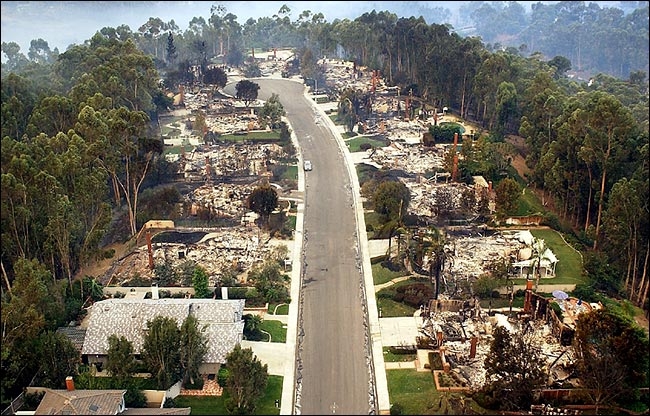
Scripps Ranch fire, San Diego, 2003. All the homes burned, but the eucalypts that surrounded them did not catch fire.
UCSF and native plant advocates make allegations about the flammability of eucalypts by misrepresenting actual wildfires in the Bay Area. These allegations are addressed elsewhere on Million Trees, which we invite you to visit if you have more questions:
So, if the forest is healthy and destroying it does not reduce fire hazards, how can UCSF justify all the damage this project will do to the environment:
Releasing thousands of tons of carbon dioxide into the atmosphere that are stored in the trees and significantly reducing the ability of the forest to sequester carbon in the future, thereby contributing to climate change.
Increasing air pollution by reducing the ability of the forest to absorb air pollutants.
Using pesticides to destroy the vegetation in the understory and preventing the trees that are destroyed from resprouting.
Destroying the food and cover of the birds and animals that live in the forest.
Eliminating the noise and wind barrier that protects UCSF’s neighbors
Increasing the risk of wildfire by eliminating the windbreak, reducing the moisture in the forest, and littering the forest with the dead logs and wood chips of the trees that are destroyed.
We can’t imagine why UCSF wants to destroy its forest. We understand why native plant advocates support this project because they are making the same demands all over the Bay Area. They want land managers to destroy non-native trees because they believe that destroying them will result in the return of native plants. The UCSF project makes no commitment to plant native plants after the forest is destroyed, with the exception of a few small areas and then only if “money is available.” Native plants will not magically emerge from the wood-chip tomb on the forest floor. Is it possible that UCSF shares the fantasy of native plant advocates that this destructive project will result in a landscape of grassland and chaparral which is the native landscape on Mount Sutro? Surely a scientific institution of such distinction knows better. Or it should.
Here are the things you can do to help us save this beautiful forest:
Sign the petition to save the forest. Available here.
Attend andspeak at a UCSF hearing about the project: Monday, February 25, 2013, 7 pm, Millberry Union Conference Center, 500 Parnassus Ave, Golden Gate Room
Submit awritten public commentby 5 PM, March 19, 2013 to UCSF Environmental Coordinator Diane Wong at EIR@planning.ucsf.edu or mail to UCSF Campus Planning, Box 0286, San Francisco, CA 94143-0286. Include your full name and address.
Write to the Board of Regents to ask why a public medical institution is engaging in such a controversial, expensive, and environmentally destructive act. Address: Office of the Secretary and Chief of Staff to the Regents, 1111 Franklin St., 12th Floor, Oakland, CA 94607 Fax: (510) 987-9224
Subscribe to the website SaveSutro.com for ongoing information and analysis.
****************************
(1) Eucalypt ecology: Individuals to ecosystems, by Jann Elizabeth Williams, John Woinarski ,Cambridge University Press, 1997
(2) Weatherspoon, C.P. and Skinner, C.N., “An Assessment of Factors Associated with Damage to Tree Crowns from the 1987 Wildfires in Northern California,” Forest Science, Vol. 41, No 3, pages 430-453
(3) Gould, J.S., et. al., Project Vesta: Fire in Dry Eucalyptus Forests, Commonwealth Scientific and Industrial Research Organisation and Department of Environment and Conservation, Western Australia, November 2007
(4) Alexandra Syphard, Jon E. Keeley, et. al., “Housing Arrangement and Location Determine the Likelihood of Housing Loss Due to Wildire.” PLOS ONE, March 18, 2012
We have been watching attempts to eradicate non-native plants and replace them with native plants on public lands in the San Francisco Bay Area for over 15 years. Few of these efforts have been successful. Non-native plants are repeatedly eradicated, then natives are planted. Within months the natives are dead and non-natives have returned.
The few projects that are successful are usually fenced, irrigated, and intensively planted and weeded. Few managers of public lands have the resources to achieve success. We have identified here on the Million Trees blog many reasons why attempts to return native plants to places in the Bay Area where they have not existed for over 100 years are often failures. Many of those reasons are related to the changes in the environment:
Higher levels of CO2 and associated climate change are promoting the growth of non-native plants. A USDA weed ecologist (1) studied the effects of higher temperatures and CO2 on the growth of non-natives (AKA weeds) by growing identical sets of seeds in a rural setting and an urban setting with higher temperatures and CO2 levels. Seeds grown in the urban setting produced substantially larger plants with much more pollen and therefore greater reproductive capability.
The growth of non-native annual grasses is encouraged by higher levels of nitrogen in the soil found in urban environments as a result of the burning of fossil fuels. (2)
The methods used by the projects undermine success
With the exception of the project on Mount Sutro in San Francisco, all of the projects use herbicides to eradicate the non-native plants and trees. Most of the non-native trees will resprout if their stumps are not sprayed immediately with herbicide and this must be done repeatedly to kill the roots of the trees. Many of these herbicides persist in the ground for years and probably suppress subsequent plant growth.
This problem is illustrated by a USDA study of the effects of a one-time aerial spraying of herbicides on grassland after 16 years. Although the herbicide is assumed to “dissipate” within a few years, the negative effect on the natives persisted 16 years later: “…the invasive leafy spurge may have ultimately increased due to spraying. Conversely, several desirable native herbs were still suffering the effects of the spraying,,,”
Anyone who is familiar with native plant restorations in the Bay Area knows that most are covered in a thick layer of mulch. When tree removals are required for a project, the mulch is usually composed of the chips of the trees that have been cut down. The projects of UC Berkeley for which UC is applying for FEMA funding (based on its claim that the clear-cutting of all non-native trees will reduce fire hazards) say specifically that the clear-cut areas will be covered with 24 inches of mulch composed of the chips of the destroyed trees.
The UC Berkeley projects also claim that native vegetation will return to these clear-cut areas without being planted based on an assumption that the seeds of native plants are dormant in the soil. One wonders how these seeds would be able to germinate when covered with 24 inches of mulch, or how the sprouts could penetrate it. Their proposal contains the fanciful suggestion that squirrels will plant the acorns of oaks in the mulch, which may be true of the oaks, but is an unlikely scenario for the many other native plants and trees which UC claims will populate their “restorations” without being planted.
Lack of horticultural knowledge is also handicapping these projects
One of 5 native oaks that survive on Tank Hill 10 years after 25 oaks were planted.
The managers of these projects often display a profound ignorance of basic horticultural knowledge. For example, we have seen them plant natives that require full sun in the deep shade of trees where they will not survive. We have seen them plant native trees that will not tolerate wind on the slopes of windy hills, only to watch the trees wither and die.
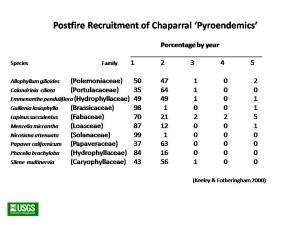
The managers of these projects are apparently unaware of the fact that hundreds of species of California native plants require fire to germinate their seeds and that most of the population will die within 5 years of the fire. (3) These are examples of such “pyroendemics” that sprout after a fire and are almost entirely gone within 5 years:
UC Berkeley and East Bay Regional Park District do not plan to plant any natives after eradicating non-native plants and trees. Their plans say that they expect seeds that are dormant in the ground to sprout when the ground is cleared of non-native plants. Unless they set fire to that ground, many seeds will not germinate and most of the plants that are germinated by that fire will disappear within 5 years unless another fire germinates another generation of plants.
UC Berkeley does not use prescribed burns on its property. East Bay Regional Park District (EBRPD) conducts only a handful of small prescribed burns every year, which they claim are solely for the purpose of reducing fuel loads. In an article about prescribed burns conducted by EBRPD, the District’s “Resource Analyst” is quoted as saying, “’This is not a restoration project. Our primary goal is fuels reduction.’” (4) Ironically, both of these owners of public lands claim that their objective in the eradication of non-native plants is to reduce fire hazard, yet they are trying to reintroduce a landscape that is dependent upon fire for survival.
The Natural Areas Program in San Francisco has never conducted a prescribed burn and the DRAFT Environmental Impact Report for their plan says they do not intend to do so in the future.
New and growing evidence that soil is altered by plants
In addition to these issues which have contributed to the failed attempts to reintroduce an historical landscape to the San Francisco Bay Area, we are reporting today on a new issue. Plants can change the microbial composition of the soil, including mycorrhizal fungi which have symbiotic relationships with plants.
Researchers tested soil for changes in composition after just three growth cycles. Several species of non-native annual grasses were grown in native soils. They reported that the non-native species reduced the population and changed the composition of the mycorrhizal fungi, which reduced the ability of native species to establish and persist in modified soils. (5)
The Berkeley Meadow is a 72-acre native plant garden on a former garbage dump on landfill.
How many more decades and how much more taxpayers’ money must we spend on these projects before land managers acknowledge their failures?
***********************
(1) Lewis Ziska, USDA Scientist, Beltsville, MD
(2) US Fish & Wildlife, Recovery Plan for Mission Blue butterfly
(3) Jon Keeley, et. al., Fire in Mediterranean Ecosystems, Cambridge University Press, 2012
(4) Wendy Tokuda, “Taming the Flames,” Bay Nature, July-September 2012
(5) Nicholas Jordan, et. al., “Soil-Occupancy Effects of Invasive and Native Grassland Plant Species Composition and Diversity of Mycorrhizal Associations,” Invasive Plant Science and Management, October-December 2012
Update: US Fish & Wildlife published the final rule designating critical habitat for Franciscan manzanita on December 20, 2013. 230.2 acres of land in San Francisco have been designated as critical habitat: 46.6 acres of federal land, 172.8 acres of parks owned by San Francisco’s Recreation and Parks Department, and 10.8 acres of private land. The complete document is available here. The document responds to public comments and explains any differences between the proposed designation and the final rule. It makes interesting reading.
In addition to the conferral of endangered status, US Fish & Wildlife has designated 318 acres of land in San Francisco as critical habitat for the Franciscan manzanita. Critical habitats are places where the endangered plant is either known to have existed in the past or they are places that provide what the plant needs to survive.
Five of the eleven places in San Francisco designated as critical habitat are on federal land in the Presidio. (Details about all the critical habitats are available here.) Forty of the 318 acres are on private land. Six of the critical habitats are in 196 acres of San Francisco’s city parks:
Corona Heights
Twin Peaks
Mount Davidson
Glen Canyon Park (erroneously called Diamond Heights by US Fish & Wildlife)
Bernal Hill Park (erroneously called Bernal Heights by US Fish & Wildlife)
Bayview Hill Park
The taxonomy of manzanita is ambiguous
There are 96 species of manzanita in California (1). The ranges of most of these species are extremely small because the manzanita hybridizes freely and therefore adaptive radiation has resulted in a multitude of species, sub-species, and varieties that are adapted to micro-climates. Many of these species are locally rare, which is consistent with the fact that 6 species of manzanita have already been designated as endangered, two of which are limited to the San Francisco peninsula: Raven’s manzanita and Franciscan manzanita.
The genetic relationship between these two species of manzanita is ambiguous, which is reflected in the constantly shifting opinions of biologists about the taxonomy (species classification) of manzanita. The 2003 Recovery Plan for Raven’s manzanita recounted the long history of these shifting views. For some time, Raven’s and Franciscan manzanitas were considered the same species. Then, for an equally long time, they were considered sub-species of the same species, Arctostaphylos hookeri. It was not until 2007, that Raven’s was reclassified as a sub-species of Arctostaphylos montana. Presently, Franciscan manzanita is classified as its own species, Arctostaphylos franciscana.
Clearly, this history of the biological opinion regarding these two species of manzanitas suggests they are closely related and morphologically (AKA anatomically) similar. The Recovery Plan concludes, “The idea of ‘pure’ species in Arctostaphylos, with its many poorly defined taxa and prevalent hybridization has often been difficult to apply over the history of taxonomic work in the genus.”
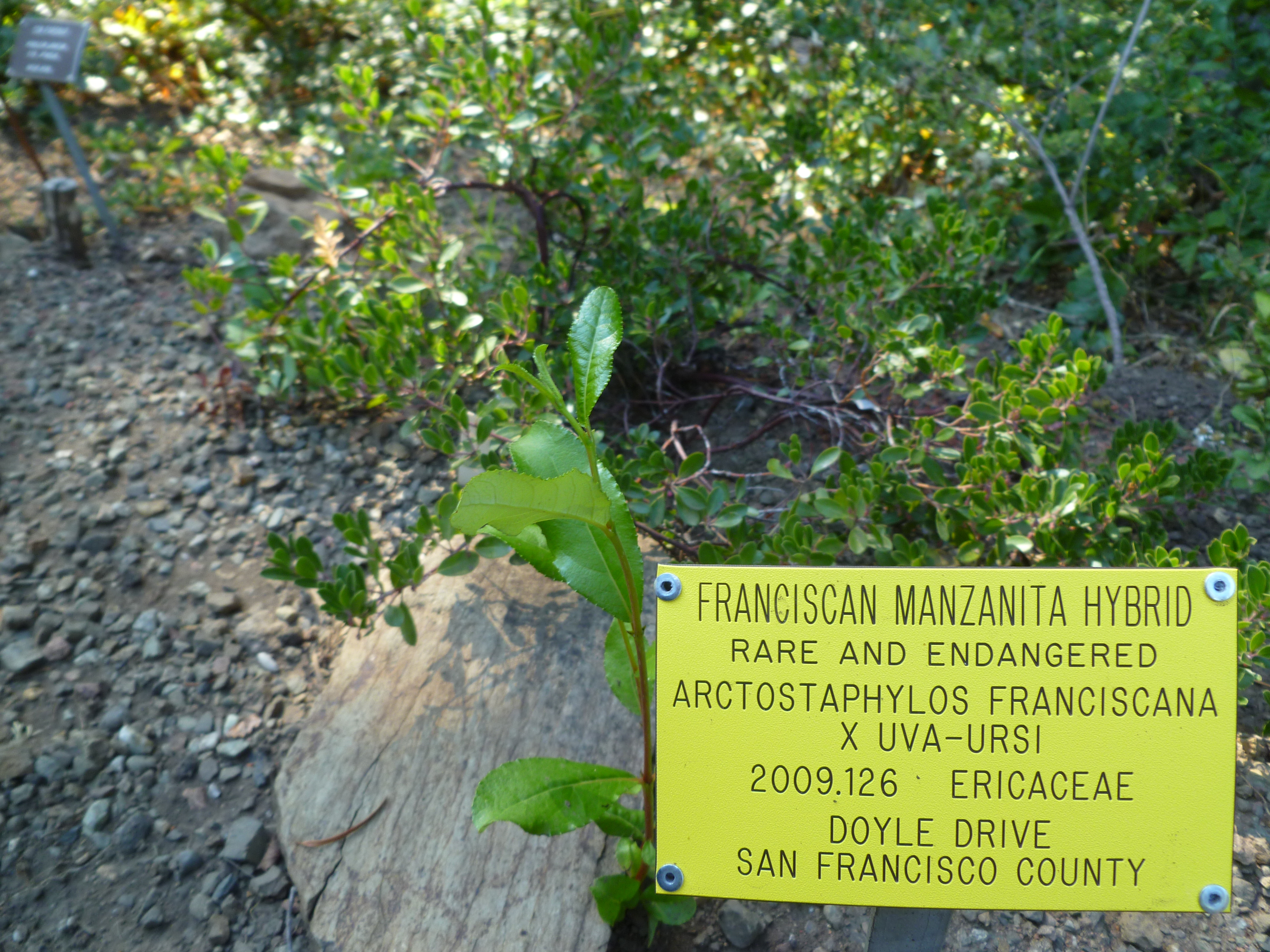
To add to the confusion regarding the provenance of Franciscan manzanita, some biologists are of the opinion that the individual plant that was discovered on Doyle Drive is actually a hybrid, not a pure-bred Franciscan manzanita. The East Bay Regional Park District botanical garden in Tilden Park has planted a clone of the individual plant from Doyle Drive. It is labeled as a hybrid of Arctostaphylos uva-ursi, which is one of the few species of manzanita with a wide range.
This is the label on the “Doyle Drive” manzanita in Tilden Park Botanical Garden, indicating that it is a hybrid.
The park ranger who led us to this plant in the Tilden garden, pointed out that the plant is morphologically distinct from the Franciscan manzanita that has been resident in that garden for about 50 years. He expressed his opinion that the Doyle Drive manzanita was properly labeled as a hybrid.
In what sense is the Franciscan manzanita “endangered?”
Franciscan manzanita has been available for purchase in nurseries for about 50 years. It has been propagated by taking cuttings and therefore they are presumed to be genetically identical clones. However, given that this plant has been sold to the public for a long time, we have no way of knowing exactly where they have been planted or if some have successfully reproduced by germinating seeds. For all we know, this plant is thriving somewhere, perhaps even in a place we might call “wild.” Perhaps the plant found on Doyle Drive was purchased in a nursery!
The individual plant found on Doyle Drive has been defined by USFWS as Franciscan manzanita despite the fact that some biologists consider it a hybrid of another species. We understand that the motivation for designating this individual as an endangered species and providing it with critical habitat is based on an assumption that it is genetically different from the Franciscan manzanita that can be purchased in nurseries and that the chances of survival of the species may be improved by cross-fertilization of these two plants such that greater genetic diversity results from their union.
Yet we are offered no evidence of the genetic composition of the Doyle Drive individual or Franciscan manzanita sold in nurseries. Nor are we provided any evidence that the Doyle Drive individual is even a genetically “pure” Franciscan manzanita rather than a hybrid of another species altogether.
If we weren’t being asked to devote 318 acres of land to the propagation of a plant with such ambiguous taxonomy, we might not question how little information we have been provided. The technology of mapping the genome of this plant is available to us. Why aren’t we making use of this technology to resolve these ambiguities? The cost of planting 318 acres with this endangered plant far exceeds the cost of such genetic analysis.
We aren’t told what it will cost to plant 318 acres with this endangered plant, but we know that the cost of the recovery plan for Raven’s manzanita and lessingia was estimated as $23,432,500 in 2003. Presumably that is an indication that the proposal for Franciscan manzanita will be a multi-million dollar effort. The cost of transplanting the single plant from Doyle Drive to the Presidio was reported as over $200,000. (1)
Thirty years of endangered status for Raven’s manzanita has not saved this plant
We have already made the point that Raven’s and Franciscan manzanitas are closely related. In its proposal for the designation of critical habitat for Franciscan, USFWS confirms this close relationship by referring us to the Recovery Plan for Raven’s. In other words, the characteristics and horticultural requirements of these two species are so similar that a separate Recovery Plan for Franciscan is not necessary. The Recovery Plan for Raven’s is applicable to Franciscan.
Therefore, we should assume that the fate of the recovery effort for Franciscan will be similar to that for the Raven’s. Raven’s was designated as endangered in 1979. Its first recovery plan was published in 1984 and the second in 2003. Many 5-year reviews of its endangered status have been done during this 33 year period. The most recent 5-year review was published in June 2012; that is, very recently.
So what does USFWS have to show for 33 years of effort to save Raven’s manzanita from extinction? Almost nothing:
Clones of the single plant in the wild exist in several botanical gardens. These clones are genetically identical and their growth in maintained gardens does not meet ESA standards for recovery.
“The wild plant has been observed to set seed although no natural seedling establishment is known to have occurred.” (6)
The plant has been the victim of twig blight several times, but the fungus cannot be treated because it would damage the mycorrhizal fungi in the soil upon which the plant is dependent.
The seeds depend upon animal predators for dispersal which are largely absent in an urban area.
The pollinators of manzanita have not been identified and therefore there is no assurance that they still exist in this location.
The 5-year review concludes that: “…recovery sufficient to warrant full delisting is not projected in the foreseeable future for [Raven’s manzanita] and may not be possible.”
We can’t appreciate the significance of the utter failure of this effort without some mention of the extreme methods used to overcome these obstacles.
The seed of manzanita is germinated by fire. However, the exact relationship between fire and germination is not known. Therefore, many complex experiments have been conducted on the few viable seeds produced by the Raven’s manzanita in a futile effort to determine the winning combination. These experiments are described in detail in an article in Fremontia (1). In short, various combinations of fire, heat, cold, smoke, liquid smoke, etc., were tried and failed to determine exactly what triggers germination of manzanita seeds.
We should remind our readers of the legal definition of “recovery” according to the Endangered Species Act. According to the 5-year review for Raven’s manzanita, here are two of the criteria for recovery toward which there has been no progress in 33 years:
“At least five spontaneously reproducing variable populations are established in reserves…in San Francisco…”
“At least two sexually reproduced generations are established within the Presidio.”
Frankly, it is no longer credible to expect the recovery of Raven’s manzanita and this failure implies the same fate for Franciscan manzanita.
Can the public parks of San Francisco meet the horticultural requirements of Franciscan manzanita?
The public parks of the City of San Francisco cannot meet the horticultural requirements of the Franciscan manzanita because it requires fire to germinate its seeds.
All of the critical habitats proposed by USFWS in San Francisco’s public parks are designated “natural areas.” According to the DRAFT Environmental Impact Report of the “Significant Natural Resource Areas Management Plan,” prescribed burns are prohibited in the natural areas. Therefore, unless there are unplanned wildfires in the six public parks proposed as critical habitat, it will not be physically possible to “spontaneously reproduce” this plant, as required by the Endangered Species Act.
Granted, the City of San Francisco could revise its management plan for the natural areas to allow—or even require—prescribed burns in the six parks proposed as critical habitat. In that case, the citizens of San Francisco would be subjected to air pollution and risk of causing an uncontrolled wildfire in surrounding residential communities. The Natural Areas Program would be subject to even more criticism than it already endures.
The Natural Areas Program is extremely controversial in the City of San Francisco because it destroys healthy non-native trees, it sprays pesticides on non-native vegetation in public areas, it destroys the habitat of wildlife, and it limits the public’s recreational access to trails which are often fenced. Subjecting the natural areas to prescribed burns is surely the bridge too far for the public which would jeopardize the future of the entire program. Why would the City of San Francisco be willing to push the public over the edge by requiring prescribed burns in six urban parks in densely populated residential communities?
Furthermore, some of the proposed critical habitat is in heavily forested areas, which are not compatible with the requirement of manzanita for full sun. As they were on behalf of Raven’s manzanita, these trees would be destroyed. The City of San Francisco is already planning to destroy 18,500 trees over 15 feet tall to accommodate its desire to reintroduce native plants to forested areas. (3) How many more trees would need to be destroyed to accommodate Franciscan manzanita? How much more carbon dioxide would be released into the atmosphere by the destroyed trees?
Bayview Hill is one of the proposed critical habitats which are heavily forested. According to SNRAMP (3), 17.16 acres of Bayview Hill is forested. Given that Bayview Hill is the only proposed critical habitat which is outside the known historic range of Franciscan manzanita, the loss of 17 acres of trees does not seem a fair trade for a plant with few prospects for survival.
The proposed critical habitat in Glen Canyon Park (inaccurately called Diamond Heights by the proposal) is also forested in a portion of the 34 proposed acres of critical habitat. This is a park in which the destruction of trees is being hotly contested. The community in this park does not need the additional controversy of tree destruction for the sole purpose of planting an endangered species.
Proposed critical habitat in other city parks is likely to be controversial for other reasons, primarily because additional restrictions on recreational access will undoubtedly be required to protect this endangered plant. Bernal Hill is an example of a city park with a huge community of visitors who will undoubtedly be enraged by further loss of recreational access. They have already been squeezed by the restrictions imposed by the Natural Areas Program.
This proposal for critical habitat is not good public relations for the Endangered Species Act
The City of San Francisco is the second most densely populated city in the country. It is comprised of only 29,888 acres. There are only 3,317 acres of City-managed parks in the city. (2) The proposed critical habitat in City-managed parks is 196 acres, 6% of total City-managed park land in San Francisco.
Please ask yourself these questions:
Does it make sense for 6% of all City-managed park land to be permanently committed to planting an endangered plant which can be purchased in nurseries?
Does it make sense to confiscate 6% of all public parks for a plant the identity of which we are not certain?
Does it make sense to throw the public out of 6% of all public parks on behalf of a plant that will never be able to spontaneously reproduce unless there is an accidental wildfire?
We think the answers to these questions are no, no, and no. This is an ill-advised proposal which makes a mockery of the Endangered Species Act. This is an important law that is trivialized by a proposal that will be physically impossible to implement without endangering the public and damaging the environment.
Comments on the proposed critical habitats will be accepted until November 5, 2012. Comments may be submitted online at the Federal eRulemaking Portal at http://www.regulations.gov (Docket Number FWS–R8–ES–2012–0067) or by U.S. mail to:
Public Comments Processing
Attn: FWS–R8–ES–2012–0067
Division of Policy and Directives Management
U.S. Fish and Wildlife Service
4401 N. Fairfax Drive, MS 2042-PDM
Arlington, VA 22203.
*********************************
Bibliography
(1) Gluesenkamp, Michael, et al., “Back from the Brink: A Second Chance at Discovery and Conservation of the Franciscan Manzanita,” Fremontia, V37:4/38:1, 2009-2010
(2) Harnik, Peter, Inside City Parks, Trust for Public Land, 2000
(3) San Francisco Recreation and Park Department, “Significant Natural Research Area Management Plan (SNRAMP),” 2006
(4) San Francisco Recreation and Park Department, “DRAFT Environmental Impact Report for SNRAMP,” 2011
(5) USFWS, “Designation of Critical Habitat for Franciscan Manzanita,” September 5, 2012
(6) USFWS, “5-Year Review of Endangered Status of Raven’s Manzanita,” June 2012
(7) USFWS, “Recovery Plan for Coastal Plants of the Northern San Francisco Peninsula,” 2003
 Conservation Sense and Nonsense