In June 2023, Washington Post published an opinion piece advocating for the use of herbicides to kill non-native plants, in which Doug Tallamy was quoted as saying that spraying herbicide on non-native plants is “chemotherapy,” equating non-native plants with cancer and pesticides with medical therapy. Tallamy. and more broadly his viewpoint, received some blowback from Conservation Sense and Nonsense and others.
Thomas Christopher and Doug Tallamy collaborate on their shared mission of promoting the use of native plants and the closely related goal of eradicating non-native plants they consider a threat to native plants and insects. In October 2023, Tom Christopher (TC) gave Doug Tallamy (DT) an opportunity to respond to criticism of native plant dogma on his Growing Greener podcast that is available HERE. Christopher also invited listeners to send him feedback on the podcast. Professor Art Shapiro, whose work was central to the interview, has responded separately and his response is available as a footnote. Conservation Sense and Nonsense (CSN) sent Christopher an email, which I hope he shared with Tallamy. The following is an excerpt from that email.
Hi Tom, Thanks for the air time for opposition to eradicating non-native plants in your interview with Doug Tallamy and for this opportunity to respond. I’m flattered that criticism of native plant dogma has attracted some attention on the East Coast. I’ve transcribed most of your interview with Doug Tallamy as best I can and provided some feedback to Tallamy’s viewpoint. I sent Art Shapiro the podcast and he has responded separately.
TC: Some people say that non-native plants are just as effective as natives in supporting food webs. For example, buddleia that is spreading throughout the East and West is used by butterflies.
CSN: Buddleia davidii is on California’s list of invasive plants, but it is not considered invasive in California. It was put on California’s list because it is considered invasive elsewhere, making the point that invasive plant behavior varies depending on local conditions, such as climate. Sweeping generalizations about invasiveness are rarely accurate. If gardeners are concerned about the potential for invasive behavior, they can plant a cultivar of buddleia that does not reproduce.
DT: We shouldn’t call all insects pollinators. Just because an insect visits a flower for nectar doesn’t mean it’s pollinating that flower. There are more visitors to flowers than there are pollinators. Butterflies visiting buddleia are just there to sip nectar.
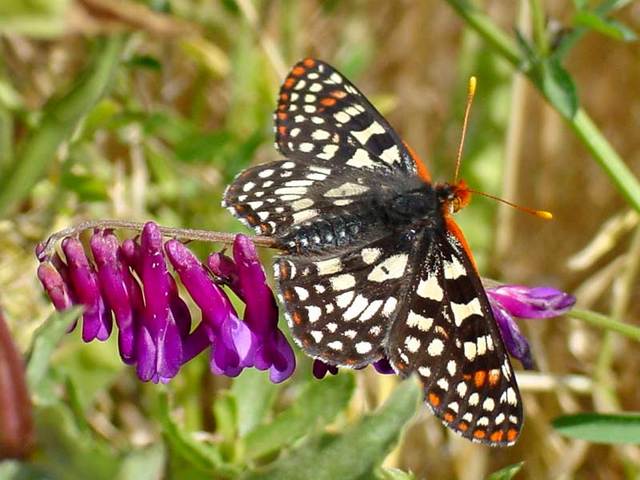
CSN: Buddleia davidii is native to Central China. Non-native buddleia is used by a butterfly species that is native to California and other states in the Western US.
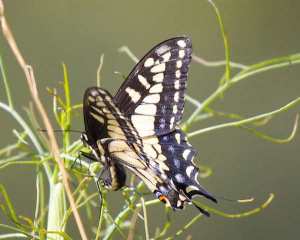
The first actual observation of checkerspot butterflies breeding spontaneously and successfully on buddleia was in Mariposa County, California in the Sierra Nevada foothills. Checkerspot bred there successfully on buddleia in 2005 and in subsequent years. This colony of checkerspot on buddleia was reported in 2009: “We conclude that buddleia davidii [and other species of buddleia] represents yet another exotic plant adopted as a larval host by a native California butterfly and that other members of the genus may also be used as the opportunity arises.” (1)
In 2017, a gardener in Mendocino County, California also reported the use of buddleia as the host plant of checkerspot: “By now I am questioning how it was that butterfly larvae were using my butterfly bush as a host plant, completely against everything I’d ever heard. How was this possible? I emailed Art Shapiro, a very well-known butterfly expert and author, sending him a pic. He wrote back to confirm they were butterfly larvae, but added, ‘These are not mourning cloak butterflies. They are checkerspots. And the only time I’m aware this has happened [like, ever, except one in a lab in 1940…] is in Mariposa County.’” (2)
Buddleia is available as the host plant of checkerspot butterflies with a native range from Alaska south along the Pacific Coast through California and Arizona to Baja California and Mexico; east to Montana, the Dakotas, Wyoming, Colorado, New Mexico. This is a clear case of a widespread native butterfly choosing a non-native plant as its host.
- Arthur M. Shapiro and Katie Hertfelder, “Use of Buddleia as Host Plant by Euphydryas chalcedona in the Sierra Nevada foothills, California,” News of the Lepidopterists’ Society, Spring 2009
- http://plantwhateverbringsyoujoy.com/never-pull-up-and-discard-what-you-cannot-identify/
DT: Most bees that people see in their gardens are honeybees that are there to get pollen and sometimes nectar. These are generalist bees but specialist bees that require pollen from particular plants (always native plants) can’t be supported by those at all.
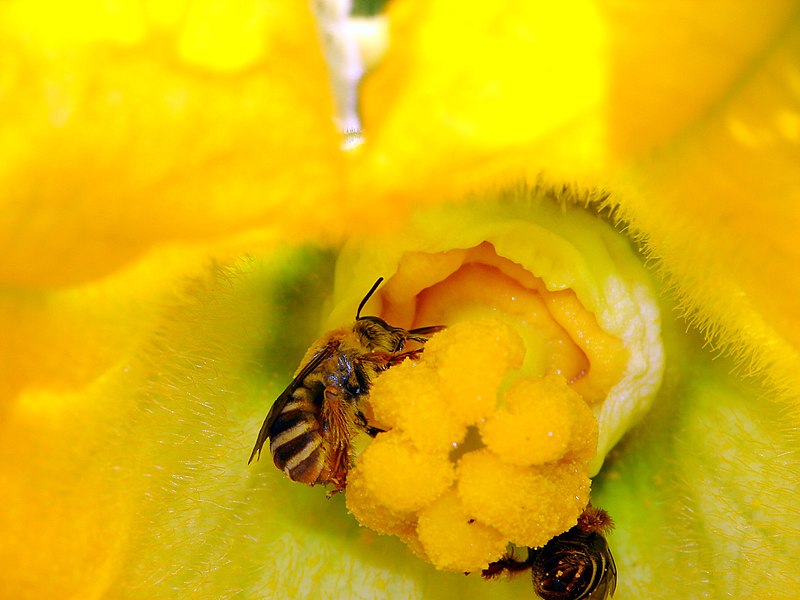
CSN: Specialization of insects is exaggerated by Tallamy. For example, he would probably call a squash bee a specialist. As its name implies, its host plant is squash plants in the squash family, with 98 genera and 975 species. The squash bee is considered an excellent pollinator of zucchini and butternut squash, both native to Central and South America. However, they do not usually visit melon plants, according to Wikipedia. Again, we are reminded to avoid broad generalizations when describing the complex and diverse natural world.
Likewise, the native alkali bee is a particularly effective pollinator of alfalfa, which is native to the Mediterranean region. Alkali bees also pollinate members of the large legume family with over 16,000 species that are native all over the world. If you are interested in such associations, you can find an exhaustive list of native butterflies and their many non-native host plants in Art Shapiro’s butterfly guide for Central California and the Bay Area. It is not true that bees Tallamy considers “specialists” require pollen from only native plants.
DT: Sometimes butterflies adopt a new host plant as a caterpillar host. For example, black swallowtail butterflies caterpillars eat carrots or parsley or dill. What’s going on? There are two different kind of hosts: 1) The caterpillar has not adopted a new host at all because it was already adapted to that particular host. 2) Actual host switching from one plant to another is very rare. It happens on a time-scale of thousands of years. It requires a mutation or an adaptation to chemical defenses of new host plants.
CSN: Tallamy tries to make a distinction to avoid acknowledging that insects make use of introduced plants because they are chemically similar to the native plants they have used in the past, which in some cases are no longer available. The butterfly has, in fact, adopted a new host, a plant that wasn’t there before and is now hosting the caterpillar. There are many cases of rapid evolution that enable such transitions, but both cases are clearly transitions from native to non-native plants. If the original native host is still available, it isn’t necessarily abandoned in favor of a non-native. Such transitions are useful because they increase the population of available insect hosts and are essential if the original native host is no longer available.
TC: Pushback from California cites research of Professor Art Shapiro reporting that spontaneous spread of non-native plants has benefited native butterflies. He reports that 82 of 236 California native butterfly species (34%) are laying their eggs on introduced plant taxa, so caterpillars feed on them and many more butterflies use introduced plants as nectary sources.
DT: Great! These are host range expansions. Agriculture in California has eliminated the host plants of a lot of butterflies and it’s a good thing we had close relatives of natives so butterflies could expand their host range and use them. But if 34% of native butterflies are using introduced plants that means 66% are not. If all plants were introduced, we would lose 66% of butterflies in California. This is not the direction I want to go. I would choose 60% rather than 34%.
CSN: Christopher and Tallamy seem to have read one sentence in the abstract of Shapiro’s study without reading subsequent sentences: “Interactions with introduced plant taxa are not distributed evenly among butterfly species. Alpine and desert butterflies interact with relatively few introduced plants because few exotic plant species have reached and successfully colonized these habitats. Other California butterfly species are specialists on particular plant families or genera with no exotic representatives in California and have thus far failed to recognize any introduced plants as potential foodplants. Some California butterflies have expanded their geographic ranges and/or extended their flight seasons by feeding on exotic plants.” In other words, where there are more introduced plants and some are closely related to native plant hosts, more native butterflies use introduced plants.
TC: What do you say to the claims that introduced plants stay greener longer than native plants adapted to wet or dry seasons so that introduced plants give rise to extra generations of caterpillars?
DT: This is only true if caterpillars can use those plants and in host range expansions they can. Shapiro is also right about extending availability of nectar. For example, monarchs that migrate need forage along the way. The minus is that we’ve been so hard on native flora. These insects were doing just fine before we brought in non-native plants. It’s a Band-Aid we’re putting on an environment that has been ravaged by taking out native species that were here before. Let’s put native species back too.
CSN: The claim that non-native plants are driving native plants to extirpation or extinction goes to the heart of the controversy. Native plant advocates believe that accusation, although there is little evidence to support it. The greatest threat to native plants and insects is habitat loss, particularly converting wildlands to agricultural fields. The second greatest threat is the pesticides that are used by agriculture. Remember that Tallamy is an enthusiastic promoter of herbicides to eradicate non-native plants. He calls it “chemotherapy” in a recent opinion column in the Washington Post. Pesticides kill both plants and the animals that feed on them, they are anathema to biodiversity and the food web that Tallamy believes he is supporting.
Marcel Rejmanek (UC Davis) is the author of the most recent report on plant extinctions in California, published in 2017. At that time there were 13 plant species and 17 sub-species native to California known to be globally extinct and another 30 species and sub-species extirpated in California but still found in other states. Over half the globally extinct taxa were reported as extinct over 100 years ago. Although grassland in California had been converted to Mediterranean annual grasses by grazing domesticated animals decades before then, most of the plants now designated as “invasive” in California were not widespread over 100 years ago.
Most of the globally extinct plant species had very small ranges and small populations. The smaller the population, the greater the chances of extinction. Most of the globally extinct plants were originally present in lowlands where most of the human population and habitat destruction are concentrated. Although there are many rare plants at higher altitudes, few are extinct. Plants limited to special habitats, like wetlands, seem to be more vulnerable to extinction. The primary drivers of plant extinction in California are agriculture, urbanization and development in general. Non-native plants are the innocent bystanders to disturbance.
“Invasive species” are mentioned only once in the inventory of extinct plants published by California Native Plant Society and only in combination with several other factors. However, the identity of this “invasive species” is not clear. Rejmanek suggests that the “invasive species” rating refers to animal “invasions” by predators and grazers. He says, “Indeed, one needs quite a bit of imagination to predict that any native plant species may be driven to extinction by invasive plants per se.” (Marcel Rejmanek, “Vascular plant extinctions in California: A critical assessment,” Diversity and Distributions, Journal of Conservation Biogeography, 2017)
TC: 90% of all insect species are specialists that have evolved in concert with only one or a few plant lineages. How can they cope with the loss of native plants?
DT: Native plants are adapting in evolutionary time. Specialization is a continuum. Few insects are confined to a single plant species, some are confined to one or two genera, and others are confined to one or two families of plants. But if you are looking at the number of plants available to them, only about 7% of plants they are adapted to are available to them. 93% of available plants are not viable hosts for insects. Everything is a specialist on one level of another.
CSN: That sounds like an argument for a diverse garden, with many plant species that offer more food sources for insects. That doesn’t seem a sound argument for eradicating non-native plants.
TC: I understand that some native plants are more useful to insects than others?
DT: These are the keystone species. Many native plants don’t support insects because plants are well-defended against them. Keystone species are making most of the food for the food web. Just 14% of native plants across the country are making 90% of food that drive the food web. 86% of the native plants are not driving the food web. Insect food comes from the big producers, like oaks, black cherries, hickories, and birches.
CSN: That is a mind-boggling admission!! Earlier Tallamy complained that non-native plants are hosting only 34% of butterflies in California. Now he says that only 14% of native plants are useful to insects. He asks home gardeners to plant only native plants as well as limit our plantings to a small subset of native plants.
Tallamy’s ideology is antithetical to the goal of biodiversity, which could be the salvation of ecosystems in a changing climate. Since we can’t predict the climate of the future, biodiversity provides more evolutionary options, which increases the chances that some species will survive. Tallamy asks us to put a few eggs in the huge basket of our ecosystems, reducing their ability to survive the challenges of our changing climate.
For example, in Oakland, California, where I live, there were approximately 10 species of native trees prior to settlement. In 1993, there were 350 tree species in Oakland. (David Nowak, “Historical vegetation change in Oakland and its implications for urban forest management,” Journal of Arboriculture, September 1993) The recently published draft of Oakland’s Urban Forest Plan reports that there are now over 500 tree species in Oakland. I can’t fathom why Oakland would want to limit the planting of trees to only 10 native species.
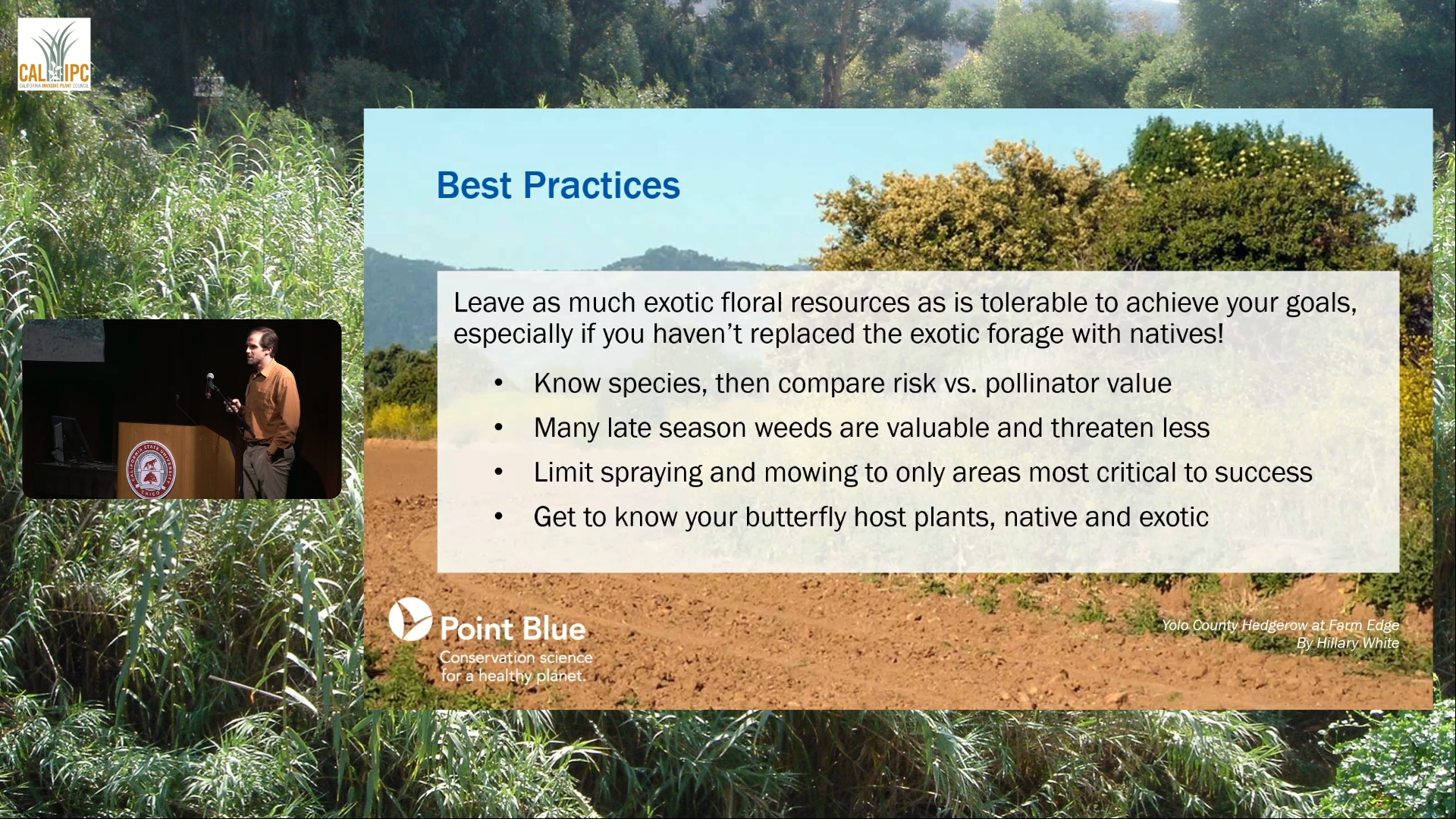
I agree with Tallamy that many native plants are not useful to insects. I attend the annual conference of California Invasive Plant Council to give native plant advocates every opportunity to convince me of their viewpoint. At the most recent conference at the end of October, Corey Shake of Point Blue Conservation made a presentation about his project to “Evaluate native bee preference for common native and exotic plants.”
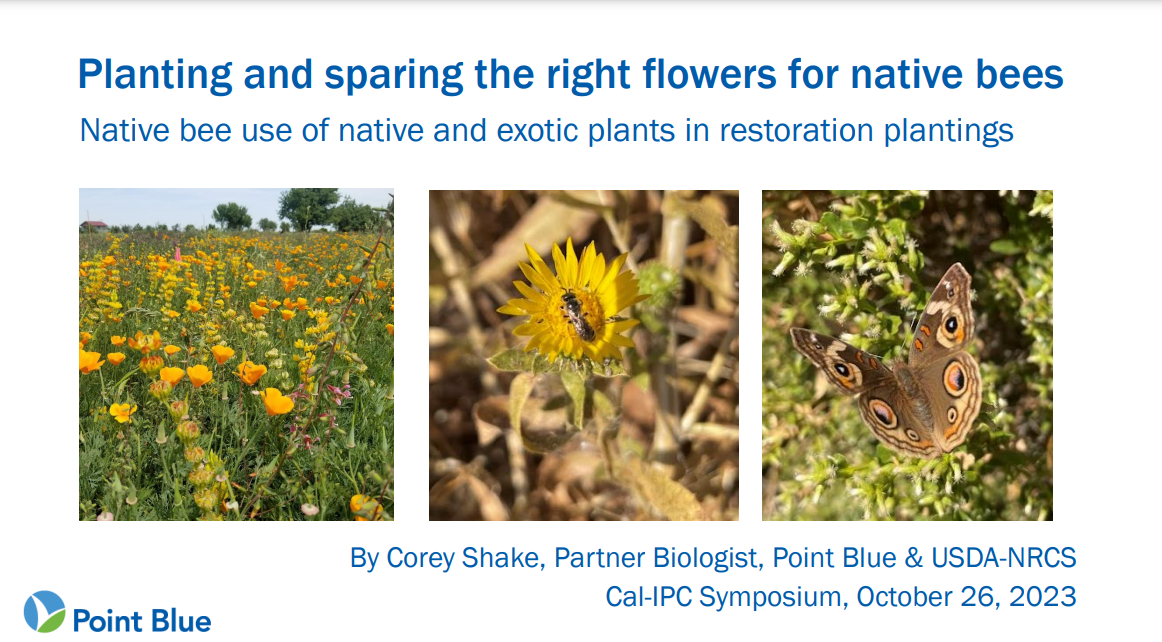
He designed 16 hedgerows around agricultural fields in Yolo County to determine if native bees have a preference for native plants or exotic plants, by controlling for availability of native plants compared to exotic plants. Here is his abstract:
“Farm edge restoration monitoring in Sacramento Valley highlights native bee use of some exotic plant floral resources. Corey Shake. Point Blue Conservation Science. cshake@pointblue.org
“Research of native bee preference for native versus exotic plant floral resources in California’s Sacramento Valley has shown mixed results. No studies have demonstrated a preference for exotic plants by native bees there, but some have highlighted the importance of exotic plant floral resources in plant-pollinator networks and expressed concern that rapid removal of exotic plants without restoring native plant populations could have negative impacts on native bees. We have been collecting native bee flower visitation, plant species, and floral abundance data on 16 farm edge restoration projects in Yolo County, California since 2019, which will allow us to assess bee preferences for some key native and exotic plants relative to their floral abundance. In our preliminary analysis, we see some important trends: (1) relative to their floral abundance in our plots, some native plant species are more frequently visited by native bees than other native plants that are infrequently or rarely visited, and (2) there is significant native bee visitation to some exotic plants relative to their floral abundance. We will further evaluate these data as well as our butterfly diversity and abundance data to provide plant-species specific insights to restoration practitioners and weed management specialists to help them reduce harmful impacts to native pollinators when executing restoration projects and managing weeds.”
In other words, not all species of native plants are useful to native bees and some species of non-native plant species are useful to native bees. Tallamy’s sweeping generalizations about the usefulness of native plants to insects are not supported by empirical or field studies. Although the characteristics of plants vary widely, the variation is unrelated to the national origins of plants.
From Micro to Macro Perspective
I recognize my voice in the questions Tom Christopher asked of Doug Tallamy, as well as Art Shapiro’s. Speaking for myself, not for Art, this interview misses the point of my criticism of native plant ideology. I like native plants as much as I like any plant and I encourage everyone to plant whatever they prefer. I only object to the pointless destruction of harmless non-native plants that thrive because they are best adapted to the conditions where they have naturalized. Non-native plants do particularly well in the wake of disturbance. Where they have replaced native plants, the natives were destroyed by disturbance, not by the hardy non-native plants that can tolerate disturbance. Non-native plants are a symptom of change, not the cause.
I object to destructive eradication projects because they poison the soil with herbicides, making it even less likely that non-native plants will be replaced by fragile native plants. I object to the loss of biodiversity which is a hedge against extinction in a rapidly changing climate. We don’t know which plants will be capable of surviving in the changed climate. We should not be taking cards out of the deck while we gamble with the future of the environment and everything that lives in it.
Unfortunately, native plant advocates take offense when anything positive is said about introduced plants. A positive statement about a non-native is routinely interpreted as a negative statement about native plants. It shouldn’t be. The emphasis on the negative assessment of introduced plants results in harmful land management decisions. The pros and cons of all plants should be considered before we condemn non-natives with a death sentence. Like our justice system for human society, all plants should be presumed innocent until proven guilty.
Thanks again for airing this debate on your podcast. I hope you will forward my email to Doug Tallamy
Webmaster, Conservation Sense and Nonsense

 Conservation Sense and Nonsense