US Fish & Wildlife Service (USFWS) proposes to kill 470,000 barred owls in the next 30 years in an effort to save the northern spotted owl (NSO) and a closely related sub-species in California. The deadline for making a comment on this proposal is January 16, 2024. Instructions for making comments are available HERE.
Today, I will tell you about this proposal, how it came about, and why I am opposed to the proposal. I provide links to the source documents so you can read them yourself. I hope this information will help you reach your own conclusions about the plan and submit a public comment.
USFWS Barred Owl Management Strategy
The purpose of the Barred Owl Management Strategy is protection for the dwindling population of northern spotted owls (NSO) in the Pacific Northwest (Washington, Oregon, and Northern California). NSOs were classified as a threatened species by USFWS in 1990. The first Recovery Plan for NSO, published in 2011, identified habitat loss and barred owls as the primary threats to NSOs. The most recent Recovery Plan has added “past habitat loss, continued timber harvest, and wildfire” to the list of threats to NSOs.
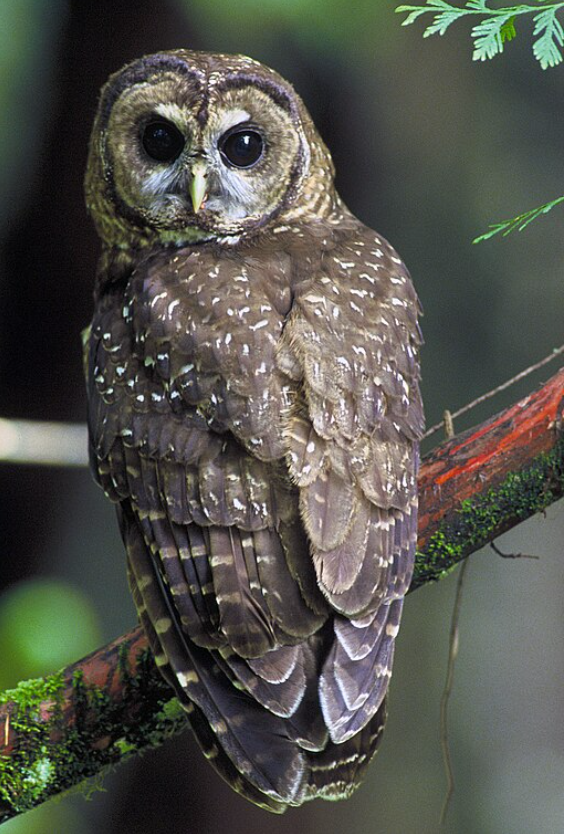
The Barred Owl Management Strategy also proposes “management” of barred owls to protect the California spotted owl (CSO), which is a subspecies of NSOs. Although endangered status for CSO was proposed in February 2023, endangered status has not been granted. Yet, USFWS proposes to extend the same lethal removal measures used to protect NSOs to CSOs. In addition to the threats to NSOs, California spotted owls are also threatened by fragmented habitat and forest mortality caused by drought and correlated disease, which have killed over 300 million conifers in California in the past 10 years.
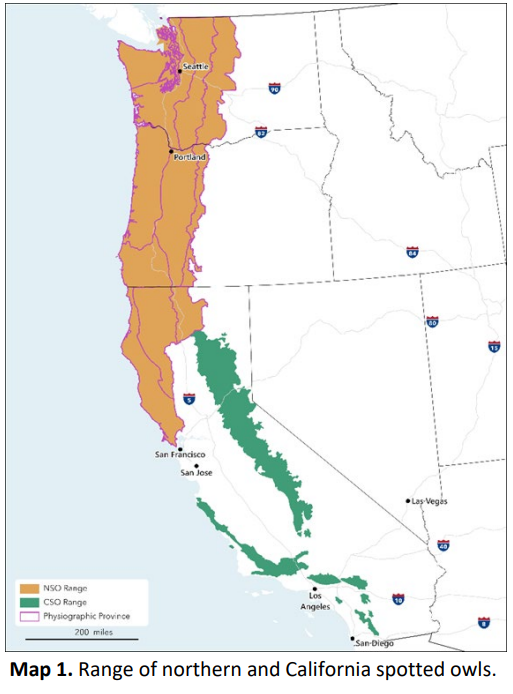
Source: Barred Owl Management Strategy
Despite the many threats to spotted owls, the Management Strategy intended to protect them addresses only one of those threats: barred owls. It makes no proposals for improving or expanding habitat or addressing the impact of climate change on forests.
The Barred Owl Management Strategy is a voluntary plan. Federal agencies in spotted owl territory (Bureau of Land Management, US Forest Service, and National Park Service) will be “encouraged” to implement the plan. If state, commercial, private property, and tribal land owners choose to participate they will be granted the same “take” permits required by the Migratory Bird Treaty Act that federal land managers will be granted, so long as they agree to follow the protocol for “removing” barred owls from their properties.
The word “removal” in the context of the Management Strategy means “lethal removal.” The protocol requires that barred owls be found by playing a recording of their distinctive call (described as “who cooks for you?”) and shooting the owl as it flies toward the call and the shooter. If guns are not allowed where barred owls are found, they must be captured and euthanized. Hybrids of barred owls and spotted owls will also be killed, despite the fact that accurately identifying hybrids is considered difficult, particularly in subsequent generations.
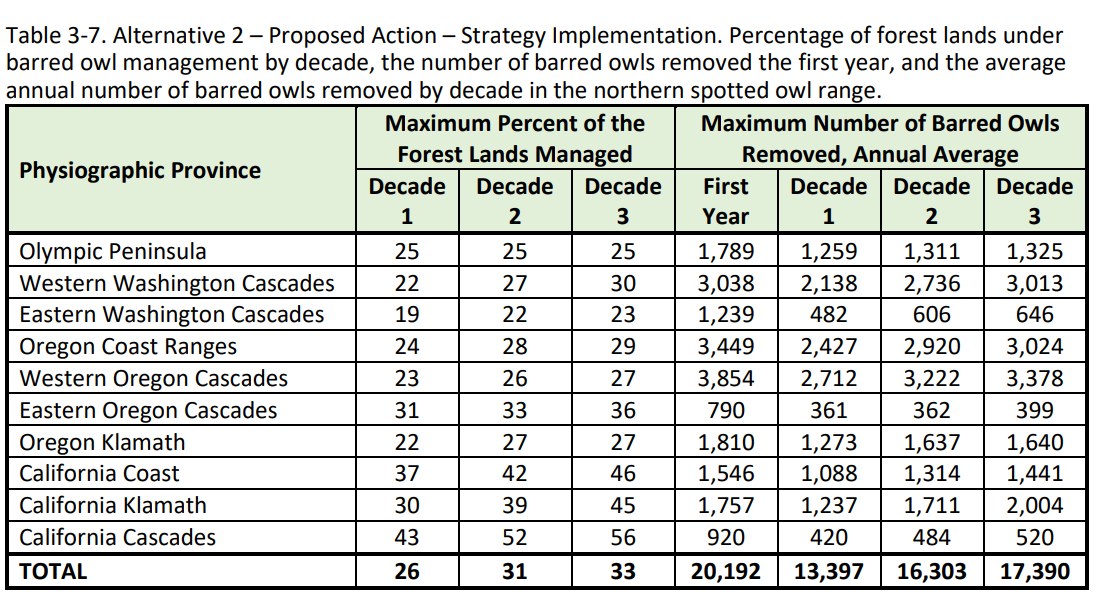
Because the Management Strategy is not mandatory, the total number of birds that will be killed can only be estimated. If all property managers choose to implement the Strategy, approximately 470,000 barred owls would be killed in the next 30 years. Although the Strategy covers only a 30 year time frame, “barred owl management will be required at same level for the long term” because “Their populations will continue to produce young that can disperse within and beyond the current range of barred owls.” (1) The estimated current population of barred owls in study areas of the Management Strategy is only 102,000. Clearly the lethal removal of barred owls is not expected to keep pace with the reproductive success of barred owls. The killing of barred owls will continue forever, although there is no expectation that they will be eliminated.
How were barred owls selected as the scapegoat?
When northern spotted owls were designated as “threatened” in 1990 it triggered the legal protections conferred by the Endangered Species Act. In 1994, the Forest Service and the Bureau of Land Management published the EIS for the Northwest Forest Plan. It created 24 million acres of reserve areas where logging was prohibited to preserve spotted owl habitat. The reserve areas protected approximately 80 percent of the remaining old growth forests in the Pacific Northwest from timber harvesting. Obviously, the plan had a negative impact on the timber industry and those who were employed by the industry. Between 1980 and 1998, 23% of logging jobs were lost, triggering the Timber Wars.
The rate of decline of spotted owl populations in the Pacific Northwest decreased when most logging in old-growth forest was stopped by the Northwest Forest Plan, but began to accelerate again in about 2008. USFWS attributes that increase in the rate of population decline to competition from barred owls and that theory is supported by several studies.
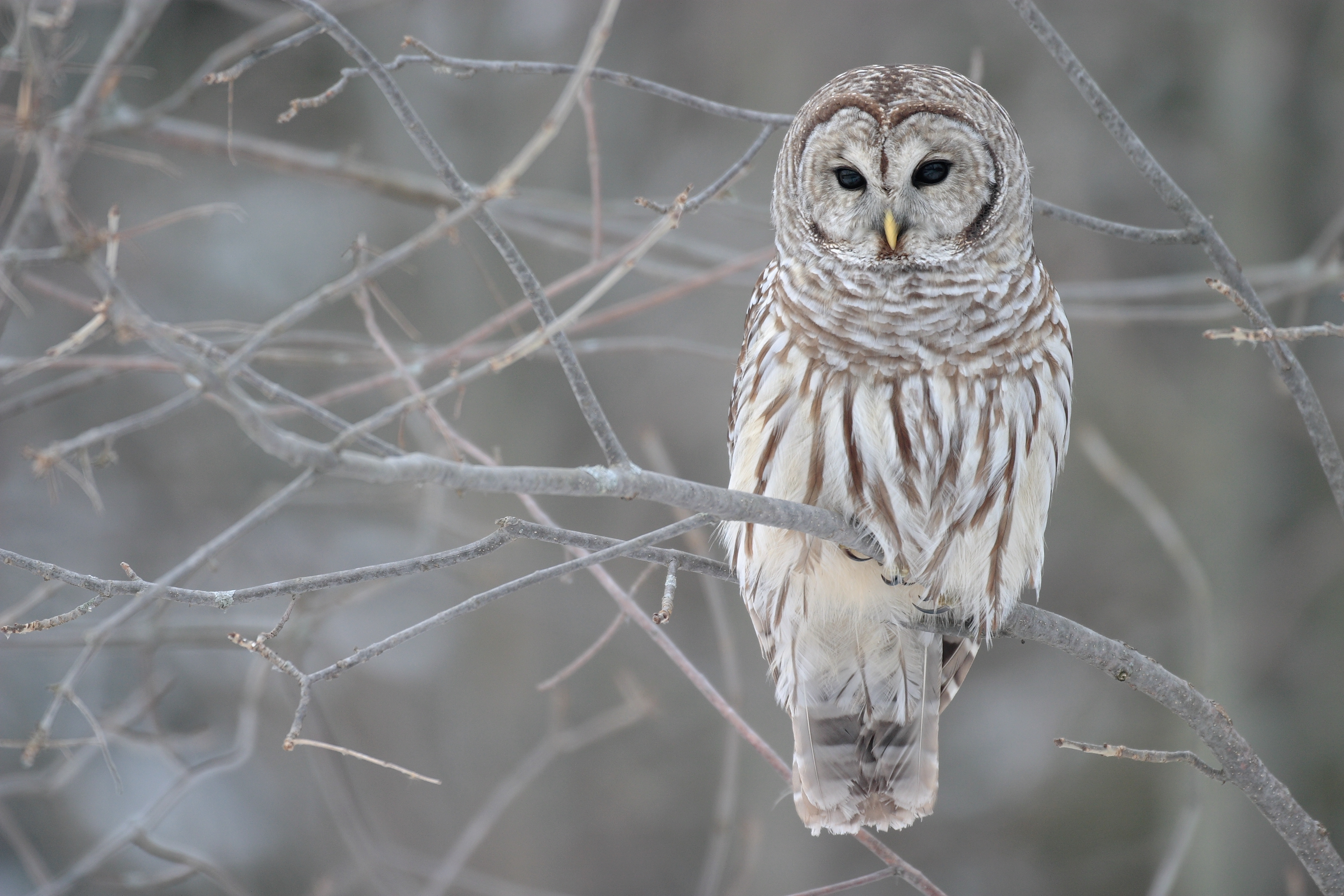
Barred owls are native to North America. They have been migrating from their historic range in the north and south east of the US to the west coast of North America since about 1900. Barred owls were first seen on the west coast of North America in British Columbia, Canada around 1959. They were first documented in Washington in the 1970s and have continued moving south from there.
Barred owls have successfully competed with spotted owls in their expanding territory because they are larger than spotted owls, they eat a wider variety of prey, they have greater reproductive success, and they are able to live in forests where spotted owls cannot. Spotted owls are restricted to old-growth forests with large trees and dense canopies, while barred owls often live in second-growth (previously logged) forests and even wooded urban areas.
The Management Strategy speculates that the omnivorous diet of barred owls will devastate the food webs in the new territory they occupy, although the Strategy offers no evidence to support that theory. In fact, as barred owls expanded their territory through the Canadian boreal forest, such devastation was not reported. Barred owls are not considered “invasive” in Canada.
The impact of barred owls on spotted owls was first observed by Lowell Diller, a wildlife biologist who worked as a consultant to Green Diamond Resource Co., a logging company managing timberland in Humboldt and Del Norte counties in Northern California. Mr. Diller was also an adjunct professor in the Department of Wildlife at Humboldt State University.
Owls, including barred owls, are protected by the Migratory Bird Treaty Act. Mr. Diller applied for permits to kill barred owls on the property of Green Diamond Resource Co. as an experiment to determine the impact of barred owls on spotted owls. He described his project in an article in the Marin Independent Journal: “In 2009,…Diller set aside patches of timberland to remove barred owls. In other patches, he did nothing. After four years, he would see how northern spotted owl numbers differed in the areas with and without barred owls…The study is the first to prove his treatment works.” To be clear, his “treatment” was to shoot barred owls. Mr. Diller also described how upsetting it was to kill birds.
Green Diamond applied for permits and has continued to kill barred owls on its property. That commitment has ensured that Green Diamond’s current rate of logging can continue. The Green Diamond spokesman explained: “’When you can protect and sustain a business and jobs and also conserve the northern spotted owl,’ he said, ‘why not do it.’” (Marin Independent Journal)
Sierra Pacific Industries is also killing barred owls on its property. Sierra Pacific Industries in Shasta County is the largest private land holder in California and the second largest lumber producer in America.
On the basis of the success of Diller’s study, USFWS approved a pilot project to kill barred owls in other places where spotted owls live. The pilot project killed about 3,000 barred owls. When the project was completed in 2021, they reported, “The removal of barred owls had a strong, positive effect on the survival of northern spotted owls and a positive, but weaker, effect on recruitment of spotted owls.” (2) The Barred Owl Management Strategy is based on the success of the pilot study.
In other words, killing barred owls has enabled the timber industry in Northern California to continue their logging operations. It has also removed the pressure to expand reserve areas to protect spotted owls, even though many scientists believe such expansion would be more effective than killing barred owls to save spotted owls: “’The bottom line is that extinction rates went down when the amount of habitat went up,’ U.S. Geological Survey biologist Katie Dugger, lead author of the 2015 demographic study, said in a presentation on the findings last fall. ‘Spotted Owls cannot exist without old-growth forest. And now we’re talking about two species trying to use the same space, so in fact we need more of it.’” (3)
Specific Flaws in Barred Owl Management Strategy
The Barred Owl Management Strategy is based on several outdated notions about nature that have been cast in the concrete of American law. The Endangered Species Act is based on assumptions about nature that were conventional wisdom at the time the law was passed 50 years ago, in 1973. Evolution was considered a series of events that occurred in the distant past and is no longer actively changing plants and animals. At the time the ESA was passed, evolution was not believed to occur within a time frame observable by humans. Nature was perceived as reaching an “equilibrium state” that was stable over long periods of time. Early conservation efforts were therefore based on the assumption that once achieved, an equilibrium state could be sustained if left undisturbed in nature preserves. (4)
We now know that these assumptions are mistaken. In the past 50 years, climate change and advances in paleontology have taught us that nature is inherently dynamic and we are usually powerless to stop it from changing even when we try. When a law is designed to control nature, we should expect some conflict between static law and dynamic nature. Fifty years after the Endangered Species Act was passed, that conflict is becoming progressively more apparent and problematic.
These are the specific flaws in the Barred Owl Management Strategy that are the result of mistaken assumptions about nature:
- Barred owls should not be considered “invasive” on the west coast of the US because the expansion of its range is a natural phenomenon that cannot and should not be stopped.
USFWS designates barred owls on the west coast as “invasive” by fabricating a story about the route barred owls took from their historic range in the east to their expanded range in the west that is not consistent with the facts. Although USFWS admits that the route that facilitated expansion is “not well documented,” they claim there is evidence of anthropogenic change across the Midwestern Prairie that supports that specific route: “…the historical lack of trees in the Great Plains acted as a barrier to the range expansion and that increases in forest caused by the anthropogenic impact of European settlement enabled the westward extension of the barred owl range. These include anthropogenic impacts such as fire exclusion and suppression, bison and beaver extirpation, deer and elk overhunting, establishment of riparian forests, and extensive planting of trees and shelterbelts in the northern Great Plains…” (2) Although that is an accurate description of anthropogenic changes in the Midwestern Prairie, it is irrelevant to the expansion of the range of barred owls, because that wasn’t the route they took to the west coast.
The legal definition of invasive species enables USFWS to designate barred owls on the west coast as “invasive” based on their claim that the expansion route was through the American Midwest as a result of anthropogenic change. If non-indigenous humans are considered the cause of a change in ranges of plants and animals, the species is considered “invasive” where it did not exist prior to the arrival of Europeans. Labelling any plant or animal “invasive” makes it a target for eradication. However, the theory of a midwestern expansion route for barred owls is not consistent with the facts:
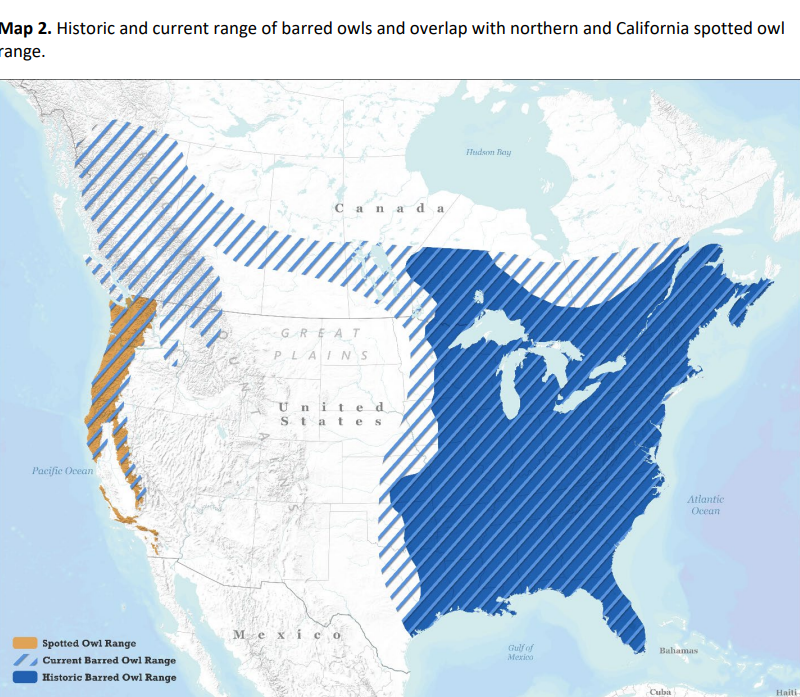
This map clearly shows that the route used by barred owls to expand their range to the west coast was through the boreal forests of Canada, which were not the result of anthropogenic change. The boreal forests of Canada have existed since the Ice Age ended 10,000 years ago. The map does not show the historic or current existence of barred owls in the American Midwest.
The expansion route of barred owls to the west coast through Canadian forests is also consistent with the record of their arrival on the west coast. They were seen first in the west in 1959 in British Columbia, Canada, at the northern edge of their current range. They were first seen in the US in Washington in the 1970s. Their range expansion continues to the south. This sequence of events is not consistent with the claim that they arrived on the west coast via the American Midwest.
Claiming that barred owls are “invasive” enables USFWS to justify their extermination, as many of their eradication projects do: “Yes, wildlife removal has been used as a management tool by many agencies across the country to control invasive species such as invasive carp, Burmese python, feral hogs, rats, mongoose, and nutria. Invasive species can thrive in areas where they do not naturally occur.” (1) That list of animals being killed by USFWS is far from complete.
This is not a trivial matter. Climate change requires that plants and animals move to find the conditions needed for their survival. Preventing the migration of plants and animals as the climate and the environment change will doom them to extinction. Designating barred owls on the west coast “invasive” has dangerous implications for many plants and animals that must move to survive in a rapidly changing climate. The Management Strategy should not set this dangerous precedent.
- Interbreeding of spotted owls and barred owls is a natural phenomenon that cannot and should not be stopped. Hybrids of spotted and barred owls should not be killed.
Hybridization is not only common, it can result in the creation of new species more rapidly than other forces of evolution, such as mutation and natural selection: “Hybridisation also offers shortcuts on the long march to speciation that do not depend on natural selection at all.” (5)
More than 99% of all species that ever lived on Earth, amounting to over five billion species, are estimated to have died out. Yet there are currently around 8.7 million species of eukaryote (organisms whose cells have a membrane-bound nucleus) globally. (Wikipedia) Biodiversity on Earth has increased partly because of hybridization, which has often enabled adaptation to changed environmental conditions.
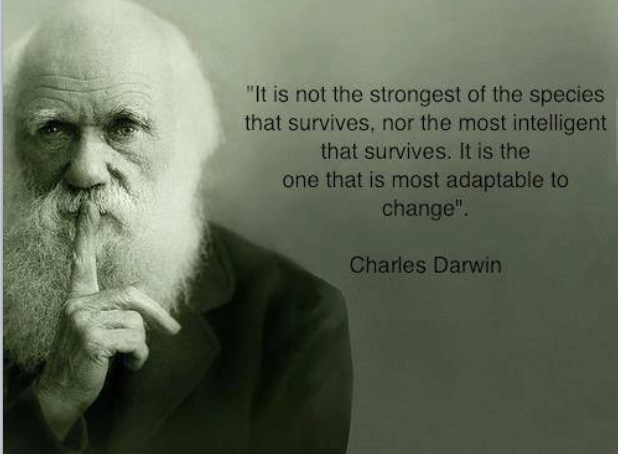
There are many important examples of hybridization among animal species, most notably the history of hybridization of our species, Homo sapiens. Humans are now the sole surviving species of genus Homo. Our genome contains the relicts of the genes of other members of our genus that are now extinct, which indicates hybridization with other hominoid species. The modern human genome contains 1-4% of Neanderthal genes. (5)
There are also many examples of hybridization of plant species that contributed to biodiversity. In a recently published study of the evolution of oaks, scientists traced the 56 million year evolutionary history of roughly 435 species of oak across 5 continents where they are found today. Hybridization was instrumental in the formation of oak species and the ability of oaks to survive in different climate conditions. The article in Scientific American about the genetic study of oak species concludes: “A firm grasp of when, where and how oaks came to be so diverse is crucial to understanding how oaks will resist and adapt to rapidly changing environments. Oaks migrated rapidly as continental glaciers receded starting around 20,000 years ago, and hybridization between species appears to have been key to their rapid response. The insights we can gain from elucidating the adaptive benefits of gene flow are critical to predicting how resilient oaks may be as climate change exposes them to fungal and insect diseases with which they did not evolve.”
The bias against hybrids is a reflection of nativist ideology in the natural world. Nativists call hybridization “genetic pollution.” Unfortunately, hybridization is seen by nativists as the loss of a “pure” native species rather than the potential for a new species that is better adapted to changing environmental conditions. The proposal to kill hybrids of barred and spotted owls is a symptom of the nativist bias that is typical of most public agencies.
Barred and spotted owls are closely related. They are in the same genus, just as Neanderthals and Homo sapiens were in the same genus. Their interbreeding is both predictable and potentially beneficial to spotted owls because barred owls are better adapted to current conditions. The hybrid has the potential to produce a new species that is better adapted to compromised forest conditions than the spotted owl. Although there is risk in hybrids, in the case of spotted owls the risk is worth taking because many scientists predict that the northern spotted owl will soon be extinct. Hybridization may be more helpful to the spotted owl species than killing barred owls.
- The Barred Owl Management Strategy should not be extended to California spotted owls.
The Barred Owl Management Strategy depends on the legal protections of the Endangered Species Act. Both barred owls and spotted owls are protected by the Migratory Bird Treaty Act. Therefore, “take” permits must be granted to kill barred owls. The protected status of northern spotted owls justifies take permits, but should not be extended to California spotted owls (CSO) that are not legally protected. Issuing take permits to kill barred owls to save California spotted owls makes a mockery of both the ESA and the Migratory Bird Treaty Act. It implies that USFWS can find loopholes in environmental laws intended to protect nature, whenever they wish. It undermines the public’s faith in government when public agencies are perceived as arbitrary and capricious.
Killing barred owls in CSO territory cannot be justified because there are few barred owls in their territory and threats to the CSO population are unrelated to the existence of a few barred owls. (See map of barred owl distribution in California below.) Shooting barred owls will not stop the wildfires, droughts and diseases killing their habitat. The proposed Management Strategy is irrelevant to the survival of CSO.
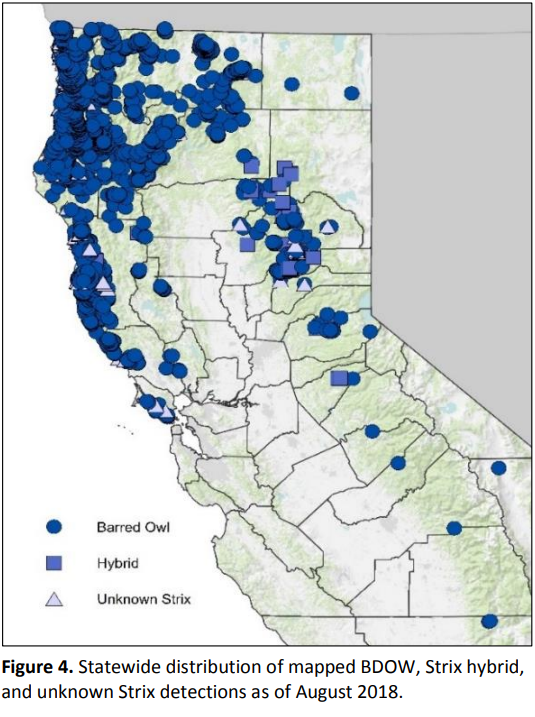
- There is no reason to kill barred owls in Marin and Sonoma counties in the San Francisco Bay Area because the population of Northern Spotted Owls is stable and there are very few barred owls.
The Marin/Sonoma County Management Zone designated by the Management Strategy includes all lands within the named counties. Conditions in Marin and Sonoma County are substantially different from the rest of the northern spotted owl range. This is the only portion of the northern spotted owl range where barred owls are very uncommon.
The recently completed survey of northern spotted owls in Marin County reports that the population is stable. The survey found nesting pairs of NSOs in all 48 inventory sites. A small decline in nesting success was not statistically significant. Two unpaired barred owls were detected on or near Marin County Property or Marin Watershed Property in 2023. One was removed, the other was not detected a second time. (6)
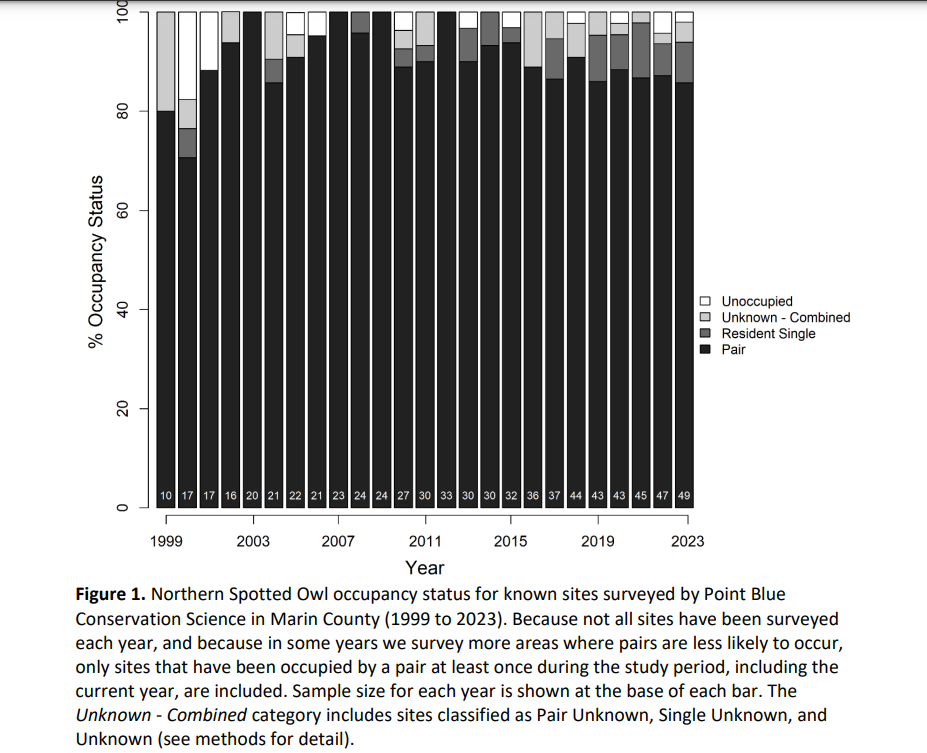
Despite the lack of evidence that northern spotted owls are threatened by barred owls in Marin County, the Barred Owl Management Strategy considers it the highest priority to kill the few transitory barred owls detected in Marin County. This is unnecessary overkill that should be removed from the Management Strategy. It contributes to the public’s perception that the strategy of USFWS is extreme and inconsistent with environmental laws that protect nature.
In conclusion, the Barred Owl Management Strategy is a reflection of the extreme nativist bias of USFWS. Like many of their projects, USFWS has selected an animal scapegoat for the declining population of northern spotted owls that are not well adapted to changed forest conditions. Selecting an animal scapegoat enables timber companies to continue logging and it is an easy way to avoid addressing the much more complex reasons for challenges to northern spotted owls. For example, killing barred owls won’t do anything to reduce the greenhouse gases causing climate change or restore logged or burned forests. The Barred Owl Management Strategy will employ an army of snipers, but is unlikely to benefit the environment or its inhabitants. USFWS cannot stop evolution, nor should it try.
Although I have low expectations that 2024 will be more peaceful than last year, in the spirit of hope, I wish you Happy New Year. Thank you for your readership.
Update, July 2025: The Northwest Forest Plan has been amended. The amendment to the plan will enable more logging in the Pacific Northwest. Https://www.chronline.com/stories/proposed-changes-would-allow-more-logging-on-federal-land-in-the-pacific-northwest,372393
The amendment began during the Biden administration and was approved in May 2025. The point of the amendment is to “manage” the forest to reduce wildfire hazards. https://www.fs.usda.gov/r06/planning/northwest-forest-plan-amendment
The stated purposed of the USFWS plan to kill 500,000 barred owls was to save endangered spotted owls. The plan was created by the timber industry in the Pacific Northwest because killing barred owls on their properties enabled them to get permits needed to continue logging on their properties.
On October 30, 2025, the US Senate rejected an effort to halt the implementation of the Barred Owl Management Plan by a vote of 25-72: https://worldanimalnews.com/2025/10/30/stop-the-slaughter-450000-barred-owls-face-mass-killing-for-so-called-conservation/
However, The Trump administration has also cancelled some grants that funded the plan to kill barred owls in the Pacific Northwest: https://washingtonstatestandard.com/2025/07/22/plans-to-shoot-thousands-of-barred-owls-in-doubt-after-feds-cancel-grants/
Confusing, isn’t it? The plan lives, but some of the funding for implementation is gone. That’s my best guess.
There is some logic to this sequence of events. However, I doubt that logic was used to reach this conclusion. In any case, I am pleased that barred owls will be spared the planned massacre. However, the loss of federal funding to kill barred owls will not prevent private land owners from killing barred owls. The revision of the Northwest Forest Plan to enable more logging might make killing barred owls on private land unnecessary.
- Frequently Asked Questions about the Barred Owl Management Strategy
- Barred Owl Management Strategy
- Sarah Gilman, “Evidence of Absence: Northern Owls are still vanishing from the Northwest,” Living Bird, April 12, 2016
- Holly Doremus, “The Endangered Species Act: Static Law Meets Dynamic World,” Journal of Law & Policy, Vol. 32: 175-235, 2010.
- The Economist, “Match and mix, hybrids and evolution,” October 3-9, 2020, page 67-70.
- Northern Spotted Owl Monitoring on Marin County Parks and Marin Municipal Water Department lands, 2023 Report, Point Blue Conservation.



 Conservation Sense and Nonsense