“How economic growth will help prevent extinction”

Earth.  NASAThe latest issue of The Economist magazine contains a special report about biodiversity which is previewed on its cover as “How economic growth will help prevent extinctions.” (1)  That’s a counterintuitive statement, but one we might expect from The Economist because it is an unashamed promoter of capitalism.  Although it has a viewpoint, its readers also rely on it for accurate reporting about international issues and events.  So, we read the special report about biodiversity with great interest.

How does economic development support biodiversity?

At the early stages of development, biodiversity suffers from the inevitable pollution associated with industrialization.  As development progresses and a society becomes more affluent, biodiversity benefits from the regulation that people begin to demand from their governments. 

In the United States, for example, tremendous progress has been made in cleaning up our water and air since the 1970s, an era of environmental regulation.  Two-thirds of our rivers were considered unsafe for swimming or fishing 40 years ago.  Only one-third are still considered unsafe. (That still seems like a lot.)   Likewise, the development of the Chinese economy has produced horrendous levels of pollution and their prosperity is just recently creating the demand to address the problem.   When we clean up our air and water, the animals with which we share the planet benefit as much as we do.

In the initial stages of development, population often increases as death rates from treatable diseases decline, which is Africa’s current stage of development.  However, education becomes more widely available as a society becomes more affluent and birth rates decline when more women are educated.  

Agricultural methods are improved by greater economic resources and education.  Improved agricultural techniques make land more productive so that less land is used for agricultural purposes.  More land becomes available for preservation and recreation.  Less labor required by agriculture increases urbanization which also uses less land.  In 1985, a study reported that “protected areas” were only 3.5% of the planet’s land area.  By 2009, another study reported that “protected areas” had increased to 13% of total land area.   In the Northeast of the US, forest is expanding on abandoned agricultural land.

Although modern agricultural methods use pesticides and fertilizer, The Economist cites two studies that report net benefit of these techniques to the environment compared to traditional methods.  That claim probably deserves more scrutiny.  We wonder, for example, to what extent our ignorance of the long-term effects of the use of synthetic chemicals made it possible to reach that conclusion.

Greater prosperity also creates leisure time and with it a demand for recreation in nature, resulting in an appreciation of nature.  This respect for nature has also promoted a less utilitarian attitude toward animals.  Animals are no longer viewed as the servants of humans.  Rather they are widely considered our neighbors in the environment in prosperous countries.  This changing attitude toward nature has produced many Non-Governmental Organizations that advocate for the preservation of land and the welfare of the plants and animals that live there. 

Brazil is a case in point because its prosperity is more recent than our own.  Its appreciation of its rainforests is quite new.  Deforestation in the Brazilian Amazon has declined from 28,000 sq kilometers in 2004 to less than 5,000 sq kilometers last year.  The attitude toward the value of the tropical forest has changed and the government’s new regulatory tools reflect that change. 

More prosperous countries are also usually more peaceful.  Wars and conflict often harm the environment, as well as its occupants.  For similar reasons, governments are usually more effective in prosperous countries.  Without competent government, environmental regulations are useless.

Do the facts fit the theory?

Extinction is considered the final test of the preservation of biodiversity.  So, have the rates of extinction decreased as many countries have become more prosperous?  The Economist tells us they have. 

First we must acknowledge our imperfect knowledge of extinction rates because we have identified a small fraction of the total number of species on our planet.  We have identified more of the large species of animals than we have of smaller species such as bacteria and microbes.  So trends in extinctions rates are easier to identify amongst vertebrates, especially birds for which detailed records are more available. 

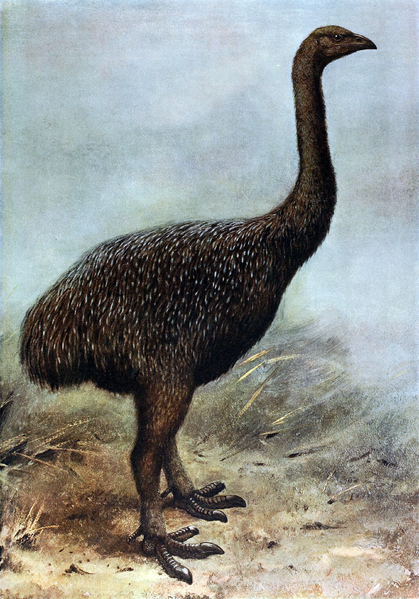
The moa was a huge flightless bird that was hunted to extinction by Polynesians when they occupied New Zealand.

Around 10,000 bird species have been identified.  Some extinctions are an inevitable result of natural selection, considered the “background” rate of extinction, which is estimated for birds to be about one extinction per century.  Bird extinctions attributed to man are exemplified by the disappearance of approximately 1,000 bird species on islands after they were occupied by Polynesians, which is at least 100 times above the background rate of extinction. 

The extinction rate for birds has decreased considerably in recent times.  Nine species of birds are known to have become extinct during the period 1980 to 2000.  Given our imperfect knowledge of all species, there may be extinctions that have not been noticed and recorded. 

The Economist article mentions the potential for climate change to accelerate rates of extinction.  In our opinion, its optimistic view of the future of biodiversity does not adequately account for that threat.  We attribute that to the viewpoint of the publication, which tends to support economic development by emphasizing its benefits more than its costs. 

The lesson for us in The Economist article is that climate change is the biggest threat to biodiversity.  As long as we continue to turn a blind eye to its causes, we should expect an acceleration of extinction rates in the future.  Eradicating non-native plant species is a diversion from this task.  If non-native plant species are better adapted to a changing climate, they are more likely to support the long-term survival of wildlife.

*********************

(1)    “Special Report:  Biodiversity,” The Economist, September 14-20, 2013.

“Ecological Restoration and Environmental Change”

Green Oaks, Knox College

Restoration and Environmental Change:  Renewing Damaged Ecosystems was written by Stuart Allison.  He is Professor of Biology and Director of Green Oaks Field Study Center at Knox College in Illinois.  His perspective on ecological restorations is unique because he is both a scientist and actively engaged in ecological restoration. 

There is a predictable tension between applied and theoretical science.  Ecology is particularly susceptible to this tension because its application is usually considered the immediate goal of the theoretical science that is intended to inform and guide it.  Therefore, we were very interested in Professor Allison’s viewpoint and we were intrigued by the suggestion of his title that his book would take into consideration the rapidly changing environment.

Although the restoration goal at Green Oaks is the re-creation of the tall grass prairie that is the historical landscape, Allison’s Ph.D. degree from UC Berkeley in Integrative Biology suggested that he is also familiar with our local ecology in the San Francisco Bay Area.  In fact, he mentions our controversy regarding the desire of native plant advocates to eradicate eucalyptus in California and he uses it to illustrate his opinion of novel ecosystems.

“When I was a graduate student at the University of California, Berkeley there was (and still is) a magnificent grove of blue gum (Eucalyptus globulus) outside of the Life Sciences Building.  It was rumored that they were some of the tallest blue gums in the world, growing so tall because they lacked any herbivores and diseases.  Eucalyptus trees grow beside roads all along California’s coastal highways and in the inland valleys of the coast ranges.  In fact, I cannot imagine California without eucalyptus trees.  But, of course, eucalyptus are not native to California–the first eucalyptus was introduced to California by Australian miners coming to the Gold Rush in the 1850s.  Today eucalyptus are so well established that many people think they are native to California, and even if they know they are not native, they don’t want to see them removed because to them, like me, eucalyptus are a central part of their experience of California.  Some people also fear that removal of eucalyptus will lead to erosion on steep hillsides and a decline in biodiversity.  In contrast, native plant enthusiasts in California would love to see eucalyptus permanently removed.  The dominance of eucalyptus in California is hardly unusual for a novel ecosystem, but it stands out because the trees came from Australia and because they are so striking in appearance and aroma that they can’t be missed.” (1)

Professor Allison then acknowledges that some scientists are now interested in and respectful of novel ecosystems such as the eucalyptus forest.  However, he is worried “that novel ecosystems will lead to a homogenized world in which the same species…are found everywhere.”   That debate is not the central theme in his book.  His primary objective is to take the pulse of his colleagues in ecological restoration and report the changes in their objectives in the past 20 years, given the rapid changes that have occurred in the environment.

What is the goal of ecological restoration?

The Society for Ecological Restoration (SER) is the professional organization recognized by most restorationists.  Its Policy Working Group claims that “an ecosystem is fully restored and the project has been completed when the restoration ‘contains sufficient biotic and abiotic resources to continue its development without further assistance or subsidy.’”

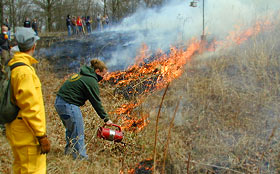
Annual Prairie Burn, Green Oaks, Knox College

Professor Allison tells us that the restoration in which he has been engaged for over 20 years will never achieve that standard:  “The tall grass prairie and savanna restorations I work with are all based on a return to historical pre-Euro-American disturbance, but all require perpetual management and human intervention to maintain them on the desired ecological trajectory.  Without regularly applied fire, those ecosystems would soon become dominated by many woody species and grow into a woodland lacking prairie or savannah characteristics.”  Professor Allison describes the annual “Prairie Burn” at Green Oaks which is considered an important social event by students at Knox College.

This is one of many ironies about ecological restorations.  Many projects are attempting to re-create an historical landscape at a specific period of time, which was not the result of natural succession.  In the case of grassland prairie, it was largely the result of periodic fires set by Native Americans.  Left to its natural devices, grassland would soon be “invaded” by shrubs and over time it would become a forest if soil and climate conditions were suitable.  In that sense, it is an artificial landscape, as unnatural as any manmade garden.  That the humans who created that historical landscape were indigenous, as opposed to European settlers, seems to us a meaningless, legalistic quibble.

The “field of dreams” theory

Most restoration projects focus almost entirely on plants.  Little explicit attention is paid to the animals that are the desirable inhabitants of the restoration.  Restorationists believe that if the habitat is made available, the animals will quickly follow.  This is the “field of dreams” theory, i.e., if we build it, the animals will come.   This is magical thinking.

Restoration projects rarely monitor the results of their projects sufficiently to test this theory.  In the San Francisco Bay Area, native plant advocates claim there are more birds and animals occupying restoration sites, but these are anecdotal observations that cannot be verified.  Nor do they seem credible to skeptics of the projects, who often think the habitat that has been eradicated actually supported more wildlife. 

Evolving goals of restoration projects

Here in the San Francisco Bay Area we have observed the changing objectives of ecological restorations.  Over fifteen years ago, local projects were touted as “sustainable.”  The public was told that once restored to historical equilibrium conditions, the projects would be capable of sustaining themselves without further resources. 

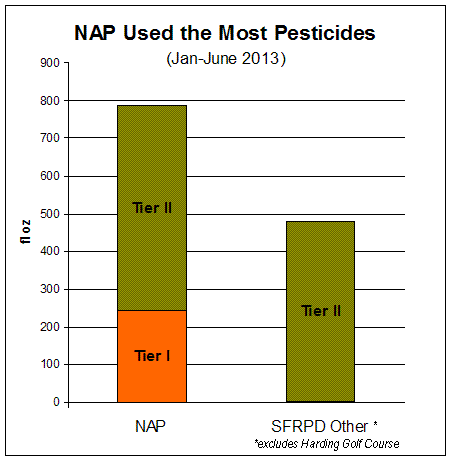
Comparson of pesticides used by San Francisco's "Natural Areas Program" compared to landscaped areas of San Francisco's parks
Comparson of pesticides used by San Francisco’s “Natural Areas Program” compared to landscaped areas of San Francisco’s parks. Photo courtesy of SF Forest Alliance.

We no longer hear that claim.  Now we are told that our “natural areas” must be managed in perpetuity.  More herbicides are used in San Francisco’s “natural areas” than landscaped portions of the parks, with the exception of a professional tournament golf course.  And if we want the animals that historically occupied those areas, they must be reintroduced, using labor-intensive methods.

Professor Allison observes the same “mission creep” amongst his colleagues.  The goal of replicating an historical landscape is no longer the dominant theme of ecological restorations.  Now the goal is more commonly defined in terms of increasing “biodiversity” and improving “ecological functions.”

New buzz words

If the new goal of ecological restorations is greater biodiversity and improved ecological functions, it seems reasonable to ask what these terms mean.  Unfortunately, we were unable to find the answer to that question in Professor Allison’s book.  Those terms are used as though their meanings are intuitively obvious.  They are not.  These terms are jargon that has little intrinsic meaning and they probably mean different things to different people.

When scientific studies quantify biodiversity, they count species of both native and non-native plants and animals.  Since there are now far more species of non-native plants and animals and far fewer extinctions of native plants and animals, biodiversity has increased virtually everywhere in the world.  So, as far as science is concerned, how could a restoration project that eradicates all non-native species result in greater biodiversity?

Obviously native plant advocates are defining the word “biodiversity” differently than traditional science.  Native plant advocates seem to define biodiversity as exclusively native.  Furthermore, the nativist ideology believes that the mere existence of non-native plants and animals will inevitably result in the extinction of native plants and animals.  There is little scientific evidence to support this assumption.  Few extinctions have been attributed to the existence of non-native plants and no extinctions blamed on non-native plants have occurred in the continental United States.

The term “ecological functions” is even more mysterious as it relates to ecological restorations.  It could mean almost anything:  production of biomass, soil composition, photosynthesis, carbon sequestration and storage, nutrient cycling, fire regime, hydrologic cycle, etc. 

Professor Allison does not provide us with his definition of this term, so we will make an assumption based on our knowledge of ecological scientific literature.  We told our readers about a study in Hawaii which compared native and non-native forests with respect to the ecological functions they are performing.  In that study, three such functions were measured and reported:  carbon sequestration, production of biomass, and nutrient cycling.  The study concluded that non-native forests were performing these ecological functions as well as native forests. 

We can also compare treeless grassland prairie with a native or non-native forest with respect to those ecological functions.  Forests—whether native or non-native– will fulfill these and other functions at least as well as the grassland prairie.  If we add the factor that the grassland prairie must be burned annually to maintain it, clearly the grassland prairie is an ecological deficit because it releases pollutants and greenhouse gases into the atmosphere when it is burned.

The moving target

The goals of ecological restoration are a moving target.  The original goals of re-creating an historical landscape that would be sustainable without continual maintenance are now widely acknowledged to be unrealistic. 

The new goals are equally elusive.  The new goals are described in obscure ways that will be impossible to measure or evaluate.  That suits the purposes of native plant advocates perfectly.  They can continue to do whatever they want and the public can’t hold them accountable because the public is not provided with a practical method of measuring success or failure.  

***********************************

(1)    Stuart K. Allison, Ecological Restoration and Environmental Change:  Renewing Damaged Ecosystems, Routledge, UK, USA, Canada, 2012

Biodiversity of the eucalyptus forest

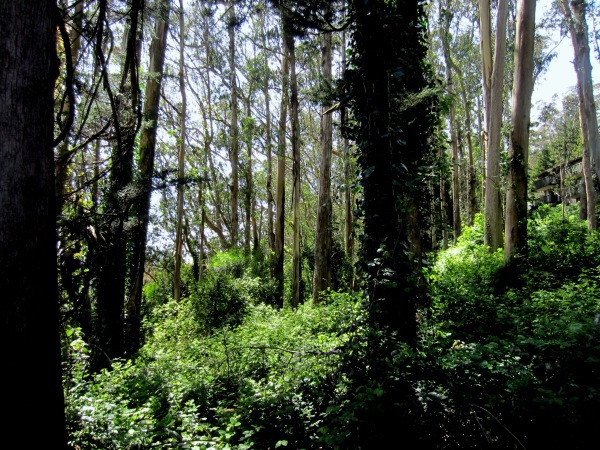
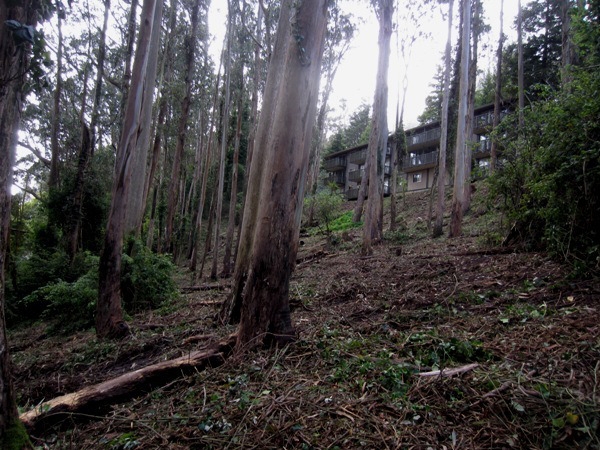
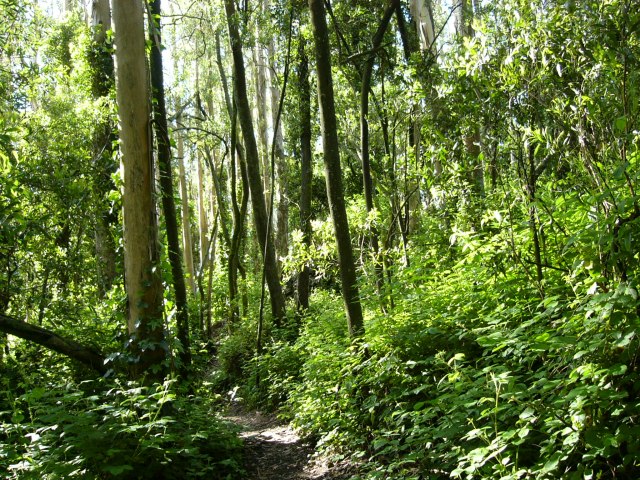
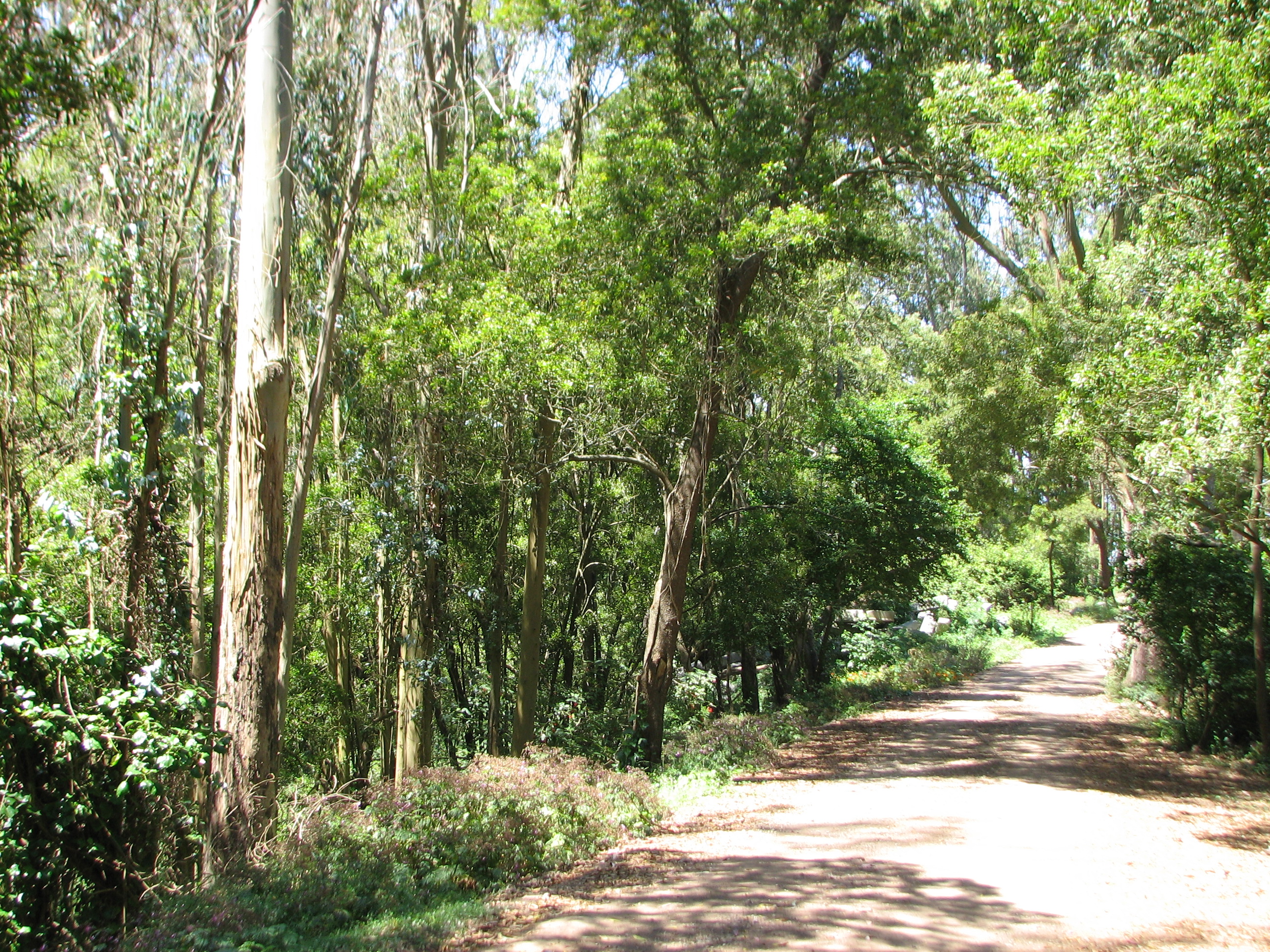
Although they can provide no scientific evidence, native plant advocates claim that the eucalyptus forest is a “biological desert” in which nothing grows and nothing lives.  We can see with our own eyes in the Sutro forest that a diverse understory thrives in the eucalyptus forest, but it is more difficult to quantify the biodiversity of wildlife in the forest.  For that we turn to scientists.

Mount Sutro Forest
Mount Sutro Forest

We published some time ago a summary of a research study by Dov Sax (Brown University) in which he compared the species richness (number of species) living in the eucalyptus forest with species richness in native oak woodland in Berkeley, California.  He found equal numbers of amphibians, insects, plants in the understory, and birds in the eucalyptus forest compared to oak woodland in the fall and significantly more species of insects in the eucalyptus forest in the spring.

Eucalyptus around the world

Professor Sax also reported similar studies all over the world that reached the same conclusions, i.e., the introduced eucalyptus forest is just as biodiverse as the native forest all over the world.  According to the Encyclopedia of Biological Invasions there are about 40 million acres of eucalypts planted in tropical, sub-tropical, and temperate countries.  We have had the opportunity to observe them in several counties.

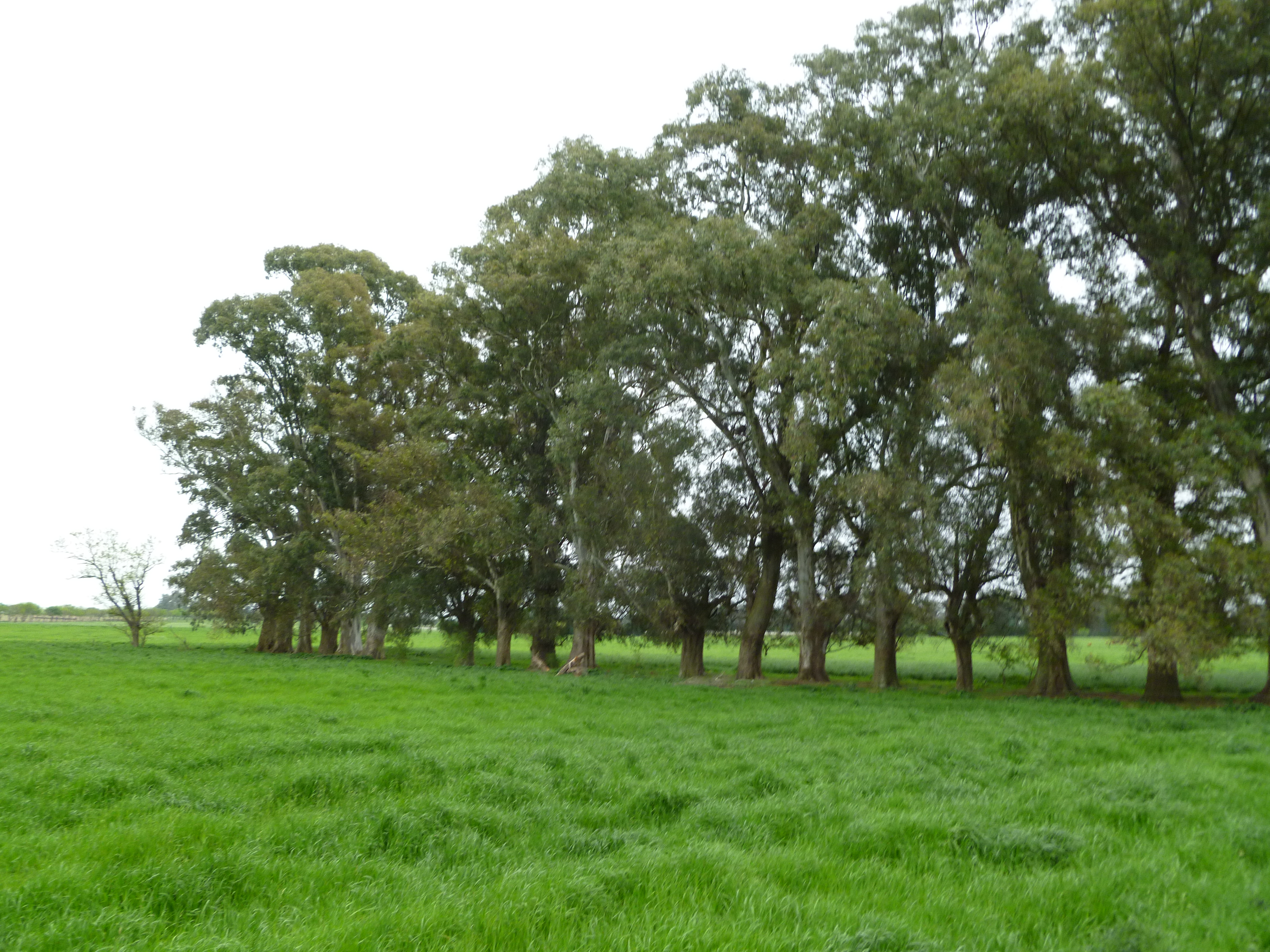
Much of Argentina is a treeless grassland prairie, called pampas.  They imported eucalyptus to provide their economy with pulp.  We observed many acres of densely growing eucalyptus forest throughout Argentina during our visit there.  They also seemed to be used on the perimeter of agricultural lands, presumably as windbreaks.

Eucalypts used an agricultural windbreak, Argentina, 2010
Eucalypts used as agricultural windbreak, Argentina, 2010

We also saw many eucalypts growing in Sicily.  We were told by our guides that they were planted by Mussolini in the 1930s as the means of draining swampland to reduce the population of malaria-carrying mosquitoes.

We found more eucalypts in Morocco where they also were being widely used as landscape trees.  There seemed to be more diversity of eucalyptus species and they were obviously considered valuable for horticultural purposes.  We also saw eucalypts sheltering agricultural crops from the wind.

Eucalypts are obviously considered valuable trees in many countries all over the world.  We marvel at the hatred they have generated in California.

More evidence of the biodiversity of the eucalyptus forest

Professor Robert Stebbins (Professor of Zoology and Emeritus Curator in Herpetology, Museum of Vertebrate Zoology, University of California, Berkeley) was hired to study the eucalyptus forest in Berkeley, California for the Nature Conservancy’s California Field Office.  This is an excerpt from his report which was published in 1983. (It is available at wiki.bugwood.org)

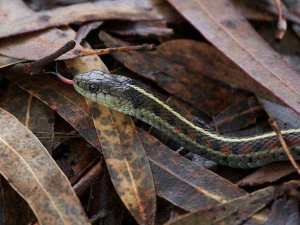
Garter snake in euclypatus leaf litter
Garter snake in eucalyptus leaf litter. Courtesy urbanwildness.com

Contrary to popular belief, many animals, both vertebrates and invertebrates, have adapted to life in the Eucalyptus groves. Moisture from the air condenses on the leaves and the drippage keeps the groves moist and cool even during the dry season. This is a suitable ground habitat for a wide variety of animal life. Amphibians such as arboreal salamander, California slender salamander, ENSATINA, California newt, rough skinned newt, and Pacific tree frog live in the forest, primarily under fallen logs and duff. Amphibians feed on such invertebrates as millipedes, centipedes, sow bugs, COLLENBOLA, spiders and earthworms.

“Several snakes such as the ring-necked snake, rubber boa and sharp tailed snake have adapted to Eucalyptus groves. The ring-necked snake feeds on the California slender salamander, the rubber boa feeds on meadow mice, and the sharp tailed snake feeds strictly on slugs. Other common reptiles include the northern and southern alligator lizards, which live under fallen logs, and the western fence lizard and western skink, which live in the less densely forested groves.

“Over 100 species of birds use the trees either briefly or as a permanent habitat. The heavy-use birds feed on seeds by pecking the mature pods on trees or fallen pods; so they must wait for the pods to disintegrate or be crushed by cars. Among the birds that feed on seeds in the trees are: the chestnutback chickadee and the Oregon junco. Examples of birds that feed on ground seeds are the song sparrow, the fox sparrow, the brown towhee, and the mourning dove. Birds that take advantage of the nectar from blossoms either by drinking the nectar or by feeding on the insects that are attracted to the nectar include Allen’s hummingbird, Bullock’s oriole, redwinged blackbird, and blackheaded grosbeak. Birds that use the trees as nest sites include the brown creeper, which makes its nest under peeling shags of bark and feeds on trunk insects and spiders, the robin, the chickadee, the downy woodpecker, and the red shafted flicker. The downy woodpecker and the red shafted flicker peck into the trunk of dead or dying trees to form their nests. When these nests are abandoned, chickadees, Bewick wrens, house wrens and starlings move in. Downy woodpeckers use dead stubs to hammer out a rhythmic pattern to declare their territories.

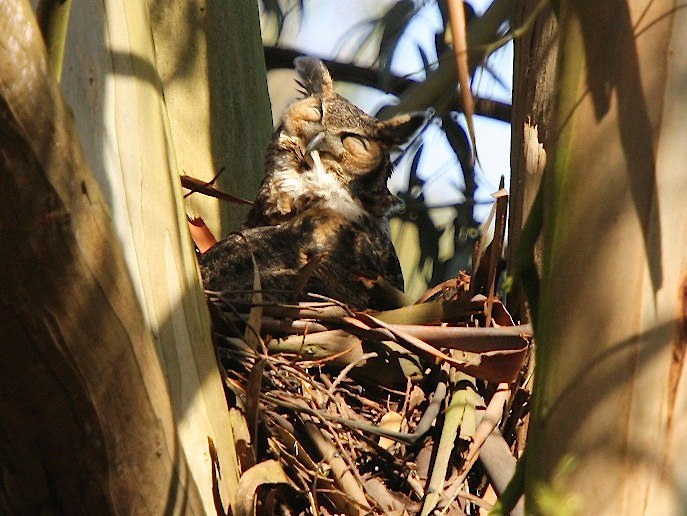
Owl nesting in eucalyptus, courtesy urbanwildness.com

“The red-tailed hawk prefers tall trees for a nesting site. It therefore favors eucalypts over trees such as oak or bay. Great horned owls use nests that have been abandoned by red-tail hawks or they nest on platforms formed between branches from fallen bark. The brown towhee and the golden crowned sparrow are birds that use piles of debris on the ground for shelter during rains.

“Several mammals have adapted to Eucalyptus. Deer find concealment in dense groves where there are suckers, coyote brush, and poison oak; moles live in the surface layer of the soil; meadow mice, gophers, and fox squirrels are found in the forest.

A Eucalyptus grove is not a sterile environment. The population density of the animals mentioned can be partially attributed to the presence of eucalypts. With a program of cutting trees and burning debris, some animal residents will disappear because they have restricted home ranges or are sedentary. If an animal’s living area (leaf litter, logs, bark) and food supply are destroyed, the animal will either die or attempt to move to another area which is already fully occupied. ‘The wildlife section draws heavily upon conversations with Professor Robert Stebbins. No errors which may exist should be attributed to the professor.’”

Refusing to see the evidence

We stumbled upon this new information in the on-line comments on SFGATE (the San Francisco Chronicle’s website) on an article about the “tree wars of San Francisco.”  (Available here)  A defender of the forest was responding to the usual claims about the eucalyptus forest being a sterile environment.  The defender of the forest was quickly attacked by a native plant advocate who called the commenter a “creepy imbecile.”  The native plant advocate also attempted to discredit the source of information on the grounds that Professor Stebbins is apparently now dead.  Obviously he was alive when he wrote his report, but the native plant advocate apparently believes that anything he wrote before he died is not credible.  Or at least I think that was his/her “reasoning.”  Oddly, another native plant advocate then chimed in, complaining that native plant advocates are being “demonized.”  Wait!  Who called whom a “creepy imbecile?”

Update:  When we published this article we assumed that the native plant advocate who claimed that Professor Stebbins was dead at the time was correct about that.  Since then we have learned that that was inaccurate information.  Professor Stebbins died on September 23, 2013, according this obituary in the New York Times.  So, the name-calling native plant advocate was fabricating “information” as well as engaging in ad hominem attacks.  We are embarrassed that we assumed the native plant advocate was at least factually correct.  

Unfortunately the name-calling comment has been removed from SFGATE which I suppose is consistent with their policy.  However, it is a loss because it illustrated the low standards for civility and quality of information being used by native plant advocates to defend their destructive projects.  (We are quoting from that comment only the portion for which evidence remains in replies to it.)

We saw these same low standards used by native plant advocates at the February 25, 2013 public hearing at UCSF about their plans to destroy the Sutro forest.  There were only about 15 speakers in defense of the project, but their comments were devoid of information.  One fellow walked to the microphone and said simply, “I hate eucalyptus” and walked away.  Another claimed that the Angel Island fire of 2008 was evidence of the flammability of eucalyptus although 80 acres of eucalypts were destroyed over 12 years before that fire.  Only 6 acres of eucalypts remain.  The grass fire stopped at the edge of that small remaining stand of eucalypts.

One wonders where people find the energy to hate anything, let alone a tree.  We struggle to understand the motivation of these crusaders against the forest.  We believe that the most highly motivated amongst them are earning their living on these projects and are simply defending their economic interests.  Nothing else makes sense to us.

Biodiversity: Another eucalyptus myth busted

Native plant advocates use many arguments to justify the destruction of non-native species and we have debunked many of those arguments here on Million Trees.  Now we will examine the claim that non-native species must be destroyed because their mere existence reduces biodiversity by out-competing native plants and animals.  Because eucalyptus trees are one of the primary targets for eradication, we will focus on the specific claim that the eucalyptus forest is a “biological desert.”   We are frequently told that “nothing grows” under the eucalypts and that they are not providing food or habitat to insects, birds, and other animals.

Professor Dov Sax (Brown University) tested these claims while a student at UC Berkeley.  He studied the eucalyptus forest in Berkeley, California, and compared it to native oak-bay woodland.  He found little difference in the species frequency and diversity in these two types of forest.
 
Eucalyptus forest and its thriving understory, Mt. Sutro, June 2009


He studied six forests of about 1 hectare each, three of eucalypts and three of native oaks and bays.  The sites were not contiguous, but were selected so that they were of similar elevation, slope, slope orientation, and type of adjacent vegetation.  He conducted inventories of species in spring and autumn.  He counted the number of:
  • Species of plants in the understory
  • Species of invertebrates (insects) in samples of equal size and depth of the leaf litter
  • Species of amphibians
  • Species of birds
  • Species of rodents

 He reported his findings in Global Ecology and Biogeography*:

“Species richness was nearly identical for understory plants, leaf-litter invertebrates, amphibians and birds; only rodents had significantly fewer species in eucalypt sites.  Species diversity patterns…were qualitatively identical to those for species richness, except for leaf-litter invertebrates, which were significantly more diverse in eucalypt sites during the spring.” 

Professor Sax also surveyed the literature comparing biodiversity in native vs non-native forest in his article.  He reports similar findings for comparisons between non-native forests and local native forests all over the world:

  • In Spain, species of invertebrates found in the leaf-litter of eucalyptus plantations were found to be similar to those found in native forests, while species richness of understory plants was found to be greater in the native forests.
  • In Ethiopia the richness of understory species was found to be as great in eucalyptus plantations as in the native forest.
  • In the Mexican state of Michoacán, species richness and abundance of birds were found to be similar in eucalyptus and native forests.
  • In Australia species richness of mammals and of soil microarthropods were found to be similar in native forests and in non-native forests of pine.

The only caveat to these general findings is that fewer species were found in new plantations of non-natives less than 5 years old.  This helps to illustrate a general principle that is often ignored by native plant advocates.  That is, that nature and its inhabitants are capable of changing and adapting to changed conditions.  In the case of non-native forests in the San Francisco Bay Area, they have existed here for over 100 years.  The plants and animals in our forests have “learned” to live in them long ago. 

  
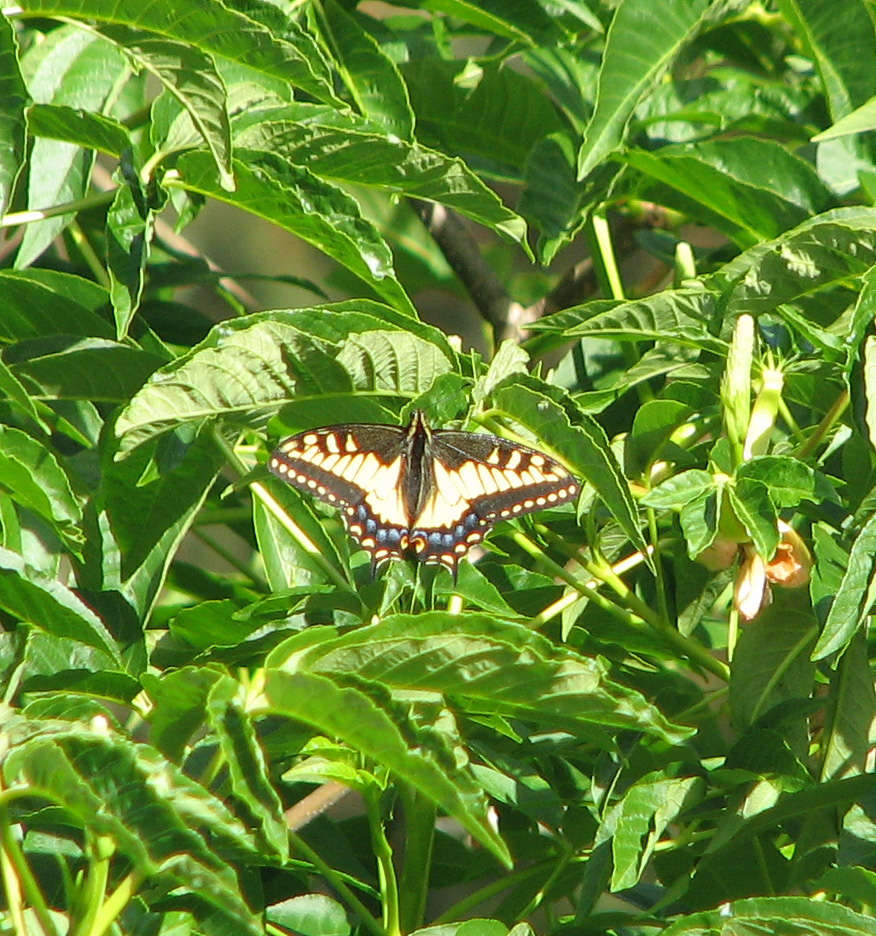
Anise Swallowtail, Mt. Sutro, March 2010

We recommend that you visit the SaveSutro website   for a description of the richness of the non-native forest that thrives on Mount Sutro in San Francisco.  It is the perfect illustration of these scientific principles.  We can discuss scientific principles in the abstract, but there is no substitute for a walk in the forest to confirm with our eyes what science tells us.


*Dov Sax, “Equal diversity in disparate species assemblages:  a comparison of native and exotic woodlands in California,” Global Ecology and Biogeography, 11, 49-52, 2002.