Environmentalism in the Rear-View Mirror

One year ago, less than a month after Donald Trump was re-elected President, I announced on Conservation Sense and Nonsense my intention to “hunker down and watch the changes [in the federal government] play out.”  Although I predicted major changes in federal public policies, I did not foresee the scale and speed of changes in environmental policies that we have witnessed in the past year.  The uncomfortable reality is that some of what is being destroyed deserved to be destroyed, but at the expense of some valuable environmental protections. 

In describing the changes we have witnessed, I will focus primarily on environmental issues in the following main categories.  Please keep in mind that changes in environmental policies are but a small fraction of the changes that have occurred in all aspects of American life and global geopolitics, e.g., education, public health, arts and entertainment, architecture, science, economics, immigration, media sources, judicial system, disaster relief, social safety net, foreign aid, tariffs, etc. 

The Trump administration has left the international Paris Agreement, the legally binding treaty adopted in 2015 to limit global warming to below 2 degrees Celsius.  The US was not represented at the November 2025 meeting of the UN Conference of the Parties (COP30) to the agreement in Brazil, but the US actively campaigned against the new commitment on the agenda to limit pollution from cargo ships by using fines.  According to the New York Times, “…the United States launched a pressure campaign that officials around the world have called extraordinary, even by the standards of the Trump administration’s combativeness, according to nine diplomats on its receiving end.” US diplomats and officials were successful in threatening countries with loss of US port access and other onerous penalties if they voted for the proposal. The Trump administration hasn’t just dropped out of the Paris Agreement.  It is also actively engaged in preventing other countries from reducing greenhouse gas emissions that cause climate change. COP30 ended without any new commitments to reduce the sources of greenhouse gas emissions, or even explicit mention of fossil fuels as the primary greenhouse gas.   

America Accommodates

Many of these changes have been delayed by legal challenges, but until appeals reach the Supreme Court, the final verdict on most issues is not known at this time.  However, the Supreme Court has signaled their intentions with many emergency orders, also known as the shadow docket.  These decisions have upheld most of the federal government’s actions, without providing any legal reasoning for doing so.  These preliminary decisions foretell the ultimate victory of the actions of the Trump administration.

Other segments of American society are contributing to the control the President has over the implementation of his agenda. At his request, Congress has completely defunded National Public Radio and the Public Broadcasting Service.  They are scrambling to find other sources of revenue, while cutting programs and staff as well as closing stations. Associated Press was banned from White House press briefings when they refused to call the Gulf of Mexico the Gulf of America, as renamed by President Trump. Legal challenges have not restored AP’s access to White House press briefings.

Mainstream media has paid multi-million dollar settlements to resolve defamation lawsuits (ABC and CBS) brought by President Trump over perceived slights.  One major network (CBS) has changed ownership and is now owned by Trump supporters (Larry & David Ellison).  The Department of Defense (now calling itself the Department of War) has restricted access of the press to department staff and now requires department approval of press releases prior to publication.  Most members of the Pentagon press corps refused to agree to these restrictions and have left their offices in the Pentagon.  Self-censorship is a more insidious threat because the public no longer knows when the media is pulling its punches to avoid retribution, which is the President’s modus operandi.

The legal profession has also been brought to its knees by the President’s threats of punishment if they participate in lawsuits that try to prevent the implementation of the administration’s policies.  Many major law practices have been forced to provide pro bono legal services for President Trump after being threatened with access restrictions to the judicial system.  Major law practices are refusing to represent plaintiffs who are trying to protect themselves from government prosecution, hoping to stay out of the line of fire.

California Responds

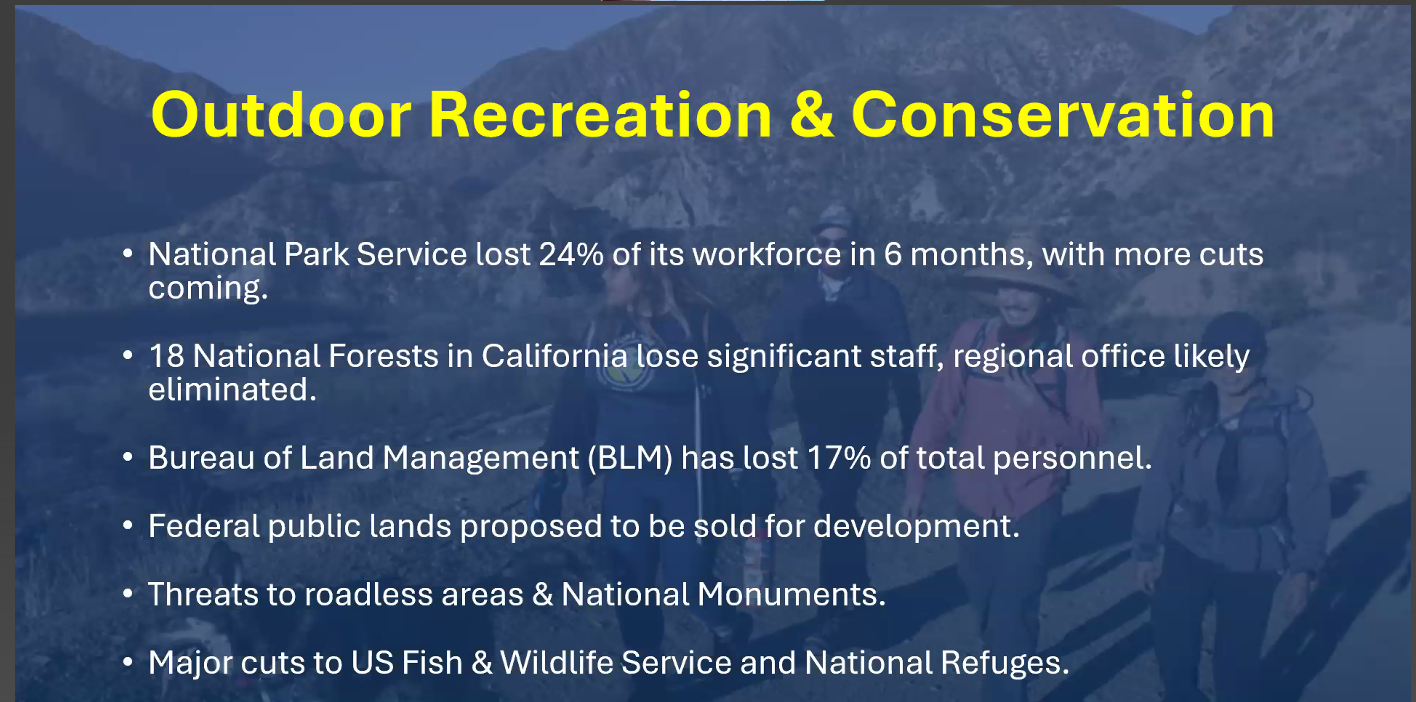
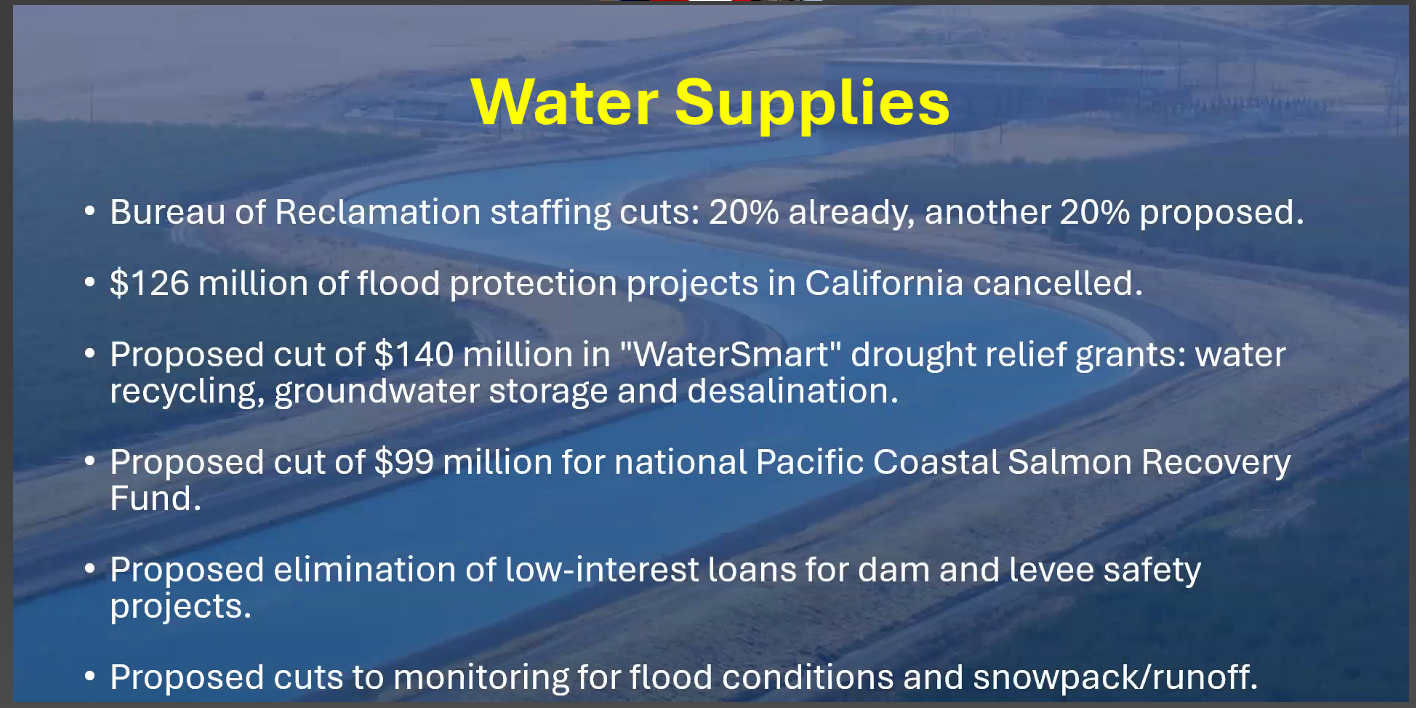
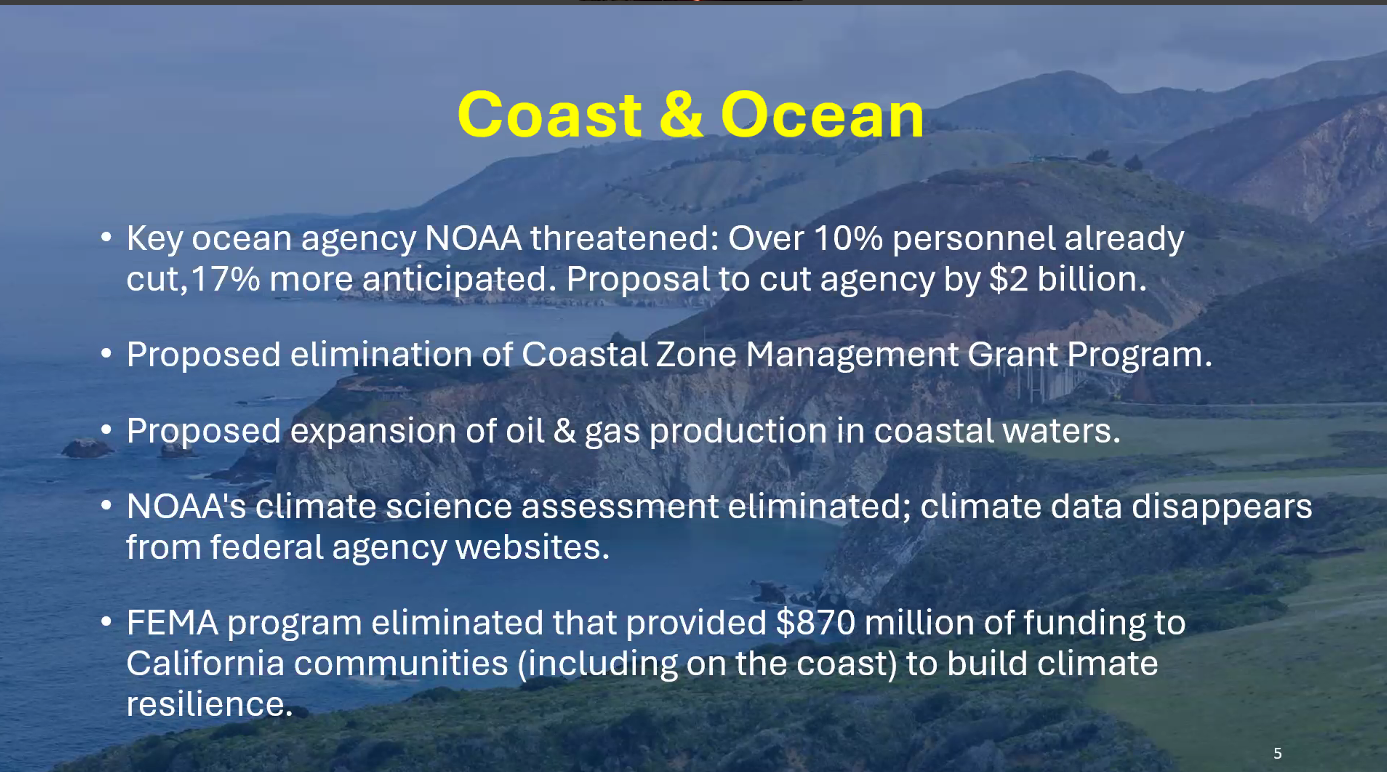
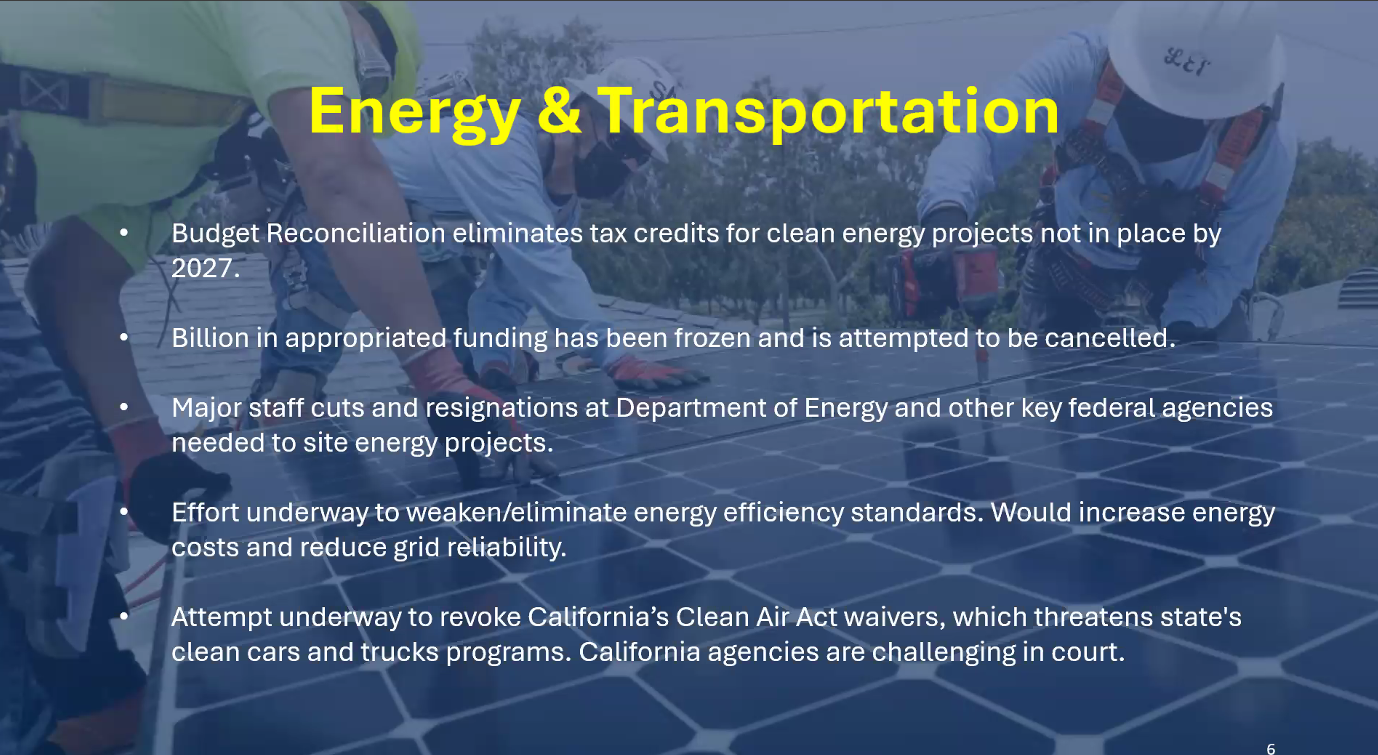
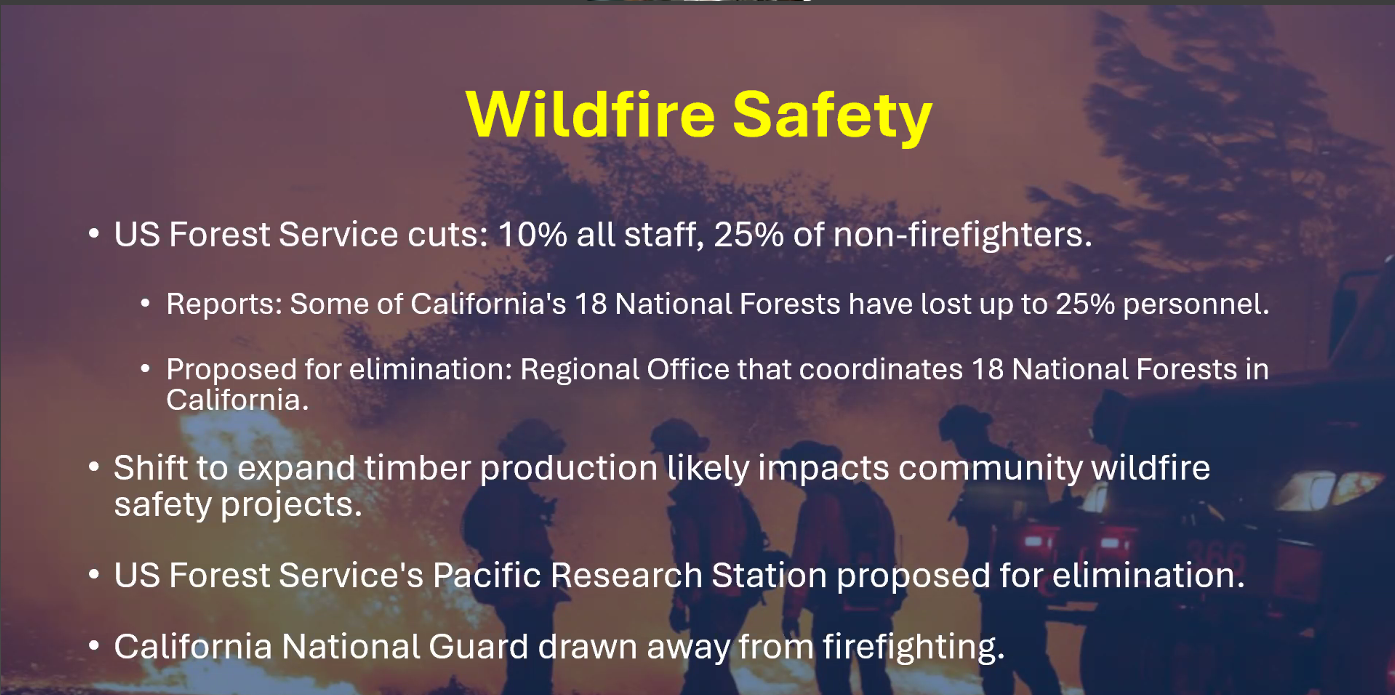
The same day that Americans re-elected Donald Trump in November 2024, California voters passed Proposition 4, the $10 billion bond that funds climate change mitigation and ecological restoration in California.  California’s bond funding will help to compensate for the loss of federal funding of ecological and climate mitigation projects in California. California Natural Resources Agency reported the cancellation of federal funding for these projects in California:

Source: California Natural Resources Agency, July 2025

Does California have enough money to compensate for the loss of federal funding of climate change mitigation and ecological restoration in California?  I don’t know, but I do know that federal funding is also being lost for many other purposes that are important to Californians, such as subsidies for health insurance and food assistance needed by many Californians.  Some municipalities are responding by raising sales and property taxes to backfill the loss of federal funding in many sectors of the economy.  While federal taxes are being cut, California’s taxes may rise.

Meanwhile, California is challenged by related issues such as the need to build more housing in order to reduce the cost and house our growing homeless population.  In July 2025, California responded to that issue by revising the California Environmental Quality Act (CEQA), which will remove many obstacles to building new housing and allow more aggressive fire hazard mitigation. 

The cost of gas in California has been consistently higher than in most states because of voters’ desire for clean air.  Regulations have made drilling for and refining oil in California costlier than in other states, which makes gas more expensive for consumers.  Refineries have responded to California’s restrictive regulations by leaving the state, which reduces supply, raises prices further and is expected to restrict availability of fuel. California’s Senate Bill 237, signed into law in September 2025, addressed these concerns by streamlining approval of drilling permits, including idle pipelines, in an “environmentally responsible and safe manner.” 

In other words, California has been forced to adapt to new economic and environmental realities. At the same time, California is aggressively fighting back.  As of October 1st, California has filed 46 lawsuits against the 2nd Trump administration, “contesting the Trump administration’s executive orders, agency decisions and even recent laws that Trump himself signed.”

Americans Shrug

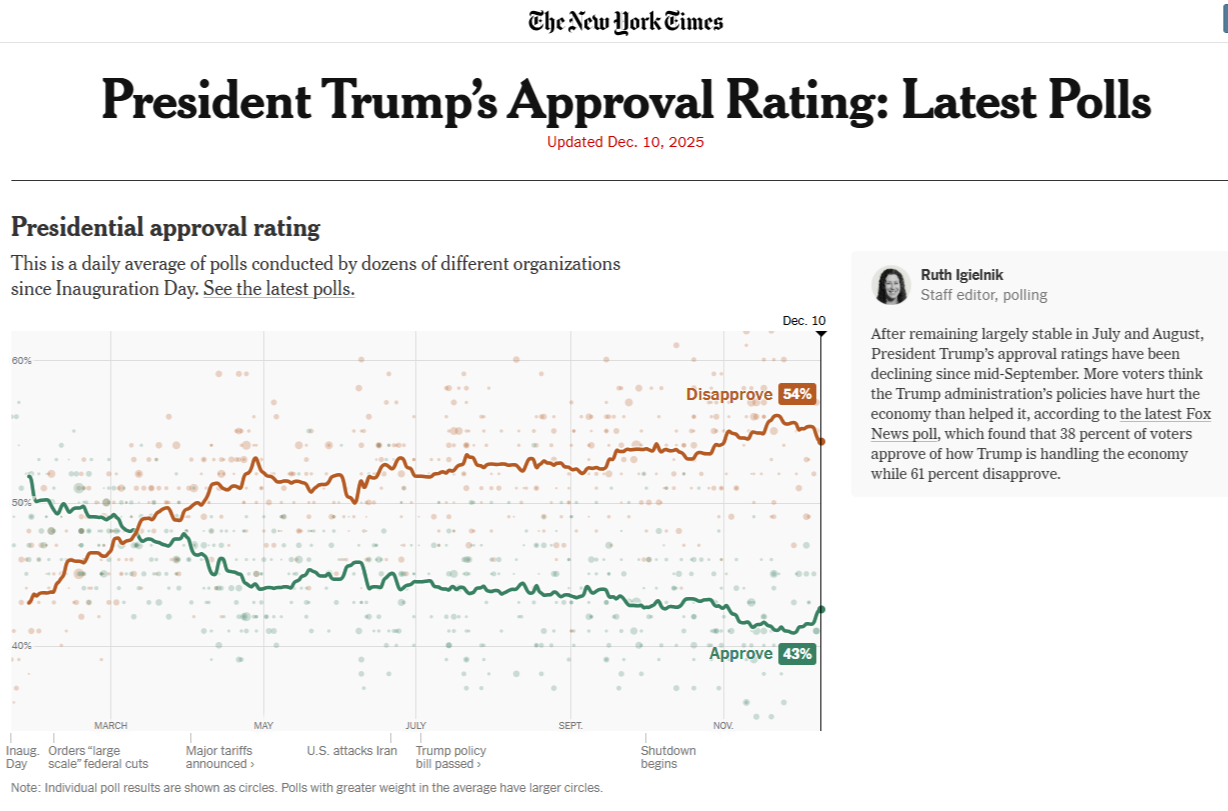
Composite opinion polls reported a persistent negative approval rating of 11% for the Trump presidency until the government shutdown in October, when the approval rating dropped to negative 15% before returning to negative 11% when the government re-opened.  Over 40% of American voters still approve of the Trump presidency.  Many voters have made up their mind and are not responsive to the daily onslaught of alarming information.  I understand and am sympathetic to the public’s dilemma, summarized in a recent social media post:  “My desire to be well informed is presently at odds with my desire to remain sane.” 

Updated 12/10/25

For perspective, consider that President Biden’s composite approval poll on July 6, 2024 was negative 19.3%, just 15 days before Biden dropped out of the presidential race on July 21, 2024. 

The demonstrations I have attended are another window into the mood of the American public.  The NO Kings demonstration on June 14, 2025 is said to have drawn 5 million people.  The second NO Kings demonstration on October 18th claims to have drawn 7 million people.  Although these seem impressive numbers, they don’t add up to a change-making revolt.  The lack of young people participating in these demonstrations is dispiriting.  The future is in their hands, yet their commitment to democracy is lukewarm compared to my generation, the boomer generation that still feels a strong commitment to the peace and prosperity that democracy has delivered to us.

On the other hand, Democrats aren’t dead yet.  In November 2025, moderate Democrats won governorships in New Jersey and Virginia and a Democratic Socialist won the mayoral election in New York City.  In response to Republican gerrymandering of congressional districts in Texas, 64% of Californians voted to gerrymander congressional districts in favor of Democratic candidates.  A recent Marist poll indicated that registered voters in the US plan to vote for Democratic candidates for congressional seats in 2026 by a margin of 14%. 

Changes in the elected leadership of the Bay Area chapters of the Sierra Club are an indication of a change in the public’s commitment to the environment.  The San Francisco Bay Area Chapter is now led by activists who want more housing and more active recreational opportunities.  The old guard, who were committed to restricting recreational access in favor of native plant restorations in public parks, has been replaced.  The Lomo Prieta Chapter, which represents the South Bay, is now undergoing a similar transition to new leadership with new priorities.

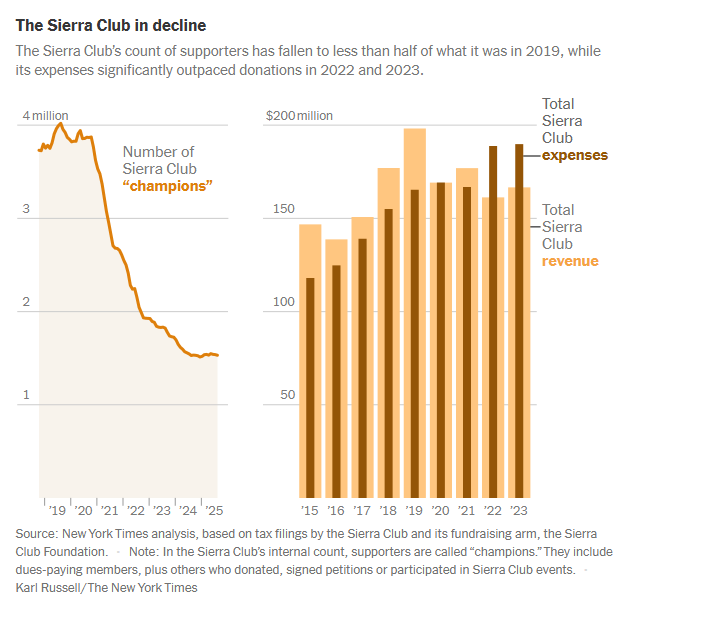
Changes in the leadership of the San Francisco Bay Area chapters of the Sierra Club are symptomatic of the Club’s much broader decline on a national scale.  According to the New York Times, the Club has lost 60% of the 4 million members it had in 2019.  The Times attributes this loss of support to the change of the Club’s advocacy focus from environmental issues, most prominently climate change, to progressive social justice issues such as racial justice, gay rights, labor rights, and immigration rights. In 2019, one of the Board Directors objected to the proposed budget, but was voted down: “I said, ‘We have two F.T.E.s devoted to Trump’s war on the Arctic refuge, and we have 108 going to D.E.I., and I don’t think we have our priorities straight,’” Mr. Dougherty said.

Finally, wealthy American philanthropists are providing clues of a fundamental change in the political climate in America.  Bill Gates, former owner of Microsoft and supporter of global health initiatives, recently announced that it is time for a “strategic pivot” in the global climate fight from focusing on limiting rising temperatures to fighting poverty and preventing disease.  Gates still believes climate change is a serious problem, but it won’t be the end of civilization because he thinks scientific innovation will contain it.  Unfortunately, federal support for finding such scientific innovations has been withdrawn.  Gates’ message seems to be that we aren’t able to stop climate change, so we must cope with it.  It’s another way of accommodating the environmental policies of the Trump administration.

Looking Ahead

I am deeply troubled by the many threats to America’s treasured democracy.  However, many of the changes in environmental policies in the past year are aligned with the mission of Conservation Sense and Nonsense.  Since its inception in 2010, the mission of Conservation Sense and Nonsense has been the preservation of our predominantly non-native urban forest, opposition to the use of pesticides on public lands and advocacy for mitigating the causes of climate change.  Some of the changes in environmental policy in the past year are consistent with those goals:

  • Many projects that use pesticides and kill harmless animals and vegetation have been defunded by the federal government. The State of California is trying to compensate for the loss with state funding, but its ability to do so will be challenged by many other new demands on state resources, such as subsidies for health care and food.

When wildlife refuges and marine sanctuaries lost much of their funding and staff, many of their projects were abandoned.  Many of those projects may have been beneficial, but the plans to aerially drop rodenticides on the Farallon Islands to kill harmless mice is an example of a project that is better off dead.

  • Prevailing public opinion that native plants and animals are superior and the corresponding belief that non-natives are a threat to them is unlikely to change in the near-term.  I do not begrudge the horticultural preferences of home gardeners.  However, native plant advocates will have limited ability to demand that public land managers eradicate non-native plants if there is no public money available to fund landscape-scale “restorations.”
  • As public money for ecological “restorations” on public land dries up, the “restoration” industry and the jobs it creates will probably dwindle over time. As economic interests in “restoration” evaporate, the advocacy that supports it is likely to as well. College students are likely to make other educational choices with more promising career prospects, which will further reduce the labor force engaged in “restorations.”
  • When forest “restoration” projects that involve clear-cutting or removing healthy trees are defunded, existing carbon storage is preserved.  Every mature tree—native or non-native—sequesters carbon at a time when we need every available carbon sink to compensate for the loss of limits on greenhouse gas emissions causing climate change.
  • Climate change will accelerate as we abandon our efforts to reduce greenhouse gas emissions that cause climate change. The landscape that survives the changed climate will be best adapted to the changed environment.  When the climate changes, vegetation changes or dies.  No amount of human intervention can alter that ultimate reality because nature always bats last.

In 2026, Conservation Sense and Nonsense will continue to report major developments relevant to my mission.  In other words, I will continue to “hunker down and watch it play out.”  Guest posts consistent with my mission and civil comments, both pro and con, are always welcome here. Thank you for your readership. 

Happy Holidays and best wishes for a more peaceful year in 2026.

“Instead of ‘controlling’ non-native plants, perhaps we should practice more ‘self-control’”

Juian Burgoff

Julian Burgoff wrote a guest post for Conservation Sense and Nonsense about the undervalued functions of non-native aquatic plants in 2023.  Necessary Nuisance explained that non-native aquatic plants perform valuable ecological functions.  Attempts to eradicate aquatic plants deprive aquatic animals of valuable habitat.  The herbicides used to kill aquatic plants also pollute the water, harming aquatic animals and killing non-target aquatic plants. 

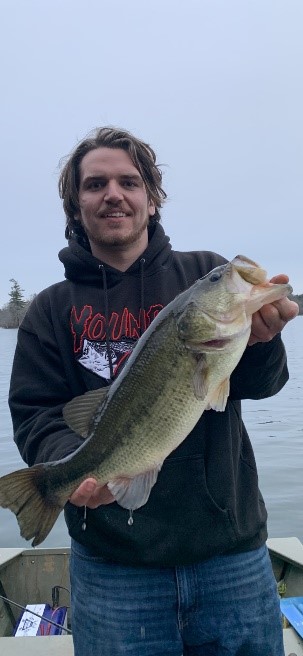
Julian Burgoff is an avid bass angler and aspiring fisheries ecologist from western Massachusetts.  He recently received a master’s degree with the Massachusetts Cooperative Fish and Wildlife Research Unit at UMass- Amherst where he studied juvenile river herring growth, diets and habitat use in coastal Massachusetts lakes and estuaries.  He is passionate about lake ecology and the management of aquatic vegetation in lakes and hopes to work in a field related to lake conservation and warmwater fisheries management in the future.

I am grateful to Julian for giving us another opportunity to publish an article about a specific project that is trying to kill valuable aquatic plants with herbicides.  Thank you, Julian.

Conservation Sense and Nonsense


Hydrilla and the Connecticut River: Falling into the “Invasive” Trap

If you spend time on the tidal Connecticut River in summer, you will likely see thick green mats covering its shorelines, coves and backwaters. This is hydrilla — a non-native aquatic plant that’s long been demonized by state agencies and lake managers across the country.

One morning during a summer internship performing fisheries related fieldwork on the river, I saw a young doe on the bank nibbling on a clump of hydrilla exposed at low tide. I laughed to myself — I knew it was good fish habitat, but even deer like the stuff!

The “official” position was that it was choking the river, outcompeting native species, and impeding recreational use of the river. But as a passionate angler and ecologist who studies aquatic ecosystems, I’ve learned that what we (as western scientists) think about non-native species and their impacts — especially in the world of aquatic plants — often turns out to be driven more by ideology than by scientific evidence.

The War on Hydrilla

Hydrilla arrived in the Connecticut River around 2016 and has since spread through the lower mainstem and its tributaries. In response, the Connecticut Agricultural Experiment Station (CAES) and the U.S. Army Corps of Engineers (USACE) have launched an aggressive herbicide campaign that seeks to “restore” native aquatic plant communities and study the efficacy of using a cocktail of various herbicides to treat the areas of the river where the growth of hydrilla is most prolific. Over the past few summers and into next year, private contractors plan to treat hundreds of acres of river coves with a mix of chemicals, including diquat and florpyrauxifen-benzyl.

On paper, this might sound like responsible ecological stewardship — reducing non-native plant stands such that their native counterparts can flourish. But in my view, it’s another example of what resource managers in Minnesota have referred to as “the invasive trap”: the belief that any non-native species must be “harmful”, and that launching management campaigns to kill them must be ecologically and economically beneficial.

The problem is that this assumption is not based on data, but on the dogmatic assumptions of invasion biology that underpin the world view of many western scientists and management agencies.

Unexpected Ecosystem Services: What the Evidence Shows

Across the country, hydrilla has often played the opposite role of what managers might expect. In the Chesapeake Bay and its tributaries, researchers found that hydrilla helped stabilize sediments, clear up murky water, and create habitat for fish and invertebrates — even helping native aquatic plant stands return. In Florida lakes, scientists compared lakes with and without hydrilla and found no major differences in fish, bird, or aquatic plant diversity.

In other words, hydrilla didn’t destroy these ecosystems where it was introduced. It filled open niche space, performed valuable ecosystem services, and is now integrated into the food web, for better or for worse.

That’s not to say hydrilla should be introduced to new water bodies or can’t impact ecosystems in ways that are perceived as harmful. Like many aquatic plants (native and non-native), hydrilla can grow in thick stands that interfere with swimming or boating, alter water chemistry and change physical habitat suitability for aquatic organisms. But many of these impacts are human nuisances, not ecological disasters, and should be managed as such. In large, dynamic systems like the Connecticut River, hydrilla’s role is likely far more complex — and possibly beneficial — than its label as “one of the world’s most invasive aquatic plants” suggests.

The Risks of Herbicide Use to “Restore” Native Plant Communities

Despite the lack of evidence that hydrilla is causing ecological “harm” to the Connecticut River, the proposed management intervention — widespread herbicide use — carries significant ecological risk.

Diquat, one of the main herbicides being applied, is what’s called a contact herbicide: it kills whatever plant tissue it touches (including native plant taxa). Florpyrauxifen-benzyl is a systemic herbicide, meaning it’s absorbed into plants and disrupts their growth. When a large quantity of aquatic plants rapidly die, they decay and release nutrients into the water, which can fuel algal blooms that reduce water clarity. If water clarity is significantly reduced, the very native plants managers aim to “restore” can’t regrow.

Ironically, hydrilla often bounces back first because it’s more tolerant of poor water quality than many native species. This can lock managers into a costly, never-ending cycle: herbicide use → temporary die-off → algal bloom → hydrilla regrowth → more herbicides.

Similar outcomes have been observed in Florida, where researchers found a large-scale florpyrauxifen-benzyl treatment sharply reduced hydrilla abundance in a Florida lake, but the plant regained dominance within a year as reduced water clarity from the treatment hindered native plant recovery.

Cascading Food Web Effects

As primary producers, aquatic plants are essential to the foundation of food webs — sheltering young fish, providing surfaces for invertebrates to live, and supporting wildlife like waterfowl. When herbicides are used to kill aquatic plants, there are often complex indirect impacts to the integrity of aquatic food webs.

Diquat is known to be toxic to not just plants (native and non-native) but invertebrates (the tiny animals that feed fish), such as amphipods. Even at concentrations lower than what’s used in field applications, diquat has the potential to impact these organisms which in turn may reduce available habitat for organisms higher up the food web like fishes.

Diquat also contains bromide, a compound that researchers have linked to a neurological disease killing bald eagles in the southeastern U.S. The disease develops when a particular cyanobacteria grows on hydrilla plants and interacts with bromide — forming a toxin that bio-magnifies as it moves up the food web. Ducks eat the hydrilla, eagles eat the ducks, and the toxin accumulates, damaging the eagles’ brains.

While this phenomenon hasn’t yet been documented in the Connecticut River, applying bromide-based herbicides in a manner that is likely to contribute to algal blooms (including cyanobacteria blooms) is not an ecologically sound management practice.

What We Don’t Know

Despite the confidence behind these large-scale management interventions, there’s little data showing how hydrilla has actually affected biodiversity or water quality in the Connecticut River. To prove that hydrilla is causing ecological “harm”, we’d need long-term monitoring — decades of data on aquatic plants, fish, wildlife, and water quality — collected before and after hydrilla became established. These data likely don’t exist at the scale needed to make an informed, unbiased assessment. Yet herbicide applications in the name of ecological “restoration” are moving forward anyway. The “post-monitoring” required by the project plan mostly focuses on the “efficacy” of the treatment (e.g. how much hydrilla biomass is reduced) not on whether algae blooms occur or how invertebrate and fish communities are affected.

This is a common phenomenon with herbicide treatments: the indirect effects of the management intervention are simply too complex and too costly to quantify. Based on the current “post-monitoring” protocol, if it’s found that hydrilla biomass is reduced and that native aquatic plant communities continue to exist following treatment, the project will be considered a success.

Less is More: Observation Based Management

Sometimes, the most ecologically mindful (and most cost effective) management decision is to pause to let species interactions occur unmolested and find their own equilibrium rather than impose an imaginary concept of what a given ecological community “should” be.

Where hydrilla interferes directly with human activities — say, blocking a boat ramp or clogging a marina — mechanical removal or small, targeted herbicide treatments could be reasonable management interventions. But broad, river-wide herbicide use is neither justified by science nor a long-term sustainable solution to non-native aquatic plant management.

With non-native species introductions, the truth is that there is no going back. Climate change, nutrient loading, and decades of physical habitat alteration via damming etc. have already changed this river beyond what it was a few centuries ago. Plants and animals are constantly being introduced and adapting to a new reality — one where species origins and “native” vs. “non-native” status matter far less than their role in maintaining ecosystem functions.

Rather than pouring more chemicals into the water, perhaps we should pour our efforts into observing, monitoring, and trying to understand why certain plants succeed and how ecosystems adjust to change over time. Instead of “controlling” non-native plants, perhaps we should practice more “self-control” and let nature heal itself without the imposition of the human ego and its desire to constantly fight the expressions of the natural world in the Anthropocene.

Julian Burgoff
Amherst, MA
jburgoff@umass.edu

California’s Wildlife Conservation Board needs to hear from you!

Although I have stopped writing original articles for Conservation Sense and Nonsense, I am still actively engaged in local environmental issues.  When there are opportunities to influence public policies that affect the environment, I often participate. 

Today, I am sharing my public comment on the update of the strategic plan of California’s Wildlife Conservation Board (WCB) in the hope that it might inspire you to write your own comment on the draft plan, which is available HEREThe deadline for submitting comments is May 16, 2025.  Comments may be sent to this email address:  wcb@wildlife.ca.gov

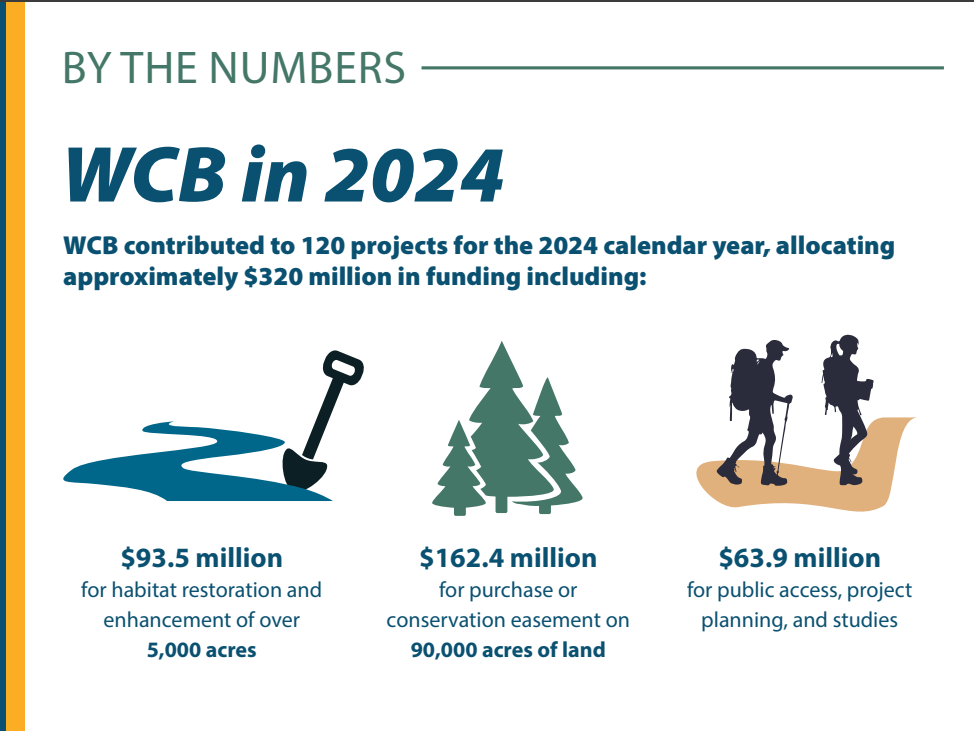
The mission of the Wildlife Conservation Board is to “protect, restore and enhance California’s spectacular natural resources for wildlife and for the public’s use and enjoyment…”  In service of that mission, WCB awards grants of millions of dollars every year for “restoration” projects.  According to WCB’s annual report for 2024, WCB awarded $93.5 million for “habitat restoration and enhancement of 5,000 acres” of land in California in 2024.

Source: “WCB 2024 Year in Review”

Over the life of the updated strategic plan, from 2025 to 2030, the Wildlife Conservation Board will distribute grants of $1.02 billion ($204 million per year) from funding made available by Proposition 4, the $10 billion “California Climate Bond,” which was approved by voters in November 2024.   Because most federal funding of climate and ecological restoration has been cancelled by the Trump administration (and being litigated, as we speak), the “California Climate Bond” will be one of the few sources of funding for these projects. 

This is my public comment on the strategic plan update for California’s Wildlife Conservation Board:


WCB Strategic Plan Update

Thank you for this opportunity to comment on the draft of WCB’s update of its strategic plan (SP).  I am writing to suggest that WCB consider the addition of a few over-arching principles that would apply to all of its programs.  These principles would enhance the plan’s stated goals of climate resilience and biodiversity protection by ensuring projects are evaluated based on their actual ecological outcomes rather than adherence to historical conditions.

  • All projects funded by WCB should be more constructive than they are destructive.  For example, a project that proposes to destroy more habitat than it creates should be less competitive than a project that will create more habitat than it destroys. A project that reduces carbon storage by destroying vegetation does not “reduce and remove carbon pollution,” as the SP proposes.
  • Projects that do not propose to use pesticides to destroy habitat should be more competitive than those that use pesticides because pesticides damage the soil and are harmful to wildlife and human life.   The success of projects is jeopardized by pesticide use.
  • Projects that apply for additional funding for a continuing project must address the fundamental question of the viability of the project.  In other words, if a project has been funded for 20 years, WCB should consider if the goals of the project are still realistic in a rapidly changing climate and environment (e.g., Invasive Spartina Project).
  • Projects should be consistent with the basic principles of science, such as:
    • The scientific definition of biodiversity includes both native and non-native plants and animals.
    • Hybridization is one of the tools of evolution that enables adaptation and speciation in response to changes in the climate and the environment.
    • The flammability of vegetation varies, but the variation is unrelated to the nativity of the plant.  Native plants are not inherently less flammable than non-native species.
    • The native ranges of California’s native plants have changed in response to the changing climate and they must continue to change if they are to survive.
    • Our changing environment dictates that historical landscapes cannot be replicated.  Humans cannot stop evolution, nor should we try.

I recommend that the WCB consider incorporating these principles into its project evaluation criteria to ensure that funded projects align with current ecological knowledge and maximize benefits for California’s biodiversity in a changing climate. Incorporating these principles into the SP would strengthen the plan’s objectives related to climate resilience (C2.1, C2.2), biodiversity protection (B1.1, B2.1), and program evaluation (D2.1, D2.2).

In support of these principles, I offer the following scientific studies for your consideration:

On pesticides damaging soil and harming wildlife and human health

  • Wan et al. (2025):  Pesticides affect a diverse range of non-target species and may be linked to global biodiversity loss. This study presents a synthesis of pesticide (insecticide, herbicide and fungicide) impacts on multiple non-target organisms across trophic levels based on 20,212 effect sizes from 1,705 studies. For non-target plants, animals (invertebrate and vertebrates) and microorganisms (bacteria and fungi), we show negative responses of the growth, reproduction, behavior and other physiological biomarkers within terrestrial and aquatic systems. Negative effects were more pronounced in temperate than tropical regions but were consistent between aquatic and terrestrial environments.  Results question the sustainability of current pesticide use and support the need for enhanced risk assessments to reduce risks to biodiversity and ecosystems.
  • Klein et al. (2024):  New Roundup formulations are 45 times more toxic to human health,on average, following long-term, chronic exposures. The study identified eight Roundup products in which Bayer has replaced glyphosate with combinations of four different chemicals: diquat dibromide, fluazifop-P-butyl, triclopyr, and imazapic. All four chemicals pose greater risk of long-term and/or reproductive health problems than glyphosate, based on the EPA’s evaluation of safety studies. Diquat dibromide and imazapic are banned in the EU. Diquat dibromide – present in all the new formulations – is 200 times more toxic than glyphosate in terms of chronic exposure and is classified as a highly hazardous pesticide.  New Roundup formulations pose significantly more harm to the environment. The chemicals replacing glyphosate in Roundup are significantly more likely to harm bees, birds, fish, earthworms, and aquatic organisms, on average. They are also significantly more persistent in the environment and more likely to leach down into groundwater, increasing the risk of contaminating waterways and drinking water.

On biodiversity including non-native species:

  • Schlaepfer et al. (2011): This pivotal paper challenges the automatic negative classification of non-native species by documenting their potential conservation benefits. The authors present evidence that some non-native species provide ecosystem services, habitat, and resources for native species, particularly in human-modified landscapes where native species may struggle. They advocate for conservation approaches that evaluate species based on their ecological functions rather than origin alone.
  • Mascaro et al. (2012): This study examines novel forests in Puerto Rico dominated by the non-native Castilla elastica tree. The research demonstrates that these novel ecosystems maintain key ecological processes such as productivity, nutrient cycling, and carbon storage at levels comparable to native forests. The findings suggest that novel ecosystems composed of non-native species can maintain essential ecosystem functions even after native tree species decline.

On hybridization as an adaptive mechanism:

  • Hamilton & Miller (2016): This paper reframes hybridization as a potential adaptive resource rather than a conservation threat. The authors present evidence that hybridization can introduce genetic variation that helps species adapt to changing environmental conditions, particularly relevant in the context of climate change. They suggest that conservation strategies should sometimes protect hybrid zones as sources of evolutionary potential rather than trying to eliminate them.
  • Fitzpatrick et al. (2015): This study examines how hybridization challenges traditional conservation approaches based on species preservation. The authors argue that hybridization is a natural evolutionary process that can generate biodiversity and adaptive potential. They present a framework for evaluating conservation value that considers genetic, ecological, and evolutionary factors rather than focusing solely on taxonomic “purity.”

On flammability unrelated to nativity:

  • Zouhar et al. (2008): This comprehensive technical report examines relationships between non-native plants and fire regimes. While acknowledging that some non-native plants can alter fire behavior, the report emphasizes that flammability is determined by plant structure, chemistry, and arrangement rather than nativity status. It provides detailed case studies showing both native and non-native plants can increase or decrease fire risk depending on specific traits.
  • Pausas & Keeley (2014): This study documents abrupt changes in fire regimes that occur independently of climate changes. The authors demonstrate that shifts in vegetation structure and fuel characteristics—which can be caused by both native and non-native species—are often more important determinants of fire behavior than plant origin. The research challenges simplistic assumptions about the relationship between native plants and fire resilience.

On changing native ranges:

  • Pecl et al. (2017): This influential paper documents how species are naturally shifting their ranges in response to climate change. The authors present global evidence of species redistributions across latitudinal, longitudinal, and elevational gradients. The study emphasizes that these range shifts are necessary adaptations to changing conditions and argues that conservation strategies need to accommodate these natural movements rather than trying to maintain historical distributions.
  • Bonebrake et al. (2018): This paper synthesizes research on climate-driven species redistribution and its implications for conservation. The authors highlight how traditional conservation approaches focused on preserving species in their historical ranges are becoming increasingly unviable under climate change. They advocate for more dynamic approaches that facilitate range shifts and species movements as adaptive responses to changing conditions.

On novel ecosystems and historical conditions:

  • Hobbs et al. (2014): This seminal paper introduces a framework for categorizing landscapes as historical, hybrid, or novel ecosystems. The authors argue that many ecosystems have been irreversibly altered by human influences and climate change, making restoration to historical conditions impossible in many cases. They advocate for pragmatic management approaches that focus on ecosystem functions and services rather than historical composition.
  • Stralberg et al. (2020): This study examines climate refugia in North America’s boreal forests. The research demonstrates that even supposedly pristine ecosystems will undergo significant changes due to climate change, with some areas serving as temporary refugia. The authors emphasize that conservation strategies need to recognize the transient nature of these refugia and plan for ongoing ecological transitions rather than static preservation.

In Conclusion

As you know, the mission of the Wildlife Conservation Board is to “protect, restore and enhance California’s spectacular natural resources for wildlife and for the public’s use and enjoyment…”  In addition, the Wildlife Conservation Board “envisions a future in which California’s wildlife, biodiversity and wild places are effectively conserved for the benefit of present and future generations.”  My suggestions for improvements in the draft strategic plan are consistent with the mission of the WCB. 

There was a time when academic scientists believed that the goal of conservation was to replicate historical landscapes by destroying plants and animals that were not here prior to European settlement.  Although many of these plants and animals found their way to California by natural means, without human assistance, they were perceived as “alien invaders” that didn’t belong here.  The assumption was that ecosystems can achieve an equilibrium state that represents an ideal that can be sustained by preventing change.  Science has long ago abandoned that notion in favor of acknowledging that nature is constantly changing in response to constant change in the environment. 

The belief that destroying such “alien invaders” would restore the landscape persisted for decades.  In many cases, no replanting was done after introduced plants were destroyed.  After poisoning our public land for decades, it has become clear to those who are not ideologically committed to historical landscapes that the original goal is not attainable because the plants and animals that survive are those that are best adapted to current environmental conditions, particularly the rapidly changing climate that is expected to continue to change.  In most cases, the newcomers are performing the same ecological functions of their predecessors and the harm that was presumed is usually balanced by benefits of their existence. 

Most academic scientists acknowledge this reality, but cultural lag has left the public behind as science has moved on.  Non-profit organizations that survive by the grace of their donors, have contributed to the pressure on public land managers such as the Wildlife Conservation Board.  Academic scientists are unwilling to participate in such grass-roots policy politics and their publications are often incomprehensible and inaccessible to the public and public land managers, leaving public land managers at the mercy of those with the least amount of information and the most amount of passionate belief.

The Wildlife Conservation Board has a responsibility to the public to inform itself of the consequences of conservation practices that are damaging the environment and are no longer realistic.  I respectfully ask that the WCB read the scientific studies I have provided and take them into consideration as it distributes over a billion taxpayer dollars made available by the passage of Proposition 4. 

Conservation Sense and Nonsense
May 1, 2025

References for cited studies

On pesticides harming soil and damaging wildlife and human health:

On biodiversity including non-native species:

  • Schlaepfer, M.A., Sax, D.F., & Olden, J.D. (2011). The potential conservation value of non-native species. Conservation Biology, 25(3), 428-437.
  • Mascaro, J., Hughes, R.F., & Schnitzer, S.A. (2012). Novel forests maintain ecosystem processes after the decline of native tree species. Ecological Monographs, 82(2), 221-228.

  On hybridization as an adaptive mechanism:

  • Hamilton, J.A., & Miller, J.M. (2016). Adaptive introgression as a resource for management and genetic conservation in a changing climate. Conservation Biology, 30(1), 33-41.
  • Fitzpatrick, B.M., Ryan, M.E., Johnson, J.R., Corush, J., & Carter, E.T. (2015). Hybridization and the species problem in conservation. Current Zoology, 61(1), 206-216.

  On flammability unrelated to nativity:

  • Zouhar, K., Smith, J.K., Sutherland, S., & Brooks, M.L. (2008). Wildland fire in ecosystems: fire and nonnative invasive plants. General Technical Report RMRS-GTR-42-vol. 6. USDA Forest Service.
  • Pausas, J.G., & Keeley, J.E. (2014). Abrupt climate-independent fire regime changes. Ecosystems, 17(6), 1109-1120.

  On changing native ranges:

  • Pecl, G.T., et al. (2017). Biodiversity redistribution under climate change: Impacts on ecosystems and human well-being. Science, 355(6332).
  • Bonebrake, T.C., et al. (2018). Managing consequences of climate-driven species redistribution requires integration of ecology, conservation and social science. Biological Reviews, 93(1), 284-305.

  On novel ecosystems and the impossibility of recreating historical conditions:

  • Hobbs, R.J., et al. (2014). Managing the whole landscape: historical, hybrid, and novel ecosystems. Frontiers in Ecology and the Environment, 12(10), 557-564.
  • Stralberg, D., et al. (2020). Climate-change refugia in boreal North America: what, where, and for how long? Frontiers in Ecology and the Environment, 18(5), 261-270.

Invasion Biology: “We can do whatever we want”

Macaylla Silver discovered Conservation Sense and Nonsense on Facebook.  We instantly recognized one another as kindred spirits, battle scarred by our attempts to protect nature from pointless destruction in service of the ideology of invasion biology and the native plant movement it spawned. 

When confronted with the destruction of wild places we love, our reaction was very similar, and responses to our efforts were also similar.  First we turned to public policy for protection:  Are they really allowed to poison our public lands with pesticides to destroy harmless plants? With a few targeted “exceptions” to policy, the answer was always, “We can do whatever we want.”

Then we both decided the best course of action was to become experts about the “science” that is used to justify destroying harmless vegetation with herbicides.  And so, we took to the books and armed ourselves with the science that refutes invasion biology.  Once again, we hit the brick wall of “We can do whatever we want.”

And there Macaylla’s experience as an activist diverges with mine.  He has successfully stopped the poisoning of Leverett Pond (for the time being) by showing the neighbors of Leverett Pond with videos, the consequences of poisoning the pond. 

However, he concludes his story with the astute observation that stopping the destruction of Leverett Pond is unlikely to be the end of the story.  Life in the pond will continue to evolve, as it must.  As long as people continue to believe that evolution must be stopped, the futile attempt to prevent change will continue. Macaylla is hopeful that mistaken belief will fade.  I hope he is right.

We thank Macaylla for his efforts.  We wish him luck in preventing more herbicide applications in Leverett Pond.

Conservation Sense and Nonsense


“Let the Pond Be a Pond”

Massachusetts Wetlands Protection Act was created for the protection of the state’s wetlands. The goals of the law are to prevent pollution, maintain habitats for plants and wildlife, and protect groundwater, public and private water supplies.

Our Town Bylaws in Leverett, Massachusetts also included a ban on the use of herbicides for any use outside of domestic and agricultural use since 1973.

There are five colleges in the area. The town is filled with highly educated academics and retired academics. Leverett is quite ecologically minded in my opinion, this hill town of 2,000 people.

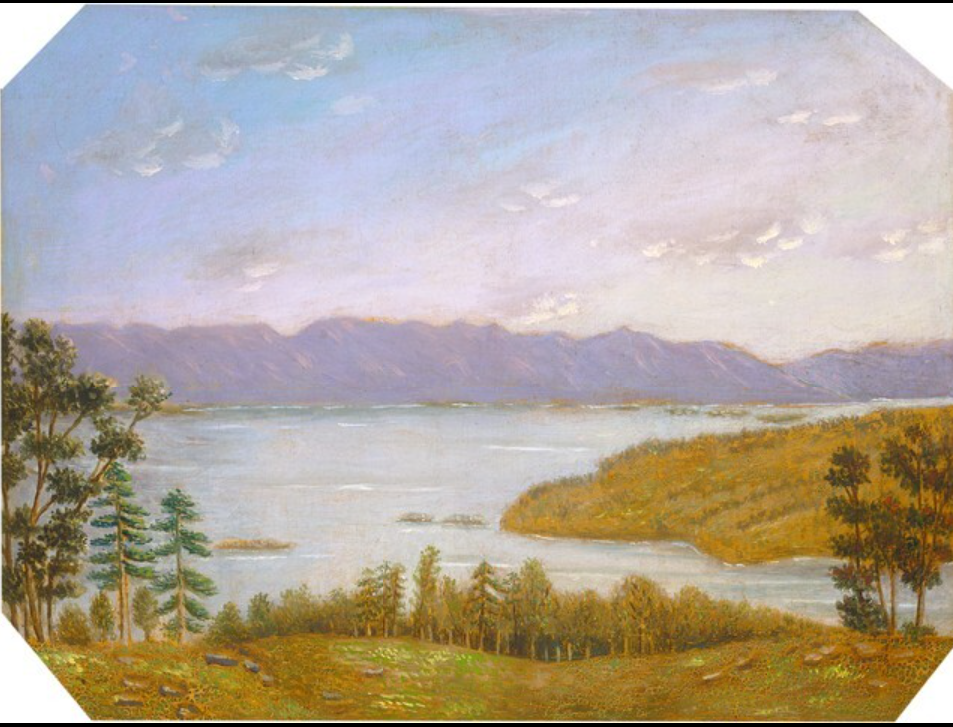
Leverett Pond, circa 1860-1880, Erastus Salisbury Field.  Public domain.

One day back in 2018, I found that the large body of water at the town’s center, Leverett Pond, was under ecological attack. Somehow, some way, a handful of land abutters on the shallow side of the pond were trying to rid the pond of “noxious weeds.”  This included floating leaved Waterlilies and Watershield, plants such as rootless carnivorous plants like Bladderworts, submerged weeds like Coontail, Waterweed and Milfoils.  Even Cattails and other plants growing on the pond’s edges were considered for removal.

Act One:  Isn’t there a law against this?


I thought I could stop this. I thought once the town’s people knew what was happening they would be outraged. I thought the state would step in, prevent the further destruction and maybe even fine the people who were poisoning the area and dredging large sections, all so they could in their words “have crystal clear water to look at.”

I thought it would be easy.  I have never been so wrong in my life. 

It was five years of continual meetings, letter writing, publishing newspaper letters and articles, and a large portion of the town thinking that somehow I was just trying to cause trouble. Or maybe they didn’t think I knew what I was talking about. Sure, I saw the destruction, but I was misinformed. They believed in their intent and factual details of why they were on a campaign of eradication.

The details of destruction used to convince the town’s Conservation Commission, Select Board, and state agencies came from two retired professors, neither with a degree in Environmental Ecology. Their plan contained the curveball of being designed to show off knowledge of several obscure subjects unknown to nearly everyone:

1.Limnology: The science of fresh water systems
2.Pesticides and their application to aquatic environments
3.The botany and identification of aquatic plants

Act Two:  Countering Pseudoscience with Science


While the wordsmithing of the two PHDs had merit and flow, my own research quickly showed that they had only a surface understanding of subjects.  In order to counter their statements and proposals, I decided that I would deeply learn all I could about limnology, pesticides and the life of aquatic plants. I would become an expert, the old fashion way: I would purchase books. Lots of them. I read extensive science based articles on pesticide families, collecting hard data and staying away from anything that was too opinionated. 

People began to realize that I knew more than expected, so much more that it was easy to forget that the vocabulary was rarely understood. I presented myself on equal footing with proponents of the project.  I asked the community and its policy makers to consider that dumping herbicide on the pond might not be the best thing, creating aporia, lingering doubts that this handful of lakefront owners may have hidden motives.

Act Three:  Invasion Biology at Work

Then came the videos. I purchased two kayaks, an underwater camera, and I used cameras I had purchased for bird photography. The videos contrasted the “before and after” of the years of degradation in 2019, 2020 and 2022. The videos got the state involved.   The state permits for dredging that the project applied for in 2010 were never received. This meant that the project had to reapply for permits for any further work after 2020. 

Up to this point, I thought I was fighting against ignorance and arrogance from a few landowners who came late to the pond’s available real estate and bought lots that were undesirable because of their shallowness and large amounts of aquatic flora and fauna. I would have been in heaven if I bought such an area, but they looked to “improve it.”  So they had set out to “manage” the water’s surface.

The two professors contacted a professional who specialized in finding ways around what was allowed by the Wetlands Protection Act. Leverett’s Conservation Commission reviewed the law and found that there were no ways around the law because the plant abundance, oxygen levels and fish life were all healthy, vibrant. Graphs, data, reams of older regurgitated documentation pointed to the same conclusion I had reached: Let the pond be a pond.

To show the reason why no further “management” permits would be issued to continue the project, the head of the Conservation Commission submitted his own reason: the project violated Town Bylaws. Clearly. 

Then it happened. Three members of the Conservation Commission had what I thought were very strange ideas about conservation.  One had a pesticide license. One looked at the pond for recreation purposes rather than an interest in environmental issues. Another felt strongly about eradicating plants that they couldn’t identify if asked.  One said, in defense of using pesticides, the blithe motto “If you can choose it, you can use it,” while the other two nodded in agreement. “We have to stop the growth of these plants before they destroy the pond. It will reach a tipping point where there will be no return,” said one, with great conviction.  “It could in the future make the fishery less healthy,” said another, without a shred of data.  I had no idea why such people would be put on such a Commission. 

The Conservation Commission voted three to two to allow the project to continue for another five years. The state admonished but did not intervene. I had been angry at the professors and their allies for their lack of concern. Now the Conservation Commission had let me, and the pond, down.

The decision of the Conservation Commission gave the pond abutters cover, so they could remove all the plants they wanted. The Commission gave herbicide sprayers a welcome mat in Leverett to earn big money for the applicators and companies that make a variety of toxins.

The decision gave the Conservation Commission, not its local intended use, protecting wetlands and freshwater, but a zealous conviction that they were acting on a world saving mission.  It was Invasion Biology at work, masquerading as “restoration,” AKA the “native plant movement.” Invaders needed to be destroyed, regardless of recklessness, collateral damage, complete destruction.

So destroying acres of plant life, to get at one plant, that is okay now.  They were Crusaders with a capital “C.” And like all crusades…it rarely ends well.

Act Four:  Pictures are worth thousands of words

In 2022, the herbicide sprayers came back, on a very windy day, on an airboat. It appeared that the targeted areas were being sprayed, yet large amounts were misted and blowing in the air as the airboat itself churned the water’s surface. It was, in a word, sloppy.

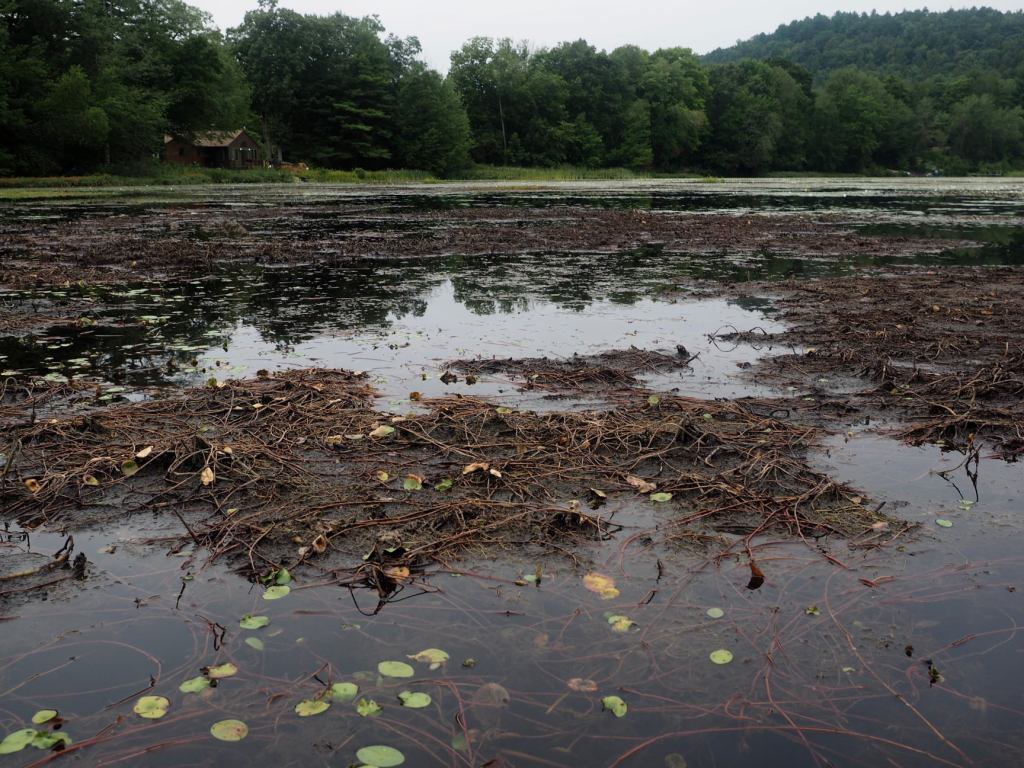
From my kayak, I videoed the spraying of the pond with herbicides from an air boat: the before, during, and the after of floating masses of dead vegetation. I got the resulting video shown to many. It had few words, an eerie soundtrack that suited the unreal transformation, from living beauty to full degradation, death and decay.  (see below)

Leverett Pond after herbicide spraying in 2022. Entire video available HERE.

For the next year, and the next they stopped spraying. Sure, they hired an aquatic harvester to clean around the area of their docks, but that was it.

In 2024, the promoters of the deadly project were apologetic. They promised that “no herbicides” would be used. Even an attempt to hand pull marginal plants failed.

The pond will continue to respond to changing climate conditions, as it must.  Plants are likely to return and the fear-mongers are likely to demand their destruction again.

Fear of so-called “invasive species” is being used as an excuse to use herbicides in the futile attempt to freeze ecosystems that replicate historical landscapes.  As climate conditions continue to change, the fantasy that humans can prevent evolution is likely to fade.   Perhaps the restoration movement will begin to realize the folly of trying to sort plants and animals into two simplistic groups:  native vs. non-native.

As Charles Mackay said in a book written in 1841, ” Men, it is said, think in herds; it will be seen that they go mad in herds, while they only recover their senses slowly, one by one.”

Macaylla Silver
Leverett, Massachusetts
Contact:  artargentia@gmail.com

Defining “Success” so “Success” can be achieved

I always attend the conferences of the California Invasive Plant Council (Cal-IPC) and the California Native Plant Society because I feel obligated to understand their viewpoint so I can accurately report on the controversies of invasion biology.  Ironically, the more I learn about the native plant movement and the “restoration” industry it spawned, the less sense it makes.  The October 2024 Symposium of the California Invasive Plant Council has provided more evidence that attempts to eradicate well-established non-native landscapes and replace them with native plants are futile.

Tricks of the “restoration” trade

Every Cal-IPC Symposium has wrestled with the question of whether or not it’s possible to convert non-native grassland to native grassland. A study of 37 grassland “restorations” in coastal California addresses that question. (1)  It’s really quite simple.  All you need to do is define success as 25% native plants after “restoration” and limit post-project monitoring to 5 years or less:  “Monitoring is done ≤5 years after project-implementation, if at all, and rarely assesses the effects of management practice on project success.” 

It also helps if public land managers in charge of the projects won’t allow the academic researcher to enter the land to conduct a survey of the results.  43% of the projects that were studied were “statutory,” i.e., they were mandated by laws such as county general plans or legally required mitigation for projects elsewhere that Environmental Impact Reports determined were harmful to the environment.  30% of the managers of the statutory projects would not allow the academic researcher to survey their projects. 

It is also easier to achieve success if the project goal is downgraded mid-project as were many of the statutory projects because they weren’t able to meet the original goal.

Project managers can also reduce their risks of failure by planting a small number of native species that are particularly easy to grow:  “Ninety-two percent of restoration managers preferentially use one or more of the same seven [native] species.”  Seven projects planted only one native species. 

According to the study, the result of planting only a few hardy native plants is “biotic homogenization.”  Call it what you will, but this risk-averse strategy is inconsistent with claims that the goal of native plant restorations is to increase biodiversity. 

The study did not ask project managers about the methods they used to eradicate non-native plants or plant native plants.  The study tells us nothing about the methods that were used or whether or not some methods were more effective than others.  Since results of the projects were all very similar, should we assume that the methods that were used didn’t matter? 

The presentation of this study concluded with this happy-face slide. (see below) It looks like a cartoonish marketing ad to me:

Harmless aquatic plants being pointlessly eradicated

A USDA research ecologist stationed at UC Davis made a presentation about the most effective way to kill an aquatic plant with herbicides, but that wasn’t the message I came away with. 

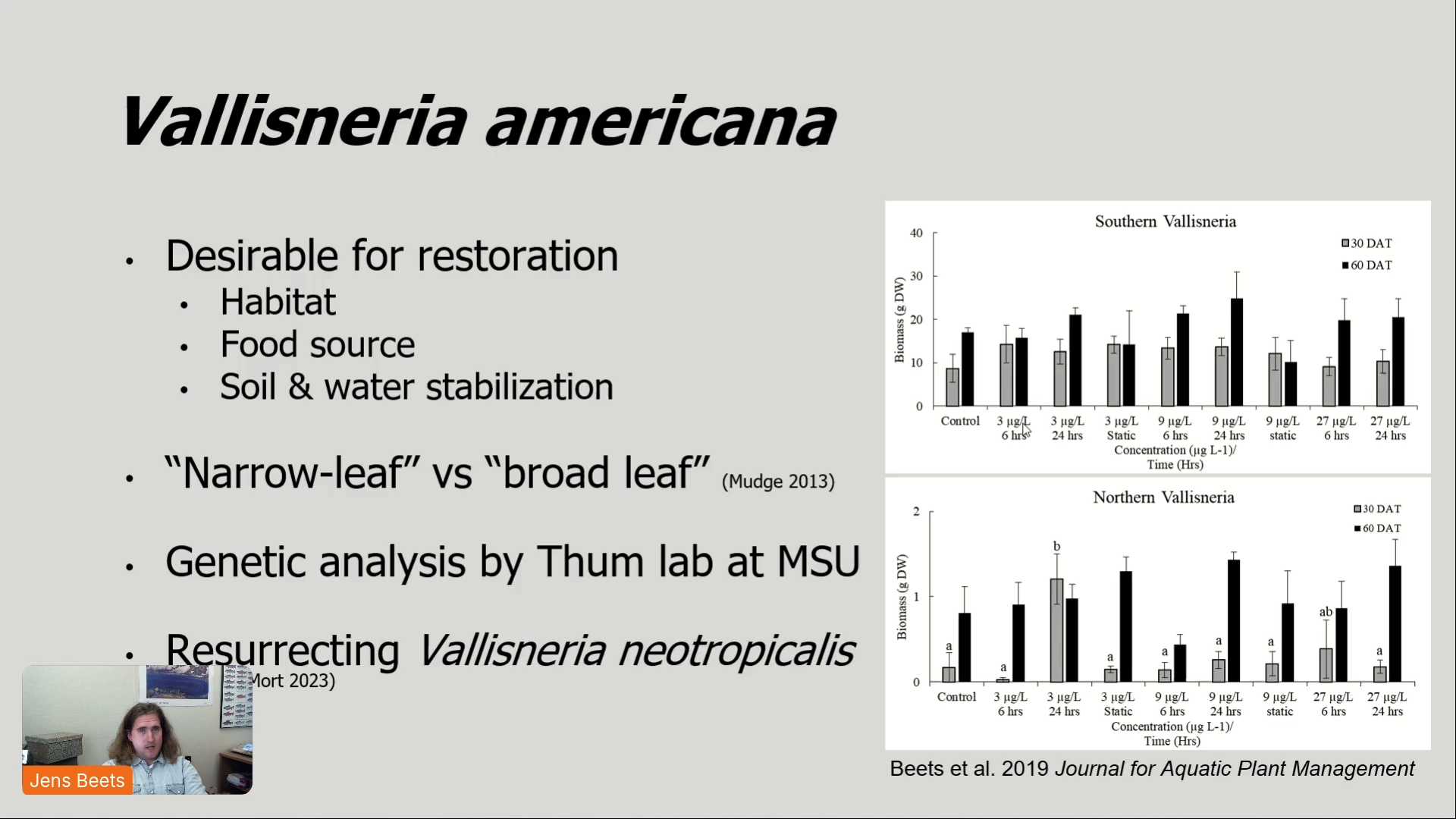
Jens Beets told us about a species of aquatic plant that is native to the East and Gulf coasts of the US, but is considered a “noxious weed” in California, solely because it isn’t native.  He said the plant is considered very useful where it is native.  (see below)

Where Vallisneria americana is native, it is considered a valuable plant for habitat restoration because it is habitat for vertebrates and invertebrates and it stabilizes soil and water levels.  The canvasback duck is named for this plant species because it is preferred habitat for the native duck that is found in California during the winter.

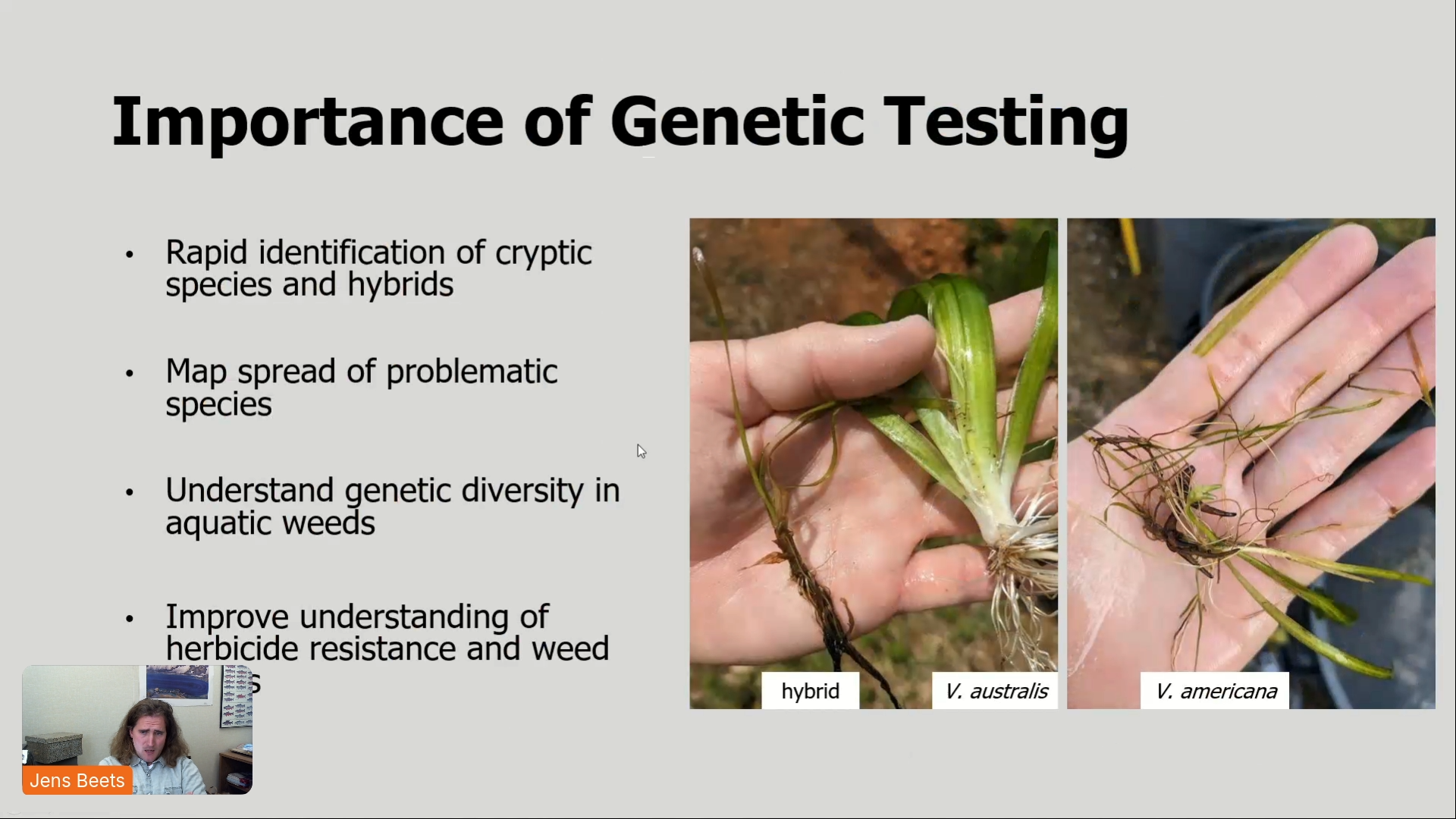
 Vallisneria americana looks very similar to other species in the genus considered native in California.  For that reason, native species of Vallisneria have been mistakenly killed with herbicide because applicators didn’t accurately identify the target plant as native.  Jens Beets recommended that genetic tests be performed before plants in this genus are sprayed with herbicide.

This story probably sounds familiar to regular readers of Conservation Sense and Nonsense.  The story is identical to the pointless and futile effort to eradicate non-native species of Spartina marsh grass in the San Francisco Bay.  The species being eradicated in California is native to the East and Gulf coasts, where it protects the coasts from extreme storm surges and provides valuable habitat for a genus of bird that is plentiful on the East Coast, but endangered in California.  The 20-year effort to eradicate non-native Spartina has killed over 50% of the endangered bird species in the San Francisco Bay. 

Throwing good money after bad

Because the hybrid is indistinguishable from the native species of Spartina on the West Coast, 7,200 genetic tests have been performed in the past 12 years before hybrid Spartina was sprayed with herbicide. Taxpayers have spent $50 million to eradicate Spartina over 20 years.  Recently, California state grants of $6.7 million were awarded to continue the project for another 10 years.  A portion of these grants is given to the California Invasive Plant Council to administer the grants.

Plants are sprayed with herbicide because they aren’t native, not because they are harmful.  Even if the target species is needed by birds and other animals, it is still killed and animals along with it.  The target species looks the same as the native species and only genetic testing can identify it is as a non-native.  The non-native is the functional equivalent of the native.  It is only genetically different because natural selection has adapted it to the conditions of a specific location. 

Pesticide regulation in the US is a hit or miss proposition

The final session of the symposium was a carefully orchestrated apologia for herbicides, a defensive tirade that suggested Cal-IPC believes its primary tool is in jeopardy.  Two presentations were made by employees of regulatory agencies.  Their assignment was to reassure the public that pesticides are safe because they are regulated by government agencies. 

The fact that many countries have banned pesticides that are routinely used in the US does not speak well for our regulatory system.  America’s pesticide regulators rarely deny market access to new pesticides.  A recent change in policies of California’s Department of Pesticide Regulation made a commitment to the continued use of pesticides for another 25 years. 

In 1996, Congress ordered the U.S. Environmental Protection Agency (EPA) to test all pesticides, used on food, for endocrine disruption by 1999. The EPA still doesn’t do this today. Twenty-five years later, the EPA has not implemented the program, nor has it begun testing on 96% of registered pesticides.  In 2022, an organization that represents farm workers sued the EPA to conduct the legally mandated evaluation of chemicals for endocrine disruption.   The lawsuit has forced the EPA to make a commitment to conduct these evaluations of chemicals for hormone disruption.   

The Cal-IPC presenters got some badly needed push back from attendees.   One attendee informed the audience that all the testing of herbicides is bought by the manufacturers, not the regulators who don’t do any testing.  Another attendee pointed out that herbicides have not been evaluated for the damage they are doing to the soil, damage that makes it difficult to grow native plants in the dead soil.  The “pesticide regulator” agreed with those observations.

Fire safety or native plant restoration?

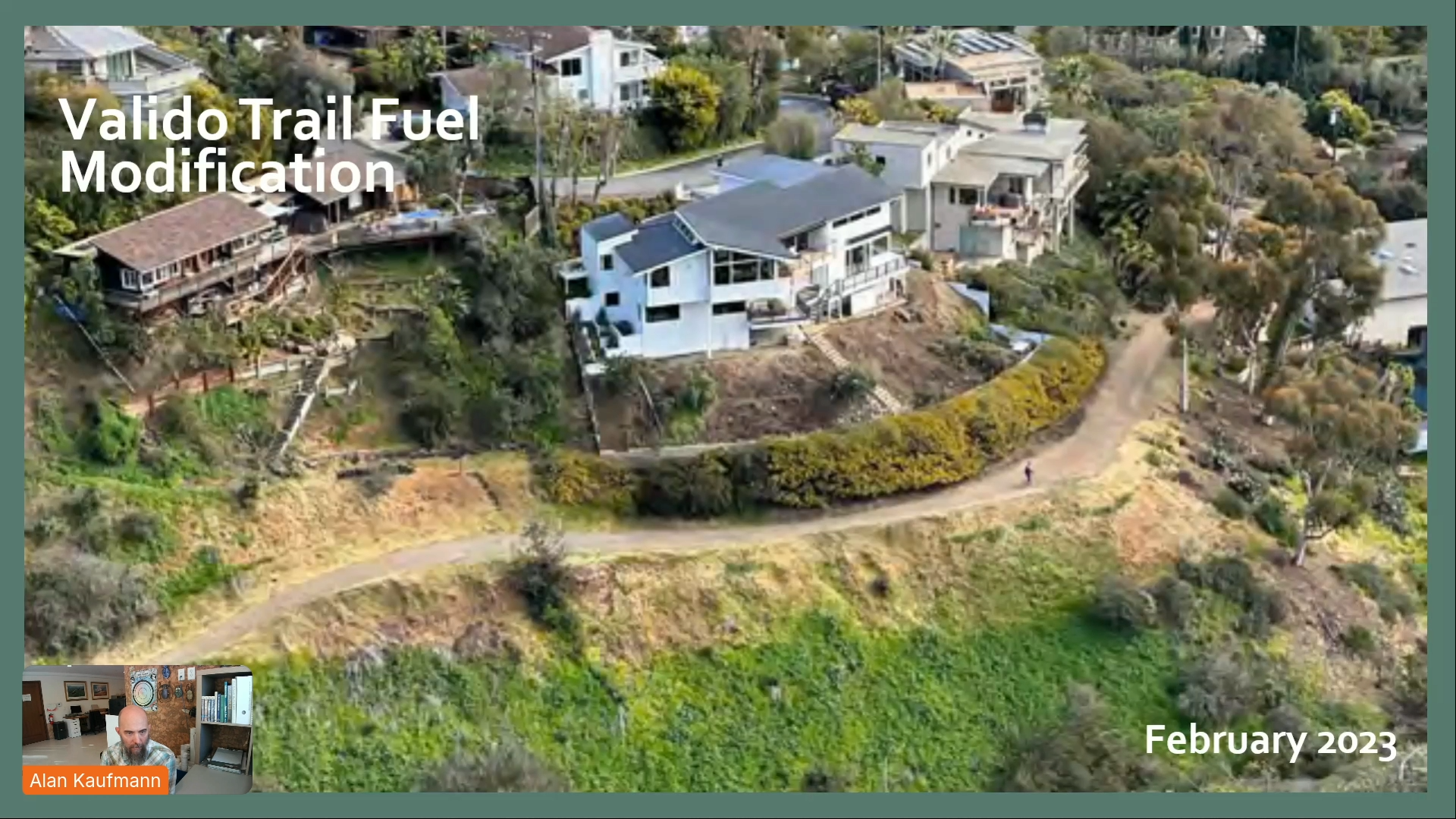
The Interim Deputy Director of the Laguna Canyon Foundation was the final presenter for the Symposium, speaking on a Friday afternoon at 4:30 pm, when there were less than 100 attendees left of the 690 registrants.  His presentation was about the blow back that his organization gets from the public about herbicide applications.  Criticism of herbicides escalated after a wet year that increased vegetation considered a fire hazard.  This photo (below) is an example of the visible effects of fuels management by Laguna Canyon Foundation using herbicides.

It seems likely that a fuels management project was selected for this presentation because it’s easier to justify herbicide use for fuels management than for eradicating harmless plants solely because they aren’t native. 

I recently supported Oakland’s Vegetation Management Plan that will use herbicides for the first time on 300 miles of roadsides and 2,000 acres of public parks and open space in Oakland.  Previously, herbicide applications were only allowed on medians in Oakland.  I tracked the development of the Vegetation Management Plan for 7 years through 4 revisions to avoid nativist versions of fuels management such as leaving dead thatch after herbicide applications on grassland or destroying non-native trees, while leaving highly flammable bay laurel trees behind or destroying broom, while leaving more flammable coyote brush behind.

However, using herbicides for the sole purpose of killing non-native plants is much harder to justify.  The irrational preference for native species has put us on the pesticide treadmill. Every plant species now targeted for eradication with herbicides should be re-evaluated, taking into consideration the following criteria:

  • Is it futile to attempt to eradicate a plant species that has naturalized in an ecosystem?
  • Will the attempt to eradicate the plant species do more harm than good?
  • Is the targeted plant species better adapted to current environmental and climate conditions?
  • Is the targeted non-native plant making valuable contributions to the ecosystem and its animal inhabitants?

If these questions cannot be satisfactorily answered, the bulls-eye on the targeted plant should be removed. Limiting the number of plants now being sprayed with herbicide is the only way to reduce pesticide use. If the plant isn’t a problem, there is no legitimate reason to spray it with herbicide.

Pot calls kettle black

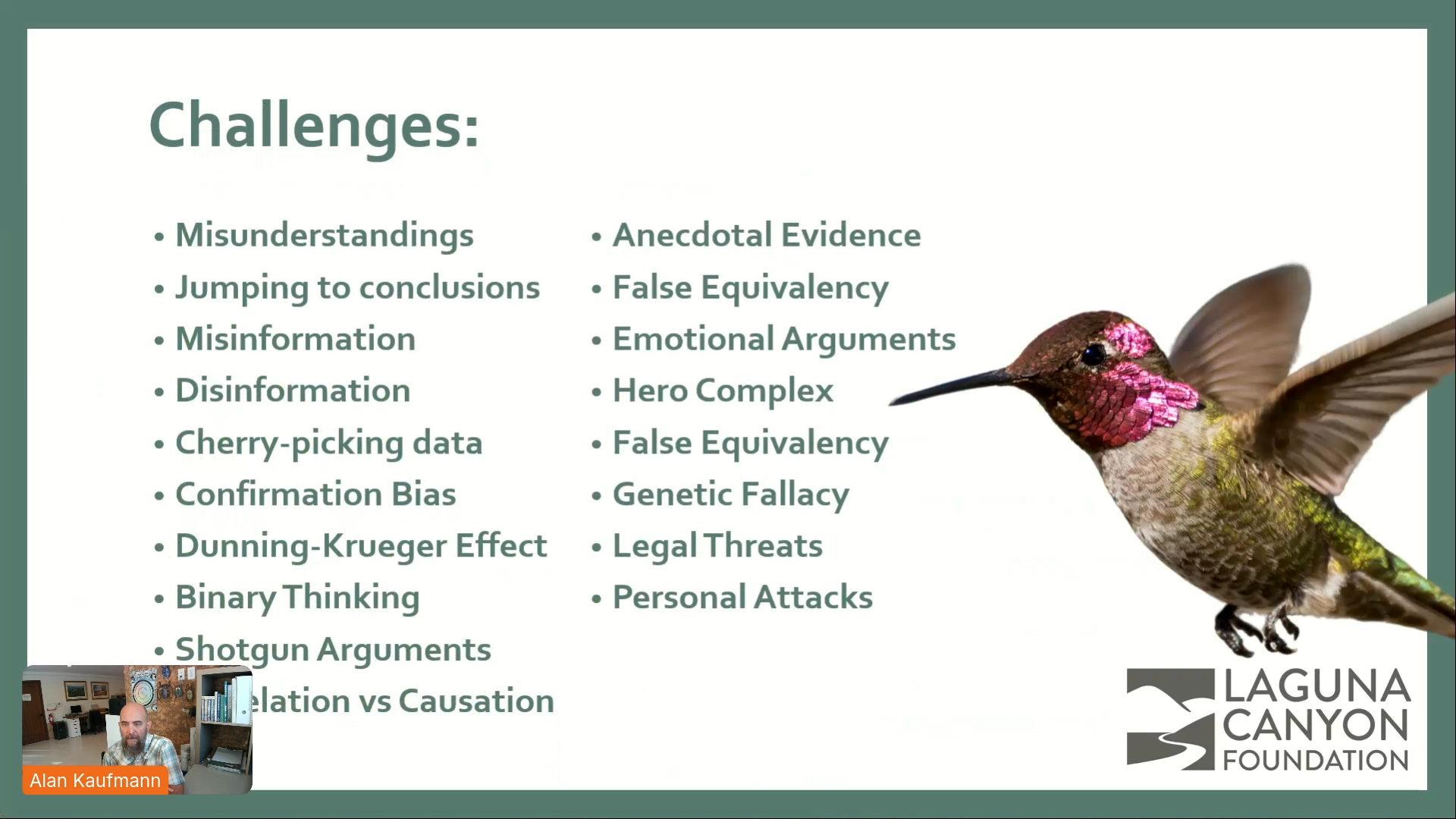
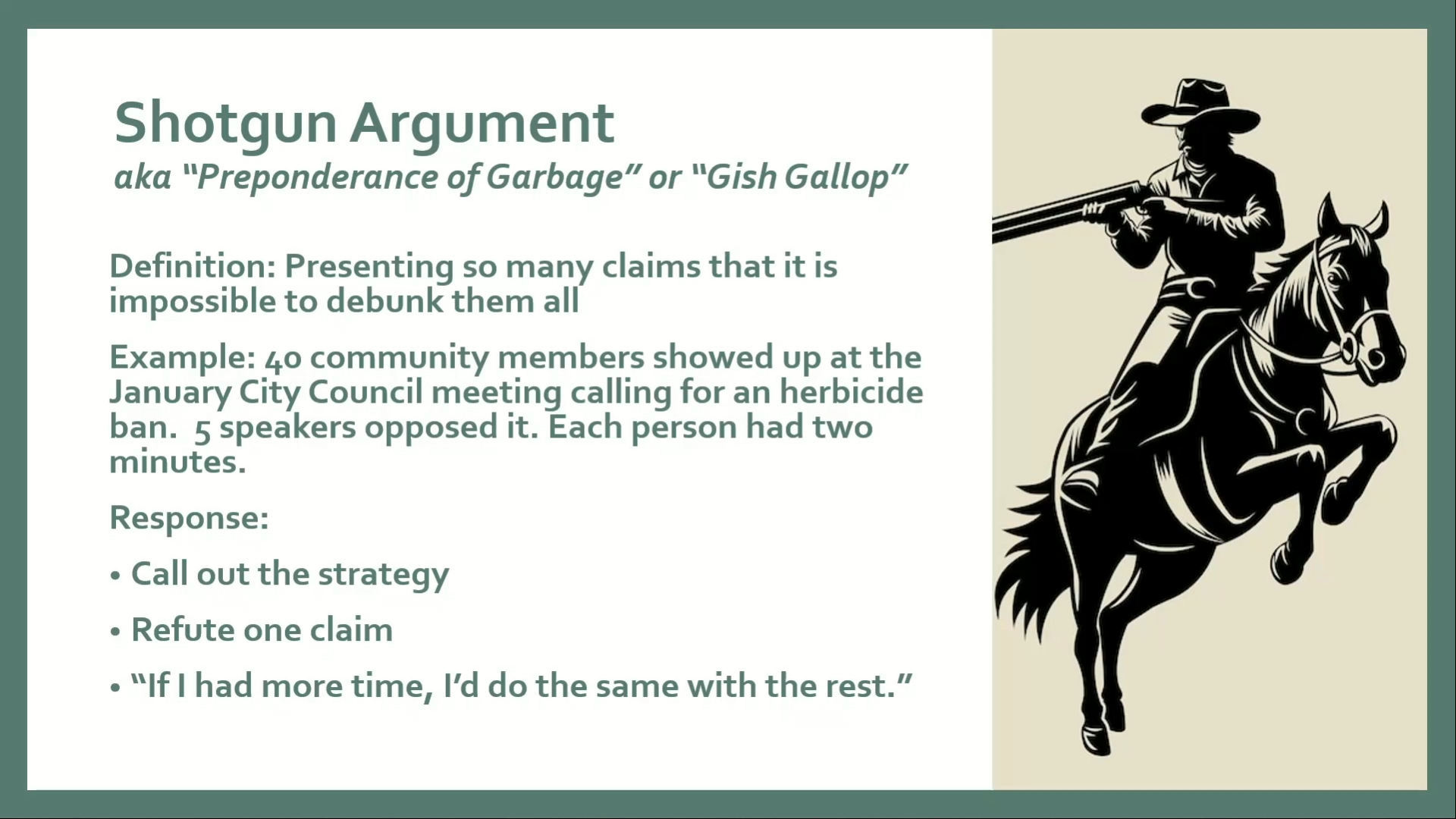
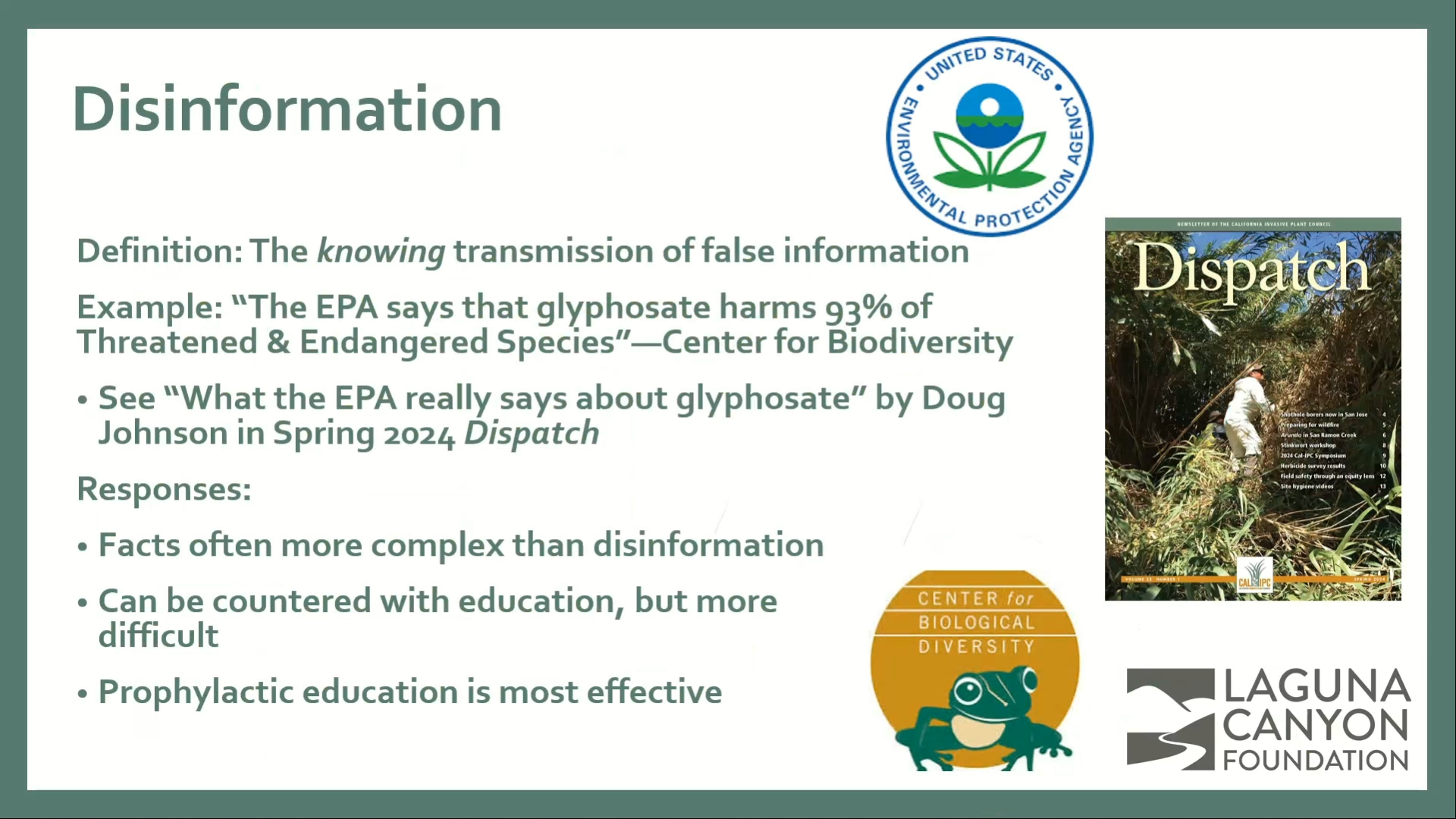
The Cal-IPC presentation was a detailed criticism of the public’s complaints about herbicides used in their community.  The intention of the presentation was to arm herbicide applicators with defenses against the public’s complaints.  Herbicide applicators were encouraged to recognize these arguments (below) and participate in the “education” of the public about the righteousness of their task.

The presenter then showed a series of slides making specific accusations, such as these:  (see below)

Those who object to the pointless destruction of nature can also cite distortions and misrepresentations of facts (AKA lies) by those who engage in these destructive projects;

  • Nativists fabricated a myth that eucalyptus kills birds to support their demand that eucalyptus in California be destroyed.  There is no evidence that myth is true. 
  • Nativists also fabricated a myth that burning eucalyptus in the 1991 firestorm in the East Bay cast embers that started spot fires 12 miles away from the fire front.  There is no evidence that myth is true.
  • Nativists exaggerate the success of their projects by setting a low bar for success, conducting no post-project monitoring, and restricting access to their completed projects.  
  • The EPA justified the dumping of rodenticides on off-shore islands by inaccurately claiming that the rodenticides do not end up in the water, killing marine animals.  There is ample evidence that island eradications have killed many marine animals because rodenticide lands in the water when applied by helicopters. 
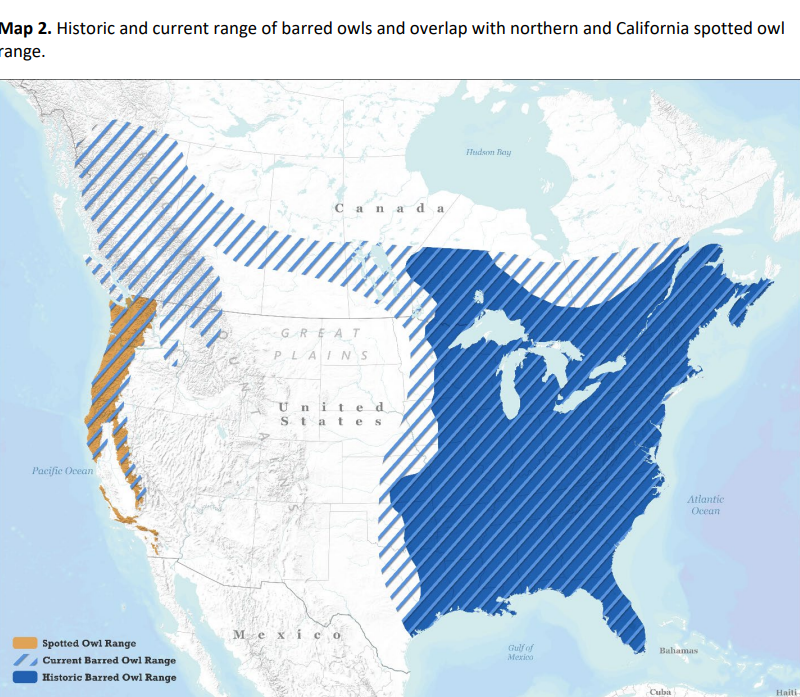
  • USFWS justified the killing of 500,000 barred owls in western forests by claiming they are an “invasive species.”  In fact, barred owls migrated from the East to the West Coasts via the boreal forests of Canada.  These forests were not planted by humans and have existed since the end of the last Ice Age, some 10,000 years ago.  The arrival of barred owls on the West Coast was a natural phenomenon.  Barred owls are therefore not “invasive species.” In a rapidly changing climate, many animals must move to survive.
  • Nativists claim that most insects are “specialists” that require native plants.  That claim is a gross exaggeration of the dependence of insects on native plants, which are sometimes confined to a family of plants containing thousands of both native and non-native species. 
  • Pesticide applicators also complain about “personal attacks.”  They are not alone.  I (and others) have been called “nature haters,” “chemophobes,” and “climate change deniers.”  Pesticide applicators feel abused.  So do I. 

I could go on.  The list of bogus claims of the superiority of native plants and animals is long and getting longer as more and more public money is available to conduct misnamed “restorations.”  Suffice to say, there is plenty of misinformation floating around invasion biology and most of it is used to defend destructive “restoration” projects.  The war on nature is also a war of words. 


(1) ­Justin Luong, et.al., “Lessons learned from an interdisciplinary evaluation of long-term restoration outcomes on 37 coastal grasslands in California.” Biological Conservation, February 2022.

The program for the Cal-IPC 2024 Symposium is available HERE.  Abstracts and presentation slides have not yet been posted to the website, but they will eventually be available to the general public. 

A Reprieve for Wildlife on the Farallon Islands

This is a good news/bad news story.  First the bad news, because it contains kernels of good news.  The federal budgets of the entire National Wildlife Refuge System are being cut, including the budget for the Farallon Islands, which has funded the research of Point Blue Conservation on the islands for over 50 years.  This cut comes on the heels of a long-term decline in funding of the wildlife refuge system from $765 million in 2010 to $527 million in 2023.  It seems safe to assume that this loss of funding will have a negative impact on these fragile ecosystems, but in the case of the Farallon Islands, we also foresee some benefit to wildlife.

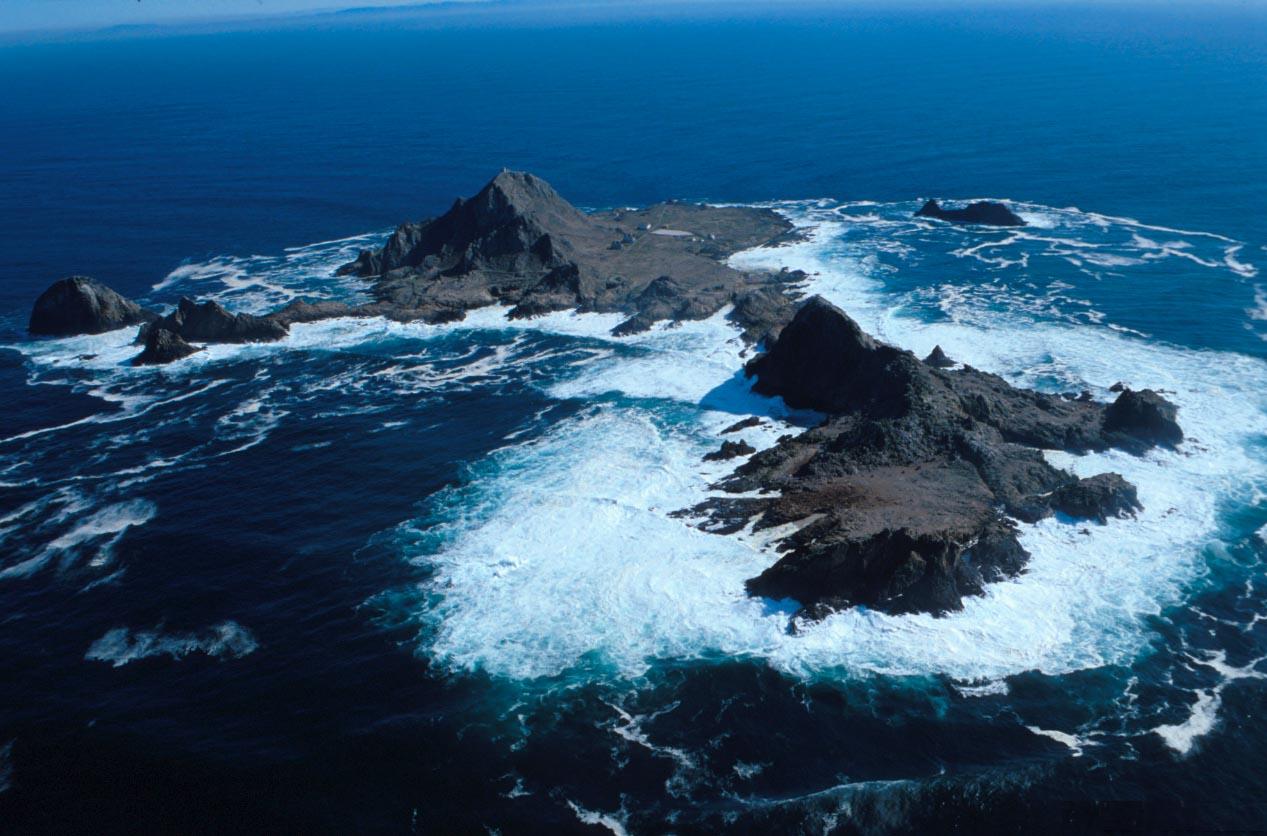
Farallon Islands, NOAA

Point Blue has maintained a year-round presence on the Farallons that will be curtailed in 2025 due to the loss of funding, leaving the island vulnerable to unauthorized visitors and activities in the winter.  It will reduce the ability to monitor wildlife populations and maintain long-term datasets that identify trends in wildlife populations. 

So, what is the good news?  For the moment, the plan to aerial broadcast nearly 2 tons of rodenticide bait on the islands to kill harmless house mice has been abandoned because it cannot be financed.  A brief reminder of why that is good news:

  • Thousands of non-target birds and marine animals are likely to have been killed by eating the bait directly or by eating poisoned house mice.  The plan and its Environmental Impact Statement (which has not been certified), predict 1,100 collateral deaths of Western gulls.  Delayed and inadequate reporting of non-target deaths by similar projects suggest numbers may be greater. 
  • House mice on the Farallons do not need to be eradicated because there is no evidence that they harm birds on the Farallons.  The only evidence of mice eating bird chicks of which I am aware were albatross chicks, a naive species that spends their life in the air except to nest in a few places in the Southern Hemisphere, but not on the Farallons.  Native mice live unmolested on other off-shore islands in California.  Native mice were removed from Anacapa Island prior to the rodenticide drop to kill rats and were returned after the drop.  House mice on the Farallons are targeted solely because they are non-native (and anecdotally because they are an annoyance to research staff who stay in dilapidated housing from which mice cannot be excluded).   
  • The bizarre explanation for killing house mice is that they attract a small population of burrowing owls, who allegedly eat bird chicks.  The burrowing owls could be removed from the Farallons, as Golden Eagles were removed from Santa Cruz Island to save the Channel Island Fox. 

More Good News

It seems likely that the budget cut will also reduce the application of herbicides on the islands to kill non-native vegetation.  Roundup (glyphosate) has been used by Point Blue Conservation on the Farallon Islands every year since 1988.  Between 2001-2005, an average of 226 gallons of herbicide were used annually (5.4 gallons per acre per year), according to the annual report of the Farallon National Wildlife Refuge. (1)

63%-80% of the vegetation on the Farallons is non-native. (2) The non-native vegetation that is being needlessly sprayed with herbicide was brought to the islands by birds who ate them elsewhere and/or by wind and ocean currents.  They cannot be eradicated because they cannot be excluded from an open ecosystem, just as house mice cannot be excluded from a dilapidated building. They are useful to wildlife and it is pointless to contaminate the ecosystem with herbicide. 

House mice on the Farallons are also accused of eating rare insects and competing with rare salamanders for food.  The study of the diet of mice on the Farallons (2) reports that mice also eat insects when vegetation becomes scarce in the fall.  If useful non-native vegetation weren’t being killed, there would be more food for all animals on the islands, including house mice, who prefer vegetation to insects.

In Conclusion

I am not in a position to evaluate the over-all impact of cuts in the budget to the National Wildlife Refuge System.  It seems likely that the overall impact on our refuges is negative.  I can only evaluate the impact on the only wildlife refuge system that I know well enough to say that the budget cut will be a reprieve for wildlife on the Farallon Islands because it is likely to reduce the unnecessary use of herbicides and it will spare the entire ecosystem from the planned aerial broadcast of anti-coagulant rodenticide bait. 

I am one of thousands of people who have vocally opposed the planned rodenticide drop for over 10 years.   We cannot claim credit for this reprieve.  The budget cut was not a surgical removal of the poison drop.  Rather it was a hatchet job.  That should not prevent us from celebrating the good fortune of the animals who will be spared.

Going Forward

I do not consider the issue of island eradications with rodenticides resolved, but I am grateful for a delay on the Farallon Islands.  The drop is likely to happen if private funding can be found for it and the federal budget for wildlife refuges could be increased in the future.

I always have hope that those who believe non-native plants and animals are harmful will come to their senses one day.  Non-native plants and animals are integral members of the food web.  As newcomers, they represent new opportunities for natural selection to find the adaptations needed to survive in our changed and changing environment.  We hope that US Fish and Wildlife Service will be deprived of the funding to continue their crusade against house mice long enough to figure this out.  They are smart, highly educated, and well-meaning people.  Surely they will figure it out eventually, hopefully in time to save wildlife on the Farallons.


Here are the articles about the mouse eradication project on the Farallons that I have published.  They provide more details about the damage done by other island eradications around the world:

The mouse eradication project on the Farallon Islands: The “con” in conservation
Island eradications in the Bay Area rear their ugly head again
It’s time to comment on the deadly project on the Farallon Islands
“When the Killing’s Done”  Maybe never
Deadly Dogma:  Revisiting the unnecessary project on the Farallon Islands
EPA’s biological evaluation of rodenticides is green wash for island eradications

References:
(1)https://drive.google.com/file/d/1XoPcS104SeOUIyfbPT_NbardctNyWAgs/view
(2) https://www.biorxiv.org/content/10.1101/2022.02.23.481645v1.full

Sources for this article: 
https://www.sfchronicle.com/climate/article/farallon-islands-research-19444987.php
https://www.pointblue.org/our-work/oceans/support-our-national-wildlife-refuges/
https://www.marinij.com/2024/06/04/farallon-islands-wildlife-research-is-in-trouble-2/

Let Evolution Lead the Way to Adaptation and Survival of Life

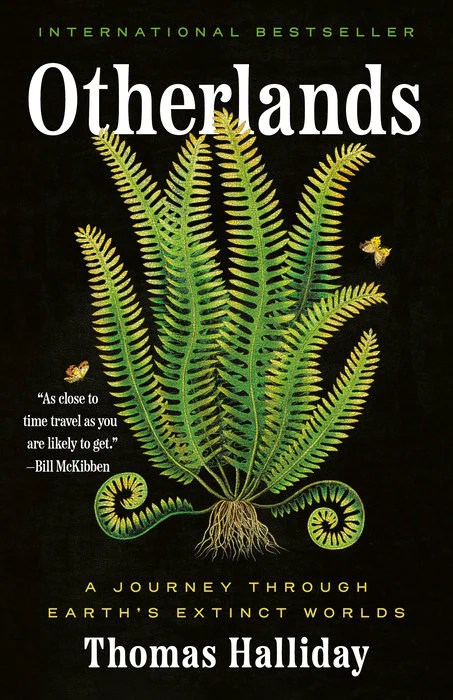
“What exists now can only ever come from what came before.” –Thomas Halliday, Otherlands

Otherlands, A Journey Through Earth’s Extinct Worlds was written by a paleontologist using the latest scientific techniques available. (1)  Paleontology has advanced far beyond digging up fossils.  Computer and DNA analysis enables paleontologists to reconstruct models of whole animals from bone fragments as well as describe the lifestyle of extinct animals such as what they ate and what ate them. 

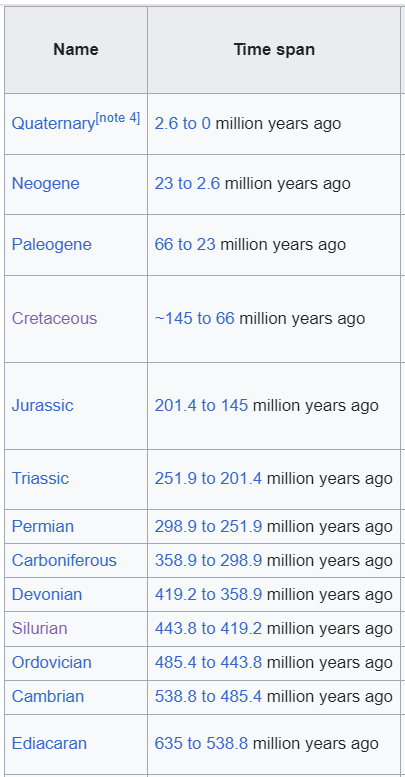
Geologic periods described by Otherlands. Source: Wikipedia

Thomas Halliday puts this knowledge of some of the 5 billion species that have gone extinct in the 4.6 billion years that Earth has existed into the context of geological and biological changes that caused their extinction.  He describes vivid scenes of specific places at specific times, starting 500 million years ago (mya), a geological period when we can recognize most of the phyla (major groups of animals sharing characteristics) that exist today. These snapshots of deep time illustrate that “Environments shape their inhabitants as much as their inhabitants shape them.” (1)

In this article, we will visit a few of these scenes that demonstrate the biological innovations resulting from evolution and the associated geological and atmospheric events.  And we will tell you about how modern conservation methods are often working at cross purposes against evolution and adaptation of life as it copes with catastrophic challenges. 

Biological Innovation

Primitive life is said to have existed on Earth 3.7 billion years ago (bya).  All life that presently exists on Earth is said to have evolved from the first life forms, although the common ancestor is yet to be identified.  No life on Earth is truly alien.

The diversification of life on Earth began to accelerate when cyanobacteria developed the ability to photosynthesize about 3 bya.  Photosynthesis converts sunlight to energy by consuming carbon dioxide, creating carbohydrates that feed plants and storing carbon in plants and the soil, while emitting oxygen into the atmosphere as a by-product.

This evolutionary innovation is responsible for the abundance and diversity of plants today. It is an important factor in the balance of carbon dioxide and oxygen in the atmosphere, which is one of the most important factors in the Earth’s climate.  More plants also mean more food for animals that evolve alongside plants, often forming relationships with one another. 

The first mass extinction, roughly 445 million years ago (mya), is the only mass extinction caused by a rapid change in the Earth’s climate from tropical to glacial, which is equivalent to saying the atmosphere changed from predominantly carbon dioxide to predominantly oxygen, the opposite of our currently changing atmosphere and climate. 

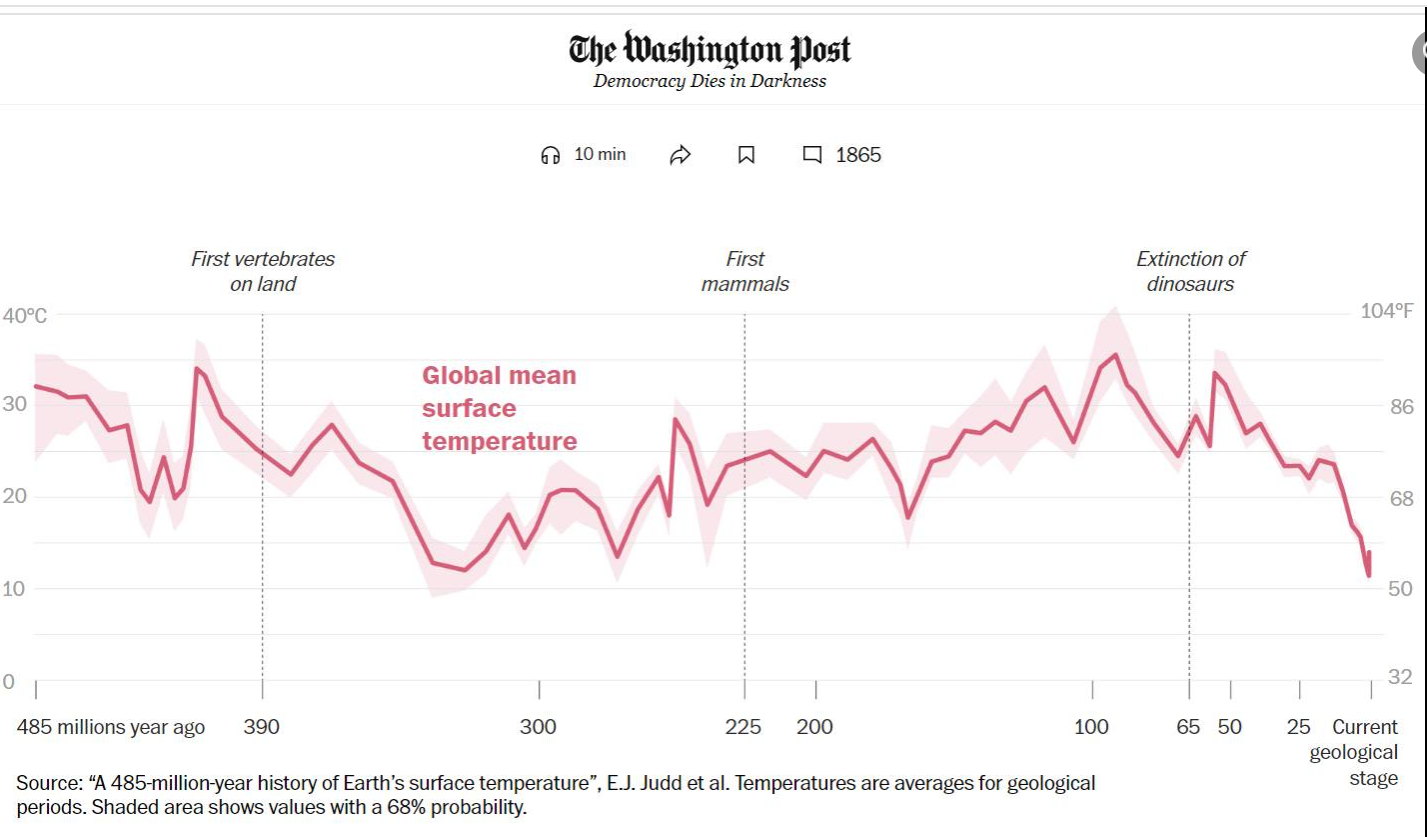
Carbon dioxide levels are said to have dropped from 7,000 parts per million (ppm) to 4,400 ppm during the Ordovician extinction event that killed about 85% of plant and animal species.  Currently our carbon dioxide level is about 420 ppm, just a fraction of what it was during the Ordovician period.  In the context of the history of Earth, the climate we are experiencing is mild, a reminder of the potential for a much more extreme climate in the near future.

This graph of global mean surface temperature on Earth in the past 485 million years tells us the Earth’s climate has been mild since humans evolved. The graph should help us understand the potential for the Earth’s climate to increase beyond the tolerance for human life.

Comparing contemporary sea levels with those in deep time is another way to appreciate the potential for devastating changes in the future.  20,000 years ago, at the height of the last ice age, sea levels were 120 meters lower than they are now.  Conversely, sea levels were highest during the mid-Silurian period, 430 mya, when sea levels were between 100-200 meters higher than they are now and atmospheric carbon dioxide concentrations were high. 

Although the causes of the drastic change in the atmosphere and therefore the climate during the Ordovician period are still debated, the advent of photosynthesis is considered a factor.  The development of fungi enabled plants to move from water to land by delivering moisture from soil to roots of plants, greatly increasing abundance and diversity of plants. About 80% of plants today receive much of their nutrients and moisture through mycorrhizal fungi. 

The photosynthesizing capabilities of plants is one of the ways greenhouse gas emissions, currently causing global warming, can be reduced.  Yet, we are using pesticides to kill plants that native plant advocates have arbitrarily decided “don’t belong.”  Pesticides also kill fungi in the soil that enable plants to survive during drought conditions created by global warming.  This is one of many examples of how management strategies used by humans are counteracting the accomplishments of evolution that occurred long before humans existed or began to think they were competent to “manage” nature.

Plant Evolution Timeline

To make a long, complicated story short, we’ll focus on the major plant groups we recognize today by starting with seedless land plants that reproduce by dispersing spores, such as mosses and ferns that evolved from algae about 460 mya. 

Gymnosperms, which we recognize today as conifers, cycads, and Gingkos, are seed-producing plants that evolved about 300 mya.  Early species of gymnosperms formed huge forests. The carbon they stored became the coal fields of today when they died during the Carboniferous period (360-300 mya).   Today, we draw our fossil fuels from these coal and oil basins.  They provide most of our energy, while releasing greenhouse gases causing climate change.

Continents were close together during the Cretaceous geologic period when angiosperms evolved. Source: Australian Museum

Angiosperms evolved from gymnosperms about 130 mya.  They are flowering plants whose seeds are often encased in fruit. They are by far the most diverse group of land plants.  The evolution of bees around the same time is an example of co-evolution: the flowers feed the bees and the bees pollinate the flowers, delivering pollen from the male anther to the female stigma.   This sexual method of reproduction creates greater genetic diversity than self-pollination.  Greater genetic diversity creates more opportunities for natural selection to operate on plant variations, which may result in species that are better adapted to existing conditions.   

A recent study (2) found that the decline in the population of bees has increased the frequency of self-pollination of some plant species that are capable of both methods of pollination.  This is an example of evolution at work today.  Plants are responding to the existential need to reproduce in the absence of bees by self-pollinating.   

What evolution has accomplished in the past can be undone.  In this case, our indiscriminate use of pesticides such as neonicotinoids has decimated bee populations. Some plants will adapt to the loss of bees by self-pollinating, but not without some loss of genetic diversity provided by sexual reproduction and consequently the long term fitness of plants to face challenges in the future. 

There’s another trade-off for both plants and bees. Producing nectar and attracting bees with colorful flowers is a big energy expense for plants.  Plants therefore save energy by reducing flower size and color, when they can rely solely on self-pollination for reproduction.  Obviously, self-pollination ultimately results in a loss of food for bees and may accelerate the decline in bee populations, a negative feed-back loop, if you will.

This example is a reminder that evolution is neither positive nor negative.  It is simultaneously both positive and negative.  It is what it is:  an inexorable force for change. 

Evolution of grasses

Grasses and grasslands are late comers to the Earth’s plant kingdom.  Grasses evolved from angiosperms about 70 mya, during the Age of Dinosaurs that abruptly ended 66 mya when an enormous asteroid collided with Earth.  Grasses are wind pollinated and their seeds are dispersed by the wind, which enables them to spread rapidly and widely. 

Grasslands became dominant ecosystems about 30 mya, replacing many forest ecosystems.  With the optimal combination of fuel, heat, and oxygen, wildfires were a factor in the transition from forests to grasslands in many places.  Once again, wildfires in conifer forests are presently playing a role in converting forests to grasslands, suitable to a warmer and drier climate.

The development of enhanced photosynthesis by C4 grasses gave them a competitive advantage in hot, dry places where photosynthesis is suppressed. C4 grasses are more drought tolerant and they store more carbon than their predecessors, C3 grasses. There are only about 60 groups of C4 grasses, including several important food crops, such as maize, sugarcane, and sorghum.  They are found in tropical and sub-tropical regions of Africa and South America and some deserts.  California’s native grasses as well as introduced grasses considered “invasive” are not C4 grasses, according to a list of C4 grasses available on Wikipedia. (3)

Because of their potential to improve drought tolerance and increase productivity and carbon storage, there is great scientific interest in converting C3 grasses to C4 grasses.  Despite decades of effort, agricultural science has not been able to duplicate what the natural forces of evolution have accomplished, reminding us that evolution is more powerful than we are.

The transition from forests to grasslands had a corresponding impact on the evolution of animals.  Some browsers of woody plants learned to be grazers, if they could, while others went hungry, and the diversity and abundance of grazers increased. 

Native plant advocates in California have selected grassland as their preferred ecosystem because it was the dominant ecosystem prior to the arrival of Europeans at the end of the 18th century. They have consistently failed to convert non-native grassland to native grassland in California.  Nor is it clear that there would be any benefit to the environment or to its inhabitants to return to the treeless landscapes of California that existed prior to settlement in the late 18th century.

Where populations of native grazers of grassland were reduced by the activities of humans, many grasslands in California naturally succeeded to shrubs and trees. “Restoration” projects attempt to prevent succession of grasslands. Some of these projects destroy native trees and shrubs (e.g. Douglas fir, coyote brush, juniper, etc.) mechanically and with pesticides to maintain ecosystems as grassland.  

Nativists also want to reintroduce the grazing animals of the pre-colonial period to replace domesticated animals humans introduced because nativists see them as competitors of native animals they consider superior. Where top predators have been killed, these herds of grazing animals outgrow available vegetation unless their numbers are controlled as domesticated animals are.

A recent meta-analysis of 221 studies of the impact of megafauna on plant abundance found, “no evidence that megafauna impacts were shaped by nativeness, “invasiveness,” “feralness,” coevolutionary history, or functional and phylogenetic novelty. Nor was there evidence that introduced megafauna facilitate introduced plants more than native megafauna. Instead, we found strong evidence that functional traits shaped megafauna impacts, with larger-bodied and bulk-feeding megafauna promoting plant diversity. Our work suggests that trait-based ecology provides better insight into interactions between megafauna and plants than do concepts of nativeness.”  (4)

The author of Otherlands agrees that the concept of nativeness is not a useful way to understand the environment or conduct conservation because:  “Where an animal or a plant from one part of the world appears in another, some might use the language of invasion, of a native ecosystem despoiled and rendered lesser by newcomers…In reality, species do move, and the notion of ‘native’ species is inevitably arbitrary, often tied to national identity…There is no such thing as a fixed ideal for an environment…To look into deep time is to see only an ever-changing list of inhabitants of one ecosystem or another…The concept of native that we so easily tie to a sense of place also applies to time…We must avoid putting our own ahistorical spin on what was, although certainly dangerous and unlikely, a journey guided entirely by chance.”  (1)

Migration

The history of evolution is also a history of migration.  The oscillation of the Earth’s climate between freezing cold and blistering heat created and destroyed land bridges that enabled or blocked migration as sea levels rose and fell.  When North America and South America were connected by Central America as a result of lower sea levels and geological events about 3 mya, the plants and animals of those continents were mixed by migration.  Likewise, aquatic life of the Pacific Ocean was separated from the Atlantic Ocean by the Central American land bridge until the Panama Canal was built in 1914.

Geological events also created or destroyed the same opportunities for migration.  The opening and closing of the Strait of Gibraltar is a case in point.  The Mediterranean Sea exists because the Strait of Gibraltar exists.  When the narrow Strait is open, the Atlantic Ocean flows into the Mediterranean Basin, creating the Mediterranean Sea, which is an obstacle for migration of plants and animals between Europe and Africa. 

About 6 mya the Strait of Gibraltar closed because the African tectonic plate moved north, colliding with the European tectonic plate.  The Mediterranean Sea slowly evaporated, concentrating ocean salt from the Atlantic Ocean, laying down a sea bed of salt in the Mediterranean Basin and ultimately creating a migration corridor between Africa and Europe. There is every reason to believe that the Strait could close again.  The Earth’s tectonic plates are in constant motion and there is no reason to believe they will stop moving.

The obsession with “where plants belong” seems to be based on ignorance of the history of dispersal and migration.  Much of China and North America have been in the same latitude since the evolution of angiosperms.  As a result, many of our plant species considered native in Eastern North America are also considered native in China.  These paired species in the same genus are called disjuncts.  There are many woody disjuncts in China and North America (magnolias, persimmons, hickory, catalpa, dogwood, sweetgum, tuliptree, tupelo, sassafras, Virginia creeper, etc) as well as many herbaceous disjuncts (ginseng, lopseed, mayapple, skunk cabbage, etc.). (5) They are different species because they have been separated long enough to change as a result of genetic drift, but are in the same plant lineage, therefore chemically similar and presumably used by the same insects.  The study of these disjuncts says, “Most scientists do not consider long-distance dispersal to have played much of a role.  The prevailing view is that most disjuncts are remnants of genera that were once widely distributed in the northern temperate zone during the Tertiary period [66 mya to 2.6 mya per Wikipedia].  These broad distributions in the northern hemisphere were made possible by recurring land bridges.” (5)

Lateral migration patterns of the past are changing in response to contemporary patterns of climate change.  The temperatures at different latitudes are becoming more similar because Polar Regions are warming at a much faster pace than temperate and tropical latitudes.  Plants and animals escaping extreme heat and associated changes in vegetation are moving to higher latitudes in the Northern Hemisphere and lower latitudes in the Southern Hemisphere.  The increasing similarity of the Earth’s climate is changing wind and ocean currents and contributing to the extreme weather events of our changing climate.  Although there are lessons in the events of deep time, we cannot assume that events in the past are entirely predictive of future events because of the complexity of natural processes and our limited understanding of them. 

Of all the nonsensical conservation strategies humans are presently using, perhaps one of the most damaging is the futile attempt to stop migration. It is one of few survival strategies of plants and animals needed in a rapidly changing climate and it cannot be stopped. 

The project that proposes to shoot barred owls in the Pacific Northwest is an example of a “conservation” project that does not deserve that honorific.  Barred owls have migrated from the East to the West Coasts of North America via the boreal forests of Canada.  This is another instance in which large contiguous stretches of land at the same latitude facilitate the migration of life because there is less variation in climate at the same latitude. 

Source: USFWS

Specialists vs. Generalists

Barred owls are more adaptable than their closely related relative in the same genus, spotted owls.  Barred owls have a more varied diet, they are willing to nest in less dense, second-growth forest, and they have greater reproductive success.  They are therefore perceived as competitors of endangered spotted owls. Instead of letting natural selection identify the winner of that competition, the US Fish & Wildlife Service intends to shoot 500,000 barred owls in the next 30 years based on their belief that spotted owls will benefit.  They do not expect to eradicate barred owls and they made a commitment to continue shooting barred owls in perpetuity.  While we continue to log old-growth forests in which spotted owls live, we will kill barred owls with no expectation that they can be eradicated.

This project is typical of American “conservation” projects that attempt to save a specialist species by killing a generalist species.  This strategy was enshrined in American law by the Endangered Species Act, which is now 50 years old.  Like many 50-year-old public policies, we now know that this conservation strategy is not working because it is inconsistent with evolutionary principles.  Change in nature is inexorable.  Legal mandates are not capable of stopping evolution.  If we had a functional political system, we could stop the greenhouse gas emissions causing climate change, but we don’t.  Therefore, we must rely on evolution to cope with the changes in the environment that we have caused.

The most recent mass extinction occurred 66 mya when an asteroid hit the Earth, ending the Age of Dinosaurs.  About 80% of all plant and animal species became extinct.  The species that survived were the most versatile and the most mobile.  Flying dinosaurs were the only dinosaurs that survived, as birds, perhaps because they were the most mobile.  “Of the specialized insects, 85% were lost and it was the generalists that survived.” (1) 

Mass extinctions have created many vacant ecological niches that are opportunities for experimentation, creating new species.  Some were better adapted than others.  Natural selection determined the winners of competition within ecological niches.  The end of the Age of Dinosaurs created the opportunity for the Age of Mammals, as well as bony fish, marsupials, and lizards. 

In other words, our outdated conservation strategy is wasting our limited resources to save specialized species that are probably doomed to extinction.  And we are doing so at the expense of generalist species that might survive if we would quit killing them.  Keep in mind that 99% of all life forms that have existed on Earth have gone extinct.  At a time when the climate is changing rapidly, the goal of saving every endangered species seems both unrealistic and wasteful of limited conservation resources.

Hybridization

Hybridization is one of the tools of evolution.  Closely related species, usually in the same genus and even family often mate and their offspring often survive to eventually give rise to new species.  Successful hybridization is a means of increasing biodiversity.  Hybridization is sometimes a means of improving adaptability and therefore survival.

Unfortunately, nativists see hybridization as a loss of biodiversity rather than an opportunity to improve adaptability and increase biodiversity.  Their “conservation” projects often attempt to prevent hybridization by killing hybrids.  For example, the plan to kill 500,000 barred owls includes all hybrids of barred and spotted owls.  Because barred owls are more versatile, hybridization with spotted owls could even the playing field with barred owls by expanding food sources and nesting habitats of spotted owls. 

The Spartina eradication project is another example of the pointless eradication of hybrids.  In the case of Spartina, the non-native species grows more densely and it doesn’t die back in winter.  Non-native Spartina provides better storm protection and better habitat for nesting birds.  The Invasive Spartina Project has been spraying hybrid Spartina with herbicides for over 20 years, without total success.  The hybrid looks so similar to native Spartina that 600 genetic tests are required every year to confirm their identification as hybrids before they are sprayed.  The Invasive Spartina Project is a waste of limited conservation resources and it serves no useful purpose.

Evolution vs. Conservation

Otherlands should be required reading for those who are engaged in the “restoration” industry.  Some of the methods and goals of conservation are at odds with the mechanisms of evolution that have ensured the survival of life on Earth for nearly 4 billion years. 

  • The use of pesticides by “restoration” projects is antithetical to the goal of conservation because they do more harm than good.
  • Migration is a means of species survival.  Natural migration of plants and animals cannot and should not be stopped.
  • Humans cannot duplicate the forces of evolution.  Natural selection is the most powerful, efficient, and effective method of determining the winners of competition.
  • Hybridization has the potential to improve adaptability of closely related plants and animals.  Hybridization cannot and should not be stopped.
  • Resources being wasted in the attempt to stop the natural forces of evolution should be redirected to reducing greenhouse gas emissions causing climate change.  Such efforts are appropriately called “conservation.”

  1. Thomas Halliday, Otherlands, A Journey Through Earth’s Extinct Worlds, Random House, 2023
  2. https://www.nytimes.com/2024/01/04/science/flower-sex-evolution-bees.html?searchResultPosition=1
  3. https://en.wikipedia.org/wiki/List_of_C4_plants
  4. Erik Lundgren et.al., “Functional traits—not nativeness-shape the effects of large mammalian herbivores on plant communities,” Science, February 2, 2024
  5. David Yih, “Land Bridge Travels of the Tertiary:  The Eastern Asian-Eastern North American Floristic Disjunction, Arnoldia, 2012

Wild by Design: A history of ecological restoration in the U.S.

“This is a superb book. Laura Martin’s research takes us where no restoration literature has gone before, asking, ‘Who gets to decide where and how wildlife management occurs?’ Martin tackles this question with unmatched clarity and insight, illuminating the crucial discussions we must have to secure a future with thriving natural species and spaces.”—Peter Kareiva, President and CEO, Aquarium of the Pacific

The author of Wild by Design, Laura J. Martin, is a professor of environmental history at Williams College.(1) She has written a comprehensive history of ecological restoration in the US that is consistent with my own observations of the restoration industry in the past 25 years.  It’s a story of the gradual transition from a conservation ethic to a preservation ethic and finally to the restoration ethic that we see today.  The story is punctuated by milestone federal laws and actions that facilitated the transition.  Environmental non-profits and academic ecologists used those laws to professionalize and monetize the restoration industry that exists today. 

By the end of the 19th Century, the public began to react to the environmental degradation caused by unregulated resource extraction.  In 1902, a survey of naturalists around the country determined there were 1,143 bison left in the country; virtually all were in captivity.   The American Bison Society was founded in 1905 in reaction to the disappearance of bison in America.  Their activism led to the creation of federal game reserves on former Indian reservations where captive bison were introduced.  The game reserves were the model for the National Wildlife Refuge system that was greatly expanded by President Teddy Roosevelt.

A photograph from 1892 of a pile of American bison skulls in Detroit, Michigan waiting to be ground for fertilizer or charcoal. (Photo Wikimedia Commons)

The creation of the Wild Flower Preservation Society (WFPS) in 1901 was modeled on the successful campaign of the Audubon Society to save birds killed to serve as ornaments on fancy hats.  It was as much a campaign to shame women into abandoning the fashion fad as it was an effort to legally ban the practice.  Likewise, the Wildflower Preservation Society applied social pressure.  They were critical of organized excursions to visit wildflowers because they picked and trampled the wildflowers.  WFPS said that “Weddings are a new menace to our native plants” because of their use of wild flowers. Their criticism was initially aimed at their own community, but “it moved toward policing the behavior of so-called new immigrants to the United States—especially children.”  The moralistic scolding by these early native plant advocates was a preview of the finger-wagging now aimed at those who choose to plant a diverse garden. 

These advocacy organizations are precursors to the many environmental non-governmental organizations that are influential in pressuring government to invest in ecological restorations today.

Conservation and Preservation

The goals of conservation and preservation are similar, but some differences were observable in the past 200 years.  Both ethics are committed to protecting the environment, but conservation allows the sustainable use of natural resources while preservation protects nature from use.  The presidencies of both Teddy and Franklin Roosevelt were committed to conservation. 

Teddy Roosevelt created the US Forest Service based on the premise that government can and should regulate public lands to manage natural resources.  Franklin Roosevelt’s conservation programs were based on the same principle, but were motivated by the economic emergency of the depression as well as the environmental disaster of the Dust Bowl in the Midwest.  The Civilian Conservation Corp (CCC) was created to provide jobs as well as to plant a “shelter belt” of trees across the Midwest of the country as a windbreak to stop dust storms (and many other projects).  Ecologists were critical of CCC projects because they expanded recreational opportunities and put “a stamp of man’s interference on every natural area they invade.” They preferred to exclude humans and their activities from nature. This is another early indicator of the conflicts between preservation and conservation that persist to the present day.

Sharp Park, Pacifica, CA. Photo by Erica Reder, SF Public Press

Government investment in ecological research

Ecological research in the United States was fundamentally altered after World War II, which ended with the beginning of the atomic era.  Atomic bombs were dropped on Japan to end the war without much thought given to the consequences.  After WWII, the federal government made big investments in science, creating the Atomic Energy Commission and the National Science Foundation, which funded ecological research to study the impact of radiation on the environment and those who live in it.  Conservation Sense and Nonsense published an article about those studies and the impact they had on ecological research. 

These studies legitimatized destruction of ecosystems to study effects of the destruction and the concept was expanded from radiation to pesticides in the 1960s.  They also provided funding to the academic profession of ecology that was small and is now enormous.  The dependence of ecological studies on government funding remains to this day and government funding of ecological projects has created the restoration industry that now extends far beyond academia.  Destruction of existing habitat is still considered the prerequisite to restoring a historical landscape.  Often, destruction is the first and only stage of the project because of the persistent fantasy that the native landscape will regenerate without further help. 

In the late 1960s Daniel Simberloff tented and fumigated 6 mangrove islands off the eastern short of Florida with methyl bromide to kill all life on the islands.  The objective of the project was to study how long it would take to repopulate the islands with insects.

From Conservation to Restoration

The post-war economic boom of the 50s and 60s greatly increased the impact of human activities on the environment.  The federal government built a vast highway system that fragmented and disrupted ecosystems.  We built huge dams, and channeled riparian ecosystems.  Open space was rapidly covered by housing and industrial development.  Wetlands were drained and filled with rubble to create more land.

People who cared about the environment began to react to the loss of nature and wildlife that lives in nature.  Although Aldo Leopold is idolized by the native plant movement, his concern about the degradation of nature was primarily for wildlife.  His interest in vegetation was as habitat for wildlife.  He was opposed to government programs devoted to killing animals perceived as predators of game animals because he believed that wildlife is best served by expanding their habitat.  In fact, he was opposed to the expansion of government’s role in conservation because “he believed restoration would be most efficient and effective if pursued by private citizens.” He did not prefer native plants because “Farmers had the opportunity to conserve plants such as ragweed and foxtail (an introduced grass), ones ‘on which game, fur, and feather depend for food.’”  In other words, in the 1940s one of the icons of the native plant movement knew that wildlife is not dependent upon native plants for food.  One wonders if native plant advocates have actually read Leopold’s treatise, A Sand County Almanac. 

Aldo Leopold’s son, Starker Leopold, had as much impact on conservation in the United States as his father.  In 1963, he published the Leopold Report that changed the direction of conservation in the National Park Service.  The Leopold Report recommended a goal for national parks of maintaining historical conditions as closely as possible to those of “primitive America.”  When the Leopold Report was adopted as official policy by the National Park Service in 1967, it committed NPS to restoring park lands to pre-settlement conditions. NPS officially changed this policy in 2021, but we don’t see any change locally in their projects because NPS is decentralized and local parks are autonomous.

Restoration Goals

Professor Martin says that “historical fidelity did not become a widespread restoration goal among ecologists and environmental organizations until the 1980s.”  The arrival of Columbus in the new World in 1492 was arbitrarily selected as the date after which all new plant species were “deemed nonnative, unwanted reminders of human (colonist) presence and activity.”  On the West Coast, 1769 is the equally arbitrary date to confer non-native status because it is the date of the first Spanish expedition to California. 

Many now question the goal of replicating historical landscapes.  After 40 years of effort, there is a growing recognition that it is not a realistic goal, especially in a rapidly changing climate.  The Society for Ecological Restoration has changed its definition of ecological restoration from “the goal of intentionally altering a site to establish a defined, indigenous, historic ecosystem” in 1990 to “the process of assisting the recovery of an ecosystem that has been degraded, damaged, or destroyed” in 2002.  Try telling that to the restorationists on the ground who are still trying to eradicate naturalized non-native plants that have been here for nearly 200 years.  Non-native annual grassland in California is a case in point. It has been repeatedly burned, mowed, plowed, and poisoned for 25 years without any visible progress toward native perennial grassland.   

Blaming non-native species

Around the same time that historical fidelity was identified as the goal of “restorations,” land managers and ecologists decided that the existence of non-native species is the main threat to native species.  I suppose the “logic” was that the main difference between historical landscapes and present landscapes is the existence of non-native species.  Concern about non-native species spread among federal agencies such as the National Park Service and The Nature Conservancy (TNC) began aggressive campaigns to kill non-natives, “which were newly framed as the main threat to wild species…nativity would become a precondition to wildness—of plants and animals both.”   TNC’s methods have become increasingly deadly and destructive: using fire and herbicides to kill plants, poisoning honeybees, aerial hunting of sheep, pigs, and goats.  As a former donor to TNC, their methods finally became intolerable to me.

Professor Martin believes that the identification of non-native species as the scapegoat was not based on experimental evidence, but merely a description of the strategies used by public land managers, as well as The Nature Conservancy.  Non-native species were a convenient scapegoat because they were easily identified and were an easy substitute for identifying and remediating the underlying conditions causing so-called “invasions.”  “Although the role of invasive species in native species extinction has since been challenged by some ecologists, the influence of this fear on species management has been enormous…The US federal budget for invasive species management increased by $400 million between 2002 and 2005, for example.”   

Endangered Species Act

The Endangered Species Act (ESA) was passed in 1973, along with companion laws such as the National Environmental Protection Act and others.  These federal laws created more funding opportunities for ecological projects as well as the legal justification for ecological restoration projects.

Federal laws permit the reintroduction of legally protected plant and animal species to places where they no longer exist.  The ESA confers the same protections for reintroduced species as it does for naturally occurring species.  Such reintroductions have become a tool for the restoration industry.  I have seen that strategy used in the San Francisco Bay Area.  If we had not been successful in preventing the reintroduction of a legally protected turtle, it would have justified the destruction of the non-native forest in my neighborhood park because the turtle requires unshaded nesting habitat within 500 feet of the water source in the park. The park remains largely forested because that is one of the few battles we have won in 25 years. Reintroduced, legally protected species are the Trojan horses of ecological restorations.

Compensatory mitigation is an equally powerful tool for the restoration industry.  Federal law requires an Environmental Impact Statement (EIS) for projects that will have a significant impact on the environment, such as big developments like building Disney World in Florida.  Disney World was built on an enormous wetland that was lost by the development of the park.  The EIS for the project agreed that the impact would be great, but it “mitigated” the impact by requiring Disney to fund the creation of a new wetland in a distant location.   

The funding generated to create fake wetlands built a new industry of commercial companies to design and build them.  Academic restoration ecologists questioned the functional equivalency between created and natural wetlands:  “’however accurate [the Comprehensive Everglades Restoration Plan] is the restored community can never be authentic.’”  The tension between commercial and academic restorationists continues today.

The Society for Ecological Restoration published findings that mitigation wetlands were not functionally equivalent to the wetlands they were meant to replace.  In Florida only half of the promised mitigation projects were actually built. Those that were built were colonized by “undesirable plant species” such as cattail and melaleuca in 32 of 40 projects.    

Projects that earn carbon credits are creating the same opportunities to generate funding for restoration projects in distant locations.  The Nature Conservancy was successful in defining carbon offsets as an international market when the Kyoto Protocols were signed in 1997.  They understood that a reforestation project would be cheaper in Costa Rica (for example) than a comparable energy efficiency project in the US.  Such distant projects don’t benefit those in the US who now have a power plant in their backyard that is being offset by a forest in Costa Rica. 

It’s a game for those who know how to play.  I have witnessed local examples in the Bay Area.  An oil spill in the bay generated millions of dollars of compensatory damages to fund unrelated “restoration” projects.  How does planting eel grass compensate for hundreds of birds killed by the oil spill?  When the San Francisco airport expanded runways, the airport had to pay compensatory mitigation that funded the restoration of native plants at India Basin in San Francisco that hardly compensates for the increased air traffic enabled by the new runway.   

Conclusion

Professor Martin is surprisingly frank about the future of ecological restoration in America:

“Whatever paths restorationists choose, restorations must happen in tandem with other changes in human behavior.  If we don’t reduce the ongoing harms of racism, fossil fuel burning, overconsumption by the wealthy, and toxic industrial chemicals, restoration will offer no more than a temporary repair, a way to move a problem to some other place or time.”

I would go one step further in my assessment of the restoration industry.  I would say that the methods used by restorationists are directly contributing to environmental degradation. 

Professor Martin asks the right questions in her concluding chapter:  “Who benefits from restoration?  Who is harmed?”  Those who earn their living in the restoration industry are the primary beneficiaries. According to a 2015 study entitled “Estimating the Size and Impact of the Ecological Restoration Economy,” environmental regulation has created a $25 billion-per-year restoration industry that directly employs more people than coal mining, logging or steel production.  Given recent investments in restoration projects of billions of dollars by California and federal infrastructure funding, this figure is undoubtedly an underestimate. 

Who is harmed?  Wildlife and humans are harmed by the destruction of useful habitat with herbicides.  Harmless animals and plants are killed because they have been arbitrarily classified as “invasive.” And all Americans are harmed by the waste of public funds that could be used to benefit society and/or the environment. 


(1) Laura J. Martin, Wild by Design:  The rise of ecological restoration, Harvard University Press, 2022.  All quotes are from this book.

The founding error of American environmentalism

The Sierra Club, like many American institutions, is trying to come to grips with systemic racism.  The Club was founded in 1892 under the leadership of John Muir who “…made derogatory comments about Black and Indigenous peoples that drew deeply on harmful racist stereotypes, though his views evolved later in his life,” according to Sierra Club executive director Michael Brune in his letter of July 2020 to Club members (available HERE).

John Muir is the founder of the Sierra Club.

Author and activist, Rebecca Solnit, follows up on the roots of racism in the American environmental movement in the most recent edition of Sierra Magazine, the national magazine for Club members.  Her telling of events reveals the founding error of the native plant movement that was based on the mistaken assumption that European settlers were entering a pristine landscape that had been unaltered by humans.  The goal of the native plant movement has therefore been to replicate the pre-settlement landscape, presumed to be the ideal landscape.

Early settlers were well aware that they were entering occupied land.  After all, the settlers had to dispossess Native Americans to occupy the land.  But that reality was quickly forgotten, enabling “the lovers of the beauty of the American landscape who reimagined the whole continent before 1492 as an empty place where, as the Wilderness Act of 1964 puts it, ‘the earth and its community of life are untrammeled by man, where man himself is a visitor who does not remain.’” (1)

John Muir’s lack of respect for Indigenous culture prevented him from understanding that he was looking at the results of Indigenous land management when he admired Yosemite Valley:  “The word garden occurs over and over in the young John Muir’s rapturous account of his summer in the Sierra Nevada in 1869. ‘More beautiful, better kept gardens cannot be imagined,’ he declared. When he saw Yosemite Valley from the north rim, he noted, ‘the level bottom seemed to be dressed like a garden.’ He assumed he knew who was the gardener in the valley and the heights, the meadows and the groves: ‘So trim and tasteful are these silvery, spiry groves one would fancy they must have been placed in position by some master landscape gardener. . . . But Nature is the only gardener able to do work so fine.’” (1)

In fact, Yosemite Valley looked like a garden to John Muir, because it was a garden, the garden tended by Native Americans for thousands of years:

“Native Americans as hunters, gatherers, agriculturalists and horticulturalists, users of fire as a land-management technique, and makers of routes across the continent played a profound role in creating the magnificent North American landscape that Europeans invaded. Their use of fire helped maintain plants and spaces that benefited these first human inhabitants—including increasing animal populations, causing plants to put forth new growth in the form of straight shoots suitable for arrow making and basket making, and keeping forests open and underbrush down. In Yosemite Valley, burning encouraged oak trees and grasslands to flourish; conifers have since overtaken many meadows and deciduous groves. The recent fires across the West are most of all a result of climate change—but more than a century of fire suppression by a society that could only imagine fire as destructive contributed meaningfully.” (1)

Native Americans setting grass fire, painting by Frederic Remington, 1908

Solnit correctly describes the consequences of this founding error on the development of environmentalism:  “Had he been able to recognize and convey that the places he admired so enthusiastically looked like gardens because they were gardens, the plants in them encouraged, the forests managed by the areas’ Native people, the history of the American environmental movement might have been different.”  (1)

Solnit believes there are three significant losses to American society and the environmental movement because of the initial lack of respect for Native Americans and their cultural practices.  The first was the greatest loss to Native Americans because disrespect for them as people and a functioning society made it easier to justify dispossessing and marginalizing them.  The second was the loss to American society that would have benefitted from understanding and emulating their accomplishments.  And the third loss was the founding error of American conservation policy that is based on the mistaken assumption that the pre-settlement landscape is the ideal landscape because it was unchanged by humans.

Several recent scientific studies have found that lands occupied by indigenous people in Australia, Brazil, and Canada have much more biodiversity than lands that have been designated as “protected areas” by governments.  Typically, indigenous people have been forced out of the protected areas, based on the assumption of traditional conservation that humans harm the environment.  As the Coordinator of Indigenous Organizations of the Amazon River Basin explains in a recent article in New York Times, “If you’re going to save only the insects and the animals and not the Indigenous people, there’s a big contradiction [because] we’re one ecosystem.”

A new conservation ethic

Our conservation goals require a major revision to right this wrong.  New goals must acknowledge that humans have altered every place on the planet for thousands of years.  New goals will acknowledge that nature is dynamic, that changes in nature are usually impossible to reverse, and that they have both positive and negative impacts. New goals will be adapted to the current environment, such as higher temperatures and drought.  New land management strategies can be informed by those used by Native Americans, but replicating the landscapes of 500 years ago will remain out of reach because underlying conditions have been fundamentally altered by evolution and the activities of modern society.

A new conservation ethic can honor the traditions of Native Americans as well as the sovereignty of nature.  We must stop damaging nature in the futile effort to replicate a landscape that was as much a human creation as the landscape of the Anthropocene era. 


(1) “Unfinished Business:  John Muir in Native America,” Rebecca Solnit, Sierra Magazine, March/April 2021

Finding the middle ground between competing conservation strategies

Today Million Trees strays off its well-worn path of informing readers of specific projects in the San Francisco Bay Area that destroy our urban forest and spray our public lands with herbicides.  Under the guidance of Charles C. Mann’s latest book, The Wizard and the Prophet (1), we’ll take a detour into the philosophical tenets of conservation.  There are competing visions of the future of humans on Earth and they are instrumental in producing different conservation strategies.

We begin by introducing Charles C. Mann because his previous books are essential to our understanding of ecology.  His 1491 informed us that the New World “discovered” by Columbus was not the pristine landscape that modern-day native plant advocates are attempting to re-create.  Rather it was a land that had been radically altered by indigenous people who had lived in the Western Hemisphere for over 10,000 years.  The landscape had been extensively gardened for food production.  The large animals had been hunted to extinction.  The landscape in the West and Midwest was dominated by open grassland because it had been regularly burned, preventing natural succession to shrubs and trees.

Native Americans setting grass fire, painting by Frederic Remington, 1908

Early explorers carried diseases to the New World to which they were immune, but the native people were not.  By the time settlers arrived two hundred years after early explorers, most of the native people had died of the diseases introduced by the explorers.  Populations of bison and other grazing animals exploded when those who hunted them were killed by disease.  The grazing animals maintained the open grassland that had been created by the fires of the hunters.  Archaeological research has only recently revealed the extent of native populations throughout the New World.

Charles Mann’s second book, 1493, reported the global exchange of plants and animals between the New and the Old Worlds that fundamentally altered both worlds.  The extent and long history of that exchange makes it impossible for us to see those introduced plants, animals, objects as foreigners who “don’t belong here.”

Different visions of the future

Million Trees is indebted to Charles Mann for the books that are the foundation of our cosmopolitan viewpoint of the world.  Mann’s new book, The Wizard and The Prophet is equally important because it helps us understand the interminable debate about conservation.  There is a dark view of the future of the environment that predicts nothing but doom and gloom.  Extinctions dominate their predictions of the future and humans are seen as the destroyers of nature.  The more optimistic view of conservation predicts that the Earth will survive the changes made by humans because humans are capable of innovating to avoid the doom predicted by the pessimists.

Mann describes these contrasting views through the lives of two 20th Century men whom he calls the prophet and the wizard.  The prophet is William Vogt, who believed that the growing population of humans threatened the future of the Earth.  The wizard is Norman Borlaug, who won the Nobel Prize in 1970 for developing more productive agricultural crops, collectively called the “Green Revolution.”

The prophet believed that the resources needed to sustain life on Earth are finite and the human population was quickly reaching the point at which sources of food, energy, and water would soon be exhausted, threatening all life with extinction.  The wizard devoted his life to expanding food resources to feed the growing human population.  These viewpoints are inherently contradictory because making more food available enables more people to survive and increase human populations.  Vogt tried to cut off the sources of funding for the agricultural projects of Borlaug.

Different conservation methods:  Food

Mann applies these different viewpoints to each major resource issue to explain why the pros and cons of different approaches to conservation are debated, beginning with food production.  The Green Revolution occurred in the 1960s when subsistence crops such as wheat, corn, and rice were improved using breeding techniques.  Borlaug developed a variety of wheat that was both resistant to stem rust, its most persistent enemy, and produced more wheat for harvest.  Working in a desperately poor part of Mexico, with inadequate resources, Borlaug spent 15 years combining thousands of different varieties of wheat to find the winning combination.  His work was done prior to our knowledge of DNA and molecular analysis, so it was a process of trial and error.  It is a heart-wrenching story of brute labor in extreme conditions.  The story is important to our understanding of genetic modification because it reminds us that genetic modification is as old as agriculture itself, although it was called “breeding” until we learned what we now know about DNA.

File:Wheat yields in Least Developed Countries.svg

Mann visits some of the many modern methods of genetic engineering, such as the attempt to “revise” photosynthesis to enable plants to store more carbon, use less water, and tolerate higher temperatures.   These projects are controversial with the public, who are deeply suspicious of all genetic engineering.  In 1999, about one-quarter of Americans considered genetically modified organisms unsafe.  Sixteen years later, 57% of Americans said GMOs are dangerous.

The debate about the value or risks of GMOs is an example of the competing visions of conservation.  The prophets see risk and the wizards see opportunities.  Surely, there ARE risks, but do they outweigh opportunities?  That is the middle ground in the debate.  Mann departs from his neutral stance to take a position on GMOs.  He quotes many scientific sources in support of his opinion that there is far more opportunity than risk in genetic engineering.  My personal opinion is that GMOs are being unfairly judged because of the development of seeds that enable the indiscriminate use of pesticides.  The pesticides are damaging the environment, not the genetically modified seeds.


Update:  I sent this article to Charles Mann to thank him for his work and invite him to correct any errors I may have made.  He has offered this “tiny clarification:”

I was actually trying to do something very slightly different. The argument about GMOs is frequently posed in terms of health risks–are they safe to eat? In my view, the evidence to date is overwhelming that there is no particular reason to think that GMO crops pose more dangers to human health than crops developed by conventional breeding. At the same time, there are a host of reasons to think that the now-conventional industrial-style agriculture brought to us by the Green Revolution has problems: fertilizer runoff, soil depletion, the destruction of rural communities, etc. GMOs are often said by advocates of industrial ag to be the only way to keep this system going so that we can feed everyone in the world of 10 billion. If you already think that industrial ag is a big problem, then of course you would oppose a technology that is supposed to keep it going. That seems to me a better, more fruitful ground to argue.”  Charles C. Mann

I agree that “industrial ag is a big problem,” and I am grateful for this clarification.


Different conservation methods:  Water

The availability of adequate water is a limitation for agriculture that provides another example of competing approaches to conservation.  The wizards want dams to control available water and maximize its use for agriculture by storing water during rainy periods and using it during dry periods.  They also want desalination plants to convert salt water to fresh water.  97.5% of all water on Earth is salt water.  It is not useful for agriculture and it is not drinking water for humans.

Prophets want to tear down existing dams to make more water available for non-human inhabitants of the Earth.  They also object to desalination plants because they kill marine life, discharge pollutants, and use a lot of energy.  Water conservation is the preferred solution to water shortages according to prophets.

Hetch Hetchy canyon was dammed nearly 100 years ago. The dam is the primary source of water for the City of San Francisco and many surrounding communities. The dam generates the electricity that runs San Francisco’s transportation system without using fossil fuels. Sierra Club and other environmental organizations have sued several times to tear down the dam.   Inklein English Wikipedia photo

Different conservation methods:  Energy

Energy is required for every human enterprise:  heat, cooking, transportation, light, industrial production, etc.  Wood was the primary source of energy for thousands of years until coal began to be used in China around 3,400 B.C.  Although coal is still used, petroleum began to replace it as the primary source of fuel in the 19th century.  The supply of coal and petroleum was considered finite until recently.  Thanks to the wizards, extraction methods have been continuously developed such that the supply is now considered effectively infinite as long as increasingly more destructive methods are used, such as fracking and strip mining.

The prophets want to replace fossil fuels as the primary source of energy because of concerns about climate change and pollution.  Although they are supportive of developing renewable sources of energy, they often object to specific projects with side-effects.  They object to wind turbines because they sometimes kill birds.  They object to large solar farms because they displace wildlife.  Their preferred approach to energy is conservation.  They want us to learn to live with less energy.

The wizards focus on improving existing sources of energy with fewer impacts on the environment.  They envision a massive energy grid that can store and share the power generated by renewable sources so that energy is available to everyone at all times whether the wind blows or the sun shines.  The prophets object to such big projects.  They want energy to be produced locally and available locally.  The Sierra Club is opposed to a California Assembly bill that would create a regional power grid.

Different conservation methods:  Climate Change

All of these issues come together when climate change is debated.  Wizards are working on geo-engineering approaches to reducing greenhouse gas emissions, such as burying carbon in the ground.  Their public policy approaches to the issue are also complex and on a large scale, such as cap-and-trade systems to create a profit-motive for reducing carbon emissions. 

Prophets are unwilling to take the risks associated with geo-engineering strategies and they are skeptical that cap-and-trade will be more than a means of avoiding the sacrifices needed to reduce greenhouse gas emissions.  The Sierra Club was instrumental in preventing the State of Washington from passing a revenue-neutral cap-and-trade law.  The Sierra Club also opposed the recent renewal of California’s cap-and-trade law.  Market-based approaches to reducing greenhouse gas emissions may not be the strongest policy tools, but they are the only tools available in the US because there is not sufficient political support for stronger policies.  Only 11 states have been able to enact market-based laws, such as cap-and-trade.  Sierra Club policies are often far removed from political realities.

Unintended consequences

Charles Mann does his best to avoid choosing a side in these debates and on the whole he succeeds.  He wants readers to understand that for every conservation method there is a cost and he dutifully tells us about the horrifying consequences of rigidly following one path rather the other.

Vogt, the prophet, firmly believed that the Earth and its human inhabitants would only survive if humans would voluntarily adopt public policies that would limit the growth of human population.  This goal was not popularized until The Population Bomb was written by Paul Ehrlich and published by the Sierra Club in 1968.  Mandatory population control became the official public policy in Mexico, Bolivia, Peru, Indonesia, and especially India.  In the 1970s and 80s millions of women were sterilized in India, often against their will.  In China the one-child policy adopted in 1980 forced tens of millions of abortions, many of which killed mothers.  Birth control was forced on women in Egypt, Tunisia, Pakistan, South Korea and the Philippines.

There is constant pressure within the Sierra Club to adopt an anti-immigration policy.  The Club had such a policy until 1996 and there have been several attempts since to reinstate that policy.  I digress to express my personal opinion that immigration is not a legitimate environmental issue because the environment is global.  The migration of people from Central America to North America does not fundamentally alter the impact on the environment.  If migrants have better access to birth control and education for women in North America, the size of their families would likely decrease.

The Sierra Club, like most mainstream environmental organizations, is firmly in the camp of the prophets.  They cast humans as the enemy of nature and their policies reflect their misanthropy.  They oppose every housing development project and all recreational access to public lands in California.

The Green Revolution and the way of the wizard carries its own baggage.  The new crops and the resources needed to produce them were not equitably distributed in the places where they were needed the most.  The richest farmers and biggest land owners in both India and Mexico were the primary beneficiaries of the improved agricultural methods.  But it wasn’t just inequitable distribution that did the most damage.  The poorest farmers owned the most marginal land.  Improved crops made their land more valuable.  It was suddenly worthwhile for land owners to dispossess their tenant farmers. The poorest farmers became the poorest homeless people in the huge cities of India and Mexico.

The Green Revolution also greatly increased the use of synthetic fertilizers that have caused nitrogen and phosphorus pollution from agricultural runoff.  And pesticides were another tool of the Green Revolution with their own suite of negative environmental consequences.

Both cases illustrate the important role that governments play in environmental policy.  Neither the extreme application of population control methods nor the inequitable distribution of agricultural resources were inevitable.  In the hands of competent, democratic government both methods had the potential to improve the well-being of humans without damaging the environment.

The Middle Ground:  All of the Above

I see Mann’s book about competing conservation strategies as an endorsement of the middle ground.  My own strong commitment to the middle ground probably influences my reaction to Mann’s book.  The concept of “population control” is as unappealing to me as some of the geo-engineering projects being developed to address climate change.

“Population control” is antithetical to a free society.  The middle ground is universal and free access to birth control, early sex education, and educating women in developing countries.  Educating women is the most effective method of reducing birth rates.

2014 UN Human Development Index. Human Development Index map. Darker is higher. Countries with a higher HDI usually have a lower birth rate, known as the fertility-income paradox.

The risks of geo-engineering solutions to climate change are too great to pursue without careful scientific analysis to fully understand the risks before they are implemented on a large scale.  Likewise, I am opposed to building new nuclear power plants until and unless we have a safe method of disposing of the nuclear waste generated by those plants.

Ironically, the middle ground is in some sense, the most aggressive conservation strategy because it is ALL OF THE ABOVE.  The consequences of climate change are too dire to choose one path and abandon the other.  We must carefully go down every path available.  We must do what we can to limit the increase in human population—within the constraints of a free society—and we must aggressively pursue the technological innovations that are needed to protect the environment from the activities of humans.  We must develop new sources of energy that do not emit greenhouse gas emissions as well as reduce our use of limited resources, such as water and energy.

I conclude with an important caveat.  This article does not do justice to Mann’s brilliant book.  I have only scratched the surface of Mann’s complex and deeply informed book.  Charles Mann made a presentation to the Long Now Foundation in San Francisco shortly after the publication of his book.  A video of his presentation is available HERE.  The video will help bridge the gap between this brief summary and reading Mann’s important book.


  1. Charles C. Mann, The Wizard and The Prophet: Two Remarkable Scientists and Their Dueling Visions to Shape Tomorrow’s World, Alfred Knopf, 2018