Dana Milbank is a political columnist for the Washington Post. Like many Americans, Milbank moved his family from urban Washington D.C. to a derelict farm in the foothills of the Blue Ridge Mountains in Virginia, seeking refuge in nature from urban confinement imposed by the Covid pandemic. So began his war on nature, dictated by native plant ideology.
In a series of columns, WaPo readers observed how his battle against non-native plants developed:
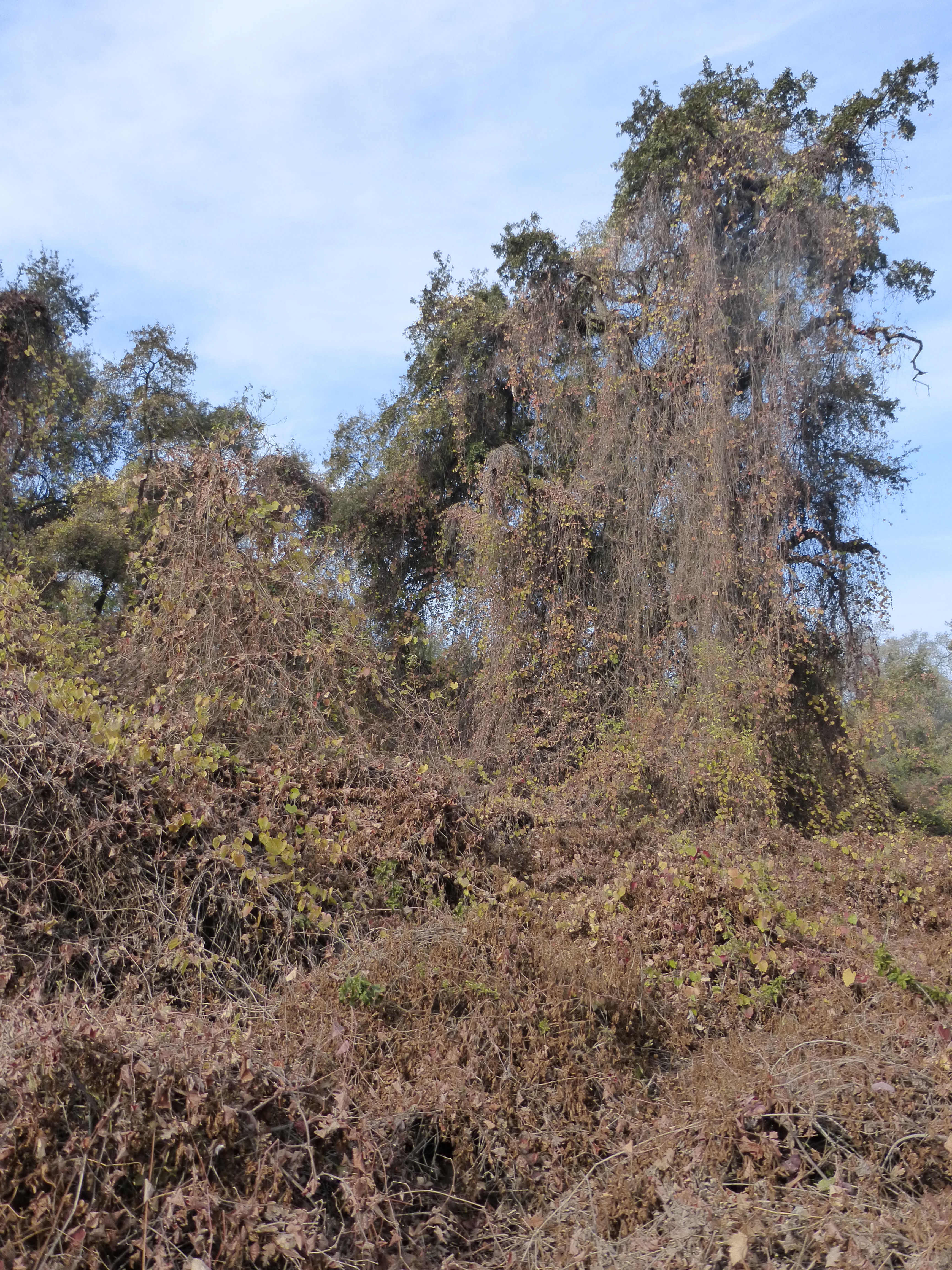
- The first installment of his “restoration” saga described the over-grown property that he believed he was obligated to tame: “an entire civilization of invasive vines and weeds had cruelly exploited the inattention [of previous elderly owners].” The vines were “murdering defenseless native trees.” He hired a crew to clear brush, until the cost challenged his budget. Then he bought equipment and tried to do it himself. He concluded that he could not “restore order” to his land without using herbicides. Even then, he was doubtful of ultimate success: “Clearly, I won’t be defeating these invaders. At best, I’ll battle them to a temporary truce, holding them at bay until I lose the will to fight them.” Like many city-slickers, Milbank has an unrealistic vision of what nature looks like when allowed to take its course.
- In the second episode of Milbank’s battle plan, deer were his target: “I will be wielding my gun against a brutal foe—one that destroys our forests, kills our wildflowers, sickens humans and threatens the very survival of birds, mammals, insects and amphibians. I am becoming a deer hunter.” Where top predators, such as wolves and bears, have been eliminated by humans, there is an over-population of deer who browse vegetation, depriving other animals of the food and cover they need. Again, Milbank has his doubts about the effectiveness of hunting deer on his property: “I can’t pretend that my hunting will make a dent in the deer population.”
- After taking Virginia’s Master Naturalist Program, Milbank’s third episode expresses his regrets as a gardener: “I’ve been filling my yard with a mix of ecological junk food and horticultural terrorists” and he warns urban and suburban gardeners that their gardens are “dooming the Earth.” He takes aim at cultivars in general and many specific species of introduced plants. Conservation Sense and Nonsense explains why most of these accusations are exaggerated, if not, patently false.
- In Milbank’s column, “How I learned to love toxic chemicals,” he expresses frustration about how hard it is to eradicate non-native plants: “I was losing, badly, to the invasive vines and noxious weeds…I’d cut them back, but they would return in even greater numbers.” He fully embraces the use of herbicides to escalate his war on nature: “I have become a reluctant convert to chemicals.” He acknowledges that glyphosate is toxic, but he claims that the cut-stump application method he uses is “surgical.” He wears protective clothing, including a respirator, which is not required by the product label or California law for glyphosate applications. He is encouraged by Doug Tallamy, who calls herbicides “chemotherapy.” Conservation Sense and Nonsense explains why herbicides are doing more harm than good to the environment and everything that lives in it.
Throwing caution to the winds
In the latest installment of Milbank’s crusade against non-native plants, he tosses caution about herbicides aside. He hires a drone to spray a hayfield with glyphosate in preparation for creating a meadow of native grasses and forbs:
“To save the birds, I brought in this big bird: a 10-foot-square, Chinese-made drone with 8 propellers, capable of carrying 10 gallons of fluid, in this case glyphosate, to kill the grass in my hayfield. (It might seem counterintuitive to douse a field in herbicide to help nature, but conservationists broadly endorse the practice.)”
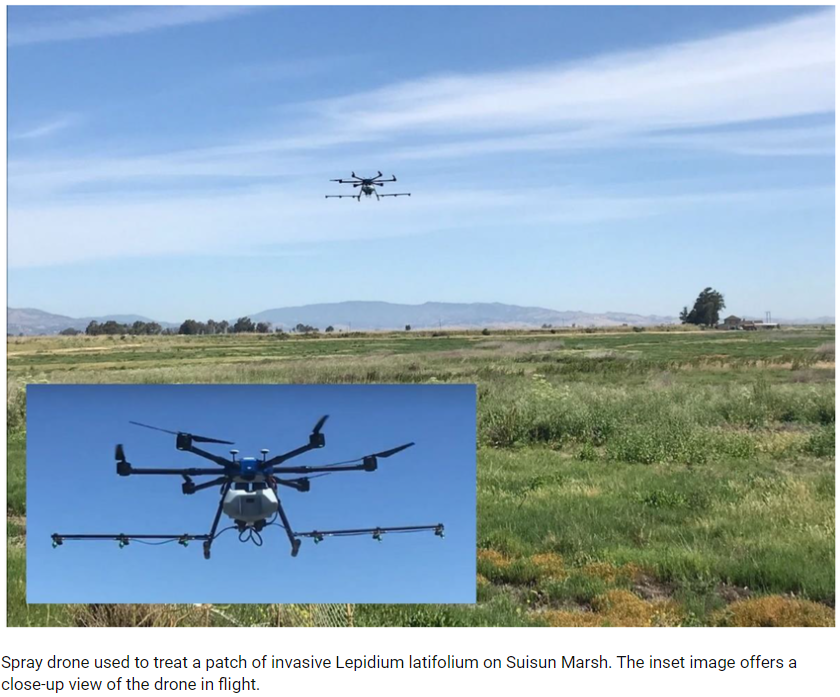
Milbank has abandoned his cautious use of herbicide and is now aerial spraying from a drone 30 feet over his head, while he watches, without wearing any protective gear:
“Shanley, in shorts, sneakers and fishing shirt, plopped in a lawn chair in the shade of my barn and, using a control pad with two joysticks, sent the drone into the sky… In a moment, the beast was airborne and, from a height of about 30 feet, spraying death on my hayfield. It sprayed the fescue. It sprayed the Johnson grass. It sprayed the foxtail. It returned, flew over the barn — and sprayed me with glyphosate. Programming error. “Sorry about that,” Shanley said. My eyes burned for two days.”
If he had been wearing safety goggles, as required for glyphosate applicators in California, he would have been spared. Milbank has the right to poison himself, his land, and the animals that live on his land. Although the applicator may be breaking laws (he would be in California) by not wearing any protective equipment, Milbank isn’t doing anything illegal.
If I weren’t reading his story in the mainstream media with a national following, I wouldn’t be writing about what he’s doing. I’m writing about Milbank’s dangerous use of herbicides because he has a big audience and his audience displays their ignorance of the dangers in over 1,400 comments.
The reader comments on Milbank’s latest article are uniformly positive, as were comments on his earlier installments about his war on nature. Most comments are short expressions of unqualified praise, such as “You are doing holy work,” or “God bless you.”
A handful of comments (including mine) express concern about the indiscriminate use of glyphosate. The few dissenting readers are blasted by Milbank’s supporters. Some of their responses betray ignorance of herbicides:
- “It’s not Round Up; it’s a safe herbicide.” In fact, Milbank says he’s using glyphosate, which is the active ingredient in Round Up.
- “He said nothing about dousing. It looks like a selective approach. In some cases, there is no practical alternative.” In fact, Milbank says explicitly that he’s spraying 10 gallons of herbicide 30 feet over the ground from an aerial drone. Does that sound selective?
The reader comments claiming that glyphosate is harmless brought to mind a recent article about the army of paid apologists for pesticides. The pesticide industry, in collaboration with the US government, has “established a ‘private social network’ to counter resistance to pesticides and genetically modified (GM) crops in Africa, Europe and other parts of the world, while also denigrating organic and other alternative farming methods. More than 30 current government officials are on the membership list, most of whom are from the US Department of Agriculture (USDA).”
The most common defense of Milbank’s herbicide spraying was that it only needs to be done once, with an occasional follow up prescribed burn. Milbank doesn’t actually claim that herbicide only needs to be sprayed once, but his supporters wish to believe that. Here are a few actual attempts to convert non-native grass to native grass that illustrate that such a conversion is unlikely to be possible, even after a persistent, long-term attempt.
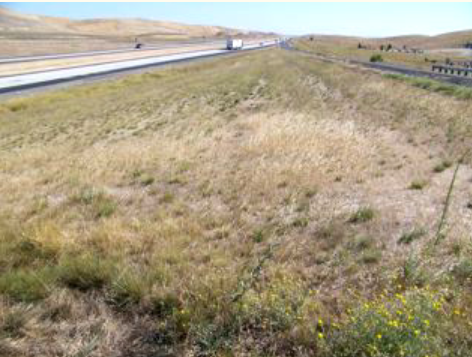
- A team of academic scientists at UC Davis attempted to convert non-native grasses to native grasses on 2 acres of roadside. At a cost of $450,000, they tried every available method (herbicides, plowing, plug planting, mowing, burning) for 9 years. When they ran out of money, they declared success, which they defined as 35% native grasses that they expected to last for no more than 10 years. (See above)
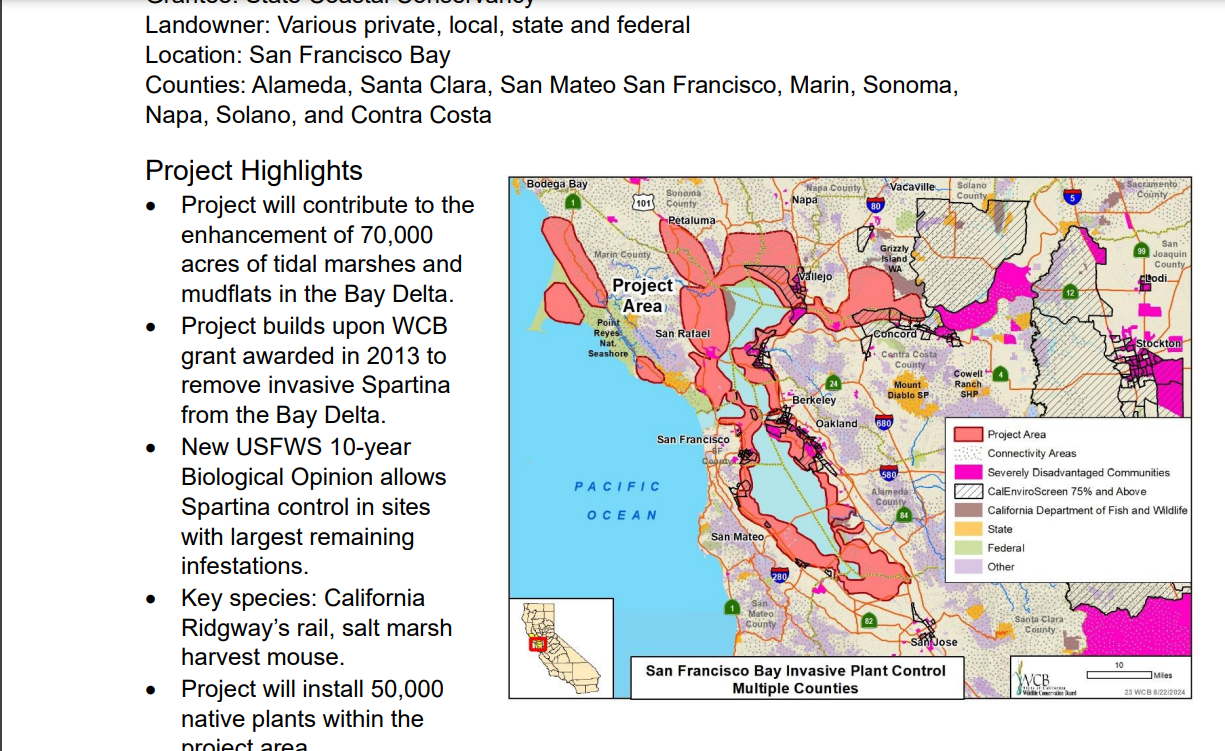
- The Invasive Spartina Project in the San Francisco Bay has been trying to eradicate non-native spartina marsh grass with herbicide for 20 years at a cost of $50 million. The project was recently granted another $6.7 million to continue the project for another 10 years. The project has killed over 600 endangered birds (Ridgway rails) in the San Francisco Bay because of the loss of habitat.
- One of the presentations at the 2022 conference of the California Native Plant Society was about a 20-year effort at the Santa Rosa Plateau Ecological Reserve to convert non-native annual grassland to native grassland, using annual prescribed burns. Many different methods were used, varying timing, intensity, etc. The abstract for this presentation reports failure of the 20-year effort: “Non-native grass cover significantly decreased after prescribed fire but recovered to pre-fire cover or higher one year after fire. Native grass cover decreased after prescribed fire then recovered to pre-burn levels within five years, but never increased over time. The response of native grass to fire (wild and prescribed) was different across time and within management units, but overall native grass declined.” The audience was audibly unhappy with this presentation. One person asked if the speaker was aware of other places where non-native grass was successfully converted to native grass. The speaker chuckled and emphatically said, “NO. I am not aware of any place where native grasses were successfully reintroduced.”
Anyone with a little knowledge of how herbicides work, would know that glyphosate kills only the top-growth of an actively growing plant. Glyphosate won’t kill the seed bank of Milbank’s hayfield, which he says has been growing there for decades, perhaps as long as 100 years. That’s why glyphosate must be applied annually as the seed bank continues to produce new top-growth annually. If Milbank plants native plants after the initial spraying, they will be killed by subsequent spraying because glyphosate is a non-selective herbicide, which kills whatever it touches, both native and non-native plants. Perhaps Milbank knows this, but his readers don’t. It might explain why Milbank is not particularly optimistic about the prospects of achieving his goal of a native meadow: “Will it work? I have no idea. It could become the field of my dreams…Or it could be a costly and time-consuming failure.”
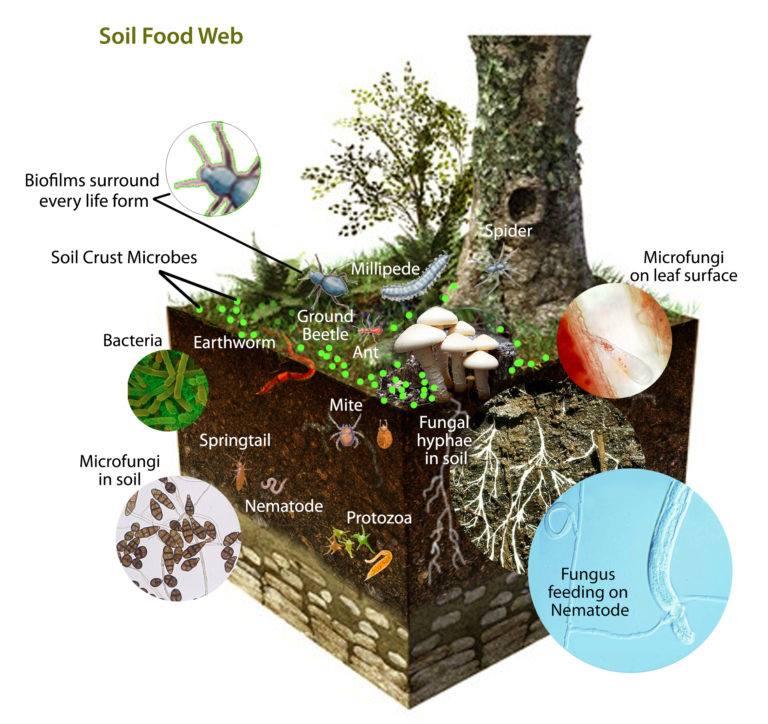
Only two of Milbank’s readers mention the damage that herbicide does to the soil, making future plantings even less likely to survive. One of those comments is from a farmer who has reason to know this important information:
“The number of things you screwed up, from possibly destroying that old man’s life, family, and farm, to messing up the winter food supply with a cascading effect for farms in your region, to obliterating a small farm, were appalling until you got to the part where you killed your soil microbes with poison. You actually killed topsoil with the idea you were going to grow healthy plants! If I were to write a caricature of a [sub]urbanite transplanted to a farming community and with the best intentions absolutely destroying everything, couldn’t have done any better than you have with your self-congratulatory actions. Farms are complex systems embedded in even more complex natural systems. Farms interact with and depend on each other. It’s where food comes from. When you kill one, you hurt all the others. You also hurt animals and plants that depend on the farm. Creating a farm, and a farming community, is hard. Destroying one is easy, and you just did it.”
This comment brought to mind a recent study about the damage that pesticides do to the soil. A meta-analysis of 600 studies “…published in the journal iScience found that soil pollution was the leading cause of declines among organisms living underground. The finding has surprised scientists, who expected farming intensification and climate change to have much greater impacts.” The co-author of the study said, “Above ground, land use, climate change and invasive species have the greatest impact on biodiversity, so we assumed that this would be similar below ground,” Victoria says. “Our results show, however, that this isn’t the case. Instead, we found that pesticide and heavy metal pollution caused the most damage to soil biodiversity. This is worrying, as there hasn’t been a lot of research into the impacts of soil pollution, so its effects might be more widespread than we know.”
A familiar story
Dana Milbank’s plans to transform a derelict farm into a native plant garden are the mirror image of the native plant movement in the San Francisco Bay, the region where I live and have observed failed native plant “restorations” for over 25 years:
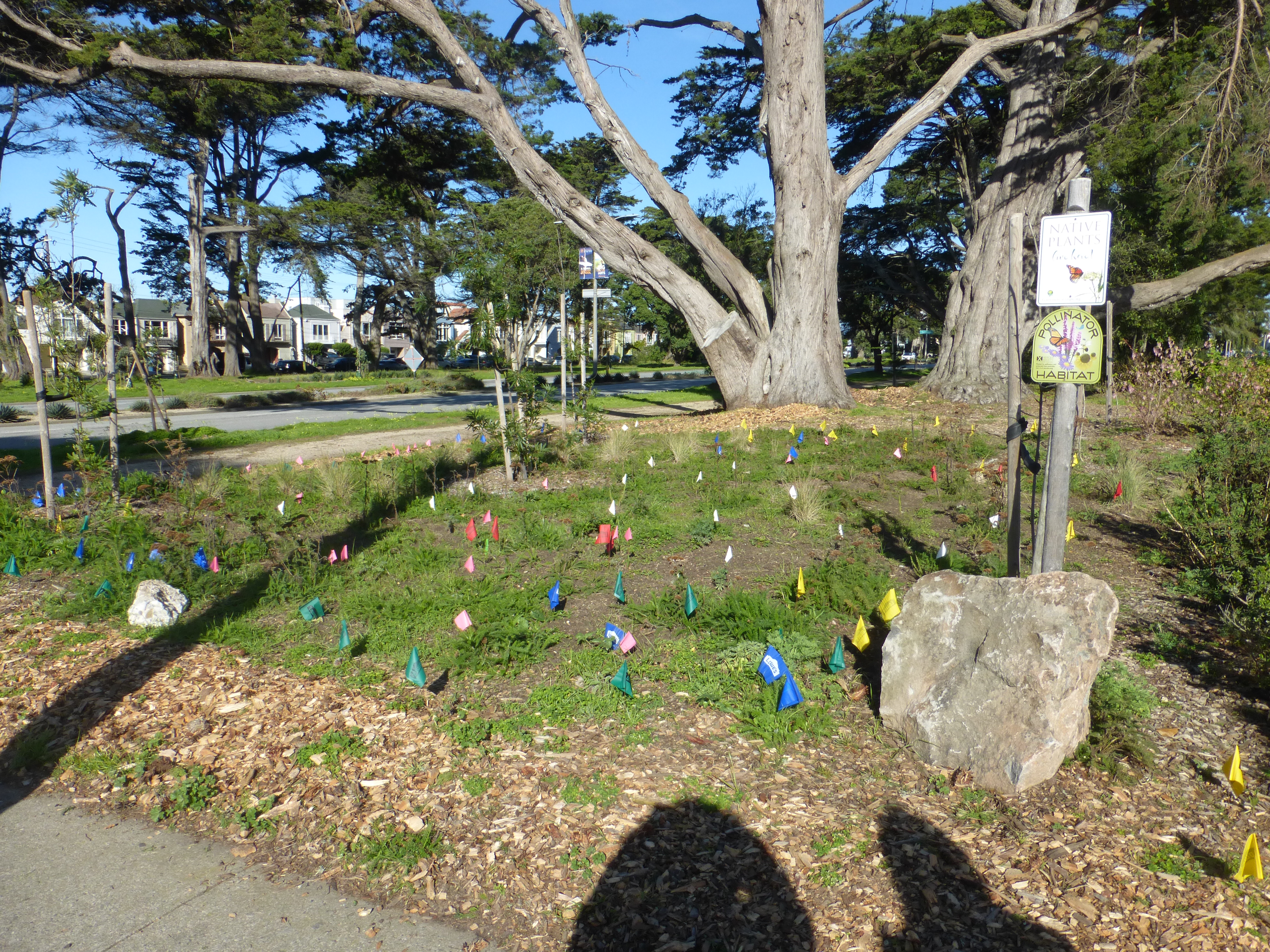
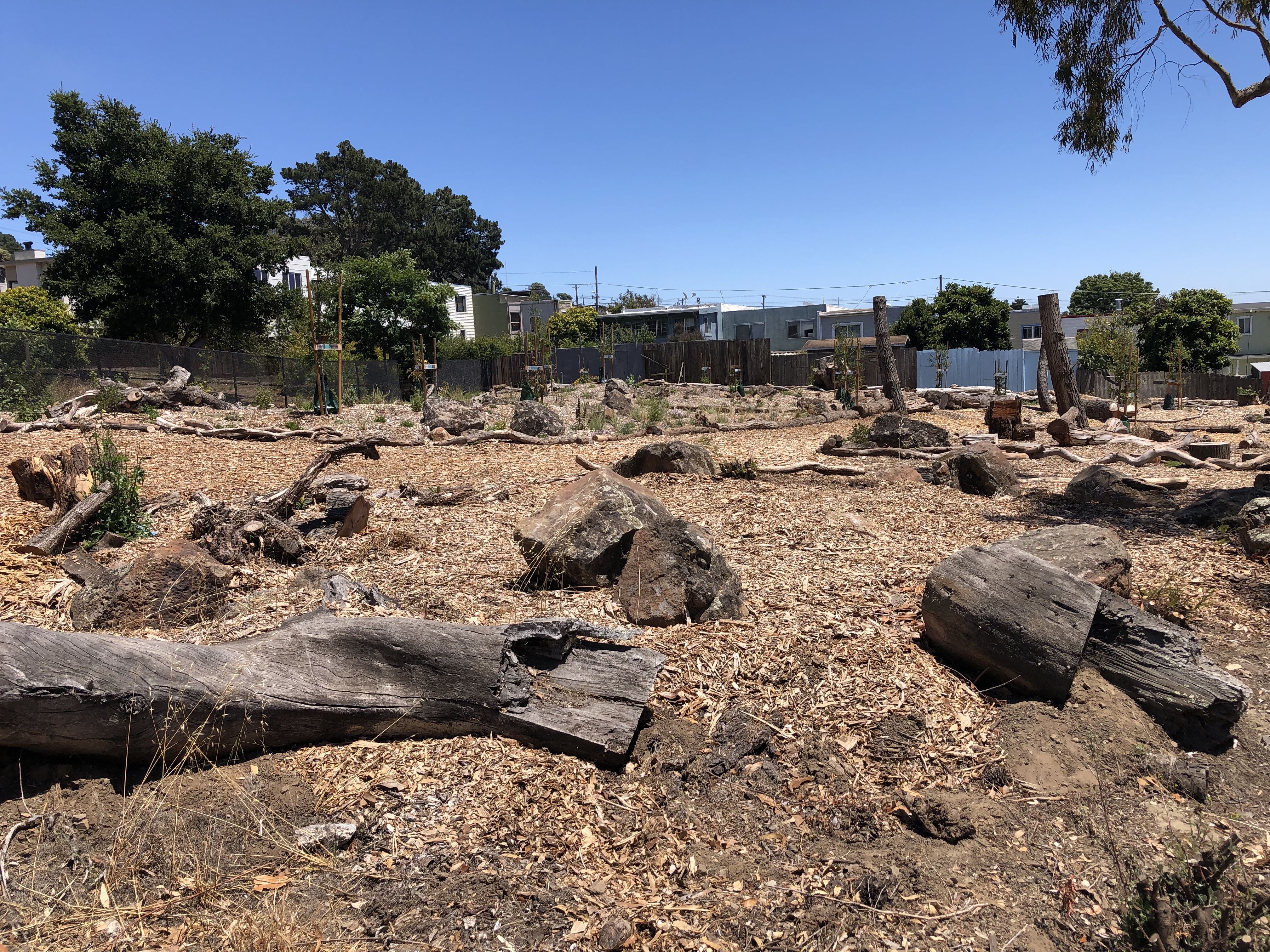
- Native plant “restoration” projects in the Bay Area began over 25 years ago based on the mistaken assumption that if non-native plants were destroyed, native plants would magically emerge without being planted. In other words, nativists originally believed that the only obstacle to native plants was the mere existence of non-native plants.
- After 25 years of applying herbicides repeatedly, there are no more native plants in the San Francisco Bay Area than there were 25 years ago. The soil has been poisoned by herbicides and climate change and associated drought makes native plants progressively less well adapted to current environment conditions.
- Despite the obvious failure of these “restoration” attempts, they continue unabated because vast sums of public money are available to keep them going. Dana Milbank will run out of money eventually, but the public coffers are never empty. Milbank is 56 years old. When he gets too old to do the work or when he dies, whatever he has accomplished will quickly revert to its previous unmanaged state. Nature will prevail and his brief conceit that humans can control nature will be history.
- The public is unaware of how much herbicide is used by public land managers because application notices are not required for most pesticides. In California, for example, if the manufacturer of the pesticide claims that the pesticide will dry within 24 hours, application notices are not required by law. Glyphosate is one of many herbicides for which application notices are not required. Some land managers post application notices anyway, but many do not. The public is also ignorant of the damage that pesticides do to the environment and everything that lives in it.



 Conservation Sense and Nonsense