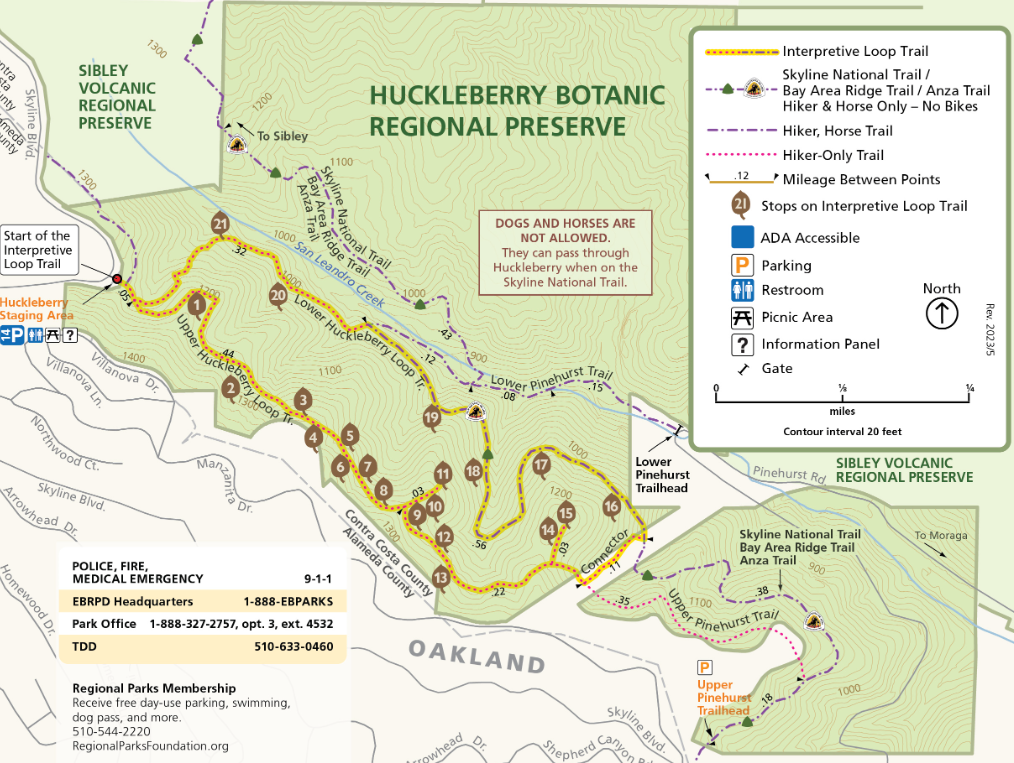
We celebrated July 4th with a walk in the woods. Huckleberry Botanic Regional Preserve in Oakland is a true remnant of native vegetation that is unique among the collection of 73 parks of the East Bay Regional Park District. The trail guide describes the conditions that created this ecosystem and enabled its survival while other native ecosystems have not survived:
Huckleberry is “a relic plant association found only in certain areas in California where ideal soil and climatic conditions exist. The vegetation association finds its roots in past climates and geologic history. The plants originated in the distant past along the southern coast of California when the climate was more moist and tempered by the cool coastal fog. Today, similar vegetation is found on the islands off the Santa Barbara coast and in isolated pockets on the mainland coast from Point Conception to Montara Mountain south of San Francisco.”
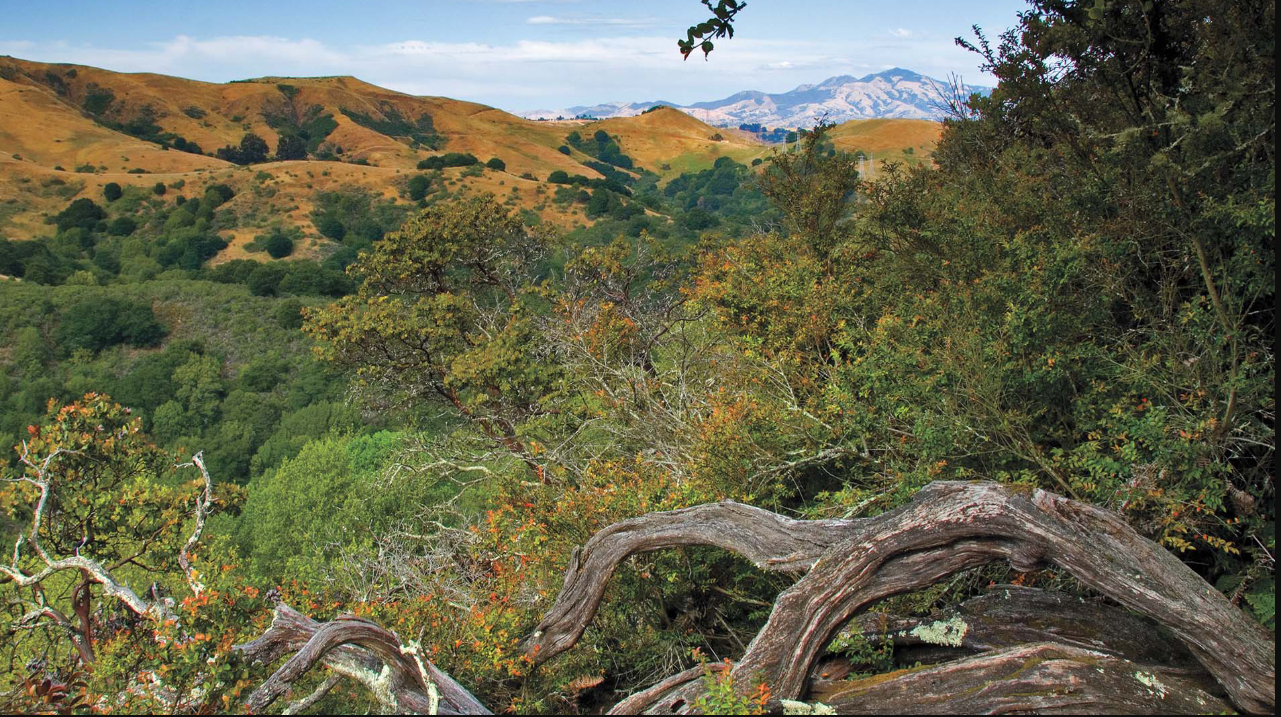
A view from Huckleberry Botanic Preserve of hills to the east. Source: East Bay Regional Park District
The preserve was created partly to protect an endangered species of manzanita, specifically pallid manzanita. There are 107 species and sub-species of manzanita, of which 95 are native to California. The ranges of most of these species are extremely small because manzanita hybridizes freely and therefore adaptive radiation has resulted in a multitude of species, sub-species, and varieties that are adapted to micro-climates. Many of these species are locally rare and 10 species of manzanita have been designated as endangered, two of which are limited to the San Francisco peninsula: Raven’s manzanita and Franciscan manzanita.
Manzanita is vulnerable to extinction partly because its ranges are small and partly because it is an “obligate seeder,” which means it can only be propagated in the wild from seed. The seed of manzanita is germinated by fire. However, the exact relationship between fire and germination is not known. Many complex experiments have been conducted on the few viable seeds produced by Raven’s manzanita, which was designated as endangered in 1979. Various combinations of fire, heat, cold, smoke, liquid smoke, etc., were tried and failed to determine exactly what triggers germination of manzanita seeds. The suppression of fire in the past 150 years has contributed to the decline of small manzanita populations in California.
Some endangered species of manzanita are available in commercial nurseries because they can be easily cloned, which means they are genetically identical. These commercially available manzanita species remain technically endangered because the criteria for endangered status requires that they be grown from seed in the wild to be eligible for removal of endangered status.
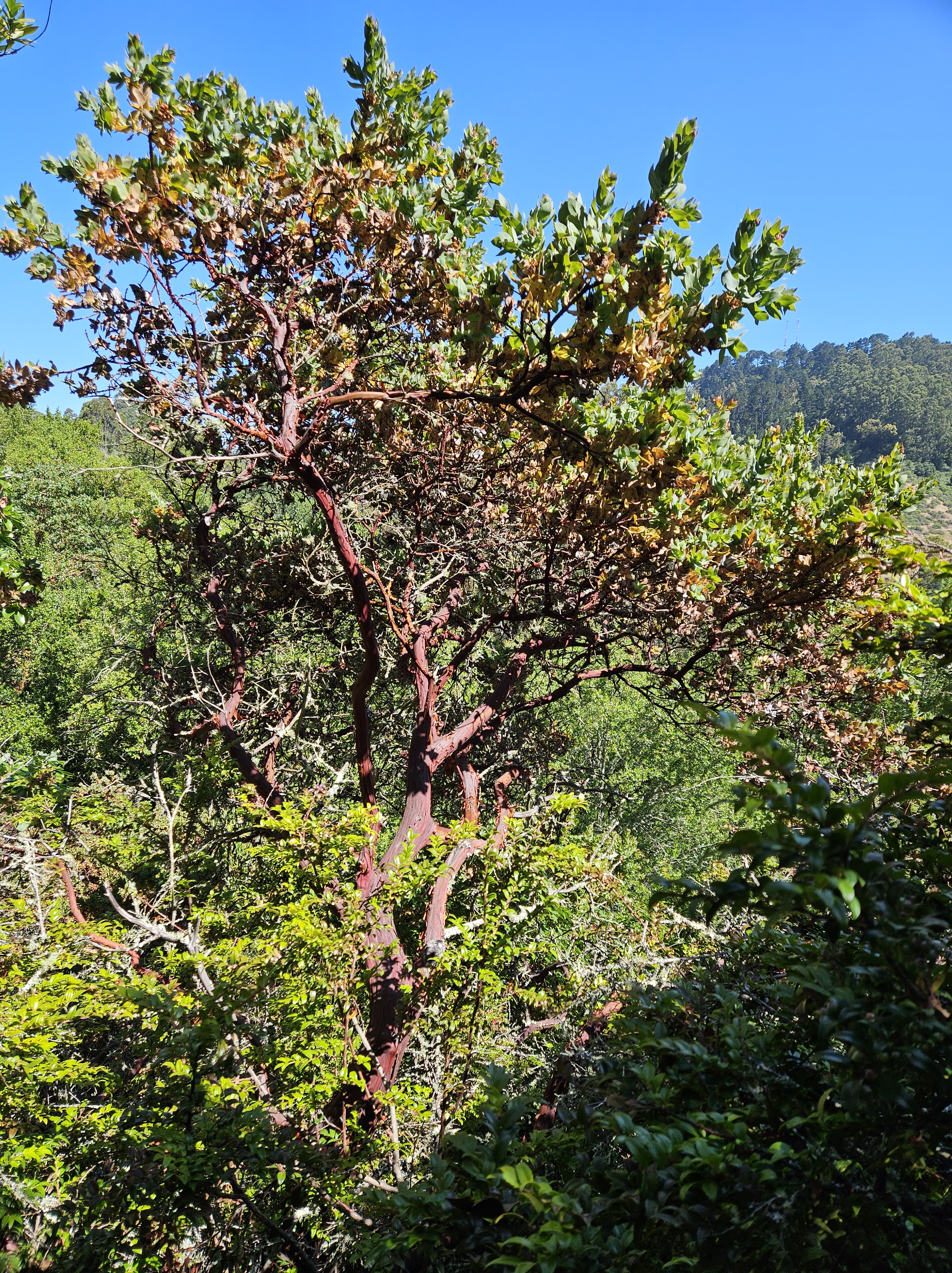
Pallid manzanita in the Huckleberry Botanic Reserve are not doing well:
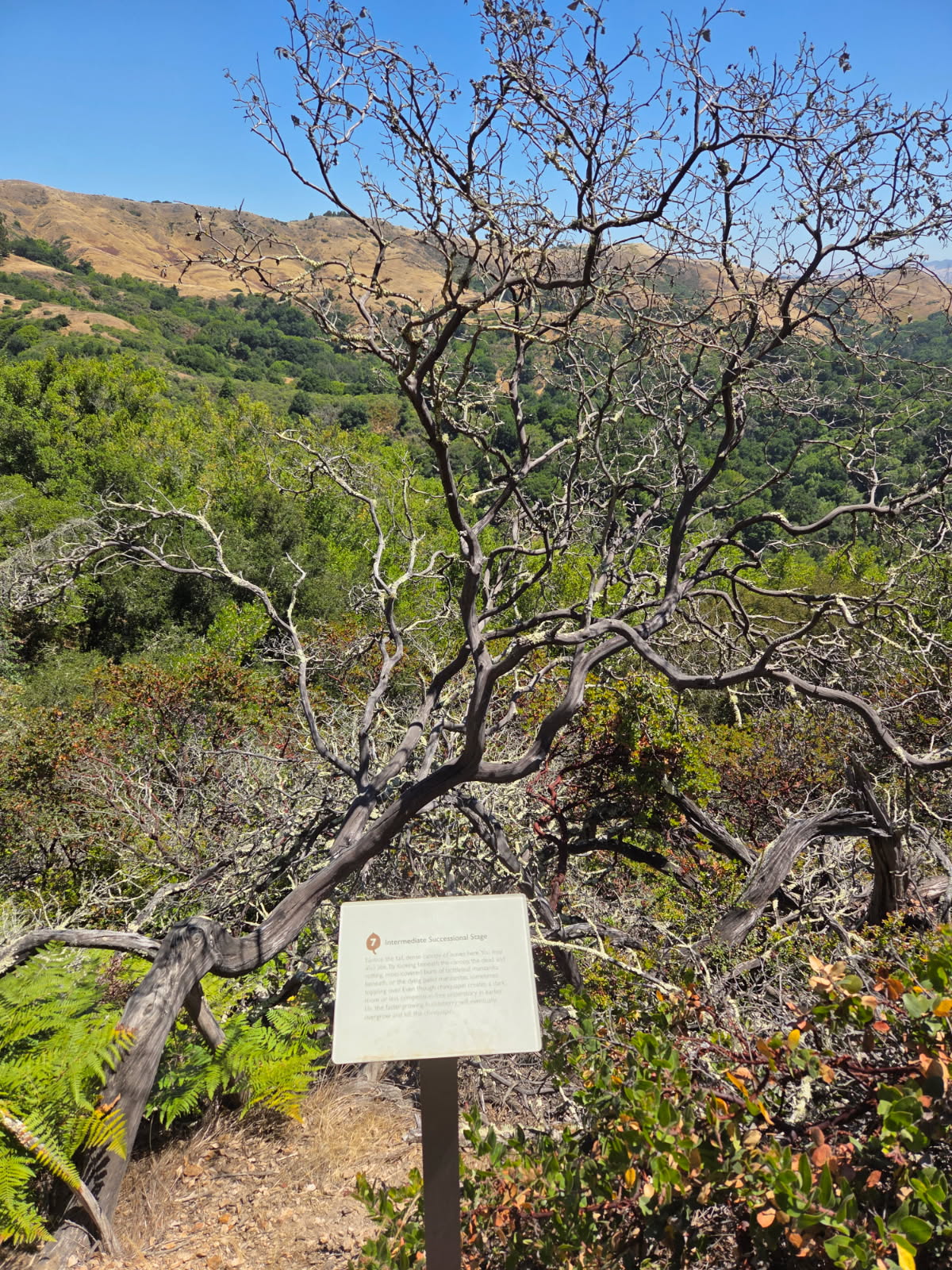
And some pallid manzanita is dead:
The sign explains that as pallid manzanita dies, it creates space in the understory for chinquapin and it predicts that more competitive huckleberry will eventually “overgrow and kill” chinquapin. The sign describes this process as natural succession. It doesn’t accuse huckleberry of being invasive. If huckleberry were non-native, it probably would be considered “invasive.”
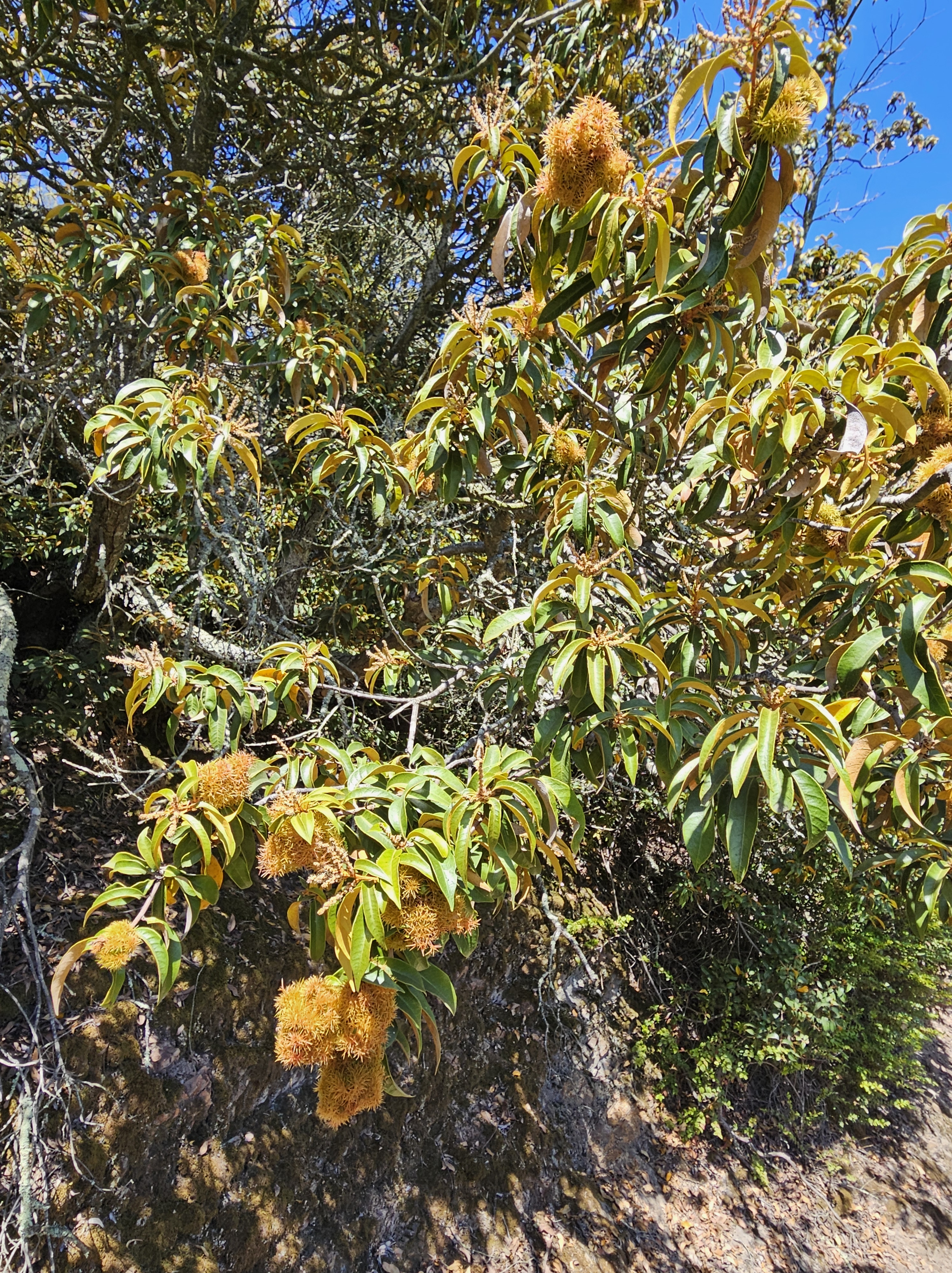
Chinquapin has a distinctive nut, which is encased in a bristly shell. My hiking companion said he and his brothers used to eat the tasty nut when camping in Mineral King in Sequoia National Park. The bristly shell doesn’t make it easy to access the nut, but birds and wildlife find a way:
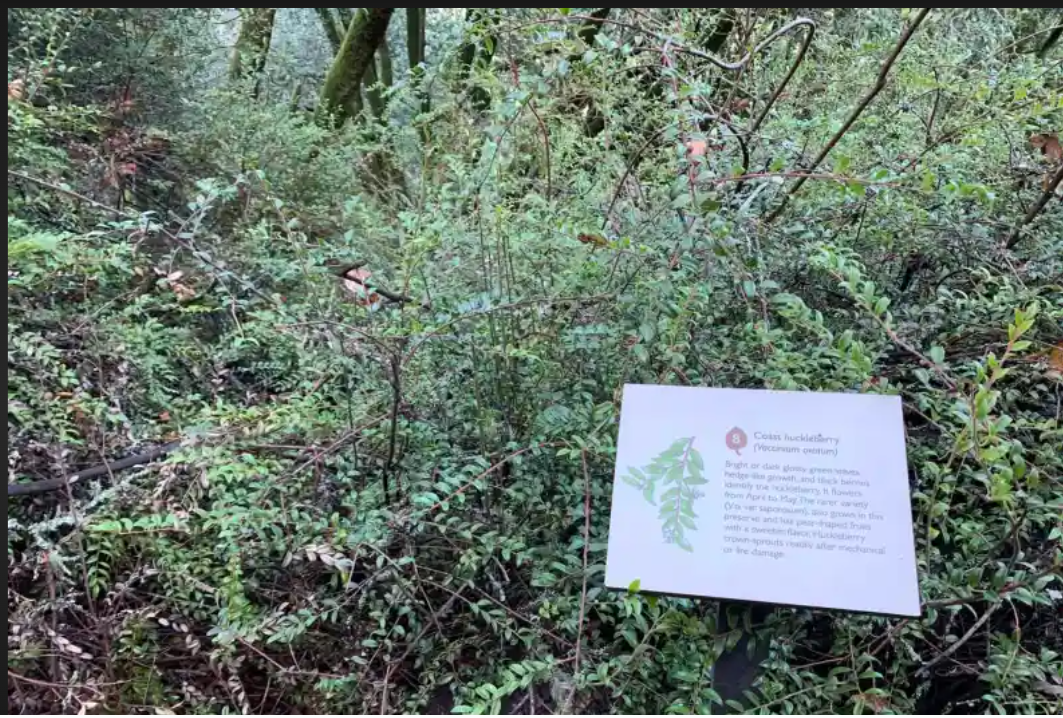
Huckleberry is appropriately the namesake of this botanic reserve. In some portions of the narrow trail huckleberry creates tall, dense hedges on either side of the trail:
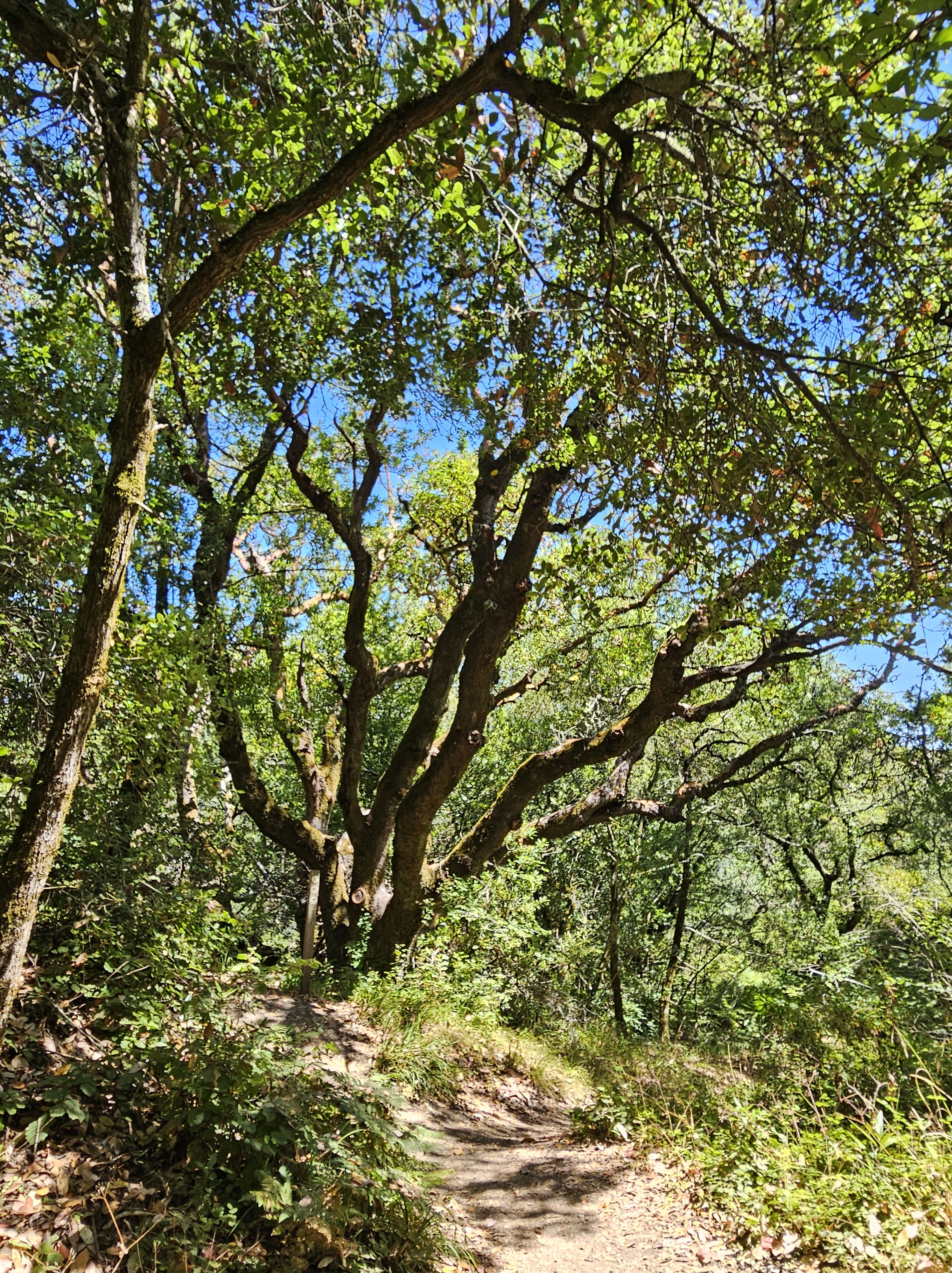
Because the Huckleberry Botanic Preserve is a relic of native vegetation that has been undisturbed by fire and development for hundreds of years, it is an excellent place to see huge native trees compared to much younger and therefore smaller native trees in other public parks in the San Francisco Bay Area.
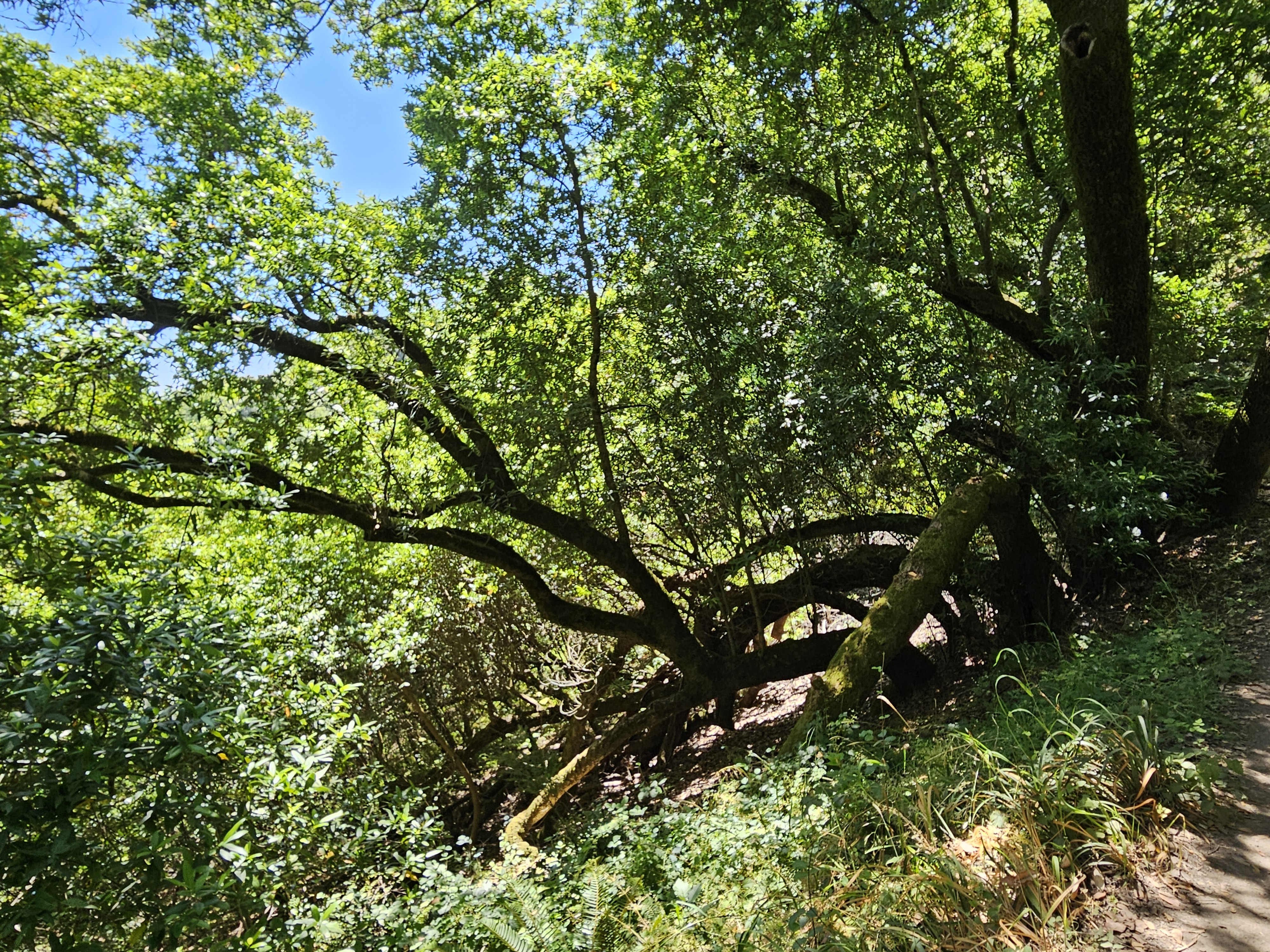
Mature bay laurel trees in Huckleberry Preserve are an opportunity to witness the competitive strategy of this tree species. When it achieves some height as it grows, its branches fall over and often put down new roots that grow new vertical trunks. This prostrate posture of bay laurels gives them a competitive advantage over other plants in the understory. Mature bay laurels occupy huge expanses of space around them that create shade and make it difficult for other plants to become established in the shade. The prostrate posture of bay laurels also makes it more flammable because the fire ladder to its canopy extends to the ground. Crush a bay laurel leaf in your hands to smell its aromatic oils that also contribute to the flammability of bay laurels:
This madrone tree in Huckleberry Reserve is the biggest I’ve ever seen:
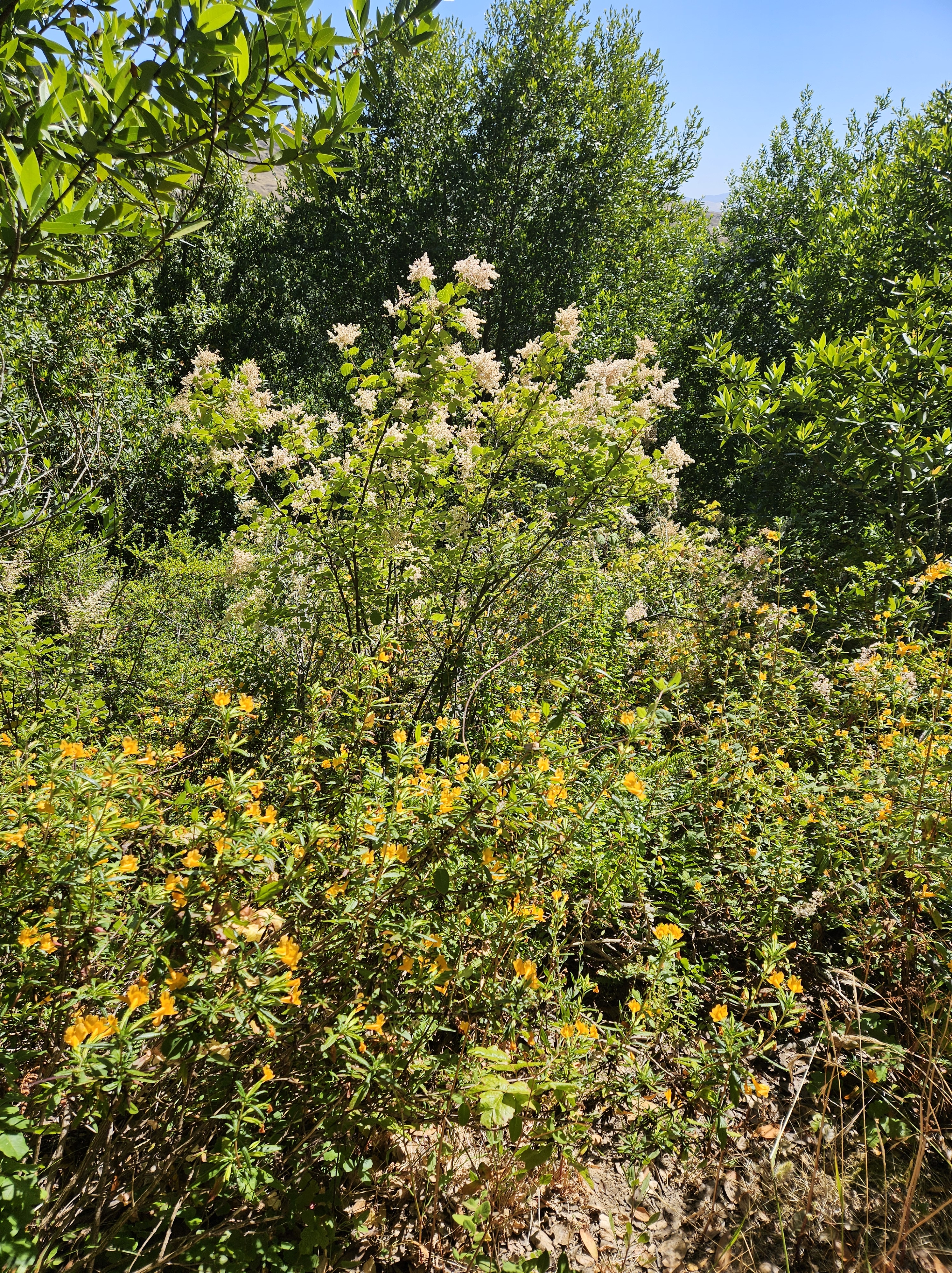
In early July some woody and herbaceous shrubs were still blooming. In this case, sticky monkey flower in the foreground and pink flowering current in the background:
Huckleberry Botanic Reserve is a unique gem in East Bay Regional Park District. I hope you will have an opportunity to see it and that you will appreciate it as much as I do.
Macaylla Silver discovered Conservation Sense and Nonsense on Facebook. We instantly recognized one another as kindred spirits, battle scarred by our attempts to protect nature from pointless destruction in service of the ideology of invasion biology and the native plant movement it spawned.
When confronted with the destruction of wild places we love, our reaction was very similar, and responses to our efforts were also similar. First we turned to public policy for protection: Are they really allowed to poison our public lands with pesticides to destroy harmless plants? With a few targeted “exceptions” to policy, the answer was always, “We can do whatever we want.”
Then we both decided the best course of action was to become experts about the “science” that is used to justify destroying harmless vegetation with herbicides. And so, we took to the books and armed ourselves with the science that refutes invasion biology. Once again, we hit the brick wall of “We can do whatever we want.”
And there Macaylla’s experience as an activist diverges with mine. He has successfully stopped the poisoning of Leverett Pond (for the time being) by showing the neighbors of Leverett Pond with videos, the consequences of poisoning the pond.
However, he concludes his story with the astute observation that stopping the destruction of Leverett Pond is unlikely to be the end of the story. Life in the pond will continue to evolve, as it must. As long as people continue to believe that evolution must be stopped, the futile attempt to prevent change will continue. Macaylla is hopeful that mistaken belief will fade. I hope he is right.
We thank Macaylla for his efforts. We wish him luck in preventing more herbicide applications in Leverett Pond.
Conservation Sense and Nonsense
“Let the Pond Be a Pond”
Massachusetts Wetlands Protection Act was created for the protection of the state’s wetlands. The goals of the law are to prevent pollution, maintain habitats for plants and wildlife, and protect groundwater, public and private water supplies.
Our Town Bylaws in Leverett, Massachusetts also included a ban on the use of herbicides for any use outside of domestic and agricultural use since 1973.
There are five colleges in the area. The town is filled with highly educated academics and retired academics. Leverett is quite ecologically minded in my opinion, this hill town of 2,000 people.
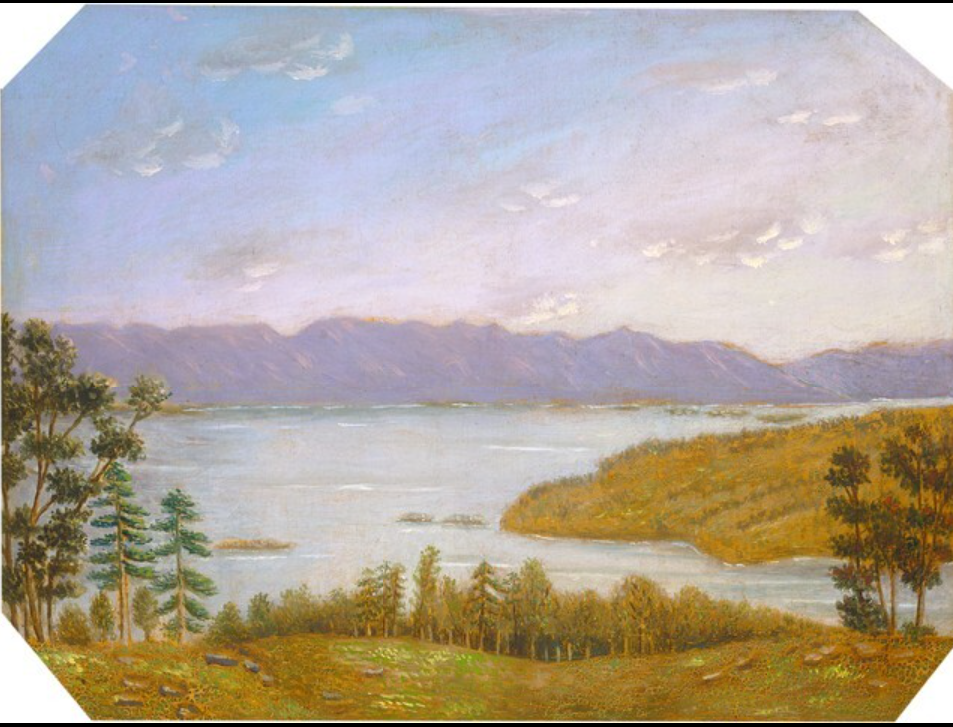
Leverett Pond, circa 1860-1880, Erastus Salisbury Field. Public domain.
One day back in 2018, I found that the large body of water at the town’s center, Leverett Pond, was under ecological attack. Somehow, some way, a handful of land abutters on the shallow side of the pond were trying to rid the pond of “noxious weeds.” This included floating leaved Waterlilies and Watershield, plants such as rootless carnivorous plants like Bladderworts, submerged weeds like Coontail, Waterweed and Milfoils. Even Cattails and other plants growing on the pond’s edges were considered for removal.
Act One: Isn’t there a law against this?
I thought I could stop this. I thought once the town’s people knew what was happening they would be outraged. I thought the state would step in, prevent the further destruction and maybe even fine the people who were poisoning the area and dredging large sections, all so they could in their words “have crystal clear water to look at.”
I thought it would be easy. I have never been so wrong in my life.
It was five years of continual meetings, letter writing, publishing newspaper letters and articles, and a large portion of the town thinking that somehow I was just trying to cause trouble. Or maybe they didn’t think I knew what I was talking about. Sure, I saw the destruction, but I was misinformed. They believed in their intent and factual details of why they were on a campaign of eradication.
The details of destruction used to convince the town’s Conservation Commission, Select Board, and state agencies came from two retired professors, neither with a degree in Environmental Ecology. Their plan contained the curveball of being designed to show off knowledge of several obscure subjects unknown to nearly everyone:
1.Limnology: The science of fresh water systems 2.Pesticides and their application to aquatic environments 3.The botany and identification of aquatic plants
Act Two: Countering Pseudoscience with Science
While the wordsmithing of the two PHDs had merit and flow, my own research quickly showed that they had only a surface understanding of subjects. In order to counter their statements and proposals, I decided that I would deeply learn all I could about limnology, pesticides and the life of aquatic plants. I would become an expert, the old fashion way: I would purchase books. Lots of them. I read extensive science based articles on pesticide families, collecting hard data and staying away from anything that was too opinionated.
People began to realize that I knew more than expected, so much more that it was easy to forget that the vocabulary was rarely understood. I presented myself on equal footing with proponents of the project. I asked the community and its policy makers to consider that dumping herbicide on the pond might not be the best thing, creating aporia, lingering doubts that this handful of lakefront owners may have hidden motives.
Act Three: Invasion Biology at Work
Then came the videos. I purchased two kayaks, an underwater camera, and I used cameras I had purchased for bird photography. The videos contrasted the “before and after” of the years of degradation in 2019, 2020 and 2022. The videos got the state involved. The state permits for dredging that the project applied for in 2010 were never received. This meant that the project had to reapply for permits for any further work after 2020.
Up to this point, I thought I was fighting against ignorance and arrogance from a few landowners who came late to the pond’s available real estate and bought lots that were undesirable because of their shallowness and large amounts of aquatic flora and fauna. I would have been in heaven if I bought such an area, but they looked to “improve it.” So they had set out to “manage” the water’s surface.
The two professors contacted a professional who specialized in finding ways around what was allowed by the Wetlands Protection Act. Leverett’s Conservation Commission reviewed the law and found that there were no ways around the law because the plant abundance, oxygen levels and fish life were all healthy, vibrant. Graphs, data, reams of older regurgitated documentation pointed to the same conclusion I had reached: Let the pond be a pond.
To show the reason why no further “management” permits would be issued to continue the project, the head of the Conservation Commission submitted his own reason: the project violated Town Bylaws. Clearly.
Then it happened. Three members of the Conservation Commission had what I thought were very strange ideas about conservation. One had a pesticide license. One looked at the pond for recreation purposes rather than an interest in environmental issues. Another felt strongly about eradicating plants that they couldn’t identify if asked. One said, in defense of using pesticides, the blithe motto “If you can choose it, you can use it,” while the other two nodded in agreement. “We have to stop the growth of these plants before they destroy the pond. It will reach a tipping point where there will be no return,” said one, with great conviction. “It could in the future make the fishery less healthy,” said another, without a shred of data. I had no idea why such people would be put on such a Commission.
The Conservation Commission voted three to two to allow the project to continue for another five years. The state admonished but did not intervene. I had been angry at the professors and their allies for their lack of concern. Now the Conservation Commission had let me, and the pond, down.
The decision of the Conservation Commission gave the pond abutters cover, so they could remove all the plants they wanted. The Commission gave herbicide sprayers a welcome mat in Leverett to earn big money for the applicators and companies that make a variety of toxins.
The decision gave the Conservation Commission, not its local intended use, protecting wetlands and freshwater, but a zealous conviction that they were acting on a world saving mission. It was Invasion Biology at work, masquerading as “restoration,” AKA the “native plant movement.” Invaders needed to be destroyed, regardless of recklessness, collateral damage, complete destruction.
So destroying acres of plant life, to get at one plant, that is okay now. They were Crusaders with a capital “C.” And like all crusades…it rarely ends well.
Act Four: Pictures are worth thousands of words
In 2022, the herbicide sprayers came back, on a very windy day, on an airboat. It appeared that the targeted areas were being sprayed, yet large amounts were misted and blowing in the air as the airboat itself churned the water’s surface. It was, in a word, sloppy.
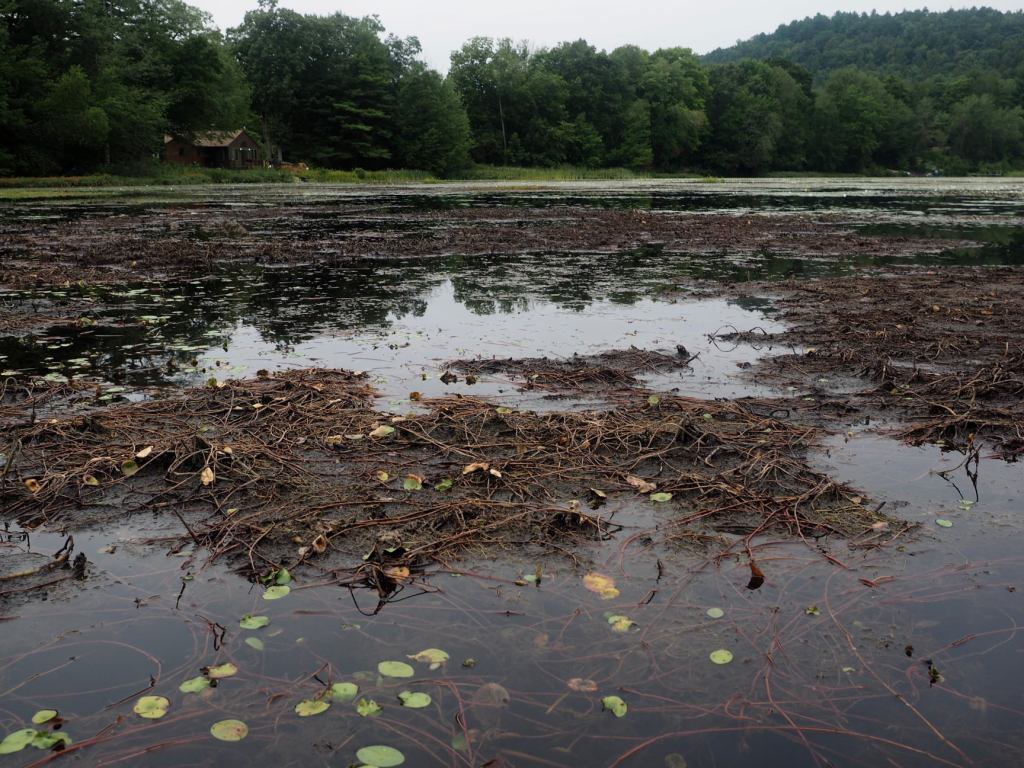
From my kayak, I videoed the spraying of the pond with herbicides from an air boat: the before, during, and the after of floating masses of dead vegetation. I got the resulting video shown to many. It had few words, an eerie soundtrack that suited the unreal transformation, from living beauty to full degradation, death and decay. (see below)
Leverett Pond after herbicide spraying in 2022. Entire video available HERE.
For the next year, and the next they stopped spraying. Sure, they hired an aquatic harvester to clean around the area of their docks, but that was it.
In 2024, the promoters of the deadly project were apologetic. They promised that “no herbicides” would be used. Even an attempt to hand pull marginal plants failed.
The pond will continue to respond to changing climate conditions, as it must. Plants are likely to return and the fear-mongers are likely to demand their destruction again.
Fear of so-called “invasive species” is being used as an excuse to use herbicides in the futile attempt to freeze ecosystems that replicate historical landscapes. As climate conditions continue to change, the fantasy that humans can prevent evolution is likely to fade. Perhaps the restoration movement will begin to realize the folly of trying to sort plants and animals into two simplistic groups: native vs. non-native.
As Charles Mackay said in a book written in 1841, ” Men, it is said, think in herds; it will be seen that they go mad in herds, while they only recover their senses slowly, one by one.”
Laura J. Martin is an environmental historian at Harvard University. She wrote two articles (1,2) about the origins of ecological field studies that might help explain the destructive methods still used today by some ecologists. Professor Martin “contendsthat the history of ecosystem science cannot be separated from the history of nuclear colonialism and environmental devastation in the Pacific [Nuclear Testing] Grounds” (2)
When the US dropped two atomic bombs on Japan in 1945, little thought was given to the consequences of atomic bombs because ending the war in the Pacific was the only consideration. Japan surrendered to the US less than one month after the bombs were dropped, effectively ending World War II.
Few doubt that the use of atomic weapons was instrumental in ending World War II. After the war, there was a more sober effort to determine the consequences of using atomic weapons. Some believed that nuclear weapons might replace conventional warfare. Others wanted to understand the impact on life on the planet before making such a momentous decision. This effort was focused on practical considerations such as the impact on the world’s fisheries and food supply. The objective of their initial studies was less concerned about long-term consequences for the environment such as the duration of impacts on living creatures and the environment in which they live.
The US federal government invested heavily in the sciences after World War II. The Atomic Energy Commission (AEC) was established in 1946 and the National Science Foundation (NSF) in 1950. The availability of federal grant funding for academic institutions “dramatically reconfigured the relationships among federal, academic, and corporate spheres.” (2) Increased federal funding greatly increased the number of academic research projects.
Between 1945 and 1970, the US detonated 105 nuclear weapons. The Atomic Energy Commission and later the National Science Foundation paid academic ecologists to conduct field studies at the test sites to determine the impact on animals.
In 1963 the US, Soviet Union, and Great Britain signed a Partial Test Ban Treaty that prohibited all non-wartime detonations except for those done below ground. Testing of the effects of radiation by academic scientists continued because the AEC mass produced radioisotopes and distributed them to American institutions. Scientists were no longer constrained to field sites where atomic bombs had been detonated.
“Thus began a period in which ecologists purposefully destroyed ‘ecosystems’ to study how they recovered.”
Laura Martin, “The World in Miniature”
The availability of radioisotopes made laboratory testing possible, but it also enabled large-scale atomic irradiation experiments such as a forest irradiation project in Georgia that exposed 300 acres of forest to an air-shielded reaction (?) that produced radiation levels comparable to expected fallout following a nuclear catastrophe. The purpose of that experiment was to determine the impact of radiation on forests. The findings were that some tree species were more vulnerable to radiation than others. This finding contributed to the hypothesis “that the greater number of species in an ecosystem, the better that system will be ‘adjusting to stress.’” (1) This is the familiar theory that greater biodiversity enhances resiliency of ecosystems against stressors such as climate change. It remains a cornerstone of conservation science.
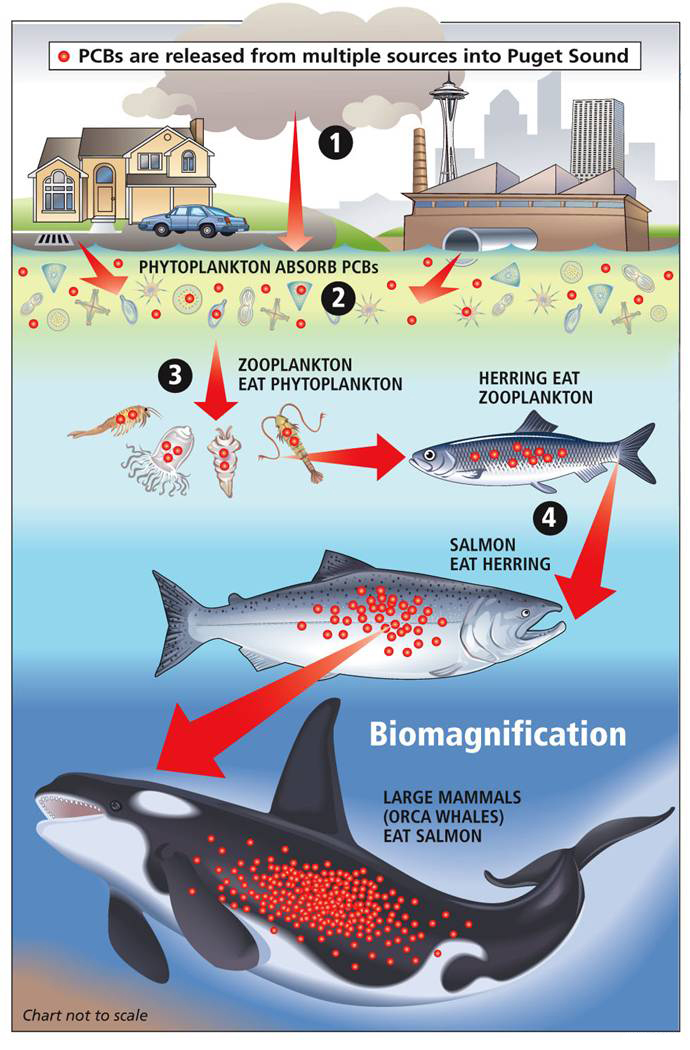
These studies are also responsible for the knowledge that radiation—and many other toxic substances such as chemicals—bioaccumulate, first described publicly in 1955, according to Martin. Many toxic substances persist in our bodies throughout our lifetime. The longer we are exposed to them, the more dangerous they are to our health. Women who were exposed to DDT before it was banned in 1972 still have higher levels of DDT in their bodies than women born after 1972. Many toxic chemicals also bioaccumulate in food webs. Top predators in the food web are more heavily burdened with poison than animals at the bottom of the food web because of biomagnification.
Using pesticides to study impacts and recovery
The concept of destroying an ecosystem for the purpose of studying impacts and recovery from impacts was soon extended to using pesticides. In a study funded by NSF in the 1960, herbicides were repeatedly applied to clear-cut plots in the White Mountain National Forest to compare the runoff from “disturbed” watershed with “undisturbed” control watersheds. “They concluded that forest clear-cutting led to the leaching of nutrients from the soil, and ultimately, algal blooms in downstream waters.” (1) (Yet, 60 years later, spraying clear-cuts with herbicides is still the norm in the timber industry.)
Destructive methods used by Daniel Simberloff
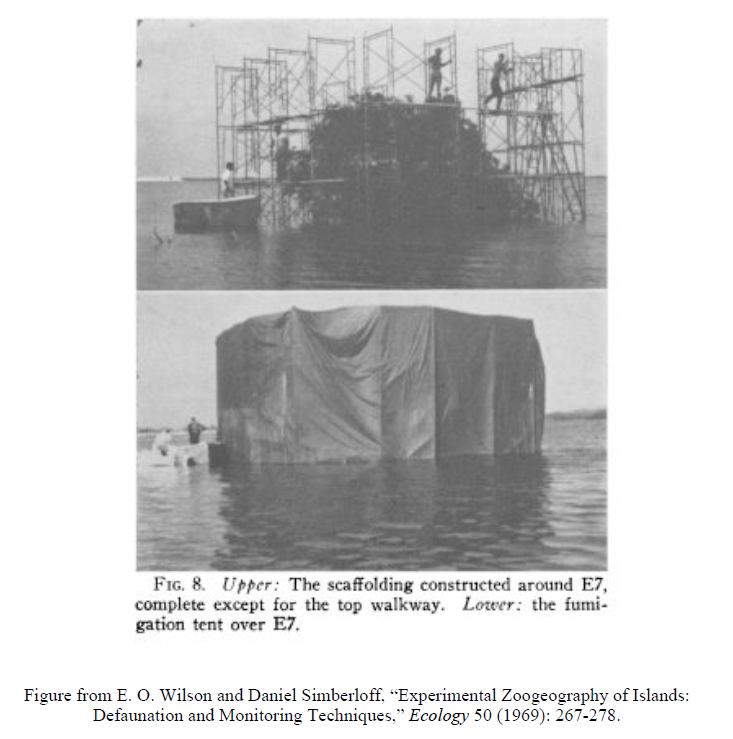
The first publication (3) in 1969 of Daniel Simberloff’s academic career was a report of his Ph.D. dissertation project under the direction of EO Wilson at Harvard University. He tented and fumigated with methyl bromide 6 mangrove islands off the Eastern shore of Florida to kill all the insects. His objective was to study how long it would take for insects to recolonize the islands.
Although Simberloff monitored the islands for only one year, he concluded, “The colonization curves plus static observations on untreated islands indicate strongly that a dynamic equilibrium number of species exists for any island.” (3) This is an example of the generalized conclusions of ecological studies noted by Professor Martin: “With ecosystem studies, ecologists claimed that fieldwork conducted in one place could be used to understand other distant and different places. The Pacific Proving Grounds became a model for lakes in Wisconsin, rain forests in Panama, deserts in China…” (2)
Laura Martin says of Simberloff’s study, “Destruction thus became a method of studying ecosystems. As Eugene Odum put it: ‘ecologists need not feel bashful about attacking ecosystems so long as they observe the rules of good science.’” (1)
Methyl bromide used by Simberloff in his thesis project is known to deplete the ozone layer of the atmosphere that shields the Earth from harmful Ultraviolet light that causes skin cancer. Its use was severely restricted by an international treaty in 1989. However, it is still used in the US for agricultural crops as a soil sterilant that kills all living organisms in the soil.
Nearly 60 years after the publication of his Ph.D. study, Daniel Simberloff remains one of the most vocal advocates for the eradication of non-native plants and animals. With few exceptions, those eradications require the use of pesticides. Simberloff may not have known the damage that methyl bromide does in the environment at the time of his study, but surely he knows or should know now. Yet, he is still committed to the eradication of non-native plants, projects that require the use of pesticides.
Many ecological studies and associated “restoration” projects adopt the same viewpoint that destruction is a justifiable method of studying and “restoring” ecosystems. “Restoration” projects often begin by killing all non-native plants with herbicides before attempting to create a native landscape. Rodenticides and insecticides are used to kill non-native animals with the understanding that many native animals will inevitably and unintentionally be killed. The Endangered Species Act accommodates the by-kills of these projects by issuing permits for “incidental takes.” The law and the scientific community make a distinction between killing individual animals and killing animals on a scale that threatens the survival of the species.
Killing and destruction were established as legitimate scientific tools over 70 years ago. Given what we know now about pesticides and radiation and at a time when habitats are being destroyed by human activities and climate change, is it time to question the legitimacy of habitat destruction as a scientific tool?
A Preview
Professor Martin is also the author of her recently published book, Wild by Design: The Rise of Ecological Restoration. I look forward to reading it. Meanwhile, I hope Professor Martin’s papers about the destructive origins of ecological field studies are a preview of her book.
Update: I have read and summarized Wild by Design in this article, published January 7, 2023.
Happy New Year! We hope 2023 will be a more peaceful year.

 Conservation Sense and Nonsense