Igniting Wildfire Worries Again

The horrific wildfire in Los Angeles in January 2025 has spawned another round of panic throughout California, as we try to come to terms with our increasing vulnerability to fire caused by the rapidly changing climate.  It was another opportunity for Jake Sigg to gin up support for his life-long campaign to destroy all eucalyptus trees in San Francisco.  He wrote a letter* to the new Mayor and Fire Chief in San Francisco making exaggerated claims of fire hazards in San Francisco and asking, once again, that San Francisco destroy all eucalyptus in the city.  I wrote my own letter* to the Mayor and Fire Chief, debunking Jake’s exaggerations and shared my letter with Jake. 

This exchange was a continuation of a debate that Jake and I have engaged in for 25 years.  I wrote an article about this issue 15 years ago for Death of a Million Trees, the predecessor to Conservation Sense and Nonsense.  Friends in San Francisco have asked me to republish that article to reassure San Franciscans that Jake’s alarming claims can be safely ignored.  I am glad to oblige today.

Conservation Sense and Nonsense


Fire!!!  The Cover Story

Native plant advocates have used many different arguments to justify the destruction of non-native trees (eucalypts are the primary target) and we will examine them all on Death of A Million Trees.  However, their most effective argument has been a bogus claim that non-native trees and plants are more flammable than native vegetation.  This justification has been effective because fear is a powerful motivator for all public policy. 

Perhaps, if this generalization about the flammability of non-native plants and trees were true, we wouldn’t be having this debate.  However, it isn’t true and we will explain why it isn’t.

The most frequently cited “evidence” of the flammability of eucalypts is the 1991 firestorm in the Oakland/Berkeley hills.  The conventional wisdom is that eucalypts were the cause of that fire.  The role the eucalypts played in the 1991 fire in the East Bay is greatly exaggerated. 

As FEMA notes in its analysis of that fire, the fire started in dry grass (“On…October 19, 1991…a brush fire was reported…the vegetation on the slope was mostly grass with some brush and a few trees.”) and only leapt out of control when a spark reached nearby brush (On October 20, 1991, “Very suddenly, the fire flared up…Burning embers had been carried from one of the hot spots to a patch of tinder dry brush.”).  When a wildfire is accelerated by high wind, everything will burn, including eucalyptus.   That does not mean the eucalypts were the cause of the fire.

The Scripps Ranch Fire of 2003 burned 150 homes but none of the Eucalyptus surrounding those homes.

FEMA identified the sources of fuel for the fire as follows:  “The northeast portions of the fire area had more wildland fuels, while in the south and western areas, the homes were the major fuels.  In effect, the more severe slopes in the north and eastern portions of the fire area required the use of native species.  The more moderate slopes and deeper soil in the south and southwest areas allowed for the introduction of more ornamental type species.”  In other words, FEMA considered native chaparral and the homes themselves the primary fuel source for the fire.

Nor does the FEMA report identify the eucalypts as the sole source of the flaming brands and embers that helped to spread the fire:  “The Oakland hills are covered with dense growths of trees, supplemented by grasses and thick brush.  The east face is exposed to the more arid climate…and is predominantly covered by grasslands and brush.  These particular trees and brush are highly vulnerable to rapid fire spread and release massive amounts of thermal energy when they burn.  They also create flying brands, which are easily carried by the wind to start new spot fires ahead of a fire front.”  Whenever the FEMA report mentions these fire brands as factors in the spread the fire, the eucalypts are not specifically identified as the source.


Addendum, 3/1/25:  Jake Sigg has variously reported that eucalyptus embers have started spot fires 12, 18, and most recently 24 miles from the fire front.  Sigg’s claim that eucalyptus bark can carry fire long distances is not supported by fire science research. A comprehensive US Forest Service study of spotting ignition by lofted firebrands, which examined 245 extinguished fires, experiments, and observations of 48 wildfires worldwide (including the 1991 Oakland Hills fire), found that the maximum spotting distance ever observed was 2.4 kilometers (approximately 1.5 miles).  

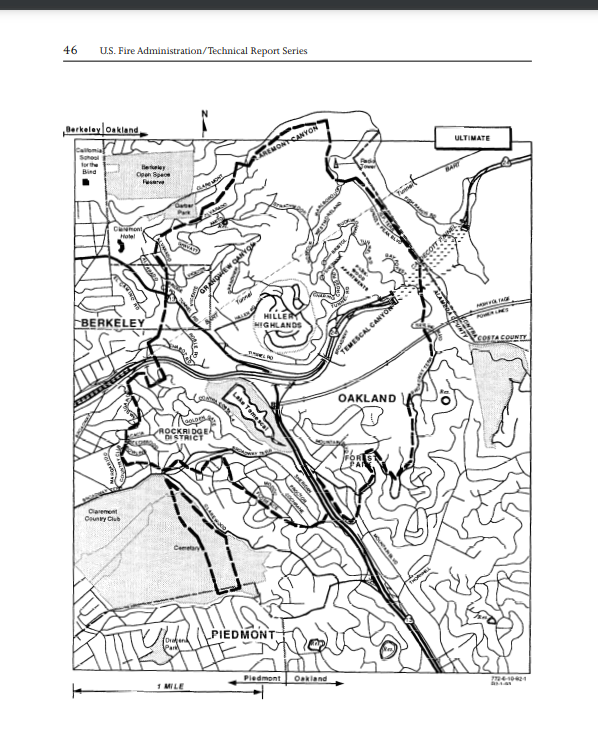
The FEMA Technical Report on the 1991 fire in Oakland and Berkeley includes a map of the ultimate size of the burn area, which was 2 miles long and 1-1/2 miles wide.  No spot fires were started outside the burned area (see map below).

The only specific mention of eucalypts as a factor in the 1991 fire in the FEMA report is related to the deep freeze that occurred the winter preceding that fire: “The unprecedented drought was accompanied by an unusual period of freezing weather, in December 1990, which killed massive quantities of the lighter brush and eucalyptus.  Dead fuel accumulated on the ground in many areas and combined with dropped pine needles and other natural debris to create a highly combustible blanket.  Due to the fiscal cutbacks, governmental programs to thin these fuels and create fuel breaks were severely curtailed, so the fuel load was much greater than normal by the second half of 1991.” Such freezes, sufficiently deep and sustained, causing eucalypts (and other plants) to die back are very rare in the Bay Area and have not occurred since 1991.

Weather is an important factor in creating the conditions for fires.  In addition to deep freezes resulting in dead leaf litter, high winds from the hot interior—called Diablo winds in the Bay Area—are an important factor.  As a peninsula surrounded by water on three sides, San Francisco is not subject to the same severe wind conditions experienced in other parts of California where wind-driven catastrophic fires have occurred.  The wind causing wildfires in coastal California blow from the hot interior and are funneled by the steep canyons of coastal mountain ranges.  The San Francisco Bay acts as a shield to protect San Francisco from these Diablo/Santa Ana winds.  The prevailing wind in San Francisco comes from the ocean, creating a climate that is milder and moister than places East of San Francisco Bay, with a history of wind-driven wildfires.  

University of California at San Francisco (UCSF) applied for a FEMA pre-disaster mitigation grant to remove eucalypts from Mt. Sutro, based on a claim that these trees are a fire hazard.  FEMA’s scientists were able to evaluate UCSF’s grant applications. Their knowledge of the local conditions led to questions about the grant applications which ultimately resulted in UCSF’s withdrawal of their applications for fire mitigation grants. 
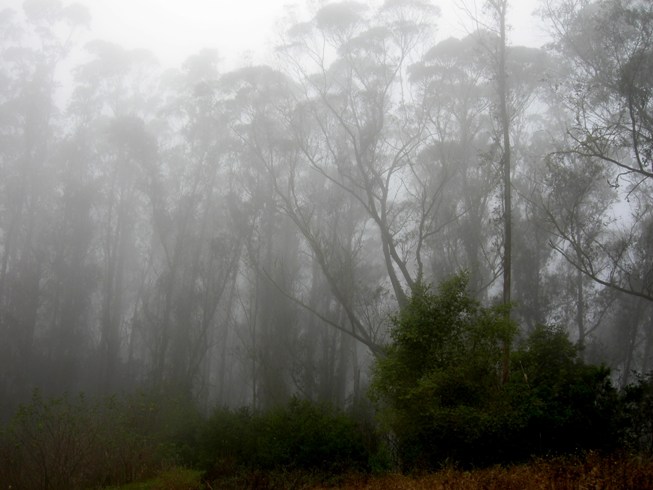
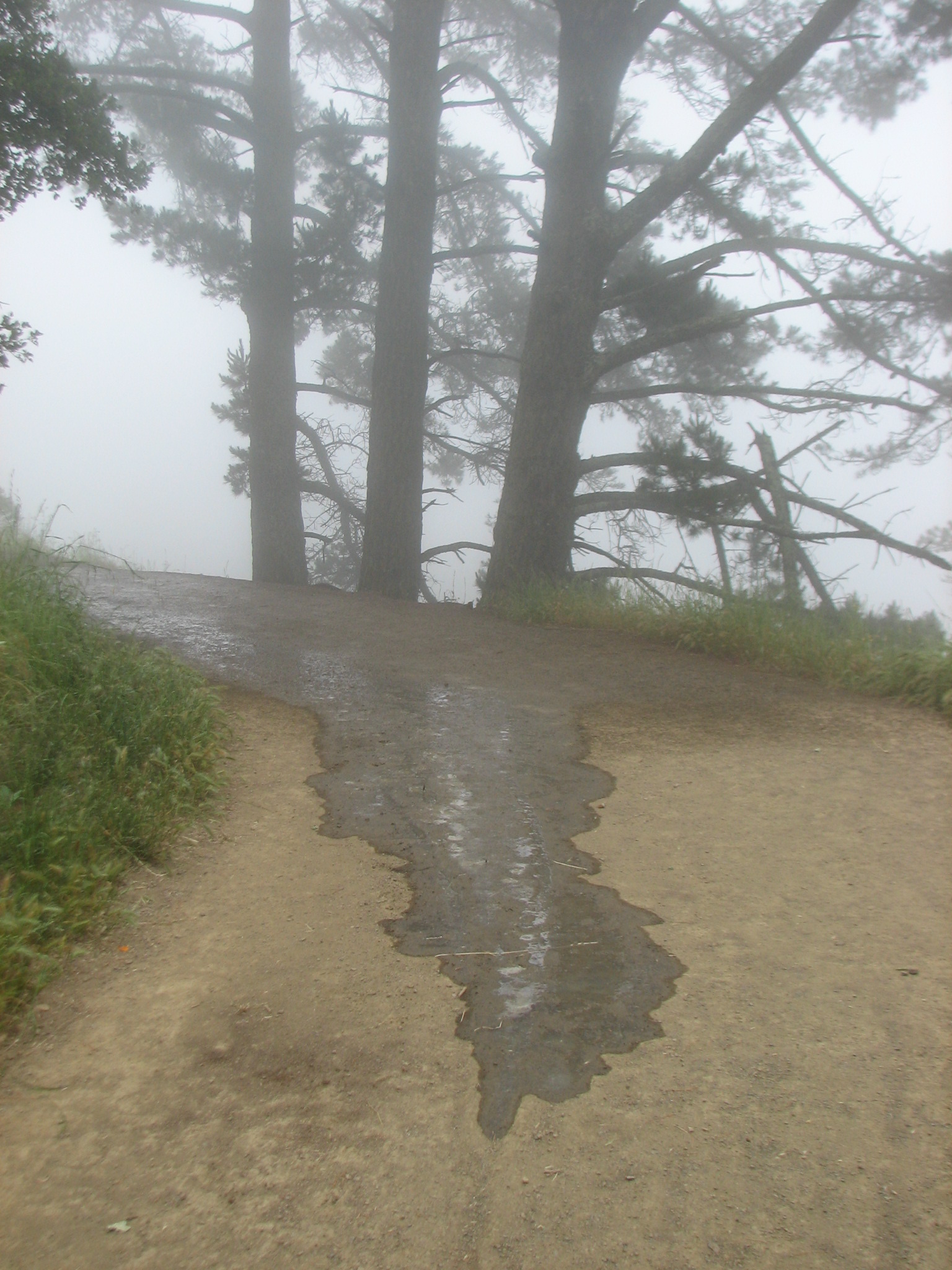
Sutro Forest is one of the fogiest places in San Francisco during summer months when the East Bay is warm and dry.  The trees precipitate moisture and retard fire ignition.
Sutro Forest on a typical summer day. The summer fog condenses water that moistens the forest floor and retards fire ignition. Courtesy Save Sutro Forest.

Addendum, 3/1/25:  The map of San Francisco pictured below is from a recent Chronicle article about limited fire hazards in San Francisco. Crocker-Amazon neighborhood at the southern border of the city is the only small area considered a “high fire hazard” by Cal-Fire.  There are NO “very high fire hazard” zones in San Francisco.  New stricter vegetation clearance standards proposed by Governor Newsom applies only to very high fire hazard zones.
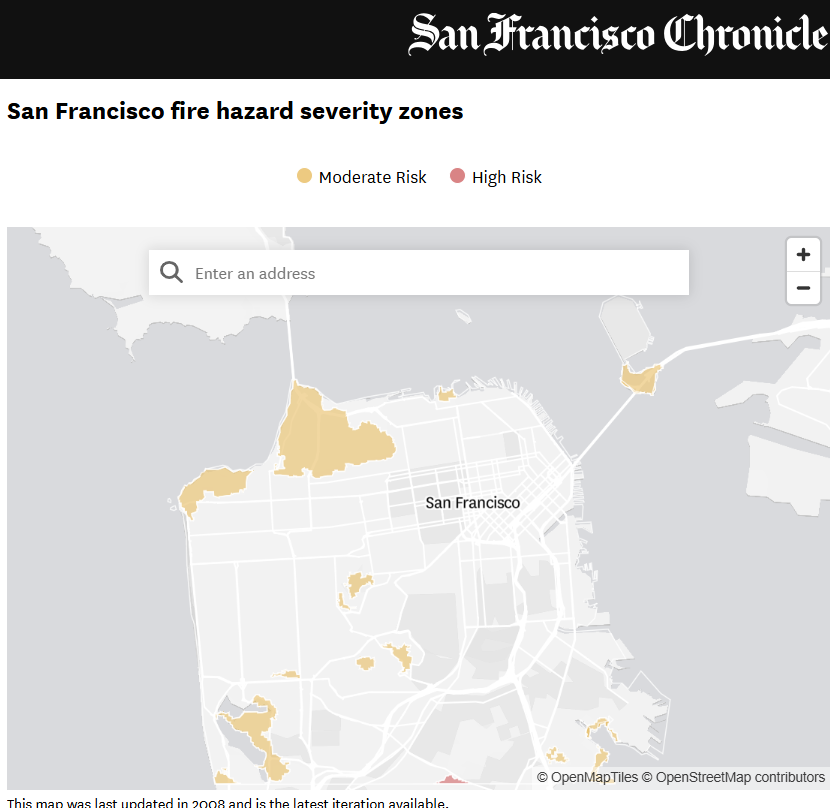
Cal Fire is updating the official maps of fire hazard severity zones.  The SF Chronicle reported“In Berkeley, Cal Fire’s new modeling decreased the number of acres listed as “very high” fire risk from 1,269 to 454.”  However, Berkeley’s fire chief took issue with some of the changes.  Cal Fire’s revised map is a draft and local jurisdictions may challenge some of the changes.  The final version of the maps is expected at the end of the year. 

Berkeleyside reported similar reductions in very high fire hazard zones in Oakland:  “While Berkeley and neighboring Oakland saw their overall hazard acreage significantly reduced — Oakland by nearly 35%…”  These are the cities where the fire in 1991 destroyed 3,400 homes and killed 25 people. The revised fire maps of fire severity zones show increased acreage of very high fire hazards in other cities in the Bay Area, such as San Jose, Half Moon Bay, Orinda, Sausalito, as well as Sonoma and Napa counties. 


The fire on Angel Island in October 2008, is an example of the bogus claims of the flammability of eucalypts.  According to an “environmental scientist” from the California state park system, 80 acres of eucalypts were removed from Angel Island over 12 years ago.  Only 6 acres of eucalyptus remain.  (“Rains expected to help heal Angel Island,” SF Chronicle, October 14, 2008).  The fire that burned 400 acres of the 740 acres of Angel Island stopped at the forest edge:  “At the edge of the burn belt lie strips of intact tree groves…a torched swath intercut with untouched forest.”  (“After fire, Angel Island is a park of contrasts,” SF Chronicle, October 15, 2008).  It was the grassland and brush that burned on Angel Island and the park rangers were ecstatic about the beneficial effects of the fire:  “The shrubs—coyote brush, monkey flower and California sage—should green up with the first storms…The grasses will grow up quickly and will look like a golf course.”  Ironically, the “environmental scientist” also tells the Chronicle that the eucalyptus forest was highly flammable, though it played no part in this fire and there was no history of there ever having been a fire in the eucalypts prior to their removal.

Although the Chronicle was determined to blame the fire on the eucalypts, the Marin Independent Journal reported otherwise:  “All the oaks up there were burning,” said the 28-year veteran of the department. “It was an ember shower that just rained on the entire building, and all around us was burning.”
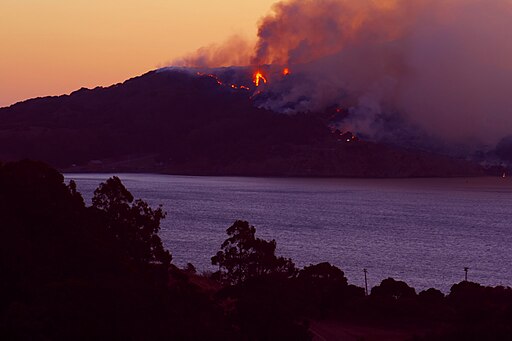
Wildfire on Angel Island, 2008. Wikipedia Creative Commons

The fire on Angel Island is not an isolated event.  Rather it is typical of recent wildfires throughout California:  “It is estimated that no more than 3 percent of the recent 2007 fires…occurred in forests…the remaining 97 percent occurred in lower elevation shrublands and urban areas, burning native shrublands such as chaparral and sage scrub, non-native grasslands and urban fuels…”  (Statement by Jon E. Keeley, USGS, before agencies of the US Senate, 2007)

Native plant advocates attempt to support their assumption about the flammability of eucalypts by citing specific characteristics such as shreddy bark and volatile oils. Shreddy bark and volatile oils are characteristics of many plants, both native and non-native.  They are not characteristics exclusive to eucalypts:  The [chaparral] community has evolved over millions of years in association with fires, and in fact requires fire for proper health and vigor…Not only do chaparral plants feature adaptations that help them recover after a fire, but some characteristics of these plants, such as fibrous or ribbonlike shreds on the bark, seem to encourage fire.  Other species contain volatile oils.”  (A Natural History of California, Schoenherr, UC Press, 1992)
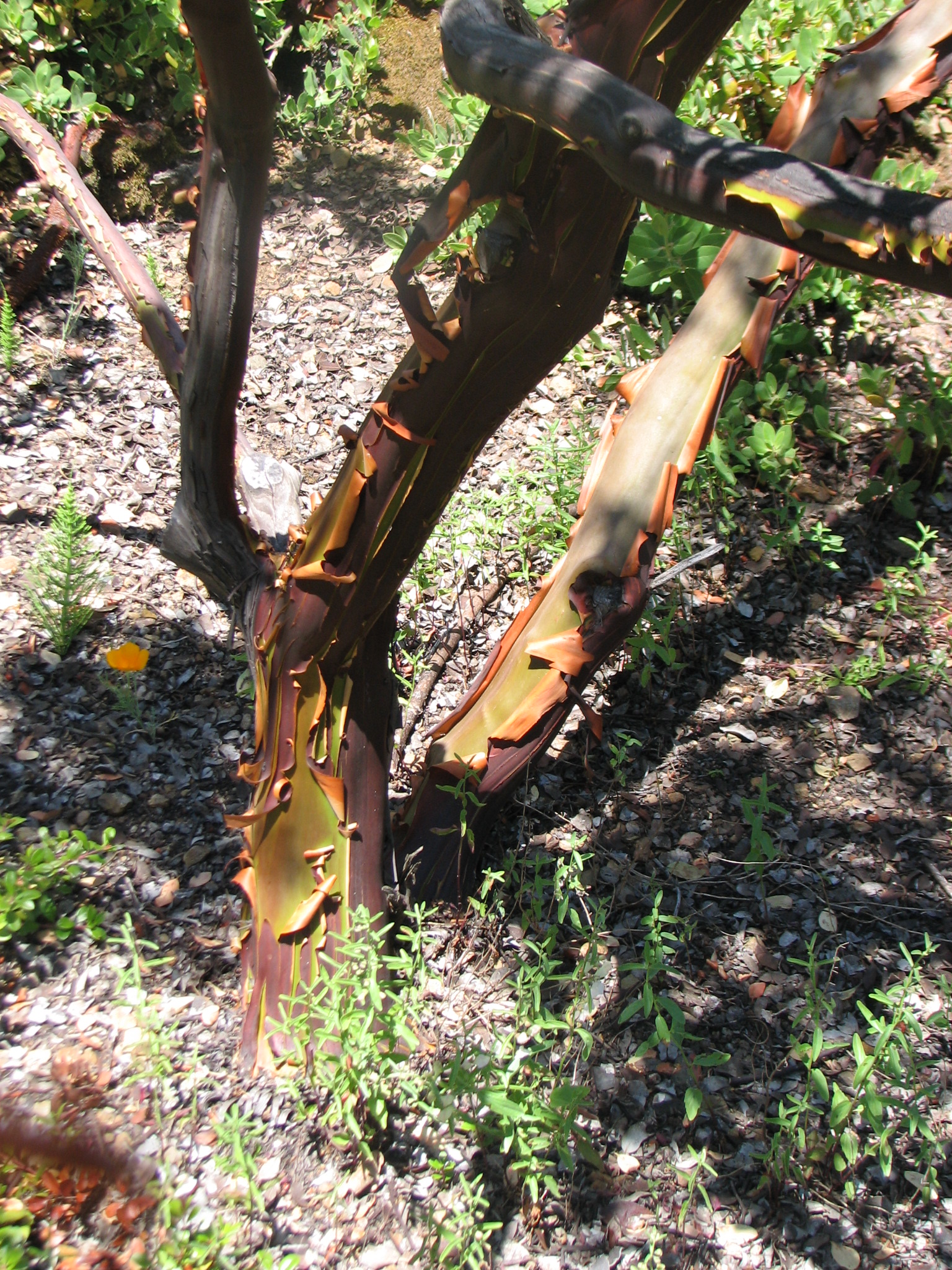
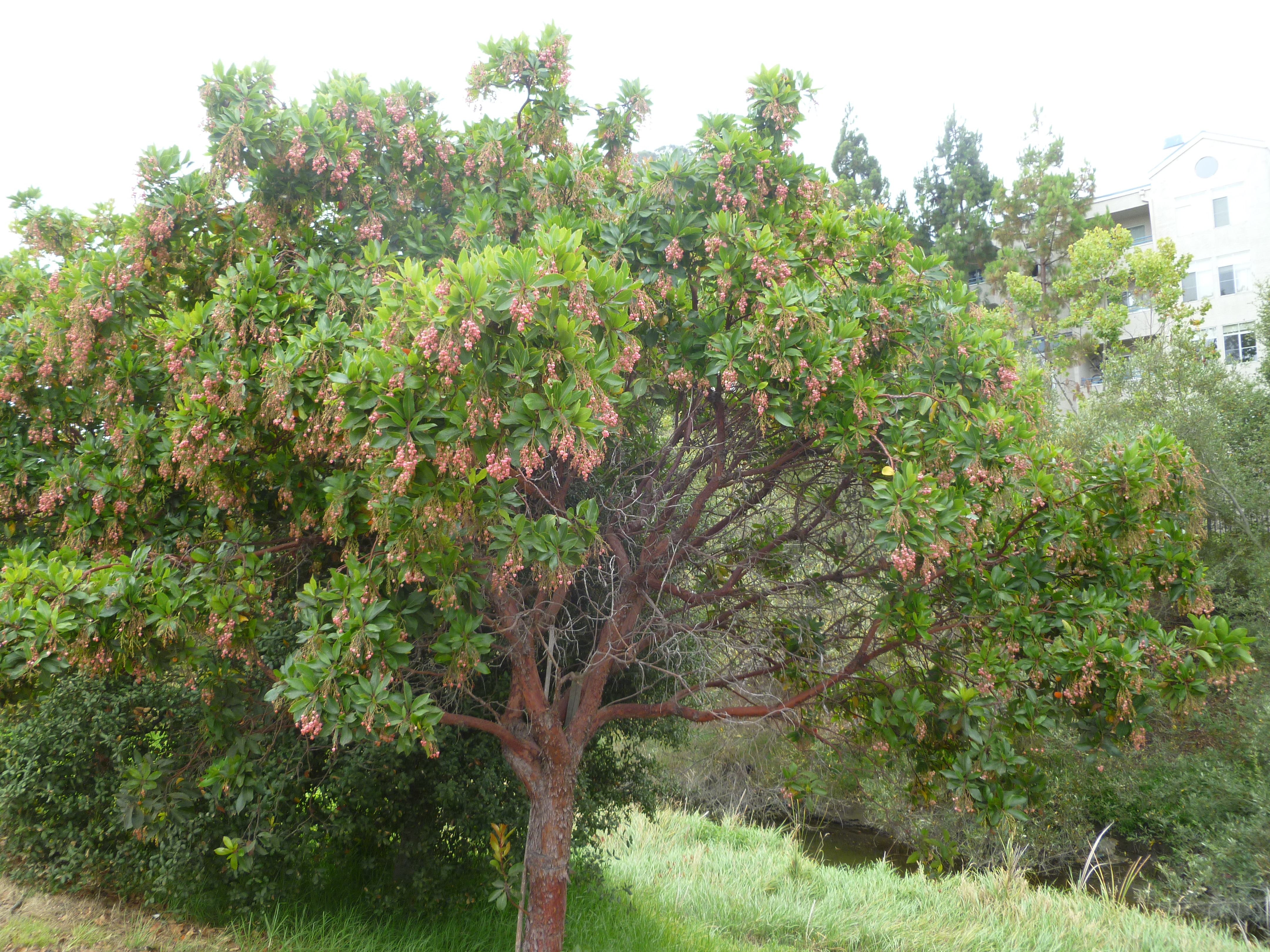
Shreddy bark of manzanita

Madrone and Manzanita are examples of native plants with “ribbonlike shreds on the bark” that are highly flammable.  Coyote brush and bay laurels are examples of native species that contain highly flammable oils.
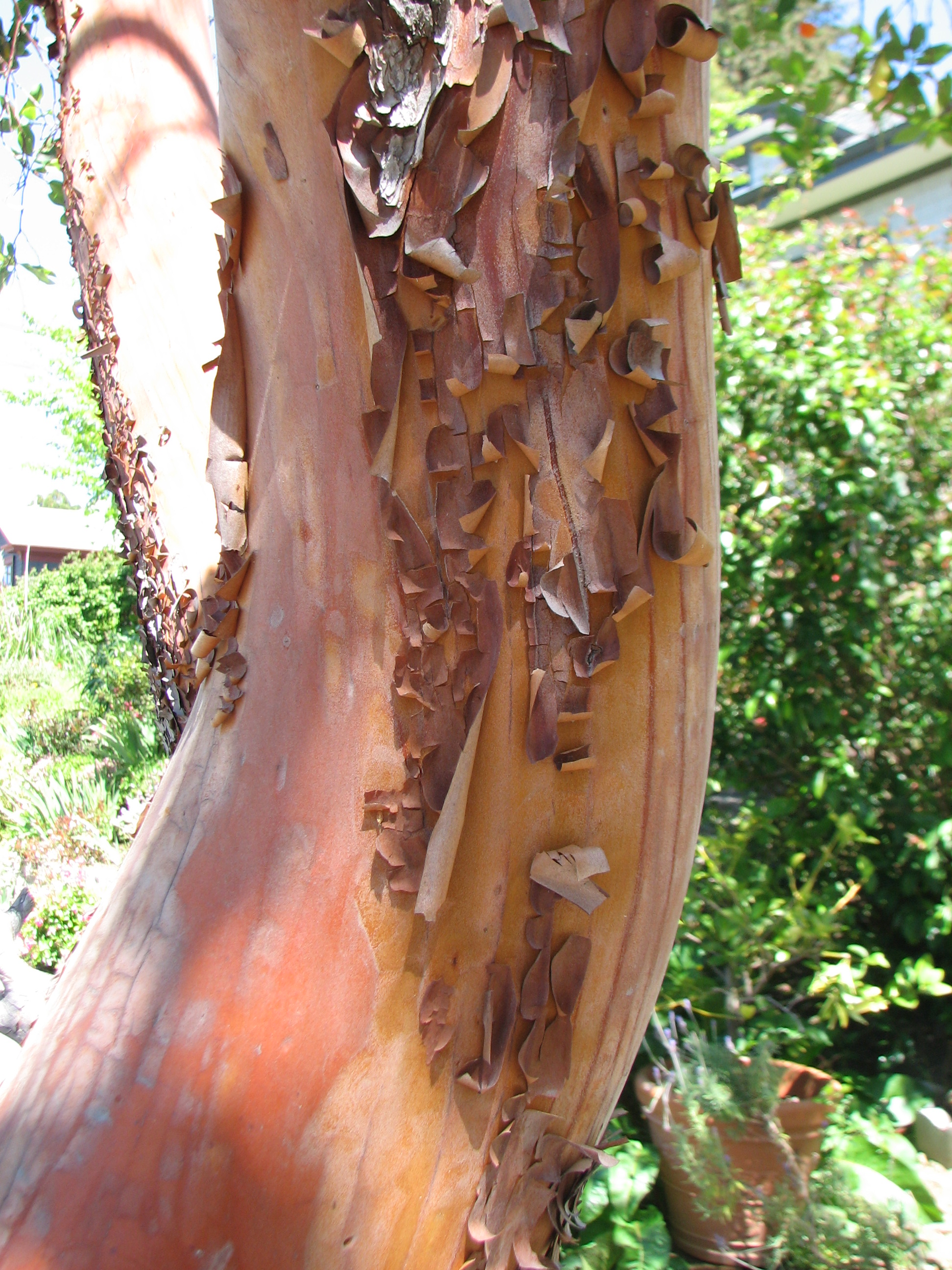
Shreddy bark of madrone
Shreddy bark of Madrone

A book about the 1991 wildfire in the Oakland/Berkeley hills illustrates the power of the legend that non-natives are more flammable than natives.  In Firestorm:  the study of the 1991 East Bay fire in Berkeley (Margaret Sullivan, 1993) states repeatedly that native plants and trees were involved in that fire.  Every tree mentioned in the following quotes from that book is native to the Bay Area:

  • “…flames surging through the dry underbrush and live oaks that line the street…”
  • “…neighborhoods…are built into the contours of the grassy hills and live-oak-and-laurel studded canyons…”
  • “…hillsides covered in seasonal grasses or had overlooked ravines of oak and madrone…were devastated by the fire.”
  • On Vicente Road, “Two redwoods up the street caught fire like matchsticks.”
  • “Roble Road and… Roble Court, derive their name from the…Spanish word for the live oak tree that grows densely there…the devastation on lower Roble…was fairly complete…”

In the single mention of the role of eucalypts in the fire, the fire skips over the tree canopy:  “The fire swept right over [the houses] scorching the crowns of surrounding eucalyptus trees.”  And the Monterey pine—also targeted for eradication by native plant advocates—plays a similar role in a nearby location:  “Across the street a grove of Monterey pines shields the white clapboard buildings of the private Bentley School…”   

After presenting all this evidence about the role of native plants in the fire, the book concludes with the legend that non-natives are more flammable than natives:   “Gardens of drought tolerant and fire-resistant California native plants have become symbols of the rebirth of the fire communities.”  This statement is illustrated with a photo of native chamise.  Chamise is one of the most flammable plants in the native chaparral community: 

“The relationship between fire and Chamise is illustrated by the plant’s tendency to ‘encourage’ burning.  A thermometer was placed within a Chamise shrub as a fire approached, and the following changes were documented.  At about 200⁰F the plant began to wilt as its temperature approached the boiling point of water.  At about 400⁰F the plant began to emit combustible gases such as hydrogen, alcohol, and methane.  At about 600⁰F the shrub smoldered and began to turn black.  At about 800⁰F the plant burst into flames!  This species must have evolved in association with frequent fires to have reached the point where it seems to encourage burning.” (A Natural History of California, Schoenherr)

Anyone with a rudimentary knowledge of the natural history of California could provide any number of such invidious comparisons between native and non-native plants with respect to their flammability.  We hope the examples we have provided illustrate that flammability characteristics of plants are unrelated to whether the plants are native or non-native.  The assumption that non-native plants are more prone to fire than native plants is fallacious.   


*These letters to Mayor Lurie and Fire Chief Crispen are available on the Facebook page of Conservation Sense and Nonsense.
My transition from activist to observer

This is my last article of 2024, and the last for the foreseeable future.  However, I still welcome guest posts that are consistent with the mission of my website.  If you have a story to tell, please contact me at mildredtrees@gmail.com.

Clarification:  I published this article prematurely on November 28th in error.  I republish the article today to clarify my intentions.

Although I have accomplished little in 25 years of environmental activism, I can point to a few achievements that I am proud of. 

  • I was successful in getting the “invasiveness” of eucalyptus downgraded from “Moderate” to “Limited” by the California Invasive Plant Council.  There were a few specific issues that were deleted from Cal-IPC’s assessment of eucalyptus.  The assessment no longer claims that eucalyptus kills birds.  Cal-IPC also removed the claim that eucalyptus leaves are allelopathic, i.e., they do not emit a chemical that suppresses the growth of an understory.  However, these improvements in Cal-IPC’s assessment of eucalyptus had no apparent effect on the demands of native plant advocates to destroy all eucalyptus in California.
  • I am proudest of our achievements to improve pesticide applications by the supplier of our drinking water in the East Bay, EBMUD.  With the help of a video and a photo, a small team of collaborators convinced the leadership of EBMUD that their staff did not know how to apply herbicides.  The leadership of EBMUD deserves equal credit for this accomplishment because they listened and they acted.  EBMUD is now conducting annual training of its staff about proper application of pesticides, herbicide application notices are being posted, and an annual report of pesticide use is presented to the Board and posted on-line for the public to see.  As a result of these efforts, herbicide applications were reduced by one-third, but have since plateaued. 
  • When the SelecTree website published by CalPoly San Louis Obispo claimed that blue gum eucalyptus lives only 50 years, it became another tool nativists used to support their demands to destroy blue gums in California.  I was able to give CalPoly the evidence needed to disprove this inaccurate claim.  Blue gums have lived in California since the 1860s and many of the original plantations are still alive.  Eucalypts are known to live in Australia from 200-400 years.  It’s difficult to determine the age of eucalyptus because trees growing in mild climates such as ours do not have clear growth rings used to determine age.  SelecTree initially changed the lifespan estimate to 150 years, which was the maximum lifespan for the entire SelecTree database of trees in California.  Since then, SelecTree has deleted all lifespan estimates because they weren’t able to find reliable sources of this information.  The correction of blue gum lifespan on SelecTree relieved some of the pressure to destroy them. 
  • I also claim small credit for the final version of Oakland’s Vegetation Management Plan, which is a compromise with native plant advocates who wanted all non-native trees on public land in Oakland to be destroyed and replaced with native trees.  The consultant who wrote the plan also deserves credit for listening and reading studies I sent to him about the flammability of trees.  Non-native plants and trees are not inherently more flammable than native trees. We live in a Mediterranean climate in which vegetation is fire adapted and fire dependent.  It took 7 years and 4 revisions to reach a compromise that satisfied the nativists.  The plan will destroy all eucalyptus less than 31” in circumference on 2,000 acres of public land and 300 miles of roadside.  The plan will also use herbicides on public land where it has been prohibited since 1998, when herbicide spraying was confined to road medians.  Although the plan is destructive, its approval after 7 years of pointless delay will finally enable Oakland to mitigate fire hazards with fuels reduction without destroying all non-native trees on public land.

These were small victories and they were difficult to accomplish. I won’t bore you with a list of hundreds of my failed efforts to protect public lands from needless destruction.  My most recent failure was an appeal to California’s Wildlife Conservation Board, which is theoretically responsible for protecting California’s wildlife. Despite the effort of a small team of collaborators, the WCB granted another 10 years of funding for an eradication project that has killed over 50% of an endangered bird species in the San Francisco Bay after 20 years of spraying herbicides, destroying the bird’s habitat and its food. 

I hope these few achievements and multitudes of failures will help to convey why I am pulling back from my 25-year effort to defend our urban forest and our public lands.  In a word, it is unrewarding work.

Good sources of information about invasion biology and the “restoration” industry

I have 535 subscribers on Conservation Sense and Nonsense and over 1,000 followers on Meta (Facebook).  In addition, my articles on Conservation Sense and Nonsense have been read by over 500,000 people who found them with internet searches over the 15 years that Conservation Sense and Nonsense has existed. 

I intend to keep posting occasional news items to Facebook and I welcome my readers to follow me there.  I also encourage my readers to follow other sources of reliable information about the issues I have covered.  I leave the field in the good hands of those who still have the courage to fight what seems like a losing battle:

  • Beyond Pesticides is a reliable source of information about pesticides.  I recommend that you subscribe to BP’s Action Alerts that inform us of opportunities to engage with decision makers about new policy decisions regarding pesticides. 
  • For home gardeners looking for advice about creating gardens that are beautiful as well as respectful of the environment and the animals that live in our gardens, I recommend that you subscribe to Garden Rant.
  • For readers who love all plants, both native and non-native, I recommend the Substack of Kollibri terre Sonnenblume.  His articles are deeply researched, informative, and beautifully written.  His knowledge of plants far exceeds anything I have learned about plants because he works directly with them as an integral part of his life and he is an astute observer.

Right turn at the crossroads

After a long, bumpy trip to the crossroads of the 2024 presidential election, the American people made a hard right turn on Election Day.  Voters have re-elected President-elect Donald Trump and given him control of all branches of government with which to implement his agenda. 

As Trump approached the crossroads he also acquired some allies who will be influential in crafting his agenda.  Wunderkind Elon Musk, who is already a major government contractor in space exploration and telecommunications, is likely to influence and benefit from policies in those—and other—areas. Billionaire “tech-bros” have convinced Trump to promote crypto currency.  Robert F. Kennedy, Jr. is likely to influence the future of our policies regarding health, such as the availability of drugs and vaccines. 

This is to say that although we can’t predict specific policy decisions, we can predict that there will be significant changes in the functioning of the federal government.  We know that Republicans have been trying for years to defund, if not eliminate, many federal agencies.  

The Environmental Protection Agency and the Department of the Interior have long been Republican targets for budget cuts.  And the US Supreme Court has collaborated with this effort by reducing the power of federal agencies to implement policies that aren’t specifically authorized by federal laws.

We should probably expect that federal funding for many so-called “restoration” projects will evaporate, such as the USFWS plan to shoot 500,000 barred owls in Western Forests or the USFWS plan to dump rodenticides on hundreds of off-shore islands to kill non-native animals.  Likewise, the theoretical ability of the EPA to evaluate new pesticides for access to the market is likely to end altogether, to the extent that regulation exists at all.

On the other hand, State funding of “restoration” projects is unlikely to decrease.  California voters have approved Proposition 4, which will provide $10 billion of bonds for water, wildfire, and land protection in California.  The federal government is expected to withdraw funding for ecological “restoration” while California state government is likely to replace the lost federal funding.

Becoming an observer

We are headed into a long period of radical change.  It is an opportunity to hunker down and watch the changes play out. That is my plan for the foreseeable future.

Although environmentalism had little explicit role in the rightward shift in American politics, it probably played a role on the margins.  The electorate’s rejection of environmentalism as a priority policy goal requires some deep reflection. 

Does environmentalism contribute to the political divide between urban and rural voters?

  • For example, urban environmentalists support the reintroduction of top predators, such as wolves, into rural communities, where they become predators of domesticated animals.  Rural communities resent that their livelihoods are threatened by decisions made by urban policy makers who are not impacted by the decisions they make. 
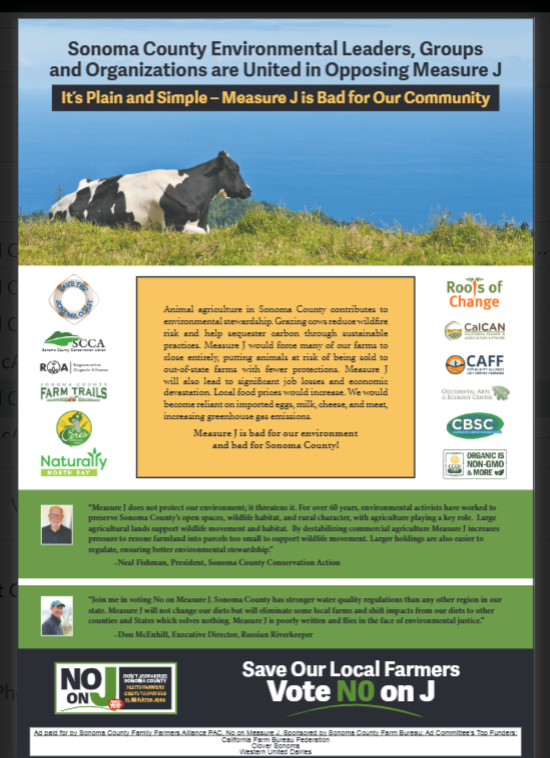
  • Proposition J in Sonoma County would have shut down many agricultural operations that raise animals.  Most of these agricultural operations are certified organic and they are central to the economy of Sonoma’s rural community. Proposition J was easily defeated by an agricultural community that could have been destroyed by an extremist version of environmentalism.  However, a similar Proposition DD in Berkeley passed narrowly in a community with a more diverse economy. 

Has environmentalism contributed to the high cost of housing and the growing homeless population?

  • The San Francisco Bay Area Chapter of the Sierra Club has a track record of suing to prevent the building of new housing.  The Chapter’s support for this agenda reflected the opinions of entrenched elected leaders who were recently displaced by a coalition of housing advocates.  One of the displaced leaders explained how this coup has changed the Chapter’s approach to new housing.  The changed leadership is now reflected in the Chapter’s political endorsements of housing advocates, such as State Senator Scott Wiener.
  • The insurance industry in California is in trouble.  Major insurance companies have left California.  Some have quit insuring homes.  The companies that remain have cancelled thousands of policies insuring homes. Premiums of the policies that remain have increased significantly and are expected to increase further.  California’s wildfires have increased the costs of the insurance industry and California has not allowed the insurance industry to anticipate increased risks of wildlife in setting premium prices for home insurance.  Insurance is required to finance new building and home buyers cannot get a mortgage without property insurance.  The 7-year delay of Oakland’s Vegetation Management Plan is an example of how extreme versions of environmentalism have handicapped fire hazard mitigation. 

Statement of Purpose

I am a moderate Democrat who voted for the Democratic candidate for president in 2024.  I am disturbed by the sudden and extreme lurch to the political right.  I also see it as an opportunity for all Americans to think deeply about how we reached this point.  I intend to do more listening and less talking.  I hope to find something more rewarding to do. 

I leave the field knowing that nativism in the natural world will be defeated eventually by evolution, as natural selection “chooses” the plants and animals capable of surviving in a radically altered climate.  Nativism in the natural world is ultimately a dead end.  Nature moves forward, not backward.  Activism, such as mine, will not successfully deliver that message to the ideologues who continue to destroy the plants and animals most likely to survive, but nature will, because nature always bats last. 

Thank you for your readership.  Best wishes for happy holidays and a more peaceful new year in 2025.

Oakland’s revised Vegetation Management Plan is the compromise I hoped for

On September 1st, I told readers that Oakland would soon publish a revised Vegetation Management Plan to reduce fire hazards in Oakland by managing vegetation on 2,000 acres of city-owned property and 300 miles of roadside.  I also shared with readers my anxiety that the revised plan would be more destructive than the previous version of the plan in response to criticism of that version.    

The 4th revision of Oakland’s Vegetation Management Plan and its revised Draft Environmental Impact Report was published on September 20th.  These documents are available HERE.  There will be a public hearing about the plan by Oakland’s Planning Commission on November 1st.  The deadline for submitting written comments on the plan is November 4th.  Comments can be submitted by email DEIR-comments@oaklandvegmanagement.org or by mail to Montrose Environmental, attention Ken Schwarz, 1 Kaiser Plaza, Suite 340, Oakland CA 94612.

Update:  The deadline for commenting on the Vegetation Management Plan has been extended to Monday, November 6, 2023, at 5 PM.

The Oakland Planning Commission held a public hearing about the VMP on Wednesday, November 1, 2023.  There was no expressed opposition to the VMP at the hearing.  Representatives of Claremont Canyon Conservancy, North Hills Community Association, and Oakland Fire Safe Council spoke in support of the plan. 

One speaker said that Oakland Fire Department and the consultant who wrote the plan successfully “threaded the needle” that made agreement possible.  She also said that “of course, we wish all the eucalyptus were gone, but we understand that is expensive.”

All members of the Planning Commission expressed their admiration and support for the VMP.

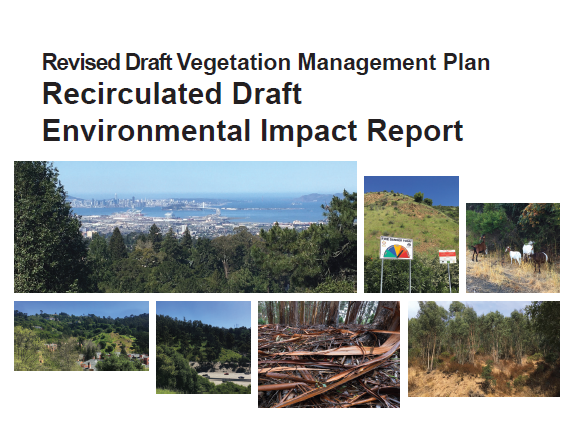
Below is a map of the VMP project areas.  Figure 2.2 in the revised plan also shows detailed maps of roads in VMP project areas, with property ownership adjacent to roads indicated, which require different vegetation management standards.   

The authors of the plan have made it easy for you to read the revised version by underlining additions and striking out deletions.  If you have read earlier versions of the plan, you won’t need to read it all again, because revisions are minimal.  They are briefly summarized on page 1-2 of the plan:

Expanded the Revised Draft VMP area to encompass the area from 30 feet to 100 feet of the edge of roadsides in the City’s VHFHSZ [Very High Fire Hazard Severity Zone] where dead and dying trees (as determined by a Certified Arborist, Licensed Forester, or Fire Safety Expert) are present on City owned property and could strike the road if they fell.

“Updated the vegetation management standards as follows:

  • Expanded the zone recommended for 3-inch maximum height of grasslands after treatment from 30 feet to 75 feet from habitable structures.
  • Clarified that, where feasible, horizontal crown spacing should adhere to the California Department of Forestry and Fire Protection’s (CAL FIRE’s) most recent defensible space standards (presently codified in Pub. Res. Code Section 4291).

“Updated treatment standards for eucalyptus stands to increase the trunk diameter of single-stem eucalyptus recommended for removal from 8 inches to 10 inches, and to recommend removal of trees that pose an unreasonable fire and/or life safety risk, based on the determination of a Certified Arborist, Licensed Forester, or Fire Safety Expert.

“Updated treatment standards for closed-cone pine-cypress stands to include removal of trees that pose an unreasonable fire and/or life safety risk, based on the determination of a Certified Arborist, Licensed Forester, or Fire Safety Expert.”

If you need a reminder of vegetation management standards in the previous version, you can find them on Table 2-4.  Basically, the VMP will thin trees and vegetation and remove dead trees and fire ladders to canopies in management areas. The most significant revision of those vegetation management standards is the expansion of clearance of dead and dying trees from 30-100 feet from the edge of 300 miles of roadsides on city-owned property. The management standards defined by the previous version were acceptable to me and the proposed revision of those standards are also acceptable to me. 

However, I am sorry to see that more eucalyptus will be removed because the diameter size standard for removal has been increased from 8 to 10 inches (circumference is greater than 31 inches).  The flammability of eucalyptus has been exaggerated by native plant advocates who want all non-native trees to be destroyed.  California’s native vegetation is fire adapted and fire dependent.  Many of our most prominent native plants—such as ceanothus and manzanita–will not germinate in the absence of fire.  The planned removal of isolated non-native trees within stands of native trees is unnecessary because it will not reduce fire hazards. The VMP should be a fire hazard reduction plan, NOT a native plant restoration.

Although I recognize that dead trees are important for the long-term health of forests because they provide food and habitat for insects and birds as well as recycle nutrients into the soil, we can’t indulge that preference in very high fire hazard zones in high-density population areas that are being treated by Oakland’s Vegetation Management Plan.  As always, we must set priorities and the public’s safety must be a high priority. 

Like most public policy, the revised Vegetation Management Plan is a compromise between two extremes.  One extreme wanted all non-native trees to be destroyed in the management areas as well as within 100 feet from the edge of 300 miles of roadside.  They also wanted Oakland to make a commitment to replace those trees with native vegetation.  The opposite extreme wanted no trees to be destroyed and no herbicides to be used to control vegetation or prevent destroyed trees from resprouting. 

The revised Vegetation Management Plan is the compromise I had hoped for.  Specifically, I had hoped that fire hazards could be reduced in Oakland without destroying more trees than necessary to mitigate fire hazards. The thinning strategy that the VMP proposes has been used successfully by the East Bay Regional Park District for over 10 years.  It leaves the canopy intact so the forest floor is shaded, which suppresses the growth of weeds and keeps the forest floor moist, which retards ignition.

I had hoped that herbicides would not be used in public parks, but did not achieve that goal. However, I am grateful that the revised plan makes many efforts to protect the public, their pets, wildlife and goats grazing in project areas from exposure to the herbicides that will be used.  (Improvements in these protections are described on pages 2-81, 3.3-29, 3.3-32)  There are also extensive new protections for monarch butterflies and a rare species of bee (see page 3.4-86). 

If your interests in the Vegetation Management Plan are different from mine, I urge you to read the plan and form your own opinion.  I hope you will be able to support the revision because it is going to be attacked by the same extreme interests that have prevented Oakland from adopting and implementing a fire hazard mitigation plan for over 7 years. Expressing our support might help to get the VMP over the finish line after years of delay caused by gridlock. I would welcome you to the middle ground that I occupy.  It’s lonely here in the middle.  We don’t have much of an audience above the noise made by the extremes, but we have the capacity to enable public policy to be made if we speak up in defense of compromise. If we want to reduce wildfire hazards in Oakland, we must compromise.

Oakland’s Vegetation Management Plan Is Headed in a Destructive Direction

Oakland has been trying to adopt a vegetation management plan (VMP) to mitigate fire hazards since November 2016.  The plan has been drafted three times in 2018, 2019, and 2020 and a draft Environmental Impact Report was also published in 2020.  All three versions of the plan were acceptable to me and many others.  Every version would have removed dead trees and thinned non-native trees on 2,000 acres of public land and 300 miles of roadsides in Oakland, leaving the tree canopy intact so that the forest floor would be shaded, suppressing the growth of weedy vegetation that ignites easily and keeping the forest floor moist, which retards fire ignition. 

Unfortunately, none of the proposed vegetation management plans were acceptable to native plant advocates who want all non-native trees in project areas in Oakland to be destroyed and the land replanted with native plants and trees.  The plan they are demanding is a native plant restoration, not a wildfire hazard mitigation plan.  Since they have successfully prevented Oakland from addressing wildfire hazards for eight years, we might assume they aren’t concerned about wildfire. 

A fourth version of the plan and a new Environmental Impact Report are expected to be published in September 2023 and there will be a new public comment period in October.  Based on written and oral public comments at public hearings, we predict that the revised plan is likely to be far more destructive than previous drafts of the plan.  Based on that prediction, I am alerting you to the need to read the revision and write a public comment.  Please ask to be notified of the publication of the plan by sending an email to info@oaklandvegmanagement.org .


Update:  The revised Oakland Vegetation Management Plan and revised Draft Environmental Impact Report were published on September 20, 2023.  These documents are available HERE.  There will be a public hearing by the Oakland Planning Commission on November 1, 2023.  The deadline for public comment will be November 4, 2023.  Comments can be submitted by email DEIR-comments@oaklandvegmanagement.org or by mail to Montrose Environmental, attention Ken Schwarz, 1 Kaiser Plaza, Suite 340, Oakland CA 94612.

When I have read the revised plan and its revised EIR, I will post a draft of my public comment on the draft by October 1st

– Webmaster, Conservation Sense and Nonsense, September 20, 2023


What do opponents of previous plans want?

There is a wide range of opinions about a vegetation management plan for Oakland.  I will use the public comment of the California Society of American Foresters (SAF) on the third version of the VMP as a representative opinion and the best available predictor of where the fourth revision is likely headed.  The entire comment of the Society of American Foresters (SAF) is available HERE and here are some of the revisions SAF is asking for

  • “Ecological restoration should be a goal of the VMP, including the establishment of native plant species where nonnative species dominate…Thinning of dense stands of nonnative tree species should only be done as part of an overall strategy of restoration, i.e., the goal of any tree removals should always be to eventually convert these stands to native tree or vegetation cover in order to build greater ecological resiliency.
  • “In concert with the goal of ecological restoration, adaptive management in light of climate change should guide management practices and restoration plans. Adaptive management strategies that incorporate new information and changing conditions will be critical to ecosystem restoration. Annual grasslands may become more dominant, oak woodlands less so in the planning area in the future as climate changes. Management targets in many cases will have to be based on anticipated future conditions.”
  • “However, if thinning is kept as the desired practice, we ask that you design each entry to be sufficiently intensive to assure that tree crowns will not close before the next thinning entry (10 years from now?) and indeed is sufficiently thinned to allow work towards establishing native vegetation in these stands.”
  • “The use of prescribed fire as a vegetation maintenance tool should have been considered and included in the VMP especially on ridges where fire moving from adjacent jurisdictions might occur, or along power-line transmission corridors.”
  • “The vegetation management zones along roadsides, especially along routes of egress, should be modified to extend 100 feet from roadside edges and should include any trees with underlying structural or health conditions that are tall enough to fall onto streets and roads. This may in some cases require looking outside of the 100-foot roadside clearance.”
  • “It is important that the use of triclopyr herbicides is included to treat cut stumps in eucalyptus to prevent sprouting. Glyphosate herbicides will not be effective in treating eucalyptus stumps and will result in resprouts.”
  • “There should be an Ecological Restoration Guide added to the appendices…This new appendix would outline the City of Oakland’s current ecological restoration efforts, identify stakeholders (e.g., city departments, Oakland Wildlands Stewards, etc.) and their roles…”

Native plant restoration, NOT wildfire hazard mitigation

The Society of American Foresters (SAF) is asking the City of Oakland to make a commitment to eradicating all non-native trees in project areas and replacing them with native plants.  Such a plan would not reduce wildfire hazards in Oakland because native vegetation is not inherently less flammable than non-native vegetation.  Most wildfires in California occur in native chaparral and native conifer forests.

The plan proposed by the Society of American Foresters (SAF) is a native plant restoration plan, NOT a wildfire hazard mitigation plan.  Their proposal would destroy much of Oakland’s urban forest, which would not be replaced by native trees:

  • Non-native trees were planted in Oakland in the 19th century because there were few native trees: “Vegetation before urbanization in Oakland was dominated by grass, shrub, and marshlands that occupied approximately 98% of the area.” (1)  Non-native tree species in the East Bay are adapted to soil and microclimate conditions that are not suitable for native species.
  • Grassland was the dominant vegetation type of pre-settlement Oakland partly because of the land management practices of Native Americans and the stock grazing of early settlers:  “Native Americans played a major role in creation of grasslands through repeated burning and these disturbance-dependent grasslands were maintained by early European settlers through overstocking of these range lands with cattle and sheep. Twentieth century reduction in grazing, coupled with a lack of natural fires and effective suppression of anthropogenic fires, have acted in concert to favor shrubland expansion.” (2)
  • Grassland in California is not native to California.  Mediterranean annual grasses were brought to California in the early 19th century by the grazing herds of Spanish-Mexicans.  California’s native bunch grasses are not adapted to heavy grazing by herds of domesticated animals.  The grassland of California is about 99% non-native (Allan Schoenherr, A Natural History of California, UC Press, 1992).  Attempts to convert annual grasslands to native bunch grass have not been successful.  A team of scientists at UC Davis spent $450,000 and 8 years trying to convert 2 acres of grassland to native bunch grasses without success.  Grassland that will replace our urban forest will not be native. 
  • Grass is easily ignited and fires move quickly through grassland, particularly in a wind-driven fire.  The deadly, destructive fires in Maui, Hawaii are a case in point.  When agricultural fields of sugar cane, pineapple and other tropical fruit left Maui they were quickly succeeded by non-native grass that was considered a factor in the spread of fire. (3)  Dormant, dry annual grassland in the East Bay Hills will be more flammable than the living vegetation that native plant advocates want to destroy.
  • A small redwood grove was the only pre-settlement exception to the otherwise treeless Oakland hills:  “…for thousands of years [the Oakland hills] were treeless meadows, visited seasonally under Indigenous management…The one exception was the redwood groves of the southern Oakland Hills, a restricted forest that extended a few miles eastward from upper Dimond Canyon over the ridgetop to the outskirts of Moraga.” (4) Much of this grove still exists today because coastal redwoods are vigorous resprouters when they are burned or cut down.
  • SAF also predicts a vegetation type-conversion from forest to grassland:   “Annual grasslands may become more dominant, oak woodlands less so in the planning area in the future as climate changes.” Grassland will naturally succeed to shrubland without regular burning, which SAF recommends to reduce fuel loads.
  • Prescribed burns in densely populated urban areas are rarely approved by Bay Area Air Quality Management District because they pollute the air and often cause uncontrolled wildfires. California law regarding liability for damage caused by prescribed burns was revised in 2022 to provide legal protections for those who manage prescribed burns.  The revised law lowers the standard for liability to gross negligence from a previous standard of simple negligence. (5)

Consequences of landscape conversion to grass and shrubs

Destroying thousands of trees will increase air pollution and reduce air quality.  Destroying thousands of trees will increase greenhouse gas emissions causing climate change by releasing the carbon stored by the trees that are destroyed and reducing carbon sequestration going forward because the destroyed forest will not be replaced by a forest of native trees.

There was little biodiversity in Oakland’s pre-settlement forest“Oakland’s original species composition has increased from approximately 10 tree species to more than 350…Today [1993], only 31% of existing trees are native to Oakland, the plurality of trees (38%) are native to Australia/New Zealand.”  (1)  Destroying thousands of non-native trees in Oakland will reduce the biodiversity of our forest.  A more diverse forest is more resilient, particularly in a changing climate, with extreme and variable weather conditions.

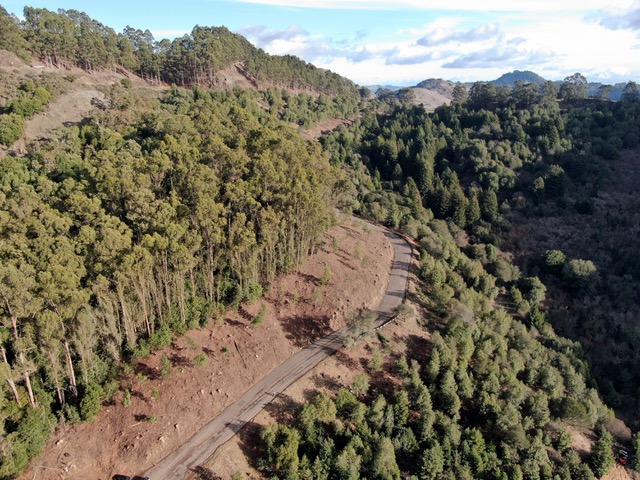
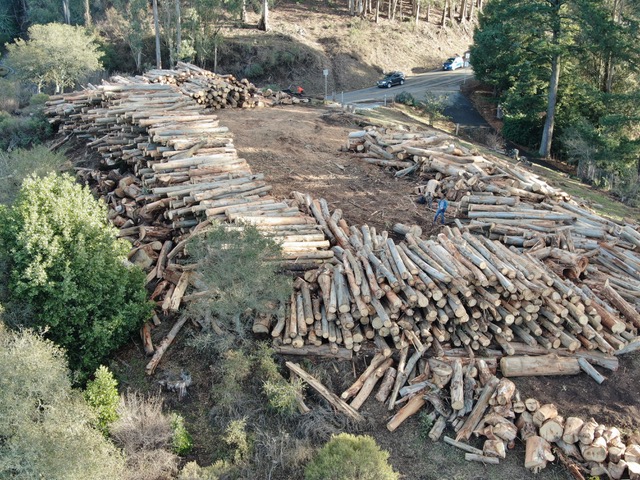
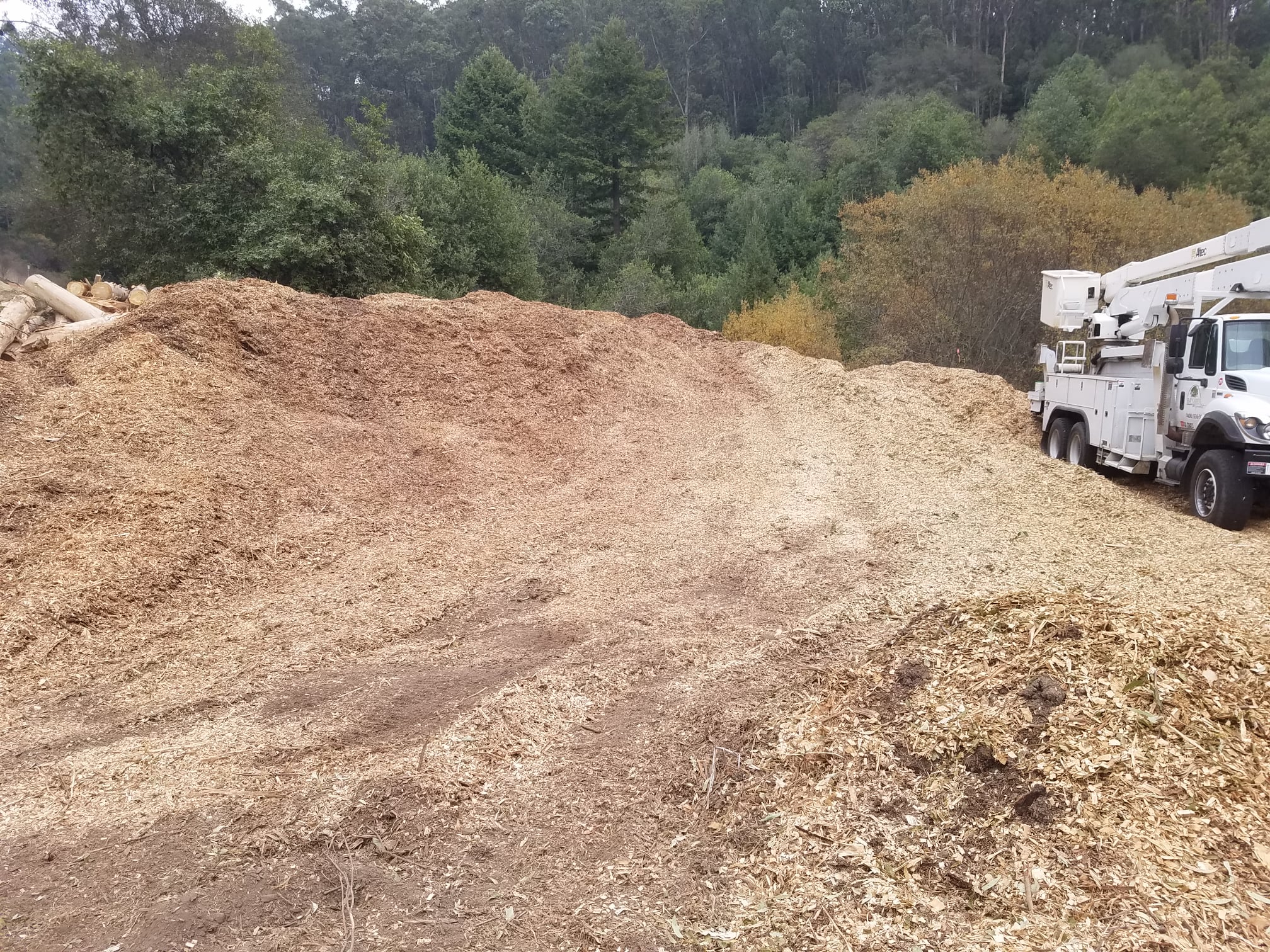
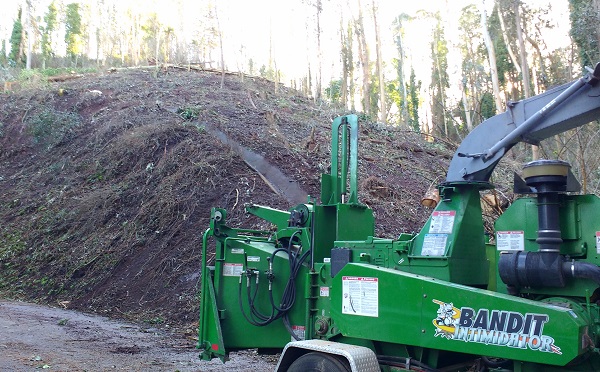
Increasing 300 miles of roadside clearance from 30 feet (as proposed by the 3rd version of the VMP) to 100 feet (as proposed for the 4th version of the VMP) will produce wood debris on a scale that cannot be disposed of.  We know what the outcome will be because of a similar project on Claremont Ave, where eucalyptus was clear cut 100 feet from the north side of 1.1 miles of the road in fall 2020.  Below are pictures of the piles of wood chips and logs that remained along that stretch of road for about 9 months while project managers tried to figure out what to do with the wood debris, which was eventually dispersed throughout the hills.  UC Berkeley implemented the project with funding from Cal-Fire. 

The north side of Claremont Ave. was clear cut 100 feet from the road. The south side of the road was not cut because the trees are native.   There is a creek flowing at the bottom of the canyon that creates the moist conditions needed for native trees, which will not grow where non-native trees now grow. Photo by Doug Prose, courtesy Hills Conservation Network.
One of many piles of logs, Claremont Ave, November 2020. It took about 9 months for the logs to be dispersed along roads in the hills. Photo by Doug Prose, courtesy Hills Conservation Network.
One of many piles of wood chips, Claremont Ave, November 2020

The roads in the East Bay hills are now lined with logs, preventing people from pulling off the road. No native plants or trees were planted after the trees were destroyed. Three years later, the clear cut roadside is vegetated with non-native annual grasses and coyote brush, a pioneer native shrub.

The project on the property of UC Berkeley was very small in comparison to the Oakland vegetation management plan that will clear cut 300 miles of roads, producing at least 300 times the amount of wood debris.  What will Oakland do with the wood debris that is produced from the destructive VMP that native plant advocates demand?  Tons of wood debris lying on the ground is far more flammable than living trees, which is another indication that the VMP that native plant advocates demand is not about mitigating fire hazards. It’s about their preference for a native landscape that is not less flammable than the landscape they demand be destroyed.  Like all Mediterranean climates, our native vegetation is fire adapted and fire dependent.  A significant number of our native species will not regenerate in the absence of fire.  Most wildfires in California in the past 5-10 years have occurred in native chaparral and native conifer forests. 

NY Times reported that 150 homes burned in this wind-driven fire in San Diego in 2003, but the eucalyptus surrounding the neighborhood did not burn. The flammability of eucalyptus trees is exaggerated to justify their destruction. NY Times photo

The more trees that are destroyed, the more herbicide will be required to prevent the trees from resprouting.  SAF is correct in saying that tricopyr will be needed to kill the roots of the trees to prevent them from repsouting.  Glyphosate will not accomplish that task.  Triclopyr is more toxic than glyphosate. Triclopyr has a signal word of “warning” and glyphosate has a less toxic signal word of “caution.”  Triclopyr kills the roots of woody plants by traveling from the cut stump to the roots of the plant in the soil.  Triclopyr is known to kill mycorrhizal fungi in the soil, which are essential to the health of plants growing in the soil.  The more herbicide that is used to kill the roots of destroyed trees, the less likely a newly planted native landscape is to survive.  All the more reason to assume that the destroyed forest will not be replaced by a native landscape.

In Summary

  • The landscape that native plant advocates demand for Oakland will be predominantly non-native annual grasses.
  • Native trees will not replace the trees that are destroyed because they are not adapted to most places where non-native trees now live and because there is no available funding to purchase native plants, plant them on thousands of acres of public land, and irrigate them until they are established.  Similar fuels management projects done by East Bay Regional Parks District, East Bay Municipal Utilities District, and UC Berkeley have not planted a native landscape to replace trees that have been destroyed.
  • Non-native annual grasses will naturally succeed to shrubs in the absence of frequent fire.  Shrublands are more flammable than the existing urban forest because fire travels on the ground, unless wind-driven fire ignites tree canopies.  In that case everything burns, both native and non-native trees.  The wind-driven fire in Oakland in 1991 spared no trees in burned areas, whether native or non-native.  
  • The project would produce many tons of flammable wood debris that has no commercial value and no place to be safely disposed of.
  • The loss of our urban forest will increase air pollution in Oakland, contribute to greenhouse gas emissions causing climate change, and raise temperatures in a city that is already a heat-island. 
  • Herbicides needed to prevent the urban forest from resprouting will poison the soil and suppress the growth of a new landscape.

If you live in Oakland City Council District 4 or 6, you are likely to be directly affected by Oakland’s vegetation management plan.  The most effective way to influence the VMP is to express your opinion to your representative on the City Council, as well as our at-large representative on the Council.  Contact information for members of the Oakland City Council is available HERE.


(1) David Nowak, “Historical vegetation change in Oakland and its implications for urban forest management,” Journal of Arboriculture, September 1993
(2) Jon E. Keeley, “Fire history of San Francisco East Bay Region and implications for landscape patterns,” International Journal of Wildland Fire, September 2005.
(3) https://www.nytimes.com/2023/08/13/us/hawaii-wildfire-factors.html
(4) Andrew Alden, Deep Oakland: How geology shaped a city, Heyday, 2023.
(5) https://kion546.com/news/2022/01/04/new-california-law-changes-liability-for-out-of-control-prescribed-burns/

Part III: Appealing to the City of Albany to save its eucalyptus forest

I am publishing my letter to the Albany City Council about the City’s plans to destroy most of the eucalyptus forest on Albany Hill.  I am publishing it in three segments because it is long.  The first segment explained why it is not necessary to destroy the forest.  The second segment explained the consequences of destroying the forest.  The third and final segment explains why it is unlikely that the forest can be replaced by native trees.

Now you have my version of the full story. If this is a place or an issue you care about, please consider writing a letter of your own to the City Council of the City of Albany.

Conservation Sense and Nonsense

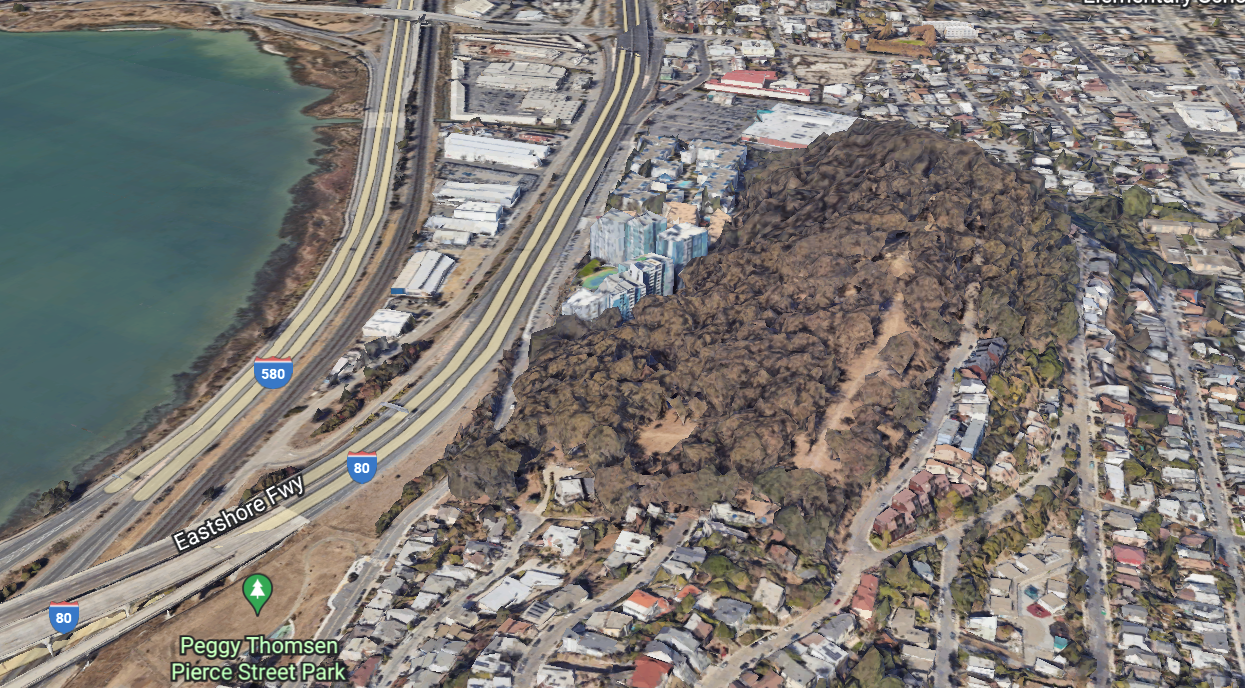
Albany Hill. Source: Google Earth


December 5, 2022

Albany City Council
1000 San Pablo Ave.
Albany, CA 94706

Dear Albany City Council:

SEE Part I and Part II of Appealing to the City of Albany to save its eucalyptus forest.  Part III is the concluding segment:

The uncertain fate of monarchs on Albany Hill is a suitable introduction to my final issue.  The proposed plans for Albany Hill claim the destroyed eucalyptus forest will be replaced by new trees. I will explain why it is unlikely that the eucalyptus forest can be replaced by another forest. Plans for a newly planted forest are described in various ways, some of which seem contradictory:

  • “[Margot] Cunningham’s [Albany’s Natural Areas Coordinator] team is pursuing grants to cut down most of the blue gums and plant the city’s side of the hill with a mix of native species and more drought tolerant trees for monarchs to roost.” (1)
  • “WHEREAS, the City is investigating consultants to design a plan to remove eucalyptus in a way that retains and restores more fire-resilient native plant communities and minimizes soil disturbance and soil erosion.” (2)
  • “More droughty Eucalyptus species can be planted to preserve the butterfly habitat.” (3)
  • “This plan will include but is not limited to: plantings of other tall trees in areas of the hill where monarchs have traditionally clustered; survey of the existing native understory which will be allowed to grow after eucalyptus removal; and analysis and design of additional plants of Albany Hill-sourced native plants.” (4)

Somehow, this diverse, drought-tolerant, fire-resilient, tall, native (with droughty eucalyptus species?) forest is expected to survive without irrigation:  “If drought-tolerant tree species are planted as seedlings, in the fall with sufficient planting site preparation and adequate rain fall, minimal if any irrigation will be required.” (5)  When predicting the fate of the existing eucalyptus forest, the plans assume that the drought will continue.  When predicting the fate of a replacement forest, the plans assume that the drought will end. 

Most public land managers irrigate newly planted trees (whether native or non-native) for at least 3 years.  Established trees rarely require irrigation to survive because they have extensive root systems that have better access to moisture in the soil than newly planted trees without extensive root systems.  Tree species that are drought-tolerant when mature trees, require irrigation as they grow their root systems.  Replacing healthy trees that don’t require irrigation with new trees that require irrigation seems an unwise choice in the middle of an extreme drought. 

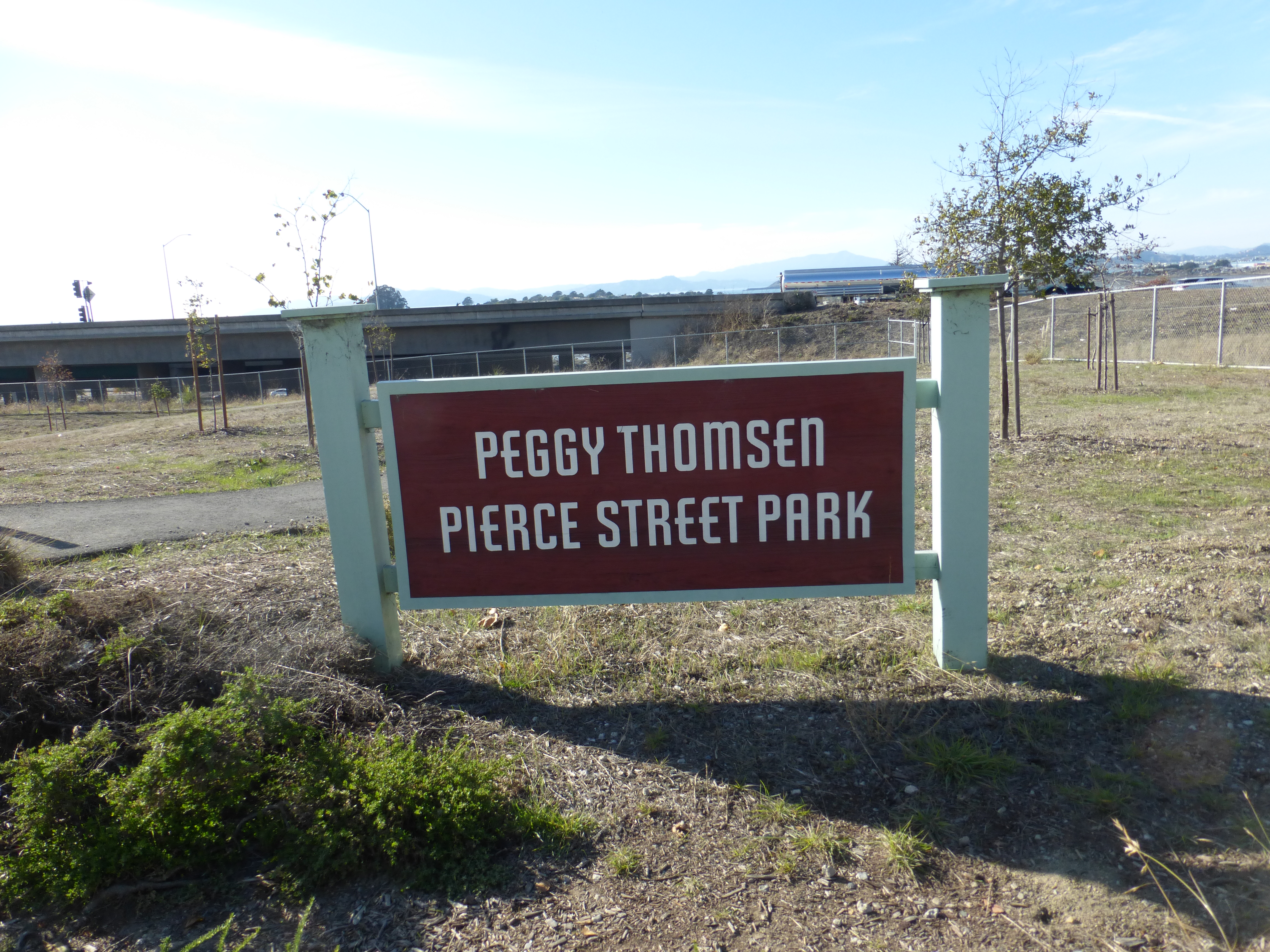
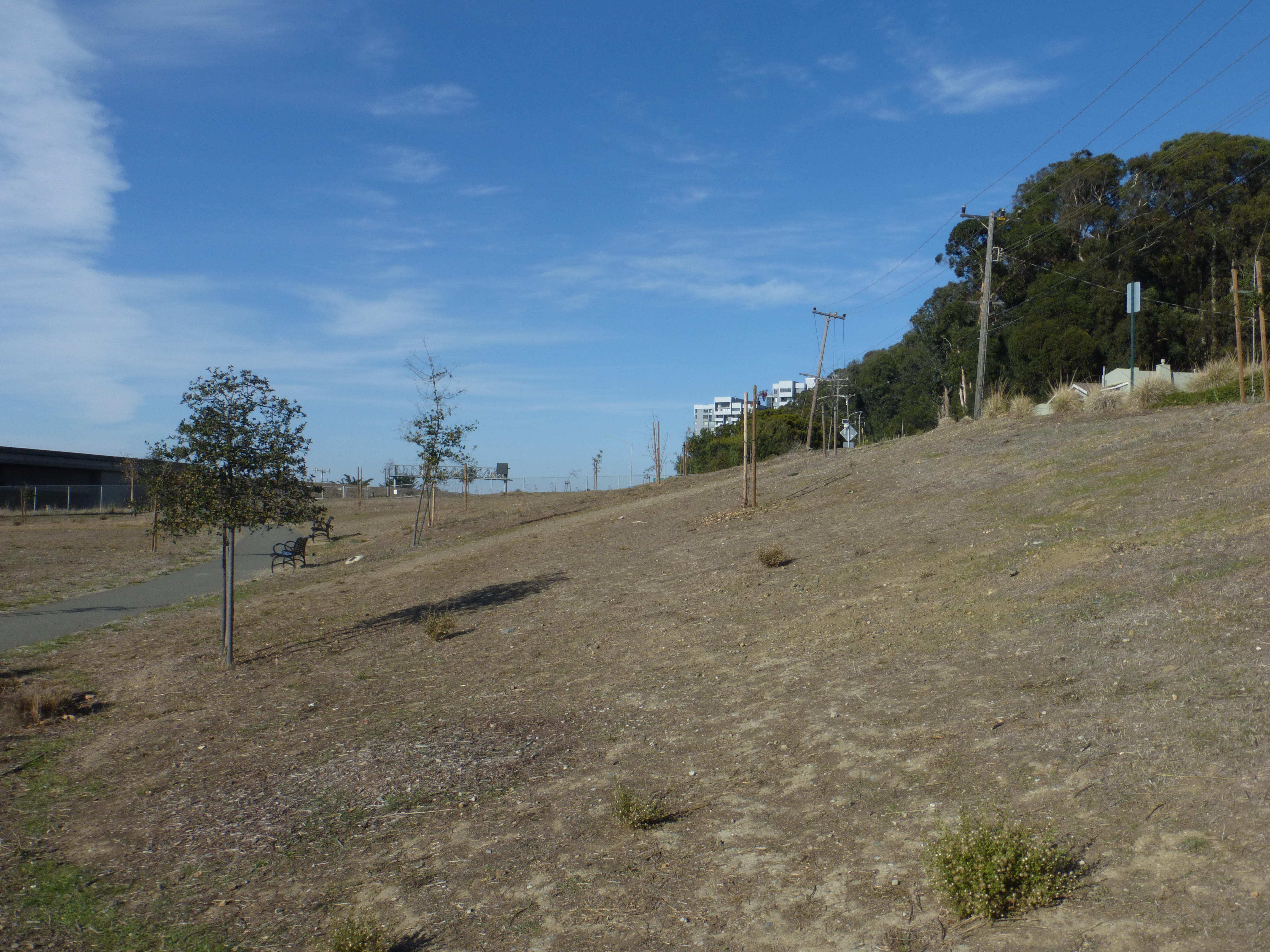
The City of Albany should have learned that lesson when they built Peggy Thomsen Pierce Street Park at the western foot of Albany Hill.  Only native trees were planted in that park.  They weren’t irrigated.  Five years after the park opened in 2017, most of the trees are dead (see below):

Peggy Thomsen Pierce Street Park, November 2022.  Conservation Sense and Nonsense

The City of Albany’s list of approved street trees is a valuable source of information about what tree species are capable of growing in Albany.  A tree species that cannot survive conditions for street trees is also unlikely to survive on the ridgeline of Albany Hill, where wind conditions are extreme and there is little moisture.  There are about 65 tree species approved for planting as street trees in Albany.  Five are native to California, but only three are native to the Bay Area.  Native big leaf maples are said to be “in decline.”  Buckeyes aren’t suitable street trees, but may be suitable for open space.  None of the listed native trees are suitable monarch habitat for a variety of reasons:  canopy too dense to provide sufficient sunshine; deciduous therefore bare in winter; short stature, etc. 

Historically, areas on Albany Hill that are now forested with eucalyptus were treeless because native trees are not adapted to the challenging climate conditions.  If the eucalyptus forest on Albany Hill is destroyed, Albany Hill is likely to be treeless again.  That is the horticultural reality of Albany Hill. 

In conclusion:

  • It is not necessary to destroy the eucalyptus forest on Albany Hill because it is not dead.
  • Destroying the eucalyptus forest on Albany Hill will increase fire hazards and safety hazards.
  • Destroying the eucalyptus forest will destroy habitat of monarch butterflies.
  • Plans to replace the eucalyptus forest with native trees are unrealistic.

Please consider reinstating the 2012 Albany Hill Creekside Master Plan.  It is still a good plan that will not do unnecessary damage to Albany Hill and its human and animal visitors.

cc: Albany Fire Chief
Albany Natural Areas Coordinator
Albany Urban Forester
Creekside Science


Update:  Shortly after I sent my letter to officials of the City of Albany about their plans to destroy most eucalyptus on Albany Hill, they revised their plans because of two updated reports that were done in November and December 2022.  Basically, they no longer plan to destroy most eucalyptus on Albany Hill for two main reasons:

  • Eucalyptus trees are the overwintering habitat of monarch butterflies. They cannot be replaced by native trees of short stature without the open canopy that filters sunlight but also provides a windbreak the monarchs need.
  • Epicormic sprouts on the eucalyptus trees indicate they are recovering from drought and are expected to survive and eventually replace their canopies.

These are the sources of information that corroborate my brief summary of the main reasons Albany is no longer planning to destroy most eucalyptus trees on Albany Hill:

They still intend to remove dead trees to reduce fuel loads, to which I have no objection.  Some dead eucalyptus may be replaced with more drought tolerant species of eucalyptus from Western Australia. 

To be clear, I don’t think my letter about their original plans for Albany Hill were influential in their revising their plans.  My letter is consistent with the advice they received from an ecologist with expertise in monarch butterflies and a consultant in fuels management.  Credit belongs to the preference of monarchs for eucalyptus and to eucalyptus for being indestructible.

April 2023


  1. Bay Nature:  https://baynature.org/2022/10/20/the-nearly-unkillable-eucalyptus-meets-its-match/
  2. Resolution No. 2021-105.  A resolution of the Albany City Council, authorizing the appropriation of funds to the Albany Hill Eucalyptus Project in the amount of $100,000
  3. https://www.albanyca.org/home/showpublisheddocument/52453/638028259461770000
  4. Staff Report to City Council regarding Albany Hill Eucalyptus Project, May 2, 2022
  5. https://www.albanyca.org/home/showpublisheddocument/52453/638028259461770000

Part II: Appealing to the City of Albany to save its eucalyptus forest

I am publishing my letter to the Albany City Council about the City’s plans to destroy most of the eucalyptus forest on Albany Hill.  I am publishing it in three segments because it is long.  The first segment explained why it is not necessary to destroy the forest.  The second segment explains the consequences of destroying the forest.  The final segment will explain why it is unlikely that the forest can be replaced by native trees. 

Conservation Sense and Nonsense

Albany Hill. Source: Google Earth


December 5, 2022

Albany City Council
1000 San Pablo Ave
Albany, CA 94706

Dear Albany City Council:

SEE Part I:  Appealing to the City of Albany to save its eucalyptus forest.  Part II continues:

The premature destruction of the eucalyptus forest will have many negative consequences:

  • The loss of significant amounts of fog drop from the tall trees.
  • The creation of tons of wood debris that will contribute to fire hazards
  • The regrowth of the trees into unstable multi-stemmed trees with lower fire ladders
  • The loss of habitat for overwintering monarch butterflies

Harold Gilliam in Weather of the San Francisco Bay Area informs us that tall non-native trees in the East Bay produce significant amounts of water by condensing fog drip: “Eucalyptus and pine groves planted there long ago intercept large amounts of fog and cause a rainlike deposit of moisture. The fog drip during the summer months has been measured at a surprising 10 inches, an amount nearly half as great as the total rainfall…”  Average rainfall in the East Bay is 21 inches per year, so this fog precipitation adds nearly 50% to total precipitation.  

Foggy morning, Redwood Park. Conservation Sense and Nonsense

One of the planning documents for the tree removal project on Albany Hill speculates that there is less fog than in the past in the San Francisco Bay Area.  According to an article in the New York Times, many people disagree with that assumption.

By precipitating fog drip during the otherwise dry time of the year, tall non-native trees reduce fire danger during the fire season.  Moisture on the forest floor helps to retard ignition and slow the spread of fire.  This was observed recently on the west side of Albany Hill when an arsonist set the forest afire in June 2022:  “The Albany Hill fire, which was initially estimated around three acres with a slow rate of spread…”  The fire was quickly extinguished.

This is where the fire in June 2022 occurred on Pierce St.  Note resprouts of the burned trees in November 2022.  Conservation Sense and Nonsense

Fog drip from the eucalyptus overstory is also irrigating the forest understory of many native shrub species, predominantly toyon.  Historical records of Albany Hill tell us toyon was not there before eucalyptus was planted.  The top of the hill is the driest area because it does not benefit from run off compared to lower elevations of the hill.  The side of the hill facing the southwest is drier than northeast face of the hill because it is exposed to more sun and wind.  Historically, oaks grew only on the northeast side of the hill where they were sheltered from the wind and the soil was moister.  One of many questions about the new plans for Albany Hill that should be asked and answered is how the existing native understory can survive without fog drip and the wind shelter of the tall trees. 

The City of Albany’s application for a grant from the California Coastal Conservancy predicts this future for Albany Hill: “The project will create more fire-resilient and healthy ecosystems by allowing native plant communities to return after eucalyptus removal…”  In fact, the opposite outcome seems more likely.  Without the benefit of fog drop from the tall trees and shelter from the wind, the existing native understory is unlikely to survive.  The existing native understory did not exist on Albany Hill prior to the planting of eucalyptus. 

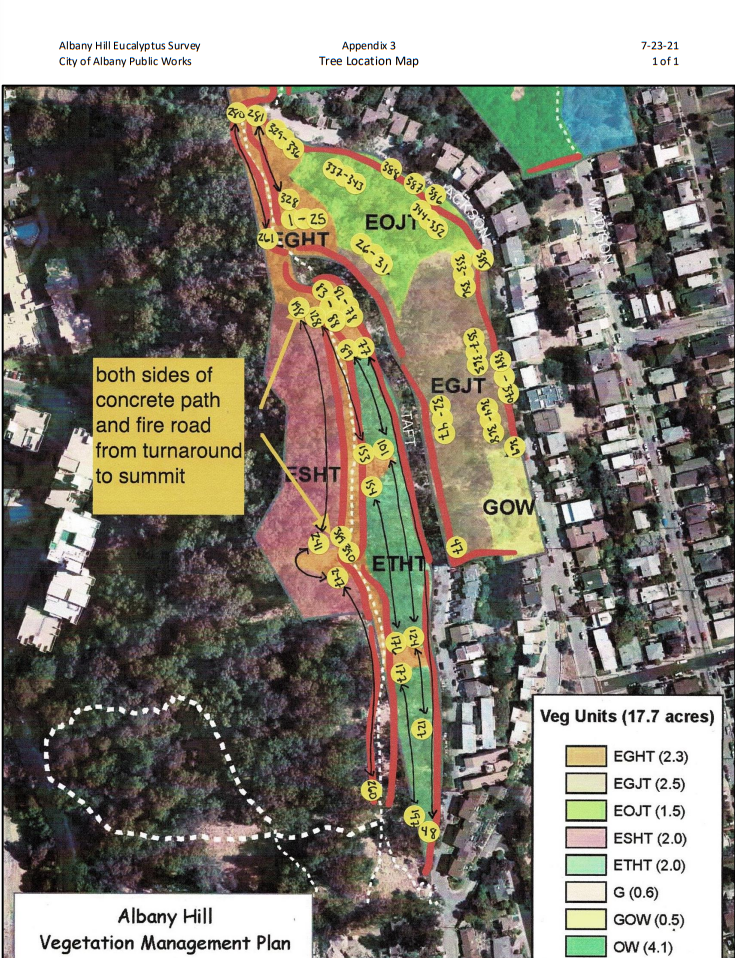
This map (see below) of tree removal plans for Albany Hill shows where approximately 400 trees will be removed at the top of the hill.  (The number of each tree planned for removal is listed on this map, some in sequences such as 1-25, indicating that 25 trees will be removed between the arrows on the map.)

Source:  Arborist Report, SBCA Tree Consulting

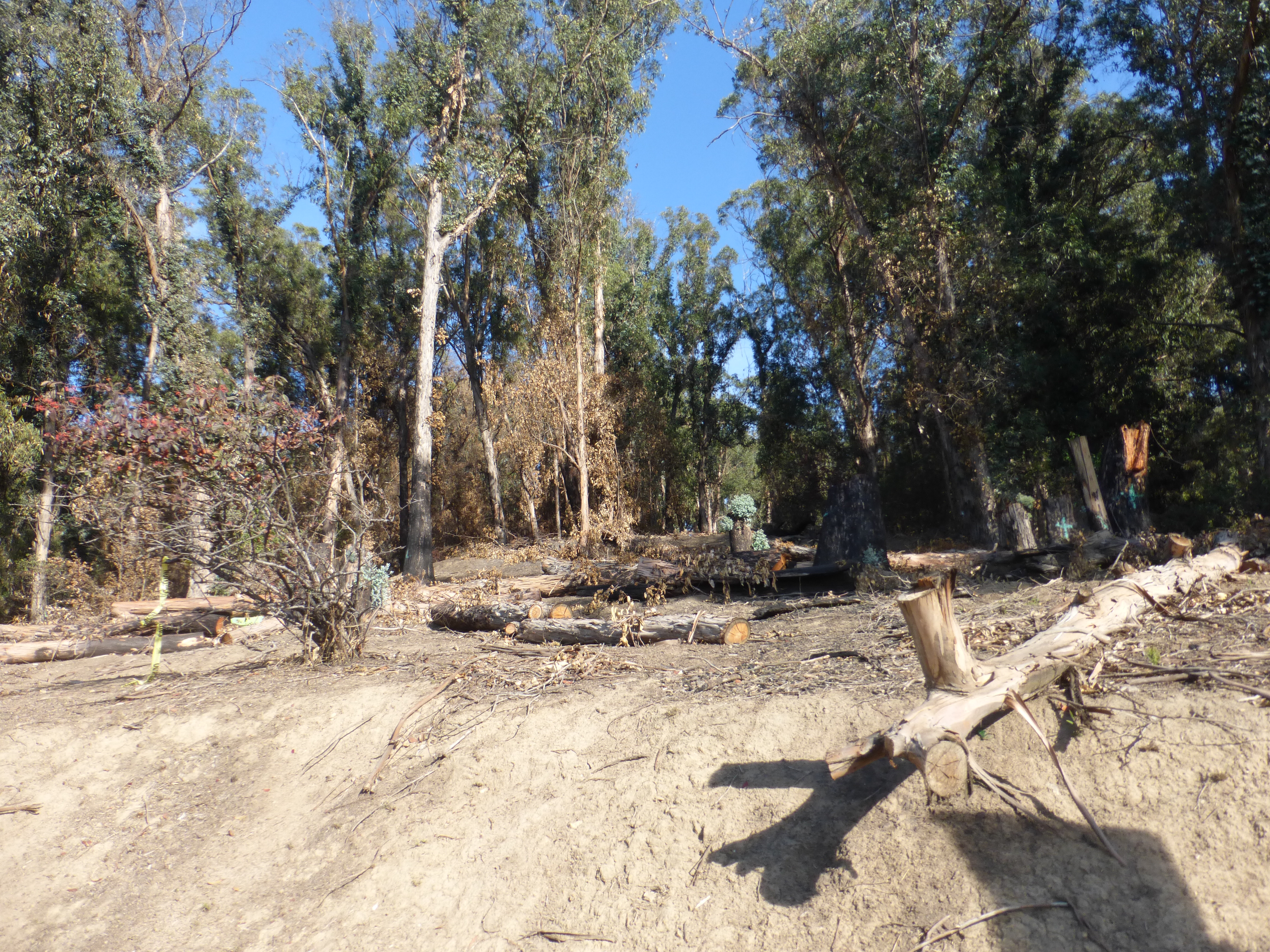
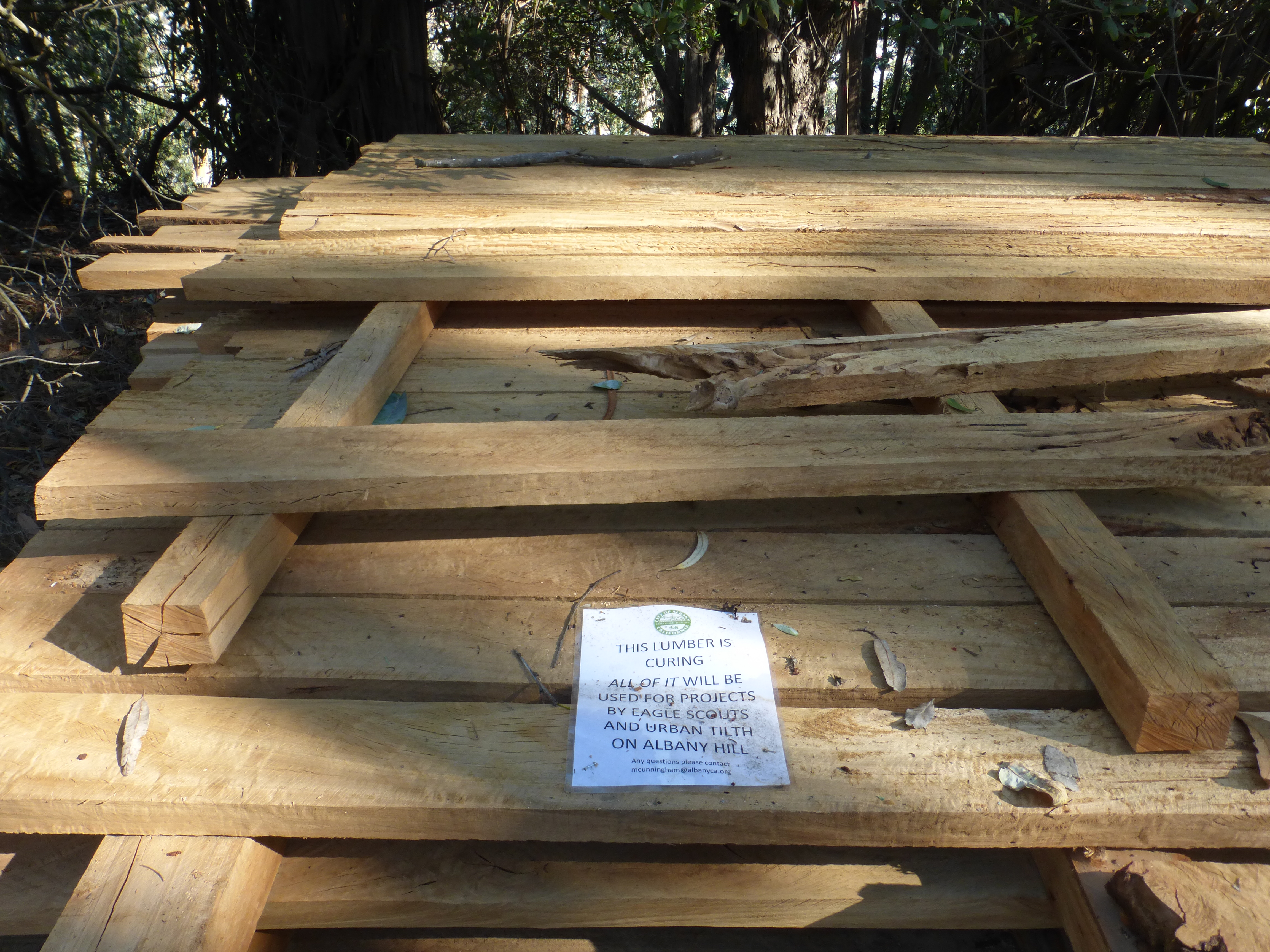
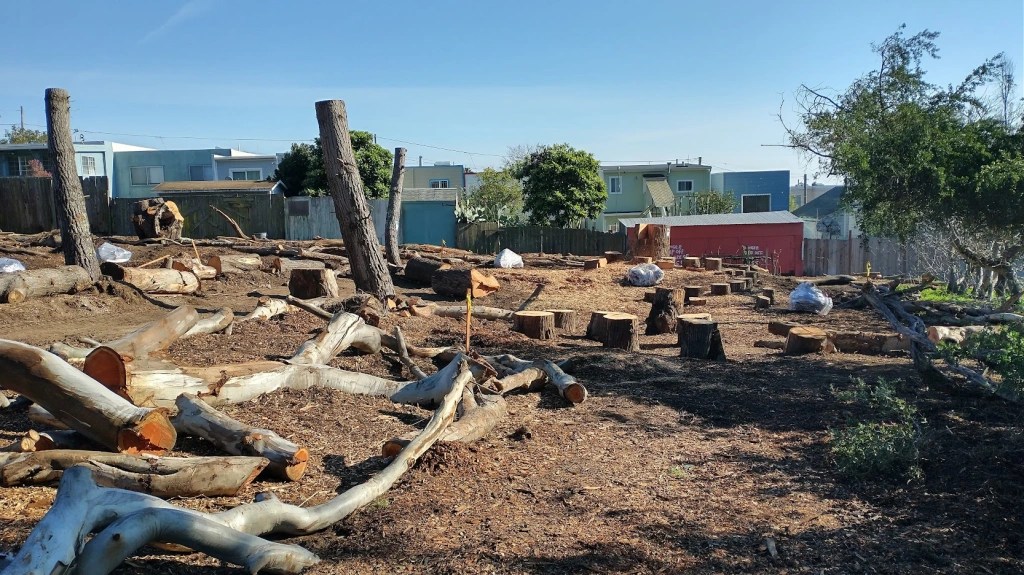
Returning to the question of fire hazards, what will happen to all that dead wood?  We get a preview of the answer to that question because the City of Albany recently destroyed between 14 and 20 eucalyptus trees (reports on the number of destroyed trees vary).  We can see what happened to some of the wood (see below):

Some of the destroyed trees are still lying on the ground (see below).  This tree has already resprouted.

Multiply that flammable wood debris by 400 to get a picture of the amount of wood debris the proposed project on Albany Hill will create.  The arborist’s report for the eucalyptus removal project makes this recommendation regarding wood debris:  “Logs and chips to remain – Cut trees, chip brush and allow mulch and logs to remain on the slope.”

We had a recent experience with the wood debris created by similar projects when UC Berkeley destroyed all non-native trees within 100 feet of the north side of Claremont Ave in fall 2020.  Huge piles of wood chips and logs were stacked along the road, which the grant application claimed would be disposed of by generating electricity in a biofuels plant.  No such biofuels plant exists and there are no plans to build it.  Here is a photo (see below) of one of the wood piles that remained along the road for about 9 months before being distributed elsewhere throughout the Berkeley hills:          

One of many piles of logs, Claremont Ave, November 2020. Photo by Doug Prose, courtesy Hills Conservation Network.

Bay Nature recently explained why we are unable to dispose of wood debris from the many fuels management projects being done in California. If you ever wondered why there are piles of wood chips in your parks or why the roads in the hills are lined with logs, this article explains. There aren’t enough lumber mills in California to keep up with all the logs or biofuel plants to keep up with the wood chips. Most of the trees killed by bark beetles or by wildfire can’t be salvaged because of the shortage of mills. The wood debris is the fuel for the next wildfire. Turning living trees into dead wood debris does not reduce fire hazards. 

In addition to reducing fire hazards, Albany’s new plans for the eucalyptus forest on Albany Hill are also intended to address safety concerns.  Based on the assumption that the eucalyptus trees will soon die, Albany wishes to reduce public safety hazards by pre-emptively taking trees down before they fall down.  As I’ve said before, the assumption that the trees will soon be dead is mistaken.  Furthermore, Albany does not intend to use herbicides on the tree stumps to prevent resprouts, which guarantees that they will resprout, creating multi-stemmed trees that will be less stable than the trees are now. 

According to the arborist’s report for Albany Hill, there is also a history of unstable trees that grew from resprouts of destroyed trees:  Stump sprouts – Sixty-nine (69) trees have developed as stump sprouts, or trees that have grown back from the stump after being cut down. Because the prior tree stump eventually rots, the new growth is not always well anchored.” The staff report to the City Council on May 13, 2021 about the project said, “Multi-trunk trees are weaker structurally and produce more fire-hazardous debris than single-trunk trees.”

Trees develop their defenses against the wind as they grow in a particular environment.  When their tree neighbors are destroyed, they are suddenly subjected to more wind than they can withstand. The arborist employed by the City of Albany acknowledges the potential for increased risk of windthrow: “Stands of trees act together to resist wind forces.  When trees are removed from a stand or grove, the wind forces on the remaining trees are increased.  This can be a concern when trees, which are currently considered low risk, receive increased wind exposure due to adjacent tree removal.”

 The unstable multi-stemmed trees that grow from resprouts will also be subjected to more wind without the protection of other trees that have been destroyed.  The proposed plans for extensive tree removals will result in a more dangerous forest of resprouts that are vulnerable to windthrow. 

Destroying 400 eucalyptus trees on Albany Hill would create an overwhelming commitment to control resprouts mechanically. It is a challenge that the City of Albany has not been able to meet in the past, as evidenced by recent resprouts and multi-stemmed trees from past resprouts. However, I don’t mean to imply that I prefer the use of herbicides to prevent resprouts.  A new forest of young, unstable eucalyptus trees with lower fire ladders is better than a forest that has been poisoned and the understory with it.  Herbicides are also harmful to monarch butterflies and other insects.

My last visit to the City park at the top of Albany Hill was on Sunday, November 20th, the weekend before Thanksgiving, which is the optimal time to see monarch butterflies in their winter roost.  We saw many monarchs in the trees that are slated for destruction and as it got warmer in the early afternoon, we watched them flutter to nearby trees.  There were many other park visitors.  Some were frequent visitors who helped us find the biggest clusters.  Other visitors were as excited as we were to find the monarchs for the first time.  This is to say, the disappearance of monarchs on Albany Hill would be a disappointment to the visitors to the park.

Monarchs roosting in epicormic sprouts of eucalyptus on the top of Albany Hill, November 20, 2022.  Conservation Sense and Nonsense

According to Stuart Weiss of Creekside Science, that’s where monarchs begin their visit to Albany Hill:  “…monarchs begin the season on the ridgetop, likely attracted by high insolation [sunshine].  Following the first storms of the season accompanied by strong winds, they move down the SW slope when storm winds (generally southerly) are too strong.  The structure of the forest in the Cluster zone consists of a series of openings surrounded by denser forest, allowing some insolation with adequate wind shelter.  These cluster sites tend to have visible sky overhead with relatively few canopy openings toward the horizon and moderate exposure to the SW (which may be related to afternoon insolation.”

Stuart Weiss was also interviewed by Bay Nature about the monarch butterflies on Albany Hill:  “Weiss wants to preserve the eucalyptuses—invasive non-natives that they are—for the butterflies’ sake. The monarchs made their choice,’ says Weiss. ‘They go for the eucalyptus, so we have to honor that.’ The key to a cozy roost, according to Weiss, is a configuration of mature trees that provide just the right mix of sunshine and protection from wind and storms. Monarchs prefer to cluster along Albany Hill’s city-owned ridgetop early in the season. Later in winter, they cluster on the hill’s privately owned southwestern slope, and near the condos at the foot of the hill’s western flank. The fate of the trees and the butterflies roosting on that land is unclear.”

Eucalypts are the preferred trees for over-wintering monarchs in California according to an analytical study of 205 over-wintering sites:  “Three types of trees were used most frequently by roosting monarchs:  eucalyptus (75% of the habitats primarily Eucalyptus globulus), pine (20% of the habitats primarily Pinus radiata), and cypress (16% of the habitats Cupressus macrocarpa).  Twelve other tree species were identified…with a combined prevalence of only 10%…habitats had smaller populations when the roosting tree type was a species other than eucalyptus, pine, or cypress.”(1) (Three different studies by different authors are the source of these data, therefore they don’t add up to 100%.) In other words, virtually all of the trees used by monarchs for their winter roost are not native to the San Francisco Bay Area. 


The third and final segment of my letter to the Albany City Council will be published tomorrow. It will explain why the eucalyptus forest cannot be replaced by native trees. Thank you for your visit today.


Update:  Shortly after I sent my letter to officials of the City of Albany about their plans to destroy most eucalyptus on Albany Hill, they revised their plans because of two updated reports that were done in November and December 2022.  Basically, they no longer plan to destroy most eucalyptus on Albany Hill for two main reasons:

  • Eucalyptus trees are the overwintering habitat of monarch butterflies. They cannot be replaced by native trees of short stature without the open canopy that filters sunlight but also provides a windbreak the monarchs need.
  • Epicormic sprouts on the eucalyptus trees indicate they are recovering from drought and are expected to survive and eventually replace their canopies.

These are the sources of information that corroborate my brief summary of the main reasons Albany is no longer planning to destroy most eucalyptus trees on Albany Hill:

They still intend to remove dead trees to reduce fuel loads, to which I have no objection.  Some dead eucalyptus may be replaced with more drought tolerant species of eucalyptus from Western Australia. 

To be clear, I don’t think my letter about their original plans for Albany Hill were influential in their revising their plans.  My letter is consistent with the advice they received from an ecologist with expertise in monarch butterflies and a consultant in fuels management.  Credit belongs to the preference of monarchs for eucalyptus and to eucalyptus for being indestructible.

April 2023


  1. Dennis Frey and Andrew Schaffner, “Spatial and Temporal Pattern of Monarch Overwintering Abundance in Western North America,” in The Monarch Butterfly Biology and Conservation, Cornell University Press, 2004.

Part I: Appealing to the City of Albany to save its eucalyptus forest

I am publishing my letter to the Albany City Council about the City’s plans to destroy most of the eucalyptus forest on Albany Hill.  I will publish it in three segments because it is long.  The first segment explains why it is not necessary to destroy the forest.  The second segment will explain the consequences of destroying the forest.  The final segment will explain why it is unlikely that the forest can be replaced by native trees. 

Conservation Sense and Nonsense

Albany Hill. Source: Google Earth


December 5, 2022

Albany City Council
1000 San Pablo Ave
Albany, CA 94707

RE:  Albany Hill Eucalyptus Project

Dear Albany City Council:

I have a sentimental attachment to the City of Albany because I lived there for 5 years at the beginning of my marriage.  We still enjoy regular visits to the city’s beauty spots of Albany Hill and the Albany Bulb, as well as Albany’s great restaurants. 

As you know, many public land managers have destroyed eucalyptus trees, but the City of Albany was not planning to destroy the eucalyptus forest on Albany Hill until recently.  According to the 2012 “Albany Hill Creekside Master Plan,” the eucalyptus forest would be “phased out” slowly over time by removing hazardous trees as necessary to ensure public safety, removing new seedlings where the forest interfaces with native oak woodland, and not replacing trees that die of old age.  I expressed my support for this approach to management of the eucalyptus forest on Albany Hill on my website, Conservation Sense and Nonsense.

The recently published Bay Nature article about Albany Hill alerted me to Albany’s new plans to destroy most of the eucalyptus forest on Albany Hill.  I’ve studied the documents about these new plans and I’m writing to express my reservations about the feasibility of the plans.  I ask for your consideration of these concerns:

  • Is it necessary to destroy the eucalyptus forest on Albany Hill?
  • What are the consequences of destroying the eucalyptus forest?
  • Is it possible to replace the eucalyptus forest with native trees?

All plants and trees in California are showing signs of drought stress and many are dead because of drought stress, especially in unirrigated parks and open spaces.  Eucalyptus trees are not immune to drought stress, although they are coping better than some species that require more water, such as redwood trees.

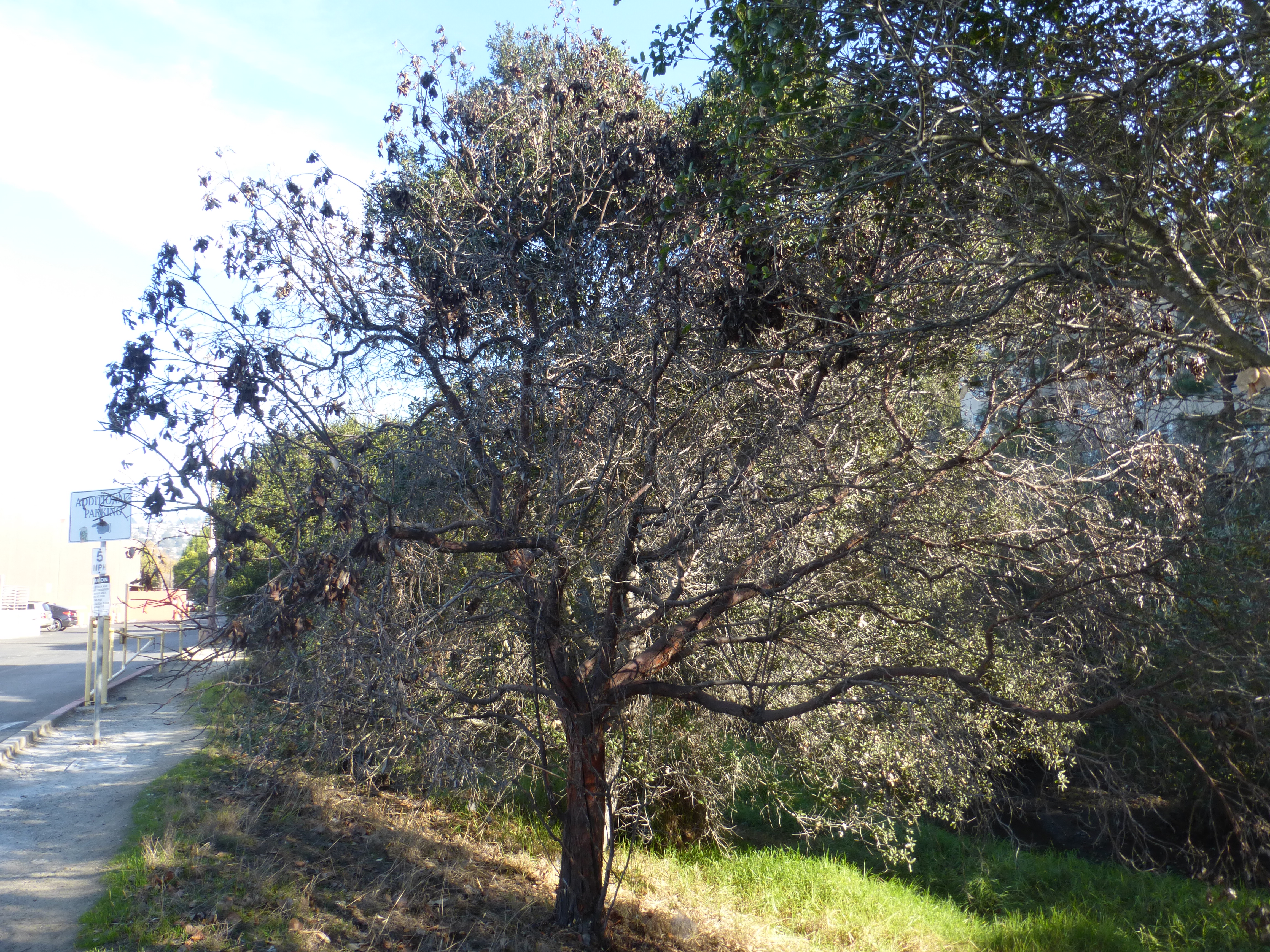
Native Madrone, north side of Cerritos Creek, 2013.  Conservation Sense and Nonsense

SAME Native Madrone on north side of Cerritos Creek is now dead, November 2022.  Conservation Sense and Nonsense.
According to the San Francisco Chronicle, over 160 million native conifers have been killed by bark beetles in California’s Sierra Nevada in the past 10 years. As the climate continues to warm, bark beetles are moving north and west into coastal counties. The worst outbreak has been in Lake County, followed by Napa County. 15-25% of conifers on the east side of Napa Valley are dead. Drought conditions are so extreme that oaks are succumbing to drought stress: “That’s how you know things are kind of really bad, when you see oaks succumb to drought stress.’”

Plans to destroy most eucalyptus on Albany Hill are based on observed die-back of the eucalyptus tree canopy.  The trees were studied by Matteo Garbelotto’s pathology lab at UC Berkeley.  Their report described the impact of the infection:  “First, symptoms observed in Eucalyptus were more markedly limited to the foliage and twigs. Leaf blight and twig necrosis were the only symptoms common across all the six areas surveyed and sampled. Branch and stem cankers, wood discoloration and fungal mats were present, but generally were site-specific or shared by trees only in 2 or 3 cases. Extensive heartrot (i.e. decay of the stem core) was not observed in any tree, although, some wood decay was observed both at the base of stems and on branches.”

The City of Albany’s application for a grant from the California Coastal Conservancy assumes that the eucalyptus trees will never recover:  “The scientific analysis…determined the trees were in irreversible decline due to drought stress and resulting vulnerability of pathogen attack…”  Since all unirrigated trees and plants are showing the same signs of stress, such a verdict would obligate us to destroy most trees in our open space.  Given the remarkable regenerative abilities of eucalyptus, they are more likely to survive than most tree species. 

Top of Albany Hill, 2015.  Conservation Sense and Nonsense

Top of Albany Hill, November 2022.  The tops of the canopy are a little thinner than they were in 2015, but not significantly.  Conservation Sense and Nonsense

These symptoms were caused by a fungus that infects most eucalyptus in California.  The fungus does not usually cause visible damage.  Damage is now visible because the trees are stressed by drought.  The situation is similar to the death of native conifers in California; native bark beetles have always been present but are now capable of killing the conifers because the trees are weakened by drought.  The difference is that it’s not clear the fungus is capable of killing eucalyptus.

Eucalyptus has remarkable regenerative ability to resprout after it has been cut down or burned.  One of the goals of the proposed project is a “fire-resilient” ecosystem, which suggests a landscape that is capable of recovering from the inevitable wildfires in a Mediterranean climate.  In fact, eucalyptus is a fire-resilient tree species because it resprouts after it is burned.  When it is under stress, it drops mature leaves and recovers by producing epicormic sprouts.  Eucalyptus trees on the top of Albany Hill are covered in epicormic sprouts, which indicate the trees are not dead and they are trying to recover.  Albany’s plans to destroy most of the eucalyptus forest on Albany Hill is based on the mistaken assumption that the trees will eventually die.  That is an assumption that is not consistent with the present status of the trees on Albany Hill or with comparable situations in the Bay Area.

Source:  Mount Sutro Forest That Was

This picture (see above) was taken in Glen Canyon Park in San Francisco in 2015.  The eucalyptus trees were producing epicormic sprouts in response to drought and a few had been girdled by those who want all eucalyptus in San Francisco destroyed.  Native plant advocates predicted that the trees would die and they advocated for their destruction.  The trees survived.


Part II of my letter to the Albany City Council will be published tomorrow. Part II will describe the negative consequences of destroying the eucalyptus forest on the top of Albany Hill. Please visit again tomorrow for the next segment of my letter to the Albany City Council. Thank you for your visit today.


Update:  Shortly after I sent my letter to officials of the City of Albany about their plans to destroy most eucalyptus on Albany Hill, they revised their plans because of two updated reports that were done in November and December 2022.  Basically, they no longer plan to destroy most eucalyptus on Albany Hill for two main reasons:

  • Eucalyptus trees are the overwintering habitat of monarch butterflies. They cannot be replaced by native trees of short stature without the open canopy that filters sunlight but also provides a windbreak the monarchs need.
  • Epicormic sprouts on the eucalyptus trees indicate they are recovering from drought and are expected to survive and eventually replace their canopies.

These are the sources of information that corroborate my brief summary of the main reasons Albany is no longer planning to destroy most eucalyptus trees on Albany Hill:

They still intend to remove dead trees to reduce fuel loads, to which I have no objection.  Some dead eucalyptus may be replaced with more drought tolerant species of eucalyptus from Western Australia. 

To be clear, I don’t think my letter about their original plans for Albany Hill were influential in their revising their plans.  My letter is consistent with the advice they received from an ecologist with expertise in monarch butterflies and a consultant in fuels management.  Credit belongs to the preference of monarchs for eucalyptus and to eucalyptus for being indestructible.

April 2023

Creating Tree Graveyards in San Francisco

At 13.7% of tree canopy coverage, San Francisco has one of the smallest tree canopies of any major city in the country.  When San Francisco’s Urban Forestry Council (UFC) announced its goal of planting 30,000 new street trees in the next 20 years, it seemed a modest goal.  Yet, Jake Sigg, the leader of native plant advocates in San Francisco, immediately objected to even this modest goal in his Nature News.  He announced the meeting of the UFC to consider the proposal and pronounced it a bad idea:

“JS:  Let’s start taking climate change seriously.  There is a prejudice—it is nothing more than that—that trees sequester more carbon than other life forms.  That is a simplistic view that, when looked at more closely, is found wanting.  To counter climate change we need to remove carbon from the air and put it where it will be for a millennium or more.  Removing it for a few decades or a century is pointless. 

“There are many reasons to plant trees on San Francisco streets, and many of our streets need them.  Climate change is not a stand-alone phenomenon; it is intimately related to diversity of biological elements.  That argues for planting native plants to invite dispossessed wildlife back into the city and you do that by planting the plants they need.  There are trees, shrubs, and perennials that ought to line our street to function in this way.  Carbon removal should not be a factor in our street plantings—biodiversity should be Number 1.”

Jake Sigg, Nature News, July 2, 2022

Yes, Jake, biodiversity is important because a diverse ecosystem is more resilient in a changing climate, but destroying all non-native plants does not make an ecosystem more diverse.  Climate change is the greatest long term threat to biodiversity, which makes addressing climate change a prerequisite to preserving biodiversity. 

I attended the Urban Forestry Council meeting of July 5, 2022, when this proposal was considered.  I was expecting to hear objections from Jake Sigg’s followers. Instead, the handful of written public comments objected to the meager commitment to plant only 30,000 new trees in San Francisco in the next 40 years. I learned more about the plan to plant more street trees in San Francisco:

  • There are presently an estimated 125,000 street trees in San Francisco.
  • Because the mortality of street trees is high, the expectation is that 50,000 street trees would need to be planted in the next 20 years to replace dead street trees.
  • According to the Urban Forestry Council it costs $1,500 to plant a tree and an additional $2,500 to water it for three years until it is established.
  • 4,000 trees would need to be planted every year to keep pace with expected tree mortality and to add 30,000 more street trees. 

These goals exist only on paper.  Between 1,500 and 2,000 trees per year are being planted in the city and no funding has been identified to increase this number.  After delivering this bad news about the sorry state of San Francisco’s urban forest, one member of the UFC spoke some much needed common sense.  Nicholas Crawford said we should “hold onto shabby trees” that are established and storing carbon.  He suggested that San Francisco should not remove trees that are at least stable because there are no trees to replace them. 

Existing trees in our urban forest are more valuable than ever.  They are storing more carbon than a replacement tree will store for at least 20 years.  They don’t need to be irrigated because they have the root and fungal networks needed to supply the tree with the moisture it needs.  Existing trees have proven themselves.  The fact that they are alive and well after 10 years of extreme drought proves they are adapted to current climate conditions.  So why destroy them? 

Jake Sigg acknowledged the value of forests to address the challenges of climate change in a recent newsletter:  “In order to have an impact on climate we need to stop deforestation and preserve, strengthen, and restore what is already here.” (Nature News, July 6, 2022)  But that principle does not apply to San Francisco for Sigg and his followers because the trees of San Francisco are predominantly non-native and they place a higher value on restoring pre-settlement treeless grassland and coastal scrub.  Because of the power and influence of the native plant movement in San Francisco our urban forest is being destroyed and planting trees is resisted.

San Francisco has made a commitment to destroying more than 18,000 non-native trees in San Francisco’s public parks.  The stated goal of that program is a landscape of native grassland and scrub.  UC San Francisco has also made a commitment to destroy most of the non-native forest on Mount Sutro.  Thousands of trees have been destroyed on Mount Sutro and more will be destroyed in the future.  The Executive Director of Sutro Stewards, the non-profit organization that is implementing the plans for destruction of the non-native forest on Mount Sutro is represented on the Urban Forestry Council, an odd choice for a citizen’s advisory council theoretically committed to the urban forest.

Tree destruction on Mount Sutro, January 2021.  Courtesy San Francisco Forest Alliance

McLaren Park:  A Case Study

Today Conservation Sense and Nonsense will visit a relatively new project in McLaren Park that has destroyed non-native trees in order to create a small native plant garden.  We drill down into the project to understand why San Francisco’s urban forest is being destroyed.  We visit this project because it is an example of many similar projects that are planned in San Francisco. 

This is one of many attempts to plant native plant gardens on Sunset Blvd in San Francisco. The functional windbreak of Monterey cypress is dying of old age. Rather than replace the windbreak, native shrubs are being planted on Sunset Blvd that will not function as a windbreak in the windiest district in San Francisco. The lack of maintenance that you see here is typical of these gardens, which makes them unpopular with neighbors.

At 312 acres, McLaren Park is one of the largest parks in San Francisco.  Fifty-three percent (165 acres) of McLaren Park is designated as a “natural area,” which means that a commitment was made nearly 25 years ago to transform it into a native plant garden.  The new native plant garden that we visit today is not actually inside one of the designated “natural areas.”  The reach of the native plant movement in San Francisco extends far beyond the 1,100 park acres of “natural areas” that were claimed in 1998. 

The new native plant garden is located in the southeast corner of McLaren, south of the community garden at the intersection of Visitation Ave and Hahn St.  This is a photo of some of the trees that were destroyed to create the native garden:

©Lance Mellon with permission.  July 2020

And this is a photo taken in December 2021, after the trees deemed “non-native” were destroyed:

© Lance Mellon with permission

The plans for the native plant garden say that 18 non-native trees would be destroyed and 6 native trees would be retained.  The plan claims that tree removals of all non-native trees were based on “professional assessments.”  Such “assessments” are routinely used by the Recreation and Park Department to justify the removal of non-native trees.  Photos of the trees indicate otherwise.  Retention of only native trees suggests that assessments aren’t even-handed.  The claim does not pass the smell test. 
Plans for the native plant garden indicate that more native trees will be planted:

The trees will need to be irrigated for at least 3 years to establish their root systems and ensure their survival.  The entire garden will need to be irrigated if it is to survive.  Let’s be clear:  an established grove of trees with an understory of annual grasses that did not require irrigation or maintenance was destroyed and replaced with new plants and trees that will require irrigation.  Is that a suitable use of scarce water resources during an extreme drought that is expected to get worse, if not be a permanent change in the climate?  That is the question we consider today.
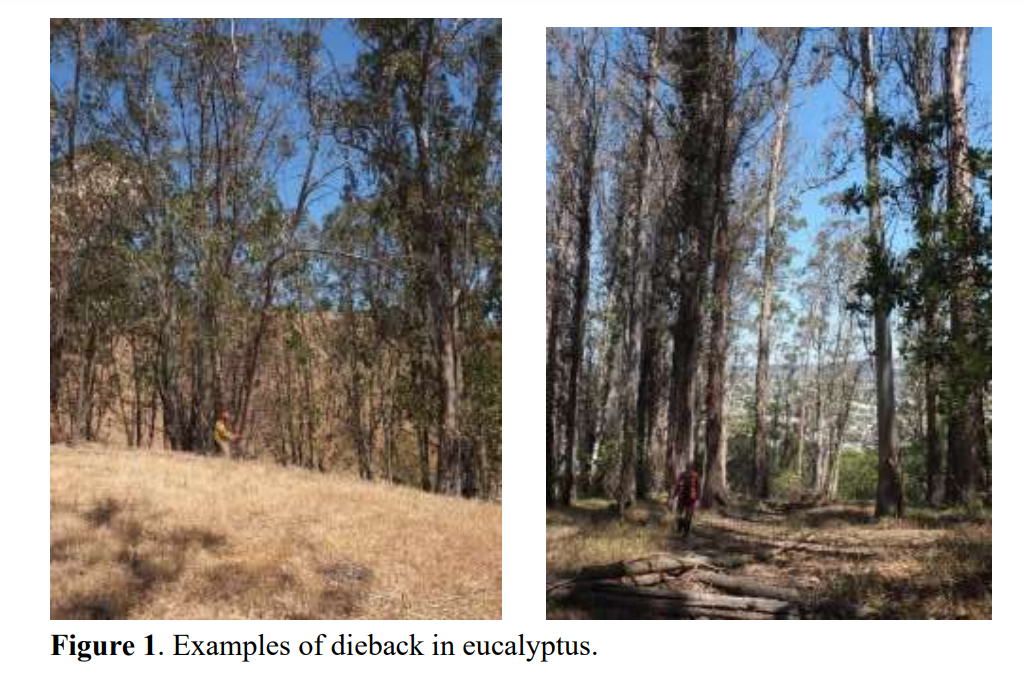
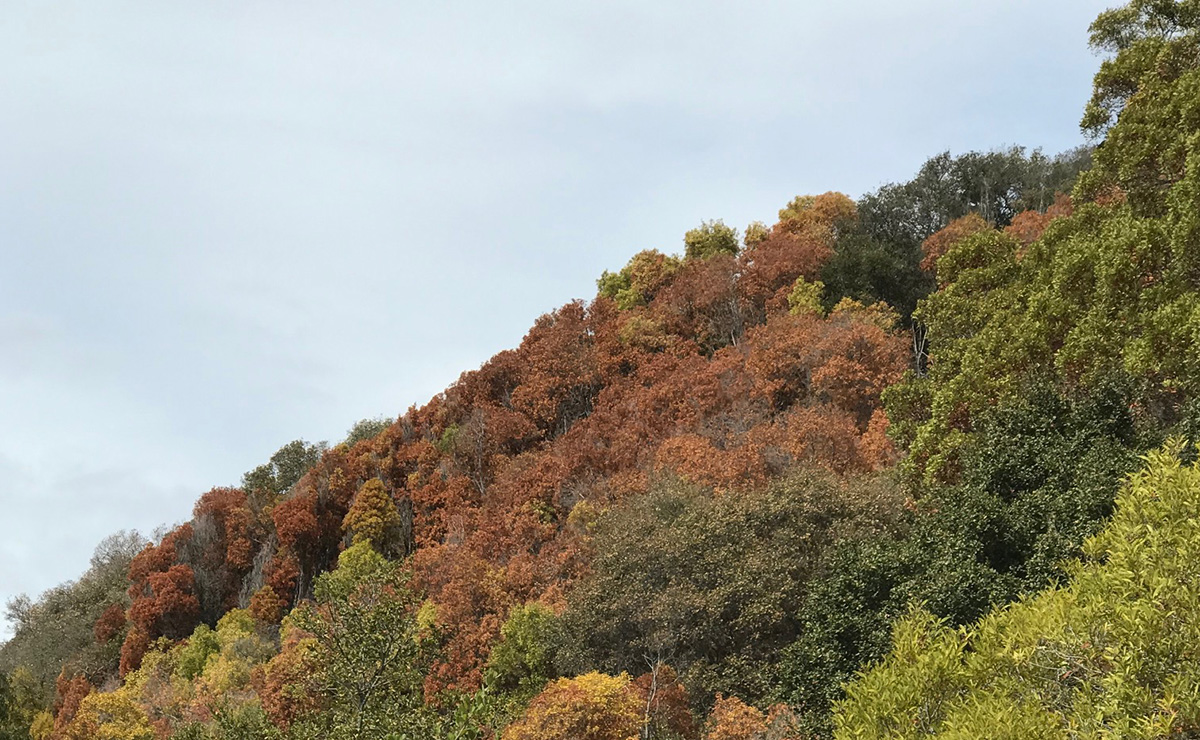
About 9 months later, the “native plant garden” looks more like a tree graveyard:

McLaren Native Plant Garden, July 2022
Some of the newly planted trees are holly leaf cherry. Signs on the trees indicate that the project was paid for with a CAL FIRE grant. One wonders how a garden full of dead wood is less flammable than a garden full of living trees.

Granted, the native plant garden is likely to look better as plants grow.  However, it will only look better if it is irrigated and taken care of.  Why should we expect it to be taken better care of than the existing garden that required no maintenance?  Wishful thinking will not make it so.

Update March 29, 2024:

This video of the native plant garden was made on March 27, 2024. It still looks like a tree graveyard, nearly 2 years after a functional forest was destroyed to create a native plant garden.

The death grip of nativism

Climate change is the environmental issue of our time.  We are seemingly incapable of doing anything substantive to address climate change.  Political gridlock prevents us from controlling the greenhouse gas emissions causing climate change.  The Supreme Court recently ruled that the Environmental Protection Agency does not have the authority to regulate polluting emissions from power plants. 

We focus on the preservation of our forests because it is the only tool we have left to absorb carbon emissions from the fossil fuels to which we are wedded.  Native plant advocates have taken that tool away from us.  Our urban forests are being destroyed and replaced with grassland and scrub.  Claims that grassland and scrub store more carbon than forests are ridiculous.  Those claims earn native plant advocates the label of climate change deniers.  As the drought continues to plague California, established landscapes that required no water are being destroyed and replaced with native plants that require irrigation. 

New funding creates new threats to eucalyptus trees

I recently received a message, asking for help to save a grove of eucalyptus trees on the Napa River from destruction:  “I live in Napa on the river where eucalyptus trees are going to be cut down that are home to owls, ravens, herons, egrets and more for over 50 years.  Could you please help save these beautiful trees and wildlife? Any suggestions or ideas would be greatly appreciated.”

Eucalyptus trees on Milton Road on the Napa River
Owls nest in the trees on Milton Road

I learned a few more details by speaking with the neighbor of the trees.  The trees are on State property and the project was going to be funded by California Department of Fish & Wildlife (CDFW).  There are few trees in this neighborhood and therefore few alternatives for the birds that roost and nest in the eucalyptus trees

Eucalyptus grove on the Napa River in which many birds nest and roost

The neighbors asked if herbicides would be used to prevent the trees from resprouting.  That was a concern partly because the well that supplies their drinking water is within 60 feet of the trees.  Before they received an answer to that question, they were informed that “CDFW has decided to halt their project of cutting down the eucalyptus trees on Milton Road!”  We don’t know why CDFW changed its mind, but we would like to believe the questions raised by the neighbors may have helped.  Thanks and congratulations to the neighbors of the eucalyptus grove on the Napa River.

Eucalyptus trees threatened in El Granada

Shortly before I heard from folks in Napa, I learned about a project to destroy eucalyptus in a small community on the coast of San Mateo County.  It’s a foggy coastal location, much like Mount Sutro in San Francisco, where fog drip from the trees during summer months keeps the ground moist and reduces fire hazards. 

The community has made a video (available HERE) about the project and the issues it raises.  It is an even-handed presentation that acknowledges the fire hazards of dense forests in the hills surrounding their community and contrasts that risk with the lower risk of the widely spaced trees in the medians of their village on flat land.  The video explains the many important functions that trees perform to store carbon, improve air quality, provide wind protection and habitat for birds.  The people of El Granada would like the project to reduce fire hazards in the hills, but retain the trees in their street medians because of their ecological value.  It’s a reasoned and reasonable approach.

Source: El Granda Advocates. http://egadvocates.org

The people of El Granada ask for your help to save some of their trees.  Their website (available HERE) invites you to sign their petition.

Predictable…and probably only the beginning

The State of California has committed billions of dollars in fire hazard mitigation, climate change, and biodiversity.  We watched the budgetary plans for these projects being developed in the past year and the plans were recently approved.  Now communities all over California are applying for State grants to implement projects like the two I have described today.  Now it’s up to communities to watch as plans are developed and participate in the process to ensure that the plans reflect their wishes.  It’s your money and your community.  Pay attention and engage in the process.

Postscript…different, but the same

Days before publishing this article, I received an email from Santa Barbara:  Well it is with great sadness we have to report that The University of California at Santa Barbara (UCSB) is again trying to destroy hundreds of Eucalyptus trees here at the University.  They want to destroy what is known as “The Eucalyptus Curtain” the boundary between the University and Isla Vista the college town here.” 

“Eucalyptus Curtain,” UC Santa Barbara. Source: localwiki.org

Some people who are trying to save this grove of eucalyptus are appealing to the California Coastal Commission.  They suggest those who share their opinion contact the CCC HERE.

In this case, the motivation for destroying these trees is not the usual allegation that they are a fire hazard.  According to this article in localwiki, the trees will be destroyed to build more student and faculty housing.  There is no question in my mind that we need more housing and I am rarely opposed to any housing project, including this one.  However, the consequences of destroying these trees are the same regardless of the motivation:

Eucalyptus and Bee, painting by Brian Stewart

Words Matter: “Die-Off” vs. “Die-Back”

California has been in severe drought conditions for over 10 years.  Climate change is the underlying reason for the extremity of the drought.  Maintaining our carbon sinks that sequester greenhouse gases causing climate change is one of our most important defenses against climate change and forests are one of our primary carbon sinks.  Unfortunately, California’s forests are dying of drought and associated insect infestations. You might think that given these conditions, we would try to preserve our forests. 

In fact, the drought has accelerated the war on our non-native urban forest in the San Francisco Bay Area.  All trees and plants have suffered during our prolonged drought.  Where trees are not irrigated in our parks and open spaces, signs of drought stress are visible.  Today, I am publishing my letter to the IPM Director and Fire Chief of East Bay Regional Park District about the need to make a distinction between dead trees and trees that are not dead, but showing symptoms of prolonged drought. My letter explains why we must distinguish between dead (described as “die-off”) and living trees (described as “die-back”) when making commitments to destroy trees that we desperately need during this climate crisis.

Links are provided to email addresses of recipients of my letter.  Please consider writing a letter of your own.


To:   Pam Beitz, Aileen Theile

CC:  Natural and Cultural Resources Committee, Matteo Garbelotto

As you know, the Park District hired the Garbelotto Lab at UC Berkeley to evaluate two species of trees in the parks, acacia and eucalyptus.  The reports of the Garbelotto Lab were recently published on the Lab’s website.  I am writing to ask that responsible staff read those reports and make adjustments in plans to remove trees as needed, based on those reports. 

Source: Report of Garbelotto Laboratory
Acacia die-off in Leona Canyon, East Bay Regional Park District. Source: US Forest Service

The diagnoses for acacia and eucalyptus are entirely different.  The pathogens are different in the two tree species.  The pathogens killing acacia are new and they are lethal.  The pathogens found in eucalyptus are not new.  They have been latent and asymptomatic in eucalyptus for decades and have only become symptomatic because of the stress of drought. The pathogens found in eucalyptus disfigure leaves and twigs, but are not fatal. 

Much like the microbes (bacteria, viruses, fungi, parasites) in our bodies that outnumber human cells, every tree is inhabited by microbes that are usually asymptomatic.  If similar tests were done on other tree species in the Bay Area, similar results would be found where trees are not irrigated.  The pathogens are always there.  Drought has made them visible.  If we were obligated to destroy every tree in the parks showing signs of drought stress, we would be required to remove most trees in the parks. 

There are significant disadvantages to destroying living trees:

  • A dead tree is not capable of resprouting, but a living tree is capable of resprouting unless it is a species that is not capable of resprouting. Eucalyptus, acacia, redwoods (not candidates for removal, but dying of drought nonetheless) and bay laurels are all vigorous resprouters.  The stumps of these living tree species will require herbicide applications to prevent them from resprouting. 
  • The herbicides used to prevent resprouting travel through the roots of the tree to kill the roots. Herbicides used to prevent resprouting damage the roots of neighboring plants and trees connected by their mycelium networks. 
  • The trees that are destroyed release their stored carbon into the atmosphere contributing to the greenhouse gasses causing climate change. In the absence of those trees, less carbon dioxide is removed from the atmosphere in the future.  Since the underlying cause of increased frequency and intensity of wildfires is the warmer/drier climate, removing living trees increases wildfire risks in the future.
  • As more trees die, wood debris has accumulated to the point that there isn’t sufficient disposal capacity. When roadsides in the Berkeley hills were clearcut over one year ago, it took 9 nine months to dispose of the wood debris.  Huge piles of wood debris were stacked on roadsides, creating a fire hazard.  The more trees that are destroyed, the more wood debris is created.
One of many piles of logs, Claremont Ave, November 2020. Photo by Doug Prose, courtesy Hills Conservation Network.

I am therefore concerned about the Park District’s plans to remove one million trees from parks in the East Bay, according to press coverage: “In consultation with academics and state experts, they’ve identified a mass die-off of trees in the parks as a result of stress from drought, climate change and a proliferation of non-native species. Now they estimate they need to remove more than 1 million trees on their land, at a cost of $20 million to $30 million in one park alone. One area of the die-off, located between Mt. Diablo and communities in Oakland and Berkeley, is particularly concerning to Fire Chief Aileen Theile.”  

In an earlier media interview Fire Chief Theile included eucalyptus in the list of dead trees: “The die-off, first noticed last October, has mostly hit eucalyptus, acacias, pines and bay laurels and has expanded this summer amid an exceptional drought.”  Oaks are strangely absent from that list of dead trees, although it is well known that there are thousands of dead oaks in the Park District that have not been removed.

In summary, I ask for your reconsideration of Park District plans and public communications regarding tree removals in the parks:

  • The Park District should confine plans for tree removals to dead trees. Dead trees are public safety risks that should be mitigated. Drought stressed trees that may be unsightly are not a priority for removal.  Given our heavy rains in December, it is still possible that many will recover.
  • Park District communications with the public should make a distinction between “die-off” and “die-back.” Acacias are accurately described as experiencing a die-off.  Eucalyptus are accurately described as experiencing a die-back.

Thank you for your consideration.