We are reprinting with permission an article about bats in San Francisco’s parks from the San Francisco Forest Alliance. The article reports observations of bats as well as a study of bat populations in San Francisco’s parks. The study found that both the number of bats as well as the number of species of bats was related to the amount of forest edge in each park and the availability of water. The study reports that the forest edge contains more insects which are the primary food of the bats.
We are posting this story today because hundreds of trees in Glen Canyon Park in which bats and many other creatures live are being destroyed as we speak. Here is a video of the destruction which started yesterday and continues today, along with a narrative of how and why this needless destruction is happening. Please watch this moving video to understand why we are so committed to opposing the pointless destruction of our trees by extremist agendas that are damaging the environment and harming the animals that live in our open spaces. (Edited to Add: And here is a video showing the second day of the demolition project.)
The study did not find any relationship between the number of bats nor the number of species of bats with the percent of native plant coverage. We speculate—although the study does not—that the absence of correlation between bat populations and native plant populations suggests that there are not more insects in native plants than at the forest edge. Although native plant advocates claim that more insects are found in native plants, this is yet more evidence that this claim is not true.
********************************
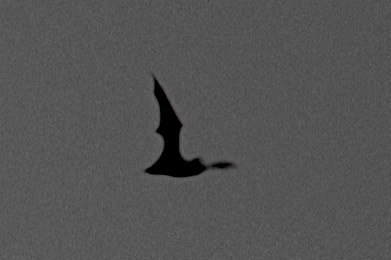
Bats are insect-eating machines. According to the USGS, “Bats normally eat about half their weight in flying insects each night.” So even for those who don’t find these night-flying mammals charming, it’s good to know there are bats among us.
San Francisco has at least four species of bats, all of which eat insects. According to research by Jennifer Krauel, which involved recording bat sounds to determine which species they were, Mexican Free-tailed bats are the most common. Parks with water – like Glen Canyon – also have Yuma Myotis bats. The other two species she found (more rarely) were Western Red Bats, and Little Brown Bats, and she found them in just a couple of places.
Her research indicated that “amount of forest edge and distance to water were the factors best explaining species richness and foraging activity.” It also showed that bats in San Francisco remain active through the winter and don’t hibernate or move elsewhere.
Glen Canyon’s bats are often visible at dusk. They’re most evident in the Fall, though they’ve been seen at other times of the year. (The pictures above are from February and April, those below from October.)
Here’s a note on bat-viewing from one visitor to Glen Canyon.
“It was late in the afternoon, and late in October. We were standing around the entrance to the park on Alms Rd. As dusk fell, bats emerged from the tall eucalyptus trees. Quite suddenly they were in the air right above us. I pulled out my camera, which is not really good in poor light but I tried to take some pictures anyway. Here’s one:
“They’re difficult to spot in the picture, but all those black smudges are bats that were moving too fast for my pocket-camera. Here’s the same picture, cropped, with the bats circled in yellow:
“They dispersed over the canyon. Here’s another picture from a few minutes later (and the one below it shows where the bats are).
“It was fantastic. I haven’t seen this many bats anywhere in San Francisco.”
LARGE TREES ARE IMPORTANT
We did a little research, and found a Stanford report that emphasized the importance of large trees to a particular species of bats, Yuma Myotis… bats that Krauel’s research had actually found in Glen Canyon Park.
“Yuma bats that forage in the preserve travel several miles to roost in large trees in Portola Valley and Woodside, suburban communities on the San Francisco Peninsula. The average diameter of the bats’ chosen trees is about a yard across — more than three times wider than the average tree in those areas.”
(The link to the abstract of the actual Stanford research paper is HERE.)
That’s the size of the big eucalyptus trees in Glen Canyon Park – including those that SFRPD wants to chop down.
WHY BATS MATTER
Bats are an important part of an eco-system, and fill a role few other creatures do: They hunt night-flying insects like mosquitoes that birds don’t catch because they’re sleeping. This is especially important now as West Nile virus, a mosquito-borne disease, has been spreading.
Having bats in a landscape contributes to its bio-diversity. All species of bats are protected in California.
(Some people are concerned that bats carry rabies – and it’s true no one should handle bats, especially grounded bats that may be sick, with their bare hands. But according to the California Department of Fish and Wildlife, less than 1% of bats are infected. [Click HERE to see their note.] The risk of getting rabies from a bat is less than the risk of being struck by lightning.)
HOW WILL SF RPD ENSURE THE PRESERVATION OF THE BATS?
We’re concerned about the impact of the planned tree removals on Glen Canyon’s bats.
All species of bats are protected, and removing the trees will impact their habitat by reducing the number of safe roosting spots, especially for Yuma Myotis bats that need both large trees and nearness to water.
The contractor will be chopping down the trees in the daytime. Bats roosting there are likely to be killed – if not in the process of the tree-felling, by being forced to fly blinded and confused in the daytime and fall prey to hawks, crows and ravens.
How is SF RPD going to ensure the protection of these bats?
And in what ways will felling large trees near the stream alter the ecology of the canyon?
In 2010, Timothy Paine, an entomologist at University of California, Riverside, published an article (1) about the introduction of Australian insect predators of eucalyptus into California. Eucalyptus is native to Australia. It was introduced to California in about 1850 and was virtually pest free until 1983. Since then 15 insect predators of the eucalyptus have been found in isolated locations in California.
Professor Paine observes that, “The spatial and temporal patterns of introductions [of these insect pests] do not seem to be random, particularly when taken in perspective of the geographic distribution of the insects in Australia.” For these and other reasons explained in his publication, Professor Paine speculates that “…with no definitive proof, we suggest that the multiple patterns may be nonrandom; instead they suggest the possibility of intentional introductions.”
In a recent interview Professor Paine explains, “We took all of the available information we had on the introduction of eucalyptus pests into California and the conclusion we drew is that there is a very high probability that someone was intentionally introducing [the insect pests of eucalyptus]…There is likely intentional movement of insect pests of eucalyptus into the state. The patterns suggest that.”
Professor Paine agonized about publishing his study. Responsible people are appropriately reluctant to make accusations in the absence of proof. He decided to publish because of the implications of his findings:
“Intentional introductions of insect herbivores onto crop plants, or organisms pathogenic to plants or domestic animals, represent an insidious threat that could severely damage the national agricultural economy, endanger a safe and abundant food supply, threaten water quality or quantity, increase the risk of wild fires, or degrade environmental quality across massive areas.”
Professor Paine has had some success with finding biological controls of these insect pests of the eucalyptus. However, as fast as he can find an effective antidote species of insect, a new pest arrives to attack the eucalyptus. His research is controversial because the native plant advocates who despise eucalyptus and demand its eradication are opposed to any attempt to control the insect infestation. Jake Sigg, our local, prominent native plant advocate is quoted as saying, “I think the University ought not to be going ahead with this research without considering all of the ramifications and hearing from all parties.”
Jake Sigg is a big fan of biological controls to eradicate non-native plants, so we find it ironic—even hypocritical–that he is opposed to research needed to save the eucalyptus from its insect predators. In his Nature News of February 18, 2011, he said, “On this scale, biological control offers the most promise, and–take note–would obviate the need for herbicides. Unfortunately, it is inadequately funded. The beauty of biocontrol is that if the necessary rigorous (and expensive) research is successful the problem of that plant is taken care of for all time–which means it is really inexpensive in the long run.”
So apparently biological controls are highly desirable if they are used to eradicate non-native plants and trees. If they are used to save non-native trees, they are verboten, in Mr. Sigg’s opinion.
The long track record of vandalism by native plant advocates
We can’t prove that Australian insects were intentionally imported to California to kill eucalypts. However, if they were it would not be the first time that native plant advocates have used vandalism to eradicate our eucalypts.
The historical record of vandalism of non-native trees in San Francisco goes back nearly 20 years. In 1994, the Sacramento Bee published an article (2) about non-native Monterey pines and eucalyptus being cut down in public parks by a native plant advocate by the name of Greg Gaar. According to the Sacramento Bee, Mr. Gaar had planted these trees and then changed his mind some 20 years later. (For the record, we note that we don’t approve of such unauthorized plantings any more than unauthorized destruction.)
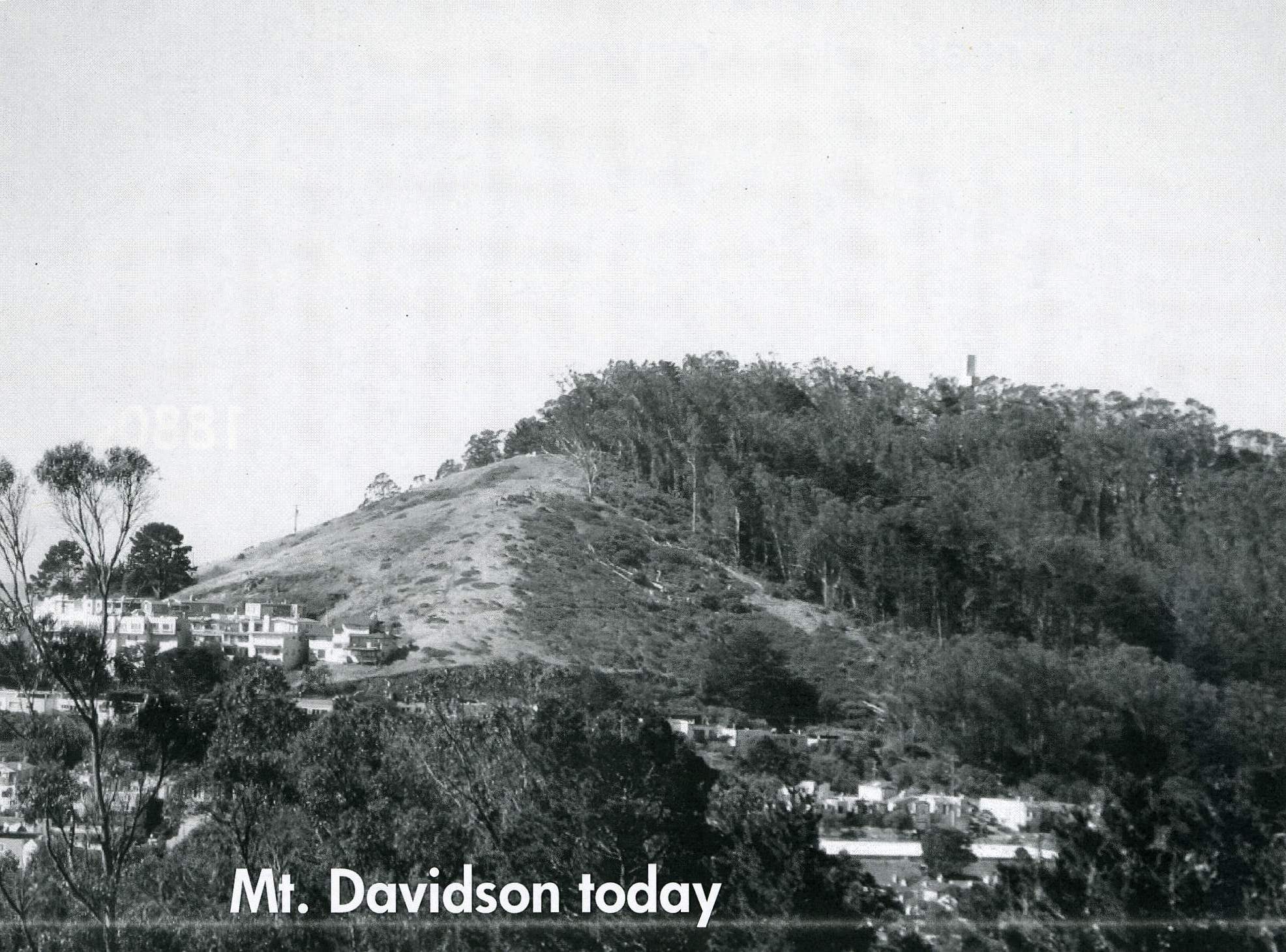
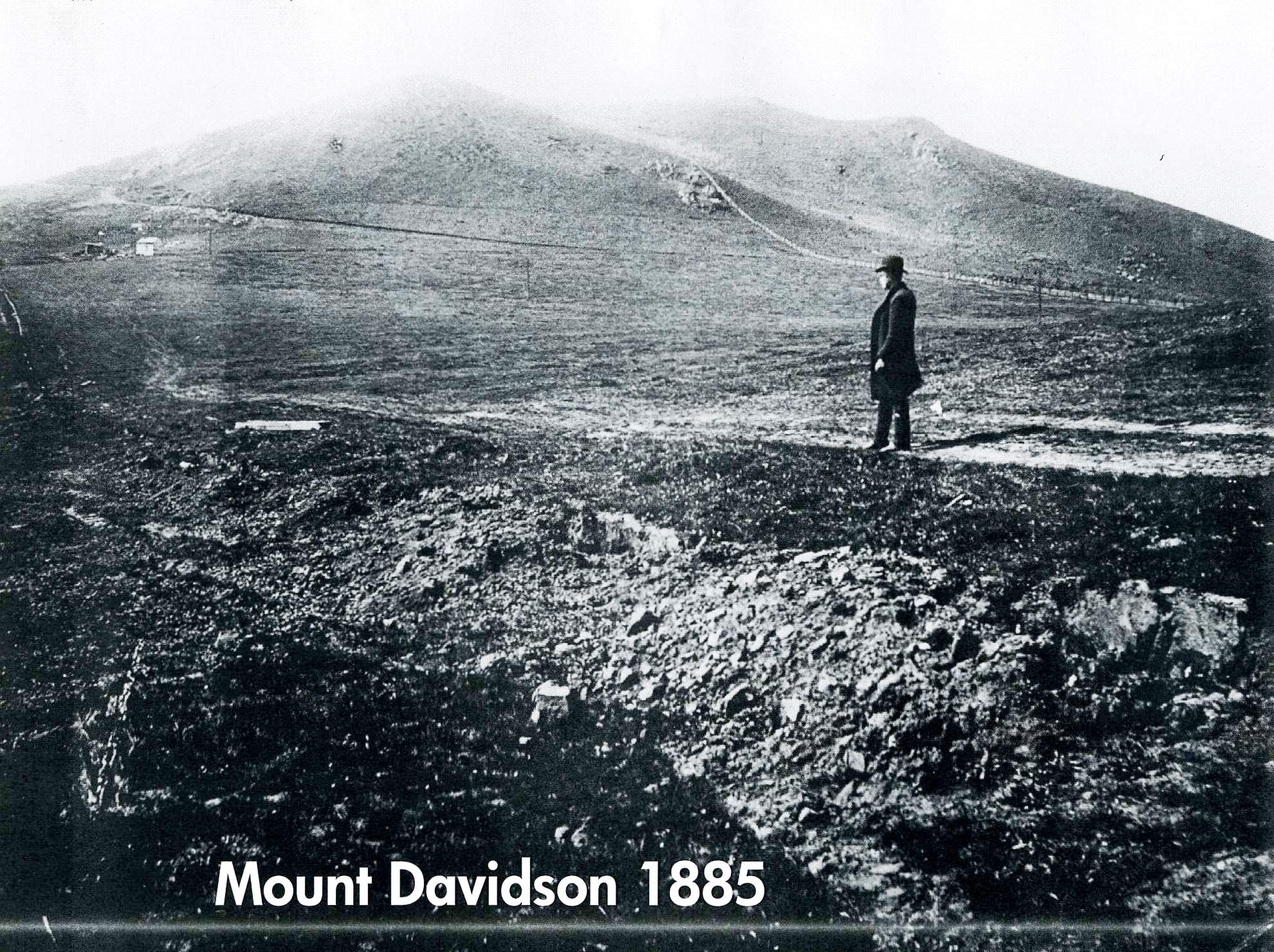
The California Native Plant Society apparently convinced Mr. Gaar that the trees were a threat to San Francisco’s “natural heritage.” He cut down trees on Mount Davidson and Tank Hill in San Francisco and was sent a bill for $10,996.27 by the Recreation and Park Department. The Bee reported that Mr. Gaar was unemployed and had no intention of paying the bill. Getting caught was apparently the end of that particular method of destroying non-native trees.
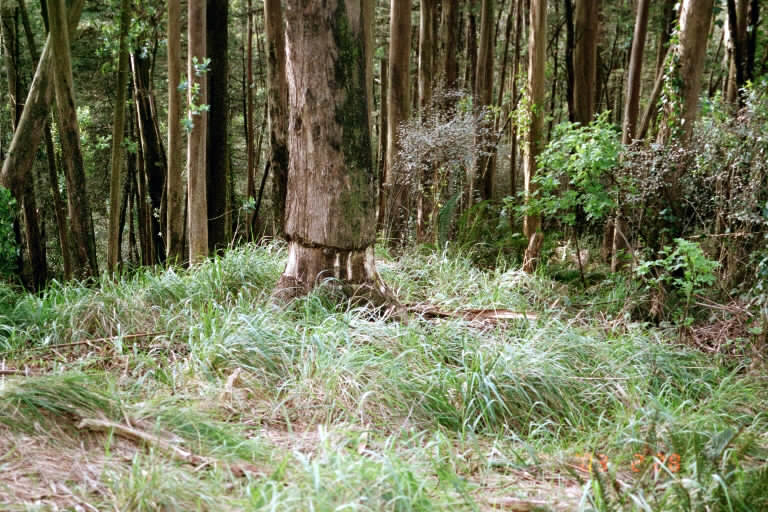
Native plant advocates then found a more surreptitious method of destroying the trees. They began girdling the trees in the public parks of San Francisco. Girdling is a method of killing a tree slowly. A band of bark is hacked off the circumference of the trunk with an axe or chainsaw. This prevents water and nutrients from traveling from the roots of the tree into the tree. The tree slowly starves to death. The bigger the tree, the longer it takes to die.
Girdled trees, Bayview Hill, San Francisco
After girdling the tree, native plant advocates stacked up vegetation around the scar so that it was not visible to the public. Even if the public noticed the scar, they didn’t know what it meant until the tree began to die. By the time the trees started to die several years after the girdling began, about 1,200 trees had been girdled in the parks of San Francisco. Most of them were on Bayview Hill, and many are still visible on Mount Davidson.
According to an article in The Independent, some of the girdling was done by city employees of the Natural Areas Program in the Recreation and Park Department, but much of it was done by native plant advocates, described as “volunteers” by their supporters and “vandals” by their critics. The Independent quotes the head of the urban forestry division of the Recreation and Park Department as saying that trees were also being killed by dousing them with pesticides.
There was a noisy outcry when the public figured out what they were doing. The native plant advocates paid a public relations price for their vandalism and they quit doing it. They are no less dedicated to destroying all of our eucalypts. Perhaps they have moved on to even more nefarious methods such as introducing deadly insects.
We wouldn’t be at all surprised. One of our more memorable debates with a prominent local nativist was about the plan of the Natural Areas Program to reintroduce a legally protected native turtle to a local park that is heavily forested with eucalypts. We knew that rare turtle requires unshaded nesting habitat within 500 feet of its water source. Providing that habitat to this legally protected turtle would have required the destruction of all the trees in that park.
When we objected to the reintroduction of that turtle, the nativist smirked and said, “You know nothing can stop us from putting that turtle in that park whenever we want. And the law provides the same legal protection to that turtle whether it is found there naturally or put there by man.”
Some of these people will stop at nothing. They are appropriately called eco-terrorists.
———————————————————————————
(1) Timothy Paine, et. al., “Accumulation of Pest Insects on Eucalyptus in California: Random Process or Smoking Gun,” Journal of Economic Entomology, 103(6): 1943-1949, 2010
(2) “San Francisco garden guerrillas axing alien plants in San Francisco,” Sacramento Bee, February 19, 1994. This article is not available free on-line. However, it can be purchased inexpensively from Sacramento Bee Archives.
Nature in the City (NIC) is one of many organizations that support native plant “restorations” in San Francisco as well as the principle entity which engages in them, the Natural Areas Program (NAP) of the Recreation and Park Department. NIC is consistently critical of anyone who questions the value of these restorations, but in their most recent newsletter they confront our objections directly. Although we don’t presume to represent the many constituencies which are critical of the Natural Areas Program, we are responding in this post to NIC based on our knowledge of the issues. (The NIC newsletter is in quotes and is italicized. Our response is not italicized.)
“Natural Areas in 2012
Last fall saw the the [sic] Planning Commission public meeting for the Draft Environmental Impact Report (DEIR) for the Significant Natural Resource Areas Management Plan. Some time later this year, the City will issue a Final Environmental Impact Report, which may be appealed by opponents of the Natural Areas Program.
Unfortunately, a handful of people are still propagating misinformation about the rationale, values, and intention of ecological restoration, management and stewardship, and of the City’s celebrated Natural Areas Program.”
Webmaster: Critics of the Natural Areas Program cannot be described accurately as a “handful of people.” We now have four websites(1) representing our views and there have been tens of thousands of visits to our websites. Comments on our websites are overwhelmingly supportive of our views. Our most recently created website, San Francisco Forest Alliance, lists 12 founding members. That organization alone exceeds a “handful of people.”
Our objections to the Natural Areas Program have also been reported by three major newspapers in the past month or so (San Francisco Examiner, Wall Street Journal, Sacramento Bee).
Many critics of NAP have been engaged in the effort to reduce its destructive and restrictive impacts on our parks for over 10 years. Scores of public meetings and hearings have been held to consider our complaints. We consistently outnumbered public speakers in support of NAP until 2006, when the NAP management plan was finally approved by the Recreation and Park Commission. Although we were outnumbered for the first time, there were over 80 speakers who asked the Recreation and Park Commission to revise NAP’s management plan to reduce its negative impact on our parks.
The public comments on the NAP DEIR are the most recent indicator of the relative size of the groups on opposite sides of this issue. These comments were submitted in September and October 2011. We obtained them with a public records request. The Planning Department reported receiving about 400 comments. In analyzing these comments, we chose to disregard about half of them because they were submitted as form letters, even though they were from dog owners who were protesting the loss of their off-leash privileges in the natural areas. We also leave aside the comments from golfers whose only interest is in retaining the golf course at Sharp Park. In other words, we set aside the majority of the comments critical of the NAP management plan in order to focus on those comments that demonstrate a comprehensive understanding of the impact of NAP on the city’s parks. Of the comments remaining, those critical of NAP and its deeply flawed DEIR outnumbered comments in support of the NAP DEIR about three to one. We urge NAP supporters to read these public comments to learn about the wide range of criticisms of NAP, including pesticide use, destruction of trees, recreational access restrictions, loss of wildlife habitat and more.
We will challenge NIC’s accusation that we are “propagating misinformation” within the context of their specific allegations:
“Contrary to the many myths that continue to percolate, the Natural Areas Plan and Program seek to do the following (among other worthwhile endeavors):
1. Protect and conserve our City’s natural heritage for its native wildlife and indigenous plant habitats and for the overall health of our local ecosystem;”
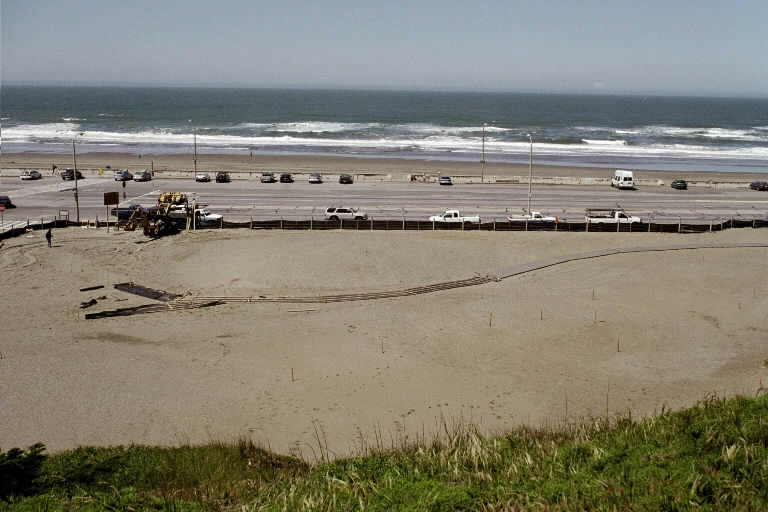
Webmaster: Since the majority of acreage claimed as natural areas by NAP 15 years ago had no native plants in them, there is little truth to the claim that NAP is protecting our “natural heritage.” The so-called “natural area” at Balboa and the Great Highway is typical of the “natural areas.” There is photographic evidence that it was built upon for about 150 years. It was the site of Playland by the Beach before it was designated a “natural area.” Sand had to be trucked onto the property and disked down 18” into the construction rubble, then shaped into dunes by bulldozers before native plants could be planted on it.
Natural Area at Balboa & Great Highway under construction
We don’t make any distinction between “native wildlife” and any other wildlife currently living in our city. We value them all. Most are making use of existing vegetation, whether it is native or non-native. They do not benefit from the loss of the blackberries that are their primary food source or the loss of the thickets or trees that are their homes. We do not believe that wildlife in San Francisco benefits from the destructive projects of the Natural Areas Program. See photos of insects, birds, and other wildlife using non-native plants in the natural areas here.
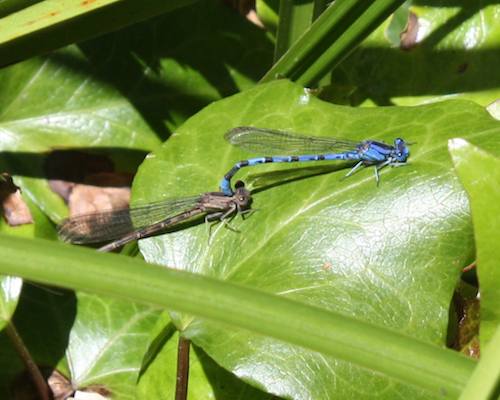
Damselflies mating on ivy, Glen Canyon Park
We do not think an ecosystem that has been sprayed with herbicides qualifies as a “healthy ecosystem.” NAP sprayed herbicides at least 86 times in 2011. Their use of herbicides has increased over 330% in the last 4 years. NAP uses herbicides that are classified as more toxic than those most used by other city departments. Last spring, 1,000 visitors to Glen Canyon Park signed a petition, asking the Natural Areas Program to stop using pesticides in their park. This petition was given to Scott Wiener, the Supervisor representing the district in which Glen Canyon Park is located.
These are statements of fact that can be easily verified by the public record.
2. “Educate our culturally diverse city about the benefits of local nature and about helping with natural areas stewardship in your neighborhood;”
And we also have had bad experiences with the volunteers who are called “stewards” by NAP, but sometimes act more like vandals. We see them spraying herbicides that they aren’t authorized to use. We see them hacking away at trees that haven’t been designated for removal. NAP is not providing the necessary guidance and supervision to the volunteers many of whom seem to consider themselves the de facto owners of the parks.
3. “Manage the City’s wildlands for public access, safety and the health of the “urban forest.””
“We hear occasional complaints about public access and tree removal. Three simple facts are thus:
1. Every single natural area in the City has at least one trail through it, where one can walk a dog on a leash;”
Webmaster: The loss of recreational access in the natural areas is real, not imagined. The following are verbatim quotes from the NAP management plan:
“Approximately 80 percent of the SFRPD off-leash acreage is located within Natural Areas.” (page 5-8). The NAP DEIR proposes to close or reduce the size of several off-leash areas. The DEIR provides no evidence that these areas have been negatively impacted by dogs. It also states that all off-leash areas in the natural areas are subject to closure in the future if it is considered necessary to protect native plants. Since NAP has offered no evidence that the proposed immediate closures are necessary, one reasonably assumes it will offer no evidence if it chooses to close the remainder of the 80% of all off-leash areas in San Francisco located in natural areas. We know from the DEIR public comments that NAP supporters demand their closure.
“Public use in all Natural Areas, unless otherwise specified, should encourage on-trail use… Additionally, interpretive and park signs should be installed or modified as appropriate to include “Please Stay on Trails” with information about why on-trail use is required.” (page 5-14) In other words, the only form of recreation allowed in the natural areas is walking on a trail. Throwing a ball or frisbee, having a picnic on the grass, flying a kite, climbing the rocks are all prohibited activities in the natural areas. And in some parks, bicycles have been prohibited on the trails by NAP.
“Finally, this plan recommends re-routing or closing 10.3 miles of trail (approximately 26 percent of total existing trails).” (page 5-14) So, the only thing visitors are allowed to do in a natural area is walk on the trails and 26% of all the trails in the natural areas will be closed to the public.
2. “The act of removing (a small subset of) non-native trees, e.g., eucalyptus, that are in natural areas has the following benefits:
a. Restores native habitat for indigenous plants and wildlife;
b. Restores health, light and space to the “urban forest,” since the trees are all crowded together and being choked by ivy;
c. Contributes to the prevention of catastrophic fire in our communities.”
Webmaster: Destroying non-native plants and trees does not restore indigenous plants and wildlife. Native plants do not magically emerge when non-native plants and trees are destroyed. Planting indigenous plants might restore them to a location if they are intensively gardened to sustain them. However, in the past 15 years we have seen little evidence that NAP is able to create and sustain successful native plant gardens. Native plants have been repeatedly planted and they have repeatedly failed.
NAP has not “restored” the health of the urban forest. They remove trees in big groups as they expand their native plant gardens. They are not thinning trees. They are creating large openings for the grassland and dune scrub that they plant in the place of the urban forest. Every tree designated for removal by the NAP management plan is clearly selected for its proximity to native plants. It is disingenuous to suggest that NAP’s tree removal plans are intended to benefit the urban forest.
3. “The overall visual landscape of the natural areas will not change since only a small subset of trees are planned to be removed over a 20-year period.”
“Please feel free to email steward@natureinthecity.org if you would like more clarification about the intention, values and rationale of natural resources management.”
Webmaster: We urge our readers to take NIC up on this offer to provide ”more clarification” of its spirited defense of the Natural Areas Program.
Do you think NIC is deluded about there being only a “handful of people” that are critical of the Natural Areas Program?
Did you notice that NIC does not acknowledge the use of herbicides by NAP? Do you think that a fair representation of criticism of NAP can omit this issue?
If you visit a park that is a natural area, do you think NAP has demonstrated in the past 15 years what NIC claims it is accomplishing?
Do you think NIC has accurately described recreational access restrictions in the natural areas?
Do you think that San Francisco’s urban forest will be improved by the destruction of 18,500 mature trees and countless young trees?
(2) “The California Department of Forestry and Fire Protection (CAL FIRE) has no record of any wildfire in San Francisco.” San Francisco Hazard Mitigation Plan, 2008, page 5-18.
We don’t usually talk about tree destruction projects on private land. We focus on public lands because, as taxpayers we’re paying for those projects and we consider ourselves the owners of public land. We also respect private property rights. We’ll make an exception to that general rule today to tell you about the eradication of eucalypts at the Mountain View Cemetery in Oakland, California.
We learned about this project from one of the cemetery’s periodic mailings to its neighbors. They informed their neighbors that they planned to plant more trees because they observed that fewer shrubs grew under the canopy of trees. They also said they “prefer to plant using what grows well in the Bay Area climate with minimal water and intervention.” Finally, they concluded in what seemed a non sequitur, “We intend to remove unwanted eucalyptus trees that border the cemetery. Although they provide a useful neighborhood screen and help to architecturally define our outdoor landscape, eucalyptus is a damaging pest to the cemetery.”
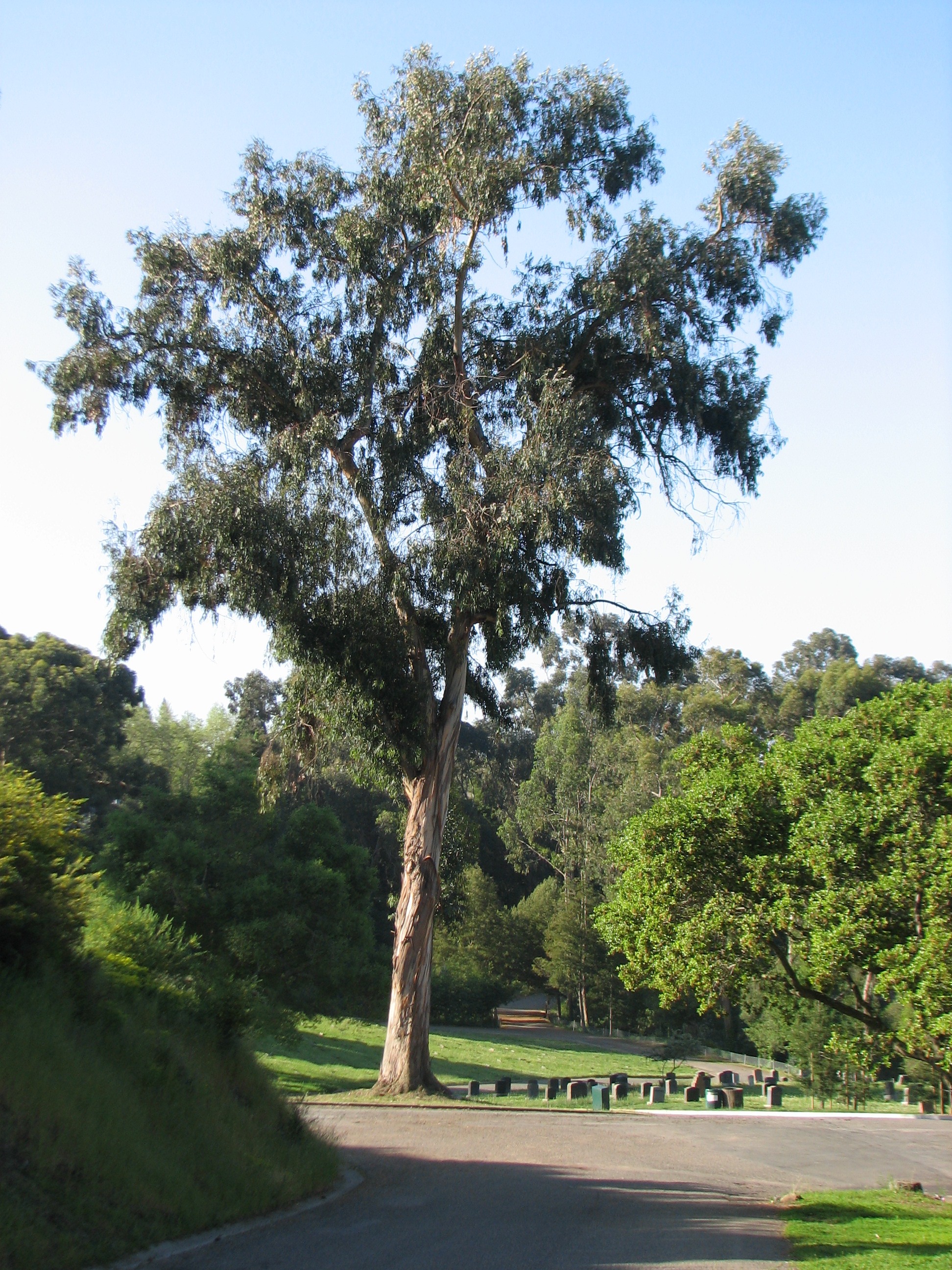
Eucalyptus, Mountain View Cemetery
Having received this warning, we weren’t surprised when the eucalypts began to disappear from the cemetery. The lone specimens in prominent areas in the cemetery seem to us a terrible loss.
Few trees grow more successfully than eucalypts in the San Francisco Bay Area. They require no supplemental water. They live for several hundred years in Australia and have grown here for over one-hundred years. They are not invasive.We don’t think they deserve to be called a “pest.”
Gone, but not forgotten
The Mountain View Cemetery was planned by Frederick Law Olmstead in 1863 and building began shortly thereafter. Although there are native Coast Live Oaks and Redwoods, according to an arborist docent they were all planted after the cemetery was built. This is as we would expect because, “Vegetation before urbanization in Oakland was dominated by grass, shrub, and marshlands that occupied approximately 98% of the area. Trees in riparian woodlands covered approximately 1.1% of Oakland’s preurbanized lands…”*
The vast majority of trees in the cemetery are not native. The original tree-lined avenue through the center of the cemetery was planted with Magnolias by Olmstead. There are many stunning specimens of non-native trees: Dawn Redwood, Copper Beech, Ginkos, etc.
Ginko in the fall, Mountain View Cemetery
Eucalyptus is not our favorite tree. We would probably choose to plant many other species before we would consider planting eucalyptus. However, the decision to plant a tree is very different from the decision to destroy a tree. We see no justification for destroying mature, healthy trees sequestering thousands of tons of carbon. The prejudice against eucalyptus remains a mystery to us.
Edited to add: The Oakland Tribune reported on March 4, 2012 that many neighbors of the Mountain View Cemetery object to the destruction of the eucalyptus trees. The Tribune reported that the neighbors are concerned about the loss of habitat for birds. The cemetery claims they are destroying the eucalyptus because they are flammable. As we have said many times on Million Trees, this is one of many fabricated fictions used by native plant advocates to justify the eradication of non-native plants and trees.
*Nowak, David, “Historical vegetation change in Oakland and its implication for urban forest management,” Journal of Arboriculture, 19(5): September 1993
The San Francisco Natural Areas Program (NAP) plans to destroy thousands of healthy trees in San Francisco’s parks. The Draft Environmental Impact Review (EIR) for NAP’s destructive plan reaches the bizarre conclusion that removing thousands of trees will have no significant impact on the environment. This conclusion is based on several fictional premises. In a previous post we examined the fictional claim that all the trees that will be removed will be replaced within the natural areas by an equal number of trees that are native to San Francisco. In this post we will examine another of the fictional premises: that only dead, dying, hazardous, or unhealthy trees will be removed.
We have many reasons to challenge the truth of the claim that only dead, dying, hazardous or unhealthy trees will be removed:
The management plan for the Natural Areas Program tells us that young non-native trees under 15 feet tall will be removed from the natural areas. By definition these young trees are not dead or unhealthy because they are young and actively growing.
The management plan has not selected only dead, dying, hazardous trees for removal. Trees have been selected for removal only in so far as they support the goal of expanding and enhancing areas of native plants, especially grasslands and scrub.
The predominant non-native tree in San Francisco, Blue Gum eucalyptus lives in Australia from 200-400 years, depending upon the climate.(1) In milder climates, such as San Francisco, the Blue Gum lives toward the longer end of this range.
However, there are many natural predators in Australia that were not imported to California. It is possible that the eucalypts will live longer here: “Once established elsewhere, some species of eucalypts are capable of adjusting to a broader range of soil, water, and slope conditions than in Australia…once released from inter-specific competitions and from native insect fauna…”(2)
The San Francisco Presidio’s Vegetation Management Plan reports that eucalypts in the Presidio are about 100 years old and they are expected to live much longer: “blue gum eucalyptus can continue to live much longer…”(3)
The Natural Areas Program has already destroyed hundreds of non-native trees in the past 15 years. We can see with our own eyes, that these trees were not unhealthy when they were destroyed.
How have mature trees been selected for removal?
The EIR wants us to believe that only dead, dying, hazardous trees will be removed from the natural areas. This claim is contradicted by the management plan that the EIR is claiming to evaluate. Not a single explanation in the management plan for why specific trees over 15 feet tall have been selected for removal is based on the health of the trees. Trees less than 15 feet tall will also be removed, but are not counted by the management plan.
Lake Merced: The explanation for removing 134 trees is “To maintain and enhance native habitats, it is necessary to selectively remove some trees.”
Mt. Davidson: The explanation for removing 1,600 trees is: “In order to enhance the sensitive species habitat that persists in the urban forest understory and at the forest-grassland ecotone, invasive blue gum eucalyptus trees will be removed in select areas. Coastal scrub and reed grass communities require additional light to reach the forest floor in order to persist “
Glen Canyon: The explanations for removing 120 trees are: “to help protect and preserve the native grassland” and “to increase light penetration to the forest floor”
Bayview Hill: The explanation for removing 505 trees is: “In order to enhance the sensitive species habitat that persists in the urban forest understory and at the forest-grassland ecotone, invasive blue gum eucalyptus trees will be removed in select areas.”
McLaren: The explanation for removing 805 trees is: “In order to enhance the sensitive species habitat that persists in the urban forest understory and at the forest-scrub-grassland ecotone, invasive trees will be removed in select areas. Coastal scrub and grassland communities require additional light to reach the forest floor in order to persist.”
Interior Greenbelt: The explanation for removing 140 trees is: “In order to enhance the seasonal creek and sensitive species habitat that persists in the urban forest understory, invasive blue gum eucalyptus trees will be removed in select areas.”
Dorothy Erskine: The explanation for removing 14 trees is: “In order to enhance the grassland and wildflower community, removal of some eucalyptus trees is necessary.”
In not a single case does the management plan for the Natural Areas Program corroborate the claim made in the EIR that only dead, dying, diseased, or hazardous trees will be removed. In every case, the explanation for the removal of eucalypts is that their removal will benefit native plants, specifically grassland and scrub. The author of the EIR has apparently not read the management plan or has willfully misrepresented it.
The track record of tree removals in the natural areas
Although it’s interesting and instructive to turn to the written word in the management plan for the Natural Areas Program to prove that the EIR is based on fictional premises, the strongest evidence is the track record of tree removals in the past 15 years. As always and in every situation, actions speak louder than words.
Hundreds of trees have been removed in the natural areas since the Natural Areas Program began 15 years ago. We’ll visit a few of those areas with photographs of those tree removals to prove that healthy, young non-native trees have been destroyed. This track record predicts the future: more healthy young trees will be destroyed in the future for the same reason that healthy young trees were destroyed in the past, i.e., because their mere existence is perceived as being a barrier to the restoration of native grassland and scrub.
Girdled trees, Bayview Hill, 2010
The first tree destruction by the Natural Areas Program and its supporters took the form of girdling about 1,000 healthy trees in the natural areas about 10 to 15 years ago. Girdling a tree prevents water and nutrients from traveling from the roots of the tree to its canopy. The tree dies slowly over time. The larger the tree, the longer it takes to die. None of these trees were dead when they were girdled. There is no point in girdling a dead tree.
One of about 50 girdled trees on Mt. Davidson, 2003
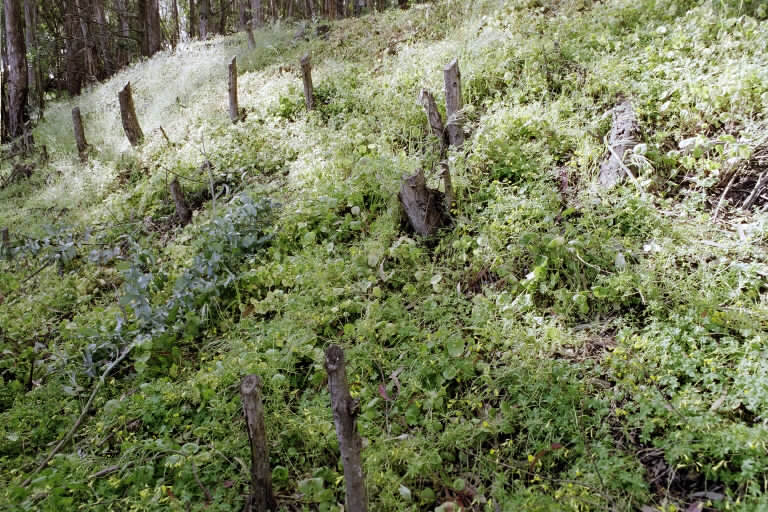
Many smaller trees that were more easily cut down without heavy equipment were simply destroyed, sometimes leaving ugly stumps several feet off the ground.
Bayview Hill, 2002
About 25 young trees were destroyed on Tank Hill about 10 years ago. The neighbors report that they were healthy trees with trunks between 6″ to 24″ in diameter and therefore fairly young trees. The trees that remain don’t look particularly healthy in the picture because they were severely limbed up to bring more light to the native plant garden for which the neighboring trees were destroyed. The neighbors objected to the removal of the trees that remain. The Recreation and Park Department agreed to leave them until they were replaced by native trees. Only 4 of the more than two dozen live oaks that were planted as replacements have survived. They are now about 36″ tall and their trunks are about 1″ in diameter.
Tank Hill, 2002
About 25 young trees were destroyed in 2004 at the west end of Pine Lake to create a native plant garden that is now a barren, weedy mess surrounded by the stumps of the young trees that were destroyed.
Pine Lake "Natural Area" 2011
About 25 trees of medium size were destroyed at the southern end of Islais Creek in Glen Canyon Park about 6 years ago in order to create a native plant garden.
There was nothing wrong with any of these trees before they were destroyed. Their only crime was that they were not native to San Francisco. There are probably many other trees that were destroyed in the natural areas in the past 15 years. We are reporting only those removals of which we have personal knowledge.
If you care about the trees of San Francisco….
If you care about the trees of San Francisco, please keep in mind that the public will have an opportunity to comment on the proposal to remove thousands of trees in the city’s parks. There will be a public hearing on October 6, 2011, and the deadline for submitting a written comment is October 17, 2011*. Details about how to comment are available here.
*[ETA: The deadline for written comments has been extended to October 31, 2011, at the request of the Planning Commission.]
(1) Jacobs, Growth Habits of the Eucalyptus, 1955, page 67
(2) Doughty, The Eucalyptus, 2000, page 6
(3) San Francisco Presidio’s Vegetation Management Plan, page 28
The San Francisco Natural Areas Program (NAP) plans to destroy thousands of trees in San Francisco’s parks. The Draft Environmental Impact Report (EIR) for NAP’s destructive plan reaches the bizarre conclusion that removing thousands of trees will have no significant impact on the environment. This conclusion is based on several fictional premises. In this post we will examine one of those premises: that all the trees that are removed will be replaced within the natural areas by an equal number of trees that are native to San Francisco.
The EIR supports this fictional premise by falsely reducing the number of trees that will be removed by:
Not counting trees less than 15 feet tall, despite the fact that the US Forest Service survey of San Francisco’s urban forest reports that the trunks of most (51.4%) trees in San Francisco are less than 6 inches in diameter at breast height, the functional equivalent of trees less than 15 feet tall.
Not counting the hundreds of trees that were destroyed prior to the approval of the NAP management plan at Pine Lake, Lake Merced, Bayview Hill, Glen Canyon parks, etc.
Not counting tree removals proposed by the “Maximum Restoration Alternative” which the EIR says is the “Environmentally Superior Alternative.” [ETA: The Planning Department later admitted that this is a mistake in the EIR. The “Maintenance Alternative” is the “Enviromentally Superior Alterantive.”]
However, even artificially reducing the number of tree removals does not make “one-to-one” replacement a realistic goal.
The natural history of trees in San Francisco
The primary reason why we know that it will not be possible to grow thousands more native trees in the natural areas in San Francisco is that there were few native trees in San Francisco before non-native trees were planted by European settlers in the late 19th century. San Francisco’s “Urban Forest Plan” which was officially adopted by the Urban Forestry Council in 2006 and approved by the Board of Supervisors describes the origins of San Francisco’s urban forest as follows:
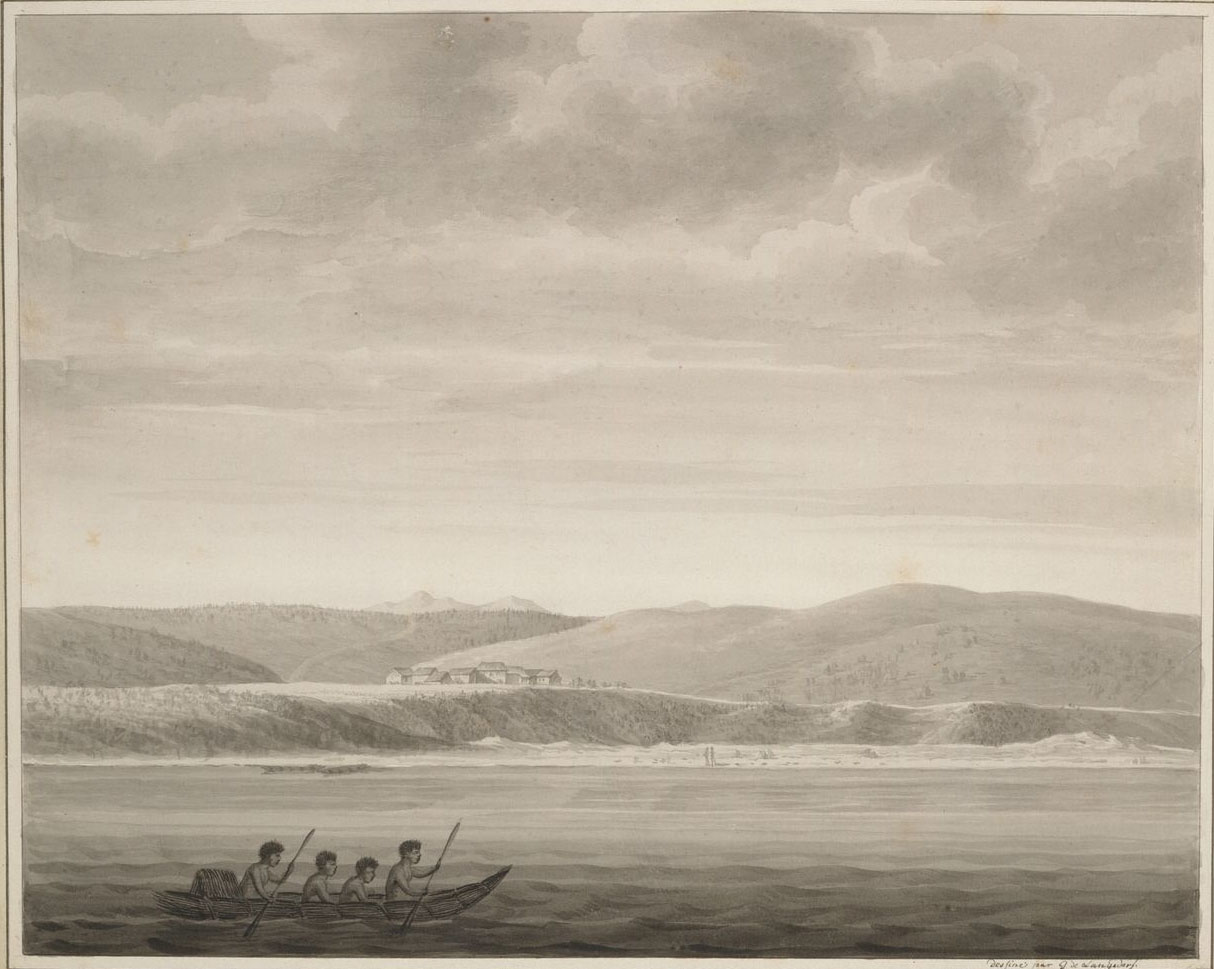
“No forest existed prior to the European settlement of the city and the photographs and written records from that time illustrate a lack of trees…Towards the Pacific Ocean, one saw vast dunes of sand, moving under the constant wind. While there were oaks and willows along creeks, San Francisco’s urban forest had little or nothing in the way of native tree resources. The City’s urban forest arose from a brief but intense period of afforestation, which created forests on sand without tree cover.”
San Francisco in 1806 as depicted by artist with von Langsdorff expedition. Bancroft Library
The horticultural reality of trees native to San Francisco
More importantly, the reality is that even if we want to plant more native trees in San Francisco, they will not grow in most places in San Francisco. We know that for several reasons:
There are few native trees in San Francisco now. According to the US Forest Service survey of San Francisco’s urban forest only two species of tree native to San Francisco were found in sufficient numbers to be counted in the 194 plots they surveyed: Coast live oak was reported as .1% (one-tenth of one percent) and California bay laurel 2.1% of the total tree population of 669,000 trees.
The city of San Francisco maintains an official list of recommended species of trees for use by the Friends of the Urban Forest and the Department of Public Works. The most recent list categorizes 27 species of trees as “Species that perform well in many locations in San Francisco.” There is not a single native tree in that category. Thirty-six tree species are categorized as “Species that perform well in certain locations with special considerations as noted.” Only one of these 36 species is native to San Francisco, the Coast live oak and its “special considerations” are described as “uneven performer, prefers heat, wind protection, good drainage.” The third category is “Species that need further evaluation.” Only one (Holly leaf cherry) of the 22 species in that category is native to San Francisco.
Finally, where native trees have been planted by NAP to placate neighbors who objected to the removal of the trees in their neighborhood parks, the trees did not survive.
Will NAP plant trees that won’t survive?
Given what we know about the horticultural requirements of the trees that are native to San Francisco, what are we to think of the claim that all non-native trees removed by the Natural Areas Program will be replaced by native trees? Is there any truth to this claim? Will native trees be planted that won’t survive? Or will they just not plant the trees that they claim will be planted?
We turn to the management plan for the Natural Areas Program for the answer to this question. In fact, the management plan proves that NAP has no intention of planting replacement trees for the thousands of trees they intend to destroy. The “Urban Forestry Statements” in Appendix F of the management plan contain the long-term plans for the natural areas in which trees will be destroyed. All but one of these specific plans is some variation of “conversion of some areas of forest to scrub and grasslands.” The exception is Corona Heights for which the plans are “converted gradually to oak woodland.” The Corona Heights natural area is 2.4 acres, making it physically impossible to plant thousands of oaks in that location.
NAP plans to destroy 1,600 trees over 15 feet tall on Mt. Davidson and more if the EIR is approved.
Putting the magnitude of the proposed tree removals into perspective
It isn’t easy to confront public policies. We all have better things to do. So, before we leave this issue, let’s consider the magnitude of the loss of thousands of trees in San Francisco. We turn to the survey of San Francisco’s urban forest by the US Forest Service to put the proposed tree removals into perspective:
There are only 669,000 trees in San Francisco, with a tree cover of only 11.9% of the land. Of the 14 cities in the US reported by this survey, only Newark, New Jersey has a smaller tree canopy, covering 11.5% of the land.
Most of these trees are small: 51.4% have trunk diameters of less than 6” at breast height.
The highest densities of trees are found in San Francisco’s open spaces, such as parks.
The trees and shrubs of San Francisco remove 260 tons of air pollutants (CO, NO₂ , O₃, PM₁₀, SO₂) per year
The trees of San Francisco now store 196,000 tons of carbon. Stored carbon is released into the atmosphere when trees are destroyed and as they decay as chips or logs on the ground.
In San Francisco, the blue gum eucalyptus stores and sequesters the most carbon (approximately 24.4% of the total accumulated carbon stored and 26.4% of annual rate of carbon sequestered). Most of the trees that have been destroyed in the past and will be destroyed in the future by NAP are blue gum eucalyptus.
If you care about the trees of San Francisco, please keep in mind that the public will have an opportunity to comment on the proposal to remove thousands of trees in the city’s parks. There will be a public hearing on October 6, 2011, and the deadline for submitting a written comment is October 17, 2011*. Details about how to comment are available here.
*[ETA: The deadline for written comments has been extended to October 31, 2011, at the request of the Planning Commission.]
Fifteen years after San Francisco’s Natural Areas Program (NAP) began operation and 5 years after its management plan was approved, the Draft Environmental Impact Report (EIR) has finally been published. We will briefly summarize the history of NAP, describe the plans as they were approved in 2006, and conclude with a comparison between those plans and the proposal in the EIR to aggressively expand NAP.
The Management Plan for the Natural Areas Program
In 1995 the Recreation and Park Commission approved the designation of 31“natural areas” in parks managed by the city of San Francisco. This designation committed 25% of the city’s park acreage in San Francisco, 33% including the city of Pacifica to the Natural Areas Program.
Most park visitors were unaware of this designation until 5 years later when they finally had access to a draft of the management plan after a lengthy battle to make it available. At that point, many park visitors could see where the Natural Areas Program was headed and many of them reacted negatively to the prospect of the destruction of non-native trees and restrictions on recreational access in popular, heavily visited parks.
The result of the long debate with the public was a revised management plan that separated the natural areas into three “management areas.” These management areas (MAs) set priorities for the restoration of parkland to native plants: MA-1 was the highest priority, MA-2 the second priority, and MA-3 the lowest priority. The appeal of these priorities to critics of NAP was the commitment that there would be no tree removals in the MA-3 areas and that no legally protected species would be planted or reintroduced there, which might require further access restrictions in the future. Forty-two percent of the total 1,080 acres of natural areas was designated as MA-3.
The management plan* was approved in 2006, after two days of public hearings at which about 200 public comments were heard by the Recreation and Park Commission. Supporters of NAP outnumbered critics of the program. The main message of the critics of the program was that the acreage committed to natural areas should be reduced to places in which native plants existed, which would not include acreage designated MA-3.
There were two trivial caveats to the approval of the program: defining the circumstances under which cats could be removed from the natural areas and specifying that tree removals must be done by the Urban Forestry Division of the Recreation and Park Department (RPD). These are some of the main features of the approved management plan:
Tree removals. 18,500 trees over 15 feet tall were designated for removal in MA-1 and MA-2 areas. In addition, non-native trees under 15 feet tall would be removed in these areas, but were not quantified because the plan did not define them as “trees”
Trails. 10.3 miles of trails were designated for closure in these areas. That represented 26% of all trails in the natural areas.
Dog Play Areas are those areas in parks that have been officially designated for off-leash recreation. The NAP management plan identified several dog play areas that would be monitored for possible closure in the future if necessary to protect native plants. Those dog play areas were in Bernal Hill, McLaren and Lake Merced parks.
The Environmental Impact Report of the Natural Areas Program
Five years after the approval of the management plan, the Environmental Impact Report (EIR) has finally been published. The EIR identifies 4 alternatives to move forward with the implementation of the plan. The EIR identifies the “Maximum Restoration Alternative” as the “Environmentally Superior Alternative” described as follows:
“This alternative seeks to restore native habitat and convert nonnative habitat to native habitat wherever possible throughout the Natural Areas, including all management areas.”
[ETA: This article has been updated by a more recent post which reports that a mistake has been found in the Draft Environmental Impact Report (DEIR): The “Maximum Restoration Alternative” is not the “Environmentally Superior Alternative” as the DEIR claims on page 2. The “Maintenance Alternative” is the “Environmentally Superior Alternative” as the DEIR says on page 526. The mistake on page 2 has been reported to the Planning Department. The Planning Department has acknowledged the error on page 2 and has made a written commitment to correct the error in the Final Environmental Impact Report. Unfortunately, this correction will not be made until the public comment period is over.]
In other words, the preferred alternative would do away with the priorities identified in the management plan and treat all three management areas the same. These are the specific implications of this proposal as described by the EIR:
Trees.Non-native trees would also be removed in the MA-3 areas. The number of trees over 15 feet tall that will be removed will exceed 18,500, but the EIR does not quantify how many trees will be removed.
Trails.More trails would be closed in the MA-1 and MA-2 areas, but the EIR is not specific about how many miles of trail will be closed.
Dog Play Areas. All dog play areas in MA-1 and MA-2 areas would be closed. This will close the dog play areas in Buena Vista and Golden Gate (Southeast) parks and what little remained of McLaren (Shelley Loop) and Bernal Hill after the closures mandated by the management plan. Dog play areas in MA-3 areas will be monitored and closed in the future if necessary to protect native plants. The EIR predicts that all of these closures in addition to the anticipated closures of GGNRA properties to off-leash dogs will result in heavier usage of the dog play areas that remain.
Golf Course at Sharp Park would be further reduced by expanded habitat for endangered species.
Other access restrictions. Legally protected species will be introduced in MA-3 areas, which may require further restrictions on access in the future.
The other alternatives identified in the EIR are:
“No Project Alternative – Under this alternative, the SFRPD would continue with the management activities authorized under the 1995 management plan.” This alternative will close the dog play areas that were monitored since the management plan was approved in 2006: the Mesa at Lake Merced, portions of Bernal Hill and McLaren (Shelley Loop).
“Maximum Recreation Alternative – This alternative seeks to restore and improve recreational access to the Natural Areas wherever it does not interfere with the continued existence of native species and federally or state-listed sensitive species.”
“Maintenance Alternative – This alternative seeks to maintain the current distribution of native and nonnative habitat and species throughout the Natural Areas. Under this alternative there would be no conversion of nonnative habitat to native habitat; other features of the Natural Areas would be retained.”
Rewarding Failure
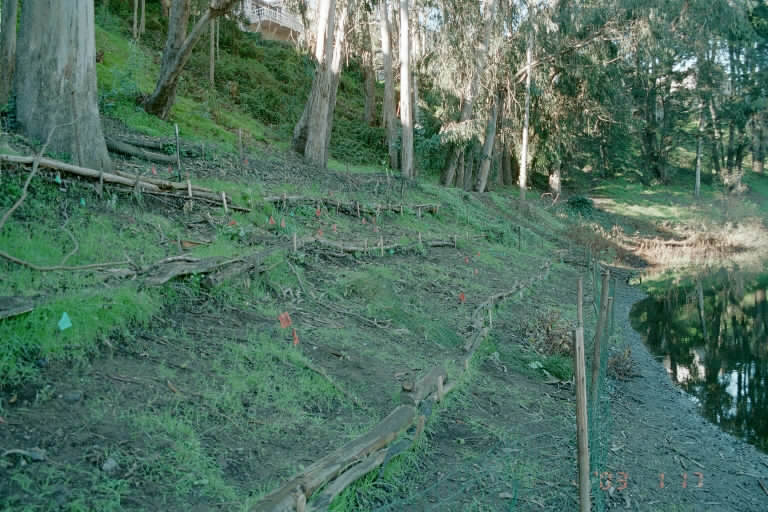
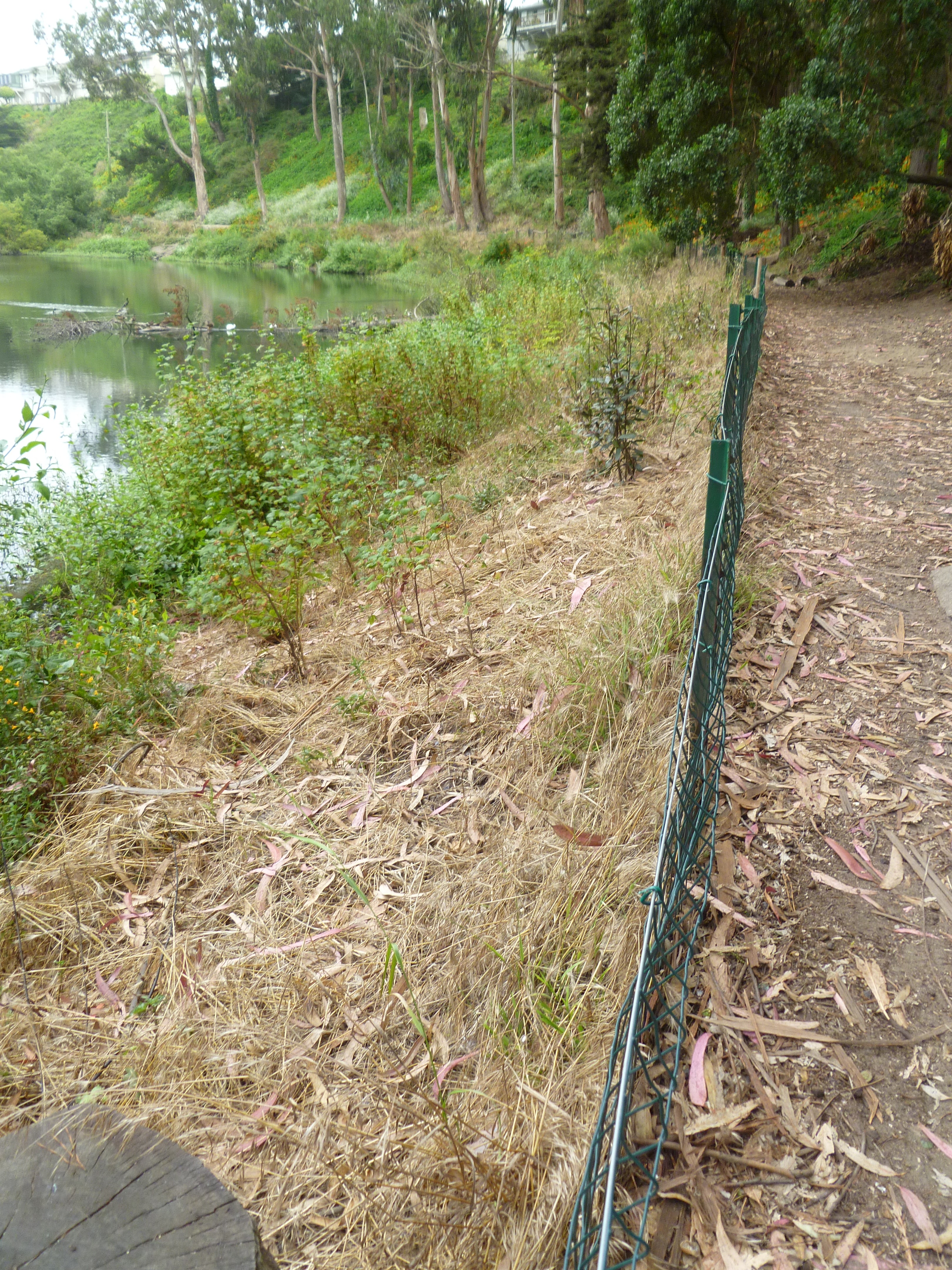
Park visitors who have been watching the restoration efforts of the Natural Areas Program for the past 15 years might be surprised that NAP apparently wishes to expand its restoration efforts. Repeated clearing of non-native plants and planting of native plants has been spectacularly unsuccessful. Here’s a photo history of the effort at Pine Lake in Stern Grove:
One of several clearing and plantings of south shore of Pine Lake, 2003The results, south shore of Pine Lake, 2011North shore of Pine Lake, 2003
Results, north shore Pine Lake, 2011
If NAP has been unable to successfully restore 58% of acres of natural areas (MA-1 and MA-2) they have been actively working on for the past 15 years, why would they want to expand their empire by adding MA-3 acreage to their agenda, committing them to actively restoring all 1,080 acres of natural areas? Aren’t they biting off more than they can chew?
Where will the money come from to fund this expanded effort?
Although NAP and its many supporters believe that this lack of success is because they haven’t been adequately funded, the NAP staff is one of the only divisions in the Recreation and Park Department that hasn’t been cut in the past 10 years. While other gardeners have been laid off, the NAP staff has remained the same size. How many gardeners will it take to expand their restoration efforts to the MA-3 areas as the EIR proposes? Remember that the MA-3 areas are 42% of the total NAP acreage. Will NAP be given a 42% increase in their staff? One wonders where the money for such an increase in staff would be taken from.
How much more herbicide will be used in this expanded effort?
Will a 42% increase in actively management NAP acreage require more herbicide use? The Natural Areas Program applied herbicides to the so-called “natural areas” 69 times in 2010. Most of those applications were of the most toxic herbicide (Garlon) for which the Natural Areas Program was granted exceptional permission to use by the Department of the Environment. How much more herbicide must be used by NAP if they actively manage the MA-3 areas? The EIR is curiously silent on this question.
Public Comment Opportunities
The public will have two opportunities to comment on the EIR and its “environmentally superior alternative” which will aggressively expand the restoration efforts of the Natural Areas Program, require more tree removals and recreational access restrictions, probably cost much more, and probably increase the use of herbicides.
“A public hearing on this Draft EIR and other matters has been scheduled by the City Planning Commission for October 6, 2011, in Room 400, City Hall, 1 Dr. Carlton B. Goodlett Place, beginning at 1:30 p.m. or later. (Call 558‐6422 the week of the hearing for a recorded message giving a more specific time.)”
“Public comments will be accepted from August 31, 2011 to 5:00 p.m. on October 17, 2011*. Written comments should be addressed to Bill Wycko, Environmental Review Officer, San Francisco Planning Department, 1650 Mission Street, Suite 400, San Francisco, CA 94103. Comments received at the public hearing and in writing will be responded to in a Summary of Comments and Responses document.”
“If you have any questions about the environmental review of the proposed project, please call Jessica Range at 415‐575‐9018.”
*[ETA: The deadline for written comments has been extended to October 31, 2011, at the request of the Planning Commission.]
If you have an opinion about the expansion of the Natural Areas Program proposed by the Environmental Impact Report you would be wise to speak/write now. It is your last opportunity to do so.
Thanks to Professor Gordon Frankie (UC Berkeley), we have learned a lot about the bees in the Bay Area. He has been studying our bees for over 20 years and has made a wealth of interesting information available on his website.
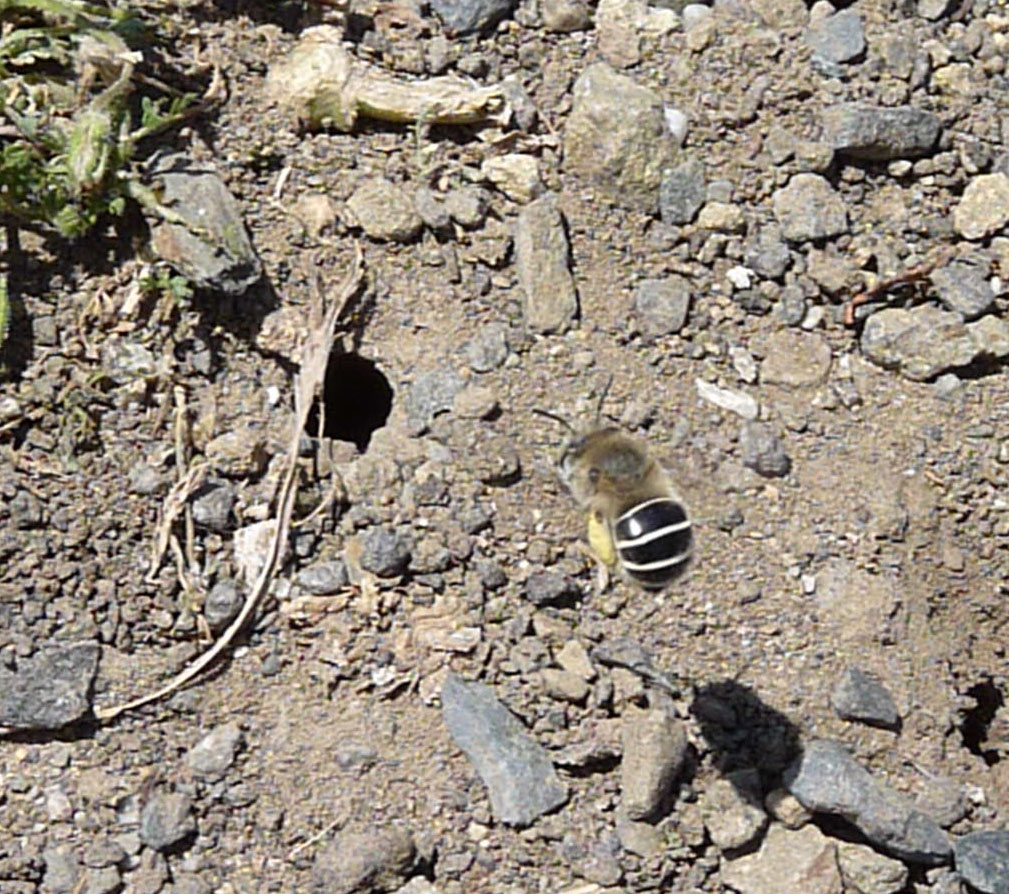
Native bee (Anthrophora urbana) approaching nest in ground at Albany Bulb
Unlike the European honeybee, our native bees are usually solitary. That is, they do not live in social colonies such as the hives of the European honeybee. Most (60-70%) California native bees live in small nests in the ground. Although they may produce enough honey to feed their own young, they don’t store an excess of honey like the honeybee.
Professor Frankie has identified one of the biggest challenges to native bees in urban gardens, “Mulch Madness.”
“[If] you happen to be one of the many ground-nesting bees that looks for garden sites for digging small tunnels where you will lay your eggs in individually-made brood cells that you will provision with pollen and some nectar, [you have a new problem in urban gardens]…Something has happened in recent years to those favored bare dirt sites that makes your task much harder and oftentimes impossible. MULCH MADNESS has arrived and has become a highly promoted ‘eco-friendly’ method for suppressing weeds, conserving water, and unknowingly discouraging ground-nesting bees!”
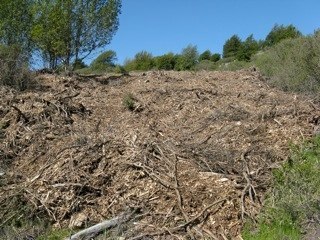
Anyone who is familiar with native plant restorations knows that most are covered in a thick layer of mulch. When tree removals are required for a restoration, the mulch is usually composed of the chips of the trees that have been cut down. The projects of UC Berkeley for which UC is applying for FEMA funding (based on its claim that the clear-cutting of all non-native trees will reduce fire hazards) say specifically that the clear-cut areas will be covered with 24 inches of mulch composed of the chips of the destroyed trees.
The UC Berkeley projects also claim that native vegetation will return to these clear-cut areas without being planted, based on an assumption that the seeds of native plants are dormant in the soil. One wonders how these seeds would be able to germinate when covered with 24 inches of mulch, or how the sprouts could penetrate it. Their proposal contains the fanciful suggestion that squirrels will plant the acorns of oaks in the mulch, which may be true of the oaks, but is an unlikely scenario for the many other native plants and trees which UC claims will populate their “restorations” without being planted.
Accommodating bees in native plant restorations
In the unlikely event that native plants would emerge from this tomb of mulch, they won’t find a population of bees to pollinate them in the future because bees will not be able to populate these projects: “bees will not dig through a thick layer of mulch.”Frankie suggests that “about 50% of your garden be left in bare dirt for the bees and other organisms.” Studies indicate that it will take between 10 and 15 years for 24 inches of mulch to decompose.
Native plant restorations also require the use of herbicides. A particularly toxic herbicide, Garlon, is used to kill the roots of the non-native trees after they have been cut down. If the stump isn’t sprayed with this herbicide immediately, the tree will resprout. The plans for the UC Berkeley projects say that retreatment with this herbicide is required twice per year for 10 years. Although insecticides are considered one of the primary reasons why bee populations are declining in the United States, less is known about the effect of herbicides on bees and other insects, because testing of these chemicals is minimal. Some scientists believe that all pesticides (both insecticides and herbicides) are more harmful to bees and other animals than we presently know.* Professor Frankie recommends against the use of all “synthetic chemicals” in a garden in which bees are welcome.
Would native plant restorations benefit from more bees?
The restorations with which we are familiar in the San Francisco Bay Area are often unsuccessful. That is, they are not usually populated by native plants unless they have been intensively planted, weeded, and irrigated. Few managers of public lands have the resources for such intensive gardening. UC Berkeley has been clear-cutting non-native trees on its properties for about 10 years, so we can visit some of those areas to see the results of such projects. They are now weedy messes, as shown in this photograph.
Results of clear-cutting non-native trees, UC Berkeley project
The use of heavy mulches and herbicides in native plant restorations raises these questions: Would using less mulch and herbicide attract more bees? Would more bees benefit the native plants? Would restorations be more successful if they were more attractive places for bees? We don’t claim to know the answers to these questions. However, we don’t think that the managers of these projects know the answers either.
Would scientific methods produce more successful native plant restorations?
What the managers of these projects call “adaptive management,” we call “trial-and-error.” There is no science involved in these projects. Control areas are not set up to test questions such as “Will a more bee-friendly environment benefit our projects?” We think a more methodical approach to these efforts would be less wasteful and more successful. If we could see more success, perhaps we would be less opposed to what seems like the needless destruction of non-native trees. As it is, the consistently poor results do not justify the destruction that we witness.
* Schacker, Michael, A Spring without Bees, Lyons Press, Guilford, Connecticut, 2008.
This is a good-news-bad-news story. The good news is that the most successful environmental organization devoted to the preservation and conservation of wildlands, The Nature Conservancy, has announced its intention to reorder its priorities in what we hope will be a less destructive direction. The Conservancy is a science-based environmental organization that is unique in that regard. It employs over 600 scientists to guide and inform its projects, in contrast to many other organizations that employ more lawyers than scientists. The scientific orientation of the Conservancy undoubtedly puts it in a position to reflect and respond to the increasingly loud voices of other scientists who are expressing concern about the costs and environmental damage that are the unintended consequences of the “restorations” which have evolved out of invasion biology.
The bad news is that public policy regarding native plant “restorations” lags far behind the developing scientific consensus regarding invasion biology, namely that original theories require revision. This is the consequence of the cultural lag that is inevitable when science moves forward, but communication of its findings to the general public lags behind.
The Nature Conservancy redefines its goals
In the past few months, the Chief Scientist of the Nature Conservancy, Peter Kareiva, has written several articles in the Conservancy’s publications expressing his views about the future of conservation. In “Beyond Man vs Nature,”(1) Kareiva is quoted as saying that species preservation should not be the top priority of the Conservancy. He admits he is “not a biodiversity guy.” Rather, he says, “The ultimate goal [should] be better management of nature for human beings.” He does not agree with those who claim that the earth is fragile and man must be excluded from nature in order to protect it. He considers nature resilient. He calls the concept of “biodiversity hot spots” sham science and he rejects the notion that conservation and development are mutually exclusive. We wants conservation efforts to focus on the things that people need from nature such as clean water and clean air. If and when people experience the benefits of conservation, they will support and participate in those efforts. The Conservancy can’t save the world alone. The active participation of the human population is required to achieve the Conservancy’s conservation goals.
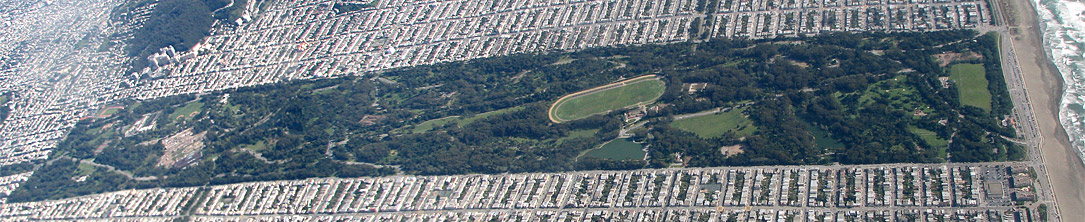
Golden Gate Park San Francisco. Most plants and trees in GG Park are not native. Creative Commons Attribution - Share Alike
In “Conservation should be a walk in the park, not just in the woods,”(2) Kareiva says that the Conservancy should participate in more urban conservation projects because that’s where most people live and even more will live in the future. He wants conservation to be more visible to people and he wants people to benefit directly from the projects.
In his most recent publication, “Invasive Species: Guilty until proven innocent?” Kareiva acknowledges the debate about invasive species. On the one hand, a few invasive species have done a great deal of harm, particularly on islands. On the other hand, many invasive species aren’t doing any harm and some are benefitting native species, even endangered species in some cases (e.g., Southwestern Willow Flycatcher in Tamarisk). He concludes, “Science-based conservation cannot be about knee-jerk platitudes and simple views of good and evil…the fact is we cannot control all invasive species, and in many cases, yesterday’s invaders have become plants and animals that are beloved by local people.”
There is nothing scientifically new to us in what Kareiva has said recently. What’s new is that he speaks as a representative of one of the most important environmental organizations in the world. Therefore, he makes a connection between scientific theory and action. That is new….very, very, new and very encouraging.
Public policy always lags behind science
Public policy is inherently conservative. It usually reflects consensus and consensus occurs late in every scientific debate. Once that consensus is finally reached, changing it is a slow process. And so, we are not surprised by the most recent example of a local community continuing the crusade to eradicate non-native trees. Two ordinances were recently passed in the Los Altos Hills on the San Francisco peninsula, to do just that.
Citizens building or expanding buildings on their properties will be required by ordinance 10-2.802 to cut down all eucalypts within 150 feet of any roadway or structure.
“Town guidelines concerning restoration action” (5-8.08) “deems certain trees undesirable,” including Monterey pine and cypress, as well as eucalyptus.
We are heartened by the publication which announces these new policies. The author objects to being dictated to regarding her tree preferences. She also responds to the usual myths regarding the negative qualities of eucalyptus. In response to the usual justification for its eradication, that it is not native, the author says, “Who cares?” Indeed, who cares? We certainly don’t care and we speculate that the vast majority of people in Los Altos Hills don’t care either. When we speak up on behalf of our trees, we speed the process of changing public policy to reflect the considerable scientific evidence that non-native trees are not harming anything or anyone. Indeed, their eradication is causing far more harm to the environment by releasing tons of sequestered carbon and requiring greater herbicide use.
We have received many comments from native plant advocates regarding carbon storage. These comments defend projects in the Bay Area to destroy non-native forests and “restore” native plants by claiming that native plants will actually sequester more carbon than the forest that they propose to destroy. As always, we are grateful for comments that give us the opportunity to research the issues and report what we have learned about this complex and important subject.
Carbon cycling in a terrestrial plant-soil system
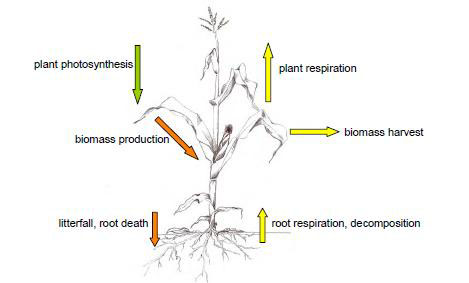
The storage of carbon in plants and soil occurs as plants and soil exchange carbon dioxide (CO₂) with the atmosphere as a part of natural processes, as shown in the following diagram (1):
Green Arrow: CO₂ uptake by plants through photosynthesis
Orange Arrows: Incorporation of Carbon into biomass and Carbon inputs into soil from death of plant parts
Yellow Arrows: Carbon returns to the atmosphere through plant respiration and decomposition of litter and soil Carbon. Carbon in plant tissues ultimately returns to atmosphere during combustion or eventual decomposition.
Rates of carbon uptake and emissions are influenced by many factors, but most factors are related to temperature and precipitation:
Higher temperatures are associated with faster plant growth, which accelerates photosynthesis and carbon uptake.
Higher temperatures also accelerate decomposition of plant materials, thereby accelerating the return of stored carbon into the atmosphere.
The effect of moisture in the soil on decomposition can be graphed as a “hump.” In extremely dry soils, decomposition is slow because the organisms that decompose vegetation are under desiccation stress. Conditions for decomposition improve as moisture in the soil increases until the soil is very wet when lack of oxygen in the soil impedes decomposition.
Although temperature and precipitation are important factors in carbon storage, they don’t change appreciably when one type of vegetation is replaced with another. Therefore, these factors aren’t helpful in addressing the fundamental question we are considering in this post, which is “Does native vegetation store more carbon than the forests that presently occupy the land in question?”
Where is carbon stored?
Source: U.S. EPA, 2018
Much of the carbon stored in the forest is in the soil. It is therefore important to our analysis to determine if carbon stored in the soil in native vegetation is greater than that stored in non-native forests. The answer to that question is definitely NO! The carbon stored in the soil of native vegetation in Oakland, California is a fraction (5.7 kilograms of carbon per square meter of soil) of the carbon stored in residential soil (14.4 kilograms in per square meter of soil). (9) Residential soil is defined by this study as “residential grass, park use and grass, and clean fill.” This study (9) reports that the amount of carbon stored in the soil in Oakland is greater after urbanization than prior to urbanization because Oakland’s “wildland cover” is associated with “low SOC [soil organic carbon] densities characteristic of native soils in the region.”
Native plant advocates have also argued that the carbon stored in the soil of perennial native grasslands is greater than non-native trees because their roots are deeper. In fact, studies consistently inform us that most carbon is found in the top 10 centimeters of soil and almost none is found beyond a meter (100 centimeters) deep. (1, 4) In any case, we do not assume that the roots of perennial grasses are longer than the roots of a large tree.
Another argument that native plant advocates use to support their claim that native perennial grasslands store more carbon in the soil than non-native trees is that native grasses are long-lived and continue to add carbon to the soil throughout their lives. In fact, carbon stored in the soil reaches a steady state, i.e., it is not capable of storing additional carbon once it has reached its maximum capacity. (1)
It is pointless to theorize about why grassland soils should store more carbon than forest soils. The fact is they don’t. In all regions of the United States forest soils store more carbon than either grassland or shrubland soils. (9, Table 5)
We should also describe Oakland’s native vegetation before moving on: “Vegetation before urbanization in Oakland was dominated by grass, shrub, and marshlands that occupied approximately 98% of the area. Trees in riparian woodlands covered approximately 1.1% of Oakland’s preurbanized lands…” (5) In other words, native vegetation in Oakland is composed of shrub and grassland. When non-native forests are destroyed, they will not be replaced by native trees, especially in view of the fact that replanting is not planned for any of the “restoration” projects in the East Bay.
The total amount of carbon stored within the plant or tree is proportional to its biomass, both above ground (trunk, foliage, leaf litter, etc.) and below ground (roots). Since the grass and shrubs that are native to the Bay Area are a small fraction of the size of any tree, the carbon stored within native plants will not be as great as that stored in the trees that are being destroyed.
Whether we consider the carbon stored in soil or within the plant, the non-native forest contains more carbon than the shrub and grassland that is native to the Bay Area.
Converting forests to grassland
If we were starting with bare ground, it might be relevant to compare carbon sequestration in various types of vegetation, but we’re not. We’re talking about specific projects which will require the destruction of millions of non-native trees. Therefore, we must consider the loss of carbon associated with destroying those trees. It doesn’t matter what is planted after the destruction of those trees, nothing will compensate for that loss because of how the trees will be disposed of.
The fate of the wood in trees that are destroyed determines how much carbon is released into the atmosphere. For example, if the wood is used to build houses the loss of carbon is less than if the wood is allowed to decompose on the forest floor. And that is exactly what all the projects we are discussing propose to do: chip the wood from the trees and distribute it on the forest floor, also known as “mulching.” As the wood decomposes, the carbon stored in the wood is released into the atmosphere: “Two common tree disposal/utilization scenarios were modeled: 1) mulching and 2) landfill. Although no mulch decomposition studies could be found, studies on decomposition of tree roots and twigs reveal that 50% of the carbon is lost within the first 3 years. The remaining carbon is estimated to be lost within 20 years of mulching. Belowground biomass was modeled to decompose at the same rate as mulch regardless of how the aboveground biomass was disposed” (8)
Furthermore, the process of removing trees releases stored carbon into the atmosphere, regardless of the fate of the destroyed trees: “Even in forests harvested for long-term storage wood, more than 50% of the harvested biomass is released to the atmosphere in a short period after harvest.” (1)
Will thinning trees result in greater carbon storage?
Native plant advocates claim that thinning the non-native forest will result in improved forest health and therefore greater carbon storage. In fact, the more open canopy of an urban forest with less tree density results in greater growth rates. (3) Although more rapid growth is associated with greater rates of carbon sequestration, rates of storage have little effect on the net carbon storage over the life of the tree. (6) Net carbon storage over the life of the tree is determined by how long the species lives and how big the tree is at maturity. These characteristics are inherent in the species of tree and are little influenced by forest management practices such as thinning. (6)
More importantly, even if there were some small increase in carbon storage of individual trees associated with thinning, this increase would be swamped by the fact that over 90% of the urban forest will be destroyed by the proposed projects we are evaluating in the East Bay. The projects of UC Berkeley and the City of Oakland propose to destroy all non-native trees in the project areas. The project of the East Bay Regional Park District proposes to destroy all non-native trees in some areas and thin in other areas from 25 to 35 feet between each tree, reducing tree density per acre by at least 90%. No amount of “forest health” will compensate for the loss of carbon of that magnitude.
Responding to native plant advocates
The vegetation that is native to the Bay Area does not store more carbon above or below the ground than the non-native forest.
Chipping the trees that are destroyed and distributing the chips on the ground will not prevent the release of carbon from the trees that are destroyed.
Thinning the trees in our public lands will not increase the capacity of the trees that remain to store carbon.
————————————————————————————————–
Bibliography
Anderson, J., et. al., “The Potential for Terrestrial Carbon Sequestration in Minnesota, A Report to the Department of Natural Resources from the Minnesota Terrestrial Carbon Sequestration Initiative, February 2008.
Birdsey, Richard, “Carbon storage and accumulation in United States Forest Ecosystems,” USDA Forest Service, General Technical Report WO-59, 1992
Environmental Protection Agency, “Inventory of U.S. Greenhouse Gas Emissions and Sinks: 1990-2008,” April 15, 2010., EPA 430-R-10-006
Fissore, C., et.al., “Limited potential for terrestrial carbon sequestration to offset fossil-fuel emissions in the upper Midwestern US,” Frontiers in Ecology and the Environment, 2009, 10.1890/090059
Nowak, David, “Historical vegetation change in Oakland and its implication for urban forest management,” Journal of Arboriculture, 19(5): September 1993
Nowak, David, “Atmospheric Carbon Reduction by Urban Trees,” Journal of Environmental Management, (1993) 37, 207-217
Nowak, David. Crane, Daniel, “Carbon storage and sequestration by urban trees in the U.S.A.,” Environmental Pollution, 116 (2002) 381-389
Nowak, David, et.al., “Effects of urban tree management and species selection on atmospheric carbon dioxide,” Journal of Arboriculture 28(3) May 2002
Pouyat, R.V. (US Forest Service)., et.al., “Carbon Storage by Urban Soils in the United States,” Journal of Environmental Quality, 35:1566-1575 (2006)
 Bats are insect-eating machines. According to the USGS, “Bats normally eat about half their weight in flying insects each night.” So even for those who don’t find these night-flying mammals charming, it’s good to know there are bats among us.
 Her research indicated that “amount of forest edge and distance to water were the factors best explaining species richness and foraging activity.” It also showed that bats in San Francisco remain active through the winter and don’t hibernate or move elsewhere.






 Conservation Sense and Nonsense