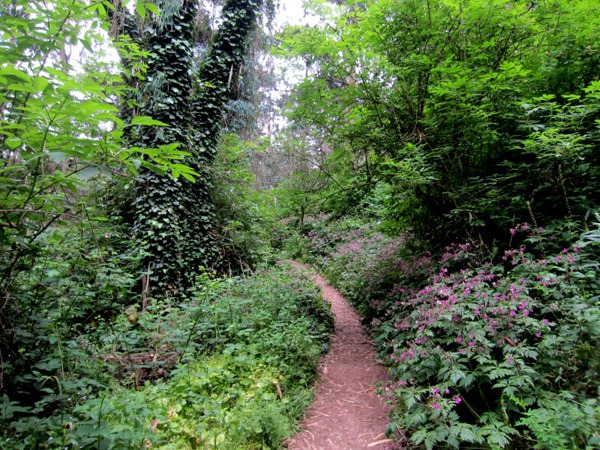
Invertebrates such as insects are plentiful in the eucalyptus forest

Native plant advocates frequently claim that the eucalyptus forest is a “biological desert.”  We find no evidence to support that claim.  We are as likely to see a diverse understory in the eucalyptus forest as in oak woodland and more likely than in a redwood forest where there is considerably less light.  We have reported on several studies that found comparable diversity of wildlife in native and non-native forests.

The abundance and diversity of insects is particularly important in evaluating the health of an ecosystem because they are near the bottom of the food web.  We won’t find many birds in an ecosystem where there are few insects, for example.  We have reported on several studies that found comparable abundance and diversity of invertebrates such as insects in native and non-native landscapes.

Still, the myth persists that eucalyptus forest is devoid of life.  In this article we will address this specific statement in the assessment of the California Invasive Plant Council (Cal-IPC) of Blue Gum eucalyptus:  “loss of native plant forage and migratory disruptions may have greater long-term impact on wider diversity of wildlife species, including invertebrates and microorganisms in soil.”    Cal-IPC provides no studies to support this speculative statement.  Therefore, we will tell you about a specific study that refutes the assumption of Cal-IPC:  “Similar breakdown rates and benthic macroinvertebrate assemblages in native and Eucalyptus globulus leaf litter in Californian streams” (1)

First, we will provide a few definitions for our readers who may not have encountered some of the more esoteric jargon before.  The benthic zone is the sub-surface layer of bodies of water.  Here is a brief list of some of the common names of macroinvertebrates that lay their eggs in water that were found in this study:  mayflies, caddisflies, stoneflies, and midges.   These insects and their larva are food for fish and birds and in turn, fish are food for other animals.
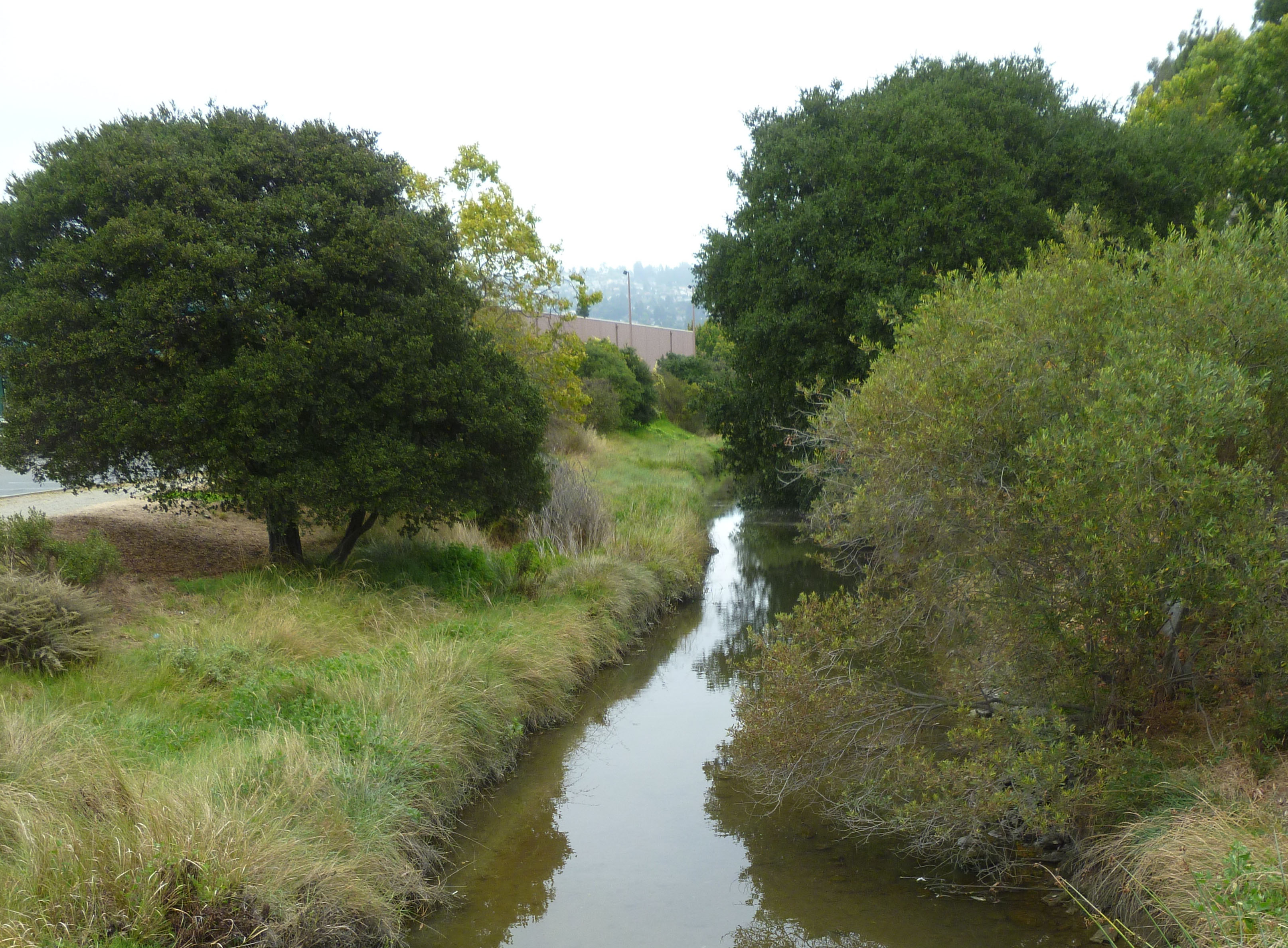
Cerritos Creek. Not one of the creeks in the study, but typical of an East Bay creek with native vegetation.

Three small streams in Alameda and Contra Costa counties in the East Bay were selected for this study because they have sections of shore with eucalyptus forest and sections with native trees (oak, bay, big leaf maple, and alder).  Like many ecological studies we have read over the years, this study hypothesized that it would find reduced abundance and diversity of insect populations in the streams bordered by eucalyptus based on the assumption that eucalyptus is “lower-quality food resource for macroinvertebates than a mixture of native litter.”  As we will, see, they did not find evidence that supported their theory.  We are fortunate that their study was published, because the chances that a negative finding will be published are significantly smaller than studies with positive results.

We will briefly describe the methods used by this study because they establish the credibility of the study.  They sampled insect populations directly from the streams as well as using mesh bags of the litter of the two types of forest:  eucalyptus forest and an assemblage of native tree species.  The sampling was done in three different seasons and the litter bags were sampled after 26, 56, and 90 days.  They used two measures of diversity and two metrics related to pollution tolerance, as well as two measures of abundance of invertebrate species in litter bag samples to describe the insect population.

Here are their key findings:

  • “[Differences in y]early litter input rates in reaches bordered by Eucalyptus and by native vegetation were not statistically significant.”
  • Species diversity and pollution tolerance did not differ significantly between eucalyptus and native sites, with one exception.  There was a higher proportion of one complex of insects (Ephemeroptera, Trichoptera, Plecoptera) in the eucalyptus samples.
  • The abundance of the five most common taxa (species or genus) did not differ significantly between eucalyptus and native sites with the exception of mayflies which were on average twice as abundant in eucalyptus sites.
  • One metric of diversity (Shannon Diversity Index) found greater species diversity in eucalyptus sites compared to native sites.
  • The decay of litter in the bags of eucalyptus litter was similar to the bags of native litter, i.e., “leaf mass loss was not significantly different between eucalyptus and native leaves.”  Decay of litter is a proxy for the amount of litter consumed by insects and microorganisms in the litter and by extension the population of these organisms in the litter:  “…the importance of biotic factors (bacteria, fungi, macroinvertebrates) in litter breakdown is greater than that of the physical fragmentation.”

The study then compared these findings with similar studies conducted all over the world.  When they found differences between their results of those of other scientists, they explained them in terms of local differences in conditions.  For example, in European native forests, more deciduous trees are found than in Californian native forests.

Only one similar study was conducted in North America, specifically in two streams in southern California:  “… [it] compared the decomposition of Eucalyptus litter to native species and found it slower than that of Alnus [alder], faster than that of Rhus [sumac] and similar to Quercus agrifolia [coast live oak].  Both the decomposition rate and the biomass of macroinvertebrate colonizers differed much more between…two streams than among the litter species.”

Both the results of their study, and the review of the literature of similar studies, led the researchers to this conclusion:

“In coastal California, we conclude that presence of small patches of riparian Eucalyptus even though it influences the species composition of plant litter in streams, has no noticeable influence on diversity and composition of benthic macroinvertebrates that colonize the litter.  Furthermore, based on similarities in leaf decomposition, Eucalyptus litter appears likely to be as suitable a substratum for macroinvertebrate colonization as some of the components of the native litter in the three streams tested.  Thus, the overall condition of these small streams is not markedly degraded by the presence of patches of riparian Eucalyptus and is unlikely to be improved by their removal.”

Looking for Godot

Looking for evidence of the harm that eucalyptus does to our ecosystems is like waiting for Godot.  No one has found any evidence yet.  We venture to say that they can keep looking, but we think they are looking for something that isn’t there.  If we keep pointing out that there is no evidence to support their indictment against eucalyptus, will they give it up eventually?  All we can do is keep trying. 

We congratulate those with the tenacity to slog through this tedious post.  Your reward is more good news for our harmless eucalyptus.

*********************************

Igor Lacan, Vincent Resh, Joe McBride, “Similar breakdown rates and benthic macroinvertebrate assemblages in native and Eucalyptus globulus leaf litter in Californian streams,” Freshwater Biology, 55, 739-752, 2010.
California Invasive Plant Council fails to make the case that eucalyptus is allelopathic

In this post we will continue to critique the assessment of the California Invasive Plant Council (Cal-IPC) that Blue Gum eucalyptus (Eucalyptus globulus) is invasive.  One of the arguments that Cal-IPC used to reach this conclusion is that chemicals in the leaves of eucalyptus suppress the germination of native plant species:  “[E. globulus] inhibits germination and growth of native plant species.”   This property is called allelopathy.

Many plants, both native and non-native have such allelopathic properties.  Therefore it is important both to determine if eucalyptus has such properties, and to compare eucalyptus to native tree species to determine if suppression of germination of competing species is any more likely under eucalyptus than native tree species.  One of the references provided by Cal-IPC compares germination success of three native plant species using both eucalyptus leaves and oak leaves:  “The Effect of Eucalyptus and Oak Leaf Extracts on California Native Plants” (1)

This unpublished master’s degree thesis does not prove that eucalyptus leaf extracts inhibit growth of native plants.  The study uses two different methods to test the hypothesis that eucalyptus leaf extracts inhibit growth of native plants.

In the first method, the seeds of three native species (two bunch grasses and a perennial forb) were germinated in petri dishes in sand soaked with a solution of the masticated leaves of eucalyptus and oak.  Two of the species of seeds grew shorter roots in the eucalyptus solution than in the oak solution.  The third species of seed grew longer roots in the eucalyptus solution than in the oak solution.  The percent of germination was lower in the eucalyptus solution than in the oak solution for two of three of the species of seeds and the same in the third species of seed.

The second method used by this study was to test germination success in the soil of eucalyptus compared to oak soil.  No significant difference was found in germination success when seeds were planted in the soil:

“The Eucalyptus soil treatment did not result in germination inhibition relative to the control which suggests that allelochemicals present in the leaves are reduced or absent in the soil.”  (1)

Since natural germination occurs in the soil rather than in petri dishes soaked in concentrated solutions, this study does not substantiate the statement that E. globulus “inhibits germination and growth of native species.”

Using our eyes to test the theory

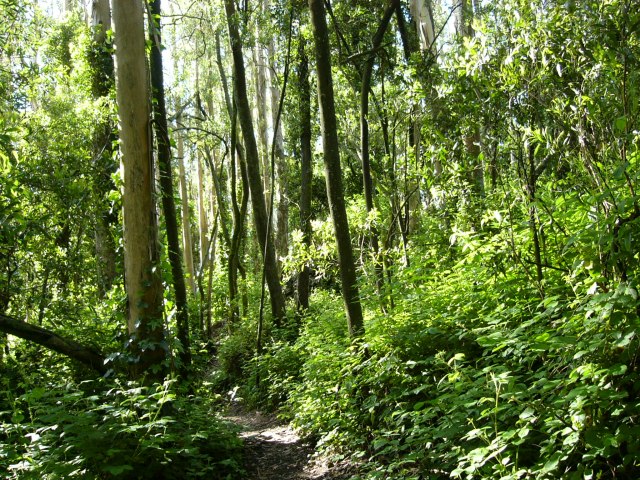
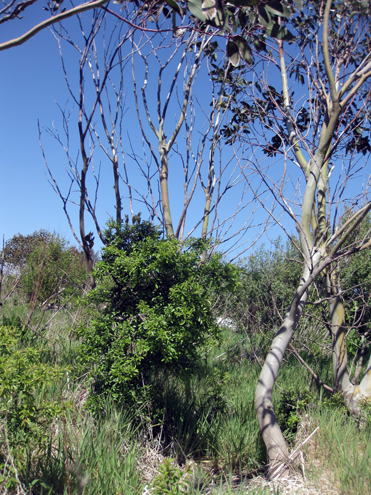
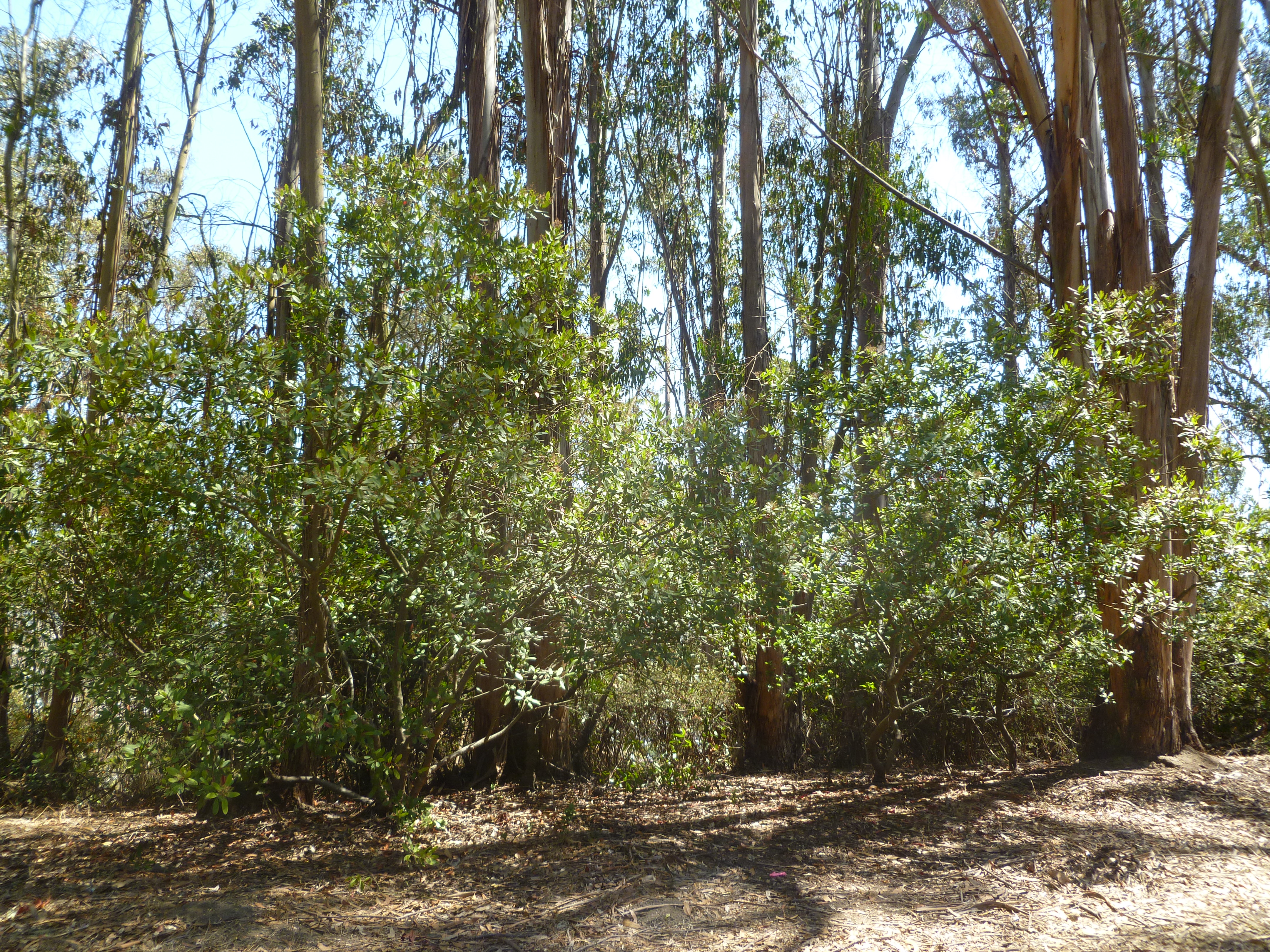
We don’t doubt that the leaves of eucalyptus contain chemicals.  But the leaves of other trees do as well.  The question is not whether or not the leaves of trees contain chemicals, but rather do they prevent the germination and growth of other species of plants?  The fact is no study has proved that the chemicals in the leaves of eucalyptus are more likely to prevent the survival of native species of plants than any other tree species, whether native or non-native.  We can see with our own eyes that eucalyptus forests often have a thriving understory of both native and non-native plants.  Here are just a few examples of local eucalyptus forests that have such an understory:

The management plan for San Francisco’s Natural Areas Program describes the eucalyptus forest on Mount Davidson as follows:

“Although the overstory is dominated by eucalyptus, when all species were considered within the urban forest at Mount Davidson (point data), native species accounted for 36 percent of the understory cover and 21 out of 50 species were native…Pacific reed grass (Calamagrostis nutkaensis) does not have a state or federal special-status rating, but San Francisco is at the southern edge of this species’ range. This species can be found in several locations on Mount Davidson”

Native Pacific reed grass under girdled eucalyptus tree on Mount Davidson

The 2011 “Albany Hill Creekside Master Plan” describes the understory of the eucalyptus forest on Albany Hill as follows:

“The eastern portion of the eucalyptus forest has a [native] toyon understory as identified in 1991.  The toyon appears to be a wider band than shown in 1991 and covers approximately 2.0 acres…It was noted in a 1972 article in the California Native Plant Society publication Fremontia that the toyon has been introduced by either man or birds.  Native species [in the eucalyptus forest] include toyon, coast live oak, coyote brush, blue wild rye grass, and poison oak.”  

Native toyon under eucalyptus on Albany Hill

Finally, the understory of the dense eucalyptus forest on Mount Sutro is the richest understory we have personally witnessed.  Its understory is composed of both native (most notably elderberry) and non-native species.

The lush, green understory on Mount Sutro.  Courtesy Save Sutro Forest.
The lush, green understory on Mount Sutro. Courtesy Save Sutro Forest.

We give the last word on the scientific question of the allelopathic properties of eucalyptus to R.G. Florence of the Department of Forestry at The Australian National University.  An Australian scientist is not under the same pressure to find a negative story to tell about eucalyptus.  Professor Florence reports that a world survey of 3,000 articles about allelopathy found “…that the phenomenon of direct chemical interaction in natural communities, in the face of natural selection pressure, must be regarded as rare.”  And further, “While [allelopathy] is an attractive concept, there is no certainty that this occurs to any appreciable extent in nature.” (2)  These observations are certainly consistent with the reality of the eucalyptus forest in the San Francisco Bay Area, where an understory of both native and non-native plants is often found.

If not allelopathy, then what suppresses understory growth?

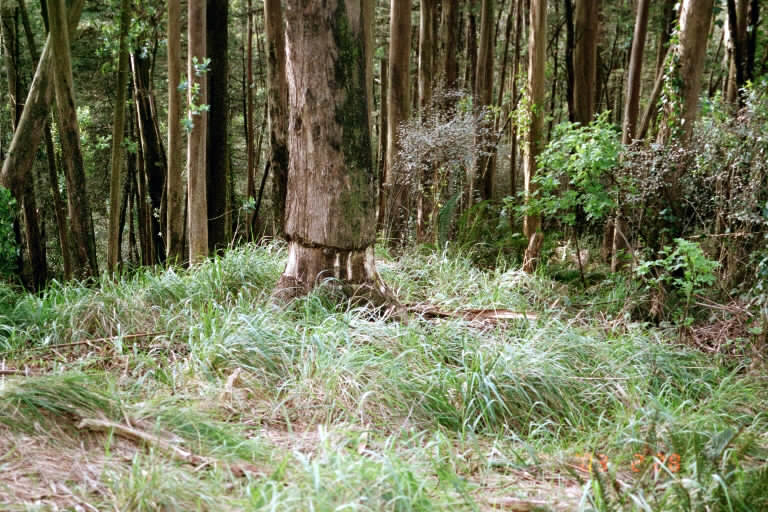
We have hiked as often in oak woodland in California as we have eucalyptus forests.  We find the understory in the oak woodland as varied as any eucalyptus forest.  Sometimes we don’t find much understory in either type of forest.  A redwood forest has the sparsest understory of any of these three tree species.

What these forest types have in common is that there is a layer of leaf litter under them that suppresses germination and growth of other plants because it forms a physical barrier to the soil.  And the limited sunlight on the floor of both forests is surely a factor in suppressing the development of an understory.  When an understory persists through the limiting factors of low light and heavy leaf mulch, there are obviously mitigating factors such as more moisture, better soil, and other resources that understory plants need.  Furthermore, some species of native plants seem to be suited to conditions in the eucalyptus forest.

The leaves of eucalyptus contain chemicals–as do the leaves of all plants– but if they do not prevent the growth of an understory or they are not any more likely to suppress the growth of competing plants than chemicals in native tree species, this is not a legitimate argument against eucalyptus.  Cal-IPC has not provided any scientific justification for indicting eucalyptus based on its allelopathic properties.

*********************************

(1)    Kam Watson, “The Effect of Eucalyptus and Oak Leaf Extracts on California Native Plants,” 2000.

(1)    R.G. Florence, Ecology and Silviculture of the Eucalypt Forest, CSIRO, 1992?, pgs 71 & 103

Eucalyptus trees do NOT kill birds!

The claim that eucalyptus trees kill birds originates with an article in the publication of the Point Reyes Bird Observatory, written by Rich Stallcup.  (1)  Mr. Stallcup was well known as a knowledgeable birder, but he was not a scientist.  He based his claim that eucalyptus trees kill birds on his observation of two dead birds in two different eucalyptus forests over a period of many years.   

Bird mortality rates

Given that Mr. Stallcup was a serious birder who spent much of his time in the field observing birds, we begin our critique of his hypothesis by pointing out that a sample of two is absurdly small from which to extrapolate to a general rule about bird mortality in eucalyptus forests.

Furthermore, the scientific literature about bird mortality informs us that a sample of two does not justify the assumption that these deaths were caused by eucalyptus trees.  For example, the annual survival rate of adult song sparrows has been reported as only 30%.  That is, in a single year, 70% of adult song sparrows will die of predation, disease, starvation, or other factors including old-age. Mortality rates are greater for small birds.  (2)

Mortality rates for young birds are substantially greater than for adult birds.  For example, a longitudinal study of Eurasian kestrels found that 51% of 245 kestrels were dead within their first year.  All of the 245 kestrels in this study were dead by the end of 10 years.  (2)

We have a beautiful Coast Live Oak tree on our property, under which we have found dead birds. Yet we have not concluded from those observations that the birds were killed by the tree.  Of course, they were not.  Although there were probably many different causes of death of these birds, we don’t feel the need to speculate about those causes because bird death is not a rare or unusual event unless, of course, you are looking for an excuse to blame the tree.

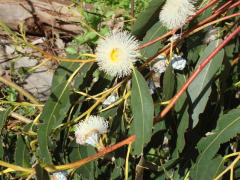
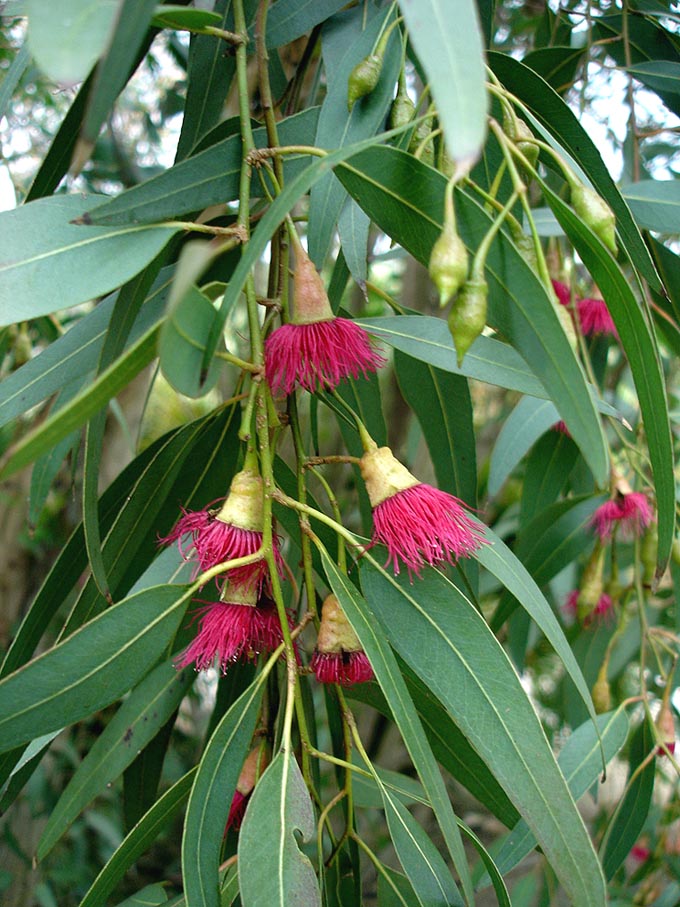
Flowers of Blue Gum eucalyptus
Flowers of Blue Gum eucalyptus. Photo by John Hovland

Stallcup’s Theory

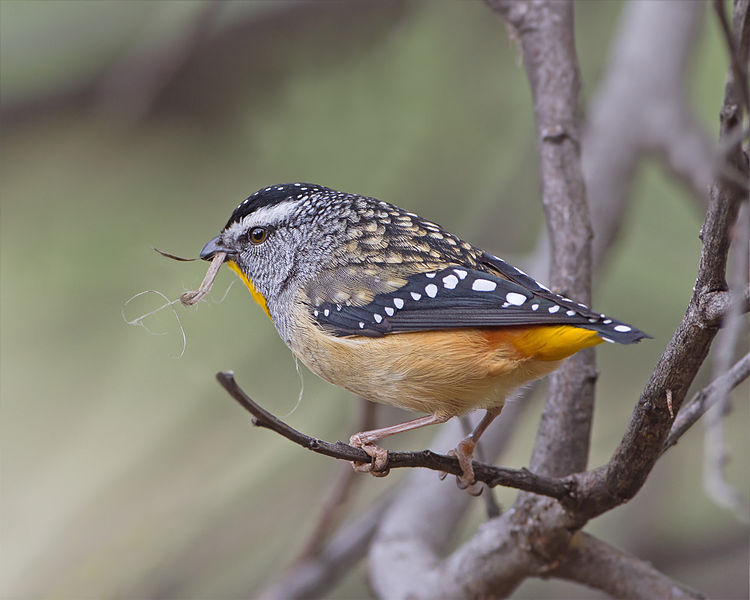
Spotted pardalote is an Australian bird with a short beak that feeds in eucalyptus forests in Australia.  Creative Commons
Spotted pardalote is an Australian bird with a short beak that feeds in eucalyptus forests in Australia. Creative Commons

Stallcup speculated that eucalyptus trees kill birds by “gumming” up their beaks or nostrils with the nectar of the eucalyptus flower which blooms from about December to May in California.  He supports this theory by claiming that the birds that are found in Australia, where eucalyptus is native, have long, curved beaks which enable them to eat nectar from the flower without gumming up their beaks or nostrils. 

This theory is not consistent with the “evidence” that Mr. Stallcup uses to support his theory:

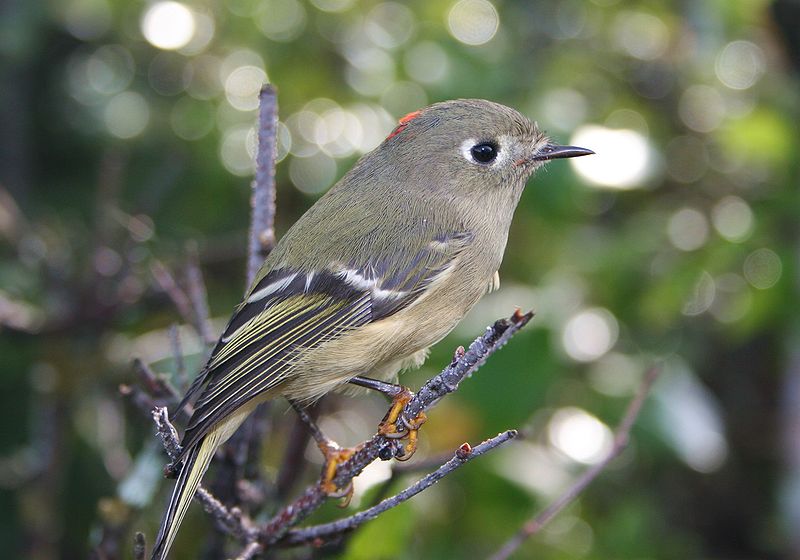
  • He found a dead ruby-crowned kinglet.  The kinglet is an insect-eating bird, not a nectar eating bird.
  • Years before that sighting, he found a dead hummingbird.  Hummingbirds eat nectar, but they have long beaks.
  • Many Australian birds that feed in eucalyptus forests do not have long, curved beaks; e.g., spotted pardalote, striated thornbill, and white-naped honeyeater. (3)
  • One study in Santa Cruz, California found many small birds feeding on insects in red gum eucalyptus, including yellow-rumped warblers, Townsend’s warblers, ruby-crowned kinglets, and bushtits.  The beaks of these birds are not shorter than those found in eucalyptus trees in Australia mentioned by the same study.  The study reported no dead birds or gummed beaks. (3)
  • The nectar of eucalyptus flowers is not “gummy.”  It feels watery to the touch.  Eucalypts are not called “gum” trees because of the nectar in their flowers.  They are named for the sap under their bark.
Ruby-crowned kinglet is a North American bird that feeds in the eucalyptus forest in California.  USFWS
Ruby-crowned kinglet is a North American bird that feeds in the eucalyptus forest in California. USFWS

We can compare Mr. Stallcup’s “data” of two dead birds with a database of a local wildlife hospital.  The report of this database was posted to SFBIRD (San Francisco Bird is an email listserve that anyone can subscribe to and report the birds they see in San Francisco) by Richard Drechsler on March 12, 2012 and is quoted here with his permission:

“I have access to a database containing 56,960 records of birds brought to a local wildlife hospital between 1992 and 2010.  During this period this facility also accepted 2500 birds who were classified as DOA (dead on arrival).  I volunteered in that facility for seven months during 2010 where I worked with ‘small birds’ in order to get a better idea of how birds are being injured.  I was aware then of the belief that resin, gum, nectar, etc. from Eucalyptus trees might harm feeding birds.  During my time there I did not encounter any birds whose passages were blocked with any natural resins that would have prevented them from eating or breathing.  This evening I compared my observations with the 19 years of data by searching on the following words:  ‘euc,’ ‘euk,’ ‘bill,’ ‘beak,’ ‘tree,’ ‘asphy,; ‘breath,’ ‘mouth,; ‘nar,’ ‘gum,’ ‘resin,’ ‘nectar,’ ‘nostril,’,’ starv,’ ‘horn,’ ‘stick,’ ‘stuck,’ ‘glue.’ 

Preliminary Data Findings:

(1)    There is no reference to Eucalyptus or any of its byproducts.

(2)    There is one reference to a bill or mouth being restrained…by a synthetic adhesive.

(3)    There is one vague reference to an Anna’s Hummingbird that was “Stuck in Resin”…treated and released one day later.

(4)    Querying on ‘sticky,’ ‘stuck,’ or ‘glue’ yields many records and a wide variety of species being trapped by synthetic adhesives such as rodent traps and building adhesives.”

 Given the ubiquitous presence of Eucalyptus in this area and the birds craving for its nectar one would expect more incidents of starving birds or ones surrendered DOA.  Also, if birds did not have the capacity to preen or molt away this nectar, wouldn’t every (indulging) bird ultimately display this residue?”

 Bird anatomy trumps the absence of data

There is no empirical evidence to support the claim that eucalyptus trees kill birds, but the most compelling evidence that this claim is not factually correct is that it contradicts the basic facts of bird physiology and anatomy.  That is, birds can and do clear their beaks and nostrils with their feet or by rubbing their beaks on branches when necessary.  If their nostrils are obstructed, they can breathe through their mouth and vice versa.

Ask yourself this question to appreciate the absurdity of the claim that birds would passively suffocate rather than using the tools they have at hand:  If you were suffocating because there was something stuck in your mouth or nose, wouldn’t you raise your hands to your face and clear the offending obstacle?  Is there any reason to assume that birds are not physically or mentally capable of the same defensive behavior?  If you have a cold and your nose is stuffed up, don’t you breathe through your mouth?

In 2010, a student taking the Cornell Lab of Ornithology correspondence course on bird biology asked his instructor this question:  Do eucalyptus trees kill North American birds?”  This is the email reply from his instructor:

“I have no firsthand knowledge of the effect of eucalyptus gum suffocating birds (or not), but I share your skepticism for the reasons you mention. The story has birds feeding in flowers and getting gum on their faces. The first bird mentioned in this saga appears to have been a Ruby-crowned Kinglet. They don’t feed on or in flowers much; they’re leaf gleaners and flycatchers. Is there even “gum” to be picked up on the flowers? Again, that seems unlikely. Birds can breathe through their mouths, so just plugging up the nostrils won’t kill them. (Nestling crows often get the feathers covering their nostrils so encrusted with food matter that there is no way they could breathe through them, but the young are fine. I chip it off when I band them.) It seems like this story could be investigated rather easily, but I see nothing about it in the scientific literature. I would need to see evidence before I believed it.”  

Those who love to hate eucalyptus

The Cornell ornithologist would need to see evidence before he believed the claim that eucalyptus trees kill birds.  Native plant advocates apparently don’t need any evidence.  They have been repeating this absurd, baseless claim since 1996, when it was originally fabricated.  One subscriber to the SFBIRD email listserve mentions this claim often, although he never offers any new actual dead birds to add to the two that were used to fabricate the story. 

 So, why do we try, once again, to set the record straight despite the stone wall built around this fable by native plant advocates?  Because we find this claim in the “assessment form” used by the California Invasive Plant Council to justify its classification of eucalyptus as “invasive:” “purported to cause mortality in native bird species.”  The California Invasive Plant Council classifies eucalyptus as “invasive” based partly on the existence of two dead birds. 

This story has been repeated by native plant advocates for nearly 20 years without any supporting evidence.  It has taken on a life of its own until those who repeat it apparently are unaware that there is no evidence to support the myth.

The US Forest Service social scientist, Dr. Paul Gobster, interviewed native plant advocates while a visiting professor at UC Berkeley about ten years ago.  At the end of his visit, he delivered a lecture at the Randall Museum about his observations of the local native plant movement.  He said they were victims of “incestuous amplification,” the trading of misinformation in a vacuum caused by their isolation.  The ridiculous story about eucalyptus trees killing birds is surely an example of incestuous amplification.   

*****************************

(1)    Rich Stallcup, “Deadly Eucalyptus,”  Point Reyes Bird Observatory, Fall 1996

(2)    Handbook of Bird Biology, Cornell Lab of Ornithology, Princeton University Press, 2004

(3)    Julie Lockhart and James Gilroy, “The portability of food-web dynamics:  reassembling an Australian psyllid-eucalypt-bird association within California,” Global Ecology and Biogeography, 2004, 13, 445-450

“Hey, You Calling Me an Invasive Species?”

The New York Times published an op-ed by a member of their Editorial Board on Sunday, September 8, 2013, entitled, “Hey, You Calling Me an Invasive Species?”  It is a spirited defense of non-native plants.  Surely this is an indication that our challenge of the native plant movement is now mainstream.  We will touch on a few of the op-ed’s main themes, but we urge you to read the op-ed here.

Mount Sutro Forest is threatened with destruction because it is not native.  Courtesy Save Sutro Forest.
Mount Sutro Forest is threatened with destruction because it is not native. Courtesy Save Sutro Forest.

Using the eucalyptus forest on Mount Sutro as an example. the Editorial Board member, Verlyn Klinkenborg, makes the point that many of our non-native plants have been here for hundreds of years.  Since they have been here for several generations of humans, most of us no longer consider them foreigners: 

“But the trees on Mount Sutro have been there within the memory of every living San Franciscan, and to the generations who have grown up within view of them, it seems almost perverse to insist that they are alien.” 

The distinction between native and non-native depends upon an arbitrarily selected “snapshot” of our landscape taken just prior to the arrival of Europeans.  On the East Coast, that’s the early 16th Century.  In the San Francisco Bay Area, that’s 1769, when Portola’s men saw the San Francisco Bay.  The Times op-ed reminds us that this particular snapshot is becoming more and more irrelevant because of climate change.  If plants and animals don’t move in response to that change they will not survive: 

“As plants and their pests adjust their range under the influence of global warming, what becomes of the distinction between native and nonnative?  To any individual species, it doesn’t matter whether it’s native or not.  The only thing that matters is whether its habitat is suitable.”

Finally, Mr. Klinkenborg takes us on a verbal tour of Central Park to make the point that our open spaces are a mélange of native and non-native plants and animals.  We can see with our eyes that they are living in harmony and to pluck only those considered non-native from their midst would be needlessly destructive and disruptive of the peace that reigns there:

“Nature in Central Park can’t be divided into native or nonnative species, and neither can it be on Mount Sutro.  The eucalyptus trees that grow there may be naturalized rather than native, but try telling that to all the other creatures that live in those woods or the people who hike there.”

Mr. Klinkenborg’s final sentence reminds us that we are the original “invaders:” 

And when it comes to the distinction between native and nonnative, we always leave one species out:  call us what you will—native, naturalized, alien or invasive.”

The absurdity of nativism is becoming more and more evident.  Our objections to its destructive consequences will eventually be heard.  It’s just a matter of time.

Biodiversity of the eucalyptus forest

Although they can provide no scientific evidence, native plant advocates claim that the eucalyptus forest is a “biological desert” in which nothing grows and nothing lives.  We can see with our own eyes in the Sutro forest that a diverse understory thrives in the eucalyptus forest, but it is more difficult to quantify the biodiversity of wildlife in the forest.  For that we turn to scientists.

Mount Sutro Forest
Mount Sutro Forest

We published some time ago a summary of a research study by Dov Sax (Brown University) in which he compared the species richness (number of species) living in the eucalyptus forest with species richness in native oak woodland in Berkeley, California.  He found equal numbers of amphibians, insects, plants in the understory, and birds in the eucalyptus forest compared to oak woodland in the fall and significantly more species of insects in the eucalyptus forest in the spring.

Eucalyptus around the world

Professor Sax also reported similar studies all over the world that reached the same conclusions, i.e., the introduced eucalyptus forest is just as biodiverse as the native forest all over the world.  According to the Encyclopedia of Biological Invasions there are about 40 million acres of eucalypts planted in tropical, sub-tropical, and temperate countries.  We have had the opportunity to observe them in several counties.

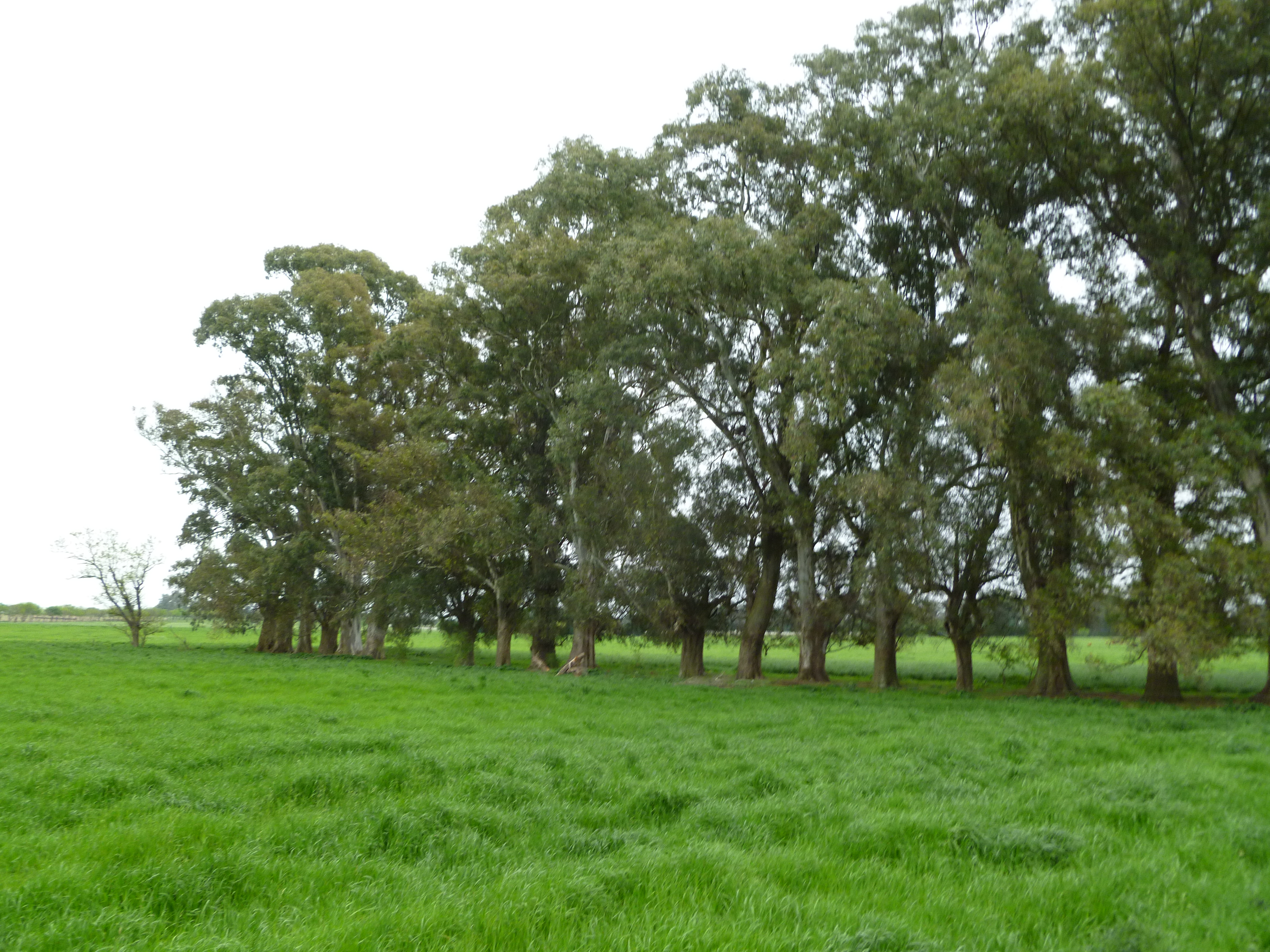
Much of Argentina is a treeless grassland prairie, called pampas.  They imported eucalyptus to provide their economy with pulp.  We observed many acres of densely growing eucalyptus forest throughout Argentina during our visit there.  They also seemed to be used on the perimeter of agricultural lands, presumably as windbreaks.

Eucalypts used an agricultural windbreak, Argentina, 2010
Eucalypts used as agricultural windbreak, Argentina, 2010

We also saw many eucalypts growing in Sicily.  We were told by our guides that they were planted by Mussolini in the 1930s as the means of draining swampland to reduce the population of malaria-carrying mosquitoes.

We found more eucalypts in Morocco where they also were being widely used as landscape trees.  There seemed to be more diversity of eucalyptus species and they were obviously considered valuable for horticultural purposes.  We also saw eucalypts sheltering agricultural crops from the wind.

Eucalypts are obviously considered valuable trees in many countries all over the world.  We marvel at the hatred they have generated in California.

More evidence of the biodiversity of the eucalyptus forest

Professor Robert Stebbins (Professor of Zoology and Emeritus Curator in Herpetology, Museum of Vertebrate Zoology, University of California, Berkeley) was hired to study the eucalyptus forest in Berkeley, California for the Nature Conservancy’s California Field Office.  This is an excerpt from his report which was published in 1983. (It is available at wiki.bugwood.org)

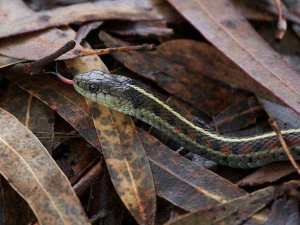
Garter snake in euclypatus leaf litter
Garter snake in eucalyptus leaf litter. Courtesy urbanwildness.com

Contrary to popular belief, many animals, both vertebrates and invertebrates, have adapted to life in the Eucalyptus groves. Moisture from the air condenses on the leaves and the drippage keeps the groves moist and cool even during the dry season. This is a suitable ground habitat for a wide variety of animal life. Amphibians such as arboreal salamander, California slender salamander, ENSATINA, California newt, rough skinned newt, and Pacific tree frog live in the forest, primarily under fallen logs and duff. Amphibians feed on such invertebrates as millipedes, centipedes, sow bugs, COLLENBOLA, spiders and earthworms.

“Several snakes such as the ring-necked snake, rubber boa and sharp tailed snake have adapted to Eucalyptus groves. The ring-necked snake feeds on the California slender salamander, the rubber boa feeds on meadow mice, and the sharp tailed snake feeds strictly on slugs. Other common reptiles include the northern and southern alligator lizards, which live under fallen logs, and the western fence lizard and western skink, which live in the less densely forested groves.

“Over 100 species of birds use the trees either briefly or as a permanent habitat. The heavy-use birds feed on seeds by pecking the mature pods on trees or fallen pods; so they must wait for the pods to disintegrate or be crushed by cars. Among the birds that feed on seeds in the trees are: the chestnutback chickadee and the Oregon junco. Examples of birds that feed on ground seeds are the song sparrow, the fox sparrow, the brown towhee, and the mourning dove. Birds that take advantage of the nectar from blossoms either by drinking the nectar or by feeding on the insects that are attracted to the nectar include Allen’s hummingbird, Bullock’s oriole, redwinged blackbird, and blackheaded grosbeak. Birds that use the trees as nest sites include the brown creeper, which makes its nest under peeling shags of bark and feeds on trunk insects and spiders, the robin, the chickadee, the downy woodpecker, and the red shafted flicker. The downy woodpecker and the red shafted flicker peck into the trunk of dead or dying trees to form their nests. When these nests are abandoned, chickadees, Bewick wrens, house wrens and starlings move in. Downy woodpeckers use dead stubs to hammer out a rhythmic pattern to declare their territories.

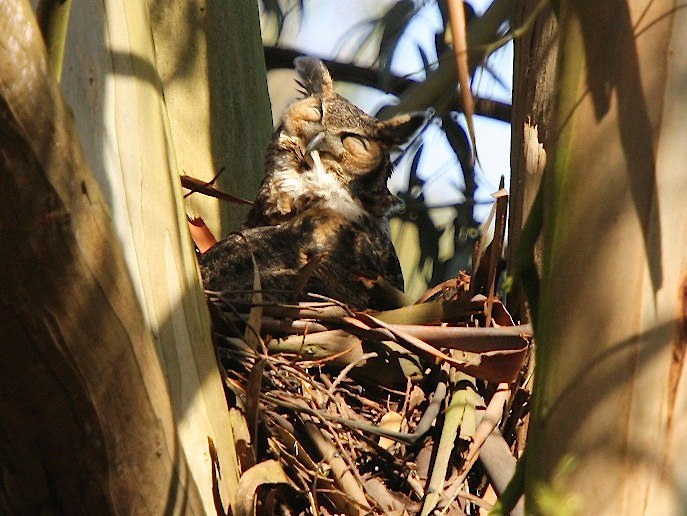
Owl nesting in eucalyptus, courtesy urbanwildness.com

“The red-tailed hawk prefers tall trees for a nesting site. It therefore favors eucalypts over trees such as oak or bay. Great horned owls use nests that have been abandoned by red-tail hawks or they nest on platforms formed between branches from fallen bark. The brown towhee and the golden crowned sparrow are birds that use piles of debris on the ground for shelter during rains.

“Several mammals have adapted to Eucalyptus. Deer find concealment in dense groves where there are suckers, coyote brush, and poison oak; moles live in the surface layer of the soil; meadow mice, gophers, and fox squirrels are found in the forest.

A Eucalyptus grove is not a sterile environment. The population density of the animals mentioned can be partially attributed to the presence of eucalypts. With a program of cutting trees and burning debris, some animal residents will disappear because they have restricted home ranges or are sedentary. If an animal’s living area (leaf litter, logs, bark) and food supply are destroyed, the animal will either die or attempt to move to another area which is already fully occupied. ‘The wildlife section draws heavily upon conversations with Professor Robert Stebbins. No errors which may exist should be attributed to the professor.’”

Refusing to see the evidence

We stumbled upon this new information in the on-line comments on SFGATE (the San Francisco Chronicle’s website) on an article about the “tree wars of San Francisco.”  (Available here)  A defender of the forest was responding to the usual claims about the eucalyptus forest being a sterile environment.  The defender of the forest was quickly attacked by a native plant advocate who called the commenter a “creepy imbecile.”  The native plant advocate also attempted to discredit the source of information on the grounds that Professor Stebbins is apparently now dead.  Obviously he was alive when he wrote his report, but the native plant advocate apparently believes that anything he wrote before he died is not credible.  Or at least I think that was his/her “reasoning.”  Oddly, another native plant advocate then chimed in, complaining that native plant advocates are being “demonized.”  Wait!  Who called whom a “creepy imbecile?”

Update:  When we published this article we assumed that the native plant advocate who claimed that Professor Stebbins was dead at the time was correct about that.  Since then we have learned that that was inaccurate information.  Professor Stebbins died on September 23, 2013, according this obituary in the New York Times.  So, the name-calling native plant advocate was fabricating “information” as well as engaging in ad hominem attacks.  We are embarrassed that we assumed the native plant advocate was at least factually correct.  

Unfortunately the name-calling comment has been removed from SFGATE which I suppose is consistent with their policy.  However, it is a loss because it illustrated the low standards for civility and quality of information being used by native plant advocates to defend their destructive projects.  (We are quoting from that comment only the portion for which evidence remains in replies to it.)

We saw these same low standards used by native plant advocates at the February 25, 2013 public hearing at UCSF about their plans to destroy the Sutro forest.  There were only about 15 speakers in defense of the project, but their comments were devoid of information.  One fellow walked to the microphone and said simply, “I hate eucalyptus” and walked away.  Another claimed that the Angel Island fire of 2008 was evidence of the flammability of eucalyptus although 80 acres of eucalypts were destroyed over 12 years before that fire.  Only 6 acres of eucalypts remain.  The grass fire stopped at the edge of that small remaining stand of eucalypts.

One wonders where people find the energy to hate anything, let alone a tree.  We struggle to understand the motivation of these crusaders against the forest.  We believe that the most highly motivated amongst them are earning their living on these projects and are simply defending their economic interests.  Nothing else makes sense to us.

More evidence that eucalypts are not invasive

Eucalyptus, Mountain View Cemetery, Oakland

We have provided our readers with photographic evidence that eucalypts are not invasive in the San Francisco Bay Area (click here and here).  Now we are going to tell you about more confirmation of this fact from a reputable source that will be difficult for native plant advocates to ignore:  Encyclopedia of Biological Invasions.

The Encyclopedia was edited by Daniel Simberloff (U of Tennessee) and Marcel Rejmanek (UC Davis) and published by UC Berkeley Press in 2011.  Many of our readers will recognize Simberloff as a prominent scientist in invasion biology.  He is responsible for the “invasional meltdown” hypothesis which is central to invasion biology.  A recent survey of empirical tests of the hypotheses of invasion biology found that there is considerable support for the “invasional meltdown” hypothesis, but that support is declining. 

Professor Simberloff has aggressively defended the assumptions of invasion biology against scientists who think that a revision of those assumptions is required by recent empirical evidence.  When Professor Mark Davis and 18 of his colleagues in ecology signed a comment in the Nature journal entitled, “Don’t judge species on their origins,” Professor Simberloff promptly recruited 140 of his colleagues to publish a rebuttal. 

We establish Professor Simberloff’s credentials for our readers as a scientist who firmly believes that non-native species are a serious threat to biodiversity so that native plant advocates will consider him a credible source of information regarding eucalyptus.   

“Eucalypts” according to the Encyclopedia of Biological Invasions

According to the Encyclopedia of Biological Invasions, eucalypts are “some of the most important solid timber and paper pulp forestry trees in the world.”  There are about 40 million acres of eucalypts planted in tropical, sub-tropical, and temperate countries.  The predominant species of eucalyptus in the Bay Area, Blue Gum (E. globulus), is grown in 13 countries in addition to the US and Australia.  About 70 species of eucalypts are naturalized outside their native ranges. “However, given the extent of cultivation, eucalypts are markedly less invasive than many other widely cultivated trees and shrubs…they have been orders of magnitude less successful as invaders than pines and several other widely planted trees…Where eucalypts have invaded, they have very seldom spread considerable distances from planting sites, and their regeneration is frequently sporadic. “ (1)

Although the Encyclopedia admits to being puzzled by why eucalypts aren’t invasive, it offers “three major reasons for the limited invasiveness of eucalypts:”

Reason One:  Seed dispersal of eucalypts is limited

The seeds of eucalypts have no natural means of dispersal, such as fleshy tissue which can function as wings on the wind.  Tests have shown that the seeds “are dispersed over quite short distances.”  (1) “Seed dispersal is mainly by wind or gravity and is virtually limited to twice the tree height.” (2) 

The seeds of the Blue Gum are encapsulated in a woody pod which makes them inedible to birds and mammals.  So, the seeds of the Blue Gum are not dispersed by animals.

Reason Two:  High mortality of eucalyptus seedlings

Eucalyptus seedlings die quickly if they don’t establish roots in moist soil quickly.  If the soil is too moist they are susceptible to destruction by fungus.  If there is too much leaf litter or there is an understory, they are unlikely to find the quick access to the soil they need to survive.  There is a narrow range of conditions needed to successfully establish eucalyptus seedlings.

Reason Three:  Lack of compatible mycorrhizal fungi

Mycorrhizal fungi exist in the soil and sometimes form a symbiotic relationship with the roots of plants. They are often essential to the health of the plant because they facilitate the absorption of water and nutrients by the plant.  Some biologists speculate that the specific species of mycorrhizal fungi needed for successful seedling development have not been exported with the eucalypts to foreign soils. 

A balanced discussion of the pros and cons of eucalypts

Given the strong commitment of the authors of the Encyclopedia of Biological Invasions to invasion biology, we are impressed with its even-handed discussion of the ecological pros and cons of eucalypts as well as its recognition of the lack of hard data to support a particular conclusion:  “Conclusions about positive or negative environmental and economic impacts of eucalypts are often anecdotal, highly controversial and context dependent.”   

The authors suggest that eucalypts not be planted near streams as the moving water is a means of seed dispersal.  On the other hand, when planted on degraded soil, the eucalypts have provided a fuel source which reduces pressure on remnants of native forests.  Eucalypts have been a valuable source of nectar for honey production all over the world.  More birds are said to be found in native forests than eucalyptus forests in California.  However, three times as many salamanders are found in the eucalyptus forests compared to native forests in California. 

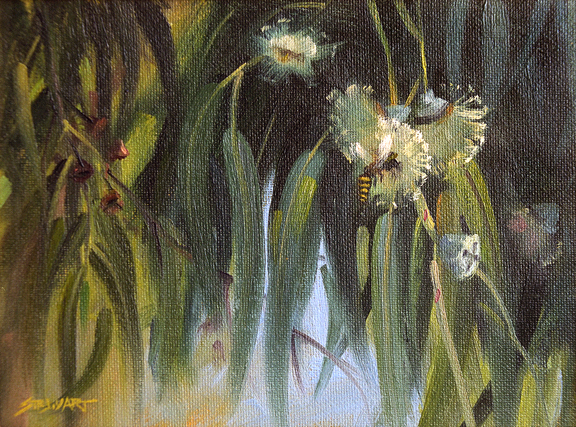
Eucalyptus and honeybee. Painting by Brian Stewart

The Encyclopedia also addresses the controversial question of whether or not eucalypts are allelopathic, which means chemicals in their roots or leaves suppress the germination of the seeds of other plants.  It reports that there is no conclusive evidence on this question.  However, the accumulation of leaf litter is probably a physical barrier to the germination of seeds in its understory, which is not an allelopathic method of suppressing competition.  This is clearly true of other trees as well.  For example, the tannins present in both oak and eucalyptus leaves prevent the rapid break down of the leaf litter which accumulates and creates a physical barrier to competing vegetation.  This is one of many examples of the characteristics that both native and non-native plants have in common.

The Encyclopedia attributes the flammability of the eucalyptus forest to leaf litter which is exacerbated in California by rare deep freezes.  These deep freezes cause die-back of eucalypts, contributing to fuel loads.   It makes no mention of the oiliness of leaves as a factor in flammability. 

There has not been such a deep freeze in the East Bay in over 20 years and 20-year intervals of such weather events have been historically typical.  These deep freezes do not occur on the San Francisco peninsula because its climate is moderated by the ocean and bay surrounding it.  Its climate is therefore warmer in winter and cooler in summer.  Therefore, this caveat about the flammability of eucalypts does not apply in San Francisco.

The myth lives on…..

Despite the fact that there is no evidence—scientific or experiential—that eucalypts are invasive, the myth lives on amongst the community of native plants advocates.  We will continue to provide the evidence that eucalypts are not invasive.  We hope that eventually the public will be sufficiently informed that they will become resistant to this claim of native plant advocates which is one of many myths used to justify the needless destruction of eucalypts.

****************************

(1)    Marcel Rejmanek and David Richardson, “Eucalypts,” in Encyclopedia of Biological Invasions, eds, Daniel Simberloff and Marcel Rejmanek, University of California Berkeley Press, 2011.

(2)    Craig Hardner, et. al., “The Relationship between Cross Success and Spatial Proximity of Eucalypts Globulus ssp. Globulus Parents,”  in Evolution, 212, 1998, 614-618.

“Do Not Destroy: Trees, Art, and Jewish Thought”

We treated ourselves to a visit to an exhibit at the Contemporary Jewish Museum in San Francisco, entitled “Do Not Destroy:  Trees, Art, and Jewish Thought.”  The title is taken from a commandment in the Torah (Deuteronomy 20:19):

“When in your war against a city you have to besiege it a long time in order to capture it, do not destroy its trees, wielding an ax against them.  You may eat of them but you must not cut them down.  Are trees of the field human to withdraw before you into the besieged city?  Only trees that you know do not yield food may be destroyed…”

This admonition is expanded by modern Jewish thought to encompass man’s responsibility to protect all of nature from harm.  The tree is a universal symbol of all nature. 

The Jewish Museum invited over 50 international artists to create original works of art inspired by the Jewish holiday which honors trees, Tu B’Shevat.  One of these works of art was awarded first prize by a public popularity contest. 

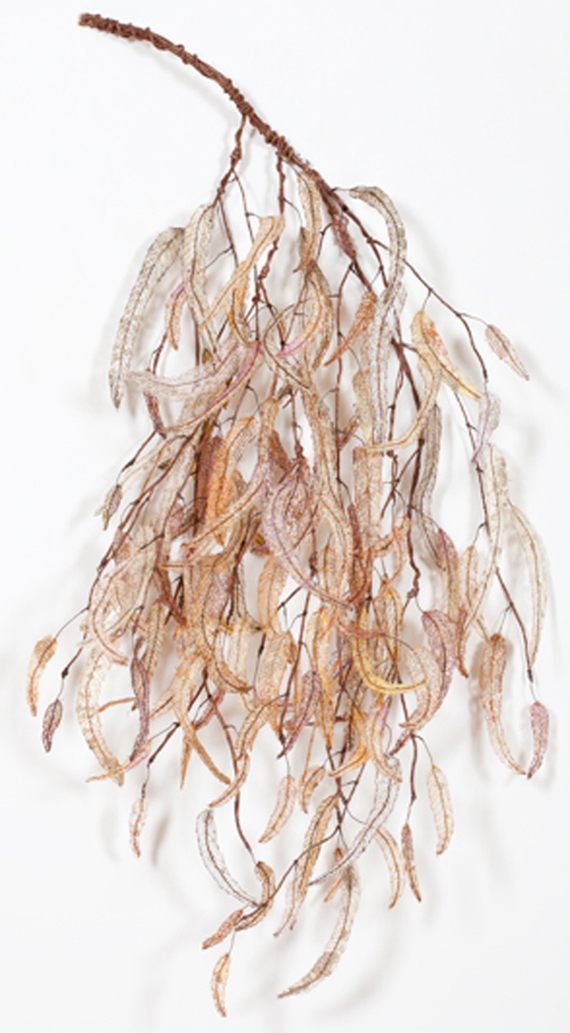
“Fauxliage: No Birds Sing” by Lisa Kokin. with permission. Photograph by Lia Roozendaal

At first glance, the viewer sees a branch of a eucalyptus tree with its graceful sickle-shaped leaves in a skeletal state, seemingly long-since dead. 

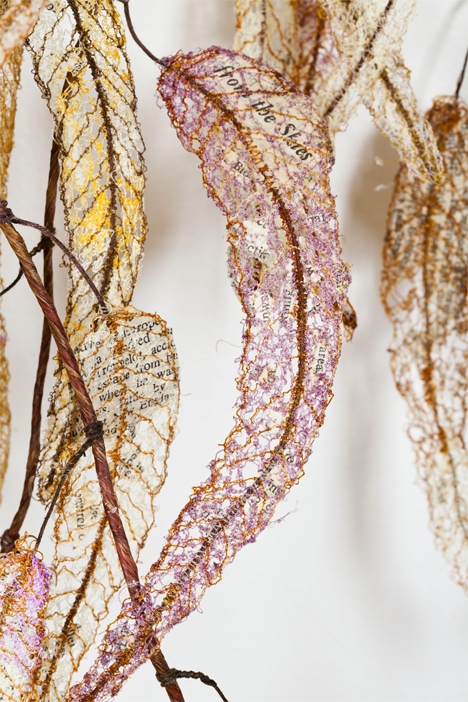
We must look more closely to appreciate the symbolic message of this evocative piece.  The leaves are in fact made of the pages of Rachel Carson’s Silent Spring.   Silent Spring was published in 1962, so we are celebrating the 50th anniversary of the publication of this ground-breaking book.  The pages have been shredded and wired together with thread and wire to create the delicate skeletal frame of each leaf. 

“Foliage: No Birds Sing” Detail with permission. Photo by Lia Roozendaal

The poetic justice of this piece took our breath away.   Silent Spring forever changed the public’s perception of the pesticides that were used in the environment at that time.  Rachel Carson informed us that these pesticides—particularly DDT—were killing our birds, silencing our springs when birds should be singing as they claim their nesting territories and attract their mates.  Although DDT was banned long ago, and many birds have recovered from the damage it caused, new pesticides have been developed and are being used to kill eucalyptus and many other non-native plants and trees.

 We have no way of knowing the artist’s intention in creating this work of art, but we commend her for celebrating the beauty of the eucalyptus and for the deeply ironic reference to the pesticides being used to kill them.  The public’s vote for first prize for this beautiful piece is evidence that there are many fans of the much-maligned eucalyptus.

[Edited to add:  We have received this comment from the artist, Lisa Kokin:  “The only thing that struck me was the sentence that begins, ‘We have no way of knowing the artist’s intention…’  It seems a bit paradoxical, given that you do understand why I chose Silent Spring to embed in the piece.  It is my concern about the environment and its destruction by corporate greed that motivated me to use Carson’s book and create a piece that speaks of that destruction in a poetic, rather than didactic, way.”]

We urge all lovers of trees to visit this exhibit which will continue until September 9, 2012.  And we ask native plant advocates to consider the commandment of the Torah and the Old Testament:  Do Not Destroy our Trees!

Contradictory Mission of the National Park Service

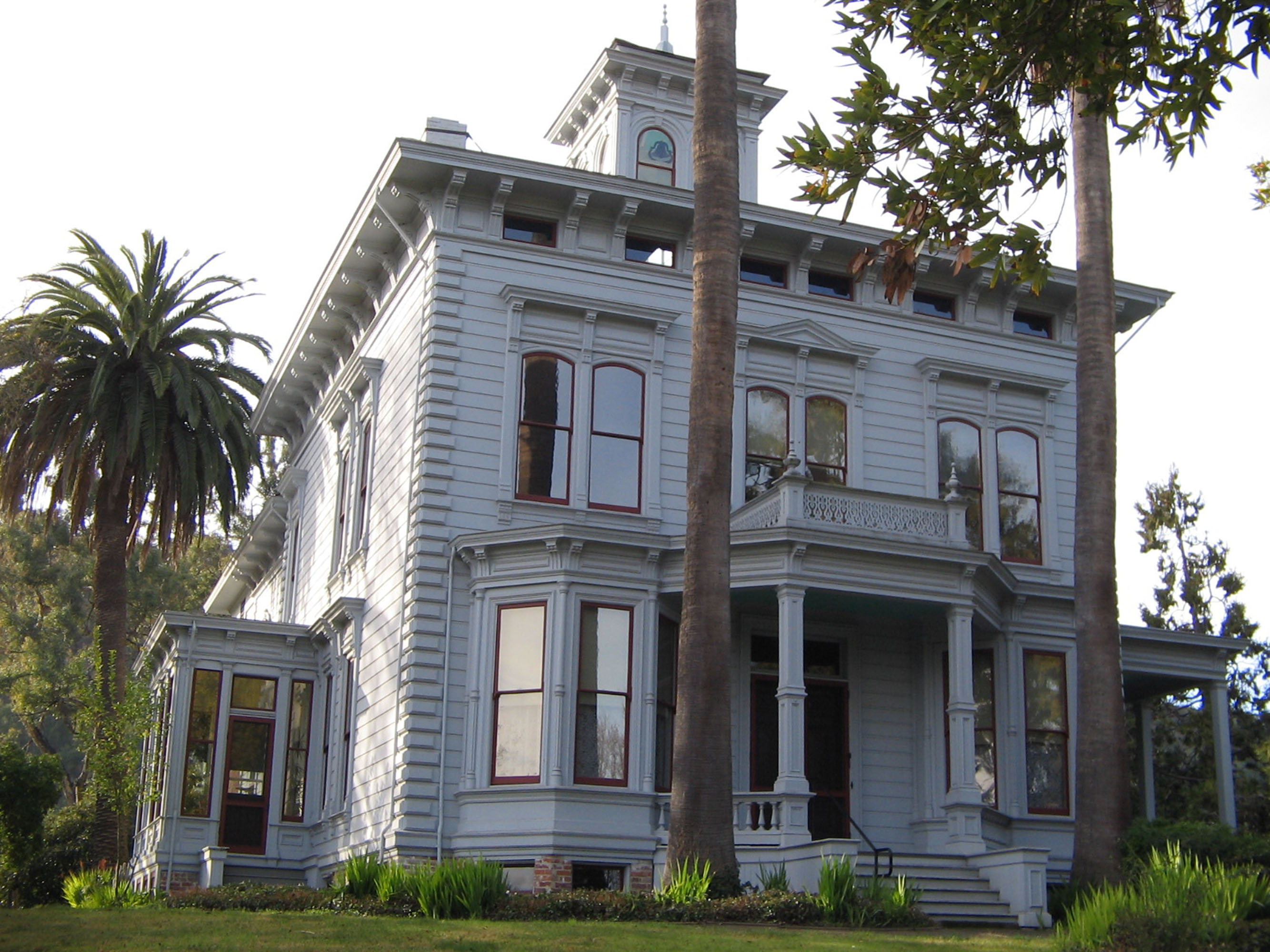
As we have reported on Million Trees, the National Park Service (NPS) is eradicating most non-native trees on its properties in the Bay Area.  (see “Our Mission”)  We were therefore taken aback when we stumbled on a news report in the Martinez News-Gazette about the NPS destroying 20 redwoods at the John Muir National Historic Site, which is an NPS property.  It seems these redwoods are the victim of the confused, sometimes contradictory mission of the NPS.

Update:  The links in this article are no longer functional.  We therefore provide a new link that corroborates the statements we have made in this article:  “John Muir National Historic Site:  Strentzel-Muir Gravesite Plan”

Redwoods are, of course, one of California’s most revered native trees.   However, in this particular location, the NPS chooses to destroy them because they were not planted by Muir’s family.  Therefore, the NPS does not consider them “historically accurate.”  NPS says their mission requires that they cut them down.

Ironically, it is the NPS that planted those particular redwoods only 20 years ago.  They planted them after destroying the non-native eucalyptus trees that were in fact historically accurate because they were planted during Muir’s lifetime.  The eucalyptus trees were presumably destroyed because they aren’t native to California.  The redwood trees were planted in their place because NPS says their policies require them to replace every tree they destroy.

Are you confused by this story?  So are we.  We think NPS must be confused as well.  They seem to have several contradictory policies.  Their obsession with native vegetation required them to destroy eucalyptus trees 20 years ago.  Their policy requiring them to replace every tree they destroy obligated them to plant native redwoods.  Twenty years later their policy requiring them to adhere to the historical record has obligated them to cut the redwoods down.  Presumably, that same policy will require them to replant eucalyptus trees.  Where will they go from there?  One wonders.

John Muir National Historical Site, NPS photo

A little historical perspective

The NPS website for the John Muir National Historic Site describes John Muir as the “Father of the National Park Service.”  They also credit him with the creation of the Sierra Club and as the person who convinced President Teddy Roosevelt to create many of our most famous national parks:  Yosemite, Grand Canyon, Sequoia, and Mt. Rainier.  Is the destruction of two generations of mature trees any way for the NPS to honor its father?

The John Muir National Historic Site in Martinez is the home that was built by Muir’s wife’s parents in 1882.  Muir and his wife moved into the home in 1890 after his wife’s father died.  Muir lived in the home for the last 24 years of his life.

Muir’s daughter reported that her father bought about a dozen different varieties of eucalyptus from a neighbor and she helped to plant them on the property.  The property was planted with many non-native plants and trees, including palms that now tower over the property.  Clearly, the Muir family didn’t share the NPS obsession with native plants.  Nor did he think too highly of those who destroy trees:

Any fool can destroy trees.  They cannot run away; and if they could, they would still be destroyed, chased and hunted down as long as fun or a dollar could be got out of their bark hides, branching horns, or magnificent bole backbones.”

–John Muir, Our National Parks, pg 364

As public policy and horticultural fads lurch from one extreme to another, the trees are the losers in man’s conceit.   And those who love trees stand helplessly by, watching the destruction, powerless to prevent it, although we pay for it with our taxes.

Basing our opinion of eucalypts on experience rather than rumors

We received a comment from a reader in Wales that prompted us to visit her website, Clegyr  Boia.  She tells a story that contains an important lesson for us:   to observe the performance of plants in our gardens and to base our evaluation of them on actual experience rather than preconceived judgments.

Eucalyptus leucoxylon ‘Rosea’ Wikimedia Commons Jean Tosti

In retelling this story, we shall call the owner of Clegyr Boia by the location of her property.  Clegyr Boia’s favorable opinion of eucalyptus trees is based on her visit to Australia in 1980.  As we did, she could see the beauty of the eucalyptus forest in Australia.

When she bought her property in Wales, she viewed it as an opportunity to develop an artistically beautiful landscape that she knew would include eucalyptus trees.  She planted eucalypts around one of her art installations because the blue color and graceful curves of their leaves enhanced her rock sculptures.  She planted other species of eucalypts in areas of the garden to shield them against the wind.

Soon after she began to plant eucalypts on her property, she was visited by friends and neighbors who were concerned about the introduction of eucalypts to their area.  They warned against the invasive properties of eucalyptus.  They claimed that nothing would grow under the eucalypts and that they would not provide food for wildlife.

Clegyr Boia’s initial response was to remove the eucalypts she had planted.  Then she had second thoughts.  She realized that her garden was full of non-native plants that were thriving and were providing valuable food for the denizens of her home, including her.  Since much of the food we eat is non-native, she decided that nativity is not a suitable criterion for banning a plant from her garden.  She decided to observe the eucalypts closely and decide based on their actual performance in her garden if they needed to be removed.

Some years later, she considers the eucalypts in her garden important contributors to its beauty.  They have demonstrated that other plants are welcome in the shelter of their canopy and that insects make good use of them.  They have also been remarkably resilient in salty, windy conditions.  When they have died back after heavy storms, they have soon resprouted.   Everything in her garden must make its own way, including the eucalypts, thereby proving their sustainability in this harsh setting. 

Native blackthorn grows next to eucalyptus. Photo courtesy Clergy Boia

We invite our readers to visit the Clegyr Boia website for the complete story, as well as a historical review of the migration of eucalypts all over the world and speculation about why they have acquired a negative reputation.

We tell this story because we admire Clegyr Boia’s commitment to her trees.  She listened to her neighbors, but she also made the commitment to her trees to watch their behavior in her garden.  She based her ultimate judgment of their suitability on their actual performance in her garden.  They have rewarded her patience with their success.

House burns without igniting eucalypts

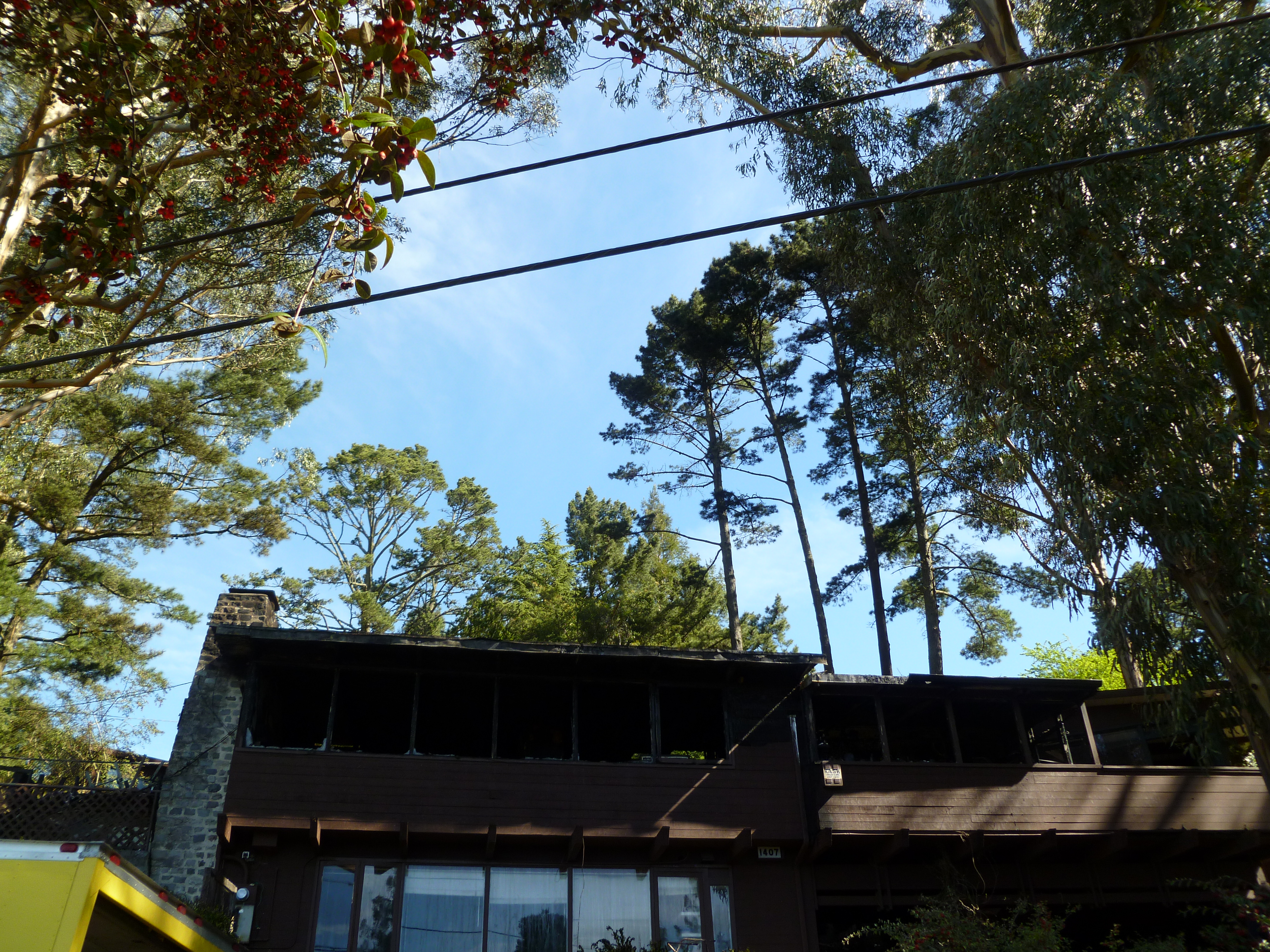
There was a fire in the Berkeley hills yesterday.  A home in the 1400 block of Queens Drive was gutted by the fire.  The home was completely surrounded by eucalyptus trees, some branches overhanging the home.  The trees did not ignite.  The leaves do not appear to be scorched by the fire.

Fire on Queens Road
Despite the fact that the trees didn’t burn, the news coverage of the fire focuses on the flammability of the trees:  “Eucalyptus trees are especially flammable and often used for kindling because of their oils.”  The accusation of flammability is not new.  We see it in any news story in which eucalypts are mentioned in any context, even those unrelated to fires. 

The claim that eucalyptus is used as kindling is something we have not heard before.  In fact, it makes no sense since the oil in eucalyptus is contained in the leaves, not in the wood, which is the usual definition of kindling.  However, we are accustomed to new anti-eucalyptus stories being fabricated at every opportunity.

We won’t repeat all the evidence that eucalyptus is not more flammable than other trees in this post because our readers have heard it all before.  We will just remind you that all reputable sources of information about preventing wildfires inform homeowners that the species of plants and trees are irrelevant to fire safety. 

All species of plants and trees will burn under certain circumstances, such as a wind-driven fire on a hot, dry day.  Property owners can reduce their risks of wildfire with appropriate maintenance, such as removing lower limbs on all trees, pruning trees and shrubs away from structures, and removing accumulated leaf litter.

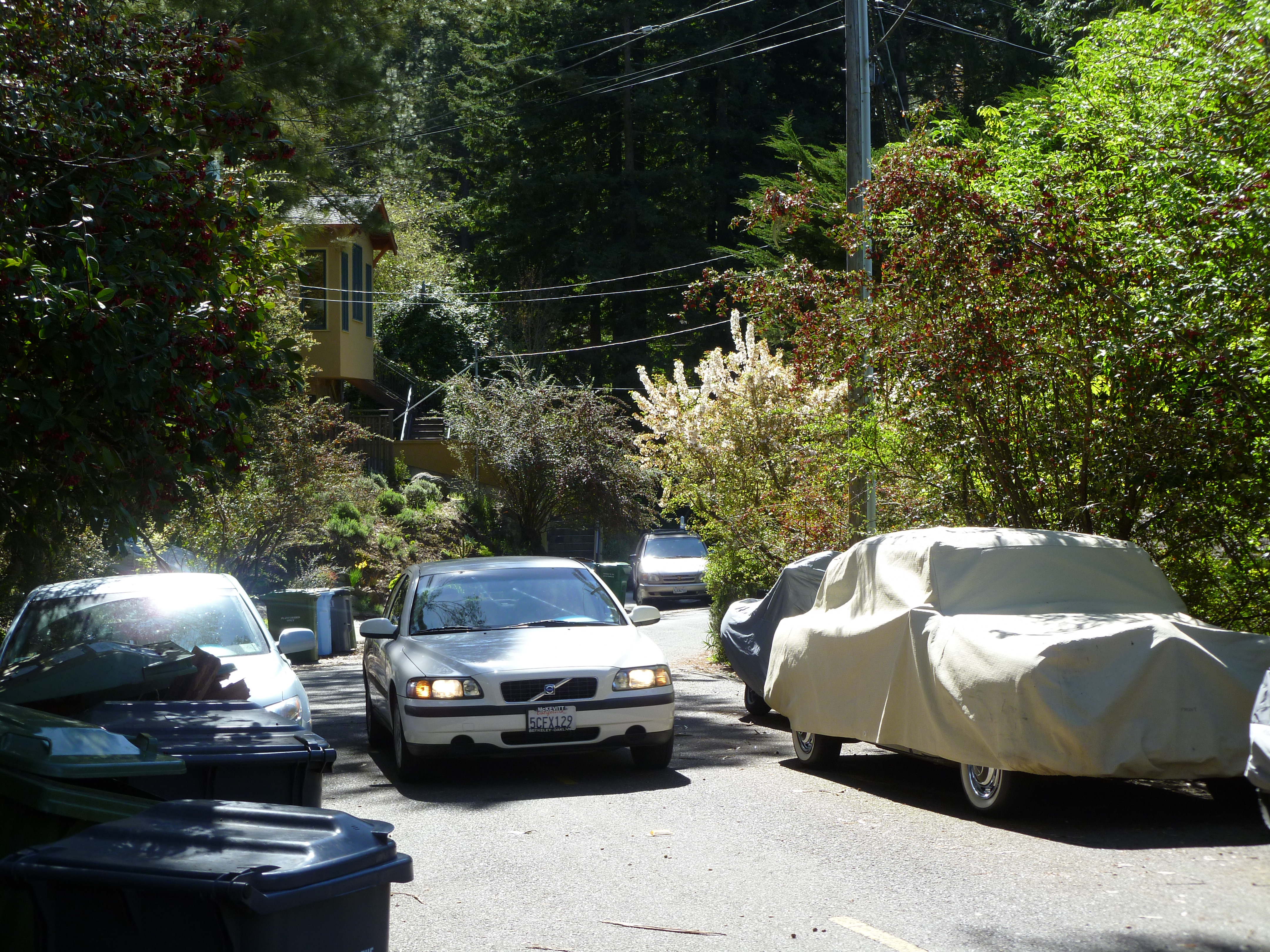
In the case of the fire on Queens Road, the neighbors put themselves in harm’s way by parking cars on both sides of a narrow street, narrowing the road to one-lane which severely restricted access to the home by fire trucks. 

Parked cars restrict access on Queens Road

As usual, humans are always looking for a non-human scapegoat for the risks they choose to take.  Rather than taking care of the vegetation around their home and reducing the number of cars parked on a narrow road, they prefer to blame the trees.  In this case the trees had nothing to do with this fire.