Native Trees and Their Close Relatives

Over 10 years ago, Mark Speyer wrote one of the first guest articles for Conservation Sense and Nonsense about mulberry trees, one native to North America and the other introduced by American colonists because it is the host plant of silk worms.  That article was a hit!  It has been viewed by over 8,600 readers.  It is still entirely relevant to the mission of Conservation Sense and Nonsense and I recommend it to you.  You will find it HERE.
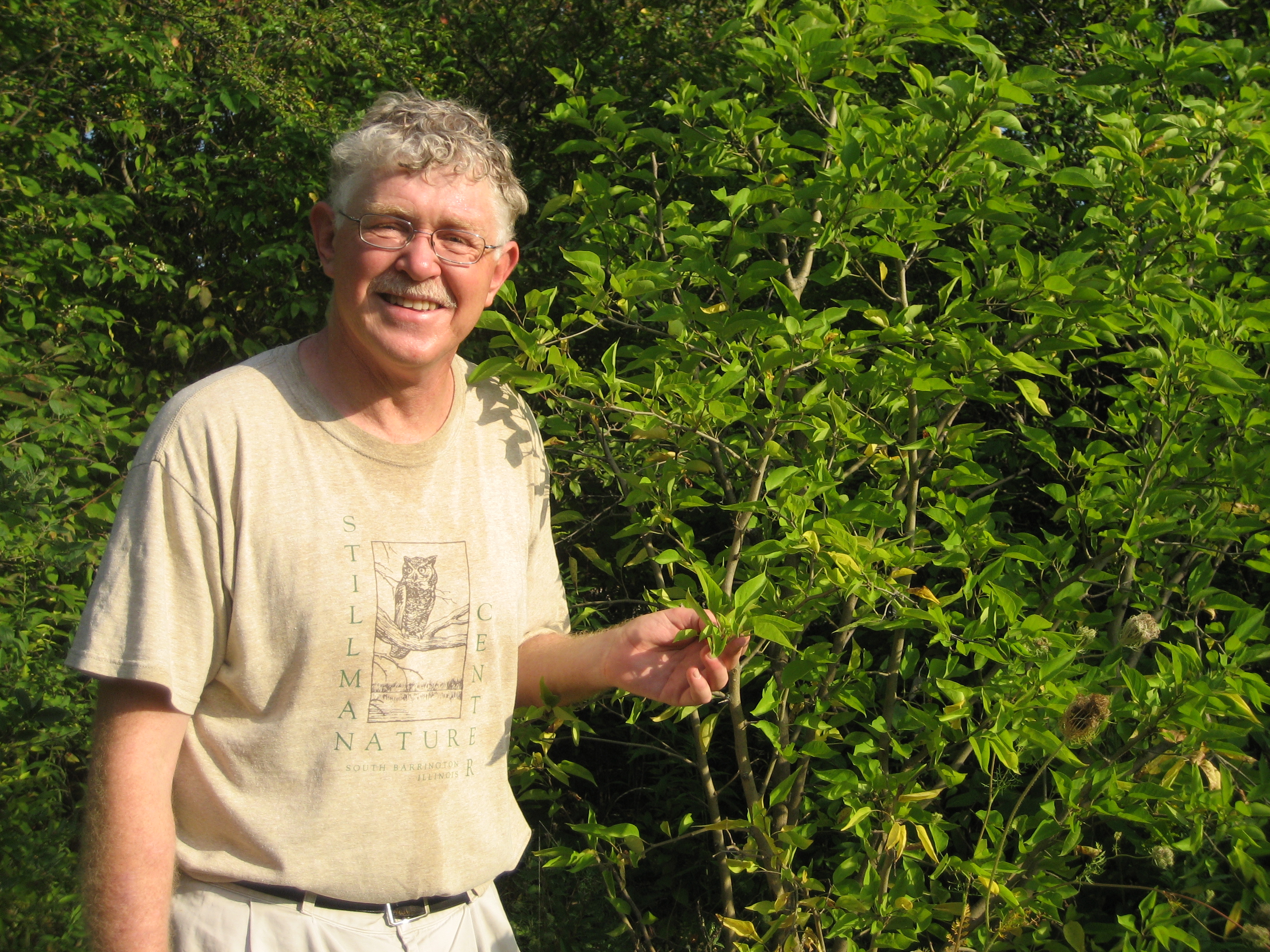
Mark Spreyer

I am grateful to Mark for giving me this opportunity to publish his guest article about willows, some native to North America and one introduced.  As in the case of introduced mulberry trees, some willow species are native to China. 

Much of China and North America have been in the same latitude since the evolution of angiosperms.  As a result of climate similarity and geographic proximity, many of our plant species considered native in Eastern North America are also native to China.  These paired species in the same genus are called disjuncts.  There are many woody disjuncts in China and North America (magnolias, persimmons, hickory, catalpa, dogwood, sweetgum, tuliptree, tupelo, sassafras, Virginia creeper, etc) as well as many herbaceous disjuncts (ginseng, lopseed, mayapple, skunk cabbage, etc.). 

They are different species from their Chinese counterparts because they have been separated long enough to change as a result of genetic drift and in response to a new environment, but are in the same genus and plant lineage and therefore chemically similar. These plant species made their way from China to North America by natural means, such as being carried by birds, animals, wind and ocean currents. 

In contrast, Chinese species of mulberries and willows were intentionally introduced to North America.  Mulberries were brought with the hope of making silk and weeping willows were brought to grace our gardens with their beauty.  Some say they don’t belong here because they were brought by humans.  Others say that is a meaningless distinction.  Whether brought by birds or brought by humans it is a distinction without a difference because humans are as much a part of nature as birds.

Mark Speyer is the Executive Director of the Stillman Nature Center in Barrington, Illinois.  He can be reached at:  stillmangho@gmail.com

WILLOWS IN THE WIND ©

       I’ve been writing nature columns for many years and I hope to write them for years to come but sometimes, the writing doesn’t come easy. The other evening, was one of those difficult times.

      As I reached for a bottle of aspirin to alleviate a headache, it hit me– willows.

You see the scientific name for the willow genus is Salix and the main ingredient in the original 1899 aspirin was salicin, an extract from willows.

      I’m not going to attempt to sort through the dozens of North American willows and their confusing hybrids. I don’t have enough aspirin for that. I’d like to concentrate on two of the willow trees, weeping and black, as well as a few of the willow shrubs.

Weeping Willow (Salix babylonica)         

      Unlike black willows, weeping willows aren’t native to this continent. The scientific name is somewhat misleading. This species originates from northern China, not the Middle East. Examples of Salix babylonica can be found growing along the famed Silk Road trade routes between China and Europe. The weeping willow arrived in Europe around 1730. It traveled to N. America courtesy of colonization. The weeping willow also landed on the W. Coast via Japan.
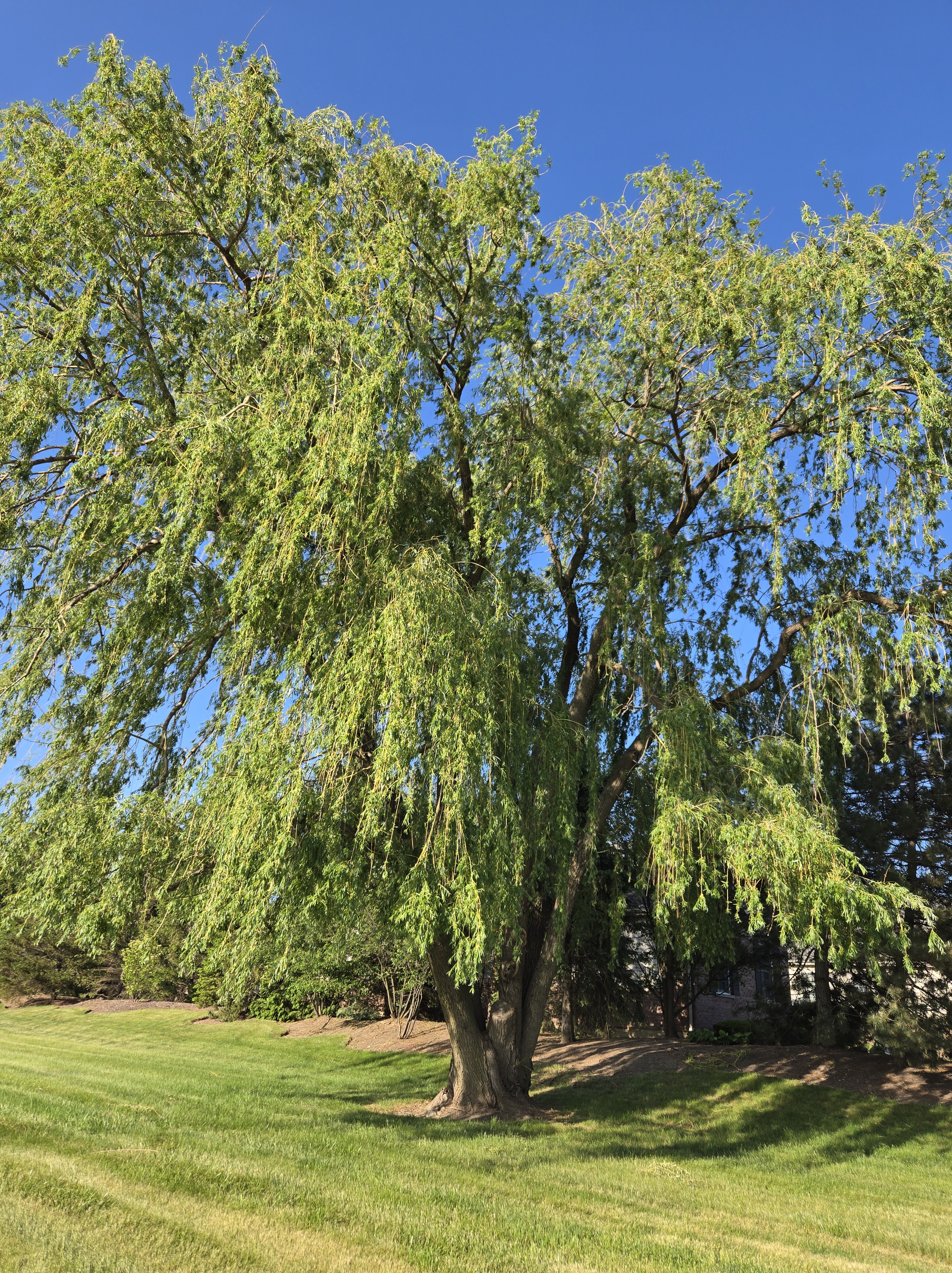
Weeping willow along a highway in suburban Chicago. Photo by Susan Allman

      Its graceful, long, slender, drooping branches makes the weeping willow an easy tree to identify. This pendulous growth habit earned this willow its common name. Not surprisingly, the tree is a popular choice for landscapers and gardeners. It is also the choice of pollinators such as specialized bees and butterflies. If planted in full sun, this rapid grower can reach a height of sixty feet.

           In addition, weeping willow tolerates soils that are somewhat acidic to alkaline. Finally, it thrives in low areas and wet spots where other trees might drown.  Decades ago, my father and I planted two weeping willows in a sunny wet pocket on the property. They grew fast and sucked up the water, just as we had hoped. You see they are designed to do just that.

         Like all willows, weeping willows are easily started from a sprig. Just stick it in some water and watch the rootlets sprout. When you think of where willows grow– along rivers, streams and other places prone to flooding– this asexual method of reproduction is a handy adaptation.

      If a flood washes away a bank and the willow that grew on it, odds are one of its branches will end up on a spit of mud or in a shallow pool downstream. With the passage of time, that branch will take root and a new willow will be on its way.

      In this country, most weeping willows are male clones and thus produce no fruit. Since reproduction for a willow is as easy as dropping a twig in running water, these clones can be found growing where no human planted them.

Black Willow (Salix nigra)

      Rather plant a native species? Then, this next tree is for you. While some may appreciate the graceful form of a weeping willow, give me the craggy old coot of the willow family, the black willow. One of the world’s largest willows, it varies in appearance with where it is growing. Along an eastern seaboard stream, it is a tree reaching a height of forty to fifty feet. In the southern reaches of the Mississippi River’s floodplain, a black willow can reach a height of 100 feet in a mere forty years.
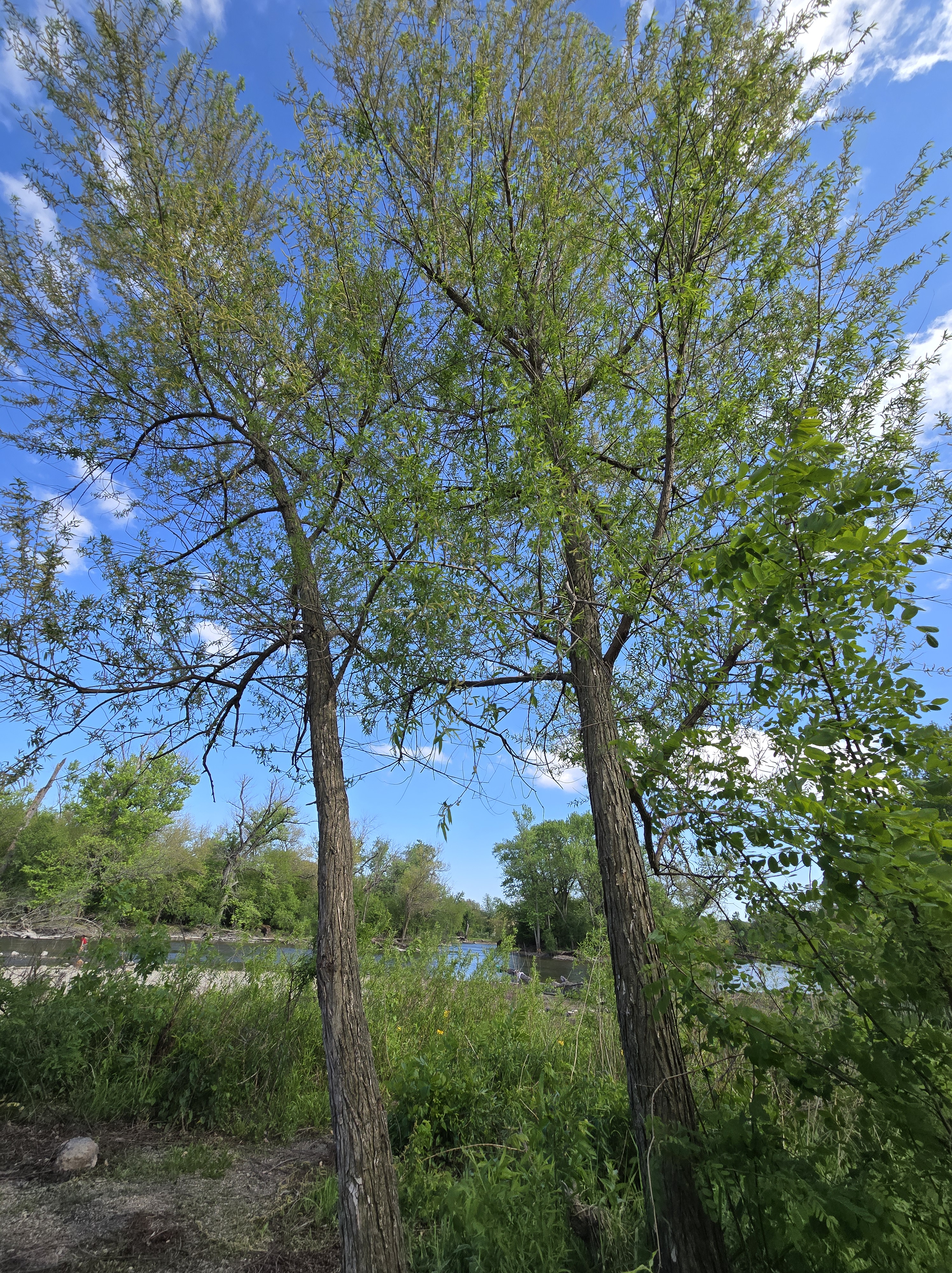
Two black willows near the Fox River in northern Illinois. Photo by Susan Allman.

      Here at the Stillman Nature Center we had a couple of sprawling specimens of our own. They had large forks, beginning low down, each fork leaned outward giving the tree a “slouching picturesqueness” as Donald Culross Peattie wrote.

      Black willow has many alternate names such as American, brittle, and, a favorite of mine, scythe-leaved willow. I like it because the botanical term for willows’ long narrow leaves is lanceolate or lance-shaped. Lances and scythes belong together, don’t you think?          

       Brittle is another appropriate name. Its slender reddish-brown twigs are flexible at first. As they age, the twigs become darker and brittle at the base. Anyone who has sat at a picnic table or parked a boat under a large black willow, will soon find these items decorated with fallen black willow twigs.    

   Unfortunately, willows are short-lived, rarely living past 85. But, as I’ve watched our willows here at Stillman, I have some questions about that figure.

     For example, one of our largest black willows came down in a heap some years ago. After the chainsaws were done, all that was left was the short, thick trunk and a few feet of each main branch that the trunk divided into.

      Was the tree dead? Not quite. As the years passed, flexible yellow branches grew from one of the large “dead” arms. Nutrients and water were obviously flowing from the roots and through the tissues of this “goner.”

      So when is a tree dead? A newspaper story provided an answer that fits our willows. The article was about the fate of a sequoia. At the time, the tree was at least 2,500 years old, “We don’t know if it’s dying or not,” said an interpretive ranger at Sequoia National Park, “One branch with green leaves connected by live tissue to one root is all that’s needed for a tree to be considered alive.”

      Of course, the Sequoia’s trunk remained standing unlike our willow’s old trunk that was down and decomposing.

               Shrubby Willows

      Most willows don’t have large trunks since they exist as shrubs. This is not the place to sort through them all. A partial list would include goat, Bebb, narrowleaf, sandbar, and, the florists’ favorite, pussy willow.                     
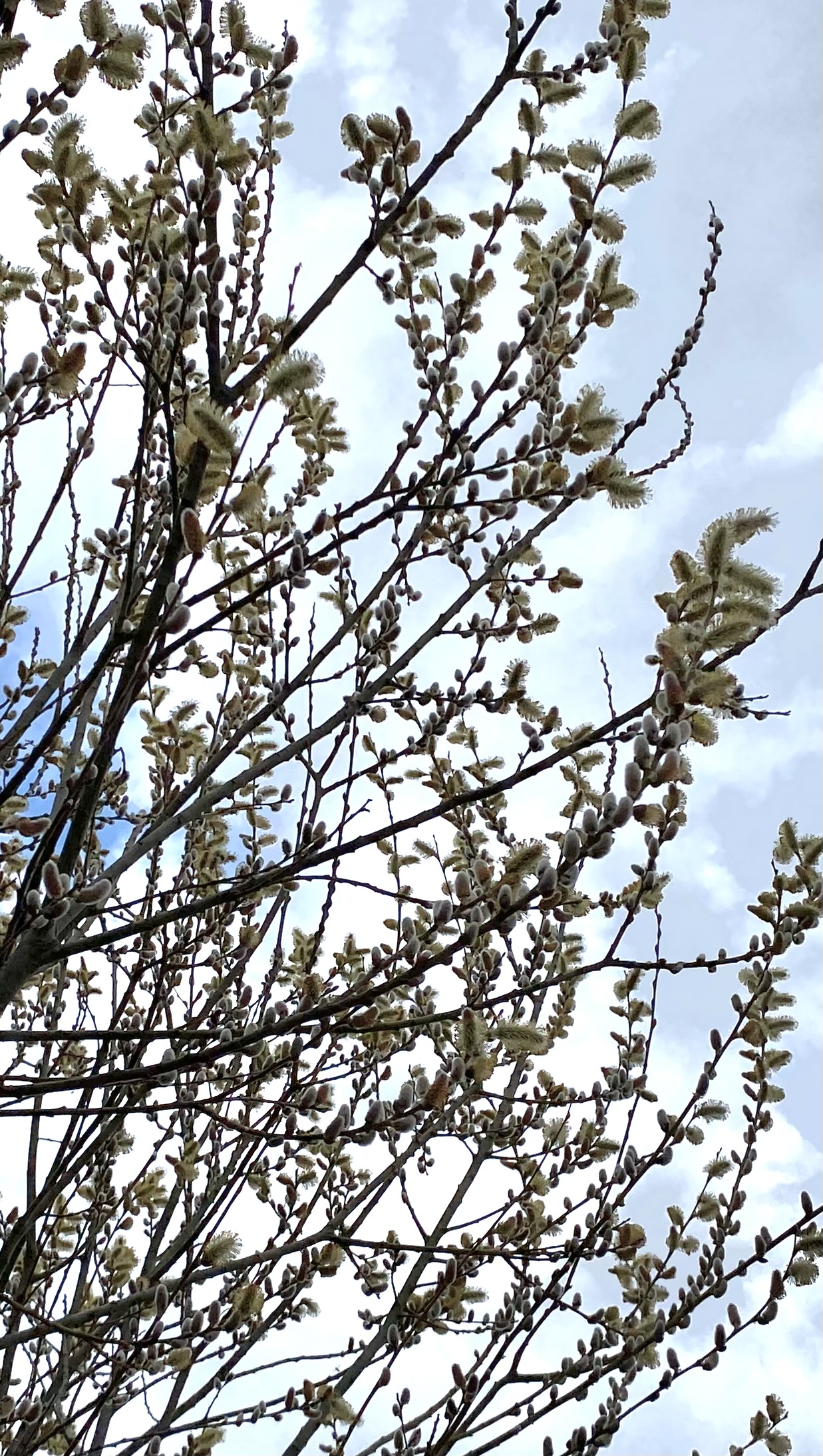
Pussy willow in spring. Photo by Lara Sviatko.

      The native pussy willow (Salix discolor) is a boreal species that can occasionally be found growing in northeastern Illinois. As you might have guessed, it inhabits wet areas such as floodplain forests, marshes, and shrubby swamps.

      Because willow thickets are within reach, deer, elk and domestic livestock will feed on willow leaves and twigs. This brings me back to where I started.       Peoples from N. America to ancient Greece made teas and other medicines from willow bark to treat joint pain and other ailments. So, are animals eating willows just to fill their stomachs or to ease their aches and pains as well? The next time I run into a talkative deer, I’ll ask.

Mark Speyer, Summer 2025

Nature’s Best Hope? Nope!

On November 16, 2024 I attended a conference at the Oakland Museum of California, where I live, sponsored by Bringing Back the Natives Garden Tour and featuring Doug Tallamy as the key note speaker.  The conference was sold out.  Two hundred enthusiastic native plant gardeners attended the conference.  Although a native Coast Live Oak is the crown jewel in my garden, I don’t consider myself a native plant advocate.  I listened quietly.

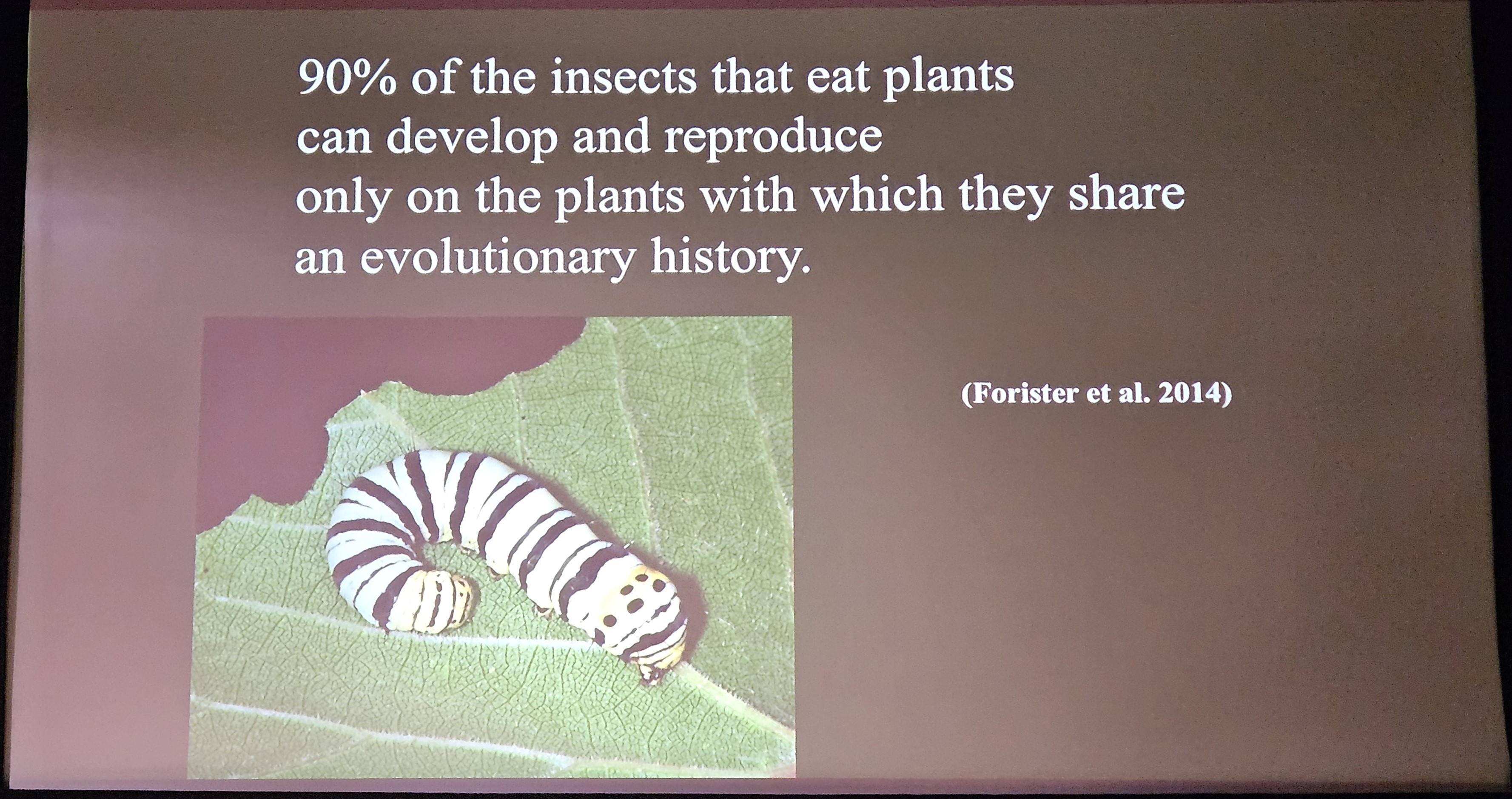
I have heard Doug Tallamy speak several times and I have read his books, so there were few surprises in his talk, except for this slide:

The cited study for this slide was published by Matthew Forister (and others).  Professor Forister is an academic entomologist who is a specialist in lepidoptera (moths and butterflies).  I have read several of Forister’s studies and I respect his research, so I was surprised that he would reach the conclusion claimed on Tallamy’s slide. 

I read the study (available HERE) and I was unable to find a conclusion in the study that was consistent with Tallamy’s interpretation of it.  Hmmmm, I said to myself, does Tallamy’s slide accurately represent Forister’s study? 

I asked Claude.ai to compare the study with Tallamy’s brief summary of the study.  Claude’s response was: 

“After carefully reviewing both the original study and Professor Tallamy’s summary slide, I find that his statement represents a somewhat oversimplified interpretation of the study’s findings…While Professor Tallamy’s statement captures the general spirit of the research – that most insect herbivores are specialists – it appears to be a simplified interpretation that makes stronger and more specific claims than what’s directly supported by the study’s data. The “90%” figure and the explicit connection to evolutionary history, while perhaps derived from other research, aren’t directly demonstrated in this particular study.”

Forister’s study found a continuous distribution between specialists and generalists, not a strict dichotomy, as Tallamy’s slide claims.  For example, an insect that is confined to plants in a genus is more specialized than an insect that is confined to a plant family.  Insects that are confined to a single plant species are extremely rare because they are often an evolutionary dead end. 

Professor Forister’s study is interesting.  It found that dietary specialization of insects varies by latitude and that specialization is greatest near the equator, where diversity of plant species is greatest, creating more opportunities for ecological niches in which specialized insects can find what they need with less competition.   

The same principle applies in the temperate zone, where we live.  That is, greater diversity creates more opportunities for insects to find what they need.  The scientific definition of biodiversity includes both native and non-native species.

The relationship between plant species in the Apiaceae family and the anise swallowtail butterfly evolved in the distant past, eons before individual members of the family evolved into different genera and species.  The association between an insect and its host plant is chemical rather than being a connection to a specific plant species.  In other words, anise swallowtail butterflies co-evolved with fennel. 

Likewise, monarch butterflies co-evolved with tropical milkweed, which is native to Mexico and Central America.  Both tropical milkweed and local native plants in the same genus contain the chemical that monarchs seek, a chemical that renders it unappealing to its predators because it makes them sick.  Again, this similarity is fortunate because tropical milkweed is evergreen and local natives are deciduous, making it available for monarchs to breed in winter months in a warming climate. Winter breeding of monarchs is recent and may not benefit the monarch population because fewer food sources are available in winter months. (2)

With the help of genetics, we can understand why individual members of a family of plants are closely related.  Plants and animals with a common ancestor are dispersed around the globe in a variety of ways, of which many are natural and long precede the advent of humans around 300,000 years ago.  Plants are carried by ocean currents, rivers, wind, storms, birds, animals, etc. 

When plants arrive in a new home, they quickly begin to change, partly because of random genetic drift and partly because they respond and adapt to the specific environment in which they have landed.  Over time, the change in the plant becomes great enough to be considered a new species, but its chemical properties remain similar to its ancestors in most cases.  Exceptions abound because nature is complex and our understanding is limited.

Why does it matter?

I attended this conference because native plant advocates are unhappy about Oakland’s Urban Forest Plan.  I support the plan because it will improve Oakland’s urban forest by addressing hazardous tree conditions, expanding the forest with diverse tree species, and more equitably distributing Oakland’s forest resources to neighborhoods that have been short-changed in the past.  I expected the plan to be discussed at the conference.  It was.

Native plant advocates want Oakland to plant more native trees and fewer non-native trees.  Opinions vary, of course, but some want a forest of exclusively native trees because of their belief that native trees support wildlife and non-native trees are not useful to wildlife.  There are many reasons why a diverse urban forest best serves Oakland and every animal that lives here:

  • The pre-settlement vegetation of Oakland was 98% grass, shrub, and marshland.(1) There were only 10 species of trees that are native to Oakland:  coast live oak, bay laurel, coast redwood, madrone, big leaf maple, holly leaf cherry, toyon, willow, buckeye, redbud.  There are now over 500 tree species in Oakland.
  • The goal of the Urban Forest Plan is to increase the population of street trees.  Most of the trees that are native to Oakland are not suitable as street trees.  Some are too big.  Some are shrubs rather than trees.  The branching habit of some native trees are too low to be street trees, which must not obstruct sidewalks or streets. 
  • Some shrubs can be pruned into trees, but that would be very costly and Oakland is broke!  A shrub that has been severely pruned into a tree is not stable.
  • Growing conditions where trees are needed in Oakland are often not suitable for native trees. That’s why they didn’t grow there prior to settlement.  Oakland’s urban forest is predominantly non-native because they are adapted to our growing conditions.
  • Climate change requires a diverse urban forest because a more diverse forest is more resilient.  Sudden Oak Death has killed millions of oaks throughout California for the past 25 years. We can’t predict which tree species will survive the warming climate.  Therefore, we must hedge our bets by planting a diverse forest.

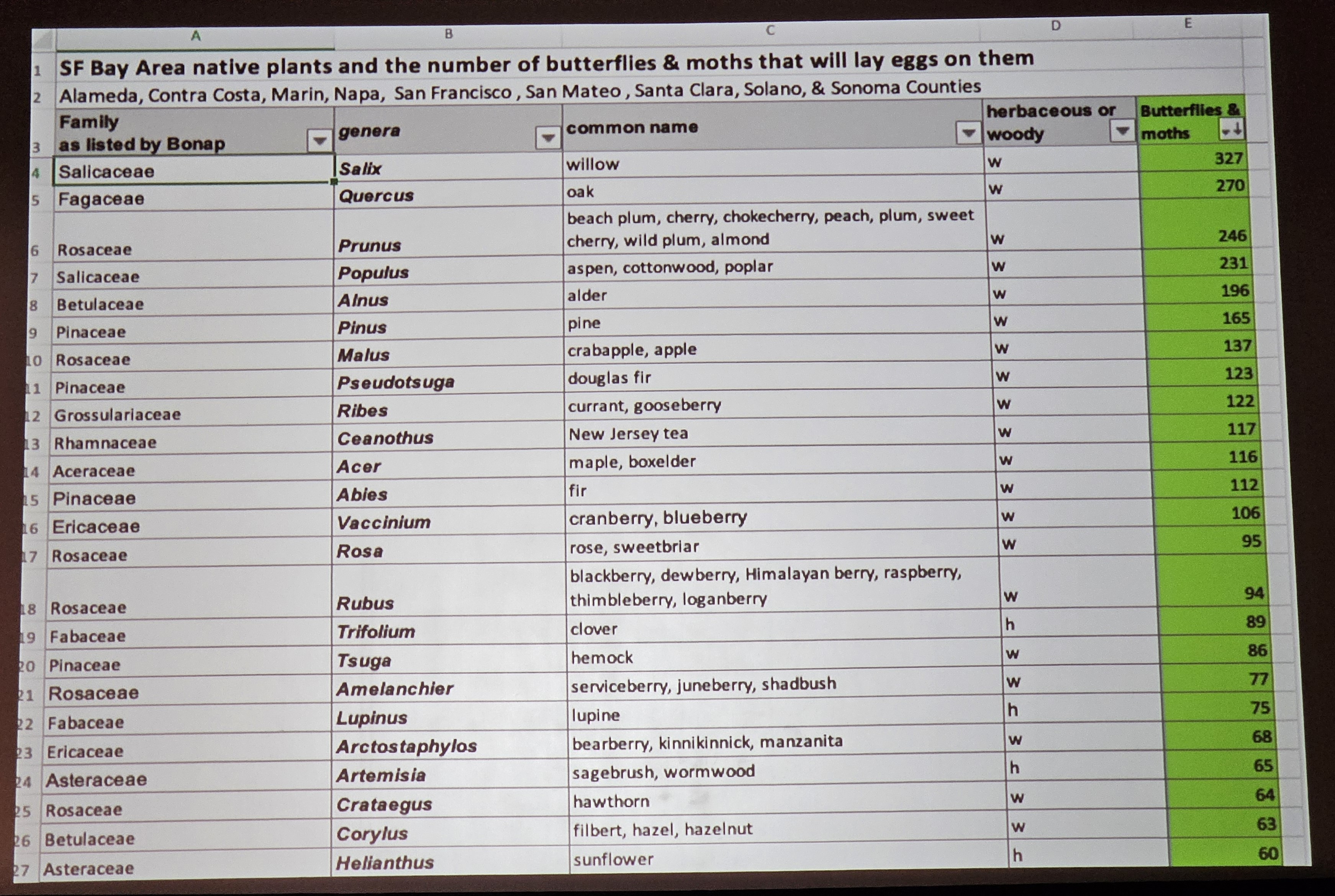
As expected, the first question the audience asked of Doug Tallamy was why Oakland Tree Services is telling native plant advocates that Oakland can’t plant exclusively native trees because they aren’t adapted to the challenging conditions that street trees face.  Doug Tallamy replied that Oakland’s Tree Services is mistaken.  He showed this slide of the many native alternatives that he believed would be suitable street trees:

This list is predominantly shrubs.  Some are not native to Oakland.  Some plants native to Oakland are missing from the list. At least one—Himalayan blackberry—is a notorious invasive non-native that most public land managers have been trying to eradicate for decades.  Himalayan blackberry is, however, an extremely useful plant for wildlife.  The list is a mixed bag, but it won’t create an urban forest.  

Update:  The Public Works & Transportation Committee of the City of Oakland approved the Urban Forest Plan for Oakland today, December 10, 2024.  Eleven people spoke in support of the plan.  No one spoke against the plan.  

Dan Kalb, City Council representative for District 1, asked why Oakland is planting non-native trees, which he claimed are breaking sidewalks and destroying the foundations of people’s homes by sending their roots into their yards.  David Moore, the head of Tree Services, handled these questions well and Kalb did not pursue the issue further. No speaker objected to non-native trees in Oakland.  

I have a native Coast Live Oak in my front yard, which damaged the foundation of my home, destabilizing the house and doing extensive damage inside the house.  To save the tree, we had to repair the foundation by suspending the new foundation over the roots from two steel-reinforced piers that are 10 feet deep at each end of the foundation.  In other words, although there is some variation in the configuration of tree roots, the variation is unrelated to the national origin of the tree species. 

Given the budget deficit in Oakland, it was necessary to reduce the goal of the plan to maintain the tree canopy rather than increase it.  No one objected to that change in the goal.  We all understood that the change was necessary.

On the bright side

I enjoyed two presentations by native plant gardeners who transformed their yards from barren places into lovely native plant gardens.  One started her project by digging up concrete covering her back yard.  The other began by digging up a front lawn.  Of course, their new gardens are an improvement over their predecessors.  They are more beautiful and they serve more wildlife. 

However, would these new gardens be even more beautiful and useful to wildlife if they were more diverse?  Would they be more resilient as the climate continues to change in unpredictable ways?  Maybe.

Thankfully, there was little talk of destruction in either of these inspiring presentations.  One exception was an anecdote about the visit of a native plant advocate to the garden of a fellow gardener.  The gardener asked his visitor where agapanthus in his garden is from.  When told it was from South Africa, he promptly pulled it out of the ground. The audience was very amused by the story.

When traveling in distant places, I don’t want to know which plants are native.  Don’t ask, don’t tell.  It’s a pleasant break from the “good” plant, “bad” plant dichotomy. 

Tallamy advised against using insecticide, but he made no mention of using herbicides. 

I have no quarrel with these gardeners.  I firmly believe that everyone should be free to plant whatever they wish in their gardens.  I respect everyone’s plant preferences and I ask that they respect mine. 

However, our public parks and open spaces belong to everyone and our tax dollars are used to maintain them.  I ask only that public land managers quit destroying healthy trees and landscapes, especially with herbicides. 


(1) David Nowak, “Historical vegetation change in Oakland and its implications for urban forest management,”  Journal of Arboriculture, September 1993

(2) Professor Emeritus Arthur Shapiro sent the following “qualifiers” in an email.  The article has been revised accordingly.  “…a couple of qualifiers. First, zelicaon cannot breed all year because it has a seasonal pupal diapause (dormancy) in winter which is photoperiod—T mediated. Its native wetland hosts (Cicuta and Oenanthe) support breeding March-October. It is unclear that it had any native hosts at all in upland, dry habitats. It was probably a tule marsh species in pre-European CA (below about 4000′), just as its close relative machaon is a fenland species in the U.K. Second, monarchs didn’t breed in winter until recently, again because of photoperiod-T induced reproductive (adult) diapause. Tropical milkweed has been cultivated in CA for well over a century but was not bred on in winter, even in SoCal. I hypothesize that warming T is responsible for the change. It is NOT advantageous to breed in winter. Because curassavica is the only plant available, it gets reused over and over again and becomes contaminated with high levels of an infectious protozoan parasite that causes significant morbidity and mortality. The butterfly might be better off if it didn’t try to breed in winter.” November 21, 2024.

Defining “Success” so “Success” can be achieved

I always attend the conferences of the California Invasive Plant Council (Cal-IPC) and the California Native Plant Society because I feel obligated to understand their viewpoint so I can accurately report on the controversies of invasion biology.  Ironically, the more I learn about the native plant movement and the “restoration” industry it spawned, the less sense it makes.  The October 2024 Symposium of the California Invasive Plant Council has provided more evidence that attempts to eradicate well-established non-native landscapes and replace them with native plants are futile.

Tricks of the “restoration” trade

Every Cal-IPC Symposium has wrestled with the question of whether or not it’s possible to convert non-native grassland to native grassland. A study of 37 grassland “restorations” in coastal California addresses that question. (1)  It’s really quite simple.  All you need to do is define success as 25% native plants after “restoration” and limit post-project monitoring to 5 years or less:  “Monitoring is done ≤5 years after project-implementation, if at all, and rarely assesses the effects of management practice on project success.” 

It also helps if public land managers in charge of the projects won’t allow the academic researcher to enter the land to conduct a survey of the results.  43% of the projects that were studied were “statutory,” i.e., they were mandated by laws such as county general plans or legally required mitigation for projects elsewhere that Environmental Impact Reports determined were harmful to the environment.  30% of the managers of the statutory projects would not allow the academic researcher to survey their projects. 

It is also easier to achieve success if the project goal is downgraded mid-project as were many of the statutory projects because they weren’t able to meet the original goal.

Project managers can also reduce their risks of failure by planting a small number of native species that are particularly easy to grow:  “Ninety-two percent of restoration managers preferentially use one or more of the same seven [native] species.”  Seven projects planted only one native species. 

According to the study, the result of planting only a few hardy native plants is “biotic homogenization.”  Call it what you will, but this risk-averse strategy is inconsistent with claims that the goal of native plant restorations is to increase biodiversity. 

The study did not ask project managers about the methods they used to eradicate non-native plants or plant native plants.  The study tells us nothing about the methods that were used or whether or not some methods were more effective than others.  Since results of the projects were all very similar, should we assume that the methods that were used didn’t matter? 

The presentation of this study concluded with this happy-face slide. (see below) It looks like a cartoonish marketing ad to me:

Harmless aquatic plants being pointlessly eradicated

A USDA research ecologist stationed at UC Davis made a presentation about the most effective way to kill an aquatic plant with herbicides, but that wasn’t the message I came away with. 

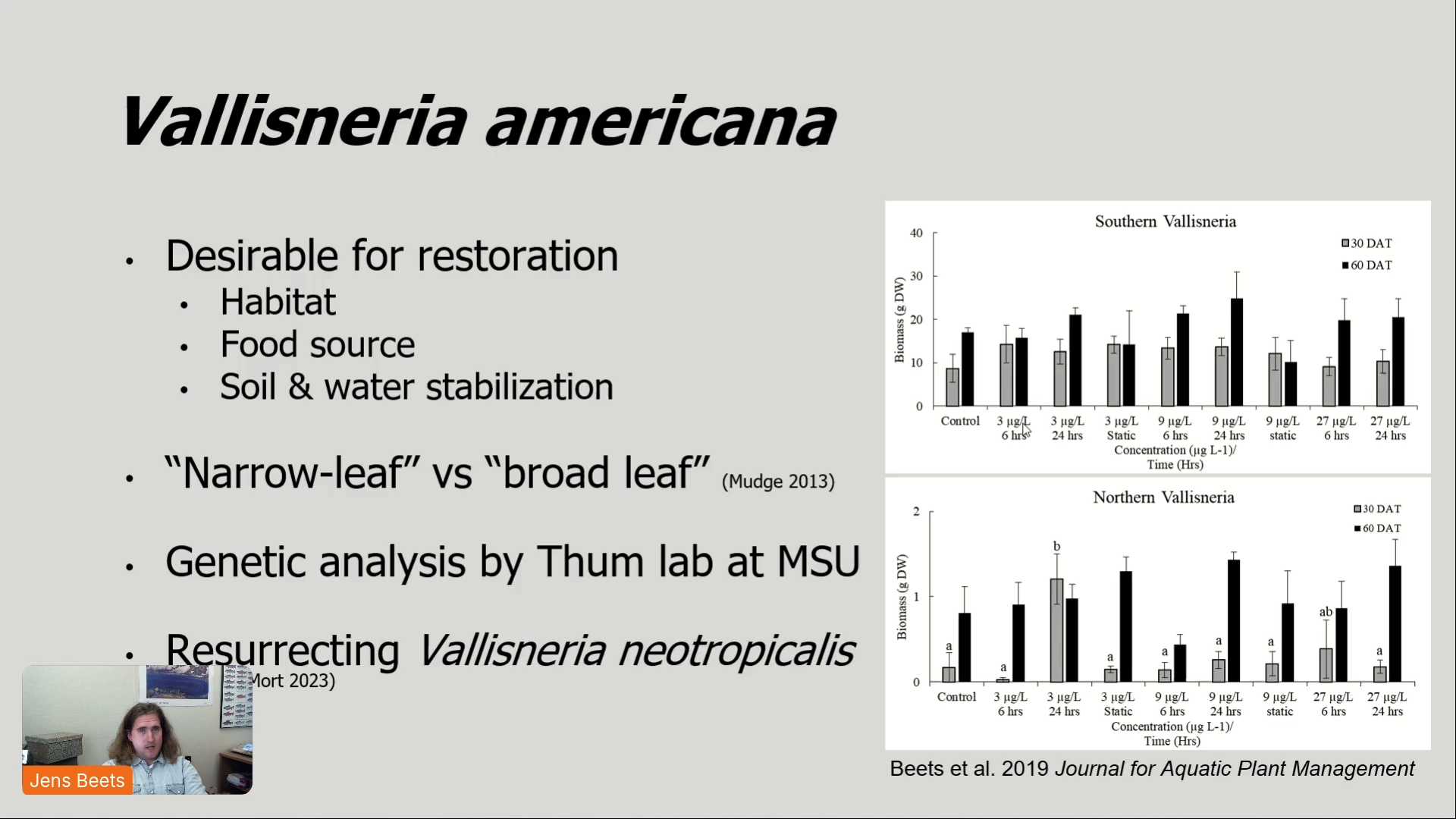
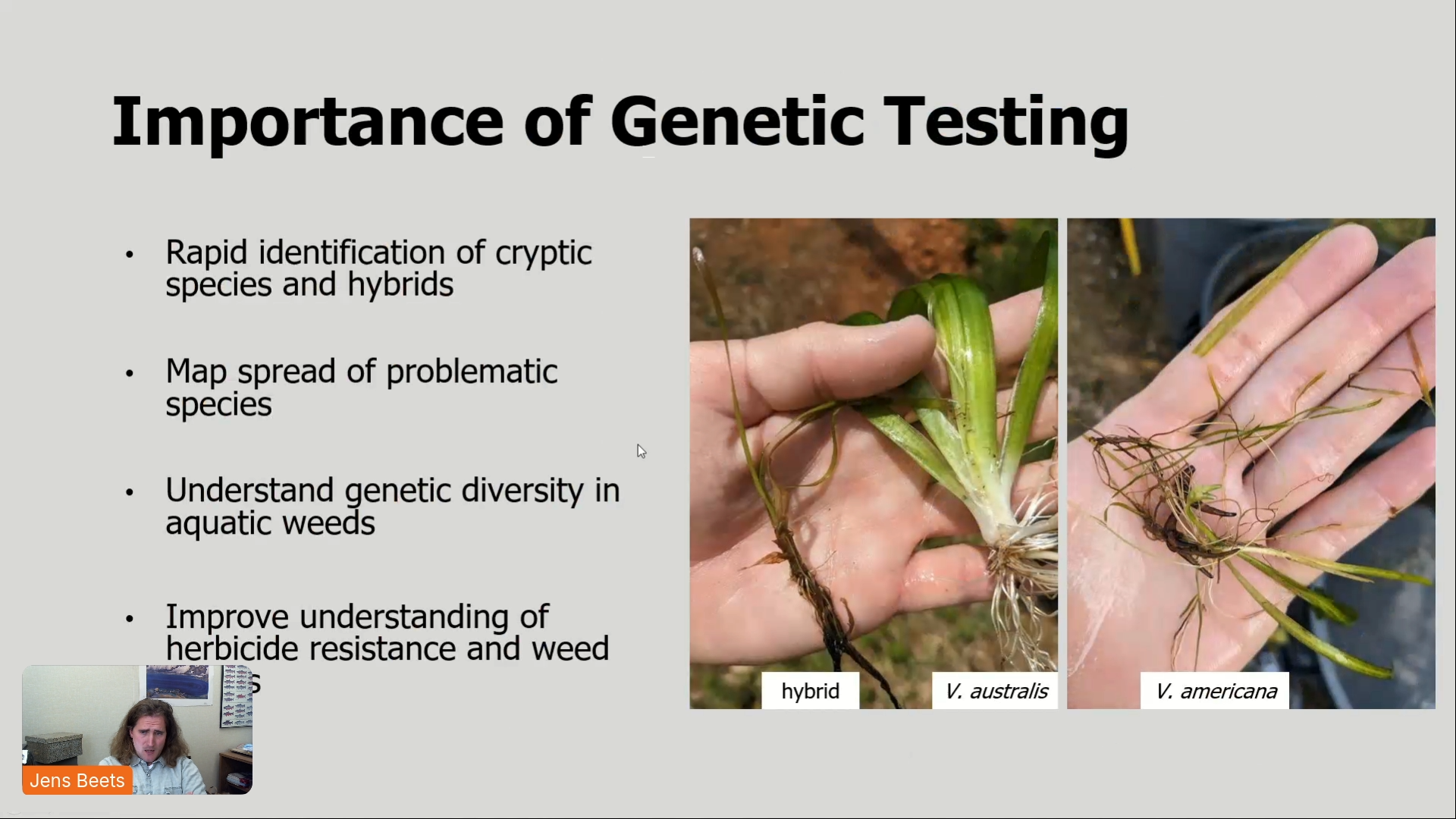
Jens Beets told us about a species of aquatic plant that is native to the East and Gulf coasts of the US, but is considered a “noxious weed” in California, solely because it isn’t native.  He said the plant is considered very useful where it is native.  (see below)

Where Vallisneria americana is native, it is considered a valuable plant for habitat restoration because it is habitat for vertebrates and invertebrates and it stabilizes soil and water levels.  The canvasback duck is named for this plant species because it is preferred habitat for the native duck that is found in California during the winter.

 Vallisneria americana looks very similar to other species in the genus considered native in California.  For that reason, native species of Vallisneria have been mistakenly killed with herbicide because applicators didn’t accurately identify the target plant as native.  Jens Beets recommended that genetic tests be performed before plants in this genus are sprayed with herbicide.

This story probably sounds familiar to regular readers of Conservation Sense and Nonsense.  The story is identical to the pointless and futile effort to eradicate non-native species of Spartina marsh grass in the San Francisco Bay.  The species being eradicated in California is native to the East and Gulf coasts, where it protects the coasts from extreme storm surges and provides valuable habitat for a genus of bird that is plentiful on the East Coast, but endangered in California.  The 20-year effort to eradicate non-native Spartina has killed over 50% of the endangered bird species in the San Francisco Bay. 

Throwing good money after bad

Because the hybrid is indistinguishable from the native species of Spartina on the West Coast, 7,200 genetic tests have been performed in the past 12 years before hybrid Spartina was sprayed with herbicide. Taxpayers have spent $50 million to eradicate Spartina over 20 years.  Recently, California state grants of $6.7 million were awarded to continue the project for another 10 years.  A portion of these grants is given to the California Invasive Plant Council to administer the grants.

Plants are sprayed with herbicide because they aren’t native, not because they are harmful.  Even if the target species is needed by birds and other animals, it is still killed and animals along with it.  The target species looks the same as the native species and only genetic testing can identify it is as a non-native.  The non-native is the functional equivalent of the native.  It is only genetically different because natural selection has adapted it to the conditions of a specific location. 

Pesticide regulation in the US is a hit or miss proposition

The final session of the symposium was a carefully orchestrated apologia for herbicides, a defensive tirade that suggested Cal-IPC believes its primary tool is in jeopardy.  Two presentations were made by employees of regulatory agencies.  Their assignment was to reassure the public that pesticides are safe because they are regulated by government agencies. 

The fact that many countries have banned pesticides that are routinely used in the US does not speak well for our regulatory system.  America’s pesticide regulators rarely deny market access to new pesticides.  A recent change in policies of California’s Department of Pesticide Regulation made a commitment to the continued use of pesticides for another 25 years. 

In 1996, Congress ordered the U.S. Environmental Protection Agency (EPA) to test all pesticides, used on food, for endocrine disruption by 1999. The EPA still doesn’t do this today. Twenty-five years later, the EPA has not implemented the program, nor has it begun testing on 96% of registered pesticides.  In 2022, an organization that represents farm workers sued the EPA to conduct the legally mandated evaluation of chemicals for endocrine disruption.   The lawsuit has forced the EPA to make a commitment to conduct these evaluations of chemicals for hormone disruption.   

The Cal-IPC presenters got some badly needed push back from attendees.   One attendee informed the audience that all the testing of herbicides is bought by the manufacturers, not the regulators who don’t do any testing.  Another attendee pointed out that herbicides have not been evaluated for the damage they are doing to the soil, damage that makes it difficult to grow native plants in the dead soil.  The “pesticide regulator” agreed with those observations.

Fire safety or native plant restoration?

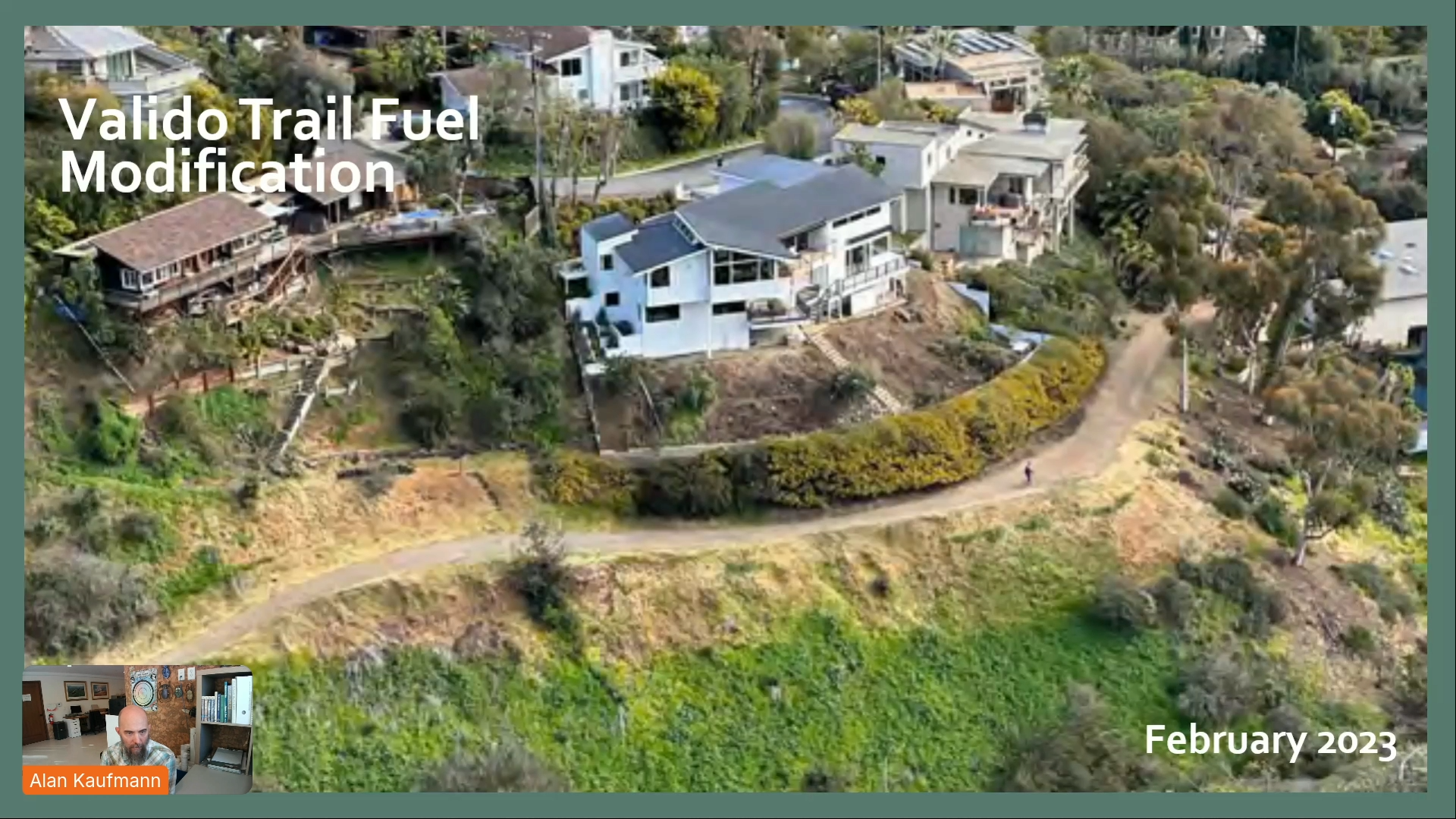
The Interim Deputy Director of the Laguna Canyon Foundation was the final presenter for the Symposium, speaking on a Friday afternoon at 4:30 pm, when there were less than 100 attendees left of the 690 registrants.  His presentation was about the blow back that his organization gets from the public about herbicide applications.  Criticism of herbicides escalated after a wet year that increased vegetation considered a fire hazard.  This photo (below) is an example of the visible effects of fuels management by Laguna Canyon Foundation using herbicides.

It seems likely that a fuels management project was selected for this presentation because it’s easier to justify herbicide use for fuels management than for eradicating harmless plants solely because they aren’t native. 

I recently supported Oakland’s Vegetation Management Plan that will use herbicides for the first time on 300 miles of roadsides and 2,000 acres of public parks and open space in Oakland.  Previously, herbicide applications were only allowed on medians in Oakland.  I tracked the development of the Vegetation Management Plan for 7 years through 4 revisions to avoid nativist versions of fuels management such as leaving dead thatch after herbicide applications on grassland or destroying non-native trees, while leaving highly flammable bay laurel trees behind or destroying broom, while leaving more flammable coyote brush behind.

However, using herbicides for the sole purpose of killing non-native plants is much harder to justify.  The irrational preference for native species has put us on the pesticide treadmill. Every plant species now targeted for eradication with herbicides should be re-evaluated, taking into consideration the following criteria:

  • Is it futile to attempt to eradicate a plant species that has naturalized in an ecosystem?
  • Will the attempt to eradicate the plant species do more harm than good?
  • Is the targeted plant species better adapted to current environmental and climate conditions?
  • Is the targeted non-native plant making valuable contributions to the ecosystem and its animal inhabitants?

If these questions cannot be satisfactorily answered, the bulls-eye on the targeted plant should be removed. Limiting the number of plants now being sprayed with herbicide is the only way to reduce pesticide use. If the plant isn’t a problem, there is no legitimate reason to spray it with herbicide.

Pot calls kettle black

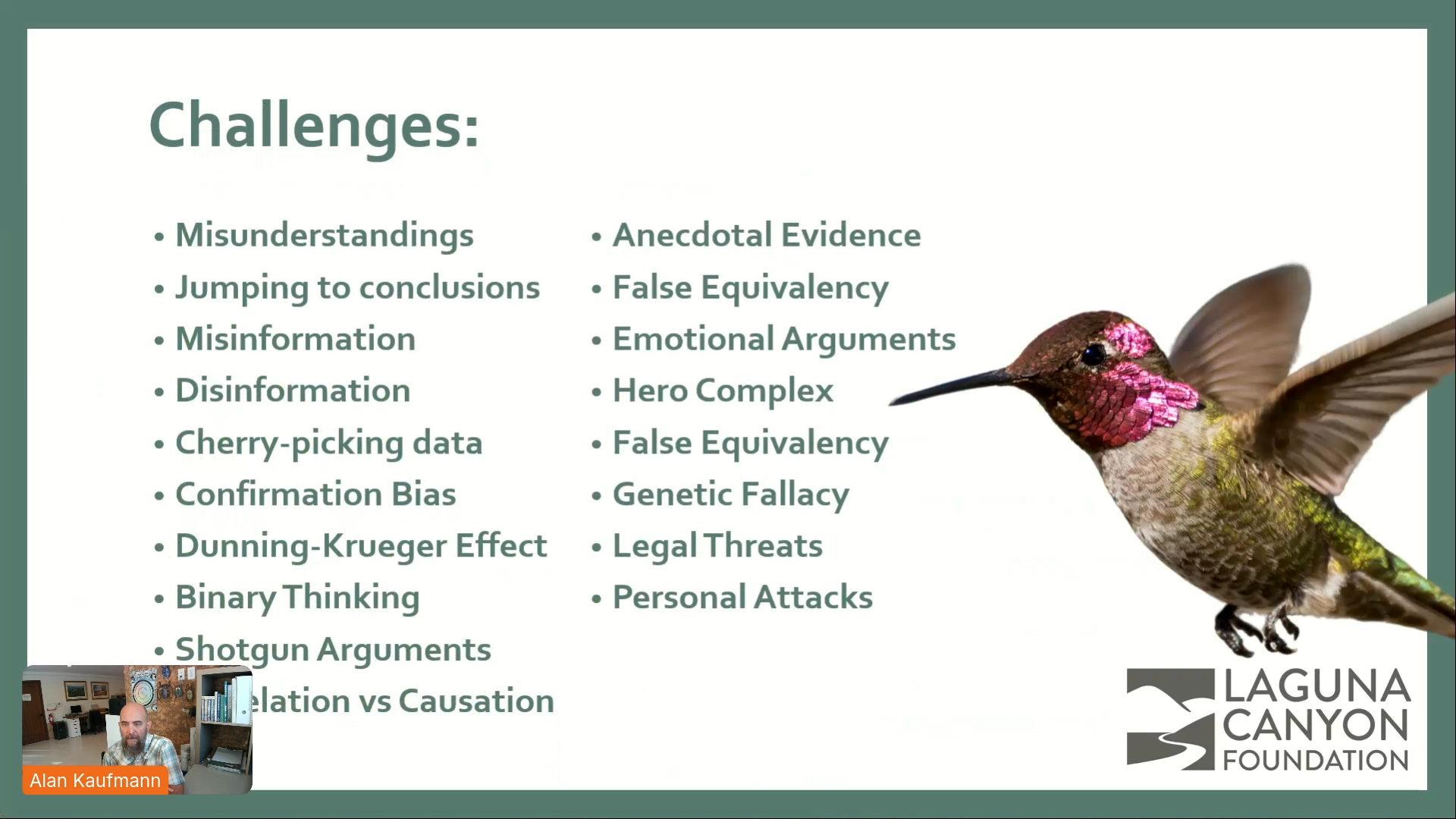
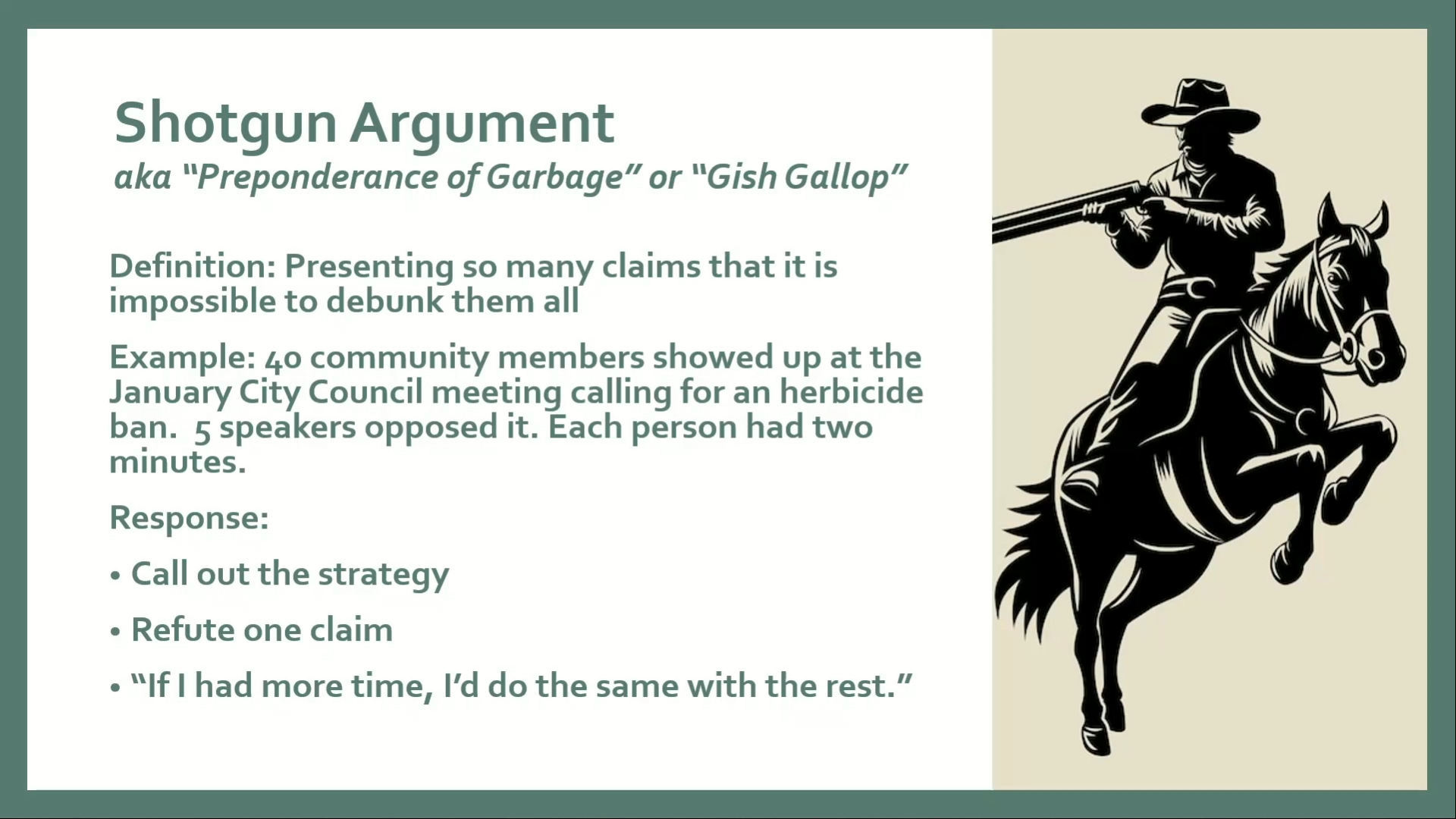
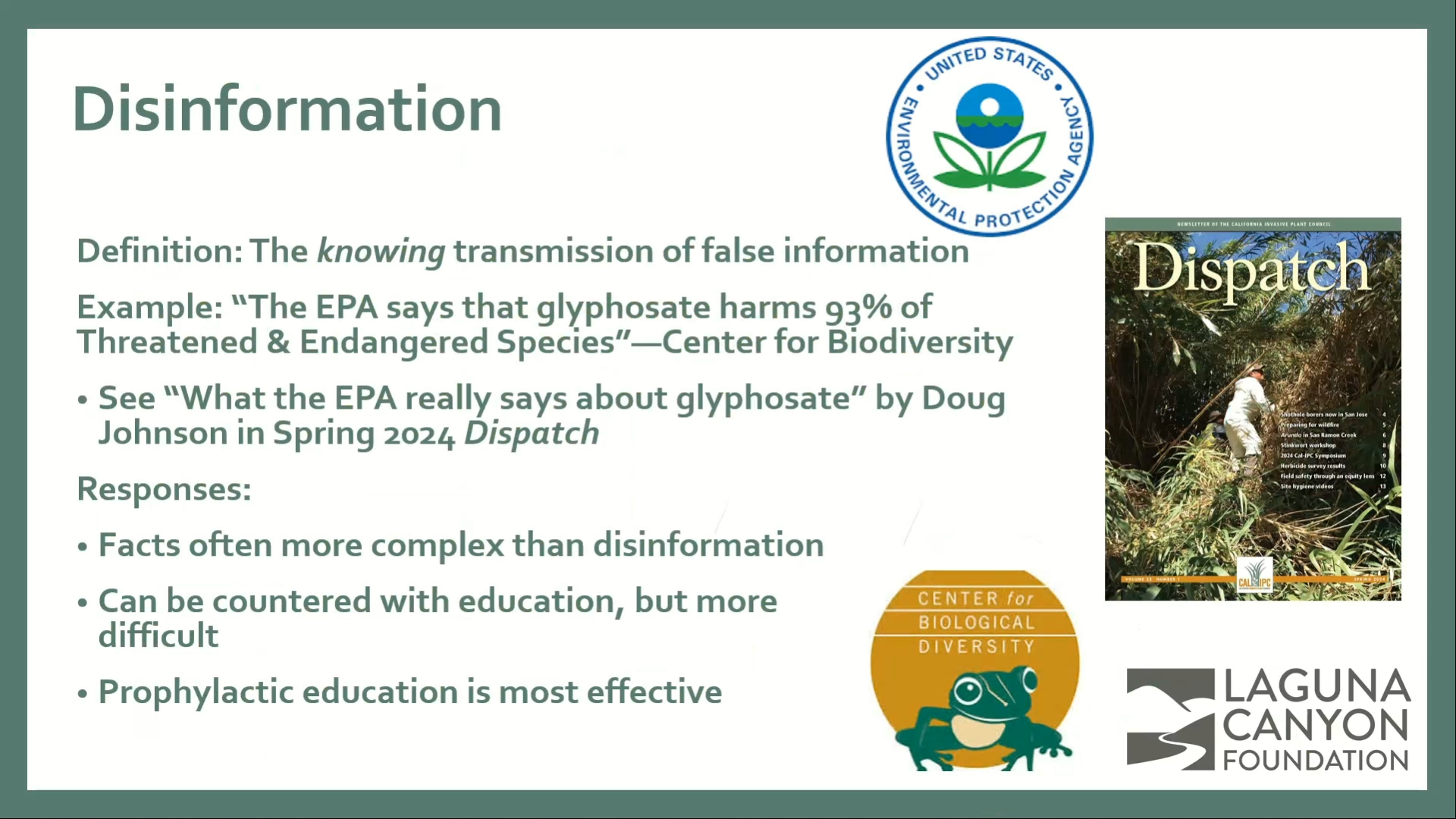
The Cal-IPC presentation was a detailed criticism of the public’s complaints about herbicides used in their community.  The intention of the presentation was to arm herbicide applicators with defenses against the public’s complaints.  Herbicide applicators were encouraged to recognize these arguments (below) and participate in the “education” of the public about the righteousness of their task.

The presenter then showed a series of slides making specific accusations, such as these:  (see below)

Those who object to the pointless destruction of nature can also cite distortions and misrepresentations of facts (AKA lies) by those who engage in these destructive projects;

  • Nativists fabricated a myth that eucalyptus kills birds to support their demand that eucalyptus in California be destroyed.  There is no evidence that myth is true. 
  • Nativists also fabricated a myth that burning eucalyptus in the 1991 firestorm in the East Bay cast embers that started spot fires 12 miles away from the fire front.  There is no evidence that myth is true.
  • Nativists exaggerate the success of their projects by setting a low bar for success, conducting no post-project monitoring, and restricting access to their completed projects.  
  • The EPA justified the dumping of rodenticides on off-shore islands by inaccurately claiming that the rodenticides do not end up in the water, killing marine animals.  There is ample evidence that island eradications have killed many marine animals because rodenticide lands in the water when applied by helicopters. 
  • USFWS justified the killing of 500,000 barred owls in western forests by claiming they are an “invasive species.”  In fact, barred owls migrated from the East to the West Coasts via the boreal forests of Canada.  These forests were not planted by humans and have existed since the end of the last Ice Age, some 10,000 years ago.  The arrival of barred owls on the West Coast was a natural phenomenon.  Barred owls are therefore not “invasive species.” In a rapidly changing climate, many animals must move to survive.
  • Nativists claim that most insects are “specialists” that require native plants.  That claim is a gross exaggeration of the dependence of insects on native plants, which are sometimes confined to a family of plants containing thousands of both native and non-native species. 
  • Pesticide applicators also complain about “personal attacks.”  They are not alone.  I (and others) have been called “nature haters,” “chemophobes,” and “climate change deniers.”  Pesticide applicators feel abused.  So do I. 

I could go on.  The list of bogus claims of the superiority of native plants and animals is long and getting longer as more and more public money is available to conduct misnamed “restorations.”  Suffice to say, there is plenty of misinformation floating around invasion biology and most of it is used to defend destructive “restoration” projects.  The war on nature is also a war of words. 


(1) ­Justin Luong, et.al., “Lessons learned from an interdisciplinary evaluation of long-term restoration outcomes on 37 coastal grasslands in California.” Biological Conservation, February 2022.

The program for the Cal-IPC 2024 Symposium is available HERE.  Abstracts and presentation slides have not yet been posted to the website, but they will eventually be available to the general public. 

Defining “Success” So That “Success” Can Be Achieved

I always attend the conferences of the California Invasive Plant Council (Cal-IPC) and the California Native Plant Society because I feel obligated to understand their viewpoint so I can accurately report on the controversies of invasion biology.  Ironically, the more I learn about the native plant movement and the “restoration” industry it spawned, the less … Continue reading “Defining “Success” So That “Success” Can Be Achieved”

I always attend the conferences of the California Invasive Plant Council (Cal-IPC) and the California Native Plant Society because I feel obligated to understand their viewpoint so I can accurately report on the controversies of invasion biology.  Ironically, the more I learn about the native plant movement and the “restoration” industry it spawned, the less sense it makes.  The October 2024 Symposium of the California Invasive Plant Council has provided yet more evidence that attempts to eradicate well-established non-native landscapes and replace them with native plants are futile.

Tricks of the “Restoration” Trade

Every Cal-IPC Symposium has wrestled with the question of how to convert non-native grassland to native grassland. A study of 37 grassland “restorations” in coastal California answers that question. (1)  It’s really quite simple.  All you need to do is define success as 25% native plants after “restoration” and limit post-project monitoring to 5 years or less:  “Monitoring is done ≤5 years after project-implementation, if at all, and rarely assesses the effects of management practice on project success.” 

It also helps if public land managers in charge of the projects won’t allow the academic researcher to enter the land to conduct a survey of the results.  43% of the projects that were studied were “statutory,” i.e., they were mandated by laws such as county general plans or legally required mitigation for projects elsewhere that Environment Impact Reports determined were harmful to the environment.  30% of the managers of the statutory projects would not allow the academic researcher to survey their projects. 

It is also easier to achieve success if the project goal is downgraded mid-project as were many of the statutory projects because they weren’t able to meet the original goal.

Project managers can also reduce their risks of failure by planting a small number of native species that are particularly easy to grow:  “Ninety-two percent of restoration managers preferentially use one or more of the same seven [native] species.”  Seven projects planted only one native species. 

According to the study, the result of planting only a few hardy native plants is “biotic homogenization.”  Call it what you will, but this risk-averse strategy is inconsistent with claims that the goal of native plant restorations is to increase biodiversity. 

The study did not ask project managers about the methods they used to eradicate non-native plants or plant native plants.  The study tells us nothing about the methods that were used or whether or not some methods were more effective than others.  Since results of the projects were all very similar, should we assume that the methods that were used didn’t matter? 

The presentation of this study concluded with this happy-face slide. (see below) It looks like a cartoonish marketing ad to me:

Harmless aquatic plants being pointlessly eradicated

A USDA research ecologist stationed at UC Davis made a presentation about the most effective way to kill an aquatic plant with herbicides, but that wasn’t the message I came away with. 

Jens Beets told us about a species of aquatic plant that is native to the East and Gulf coasts of the US, but is considered a “noxious weed” in California, solely because it isn’t native.  He said the plant is considered very useful where it is native.  (see below)

Where Vallisneria americana is native, it is considered a valuable plant for habitat restoration because it is habitat for vertebrates and invertebrates and it stabilizes soil and water levels.  The canvasback duck is named for this plant species because it is preferred habitat for the native duck that is found in California during the winter.

 Vallisneria americana looks very similar to other species in the genus considered native in California.  For that reason, native species of Vallisneria have been mistakenly killed with herbicide because applicators didn’t accurately identify the target plant as native.  Jens Beets recommended that genetic tests be performed before plants in this genus are sprayed with herbicide.

This story probably sounds familiar to regular readers of Conservation Sense and Nonsense.  The story is identical to the pointless and futile effort to eradicate non-native species of Spartina marsh grass in the San Francisco Bay.  The species being eradicated in California is native to the East and Gulf coasts, where it protects the coasts from extreme storm surges and provides valuable habitat for a genus of bird that is plentiful on the East Coast, but endangered in California.  The 20-year effort to eradicate non-native Spartina has killed over 50% of the endangered bird species in the San Francisco Bay. 

Throwing good money after bad

Because the hybrid is indistinguishable from the native species of Spartina on the West Coast. 7,200 genetic tests have been performed in the past 12 years before hybrid Spartina was sprayed with herbicide. Taxpayers have spent $50 million to eradicate Spartina over 20 years.  Recently, California state grants of $6.7 million were awarded to continue the project for another 10 years.  A portion of these grants are given to the California Invasive Plant Council to administer the grants.

Plants are sprayed with herbicide because they aren’t native, not because they are harmful.  Even if the target species is needed by birds and other animals, it is still killed and animals along with it.  The target species looks the same as the native species and only genetic testing can identify it is as a non-native.  The non-native is the functional equivalent of the native.  It is only genetically different because natural selection has adapted it to the conditions of a specific location. 

Pesticide regulation in the US is a hit or miss proposition

The final session of the symposium was a carefully orchestrated apologia for herbicides, a defensive tirade that suggested Cal-IPC believes its primary tool is in jeopardy.  Two presentations were made by employees of regulatory agencies.  Their assignment was to reassure the public that pesticides are safe because they are regulated by government agencies. 

The fact that many countries have banned pesticides that are routinely used in the US does not speak well for our regulatory system.  America’s pesticide regulators rarely deny market access to new pesticides.  A recent change in policies of California’s Department of Pesticide Regulation made a commitment to the continued use of pesticides for another 25 years. 

In 1996, Congress ordered the U.S. Environmental Protection Agency (EPA) to test all pesticides used on food for endocrine disruption by 1999. The EPA still doesn’t do this today. Twenty-five years later, the EPA has not implemented the program, nor has it begun testing on 96% of registered pesticides.  In 2022, an organization that represents farm workers sued the EPA to conduct the legally mandated evaluation of chemicals.   The lawsuit has forced the EPA to make a commitment to conduct these evaluations of chemicals for hormone disruption.   

The Cal-IPC presenters got some badly needed push back from attendees.   One attendee informed the audience that all the testing of herbicides is bought by the manufacturers, not the regulators who don’t do any testing.  Another attendee pointed out that herbicides have not been evaluated for the damage they are doing to the soil, damage that makes it difficult to grow native plants in the dead soil.  The “pesticide regulator” agreed with those observations.

Fire safety or native plant restoration?

The Interim Deputy Director of the Laguna Canyon Foundation was the final presenter for the Symposium, speaking on a Friday afternoon at 4:30 pm, when there were less than 100 attendees left of the 690 registrants.  His presentation was about the blow back that his organization gets from the public about herbicide applications.  Criticism of herbicides escalated after a wet year that increased vegetation considered a fire hazard.  This photo (below) is an example of the visible effects of fuels management by Laguna Canyon Foundation using herbicides.

It seems likely that a fuels management project was selected for this presentation because it’s easier to justify herbicide use for fuels management than for eradicating harmless plants solely because they aren’t native. 

I recently supported Oakland’s Vegetation Management Plan that will use herbicides for the first time on 300 miles of roadsides and 2,000 acres of public parks and open space in Oakland.  Previously, herbicide applications were only allowed on medians in Oakland.  I tracked the development of the Vegetation Management Plan for 7 years through 4 revisions to avoid nativist versions of fuels management such as leaving dead thatch after herbicide applications on grassland or destroying non-native trees, while leaving highly flammable bay laurel trees behind or destroying broom, while leaving more flammable coyote brush behind.

However, using herbicides for the sole purpose of killing non-native plants is much harder to justify.  The irrational preference for native species has put us on the pesticide treadmill. Every plant species now targeted for eradication with herbicides should be re-evaluated, taking into consideration the following criteria:

  • Is it futile to attempt to eradicate a plant species that is deeply entrenched in plant communities?
  • Will the attempt to eradicate the plant species do more harm than good?
  • Is the targeted plant species better adapted to current environmental and climate conditions?
  • Is the targeted non-native plant making valuable contributions to the ecosystem and its animal inhabitants?

If these questions cannot be satisfactorily answered, the bulls-eye on the targeted plant should be removed. Limiting the number of plants now being sprayed with herbicide is the only way to reduce pesticide use. If the plant isn’t a problem, there is no legitimate reason to spray it with herbicide.

Pot calls kettle black

The Cal-IPC presentation was a detailed criticism of the public’s complaints about herbicides used in their community.  The intention of the presentation was to arm herbicide applicators with defenses against the public’s complaints.  Herbicide applicators were encouraged to recognize these arguments (below) and participate in the “education” of the public about the righteousness of their task.

The presenter then showed a series of slides making specific accusations, such as these:  (see below)

Those who object to the pointless destruction of nature can also cite similar distortions and misrepresentations of facts (AKA lies) by those who engage in these destructive projects;

  • Nativists fabricated a myth that eucalyptus kills birds to support their demand that eucalyptus in California be destroyed.  There is no evidence that myth is true
  • Nativists also fabricated a myth that burning eucalyptus in the 1991 firestorm in the East Bay cast embers that started spot fires 12 miles away from the fire front.  There is no evidence that myth is true.
  • Nativists exaggerate the success of their projects by setting a low bar for success, conducting no post-project monitoring, and restricting access to their completed projects.  
  • The EPA justified the dumping of rodenticides on off-shore islands by inaccurately claiming that the rodenticides do not end up in the water, killing marine animals.  There is ample evidence that island eradications have killed many marine animals because rodenticide lands in the water when applied by helicopters. 
  • USFWS justified the killing of 500,000 barred owls in western forests by claiming they are an “invasive species.”  In fact, barred owls migrated from the East to the West Coasts via the boreal forests of Canada.  These forests were not planted by humans and have existed since the end of the last Ice Age, some 10,000 years ago.  The arrival of barred owls on the West Coast was a natural phenomenon.  Barred owls are therefore not “invasive species.” In a rapidly changing climate, many animals must move to survive.
  • Nativists claim that most insects are “specialists” that require native plants.  That claim is a gross exaggeration of the dependence of insects on native plants, which are sometimes confined to a family of plants containing thousands of both native and non-native species. 
  • Pesticide applicators also complain about “personal attacks.”  They are not alone.  I (and others) have been called “nature haters,” “chemophobes,” and “climate change deniers.”  Pesticide applicators feel abused.  So do I. 

I could go on.  The list of bogus claims of the superiority of native plants and animals is long and getting longer as more and more public money is available to conduct misnamed “restorations.”  Suffice to say, there is plenty of misinformation floating around invasion biology and most of it is used to defend destructive “restoration” projects.  The war on nature is also a war of words. 


(1) ­Justin Luong, et.al., “Lessons learned from an interdisciplinary evaluation of long-term restoration outcomes on 37 coastal grasslands in California.” Biological Conservation, February 2022.

“Grasses and Perennials: Sustainable planting for shared spaces”

Earlier this year, several comments on the Garden Rant website drew my attention to the Conservation Sense and Nonsense blog. The well informed scientific based comments of the Conservation Sense webmaster resonated with me – our gardening should be built on fact and best practice, not dogma or belief. I garden in England, the United Kingdom – and here we just don’t have the same intensity of debate surrounding native plants and restoration projects. Instead, we have a rich diversity of plants, drawn from all over the world; and our gardens are based on the principles of freedom of expression and individual design.

There is an emerging movement here, advocating the use of sustainable plant communities, taking design to the next level by creating functional ecological plantings – for nature, not just human enjoyment. This is a natural progression, utilising suitable plants from anywhere in the world, already growing in the equitable English climate. That said, our weather has been more challenging over the last few years, with increasing volatility and unpredictability; which makes appropriate plant selection even more important.

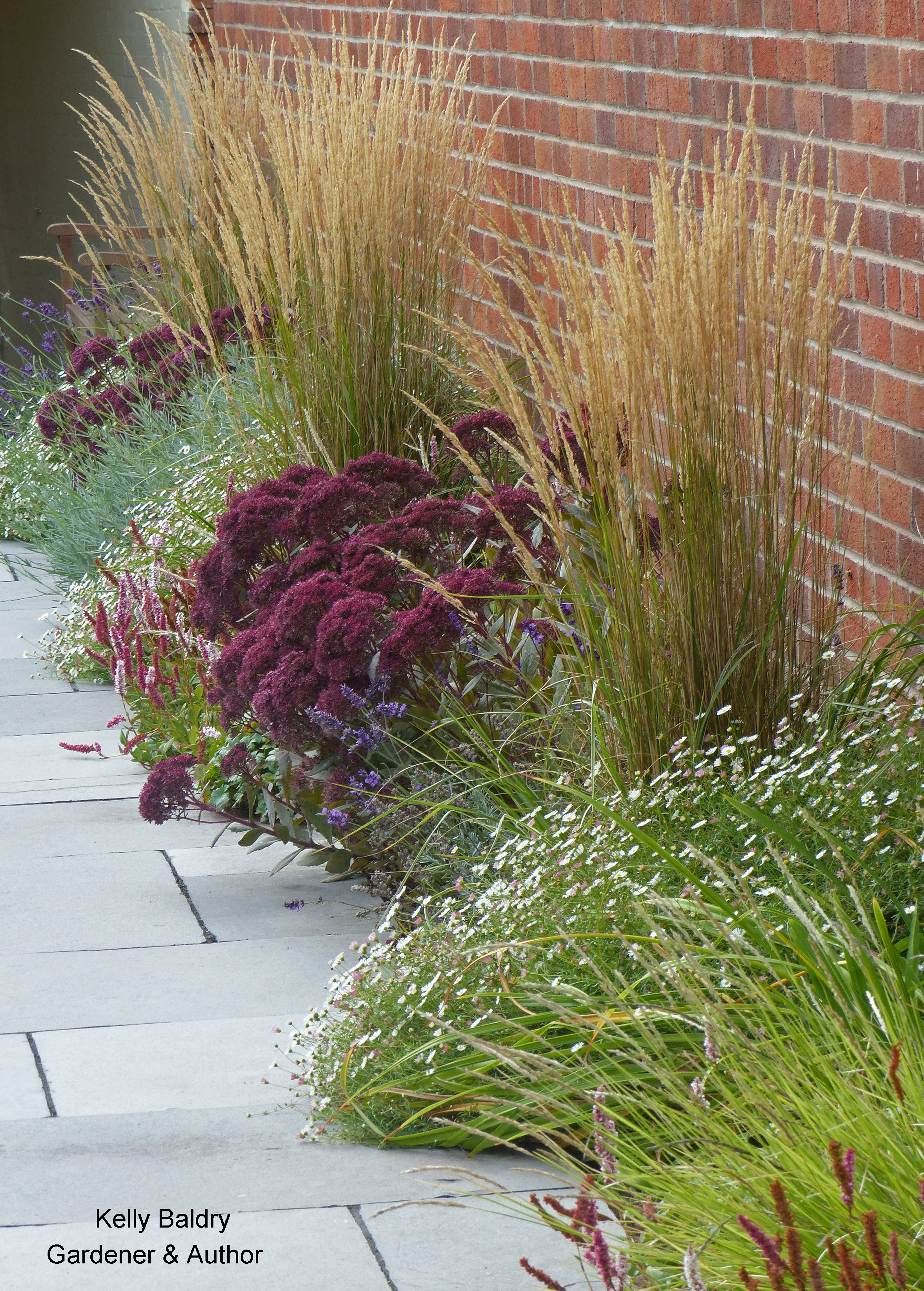
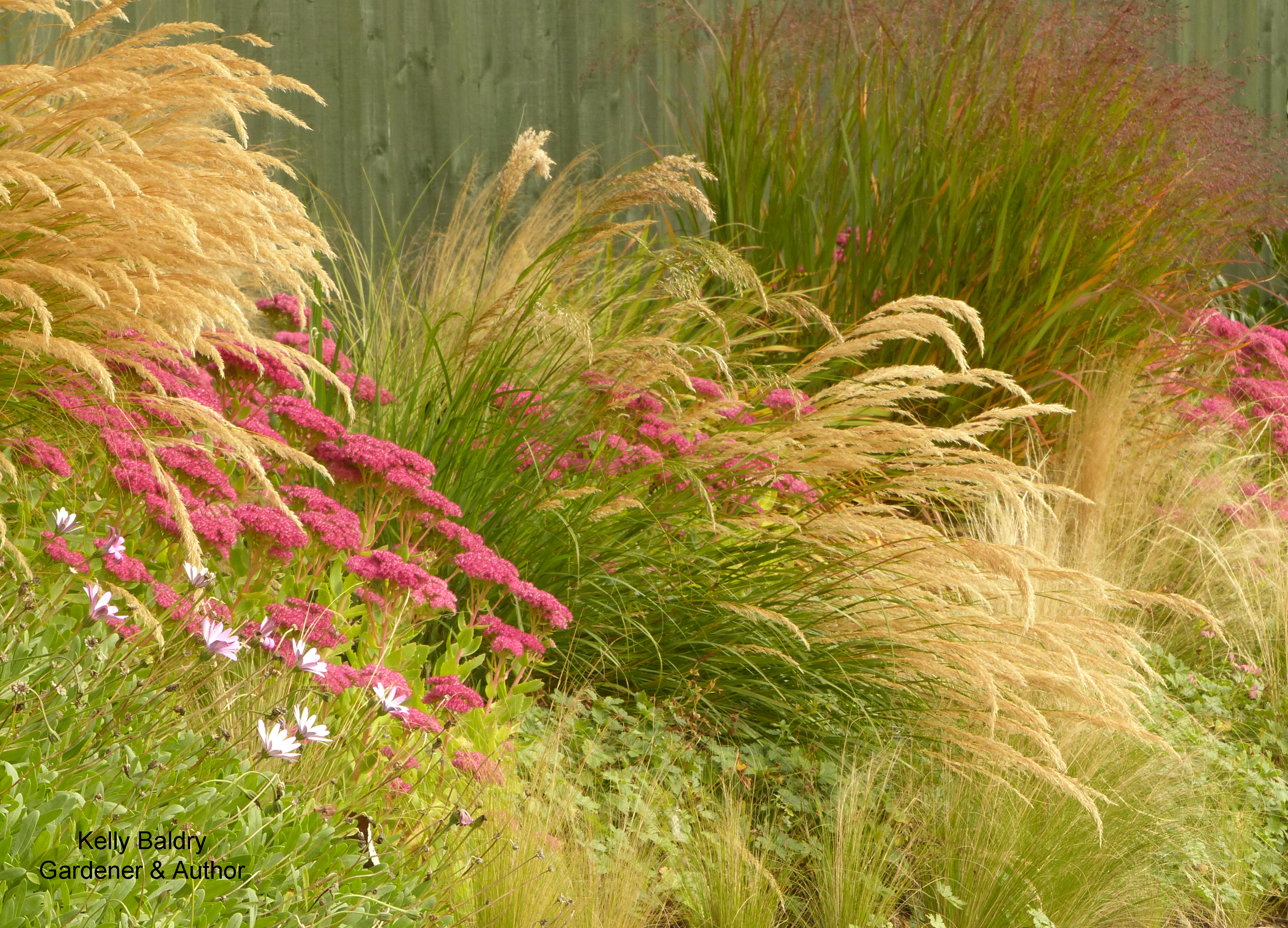
To encourage the use of a wide range of well-chosen plants, I decided to share my knowledge and experience in a short book, called “Grasses and Perennials – Sustainable Planting for Shared Spaces,” available from Amazon in print and digital download. The book is the culmination of fifteen years professional landscaping, working to establish plant communities that hold a person’s interest, if only for a few moments – the difference between the forgettable, and the noteworthy. My passion is planting spaces that the public see and work at every day; but the principles in the book apply equally well to domestic gardens, as do all the plants I’ve listed. The book also brings science and reason to the debate around the use of native plants, and gives practical hints and tips for managing successful, sustainable plantings.

Here is a taster quote from Chapter 3 – Functional Space:
“Rather than relying on plants considered native to the British Isles, I will use any plant with potential, from anywhere, provided it will establish within a community of compatible plants. There is currently a mistaken assumption that native plants (as opposed to non-native plants, often labelled as exotics), are ideally suited to geographic region of origin and pollinators, without question. In reality, native plants may succumb to freshly introduced pathogens and react poorly to a swiftly altering climate.

“The insistence by some designer’s on using solely native plants, is effectively a determination that a given moment in time (usually in the past), is somehow ecologically superior – and overlooks the positive and scientific arguments for planting non-natives. There is little point constructing plantings based solely on region of origin, rather than usefulness and resilience. Plant communities alter all the time and nature is never static; and the definition of native plants is also somewhat subjective – we cannot know for certain how plants were moved and used by early humans. Can we safely assume that a plant is native to a given environment simply because a plant hunter happened to discover it there – probably quite recently in terms of our evolution?”

Kelly Baldry, United Kingdom