The Global War on Non-Native Trees

“In some cases, removal of urban trees because they are non-native may represent an ‘over-shoot’ where the removal of non-natives becomes an end unto itself… the non-native trees being removed are not necessarily highly invasive, and removal is more driven by a desire for native species rather than any real or perceived problems caused by the non-native species.”

An international team of academic scientists studied the many conflicts around the world between those who find value in introduced trees and those who demand their destruction. (1) Team members were from Australia, France, New Zealand, and South Africa.  Professor Marcel Rejmanek at UC Davis was the only American on the team.

Professor Rejmanek is well known to us as the author of the chapter about eucalyptus in Daniel Simberloff’s encyclopedic tome about biological “invasions.”  Rejmanek said, “…eucalypts are markedly less invasive than many other widely cultivated trees and shrubs…they have been orders of magnitude less successful as invaders than pines and several other widely planted trees…Where eucalypts have invaded, they have very seldom spread considerable distances from planting sites, and their regeneration is frequently sporadic.  He noted that eucalyptus is useful to bees and hummingbirds and I add here that it blooms throughout winter months when little else is blooming in California.  He said,  “Conclusions about positive or negative environmental and economic impacts of eucalypts are often anecdotal, highly controversial and context dependent.”    Professor Rejmanek’s assessment was instrumental in my effort to convince the California Invasive Plant Council to remove blue gum eucalyptus from its list of invasive species.  Cal-IPC downgraded its assessment of invasiveness of blue gum eucalyptus from “medium” to “limited” in response to my request. 

Professor Rejmanek is also the author of the most recent report on plant extinctions in California, published in 2017.  At that time there were 13 plant species and 17 sub-species native to California known to be globally extinct and another 30 species and sub-species extirpated in California but still found in other states.  Over half the globally extinct taxa were reported as extinct over 100 years ago.  Although grassland in California had been converted to Mediterranean annual grasses by grazing domesticated animals nearly 100 years before then, most of the plants now designated as “invasive” in California were not widespread over 100 years ago.  Only one extinction mentions “invasive species” as one of the factors in its disappearance.  Rejmanek speculates that livestock grazing is the probable cause.  He said, “Indeed, one needs quite a bit of imagination to predict that any native plant species may be driven to extinction by invasive plants per se.”

This recap of Rejmanek’s expertise about so-called “invasive” trees and plants establishes his credentials as a reliable witness as the co-author of “Conflicting values:  ecosystem services and invasive tree management,” which I will summarize for readers today.

Setting the stage for conflict

As Europeans colonized the new world in the 18th and 19th centuries, they often brought trees from home with them, motivated primarily by an aesthetic preference. When the colonial era came to an end, nationalism during the 19th century encouraged a new appreciation of indigenous flora.  When planting their own gardens and farms, America’s founding fathers had a strong preference for planting native trees.  While fighting the Revolutionary War, George Washington wrote to the caretakers of his farm at Mount Vernon instructing them to plant NO English trees, but rather to transplant trees from the surrounding forests.

Sources of conflict

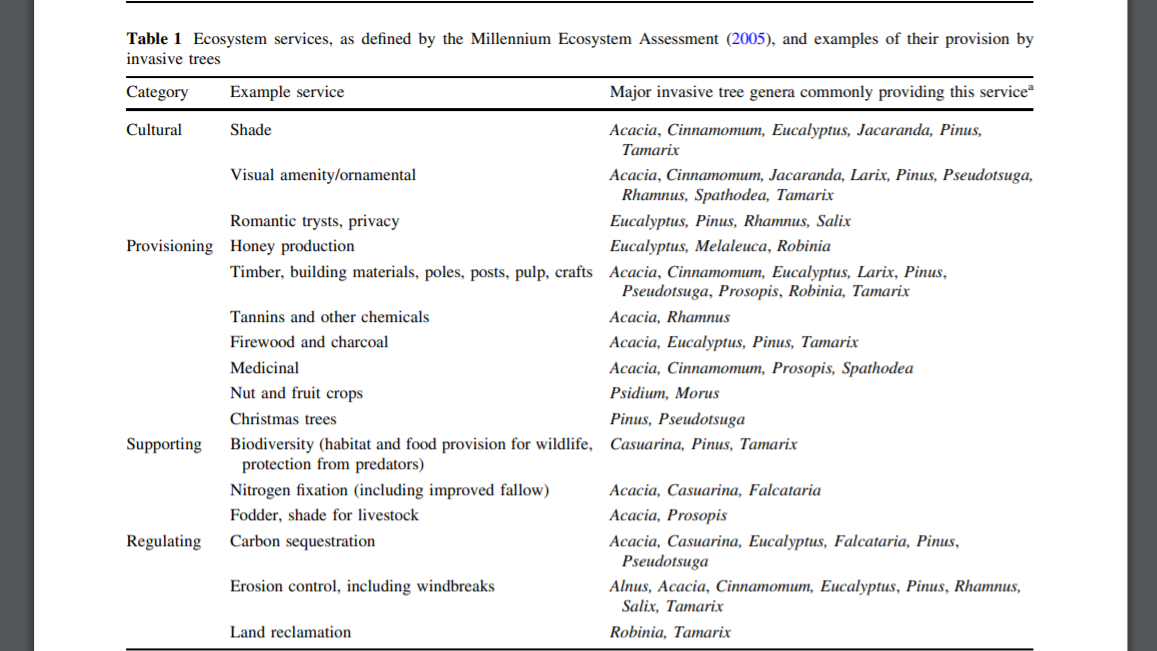
By mid-20th century, this preference for indigenous trees escalated to the current belief that non-native trees are threatening indigenous ecosystems.  Conflict arises when there is a “failure to account for, assess, and balance trade-offs between the eco-system services or, at times, a failure to agree on the relative value of particular services.” (1) The study identifies the tree species that are the focus of such conflicts around the world and the ecosystem services those species provide:
Conservation Sense and Nonsense has reported on many of these conflicts around the world:

  • The stated purpose of the destruction of forests in Chicago was the “restoration” of grassland that existed prior to the arrival of Europeans.  Conservation Sense and Nonsense described the conflict regarding that destruction in one of my first articles in 2011 because the issues were similar to those in the San Francisco Bay Area. The debate raged in Chicago for over 15 years, but the destruction of the forest was finally accomplished, despite opposition.  Likewise, in San Francisco after 20 years of conflict, the eradication of eucalyptus forests is being achieved.
  • In 2012, we republished an article by Christian Kull about the practical value of acacia trees to Vietnamese farmers and their opposition to the attempt to destroy them.
  •  We republished an article in 2014 about opposition to the destruction of willow trees in Australia that were planted to control erosion.  Willows are one of many examples of a tree that is considered valuable in North America where it is native and hated in Australia where it is not. The authors of the article described the arguments used to justify the project, ‘Sure, it makes a big mess and causes erosion, and nutrient release, and carbon emissions, and local temperature increases, and loss of habitat, but it’s necessary because we’re going to make Australia a place for natives-only again.’
  • Conservation Sense and Nonsense published a guest post by Matt Chew in 2017 about the eradication of tamarisk trees that were introduced for erosion control in southwestern US.  In that case, the survival of an endangered bird is threatened by this misguided attempt to eradicate tamarisk by introducing a non-native insect.
  • Conservation Sense and Nonsense published a guest post in 2015 by a South African who objected to the destruction of jacaranda trees.  In that case, the beauty of these iconic trees was the primary objection to their destruction.
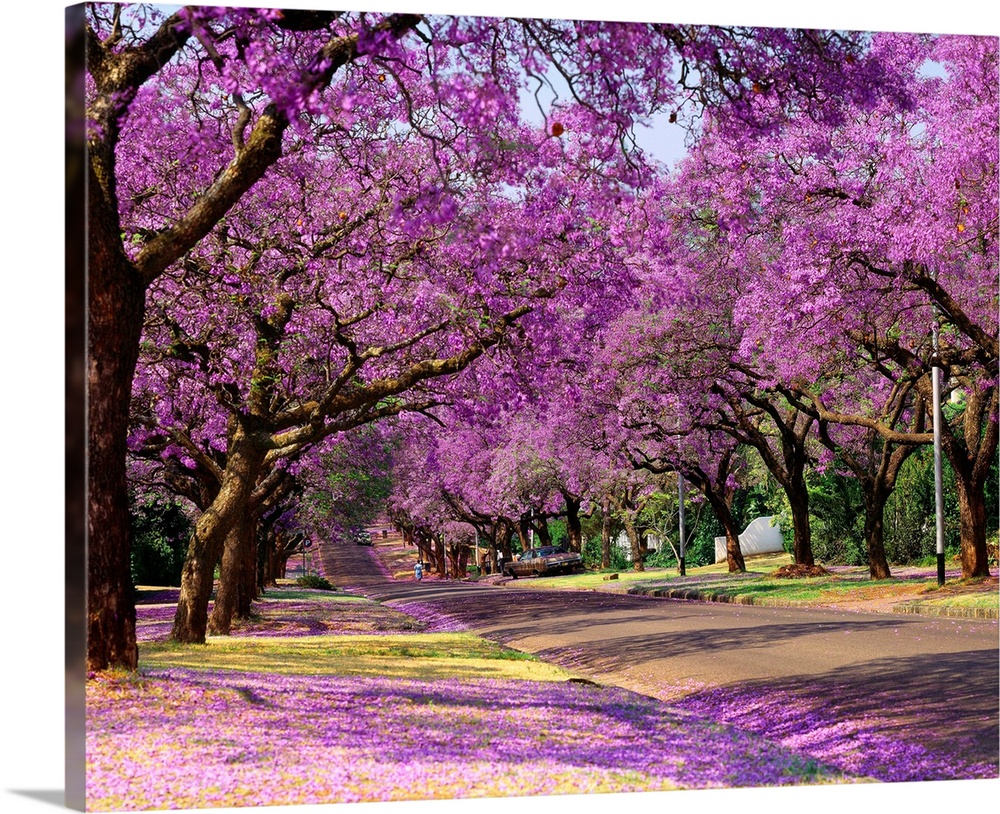
Jacaranda trees in Pretoria, South Africa

Many similar conflicts around the world are described by the study, which categorizes the conflicts as focused in three areas:  urban and near-urban trees; trees that provide direct economic benefits; and invasive trees that are used by native species for habitat or food.  I will focus on conflicts in urban and suburban areas because they are close to home.

Where is conflict greatest?

The study searched for examples of such conflicts around the world and found that most were in developed countries where ecological knowledge has suggested that eradication is necessary and democracy is strong enough to enable dissent.  Such conflicts are well documented in urban areas where many non-native trees have been introduced. Based on my experience with many of these urban conflicts, I can agree with the authors of the study that they are “frequently vitriolic, as seen in letters to editors, public protests, websites, and blogs.” (1)

How NOT to reduce conflict

The authors of this study dismiss suggestions that “educating” those who object to eradication projects can reduce conflict.  Their assessment of why that approach intensifies conflict is consistent with my own reaction to being lectured about the claimed benefits of eradication projects:

“However, the concept of ‘education’ implies that opponents of tree removal are inherently ignorant or unaware and discounts the importance of their views and values.  Sceptics of environmental issues are frequently highly educated and scientifically literate, with conflict driven by fundamental values, not lack of knowledge.  Further, what one party in a conflict views as education can be viewed as propaganda by those with opposing priorities.” (1)

The authors suggest that the planning process for such projects must be a two-way dialogue that recognizes shared values, such as a strong commitment to conservation of the environment.  The authors describe some of my own reservations about eradication projects:

“In some cases, removal of urban trees because they are non-native may represent an ‘over-shoot’ where the removal of non-natives becomes an end unto itself…Objective evaluation of the ecological services affected may not result in the removal of non-native trees being justified.  Indeed, in some cases the non-native trees being removed are not necessarily highly invasive, and removal is more driven by a desire for native species rather than any real or perceived problems caused by the non-native species.” (1)

There is no doubt that the demand to destroy eucalyptus in California is a case in which removal has become an end in itself that is not justified.  These are some of the accusations used to justify the destruction of eucalyptus that have been disproven by academic scientists without getting eucalyptus off nativists’ hit list.
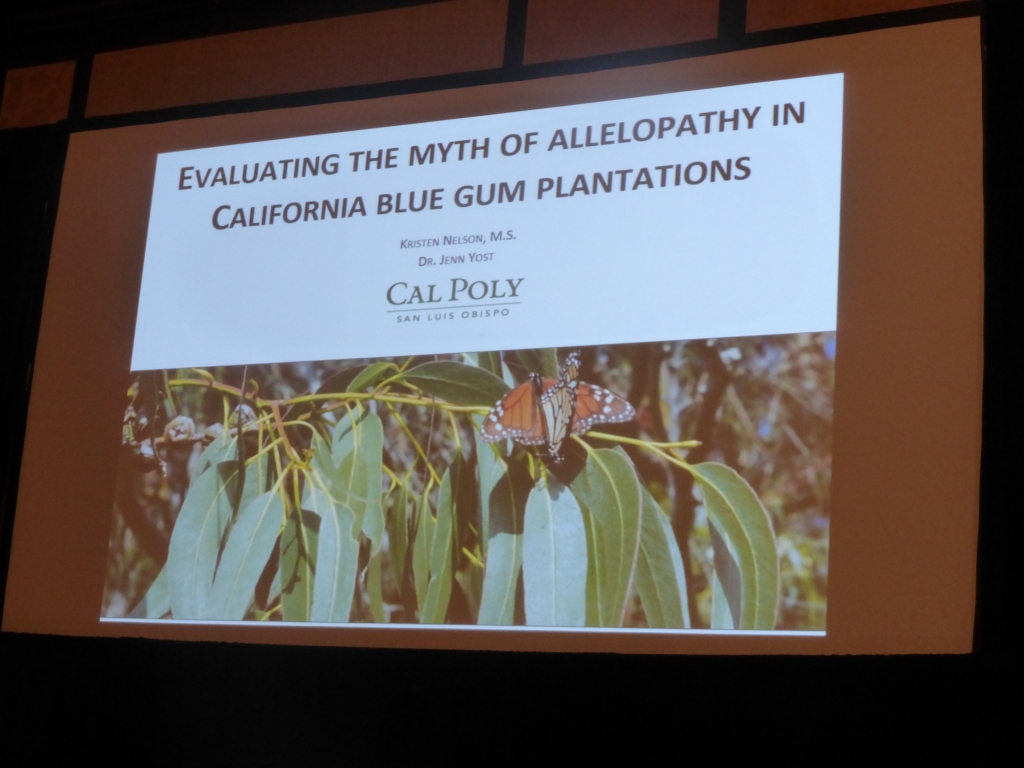
Source: Conference of California Native Plant Society, 2018

Pessimistic conclusion

The study concludes that we should expect plant invasions around the world to increase and that increased wealth and democracy will make conflicts about tree eradications more widespread.  The authors “suggest that conflict should be seen as a normal occurrence in invasive species removal…Avoiding conflict entirely may be impossible…”

I can’t disagree with the authors of this study about the poor prospects of resolving conflict regarding the destruction of non-native trees that are the heart of our urban forest in California.  However, I am grateful to the authors for their understanding of the issues and their respect for introduced trees as well as those who advocate for their preservation. They understand that lectures by those who demand that trees be destroyed despite the functions they perform are condescending and exacerbate conflict rather than resolving it. 

A Postscript

Jake Sigg has been the leader of the crusade to destroy eucalyptus forests in the San Francisco Bay Area for over 30 years.  He and I have debated this issue many times, without resolution.  In his newsletter of January 20th, Jake seems to acknowledge the futility of our debate as well as his motivation to create a native landscape. It seems he has reached the same conclusion as the authors of the international study of the inevitability of conflict about the destruction of non-native trees, although he concedes that he won’t quit trying…and neither will I. 

“For years I’ve been fighting tree huggers, who understandably don’t want to cut healthy trees down.  The blue gums are handsome brutes.  In my eye I see the rich diverse native biological communities that they displaced; those I fight with don’t see that and don’t value that.  So you can see the communication problem at the beginning.  The same consideration plagues many contentious issues in the world.

How do you explain this to them?  Mostly, you can’t; you do what you are able to do.  This is not an age for listening to fellow beings.  I find it hard to do.  David Brooks, a favorite, wrote a fraught opinion piece in today’s 
NYT.  He has just about thrown up his hands, as have I—except that I can’t—and neither can Brooks.”
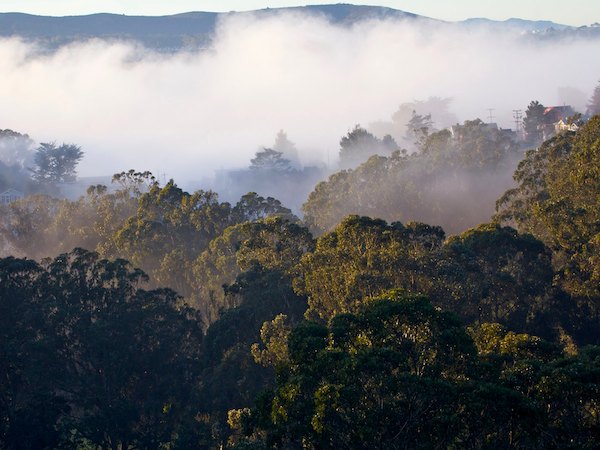
Eucalyptus canopy on east side of Glen Canyon Park, taken from Turquoise Way December 2012, before tree destruction escalated beyond riparian areas. Glen Cayon Park is one of 33 parks in San Francisco where most eucalyptus trees are being destroyed because they are not native. Courtesy San Francisco Forest Alliance

  1. Ian Dickie, et. al., “Conflicting values:  ecosystem services and invasive tree management,” Biological Invasions, 2014.

The need for diverse urban forest and the obstacles to achieve that goal

Matt Ritter is a professor of biology at Cal Poly San Luis Obispo and Director of Cal Poly Plant Conservatory.  He is the author of several books about California’s unique flora, including A Californian’s Guide to the Trees Among Us.  He is considered an expert on the horticulture, ecology and taxonomy of the Eucalyptus genus.

Click on picture to view Professor Ritter’s presentation

In October 2021, Professor Ritter gave a presentation to the California Urban Forests Council, entitled “Underutilized Species for the Future of Urban Wood and Urban Forestry.”   He began by explaining why it is important to identify new tree species for our urban forest.

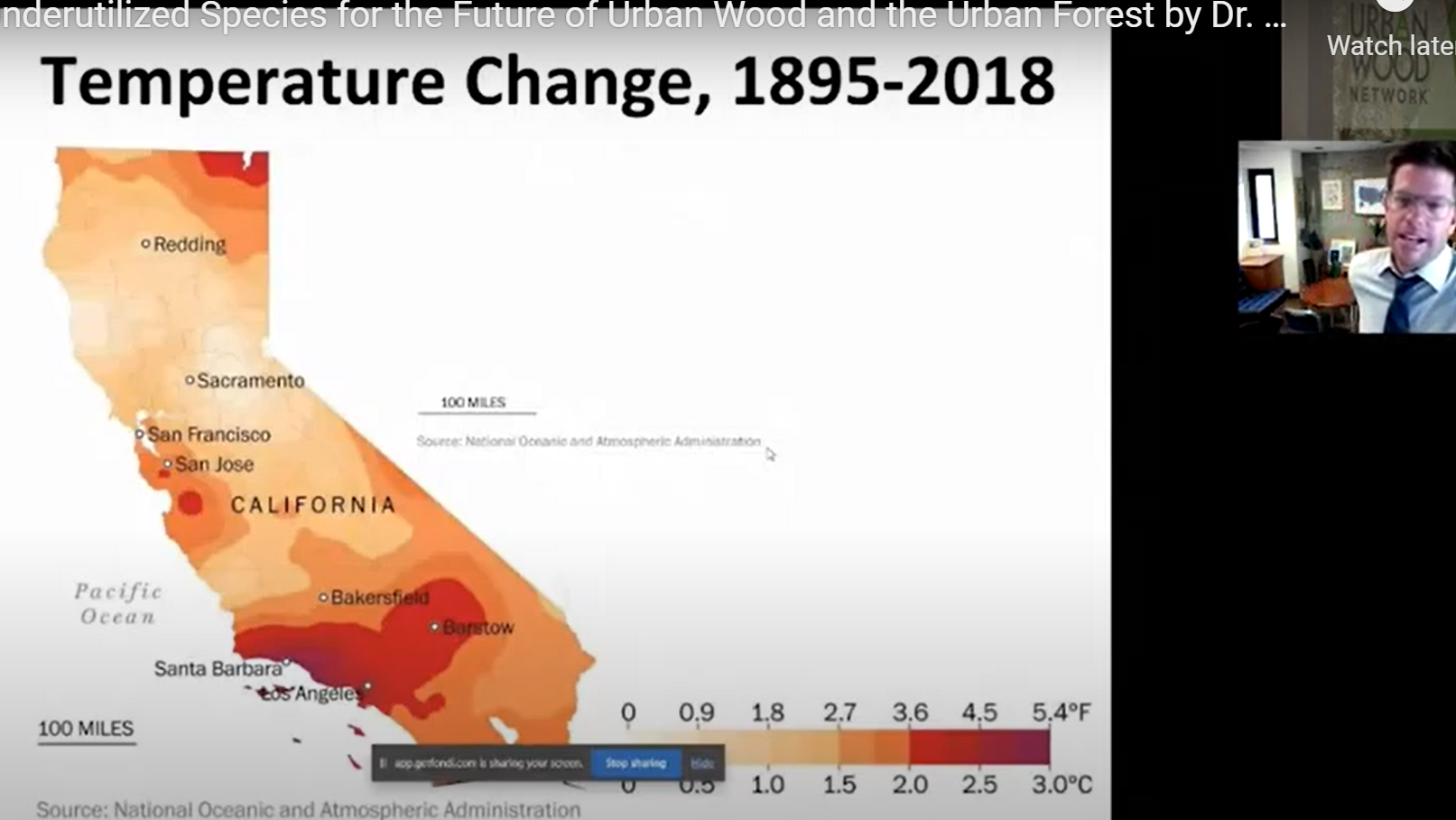
  • “Baja is moving to Oregon,” said Ritter to set the stage.  Within 50-80 years trees living in California now will no longer be adapted to the anticipated warmer, drier climate.  Trees killed by wildfire in California are not returning.  Forests are quickly converting to grassland and shrub.  As of 2018, California had lost 180 million trees to drought, disease, bark beetles, heat, and wildfire, which is nearly 5% of the total tree population in California.  Adding subsequent years to date, we have probably lost 7% of all of our trees.
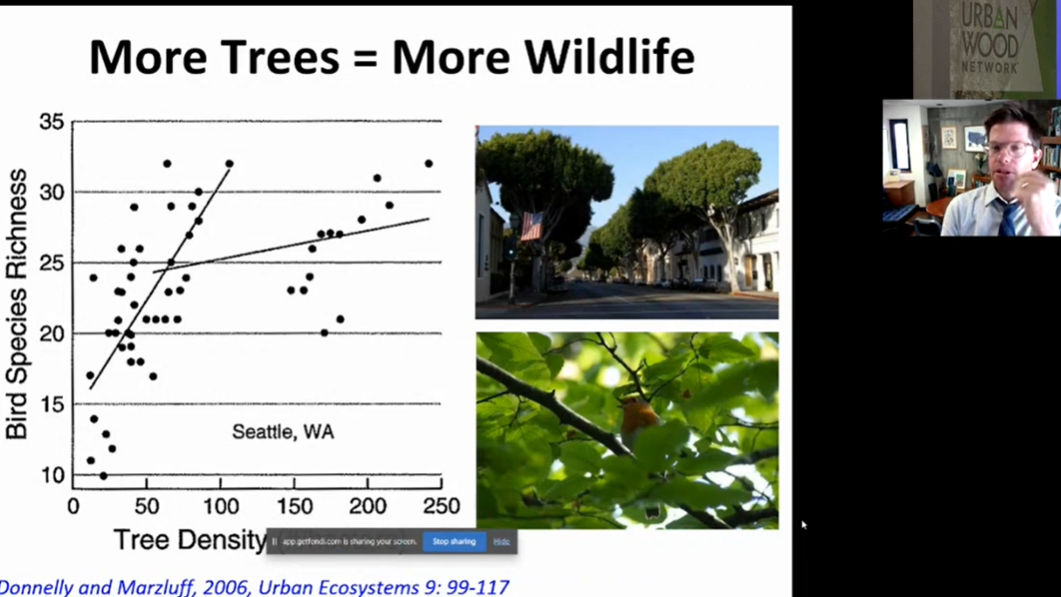
  • Trees in urban areas will help Californians cope with warmer conditions because they cool our cities and reduce energy consumption.  Fewer trees will mean a lower quality of life, for us and for birds.  The loss of our trees reduces carbon storage, which contributes to more climate change. 

Ritter then explained why we must diversify tree species in our urban forests.

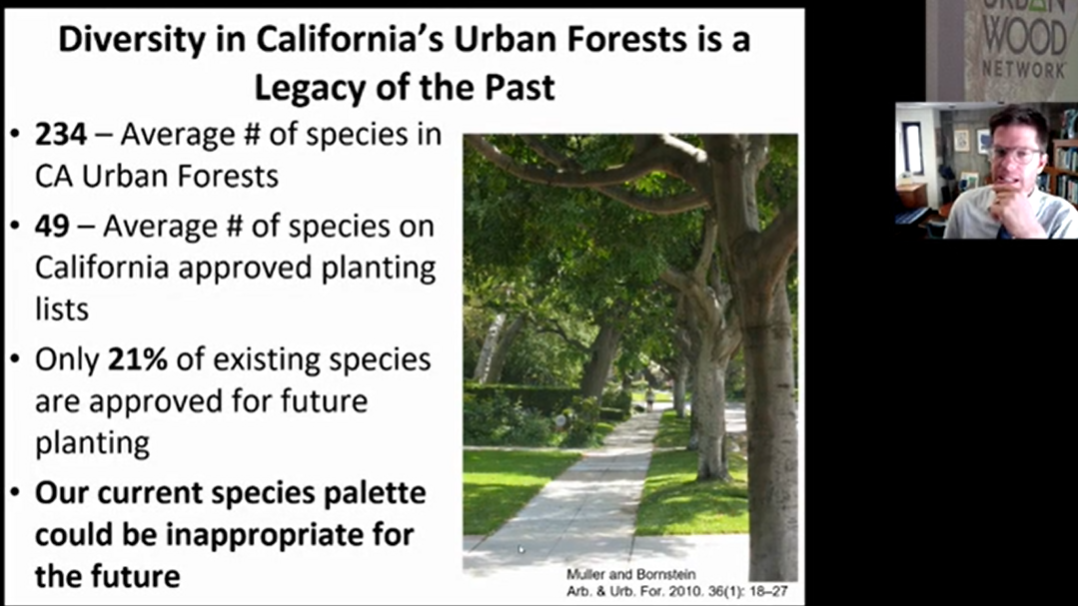
  • There are over 60,000 tree species in the world and only 7% of tree species are found in urban areas around the world.  In California our urban forests are even less diverse.  There are only 234 tree species on average in California’s urban forests.  The average number of approved tree species for planting in California’s municipalities is only 49 and few species on those approved lists are native to California.
  • Diversity of tree species ensures greater resiliency that enables our urban forests to survive changing conditions.
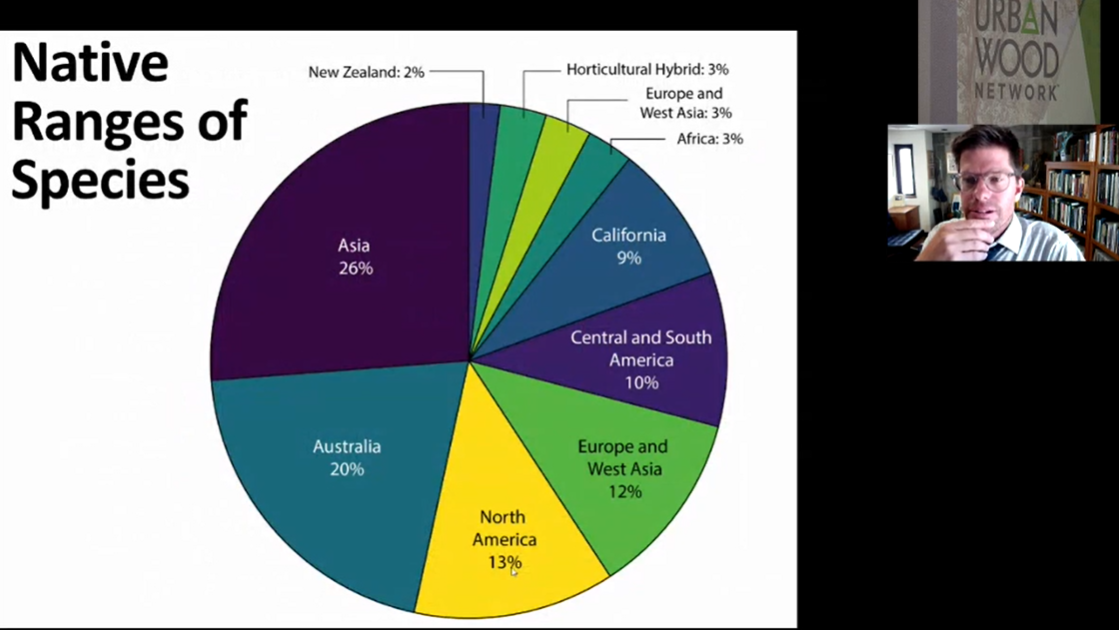
  • Only 9% of tree species in California’s urban forests are native. 
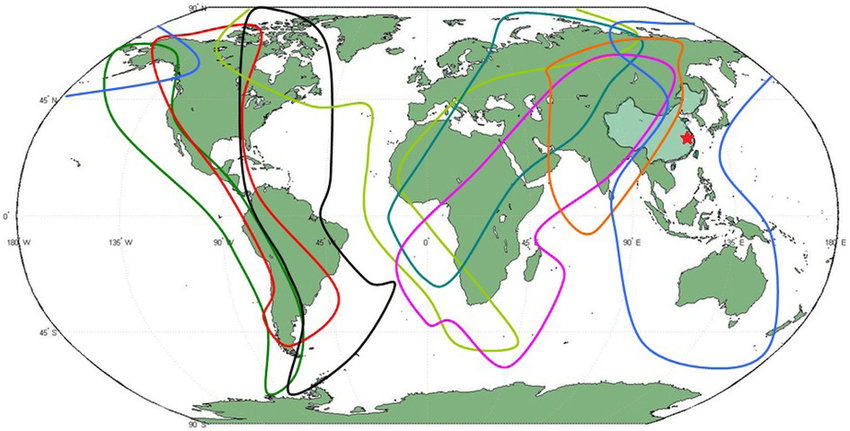
The native ranges of tree species in California’s urban forest.

An inventory of Oakland’s urban forest (street trees, medians, and landscaped parks only) was recently completed.  With 535 tree species, the diversity of Oakland’s urban forest is greater than average for California.  With 14% native trees, Oakland’s urban forest is more native than average. There are 59 species on Oakland’s list of approved trees, of which only 4 are native to Oakland.  The most significant finding of Oakland’s tree inventory is that our urban forest is only 64% “stocked,” meaning that of existing tree wells, only 64% are currently planted with trees.  When trees die in Oakland, they aren’t being replaced.  I don’t doubt there is a will to plant trees in Oakland.  I assume it is a question of means in a city with more pressing needs than resources.

Ritter and his colleagues at Cal Poly have created a website called SelecTree to help Californians choose the right tree for the right site and conditions.  There are 1,500 tree species described on SelecTree, using 60 characteristics, such as drought tolerance.  SelecTree rates blue gum eucalyptus “medium” for drought tolerance, the same rating as native coast live oak and bay laurel.  Ritter clarified that drought tolerance on SelecTree is a measure of how much water the tree species uses.  Claims that eucalyptus uses more water than native trees is bogus, like most bad raps about eucalyptus.  

Ritter recommended specific tree species, based on their drought and heat tolerance.  He said that when diversifying our urban forests “we have to think about Australia” because it is the hottest, driest, flattest, and oldest place on the planet, which is another way of saying that tree species in Australia have survived terrible conditions that are comparable to the challenging conditions in urban environments.

Ritter recommended oak species that are native to Texas; eucalyptus and closely related tree species; and several tree species in the legume family, especially acacia.  In each case he mentioned the suitability of tree species based partly on the quality of its wood.  Apparently, I’m not the only person in California who is disturbed by huge piles of wood chips wherever trees have been destroyed.  Ritter also thinks we should be thinking about how we can use wood when trees are destroyed, rather than building potential bonfires.  

Obstacles to diverse urban forests in California

When Professor Ritter took questions from the audience, we learned that the main obstacle to a diverse urban forest in California, adapted to our climate conditions, is the myopic focus of native plant advocates:

Question:  “Are we introducing new pathogens to our natives by importing new species?”

Answer:  There are many laws and rules that restrict the importation of plants to prevent that from happening.  We also import only the seeds of plants, not grown plants.  The seeds are sterilized and they don’t carry the pathogens that may exist on grown plants in their native ranges.

Question:  “Do we know how quickly birds and insects adapt to new species?”

Answer:  “No we don’t, but who cares?  We are facing a climate emergency.   We have 50 years before life in our cities becomes hell.  We have a responsibility to protect the quality of life in our cities.  We should stop developing the wild, but cities are different.” 

Ritter anticipated a question that is often a concern of native plant advocates by saying we should not be concerned about “weediness,” AKA “invasiveness.”  He said, “That should be far down on our list of priorities of what to worry about.  We need to be primarily concerned about what tree species will grow in our changed climate.”

Rhetorical Question:  “But insects need native plants!

Answer:  Ritter instantly recognized the mantra of Doug Tallamy.  He replied that it is not well established that there are more insects living on native plants than on introduced plants.  He mentioned a single study that inventoried plant and animal species in eucalyptus compared to oak forests, presumably Dov Sax’s study which concluded:  “Species richness was nearly identical for understory plants, leaf-litter invertebrates, amphibians and birds; only rodents had significantly fewer species in eucalypt sites.  Species diversity patterns…were qualitatively identical to those for species richness, except for leaf-litter invertebrates, which were significantly more diverse in eucalypt sites during the spring.” 

Rhetorical Question:  “We are still dealing with a legacy of blue gum eucalyptus in the Bay Area.  Why should we repeat that mistake?”

Answer:  Ritter agreed that blue gum eucalyptus is “inappropriate” in many places where it was planted in the Bay Area, but we’re not planting blue gums.  There are 800 eucalyptus species and many are ideal for our conditions.  He said, “Why not plant eucalyptus?  It would be dumb not to plant suitable eucalyptus species just because it shares a name.”

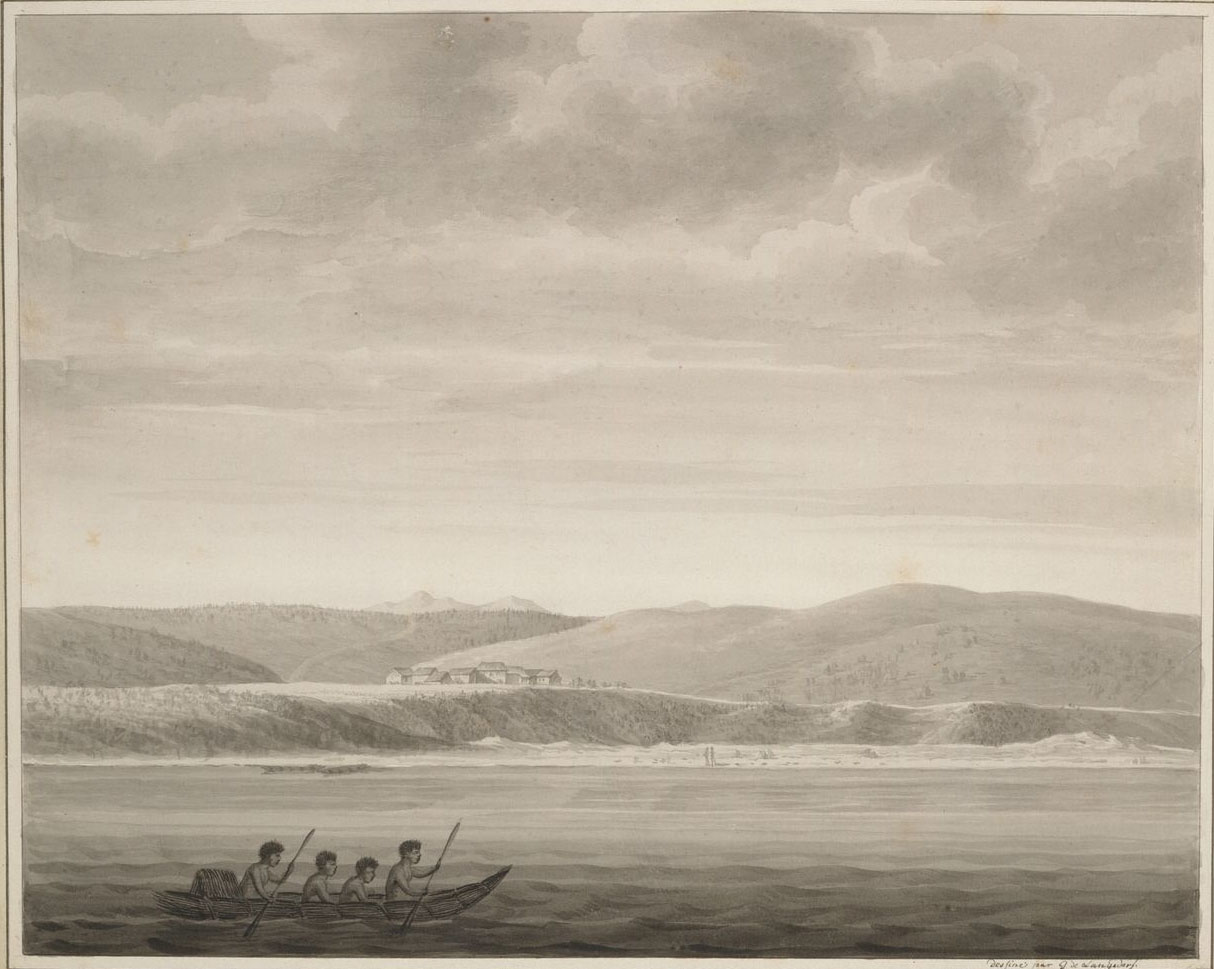
Ritter added that, “Planting only natives just doesn’t work in San Francisco.  There would be no trees in Southern California because we don’t have very many native trees in California.”  The pre-settlement coast of California was virtually treeless in most places and that’s a fact. For example, a study of historic vegetation in Oakland, California reported that only 2% of pre-settlement Oakland was forested with trees. “Vegetation before urbanization in Oakland was dominated by grass, shrub, and marshlands that occupied approximately 98% of the area.” (1)

San Francisco in 1806 as depicted by artist with von Langsdoff expedition. Bancroft Library

Oakland as a case in point

The San Francisco Chronicle recently published an article about a guerilla tree-planter in Oakland who is planting native oak trees on public land, wherever he wants.  Oakland’s Director of Tree Services, David Moore, gently suggests that many of these tree plantings are ill-advised:  “‘There is a part of all of us that loves with our hearts the coast live oak tree because of its heritage, the symbolism of our city, and just the legacy that they have,’ Moore said. ‘But we have to diversify, and we are diversifying to other ones that are recommended to be more adaptable to climate change…The reality is that we have created a world that is not the native conditions of these plants,’ Moore said. ‘If we want trees to survive in these non-native conditions, we have to pick trees from around the world that can survive these conditions.’…Moore said oaks, while beautiful, are not the ideal tree for today’s hot, dry and cramped urban landscape. Without careful and costly maintenance, he said, oaks could destroy sidewalks, block light from street lamps and grow their branches into streets and walkways, creating hazards for motorists and pedestrians. The city still plants oaks, but mainly in parks rather than streets because that’s where they do better, Moore said…”

Stalemate

So, here we are.  We have a pressing need for a more diverse urban forest that is adapted to present and anticipated conditions, but we are paralyzed by the ideological commitment of native plant advocates who are demanding that we destroy our urban forest because it is predominantly non-native.  In a recent edition of Nature News, Jake Sigg said, “Hysterical tree planting is worse than a waste of time and resources…”

I am grateful to Professor Ritter for being bluntly frank with members of the arborist community who should know better.  Dare we hope they learned something from that presentation? 

I wish you Happy New Year.  Please join me in my hope for a more peaceful year.  Thank you for your readership.


(1) Nowak, David, “Historical vegetation change in Oakland and its implications for urban forest management,” Journal of Arboriculture, 19(5): September 1993

When ideas remain unexamined and unchallenged, they intimidate ©

My last article of the year is a guest post by Marlene A. Condon, the author/photographer of The Nature-friendly Garden:  Creating a Backyard Haven for Plants, Wildlife, and People (Stackpole Books; information available HERE.)   You can read her blog In Defense of Nature.

Merry Christmas !

Million Trees

A birds-eye view of the University of Virginia (UHall seen in first photo) in Charlottesville, Virginia, makes clear that there are plenty of native trees to be found in developed areas.

The novelist E. L. Doctorow, in a 1989 conversation with PBS journalist Bill Moyers, said, “When ideas go unexamined and unchallenged for a long enough time, they become mythological and very, very powerful. They create conformity. They intimidate.”

He could have been speaking about the current environmental narrative regarding so-called invasive plants. Anyone who speaks out feels the wrath of the folks pushing their fictional environmental manifesto; I’ve lost jobs because of these people.

Most neo-scientists and -environmentalists, having arrived late to the party, have no clue as to why some alien plants exist in profusion along roadways, in former farm fields, and along trails in forests. The popular notion that native plants would otherwise be filling those areas is easily accepted by people who don’t possess knowledge of soil science, or who lack experience with gardening and/or closely observing the natural progression of plants in unmanaged, disturbed areas.

Knowing the prior history of the land is essential to understanding why particular nonnative plants fill some areas. Road building discomposes soil. Trail development/use and cows/farming-equipment moving over the land compact soil. Only “colonizer plants”—those capable of thriving under the altered and nutrient-poor conditions of these sites—can grow there.

Usually such areas, after many years, support a mix of native and nonnative pioneers, but sometimes alien plants outnumber the natives because they are best suited to the constraints imposed by the physical attributes of the site. Anyone (no Ph.D. required) can verify this statement by taking the time to observe the progression of plants in an area not revegetated by people. Doing so would make clear that alien plants do not “push out” native plants by “invading” and “taking over”, but rather, they fill disrupted areas where few native plants can successfully grow.

Yet, the desire by scientists and environmentalists is so great to get folks to remove supposedly invasive plants from the environment that we now have tall tales being spread. Herewith a sampling of some of the most egregiously untrue declarations regarding alien plants.

Johnny Randall, Director of Conservation Programs at the North Carolina Botanical Garden (University of North Carolina at Chapel Hill) wrote a New Hope [North Carolina] Audubon blog post called “Invasive Plants Are NOT for the Birds.”

  • He writes that, “The scientific literature on invasive plants and bird-dispersal is moderate but growing, and almost all of the research warns that this is a serious and multi-layered phenomenon. First off – birds either do not discriminate between native and invasive plants or often prefer invasives over natives. One reason for this is that a large proportion of invasives are high in carbohydrates, whereas the natives are often higher in protein and lipids/fats. Birds are consequently (pardon the analogy) choosing candy bars over cheeseburgers, which could affect bird nutrition, particularly during fall migration”.

The suggestion that birds are choosing “autumn olive berries [that] are sugary sweet treats, the junk food of the bird diet” is echoed by many people. This quote, from a letter to the editor of The Crozet Gazette by Susan A. Roth, William Hamersky, and Manuel T. Lerdau, Ph.D., is supposedly based upon a study published by the Wilson Journal of Ornithology in March, 2007, entitled “Fruit Quality and Consumption by Songbirds during Autumn Migration”.

Yet this study states that “Most common fruits on Block Island [where the study took place in Rhode Island] contained primarily carbohydrates…and little protein…and fat.” As the research paper’s authors were mainly speaking of native plants, this statement directly contradicts that of Mr. Randall that natives are often higher in proteins and fats than so-called invasives.

Additionally, the research paper’s authors state that “fruit selection by birds on Block Island was not simply related to differences in macronutrient composition between fruits…studies of wild and captive songbirds have shown that some species preferentially select high-fat fruits…or high-sugar fruits…”, which hardly implies that Autumn Olive fruits are a necessarily inferior food choice, as declared by Roth, et al.

A variety of foods exists to serve a variety of purposes. Turning sugar into something “bad” for birds comes as a result, perhaps, of this same application to human nutrition. But sugar is not in and of itself, “bad”. A runner in need of glucose who eats some jelly beans gets a quick burst of energy to continue exercising. There’s absolutely nothing wrong with that.

Sugar is only a problem if it’s eaten in excess, as might be done by children. But birds are not children; if they feel the need for protein and fat, they will search for insects and fruits that offer what they need.

  • Furthermore, Director Randall wrote that “Researchers have also shown that many invasive plants have fruits that persist longer than do native plant fruits into the fall and winter. The invasives are therefore available when our natives are not.”

In a world of disappearing habitat for wildlife because of human development, the fact that fruits on invasive plants are available when native-plant fruits are depleted should be seen as a positive rather than a negative.

Charlottesville, Virginia, residential area, has so many trees that you can’t see the roadways interspersed among them. In other words, insects and birds aren’t disappearing because alien plants have replaced native trees.

“Recent research published by Narango et al., in the October 22, 2018, issue of the Proceedings of the National Academy of Science demonstrates that native plants are best for birds. The research showed that yards landscaped with the usual garden center plants, which are mostly nonnative ornamentals, could not support a stable population of chickadees. Yards where native plants composed at least 70 percent of the plantings were able to do so. This is because native plants host more insects than non-natives and therefore provide the necessary high-protein food that birds need to feed their chicks.” [from a letter to the editor of The Crozet Gazette by Susan A. Roth, William Hamersky, and Manuel T. Lerdau, Ph.D.]
Narango’s study cannot be generalized to all birds, although many people have made the mistake of claiming it can. This study applies only to chickadees and certain other birds that inhabit forest because such species are dependent upon the native plants (trees) that comprise our forestland. In other words, if you want forest birds to reproduce in your yard, your yard must be forest. For a fuller explanation, please read “Chickadee Chicanery” at In Defense of Nature.

“These invasive species not only impact our forests, wetlands and streams, but also our economy, health and safety. They kill the trees that shade our homes and that our kids play hide-and-seek around. They increase the presence of other disease-spreading species like ticks. They diminish visibility along trails where safety is important”. [quote from an article from the Central Ohio Partnership for Regional Invasive Species Management at a Nature Conservancy-sponsored website]

The only “forests” where you will see alien-plant species are those that are either managed improperly (overly thinned and thus allowing too much sunlight to reach the ground under the trees) or those that are actually “woods” in the process of succession (transforming from a field to a forest that has not yet reached maturity). “Invasive” plant species are sun-loving and therefore do not inhabit shady mature forests.

As for killing trees, if “they” refers to vines (a common complaint in the eastern U.S.) one must ask, why was the homeowner unable (or unwilling) to keep a vine from killing a tree in his yard that his “kids play hide-and-seek around”? However, if “they” refers to nonnative animals and/or diseases killing trees, that is a different situation altogether, which is not the point of this article. It’s unfortunate the writer did not make clear what “they” referred to. As far as I can tell, there’s no proof that “invasive” plants, in general—as stated above—increase the presence of organisms such as ticks. A study published in Environmental Entomology

purportedly shows that barberry-infested plots support more mice and thus ticks than plots in wooded areas with no barberry.

However, the “no barberry” plots were severely browsed by deer and thus “little understory vegetation was present.” In other words, these scientists compared two completely different habitats, which explains the greater number of ticks in the shrubby (Japanese Barberry) area that provided “questing habitat [for] blacklegged ticks [whereas] little other suitable vegetation exist[ed] in [the] severely browsed forests.”
“Questing habitat” refers to plants upon which ticks can wait at the appropriate height to grab onto an animal that comes by. Obviously, ticks are not going to be found in an area with little understory vegetation as they have nowhere to sit and wait for their quarry.

And we’re to believe “invasive” plants diminish visibility along trails, and native plants don’t? It sounds more like the folks who are supposed to be maintaining the trails have been derelict in their duties!

It’s clear that scientists and journalists are doing everything they can to assure that government and the general public view so-called invasive plants in a negative light. Yet, to my knowledge, no study condemning “invasive plants” exists that has the least bit of merit.

Marlene A. Condon


Addendum by Million Trees

Nativism turns a blind eye to climate change

“Reflexive demonization of alien species ignores the beautiful but complex truth that nature fights to find a way—and for a planet navigating the pressures of climate change and overpopulation, that just might be our saving grace.” – Marianne Willburn, Garden Rant
Margaret Renkl writes an opinion column for the New York Times that I usually enjoy because she frequently writes about nature, often based on observations of wildlife in her own garden.  She lives in her childhood home in Nashville, Tennessee.  Much of her garden was planted with non-native plants and trees decades ago by her deceased mother.  Yet, in a recent column, Ms. Renkl blames non-native plants for a variety of crimes against nature. 

  • She suggests that non-native trees are blooming earlier than native trees, which she says has “skewed our experience of spring.”  She is apparently unaware that spring does indeed arrive earlier than it has in the past because of climate change.  Warmer weather arrives earlier, triggering the blooms of spring, not vice versa.  Both native and non-native plants are blooming earlier than they did in the past. 
  • She suggests that gardens planted with non-native plants are “blooming wastelands where the flowers feed nobody at all,” yet her columns are usually filled with the wildlife that lives in her own garden, with introduced plant species.
  • Although she does not use pesticides in her own garden, she believes that her neighbors’ non-native gardens require them to use pesticides that kill wildlife.  She says, “The typical suburban yard is actually worse than a wasteland. It’s a death trap.” She does not seem to know that most herbicide is used to kill non-native plants, not native plants nor does she seem to realize the contradiction in her indictment of gardening with non-native plants.  If there are more insects living in native gardens than non-native gardens, why would more pesticide be needed in non-native gardens?  If people could learn to love the clover, dandelions, and English daisies in their lawns as much as I do, they would use less “weed killers” on their lawns.

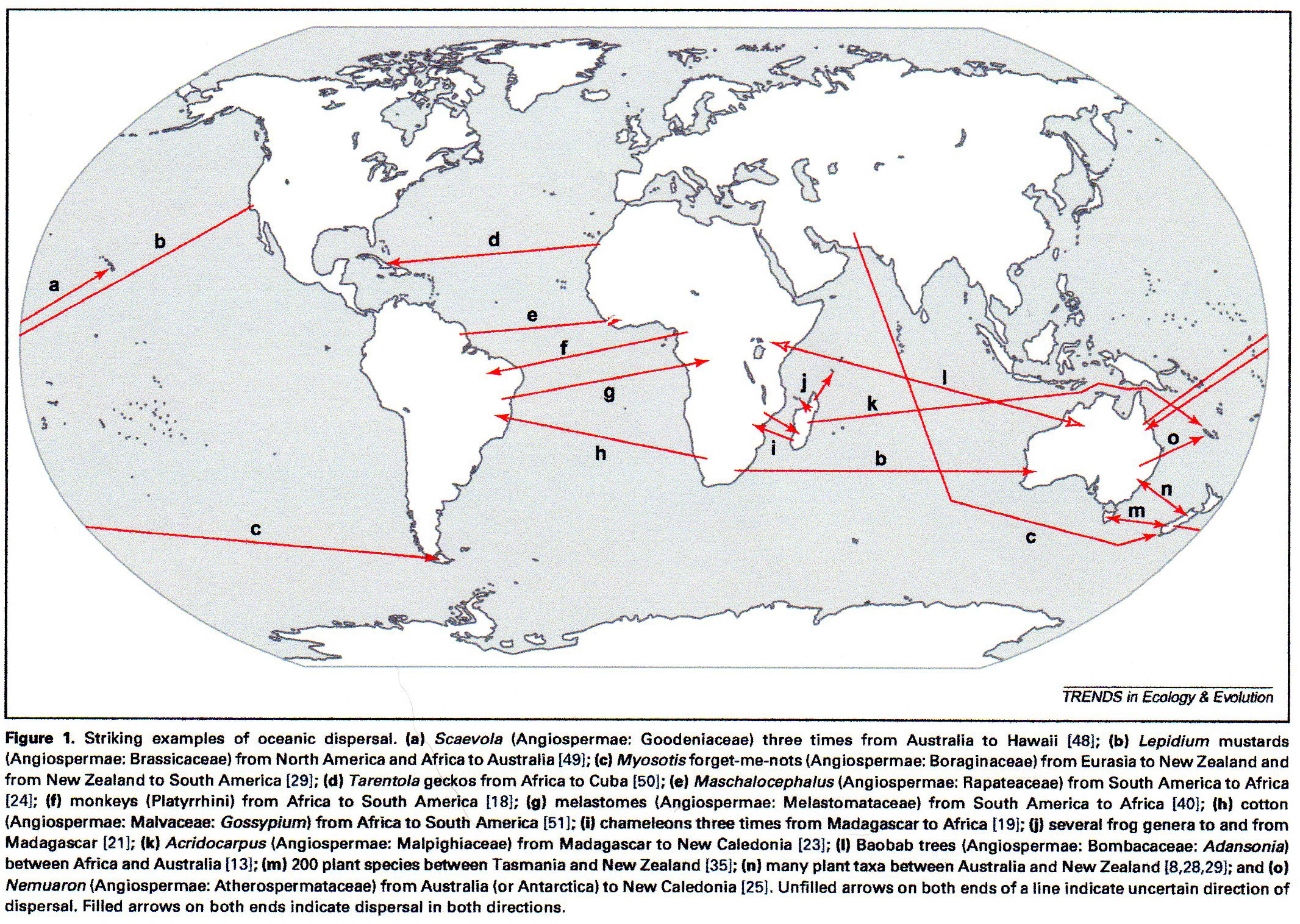
Ms. Renkl’s misperceptions about non-native plants seem to be based on a mistaken belief in their origins.  She says, “Ambulatory and omnivorous, human beings are a migratory species. That’s not true for the vast majority of plants.”  In fact, plants are just as mobile as animals, including humans.  Plants are carried by birds, animals, wind, ocean currents, etc.  They come and go as the climate changes, as it has many times in the past 500 million years that plants have existed on Earth.  Plants now considered non-native existed here in the distant past, in a different climate.  Here are a few examples of such dispersals; most occurred before humans even existed:

The ability to migrate is essential to the survival of plant and animal species.  As the climate changes, this survival strategy is quickly becoming even more important.  When we demand that plants be restricted to their historical “native” ranges, we doom them to extinction because when the climate changes, the vegetation must change.

Where did Ms. Renkl learn these myths?

Ms. Renkl’s cites Doug Tallamy’s Nature’s Best Hope as one of the sources of her mistaken beliefs.  Tallamy considers the existence of non-native plants the root of all evil in nature.  He calls them “ecological tumors.” He blames non-native plants for declining populations of both native plants and insects, and by extension to declining populations of birds that eat insects. 

In Nature’s Best Hope, Tallamy says, “…we must not use climate change as an excuse to do nothing.  Most species of plants and animals are far more resilient to climate variability than we give them credit for.  Besides, increasing the number and biomass of the plantings in our yards and public spaces is one of our most accessible and convenient tools to fight climate change.”  The problem with Tallamy’s dogma is that it inspires the public and land managers to eradicate established landscapes that are not native based on Tallamy’s claims that non-natives are “crowding out” native species and depriving wildlife of food. All native plant “restorations” begin by eradicating non-native plants, usually with herbicides that retard new growth.  In other words, the native plant ideology is causing the loss of vegetation and therefore the loss of stored carbon and the reduced capacity for carbon sequestration in the future.  The native plant ideology is not increasing biodiversity, nor is it “fighting climate change.”  It is more destructive than constructive. 

I’m not looking for “an excuse to do nothing.”  On the contrary, I believe every effort must be made to stop or at least slow down the inexorable advance of climate change.  The most basic effort we can make is to stop destroying functional vegetation, especially trees.  Then, there is a lengthy list of what we should be doing to reduce greenhouse gas emissions, which is another, equally important topic. 

Native plant advocates consider climate change irrelevant because they believe the existence of non-native plants is the sole culprit of all problems in the environment.  They see every environmental issue through the narrow lens of their dogma.  This comment on an article about the value of non-native plants by Marlene Condon published in [Chesapeake] Bay Journal is an example of such a misinterpretation of an environmental issue:

“English ivy is an evergreen, non-native, invasive groundcover that has demolished undisturbed natural areas…In salmon country that’s the difference between clean, cold streams and warmer streams filled with sediment.”

Eradicating ivy on stream banks is likely to produce more sediment because it will take some time for replacement vegetation to cover the ground, especially if herbicides are used to eradicate the ivy. Water is warmer in streams because of climate change and because there is less water due to water diversion and droughts. There are many other reasons for declining populations of salmon, particularly dams that prevent salmon from reaching their spawning grounds upstream.

Treat the cause, not the symptom

The native plant ideology ignores the underlying causes of changing ecosystems. Most changes are caused by the activities of humans, such as agriculture, development, water diversion, and pesticides.  Climate change is the underlying cause of some changes in nature and it will steadily become a more important factor.  Eradicating non-native plants will not reverse any of those changes nor will it prevent changes in the climate.    


  1. Alan de Queiroz, “The resurrection of oceanic dispersal in historical biogeography,” Trends in Ecology and Evolution, 20 No. 2, February 2005

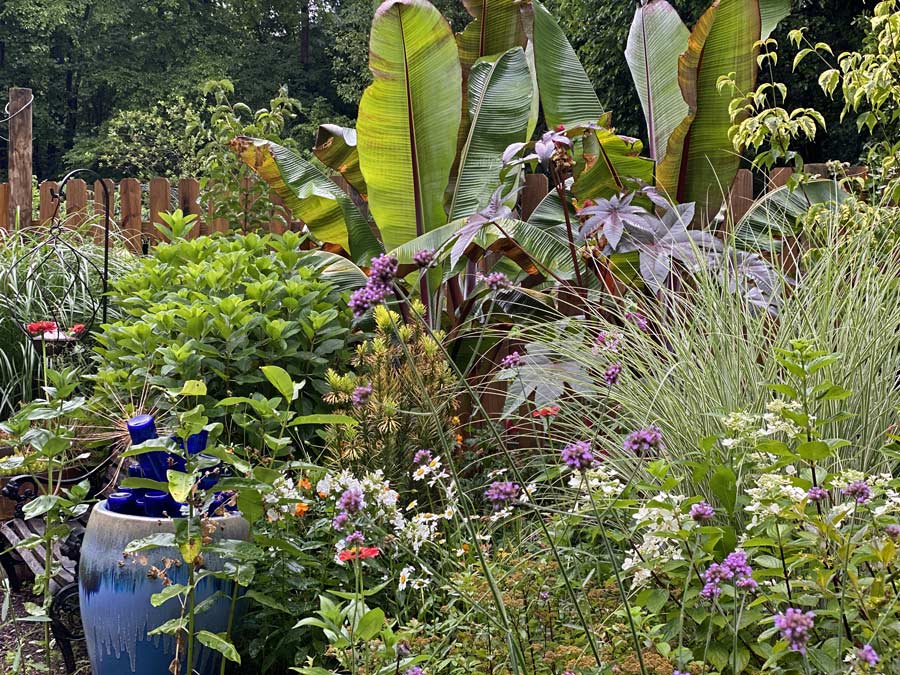
Photo credit for featured photo: Garden Rant, Marianne Willburn

Computer models predict the future? Garbage in, garbage out

Computer modeling is an increasingly popular tool used in ecological studies.  The rapidly changing climate is putting pressure on scientists to predict the trajectory of the change and the impacts those changes will have on the environment.  However, a computer model is only as predictive as the assumptions used to build it.  In other words, “garbage in, garbage out.”

That sets the stage for a study published in 2018 that predicted that “grassland may be a more reliable carbon sink than forests in California.”(1) The study was quickly adopted by native plant advocates as a weapon in their battle to destroy non-native trees in favor of grassland they prefer. (2) They prefer grassland because it was the pre-settlement coastal landscape.  They don’t acknowledge that burning by Native Americans and grazing by native ungulates were the primary reasons why grassland did not succeed to shrubs and forests prior to settlement. Pre-settlement grassland was as much a human creation as any modern landscape.

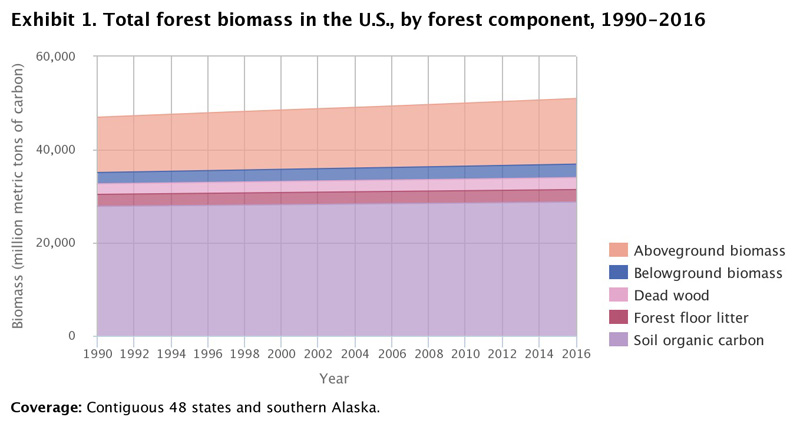
Source: US EPA, 2018

Most carbon storage is below ground, in roots and soil.  That is true of both grassland and forests. If the forest burns, the carbon it has stored in soil remains, just as the below ground carbon sink of grassland remains. 

The study (1) that claims grassland may be a more reliable carbon sink than forests reaches its erroneous conclusion by comparing below ground carbon storage in grassland with above ground carbon storage in forests. It’s a classic case of inappropriately comparing apples with oranges to the disadvantage of forests.  It seemed such an unlikely comparison that I asked the study’s authors to confirm they had compared below ground carbon storage in grassland with above ground carbon storage in forests.  They confirmed that they did, indeed, make that inappropriate comparison.

The study also bolsters its mistaken conclusions by erroneously claiming that forests are more likely to burn than grasses:

“The fire resistance for grasses is 0.5 while that of trees range from 0.1−0.3, making grasses more resistant to wildfires than trees, which is roughly consistent with field-observations since in the event of a wildfire, when compared to trees, a smaller fraction of the biomass of grass is damaged.” (1)

However, the study cited as the source of this statement (3) says exactly the opposite:

“The fraction of individuals killed depends upon the prescribed PFT fire resistance, which represents the PFT survivorship during a fire (see Table 1). In the fire model, grasses and litter are fully consumed.” (3)

Table 1 PFT parameter values for fire resistance
PFTFire Resistance (%)
Woody
Tropical broad-leaved evergreen12.0
Tropical broad-leaved raingreen50.0
Temperate needle-leaved evergreen12.0
Temperate broad-leaved evergreen50.0
Temperate broad-leaved summergreen12.0
Boreal needle-leaved evergreen12.0
Boreal summergreen12.0
Grasses
C3 grass100.0
C4 grass100.0

Table 1 is consistent with this statement in the abstract of the cited study:  “Estimated litter moisture is the main driver of day‐to‐day fire probability.”  (3) Forests retain more moisture in the soil and leaf litter because of the shade provided by the tree canopy.  I wrote to the study author again, asking “where is the source of your statement that grasses are more fire resistant than trees?”  He did not reply.

If a study doesn’t seem to make sense, or it contradicts other sources of information, it is worthwhile to look under the hood.  What is driving the model?  Is it fueled by hot air?  Is it serving an activist agenda? Are cited studies accurately quoted? 

Some truth emerges from the model’s black box

Despite the erroneous assumptions of the computer model used by this study, there is some truth in the conclusions it reaches.  Vegetation type conversions are occurring now and they will continue as the climate continues to change because when the climate changes, the vegetation changes. We are presently witnessing the transition of native conifers at high altitudes to lower altitude hardwood trees. Although these changes will occur gradually and there will be many intermediary transitions, the fact is that grassland is more likely to survive than forests in a warmer, drier climate in the long run. 

The Guardian has published a comprehensive report about the loss of forests all over the world.  In the Rocky Mountains, one-third of places where trees burned 20 years ago are now occupied by shrubs and flowers.  About 15% of forests in the Rocky Mountains are not expected to grow back if killed by fire because the climate is no longer suitable for them.  About half of existing forests in Alberta, Canada are expected to vanish by 2100.  The “megadrought” in south-western US is expected to convert 30% of forests to shrubland or another type of ecosystem.

In the short run, the loss of forests can be mitigated by reforestation with tree species that are better adapted to a warmer, drier climate.  The study (1) acknowledges the potential for mitigation to preserve forest ecosystems:  Factors such as species traits, biodiversity, rapid evolution, and human management intervention could alter our model-based findings from the projections provided here. Consequently, our results indicate the potential direction of change as opposed to predictions that consider the full ensemble of ecological, physiological and management factors that can alter pathways and responses of ecosystems to climate change.”

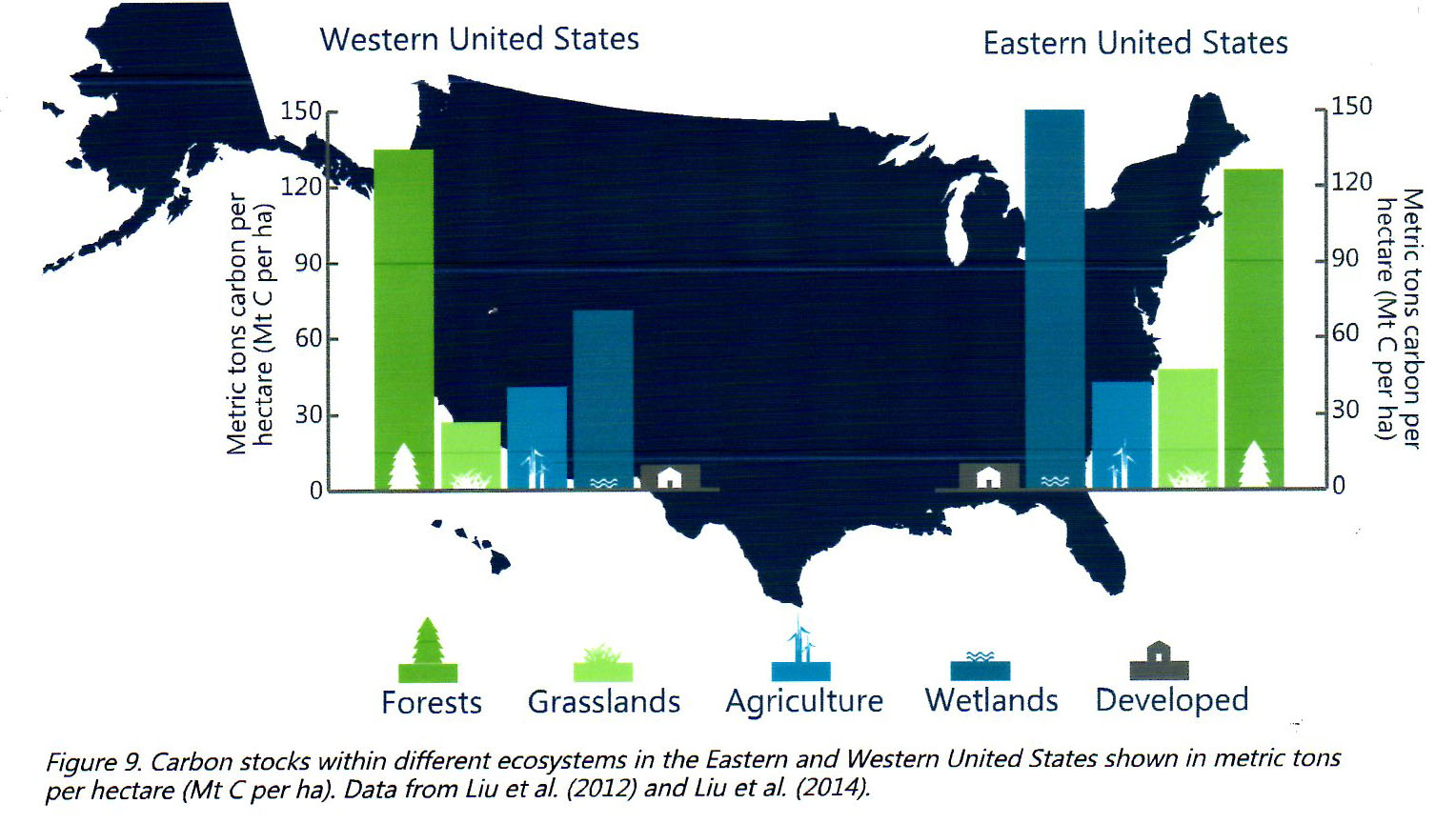
From the standpoint of carbon storage, it is not good news that grassland is likely to inherit hot, dry lands previously occupied by forests.  Forests and wetlands store more carbon than grasslands, as the above chart in a USDA publication about carbon storage shows.  Sustaining below ground carbon sinks will depend on carbon sequestration by above-ground plants and trees.  Because above-ground carbon sequestration is primarily dependent upon the biomass, forests will always do a better job than grassland in the long run.  In the short-run, grassland will grow back more quickly than forests, but it will never achieve comparable biomass. 

Forests are presently absorbing about one-quarter of all human carbon emissions annually. Forests make a significant contribution to reducing carbon emissions, but planting trees is not a panacea as long we continue to burn fossil fuels to generate energy. The loss of carbon-sequestering capabilities of forests will exacerbate climate change in the long-run.  It’s one of many dreaded feedback loops that are reaching tipping points:  the impacts of climate change are destroying the mechanisms that mitigate climate change. 

The study (1) acknowledges that by the end of the 21st Century, under current climate conditions (warming limited to 0.3⁰ – 1.7⁰ Centigrade) forests will have removed 5 times more net carbon (carbon storage minus carbon loss) per hectare from the atmosphere than grassland in California.  See Table 1 in the study (1).  Thus, the study agrees that forests store more carbon than grassland.

From the standpoint of wildlife, it is not good news that grassland is likely to replace forests in a warmer climate. The insects, birds, and animals that live in the forest will lose their habitat. Forests are home to over 80% of terrestrial species.  We will lose our shade in a warming climate and our windbreak. 

Not an argument for destroying forests

This study (1) is unfortunately being used by the native plant movement to advocate for the preemptive destruction of healthy urban forests that are not more likely than native forests to burn in wildfires.  Virtually all wildfires in California occur in native vegetation. There is no advantage to destroying healthy forests that are expected to live for another 100-200 years.  We don’t amputate our limbs to avoid breaking them.  Nor should we destroy our forests before they die.

(1)“Grasslands may be more reliable carbon sinks than forests in California,” Pawlok Dass, Benjamin Z Houlton, Yingping Wang and David Warlind, 10 July 2018, Environmental Research Letters, Volume 13, Number 7 

(2) “Importance of Grasslands for Carbon Storage,” Yerba Buena Chapter of California Native Plant Council, Quarterly Newsletter, March 2021, page 6. 

(3) “The role of fire disturbance for global vegetation dynamics: coupling fire into a dynamic global vegetation model,” Thonicke K, Venevsky S, Sitch S and Cramer W 2001,  Glob. Ecol. Biogeogr.10 661–77

Nobody cares where a pretty wildflower is from

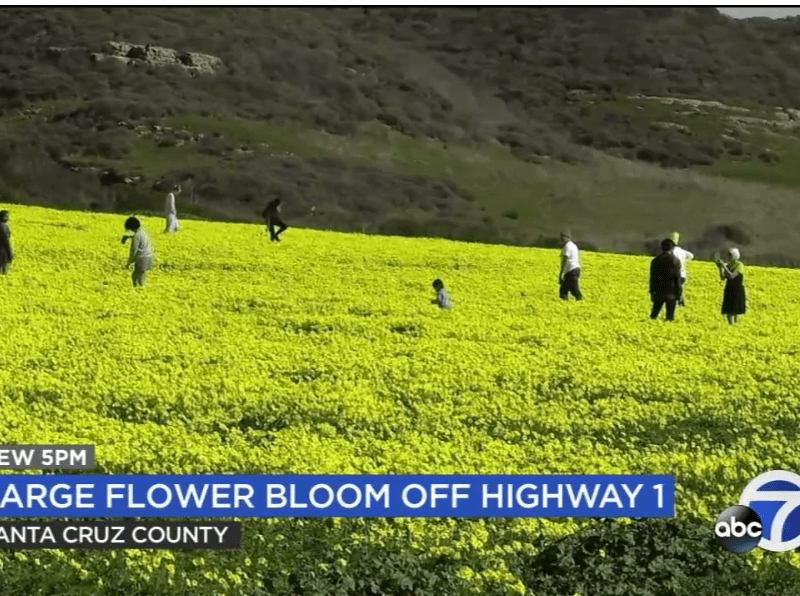
The feel-good ending of the local news broadcast on Channel 7 (ABC) on February 17, 2021, featured this video of a huge field of oxalis (Bermuda buttercup, Oxalis pes-caprae) blooming on the roadside of Highway 1 in Santa Cruz County.  People were stopping along the road to admire the bright yellow blooms of spring and photograph them.  No one said anything about where the plant “belongs,” and no bad words were spoken about this useful plant that native plant advocates love to hate.

Click on the picture to activate the video

Despite its beauty and utility, oxalis is sprayed with one of the most toxic herbicides on the market in public parks and open spaces in the Bay Area.  San Francisco’s Recreation and Parks Department has been spraying oxalis in several public parks for over 15 years.  San Francisco Forest Alliance (SFFA) published a brilliant article about this pointless and destructive crusade that was republished by Conservation Sense and Nonsense in 2015.  That article about the many benefits of oxalis is one of the most popular articles on this blog; it has been viewed by over 10,000 readers and many more on the SFFA website.  We invite you to visit it and we summarize it briefly here:

  • Oxalis blooms briefly in early spring and dies back before summer begins, leaving the ground to other plants. It does not kill other plants, rather it co-exists briefly during its annual bloom.
  • Oxalis is very useful to pollinators and its tuberous roots (bulbils) are eaten by ground dwelling animals such as gophers.
  • Oxalis is called sour-grass because of its pleasant-tasting tang and it is often eaten by children.
  • Triclopyr is the active ingredient in the herbicide that is used on oxalis during its blooming season. It damages the soil by killing beneficial fungi and microbes, and it is toxic to many animals.

The annual poisoning of oxalis on Mount Davidson was recently videotaped by Ron Proctor and published by the San Francisco Forest Alliance. A crew of 5 men was hired to do the deed.  Ironically, this spraying of oxalis on Mount Davidson in San Francisco was taking place at the same time that tourists were admiring oxalis in a neighboring county.

Click on picture to activate the video.

Oxalis is not an isolated example of a non-native plant that is admired by the public, but hated by native plant advocates and public land managers who do their bidding.  As a member of the Sierra Club, I receive emails alerting me to opportunities to advocate for the protection of the environment.  The most recent email featured a picture of a yellow wildflower in the foreground of a photograph of a Bay Area landscape:

The yellow wildflower in the foreground is Black Mustard (Brassica nigra).  I responded to the Sierra Club’s email:

“The plant in the foreground of your photograph appears to be Brassica nigra:  ‘Brassica nigra, or black mustard, is an annual plant cultivated for its black or dark brown seeds, which are commonly used as a spice. It is native to tropical regions of North Africa, temperate regions of Europe, and parts of Asia.’ Wikipedia

“I hope the use of this photo in this Sierra Club email to its members means that the Sierra Club is finally prepared to accept the reality of the presence of non-native plants in our public parks and open spaces.  The Sierra Club’s support for unnecessary and destructive eradication projects has been regrettable, particularly because they require the use of harmful herbicides.  I hope this email is an indication that the Sierra Club is finally ready to reconsider this futile crusade.”

I received this disappointing reply from the Sierra Club:  The staffer who puts together our newsletter isn’t a plant buff and wouldn’t have known the difference. But I am a plant buff and review the newsletter and know the difference between a mustard and a native plant. I somehow just overlooked that photo entirely. Thanks for bringing it to my attention. I’ll be more careful in my review of the newsletter in the future (look more carefully at the photos). And we’ll change the online version.”

The beauty and resilience of weeds

Dandelion by Mona Caron. Click on the picture to see more murals by Mona Caron.  Mona is a Swiss artist who became a muralist in her adoptive hometown San Francisco, California.  She is best known for her multi-story murals celebrating the rebellious resilience of weeds.

 The Bottom Line

The general public doesn’t care where plants came from.  The public recognizes and values beauty wherever it is found.  Unfortunately, our public lands are in the death grip of the native plant movement and environmental organizations that should be objecting to the use of herbicides in our public parks and not promoting that destructive agenda.  The crusade against non-native plants has been responsible for spraying our public lands with dangerous pesticides for over 20 years.  They have little to show for their toxic crusade, perhaps because the herbicides damage the soil and make the survival of native plants even less likely.


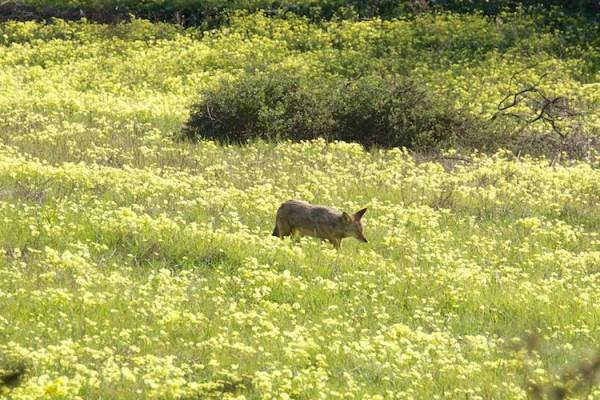
The featured photo at the top of this article was taken in Glen Canyon, another public park in San Francisco where oxalis has been sprayed annually for many years.  The copyright photo of a coyote in a field of oxalis was taken by Janet Kessler and is shown with her permission.

Fact vs. Fiction: The real threats to native plants in California

The enduring fiction of the native plant movement is that the existence of non-native plants threatens the existence of native plants by “crowding out” native plants.  If that were true, we should expect to see some evidence of such a causal relationship after 250 years of steadily increasing numbers of non-native plant species.  But we don’t. 

Marcel Rejmanek (UC Davis) is the author of the most recent report on plant extinctions in California, published in 2017.  At that time there were 13 plant species and 17 sub-species native to California known to be globally extinct and another 30 species and sub-species extirpated in California but still found in other states.  Over half the globally extinct taxa were reported as extinct over 100 years ago.  Although grassland in California had been converted to Mediterranean annual grasses by grazing domesticated animals decades before then, most of the plants now designated as “invasive” in California were not widespread over 100 years ago.

Most of the globally extinct plant species had very small ranges and small populations.  The smaller the population, the greater the chances of extinction.  Most of the globally extinct plants were originally present in lowlands where most of the human population and habitat destruction are concentrated. Although there are many rare plants at higher altitudes, few are extinct.  Plants limited to special habitats, like wetlands, seem to be more vulnerable to extinction. The primary drivers of plant extinction in California are agriculture, urbanization and development in general.

Non-native plants are the innocent bystanders to disturbance

“Invasive species” are mentioned only once in the inventory of extinct plants published by California Native Plant Society and only in combination with several other factors. However, the identity of this “invasive species” is not clear.  Rejmanek suggests that the “invasive species” rating refers to animal “invasions” by predators and grazers.  He says, “Indeed, one needs quite a bit of imagination to predict that any native plant species may be driven to extinction by invasive plants per se.” (1)

Although climate change is not cited as the cause of any of the known plant extinctions in California, Rejmanek predicts that climate change is likely to be a factor in the future, not only because of the impact of drought and higher temperatures, but also because non-native plants may be better adapted to changed conditions.

There are over 1,000 naturalized non-native plant species in California.  Their presence is associated with human disturbance.  Naturalized non-native plants are a symptom of disturbance, not the cause.  The impact of non-native plants on native plants cannot be separated from other factors that created the conditions for success of non-native plants.

Specialized insects are exaggerated

Another popular fiction among native plant advocates who love to hate non-native plants is that specialized insects—especially pollinators—require specific native plant species. Again, the record of plant extinctions in California does not support that myth:  “…there is no indication that the loss of pollinators was an important factor in plant species extinctions in California. [For example, one of the native plant species extirpated in California] has many documented non‐specialized pollinators. There does not seem to be any particular dispersal mode associated with presumably extinct plants in California.” (1)

Putting plant extinctions into context

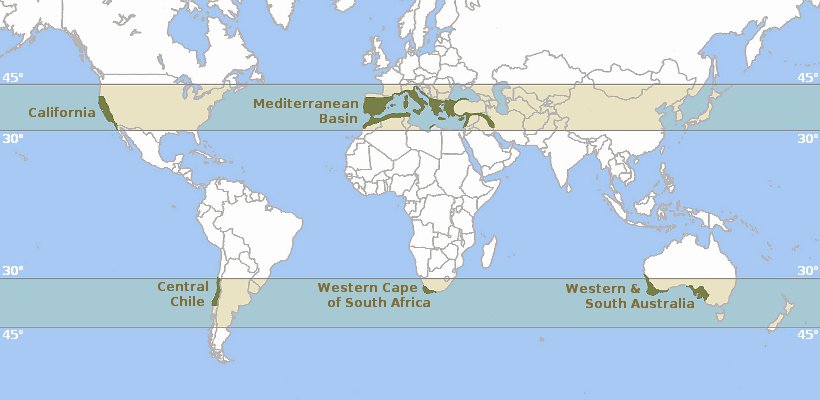
Mediterranean Climates are found in coastal temperate zones. Mediterranean climates are characterized by hot dry summers and mild wet winters.

Setting sub-species aside, there are 5,280 identified native plant species in California and 28 known extinctions of native plant species, including 15 plant species known to still exist in other states.  Only .53% of California native plants are known to be extinct in California, about one-half of one-percent.  Does that seem like a lot?  Rejmanek compared the extinction rate in California with other Mediterranean climates.  The extinction rate of native plants in California is similar to those in the European Mediterranean Basin, South Africa, and Australia, but a little greater than the rate in Chile, where there are fewer endemic plants that exist only in Chile.  Endemism is associated with small native ranges and small populations that are more vulnerable to extinction.

Why are there many endemic plants in California?

About 40% of native plant species in the California Floristic Province are endemic, found only in California and in most cases only in small areas within California, including our off-shore islands.  Their small populations in isolated geographic areas, sometimes within unique ecosystems, such as alkaline sinks, make them particularly vulnerable to extinction.

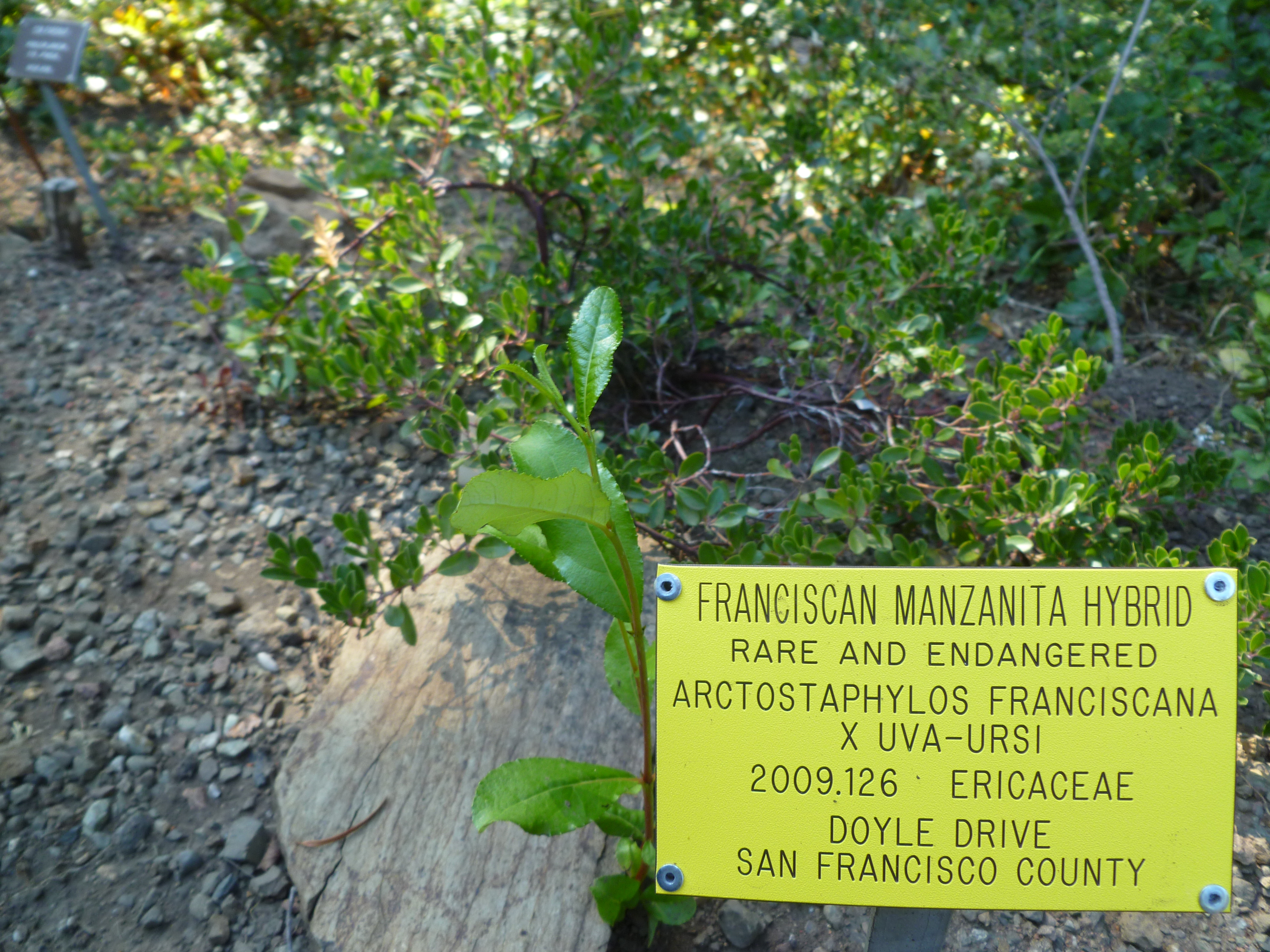
The evolutionary history of endemic plant species explains why there are so many in California.  Endemic plants are close relatives to plants that exist elsewhere and are sometimes plentiful where they came from.  For example manzanita is a genus of chaparral shrub that is plentiful in California, but there are also many rare endemic manzanita species that occur only in small areas and small populations.  There are several endangered manzanita species in the Bay Area (pallid, Raven’s, Franciscan).

Franciscan manzanita is one of 2 endangered manzanita species in San Francisco. There is one individual plant left of each of these two manzanita species. There are many endemic plants and insects in San Francisco and several are now extinct. San Francisco has a complex, diverse geology and topography and it is surrounded on 3 sides by water, creating many small, isolated microclimates in which many endemics have evolved.

The geography of California explains why the evolution of a plant species diverged from its plentiful ancestors to become an endemic species in a small geographic area.  Plants move around in a wide variety of ways, most natural, without the aid of humans.  Their seeds are dispersed by animals and birds that eat them or inadvertently carry them to another location.  Sometimes their seeds are carried on the wind or brought to islands by storms and currents.

When a plant arrives in a new location that is isolated from its original home and therefore cannot mate with its relatives, it begins its own, independent evolutionary history.  Each successive generation is reacting to its new environment, rewarding its fitness with its new home with a successful new generation.  Each generation rolls the genetic dice, its genome drifting away from its ancestors in a random way.  Occasionally a mutation will occur that alters the evolutionary trajectory.  Eventually, the plant in its new home is sufficiently genetically distinct that taxonomists are ready to call it a separate species.  Naming a new species is a judgment call, often questioned by some taxonomists, called “lumpers” as opposed to the “splitters” who are ready to name it a new species.

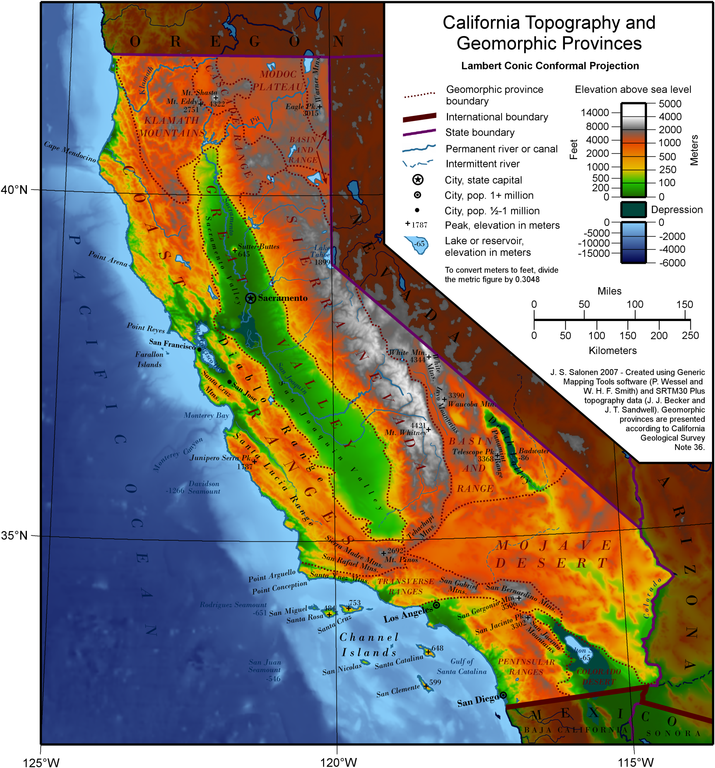
The factors that result in endemic species are many, but broadly speaking they are mobility and, ironically, isolation.  California is one of the most geographically diverse states in the country, with corridors for mobility, but many barriers that create isolation.  Gordon Leppig describes California’s geographic diversity in Beauty and the Beast:  California Wildflowers and Climate Change, published by California Native Plant Society:  “The state’s natural wonders include five deserts, the highest and lowest points in the continental United States, the third-longest state coastline (about one thousand miles), the most national parks (nine), the most federally designated wilderness areas (more than 140), the highest percentage of wilderness in the contiguous United States (14%), the most diverse conifer assemblage outside the Himalayas, the most federally listed species….”  The multitude of different ecosystems with unique microclimates produces one of the most diverse floras in the world.

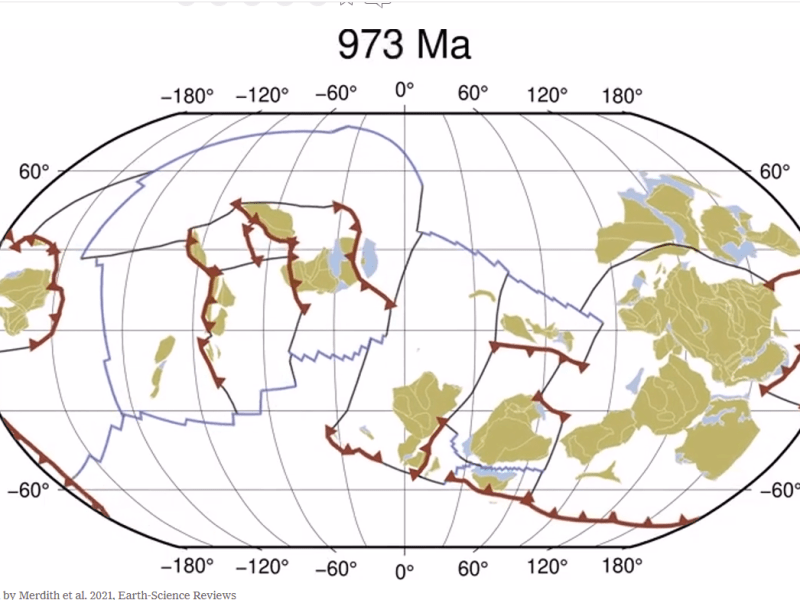
Click on the picture to watch the movement of tectonic plates over one billion years. Watch California slowly emerge as the jigsaw puzzle takes shape. California is the edge of two tectonic plates that collide and grind past one another perpetually, uplifting and dropping the land into fractured geomorphic pieces.

Human activities penetrate the barriers that created genetic isolation in the past.  Our roads become corridors for the biological exchange that threatens small, isolated pockets of rare plants.  Trade and travel has ended the isolation of off-shore islands.  Our roads and dams also create new barriers for mobility.  In other words, we are altering pre-settlement corridors and creating new ones.  We should expect consequences for our ecosystems for the changes we have made.

Given the number of rare and endemic plants in California and the changes in the environment required to accommodate nearly 40 million human Californians, it seems that extinction of less than one-half of one percent of native plants is a surprisingly small loss. 


(1) Marcel Rejmanek, “Vascular plant extinctions in California: A critical assessment,” Diversity and Distributions, Journal of Conservation Biogeography, 2017

Migration: Life on the move

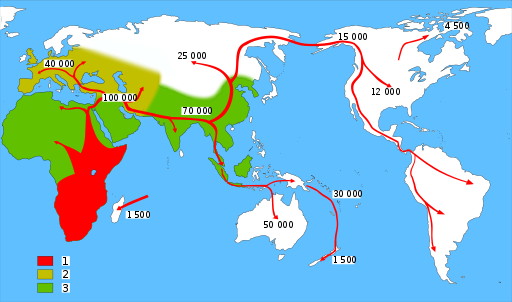
Sonia Shah’s recently published book, The Next Great Migration: The Beauty and Terror of Life on the Move, takes a deep dive into the past to trace the ancient history of migrating life on Earth. For as long as life has existed on Earth, life has been on the move, as needed to survive the constantly changing environment in which all plants and animals live.

1 Homo sapiens
2 Neanderthals
3 Homo erectus

Shah’s is an ambitious attempt to tell this story, not confined to human migration, but encompassing plants and animals as well because all of these migrations are connected. Scientists speculate the earliest migrations of human ancestors, some 100,000 years ago out of Africa, were in pursuit of the migrating animals that humans hunted.  On balance, the movements of plants and animals are beneficial to life on Earth because they are necessary to survive. When they aren’t beneficial, the problems are usually short-lived and humans are usually unable to stop them because nature is more powerful than we are.

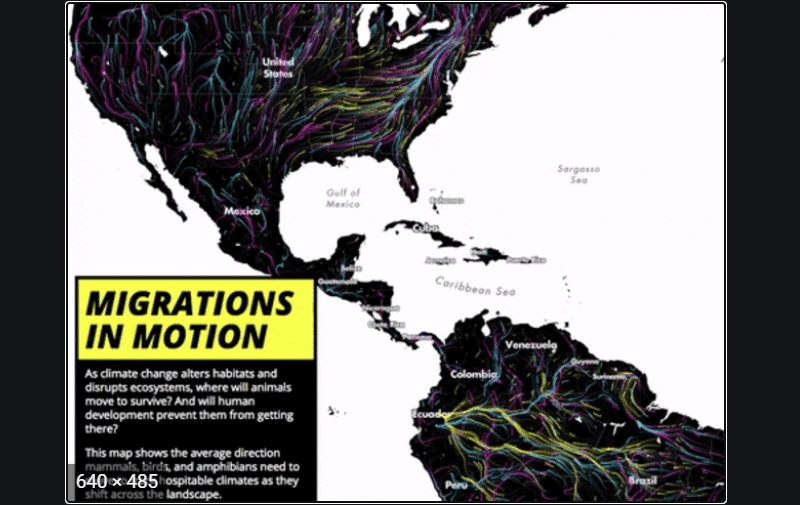
Click on map for animated movement of animals in response to changing climate conditions.

Migrations are even more frequent at a time of rapid and extreme climate change. As crops fail in the withering heat and drought caused by global warming, farmers are abandoning their farms to find the food they need to survive. Hence, Shah’s prediction that we are about to witness the “next great migration” because of the challenges of climate change. When the climate changes, the vegetation changes. When the vegetation changes, animals must move to find the food they need. Humans wish to put ourselves in a special category that denies our kinship with animals. But we are as dependent upon our food as any animal and the changing climate will challenge our existence as much as other forms of life.

Shah also traces the brief history of human knowledge of migrations about which little was known before the development of the scientific tools to study it.  Paleontology could dig up fossils that would raise more questions than answers about the residents of deep time, but it wasn’t until the development of molecular analysis that fossils could inform scientists of the evolutionary history of and close relationships among plants and animals that reflect migrations in the distant past.  New technology is capable of tracing the movements of animals that were unknown in the distant past, when animals seemed to mysteriously disappear at the end of one season and returned at the beginning of another season.

Invasion Biology is based on ignorance of migration

The fact that animal migration was largely unknown led to some fundamental misunderstandings about nature, including the unfortunate rise of nativism in the natural world that was spawned by the mistaken hypotheses of invasion biology. Shah explained the consequences of inadequate knowledge of migration in a recently published article in New York Times Magazine:

“When scientists considered movements across barriers and borders, they characterized them as disruptive and outside the norm, even in the absence of direct evidence of either the movements themselves or the negative consequences they purportedly triggered…Influential subdisciplines of biological inquiry focused on the negative impact of long-distance translocations of wild species, presuming that the most significant of these occurred not through the agency of animals on the move but when human trade and travel inadvertently deposited creatures into novel places.  The result, experts in invasion biology and restoration biology said, could be so catastrophic for already-resident species that the interlopers should be repelled or, if already present, eradicated, even before they could cause any detectable damage.”

In turn, Invasion Biology spawned pointless and destructive eradication projects

Conservation Sense and Nonsense has followed the destructive and futile attempts to eradicate plants and animals that nativists say “don’t belong here:”

  • Hawaii is an extreme case of attempts to eradicate non-native plants and animals: frogs, owls, egrets, seals, fruit trees, mangroves, parrots, etc.  These eradication projects often do more harm than good.  The “logic” for these projects is muddled, partly because the Hawaiian Islands emerged from the sea as barren volcanoes.  The question of “what belongs there” is a matter of opinion and debate in Hawaii and elsewhere.

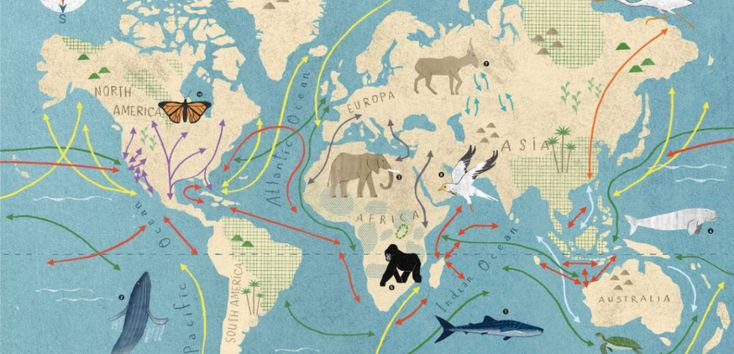
Bird migration routes

Migration enables survival

I hope that improved knowledge of migration will help people understand that migration is a natural phenomenon that is essential to the survival of all life on Earth.  Migration enables life to adapt to changes in the environment, facilitating evolution and reducing frequency of extinction.

Doug Tallamy’s Blame Game

The fact that insect populations are declining in many places around the world is well known, but the reasons for the decline are not well known.  Where there is uncertainty, there is speculation and where there is speculation, there is debate.

Doug Tallamy recently stepped into that debate by publishing a review article about insects and their use of plants.  The article is a mind-numbing list of studies that find both positive and negative relationships between insects and non-native plants.

Tallamy contends those studies add up to support for his belief that non-native plants are bad for insects and native plants are good for insects.  He suggests that declining populations of native plants should be considered one of the reasons for declining populations of insects, but then he goes one step further. Tallamy suggests that non-native plants are responsible for declining populations of native plants.  It follows that Tallamy blames non-native plants for the disappearance of insects.

My interpretation of the studies in Tallamy’s review is different.  The studies tell me that there is too much variation in insect-plant relationships to generalize about the relative value of native vs. non-native plants to insects.  A more accurate conclusion would be that sometimes insects make a successful transition from a native to a non-native plant—especially in the absence of a native in the same lineage—and sometimes they don’t…or at least they haven’t yet.

Anise swallowtail butterfly is one of many insects that have made a successful transition from a disappearing native plant to an introduced non-native plant in the same lineage. Prior to that transition, swallowtails were able to lay eggs only once a year, when the native was available. The introduced non-native is available year around, which enables the swallowtail to lay its eggs year around. Courtesy urbanwildlife.org

Since evolution is a process and not a historical event, these insect/plant relationships will continue to change.  There are many studies that document such transitions and Tallamy cites some of them in his review.  Tallamy assumes insects will be forever handicapped, if not killed, by whatever deficiencies there are in the non-native substitute.  I assume the insect is more likely to adapt and eventually evolve to cope with those deficiencies.  Both our assumptions are just guesses.  Tallamy considers nature immutable, while I consider it dynamic.  Where Tallamy sees doom and gloom, I see opportunity.

Professor Art Shapiro’s (Distinguished Professor of Evolution and Ecology, UC Davis) assessment of Tallamy’s review article is less equivocal than mine.  Keep in mind when reading his assessment that he is far more knowledgeable than I am:

  1. “There is little evidence known to me of alien plants (‘invasives’) competitively displacing natives in ‘communities’ except in highly disturbed environments, except in the case of ‘ecological engineer’ species like Japanese honeysuckle, Himalayan Blackberry, climbing fern in Florida, Purple Loosestrife, etc. — things that drastically alter the ground rules for structuring the vegetation by smothering or prompting fire.

  2. “The use of natives and non-natives by insects has a long and venerable history, going back to T.R.E. Southwood and his comparisons of insect faunas on British trees to Godwin’s history of the British flora, Azevedo’s student study at SF State, etc. — demonstrating overall that enemies accumulate in time on naturalized aliens, but it may be a very slow process if there is no phylogenetic or chemical bridge to their colonization. Experiments using haphazardly-selected species to examine acceptability are basically silly, and very easy to ‘stack’ if one knows one’s phytochemistry.

  3. “As I have repeatedly pointed out, ‘weed’ eradication would lead rapidly to the extirpation of nearly all of the non-tree-feeding urban and suburban butterfly fauna in lowland California (and many other places).”

Why are insect populations declining?

A 2017 study revealed a shocking 76 percent decline in the biomass of flying insects over 27 years in protected areas in Germany.  The German study does not offer specific explanations for the significant decline in insects, but it speculates about probable cause: Agricultural intensification (e.g. pesticide usage, year-round tillage, increased use of fertilizers and frequency of agronomic measures) that we could not incorporate in our analyses, may form a plausible cause. The reserves in which the traps were placed are of limited size in this typical fragmented West-European landscape, and almost all locations (94%) are enclosed by agricultural fields. Part of the explanation could therefore be that the protected areas (serving as insect sources) are affected and drained by the agricultural fields in the broader surroundings (serving as sinks or even as ecological traps). Increased agricultural intensification may have aggravated this reduction in insect abundance in the protected areas over the last few decades.”  Presumably “protected areas” in Germany are not landscaped with non-native plants, rendering the use of this study to corroborate Tallamy’s hypothesis irrelevant.

A comprehensive review of 73 reports of declining insect populations around the globe was published in 2019. These studies report the reasons for declining populations: “The main drivers of species declines appear to be in order of importance: i) habitat loss and conversion to intensive agriculture and urbanization; ii) pollution, mainly that by synthetic pesticides and fertilisers; iii) biological factors, including pathogens and introduced species; and iv) climate change. The latter factor is particularly important in tropical regions, but only affects a minority of species in colder climes and mountain settings of temperate zones.” The “introduced species” are usually insects rather than plants.

In a Yale e360 article about Tallamy’s review, one commenter offers his opinion that the over-population of deer and their preference for eating native vegetation is likely a greater threat to native plants than the existence of non-native plants that provide an alternative source of food for deer, thereby reducing predation of native plants.  Tallamy seems to agree that deer are a problem for native plants, while rejecting deer as a greater threat to native plants than the existence of non-native plants.

The list of reasons for declining insect populations is long and will probably get longer as more research is done.  If the existence of non-native plants is on that list, it is unlikely to be higher on a prioritized list than the pesticides that are being used to eradicate non-native plants.  The more herbicide that is used to eradicate non-native plants, the more harm is done to insects.

EPA Biological Evaluation of glyphosate is a black eye for native plant “restorations” that use herbicide

The Environmental Protection Agency has finally published its Biological Evaluation (BE) of the impact of glyphosate products (all registered formulations of glyphosate products were studied) on endangered animals (mammals, birds, amphibians, reptiles, fish, invertebrates) and plants. The BE reports that 1,676 endangered species are “likely adversely affected” by glyphosate products. That is 93% of the total of 1,795 endangered species evaluated by the study. Of the total of 792 critical habitats of endangered species, 759 (96%) were “likely adversely affected” by glyphosate products.  Most of those critical habitats probably contain predominantly native plants that are clearly not benefiting from herbicides used to kill their competitors.

Both agricultural and non-agricultural uses of glyphosate products were evaluated by the BE. Although only endangered plants and animals were evaluated by the BE, we should assume that all other plants and animals are likewise harmed by glyphosate because the botanical and physiological functions of plants and animals are the same, whether or not they are endangered. Herbicides, specifically glyphosate products, are used by the majority of projects that attempt to eradicate non-native plants. As a result, the crusade against non-native plants is undoubtedly a far more important factor in the decline of insect populations than their mere existence.

Why are native plant populations declining?

There are many reasons why native plant populations are declining, but there is little evidence that non-native plants are the cause of declining populations of native plants. Many of the causes of declining insect populations are also causes of declining populations of native plants. A recent study reports that 65 taxa of native plants in the US and Canada are thought to be extinct. The study did not report a single case in which the extinction was caused by the existence of non-native plants. Sixty-four percent of extinct plants were single-site endemics. The same drivers cited by recent insect studies appear on the list of causes of plant extinctions. Nearly half of the extinctions occurred more than 100 years ago, long before introduced plants were considered an issue.

Butterfly bush is a host plant of Variable checkerspot butterflies. It is also an important source of nectar for butterflies and bees. It is being eradicated on public land because it is not a native plant. butterflybush.com

My New Year’s Wish

Nature is too complex to be reduced to a single cause for changes in the environment.  Human knowledge is insufficient to identify all of the causes.  That’s why we make many mistakes when trying to fix a perceived problem in nature.  Our own priorities influence our evaluation of changes in the environment.  We should not automatically assume that a change is a problem or that it must be reversed.

The existence of novel ecosystems is a case in point.  They can as easily be seen as positive or negative.  If a native plant or animal is no longer adapted to changes in the environment, such as climate change, we should be grateful that a non-native substitute is capable of tolerating the change.  Where some see enemies, others see friends.

I wish you all a very happy New Year in 2021.  I can’t wish 2020 a fond farewell.  I can only say good riddance!  I am hopeful for a more peaceful year, one in which we befriend our enemies and work together for a better world for nature and for humanity.  I am grateful for your readership.

Re-upping on Reality

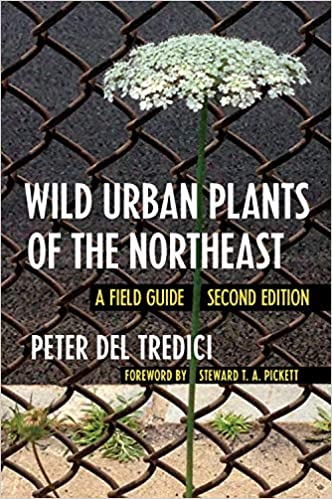
A book review by Marlene A. Condon©of Wild Urban Plants of the Northeast by Peter Del Tredici

Marlene A. Condon is the author/photographer of The Nature-friendly Garden:  Creating a Backyard Haven for Plants, Wildlife, and People (Stackpole Books 2006; information at www.marlenecondon.com).  Please visit her blog, In Defense of Nature.  You can reach her at marlenecondon@aol.com

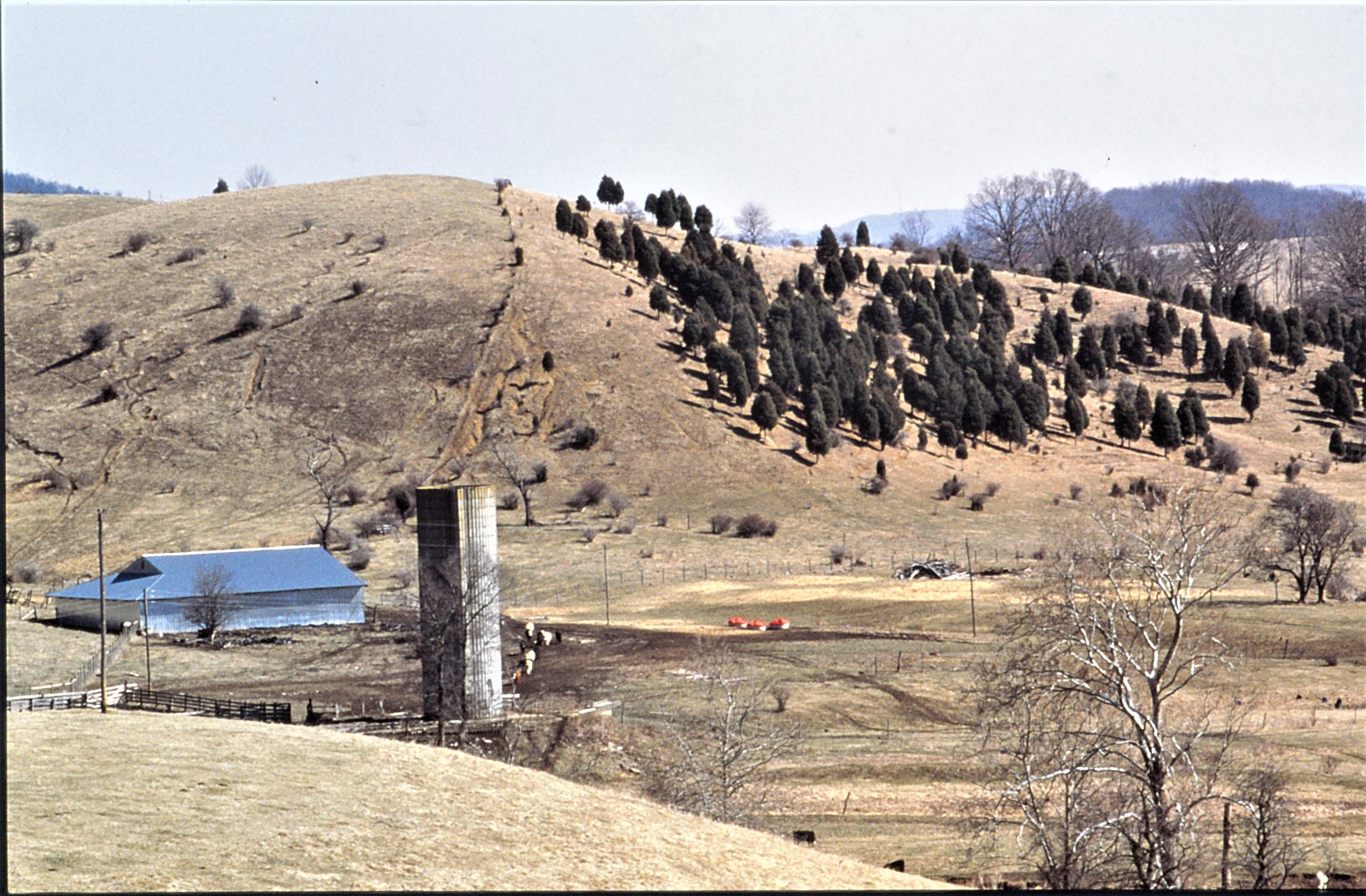
To the farmer’s eye, Eastern Redcedar trees “invade” his cow fields where he would prefer only grass to grow. To the ecologist’s eye, the trees signify the need for soil remediation. Photo credit Marlene A. Condon

Prefatory Comments

When I was a student in the mid-1970s at Virginia Tech, small farms surrounded the town of Blacksburg. I spent time at many of the cow farms, where I constantly heard complaints by agriculturalists about the Eastern Redcedar (Juniperous virginiana) perpetually invading their fields.

After getting my degree in physics, I moved north to Charlottesville, a 140-mile highway drive through rural areas. In the ensuing decades, numerous small farms were abandoned as it became more difficult for farmers to make a living from them.

On frequent trips back to Blacksburg, I watched as the forsaken cow fields began to fill with cedar trees. Then, as time went on, Autumn Olive (Eleagnus umbellata) shrubs began to show up as well. It took decades for those fields to become a forest of cedars, olives, or a mix of both; succession was a slow process because the soils had been emptied of their nutrients, and they were compacted by the generations of half-ton animals that had trod upon them.

What the farmers didn’t understand in the 70s, and what most people still don’t understand today, is that Mother Nature tries constantly to replenish degraded areas by sending in colonizers—plants capable of growing in and enriching exhausted soil. Because very few kinds of plants can perform this natural restorative work, their presence in an area is a sure sign of impoverished land.

Virginia Cedar, Virginia Pine (Pinus virginiana), and Broomsedge (Andropogon virgincus) comprise the most-common native species that move into old Virginia cow fields, sometimes accompanied by Black Locust (Robinia pseudoacacia) that is somewhat beyond its original range. But Autumn Olive, from Asia, is a far superior restorer. It not only enriches the soil with nitrogen, an essential nutrient for plant growth, but also provides for wildlife far better than these other plants. I can’t think of another species that feeds such an abundance of pollinators in the spring with its fragrant blooms, and birds and mammals in mid-to-late summer with fruits and again in late winter by way of its buds.

Yet Autumn Olive is one of the most despised plants of people going after so-called invasive-plant species, the presence of which in our environment they don’t understand and have misinterpreted. For example, University of Delaware entomology professor Doug Tallamy starts Bringing Nature Home (published in 2007) with an explanation of how he came to write his book: He and his wife had moved seven years earlier to 10 acres in southeastern Pennsylvania where he found “at least 35 percent of the vegetation on our property (yes, I measured it) consisted of aggressive plant species from other continents that were replacing what native plants we did have.”

Despite his knowledge that the area “had been farmed for centuries before being subdivided and sold to people like [him and his wife]”, this entomologist clearly had no clue about the full story of the landscape he had bought. The presence of Multiflora Rose (Rosa multiflora), Autumn Olive, and other much denigrated alien species that occupied about a third of his property revealed a prior history that Dr. Tallamy and other invasion proponents ignore.

The farmer’s land had obviously stood idle for some years, giving the variety of plants mentioned plenty of time to move in to rehabilitate the soil. These alien species didn’t suddenly appear and grow to full size overnight; we know the plants had been growing for a long time because the author tells us: “In places on [his] land, bittersweet…was supported at the base by vines with six-inch diameters.”

They weren’t “taking over the land” by “push[ing] out any existing natives,” as Dr. Tallamy erroneously asserts. Ecological succession is defined as “a gradual and orderly process of change brought about by the progressive replacement of one community [herbaceous plants to woody shrubs] by another until a stable climax [forest] is established.” (1) If Professor Tallamy truly understood how the natural world works, he would realize he can now grow his preferred climax community of native trees only because the alien “invaders” prepared the site for him to do so.

It’s unfortunate that Doug Tallamy’s false version of nature has been given much credence and publicity. Thanks to conservationists and governments at all levels rallying around his contrived version of reality, huge areas of well functioning habitat have been, and continue to be, destroyed throughout the United States. Adding insult to injury, the “mission” to get rid of supposedly invasive plants has usually been accomplished with the use of herbicides deadly to wildlife.

Book review of Wild Urban Plants of the Northeast by Peter Del Tredici

The natural world would currently be in far better shape if years ago the press had instead taken note of urban ecologist and Harvard botanist Peter Del Tredici’s book, Wild Urban Plants of the Northeast (first published by Cornell Press in 2010, with an expanded version out this year). Unlike Dr. Tallamy, Dr. Del Tredici recognizes the substantial modifications to our environment wrought by development and climate change, such as soil degradation that goes hand in hand with construction, and drought that is more severe and more frequent due to climate warming.

Anyone knowledgeable about plants should recognize that these changes are quite consequential for these organisms. Perhaps Professor Tallamy doesn’t “get it” because he’s focused only on insects and knows very little about animal/plant relationships. For example, he erroneously writes (2) that the Tulip Poplar tree (Liriodendron tulipifera) “is one of the least productive forest species in terms of its ability to support wildlife—insects and vertebrates alike.” He doesn’t know Tulip Poplar blooms feed a myriad of insects along with hummingbirds, and its seeds are taken by the Eastern Gray Squirrel and other rodents, as well as birds like the Carolina Chickadee, the mascot for his cause célѐbre.

It’s a shame that Wild Urban Plants of the Northeast is referred to as a field guide on its cover and in advertisements. People are bound to think this book is mainly for identification of plants growing in urban areas, but it is so much more. Conservationists and gardeners throughout the entire country—and certainly students learning about plants—would do well to read the 29-page “Introduction”.

 The true value of this work lies in the author’s explanatory text about why the 268 covered species show up in the cracks and crevices of city sidewalks and deserted parking lots, as well as from the walls of decrepit buildings. It’s an ecology lesson that is far more illustrative than the dry text you might read in a book devoted to the subject for the classroom.

An urban Krakatoa. This sea of urban blacktop is like a volcanic lava flow, and the plants that grow here, including mullein (Verbascum thapsus) , chicory (Cichorium intybus), New England hawkweed (Hiercium saubadum), and white heath aster (Symphyotrichum pilosum), can tolerate extreme heat and drought.  Courtesy Peter Del Tredici

For example, in Wild Urban Plants, the reader views a photo of an abandoned building with its fissured parking lot in which a variety of wildflowers grow. The caption likens the “sea of urban blacktop” to “a volcanic lava flow” where plants must be able to tolerate extreme heat and drought. What a superb metaphor! It conveys the environmental conditions to which these plants are subjected while also making very clear to the reader why only certain plants germinate and survive well in such places.

Princess Tree (Paulownia tomentosa) colonizing an abandoned building in New London, Connecticut. From the plants’ perspective, a decaying brick wall is just a limestone cliff. Courtesy Peter Tredici.

In Wild Urban Plants, Princess Tree (Paulownia tomentosa) is seen growing out the side of a neglected painted-brick building in New London, Connecticut. The caption informs us that, “From the plants’ perspective, a decaying brick wall is just a limestone cliff.” How marvelously enlightening!

The urban glacier leaves a trail of compacted glacial till in its wake. Courtesy Peter Del Tredici

Perhaps the most unique metaphor of all can be found in the picture of a  backhoe sitting atop a hill of dirt. The author tells us “The urban glacier [referring to the backhoe] leaves a trail of compacted glacial till in its wake.” A conglomerate of unsorted broken rocks, till does not provide amenable growing conditions for very many species of plants.

The author doesn’t go into this subject, but moss is often the first colonizing organism to move in. It secretes organic acids that break down the rocks into soil, paving the way for plants with the ability to fix nitrogen to come in, and over time, as plants die, the soil is enriched via their nitrogen, allowing other kinds of plants to live here. An understanding of this process is sorely lacking among those conservationists who insist that “invasive” plant species serve no useful purpose in the environment. In fact, it’s a darned good thing they are here, given their ability to flourish under present environmental conditions. This is the explanation, after all, for their apparent invasiveness.

Dr. Tredici’s “Introduction” should be required reading for everyone involved in conservation. With a better comprehension of how the natural world works, people should be able to realize that the United States is wasting many millions of taxpayer dollars every year to remove alien plants. And annually putting millions of pounds of herbicides into our environment (according to a 2012 Environmental Protection Agency report (3)) manifests a horrendous crime against nature.

This counterproductive war on nonnative plants must be stopped quickly; far too much damage has already been done. Spread the word about this book to everyone you know.

References:

  1. https://www.thefreedictionary.com/Plant+succession
  2. Bringing Nature Home, Doug Tallamy
  3. https://www.epa.gov/sites/production/files/2017-01/documents/pesticides-industry-sales-usage-2016_0.pdf