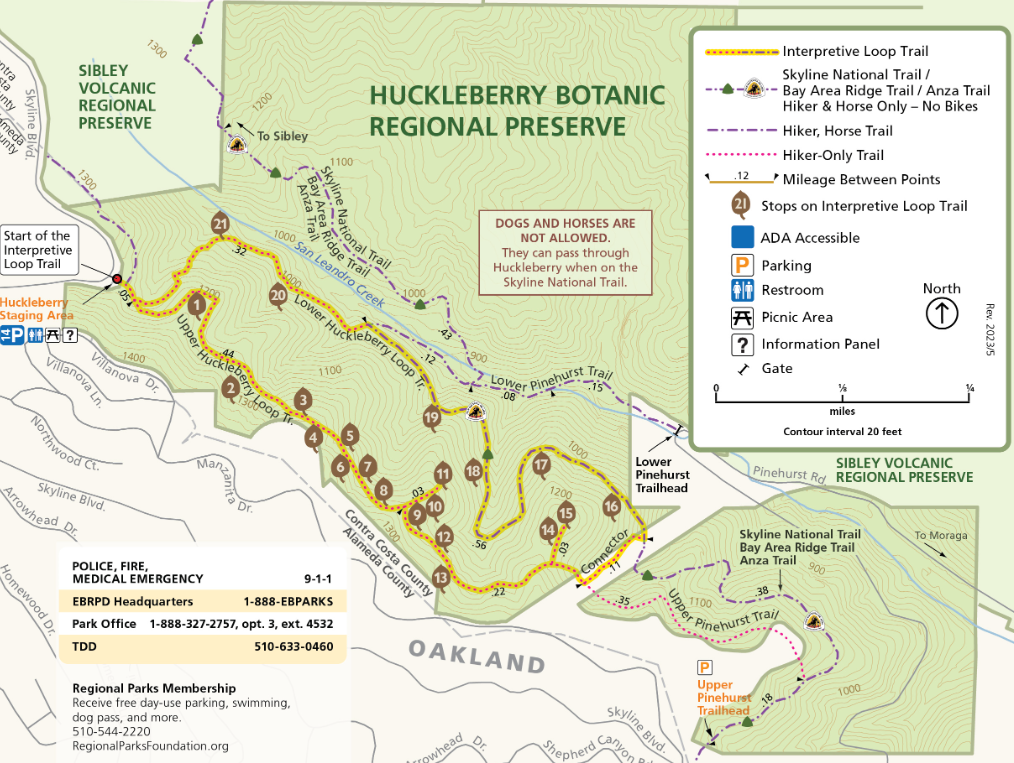
We celebrated July 4th with a walk in the woods. Huckleberry Botanic Regional Preserve in Oakland is a true remnant of native vegetation that is unique among the collection of 73 parks of the East Bay Regional Park District. The trail guide describes the conditions that created this ecosystem and enabled its survival while other native ecosystems have not survived:
Huckleberry is “a relic plant association found only in certain areas in California where ideal soil and climatic conditions exist. The vegetation association finds its roots in past climates and geologic history. The plants originated in the distant past along the southern coast of California when the climate was more moist and tempered by the cool coastal fog. Today, similar vegetation is found on the islands off the Santa Barbara coast and in isolated pockets on the mainland coast from Point Conception to Montara Mountain south of San Francisco.”
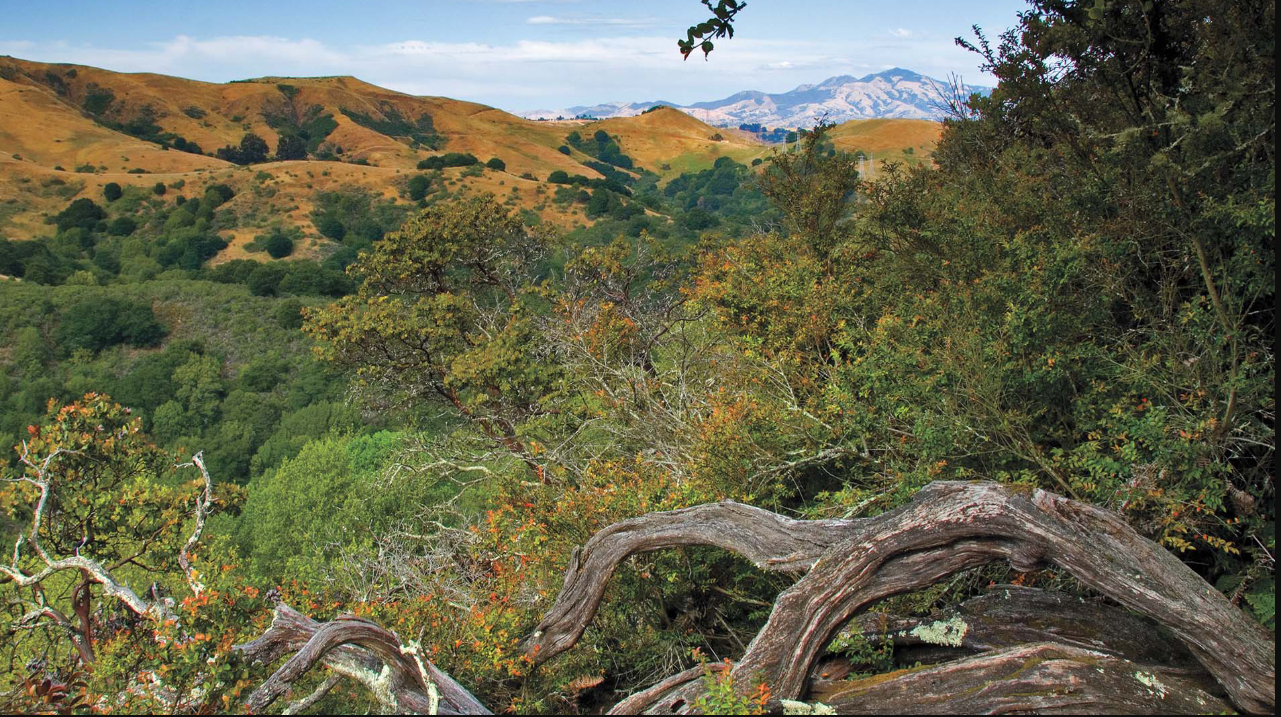
A view from Huckleberry Botanic Preserve of hills to the east. Source: East Bay Regional Park District
The preserve was created partly to protect an endangered species of manzanita, specifically pallid manzanita. There are 107 species and sub-species of manzanita, of which 95 are native to California. The ranges of most of these species are extremely small because manzanita hybridizes freely and therefore adaptive radiation has resulted in a multitude of species, sub-species, and varieties that are adapted to micro-climates. Many of these species are locally rare and 10 species of manzanita have been designated as endangered, two of which are limited to the San Francisco peninsula: Raven’s manzanita and Franciscan manzanita.
Manzanita is vulnerable to extinction partly because its ranges are small and partly because it is an “obligate seeder,” which means it can only be propagated in the wild from seed. The seed of manzanita is germinated by fire. However, the exact relationship between fire and germination is not known. Many complex experiments have been conducted on the few viable seeds produced by Raven’s manzanita, which was designated as endangered in 1979. Various combinations of fire, heat, cold, smoke, liquid smoke, etc., were tried and failed to determine exactly what triggers germination of manzanita seeds. The suppression of fire in the past 150 years has contributed to the decline of small manzanita populations in California.
Some endangered species of manzanita are available in commercial nurseries because they can be easily cloned, which means they are genetically identical. These commercially available manzanita species remain technically endangered because the criteria for endangered status requires that they be grown from seed in the wild to be eligible for removal of endangered status.
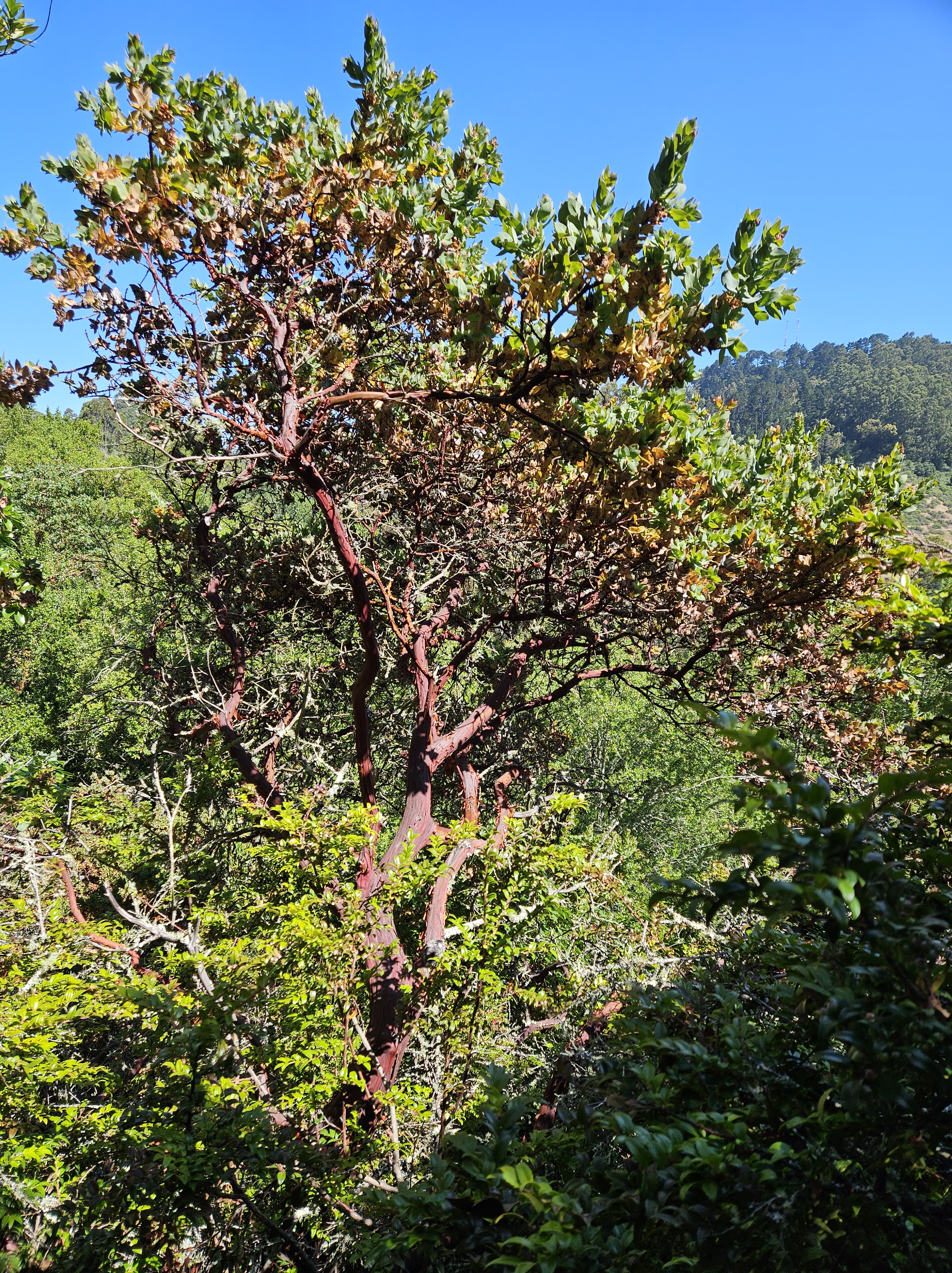
Pallid manzanita in the Huckleberry Botanic Reserve are not doing well:
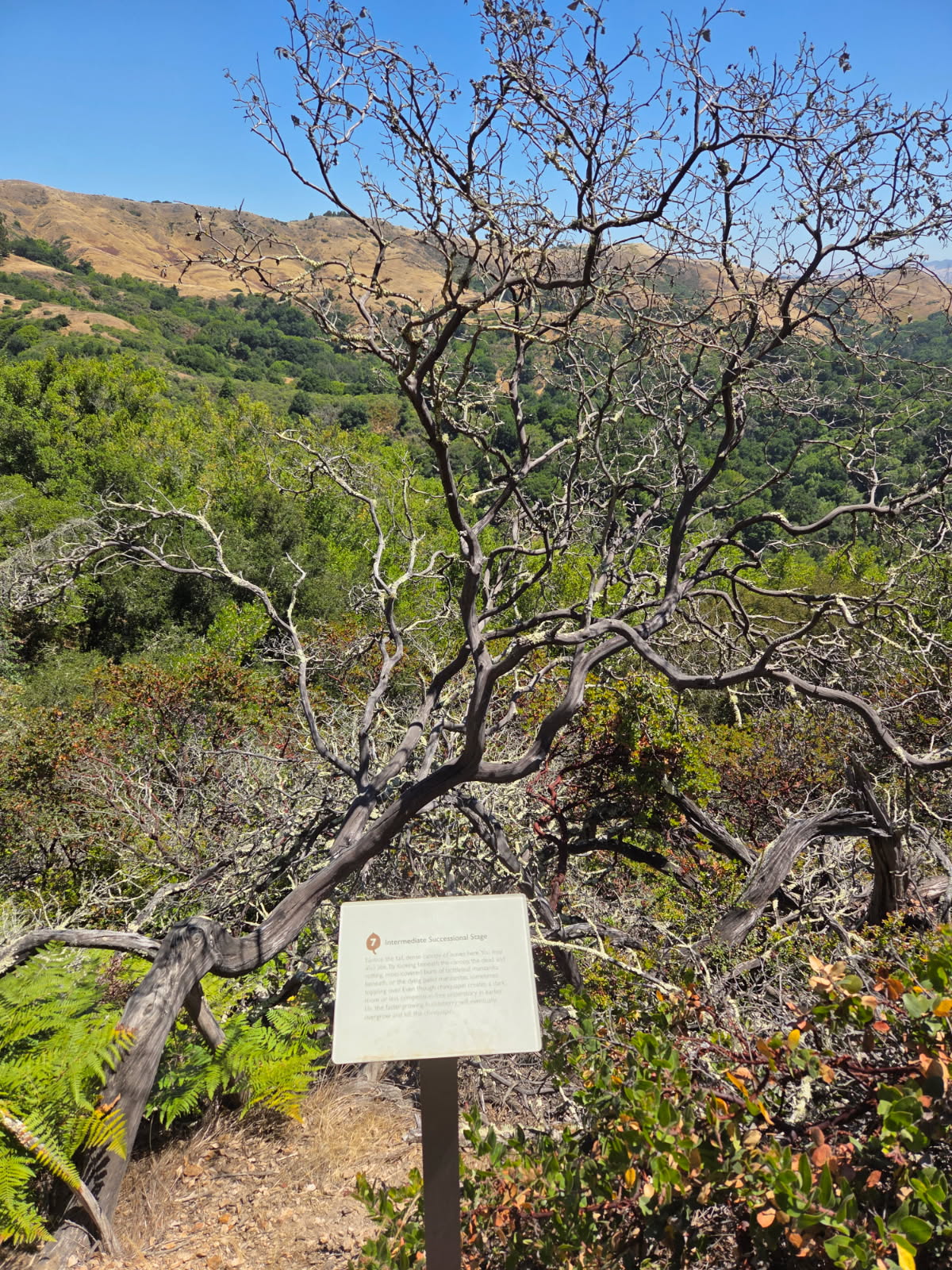
And some pallid manzanita is dead:
The sign explains that as pallid manzanita dies, it creates space in the understory for chinquapin and it predicts that more competitive huckleberry will eventually “overgrow and kill” chinquapin. The sign describes this process as natural succession. It doesn’t accuse huckleberry of being invasive. If huckleberry were non-native, it probably would be considered “invasive.”
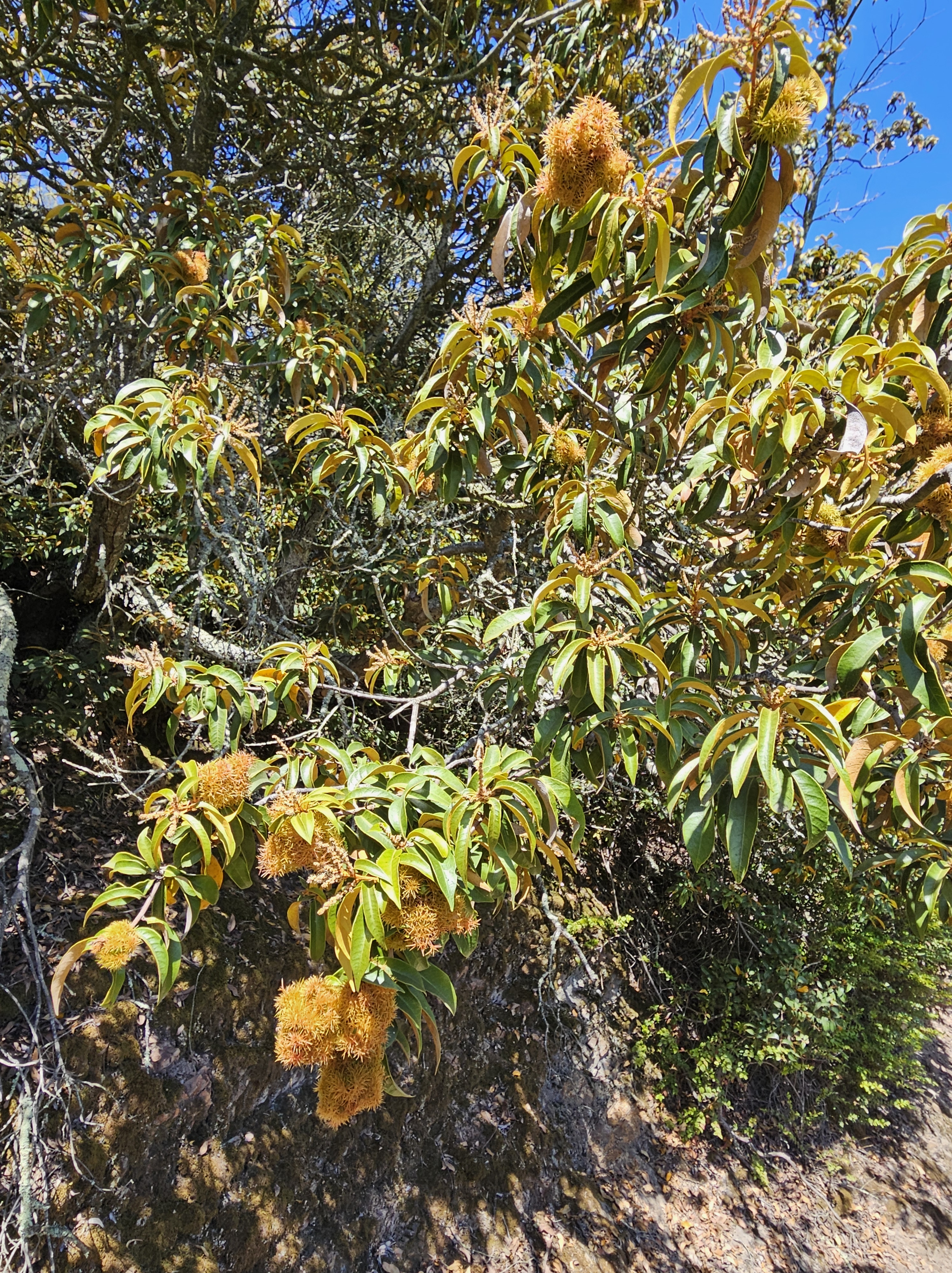
Chinquapin has a distinctive nut, which is encased in a bristly shell. My hiking companion said he and his brothers used to eat the tasty nut when camping in Mineral King in Sequoia National Park. The bristly shell doesn’t make it easy to access the nut, but birds and wildlife find a way:
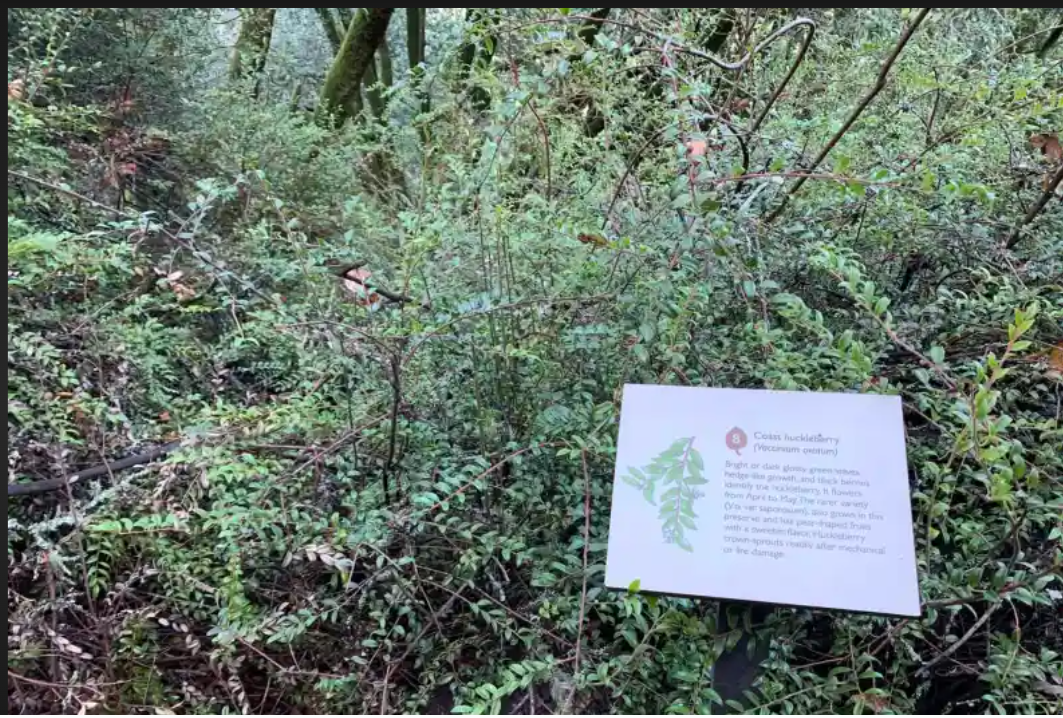
Huckleberry is appropriately the namesake of this botanic reserve. In some portions of the narrow trail huckleberry creates tall, dense hedges on either side of the trail:
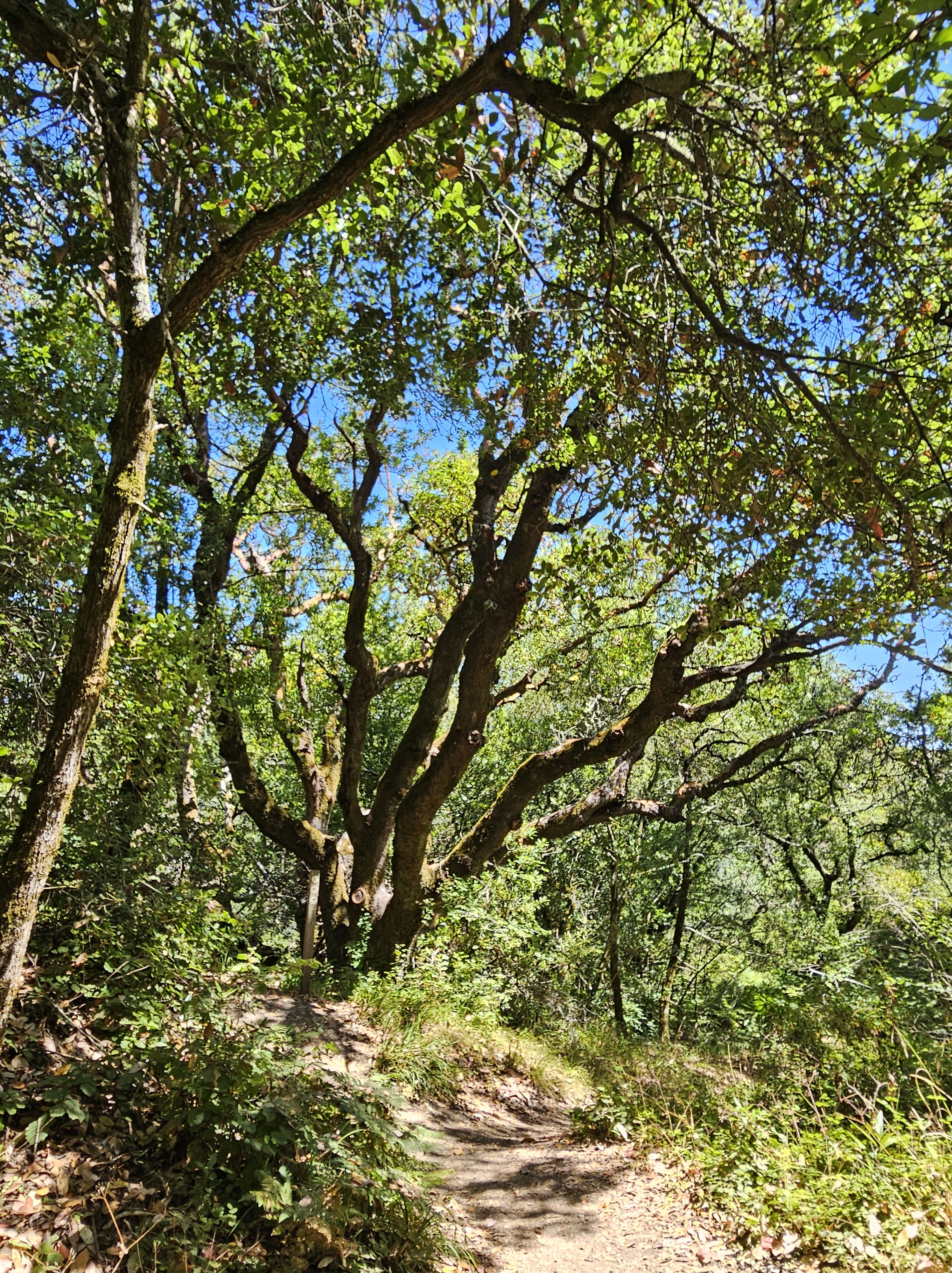
Because the Huckleberry Botanic Preserve is a relic of native vegetation that has been undisturbed by fire and development for hundreds of years, it is an excellent place to see huge native trees compared to much younger and therefore smaller native trees in other public parks in the San Francisco Bay Area.
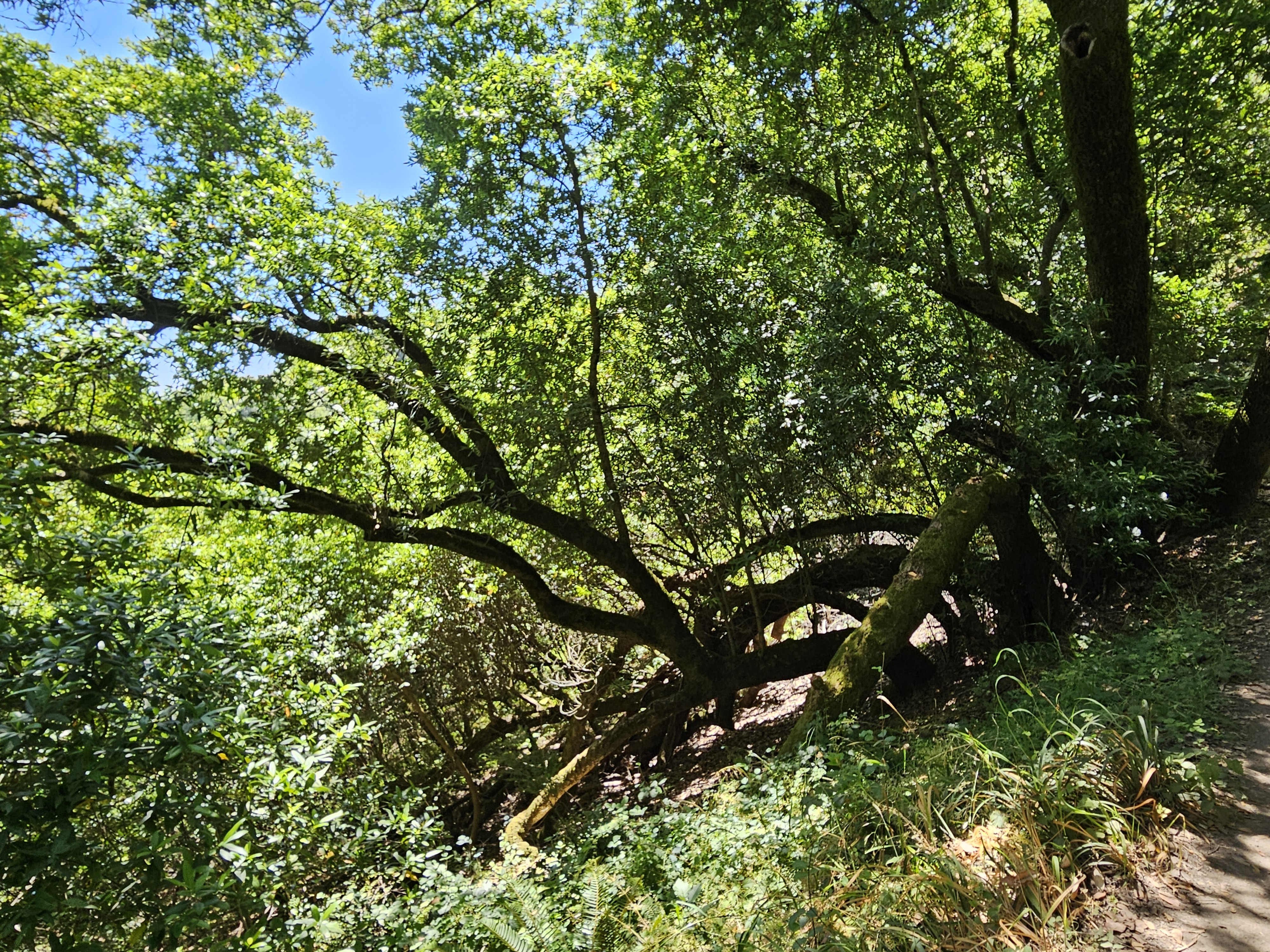
Mature bay laurel trees in Huckleberry Preserve are an opportunity to witness the competitive strategy of this tree species. When it achieves some height as it grows, its branches fall over and often put down new roots that grow new vertical trunks. This prostrate posture of bay laurels gives them a competitive advantage over other plants in the understory. Mature bay laurels occupy huge expanses of space around them that create shade and make it difficult for other plants to become established in the shade. The prostrate posture of bay laurels also makes it more flammable because the fire ladder to its canopy extends to the ground. Crush a bay laurel leaf in your hands to smell its aromatic oils that also contribute to the flammability of bay laurels:
This madrone tree in Huckleberry Reserve is the biggest I’ve ever seen:
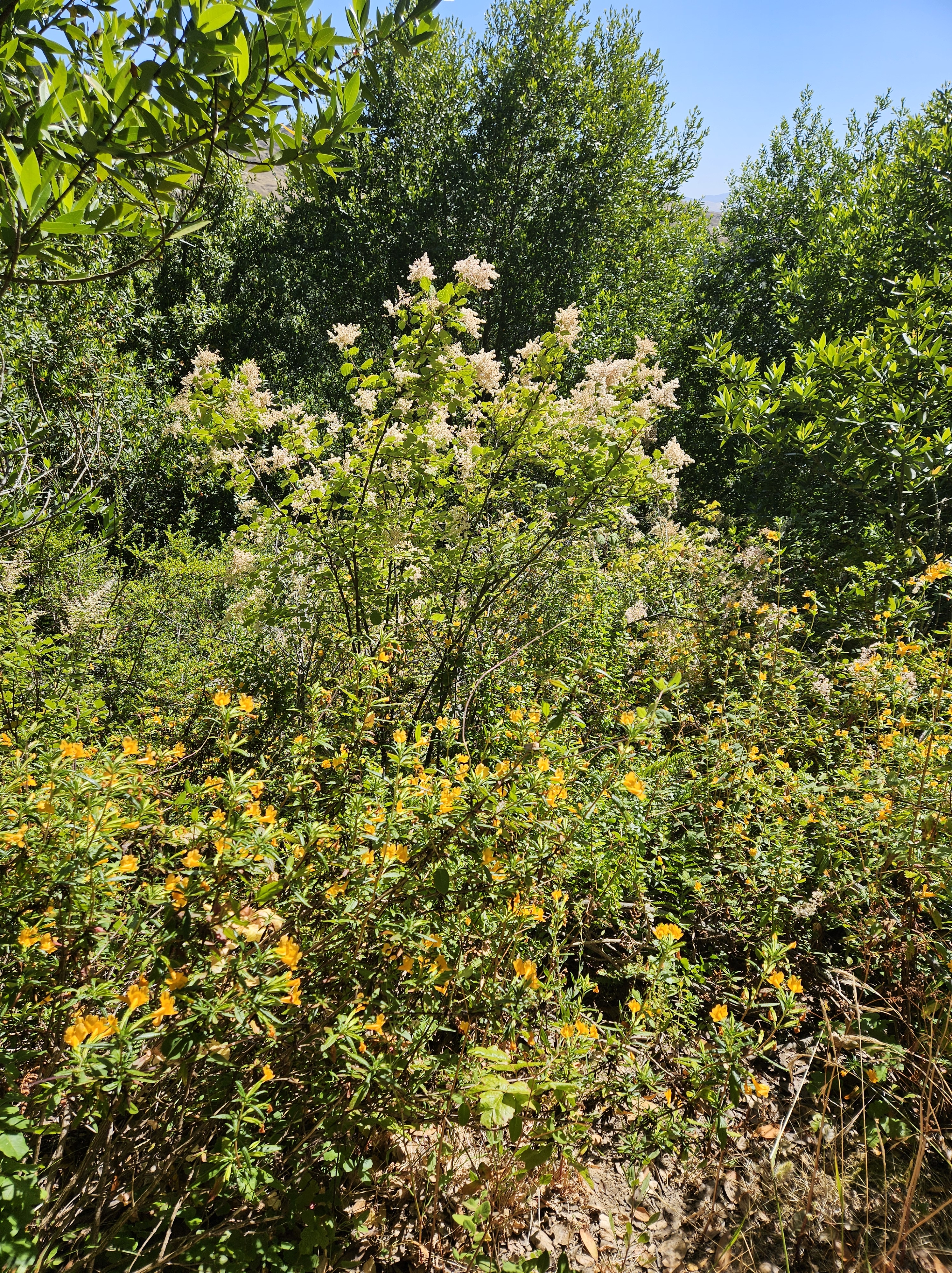
In early July some woody and herbaceous shrubs were still blooming. In this case, sticky monkey flower in the foreground and pink flowering current in the background:
Huckleberry Botanic Reserve is a unique gem in East Bay Regional Park District. I hope you will have an opportunity to see it and that you will appreciate it as much as I do.
We spent a few days in a small family-owned resort in Sierra City in mid-July. It’s an area we know well because we have visited many times in the past 25-years and taken many birding and geology courses at the nearby San Francisco State University Sierra Nevada Field Station.
It has been about 12 years since our last visit and we were expecting to see significant changes after a decade of drought. Our previous visits were also earlier in the summer, during nesting season in June, when birds are more active and vocal. As expected, the weather was much warmer than previous visits.
The Setting
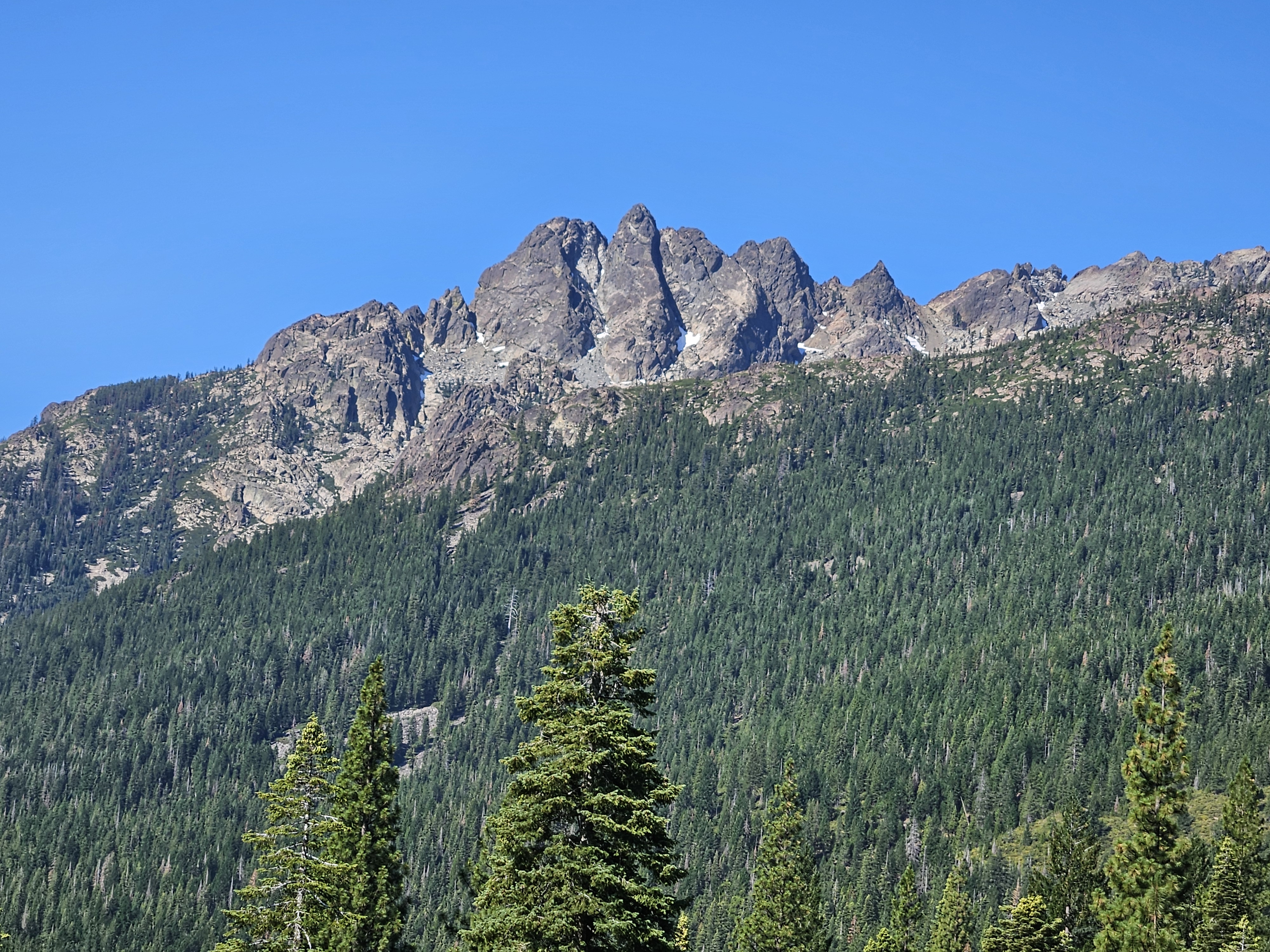
Sierra City sits at the base of Sierra Buttes at 4,200 feet elevation. Sierra Buttes tower above at 8,560 feet. The Buttes are the remains of the lava flow of an ancient volcano. The soft rock surrounding the lava flow eroded away long ago and the harder rock has been sculpted several times by glaciers during past ice ages. The glaciers sculpted rocks on the valley floor into the basins of many lakes that remain today.
Sierra Buttes
This area was occupied by a hunter-gatherer culture of Indigenous people for thousands of years. They migrated according to the seasonal harvests of plants and animals until Europeans arrived in 1850 to mine for gold. The first generation of the owners of the resort arrived as miners. When gold was exhausted, ranching became the family enterprise. When the recreational treasures of the area were discovered in the 1960s, the family converted the ranch to a resort in 1967. The economy of this area has evolved, just as its flora and fauna have.
Fire Hazard Mitigation?
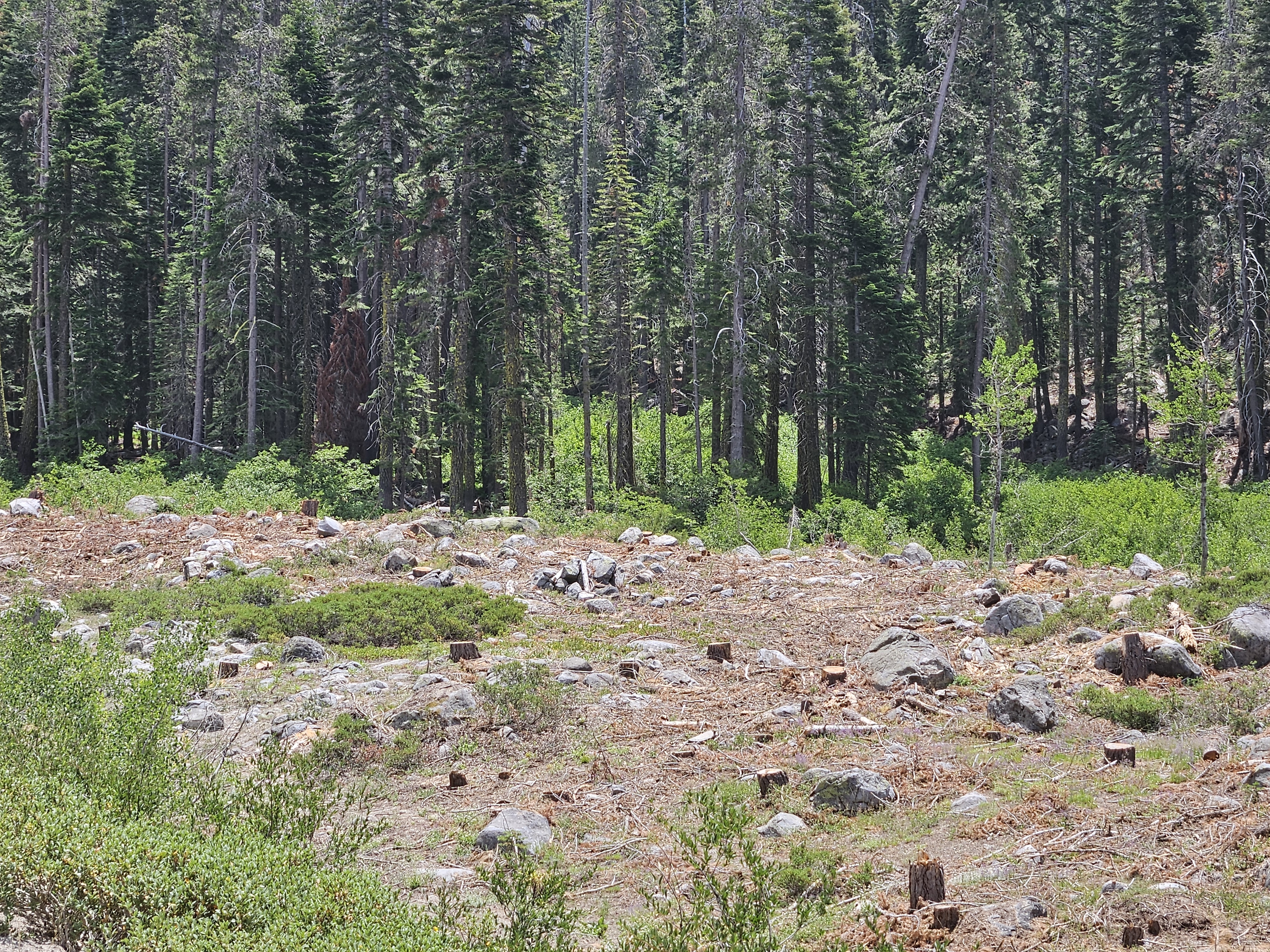
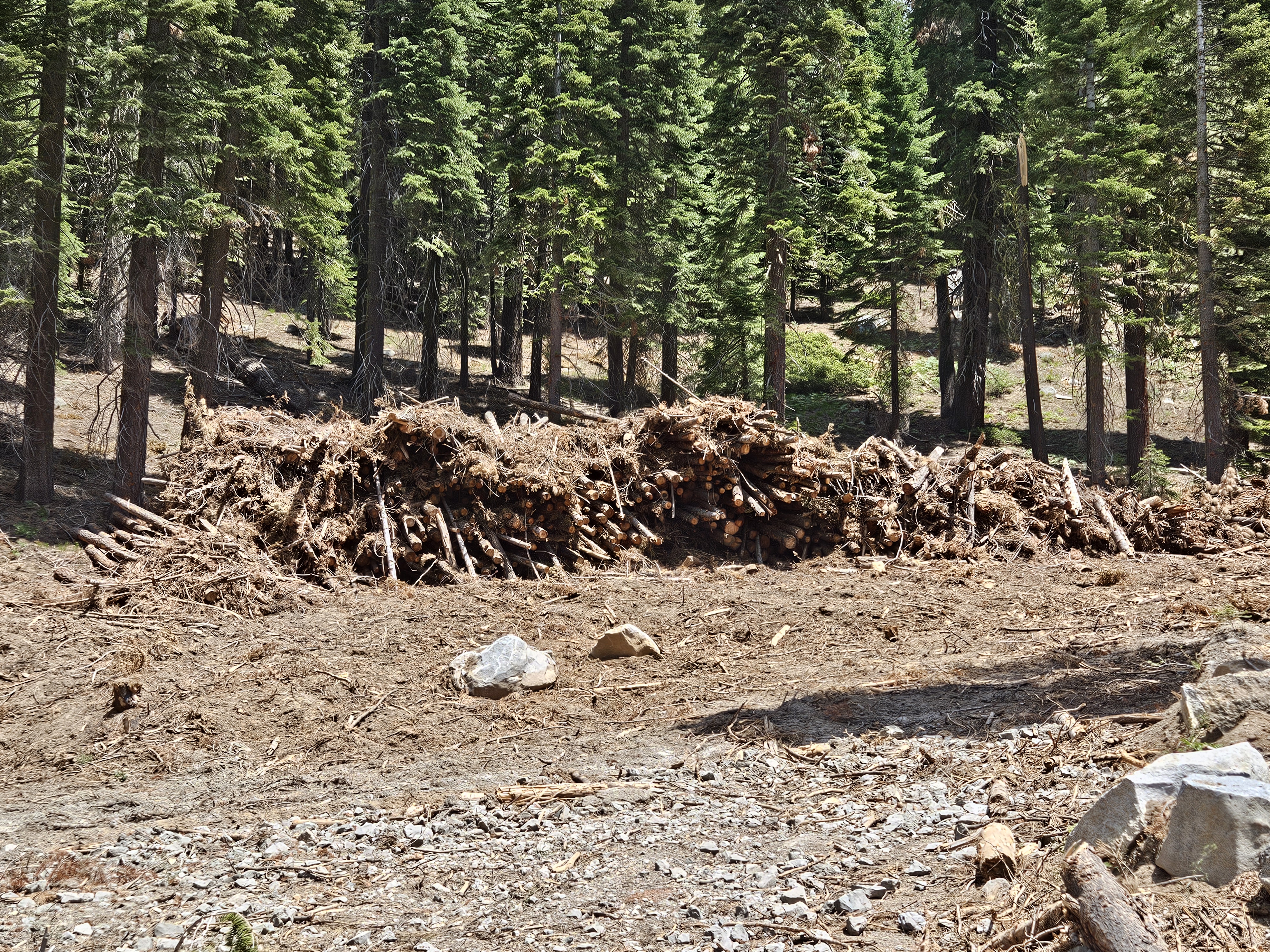
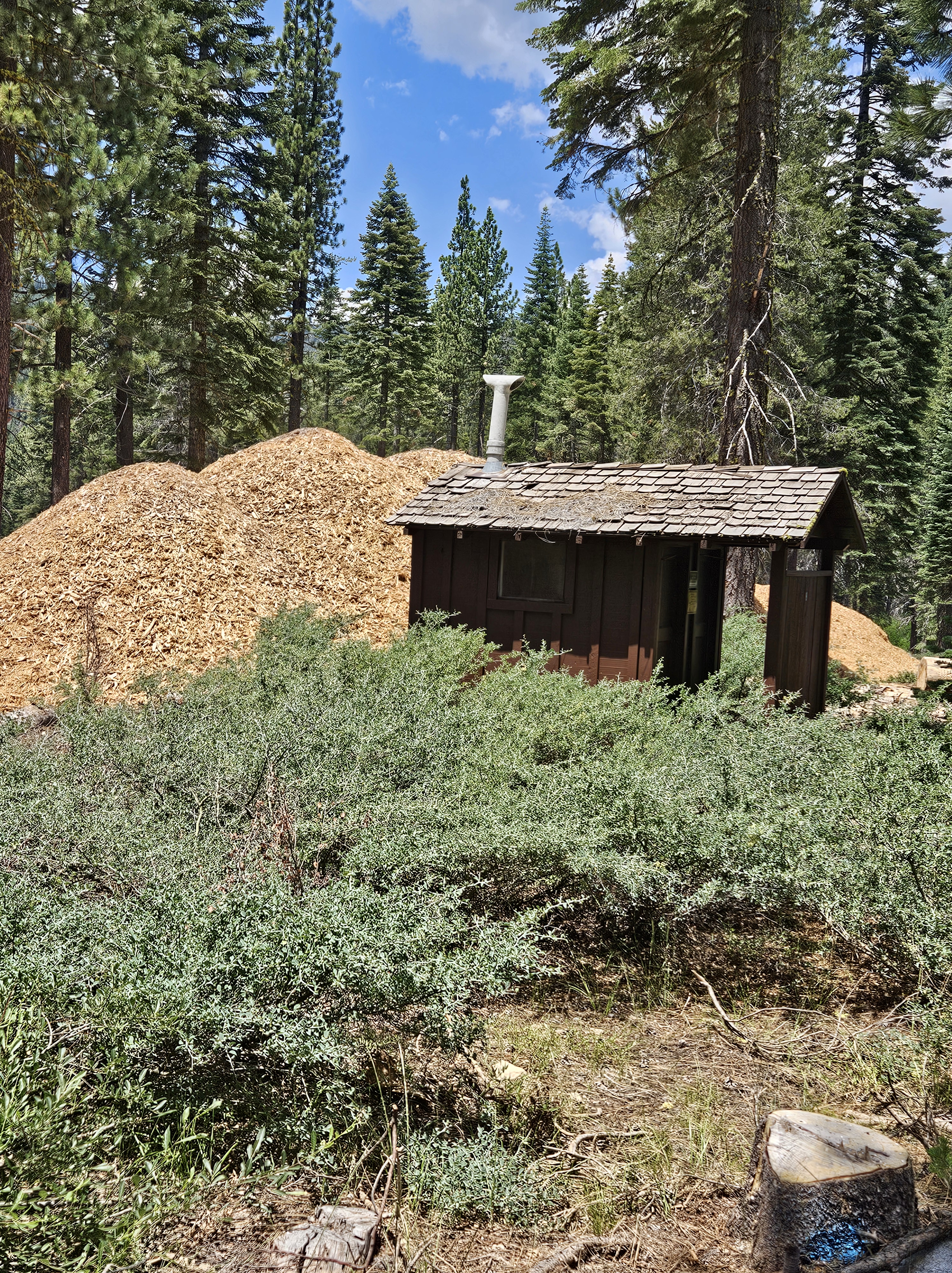
The most significant change we observed since we were last in the Sierras is the massive timber operations. In the 12 miles from Sierra City to Yuba Pass at 6,700 feet, we saw roadside clearings created by cutting young trees. Huge piles of small-diameter logs and wood chips were stacked in the clearings (see below).
Chapman Creek Campground
These clearings looked like fire hazard mitigation partly because of their proximity to the road and to campgrounds, but also because they destroyed small trees, which are more likely to ignite than big trees. On the other hand, the piles of logs and wood chips are more flammable than any living tree, big or small.
Thinning the forests is also a strategy to reduce competition for available moisture at a time of extreme drought. Extreme drought stress in the conifer forests of the Sierra Nevada is one of the primary causes of tree mortality in California in the past decade.
Commercial Logging?
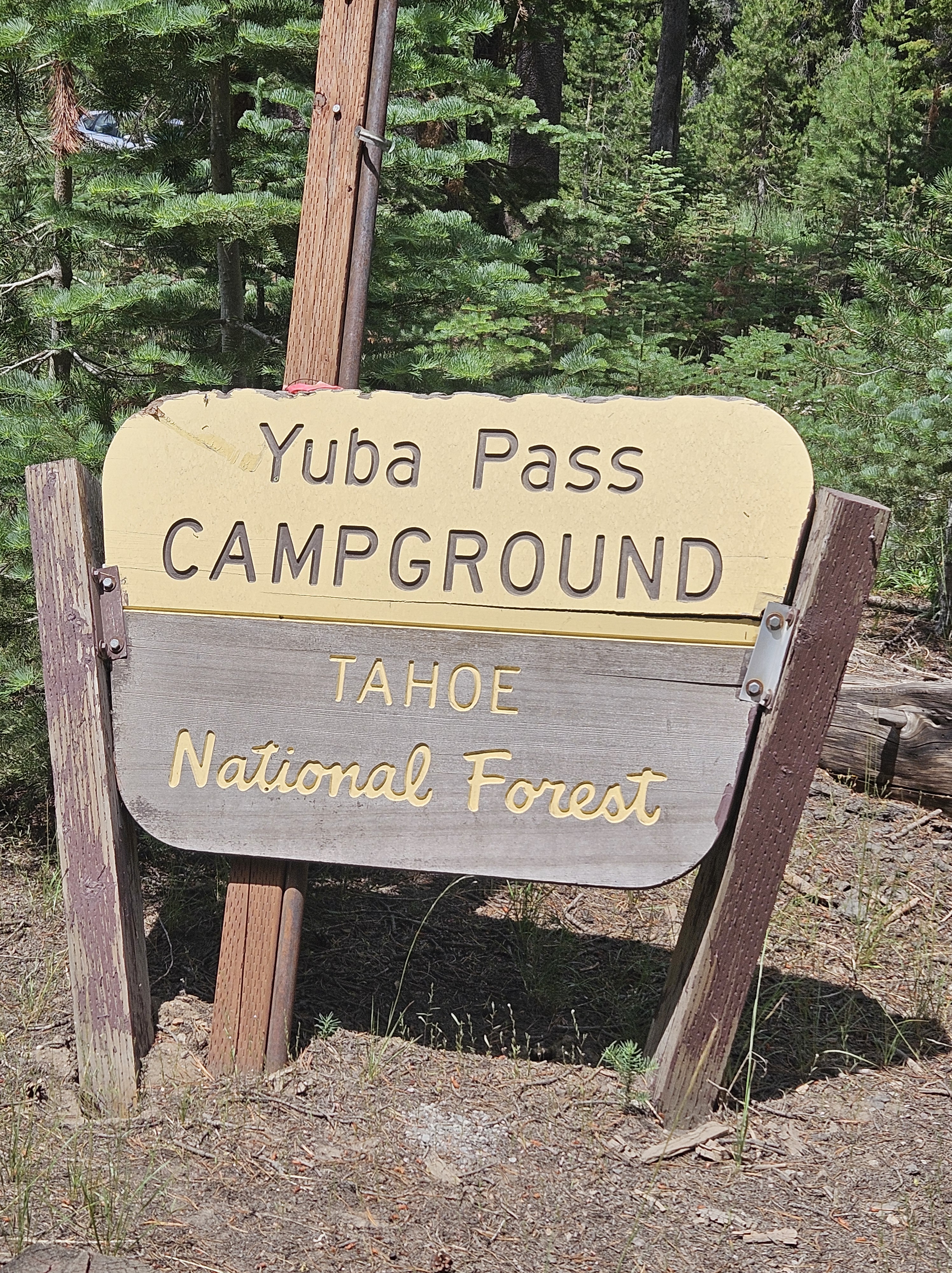
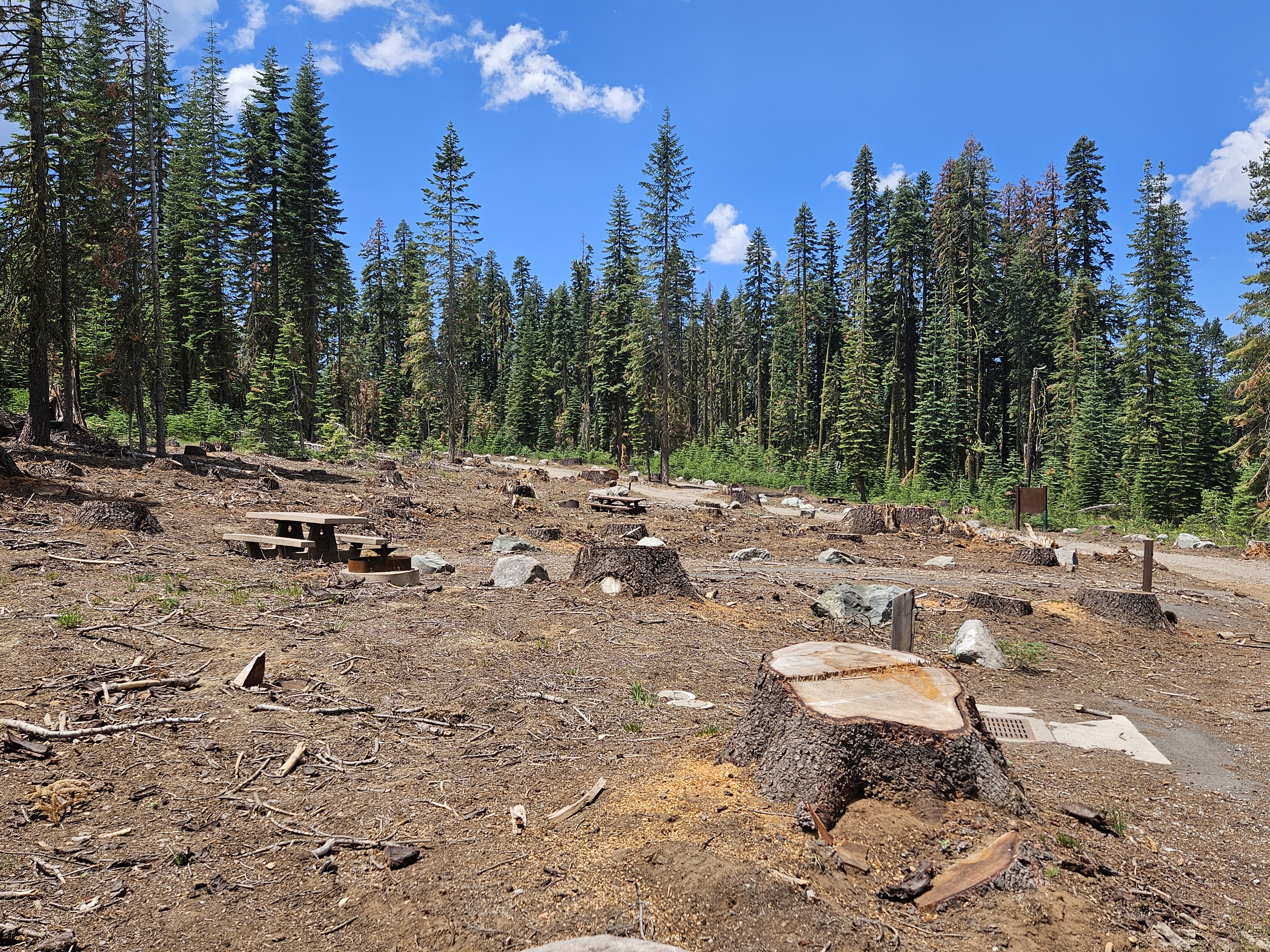
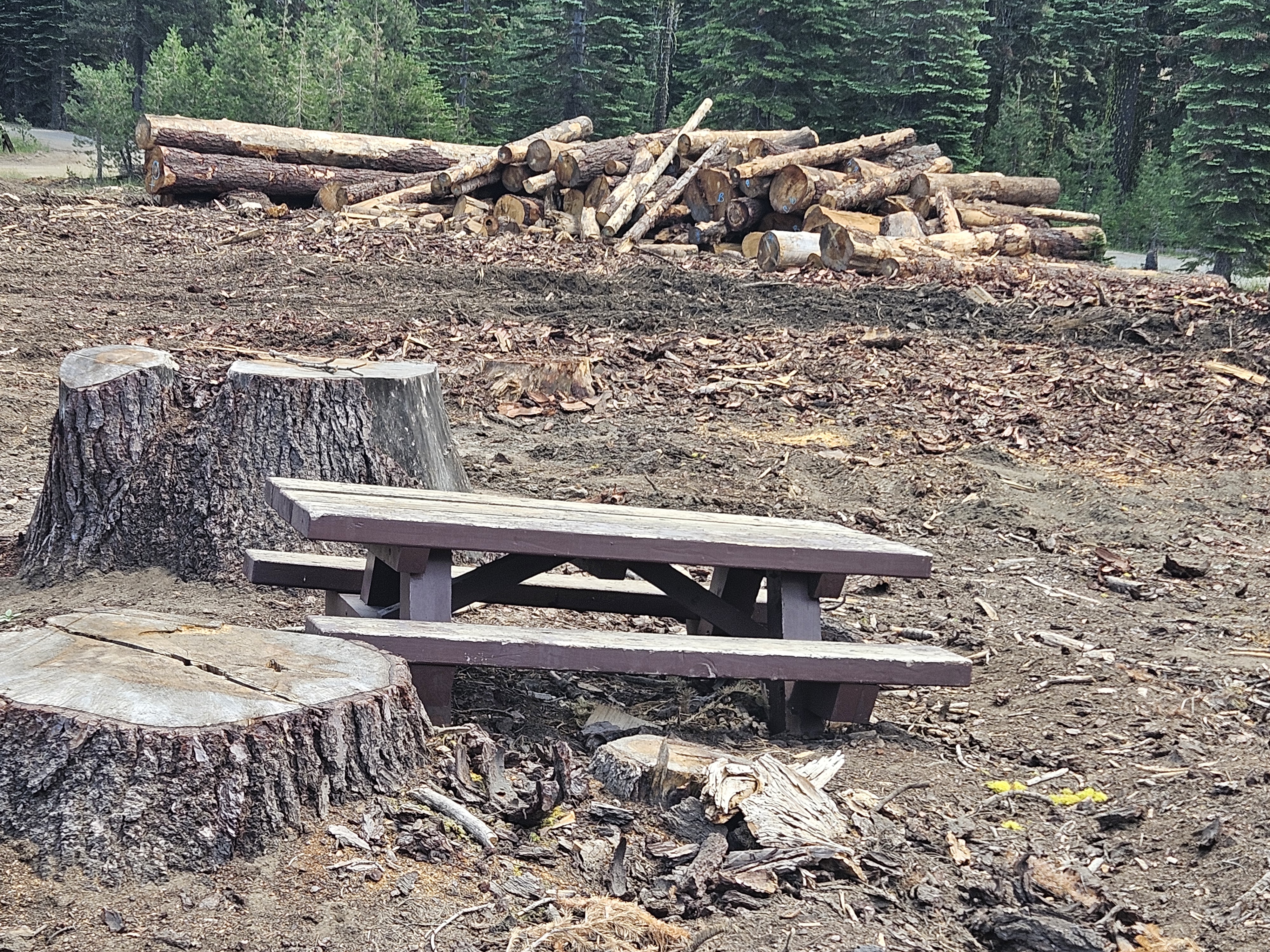
When we reached the summit of the road at Yuba Pass, we saw another clearing that used a different strategy than those we had passed. The campground at Yuba Pass was entirely clear cut of all of its trees, big and small. Lonely picnic tables were surrounded by the stumps of large trees. Appropriately, the campground was closed and its bathroom locked (see below). No one would want to camp there now.
This destruction of the campground at Yuba Pass looks like a fire hazard mitigation project gone bad or a commercial logging operation at the expense of a campground at an important trail head that is used for winter cross-country skiing and summer hiking.
We visited the bar at our resort at the end of the day to get the perspective of the locals about these logging operations on Highway 49. We learned that they are controversial with the locals, but there is no vocal opposition to them in a small community of only 200 year-round residents. (The bartender said the community was more concerned about AT&T’s threats to disconnect their landline phones because the community does not have a cell phone tower.)
However, the public’s reaction to the destruction of the campground at Yuba Pass was much stronger than to the thinning of young trees. The rumor is that the contractor who clear cut the campground at Yuba Pass did not do what they were supposed to do. The Yuba Pass project is considered a rogue operation by the locals.
We also learned that the piles of logs and wood chips will eventually be hauled away to be used as biofuels to generate electricity. As the wood is burned, the carbon stored in the wood will be released into the atmosphere, contributing to greenhouse gases that cause climate change. Some of the dead wood has already been removed. Nine months after the trees were destroyed, much still remains to be removed. Meanwhile, the piles are clearly a fire hazard. Fire hazards are increased in the short term by dead wood and in the long term by contributing to global warming.
Tree Mortality
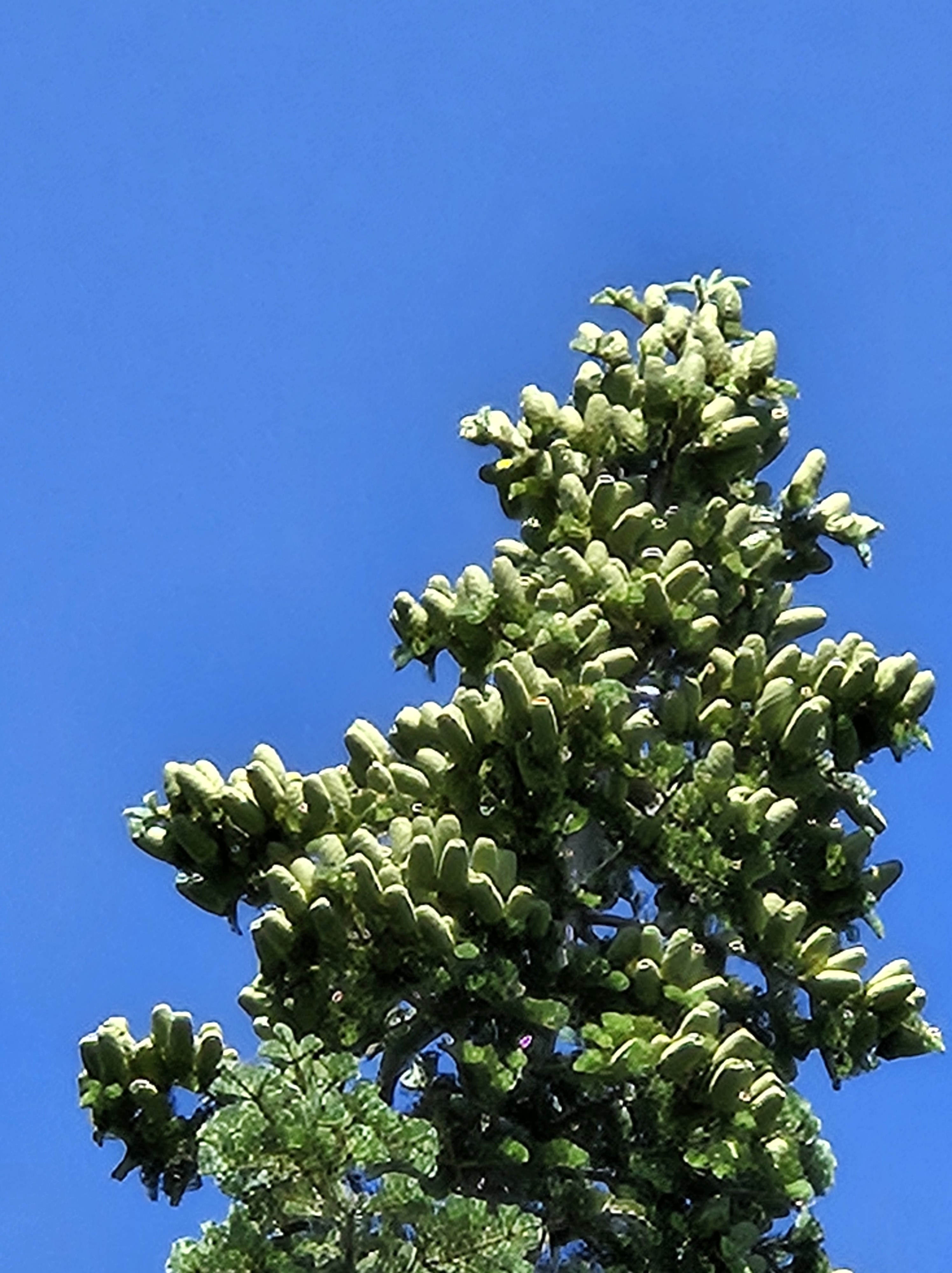
At Yuba Pass, we began to see first-hand the tree mortality in the Sierra Nevada we had been reading about in the media for years. We saw many dead red firs as well as one of the symptoms of more red fir deaths in the near future.
Adjacent to dead red fir trees, younger red fir trees were heavily loaded with cones, which are an indication that the tree is making a last gasp for survival of the species by trying to produce a big, new generation of trees (see above).
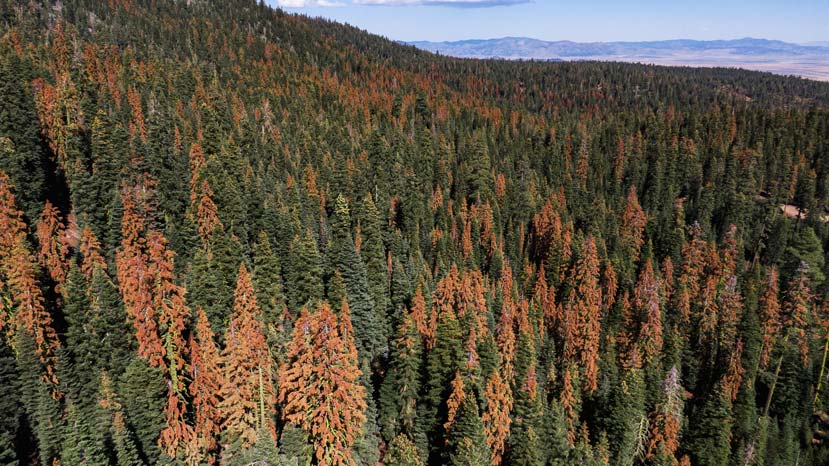
As we drove over the summit to the eastern side of the Sierra Nevada we could see the scale of the death of red and white firs. The eastern side of the Sierras is drier than the gently-sloping western side, which receives the moist air from the ocean. The Sierras drop steeply on the eastern side to the Great Basin, which extends into Nevada as a dry, hot desert. (see below)
Dead conifers at Yuba Pass in October 2022. Source: Sierra Nevada Conservancy
Until 2022, tree mortality in the Sierra Nevada range was confined to southern and central portions of the range and at lower elevations. An aerial survey of trees in the northern portions of the range in October 2022 found 28 million dead red and white firs at higher elevations. Red and white firs are higher elevation conifers and were therefore harder hit than lower elevation conifers in this portion of the range.*
Ecological “restorations” are never done
We visited a restoration project on the eastern side of Yuba Pass at Carmen Meadow. The project was done about 20 years ago. We wanted to see how it was progressing.
The meadow had been the home of rare willow flycatchers until it dried out, killing the willows that were home to the flycatchers. A berm had been built as the roadbed of a railroad. The berm diverted water into the creek, digging its channel lower than the meadow, draining water from the meadow into the creek. A check-dam was built to divert water channeled by the berm from the creek into the meadow, restoring water to the meadow. The flycatchers returned when the willows returned.
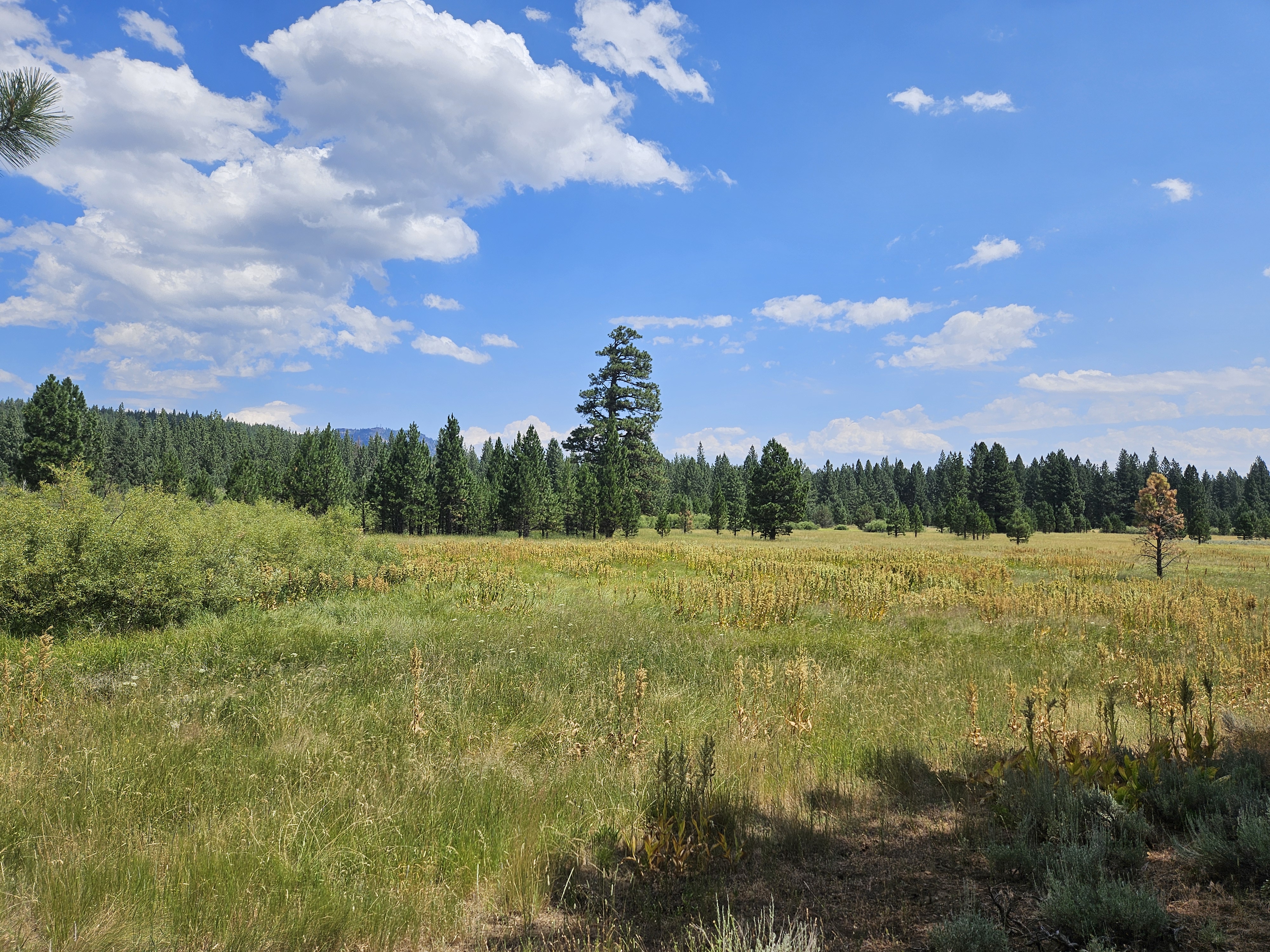
We had last seen Carmen Meadow over 12 years ago. Although willows remained, there were also young Jeffrey pines on the perimeter of the meadow as well as dotted throughout the meadow. Thus, natural succession from pond, to meadow, to forest is in progress. (see below) Restoration projects are never done because nature is dynamic and evolution is never done.
Carmen Meadow
Must this natural succession of the Carmen Meadow be stopped? That is probably a matter of opinion. My readers know that my opinion is probably “NO.” In defense of my opinion, I offer my readers an alternative scenario.
Willow flycatchers are also rare in the Southwest, where the loss of water also caused the loss of willows that are home to the flycatchers. But, in Southwestern desert, the solution is not so easy and painless as diverting water into Carmen Meadow.
Water in the Southwest has been diverted from riparian areas for agriculture and drinking water for large and growing residential communities. As you might imagine, few are willing to divert water supporting human activities to support a rare bird.
In the Southwest, willow flycatchers solved their own problem by making the necessary transition from willows to non-native tamarisk trees that require significantly less water than willows. And in this case, native plant advocates resisted this transition by trying to eradicate tamarisk solely because they are not native trees. The birds were willing and able to transition to a non-native tree, but the nativists wouldn’t accommodate their preference.
The Message
We had a wonderful time on our brief trip to Sierra City at Yuba Pass. We hope to go again and we expect to see more changes when we do. We took these messages away with us.
Yes, the Sierra Nevada range is changing, but it remains beautiful. We encourage you to visit and if you have, visit again because it is never the same twice.
There is a fine line between fire hazard mitigation and commercial logging and it isn’t always clear what the objective is.
The short-term objectives of any landscape project are sometimes at odds with the long-term objectives.
“Urban Jungle is breathtaking in its scope, both geographic and temporal… I can say I probably learned more per page in Urban Jungle than in any other book I have read at all recently.” –Professor Art Shapiro
As climate change makes many places uninhabitable, there is a new urgency to restore natural habitats damaged by human activities.
After a lengthy and contentious battle, the European Union narrowly voted to make a commitment to restore 20% of nature areas on land and sea within their borders. Farmers were the primary opposition to making this commitment, claiming it would severely reduce their ability to produce sufficient food. 6,000 scientists from several countries disagreed: “They argued that in the long term, it was climate change and nature degradation that constituted the highest threat, and that the proposed policy would ensure sustainable food production.” (1)
The Biden administration has issued an executive order to conserve 30% of US lands and oceans by 2030. This 30X30 commitment has been funded by the State of Californiaand is in the early stages of implementation. In the US, the commitment to “restore” land is often interpreted as a commitment to destroy non-native species with pesticides with the goal of restoring native plants and animals.
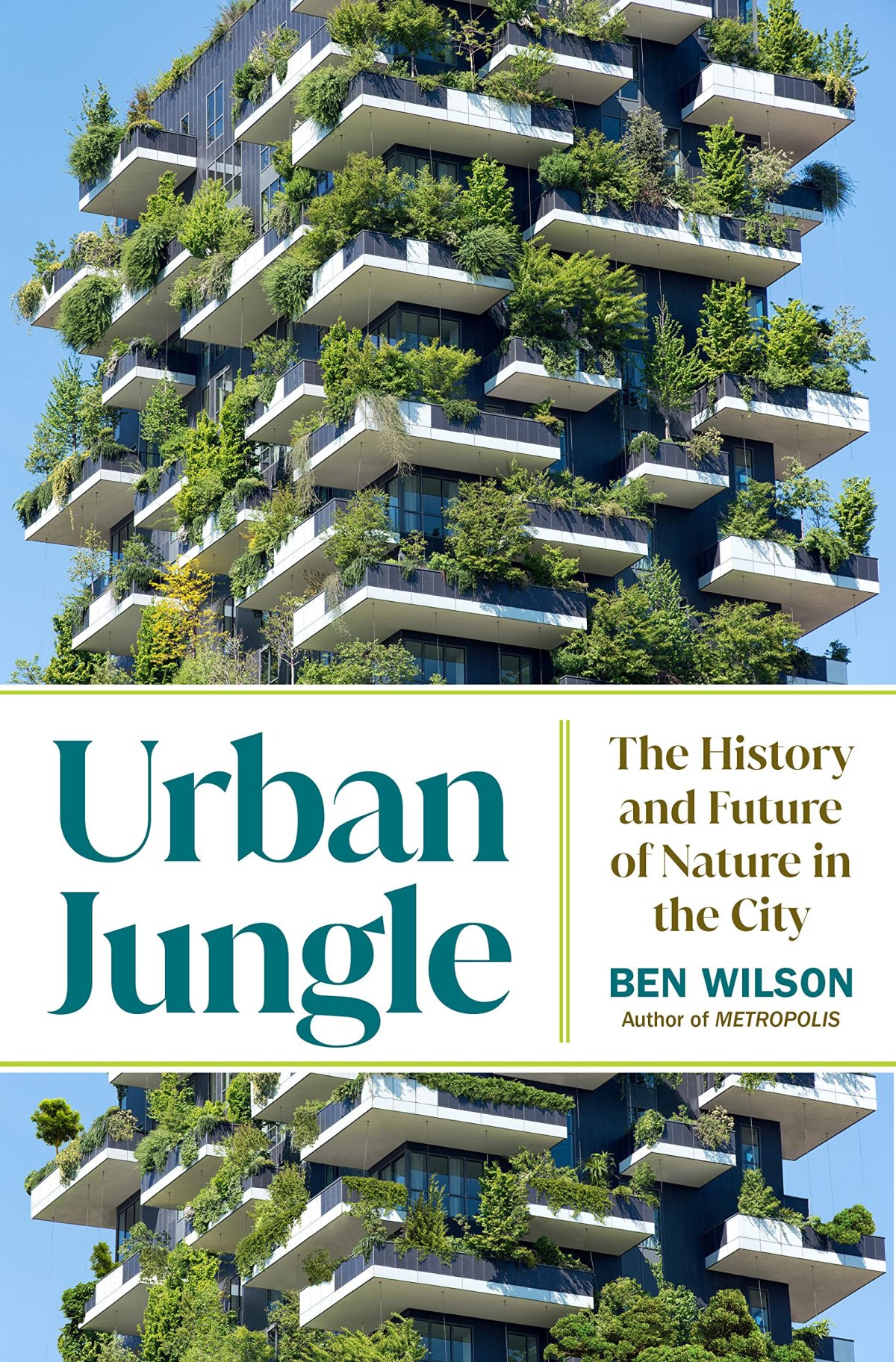
“Restoration” could mean something entirely different and a recently published book, Urban Jungle: The History and Future of Nature in the City, invites us to redefine restoration in a very different way. In a nutshell, Urban Jungle proposes to let nature heal itself without a preconceived goal to replicate historical landscapes that aren’t adapted to the climate and the challenging conditions of the urban environment. Left to its own devices, nature creates novel ecosystems, plant communities that are biodiverse and self-sustaining.
World War II created a case study of novel ecosystems
When World War II ended in 1945, the Potsdam Agreement determined that Germany would be occupied by the allies that won the war: United States, United Kingdom, France, and Soviet Union. The map of post-war Germany (see below) shows the division of Germany among the allies. The white portion of the map was administered by the Western Allies and the gray portion of the map by the Soviet Union. Berlin (in red) was deep in Soviet controlled East Germany and was likewise divided into East and West Berlin. The Soviet Union did whatever it could to isolate West Berlin by restricting access routes to West Berlin and ultimately building a wall around it in 1961.
Berlin was heavily bombed during the war and was largely a pile of rubble at the end of the war. While other European cities were able to clear the rubble within a few years, West Berlin could not because the Soviets would not let them dispose of rubble outside city limits.
The physical isolation of West Berlin and the restricted access of the population to the countryside turned West Berlin into an ecological island. Scientists in West Berlin, with few other opportunities to pursue their interests in botany and ecology, studied and recorded the transition of many tons of building rubble into novel ecosystems populated by whatever plants could find their way there and survive the challenging conditions. West Berlin was physically isolated from 1945 until the reunification of West and East Germany in 1990, creating a unique opportunity to study natural succession in an urban setting when nature is left alone for nearly 50 years.
One of the first pioneer plants in West Berlin arrived with the Ukrainian army in the hay brought to feed their horses. Salsola collina, a tumbleweed, is native to southern Russia and central Asia. Its arrival was a preview of what was to come, a landscape that would be radically different from the pre-urban landscape. The plants best adapted to the harsh conditions of the ruined city were hardy non-native species.
Non-native plants that thrived in West Berlin were more tolerant of higher temperatures in an urban setting, where hard surfaces absorb more solar radiation, buildings block the wind, and greater pollution traps heat. This is known as the heat island effect. By the 1960s, the temperature in Berlin was on average over 4⁰F higher than the surrounding countryside.
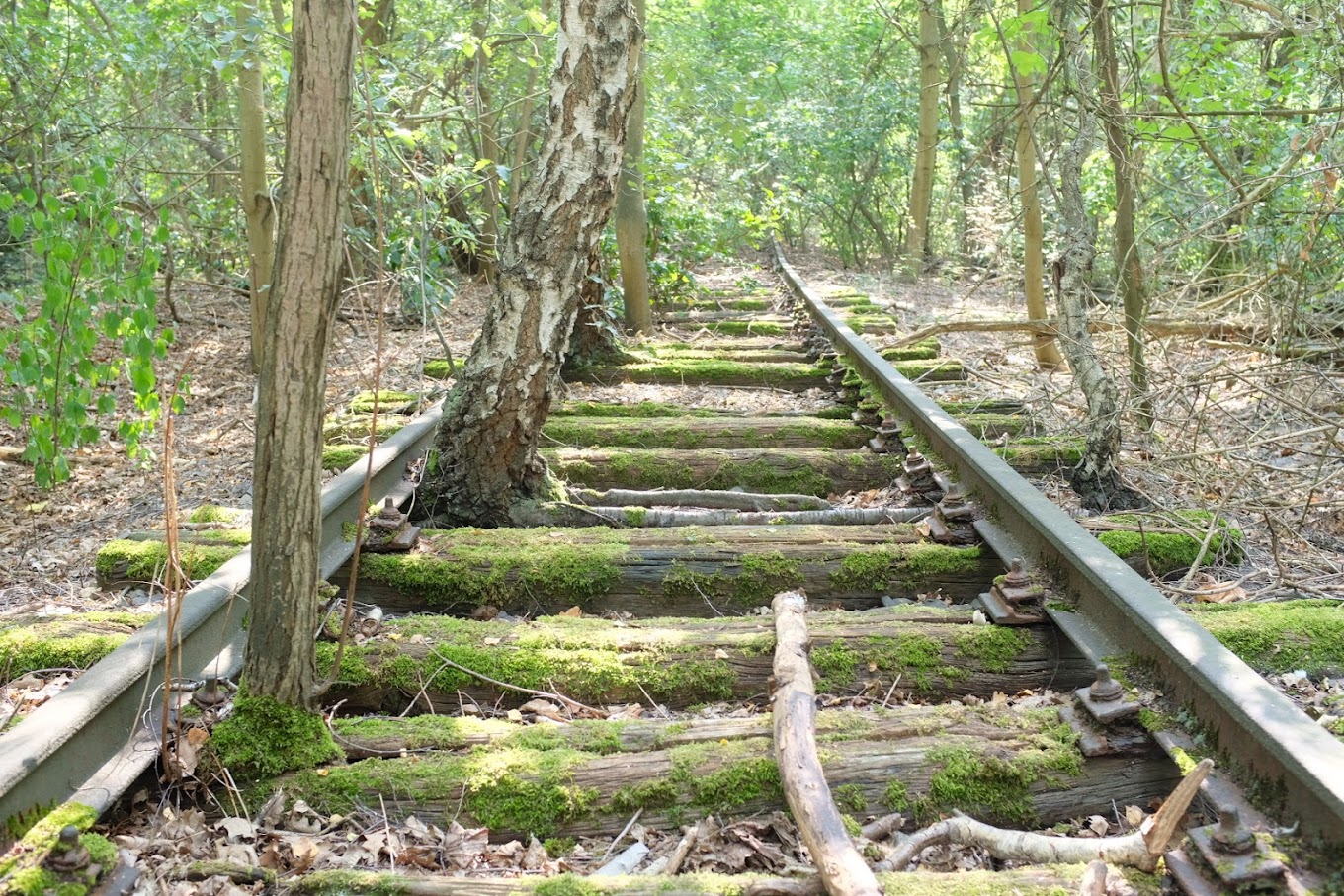
Südgelände Nature Park in Berlin was a railway yard that was abandoned in 1952 as a result of the division of East and West Berlin. By 1984 there were 334 ferns and flowering plants and many animals, birds, and insects living in the park. It is a novel ecosystem that was shaped by human activities then left to natural processes. It remains as a nature park today because the people of Berlin fought against developing it into a train station again. They had come to love its wild beauty during their long confinement during the Cold War and they weren’t willing to give it up. Source: Südgelände Natur Park
The naturally evolving novel ecosystems in West Berlin were also surprisingly biodiverse. Where natural succession was allowed to occur over many years, 140 different plant species and 200 insect species were found in the 21st Century. In nearby Tiergarten Park, which is carefully maintained as a park, only one-quarter as many insects were found in an area of comparable size. By the end of the 20th century, 1,392 naturalized plant species were growing in Berlin, compared to 822 in the 18th century.
21st Century equivalent to World War II
Climate change is the 21st Century equivalent of World War II in its potential to cause death and destruction. Climate change will create similar requirements to restore environments that are destroyed. Urban settings will be particularly vulnerable to the consequences of climate change because they are population centers and they are already compromised by urbanization.
Tidal estuaries and wetlands are one of many ecosystems that are threatened by climate change, as sea-levels rise in a warming climate and intensity and frequency of storms increases flooding. These threats are greater in urbanized areas because most of our largest cities were built on coastlines and rivers at a time when transportation and shipping was easier by water than by land.
Historically, cities were protected from storms by surrounding marshlands that filtered and cleansed runoff from the land, polluted by human waste. But as cities grew, marshlands were often destroyed to create more land. In many cases, the landfill was composed of the garbage produced by city-dwellers.
The closure of urban garbage landfills and the restoration of wetlands to buffer the city from the rising sea and extreme weather events is another opportunity to redefine restoration as a natural process that uses the healing powers of nature. Urban Jungle uses Fresh Kills Landfill in New York City as an example of restoring nature by leaving it alone.
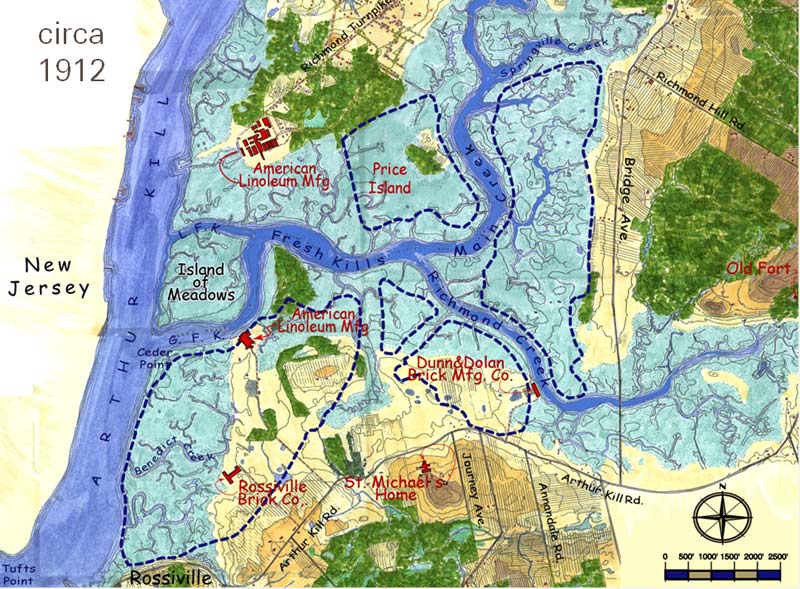
Fresh Kills was a tidal estuary and marshland on the west side of Staten Island in New York City. It was opened as a landfill to accept residential garbage in 1948. By 1986 it had reached peak volume, receiving 26,000 tons of residential garbage per day. When it was closed in March 2001, the garbage was from 90 to 225 feet tall, weighing 150 million short tons. It was reopened in September 2001 to accept about one-third of the rubble from the collapse of the World Trade Center on September 11, 2001. It was the largest garbage landfill in the world when it finally closed.
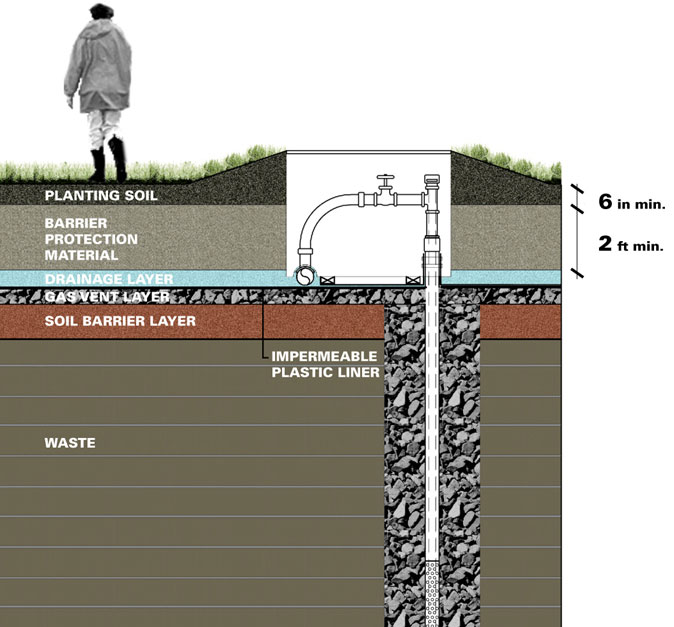
Fresh Kills Landfill is now in a 30-year process of being restored as a park, renamed Freshkills Park. The garbage was capped (see below) and methane produced by the decomposing garbage is being captured and used to heat about 22,000 homes on Staten Island.
The productive wetland ecosystem that was destroyed by the landfill cannot be restored. Instead, a new ecosystem will slowly emerge on top of the toxic garbage. The process began by seeding the slopes of garbage with fast-growing plants that were then plowed repeatedly back into the soil to add organic matter. Then tough native grassland species were planted to provide habitat for initial colonizers, such as insects, small mammals and birds. Now that basic conditions for life have been established, what happens next is in the hands of nature: “Freshkills Park will be reclaimed by whatever species are attracted to the foundation of grasses.Nature will do the bulk of the work, not human beings. Biodiversity will steadily build as winds and birds bring seeds to the site. This process of spontaneous successional growth is how nature rebounds from natural disasters such as forest fires, earthquakes, volcanic activity and climate upheaval. Only in the case of Freshkills Park, the disaster was humanmade.”(2)
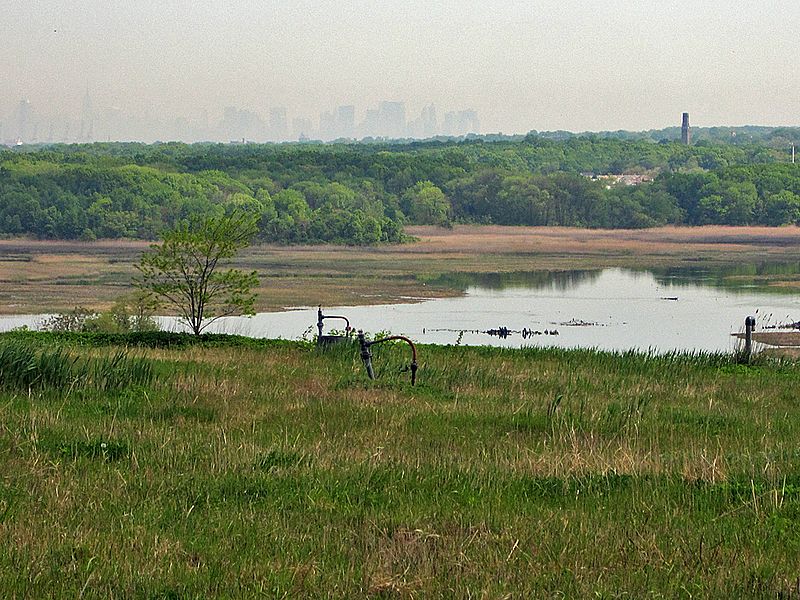
View of Downtown Manhattan from Freshkills Park. Licensed by Creative Commons
Getting off the pesticide treadmill
Allowing nature to heal the places humans have damaged is also an opportunity to get off the pesticide treadmill. The natural process of succession does not require the use of herbicides to eradicate non-native plants that arrive naturally on the wind, in water currents, and in the stomachs of animals and birds. When all plants are welcome, there is no need for herbicides and there is more biodiversity that supports more animals and is more resilient as the climate changes in unpredictable ways.
In 2019, France banned the use of glyphosate-based herbicides for non-agricultural use. The French city of Blois imposed the ban before the national ban was adopted: “A study published in 2019 found more than 300 species of urban plants sprouting out of the pavements of the French city of Blois, which had recently phased out glyphosate weedkiller.” (2)
Allowing nature to “manage” our public parks, makes them safer for us and for wildlife as well as more biodiverse than human management that wages a never-ending war on so-called “invasive” plants. There are more bees and bee species in cities than in surrounding countryside because there is more available food in its diverse vegetation: “Analysis of honey from a bee in Boston, Massachusetts, found it had pollen taken from 411 different species of plants; nearby country honey contained traces from just eighty-two plants. Cities are islands of biodiversity compared to rural monocultures, with a bigger and more diverse source of nectar even than nature reserves and forests…” (2)
The takeaway message
Successful restoration of damaged land will take these facts into consideration:
Many hardy non-native plants are better adapted to challenging urban conditions than native plants: “If native plants can’t hack it in the metropolis, their place should be taken by specialist species drawn from around the world that find niches in the various microclimates of the concrete jungle.” (2)
A diverse landscape of native and non-native plants is more resilient in a changing, variable, and unpredictable climate.
Novel ecosystems created by natural succession are more biodiverse than their historical predecessors.
When pesticides are used to kill non-native plants, disturbed land is damaged further and is even less likely to support a native landscape. Killing non-native plants with herbicide also reduces biodiversity.
The California Native Plant Society (CNPS) held a conference in October for the first time since 2018. There were two main themes of the conference:
Money: The State of California is making a huge investment in the environment with many interrelated goals:
“30 X 30” is shorthand for the goal of protecting 30% of California’s land and coastal waters by 2030.
Developing “nature-based solutions” to address the threats of climate change.
Vegetation and forest management to reduce wildfire hazards.
Protecting and enhancing California’s biodiversity.
Fire: The frequency and intensity of wildfire is of concern to all Californians, but the California Native Society has a particular interest in fire because it is viewed as a tool to enhance native plant abundance and control the spread of non-native plants that outcompete native plants.
Money
If attendance were the sole measure of success, the conference was a resounding success. The conference was sold out with record-breaking attendance of 1,200 people. That’s a 50% increase in attendance since 2018, when 800 people attended. People came to learn about the many opportunities for public funding of their “restoration” projects and they were not disappointed.
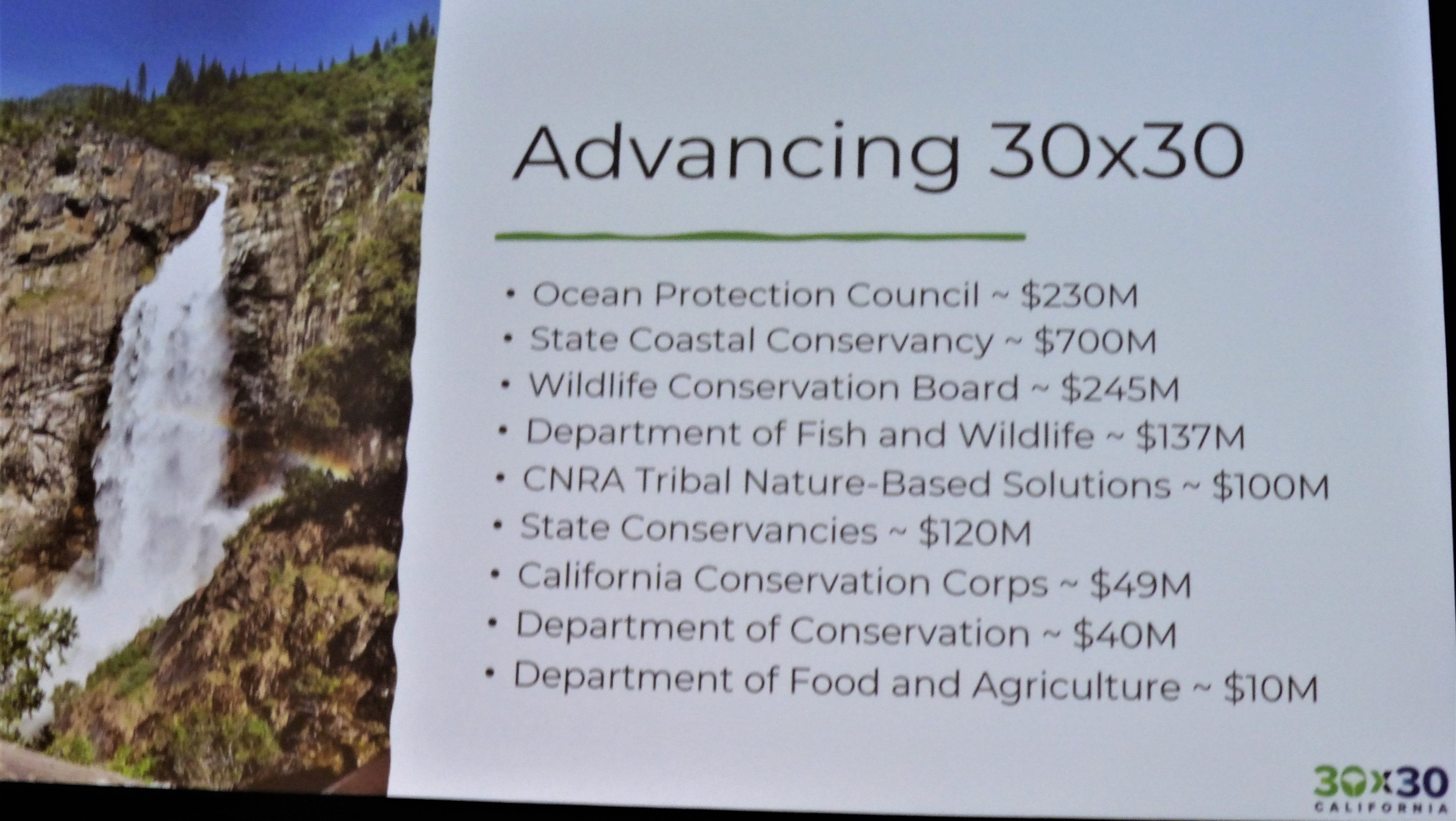
Jennifer Norris, Deputy Secretary for Biodiversity and Habitat for the California Natural Resources Agency (CNRA) was one of the keynote speakers. She and many other staff of CNRA made presentations at the conference to inform the community of native plant advocates about the many new opportunities to obtain grants for their projects. This slide (below) shown at the conference, itemized by state agencies the $1.631 Billion budget for just the 30 X 30 portion of the CNRA’s environmental grant programs. It does not include Cal-Fire funding for forestry projects to reduce wildfire hazards and address climate change. Nor does it include $10 million of new funding for Weed Management Areas, which funds projects that attempt to eradicate non-native plants and $10 million of new funding for the state council for invasive species. State funding is also supplemented by new federal funding in support of a national goal of achieving 30 X 30.
But money isn’t the only element of this state program that native plant advocates are excited about. They have also been gifted a three-year moratorium on requirements for Environmental Impact Reports for their projects. There will therefore be no requirements for a public process to review plans and comment on them.
An anxious applicant for state grant funding asked a speaker representing the Wildlife Conservation Board about a rumor that projects using herbicides would not be funded. The speaker’s reassuring answer was, “We are not rejecting projects using herbicides.” Applicants are being asked to complete a questionnaire about herbicides they plan to use, but the speaker was quick to add, “We have not rejected any [such applications] so far.” She assured the audience that “You are all careful” in your use of herbicides.
Huge buckets of money are being distributed with no restrictions on the use of herbicides and no vetting process such as an environmental impact review with opportunities for the public to comment. It seems inevitable that some of the projects will unintentionally do more harm than good, and the public will have nothing to say about which projects are funded.
Fire
Alexii Sigona was the first keynote speaker for the conference. He is a member of the Amah Mutsun-Ohlone Tribal Band (not a federally recognized tribe) and a Ph.D. candidate at UC Berkeley in the Department of Environmental Science. He explained that there are 600 recognized members of the Amah Mutsun Band in a wide region around Pescadero, Hollister, and San Juan Bautista. They collaborate with organizations such as CNPS because they don’t have the resources to manage their ancestral tribal lands. He described some of the projects they engage in:
Landscape scale removal of “invasive” plants.
Plug planting of 120,000 native grass plants.
Creating “native hedgerows” for food sources.
Removal of native Douglas Firs “encroaching” on grassland. They have removed 5,000 native Douglas fir trees. He acknowledged that this project caused some concern about erosion and aesthetics. Removal of native Douglas fir was mentioned by several other speakers during the conference. It is an example of the preference of native plant advocates for grassland because it is the pre-settlement vegetation. Native coyote brush is another target of eradication projects that attempt to prevent natural succession of grassland to other vegetation types.
There is great interest among native plant advocates in the land management practices of Native Americans because controlled burns were Native Americans’ most important tool to maintain grassland species needed for food and for their prey. Controlled burns are important to native plant advocates because they believe they are beneficial to native plants and help to control non-native plants. Prescribed burns are also currently popular with many public land managers and they are the current fad among many fire scientists.
Two presentations at the conference suggest that prescribed burns are not compatible with the preservation of native chaparral, nor are they capable of converting non-native grassland to native grassland.
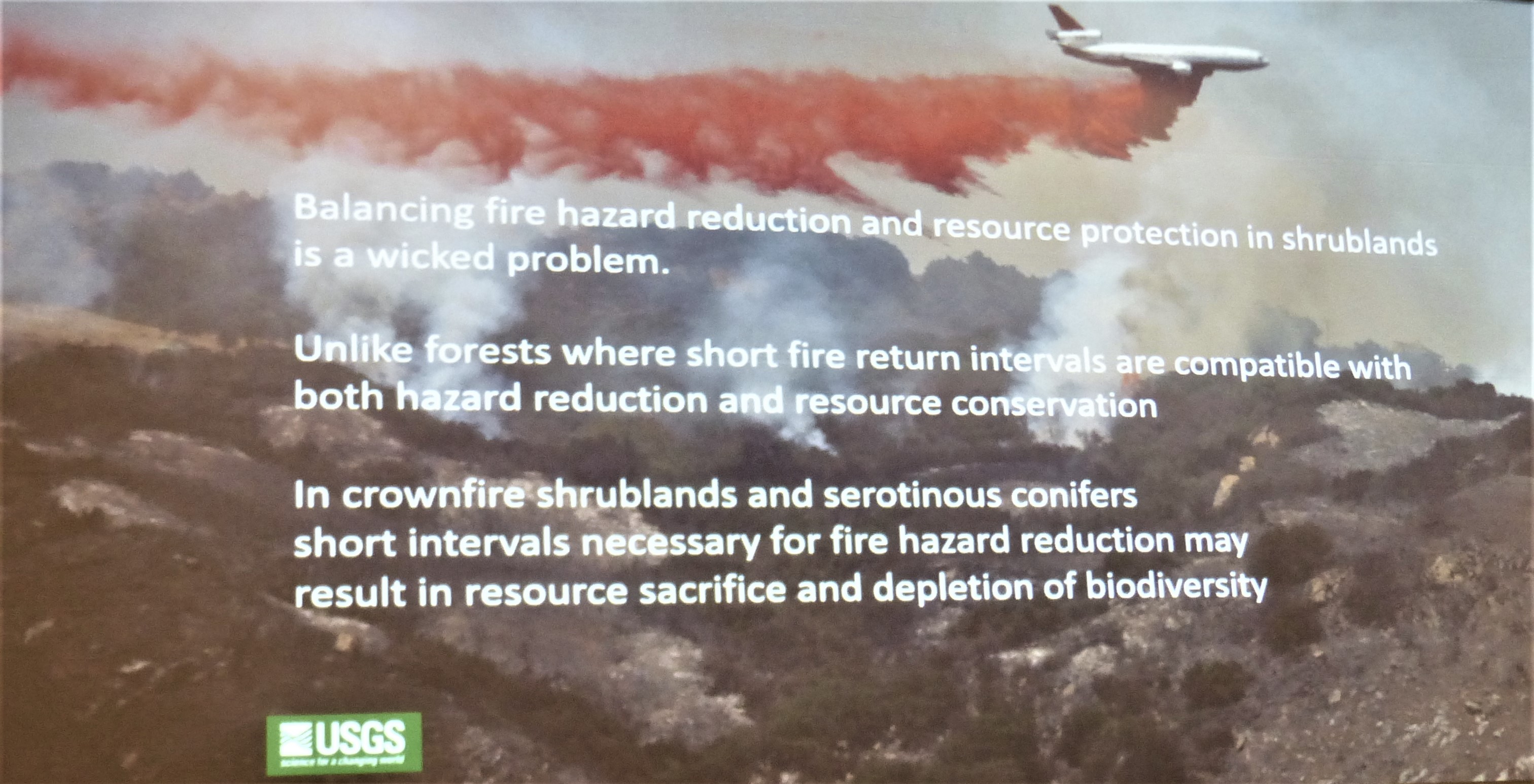
This (above) is the concluding slide of Jon E. Keeley’s presentation. Dr. Keeley is a respected fire scientist with US Geological Service with expertise in chaparral species. He explained that 60% of native chaparral species (notably manzanita and ceanothus) are obligate seeders that do not resprout after fire and therefore depend on the existence of their dormant seed bank for regeneration. In recent decades the fire interval in chaparral has decreased due to climate change and associated drought. In many places, the fire interval has become too short to establish the seed bank needed for regeneration. In those places Dr. Keeley has observed vegetation type conversion to non-native annual grasses.
Dr. Keeley Is concerned that vegetation type conversion from forests in some cases and shrublands in others to non-native annual grassland may be the result of shortening fire intervals further “because of the upsurge in state and federal programs to utilize prescription burning to reduce fire hazard.” (1) This concern extends to some conifer species that do not resprout. Some are serotinous conifers whose cones are sealed shut and do not release their seeds in the absence of fire.
This is a familiar theme for much of Dr. Keeley’s research. He asks that land managers balance the conflicting goals of resource management and fire hazard reduction.
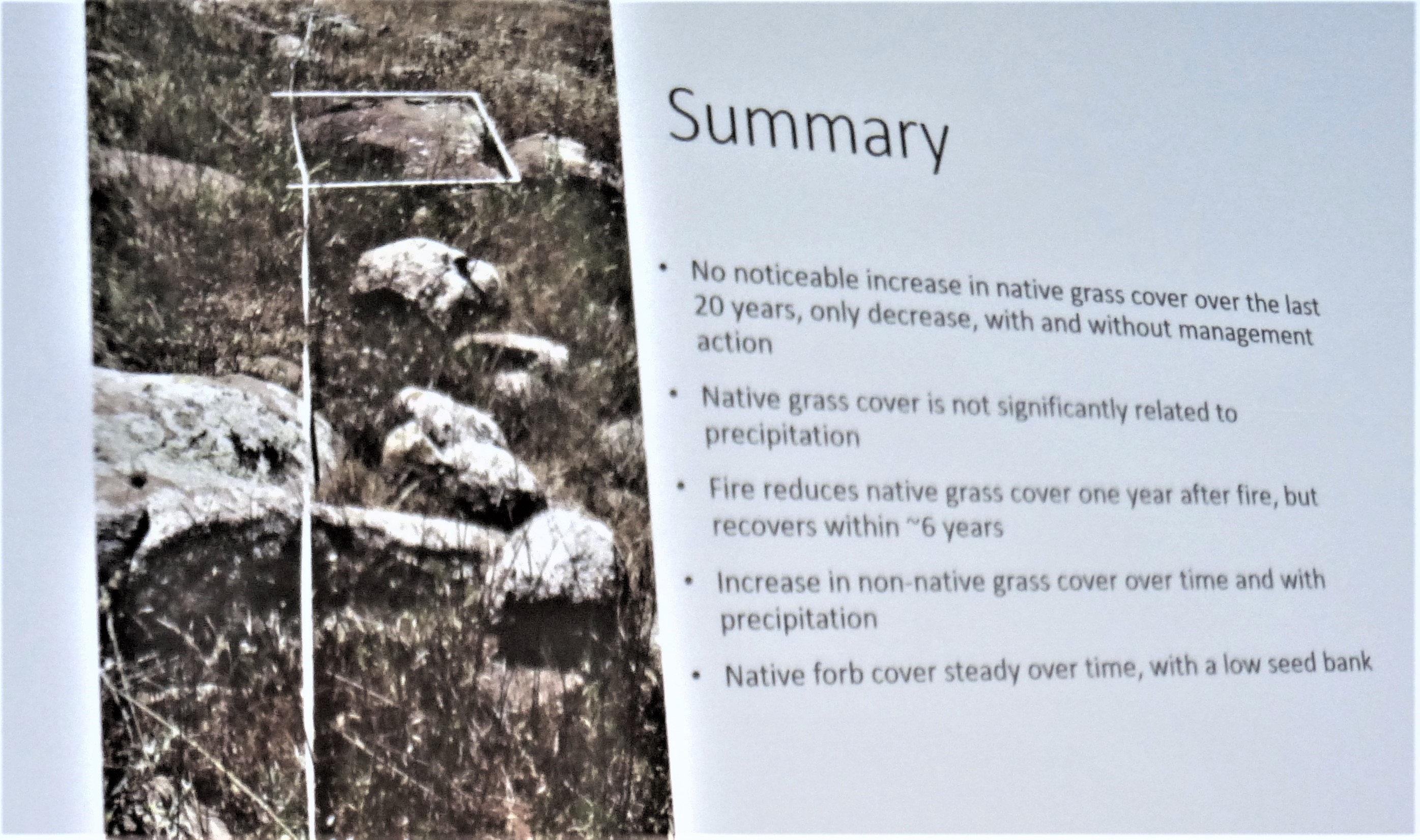
This (above) is the concluding slide (sorry for the poor quality of my photo) of a presentation about a 20-year effort at the Santa Rosa Plateau Ecological Reserve to convert non-native annual grassland to native grassland, using annual (sometimes bi-annual) prescribed burns. Many different methods were used, varying timing, intensity, etc. The abstract for this presentation reports failure of the 20-year effort: “Non-native grass cover significantly decreased after prescribed fire but recovered to pre-fire cover or higher one year after fire. Native grass cover decreased after prescribed fire then recovered to pre-burn levels within five years, but never increased over time. The response of native grass to fire (wild and prescribed) was different across time and within management units, but overall native grass declined.” (1)
The audience was audibly unhappy with this presentation. One person asked if the speaker was aware of other places where non-native grass was successfully converted to native grass. The speaker chuckled and emphatically said, “NO. I am not aware of any place where native grasses were successfully reintroduced.”
Another questioner prefaced her question with the admission that “I’m new here and all this is new to me.” Then she suggested that Native Americans are having some success using prescribed fire and that they should be consulted. The speaker graciously replied that she planned to do so.
Keep in mind that Native Americans weren’t historically using prescribed fire to convert annual grasses to native grasses. Their burns were intended to maintain native grassland in the absence of competing non-native annual grassland. Their objectives were different and they were operating in a very different climate and environment.
Estimates of the pre-settlement population of Native Americans in Californiarange from 138,000 to 750,000. The population of Native Americans is estimated to have been reduced to as few as 25,000 after the arrival of Europeans due to disease and violence. There are now over 39 million Californians and only 630,000 of them were Native Americans in the 2020 census. Land management practices that are suitable for a population of less than 1 million seasonally migrating Californians are not necessarily suitable for a population of over 39 million sedentary Californians.
The futility of trying to eradicate non-native plants
The Invasive Spartina Project (ISP) is another 20-year eradication project that is doomed to failure. The presentation about the ISP was bravely made by Dr. Debra Ayres, one of the creators of the ISP in 1998. With intensive effort and hundreds of gallons of herbicide (imazapyr), non-native spartina marsh grass has been greatly reduced in the San Francisco Bay, but the hybrid of non-native S. alterniflora and native S. foliosa persists. Dr. Ayres explained why:
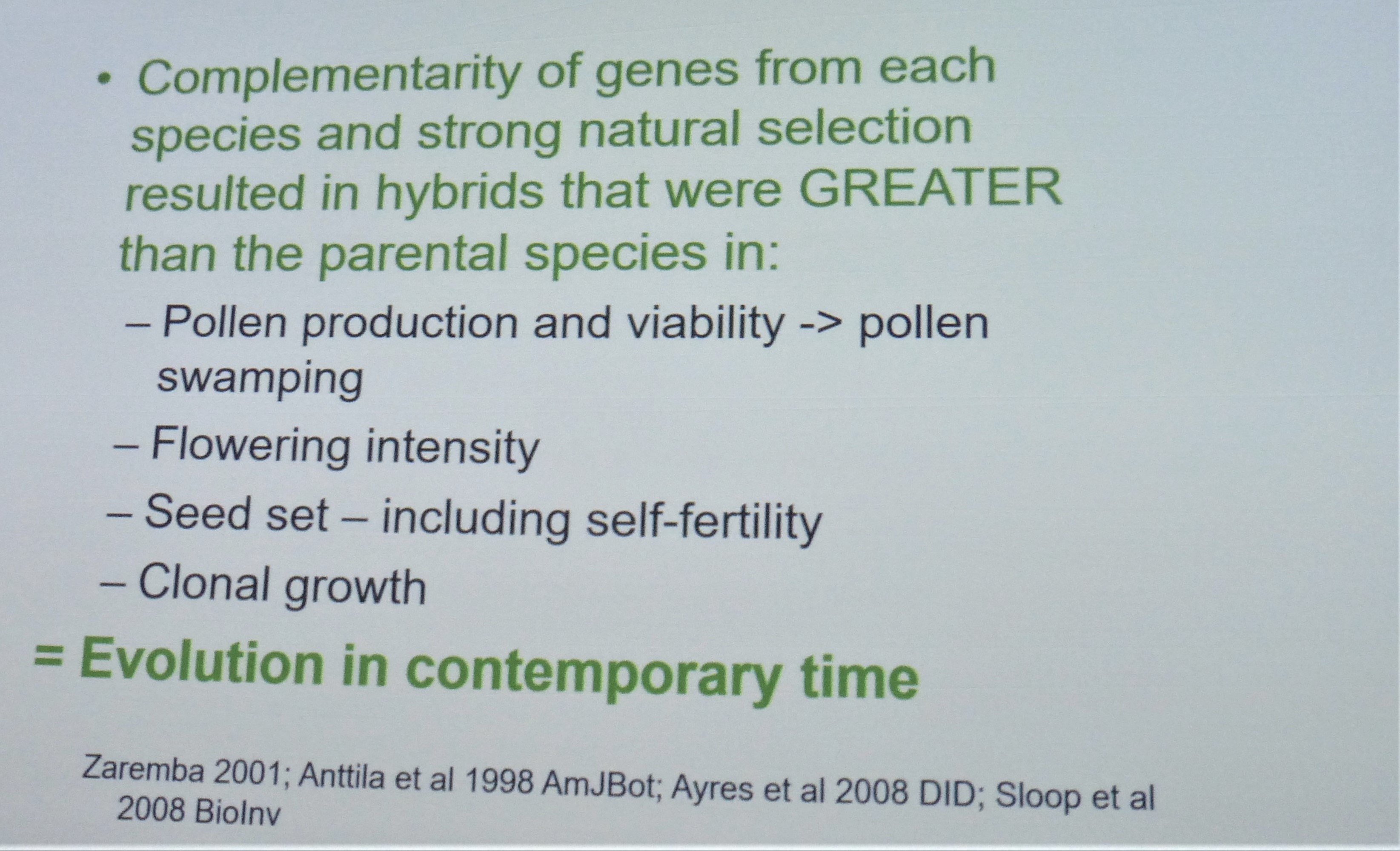
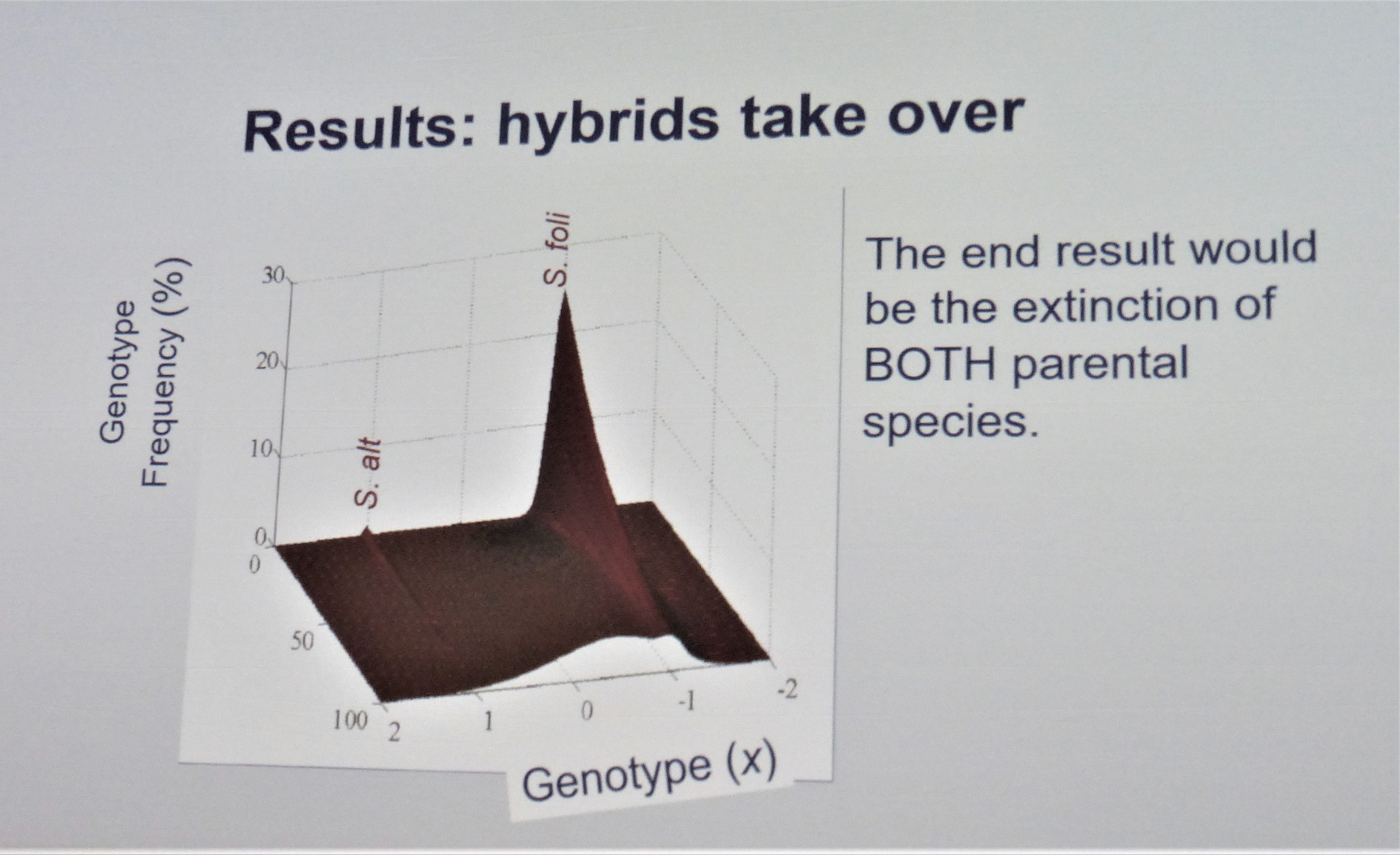
The spartina hybrid is reproductively stronger in every way than either of its parent species. Dr. Ayres predicts that the hybrid will eventually replace both of its parent species:
If the goal of this project was to eradicate non-native spartina, hybrid spartina will accomplish that goal. You might think that this prediction would end the futile attempt to eradicate the hybrid, but you would be wrong. There is no intention of abandoning this 20-year project. More funding is assured by the California Coastal Conservancy and the project continues to provide well-paid jobs.
Dr. Ayres ended her presentation with this enigmatic statement: “Evolution doesn’t stop just because we think it has to.”She seems to acknowledge that humans cannot stop evolution, yet she seems to recommend that we continue to try doing so. If those positions seem contradictory, that’s because they are. The bottom line is that as long as public funding continues to be available, this project will continue.
A central theme of the nativist agenda is the futile desire to prevent hybridization because it has the potential to replace a species considered “native.” They fail to understand that hybridization is an important evolutionary tool that helps plant and animal species adapt to changes in environmental conditions by favoring traits that are better adapted to new conditions. Humans cannot stop evolution, nor should we try.
San Francisco
I have a special interest in San Francisco because I lived there for nearly 30 years. The native plant movement is very strong in San Francisco and there were several presentations about the success of the movement at the conference.
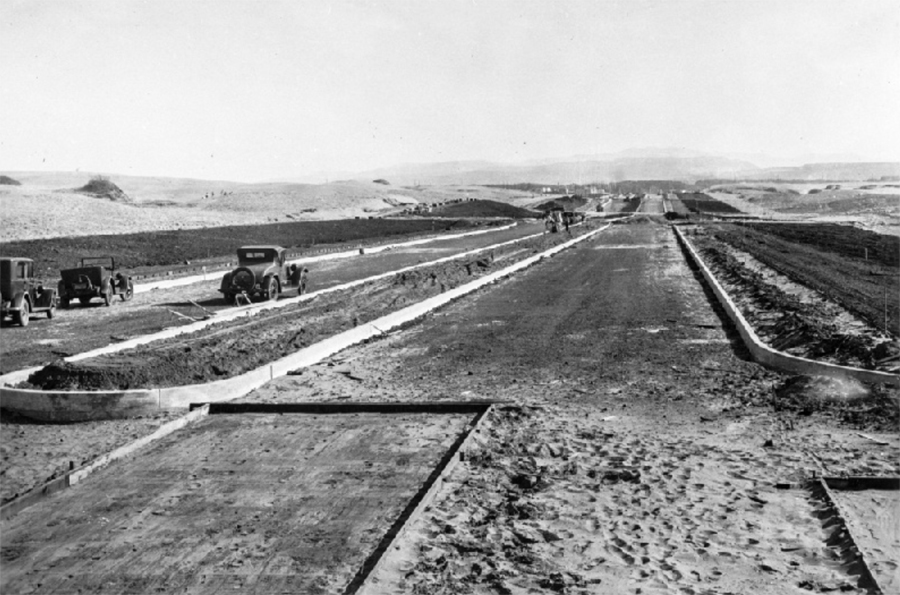
Sunset Blvd being built on barren sand in 1931
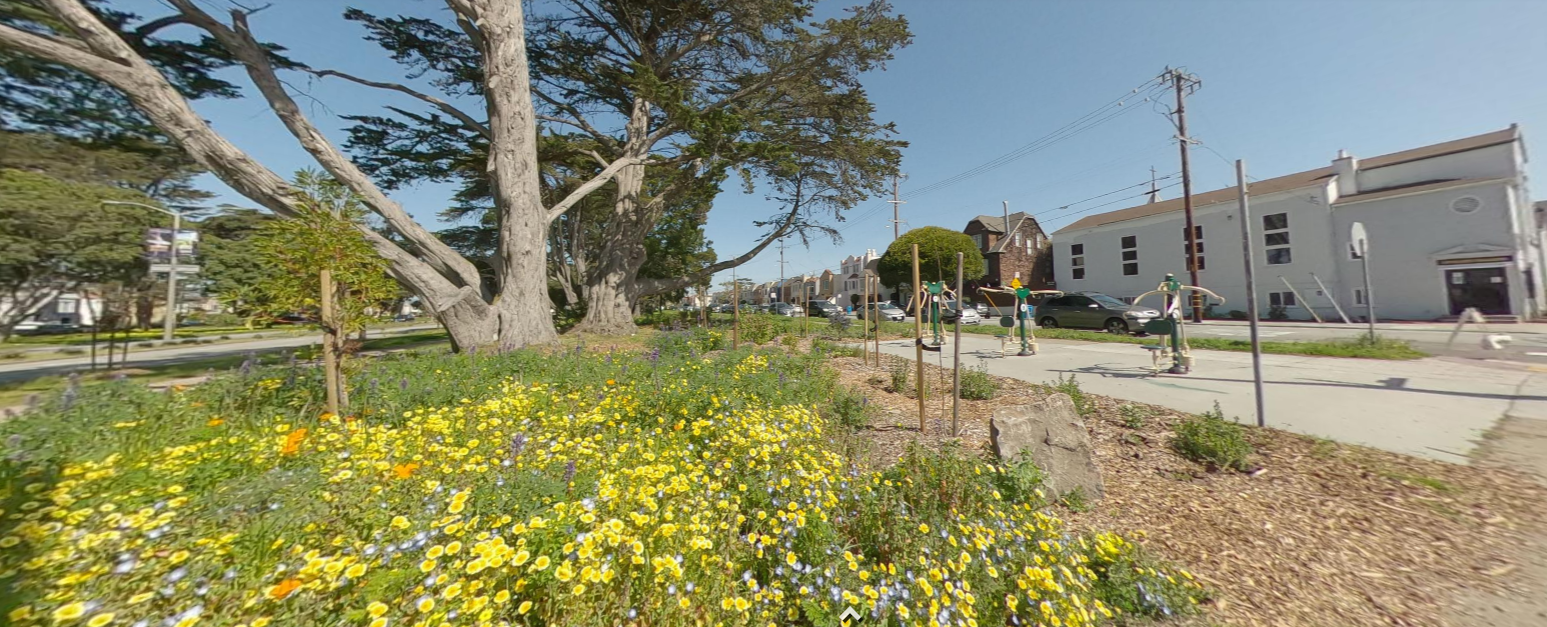
One of the projects is trying to turn Sunset Blvd on the western side of San Francisco into a native plant garden. I lived in that district and am therefore familiar with Sunset Blvd as the major north-south traffic artery through the district. It is important as the only wind break in the windiest district of the city, which is only 13 short blocks from the ocean. The district is virtually treeless because of wind conditions and the pre-settlement landscape of barren sand. Sunset Blvd is therefore the oasis of the Sunset District. In the past, it was the only place to take a long walk in the shelter of the tall Monterey pines and cypress and tall-shrub understory. The lawn beneath the trees was the only place for children to play close to their homes.
San Francisco’s Department of Public Works (DPW) is responsible for maintaining the medians in San Francisco. It was therefore DPW’s responsibility to replace the wind break on Sunset Blvd that is dying of old age. That’s not what they chose to do. They are replacing the lawn with native shrubs and the tall trees with small native trees that won’t provide shelter from the wind.
The spokesperson for DPW acknowledged that the project is controversial. Neighbors of Sunset Blvd valued the sheltered recreational space provided by the 2.5 mile-long and wide median. Native plant advocates and their allies want to create a wildlife corridor through the western edge of the city. The spokesperson for DPW said that their plans are a compromise between these different viewpoints. I don’t know if the neighbors agree, but I can say that native plant advocates are thrilled with the new native plant gardens on Sunset Blvd based on their presentation at the CNPS conference.
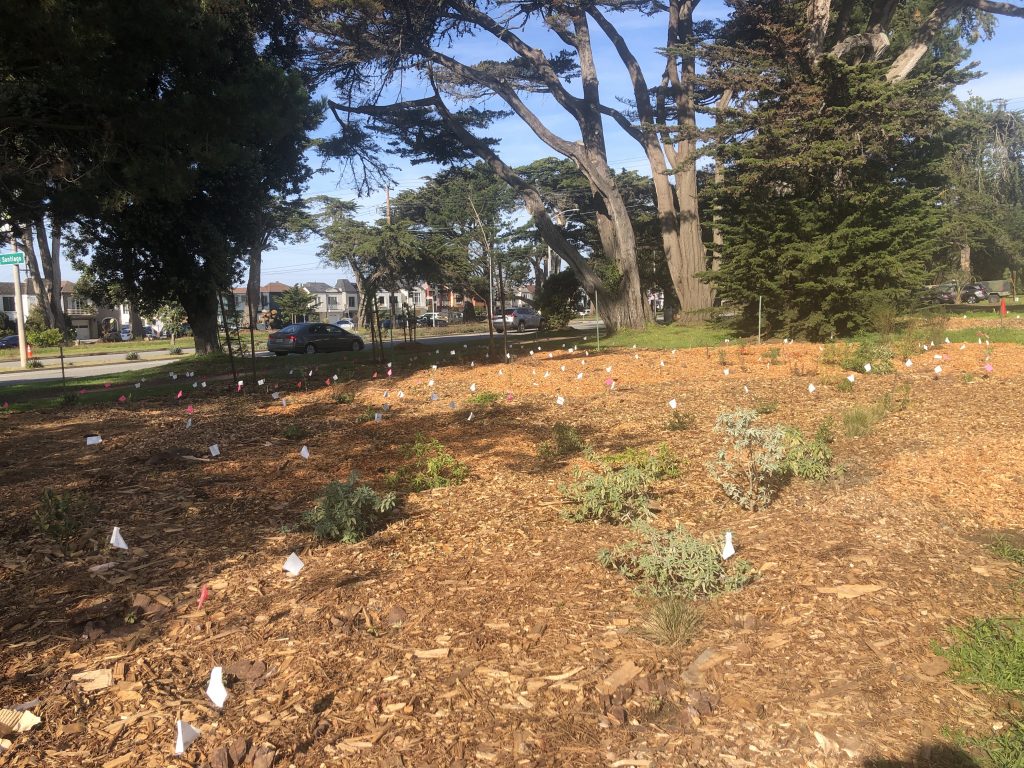
Planting Sunset Blvd. with native plants, December 2020
Native plant advocates prevailed on Sunset Blvd because CNPS bought or raised all the native plants and provided volunteers to plant them and maintain them for 3 years. DPW couldn’t look their gift horse in the mouth. DPW hired 6 new gardeners to support maintenance of Sunset Blvd. This is an example of how the money that is flowing into such projects will transform many places into native plant gardens.
Sunset Blvd and Taraval, spring 2022
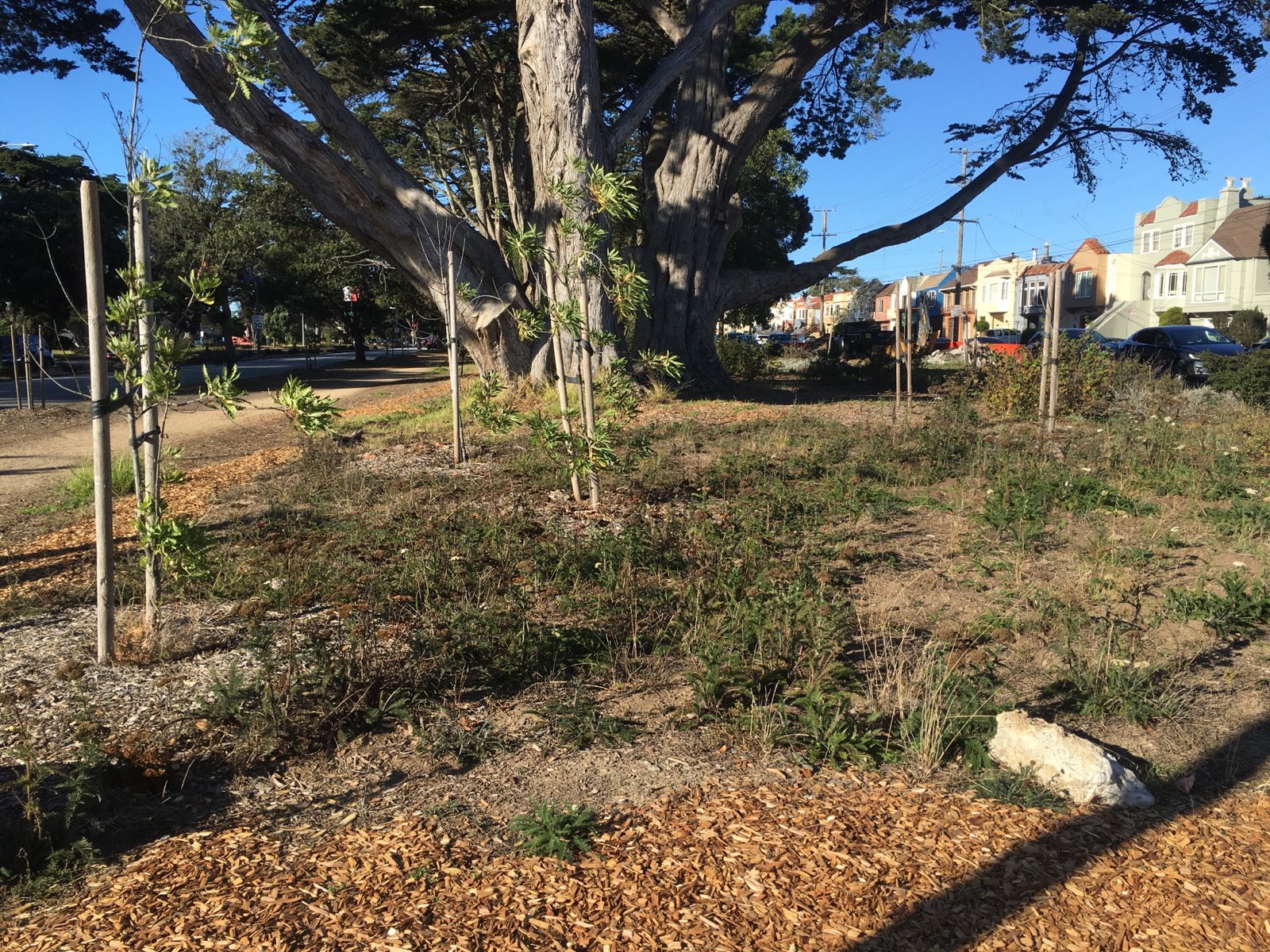
So, let’s look at the result of these projects. Presenters of these projects showed many beautiful pictures of newly planted native gardens on Sunset Blvd (above). The pictures were taken in spring, when native plants briefly flower. But that’s not what these places look like most of the year. They will look better if they are irrigated year-round, but that would defeat the purpose of replacing the lawn to reduce water usage. Unlike native plants, lawn turns brown during the dry season if it isn’t watered, but it is still functional as walkable ground.
Here’s what that garden at Sunset Blvd and Taraval looks like most of the year:
Sunset Blvd & Taraval, October 23, 2022
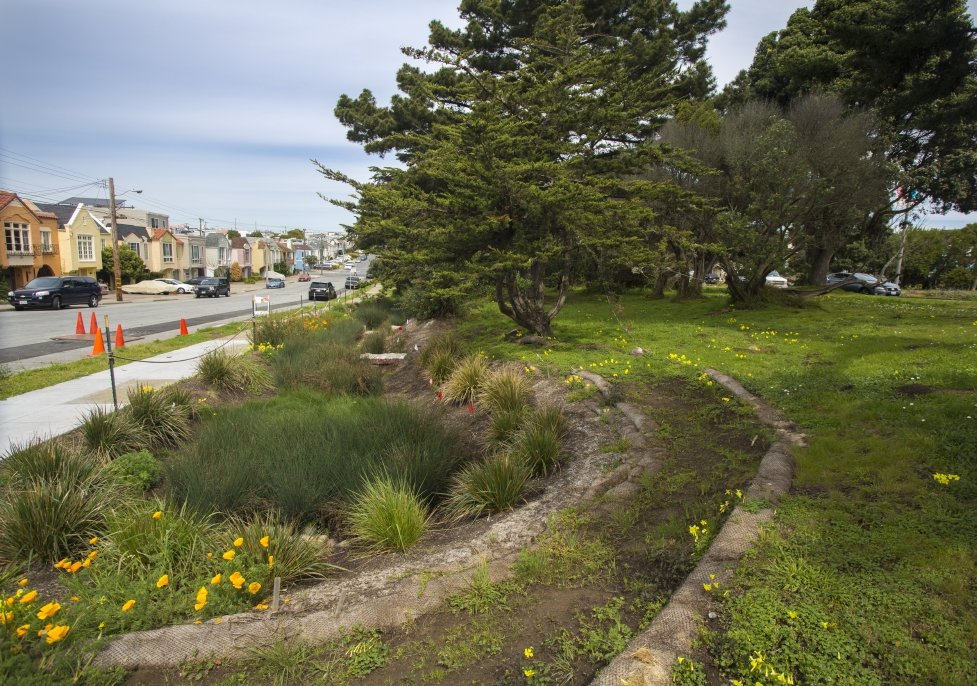
There was also a presentation by a spokesperson from San Francisco’s Public Utilities Commission (PUC) about the creation of rain gardens in San Francisco. San Francisco’s sewer system was built long ago when regulations did not require the separation of street run off from residential sewage. When it rains, the sewage treatment plant is overwhelmed by street run off. The sewage treatment plant releases untreated sewage and run off into the ocean, in violation of federal standards for water treatment.
Rain garden on Sunset Blvd as shown at the CNPS Conference
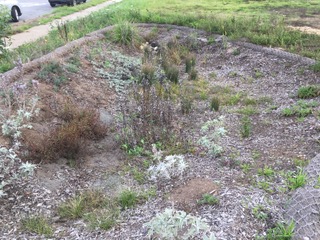
Rain Garden on Sunset Blvd in August 2022. They aren’t pretty year around.
The PUC is developing rain gardens to redirect street run off away from sewage treatment plants into the ground so that treatment plants are not overwhelmed during heavy rain. The San Francisco Chronicle recently reported that 151 rain gardens have been installed so far. It seems a very good idea, but native plant advocates are not happy with the rain gardens because the PUC has not made a commitment to plant exclusively native plants in the rain gardens. The audience pressured the speaker about this issue. He advised them to lobby the PUC to make a commitment to plant only native plants in the rain gardens. I have no doubt that they will take his advice. Given their influence and their access to public funding, I would be surprised if the PUC continues to resist their demands.
Conclusion
I have undoubtedly exhausted your patience, although there is much more I could tell you about, including several projects that look promising because they are exploring the importance of soil health to achieve successful results.
The conference themes in 2022 were consistent with the previous two conferences I have attended since 2015. This is my summary of the fundamental errors of the nativist agenda in the natural world. They are as apparent in 2022 as they were in 2015:
The futility of trying to eradicate non-native plants that are better adapted to current environmental conditions.
The futile and harmful attempts to prevent natural succession and hybridization.
The contradictory goals of fuels management and resource management.
The lack of understanding that vegetation changes when the climate changes. The ranges of native plants have changed and will continue to change. The pre-settlement landscape of the 18th century cannot be recreated.
The lack of understanding of the importance of soil health to ecological restoration and associated ignorance (or denial) of the damage that pesticides do to the soil.
(1) Abstracts for all presentations are available on the CNPS website.
Restoration and Environmental Change: Renewing Damaged Ecosystems was written by Stuart Allison. He is Professor of Biology and Director of Green Oaks Field Study Center at Knox College in Illinois. His perspective on ecological restorations is unique because he is both a scientist and actively engaged in ecological restoration.
There is a predictable tension between applied and theoretical science. Ecology is particularly susceptible to this tension because its application is usually considered the immediate goal of the theoretical science that is intended to inform and guide it. Therefore, we were very interested in Professor Allison’s viewpoint and we were intrigued by the suggestion of his title that his book would take into consideration the rapidly changing environment.
Although the restoration goal at Green Oaks is the re-creation of the tall grass prairie that is the historical landscape, Allison’s Ph.D. degree from UC Berkeley in Integrative Biology suggested that he is also familiar with our local ecology in the San Francisco Bay Area. In fact, he mentions our controversy regarding the desire of native plant advocates to eradicate eucalyptus in California and he uses it to illustrate his opinion of novel ecosystems.
“When I was a graduate student at the University of California, Berkeley there was (and still is) a magnificent grove of blue gum (Eucalyptus globulus) outside of the Life Sciences Building. It was rumored that they were some of the tallest blue gums in the world, growing so tall because they lacked any herbivores and diseases. Eucalyptus trees grow beside roads all along California’s coastal highways and in the inland valleys of the coast ranges. In fact, I cannot imagine California without eucalyptus trees. But, of course, eucalyptus are not native to California–the first eucalyptus was introduced to California by Australian miners coming to the Gold Rush in the 1850s. Today eucalyptus are so well established that many people think they are native to California, and even if they know they are not native, they don’t want to see them removed because to them, like me, eucalyptus are a central part of their experience of California. Some people also fear that removal of eucalyptus will lead to erosion on steep hillsides and a decline in biodiversity. In contrast, native plant enthusiasts in California would love to see eucalyptus permanently removed. The dominance of eucalyptus in California is hardly unusual for a novel ecosystem, but it stands out because the trees came from Australia and because they are so striking in appearance and aroma that they can’t be missed.” (1)
Professor Allison then acknowledges that some scientists are now interested in and respectful of novel ecosystems such as the eucalyptus forest. However, he is worried “that novel ecosystems will lead to a homogenized world in which the same species…are found everywhere.” That debate is not the central theme in his book. His primary objective is to take the pulse of his colleagues in ecological restoration and report the changes in their objectives in the past 20 years, given the rapid changes that have occurred in the environment.
What is the goal of ecological restoration?
The Society for Ecological Restoration (SER) is the professional organization recognized by most restorationists. Its Policy Working Group claims that “an ecosystem is fully restored and the project has been completed when the restoration ‘contains sufficient biotic and abiotic resources to continue its development without further assistance or subsidy.’”
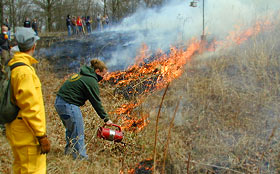
Annual Prairie Burn, Green Oaks, Knox College
Professor Allison tells us that the restoration in which he has been engaged for over 20 years will never achieve that standard: “The tall grass prairie and savanna restorations I work with are all based on a return to historical pre-Euro-American disturbance, but all require perpetual management and human intervention to maintain them on the desired ecological trajectory. Without regularly applied fire, those ecosystems would soon become dominated by many woody species and grow into a woodland lacking prairie or savannah characteristics.” Professor Allison describes the annual “Prairie Burn” at Green Oaks which is considered an important social event by students at Knox College.
This is one of many ironies about ecological restorations. Many projects are attempting to re-create an historical landscape at a specific period of time, which was not the result of natural succession. In the case of grassland prairie, it was largely the result of periodic fires set by Native Americans. Left to its natural devices, grassland would soon be “invaded” by shrubs and over time it would become a forest if soil and climate conditions were suitable. In that sense, it is an artificial landscape, as unnatural as any manmade garden. That the humans who created that historical landscape were indigenous, as opposed to European settlers, seems to us a meaningless, legalistic quibble.
The “field of dreams” theory
Most restoration projects focus almost entirely on plants. Little explicit attention is paid to the animals that are the desirable inhabitants of the restoration. Restorationists believe that if the habitat is made available, the animals will quickly follow. This is the “field of dreams” theory, i.e., if we build it, the animals will come. This is magical thinking.
Restoration projects rarely monitor the results of their projects sufficiently to test this theory. In the San Francisco Bay Area, native plant advocates claim there are more birds and animals occupying restoration sites, but these are anecdotal observations that cannot be verified. Nor do they seem credible to skeptics of the projects, who often think the habitat that has been eradicated actually supported more wildlife.
Evolving goals of restoration projects
Here in the San Francisco Bay Area we have observed the changing objectives of ecological restorations. Over fifteen years ago, local projects were touted as “sustainable.” The public was told that once restored to historical equilibrium conditions, the projects would be capable of sustaining themselves without further resources.
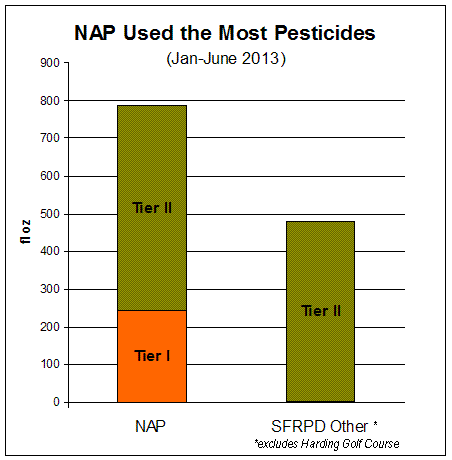
Comparson of pesticides used by San Francisco’s “Natural Areas Program” compared to landscaped areas of San Francisco’s parks. Photo courtesy of SF Forest Alliance.
Professor Allison observes the same “mission creep” amongst his colleagues. The goal of replicating an historical landscape is no longer the dominant theme of ecological restorations. Now the goal is more commonly defined in terms of increasing “biodiversity” and improving “ecological functions.”
New buzz words
If the new goal of ecological restorations is greater biodiversity and improved ecological functions, it seems reasonable to ask what these terms mean. Unfortunately, we were unable to find the answer to that question in Professor Allison’s book. Those terms are used as though their meanings are intuitively obvious. They are not. These terms are jargon that has little intrinsic meaning and they probably mean different things to different people.
When scientific studies quantify biodiversity, they count species of both native and non-native plants and animals. Since there are now far more species of non-native plants and animals and far fewer extinctions of native plants and animals, biodiversity has increased virtually everywhere in the world. So, as far as science is concerned, how could a restoration project that eradicates all non-native species result in greater biodiversity?
Obviously native plant advocates are defining the word “biodiversity” differently than traditional science. Native plant advocates seem to define biodiversity as exclusively native. Furthermore, the nativist ideology believes that the mere existence of non-native plants and animals will inevitably result in the extinction of native plants and animals. There is little scientific evidence to support this assumption. Few extinctions have been attributed to the existence of non-native plants and no extinctions blamed on non-native plants have occurred in the continental United States.
The term “ecological functions” is even more mysterious as it relates to ecological restorations. It could mean almost anything: production of biomass, soil composition, photosynthesis, carbon sequestration and storage, nutrient cycling, fire regime, hydrologic cycle, etc.
Professor Allison does not provide us with his definition of this term, so we will make an assumption based on our knowledge of ecological scientific literature. We told our readers about a study in Hawaii which compared native and non-native forests with respect to the ecological functions they are performing. In that study, three such functions were measured and reported: carbon sequestration, production of biomass, and nutrient cycling. The study concluded that non-native forests were performing these ecological functions as well as native forests.
We can also compare treeless grassland prairie with a native or non-native forest with respect to those ecological functions. Forests—whether native or non-native– will fulfill these and other functions at least as well as the grassland prairie. If we add the factor that the grassland prairie must be burned annually to maintain it, clearly the grassland prairie is an ecological deficit because it releases pollutants and greenhouse gases into the atmosphere when it is burned.
The moving target
The goals of ecological restoration are a moving target. The original goals of re-creating an historical landscape that would be sustainable without continual maintenance are now widely acknowledged to be unrealistic.
The new goals are equally elusive. The new goals are described in obscure ways that will be impossible to measure or evaluate. That suits the purposes of native plant advocates perfectly. They can continue to do whatever they want and the public can’t hold them accountable because the public is not provided with a practical method of measuring success or failure.
***********************************
(1) Stuart K. Allison, Ecological Restoration and Environmental Change: Renewing Damaged Ecosystems, Routledge, UK, USA, Canada, 2012

 Conservation Sense and Nonsense