The Forever War on Non-Native Plants

I spoke to California’s Wildlife Conservation Board at their August 2024 meeting about the Invasive Spartina Project. I asked the Board not to fund the eradication of non-native spartina and its hybrid, using herbicide. This project, which began 20 years ago, had cost over $50 million by 2023. (1)  Non-native spartina, native to the East and Gulf coasts (2), provides crucial habitat for Clapper rails (3), closely related to our endangered Ridgway rails.
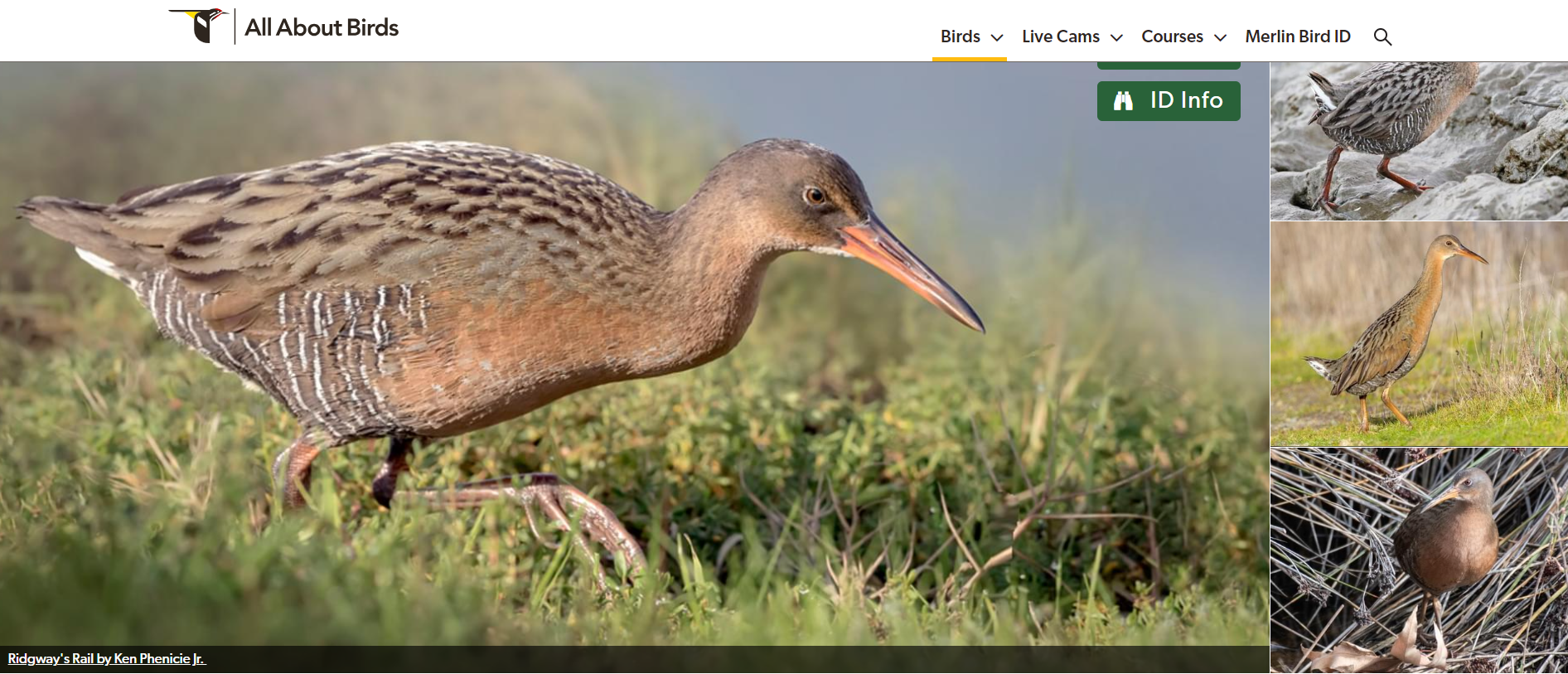
Source: Cornell Laboratory of Ornithology

Non-native spartina grows taller, denser, and doesn’t die back in winter as native spartina does. Because early aerial spraying of herbicide eradicated most non-native spartina by 2010, Ridgway rail populations declined by 50% due to habitat loss. (4)

The project was temporarily paused in 2014 to plant native marsh plants and stabilize rail populations. When the project was resumed in most places the rail population continued to decline from 2018-2023. There were approximately 1,200 Ridgway rails in the Bay estuary before the project began. (5)  The most recent survey in 2022 found about 500. (6)

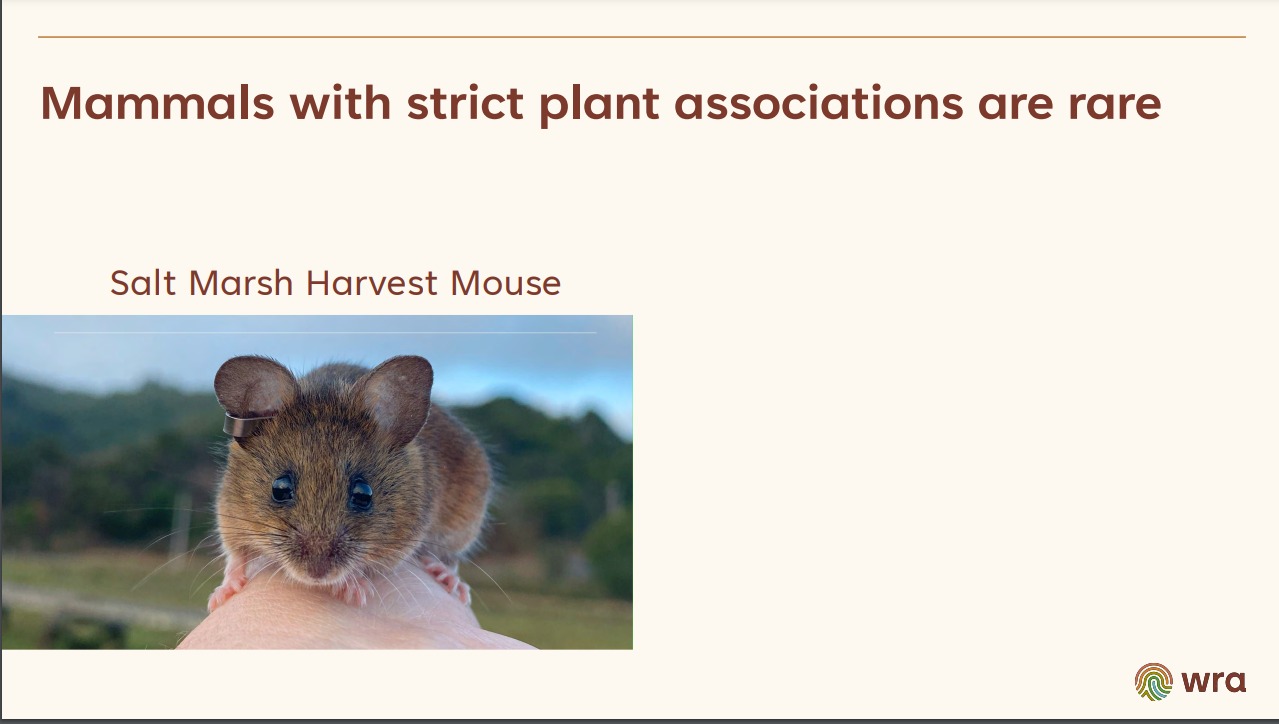
Native pickleweed was planted based on the mistaken assumption it would benefit endangered salt marsh harvest mice.  Recent studies show there are more mice in areas with less pickleweed and they eat both native and non-native plants. (7)
For the past 10 years, the focus has been on eradicating a hybrid of spartina, though it is indistinguishable from native spartina and 7,200 genetic tests were required from 2010 to 2022 to identify it. Hybridization is a natural evolutionary process that supports natural selection. (8)

Hybrid spartina could help to protect the Bay’s shoreline as sea level rises and extreme storm events cause erosion.  Where it is eradicated, gaps in vegetation are difficult to revegetate because the herbicide (imazapyr) that is used is very mobile and persistent in the soil. Imazapyr is also a non-selective herbicide that kills both native and non-native plants growing closely together, as they do in the San Francisco Bay Estuary. (9)

Although others spoke with me, there were an equal number of people who spoke in favor of granting nearly $7 million to continue the project for another 10 years. Some of the funding is granted to California Invasive Plant Council to administer the grants. Several of those speakers (including Marin Audubon) actually claimed that the project is benefiting endangered Ridgway rails, despite the fact that the project has killed at least 600 of them by destroying their nesting habitat and probably contaminating the food they eat, such as crustaceans and mollusks.

You might wonder why an organization such as Marin Audubon, which is committed to protecting birds, would advocate to continue a project that has killed at least 600 endangered birds, until you remember that Marin Audubon is also supportive of the project that plans to kill 500,000 barred owls. Marin Audubon also wants the Barred Owl Management Strategy to be mandatory instead of voluntary as proposed by USFWS.
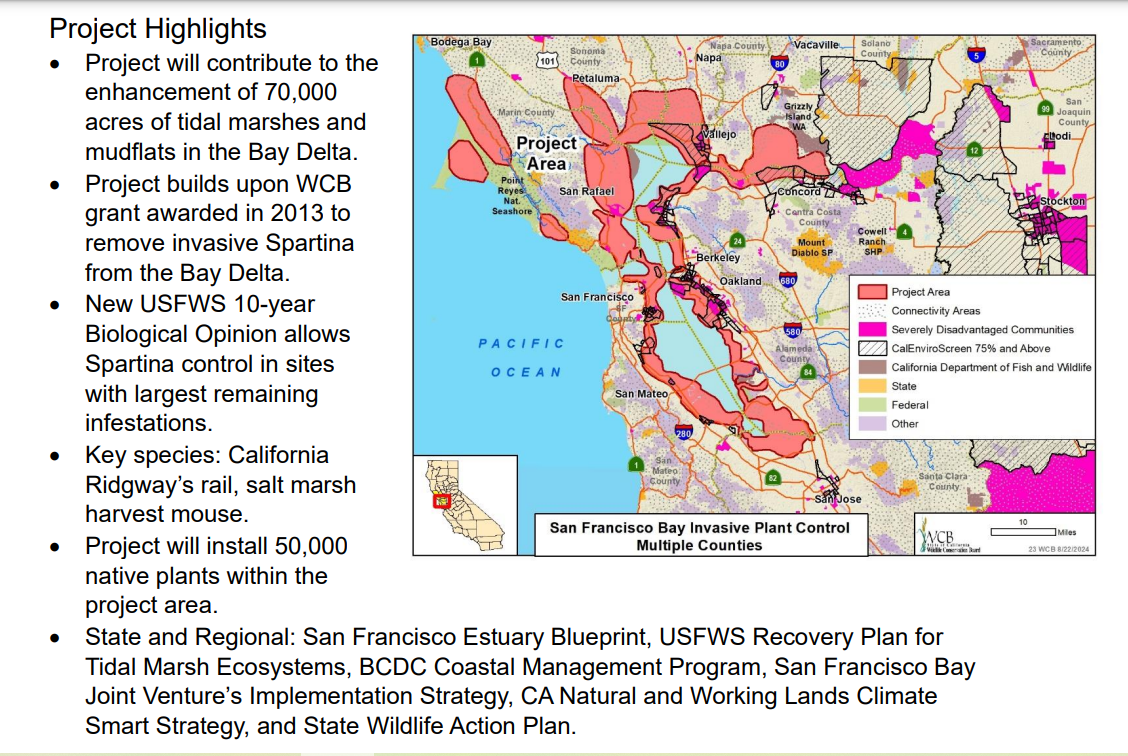
Source: Staff Report for Invasive Spartina Project, WCB Board Meeting, August 22, 2024

The Wildlife Conservation Board approved grants to the Invasive Spartina Project with one dissenting vote. The dissenting Board member voted, “Hell, NO!” Her term on the Board will end after the May 2025 meeting.  She does not expect to be reappointed.  Her departure will be the end of the effort to prevent the Wildlife Conservation Board from granting funds to projects that use pesticides.  It’s another dead end for those who advocate on behalf of wildlife and against the use of pesticides on public lands.

Funding sources to continue the Invasive Spartina Project are the Greenhouse Gas Reduction Act and Climate Change Resilience fund. These funding sources are as inappropriate as the project itself.  Destroying vegetation does not reduce greenhouse gas emissions.  Destroying non-native vegetation that grows taller, denser, and doesn’t die back in winter does not make our shoreline more resilient as sea-levels rise and winter storms become more intense.

Invasive Spartina Project is typical, not unique

The Invasive Spartina Project is typical of other “restoration” projects in California that have been trying, unsuccessfully, to eradicate non-native plants for 20 years and more.  Thanks to the California Invasive Plant Council (Cal-IPC), we now have survey data that tells us where these projects have been done and for how long. (10)

Cal-IPC sent more than 300 survey questionnaires to “practitioners” who had registered for Continuing Education credits for Cal-IPC classes and “land manager staff of organization throughout California.”  Over 100 practitioners replied to the survey.  This graph depicts their replies to the question, “Approximately how many total years have you applied herbicides throughout your career?”
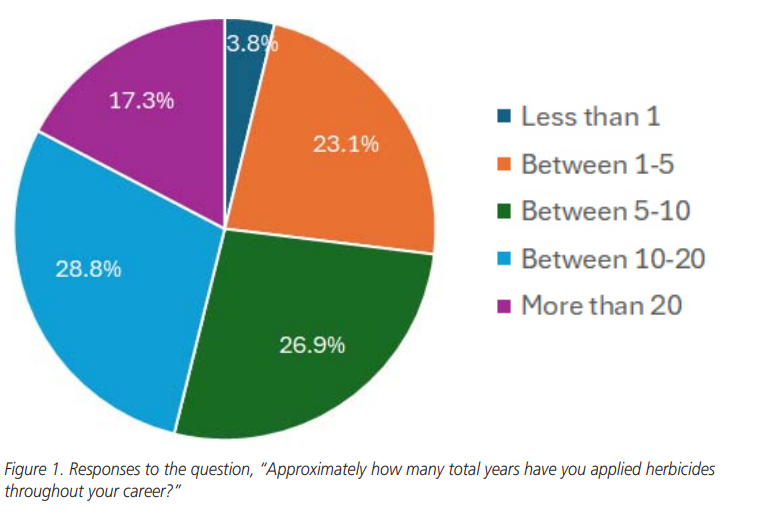
Source: California Invasive Plant Council

Clearly, the Invasive Spartina Project is one of many “restoration” projects that have been applying herbicides for 20 years or more.  And the Invasive Spartina Project has secured State funding to continue spraying herbicides for another 10 years.  Spraying herbicides on public lands has created stable, life-long employment for an army of weed warriors. 

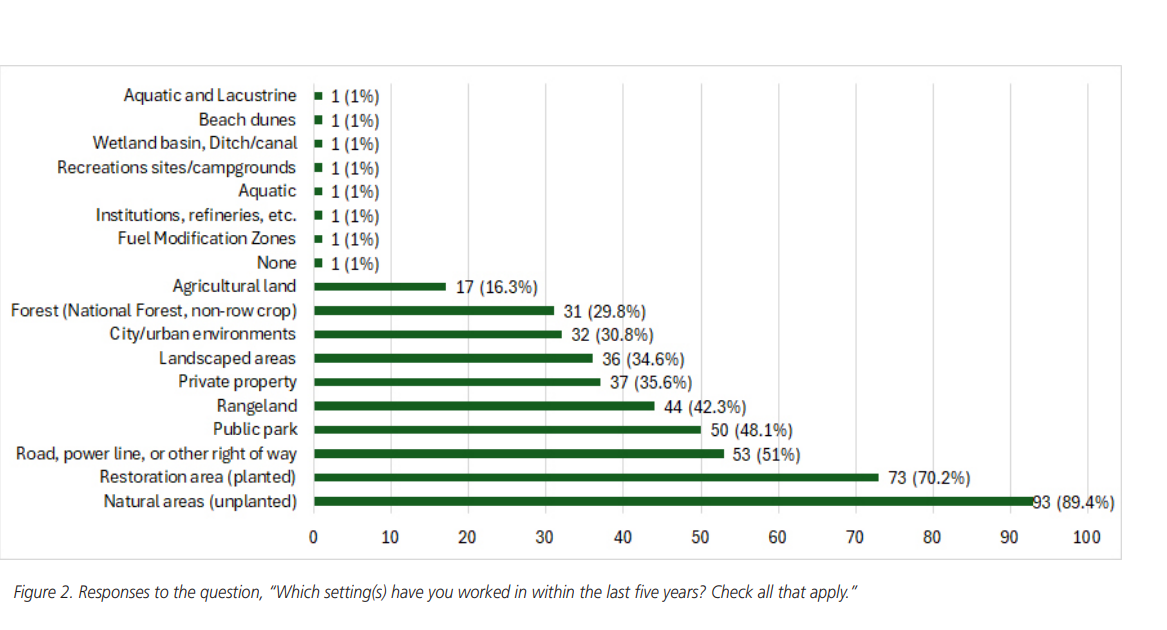
The survey also tells us where herbicides are being sprayed:
Source: California Invasive Plant Council

Virtually all (89%) herbicide applicators are spraying herbicides in “natural areas”—which we assume are wildlands—where no attempt has been made to plant native plants.  Most projects are more destructive than they are constructive. Nearly 50% of herbicide applicators are spraying in public parks.  70% of herbicide applicators spray in “restoration areas,” presumably to sustain the native plants that were planted.  If they are using non-selective herbicides, such as glyphosate and imazapyr, they are probably killing native plants too.

There are many other revelations in this survey and the details are available in the Cal-IPC publication (10):

  • Only 1.9% of respondents had not used herbicides or been part of a project that used herbicides.
  • The top three application methods were spot spraying (100%), cut stump (87%), and broadcast spray (70%).
  • 40% of respondents were not calibrating their herbicide use.  “Calibration is the process of adjusting and measuring the amount of pesticide that a piece of equipment will apply to a target area. It’s an important step in the pesticide application process to ensure that the equipment is applying the correct amount of pesticide at the right rate and in a uniform manner.” (Google search)
  • 28% of respondents had never received calibration training.  20% of respondents said they did not calibrate their herbicide application because “they did not know how.” Cal-IPC often claims that herbicides are being applied “judiciously.” If you don’t know how to apply herbicides, you are unlikely to apply them “judiciously.”

The Forever War on Non-Native Plants

Cal-IPC’s survey of “restoration” practitioners confirms our observations of their efforts in the past 25 years in the San Francisco Bay Area:

  • Attempts to eradicate non-native plants are a Forever War that has poisoned our public lands without eradicating non-native plants or restoring native vegetation, in most cases.
  • The war is futile because it is attempting to stop evolution, which is trying to help flora and fauna adapt to the changing climate and environment.  Humans cannot stop evolution, nor should we try.  The Forever War is a losing battle against evolution, which has sustained life on Earth for 3.7 billion years, without human “assistance.” 
  • The plants that we are trying to kill are also adapting to the poisonous war we pointlessly wage against them.  They have evolved and will continue to evolve resistance to the poisons we spray on them. Herbicides are less effective than they were 40 years ago and they will be continuously less effective. 
  • We are poisoning ourselves and other animals in our futile attempt to kill the plants that feed them.  Claims that wildlife eat only native plants is a fiction and a lie that sustains an industry with vested economic interests in that myth.
  • Many pesticide applicators are not properly trained or they are not following legally mandated instructions for pesticide applications on product labels. They are hurting themselves when they don’t wear legally required personal protection equipment. They are hurting the environment and everyone who lives in it when they use too much pesticide because they have not calibrated their applications as required by the product label. When they don’t post pesticide application notices in advance of their applications, they deprive the public of the opportunity to protect themselves by avoiding the area.  Even when they do, such signs would not be helpful to wildlife.
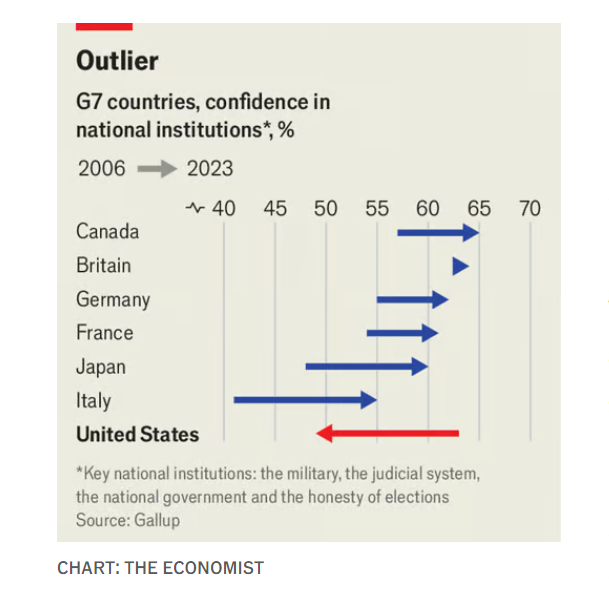
  • The money that is wasted on this Forever War could be used to address a multitude of other pressing needs.  For example, the lead pipes in Oakland that are delivering drinking water contaminated with lead to children in our public schools could be replaced with a fraction of what has been spent to eradicate non-native spartina marsh grass in the past 20 years. (11)  It’s no wonder that the public does not trust the American government:
Source: Economist Magazine

References:

  1. San Francisco Estuary News, “The Battle for Native Cordgrass,” Jacoba Charles, March 2023
  2. USDA Plant Database:  Spartina alterniflora  When the Invasive Spartina Project began, the USDA Plant Database  map of this species indicated that the species was introduced on the West Coast.  The current version of the map shows that this species is now native to the West Coast.
  3. Clapper rail, Cornell Laboratory of Ornithology  Status of Clapper rail is “Low Concern”
  4. Adam Lambert et.al., “Optimal approaches for balancing invasive species eradication and endangered species management,” Science, May 30, 2014, vol. 344 Issue 6187
  5. “Effects of Predation, Flooding, and Contamination on Reproductive Success of California Clapper Rails (Rallus Longirostris Obsoletus) in San Francisco Bay,” Steven E. Schwarzbach, Joy D. Albertson, Carmen M. Thomas, The Auk, 1 January 2006
  6. 2023 California Ridgway’s Rail Surveys for the San Francisco Estuary Invasive Spartina Project  (page 9)
  7. “Evaluating the plasticity of a ‘specialized’ rodent in a highly-invaded estuary,” Katie R. Smith, et.al.,  Presentation to California Invasive Plant Council Symposium, October 2023
  8. San Francisco Estuary Invasive Spartina Project   2021‐2022 Monitoring and Treatment Report (Appendix II, page 3)
  9. Journal of Pesticide Reform: https://assets.nationbuilder.com/ncap/pages/26/attachments/original/1428423389/imazapyr.pdf?1428423389#:~:text=Imazapyr%20can%20persist%20in%20soil,aerial%20and%20ground%20forestry%20applications
  10. Dispatch, Newsletter of California Invasive Plant Council, Spring 2024  (page 10-11)
  11. “In 2018, Oakland Unified School District (OUSD) estimated that it would cost $38 million to fix lead contamination in its schools. This included $22 million to replace water lines and $16 million to replace drinking water and sink fixtures. The OUSD blamed the aging infrastructure for the high lead levels and sought help from the state and federal government.” (Google Search)
What does “restoration” mean?

I welcome comments on my website because I often learn from them.  This comment on a recent post inspired me to think about why I often put the word “restoration” in quotation marks when describing projects that are more destructive than constructive:

Oh my, we are back to putting quotes around words we don’t like. An excerpt from this article:

“Many ecological studies and associated “restoration” projects adopt the same viewpoint that destruction is a justifiable method of studying and “restoring” ecosystems. “Restoration” projects often begin by killing all non-native plants with herbicides before attempting to create a native landscape.”

Often? We do a fair amount of underburning around here, primarily to “restore” ecosystem structure and function in mixed conifer. Of the burns I have been involved with, not one involved herbicides and pesticides. I think you put the lie to your own article by this one exaggeration. I suspect if I bothered to look I would find many others.

This is my reply to this comment:

When the word restoration is used appropriately, it is a powerful, positive word.  There is a multitude of potential projects in California that would be restorative.  Here is a brief list:

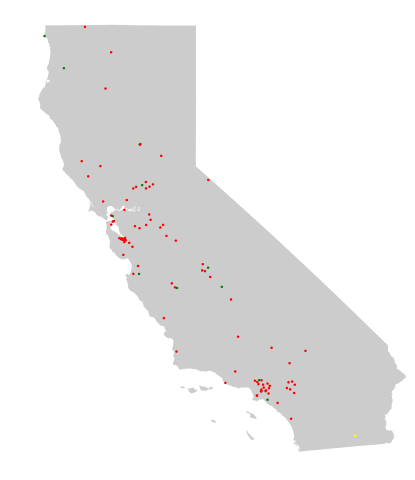
Superfund Sites in California

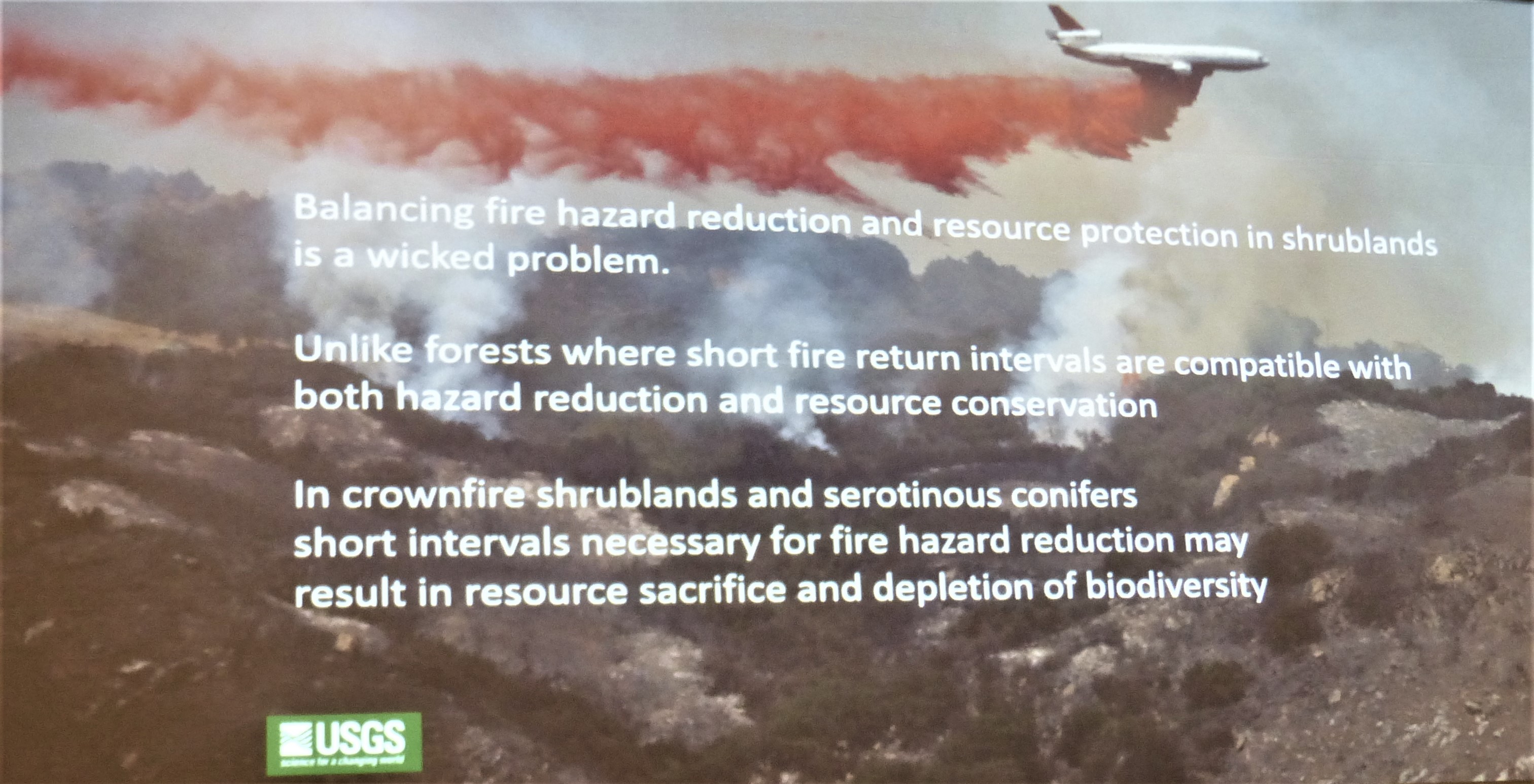
Prescribed burns are currently popular and some don’t use herbicides before burning, but they are NOT a panacea.  Many prescribed burns have become destructive wildfires.  Here are two presentations made at the October conference of the California Native Plant Society that were critical of the over-reliance on prescribed burns:

Source: Jon F. Keeley, CNPS Conference, October 2022
  • Dr. Jon Keeley is a respected fire scientist with US Geological Service with expertise in chaparral ecosystems.  He explained that 60% of native chaparral species (notably manzanita and ceanothus) are obligate seeders that do not resprout after fire and therefore depend on their dormant seed bank for regeneration.  In recent decades the fire interval in chaparral has decreased due to climate change and associated drought.  In many places the fire interval has become too short to establish the seed bank needed for regeneration.  In those places Dr. Keeley has observed vegetation type conversion to non-native annual grasses.  Dr. Keeley Is concerned that vegetation type conversion from forests in some cases and shrublands in others to non-native annual grassland may be the result of shortening fire intervals further “because of the upsurge in state and federal programs to utilize prescription burning to reduce fire hazard.” 
  • Another presentation about a 20-year effort to convert non-native annual grassland to native grassland using prescribed burns at the Santa Rosa Plateau Ecological Reserve reported their failure: “Non-native grass cover significantly decreased after prescribed fire but recovered to pre-fire cover or higher one year after fire.  Native grass cover decreased after prescribed fire then recovered to pre-burn levels within five years, but never increased over time.  The response of native grass to fire (wild and prescribed) was different across time and within management units, but overall native grass declined.” The audience was audibly unhappy with this presentation.  One person asked if the speaker was aware of other places where non-native grass was successfully converted to native grass.  The speaker chuckled and emphatically said, “NO.  I am not aware of any place where native grasses were successfully reintroduced.” 

When describing projects that are more destructive than constructive, I put the word “restoration” in quotes.  I stand by that choice.

Projects that are truly restorative

Days after responding to this comment, the New York Times published an article about the successful effort to clean up the New York City harbor that deserves to be called a restoration:

“Fifty years ago, Congress voted to override President Richard Nixon’s veto of the Clean Water Act. It has proved to be one of the most transformative environmental laws ever enacted.

“At the time of the law’s passage, hundreds of millions of gallons of raw sewage was dumped by New York City into the Hudson River every day. This filth was compounded by industrial contaminants emptied into the river along much of its length. The catch basin for all of this was New York Harbor, which resembled an open sewer. At its worst, 10 feet of raw human waste blanketed portions of the harbor bottom, and certain reaches held little or no oxygen to sustain the life of its fishery. Trash floated among oil slicks.

“Health advisories against eating fish from the Hudson remain, but its ecology has largely recovered, thanks to the law, which imposed strict regulations on what could be discharged into the water by sewage treatment plants, factories and other sources of pollution….”

The NYT article also describes how many animal species benefitted from the reduction in pollution in New York City’s harbor.

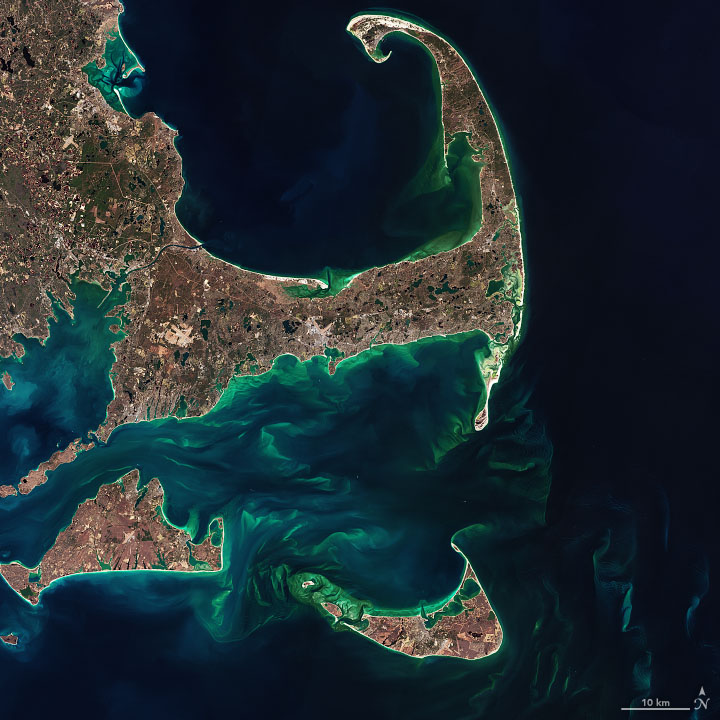
NYT also published an article about the pollution of the water surrounding Cape Cod that is destroying that ecosystem. 

“The algal explosion is fueled by warming waters, combined with rising levels of nitrogen that come from the antiquated septic systems that most of the Cape still uses. A population boom over the past half-century has meant more human waste flushed into toilets, which finds its way into waterways.

“More waste also means more phosphorus entering the Cape’s freshwater ponds, where it feeds cyanobacteria, commonly known as blue-green algae, which can cause vomiting, diarrhea and liver damage, among other health effects. It can also kill pets.

“The result: Expanding aquatic dead zones and shrinking shellfish harvests. The collapse of vegetation like eelgrass, a buffer against worsening storms. In the ponds, water too dangerous to touch. And a smell that Ms. Fisher characterizes, charitably, as “earthy.”

“Together, the changes threaten the natural features that define Cape Cod and have made it a cherished destination for generations.”

Cape Cod. Source: NASA

This an example of the many missed opportunities to restore the environment.  Instead of addressing the sources of pollution, such as leaky septic tanks and sewage systems, we invest in projects that contribute to pollution by spraying harmless vegetation with herbicides, killing harmless animals with pesticides and contributing to air pollution by burning vegetation. 

Closer to home, the recent torrential rain soaking California is a reminder of our inadequate sewer systems now overflowing from storm drains into city streets and being dumped into the ocean when the drainage gets that far.   San Francisco’s antiquated sewage system is an extreme case.  When it was built, it funneled storm runoff from city streets into the city’s sewer system, combining residential sewage waste with storm water runoff.  When it rains heavily, San Francisco’s sewage system is not capable of treating the increased flow. Such systems have been illegal for decades, but San Francisco has not made the necessary improvements to its sewer system.  As the SF Chronicle reports, city streets are now flooded with a toxic mix of rain water and human sewage. 

“Restoration” is not a dirty word when used to describe projects that reduce pollution.  When projects contribute to pollution they cannot legitimately be called “restorations.” 

The National Park Service has an epiphany

“We were probably always wrong to think about protected places as static.” – NPS Scientist

During the Trump administration federal agencies were forced to be silent about climate change.  Behind closed doors, many federal agencies were quietly preparing for the day when they would be able to begin the process of adapting to climate change. 

Shortly after the 2020 presidential election, the National Park Service published a natural resources report that announced a radical departure from traditional conservation strategy that was based on an assumption that nature is static and evolution a historical event.  “Resist-Accept-Direct—A framework for the 21st century resource manager” acknowledged that the rapidly changing climate requires a new approach based on the knowledge that nature is dynamic and evolution is a current and continuous event.  Many other federal agencies participated in the preparation of the report, which implies that other federal agencies may adopt the new conservation strategy. (1)

In April 2021, the National Park Service published policy guidance for park managers based on the principles of “Resist-Accept-Direct.” The New York Times interviewed the lead author of the policy guidance, who described the new conservation strategy of the National Park Service:   “The concept of things going back to some historical fixed condition is really just no longer tenable.” 

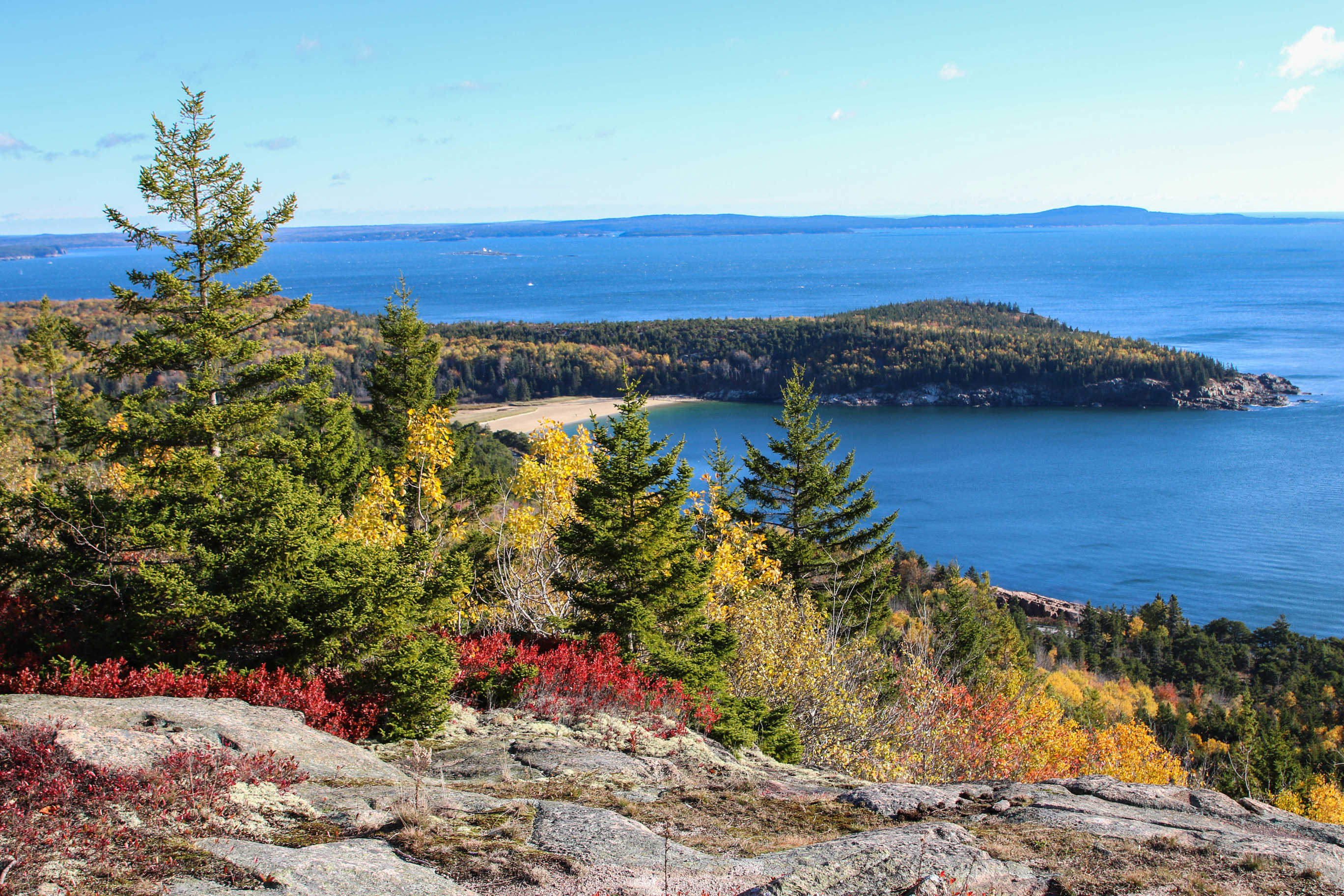
Acadia National Park, Maine

An ecologist and the science coordinator of Acadia National Park in Maine told NY Times what this new strategy meant to him and his colleagues.  He said that as recently as 2007 protected areas like the national parks were still being thought about as static places that could be preserved forever with the right techniques. “We weren’t being trained on how to manage for change,” he said. “We were being trained on how to keep things like they were in the past.”  That means nearly everyone in his line of work was caught unprepared for the current reality. “You have a whole profession of people having to shift how we think.  We were probably always wrong to think about protected places as static.”

Evolution of National Park Service Policy:  From preservation to restoration

The federal law that established the National Park Service in 1916, defined its mission:

“…which purpose is to conserve the scenery and the natural and historic objects and the wild life therein and to provide for the enjoyment of the same in such manner and by such means as will leave them unimpaired for the enjoyment of future generations.”

H.R. 15522, An Act to establish a National Park Service, engrossed August 5, 1916 (1)

Preservation was the original mission of the National Park Service.  In 1963, the mission of the National Park Service was radically changed by the Leopold Report, written by A. Starker Leopold, the son of Aldo Leopold.  The Leopold Report recommended a goal for national parks of maintaining historical conditions as closely as possible to those “of primitive America.”  When the Leopold Report was adopted as official policy by the National Park Service in 1967, it committed NPS to restoring park lands to pre-settlement conditions:

“Passive protection is not enough. Active management of the natural environment, plus a sensitive application of discipline in park planning, use, and development, are requirements for today’ Simultaneously, that edition of NPS policies also described the primary management task as a seemingly simple undertaking: ‘[safeguard] forests, wildlife, and natural features against direct removal, impairment, or destruction,’ and ‘[apply] ecological management techniques to neutralize the unnatural influences of man, thus permitting the natural environment to be maintained essentially by natural agents’” (1)

In 1967, the land management goals of the National Park Service became more ambitious.  The goal of “preservation” was replaced by the goal of “restoring” historic landscapes and ecosystems.  The pre-settlement landscape of 500 years ago on the East Coast and 250 years ago on the West Coast was established as the baseline landscape that NPS was committed to re-creating.  The baseline landscape was presumed to be “pristine” although it had been actively gardened by indigenous people for thousands of years.

The new land management strategy of the National Park Service

The National Park Service calls its new land management strategy the RAD framework, an acronym that summarizes three alternative strategies:  

  1. “Resist the trajectory of change, by working to maintain or restore ecosystem processes, function, structure, or composition based upon historical or acceptable current conditions.
  2. “Accept the trajectory of change, by allowing ecosystem processes, function, structure, or composition to change, without intervening to alter their trajectory.
  3. “Direct the trajectory of change, by actively shaping ecosystem processes, function, structure, or composition towards desired new conditions.” (1)

Every land management decision will choose among these alternatives based on an analysis that will begin with a climate assessment. Instead of looking to the past for guidance, the planning process will assess current conditions and project future climate conditions.  Based on that assessment, the purpose of land management plans will be adaptation to current and anticipated conditions.  Every plan will be designed for a specific place, based on specific current and anticipated conditions.  There is no one-size-fits-all plan, only a framework for devising individual plans tailored for specific parks or ecosystems within parks. 

The new strategy also makes a commitment to monitor the project as plans are implemented and modify the strategy as the environment continues to change and the ecosystem responds to land management.  This is called “adaptive management” and it is essential in a rapidly changing environment. The project doesn’t end, because nature never stops changing.  It’s a process for which there is no end-stage.

It’s a challenging strategy, but one that has the potential to be less destructive than the “restoration” paradigm that always began by destroying plants and animals perceived as intruders without historical precedents.  Precisely what it will mean remains to be seen.  There will probably be pockets of resistance from those who remain committed to the “restoration” paradigm and those who are economically dependent on existing projects.  All the more reason to continue to watch what is being done and participate in whatever public process is available

An example of an NPS project that should be abandoned.

There are undoubtedly hundreds, perhaps thousands of NPS projects that are based on the ambitious restoration goals of the 1963 Leopold Report.  Perhaps some were successful.  My personal knowledge of NPS projects is limited to those in the San Francisco Bay Area, my home.

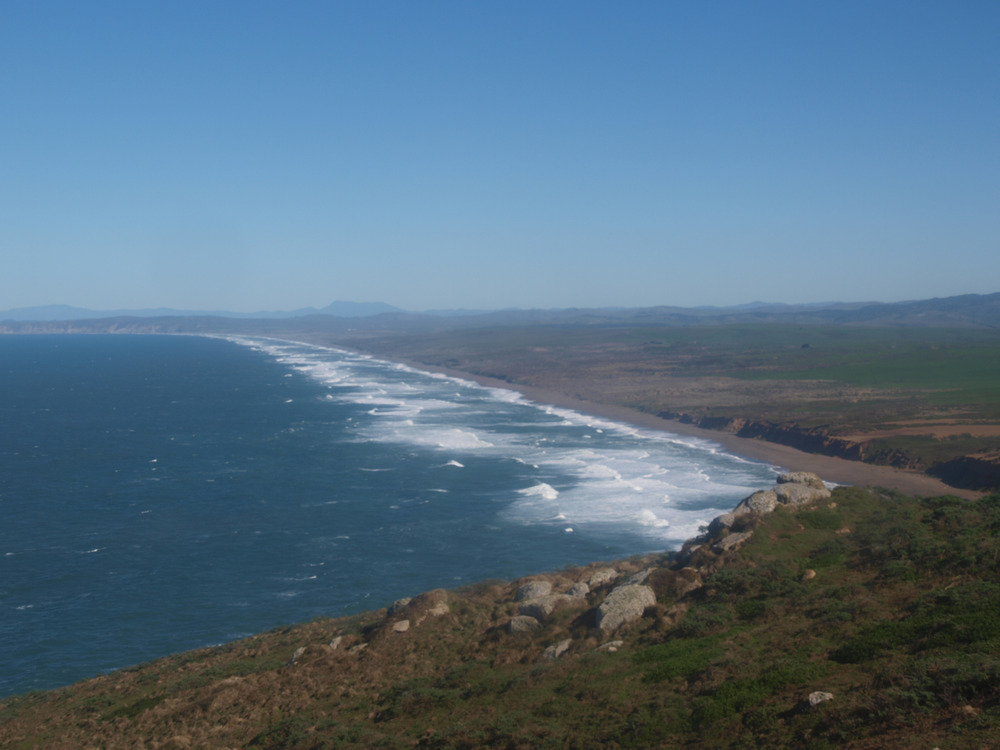
Point Reyes National Seashore

An attempt to eradicate European beach grass in the Point Reyes National Seashore (PRNS) is an example of an NPS “restoration” project that should be abandoned if the new RAD framework is implemented.  The PRNS project was described by NPS staff at the 2018 conference of the California Invasive Plant Council, a source and a setting that should be considered credible by the most ardent supporters of ecological “restorations.”

About 60% of sand dunes in the Point Reyes National Seashore were covered in European beach grass when the eradication effort began in 2000.  The goal of the project was to restore native dune plants and increase the population of endangered snowy plovers that nest on bare sand.  The project began by manually pulling beach grass from 30 acres of dunes at Abbott’s Lagoon.  The grass grew back within one year, presumably because the roots of the beach grass are about 10 feet long.  Manually pulling the grass from the surface does not destroy the roots. 

A new method was devised that was more successful with respect to eradicating the beach grass.  The grass and its roots were plowed up by bulldozers and buried deep in the sand.  The cost of that method was prohibitively expensive at $25,000 to $30,000 per acre and the barren sand caused other problems.  The barren dunes were mobile in the wind.  Sand blew into adjacent ranches and residential areas, causing neighbors of the park to object to the project.  The sand also encroached into areas where there were native plants, burying them.  The bare sand was eventually colonized by “secondary invaders.”  Different non-native plants replaced the beach grass because they were more competitive than the desired native plants. 

In 2011, the National Park Service adopted a third strategy for converting beach grass to native dune plants.  They sprayed the beach grass with a mixture of glyphosate and imazapyr.  At $2,500 to $3,000 per acre, this eradication method was significantly cheaper than the mechanical method.  However, it resulted in different problems that prevented the establishment of native dune plants.  The poisoned thatch of dead beach grass was a physical barrier to successful seed germination and establishment of a new landscape.  Where secondary invaders were capable of penetrating the dead thatch, the resulting vegetation does not resemble native dunes. 

Presentation at California Invasive Plant Council conference regarding attempt to eradicate European beach grass at Point Reyes National Seashore, November 2018

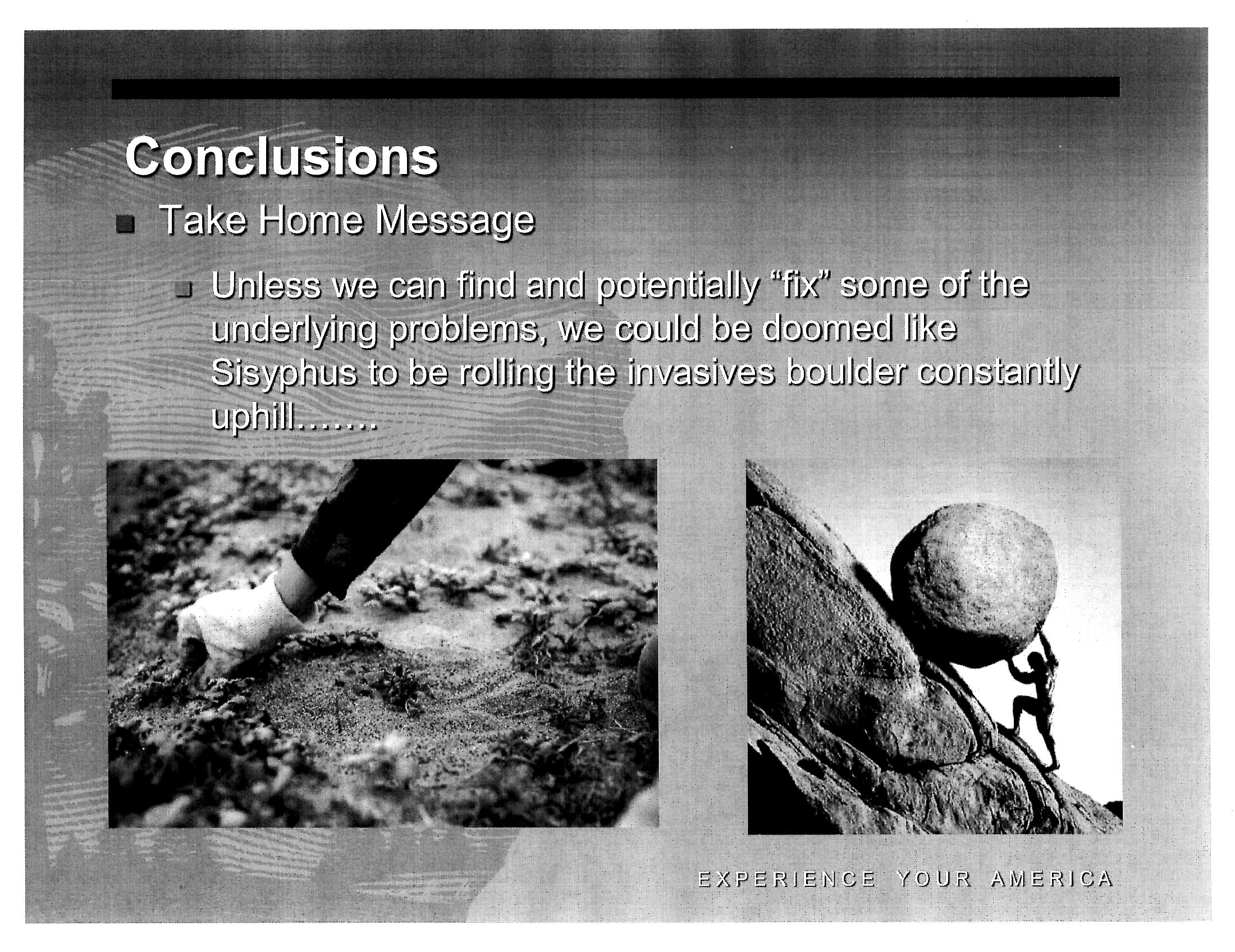
The concluding slides of the presentation of NPS staff about this project were stunning.  The slides said it is a “Restoration fallacy that killing an invader will result in native vegetation.”  My 20-plus years of watching these futile efforts confirm this reality.  However, I never expected to hear that said by someone actually engaged in this effort.  The presenter mused that such projects are like Sisyphus trying to roll a boulder up hill.

Presentation at California Invasive Plant Council conference regarding attempt to eradicate European beach grass at Point Reyes National Seashore. November 2018

Looking forward, not back

The realization—or perhaps acknowledgement—that the NPS strategy of re-creating historical landscapes is unrealistic was a long time coming.  Over the 50 years that the “restoration” strategy was attempted much unnecessary damage was done.  Useful, functional landscapes were destroyed.  Healthy trees were destroyed solely because they were planted by Europeans.  Animals were killed because they were perceived to be competitors of “native” animals.  Herbicides poisoned the soil, preventing regeneration or germination of new vegetation.  Established landscapes that had not needed irrigation were replaced with native plants that required irrigation.  Stabilizing vegetation was destroyed, resulting in erosion and drifting sand. 

The National Park Service has awakened to the failure of their “restoration” strategy because of the combination of failed projects that were based on mistaken assumptions and the impacts of climate change. NPS led public land managers into the dead end of attempting to re-create historical landscapes. Now NPS will lead public land managers out of that dead end into the reality of a changed environment with a rapidly changing future. Better late than never.


  1. Schuurman, G. W., C. Hawkins Hoffman, D. N. Cole, D. J. Lawrence, J. M. Morton, D. R. Magness, A. E. Cravens, S. Covington, R. O’Malley, and N. A. Fisichelli. 2020. Resist-accept-direct (RAD)—a framework for the 21st-century natural resource manager. Natural Resource Report NPS/NRSS/CCRP/NRR—2020/ 2213. National Park Service, Fort Collins, Colorado. https://doi.org/10.36967/nrr-2283597
  2. Planning for a Changing Climate: Climate-Smart Planning and Management in the National Park Service, NPS, April 2021.  https://toolkit.climate.gov/reports/planning-changing-climate-climate-smart-planning-and-management-national-park-service

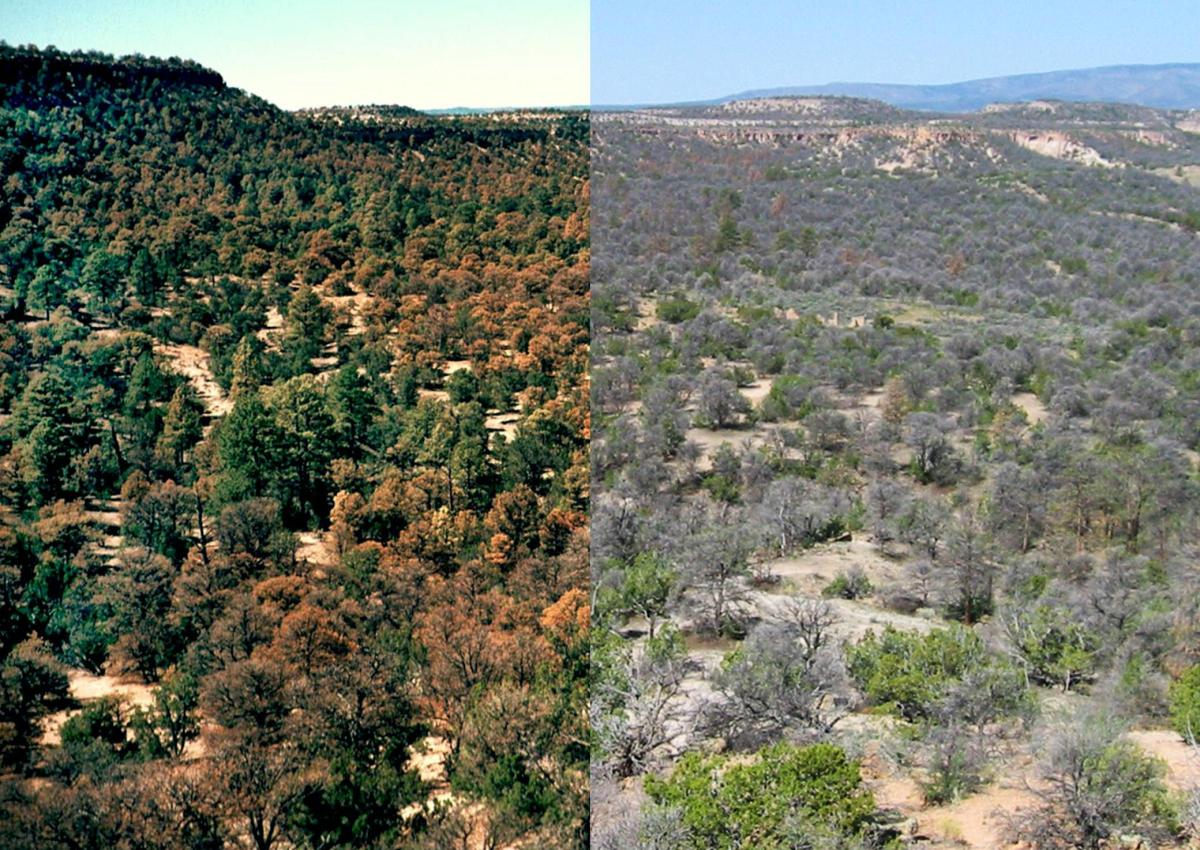
Featured Photo from RAD Natural Resource Report.  Photo caption:

“Multiple federal agencies, including the National Park Service (Bandelier National Monument), tribes, and others steward the East Jemez Mountains ecosystem of New Mexico, an ecologically transforming landscape where massive forest die-off is projected to occur more frequently in the future. Piñon pines, normally evergreen, have reddish-brown foliage in October 2002 (left). By May 2004 (right), the dead piñon pines lost all their needles, exposing gray trunks and branches. The photos were taken from the same vantage point near Los Alamos, N.M. Forest drought stress is strongly correlated with tree mortality from poor growth, bark beetle outbreaks, and high-severity fire. Credit: C. Allen, USGS” (1)

“Restoring” vegetation does not restore an ecosystem

One of the persistent questions in our interminable debate with native plant advocates is whether or not native vegetation provides superior habitat for wildlife compared to existing non-native vegetation.  At the heart of that question is the closely related question of whether or not more insects are found in native vegetation than in non-native vegetation.  That’s because insects (and other arthropods) are near the bottom of the food web.  If there are fewer insects, there are probably fewer birds and other animals that eat insects. We have told our readers about many studies that find equal abundance and diversity of insects in native compared to non-native vegetation, so we won’t repeat them, but here’s a brief list of those studies and links to them for new readers:

Does “restoration” of native vegetation increase insect populations?

Arthropods - Creative Commons Share Alike
Arthropods – Creative Commons Share Alike

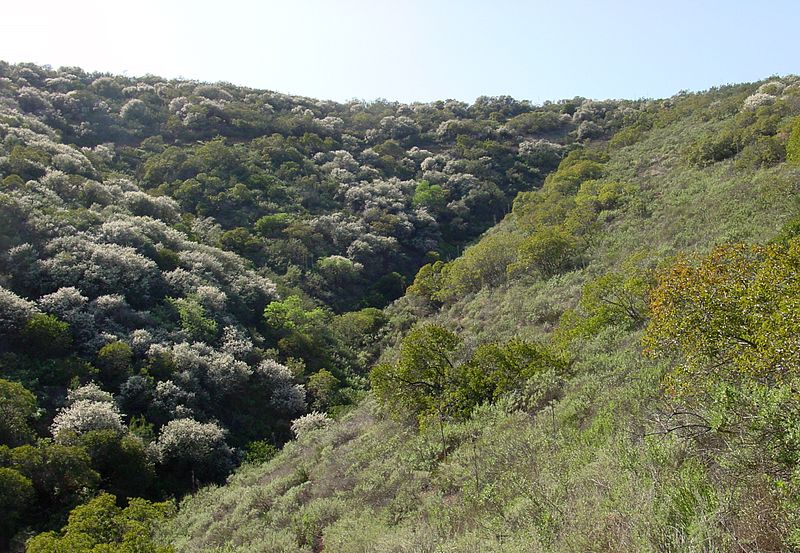
In this post we will consider this issue from a slightly different angle:  can insect population or diversity be increased by “restoration” of native vegetation?  Even if we accept the premise of native plant advocates that native vegetation supports greater abundance and diversity of insects, can that population be “restored” by eradicating non-native vegetation and replacing it with native vegetation?  That question is answered with a resounding “NO” by a study that compared arthropod abundance and diversity in undisturbed (predominantly native vegetation), disturbed (predominantly non-native vegetation), and disturbed sites 5 and 15 years after restoration. (1) Restoration methods described in the study are mowing followed by disking and seeding, disking and seeding, planting of container stock, and clearance by hand.  All sites were irrigated initially.  No mention is made of herbicide use or prescribed burns to eradicate non-native vegetation. The vegetation type in all 15 sites in Southern California was coastal sage scrub.  This is the dominant vegetation type along the coast of California and is the goal of many restoration projects in the San Francisco Bay Area.  Many species of both native and non-native vegetation in the study sites also exist in the Bay Area.

Coastal sage scrub in Southern California - Creative Commons Share Alike
Coastal sage scrub in Southern California – Creative Commons Share Alike

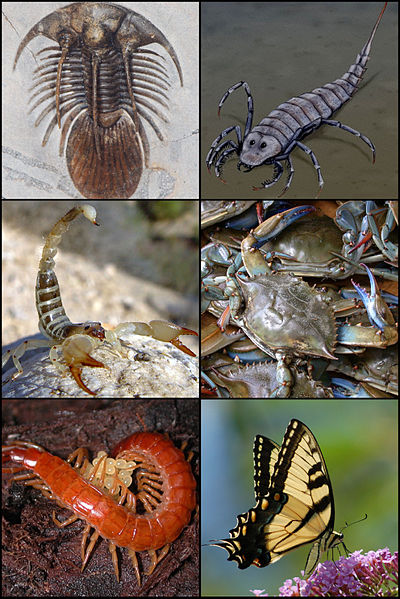
The study used pitfall traps to collect arthropods in these sites.  Arthropods are invertebrates that include insects, arachnids (spiders), and crustaceans (aquatic species not relevant to this study).  Arthropods are further divided into guilds such as herbivores, predators, scavengers, and parasites.  Because of the method of collecting in pitfall traps, few herbivores were found. Here are some of the findings of this study:

  • “Arthropod diversity at undisturbed and disturbed sites was greater than at sites that were 5 and 15 years following restoration.”
  • “Number of arthropod species was not significantly different among undisturbed, disturbed, and restored sites.”
  • “Vegetation at disturbed and undisturbed sites differed significantly; older restorations did not differ significantly from undisturbed in diversity, percent cover, or structural complexity.”
  • “Vegetation characteristics did not differ significantly between the newly restored site and disturbed sites.”
  • “…arthropod communities at all restored sites were, as a group, significantly different from both disturbed and undisturbed sites.”
  • “As found in other studies of other restoration sites, arthropod communities are less diverse and have altered guild structure.”

Here is the concluding discussion of this study:

“Of the restoration sites sampled, none had developed an arthropod community that resembled undisturbed or disturbed native coastal sage scrub. Restoration sites in general exhibited lower arthropod diversity and a preponderance of exotic arthropod species. The time elapsed since revegetation effort had no discernible effect on arthropod community structure; there was no gradual return of the community to a more natural structure over time”.

 “Restorations” do not improve arthropod abundance or diversity

This study found that arthropod population and diversity was the same in disturbed (non-native) and undisturbed (native) vegetation.  When disturbed vegetation was “restored” arthropod population was maintained but the composition of the arthropod community was significantly changed even 15 years after the restoration was completed.  There were more “exotic” species of arthropods in the restored sites even though the vegetation was similar to the undisturbed sites of native vegetation.  The restored vegetation was native, but its arthropod occupants weren’t.

However, the birds and other animals that prey on those insects don’t care if the insects are native or non-native.  Much like humans, animals are not concerned with the nativity of their food.  The non-native apple you are eating is just as tasty whether you are eating it in its native range in Central Asia or where it has been introduced.  If you have an apple tree, you know the birds and squirrels enjoy the apples too and the bees and other pollinators enjoy the apple blossoms.   Most of what we eat is not native, yet many people are obsessed with the nativity of vegetation, claiming that animals require native vegetation even though humans don’t.

An important caveat

The predominant vegetation type in the San Francisco Bay Area is coastal scrub, which is also the vegetation type in the study of arthropod populations.  This suggests that if a similar study were conducted here, the results might be similar.  However, there is one very important difference between the restorations studied in Southern California and the restorations in the Bay Area.   Land managers in the San Francisco Bay Area are using large amounts of herbicides to destroy non-native vegetation.  The study in Southern California reports no herbicide use in restoration sites. It seems likely that herbicides sprayed in restoration projects in the Bay Area would decrease the population of arthropods.  We would like to see a study that tests that hypothesis. 

There is more to an ecosystem than plants

The veneration of native plants has become a national obsession.  Demands for eradication of non-native plants are supported by many fictions to justify these destructive projects.  One of those fictions is that wildlife requires native vegetation.  We have found no empirical evidence to support that assumption.   The study we are reporting today is yet more evidence that restoring native plants does not restore an ecosystem. In this case, after 15 years of effort, land managers were eventually successful in establishing a population of native plants.  However, these “restored” native landscapes did not support a population of insects and spiders that were comparable to either the undisturbed native landscape or the unrestored non-native landscape.  We have been looking for some legitimate reason to engage in these destructive projects for over 15 years.  We have yet to find any justification for spraying our public lands with herbicides or destroying hundreds of thousands of healthy trees.  We will keep looking.


(1)    Travis Longcore, “Terrestrial Arthropods as Indicators of Ecological Restoration Success in Coastal Sage Scrub (California, USA),” Restoration Ecology, December 2003, Vol. 11 No 4, pp.397-409