Today, I’m publishing an excerpt of “The Post-Native World,” which was originally published by Ground Up, the Landscape Architecture and Environmental Planning Journal of the University of California, Berkeley.
The author of the article, Mark Wessels, received his Master in Landscape Architecture at UC Berkeley. He is a licensed landscape architect and certified arborist. He is a Senior Associate with PGAdesign in Oakland, California.
Mark sent the following excerpt of his article in Ground Up to the members of the Oakland Urban Forest Forum, of which I am a member. Mark’s article reflects my own belief that resilience of urban landscapes in a changing climate requires diversity, redundancy, and flexibility that can only be achieved with both native and introduced plants.
Conservation Sense and Nonsense
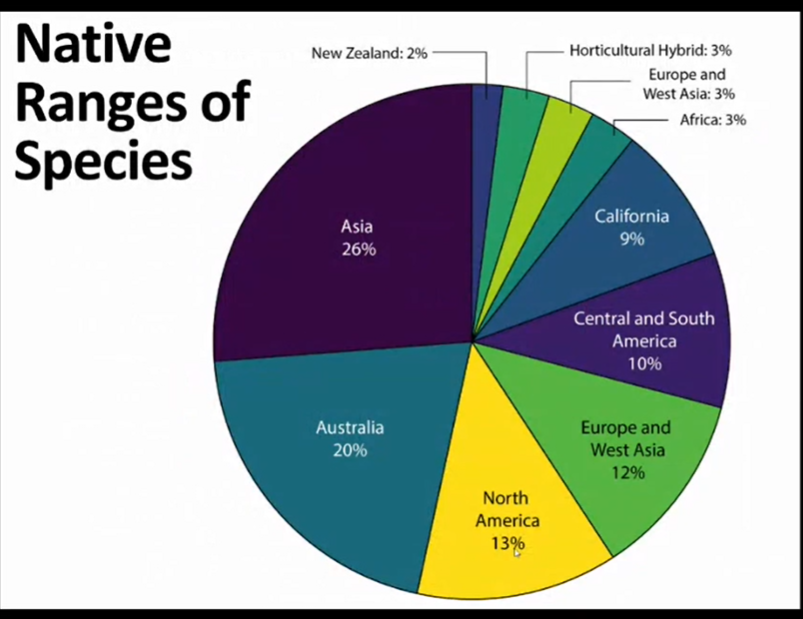
Native ranges of trees in California’s urban forests. Source: Matt Ritter, Professor of Forestry, Cal Poly, SLO
CITIES AS HARBINGERS OF A POST-NATIVE WORLD Native plant enthusiasts argue that native plants have evolved for thousands of years to be optimized for their environments. This is based on the assumption that environmental factors like soil type, climate, and ecological communities change very slowly, at the rate of geologic time. The fitness advantage of native plants depends on a relatively static, unchanging environment.
Yet cities are anything but static. Urban soils are altered by construction, compaction, and contamination. Impermeable surfaces and water infrastructure change urban hydrology. Urban heat island effect and microclimates affect soil and air temperatures. Cities are defined more by how urban they are than by where on the planet they are located. A tree adapted to urban environments, for example, is much more likely to flourish in San Francisco than one adapted to coastal dunes. In short, cities are post-native; they no longer reflect the environmental conditions for which native plants evolved. They are something new.
Cities are not the only places irreversibly altered by human activity. Human influence ripples out through resource extraction, food and energy production, and global climate change. Cities are already several degrees warmer than their historical temperatures, and many native plants cannot survive in this altered environment. Climate models predict several degrees of warming globally in the next 50 years. Native plants face challenges in urban settings today, and 50 years from now they will face challenges everywhere. As the effects of climate change spread beyond cities, landscape architects will need to move beyond geographic provenance to find plants adapted to a post-native world.
DIVERSITY OF APPROACHES VS. SINGLE STRATEGY Globalization has irreversibly altered the planet, but it may also hold the key to surviving climate change. Designers today have unprecedented access to plants from around the world. For millennia, plants have been continuously evolving new, more efficient ways to survive in an astounding array of environmental conditions. In a post-native world, we will have to reconsider the idea that each plant is custom-evolved for a particular place on the earth, and instead think of global biodiversity as a library of adaptation. This library holds the key to successful planting in urban areas today, and hope for an uncertain future.
What I’m suggesting is that we embrace global biodiversity while we still have it; that our cities become hotbeds of plant species richness, hybridization, and cross-pollination; that we start a thousand divergent experiments, in small and controlled ways; and that we embrace this moment of globalization to produce an unprecedented explosion of diversity with which we can begin to replant and repopulate this irreversibly altered planet.
The resilience of natural systems lies in diversity, redundancy, and flexibility. Individual plants, and even individual species, die off frequently, but there is always another individual or another species to fill the void. Relying on a small set of native trees without embracing the redundancy and diversity of natural systems is a recipe for disaster.
This is a story of the influence of interest groups on the process of making new laws. When Assembly Bill 1573 was introduced in February 2023, it seemed to be primarily a water-saving measure that would “eliminate the use of irrigation of nonfunctional turf” (turf that is not a recreational area or community space with foot traffic). AB1573 also mandated that all new or renovated nonresidential areas install not less than 25% local native plants by 2026, 50% local native plants by 2030, and 75% local native plants by 2035. It defined local native plants as “California indigenous plants to an area that have evolved and occur naturally in the Jepson Region associated with a specific California location.”
As AB1573 passed through legislative committees in the Assembly and the Senate it was amended six times (legislative history of AB1573 is available HERE.). California Native Plant Society and its many allies pulled out all the stops to influence the legislation and ensure its passage. Members of these advocacy organizations were asked at each juncture to contact their elected representative to urge them to pass this legal mandate requiring public and commercial properties to plant native plants.
The final revision of AB1573 occurred on September 1st, after consideration by the Senate Appropriations Committee. The final revision made two significant changes:
The requirement for native plants in new and renovated landscapes on non-residential properties was lowered to 10%.
However, the definition of native plant was revised to include: “a plant that is nonnative and noninvasive that provides pollinator benefits, and that is a low-water use plant, as determined by the Department of Water Resources and the Natural Resources Agency” In other words, the final revision considers many non-native plants the functional equivalent of native plants.
On September 7, 2023, the authors of AB1573 asked that the bill be moved to the “inactive file.” They have given up. Their bill has been so emasculated that they don’t see the point of continuing to try to pass it.
Why did this attempt to legally mandate native plants fail?
There are probably many aspects of this story that I don’t know. There were probably many private meetings and written communications that I’m not aware of. I could probably learn about some of them by making a public records request, but I think I know enough of the story to relate it to my readers. If you know more about the process than I do, please share it with us.
The first visible sign that AB1573 was in trouble was in June 2023, when the Associate Director of Plant California Alliance published an editorial about AB1573 in an agricultural newsletter, available HERE. Plant California Alliance represents “California’s nursery industry. Our membership includes farmers, growers, urban agriculturists, wholesalers, retail garden centers, landscapers, garden suppliers, horticulturalists, as well as educators and researchers.” This is an organization with horticultural knowledge and practical experience growing plants in California. The editorial explained why the goals of AB1573 are unrealistic and based on mistaken assumptions about California native plants:
There aren’t enough native plants available for sale to meet such a requirement. California Native Plant Society claims nursery sales are about 6% native, but two large wholesale nurseries estimate their stock is not more than 1% native.
“…there is also the fundamental question of why a native plant mandate is included in a water conservation bill at all. Not all native plants are low water plants…Sometimes a non-native plant is a better choice when designing a drought resilient, low water garden.” California Water Service recommends: “Plants that are adapted to long, dry summers and short, rainy winters are called “Mediterranean-zone” plants. These include plants that are native to California, as well as those that originated in southern Europe, South America, and other “Mediterranean” climates. These plants don’t need much water in the summer and have thrived in water-scarce conditions for thousands of years.”
“And, what about native plants’ impacts on fire? Unfortunately, some California native plants are not considered fire-resistant, and some are even considered fire prone. For example, FireSafe Marin has several California native plants on their list of fire-prone plants, including manzanita (Arctostaphylos), coyote brush (Baccharis spp.), California buckwheat (Erigonum fasciculatum), and California bay (Umbellularia californica).” Most wildfires in California occur in native chaparral and native conifer forests. When wildfires occur in residential neighborhoods, the homes themselves are the primary fuel for the fire. Everything burns in wind-driven fires, regardless of the native origins of plants.
NY Times reported that 150 homes burned in this wind-driven fire in San Diego in 2003, but the eucalyptus surrounding the neighborhood did not burn. NY Times photo
In August, tree advocacy organizations finally woke up to the implications of AB1573 for California’s urban forests when they realized that the definition of “native plant” also included native trees. California Releaf and California Urban Forests Council asked their members to contact the Senate Appropriations Committee to ask that trees be explicitly exempted from the requirement for native plants on non-residential properties in California.
Composition of California’s Urban Forest. Source: Californian’s Guide to the Trees Among Us
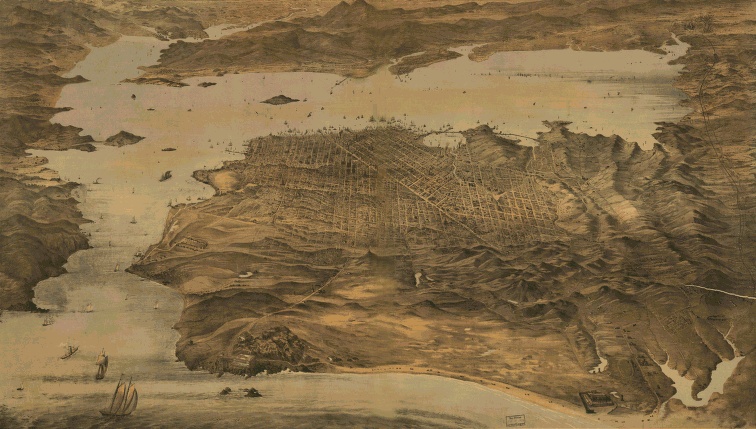
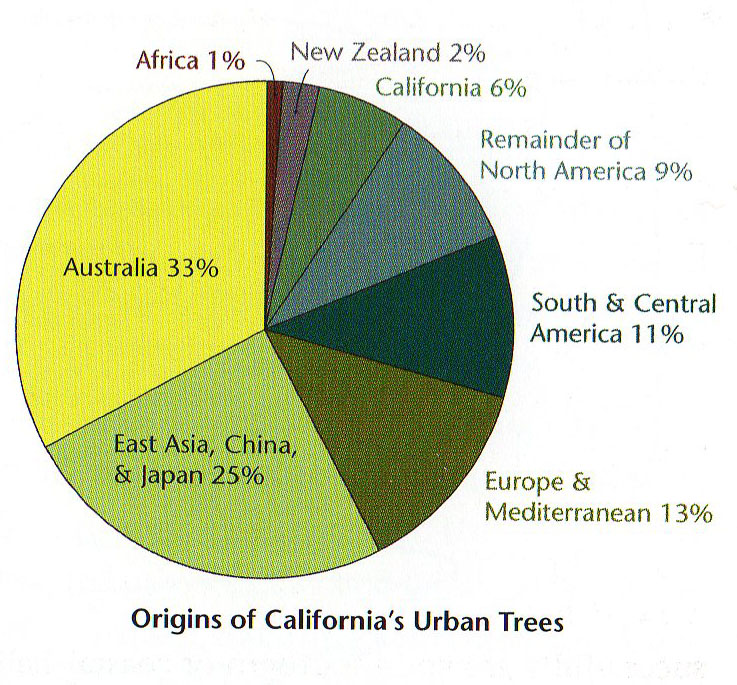
Only 9% of California’s urban forests are native to California. (1) Pre-settlement San Francisco was virtually treeless. One-third of San Francisco was barren sand dunes on its western edge. San Francisco’s urban forest is now predominantly non-native and much of it is being destroyed to accommodate native plant restorations that require full sun.
Birds-eye view of San Francisco in 1868
Non-native trees were planted in Oakland in the 19th century because there were few native trees: “Vegetation before urbanization in Oakland was dominated by grass, shrub, and marshlands that occupied approximately 98% of the area.” (2) Non-native tree species in the East Bay are adapted to soil and microclimate conditions that are not suitable for native species. Non-native annual grasses will replace Oakland’s urban forest in the hills, not native trees, if native plant advocates get the Vegetation Management Plan they have been fighting for for nearly 8 years.
A Learning Experience?
I would like to think that California’s policy makers learned something from the process of considering AB1573. Do they have a better understanding of what grew in California in the past and therefore what is capable of growing in the future?
Probably not
Ironically, on the same day that AB1573 was withdrawn by its authors, the San Francisco Examiner published this article about a new initiative to plant more greenery in San Francisco, led by the California Academy of Sciences. It’s an excellent idea, except that the leaders of this initiative equate greenery with native plants: “He’s looking to introduce more native plants in The City, which will in turn attract more native insects and more native birds throughout San Francisco.”Nature is not synonymous with native plants. The scientific definition of biodiversity includes both native and non-native plants. In fact, San Francisco’s Open Space Element of the General Plan also defines biodiversity as including both native and non-native plants.
As much as I would like to hope that Californians have a more realistic goal for the future of California’s landscapes after watching the failure of AB1573, I don’t think I can.
Matt Ritter, A Californian’s Guide to the Trees Among Us, Heydey Books, 2016.
David Nowak, “Historical vegetation change in Oakland and its implications for urban forest management,” Journal of Arboriculture, September 1993
California has made a $15 Billion budget commitment to address climate change and protect biodiversity. The California Natural Resources Agency (CNRA) held a series of workshops to explain the initiative and give the public an opportunity to provide feedback to CNRA. Sixteen hundred Californians participated in those workshops, including me.
California Natural Resources Agency recently published a draft of the first installment of implementation plans: “Natural and Working Lands Climate Smart Strategy.” The public is invited to comment on this draft. The deadline for comment is November 9, 2021. There are three ways you can send your comments and feedback: Email: CaliforniaNature@Resources.ca.gov; Letter via postal mail: California Natural Resources Agency, 715 P Street, 20th Floor, Sacramento, CA 95814; Voice message: 1 (800) 417-0668.
Update: The deadline for public comment has been extended to Wednesday, November 24, 2021.
Below is the comment that I submitted today. I focused my attention on the portions of the draft that are relevant to my urban home, such as developed land and urban forests. My comment may not be relevant to your concerns, so I encourage you to write a comment of our own. If you find issues in the draft that I haven’t mentioned please post a comment here to alert other readers.
TO: California Natural Resources Agency
RE: Public Comment on “Natural and Working Lands Climate Smart Strategy”
Thank you for this opportunity to comment on the draft of California’s Climate Smart Land Stretegy.
I find much to like in the draft of California’s Climate Smart Land Strategy. In particular:
The draft makes a commitment to reduce pesticide use on public lands, for example:
Priority nature-based solutions for developed lands:
“low-chemical management of parks and open spaces in and around cities to beneft underserved communities who are often the most negatively affected by health impacts related to air pollution and extreme heat caused by urban heat islands.”
“Prioritize protection of public safety by ecologically treating vegetation near roads and energy infrastructure.”
“Utilize safer, more sustainable pest management tools and practices to combat invasive species and accelerate the transition away from harmful pesticides.”
The draft makes a commitment to expanding, maintaining and preserving urban forests:
Priority nature-based solutions for developed lands:
“Increase development and maintenance of both urban tree canopy and green spaces to moderate urban heat islands, decrease energy use, and contribute to carbon sequestration.”
“Maintain urban trees to provide vital ecosystem services for as long as feasible”
The State of California defines the urban forest broadly and the draft acknowledges its importance in climate smart land management:
“California Public Resources Code defines urban forests as “those native or introduced trees and related vegetation in the urban and near‐urban areas, including, but not limited to, urban watersheds, soils and related habitats, street trees, park trees, residential trees, natural riparian habitats, and trees on other private and public properties.” Urban forests are our opportunity to apply climate smart land management in the places most Californians call home. The character of urban forests is diverse, which heavily influences the localized selection of management options and outcomes related to both carbon storage and co-benefits.”
The draft acknowledges that suitability to a specific location and climate are the appropriate criteria for planting in the urban forest. Because native ranges are changing in response to changes in the climate, whether or not a tree is native to a specific location is no longer a suitable criterion.
“Utilize place-based tree and plant selection and intensity, to ensure the species selection process considers climate, water, and locally-specific circumstances.”
The draft acknowledges the importance of forests to maintain carbon sinks to reduce greenhouse gas emissions that cause climate change. The urgent need to address climate change must trump nativists’ desire to replicate treeless historical landscapes.
“Healthy forests can serve as reliable carbon sinks, both because they are able to store significant amounts of carbon and because they are at a lower risk of carbon loss due to climate impacts such as wildfire and drought. After large, high-severity fires, some of California’s forests may convert to shrublands and grasslands59 that are not capable of supporting the same level of carbon storage as forests.”
“…shrublands and chaparral store substantially less carbon, and the dynamics of their growth and disturbance are less well known.Evidence indicates that shrublands in California are burning more frequently than they would have historically, leading to degraded conditions, possible conversion to grasslands, and reduced carbon storage in above ground biomass.”
Making these commitments operational implies that the State must also make these commitments:
The State of California should not fund projects that destroy healthy trees for the sole purpose of replicating treeless historical landscapes, especially on developed lands.
The State of California should not fund projects that destroy functional landscapes and healthy trees, particularly by using herbicides.
Suggested improvements in the draft
These commitments in the draft should be revised:
“Implement healthy soils practices, including through native plant landscaping and mulch and compost application.”
The word “native” should be deleted because the nativity of a plant is irrelevant to soil health. Introduced plants do not damage soil, but using herbicides to kill them does damage the soil by killing beneficial microbes and mycorrhizae.
“Increase drought-tolerant yards and landscaping through, for example, native plant species replacements and lawn removal and by adopting, implementing and enforcing the State’s Model Water Efficient Landscaping Ordinance.”
The word “native” should be replaced by “drought-tolerant,” which would include many native species, but not all. Redwoods are an example of a native tree that is definitely not drought-tolerant. Many species of drought-tolerant plants have been introduced to California from other Mediterranean climates that are well adapted to our climate and the anticipated climate in the future.
California’s urban forest is predominantly non-native because these are the tree species that are adapted to our climate and can survive harsh urban conditions. Professor Matt Ritter of CalPoly is the source of these data. He presented this slide at a conference of the California Urban Forest Council on October 14, 2021.
“Where appropriate and applicable, Departments should rely on the Class 33 categorical exemption for small habitat restoration projects in the CEQA Guidelines”
Such exemptions should not be granted to projects that will use pesticides because they will damage the environment, including the soil, and the wildlife that lives there. Such a specific limitation is consistent with commitments in the draft to reduce pesticide use in parks and open spaces around cities because those are the places where such small projects (5 acres or less) are likely to be proposed. Such a limitation on the use of this exemption to CEQA requirements should be added to the final draft because it does not explicitly exist in the code.
The importance of setting priorities
The strength of the draft is its emphasis on addressing the sources of climate change. All projects funded by this initiative must be consistent with that over-riding mission because climate change is the primary threat to all ecosystems. Reducing the sources of greenhouse gases causing climate change is a prerequisite for protecting biodiversity.
I appreciate the mention of opportunities to remediate brownfields, but I believe a broader commitment to addressing sources of pollution is needed:
“Ensure brownfield revitalization supports community efforts to become more resilient to climate change impacts by incorporating adaptation and mitigation strategies throughout the cleanup and redevelopment process. These efforts also increase equity, as many climate vulnerable communities live close to brownfields and other blighted properties.”
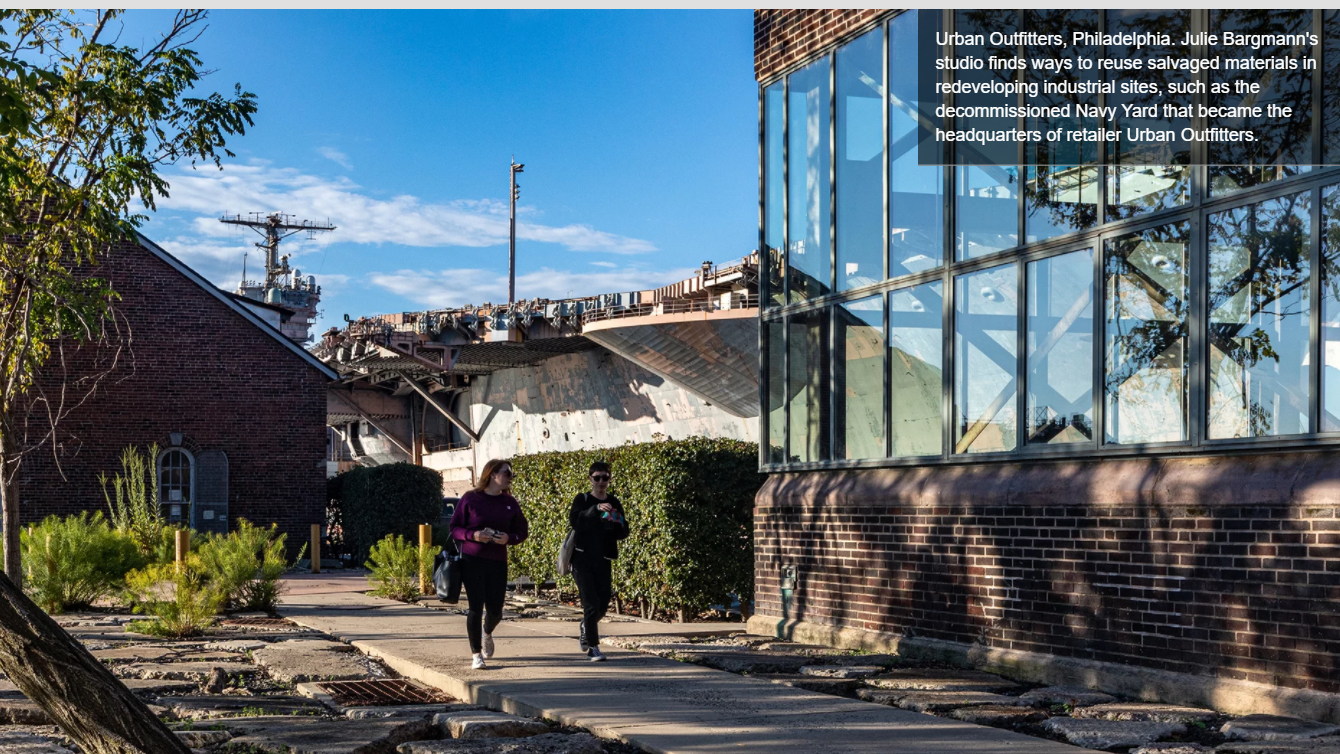
Julie Bargmann was recently awarded the Oberlander Prize in Landscape Architecture for her ground-breaking work to bring blighted land back to useful life in the heart of post-industrial cities. Her work is unique because it transforms abandoned industrial land into beautiful public space while honoring and preserving its history. She brings new meaning to the word “restoration.” She does not begin by destroying functional landscapes. She provides a model for a new approach that is particularly important to underserved inner-city communities. I live in Oakland, where I see many such opportunities to restore public land to useful life without the scorched-earth strategies commonly used by ecological “restorations.”
Julie Bargmann projects. Source: NPR News Hour
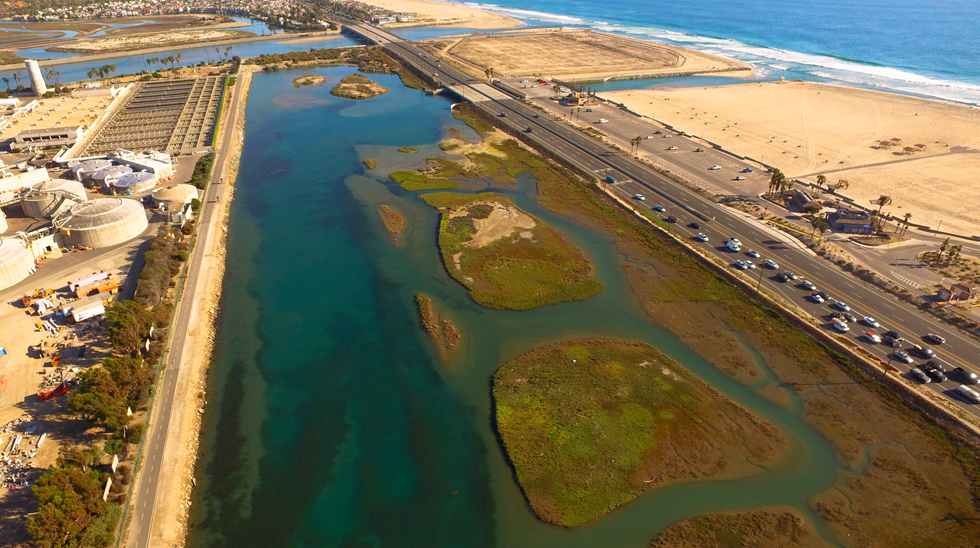
When ecological restorations are funded without addressing sources of pollution, valuable resources are often wasted. The recent oil leak from an oil platform off the coast of Southern California is a case in point. Millions of dollars were spent restoring a wetland that was doused with oil for the second time. Yet, some of the oil platforms in California waters are no longer productive, but have not been safely decommissioned. This is putting the conservation cart before the horse.
We are about to make enormous investments in the expansion of wetlands, as we should. At the same time, we should address the sources of pollution that will despoil those wetlands, such as many miles of impaired waters in the watersheds that drain into the wetlands. For example, the draft touts seagrasses as carbon sinks and acknowledges pollution as one of the major threats to seagrass: “The leading causes of seagrass loss are nutrient pollution, poor water clarity, disease, and disturbance.”
At every turn, climate smart solutions should stay focused on the underlying causes of problems in the environment, rather than cosmetic solutions that don’t address those causes. Quibbling about whether or not marsh grass is native or non-native is like arguing about the color of the lifeboat. Let’s focus on whether or not a landscape is functional as a carbon sink.
In conclusion
The draft gives me hope that the State of California can do something useful with our tax dollars to address climate change without damaging the environment further. The draft shows the influence of learned hands with good intentions. Now let’s see specific projects funded that are consistent with the goals defined by the draft. That’s where the rubber meets the road.
In September 2016, the State of California passed a law that allocated $1.2 billion to create a cap and trade program to reduce Greenhouse Gas (GHG) emissions. The California Natural Resources (CNR) Agency was allocated $80 million to fund green infrastructure projects that reduce GHG emissions. The CNR Agency is creating an Urban Greening Program to fund grants to cities, counties, and other entities such as non-profit organizations in URBAN settings. 75% of the funding must also be spent in economically disadvantaged communities.
These grants must reduce GHG emissions using at least one of these specific methods:
Sequester and store carbon by planting trees
Reduce building energy use from strategically planting trees to shade buildings
Reduce commute, non-recreational and recreational vehicle miles travelled by constructing bicycle paths, bicycle lanes, or pedestrian facilities.
Clearly, planting trees is one of the primary objectives of this grant program. That sounds like good news for the environment and everyone who lives in it until you read the draft program guidelines which are available HERE.
Unfortunately, as presently drafted, the grant program will NOT increase California’s urban tree canopies, because the program requires the planting of “primarily” native trees. That requirement is explicitly stated several times in the draft guidelines, but there are also places in the draft where the reader might be misled to believe the requirement applies only to plants and not to trees. Therefore, I asked that question of the CNR Agency staff and I watched the public hearing that was held in Sacramento on October 31st. CNR Agency staff responded that the requirement that grant projects plant “primarily” native species applies to both plants and trees.
The good news is that the grant program guidelines are presently in draft form and the public has an opportunity to comment on them. If you agree with me that we need our urban forest, you will join me in asking the CNR Agency to revise their grant program guidelines to remove restrictions against planting non-native trees. Public comment must be submitted by December 5, 2016. Send comments to: Urban Greening Grant Program c/o The California Natural Resources Agency Attn: Bonds and Grants Unit 1416 Ninth Street, Suite 1311 Sacramento, CA 95814 Phone: (916) 653-2812, OR Email: urbangreening@resources.ca.gov Fax: (916) 653-8102
Here are a few of the reasons why limiting trees to native species will not increase tree canopies in urban areas in California:
Many places in California were virtually treeless prior to the arrival of Europeans. Non-native trees were planted by early settlers in California because most of our native trees will not grow where non-native trees are capable of growing. According to Matt Ritter’s California’s Guide to the Trees Among Us, only 6% of California’s urban trees are native to California:
Draft guidelines for the Urban Greening grants refers applicants to the California Native Plant Society for their plant palette (see page 24 of guidelines). If applicants use this as the source of their plant palate, they will find few trees on those lists. This is another way to understand that if you want trees in California, most of them must be non-native.
Most California native trees are not suitable as street trees because of their horticultural requirements and growth habits.
The approved list of street trees for the City of San Francisco includes no trees native to San Francisco. There are many opportunities to plant more trees in San Francisco because it has one of the smallest tree canopies in the country (12%). The US Forest Service survey of San Francisco’s urban forest reported that 16% are eucalyptus, 8% are Monterey pine, and 4% are Monterey cypress. None of these tree species is native to San Francisco.
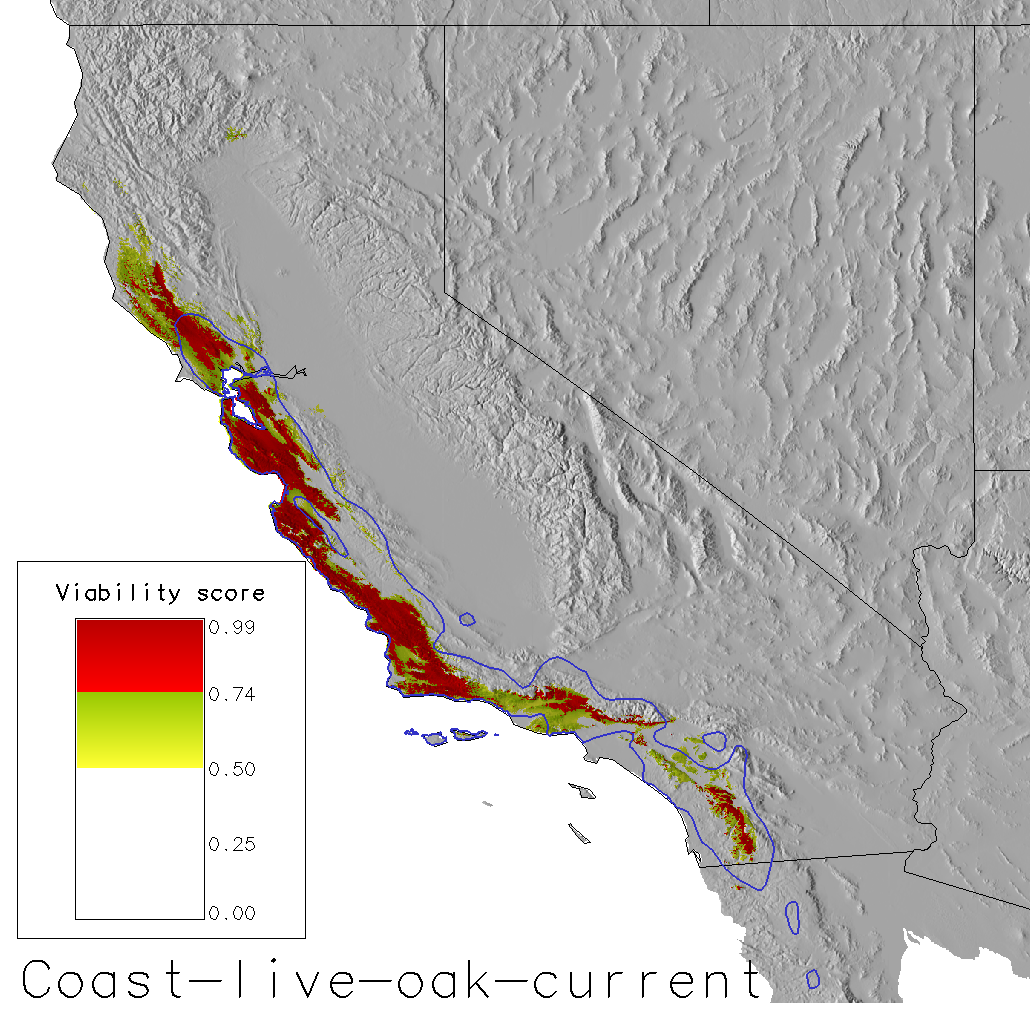
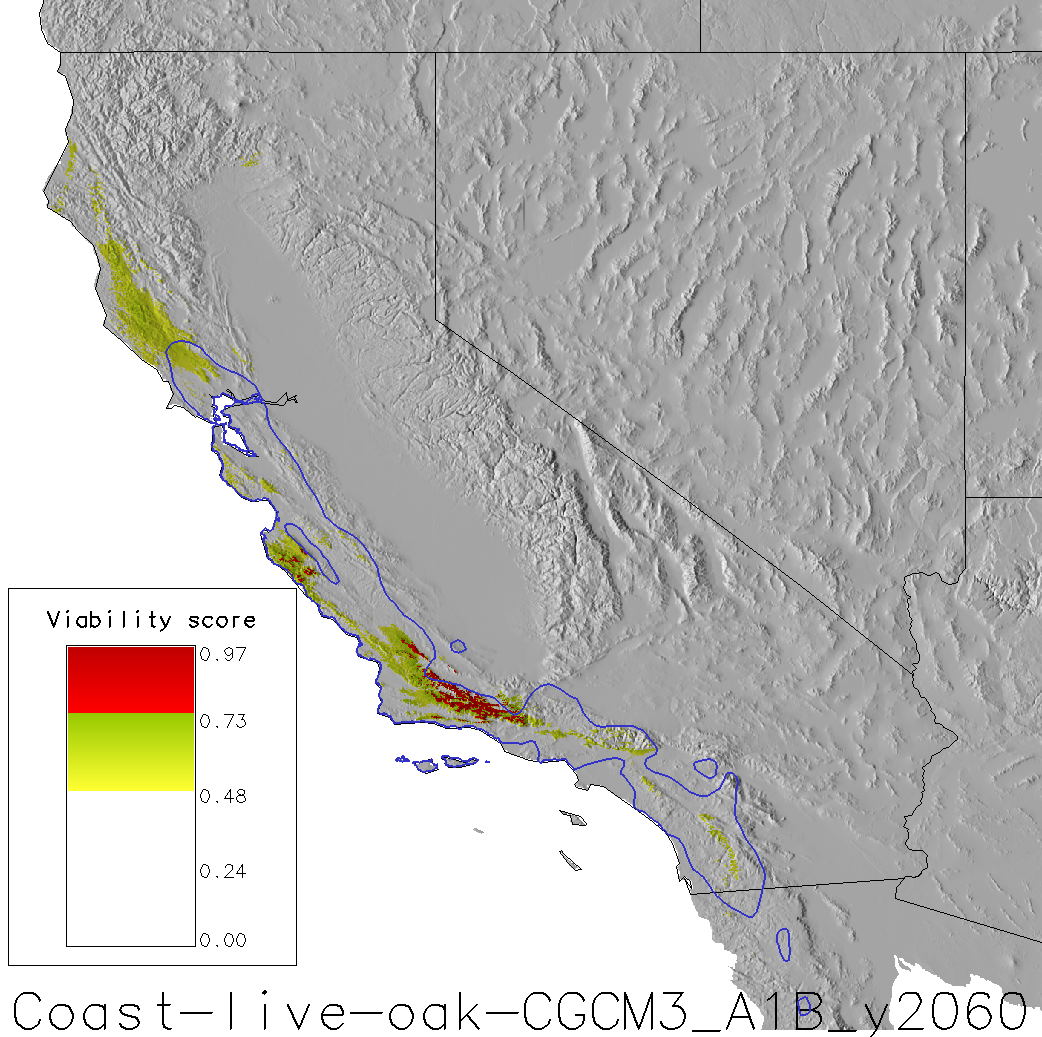
The approved list of street trees for the City of Oakland includes 48 tree species of which only two are natives. Neither seem appropriate choices: (1) toyon is a shrub, not a tree and the approved list says it will “need training to encourage an upright form.” It is wishful thinking to believe that toyon can be successfully pruned into a street tree; (2) coast live oak is being killed by the millions by Sudden Oak Death and the US Forest Service predicts coast live oaks will be virtually gone in California by 2060.
Climate change requires native plants and trees to change their ranges if they are to survive. One of the indicators of the impact of climate change on our landscapes is that 70 million native trees have died in California because of drought, insect infestations, and disease. The underlying cause of these factors is climate change.
66 million native conifers have died in the Sierra Nevada in the past 4 years because of drought and native bark beetles that have spread because winters are no longer cold enough to keep their population in check. Update: A new survey of California’s trees now reports that 102 million trees are now dead. That’s one-third of California’s trees. 62 million trees died in 2016 alone, which is an accelerating rate of death. These trees are still standing and they pose an extreme fire hazard. These are NATIVE TREES being killed by a combination of drought and NATIVE BARK BEETLES.
5 million native oaks have died since 1995 because of Sudden Oak Death. A study of SOD by University of Cambridge said in spring 2016 that the SOD epidemic is “unstoppable” and predicted that most oaks in California would eventually be killed by SOD. The Oak Mortality Task Force reported the results of its annual survey for 2016 recently. They said that SOD infections increased greatly in 2016 and that infections that were dormant in 2015 are active again. This resurgence of the pathogen causing SOD is caused by increased rain in 2016.
Scientists predict that redwood trees will “relocate from the coast of California to southern Oregon” in response to changes in the climate.
If you care about climate change, please join us in this effort to create a grant program that will expand our urban forests and reduce the greenhouse gas emissions that are causing climate change. Restrictions against planting non-native trees must be removed from grant guidelines in order to increase our tree canopies in California’s urban environments.
Update: Final guidelines for California State Urban Greening grant applications were published on March 1, 2017, and are available HERE. That program will distribute $76 million to cities that reduce greenhouse gas emissions by planting trees or reducing fossil fuels emissions. The deadline for grant applications is May 1, 2017. There will be a workshop for applicants at the Lake Temescal Beach House (6500 Broadway, Oakland) on March 27, 2017.
Final guidelines are improved from the draft guidelines. Draft guidelines would have required applicants to plant only native trees. The State agency received 62 public comments on the draft. 27 of those comments asked that the guidelines be revised to permit planting non-native trees as well as native trees. One of the 27 comment letters was signed by 33 tree-advocacy non-profit organizations.
Final guidelines reflect the public’s opposition to prohibiting the planting of non-native trees, which would have severely limited the number of trees that would survive. Native trees have specific horticultural requirements that limit the places where they can be planted.
Final guidelines now say that only “invasive” trees cannot be planted by grant projects. If the granting agency uses the classification of the California Invasive Plant Council to determine “invasiveness,” applicants would not be allowed to plant 15 specific tree species. However, the California Invasive Plant Council is revising its inventory of “invasive” plants, so we don’t know if the number of “invasive” trees will be increased by that revision.
Update #2: The California Invasive Plant Council has published the proposed revision to its list of “invasive” species. There were about 200 plants on the existing list. Now they propose to add another 99 species. Ten of those species are added based on their current impacts in California. One of the ten is a tree (glossy privet). 87 of the species are proposed for addition “based on risk of becoming invasive” in the future in California. Twelve of the 89 potentially invasive plants are trees.
There were 15 trees on the original list of “invasive” species. That means that the revised list of “invasive” trees will now include a total of 28 trees that cannot be planted by Urban Greening projects that are applying for grant funds.
The revised inventory of “invasive” plants was just published. Public comments can be submitted on the proposed revisions by May 8. The proposed revisions and how to make comments on the proposal are available HERE.
Personally, I object to the introduction of a new category of 89 plants that are not presently having any “impact” according to Cal-IPC but are predicted to in the future. These revisions will increase the inventory of “invasive” plants by 50%. It represents a significant escalation of the crusade against non-native plants in the California.
Nativist bias is not entirely absent from the revised guidelines for the Urban Greening program. Applicants are required to explain why they plan to plant non-native trees. However, applicants are also required to have a certified arborist or comparable horticultural expert certify that the plant list is appropriate to the planting location. Hopefully, that will prevent the wasteful planting of native trees where they will not survive.
We believe that addressing climate change should be our highest environmental priority because it is the cause of many environmental problems. For example, a recent study found that changes in climate accounted for over half of the significant changes in vegetation all over the world in the past 30 years: “The climate governs the seasonal activity of vegetation…In humid mid-latitudes temperature is the largest influencing factor in plant growth. In predominantly dry areas, however, it is the availability of water and in the high altitudes incident solar radiation.” (1) Animals are affected by both changes in vegetation and climate, as exemplified by the shrinking home of the polar bear as Arctic ice melts.
The consensus amongst scientists is that increases in greenhouse gas emissions are the primary cause of climate change and carbon dioxide is the predominant greenhouse gas. Although the burning of fossil fuels is often considered the biggest source of greenhouse gas emissions, in fact transportation is responsible for only 10% of emissions. In contrast, deforestation is contributing 20% of greenhouse gas emissions because trees store carbon as they grow and release it into the atmosphere as carbon dioxide when the tree is destroyed. For that reason—and many others– we are opposed to the destruction of our urban forest.
Mount Sutro Forest is threatened with destruction because it is not native. Courtesy Save Sutro Forest.
Because our urban forest is predominantly non-native, native plant advocates are committed to defending the projects that are destroying the urban forest, which puts them in the awkward position of claiming that its destruction will not contribute to climate change. Here are a few of the arguments used by native plant advocates and the scientific evidence that those arguments are fallacious:
Since the native landscape in the Bay Area is grassland and scrub, native plant advocates often claim that these landscapes store more carbon than trees. In fact, trees store far more carbon than the native landscape because carbon storage is largely proportional to biomass. In other words, the bigger the plant, the more carbon it is capable of storing. (Carbon storage in plants and soils is explained in detail here.)
In the Draft Environmental Impact Report for San Francisco’s Natural Areas Program, native plant advocates claimed that destroying the forest and restoring grassland would lower ground temperatures based on a scientific study about the arctic north at latitudes above 50°. In fact, the point of that study was that snow reflects more light than trees. The Bay Area is far below 50° latitude and it doesn’t snow here, so that study is irrelevant to the Bay Area. (That study and its misuse by native plant advocates are reported here.)
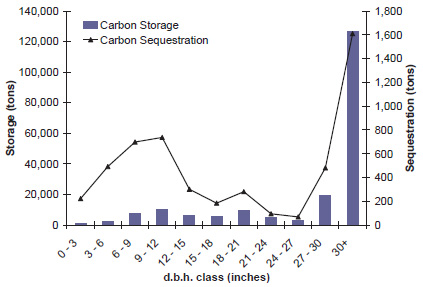
Since most of the urban forest in the Bay Area was planted over 100 years ago, native plant advocates often claim that only young trees store carbon. Since carbon storage is largely proportional to biomass, mature trees store more carbon than small young trees. That is illustrated by this graph from the US Forest Service survey of San Francisco’s urban forest.
Larger trees store more carbon at a faster rate
The claim that young trees store more carbon is often made in connection with the equally bogus claim that “restoration” projects in the Bay Area will replace non-native trees with native trees. None of the plans for these projects propose to plant native trees where non-native trees are destroyed because that wasn’t the native landscape. In any case, native trees don’t tolerate the windy, dry conditions in which non-native trees are growing. For example, a study of historic vegetation in Oakland, California reported that only 2% of pre-settlement Oakland was forested with trees. (2)
A new study about carbon storage in forests
Now that science has established the reality of climate change, most scientific inquiry has turned to how to stop it and/or mitigate it. For example, a recent study reports that planting forests where they did not exist in the past, quickly stores far more carbon in the soil than the treeless landscape. Scientists “…looked at lands previously used for surface mining and other industrial uses, former agricultural lands, and native grasslands where forests have encroached….[they] found that, in general, growing trees on formerly non-forested land increases soil carbon.” (3)
Here are their specific findings on each type of previously non-forested land:
“On a post-mining landscape, the amount of soil carbon generally doubled within 20 years and continued to double after that every decade or so.”
“The changes after cultivation of farm fields was abandoned and trees became established are much subtler, but still significant…at the end of a century’s time, the amount of soil carbon averages 15 percent higher than when the land was under cultivation…”
“In places where trees and shrubs have encroached into native grassland, soil carbon increased 31 percent after several decades…”
Mainstream environmental organizations such as the Sierra Club claim to be concerned about climate change, yet they are the driving force behind the destruction of the urban forest in the San Francisco Bay Area. When will they wake up to the fact that advocating for the destruction of the urban forest is irresponsible for an environmental organization in the age of climate change?
*******************************
(1) “A Look at the World Explains 90 Percent of Changes in Vegetation,” Science Daily, April 22, 2013.
(2) Nowak, David, “Historical vegetation change in Oakland and its implications for urban forest management,” Journal of Arboriculture, 19(5): September 1993
(3) “Soils in Newly Forested Areas Store Substantial Carbon That Could Help Offset Climate Change,” Science Daily, April 4, 2013.
We are reprinting, with permission, an article on the website of the San Francisco Forest Alliance about the many ecological functions performed by our urban forests and the plans of the Natural Areas Program to destroy over 18,500 mature, healthy trees. Please visit the website of the Forest Alliance to read about their efforts to save the urban forest in San Francisco from needless destruction.
**************************************
Urban trees are hugely important, not just for their beauty, but for environmental reasons. The [Natural Areas Program’s] NAP’s SNRAMP plans to cut down 18,500 trees (and a whole lot more under 15 feet in height, plus whatever is lost to wind-throw when the wind-break of the other trees is gone).
Source: USDA Report, Assessing Urban Forests Effects and Values, 2007
What are these 18,500++ trees doing for us? Here are nine ways in which urban forests help us.
The Nature Conservancy's Carbon equivalence graphic
Storing Carbon. Trees store carbon and keep it out of the atmosphere. The bigger the tree, the more it stores. CLICK HERE for a 3-minute video from the Nature Conservancy about the carbon stored by a red oak tree that’s 18 inches in diameter. Eucalyptus may store even more, because it grows taller than a red oak and is more dense (Eucalyptus, around 50 lbs/cu ft; red oak, about 41).
Providing Oxygen. Trees produce more oxygen than they use. When they’re felled, they decay and use oxygen instead of making it.
Trapping and removing air pollution. Tree leaves capture air pollution, and help clean our air. The trapped pollution stays on the leaves or falls to the ground – where we don’t have to breathe it.
Golden Gate Park - in the beginning (abt 1880)
A windbreak. In its pre-European state, San Francisco was a place of windblown sand that got into everything from railway tracks to people’s lungs. With a city and a major park atop the former dunes, we don’t have to worry about sand so much, but the wind still sweeps across our city. The eucalyptus forests and other trees act as a windbreak, and improve the micro-climates not only of the forest, but of surrounding areas.
Buffering noise. Trees absorb sound, in much the way that fabrics and soft materials do. Once they’re felled, everything becomes noisier. Thinning a forest lets in the sounds of the city and its traffic. When Laguna Honda Hospital felled some 200 trees in conjunction with its new building, neighbors in Forest Knolls and Midtown Terrace noticed increased noise.
Slowing runoff. When it rains, the roots of the trees, and the duff made by their shed leaves and the understory beneath them, soaks it up like a sponge. Then it slowly lets it out again, allowing plants and vegetation to use it over time, replenishing ground water, and fighting erosion. (If you want to see the difference – drive by Christopher, below Mount Sutro, during heavy rain – and then drive up Twin Peaks Boulevard. The latter’s like a river when it’s pouring.) [See “Rainfall Interception” data from USDA]
Preventing erosion. Many of these trees grow on very steep slopes, and below them are our neighborhoods. Their roots function now like a geo-textile, holding the slopes in place – particularly in forest areas, where the roots are intermeshed and intergrafted. On Twin Peaks, where the vegetation is thinner, landslips occur every season of heavy rain. In Forest Knolls, clearing of slopes below the houses has resulted in landslides requiring months of tarping to stabilize them. This is a particularly insidious problem; it may take 6-8 years for the root system to die and decay, and by then the homeowner may not even know or recall that trees once held the slope together.
Provide habitat. Trees provide cover, places to perch and hide, and food by way of nectar and leaves and the insects attracted to the trees. Eucalyptus, in particular, flowers in winter providing nectar for bees, butterflies, and birds – and attracting birds that prey on these insects. It’s a nesting site for owls and hawks and feral bees, and a hunting ground for birds small and large. Our city would have far fewer birds, animals, and bees without these trees.
Boost property values. People like trees. Homes near forested areas are valued by owners and potential buyers. Realtors often mention these settings in their listings. Some studies show mature trees nearby can add up to 30% to property values.




 Preventing erosion. Many of these trees grow on very steep slopes, and below them are our neighborhoods. Their roots function now like a geo-textile, holding the slopes in place – particularly in forest areas, where the roots are

 Conservation Sense and Nonsense