Eradication of marsh grass on East and West Coasts doesn’t make sense

New York State agencies have been trying to destroy the Piermont Marsh since 2013, because most of the marsh grass is not native. Piermont Marsh is adjacent to the small village of Piermont on the west side of the Hudson River, less than 30 miles north of New York City.
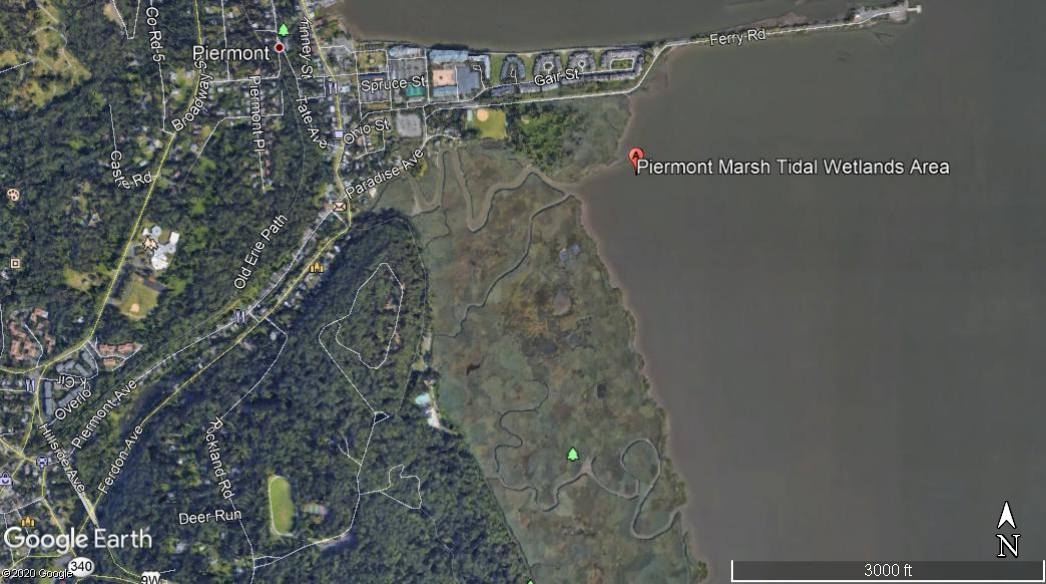
The community of Piermont organized to prevent the destruction of their marsh for two reasons:

  • They believed that the marsh had protected them from the devastating storm surge caused by Hurricane Sandy in 2011. The village sustained damages of $11.8 million in that storm, but villagers believed it would have been much worse without the protection of the marsh.
  • The initial plan to eradicate 200 acres of non-native phragmites proposed the use of herbicides to kill the marsh grass. The villagers were concerned about large quantities of herbicides being sprayed into their waterways.
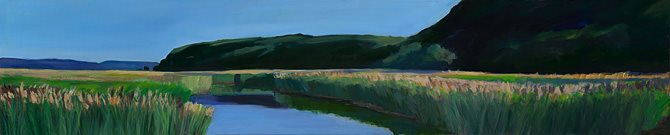
The Piermont Marsh is also very beautiful.

I have followed the attempt to save the Piermont Marsh because it is nearly identical to our West Coast version of the same issue.  Non-native spartina grass has been nearly eradicated on the entire West Coast using herbicides over the past 15 years.  After witnessing the unintended consequences of the eradication of spartina, I was sympathetic to the community of Piermont and hopeful that their organized resistance might be successful.

Opposition to the proposed project to destroy the Piermont Marsh has accomplished a great deal.  The first round of public comment and negotiation resulted in a reduction in the size of the project from 200 acres to 40 acres.  The Piermont community was also given a commitment to conduct an analysis of the damage done to the village by the destructive storm surge in the 2011 hurricane Sandy to determine the role the marsh played in protecting the village from even greater damage.

The scientist who conducted that study reported the results of the study in July 2020.  He concluded that “the presence of the Marsh is estimated to have avoided $902,000 worth of property damage and loss.” (1) He made other significant observations:

  • The native marsh grass that the project wishes to restore does not provide as much storm protection in the spring: “Typha [the native species of marsh grass] shows far more seasonal variation than phragmites.  Unlike phragmites, which maintains its height and density year-round, Typha is shorter and sparser in the spring.” (1)
  • The scientist predicted that by 2100 the Piermont Marsh will likely be overwhelmed by sea level rise. Whatever vegetation is at the Piermont Marsh, it will be gone within 80 years.

For the moment, the Piermont Marsh project is on hold:  “[The plan] will be redrafted and the new draft should be presented to the public in 2021.” (1) Meanwhile, herbicides will not be used in the marsh and experiments will be conducted to kill marsh grass by covering it with a geotextile that deprives the vegetation of light.  However, project managers have not made a commitment to avoid herbicides in the future.

Based on my experience with opposition to such destructive projects,  delays are often ultimately victories.  Funding priorities often change and more scientific information becomes available to inform a better decision.  For example, the current draft plan contains outdated information about glyphosate.  It claims that “Glyphosate is a non-selective, systemic herbicide that controls weeds by inhibiting a specific pathway for amino acid synthesis that is unique to plants and not present in animals.”

We now know that the claim about a “unique pathway” for glyphosate existing only in plants is not true.  In 2020, plaintiffs in a class-action suit against Monsanto alleging that it falsely advertised that the active ingredient in Roundup only affects plants were awarded $39.5 million.  The settlement also requires that the inaccurate claim be removed from the labels of all glyphosate products: “…[plaintiff] says Monsanto falsely claimed through its labeling that glyphosate, the active ingredient in Roundup, targets an enzyme that is only found in plants and would therefore not affect people or pets. According to the suit, that enzyme is in fact found in people and pets and is critical to maintaining the immune system, digestion and brain function.”

In defense of phragmites

According to a study conducted in 2017, phragmites is playing the same ecological roles as their native predecessors:

“An invasive species of marsh grass that spreads, kudzu-like, throughout North American wetlands, may provide similar benefits to protected wetlands as native marsh grasses. According to new research from North Carolina State University, the invasive marsh grass’s effects on carbon storage, erosion prevention and plant diversity in protected wetlands are neutral… studies have shown that Phragmites may help reduce shoreline erosion in marshlands and store carbon at faster rates than native grasses…The team found no significant differences between ecosystem services of the marshes they studied, indicating that Phragmites’ effect was largely neutral.” 

Land managers and contractors have been trying to eradicate phragmites in the Delaware River and its estuary for nearly 40 years.  Although the contractors are still committed to that project, critics are getting louder and scientists are finding more evidence of the benefits of phragmites.  It is no longer clear that eradicating phragmites is possible, nor is it clear that it would be beneficial.

Rising sea levels as ice melts in warmer temperatures are bringing the benefits of phragmites into focus:  “Some scientists have been arguing that phragmites…could be a key line of defense against rising sea level, particularly in areas like the Mid-Atlantic where land is sinking while water continues to rise… Research from 20 years ago found that phragmites help marshes elevate faster than some other plants…”

The herbicides used to kill phragmites are aerial sprayed from helicopters, killing both native and non-native plants, resulting in barren mudflats that are more vulnerable to erosion:  “The herbicide treatment of phragmites can also mean other native plants become casualties in the process, leaving an unvegetated landscape behind. With no plants to hold sediment in place, an open mudflat can be extremely vulnerable to flooding in the face of storms or unsuccessful regrowth… ‘You know, the Phrag marsh is certainly a whole lot better than no marsh,’ [a Rutgers scientist] said.”

Trying to eradicate phragmites no longer makes sense.  So why is it continuing to happen?  A Rutgers marine biologist explains:   “Well, might I say…there’s a whole army of environmental consultants that get paid to remove phragmites and don’t get paid to leave it alone.”  That is really the heart of the matter.  The projects are designed to create jobs and apply for government funds, not to protect the environment.

The West Coast version of marsh grass eradication

If the word “spartina” is substituted for the word “phragmites” the Piermont Marsh project and the questions it raises apply to similar projects on the West Coast.  For over 15 years, non-native spartina marsh grass has been eradicated using herbicides along the entire West Coast.  The result of spartina eradication projects on the West Coast is also barren mud shoreline that is poisoned with herbicide and miles of coastline that is vulnerable to rising sea levels and erosion.

The Ridgway Rail was collateral damage of the spartina eradication project. The population of this endangered bird plummeted because its nesting habitat was destroyed.

There is another similarity between the East Coast and West Coast versions of eradicating marsh grass.  Like the native typho (cattail) that is the goal of the East Coast project, native spartina that was the goal of the West Coast project is inferior protection of the coastline against storm surges.  The native species of spartina on the West Coast that was the theoretical goal of the eradication project is shorter and less dense than the non-native species.  It also dies back in the winter, unlike the non-native species that persists throughout the year.  In other words, the native species does not provide the same protection for the shoreline that is provided by the non-native species.  In any case, plantings of the native species failed in the poisoned ground, so its benefits claimed by the project are entirely irrelevant.

These eradication projects don’t make any more sense on the West Coast than their mirror image on the East Coast. 


  1. The Piermont Marsh Alliance Report on July 16 Webinar regarding Piermont Marsh
Baseless generalizations in Doug Tallamy’s Nature’s Best Hope

Doug Tallamy’s latest book, Nature’s Best Hope, continues his crusade against non-native plants.  He now calls invasive plants “ecological tumors.”  You might be tempted to respond that invasive plants are a small subset of non-native plants until you realize that Tallamy calls 3,300 plant species in North America “invasive.”  There are approximately 6,500 species of native plants in California, which reminds us that introduced plants are often a significant portion of our urban landscapes.  The title of Tallamy’s book is a misnomer.  Nature is not confined to native plants, as Tallamy wishes it to be.

Tallamy makes no meaningful distinction between “invasive” and “non-native.”  The classification of berry-producing non-native plants as “invasive” is a case in point.  Although Himalayan blackberries are invasive, most other berry-producing non-natives in California are not.  Cotoneaster, pyracantha, and holly are a few examples of berry-producing plants being eradicated in the Bay Area that are not inherently “invasive.”  They spread because birds eat the berries and deposit the seeds elsewhere.

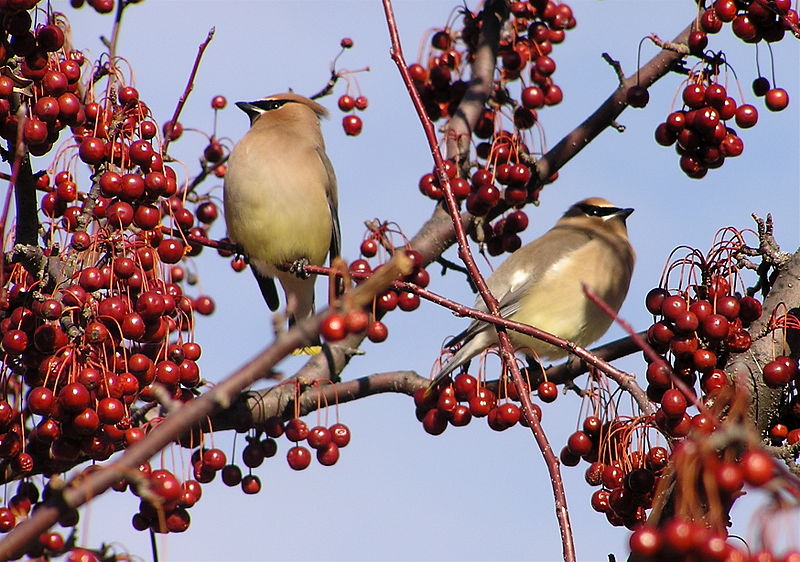
Cedar Waxwings in crab apple tree. Wikimedia Commons

Eradicating berry-producing plants deprives birds of an important source of food.  If herbicides are used to kill the plant, the birds are also exposed to harmful chemicals, known to reduce reproductive success and cause other sub-lethal health issues in wildlife. In the case of Himalayan blackberries, they are frequently eaten by children and adults, who are then exposed to the herbicides used to kill the shrubs that are often widespread in our parks and open spaces.  San Francisco’s Recreation and Park Department sprayed blackberries in San Francisco’s parks and open spaces 23 times in 2019.

Tallamy and his nativist allies claim that native plants are beneficial to wildlife, especially birds.  How can they claim that eradicating berry-producing plants benefits birds?  They do so by claiming that native berries are more nutritious than non-native berries.  In particular, they claim that native berries contain more fat than sugar and that migrating birds require berries with high fat content.   Tallamy cites one study in support of that claim, a study that compared fat and sugar levels in the berries of 9 species of plants in the Northeast, 5 native species and 4 introduced species.  They found that the native species they analyzed had more fat content than the introduced species they analyzed. (1)

Generalizations unsupported by evidence

From that single study of nine plant species, Tallamy generalizes that berries of plants that are considered native in Asia are less nutritious for migrating birds than the berries of native plants in North America are. (None of the nine plant species studied occurs in California.)  Does that generalization make sense?

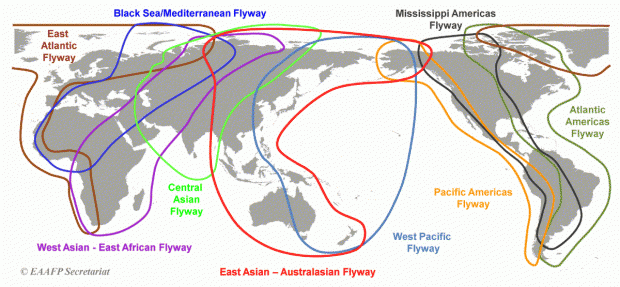
  • Tallamy does not provide any evidence that there are fewer migratory birds in Asia, or that the nutritional needs of migratory birds in Asia are different than those in North America. In fact, looking at the migratory patterns of birds confirms that migratory routes of birds span several continents.  The intercontinental flights of birds sometimes span both Asia and North America.  There is no logical or evidentiary explanation for berries of native plants in Asia being uniformly less nutritious than native plants in North America.
  • However, Tallamy offers evidence of the similarity between plants in Asia and closely related plants in North America. Wooly adelgids quickly made a transition to native hemlocks when they arrived in North America from Asia because its native host in Asia is closely related to the American native.  The adelgid has “all but eliminated hemlocks” in America, according to Tallamy.  The emerald ash borer has killed millions of ash trees in America when it arrived from Asia, where its native host was closely related.  On one hand, Tallamy claims that native plants in America are unique, completely different from plants in Asia, yet he recognizes that insects from Asia rapidly adapt to closely related host plants in America.
  • Asian species are not so foreign to America as Tallamy wishes us to believe. There are relicts of vegetation that extended completely around the Northern Hemisphere about 50 million years ago that were broken up by a combination of mountain-building and climate change. Tree of Heaven, Gingko, and Dawn Redwood, now considered introduced trees from Asia, occurred here naturally during that geologic period.  Tallamy says we must confine our choices to plants that “share an evolutionary history.”  In fact, many plants now considered non-native shared an evolutionary history with plants now considered native. Trees are time travelers, marching to the beat of the Earth’s geologic and climate drum.  Now they must be on the move to survive our changing climate.  We should not stand in their way.

Such generalizations unsupported by evidence are typical of Tallamy’s work.  In “Native plants improve breeding and foraging habitat for an insectivorous bird,” Tallamy and his collaborators conclude, “We demonstrate that residential yards dominated by nonnative plants have lower arthropod abundance…that function as population sinks for insectivorous birds.”  The data provided do not support such a broad generalization.  They studied one species of bird, in one geographic location, in a short period of time.  They inventoried arthropods for two years in a single month time-frame.  They quantify only one variable (plant foliage biomass) in addition to the nativity of plants, the abundance of insects, and the breeding success of one bird species.  They have not taken into consideration intervening variables such as variations in temperature, rainfall, pesticide use, etc.  The bird species studied is abundant within its range.  Its conservation status is “Least Concern.”  The abundance of this bird species does not justify the dire predictions of Tallamy’s study.

In conclusion

I have focused on just one of the many controversies discussed in Doug Tallamy’s new book.  I haven’t touched on the two most fundamental errors in Tallamy’s work:

  • Tallamy underestimates the speed of adaptation and evolution. There is ample evidence of rapid adaptation to non-native vegetation, including Tallamy’s examples of wooly adelgid and emerald ash borer making a quick transition to North American native trees after arriving from Asia.
  • He exaggerates the degree of specialization among insects. For example, he claims that 30% of native bees are “host-plant specialists,” yet Bees of the World (Michener, Johns Hopkins University) estimates a global average of 9% of bee species use plants within the same genus and it is “exceedingly rare” for bee species to be confined to only one plant species.

We have explored those issues in Tallamy’s work in previous articles:

  • Doug Tallamy claims that insects eat only native plants, yet his own study proves otherwise: HERE
  • Doug Tallamy claims that non-native plants are “ecological traps for birds.”  HERE is an article that disputes that theory.
  • Doug Tallamy claims that native and non-native plants in the same genus are not equally useful to wildlife, but he is wrong about that.  Story is HERE.
  • Doug Tallamy advocates for the eradication of butterfly bush (Buddleia) because it is not native.  He claims it is not useful to butterflies, but he is wrong about that.  Story is HERE.
  • Doug Tallamy publishes a laboratory study that he believes contradicts field studies, but he is wrong about that.  Story is HERE.
  • Doug Tallamy speaks to Smithsonian Magazine, Art Shapiro responds, Million Trees fills in the gaps:  HERE

(1) B. Smith, et. al., “The value of native and invasive fruit-bearing shrubs for migrating birds,” Northeastern Naturalist, 2013, 20(1): 171-84.

Open letter to Sierra Club about its racist roots and elitist policies


The Executive Director of the Sierra Club, Michael Brune, has published a mea culpa about the club’s racist roots. John Muir was the founder of the Sierra Club. He considered the Indigenous people of California despoilers of nature and was responsible for evicting them from Yosemite when it was established as a National Park. Indigenous people had lived in peace in Yosemite Valley for thousands of years and their eviction was a tragedy.

More recently, the club’s policies promoted population control in the 1960s.  In the 1990s and again in the 2000s many club members tried to force the club to adopt an anti-immigration policy. The membership organized to prevent the club from adopting an anti-immigration policy and it’s time for the membership to express itself again, in support of Brune’s commitment to reverse course.

Mr. Brune apologizes for these racist policies and makes a commitment to reversing the club’s tradition of promoting the interests of wealthy, white people by investing in staff and leadership who are people of color.  I have written to Michael Brune to express my support for his commitment and make suggestions for addressing several closely related issues.  If you are a Sierra Club member, I urge you to write to Mr. Brune.  Perhaps you can make other suggestions for improving the club’s democratic functioning, as well as increasing the diversity of its membership and leadership.

Here is my letter to Michael Brune.  You can send your own letter to him at michael.brune@sierraclub.org


Michael Brune
Executive Director
Sierra Club

Dear Mr. Brune,

Thank you for making a commitment to confront the racist roots of the Sierra Club and take actions needed to broaden the club’s membership and leadership.  As a member, I am writing to ask that the club take this opportunity to address closely related issues that have turned it into the exclusive club that it is today.  The club’s policies are as much misanthropic as they are racist.

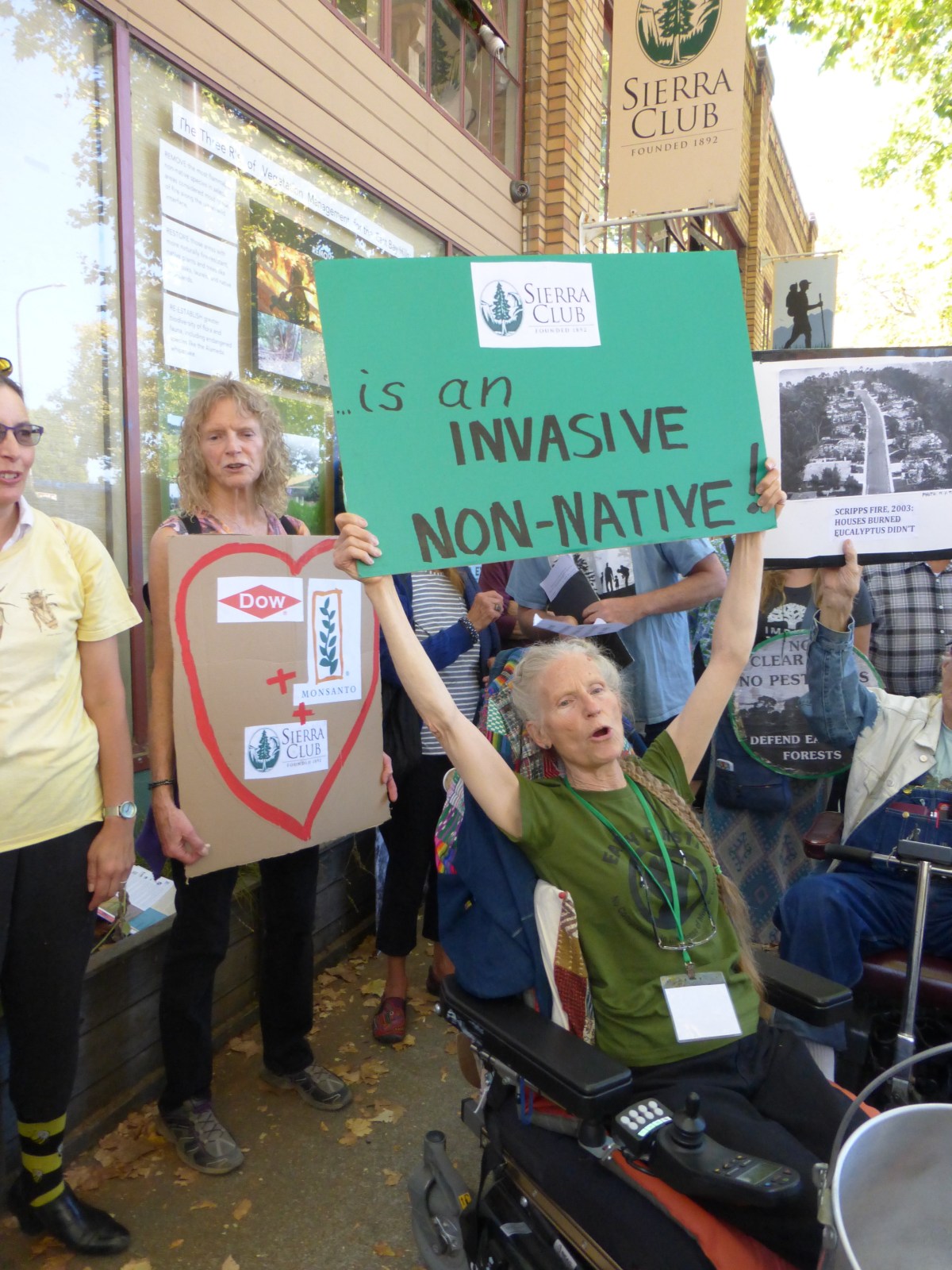
  • The club’s support for eradicating non-native plants and trees by using herbicides is a short-step away from its history of opposition to legal immigration. The connection between hatred of non-native plants and human immigrants is not lost on people of color.  High Country News recently published this thoughtful article by a young woman of Chinese descent who has suddenly realized that the demonization of non-native plants and animals is indistinguishable from similar attitudes toward human immigrants:  “Until this spring, I would have supported a concerted public effort to eradicate a threatening invasive species. But I’m no longer able to separate this environmental management strategy from the harm that the Trump administration’s insistent characterization of COVID-19 as an Asian disease has caused to Asian Americans, targeted anew for their race. I have yet to reconcile my training as an ecologist with my growing sense that what I learned reifies violent white norms far beyond the realm of natural resources.”
  • The club’s opposition to virtually every new housing project in the Bay Area serves the interests of wealthy home owners who object to greater housing density. At a time when thousands of people are living on the streets and thousands more are about to be evicted, the elected leadership of the Bay Area Chapter has become the “I’ve Got Mine Club.”  The club is as guilty of classism as it is of racism.
  • The club’s opposition to recreational use of public parks and open space is also a reflection of its elitism. The Bay Area Chapter was opposed to the proposed revision of the Recreation and Open Space Element (ROSE) of San Francisco’s General Plan because “The draft ROSE talks about the benefits of open space for physical fitness through exercise and recreation, but these one can do on city streets and in gyms.”  In the same Yodeler article, the club redefines recreation:  “…the draft [ROSE] neglects the values of respite, quiet contemplation, and undisturbed wildlife viewing…”  The club consistently demands that people be fenced out of parks because people “damage” nature and the club frequently sues to enforce its demands.  Wealthy people don’t need parks.  They can go to the gym.  The public is welcome to walk around their fenced enclosures to observe nature, to look but not touch nature.  Please visit the Berkeley Meadow to see an example of one of the many fenced pens that the club advocated for in the East Bay.

I close with specific suggestions for how the club can welcome everyone into its tent.  Complaints are most effective when accompanied by suggestions for addressing those complaints.

  • The club needs term limits for its elected leadership positions. I have closely followed the club’s policies for 30 years.  Many of the elected leaders have been in their positions for decades.  The longer they are in those positions, the more entrenched their attitudes have become.  They arrived with an agenda to which they continue to adhere.  Younger people with different perspectives are needed to inject life into the club, people who engage in active recreation and don’t own their homes, for example.
  • The club needs to improve its democratic functioning. The Chapter leadership refuses to put issues on its meeting agenda with which it does not agree.  There must be some mechanism for members to influence club policies.  When the club takes a position on a specific local policy issue, it has an obligation is hear from both sides first.  The club does not do its due diligence before making such policy decisions.
  • The club needs more scientists and fewer lawyers. When the club takes a position on a complex environmental issue, it has an obligation to be accurate about the information it uses in its public comments and publications.  For example, fundamental and elementary errors are made by the club when advocating for the use of pesticides.

I wish you the best of luck in addressing the weaknesses of the club that have taken decades to develop and will undoubtedly take decades to turn around.  The club has an important role to play.  It is in everyone’s interests that the club survive and be as strong as possible.  At the moment, the club wields more political power than it deserves because it is not using that power responsibly.

Sincerely,

Sierra Club Member

cc: Ramón Cruz
Sierra Club President
c/o board.liaison@sierraclub.org