
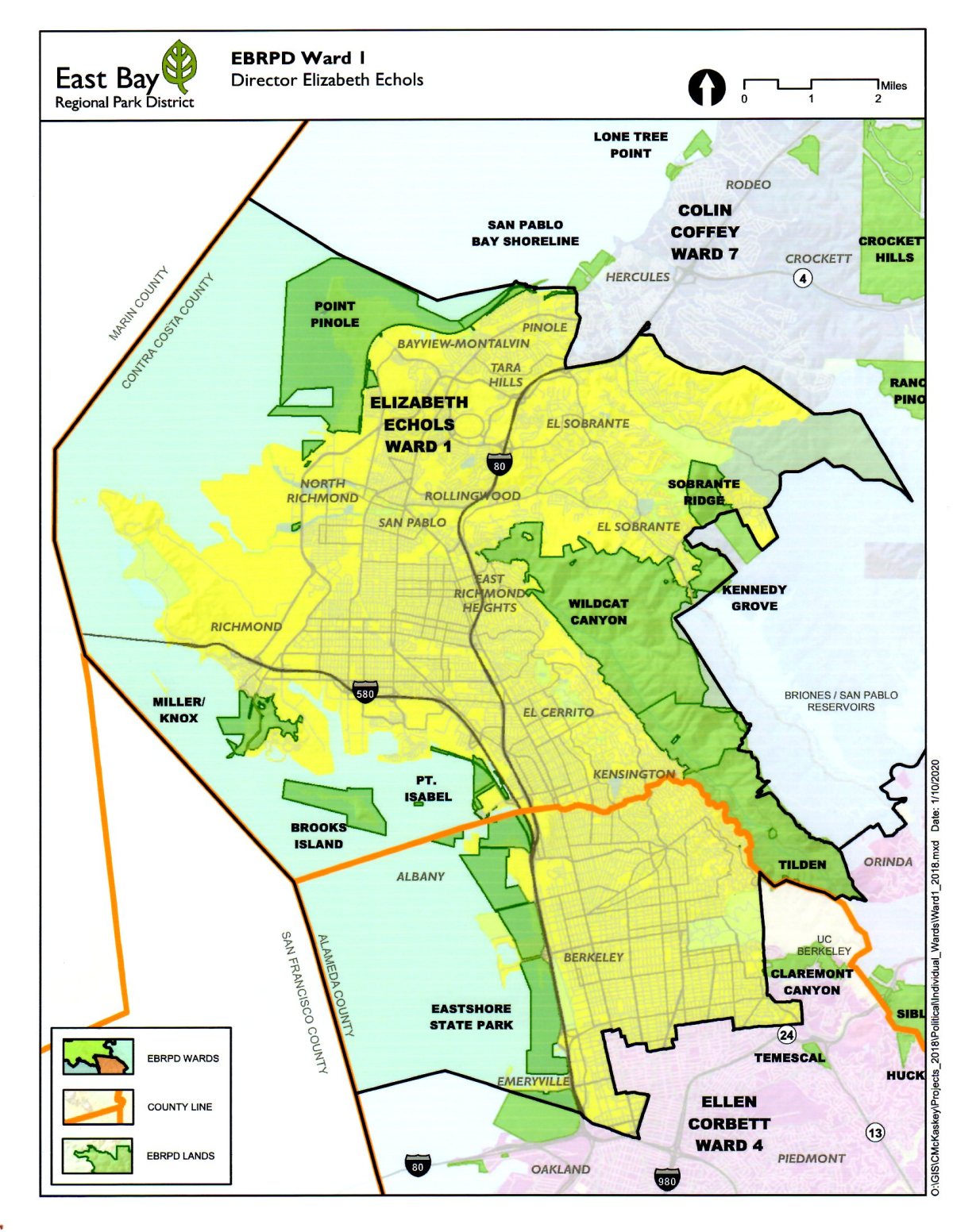
If you live in Ward 1 of the East Bay Regional Park District, you will have an opportunity to vote for your representative to the Park District’s Board of Directors on November 3rd. Many of the most heavily visited parks in the East Bay–such as Tilden Park, Point Isabel, Point Pinole, Eastshore Park–are in Ward 1. The future of those parks will be in the hands of the Board member who wins this election.
Elizabeth Echols is the incumbent who is running for election. Echols was appointed to the Board by the Board after the unfortunate death of Whitney Dotson.** Dotson had represented Ward 1 with distinction since 2008, after defeating Norman La Force in the race for that seat on the Board. Now Echols must be elected to keep her seat on the Board.*
There was intense competition for the temporary appointment to the Board when Echols was appointed by the Board. Norman La Force asked for the temporary appointment, but was not selected by the Board. La Force has a long track-record that probably explains why the Board did not appoint him:
- Norman La Force advocates for the destruction of non-native trees in East Bay Regional Parks and the use of herbicides to eradicate non-native plants and prevent trees from resprouting after they have been destroyed.
- As a lawyer and the co-founder and CEO of SPRAWLDEF, Norman La Force has sued East Bay Regional Park District many times to impose his personal vision on the parks. These lawsuits were costly to taxpayers and the Park District and they delayed the implementation of park improvements.
- Norman La Force is consistently opposed to many types of recreation. He advocates for parks that prohibit public access.
- Norman La Force has an antagonistic attitude toward park visitors who do not share his personal vision.
Norman La Force sued FEMA and the Park District to destroy all non-native trees
East Bay Regional Park District (EBRPD) is thinning non-native trees to mitigate wildfire hazards by reducing fuel loads and FEMA is funding many of these projects. Norman La Force is not satisfied with merely thinning trees. He sued EBRPD and FEMA to force the removal of all non-native trees on 3,500 acres of park land. That lawsuit is available HERE. La Force appealed after losing the lawsuit, but lost again on appeal.
Norman La Force tried to make Sierra Club endorsement of the renewal of a parcel tax to fund the Park District contingent on a commitment to destroy all non-native trees rather than thin them:
“Hence, the Sierra Club believes it is critical that in any renewal of Measure CC funding for vegetation management should be increased for the removal of non-natives such as eucalyptus and their replacement with restored native habitat. If the Park District wants to continue with a program that merely thins the non-native ecualyputs (sic) and other non-native trees, then it must find other funds for those purposes. Future tax money from a renewal of Measure CC funds should not be used to thin eucalyptus but must be allocated to the restoration of native habitat.” La Force’s full letter is available HERE.
Norman LaForce sued the Park District to prevent recreational improvements at Albany Beach
In an op-ed published by Berkeleyside, one of La Force’s many lawsuits against the Park District is described. The lawsuit attempted to prevent the construction of a path with recreational access: “SPRAWLDEF is an acronym for Sustainability, Parks, Recycling and Wildlife Legal Defense Fund. On Jan. 17, [2013] the group, founded by Norman La Force and David Tam, filed a lawsuit against the East Bay Regional Park District, opposing a plan to acquire a small strip of property along the shoreline behind the track to complete a missing link in the Bay Trail between Berkeley and Richmond. The Park District’s Plan would also add some parking to the Albany Beach area, build some wheelchair access to the water’s edge, and expand and protect the dune area behind the beach. There’s something in this lawsuit to alienate just about everyone: Bicyclists and hikers who use the Bay Trail; environmentalists with an interest in dune habitat; kayakers and kiteboarders who launch from the Albany shoreline; the ADA constituency who find beach access generally impossible; and, most of all, dogs and their owners who rely on Albany beach for a place to play in the water. Read the filing. It has all the earmarks of a spoiled child throwing a tantrum because they did not get their way.” Emphasis added.
According to this article in the East Bay Times, the SPRAWLDEF lawsuit to prevent the Albany Beach project was eventually dismissed after two unsuccessful SPRAWLDEF appeals. The Park District’s defense of the project required the preparation of a second, Supplemental EIR. Park District resources were wasted to defend the project against Norman La Force’s frivolous lawsuits.
In response to a public records request, the Park District provided this estimate of the cost of defending the District against La Force’s lawsuits regarding Albany Beach: “In total, we estimate that the attorney’s fees incurred directly as a result of the litigation filed by SPRAWLDEF relating to Albany Beach were between $321,358 and $346,358. In addition, the court ordered the Park District to pay Petitioner SPRAWLDEF $60,587.50 in attorneys’ fees as the prevailing party in the 2013 litigation.” The Park District was forced to waste nearly $400,000 of taxpayers’ money to defend its improvement project at Albany Beach. The project was needlessly delayed by the lawsuits and money that could have been used to improve parks was wasted.
Norman La Force does not want people in the parks
Norman La Force was instrumental in creating the Berkeley Meadow at the foot of University Ave. in Berkeley. The Berkeley Meadow was at one time part of the San Francisco Bay, until it was created with landfill and used as a city dump until the 1960s. Over a period of 5 years at a cost of $6 million “non-native vegetation was scraped away, then the land capped with clean fill and contoured to form naturally filling seasonal ponds.” Then the meadow was planted with native grasses and shrubs to create an “approximation of the historic landscape that might have been present a half mile inland.” The Berkeley Meadow is surrounded by a fence. Public access is restricted to two narrow, fenced trails running diagonally through the 72-acre fenced enclosure. Bicycles and people walking dogs on or off-leash are prohibited on the fenced trails.
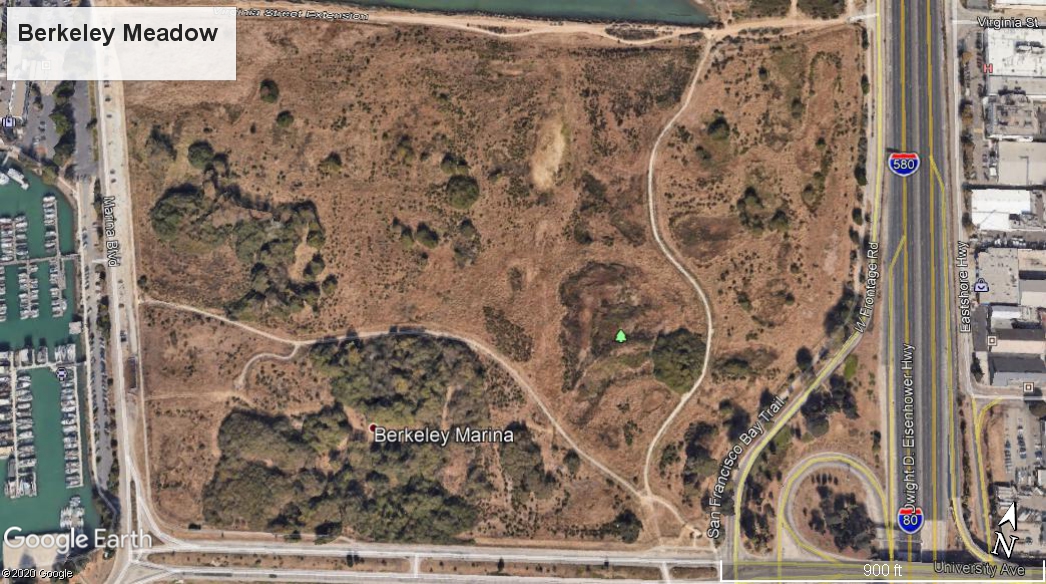
Berkeleyside described the Berkeley Meadow and contrasted it with a heavily visited adjacent park, owned by the City of Berkeley: “What you won’t see [in the Berkeley Meadow] is more than a handful of the 2 million annual state park visitors, though this prime spot is just a short bike ride from West Berkeley. The adjacent, city-owned César Chávez Park on the north waterfront gets most of the visitors along its paved trail. But here, only a few hundred yards away, the Meadow, our state park managed by the East Bay Regional Parks District, is an almost wild place, trisected by two wheel-chair accessible paths.” Indeed, the Berkeley Meadow does look wild, much like a vacant lot looks wild.
Norman La Force has a confrontational attitude toward park visitors
In his letter to FEMA objecting to the withdrawal of funding for a tree-removal project that was implemented before being authorized by FEMA, Norman La Force says that those with whom he disagrees are “like climate change deniers.” Ironically, he is defending the unauthorized clear cutting of approximately 150 trees in his letter, actions that contribute to climate change. La Force is actually the “climate change denier” in his accusatory letter. The letter is available HERE.
In an earlier letter to FEMA about the same projects, La Force begins by asking FEMA to ignore those with whom he disagrees: “We urge FEMA to discount the views of any individual or group that uses sophomoric name calling tactics in the press or in their FEMA scoping comments to categorize people or advocacy groups as ‘nativists’ (or other similar pejorative labels)…” The letter is available HERE: FEMA-DEIS for East Bay Hills predisaster mitigation – public comments
When La Force ran for the Ward 1 Board seat in 2008, Berkeley Daily Planet published an op-ed by someone who had observed Norman La Force in action. Here are a few relevant quotes from her op-ed (emphasis added):
- “La Force is not only ‘a thorn in the side of park officials,’ he is fiercely aggressive and known for vengeful acts.”
- “If La Force is elected, he will threaten the park access of every person who walks a dog, rides a horse, seeks accessible trails, and bikes on the lands of the East Bay Regional Parks. His scientific background is nothing, as he has demonstrated in public hearings many times. He has worked harder to keep humans out of parks than any other “park proponent” I know. He definitely will try to crush any “opponent,” including the disabled, the young and the elderly. Not because they are right or wrong, but because they oppose him. I urge everyone to watch their back if he’s elected.”
- “One can have honest debates about how to create urban edge ecosystems that allow both human uses and wild life to thrive together (yes, it can be done beautifully), but Norman’s rigidity will never consider other perspectives or creative solutions.”
Vote for Elizabeth Echols for the Park District Board of Directors
On November 3rd, please vote for the parks in the East Bay, not against them. Please do not install an enemy of the parks who does not want people or trees in our parks and is willing to spray our parks with herbicide to get the landscape he prefers. When we vote for President of the United States on November 3rd, we must decide who to vote for at the same time we are voting against another candidate. Both decisions are equally important.
The meetings of the Board of Directors of the Park District are open to the public. They are collegial events in which the Board works cooperatively with the staff and the public is treated with respect. The Park District does not deserve to have a “spoiled child throwing a tantrum” imposed on them, especially not someone who has sued them many times to get what he wants. East Bay Regional parks are open to everyone with a wide range of recreational interests. Let’s keep them that way by voting for Elizabeth Echols on November 3rd.
*Full Disclosure: I have not met Elizabeth Echols. I do not know her. I have not consulted with her about the preparation of this article. I have no reason to believe she would agree with my assessment of her opponent in the race for the Board seat in Ward 1. My recommendation to vote for her is based primarily on the fact that she was selected by the Board for her temporary appointment to the Board, which suggests that she is supported by the Board and Park District staff. I have read her credentials on her candidacy website and I have watched her participation in Board meetings since she was appointed to the Board. This limited information about her gives me confidence that she will represent Ward 1 well.
**Update: I have been informed that Elizabeth Echols was appointed to the Board after Whitney Dotson retired and that Mr. Dotson died about 2 weeks after Ms. Echols was appointed. September 30, 2020
Update: East Bay Times endorsed Elizabeth Echols for the seat on the Board of East Bay Regional Park District to represent Ward 1. Their explanation for their endorsement is half praise for Echols and half condemnation of Norman La Force. The article is behind a paywall, so here are a few quotes: “In approach, she and her opponent, attorney and former El Cerrito Councilman Norman La Force, couldn’t be more different. At the park district, La Force is best known as the guy who files legal challenges. La Force claims in his campaign material that he led the Sierra Club campaign to have the district purchase more land to double the size of the Point Isabel Dog Park, perhaps the East Bay’s most popular escape for canine owners. Actually, when the park at Point Isabel was expanded in the early 2000s, La Force sought to block dog access to the new area.”
After explaining some of the many lawsuits La Force has filed against the Park District, East Bay Times concludes, “Now, La Force says, he wants to join the board so he can change the park district from the inside and lead it in a different direction. But we’re quite happy with the district’s current direction. Echols is the candidate who will keep it on track.” September 30, 2020
Update: Tom Butt, the Mayor of Richmond, has endorsed Elizabeth Echols for the seat on the Board of the Park District. In his newsletter, he explains why he has endorsed Echols:
“The editorial in the East Bay Times at the bottom of this email recommends Elizabeth Echols for the District that includes Richmond. I agree that Echols is the only reasonable choice for this position. Echols is opposed by a really bad candidate, Norman La Force, who is no friend of Richmond.”
Mayor Butt explains why La Force is persona non grata in Richmond in his newsletter to the people of Richmond:
“In 2010, Citizens for East Shore Parks (CESP) entered into a litigation settlement agreement with Upstream Point Molate, the prospective developer of the gigantic and sprawling Point Molate Casino, including parking garages for over 7,500 vehicles. The settlement agreement that LaForce negotiated traded unqualified early support of the casino for tens of millions of dollars targeted for acquisition of open space at other locations. At the time, LaForce was a founding member of the CESP board. He was able to get other environmental organizations, including the Sierra Club to support the settlement terms in exchange for sharing the settlement proceeds. See Contra Costa County Case No. MSN09-0080”
Mayor Butt explains why the Sierra Club backed the agreement with casino developers, according to Richmond Confidential: “The plan for the casino has made strange bedfellows over the years it’s been debated. Some environmental groups, including the Sierra Club, have backed the plan to develop Point Molate as a massive gaming resort complex because the plan would fund extra protections for native habitats and the removal of invasive plant species.”
Mayor Butt describes the casino project in his newsletter. Does this project sound like it protects the environment? “The project includes a 4,000-slot machine casino, 1,100 hotel rooms, a convention center, a performing arts center, entertainment venues, retail space, a tribal government center and tribal housing. Under the agreement, three-fourths of the 412-acre site would be preserved as open space. The tribe has agreed to restore and protect natural habitat and to provide a continuous shoreline trail that would be a new addition to the Bay Trail.”
Mayor Butt concludes, “La Force has proven himself as someone who would sell out Richmond in a heartbeat.” September 30, 2020. Posted October 3, 2020.
Update: Berkeleyside has published 4 op-eds about the race for a seat on the Board of East Bay Regional Park District. Here, in the order in which they were published:
- “Support our parks by voting for Elizabeth Echols for East Bay Regional Park District Board”
- “Norman La Force is wrong for our East Bay parks”
- “As a Park District board member, Elizabeth Echols will balance open space and human recreation”
- “Elect Norman La Force to the Parks Board for his leadership and commitment to environmental goals”
Although the op-eds are instructive, the comments on the op-eds are far more revealing. Many influential stakeholders in land use decisions in the East Bay have stepped forward to tell us about their personal experiences with Norman La Force during specific land use policy debates, going back decades. It isn’t a pretty picture. The few who defend La Force appreciate his confrontational style of civic engagement and they applaud lawsuits as a means to get what they want.
The debates on these op-eds are a window into the Bay Area community of “environmentalists.” It is an extreme version of environmentalism that believes the purpose of urban public parks is to provide protected reserves for native plants and animals. It’s a misanthropic approach that opposes all new housing and views humans as intruders in nature.
Added October 28, 2020



 Conservation Sense and Nonsense