The Dawn and Dusk of the Age of Mammals

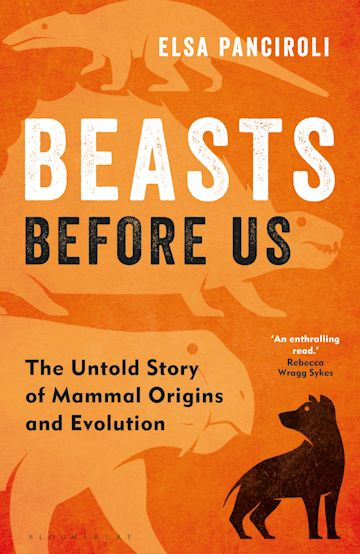
In Beasts Before Us, paleontologist, Elsa Panciroli, traces the evolutionary history of the mammal class of the animal kingdom, of which humans are members, to its origins about 300 million years ago.  It’s a tedious recitation of multitudes of now extinct species from their earliest ancestors up to the dawn of the age of mammals that began 66 million years ago after the abrupt end of the age of dinosaurs. But it’s also a rewarding read because it reminds us of our close relationships with other animals as well as the ways in which we are different.  Those differences predict which mammals will survive the forthcoming sixth great extinction that humans have inflicted on life on Earth.
Mammals living today have in common only one characteristic that distinguishes them from other classes of close relatives.  The subdivisions of mammals alive today have mammary glands that produce milk to feed their young.  The three subdivisions of mammals are monotremes, marsupials, and placentals.  Monotreme species alive today are platypus and echidna whose young are hatched from eggs, but are milk fed by their mothers.  Marsupials are born at an undeveloped stage and carried to term in their mothers’ pouch.  By far the largest group, placentals carry their developing offspring inside the mothers’ abdomen until birth. 

The earliest ancestors of mammals were four-legged vertebrates called amniotes. Amniotes were named for the membrane that lined the hard shells of their eggs, protecting the embryo.  The development of the amniotic membrane provided protection needed to lay and hatch eggs on land rather than the ocean where earlier forms of life lived.  This evolutionary development was associated with the transition of life from the ocean to the land.  The earliest amniotes diverged to take two different evolutionary paths, one as reptiles and dinosaurs (sauropsids) and the other as mammals (synapsids).  Pause here briefly to contemplate our close relationships with other animals. 

The Science of Paleontology

Beasts Before Us is also interesting as a history of paleontology, the branch of science that studies fossils of plants and animals to determine the evolutionary history of life.  Beasts focuses on advances in modern paleontology, but this article takes readers further back in time to appreciate how recently we learned about the scale of past extinctions that predict future extinctions.

Prior to the 19th century, an understanding of extinction was inconsistent with prevailing Western belief that the world was created by God as complete, perfect, and unchangeable.  In the late 17th century fossils of extinct animals were discovered that appeared to be unlike any living species.  Inquiring minds began the search for an explanation for what happened to these unknown species. 

George Cuvier is credited with establishing the modern concept of extinction in a lecture to the French Institute in 1796.  Cuvier is sometimes called the “founding father of paleontology.”  He rejected the theories of evolution, believing instead that extinctions could be explained by “cyclical creations” and catastrophic natural events such as floods. 

The fossil record is limited in what it can tell us about life in deep time because it does not preserve the remains of extinct species with equal reliability.  Bones survive to tell the tale with greater accuracy than soft tissues and plants.  Paleontology is developing techniques to compensate for gaps in the fossil record, drawing from other scientific disciplines, such as botany, biochemistry, mathematics, and engineering. 

Since more than 99% of all species that ever lived on Earth—more than five billion species–are now extinct, we can only imagine the difficulty of the task of piecing together the complete phylogenetic tree of life.  Beasts Before Us gives us a current view of what has been accomplished to date.  Clearly it is not the end of the story and much of the story is still speculative. 

Divergent Evolution

The 300-million year journey from the first ancestors of mammals to modern mammals of today is a story of divergent evolution, the accumulation of differences between closely related populations within species that lead to new species. Tracing that long process was until recently dependent upon the fossil record and was therefore focused on changes in bone structure, particularly teeth, jaws, and skulls for which the fossil record is more intact. 
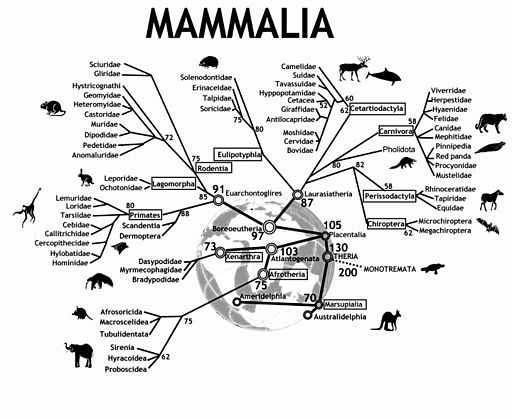
Evolutionary tree of mammals. Wikimedia Commons

These bone structures are important clues about the diet of animals. The teeth of herbivores, insectivores, and carnivores are different.  “Mammal fossils can be distinguished and named based on their teeth alone.” (1) Nearly half of all mammal species are rodents, a name that comes from the Latin word for gnaw.  Their long front teeth grow continuously as they are ground down by gnawing on tough plant material such as tree bark in the case of beavers or the wooden shingles on my home in the case of squirrels.

The digestive systems of mammals also diverged to accommodate their different diets (or vice versa).  Carnivores typically have a short intestinal track where digestion is accomplished with enzymes and resident microbial communities.  Herbivores have a longer digestive system in which plant material is fermented in a series of separate chambers in the case of ruminants (cows, sheep, deer, etc.). 

Divergent evolution creates diverse species with diverse abilities to exploit different ecological niches while reducing competition between species.  Shortly after the divergence of mammal and reptile lineages, the characteristic most consequential to the fate of those lineages was endothermy (warm-bloodedness) in mammals and ectothermy (cold-bloodedness) in reptiles. The divergence of this characteristic occurred about 250 million years ago, shortly after the divergence of mammal and reptile lineages. 

Only mammals and birds are generally capable of generating their body heat internally.  Over millions of years they also evolved insulation that conserves body heat with fur, feathers, and blubber in the case of marine mammals. A diet high in sugar and fat also helps to maintain body heat. Cold blooded animals depend on external heat sources such as sunlight to be active.  These crucial differences in mammals and reptiles relegate them to different ecological niches to which they are suited, for example:

  • Mammals and birds can survive in colder climates than reptiles.
  • Mammals and birds can be more active at night when it is cooler.
  • Mammals and birds can be more active for longer periods of time than reptiles.
  • Mammals and birds can live below ground where it is colder in summer and warmer in winter than above-ground temperatures.
  • On the other hand, mammals and birds must eat more and more frequently than reptiles. 

These significant differences are partly responsible for the sudden transition from the age of dinosaurs to the age of mammals 66 million years ago.  During the age of dinosaurs, mammals were small, lived below ground, and ate primarily insects.  This lifestyle avoided competition with huge dinosaurs that dominated the land. 
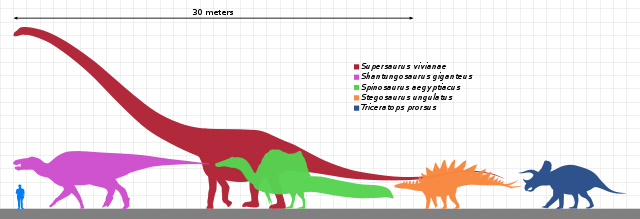
Scale diagram comparing a human and the largest-known dinosaurs of five major clades Creative Commons Attribution-Share Alike 4.0 International license.

When the asteroid hit the Earth 66 million years ago, the climate was suddenly and drastically transformed from a tropical climate to a cool, partly sunless climate.  Vegetation adapted to a tropical climate quickly died, depriving dinosaurs of their food if they weren’t killed outright by the impact. 

Beasts paints a vivid and dire picture of the cataclysmic event that ended the age of dinosaurs.  The asteroid created a crater almost 100 miles in diameter and 12 miles deep.  “An earthquake larger than any recorded in human history would have made the Earth reverberate like a bell.  The thermal shockwave would have flash-fried all life for hundreds of miles.  The blast of air probably flattened forests as much as 1,000 kilometers away…[the impact] created a mega-tsunami at least 330 feet in height…[that] mounted the coasts of North American and barreled inland like a liquid steam-roller…The dust in the atmosphere swirled its way around the planet until it enclosed all life in its smothering grip.  The sun rose, but as little as half of its light could penetrate the dust in the atmosphere.  The sulphur in the dust combined with water droplets to rain sulphuric acid on the land, burning away the green vegetation…Few animals bigger than a Labrador dog survived the extinction event.”  (1; not verbatim)

The fifth extinction predicts the consequences of the sixth extinction

Small mammals were safely below ground and they didn’t require the great quantities of plant food required by dinosaurs.  Mammals inherited the Earth and over millions of years they evolved into some 5,500 mammal species today of which 90% are still small bodied, most of them rodents.

The final chapter of Beasts uses the consequences of the fifth extinction that ended the age of dinosaurs to predict the consequences of the anticipated sixth extinction because “Humans are replicating many of the conditions of previous mass extinctions.” (1)

  • Animals are likely to become more active at night, when temperatures are cooler.
  • Animals are likely to find some respite by living below ground where temperatures are more moderate in winter and summer. 
  • Animals will move to more temperate regions if they can.

The animals that are most likely to survive will be small generalists, who need less food, are not fussy about what they eat, and are more capable of tolerating heat. Think rats. Beasts advises, “If I were you, I’d say goodbye to any wild animal bigger than a pig—zoos are likely to be the only refuges for them in the future we are creating.”

Birds were the only descendants of dinosaurs to survive the fifth great extinction.  They are expected to fare better in the sixth extinction for much the same reason:  they can be active at night; they eat insects as well as plants; they are more mobile than most classes of animals.  We often hear dire predictions of the fate of birds, but in fact they are less threatened than other classes of animals.  A recent study reported that 21% of reptiles are threatened with extinction, a higher risk than birds (of which about 13 percent of species are threatened with extinction) and slightly less than mammals (25 percent). Amphibian species are at highest risk with about 40 percent of species in danger of extinction.  We hear more about birds because their popularity motivates greater media coverage about them.

I will also presume to give my readers some advice. 

  • Quibbling about whether native plants are superior to non-native plants is like arguing about the color of the lifeboat. It really doesn’t matter.  Soon enough we will be glad to have ANY vegetation that is capable of living in the climate we have created. The universe is indifferent to the survival of any specific species of life.
  • You can do more for the environment and the animals that live in it by stopping the use of pesticides than by planting native plants. 
  • Be humble about what you think you know.  Many important scientific concepts such as evolution and extinction are less than 200 years old and the cause of the extinction of dinosaurs was discovered less than 50 years ago.  What you learned 50 years ago may need to be reconsidered and revised.  A rapidly changing situation requires that we keep an open mind to new information.
  • Set meaningful prioritiesClimate change is an existential threat to all life on Earth.  Ask yourself how we can justify the destruction of healthy trees that sequester the carbon that contributes to climate change? 
  1. Elsa Panciroli, Beasts Before Us: The Untold Story of Mammal Origins and Evolution, Bloomsbury Sigma, 2021

History of Earth predicts its future

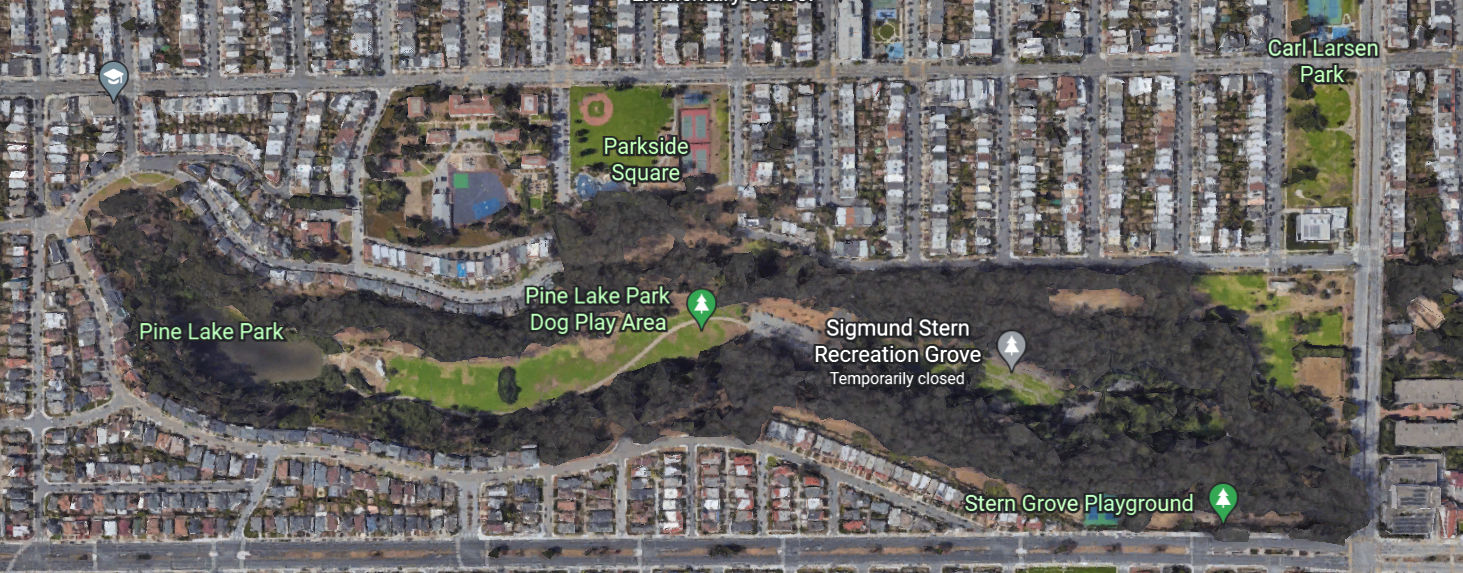
My interest in the native plant movement began about 25 years ago when my neighborhood park was designated as a “natural area” by San Francisco’s Recreation and Park Department.  My park was only one of 33 parks in San Francisco that were designated as a “natural area.” 

What did it mean to be a “natural area?”  As I studied the plans, my reaction was primarily to the proposed destruction of non-native plants and trees.  Later I realized that the eradication of non-native plants and trees would be accomplished with herbicides. 

Stern Grove Park in San Francisco was my neighborhood park where I began my long journey to understand why anyone would want to destroy trees in a treeless neighborhood. 

How could the creation of native plant gardens justify the destruction of our urban forest using herbicides?  I have spent the last 25 years trying to answer that question.  There are many useful lines of inquiry in the search for the answer, but the approach that has been most helpful to my understanding of the futility of the undertaking has been the study of the physical and biological forces that created Earth and its inhabitants.  Today, I will take you on an abbreviated journey of the past 4.6 billion years of events on Earth that have resulted in present-day nature, drawing from A Brief History of Earth by Andrew Knoll, Professor of Natural History at Harvard University. (1)

Gravity “created” the Earth

“Gravity is the architect of our universe.”  Gravity is the attraction of objects to one another in proportion to their mass and proximity that over billions of years accumulated the elements dispersed in Earth’s universe.  As these dispersed objects coalesced into stars, planets, moons, and asteroids, Earth was formed about 4.6 billion years ago.

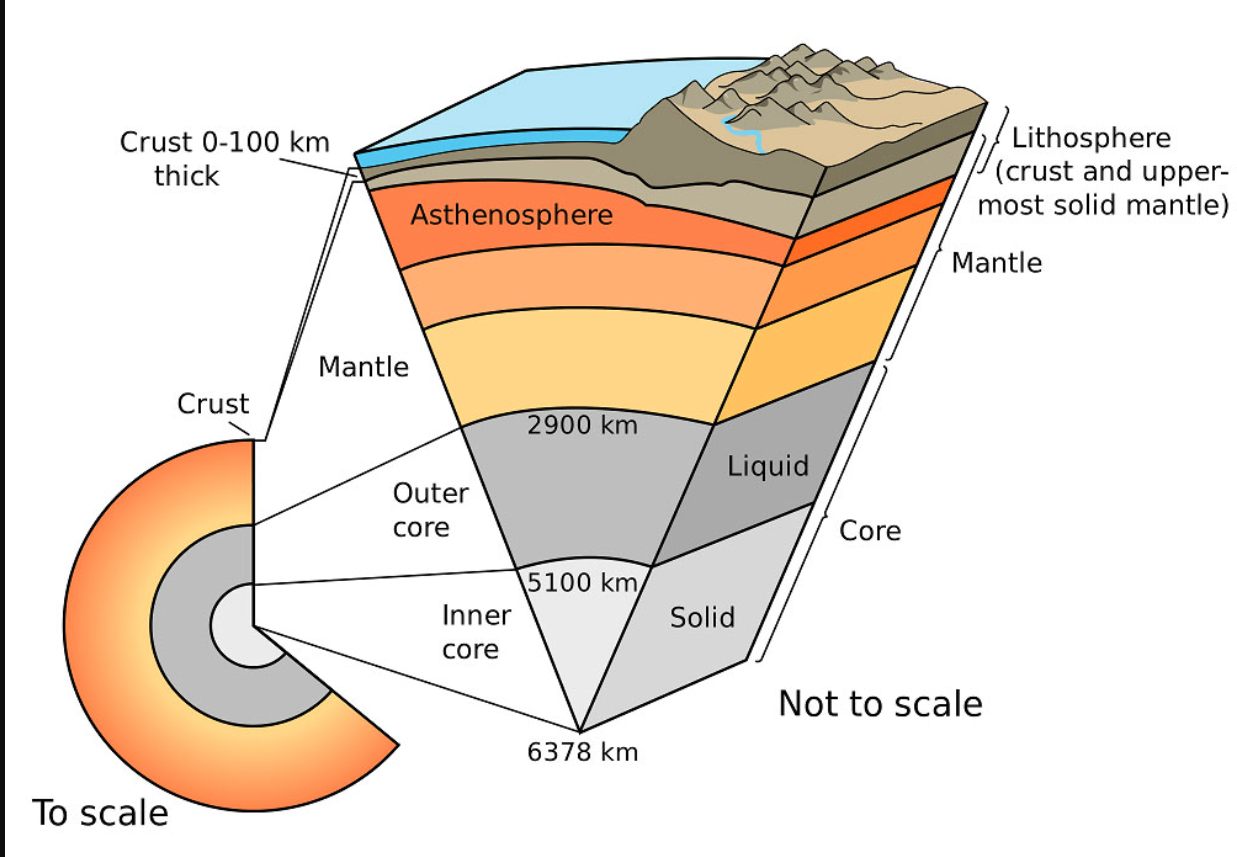
Cross-section of Earth. Source: USGS

“Earth is a rocky ball.”  Its inner core is solid, composed mostly of iron.  Earth’s molten outer core moves by convection as hotter, denser material near the base rises and cooler, less dense matter toward the top sinks.  This circular motion generates electrical current that creates the Earth’s magnetic field.  The mantle is composed of the molten magma that emerges on the surface crust of Earth where tectonic plates are separating and when volcanoes erupt where tectonic plates submerge into the mantle. The crust of Earth that is visible to us is only 1% of Earth’s mass.

Physical Earth

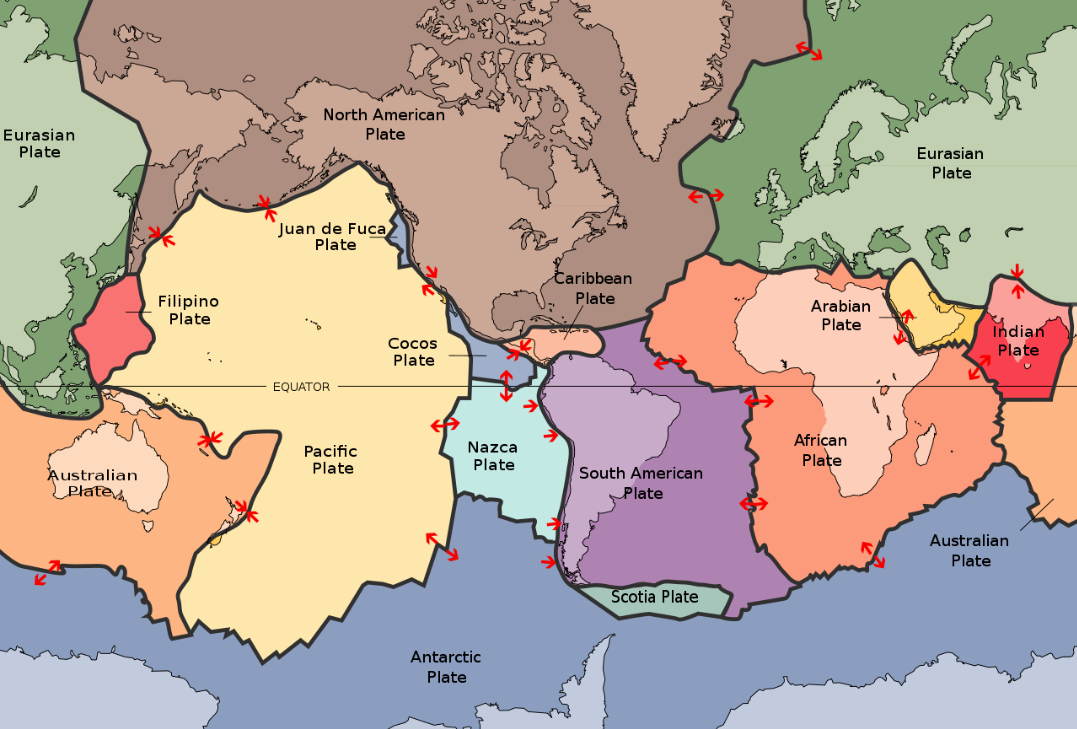
Simplified map of Earth’s principal tectonic plates, which were mapped in the second half of the 20th century (red arrows indicate direction of movement at plate boundaries).  Source:  USGS

The crust of Earth is composed of plates that are moved on the surface of the Earth by the convection current of the mantle.  Some of the plates are moving away from one another where they meet.  As the plates separate, molten magma from the mantle is pushed through the crust, forming new crust.  The North American and Eurasian plates are moving apart in the middle of the Atlantic Ocean at the rate of about 1 inch per year. 

Since the Earth is not getting bigger, the expanding crust collides with adjacent plates.  In some places, the collision of the plates pushes up the crust into mountain ranges.  The Himalayan mountain range is the result of the collision of the Indo-Australian and the Eurasian Plates, a process that continues today.

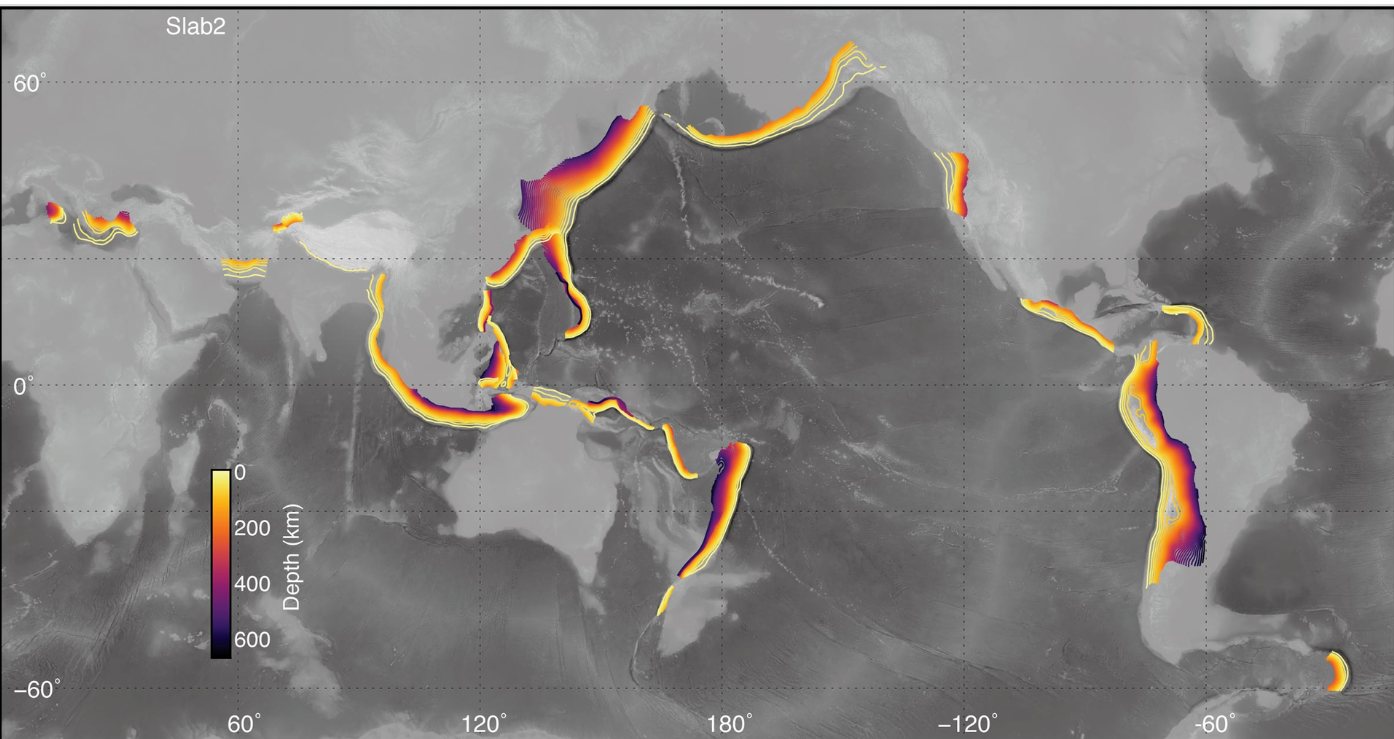
Map of subducted slabs, contoured by depth, for most active subduction zones around the globe. Source:  USGS

In other places, the expanding crust is pushed below the adjacent plate in subduction zones, where the crust dives below the crust into the mantle.  Earthquakes are common in subduction zones and the subducting plate triggers volcanic eruptions in the overriding plate.  Earthquakes are also common where adjacent plates are grinding against one another in opposite directions, as is the case on the coast of California.

Pangea super-continent

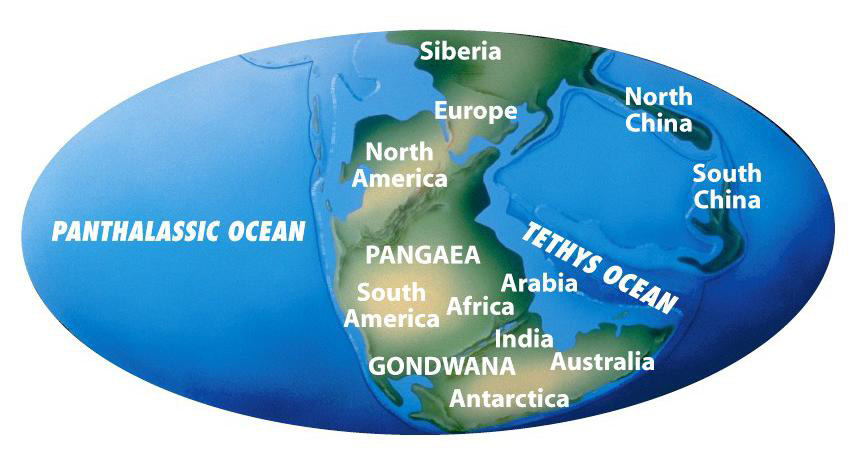
The movement of tectonic plates has assembled and reassembled the Earth’s continents many times. The entire history of the configuration of continents is not known to us because of the cycle of the crust emerging from the mantle only to return to the mantle about 180 million years later.  We know that all continents were fused into a single continent, named Pangea, about 350 million years ago and began to break up 200 million years ago.  Much of life as we know it evolved on Earth while the continents were fused, which is one of the reasons why all life on Earth is related.  Geographic isolation of species results in more biodiversity as genetic drift and different environments result in greater speciation.  Geologists believe such continental mergers are likely in the distant future.  

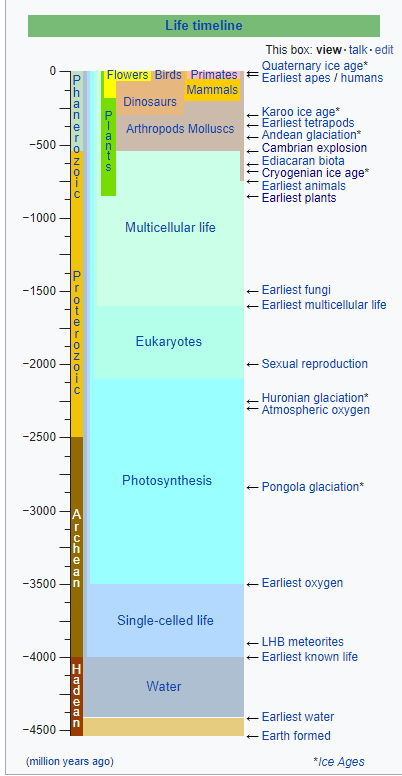
Earth’s oceans and atmosphere were formed within the first 100 million years of its birth.  Continents were visible above oceans, but small compared to their present size.  The absence of oxygen in the air at that early stage was the most significant difference between present and early Earth.

Biological Earth

Life, as presently defined, requires growth and reproduction, metabolism, and evolution. (I say, “presently defined” because debate continues about defining viruses as life since they do not meet all criteria.)  The chemical components required to perform the functions of life and the natural processes to combine them (such as heat and lightning) were available on Earth for millions of years before they combined to perform the functions of life.  Precisely how and when that happened on Earth is studied intensely, but not conclusively known, although Professor Knoll describes theoretical possibilities. 

The geological record suggests that “Earth has been a biological planet for most of its long history.” Microbes may have been living on Earth 4 billion years ago.  Climate on Earth was warm at that time for the same reason the climate is warming today.  The atmosphere was composed primarily of carbon dioxide (the greenhouse gas that traps heat on the surface of the Earth) and nitrogen:  “…life emerged on an Earth barely recognizable to the modern eye—lots of water and not much land, lots of carbon dioxide but little or no oxygen…”

Oxygen Earth

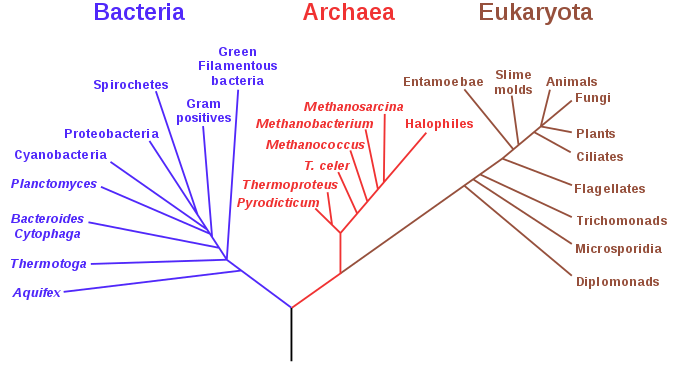
Phylogenetic tree of life based on Carl Woese et al. rRNA analysis. The vertical line at bottom represents the last universal common ancestor.

Two of the three domains of life were capable of living without oxygen:  archaea and bacteria.  Archaea are single-cells without nuclei.  We are all too familiar with bacteria, as they are as much a part of our bodies as our own cells.  Oxygen was the prerequisite for the evolution of the third domain of life, eukarya.  The kingdoms of eukarya most familiar to us are plants, animals, and fungi. 

Oxygen arrived on Earth when early life forms evolved the ability to photosynthesize, the process by which plants (and some other organisms) use sunlight to synthesize food from carbon dioxide and water, generating oxygen as a byproduct.  This transition occurred about 2.4 billion years ago, as measured by the absence of iron on the seafloor after that time. 

Photosynthesis alone could not have accomplished the transformation of Earth’s atmosphere to the balance of carbon dioxide and oxygen needed to support complex life on our planet because photosynthesis also requires nutrients as well as sunlight and water.  Phosphorous weathers from rocks, a process that was initially limited by the small amount of land above sea level.  As the planet matured, more land emerged from the sea, making more phosphorous available to photosynthesizing organisms.  Photosynthesis was also enhanced when some bacteria and archaea evolved the ability to convert nitrogen gas into biologically usable molecules, a process called nitrogen-fixing.  Many plants in the legume family are capable of nitrogen-fixing today.

Extinctions of the past predict extinctions of the future

There have been five major extinction events in the past 500 million years that changed the course of evolution of life on Earth and at least 20 mass extinctions in total (2).  The first representatives of all modern animal phyla (a taxonomic classification between kingdom and class) evolved during the Cambrian Period (541-486 million years ago).  All extinction events were associated with radical changes in the climate.  Many of the changes in the climate were caused by changes in the balance of carbon dioxide and oxygen in the atmosphere.  All these catastrophic events were natural events, not caused by the activities of humans because they all occurred long before the advent of human evolution. 

The third and biggest extinction event occurred 252 million years ago at the end of the Permian geologic period, when more than 90% of marine animals and 70% of terrestrial species disappeared.  At that time, continents were fused into the single supercontinent of Pangea.  The extinction of most life on Earth was caused by the sudden and catastrophic change in the atmosphere–and therefore the climate–by an episode of volcanism in Siberia “a million times greater than any volcanism ever witnessed by humans” or our primate ancestors.  Gases emitted by volcanism at the end of the Permian period rapidly increased the carbon dioxide content of the atmosphere and oceans by several times greater than before that event.  “It would take 10 million years for life to reassemble into something approaching the complexity of the ecosystems that preceded it. The world that emerged from the volcanic dust was unlike anything that came before.” (2) The current increase of carbon dioxide in the atmosphere caused by the burning of fossil fuels by human activities is comparable to this event and is expected to cause the sixth great extinction on Earth.  

The fifth and most recent massive extinction event occurred 66 million years ago, bringing 170 million years of dinosaur evolution to an abrupt end. The entire environment of the planet was radically and suddenly altered by the impact of an asteroid 7 miles in diameter that landed on what is now the Yucatan peninsula in Mexico.  The impact engulfed Earth in a dust cloud that precipitated the equivalent of a nuclear winterkilling most vegetation and animals adapted to a much warmer climate.  As with all massive extinctions, it took millions of years for plants and animals to slowly evolve adaptations to the new environment.  Dinosaurs did not evolve again, a reminder that evolution does not necessarily repeat itself (although birds evolved from dinosaurs).  Although there were small mammals during the dinosaur age, the disappearance of dinosaurs and corresponding changes in the climate introduced the age of mammals, including the human lineage about 300,000 years ago.  When multiple animal groups disappear it creates opportunities by reducing competition between groups.

What can we learn from the history of Earth?

If a native plant advocate were reading this abbreviated history of Earth, these are the lessons I would hope they might learn from it:


  1. Andrew H. Knoll, A Brief History of Earth, 2021.  All quotes in this article are from this excellent book unless otherwise indicated.
  2. Elsa Panciroli, Beasts Before Us: The Untold Story of Mammal Origins and Evolution, Bloomsbury Sigma, 2021.