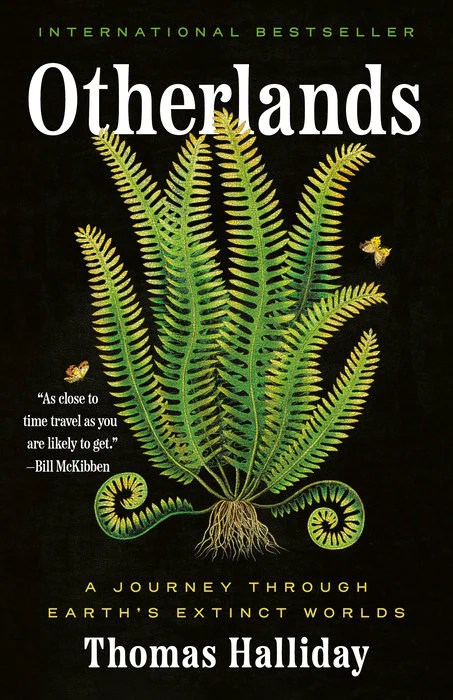
Otherlands, A Journey Through Earth’s Extinct Worlds was written by a paleontologist using the latest scientific techniques available. (1) Paleontology has advanced far beyond digging up fossils. Computer and DNA analysis enables paleontologists to reconstruct models of whole animals from bone fragments as well as describe the lifestyle of extinct animals such as what they ate and what ate them.
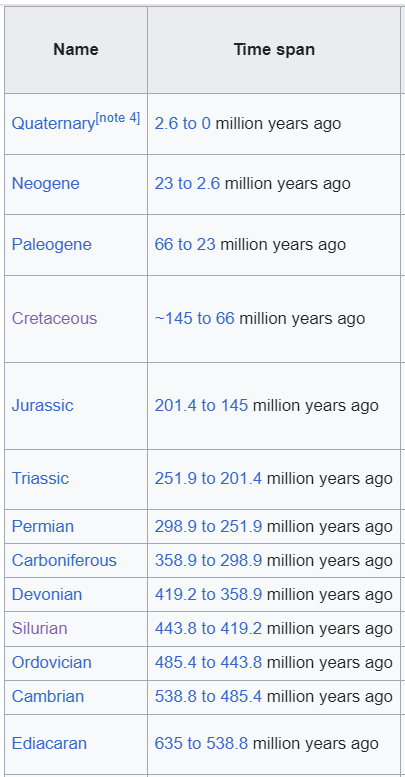
Thomas Halliday puts this knowledge of some of the 5 billion species that have gone extinct in the 4.6 billion years that Earth has existed into the context of geological and biological changes that caused their extinction. He describes vivid scenes of specific places at specific times, starting 500 million years ago (mya), a geological period when we can recognize most of the phyla (major groups of animals sharing characteristics) that exist today. These snapshots of deep time illustrate that “Environments shape their inhabitants as much as their inhabitants shape them.” (1)
In this article, we will visit a few of these scenes that demonstrate the biological innovations resulting from evolution and the associated geological and atmospheric events. And we will tell you about how modern conservation methods are often working at cross purposes against evolution and adaptation of life as it copes with catastrophic challenges.
Biological Innovation
Primitive life is said to have existed on Earth 3.7 billion years ago (bya). All life that presently exists on Earth is said to have evolved from the first life forms, although the common ancestor is yet to be identified. No life on Earth is truly alien.
The diversification of life on Earth began to accelerate when cyanobacteria developed the ability to photosynthesize about 3 bya. Photosynthesis converts sunlight to energy by consuming carbon dioxide, creating carbohydrates that feed plants and storing carbon in plants and the soil, while emitting oxygen into the atmosphere as a by-product.
This evolutionary innovation is responsible for the abundance and diversity of plants today. It is an important factor in the balance of carbon dioxide and oxygen in the atmosphere, which is one of the most important factors in the Earth’s climate. More plants also mean more food for animals that evolve alongside plants, often forming relationships with one another.
The first mass extinction, roughly 445 million years ago (mya), is the only mass extinction caused by a rapid change in the Earth’s climate from tropical to glacial, which is equivalent to saying the atmosphere changed from predominantly carbon dioxide to predominantly oxygen, the opposite of our currently changing atmosphere and climate.
Carbon dioxide levels are said to have dropped from 7,000 parts per million (ppm) to 4,400 ppm during the Ordovician extinction event that killed about 85% of plant and animal species. Currently our carbon dioxide level is about 420 ppm, just a fraction of what it was during the Ordovician period. In the context of the history of Earth, the climate we are experiencing is mild, a reminder of the potential for a much more extreme climate in the near future.
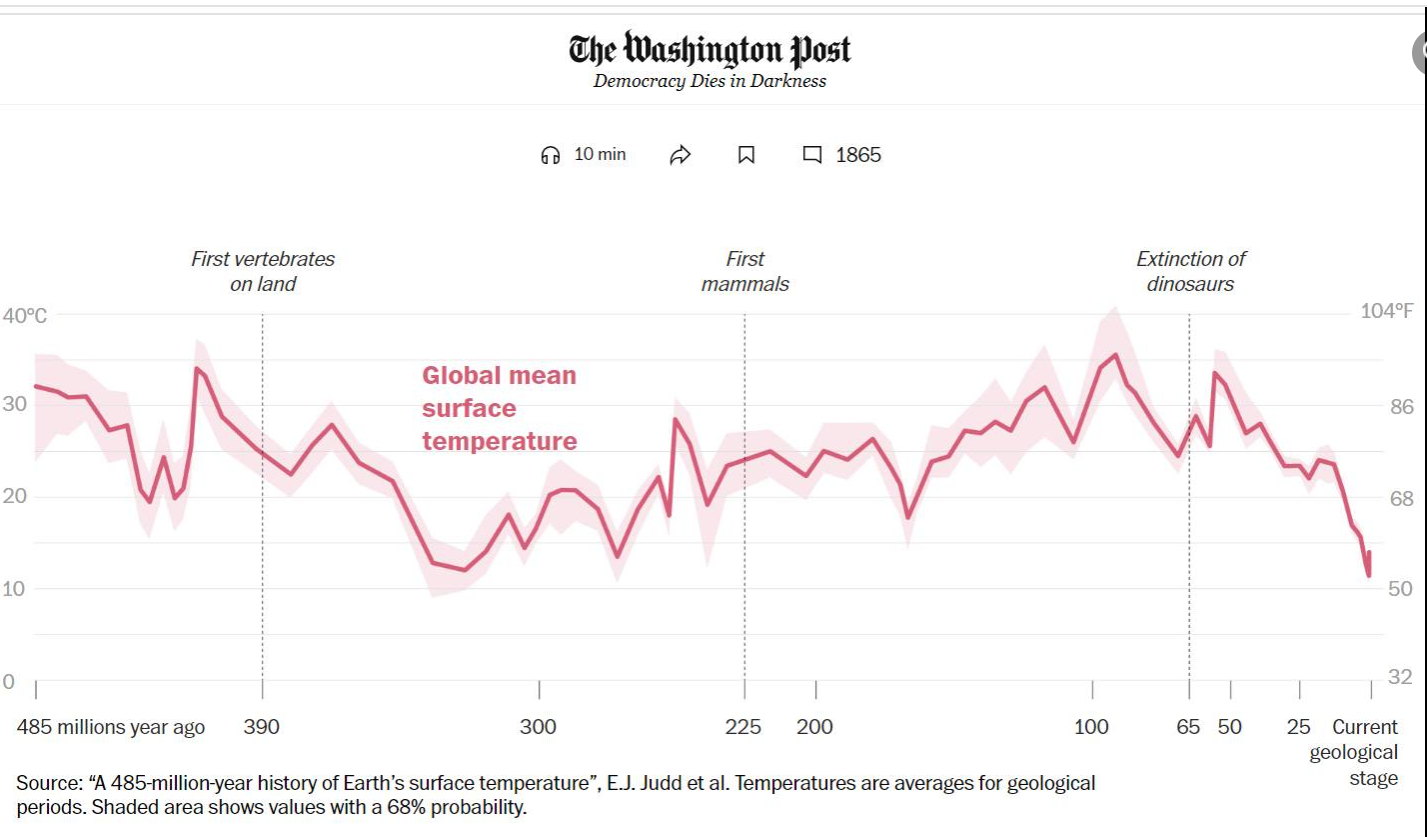
Comparing contemporary sea levels with those in deep time is another way to appreciate the potential for devastating changes in the future. 20,000 years ago, at the height of the last ice age, sea levels were 120 meters lower than they are now. Conversely, sea levels were highest during the mid-Silurian period, 430 mya, when sea levels were between 100-200 meters higher than they are now and atmospheric carbon dioxide concentrations were high.
Although the causes of the drastic change in the atmosphere and therefore the climate during the Ordovician period are still debated, the advent of photosynthesis is considered a factor. The development of fungi enabled plants to move from water to land by delivering moisture from soil to roots of plants, greatly increasing abundance and diversity of plants. About 80% of plants today receive much of their nutrients and moisture through mycorrhizal fungi.
The photosynthesizing capabilities of plants is one of the ways greenhouse gas emissions, currently causing global warming, can be reduced. Yet, we are using pesticides to kill plants that native plant advocates have arbitrarily decided “don’t belong.” Pesticides also kill fungi in the soil that enable plants to survive during drought conditions created by global warming. This is one of many examples of how management strategies used by humans are counteracting the accomplishments of evolution that occurred long before humans existed or began to think they were competent to “manage” nature.
Plant Evolution Timeline
To make a long, complicated story short, we’ll focus on the major plant groups we recognize today by starting with seedless land plants that reproduce by dispersing spores, such as mosses and ferns that evolved from algae about 460 mya.
Gymnosperms, which we recognize today as conifers, cycads, and Gingkos, are seed-producing plants that evolved about 300 mya. Early species of gymnosperms formed huge forests. The carbon they stored became the coal fields of today when they died during the Carboniferous period (360-300 mya). Today, we draw our fossil fuels from these coal and oil basins. They provide most of our energy, while releasing greenhouse gases causing climate change.
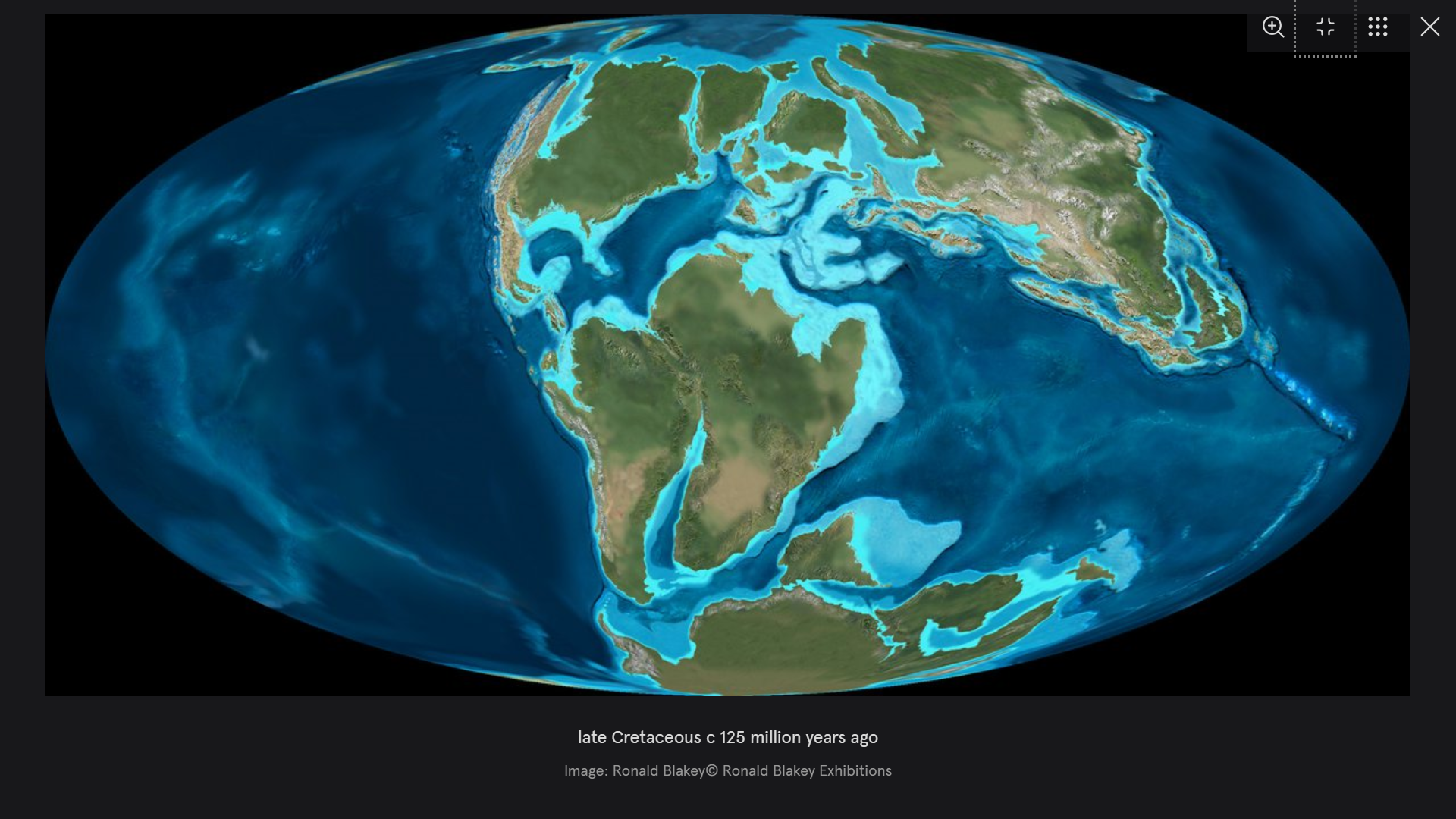
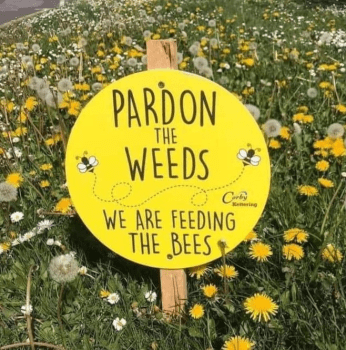
Angiosperms evolved from gymnosperms about 130 mya. They are flowering plants whose seeds are often encased in fruit. They are by far the most diverse group of land plants. The evolution of bees around the same time is an example of co-evolution: the flowers feed the bees and the bees pollinate the flowers, delivering pollen from the male anther to the female stigma. This sexual method of reproduction creates greater genetic diversity than self-pollination. Greater genetic diversity creates more opportunities for natural selection to operate on plant variations, which may result in species that are better adapted to existing conditions.
A recent study (2) found that the decline in the population of bees has increased the frequency of self-pollination of some plant species that are capable of both methods of pollination. This is an example of evolution at work today. Plants are responding to the existential need to reproduce in the absence of bees by self-pollinating.
What evolution has accomplished in the past can be undone. In this case, our indiscriminate use of pesticides such as neonicotinoids has decimated bee populations. Some plants will adapt to the loss of bees by self-pollinating, but not without some loss of genetic diversity provided by sexual reproduction and consequently the long term fitness of plants to face challenges in the future.
There’s another trade-off for both plants and bees. Producing nectar and attracting bees with colorful flowers is a big energy expense for plants. Plants therefore save energy by reducing flower size and color, when they can rely solely on self-pollination for reproduction. Obviously, self-pollination ultimately results in a loss of food for bees and may accelerate the decline in bee populations, a negative feed-back loop, if you will.
This example is a reminder that evolution is neither positive nor negative. It is simultaneously both positive and negative. It is what it is: an inexorable force for change.
Evolution of grasses
Grasses and grasslands are late comers to the Earth’s plant kingdom. Grasses evolved from angiosperms about 70 mya, during the Age of Dinosaurs that abruptly ended 66 mya when an enormous asteroid collided with Earth. Grasses are wind pollinated and their seeds are dispersed by the wind, which enables them to spread rapidly and widely.
Grasslands became dominant ecosystems about 30 mya, replacing many forest ecosystems. With the optimal combination of fuel, heat, and oxygen, wildfires were a factor in the transition from forests to grasslands in many places. Once again, wildfires in conifer forests are presently playing a role in converting forests to grasslands, suitable to a warmer and drier climate.
The development of enhanced photosynthesis by C4 grasses gave them a competitive advantage in hot, dry places where photosynthesis is suppressed. C4 grasses are more drought tolerant and they store more carbon than their predecessors, C3 grasses. There are only about 60 groups of C4 grasses, including several important food crops, such as maize, sugarcane, and sorghum. They are found in tropical and sub-tropical regions of Africa and South America and some deserts. California’s native grasses as well as introduced grasses considered “invasive” are not C4 grasses, according to a list of C4 grasses available on Wikipedia. (3)
Because of their potential to improve drought tolerance and increase productivity and carbon storage, there is great scientific interest in converting C3 grasses to C4 grasses. Despite decades of effort, agricultural science has not been able to duplicate what the natural forces of evolution have accomplished, reminding us that evolution is more powerful than we are.
The transition from forests to grasslands had a corresponding impact on the evolution of animals. Some browsers of woody plants learned to be grazers, if they could, while others went hungry, and the diversity and abundance of grazers increased.
Native plant advocates in California have selected grassland as their preferred ecosystem because it was the dominant ecosystem prior to the arrival of Europeans at the end of the 18th century. They have consistently failed to convert non-native grassland to native grassland in California. Nor is it clear that there would be any benefit to the environment or to its inhabitants to return to the treeless landscapes of California that existed prior to settlement in the late 18th century.
Where populations of native grazers of grassland were reduced by the activities of humans, many grasslands in California naturally succeeded to shrubs and trees. “Restoration” projects attempt to prevent succession of grasslands. Some of these projects destroy native trees and shrubs (e.g. Douglas fir, coyote brush, juniper, etc.) mechanically and with pesticides to maintain ecosystems as grassland.
Nativists also want to reintroduce the grazing animals of the pre-colonial period to replace domesticated animals humans introduced because nativists see them as competitors of native animals they consider superior. Where top predators have been killed, these herds of grazing animals outgrow available vegetation unless their numbers are controlled as domesticated animals are.
A recent meta-analysis of 221 studies of the impact of megafauna on plant abundance found, “no evidence that megafauna impacts were shaped by nativeness, “invasiveness,” “feralness,” coevolutionary history, or functional and phylogenetic novelty. Nor was there evidence that introduced megafauna facilitate introduced plants more than native megafauna. Instead, we found strong evidence that functional traits shaped megafauna impacts, with larger-bodied and bulk-feeding megafauna promoting plant diversity. Our work suggests that trait-based ecology provides better insight into interactions between megafauna and plants than do concepts of nativeness.” (4)
The author of Otherlands agrees that the concept of nativeness is not a useful way to understand the environment or conduct conservation because: “Where an animal or a plant from one part of the world appears in another, some might use the language of invasion, of a native ecosystem despoiled and rendered lesser by newcomers…In reality, species do move, and the notion of ‘native’ species is inevitably arbitrary, often tied to national identity…There is no such thing as a fixed ideal for an environment…To look into deep time is to see only an ever-changing list of inhabitants of one ecosystem or another…The concept of native that we so easily tie to a sense of place also applies to time…We must avoid putting our own ahistorical spin on what was, although certainly dangerous and unlikely, a journey guided entirely by chance.” (1)
Migration
The history of evolution is also a history of migration. The oscillation of the Earth’s climate between freezing cold and blistering heat created and destroyed land bridges that enabled or blocked migration as sea levels rose and fell. When North America and South America were connected by Central America as a result of lower sea levels and geological events about 3 mya, the plants and animals of those continents were mixed by migration. Likewise, aquatic life of the Pacific Ocean was separated from the Atlantic Ocean by the Central American land bridge until the Panama Canal was built in 1914.
Geological events also created or destroyed the same opportunities for migration. The opening and closing of the Strait of Gibraltar is a case in point. The Mediterranean Sea exists because the Strait of Gibraltar exists. When the narrow Strait is open, the Atlantic Ocean flows into the Mediterranean Basin, creating the Mediterranean Sea, which is an obstacle for migration of plants and animals between Europe and Africa.
About 6 mya the Strait of Gibraltar closed because the African tectonic plate moved north, colliding with the European tectonic plate. The Mediterranean Sea slowly evaporated, concentrating ocean salt from the Atlantic Ocean, laying down a sea bed of salt in the Mediterranean Basin and ultimately creating a migration corridor between Africa and Europe. There is every reason to believe that the Strait could close again. The Earth’s tectonic plates are in constant motion and there is no reason to believe they will stop moving.
The obsession with “where plants belong” seems to be based on ignorance of the history of dispersal and migration. Much of China and North America have been in the same latitude since the evolution of angiosperms. As a result, many of our plant species considered native in Eastern North America are also considered native in China. These paired species in the same genus are called disjuncts. There are many woody disjuncts in China and North America (magnolias, persimmons, hickory, catalpa, dogwood, sweetgum, tuliptree, tupelo, sassafras, Virginia creeper, etc) as well as many herbaceous disjuncts (ginseng, lopseed, mayapple, skunk cabbage, etc.). (5) They are different species because they have been separated long enough to change as a result of genetic drift, but are in the same plant lineage, therefore chemically similar and presumably used by the same insects. The study of these disjuncts says, “Most scientists do not consider long-distance dispersal to have played much of a role. The prevailing view is that most disjuncts are remnants of genera that were once widely distributed in the northern temperate zone during the Tertiary period [66 mya to 2.6 mya per Wikipedia]. These broad distributions in the northern hemisphere were made possible by recurring land bridges.” (5)
Lateral migration patterns of the past are changing in response to contemporary patterns of climate change. The temperatures at different latitudes are becoming more similar because Polar Regions are warming at a much faster pace than temperate and tropical latitudes. Plants and animals escaping extreme heat and associated changes in vegetation are moving to higher latitudes in the Northern Hemisphere and lower latitudes in the Southern Hemisphere. The increasing similarity of the Earth’s climate is changing wind and ocean currents and contributing to the extreme weather events of our changing climate. Although there are lessons in the events of deep time, we cannot assume that events in the past are entirely predictive of future events because of the complexity of natural processes and our limited understanding of them.
Of all the nonsensical conservation strategies humans are presently using, perhaps one of the most damaging is the futile attempt to stop migration. It is one of few survival strategies of plants and animals needed in a rapidly changing climate and it cannot be stopped.
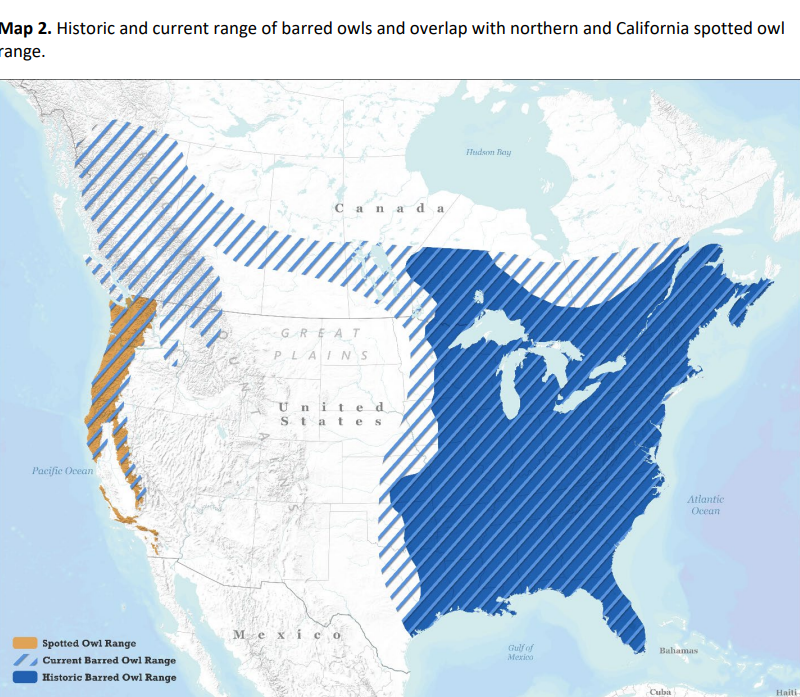
The project that proposes to shoot barred owls in the Pacific Northwest is an example of a “conservation” project that does not deserve that honorific. Barred owls have migrated from the East to the West Coasts of North America via the boreal forests of Canada. This is another instance in which large contiguous stretches of land at the same latitude facilitate the migration of life because there is less variation in climate at the same latitude.
Specialists vs. Generalists
Barred owls are more adaptable than their closely related relative in the same genus, spotted owls. Barred owls have a more varied diet, they are willing to nest in less dense, second-growth forest, and they have greater reproductive success. They are therefore perceived as competitors of endangered spotted owls. Instead of letting natural selection identify the winner of that competition, the US Fish & Wildlife Service intends to shoot 500,000 barred owls in the next 30 years based on their belief that spotted owls will benefit. They do not expect to eradicate barred owls and they made a commitment to continue shooting barred owls in perpetuity. While we continue to log old-growth forests in which spotted owls live, we will kill barred owls with no expectation that they can be eradicated.
This project is typical of American “conservation” projects that attempt to save a specialist species by killing a generalist species. This strategy was enshrined in American law by the Endangered Species Act, which is now 50 years old. Like many 50-year-old public policies, we now know that this conservation strategy is not working because it is inconsistent with evolutionary principles. Change in nature is inexorable. Legal mandates are not capable of stopping evolution. If we had a functional political system, we could stop the greenhouse gas emissions causing climate change, but we don’t. Therefore, we must rely on evolution to cope with the changes in the environment that we have caused.
The most recent mass extinction occurred 66 mya when an asteroid hit the Earth, ending the Age of Dinosaurs. About 80% of all plant and animal species became extinct. The species that survived were the most versatile and the most mobile. Flying dinosaurs were the only dinosaurs that survived, as birds, perhaps because they were the most mobile. “Of the specialized insects, 85% were lost and it was the generalists that survived.” (1)
Mass extinctions have created many vacant ecological niches that are opportunities for experimentation, creating new species. Some were better adapted than others. Natural selection determined the winners of competition within ecological niches. The end of the Age of Dinosaurs created the opportunity for the Age of Mammals, as well as bony fish, marsupials, and lizards.
In other words, our outdated conservation strategy is wasting our limited resources to save specialized species that are probably doomed to extinction. And we are doing so at the expense of generalist species that might survive if we would quit killing them. Keep in mind that 99% of all life forms that have existed on Earth have gone extinct. At a time when the climate is changing rapidly, the goal of saving every endangered species seems both unrealistic and wasteful of limited conservation resources.
Hybridization
Hybridization is one of the tools of evolution. Closely related species, usually in the same genus and even family often mate and their offspring often survive to eventually give rise to new species. Successful hybridization is a means of increasing biodiversity. Hybridization is sometimes a means of improving adaptability and therefore survival.
Unfortunately, nativists see hybridization as a loss of biodiversity rather than an opportunity to improve adaptability and increase biodiversity. Their “conservation” projects often attempt to prevent hybridization by killing hybrids. For example, the plan to kill 500,000 barred owls includes all hybrids of barred and spotted owls. Because barred owls are more versatile, hybridization with spotted owls could even the playing field with barred owls by expanding food sources and nesting habitats of spotted owls.
The Spartina eradication project is another example of the pointless eradication of hybrids. In the case of Spartina, the non-native species grows more densely and it doesn’t die back in winter. Non-native Spartina provides better storm protection and better habitat for nesting birds. The Invasive Spartina Project has been spraying hybrid Spartina with herbicides for over 20 years, without total success. The hybrid looks so similar to native Spartina that 600 genetic tests are required every year to confirm their identification as hybrids before they are sprayed. The Invasive Spartina Project is a waste of limited conservation resources and it serves no useful purpose.
Evolution vs. Conservation
Otherlands should be required reading for those who are engaged in the “restoration” industry. Some of the methods and goals of conservation are at odds with the mechanisms of evolution that have ensured the survival of life on Earth for nearly 4 billion years.
- The use of pesticides by “restoration” projects is antithetical to the goal of conservation because they do more harm than good.
- Migration is a means of species survival. Natural migration of plants and animals cannot and should not be stopped.
- Humans cannot duplicate the forces of evolution. Natural selection is the most powerful, efficient, and effective method of determining the winners of competition.
- Hybridization has the potential to improve adaptability of closely related plants and animals. Hybridization cannot and should not be stopped.
- Resources being wasted in the attempt to stop the natural forces of evolution should be redirected to reducing greenhouse gas emissions causing climate change. Such efforts are appropriately called “conservation.”
- Thomas Halliday, Otherlands, A Journey Through Earth’s Extinct Worlds, Random House, 2023
- https://www.nytimes.com/2024/01/04/science/flower-sex-evolution-bees.html?searchResultPosition=1
- https://en.wikipedia.org/wiki/List_of_C4_plants
- Erik Lundgren et.al., “Functional traits—not nativeness-shape the effects of large mammalian herbivores on plant communities,” Science, February 2, 2024
- David Yih, “Land Bridge Travels of the Tertiary: The Eastern Asian-Eastern North American Floristic Disjunction, Arnoldia, 2012
 Conservation Sense and Nonsense
I love this article so much! I will search out this book. Thank you million trees for all you do! I hope the nativists are reading!
Thanks. It was a tough one. Otherlands is a very important book, but it is challenging. The author is British and the book was very popular in Europe. I hope it will find an audience in the US.
Wow wow wow wow. This was interesting and upsetting to read. I’ve been thinking so much about the spotted owl thing, and reading these last few paragraphs…it’s so frustrating to read they have sprayed spartina for 20 years. Ugh. I’ve commented before but I really appreciate your work. I work in the plant world and I struggle with trying to do what clients want versus what I believe the land wants. I’m going to order this book. I read all of your posts and really love learning from your perspective.
Thank you, Ella. Please tell us about your experiences as a professional. People need to hear from different people with different experience.
I will try again to write something. My writing is not as scientific/academic but I do have a lot to say on the subject. I will try again. Thank you 🙂
I encourage different approaches to the issues. Yours is likely to be observational, based on experiences.
That is a powerful approach and influential with many people.