Butterflies of the Bay Area Region

Our readers may remember Professor Arthur Shapiro as a critic of massive ecological “restorations” that attempt to turn back the botanical clock.   Professor Shapiro is better known in the world of academic science as an expert on the butterflies of California.  His Field Guide to Butterflies of the San Francisco Bay and Sacramento Valley Regions (University of California Press, 2007) reflects a lifetime of observation and study of butterflies.  It is as informative about butterfly behavior and physiology as it is readable and engaging.  This is no dry, academic treatise.  Rather it represents an accumulation of over thirty years of experience, walking on every sunny day amongst the butterflies of California and enjoying every minute of it.

We could choose any number of interesting topics from Professor Shapiro’s guide, but we think our readers will be most interested in learning about the natural history of California and the Bay Area region and how that history resulted in our current butterfly fauna.   It’s not a gloomy story, as you might expect in a place that has changed so radically since it was occupied by Europeans in the 19th century.  Rather it’s a story of change and adaptation to change and therefore very much in tune with the concerns of the Million Trees blog.

Butterflies in the landscape created by humans

This is the reality of which plants are useful to butterflies in the Bay Area and Delta Region of California:
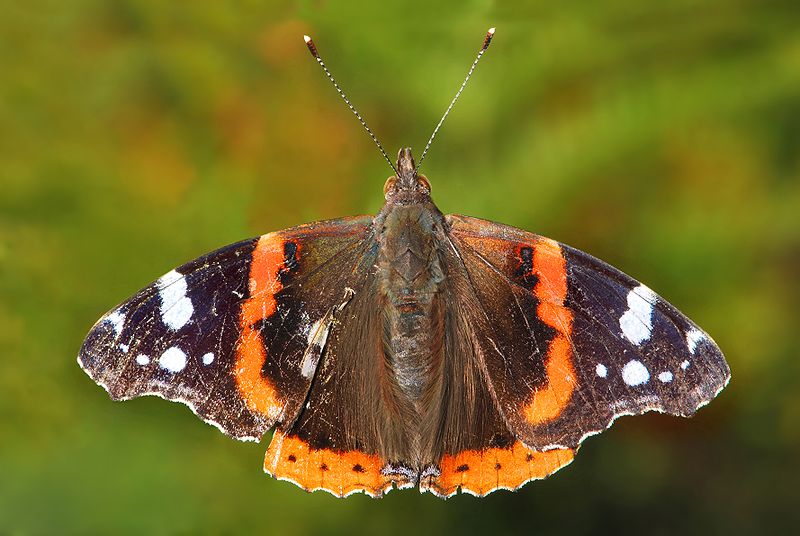
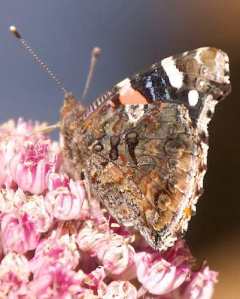
Red Admiral.  public domain
Red Admiral. public domain

“California butterflies, for better or worse are heavily invested in the anthropic landscape [altered by humans].  About a third of all California butterfly species have been recorded either ovipositing [laying eggs] or feeding on nonnative plants.  Roughly half of the Central Valley and inland Bay Area fauna is now using nonnative host plants heavily or even exclusively.  Our urban and suburban multivoltine [multiple generations in one year] butterfly fauna is basically dependent on ‘weeds.’  We have one species, the Gulf Fritillary that can exist here only on introduced hosts.  Perhaps the commonest urban butterfly in San Francisco and the East Bay, the Red Admiral is overwhelmingly dependent on an exotic host, pellitory.  And that’s the way it is.”

Professor Shapiro explains that alterations in our landscape made by humans made it necessary for butterflies to make the transition from natives to non-natives in order to survive:

The explanation for this odd situation can be found in the history of California’s wetlands.  As recently as the early twentieth century, there were extensive fresh water marshes in our area, especially along the east side of the Sacramento Valley.  These wetlands stayed green in the summer and could support multivoltinism because native host plants were available…The draining, diking, and agriculturalization of the wetlands corresponded in time with the widespread naturalization of exotic weeds related to native marshland plants.”
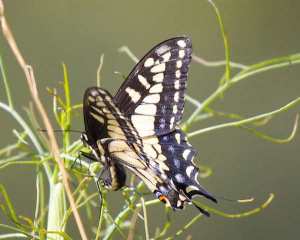
Anise Swallowtail butterfly in non-native fennel.  Courtesy urbanwildness.org
Anise Swallowtail butterfly in non-native fennel. Courtesy urbanwildness.org

Here are a few examples of native butterfly species that made the transition from native to non-native plants when the wetlands were altered by humans:

“What did our Mylitta Crescent feed on before the various pestiferous annual Mediterranean thistles come to California?  Native, mostly wetland thistles, just as it does in mountain bogs today…The Common Checkered Skipper still uses checkerbloom in wetlands where it can find it, but thanks to a weedy species of mallow it is now found in every garden and weedy lot in the northern part of the state.  And the Anise Swallowtail still lays eggs on water hemlock…in marshes, but percentage-wise very few of them.”

San Francisco is a special case for butterflies

San Franciscans know that although their city is very small in size, it is composed of many even smaller microclimates.  Professor Shapiro explains how these microclimates impacted our butterflies:

“The main reason why we have so many federally endangered or threatened butterflies in the Bay Area is that our peculiar geography is predisposed to the fragmentation of populations—particularly in the coastal fog belt.  These local evolutionary experiments may well have been dead ends in the long run…But they were so restricted to tiny chunks of habitat that even nineteenth-century development was enough to spell their doom.”

Then he reminds us what it would take to “restore” the landscapes that supported these rare or extinct butterfly species:

“Had there been an Endangered Species Act in the 1860s, San Francisco would be a very different place.  The “Great Sand Bank” occupying the western third of the city would have been declared critical habitat for any number of plants and animals found nowhere else on Earth—including three butterflies that subsequently went extinct.  We could still have the Xerces Blue, the Pheres Blue, and the Sthenele Satyr, but there would be no Golden Gate Park and no Sunset District.  The reclamation and stabilization of what was seen as a bleak, barren, fog-and-windswept wasteland were hailed at the time as triumphs of civilization.  Now some environmentalists would like to turn the clock back and restore a little of that unique habitat.  But some of its inhabitants, including those three butterflies, are gone, never to return.”
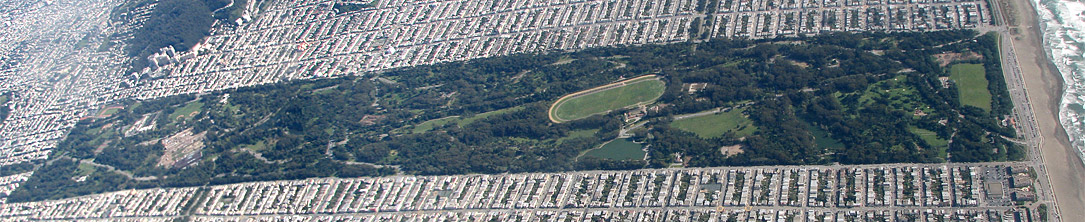
Golden Gate Park and its neighborhood.  Would you trade this for the barren sand dunes that preceded it?  Gnu Free Documentation
Golden Gate Park and its neighborhood. Would you trade this for the barren sand dunes that preceded it? Gnu Free Documentation

 However, the story isn’t entirely of loss in San Francisco:
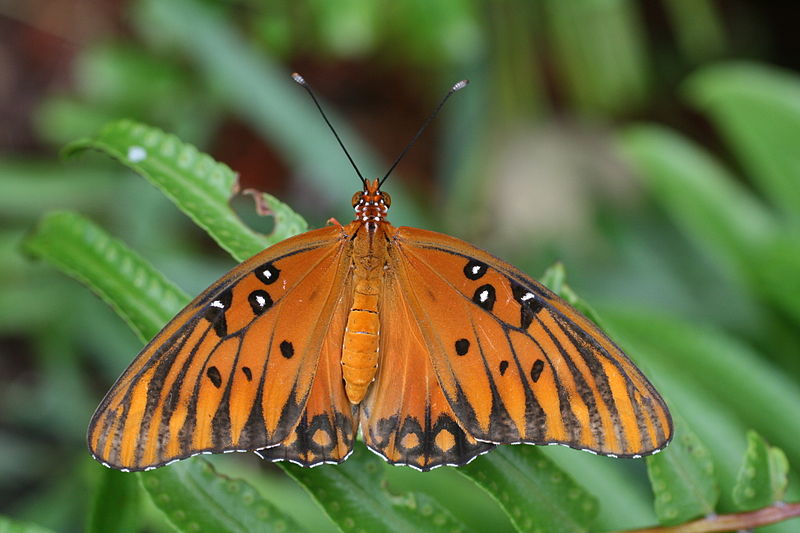
Gulf Fritillary.  Creative Commons
Gulf Fritillary. Creative Commons

“The Cabbage White…arrived sometime in the late nineteenth century.  The Gulf Fritillary…seems to have become established only in the 1950s.  The Fiery Skipper was unknown…in 1910…Several native species treated as scarce [in 1910] have become commoner due to introduced, weedy host plants.  The Anise Swallowtail and the Red Admiral are prime examples.  The West Coast Lady, most of whose hosts are weedy, was already very abundant in [1910].”

What do butterflies need today?

Professor Shapiro provides a detailed list of the plants used by the butterflies of California.  You will find roughly equal numbers of native and non-native plants on the list of plants they like as well as the plants they don’t like.  This is how he summarizes these lists:  “Most California natives in cultivation are of no more butterfly interest than nonnatives, and most of the best butterfly flowers in our area are exotic.”

What is done cannot be undone

While humans wring their hands about “weeds” and the loss of historical landscapes, butterflies have moved on.  And so they must to survive.  And so should we because these historical landscapes cannot be recreated without abandoning the economic enterprises which feed us or the homes that house us.  We aren’t going to bull doze Golden Gate Park or the residential neighborhoods that surround it.  The least we can do for the butterflies of California is to quit dousing the plants they need with herbicides solely because they are non-native.  We have created the landscape that we need and we should quit destroying the landscape that our butterflies now need.

Professor Shapiro’s Preface is a fitting conclusion:

The changes that humans have wrought on the lives of butterflies are merely the most recent of the many changes they have gone through in their history.  We have no hope of restoring communities to some hypothetical pristine state on any but a miniature scale.  At best we create gardens that more or less resemble what we think those communities looked like at some arbitrary time in the past.  Like all gardens, they require constant effort to keep them from becoming what today’s conditions drive them to become—conditions dominated by what we characterize as “weeds.”  We can, however, try to protect the bits of nature that have survived relatively unchanged despite us, cognizant that larger forces than we control may override our efforts.”
Eucalyptus: A fairy tale

We were browsing in our local used book store when a book caught my eye with the title, Eucalyptus.*  Of course, I had to buy it.  It is fiction, a welcome reprieve from the dry, often dense reading I must do to inform the readers of Million Trees.  Now I have the pleasure of sharing this diversion with you.

A fairy tale told among the trees

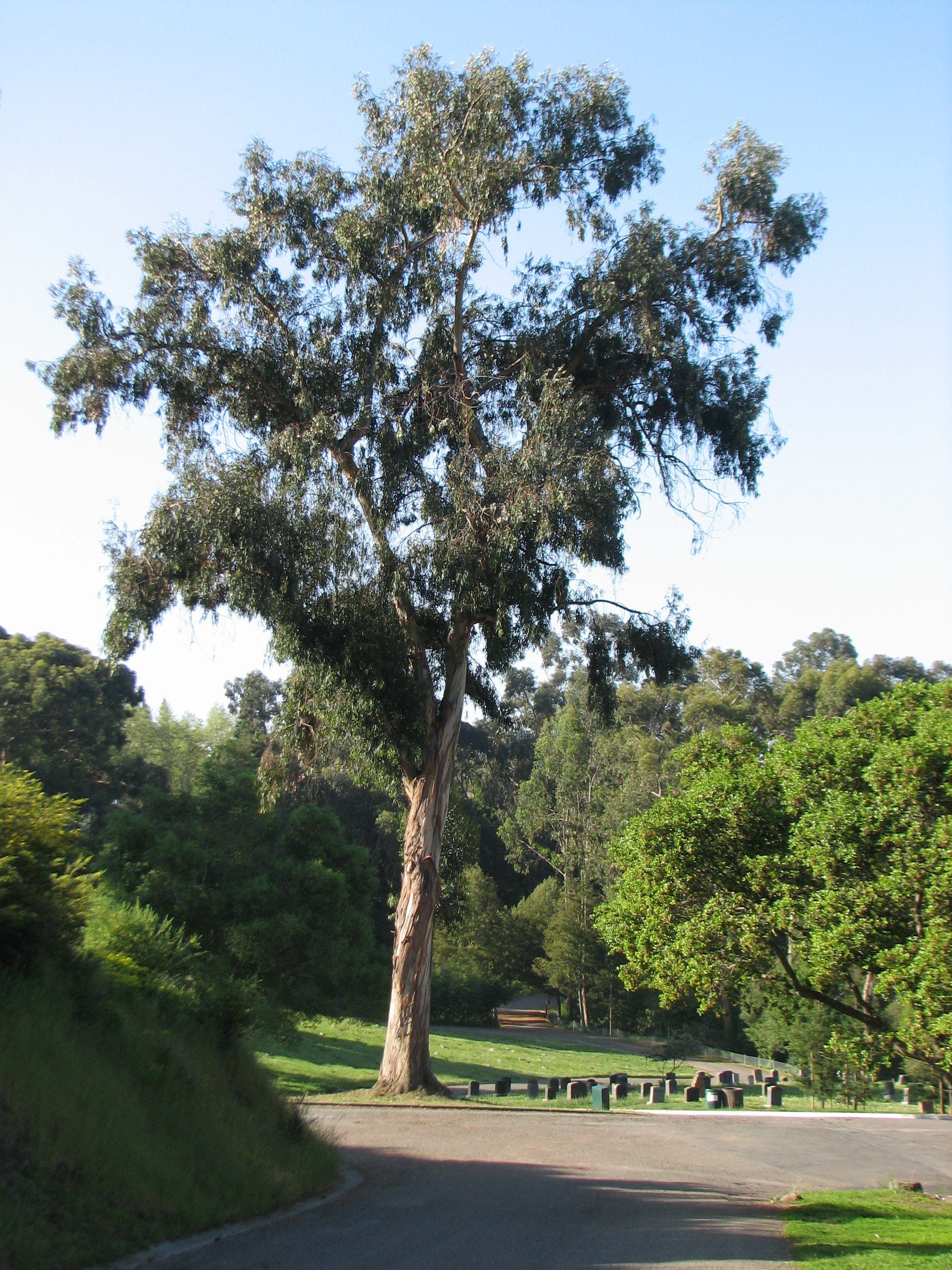
Blue gum eucalyptus tree in the Mountain View Cemetery.

We are in post-war Australia.  A young man marries a mail-order bride and soon loses her in childbirth, but not before insuring her life.  With this windfall, he buys a beautiful piece of land beside a river in southeast Australia.  His life is spent collecting and planting hundreds of different species of eucalyptus while raising his daughter.

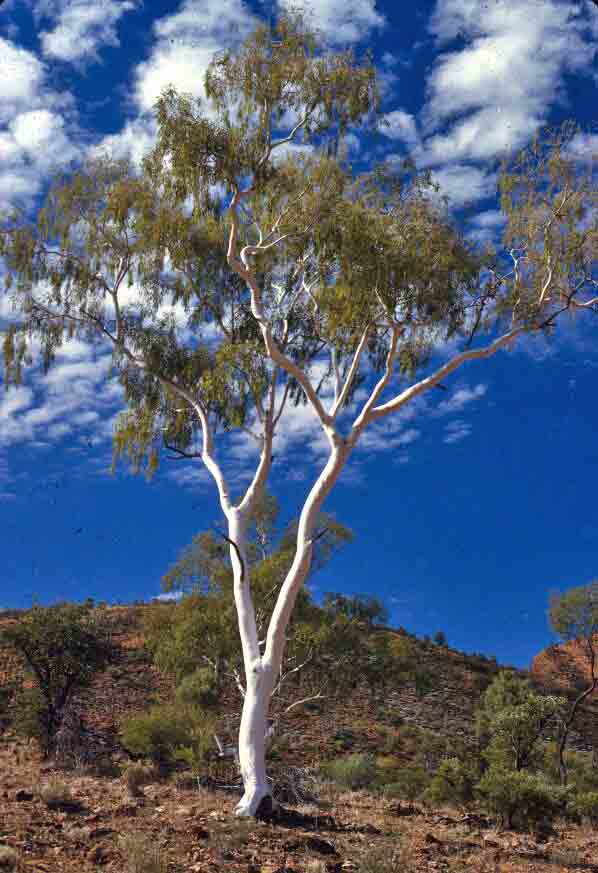
The hundreds of species of eucalyptus provide what little structure there is to the book.  Chapters are given the botanical names of the great variety of species and their various shapes and characters are described.  Our very own blue gum is mentioned at length:  “The Blue Gum is easily recognizable.  The name E. globulus for the shape of its fruit, now describes the imperial distribution of this majestic tree:  through the Mediterranean, whole forests in California and South Africa, and all states of Australia.”

The farmer is as devoted to his trees as he is to his beautiful daughter, so when the young men start coming around to court his daughter he protects her by devising a scheme that renders her nearly unattainable.  He announces that the man who wins his daughter’s hand must first name every species of eucalyptus on his property.  This proves an insurmountable task, but his daughter is indifferent to the failures of a long line of men who come from all over Australia to see her legendary beauty, but fail over many years to pass the test.

Ghost Gum.  Courtesy Cynthia Clampitt, Waltzing Australia
Ghost Gum. Courtesy Cynthia Clampitt, Waltzing Australia

Finally, a uniquely qualified botanist presents himself to the challenge.  It becomes apparent that he will pass the test.  While the father and this botanist tick off the list of hundreds of eucalypts, a mysterious stranger visits the daughter in the forest.  He tells her stories that charm her.  For the first time in her life, someone interests her.  He brings to her his knowledge of a wide world full of unusual lives and human predicaments.

When the stranger suddenly disappears without explanation, she falls into a deep stupor.  Meanwhile, the botanist passes the difficult test and comes to claim his bride.  But she languishes in despair and he is unable to revive her.

We must leave the story here, because the end is a wonderful surprise of which we do not wish to deprive you.   It was a great pleasure to read about our trees where they are respected and admired, as they deserve to be here as well.


*Murray Bail, Eucalyptus, Melbourne, Australia, 1998

Deforestation update is good news

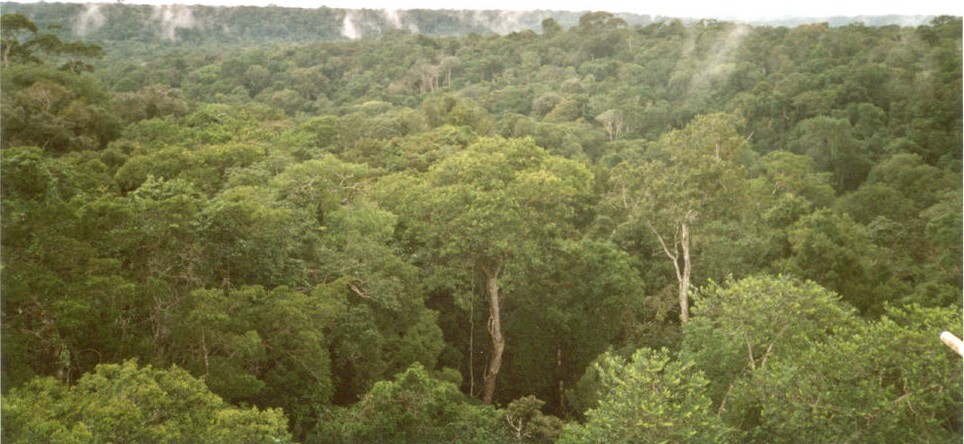
We don’t have many opportunities to tell our readers positive stories, so we are grateful for a recent article in The Economist magazine about deforestation. (1) In many places around the world the rate of deforestation has slowed and some places are being reforested. Greenhouse gas emissions from deforestation were contributing 25% of all emissions just 15 years ago.  Now deforestation accounts for only 12% of total emissions.  The Intergovernmental Panel on Climate Change which represents international scientific consensus said in its most recent report, “deforestation has slowed over the last decade.”

Amazon rainforest.  Creative Commons - Share Alike
Amazon rainforest. Creative Commons – Share Alike

The reasons for this improvement are important because they give us clues about how we can make further progress.  The Economist sees a pattern in the success stories:  “Typically, countries start in poverty with their land covered in trees.  As they clear it for farms or fuel, they get richer—until alarm bells ring and they attempt to recover their losses.  This happens at different stages in different places, but the trajectory is similar in most:  a reverse J. steeply down, then bottoming out, then up—but only part of the way.”  Here are a few examples that illustrate this principle:

  • Fifteen years ago, Brazil was losing 20,000 sq kilometers (7,700 sq miles) of forest per year. Since then a national policy has created national parks and protected patches of forest which has reduced deforestation to a rate of less than 6,000 sq kilometers per year.*
  • Mexico has cut its deforestation rate even more than Brazil.
  • India and Costa Rica are replanting their forests. India had 640,000 sq km of forest left in 1980.  It now has 680,000 sq km of forest.  Only 20% of Costa Rica was forested in the 1980s.  Now 50% of Costa Rica is forested.

These countries have in common some of the factors that predict success in reducing deforestation.  They are all more prosperous than they were in the past.  Their fertility rates are declining.  They are all democracies, in which public policy is largely a reflection of what the voters demand of their elected officials.  These are also countries in which the government is sufficiently functional to enforce their forest policies.  Developments in satellite imagery have helped these governments to monitor and enforce their policies.

(*Since this report was published by The Economist, the Yale Environmental Review 360e has published data on deforestation in Brazil for 2013.  After reducing the rate of deforestation since 2004, the rate of deforestation increased from 2012 to 2013 due to new roads and dams, and illegal logging.)

None of these factors would predict the relatively low deforestation rate in the Congo because its population is growing rapidly, it is still very poor, and its government is dysfunctional.  The Economist attributes the relatively low deforestation rate of the Congo to the movement of its rural population to distant urban areas.  The distance of forests in the east of the country from the cities in the west makes them less vulnerable to deforestation.

Deforestation continues to be a serious problem in Indonesia, despite the fact that the fertility rate has declined and farm output increased.  The rate of deforestation in Indonesia has exceeded that of Brazil since 2011.  The government of Indonesia is hostile to anti-deforestation policy, seeing it as foreign intervention.  Indonesia has only recently achieved democratic elections, which may enable reconsideration of forest policies.

China is also an interesting case because it has invested huge effort in reforestation without making any perceptible progress toward democratization.  However, the population is stable and increasingly urbanized and the country is significantly more prosperous than it was in the 1980s.  The effects of China’s deforestation were so dire as to motivate its autocratic rulers to take immediate action.  (2)

Only 2% of China’s original forest is still intact, according to Greenpeace.  Rampant logging and overgrazing have degraded its soil to the point that 25% of its territory is now covered in sand.  The desert is so close to Beijing that its roads are often clogged with sand, its railways inundated, and its pastures desiccated.

In 1978, China began one of the biggest reforestation projects in the world.  Since then 66 billion trees have been planted to create a shelterbelt along the edges of its northern desert that is projected to be 2,800 miles long by 2050.  Unfortunately, the Chinese selected few species of trees, which would grow quickly.  Some species were short-lived and some weren’t suited to soil conditions, so only 15% of trees planted since 1949 are still alive.  This is probably another example of a country that could make greater progress against deforestation with a more open democracy, which improves decision-making.

Global_Forest_Cover_Sub-Regional_Trends


Deforestation in the United States

Deforestation in the United States is largely a thing of the past.  About half of the United States was forested in 1600 compared to about one-third today.  Most of this deforestation occurred by 1910, when demand for lumber decreased significantly due to changes in building materials.  In the northeast of the country, much of the land has been naturally reforested as land that had been cleared for agriculture was abandoned.  It was always marginal land for agriculture, so as the population became more mobile, it moved west to find better land for farming.  This graph reflects these changes in land use and informs us that the south and the west are still supplying lumber for the world.  The US is supplying about one-fourth of the world’s timber.   Wildfires and insect infestations caused by climate change are also factors in declining forest cover in the west (although probably not reflected in this graph which ends in 1997).  (3)

Forest cover, USA. US Forest Service

Meanwhile, our local experience with deforestation is an outlier in these national trends.  Much of California was naturally treeless grassland and chaparral and it is being returned to that landscape by the native plant movement.  Most of our urban forest in the San Francisco Bay Area is not native to California.  It is being destroyed by most managers of public land because it is not native.  The public often objects to these destructive projects, but we are being ignored.

As we have seen in the examples above, deforestation and reforestation are largely political decisions.  American democracy is increasingly more responsive to economic interests than to the public.  Declining voter participation rates are undoubtedly a factor in this disturbing trend.  If you are not registered to vote, please give some thought to how our democracy has been damaged by lack of participation.  Midterm elections will take place this November.  Much is at stake.


(1) “A clearing in the trees,” The Economist, August 23-29, 2014

(2) “Great Green Wall,” The Economist, August 23-29, 2014

(3) http://en.wikipedia.org/wiki/Deforestation_in_the_United_States

Is UC Berkeley building a bonfire during fire season?

If you are watching the news, you know that wildfires are raging all over California. One of those fires destroyed most of the small town of Weed a few days ago. The San Francisco Chronicle reported that fire and made a rare acknowledgement of the flammability of native California vegetation: “…the native fuels adapted over thousands of years to the lightning-caused fires that regularly broke out in California. The most problematic in a drought situation, he said, are manzanita, younger ponderosa pine trees and incense cedars. The three are all highly flammable and close to the ground, creating a fuel ladder from the grass to the overstory trees.” The article also noted that fires usually start in grasses and are then fanned by high winds into wildfires that destroy everything in their path.

Yet, the fiction continues in the San Francisco Bay Area that only non-native trees are to blame for wildfires and that they must all be destroyed to reduce fire hazards. In fact, when the trees are destroyed, the unshaded ground is quickly populated by grasses that are the type of vegetation in which virtually all of our fires start.

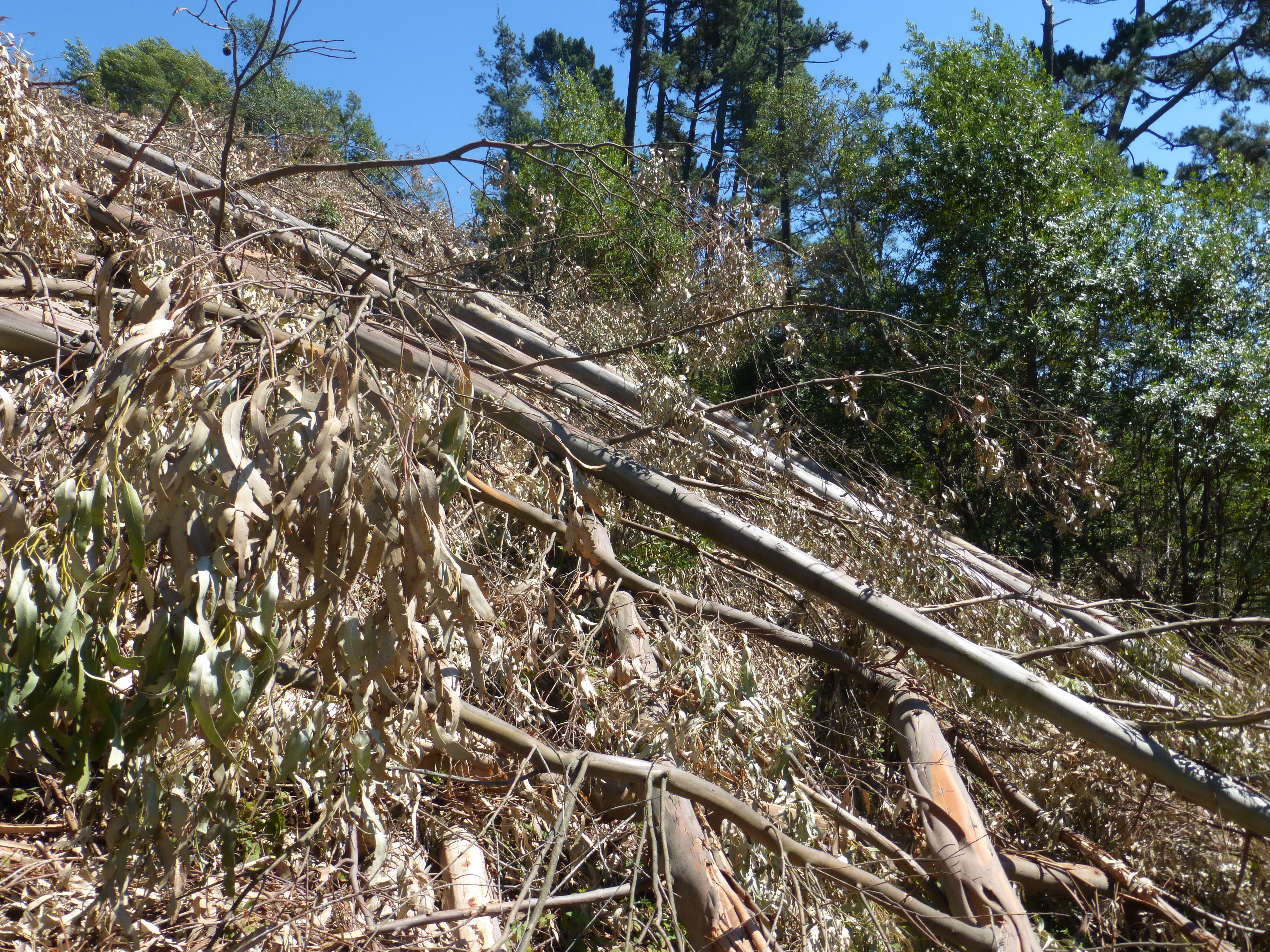
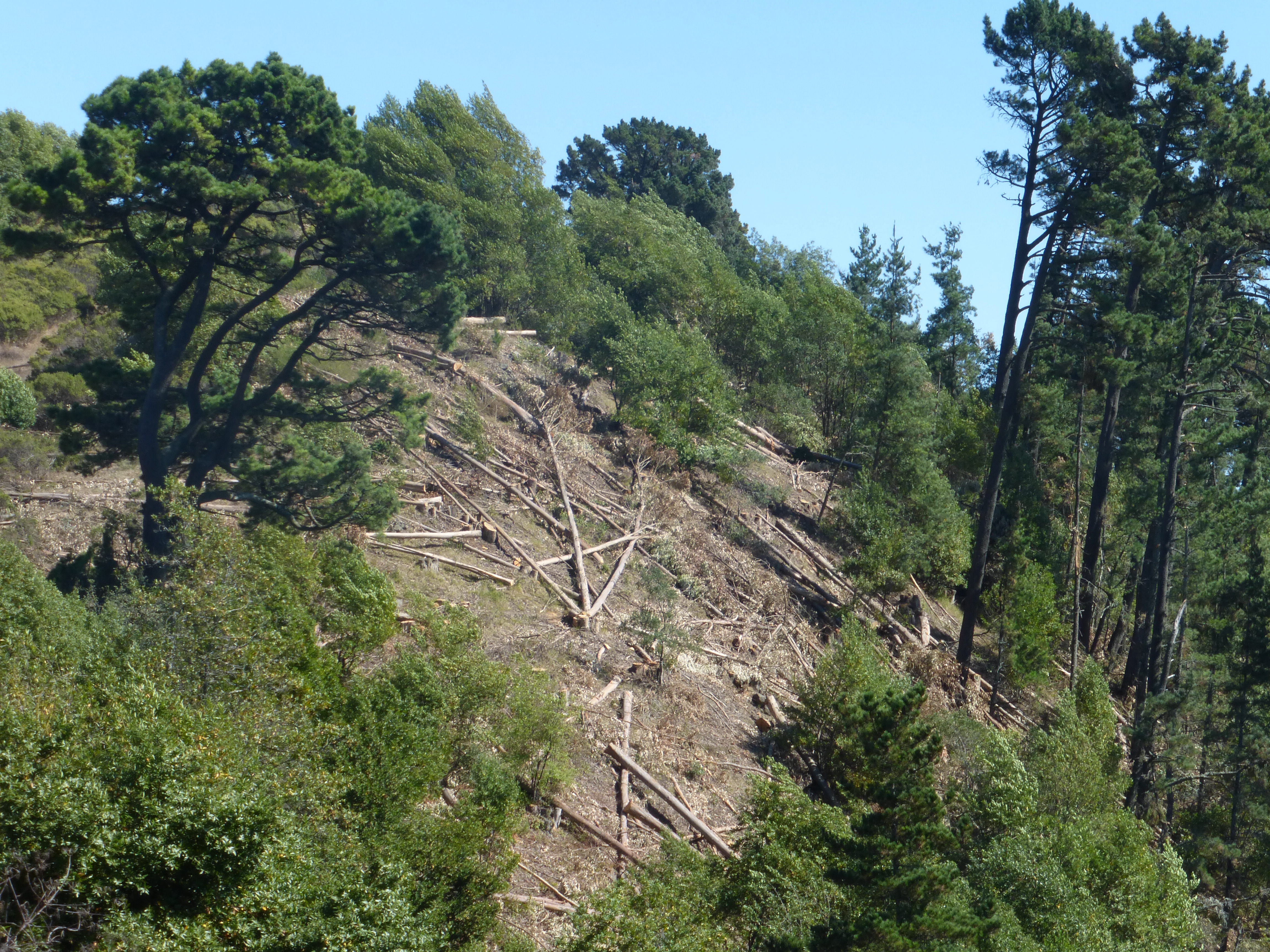
In the height of fire season, UC Berkeley has recently destroyed many trees in the East Bay Hills and left them lying on the ground to dry out. These huge piles of dead vegetation look like bonfires waiting to happen. We are grateful to our readers for alerting us to this new round of destruction. They have given us permission to publish their letter to the Federal Emergency Management Agency and UC Berkeley. We hope you will consider writing your own letter to express your concern.


Alessandro Amaglio [alessandro.amaglio@dhs.gov]
Region IX Environmental Officer
Federal Emergency Management Agency
Oakland, CA

RE: East Bay Hills – Environmental Impact Statement – FEMA – RIX

Dear Mr. Amaglio,

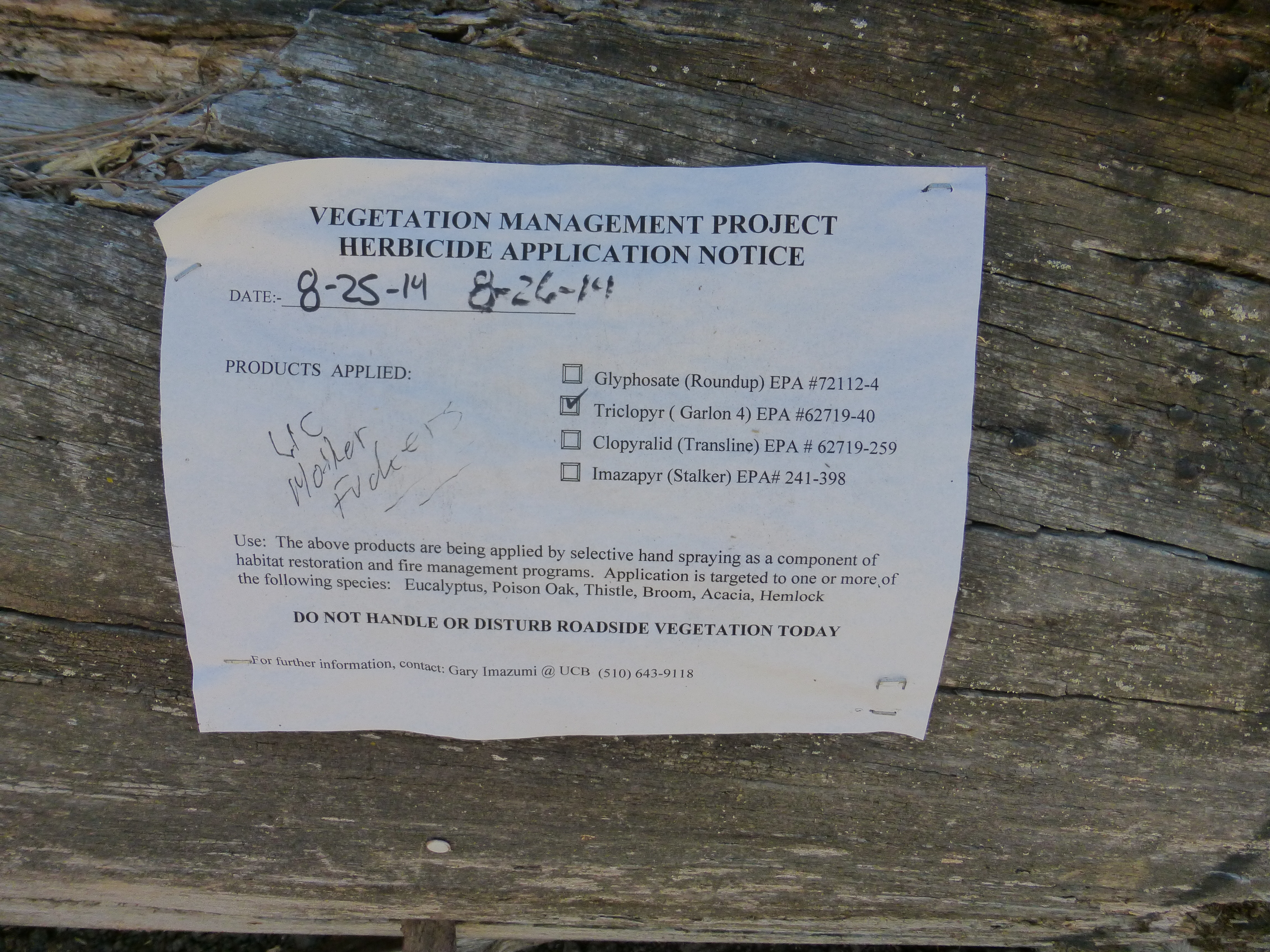
We are writing to tell you that UC Berkeley is in the process of destroying eucalyptus and some pine on its property. Judging by the Pesticide Application Notice posted on Grizzly Peak Blvd near South Park Drive, the trees were destroyed August 24-26, 2014. The scale of the removals is not entirely visible because the property goes down a steep slope that we could not cover. Based on what was visible to us, it appears that at least 100 trees were destroyed on a few acres.

P1010390

We believe the trees are being destroyed within the area for which UC Berkeley has applied for a FEMA grant to remove all non-native trees. We have used the maps in the Draft EIS to make this determination. Therefore, it seems appropriate that FEMA should be informed about this.

P1010400

While we visited the property on Monday, September 15, 2014, we could hear chainsaws in the distance but could not determine where the sound was coming from. Therefore, we suspect that more trees are being destroyed, but cannot determine exactly where.

P1010384

The Pesticide Application Notice gave the name of a person at UC Berkeley (Gary Imazumi) who is responsible for this project. (For the record, we are not responsible for the graffiti scrawled on that sign.) We have contacted him and asked for more information about the entire scale of the project and a timeline for its completion. We have also asked him what will be done with the huge piles of dead vegetation that are now lying on the ground. We have not received a response to our questions.

This incident raises the following questions and concerns:

  • Has the Draft EIS for the FEMA grants to UC Berkeley for tree removal been approved?
  • Has the FEMA grant to UC Berkeley been awarded?
  • If the EIS and/or the grant have not been approved, can UC Berkeley be reimbursed for expenses it incurs prior to the award of the grant?
  • The trees that UC Berkeley destroyed on August 24-26 are still lying on the ground several weeks after they were cut down. They have not been chipped or hauled away.  The Draft EIS made a commitment to chip the destroyed trees and distribute them on the ground.  Is there any time frame for this disposition of the destroyed trees?  Should the public expect dead trees to spend weeks or more on the ground after they are cut down?
  • As you know and the daily news confirms, we are now in the height of fire season. Does it seem consistent with fire hazard mitigation to use chainsaws at this time of year, particularly after several years of drought?
  • Does it seem consistent with fire hazard mitigation to leave dead vegetation lying on the ground during the height of the fire season? Does FEMA believe that dead vegetation is less flammable than living, standing trees?

P1010396

We understand that some of these questions are rhetorical and we don’t expect answers to any but the first three questions. The rhetorical questions are not intended to put you in an awkward position. They are intended to express our opinion of UC Berkeley’s hypocritical claim that destroying living trees will reduce fire hazards. We just want FEMA to know what is happening and to take it into consideration before finalizing the EIS and/or awarding the grant, if FEMA has not already done so.

Thank you for your consideration.

[Concerned citizens of Oakland]

Cc: Gary Imazumi, Manager, Grounds Operations, UCB [garyi@berkeley.edu]
Sal Genito, Associate Director, Grounds, Custodial, Environmental Services, UCB [salgenito@berkeley.edu]
R’obert Newell, Acting Assistant Vice Chancellor, Physical Plant, UCB [rbnewell@berkeley.edu]


Update:  On December 1, 2014, FEMA published the final Environmental Impact Statement for the “Fire Hazard Mitigation Grants” in the East Bay Hills.  As a result of UC Berkeley’s premature removal of trees in the project area prior to the publication of the EIS and prior to the award of the grants, the final EIS says that UC Berkeley will not be awarded grant funding for the Frowning Ridge portion of their grant application.  The following is an excerpt from the Executive Summary of the final EIS (page 17) which is available HERE.  However, we should not assume that this prohibition will remain when the EIS is officially approved by the “Decision of Record” on January 5, 2015, because we assume it is being challenged by those who support this project.

“In August 2014, UCB undertook environmental treatment measures on approximately 7.5 acres of the 185.2-acre project area at Frowning Ridge. According to UCB, they felled 150 eucalyptus, Monterey pine, and acacia trees, and applied an herbicide to eucalyptus and acacia stumps. In undertaking these actions prior to issuance of the final EIS, UCB failed to comply with both the specific conditions of the grant and also the NEPA requirement which limits applicant action during the NEPA process under 40 CFR 1506.1. Both required UCB to refrain from action until FEMA had completed its environmental review. As a result, the Frowning Ridge project area is no longer eligible for PDM program grant funding.

Nonetheless, the environmental analysis of the impacts of the proposed action at Frowning Ridge has not been removed from the final EIS because it is part of the review and consideration that FEMA has undertaken in concluding whether to fund the proposed actions. FEMA will continue to work with the U.S. Fish and Wildlife Service and the National Marine Fisheries Service to determine whether UCB’s unauthorized work at Frowning Ridge negatively affects UCB’s other projects at Strawberry Canyon and Claremont Canyon and will make further decisions regarding these projects in the Record of Decision.”


Rosalie Edge, conservation hero

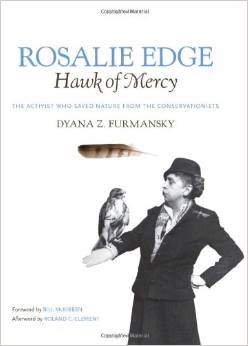
Rosalie EdgeWe are grateful to Dyana Furmansky for turning a suitcase full of letters into a fascinating biography of an important conservationist, Rosalie Edge. (1) Rosalie Edge was one of the first ardent defenders of wildlife—particularly birds—in America.  She came to this mission late in life, from unlikely previous experience.  Her life is therefore an interesting story, but it also interests us because her experiences as a conservationist shed light on our struggle to preserve our urban forest.  Specifically her struggle with the Audubon Society foretold our attempts to convince the local chapter of the Audubon Society (Golden Gate Audubon Society) that some of their policies are harmful to birds.

From privilege to the trenches of conservation warfare

Rosalie was born Mabel Rosalie Barrow in New York City in 1877 into a family of great wealth and privilege.  She married Charles Noel Edge in 1909 and followed him around the Orient for several years while he earned his living as a civil engineer and then as an investor.

They returned home, where Rosalie joined the woman’s suffrage movement in 1915.  She wrote passionate pamphlets for the suffragists, which later became her hallmark as a conservationist.   When women won the vote in the United States in 1920 with the passage of the 19th Amendment to the Constitution, Rosalie didn’t have much time to find another mission.   Her husband fell in love with another woman, effectively ending their marriage, which continued in name only to their death.

At the age of 44, in 1921, Rosalie was grief-stricken about the failure of her marriage.  She found solace in walks in Central Park in New York City and soon discovered that watching the birds gave her comfort.  The birders of Central Park were a community in the 1920s as they still are today.  They took Rosalie under their wing.  Soon she was embroiled in the organizational politics of the National Association of Audubon Societies (NAAS), the precursor to the National Audubon Society.  She learned that NAAS was engaged in activities that some members considered harmful to birds:

  • The President of the NAAS was taking donations from manufacturers of guns in exchange for adopting policies that were supportive of hunting birds.
  • NAAS also refused to oppose policies and practices that are harmful to birds, such as:
    • Killing birds to use their feathers in women’s hats, and
    • The policy of the federal government that paid large bounties for dead birds of prey, such as bald eagles.
  • NAAS was trapping and selling fur-bearing animals on its bird reserve in Louisiana to pay the salaries of their staff.

With only the force of her strong personality, Rosalie tried to shame the NAAS into abandoning these practices by attending their annual meetings.  When that approach failed, she sued NAAS for its mailing list and won.  With the mailing list of the 11,000 members of NAAS, Rosalie was able to communicate directly with the membership.  This approach put substantially more pressure on NAAS leadership as well as reduced its membership.   She had very little help with this effort.  She named her operation the Emergency Conservation Committee (ECC), but she was a proverbial one-woman-band.

Many of the NAAS policies to which Rosalie objected where eventually changed.  However, she was alienated from most members of NAAS and its successor NAS, until shortly before her death in 1962 at the age of 85.  She attended their banquet in 1962, along with 1,200 conservationists, where she was given a standing ovation.  Rosalie said, “’I have made peace with the National Audubon Society.’” (1)

The accomplishments of the Emergency Conservation Committee

The accomplishments of the ECC are particularly impressive if you keep in mind that most were achieved in the 1930s and 40s.  In the 1930s, there was very little money for anything other than creating jobs and putting food on the table.  In the 1940s the cost of World War II was our highest national priority.  Conservation was perceived as a luxury by both the public and the government.  Yet, Rosalie and those who helped her, accomplished many great things.

  • Migrating hawks shot in one day prior to establishing sanctuary.  Courtesy Hawk Mountain Sanctuary Archives
    Migrating hawks shot in one day prior to establishing sanctuary. Courtesy Hawk Mountain Sanctuary Archives

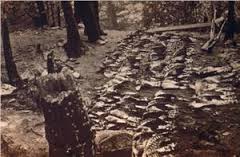
    Hawk Mountain in Pennsylvania was a place where wind currents funneled tens of thousands of hawks during their fall migration. It was therefore a popular place for hunters to stand on the mountain and shoot the birds out of the air.  Tens of thousands of hawks were slaughtered every year, which was just too much to bear for Rosalie.  Nearly penniless during the deepest years of the depression, Rosalie borrowed $500 from a friend with an interest in the hawks to lease Hawk Mountain.  Fortunately the land wasn’t useful for most purposes and economic conditions depressed land values, so she was eventually able to buy it.  It was the first privately acquired property for the sole purpose of conservation.  It was considered the model for The Nature Conservancy by one of TNC’s co-founders, Richard Pough.  Today, Hawk Mountain is visited by tens of thousands of visitors every fall to witness the migration.  There are far more visitors to see the birds than there had been to shoot them in the past.  The data gathered at the Hawk Mountain Sanctuary about immature hawk and eagle migration were very helpful to Rachel Carson in making her case against DDT.

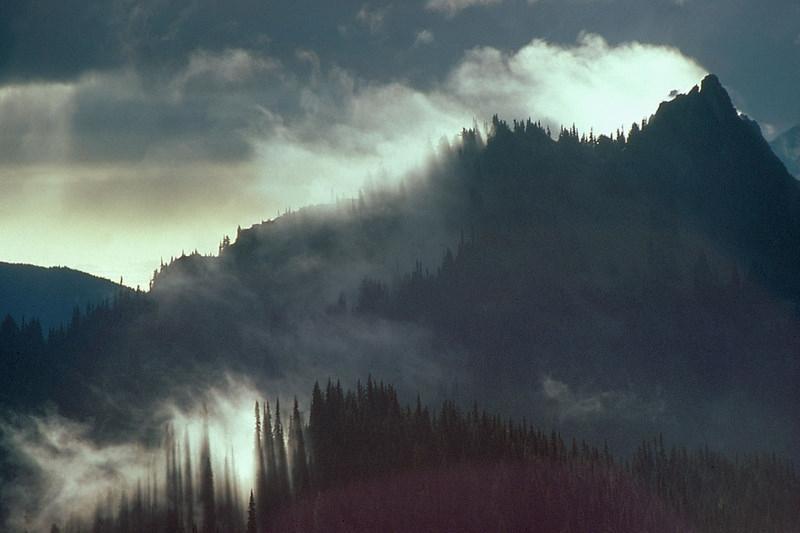
  • When Franklin Roosevelt became President, things got a little easier for Rosalie because his Secretary of the Interior, Harold Ickes, shared her interest in conservation. Together they collaborated to create Olympic National Park in Washington State, to incorporate a sugar-pine forest into Yosemite National Park, and to create King’s Canyon National Park in the Sierra Nevada in California.  None of these achievements was easy.  The story of how opposition was overcome would sound familiar today.  Timber and other economic interests had to be satisfied or neutralized by overwhelming public support.  Rosalie’s passionate pamphlets were instrumental in creating public support.
Olympic National Park.  NPS photo
Olympic National Park. NPS photo

Familiar themes

Rosalie’s experiences with the National Association of Audubon Societies sound familiar to us.  Despite the organization’s stated mission of protecting birds, economic interests sometimes influence its policies and practices.  The paid staff of an organization is under constant pressure to fund its salaries.  The temptation for quid pro quo arrangements is great, particularly during hard economic times.  Although Rosalie was successful in ending such arrangements, the temptation is always there.  Therefore, constant vigilance is required to prevent it from happening again.

Towards the end of her life, Rosalie’s unpublished memoir explains why her Emergency Conservation Committee was successful:

“In her memoir, she had commended volunteerism as the most meaningful way to bring about change.  ‘I beg each one to keep conservation as his hobby, to keep his independence, his freedom to speak his mind,’ she had written years before.  She had seen too many professionals become jaded or fall captive to special interests.  She, on the other hand, had spoken freely.  There would always be a need for those who could do that, she warned.” (1)

We believe that the local chapter of the Audubon Society (Golden Gate Audubon Society) is supporting projects that are harmful to birds.  We have detailed those projects in a recent post and won’t repeat them here.  The story of Rosalie Edge’s confrontation with the National Association of Audubon Societies warns us that changing those policies will not be easy.  However, we are inspired by Rosalie’s success and we follow her lead:  We are a loose confederation of volunteers who work collaboratively, but independently.   We are compensated solely by the occasional success of our venture to save our urban forest and the animals that live in it.  We cannot be compromised by any economic interests.


(1) Dyana Z. Furmansky, Rosalie Edge Hawk of Mercy, University of Georgia Press, 2009

Climate change requires plants and animals move to survive

Our readers know that we consider climate change the most critical environmental issue of our time.  We also believe that the native plant ideology is antithetical to our concern about climate change for two reasons:

  • The changing climate requires that plants and animals move in order to survive. Therefore, the demand that historical ranges of native plants and animals be restored and maintained is both unrealistic and harmful.  It is unrealistic because the environment has changed in the past 250 years since the arrival of Europeans on the West Coast and it will continue to change.  Therefore, we cannot assume that the native plants that existed here in 1769 are still capable of surviving here.  It is harmful because animals can and do move as the climate changes.  Therefore, eradicating the plants they need for survival is harmful to them.
  • The eradication of non-native plants and trees is exacerbating climate change by releasing their stored carbon into the atmosphere, thereby contributing to the greenhouse gases that cause climate change. When prescribed burns are used to eradicate non-native plants or prevent natural succession the release of carbon into the atmosphere by the plants that are burned is immediate.  When large, mature trees are destroyed, the carbon they have stored as they grew is released into the atmosphere as the wood decays.  Furthermore, their ability to store carbon in the future is lost to us going forward.  Since carbon storage is directly proportional to biomass, whatever we plant in their place is incapable of storing as much carbon as the mature trees.
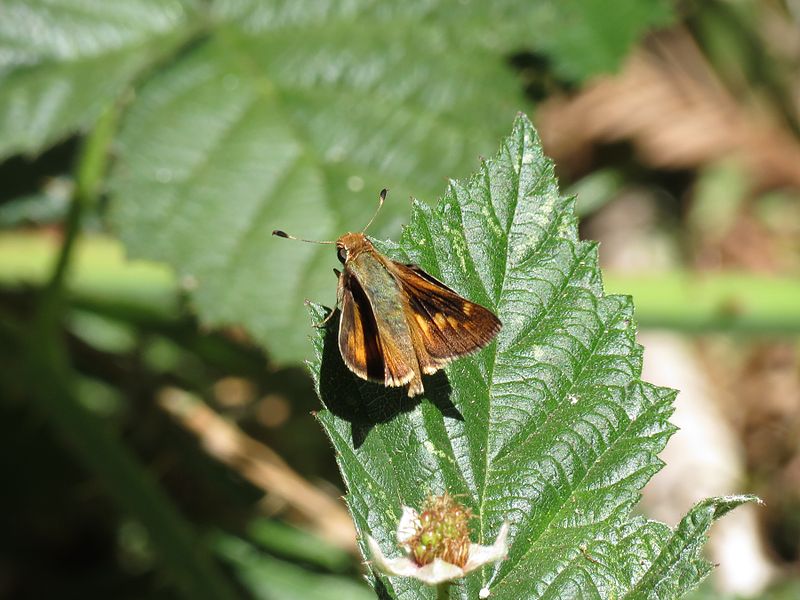
The umber skipper has adapted to Bermuda grass in lawns in the East Bay.  Creative Commons
The umber skipper has adapted to Bermuda grass in lawns in the East Bay. Creative Commons

There is an important caveat that we must add to our first bullet point.  Changing location is not the only mechanism that can ensure species survival in a changing climate.  Many species are probably “pre-adapted” to the changed climate.  That is, they may be capable of surviving changes in the climate.  Secondly, species can adapt and/or evolve in response to changes in the environment, which is another mechanism that facilitates species survival.  We invite our readers to visit our post about the rapid evolution of finches in the Galopagos Islands in response to extreme weather conditions that caused selection events.

Today we will inform our readers of the scientific record regarding the need for plants and animals to move as the climate changes.  We will use the recently released fifth report of the Intergovernmental Panel on Climate Change as our source.

Intergovernmental Panel on Climate Change

First we will establish the credibility of the Intergovernmental Panel on Climate Change (IPCC).  The IPCC was formed in 1988 by the United Nations.  It is composed of thousands of scientists from all over the world, representing the 190 member nations of the UN.  The IPCC does not conduct original research.  Rather it compiles thousands of peer-reviewed scientific studies into reports that represent a consensus viewpoint of the global scientific community.  Typically, scientists from 120 countries participate in marathon sessions in which consensus must be reached before reports can be published.  The IPCC has published 5 reports since 1988, the most recent earlier in 2014.

How the climate has changed and how it will continue to change

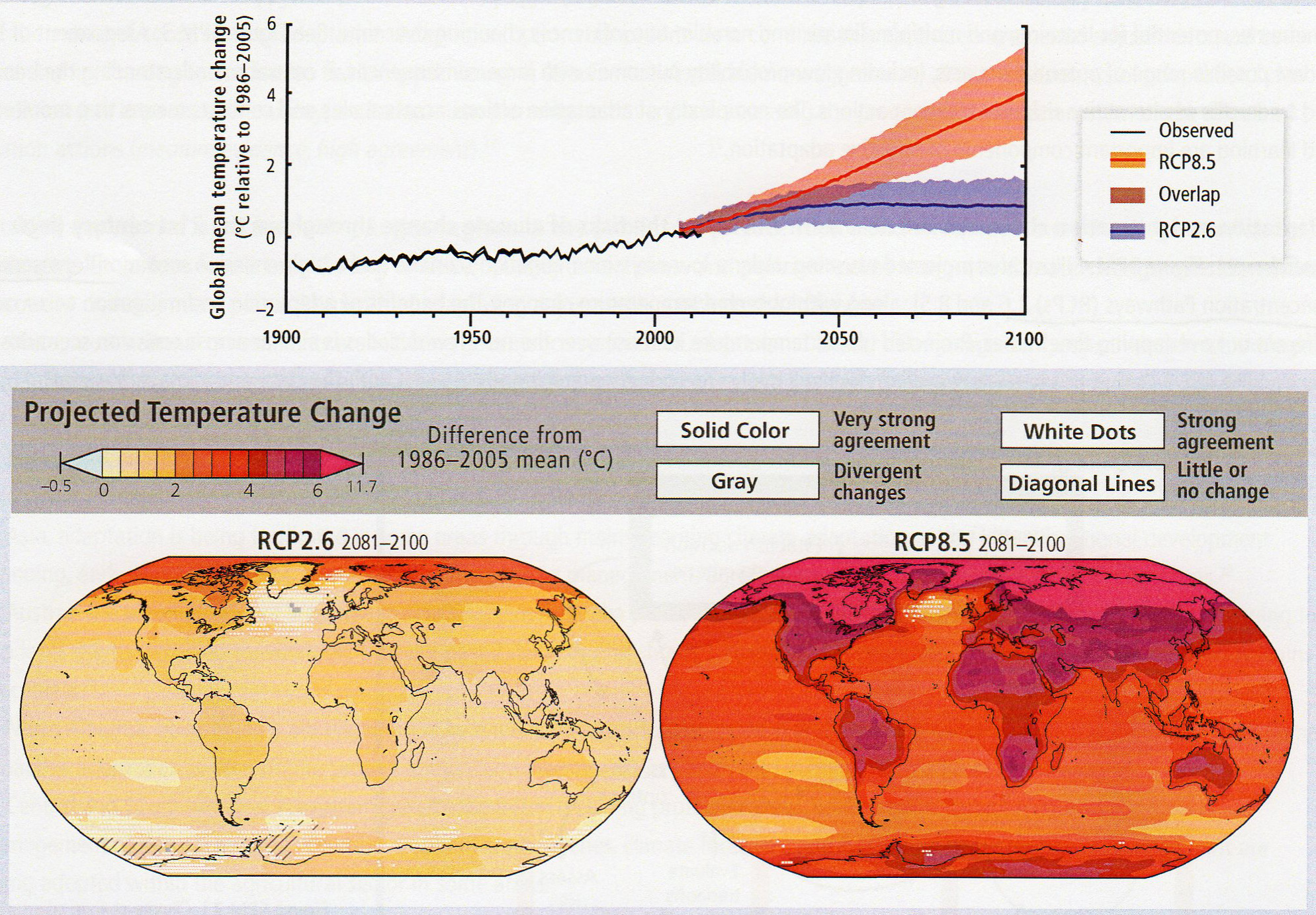
The IPCC compiled several different sources of data to report how the climate has changed from 1900 to the present.  Then they modeled the multitude of variables that influence climate to predict different trajectories for the climate going forward to 2100.  The many variables that influence climate interact in complex ways that are not entirely predictable.  There is therefore some uncertainty in those predictions, as there is in any prediction of the future.  Therefore, future temperature is depicted by the following graph as “bands” of probability.  The bands become wider as the graph depicts further into the future, as we would expect; that is, the distant future is less predictable than the near future.

Observed and projected temperature change, IPCC 2014

Here’s what we learn from this graph:

  • The graph reports that the average global temperature has increased by 1° Celsius (1.8° Fahrenheit) from 1900 to the present.  Graphs depicting the more distant past indicate that the climate began to warm around the time of the industrial revolution, about 1850.  Therefore the total increase in temperature is greater than that depicted by this graph.  However, the rate of increase has accelerated greatly in the past 50 years.
  • The upper range of projected temperature increases on the graph is labeled RCP8.5 (Representative Concentration Pathway 8.5). That pathway is based on the assumption that present levels of greenhouse gas emissions will continue to increase at the same rate as they have in the recent past.  The mean prediction of that pathway is a global temperature increase from the present to the end of the century of 3.7° Celsius (4.6° Fahrenheit).
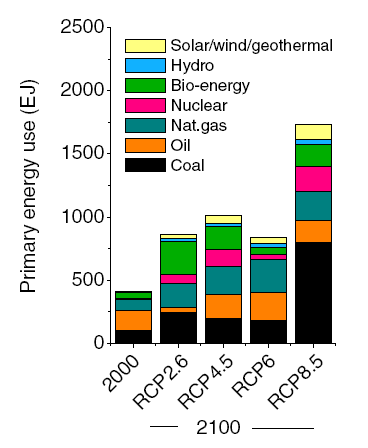
  • The lower range of the projected temperature increases on the graph is labeled RCP2.6 (Representative Concentration Pathway 2.6). The mean prediction of that pathway is a temperature increase to the end of the century of 1° Celsius (1.8° Fahrenheit).  That pathway is based on the assumption that greenhouse gas emissions are radically reduced, beginning immediately, as represented by the following graph from The Guardian.  This graph also depicts two intermediate emission scenarios between the present trajectory(RCP 8.5) and the maximum predicted reductions in emissions (RCP 2.6)
Projected energy use

Movements needed for survival in a changing climate

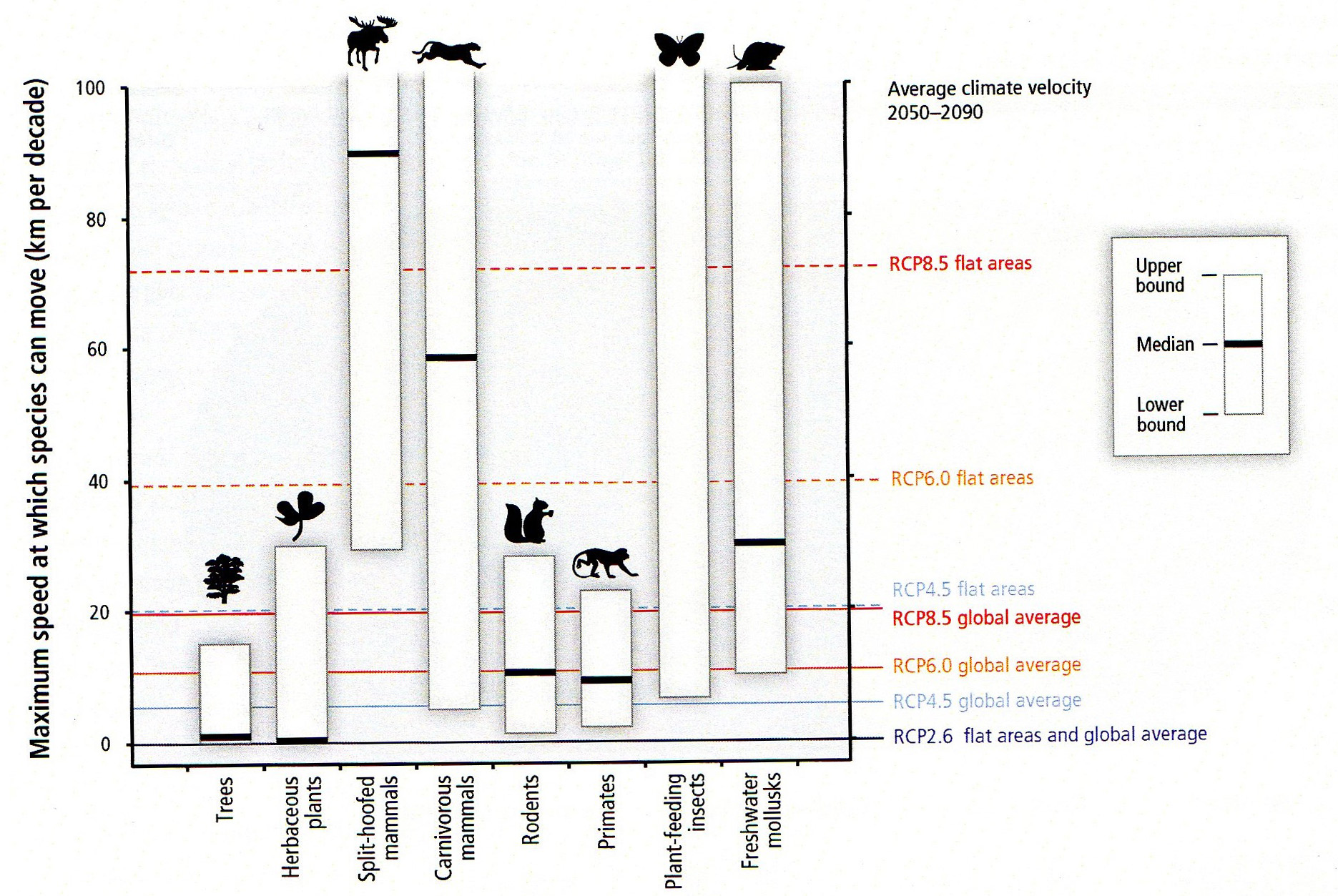
The world has done little to reduce greenhouse gas emissions and America has done even less.  According to a recent Gallup Poll, only 39% of Americans are “concerned believers” in climate change.  Another 36% of Americans believe the climate is changing, but don’t believe it will affect them.  Twenty-five percent (25%) of Americans do not believe the climate is changing.  Therefore, for the time being, it seems extremely unlikely that our polarized politics in America will be capable of responding effectively to the grim reality of climate change.  Within that context, we inform you of the final graph from the IPCC report about the need for plants and animals to move from their present ranges in response to climate change and their variable ability to do so.

Adaptation to Climate Change.  IPCC
Adaptation to Climate Change. IPCC

On the vertical axis, the graph depicts the ability of plants and animals to move, measured in kilometers per decade.  The horizontal lines depict the need of plants and animals to move in response to various scenarios of climate change as we described earlier.  The bars depict the ability of plants and animals to move and the height of each bar informs us of the variable ability of plants and animals to move.  Trees are the least able to move, unless we have the wisdom to plant them outside their native ranges—at higher latitudes or elevations–where they are more likely to survive in the future. 

For example, if we radically reduce greenhouse gas emissions immediately (RCP2.6), most species of trees and plants will be sustainable at their present latitudes and elevations.  But if greenhouse gas emissions continue on their current trajectory (RCP8.5), most species of trees and plants will not be capable of moving far enough, fast enough to survive as the climate warms.  Although trees and plants are capable of moving only very slowly, most animals are capable of moving more rapidly.  Will they have the plants they need to survive in their new ranges?

 Putting our heads in the sand

Surely there aren’t many native plant advocates in the San Francisco Bay Area who don’t believe in the reality of climate change.  The Gallup Poll reports that most people who don’t believe in climate change are Republicans and in the San Francisco Bay Area Republicans are a small minority.  And so we ask native plant advocates this question:  How do you reconcile the reality of climate change with your demand that native plants be restored and maintained where they existed 250 years ago in a very different climate?


Polarized views of nature mirror our politics

We recently posted an article about our on-going debate with the Audubon Society regarding its misguided support for the projects that are destroying the urban forest in the San Francisco Bay Area.  That article provided a few examples of our widely divergent views of nature:

  • We don’t see how birds will benefit from the destruction of tens of thousands of trees and countless plants that provide food and cover for birds and animals.
  • We don’t enjoy walking in nature with a judgmental eye, which points fingers at plants and animals that others claim “don’t belong there.” We are unwilling to divide nature into “good” and “bad” categories.
  • We don’t think humans have the right to pass a death sentence on wild animals because they prefer another animal, which they claim will benefit from the death of a potential competitor.
  • We don’t consider a “managed” forest a “more natural forest.” We don’t think humans are capable of improving what nature can accomplish without our interference.  We don’t think a public park that is routinely sprayed with herbicides can be accurately described as a “natural area.”
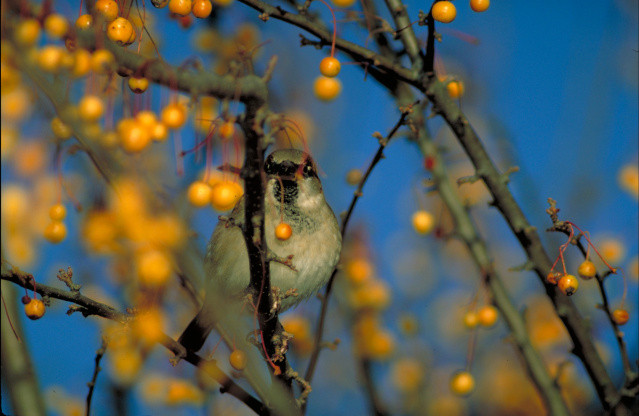
English sparrow.  US Fish & Wildlife photo
English sparrow. US Fish & Wildlife photo

However, these widely divergent viewpoints about nature are not inconsistent with the extremes of our polarized politics in America.  Just as we don’t expect to change the minds of those at the opposite end of the political spectrum, we don’t expect to change the minds of those who view nature through the darkly colored lens of nativism.  Just as elections for public office are decided by the independents in the middle of the political spectrum, the debate about the future of our public lands will be decided by those who have not yet formed an opinion about what is best for nature.  Today’s post is addressed to them.  We will tell the “independents” about two recent op-eds published by The New York Times which represent the two extreme viewpoints about nature.  Both op-eds use sparrows as representatives of the natural world, which we hope will make the differences in these viewpoints starker and therefore clearer.

First a word about how important the “independents” are to the debate about the ecological “restorations” which are dictated by invasion biology.  Political independents are usually not more than a third of the electorate.  But, a survey conducted by University of Florida suggests the majority of the public are still open to learning more about “invasive species.”  They report that 62% of Floridians they surveyed said they are not knowledgeable or only slightly knowledgeable about invasive species.  Ironically, the same survey claimed that “a majority voiced support for raising sales tax to combat invasive species.”  One wonders why voters who acknowledge that they know nothing or next to nothing about invasive species would be willing to tax themselves to combat something they don’t understand.  In any case, if Floridians are typical, the majority of the public needs to know more about invasion biology.  We hope they have access to balanced information that is not written by those who make their living killing animals and poisoning our public lands.  Million Trees was created over four years ago for that purpose.

“The Truth About Sparrows”

Some time ago, we told the story of how sparrows were brought to America in the 1850s by people who believed they would eat the insects that were killing trees.  We concluded that article by saying that 150 years later house sparrows are no longer despised as alien intruders.  We were wrong.

In May 2014, the New York Times published an op-ed entitled “The Truth About Sparrows.”  The op-ed was written by Peyton Marshall, whose mother was an exterminator of house sparrows.  This was no idle pastime for Ms. Marshall’s mother.  It was her mission.

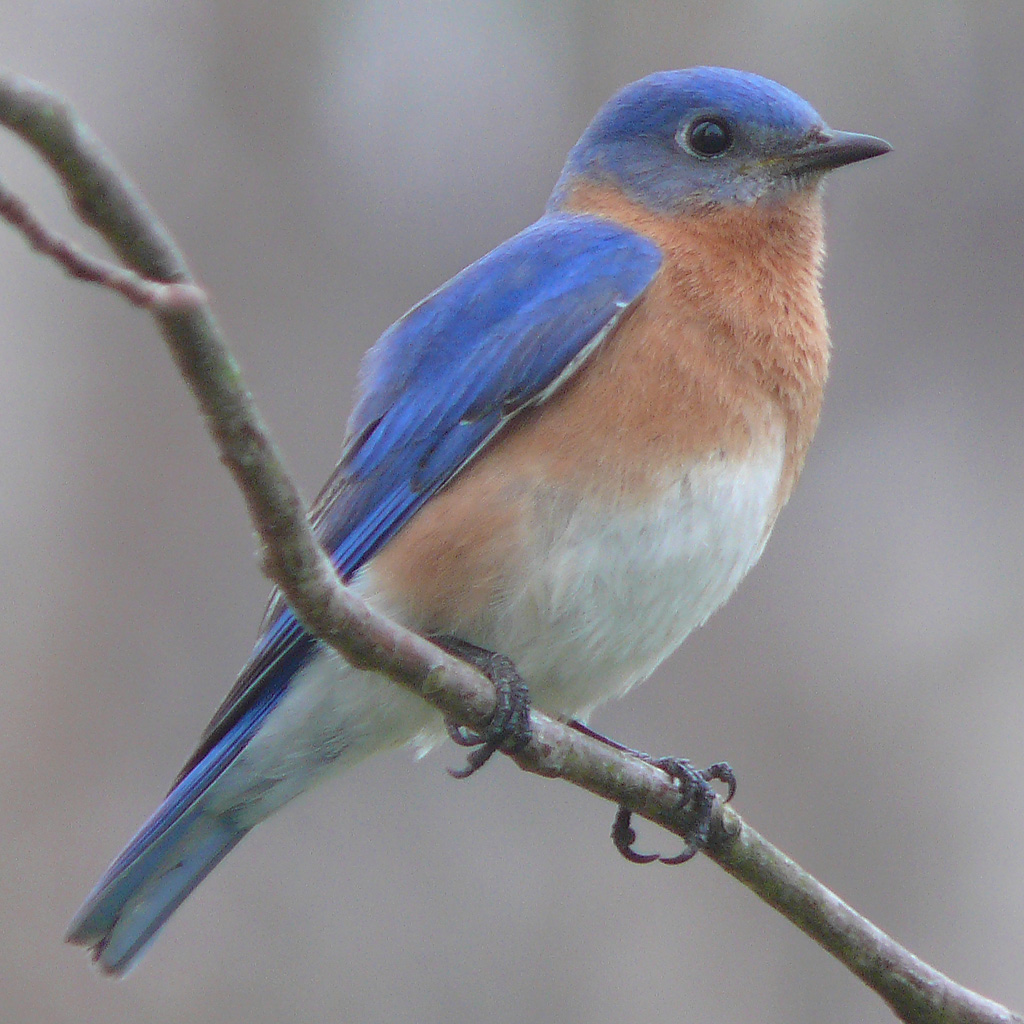
Eastern bluebird, public domain

Mom’s crusade against house sparrows began when Ms. Marshall was a child.  Mom loved bluebirds at a time when their population was dwindling in the east where they lived.  Mom decided that house sparrows were to blame and so she took it upon herself to kill every house sparrow that had the misfortune of entering her yard or within reach of it.

Mom began by trapping the house sparrows.  “Good” birds caught in the traps were freed, but the house sparrows were put into plastic garbage bags and asphyxiated.  Mom started the family car in the garage and wrapped the open end of the garbage bag around the tailpipe.  When the birds did not die, she consulted her husband who informed her that the car was a diesel and would not produce enough carbon monoxide to kill the birds.

So, mom took her operation on the road.  She helped elderly ladies with their groceries in the parking lot in exchange for a shot at their tailpipe.  When dropping off her children for play dates and birthday parties, she asked their parents if she could make brief use of their cars to kill birds.  Polite parents watched in horror as they became accessories to this execution.

Ms. Marshall concludes her story by noting that the population of bluebirds has rebounded since she was a child.  But mom continues to trap house sparrows in her yard and now uses a less public means of killing them:  “Now, she uses a carving knife and cutting board, at her leisure, in the privacy of her own kitchen.”

Although Ms. Marshall doesn’t say so, we doubt that the recovery of the bluebird population has much to do with the extermination of house sparrows in her mother’s backyard.  The recovery of the bluebird population is attributed to building nest boxes that substitute for the dead trees which are their preferred nest sites.  There are few dead trees in urban and suburban areas because people consider them hazardous and unsightly.  Once again, animals pay the price for the choices of humans.

“What the Sparrows Told Me”

The New York Times published “What the Sparrows Told Me” in August 2014.  It is a fitting antidote to the grisly tale of the sparrow exterminator.

Trish O’Kane, the author, was a human rights investigative journalist in Central America for 10 years before moving to New Orleans to teach journalism.  Less than a month after arriving in New Orleans, she and her family were displaced by hurricane Katrina in 2005.  Four months after the hurricane, she rented a room in a dry part of town so that she could return to her teaching job.  It was a hard time for everyone in New Orleans, but her gloom was deepened by learning of her father’s terminal cancer which would kill him in a matter of months.

Ms. O’Kane had never had an interest in birds before, but she knew she needed “to focus on something beautiful, something positive, something alive,” and so she did:

“I bought two bird feeders.  Each morning I sat on that back stoop and watched those sparrows.  Instead of wondering what was going to happen to the city, to the Gulf Coast, to the planet, I started wondering why one sparrow was hogging all the seed.  I started thinking about their resilience, their pluck, their focus on immediate needs.  If they couldn’t find food, they went somewhere else.  If they lost a nest, they built another.  They had no time or energy for grief.  They clung to the fence in raggedy lines heckling one another like drunken revelers on Bourbon Street.  Their sparring made me laugh.“

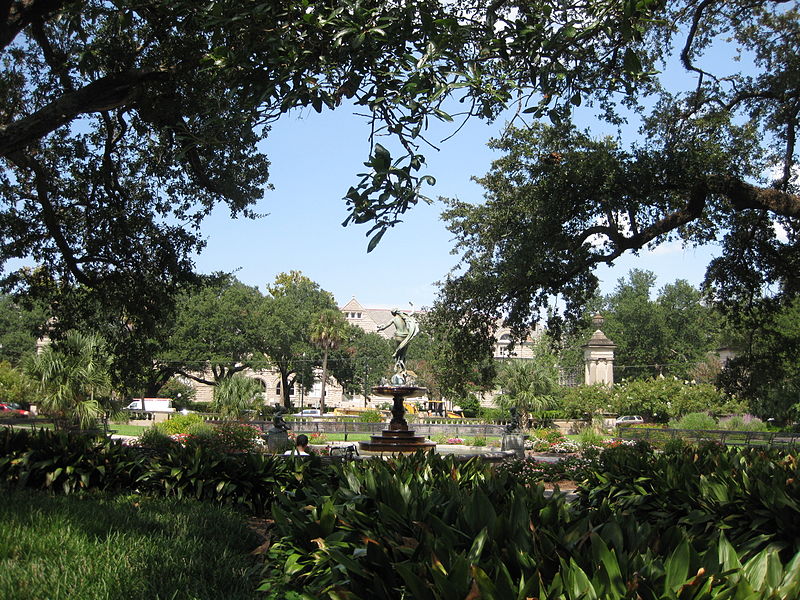
Audubon Park, New Orleans.  Public domain
Audubon Park, New Orleans. Public domain

Ms. O’Kane started holding her classes in Audubon Park, named for John James Audubon.  Her students began to find the same solace in watching the birds going about their business, finding a way to survive, carrying on.  And that gave her and her students the strength and the will to do the same at a time when life was hard in New Orleans.

Ms. O’Kane is now a doctoral student in environmental studies at University of Wisconsin, Madison.  She has found a way to connect her interest in human rights with her new found interest in birds.  She teaches an undergraduate course in environmental justice in which she pairs undergraduate students with middle school students in a mentoring program called Nature Explorers.  Many of the middle school children are immigrants from Central America.  She finds that they enjoy learning about the birds that migrate between Central America and Wisconsin, just as their families did.  The birds, like the people of America, are citizens of the world.

Ms. O’Kane tells us that many of her undergraduate students are frightened of the future of our planet.  She likes to start each new class with the story of the sparrows in New Orleans:  “I tell them that the birds are a gift to help them get through each day, a way to enjoy the world while we change it so that young people, everywhere, have a chance.”

Whose eyes do you choose to look through?

It’s no secret that our viewpoint regarding nature is more closely aligned with Ms. O’Kane’s.  If you haven’t yet taken a stand on the issue of what plants and animals are welcome in your ideal nature, think for a moment.  Which of these starkly different viewpoints do you prefer?

Understanding the eucalyptus forest – Professor Joe R. McBride

This article has been republished from the  website of Save Mount Sutro Forest, with permission.


Dr. Joe McBride of UC Berkeley spoke at the Commonwealth Club in April 2014 as part of the series “The Science of Conservation and Biodiversity in the 21st Century.” His main message:

  • Eucalyptus groves in California provide habitat for as many native species as do most ‘native’ habitats.
  • They grow well at high densities and an average spacing of 8 feet between trees is quite typical.
  • They have relatively high fuel loads, but the cool and damp dense eucalyptus forests reduce the risk of fire.
  • Eucalyptus is subject to few diseases or pests, and parasitic wasps provide pest control.
  • It provides a host of ecosystem services including carbon sequestration, pollution reduction, slope stabilization, windbreaks, wildlife habitat, and recreational value.

Dr. Joe R. McBride was Professor of Landscape Architecture and Environmental Planning, Department of Environmental Science, Policy, and Management, UC Berkeley. (He has since retired.)

Read on for notes from Dr. McBride’s talk. (There are also links to his Powerpoint presentation.)

—————————————

sutro forest with dappled sunlight

THE HISTORY, ECOLOGY AND FUTURE OF EUCALYPTUS PLANTATIONS IN THE BAY AREA

Notes From a Talk By Dr. Joe R. McBride

Dr McBride’s wide-ranging talk covered a lot of ground. He talked about the ecology of the eucalyptus forest in the Bay Area: its structure, the variety of plants and animals that live within it, its health and the ecological functions it performs; the dynamics within these forest stands; and their invasive potential.

WHY EUCALYPTUS CAME TO CALIFORNIA

Eucalyptus was first planted in California during the Gold Rush, possibly for oil to use in eucalyptus king of the forest smgold-mining and in medicine.

In the 1870s, eucalyptus planting was encouraged for many objectives: to beautify cities, to improve farmland, as windbreaks, and to dry out swamps to combat malaria.

It was grown in woodlots for firewood, but as people switched to natural gas and other fossil fuels this became rare. Later, it was planted for timber – which didn’t work out because the trees were harvested too young; and still later for bio-fuel, which did not become commercially attractive.

By the 1950s, it had become an integral part of the California landscape. Six species were planted, primarily blue gum in Northern California, and red gum and river gum in Southern California. (Worldwide, there are perhaps 640 species.)

Eucalyptus beautifies our cities, and helps stabilize soil on steep hills. The surface area of the leaves, broader than those of conifers, help trap particulate pollution. Unlike deciduous trees, the evergreen foliage of eucalyptus removes pollutants all year long.

HOW DENSE MAKES SENSE?

The density of eucalyptus plantations in Bay Area ranges from 150-160 trees per acre to about 1700 trees per acre. mt davidson understory(The highest density resulted from a freeze in 1970s: trees were cut down because of the perceived fire hazard, but the trees presumed dead later resprouted.) On Angel Island, the normal density was 8ft spacing (about 680 trees per acre) but it ranged to 30 feet between trees.

In the East Bay, 8 ft. x 8 ft. is quite typical eucalyptus plantation density. Left to grow naturally, stands become denser through in-growth, mainly by sprouting and also by sibling establishment.

Is management by thinning necessary for the health of the forest, someone asked, and what density is ideal?

Dr McBride had seen no examples of stands that could be improved by thinning. Eucalyptus grows well with a high density at an average of 8 ft x 8ft spacing between trees. In Australia and New Zealand no one thins; they just harvest the trees and let them regrow from sprouts.

In the US, eucalyptus was not marketable, so there’s no history of managing eucalyptus plantations. Also, until recently there were no diseases or insects. The long-horned borer and the psyllid have now appeared in some places, and thinning is not seen as a solution to these insect problems; they are better controlled by certain predatory wasps.

Logging eucalyptus would mean a lot of ground disturbance and erosion. If the logs are removed, the skid trails can destabilize the soil.

MUCH GROWS UNDER EUCALYPTUS – NATIVE AND NOT

Contrary to popular belief, eucalyptus forests have as many species (or more!) growing in their understory as do oak woodlands. A 1990 survey in Tilden Park found 38 species in the understory of eucalyptus forests (24 native plants; 14 introduced plants), while the oak woodland had 18 species in understory (14 native plants; 5 introduced plants). Only the riparian woodlands in Murray Park are somewhat richer in species than riparian eucalyptus forest (58 species vs 34).  In East Bay eucalyptus forests, California Bay, Coast live oak, poison oak, bedstraw, California blackberry, and chickweed were ubiquitous. The amount of light reaching the ground influences which species can be found in the understory.ferns and blackberry and poison oak

What about allelopathy? Under experimental conditions, eucalyptus litter inhibited germination and growth of cucumber seeds, so eucalyptus litter may be somewhat allelopathic to some plants. But a study from UC Santa Barbara indicates that if eucalyptus litter is removed, within 2 years there’s no inhibitory effect on other plants germinating. And clearly, it isn’t allelopathic to all the species mentioned earlier.

Someone asked whether it would be advisable to “manage eucalyptus stands that have an invasive understory.”

Dr McBride responded: “I have no prejudice against invasive plants. I am an invasive Californian myself.” (There was amused applause.) He continued that each eucalyptus grove is different, so it’s important to look at it on a stand-by-stand basis and measure the fire hazard of eucalyptus plantations against the value of each stand for wildlife habitation, recreation, and wind break functions.

eucalyptus trees in Sutro Forest

In response to a question about whether ivy kills eucalyptus trees, Dr McBride said he has not seen evidence the ivy shades the foliage of eucalyptus trees. He’s seen no evidence of ivy killing eucalyptus, although on Mt. Davidson, he did see ivy growing over trees that had been killed by girdling with an axe or chainsaw.

INSIDE A EUCALYPTUS FOREST

Shading and leaf litter changes the microclimate of a eucalyptus grove. As you move in from the edge to the interior of the forest, conditions change. The species change from the edge to the interior of the forest as the amount of light decreases, so there are different species at the edge of the forest and inside it. A 1980s study in the Presidio compared conditions outside a eucalyptus forest and inside it. It showed:

  • Temperature moderation: Daytime temperature fell an average of 10%, and night-time temperature rose an average of 5%
  • Windbreak: Wind velocity dropped 40%
  • Relative humidity was 5% higher (from the edge to the interior).
  • Shade: Light intensity was 90% lower.
  • Moisture: Precipitation (rain) decreased 12%; but fog-drip (i.e., moisture precipitated from the fog) increased 300%

EUCALYPTUS STORES CARBON

Eucalyptus increases the carbon content in the soil compared to grasslands (Zinke et al, 1988). Its fast growth and large size means it sequesters a lot of carbon in its trunk and root systems.

EUCALYPUS SUPPORTS WILDLIFE

Owlets in an eucalyptus tree nest

Again, contrary to belief, eucalyptus provides a good environment for a wide variety of wildlife. A number of studies demonstrate this.

  • A 1970 study showed many birds make “moderate use” of eucs as habitat and a few birds make “great use” of eucs. (Almost all these species are native.) Birds that make most use: mourning doves; Great Horned Owls, whose range has been extended by CA eucalyptus; Stellar’s jays; yellow-bellied sapsuckers; Allen’s hummingbirds; olive-sided flycatchers; brown creepers; dark-eyed juncos; Audubon warblers.
  • Some reptiles make great use of eucalyptus groves: Southern Alligator lizard and the slender salamander. Among mammals, deer mice make “heavy” use of eucalyptus.
  • photo credit: Janet Kessler
    photo credit: Janet Kessler

    Robert Stebbins’ monumental 1978 study on the attractiveness of eucalyptus for habitat in the East Bay found that all species making use of eucalyptus for habitat found eucalyptus about the same as grasslands in attractiveness, but oak/bay woodlands were even more attractive.

  • Monarch butterflies most commonly use eucalyptus trees in state parks. But some of the insects in eucalyptus hurt the trees. One is the eucalyptus long horned borer – but can be controlled by a parasitic wasp. The red gum lerp psyllid is more of a problem in Southern California, which has more red gum. However, it’s part of the food chain: woodpeckers and other bird species feed on their larvae.
  • A study showed that eucalyptus in a riverside environment doesn’t impact species diversity of stream insects or pollution tolerance compared with native riparian environments.

NATURAL SUCCESSION IN EUCALYPTUS?

Over the next 200-300 years, the eucalyptus forests in the East Bay could gradually – and naturally – shift to oak-bay woodlands. In the East Bay (though not at Mt. Davidson or Mt. Sutro), the eucalyptus plantations have California Coast live oaks and California bay trees in the understory, and they are doing well. The live oaks are “tolerant” of shade and the bays are “very tolerant” of shade. If they aren’t disturbed, the oaks and bays regenerate well in the understory, and being even longer-lived than the eucalyptus trees, they will eventually naturally succeed the eucalyptus. The bay tree is higher in regeneration than the Coast live oak in Tilden Park (McBride, 1990).

WHAT ABOUT FIRE HAZARD?

fog in mt sutro cloud forest sept 2013Eucs support considerable fuel load on the ground because of rapid decay of foliage and shredding of its bark. They have a higher fuel load than California bays or Coast live oaks. They release an aromatic compound that can ignite with sparks, and they burn hot.

However, while the tree density of eucalyptus plantations can mean a greater accumulation of fuel in the understory, the higher density means a cooler, wetter understory that might not dry out as fast. Three risk factors in fire risks of any tree: amount of fuel it produces; tissue moisture content; fuel ladder based on presence of other plants in its understory.

IS EUCALYPTUS INVASIVE?

Under certain circumstances, eucalyptus can spread – for instance, on Angel Island, some stands spread through road cuts and prescribed burns (which destroyed competing vegetation). However, in most cases they don’t: aerial photographs show that boundaries are stable. The eucalyptus forests on Mount Davidson and in Tilden Park show stable boundaries.

mt D comparison 1927 -2010In the Bay Area, Dr McBride found eucalyptus forest area declined between 1939 and 1997. The natural spread hasn’t increased the area of eucalyptus groves.

DO TREES DEPLETE AQUIFERS?

Someone mentioned attending a talk where the speakers said that tree removal would help to replenish aquifers. Was that true? Dr McBride thought it very unlikely; most aquifers are much deeper than tree roots.

WHAT ABOUT PESTICIDES?

Someone speaking for people with disabilities owing to chemicals said herbicide use in these areas violated their right to access, and wondered how “environmental” organizations – like the Sierra Club – could support this. Dr McBride sympathized, said he was also concerned about toxic herbicide use. He mentioned that the East Bay tree-felling project is on hold owing to a number of unanswered questions that would need further research.

Here are links to his Powerpoint presentation in ppt and pptx formats.
PPT: McBride Presentation – Eucalyptus
PPTX: McBride Presentation – Eucalyptus

Here is a link to the audio notes taken by a member of the audience


Global increases in biodiversity resulting from new species

Great horned owl in eucalyptus.  Courtesy urbanwildness.org
Great horned owl in eucalyptus. Courtesy urbanwildness.org

One of the most popular justifications for eradicating non-native plants is the claim that they will out-compete native plants, ultimately causing their extinction.  Innumerable studies have found no evidence to support that claim, but the belief persists amongst those who demand the eradication of non-native plants.

Islands have been considered particularly vulnerable to extinctions because they contain many endemic species (found only on that island) that have evolved in physical isolation from their ancestors from other places and become unique species.  And there were many animal extinctions–particularly of flightless birds–with the arrival of humans who were both their predators and brought predators with them.

However, despite the conventional wisdom that the introduction of new species of plants to islands would result in extinction of their predecessors, there is no evidence that this is indeed the case with introduced plants.  In 2008, Dov Sax and Steven Gaines published a study of species diversity on islands.  This is what they found:

Honeybee on wild mustard.  Courtesy urbanwildness.org
Honeybee on wild mustard. Courtesy urbanwildness.org

Predation by exotic species has caused the extinction of many native animal species on islands, whereas competition from exotic plants has caused few native plant extinctions…By analyzing historical records, we show that the number of naturalized plant species has increased linearly over time on many individual islands. Further, the mean ratio of naturalized to native plant species across islands has changed steadily for nearly two centuries. These patterns suggest that many more species will become naturalized on islands in the future.” (1)

In other words, the introduction of new plants to islands has not resulted in extinctions of the plants that preceded them.  Therefore, the result of plant introductions has been greater plant diversity on islands.

But what about the continents?

Painted lady butterfly on Weigela.  Courtesy urbanwildness.org
Painted lady butterfly on Weigela. Courtesy urbanwildness.org

Recently a new study was published that asked the same question on a global scale:  Has the introduction of new plants and animals resulted in the extinction of their predecessors?  The answer is a resounding NO!  (2)

The study was conducted on a huge scale by an international team of scientists:

  • “6.1 million species occurrence records from 100 individual time scales”
  • “35,613 species were represented…including mammals, birds, fish, invertebrates, and plants”
  • “The geographical distribution of study location is global, and includes marine, freshwater, and terrestrial biomes, extending from the polar regions to the tropics in both hemispheres.”
  • “The collective time interval represented by these data is from 1874 to the present, although most data series are concentrated in the past 40 years.”

Like most scientists who expect to find evidence of decline, this team of researchers was surprised to find little evidence of loss.  Here are some of their key findings:

  • “Surprisingly, we did not detect a consistent negative trend in species richness or in any of the other metrics of α diversity.”
  • “There is no evidence of consistent loss of biodiversity among terrestrial plants.”
  • “Time series for terrestrial plants exhibit, on average, a positive slope for species richness.”
  • “Collectively, these analyses reveal local variation in temporal α diversity but no evidence for a consistent or even an average negative trend.”  (Alpha diversity is species richness at the local level.)
  • “An analysis of slopes by climate regions reveals that temperate time series have a significantly positive trend…”

In other words, new plants result in more plants, particularly where we live, in the temperate zone.  There is no empirical evidence that new plants have resulted in the loss of the plants that were there before they arrived.

So what’s the beef?

Song sparrow in wild radish.  Courtesy urbanwildness.org
Song sparrow in wild radish. Courtesy urbanwildness.org

You might think that this huge new study would put the controversy to rest.  You would be wrong.  For every answer we find, there is a new question from nativists.  The response of native plant advocates to the good news that the plants they prefer will not disappear if new plants are allowed to live in their company is that the plant world is being “homogenized.”  They say that if new plants are permitted to remain, all landscapes will become the same, resulting in the loss of unique landscapes that existed in the past.

They are, of course, mistaken.  Their dire prediction will not come to pass because the biotic and abiotic conditions of every landscape are unique.  The climates are different.  The soils are different.  The atmosphere is different.  The plants and animals that are there when they arrive are different.  If the new plant survives in its new home, it will be capable of adapting to these local conditions and over time it will change, ultimately becoming a unique species.  When the first family of monkeys made the voyage from Africa to South America, they were the same species as those they left behind.  Now they are unique species as a result of genetic drift and genetic divergence.

The process of adaptation and evolution is often more rapid than we expect.  Sometimes such changes have occurred within the lifetimes of scientists who were able to witness these changes.  More often, the changes occur more slowly and are only visible in museum collections or fossil records.

Consider the consequences

Garter snake in eucalyptus leaf litter.  Courtesy urbanwildness.org
Garter snake in euclypatus leaf litter

It is physically impossible to prevent the arrival of new species.  Even when they are not intentionally introduced they find a way to piggy back on the daily activities of humans.  They arrive on our airplanes and cargo ships.  We aren’t going to stop importing or exporting our products all over the world.  Nor are we going to quit traveling.  We must accept the consequences of the way we live and quit blaming plants and animals for their passive participation in our movements.

Aside from the question of whether or not it is physically possible to stop the arrival of new plants and animals, let’s acknowledge that at least in the case of plants no great harm has come from their introductionSince we now enjoy more plants than were here when they arrived, just what is it that we’re griping about?  We seem to be griping about change.  Change will occur whether we like it or not.  We can’t prevent change, so we must quit fighting against something that we are powerless to prevent.  That is the definition of wisdom.

Finally, we must consider the consequences of trying to eradicate non-native plants that are firmly entrenched in our landscapes.  Huge amounts of herbicide are being used in the futile attempt to eradicate them.  Fires that pollute the air and endanger our homes are set for the same purpose.  Trees that are performing valuable ecological functions are being destroyed.  The animals that use these plants and trees for food and cover are being deprived of their homes and their food.  We are doing more harm than good.


  1. Dov Sax and Steven Gaines, “Species invasions and extinctions: The future of native biodiversity on islands,” Proceedings of the National Academy of Sciences, August 12, 2008
  2. Maria Dornelas, et. al., “Assemblage times series reveal biodiversity change but not systematic loss,” Science, April 18, 2014

Open letter: Does Audubon Society advocate for birds or birders?

Our family was a member of the Audubon Society for decades because we love birds and birding all over the world is our primary hobby.  So, it was painful to give up that membership a few years ago when we were unable to convince the Bay Area chapter of Audubon (Golden Gate Audubon Society (GGAS)) that its support for the projects that are destroying hundreds of thousands of trees, are harmful to birds.  We didn’t give up easily.  We tried for many years to convince GGAS that their policy is harmful to birds.  Since leaving Audubon, the GGAS has become progressively more aggressive in its support for these projects.  Here are a few recent examples of policy decisions they have made:

  • GGAS signed a letter of support for the planned project that proposes to aerial bomb 1.3 metric tons of rodenticide on the Farallon Islands to kill mice.  You can read about that horrible project HERE.
  • GGAS is also supporting the US Fish & Wildlife project that is shooting barred owls based on the belief that another native bird will benefit.  Read about that project HERE.
  • Recently they sent a letter to University of California, San Francisco, asking them to proceed with their original plans to destroy approximately 30,000 trees on Mount Sutro.  These plans are presently on hold in response to the objections of the public.

Today, we are going to take a closer look at Audubon’s support for the destruction of most trees on Mount Sutro.  Jack Dumbacher, member of the GGAS Board of Directors and Chairman of the GGAS “Conservation” Committee, has written an article for the GGAS blog about that project, which gives us this opportunity.

Who are “WE?”

Mr. Dumbacher’s article begins with a litany of “what WE want:”

  •  “We understand that just seeing birds is not enough – we want diversity. It is not enough to have a life list of one species that you’ve seen really well.
  • We want a long life list with many species. We want to count as many species as we can on each field trip.
  • We want to see birds doing a variety of interesting things.
  • We want reasons to visit a variety of habitats and regions. And we love seeing that occasional rare, out-of-place species.”

Many birders and Audubon members have tried unsuccessfully to engage Mr. Dumbacher in a dialogue, so we are resorting to this “open letter” venue to ask these questions:

  • Who are “WE” in this list of what Mr. Dumbacher claims “WE want?”  Does he speak for you?  Does he speak for the birds?  If not, is he speaking for himself?  Is he speaking for all Audubon members?  If you are an Audubon member, is he speaking for you?
  • If this isn’t a list that speaks for you, what do YOU want?  Do you want to be able to walk in a forest in which many birds live now?  Or do you prefer grassland and dune scrub, which is what the forest in San Francisco is being converted to by native plant advocates?
  • If Mr. Dumbacher’s wish list doesn’t speak for the birds, what do you think the birds want?  Where do you think the owls and raptors will nest if all the tall trees are destroyed?  Where do you think the bats will live if the tall trees are destroyed?  What do you think the hummingbirds will eat in the winter if all the eucalypts that flower in the winter are destroyed?
Red-tailed hawk nesting in eucalyptus.  Courtesy urbanwildness.org
Red-tailed hawk nesting in eucalyptus. Courtesy urbanwildness.org

We are too ignorant to understand what THEY want

Mr. Dumbacher wonders how those who share his opinions regarding nature can convince us to want what they want:  “…how do we make the case for diversity?”  Then he proceeds to try to make the case, by looking back on his childhood experiences in nature and passing judgment on them: 

“My father spent much of his spare time in open green spaces. Sometimes I would go with him, and we heard birds and saw squirrels and geese, and we believed that we loved and understood nature. After spending many more years of my life studying biology, I realized that we were just golfers on a relatively impoverished golf course landscape.”

It struck us as unspeakably sad that he would look back on his childhood experience in nature with such condescension.  It seems that each of us should have the right to enter nature with whatever level of knowledge we can bring to that experience.  Mr. Dumbacher has a Ph.D. degree.  Does he think a Ph.D. degree is required to appreciate nature?  Such a prerequisite would leave most of us out.  Don’t we have a right to enjoy nature too?

Burdened with too much knowledge

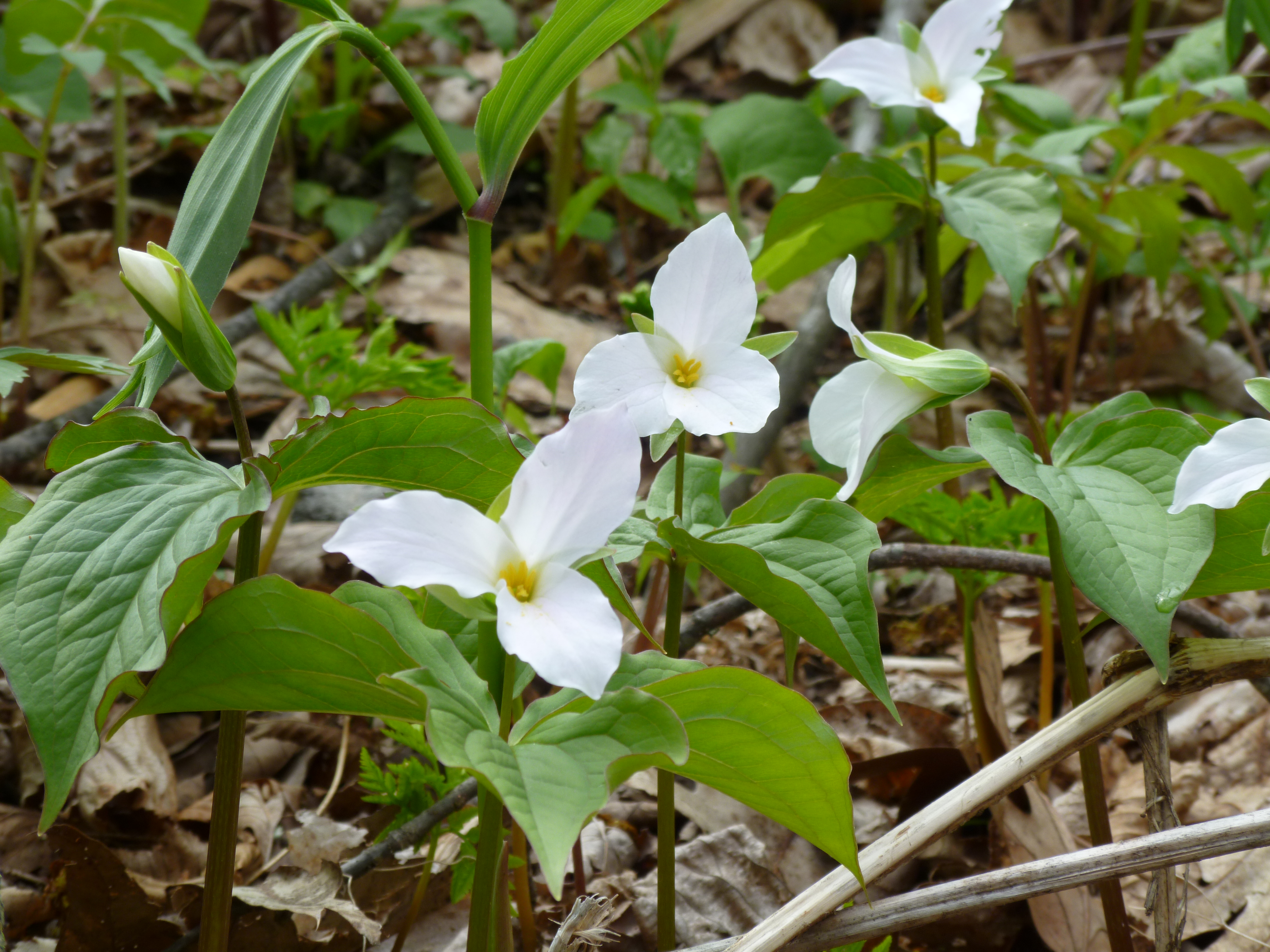
Trilium in Virginia
Trilium in Virginia

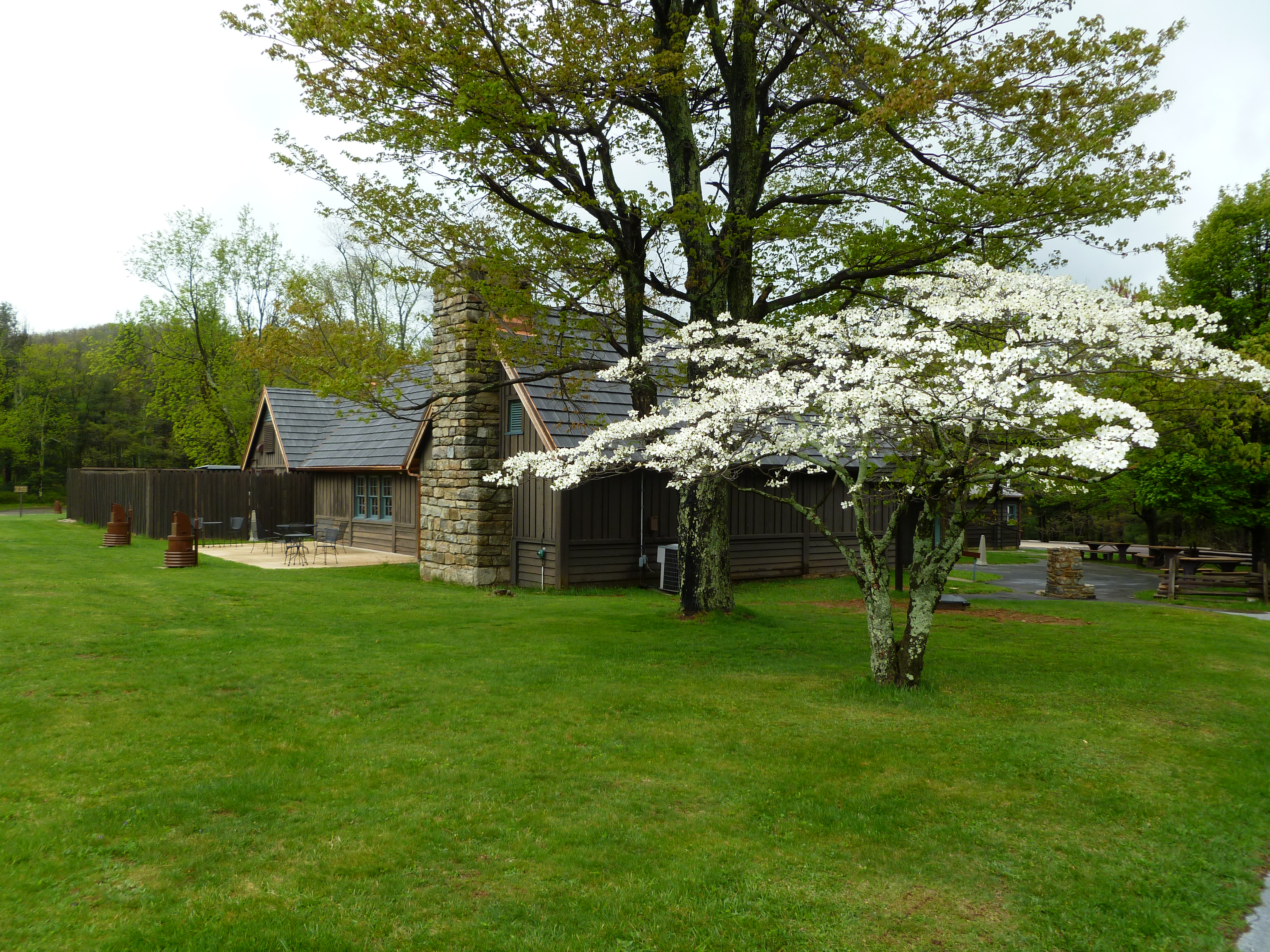
We will use our personal experience to present a contrarian viewpoint.  A few years ago we had the opportunity to drive the length of the Blue Ridge Highway from the Shenandoah Valley in northern Virginia to the heart of Tennessee.  Of course, we had many walks in the woods.  It was early spring.  The dogwoods were blooming.  The birds were actively starting their nesting season.  As much as we enjoy a walk in the woods here in California, there was even greater pleasure in those walks in the eastern woods because we have almost no knowledge of what is native or non-native there.  It was a great relief to be able to walk without passing judgment, as we have been taught to do in California.  There was no need to point fingers and declare that something “doesn’t belong there.”  We could accept the beauty of everything we saw on equal terms.  Ignorance was bliss.

Dogwood, Virginia
Dogwood, Virginia
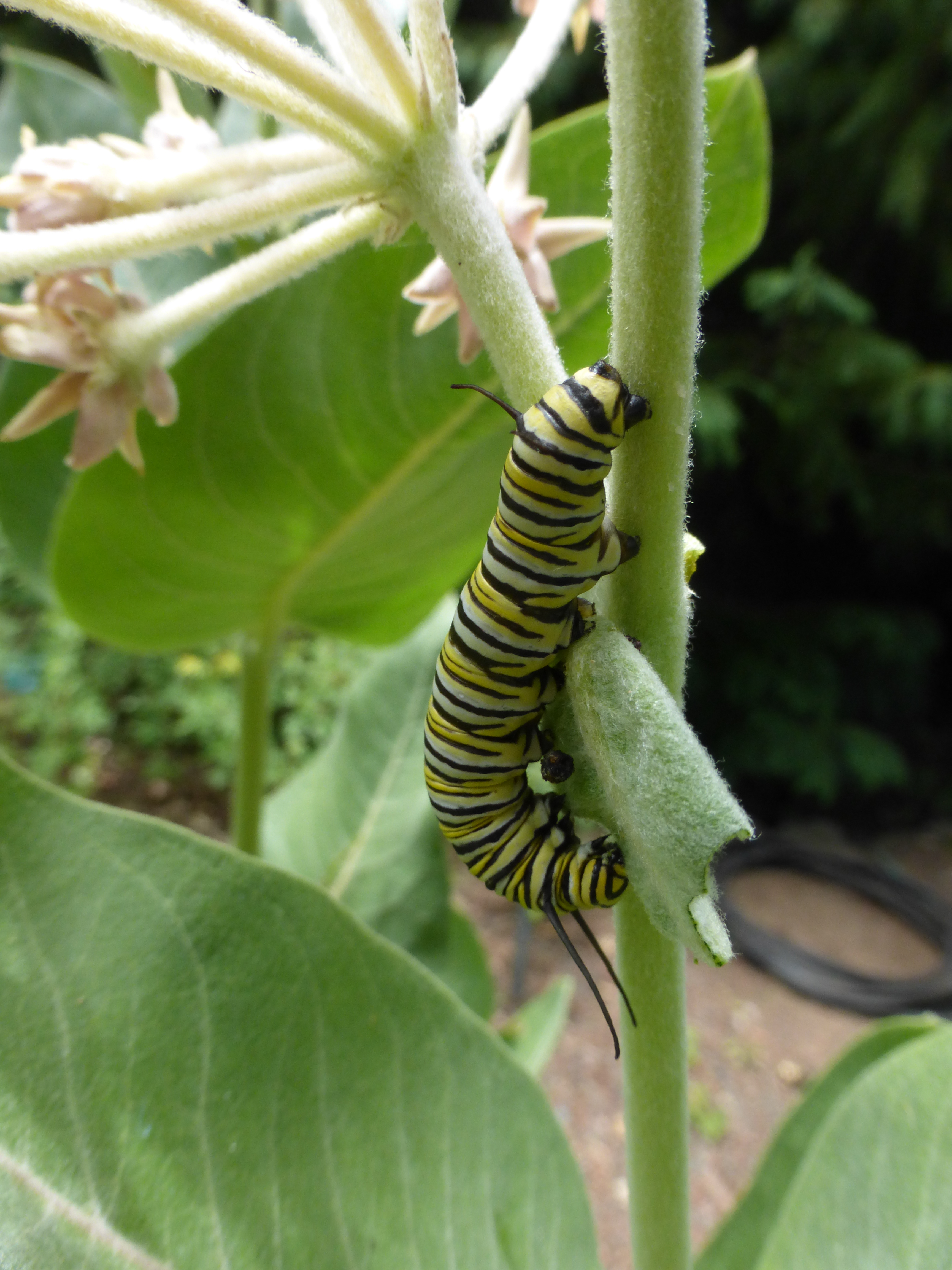
Monarch caterpillar on milkweed.  Tilden Botanical Garden
Monarch caterpillar on milkweed. Tilden Botanical Garden

We will contrast that experience with a more recent experience in the East Bay Regional Park District Botanical Garden in Tilden Park.  We were taking a course in which several participants in the class were members of the California Native Plant Society.  You might think that a botanical garden in which solely natives are planted, would be a pleasant place for them to walk.  It wasn’t.  They were outraged by the few non-native “weeds” we saw.  They crawled over the plantings to pull the uninvited plants from their roots.  One was a lovely scarlet pimpernel, blooming in its bright coral amongst native plants in their dormant, brown phase.   Their destructive attitude detracted from our enjoyment of the garden.

The “tiny minority” myth

As the “restoration” projects in the Bay Area have become progressively more destructive, the public has become progressively more opposed to them.   Mr. Dumbacher calls us a “vocal minority” in his article.  He is mistaken.  We consistently outnumber native plant advocates (sometimes ten to one) whenever we have an opportunity to express our opinion in a public venue:  in public hearings, on petitions, during written public comment periods.  We are not a minority.

Mr. Dumbacher is also mistaken in his description of the project which he is defending in his article.  He says, “…a Sutro Management Plan was formed that balanced incremental thinning with incremental planting of native species, in order to increase diversity and reduce the fire threat.”  We will give Mr. Dumbacher the benefit of the doubt by assuming that he has not read the Environmental Impact Report of February 2013, in which the project was described in detail.  Within a year five years, that project would have destroyed 90% of the trees (about 30,000 trees) and understory on 75% of the acres of Mount Sutro.  It proposed no planting of native plants, with the exception of a few small areas if money became available to pay for them.   The word “thinning” is used by native plant advocates to describe their plans to destroy the forest because it sounds less destructive.  However, it is not a word that accurately describes the destruction of 90% of the forest.

What happens to the birds that are there now?

Blackberries in the Sutro forest.  Courtesy Save Sutro Forest
Blackberries in the Sutro forest. Courtesy Save Sutro Forest

Unfortunately, we can’t share with our readers the lovely pictures in Mr. Dumbacher’s article because we don’t have permission, although you can visit the article to see for yourself.  You will see beautiful birds sitting on plants that exist now on Mount Sutro and Mount Davidson.  They are native plants that thrive in the understory of the forest and are unlikely to survive the devastation of the destruction of the trees and understory.  There are also non-native plants in the understory.  Many of them, such as blackberry, are valuable sources of food for birds.  There is no evidence, and no reason to believe, that destroying the Sutro forest will increase the number of bird species in San Francisco. 

Native red elderberry on Mount Sutro.  Courtesy Save Sutro Forest
Native red elderberry on Mount Sutro. Courtesy Save Sutro Forest

One wonders if Mr. Dumbacher isn’t aware of this obvious contradiction:  he illustrates his article with birds that live in the forest now while trying to make the case that the forest must be destroyed so he can see more birds.  Perhaps the answer is that he doesn’t really want more birds, he is only interested in certain birds:  “But If you want migrants to visit your city, if you want rare birds to breed in your local parks, and if you want a county list that exceeds 200 species, then please get involved in local habitat management and restoration, and be ready to speak up for nature in your city.”

The "managed" portion of the Sutro forest:  orange flags and weeds
The “managed” portion of the Sutro forest: orange flags and weeds

Here is another contradiction in Mr. Dumbacher’s appeal for your support for destroying most of the Sutro forest:  “we should try to manage a more natural forest.” In what sense is a “managed” forest also a “more natural” forest?  The Sutro forest is natural now, wild and unmanaged, a delightful mess.  We see no benefit in “managing” it.  Our experience with the managed summit of Mount Sutro is herbicide use (in the past), irrigation, wood chips, and dry weeds populated with colored flags where someone has apparently planted something that didn’t emerge from the wood chips.

Does Mr. Dumbacher speak for you?  Do you share his view of “nature?”

Postscript:  Mr. Dumbacher’s viewpoint is particularly troubling because he is Chair of the Department of Ornithology and Mammalogy at California Academy of Sciences, the Bay Area’s leading institution of science education.    It seems that there is little science in Mr. Dumbacher’s viewpoint as expressed in his article.