Rabbits are not native to either Britain or Australia, but they have lived in Britain long enough that they aren’t considered invaders there. In fact, they are romanticized in British children’s literature and cultural traditions:
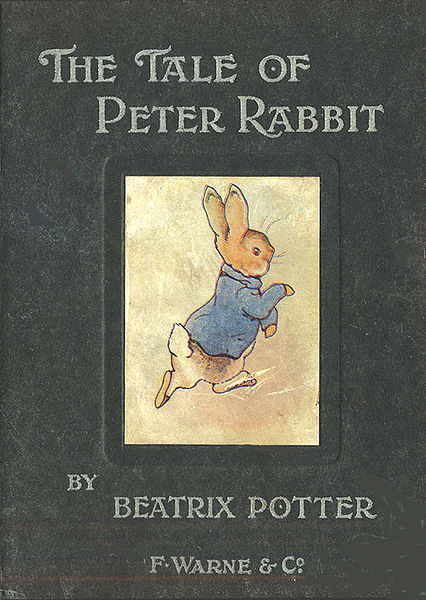
“The rabbit also is alien [to Britain] but especially following… abandonment of traditional grassland management, is vital in maintaining many species-rich wildflower pastures and hugely important as food for predators such as common buzzards. And, of course, in 1902 Beatrix Potter gave her fictional rabbit a blue waistcoat, a trug with carrots in it, and the name Peter, and single-handedly generated a huge sentimental cultural association between humans and rabbits, particularly from our formative experiences as readers of the genre of children’s nature literature. This one book has sold over 45 million copies worldwide and been translated into 36 languages. The rabbit has many friends. Enemies of the rabbit, most especially the Anti-Rabbit Research Foundation on Australia…, return to the power of children’s literature to counter the rampant sentimentality for the British invader down under. Aussie kids are urged (through popular primary school books) to cherish and embrace the native desert marsupial Bilby at Easter time, and to shun the more traditional (but culturally invasive) Easter Bunny. They eat chocolate Easter Bilbies as part of scientifically sponsored cultural ecological restoration. There may be a tendency to chuckle at this evidence. But this is serious stuff in an invaded land such as Australia. Severing cultural ties with rabbits needs to be done at a young age, before the powerful and mentally invasive Beatrix Potter-effect can take hold!” (1)
Propaganda is no laughing matter
Here are a few examples of similar propaganda campaigns that are used in the San Francisco Bay Area to support their destructive projects:
Nativists claim they are “managing” the urban forest. Do you think that word describes the project on Mount Sutro that will destroy 90% of the trees and understory on 75% of the mountain? Doesn’t “destroying” seem a more accurate description of that project?
Nativists often claim they will replace all the non-native trees they destroy with native trees. Do you think dune scrub and grassland is accurately described as a native “forest?” Isn’t this a classic fraud of “bait-and-switch?”
Sometimes nativists claim that native plants will “regenerate” where non-natives are destroyed without planting anything. Anyone who believes that has not seen the result of these projects, where weeds reign even when natives are planted.
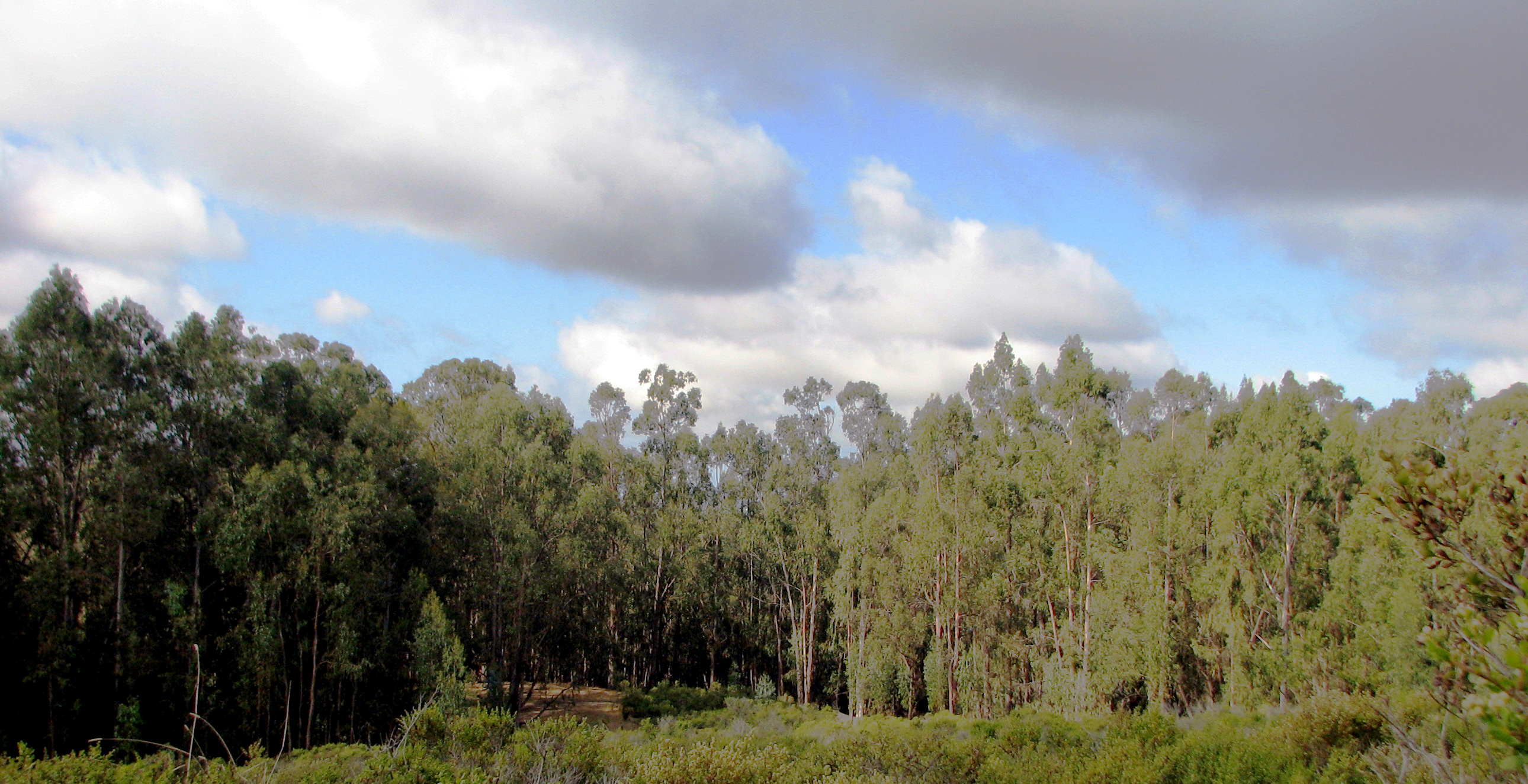
Nativists claim that the eucalyptus forest is dying of old age. The predominant species of eucalyptus in the Bay Area lives in Australia from 200-500 years. Professional arborists tell us they are healthy. Why should we believe the eucalyptus forest is dying?
These propaganda campaigns are often successful because the public doesn’t have time to inform themselves of the reality. The written documents that describe these projects are often hundreds–sometimes thousands–of pages long. If people aren’t regular visitors to the parks where these projects have been in progress for years, they don’t know that most are weedy messes. As the projects get bigger and more land managers install them, they are more difficult to hide from the public. That’s why the ranks of critics are growing and getting noisier. We will eventually be heard.
************************
Invasive & Introduced Plants and Animals: Human Perspectives, Attitudes, and Approaches to Management, editors Ian Rotherham, Robert Lambert, Earthscan Publishing, London, Washington, DC, 2011.
Invasive and Introduced Plants and Animals: Human Perceptions and Approaches to Management is edited by two British academics. It is a collection of articles written by invasion biologists as well as scientists who are critical of invasion biology. It attempts to present the entire spectrum of opinion on the debate that is the primary subject of the Million Trees blog: “Our intention is to stimulate the reader toquestion ideas and received wisdom [about invasion biology], and to try to establish the interface between objective science and subjective sociocultural fashions and values.” (1) That is, the evaluation of invasion biology involves both science and public opinion.
Using both criteria, the authors evaluate conservation projects in their concluding chapter of the book: “We perceive that present approaches:
Generally lack scientific rigour in their justification;
Fail to inform and engage and call upon all stakeholders…;
Rarely provide a holistic (for example, catchment wide) context or strategy;
Almost always lack financial or human resources to be long-term effective;
Have no realistic long-term targets, and if they do, no effective monitoring towards achievement…”
This evaluation of ecological “restoration” projects fits perfectly with our opinion of projects in the San Francisco Bay Area. These projects are not based on sound science. They are initiated behind the public’s back and are therefore rarely supported by the public. Most importantly, they are usually unsuccessful. Typically, the projects are far more destructive than constructive. We are losing the trees we value and the habitat needed by wildlife and in return we are usually left with barren, weedy messes.
Based on these shortcomings, the authors point to new approaches that address past failures.
Acknowledge ambiguity and change
First, we must accept that the distinction between native and exotic plants is often ambiguous and the distinction between plants that are harmful and those that are not is even less clear. Dividing up the natural world into good and bad, is a fool’s errand that does not acknowledge that such judgments are ultimately a matter of opinion.
How many times have we heard native plant advocates say, “I hate eucalyptus”? More often, they dress up their hatred in more valid arguments, such as eucalyptus is flammable, or they aren’t healthy, or they kill other plants or they aren’t useful to wildlife. Those who defend eucalyptus know that these accusations are not true or equally true of some native trees. Therefore, that argument can’t be resolved with facts because in the end there is a range of subjective opinion that can’t be changed with facts.
The Berkeley Meadow is a 72-acre native plant garden on a former garbage dump on landfill.
Secondly, we must accept that returning landscapes to prehistoric conditions is impossible. Nature moves forward, not back. Humans have fundamentally altered the environment and reversing those changes is not physically possible. If we have unrealistic goals for conservation projects, we can expect failures. When native plant gardens are installed on landfill that served as garbage dumps for decades (as they have been in the East Bay), we should not be surprised when they are unsuccessful.
Setting realistic goals
Ironically, the authors recommend larger projects rather than smaller projects. Because ecosystems are integrated, attempts to change only a segment of an integrated system are doomed to fail. The 1,100 acres of city-managed park land that have been designated as “natural areas” in San Francisco are chopped into 32 pieces, some as small as one-third of an acre. When non-native plants are eradicated, these tiny plots are quickly repopulated with the same weeds from adjacent areas. Sharp Park in Pacifica is the only “natural area” that may be capable of functioning as an ecosystem in the long-term because of its size and its relative physical isolation.
Letting the public decide
Finally, we must acknowledge that the alteration of our public lands is not a scientific decision. It is a public policy decision. In a democracy this means that the public must decide. In the vast majority of cases, the public has not been given the opportunity to make the decision because the managers of our public lands have been making these decisions for us. They do so by claiming that it is a scientific, not a public policy decision and that their expertise puts them in a position to impose their will on the public. The authors of the book we are reviewing today challenge this claim: “Yet in interventions conservation practice hides behind a veneer of pseudoscience and certainly challenges democratic processes.” Hear, hear!!! Thank you for this astute observation, which we see played out repeatedly in the San Francisco Bay Area.
The authors conclude with this advice to those who are responsible for ecological “restorations”: “It is important to recognize the subjectivity of decision-making processes, and the cultural and historical origins of many of today’s problem species.”
*********************************
(1) Invasive & Introduced Plants and Animals: Human Perspectives, Attitudes, and Approaches to Management, editors Ian Rotherham, Robert Lambert, Earthscan Publishing, London, Washington, DC, 2011.
“The primary purpose of this Vegetation and Biodiversity Management Plan for the Marin County preserves is to provide comprehensive, long-term guidance for a new science-based approach to vegetation management that will (1) maintain the natural biodiversity of the vegetation within the preserves, (2) maintain emergency and public access, and (3) manage fuel loads to reduce the threats of the spread of natural and human-caused fires.”
Marin County Civic Center
In other words, her report attempts to reconcile fire hazard reduction with resource management. The report is therefore of interest to readers of Million Trees, because many of the ecological restoration projects in the San Francisco Bay Area with which we are familiar claim to achieve these goals simultaneously. Loran May’s report acknowledges that there is a conflict between vegetation management for fuel reduction and the conservation of native habitat. Separating these two goals is a big step forward, in our opinion, because reducing fire hazard has been the most influential argument with the public and decision-makers for destroying non-native vegetation.
The consultant read the written policies regarding vegetation management of most of the owners of public lands all over the San Francisco Bay Area and interviewed the managers of those organizations regarding their experiences with the application of those policies. The consultant’s report is based in part on what she learned from all the major owners of public land in the Bay Area:
Audubon Canyon Ranch (ACR)
California State Parks (CSP)
East Bay Municipal Utilities District (EBMUD)
East Bay Regional Park District (EBRPD)
Golden Gate National Recreation Area (GGNRA)
Marin Municipal Water District (MMWD)
Marin County Open Space District (MCOSD)
Midpeninsula Regional Open Space District (MROSD)
Shelterbelt Builders, Inc. (SBI)
Santa Clara County Parks (SCCP)
Santa Clara Fire Safe Council (SCFSC)
Santa Clara County Open Space Authority (SCCOSA)
Here is what she learned about the current status of policies and practices regarding vegetation management for the purpose of reducing fire hazard and the impact it is having on natural resources in the San Francisco Bay Area:
All agencies indicated that the eradication of non-native species is a high priority for their organizations and that a big portion of their resources is devoted to that task. However,”They stressed that eradication of some well-established populations may not be feasible.”
Since total eradication is not considered a realistic goal, agencies prioritize removal of non-natives as follows: new “infestations,” control at “leading edge” into wildlands, “noxious weeds” as defined by California law, and non-native plants considered threats to legally protected native plant species.
Mechanical removal such as mowing or brush cutting followed by herbicide application is considered the most effective and most cost effective method of destroying non-native vegetation. However, organizations that are responsible for water supplies, have some constraints on the use of herbicides.
“… the interviewees overwhelmingly indicated that the most effective approach to reducing fire risk and protecting structures and adjacent communities is the establishment of defensible space zones along the wildland-urban interface. Interviewees stressed that defensible space zones are an important and often underutilized tool in helping slow the spread of fires from or onto preserves.”
Land managers indicated that large fuel breaks distant from properties were difficult to maintain because they are quickly dominated by non-native plants: “A recurring theme during interviews about fuel modification zones was the need to address and minimize invasive plant spread and establishment within these zones. Most agencies indicated that they have had to redirect a large portion of their fuel management funding away from construction of new fuel modification zones to controlling or containing infestations of invasive plants, such as French broom, within already constructed fuel modification zones.”
Public agencies agree that fuel reduction should occur only in the perimeter that separates developed from undeveloped land because ignition is more likely to occur in developed areas and buildings are more likely to ignite than wildland fuels. Most agencies have adopted a 100-foot standard for creating defensible space around properties.
“In wildland fires, most structures are ignited by embers. Building an ignition-resistant structureis the most effective defense against structure ignition and loss, since there will almost always be numerous embers in a wildfire.”
The experience of managers of public land with wildfires indicates that fuel breaks are generally ineffective in stopping the spread of fire: “Fires have been stopped by fuelbreaks only in instances where fire intensity was low.”
Agencies agreed that, “…ridgetop fuelbreaks typically have limited effectiveness for stopping the spread of fire during large fire events… Interviewees raised concerns that constructing and maintaining fuelbreaks is cost prohibitive and is a major cause of rising program costs for many land management agencies. All agencies noted that fuelbreaks are also strongly linked to the spread of invasive plants within their lands. For these reasons, interviewees strongly recommended that fuelbreaks be minimized, and resources reapplied to defensible space zones.”
This report sounds familiar!
None of these experiences of the managers of public lands in the Bay Area sound new to the readers of Million Trees. We have been telling our readers about these issues for over three years. We have written public comments on all of the written plans and environmental impact reports and statements for the plans many times. Just for fun, let us itemize our agreement:
When vegetation is removed—whether it is native or non-native—the vegetation that will soon occupy the bare ground will be non-native vegetation because it is more competitive than native vegetation. Unless the bare ground is intensively planted, irrigated, weeded, etc., native plants will not occupy land cleared of vegetation. The projects on public lands that are clearing vegetation for the purpose of reducing fuel loads never plant or garden after the land is cleared. When the goal of a project is to convert the land from non-natives to natives, some planting is sometimes done, but the gardening effort is rarely sufficient to achieve anything but a temporary result.
The huge projects in the East Bay for which FEMA funding has been requested, are based on the fantasy that eradication of all non-native plants and trees from hundreds of acres of public land with no subsequent replanting will magically result in a native landscape. The Marin County report is evidence that this assumption is not realistic.
Reducing fuel loads far from property will not reduce the risk of property loss from wildfire. Such vegetation removal must be close to the property to provide protection. Most fuel reduction projects in the East Bay are far from any property and therefore will not reduce fire hazards to people or property.
It will not be physically possible to eradicate all non-native vegetation. It is a fool’s errand to try because the most effective method of control requires herbicide use. By the time the land has been sufficiently poisoned to eradicate all non-native plants, our watershed will be poisoned and our public lands will not be fit to visit safely. In other words, it’s just not worth it to try to eradicate all non-native plants with herbicides.
We don’t wish to leave our readers with the mistaken idea that the Marin County report “Vegetation and Biodiversity Management Plan” is the silver bullet that will loosen the native plant movement’s tight grip on our public lands. In fact, it is first and foremost, a plan that is devoted to the preservation of native plants. All of its recommendations are aimed at that goal. It advocates for the destruction of non-native plants and trees wherever they are considered a threat to rare native plants or occur in small enough populations that eradication is physically possible.
However, for the first time in our long experience with similar written plans around the Bay Area, this report acknowledges that destroying vegetation for the purpose of reducing fire hazard is not the same thing as conserving native plants. This represents a significant reversal from previous plans which were based on the fictitious premise that fire hazards can be reduced by converting non-native to native landscapes. Therefore, we consider it a BREAKTHROUGH!
Once passed, laws rarely change and when they do it takes an arduous effort that tests a rigid political and judicial system. Nature, on the other hand, is inherently dynamic and we are usually powerless to stop it from changing even when we try. So, when a law is designed to control nature, we can expect some conflict between static law and dynamic nature. Forty years after the Endangered Species Act was passed, that conflict is becoming progressively more apparent and problematic.
San Franciscans recently had an opportunity to comment on the designation of 270 acres of city parkland as critical habitat for the endangered Franciscan manzanita which illustrated some of these conflicts. This rare plant requires full sun, which predicts that all trees will be destroyed in those acres, as they were for the closely related, endangered Raven’s manzanita. The seeds of both of these plants germinate only after fires, which may mean that prescribed burns will be required for the long-term survival of the plants. Restrictions on recreational access are also likely.
Are these sacrifices worth making? Are the prospects of the long-term survival of these rare plants good enough to justify these sacrifices? That’s for you to judge.
The Antioch Dunes
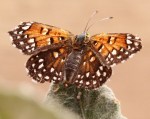
Lange’s metalmark butterfly, USFWS photo
Let’s consider those questions within the context of the Antioch Dunes, a National Wildlife Refuge northeast of San Francisco which is the home of three endangered species, including Lange’s metalmark butterfly. Antioch Dunes was designated as a national wildlife refuge in 1980, four years after the metalmark was given endangered status.
It is 55 acres along the southern shore of the San Joaquin River east of the city of Antioch. Historically it was a system of enormous sand dunes that was an accumulation of glacial sands washed down from the Sierras over millennia. Some of the dunes were as high as 120 feet. Because it was a unique habitat, surrounded by different vegetation, it was home to many endemic species that existed only there. As the dunes were diminished by decades of mining for building materials, those endemic species became progressively more rare. The remaining dunes were fragmented into two segments separated by a gypsum plant that spews gypsum dust onto the plants. This is just one of many factors that have decimated the population of plants and insects.
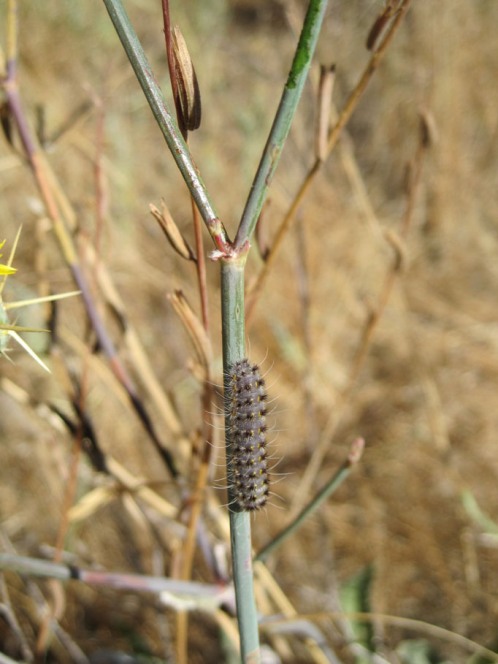
Lange’s metalmark caterpillar on naked-stemmed buckwheat. USFWS photo.
Historically, the dunes were unstabilized sand, known as “transporting dunes.” The sand shifts in the wind, which some plants are specifically adapted to. The host plant of Lange’s metalmark, naked-stemmed buckwheat, is such a plant that requires the shifting sands for its long-term survival. The buckwheat is the only plant the metalmark will lay its eggs on.
The “creative destruction” of the shifting sands also helps to control the non-native weeds that compete with the native plants.
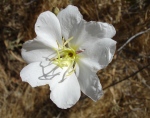
When Lange’s metalmark and two rare plants (Antioch Dunes evening primrose and Contra Costa wallflower) were given endangered status in 1976, the owners of the property assumed that the federal government would soon purchase the land for their long-term protection. They sold most of the remaining sand in preparation for that sale. The short-term consequence of endangered status was not positive because the sand dunes were further depleted by the rush to profit before the sale of the land to the federal government as a wildlife refuge.
Efforts to recover the population of Lange’s metalmark butterfly
Antioch Dunes evening primrose. USFWS photo.
Managers of Antioch Dunes have trucked in tons of sand to restore the dunes. They have aggressively managed the non-native weeds that compete with the host plant of the butterfly and other rare plants. They use herbicides and prescribed burns in addition to hand-pulling the weeds. They have planted thousands of the rare plants in an attempt to restore the population.
In 1986, they closed the dunes to the public—except for a monthly guided tour—after the dunes were trampled by thousands of people trying to catch a glimpse of Humphrey, the whale that lost his way into the delta and had to be coaxed back out to sea by playing recordings of whale vocalizations.
After a one-day peak count of 2,342 butterflies in 1999, the population plummeted to only 45 in another one-day count in 2006. Clearly something drastic had to be done to turn the decline around. A captive breeding program began the following year. A biologist at Moorpark Community College in Southern California captured a few ovulating females and carried them home to Moorpark to lay their eggs. The story of how the butterflies and their offspring were tended by students at the college is mindboggling:
“Each [of the 27 newly-hatched butterflies] had to be fed two or three times a day, by hand, with a Q-tip soaked in honeywater—an aggravating job that wound up taking all morning. In the afternoon, the [new generation of butterflies brought from the dunes] were transferred onto potted buckwheat plants so they could keep laying eggs. (Students assemble homemade enclosures for each butterfly by shoving the buckwheat through the bottom of an upside-down quart-sized clear plastic deli container…ventilating it, and sealing it off from pests with duct tape and toilet paper.) The other butterflies, meanwhile, spent their afternoon split into groups of four or five. The hope is that these adults will pair off and breed, and students sign up for one-hour ‘mating watch’ shifts to keep them under observation…The students also have to move the containers frequently from place to place, in and out of shade, to keep the butterflies inside from getting too hot or too cold, and to try to catch a certain mysterious quality of dappled sunlight that appears to put the insects in the mood. “ (1)
This labor-intensive, tedious exercise has been done annually since 2007. In 2008, the enterprise was able to reintroduce 30 butterflies to Antioch Dunes. In 2012, the total annual count of butterflies at Antioch Dunes was 32, up from 28 the previous year. Not much to show for the effort of the Moorpark students and faculty.
What are the prospects for survival of Lange’s metalmark butterfly?
As you might expect, the answer to that question varies depending on who you ask. Two of the oldest, most experienced butterfly experts—Jerry Powell (Emeritus Professor, UC Berkeley) and Rudi Mattoni—say it’s hopeless. They find the continuing effort laughable.
Powell has been studying the Antioch Dunes for decades. He sees the selection of Lange’s metalmark as the sole insect species on which to lavish attention and support, extremely stupid. All the insect populations on the Antioch Dunes have been decimated by encroaching civilization. All the plants and animals at the Dunes form a complex ecosystem that can’t be separated into a few species that can be saved in isolation from their community. Powell was interviewed by the author of Wild Ones: “He told me that any work to recover the Lange’s is decades beyond the point of diminishing returns, and even if it were possible, the agency’s strategies were, in his opinion, completely misguided.”
Mattoni spent decades trying to save several species of rare butterflies in Southern California from extinction. At the age of 76, he abruptly threw up his hands and moved to Argentina. The author of Wild Ones interviewed him via Skype: “’There’s a clause right near the top [of the Endangered Species Act] that nobody remembers,‘ he said, ‘And it’s the whole soul of the Endangered Species Act.’ It begins, ‘The purposes of this Act are to provide a means whereby the ecosystems upon which endangered and threatened species depend may be conserved.’” Then Mattoni explained why he walked away from a long career of trying to save rare butterflies, “The butterflies were just a means to preserve wild places, but all the attention got lavished on the butterflies themselves…Once the habitat is gone, it’s gone,” Mattoni said. ‘It’s too complex—you can’t put these things back.’”
So, where does the author of Wild Ones find a more optimistic viewpoint for the survival of the metalmark or least ideas about what to do to save it? He interviews Brent Plater, former lawyer for Center for Biological Diversity, now owner of his own legal-suit machine, Wild Equity Institute. Plater tells him that he is preparing to sue to prevent the opening of gas-fired energy plants near Antioch Dunes. The plants will be less polluting than petroleum fuel plants, but Plater isn’t a “better-is-best” kinda guy. He doesn’t want ANY energy producing plants near the Antioch Dunes because they increase nitrogen levels in the air and nitrogen encourages the growth of non-native weeds that compete with the rare native plants. The Wild Equity website announces that suit was filed on July 24, 2013, against EPA for approving permits to the builders of the new energy plants.
The Shifting Baselines Syndrome
What distinguishes the optimists from the pessimists in this debate? Age is one difference. Wild Ones tells us about the “shifting baselines syndrome” which explains why the old scientists are less likely to be optimistic than the young lawyer.We form our opinion of what is “normal” in nature when we are young.
When Professor Powell and Mr. Mattoni were young the Antioch Dunes were teeming with insects, the sand dunes were nearly intact, and the native plants were still thriving. Compared to that baseline, the Antioch Dunes are totally trashed and the prospect of returning them to their previous glory seems preposterous to them.
Mr. Plater’s view of what is normal for the Antioch Dunes is a small population of butterflies, native plants overrun by non-native plants, and sand that was trucked in and bulldozed into dunes. It’s not difficult to improve on that landscape. Reducing nitrogen levels in the air seems a suitable improvement.
The author of Wild Ones doesn’t offer a particular answer to this question, but he does point in a direction. He visits two neighboring populations of metalmark butterflies. One population in Mendota, about 120 miles away from the Antioch Dunes, looks identical to the Lange’s metalmark, in his opinion. But DNA tests say it’s not identical to the Lange’s metalmark. The metalmark population near Mt. Diablo, just ten miles away, looks less like the Lange’s metalmark, but its DNA is very similar, just .5% (one-half percent) difference in their DNA.
The proximity of these sub-species of metalmarks illustrates one of the issues with the Endangered Species Act. DNA analysis, which was not readily available when the Endangered Species was passed, is making it possible to split species into more and more sub-species. The smaller the populations of sub-species, the more likely they are to dwindle as the climate changes and habitat disappears. The Endangered Species Act would be a less blunt instrument if it applied to species, rather than to small, isolated populations of sub-species.
The author of Wild Ones tells us about a breeding program for a butterfly in which markedly different physical characteristics were achieved in just seven generations. He wonders if by selective breeding of the butterfly that is very closely related genetically to Lange’s metalmark, we would have a butterfly that not only looked identical but would be nearly identical genetically. Echoes of Frankenstein come to mind. Is it a freak show or is it a way to resurrect the Lange’s metalmark with a lot less fuss? Again, we leave that to you.
*****************************
Jon Mooallem, Wild Ones, Penquin Press, New York, 2013
Farmers have been battling with weeds since the advent of agriculture, about 6,000 years ago. Most of the weapons used against weeds were mechanical until the last century or so when herbicides became the primary weapon. At the same time that the weapon became more lethal, farming techniques changed to give weeds the advantage. Farms became huge monocultures and crop rotations were abandoned in favor of the most profitable crop.
Cornfield
When weeds evolved defenses against the herbicides, farmers responded by increasing doses and manufacturers created new products to which weeds hadn’t yet evolved resistance. Finally, the use of herbicides skyrocketed when crop seeds were invented that weren’t killed by the herbicides, so that huge amounts of herbicides can be used without killing the crop.
When Roundup with the active ingredient glyphosate went on the market in the 1970s, its manufacturer, Monsanto, claimed that weeds would not be able to evolve resistance to it. And apparently that was initially true until Roundup was used on a huge scale when herbicide-resistant seeds were put on the market in the 1980s. Norman Ellstrand of UC Riverside explains why: “He argues that the reason was that farmers applied glyphosate to relatively little farmland. As they applied it to more and more acreage, they raised the evolutionary reward for mutations that allowed weeds to resist glyphosate. ‘That ups the selection pressure tremendously,’ he said.” *
There are now 24 species of weeds that are resistant to glyphosate and they are rapidly expanding their range in agricultural areas all over the world. In 2012, an agricultural consulting firm reported that 34% of farms in the US had glyphosate-resistant weeds. In the first half of 2013, half of all farms in the US are reporting glyphosate-resistant weeds.
Let’s take another approach
Obviously, we are losing the war against weeds. So, let’s examine the strategy we have been using and try another approach. Weed ecologists are now studying the strategies that weeds have used to cope with the weapons we have been using against them. Here are a few of those strategies:
Some weeds have changed color so that they are indistinguishable from the crop they are hiding in.
Weeds that grew in dry ground, evolved to thrive in wet ground in rice fields that are flooded much of the crop season.
Some weeds became shorter to escape the mowing and harvesting of the agricultural crop.
Some weeds drop their seeds and go dormant before the crop is harvested and create seed banks that can sprout when conditions are more favorable for them.
Parasitic weeds wrap around their host and steal nutrients from them.
Some weed ecologists believe that a better understanding of the mechanisms used by weeds to foil our attempts to control them will enable us to devise better weapons against them. They believe that developing new herbicides and/or using more of them will always be a short-term solution.
For example, David Mortensen of Penn State is “investigating controlling weeds by planting crops like winter rye that can kill weeds by blocking sunlight and releasing toxins. ‘You want to spread the selection pressure across a number of things that you’re doing so that the selection pressure is not riding on one tactic,’ he said.”*
Regardless of what method is used to control weeds in the future, let’s consider the toxicity of the method the most important criterion for judging their effectiveness. Even if it kills fewer weeds, the least toxic alternative is the best alternative in our opinion.
********************************
*Carl Zimmer, “Looking for Ways to Beat the Weeds,” New York Times, July 15, 2013.
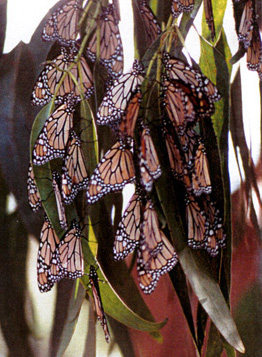
Monarch butterflies over-winter in California’s eucalyptus groves
The East Bay Express has published an op-ed in defense of the much maligned eucalyptus. “The Eucalyptus is Part of California” is by Gregory Davis, a Berkeley resident. We summarize the main points for our readers:
University of California, Berkeley’s plan to destroy all non-native trees—primarily eucalyptus, Monterey pine, and acacia—is characterized as a “meat-axe approach.”
Applying herbicides repeatedly to prevent regrowth of non-natives is “tantamount to opening a can of worms.” We don’t know the consequences of dousing our public land with toxic chemicals, just as we didn’t know that using Agent Orange during the War in Vietnam would permanently damage that country and its citizens.
The moderate approach advocated by the Hills Conservation Network is more reasonable. Thinning and selective removal will do less damage.
Flammability of eucalyptus groves has been greatly exaggerated.
Eucalyptus has lived in California longer than most of us have been alive. They are more native than we are.
The loss of the “beauty and majesty” of eucalyptus in the hills will make hiking in the East Bay hills a less pleasant experience. “Anyone who has hiked up the trail under the green canopy of these tall, stately, plumed-top, evergreen trees knows how precious they are.”
Thank you, Mr. Davis, for writing this article and to the East Bay Express for publishing it. Critics of the native plant movement are learning that they must speak up if we are to save our trees. The projects that destroy our trees finally became so big and so visible, that more people are aware of them and are more willing to defend our trees.
We must tell our readers about the collateral damage of misguided attempts to manage nature more often than we would like. We prefer positive stories, but in the hope of a better future we must also inform the public of the unintended consequences of the many projects that are killing one species of plant or animal based on the mistaken assumption that another plant or animal will benefit.
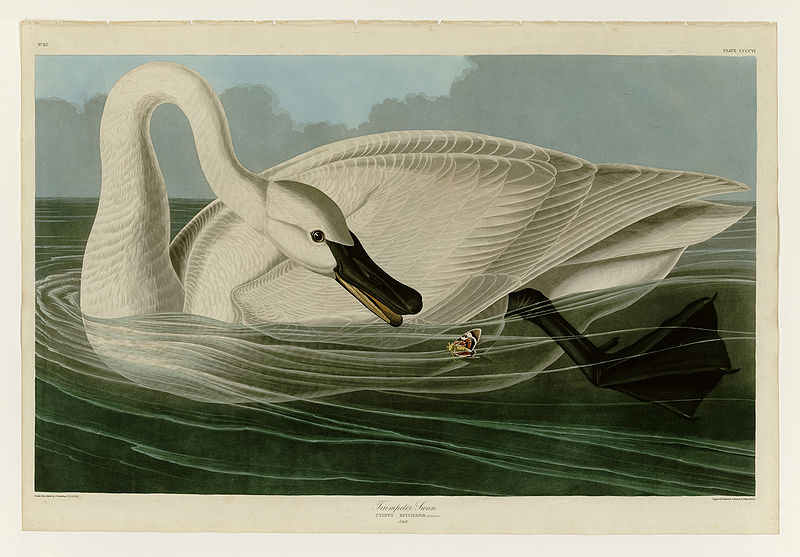
Trumpeter swan by James Audubon
In this case, a project sponsored by the Nature Conservancy decimated the population of rare Arctic grayling fish in Centennial Valley, Montana, by damming the streams to create ponds for the benefit of the equally rare trumpeter swan. The grayling had spawned in those streams and the population plummeted when the streams were dammed.
Unfortunately, they ARE trying it again. Now the scientists are trying to compensate for the damage to the grayling population by killing cutthroat trout that is considered a predator to the grayling. The cutthroat is not native, so that also makes it a candidate for eradication. It’s as though we are on a killing treadmill. One mistake seems to lead to another.
Stop and think before you shoot!
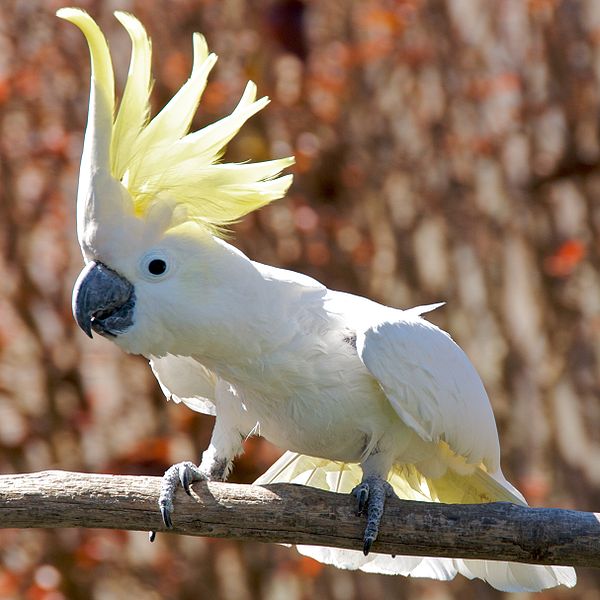
Cockatoo. Creative Commons
A bird lover in Hawaii takes a more thoughtful approach to the suggestion that introduced cockatoos and African parrots should be shot, based on the assumption that they are competing with the dwindling population of native birds. He points out that the native birds nest in the ground, while the cockatoos and parrots nest in cavities in the trees. Most of the native birds are nectar eaters, while the cockatoos and parrots eat seeds and nuts. So, he wonders if the introduced birds are really a threat to the native birds.
The exotic birds are either escaped pets or the descendents of them. The author of the article urges pet owners to take care of their pets and make a permanent commitment to their care. Releasing them into the forest is making them a target for people who think killing them would benefit other birds.
The author is not opposed to killing non-native animals when absolutely necessary, but he is at least willing to carefully consider if it is necessary, in his opinion. He is comfortable with the killing of rats, pigs, and feral cats, for example.
Million Trees takes this question a step further. We don’t think humans should micromanage nature. We don’t have enough information to presume to know better than nature what is best. We also have our own anthropomorphic criteria for which species is more important than another. Our judgment is self-serving and is not a substitute for the even-hand of nature. Nature follows the simple rule of “survival of the fittest.” Nature is as likely to save the lowly spider as it is to save the beautiful trumpeter swan.
A parable to illustrate the point
This parable, retold in Fanaticism of the Apocalypse (1) illustrates the futility of man’s attempt to control nature:
“Noah, as he is loading the animals onto the Ark, is alarmed by the large number of candidates. Mammals, birds, marsupials, penguins, primates, and lizards have already gone on board. The ass, the ox, the giraffe, the elk, the stag, the lion, and the cat urge the patriarch to raise the gangplank and close the hatches. The boat is chock-full, the cedar hull is about to crack open, the Deluge is threatening. Outside, a crowd of harmful or misshapen pests—cockroaches, toads, slugs, spiders—asks to be taken on. The toad speaks on behalf of his unsightly comrades: he pleads their cause with eloquence, pointing out to the Patriarch that they perform a useful function in nature. In God’s design, nothing is ugly or repugnant: everything is ingenious, even invertebrates, mollusks are necessary. No one has the right to destroy these creatures of the Lord. But Noah turns on his heel and decides to raise the anchor. Then a cloud of insects and pests assails him: fleas climb on his legs, crabs crawl in his pubic hair, lice swarm on his head, leeches, stinkbugs, and mosquitoes stick to his skin without him noticing them. Snakes slip into his flowing hair, spiders take up residence in his beard. That is how the whole bestiary was spared.”
We fiddle with nature at our own peril.
*****************************
(1) Pascal Bruckner, The Fanaticism of the Apocalypse, Polity, May 2013
Update: US Fish & Wildlife published the final rule designating critical habitat for Franciscan manzanita on December 20, 2013. 230.2 acres of land in San Francisco have been designated as critical habitat: 46.6 acres of federal land, 172.8 acres of parks owned by San Francisco’s Recreation and Parks Department, and 10.8 acres of private land. The complete document is available here. The document responds to public comments and explains any differences between the proposed designation and the final rule. It makes interesting reading.
************************************
We have just learned—belatedly—that US Fish & Wildlife has reopened the public comment period for the designation of critical habitat for the endangered Franciscan manzanita in San Francisco’s public parks. The new public comment deadline is July 29, 2013. The announcement tells us that public comment period has been reopened for the following reasons:
Acreage of critical habitat has been revised to correct previous errors
Seventy-three acres of San Francisco’s city-managed parks have been added “at the request of the staff of the Recreation and Park Department.”
The National Park Service and the Presidio have both asked that some of their property be removed from the designation of critical habitat.
A Draft Economic Analysis has been added: “…total potential incremental economic impacts in areas proposed as critical habitat over the next 20 years (2013 to 2032) will be approximately $28,222 ($1,411 annualized)…” Given that the cost estimate for the recovery plan for the closely related Raven’s manzanita (and lessingia) was estimated as $23,432,500 in 2003, we consider this cost estimate for reintroduction of Franciscan manzanita ridiculous.
Does San Francisco’s Recreation and Park Department understand that the Endangered Species Act provides the same legal protection for reintroduced species as it does naturally occurring endangered species, such as the red-legged frog and the San Francisco garter snake at Sharp Park? The Recreation and Park Department was recently ordered by a federal judge to pay $386,000 of legal expenses of organizations that sued the Department on behalf of these endangered species. The Department would be wise to consider that such suits on behalf of Franciscan manzanita would be likely if the Department does not conduct prescribe burns and/or does not destroy all trees in critical habitat because both are required for the survival of this species.
We are reprinting below our original article of October 23, 2012, describing the horticultural requirements of Franciscan manzanita and our concerns about its reintroduction in the city-managed parks of San Francisco.
In addition to the conferral of endangered status, US Fish & Wildlife has designated 318 acres of land in San Francisco as critical habitat for the Franciscan manzanita. Critical habitats are places where the endangered plant is either known to have existed in the past or they are places that provide what the plant needs to survive.
Five of the eleven places in San Francisco designated as critical habitat are on federal land in the Presidio. (Details about all the critical habitats are available here.) Forty of the 318 acres are on private land. Six of the critical habitats are in 196 acres of San Francisco’s city parks:
Corona Heights
Twin Peaks
Mount Davidson
Glen Canyon Park (erroneously called Diamond Heights by US Fish & Wildlife)
Bernal Hill Park (erroneously called Bernal Heights by US Fish & Wildlife)
Bayview Hill Park
The taxonomy of manzanita is ambiguous
There are 96 species of manzanita in California (1). The ranges of most of these species are extremely small because the manzanita hybridizes freely and therefore adaptive radiation has resulted in a multitude of species, sub-species, and varieties that are adapted to micro-climates. Many of these species are locally rare, which is consistent with the fact that 6 species of manzanita have already been designated as endangered, two of which are limited to the San Francisco peninsula: Raven’s manzanita and Franciscan manzanita.
The genetic relationship between these two species of manzanita is ambiguous, which is reflected in the constantly shifting opinions of biologists about the taxonomy (species classification) of manzanita. The 2003 Recovery Plan for Raven’s manzanita recounted the long history of these shifting views. For some time, Raven’s and Franciscan manzanitas were considered the same species. Then, for an equally long time, they were considered sub-species of the same species, Arctostaphylos hookeri. It was not until 2007, that Raven’s was reclassified as a sub-species of Arctostaphylos montana. Presently, Franciscan manzanita is classified as its own species, Arctostaphylos franciscana.
Clearly, this history of the biological opinion regarding these two species of manzanitas suggests they are closely related and morphologically (AKA anatomically) similar. The Recovery Plan concludes, “The idea of ‘pure’ species in Arctostaphylos, with its many poorly defined taxa and prevalent hybridization has often been difficult to apply over the history of taxonomic work in the genus.”
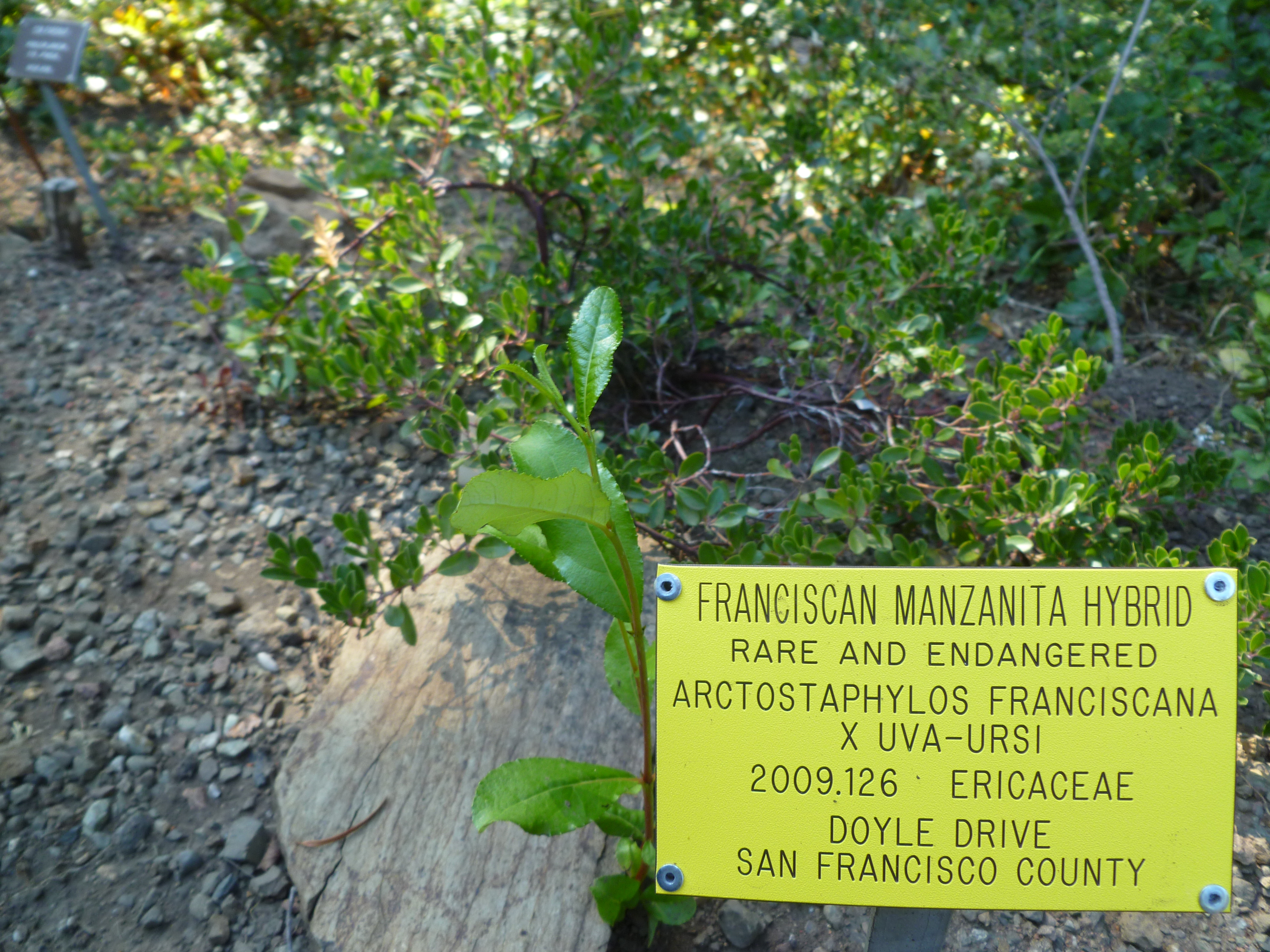
To add to the confusion regarding the provenance of Franciscan manzanita, some biologists are of the opinion that the individual plant that was discovered on Doyle Drive is actually a hybrid, not a pure-bred Franciscan manzanita. The East Bay Regional Park District botanical garden in Tilden Park has planted a clone of the individual plant from Doyle Drive. It is labeled as a hybrid of Arctostaphylos uva-ursi, which is one of the few species of manzanita with a wide range.
This is the label on the “Doyle Drive” manzanita in Tilden Park Botanical Garden, indicating that it is a hybrid.
The park ranger who led us to this plant in the Tilden garden, pointed out that the plant is morphologically distinct from the Franciscan manzanita that has been resident in that garden for about 50 years. He expressed his opinion that the Doyle Drive manzanita was properly labeled as a hybrid.
In what sense is the Franciscan manzanita “endangered?”
Franciscan manzanita has been available for purchase in nurseries for about 50 years. It has been propagated by taking cuttings and therefore they are presumed to be genetically identical clones. However, given that this plant has been sold to the public for a long time, we have no way of knowing exactly where they have been planted or if some have successfully reproduced by germinating seeds. For all we know, this plant is thriving somewhere, perhaps even in a place we might call “wild.” Perhaps the plant found on Doyle Drive was purchased in a nursery!
The individual plant found on Doyle Drive has been defined by USFWS as Franciscan manzanita despite the fact that some biologists consider it a hybrid of another species. We understand that the motivation for designating this individual as an endangered species and providing it with critical habitat is based on an assumption that it is genetically different from the Franciscan manzanita that can be purchased in nurseries and that the chances of survival of the species may be improved by cross-fertilization of these two plants such that greater genetic diversity results from their union.
Yet we are offered no evidence of the genetic composition of the Doyle Drive individual or Franciscan manzanita sold in nurseries. Nor are we provided any evidence that the Doyle Drive individual is even a genetically “pure” Franciscan manzanita rather than a hybrid of another species altogether.
If we weren’t being asked to devote 318 acres of land to the propagation of a plant with such ambiguous taxonomy, we might not question how little information we have been provided. The technology of mapping the genome of this plant is available to us. Why aren’t we making use of this technology to resolve these ambiguities? The cost of planting 318 acres with this endangered plant far exceeds the cost of such genetic analysis.
We aren’t told what it will cost to plant 318 acres with this endangered plant, but we know that the cost of the recovery plan for Raven’s manzanita and lessingia was estimated as $23,432,500 in 2003. Presumably that is an indication that the proposal for Franciscan manzanita will be a multi-million dollar effort. The cost of transplanting the single plant from Doyle Drive to the Presidio was reported as over $200,000. (1)
Thirty years of endangered status for Raven’s manzanita has not saved this plant
We have already made the point that Raven’s and Franciscan manzanitas are closely related. In its proposal for the designation of critical habitat for Franciscan, USFWS confirms this close relationship by referring us to the Recovery Plan for Raven’s. In other words, the characteristics and horticultural requirements of these two species are so similar that a separate Recovery Plan for Franciscan is not necessary. The Recovery Plan for Raven’s is applicable to Franciscan.
Therefore, we should assume that the fate of the recovery effort for Franciscan will be similar to that for the Raven’s. Raven’s was designated as endangered in 1979. Its first recovery plan was published in 1984 and the second in 2003. Many 5-year reviews of its endangered status have been done during this 33 year period. The most recent 5-year review was published in June 2012; that is, very recently.
So what does USFWS have to show for 33 years of effort to save Raven’s manzanita from extinction? Almost nothing:
Clones of the single plant in the wild exist in several botanical gardens. These clones are genetically identical and their growth in maintained gardens does not meet ESA standards for recovery.
“The wild plant has been observed to set seed although no natural seedling establishment is known to have occurred.” (6)
The plant has been the victim of twig blight several times, but the fungus cannot be treated because it would damage the mycorrhizal fungi in the soil upon which the plant is dependent.
The seeds depend upon animal predators for dispersal which are largely absent in an urban area.
The pollinators of manzanita have not been identified and therefore there is no assurance that they still exist in this location.
The 5-year review concludes that: “…recovery sufficient to warrant full delisting is not projected in the foreseeable future for [Raven’s manzanita] and may not be possible.”
We can’t appreciate the significance of the utter failure of this effort without some mention of the extreme methods used to overcome these obstacles.
The seed of manzanita is germinated by fire. However, the exact relationship between fire and germination is not known. Therefore, many complex experiments have been conducted on the few viable seeds produced by the Raven’s manzanita in a futile effort to determine the winning combination. These experiments are described in detail in an article in Fremontia (1). In short, various combinations of fire, heat, cold, smoke, liquid smoke, etc., were tried and failed to determine exactly what triggers germination of manzanita seeds.
We should remind our readers of the legal definition of “recovery” according to the Endangered Species Act. According to the 5-year review for Raven’s manzanita, here are two of the criteria for recovery toward which there has been no progress in 33 years:
“At least five spontaneously reproducing variable populations are established in reserves…in San Francisco…”
“At least two sexually reproduced generations are established within the Presidio.”
Frankly, it is no longer credible to expect the recovery of Raven’s manzanita and this failure implies the same fate for Franciscan manzanita.
Can the public parks of San Francisco meet the horticultural requirements of Franciscan manzanita?
The public parks of the City of San Francisco cannot meet the horticultural requirements of the Franciscan manzanita because it requires fire to germinate its seeds.
All of the critical habitats proposed by USFWS in San Francisco’s public parks are designated “natural areas.” According to the DRAFT Environmental Impact Report of the “Significant Natural Resource Areas Management Plan,” prescribed burns are prohibited in the natural areas. Therefore, unless there are unplanned wildfires in the six public parks proposed as critical habitat, it will not be physically possible to “spontaneously reproduce” this plant, as required by the Endangered Species Act.
Granted, the City of San Francisco could revise its management plan for the natural areas to allow—or even require—prescribed burns in the six parks proposed as critical habitat. In that case, the citizens of San Francisco would be subjected to air pollution and risk of causing an uncontrolled wildfire in surrounding residential communities. The Natural Areas Program would be subject to even more criticism than it already endures.
The Natural Areas Program is extremely controversial in the City of San Francisco because it destroys healthy non-native trees, it sprays pesticides on non-native vegetation in public areas, it destroys the habitat of wildlife, and it limits the public’s recreational access to trails which are often fenced. Subjecting the natural areas to prescribed burns is surely the bridge too far for the public which would jeopardize the future of the entire program. Why would the City of San Francisco be willing to push the public over the edge by requiring prescribed burns in six urban parks in densely populated residential communities?
Furthermore, some of the proposed critical habitat is in heavily forested areas, which are not compatible with the requirement of manzanita for full sun. As they were on behalf of Raven’s manzanita, these trees would be destroyed. The City of San Francisco is already planning to destroy 18,500 trees over 15 feet tall to accommodate its desire to reintroduce native plants to forested areas. (3) How many more trees would need to be destroyed to accommodate Franciscan manzanita? How much more carbon dioxide would be released into the atmosphere by the destroyed trees?
Bayview Hill is one of the proposed critical habitats which are heavily forested. According to SNRAMP (3), 17.16 acres of Bayview Hill is forested. Given that Bayview Hill is the only proposed critical habitat which is outside the known historic range of Franciscan manzanita, the loss of 17 acres of trees does not seem a fair trade for a plant with few prospects for survival.
The proposed critical habitat in Glen Canyon Park (inaccurately called Diamond Heights by the proposal) is also forested in a portion of the 34 proposed acres of critical habitat. This is a park in which the destruction of trees is being hotly contested. The community in this park does not need the additional controversy of tree destruction for the sole purpose of planting an endangered species.
Proposed critical habitat in other city parks is likely to be controversial for other reasons, primarily because additional restrictions on recreational access will undoubtedly be required to protect this endangered plant. Bernal Hill is an example of a city park with a huge community of visitors who will undoubtedly be enraged by further loss of recreational access. They have already been squeezed by the restrictions imposed by the Natural Areas Program.
This proposal for critical habitat is not good public relations for the Endangered Species Act
The City of San Francisco is the second most densely populated city in the country. It is comprised of only 29,888 acres. There are only 3,317 acres of City-managed parks in the city. (2) The proposed critical habitat in City-managed parks is 196 acres, 6% of total City-managed park land in San Francisco.
Please ask yourself these questions:
Does it make sense for 6% of all City-managed park land to be permanently committed to planting an endangered plant which can be purchased in nurseries?
Does it make sense to confiscate 6% of all public parks for a plant the identity of which we are not certain?
Does it make sense to throw the public out of 6% of all public parks on behalf of a plant that will never be able to spontaneously reproduce unless there is an accidental wildfire?
We think the answers to these questions are no, no, and no. This is an ill-advised proposal which makes a mockery of the Endangered Species Act. This is an important law that is trivialized by a proposal that will be physically impossible to implement without endangering the public and damaging the environment.
Comments on the proposed critical habitats will be accepted until November 5, 2012. Comments may be submitted online at the Federal eRulemaking Portal at http://www.regulations.gov (Docket Number FWS–R8–ES–2012–0067) or by U.S. mail to:
Public Comments Processing
Attn: FWS–R8–ES–2012–0067
Division of Policy and Directives Management
U.S. Fish and Wildlife Service
4401 N. Fairfax Drive, MS 2042-PDM
Arlington, VA 22203.
*********************************
Bibliography
(1) Gluesenkamp, Michael, et al., “Back from the Brink: A Second Chance at Discovery and Conservation of the Franciscan Manzanita,” Fremontia, V37:4/38:1, 2009-2010
(2) Harnik, Peter, Inside City Parks, Trust for Public Land, 2000
(3) San Francisco Recreation and Park Department, “Significant Natural Research Area Management Plan (SNRAMP),” 2006
(4) San Francisco Recreation and Park Department, “DRAFT Environmental Impact Report for SNRAMP,” 2011
(5) USFWS, “Designation of Critical Habitat for Franciscan Manzanita,” September 5, 2012
(6) USFWS, “5-Year Review of Endangered Status of Raven’s Manzanita,” June 2012
(7) USFWS, “Recovery Plan for Coastal Plants of the Northern San Francisco Peninsula,” 2003
Some years ago we set up a few Google alerts on the topics we cover on Million Trees so that we would be informed of new developments. One of those Google alerts was “invasive species.” We receive a daily barrage of articles about the international crusade against non-native plants. Once in a great while we are also treated to a small voice of reason in this otherwise unreasonable crusade.
Nanaimo, Briish Columbia
Here is a letter to the editor of the Nanaimo News Bulletinin Nanaimo, British Columbia, Canada written by someone responding to a local attempt to eradicate non-native plants, AKA “invasive species.” We could have written this letter ourselves. It represents our viewpoint perfectly.
Published: April 23, 2013 7:00 AM
“To the Editor,
Re: City leading attack on invasive plants, April 18.
Once they were weeds, and we got rid them when they were in our way.
Now they’re “invasive species”, and we’re urged to get rid of them even when they’re not in the way.
Why? Because they’re “alien.”
This, of course, is nonsense.
Nature doesn’t recognize man-made boundaries or discriminate between “native” and “alien” plants. Apart from a few well-known examples, most people don’t know the difference either. Most of the plants in our gardens are “alien.”
One of the favourite targets is Scotch broom. It’s claimed that broom crowds out native species, though we’re never told what they are. No wonder, since broom thrives on ground disturbed by human activity such as roadways and abandoned fields.
Far from being a nuisance, it’s a nitrogen-fixing plant that enriches the soil. One of the many myths spread about broom is that its pollen is an allergen.
Not so. A University of B.C. study has shown that its pollen grains are too large to cause an allergic reaction.
Now the City of Nanaimo wants to get rid of the blackberries that we look forward to in August and September. It’s the wrong kind of blackberry, apparently.
It has decided to designate May as “Invasive Plant Awareness Month” and is encouraging residents to remove the aliens from wherever they are.
Goodness knows what the city will look like after the eco-warriors have gone on the rampage with their brushhooks.
We do not live in an unchanging Garden of Eden. Nature is dynamic. Birds carry seeds over hundreds of miles and new plants grow where they didn’t grow before.
Human attempts to halt natural growth and development are arrogant and doomed to failure. By all means get rid of weeds on your property or on public land where they’re a nuisance.
Otherwise, let nature take its course, and don’t feel you’re somehow saving the planet by hacking away at a plant just because it’s on an “alien” hit list.
Gregory Roscow
Nanaimo”
If you share this viewpoint without expressing it when confronted with the relentless public relations campaign in support of destructive “restoration” projects, we urge you to speak up. There are many of us who object to these destructive projects, but few are expressing their concern about the loss of ecologically valuable plants and trees.
Many thanks to Mr. Roscow for his eloquent defense of defenseless plants in Nanaimo, British Columbia.
This is a story that passes for good news at a time of global warming. A new study based on data from 21 broadleaf forests in northern latitudes over a 20 year period reports that forests in some places seem to be capable of achieving normal rates of growth while using less water. For the moment, the assumption is that increased levels of carbon dioxide are essentially acting as a fertilizer, promoting growth with less water. This suggests that at least in some locations, it might be possible for forests to survive through the droughts caused by climate change.
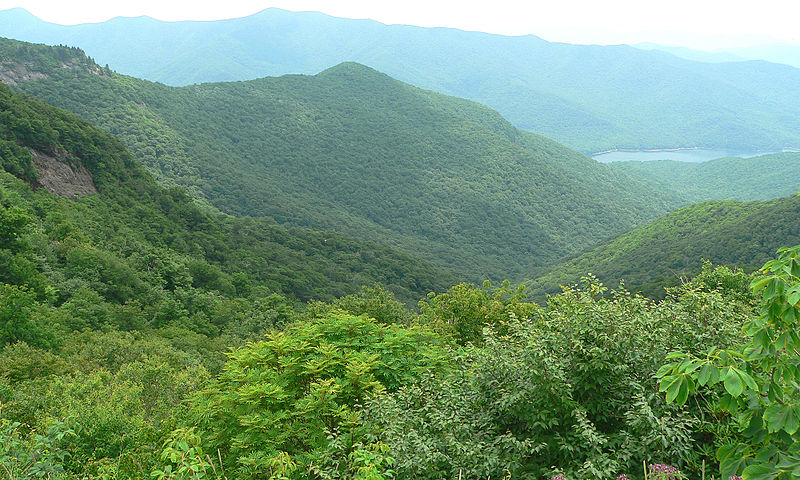
Broadleaf forest. Blue Ridge Parkway
Like most changes in the environment, there are pros and cons to forests using less water because forests recycle the water into the atmosphere where it becomes rain clouds. If the forests take up less water, they will probably supply less moisture to agricultural areas downwind of the forests.
Where forests exist on the perimeters of their climatic ranges, they are not faring as well. In the American West, for example, there are massive tree die-offs caused by less rainfall and snow as well as beetle infestations where temperatures are no longer cold enough to kill them in the winter.
Scientists had predicted some growth benefit from higher levels of carbon dioxide, but this study found the benefit to be far greater than previously predicted. Higher growth rates also predict that forests will be capable of absorbing more carbon dioxide because carbon storage is mainly proportionate to biomass.
Trees absorb carbon dioxide through the pores in their leaves, called stomata. Scientists hypothesize that trees don’t need to open their pores as wide when carbon dioxide levels are higher. Since moisture is lost when the pores open, less moisture is lost if the pores don’t open as wide. That’s the working theory of this new research.
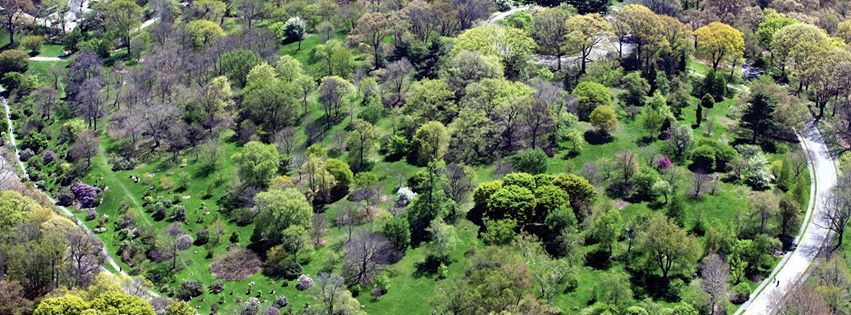
Harvard Arboretum
The forest at the Harvard arboretum was one of the forests included in this study. It has the longest continuous record of forest growth in the world.
Many questions remain. Which species are becoming more efficient in their water use? Are there intervening factors that are reducing water use? Will this trade-off between water use and carbon dioxide levels have an upper limit?
 “The rabbit also is alien [to Britain] but especially following… abandonment of traditional grassland management, is vital in maintaining many species-rich wildflower pastures and hugely important as food for predators such as common buzzards. And, of course, in 1902 Beatrix Potter gave her fictional rabbit a blue waistcoat, a trug with carrots in it, and the name Peter, and single-handedly generated a huge sentimental cultural association between humans and rabbits, particularly from our formative experiences as readers of the genre of children’s nature literature. This one book has sold over 45 million copies worldwide and been translated into 36 languages. The rabbit has many friends. Enemies of the rabbit, most especially the Anti-Rabbit Research Foundation on Australia…, return to the power of children’s literature to counter the rampant sentimentality for the British invader down under. Aussie kids are urged (through popular primary school books) to cherish and embrace the native desert marsupial Bilby at Easter time, and to shun the more traditional (but culturally invasive) Easter Bunny. They eat chocolate Easter Bilbies as part of scientifically sponsored cultural ecological restoration. There may be a tendency to chuckle at this evidence. But this is serious stuff in an invaded land such as Australia. Severing cultural ties with rabbits needs to be done at a young age, before the powerful and mentally invasive Beatrix Potter-effect can take hold!” (1)

 Conservation Sense and Nonsense