Juliet Stromberg is a plant ecologist who specialized in wetland and riparian ecosystems of the American Southwest. Her friends call her Julie and I will presume to do the same. She has retired from her position at Arizona State University, but her husband, Matt Chew, is still teaching ecology from a historical perspective at ASU. He is very much her partner in their 20-year project to restore 4-acres of dead citrus grove and an 80-year old Spanish colonial house, long abandoned and derelict. The property came with water rights, without which their project would not have been possible.
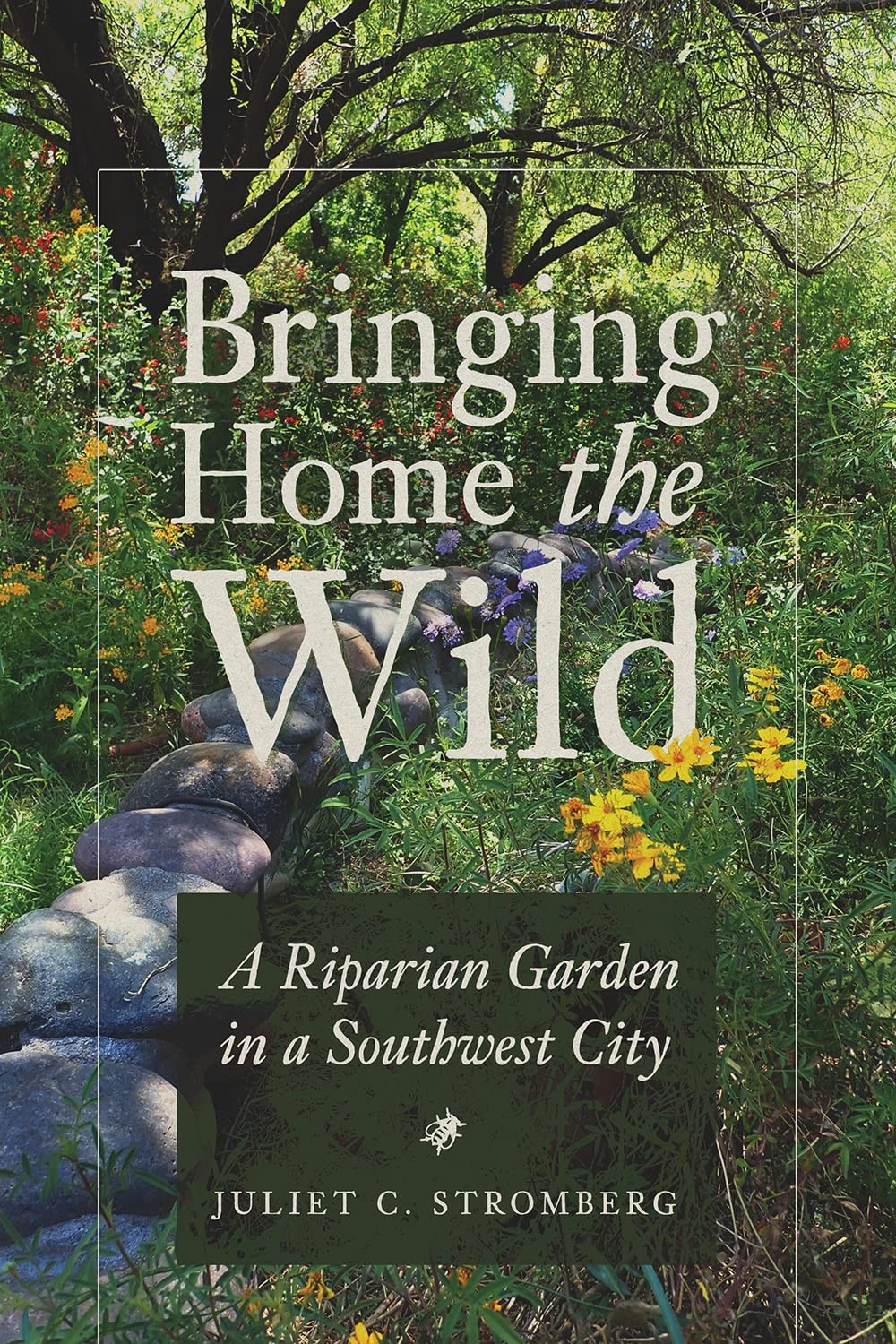
In her recently published book, Bringing Home the Wild: A Riparian Garden in a Southwest City, Julie tells us how she and her partner transformed—with the help of natural processes–this dead patch of land in South Phoenix, Arizona into the oasis that it is today. The first step was to restore the irrigation system, which immediately brought much of the dormant seed bank back to life.
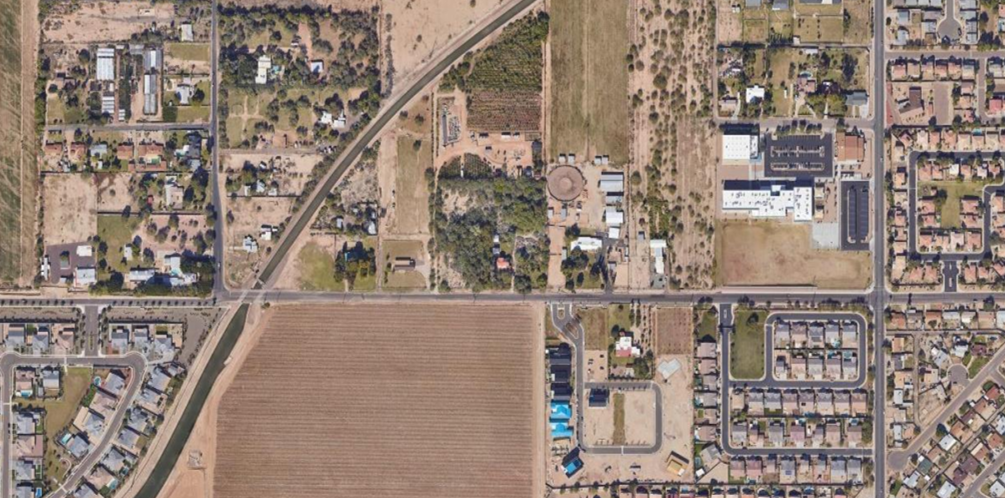
Julie & Matt’s garden is in the center of this aerial view
Using the riparian vegetation of the Salt River—the source of their water—as her reference, she chose a half-dozen tree species as the foundation of their garden, such as Fremont cottonwood, Gooding’s willow, and velvet mesquite. Twenty years later, there are now 300 trees, sheltering a community of plants and animals. How did they get there?
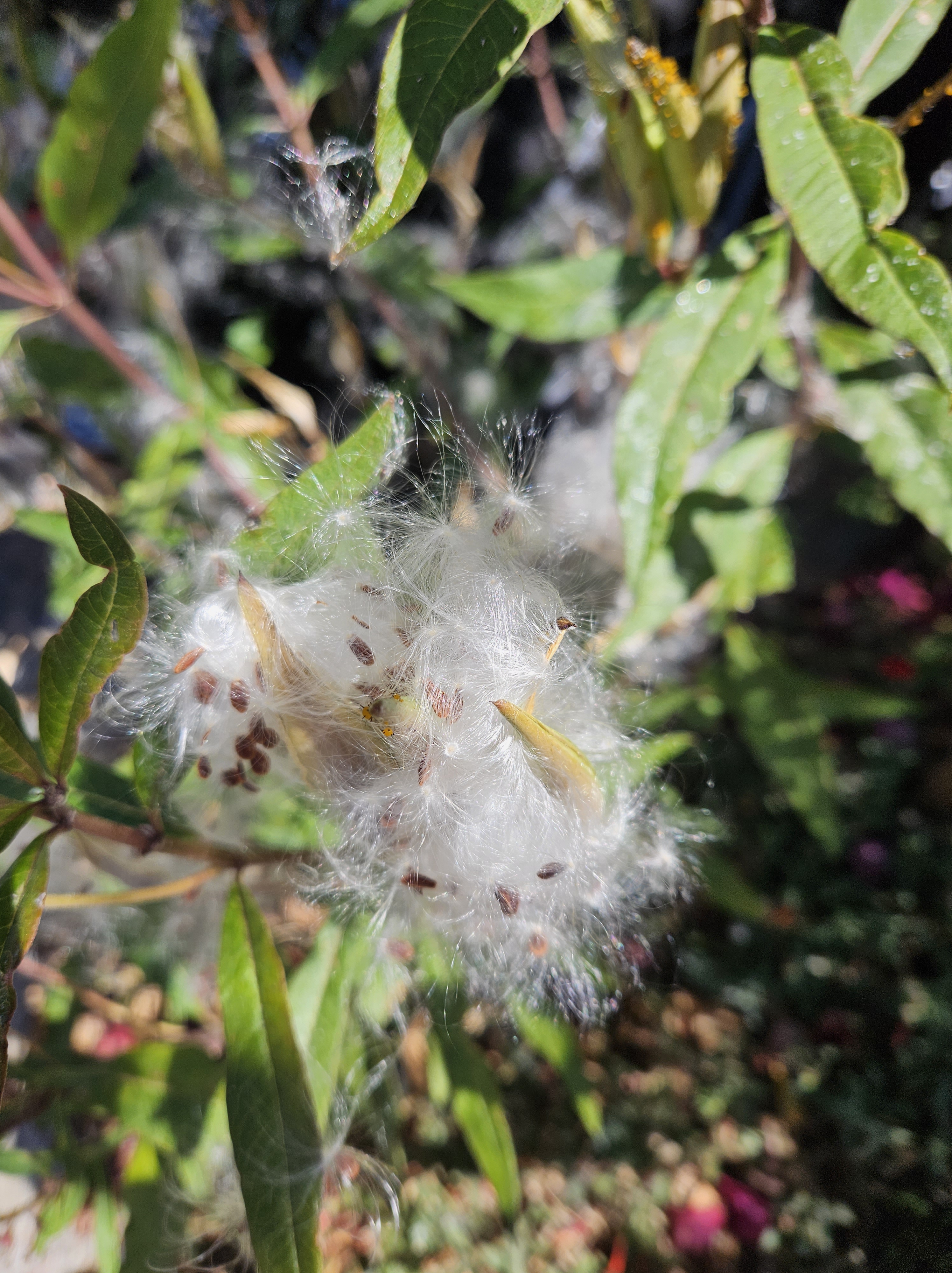
The seeds of some trees such as blue elderberry and mulberry were brought from neighboring gardens by birds and small animals. Julie and Matt have seen 157 species of birds in their garden, so we can assume birds have done some of the planting. The seeds of some plants are aerodynamically shaped and were blown in by the wind, adding to the diversity of the garden.
Tropical milkweed seeds ready to be launched by the wind from a neighbor’s front yard. Conservation Sense and Nonsense, Oakland, CA, October 2023
Many of the trees are American in origin, but others are not. Regardless of the method of dispersal, most introductions are welcome in Julie’s garden. She spares her readers the tedious recitation of which plants are considered native and which are not. The Southwestern desert is not an ecosystem with which I am familiar. I was glad to have a tour of Julie’s garden without irrelevant information about the nationality of every plant. For the same reason, I like to travel in distant places where I can’t distinguish natives from non-natives. Everything looks great to me and nothing brings me down more than a guide who wants to inform us of what “belongs” and what doesn’t.
Julie and Matt also planted a fruit orchard and a vegetable garden that bring more birds, insects, and animals to the garden as well as providing food for their table. Eating the fruits of our labors in the garden deepens our respect for what plants do for us and establishes our working relationship with the land.
Managing a wild garden
In keeping with Julie’s opinion that ecological restoration is a form of “glorified gardening,” she actively manages her garden. A few plants that annoy members of her community of plants and animals—such as puncture vine and tumbleweed—are not welcome.
When the delicate balance between predator and prey becomes unbalanced, some protective measures are necessary. If coyotes and dogs can’t keep up with the rabbit population, it’s sometimes necessary to put vulnerable plants into cages to protect them. The root balls of some plants are covered in wire mesh to protect them from hungry gophers.
Plants also assist in their own defense. Where mesquite is grazed by cattle, the tree responds by growing longer thorns to repel the cattle. When plants are attacked by plant-eating insects, some emit a toxin to render themselves inedible. The scent of the chemical wafts to neighboring plants, alerting them to the arrival of predators. These natural defenses are an important line of scientific inquiry that has potential to substitute nature-based solutions for synthetic chemicals.
The population of roof rats in Julie’s home is kept in check with liquid birth control, lest they chew on electrical wires or build nests in car engines.
Gardening with the help of friends
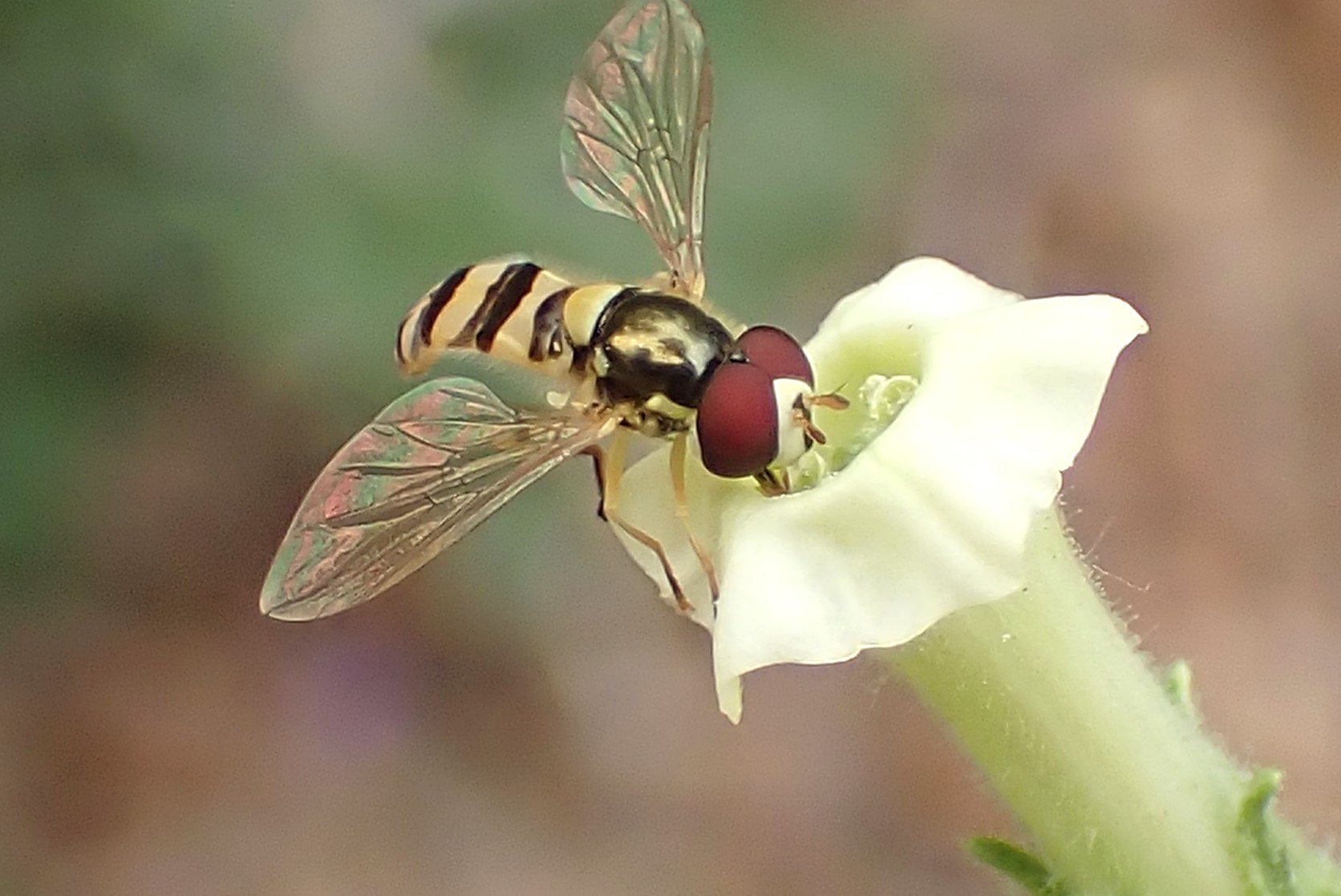
Julie’s is not a manicured garden, but it requires constant pruning to keep trails clear and provide light and space for plants to thrive. The annual scouring of the flood plain by spring floods is one of the natural processes that Julie and Matt could not use to restore their land because irrigation water is channelized and confined by concrete. Julie has come to appreciate the flies and other insects who are the decomposing crew, helping to reduce the accumulation of debris in the absence of annual scouring floods. Sixty-six species of flies assist with decomposition as well as pollination in Julie’s garden.
Julie is happy to have coyotes in her garden, but her dogs disagree. Violent and fatal confrontations between these closely related species required building a wall that confines dogs close to the house at night, while coyotes safely roam most of the garden.
Dogs are an important part of Julie and Matt’s life. Early in the book’s introduction Julie warns readers that they should put her book down “NOW!” if they don’t want to hear dog stories. Julie has walked thousands of dogs in a nearby animal shelter. In addition to her own 4 dogs, there are also occasional foster dogs who need to recover from traumatic experiences to be adoptable. In Julie’s refuge, these traumatized dogs learn to trust again.
Peaceful co-existence
Julie is a recovering academic scientist. Before she retired, she felt that her focus on the accumulation of data needed for scientific analysis was causing her to lose track of the big picture. She needed to stop and smell the flowers, so to speak.
She received her graduate education during the heyday of invasion biology. Julie slowly shifted away from native purism based on her experiences in the field. She has rejected that doctrine, and regrets teaching her students to fear “those who came from somewhere else.”
Julie has a vivid memory of the first step she took on that journey to her gardening ethic of peaceful coexistence. She had been instructed to pull tree tobacco from land along the Salt River that was being restored. The nicotine in the plant was making her feel sick, which seemed to bring her to her senses. She began to wonder what she was doing, “following orders to kill creatures she barely knew.”
Fly on desert tobacco. Photo courtesy Juliet Stromberg
Part of Julie’s skepticism about such eradication projects is based on her understanding of how little we know. She realizes that the harm done by non-native species is exaggerated and their benefits are underestimated. Given the limits of our knowledge, we should be obligated to give introduced plants the benefit of the doubt before killing them. She now appreciates the beauty of tree tobacco, which also feeds birds, fixes carbon, and stabilizes the soil. Its seeds were naturally dispersed to Julie’s garden and tree tobacco is welcome there.
Imperatives imposed by climate change
Julie says, “The preoccupation with provenance diverts conservationists and gardeners from critical issues,” such as climate change, food security, and extinction (which, studies show, are not caused by introduced plants). Living in the Southwest, Julie has a front row seat on climate change. It’s always (within the context of our lifetime) been hot there, but now it is blisteringly hot during summer months. She watches hummingbirds in her garden seek shelter in the shade, close to the irrigation drip. She watches dogs panting, birds gasping for breath and plants wither and die in the heat. And she knows that both native and non-native plants store carbon that would otherwise contribute to greenhouse gases causing climate change. Carbon storage varies according to certain plant characteristics, but those characteristics are unrelated to the nationality of plants.
Those who insist on replicating the landscape that existed 200-400 years ago in America are depriving nature of the evolutionary opportunities that will enable survival. We don’t know what life will be capable of living in the climate of the near-future. Nature needs as many alternatives as possible to find the species that can survive. Plants and animals are blameless in this struggle of survival of the fittest. The least we can do is to get out of their way as natural selection finds the life that is adapted to the current and future climate.
Showing respect for nature
Julie does not use any pesticides in her garden….no herbicides, fungicide, or insecticide. She is concerned about the pesticides used by her neighbor across the road who grows cotton. She notices the blue cotton seeds scattered on the ground and surmises that they were coated in insecticide or herbicide that will infuse pesticide into the plant as it grows. The poisoned seed can kill seed-eating birds and other animals and the plant itself will be poisonous as it grows. The dust from the cotton field blows into her property when the field is plowed and after the cotton is harvested because no cover crops are grown to tamp down the dust and prevent the loss of carbon stored in the soil. Julie can see firsthand the damage caused by industrial agriculture and is confirmed in her commitment to avoid using pesticides.
Julie shows her respect for everything living in her garden by her choice of pronouns to describe them: “who” not “what,” “she/her” not “it.” She asks her readers to show the same respect for plants and animals, regardless of their nationality. Avoiding the use of pesticides in our gardens is another way to show our respect for the plants and animals on which we depend, with the added benefit of not poisoning ourselves.
Thank you, Juliet Stromberg, for telling us about your garden and congratulations for what you have accomplished and learned from the experience of nurturing it back to life with the help of nature.
Oakland has been trying to adopt a vegetation management plan (VMP) to mitigate fire hazards since November 2016. The plan has been drafted three times in 2018, 2019, and 2020 and a draft Environmental Impact Report was also published in 2020. All three versions of the plan were acceptable to me and many others. Every version would have removed dead trees and thinned non-native trees on 2,000 acres of public land and 300 miles of roadsides in Oakland, leaving the tree canopy intact so that the forest floor would be shaded, suppressing the growth of weedy vegetation that ignites easily and keeping the forest floor moist, which retards fire ignition.
Unfortunately, none of the proposed vegetation management plans were acceptable to native plant advocates who want all non-native trees in project areas in Oakland to be destroyed and the land replanted with native plants and trees. The plan they are demanding is a native plant restoration, not a wildfire hazard mitigation plan. Since they have successfully prevented Oakland from addressing wildfire hazards for eight years, we might assume they aren’t concerned about wildfire.
A fourth version of the plan and a new Environmental Impact Report are expected to be published in September 2023 and there will be a new public comment period in October. Based on written and oral public comments at public hearings, we predict that the revised plan is likely to be far more destructive than previous drafts of the plan. Based on that prediction, I am alerting you to the need to read the revision and write a public comment. Please ask to be notified of the publication of the plan by sending an email to info@oaklandvegmanagement.org .
Update: The revised Oakland Vegetation Management Plan and revised Draft Environmental Impact Report were published on September 20, 2023. These documents are available HERE. There will be a public hearing by the Oakland Planning Commission on November 1, 2023. The deadline for public comment will be November 4, 2023. Comments can be submitted by email DEIR-comments@oaklandvegmanagement.org or by mail to Montrose Environmental, attention Ken Schwarz, 1 Kaiser Plaza, Suite 340, Oakland CA 94612.
When I have read the revised plan and its revised EIR, I will post a draft of my public comment on the draft by October 1st.
– Webmaster, Conservation Sense and Nonsense, September 20, 2023
What do opponents of previous plans want?
There is a wide range of opinions about a vegetation management plan for Oakland. I will use the public comment of the California Society of American Foresters (SAF) on the third version of the VMP as a representative opinion and the best available predictor of where the fourth revision is likely headed. The entire comment of the Society of American Foresters (SAF) is available HEREand here are some of the revisions SAF is asking for:
“Ecological restoration should be a goal of the VMP, including the establishment of native plant species where nonnative species dominate…Thinning of dense stands of nonnative tree species should only be done as part of an overall strategy of restoration, i.e., the goal of any tree removals should always be to eventually convert these stands to native tree or vegetation cover in order to build greater ecological resiliency.”
“In concert with the goal of ecological restoration, adaptive management in light of climate change should guide management practices and restoration plans. Adaptive management strategies that incorporate new information and changing conditions will be critical to ecosystem restoration. Annual grasslands may become more dominant, oak woodlands less so in the planning area in the future as climate changes. Management targets in many cases will have to be based on anticipated future conditions.”
“However, if thinning is kept as the desired practice, we ask that you design each entry to be sufficiently intensive to assure that tree crowns will not close before the next thinning entry (10 years from now?) and indeed is sufficiently thinned to allow work towards establishing native vegetation in these stands.”
“The use of prescribed fire as a vegetation maintenance tool should have been considered and included in the VMP especially on ridges where fire moving from adjacent jurisdictions might occur, or along power-line transmission corridors.”
“The vegetation management zones along roadsides, especially along routes of egress, should be modified to extend 100 feet from roadside edges and should include any trees with underlying structural or health conditions that are tall enough to fall onto streets and roads. This may in some cases require looking outside of the 100-foot roadside clearance.”
“It is important that the use of triclopyr herbicides is included to treat cut stumps in eucalyptus to prevent sprouting. Glyphosate herbicides will not be effective in treating eucalyptus stumps and will result in resprouts.”
“There should be an Ecological Restoration Guide added to the appendices…This new appendix would outline the City of Oakland’s current ecological restoration efforts, identify stakeholders (e.g., city departments, Oakland Wildlands Stewards, etc.) and their roles…”
Native plant restoration, NOT wildfire hazard mitigation
The Society of American Foresters (SAF) is asking the City of Oakland to make a commitment to eradicating all non-native trees in project areas and replacing them with native plants. Such a plan would not reduce wildfire hazards in Oakland because native vegetation is not inherently less flammable than non-native vegetation. Most wildfires in California occur in native chaparral and native conifer forests.
The plan proposed by the Society of American Foresters (SAF) is a native plant restoration plan, NOT a wildfire hazard mitigation plan. Their proposal would destroy much of Oakland’s urban forest, which would not be replaced by native trees:
Non-native trees were planted in Oakland in the 19th century because there were few native trees: “Vegetation before urbanization in Oakland was dominated by grass, shrub, and marshlands that occupied approximately 98% of the area.” (1) Non-native tree species in the East Bay are adapted to soil and microclimate conditions that are not suitable for native species.
Grassland was the dominant vegetation type of pre-settlement Oakland partly because of the land management practices of Native Americans and the stock grazing of early settlers: “Native Americans played a major role in creation of grasslands through repeated burning and these disturbance-dependent grasslands were maintained by early European settlers through overstocking of these range lands with cattle and sheep. Twentieth century reduction in grazing, coupled with a lack of natural fires and effective suppression of anthropogenic fires, have acted in concert to favor shrubland expansion.” (2)
Grassland in California is not native to California. Mediterranean annual grasses were brought to California in the early 19th century by the grazing herds of Spanish-Mexicans. California’s native bunch grasses are not adapted to heavy grazing by herds of domesticated animals. The grassland of California is about 99% non-native (Allan Schoenherr, A Natural History of California, UC Press, 1992). Attempts to convert annual grasslands to native bunch grass have not been successful. A team of scientists at UC Davis spent $450,000 and 8 years trying to convert 2 acres of grassland to native bunch grasses without success.Grassland that will replace our urban forest will not be native.
Grass is easily ignited and fires move quickly through grassland, particularly in a wind-driven fire. The deadly, destructive fires in Maui, Hawaii are a case in point. When agricultural fields of sugar cane, pineapple and other tropical fruit left Maui they were quickly succeeded by non-native grass that was considered a factor in the spread of fire. (3) Dormant, dry annual grassland in the East Bay Hills will be more flammable than the living vegetation that native plant advocates want to destroy.
A small redwood grove was the only pre-settlement exception to the otherwise treeless Oakland hills: “…for thousands of years [the Oakland hills] were treeless meadows, visited seasonally under Indigenous management…The one exception was the redwood groves of the southern Oakland Hills, a restricted forest that extended a few miles eastward from upper Dimond Canyon over the ridgetop to the outskirts of Moraga.” (4) Much of this grove still exists today because coastal redwoods are vigorous resprouters when they are burned or cut down.
SAF also predicts a vegetation type-conversion from forest to grassland: “Annual grasslands may become more dominant, oak woodlands less so in the planning area in the future as climate changes.” Grassland will naturally succeed to shrubland without regular burning, which SAF recommends to reduce fuel loads.
Prescribed burns in densely populated urban areas are rarely approved by Bay Area Air Quality Management District because they pollute the air and often cause uncontrolled wildfires. California law regarding liability for damage caused by prescribed burns was revised in 2022 to provide legal protections for those who manage prescribed burns. The revised law lowers the standard for liability to gross negligence from a previous standard of simple negligence. (5)
Consequences of landscape conversion to grass and shrubs
Destroying thousands of trees will increase air pollution and reduce air quality. Destroying thousands of trees will increase greenhouse gas emissions causing climatechange by releasing the carbon stored by the trees that are destroyed and reducing carbon sequestration going forward because the destroyed forest will not be replaced by a forest of native trees.
There was little biodiversity in Oakland’s pre-settlement forest: “Oakland’s original species composition has increased from approximately 10 tree species to more than 350…Today [1993], only 31% of existing trees are native to Oakland, the plurality of trees (38%) are native to Australia/New Zealand.” (1) Destroying thousands of non-native trees in Oakland will reduce the biodiversity of our forest. A more diverse forest is more resilient, particularly in a changing climate, with extreme and variable weather conditions.
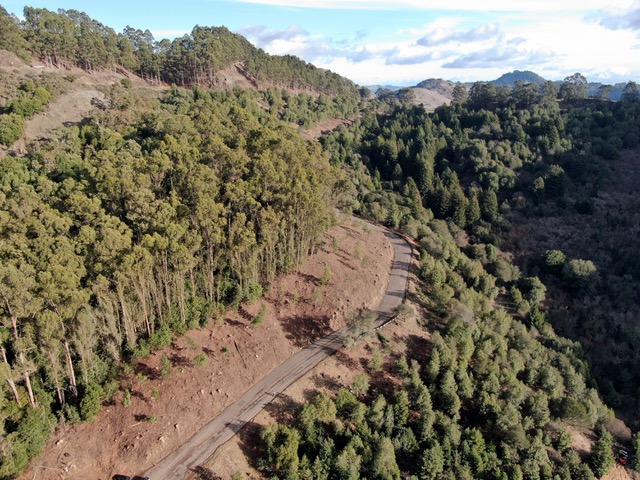
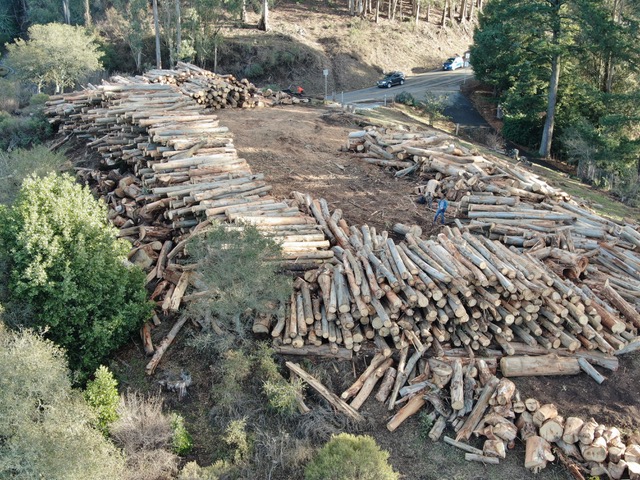
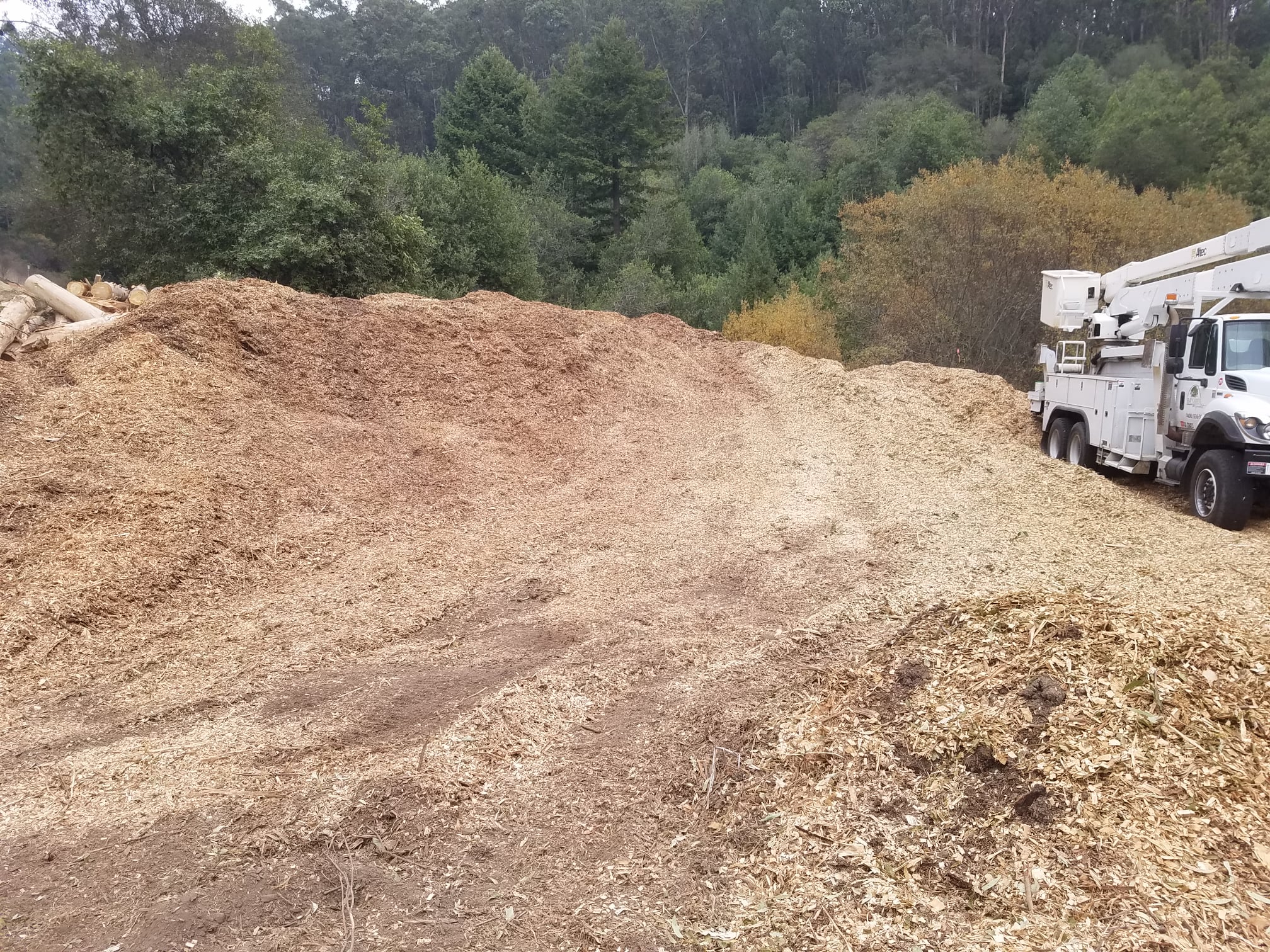
Increasing 300 miles of roadside clearance from 30 feet (as proposed by the 3rd version of the VMP) to 100 feet (as proposed for the 4th version of the VMP) will produce wood debris on a scale that cannot be disposed of. We know what the outcome will be because of a similar project on Claremont Ave, where eucalyptus was clear cut 100 feet from the north side of 1.1 miles of the road in fall 2020. Below are pictures of the piles of wood chips and logs that remained along that stretch of road for about 9 months while project managers tried to figure out what to do with the wood debris, which was eventually dispersed throughout the hills. UC Berkeley implemented the project with funding from Cal-Fire.
The north side of Claremont Ave. was clear cut 100 feet from the road. The south side of the road was not cut because the trees are native. There is a creek flowing at the bottom of the canyon that creates the moist conditions needed for native trees, which will not grow where non-native trees now grow. Photo by Doug Prose, courtesy Hills Conservation Network.One of many piles of logs, Claremont Ave, November 2020. It took about 9 months for the logs to be dispersed along roads in the hills. Photo by Doug Prose, courtesy Hills Conservation Network.One of many piles of wood chips, Claremont Ave, November 2020
The roads in the East Bay hills are now lined with logs, preventing people from pulling off the road. No native plants or trees were planted after the trees were destroyed. Three years later, the clear cut roadside is vegetated with non-native annual grasses and coyote brush, a pioneer native shrub.
The project on the property of UC Berkeley was very small in comparison to the Oakland vegetation management plan that will clear cut 300 miles of roads, producing at least 300 times the amount of wood debris. What will Oakland do with the wood debris that is produced from the destructive VMP that native plant advocates demand? Tons of wood debris lying on the ground is far more flammable than living trees, which is another indication that the VMP that native plant advocates demand is not about mitigating fire hazards. It’s about their preference for a native landscape that is not less flammable than the landscape they demand be destroyed. Like all Mediterranean climates, our native vegetation is fire adapted and fire dependent. A significant number of our native species will not regenerate in the absence of fire. Most wildfires in California in the past 5-10 years have occurred in native chaparral and native conifer forests.
NY Times reported that 150 homes burned in this wind-driven fire in San Diego in 2003, but the eucalyptus surrounding the neighborhood did not burn. The flammability of eucalyptus trees is exaggerated to justify their destruction. NY Times photo
The more trees that are destroyed, the more herbicide will be required to prevent the trees from resprouting. SAF is correct in saying that tricopyr will be needed to kill the roots of the trees to prevent them from repsouting. Glyphosate will not accomplish that task. Triclopyr is more toxic than glyphosate. Triclopyr has a signal word of “warning” and glyphosate has a less toxic signal word of “caution.” Triclopyr kills the roots of woody plants by traveling from the cut stump to the roots of the plant in the soil. Triclopyr is known to kill mycorrhizal fungi in the soil, which are essential to the health of plants growing in the soil. The more herbicide that is used to kill the roots of destroyed trees, the less likely a newly planted native landscape is to survive. All the more reason to assume that the destroyed forest will not be replaced by a native landscape.
In Summary
The landscape that native plant advocates demand for Oakland will be predominantly non-native annual grasses.
Native trees will not replace the trees that are destroyed because they are not adapted to most places where non-native trees now live and because there is no available funding to purchase native plants, plant them on thousands of acres of public land, and irrigate them until they are established. Similar fuels management projects done by East Bay Regional Parks District, East Bay Municipal Utilities District, and UC Berkeley have not planted a native landscape to replace trees that have been destroyed.
Non-native annual grasses will naturally succeed to shrubs in the absence of frequent fire. Shrublands are more flammable than the existing urban forest because fire travels on the ground, unless wind-driven fire ignites tree canopies. In that case everything burns, both native and non-native trees. The wind-driven fire in Oakland in 1991 spared no trees in burned areas, whether native or non-native.
The project would produce many tons of flammable wood debris that has no commercial value and no place to be safely disposed of.
The loss of our urban forest will increase air pollution in Oakland, contribute to greenhouse gas emissions causing climate change, and raise temperatures in a city that is already a heat-island.
Herbicides needed to prevent the urban forest from resprouting will poison the soil and suppress the growth of a new landscape.
If you live in Oakland City Council District 4 or 6, you are likely to be directly affected by Oakland’s vegetation management plan. The most effective way to influence the VMP is to express your opinion to your representative on the City Council, as well as our at-large representative on the Council. Contact information for members of the Oakland City Council is available HERE.
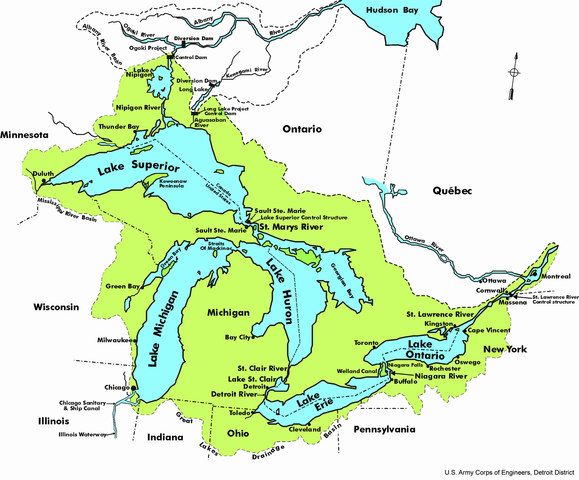
I’m reading about the Great Lakes in preparation for a cruise on the Great Lakes from Chicago to Toronto. (1,2) It’s a story of continuous invasions of aquatic creatures, one after the other, with many more expected in the future. Every one of those invasions was caused by the removal of natural barriers from isolated bodies of water to accommodate human activities such as shipping of goods.
Connecting the Great Lakes to the Atlantic Ocean
The St. Lawrence River is the natural gateway into the Great Lakes from the Atlantic Ocean. The salty water of the ocean and the fresh water of the lakes was part of the natural barrier that protected the lakes from invasive species because, for the most part, the marine creatures that live in salty water are different from those that live in fresh water.
The St. Lawrence River was steep and narrow, creating white-water rapids that limited travel from the ocean to the lakes (or vice versa) in anything but a birch bark canoe that could be carried around the rapids. The natural barrier was penetrated by building the St. Lawrence Seaway in 1959 that widened the river and used locks to climb the steep incline of the river into Lake Ontario.
The St. Lawrence Seaway was instantly obsolete because of the unforeseen container revolution that transformed global shipping. The transition from traditional to container shipping was instantaneous because the advantages are so great. Container ships are huge in comparison to the small ships that had been loaded by hand for centuries. The St. Lawrence Seaway is too narrow to accommodate container ships. The loans given to the builders of the seaway by Canada and the US were eventually forgiven because the tolls on the seaway will never pay for the expense.
But the damage was done, although much of it could have been avoided. The ships that start their voyage in fresh water ports on rivers take on their ballast water when they start their voyage and with it freshwater aquatic creatures that don’t live in the Great Lakes. When they arrive in the Great Lakes they dump their ballast water to take on their cargo. The dumping of ballast water in the Great Lakes could have been regulated in 1959, but it wasn’t. Only very recently have ships from fresh water ports been asked to exchange their ballast water in the ocean, before entering the Great Lakes and those regulations weren’t mandatory until 2021. Such is the power of commercial interests that the consequences of introducing new species into the Great Lakes were not considered.
The second natural barrier that protected the Great Lakes was Niagara Falls in New York with a vertical drop of 160 feet. That steep cliff across the Niagara River prevented the movement of marine animals from the Atlantic Ocean, through Lake Ontario and into the other four lakes. It was one of the first barriers to be penetrated by the Erie Canal in 1825 and the Welland Canal in 1829. The Erie Canal connects the Hudson River that flows into the Atlantic Ocean to Lake Erie, bypassing Niagara Falls and creating a gateway from the Atlantic Ocean into the Great Lakes. The Welland Canal connects Lake Ontario to Lake Erie, which also bypassed Niagara Falls and created another gateway from the Atlantic Ocean to all of the Great Lakes.
Connecting the Great Lakes to the Mississippi River Basin
The St. Lawrence Seaway, Erie, and Welland canals opened the front door of the Great Lakes to salt water creatures in the Atlantic Ocean and the ships that brought foreign aquatic animals into the Great Lakes. The reversal of the Chicago River that connected Lake Michigan to the entire Mississippi River basin, opened the back door to the Great Lakes to all of the freshwater aquatic animals that live in the vast Mississippi River basin, east of the Continental Divide.
When Chicago was built, it dumped its sewage into Lake Michigan and it also took its drinking water from Lake Michigan. As the population of Chicago grew it became more vulnerable to typhoid epidemics caused by the polluted water Chicago was drinking. The Chicago River had sent a dribble of water into Lake Michigan from its headwaters not far west of Chicago before it was reengineered.
In 1900, Chicago built a huge sanitary canal that connected Lake Michigan to the Mississippi River. The sanitary canal carried Chicago’s sewage into the Mississippi River and created a shipping lane to the Mississippi River while giving Chicago a clean source of water from Lake Michigan. The sanitary canal reversed the flow of the Chicago River, which now flows out of Lake Michigan.
The Consequences
The first invasive predator of native fish arrived in the Great Lakes via the canals built early in the 19th century. The sea lamprey is a parasite that attaches itself to the bellies of fish and slowly sucks the blood out of it. Its suction-cup mouth is the stuff of nightmares.
Source: Great Lakes Fishery Commission
Lampreys, like salmon and sturgeon, are born in freshwater rivers and streams before living in the ocean and finally returning to their freshwater birth place to spawn and die. They are capable of living in both fresh and salty water. In the Great Lakes lampreys did not need to migrate to the ocean as their ancestors had because there was sufficient food in the lakes.
As late as the 1940s commercial fishermen in the Great Lakes were harvesting 100 million pounds of native fish, such as lake trout and whitefish, annually. Lampreys were first reported in Lake Michigan in 1936. By 1950, the commercial fishery had all but collapsed as the lamprey population reached its peak.
Lampreys met their match when a graduate student at University of Michigan wrote his Ph.D. thesis about the life cycle of lampreys. He spent several years stalking lampreys in Lake Michigan and its tributaries, finding out where and when they spawn and at what point in their life cycle they become parasites of fish.
The lamprey population had been so vast that it was impossible to target an attack on them. An understanding of their life cycle enabled the development of a strategy to eradicate them. More than 5 of their 7-year lifespan is spent burrowed in the gravel of small streams that feed into the lakes. At that stage they are not yet fish predators.
Armed with the knowledge of when and where lampreys were most vulnerable, the strategy was to build mesh barriers that prevented the lampreys from returning to the streams to spawn. There was some success with the barriers, but not sufficient to reduce the huge population.
The final solution to lamprey control was the use of a chemical that would poison lampreys without killing native fish. Finding the chemical that would do the job was a classic case of trial-and-error without regard for the consequences of using poisons in the environment. Chemicals were solicited from all over the country and the world for study as candidates. The tests, done in uncontrolled environments with no safety precautions for low-level workers, consisted of dumping hundreds of different chemicals into three jars, one containing a lamprey, another native lake trout, and a third native blue gill. After hundreds of trials, a chemical that killed only the lampreys was selected for the job of eradicating the lamprey population. No thought was given to the possible effect on all the other native fish in the lakes—such as whitefish and sturgeon—or humans, or plants. (3) The same chemical is still used today to control the lamprey population, which remains but is no longer considered a problem.
There are many invasions into the Great Lakes. The lampreys were followed by alewives, a species of small fish. The population of alewives boomed at first, then busted, resulting in massive rafts of millions of dead alewives. Finally, the population of alewives stabilized and now are considered the primary prey of salmon that were introduced in the 1960s to serve the sport fishermen who are the backbone of Michigan’s tourist industry.
Zebra and quagga mussels proved to be one of most damaging of the invaders in the Great Lakes, partly because of how widely they spread. They were brought to the lakes in the ballast water of ocean-going ships. The open back door of the Great Lakes into the vast Mississippi River basin enabled the inevitable spread of quagga mussels throughout the country, eventually crossing the Continental Divide into western states. Those who tried to prevent that spread, spent many years imposing strict regulations about decontaminating and moving boats into places where mussels weren’t yet found. Today, places like Lake Powell have given up enforcing the regulations.
The mussels are filter feeders of phytoplankton that is food for creatures at the bottom of the food chain, depriving them of food, as well as their predators higher in the food chain. The mussels have turned sandy beaches into foot-slicing no-go zones. They improve the water clarity of the lakes, but that’s a mixed blessing for other inhabitants of the lakes.
Quagga and zebra mussels are now part of the food web. Populations of diving ducks have increased where mussels are found. A species of non-native fish—the goby—thrives on quaggas. And native whitefish, yellow perch, and chub have slowly developed the ability to digest quaggas, a story not fit for the squeamish. Whitefish don’t have the jaws needed to crack the mussel open, so they swallow them whole and leave it to their digestive system to deal with it: “the typical whitefish has an anus about the size of a ‘swizzle stick.’ But the fish excrement, a paste of crushed mussel shell thick as unset concrete, stretched the whitefish’s underside orifice to the diameter of his pinky.” (1)
The latest arrival is Asian carp via the Chicago River and sanitary canal from the Mississippi River into Lake Michigan. Asian carp were introduced to the Mississippi River to eat sewage pollution drained into the river by many rural communities. The prediction is that Asian carp will decimate the commercial fishery of the Great Lakes, though it is still early in that story.
More man-made problems
Not all problems in the Great Lakes are caused by the arrival of foreign aquatic species, but other problems are also man-made. Lake Erie is the most polluted of the Great Lakes. In summer months, when temperatures are high, there are toxic algal blooms that kill fish and pollute drinking water. Although the sources of pollution are man-made, the shallow lake bottom contributes to the problem. Lake Erie is the shallowest of the Great Lakes.
The Great Black Swamp at the western edge of Lake Eric slowly drained the watershed into Lake Erie, filtering and cleansing the water as it flowed through the swamp. The swamp was drained and filled to create more land for agriculture and remove an obstacle to westward travel and migration. Now the rich agricultural land that surrounds Lake Erie drains run-off of chemical fertilizers into the lake, providing the nutrients that produce algal blooms.
Climate change has already created chaos in the Great Lakes and the damage is expected to accelerate in the future. While the climate has warmed on land, the temperature of the water in the Great Lakes has climbed even higher, promoting growth of toxic algae. Winter temperatures are no longer low enough to freeze the lakes during the winter because the dark water of the lakes in the winter absorbs more heat than reflective white snow and ice. The higher temperature of the water in the lakes also increases evaporation of the water, lowering water levels, causing erosion of the exposed shore, and destroying infrastructure on the shore.
Moral of the Story
Problems in the Great Lakes were caused by humans who were accommodating their own needs. The aquatic animals blamed for the problems were only symptoms of the changes made by humans. They were not the cause. Eradicating them will not prevent new invasions in the future, so long as the gateways to other bodies of water remain open. And over time, many of the species that cause problems at first will enter the food web and become contributing members of the ecosystem. We fear change, but in many cases that is because our time frame for evaluating change is too short.
We should assume that similar problems have occurred wherever isolated bodies of water have been connected to serve human activities. The Suez Canal connected the Mediterranean Sea to the Red Sea in 1869. The Panama Canal connected the Atlantic Ocean to the Pacific Ocean in 1914. I can only imagine the consequences of removing the impassable barriers between those vast bodies of water.
To be clear, I don’t regret the building of most of the canal passages, with the possible exception of the St. Lawrence Seaway. However, it is not realistic to expect that the environment will not be altered by removing impassable barriers on water or land and it is pointless to blame the plant and animal species that are merely responding to the changes we have made.
(1) Dan Egan, Death and Life of the Great Lakes, W.W. Norton & Co., 2017
(2) Jerry Dennis, The Living Great Lakes, St. Martin’s Press, 2003
(3) The pesticide 3-trifluoromethyl-4-nitrophenol (TFM) is used to control sea lamprey (Petromyzon marinus) populations in the Great Lakes through its application to nursery streams containing larval sea lampreys. TFM uncouples oxidative phosphorylation, impairing mitochondrial ATP production in sea lampreys and rainbow trout (Oncorhynchus mykiss). However, little else is known about its sub-lethal effects on non-target aquatic species. The present study tested the hypotheses that TFM exposure in hard water leads to (i) marked depletion of energy stores in metabolically active tissues (brain, muscle, kidney, liver) and (ii) disruption of active ion transport across the gill, adversely affecting electrolyte homeostasis in trout. Exposure of trout to 11.0 mg l− 1 TFM (12-h LC50) led to increases in muscle TFM and TFM-glucuronide concentrations, peaking at 9 h and 12 h, respectively. Muscle and brain glycogen was reduced by 50%, while kidney and muscle lactate increased with TFM exposure. Kidney ATP and phosphocreatine decreased by 50% and 70%, respectively. TFM exposure caused no changes in whole body ion (N a+, Cl−, Ca2 +, K+) concentrations, gill Na+/K+ ATPase activity, or unidirectional Na+ movements across the gills. We conclude that TFM causes a mismatch between ATP supply and demand in trout, leading to increased reliance on glycolysis, but it does not have physiologically relevant effects on ion balance in hard water.” (Oana Birceanu, et.al., “The effects of the lampricide 3-trifluoromethyl-4-nitrophenol (TFM) on fuel stores and ion balance in a non-target fish, the rainbow trout,” Comparative Biochemistry and Physiology, March 2014)
Dana Milbank is a political commentator for the Washington Post. Like many city dwellers, Milbank moved his family from Washington DC to the Virginia countryside during the Covid pandemic.
His new home inspired him to become a native plant advocate with the usual corresponding hatred of non-native plants. He announced his new hobby of killing non-native plants in April 2023, as described in this response to his article by several defenders of the natural world as it exists, rather than as some might wish it to be.
In a more recent article, Milbank expressed his frustration at the failure of his early efforts to destroy non-native plants on his property without using herbicides: “When last I wrote about my battle of the brush, I was losing, badly, to the invasive vines and noxious weeds that had turned forest and field at my Virginia home into an impassable jungle. I’d cut them back, but they would return in even greater numbers.”
He justifies poisoning both his property and the Shenandoah National Park near his home by turning to advisors who tell him what he wants to hear, people who make their living using herbicides to eradicate non-native plants.
Of course, renowned native plant guru, Doug Tallamy, is one of his advisors. Although Tallamy advised residential gardeners against using herbicides in his book, Nature’s Best Hope, published in 2020, he has now changed his mind about herbicides. In Milbank’s article, Tallamy says that herbicides are an “essential tool:” “‘I think of it as chemotherapy,’ said Doug Tallamy, a University of Delaware entomologist and guru of the native-plant movement. ‘We have ecological tumors out there. If we don’t control them, we have ecological collapse. We have the collapse of the food web.’”
Poisoning the soil
Milbank admits that glyphosate (Roundup) is toxic and he wears protective gear when applying it, including a respirator (which is not required for glyphosate applications by California’s pesticides regulations). He describes his application technique: “My preferred technique is ‘hack and squirt.’ With my hatchet, I cut gouges around the circumference of the invading tree, then spray the poison inside. For smaller invaders, I can chop the whole thing down and apply the chemical as a ‘cut stump’ treatment.
I read most of the over one thousand comments on Milbank’s article to determine the public’s reaction. Although many commenters express reservations about the use of herbicides, the majority of commenters are supportive of the use of herbicides. The manufacturers of pesticides are definitely winning the public relations battle regarding chemical safety. When supporters reply to doubters of herbicide use, they defend Milbank’s application technique as “surgical.”
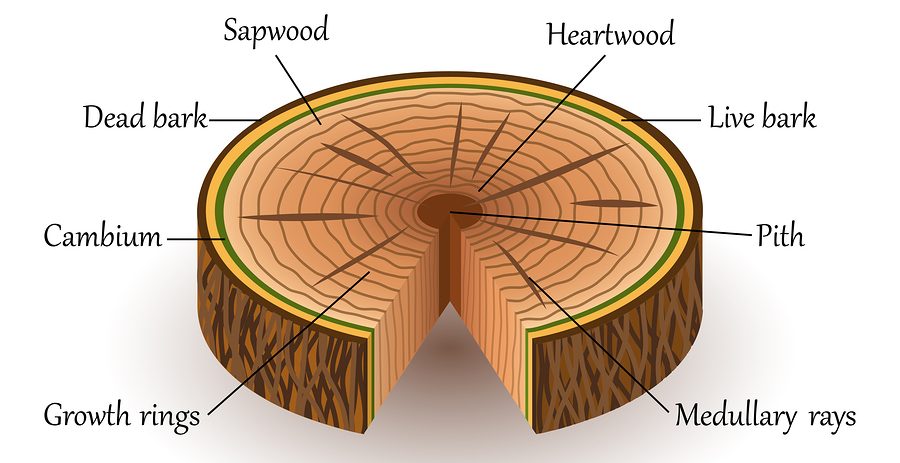
Cut stump and hack and squirt application methods are less likely to disperse chemicals in the air, but they increase soil contamination. These application methods work by applying herbicide shortly after the woody plant is cut, while the cambium layer (between the bark and the heart wood) is still functional. The cambium layer delivers the herbicide to the roots of the plant to kill the roots. The application may appear to be “surgical” from the standpoint of above-ground contamination, but the damage is being done in the soil, the plants growing in the soil, and the animals that eat those plants.
There are many consequences of poisoning the soil:
Because the roots of plants are intertwined as well as connected to one another by fungal networks in the soil, non-target plants are harmed and often killed. It is not possible to poison one plant without poisoning others. HERE is an example of a forest of native trees that was damaged by spraying herbicide under the trees.
Herbicides kill beneficial microbes and fungi in the soil that contribute to plant health. (1) For example, fungal networks that are killed by herbicides transport moisture and nutrients from the soil to the plants. Whatever vegetation remains or is planted in the future is handicapped by the loss of this living support system.
Glyphosate binds minerals in the soil, preventing essential nutritional minerals such as iron and manganese in the soil from being taken up by plants. (2) Glyphosate is so widely used that it is found in the blood and urine of most of the population, including children. Could glyphosate be a factor in widespread iron-deficiency anemia in adolescent girls and young women? (3)
Glyphosate is a well-known anti-microbial agent. These effects raise concerns regarding glyphosate’s influence on human health and behavior through secondary means, such as our gastrointestinal microbiome, given what is now known regarding the gut microbiome and its influence on human health and disease. (4,5)
Milbank repeats his accusation that those who believe the threat of non-native plants is exaggerated, are climate change deniers. He turns to the Executive Director of the federal Invasive Species Council for confirmation, who calls the threats of non-native plants “settled science.” Science is, by definition, never settled. Science is a process, not a conclusion. Every scientific hypothesis is constantly tested and usually refined or overturned as new knowledge and methods are available. Many scientists are testing the hypotheses of invasion biology and questioning their validity in a changing climate.
The only issue about invasion biology that is “settled” is that it has created a multi-billion dollar “restoration” industry that relies on and benefits the manufacturers of pesticides, as well as creating vested interests that perpetuate the industry.
Milbank also quotes one of his advisors who claims that native plants are better adapted to the changed climate than non-native plants: “The natives have the best ability to adapt — they’ve been adapting for tens of thousands of years in these areas — so they’ve got the ability to change as the climates and the landscapes have been changing.” This statement seems comical, given that the topic is the extreme difficulty of eradicating non-native plants and the fact that they are out-competing native plants. There is zero evidence that native plants are better adapted to the changed climate than the non-native plants that have replaced them. 500 million years of geologic history on Earth has informed us that when the climate changes—as it has many times–the vegetation changes.
All plants, whether native or non-native, convert carbon dioxide to oxygen and store carbon. Destroying them contributes to greenhouse gases causing climate change by releasing their stored carbon into the atmosphere and reducing the capacity of the landscape to absorb more carbon in the future.To deny that fact, is to be a climate change denier.
Reality trumps unrealistic hopes
Milbank describes the landscape he hopes to achieve with the help of herbicides. It is the landscape that existed in the distant past, in a different climate, before the environment was altered by the activities of humans. I am reminded of one of the presentations at the most recent conference of the California Native Plant Society, an event where the audience hopes and the speakers douse the audience’s hope with the reality of their unsuccessful efforts. The presenter described a 20-year effort at the Santa Rosa Plateau Ecological Reserve to convert non-native annual grassland to native grassland, using annual (sometimes bi-annual) prescribed burns. Many different methods were used, varying timing, intensity, etc. The abstract for this presentation reports failure of the 20-year effort: “Non-native grass cover significantly decreased after prescribed fire but recovered to pre-fire cover or higher one year after fire. Native grass cover decreased after prescribed fire then recovered to pre-burn levels within five years, but never increased over time. The response of native grass to fire (wild and prescribed) was different across time and within management units, but overall native grass declined.” The audience was audibly unhappy with this presentation. One person asked if the speaker was aware of other places where non-native grass was successfully converted to native grass. The speaker chuckled and emphatically said, “NO. I am not aware of any place where native grasses were successfully reintroduced.”
Coast redwoods (Sequoia sempervirens) and sierra redwoods, often called giant sequoias (Sequoiadendron giganteum), are members of the Sequoioideae family, a sub-family of the Cypress family. Both are native to California. Dawn redwood (Metasequoia) is the third genus in the small Sequoioideae family. Although there is fossil evidence that dawn redwoods lived in California some 40 million years ago they are now native only to a small region in China.
Coast and sierra redwoods have a common ancestor that is now extinct. They evolved into different genera in response to the creation of microclimates by geologic changes that isolated their gene pools and gradually drifted apart in directions adapted to their respective regions. (1)
Coast redwoods live in wetter climates than sierra redwoods and they are heavily dependent on coastal fog that maintains a moist environment when interior regions of California are hot and dry. As our climate continues to change, the future of coast redwoods will depend on whether or not our coastal fog persists. In turn, the fog depends on the coolness of the ocean relative to the warmth of the land. The greater that difference in temperature, the more fog is created as water in warm air condenses when it meets cold ocean air.
Sierra redwoods tolerate a much drier climate than coast redwoods, but they have been tested by our prolonged drought. They are also threatened by wildfires that have ravaged California during our long drought. Only about 70 small, isolated groves of sierra redwoods still exist on the western slope of the Sierra Nevada. In 2020 and 2021, wildfires killed 13 percent to 19 percent of the world’s giant sequoias, according to the U.S. Forest Service. (2) The Mariposa Grove of giant sequoias in Yosemite National Park burned in 2022, but none of the sequoias were killed.
Public land managers are under intense pressure to do whatever is necessary to save our sierra redwoods. Extreme measures have been taken, such as wrapping their huge trunks in fire resistant foil, spraying trunks with water and canopies with gel when fires approach. (3)
The prevailing opinion about conserving sierra redwoods is that prescribed burns will reduce fuel loads and therefore fire hazards as well as kill shrubby understory that can carry fire from the ground into tree canopies. The understory is also considered competition for moisture in the soil. Kevin McCarthy, the speaker of the US House of Representatives, has introduced a bill titled Save our Sequoias Act (SOSA) that would enable logging to reduce fuel loads in giant sequoia groves without requiring environmental impact reviews. Many experts disagree about that strategy. We visited the sierra redwood grove in Calaveras Big Trees State Park at the end of May to see for ourselves and consider the pros and cons of the strategy that is being used there to save the big trees.
Calaveras Big Trees State Park
Calaveras Big Trees State Park is located near the town of Arnold at an elevation of about 4,700 feet. It is near the northern end of the narrow range of giant sequoias. The southern end of the range is near the city of Visalia in Sequoia National Park at about 6,000 feet elevation. Most of the big trees that were destroyed by recent wildfires are at the southern edge of the native range. Recent wildfires have not reached Calaveras Big Trees, but several giant sequoias in the park were badly damaged by prescribed burns and may not survive. These damaged trees are a testament to the risks of prescribed burns.
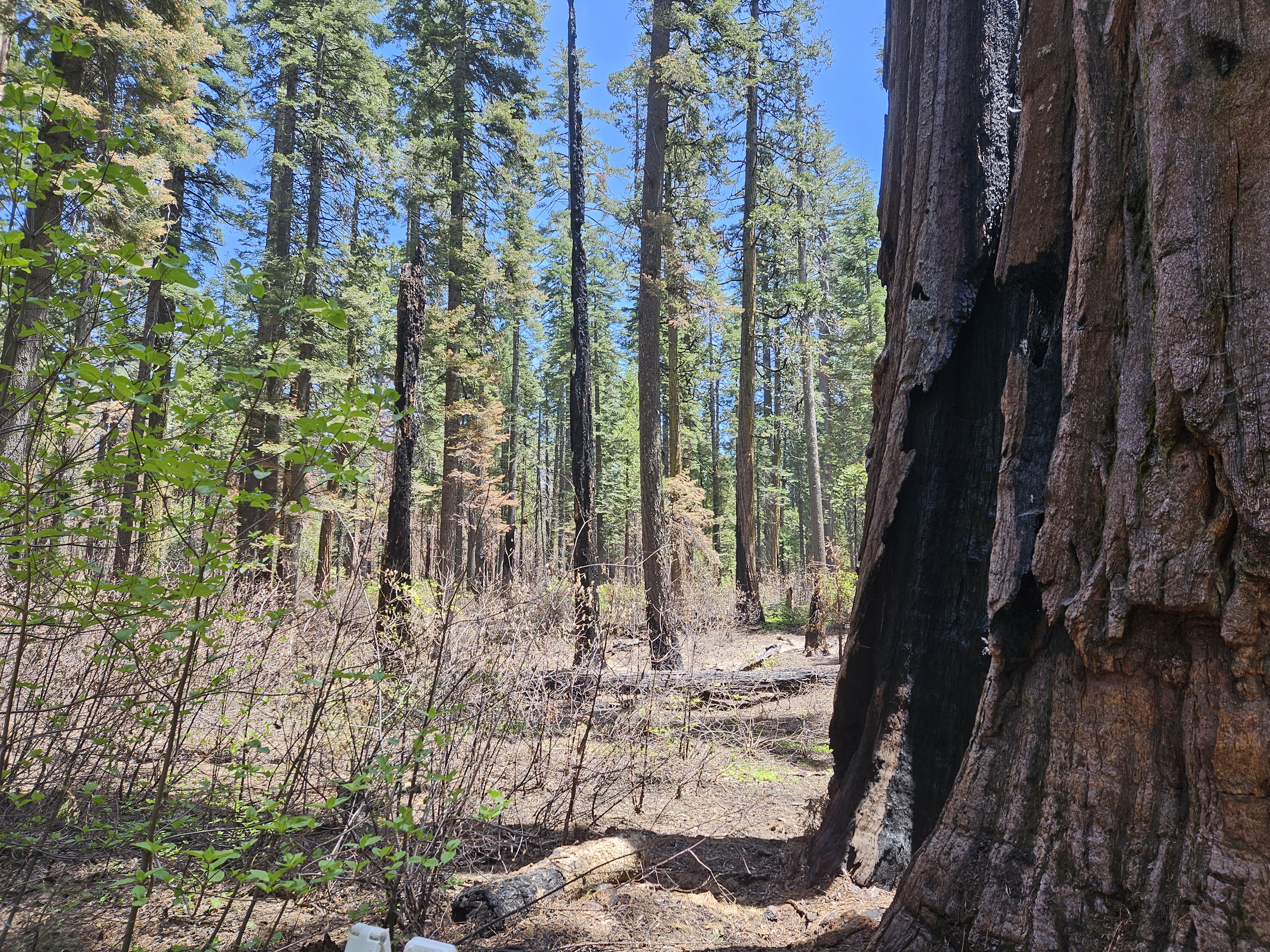
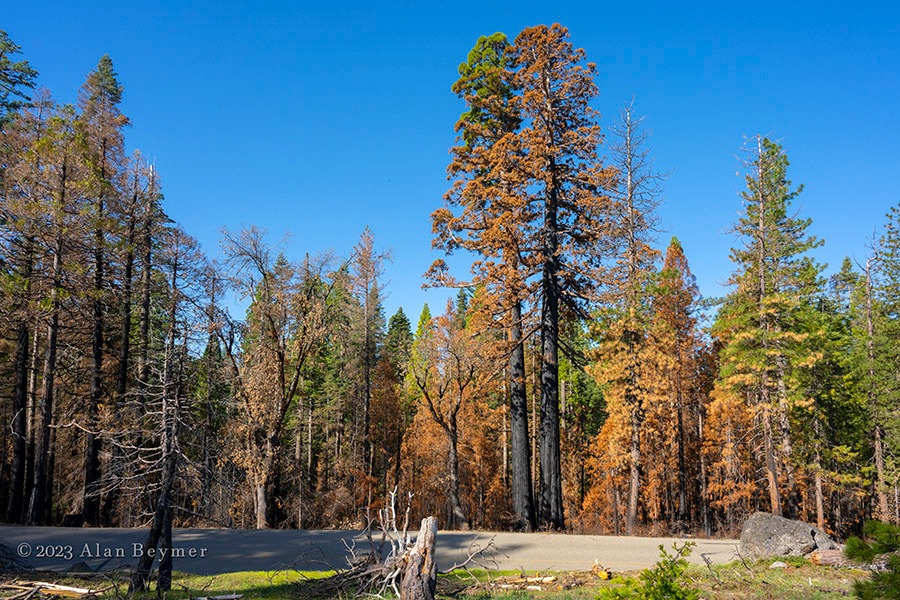
Below is a picture of one of the areas that was intentionally burned in 2022 to reduce fuel loads:
Calaveras Big Trees State Park, May 25, 2023
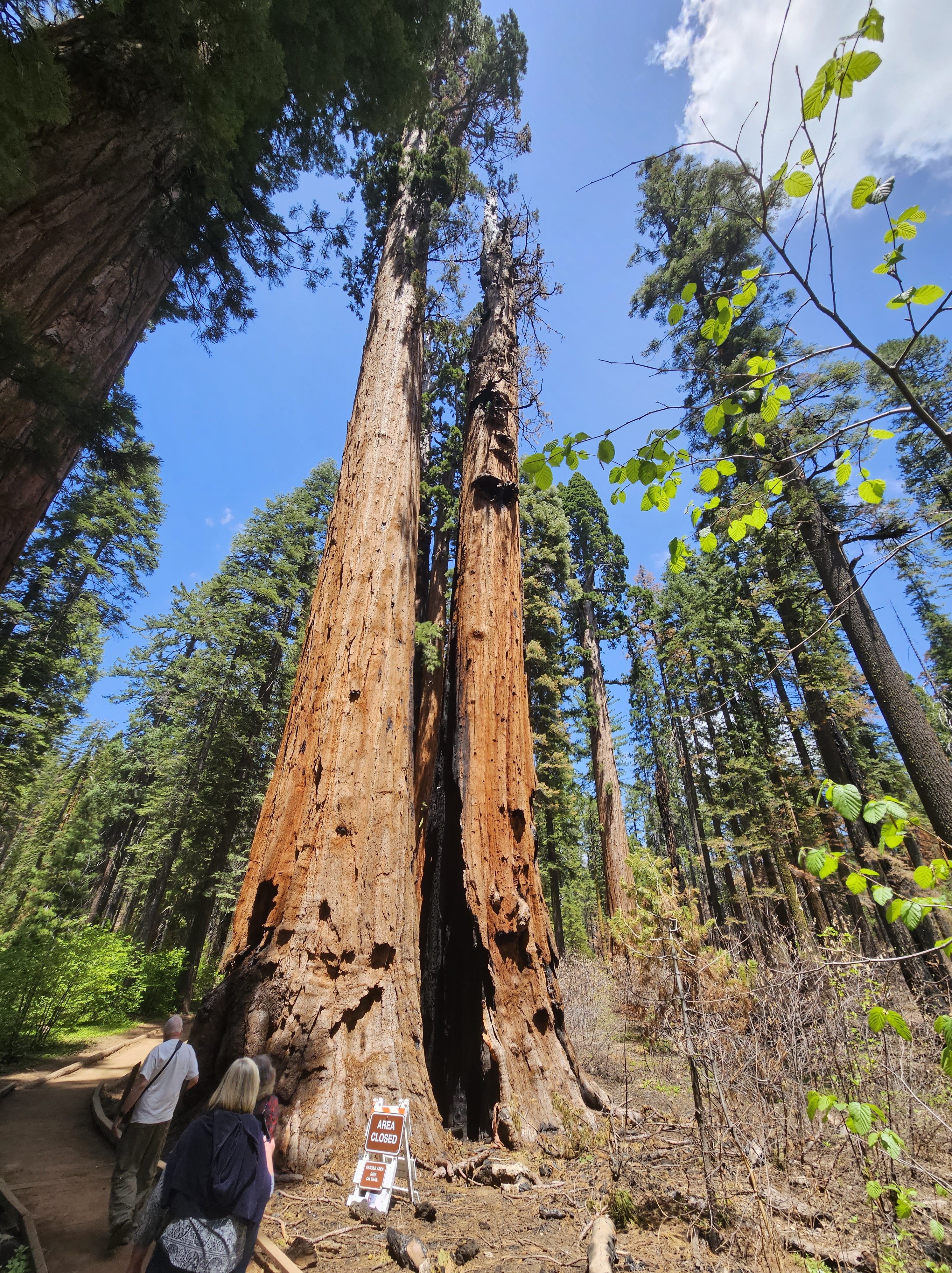
Below is a picture of a giant sequoia that was scorched by that fire. The right-hand side of the tree looks seriously damaged, suggesting that the tree may not survive:
Calaveras Big Trees State Park, May 25, 2023
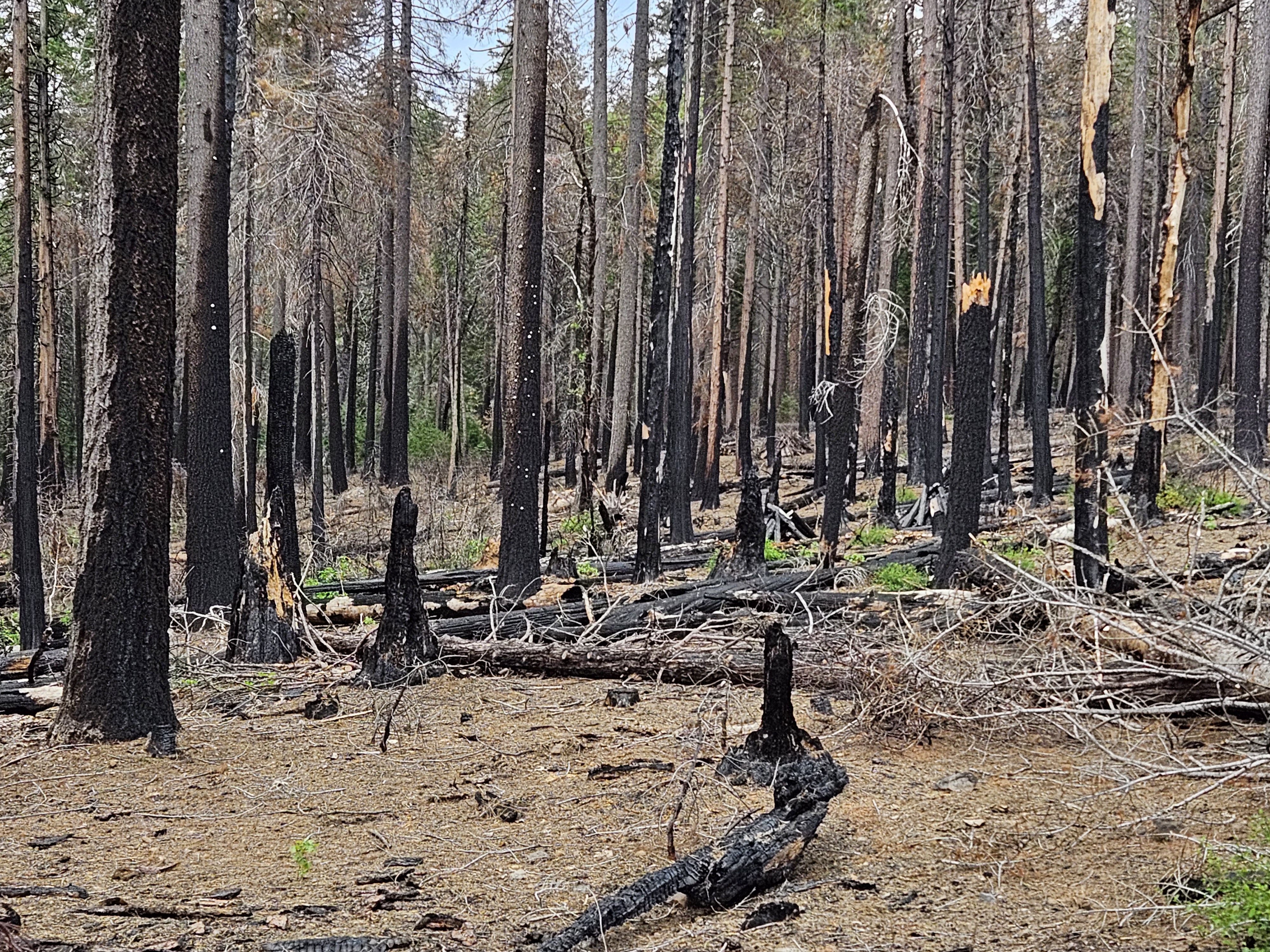
Larger prescribed burns were also conducted on the northern edge of the park, where there are few sequoias. Below is a picture of one of several large areas of the park that were intentionally burned:
Calaveras Big Trees State Park, May 25, 2023
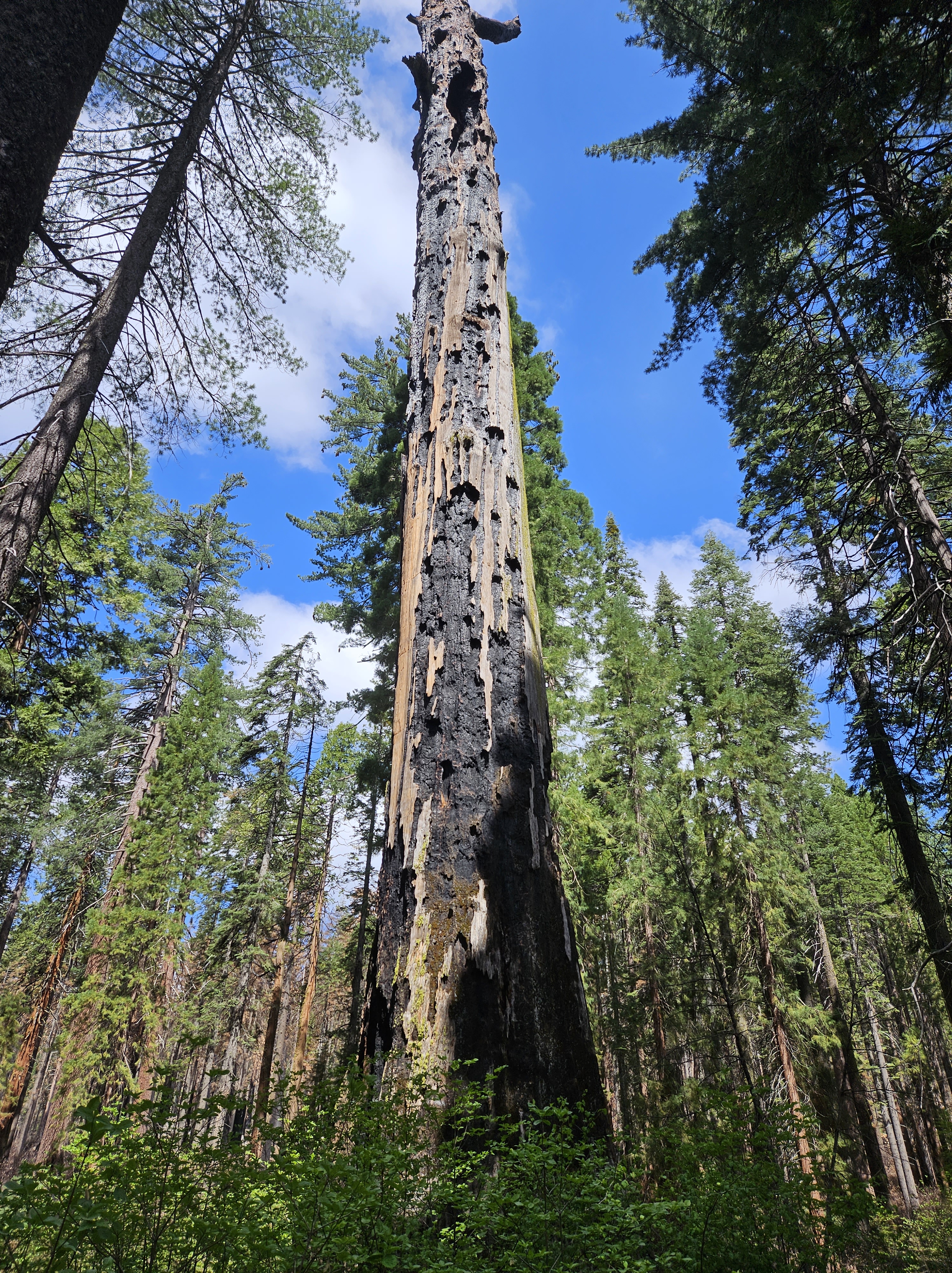
There are only two sequoias in this part of the park, named the Orphans because of their isolation from other sequoias in the park. The Orphans were severely burned by this fire. (see below) It isn’t clear if the Orphans will survive.
The Orphans, Calaveras Big Trees State Park. Photo by Alan Beymer with permission.
Land management or mismanagement?
The potential loss of a few giant sequoias at Calaveras Big Trees may seem trivial, but their loss must be put in the context of the small and shrinking population of giant sequoias as well as their very long lifespan of roughly 3,000 years. The survival of the species is threatened by these unintentional deaths that could have been avoided.
Many major wildfires have been started when burn crews lost control of prescribed burns. In April 2022, the US Forest Service conducted two prescribed burns in the Santa Fe National Forest in New Mexico that merged and became a major wildfire that burned for months, ultimately destroying over 341,000 acres of forest. Although it was one of the most destructive of wildfires started by a prescribed burn, it is only one of many.
Logging to thin the forest is another strategy used by public land managers to reduce fuel loads, but we did not see any evidence of logging at Calaveras Big Trees. The giant sequoias in Calaveras County reside in a mixed conifer forest of ponderosa pine, incense cedar, white fir, and sugar pine. These tree species are valuable timber and therefore vulnerable to pressure from the logging industry. It seems likely that the Save our Sequoias Act sponsored by Republicans is a gift to the logging industry, rather than to the sequoias.
In 2017, the National Academy of Sciences published an evaluation of fuels management projects in the US. The authors of this publication reported that managing forest fuels has been ineffective: “Mechanical fuels treatments on the US federal lands over the last 15 years totaled almost 7 million hectares, but the annual area burned has continued to set records. Regionally, the area treated has little relationship to trends in the area burned, which is influenced primarily by patterns of drought and warming.” Where fuels treatment was done, wildfires subsequently occurred:“10% of the total number of US Forest Service forest fuels treatments completed in the 2004-2013 period in the western United States subsequently burned in the 2005-2014 period.” This suggests that“most treatments have little influence on wildfire.” In any case, only 40% of wildfires occurred in forests since 1984, with most fires burning grasslands and shrublands.
The authors of the study published by the National Academy of Sciences, recommend a new approach to forest management. Whereas past policies were designed to maintain forest conditions to historical conditions, this is no longer considered a realistic goal. The recommended goal is now “supporting species compositions and fuel structure that are better adapted to a warming, drying climate with more wildfire.”
The other, equally important new goal is to reduce the vulnerability of communities to wildfire by “changing building codes to make structures more fire-resistant…and providing incentives, education, and resources to reduce vulnerability to future wildfire.” The only tree removals that make sense to the authors are those immediately around residential communities, “strategically located to protect homes and the surrounding vegetation.” That is the principle of creating “defensible space” immediately around structures: “fuels management for home and community protection will be most effective closest to homes…where ignition probabilities are likely to be high.” The strategies used in Calaveras Big Trees to protect giant sequoias may not be the best strategies for surrounding residential communities.
Land managers who conduct prescribed burns in sequoia groves also believe they are assisting forest regeneration because the heat of fires is said to release the seed-carrying female cones from the tree canopy and open the cones to release their seeds. The track record on forest regeneration after wildfires depends partly on the severity of fire, but the results of studies are mixed. (4)
The purpose of prescribed burns is to reduce fuel loads with low-severity fire in order to prevent more destructive high-severity fires. However, in the case of giant sequoias, high-severity fires may be necessary for long-term survival of the species: “High-severity fires create robust seedling establishment and survival. For example, in a report on sequoia ecology, NPS researcher Nate Stephenson concluded: ‘Before the arrival of European settlers, successful recruitment of mature sequoias depended on fires intense enough to kill the forest canopy in small areas. Thus, sequoia is a pioneer species, and this conclusion has specific management implications.’” (5)
We saw an example of forest regeneration after a severe wildfire in the sequoia grove in Calaveras Big Trees. Below is a photo of the Mother of the Forest that was burned by a wildfire in 1908. That tree was particularly vulnerable to wildfire because the thick, spongy bark layer that protects sequoias from fire (as well as insects and disease) had been removed by entrepreneurs (more accurately called vandals) who reassembled the bark as a tree replica for display and profit.
Calaveras Big Trees State Park, May 25, 2023
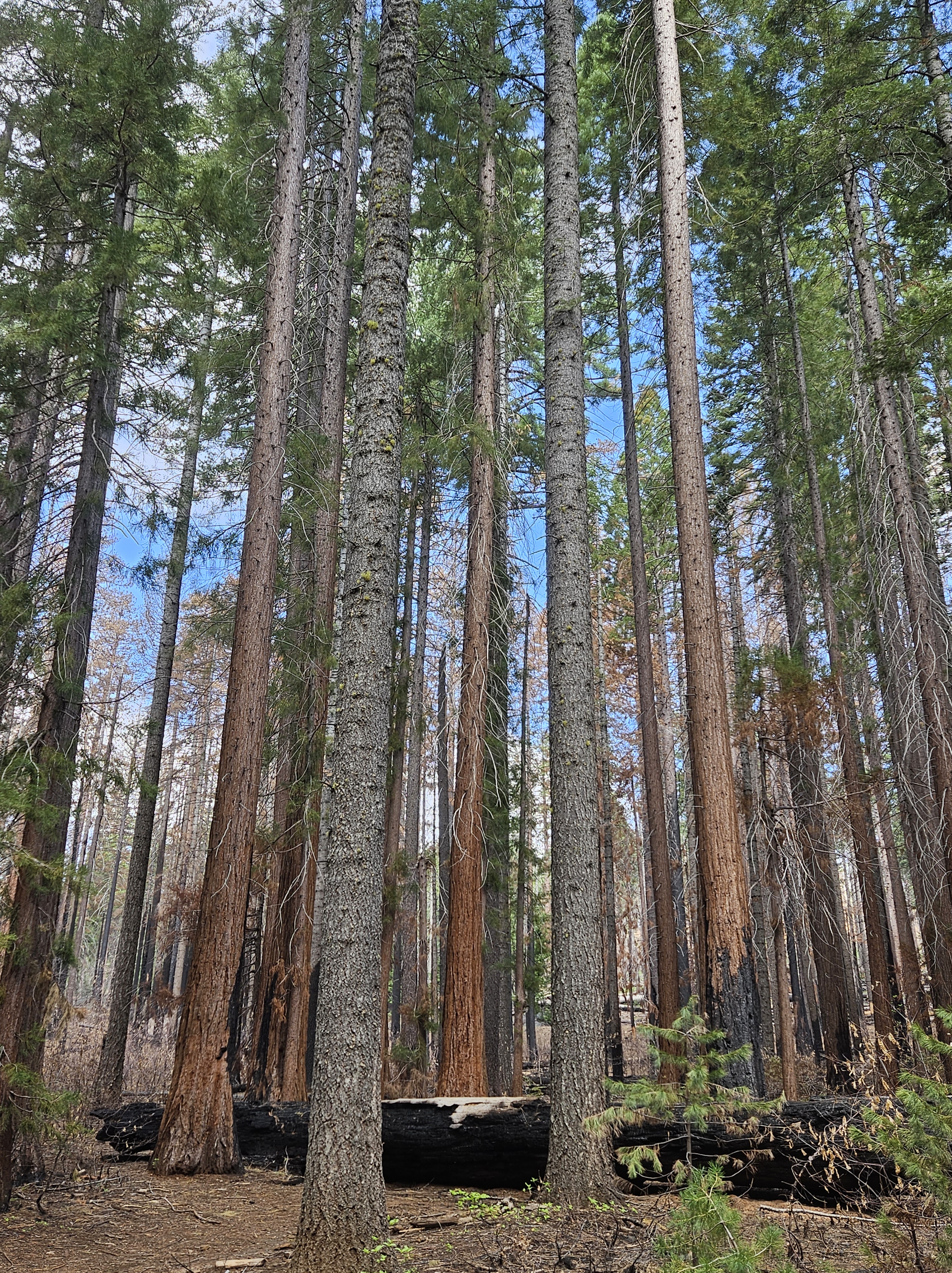
The Mother of the Forest is surrounded by a young forest of trees, including many giant sequoias. (See below. Trees with reddish bark are young giant sequoias.) “The [1908] fire created ideal growing conditions for giant sequoia seedlings and today there is a healthy stand of young sequoias there. Many of these trees are the result of natural regeneration that happens after a fire, while others were planted during the 1930s by members of the Civilian Conservation Corps.” (6)
Calaveras Big Trees State Park, May 25, 2023
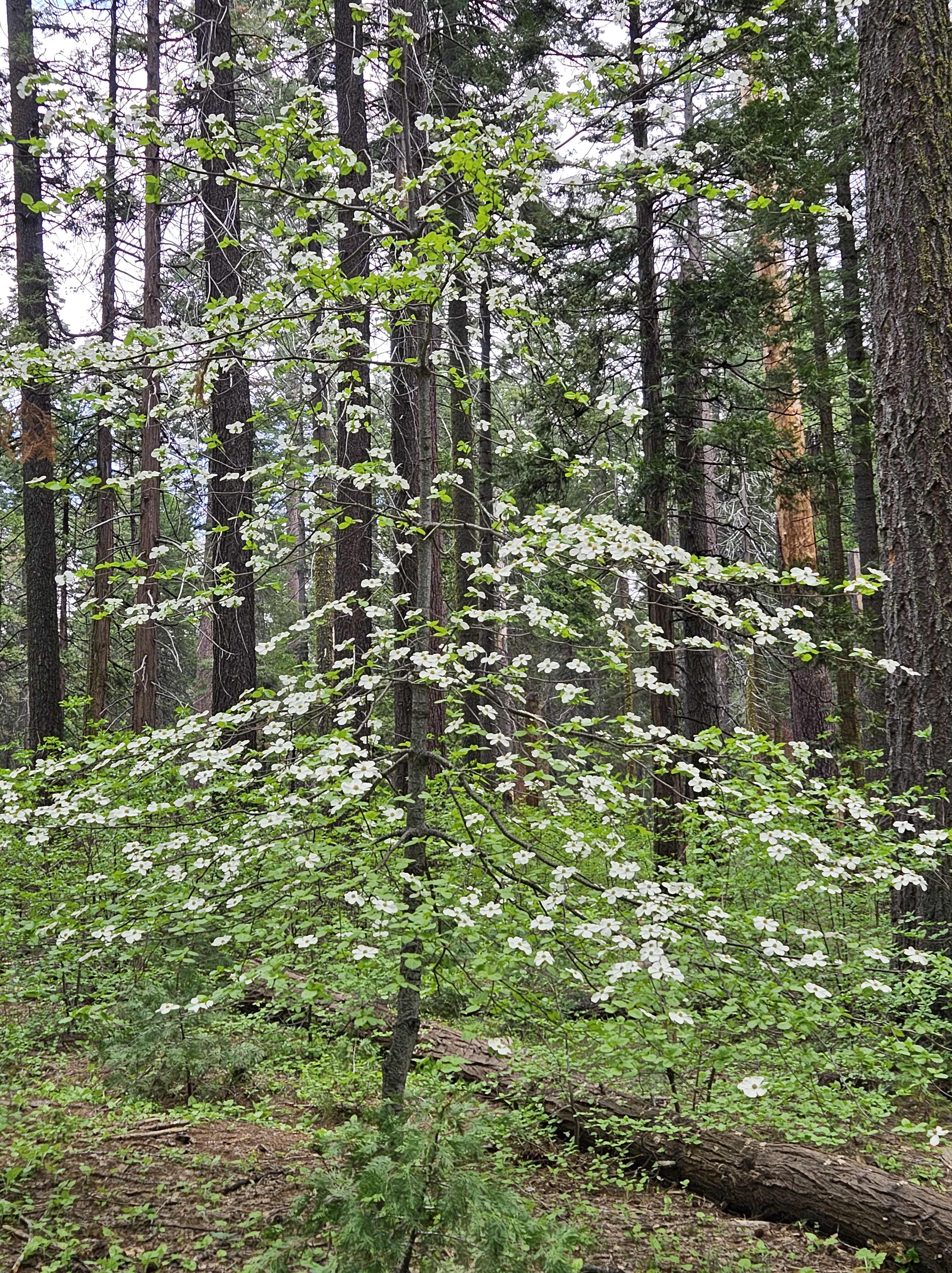
Mountain dogwood (Cornus nuttalli) and hazelnut (Corylus cornuta) are the predominant understory shrubs in the forest of Calaveras Big Trees. After an unusually long, cold winter most weren’t blooming yet at the end of May. A few dogwoods were blooming where sunshine penetrated the tree canopy. (see below)
Calaveras Big Trees State Park, May 25, 2023
Unfortunately, these lovely small trees are seen as competitors of the giant sequoias for available water and nutrients in the soil. Therefore, destroying the understory in Calaveras Big Trees is one of the management goals. According to the Calaveras Big Trees Association, most of the dogwoods were chopped down by park staff about 9 years ago. Dogwoods are vigorous resprouters, so they quickly grew back more densely than their taller predecessors. Pesticides (including herbicides) aren’t used in Calaveras Big Trees, so resprouting was inevitable. I wonder if those who destroyed the dogwoods understood that would be the outcome of their effort.
Management strategies of the timber industry are based on an assumption of competition. When clear-cut harvests are done by the timber industry they are typically sprayed with herbicides from helicopters to destroy the understory that they assume competes with the tree seedlings they plant for the next timber crop. Public land managers often use the same strategy.
The research of Suzanne Simard has informed us that there is more cooperation in the forest than there is competition.A lifetime of observing healthy forests taught her that the soil is occupied by vast networks of fungi that connect the plants and trees. These mycorrhizal fungi transfer moisture and nutrients from the soil to the trees and plants, to their benefit. She speculated that the destruction of all vegetation in clear cuts was eliminating that support structure and she designed experiments to test her hypothesis.
The specifics of fungal associations between tree species varies, which requires that we describe a specific relationship. Simard’s original studies focused on the fungal associations between Douglas fir and birch trees in the understory. Birch trees were destroyed in the clear cuts that were then planted with Douglas fir seedlings that were not doing well. Simard’s experiments eventually revealed that birch trees and firs mutually benefit one another through their fungal networks. Carbon stored and the sugar produced by photosynthesis by firs are shared with deciduous birch during winter months while they are leafless. In summer months when birch are foliated, they store more carbon that is shared with firs. Birch is resistant to a root pathogen to which firs are susceptible. In a sharing fungal relationship between birch and firs, birch confers some of that resistance to the root pathogen onto their fir neighbors. Is there a similar relationship between dogwoods and sequoias and other conifers in the forest at Big Trees?
The understory also shades the forest floor, which retains moisture in the soil that would otherwise evaporate in the absence of shade. The canopy of giant sequoias is near the top of mature trees and doesn’t cast much shade. In other words, the shaded forest floor provides more moisture for all members of the plant community in sequoia groves. Furthermore, a shaded forest floor is less likely to ignite a fire because of the moisture it retains.
More questions than answers
I don’t know the answers to the questions I have raised about management strategies in Calaveras Big Trees:
Is there a mutually beneficial relationship between dogwood and hazelnut and giant sequoia? Is it necessary or beneficial to destroy the understory in the sequoia groves of Calaveras Big Trees?
Are there more risks than rewards in conducting prescribed burns in Calaveras Big Trees?
Would thinning the trees in sequoia groves benefit the timber industry more than the sequoias?
Are severe fires more effective than low-severity fires to germinate the seeds of giant sequoias and regenerate the forest after fires?
However, I am sure that when there is uncertainty and great risk, there must be caution. I also know that Calaveras Big Trees State Park is a treasure. If you haven’t visited, I suggest you put it on your bucket-list.
Gary D. Lowe, “Geologic History of Giant Sequoia and the Coast Redwood,” North America Research Group, Beaverton, Oregon, 2013-2014.
Dana Milbank is a political columnist for the Washington Post. He broke out of his political mold on April 7, 2023 to write an article about gardening published by the Post, which repeats every myth of the nativist ideology.
A team of dismayed critics of invasion biology has responded to excerpts of Milbank’s column:
Marlene A. Condon is a garden writer based in Virginia and the author of The Nature Friendly Garden. She has a degree in physics. Her entire critique of Milbank’s column is available on her website. Her comments address the reader.
Carol Reeseis a retired Extension Horticulture Specialist who conducted her 27 year career from the University of Tennessee’s West Tennessee AgResearch and Education Center in Jackson, where a large and diverse display garden gave her the opportunity to observe biodiversity in action on an enormous range of plant species from other parts of the world. She describes herself as a farm raised country girl tomboy who has looked at the natural world in hundreds of settings and landscapes, natural and manmade, and read countless books and articles. She has written for several magazines, newspapers, articles for Garden Rant as well as university publications. Her speaking engagements around the country have allowed her to engage with many other green industry professionals. Dana Milbank’s column prompted her to email him directly with her concerns, directly addressing some of his assertions. I publish some excerpts here from her emails sent directly to Milbank.
Conservation Sense and Nonsense is the webmaster of this website. I have studied invasion biology and the native plant movement it spawned for over 25 years. I’ve watched forests of healthy, non-native trees in California be destroyed and replaced by weedy grassland. I have used what I have learned to advocate for a less destructive approach to restoration, a word I am reluctant to use to describe projects that use herbicides to eradicate harmless plants and trees. My comments are addressed to the reader.
What follows are excerpts from Dana Milbank’s column with responses from Marlene Condon, Carol Reese, and Conservation Sense and Nonsense, just three of many skeptics of invasion biology. To summarize the point of our criticism:
Insects are not dependent on native plants. They are just as likely to use related non-native plants in the same genus or even plant family with similar chemical properties and nutritional value.
While some non-native plants have potential to be harmful, many are beneficial. There are pros and cons to both native and non-native plants and that judgment varies from one animal species to another, including humans. For example, we don’t like mosquitoes, but they are important food for bats and birds.
All plants, whether native or non-native convert carbon dioxide to oxygen and store carbon. Destroying them contributes to greenhouse gases causing climate change.
When the climate changes, vegetation must also change. Many non-native plants are better adapted to current climate and environmental conditions in disturbed ecosystems.
Conservation Sense and Nonsense
“I’m no genius about genuses, but your garden is killing the Earth” By Dana Milbank Washington Post, April 7, 2023
Milbank: I did almost everything wrong.
Reese: I’m so sorry you thought this!
Milbank: For 20 years, I found the latest, greatest horticultural marvels at garden centers and planted them in my yard: sunny knock-out roses, encore azaleas, merlot redbud, summer snowflake viburnum, genie magnolia, firepower nandina
In between them flowed my lush, deep-green lawn. I hauled sod directly from the farm and rolled it out in neat rows. I core-aerated, I conditioned, I thatched, I overseeded, I fertilized. I weeded by hand, protecting each prized blade of tall fescue from crabgrass and clover.
In this season, a symphony of color performs in my yard. The fading daffodils, cherry blossoms, saucer magnolias, hyacinths and camellias meet the arriving tulips, lilacs, creeping phlox and azaleas, with the promise of rhododendrons, peonies, hydrangeas, day lilies and roses to debut in the coming weeks.
But this year, the bloom is off the rose. And the hydrangea. And the rhododendron. And all the rest. It turns out I’ve been filling my yard with a mix of ecological junk food and horticultural terrorists.
Condon:When Mr. Milbank posits that he’s “been filling his yard with a mix of ecological junk food and horticultural terrorists,” he’s channeling the kind of words Bringing Nature Home author Doug Tallamy loves to employ: Biased expressions that implant negative images in the reader’s mind so he will become yet another minion of this scientist. Nowadays you can’t read a garden or environmental column without being accosted with the same words or variations thereof, as if everyone has become a mouthpiece for Doug Tallamy, which I’ve never seen done more obviously than in this column by Dana Milbank.
Conservation Sense and Nonsense: Milbank’s lengthy list of “bad” plants in his garden paints with too broad a brush. For example, instead of identifying a particular species of hydrangea and rhododendron, Milbank condemns an entire genus. Both hydrangea and rhododendron genera have several native species within the genus. Most (all?) species of phlox are also native to North America.
Milbank: When it comes to the world’s biodiversity crisis — as many as 1 million plant and animal species face near-term extinction because of habitat loss ― I am part of the problem. I’m sorry to say that if you have a typical urban or suburban landscape, your lawn and garden are also dooming the Earth.
Reese:YIKES! This is pretty extreme, and dare I say inaccurate? No, home gardeners are part of the solution, no matter the plants in their garden. Doom will come from lack of diverse green space. Doom will come from climate warming as a result, as well as from pollution, tillage, factory farming and development.
Milbank: I came to understand the magnitude of my offenses after enlisting in nature boot camp this spring. I’m in “basic training” with the state-sponsored Virginia Master Naturalist program. While others sleep in on rainy weekend mornings, my unit, the Arlington Regional Master Naturalists, has us plebes out in the wetlands distinguishing a yellow-bellied sap sucker from a pileated woodpecker.
I’m no genius with genuses, but I know a quercus from a kalmia, and because of my gardening experience, I began the program with confidence. Instead, I’ve discovered that all the backbreaking work I’ve done in my yard over the years has produced virtually nothing of ecological value — and some things that do actual harm.
A few of the shrubs I planted were invasive and known to escape into the wild. They crowd out native plants and threaten the entire ecosystem. Our local insects, which evolved to eat native plants, starve because they can’t eat the invasive plants or don’t recognize the invaders as food.
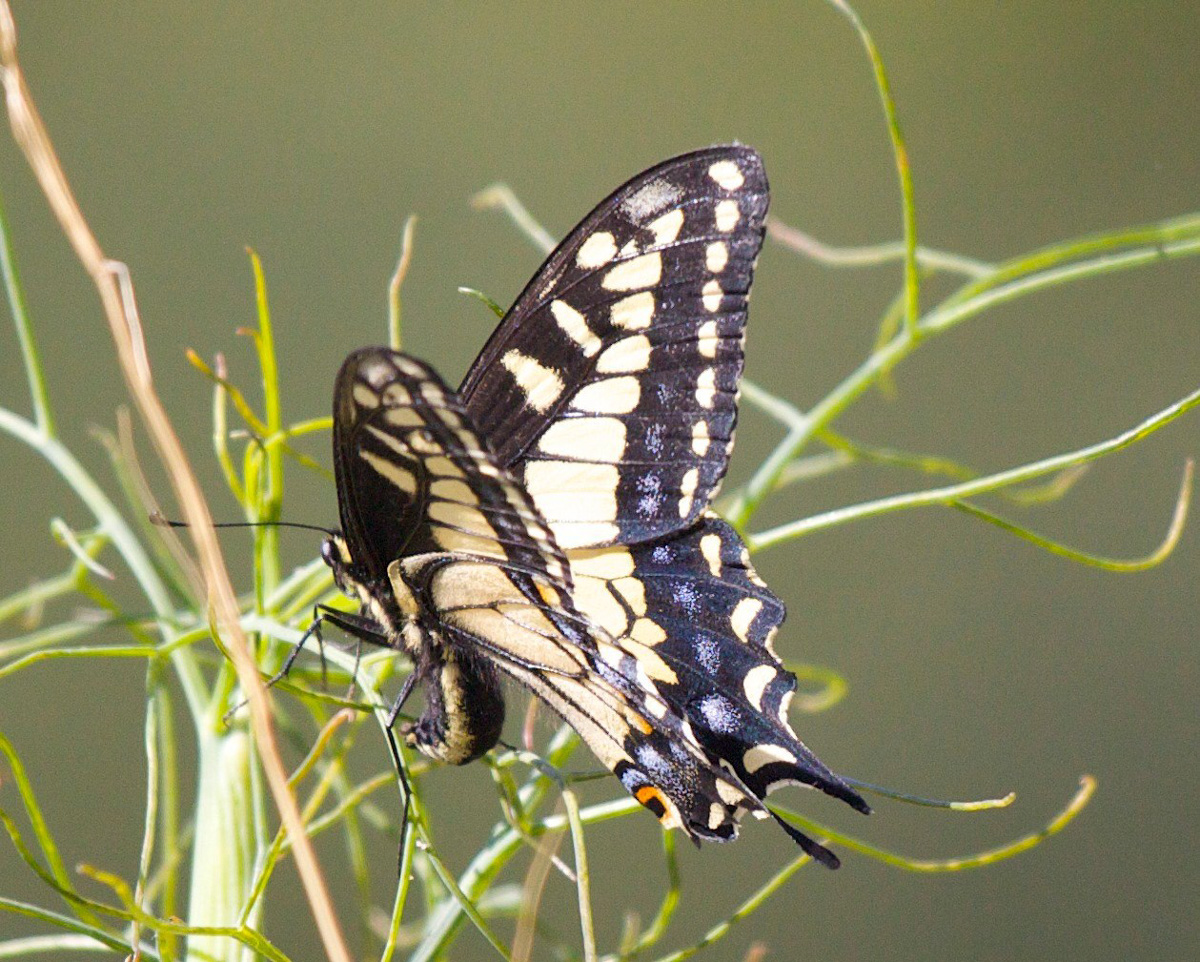
Anise swallowtail on non-native fennel. Courtesy urbanwildness.org “Papilio zelicaon, the anise swallowtail, typically has one to two generations in the mountains and foothills of California where it feeds on native apiaceous hosts. However, along the coast, in the San Francisco Bay Area and the urbanized south coastal plains and in the Central Valley, P. zelicaon feeds on introduced sweet fennel, Foeniculum vulgare, and produces four to six or more generations each year… the use of exotics has greatly extended the range of P. zelicaon in lowland California.” SD Graves and A Shapiro, “Exotics as host plants of the California butterfly fauna,” Biological Conservation, 2003.
Reese:It sounds so logical, but is sooo inaccurate. Ask any entomologist that has spent their careers “fighting pests” on valued crop or ornamental plants. Remember Pangea [when all continents were fused into one]? More recently, have you thought about the exchange of plants and animals across Berengia when we were still connected to Asia? We can trace those relationships/kinships of our plants to Asian/Eurasian plants now through DNA. They eventually differentiated into species (a continuum of change caused by climate and geologic pressures until we [Man] declare it as a different species, though biologically it is still basically the same nutritional makeup)
Condon also dissects Milbank’s statement:
“They crowd out native plants and threaten the entire ecosystem.” Read virtually any description of where you find so-called invasive plant species and you will find the word “disturbed.” This tells you the soil profile has been negatively impacted by people, animals, or weather, and usually means the topsoil is gone. Only very tough plants—known as colonizers—can grow in disturbed areas because the soil is nutrient-poor and is typically compacted. Consequently, these areas may fill with a mix of native and nonnative plants, or mainly one or the other—but every single plant is a colonizer that is working to rehabilitate the land for the benefit of the native plants that require topsoil in which to grow. “Invasiveness” is nothing more than a derogatory word used by people with contempt for alien-plant colonization. Conclusions: Alien plants can’t “crowd out” native plants because once the soil is disturbed and thus degraded, most of our native plants can’t grow there and thus are not there to be crowded out. As for “threatening the entire ecosystem,” to the contrary, alien colonizers are helping to restore it.
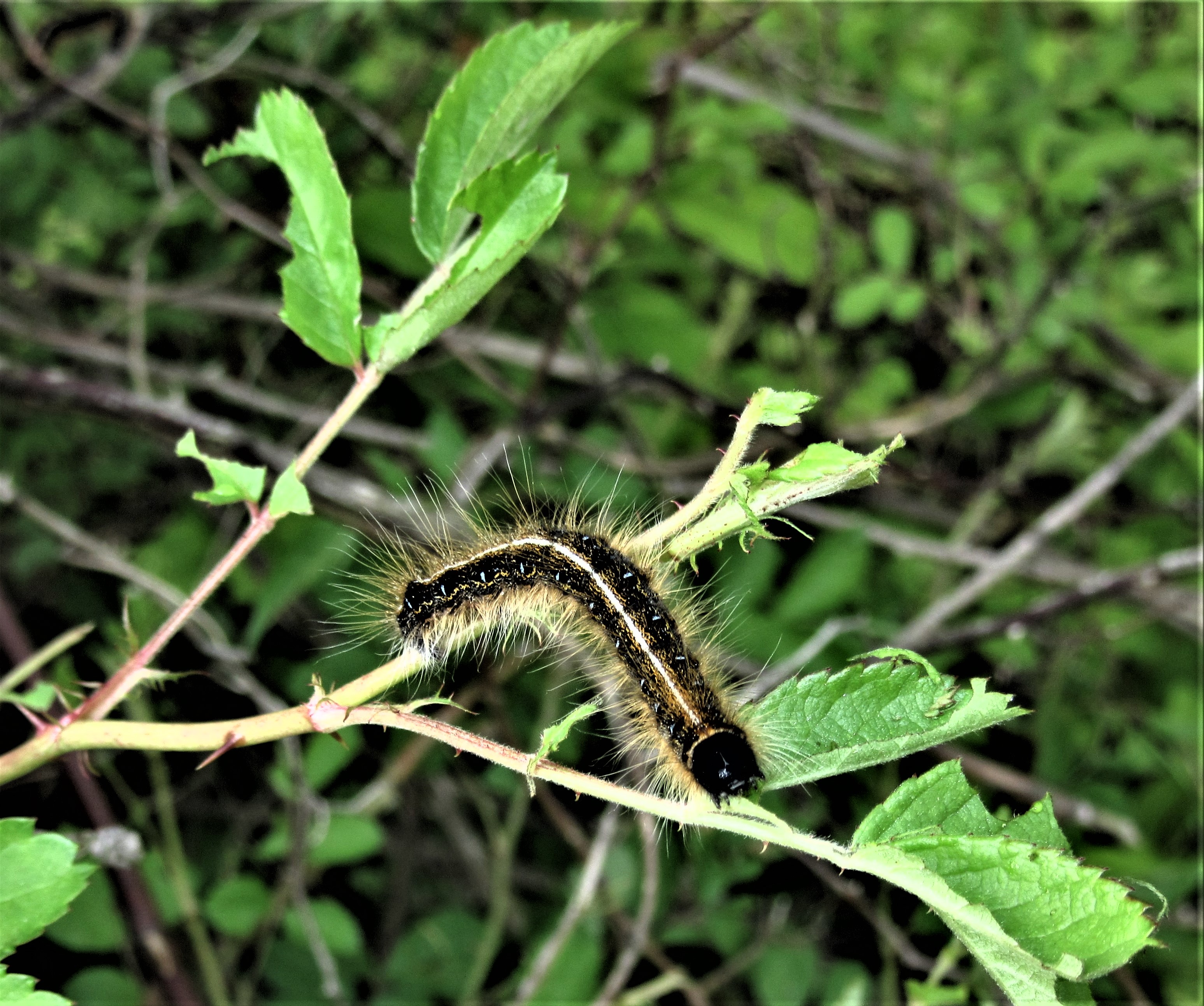
“Our local insects, which evolved to eat native plants, starve because they can’t eat the invasive plants or don’t recognize the invaders as food.” This oft-repeated distorted premise comes straight out of Bringing Nature Home, in which Doug Tallamy deceptively writes about “an excellent demonstration of how restricted a specialist’s [an insect with particular food preference] diet is.” Tallamy tells the story of Eastern Tent caterpillars on a cherry tree denuded of its own leaves but hosting a Japanese Honeysuckle vine. He writes that the caterpillars didn’t recognize the honeysuckle as food (sound familiar?) But, of course, they didn’t because this species of insect can only eat plants in the Rose Family, which does not include honeysuckle. What Doug Tallamy doesn’t tell the reader is that the tent caterpillars could certainly have eaten the so-called invasive Multiflora Rose, which I’ve documented in the photo below. Conclusion: Native insects did not evolve to eat only local (native) plants, but rather can typically feed upon dozens, if nothundreds or thousands, of plants related to each other by family classification, even though they grow in other countries.
Tent caterpillar on multiflora rose. Photo by Marlene Condon.
Milbank: This in turn threatens our birds, amphibians, reptiles, rodents and others all the way up the food chain. Incredibly, nurseries still sell these nasties — without so much as a warning label.
Reese:As I read, I also watch the many birds on my lawn, the fence lizards on my decks, the insects humming among the flowers in my diverse collection of native cultivars and introduced plants.
Hummingbird in eucalyptus flower. Eucalyptus blooms from November to May. It is one of the few sources of nectar and pollen for birds and bees during the winter months when little else is blooming. Courtesy Melanie Hoffman
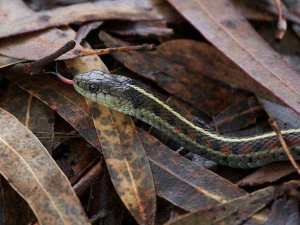
Eucalyptus leaf litter makes excellent camouflage for this garter snake. Courtesy Urban Wildness
Milbank: Most of my other plants, including my beloved lawn, are ecological junk food.
Reese:Now, now! Many (most) natives do not supply useful forage either. All plants supply some benefit. They provide shelter, create, improve and anchor soil, cleanse air and water, make oxygen and cool the planet. The plant must be judged on benefits versus detriments in each situation. If a nonnative plant is the only thing that will flourish in bombed out rubble, or contaminated soil, if it is providing many benefits, shall we rip it out because caterpillars won’t eat it? If we let it get established, will it ready the site for other species with more benefits to become established? Shall we get out of the way and let nature do what she does, which is heal herself?
Milbank: The trees, shrubs and perennials are mostly “naturalized” plants from Asia or Europe or “cultivars,” human-made varieties of native plants bred to be extra showy or disease resistant but lacking genetic diversity or value to animals. I, like other gardeners I know, planted them after mistaking them for their native cousins. They’re not doing harm, but neither are they doing anything to arrest the spiral toward mass extinction.
Reese:Please know that the most influential native plant botanical garden in the country (Mt. Cuba Center) has trialed the cultivars of native plants for their ecological benefits and found as should be expected, that each cultivar must be judged on its own merits. Some are better than the straight native as in the coneflowers where ‘Fragrant Angel’ scored tops for pollinators and many others were very close to being as good as straight species. These cultivars were even better than the other species of Echinacea tested. BTW, I grow E. purpurea, pallida, paradoxa, tennesseensis and laevigata as well as many cultivars. Remember that cultivars should also be judged on not just nutritional value, but other factors that increase benefits, such as length of bloom period, numbers of blooms, drought resistance, heat tolerance, hardiness, ease of production (cost) and durability. Please ask to speak to Sam Hoadley there as he leads the research on beneficial cultivars and has completed and undertaken several studies of different native species. Great guy and great speaker.
Please be aware that many cultivars originated as naturally occurring deviations in seedling populations, and as we know this actually diversifies the genetic pool, allowing Mother Nature to select the better form. We sometimes agree with her, and other times we may move along that diversifying form by crossing it with others that are demonstrating genetic variance. Logically, this actually furthers the cause of a broader genetic pool that can help in today’s crisis in showing which can cope and flourish.
Milbank: To get a sense of my missteps, I asked Matt Bright, who runs the nonprofit Earth Sangha, a native-plant nursery in Fairfax County (and a lecturer on botany for my nature boot camp) to walk through my yard with me.
He took aim at my day lilies: “I would remove them all. Those have also become badly invasive.”
He spied my creeping jenny on a slope: “Another nasty invasive.”
He condemned to death my rose of Sharon shrubs (natural areas “have really been torn up by these guys”) and my innocuously named summer snowflake viburnum.
Worst was my row of nandinas — “heavenly bamboo” — along the foundation. “You definitely want to remove it,” he advised. Its cyanide-laced berries poison birds.
Condon:This tactic is typical of the followers of Tallamy who want folks to perceive supposedly invasive plants as “bad” even though no evidence exists to support their accusations, especially in this instance. Mr. Milbank and Mr. Bright, who obviously supplied this information, have misspoken here. A study out of the University of North Carolina, Chapel Hill, published in 2022, explains that Cedar Waxwings are the only birds that might be poisoned, and that’s only going to happen if someone grows so many nandinas that these birds consume large numbers of fruits in a single feeding bout. If you grow just one or even a few plants, you are not going to poison waxwings.
Conservation Sense and Nonsense: Here in California, most berry-producing, non-native plants are considered “invasive” based on the assumption that birds eat the berries and spread the plants. Nandina was briefly on the list of invasive plants in California until knowledgeable people informed the California Invasive Plant Council that birds don’t eat the toxic berries. Nandina was removed from the invasive plant inventory long ago.
Bumblebee on Cotoneaster, Albany, CA. Cotoneaster is one of many berry-producing non-native plants on the list of invasive plants in California. Himalayan blackberries are another target for eradication in California. They are frequently sprayed with herbicide in public parks where children and other park visitors eat the blackberries.
I also have personal experience with nandina and cedar waxwings. Flocks of waxwings visited my holly trees in San Francisco every year. They did not touch my three nandina plants.
California buckeye (Aesculus californica) is an example of a native tree that is toxic. Its flowers are toxic to honeybees and its big brown seeds for which it is named were used by Indigenous people to stun fish to make them easier to catch. The bark, leaves, and fruits contain neurotoxic glycoside aesculin. Every negative characteristic attributed to some non-native plant species is equally true of some native plant species. No one mentions buckeye’s toxic characteristics because it’s a beautiful native tree. Photo Sacramento Tree Foundation
Condon: I’ve had a Rose of Sharon (Hibiscus syriacus) growing in my yard since I moved to my home in Virginia almost 40 years ago. In all this time, only one seedling from the plant I brought here has ever “volunteered” to become a second yard denizen. During the past 37 years, pollinators have fed at the original plant and then also at its offspring. What I’ve found by experience in my yard is that few plants can successfully move into a space that’s already filled with other plants. (Proving what physics tells us–that no two physical objects can occupy the same space). I’ve brought home numerous so-called invasive plants, only to have them disappear or simply stay put where I planted them. That’s because hundreds, if not thousands, of plants fill my yard.
Conservation Sense and Nonsense: Virginia is one of only four states in which rose of Sharon is considered invasive. Condon’s experience with rose of Sharon in Virginia suggests that lists of “invasive plants” are either inaccurate or are serving another purpose (perhaps both). The longer the list of “invasive plants” the more work is created for the “restoration” (AKA eradication) industry.
Rose of Sharon is not considered invasive in California. This is a reminder that the behavior of plants varies because of the wide range of climate and environmental conditions. Nearly one third of the plants on California’s list of invasive plants are not considered invasive in California. They are on the list because they are considered invasive in Hawaii, a state with a warmer, wetter climate than California. In naming rose of Sharon as a dangerous invasive, a media resource with a national readership has made a generalization that red-lines more plants than necessary. They become targets for eradication with herbicide and they deprive us of the biodiversity that is particularly important in a changing climate in which biodiversity ensures resiliency.
Milbank: Bright did praise two “good” species I have that contribute to biodiversity: a sycamore and a catalpa as well as a “great” American elm and a “phenomenal” dogwood. (I couldn’t take much pride in them, though, because all four were here long before I arrived.) And Bright assured me I wasn’t a particularly egregious offender; my one-sixth acre lot in town is typical of the urban/suburban landscape.
● ● ●
Lawns, and those useless, ubiquitous cultivars of trees, shrubs and perennials sold by the major garden centers, aresquelching the genetic variety nature needs to adapt to climate change.
Reese:It’s actually the opposite. We need more plants in the mix. We need “the tumult of nature” to decide. We aren’t the jury, and we continue to interfere with our well-intended assumptions that we know best.
Lawns are full of wildlife when management is minimal. Mow. That’s all. Mow judiciously when “lawn weeds” are blooming. Watch birds feed on the many insects in the lawn including lepidopteran larvae. Realize that many moths pupate underground. Think of your lawn as haven for them and for the grubs birds relish as millions of acres across our country are being tilled for factory farms. Remember that the best habitat is mixed. Open areas bordered by wooded areas and most species love the borders. Our suburban landscapes are ideal if we just stop killing things.
Milbank: The resulting loss of native plants in our fragmented urban and suburban landscapes deprives both plants and wildlife of the contiguous habitats they need to breed and, over time, to migrate in response to climate change.
The deck is stacked against nature in this fight.
● ● ●
If possible, you should remove the nastiest of the invasive plants if you have them: burning bush, Japanese barberry, Asian bush honeysuckle, English ivy, callery (Bradford) pear and a few others.
But leave the rest of your plants alone, for now. Tallamy ultimately wants to cut lawn acreage in half, but “there is room for compromise,” he said. Think of your noninvasive plants and cultivars as “decorations.”
Janet Davis, who runs Hill House Farm & Nursery in Castleton, Va., has a similar message for the purists who make you feel bad about your blue hydrangea. “Don’t give me crap about something that’s not native but not invasive,” she said. “I’m never going to tell you you can’t have your grandmother’s peony.”
Thus absolved, I shed my guilt about my yard full of ecological empty calories. I kept my hydrangeas, azaleas and roses but pulled out the truly bad stuff. I dug up the nandinas and replaced them with native winterberry holly, red chokeberry and maple-leaf viburnum. I removed the rose of Sharon and substituted American hazelnut and witch hazel. I uprooted the invasive viburnum and planted a native arrowwood viburnum in its place.
I also took a small step in the painful task of killing my beloved lawn. I used landscape fabric to smother about 400 square feet of turf. In its place, I planted a smattering of canopy trees (two white and two northern red oaks), understory trees (ironwood, eastern redbud), shrubs (wild hydrangea, black haw viburnum) and various perennials and grasses (Virginia wild rye, blue-stemmed goldenrod, American alumroot, woodrush, spreading sedge).
My 38 plants cost $439 at Earth Sangha. But these natives, adapted to our soil and conditions, don’t require fertilizer, soil amendments or, eventually, much watering. Over time, I’ll save money on mulch and mowing.
Reese:This one is so oft repeated and so very wrong. It depends on the plant, and it depends on the site. Plants in the wild require no input to succeed whether native or not because we have not messed up the soil and we have let the natural cycles of plant debris/decay improve the soil as it was meant to, creating a live, moist, interaction of microorganisms that work symbiotically to support the plant, which, btw has also been selected by nature for that site. It has absolutely nothing to do with origins. In fact, why would nonnative plants become “invasive” if they did not adapt as well or better than the native plants? I want to snort with laughter!
Milbank: Right now, my seedlings look pretty sad. Where once there were healthy lawn and vibrant shrubs, there is now mud and scrawny sprigs poking from the ground every few feet. I put up chicken wire to keep the kids (and me) from trampling them. The carcasses of my invasive plants lie in a heap on the gravel.
Condon: This statement supports my contention that ridding your yard (and, in the case of government, natural areas and parks) of “invasive” plants destroys habitat, leaving our wildlife high and dry. Follow the advice of Doug Tallamy, via Dana Milbank (and many others) and you make the environment far less hospitable to our wildlife by removing plants that supplied habitat NOW when our critters need it to survive.
Conservation Sense and Nonsense: This description of Milbank’s ravaged garden is consistent with my 25 years of observing native plant “restorations” on public land. They all begin with destruction, usually accomplished with herbicides. The first stage of these projects is often described as “scorched earth.” Years later, there is rarely habitat comparable to what was destroyed. Colored flags usually outnumber plants.
This is what a native plant garden on Sunset Blvd in San Francisco looked like after two years of effort: more colored flags than plants. The sign claims it is “pollinator habitat.” Since when do pollinators eat flags?
Milbank: But in a couple of seasons, if all goes well, my yard will be full of pollinators, birds and other visitors in need of an urban oasis. Years from now, those tender oak seedlings, now 6-inch twigs, will stretch as high as 100 feet, feeding and sheltering generations of wild animals struggling to survive climate change and habitat loss.
Conservation Sense and Nonsense: Destroying harmless vegetation contributes to climate change by releasing carbon stored in the living vegetation and reducing the capacity to sequester more carbon. Above-ground carbon storage is proportional to the biomass of the living vegetation. Destroying large, mature plants and trees releases more greenhouse gases in the atmosphere than the young plants and trees can sequester. Meanwhile, the climate continues to change and the native plants that Milbank prefers are less and less likely to be adapted to conditions. Native plant ideology is a form of climate-change denial.
A small forest of non-native trees was destroyed in a San Francisco park to create a native plant garden. Nine months later, this is what the project looked like: a tree graveyard.
Milbank: I won’t be alive to see it. Yet even now, my infant oaks give me something the most stunning cherry blossom never could: a sense of hope.
Conservation Sense and Nonsense: I feel bad for Dana Milbank. He has been successfully guilt-tripped into believing he has damaged the environment. He hasn’t, but destroying his harmless garden WILL damage the environment.
We hope he will find his way back to a less gloomy outlook on nature, which will outlast us all in the end. Altered perhaps, but always knowing best what it takes to survive. The way back from the cliff he is standing on is through a study of evolutionary change through deep time to appreciate the dynamic resilience of nature, which may or may not include humans in the distant future. Our message is “Embrace the change because change will enable survival.”
Suggested reading for those standing on the steep cliff created by nativism in the natural world:
California’s Department of Pesticide Regulation (DPR) has published a draft of a policy that would replace its Integrated Pest Management policy with a Sustainable Pest Management (SPM) policy that is different in name only. SPM makes a commitment to continue using pesticides in California until 2050, and by implication, beyond. It makes NO commitment to reduce pesticide use or reconsider the current targets of pesticide applications. It claims that the health hazards and damage to the environment will be reduced by identifying “Priority Pesticides” for possible substitution or “eventual elimination.” It doesn’t commit to identifying any specific number of dangerous pesticides nor does it provide specific criteria for selecting these dangerous products. It claims that increased testing and development of new products will result in safer products and puts these judgments into the hands of “stakeholders” with “experiential and observational knowledge” rather than scientists with expertise in soil science, endocrinology, toxicology, epidemiology, biology, botany, horticulture, etc. The “stakeholder” committee that wrote the SPM proposal for urban areas included the manufacturer of pesticides and other users and promoters of pesticides.
That’s not an exhaustive list of the many faults of SPM and the dangers that lurk in it. I hope you will read it yourself and consider writing your own public comment by thedeadline on Monday, March 13, 2023, at 5 pm. The document is available HERE. It’s less than 100 pages long and it is a quick read because it is basically a collection of bullet-points.
This is how to comment: “DPR is accepting public comments to inform the prioritization and implementation of the Roadmap’s recommendations through March 13, 2023 at 5 p.m. Comments can be shared in writing to alternatives@cdpr.ca.gov or by mail to the department at 1001 I Street, P.O. Box 4015, Sacramento, CA 95812-4015.” Please note that Department of Pesticide Regulations is not offering revisions, only “prioritization and implementation.”
My public comment on California’s “Sustainable Pest Management Roadmap”
A summary of my public comment is below. A link to the entire comment is provided at the end of the summary:
Public Comment on “Sustainable Pest Management Roadmap” (AKA “Pathway to poisoning the environment for another 25 years”)
My public comment is focused on pesticide use in urban areas because of my personal experience and knowledge of pesticide use where I live. These are the broad topics I will cover in detail with specific examples later in my comment:
Since glyphosate was classified as a probable carcinogen by the World Health Organization in 2015 and the manufacturer of glyphosate settled 100,000 product liability lawsuits by awarding $11 billion to those who were harmed by glyphosate, public land managers have been engaged in the process of substituting other, usually equally or more dangerous herbicides for glyphosate to deflect the public’s concerns. The Sustainable Pest Management Roadmap (SPM) formalizes this process of substitution without addressing the fundamental problems caused by pesticides.
SPM endorses the status quo that exists now. Affixing the word “Accelerating” to SPM is an extreme case of double-speak that deliberately obscures, disguises, distorts, or reverses the meaning of words. SPM ensures that toxic pesticides will be used in California for more than 25 years, to 2050, and likely beyond. SPM therefore accelerates the damage to the environment that is occurring now. Given that climate change will enable the movement of more pests into areas where they are now suppressed by weather, greater use of pesticides should be anticipated so long as the underlying issue is not addressed.
The underlying issue is that pests have been identified for eradication that in some cases cannot be eradicated and in other cases should not have been identified as pests either because they are innocuous or because of the valuable ecological functions they perform. The key question that SPM does not address is whether pesticide use is truly necessary in the first place. Unless we focus on whether a pesticide is actually necessary, all other issues are merely window dressing for perpetual pesticide use.
SPM proposes to identify “Priority Pesticides” for possible substitution without any clear definition of “Priority Pesticides,” a process that is ripe for manipulation. Given the substitutions that are occurring now, we cannot assume that further substitutions would be less toxic. SPM puts the classification of “Priority Pesticides” into the hands of “stakeholders” without clearly identifying who stakeholders are. SPM says “stakeholders” were involved in the development of the proposed policy. Those stakeholders included only users and promoters of pesticide use. There was no representation on the Urban Sub-Group of organizations such as Californians for Pesticide Reform, California Environmental Health Initiative, Beyond Pesticides, Center for Environmental Health, Environmental Working Group, etc. Nor was there any visible expertise in the fields of science that are capable of analyzing and evaluating the impact of pesticides, such as soil science, endocrinology, toxicology, entomology, botany, biology, or horticulture. SPM ensures that this exclusion will continue during the implementation phase by suggesting that “experiential and observational” knowledge should be represented on an equal footing with undefined “science.” The word “science” is being used and abused by advocates for pesticide use who dangle it as a magic talisman, conferring fraudulent credibility.
As a long-time reader of Jake Sigg’s Nature News, I am very familiar with his passionate crusade against Oxalis pes-caprae. When oxalis appears in the landscape in January, Jake gears up his campaign again. This year the WestsideObserver published an article by Jake about oxalis that reaches a new level of urgency and asks land managers to increase their use of herbicides to kill the plant.
In the past, Jake has advised careful and relentless hand-pulling of oxalis with its bulb intact. Now he acknowledges that hand-pulling is useless to eradicate oxalis. Although herbicides have been used on oxalis in San Francisco’s parks for 25 years, Jake now wants MORE herbicides to be used. Over 20% of all herbicide spraying by the Natural Resources Division (NRD) of the Recreation and Park Department was applied to kill oxalis in “natural areas” in 2022. NRD sprayed oxalis 35 times in 2021 and 38 times in 2022.
Spraying Garlon on Twin Peaks in San Francisco, February 2011
From January to March, virtually all the herbicides sprayed by NRD in the so-called “natural areas” were sprayed on oxalis. If it were possible to eradicate oxalis with herbicide, why is there more oxalis now than there was 25 years ago, when NRD (then known as the Natural Areas Program) started spraying herbicides in the “natural areas?” A lot of herbicide has flowed under the bridge in the past 25 years, but oxalis thrives. What is the point of pouring more herbicide under the bridge of sighs? We’re pouring more fuel on the fire with nothing to show for it.
One of many pesticide application notices on oxalis in Glen Canyon Park in February 2023.
The University of California Integrated Pest Management Program explains why it’s not possible to eradicate Oxalis pes-caprae with herbicides: “Several postemergent herbicides including triclopyr and fluroxypyr (selective for broadleaf plants) and glyphosate and glufosinate (nonselective) effectively kill the top growth of this weed but are harmful to most ornamentals, so be careful these herbicides don’t drift onto desirable plants. These herbicides don’t kill the bulbs, and regrowth from bulbs should be expected.” In other words, you can kill the above-ground top growth and other non-target plants in the vicinity, but you won’t kill the oxalis.
Chemical Warfare?
On one hand, Jake urges public land managers to escalate chemical warfare against oxalis. On the other hand, he accuses oxalis of “chemical warfare” (AKA allelopathy), secreting chemicals that kill other plants. This accusation is pure speculation on Jake’s part. He offers as “evidence” of his speculation that after oxalis dies back in April “we’re left with bare ground for the rest of summer and autumn.” He ignores the obvious fact that annual spraying of gallons of herbicide on oxalis in the “natural areas” could be causing the bare ground. It has apparently not occurred to him that many herbicides are non-selective, killing everything they touch, not just targeted plants. And those herbicides that claim to be selective are very mobile in the soil, capable of killing adjacent plants through their roots. If you don’t want to see bare ground, don’t spray herbicides!
Jake asks for more research on how oxalis interacts with other plants in his article published by Westside Observer. He is apparently unaware of the research that has been done by scientists at University of Montana to address the question of how competitive oxalis is in plant communities that include native plants: “Oxalis is a poor competitor. This is consistent with the preferential distribution of Oxalis in disturbed areas such as ruderal habitats, and might explain its low influence on the cover of native species in invaded sites.”
The study explains why oxalis does not suppress the growth of other plants, including natives. Oxalis makes more phosphorous available in the soil, which essentially acts as a fertilizer for other plants: “These results are consistent with our field data and suggest that Oxalis may improve P availability in the field.”
This study was published in 2007. It found that Oxalis pes-caprae does not suppress the growth of other plants and, in fact, increases nutrients in the soil. Jake apparently doesn’t know about this study and related studies that found that pollinators are as interested in O. pes-caprae as they are in native plants.
Jake’s accusation that oxalis is waging “chemical warfare” against native plants does not come out of nowhere. The same accusation was used against eucalyptus trees for decades until a definitive empirical study proved that eucalyptus is not allelopathic. The California Invasive Plant Council removed that accusation from its evaluation of Blue Gum eucalyptus in 2015 (along with the accusation that eucalyptus kills birds). As the readers of Jake’s Nature News know, his hatred of eucalyptus is second only to his hatred of oxalis. There was never evidence that eucalyptus is allelopathic and there is no evidence that oxalis is allelopathic.
Does biodiversity justify poisoning nature?
Jake justifies his crusade against oxalis based on his belief that its existence threatens biodiversity. Since there is no evidence that oxalis kills other plants, there is no reason to believe its existence threatens biodiversity.
Jake also asks us to include only native plants in the measure of biodiversity, but he is alone in that belief. Scientific measurements of biodiversity include all species of plants and animals, whether considered native or non-native. The Recreation and Open Space Element of San Francisco’s General Plan explicitly acknowledges that both native and non-native plants contribute to biodiversity:“Parks and open spaces in San Francisco include both native and non-native species, both of which can contribute to local biodiversity.” (Policy 4.1, Recreation and Open Space of San Francisco General Plan)
Jake ups the ante against oxalis by claiming that wildlife requires solely native plants, a fundamental tenet in native plant ideology. Again, this claim is unsupported by evidence. As Professor Art Shapiro (UC Davis) says in his Field Guide to Butterflies of the San Francisco Bay and Sacramento Valley Regions,“Most California natives in cultivation are of no more butterfly interest than nonnatives, and most of the best butterfly flowers in our area are exotic.”
coyote hunting in oxalis field. Copyright Janet Kessler
On one hand, Jake claims that oxalis deprives birds and other foragers of food. On the other hand, Jake acknowledges that oxalis is foraged by gophers and scrub jays (based on one observation). Jake wants it both ways because that serves his purpose.
If native plants were any benefit to wildlife, that benefit is quashed by the widespread use of herbicides being used in the “natural areas.” For example, Himalayan blackberries are an important source of food for birds and other wildlife in San Francisco’s parks and are also eaten by children visiting the parks. The blackberries are routinely sprayed with herbicides in the so-called “natural areas.” Wildlife is exposed to the herbicides and they are also deprived of important sources of food.
A recent survey of 24,000 gardens in the UK found that pesticide use had a significant effect on bird life. The study found that gardens that used pesticides had fewer species of birds than similar gardens that did not use pesticides:
“Pesticide spraying impacted the positive effect [surrounding habitat quality] had on bird richness. Specifically, ‘species richness [number of species] increases with the surrounding quality, both for gardens that do not use pesticides and for gardens that applied pesticides, but this effect is significantly less strong when pesticides are applied’ the study indicates. Scientists zeroed in on three active ingredients: the weed killer glyphosate, the neonicotinoid insecticide acetamiprid, and the synthetic pyrethroid deltamethrin as resulting in the most damaging pesticide impacts to bird species’ richness.” Note that the study’s definition of “surrounding habitat quality” made no distinction between native and non-native plants. The British are not strong supporters of native plant ideology.
Nativists keep using huge quantities of herbicide to kill vegetation they don’t like, while also claiming that their eradication projects benefit birds. This is a fundamental contradiction. Their eradication projects are harmful to birds and other creatures that live in our parks and open spaces.
Jake’s Lament
In his article, Jake laments that people are accepting changes in the landscape because they don’t remember what the landscape looked like 100 years ago. His “baseline view” of what landscapes should look like is much further in the past than most people’s memories of the landscape.
The climate has changed significantly in the past 100 years. When the climate changes vegetation changes. We should welcome the changes because they are required for the survival of any landscape. When the climate changes, plants and animals must move, adapt, or die. The changing landscape is an indication that plants are adapting to changing conditions.
We cannot stop evolution, nor should we try. Herbicides are a futile attempt to stop evolution. Herbicides cannot stop evolution, because plants evolve a resistance to them. After 25 years of constant herbicide use in San Francisco’s parks and open spaces, we should assume that they are less effective every year.
While San Francisco’s Recreation and Park Department has significantly reduced its use of herbicides since 2010, the Natural Resources Division that is responsible for the “natural areas” has not. Natural Resources Division is now using more herbicides than the rest of the parks. Source: San Francisco IPM Program, Department of Environment
“This is a superb book. Laura Martin’s research takes us where no restoration literature has gone before, asking, ‘Who gets to decide where and how wildlife management occurs?’ Martin tackles this question with unmatched clarity and insight, illuminating the crucial discussions we must have to secure a future with thriving natural species and spaces.”—Peter Kareiva, President and CEO, Aquarium of the Pacific
The author of Wild by Design, Laura J. Martin, is a professor of environmental history at Williams College.(1) She has written a comprehensive history of ecological restoration in the US that is consistent with my own observations of the restoration industry in the past 25 years. It’s a story of the gradual transition from a conservation ethic to a preservation ethic and finally to the restoration ethic that we see today. The story is punctuated by milestone federal laws and actions that facilitated the transition. Environmental non-profits and academic ecologists used those laws to professionalize and monetize the restoration industry that exists today.
By the end of the 19th Century, the public began to react to the environmental degradation caused by unregulated resource extraction. In 1902, a survey of naturalists around the country determined there were 1,143 bison left in the country; virtually all were in captivity. The American Bison Society was founded in 1905 in reaction to the disappearance of bison in America. Their activism led to the creation of federal game reserves on former Indian reservations where captive bison were introduced. The game reserves were the model for the National Wildlife Refuge system that was greatly expanded by President Teddy Roosevelt.
A photograph from 1892 of a pile of American bison skulls in Detroit, Michigan waiting to be ground for fertilizer or charcoal. (Photo Wikimedia Commons)
The creation of the Wild Flower Preservation Society (WFPS) in 1901 was modeled on the successful campaign of the Audubon Society to save birds killed to serve as ornaments on fancy hats. It was as much a campaign to shame women into abandoning the fashion fad as it was an effort to legally ban the practice. Likewise, the Wildflower Preservation Society applied social pressure. They were critical of organized excursions to visit wildflowers because they picked and trampled the wildflowers. WFPS said that “Weddings are a new menace to our native plants” because of their use of wild flowers. Their criticism was initially aimed at their own community, but “it moved toward policing the behavior of so-called new immigrants to the United States—especially children.” The moralistic scolding by these early native plant advocates was a preview of the finger-wagging now aimed at those who choose to plant a diverse garden.
These advocacy organizations are precursors to the many environmental non-governmental organizations that are influential in pressuring government to invest in ecological restorations today.
Conservation and Preservation
The goals of conservation and preservation are similar, but some differences were observable in the past 200 years. Both ethics are committed to protecting the environment, but conservation allows the sustainable use of natural resources while preservation protects nature from use. The presidencies of both Teddy and Franklin Roosevelt were committed to conservation.
Teddy Roosevelt created the US Forest Service based on the premise that government can and should regulate public lands to manage natural resources. Franklin Roosevelt’s conservation programs were based on the same principle, but were motivated by the economic emergency of the depression as well as the environmental disaster of the Dust Bowl in the Midwest. The Civilian Conservation Corp (CCC) was created to provide jobs as well as to plant a “shelter belt” of trees across the Midwest of the country as a windbreak to stop dust storms (and many other projects). Ecologists were critical of CCC projects because they expanded recreational opportunities and put “a stamp of man’s interference on every natural area they invade.” They preferred to exclude humans and their activities from nature. This is another early indicator of the conflicts between preservation and conservation that persist to the present day.
Sharp Park, Pacifica, CA. Photo by Erica Reder, SF Public Press
Government investment in ecological research
Ecological research in the United States was fundamentally altered after World War II, which ended with the beginning of the atomic era. Atomic bombs were dropped on Japan to end the war without much thought given to the consequences. After WWII, the federal government made big investments in science, creating the Atomic Energy Commission and the National Science Foundation, which funded ecological research to study the impact of radiation on the environment and those who live in it. Conservation Sense and Nonsense published an article about those studies and the impact they had on ecological research.
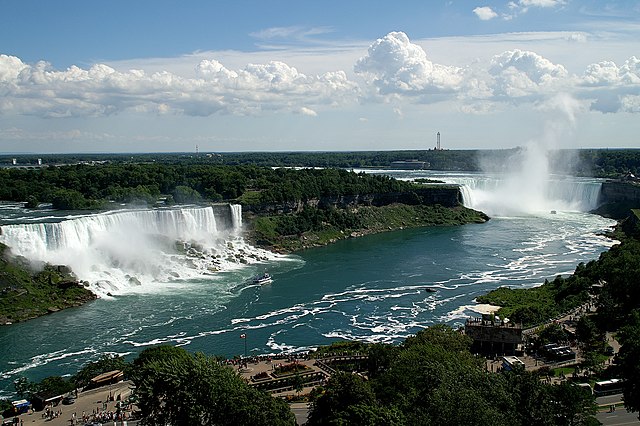
These studies legitimatized destruction of ecosystems to study effects of the destruction and the concept was expanded from radiation to pesticides in the 1960s. They also provided funding to the academic profession of ecology that was small and is now enormous. The dependence of ecological studies on government funding remains to this day and government funding of ecological projects has created the restoration industry that now extends far beyond academia. Destruction of existing habitat is still considered the prerequisite to restoring a historical landscape. Often, destruction is the first and only stage of the project because of the persistent fantasy that the native landscape will regenerate without further help.
In the late 1960s Daniel Simberloff tented and fumigated 6 mangrove islands off the eastern short of Florida with methyl bromide to kill all life on the islands. The objective of the project was to study how long it would take to repopulate the islands with insects.
From Conservation to Restoration
The post-war economic boom of the 50s and 60s greatly increased the impact of human activities on the environment. The federal government built a vast highway system that fragmented and disrupted ecosystems. We built huge dams, and channeled riparian ecosystems. Open space was rapidly covered by housing and industrial development. Wetlands were drained and filled with rubble to create more land.
People who cared about the environment began to react to the loss of nature and wildlife that lives in nature. Although Aldo Leopold is idolized by the native plant movement, his concern about the degradation of nature was primarily for wildlife. His interest in vegetation was as habitat for wildlife. He was opposed to government programs devoted to killing animals perceived as predators of game animals because he believed that wildlife is best served by expanding their habitat. In fact, he was opposed to the expansion of government’s role in conservation because “he believed restoration would be most efficient and effective if pursued by private citizens.” He did not prefer native plants because “Farmers had the opportunity to conserve plants such as ragweed and foxtail (an introduced grass), ones ‘on which game, fur, and feather depend for food.’” In other words, in the 1940s one of the icons of the native plant movement knew that wildlife is not dependent upon native plants for food. One wonders if native plant advocates have actually read Leopold’s treatise, A Sand County Almanac.
Aldo Leopold’s son, Starker Leopold, had as much impact on conservation in the United States as his father. In 1963, he published the Leopold Report that changed the direction of conservation in the National Park Service. The Leopold Report recommended a goal for national parks of maintaining historical conditions as closely as possible to those of “primitive America.”When the Leopold Report was adopted as official policy by the National Park Service in 1967, it committed NPS to restoring park lands to pre-settlement conditions.NPS officially changed this policy in 2021, but we don’t see any change locally in their projects because NPS is decentralized and local parks are autonomous.
Restoration Goals
Professor Martin says that “historical fidelity did not become a widespread restoration goal among ecologists and environmental organizations until the 1980s.” The arrival of Columbus in the new World in 1492 was arbitrarily selected as the date after which all new plant species were “deemed nonnative, unwanted reminders of human (colonist) presence and activity.” On the West Coast, 1769 is the equally arbitrary date to confer non-native status because it is the date of the first Spanish expedition to California.
Many now question the goal of replicating historical landscapes. After 40 years of effort, there is a growing recognition that it is not a realistic goal, especially in a rapidly changing climate. The Society for Ecological Restoration has changed its definition of ecological restoration from “the goal of intentionally altering a site to establish a defined, indigenous, historic ecosystem” in 1990 to “the process of assisting the recovery of an ecosystem that has been degraded, damaged, or destroyed” in 2002. Try telling that to the restorationists on the ground who are still trying to eradicate naturalized non-native plants that have been here for nearly 200 years. Non-native annual grassland in California is a case in point. It has been repeatedly burned, mowed, plowed, and poisoned for 25 years without any visible progress toward native perennial grassland.
Blaming non-native species
Around the same time that historical fidelity was identified as the goal of “restorations,” land managers and ecologists decided that the existence of non-native species is the main threat to native species. I suppose the “logic” was that the main difference between historical landscapes and present landscapes is the existence of non-native species. Concern about non-native species spread among federal agencies such as the National Park Service and The Nature Conservancy (TNC) began aggressive campaigns to kill non-natives, “which were newly framed as the main threat to wild species…nativity would become a precondition to wildness—of plants and animals both.” TNC’s methods have become increasingly deadly and destructive: using fire and herbicides to kill plants, poisoning honeybees, aerial hunting of sheep, pigs, and goats. As a former donor to TNC, their methods finally became intolerable to me.
Professor Martin believes that the identification of non-native species as the scapegoat was not based on experimental evidence, but merely a description of the strategies used by public land managers, as well as The Nature Conservancy. Non-native species were a convenient scapegoat because they were easily identified and were an easy substitute for identifying and remediating the underlying conditions causing so-called “invasions.” “Although the role of invasive species in native species extinction has since been challenged by some ecologists, the influence of this fear on species management has been enormous…The US federal budget for invasive species management increased by $400 million between 2002 and 2005, for example.”
Endangered Species Act
The Endangered Species Act (ESA) was passed in 1973, along with companion laws such as the National Environmental Protection Act and others. These federal laws created more funding opportunities for ecological projects as well as the legal justification for ecological restoration projects.
Federal laws permit the reintroduction of legally protected plant and animal species to places where they no longer exist. The ESA confers the same protections for reintroduced species as it does for naturally occurring species. Such reintroductions have become a tool for the restoration industry. I have seen that strategy used in the San Francisco Bay Area. If we had not been successful in preventing the reintroduction of a legally protected turtle, it would have justified the destruction of the non-native forest in my neighborhood park because the turtle requires unshaded nesting habitat within 500 feet of the water source in the park. The park remains largely forested because that is one of the few battles we have won in 25 years. Reintroduced, legally protected species are the Trojan horses of ecological restorations.
Compensatory mitigationis an equally powerful tool for the restoration industry. Federal law requires an Environmental Impact Statement (EIS) for projects that will have a significant impact on the environment, such as big developments like building Disney World in Florida. Disney World was built on an enormous wetland that was lost by the development of the park. The EIS for the project agreed that the impact would be great, but it “mitigated” the impact by requiring Disney to fund the creation of a new wetland in a distant location.
The funding generated to create fake wetlands built a new industry of commercial companies to design and build them. Academic restoration ecologists questioned the functional equivalency between created and natural wetlands: “’however accurate [the Comprehensive Everglades Restoration Plan] is the restored community can never be authentic.’” The tension between commercial and academic restorationists continues today.
The Society for Ecological Restoration published findings that mitigation wetlands were not functionally equivalent to the wetlands they were meant to replace. In Florida only half of the promised mitigation projects were actually built. Those that were built were colonized by “undesirable plant species” such as cattail and melaleuca in 32 of 40 projects.
Projects that earn carbon credits are creating the same opportunities to generate funding for restoration projects in distant locations. The Nature Conservancy was successful in defining carbon offsets as an international market when the Kyoto Protocols were signed in 1997. They understood that a reforestation project would be cheaper in Costa Rica (for example) than a comparable energy efficiency project in the US. Such distant projects don’t benefit those in the US who now have a power plant in their backyard that is being offset by a forest in Costa Rica.
It’s a game for those who know how to play. I have witnessed local examples in the Bay Area. An oil spill in the bay generated millions of dollars of compensatory damages to fund unrelated “restoration” projects. How does planting eel grass compensate for hundreds of birds killed by the oil spill? When the San Francisco airport expanded runways, the airport had to pay compensatory mitigation that funded the restoration of native plants at India Basin in San Francisco that hardly compensates for the increased air traffic enabled by the new runway.
Conclusion
Professor Martin is surprisingly frank about the future of ecological restoration in America:
“Whatever paths restorationists choose, restorations must happen in tandem with other changes in human behavior. If we don’t reduce the ongoing harms of racism, fossil fuel burning, overconsumption by the wealthy, and toxic industrial chemicals, restoration will offer no more than a temporary repair, a way to move a problem to some other place or time.”
I would go one step further in my assessment of the restoration industry. I would say that the methods used by restorationists are directly contributing to environmental degradation.
Professor Martin asks the right questions in her concluding chapter: “Who benefits from restoration? Who is harmed?” Those who earn their living in the restoration industry are the primary beneficiaries. According to a 2015 study entitled “Estimating the Size and Impact of the Ecological Restoration Economy,” environmental regulation has created a $25 billion-per-year restoration industry that directly employs more people than coal mining, logging or steel production. Given recent investments in restoration projects of billions of dollars by California and federal infrastructure funding, this figure is undoubtedly an underestimate.
Who is harmed?Wildlife and humans are harmed by the destruction of useful habitat with herbicides. Harmless animals and plants are killed because they have been arbitrarily classified as “invasive.” And all Americans are harmed by the waste of public funds that could be used to benefit society and/or the environment.
(1) Laura J. Martin, Wild by Design: The rise of ecological restoration, Harvard University Press, 2022. All quotes are from this book.
I am publishing my letter to the Albany City Council about the City’s plans to destroy most of the eucalyptus forest on Albany Hill. I am publishing it in three segments because it is long. The first segment explained why it is not necessary to destroy the forest. The second segment explained the consequences of destroying the forest. The third and final segment explains why it is unlikely that the forest can be replaced by native trees.
Now you have my version of the full story. If this is a place or an issue you care about, please consider writing a letter of your own to the City Council of the City of Albany.
Conservation Sense and Nonsense
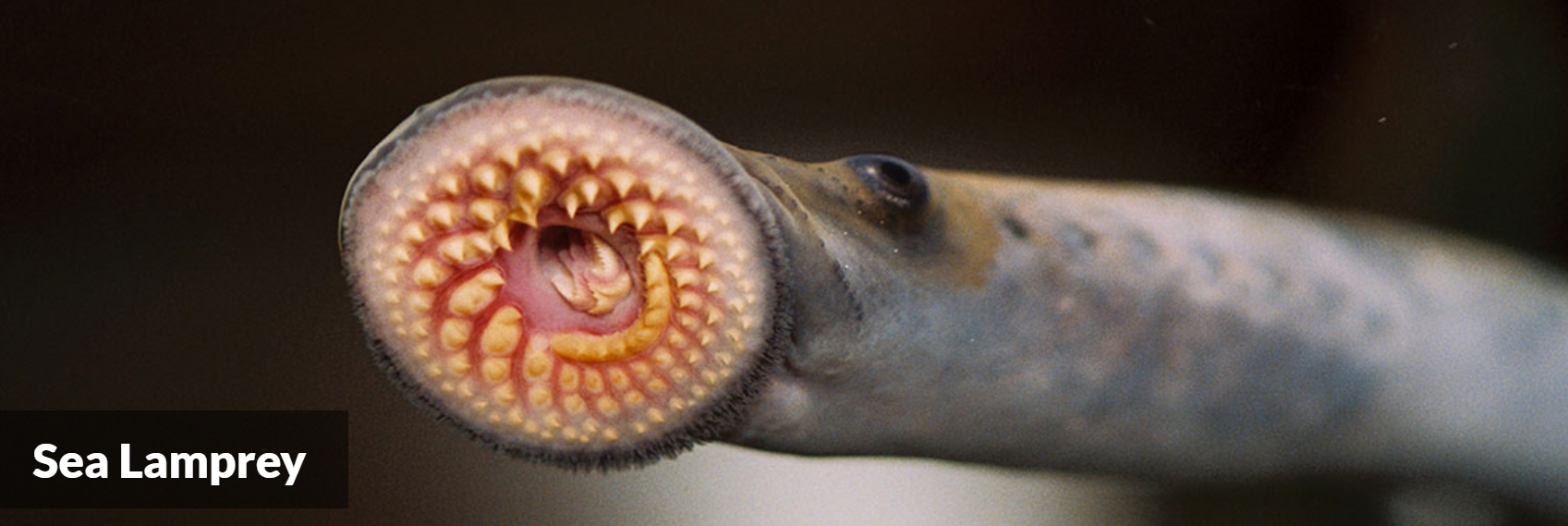
Albany Hill. Source: Google Earth
December 5, 2022
Albany City Council 1000 San Pablo Ave. Albany, CA 94706
Dear Albany City Council:
SEE Part I and Part II of Appealing to the City of Albany to save its eucalyptus forest. Part III is the concluding segment:
The uncertain fate of monarchs on Albany Hill is a suitable introduction to my final issue. The proposed plans for Albany Hill claim the destroyed eucalyptus forest will be replaced by new trees. I will explain why it is unlikely that the eucalyptus forest can be replaced by another forest. Plans for a newly planted forest are described in various ways, some of which seem contradictory:
“[Margot] Cunningham’s [Albany’s Natural Areas Coordinator] team is pursuing grants to cut down most of the blue gums and plant the city’s side of the hill with a mix of native species and more drought tolerant trees for monarchs to roost.” (1)
“WHEREAS, the City is investigating consultants to design a plan to remove eucalyptus in a way that retains and restores more fire-resilient native plant communities and minimizes soil disturbance and soil erosion.” (2)
“More droughty Eucalyptus species can be planted to preserve the butterfly habitat.” (3)
“This plan will include but is not limited to: plantings of other tall trees in areas of the hill where monarchs have traditionally clustered; survey of the existing native understory which will be allowed to grow after eucalyptus removal; and analysis and design of additional plants of Albany Hill-sourced native plants.” (4)
Somehow, this diverse, drought-tolerant, fire-resilient, tall, native (with droughty eucalyptus species?) forest is expected to survive without irrigation: “If drought-tolerant tree species are planted as seedlings, in the fall with sufficient planting site preparation and adequate rain fall, minimal if any irrigation will be required.” (5)When predicting the fate of the existing eucalyptus forest, the plans assume that the drought will continue. When predicting the fate of a replacement forest, the plans assume that the drought will end.
Most public land managers irrigate newly planted trees (whether native or non-native) for at least 3 years. Established trees rarely require irrigation to survive because they have extensive root systems that have better access to moisture in the soil than newly planted trees without extensive root systems. Tree species that are drought-tolerant when mature trees, require irrigation as they grow their root systems. Replacing healthy trees that don’t require irrigation with new trees that require irrigation seems an unwise choice in the middle of an extreme drought.
The City of Albany should have learned that lesson when they built Peggy Thomsen Pierce Street Park at the western foot of Albany Hill. Only native trees were planted in that park. They weren’t irrigated. Five years after the park opened in 2017, most of the trees are dead (see below):
Peggy Thomsen Pierce Street Park, November 2022. Conservation Sense and Nonsense
The City of Albany’s list of approved street trees is a valuable source of information about what tree species are capable of growing in Albany. A tree species that cannot survive conditions for street trees is also unlikely to survive on the ridgeline of Albany Hill, where wind conditions are extreme and there is little moisture. There are about 65 tree species approved for planting as street trees in Albany. Five are native to California, but only three are native to the Bay Area. Native big leaf maples are said to be “in decline.” Buckeyes aren’t suitable street trees, but may be suitable for open space. None of the listed native trees are suitable monarch habitat for a variety of reasons: canopy too dense to provide sufficient sunshine; deciduous therefore bare in winter; short stature, etc.

Historically, areas on Albany Hill that are now forested with eucalyptus were treeless because native trees are not adapted to the challenging climate conditions. If the eucalyptus forest on Albany Hill is destroyed, Albany Hill is likely to be treeless again. That is the horticultural reality of Albany Hill.
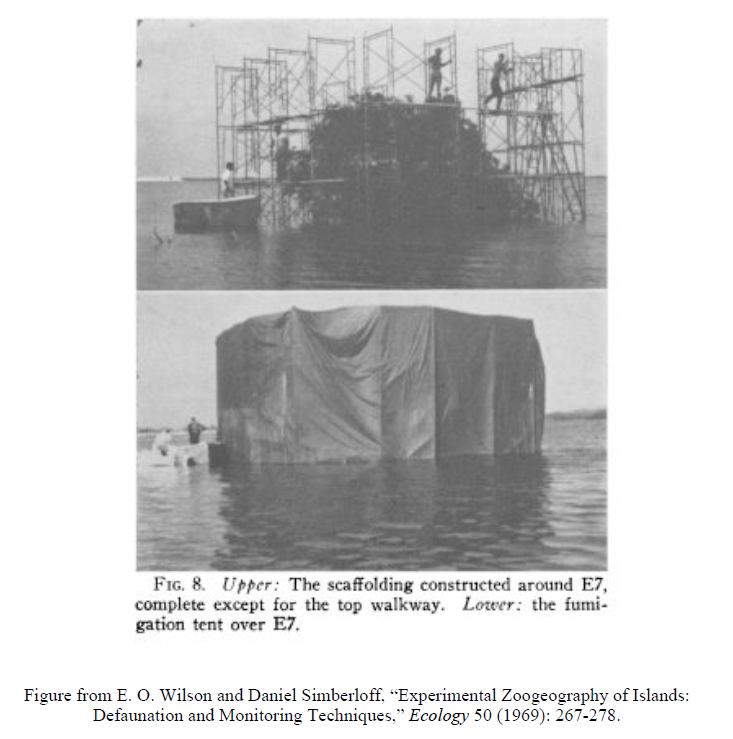
In conclusion:
It is not necessary to destroy the eucalyptus forest on Albany Hill because it is not dead.
Destroying the eucalyptus forest on Albany Hill will increase fire hazards and safety hazards.
Destroying the eucalyptus forest will destroy habitat of monarch butterflies.
Plans to replace the eucalyptus forest with native trees are unrealistic.
Please consider reinstating the 2012 Albany Hill Creekside Master Plan. It is still a good plan that will not do unnecessary damage to Albany Hill and its human and animal visitors.
cc: Albany Fire Chief Albany Natural Areas Coordinator Albany Urban Forester Creekside Science
Update: Shortly after I sent my letter to officials of the City of Albany about their plans to destroy most eucalyptus on Albany Hill, they revised their plans because of two updated reports that were done in November and December 2022. Basically, they no longer plan to destroy most eucalyptus on Albany Hill for two main reasons:
Eucalyptus trees are the overwintering habitat of monarch butterflies. They cannot be replaced by native trees of short stature without the open canopy that filters sunlight but also provides a windbreak the monarchs need.
Epicormic sprouts on the eucalyptus trees indicate they are recovering from drought and are expected to survive and eventually replace their canopies.
These are the sources of information that corroborate my brief summary of the main reasons Albany is no longer planning to destroy most eucalyptus trees on Albany Hill:
They still intend to remove dead trees to reduce fuel loads, to which I have no objection. Some dead eucalyptus may be replaced with more drought tolerant species of eucalyptus from Western Australia.
To be clear, I don’t think my letter about their original plans for Albany Hill were influential in their revising their plans. My letter is consistent with the advice they received from an ecologist with expertise in monarch butterflies and a consultant in fuels management. Credit belongs to the preference of monarchs for eucalyptus and to eucalyptus for being indestructible.
Resolution No. 2021-105. A resolution of the Albany City Council, authorizing the appropriation of funds to the Albany Hill Eucalyptus Project in the amount of $100,000