Seeking Peace in Our Gardens

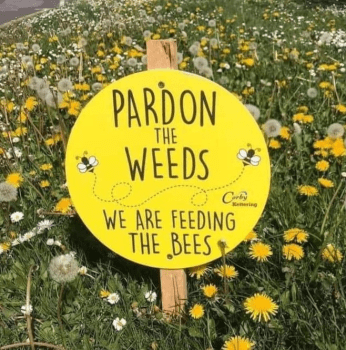
Garden Rant recently published an article by garden-writer, Marianne Willburn, defending gardeners who prefer a diverse garden over an exclusively native garden.  This issue has been hotly debated for several decades, generating conflict in gardens and garden societies.  These are places where people seek refuge from life’s many challenges.  Some mourn the loss of peace in the garden and wish for a return to peaceful co-existence between gardeners regardless of which plants they prefer.  As American politics have become increasingly polarized, all the more reason to foster peace in our gardens.
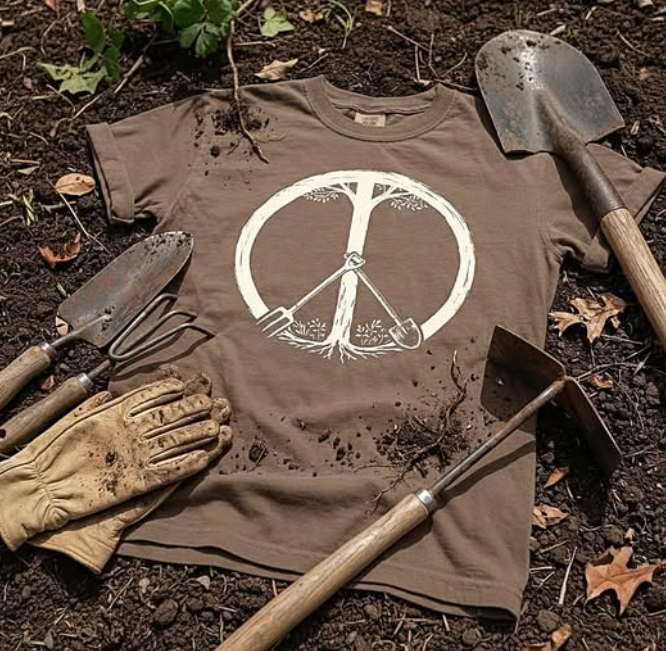
Available at Gardenistee.

Conflicting Goals in the Garden

The primary goal of home gardeners was beauty prior to the advent of the native plant movement.  As the saying goes, beauty is in the eye of the beholder, which is a way of saying everyone has their personal definition of beauty.  In the garden, some prefer order and symmetry while others prefer naturalistic chaos and abundance. 

The native plant movement brought an entirely different goal to the garden about 30 years ago.  Native plant advocates want a garden that they believe will best serve the wildlife that lives in it, from the insects at the bottom of the food web, to the birds that eat insects and beyond, to the top of the food web.  Beauty is not their goal.  In fact, a beautiful garden is considered by some the antithesis of a native garden, judging by the gardens of some of my neighbors whose gardens look dead half the year in our Mediterranean climate that is without rain half the year.

Dictators in the Garden

Such different viewpoints about the purpose of our gardens could have lived peacefully side-by-side if native plant advocates had respected the opinions of cosmopolitan gardeners, but they didn’t.

To quote the Garden Rant article, the native plant movement “saddles everyman gardeners (whether they wished to grow Hemerocallis [daylilies] or fill a raised bed with herbs) with the burdens of past and present ecological damage to our planet, the saving of species from extinction, and the reversal of climate change.” 
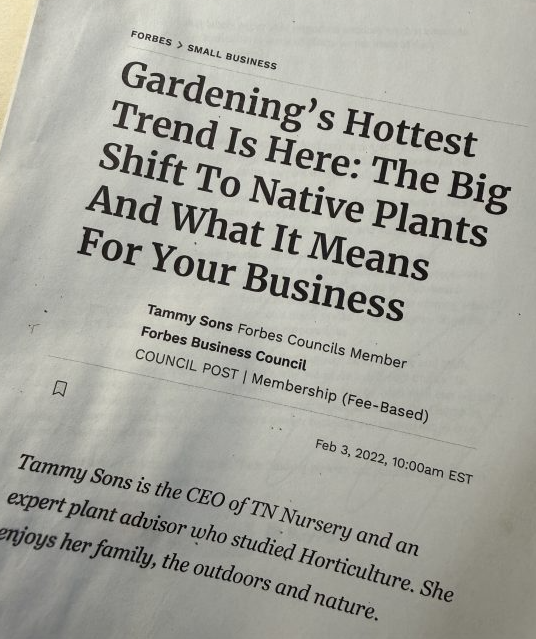
Source: Garden Rant image of media article

If you haven’t been on the receiving end of such a moralistic lecture from a native plant advocate, you may think that’s an exaggeration.  Here are a few examples of such condescending lectures from native plant advocates about the obligations of gardeners to save the planet: 

Gardens planted with non-native plants are “blooming wastelands where the flowers feed nobody at all.” 
“The typical suburban yard is actually worse than a wasteland. It’s a death trap.”
Margaret Renkle, NY Times, March 28, 2021

“It turns out I’ve been filling my yard with a mix of ecological junk food and horticultural terrorists.”
 “I’m sorry to say that if you have a typical urban or suburban landscape, your lawn and garden are also 
dooming the Earth.”
Dana Milbank becomes a native plant gardener, Washington Post, April 7, 2023

“’I think of it as chemotherapy,’ said Doug Tallamy, a University of Delaware entomologist and guru of the native-plant movement. ‘We have ecological tumors out there. If we don’t control them, we have ecological collapse. We have the collapse of the food web.’”
Doug Tallamy, Washington Post, June 30, 2023

“…no other “don’t” has been shouted more loudly lately than the list of plants to avoid, the various nonnative, longtime nursery-industry standards that are now understood to cause environmental harm.”
Margaret Roach, NY Times, March 17, 2026

Such dire predictions of ecological collapse are overheard among neighbors, over garden fences, in garden society meetings, and in conferences of the California Invasive Plant Council and the California Native Plant Society.  Articles with similar themes are found in garden magazines and in the publications of environmental organizations such as the Sierra Club and the Xerces Society. 

If the extravagant claims of advocates about the superiority of native plants received the scrutiny and analysis they need, the native plant movement would not have the power and influence that it presently has.  Now let’s turn a bright light on the claims of nativism in the natural world.

Debunking Nativist Myths

Nathan Lambstrom is a botanist and professional landscape designer who has given us an example of how nativist myths persist.  He reports that Doug Tallamy supports his claim that insects require native plants by obscuring the many contributions non-native plants make to moths and butterflies.  He manipulates his data set to hide the documented contributions of non-native plants, including plants considered “invasive.” 

I was introduced to the nativist myth that native plants store more carbon than non-native plants nearly 20 years ago in an undergraduate ecology class at UC Berkeley.  The University’s land manager who was responsible for destroying non-native trees on the University’s open space told the class that “carbon storage in non-native trees doesn’t count.”  I was horrified that the class as well as the professor teaching the class accepted this nonsensical statement without comment.  The truth is that both native and non-native plants and trees store carbon while they are alive that would otherwise be released into the atmosphere, contributing to climate change.  As long as native plant advocates continue to demand the destruction of non-native plants and trees, they cannot claim that their projects reduce greenhouse gases that cause climate change.

Academic Ecologists Retreat from Invasion Biology

Recently, Thomas Christopher (one of Doug Tallamy’s co-authors and allies) interviewed James Hitchmough, a British ecologist on his Growing Greener podcast.  The title of the podcast suggests that Mr. Hitchmough’s viewpoint “challenges the US Consensus” regarding the relative value to insects of natives compared to non-natives.  Mr. Hitchmough’s response was that the claimed preference of insects for native plants was conventional wisdom among ecologists in the past, but that “when they did the [field] work, they changed their view.” He also said that the singular focus on the needs of lepidoptera skews the issues because lepidoptera are only 15% of all insects. Other taxa of insects have less restricted host plant preferences than lepidoptera.   
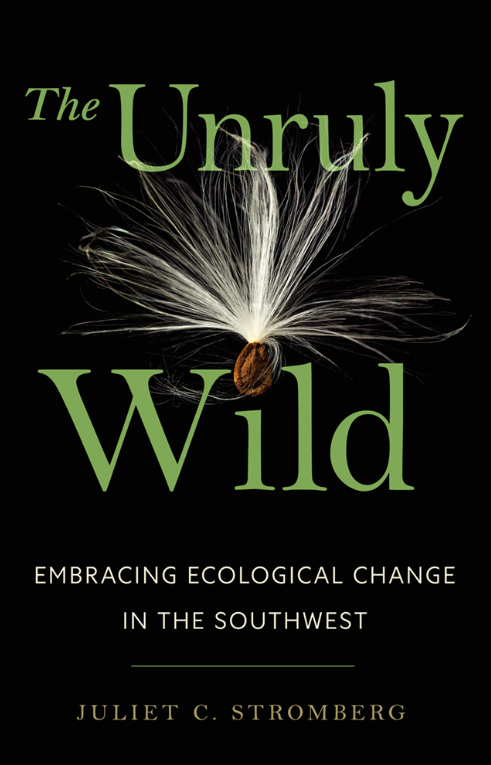
That change in viewpoint has occurred among academic ecologists in the US, but continues to be resisted by many gardeners, such as Thomas Christopher.  Professor Emeritus Juliet Stromberg recently published a book about her journey from her graduate education, which was deeply steeped in invasion biology, to her present viewpoint, based on decades of fieldwork and as expressed by the title of her book:  The Unruly Wild:  Embracing Ecological Change in the Southwest

Stromberg’s book is representative of the opinions of many academic ecologists today.  Change in nature is inevitable and it is usually both good and bad, from the perspective of other members of the ecological community and no matter the geographic origins of plants and animals. When judging the impact of new members of an ecological community, the most likely answer is “it depends.” 

Endorsements of Stromberg’s book suggest that she is not alone in her realization of the value of introduced plants, which are adapted to the conditions humans have imposed on them:

 “An erudite love story of nature in the American Southwest.”
Fred Pearce, author of The New Wild

“Stromberg has written a masterful treatise on why a knee-jerk response to eradicating nonnative plants is not just misguided but counterproductive.”
Dov F. Sax, co-editor of Species Invasions

“Julie Stromberg articulates, with personal knowledge and deep love, a new way to understand and care for a changing world.”
Erick Lundgren, University of Alberta, Canada

Climate change, human activities, and evolution force us to embrace ecological change.  Juliet Stromberg helps us to face this reality without fear, but with hope that nature can continue to cope with the demands that humans have made of it.  Our efforts to prevent change are futile and they often cause more damage than the environmental changes themselves.

Restoring Peace to Our Gardens

We encourage gardeners to restore peace to our gardens by respecting our cosmopolitan preferences in our gardens, as we respect the preference of others for native plants.
Gardening with the help of nature

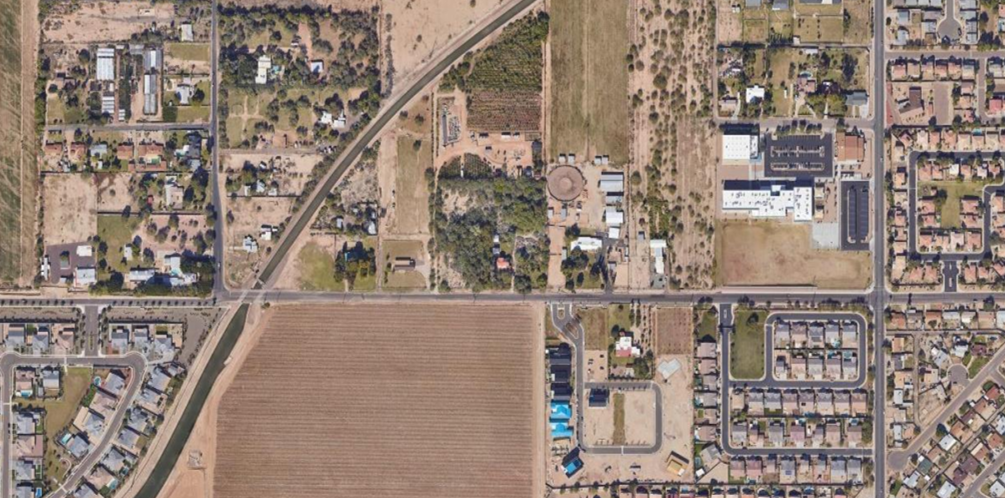
Juliet Stromberg is a plant ecologist who specialized in wetland and riparian ecosystems of the American Southwest.  Her friends call her Julie and I will presume to do the same.  She has retired from her position at Arizona State University, but her husband, Matt Chew, is still teaching ecology from a historical perspective at ASU.  He is very much her partner in their 20-year project to restore 4-acres of dead citrus grove and an 80-year old Spanish colonial house, long abandoned and derelict.  The property came with water rights, without which their project would not have been possible.

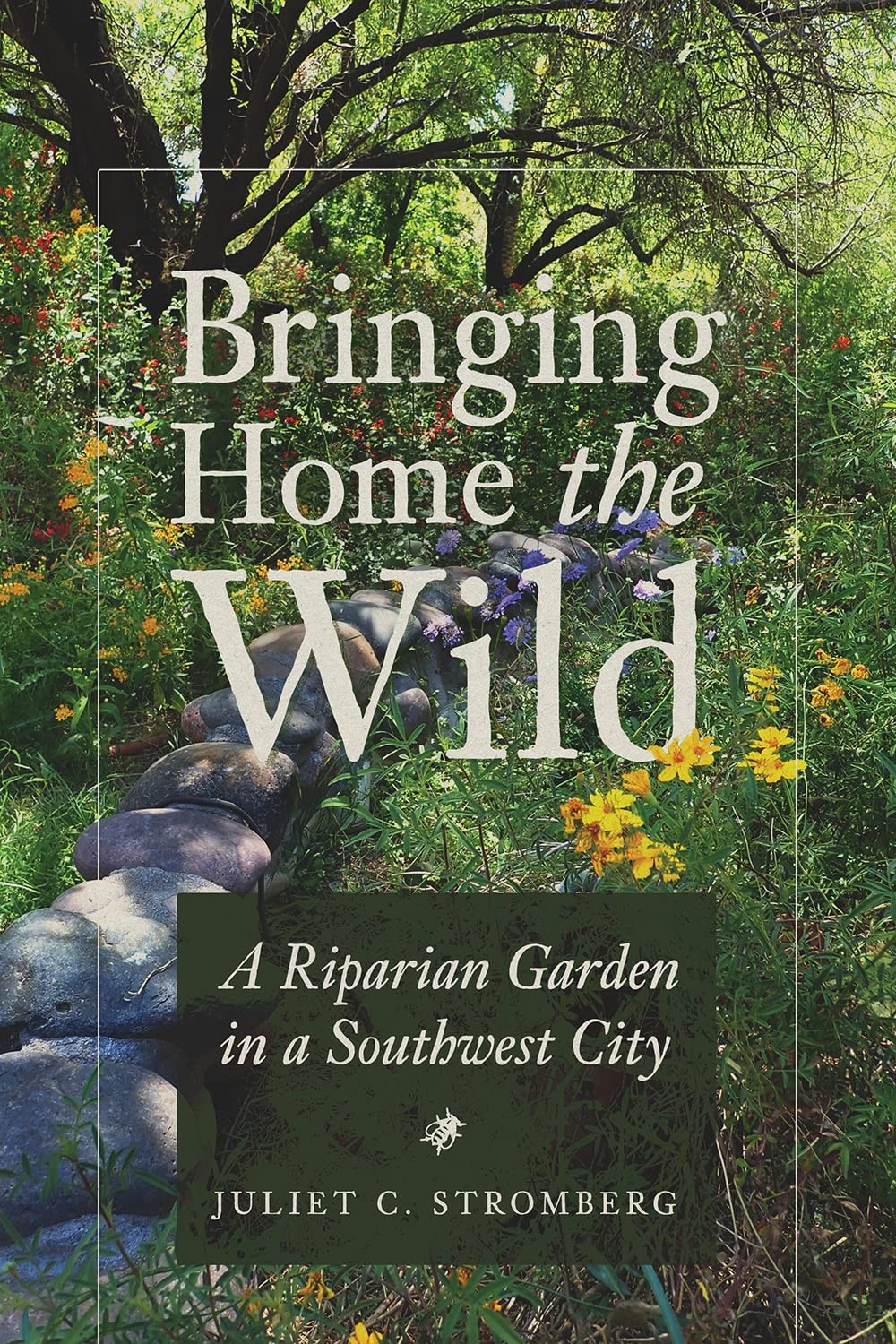
In her recently published book, Bringing Home the Wild:  A Riparian Garden in a Southwest City, Julie tells us how she and her partner transformed—with the help of natural processes–this dead patch of land in South Phoenix, Arizona into the oasis that it is today.  The first step was to restore the irrigation system, which immediately brought much of the dormant seed bank back to life. 

Julie & Matt’s garden is in the center of this aerial view

Using the riparian vegetation of the Salt River—the source of their water—as her reference, she chose a half-dozen tree species as the foundation of their garden, such as Fremont cottonwood, Gooding’s willow, and velvet mesquite.  Twenty years later, there are now 300 trees, sheltering a community of plants and animals.  How did they get there? 

The seeds of some trees such as blue elderberry and mulberry were brought from neighboring gardens by birds and small animals. Julie and Matt have seen 157 species of birds in their garden, so we can assume birds have done some of the planting.  The seeds of some plants are aerodynamically shaped and were blown in by the wind, adding to the diversity of the garden.

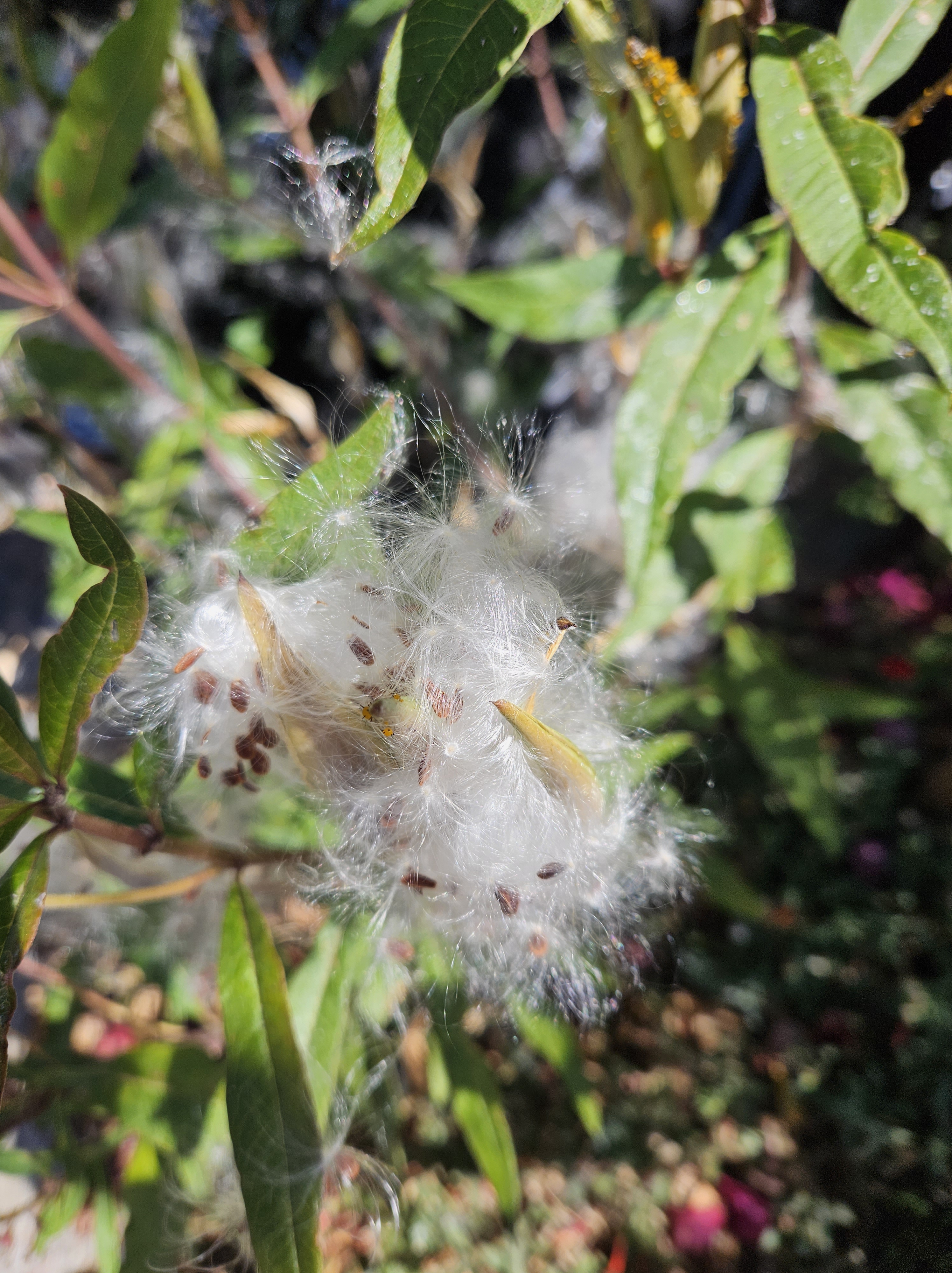
Tropical milkweed seeds ready to be launched by the wind from a neighbor’s front yard.  Conservation Sense and Nonsense, Oakland, CA, October 2023

Many of the trees are American in origin, but others are not.  Regardless of the method of dispersal, most introductions are welcome in Julie’s garden. She spares her readers the tedious recitation of which plants are considered native and which are not.  The Southwestern desert is not an ecosystem with which I am familiar.  I was glad to have a tour of Julie’s garden without irrelevant information about the nationality of every plant.  For the same reason, I like to travel in distant places where I can’t distinguish natives from non-natives.  Everything looks great to me and nothing brings me down more than a guide who wants to inform us of what “belongs” and what doesn’t. 

Julie and Matt also planted a fruit orchard and a vegetable garden that bring more birds, insects, and animals to the garden as well as providing food for their table. Eating the fruits of our labors in the garden deepens our respect for what plants do for us and establishes our working relationship with the land. 

Managing a wild garden

In keeping with Julie’s opinion that ecological restoration is a form of “glorified gardening,” she actively manages her garden.  A few plants that annoy members of her community of plants and animals—such as puncture vine and tumbleweed—are not welcome. 

When the delicate balance between predator and prey becomes unbalanced, some protective measures are necessary.  If coyotes and dogs can’t keep up with the rabbit population, it’s sometimes necessary to put vulnerable plants into cages to protect them.  The root balls of some plants are covered in wire mesh to protect them from hungry gophers. 

Plants also assist in their own defense.  Where mesquite is grazed by cattle, the tree responds by growing longer thorns to repel the cattle.  When plants are attacked by plant-eating insects, some emit a toxin to render themselves inedible.  The scent of the chemical wafts to neighboring plants, alerting them to the arrival of predators.  These natural defenses are an important line of scientific inquiry that has potential to substitute nature-based solutions for synthetic chemicals. 

The population of roof rats in Julie’s home is kept in check with liquid birth control, lest they chew on electrical wires or build nests in car engines. 

Gardening with the help of friends

Julie’s is not a manicured garden, but it requires constant pruning to keep trails clear and provide light and space for plants to thrive. The annual scouring of the flood plain by spring floods is one of the natural processes that Julie and Matt could not use to restore their land because irrigation water is channelized and confined by concrete.  Julie has come to appreciate the flies and other insects who are the decomposing crew, helping to reduce the accumulation of debris in the absence of annual scouring floods.  Sixty-six species of flies assist with decomposition as well as pollination in Julie’s garden. 

Julie is happy to have coyotes in her garden, but her dogs disagree.  Violent and fatal confrontations between these closely related species required building a wall that confines dogs close to the house at night, while coyotes safely roam most of the garden. 

Dogs are an important part of Julie and Matt’s life.  Early in the book’s introduction Julie warns readers that they should put her book down “NOW!” if they don’t want to hear dog stories.  Julie has walked thousands of dogs in a nearby animal shelter.  In addition to her own 4 dogs, there are also occasional foster dogs who need to recover from traumatic experiences to be adoptable.  In Julie’s refuge, these traumatized dogs learn to trust again. 

Peaceful co-existence

Julie is a recovering academic scientist.  Before she retired, she felt that her focus on the accumulation of data needed for scientific analysis was causing her to lose track of the big picture.  She needed to stop and smell the flowers, so to speak. 

She received her graduate education during the heyday of invasion biology. Julie slowly shifted away from native purism based on her experiences in the field.  She has rejected that doctrine, and regrets teaching her students to fear “those who came from somewhere else.” 

Julie has a vivid memory of the first step she took on that journey to her gardening ethic of peaceful coexistence.  She had been instructed to pull tree tobacco from land along the Salt River that was being restored.  The nicotine in the plant was making her feel sick, which seemed to bring her to her senses.  She began to wonder what she was doing, “following orders to kill creatures she barely knew.” 

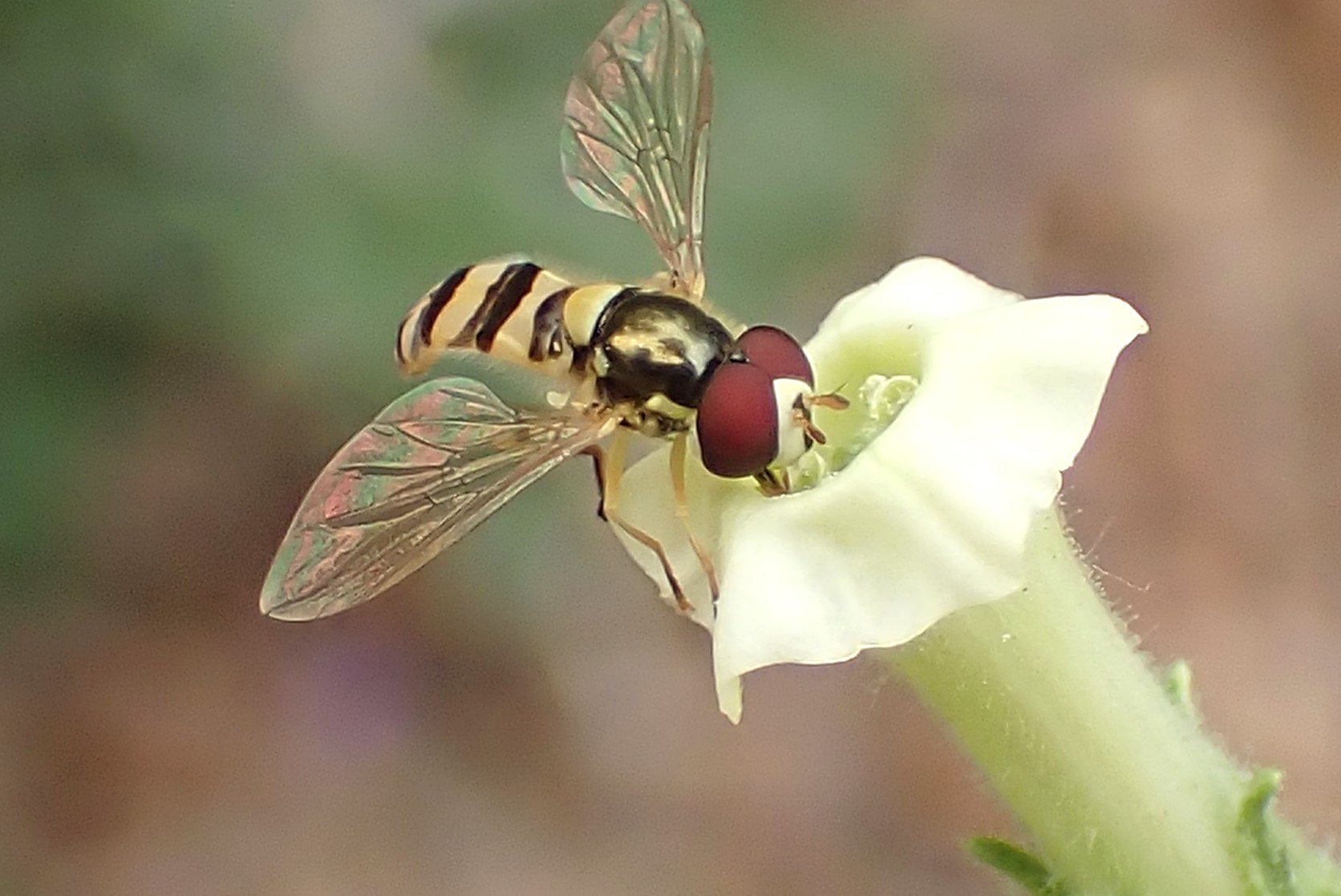
Fly on desert tobacco. Photo courtesy Juliet Stromberg

Part of Julie’s skepticism about such eradication projects is based on her understanding of how little we know.  She realizes that the harm done by non-native species is exaggerated and their benefits are underestimated.  Given the limits of our knowledge, we should be obligated to give introduced plants the benefit of the doubt before killing them.  She now appreciates the beauty of tree tobacco, which also feeds birds, fixes carbon, and stabilizes the soil.   Its seeds were naturally dispersed to Julie’s garden and tree tobacco is welcome there.

Imperatives imposed by climate change

Julie says, “The preoccupation with provenance diverts conservationists and gardeners from critical issues,” such as climate change, food security, and extinction (which, studies show, are not caused by introduced plants).  Living in the Southwest, Julie has a front row seat on climate change.  It’s always (within the context of our lifetime) been hot there, but now it is blisteringly hot during summer months.  She watches hummingbirds in her garden seek shelter in the shade, close to the irrigation drip.  She watches dogs panting, birds gasping for breath and plants wither and die in the heat.  And she knows that both native and non-native plants store carbon that would otherwise contribute to greenhouse gases causing climate change. Carbon storage varies according to certain plant characteristics, but those characteristics are unrelated to the nationality of plants. 

Those who insist on replicating the landscape that existed 200-400 years ago in America are depriving nature of the evolutionary opportunities that will enable survival.  We don’t know what life will be capable of living in the climate of the near-future.  Nature needs as many alternatives as possible to find the species that can survive.  Plants and animals are blameless in this struggle of survival of the fittest.  The least we can do is to get out of their way as natural selection finds the life that is adapted to the current and future climate.

Showing respect for nature

Julie does not use any pesticides in her garden….no herbicides, fungicide, or insecticide.  She is concerned about the pesticides used by her neighbor across the road who grows cotton.  She notices the blue cotton seeds scattered on the ground and surmises that they were coated in insecticide or herbicide that will infuse pesticide into the plant as it grows.  The poisoned seed can kill seed-eating birds and other animals and the plant itself will be poisonous as it grows.  The dust from the cotton field blows into her property when the field is plowed and after the cotton is harvested because no cover crops are grown to tamp down the dust and prevent the loss of carbon stored in the soil.  Julie can see firsthand the damage caused by industrial agriculture and is confirmed in her commitment to avoid using pesticides.

Julie shows her respect for everything living in her garden by her choice of pronouns to describe them:  “who” not “what,”  “she/her” not “it.”  She asks her readers to show the same respect for plants and animals, regardless of their nationality.  Avoiding the use of pesticides in our gardens is another way to show our respect for the plants and animals on which we depend, with the added benefit of not poisoning ourselves.

Thank you, Juliet Stromberg, for telling us about your garden and congratulations for what you have accomplished and learned from the experience of nurturing it back to life with the help of nature.