Environmental education plays an important role in the native plant movement. Young people are indoctrinated with the native plant ideology and recruited as volunteers in native plant restorations.
We were introduced to the relationship between environmental education and the native plant movement on our first visit to the Randall Museum in San Francisco. The Randall is operated by San Francisco’s Recreation and Park Department. According to its website it “…offers youth and adults opportunities for active involvement and recreation in an integrated program of arts and sciences…The Museum strives to inspire creativity, curiosity, and appreciation of the world around us.”
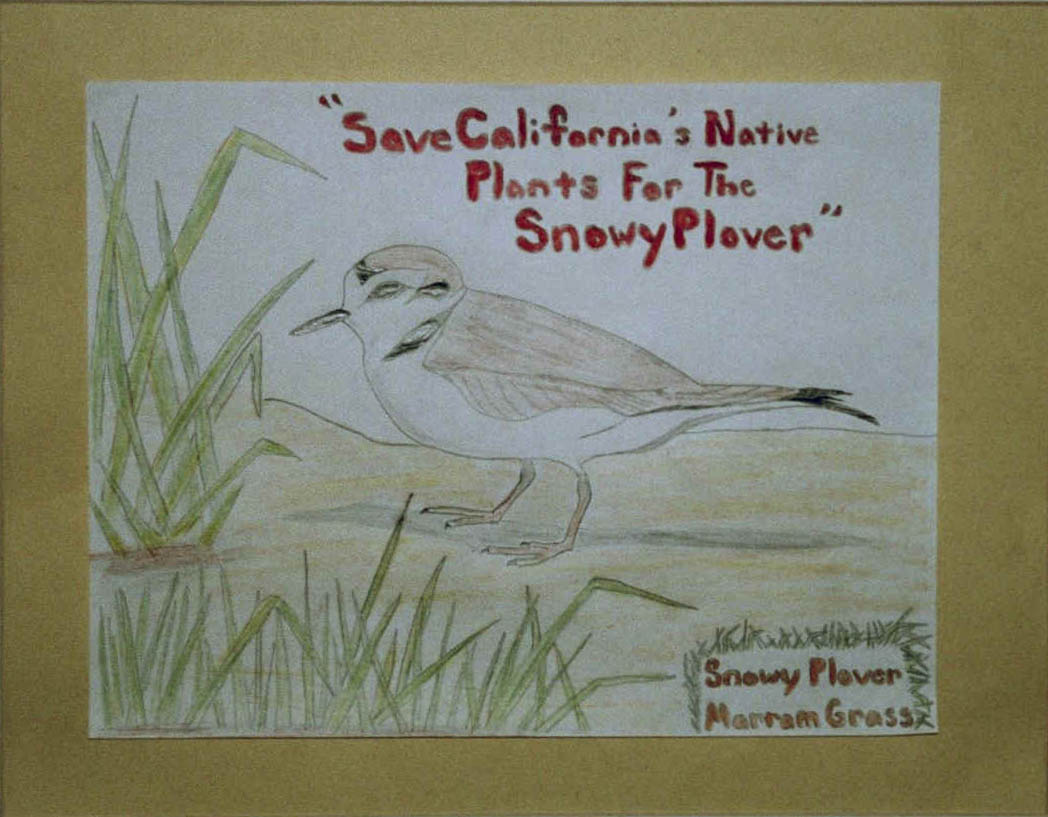
On our first visit, the main room of the museum was decorated with posters that had been drawn by the children visiting the museum. The posters covered the perimeter of the room. Each poster featured an animal, a plant, and the message “Save California’s native plants for the [pictured animal].”
Poster at the Randall Museum
The relationship between each animal and the pictured native plant seemed tenuous at best. Here is a picture of one of those posters, which claims that the Snowy Plover requires a particular native plant. In fact, Snowy Plovers make no use of this plant or any other.
According to The Sibley Guide to Bird Life and Behavior, “Plovers…are specialized feeders that rely on vision to locate their prey, which includes all manner of invertebrates such as earthworms, adult and larval insects, amphipods, isopods, tiny crabs…” etc. They don’t eat plants nor do they require plants—let alone native plants—for nesting because they nest on the bare sand.
In addition to being misinformation, this approach to environmental education struck us as rather sterile. It reminded us of a public hearing about San Francisco’s Natural Areas Program at which a native plant advocate explained her objective for the education of children in San Francisco. She said that children should be required to memorize the names of 30 native plants each day. How boring, we thought. Would children be inspired to love nature by such a rote exercise?
Separating children from nature
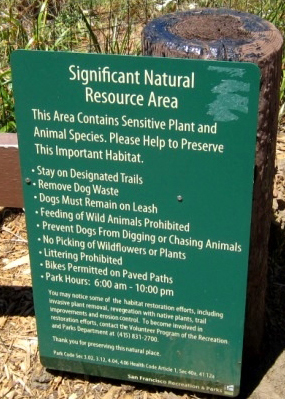
“Stay on designated trails” Signage in San Francisco’s “natural areas”
We are apparently not the only ones who have reacted to such an uninspiring approach to environmental education. In a recent article in Orion Magazine (1), a parent tells the story of taking his children to a class at the Happy Hills Nature Center. The nature center is surrounded by a meadow blooming with wildflowers, but instead of wandering through that meadow to explore, the children are required to go inside on a sunny day and watch 27 slides of wildflowers. They are bored stiff. When the class is over, they want to get outside, but they are told to stay on the trail and not to pick the flowers, even the non-native dandelions.
This is typical of the experiences that children are now getting in our parks. They are prohibited from wading in the creek or lake. They are prohibited from climbing the rocks or trees. Fences and signs require that they stay on the trails. They are told that nature is fragile and will not tolerate their presence. They are effectively prevented from interacting with nature. They may look, but they may not touch.
The Orion article concludes that this approach to environmental education will not foster an interest in or respect for nature. If children are alienated from nature, they will not have an interest in protecting it. The article cites two research studies in which early experiences with nature are found to correlate with an interest in nature as adults.
One study surveyed environmentalists to determine if there were any similarities in their childhood experiences. It found that “Most environmentalists attributed their commitment to a combination of two factors, ‘many hours spent outdoors in a keenly remembered wild or semi-wild place in childhood or adolescence, and an adult who taught respect for nature.’”
Another study interviewed two thousand adults in a wide range of occupations chosen at random in one hundred urban areas around the country. They found that “Childhood participation in ‘wild’ nature such as hiking or playing in the woods, camping and hunting or fishing, as well as participation in ‘domesticated’ nature such as picking flowers or produce, planting trees or seeds, and caring for plants in childhood have a positive relationship to adult environmental values.”
Of course, we couldn’t help but think of our own early experiences with nature. Vivid memories of building forts in the trees and dams in the creek came to mind. Both activities would be prohibited in today’s parks.
Defeating the purpose of environmental education
Memorizing lists of plants or looking at slides of them in a darkened room is not a substitute for interacting with nature. And that interaction will not take place behind a fence. The result of such childhood experience will be adults who are not interested in nature and therefore don’t care about protecting it. Ironically, those who claim to be devoted to saving nature are defeating their purpose by separating children from nature.
********************************
(1) David Sobel, “Look, Don’t Touch,” Orion Magazine, July/August 2012
“The primary agenda of the [permaculture] movement has been to assist people to become more self reliant through the design and development of productive and sustainable gardens and farms. The design principles which are the conceptual foundation of permaculture were derived from the science of systems ecology and study of pre-industrial examples of sustainable land use.“(1)
What does the permaculture movement have in common with the native plant movement?
Both have an interest in the preservation of native habitats and animals and both want to reduce the negative impact of human habitation on the Earth’s ecosystems.
How is the permaculture movement different from the native plant movement?
The permaculture movement has a broader view of ecology including the impact modern agriculture has on the Earth’s ecology, taking into account that modern crops are almost entirely non-native. Permaculture considers both the costs and benefits of native plant “restorations”—such as the use of pesticides—and also puts the question of how realistic the goals of the project are into that equation. Permaculture respects the complexity of nature and the shortened time perspective of man. It therefore does not assume that man is capable of foreseeing the consequences of his manipulation of nature. The humility of permaculture is a stark contrast to the sweeping generalizations and dogmatic edicts that we often hear from native plant advocates.
What do the principles of permaculture tell us about “invasion biology?”
The principles of permaculture were eloquently expressed in a recent blog dialogue about the potential for introduced species to be invasive, in this case the kiwi vine. The author of this comment is Toby Hemenway, who has given us permission to reprint his comment. Mr. Hemenway is the author of a book (Gaia’s Garden: A Guide to Home-Scale Permaculture, Chelsea Green Publishing, 2009) and a website about permaculture. Reading the entire comment thread in which this comment appears will help you to understand the difference between the native plant movement and the permaculture movement.
****************************************
Hardy Kiwi. Creative Commons
“I have said several times that the shade-tolerant vines are very challenging species, so I’m not surprised to see Mr. Lautzenheiser’s report [about the kiwi vine]. And I’ll repeat that all of New England is a highly disturbed landscape…
The vines will come, and they will go. After all the alterations in the landscape Euro-Americans have made, it’s going to be centuries before we stop seeing things like these kiwi amphitheaters. We cannot predict when a species will turn rampant – next time it might be string beans – so we have two choices: never, ever introduce a new species, or accept that we are dealing with new types of ecosystems that are going to make us miserable if we keep thinking about the impact of new species as a disaster. The first is impossible.
Very relevantly, I spent last Saturday in the Beartooth Mountains with a retired local ecologist. We stopped at a disturbed site in the sagebrush above Red Lodge and he harvested two bouquets of plants, one of natives, one of exotics. The exotic bouquet had at least twice as many species in it, including a number that he was pretty upset with. He is no fan of invasive species. Later we stood in a mixed-conifer grove high in the much less disturbed mountains, and he showed the immense damage from the pine beetle, a native insect that is devastating millions of acres in the west. It seems to have burst out of control because of decades of Smoky the Bear fire suppression – our way of saving the ecosystem – that has left the forest full of crowded trees that are perfect beetle food. This is a native species that has gone rampant. This happens all the time: many thousands of acres of lodgepole pine in Idaho and eastern Washington are dying from native honey-mushroom infestation, but ecologists are starting to understand that this may be a way of returning nutrients to the soil after old-growth forests have sequestered them above ground for too long. We hate to see these forests die. And we don’t know what’s going on.
When someone asked what we can do about all this, the ecologist answered that we can preserve very small areas in special projects, but that anything beyond that is simply impossible. The impact of non-native species, he said, brought here in the massive quantities that they were and still are, combined with our alterations in the landscape of a whole continent, make any return to previous conditions out of the question. We don’t like this, he said, because it holds a mirror up to us and shows us how out of balance with the rest of nature we are. And now we’re stuck with the consequences, so we demonize the other species instead of facing what he sees as the real problem: there are too many of us, moving around far too much. Asking people not to plant species that they like is a losing game, not with a hundred million gardeners in this country shopping at nurseries.
We’re going to have to learn to live with this new landscape, as much as we don’t like it, and take it as a stunning opportunity to learn about ecosystem development, was his conclusion. It is a colossal experiment in hybridizing whole ecosystems, and to say “this species is bad, or this one” misses the point completely. We have altered a continent and there is no undoing it, no return to before. We cling to the hope of preservation and restoration because we can’t accept that we have to live with what we have done. It’s time to move on, he said, accept that these species are here, and stop interfering. We didn’t know enough to keep this from happening, and we surely don’t know enough to “fix” it. The attempted cures are doing even more harm, the way fire suppression did. Thinking it is a problem is the problem.
He struck me as a wise man, in many ways, and I learned a lot from him. I’ve been spending many days in Yellowstone this summer, and see that one simple restoration act, re-introducing the wolf, has slammed through that nearly undisturbed, enormous ecosystem in hundreds of unforeseen ways. The elk have been driven out of the valleys into the hills. The bison are exploding through the valleys, along with once-scarce pronghorns. Species mixes of all kinds are shifting in totally unforeseen ways. It was a profoundly radical act that has totally altered the landscape, all because of one management decision. And we think we know that hardy kiwi is wrong to be there? We need to stop deciding we know better than nature, even nature with kiwi in it.
Am I saying we should do nothing? Well, we can do what we want, and I’m sure we will. But it won’t make much difference at all, except where we’re able to target especially vulnerable species and habitats and freeze some of them where they are (in ways nature never does). Nature is just too big, the process too far along.
I was at a conference a while ago called “Native Plants and Permaculture” where those two groups came together to make peace and learn from each other. We did an exercise where everyone lined up where they thought they fell along a spectrum from “Only plant natives” to “Plant whatever you want.” There were 3 people in the first category, and one in the latter. Everyone else, permies and nativists, were mixed in a perfect bell curve with most right in the middle. Our differences are tiny. Let’s stop focusing on them.
Again, I think that against all the good that permaculturists are doing, it makes little sense to focus on the tiny minority of us who don’t think before we plant. That’s a minuscule drop in the bucket compared to corn, GMOs, nursery owners, developers, and all the others who alter land and plant exotics. It’s a classic case of making our firing squad in a circle, as Che claimed the Left was prone to do. The discussion of all this is very fruitful, but the accusations that permaculturists are doing significant harm, compared to all the others, don’t hold up.
Most states have invasive species lists in the several hundreds, which to me says we’re either completely doomed or there is an error in our way of thinking. In another 5 years another hardy kiwi-like enemy will appear, and then another, and another, with no one able to predict, like the native pine beetle, what it will be. You can be miserable about this if you want; I’m going to watch it and learn from it. We have no choice but to wait out the next few hundred years until this terribly unbalanced landscape finds some new, always-dynamic set of equilibriums. Meanwhile I’ll be using the best tools available (and they won’t include hardy kiwi in New England!) to create healthy designed ecosystems in the places people are settled in, and if nature chooses to use something I’ve planted for her own purposes, in a way that I don’t understand, I will accept that she knows what she is doing instead of thinking, always wrongly, that I know better.”
In 2010, Timothy Paine, an entomologist at University of California, Riverside, published an article (1) about the introduction of Australian insect predators of eucalyptus into California. Eucalyptus is native to Australia. It was introduced to California in about 1850 and was virtually pest free until 1983. Since then 15 insect predators of the eucalyptus have been found in isolated locations in California.
Professor Paine observes that, “The spatial and temporal patterns of introductions [of these insect pests] do not seem to be random, particularly when taken in perspective of the geographic distribution of the insects in Australia.” For these and other reasons explained in his publication, Professor Paine speculates that “…with no definitive proof, we suggest that the multiple patterns may be nonrandom; instead they suggest the possibility of intentional introductions.”
In a recent interview Professor Paine explains, “We took all of the available information we had on the introduction of eucalyptus pests into California and the conclusion we drew is that there is a very high probability that someone was intentionally introducing [the insect pests of eucalyptus]…There is likely intentional movement of insect pests of eucalyptus into the state. The patterns suggest that.”
Professor Paine agonized about publishing his study. Responsible people are appropriately reluctant to make accusations in the absence of proof. He decided to publish because of the implications of his findings:
“Intentional introductions of insect herbivores onto crop plants, or organisms pathogenic to plants or domestic animals, represent an insidious threat that could severely damage the national agricultural economy, endanger a safe and abundant food supply, threaten water quality or quantity, increase the risk of wild fires, or degrade environmental quality across massive areas.”
Professor Paine has had some success with finding biological controls of these insect pests of the eucalyptus. However, as fast as he can find an effective antidote species of insect, a new pest arrives to attack the eucalyptus. His research is controversial because the native plant advocates who despise eucalyptus and demand its eradication are opposed to any attempt to control the insect infestation. Jake Sigg, our local, prominent native plant advocate is quoted as saying, “I think the University ought not to be going ahead with this research without considering all of the ramifications and hearing from all parties.”
Jake Sigg is a big fan of biological controls to eradicate non-native plants, so we find it ironic—even hypocritical–that he is opposed to research needed to save the eucalyptus from its insect predators. In his Nature News of February 18, 2011, he said, “On this scale, biological control offers the most promise, and–take note–would obviate the need for herbicides. Unfortunately, it is inadequately funded. The beauty of biocontrol is that if the necessary rigorous (and expensive) research is successful the problem of that plant is taken care of for all time–which means it is really inexpensive in the long run.”
So apparently biological controls are highly desirable if they are used to eradicate non-native plants and trees. If they are used to save non-native trees, they are verboten, in Mr. Sigg’s opinion.
The long track record of vandalism by native plant advocates
We can’t prove that Australian insects were intentionally imported to California to kill eucalypts. However, if they were it would not be the first time that native plant advocates have used vandalism to eradicate our eucalypts.
The historical record of vandalism of non-native trees in San Francisco goes back nearly 20 years. In 1994, the Sacramento Bee published an article (2) about non-native Monterey pines and eucalyptus being cut down in public parks by a native plant advocate by the name of Greg Gaar. According to the Sacramento Bee, Mr. Gaar had planted these trees and then changed his mind some 20 years later. (For the record, we note that we don’t approve of such unauthorized plantings any more than unauthorized destruction.)
The California Native Plant Society apparently convinced Mr. Gaar that the trees were a threat to San Francisco’s “natural heritage.” He cut down trees on Mount Davidson and Tank Hill in San Francisco and was sent a bill for $10,996.27 by the Recreation and Park Department. The Bee reported that Mr. Gaar was unemployed and had no intention of paying the bill. Getting caught was apparently the end of that particular method of destroying non-native trees.
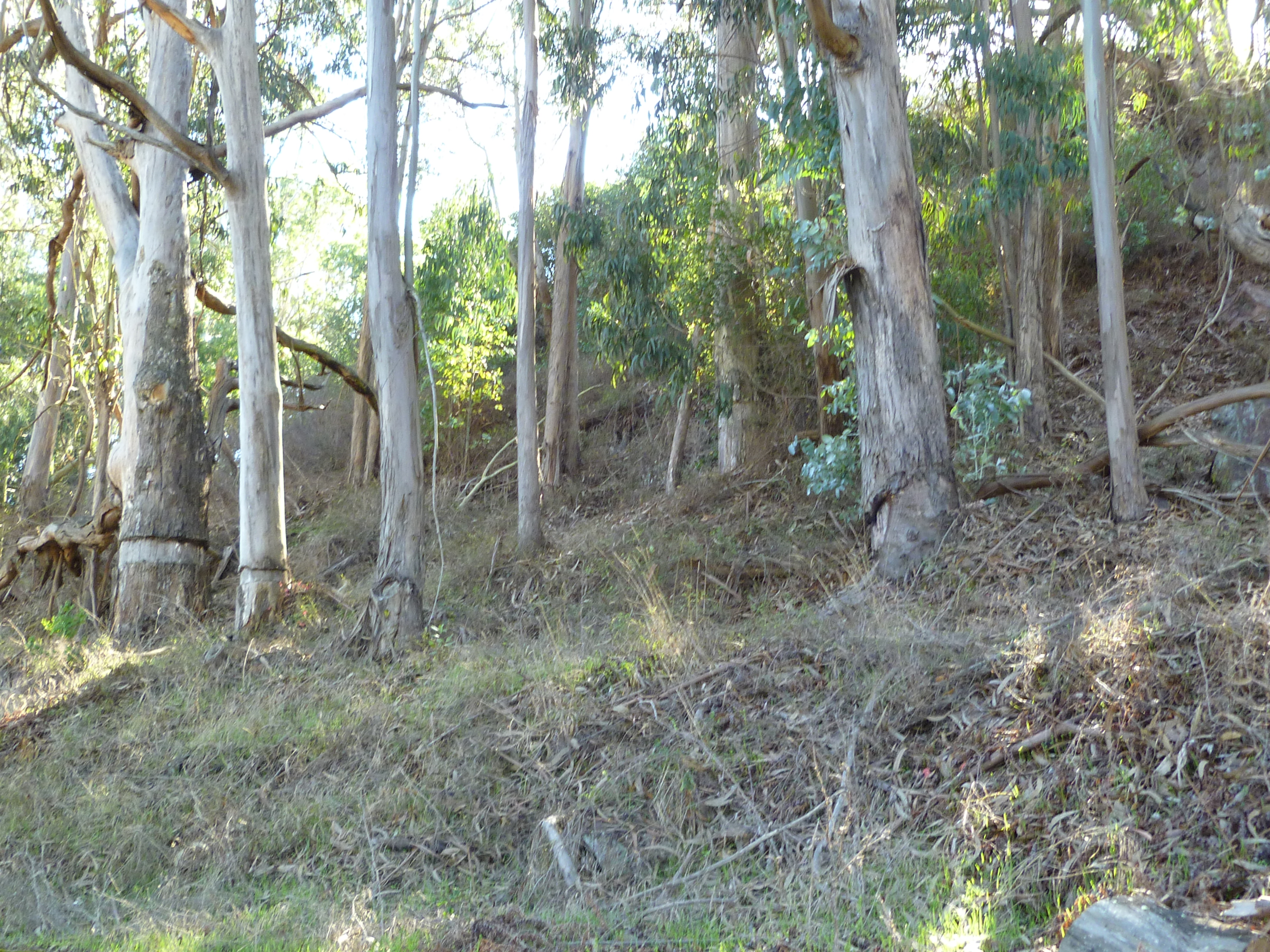
Native plant advocates then found a more surreptitious method of destroying the trees. They began girdling the trees in the public parks of San Francisco. Girdling is a method of killing a tree slowly. A band of bark is hacked off the circumference of the trunk with an axe or chainsaw. This prevents water and nutrients from traveling from the roots of the tree into the tree. The tree slowly starves to death. The bigger the tree, the longer it takes to die.
Girdled trees, Bayview Hill, San Francisco
After girdling the tree, native plant advocates stacked up vegetation around the scar so that it was not visible to the public. Even if the public noticed the scar, they didn’t know what it meant until the tree began to die. By the time the trees started to die several years after the girdling began, about 1,200 trees had been girdled in the parks of San Francisco. Most of them were on Bayview Hill, and many are still visible on Mount Davidson.
According to an article in The Independent, some of the girdling was done by city employees of the Natural Areas Program in the Recreation and Park Department, but much of it was done by native plant advocates, described as “volunteers” by their supporters and “vandals” by their critics. The Independent quotes the head of the urban forestry division of the Recreation and Park Department as saying that trees were also being killed by dousing them with pesticides.
There was a noisy outcry when the public figured out what they were doing. The native plant advocates paid a public relations price for their vandalism and they quit doing it. They are no less dedicated to destroying all of our eucalypts. Perhaps they have moved on to even more nefarious methods such as introducing deadly insects.
We wouldn’t be at all surprised. One of our more memorable debates with a prominent local nativist was about the plan of the Natural Areas Program to reintroduce a legally protected native turtle to a local park that is heavily forested with eucalypts. We knew that rare turtle requires unshaded nesting habitat within 500 feet of its water source. Providing that habitat to this legally protected turtle would have required the destruction of all the trees in that park.
When we objected to the reintroduction of that turtle, the nativist smirked and said, “You know nothing can stop us from putting that turtle in that park whenever we want. And the law provides the same legal protection to that turtle whether it is found there naturally or put there by man.”
Some of these people will stop at nothing. They are appropriately called eco-terrorists.
———————————————————————————
(1) Timothy Paine, et. al., “Accumulation of Pest Insects on Eucalyptus in California: Random Process or Smoking Gun,” Journal of Economic Entomology, 103(6): 1943-1949, 2010
(2) “San Francisco garden guerrillas axing alien plants in San Francisco,” Sacramento Bee, February 19, 1994. This article is not available free on-line. However, it can be purchased inexpensively from Sacramento Bee Archives.
The Ruth Bancroft Garden in Walnut Creek, California, is a 3-acre remnant of a 400-acre fruit farm started in the 1880s by Hubert Howe Bancroft. Bancroft is a familiar name in the Bay Area because Mr. Bancroft was also a famous historian and publisher who amassed a huge collection of documents about the American West. He donated that collection to University of California at Berkeley, which is the origin of the Bancroft Library there. The Bancroft Library is California’s greatest repository of California history.
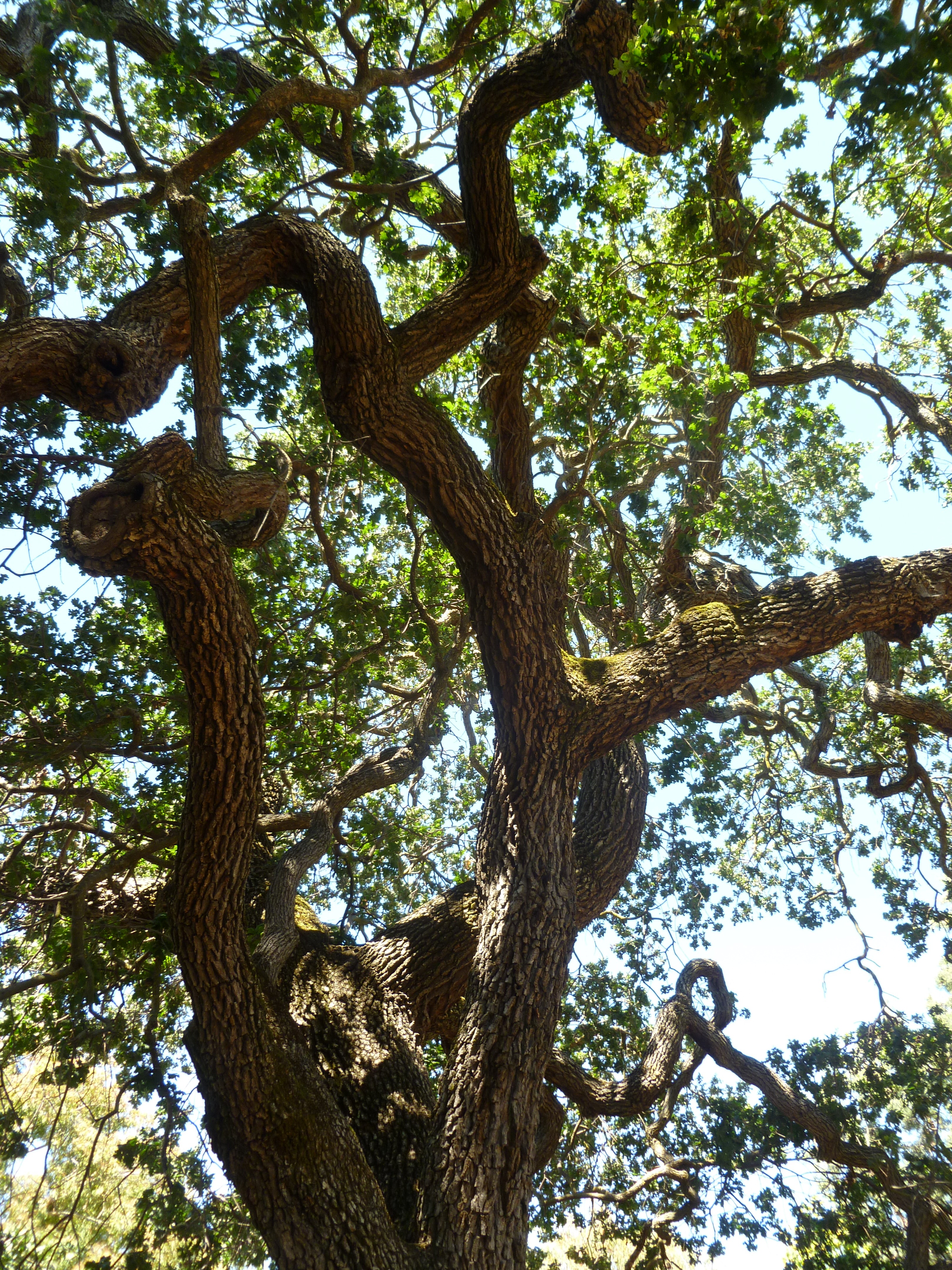
Valley Oak, Bancroft Garden
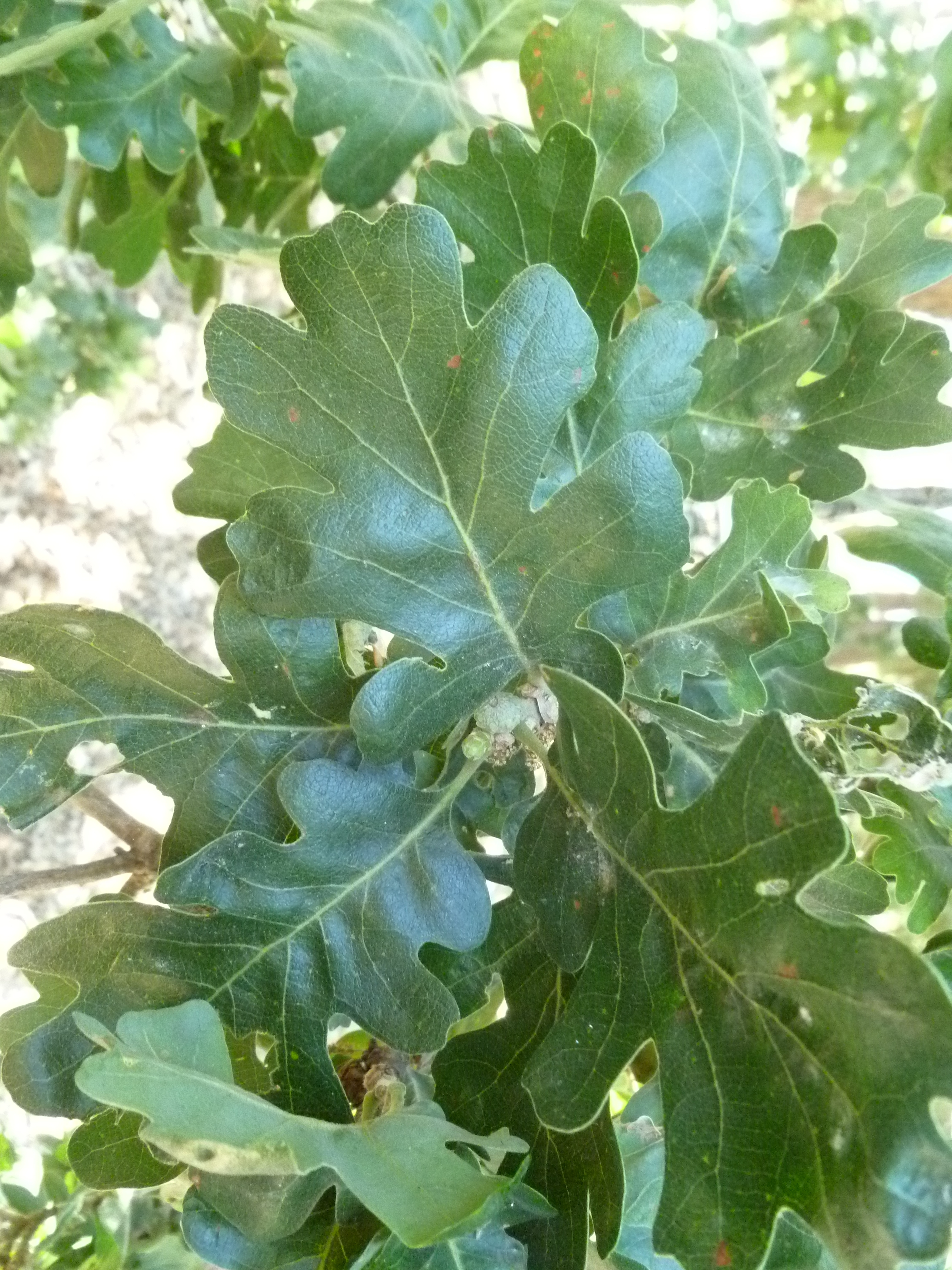
When Mr. Bancroft purchased his property, it was oak woodland. These were the venerable valley oaks (Quercus lobata), the largest oak in Northern California. Only one of these oaks remains in the garden. It is estimated to be 350 years old. Its contorted branches create an enormous tent of shade, reaching to the ground. There is not a more beautiful tree, in our opinion.
Quercus lobata, named for its deeply lobed leaves
Mr. Bancroft’s granddaughter-in-law, Ruth Bancroft started planting her garden in 1972. She had a life-long interest in cactus and succulents, so it wasn’t a good year to begin that venture. The hard freeze of the winter of 1972-73 killed many of the young plants which are not hardy in temperatures below freezing. Fortunately, such hard freezes are rare in the Bay Area and the garden has suffered significant losses only once since then, in winter 1990.
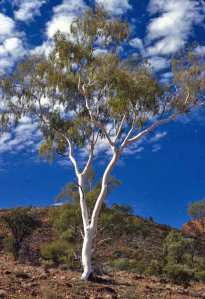
Ghost Gum. Courtesy Cynthia Clampitt, Waltzing Australia
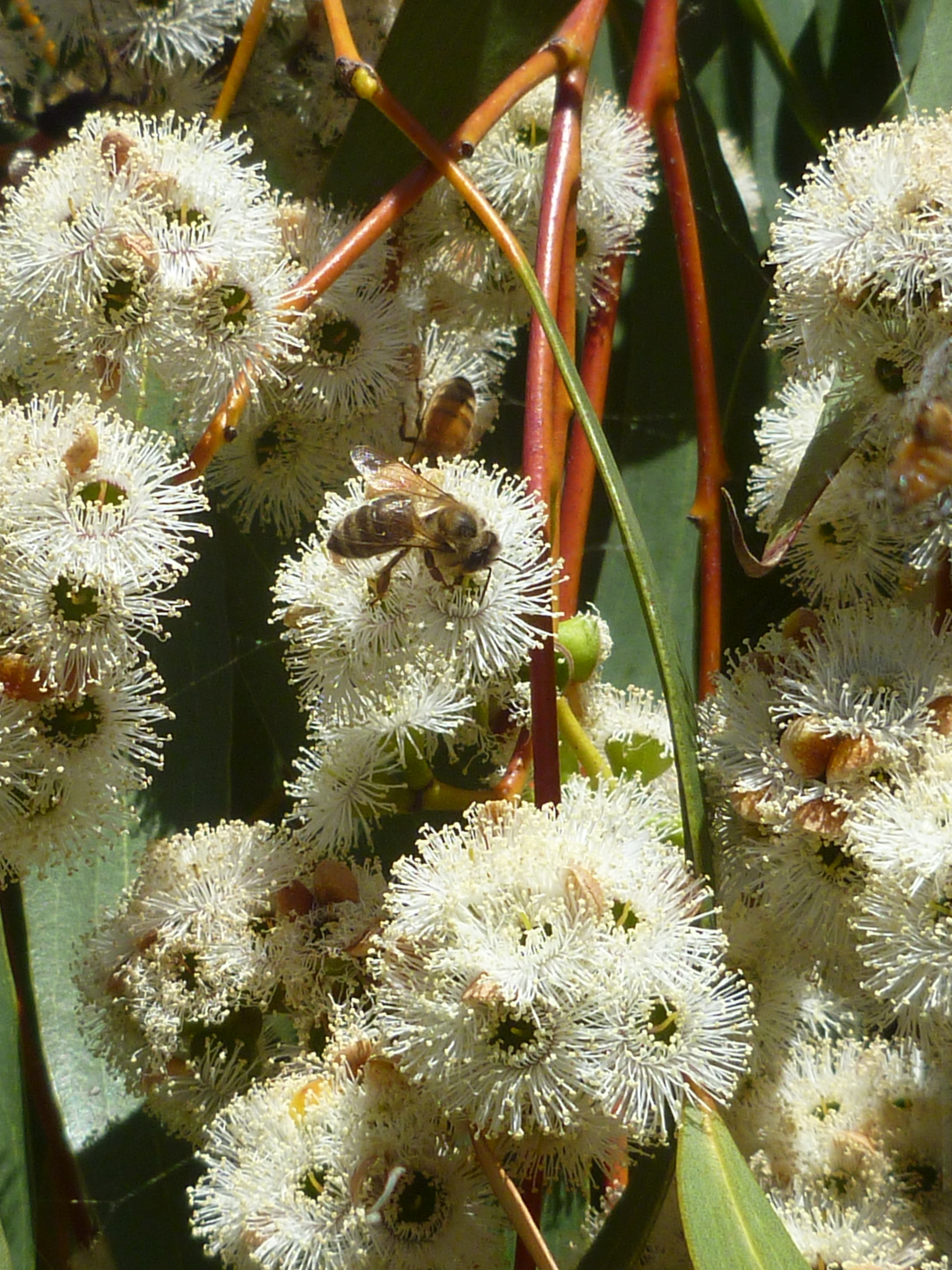
There are several eucalyptus trees in the garden, but one is a stand-out. The ghost gum (Eucalyptus pauciflora) is aptly named for its white bark. Coincidentally its ancestral home is the Snowy Mountains in Australia where it is often found standing in the snow. It is one of the few cold-tolerant species of eucalypts. Our opinions of eucalypts are heavily influenced by one particular species, the blue gum eucalyptus, because it is the predominant eucalypt in California. We often forget that there are actually 700 species of eucalyptus and therefore there are a wide variety of forms and horticultural characteristics. The ghost gum in the Bancroft Garden was flowering and swarming with bees collecting pollen and/or nectar. The flowers were close to the ground so we were able to confirm that the nectar was not at all sticky, as critics of eucalyptus often claim.
Flowers of Ghost Gum with visiting bee
Touring the garden, we were reminded of many of the themes of the Million Trees blog.
Planting species outside of their range is insurance
The plants in the Bancroft Garden are from all over the world, particularly similar climates such as Australia, South Africa, and Mediterranean countries. Many of the plants come from drier desert climates. Several of the plants in the garden are extinct or nearly so in their native ranges. They continue to exist in the world only because they were exported to new locations before they disappeared from their ancestral homes.
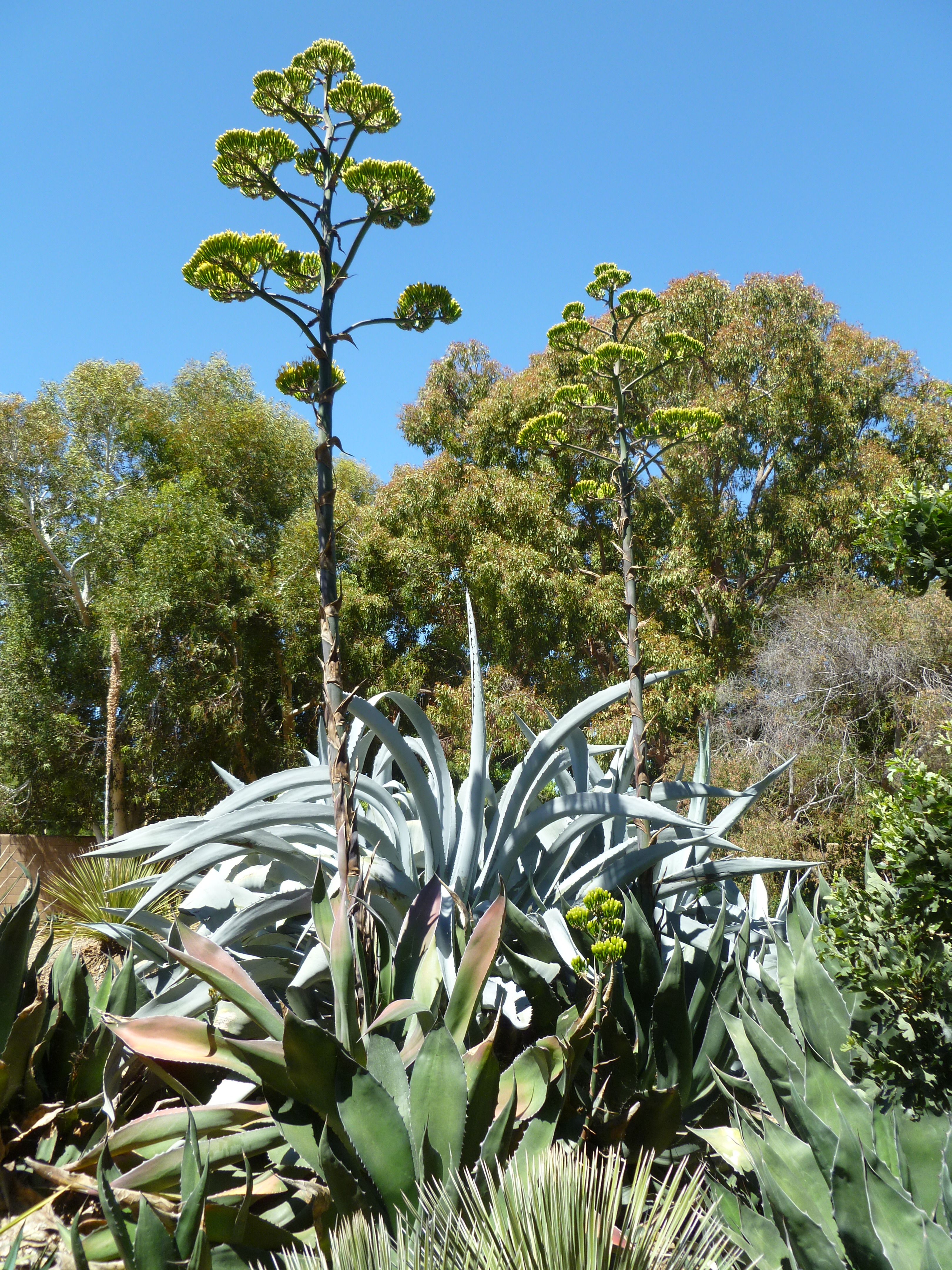
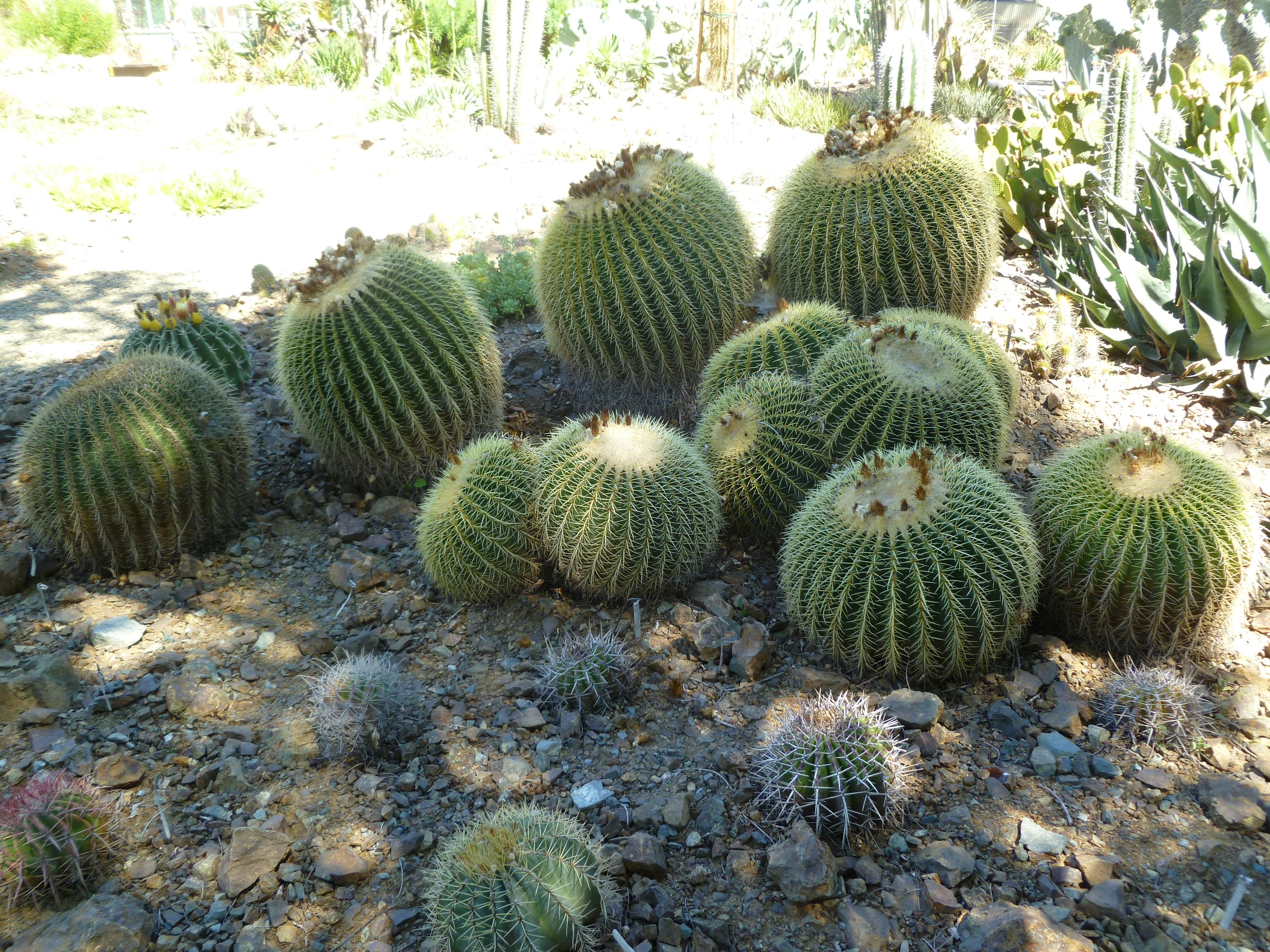
Agave franzosinii is no longer found in the wild in MexicoGolden Barrel cacti are endangered in the wild due to unscrupulous collectors and the flooding of their habitat by a hydroelectric project,
This is one of many reasons why we do not share the purist vision of the native plant movement, that only plants native to a particular location be allowed to exist in that location. In a changing climate, it is particularly important that plants and animals be allowed to remain where they have been introduced. Their new homes are insurance against their extinction from the Earth.
The characteristics that native and non-native plants have in common
Although most of the plants in the Bancroft Garden are not native to California, there is a section of the garden that is devoted to native plants. Ruth Bancroft had some difficulty establishing that portion of the garden: “When Ruth Bancroft decided to experiment with native California penstemons…many of her plants died. She added even more rock to the bed and planted again. In the improved drainage, that this rocky bed now provides, penstemons thrive alongside such other California native perennials as woolly blue curls and…buckwheats.”
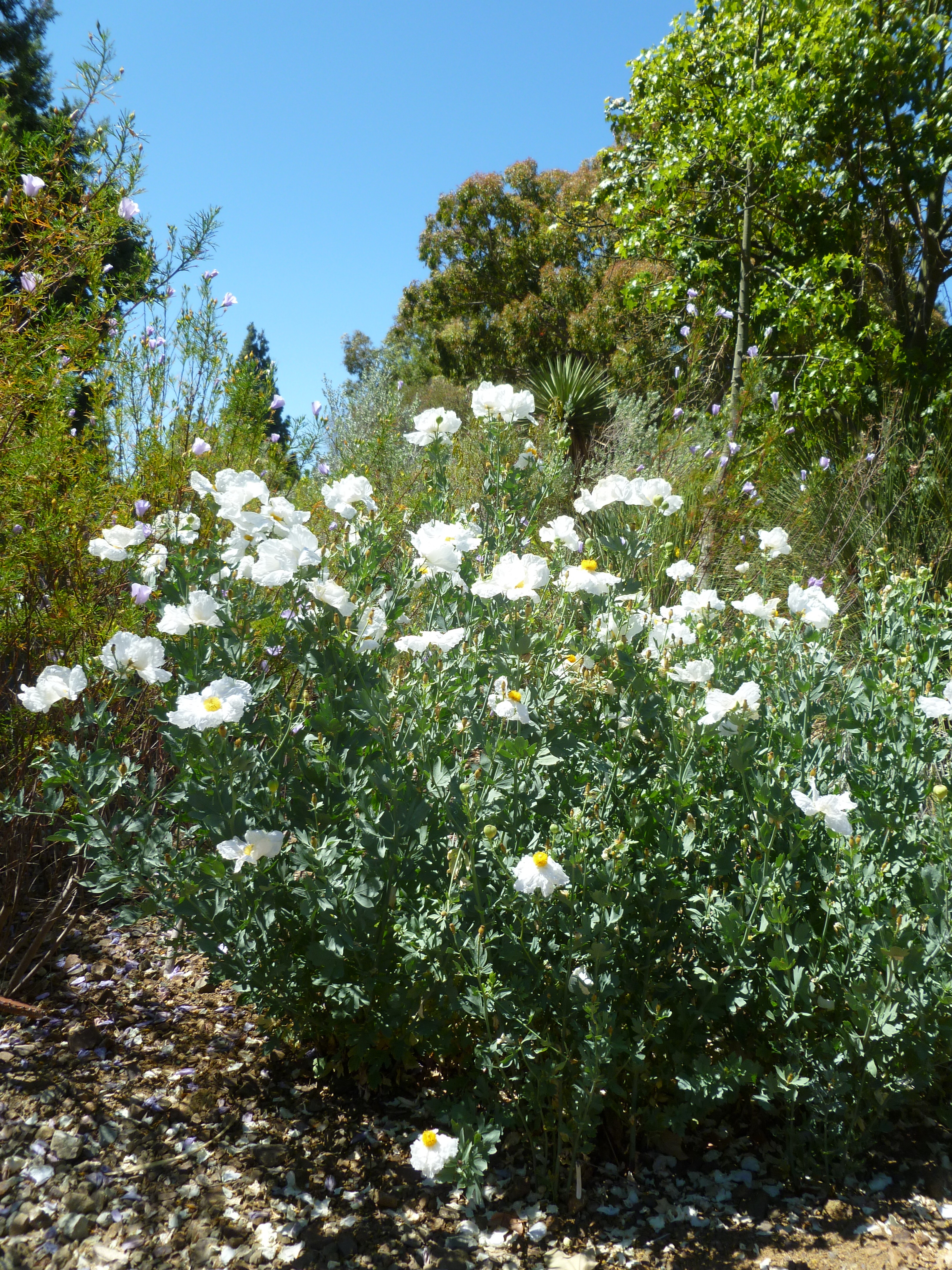
Mitilija poppy, Bancroft Garden
Matilija poppy (Romneya coultera), is another California native in the Bancroft garden, but one which must be watched closely because, “…its major problem is that it spreads underground and can be invasive.” This is a description often applied to non-native plants. However, when the author is a horticulturalist, rather than a nativist, it is sometimes applied to native plants as well.
There is also a native Manzanita in the garden which is a hybrid descendent of two unrelated Manzanita species which have long since disappeared from the garden. Hybrids of native plants are often eradicated by native plant advocates who want to freeze all native species into place. Hybridization represents change and abhorrence of change is a basic tenet of nativism. The existence of this hybrid in the Bancroft Garden is an example of why we are opposed to nativism in its purest form. The hybrid survives, but its two ancestors are gone. Aren’t we better off with this survivor in the Bancroft Garden than with no Manzanita at all?
The Bancroft Garden was an opportunity to revisit these themes of the Million Trees blog:
Native plants are as likely as non-native plants to require tending in the garden, such as soil amendments
Both native and non-native plants are sometimes invasive
Hybridization is another means of insuring the survival of plant genes
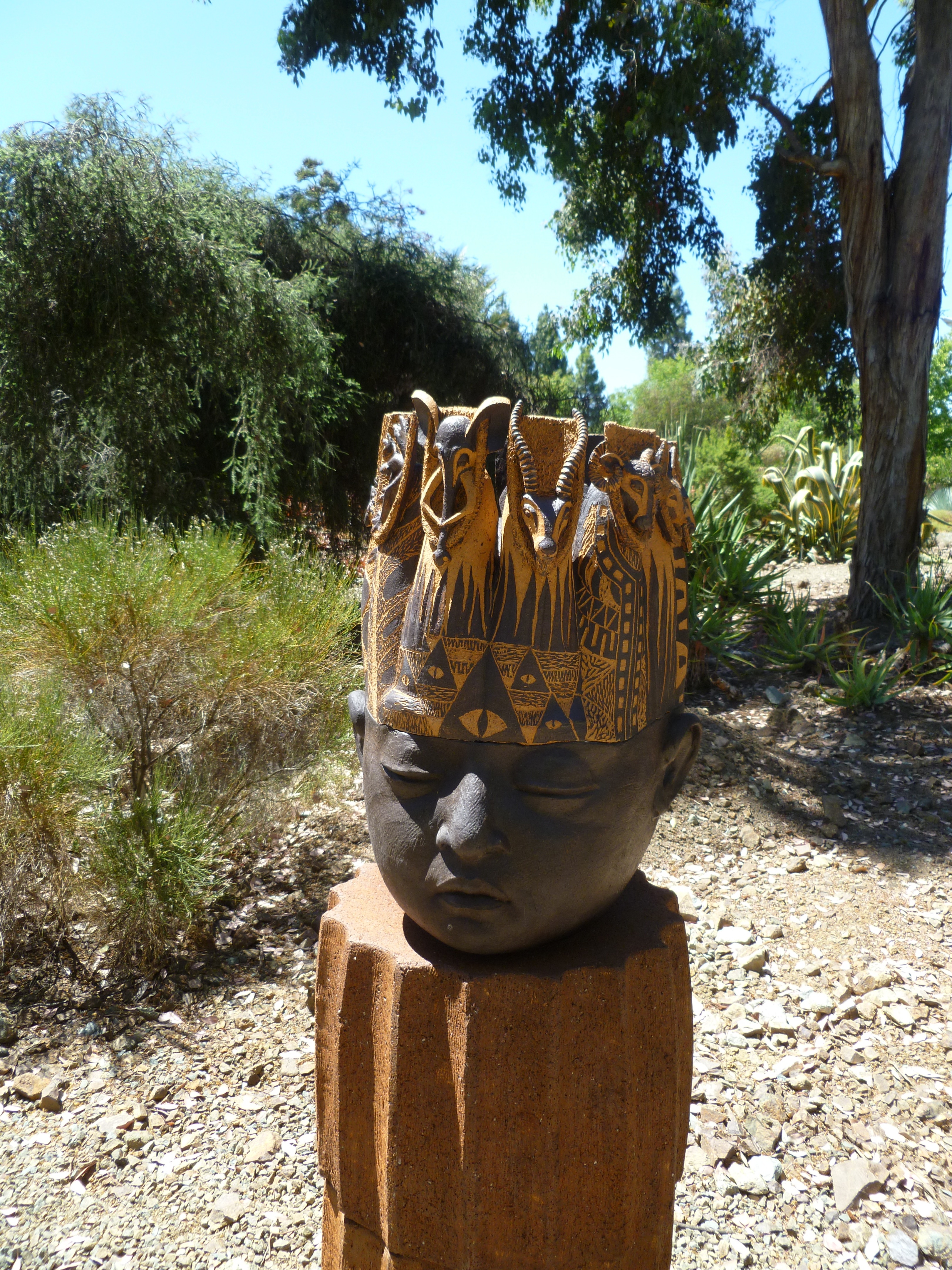
This is a particularly good time to visit the Bancroft Garden. There is an exhibit of sculpture by artists from all over the West Coast in the garden until July 14, 2012. It is an interesting and lovely garden which is rich in California history.
In 2003, when the great debate with native plant advocates about the future of San Francisco’s public parks reached a fever pitch, the California Academy of Sciences stepped into the fray by publishing this article in their quarterly publication, California Wild. This article was written by Gordy Slack, free lance science writer and former editor of California Wild.
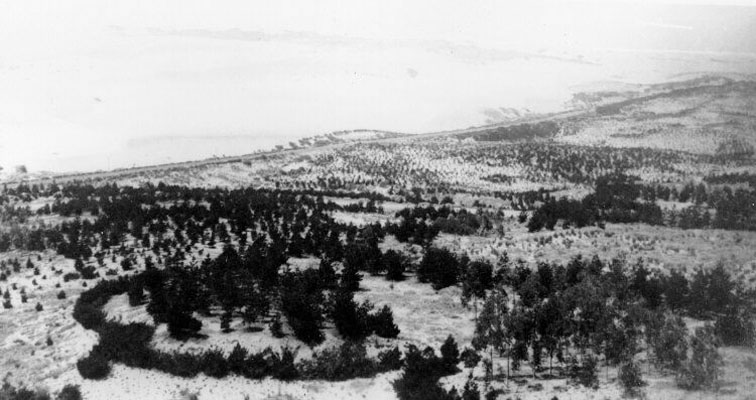
Golden Gate Park in 1880. The trees are about 10 years old. In the distance, looking south, we see the sand dunes of the Sunset District. That’s what most of Golden Gate Park looked like before the trees were planted.
As you will see, “Evolution in the Park” (1) urges the public to consider that the parks of San Francisco have been transformed over the past 150 years from predominantly barren sand dunes to green oases of non-native trees and plants. Using Golden Gate Park as an example, Mr. Slack reminds us that the non-native trees provided the windbreak needed to protect the entire landscape which we admire today. The park has changed and it will continue to change, because nature is dynamic. The forces of evolution are stronger than human desires to freeze-frame our world.
At the time, we were deeply grateful to Mr. Slack and to the Academy of Sciences for taking a position on the controversy. We remember thinking that the opinion of this prestigious institution would surely settle the controversy. But we were mistaken, because native plant advocates would not even read this article, let alone heed its message.
As the Environmental Impact Report for the Natural Areas Program undergoes revision and the controversy heats up again, we reprint “Evolution in the Park.” We can only hope that someday reason will prevail.
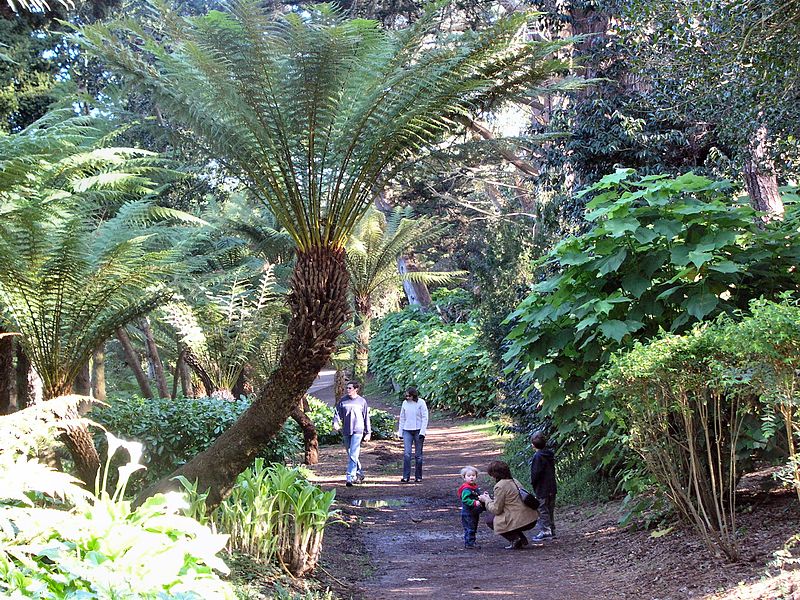
Tree ferns from New Zealand are one of many species of non-native trees that make Golden Gate Park the beautiful place it is today. Creative Commons
******************************
“When San Francisco officials asked the great nineteenth-century landscape architect Frederick Law Olmstead how to turn the wind-scoured dunes of the western half of the city into a green, rambling park, he was happy to offer advice: Don’t bother, he said, it’ll never work.
They went ahead anyhow, establishing three-mile-long, 1,107-acre Golden Gate Park on April 4, 1870. The decades that followed saw an almost unbelievable transformation under the strong hand of the park’s first superintendent, William Hammond Hall. He shaped glades and grew forests, dug lakes and planted lawns, until people nearly forgot that under the acres of grass and trees and shrubs lay mountains of sand.
The invention of Golden Gate Park was an amazing engineering and horticultural accomplishment, but it was not an environmental one—at least not in the sense of conserving native natural resources. If the California Native Plant Society (CNPS) had existed then, it would never have allowed Hall to spread tons of exotic barley seed over the dunes as part of his plan to “reclaim” them. The barley achieved what Hall wanted—to create favorable conditions for the thousands of alien trees and shrubs he would soon plant. And yet the CNPS now meets in Strybing Arboretum and botanists love the park. Everyone does. It would seem as silly to criticize the park’s blue gum trees for being out-of-towners as it would be to criticize most of us for being exotics. The park is as much an urban invention as the parking lot or the shopping mall, only much better. There is nothing wild about it…except what goes on there.
Nancy de Stefanis is the Director of San Francisco Nature Education, a group that leads nature studies in Golden Gate Park. She is perhaps best known for her discovery in 1993 that great blue herons were nesting in the park’s Stow Lake, and for her efforts to protect those nests from raccoons and other threats (California Wild, Summer 2002). A few days ago, on an early morning walk in the park, she saw a great blue plucking endangered red-legged frogs out of a pond. She saw feral cats, gray squirrels, and a three-foot-long box turtle. All this, and she had intended to look for birds! She saw those, too: an albino robin, varied thrushes, ravens, white- and gold-crowned sparrows, and a courting pair of red-tail hawks doing loopty-loops and dives. She saw a bevy of seven California quail running through Strybing Arboretum, the only population of quail left in the park. “It was incredible,” she said. “We saw 25 bird species easy.”
Anyone who’s spent much time in Golden Gate Park has wild stories to tell. My own favorite took place a few years ago, after I’d pulled an all-nighter at the magazine and was tired enough to sleep dangling off of Half Dome. Half Dome was too far away, so I walked a few hundred yards east on Middle Drive and up a tiny path back to Lily Pond. I walked the perimeter looking for a place to sleep. The pond had steep vegetated banks all around except for a small, reasonably sloped patch of dirt on the east side. I kicked away some guano, put a newspaper under my head, and fell asleep.
I woke up half an hour later; something soft was tickling my arm. I raised my head slowly to find myself surrounded by mallards. There must have been 20 and they filled every inch of the dirt patch around me. One nestled comfortably between my outstretched arm and my torso.
Each duck had its head swiveled and tucked into the feathers on its back. When I lifted my own head, the birds next to me raised and turned theirs as well, and a couple of them stirred, causing a chain reaction of awakenings in the ultimate morning-after surprise. No one lost his or her cool, though. I tiptoed out of their realm and headed back to work, downy feathers clinging to my sweater and my hair. That was how I became the Man Who Sleeps with Ducks.
Raymond Bandar, a field associate in the Academy’s Department of Ornithology and Mammalogy, grew up in Golden Gate Park and has a thousand wild stories to tell. He says that in the 1940s, when he was a boy, it was a “biologist’s paradise.” He spent long summer days hunting for garter snakes, alligator and fence lizards, bush rabbits, Pacific pond turtles, weasels, and red-legged frogs. Peacocks roamed free in the park, and there Bandar courted his wife, Alkmene. They took long, moonlit walks from the beach to the park’s entrance on Stanyan, stopping to spoon in the Valley of the Moon.
Most old-timers like Bandar long for the good old days, when the park was “less manicured.” It’s hard to tell if this is because the park used to be wilder, or because the old-timers were. But there’s no doubt that the park refuses to cooperate by holding still. As Heracleitus said, “You can’t step into the same river twice.” (Or as Cratylus, Heracleitus’s follower, trumped, ‘You can’t step into the same river once.’)
The park’s “ecosystems” are a moving target, changing with park administrations and larger cycles of growth and death. In recent years, the Parks Department has cleared away much of the undergrowth that had been protecting ground-nesting birds—and homeless humans. Other forces originate outside the park but have an influence by increasing, diminishing, or eliminating the animals that live within. If there are no peregrines anywhere else in California, there aren’t going to be any in Golden Gate Park either.
Late Academy ornithologist Luis Baptista used to talk about the 1980s in the park. California quail were common then, running here and there on urgent business. Native bush rabbits lived here, too. The rabbits are now gone and the quail nearly so. I’ve heard speculation that the rabbit population may have collapsed partly under predation by humans, too. But both are most likely victims of the park’s shifting food web.
Raptors returned when their populations rebounded from the DDT poisoning that largely ended four decades ago. Recently, red-tailed, red-shouldered, and Cooper’s hawks have moved in, according to Douglas Bell, a biology professor at California State University in Sacramento. The park is now “probably a sink for white-crowns” he says. “It draws them in, but because of the intense predation, their survivorship is very low.” But even bigger players in the songbird and quail equation are the park’s resident feral cats. According to Baptista and Bell, white-crowned sparrow deaths in the park are probably due mostly to cats.
In addition to feral cats and other predators, floral changes affect park wildlife as well. Many of the Park’s trees are reaching climax now, says Peter Dallman, who is writing a natural history guide to Strybing Arboretum. The big trees are falling or are being cut down in anticipation of their natural collapse. The pygmy nuthatch, a bird that nests in the park’s climax Monterey pine forest, will likely flee the park when those trees come down.
Today, raccoons are plentiful. So are ravens, though Bell remembers that not long ago no ravens nested here. Exotic cowbirds have arrived, too; they lay their eggs in the nests of other birds, which then raise ravenous cowbird chicks, often at the expense of their own young. Squirrels are multiplying out of control, says Dallman.
Cat populations are strong, but not as strong as their political lobby. The bison herd, introduced to the park in 1894, remains stable at eleven. But the reintroduced grizzly bears (Bandar remembers when there were at least two sad grizzlies in cages in the park’s southeast corner) are long gone. The last Golden Gate grizzly, Monarch, is now stuffed and on exhibit in the Academy’s Wild California Hall.
These changes and conflicts raise some uncomfortable questions about the park and its mission. By what standard can the costs or benefits of these changes be measured? Should we be trying to restore Golden Gate Park systems and populations that are at bottom artificial? Should we simply maintain the species we prefer, and get rid of, or let slip away, the unpopular ones? Should “maximum diversity” be the goal, and mandate mediations of conflicts that arise between incompatible species, such as cat and quail?
To maintain quail in the park for the long term, for instance, would require “intensive and sustained human intervention,” says Bell. “We’d have to rely on the full range of wildlife management techniques.” Predation would have to be monitored and protective habitat cultivated. New quail stocks would have to be introduced, and electrically charged wire cages (through which the quail could fit, but not cats or ravens or raptors) could be built around nesting areas. But without heroic and constant human support, the quails’ days in the park are numbered.
Like its creation, the park’s future will be shaped by human invention, its progression determined by our priorities.”
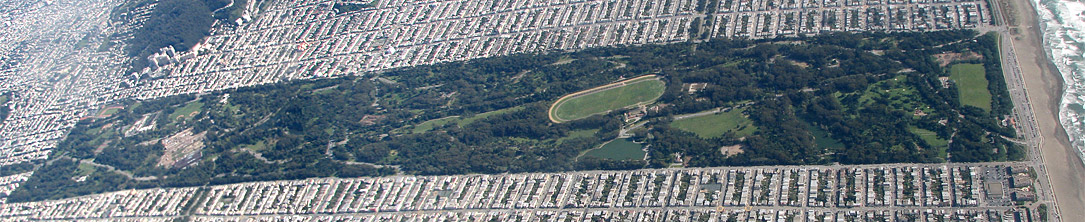
Golden Gate Park, aerial view. Gnu Free Documentation
(1) Gordy Slack, “Evolution in the Park,” California Wild, Spring 2003 [reprinted with permission of author]
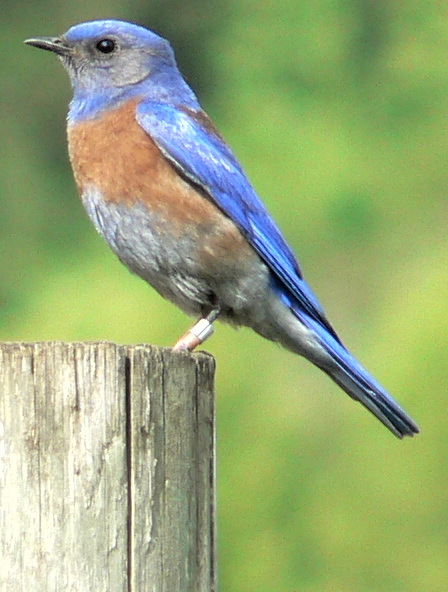
The community of serious birders is very excited about the Western Bluebirds that are raising their chicks in Golden Gate Park: “This afternoon, I went to check up on the Western Bluebirds nesting near the Bison Paddock [in Golden Gate Park]. I’m thrilled to report that I saw two youngsters poking their heads out of the nest hole, and both parents assiduously feeding.” (1) According to the San Francisco Breeding Bird Atlas, Western Biuebirds have not been reported breeding in San Francisco since 1936! (2)
However, the birding community is less thrilled about where the Bluebirds chose to build their nest: in a cavity in a eucalyptus tree created by a woodpecker that had nested there previously. Adding insult to injury, this particular eucalyptus tree is also adjacent to the off-leash dog play area in Golden Gate Park: “The nest is in an old woodpecker hole in a big eucalyptus that overhangs the dog run at the back of the paddock.” (1)
The nesting Bluebirds have violated two sacred tenets of the local birding community, i.e., that birds don’t use non-native plants and trees and that birds are harmed by dogs.
Do our birds use non-native plants and trees?
We are often impressed by the efforts of native plant advocates to convince us that birds don’t use non-native plants and trees. There seems to be no end to the inventive arguments they use to convince us our belief in the value of non-native plants is misguided. We recently had an on-line dialogue with a native plant advocate who responded to our citation of a study that reported equal numbers of species of plants and animals in the understory of eucalyptus forest and oak woodlands by saying that the animals found in the eucalyptus forest were “on their way to the oak woodland.”
One of the most famous birders in San Francisco led a walk on Mt. Davidson last weekend that was sponsored by the local chapter of the California Native Plant Society. When this walk was announced to the public, the birder promised to “discuss how birds preferentially use native plant communities over introduced plants.” Since Mt. Davidson is heavily forested exclusively with non-native trees (eucalyptus, Monterey pine and cypress), we wondered how he was going to successfully make that point. He didn’t. These are the birds he reported seeing on Mt. Davidson during that walk and the San Francisco Breeding Bird Atlas tells us where these birds are found:
Band-Tailed Pigeon “…inhabits oak woodlands and coniferous forests”
Olive-sided Flycatcher “…prefers wooded canyons”
Western Wood- Pewee “…found in a variety of woodland and forest habitats”
Swainson’s Thrush “…prefers well-shaded moist canyons and humid, dense forest”
In other words, he set out to prove that the birds on Mt. Davidson prefer native plants, but all the birds he reports having seen are there because of the non-native forest. He makes no mention of this in his report of what he has seen. He apparently walks away from this experience with his beliefs unshaken by reality.
Are birds harmed by dogs?
Native plant advocates claim that dogs are extremely damaging to the environment. That they harm birds is only one of many accusations. Here’s a typical quote about dogs from a reader of Jake Sigg’s Nature News: “Considering the hugely negative environmental impact that dogs cause (holes dug, plants torn up, dog poop everywhere, dogs running into playgrounds, dog foods made from huge numbers of ocean fish) I feel that if dog owners wish to speak on matters related to dogs they should first license their dogs to support the fix-up of the damage caused by dogs in our City parks & streets.”
When a dog owner walked away from a Park Ranger after a confrontation about his off-leash dog, the ranger shot him in the back with a taser. Since this incident occurred in a place where off-leash recreation had been permitted as recently as one-month before, many people believed the Ranger’s action was a bit extreme. Not so in the community of native plant advocates. Here’s a quote from a regular reader of Jake Sigg’s Nature News: “All hail the ranger with the Taser! Finally, a national park employee doing her job…We should build a bronze statue of this ranger. I hope that one electrical shock makes all dog owners think.”
Yes, indeed. It does make us think. It makes us think that there is a great deal of conflict in our public parks and that much of it seems to be on behalf of the animals who can’t speak for themselves. What would the Western Bluebirds nesting in a eucalyptus tree next to an off-leash dog run tell us? Might they advise us to “Chill! We can take care of ourselves. You need not fight amongst yourselves on our behalf. We will find a suitable home. We don’t care if a tree is native or non-native if it provides the shelter we need. Nesting near the dogs hasn’t harmed us or our chicks.”
We wish the birds could speak for themselves.
**************************************
(1) SF Birds email list by subscription only
(2) “San Francisco Breeding Bird Atlas,” San Francisco Field Ornithologists, June 2003.
“When in your war against a city you have to besiege it a long time in order to capture it, do not destroy its trees, wielding an ax against them. You may eat of them but you must not cut them down. Are trees of the field human to withdraw before you into the besieged city? Only trees that you know do not yield food may be destroyed…”
This admonition is expanded by modern Jewish thought to encompass man’s responsibility to protect all of nature from harm. The tree is a universal symbol of all nature.
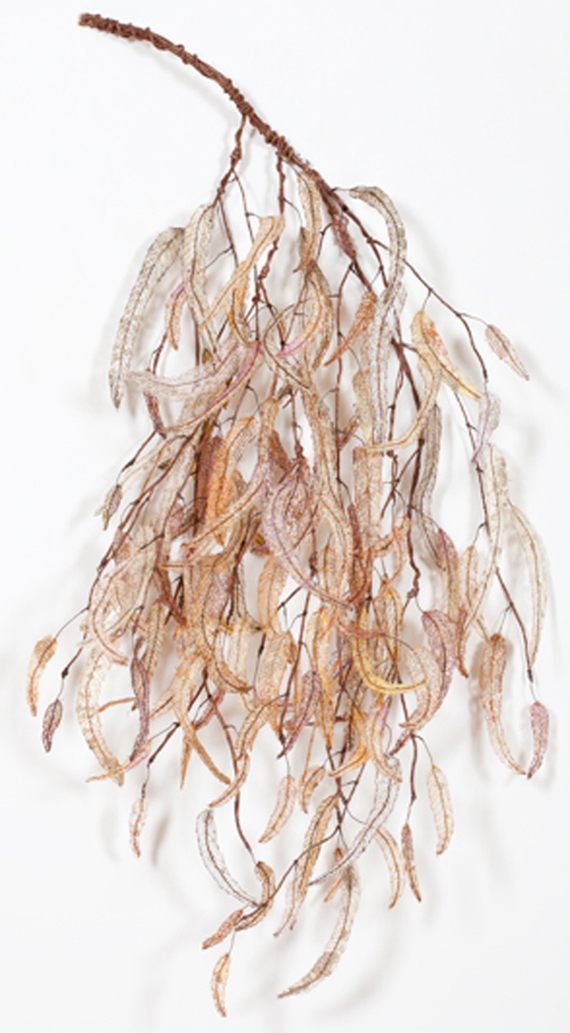
The Jewish Museum invited over 50 international artists to create original works of art inspired by the Jewish holiday which honors trees, Tu B’Shevat. One of these works of art was awarded first prize by a public popularity contest.
“Fauxliage: No Birds Sing” by Lisa Kokin. with permission. Photograph by Lia Roozendaal
At first glance, the viewer sees a branch of a eucalyptus tree with its graceful sickle-shaped leaves in a skeletal state, seemingly long-since dead.
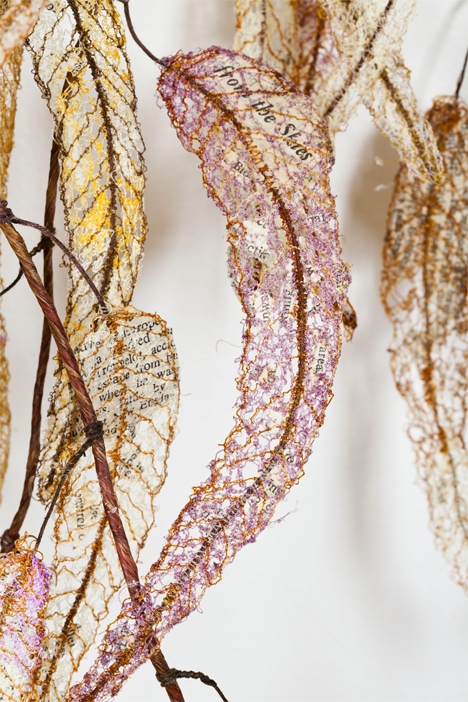
We must look more closely to appreciate the symbolic message of this evocative piece. The leaves are in fact made of the pages of Rachel Carson’s Silent Spring.Silent Spring was published in 1962, so we are celebrating the 50th anniversary of the publication of this ground-breaking book. The pages have been shredded and wired together with thread and wire to create the delicate skeletal frame of each leaf.
“Foliage: No Birds Sing” Detail with permission. Photo by Lia Roozendaal
The poetic justice of this piece took our breath away. Silent Spring forever changed the public’s perception of the pesticides that were used in the environment at that time. Rachel Carson informed us that these pesticides—particularly DDT—were killing our birds, silencing our springs when birds should be singing as they claim their nesting territories and attract their mates. Although DDT was banned long ago, and many birds have recovered from the damage it caused, new pesticides have been developed and are being used to kill eucalyptus and many other non-native plants and trees.
We have no way of knowing the artist’s intention in creating this work of art, but we commend her for celebrating the beauty of the eucalyptus and for the deeply ironic reference to the pesticides being used to kill them. The public’s vote for first prize for this beautiful piece is evidence that there are many fans of the much-maligned eucalyptus.
[Edited to add: We have received this comment from the artist, Lisa Kokin: “The only thing that struck me was the sentence that begins, ‘We have no way of knowing the artist’s intention…’ It seems a bit paradoxical, given that you do understand why I chose Silent Spring to embed in the piece. It is my concern about the environment and its destruction by corporate greed that motivated me to use Carson’s book and create a piece that speaks of that destruction in a poetic, rather than didactic, way.”]
We urge all lovers of trees to visit this exhibit which will continue until September 9, 2012. And we ask native plant advocates to consider the commandment of the Torah and the Old Testament: Do Not Destroy our Trees!
The “Recovery Action Plan for the Mission Blue Butterfly at Twin Peaks Natural Area” acknowledges the difficulty of this undertaking. It cites a study of 226 attempts to reintroduce butterflies where they have been extirpated (locally extinct). These attempts lasted an average of 15 years. Only 29 of the attempts were ultimately successful. So what are the odds of success on Twin Peaks?
Identified obstacles to success
The federal Endangered Species Act requires that a recovery plan be written for each endangered species. These recovery plans are a valuable source of information about each endangered species, the factors that resulted in their endangered status, and the plans to promote the recovery of the population. From the recovery plan for the Mission Blue, we learn of several issues that make its reintroduction problematic at best:
The Mission Blue is dependent upon just 3 species of lupine for its development. Two of these exist on Twin Peaks, but the predominant species is infected with a fungal pathogen which flares up during warmer, wetter weather. The small population of Mission Blues on Twin Peaks crashed in 1998 when the fungal pathogen killed many of the lupines.
The lupine is crowded out by scrub species if natural disturbances such as fire do not prevent natural succession from grassland to scrub such as native coyote brush.
Non-native species of plants are also competitors of the native lupines and their growth is encouraged by higher levels of nitrogen in the soil found in urban environments as a result of the burning of fossil fuels.
The Natural Areas Program cannot control these factors:
There is no known cure for the fungal pathogen that is killing lupine. In wetter years, it is likely to kill some of the lupine on Twin Peaks again, as it has in the past.
The Draft Environmental Impact Report for the Natural Areas Programs says that prescribed burns will not be conducted in the “natural areas.” Prescribed burns are conducted by the State parks department periodically on San Bruno Mountain, where a viable population of Mission Blue butterflies exists. This method of preventing natural succession to scrub in order to maintain a population of the butterfly’s host plant will not be an option on Twin Peaks.
We should probably assume that existing automobile traffic in San Francisco will continue to contribute to nitrogen in the soil for the foreseeable future. Higher levels of nitrogen will promote the growth of the non-native vegetation that competes with the native lupine upon which the Mission Blue depends.
Unidentified obstacles to success
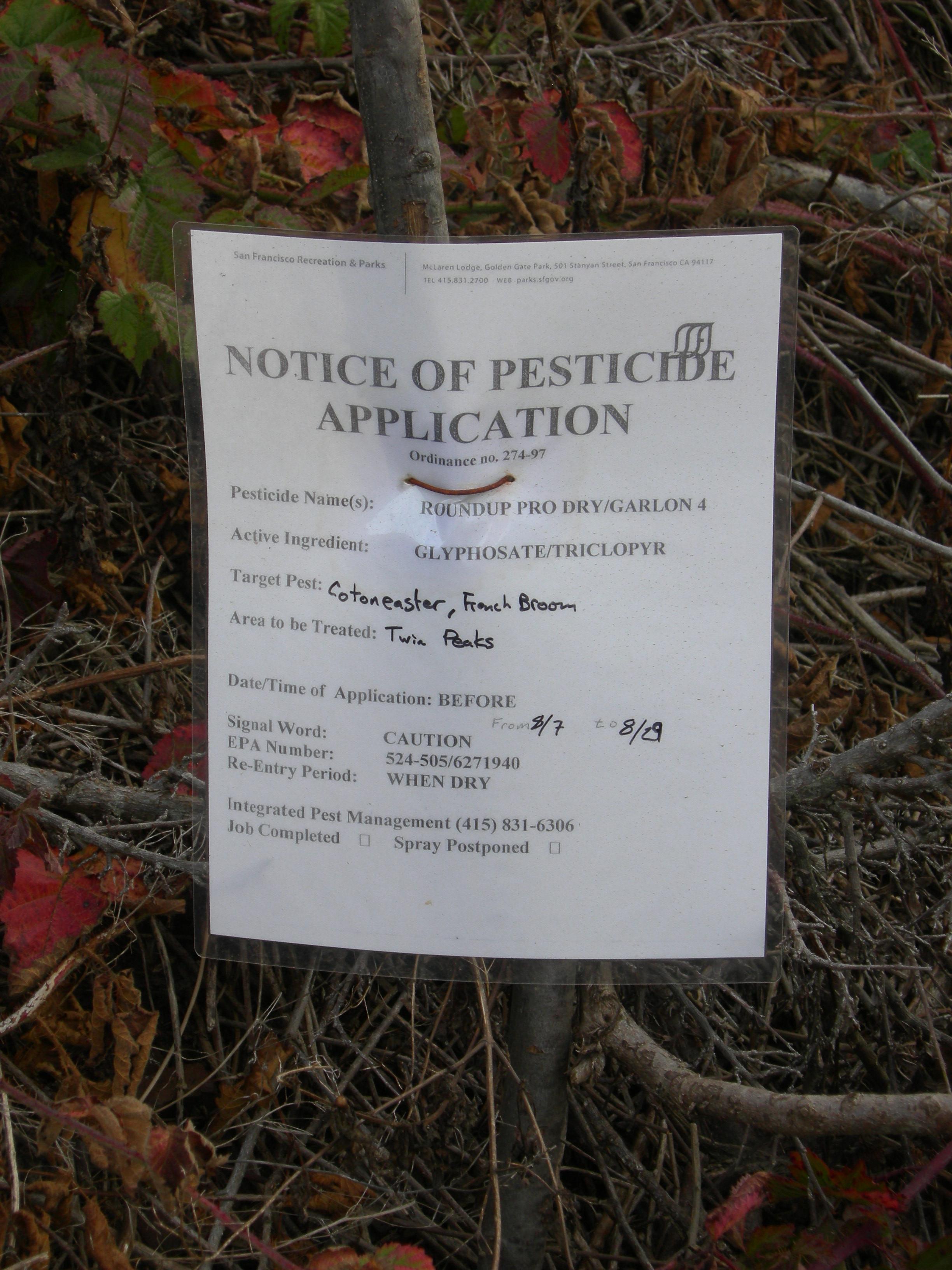
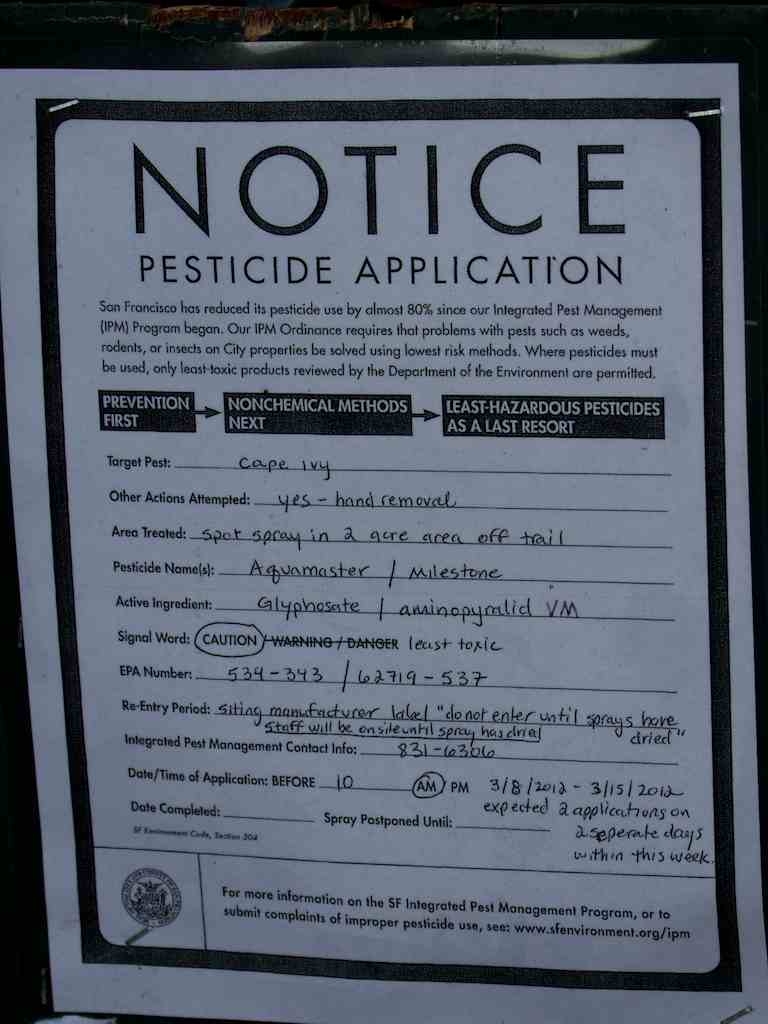
Pesticide Application Notice, Twin Peaks
In addition to the issues that have been identified by federal and local recovery plans, the Natural Areas Program has introduced a new threat to the Mission Blue. Herbicides are being used on Twin Peaks to control non-native vegetation. Twin Peaks was sprayed with herbicides 16 times in 2010 and 19 times in 2011. Are these herbicides a factor in the limited reproductive success of the Mission Blues that have been reintroduced to Twin Peaks?
A recently published study reports that the reproductive success of the Behr’s metalmark butterfly was significantly reduced (24-36%) by herbicides used to control non-native vegetation. Two of those pesticides are used on Twin Peaks, imazapyr and triclopyr. Triclopyr was used most often on Twin Peaks in 2010 and imazapyr in 2011.
The study does not explain how this harm occurs. It observes that the three herbicides that were studied work in different ways. It therefore speculates that the harm to the butterfly larva may be from the inactive ingredients of the pesticides which they have in common, or that the harm comes to the larva from the plant which is altered in some way by the herbicide application. Either theory is potentially applicable to the herbicides used on Twin Peaks and consequently harmful to the Mission Blue.
Native plant advocates would like us to believe that the herbicides used to eradicate non-native plants are not harmful to animals, including humans. In fact, they don’t know that. The truth is that no one knows if herbicides are harmful to animals because there is almost no research that would answer this question. The tests required by law by the Environmental Protection Agency to put new chemicals on the market are very limited. The honeybee is the only insect on which the EPA is required to test chemicals before they are put on the market. No tests are required for butterflies or any other insect.
US Fish & Wildlife funded the research on the Behr’s metalmark butterfly which suggests that herbicides are harmful to butterflies. US Fish & Wildlife is also the co-sponsor and co-funder of the reintroduction of the Mission Blue butterfly on Twin Peaks. Will US Fish & Wildlife advise the Natural Areas Program that herbicide use on Twin Peaks should be stopped?
In a more perfect world we would have the wisdom to stop using pesticides until we had some scientific evidence that they are not harmful to us and the animals with which we share the planet.
It’s spring. Have you noticed that the birds are singing? This is the time of year when they are most vocal. They are staking out their nesting sites and attracting their mates with their songs. They are quieter when they have laid their eggs as they try to avoid detection. Migratory birds are also passing through, on their way to their breeding homes. The food they find along the way is important to their survival on their long and physically challenging journeys from their winter to their summer homes.
Subscribers to Wildcare recently received an email newsletter reminding them that pruning trees and shrubs at this time of year is dangerous for the birds that are hiding their nests in them. Wildcare is a local organization which treats sick or injured animals and educates the public about “how to live peacefully with wildlife.”
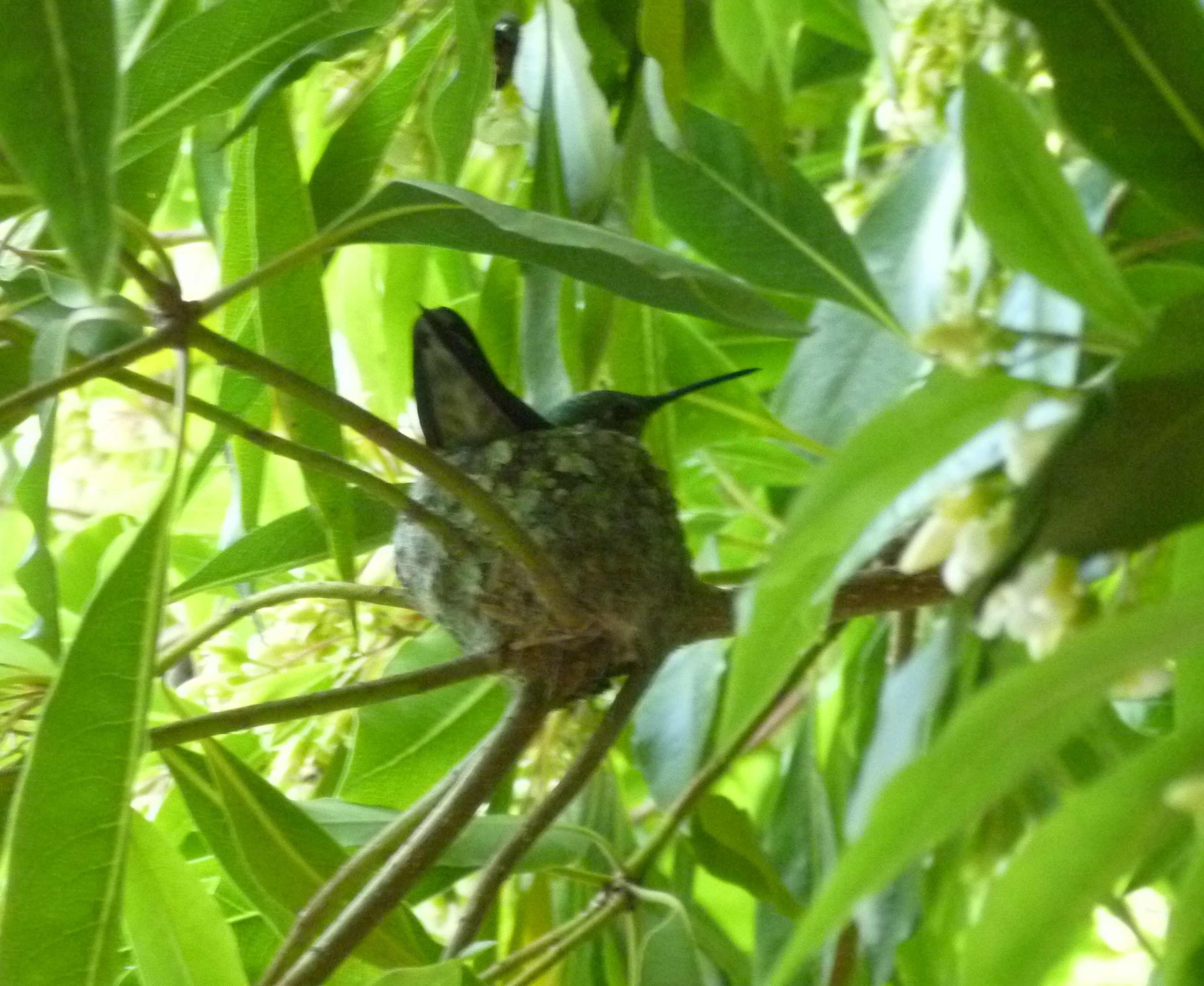
Hummingbird nest in Pittosporum, March 2012
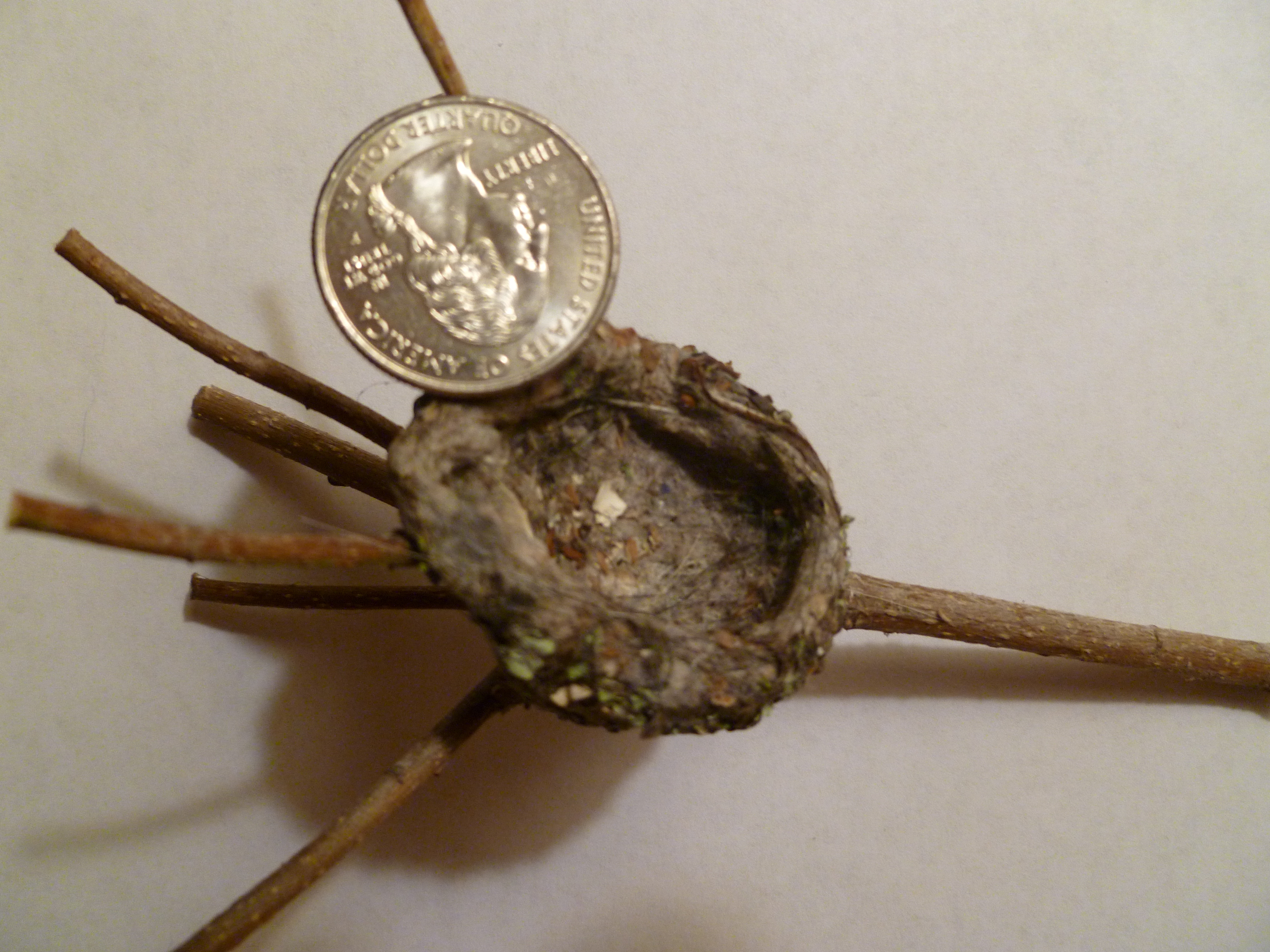
We were recently reminded of the vulnerability of birds at this time of year in our own yard when a hummingbird selected our flowering, non-native Victorian Box tree (Pittosporum undulatum) to build her nest. Her nest was completely invisible to us, but we spotted her darting in and out of it as she built her nest. We were able to take this picture of her sitting on her nest by crawling into the understory of the tree.
Hummingbird nest is not much bigger than a quarter!
Then disaster struck. An early spring storm tore a huge branch from the tree and sent her nest tumbling to the ground. We watched with heavy hearts while the hummingbird made anxious, noisy flights into the fallen branch. When she gave up, we carefully lifted the fallen branch to find her tiny, empty nest. As sad as this event was in our lives and hers, at least we knew that the failure of her nest was no fault of ours. San Francisco’s Natural Areas Program cannot say the same of their destructive project in Glen Canyon Park.
The Natural Areas Program violates their Streambed Alteration Permit
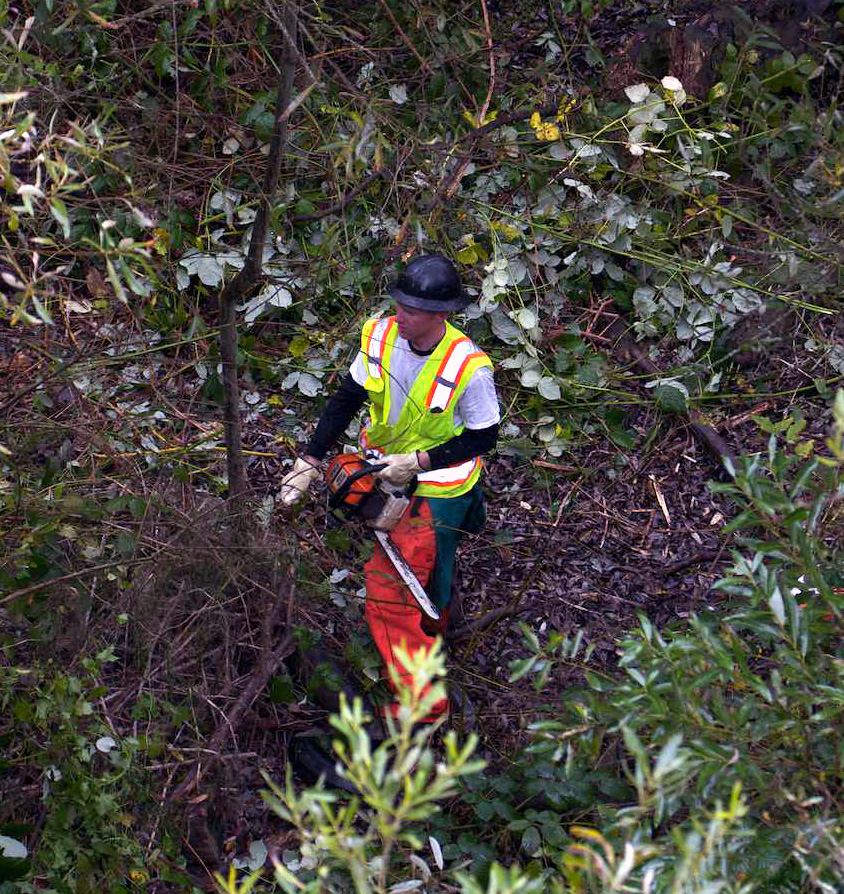
Destroying vegetation with chainsaws in Glen Canyon Park, November 2011
The Natural Areas Program began to destroy the non-native vegetation in Glen Canyon Park in San Francisco in November 2011. In addition to destroying valuable habitat with chainsaws, they also sprayed herbicides. The San Francisco Forest Alliance (SFFA) protested this destructive project many times but it has continued unabated to as recently as April 27, 2012, when they pruned trees and sprayed herbicides.
Earlier in April, SFFA learned from a public records request that this project violated a legal commitment to the California Department of Fish & Game. The Natural Areas Program made the following commitment to mitigate harm to wildlife in Glen Canyon Park in its Streambed Alteration Permit:
“It is the policy of RPD’s Natural Areas Program that no new projects will begin during the breeding season (December to May). Follow up work in previously cleared areas may be done during the breeding season, however, because areas will have been cleared previously. Wildlife will not likely be using these areas for breeding. This protocol has been effective in reducing impacts to breeding wildlife.”
SFFA brought this violation of its commitment to the attention of the General Manager of the Recreation and Park Department immediately. The head of the Natural Areas Program said that the violation was necessary because the grant funding for the project was about to expire. To avoid losing the funding for the project, the birds and animals of Glen Canyon Park were subjected to this destructive project during their breeding and nesting season.
SFFA has brought this violation to the attention of the California Department of Fish & Game. Their regulations require them to enforce the terms of the Streambed Alteration Permit, including the mitigation of potential harm to wildlife. Violations of the terms of the permit are subject to “civil penalties” according to the regulations: “A person who violates this chapter is subject to a civil penalty of not more than twenty-five thousand dollars ($25,000) for each violation.”
One month after SFFA informed California Department of Fish & Game of the violation, nothing seems to be done about it. In fact, weeks after SFFA sent this information to Fish & Game, another episode of destruction occurred in Glen Canyon Park on April 27, 2012.
The consequences of native plant “restorations” to wildlife
We will never know how many birds and animals were harmed by the destruction in Glen Canyon Park. The management plan for the Natural Areas Program tells us (Appendix D) there are 18 species of birds that are found in and/or breed in Glen Canyon Park that are considered “Species of Local Concern.” That is, the Audubon Society considers them rare in San Francisco.
We also know that migratory birds will find less food in Glen Canyon Park this year than they have found in the past as they pass through San Francisco on their way to their breeding homes. Many of the flowering and berry producing non-native plants that have thrived in Glen Canyon Park in the past have been destroyed by this destructive project, which is described by the Natural Areas Program in its Streambed Alteration Permit application as “…the ‘Scorched Earth’ method, in which all above-ground vegetation including natives, are removed.”
Ironically, this project was partially funded by a grant program of the State of California entitled “Habitat Conservation Fund.” We believe this project was a grotesque misuse of this fund. The wildlife of Glen Canyon Park did not benefit from this project. In fact, we believe they have been harmed by it.
The public’s mania about “invasive species” often seems new to us. It’s not. In Peter Coates’ provocative book, American Perceptions of Immigrant and Invasive Species, we learn about one of the first episodes of public concern about an introduced species in American history, known as the “sparrow wars.”
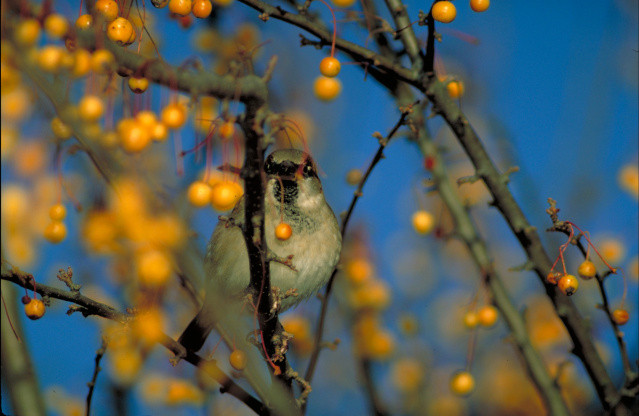
English sparrow. US Fish & Wildlife photo
Like many introductions of non-native species of plants and animals, the English sparrow (AKA house sparrow) was introduced to perform a practical function. Elm trees on the East Coast were being defoliated by a voracious native caterpillar. In 1852, The English sparrow was brought to America to rescue the trees from the caterpillars. The sparrows thrived and were soon reviled by ornithologists who considered them alien invaders.
The debate between ornithologists and those with a more cosmopolitan view of nature is reported at length by Coates. Long story short, the debate is reminiscent of what we hear today from nativists:
They feared that the English sparrow would compete with native species for food and habitat and that native species would lose this competition.
They considered native birds superior to the English sparrow which was considered dirty and a promiscuous breeder.
The English sparrows were city dwellers and were considered the bird equivalent of ghettoized immigrants.
The English sparrows were criticized for not eating enough of the caterpillars they were imported to eat. They weren’t doing the job they were hired to do!
This debate raged on amongst birders for decades according to the historical record reported by Coates. However, we no longer hear birders complain about the English sparrow, although we hear them complain about many other birds.
Update: This post requires an update. The New York Times published an op-ed in which a woman describes in horrific detail the monomaniacal attempts of her mother to exterminate all house sparrows in their neighborhood based on her belief that their eradication would benefit blue birds. It is a blood-curdling story that contradicts my naïve belief that after nearly 200 years, the house sparrow has been accepted in America.
We were introduced to this mindset by an ominous encounter with a birder in Florida who is typical of the nativist viewpoint of the avian world. The sound of gunfire drew us to a man with a shot gun on the lawn of our motel. Starlings were falling around him, where he quickly finished them off with a vigorous stomp of his booted foot. We were unfamiliar with the hatred of non-native species at that time and asked him why he was killing the birds. He seemed stunned to be questioned. He explained, as though speaking to retarded children, that the starlings were “trash birds” that must be killed. Following a basic rule of survival, we walked away from a person wielding a gun.
Why was the English sparrow redeemed?
Returning to the English sparrow, why are they no longer the target of hostility from birders? We speculate that one reason may be that they have been here for a long time, nearly 200 years. Just as human immigrants are often the target of prejudice and discrimination when they first arrive, they eventually become a routine part of our world. We rarely think of the Irish or other Europeans as immigrants in America.
Another reason is that the population of English sparrows is actually declining: “Since 1966 its North American population has declined by 2.5 percent annually.” (1) However, there is still an estimated population of 150 million in North America.
Ironically, the population of English sparrows is declining significantly in Britain, its ancestral home, where only 13 million are estimated to remain. In 2000 the British press was full of stories about the sudden decline of their iconic bird, “Responding to the strong sense that an essential part of the nation’s natural heritage…was disappearing…”
The lessons of the sparrow wars
These are familiar themes to the readers of the Million Trees blog:
Some people fear newcomers to their world, whether those newcomers are people, animals or plants and that fear can result in destructive hatred.
Newcomers usually fit in eventually. What is initially perceived as a threatening “invasion” rarely turns out to be a problem in the long run.
Because nature is dynamic, the new home of an introduced species sometimes becomes the only home of that species. The movement of species is another way to ensure their survival. In fact, there is a new movement amongst citizen “scientists” to move rare species which are threatened by changed climate conditions into new locations. This is called “assisted migration.” (2)
—————————————————————-
(1) Peter Coates, American Perceptions of Immigrants and Invasive Species, UC Press, 2007. All quotes are from this book.
(2) Emma Marris, Rambunctious Garden, Bloomsbury, 2011.



 Conservation Sense and Nonsense