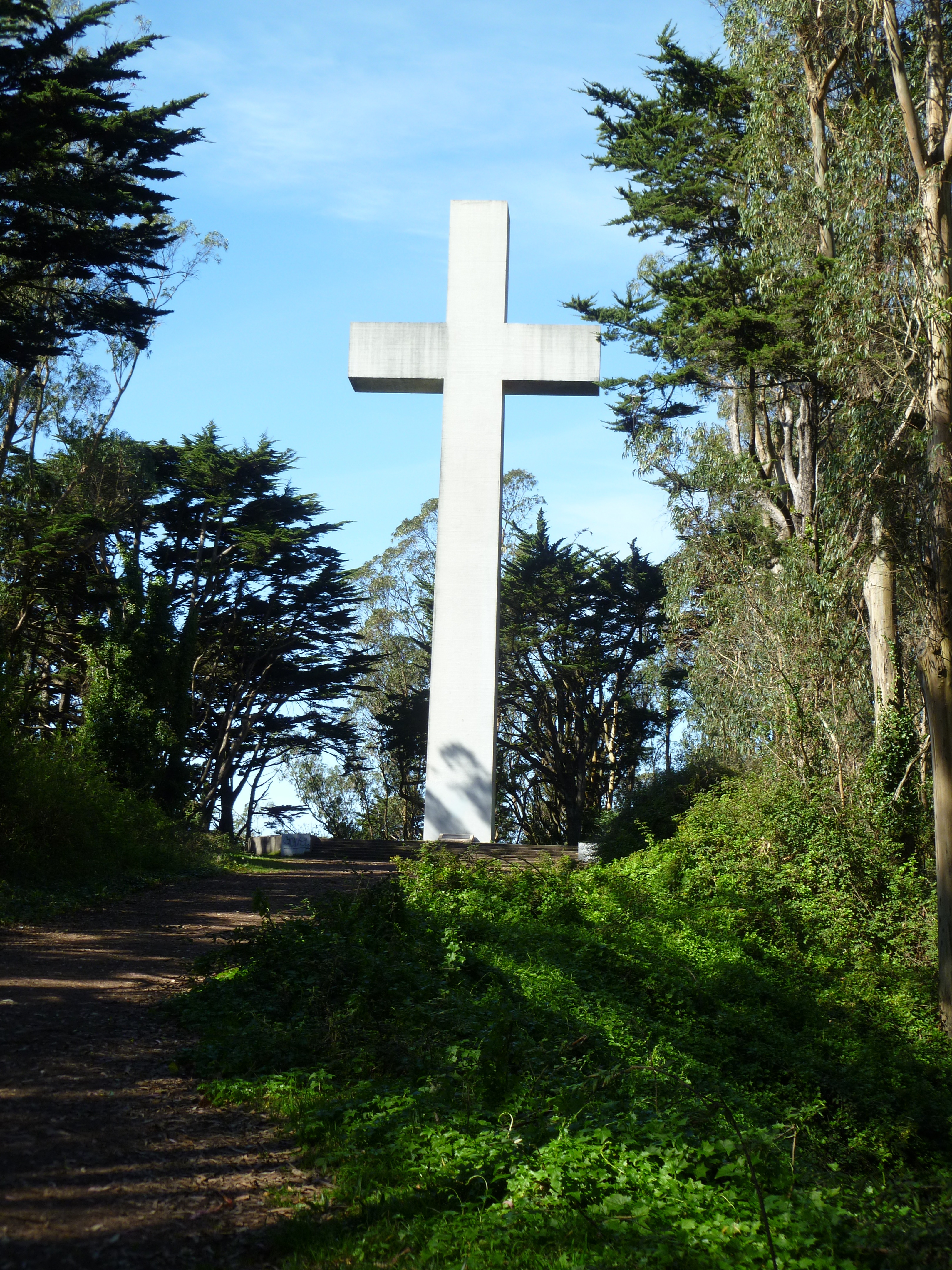
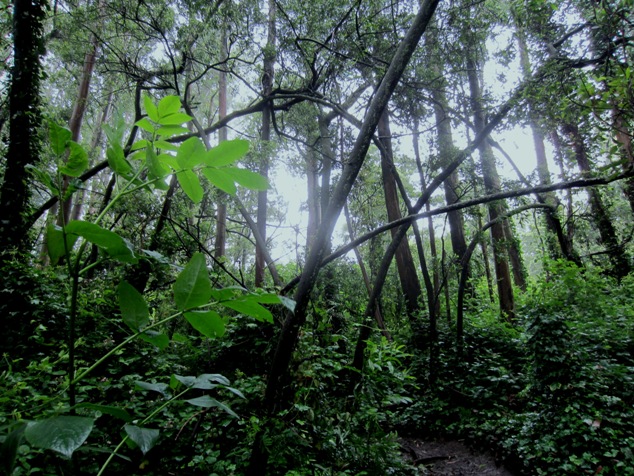
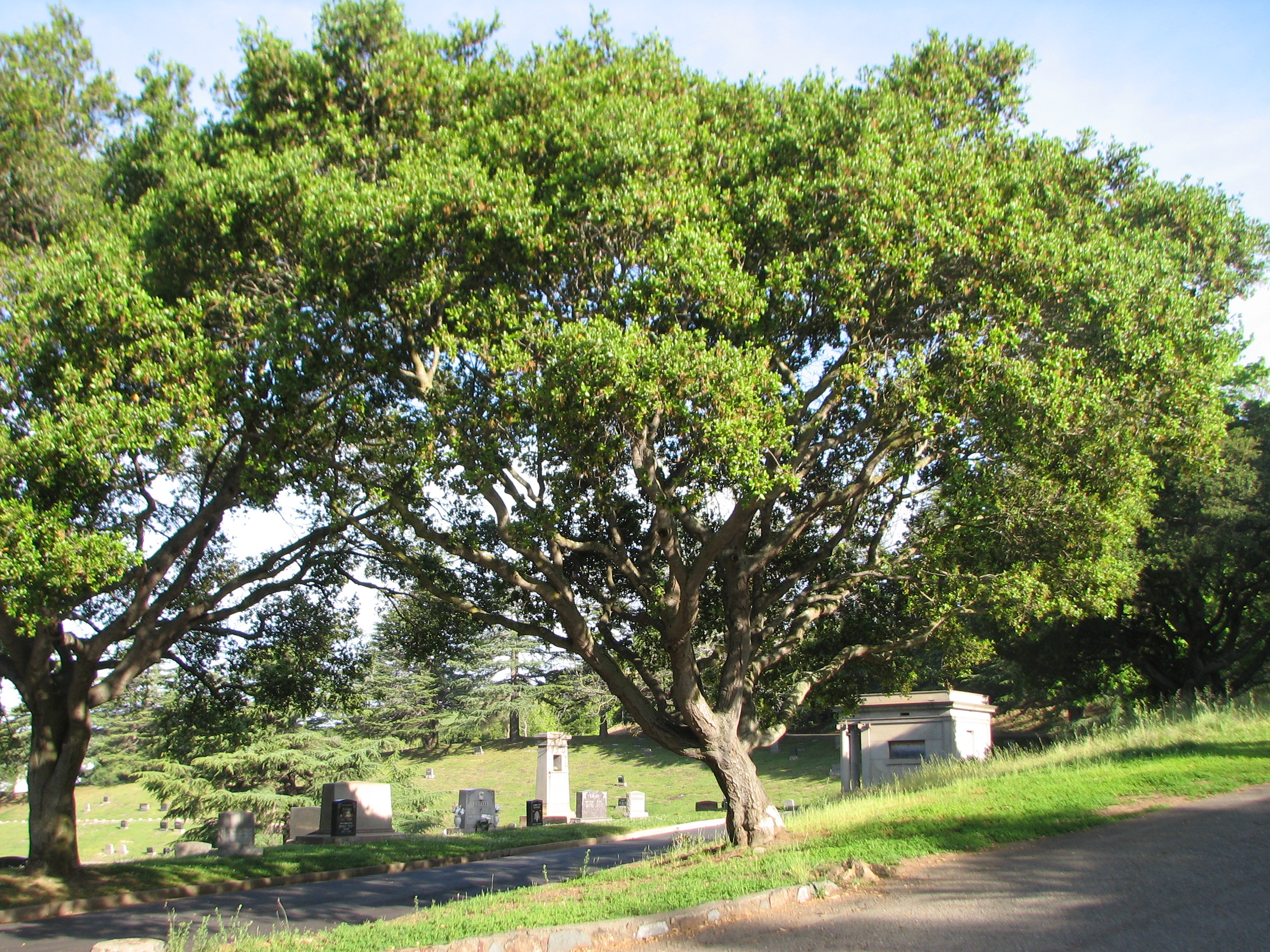
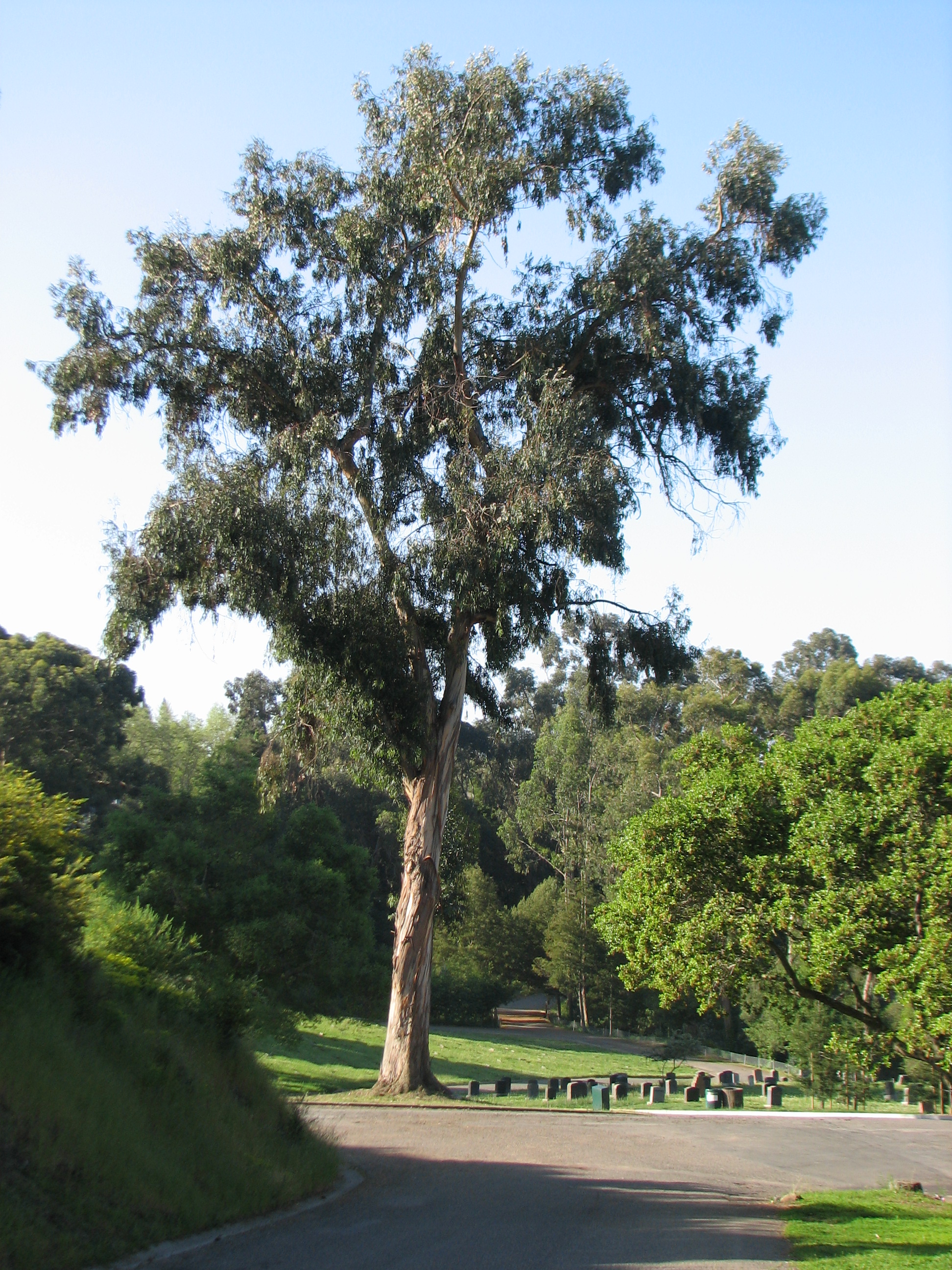
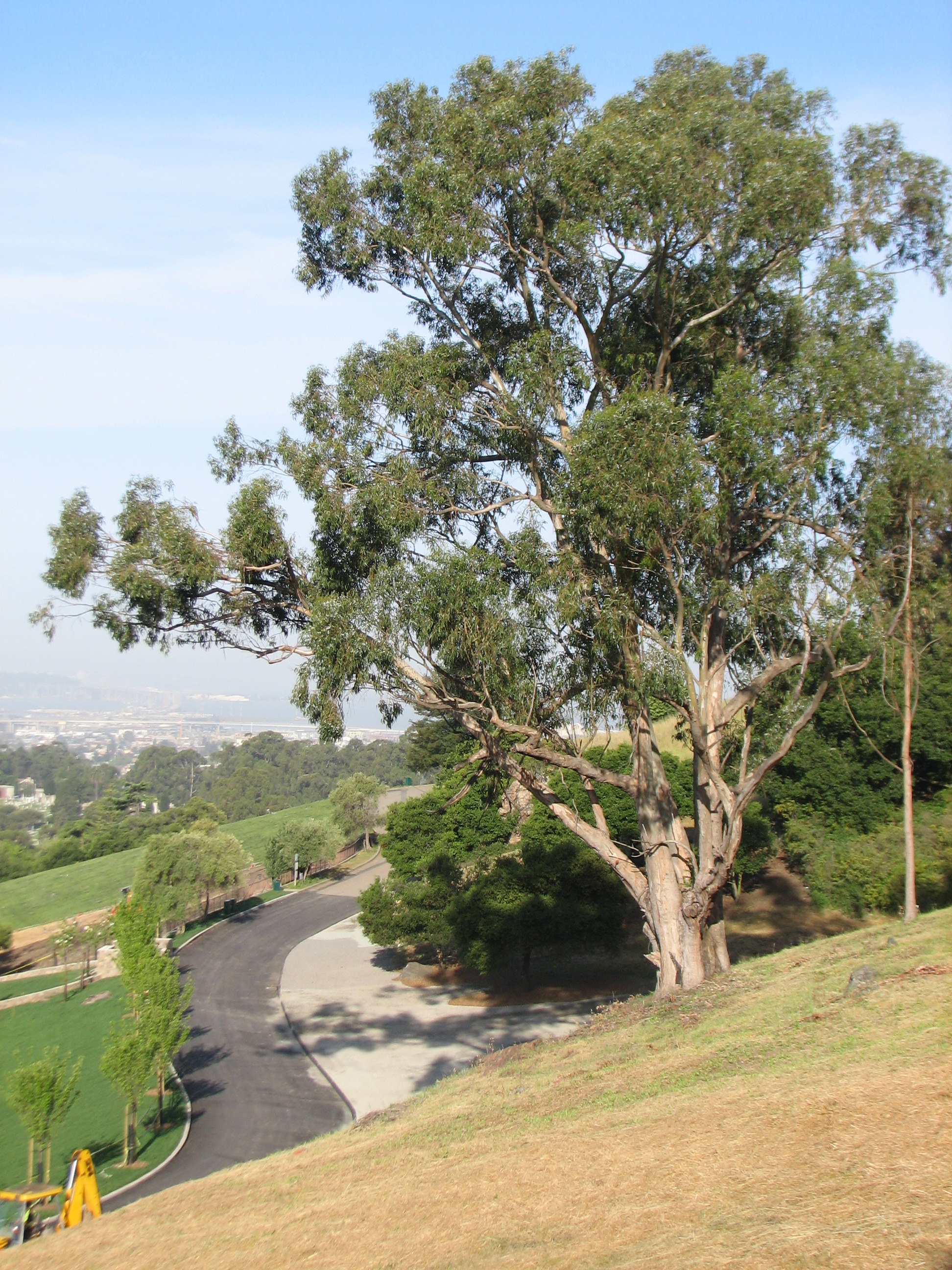
The urban forest on Mt. Davidson is slated for destruction.
According to California Trees (1) the US Forest Service has determined that tree cover in the country’s urban areas is decreasing by 4 million trees a year. Although no research has been done on tree loss throughout California, the US Forest Service reported a one-percent decline in trees and shrubs in Los Angeles despite a big campaign to plant one million trees there.
You might think that the loss of trees in urban areas is the result of increasing development and you would probably be at least partially correct. But many trees are lost for more trivial reasons that we think could be easily prevented. Here are some local examples of trees in the Bay Area that were needlessly destroyed or soon will be.
The City of Oakland has a “view ordinance” which guarantees homeowners the preservation of their view at the time they purchased their home. This view ordinance was invoked by a resident in the Oakland hills who demanded that her neighbor and the City of Oakland destroy trees obstructing her view. Her neighbor purchased her house because of its forested view. Yet, the desire for a forested view was trumped by her neighbor’s desire for a treeless view. The law required that 25 trees be destroyed on private property and 21 trees on city property in order to restore the view of a 95-year old property owner who no longer lives in her home. When trees are destroyed for such trivial reasons, we should not be surprised by the following compendium of absurd excuses to destroy trees. (The story is here.)
The people of San Francisco are trying to prevent the destruction of their urban forest which is almost entirely non-native. The City of San Francisco is systematically destroying non-native trees in order to return the landscape to its historical origins as grassland and dune scrub. The latest battle in this long war is a particular park, Glen Canyon, in which the City proposes to destroy about 160 trees in the short -run and 300 trees in the long-run. A handful of the trees are hazardous and aren’t disputed, but most have been evaluated as “poor suitability” which is the latest euphemism used by native plant advocates to describe non-native trees. They propose to replace most of the trees with native shrubs and a few tall trees that are native to California, but not to San Francisco, such as Douglas Fir and Cottonwoods. It remains to be seen if either of these species will survive in San Francisco. Douglas Fir requires more rainfall than San Francisco receives and Cottonwoods are hot-climate trees which don’t tolerate mild temperatures without seasonal fluctuations. We suspect that is the strategy, i.e., to plant trees for the sole purpose of placating the public without any intention that the trees will survive. (The story is here.)
The space shuttle Endeavor was recently retired from service. Its permanent home is now a museum in Los Angeles, where 400 street trees were destroyed to accommodate the delivery of the space shuttle from the airport to the museum. The neighbors were not pleased, as you might imagine. They unfortunately live in a blighted part of Los Angeles, so they didn’t have the clout needed to save their trees. Do you think these trees would have been destroyed in Beverly Hills? We doubt it. (The story is here.)
The neighbors of Dimond Park in Oakland are trying to save the trees in their park from being destroyed by a “restoration.” We often marvel at the use of the word “restoration” to describe projects which are more accurately described as “destruction.” This is yet another native plant project, which is hell bent to remake nature to its liking. In this case 42 trees would be destroyed, of which 27 are native, including 17 redwood trees. Please help the neighbors save their trees by signing their petition which is available here.
Finally, we share the story of a property owner on 65th St in Oakland who with a great deal of courage and tenacity was able to save most of the street trees on her block from being destroyed by the City of Oakland. The trees weren’t posted as required by Oakland’s ordinance. The crew who came to cut them down couldn’t tell her why they were being cut down, nor could they tell her who owned the trees. We encourage you to read her story because it will give you a brief lesson on the difficulty of advocating against the needless destruction of trees.
Deforestation causes climate change
We have been accumulating these stories in the past few months, but are finally inspired to share them with our readers because of the recent storm on the East Coast, Sandy, which caused over $50 billion in damage and the lives of over 100 people. What’s the connection? The connection is that Sandy has finally forced people to take the threats of climate change more seriously.
When will this new interest in climate change translate to an interest in saving our trees? Probably not soon, because few people understand that globally, deforestation contributes 20% of greenhouse gases that cause climate change. The public and its elected representatives are focused primarily on transportation as the source of climate change. Transportation contributes only 10% of greenhouse gases globally.
Here in California, we are gearing up to put our climate change law (AB 32) into action by creating a cap and trade auction which will enable emitters of greenhouse gases to purchase carbon offsets. Ironically, one of the things that carbon emitters can do to offset their contribution to greenhouse gases is to plant trees. Yet, those who destroy trees are not being required to purchase carbon offsets. Until the people who destroy trees are required to pay for the damage they do to the environment, we are unlikely to see a change in the cavalier attitude that governments seem to have about destroying trees.
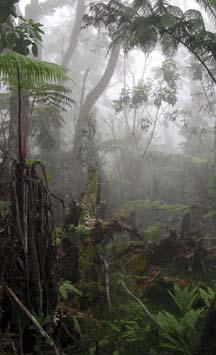
Joseph Mascaro is one of the scientists Emma Marris interviewed for her ground-breaking book, Rambunctious Garden. (1) Marris visited Mascaro on the Big Island of Hawaii, where he was studying the forests, comparing native with “novel” forests, the name given to ecosystems composed of both native and introduced species of plants.
According to Marris, Mascaro considers Ariel Lugo his mentor. Lugo is a US Forest Service scientist living and working in Puerto Rico. He is one of the first scientists to observe and report that non-native forests in Puerto Rico are performing important ecological functions and benefiting native forests by restoring depleted agricultural soils and providing shelter to native seedlings.
Lugo, like many native plant advocates, received his education in ecology at a time when there was deep suspicion of introduced species. The conventional wisdom was that introduced species were competitors of preferred native species, that they were inferior members of an ecosystem and that they would eventually dominate and replace their native predecessors.
When Lugo’s team reported that the understory in the non-native forest was so dense that it made the forest impenetrable, he was incredulous. Slowly, the reality of the non-native forest penetrated the prejudices of his training. He submitted his findings for publication repeatedly. After a lengthy debate, his study was finally published in 1992. He still considers himself an outlier amongst his colleagues in the Forest Service.
Joseph Mascaro is now a Postdoctoral Associate at the Carnegie Institution for Science in Stanford, California. His study of the novel forests of Hawaiian lowland rain forests has recently been published: “Novel forests maintain ecosystem processes after the decline of native tree species.” (2) We will do our layman’s best to report his main findings.
Judging the forest by the functions it performs
The scientific community seems to agree that introduced plant species have resulted in a net increase in species on the Hawaiian Islands: “Seventy-one vascular plant species are known to have become extinct in Hawaii over the past ~1700 years, while at least 1,090 introduced plant species have become naturalized during this period: an approximate doubling of its pre-human contact flora.” (2)
Mascaro’s study asks and answers the question, what are the functional implications of increased diversity due to invasion? He proposes and tests three hypotheses:
Species richness and diversity are greater in novel forests than native forests in lowland Hawaii.
Basic measures of ecological functions of novel forests meet or exceed measures in native forests. He used these basic measures:
Aboveground and belowground production of biomass, called productivity
Aboveground and belowground storage of carbon
Cycling (or turnover) of nitrogen and phosphorous between soil, trees, and leaf litter.
Because forest establishment in Hawaii begins on barren lava flows on which there is no available nitrogen and it takes several centuries to accumulate the nitrogen needed by native trees, the disparity between the functioning of novel and native forests are greatest on younger lava flows where novel forests are composed of nitrogen-fixing tree species.
He reports his findings: “At local scales, we found that novel forests had significantly higher tree species richness and higher diversity of dominant tree species. We further found that aboveground biomass, productivity, nutrient turnover (as measured by soil-available and litter-cycled nitrogen and phosphorus) and belowground carbon storage either did not differ significantly or were significantly greater in novel relative to native forests.” (2) Our interpretation of this study is that the novel forests of the lowland rain forests of Hawaii maintain basic functioning where native forests are now absent and that the novel forest facilitates the revegetation of barren lava flows by creating fertile soil.
He also speculated that “Because large portions of the Earth’s surface are undergoing similar transitions from native to novel ecosystems, our results are likely to be broadly applicable.” (2) It is this conclusion that his findings can be generalized to other locations that brought Joseph Mascaro’s study to our attention.
Mascaro recently wrote to the Webmaster of the Save Mount Sutro Forest website and sent his study. He lives in San Francisco and drives over Mt. Sutro daily, on his way to work. Mascaro told the Save Sutro Webmaster, “I wanted to let you know that your website and effort are much appreciated. As a practicing ecologist, I find it bewildering that efforts to restore native plant communities (some of which I find very important) would be directed at a diverse, old-growth, functioning ecosystem smack in the middle of one of the largest cities in the country….Cases like Sutro are often emotional and controversial, and while I don’t disparage anyone’s view, I tend to think that great pause must be taken before destroying something that is centuries old. I hope you will continue your effort.” (quoted with permission)
Mount Sutro Forest. Courtesy Save Mount Sutro Forest
We are grateful to Joseph Mascaro for his research on the novel forests of Hawaii and for expressing his opinion of the value of the forest on Mt. Sutro. We are also grateful to the Webmaster of Save Sutro Forest for her insightful and articulate defense of the Sutro Forest.
The evolution of ecology
We began this post with the observation that scientists have found it difficult to report their findings about novel ecosystems that are not consistent with their educational training. When we expect to see something, it is often difficult for us to see something that contradicts those expectations. We commend scientists such as Ariel Lugo for reporting his observations, although they weren’t consistent with his training.
We are also pleased to report that we have observed, first-hand, a change in the training of university students in ecology. We attended two sessions of an undergraduate seminar in a local, major university. That seminar is reading and evaluating Rambunctious Garden. The students were entirely receptive to the revision of traditionally negative judgments of introduced species. That revision is the main theme of Rambunctious Garden. These students are the next generation of ecologists. They are the beginning of a new conventional wisdom about the role of introduced species in our ecosystems.
**********************************
(1) Emma Marris, Rambunctious Garden, Bloomsbury, 2011
(2) Joseph Mascaro, R. Flint Hughes, Stefan A. Schnitzer, “Novel forests maintain ecosystem processes after the decline of native tree species,” Ecological Monographs, 82(2), 2012, pp. 221-228 by Ecological Society of America
We try to give people the benefit of the doubt. We assume that native plant advocates believe what they say even when we know what they’re saying isn’t true. We assume they share our commitment to protecting the environment even though we don’t agree about how to achieve that goal.
However, recent events have forced us to reconsider our generous interpretation of CBD’s motives. In particular, we find the Center for Biological Diversity’s action and inaction on these two local issues contradictory:
On one hand, CBD filed for endangered status for the Franciscan manzanita. CBD’s clone, Wild Equity (founded by a former employee of CBD), sued when endangered status was delayed. They demanded the designation of critical habitat—including 196 acres of San Francisco’s public parks– for a plant which is likely a hybrid of one of the most common species of manzanita and will require dangerous and polluting wildfires to reproduce. This seems consistent with CBD’s long track-record of aggressively protecting rare plants and animals despite negative impact on humans.
On the other hand, CBD has thus far done nothing on behalf of the endangered Clapper Rail. It has been over a year since studies have shown that the eradication of non-native Spartina marsh grass in San Francisco Bay has decimated the small population of this rare bird. The assumption is that the Rail is exposed to its predators–particularly during nesting season–by eradication of dense, year-round cover provided by Spartina. It’s also possible that the pesticide (imazapyr) used to eradicate Spartina is a factor, because the effect of imazapyr on shore birds has not been tested. The absence of action on behalf of the Rail seems inconsistent with CBD’s extreme actions on behalf of other endangered plants and animals.
California Clapper Rail
Is Center for Biological Diversity motivated by money?
So how do we reconcile these seemingly inconsistent actions vs. inactions of CBD? What motivates their selection of particular species of plants and animals for protection?
Ted Williams calls himself an “environmental extremist.” He is the author of a regular column in Audubon Magazine which is appropriately entitled, “Incite.” One of Williams’ articles demonizing eucalyptus is typical of the provocative approach of his column. In that article, he fabricated “data” about bird deaths to justify the crusade to eradicate eucalypts.
Williams is proud of his credentials as an environmental provocateur and he uses those credentials to defend his criticism of Center for Biological Diversity in an article in High Country News (1). He expresses his opinion that CBD is motivated by money. He points out that CBD has filed hundreds of suits against the federal government, using environmental laws, such as the Endangered Species Act, and that every time it wins it collects attorney fees from the federal government. The cost and number of these suits has become a major obstacle to US Fish & Wildlife and the Environmental Protection Agency in fulfilling their mandate to protect rare species.
Although these accusations are accurate, we don’t think this is an adequate explanation for CBD’s choice of issues to pursue. We turn to the New York Times to put this accusation into perspective. The Times reports (2) that CBD had filed 700 lawsuits when the article was published in March 2010, and they were successful in those suits 93% of the time. Those suits forced the government to list 350 endangered species and designate 120 million acres of critical habitat for their recovery.
However, revenue generated by the success of these suits was only $1.4 million in 2008, compared with $7.6 million from contributions and grants. In other words, only 16% of CBD’s revenue in 2008 came from their suits against the federal government.
Furthermore, the founder and Executive Director of CBD earned $116,000 in 2008, which doesn’t seem out of line for an organization with over 60 employees and offices all over the country (including the San Francisco Bay Area).
We don’t think the leadership of CBD is motivated by money.
It’s about power and control
We turn to the New Yorker magazine (3) to understand and explain the motivation of Center for Biological Diversity and its local ally, Wild Equity. In 1999, the New Yorker published an in-depth study of the leadership of CBD entitled, “No People Allowed.”
The article reports the creation of CBD and its early history in the southwest where it was founded and is still headquartered. Their initial efforts were direct-action, typical of traditional environmental organizations; then they discovered the power of the law: “’We’re crazy to sit in trees when there’s this incredible law wherewecan make people do whatever we want,’” said Robin Silver, one of the founders of CBD.
Using federal environmental laws, they apparently brought the timber industry in the southwest to a virtual halt and they were making similar progress in eliminating all grazing in the southwest when the article was published. Perhaps there was some benefit to the environment, but there was also significant economic loss to the human community in the southwest, according to the New Yorker.
So, what does CBD want? The New Yorker tells us that the founder’s deconstructionist philosophy is “a decentering and disempowering of the human.” Their goal is described: “…the center is endeavoring to undo the dominion of man over animals and plants…the only way to get to the desired state is to deconstruct stuff that exists in the world: legal arrangements, social and economic forms, and even physical structures.” CBD’s Executive Director tells us his motivation in the New Yorker article as well as the long term goal of CBD: “[Kieran] Suckling cheerfully admitted that he’s ‘using one side of industrial society against itself,’ but only temporarily; in the long run, he says, there will be a new order in which plants and animals are part of the polity. For example, legal proceedings could be conducted outdoors—in which case ‘the trees will make themselves felt.’”
“Good” tree may stay
We find the reference to the desires of trees particularly interesting. Apparently Mr. Suckling believes he speaks for the trees. What about the non-native trees which CBD demands we destroy on behalf of other plants and animals which it prefers? Mr. Suckling apparently considers himself the spokesperson for just particular trees of his choosing. Apparently the rights of trees will be limited to native trees when CBD has successfully established this new order.
“Bad” tree must go.
Mr. Suckling also implies that CBD’s control of the environment is only temporary until the new order is established in which plants and animals are in control. This reminds us of a similar fantasy about a new social and economic model which was originally proposed by Karl Marx. In creating the concept of communism, he envisioned a temporary dictatorship of elites which would eventually be ceded to a “dictatorship of the proletariat.” The world has now witnessed many attempts to install communism as the governing economic model, but we have not seen the dictatorship of elites willingly cede their power to the people.
This quote of CBD’s Executive Director from Ted Williams’ article, also helps us to understand why CBD sues the federal government to achieve their goals: “’They [employees of federal agencies] feel like their careers are being mocked and destroyed—and they are,’ he told the High Country News. ‘So they become much more willing to play by our rules.’” In other words, suing—and the threat of suit—is CBD’s means of controlling the federal agencies that are responsible for protecting the environment, i.e., forcing them to do what CBD wants.
Humans will always be in control of land-use decisions. It’s only a question of which humans are in control and CBD intends to be the humans in control. If we hand them that power, we will find it difficult to wrest it from them if we decide they are not using that power wisely or fairly.
We can’t defend all of the activities of humans when we damage the environment to suit our purposes. However, we don’t think the Center for Biological Diversity would be a better steward of our land. Even if they were capable of wise land-use decisions, we are unwilling to suspend democratic methods of making those decisions. As human society repeatedly demonstrates, absolute power corrupts absolutely. We are no more willing to hand our fate to Center for Biological Diversity than to any other despot, benevolent or not.
We invite Center for Biological Diversity to prove us wrong
We would like Center for Biological Diversity to prove us wrong. CBD can demonstrate that their motivation is not simply the confiscation of public land from human use as a means of destroying human society and civilization. They can start by filing suit on behalf of the endangered Clapper Rail to stop the pointless and destructive eradication of non-native Spartina in San Francisco Bay, using a toxic pesticide about which little is known. CBD can demonstrate their commitment to protecting animals even if humans are not punished by that effort.
***********************
(1) Ted Williams, “Extreme Green,” High Country News, May 21, 2011
(2) Anne Mulkern, et. al., “Brazen Environmental Upstart Brings Legal Muscle, Nerve in Climate Debate,” New York Times, March 30, 2010.
(3) Nicholas Lemann, “No People Allowed,” New Yorker, November 22, 1999.
We have provided our readers with photographic evidence that eucalypts are not invasive in the San Francisco Bay Area (click here and here). Now we are going to tell you about more confirmation of this fact from a reputable source that will be difficult for native plant advocates to ignore: Encyclopedia of Biological Invasions.
The Encyclopedia was edited by Daniel Simberloff (U of Tennessee) and Marcel Rejmanek (UC Davis) and published by UC Berkeley Press in 2011. Many of our readers will recognize Simberloff as a prominent scientist in invasion biology. He is responsible for the “invasional meltdown” hypothesis which is central to invasion biology. A recent survey of empirical tests of the hypotheses of invasion biology found that there is considerable support for the “invasional meltdown” hypothesis, but that support is declining.
Professor Simberloff has aggressively defended the assumptions of invasion biology against scientists who think that a revision of those assumptions is required by recent empirical evidence. When Professor Mark Davis and 18 of his colleagues in ecology signed a comment in the Nature journal entitled, “Don’t judge species on their origins,” Professor Simberloff promptly recruited 140 of his colleagues to publish a rebuttal.
We establish Professor Simberloff’s credentials for our readers as a scientist who firmly believes that non-native species are a serious threat to biodiversity so that native plant advocates will consider him a credible source of information regarding eucalyptus.
“Eucalypts” according to the Encyclopedia of Biological Invasions
According to the Encyclopedia of Biological Invasions, eucalypts are “some of the most important solid timber and paper pulp forestry trees in the world.” There are about 40 million acres of eucalypts planted in tropical, sub-tropical, and temperate countries. The predominant species of eucalyptus in the Bay Area, Blue Gum (E. globulus), is grown in 13 countries in addition to the US and Australia. About 70 species of eucalypts are naturalized outside their native ranges. “However, given the extent of cultivation, eucalypts are markedly less invasive than many other widely cultivated trees and shrubs…they have been orders of magnitude less successful as invaders than pines and several other widely planted trees…Where eucalypts have invaded, they have very seldom spread considerable distances from planting sites, and their regeneration is frequently sporadic. “ (1)
Although the Encyclopedia admits to being puzzled by why eucalypts aren’t invasive, it offers “three major reasons for the limited invasiveness of eucalypts:”
Reason One: Seed dispersal of eucalypts is limited
The seeds of eucalypts have no natural means of dispersal, such as fleshy tissue which can function as wings on the wind. Tests have shown that the seeds “are dispersed over quite short distances.” (1) “Seed dispersal is mainly by wind or gravity and is virtually limited to twice the tree height.” (2)
The seeds of the Blue Gum are encapsulated in a woody pod which makes them inedible to birds and mammals. So, the seeds of the Blue Gum are not dispersed by animals.
Reason Two: High mortality of eucalyptus seedlings
Eucalyptus seedlings die quickly if they don’t establish roots in moist soil quickly. If the soil is too moist they are susceptible to destruction by fungus. If there is too much leaf litter or there is an understory, they are unlikely to find the quick access to the soil they need to survive. There is a narrow range of conditions needed to successfully establish eucalyptus seedlings.
Reason Three: Lack of compatible mycorrhizal fungi
Mycorrhizal fungi exist in the soil and sometimes form a symbiotic relationship with the roots of plants. They are often essential to the health of the plant because they facilitate the absorption of water and nutrients by the plant. Some biologists speculate that the specific species of mycorrhizal fungi needed for successful seedling development have not been exported with the eucalypts to foreign soils.
A balanced discussion of the pros and cons of eucalypts
Given the strong commitment of the authors of the Encyclopedia of Biological Invasions to invasion biology, we are impressed with its even-handed discussion of the ecological pros and cons of eucalypts as well as its recognition of the lack of hard data to support a particular conclusion: “Conclusions about positive or negative environmental and economic impacts of eucalypts are often anecdotal, highly controversial and context dependent.”
The authors suggest that eucalypts not be planted near streams as the moving water is a means of seed dispersal. On the other hand, when planted on degraded soil, the eucalypts have provided a fuel source which reduces pressure on remnants of native forests. Eucalypts have been a valuable source of nectar for honey production all over the world. More birds are said to be found in native forests than eucalyptus forests in California. However, three times as many salamanders are found in the eucalyptus forests compared to native forests in California.
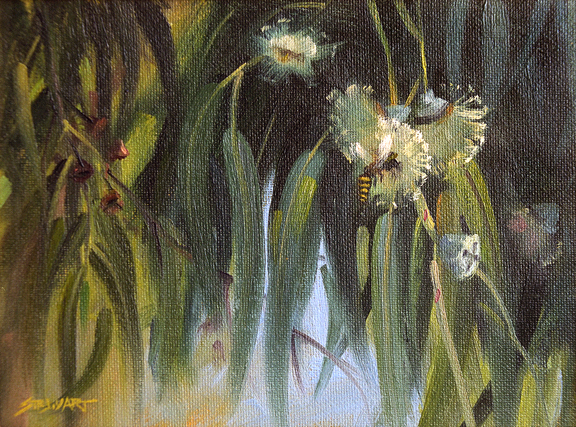
Eucalyptus and honeybee. Painting by Brian Stewart
The Encyclopedia also addresses the controversial question of whether or not eucalypts are allelopathic, which means chemicals in their roots or leaves suppress the germination of the seeds of other plants. It reports that there is no conclusive evidence on this question. However, the accumulation of leaf litter is probably a physical barrier to the germination of seeds in its understory, which is not an allelopathic method of suppressing competition. This is clearly true of other trees as well. For example, the tannins present in both oak and eucalyptus leaves prevent the rapid break down of the leaf litter which accumulates and creates a physical barrier to competing vegetation. This is one of many examples of the characteristics that both native and non-native plants have in common.
The Encyclopedia attributes the flammability of the eucalyptus forest to leaf litter which is exacerbated in California by rare deep freezes. These deep freezes cause die-back of eucalypts, contributing to fuel loads. It makes no mention of the oiliness of leaves as a factor in flammability.
There has not been such a deep freeze in the East Bay in over 20 years and 20-year intervals of such weather events have been historically typical. These deep freezes do not occur on the San Francisco peninsula because its climate is moderated by the ocean and bay surrounding it. Its climate is therefore warmer in winter and cooler in summer. Therefore, this caveat about the flammability of eucalypts does not apply in San Francisco.
The myth lives on…..
Despite the fact that there is no evidence—scientific or experiential—that eucalypts are invasive, the myth lives on amongst the community of native plants advocates. We will continue to provide the evidence that eucalypts are not invasive. We hope that eventually the public will be sufficiently informed that they will become resistant to this claim of native plant advocates which is one of many myths used to justify the needless destruction of eucalypts.
****************************
(1) Marcel Rejmanek and David Richardson, “Eucalypts,” in Encyclopedia of Biological Invasions, eds, Daniel Simberloff and Marcel Rejmanek, University of California Berkeley Press, 2011.
(2) Craig Hardner, et. al., “The Relationship between Cross Success and Spatial Proximity of Eucalypts Globulus ssp. Globulus Parents,” in Evolution, 212, 1998, 614-618.
The San Francisco Forest Alliance has made considerable progress in informing the public of the destructive projects of San Francisco’s Natural Areas Program (NAP). NAP and its supporters have taken notice of the growing opposition to their plans to transform our public parks into native plant museums. They are cranking up their public relations effort to confuse the public.
The Recreation and Park Department of the City of San Francisco is the sponsor of the Natural Areas Program. They have recently created a cynical video about NAP which misrepresents the reality of what NAP has done to our parks and what they plan to do in the future. The San Francisco Forest Alliance has produced a rebuttal to this video which is available here. Because the Recreation and Park Department disabled the ability to post comments to their video, we call the rebuttal the “Free Speech Version.”
The Sierra Club has also published an article about the Natural Areas Program in their newsletter, The Yodeler. This article is also chock full of misinformation both about NAP and about its critics. This is our rebuttal to this article. These are issues that we have covered in the past, so we’re not providing much detail here, but we’ve included links to previous Million Trees posts. (The Yodeler article is italicized and in quotes and our rebuttal is not italicized.)
“San Francisco Natural Areas Management Plan in peril”
“In San Francisco, where nearly everyone claims to be an environmentalist, how can there be opposition to certifying environmental review for the city’s Significant Natural Resource Areas Management Plan (SNRAMP) to guide the care of the city’s natural areas?
The plan covers all aspects of preservation for the city’s natural areas, which include many of the most vital remnants of the city’s original ecosystems, including a diverse array of landscapes and habitat types.”
Webmaster: There is no opposition to an environmental review of the Natural Areas Program. Rather there is opposition to the Draft EIR because it is a white wash. The Draft EIR fabricates a plan which is easy to defend but bears little relationship to the written plan (SNRAMP) that it is legally obligated to evaluate.
Most of the natural areas had no native plants in them when they were designated as natural areas. The claim that the natural areas are “remnants of original ecosystems” is bogus. Some were essentially building rubble from the constructions of former occupants of the land.
Balboa Natural Area under construction
“Much of the conflict surrounding the plan has to do with concerns about tree removal. Most of the trees in the designated natural areas will remain where they are. The vast majority of lands—including almost all the lands within the less critical MA-2 and MA-3 management subareas—will remain forested.”
Webmaster: Native plant advocates killed approximately 1,200 trees by girdling them before they were caught and stopped. Since then NAP has destroyed hundreds of trees in many natural areas. Their written plans (SNRAMP) state that they plan to destroy 18,500 trees over 15 feet tall and countless smaller trees which they choose not to define as trees.
“However, many trees are in sorry shape, suffering from old age, disease, beetle infestations, and cumulative damage from years of neglect.”
Webmaster: The trees that NAP plans to remove are not hazardous or unhealthy. They have been selected for removal solely because they are shading native plants or areas where NAP wishes to expand existing native plant gardens. Most of the plants that are native to San Francisco require full sun. The written plan makes this reason for tree removals perfectly clear. Those who claim that the trees are unhealthy have either not read the written plan or they willfully misrepresent it.
Critics of NAP are not opposed to the removal of hazardous trees. The City of San Francisco has the right and the obligation to identify hazardous trees and remove them. Neither a written management plan for NAP nor an Environmental Impact Report is required to remove hazardous trees.
“Some trees are the wrong species in the wrong places, displacing habitat needed by native birds, pollinators, and other critters. A stand of planted blue gum or Monterey cypress may be large and “majestic”, but take up space needed for native habitat (grassland, dune-scrub, oak woodlands, etc.)”
Webmaster: This is the heart of the controversy. Most of the trees will be destroyed only because they are the “wrong species,” not because they are hazardous. Those who know both the science of ecology and the reality of wildlife in San Francisco do not believe that wildlife benefits from the destruction of existing trees and vegetation. Animals have long ago adapted to the existing landscape which has been here for over 150 years. We also make no distinction between native and non-native wildlife. Both are equally valuable to us and we find the distinction distasteful, just as we find racial prejudice distasteful.
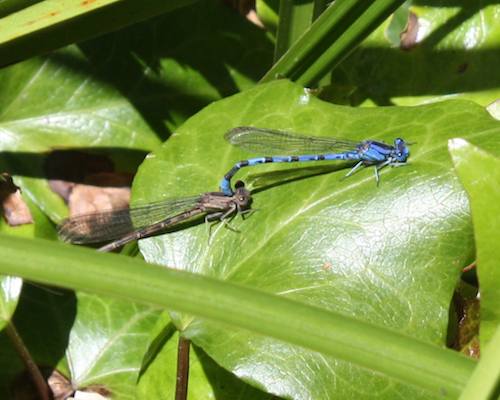
Damselflies mating on ivy in Glen Canyon Park
“The SNRAMP is designed to strike a balance, making the most of the ecological value of existing forested areas while in certain critical areas (such as small patches on Mount Davidson), the plan calls for limited tree removal.”
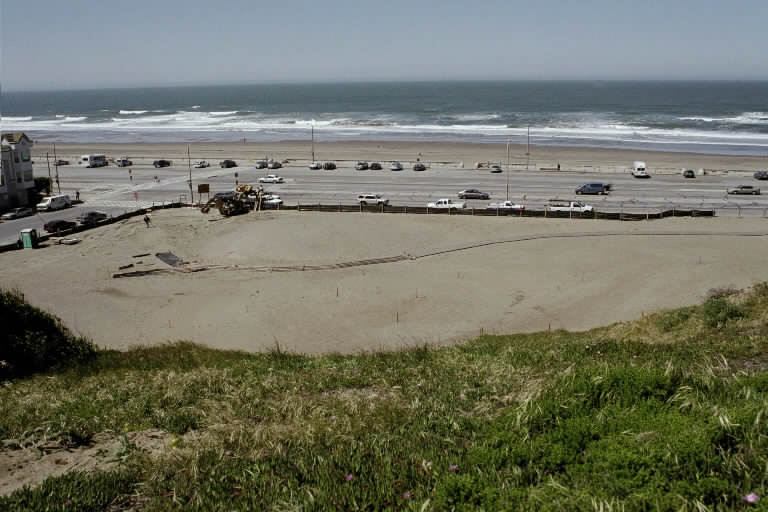
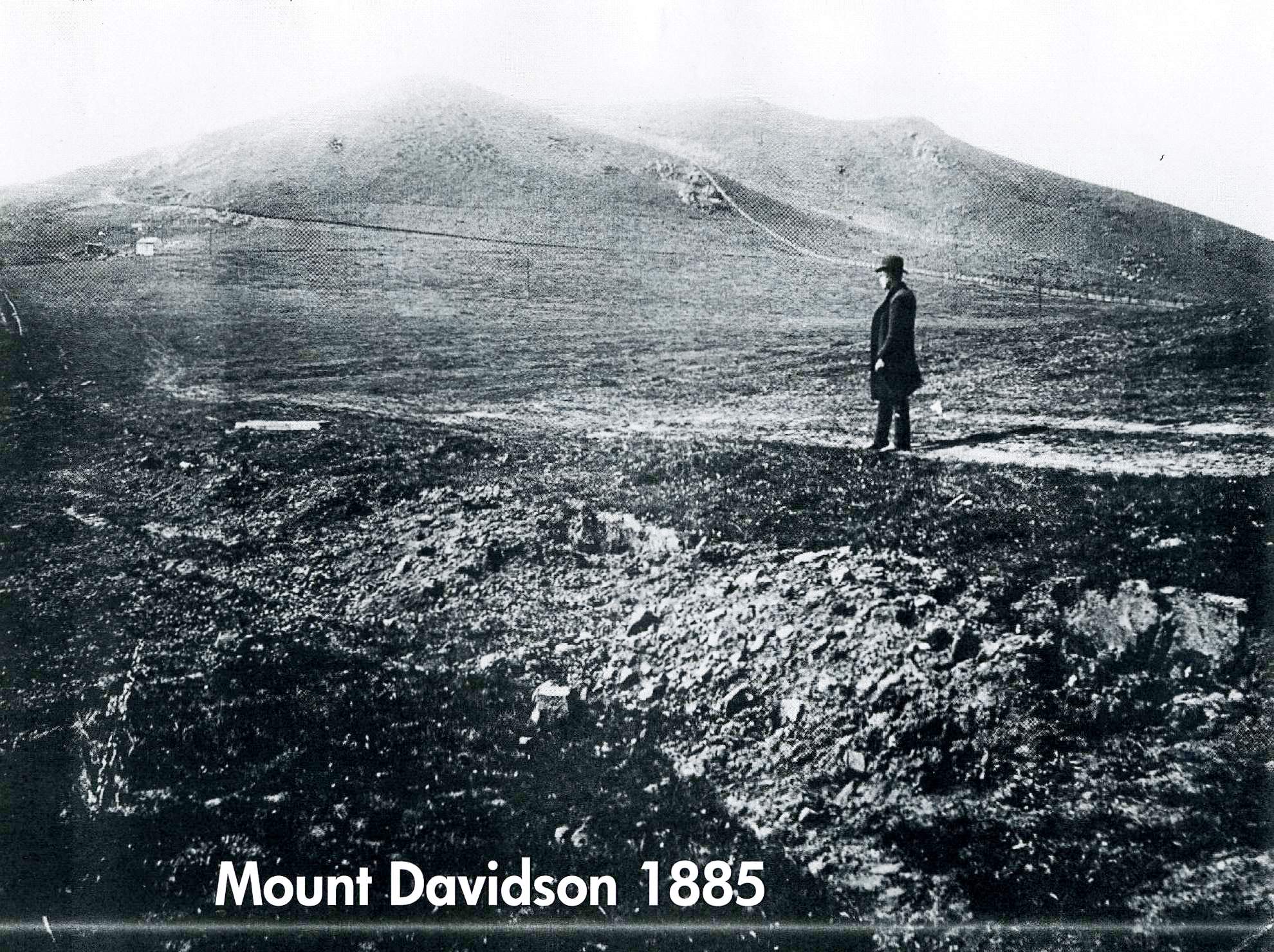
Webmaster: Mt. Davidson will lose 1,600 trees over 15 feet tall when SNRAMP is implemented in addition to about 200 trees that have already been destroyed by NAP or its supporters. Most of the trees on 10.2 acres of Mt. Davidson will be destroyed. This is not a “small patch.”
“Unfortunately, a small but vocal group of “tree advocates” has been campaigning loudly against any tree removal in any park, anywhere in the city. They have exaggerated the envisioned amounts of tree-removal, and promulgated disinformation about the scope and objectives of the plan, wildly accusing advocates of ecological restoration of wanting to revert the entire park system to its former “wasteland” of dunes and scrub.”
Webmaster: Critics of NAP are not a “small group.” Several thousand people have signed the petitions of the San Francisco Forest Alliance, asking the City’s policy-makers to stop the destruction in San Francisco’s parks.
Here is a quote from the management plan for NAP which clearly states its objectives: “Prior to colonization and the stabilization of dunes and introduction of invasive species, trees were not a dominant feature of the San Francisco peninsula…Much of the area probably resembled the coastal scrub habitats of San Bruno Mountain or the grassland scrub mosaics of the Marin Headlands…The long-term goal of urban management in MA-1 and MA-2 areas…is to slowly convert those areas to native scrub and grassland.”
It is not necessary to exaggerate the objectives of NAP for the 1,100 acres of park land they have claimed as natural areas. Their objectives are clearly stated in their management plan.
“Contention has also come from segments of the well-organized off-leash-dog advocates. Partly because of continuing disagreements with the Golden Gate National Recreation Area over management of Crissy Field and Fort Funston (see September-October 2005, page 23). Some oppose any environmental restriction on dogs, and some seem to object to any fencing anywhere or any attempt to route pedestrian and canine traffic into well-defined paths—even to protect erosion-prone areas or sensitive plantings. We don’t believe that these represent the majority of responsible dog-owners, but they have been the most vocal.”
Webmaster:People who visit San Francisco’s parks with their dogs are impacted by NAP because NAP has claimed 80% of all off-leash areas as “natural areas. Only 118 acres of park land in San Francisco have been designated for off-leash areas. In other words, there are 1,100 acres of “natural areas” but only 118 acres of off-leash areas and NAP has claimed 80% of those 118 acres. (SNRAMP 5-8)
The Draft Environmental Impact Report (DEIR) for NAP proposes to close or reduce the size of several off-leash areas. The DEIR offers no evidence that these areas have been negatively impacted by dogs. It also states that all off-leash areas in the natural areas are subject to closure in the future if it is deemed necessary to protect native plants. Since NAP has offered no evidence that the proposed immediate closures are necessary, one reasonably assumes it will offer no evidence if it chooses to close the remainder of the 80% of all off-leash areas in San Francisco located in natural areas. We know from the DEIR public comments that NAP supporters demand their closure.
Given these facts, no one should be surprised that people who wish to walk their dog in the parks have reacted to the Natural Areas Program and the restrictions it has proposed. The Sierra Club’s representation of dog owners as being unreasonable is unfair and misrepresents the nature of their opposition.
“Some feral-cat advocates have objected to reductions in large feral-cat colonies on park lands. There are also some people who object to the use of any herbicide. Then there are those who argue against the plan from a posture of ecological nihilism. They maintain that under the new conditions informing evolution in the “anthropocene” era, it makes little sense to spend money and resources trying to save native ecosystems which are inevitably doomed to extinction. Rather, they suggest, we should embrace the “rambunctious” exuberance of weeds gone wild.”
Webmaster: The Sierra Club finally acknowledges that NAP uses herbicides. What a breakthrough! However, it tells us nothing about NAP’s herbicide use, which would explain why park visitors object. NAP’s herbicide use has increased over 300% in the past three years. It used herbicides 86 times in 2011and it has sprayed 87 times in the first 9 months of 2012. Most of the herbicides it uses are classified by the City’s Integrated Pest Management Program (IPM) as “Most Hazardous” and “More Hazardous.”
The Draft Environmental Impact Report (DEIR) for NAP says next to nothing about NAP’s pesticide use. It does not report either the volume of pesticide use or the types of pesticide used. This is one of the conspicuous omissions in the DEIR for which it is criticized. If that omission is not corrected in the final version, you can be sure that the public will object.
In naming a new geologic era the Anthropocene, scientists are merely acknowledging man’s pervasive impact on the Earth. Acknowledging this fact does not “give up” on the Earth. Rather it offers us the opportunity to adopt more realistic goals of what we can accomplish while making a commitment to stop damaging the environment further with the pesticides and prescribed burns that are used by the restoration industry and its sponsors in the chemical industry.
“All these concerns have already been addressed in the planning process leading up to the issuance and approval of the management plan, during countless public meetings. The purpose of environmental review is to assess the environmental impacts of the plan. The current Draft Environmental Impact Report (EIR) does this in a reasonable fashion, and to that extent—at least for the San Francisco portions of the plan—it is adequate and complete. It is beyond the scope of an EIR to resolve all the underlying conflicts”
Webmaster: There were three public meetings prior to the approval of the management plan in 2006. The Recreation and Park Commission held one public hearing (in two sessions) when they approved the management plan. All other public hearings were demanded by critics of NAP in a fruitless attempt to convince the Recreation and Park Department to revise its plans so that NAP would be less destructive.
“The final draft of the SNRAMP was published in 2006, but the environmental review process has been continuously delayed. As a result, a whole new cast of characters has come into play, including new planning commissioners, new staff, and new voices among the advocacy groups. These each have had to be brought up to speed, inevitably some protest that their voices were not heard, and the whole process gets delayed even more.”
There is new opposition to NAP because the public has had six more years of experience with NAP. They have watched the plans being implemented in their parks even though there is still no approved Environmental Impact Report and they don’t like what they see.
Critics of NAP do not need to be “brought up to speed.” We can see with our own eyes the destruction of our parks and the conflict caused by the extremist vision of recreating wilderness in the second most densely populated city in the country.
No amount of smoke can obscure the reality of the Natural Areas Program.
Update: US Fish & Wildlife published the final rule designating critical habitat for Franciscan manzanita on December 20, 2013. 230.2 acres of land in San Francisco have been designated as critical habitat: 46.6 acres of federal land, 172.8 acres of parks owned by San Francisco’s Recreation and Parks Department, and 10.8 acres of private land. The complete document is available here. The document responds to public comments and explains any differences between the proposed designation and the final rule. It makes interesting reading.
In addition to the conferral of endangered status, US Fish & Wildlife has designated 318 acres of land in San Francisco as critical habitat for the Franciscan manzanita. Critical habitats are places where the endangered plant is either known to have existed in the past or they are places that provide what the plant needs to survive.
Five of the eleven places in San Francisco designated as critical habitat are on federal land in the Presidio. (Details about all the critical habitats are available here.) Forty of the 318 acres are on private land. Six of the critical habitats are in 196 acres of San Francisco’s city parks:
Corona Heights
Twin Peaks
Mount Davidson
Glen Canyon Park (erroneously called Diamond Heights by US Fish & Wildlife)
Bernal Hill Park (erroneously called Bernal Heights by US Fish & Wildlife)
Bayview Hill Park
The taxonomy of manzanita is ambiguous
There are 96 species of manzanita in California (1). The ranges of most of these species are extremely small because the manzanita hybridizes freely and therefore adaptive radiation has resulted in a multitude of species, sub-species, and varieties that are adapted to micro-climates. Many of these species are locally rare, which is consistent with the fact that 6 species of manzanita have already been designated as endangered, two of which are limited to the San Francisco peninsula: Raven’s manzanita and Franciscan manzanita.
The genetic relationship between these two species of manzanita is ambiguous, which is reflected in the constantly shifting opinions of biologists about the taxonomy (species classification) of manzanita. The 2003 Recovery Plan for Raven’s manzanita recounted the long history of these shifting views. For some time, Raven’s and Franciscan manzanitas were considered the same species. Then, for an equally long time, they were considered sub-species of the same species, Arctostaphylos hookeri. It was not until 2007, that Raven’s was reclassified as a sub-species of Arctostaphylos montana. Presently, Franciscan manzanita is classified as its own species, Arctostaphylos franciscana.
Clearly, this history of the biological opinion regarding these two species of manzanitas suggests they are closely related and morphologically (AKA anatomically) similar. The Recovery Plan concludes, “The idea of ‘pure’ species in Arctostaphylos, with its many poorly defined taxa and prevalent hybridization has often been difficult to apply over the history of taxonomic work in the genus.”
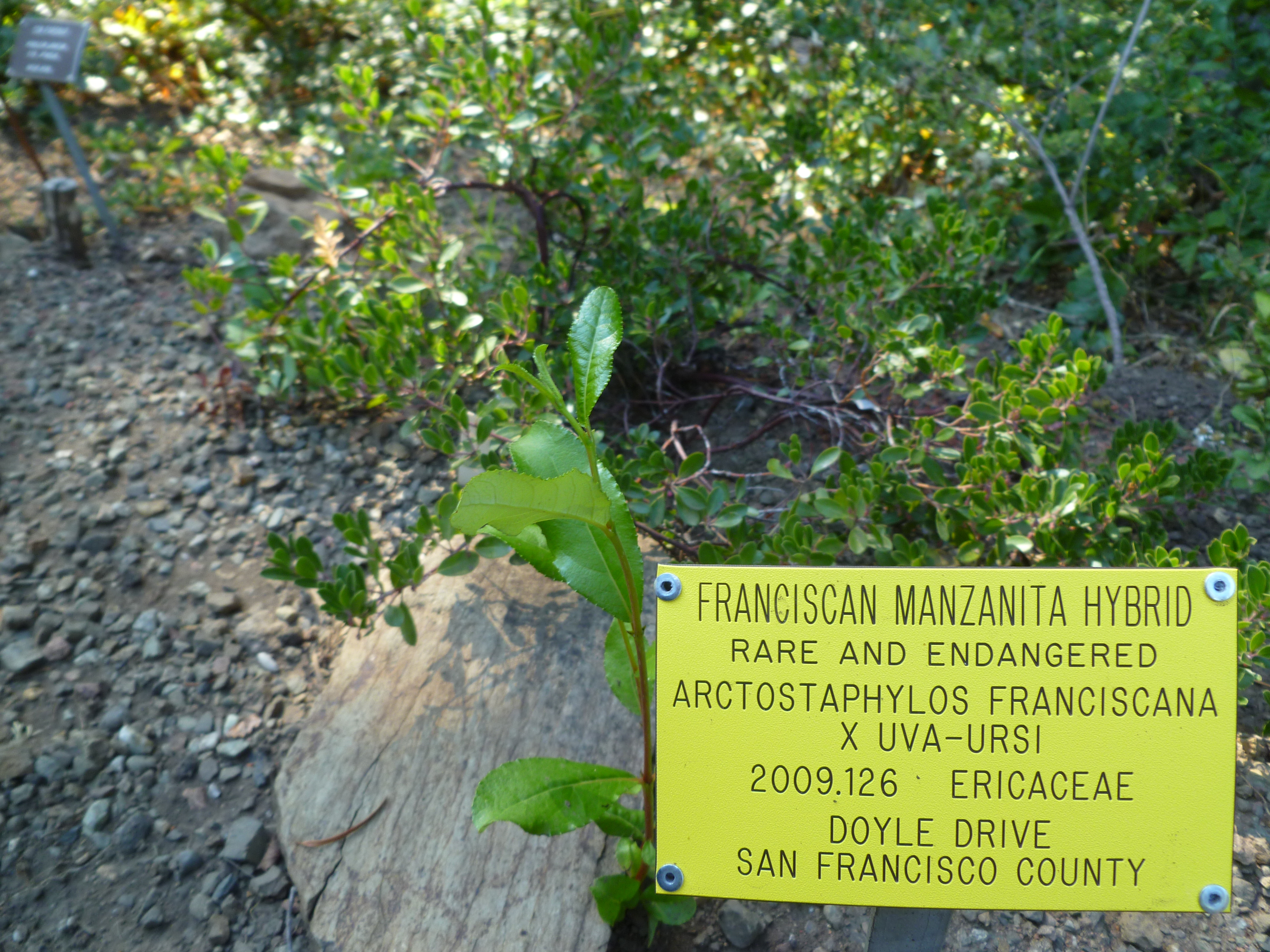
To add to the confusion regarding the provenance of Franciscan manzanita, some biologists are of the opinion that the individual plant that was discovered on Doyle Drive is actually a hybrid, not a pure-bred Franciscan manzanita. The East Bay Regional Park District botanical garden in Tilden Park has planted a clone of the individual plant from Doyle Drive. It is labeled as a hybrid of Arctostaphylos uva-ursi, which is one of the few species of manzanita with a wide range.
This is the label on the “Doyle Drive” manzanita in Tilden Park Botanical Garden, indicating that it is a hybrid.
The park ranger who led us to this plant in the Tilden garden, pointed out that the plant is morphologically distinct from the Franciscan manzanita that has been resident in that garden for about 50 years. He expressed his opinion that the Doyle Drive manzanita was properly labeled as a hybrid.
In what sense is the Franciscan manzanita “endangered?”
Franciscan manzanita has been available for purchase in nurseries for about 50 years. It has been propagated by taking cuttings and therefore they are presumed to be genetically identical clones. However, given that this plant has been sold to the public for a long time, we have no way of knowing exactly where they have been planted or if some have successfully reproduced by germinating seeds. For all we know, this plant is thriving somewhere, perhaps even in a place we might call “wild.” Perhaps the plant found on Doyle Drive was purchased in a nursery!
The individual plant found on Doyle Drive has been defined by USFWS as Franciscan manzanita despite the fact that some biologists consider it a hybrid of another species. We understand that the motivation for designating this individual as an endangered species and providing it with critical habitat is based on an assumption that it is genetically different from the Franciscan manzanita that can be purchased in nurseries and that the chances of survival of the species may be improved by cross-fertilization of these two plants such that greater genetic diversity results from their union.
Yet we are offered no evidence of the genetic composition of the Doyle Drive individual or Franciscan manzanita sold in nurseries. Nor are we provided any evidence that the Doyle Drive individual is even a genetically “pure” Franciscan manzanita rather than a hybrid of another species altogether.
If we weren’t being asked to devote 318 acres of land to the propagation of a plant with such ambiguous taxonomy, we might not question how little information we have been provided. The technology of mapping the genome of this plant is available to us. Why aren’t we making use of this technology to resolve these ambiguities? The cost of planting 318 acres with this endangered plant far exceeds the cost of such genetic analysis.
We aren’t told what it will cost to plant 318 acres with this endangered plant, but we know that the cost of the recovery plan for Raven’s manzanita and lessingia was estimated as $23,432,500 in 2003. Presumably that is an indication that the proposal for Franciscan manzanita will be a multi-million dollar effort. The cost of transplanting the single plant from Doyle Drive to the Presidio was reported as over $200,000. (1)
Thirty years of endangered status for Raven’s manzanita has not saved this plant
We have already made the point that Raven’s and Franciscan manzanitas are closely related. In its proposal for the designation of critical habitat for Franciscan, USFWS confirms this close relationship by referring us to the Recovery Plan for Raven’s. In other words, the characteristics and horticultural requirements of these two species are so similar that a separate Recovery Plan for Franciscan is not necessary. The Recovery Plan for Raven’s is applicable to Franciscan.
Therefore, we should assume that the fate of the recovery effort for Franciscan will be similar to that for the Raven’s. Raven’s was designated as endangered in 1979. Its first recovery plan was published in 1984 and the second in 2003. Many 5-year reviews of its endangered status have been done during this 33 year period. The most recent 5-year review was published in June 2012; that is, very recently.
So what does USFWS have to show for 33 years of effort to save Raven’s manzanita from extinction? Almost nothing:
Clones of the single plant in the wild exist in several botanical gardens. These clones are genetically identical and their growth in maintained gardens does not meet ESA standards for recovery.
“The wild plant has been observed to set seed although no natural seedling establishment is known to have occurred.” (6)
The plant has been the victim of twig blight several times, but the fungus cannot be treated because it would damage the mycorrhizal fungi in the soil upon which the plant is dependent.
The seeds depend upon animal predators for dispersal which are largely absent in an urban area.
The pollinators of manzanita have not been identified and therefore there is no assurance that they still exist in this location.
The 5-year review concludes that: “…recovery sufficient to warrant full delisting is not projected in the foreseeable future for [Raven’s manzanita] and may not be possible.”
We can’t appreciate the significance of the utter failure of this effort without some mention of the extreme methods used to overcome these obstacles.
The seed of manzanita is germinated by fire. However, the exact relationship between fire and germination is not known. Therefore, many complex experiments have been conducted on the few viable seeds produced by the Raven’s manzanita in a futile effort to determine the winning combination. These experiments are described in detail in an article in Fremontia (1). In short, various combinations of fire, heat, cold, smoke, liquid smoke, etc., were tried and failed to determine exactly what triggers germination of manzanita seeds.
We should remind our readers of the legal definition of “recovery” according to the Endangered Species Act. According to the 5-year review for Raven’s manzanita, here are two of the criteria for recovery toward which there has been no progress in 33 years:
“At least five spontaneously reproducing variable populations are established in reserves…in San Francisco…”
“At least two sexually reproduced generations are established within the Presidio.”
Frankly, it is no longer credible to expect the recovery of Raven’s manzanita and this failure implies the same fate for Franciscan manzanita.
Can the public parks of San Francisco meet the horticultural requirements of Franciscan manzanita?
The public parks of the City of San Francisco cannot meet the horticultural requirements of the Franciscan manzanita because it requires fire to germinate its seeds.
All of the critical habitats proposed by USFWS in San Francisco’s public parks are designated “natural areas.” According to the DRAFT Environmental Impact Report of the “Significant Natural Resource Areas Management Plan,” prescribed burns are prohibited in the natural areas. Therefore, unless there are unplanned wildfires in the six public parks proposed as critical habitat, it will not be physically possible to “spontaneously reproduce” this plant, as required by the Endangered Species Act.
Granted, the City of San Francisco could revise its management plan for the natural areas to allow—or even require—prescribed burns in the six parks proposed as critical habitat. In that case, the citizens of San Francisco would be subjected to air pollution and risk of causing an uncontrolled wildfire in surrounding residential communities. The Natural Areas Program would be subject to even more criticism than it already endures.
The Natural Areas Program is extremely controversial in the City of San Francisco because it destroys healthy non-native trees, it sprays pesticides on non-native vegetation in public areas, it destroys the habitat of wildlife, and it limits the public’s recreational access to trails which are often fenced. Subjecting the natural areas to prescribed burns is surely the bridge too far for the public which would jeopardize the future of the entire program. Why would the City of San Francisco be willing to push the public over the edge by requiring prescribed burns in six urban parks in densely populated residential communities?
Furthermore, some of the proposed critical habitat is in heavily forested areas, which are not compatible with the requirement of manzanita for full sun. As they were on behalf of Raven’s manzanita, these trees would be destroyed. The City of San Francisco is already planning to destroy 18,500 trees over 15 feet tall to accommodate its desire to reintroduce native plants to forested areas. (3) How many more trees would need to be destroyed to accommodate Franciscan manzanita? How much more carbon dioxide would be released into the atmosphere by the destroyed trees?
Bayview Hill is one of the proposed critical habitats which are heavily forested. According to SNRAMP (3), 17.16 acres of Bayview Hill is forested. Given that Bayview Hill is the only proposed critical habitat which is outside the known historic range of Franciscan manzanita, the loss of 17 acres of trees does not seem a fair trade for a plant with few prospects for survival.
The proposed critical habitat in Glen Canyon Park (inaccurately called Diamond Heights by the proposal) is also forested in a portion of the 34 proposed acres of critical habitat. This is a park in which the destruction of trees is being hotly contested. The community in this park does not need the additional controversy of tree destruction for the sole purpose of planting an endangered species.
Proposed critical habitat in other city parks is likely to be controversial for other reasons, primarily because additional restrictions on recreational access will undoubtedly be required to protect this endangered plant. Bernal Hill is an example of a city park with a huge community of visitors who will undoubtedly be enraged by further loss of recreational access. They have already been squeezed by the restrictions imposed by the Natural Areas Program.
This proposal for critical habitat is not good public relations for the Endangered Species Act
The City of San Francisco is the second most densely populated city in the country. It is comprised of only 29,888 acres. There are only 3,317 acres of City-managed parks in the city. (2) The proposed critical habitat in City-managed parks is 196 acres, 6% of total City-managed park land in San Francisco.
Please ask yourself these questions:
Does it make sense for 6% of all City-managed park land to be permanently committed to planting an endangered plant which can be purchased in nurseries?
Does it make sense to confiscate 6% of all public parks for a plant the identity of which we are not certain?
Does it make sense to throw the public out of 6% of all public parks on behalf of a plant that will never be able to spontaneously reproduce unless there is an accidental wildfire?
We think the answers to these questions are no, no, and no. This is an ill-advised proposal which makes a mockery of the Endangered Species Act. This is an important law that is trivialized by a proposal that will be physically impossible to implement without endangering the public and damaging the environment.
Comments on the proposed critical habitats will be accepted until November 5, 2012. Comments may be submitted online at the Federal eRulemaking Portal at http://www.regulations.gov (Docket Number FWS–R8–ES–2012–0067) or by U.S. mail to:
Public Comments Processing
Attn: FWS–R8–ES–2012–0067
Division of Policy and Directives Management
U.S. Fish and Wildlife Service
4401 N. Fairfax Drive, MS 2042-PDM
Arlington, VA 22203.
*********************************
Bibliography
(1) Gluesenkamp, Michael, et al., “Back from the Brink: A Second Chance at Discovery and Conservation of the Franciscan Manzanita,” Fremontia, V37:4/38:1, 2009-2010
(2) Harnik, Peter, Inside City Parks, Trust for Public Land, 2000
(3) San Francisco Recreation and Park Department, “Significant Natural Research Area Management Plan (SNRAMP),” 2006
(4) San Francisco Recreation and Park Department, “DRAFT Environmental Impact Report for SNRAMP,” 2011
(5) USFWS, “Designation of Critical Habitat for Franciscan Manzanita,” September 5, 2012
(6) USFWS, “5-Year Review of Endangered Status of Raven’s Manzanita,” June 2012
(7) USFWS, “Recovery Plan for Coastal Plants of the Northern San Francisco Peninsula,” 2003
Conservation biology is being revised so rapidly that we are struggling to keep up with it. In our previous post, we introduced our readers to Professor Scott Carroll’s proposal that a more realistic approach to conservation would accommodate non-native species because they are often better adapted to present conditions than their native predecessors. He calls his approach Conciliation Biology.
Today, we are introducing our readers to another proposal to redefine wilderness to a new standard which acknowledges that the environment has been radically altered by man. The author of this proposal is Nigel Dudley, a practicing British conservationist. He calls his new standard “authenticity,” which he defines as follows:
“An authentic ecosystem is a resilient ecosystem with the level of biodiversity and range of ecological interactions that can be predicted as a result of the combination of historic, geographic and climatic conditions in a particular location.”*
Let’s focus for a moment on this portion of that definition: “…historic, geographic and climatic conditions in a particular location.” Mr. Dudley explains this particular parameter of his definition of authenticity: “…some ecosystems have unusually high levels of diversity…through being isolated or undisturbed for exceptionally long periods. Other ecosystems have already been hugely changed and in some cases impoverished…it will not always be possible either to recover lost elements or to remove additions. What an ecosystem is likely to contain in the future needs to be based on current realities…”
Clearly places like the Berkeley Meadow are not candidates for “authenticity.” This particular native plant museum was the former garbage dump for the city of Berkeley, built on landfill. This seems an extreme example of denial of current realities.
The Berkeley Meadow, a 72-acre fenced pen for native plants on the former city garbage dump
Choosing candidates for authenticity
Dudley’s point in proposing this new standard is to focus conservation efforts where they are most likely to be fruitful. Our interest in this new standard is in the stark contrast it provides to the local projects which fail by every measure introduced by Mr. Dudley in his book about authenticity.
Natural species composition: Virtually all predators and grazing animals are gone from the urbanized San Francisco Bay Area. San Francisco’s Natural Areas Program claims to have designated only “remnants of native vegetation” as natural areas. In fact, vegetation cover in the 1,105 acres of natural areas is on average only 46% native. Some of the 31 natural areas are populated by as little as 11% native vegetation.
Migrant composition: Some bird migrations are intact, but others have been changed by existing vegetation such as the tall, non-native trees of which there were few in the native landscape. Migrations of ungulates are long gone.
Invasive species: Non-native plants and trees outnumber native species throughout the Bay Area.
Chemical composition: Air, water, and soil composition are vastly different than they were 200 years ago.
Functioning food web: The food web has been radically altered by the loss of top predators and ungulates and cannot be recreated in a densely populated urban environment. Bears may be welcome in the zoo, but are not wandering our streets looking for their next meal.
Functioning ecological processes: Funneling most creeks into underground culverts is an example of a lost ecological process in the urban environment.
Regeneration process: Fire is a regeneration process that is lost in the urban environment. Prescribed burns are allowed by some managers of public land in the Bay Area, but San Francisco’s Natural Areas Program has reluctantly agreed not to conduct prescribed burns.
Resilience: Although the original goal of San Francisco’s Natural Areas Program was that once “restored” the natural areas would be self-sustaining, fifteen years later, NAP concedes that on-going maintenance will be required to sustain the natural areas. Dudley says, “Ideally, authentic ecosystems should also be self-sustaining: they should not need constant and often expensive manipulation to maintain their values.” Clearly, the “natural areas” in San Francisco’s parks do not meet this criterion for authenticity.
Area: Most of the restoration projects in the Bay Area are too small to be sustainable. The average size of San Francisco’s 31 natural areas is only 35 acres. The smallest is only one-third of an acre. Size is a proxy for the ability to isolate a restored site from repeated re-invasion. The natural areas are small and are surrounded by non-native vegetation which will quickly return.
Connectivity: Virtually every restoration project in urbanized Bay Area is physically isolated.
It may be possible to compensate for these bad odds of a sustainable, authentic restoration project in the urbanized San Francisco Bay Area. If so, it will be extremely costly, which is undoubtedly why most projects have not been successful. The National Park Service has had some success with its projects because they seem to have greater resources than other managers of public land. But is this the top priority of taxpayers? As the presidential election season heats up and the debate rages about raising taxes and cutting federal spending, one wonders why these projects are not in the budget-cutting cross-hairs.
Looking on the bright side
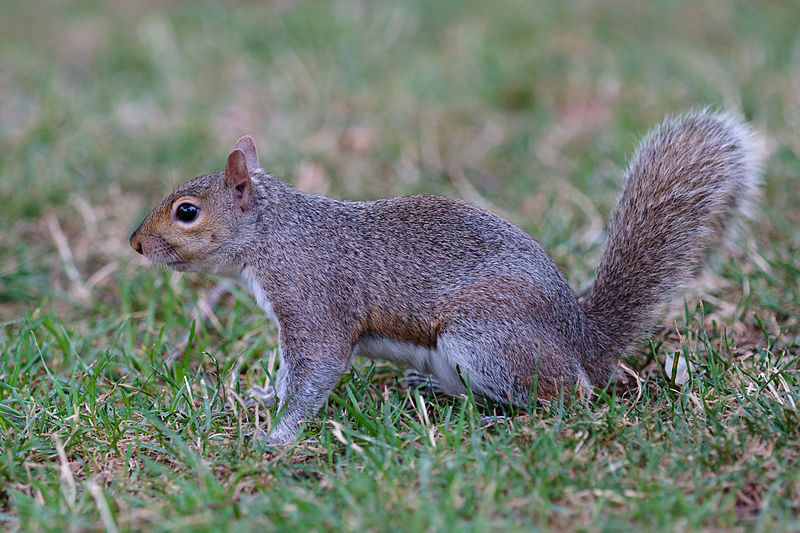
Grey squirrel. Creative Commons
We make every effort to end each story with a positive outlook. In this case, we turn to Mr. Dudley to remind our readers that the environment is not necessarily destroyed by the mere existence of non-native species. Being British, he uses British examples to make his point. The North American grey squirrel is considered an invasive species in Britain and the native red squirrel is now rare. While the British are not happy about the loss of their native squirrel, Mr. Dudley reminds them that the non-native grey squirrel is performing the same ecological functions as its native predecessor. There is apparently no evidence that the environment has been harmed by this substitution.
We don’t like change. But is change actually doing any harm? If not, let’s accept it, because fighting against it is costly and probably futile. That is the definition of wisdom: that we accept what we cannot change.
************************
*Nigel Dudley, Authenticity in Nature. Earthscan, 2011
Our interest in invasion biology is primarily in its application, specifically to “restoration” projects. Therefore, as science revises the assumptions of invasion biology we are equally interested in the implications for ecological restorations.
Professor Scott Carroll (UC Davis) is a particularly good candidate to lead the way in revising ecological restoration practices, as informed by current scientific theories of invasion biology. His study of rapid evolution of the native soapberry bug to accommodate use of non-native vegetation puts him in the forefront of the effort to integrate evolutionary theory into invasion biology.
And so we introduce to our readers, Professor Carroll’s proposal that we turn from efforts to eradicate non-native species in favor of a new approach which manages the co-existence of native and non-native species. He calls this approach Conciliation Biology.*
Conciliation Biology is based on these premises:
The environment has been radically altered by the activities of humans
The environment will continue to change in the future.
It is not feasible to eradicate non-native species.
The cost of attempting to do so is prohibitive.
These are familiar themes on Million Trees and we will not belabor them in this post. Rather we will focus on those aspects of Professor Carroll’s proposal that are new to us.
Rapid evolution can resolve apparent ecological problems
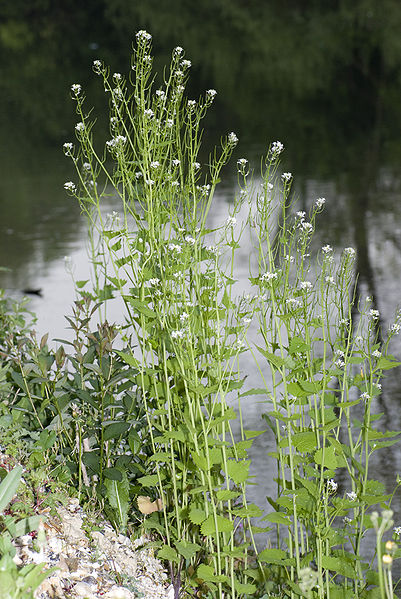
Garlic mustard. GNU Free
Garlic mustard is an invasive non-native plant which tolerates shade and emits a powerful root toxin known to inhibit the germination of other plants, notably forest trees. This chemical tool to reduce competition is known as allelopathy, a weapon used by many plant species, both native and non-native.
Since garlic mustard arrived first in the eastern US and spread slowly west, scientists compared the allelopathic toxicity of a population of garlic mustard known to have arrived 50 or more years ago with a population which arrived only 10 years ago. The toxicity of the recently arrived garlic mustard was significantly greater than that of the older population. In fact, the understory and seedling germination were rebounding in the forest with the older population of garlic mustard.
New exotic species are sometimes better adapted to the changed environment
Professor Carroll cites a study of two aquatic species (Phragmite and Hydrilla) which provide superior ecological services than their native counterparts because of changes in the environment. The extreme weather events associated with climate change are subjecting our coasts to unprecedented storm surges. Native species of marsh grass are not as successful in protecting the coast against the ravages of these storm surges.
We have our own local example of the same phenomenon. Non-native Spartina marsh grass is being eradicated along the entire west coast of the country. It grows taller and thicker than native Spartina and it does not die back during the winter months as the native species does. Since storm surges occur during the winter months, surely the non-native Spartina provides superior protection to our coast. We have yet to see a scientific experiment which proves this point, but common sense tells us that it is a study that needs to be done, particularly since ornithologists have reported that the eradication of non-native Spartina has been harmful to our dwindling population of endangered California Clapper Rail.
The harmful effects of eradication efforts
Iberian lynx. Creative Commons
We have seen many such harmful consequences of eradication efforts, but Professor Carroll provides his own example. Iberian rabbits are native to Spain. They were intentionally imported to Australia where they quickly became a problem. The Australians imported a virus from South America that killed the rabbits. The virus was also introduced to Britain for the same purpose. The virus has spread back to Spain where it is killing the rabbits in their native range. The rabbits are prey of several rare species of animals in Spain, including the Iberian lynx. The absence of their prey is now decimating those native predator populations as well.
Biological controls are one of many dangerous games being played by those who share in the fantasy that it is possible to eradicate non-native species without paying a price. Sometimes that price is greater than whatever cost may be associated with the non-native species.
Simply eradicating non-native species will not necessarily result in the return of natives
Professor Carroll tells us the story of the failed attempt to save the Large Blue butterfly in Britain from extinction to illustrate this point. This was apparently a spectacularly beautiful butterfly, and so the British spent 50 years trying to bring it back from extinction. They failed because they figured out too late that the butterfly is dependent upon an ant which lives only in heavily grazed vegetation. The ant population no longer existed within the range of the butterfly because grazing had long ago been abandoned.
How many other pointless efforts to reintroduce endangered species are there? We recently told our readers about the effort to reintroduce the endangered Mission Blue butterfly to Twin Peaks in San Francisco. This is a radically altered environment with high levels of nitrogen and carbon dioxide associated with the urban environment. The annual brush fires of pre-settlement San Francisco are no longer capable of sustaining the scrub required by the butterfly and the prescribed burns, which are the artificial equivalent, are not allowed in San Francisco. The scrub is therefore maintained with repeated applications of pesticides which are unlikely to benefit the endangered butterfly.
What is Conciliation Biology
Conservation biology has been “constrained by often futile efforts to restore historical communities, and [does] not appreciate the unavoidable and dynamic contributions of ongoing adaptive evolution.” * Conciliation biology proposes to address these shortcomings by:
Taking a longer-term view of the chronic effects of changes in the environment.
Making greater use of evolutionary theory
Fostering ongoing adaptation by accepting the hybridization that increases genetic variability
Identifying and supporting community mechanisms that increase resiliency
Improving the effectiveness of the science of invasion biology by using a multidisciplinary approach
How long will It take for this new approach to filter into the minds of those who are busily destroying non-native vegetation and damaging the environment in the process? How much damage will be done before these destructive methods are abandoned in favor of an approach that accommodates the reality, inevitability, and often the advantages of change?
*****************************
*Carroll, Scott, “Conciliation biology: the eco-evolutionary management of permanently invaded biotic systems,”Evolutionary Applications, 2011, 184-199.
Now we are going to tell you about a new publication by another team of scientists who challenged other assumptions about invasive plants and also conducted their own original research of one of the most basic assumptions of invasion biology: that invasions are facilitated by disturbance.
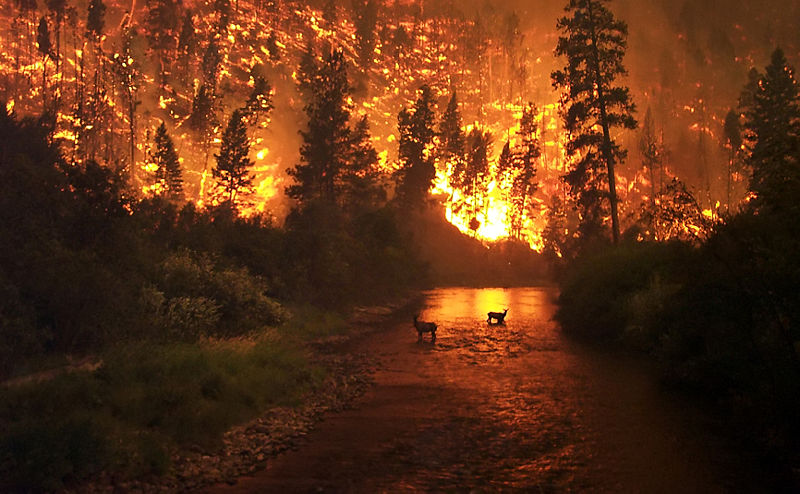
Wildfire, Bitterroot National Park, 2000. Wildfires are a type of disturbance that has increased with global warming and drought.
We introduced our readers to the leader of this research team, Professor Angela Moles, in a recent post about the mounting evidence that attempts to eradicate non-native species are futile. Professor Moles (University of New South Wales, Australia ) gave a TED (Technology, Entertainment, Design) presentation in which she reported that introduced species have changed significantly since their introduction and that if they weren’t yet new species, they soon would be. She proposed that non-native plants in Australia be granted citizenship.
Professor Moles collaborated with 21 scientists all over the world (Uganda, Indonesia, Mexico, USA, Australia, New Zealand, Japan, Argentina, Estonia, New Zealand) in the study that resulted in a recently published article entitled, “Invasions: The trail behind, the path ahead, and a test of a disturbing idea.” *
The trail of invasion biology
As the title suggests, the article begins by reporting that after 30 years and 10,000 publications, invasion biology has tested many assumptions and found inconsistent evidence to support them:
The search for traits of introduced plants that predict invasiveness has been a dead end: “…it is not currently possible and will probably never be possible to predict which species are likely to become problem invaders on the basis of traits alone. We therefore suggest that this is one area of invasion biology that merits less attention in the future.”
Invasion biology predicted that lack of genetic variability would hinder evolutionary adaptation in introduced species. This assumption has not been supported by empirical studies: “…rapid evolution has been repeatedly demonstrated in introduced populations, and the predicted reduction in genetic variance has not been observed.”
Rapid evolution of introduced species has been well established by empirical studies: “We have reached the point where additional case studies demonstrating rapid evolutionary change in introduced species are unlikely to have a major impact on our understanding of invasions.” New research questions are needed.
There is little evidence to support the assumption that introduced plant species will cause extinction In native communities: “…there are astonishingly few documented cases of native plants being driven to extinction by competition from introduced plants. There is no evidence for any native species in the United States being driven to extinction even within a state, by competition from an introduced plant species.”
The way forward in invasion biology
Professor Moles and her team then tell us why invasion biology has not been able to prove the assumptions on which the theory is based. The theory of invasion biology was based on untested assumptions that have been accepted as true although there is no empirical evidence to support them. The goal for the future of invasion biology should be to identify these assumptions that have been accepted as dogma, test them, and abandon those that are not consistent with empirical facts.
The authors of this study also, “…join a growing chorus, suggesting that our approach to invasion biology has been too simplistic.” Studies have tended to focus on the features of introduced plants in isolation. A more fruitful line of inquiry will consider the complex interactions between newly introduced species and their new environment:
“Rather than focusing on one factor at a time, we need to find ways (including multivariate analysis) to synthesize information about the recipient habitats/ communities, the characteristics of both resident species and the invaders, demographic processes, propagule pressure [measure of the number of species released into a region in which they are not native], the differences between current conditions and those with which the resident species evolved, evolutionary change to both native and introduced species, plasticity and feedbacks and interactions between different species and processes.”
You might say, “Phew! That sounds like a daunting task.” And so it is, but this team of scientists takes it on with an elaborate and complex study of one of the most basic assumptions of invasion biology: that disturbance facilitates plant invasions.
Does disturbance facilitate plant invasions?
“Disturbance is thought to facilitate invasion by simultaneously opening new ground for colonization, decreasing the competition from resident native species and releasing pulses of resources.” The definition of “disturbance” has varied in different studies, but generally includes fire, grazing, agriculture, erosion, wind, and flood. Empirical tests of this theory have produced mixed results. Even when the results have been positive, they have not persisted over the long-term.
Because disturbance is a natural feature of all ecosystems, native species have adaptive features that enable them to respond to natural disturbances. Therefore, the research team theorized that it is not disturbance per se which creates opportunity for invasions by introduced species, but rather changes in the disturbance regime. Their research study was therefore designed to distinguish between the level of disturbance and changes in the level of disturbance.
Given the international composition of their research team, they were able to select 200 sites in eight countries. They selected only those sites for which the natural patterns of disturbance were known. Their research methods were statistically complex and a detailed description of them is beyond our comprehension and probably many of our readers, but we encourage those with the necessary scientific knowledge to read the article which is available on the internet.
Their analysis of these 200 sites led them to the conclusion that the change in disturbance regimes was far more predictive of the success of invasions than the level of disturbance but that both variables explained only 7% of the variation in the percent of cover or species richness contributed by introduced species.
In other words, one of the most basic assumptions of invasion biology did not pass an empirical test of its validity. Invasions by introduced plants are largely unexplained by disturbance.
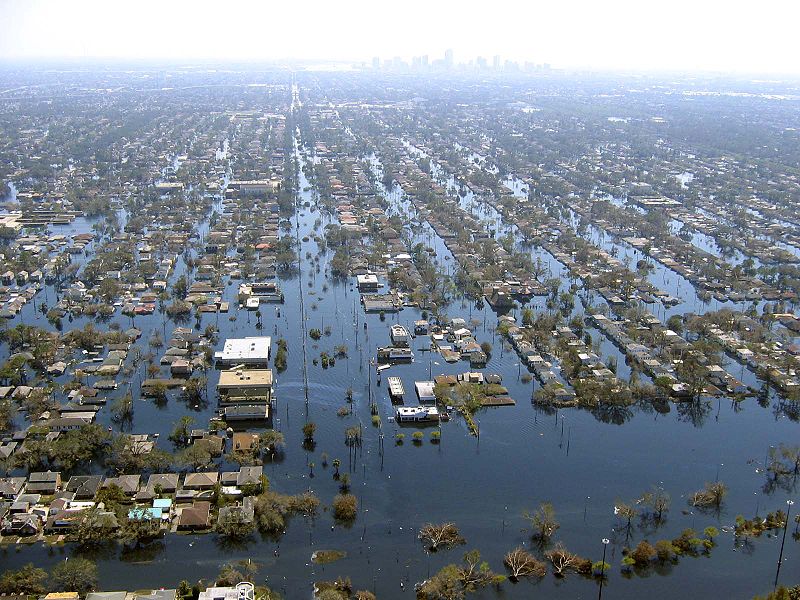
Post Katrina New Orleans. Floods are another type of disturbance that is likely to increase with climate change.
The future of invasion biology
Science is rapidly revising the assumptions of invasion biology. We strongly believe that it is just a matter of time before science informs us that introduced species are here to stay and that this is not the terrible news we have been led to believe. It is inevitable that this information will filter slowly from the scientific community to the community of native plant advocates. We hope that they hear and accept this good news before our non-native trees are destroyed.
********************
*Moles, Angela, et. al., “Invasions: The trail behind, the path ahead, and a test of a disturbing idea,” Journal of Ecology, British Ecological Society, 2012, 100, 116-`127. All quotes are from this article
“Support for major hypotheses in invasion biology is uneven and declining” is the title of a paper recently published in NeoBiota* co-authored by seven scientists from all over the world (Germany, USA, Spain, Canada, Czech Republic). The title captured our attention because it is consistent with our viewpoint.
The international team of scientists analyzed 371 empirical studies which tested six major hypotheses in invasion biology. They found that empirical evidence for these hypotheses is uneven and declining. The hypotheses that were tested by the studies were:
Invasional meltdown: the presence of invasive species facilitates invasion and survival of additional new species.
Novel weapons: invasive species with traits new to an exotic habitat have a competitive advantage over native species.
Enemy release: introduced species have a competitive advantage in the exotic range because they are released from their enemies in the new environment.
Biotic resistance: More biologically diverse ecosystems are more resistant to invasion.
Tens rule: 10% of newly introduced species escape to the wild; 10% of those naturalize in the wild; 10% of those become invasive.
Island susceptibility: Invasive species are more likely to become established and have major ecological impacts on islands than on continents.
The scientists counted the number of studies that support, question/oppose, or are undecided/inconclusive about each hypothesis. They also compared the number of supporting studies when the hypothesis was new with the number of supporting studies published recently to determine the decline in support for the hypothesis. Here’s what they found:
Hypothesis
n
% of supporting studies
% of decline in support
Invasional meltdown
30
77%
41%
Novel weapons
23
74%
25%
Enemy release
106
54%
10%
Biotic resistance
129
29%
5%
Tens rule
74
28%
10%
Island Susceptibility
9
11%
25%
Although support is strongest for the invasional meltdown hypothesis, recent studies are less supportive than early studies, indicating substantial decline in support. Declining evidence of invasional meltdown is consistent with the fact that exotic species are eventually integrated into the food web which reduces their populations, stabilizing their spread. There is apparently little evidence that islands are more susceptible to invasion than continents and few studies have been done to test the hypothesis.
Declining support for scientific hypotheses has been observed in many disciplines, particularly medicine, ecology, and psychology. The scientists who study this phenomenon theorize that the decline is attributable to some combination of these factors:
Over time the amount of available long-term data increases.
The best examples which are the strongest cases for the hypothesis are most likely to be studied first.
Publication bias favors new hypotheses and those for which the results are conclusive.
The NeoBiota paper also observes that the empirical evidence supporting each hypothesis varies by taxonomic group (plants, invertebrates, vertebrates) and habitat type (terrestrial, freshwater, marine). For example:
The novel weapons hypothesis has been tested only for plants in terrestrial habitats.
Support for the invasional meltdown hypothesis is even across taxa and habitats.
Support for biotic resistance is strongest in marine habitats.
Where is invasion biology headed?
The authors of the NeoBiota paper are not suggesting that invasion biology be abandoned. Rather their goal is to redirect scientists in the field to more productive efforts, such as:
Where a hypothesis cannot be generalized to all taxa and habitats specify exactly where it is applicable.
Rather than focusing on newly introduced species, focus on the interaction of a those species with their new environment.
Discard those hypotheses that don’t work.
Based on our fifteen years of experience studying the native plant movement and its theoretical underpinnings in invasion biology we wholeheartedly support the advice of the authors to focus scientific efforts on the interaction of new species with their new environment. We strongly believe that the success of newly introduced species is based largely on changes in the environment into which they are introduced. In other words, invasions are more a result of changes in the environment than on the characteristics of the introduced species.
We also endorse the advice that scientists be more specific about the applicability of the assumptions of invasion biology. We have seen the damage done by sweeping generalizations about how ecosystems operate in the hands of hobbyists. Nature is complex and we do not necessarily understand all the factors operating in a given environment. We hope that scientists will lead the way to the public’s more nuanced understanding of ecosystems.
************************************
*Jeschke, Jonathan, et. al., “Support for major hypotheses in invasion biology is uneven and declining,” NeoBiota, 14: 1-20 (2012)