Today, I am proud to publish a guest post by Arthur M. Shapiro, Distinguished Professor Emeritus of Ecology and Evolution at UC Davis and renowned expert on the butterflies of California. He is the author of a seminal, frequently cited study of California butterflies that reported the results of 30 years of observing butterflies in his research transects. He is also the author of Field Guide to the Butterflies of the San Francisco and Sacramento Valley Region, which draws on diverse data sources in addition to his own.
When the native plant movement began in earnest over 30 years ago, nativists believed that their preference for native plants was widely shared by the public. They were unprepared for the blow back from the public who objected to the destruction of trees and vegetation, deemed “invasive,” a debatable description of non-native plants.
So began the fabrication of claims that non-native plants are harmful to the environment and its inhabitants, intended to justify their effort to eradicate non-native plants. Most claims have been proven false, but the accusation that non-native plants are responsible for the global decline in insect populations is still standing.
Professor Shapiro’s review addresses this particular accusation about non-native plants, the remaining myth that is used to justify the eradication of non-native plants. These are the myths about non-native plants that have been put to rest by reality and research:
- Thirty years ago a birder and nativist claimed that eucalyptus trees kill birds. There is scant evidence of this claim and it is rarely heard today.
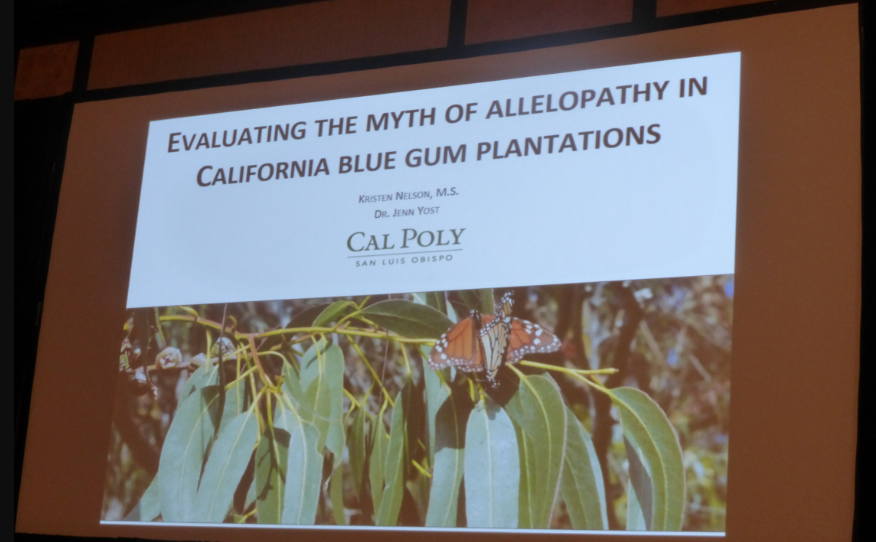
- Next up, nativists claimed that “nothing grows under eucalyptus trees” because eucalyptus leaves emit an allelopathic toxin that suppresses germination of plants. Research eventually proved that this claim is false.
- Then, the story was that eucalyptus in California only live for 50 years and that they become hazardous at greater ages, which requires that they be destroyed. The source of this information was Cal Poly SLO’s Selectree tool. We were able to disprove that claim and the Selectree tool was revised accordingly. Now longevity of tree species has been entirely removed from Selectree because the source of information was determined to be unreliable.
- Another popular myth was that non-native plants are more flammable than native plants. Although flammability varies by species, there is no evidence that non-native plants are inherently more flammable than native plants. Most wildfires in California occur in native conifer forests and native chaparral.
In his review of a compendium of essays on the subject, written by European scholars, Professor Shapiro addresses the claim that non-native plants are to blame for the global decline in insect populations. His review informs us of the current status of this debate, which remains unresolved in the absence of sufficient data.
BIOLOGICAL INVASIONS AND GLOBAL INSECT DECLINE. Edited by Jonatan Rodriguez, Petr Pysek, and Ana Novoa. 2025. Elsevier. $127.50 (paper).
William Belknap was Secretary of War in Ulysses S. Grant’s Cabinet. He was a notorious grifter, and the House of Representatives voted unanimously to impeach him. To avoid a trial he resigned immediately but the Senate tried him anyway. (They failed to convict on the grounds that he could no longer be impeached since he was no longer in office.) What does this have to do with this book? The first line of the impeachment resolution became a standing joke: “Whereas Belknap is corrupt, therefore…” Wags quickly completed the sentence by filling in a variety of ludicrous “consequences,” such as bad weather. Belknap was “blamed” for everything judged bad.
It’s the same with “invasive species.” Ever since Charles Elton published “The Ecology of Invasions by Animals and Plants” in 1958, invasion biology has been a significant subdiscipline of ecology. Colleges of agriculture had long studied “weed science,” but it now acquired an academic imprimatur; likewise pest management and the dynamics of infectious disease. The tendency to blame all our ills on invasive species, however, has blossomed in our own day.
When Oliver Milman published “The Insect Crisis” (2022), he called public attention to a developing situation theretofore known to a select few. Now two putative crises—invasive species and insect declines—have been brought together in a supposed cause-and-effect relationship. The editors of this scholarly omnium-gatherum of twelve chapters are all European botanists, two of them affiliated with the Czech Academy of Sciences, which maintains a Department of Invasion Ecology. It would be a fine focus of a graduate seminar (I may indeed use it as such) but it is not appropriate or intended for a general readership. The chapters have individual and copious bibliographies (there is none for the book as a whole), and their sheer bulk may convey the impression that we know a lot about their subjects when, by and large, we don’t. There are two general conclusions to be drawn from the text: One, we actually know very little about the effects of invasive species on insects; two, when we do know something substantial it concerns island ecosystems. That is hardly surprising. We have known at least from the times of Darwin and Wallace that depauperate, mostly-endemic island ecosystems are extremely vulnerable to disturbance, including invasion.
My own involvement with the subject of this book centers on the biology of Lepidoptera, including their host-plant relationships. I have been publishing in this area since the 1960s. It is covered here in Chapter 5, by Litt, Mitchell, and the ubiquitous Doug Tallamy. I must admit I was pleasantly surprised that the chapter avoids the temptation to hyperbole, and basically confirms the impression that to the extent invasive plants have been shown, or at least strongly suspected, to have adverse effects on native insects, the usual mechanism is the competitive displacement of native plants which are insect resources by aliens which are not. Cases in which native phytophages are lured to their doom by chemically-attractive invasives that are either toxic or nutritionally inadequate are rare indeed. My beef with the chapter – and it is non-trivial—is that it underplays the role invasives can and often do play as suitable hosts whose arrival bolsters, rather than harms, native insect populations. In numerous cases these insects are rescued by the weeds when urbanization or other habitat loss has put them in serious danger. The authors do cite our summary paper (Graves and Shapiro 2003, in Biological Conservation). They make no effort to extract relevant information from such sources as my field guide to butterflies of the Bay Area and Sacramento Valley, in which at least 20% of the species are listed as breeding on invasive plants (!), but there is plenty such out there. We simply do not have the data to say conclusively whether naturalized exotics are, on balance, good or bad for our butterfly fauna—only for particular species. How much less do we know about, say, beetles?
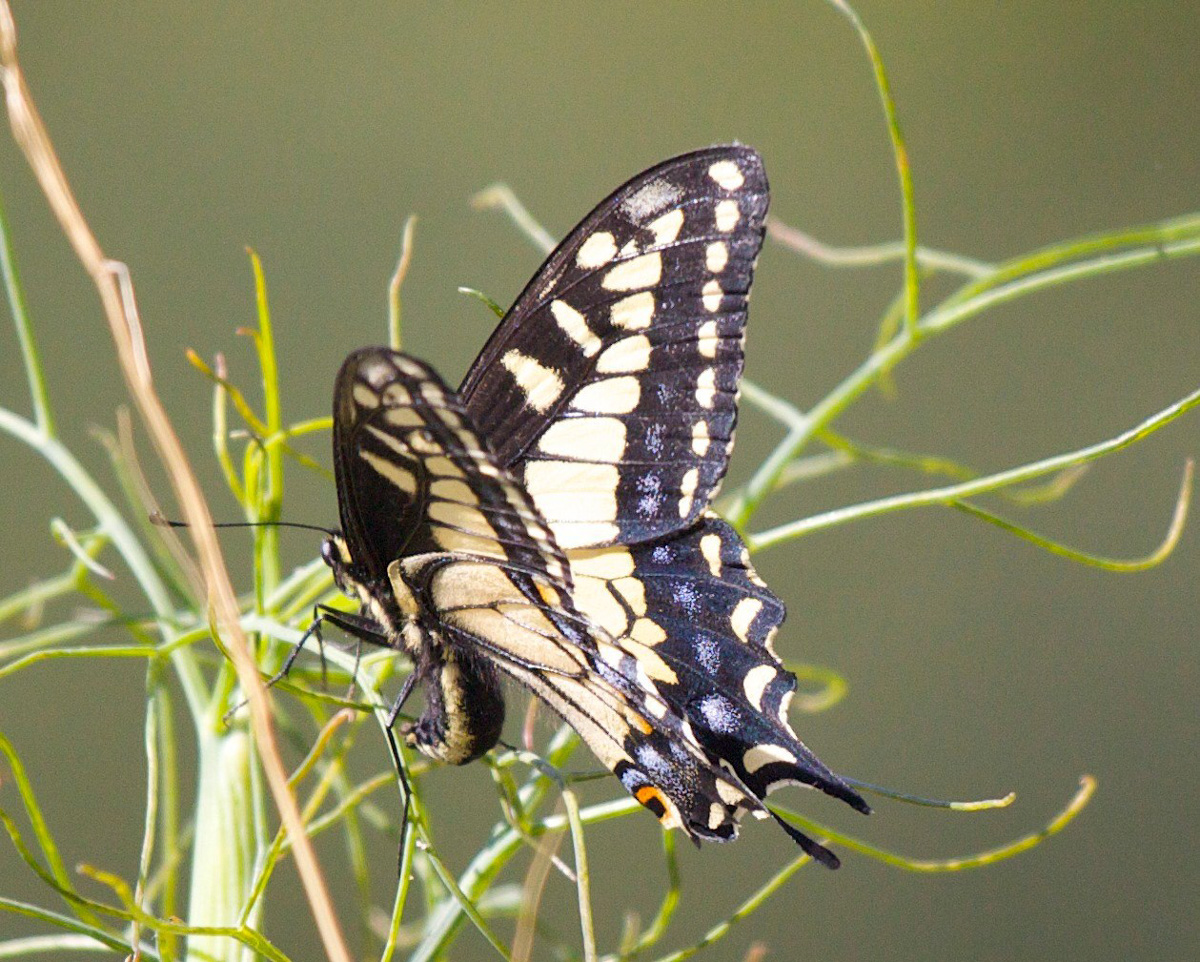
In 2006 I published a note on the use of a Cruciferous invasive “weed” as a host plant by one of the world’s highest-altitude butterflies, the endemic Andean Phulia nymphula. If this is happening in the high Andes, where else might we find it?
If invasive species are a significant contributor to the global phenomenon of insect decline, this book can serve to point us toward the research that needs to be done; it does not make a case that “would stand up in court.” Invasives, like poor Belknap, are easily blamed for things they may not impinge on at all.
ARTHUR M. SHAPIRO, Evolution and Ecology, University of California, Davis

