The medical establishment takes a stand on GMOs that enable more herbicide use

The majority of the scientific community has, until recently, considered genetically modified (GM) food safe to eat.  The Pew Research Center conducted a survey in which they compared the opinions of scientists regarding GM food to the opinions of the general public.  The scientists in the survey were members of the American Association of the Advancement of Science, an elite group of scientists.  Eighty-eight percent of the sampled scientists considered GM food safe to eat, compared to only 37% of the general public.  This survey was published in January 2015, reflecting recent attitudes toward GM food.

That opinion has changed, at least among some medical professionals, according to an article recently published by the New England Journal of Medicine (NEJM). (1)  NEJM is America’s premier medical journal, with the highest standards of journalistic ethics for the studies they choose to publish.  The article in NEJM was co-authored by a professor of preventive medicine and a professor of crop and soil science.  They conclude that GMOs have enabled huge increases in the use of herbicides by agriculture, posing hazards to public health.  The genetic modification itself is not to blame.  Rather it is the increased use of herbicides that are a matter of concern.

The authors trace the sequence of events that changed their opinion of GM foods from benign to a public health hazard.

What is “genetic modification?”

Genetic modification of plants and animals occurs naturally and has as long as life has existed on Earth.  When two closely related species interbreed, the result is a hybrid, which sometimes persists in nature and often ultimately results in a new species.  For example, there are hundreds of species, sub-species, and varieties of Manzanita in California because it is a species that freely hybridizes.  Sycamore trees are another plant that hybridizes freely.  Historically, such hybridizing events were not considered harmful.

Genetic modification is not fundamentally different from selective breeding in which humans have been engaged since the advent of agriculture and domestication of animals thousands of years ago.  Individual plants and animals with characteristics considered valuable were bred by humans to enhance the usefulness of plants or animals to humans.  Ancestor plants of corn were barely edible, but corn has become one of our staple foods as a result of breeding.

DNA analysis greatly enhanced the ability of humans to genetically modify plants and animals to make them more useful to humans.  Now scientists can import DNA into plants and animals from virtually anywhere in the biosphere.  Some of those modifications have been very beneficial, such as increasing crop yields, or enabling plants to survive in warmer climates, etc.  In 2000 and 2004, the American Academy of Sciences evaluated GM foods and concluded that they did not pose any unique hazards of human health.

Genetic modification becomes the enabler of herbicides

So what has changed that makes the medical establishment decide that GM foods are a matter of concern?  Beginning in the 1990s genetically modified crop seeds were developed that enable the crop to tolerate unlimited amounts of herbicide, particularly glyphosate (AKA Roundup).  Ninety percent of corn and soybeans grown in the United States is grown from these seeds.  Consequently, glyphosate use in the United States has increased from .4 million kilograms in 1974 to 113 million kilograms in 2014.

Rare ears of organic corn.  Courtesy A Really Small Farm
Rare ears of organic corn. Courtesy A Really Small Farm

Unfortunately, weeds are smarter than we are.  The more herbicide we use, the smarter the weeds get.  The evolutionary pressure of the chemical onslaught on the weeds has produced glyphosate-resistant weeds on nearly 100 million acres in 36 states.  There is always enough genetic variation in any large population of plants and insects to ensure that a few individuals will survive whatever we spray on them.  Those survivors will breed to produce the next generation, which ensures that the next generation will be more likely to survive the next onslaught of chemicals.  Over time, the population of weeds and insects capable of surviving our chemicals gets bigger and stronger.

One bad decision begets another

You might think we would abandon this chemical warfare in favor of a less poisonous, more effective long-term strategy.  You would be wrong because you’re not thinking like a corporation which manufacturers chemicals and the seeds that ensure their use.  Of course, their strategy is to make the chemicals stronger and stronger.  That strategy might make sense if we weren’t living on the same planet with all that poison or eating the food that has been sprayed with them.

The medical profession draws the line

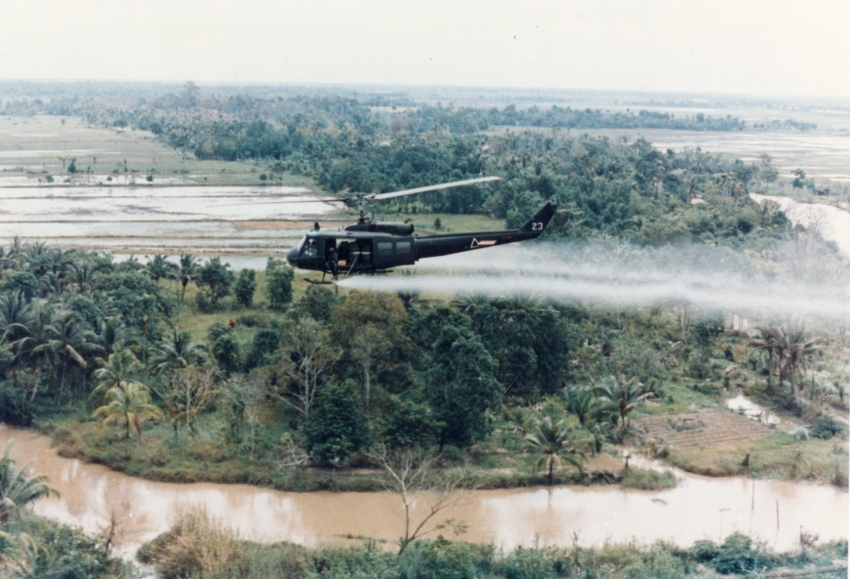
In response to herbicide-resistant weeds, the manufacturers of pesticides have developed a new herbicide which combines glyphosate and 2,4D into a product called “Enlist Duo.”  You may recognize 2,4D as one of the ingredients in Agent Orange, used during the Vietnam War to defoliate the battle field and incidentally to poison our troops and generations of Vietnamese.  Enlist Duo was approved by the Environmental Protection Agency in 2014.  In 2015, the World Health Organization (WHO) classified glyphosate as a “probable human carcinogen” and 2,4D as a “possible human carcinogen.” 

US Army helicopter spraying Agent Orange over Vietnam. Public Domain

This escalation of chemical warfare on America’s food supply has sent some members of the medical community over the edge:

“These developments suggest that GM foods and the herbicides applied to them may pose hazards to human health that were not examined in previous assessments.  We believe that the time has therefore come to thoroughly reconsider all aspects of the safety of plant biotechnology.  The National Academy of Sciences has convened a new committee to reassess the social, economic, environmental, and human health effects of GM crops.  This development is welcome, but the committee’s report is not expected until at least 2016.” (1)

In view of these concerns, the authors of the article in NEJM advise the EPA to withdraw its approval of Enlist Duo, a decision which “was made in haste…based on poorly designed and outdated studies and on an incomplete assessment of human exposure and environmental effects.” The authors also suggest that we “revisit the United States’ reluctance to label GM foods.”  They suggest that it is time to join 64 other countries around the world that require labeling of GM foods.


(1) Philip J. Landrigan, M.D., and Charles Benbrook, Ph.D., “GMOs, Herbicides, and Public Health,” New England Journal of Medicine, August 20, 2015.

Do you think a small dose of poison won’t hurt you? Think again.

In our previous post we told our readers about the strategies used by opponents of government regulation to prevent or delay regulation by undermining the science that informs us of environmental and health risks.  In this post, we will focus on the inadequacy of pesticide regulation in the US and the arguments used to justify inadequate regulation.

Paracelsus coined the adage "the dose makes the poison" in the 16th Century
Paracelsus coined the adage “the dose makes the poison” in the 16th Century

Pesticide regulation in the US—like all regulation of chemicals—is based on an assumption that there is a threshold of exposure below which the chemical is safe.  This assumption is often summarized as “the dose makes the poison.”  This old adage originates with a Renaissance medic who died in 1541 and it was employed at the dawn of the nuclear era to reassure the public that they were not being harmed by radiation.  Since radiation occurs naturally in the environment, some low level of exposure is assumed to be harmless.  (1)

But can we assume that the same is true of pesticides?  Does every pesticide have some threshold dose below which it is harmless?  There are many reasons why we cannot assume that there are safe levels of exposure to pesticides.

Bioaccumulation and Biomagnification

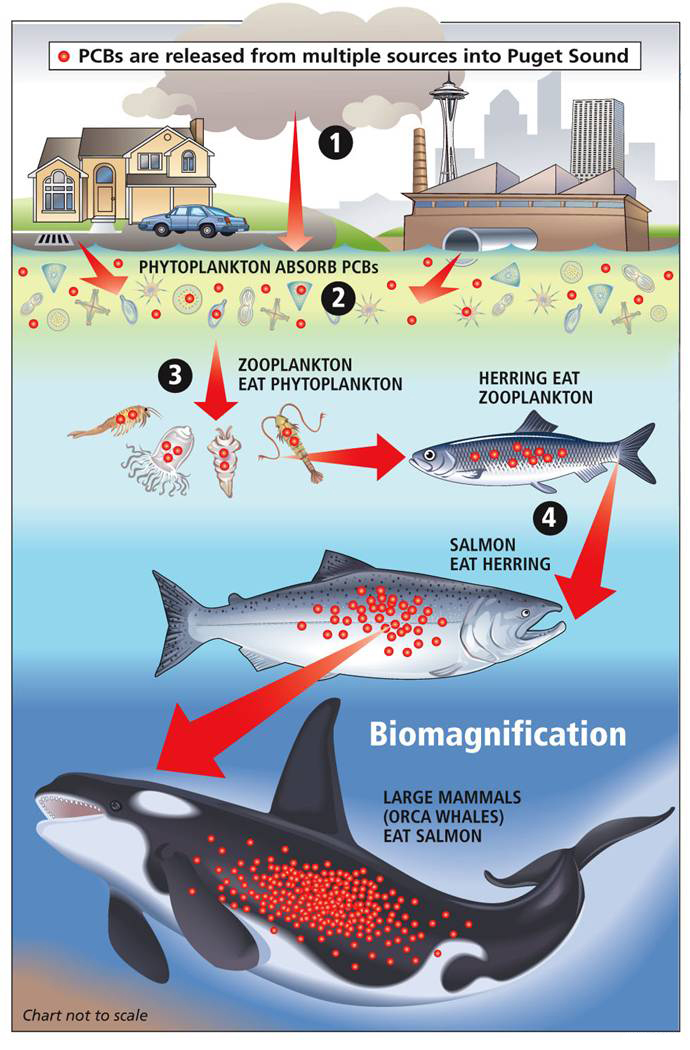
BiomagnificationMany chemicals accumulate in our bodies throughout our lives. Researchers at Brown University tested the blood of over 3,000 women between the ages of 16-49 for levels of mercury, lead, and PCBs. These three chemicals are known to harm brain development of fetuses and babies. The sample was designed to represent the national population of 134.4 million women of childbearing age. Here’s what they found:

  • “Nearly 23 percent of American women of childbearing age met or exceeded the median blood levels for all three chemical pollutants [combined].” (2)
  • “As women grew older, their risk of exceeding the median blood level in two or more of these pollutants grew exponentially to the point where women aged 30 to 39 had 12 times greater risk and women aged 40-49 [born before these chemicals were banned] had a risk 30 times greater than those women aged 16 to 19.(2)
  • The chemicals that accumulate in a woman’s body do not stop there. They are passed from one generation to the next in mother’s milk and across the placenta to her unborn child.  If we stopped all new discharges today and cleaned up all the PCBs already in the environment, “it would take six generations…until PCBs would no longer be detectable in the bodies of our offspring.” (3)
  • “Fish and alcohol consumption also raised the risk of having higher blood levels. Women who ate fish more than once a week during the prior 30 days had 4.5 times the risk of exceeding the median in two or more of these pollutants.” (2)

PCB  is an organochlorine (organic–carbon-based–chemicals that contain one or more chlorine atoms), as are all products derived from chlorine, such as polyvinyl chloride (PVC) and some pesticides, such as DDT.  Organochlorines accumulate in the fatty tissue of living things (bioaccumulation), magnifying in concentration as they are eaten by their predators (biomagnification).   Animals at the top of the food chain—such as humans—therefore receive larger doses of these chemicals than animals at the bottom of the food chain.

Some chemicals are not easily metabolized by our bodies and many persist in the environment for long periods of time, which contributes to the cumulative effect of each individual exposure:  “The increased stability of many organochlorines makes them more resistant to the body’s metabolic processes, so they are retained in the body for longer, may accumulate to higher and higher concentrations over time, and will cause more severe toxic effects for a longer period of time than if they were more easily metabolized.” (3)

In other words, a single dose of a chemical may not be harmful, but the accumulation of many doses from a variety of sources over a long period of time is much more likely to be harmful. 

Multiple exposure sources

Even if there were some safe dose of a particular chemical, we should assume that we are also exposed to multiple sources of that chemical, of which we may be unaware.  Taking organochlorines as an example of chemicals known to be toxic and to accumulate, if we are exposed to an organochlorine pesticide, we might also be exposed to organochlorine by-products of pulp paper manufacturers, and/or dry cleaning processes, and/or hazardous wastes generated by incinerators, and/or the PVC plumbing in our homes, and/or detergents and water disinfectants, etc.

Many of these chemicals are airborne and are found at high concentrations far from where they were applied:  “Airborne deposition of atrazine [herbicide] into the Great Lakes has become so significant that there is now about 36,000 kilograms of the pesticide in Lake Superior water…the bulk of organochlorine pesticides and other persistent pollutants that enter the waters of the Great Lakes come from as far away as the southeastern United States and Latin America.” (3)  These chemicals are volatized from where they were discharged, they travel on atmospheric currents and are deposited by rain and snow in colder regions where they stay.  Polar regions are the ultimate sink for persistent organochlorines, where they are far more persistent than in warmer climates, e.g., atrazine has a half life of 60 days at room temperature, but does not degrade at all below 43° F.

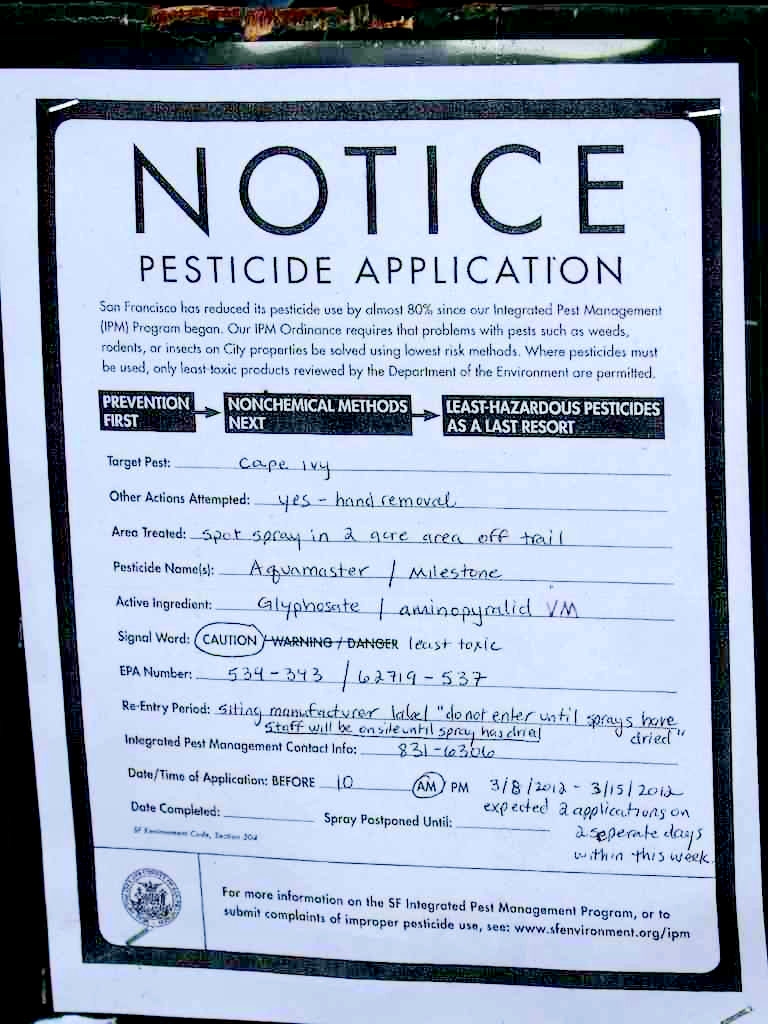
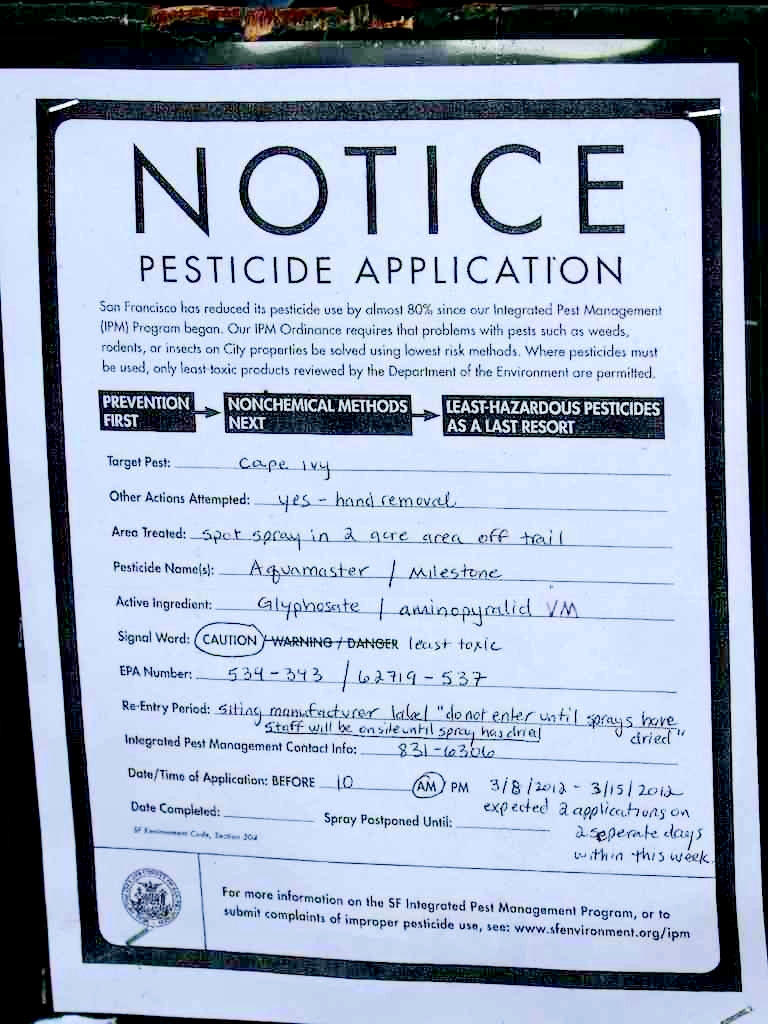
Mixture of glyphosate and aminopyralid sprayed on ivy in Glen Canyon Park, San Francisco

There are over 80,000 chemicals on the market of which only a small fraction have been tested and there are thousands more that are formed as accidental by-products, such as dioxins. These chemicals interact in unknown and unpredictable ways about which little is known: “Less than 0.25 percent of studies have evaluated the effects of mixtures of more than two chemicals.” (3)  Even if there were some safe level of exposure to a single chemical, that would tell us nothing about the synergistic (multiplicative or exponential effect by which the whole is greater than the sum of its parts) or additive effects of the multiple chemicals to which we are exposed.  A recent study by an international team of 174 scientists at leading research institutions reported that a “cocktail” of common chemicals found at exposure levels in the environment today can trigger the cellular mutations that result in cancer.

Limitations of testing

In the small minority of cases in which a chemical has been tested for toxicity, that test is only as accurate as the test protocol/test parameters/test procedures, etc.  There are many methodological limits of toxicological analysis:

  • Tests are conducted on laboratory animals in which the dose is limited to a single chemical. As we said before, in the real world, humans and other animals are subjected to many chemicals simultaneously in doses that are unknown and unknowable, because little testing is done of contamination in the environment.
  • Tests are done for relatively short periods of time, compared to the long lives of humans during which chemicals accumulate in our bodies.
  • The chemical threshold deemed “safe” is not the dose at which no adverse affect occurred. It is only the dose at which no adverse affect was observed:  “Subclinical affects—reduced fertility, compromised immune systems, and reduced intelligence, for example—are not observed not because they have not occurred but because they are seldom sought.” (3) In other words, the testing regimen does not test for many potential health problems.
  • The testing regimen also is limited to certain species and certain stages of development. For example, bees are the only species of insect on which pesticide tests are required and they are only tested at the adult stage.  Bee keepers will tell you that larvae stages of bee development are far more vulnerable to pesticides than adult bees, yet no tests are required on that stage of development.  Bees are probably less vulnerable to pesticides than caterpillars which eat vegetation, but caterpillars are not tested.  If caterpillars are killed, there are no moths and butterflies.
  • The test is only as accurate as the analytical tool. The test may not be sensitive enough to detect injury.  The history of lead regulation is an illustration of the evolving science of toxicology testing.  Lead poisoning was first detected in the 1920s among workers exposed to lead.  The first established threshold for lead exposure was 80 micrograms of lead per deciliter of blood.  In the 1960s Australian physicians reported a connection between lead levels in children and lead in household paint.  Industries with an economic interest in the issue organized a defense of their products, which prevented further regulation until the late 1970s when the threshold was lowered to 60 micrograms per deciliter.  A few years later, the threshold was reduced further to 40 micrograms, then 35 micrograms, then 30 micrograms, then 25 micrograms.  “In the 1990s the safe level for children was reduced to 10 micrograms…Today it is understood…that exposure to less than 10 micrograms per deciliter also impairs cognitive development, and there is most likely no threshold at all.” (3)

Manipulation and Obfuscation

The tests of toxicity required by law are conducted on a small minority of the tens of thousands of chemicals on the market.  When the tests required by law are conducted, they are inadequate to accurately determine toxicity.  So, in those rare cases when tests indicate that a chemical is harmful at the doses being used, you might think its use would be prohibited by law.  You would be wrong.  Regulation is prevented, even when tests clearly indicate that a chemical is harmful.

Atrazine is only one of many examples of how regulation is prevented by the disinformation campaigns of the manufacturers of chemicals and the industries which use them.  Professor Tyrone Hayes was hired by the manufacturer of atrazine to test the toxicity of that chemical on frogs, the animal that Professor Hayes studies.  Professor Hayes quickly reported that atrazine caused hermaphroditism and sterility in frogs.  Atrazine is a known endocrine (hormone) disrupter.  Very small quantities of hormones are capable of producing cascading effects throughout our bodies.  Despite this well known physiological fact, the primary means used by the manufacturer of atrazine to discredit Professor Hayes’ research was to argue about the doses that were used in his study:  “Atrazine is unlikely to have an adverse impact on frogs at existing levels of exposure” (4)  This criticism of Professor Hayes’ research is bogus because the dose he used was taken directly from the environment in which atrazine is used and contaminates surrounding water bodiesHe and his students continued the work, travelling to farming regions throughout the Midwest, collecting frogs in ponds and lakes, and sending three hundred pails of frozen water back to Berkeley. In papers in Nature and in Environmental Health Perspectives, Hayes reported that he had found frogs with sexual abnormalities in atrazine-contaminated sites in Illinois, Iowa, Nebraska, and Wisconsin.” (5)

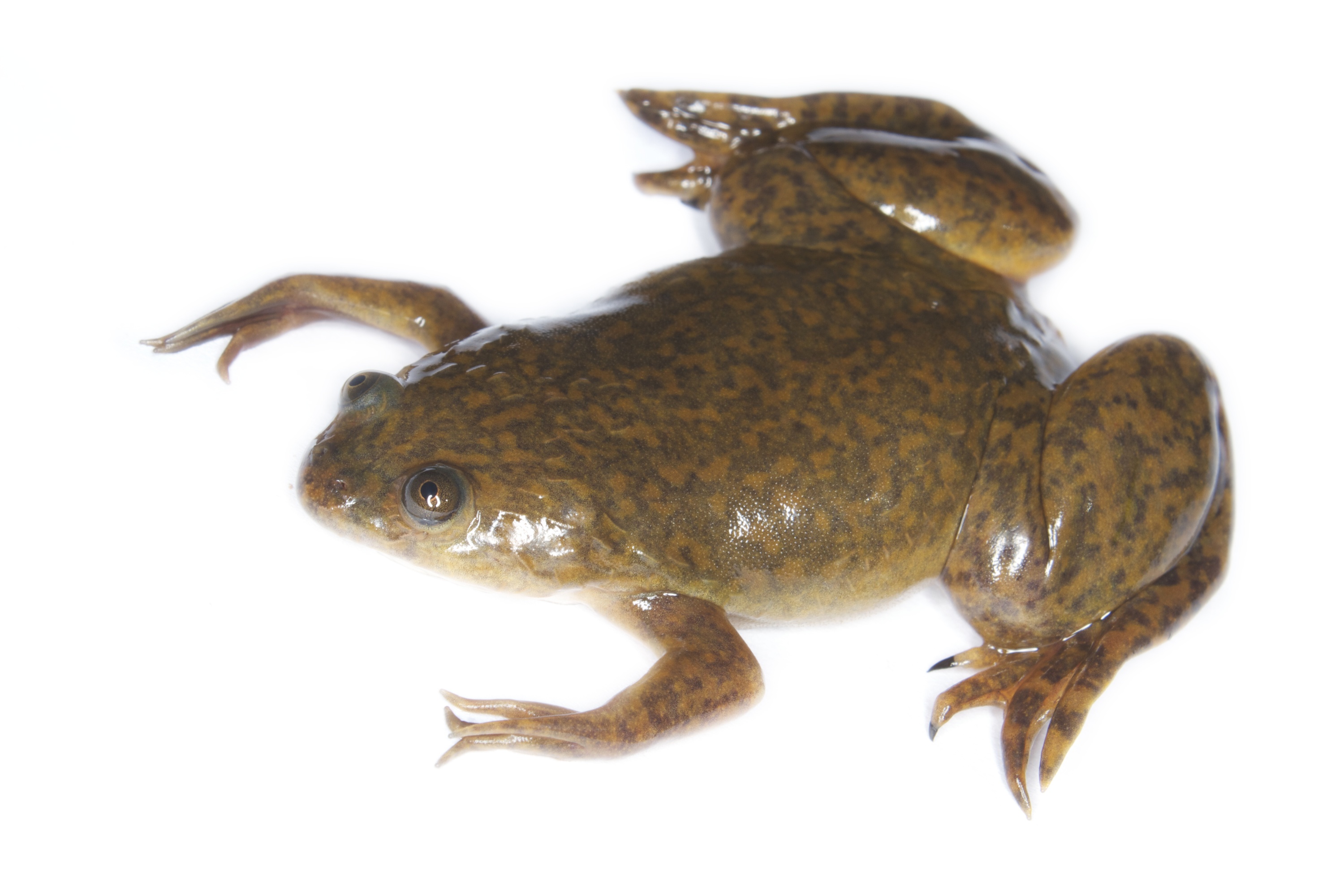
African clawed frog was used in human pregnancy tests. Creative Commons

In our recent debate with a reader who does not believe that pesticides are harmful to humans, his response to this information about the affects of atrazine on frogs was that he does not care about frogs.  So, let’s take a moment to think about why this research should be a matter of concern to us, even if we don’t care about frogs.  One of the frogs that Professor Hayes used in his research on atrazine was the African clawed frog.  The reason why he used that particular species is that, although it is not a native frog, it is very commonly found in nature because it was used for decades in pregnancy tests on humans.  If the urine of a pregnant woman is injected into a female African clawed frog, the frog quickly lays eggs.   In other words, the reproductive and endocrine system of frogs is closely related to that of humans.  If the reproductive and developmental system of frogs is adversely affected by atrazine, we should assume that humans are probably also affected.

Agent Orange was used in Vietnam from 1965-1969 to defoliate the battlefield to make the guerilla enemy more visible.  It was discontinued when scientists reported that it caused birth defects in mice.  Subsequently, Vietnam veterans reported severe health problems that were suspected to be a result of exposure to Agent Orange.  The manufacturers of Agent Orange quickly circled the wagons.  With the active participation of the government, they were able to prevent compensation of Vietnam veterans for their health problems for over 20 years.  This was achieved by direct manipulation of the research data.  Specifically, exposed workers and soldiers were put into the unexposed control group so that no statistical difference in the groups was apparent. (3)

There are multitudes of ways to cook the books.  Atrazine and Agent Orange are two examples in which the manipulation was discovered.  We will never know how many more there are that we don’t know about.

Cost-benefit analysis

Current federal law regulating toxic chemicals requires a cost-benefit analysis be taken into consideration before a chemical can be taken off the market.  In the case of pesticides, the manufacturers and the primary users of pesticides have successfully defended against regulation by claiming that agricultural productivity would be drastically reduced and the price of food drastically increased without continued use of pesticides.  However, there is considerable evidence to the contrary:

  • Despite massive pesticide use, some 37 percent of all US crop production is lost to pests—significantly more than was lost before the advent of synthetic pesticides.” (3)
  • In 1989, the US National Academy of Science’s Board on Agriculture reported, “Reduced use of these [chemical] inputs lowers production costs and lessens agriculture’s potential adverse environmental and health effects without necessarily decreasing—and in some cases increasing—per acre crop yields and the productivity of livestock management systems.” (3)
  • “In Germany…a long-term study of 44 farms has found that yields of wheat, oats, and rye have steadily increased over a 17-year period following the farmers’ transition to strictly organic agriculture.” (3)
  • “While yields stay more or less the same, the impact on farmers’ profits can be very positive [because] pesticides account for as much as 20 percent of the variable costs of crop production.” (3)

As strong as the case is against economic benefits of pesticide use by agriculture, the case is much stronger against pesticide use for ecological “restorations.”  There is no empirical evidence that there is any benefit to ecological “restorations.”  They do not increase biodiversity.  They do not benefit wildlife.  If there is no benefit, there is no justification for using pesticides for this purpose.

We apologize for the length of this post.  After spending several months studying the issues, we felt compelled to take you on our journey to the inevitable conclusion.  There is no justification for using pesticides for the sole purpose of eradicating non-native plants because they are not doing any harm and therefore there is no benefit to killing them, particularly with harmful pesticides.


 (1) Naomi Oreskes & Erik Conway, Merchants of Doubt, Bloomsbury Press, 2010

(2) Marcella Remer Thompson, Kim Boekelheide, “Multiple environmental chemical exposures to lead, mercury, and polychlorinated biphenyls among child-bearing-aged women: Body burden and risk factors,” Elsevier, November 16, 2012

(3) Joe Thornton, Pandora’s Poison, MIT Press, 2000

(4) Jon Entine, “Scared to Death:  How chemophobia threatens public health,” A position paper of American Council on Science and Health, 2011

(5) Rachel Aviv, “A Valuable Reputation,” New Yorker, February 10, 2014

Merchants of Doubt: Why isn’t our government regulating pesticide use?

A few months ago, we had a long email “conversation” with a reader who is opposed to the destruction of our urban forest, but does not believe that pesticides are harmful to the environment. He is an intelligent and well-informed person and we were intrigued by some of the arguments he used.  We read and considered every resource he sent in support of his opinion.  Then we read the resources suggested by our collaborators with greater knowledge of pesticides.

Glyphosate application, Glen Park, San Francisco.

We have decided to report some of what we learned because of the recent decision of the World Health Organization (WHO) to classify glyphosate as a “probable human carcinogen.”  Glyphosate is the herbicide used most often by land managers to eradicate plants they consider “invasive.”  It is also considered the least toxic of the many herbicides they use.  Some countries are reacting to the WHO decision by banning use of glyphosate.  The Marin Municipal Water District has announced that it will quit using glyphosate (and other herbicides) to eradicate non-native plants on Mt.  Tamalpais.  The City of San Francisco recently announced that it has reclassified glyphosate from Tier II (more hazardous) to Tier I (most hazardous)Why isn’t our federal government or our land managers in the East Bay questioning the use of this pesticide?  Our reading in the past few months answers this question. 

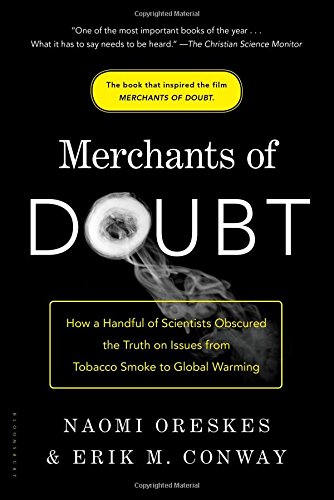
Merchants of Doubt

Merchants of Doubt (1) is about a small group of people (mostly men) who have influenced public policy in the past 60 years by undermining the science upon which these policies should be based.  They were physical scientists who were involved in the development of weapons during WW II and the Cold War that followed.  As such they were deeply committed to militaristic solutions to international threats and they perceived communism as America’s greatest enemy.  It follows that they were equally committed to our capitalist economic system which is the antithesis of communism.  They perceived government regulation of business interests as a threat to capitalism.  Here are some of the public policy issues in which they have been influential:

  • Merchants of DoubtAfter WW II many scientist who participated in the development of nuclear weapons became advocates for arms control because they predicted dire consequences of their use, such as the nuclear winter that would decimate life on Earth. The Merchants of Doubt stepped forward to undermine the effort to disarm the nuclear arsenal by attacking the predictions of their opponents.  They played a similar role during the Reagan administration when most scientists did not consider the Strategic Defense Initiative (AKA Star Wars) technically feasible.   With the backing of the Merchants of Doubt, the development of SDI was funded despite the fact that it is unlikely to be useful in actually defending against nuclear missile attack.
  • In 1953, laboratory tests on mice were the first scientific evidence that smoking causes cancer. The manufacturers of cigarettes engaged in a “massive and ongoing fraud to deceive the American public about the health effects of smoking” (1) and their efforts were aided and abetted by the Merchants of Doubt who provided much of the “scientific” cover that delayed the regulation of cigarettes for decades.   When laboratory tests and epidemiological data indicated that second hand smoke is more toxic to innocent bystanders than to those who smoke, the Merchants of Doubt stepped forward again to delay the bans on smoking that are now in place in most public places.
  • The Merchants of Doubt have played a similar role in preventing or delaying government action to address several environmental issues: acid rain which was killing the world’s forests; depletion of ozone in the atmosphere which results in an increase in the incidence of skin cancer; and currently climate change. 

How could such a small group of people be so influential when the science of these issues is so conclusive?  Here are some of the reasons why the Merchants of Doubt were successful in delaying and in some cases, preventing government regulations to address these issues:

  • Science is rarely conclusive. It is primarily a process of hypothesis testing, and retesting until the weight of evidence is sufficient to outweigh uncertainty.  If doubt is continually put on the scale, certainty is harder to achieve.  That was the strategy of the Merchants of Doubt.  They didn’t need to disprove the evidence.  All they needed to do was to cast doubt and keep demanding that more evidence was required to overcome uncertainty.  In most cases, doubt was overcome eventually, but the Merchants of Doubt were successful in delaying public policy on most of these issues for decades.  Climate change remains our biggest issue for which there is insufficient public consensus to enable public policy to address it.  The economic interests vested in the industries contributing to climate change are so big, wealthy, and therefore influential that it remains to be seen if or when we will finally be able to address the causes of climate change.
  • The media has participated in the promulgation of doubt.  The “fairness doctrine” requires that responsible journalists and broadcasters represent dissenting views.  For example, every time there was a broadcast about the health dangers of smoking, tobacco companies and their allies demanded equal time.  We no longer see such “balanced” coverage of smoking.  The evidence is so overwhelming that government regulation was finally achieved and advertising of tobacco products is strictly limited.  We seem to be moving in that direction on media coverage of climate change, but we still see dissenting views reported at a time when scientific evidence no longer justifies the representation of that viewpoint.
  • The most disturbing reason why the Merchants of Doubt were successful was that government was actively collaborating with them. They were represented on government panels, review bodies, task forces, etc.  This often put them in a position to disarm, distort, or censure scientific opinion on all of the issues in which they were actively engaged.

A word about conspiracy theories is required.  We are generally deeply suspicious of conspiracy theories.  We realize that this brief summary of a 274-page book with 75-pages of citations and footnotes, written by two science historians probably sounds like a conspiracy theory.  The fact that the Merchants of Doubt (who are identified in the book*) weren’t much more than a handful of people may seem particularly fanciful.  We can only say in defense of our summary that you should read this book before reaching the conclusion that it is not possible for a small group of influential people to control public policy to the extent that Merchants of Doubt informs us they did.  The authors of Merchants of Doubt make a convincing case.  There is also a documentary movie (available for rental on Netflix) based on the book, which should help you decide if you find their report credible.

Pesticide regulation in the US

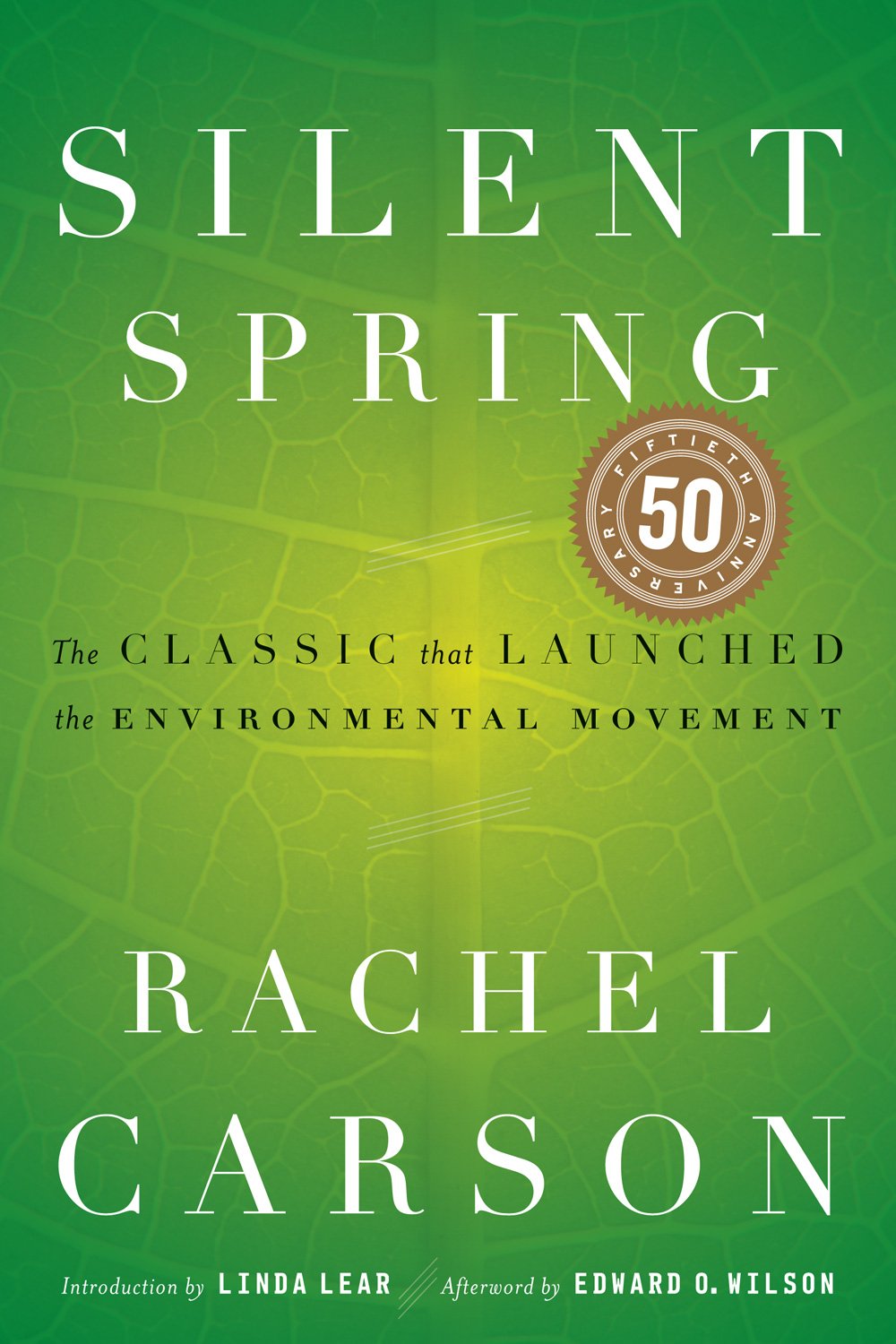
Silent springYou may be wondering what all this has to do with pesticides, so let’s turn to that issue.  The story of pesticide regulation in the US begins with the publication of Silent Spring in 1962, in which Rachel Carson informed us that the widespread use of DDT by agriculture was having a devastating effect on wildlife, particularly birds.  She was immediately attacked by the manufacturers of pesticides as a “hysterical female,” but after 10 years of research which proved her point, DDT was finally banned for agricultural use in the US in 1972, shortly after the creation of the Environmental Protection Agency.  Fifty years later, DDT remains one of the few pesticides banned in the US for agricultural use.

You might think that is the end of the story for DDT, but you would be wrong.  The Merchants of Doubt created foundations to carry their message and receive tax-deductible “donations” from the corporations they are protecting.  In 2007, these foundations launched a belated attack on the banning of DDT.  For example, The Competitive Enterprise Institute—which was instrumental in defending tobacco– says on its website, “Millions of people around the world suffer the painful and often deadly effects of malaria because one person sounded a false alarm…That person is Rachel Carson.” (1)  This accusation was repeated by several other “foundations” and published by the mainstream press.  Michael Crichton, the author of novels portraying global warming as a liberal hoax, quotes one of his fictional characters as saying, “Banning DDT killed more people than Hitler…It was so safe you could eat it.”  Apparently fictional characters also have fictional digestive systems.

Why the belated attack on Carson decades after the issue has been resolved to the public’s satisfaction?  “In the demonizing of Rachel Carson, free marketers realized that if you could convince people that an example of successful government regulation wasn’t, in fact, successful—that it was actually a mistake—you could strengthen the argument against regulation in general.” (1)

There is no truth to this accusation that banning DDT caused millions of deaths by malaria:

  • The ban of DDT in the US did not obligate any other country to ban DDT. In fact, many countries continued to use DDT long after the US banned it. 
  • By the time DDT was banned in the US, it was no longer effective on many insects, including the malaria-carrying mosquito for which DDT was used most heavily during WWII. Insects have short lives and huge populations.  Therefore, they evolve much more quickly than most animals.  This is one of the strongest arguments against pesticide use, yet the public does not seem to understand that the more pesticide we use, the more quickly they become ineffective. Both insect and plant pests evolve resistance to pesticides quickly. 
  • Malaria control was not achieved solely with pesticides. Draining swamps and wetlands, removing standing pools of water, using window screens and bed nets, etc. have proven more effective than widespread spraying of pesticides.

Preview

A small group of people with scientific backgrounds have succeeded in confusing the public about many critical issues that threaten our health and our environment.  Their desire to prevent government regulation has trumped their commitments to science.  In any case, they are presuming to judge scientific issues outside their expertise.  They did not have the credentials to deny the reality of climate change, for example, yet they were given the podium by our government and our media.

In our next post, we will look at some of the specific arguments used to disarm criticisms of pesticide use and respond to them with the help of an excellent book, Pandora’s Poison by Joe Thornton.


*Individuals identified by Merchants of Doubt as purveyors of misinformation intended to prevent regulation of environmental and health risks:  Frederick Seitz, Robert Jastrow, William Nierenberg, S. Fred Singer and others playing smaller roles.

(1) Naomi Oreskes and Erik Conway, Merchants of Doubt, Bloomsbury Press, 2010

The Sierra Club must STOP advocating for deforestation and pesticide use in San Francisco Bay Area

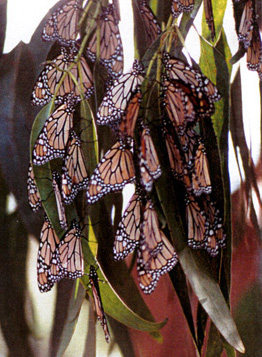
Monarch butterflies over-winter in California's eucalyptus groves
Monarch butterflies over-winter in California’s eucalyptus groves

Million Trees is sponsoring a petition to the national leadership of the Sierra Club in collaboration with San Francisco Forest Alliance.  The petition asks the Sierra Club to quit advocating for the destruction of the urban forest and the use of pesticides in the San Francisco Bay Area.  It also asks the Sierra Club to withdraw its suit against FEMA, which demands the destruction of 100% of all “non-native” trees (eucalyptus, Monterey pine, acacia).  This is an on-line petition which can be signed HERE.  If you are signing this petition and you are a present or former member of the Sierra Club, please mention it in your comments.

sign petition to sierra club

There will be a demonstration by supporters of this petition at the headquarters of the San Francisco Bay Area Chapter of the Sierra Club on Tuesday, August 25, 2015, at 4 pm, 2530 San Pablo Ave, Suite I, Berkeley, CA.  Please join us if you can.

If you are a regular reader of Million Trees, you probably understand why we are making this request of the Sierra Club.  For the benefit of newer readers, we recap the long history of trying to convince the San Francisco Bay Area Chapter of the Sierra Club that its support for the destruction of our urban forest, as well as the pesticides used to prevent its return, contradicts the mission of the Sierra Club as a protector of the environment.

  • This “open letter” was sent to the leadership of the local chapter of the Sierra Club. It informs the Sierra Club of many misstatements of fact in the chapter’s newsletter about the “Wildfire Hazard Reduction and Resource Management Plan” of the East Bay Regional Park District.
  • This article is about the Sierra Club’s public comment on the “Wildfire Hazard Reduction and Resource Management Plan” of the East Bay Regional Park District. The Sierra Club instructs EBRPD to put the “restoration of native plant communities” on an equal footing with fire hazard reduction.  It also specifically endorses the use of pesticides for this project.  In other words, native plants are more important than public safety in the opinion of the Sierra Club. 
  • This “open letter” is about misstatements of fact in the chapter newsletter about San Francisco’s Natural Areas Program. We wrote that “open letter” because the newsletter refused to publish our letter to the editor.
  • This article is about misstatements of fact in the chapter newsletter about the FEMA projects in the East Bay Hills. This incident occurred during the brief period of time when the on-line version of the newsletter was accepting on-line comments.  That opportunity to communicate with the chapter enabled a correction of inaccurate statements in the newsletter.

Sierra Club’s suit against FEMA, which demands the destruction of 100% of all “non-native” trees in the East Bay Hills was the proverbial straw that broke the camel’s back.  Chronic annoyance at the club’s endorsement of destructive and poisonous projects was suddenly elevated to outrage.  HERE is the Club’s description of its suit, which is available in its on-line newsletter.  Attempts to communicate our outrage to the Club by posting comments on that article failed.  That is, the Club is no longer publishing comments it doesn’t like, thereby cutting off any means of communicating with them.  Our petition is the only means of communication left to us.  The text of the petition follows and it can be signed HERE.  Please distribute this petition to your friends and neighbors who share our concern about the destruction and poisoning of our public lands in the San Francisco Bay Area.


Title:     Sierra Club must STOP advocating for deforestation and pesticide use in San Francisco Bay Area

Petition by:        Million Trees and San Francisco Forest Alliance

To be delivered to:
Michael Brune, Executive Director, Sierra Club, michaelbrune@sierraclub.org
Aaron Mair, President, Board of Directors, Sierra Club, aaronmair@gmail.com

We are environmentalists who ask the Sierra Club to quit advocating for the destruction of the urban forest and the use of pesticides in the San Francisco Bay Area.  We also ask that the Sierra Club withdraw its suit against FEMA, which demands the destruction of 100% of all “non-native” trees (eucalyptus, Monterey pine, acacia).  If you are signing this petition and you are a present or former member of the Sierra Club, please mention it in your comments.

Over the past 15 years, tens of thousands of trees have been destroyed on public lands in the San Francisco Bay Area.  Now hundreds of thousands of trees in the East Bay are in jeopardy of being destroyed by a FEMA grant to three public land managers.  The Bay Area Chapter of the Sierra Club has actively supported all of these projects and now it has sued FEMA to demand the destruction of 100% of all “non-native” trees.

These projects have already used hundreds of gallons of herbicide to prevent the trees from resprouting and to kill the weeds that grow when the shade of the canopy is destroyed.  Now, the FEMA project intends to use thousands of gallons of herbicide for the same purpose.  These herbicides (glyphosate, triclopyr, imazapyr) are known to be harmful to wildlife, pets, and humans.

This environmental disaster will release tons of carbon into the atmosphere, thereby contributing to climate change.  It will destroy valuable habitat for wildlife, introduce poisons into our watershed, cause erosion, and eliminate our windbreak.  We call on the national leadership of the Sierra Club to prevent the active participation of the Bay Area Chapter of the Sierra Club in this environmental disaster.

Petition background:

The San Francisco Bay Area was virtually treeless prior to the arrival of Europeans.  The landscape was predominantly grassland, scrub, and chaparral.  Trees grew only in ravines where they were sheltered from the wind and water was funneled to them.  The trees that were brought from other areas of California and from other countries were chosen because they are the species that are best adapted to our local conditions.  John Muir, the Founder of the Sierra Club, also planted these tree species around his home in Martinez and was as fond of those trees as many of us are still today.

The Sierra Club has now turned its back on this cosmopolitan view of nature in favor of returning our landscape to the pre-settlement landscape of grassland, scrub, and chaparral.  This approach has led to the destruction of tens of thousands of trees and the use of herbicides to prevent them from resprouting.

In the East Bay, native plant advocates have also falsely claimed that “non-native” trees are more flammable than native plants.  Although fire hazard reduction was the stated purpose of the FEMA grants, fire hazards will be increased by the clear-cuts of our urban forest for the following reasons:

  • Tons of dead, dry wood chips will be scattered on the ground to a depth of 24 inches.
  • The fog drip which is condensed by the tall trees moistens the ground and will be lost when the canopy is destroyed. The ground vegetation will therefore be drier and more likely to ignite.
  • The tall trees provide a windbreak which has been demonstrated repeatedly to be capable of stopping a wind-driven fire, which is typical of California wildfires.
  • The project does not intend to plant any replacement plants or trees. Therefore, the most likely colonizers of the bare ground are annual grasses which ignite easily during the dry season and in which most fires in California start and spread.
Hummingbird in eucalyptus flower.  Courtesy Melanie Hoffman
Hummingbird in eucalyptus flower. Courtesy Melanie Hoffman

Many empirical studies document the rich biodiversity of our urban forest today.  Bees, hummingbirds, and monarch butterflies require eucalyptus trees during the winter months when there are few other sources of nectar.  Raptors nest in our tall “non-native” trees and an empirical study finds that their nesting success is greater in those trees than in native trees.

In short, the Bay Area Chapter of the Sierra Club is promoting an environmental disaster that is adamantly opposed by tens of thousands of people.  FEMA received over 13,000 public comments on its draft Environmental Impact Statement, over 90% in opposition to this project, according to FEMA’s own estimate.  The signers of this petition are also opposed to this project as presently described by FEMA grant applications and its Environmental Impact Statement.

Environmentalists in the San Francisco Bay Area have been denied due process by the local chapter of the Sierra Club.  The Bay Area Chapter has blocked every effort to communicate with them:  they ignore our emails, block our comments on their blog, refuse our letters to the editor of their newsletter, and do not answer our phone calls.  We believe that the national leadership has an obligation to consider our complaint because the actions of the local chapter are inconsistent with the mission of the Sierra Club.  The local chapter is actively contributing to climate change and endorsing the use of toxic pesticides in our environment.

Xenophobia is Killing Our Planet

We are publishing a guest post from South Africa with mixed feelings.  We are glad to welcome another like-minded person into our effort to prevent the pointless destruction of the plants that have been members of our communities for generations, solely because they are not considered “native.”  On the other hand, we are saddened to learn that other communities are experiencing the same destruction that we are witnessing here in the San Francisco Bay Area. This guest post is an article that was published by The Witness, which the author describes as “South Africa’s oldest daily newspaper.”


Xenophobia is Killing Our Planet

Xenophobia (both human and ecological) is raging worldwide. Yet we are all Earthlings and life on Earth has always migrated. The Khoisan are the first known inhabitants of Africa, and African elephants and lions once roamed North America; America’s bison, bear and deer immigrated from Eurasia, while horses, which evolved in the States, radiated outwards, returning home to be shot as aliens.

Historically, the mass hysteria of rhetoric-spurred xenophobia has sucked reason and compassion from sections of whole countries. Propaganda supporting Hitler’s racial-purity infected Germans to hate Jews who were vilified as pigs. In Rwanda, the genocide of the Tutsi tribe began with the Hutus defaming them as cockroaches. In South Africa, foreign nationals have been slandered as lice and ticks. While in ecological warfare, exotic plants are demonized as cancers and monsters. Those brainwashed by this illogical prejudice, tend to overlook their own ancestral origins and their personal culpability about the very things they fear and denounce in more recent arrivals in our war-torn world now over-flowing with desperate refugees.

Essentially we are all settlers at any given time. Definitions of nativeness are changed at whim by invasion biologists who measure other creatures via a creed they themselves do not exemplify. ‘Alien’ plant species are destroyed country-wide, drastically disrupting ecosystems for the slightest inconvenience to native species or commercial interests. South Africa’s multi-billion rand [1 US $ = 12.64 S. African rand] Working for Water, the world’s largest ever tree-cutting campaign, is a terrifying example. Levelling countless rain-drawing trees on a planet already suffering from tree-loss-induced global warming, is tantamount to blood-letting an already haemorrhaging patient. Far from saving water, the dire rainfall deficit has devastated South Africa with widespread drought causing a conservatively-estimated R400 million  loss to livestock and crops in KwaZulu-Natal alone.

Unprecedented ferocious winds, fires, floods, heat waves, violent storms and catastrophic disasters are battering our over-populated planet, our ice caps melting faster, its creatures dying. And it is no wonder: armed with poisons, the world’s chemical corporations have dressed themselves in Xenophobia, using it as a front to motivate and mask their hugely-profitable, unceasing nature destruction. In a study published in the journal Science this year, 18 international researchers found that human abuse has so disrupted complex interactions between oceans, land and atmosphere that the earth is becoming inhospitable to life. Johan Rockstrom, professor of environmental science at Stockholm University, gravely concluded that, for the first time in human history, we risk destabilizing the entire planet.

Only enough ecosystems, essential for regulating Earth’s climate, keep our civilization from extinction, and scientists estimate we’d have to return as much as 40% of all land to nature to regain long-term stability. Britain’s James Lovelock says we can all help by letting portions of our gardens go wild. Forest ecologist at Stellenbosch University, Dr Coert Geldenhuys, explained in an article how alien infestations repair forests when indigenous trees can’t fill the pioneering role, rehabilitating the soil before dying out, allowing natives to return. This Earth-healing is harmless, sustainable and free, yet fanatics continue mutilating and polluting, with depraved indifference leaving countless creatures, (both native and alien, seen and unseen) homeless, poisoned and dying – as recently verified by scores of dead baby weaver birds strewn amid an axed casaurina forest. Yet ever more prominent ecologists the likes of David Theodoropoulos, Mark Davis, Matthew Chew, Ken Thompson and Dov Sax, see a bigger picture with the role of invasive aliens far more complex and beneficial than generally believed. Fred Pearce (author of THE NEW WILD) puts it all in a nutshell: invasives re-boot Earth’s man-damaged ecosystems to help nature withstand global warming.

AT WAR WITH NATURE, a powerful exposé by New Zealand conservationist W F Benfield (available on AMAZON) reveals that the chemical industry in league with blindly-believing invasion followers who manufacture the crises needed to justify saturating our planet with poisons, are now offering their lethal services to the uninhabited islands of other lands. They were recently enlisted to rid our own Marion Island of mice. But this ‘extinction industry’ as Benfield succinctly describes it, uses deceit, staged photographs and chemicals to do far more harm to resident wildlife than any pest explosion ever could. (Watch POISONING PARADISE on YouTube.) The shockingly inhumane poison 1080 (banned in most countries) is regularly released over New Zealand where corporate conservation plans to render the entire country predator-free. Naturally, once predators are eradicated, their prey will multiply to plague proportions – creating unending opportunities for ever-hungry chemical corporations.

Man’s agriculture is presently eating away so much of the planet’s diminishing wilderness that the European Union and United Nations called for a global shift to a vegan diet to alleviate global warming caused by livestock farming and chemical poisoning. Recently the World Health Organization finally verified a study linking Roundup to cancer after hundreds of studies with similar findings were skewed or suppressed for 30 years. This tumour-causing herbicide was also connected to a mystery kidney disease which killed up to 20,000 farmworkers labouring in extreme heat in Central America, India and Sri Lanka. Scores of Argentinean farmers are suing Monsanto over their infant children’s birth defects, including cerebral palsy, Down’s syndrome, psychomotor retardation, missing fingers and blindness.

Roundup leaches nutrients from the soil, damages micro-organisms, kills earth worms and stimulates unstoppable super weeds. In Australasia it has killed 3 frog species, and, according to World Health statistics, the mere careless use of glyphosate-containing herbicides sickens and kills hundreds of thousands of people worldwide annually. Besides damaging the digestive tracts of animals and humans, incidences of once-rare diseases have soared since its use, linking it to Alzheimer’s, attention deficit disorder, autism, asthma and infertility. Workers spraying from backpacks are at risk simply by breathing in spray drift. Destroying harmless naturalized vegetation with chainsaws and deadly carcinogens, xenophobia, in bed with the chemical industry, is a danger to all life.

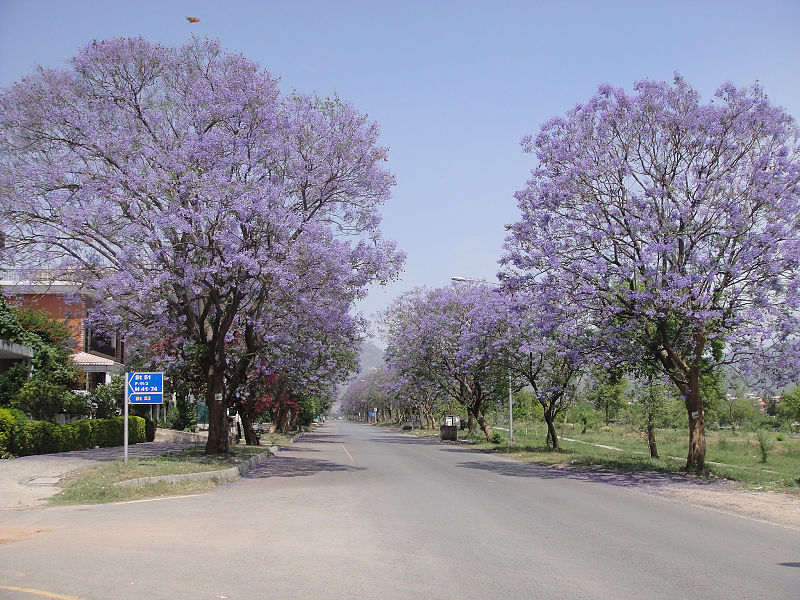
Jacaranda street trees in bloom in Pakistan.  Creative Commons - Share Alike
Jacaranda street trees in bloom in Pakistan. Creative Commons – Share Alike

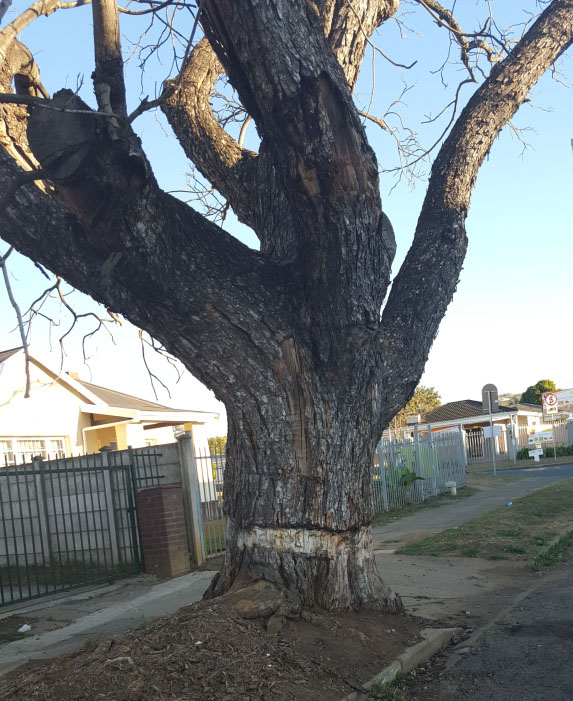
Pietermaritzburg’s beloved Art in the Park has to move next year because the original river-side site has been so degraded by felled trees, and everywhere gracious Jacaranda trees lining our streets stand tragically ring-barked and dying. In the decades since this merciless ethnic cleansing started, our bees have been poisoned to the edge of extinction, our butterflies, birds, rare frogs and chameleons as well as common-place insects and microscopic organisms essential to planet life, vanishing from our shrinking vegetation, while our polluted waterways and seas have vast chemical dead-zones, and scores of fish suffocate when poison-sprayed water-plants suck oxygen from the water whilst dying en masse.

Ring-barked (AKA girdled) jacaranda tree in South Africa.
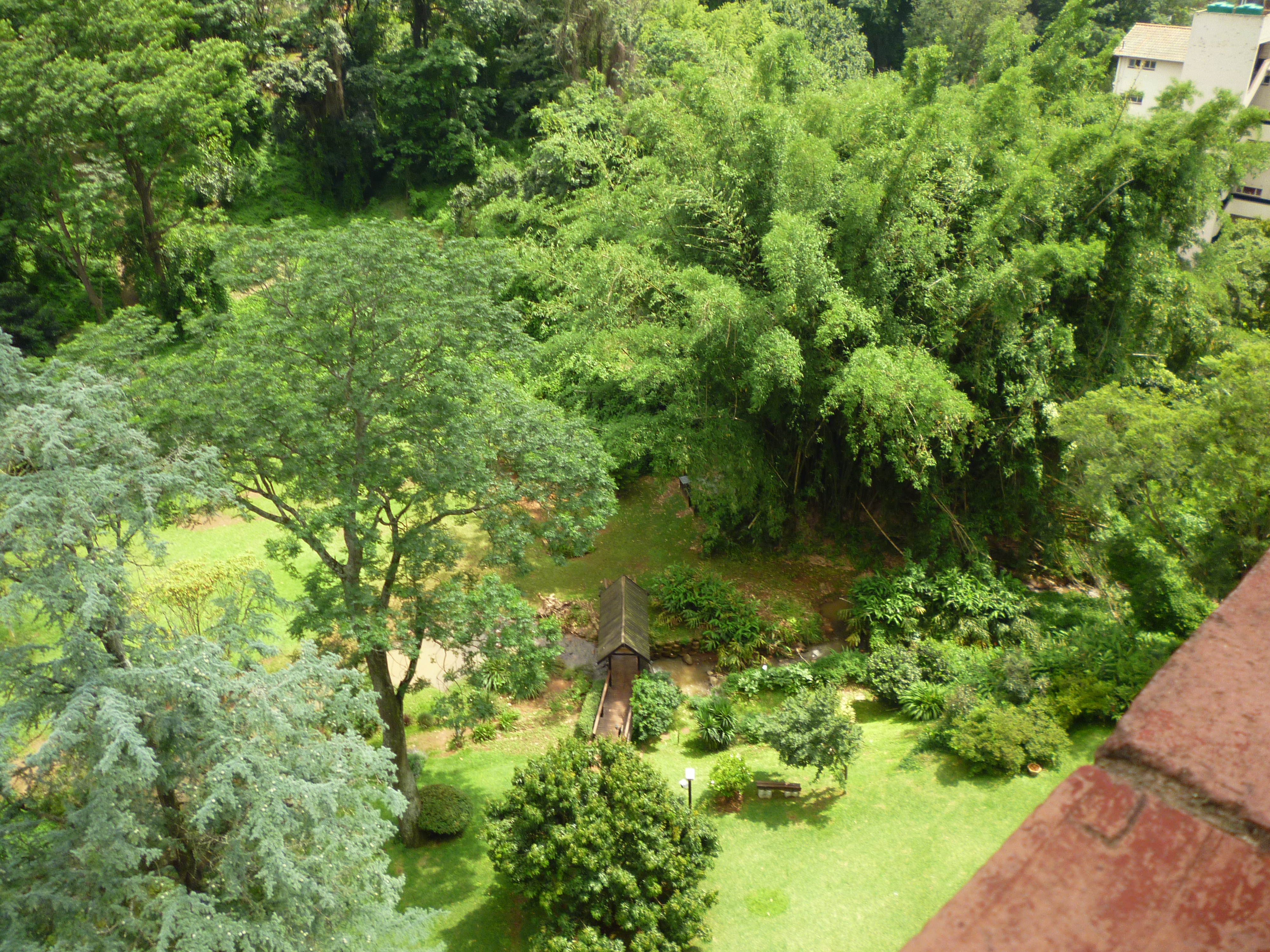
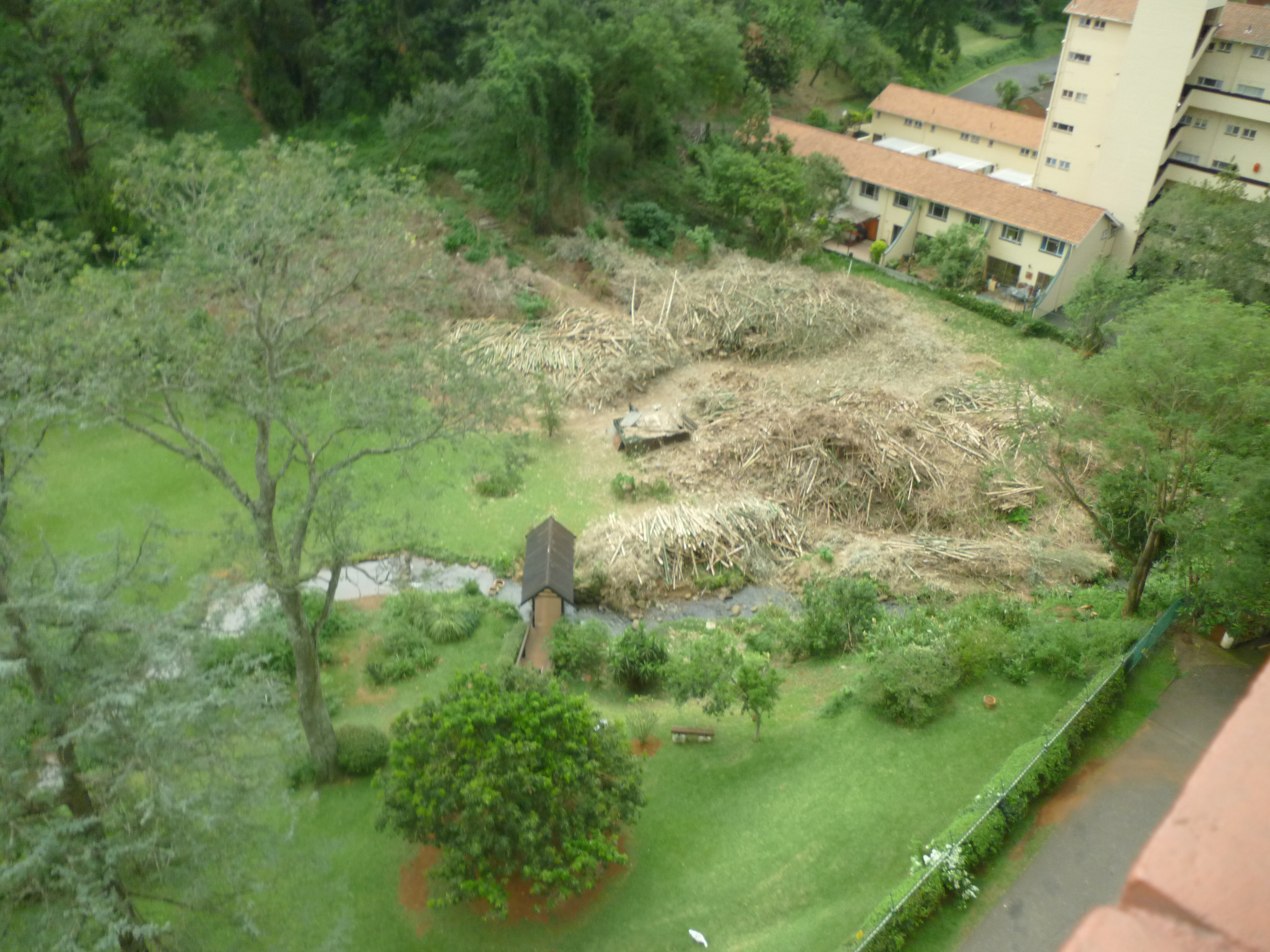
Bamboo before it was killed with herbicide.

In Pietermaritzburg, magnificent five-storey tall bamboo in the once-beautiful stream-side park behind the Beacon Hill apartment block, were recently hacked and poisoned, risking the stream and its life-forms and resident geese and ducks, as well as the city’s ground water. Helicopters dropped clouds of poisonous herbicide on dagga growing amid hill-side food crops belonging to impoverished KwaZulu-Natal villagers. In the US, tons of chemicals dumped into Lake Michigan to kill one ‘alien’ fish, killed hundreds of thousands while brain-washed con-servationists and scientists cheered. American animal advocate, Nathan Winograd, reflected that in the hopeless battle to return America to a mythical ecological state, slaughter without end has been proposed. 

Bamboo after being killed with herbicide.

The effects of removing everything arbitrarily judged to be foreign are incalculable. Migrating thousands of miles, the incredible monarch butterfly – a precious natural wonder – has dropped an astounding 90% in numbers since milk weed was killed by herbicides. The worldwide massacre of plants and creatures sometimes just miles ‘out of place’ have evoked unlikely alliances between hunters and vegans who fear Earth’s animals are being wiped out. Andrew Tyler, Britain’s Animal Aid director, believes that the growing appetite for ‘alien’ blood is driving the slaughter of animals scapegoated for human-committed environmental abuses.

America’s Agricultural Department recently revealed that since 1997 it has destroyed a staggering 27 million animals by aerial snipers, poisons and traps, to help dessert bighorn sheep, deer and pronghorn. This alien killing mania spread quickly to unwanted natives. Elk, cougar, fox, bobcats, coyotes, badgers, prairie dogs, bears, wolves, wild longhorn, burros and horses – creatures which once filled us with wonder – among those left to rot that.  Alien disdain is worldwide: mustangs are killed lest they damage native plants, Britain’s grey squirrels destroyed to bring back the red, its deer culled to protect wildflowers, Canada Geese shot for dropping scat on pathways, while South Africa’s own shameful hit list includes the endangered black Kenya rhinoceros. Are purist’s any better than rhino poachers?

This madness, instigated and exonerated by invasion biology, is done at the unknowing tax-payer’s expense. With our living green world turning into a dead planet there have been increasing calls from the public, social sciences and ecology itself, for invasion biology to end. It is the only ‘scientific’ field ever doubted, and this, as they themselves admit, via a virtual ‘cottage industry’ of critical scientific articles, and even death-wishing obituaries in well-respected publications. Many regard this unproved discipline as money-making deceptive hype, xenophobic, immoral, cruel, nonsensical, climate changing and earth endangering. An English review of the book LA GRANDE INVASION explains the inspiring perspective of French ecologist, Jacques Tassin, who adjures conservationists to reconcile man to a new alliance with the living world, including invasives, which he believes are symptoms of pollution testifying to ‘ a richness for tomorrow’.

Invasion Biology has given chemical corporations an excuse to devastate our beautiful planet on a scale never seen before. We’ve become a world at war with itself. If this anti-life pseudo-science is not abolished, Earth’s millions of life-forms are doomed. Humanity has forgotten the spirit and intelligence innate in the wild: before it is too late we should unshackle nature to help heal itself. It’s time we all denounced what we’ve unknowingly allowed to happen. Mahatma Gandhi said: ‘Be the change you wish to see in the world.’ We should empathize with terrified foreign nationals and innocent creatures persecuted and killed through xenophobia’s ugly ethos, and remember that Christ himself identified with the alien Samaritans of this world, declaring: ‘What ye do unto the least of these my brethren, ye do also unto me.’

Gloria Keverne is a South African environmental activist and the international bestselling author of A MAN CANNOT CRY and BROKEN WINGS. In xenophobic riots in South Africa this year seven foreign-national human beings tragically lost their lives, while for decades countless trees, animals and insects have perished, poisoned and deprived of habitat by this prejudiced mind-set.  She can be emailed at glory@chrysalis-dreams.co.za.  If you agree with her viewpoint, please take a minute to thank her for defending her local landscape and wish her good luck in preventing its needless destruction.

More public comments on FEMA projects in the East Bay Hills

We are publishing a few more of our favorite public comments on the Draft Environmental Impact Statement for the FEMA projects in the East Bay Hills which will destroy nearly a half-million trees if implemented as presently described.

Over 13,000 public comments were submitted to FEMA.  FEMA estimates that 90% of the comments are opposed to the project.  We have selected a few which demonstrate expertise as well as knowledge of the areas that will be irreparably harmed by the destruction of hundreds of thousands of trees and the spraying of toxic herbicides.  All of the comments are in the public record and can be read HERE.

You can help to prevent this project from being implemented as presently planned by making a contribution to the suit of the Hills Conservation Network.  Visit the HCN website HERE to make a contribution.

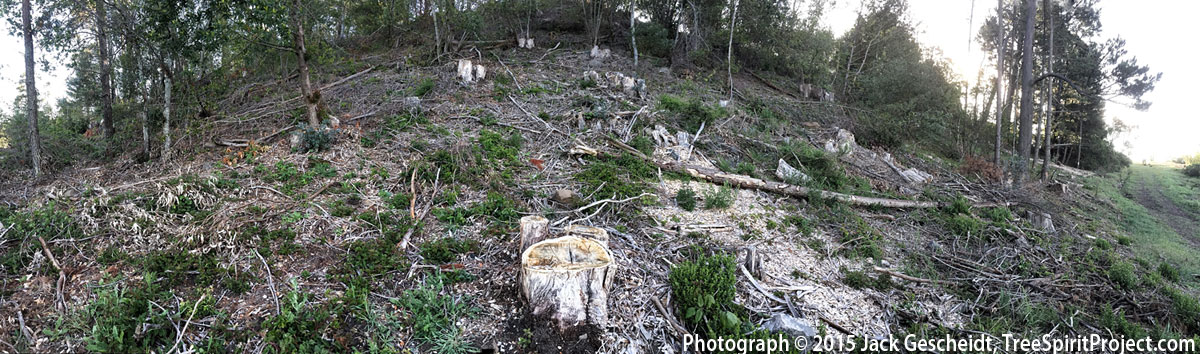
clearcut-East-Bay-hills-Jack Gescheidt


From:                    [Name redacted by Million Trees]

To:                          EBH-EIS-FEMA-RIX

Subject:               Berkeley Hills

Date:                     Friday, June 14, 2013 11:52:35 PM

I am a resident of Berkeley, California. I oppose the use of FEMA funds to cut trees in the Berkeley and Oakland Hills. I am an environmental science teacher at Berkeley High School. We know that these trees provide important habitat for many kinds of wildlife, and cutting them down will not prevent fires. Clear-cutting in the Berkeley and Oakland Hills is a very bad idea. It may cause mud slides, destroy the landscape, harm wildlife, destroy hikers’ aesthetic enjoyment of our wildlands; the planned use of pesticides is unconscionable. Please do not fund any of this clear-cutting. It is a waste of money, will not prevent fires, and will cause harm.


From:                    [Name redacted by Million Trees]

To:                          EBH-EIS-FEMA-RIX

Subject:               FEMA “fire hazard reduction” NO!!!!

Date:                     Friday, May 17, 2013 11:45:15 AM

Hello,

As a trained wildlands firefighter, I am familiar with the management techniques of wildland fires. Clear-cutting is not one of them. I could potentially support implementing a permanent firebreak of the standard size: about the width of a road. Cutting more than that is unnecessarily destructive, and destroys natural heritage which belongs to our children. Applying herbicide is likewise completely unrelated to standard, approved wildlands fire management, and presents unknown environmental dangers. I recommend consulting the county fire department for their recommendations, which based on my experience, will likely consist of bringing out a CCC or convict crew to cut a firebreak seasonally.

My family and I STRONGLY OPPOSE the current plan.

[Name redacted by Million Trees]

Berkeley resident


From:                    [Name Redacted by Million Trees]

To:                          EBH-EIS-FEMA-RIX

Subject:               Halt the land clearing!

Date:                     Friday, May 17, 2013 2:30:22 PM

Absolutely do not go forward with plans to clearcut the Strawberry and Claremont Canyons. These trees provide far more beneficial ecosystem services, like cooling, attracting moisture, and providing beauty, oxygen and habitat.

Do not use Round up on this land, it is an extremely hazardous toxic pollution.

The proposed management is extremely misguided and very irresponsible destruction, and would cause far greater ecological harm. The loss of this forest would be a great impoverishment to all the surrounding communities. Leave these trees alone!!

[Name redacted by Million Trees], Natural Areas Manager

A retired university planner critiques the FEMA projects in the East Bay Hills

We recently finished reading all of the 13,000 public comments on the FEMA draft EIS.  FEMA says that about 90% of the comments are opposed to the project and having read the comments that seems about right. 

It was a very rewarding experience to read the comments and we recommend it to anyone who is discouraged or doubtful that we can prevent the destruction of our urban forest in the East Bay (available HERE).

There were many excellent comments, many from people with specific expertise and knowledge of the issues that inform our opposition to these projects.  We plan to publish a few of them, as we obtain permission from their authors.  Today, we publish the public comment of Christopher Adams, with his permission.  We hope you are as impressed with his astute analysis as we are.


 Comments on Hazardous Fire Risk Reduction, East Bay Hills, CA,

Draft EIS

Prepared by Christopher Adams

Introduction:

My comments here are made solely in my capacity as a private citizen, but I think it is germane to state my background. I am a retired university planner, and for several years I directed the office which was responsible for review of every environmental document prepared by all the campuses and other facilities of the University of California. In addition, I was directly involved with the drafting, the public hearings, and the response to comments and preparation of two major Environmental Impact Reports, prepared under the California Environmental Quality Act for a UC campus. I also live near the EB Hills in an area subject to wild fires and share the concerns of others about the risk of fire.

Summary:

The Hazardous Fire Risk Reduction, East Bay Hills, CA, Draft EIS is a deficient document, beginning with its basic premise. While purportedly for the purposes of fire management, the proposed actions appear to be mostly motivated by a dream of a restoring the EB Hills to some imagined Eden prior to the European and American colonization of California. Instead of applying scientific and policy analysis to the impacts of the proposed actions the DEIS authors appear to have decided that the proposed clear cutting and herbicide measures are the right ones for fire protection and then cherry‐picked evidence, whether in the description of existing conditions or the possible alternatives solutions, which supports this conclusion. The DEIS rejects out of hand fire management alternatives that do not involve clear cutting and massive application of herbicides. In so doing the DEIS is a classic example of post hoc rationalization. Unless the DEIS is re‐issued with corrections and additions responding to the comments below, I believe that FEMA is seriously exposed to potential litigation. More significantly, if FEMA does not consider other less draconian and less expensive fire management measures, it will not be serving the interests of the citizens most impacted by fire danger, not to mention the taxpayers who will ultimately foot the bill.

Specific Comments:

The DEIS fails to note the existence of native trees which are specifically susceptible to the effects of one of the herbicides proposed for use. Section 4.2.2.2.1 notes that the native trees in the woodlands include madrone (Arbutus menziesii). However, in Section 3.4.2.1.1 Strawberry Canyon‐PDM there is no mention of madrones in the list of trees in the “native forest” (first paragraph of section). This is a significant omission, because there are madrones in Strawberry  Canyon, yet in the third paragraph of this same section one of the two herbicides proposed for use to stifle stump regeneration is Stalker (imazapyr) which has been identified elsewhere as being used specifically to eliminate madrones. According to the EPA Reregistration Eligibility Decision for Imazapyr: “Imazapyr use at the labeled rates on non‐crop areas when applied as a spray or as a granular to forestry areas present risks to non‐target plants located adjacent to treated areas.” (1)

The DEIS fails to acknowledge the growing threat of French broom in the UCB area.

While the presence of eucalyptus, Monterey pine, and acacia is repeatedly discussed, there is almost no mention of the rapid invasion of French broom. It is mentioned only in passing and without its scientific name in the discussion in Section 4.2.2.2.3 under “Northern Coastal Scrub.” While French broom has been rapidly increasing in the upper slopes of the Strawberry Canyon PDM and Claremont PDM areas, there is no mention of it at these locations in the DEIS. This plant is an active pyrophyte which chokes out native vegetation, can be poisonous to livestock, and is of limited benefit to native animals. The increase in sunlight from the proposed removal of large amounts of eucalyptus will encourage its spread. There is no mention of the fire risk from French broom in the discussion of fire risk in Northern Coastal Scrub, Section 4.3.3.2.5, and I could find no mention of its removal anywhere in the document.

The UCB project description does not explain if a fuel break is planned in the UCB areas and if so to describe it.

Section 1.1.1 UCB states that it will follow the “same general approach…which is included in Oakland’s grant application (see Section 1.1.2 below).” In Section 1.1.2 it is stated there the Oakland PDM would “create a fuel break on the west side of Grizzly Peak Boulevard north and east of the Caldecott Tunnel [presumably this means the west entrance to the tunnel].” UCB Strawberry Canyon properties also abut Grizzly Peak Boulevard, so the statement of “the same general approach” implies that UCB also proposes a “fuel break,” but none is described. Since the term “fuel break” implies clearing to the bare soil, with potential significant environmental impacts, this is a serious omission.

The DEIS fails to consider the impact on global climate change by the wholesale destruction of trees. The DEIS states that for UCB Strawberry Canyon alone 12,000 trees will be destroyed. Because trees absorb CO2 at an average rate of 13 pounds per year, this represents a potential loss in CO2 absorption of 78 tons per year. Given the growth patterns of native trees in Berkeley, which tend to be riparian or to grow on north facing slopes in a widely scattered pattern, the number of replacement trees will not come close to compensating for those destroyed. The difference should be estimated and calculated.

The DEIS fails to consider an actual and accomplished fuel management program when dismissing the alternative described in Section 3.3.1.1.

The Lawrence Berkeley National Laboratory (LBNL) is located on 175 acres on the north side of Strawberry Canyon immediately adjacent to the UCB and EBRPD areas described in the DEIS. LBNL, which is managed by the University of California, employs more than 4,000 persons on this site in laboratory buildings and with equipment that is worth several billion dollars. LBNL has recently completed a fire management program which is essentially what is described in Section 3.3.1.1 of the DEIS, Removal of Brush, Surface Fuels, Lower Limbs and Small Trees. The entire project was completed within the LBNL maintenance budget without special grants and has given the laboratory a great deal of fire security, according to its professional fire personnel. Yet there is no reference to this in the DEIS. The LBNL program is further described in the following links. This first links to a powerpoint slides; the second to a video discussion of the slides. http://www.lbnl‐cag.org/docManager/1000000159/Berkeley%20Lab%20Fire%20Safe%20Vegetati on%2C%20Lab%20Fire%20Marshal.pdf

http://www.lbnl‐cag.org/Content/10024/preview.html

The links convey much more effectively than my comments how an alternative to massive clear cutting and massive application of herbicides will effectively accomplish the goal of managing fire in the East Bay Hills.

The DEIS is incomplete and verging on the dishonest about the use of herbicides.

“Management of resprouts without herbicides is expensive….and thus was removed from further study.” This ignores the management of resprouts used successfully by LBNL as described in the above referenced powerpoint and video. There is no study about the use of herbicides at the scale proposed, e.g. 12,000 trees in Strawberry Canyon alone, on human populations, let alone native plants and animals.

The DEIS fails completely to discuss the realities of encouraging native plants after the clear cutting and heavy and repeated application of herbicides.

1) Restoration ecology is barely in its infancy, yet this DEIS expects us to accept on faith alone that when the clear cutting is done and the slopes sprayed with herbicides the native vegetation will miraculously reappear.

2) At the present time live oaks and bays are common on the north side (south facing side) of Strawberry Canyon under eucalyptus. This is probably because the fog drip from the eucalyptus and the shade encourage their growth in what would otherwise be a very dry area. Compare, for example, on slopes of similar aspect in portions of the EB Hills behind El Cerrito or Fremont. There is nothing in the DEIS to explain how native trees will increase or survive after the clear cutting has destroyed their source of water and shade.

3) Because of the abundance of deer in Strawberry Canyon and adjacent areas, small trees need to be protected against browsing. (See the LBNL powerpoint for an illustration of wire protective cages. http://www.lbnl‐ cag.org/docManager/1000000159/Berkeley%20Lab%20Fire%20Safe%20Vegetati on%2C%20Lab%20Fire%20Marshal.pdf) The DEIS says nothing about preventing deer browsing.

4) California native oaks of several species, including Quercus agrifolia are subject to the fungal disease Sudden Oak Death Syndrome (SODS), which has been found in the East Bay Hills. The DEIS fails to discuss the existence of SODS or its impact on replacement vegetation after the clear cutting and application of herbicides.

5) The DEIS states that “alleopathic oils” in the leaves and bark of eucalyptus suppress the growth of other vegetation. Yet the DEIS fails to state how covering slopes two feet deep with eucalyptus slash will not inhibit growth of new “native” plants.

6) Native California bunch grasses have largely been supplanted by European annual grasses, many of which form mats which choke out other plants. Similarly native shrubs such as coyote bush (Baccharis species) are being supplanted by invasive plants such as broom. The DEIS fails to explain how native plants will succeed in competition for sun and water with these plants.

The DEIS fails to consider the aesthetic impact to views from the trails and roads within the canyon and from houses near it after the clear cutting.

Section 4.12.2 of the DEIS states that a goal of the UCB LRDP (2005) is to “Maintain the visual primacy of the natural landscape in the hill campus” but there is no mention of the impact of clear cutting on this natural landscape. The north side of the lower portion of Strawberry Canyon forms the main campus of Lawrence Berkeley National Laboratory (LBNL). While individual buildings at LBNL are attractive in design, the overall effect of the site is essentially industrial, similar to an office park one might see along a freeway. The views of LBNL from the fire road that winds through the canyon are now largely screened by the large trees which will be destroyed by clear cutting. The trees also offer cooling shade to those using the area for recreation. The fire road is a major recreation amenity for UCB students, employees, and neighbors, used daily by hundreds of hikers, joggers, dog walkers, and mountain bikers. Removal of most of the trees as proposed will completely change the views enjoyed from the fire road. The DEIR provides absolutely no analysis of this impact either verbally or by providing illustrations of any viewing point in Strawberry Canyon. Most of the discussion of Section 5.8 is oriented to views over the hills from high points to the bay, which indeed may be improved by clear cutting. There is no discussion of views from within the areas to be clear cut and no reference to Strawberry Canyon.

The DEIS bases its list of plant species slated for destruction on incomplete and inaccurate botanical and fire danger information.

The authors of the DEIS seem not to understand the difference between “native” and “endemic” and they seem to have arbitrarily selected some “native” plants to extirpate while keeping others based on criteria having little or no relationship to fire hazards. Section 3.4.2.1.1 states that “Non native trees, including all eucalyptus, Monterey pine, and acacia would be cut down.” The Jepson Manual  (2), which is the definitive source for California plants divides the state into geographic areas. According to Jepson Monterey pines (Pinus radiata) are native to California, and while not endemic to the EB Hills, they are native in the geographic area CCo, which includes both portions of Monterey County and the EB Hills with similar climatic conditions. Coast redwoods (Sequoia sempervirens) are also found in Strawberry Canyon but not as an endemic. They are also native to the geographic area (CCo). In contrast to Monterey pines, however, Coast Redwoods appear to escape destruction by clear cutting; at least there is no mention of such action in the DEIS. Another native and Strawberry Canyon endemic, California Bay (Umbellularia californica), is specifically listed in the DEIS to be retained. But in a publication of the University of California Cooperative Extension (3) it is listed as a “High Fire Hazard Native Tree.” Note that these comments are not meant to imply favoring destruction of redwoods or bay trees but to further illustrate the inaccurate information and the arbitrary nature of the DEIS conclusions. Similarly cypress species which grow in parts of Strawberry Canyon are also listed as pyrophites in this UC document, but the DEIS does not propose their extirpation.

The DEIS fails to consider the impact on Strawberry Creek of run‐off from the predicted massive amounts of slash, from the standpoint of hydrology and flood control or the impact on the biota of the creek.

Section 3.4.2.1 of the DEIS states within Strawberry Canyon there will be clear cutting on 56 acres and that the downed trees will be chipped and left on 20% of the site at a depth of 2 feet. Based on these numbers the cumulative amount of material on the ground will be 975,744 cubic feet (.2 x 56 x 43,560 x 2). If merely 1% of this material is washed away in a storm, which seems a very conservative estimate considering the slopes where the material would be placed, there could be more than 1,000 cubic yards of slash material washed into Strawberry Creek. The DEIS does not discuss the impact on the biota of the creek of this potential massive amount of new material. Nor does the DEIS discuss the impact of this material on stream flow in storm conditions. Given that the culverts in the lower levels of the creek, near the Haas Clubhouse and the University Botanic Garden, are only about 9.5 square feet in cross section (See Figure 1.), there is a strong likelihood that the slash material would block the culverts and cause flooding. Section 3.4.2.1 states that “if the site yields a large number of large tree trunks,” some “may” be removed or used for other purposes than left on the site; however, the DEIS fails to state the criteria for determining what the “large number” is that would trigger such action. The hydrologic and ecological impacts are presumably left to the loggers to evaluate.
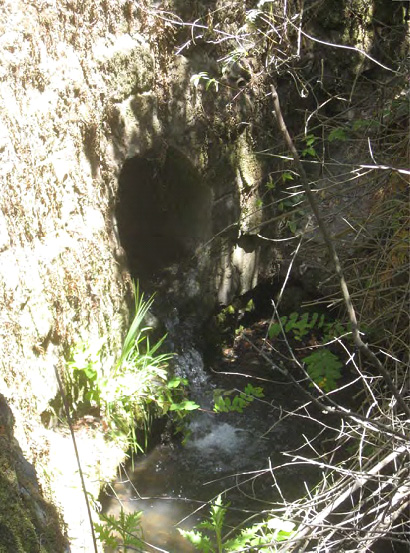
FEMA comment - Adams 1 copy

Figure 1, Culvert on lower fire trail, near Botanic Garden


The DEIS implies that trees other than eucalyptus, Monterey pines, and acacias will not be cut, but current actions in Strawberry Canyon suggest that UCB will cut anything at any time regardless of environmental regulations. The DEIS must be amended and re‐issued to include other UCB actions as part of cumulative impacts.

During the past week (June 6‐13, 2013) I have personally observed the cutting of at least six healthy, mature California live oaks, bays, and cypresses in Strawberry Canyon. (See Figures 2 and 3.) The oaks were particularly magnificent, and their destruction is tragic. I am familiar with the needs for passage of fire trucks as I own woodland property on a narrow privately maintained road. None of the trees just cut would have prevented passage of trucks, but I was told by one of the tree cutters that the excuse was “Fireman.” To my knowledge this cutting was done without any compliance with the California Environmental Quality Act (CEQA), which is the state equivalent of NEPA and applies to all UCB actions. This cutting constitutes a violation of the CEQA Guidelines Section 15304, which states that exemptions from CEQA apply only to actions “which do not involve the removal of healthy, mature, scenic trees.” If UCB is flagrantly cutting trees now, while the DEIS is out for public comment, what can we expect once the NEPA process is completed?
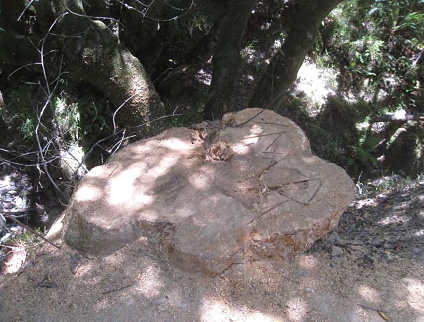
FEMA comment - Adams 2 copy

Figure 2. Bay stump on lower fire trail, cut on or about June 11 2013, diameter +/‐42”
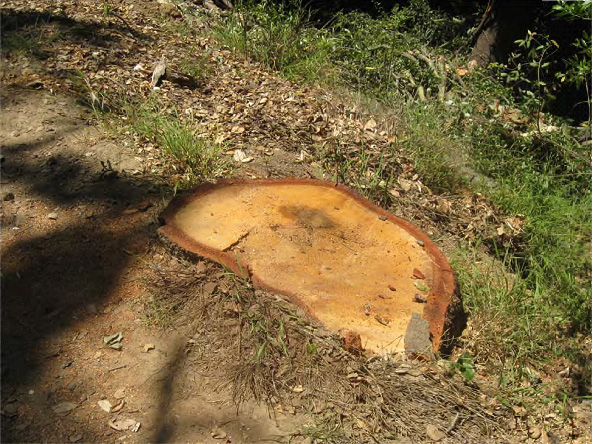
FEMA comment - Adams 3 copy

Figure 3. Live oak stump on lower fire trail, cut on June 10, 2013, diameter +/‐ 38”

(1) EPA 738‐R‐06‐007, 2006

(2) The Jepson Manual of Vascular Plants of California, 2nd Edition, UC Press, 2012

(3) Pyrophytic vs. Fire Resistant Plants, FireSafe Marin in Cooperation with University of California Cooperative Extension, October 1998


Thank you, Mr. Adams, for taking the time and trouble to write this excellent public comment on the FEMA draft EIS.
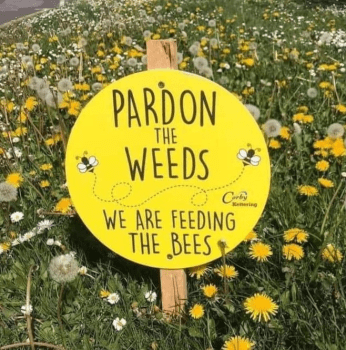

 

“Five Reasons it’s Okay to Love Oxalis – and Stop Poisoning It”

The San Francisco Forest Alliance has published an excellent article about the pointless and harmful attempt to eradicate oxalis in San Francisco’s so-called “natural areas.”  We are grateful to SFFA for their outstanding research and permission to republish the article. 


The oxalis season is over, and the perky yellow flowers have vanished for another year. These Bermuda buttercups will be back next year to herald the spring, bringing joy to those who love them, irritation to those who hate them, and Tier I herbicides targeted at them in San Francisco’s so-called “Natural” Areas.

oxalis 1

THOSE WHO HATE OXALIS AND WANT TO POISON IT WITH GARLON

These flowers are so visible in spring that Bay Nature magazine did an article about them in March 2015: A Natural History of the Little Yellow Flower that’s Everywhere Right Now. It quoted Jake Sigg, the retired SF Recreation and Parks gardener who is considered the doyen of San Francisco’s native plant movement. He hates oxalis pes caprae, which he considers extremely invasive. The article quotes him as saying that, without intervention, “in X many years Twin Peaks would just be one solid mass of yellow, and there wouldn’t be any other plants there…” The article suggested that an oxalis-dominated  landscape “drives away coyotes, hawks and owls that feed on grassland foragers, and the situation is especially dire for endangered Mission blue butterflies, which depend heavily on native wildflowers.” Most of those ‘facts’ about oxalis are mistaken as we’ll explain below.

Mr Sigg’s theories align with those of the Natural Areas Program (NAP) of the San Francisco Recreation and Parks Department (SFRPD), which uses the herbicide, Garlon (triclopyr) to battle oxalis despite its dubious efficacy for the purpose.  San Francisco’s Department of the Environment classifies Garlon 4 Ultra as Tier I: Most Hazardous. It’s listed as HIGH PRIORITY TO FIND AN ALTERNATIVE (their caps). Since oxalis is the main reason NAP uses Garlonthe alternative we propose is – don’t use Garlon or anything else on oxalis.

An article on SaveSutro.com, based on a detailed study by the Marin Municipal Water Department, describes some of the issues with Garlon:

  • Garlon “causes severe birth defects in rats at relatively low levels of exposure.” Baby rats were born with brains outside their skulls, or no eyelids. Exposed adult female rats also had more failed pregnancies.
  • Rat and dog studies showed damage to the kidneys, the liver, and the blood.
  • About 1-2% of Garlon falling on human skin is absorbed within a day. For rodents, it is absorbed twelve times as fast. It’s unclear what happens to predators such as hawks that eat the affected rodents.
  • Dogs  may be particularly vulnerable; their kidneys may not be able to handle Garlon as well as rats or humans.  Dow Chemical objected when the Environmental Protection Agency noted decreased red-dye excretion as an adverse effect, so now it’s just listed as an “effect.”
  • It very probably alters soil biology. “Garlon 4 can inhibit growth in the mycorrhizal fungi…” (soil funguses that help plant nutrition)
  • It’s particularly dangerous to aquatic creatures: fish (particularly salmon); invertebrates; and aquatic plants.
  • Garlon can persist in dead vegetation for up to two years.
Natural Areas Program uses Garlon on oxalis

First, a little about the actual natural history of oxalis. This plant doesn’t set seed in California, and spreads entirely by sending out roots and forming little bulbils (like tiny potatoes) underground. It’s usually found where the soil has been disturbed by activities such as road-building, gardening, or trail-building. In some cases, the disturbance comes from landslides or something similar. It can’t stand frost. If we do nothing, it would tend to die down rather than spreading uncontrollably.

In disturbed landscapes, it can spread fast. For this reason it can be a nuisance in gardens. People don’t want to leave their gardens alone for years to let nature take its course with the oxalis, and not every garden design includes brilliant yellow as the dominant color for a few weeks. The only way to eradicate it in the short term is to dig it out carefully every time you see it, and make sure you get most of the bulbils. Or use strong herbicides, which may not work.

In a natural landscape, though, it’s a different story and here’s why.

1) OXALIS IS GOOD FOR BEES AND BUTTERFLIES

Honeybee on oxalis flower

Oxalis is actually an excellent plant for bees and butterflies.  When blooming, it provides “copious nectar.” In fact, it generously gives away its nectar. Since it doesn’t set seed, it doesn’t benefit from pollinators – but it’s a food source for honey bees, bumblebees and butterflies. (You can read a rather technical description of the plant HERE in a 2-page PDF note from UCLA’s Barry A. Prigge and Arthur C. Gibson.)

Bumblebee on oxalis flower

In fact, a recent 2014 study shows that plant communities with exotic plants had more plant species as well as more pollinators, that pollinators didn’t prefer native plants, and that even some specialist pollinators depended on introduced plant species.

It’s true the Mission Blue butterfly needs (native) lupine as its nursery plant. (It doesn’t depend on any other native wildflowers – only three varieties of lupine.  Incidentally, one of the key nectar sources for the Mission Blue butterfly is an invasive non-native Italian thistle: Carduus pycnocephalus).

Butterfly on oxalis flower

Lupine has been planted on Twin Peaks as NAP attempts to reintroduce the Mission Blue butterfly there. But lupine is also a plant of disturbed areas, which means that NAP must maintain it or it will die out as the area stabilizes. They have to keep planting it, weeding, and trimming the grass around the lupine patches to make it attractive to the butterfly. An SFRPD report on the reintroduction project said “unmanaged habitat deteriorates quickly.” Presumably, they don’t use Garlon near the lupine patches, since it would likely kill that too. Despite what is implied in the Bay Nature article, it’s not oxalis that’s the issue. The real problem is another native plant, the coyote bush which takes over grasslands in a natural succession.

2) OXALIS IS GOOD FOR WILDLIFE

Oxalis bulbils are a food source for wildlife. Gophers and other rodents eat them. In fact, the Bay Nature article says, “Their spread is abetted by pocket gophers and scrub jays, which have been spotted carrying the bulbs and caching them in the ground—effectively planting them in new areas.”

Since gophers are a foundation species in the food web, being dinner for predators from hawks to coyotes to great blue herons, these plants actually provide habitat benefits whether or not they’re flowering, because the bulbils are there all year.

oxalis 6

Where there are gophers, the predators follow. Like the coyotes in these pictures, which clearly haven’t been driven away by a landscape dominated by oxalis.

coyote pouncing in oxalis field. Copyright Janet Kessler
coyote in oxalis field. Copyright Janet Kessler

3)  OXALIS DOESN’T LEAVE THE GROUND BARE

The article says that oxalis leaves “bare ground during the six months of the year oxalis doesn’t flower.” That’s not true either.

oxalis 9

oxalis 10The spectacular yellow bloom of the oxalis – valuable because the mass of color attracts honey bees and bumblebees – gives the impression that it’s the only plant there.  But though it visually takes over the landscape when it’s in bloom, it naturally grows interspersed with grasses and other plants. Like in the picture above.

In fact, oxalis tends to enrich the soil with phosphorus, which is good for grass.

So when it finishes blooming, as it has by now – you don’t get bare ground. The picture below shows the same area as the first picture in this article – but it’s after the oxalis bloom is over. It’s grassland.

oxalis 11

4)  OXALIS HAS LITTLE IMPACT ON “NATIVE” PLANTS

One argument – related  to the ‘bare ground’ argument – is that oxalis takes over grasslands and destroys them, particularly the native grasses. However, grasslands in most of California including San Francisco are dominated by non-native grasses. The change occurred over 100 years ago, when these grasses were planted for pasture. So the grassland that NAP is defending with herbicides is primarily non-native anyway.

oxalis 12

But anyway, what’s the evidence that oxalis is actually damaging native plants?

It’s true some European studies do suggest that an increase in oxalis is associated with a decrease in native plants diversity –though whether it’s a cause is unclear. It may just be benefiting from human activities that disrupt the landscape. Another study put oxalis head-to-head with a native annual grass, lolium rigidum. The native grass tended to dominate. Their conclusion: “Oxalis is a poor competitor. This is consistent with the preferential distribution of Oxalis in disturbed areas such as ruderal habitats, and might explain its low influence on the cover of native species in invaded sites.

The California Invasive Plant Council rates its invasiveness as “moderate,” considering it as somewhat invasive in sand dunes and less so in coastal bluff areas.

In San Francisco, every place where oxalis grows is already a disturbed environment, a mix of non-native grasses and plants with native plants (some of which have been artificially planted).  Here,  oxalis appears to grow happily with other plants – including, for instance, the native California poppy in the picture above.

5) KIDS LOVE IT AND IT’S EDIBLE

Children love oxalis, both for its pretty flower and for the sour taste of its edible stems.

oxalis 13

oxalis 14Even small children love gathering posies of Bermuda buttercups (though picking flowers is technically prohibited in Natural Areas). The flowers are surprisingly hardy for wildflowers, and in a glass of water last quite well as cut-flowers.

The plant is edible, and its tart leaves make a nice addition to salad. People enjoy snacking on its sour stems. Besides Bermuda buttercup, it’s also called ‘sourgrass’ and ‘soursob.’ It does contain oxalic acid (as does spinach, for instance), and so you probably wouldn’t want to make a meal of it. Though in South Africa it’s made into soup.

Adding Garlon to it is probably a bad thing.

Photo credit: Badjonni (Creative Commons – Flickr)

CONCLUSION

From our current evidence, there’s no sign that oxalis has a negative impact on wildlife, and plenty of evidence it’s already part of the ecological food web of our city.  The evidence also suggests it’s not having a negative effect on other plants in San Francisco either. Lots of people find this flower attractive; one writer described it as the city smiling with Bermuda buttercups.

In any case, even Doug Johnson of the California Invasive Plant Council doesn’t think it’s worth attacking at a landscape level: the payoff isn’t worth the expense. Removing it from the hundreds of acres in Natural Areas isn’t as simple as eradicating it from a small yard where it’s clashing with the garden design. It requires a lot of work, a lot of powerful herbicides, a multi-year effort – and for what?

The justification for using strong pesticides like Garlon to control it is weak. We call on NAP to stop using Tier I and Tier II herbicides altogether.


Conference of the California Native Plant Society

In January 2015, the California Native Plant Society (CNPS) celebrated its 50th anniversary by holding a gigantic conference.  About 700-1,000 people attended.  There were several hundred short presentations and many posters describing research and “restoration” projects.  The abstracts of these presentations are available on the CNPS website.  We are publishing a brief description of a few of the presentations sent to us by one of our readers who attended the conference.  We publish with permission but without attribution, on request.  We have added a few edits in brackets and italics as well as a few links to relevant articles on Million Trees.


I was very impressed with the quality of the presentations at the CNPS conference.  Some were given by academic scientists or their graduate students. Many were given by land managers and managers of “restoration” projects.  There were about 225 presentations in 5 simultaneous sessions, so it was possible to hear only about 45 of them. There were also many short “lightning” presentations and nearly 50 posters.  Please consider this an impression of the conference, rather than a comprehensive report.

Michael Soulé was the opening speaker.  You might recognize his name as one of the proponents of invasion biology who is angry about growing acceptance of “novel ecosystems” and the ecological functions they perform.  [Million Trees has posted articles about this debate among academic scientists.  Soulé is one of the invasion biologists who demanded that the Nature Conservancy abandon their support for novel ecosystems.]   His objection to any acceptance of non-native plants was the main focus of his presentation.  He closed by saying that he “cannot live” without wild nature.  Since his definition of “nature” seems to exclude non-native plants, one wonders how he will manage to survive.   Perhaps he lives in an alternate universe populated solely by native plants.

Trees in Paradise, by Jared Farmer

Jared Farmer was the speaker at the conference dinner.  His subject was the history of eucalyptus in California.  His presentation was similar to his treatment of the subject in his book, Trees in Paradise.  [Million Trees has posted articles about Farmer’s book.]  Like his book, his presentation was even-handed in its treatment of eucalyptus.  That enraged the audience, which booed every time he said something positive about eucalyptus.  One wonders why he was invited to speak to this audience.  Were the organizers of the conference interested in promoting a more balanced view of eucalyptus?  Or did they just want a provocative speaker to wake up a sleepy audience after hours of a fund-raising auction?

Many of the presentations were surprisingly frank about the difficulties experienced by “restoration” projects.  CNPS deserves credit for inviting speakers who described some stunning failures of their effort to “restore” native landscapes.  I’ll describe just a few of the themes of speakers I heard.

San Francisco’s Public Utilities Commission

I was surprised to learn that San Francisco’s Public Utilities Commission (PUC) is heavily engaged in native plant “restorations.”  The PUC is responsible for managing thousands of acres of open space in the watershed that supplies San Francisco’s drinking water.  Common sense suggests that the PUC’s top priority would be the purity and safety of the water supply.  The PUC presentations at the conference suggest otherwise.  The PUC’s commitment to native plant “restorations” seems to trump the goal of clean water.

The PUC attempted to “restore” 100 acres of wetland and riparian habitat in San Mateo, Alameda, and Santa Clara counties by planting over 500,000 native plants, obtained from several different nurseries.  They claim to have followed a strict protocol which theoretically should have prevented the introduction of diseased plants.  Their protocol obviously failed.  The fact that many of the plants were infected with Phytophthora was not discovered until they were planted in the ground.  Phytophthora is the pathogen that is causing Sudden Oak Death.  The PUC is now faced with the difficult—if not impossible—task of trying to contain the spread of a fatal pathogen for which there is no known cure.

This project was funded by a “mitigation” grant for capital projects elsewhere in San Francisco.  Environmental laws require the builders of new development to “mitigate” for the impact they have on the environment by funding projects elsewhere, which are considered beneficial to the environment.  This often looks like legalized extortion to me.  It also increases the cost of infrastructure improvements, which limits the number of improvements we can make.  In this case, there clearly was no benefit to the environment.  It was both money down the drain and a poke in the environment’s eye.

As pointless as that project seemed, the other project presented by the PUC seemed even more pointless.  They presented a poster describing an experiment intended to determine the most effective application method and type of herbicide to eradicate coyote brush.  They used several different methods and types of herbicide, including Garlon (triclopyr) [which is known to be very toxic to aquatic life] and Milestone (aminopyralid) [which is banned in the State of New York because it is persistent and very mobile in the soil].

Detail of poster about PUC project, CNPS Conference

As you know, coyote brush is a native plant, so one wonders why it was necessary to eradicate it.  According to PUC’s poster, it’s another example of trying to prevent natural succession from grassland to scrub.  You might ask why the PUC is obligated to maintain grassland?  You might also ask how the PUC can justify using toxic herbicides in our watershed?  I can’t answer those questions.  It doesn’t make sense to me.

San Bruno Mountain

Mission Blue butterfly. Wikimedia Commons

There was also a discouraging presentation by the folks who have been engaged in the effort to “restore” San Bruno Mountain in order to preserve and maintain a population of several species of rare butterflies, including the endangered Mission Blue butterfly.  This project officially began 32 years ago when the Habitat Conservation Plan was created by federal environmental protection laws.  The goal was to restore native grassland required by the rare butterflies.  The speaker said this goal remains largely unfulfilled.  As for the butterflies, their current status is largely unknown because monitoring efforts are not sufficient to determine the size of the population.

While non-native plants considered “invasive” are a part of the problem in achieving the goal of this project, the biggest problem is, in fact, a native plant.  Once again, natural succession from grassland to native scrub, dominated by coyote brush, is the main reason why grassland continues to shrink on San Bruno Mountain:

“Although the last mapping effort in 2004 reported 1296 acres of grassland, we believe that many of these areas are in imminent threat of scrub encroachment and could be converted to scrub after a good coyote brush recruitment year. Large patches of contiguous grassland with less than 2% scrub cover are quickly vanishing…Baccharis pilularis (coyote brush) accounts for the majority of the scrub encroachment observed on San Bruno. It seems to follow the well documented pattern of episodic establishment in wet seasons when roots can more quickly tap into needed soil water. Once seedlings have survived the first critical year, mortality drops quickly and full establishment plays out over the next 5-7 years (Williams et al. 1987). During this process of establishment, grassland resources decline and eventually disappear. Soil changes such as increased nitrogen and allelopathic compounds often follow scrub encroachment (Zavaleta and Kettley 2006, Weidenhamer and Callaway 2010) reducing the ability of grasslands to successfully re-establish without an intermediate disturbance such as a fire or intensive browsing (Hobbs and Mooney 1986).” (1)

San Bruno Mountain from Daly City. Wikimedia Commons

It’s seems almost comic that when all is said and done, the main threat to native grassland “restoration” is apparently a native plant that is just doing what comes naturally…”invading” grassland in the absence of fire or grazing.

Hybridization:  Friend or foe?

Dieteria canescens variety canescens, native to Wyoming and other western states. Photo by Stephen Perry.
Dieteria canescens variety canescens, native to Wyoming. Photo by Stephen Perry.

I also attended the presentation of a native plant advocate from Mammoth Lake, on the eastern side of the Sierras.  She is engaged in a futile crusade to prevent the hybridization of a new plant, which she considers non-native, with a closely related native plant.  When this new plant arrived in her neighborhood, she recognized that it was different, but she was unable to identify it.  It wasn’t easy to find someone who could identify it.  Eventually, she found a botanist in Wyoming (where it is native) who was able to tell her that the new plant is a variety of a plant that is native at Mammoth Lake.  These plants are in the aster family.  The native is Dieteria canescens.  The new plant considered a non-native invader is Dieteria canescens var. canescens.  In other words, they are the same species!

From a horticultural standpoint, the new plant is superior to the native in every way: it is a bigger plant with more flowers; the flowers are bigger with more rays; the flowers are a deeper color.  So, why must it be eradicated?  Because native plant advocates fear that it will hybridize with the native aster and “swamp” it genetically, i.e., wipe it out.  Would that be such a terrible thing?  That is a matter of opinion.

Dieteria canescens, native to Mammoth Lake. Photo by Steve Mason

One person in the audience asked why the new plant was not being accepted as an adaptation to climate change that would probably increase the likelihood of the survival of the species.  The speaker’s answer was that she could not accept the loss of the variety she considers native.  Another person in the audience asked this rhetorical question:  “What is our narrative here?  How can we expect the public to understand that it is necessary to eradicate a plant that is the same species?” The speaker agreed that it is not an easy sell.  I was encouraged by these questions.  They seem to be a glimmer of common sense.  I hope they are prophetic of the future of the native plant movement.

On that happy note, I close with an invitation to visit the CNPS website to read the abstracts of the hundreds of posters and presentations at this excellent conference.


  1. “Assessment of the past 30 years of habitat management and covered species monitoring efforts associated with the San Bruno Mountain Habitat Conservation Plan (Draft),” Creekside Science, October 21, 2014.

“Tending the Wild:” Our changing relationship with nature

We recently introduced our readers to a book about the land management practices of Native Americans in California, Tending the Wild:  Native American Knowledge and the Management of California’s Natural Resources.  (1) Drawing from this valuable resource, we will describe how the relationship of humans with nature has changed several times since the arrival of humans in California approximately 12,000 years ago.  We will conclude by raising questions about our current relationship with nature, as reflected in our land management practices.

The relationship of Native Americans with nature

Basket CA Native AmericanWe will let the author of Tending the Wild speak for Native Americans, based on her extensive research of their culture and land-management practices:

“Although native ways of using and tending the earth were diverse, the people were nonetheless unified by a fundamental land use ethic:  one must interact respectfully with nature and coexist with all life-forms.  This ethic transcended cultural and political boundaries and enabled sustained relationships between human societies and California’s environments over millennia.  The spiritual dimension of this ethic is a cosmology that casts humans as part of the natural system, closely related to all life-forms.  In this view, all non-human creatures are ‘kin’ or ‘relatives,’ nature is the embodiment of the human community, and all of nature’s denizens and elements—the plants, the animals, the rocks, and the water—are people.  As ‘people,’ plants and animals possessed intelligence, which meant that they could serve in the role of teachers and help humans in countless ways—relaying messages, forecasting the weather, teaching what is good to eat and what will cure an ailment.” (1)

We emphasize that Native American culture considered humans a part of nature because this viewpoint provides contrast to modern interpretations of the relationship between humans and nature. 

Exploitation of nature by early settlers

When Europeans began to establish settlements in California in the late 18th century, they brought with them an entirely different viewpoint about their relationship with nature.  Natural resources were to be exploited and humans were the master of the natural world which was in their service.

Western pioneer ranch
Western pioneer ranch. Painting by John Olson Hammerstad, 1842-1925.


The first phase of European settlement was the importation of huge herds of livestock by the Spanish coming from Mexico:

“During the Mission era…grazing was among the activities that caused the greatest damage.  Coastal prairies, oak savannas, prairie patches in coastal redwood forests, and riparian habitats, all rich in plant species diversity and kept open and fertile through centuries of Indian burning, became grazing land for vast herds of cattle, sheep, goats, hogs, and horses owned by Spanish missions and rancheros.  By 1832 the California missions had more than 420,000 head of cattle, 320,000 sheep, goats, and hogs, and 60,000 horses and mules…overgrazing eliminated native plant populations, favored alien annuals, and caused erosion…A great variety of alien [plant] species were introduced inadvertently during the Mission Period.  Research has shown that European forbs and grasses…were brought into California at this time, contained in adobe bricks, livestock feed, livestock bedding, and other materials.  Soon these alien [plants] overwhelmed the native species, markedly changing the character and diversity of grasslands and other habitats west of the inner Coast Ranges.”  (1)

Tending the Wild reports that during this early phase of European settlement, Native Americans were quick to adapt to the changing landscape.  They incorporated useful new plants into their diets.  Likewise, we see today new plants and animals quickly enter the food web.


Hydraulic gold mining in California.

These changes in the landscape paled in comparison to the exploitation of the land that began in 1849 when gold was discovered in California and the huge influx of Americans of diverse European descent arrived.  Here are a few examples:

  • “…by the 1870s ‘more men made their living in the broader geography and economy of farming—48,000—than in all the mines of the Sierra footholls—36,000.’ To accommodate the acreage devoted to growing crops, marshes were drained, underground water was tapped by artesian wells, streams and rivers were dammed and diverted for irrigation, and lands were fenced.  In the process huge tracts of former native grasslands, riparian corridors, and vernal pools were converted to artificial, human-managed agricultural systems.” (1)
  • “Five million acres of wetland in California have been reduced by 91% through diking, draining, and filling for agriculture, housing, or other purposes.” (1)
  • By 1900, 40% of California’s 31 million acres of forest were logged.
  • “By the early 1900s, the numbers of marine mammals, wildfowl, elk, deer, bear, and other birds and mammals had been so drastically reduced that Joseph Grinnell would write, ‘Throughout California we had been forcibly impressed with the rapid depletion everywhere evident among the game birds and mammals.’” (1)
  • Between 1769 and 1845, the population of Native Americans in California dropped from an estimated 310,000 to 150,000. Between 1845 and 1855, the population of Native Americans dropped from 150,000 to 50,000.

Romanticizing Nature

Meanwhile, in Europe and the East Coast of the US, a new view of nature was being articulated.  The Romantic movement viewed nature as an escape from the stress of urban life, a tranquil retreat from civilization.  In California, John Muir was strongly influenced by Romanticism: 

“Muir and those with similar views responded to the destruction and exploitation of California’s natural resources with a preservationist ethic that valued nature above all else but which defined nature as that which was free of human influenceThus while he championed the setting aside of parks as public land, Muir also contributed to the modern notion that the indigenous inhabitants of the state had no role in shaping its natural attributes.” (1)

Muir was unable to fit Native Americans into his idealized view of nature.  He wrote this account of Miwok Indians in the Sierra Nevada in 1869:

“’We had another visitor from Browns’ Flat to-day, an old Indian woman with a basket on her back.  Her dress was calico rags, far from clean.  In every way she seemed sadly unlike Nature’s neat well-dressed animals, though living like them on the bounty of wilderness.  Strange that mankind alone is dirty.  Had she been clad in fur, or cloth woven of grass or shreddy bark, like the juniper or libocedrus mats, she might have seemed a rightful part of wilderness; like a good wolf at least, or bear.  But no point of view that I have found are such debased fellow beings a whit more natural than the glaring tailored tourists we saw that frightened the birds and the squirrels.’” (1)

Sharp Park, Pacifica, CA.  Photo by Erica Reder, SF Public Press
Sharp Park, Pacifica, CA. Photo by Erica Reder, SF Public Press

In this romanticized view of nature, humans are not welcome Humans defile the purity of nature.  This is the prevailing viewpoint today among those who consider themselves environmentalists, park advocates, and conservationists.  They advocate for “wilderness” where “humans may visit, but not remain.”  They post signs, advising visitors to look but not touch.  Their “restoration” projects put nature behind a fence.  They complain about immigration.

The condescending attitude articulated by John Muir toward Native Americans was instrumental in our ignorance of their land management practices.  Europeans considered Native Americans primitive and therefore did not expect to learn anything useful from them.  Europeans imported and grew their own food from their original homes because they were unaware of how local food sources could be grown and used.  Our knowledge of Native American culture is recent and it comes too late to ever be fully informed because those who tended the land are long since gone.  Furthermore, this new knowledge of land management practices of Native Americans is not well known, certainly not among native plant advocates who are attempting to re-create a landscape which was created by methods they do not understand.

Redefining ecological “restoration”

The author of Tending the Wild admires Native American culture as well as the landscape that was created by their land management practices.  Therefore, she concludes her book with a proposal that we adopt their land management methods:

“What then, should be the goal of ecological restoration?  Restoring landscapes and ecosystems to a ‘natural’ condition may be impossible if that natural condition never existed…Restorationists must at the very least acknowledge the indigenous influence in shaping the California landscape.  This chapter advocates an additional step—using indigenous people’s knowledge and methods to carry out the restoration process, to return landscapes to historical conditions and restore the place of humans in this continuing management.”  (1)

In our previous post, we described some of the land management practices of Native Americans, particularly the importance of setting fires.  Adopting these management practices for ecological restorations would require us to make a permanent commitment to setting fires.  Fires pollute the air, release greenhouse gases into the atmosphere, and endanger lives and property.  Therefore, this is surely not a proposition that can be reasonably applied to our densely populated urban parks.  The maximum population of Native Americans prior to the arrival of Europeans is estimated to have been 310,000.  The population of California was estimated to be over 38 million in 2013.  Land management practices that were appropriate for a human population of only 310,000 are not appropriate for a population of over 38 million.

Furthermore, the land management practices of Native Americans were useful for their culture.  They tended the landscape in order to feed, clothe, heal, and house themselves.  If that specific landscape is no longer useful for those purposes, why would we consider it an ideal landscape?  In what sense would it be superior to the landscape that occurs naturally without setting fires or intensively gardening our open spaces?

A more realistic paradigm is needed

We believe a more sustainable paradigm for managing nature is needed.  Although we won’t presume to define this new paradigm, we will suggest some parameters:

  • Humans are as much a part of nature as any other animal. Therefore, conservation goals must accommodate the presence of humans.  However, humans must respect plants and animals as equal partners in achieving conservation goals.
  • Since we live in a free society, we must assume that human populations will grow in proportion to the choices of humans. And since we are a nation of laws, we must assume that immigration will occur as allowed by our laws.  Conservation goals must be consistent with the realities of human population density.
  • Conservation goals should look forward, not back. Goals should reflect the changes in the environment that have already taken place and anticipate the changes that are expected in the future.
  • The distinction between native and non-native species should be only one of several criteria to determine whether a species “belongs here.” If plants and animals are sustaining themselves without human subsidy, we should acknowledge and appreciate the functions they perform in the ecosystem.  This approach will reduce the use of herbicides, now being used to eradicate plants perceived to be “non-native,” in our parks and open spaces.
  • Conservation goals should be realistic within the confines of available resources and in competition with other priorities.
  • There are pros and cons to every change we make in the landscape. Whenever we alter the landscape, if our land management methods damage the environment by using pesticides, killing animals or destroying their food resources and homes, contributing to greenhouse gases, restricting recreational access, etc., we must have solid evidence that the benefits to the environment will be greater than the damage we foresee.  If there is no net benefit, we should leave it be.

Can you add to or suggest revisions of this list of a new conservation ethic?  Surely there are as many opinions as there are readers of Million Trees.  We would like to hear your ideas.


  1. M. Kat Anderson, Tending the Wild: Native American Knowledge and the Management of California’s Natural Resources, University of California Press, 2005 (This is the source of most of the information in this article.)