Environmental Impact Report of Natural Areas Program proposes aggressive expansion

Fifteen years after San Francisco’s Natural Areas Program (NAP) began operation and 5 years after its management plan was approved, the Draft Environmental Impact Report (EIR) has finally been published.  We will briefly summarize the history of NAP, describe the plans as they were approved in 2006, and conclude with a comparison between those plans and the proposal in the EIR to aggressively expand NAP.

The Management Plan for the Natural Areas Program

In 1995 the Recreation and Park Commission approved the designation of 31“natural areas” in parks managed by the city of San Francisco. This designation committed 25% of the city’s park acreage in San Francisco, 33% including the city of Pacifica to the Natural Areas Program.  

Most park visitors were unaware of this designation until 5 years later when they finally had access to a draft of the management plan after a lengthy battle to make it available.  At that point, many park visitors could see where the Natural Areas Program was headed and many of them reacted negatively to the prospect of the destruction of non-native trees and restrictions on recreational access in popular, heavily visited parks.

The result of the long debate with the public was a revised management plan that separated the natural areas into three “management areas.”  These management areas (MAs) set priorities for the restoration of parkland to native plants:  MA-1 was the highest priority, MA-2 the second priority, and MA-3 the lowest priority.  The appeal of these priorities to critics of NAP was the commitment that there would be no tree removals in the MA-3 areas and that no legally protected species would be planted or reintroduced there, which might require further access restrictions in the future.  Forty-two percent of the total 1,080 acres of natural areas was designated as MA-3.

The management plan* was approved in 2006, after two days of public hearings at which about 200 public comments were heard by the Recreation and Park Commission.  Supporters of NAP outnumbered critics of the program.  The main message of the critics of the program was that the acreage committed to natural areas should be reduced to places in which native plants existed, which would not include acreage designated MA-3.

There were two trivial caveats to the approval of the program:  defining the circumstances under which cats could be removed from the natural areas and specifying that tree removals must be done by the Urban Forestry Division of the Recreation and Park Department (RPD).  These are some of the main features of the approved management plan:

  • Tree removals.  18,500 trees over 15 feet tall were designated for removal in MA-1  and   MA-2 areas.   In addition, non-native trees under 15 feet tall would be removed in these areas, but were not quantified because the plan did not define them as “trees”
  • Trails.  10.3 miles of trails were designated for closure in these areas.  That represented 26% of all trails in the natural areas.
  • Dog Play Areas are those areas in parks that have been officially designated for off-leash recreation.  The NAP management plan identified several dog play areas that would be monitored for possible closure in the future if necessary to protect native plants.  Those dog play areas were in Bernal Hill, McLaren and Lake Merced parks. 
  • Golf Course at Sharp Park will be reconfigured to accommodate populations of two endangered species.

The Environmental Impact Report of the Natural Areas Program

Five years after the approval of the management plan, the Environmental Impact Report (EIR) has finally been published.  The EIR identifies 4 alternatives to move forward with the implementation of the plan. The EIR identifies the “Maximum Restoration Alternative” as the “Environmentally Superior Alternative” described as follows:

“This alternative seeks to restore native habitat and convert nonnative habitat to native habitat wherever possible throughout the Natural Areas, including all management areas.”

[ETA:  This article has been updated by a more recent post which reports that a mistake has been found in the Draft Environmental Impact Report (DEIR):  The “Maximum Restoration Alternative” is not the “Environmentally Superior Alternative” as the DEIR claims on page 2.  The “Maintenance Alternative” is the “Environmentally Superior Alternative” as the DEIR says on page 526.  The mistake on page 2 has been reported to the Planning Department.  The Planning Department has acknowledged the error on page 2 and has made a written commitment to correct the error in the Final Environmental Impact Report.  Unfortunately, this correction will not be made until the public comment period is over.]

In other words, the preferred alternative would do away with the priorities identified in the management plan and treat all three management areas the same.  These are the specific implications of this proposal as described by the EIR:

  • Trees.  Non-native trees would also be removed in the MA-3 areas.  The number of trees over 15 feet tall that will be removed will exceed 18,500, but the EIR does not quantify how many trees will be removed.
  • Trails.  More trails would be closed in the MA-1 and MA-2 areas, but the EIR is not specific about how many miles of trail will be closed.
  • Dog Play Areas.  All dog play areas in MA-1 and MA-2 areas would be closed.  This will close the dog play areas in Buena Vista and Golden Gate (Southeast) parks and what little remained of McLaren (Shelley Loop) and Bernal Hill after the closures mandated by the management plan.  Dog play areas in MA-3 areas will be monitored and closed in the future if necessary to protect native plants.  The EIR predicts that all of these closures in addition to the anticipated closures of GGNRA properties to off-leash dogs will result in heavier usage of the dog play areas that remain.
  • Golf Course at Sharp Park would be further reduced by expanded habitat for endangered species.
  • Other access restrictions.  Legally protected species will be introduced in MA-3 areas, which may require further restrictions on access in the future.

The other alternatives identified in the EIR are:

  • “No Project Alternative – Under this alternative, the SFRPD would continue with the management activities authorized under the 1995 management plan.”  This alternative will close the dog play areas that were monitored since the management plan was approved in 2006: the Mesa at Lake Merced, portions of Bernal Hill and McLaren (Shelley Loop).
  • “Maximum Recreation Alternative – This alternative seeks to restore and improve recreational access to the Natural Areas wherever it does not interfere with the continued existence of native species and federally or state-listed sensitive species.”
  • “Maintenance Alternative – This alternative seeks to maintain the current distribution of native and nonnative habitat and species throughout the Natural Areas.  Under this alternative there would be no conversion of nonnative habitat to native habitat; other features of the Natural Areas would be retained.”

Rewarding Failure

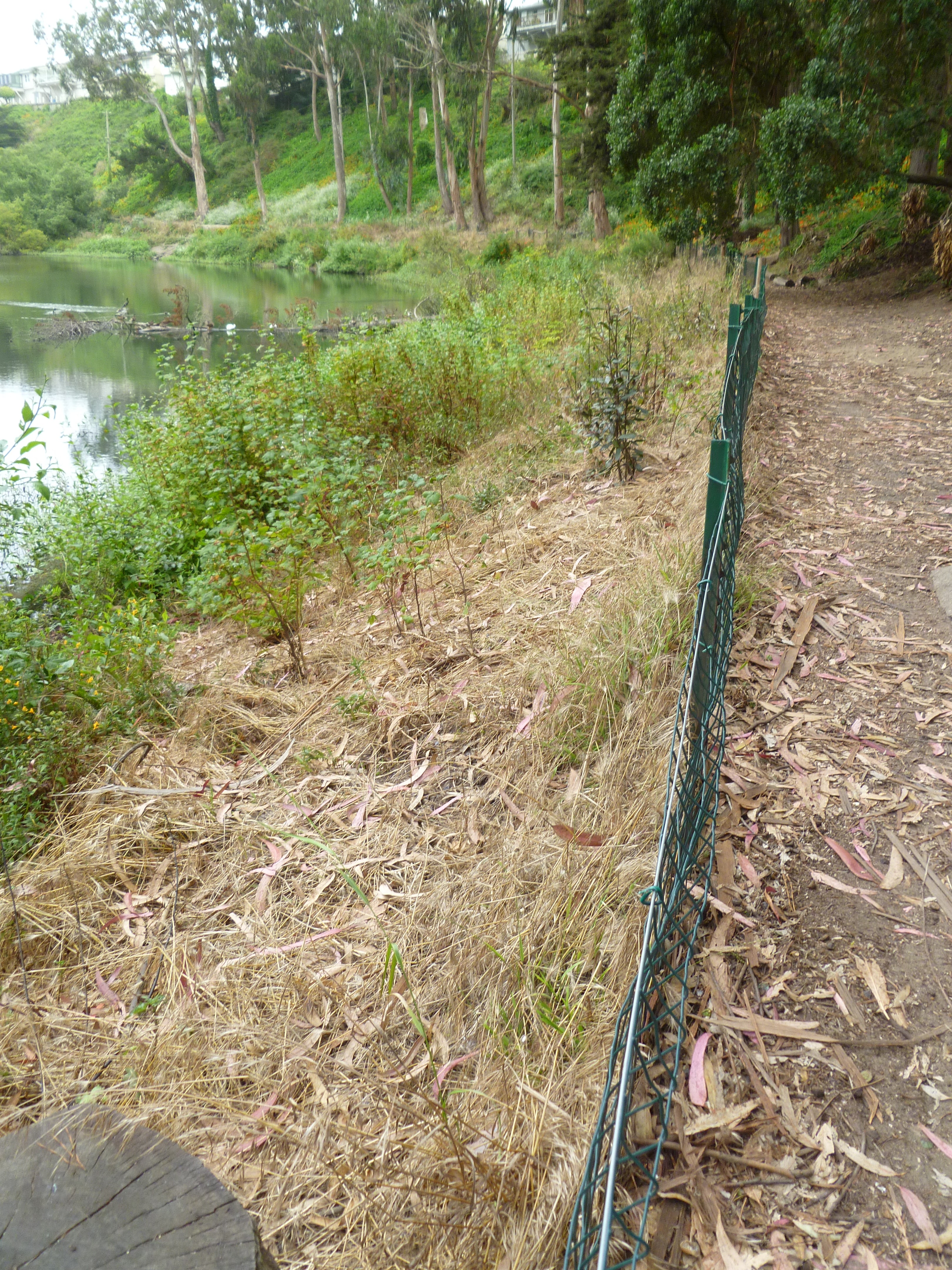
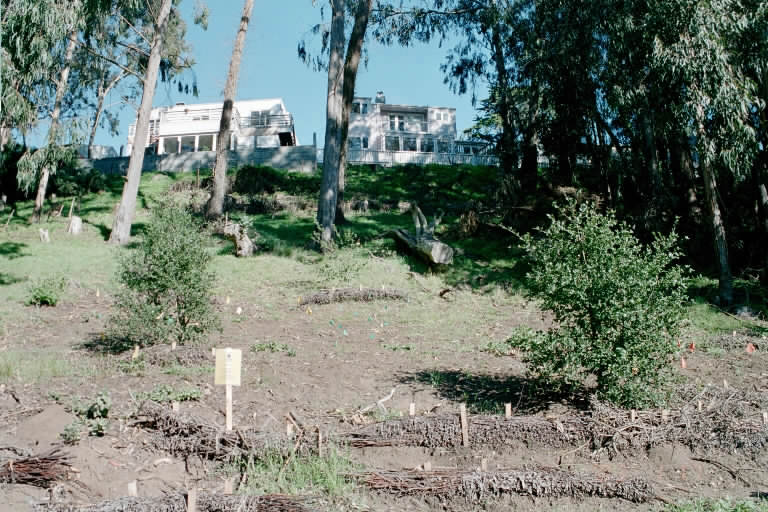
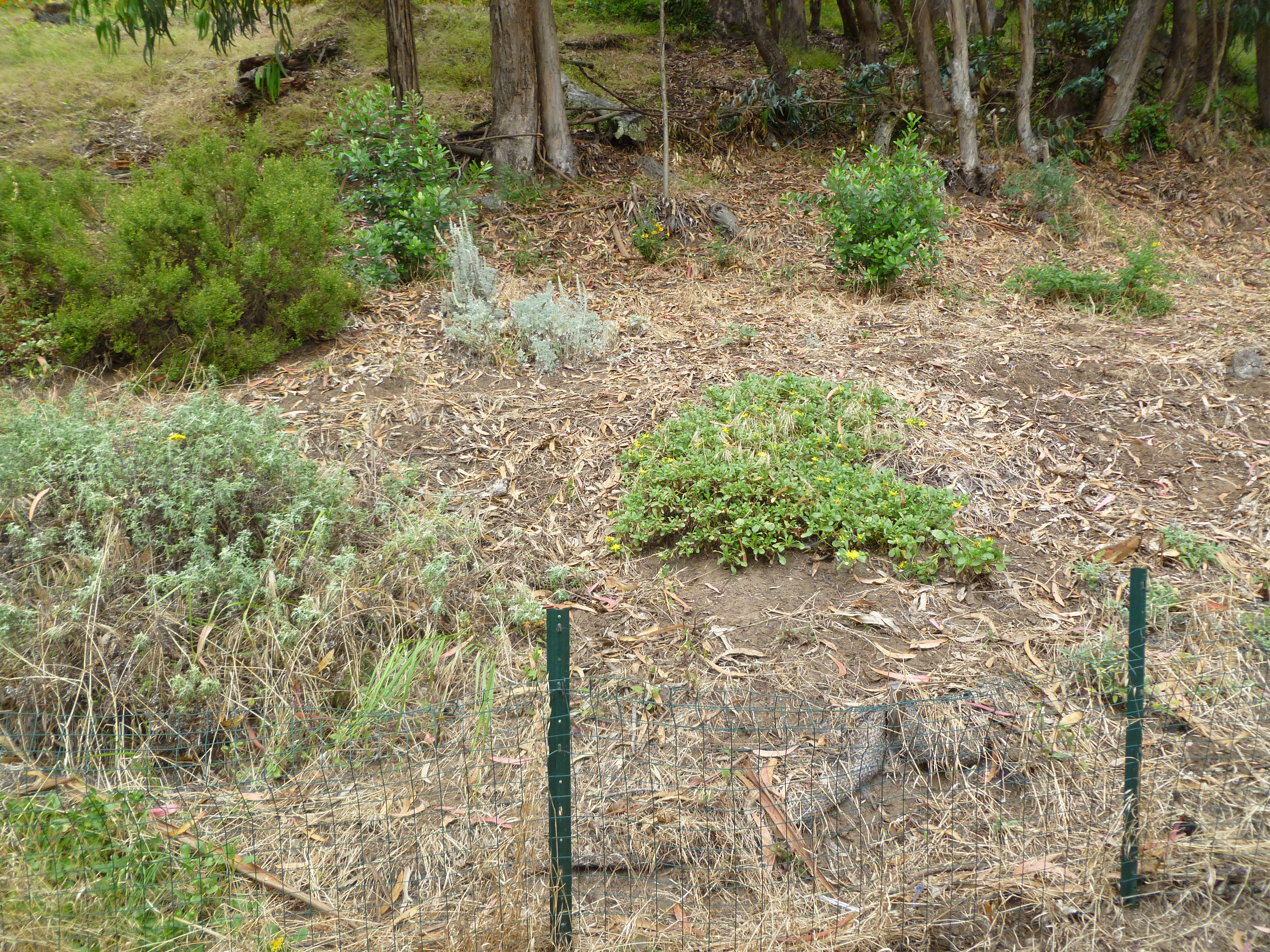
Park visitors who have been watching the restoration efforts of the Natural Areas Program for the past 15 years might be surprised that NAP apparently wishes to expand its restoration efforts.  Repeated clearing of non-native plants and planting of native plants has been spectacularly unsuccessful.  Here’s a photo history of the effort at Pine Lake in Stern Grove:
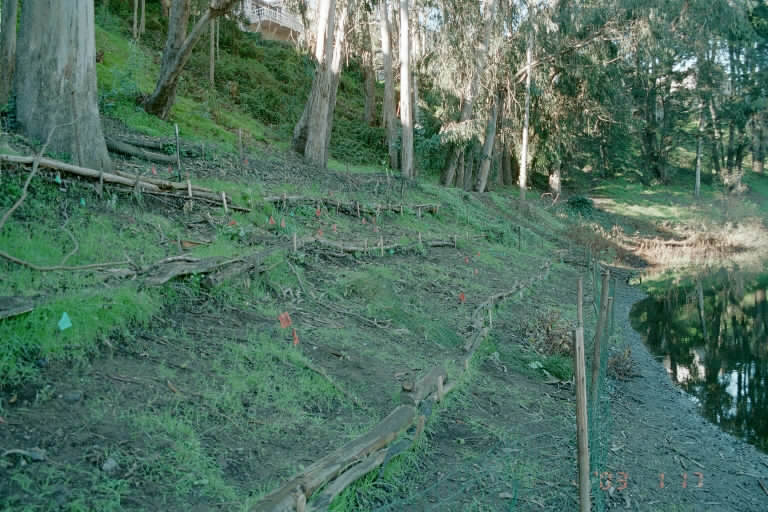
One of several clearing and plantings of south shore of Pine Lake, 2003
The results, south shore of Pine Lake, 2011
North shore of Pine Lake, 2003
 
Results, north shore Pine Lake, 2011

If NAP has been unable to successfully restore 58% of acres of natural areas (MA-1 and MA-2) they have been actively working on for the past 15 years, why would they want to expand their empire by adding MA-3 acreage to their agenda, committing them to actively restoring all 1,080 acres of natural areas?  Aren’t they biting off more than they can chew?

Where will the money come from to fund this expanded effort?

Although NAP and its many supporters believe that this lack of success is because they haven’t been adequately funded, the NAP staff is one of the only divisions in the Recreation and Park Department that hasn’t been cut in the past 10 years.  While other gardeners have been laid off, the NAP staff has remained the same size.  How many gardeners will it take to expand their restoration efforts to the MA-3 areas as the EIR proposes?  Remember that the MA-3 areas are 42% of the total NAP acreage.  Will NAP be given a 42% increase in their staff?  One wonders where the money for such an increase in staff would be taken from.

How much more herbicide will be used in this expanded effort?

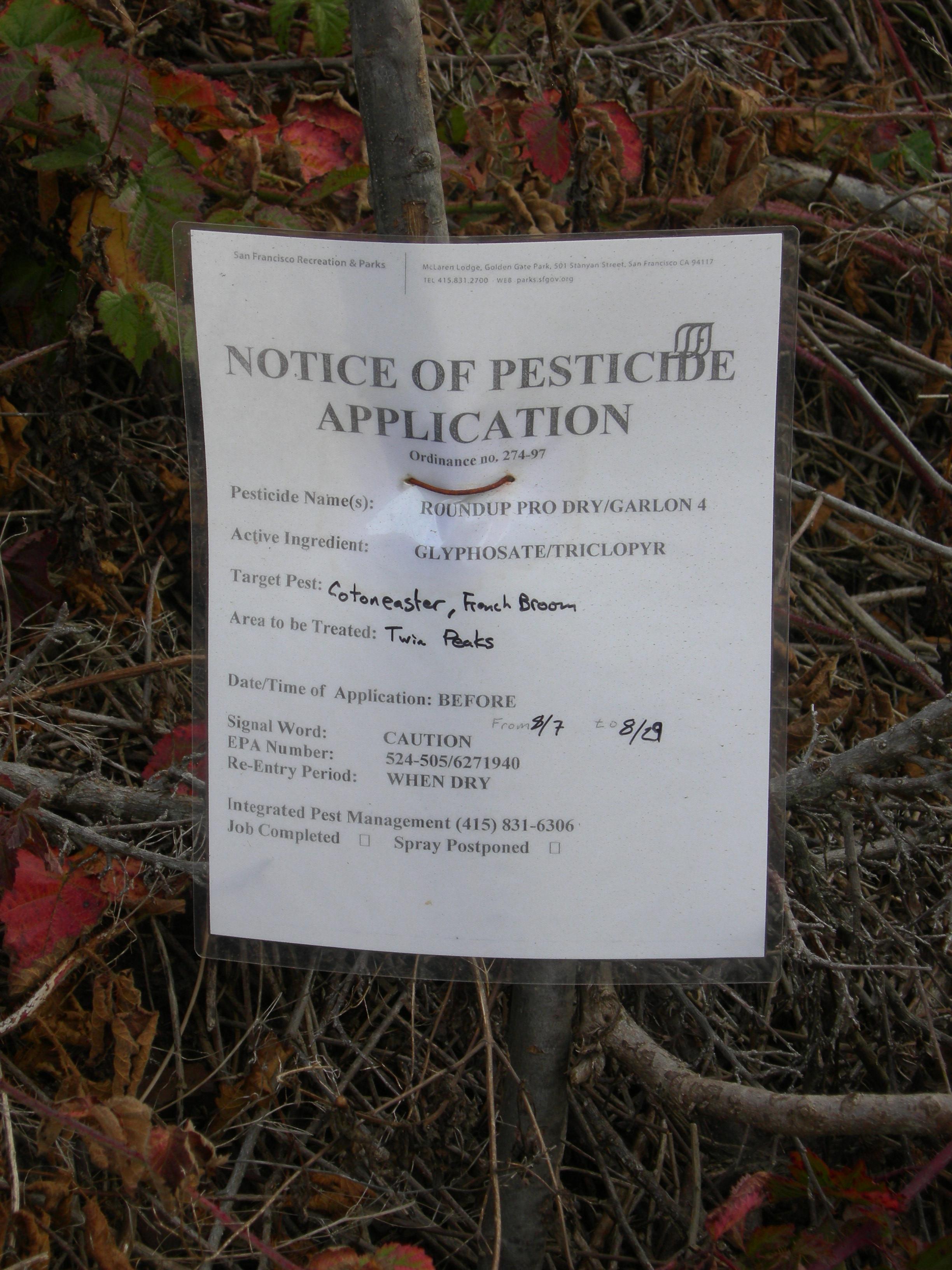
Will a 42% increase in actively management NAP acreage require more herbicide use?  The Natural Areas Program applied herbicides to the so-called “natural areas” 69 times in 2010. Most of those applications were of the most toxic herbicide (Garlon) for which the Natural Areas Program was granted exceptional permission to use by the Department of the Environment.  How much more herbicide must be used by NAP if they actively manage the MA-3 areas?  The EIR is curiously silent on this question.

Public Comment Opportunities

The public will have two opportunities to comment on the EIR and its “environmentally superior alternative” which will aggressively expand the restoration efforts of the Natural Areas Program, require more tree removals and recreational access restrictions, probably cost much more, and probably increase the use of herbicides.

  • “A public hearing on this Draft EIR and other matters has been scheduled by the City Planning Commission for October 6, 2011, in Room 400, City Hall, 1 Dr. Carlton B. Goodlett Place, beginning at 1:30 p.m. or later. (Call 558‐6422 the week of the hearing for a recorded message giving a more specific time.)”
  • “Public comments will be accepted from August 31, 2011 to 5:00 p.m. on October 17, 2011*. Written comments should be addressed to Bill Wycko, Environmental Review Officer, San Francisco Planning Department, 1650 Mission Street, Suite 400, San Francisco, CA 94103. Comments received at the public hearing and in writing will be responded to in a Summary of Comments and Responses document.”
  • “If you have any questions about the environmental review of the proposed project, please call Jessica Range at 415‐575‐9018.”

*[ETA:  The deadline for written comments has been extended to October 31, 2011, at the request of the Planning Commission.]

If you have an opinion about the expansion of the Natural Areas Program proposed by the Environmental Impact Report  you would be wise to speak/write now.  It is your last opportunity to do so.

———————————
*Type in search box:  Natural Areas Program management plan

Are native species inherently superior to non-native species?

The native plant movement is based on the fundamental assumption that native species of plants and animals are inherently superior to non-native species.  The basis of this assumption seems to vary.  Sometimes the explanation offered is as simple as “the non-native doesn’t belong here.”  It’s not clear what that statement means.  Putting it in the best light, it implies that there is some optimal ecology that is best represented by exclusively native species.  A less generous interpretation would be that non-native plant and animal species are the non-human equivalent of illegal immigrants. 

We will examine this claim of the superiority of native species in the context of bees to make the point that nature is complex and cannot be oversimplified by such a sweeping generalization.

Professor Gordon Frankie, our local expert on the bees of the Bay Area, says that native bees are superior pollinators to the European honeybee.  If that were true, we would consider that a legitimate basis for the judgment that, in this case, the native bee is superior to the non-native bee.  However, the evidence available to us suggests that a comparison of the native to the non-native bee is more complicated.

In considering this question, we will focus on agriculture rather than residential gardens, because agriculture is economically more important and for the same reason more is known about the role of bees in agriculture.

Why would native bees be superior pollinators than non-native bees?

We know of two specific examples of native bees that are more effective pollinators of agricultural crops.  Both cases illustrate the pros and cons of native bees as agricultural pollinators.

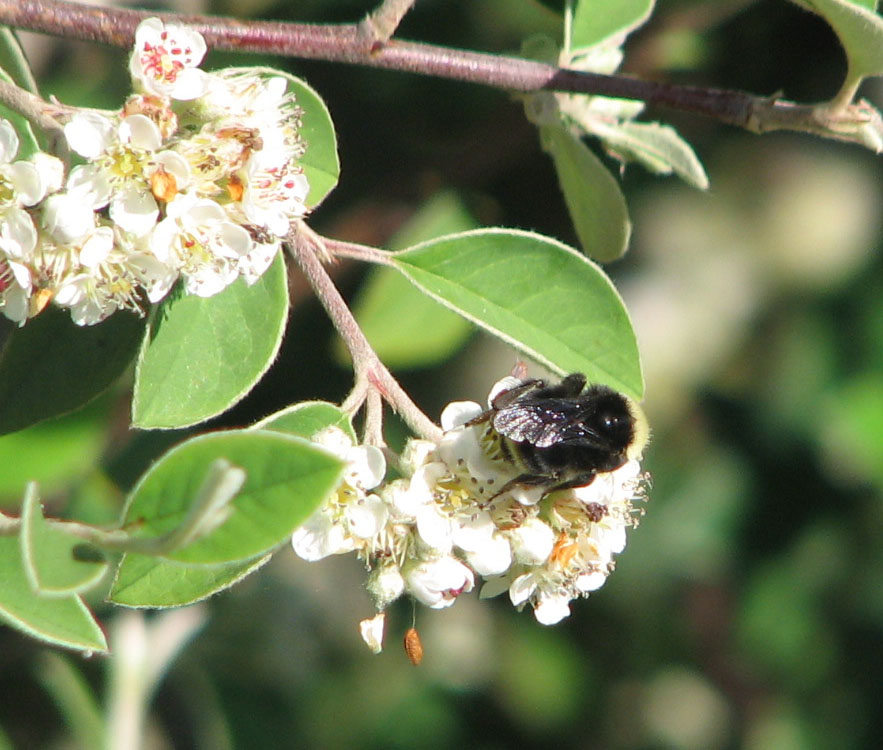
Bumblebee on Cotoneaster, Albany Bulb

There are some crops—tomatoes, cranberries, blueberries, eggplants, and kiwi fruits—that are effectively pollinated by native bumblebees (Bombus) because of their unique method of pollination.  This method is called “buzz-pollination” or “sonication” and it is described as “an intense vibration, like a tuning fork being struck, pollen gathered from other flowers literally exploded off Bombus.”(1)

Unfortunately, though its pollination technique is superior, other characteristics of the native bumblebee have limited its usefulness in agriculture.  The crops with which it is most effective produce only pollen.  Therefore, the bumblebee must be provided with an alternate source of nectar to fulfill its dietary needs.(2)  

The bumblebee, like most native bees, is solitary.  It does not live in hives like the social European honeybee.  Therefore, it cannot be transported where and when it is needed, as the honeybee can.  An attempt at a high-tech solution to this limitation ended in disaster:  “In the 1990s, a bumblebee species Bombus occidentalis, was made extinct when experimenting breeders mixed species in Europe and shipped queens back to America.  The queens carried with them an exotic disease that Bombus occidentalis has no immunity for.”   Growers of tomatoes are now “forced to resort to less efficient pollinators.”  (Schacker 2008). 

Another example of a native bee that is a superior pollinator of an agricultural crop is the alkali bee which is the most efficient pollinator of alfalfa, a crop that is essential to the dairy and beef industries.  “Alfalfa flowers…keep their sexual parts hidden, under tension like a spring.  Bees must trip the spring to get at the pollen, and in so doing, they are hit on the head—something honey bees are not particularly fond of.  The alkali bees…don’t mind getting hit on the noggin and will happily pollinate a field of alfalfa.”  (Schacker 2008). 

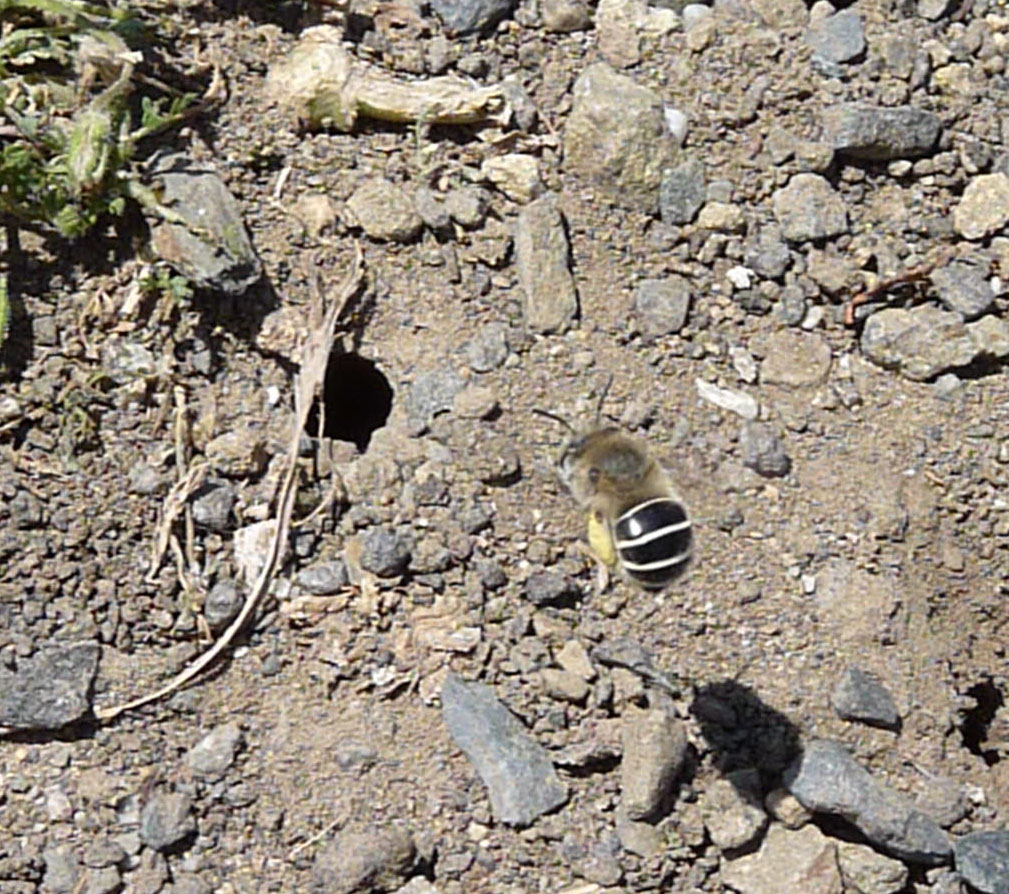
Native bee approaching nest in ground, Albany Bulb

Unfortunately, the alkali bee, like 85% of native bees in the US, nests in the ground, in particular the alkaline soils of the western US for which it is named.  As cropland in the west expanded, the alkali bee was virtually wiped out by plowing up the ground in which it nested.  A leafcutter bee was imported from Canada as a substitute, but a fungus is now infecting its larvae. (Schacker 2008)

These disadvantages of native bees can be compensated for by providing nesting and nectar sources adjacent to croplands.  These hedgerows must be large enough to provide sufficient nesting opportunities and nectar sources. 

However, such hedgerows do not solve all the potential problems of using native bees as pollinators.  Because the bees are resident year around and cannot be transported, they cannot be removed when the crops are sprayed with pesticides.  And the pesticides are very damaging to the bees.  Therefore, a commitment to providing hedgerows for a resident bee population is also a commitment to organic agriculture, i.e., without using pesticides. 

This is not to say that the honeybees aren’t being adversely affected by the use of pesticides in the crops they are pollinating.  The impact of pesticides on  honeybees would be exacerbated if they were resident when pesticides were applied to the crop.  As it is, the honeybee is being affected by the residues of the pesticides on the crops they pollinate.  This is considered one of the primary reasons for Colony Collapse Disorder of commercial honeybees which has been destroying about one-third of commercial honeybee hives in the past few years.

Unlike most native bees, the European honeybee does not hibernate.  It is therefore available year around to be transported where and when it is needed.  Most native bees hibernate, but not necessarily at the same time.  Different species of native bees hibernate at different times and are therefore available for pollination at different times. 

Most native bees are more selective in their pollination than the European honeybee which is an extreme generalist:  “honeybees have the greatest pollen dietary range…of any known pollinator.” Although there are “only a handful of well-documented cases in North America of truly monolectic bees [a bee that visits only one kind of flower]” (Buchmann 1996), the flower preferences of native bees are narrower than that of the European honeybee.  While some native bees may prefer native plants, honeybees are willing to pollinate both native and non-native plants.  This is important because virtually all of our agricultural crops are non-native.

Native bees are not inherently superior to non-native bees

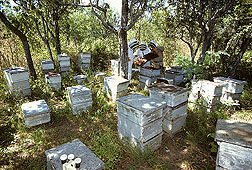
Honeybee hives, USDA photo

In summary, the European honeybee has several important advantages over native bees as pollinators of agricultural crops:

  • Because the honeybee is a social bee that lives in hives, it can:
    • Be transported where and when it is needed
    • Be removed from the agricultural crop when it is sprayed with pesticides
    • Does not need to be provided with nesting space and an alternate food supply
  • The honeybee is available for pollination services year around because it does not hibernate.
  • The honeybee pollinates a wider range of flowers than most native bees.

While native bees may be more efficient pollinators of residential gardens, there are a number of disadvantages to using native bees for agricultural pollination.  Although many of these obstacles can be overcome with greater use of resources, we cannot agree with the assumption of native plant advocates that native bees are inherently superior to the non-native European honeybee.  As with all sweeping generalizations, the truth is usually more complicated because nature is complex and man’s understanding of it is limited.


(1) Schacker, Michael, A Spring without Bees, Lyons Press, Guilford, Conn, 2008.

(2) Buchmann, S, and Nabhan, G, The Forgotten Pollinators, Island Press, 1996

“Museumification” of our parks separates children from nature

The Berkeley Meadow

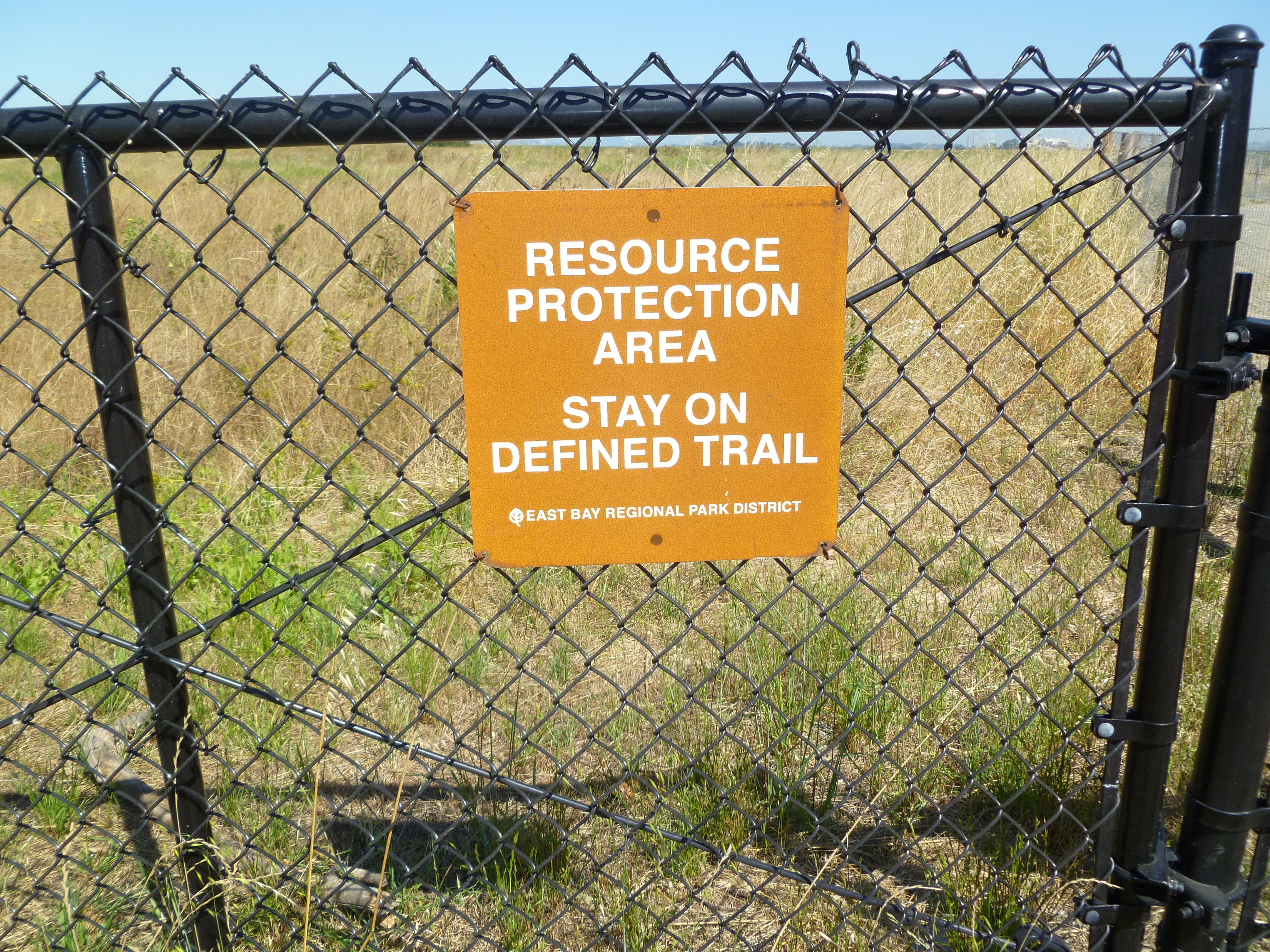
We recently published an article about the Berkeley Meadow, a 72-acre fenced pen for native plants and animals.  In response, one of our readers alerted us to a video cartoon about the Berkeley Meadow which we recommend to you.  “Grandpa Takes the Kids to the Plant Zoo” captures the absurdity of this “restoration” project.

The sentiments expressed by the children in this video remind us of an article published in 2004 about similar restoration projects in Chicago and San Francisco.  “Urban Park Restoration and the ‘Museumification’ of Nature” was written by Dr. Paul Gobster after he visited the Bay Area as a visiting professor at UC Berkeley, collaborating with colleagues in landscape architecture.

Dr. Gobster is a social scientist with the US Forest Service, stationed in the Chicago area and the editor of a book* about the restoration movement there.  The restorations in Chicago are similar to those in the San Francisco Bay Area because both places were primarily grassland prior to the arrival of Europeans.   Restorations in both areas therefore require the destruction of most trees.  In the Chicago area, many of the trees are native because of the natural succession of grassland to shrubland and finally to forest.  The fires of Native Americans that sustained the grassland were stopped at the time of settlement.

In “Museumification,” Dr. Gobster expresses his opinion of the restorations in the San Francisco Bay Area and in Chicago:

“…it is my contention that little headway has been made in exploiting the key role urban parks might have in strengthening the ties between nature and culture.  To the contrary, some current attempts at ecological restoration in urban parks may distance people from the experience of nature even further than did earlier naturalistic designs, leading to a form of detached observation not unlike what one might experience in a museum.  Instead of providing a bridge between nature and the city…park restoration can lock nature inside the gates of paradise and leave people on the outside looking in.”

Dr. Gobster is particularly concerned about the impact of “museumification” of parks on children who should be the primary beneficiaries of our parks.  Their earliest experiences with nature may foster a lifelong interest in nature or an alienation from it.

“The wild and weedy nature that existed in many of these urban park areas prior to restoration provided [a setting for unstructured play]…Now displaced by a more ecologically diverse yet more fragile nature, these kinds of activities are discouraged just as they are in more manicured park settings.  Children are much less likely to attain satisfying nature experiences through passive forms of interaction and thus may be disproportionately affected by such changes.  The result of this museumification is that we are creating a significant gap in the spectrum of nature experiences available to urban children precisely at the nearby places where children stand the best chances for getting acquainted with nature.  Thus while striving to achieve authenticity in the restoration of ecosystems we may be sacrificing the authenticity of children’s nature experiences.”

Children discovering nature. NPS photo

In “Grandpa Takes the Kids to the Plant Zoo,” we see that the kids are uninterested in looking at the plants on the other side of the fence.  They ask Grandpa to take them elsewhere so they can play.  Grandpa must also ask them not to touch the few plants within reach because they have been sprayed with herbicides.  The park is not accessible to the kids because it is behind a fence and it has also been sprayed with herbicides, so it’s not a safe place for them to play.  In the East Bay Regional Park District, for example, herbicide use in its restoration projects (AKA “resource management”) increased 300% in 2009.  Herbicides had not been sprayed in the Serpentine Prairie prior to 2009, when it was fenced for “restoration.”  Now it is sprayed with herbicides, mowed, planted, and is due for periodic prescribed burns to prevent its succession to shrubs and subsequently to oak woodland.

When we alienate children from nature, we jeopardize the future of our parks.  If parks are not viewed as useful places, they will not enjoy the support needed to sustain them.  And if nature is not viewed as valuable, we undermine the public’s support for preservation of the environment.  As adults debate the merits of native plant restorations, they should keep in mind the needs of children because the future of our public lands is in their hands and children are unable to speak for themselves in the public policy arena. 


* Gobster & Hull, eds., Restoring Nature, Washington DC, Island Press, 2000

Spartina alterniflora: Treasured on the East Coast, reviled on the West Coast

Spartina alterniflora (Smooth Cordgrass) is a species of marsh grass native to the Atlantic and Gulf coasts of the United States, where it is considered a valuable plant making important contributions to the coastal ecology:

  •  Its dense growth provides protection against storm surge and “erosion control along shorelines, canal banks, levees, and other areas of soil-water interface.”(1)
  • It filters nutrients, sediments and toxins from the water that flows off the land before reaching the ocean, acting as a natural water treatment facility.
  • It provides cover and food for birds, mammals and marine animals that live in the coastal marsh.  Many other marsh plants occupy the same marshlands.

    Spartina alterniflora, Smooth Cordgrass. USDA photo

Where Smooth Cordgrass has died back in its native range, the dieback has been considered a serious environmental threat:

  • In 2001 the Governor of Louisiana declared a “state of emergency” when Smooth Cordgrass declined and the state obtained $3 million of federal funding to study and hopefully reverse the decline.  This study resulted in the development of a method of aerial seeding of Smooth Cordgrass to restore declining areas of marshland.(2)
  • A similar, but smaller dieback of Smooth Cordgrass in Georgia led to a collaborative research and on-going monitoring effort by 6 research institutions in Georgia.(3)
  • Similar dieback of Smooth Cordgrass has been reported as far north as the coast of Maine.  A researcher at the Connecticut Agricultural Experiment Station is quoted in that report as saying, “In New Orleans, if their marshes were intact, the storm surge of Katrina would not have reached the levees.”(4)

The war on Smooth Cordgrass in the West Coast 

Smooth Cordgrass is not native on the Pacific Coast of the United States.  Therefore it is treated as an alien invader to be eradicated with herbicides:

  • $24 million was spent to eradicate Smooth Cordgrass in San Francisco and Willapa Bay from 2000 to 2010 (5)
  • $16.3 million is projected to be spent on eradication efforts on the entire West Coast from 2011 to 2020 (6)

In 2006, 2,000 acres were treated with herbicides to eradicate Smooth Cordgrass in the San Francisco Estuary.    Most were retreated 3 to 5 times after initial treatment.  In 2010, twenty five sites were slated for retreatment, usually with herbicides.  The San Francisco Estuary Invasive Spartina Project (ISP) “defines a need for a zero tolerance threshold on invasive Spartina in the San Francisco Bay.”(7)

The ISP reports that imazapyr (Habitat) will be used in most sites, although it will sometimes be mixed with glyphosate (Roundup). (See SaveSutro for more information about imazapyr and its use in San Francisco.)  The ISP acknowledges that:

  •  “little is known about the interactive effects” of combining these herbicides or any of the surfactants used with these herbicides.
  • These herbicides will be applied using a variety of methods, including aerial spraying by helicopter.
  • Although the ISP considers imazapyr a relatively non-toxic herbicide, it also acknowledges that imazapyr has only been used since 2005.  Therefore, “Only few toxicity studies exist for birds…no data exist for the potential toxicity of imazapyr to shorebirds.”(8) Given that one of the stated purposes of eradicating Smooth Cordgrass is to benefit the endangered Clapper Rail, it seems surprising that nothing is known about the effects of imazapyr on any shorebird, including the Clapper Rail.

Why is Smooth Cordgrass treasured on the East Coast and reviled on the West Coast?  That question was asked and answered by Professor James Morris at an Environmental Law Conference in Eugene, Oregon on March 5, 2011.  Professor Morris studies Smooth Cordgrass at the Baruch Institute for Marine & Coastal Sciences at the University of South Carolina.  We urge our readers to watch a video of his presentation to the conference in Oregon.  We will draw upon that video in addressing the claims (9) made by those who are attempting to eradicate Smooth Cordgrass on the West Coast:

Indictment:  Smooth Cordgrass will invade mud flats, eliminating valuable habitat for plants and animals that inhabit that segment of marshland.

Defense:  According to Professor Morris, Smooth Cordgrass was introduced to the West Coast in shipments of Eastern oysters over 100 years ago without eliminating mudflats.  Europe has had similar experience with Smooth Cordgrass which was introduced there to reduce sediment in harbors.  Professor Morris showed pictures of Danish and Dutch estuaries in which Smooth Cordgrass has existed since the 1930s without radically altering the composition of the marshland.

Indictment:  Smooth Cordgrass will invade waterways, making them impassable.

Defense:  Again, since this has not happened in 100 years, there is no reason to assume it will happen in the future.  Furthermore, the USDA describes the narrow range of Smooth Cordgrass:  “the width and thickness of vegetative colonies are controlled by a number of site specific conditions such as elevation, shoreline slope, and frequency, depth and duration of flooding” as well as salinity and acidity.  In other words, the range of Smooth Cordgrass is limited.

Indictment:  Smooth Cordgrass does not provide habitat value equal to the native species of cordgrass with which Smooth Cordgrass competes, particularly for the endangered Clapper Rail.

Defense:  Mike Casazza at the Dixon Field Station of the USGS is presently studying the effect of eradicating Smooth Cordgrass on the reproductive success of the Clapper Rail:  “Removal of invasive Spartina accomplishes the goal of Spartina eradication, but if rails fail to survive and reproduce, then the goal of species protection is unfulfilled…the potential for impact from invasive Spartina removal and the potential for mitigation by rail ecology and behavior remain poorly understood.”(10)  Clapper Rails live in Smooth Cordgrass on the East Coast:  “numerous” Clapper Rail families were observed nesting in Smooth Cordgrass on Dewees Island, South Carolina.(11)

Indictment:  Smooth Cordgrass is outcompeting the native Pacific Cordgrass (Spartina foliosa) by displacement and hybridization.

Defense:  This is probably true because of the characteristics of the Pacific Cordgrass:  “S. foliosa occupies a very limited range in the intertidal zone, and the leaves and stems wither in fall and shed in the winter, leaving sparse standing matter that is ineffective at trapping sediment.  Seedlings of S. foliosa are seldom found in established marshes and appear only intermittently in sheltered upper mudflats.”(12)  In other words, the range of the native cordgrass is narrower, it does not grow as densely, and it is not foliated year around, thereby creating opportunities for the non-native cordgrass to occupy bare ground.  Since marsh grasses are beneficial to the environment and its inhabitants, the ability of Smooth Cordgrass to occupy this vacuum seems a benefit, particularly since native cordgrass is less capable of removing sediments from water, reducing its effectiveness as a filter of pollutants from water flowing into the bay.(13)

Smooth Cordgrass is treasured on the East and Gulf Coasts because it performs valuable ecology services.  Although it performs the same ecological functions on the West Coast, it is being eradicated.  The evidence available to us suggests that we are spending a lot of money and effort, as well as using a lot of herbicides, to eradicate Smooth Cordgrass only because it is not native to the West Coast.   

  • Smooth Cordgrass provides superior storm surge protection particularly during winter months when native cordgrass is dormant.
  • Smooth Cordgrass is more capable of filtering pollutants from water flowing into the bay.
  • Smooth Cordgrass provides at least equal habitat quality to the endangered Clapper Rail and probably other marsh plants and animals as well.
  • Smooth Cordgrass has not blocked waterways or eliminated mud flats in comparable situations over long periods of time

We invite our readers to supply us with evidence that there are legitimate reasons for the campaign against Smooth Cordgrass.


(2) Dorset Hurley, “Geogia’s Marsh Die Back and Louisiana’s Marsh Browning,” Altamaha Riverkeeper

(3) Ibid.

(4) “What’s killing off our salt marshes,” Going Coastal Magazine, September 15, 2008

(5) “West Coast Governor’s Agreement on Ocean Health,” May 2010, page 5

(6) Ibid., page 6

(7) “San Francisco Estuary Invasive Spartina Project, 2010 Pesticide Application Plan,” page 15.

(8) Ibid. page 31

(9) “West Coast Governor’s Agreement on Ocean Health,” May 2010

(10) “Ecology of California Clapper Rail in the San Francisco Bay/Delta Region,” USGS Western Ecological Research Center

(11) Judy Drew Fairchild, “Watch for Clapper Rails and chicks,” Dewees Island, SC

(12)“West Coast Governors’ Agreement on Ocean Health,” May 2010, page 12

(13) “San Francisco Estuary Invasive  Spartina Project, 2010 Pesticide Application Plan,” page 10

Concern about herbicide use: Legitimate or “chemophobia”?

Recently there was a brief dialogue about herbicide use in San Francisco’s so-called “natural areas” in Jake Sigg’s Nature News that was of some interest to those who consider such use a contradiction in a public park designated as a “natural area”:

  •  Jake Sigg:  “Spurious, damaging information being circulated regarding herbicide use in our open spaces:  Mischievous people…are circulating false information…whipping up fears that have no foundation”  (Nature News, February 14, 2011)
  • Reader:  “…Garlon is legally classified as a hazardous chemical.  I am therefore writing to supply you with information from reputable sources.  I ask that in your future communications on this subject, you accurately describe the facts that are known about this chemical.” (Nature News, February 18, 2011)
  • Jake Sigg:  “The chemophobia rampant in this country is primarily based on emotion and anxiety, and does us a great disservice.” (Nature News, February 18, 2011)
  • Jake Sigg:  “The anti-herbicide crazies quickly seize on articles like this NYT one as proof of their contentions…” (Nature News, March 30, 2011)

This dialogue and the positive feedback that Mr. Sigg reported from his readers in support of herbicide use, suggest that herbicides are an important tool for the native plant movement.  They are anxious not to lose this tool in their crusade to eradicate non-native plants and trees.  After researching how much herbicide is being used by the Natural Areas Program, we can understand why they angrily defend its use.

Herbicide use by San Francisco’s Natural Areas Program

The Natural Areas Program (NAP) reports having used herbicides 69 times in 2010:  36 applications of Garlon, 31 applications of Roundup, and 2 applications of Milestone.  Putting those numbers into perspective, other areas (those not designated as “natural areas”) in the Recreation and Park Department sprayed Garlon, the most hazardous chemical, only a few times in 2010.

About 20% of these herbicide applications were done by a contractor who was paid $9,000 per application.  The employees of this contractor are therefore equally committed to this source of revenue, contributing to the economic interest that is a motivating factor in the native plant movement.

Not all of the “targets” of these sprayings are identified, but those that are include:  oxalis, blackberry, ivy, fennel, cotoneaster, hemlock, pampas grass, broom, erharta grass, mustard, and thistle.  Blackberry is an important source of food for wildlife in the city. We hope that children in the park do not graze on the blackberries.  Garlon was also sprayed on Scabiosa, which has not been identified as an “invasive plant” by the California Invasive Plant Council.

Glen Canyon, with a creek running through it and a year-around day care center adjacent to that creek, was sprayed 12 times.  Twin Peaks, the watershed to that creek, was sprayed 16 times.  Lake Merced was sprayed 3 times, despite the fact that it has been officially designated as red-legged frog habitat.

What is known about these chemicals?

The City’s policy regarding “Integrated Pest Management” classifies the chemicals used on city properties in terms of the risks associated with their use.  Here is how the City’s policy classifies these chemicals: 

  • Garlon:  Tier I, Most Hazardous.  Use Limitations:  “Use only for targeted treatments of high profile or highly invasive exotics via dabbing or injections.  May use for targeted spraying only when dabbing or injection are not feasible and only with use of a respirator.  HIGH PRIORITY TO FIND ALTERNATIVE.”
  • Roundup:  Tier II, Less Hazardous.  Use Limitations:  “Spot application of areas inaccessible or too dangerous for hand methods, right of ways, utility access, or fire prevention.  Use for cracks in hardscape, decomposed granite and edging only as last resort.  OK for renovations but must put in place weed prevention measures.  Note prohibition on use within buffer zone 60 feet around water bodies in red-legged frog habitat.”
  • Milestone:  Tier I, Most Hazardous

    Spraying Garlon on Twin Peaks without use of the respirator required by City policy, February 2011

Federal law also requires that chemicals be evaluated by the Environmental Protection Agency (EPA) before being commercially available to consumers.  The EPA conducts a number of tests of toxicity, reports the results of those tests on a mandated Material Safety Data Sheet (MSDS), and classifies the chemical with respect to its relative toxicity.  Here are a few highlights from the MSDS for these chemicals:

  • Garlon 4 Ultra is defined as a “Hazardous Chemical” according to the OSHA Hazard Communication Standard.  “Material is highly toxic to aquatic species” and “slightly toxic to birds.”
  •  Roundup Pro is defined as a “Hazardous Chemical” according to the OSHA Hazard Communication Standard. Toxicological effects in rats:  “decrease in body weight gain; histopathologic effects.”  “Moderately toxic” to aquatic life.

The Marin Municipal Water District (MMWD) quit using all herbicides in 2005 in response to the public’s protests.  They have been engaged in a process of evaluating herbicides for possible use in the future.  In 2008, MMWD contracted for a risk assessment of 5 herbicides they were considering for possible use.  That risk assessment determined that Garlon 4 Ultra is the most hazardous of the 5 chemicals that were evaluated.    MMWD is not considering the use of Garlon in the future. 

Does NAP’s herbicide use conform to the City’s Integrated Pest Management Law?

 San Francisco’s Integrated Pest Management Ordinance makes the following commitments regarding pesticide use on the city’s properties:

  • 300a “…the policy of the City..to eliminate or reduce pesticide applications on City property to the maximum extent possible.”
  • “The City…shall assume pesticides are potentially hazardous to human and environmental health.”
  • “The City shall give preference to reasonably available nonpesticide alternatives when considering the use of pesticides.”
  • “Consider the use of chemicals only as a last resort.”
  • “This Chapter applies the Precautionary Principle to the selection of reduced risk pesticides and other pest management techniques.”

The City’s ordinance that obligates the City to follow the Precautionary Principle makes this commitment:

“A central element of the precautionary approach is the careful assessment of available alternatives using the best available science. An alternatives assessment examines a broad range of options in order to present the public with the consequences of each approach. The process takes short-term versus long-term effects or costs into consideration, and evaluates and compares the adverse or potentially adverse effects of each option, giving preference to those options with fewer potential hazards. This process allows fundamental questions to be asked: ‘Is this potentially hazardous activity necessary?’ ‘What less hazardous options are available?’ and ‘How little damage is possible?’”

We do not believe that herbicide use by the Natural Areas Programs meets the standards of either the City’s ordinance about pesticide use or its commitment to the Precautionary Principal.  These laws are theoretically rigorous, but the enforcement of those laws is not.  The Natural Areas Program is using an herbicide (Garlon) categorized by City policy as the “Most Hazardous” most of the time.  They are using that chemical in sensitive areas in which water can be contaminated and in which children can be exposed.  Their use of that hazardous chemical has increased over time and they have been using that chemical for at least 5 years, perhaps longer (the 2006 management plan for the Natural Areas Program reports the use of this chemical).  If Garlon has not been capable of eradicating in 5 years, the non-native plants that are the target of the Natural Areas Program, it is not likely to do so in the foreseeable future.  

Legitimate concern or “chemophobia”?

Let the reader be the judge.  Given what we know about these chemicals, the frequency of their use, the length of that use, and the locations of that use:

  • Do you think there is reason to be concerned about the herbicides that are being sprayed on our public parks? 
  • Do you think that places that have been designated as “natural areas” should be sprayed with herbicides which are legally and officially designated as hazardous chemicals? 

Broom: “I’m ba-ack”

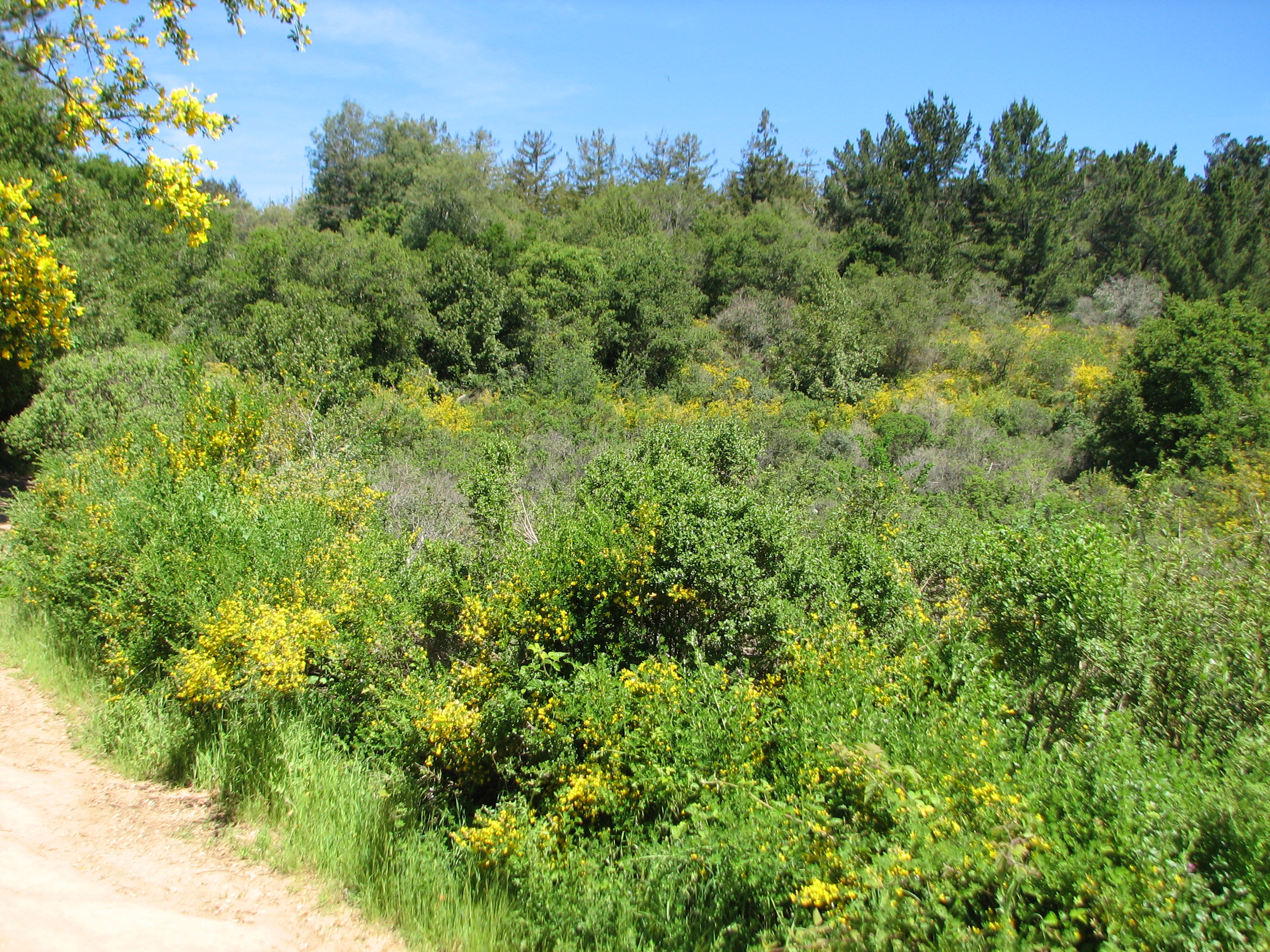
Leona Canyon, Spring 2011

One of our first posts, nearly one year ago, was about attempts to eradicate broom (see “Broom:  I’ll be back!”).  It’s that time of year again, when the broom is blooming around the Bay Area, adding a dash of bright yellow color to our public lands.

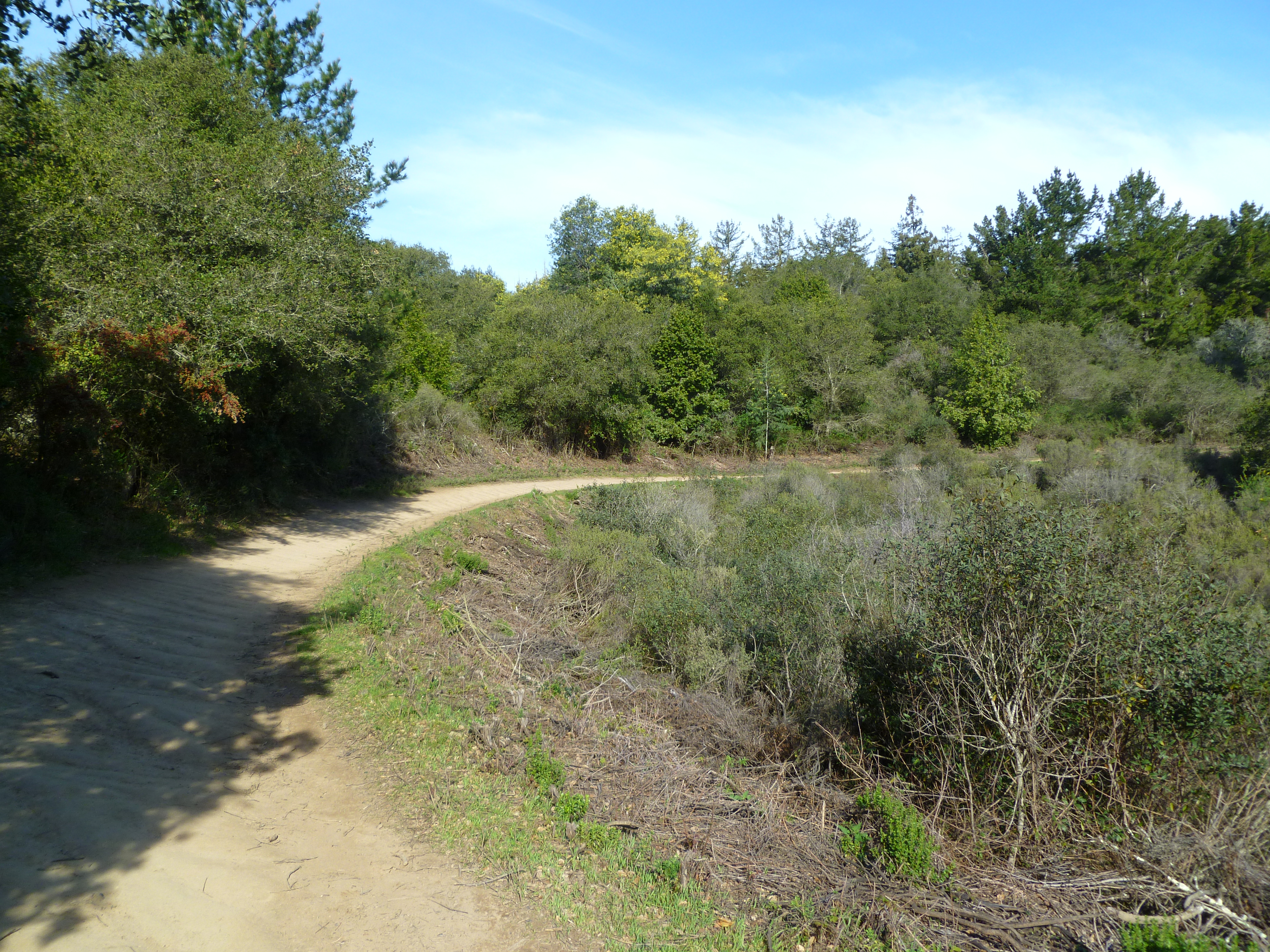
Despite continuing efforts to eradicate broom, it makes this annual comeback, regardless of the method used to kill it.  Mechanical destruction is one of the methods used.  In the photograph taken in fall 2010 of a trail in Redwood Park we see the unsightly result of such an attempt to eradicate the broom shown in our first post about broom in spring 2010.

Redwood Park, Spring 2010
Redwood Park, Fall 2010

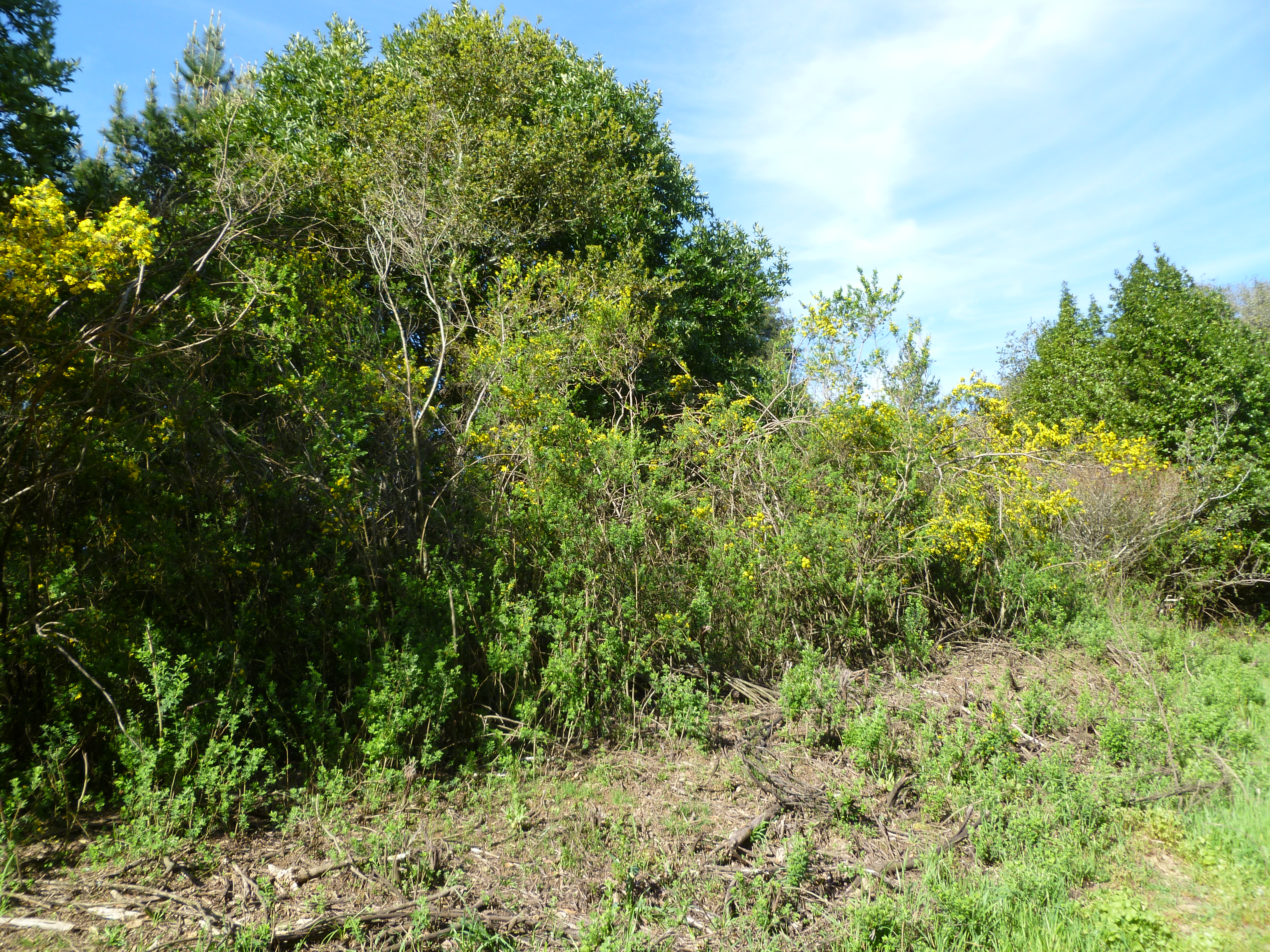
The UC Davis Statewide Integrated Pest Management Program  predicts the results of this effort to eradicate broom:  “Brush rakes and bulldozers often leave pieces of rootstalks that readily can resprout…using large equipment to clear land creates a perfect environment for new seedling establishment, making follow-up control essential.”  So, we shouldn’t be surprised when we revisit this same site the next spring to find that although it is still unsightly, it is also covered with the resprouts of the broom.

Broom resprouts, Redwood Park, Spring 2011

Herbicides are also used to eradicate broom.  The East Bay Regional Park District uses Garlon for foliar spraying of broom, despite the public’s concern about herbicide use in our parks.  In contrast, Marin Municipal Water District (MMWD) has not used herbicides on its properties since 2005, in response to public protests.  In December 2010, the Marin Independent Journal reported that MMWD is considering using Roundup (which is considered less toxic than Garlon) for broom control, but that a proposal will not be made until 2012 at the earliest, after an environmental impact study that will consider all alternatives for “pest management.”

Even if we are willing to accept the health and environmental risks associated with herbicides, they are not a guarantee of success.  According to UC Davis, “One application of an herbicide does not always completely control brooms…Watch treated areas closely for at least a year, and retreat as necessary.”


Since the seeds of broom are known to live in the ground from 50 to 60 years, we should expect that it is very difficult to eradicate.  Unless we make a commitment to kill the plant above the ground every year for as long as the seeds live in the ground, we cannot expect to be successful in that effort.

We were therefore amused by this exchange that Jake Sigg had with one of the readers of his “nature newsletter” (December 20, 2010):

Reader:  “…We have been up there every year for about 3-1/2 years now…It has been quite instructive about how flat out difficult it is to reverse the process [of “displacement” of native plants].  Like most invaders, the non-native plants like it here and want to stay.  The broom in particular are [sic] astoundingly persistent in holding whatever territory that they have gained.  It sounds strange to say, that sometimes I think the project is an exercise in futility while at the same time is extremely satisfying work and will continue it into the indefinite future.”

Jake Sigg:  “…It is such a lop-sided struggle…And yet, we all keep going.  It is a paradox that I don’t understand.  While working I’m fully aware of the seeming futility of what we’re doing, and yet keep going—and enjoying it!!”

Jake Sigg and his readers would benefit from the advice of Mark Davis in his book, Invasion Biology.*  Professor Davis suggests that unless a non-native species causes great health or economic harm, we adopt the “LTL approach” i.e., “Learn to love ‘em” or at least “Learn to live with them.” 

If it is futile to eradicate a plant we don’t like, if that plant isn’t doing us or any other plant any harm, and if we are damaging our environment in our futile attempt, let’s change our attitude toward that plant.  If we can’t change the plant, it is still within our power to change ourselves.  Surely we can find something more fruitful to do that is equally satisfying such as planting more native plants rather than destroying non-native plants.

Broom is an especially good candidate for LTL.  It is green all year around.  It requires no care whatsoever.  And in the spring it treats us to a lovely carpet of bright yellow.   What’s not to love?


* Mark Davis, Invasion Biology, Oxford University Press, 2009, page 150

Destruction of eucalyptus threatens bees

The Pt Reyes Light received a Letter to the Editor in response to its series about the destruction of eucalyptus trees.  The author of the letter explains that eucalypts are one of the few sources of nectar during the winter, that the nectar is vital to the survival of bees over the winter, and that the bees are essential to California agriculture.  The letter was published in the Light on January 6th and is reprinted here with permission:

Think before you cut

Dear Editor,

The recent articles in the Light regarding the Park’s and other’s plans to eradicate eucalyptus from California fail to take into consideration one critical aspect of the need for eucalyptus in the continuation of agriculture in the state.

The common honeybee was introduced to California in the mid-19th century, around the same time as Blue Gum Eucalyptus. Each spring and summer, honeybees gather huge amounts of nectar from flowers and store it in the form of honey so they will have enough food to make it through the winter, when the weather is too cold and rainy and flowers are too few to provide food for the bees. 

In autumn, each hive greatly reduces its number of bees in order to survive the winter on the honey they stored. This is done by the queen laying fewer eggs and thus not replacing the bees that naturally die. Hives of 40,000 to 50,000 bees in summer drop to 10,000 bees in winter.

During December and early January, bees hover in a tight cluster, keeping each other warm and living off the stored honey.  In early January the Queen again lays eggs in ever-increasing numbers each day; larvae and then newly-hatched bees must be fed huge amounts of honey to support rapid growth. The demand for honey increases exponentially and if honey stores are not enough, the hive can starve to death just before warmer, drier weather and its tons of flowering plants arrives. 

But in California we have periods of sunny, warm days, in January and especially February. These allow bees to forage for nectar to supplement depleted stores in their hives and insure their continuation.  But what is blooming in January and February, when bees are in desperate need of nectar plants? Acacia, almond, ceonothus, manzanita, mustard, rosemary and some fruit trees bloom for short periods of time, but their small number and smaller sizes do not always guarantee enough blossoms. And any hard rain or wind can destroy whatever blossoms there are. 

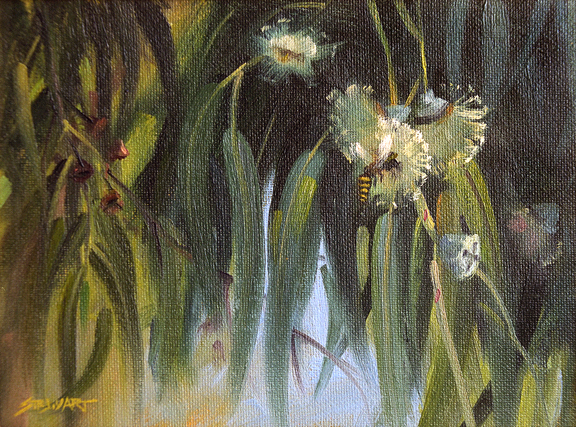
Eucalyptus, on average 100-feet high and 30 to 50-feet wide, has tens of thousands of nectar-filled blossoms per tree.  It blooms throughout California from late January through mid-May, ensuring an abundant supply of nectar for hives at the time of their most critical need.

Prior to the arrival of the honeybee in California, the state population was 1 million people and agriculture consisted of wheat, barley, cattle and sheep, all of which could easily survive without honeybees.  Today, with California growing much of the fruits, nuts and vegetables for the U.S., the honeybee is an intricate part of the continuation of agriculture. With the current problem of Colony Collapse Disorder, the fate of the honeybee is already precarious. Cut down all these Eucalyptus trees and the fate of thousands of hives of bees, and thus the continued pollination of our food crops, may be in serious jeopardy.  Think before you cut them down.

Cathleen Dorinson, Pt Reyes Station

Eucalyptus and Bee, painting by Brian Stewart
Research on Colony Collapse Disorder has identified reduced supplies of nectar as one of many factors in the failure of about 30% of commercial hives per year in the past few years.  Bees, already weakened by chronic exposure to pesticides and reduced food supplies, are unable to recover from the fungi, viruses, and parasites that are rampant in the “global diaspora of organisms.”

eucalyptus honey

Because of the role of pesticides in the death of bees, the eradication of eucalyptus exposes bees to  double jeopardy:  the loss of a major food source during the winter and exposure to the pesticides that are used to kill the roots of the eucalyptus trees.

Garlon with the active ingredient triclopyr, is the pesticide used by most managers of public lands to kill the roots of the eucalyptus after the trees are cut down.  Eucalyptus is a vigorous resprouter.   Unless the stump is poisoned immediately with a toxic pesticide, it will return ten-fold after it is cut down, or in the unlikely event that it burns down, or after a freeze deep and long enough to cause the tree to die back.

Garlon is known to be toxic to bees.  The Marin Municipal Water District quit using all pesticides on its properties in 2005 in response to public protests.  It hired a consultant to evaluate 5 pesticides for potential use in the future.  The risk assessment published in 2008  stated that Garlon was the most toxic of the 5 pesticides studied and that it was the most toxic to bees. The Marin Municipal Water District is presently seeking approval to begin using Roundup again.  It does not propose to use Garlon.

The so-called Natural Areas Program in San Francisco, which is responsible for the care of approximately 1,000 acres of park land ironically called “natural areas” uses Garlon heavily.  About 75% of its pesticide applications (by volume and frequency) are of Garlon.  Could this be a factor in the collapse of several beehives recently reported in San Francisco?

The East Bay Regional Park District used 34 gallons of Garlon in 2008.  How many more gallons of Garlon will be used by these managers of public lands when they cut down the hundreds of thousands of eucalyptus trees which they have proposed to destroy in their official plans?

Once again, we can’t make sense of the destructive actions of those who are damaging nature in the name of “restoring” nature.  In our view, it is a fundamental contradiction.

The Sierra Club instructs FEMA

Those who are still members of the Sierra Club, but are concerned about the Club’s endorsement of projects to destroy trees and  use toxic poisons to kill their roots, might be interested in the Club’s public comment (scroll down to Appendix F “Written Comments) to Federal Emergency Management Agency (FEMA) in preparation for the Environmental Impact Study of four such projects in the East Bay hills. 

 The Chairman of the Bay Area Chapter of the Sierra Club begins by asking FEMA to ignore those who are critical of these projects:  “1. We urge FEMA to discount the views of any individual or group that uses sophomoric name calling tactics in the press or in their FEMA scoping comments to categorize people or advocacy groups as ‘nativists’ (or other similar pejorative labels)…”

Apparently the author does not consider calling someone “sophomoric” an example of “name-calling.”  Webster defines “sophomoric” as “intellectually pretentious and conceited but immature and ill-informed.”  Hmmm…that sounds pretty insulting to us.

We don’t use the word “nativist” here on Million Trees, not because we consider it an inaccurate description, but rather because we have been told that it offends native plant advocates.  Since our goal on Million Trees is to inform, rather than to offend, we stick with the clunky phrase, “native plant advocates.”

What about “other similar pejorative labels?”  Does the Club also object to the phrase “native plant advocates?”  We are at a loss to arrive at some phrase that would appease them.  For the moment, we’ll stick with “native plant advocates” to describe those who advocate for the restoration of native plants to our public lands.  After all, the Sierra Club freely admits its preference for native plants in their letter:  “We obviously prefer our local native species and plant communities when compared to…introduced species.” 

The Sierra Club also instructs FEMA to put the restoration of native plant communities on an equal footing with fire hazard mitigation:  “We also urge FEMA to ensure that natural resource protection is given equal status with fire hazard reduction work when final projects are developed.”  The letter provides a detailed description of the “natural resource protection” it has in mind.  In this context, that phrase translates to “native plant restoration.” 

Since the stated purpose of FEMA’s pre-disaster and hazard mitigation grants is to reduce fire hazard to the built environment and the humans who live in it, this doesn’t seem an appropriate request.  FEMA’s legal and fiduciary responsibility is to respond to disasters when they occur and to reduce the potential for disasters in the future.  FEMA seems to have its hands full doing just that.  FEMA’s assigned mission does not include native plant restoration.

As we observed in our post “Open Letter to the Sierra Club,” the Club tends to ignore the fact that the tree destruction for which they advocate requires the use of toxic herbicides.  However, in its public comment letter to FEMA, the Club acknowledges the use of such herbicides and endorses their use:  “We are not currently opposed to the careful use of Garlon…”  On our page about “Herbicides,” we report that the EPA classifies Garlon as “hazardous”  and we cite the laboratory research on Garlon, indicating that it is harmful to many species of animals and is mobile in soil and water.

We hope that FEMA will maintain its mandated focus on hazard mitigation, its sole responsibility to the taxpayers.   If the taxpayers wish to fund native plant restorations, they should do so by designating an appropriate fund source.  FEMA is not an appropriate fund source for native plant restorations.

Open Letter to the Sierra Club

In this post we are writing an open letter to the Sierra Club about an article in their recent edition of the Yodeler, the newsletter of the Bay Area Chapter of the Club.  The article is available here. 

——————————————————————————————-

Dear Sierra Club,

We are writing about an article in the Yodeler about the “Wildfire Hazard Reduction and Resource Management Plan” of the East Bay Regional Park District.  A charitable description of that article is that it is misleading and inaccurate.

The most important flaw in the article is that it omits the most controversial issue in the “Wildfire Plan.”  It describes the methods used to eradicate non-native plants and trees as follows:  “Methods for removal include hand removal, grazing by cattle and goats, and limited controlled burns.”

In fact, herbicides are often used by EBRPD to kill non-native plants and trees.  The failure to mention this use of herbicides in the Yodeler cannot be dismissed as ignorance of this fact since it is described in detail in the “Wildfire Plan” and was the most frequently mentioned issue in the meeting of the EBRPD Board of Directors at which the Plan was approved.  The Sierra Club was represented at this meeting and surely noticed that many speakers expressed their concern regarding the use of herbicides officially designated “hazardous chemicals” by OSHA.  The toxicity of these herbicides is reported  here and here.

The description of controlled burns required by the Plan as “limited” is debatable.  We believe that the use of controlled burns for the sole purpose of restoring native plants is dangerously irresponsible.

At the recent meeting of the Executive Committee of the Board of Directors of the EBRPD, the “fuel management” plans for 2011 were presented and approved.  These plans included prescribed burns in 5 locations, on approximately 250 acres.  These burns were described by the Assistant Fire Chief as unrelated to reduction of fuel loads, but rather for the purpose of supporting restoration of native plants to the parks.  A representative of the California Native Plant Society expressed  gratitude to East Bay Regional Park District  for conducting these burns for the benefit of native plants.

We object to the use of controlled burns for this purpose because such burns have a history of causing major wildfires (reported here).  Some of these controlled burns will occur in areas with many acres of eucalyptus and Monterey pine that both the Sierra Club and the East Bay Regional Park District claim are highly flammable.  The burns are scheduled to occur during the height of the fire season.  Such burns also reduce air quality and release carbon and particulates into the air.

It baffles us that the Sierra Club endorses the use of dangerous herbicides and prescribed fires.  However, we aren’t surprised because the Club’s comments on the Draft EIR for the “Wildfire Plan” warned us that the Sierra Club considers the restoration of native plants a higher priority than the public’s safety.  The lawyer representing the Club said on behalf of the Club, “Perhaps the most serious problem with the Plan is that it explicitly makes the preservation and enhancement of wildlife a secondary concern, with minimizing fire danger the primary concern” and concluded, “However, the over-emphasis on decreasing wildfire risks at the expense of habitat values is disturbing.”

The Club’s priorities reveal a misanthropic agenda that betrays its original ideals and its commitment to the environment on behalf of all living creatures, including humans.

Million Trees

Herbicide Subterfuge

The public is unaware of the scale of herbicide use in our parks and public lands.  Nor are they aware of the toxicity of herbicides to humans and animals.  We will describe just two examples of the subterfuge that is used by “restorationists” to hide the use of herbicides.

The management plan of San Francisco’s Natural Areas Program (NAP) includes a description of the NAP’s herbicide use. Table 4-2 of the plan identifies 16 species of non-native plants and trees on which herbicides (Roundup and Garlon) are used.  Although the plan states specifically that herbicides are used, the Initial Study of environmental impact of the program says absolutely nothing about the use of herbicides. It does not acknowledge that herbicides are used or analyze their impact on the environment and its inhabitants.

Twin Peaks, San Francisco

The use of herbicides by a program calling itself the “Natural Areas Program” is particularly ironic in San Francisco, a city that has officially adopted the Precautionary Principle.  The PP theoretically obligates the city of San Francisco to ban any substance that might harm the environment or its inhabitants, even if there is not yet scientific evidence of that harm.  In the case of herbicides, there is plenty of evidence of the harmful effects on humans and other animals.

The East Bay Regional Park District is also using herbicides without acknowledging the risks in doing so.  In its Wildfire Plan, EBRPD misinforms the public that the Marin Municipal Water District is using herbicides:  “Using herbicides to control invasive [AKA non-native] plant species…can be an efficient and cost-effective method…Recent studies conducted by the Marin Municipal Water District (MMWD)  confirm this approach; the results of their studies on the use of non-chemical control methods for the control of invasive non-native plants indicated that non-chemical alternatives are ineffective for large-scale vegetation management projects. (see Appendix H…)”  (page 92) .  In other words, EBRPD in its Wildfire Plan is inaccurately claiming that MMWD is using herbicides when they are not.  MMWD has confirmed in writing that they have not used herbicides since 2005.

But, EBRPD doesn’t stop there.  When the public pointed out to EBRPD during the public comment period on the Environmental Impact Review (EIR) that MMWD is not using herbicides, EBRPD responded (Response to Comments) as follows:  “As of March 2010, MMWD’s draft reports and analyses have shown no significant risk associated with the use of the chemicals studied on human health, animals or non-target plants, and a greatly increased average annual cost for eradicating 100 acres of the 750 acres of broom without the use of herbicides…”  (page 394) Whoever wrote that sentence has either not read MMWD’s risk assessment of herbicide use or is misrepresenting it.  In fact, MMWD’s risk assessment is perfectly clear in describing significant harm to the environment caused by herbicide use.

No wonder the public is in the dark about the use of herbicides.  Every effort is being made to keep them in the dark.