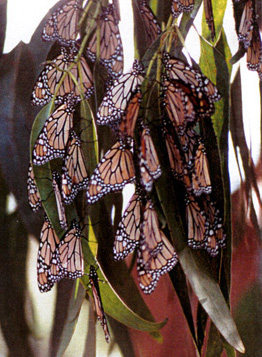
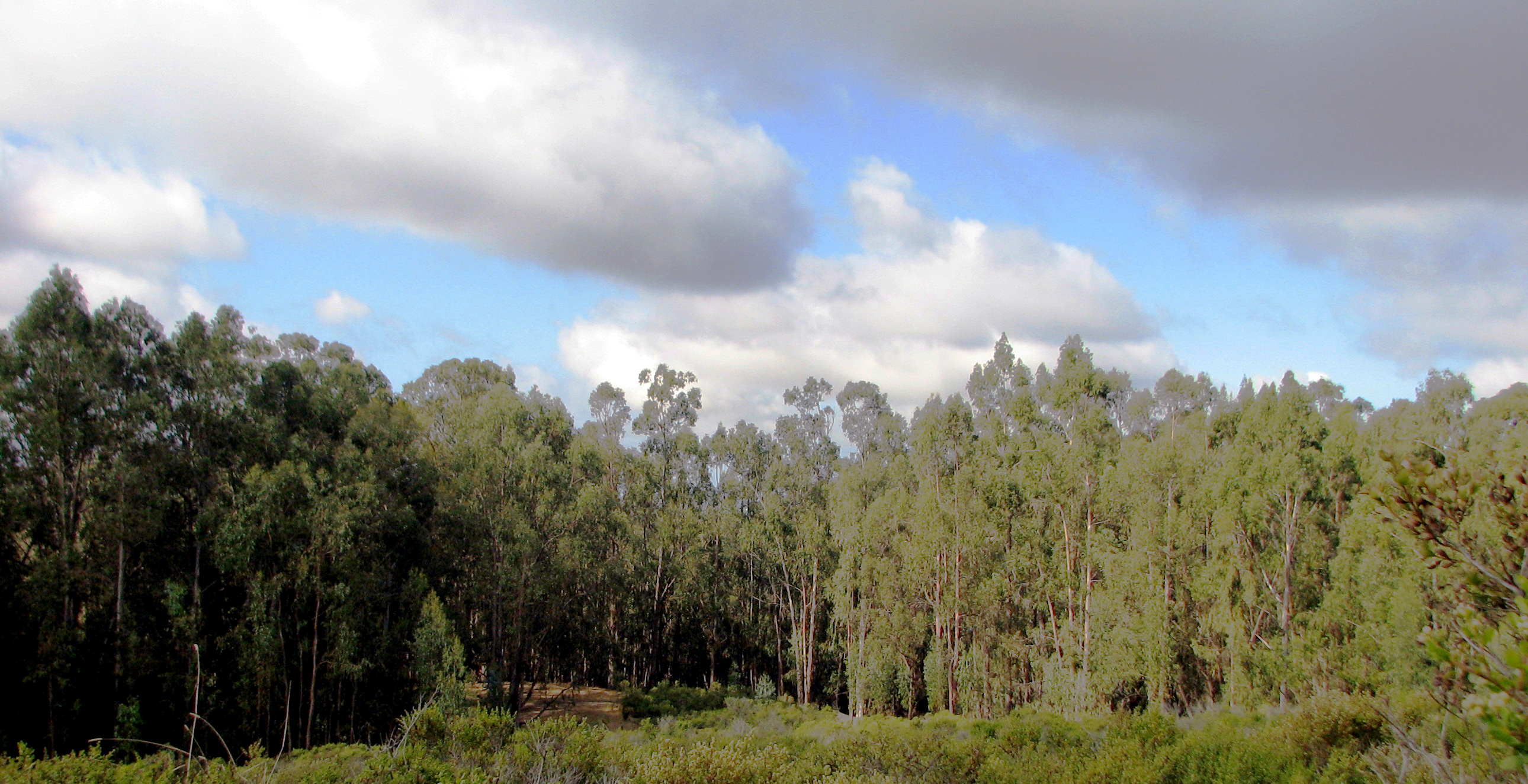
Monarch butterflies over-winter in California’s eucalyptus groves
The East Bay Express has published an op-ed in defense of the much maligned eucalyptus. “The Eucalyptus is Part of California” is by Gregory Davis, a Berkeley resident. We summarize the main points for our readers:
University of California, Berkeley’s plan to destroy all non-native trees—primarily eucalyptus, Monterey pine, and acacia—is characterized as a “meat-axe approach.”
Applying herbicides repeatedly to prevent regrowth of non-natives is “tantamount to opening a can of worms.” We don’t know the consequences of dousing our public land with toxic chemicals, just as we didn’t know that using Agent Orange during the War in Vietnam would permanently damage that country and its citizens.
The moderate approach advocated by the Hills Conservation Network is more reasonable. Thinning and selective removal will do less damage.
Flammability of eucalyptus groves has been greatly exaggerated.
Eucalyptus has lived in California longer than most of us have been alive. They are more native than we are.
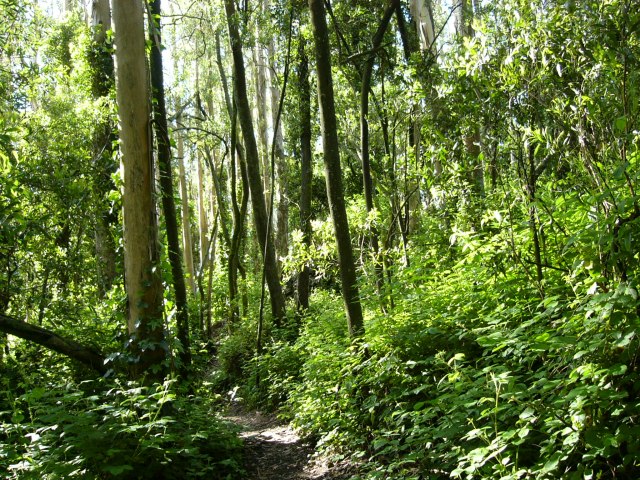
The loss of the “beauty and majesty” of eucalyptus in the hills will make hiking in the East Bay hills a less pleasant experience. “Anyone who has hiked up the trail under the green canopy of these tall, stately, plumed-top, evergreen trees knows how precious they are.”
Thank you, Mr. Davis, for writing this article and to the East Bay Express for publishing it. Critics of the native plant movement are learning that they must speak up if we are to save our trees. The projects that destroy our trees finally became so big and so visible, that more people are aware of them and are more willing to defend our trees.
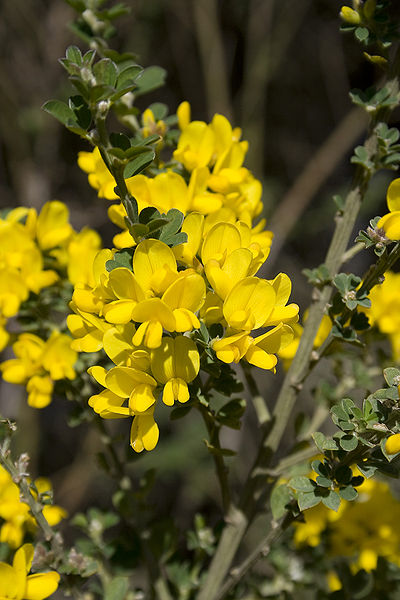
Broom is the likely occupant of East Bay public land now shaded by non-native trees that will be destroyed by the FEMA projects. Share Alike.
Invasion Biology: Critique of a Pseudoscience is a book by David Theodoropoulos. (1) He explains in the preface of the book, how he arrived at the conclusion that invasion biology is a pseudoscience and why he felt compelled to explain that conclusion in his book.
Theodoropoulos was from an early age a lover of nature and he always spent much of his time outdoors, observing nature. He recalls noticing decades before writing his book that some plant species—such as broom—tended to occupy disturbed ground such as roadsides. He was also aware that introduced species of plants were contributing to biological diversity. Putting those two observations together, he concluded that plants that are introduced and dispersed by the activities of man are integrating into ecosystems and increasing biodiversity.
As the hysteria about “alien invasions” began to mount in the 1990s, Theodoropoulos could not reconcile this anxiety with his observations of nature. He read the studies that supported invasion biology and found their scientific methods and their conclusions unsatisfactory. He concluded that the fear of introduced plants was motivated by “psychological factors” that are not supported by scientific evidence.
As he shared his observations with others, he was subjected to abusive attacks by proponents of invasion biology, which ultimately compelled him to write his book to defend his opinion of invasion biology. He explains why he wrote his book:
“During the past decade ‘invader’ fears have reached a fevered pitch, with a constant barrage from the media fanning the flames, and a huge volume of literature has been published, produced by scientists with a self-interest in promoting this ideology. Corporate and bureaucratic interests have intruded, pushing their agendas of profit and control. Finally, the use of invader fears to justify total human control of the natural world has shown that the ideology has reached a dangerous place.” (emphasis added)
David Theodorpoulos will be speaking in the East Bay on Sunday, July 14, 2013. Here is the announcement of this event by its sponsor East Bay Pesticide Alert:
INVASION BIOLOGY
OR INTEGRATION BIOLOGY?
Who is behind the deforestation and pesticiding of the East Bay Hills, from Richmond to Hayward?
**Slideshow with narration, followed by discussion**
DAVID THEODOROPOULOS
Conservation Biologist and Author:
Invasion Biology: Critique of a Pseudoscience
+ Update from Save Mt. Sutro Forest
SUNDAY, JULY 14, 2013, 6:30PM(doors open 6PM)
Historic Hall, Berkeley Fellowship of Unitarian Universalists
1924 Cedar (one block east of MLK, Jr. Way)
Hear about Invasion Biology from a different perspective of non-native species, based on Evolutionary Biology, and find out about the native plant restoration movement’s connection to the pesticide industry.
**Please refrain from using scented products prior to attending **Wheelchair accessible
Co-sponsored by East Bay Pesticide Alert (dontspraycalifornia.org) (see wildfire pages) & Social Justice Committee BFUU (bfuu.org)
***********************
We have read Mr. Theodoropoulos’ book and we have heard him speak. We can highly recommend both his book and his talk as informative and interesting. We can also recommend the speaker about the Sutro Forest in San Francisco. If you are not aware of how widespread the destruction of non-native plants and trees is, you will want to hear about the plans to destroy over 30,000 trees on Mount Sutro in San Francisco. Please come to learn about the destructive consequences of projects that are attempting to convert our diverse landscape into native plant advocates’ fantasy of what it looked like 250 years ago.
Update: A video of this presentation is now available here.
The Environmental Protection Agency (EPA) has published its comment on the Draft Environmental Impact Statement (DEIS) for the FEMA projects in the East Bay. It is available here: FEMA DEIS – public comment – EPA. We are pleased to tell you that the EPA shares many of our concerns about the environmental impact of these projects and they consider the evaluation of those impacts by the DEIS inadequate. The EPA has rated this project “Environmental Concerns – Insufficient Information.” These are the definitions of those terms:
“Environmental Concerns: The EPA review has identified environmental impacts that should be avoided in order to fully protect the environment.Corrective measures may require changes to the preferred alternative or application of mitigation measures that can reduce the environmental impact…”
“Insufficient Information: The draft EIS does not contain sufficient information for EPA to fully assess environmental impacts that should be avoided in order to fully protect the environment…”
EPA says, “The project could result in degradation of natural resources”
The EPA shares our opinion about the probable outcome of the proposed project:
“The document assumes that areas will naturally regenerate, once rid of non-native species. We are concerned that some of the aspects of the project would result in degradation of natural resources and may not provide for natural regeneration. Further, while the DEIS includes a discussion of climate change, it does not include a detailed discussion of the potential impact of climate change on the Project area. Current research indicates that climate change could impact the amount, timing and intensity of rain and storm events; increase the length and severity of the fire season; modify the rate and distribution of harmful timber insects and diseases; and aggravate already stressed water supplies. A significant change in the weather patterns could have important implications for the management of the Project area.”
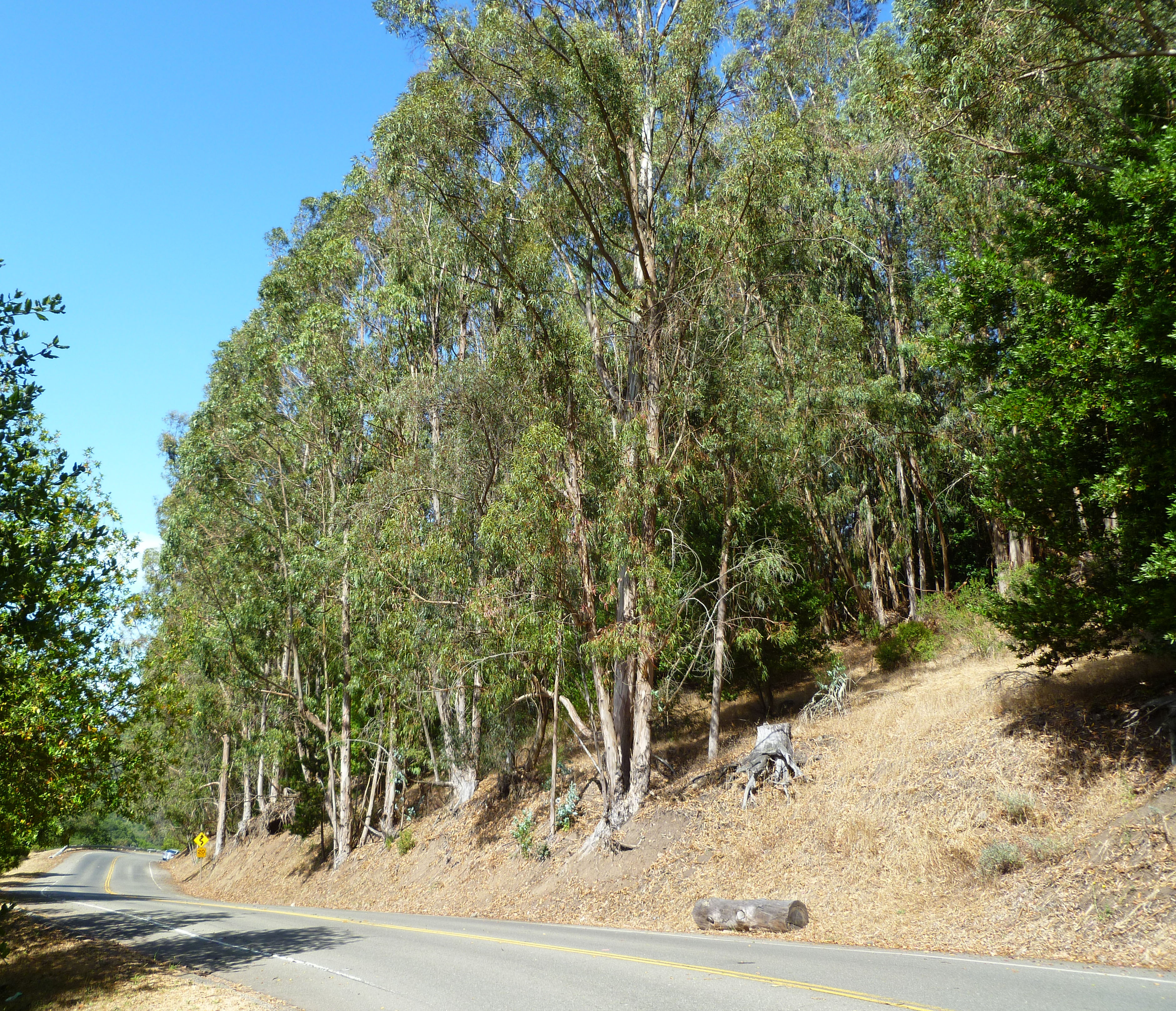
FEMA proposed project on the right. Claremont Blvd. westbound.
The EPA recommends that the final EIS take into consideration the impact that climate change will have on the success of the project. For example, as plants and animals move in response to climate change, they may no longer be viable in their historic ranges, which this project attempts to replicate. Ironically, the project contributes to climate change by releasing tons of greenhouse gases that cause climate change. The DEIS does not acknowledge or analyze these factors.
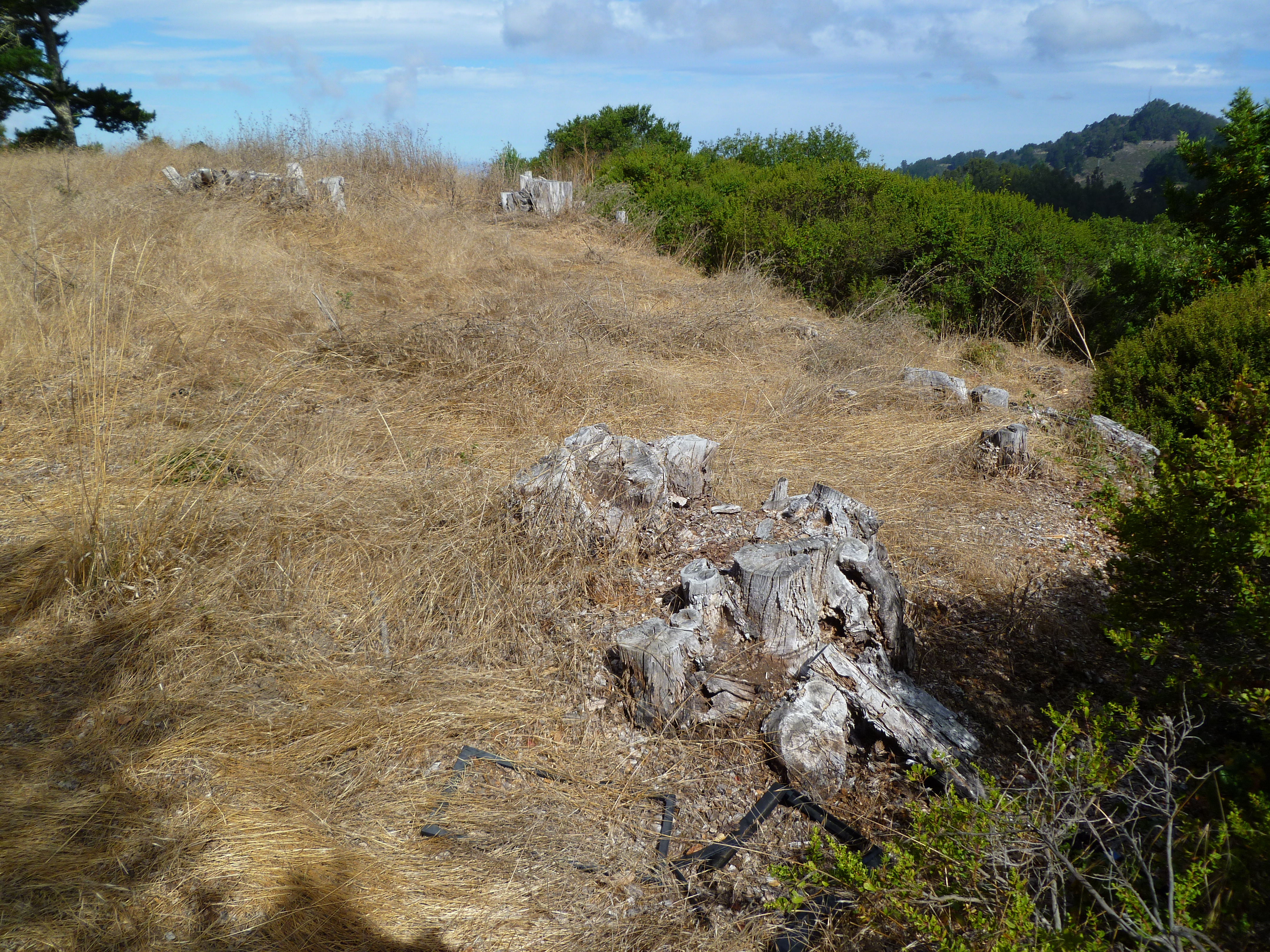
A completed project 10 years later. Southbound Grizzly Peak Blvd.
EPA says, “We note that extensive use of herbicides is proposed”
Yes, indeed, this project will require thousands of gallons of herbicide and we are delighted that the EPA has noticed this as well as the serious deficiencies of information in the DEIS regarding herbicide use:
There are many different formulations of Roundup with different properties, yet the DEIS does not identify which formulation of Roundup will be used. Therefore we cannot evaluate its toxicity.
The DEIS does not clearly state which herbicide products will be used for what purpose and in what locations.
The DEIS does not clearly state the method of application of herbicides.
The DEIS does not acknowledge that both triclopyr and imazapyr “can migrate through the soil” which will damage the native trees and vegetation this project claims to promote.
The DEIS evaluates the impact of herbicides only on endangered species which may or may not be the most sensitive species to herbicides. The final EIS must evaluate the impact of herbicides on the most sensitive species of animals, whether or not they are endangered.
The EPA is equally concerned about the impact of herbicides on human health and safety. It therefore notes the following deficiencies in the DEIS in that regard:
Reports of toxicity of herbicides in the DEIS are incomplete and inaccurate.
The DEIS does not acknowledge the “possibility of people and or animals entering the treated areas and coming in contact with herbicides already applied.” The Final EIS (FEIS) should therefore “clarify that there is potential for human exposure even if the chemicals do not move from the application site.” Further, “The FEIS should include a mitigation measure to remove fruiting or other edible vegetation.”
The EPA also noted many of the troubling inaccuracies andcontradictions in the DEIS that were also a concern to us:
The DEIS claims as “mitigation” the requirements on the labels of the herbicide products that will be used. These are mandatory requirements for legal use of the products, not voluntary measures that can be described as “mitigation.”
Likewise, the DEIS claims that requiring applicators of herbicides to wear protective clothing is a “Best Management Practice.” Wearing protective clothing is required for legal application of herbicides, not a voluntary measure.
Several contradictory statements are made in the DEIS regarding maximum wind speeds beyond which herbicides should not be applied.
The DEIS claims that the “Lowest Observed Adverse Effect Levels” of herbicides can be estimated from an experimentally derived “No-observed Adverse Effect Level” without providing any supporting reference. The EPA asks, basically, where does that claim come from?
The EPA points out inconsistent and incorrect use of the phrase “Certified Pesticide Applicator.” That may seem a small quibble, but it means that we have no idea what the qualifications will be of the people who will apply herbicides.
The DEIS announces that a specific adjuvant or surfactant will be used without telling us anything about the properties of that product. The adjuvant or surfactant is the inert ingredient in a formulated herbicide product that delivers the active ingredient (the poison) to the plant.
The DEIS uses an outdated EPA study about the effect of glyphosate on rabbits to report the toxicity of the product on rats. Whoops! Old data about the wrong animal! Picky, picky.
EPA asks, “Are the trees being removed for development?”
The EPA has apparently noticed that the DEIS mentions the long-term plans to build on some of the project areas of UC Berkeley. Therefore, it wants to know if that’s why the trees are being destroyed:
“Given that development is not included in the purpose and need for this Project, it is unclear whether the trees in these overlap areas would be removed for construction purposes regardless of whether they are removed as part of the proposed Project or not.”
Government is doing its job!
We are amongst the slim majority of voters who believe that government has an important job to do. We are often disappointed by government, but we aren’t inclined to kill it because it is sometimes incompetent. We are therefore very pleased to tell our readers that the EPA has apparently read the DEIS published by its sister/brother agency, The Federal Emergency Management Agency. Although they did not identify many of the important issues in the DEIS, they identified some of them. For that we are grateful as well as hopeful that the sponsors of these destructive projects will be forced to at least modify them, if not abandon them altogether. Thank you, EPA!
The public comment period for the FEMA project in the East Bay that proposes to destroy nearly half a million trees will close on Monday, June 17, 2013, at midnight. If you want to express your opinion of these projects, it’s time to do so. Detailed information about the projects and how to comment on them is available HERE.
The projects have drawn quite a bit of media coverage, starting with Beyond the Chronblog in mid-May and quickly picked up by many other internet sources of information. Most of those internet sources referred their readers to the Million Trees blog for more information. In May we had over 12,000 visitors to our articles about these projects.
Both the Oakland Tribune and the San Francisco Chronicle covered the story. The Tribune coverage was appallingly inaccurate and biased. The Chronicle coverage was more balanced than it usually is about native plant restoration projects, which the Chronicle usually supports without reservation.
The winner of the booby prize for balanced and fair reporting of the projects goes to the Sierra Club Yodelerwhich expressed its unqualified support for the projects at the same time it demonstrated total ignorance of the projects (or chose to misrepresent them):
Sierra Club said, “We want to avoid past mistakes, when agencies simply stripped off vegetation and then walked away, leaving the land clear for exotic and even more-flammable vegetation.” This is precisely what these projects plan to do…destroy everything then walk away without planting anything.
Sierra Club said, “The Park District is now implementing that program, and we are monitoring the progress.” If they are monitoring that program, why don’t they know what the Park District is doing?
Sierra Club said, “The preferred alternative involves application of the herbicide glyphosate (trade name Roundup) to the stumps to prevent re-sprouting. There is no practical way to eliminate eucalyptus infestations without herbicide, and glyphosate is relatively low in toxicity.” The Sierra Club is simply wrong. These projects will use Garlon (with active ingredient triclopyr) and/or Stalker (with active ingredient imazapyr)—not glyphosate (Roundup)–to prevent the trees from resprouting. Both products are rated by the EPA as more toxic, more persistent, and more mobile in the soil than glyphosate. Glyphosate (Roundup) will be foliar sprayed on non-native vegetation. Recent studies report that glyphosate (Roundup) is not a benign pesticide.
There are some scathing comments on the Yodeler article from people who know enough about the project plans to inform the Club that they have run off the rails…into the weeds!! The Club seems not to have noticed this attempt to set them straight. When someone called them weeks later to ask about the projects, they repeated the same misinformation to the caller.
(Update: One of our readers informed the Sierra Club of the inaccuracy of its Yodeler report about the FEMA projects in the East Bay (see comment below). We are pleased to report that the Sierra Club has revised its Yodeler report on June 19, 2013. It now acknowledges that native plants will not be planted by these projects. Consistent with the Draft Environmental Impact Statement for these projects, the Yodeler now claims that native plants will be “recruited” into the areas in which non-native plants and trees will be destroyed.
We think that is an unlikely outcome of these projects and FEMA’s environmental consultant agrees with us about that (explained here). However, at least the Yodeler article is now consistent with the written plans for the project.
The Yodeler also acknowledges the use of Garlon to kill the roots of the trees that will be destroyed.
Thanks to our readers for alerting the Sierra Club to the inaccuracy of their description of this project. We are sorry that the Sierra Club continues to support the project now that they have a better understanding of the written plans. 6/19/13)
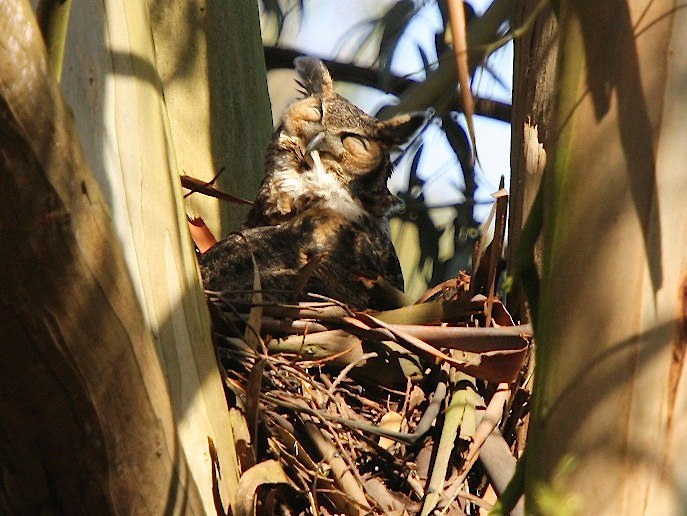
Owl nesting in eucalyptus, courtesy urbanwildness.com
On the positive side of the ledger, we commend the East Bay Expressfor its article about these projects. The author deserves credit for actually reading about the projects before she wrote her report!!! She read the letter from FEMA’s environmental consultant which we reported to our readers here. In a nutshell, the consultant said that UC Berkeley’s project could increase fire hazards by leaving a 2-foot wood chip mulch on the ground and that conversion to a native landscape was an improbable outcome of the project since nothing will be planted.
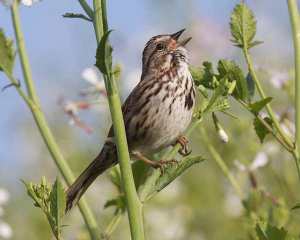
Song Sparrow in non-native wild radish
Our personal favorite for coverage of this project is Nathan J. Winograd’s article, “Biological Xenophobia: The Environmental Movement’s War on Nature,” which was published by the Huffington Post. Mr. Winograd is highly qualified to express his opinion of these projects. He has devoted his personal and professional life to the welfare of animals. He is best known for his advocacy for “no-kill” shelters for our animals. He was the lawyer for the SPCA in San Francisco when the GGNRA started to destroy non-native trees and fence the public out of their properties to protect their fragile native plant museums. So, he has been a long-time observer of the destructive and restrictive consequences of native plant projects. He was prompted to write this article by this latest round of destruction, that is, the FEMA projects in the East Bay.
Here are a few choice phrases from Mr. Winograd’s excellent article:
“Invasion biologists believe that certain plants and animals should be valued more than others if they were at a particular location ‘first.” When the species that were there ‘first’ are in the same habitat with a species that came later, they assert that the latter should be eradicated.”
“And the nativist movement is getting worse and increasingly violent, both in rhetoric (fish they don’t value are called ‘missiles with fins’) and in deeds. At a time of climate change, in a country that needs more trees, not less, nativists in the San Francisco Bay Area are proposing the clear cutting of upwards of half a million trees on San Francisco’s Mount Sutro and in the Oakland and Berkeley hills as part of their ongoing war against the Eucalyptus. After the trees are clear-cut thousands of gallons of toxic herbicides, will be spread throughout wildlife corridors in order to prevent resprouting.”
“An authentic environmentalism would not advocate that humans seek out and destroy living things for simply obeying the dictates of the natural world, such as migration and natural selection. It would not condone the killing of those plants and animals who find themselves in parts of the world where, for whatever arbitrary reason — be they economic, commercial or aesthetic — some humans do not want them to be. An authentic environmentalism would not exacerbate suffering, call for killing and seek the destruction of natural places.”
“Indeed, “invasion biology” is a faux environmentalism, used to disguise the ugly truth about what is really motivating its adherents: an intolerance of the foreign that we have rejected in our treatment of one another, a biological xenophobia that seeks to scapegoat plants and animals for the environmental destruction caused by one species and one species alone: humans.”
There are nearly 500 comments on Mr. Winograd’s article and they are as interesting as the article itself. They are a microcosm of this debate between nativists and those with a more cosmopolitan view of nature. We aren’t disinterested observers, so our opinion of the comments of nativists may not be entirely objective. However, we find many of their comments condescending and uninformed, a contradictory mix of sentiments.
We thank our readers for informing themselves about the FEMA projects and we hope that you now have the information you need to write your public comment by the deadline, June 17, 2013. Here is where you can send your comment:
These public lands belong to you and the money that will be used to implement these projects is your tax dollars. So, please tell the people who work for you what you think of these projects.
This is a revision of an article that was published on May 5, 2013. In our haste to inform our readers of these projects during the public comment period, we published before we had read the entire Environmental Impact Study. We are forced to revise our estimates based on further reading of the document. We apologize for the confusion and thank you for your patience.
On May 29, 2013, we found an error in the number of trees that will be removed at Frowning Ridge. We show our corrections so as not to mislead our readers.Again, our apologies.
*******************************
The Federal Emergency Management Agency (FEMA) has been considering grant applications for “fire hazard mitigation” in the East Bay since 2005, when the first of these applications was submitted. After years of debate about whether or not the projects achieve the stated purpose and at what cost to the taxpayers and the environment, FEMA finally agreed to resolve the controversial issues by mandating an environmental impact review, which began in 2010. Although FEMA paid for the environmental review, the grant applicants conducted it and it represents their opinions of their projects.
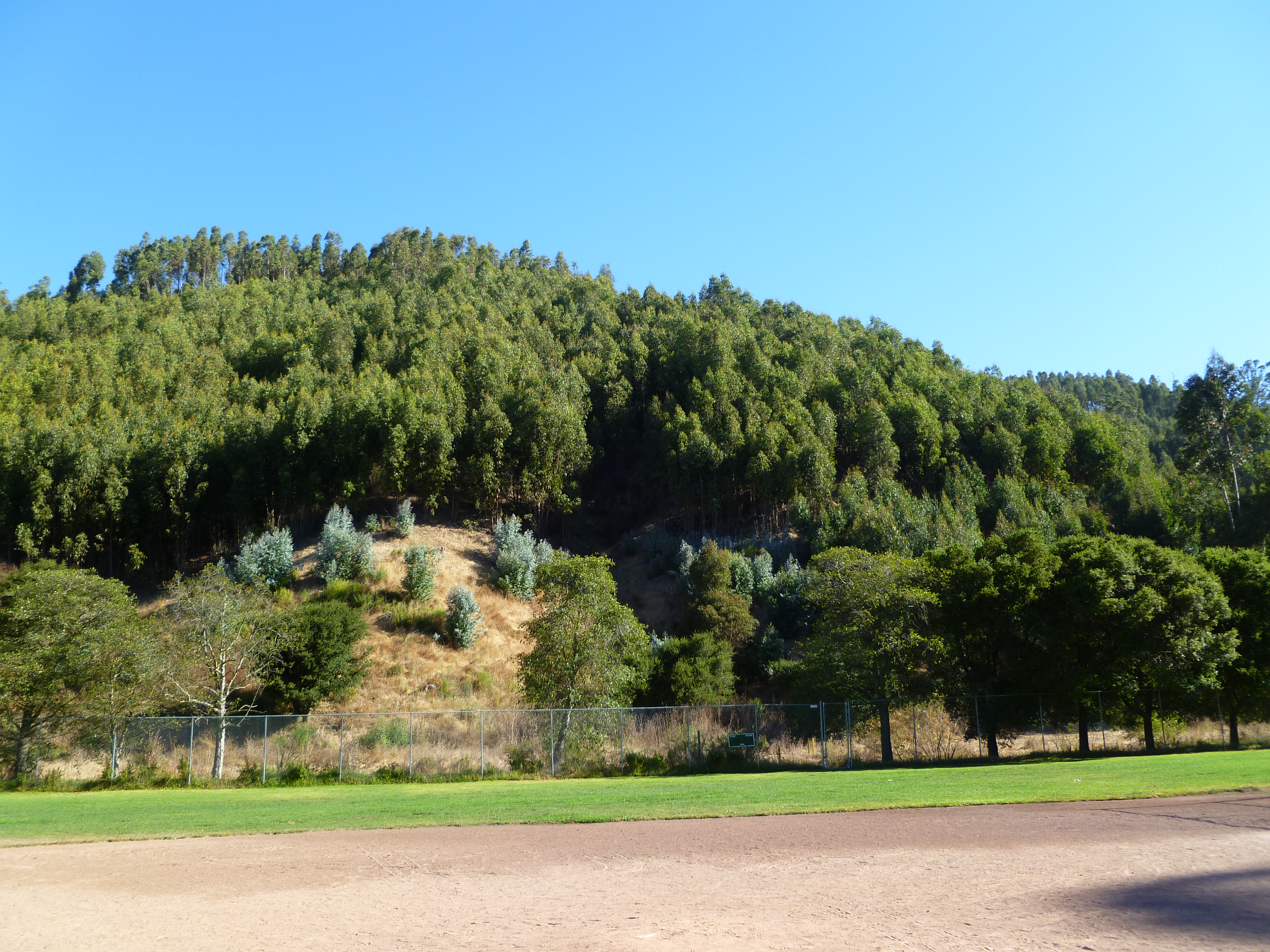
This eucalyptus forest at the North Oakland Sports Facility will be entirely destroyed.
These are the projects for which the Million Trees blog was created and for which it was named. Our opinion of these projects is unchanged by the environmental impact review. These projects will not achieve their stated objectives. Instead they will damage the environment and endanger the public.
The Draft Environmental Impact Statement (DEIS) for these projects was published by FEMA on April 25, 2013. It is available here. This is a brief description of the projects, our initial assessment of the DEIS, and information about how you can participate in the decision-making process which will ultimately determine the fate of these projects.
Description of the projects in the East Bay
Three different owners of public land have applied for these grants: University of California at Berkeley (UCB), City of Oakland, and East Bay Regional Park District (EBRPD). The projects of UCB and Oakland are similar and they are different from the projects of EBRPD, so we will describe them separately. These are the locations of the projects of UCB and Oakland, their acreage, and the estimated number of trees that will be removed by these projects:
Project Area
Project Acreage
Estimated Tree Removals*
UCB
Strawberry Canyon
56.3
22,000
Claremont
42.8
Frowning Ridge (in Oakland)
185.2
38,000 32,000
Sub-Total
284.3
60,000 54,000
Oakland
North Hills Skyline
68.3
Caldecott Tunnel
53.6
Sub-Total
121.9
25,735 23,161
TOTAL
406.2
85,735 77,161
*UCB estimated tree removals are provided by the DEIS; Oakland estimated tree removals are extrapolated assuming the same number of trees per acre (60,000 54,000 ÷ 284.3 = 211 190 trees per acre X 121.9 acres = 25,735 23,161 trees removed by the projects of the City of Oakland)
UCB and Oakland plan to remove all non-native trees (eucalyptus, Monterey pine, acacia, etc.) and vegetation from the project area. All non-native trees up to approximately 24 inches in diameter at breast height (DBH) will be cut into wood chips and scattered on the ground of the project area. They estimate that 20% of the project area will be covered with wood chips to a depth of 24 inches. The DEIS estimates that the wood chips will take from 5 to 10 years to decompose. Larger trees will be cut up and scattered on the site.
Although UCB and Oakland do not intend to plant the project areas (unless erosion subsequent to tree removals demands seeding of native grasses and herbaceous plants), they predict that the project area will eventually become native grassland, scrub, and forest of coast live oak, California bay laurel, big-leaf maple, California buckeye, and California hazelnut. They predict that this conversion from non-native to native vegetation will be accomplished by “recruitment” from areas where these plants exist, into the areas where non-native plants and trees will be removed.
The stumps of eucalypts and acacia will be sprayed with an herbicide (Garlon with the active ingredient triclopyr) soon after the trees are cut down to prevent resprouting. An estimated 1 – 2 ounces of formulated herbicide will be required for each stump. Based on an experiment conducted by East Bay Regional Park District, an estimated 5% of the trees will require retreatment of subsequent resprouts. They are therefore predicting that between 703 633 and 1,407 1,266 gallons of herbicide will be required to prevent resprouting if only 5% of the stumps require retreatment as they claim. Monterey pines will not require herbicide treatment which reduces this estimate proportionately, although we are not provided with enough information to make this calculation. Herbicide (Roundup with active ingredient glyphosate) will also be sprayed to control non-native vegetation, but no estimates of quantities required for that purpose are provided by the DEIS.
The fire hazard mitigation projects of the East Bay Regional Park District were described in detail in its “Wildfire Hazard Reduction and Resource Management Plan” of 2009. EBRPD has applied for FEMA funding for about one-third of the “recommended treatment areas” in that plan. The FEMA DEIS considers all recommended treatment areas on EBRPD property, including those for which FEMA funding has not been requested. The recommended treatment areas for which FEMA funding has not been requested are called “Connected Action Acres.” The “Connected Action Acres” have undergone environmental review under California law (CEQA) and are therefore approved for implementation, which has already begun.
Project Area
Project Acres
Connected Action Acres
Total Acres
Estimated Tree Removals*
EBRPD
Sobrante Ridge
4.1
0
Wildcat Canyon
65.6
46.6
Tilden Park
132
194.2
Claremont Canyon
35.3
130.4
Sibley Volcanic
47.5
118.4
Huckleberry
17.8
.3
Redwood Park
58.4
92.8
Leona Canyon
4.6
0
Anthony Chabot
200
478.2
Lake Chabot
4.8
0
Miller-Knox
22.2
0
TOTAL
592.3
1,060.7
1,653
400,602 409,176
*Estimated Tree Removals: Neither the DEIS nor EBRPD’s “Wildfire Plan” provides an estimate of the number of trees they plan to destroy. Furthermore their plans for tree removals are complex and variable. All non-native trees (eucalypts, Monterey pines, acacia) will be removed in some recommended treatment areas, but in most they will be thinned to spacing of 25 to 30 feet. The final Environmental Impact Report for the “Wildfire Plan” provides an estimate of the existing tree density of existing eucalypts on EBRPD property (page 392). Acres of eucalypts in the entire project area are provided by the DEIS (page 4.2-6). Our estimate of tree removals is based on those figures (1).
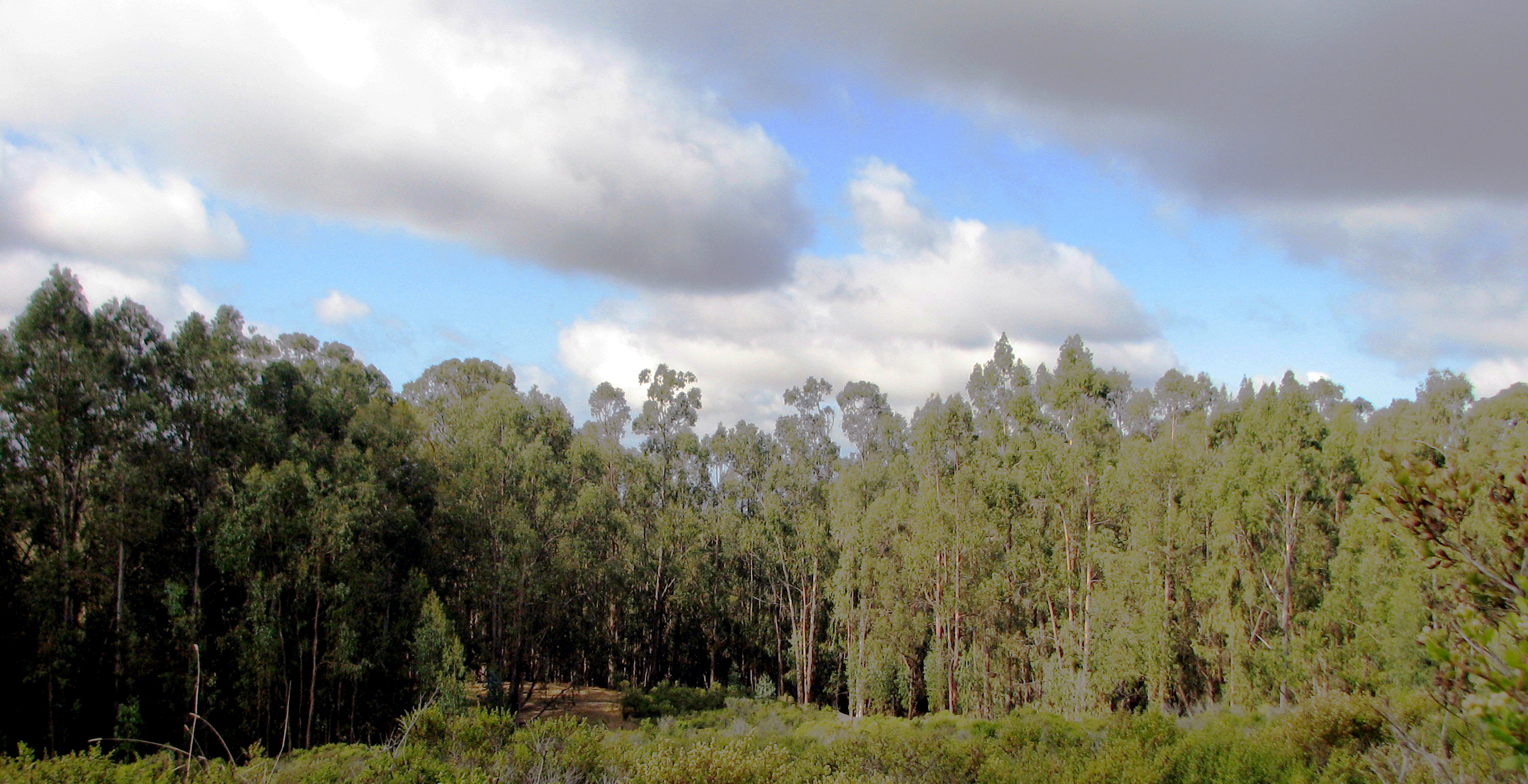
This eucalyptus forest at Chabot Park will be thinned to about 60 trees per acre.
This estimate does not include the Monterey pines and acacia that will be removed by EBRPD, for which inadequate information is available to provide an estimate.
EBPRD plans to cut the trees into wood chips which will be scattered to cover 20% of the project to maximum depth of 4-6 inches. The remainder of the wood will be burned in piles. Other non-native vegetation will be destroyed with herbicides and/or prescribed burns. These prescribed burns will not be funded by FEMA.
EBRPD’s plans to convert the project area to native vegetation are similar to the plans of both UCB and Oakland. EBRPD also does not plan to plant project areas with native vegetation. EBRPD also plans to use herbicides on the stumps of eucalypts and acacia which we estimate will require a mind-boggling 3,286 3,356 to 6,572 6,713 gallons of herbicide.
Million Trees’ assessment of these projects
We have surely exhausted your patience with the mind-numbing detail needed to describe these projects accurately. Therefore, we will provide only a brief outline of our assessment of these projects:
* These projects are more likely to increase the risk of wildfires than to reduce that risk.
By distributing tons of dead wood onto bare ground
By eliminating shade and fog drip which moistens the forest floor, making ignition more likely
By destroying the windbreak that is a barrier to wind driven fires typical of wildfires in California
By expanding the oak-bay woodland being killed by Sudden Oak Death, thereby adding more dead wood
* These projects will damage the environment by releasing hundreds of thousands of tons of carbon dioxide into the atmosphere from the destroyed trees, thereby contributing to climate change.
* These projects will endanger the public by dousing our public lands with thousands of gallons of toxic herbicides.
* Erosion is likely on steep slopes when the trees are destroyed and their roots are killed with herbicides.
* Non-native vegetation such as broom, thistle, and hemlock are more likely occupants of the unshaded, bared ground than native vegetation which will not be planted by these projects.
* Prescribed burns will pollute the air and contribute to the risk of wildfire, endangering lives and property.
* These projects are an inappropriate use of the limited resources of the Federal Emergency Management Agency which are for the expressed purpose of restoring communities destroyed by disasters such as floods and other catastrophic events and preparing communities for anticipated catastrophic events. Most of the proposed projects in the East Bay are miles away from any residences.
Update: Please visit THIS post for the current status of these projects. In summary: East Bay Regional Park District is implementing its original plans. City of Oakland is developing a new “Vegetation Management Plan.” UC Berkeley is suing to re-instate its FEMA grant funding so that it can implement its original plans.
How to participate in this decision-making process
The Hills Conservation Network has created a petition to oppose these projects. It is available HERE.
You can also participate in this decision. FEMA will host three public meetings in May 2013:
Tuesday, May 14, 2013, 2:00 p.m. – 4:00 p.m., Richard C. Trudeau Center, 11500 Skyline Boulevard Oakland, CA 94619
Tuesday, May 14, 2013, 6:00 p.m. – 8:00 p.m., Richard C. Trudeau Center, 11500 Skyline Boulevard Oakland, CA 94619
Saturday, May 18, 2013, 10:00 a.m. – 12:00 p.m., Claremont Middle School, 5750 College Avenue Oakland, CA 94618
Comments on this document must be submitted by June 17, 2013. You may submit written comments in several ways:
These public lands belong to you and the money that will be used to implement these projects is your tax dollars. So, please tell the people who work for you what you think of these projects.
*********************************
(1) Calculation of estimated tree removals by East Bay Regional Park District, Update: We understand the weakness of this estimate. Unfortunately, the DEIS does not provide sufficient information to improve its accuracy. Again, our apologies.
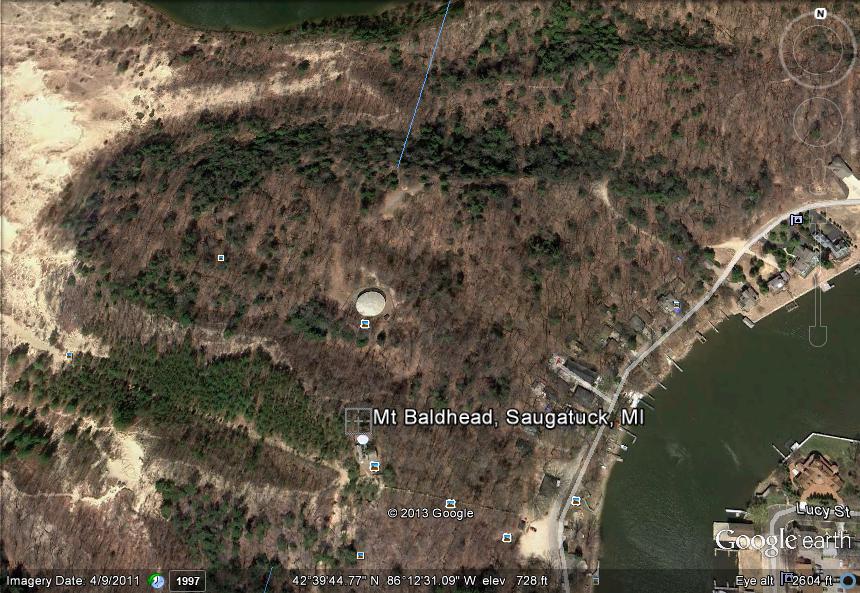
One of our readers sent us a link to an article about a “restoration” project gone awry in his neighborhood. Mount Baldhead is a city-owned park in Saugatuck, Michigan. US Fish & Wildlife funded a $700,000 federal grant to eradicate non-native plants on Mount Baldhead and several other municipal parks in the area. The grant was used to hire “certified applicators” to spray the non-native plants with imazapyr. Mount Baldhead was sprayed in summer 2010 and again in fall 2011. In spring 2012, the native oaks and maples, under which the non-native plants had grown and were sprayed, began to show signs of damage. Now a significant portion of the native forest is leafless and barren.
Mount Baldhead, Saugatuck, Michigan. A clearer view of the damage is available in the article to which we provide a link above. We were denied permission to publish that picture.
The soil on Mount Baldhead is being studied to determine how far the pesticide has seeped into areas where it was not sprayed. This information may predict the extent of the eventual damage to the native forest. The ultimate fate of the trees that have been damaged is not known. There is no antidote to the pesticide. Will the trees survive? We don’t know yet.
What does it mean to be a “certified applicator” of pesticides?
This story is of interest to us because imazapyr is being widely used in the San Francisco Bay Area and its use has increased substantially in the past year.
Because imazapyr is being used heavily, we have read the manufacturer’s label for the formulated products (Habitat and Polaris) and the federally mandated Material Safety Data Sheet.
Therefore, we know that imazapyr should not be sprayed under trees you do not want to kill. This is a product that is mobile in the soil. It is capable of traveling from the roots of the plant on which it is sprayed into the roots of adjacent plants on which it has not been sprayed, killing or damaging plants that were not the intended targets of the spraying.
These incidents make us ask what, if anything, it means to be a “certified applicator” of pesticides. Does the certification require the applicator to read the manufacturer’s label? If so, does the certification require the applicator to actually follow the directions on the manufacturer’s label? Clearly, this isn’t happening and there don’t seem to be any consequences for the “certified applicator” who kills plants and trees that he/she wasn’t hired to destroy. So, we conclude that such certification is meaningless.
The Million Trees mantra
Native plant advocates believe their projects benefit the environment. We do not see the benefit they claim. This is what we see:
• Increasing use of toxic pesticides is required to kill non-native vegetation. These pesticides are inherently hazardous and their incompetent use makes them even more hazardous.
• The wildlife that lives in our open spaces is being poisoned by these pesticides and they are losing their homes and their sources of food.
• The results of these projects do not justify these dangerous practices. The projects often look more dead than alive.
Here is a letter to the editor of the New York Review of Books, February 7, 2013:
“Dear Editor,
Tim Flannery in his review of the Biography of Rachel Carson makes one mistake and that concerns pesticide use reductions in Canada [“A Heroine in Defense of Nature,” NYR, November 22, 2012]. The first Canadian province to ban the ‘cosmetic’ use of specified pesticides and herbicides—i.e., for gardens and flowers, and not for commercial crops—was not Ontario (2009) but Quebec (2006).
This was the result of grassroots activity at the local, municipal level and it was backed by a national organization, the Campaign for Pesticide Reductions (CPR!), of which a leading sponsor (surprisingly perhaps) was the Canadian Labour Congress. The ban was backed by the Canadian Cancer Society, the first of many moves in the direction of cancer prevention, versus cancer treatment and research. Quebec’s move to ban the sale as well as the use of these products was a violation of the federal authority over commerce and it resulted in a challenge under the North American Trade Agreement (NAFTA, Chapter 13).
Some of Rachel Carson’s aims over pesticide use reduction could be achieved by a statute requiring the practice of Integrated Pest Management (IPM), which properly interpreted results in the avoidance, or use reduction, of synthetic organic chemical pesticides wherever possible. Canada, like most countries has not done this: pesticide registration or licensing is easy to get and once a pesticide is on the market, it is very difficult to prevent its proliferation or remove it from the environment. But unlike many Canadian environmental measures, the bans so far on the cosmetic use of pesticides are truly progressive.”
David Bennett
Former Director
Health, Safety and Environment
Canadian Labour Congress
Ottawa, Canada
The North American Trade Agreement is a free trade agreement between the United States, Canada, and Mexico. If you want to do business with the United States, you apparently are not allowed to ban the sale and use of pesticides.
San Francisco’s misnamed Integrated Pest Management policy
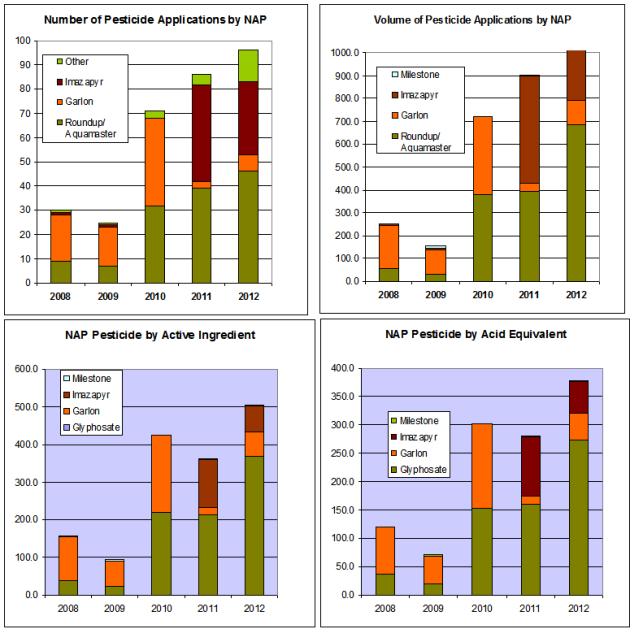
This seems a timely reminder of the difficulty of changing public policy regarding pesticide use. For the third year in a row, San Franciscans recently attended the annual hearing at which the city’s pesticide policy is renewed by the Environment Commission. Citizens reported the escalating use of toxic pesticides in San Francisco’s public parks by the so-called Natural Areas Program. They also repeated their annual request that pesticides considered “Most Hazardous” (Tier I) and “More Hazardous” (Tier II), not be sprayed in public parks.
Volume of pesticide use by San Francisco’s “Natural Areas Program.” Courtesy San Francisco Forest Alliance
Once again, the public’s request fell on deaf ears. In fact, the only changes to the city’s pesticide policy liberalized the use of pesticides by the Natural Areas Program. Milestone which had been rated “Most Hazardous” in the past has now been downgraded to Tier II. This is the pesticide that is mobile in the soil and persists in the soil for a long time. It is banned by the state of New York for sale or use because of concerns about the potential of poisoning ground water. Yet it is used in San Francisco in the watershed to Islais Creek.
Also, Garlon (Tier I) can now be sprayed without the applicator wearing a respirator, which will make it easier and more likely to be used in the future.
However, these two revisions of the city’s pesticide policy pale in comparison to the recent decision of the Recreation and Park Department with respect to promoting the use of pesticides in the city’s parks. The Recreation and Park Department recently announced that the person in charge of the Natural Areas Program is now also in charge of the Department’s pesticide use. This inappropriate decision effectively removes all pretenses that the Natural Areas Program’s use of pesticides is being monitored or supervised. The Natural Areas Program is now free to use pesticides wherever and whenever they wish.
Mr. Bennett makes a mistake in his letter to the editor. He assumes that an Integrated Pest Management policy would avoid or at least reduce pesticide use. San Francisco calls its pesticide policy an Integrated Pest Management program. That policy has obviously not reduced pesticide use in San Francisco’s parks. In fact, it seems to facilitate the use of pesticides. Pesticide use by any name is still pesticide use.
The San Francisco Chronicle recently published an op-ed by Joe Mascaro about the Sutro Forest (available here). He is a professional ecologist at the Carnegie Institution for Science who studies the ecological functions of forests (his research is described here). He is also a San Franciscan and a fan of the Sutro Forest. He tells us in his op-ed that the Sutro Forest is a unique, “novel” forest that is thriving and that destroying it will increase the risk of wildfire, contrary to the claims of UCSF.
As we approach the March 19, 2013 deadline for submitting public comments on the Draft Environmental Impact Report for UCSF’s proposed plan to destroy 90% of the forest and its understory on 75% of the 61 acres of the Mount Sutro Reserve, we appeal to our readers to take a few minutes in their busy day to write your own comment (see below for details of where to send comments).
About 200 people came to the community meeting at UCSF last night. Nearly 60 people spoke; the overwhelming majority spoke in opposition to UCSF’s proposed plans to destroy most of the forest. Everyone spoke respectfully but with passion about what this forest means to the community. Many spoke about the loss of trees and habitat where similar projects already have been implemented by the Natural Areas Program and the GGNRA.
Over 1,700 people have signed the petition to save the Sutro Forest. If you haven’t signed yet, please do so here. We’re going to quote a few of the astute and well-informed comments that people have written on the petition in the hope that it will inspire you to write your own comment. (Grammatical edits only.)
Comment #1575:
“Among many other reasons not to hurt this forest- it is healing to people in need of healing at the UCSF hospital. The sight of it sustained me through a difficult labor during which I gazed on it for 13 hours. It is a vibrant, healthy, and sacred forest, and the people who love it will not stand by idly and quietly if it is in harms way”
Scientific studies corroborate this patient’s personal experience. Here is a report of these studies.
Comment #1528:
“Please nooooo!!! do not destroy the habitat for hundreds of creatures. WHY the destruction FOR NOTHING!!! I live in the neighborhood and I am sick and tired to see the city and UCSF cutting down trees and not replacing them.. but only with shrubs and small plants”
This is another San Franciscan who has noticed that the UCSF project is one of many in San Francisco which is destroying trees in order to return the landscape to native grassland and scrub.
Comment #1519:
“The reasons for tree removal are inaccurate. The effort is a waste of resources. The forest is healthy and most importantly serves the needs of the population of the city. UC has indicated its willingness to destroy trees for its own gain, but what the people of SF need is the unique ecosystem that provides wind relief, beauty, and comfort. Native plant restoration is a myopic, militant effort that does not take into consideration the needs of the people who live in SF. This is another effort to waste and destroy for misconceived ideals.”
This San Franciscan understands that the Sutro forest is performing important ecological functions.
Comment #1518:
“The trees in Sutro forest provide immense value to the neighborhood and the city in which we live. It is a wind break, it is a visual stimulus, it is a wonderful place to walk, it is home to a large number of hummingbirds, it isolates a busy hospital from the neighborhood and it provides a tremendous source of ground water to neighboring houses. Save the forest.”
This Sutro neighbor understands that the loss of this forest will harm both the neighborhood and the animals that live in the forest.
Comment #1471:
“Destroying 90% of the trees will destroy the forest – its beauty, its Cloud Forest aspect, and its habitat value. The trees, which sequester tons of carbon, will no longer do so, and instead the dead chipped trees will release carbon dioxide into the atmosphere. PLEASE DO NOT REMOVE THESE TREES!”
This commenter understands that the forest is storing carbon which will be released into the atmosphere as carbon dioxide when the trees are destroyed. Carbon dioxide is the predominant greenhouse gas which is causing climate change.
Comment #1277:
“For environmental reasons please do not cut the forest of Mount Sutro. Risk of landslides (the old forest has intertwined and intergrafted roots that function like a living geo-textile and hold up the mountain, while the exposed rock on Twin Peaks has a rock-slide every year or two); Pesticide drift into our neighborhood, affecting us and our pets (right now, Sutro Forest may be the only pesticide-free wildland in the city; the Natural Areas Program, which controls most of it, uses pesticides regularly) Increased noise (the vegetation – the leaves of the trees and the shrubs in the understory are like soft fabrics absorbing sound) Changes in air quality (trees reduce pollution by trapping particle on their leaves until they’re washed down) Environmental impact – (eucalyptus is the best tree species for sequestering carbon because it grows fast, large, is long-lived, and has dense wood; but felled and mulched trees release this carbon right back into the atmosphere).”
This San Franciscan is aware of the pesticides being used by the Recreation and Park Department’s so-called “Natural Areas Program.” UCSF’s proposed project will use pesticides to prevent the resprouting of the trees that they destroy. Pesticides used by native plant “restorations” are described here. She also understands that trees stabilize steep slopes and reduce air pollution.
Here’s what you can do to help save the Sutro Forest:
• Sign the petition to save the forest. Available here.
• Submit a written public comment by 5 PM, March 19, 2013 to UCSF Environmental Coordinator Diane Wong at EIR@planning.ucsf.edu or mail to UCSF Campus Planning, Box 0286, San Francisco, CA 94143-0286. Include your full name and address.
• Write to the Board of Regents to ask why a public medical institution is engaging in such a controversial, expensive, and environmentally destructive act. Address: Office of the Secretary and Chief of Staff to the Regents, 1111 Franklin St., 12th Floor, Oakland, CA 94607 Fax: (510) 987-9224
• Subscribe to the website SaveSutro.com for ongoing information and analysis.
UCSF has sent an email to its neighbors about its plans for the Sutro forest in which they say, “Contrary to rumors being circulated, there is no plan to cut down 30,000 trees in the Mount Sutro Open Space Reserve, and it is unfortunate that this misinformation continues to spread.”
Our response is, Do the math!!
The Draft Environmental Impact Report (DEIR) claims that the thinned forest will have 62 trees per acre. (DEIR Appendix F) The DEIR arrives at this figure by assuming that each tree will occupy a circle with a radius of 15’. In fact, it is not possible to pack circles into another geometric space, whether it is a bigger circle, a rectangle or a square without wasting space. Therefore, this calculation arrives at a bogus answer which is larger than is physically possible.
We have calculated the number of trees remaining in the thinned forest based on the number of squares in an acre that are 30’ X 30’. Such calculations of tree density are found in books regarding arboriculture, which corroborates that we are using a standard calculation used by the timber industry and the DEIR is not. (1)
48.4
43560/900 = trees per acre if 30 feet apart (the proposed plan)
12.1
43560/3600 = trees per acre if 60 feet apart (the proposed plan)
45000
Total number of trees existing now on 61 acres (according to UCSF)
34040
46 acres X 740 trees/acre = Number of trees existing in project area
2112
44 acres X 48 trees/acre = thinned forest with 30’ spacing
24
2 acres (Demo Area #4) X 12 trees/acre = thinned forest with 60’ spacing
31904
Existing Trees – Thinned Forest = Trees Removed in Project Area
70.9%
Trees Removed/Existing Trees in total forest = Percent of Trees Removed in Total Forest
If UCSF wishes to reduce the number of trees that will be removed by the proposed plan, it can do so by reducing the spacing between the trees or the number of acres to be “thinned.” All other numbers used to arrive at an estimated number of tree removals are straight-forward mathematical calculations based on the information provided by UCSF.
UCSF would be wise to read the DEIR for its project, which says, “Under full-implementation or worst-case implementation of management activities under the proposed project, approximately 60% of all existing trees, including large and small trees, could be removed.” UCSF reports that there are 45,000 trees in the Mount Sutro Reserve presently. Sixty-percent of 45,000 is 27,000 trees. We think UCSF’s estimate of tree removals is just a few thousand trees less than what is actually planned. What are we quibbling about?
Once again, we invite UCSF to revise its proposed project to reduce the number of trees that will be removed.
****************************
(1) Ecology and Silviculture of Eucalypt Forests, R.G. Florence, CSIRO, Australia
One of the arguments used by native plant advocates to defend the use of pesticides to eradicate non-native plants and trees is that this use is trivial in comparison to the volume of pesticides used by agriculture. It’s not an argument that makes sense to us. In fact, the opposite seems a stronger argument. In other words, if it is necessary to use pesticides to produce our food, all the more reason to avoid the use of pesticides for other purposes, because the harm done by pesticides is cumulative. Humans and other animals accumulate pesticides and other toxic substances in our bodies throughout our lifetimes so the fewer sources of toxic contamination, the better.
However, as we learn more about how pesticides are used by agriculture and how harmful pesticides are to us and other animals, the more we question the underlying premise. That is, we wonder if it really is necessary to use pesticides to produce our food. We have researched this question and we are reporting to our readers a brief history of pesticide use by agriculture, the consequences of this use, and finally, the growing evidence that present levels of pesticide use by agriculture isn’t necessary or justified.
The history of pesticide use by agriculture
The use of synthetic pesticides by agriculture began after World War II as a result of the development of new chemicals and the industry that produced them during the war. Prior to WW II, farmers generally purchased raw chemicals to formulate primitive pesticides because ready-to-use pesticides were not available. Here are some of the statistical trends that describe the use of pesticides by agriculture: (1)
Three-fourths of all pesticide use in the U.S. is by agriculture.
Pesticide use has been consistent at 2.6 to 2.7 pounds per acre of cropland per year for the past 25 years.
The volume of synthetic herbicide use has increased steadily since 1945, but the volume of insecticide use has declined after the 1980s as new low-dose products have been developed.
Fruits/nuts lead all other crops in terms of pesticide applications, with about 45 pounds of active ingredient per acre grown. Vegetables receive about half that rate, but the rate nearly doubled from 13.4 to 23.7 pounds per acre from 1988-89 to 1996-97.
The expenditures for pesticides by agriculture are another way to understand the increased use of pesticides and their importance to both the agricultural industry and the chemical industry: Farm expenditures on pesticides have increased from $296 million in 1929-31 to about $8.5 billion in 1995-97 in constant dollars. These are the factors that account for increased expenditures over seven decades: (1)
The amount of active ingredient in pesticides usage increased during that period three fold (from 230 to 782 million pounds).
The replacement of low cost pesticides such as sulfur and petroleum by more expensive formulated pesticides.
From 1974-76 to 1995-97, the average expenditure per pound of active ingredient nearly doubled.
The average expenditure per capita for agricultural pesticides was reported as $32.10 in 2003. That is, for every American, $32.10 was spent on pesticides for agriculture per year.
How does America’s pesticide usage compare to the rest of the world? (2)
World-wide expenditures on pesticides were $39.443 billion in 2007. The United States bought one-third of all of the pesticides sold in the world in 2007.
The U.S. used 25% of all herbicides and 22% of all pesticides used in the world in 2007.
Changes in farming practices in the United States
Cornfield. Creative Commons
Farming in the United States has changed since World War II. There are fewer farms and they are much larger than they were in the past. Most farming is no longer done by the owner of the land. This separation of farming and ownership has destroyed farming communities. We no longer find farmers congregating in local cafes swapping tips at 5 am. It has become an impersonal industry. (3)
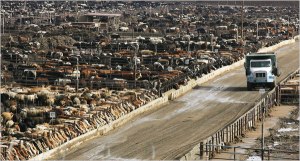
Feedlot
Farming practices have changed to accommodate the industrial model. Farms now grow only one or two crops which substantially reduces the traditional practice of crop rotation. Animals are no longer found on farms because farming and raising livestock are now done separately. Farms now specialize.
Increased pesticide use is both cause and effect of these changes in farming practices. The drop in crop prices which made small farms unprofitable also motivated pesticide use to reduce labor costs. Pesticides were also a substitute for the crop rotations which reduced insect populations by disrupting the relationship between predator and host. Pesticides also compensated for the weed-suppressing effects of alfalfa grown to feed livestock now gone from the farm. The loss of animal manure on the farm required the substitution of chemical fertilizers. The manure which had been useful in the past is now a waste product that pollutes water from run-off from industrial-size feed lots. Separating farming from land ownership meant those using synthetic chemicals were no longer poisoning their own land and suffering the long-term consequences of their choices.
Traditional farming methods are equally effective and do less damage to the environment
The agriculture and chemical industries have been successful in convincing the public that the use of pesticides and associated farming methods were necessary to produce the food we need at the prices we are willing to pay. This fiction has thus far sustained an industry that is clearly damaging the environment and exposing the public to environmental pollution. There is growing evidence that traditional farming methods are equally effective and do less damage to the environment.
The results of a large-scale, long-term study comparing traditional farming methods with industrial farming methods were recently published. The study was conducted by the US Department of Agriculture, University of Minnesota, and University of Iowa on the research farm of the University of Iowa. They divided the research acres into three sectors and used three different farming methods to test and compare the efficacy of these methods: (4)
Conventional method: growing only corn and soybeans in a two-year rotation cycle, using synthetic fertilizers and pesticides.
Three-year rotation cycle, adding a crop of grains and clover.
Four-year rotation cycle, adding a crop of alfalfa plus livestock which was fed the alfalfa.
They conducted this test over a nine-year period from 2003-2011. Here are the results of their study:
The longer rotations of more crops produced higher yields than conventional methods: 4% more corn and 9% more soybeans. The longer rotations were also more profitable than conventional methods.
The longer rotations required less synthetic fertilizer than the conventional method. The amount of fertilizer required by the longer rotations also decreased over time as the soil improved during the study.
“The longer rotations reduced herbicide use by a whopping 88% with little increase in weediness.” (4)
Longer rotations substitute labor for other inputs, but without reducing profitability.
Why aren’t traditional farming methods adopted?
As stunning as this information is, it is actually not new: “In 1989, the National Research Council investigated alternative agricultural operations such as these and reported that U.S. farming could be shifted to more natural forms without losses to yields or profits, without significantly higher food prices, and with significant gains in health and environmental protection.” (3)
The Union of Concerned Scientists explains why the public is unaware of the superiority of traditional farming methods in their article about the new study done at the University of Iowa. They tell us that the Economic Research Service of the US Department of Agriculture reports that 53% of all food and agriculture research is conducted by the private sector. Clearly the agriculture and chemical industries would not fund a study that might conclude that conventional farming methods are harmful and/or uneconomical. So, the availability of funding for such studies is limited. (4)
In the event that such a study is conducted, what are the chances that it will be published? The study done at the University of Iowa was rejected for publication by the journals Science and the Proceedings of the National Academy of Sciences. It was finally accepted by PLOS One which is solely an on-line publication. (5)
Finally, in the event that a farmer learns that traditional farming methods are less harmful to the environment and equally productive, what are the chances that he will adopt those methods? The chances are small because the farmer probably does not own the land and is therefore unconcerned about polluting it and there is no cost to the farmer associated with polluting the environment. (5)
Pesticides are a public health risk whether they are used in agriculture or in our public parks. In both cases, the good news is that it isn’t necessary to use pesticides. If the public wants to reduce the public health risks of pesticide use, they will have to speak up. Those who use pesticides are not going to stop using them unless they are forced to do so.
*************************
(1) Center for Integrated Pest Management, North Carolina State University, “Pesticide usage in the United States: Trends during the 20th Century,” February 2003. Available here.
(2) Environmental Protection Agency, “Pesticide Industry Sales and Usage. 2006 and 2007 Market Estimates.” Available here.
(3) Sandra Steingraber, Living Downstream, Addison-Wesley, 1997
(4) Karen Stillerman, Union of Concerned Scientists, “Crop Rotation Generates Profits without Pollution (or, What Agribusiness Doesn’t Want You to Know,” October 11, 2012. Available here.
(5) Mark Bittman, “A Simple Fix for Farming,” New York Times, October 19, 2012. Available here.
 Conservation Sense and Nonsense