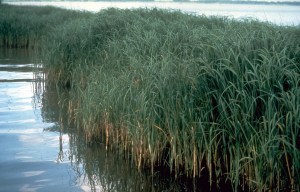
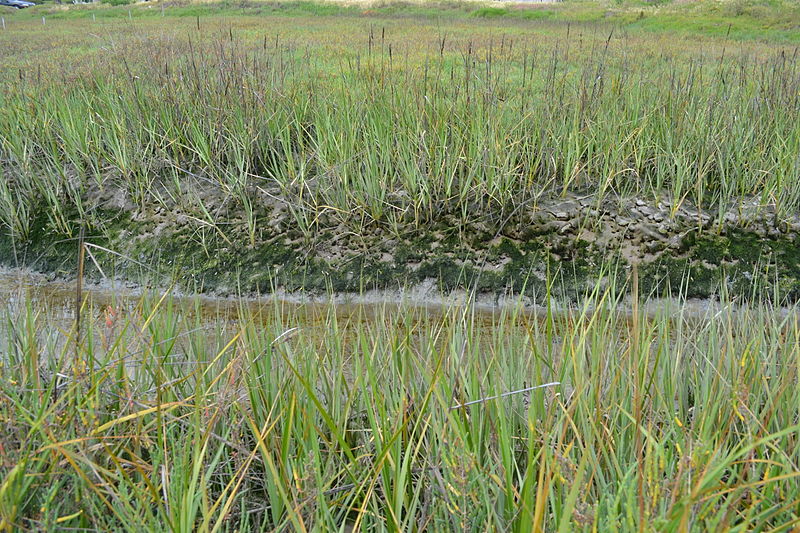
This is a good news/bad news story about the eradication of non-native Spartina marsh grass and the impact it has had on the population of endangered California Clapper Rail:
The good news: US Fish & Wildlife has temporarily halted efforts to eradicate non-native Spartina (Spartina alterniflora) in the San Francisco Bay Area because the population of endangered California Clapper Rail has declined by 50% during the period of eradication efforts from 2005 to 2011. (1) This problem was identified several years ago and was attributed to the lack of cover for the rail as a result of eradication of non-native Spartina, which grows more densely, taller, and doesn’t die back in winter as the native Spartina does. (2)
The bad news: US Fish & Wildlife attributes this negative impact on the Clapper Rail population on the slow recovery of native Spartina (Spartina foliosa). Spartina foliosa – USFWS
They do not acknowledge that non-native Spartina provides superior cover compared to the native species. Nor do they acknowledge that non-native Spartina was killed with herbicides. Therefore, they do not consider the possibility that the slow recovery of native Spartina may be attributable to the herbicides that were used to kill the non-native plant. They also continue to claim that the recovery of the endangered California Clapper Rail depends upon the return of native Spartina, despite the overwhelming evidence to the contrary. The California Clapper Rail is a sub-species of Clapper Rail; the Clapper Rail is abundant on the East and Gulf Coasts and not endangered perhaps because of the superior cover provided by Spartina alterniflora on those coasts. (3) Based on these fictions, US Fish & Wildlife proposes a new strategy that will simultaneously eradicate non-native Spartina while intensively planting native Spartina. (1)
We have been following the Spartina eradication project since 2011. For the benefit of new readers, we will review the issues with a few excerpts from previous posts on Million Trees.
Spartina alterniflora: Treasured on the East Coast, reviled on the West Coast
Spartina alterniflora (Smooth Cordgrass) is a species of marsh grass native to the Atlantic and Gulf coasts of the United States, where it is considered a valuable plant making important contributions to the coastal ecology:
Its dense growth provides protection against storm surge and “erosion control along shorelines, canal banks, levees, and other areas of soil-water interface.” (4)
It filters nutrients, sediments and toxins from the water that flows off the land before reaching the ocean, acting as a natural water treatment facility.
It provides cover and food for birds, mammals and marine animals that live in the coastal marsh.
Where Smooth Cordgrass has died back in its native range, the dieback has been considered a serious environmental threat:
In 2001 the Governor of Louisiana declared a “state of emergency” when Smooth Cordgrass declined and the state obtained $3 million of federal funding to study and hopefully reverse the decline. This study resulted in the development of a method of aerial seeding of Smooth Cordgrass to restore declining areas of marshland. (5)
A similar, but smaller dieback of Smooth Cordgrass in Georgia led to a collaborative research and on-going monitoring effort by 6 research institutions in Georgia.
Similar dieback of Smooth Cordgrass has been reported as far north as the coast of Maine. A researcher at the Connecticut Agricultural Experiment Station is quoted in that report as saying, “In New Orleans, if their marshes were intact, the storm surge of Katrina would not have reached the levees.” (6)
The war on Smooth Cordgrass on the West Coast
Smooth Cordgrass is not native on the Pacific Coast of the United States. Therefore it is treated as an alien invader to be eradicated with herbicides:
$24 million was spent to eradicate Smooth Cordgrass in San Francisco Bay and Willapa Bay from 2000 to 2010 (7)
$16.3 million is projected to be spent on the entire West Coast from 2011 to 2020 (7)
Spartinais being eradicated with an herbicide, imazapyr. This is a new herbicide about which little is known. The analysis that was done to justify its use in the Spartinaeradication project admits that no studies have been done on its effect on shorebirds, including the endangered Clapper Rail.
The Material Safety Data Sheet mandated by the Environmental Protection Agency tells us that imazapyr is “not readily biodegradable.” So, in the event that we eventually learn that this herbicide is harmful to shorebirds and/or to us, we probably should assume that it will still be in the environment in the nearly 200 sites in the San Francisco Estuary on which it has been sprayed. Imazapyr is also being sprayed–sometimes from helicopters–in hundreds of places along the West Coast, including Oregon and Washington.
Imazapyr is often mixed with glyphosate by the Spartina eradication project. Glyphosate is a non-selective herbicide. That is, it kills any plant it is sprayed on at the right stage of its growth. But imazapyr is far more insidious as a killer of plants because it is known to travel from the roots of the plant that has been sprayed to the roots of other plants. For that reason, the manufacturer cautions the user NOT to spray near the roots of any plant you don’t want to kill. For example, the manufacturer says explicitly that imazapyr should not be sprayed under trees,because that tree is likely to be killed, whether or not that was the intention.
Furthermore, no tests have been conducted on the toxicity of combining multiple pesticides in a single application. Therefore, we know nothing about the possible synergistic effects of combining imazapyr and glyphosate.
These facts about the herbicides used to eradicate non-native Spartina bear repeating. The main herbicide being used is known to be mobile in the soil and persistent in the environment. The herbicide with which it is often mixed is an indiscriminate killer of any plant on which it is sprayed. Therefore, the likelihood that these herbicides will prevent the establishment of the new plantings of native Spartina should be taken into consideration. The entire enterprise seems deeply flawed, both harmful and futile.
Bringing it home to the Bay Area
So, what does this have to do with you? If you are concerned about pesticide use, you might be interested in the fact the East Bay Regional Park District (EBRPD) used 203 gallons of imazapyr in 2009 and 121 gallons in 2010 for the sole purpose of eradicating Spartina on their properties. We don’t know how much imazapyr EBRPD used in 2011, 2012 and 2013, because they haven’t published a report of pesticide use since 2010. Since their properties are only on the east side of the San Francisco Bay, we should assume that at least that much imazapyr was used by land managers on the west side of the Bay.
Displacement of Clapper Rails in San Francisco
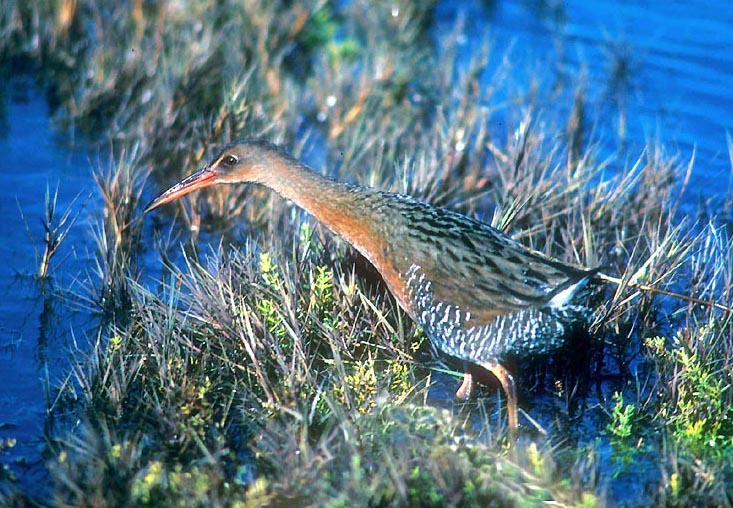
California Clapper Rail. British Wikipedia
In July 2011, a Clapper Rail was seen and photographed at Heron’s Head in southeastern San Francisco. There was quite a bit of excitement about this sighting because a Clapper Rail had not been seen in San Francisco for decades. That excitement dissipated when we learned more about where this bird came from, which provided a probable reason for its arrival.
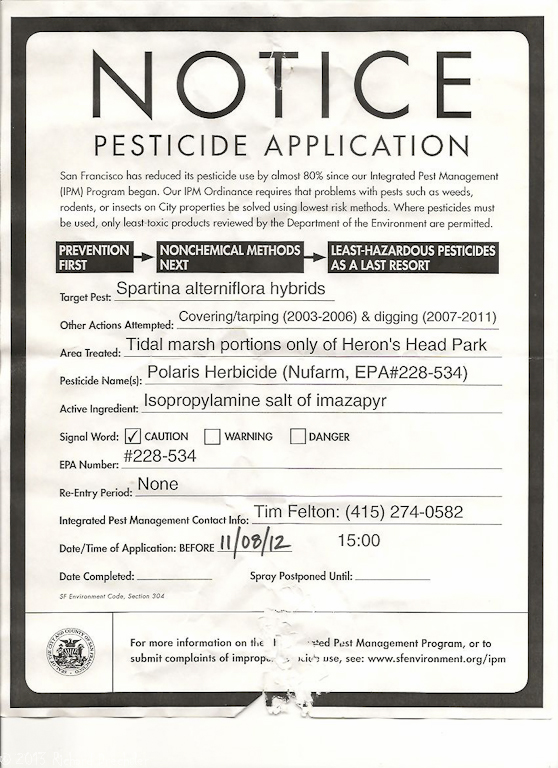
The Clapper Rail was wearing a radio collar that had been put on him and 109 other rails by the USGS to track their movements. He had moved from Colma Creek, 11 km south of Heron’s Head, which is one of nearly 200 Spartina“control sites” in the San Francisco Estuary. The bird sighted at Heron’s Head is one of three Clapper Rails that have left Colma Creek since 2007, when the radio collars were placed. The Spartina control project has been going on for over 10 years, so we have no way of knowing how many Clapper Rails were displaced prior to 2007. In 2012, non-native Spartina at Heron’s Head was sprayed with herbicides. Where did the Clapper Rails go from there? Was there anywhere left for them to hide?
Pesticide Application Notice, Heron’s Head, 2012
As our readers know, native plant advocates claim their “restoration” projects benefit wildlife. They can offer no evidence for this claim. But there is considerable evidence that proves them wrong. The endangered California Clapper Rail is one such case.
(1) Adam Lambert et.al., “Optimal approaches for balancing invasive species eradication and endangered species management,” Science, May 30, 2014, vol. 344 Issue 6187
(2) “West Coast Governors’ Agreement on Ocean Health, Spartina Eradication Action Coordination Team Work Plan,” Released May 2010, page 12
We are publishing a guest post by Virginia Daley and Fritzi Cohen of the Fearless Fund. They explain that pesticides used by ecological “restorations” are having a negative impact on organic agriculture.
The ever expanding war on “invasive species” is giving “green cover” to the widespread use of inadequately tested pesticides that threaten the health of the very soil and water that sustain all life.
Wherever man migrated he brought plants prized for food, fiber, medicine and ornament. With world exploration and trade, the exchange of flora and fauna became ever wider, and after 1492, the ecosystems of the continents were transformed.
Importation was encouraged by presidents and agencies such as the United States Office of Plant Introduction. The US Department of Agriculture planted the now vilified kudzu, and tamarisk for erosion control, fodder and other useful purposes. Today, 98% of our crops and many plants we think of as American as apple pie are actually from somewhere else –including the apples in that pie.
USDA photo
At the beginning of the 20th century, however, laws were passed “to protect crops and livestock from the wilds of Nature.” Mid-century, in a climate of war and fear of foreign attack, the theory of invasion biology branded alien species “invaders.”
But all-out war was declared on “invasive species” in 1999 with Executive Order 13112, which authorized billion dollar funds and a massive network of agencies to “rapidly respond” to “alien species whose introduction does or is likely to cause economic or environmental harm or harm to human health.” The National Invasive Species Council was created, whose co-chairs include the secretaries of Interior, Agriculture, and Commerce, State, Defense and Homeland Security, Treasury, Transportation, Health and Human Services as well as Administrators of the EPA, USAID, and the US Trade Representative. Programs coordinate and collaborate with federal, state, county and environmental organizations with a variety of funding sources. Washington State has one of the most sophisticated invasive species networks, and has cannibalized the commission on biodiversity.
More often than not, this war employs chemical weapons. Mike Ludwig exposes the very cozy relationship among government, conservationists and the biotech industry that manufacture herbicides in the TruthoutSpecial Investigation: The Pesticides and Politics of America’s Eco-War. Pesticide profiteers have been involved in this offensive from the beginning. One might question whether the chemicals are merely a method of combat or motive for the war.
Ecologists have begun to raise objections to this approach.Some point out it is ideology rather than sound science that drives the targeting of certain species. Some reveal that many of these demonized species are not inherently harmful and in fact provide environmental services as water filters, soil cleansers, stabilizers, enhancers, protectors, and air purifiers. Others remind us the real drivers of plant “invasions” are frequently man made: climate change, nitrogen eutrophication, increased ubanization and other land-use changes. Evolutionary biologists warn against shortsightedness: ecosystems are constantly changing. Species and communities naturally come and go.
And, of course, there is the warning against the use of dangerous compounds as a solution to perceived problems. As Timothy Scott writes in Invasive Plant Medicine, “[E]ven if the poisons are carefully applied (and they aren’t most of the time) they eventually contaminate the water, soil and air and enter the food chain, affecting microorganisms up through to our dinner plates.” Furthermore, these costly eradication efforts often fail, affect unintended species, (including nearby plants and bees) and actually create superweeds that then require more and stronger herbicides.
Non-native species have been intentionally introduced to hundreds of millions of acres in the US:
Wheat [from the Near East and Ethiopia] 58 million acres
Soybeans [from East Asia] 76.6 million acres
Sorghum [from Africa] 5.6 million acres
Corn [mostly genetically engineered and therefore from nowhere] 92 million acres.
Yet no one calls these monocultures, pesticide-purged of biodiversity, “invasive.”
Thus the label of “invasive species” is political, not ecological. It masks complex issues of land usage and legal questions. And it is exploited to justify an arsenal of control methods that may indeed cause-not prevent-economic, environmental and harm to plant, animal and human health.
Let’s examine some of the featured invasive non-natives in Washington State:
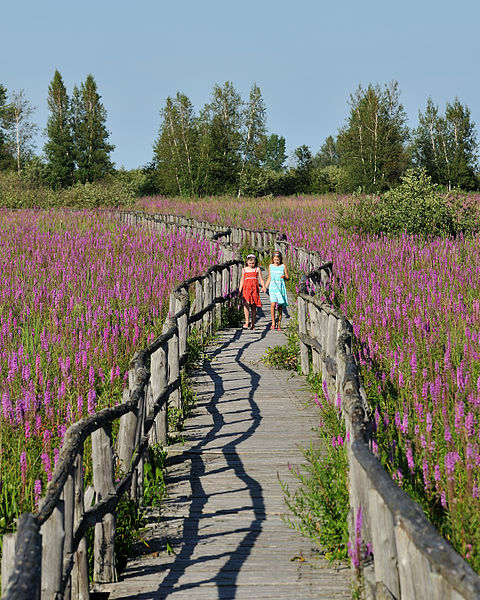
Purple loosestrife. GNU Free
In his paper, Should we care about purple loosestrife?, Claude LaVoie, professor of Environmental Management at Université Laval, Canada describes a massive media campaign to condemn purple loosestrife and refutes the “science” behind it. He calls the depiction of purple loosestrife in scientific studies “(lacking definition) far removed from that in newspapers (alarming)” describing this plant’s negative impacts on wetlands as “probably exaggerated” and pointing out that of the studies done most were somewhat biased, relied on anecdotal information and were not formally reviewed. He considers only one review to be really impartial, “and this one painted an inconclusive picture of the species.”
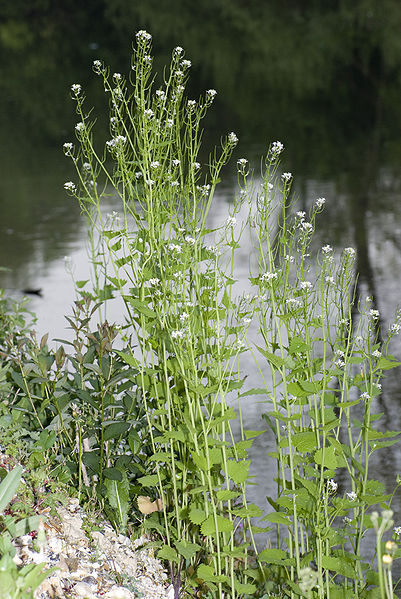
Though Washington State requires its eradication, edible garlic mustard contains more vitamin C than orange juice, more A than spinach, and shares the medicinal benefits of both garlic and mustard.
Garlic mustard. GNU Free
On the Hoh River, Japanese knotweed is injected and/or sprayed with glyphosate and imazapyr in the name of salmon restoration. Despite this righteous intent, we have been unable to find any scientific support for Japanese knotweed’s interference with salmon. There is also an assumption that water quality and the water community are unaffected by chemically laced vegetation decaying on waterbanks. The impact of glyphosate and imazapyr on phytoplankton and marine organisms has never been scientifically examined. On the other hand, the virtues of Japanese knotweed have been ignored. Long planted a along riverbanks for stability and shade, beekeepers value the flowers as an important nectar source when little else is flowering. This plant has been used for centuries as a gentle laxative and is an excellent source of the potent antioxidant resveratrol, and it is now used in treating Lyme disease. It exemplifies Tim Scott’s caution that in attacking “invasives,” we may be “destroying potent medicinal remedies.”
Fritzi Cohen owns Moby Dick Hotel and Oyster Farm on Willapa Bay in Nahcotta, WA. For 20 years, she has been fighting the use of insufficiently studied pesticide combinations sprayed by the state and county that have contaminated her tidal flats and oyster beds in order to eliminate a non-native grass, Spartina alterniflora. This eradication project was based on politics, not science. Dr. James Morris, Director of Baruch Institute of Marine and Coastal Science, has demonstrated that contrary to the claims that this grass harms the ecosystem, it provides economic benefits that outweigh the costs of controlling it. This purge has cost taxpayers well over 25 million dollars, degrading Willapa Bay and certainly not helping the health of the ocean.
Chemical warfare campaigns are being waged against so-called “invasive species” on vast tracts of public, tribal, and conservancy land throughout the country which add to the proliferation of pesticides accompanying agricultural GMOs and habitat restoration.
Whether by drift, seepage, runoff or court order, it is an invasion of chemicals, not plants, we should be worried about. The escalating use of pesticides is putting the future of organic, biodynamic, and transitional agriculture in jeopardy. It looks to us as if this is a war on everything ORGANIC.
It is time to reexamine the underlying assumptions and motivations for the ‘war on invasive species’, consider its collateral damage, and explore creative rather than destructive responses to changes in our environment.
We must rely on science not self-interest in distinguishing harm from hype. And realize that the term ‘invasive’ can be arbitrary, ‘harm’ subjective and ‘safety’ unproven. We must abandon eco-illogical practices that throw precaution to the wind and water and soil and if controls are judged -based on fact not fear-to be necessary, we must use methods that safeguard the environment and all creatures in the food chain.
Short of stopping global trade and travel, preventing new introductions will be difficult at best and without reversing global warming species will be migrating and mutating to adapt to climate change. And we are not returning to some imaginary ‘pristine’ Eden. The genie is not going back in the bottle.
Shouldn’t we embrace the possible benefit of these newcomers: as food, fiber, medicine, biofuel, carbon sequestration, erosion control, coastline protection, new industry?
Before embracing “invasiveness” as a claim to virtue that justifies all means of extermination, perhaps we should reflect on the catastrophic changes following the invasion of the Americas by our own European culture.
Virginia Daley, Acting Executive Director, Fearless Fund
Fritzi Cohen, President
We have added bold for emphasis, photos, and links to articles about some of the specific issues. Thanks to Ms. Daley and Ms. Cohen for sharing their concerns with the readers of Million Trees.
This is the story of the persecution of Tyrone Hayes, Professor of Biology at UC Berkeley, by the manufacturer (Syngenta) of an herbicide (atrazine). Professor Hayes was asked by Syngenta to conduct research on atrazine in 1999. Fifteen years later, New Yorker magazine has published a detailed account of Professor Hayes’ painful experience. (1)
Although Hayes was well aware of what Syngenta was doing to discredit him and his research, his suspicions have now been confirmed because of documents revealed by a legal battle. Specifically, 23 Midwestern cities sued Syngenta for “concealing atrazine’s true dangerous nature” and contaminating their water supply. The documents subpoenaed in those class-action suits revealed Syngenta’s campaign to undermine Professor Hayes’ credibility. In 2012, Syngenta settled those suits (without admitting wrongdoing) by giving $105 million to 1,000 water districts to filter atrazine from their drinking water.
Science for sale
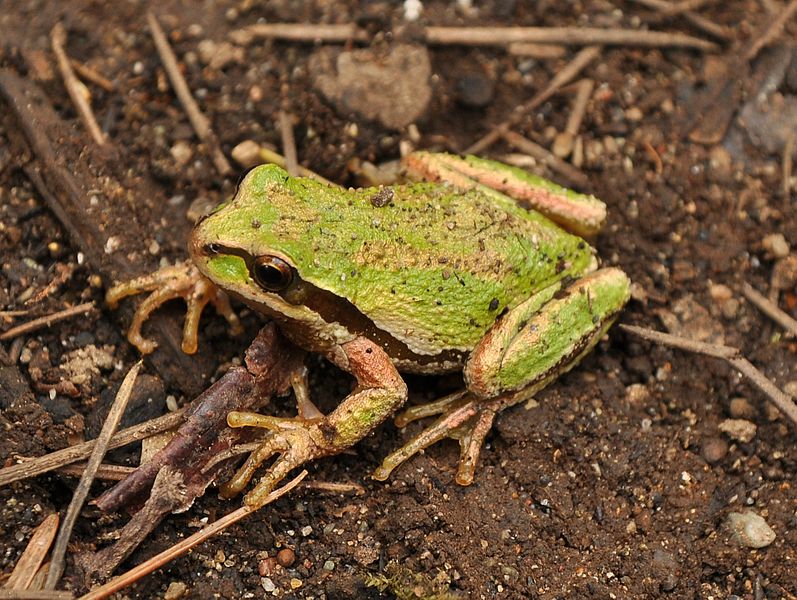
Pacific Chorus Frog, Creative Commons
Professor Hayes has had an interest in frogs since he was a child in rural South Carolina. He was fascinated by the transformation from tadpole to frog. That childhood interest led to his primary research interest in amphibians. So, when Syngenta asked him to study the affect of atrazine on frogs, it seemed to be an opportunity to improve and expand his research program. Some of his graduate students were wary, but Hayes assured them that his work could not be compromised by the acceptance of the small fee ($125,000) from Syngenta.
It was not until Hayes and his team began to observe and report birth defects in the reproductive organs of frogs exposed to atrazine that he began to understand the risk he had taken in accepting that funding. His formerly collaborative relationship with Syngenta scientists quickly deteriorated when he reported his findings. He ended his formal relationship with Syngenta in November 2000, when it became apparent they were trying to prevent him from pursuing his research.
Then Syngenta began a relentless assault on his research and he, just as relentlessly, pursued his inquiries. While Syngenta hired other “scientists” to discredit his research, Hayes and his team traveled the Midwest to gather samples of contaminated water to analyze in his laboratory. They sent 300 pails of frozen water to Berkeley from Illinois, Iowa, Nebraska, and Wyoming. The more tests they conducted, the more evidence they found that atrazine caused profound deformities of the reproductive organs of frogs such as hermaphroditism which is the expression of both male and female organs resulting in sterility. These deformities were observed at atrazine concentrations 30 times less than allowed by the Environmental Protection Agency.
Dirty tricks
Here is an incomplete list of some of the things that Syngenta did to discredit Professor Hayes’ research. These activities were documented in the evidence subpoenaed during the atrazine suit.
Syngenta sent its employees to Hayes’ public presentations to ask rhetorical questions which cast doubt on the accuracy of his work, such as “Why can’t anyone replicate your research?” Hayes says the answer to that question is that no one has tried. Syngenta hired “scientists” who altered Hayes’ research methods and reported that their findings were evidence that replication was not possible.
Syngenta purchased search words on the internet so that any searches for Hayes’ research would send people to an advertisement that says “Tyrone Hayes Not Credible.” Ironically, Syngenta is now using that same tactic to discredit the article in the New Yorker. A search for “atrazine” sends the searcher to the “Atrazine Facts” website with leading articles attacking the veracity of the New Yorker article.
The work journal of Syngenta’s head of “communications” contained a list of plans to ruin Hayes’ reputation. One entry said, “set trap to entice him to sue.” Another entry said, “investigate wife.” Syngenta claims that some of the strategies on that list were not implemented.
The vast financial resources of Syngenta help to put these efforts into perspective. Syngenta’s sales of seeds and pesticides are worth $14 billion per year and atrazine sales are $500 million annually. They have the resources and the motivation to protect their product in the marketplace.
The evidence against atrazine mounts
Meanwhile, more scientists began to report evidence that atrazine causes birth defects. An epidemiologist reported that children conceived during the seasonal application of atrazine are statistically more likely to be born with genital defects. Shortly after the publication of that paper, the New York Times published a big study about the extent to which the nation’s drinking water is contaminated with atrazine. Both of these studies endured media attacks from Syngenta.
Jason Rohr, ecologist at University of South Florida and a member of the EPA panel which evaluated atrazine, criticized the “lucrative ‘science for hire’ industry.” He wrote for Policy Perspective that “…a Syngenta-funded review of the atrazine literature had arguably misrepresented more than fifty studies and made a hundred and forty-four inaccurate or misleading statements, of which 96.5% appeared to be favorable to Syngenta.” (1)
Two other members of the EPA scientific advisory panel for atrazine review have written a paper (not yet published) complaining that the recommendations of the panel are ignored and that the EPA is placing “human health and the environment at the mercy of the industry.” They conclude that“the single best predictor of whether or not the herbicide atrazine had a significant effect in a study was the funding source.” (1)
Getting away with it
Since Professor Hayes began to report the results of his study of the effects of atrazine on frogs there have been several reviews of atrazine by the Environmental Protection Agency. Hayes and other researchers participated in those reviews. The EPA has approved the continued use of atrazine after each review, most recently in 2012. The next review is scheduled for this year.
The European Union banned atrazine in 2003. The European Union uses the “Precautionary Principle” to evaluate pesticides for approval: “if an action or policy has a suspected risk of causing harm to the public or to the environment in the absence of scientific consensus that the action or policy is harmful, the burden of proof that it is not harmful falls on those taking an action.” (2) In other words, the manufacturer of the pesticide must prove it is NOT harmful. (Ironically, the city of San Francisco is legally obligated to use the Precautionary Principal for approved use of pesticides, although the city is using pesticides which the EPA considers “hazardous.”)
American federal law uses the opposite approach. The Environmental Protection Agency must prove that a pesticide is harmful before banning that product. The New Yorker explains in detail all of the legal limitations on the EPA in establishing such proof. For example, the EPA is legally obligated to involve the industry in establishing the criteria for the review. They are also legally obligated to conduct a cost-benefit analysis. Syngenta claims that corn production in the United States would be drastically reduced if atrazine were banned. Proving health and environmental consequences of continued atrazine use of equal economic value to corn production would be difficult.
These and other legal obstacles have rendered the EPA nearly impotent to regulate pesticides. While it may be tempting to blame the EPA, lawmakers are largely responsible for tying their hands. There are some 80,000 chemicals in the environment. The EPA has banned only 5 chemicals since its inception in the 1970s (PCBs, chlorofluorocarbons, dioxin, asbestos, and hexavalent chromium; the ban on asbestos was overturned in 1991 [2]).
Syngenta is now represented on the federal Invasive Species Advisory Committee, which puts them in a position to influence the country’s policies regarding the eradication of non-native species using their products. This seems to us a flagrant conflict of interest and a clear indication of the extent to which our government is controlled by industry. Such appointments are discretionary and therefore cannot be blamed on legal requirements. Rather they are more a reflection of the way money influences politics in our country.
The consequences
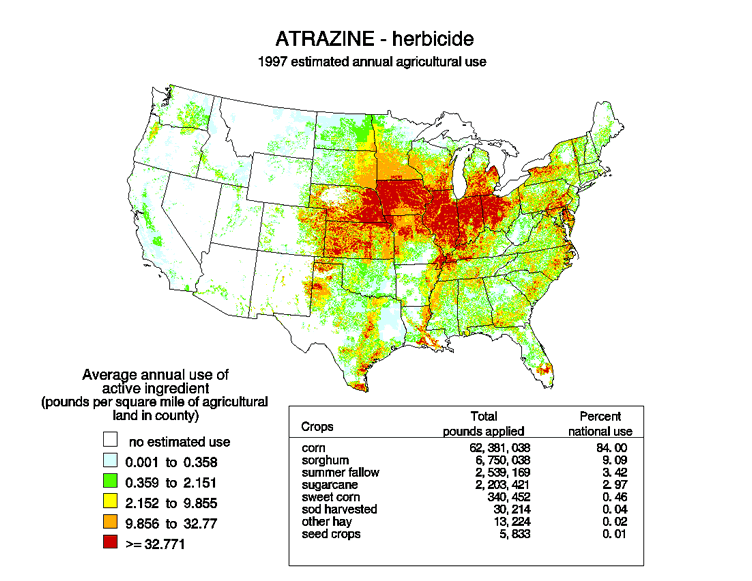
Atrazine is the second most widely used herbicide in the United States. Only glyphosate (Roundup etc.) is used more often. Atrazine degrades slowly in the soil and washes into streams and lakes where it does not dissolve. An estimated 30 million Americans are drinking water contaminated with trace amounts of atrazine.
Atrazine use 1997
To our knowledge, atrazine is not being used by any of the ecological “restorations” of the public lands in the Bay Area. Atrazine is used primarily—but not exclusively—for agricultural crops, most notably corn. In California, about 23,000 pounds of atrazine (active ingredient only) were used on over 1 million acres in 2011. (3)
The fragility of truth
We can empathize with Professor Hayes. Like him, we have been engaged in the effort to inform the public of the destruction of our public lands for 15 years. And like him, we have been on the receiving end of a campaign to discredit and intimidate us into abandoning our effort.
The February 6, 2014 meeting of the Integrated Pest Management Program in San Francisco provides a recent example. The director of San Francisco’s so-called Natural Areas Program told a roomful of her colleagues that criticism of her program’s herbicide use is “frankly nonsense.” Since our sources of information about herbicides are exclusively Material Safety Data Sheets mandated by the EPA and the manufacturers’ labels, we consider this statement groundless defamation. Admittedly, this is a trivial example, compared to the harassment endured by Professor Hayes. The analogy is that both are an attempt to discredit and dismiss critics of pesticide use.
Professor Hayes’ reaction to his experience is similar to ours. The more they attack him, the more determined he is to make his case. He has been vindicated by being promoted to full professor in 2003 and other researchers have reported similar findings in humans. Although he told the New Yorker that “the tide is turning,” atrazine is still on the market.
Likewise, we tenaciously pursue our mission to stop the destruction of our public lands. It is now clear that our opinion of these projects is shared by the public as well as many scientists. But we are not there yet.
It’s not easy to find information about herbicide use by land managers. We make inquiries and public records requests of all the managers of public lands in the Bay Area. Despite these persistent efforts, we have never been confident that we have the complete picture. We are therefore grateful for a recent survey conducted by the California Invasive Plant Council (Cal-IPC) of land managers—public and private—about the methods they use and for what purposes. The following charts tell us what Cal-IPC learned from their survey.
Cal-IPC sent surveys to 100 land managers who described the lands they managed as follows:
Organization*
Response
Local agency
54%
Federal agency
53%
State agency
48%
Land trust or other private landowner
40%
Private consultant
26%
Other (nonprofit, forestry company, utility, regional park district, conservation district)
27%
*multiple employers
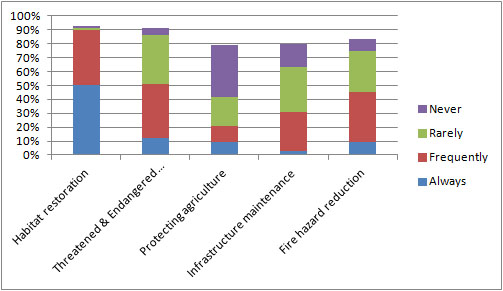
How frequently are the following objectives part of land managers’ reason for managing invasive plants?
Non-herbicidal methods used by land managers to control invasive plants
Method
Always
Frequently
Rarely
Never
Pulling with hand tools
9%
76%
14%
1%
Digging with hand tools
8%
64%
24%
4%
Cutting with pruners or loppers
7%
59%
27%
7%
Weed whacking with string or plastic blade
7%
52%
27%
14%
Cutting with hand saw or chainsaw
3%
52%
34%
10%
Mowing with large equipment
3%
44%
26%
27%
Brushcutting with metal blade
2%
30%
37%
30%
Grazing
0%
29%
23%
47%
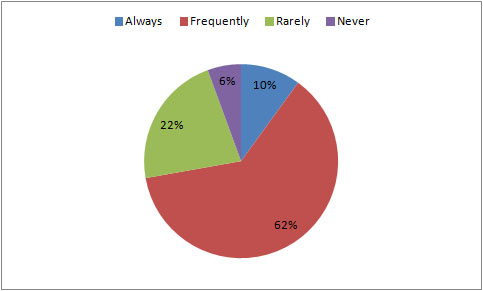
How often do land managers use herbicides for invasive plant control?
What methods do land managers use to apply herbicides?
Method
Always
Frequently
Rarely
Never
Foliar spray – spray to wet
8%
69%
19%
4%
Foliar spray – thin line
1%
13%
30%
55%
Foliar spray – low volume/high concentration
1%
22%
35%
42%
Basel bark application
2%
17%
44%
37%
Cut stump application
4%
49%
35%
13%
Drill and inject application
1%
11%
30%
58%
Girdling or frilling application
1%
5%
43%
51%
Broadcast application
1%
23%
45%
31%
Wick application
2%
6%
44%
48%
Aerial application
0%
4%
13%
83%
What herbicides are used by land managers?
Active Ingredient
Response Percent
Glyphosate (e.g. RoundUp, Aquamaster)
99%
Triclopyr (e.g. Garlon 3A, 4A)
74%
Aminopyralid (e.g. Milestone, VM)
50%
Clopyralid (e.g. Transline, Reclaim)
45%
Imazapyr (Chopper, Stalker, Habitat, Arsenal)
42%
Chlorsulfuron (e.g. Telar)
31%
Fluazifop (e.g. Fusilade)
20%
2,4-D (e.g. Amine 4, Weedar)
12%
Acetic acid
6%
Clove oil (e.g. Matran
5%
Pelargonic acid (e.g. Scythe)
2%
These charts were shown by the Executive Director of the California Invasive Council (Cal-IPC) at a meeting of the Integrated Pest Management Program in San Francisco on February 6, 2014. He explained that the survey of land managers was conducted to assist Cal-IPC in preparation for a new edition of best management practices for managing invasive plant species in wildlands. That publication will include risk assessments of the herbicides being used by land managers. Cal-IPC is collaborating with the author of the risk assessments of potential herbicide use for the Marin Municipal Water District. We look forward to the publication of this document, which is anticipated in June 2014. We hope that land managers will have confidence in the risk assessments of the herbicides they use, given the source of the information.
We make note of …..
According to this survey of land managers:
Ninety-four percent of land managers are using herbicides to control plants they consider “invasive.” Sixty-two percent are using herbicides frequently.
Seventy-four percent of land managers are using Garlon, which is one of the most hazardous herbicides available on the market, as rated by the Environmental Protection Agency.
Many land managers are using Milestone and imazapyr which are known to be mobile in the soil as well as persistent in the environment according to the manufacturer’s label and the Environmental Protection Agency.
Foliar spray is the method used most frequently by land managers to apply herbicides. This method of application has the potential to drift into non-target areas.
These practices are not adequately acknowledged in the environmental impact reports for the ecological “restoration” projects in the Bay Area. Some environmental impact reports have not acknowledged the types of herbicides being used or the methods used to apply them. None of the reports have acknowledged the quantities used by the projects nor have they acknowledged the toxicity of the herbicides. The public is therefore unaware of the extent to which herbicides are being used by these projects and the risks associated with using them.
We are republishing the following article published by Huffington Post on January 7, 2013, with permission of the author, Maggie Sergio. Maggie has done some impressive research about the appalling project to aerial bomb the Farallon Islands with rodenticides to kill mice. We shudder to think about how many other animals will be killed by this project. Please sign the petition to US Fish and Wildlife to abandon this horrible plan. The petition is available HERE.
*************************************************
I first heard the term “island eradication” back in 2011, when a colleague sent me an email that contained a project scoping notice from U.S. Fish & Wildlife (USFWS), San Francisco Bay National Wildlife Refuge Complex. This public notice announced a non-native mouse eradication project for the Farallon Islands, which are located 27 miles off the coast of San Francisco. The solemn tone of his words — “Have you seen this?” — quickly caught my attention.
As I read the document I couldn’t believe what was being contemplated. USFWS wants to use helicopters to drop 1.3 metric tons of brodifacoum (in the form of loose rat poison pellets) over the Farallon Islands, an area that has been designated as a National Wildlife Refuge. Nonnative mice are the issue. The ashy storm-petrel, a seabird that is considered a species of special concern, is being indirectly impacted by the presence of mice.
Photo of ashy storm-petrel courtesy of Wikipedia images. Photo taken by Duncan Wright
It is Fish and Wildlife’s assumption that the population of the ashy storm-petrel, a bird that is naturally a slow breeder, would recover if the mice could be eliminated. The rationale being used is that the mice are the food source that attracts an average of six burrowing owls–which also eat petrels–to the Farallon Islands every year. USFWS scientists believe the burrowing owls are staying longer than they normally would if the mice were not there. It is believed that the owls show up to feast on the mice when the mouse population spikes during the fall and early winter. The burrowing owl is also a species of special concern.
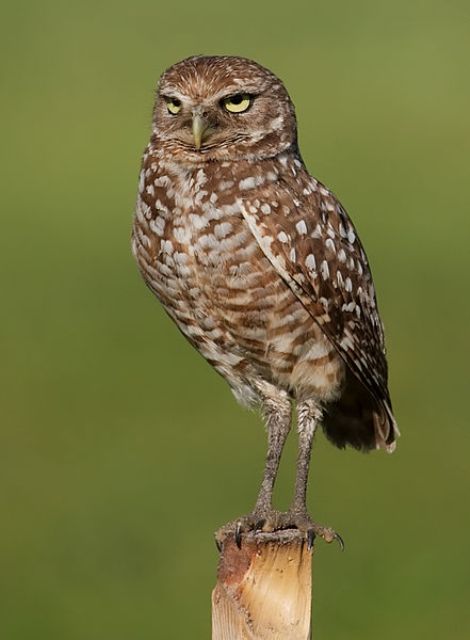
Photo of burrowing owl courtesy of Wikipedia images. Photo taken by Dori Merr
When the mouse population dips during the winter months, the few burrowing owls that remain on the island can, and do, turn to eating the chicks of the ashy storm-petrel. In reading the data provided by USFWS, I found it very interesting that out of 1,618 prey items analyzed in 679 owl pellets, only 82 storm-petrels were found. Based on the data from USFWS the majority of the owls’ diet appears to be invertebrates and mice.
It is important to add that the owls are not the only animals consuming the ashy storm-petrel chicks. Western gulls, one of the most opportunistic birds I have ever worked with as a wildlife rehabilitator, also consume ashy storm-petrel chicks. I can’t help but wonder when the Western gulls or any other species on the Farallones will be targeted next by USFWS in this unsettling fable of environmental ethics that pitches one species of animal against another.
If this 1.3 metric ton poison drop is allowed to move forward, thousands of wild animals will be inhumanely poisoned, and in turn, those killed become a poisoned food source for other animals. This is how the food web becomes contaminated. Since USFWS is chartered with the mission to protect ALL living resources within the public trust, the casual tone conveyed by this agency regarding collateral damage and “non-target species” is deplorable and unacceptable. I reached out to USFWS and asked for a comment with respect to that mission and how this project is contradictory. I have yet to receive a response.
There is also the potential for long term damage to the environment. Sub lethal impacts of anticoagulant rodenticides on wildlife are a threat that has the potential to impact future generations of birds, fish, sea lions, elephant seals, raptors, sharks, insects, crabs and other marine life. If the poison does not kill them outright, it can affect their behavior, reproduction, and survivability. Information on sub lethal poisoning was completely bypassed in the revised draft environmental impact statement (RDEIS) released this past October. Page 139 contains the statement that “Adverse effects as a result of possible sub-lethal exposure are unknown for brodifacoum or diphacinone.” The EPA also makes mention of this omission on page 11 of their 18 page comment letter found here
Information on sub lethal impacts of anticoagulants is readily available to anyone with access to the internet and web browser. This report tells the story of a dog exposed to brodifacoum at one point in her life, though her owners don’t know when, as this dog never displayed any acute symptoms of exposure. This dog was bred and the result was eight of her eleven puppies died soon after birth. Three were necropsied. Two of the puppies were found to be bleeding internally and brodifacoum was detected in the livers of two of the dead puppies. This is how brodifacoum and other anticoagulant rodenticides work. After animals ingest the poison, the animal bleeds to death because the active ingredient interferes with the blood’s natural ability to clot. This is the type of scientific documentation that is required to be disclosed in an environmental impact statement. The exclusion of this critical information equates to “cherry picking” of science. What happened to this dog has the potential to be replicated by a number of species that live in, or close to the fragile ecosystem of the Farallon Islands, if brodifacoum or other anticoagulants were to be aerially broadcast across the terrain.
Here’s the really scary thing. If this same event were to occur in nature as the result of brodifacoum permeating the food chain, the public and scientific community would not even be aware of it since the post project monitoring does not include monitoring for the presence of rodenticides or residues in the environment, except for intertidal invertebrates and then ONLY ‘If greater than negligible bait drift into the marine environment is detected.” (pg. 72 of the DEIS)
I started researching island eradication projects over two years ago and quickly learned of what happened on Rat Island in Alaska, a previous rodent eradication project that resulted in the poisoning of at least 46 bald eagles and over 420 seabirds. I found this highly critical report written by the Ornithological Council of USFWS and Island Conservation, and this story by Nature magazine.
I also received several emails urging me to investigate what was happening with the eradication project at Palmyra Atoll, which is located about 1000 miles from Hawaii. I have since learned that the eradication attempt at Palmyra Atoll resulted in bait getting into the water and fish becoming a contaminated food supply. The final report is available here.
I first wrote about this topic for the Huffington Post back in 2011, after members of the public were denied the opportunity to make public comments at the first public scoping meeting held in Fort Mason, San Francisco in May of 2011. We were given a presentation by the officials about the problem of non-native mice on the island, and the indirect impact these mice were having on the ashy storm-petrel, the farallon arboreal salamander, and the caramel cricket. We learned that an environmental impact statement was underway and that USFWS had engaged with two partners for this project; Island Conservation and PRBO (now Point Blue Conservation Science). After a presentation on how these projects are carried out and why one is needed at the Farallon Islands, we were divided into groups and sent to separate corners of the large room. Without a doubt, this was a technique for crowd control. There was a healthy turnout of concerned citizens and most were shocked and opposed at the prospect of using helicopters to carpet bomb the Farallones with a type of rat poison (brodifacoum) that has come under heavy scrutiny from the EPA and the California Dept of Pesticide Regulation.
In each of the room corners were representatives from USFWS, Island Conservation and Point Blue Bird Science. They had flip charts and wrote down questions, concerns and suggestions. In speaking with one representative from USFWS, I raised the question of other animals being poisoned in the process, something continually referred to as “non-target species.” The response was casual and dismissive. “Nobody likes it, but it happens” one USFWS employee shrugged.
Conflict of Interest
Fast forward to the fall of 2013 and a 741 page Revised Draft Environmental Impact Statement (RDEIS) is released. Written by Island Conservation under two Cooperative Agreements found here, and here. The creation of the environmental impact statement netted the Santa Cruz based nonprofit a total of $481,883. Island Conservation is also the contractor that will get the eradication business if the decision is made to move forward with this project. And since Island Conservation is a registered 501c3, income earned from eradication projects is tax free. Details surrounding the financial relationship between Island Conservation and USFWS didn’t surface until I asked Gerry McChesney, USFWS Refuge Manager for the Farallon Islands, how much Island Conservation has been paid to write the environmental impact statement. My request was handled under the Freedom of Information Act.
The blatant conflict of interest is disturbing, but what angers me is that it took my questioning before this information became public knowledge. Island Conservation has been paid $481,883 by USFWS to write the environmental impact statement for an eradication project they will be awarded worth approximately 1.3 million dollars. This explains the end result of a highly biased and misleading environmental impact statement.
According to NEPA’s (National Environmental Policy Act) rules of engagement, financial interests of parties involved need to be disclosed in the environmental impact statement. This is something the EPA pointed out in their lengthy comment letter dated 12/09/13.
” In our scoping comments, we raised potential conflict of interest issues if Island Conservation were to prepare the impact assessment and also carry out the eradication project. Since the DEIS does not include the disclosure statement, required by 40 CFR 1506.5(c), specifying that Island Conservation has no financial or other interest in the outcome of the project, it is unclear whether this issue has been addressed.” ~ EPA comment letter on the Farallones mouse eradication project, 12/09/13
Speaking of the EPA…..When they write an 18 Page Comment Letter with Concerns, We Need to Listen
This letter dated 12/09/13 from the EPA identified the numerous issues the EPA has with the draft environmental impact statement. What is unfortunate is that the EPA has no jurisdiction to stop this project. Only to give opinion and point out any potential NEPA violations, such as the conflict of interest issue.
The tone of the EPA’s letter was serious and expressed great concern about this project moving forward. Points raised by the EPA include the fact that the amount of bait proposed for use violates federal law, that predictions with respect to the success of hazing of wildlife are overly optimistic and do not mention how hazing activities would affect the mice, and fails to include any information about the failures of several previous island eradication projects.
“Much information can be obtained from previous rodent eradication attempts and it is not clear that lessons learned from these projects have been integrated into the planning for the proposed project. We are aware that three recent rodent eradication attempts – Wake Atoll, Henderson Island, and Desecheo Island – have failed. These efforts all attempted to eradicate rat species. The Wake Atoll Rat Eradication Review concluded that planning and associated research did not seem to adequately address some of the key issues and the general complexities of the project, and that the number of information gaps noted during the planning process should have led to serious consideration of postponing the project until those issues were more fully addressed. This is our main concern for the Farallon project.” ~ EPA comment letter, 12/09/13
Retired USFWS Biologist Weighs In
Biologist Sonce DeVries recently retired from USFWS after 22 years. During her tenure as Acting IPM Coordinator from 2010-2012, she reviewed proposals for a number of island eradication projects. While she fully agrees that invasive species are an issue that need to be addressed, she feels strongly that the approach that has been used in the past by USFWS and Island Conservation is not the way to do it. Her six page comment letter found herereflects many of the same concerns I have regarding the inaccurate and misleading science behind this proposed project.
“My review of the references cited in this DEIS shows that some significant misinterpretations of the original references have occurred. The authors of this environmental impact statement must accurately quote the scientific literature and not insert words or phrases that imply or state a different conclusion from that of the original reference being cited. While the DEIS states that no choice of alternatives has been made, the text clearly indicates that the reader is being strongly encouraged to select Alternative B, the use of Brodifacoum as the preferred alternative. Well written EISs go to great lengths to present a completely neutral discussion of the facts and allow the reviewer to reach their own conclusions. The DEIS does not meet that requirement.” ~ Sonce DeVries, retired biologist and former Acting IPM Coordinator, USFWS.
Richard has many concerns about the proposed project that he outlined in this four page comment letter here from the Ocean Foundation. Richard has a wealth of experience surrounding Natural Resource Damages Assessments (NRDA) and has requested that USFWS and/or Island Conservation post a surety bond in the event of accidental rat poison spills into the ocean (which occurred during a New Zealand project) and the inevitable deaths of non-target animals due to exposure to brodifacoum.
“The Revised DEIS is inadequate in reflecting a casual and dismissive attitude throughout the document regarding the inevitable mortality of public trust living resources, such as numerous non-target species, including birds and marine life, in a manner which hardly presents a fairly-considered cost-benefit analysis. Throughout the DEIS the document instead attempts to rationalize the unnecessary killing of a lot of innocuous wildlife in the process of eradication of one species – the mice – but the document provides no conclusive evidence that the Ashy Storm Petrel will benefit over the long term from all of this collateral damage throughout the overall ecosystem.” ~ Richard Charter, Senior Fellow, The Ocean Foundation.
American Bird Conservancy
American Bird Conservancy is the only bird conservation organization that hasn’t been drinking the USFWS/Island Conservation Kool-Aid about this proposed project. I think they are the only birding group that took the time to read and think critically about what USFWS wants to do. Below is a quote from the ten page comment letter submitted last month.
“American Bird Conservancy is concerned about the tenuous and indirect connection between the stated goals of the Project and the proposed means of achieving them. The conclusions in the RDEIS are founded on what we deem to be a faulty and incomplete analysis. We are concerned about poisoning the Farallon food web, including migrating raptors, sea birds, native terrestrial species, and marine mammals, and about what we consider an unacceptable level of projected incidental mortality of Western Gulls. We are also worried about the potential to cause long-term damage to the very practice of eradication of non-native mammals from islands. Related concerns include, but are not limited to, the inflated projection of effectiveness of gull hazing operations, the inadequate consideration of alternative methods of bait delivery, the biased selection of modeling assumptions, the exclusion of data from Rat Island, the under-estimation of brodifacoum toxicity, and the unorthodox and potentially biased risk assessment assumptions for diphacinone.” ~ George H. Fenwick, PhD, American Bird Conservancy
Dolphins and Penguins Die Following Drops in New Zealand
To better understand what happens with island eradication projects, watch this news report which tells what happened on two islands in New Zealand after brodifacoum was aerially dropped over two islands. Notice how Richard Griffiths with the New Zealand Department of Conservation dances around the repeated question with respect to the testing of dead dolphins and penguins for exposure to brodifacoum. Richard is now employed by Island Conservation.
Despite the critical data and the many voices of opposition, USFWS may still decide to move forward. My plea to USFWS is to remember the work of one of their own most influential biologists, Rachel Carson. Her revolutionary book, Silent Spring, published in 1962, sounded the alarm about the environmental impacts of pesticides and the penetrating influence the chemical industry has on commercial agriculture. Fifty two years later, the dominion of the pesticide industry continues and has now expanded beyond the confines of agriculture to include invasive species as another market opportunity to exploit. With respect to the South Farallon Islands Mouse Eradication Project, this is the “con” in conservation.
Update: The Final Environmental Impact Statement for the mouse eradication project on the Farallon Islands was published on March 15, 2019. The Final Environmental Impact Statement recommends the original plan as the “preferred alternative.” In other words, despite intense opposition to this plan, its implementation is now eminent.
No public comments are allowed on a Final Environmental Impact Statement, so there’s nothing further we can say about what seems to be an unnatural disaster in the making. At this stage of a project, lawsuits are the only way to stop it. I don’t know if anyone is willing and able to sue.
On December 14, 2013, the New York Times published an article entitled “The Selling of Attention Deficit Disorder.” Attention Deficit Hyperactivity Disorder (ADHD) is a neurological disorder that was identified about 50 years ago. The number of children taking medication for ADHD has soared from 600,000 in 1990 to 3.5 million presently.
Advertising in popular magazines such as People and Good Housekeeping suggest that medication for ADHD is needed to cure childhood forgetfulness and impatience and promises that schoolwork will improve and family tensions will be reduced. These are empty promises for symptoms that are normal child behavior. One of the manufacturers of ADHD medication recently paid to publish 50,000 copies of a comic book that uses superheroes to convince children that these medications will make life easier for them.
These seductive promises have proved very profitable for the pharmaceutical industry: “Sales of stimulant medication in 2012 were nearly $9 billion, more than five times the $1.7 billion a decade before.” But the industry is not satisfied with these results. Now they are marketing these medications to adults. Sixteen million prescriptions for ADHD medications were written for adults between the ages of 20-39 in 2012, nearly triple the number of prescriptions written just five years before.
As disturbing as this example of the insidious power of advertising is to convince us that we need something they are selling, it is hardly an isolated example. On a typical evening in front of the TV, men are told that a variety of medications will improve their sex lives and women will be told that a good night’s sleep is just a pill away.
Advertising is also used to improve the image of industries that the public would otherwise think badly of. For example, energy ratepayers are paying for a television campaign that tells us how much P.G. & E.– the monopoly provider of electricity and natural gas in Northern California–cares about our safety. Yet, the mainstream media informs the public of the many breaches of public safety by P.G. & E. In 2010, 37 homes and 8 lives were lost in San Bruno when an underground gas pipeline exploded. The pipeline had been badly built, not inspected, and not repaired. Subsequent investigations of P.G. & E.’s records proved that such neglect and incompetence is rampant throughout their system and continues to this day. Money that could be spent on our safety is being spent on advertising. Such manipulation of the public’s attitudes with advertising is the American industry standard.
Is the pesticide industry fueling the demand for ecological “restorations?”
Readers are surely wondering by now what this has to do with the mission of Million Trees. Clearly the manufacturers of pesticides are the beneficiaries of the ecological “restorations” that destroy non-native vegetation with herbicides (herbicides are one type of pesticide). From the standpoint of the industry, the more plants that are labeled “invasive” the better. And since new plants are always being introduced—either intentionally or unintentionally—it’s a winning business model to label every new plant “invasive.”
We don’t have a lot of evidence to support our theory that the pesticide industry is one of the sources of support for invasion biology and ecological “restorations.” Two of the 31 members of the National Invasive Species Advisory Committee are employed by companies that manufacture pesticides. One member is employed by Dow AgroSciences which manufactures Garlon, the most frequently used herbicide to prevent the resprouting of non-native trees after they are destroyed. The other member is employed by Syngenta which manufactures pesticides and biocontrols which are another method used to destroy vegetation by introducing insects or plant diseases.
Is it inappropriate for the pesticide industry that benefits from the designation of “invasive” species to participate in setting federal policy regarding those species? Undoubtedly there are arguments on both sides of that question.
Shelterbelt began the eradication of non-natve vegetation in Glen Canyon in November 2011
Admittedly, it’s a stretch to say that invasion biology was created to increase demand for pesticides and other products and services needed for ecological “restorations.” We can’t and won’t say that. But we invite our readers to wonder with us if some aggressive investigative reporting would find more evidence that it’s a factor. Wouldn’t it help to explain why invasion biology persists despite the lack of scientific evidence to support it?
This is a guest post by a member of Communities United in Defense of Olmstead (CUIDO) Olmstead is a 1999 Supreme Court decision affirming the civil rights of people with disabilities. We have added links to articles about the issues about which they were demonstrating.
************************************
CUIDO demonstration on November 2, 2013. Photo by Luke Hauser
Eighteen activists –including a blind woman, a deaf man, numerous wheelchair riders, people with invisible disabilities, and nondisabled allies–paraded single file through the Farmers Market and downtown Berkeley, California on Saturday, November 2, 2013. The action was called by CUIDO, a local disability action organization.
The protesters carried signs —“DEAF SAY: READ OUR HANDS! NO CLEAR CUTS, NO PESTICIDES, DEFEND EAST BAY FORESTS” and “DEATH BY 1,000,000 CUTS!!”— as they passed out hundreds of leaflets warning of the impending destruction. Protesters also carried, attached to their wheelchairs, enlarged photographs of graceful tall trees that are targeted for elimination, including a photo of a bald eagle parent and chick, nesting in a “non-native” eucalyptus tree.
Their action took place on All Souls Day, El Dia de los Muertos. Protesters identified with the souls of the trees and forest life endangered by this plan. Stephanie Miyashiro’s wheelchair bore a photo of large trees. A paper chain connected her heart with the trees. Her sign proclaimed: “Our lives are inextricably linked.”
Two CUIDO activists will discuss the issue in greater detail at 2:30 pm Friday, November 15, 2013, on “Pushing Limits,” a radio program on KPFA (94.1 FM) which addresses issues relevant to the disability community. Update: Marg Hall and Jean Stewart did a terrific job with this interview which is available HERE
More protests are planned. Community members who would like to join in future CUIDO actions are encouraged to contact the group at: cuidoaction@gmail.com.
CUIDO, Communities United in Defense of Olmstead, is a grassroots rights organization of people with disabilities, including chemical injuries caused by pesticides. Olmstead is a 1999 Supreme Court decision affirming the civil rights of people with disabilities.
This is the flyer that CUIDO distributed at their demonstration:
DAY OF THE DEAD TREES
Trees are sacred and beloved friends; ancient living trees link us to our ancestors.
A plan is afoot to cut down hundreds of thousands of tall trees on over 2000 acres of forest, from Richmond to Castro Valley. A great many have already been destroyed. In observing Day of the Dead, we mourn their loss, celebrate their spirits, and treasure—and pledge to protect—those that remain.
Some of our most popular parks will have almost no trees left. In place of tall trees we will see vast acres of woodchips, as there are no plans for replanting. Similar projects are proposed for other Bay Area locations, such as Sutro Forest (SF).
The pretext is fire hazard mitigation, but the result will be a dry and barren landscape which will actually increase fire danger. A complex, delicate ecosystem will be destroyed, and massive amounts of carbon will be released, contributing to global warming. Deforestation is one of the principle causes of climate change, which already threatens the planet.
There are alternative approaches to fire hazard mitigation, but project sponsors (UC Berkeley, East Bay Regional Parks District, and the City of Oakland) have dismissed safer and less destructive alternatives. Instead, they propose clear-cutting and long-term, extensive use of toxic herbicides, which they intend to apply for up to 10 years. One of these pesticides has been shown to cause acute skin, eye, & respiratory illnesses; the other has been linked to blood, kidney, liver, & nervous system toxicity. One of the targeted tree species is listed as Endangered. The funding for this project is all public money, including a Wildfire Prevention Assessment District special tax on Oakland residents. (mail-in ballot due Nov. 13-VOTE NO!) IS THIS HOW YOU WANT YOUR TAX DOLLARS SPENT?
Distributed by: CUIDO (Communities United in Defense of Olmstead)
Contact: cuidoaction@gmail.com ; http://www.cuido.org
CUIDO is a grassroots rights organization of people with disabilities, including chemical injuries caused by pesticides.
Hawaiians have been subjected to more than their fair share of the toxic methods used to eradicate non-native species because the justification for such projects is strongest on islands. Islands contain the most endemic species, unique to those islands, because they evolved in geographical isolation. More extinction has occurred on islands than on the mainland of the United States because species that evolved in isolation are more vulnerable to new competition than species that have evolved with more competition. Theoretically, if you can eradicate a non-native species, it is more possible to prevent reintroduction on an isolated island.
The coqui frog is from Puerto Rico. There are no native frogs in Hawaii,
Coqui frog
so the coqui is not competing with a native, which is the usual justification for eradicating a species. In this case, the promoters of this project claim that the frog is eating all of the insects, depriving other animals of food. A concentrated caffeine solution has been the poison of choice for the coqui.
The strawberry guava is a fruit tree that has been a valuable source of food for both animals and humans. It was brought to Hawaii by Polynesian ancestors in the distant past. It is being eradicated with an imported non-native insect.
We have also reported that there is considerable push back from Hawaiians who consider some of these species valuable and in any case, don’t appreciate being poisoned. That push back is the point of this post.
The new threat to the health and safety of Hawaiians
Pineapple and sugar cane plantations were the mainstay of Hawaiian agriculture. They have moved operations to places where it’s cheaper to do business. They have been replaced with thousands of acres of corn and soy beans which have been genetically modified to produce plants resistant to herbicides. The plantations produce seeds, which carry the genetic modification for pesticide resistance, to be sold to farmers all over the world.
These small farms are being replaced by huge fields of corn and soya. Kauia, Hawaii
Hawaii is an attractive place to grow these valuable seeds because the weather allows for three crops to be grown each year. That not only speeds up production, but also reduces the time needed for testing and development of new hybrids. Naturally, pesticides are used on those crops. After all, the crop is immune to the pesticides.
The scale of these operations, their year-around activity, and the pesticides sprayed on the crops have become intolerable to the neighbors of these operations who are bothered by both dust and pesticides. They have been demanding that the operations be scaled-back or at least controlled. Naturally, there are also people who are making their living from this profitable enterprise, and these people fight back.
A legislative committee on Kauai considered an ordinance in early October that would have restricted the operations of these companies. Between 1,500 and 4,000 supporters of the bill demonstrated at that hearing. Opponents of the bill were said to be more numerous. The bill was amended and passed by the committee and considered for approval by the legislative body last week. The hearing started at 9 am and lasted until 3:30 am the following day. The ordinance was passed as amended:
“The ordinance requires the seed companies to disclose which pesticides they use and establishes no-spray zones around schools, medical facilities, homes, public roads and waterways. The original bill would also have limited the planting of genetically modified crops, but those provisions were removed during deliberations.” (1)
These restrictions seem rather minimal, yet it took thousands of people attending several days of hearings to accomplish this small improvement. That’s the commitment that is required for the public to be heard over the voices of corporate and economic interests.
In the San Francisco Bay Area we marvel that we are unable to convince our public policy makers that they should stop poisoning our public parks. Supporters of these local projects are not large, powerful corporations, so shouldn’t it be easier to make ourselves heard? Apparently we are just not making enough noise.
Yale Environment 360, the on-line science blog, published an interesting article last week about new discoveries in forest ecology regarding the importance of microbes in the soil for forest health. These root fungi—called mycorrhizal fungi— form a symbiotic relationship with many plants and trees, both native and non-native. They provide water and mineral nutrients in exchange for plant carbohydrates. Scientists have known of the existence of these microorganisms for some time, but recent advances in DNA analysis has enabled scientists to identify thousands of different species of mycorrhizae and their association with certain tree species.
Scientists at Yunnan University in China had been trying for some time to save a critically endangered tree that had dwindled to only 200 individuals. They had been transplanting seedlings into protected areas, with little success. Finally, they discovered that inoculating the seedlings with mycorrhizae increased survival rates from 46% to 80%
Certified arborists evaluating the Sutro Forest called it “mycorrhizal heaven.” Courtesy Save Sutro
Root fungi and our urban forest in the Bay Area
We learned of the importance of these root fungi to our urban forest from Colin Tudge’s book, The Tree, nearly ten years ago: “Most forest trees and many other plants too, make use of mycorrhizae; some, like oaks and pines, seem particularly reliant on them.” And eucalypts are also dependent upon mycorrhizae: “Many trees have mycorrhizae, but pines andeucalypts seem particularly adept.” (1)
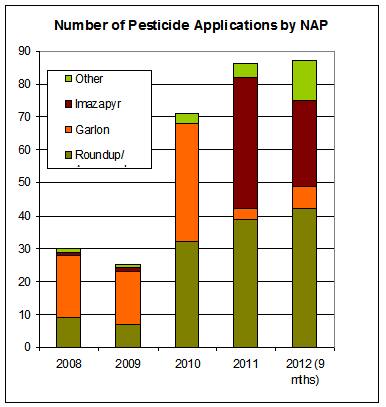
Volume of pesticide use by San Francisco’s Natural Areas Program, Courtesy Save Sutro
And in 2010, we learned from the Marin Municipal Water District’s “Herbicide Risk Assessment,” that one of the most frequently used herbicides sprayed on the stumps of eucalypts when they are cut down is known to be harmful to mycorrhizal fungi in the soil. This herbicide is also foliar sprayed on non-native vegetation such as broom, Himalayan blackberry, ivy, etc. The active ingredient in Garlon 3A and Garlon 4 Ultra—triclopyr–is known to be toxic to microrganisms such as mycorrhizae:
“Mycorrhizal fungi are symbionts with plants that provide water and mineral nutrients in exchange for plant carbohydrates. Cenococcum geophilum, the slowest growing fungus, was least sensitive to the effects of triclopyr, exhibiting decreased growth at 742 ppm a.e. A similar study found that triclopyr (formulation not reported) could inhibit growth in five mycorrhizal species: Hebeloma crustuliniforme, Laccaria laccata, Thelophora americana, Thelophora terrestris, and Suillus tomentosus.94Fungi were kept in liquid culture for 30 days and the reduction of biomass with increasing triclopyr concentrations was measured. A 90% reduction in biomass was observed for all species at concentrations of 720 ppm; greater than 50% reduction biomass was observed in four of the five species at 36 ppm. The most sensitive species, Thelophora americana, exhibited a 6% decrease in growth rates relative to controls at triclopyr concentrations of 0.072 ppm (this result was statistically significant). In other species, statistically significant decreases in growth were reported between 0.72 ppm and 7.2 ppm.” (2)
These studies tested this herbicide on only six species of mycorrhizal fungi. We should probably assume that other species would also be harmed and it is likely that other herbicides would also be harmful, though no tests have apparently been conducted. Testing of pesticides is woefully inadequate because legal requirements for testing are minimal and most testing is funded by manufacturers with little motivation for learning more bad news.
Here is one of the comments posted on the Yale Environment 360 article by an academic at University of Philippines, about presumed damage to agricultural soils by pesticide and fertilizer use:
“The article on microbes by Conniff follows what I pointed out earlier to Yale e360, that there is a group in the Philippines, of which one is a geneticist trained in the U.S. and two are foresters trained in the Philippines, who believe in fertilizer- and pesticide-free agriculture methods that do not kill off microorganisms in the soil that are much needed by the plants. They (the three happen to be brothers) applied this principle to rice and other crops and are harvesting more with less input. They have a growing following among farmers as well as a flourishing broadcasting business. They fight an uphill battle against fertilizer and pesticide multinationals and their local partners. They are slowly winning their battles and will later win the war for food security. Advances in tropical forestry will broaden horizons. Thank you Yale e360!”
Posted by Bienvenido R. Rola, PhD on 10 Oct 2013
Implications for ecological “restorations” in the Bay Area
It seems likely that the huge amounts of herbicide that are used by local projects to eradicate non-native vegetation are damaging the microbes in the soil that are essential to forest health. This is probably one of many explanations for the lack of success of these projects. Here is a recap of the many reasons why these projects are rarely successful unless they are intensively planted and gardened:
Higher levels of CO₂ and associated climate change are promoting the growth of non-native plants.
The growth of non-native annual grasses is encouraged by higher levels of nitrogen in the soil found in urban environments as a result of the burning of fossil fuels.
Hundreds of species of California native plants require fire to germinate their seeds and most of the population will die within 5 years of the fire. Prescribed burns are prohibited in San Francisco and are severely limited in most urban areas because of air quality standards and safety concerns.
Herbicides are damaging the soil.
***************************************
(1) Colin Tudge, The Tree, Three Rivers Press, 2005
(2) Chapter 4, Marin Municipal Water District, “Herbicide Risk Assessment,” 2010
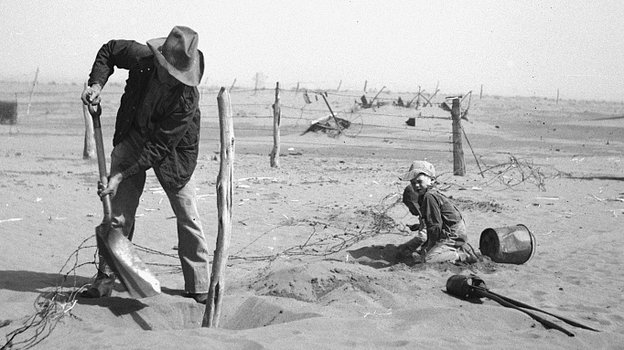
In the 1930s, during the Great Depression, the entire country experienced extreme poverty. In the Midwest, the drought and the dust storms it caused contributed to the suffering. The Dust Bowl was a result of decades of intensive farming on marginal land that was made possible by atypical years of heavy rain and high commodity prices. When the drought hit that is more typical of the climate in that region, the crops died and the depleted, sandy soil was free to blow in the wind in what were called “black blizzards.”
The Dust Bowl
Franklin D. Roosevelt had a lifelong interest in and fondness for trees. Prior to entering politics, he had forested his property at Hyde Park in New York. So, when confronted with the Dust Bowl, a tree-based solution came naturally to him while on the campaign trail for the presidency. He was visiting a desolate town in Montana that had been deforested by mining operations when the idea of a massive windbreak to protect agricultural land from the wind and stabilize the soil came to him.
This windbreak came to be known as the Shelterbelt. The story of the planting of the Shelterbelt is one of many interesting stories about American forests told in American Canopy: Trees, Forests, and the Making of a Nation. (1)
The idea of windbreaks to protect agricultural lands was not new at the time:
“For instance, California citrus growers routinely planted stands of fast-growing, imported eucalyptus trees to shield their precious orange trees from gusts coming off the Pacific Ocean. As a 1908 pamphlet on eucalyptus explained, ‘In unprotected orchards, nearly the entire crop is frequently blown from the trees, or so scarred and bruised that the grade and market value are much reduced.’” (1)
Despite this track record of the value of trees to protect agricultural crops, President Roosevelt met with fierce political resistance to his proposal to create the Shelterbelt. At every turn, the project was repeatedly starved of the funding needed to complete the project. The detailed story of that resistance is reminiscent of the political theater we are now witnessing that is attempting to prevent the implementation of the Affordable Care Act.
Although the Shelterbelt never reached the scale that President Roosevelt had envisioned, much of it was eventually planted in Oklahoma, Texas, Kansas, Nebraska, and the Dakotas:
“A 1954 evaluation of the Shelterbelt determined that over 220 million trees had been planted on thirty thousand farms. The Forest Service had laid down in total more than 18,600 linear miles of tree strips—and a majority of these, more than 70 percent, survived for decades. During the 1950s and 1960s many of the original Shelterbelt plantings were reinforced or expanded through the private actions of farmers who had come to appreciate the value of tree windbreaks.” (1)
Despite the huge scale of that project, only $14 million was spent in the eight years that the project existed. “An article in American Forests estimated, somewhat optimistically, ‘On a fifty-year basis, the cost to the government of an acre [of agricultural land] protected a year is estimated at four cents.’” That’s a bargain at ten times that estimated price.
The description of the trees and how they were planted helps us to appreciate that a windbreak is more than a single row of trees on the perimeter of a field:
“Tree strips in the Shelterbelt typically included ten rows of vegetation. The outer row contained small trees or shrubs, most commonly chokeberry, lilac, mulberry, Russian olive, and wild plum. The inner rows featured quick-growing, long-lived, taller trees that had been selected for their tolerance of the unwelcoming climate. Some tree varieties were native, while others had been discovered abroad, often the result of research first conducted by plant explorers…The most widely planted species were cottonwood, green ash, and Chinese elm, which each appeared in all six participating states.” (1)
After planting, the trees and shrubs had to be protected from grazing animals with fences.
Drought strikes again
National Public Radio (NPR) recently broadcast anupdate about the Shelterbelt. It’s not good news. The drought in the Midwest that is considered a consequence of climate change is killing the Shelterbelt:
“Now [the] trees [in the Shelterbelt] are dying from drought, leaving some to worry whether another Dust Bowl might swirl up again.”
A farmer in Oklahoma describes the dying Shelterbelt:
“He pointed to a line of trees as he drove along the shelterbelt trees that flank his farmhouse. ‘You can see the tops of those trees?’ he asked. ‘You see how they’re dying? You can see how it’s almost deteriorated to nothing.’”
Oklahoma State Forester, Tom Murray, told NPR what the Shelterbelt accomplished there:
“’This used to be cotton field, if I remember right, looking back at the history,’ he says. ‘And it just blew—it’s sand and it blew. By putting this [windbreak] here, it stopped that south wind from blowing across the field.’”
When we read the story of the creation of the Shelterbelt, we were immediately struck by the irony of its name. Here in the San Francisco Bay Area, the most widely used sub-contractor for the destruction of non-native plants and trees is named Shelterbelt. They are responsible for many of the herbicide applications in the so-called “natural areas” in San Francisco. Here is a description of their organization from their website:
“Shelterbelt Builders was founded in 1978 in Berkeley, CA as a general building and landscaping company completing over 600 commercial and residential projects during the subsequent 15 years…After an exhaustive effort rebuilding residential homes following the 1991 Oakland Hills firestorm, management realized there was no locally available organization specializing in the management, stewardship and restoration of native landscapes in the San Francisco Bay Area. At that time, Shelterbelt abandoned traditional construction and restructured itself into a specialty contracting company dedicated exclusively to restoration of native landscapes and open land management. We are now one of the leading companies in California devoted to this task.”
Shelterbelt began the eradication of non-natve vegetation in Glen Canyon in November 2011
The Shelterbelt company began as a builder. Now they are a destroyer of non-native trees and plants. Their name is now a misnomer in our opinion. The name, Shelterbelt, was coined in 1935 to describe a massive windbreak composed of non-native and native trees that was responsible for helping to stabilize the agricultural land in the American Midwest and end the era of the Dust Bowl. To see that name appropriated by a company that actively engages in the destruction and poisoning of non-native vegetation is very sad indeed. It is also a reminder that ecological “restorations” have become an industry, with vested economic interest in the continuation of the destructive crusade against non-native plants and trees.
Shelterbelt’s tools: chainsaws and equipment to spray herbicides
***************************************
(1) Eric Rutkow, American Canopy: Trees, Forests, and the Making of a Nation, Scribner, 2012