The use of the herbicide, glyphosate (AKA Roundup) has skyrocketed since genetically modified seeds were introduced which enable farmers to spray their crops with unlimited amounts of glyphosate without damaging their crops. We have been reading with increasing alarm the mounting evidence of the damage that is being done to the environment by this indiscriminate use of glyphosate as well as evidence of the impact on human health. We’ve been holding out for an unimpeachable source to inform our readers of this evidence because our critics often accuse us of being alarmist.
Farmers who do not use herbicides report that their crop is often damaged by aerial drift and water runoff from their neighbors who use herbicides.
“Superweeds” that are resistant to any herbicide are becoming more numerous. Million Trees reported on this issue recently. The reaction of the Environmental Protection Agency to these superweeds was to increase the amount of glyphosate that can be legally used on agricultural crops. This is a very unfortunate response to the problem in our opinion and will surely prove to be self-defeating in the end.
The herbicide binds with minerals in the soil—manganese, calcium, boron, etc.—to reduce run off. The herbicide is competing with the plant for these minerals which the plant needs for its growth. These minerals are also important to human nutrition. If the plant contains fewer minerals, its nutritional value is reduced.
This binding of the minerals in the soil is changing the physical quality of the soil, making it very hard and difficult to cultivate. Farmers report that plowing their fields sprayed with glyphosate has become increasingly difficult. If the roots of the plant can’t penetrate the soil, the growth of the plant is retarded.
The herbicide is killing fungi and microbes in the soil. These plants and creatures also benefit crop plant growth by facilitating the transfer of nutrients from the soil to the crop plant.
Most of the genetically modified crops are corn and soy. These crops are widely used as animal feed. We speculate that if these crops are harmful to humans, they are probably also harmful to animals.
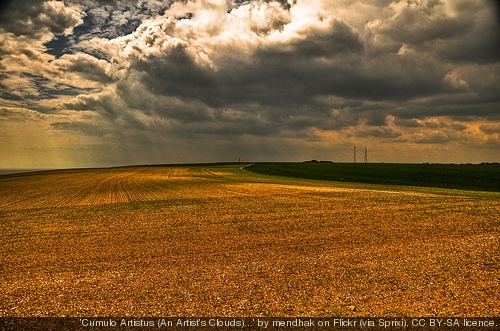
Cornfield
The manufacturer of glyphosate, Monsanto, has refuted these observations. You can read the New York Times article if you are interested in their version of the story. We close with the words of a farmer who tried Monsanto’s genetically modified seeds. After several years of spraying his crop with glyphosate he has returned to conventional seeds and he is no longer spraying glyphosate: “Although a neighbor told him that he would go broke growing conventional crops, Mr. Verhoef has no plans to go back to genetically engineered varieties. ‘So far so good,’ Mr. Verhoef said, ‘I’m not turning back, because I haven’t seen anything that is going to change my mind about glyphosate.’” We consider this farmer a more credible source of information than Monsanto.
On Thursday, August 29, 2013, the Executive Committee of the Board of Directors of the East Bay Regional Park District will consider the District’s plans for fuels management in 2014. In April 2010, the District’s Board of Directors approved the “Wildfire Hazard Reduction and Resource Management Plan” and its Environmental Impact Report. That plan provided for an annual progress report as well as budget and project planning for each forthcoming year.
Here is the District’s report of what has been accomplished so far and the projects planned for completion by the end of 2013:
“In 2012, initial entry work was undertaken at Anthony Chabot and Sibley, for a total of 153 acres, including 140 acres of eucalyptus thinning in and around the Anthony Chabot Family Campground and 13 acres of eucalyptus thinning in the steep slopes of Sibley Triangle. Approximately 1,500 tons of hazardous wildland fuels were treated.
The District’s resource management prescribed broadcast burn program is continuing in 2013. Approximately 50 acres of native prairie grassland in Point Pinole and 80 acres of invasive plants in Round Valley are scheduled for burning this year.
By the end of 2013, a total of 160 acres of initial entry work are expected to be completed at Anthony Chabot, Claremont Canyon, Kennedy Grove, Lake Chabot, Sibley, Tilden, and Wildcat Canyon. Approximately 900 acres across 16 parks will be maintained using goat grazing, prescribed burns, and chemical, mechanical, and hand labor as described in the 2012 report, and in accordance with the prescriptions and treatment protocols adopted in the Plan.” (1)
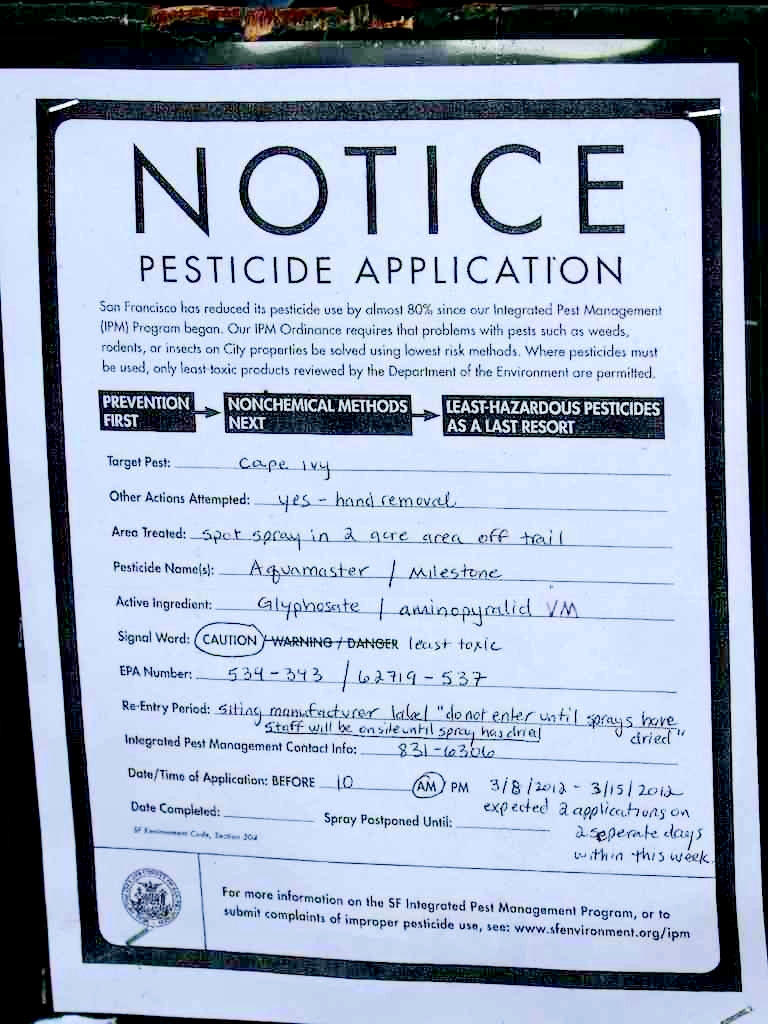
We would like to be able to tell our readers about the pesticides required to accomplish these tasks. Unfortunately, the District has not posted an annual report of its pesticide use since 2010. The District says it does not expect to complete the annual report of pesticide use for 2011 until late in 2014. Meanwhile, you can see the latest report for 2010 that is available here.
Here are the District’s plans for implementation of fuels management projects in 2014 (Attachment B of report available here):
Project Description
Estimated Cost
Estimated Acres
Annual maintenance of light, flashy fuels and eucalyptus sprouts in Fuels Plan area
$500,000
671
Annual maintenance of light, flashy fuels OUTSIDE of Fuels Plan area
$175,000
268
Periodic maintenance of heavy fuels (brush and ladder fuels) in Fuels Plan area
$250,000
70
Sub-Total Fuels Maintenance
$925,000
1009
Initial treatment of heavy fuels and eucalyptus in Fuels Plan area (Chabot, Claremont Canyon, Huckleberry, Leona, Redwood, Sibley, Sobrante Ridge, Tilden, Wildcat)
$1,200,000
544
Initial treatment OUTSIDE Fuels Plan area
$50,000
15
Sub-Total Initial Treatment
$1,250,000
559
Resource/habitat prescribed burns
$25,000
126
TOTAL FUELS MANAGEMENT
$2,200,000
1694
You can see exactly what will be done and where by looking at Attachment C of the report (available here). All the “recommended treatment areas” are listed where the work is planned. There are maps of the “recommended treatment areas” in the “Wildfire Hazard Reduction and Resource Management Plan” which is available here.
The District expects to complete initial treatment on all 3,000+ acres of the fuels management project in 2019. The District estimates that the annual cost of maintaining those treated acres will be between $2,055,000 and $5,400,000 per year in perpetuity. If you read our recent post about the Marin County Parks and Open Space “Vegetation and Biodiversity Management Plan” you know that all managers of public land in the Bay Area report the mounting costs of maintaining the fuel breaks they have created because when vegetation is cleared, the ground is quickly occupied by non-native weeds. Our readers will recall that the author of that report recommends that fuels management projects be sharply curtailed so as to reduce the maintenance problems that are created by them. The report also states that fire hazards will not be increased by curtailing vegetation management projects as recommended. The projected costs of maintaining fuel breaks in the East Bay Regional Park District are an example of the maintenance nightmare that is being created by these projects.
The meeting of the Board Executive Committee will take place at 12:45 pm on Thursday, August 29, 2013, at District headquarters: 2950 Peralta Court, Oakland, California. The public has an opportunity to comment at these meetings. You could, for example, ask why the District’s annual report of pesticide use hasn’t been made available to the public since 2010. Your tax money is being used to fund these projects. So, you have a right to know how your money is being spent.
“The primary purpose of this Vegetation and Biodiversity Management Plan for the Marin County preserves is to provide comprehensive, long-term guidance for a new science-based approach to vegetation management that will (1) maintain the natural biodiversity of the vegetation within the preserves, (2) maintain emergency and public access, and (3) manage fuel loads to reduce the threats of the spread of natural and human-caused fires.”
Marin County Civic Center
In other words, her report attempts to reconcile fire hazard reduction with resource management. The report is therefore of interest to readers of Million Trees, because many of the ecological restoration projects in the San Francisco Bay Area with which we are familiar claim to achieve these goals simultaneously. Loran May’s report acknowledges that there is a conflict between vegetation management for fuel reduction and the conservation of native habitat. Separating these two goals is a big step forward, in our opinion, because reducing fire hazard has been the most influential argument with the public and decision-makers for destroying non-native vegetation.
The consultant read the written policies regarding vegetation management of most of the owners of public lands all over the San Francisco Bay Area and interviewed the managers of those organizations regarding their experiences with the application of those policies. The consultant’s report is based in part on what she learned from all the major owners of public land in the Bay Area:
Audubon Canyon Ranch (ACR)
California State Parks (CSP)
East Bay Municipal Utilities District (EBMUD)
East Bay Regional Park District (EBRPD)
Golden Gate National Recreation Area (GGNRA)
Marin Municipal Water District (MMWD)
Marin County Open Space District (MCOSD)
Midpeninsula Regional Open Space District (MROSD)
Shelterbelt Builders, Inc. (SBI)
Santa Clara County Parks (SCCP)
Santa Clara Fire Safe Council (SCFSC)
Santa Clara County Open Space Authority (SCCOSA)
Here is what she learned about the current status of policies and practices regarding vegetation management for the purpose of reducing fire hazard and the impact it is having on natural resources in the San Francisco Bay Area:
All agencies indicated that the eradication of non-native species is a high priority for their organizations and that a big portion of their resources is devoted to that task. However,”They stressed that eradication of some well-established populations may not be feasible.”
Since total eradication is not considered a realistic goal, agencies prioritize removal of non-natives as follows: new “infestations,” control at “leading edge” into wildlands, “noxious weeds” as defined by California law, and non-native plants considered threats to legally protected native plant species.
Mechanical removal such as mowing or brush cutting followed by herbicide application is considered the most effective and most cost effective method of destroying non-native vegetation. However, organizations that are responsible for water supplies, have some constraints on the use of herbicides.
“… the interviewees overwhelmingly indicated that the most effective approach to reducing fire risk and protecting structures and adjacent communities is the establishment of defensible space zones along the wildland-urban interface. Interviewees stressed that defensible space zones are an important and often underutilized tool in helping slow the spread of fires from or onto preserves.”
Land managers indicated that large fuel breaks distant from properties were difficult to maintain because they are quickly dominated by non-native plants: “A recurring theme during interviews about fuel modification zones was the need to address and minimize invasive plant spread and establishment within these zones. Most agencies indicated that they have had to redirect a large portion of their fuel management funding away from construction of new fuel modification zones to controlling or containing infestations of invasive plants, such as French broom, within already constructed fuel modification zones.”
Public agencies agree that fuel reduction should occur only in the perimeter that separates developed from undeveloped land because ignition is more likely to occur in developed areas and buildings are more likely to ignite than wildland fuels. Most agencies have adopted a 100-foot standard for creating defensible space around properties.
“In wildland fires, most structures are ignited by embers. Building an ignition-resistant structureis the most effective defense against structure ignition and loss, since there will almost always be numerous embers in a wildfire.”
The experience of managers of public land with wildfires indicates that fuel breaks are generally ineffective in stopping the spread of fire: “Fires have been stopped by fuelbreaks only in instances where fire intensity was low.”
Agencies agreed that, “…ridgetop fuelbreaks typically have limited effectiveness for stopping the spread of fire during large fire events… Interviewees raised concerns that constructing and maintaining fuelbreaks is cost prohibitive and is a major cause of rising program costs for many land management agencies. All agencies noted that fuelbreaks are also strongly linked to the spread of invasive plants within their lands. For these reasons, interviewees strongly recommended that fuelbreaks be minimized, and resources reapplied to defensible space zones.”
This report sounds familiar!
None of these experiences of the managers of public lands in the Bay Area sound new to the readers of Million Trees. We have been telling our readers about these issues for over three years. We have written public comments on all of the written plans and environmental impact reports and statements for the plans many times. Just for fun, let us itemize our agreement:
When vegetation is removed—whether it is native or non-native—the vegetation that will soon occupy the bare ground will be non-native vegetation because it is more competitive than native vegetation. Unless the bare ground is intensively planted, irrigated, weeded, etc., native plants will not occupy land cleared of vegetation. The projects on public lands that are clearing vegetation for the purpose of reducing fuel loads never plant or garden after the land is cleared. When the goal of a project is to convert the land from non-natives to natives, some planting is sometimes done, but the gardening effort is rarely sufficient to achieve anything but a temporary result.
The huge projects in the East Bay for which FEMA funding has been requested, are based on the fantasy that eradication of all non-native plants and trees from hundreds of acres of public land with no subsequent replanting will magically result in a native landscape. The Marin County report is evidence that this assumption is not realistic.
Reducing fuel loads far from property will not reduce the risk of property loss from wildfire. Such vegetation removal must be close to the property to provide protection. Most fuel reduction projects in the East Bay are far from any property and therefore will not reduce fire hazards to people or property.
It will not be physically possible to eradicate all non-native vegetation. It is a fool’s errand to try because the most effective method of control requires herbicide use. By the time the land has been sufficiently poisoned to eradicate all non-native plants, our watershed will be poisoned and our public lands will not be fit to visit safely. In other words, it’s just not worth it to try to eradicate all non-native plants with herbicides.
We don’t wish to leave our readers with the mistaken idea that the Marin County report “Vegetation and Biodiversity Management Plan” is the silver bullet that will loosen the native plant movement’s tight grip on our public lands. In fact, it is first and foremost, a plan that is devoted to the preservation of native plants. All of its recommendations are aimed at that goal. It advocates for the destruction of non-native plants and trees wherever they are considered a threat to rare native plants or occur in small enough populations that eradication is physically possible.
However, for the first time in our long experience with similar written plans around the Bay Area, this report acknowledges that destroying vegetation for the purpose of reducing fire hazard is not the same thing as conserving native plants. This represents a significant reversal from previous plans which were based on the fictitious premise that fire hazards can be reduced by converting non-native to native landscapes. Therefore, we consider it a BREAKTHROUGH!
Farmers have been battling with weeds since the advent of agriculture, about 6,000 years ago. Most of the weapons used against weeds were mechanical until the last century or so when herbicides became the primary weapon. At the same time that the weapon became more lethal, farming techniques changed to give weeds the advantage. Farms became huge monocultures and crop rotations were abandoned in favor of the most profitable crop.
Cornfield
When weeds evolved defenses against the herbicides, farmers responded by increasing doses and manufacturers created new products to which weeds hadn’t yet evolved resistance. Finally, the use of herbicides skyrocketed when crop seeds were invented that weren’t killed by the herbicides, so that huge amounts of herbicides can be used without killing the crop.
When Roundup with the active ingredient glyphosate went on the market in the 1970s, its manufacturer, Monsanto, claimed that weeds would not be able to evolve resistance to it. And apparently that was initially true until Roundup was used on a huge scale when herbicide-resistant seeds were put on the market in the 1980s. Norman Ellstrand of UC Riverside explains why: “He argues that the reason was that farmers applied glyphosate to relatively little farmland. As they applied it to more and more acreage, they raised the evolutionary reward for mutations that allowed weeds to resist glyphosate. ‘That ups the selection pressure tremendously,’ he said.” *
There are now 24 species of weeds that are resistant to glyphosate and they are rapidly expanding their range in agricultural areas all over the world. In 2012, an agricultural consulting firm reported that 34% of farms in the US had glyphosate-resistant weeds. In the first half of 2013, half of all farms in the US are reporting glyphosate-resistant weeds.
Let’s take another approach
Obviously, we are losing the war against weeds. So, let’s examine the strategy we have been using and try another approach. Weed ecologists are now studying the strategies that weeds have used to cope with the weapons we have been using against them. Here are a few of those strategies:
Some weeds have changed color so that they are indistinguishable from the crop they are hiding in.
Weeds that grew in dry ground, evolved to thrive in wet ground in rice fields that are flooded much of the crop season.
Some weeds became shorter to escape the mowing and harvesting of the agricultural crop.
Some weeds drop their seeds and go dormant before the crop is harvested and create seed banks that can sprout when conditions are more favorable for them.
Parasitic weeds wrap around their host and steal nutrients from them.
Some weed ecologists believe that a better understanding of the mechanisms used by weeds to foil our attempts to control them will enable us to devise better weapons against them. They believe that developing new herbicides and/or using more of them will always be a short-term solution.
For example, David Mortensen of Penn State is “investigating controlling weeds by planting crops like winter rye that can kill weeds by blocking sunlight and releasing toxins. ‘You want to spread the selection pressure across a number of things that you’re doing so that the selection pressure is not riding on one tactic,’ he said.”*
Regardless of what method is used to control weeds in the future, let’s consider the toxicity of the method the most important criterion for judging their effectiveness. Even if it kills fewer weeds, the least toxic alternative is the best alternative in our opinion.
********************************
*Carl Zimmer, “Looking for Ways to Beat the Weeds,” New York Times, July 15, 2013.
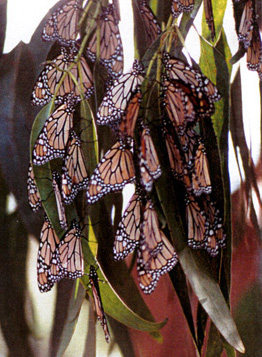
Monarch butterflies over-winter in California’s eucalyptus groves
The East Bay Express has published an op-ed in defense of the much maligned eucalyptus. “The Eucalyptus is Part of California” is by Gregory Davis, a Berkeley resident. We summarize the main points for our readers:
University of California, Berkeley’s plan to destroy all non-native trees—primarily eucalyptus, Monterey pine, and acacia—is characterized as a “meat-axe approach.”
Applying herbicides repeatedly to prevent regrowth of non-natives is “tantamount to opening a can of worms.” We don’t know the consequences of dousing our public land with toxic chemicals, just as we didn’t know that using Agent Orange during the War in Vietnam would permanently damage that country and its citizens.
The moderate approach advocated by the Hills Conservation Network is more reasonable. Thinning and selective removal will do less damage.
Flammability of eucalyptus groves has been greatly exaggerated.
Eucalyptus has lived in California longer than most of us have been alive. They are more native than we are.
The loss of the “beauty and majesty” of eucalyptus in the hills will make hiking in the East Bay hills a less pleasant experience. “Anyone who has hiked up the trail under the green canopy of these tall, stately, plumed-top, evergreen trees knows how precious they are.”
Thank you, Mr. Davis, for writing this article and to the East Bay Express for publishing it. Critics of the native plant movement are learning that they must speak up if we are to save our trees. The projects that destroy our trees finally became so big and so visible, that more people are aware of them and are more willing to defend our trees.
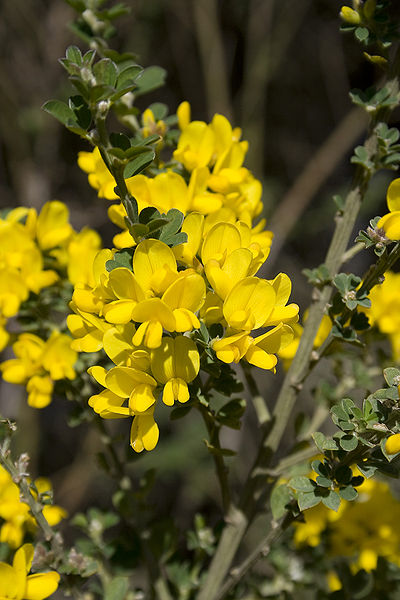
Broom is the likely occupant of East Bay public land now shaded by non-native trees that will be destroyed by the FEMA projects. Share Alike.
Invasion Biology: Critique of a Pseudoscience is a book by David Theodoropoulos. (1) He explains in the preface of the book, how he arrived at the conclusion that invasion biology is a pseudoscience and why he felt compelled to explain that conclusion in his book.
Theodoropoulos was from an early age a lover of nature and he always spent much of his time outdoors, observing nature. He recalls noticing decades before writing his book that some plant species—such as broom—tended to occupy disturbed ground such as roadsides. He was also aware that introduced species of plants were contributing to biological diversity. Putting those two observations together, he concluded that plants that are introduced and dispersed by the activities of man are integrating into ecosystems and increasing biodiversity.
As the hysteria about “alien invasions” began to mount in the 1990s, Theodoropoulos could not reconcile this anxiety with his observations of nature. He read the studies that supported invasion biology and found their scientific methods and their conclusions unsatisfactory. He concluded that the fear of introduced plants was motivated by “psychological factors” that are not supported by scientific evidence.
As he shared his observations with others, he was subjected to abusive attacks by proponents of invasion biology, which ultimately compelled him to write his book to defend his opinion of invasion biology. He explains why he wrote his book:
“During the past decade ‘invader’ fears have reached a fevered pitch, with a constant barrage from the media fanning the flames, and a huge volume of literature has been published, produced by scientists with a self-interest in promoting this ideology. Corporate and bureaucratic interests have intruded, pushing their agendas of profit and control. Finally, the use of invader fears to justify total human control of the natural world has shown that the ideology has reached a dangerous place.” (emphasis added)
David Theodorpoulos will be speaking in the East Bay on Sunday, July 14, 2013. Here is the announcement of this event by its sponsor East Bay Pesticide Alert:
INVASION BIOLOGY
OR INTEGRATION BIOLOGY?
Who is behind the deforestation and pesticiding of the East Bay Hills, from Richmond to Hayward?
**Slideshow with narration, followed by discussion**
DAVID THEODOROPOULOS
Conservation Biologist and Author:
Invasion Biology: Critique of a Pseudoscience
+ Update from Save Mt. Sutro Forest
SUNDAY, JULY 14, 2013, 6:30PM(doors open 6PM)
Historic Hall, Berkeley Fellowship of Unitarian Universalists
1924 Cedar (one block east of MLK, Jr. Way)
Hear about Invasion Biology from a different perspective of non-native species, based on Evolutionary Biology, and find out about the native plant restoration movement’s connection to the pesticide industry.
**Please refrain from using scented products prior to attending **Wheelchair accessible
Co-sponsored by East Bay Pesticide Alert (dontspraycalifornia.org) (see wildfire pages) & Social Justice Committee BFUU (bfuu.org)
***********************
We have read Mr. Theodoropoulos’ book and we have heard him speak. We can highly recommend both his book and his talk as informative and interesting. We can also recommend the speaker about the Sutro Forest in San Francisco. If you are not aware of how widespread the destruction of non-native plants and trees is, you will want to hear about the plans to destroy over 30,000 trees on Mount Sutro in San Francisco. Please come to learn about the destructive consequences of projects that are attempting to convert our diverse landscape into native plant advocates’ fantasy of what it looked like 250 years ago.
Update: A video of this presentation is now available here.
The Environmental Protection Agency (EPA) has published its comment on the Draft Environmental Impact Statement (DEIS) for the FEMA projects in the East Bay. It is available here: FEMA DEIS – public comment – EPA. We are pleased to tell you that the EPA shares many of our concerns about the environmental impact of these projects and they consider the evaluation of those impacts by the DEIS inadequate. The EPA has rated this project “Environmental Concerns – Insufficient Information.” These are the definitions of those terms:
“Environmental Concerns: The EPA review has identified environmental impacts that should be avoided in order to fully protect the environment.Corrective measures may require changes to the preferred alternative or application of mitigation measures that can reduce the environmental impact…”
“Insufficient Information: The draft EIS does not contain sufficient information for EPA to fully assess environmental impacts that should be avoided in order to fully protect the environment…”
EPA says, “The project could result in degradation of natural resources”
The EPA shares our opinion about the probable outcome of the proposed project:
“The document assumes that areas will naturally regenerate, once rid of non-native species. We are concerned that some of the aspects of the project would result in degradation of natural resources and may not provide for natural regeneration. Further, while the DEIS includes a discussion of climate change, it does not include a detailed discussion of the potential impact of climate change on the Project area. Current research indicates that climate change could impact the amount, timing and intensity of rain and storm events; increase the length and severity of the fire season; modify the rate and distribution of harmful timber insects and diseases; and aggravate already stressed water supplies. A significant change in the weather patterns could have important implications for the management of the Project area.”
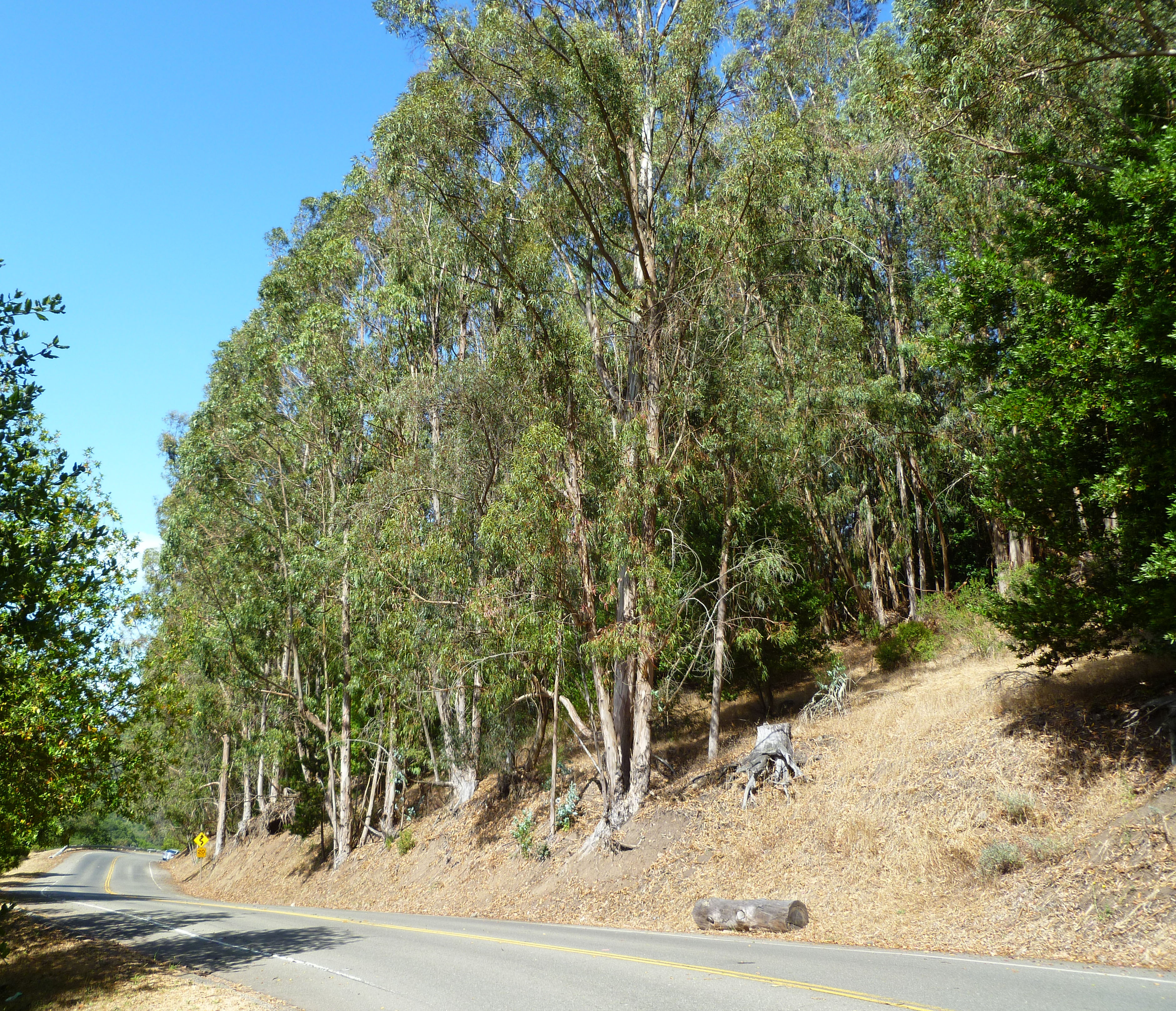
FEMA proposed project on the right. Claremont Blvd. westbound.
The EPA recommends that the final EIS take into consideration the impact that climate change will have on the success of the project. For example, as plants and animals move in response to climate change, they may no longer be viable in their historic ranges, which this project attempts to replicate. Ironically, the project contributes to climate change by releasing tons of greenhouse gases that cause climate change. The DEIS does not acknowledge or analyze these factors.
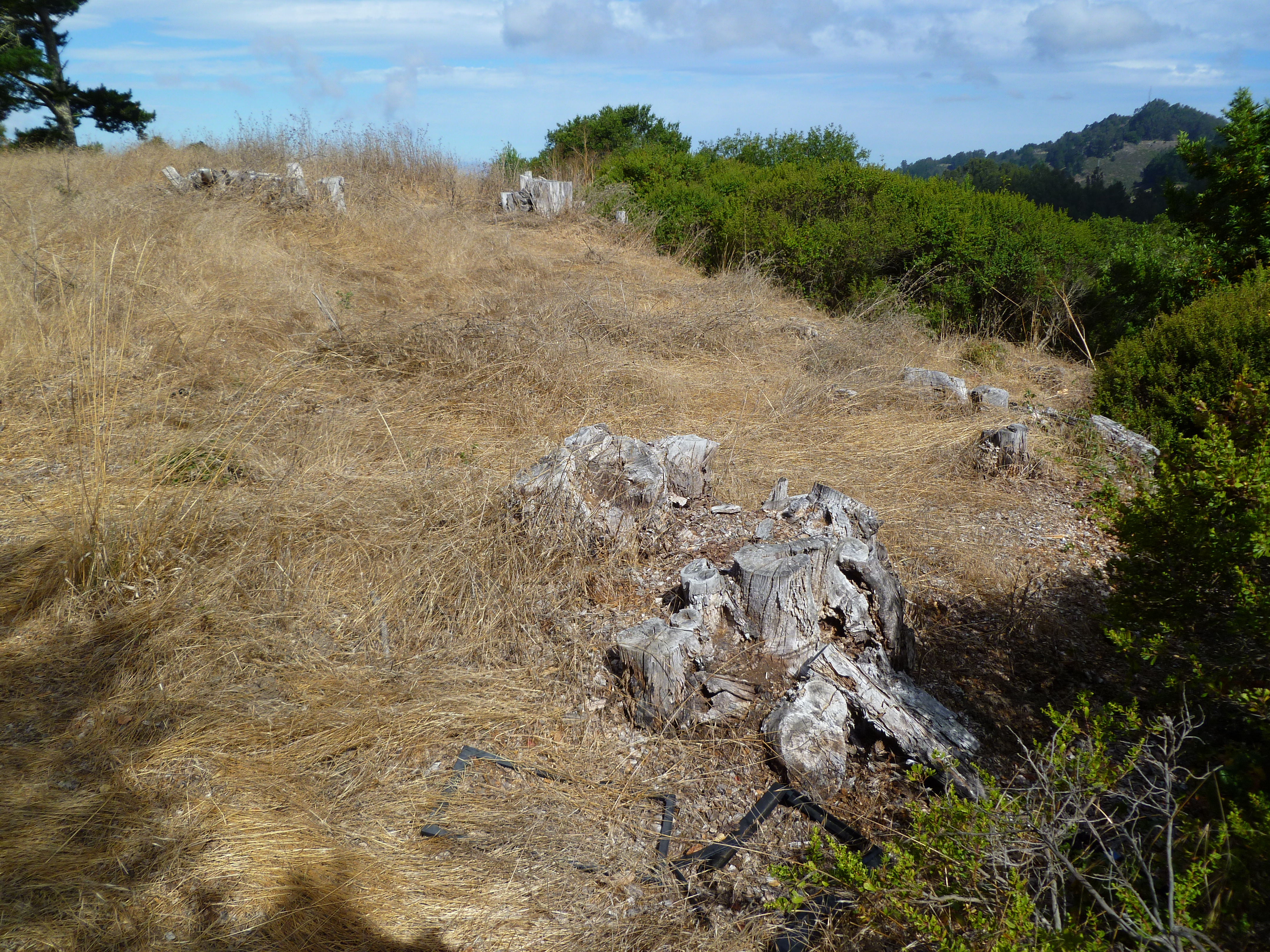
A completed project 10 years later. Southbound Grizzly Peak Blvd.
EPA says, “We note that extensive use of herbicides is proposed”
Yes, indeed, this project will require thousands of gallons of herbicide and we are delighted that the EPA has noticed this as well as the serious deficiencies of information in the DEIS regarding herbicide use:
There are many different formulations of Roundup with different properties, yet the DEIS does not identify which formulation of Roundup will be used. Therefore we cannot evaluate its toxicity.
The DEIS does not clearly state which herbicide products will be used for what purpose and in what locations.
The DEIS does not clearly state the method of application of herbicides.
The DEIS does not acknowledge that both triclopyr and imazapyr “can migrate through the soil” which will damage the native trees and vegetation this project claims to promote.
The DEIS evaluates the impact of herbicides only on endangered species which may or may not be the most sensitive species to herbicides. The final EIS must evaluate the impact of herbicides on the most sensitive species of animals, whether or not they are endangered.
The EPA is equally concerned about the impact of herbicides on human health and safety. It therefore notes the following deficiencies in the DEIS in that regard:
Reports of toxicity of herbicides in the DEIS are incomplete and inaccurate.
The DEIS does not acknowledge the “possibility of people and or animals entering the treated areas and coming in contact with herbicides already applied.” The Final EIS (FEIS) should therefore “clarify that there is potential for human exposure even if the chemicals do not move from the application site.” Further, “The FEIS should include a mitigation measure to remove fruiting or other edible vegetation.”
The EPA also noted many of the troubling inaccuracies andcontradictions in the DEIS that were also a concern to us:
The DEIS claims as “mitigation” the requirements on the labels of the herbicide products that will be used. These are mandatory requirements for legal use of the products, not voluntary measures that can be described as “mitigation.”
Likewise, the DEIS claims that requiring applicators of herbicides to wear protective clothing is a “Best Management Practice.” Wearing protective clothing is required for legal application of herbicides, not a voluntary measure.
Several contradictory statements are made in the DEIS regarding maximum wind speeds beyond which herbicides should not be applied.
The DEIS claims that the “Lowest Observed Adverse Effect Levels” of herbicides can be estimated from an experimentally derived “No-observed Adverse Effect Level” without providing any supporting reference. The EPA asks, basically, where does that claim come from?
The EPA points out inconsistent and incorrect use of the phrase “Certified Pesticide Applicator.” That may seem a small quibble, but it means that we have no idea what the qualifications will be of the people who will apply herbicides.
The DEIS announces that a specific adjuvant or surfactant will be used without telling us anything about the properties of that product. The adjuvant or surfactant is the inert ingredient in a formulated herbicide product that delivers the active ingredient (the poison) to the plant.
The DEIS uses an outdated EPA study about the effect of glyphosate on rabbits to report the toxicity of the product on rats. Whoops! Old data about the wrong animal! Picky, picky.
EPA asks, “Are the trees being removed for development?”
The EPA has apparently noticed that the DEIS mentions the long-term plans to build on some of the project areas of UC Berkeley. Therefore, it wants to know if that’s why the trees are being destroyed:
“Given that development is not included in the purpose and need for this Project, it is unclear whether the trees in these overlap areas would be removed for construction purposes regardless of whether they are removed as part of the proposed Project or not.”
Government is doing its job!
We are amongst the slim majority of voters who believe that government has an important job to do. We are often disappointed by government, but we aren’t inclined to kill it because it is sometimes incompetent. We are therefore very pleased to tell our readers that the EPA has apparently read the DEIS published by its sister/brother agency, The Federal Emergency Management Agency. Although they did not identify many of the important issues in the DEIS, they identified some of them. For that we are grateful as well as hopeful that the sponsors of these destructive projects will be forced to at least modify them, if not abandon them altogether. Thank you, EPA!
The public comment period for the FEMA project in the East Bay that proposes to destroy nearly half a million trees will close on Monday, June 17, 2013, at midnight. If you want to express your opinion of these projects, it’s time to do so. Detailed information about the projects and how to comment on them is available HERE.
The projects have drawn quite a bit of media coverage, starting with Beyond the Chronblog in mid-May and quickly picked up by many other internet sources of information. Most of those internet sources referred their readers to the Million Trees blog for more information. In May we had over 12,000 visitors to our articles about these projects.
Both the Oakland Tribune and the San Francisco Chronicle covered the story. The Tribune coverage was appallingly inaccurate and biased. The Chronicle coverage was more balanced than it usually is about native plant restoration projects, which the Chronicle usually supports without reservation.
The winner of the booby prize for balanced and fair reporting of the projects goes to the Sierra Club Yodelerwhich expressed its unqualified support for the projects at the same time it demonstrated total ignorance of the projects (or chose to misrepresent them):
Sierra Club said, “We want to avoid past mistakes, when agencies simply stripped off vegetation and then walked away, leaving the land clear for exotic and even more-flammable vegetation.” This is precisely what these projects plan to do…destroy everything then walk away without planting anything.
Sierra Club said, “The Park District is now implementing that program, and we are monitoring the progress.” If they are monitoring that program, why don’t they know what the Park District is doing?
Sierra Club said, “The preferred alternative involves application of the herbicide glyphosate (trade name Roundup) to the stumps to prevent re-sprouting. There is no practical way to eliminate eucalyptus infestations without herbicide, and glyphosate is relatively low in toxicity.” The Sierra Club is simply wrong. These projects will use Garlon (with active ingredient triclopyr) and/or Stalker (with active ingredient imazapyr)—not glyphosate (Roundup)–to prevent the trees from resprouting. Both products are rated by the EPA as more toxic, more persistent, and more mobile in the soil than glyphosate. Glyphosate (Roundup) will be foliar sprayed on non-native vegetation. Recent studies report that glyphosate (Roundup) is not a benign pesticide.
There are some scathing comments on the Yodeler article from people who know enough about the project plans to inform the Club that they have run off the rails…into the weeds!! The Club seems not to have noticed this attempt to set them straight. When someone called them weeks later to ask about the projects, they repeated the same misinformation to the caller.
(Update: One of our readers informed the Sierra Club of the inaccuracy of its Yodeler report about the FEMA projects in the East Bay (see comment below). We are pleased to report that the Sierra Club has revised its Yodeler report on June 19, 2013. It now acknowledges that native plants will not be planted by these projects. Consistent with the Draft Environmental Impact Statement for these projects, the Yodeler now claims that native plants will be “recruited” into the areas in which non-native plants and trees will be destroyed.
We think that is an unlikely outcome of these projects and FEMA’s environmental consultant agrees with us about that (explained here). However, at least the Yodeler article is now consistent with the written plans for the project.
The Yodeler also acknowledges the use of Garlon to kill the roots of the trees that will be destroyed.
Thanks to our readers for alerting the Sierra Club to the inaccuracy of their description of this project. We are sorry that the Sierra Club continues to support the project now that they have a better understanding of the written plans. 6/19/13)
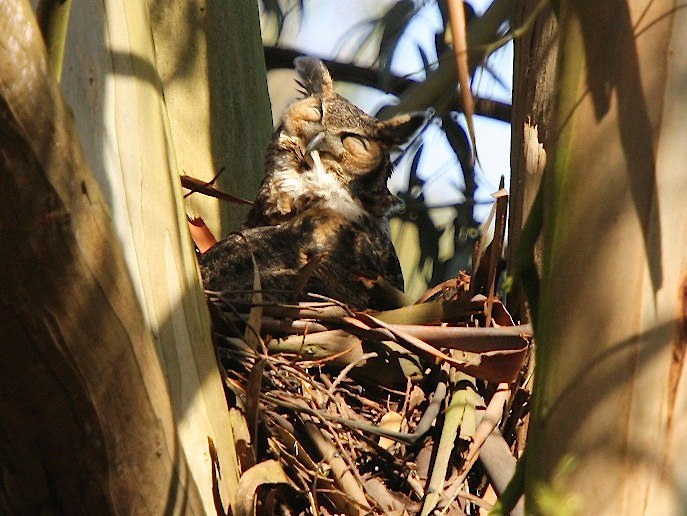
Owl nesting in eucalyptus, courtesy urbanwildness.com
On the positive side of the ledger, we commend the East Bay Expressfor its article about these projects. The author deserves credit for actually reading about the projects before she wrote her report!!! She read the letter from FEMA’s environmental consultant which we reported to our readers here. In a nutshell, the consultant said that UC Berkeley’s project could increase fire hazards by leaving a 2-foot wood chip mulch on the ground and that conversion to a native landscape was an improbable outcome of the project since nothing will be planted.
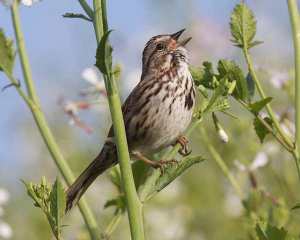
Song Sparrow in non-native wild radish
Our personal favorite for coverage of this project is Nathan J. Winograd’s article, “Biological Xenophobia: The Environmental Movement’s War on Nature,” which was published by the Huffington Post. Mr. Winograd is highly qualified to express his opinion of these projects. He has devoted his personal and professional life to the welfare of animals. He is best known for his advocacy for “no-kill” shelters for our animals. He was the lawyer for the SPCA in San Francisco when the GGNRA started to destroy non-native trees and fence the public out of their properties to protect their fragile native plant museums. So, he has been a long-time observer of the destructive and restrictive consequences of native plant projects. He was prompted to write this article by this latest round of destruction, that is, the FEMA projects in the East Bay.
Here are a few choice phrases from Mr. Winograd’s excellent article:
“Invasion biologists believe that certain plants and animals should be valued more than others if they were at a particular location ‘first.” When the species that were there ‘first’ are in the same habitat with a species that came later, they assert that the latter should be eradicated.”
“And the nativist movement is getting worse and increasingly violent, both in rhetoric (fish they don’t value are called ‘missiles with fins’) and in deeds. At a time of climate change, in a country that needs more trees, not less, nativists in the San Francisco Bay Area are proposing the clear cutting of upwards of half a million trees on San Francisco’s Mount Sutro and in the Oakland and Berkeley hills as part of their ongoing war against the Eucalyptus. After the trees are clear-cut thousands of gallons of toxic herbicides, will be spread throughout wildlife corridors in order to prevent resprouting.”
“An authentic environmentalism would not advocate that humans seek out and destroy living things for simply obeying the dictates of the natural world, such as migration and natural selection. It would not condone the killing of those plants and animals who find themselves in parts of the world where, for whatever arbitrary reason — be they economic, commercial or aesthetic — some humans do not want them to be. An authentic environmentalism would not exacerbate suffering, call for killing and seek the destruction of natural places.”
“Indeed, “invasion biology” is a faux environmentalism, used to disguise the ugly truth about what is really motivating its adherents: an intolerance of the foreign that we have rejected in our treatment of one another, a biological xenophobia that seeks to scapegoat plants and animals for the environmental destruction caused by one species and one species alone: humans.”
There are nearly 500 comments on Mr. Winograd’s article and they are as interesting as the article itself. They are a microcosm of this debate between nativists and those with a more cosmopolitan view of nature. We aren’t disinterested observers, so our opinion of the comments of nativists may not be entirely objective. However, we find many of their comments condescending and uninformed, a contradictory mix of sentiments.
We thank our readers for informing themselves about the FEMA projects and we hope that you now have the information you need to write your public comment by the deadline, June 17, 2013. Here is where you can send your comment:
These public lands belong to you and the money that will be used to implement these projects is your tax dollars. So, please tell the people who work for you what you think of these projects.
This is a revision of an article that was published on May 5, 2013. In our haste to inform our readers of these projects during the public comment period, we published before we had read the entire Environmental Impact Study. We are forced to revise our estimates based on further reading of the document. We apologize for the confusion and thank you for your patience.
On May 29, 2013, we found an error in the number of trees that will be removed at Frowning Ridge. We show our corrections so as not to mislead our readers.Again, our apologies.
*******************************
The Federal Emergency Management Agency (FEMA) has been considering grant applications for “fire hazard mitigation” in the East Bay since 2005, when the first of these applications was submitted. After years of debate about whether or not the projects achieve the stated purpose and at what cost to the taxpayers and the environment, FEMA finally agreed to resolve the controversial issues by mandating an environmental impact review, which began in 2010. Although FEMA paid for the environmental review, the grant applicants conducted it and it represents their opinions of their projects.
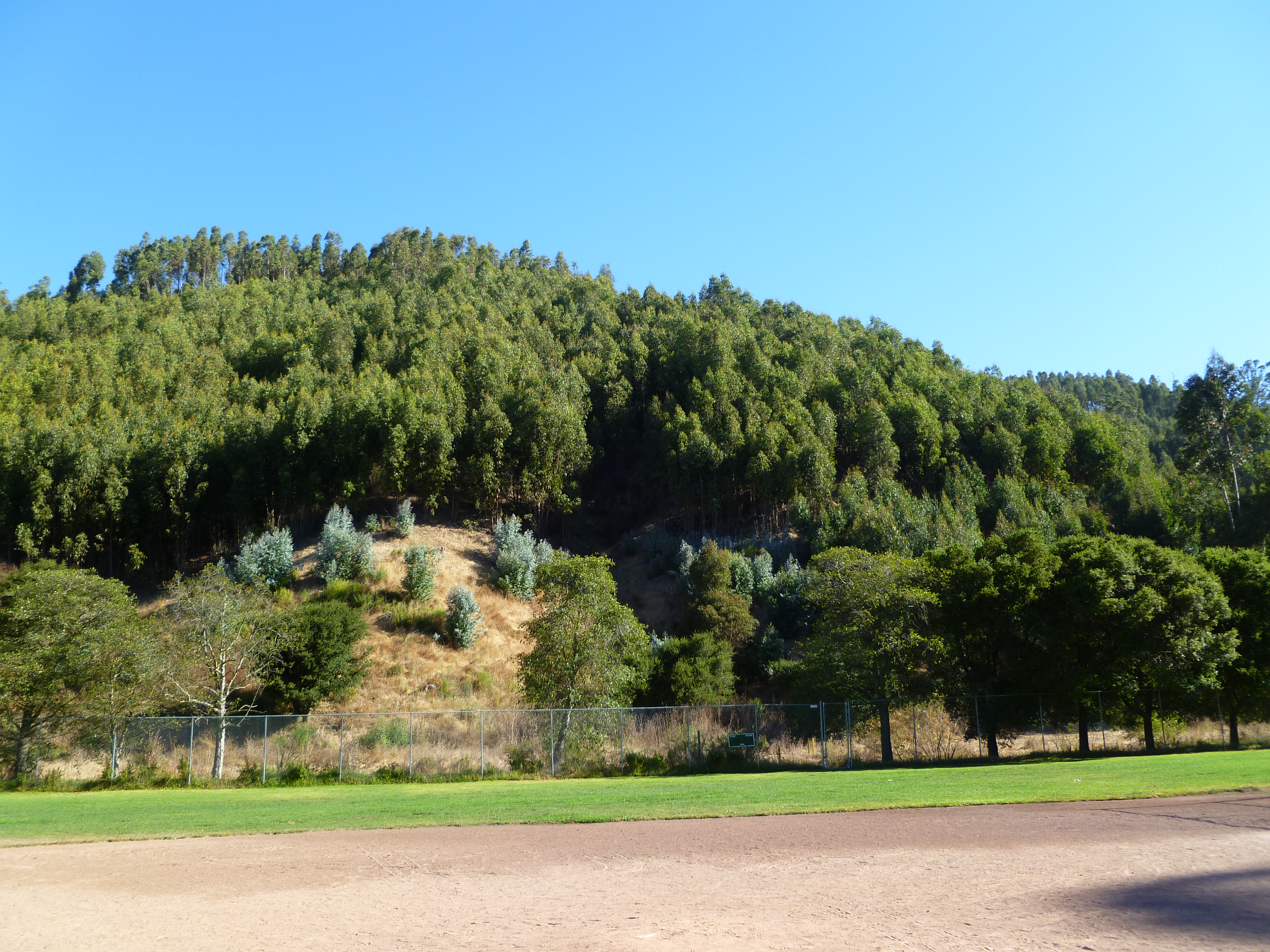
This eucalyptus forest at the North Oakland Sports Facility will be entirely destroyed.
These are the projects for which the Million Trees blog was created and for which it was named. Our opinion of these projects is unchanged by the environmental impact review. These projects will not achieve their stated objectives. Instead they will damage the environment and endanger the public.
The Draft Environmental Impact Statement (DEIS) for these projects was published by FEMA on April 25, 2013. It is available here. This is a brief description of the projects, our initial assessment of the DEIS, and information about how you can participate in the decision-making process which will ultimately determine the fate of these projects.
Description of the projects in the East Bay
Three different owners of public land have applied for these grants: University of California at Berkeley (UCB), City of Oakland, and East Bay Regional Park District (EBRPD). The projects of UCB and Oakland are similar and they are different from the projects of EBRPD, so we will describe them separately. These are the locations of the projects of UCB and Oakland, their acreage, and the estimated number of trees that will be removed by these projects:
Project Area
Project Acreage
Estimated Tree Removals*
UCB
Strawberry Canyon
56.3
22,000
Claremont
42.8
Frowning Ridge (in Oakland)
185.2
38,000 32,000
Sub-Total
284.3
60,000 54,000
Oakland
North Hills Skyline
68.3
Caldecott Tunnel
53.6
Sub-Total
121.9
25,735 23,161
TOTAL
406.2
85,735 77,161
*UCB estimated tree removals are provided by the DEIS; Oakland estimated tree removals are extrapolated assuming the same number of trees per acre (60,000 54,000 ÷ 284.3 = 211 190 trees per acre X 121.9 acres = 25,735 23,161 trees removed by the projects of the City of Oakland)
UCB and Oakland plan to remove all non-native trees (eucalyptus, Monterey pine, acacia, etc.) and vegetation from the project area. All non-native trees up to approximately 24 inches in diameter at breast height (DBH) will be cut into wood chips and scattered on the ground of the project area. They estimate that 20% of the project area will be covered with wood chips to a depth of 24 inches. The DEIS estimates that the wood chips will take from 5 to 10 years to decompose. Larger trees will be cut up and scattered on the site.
Although UCB and Oakland do not intend to plant the project areas (unless erosion subsequent to tree removals demands seeding of native grasses and herbaceous plants), they predict that the project area will eventually become native grassland, scrub, and forest of coast live oak, California bay laurel, big-leaf maple, California buckeye, and California hazelnut. They predict that this conversion from non-native to native vegetation will be accomplished by “recruitment” from areas where these plants exist, into the areas where non-native plants and trees will be removed.
The stumps of eucalypts and acacia will be sprayed with an herbicide (Garlon with the active ingredient triclopyr) soon after the trees are cut down to prevent resprouting. An estimated 1 – 2 ounces of formulated herbicide will be required for each stump. Based on an experiment conducted by East Bay Regional Park District, an estimated 5% of the trees will require retreatment of subsequent resprouts. They are therefore predicting that between 703 633 and 1,407 1,266 gallons of herbicide will be required to prevent resprouting if only 5% of the stumps require retreatment as they claim. Monterey pines will not require herbicide treatment which reduces this estimate proportionately, although we are not provided with enough information to make this calculation. Herbicide (Roundup with active ingredient glyphosate) will also be sprayed to control non-native vegetation, but no estimates of quantities required for that purpose are provided by the DEIS.
The fire hazard mitigation projects of the East Bay Regional Park District were described in detail in its “Wildfire Hazard Reduction and Resource Management Plan” of 2009. EBRPD has applied for FEMA funding for about one-third of the “recommended treatment areas” in that plan. The FEMA DEIS considers all recommended treatment areas on EBRPD property, including those for which FEMA funding has not been requested. The recommended treatment areas for which FEMA funding has not been requested are called “Connected Action Acres.” The “Connected Action Acres” have undergone environmental review under California law (CEQA) and are therefore approved for implementation, which has already begun.
Project Area
Project Acres
Connected Action Acres
Total Acres
Estimated Tree Removals*
EBRPD
Sobrante Ridge
4.1
0
Wildcat Canyon
65.6
46.6
Tilden Park
132
194.2
Claremont Canyon
35.3
130.4
Sibley Volcanic
47.5
118.4
Huckleberry
17.8
.3
Redwood Park
58.4
92.8
Leona Canyon
4.6
0
Anthony Chabot
200
478.2
Lake Chabot
4.8
0
Miller-Knox
22.2
0
TOTAL
592.3
1,060.7
1,653
400,602 409,176
*Estimated Tree Removals: Neither the DEIS nor EBRPD’s “Wildfire Plan” provides an estimate of the number of trees they plan to destroy. Furthermore their plans for tree removals are complex and variable. All non-native trees (eucalypts, Monterey pines, acacia) will be removed in some recommended treatment areas, but in most they will be thinned to spacing of 25 to 30 feet. The final Environmental Impact Report for the “Wildfire Plan” provides an estimate of the existing tree density of existing eucalypts on EBRPD property (page 392). Acres of eucalypts in the entire project area are provided by the DEIS (page 4.2-6). Our estimate of tree removals is based on those figures (1).
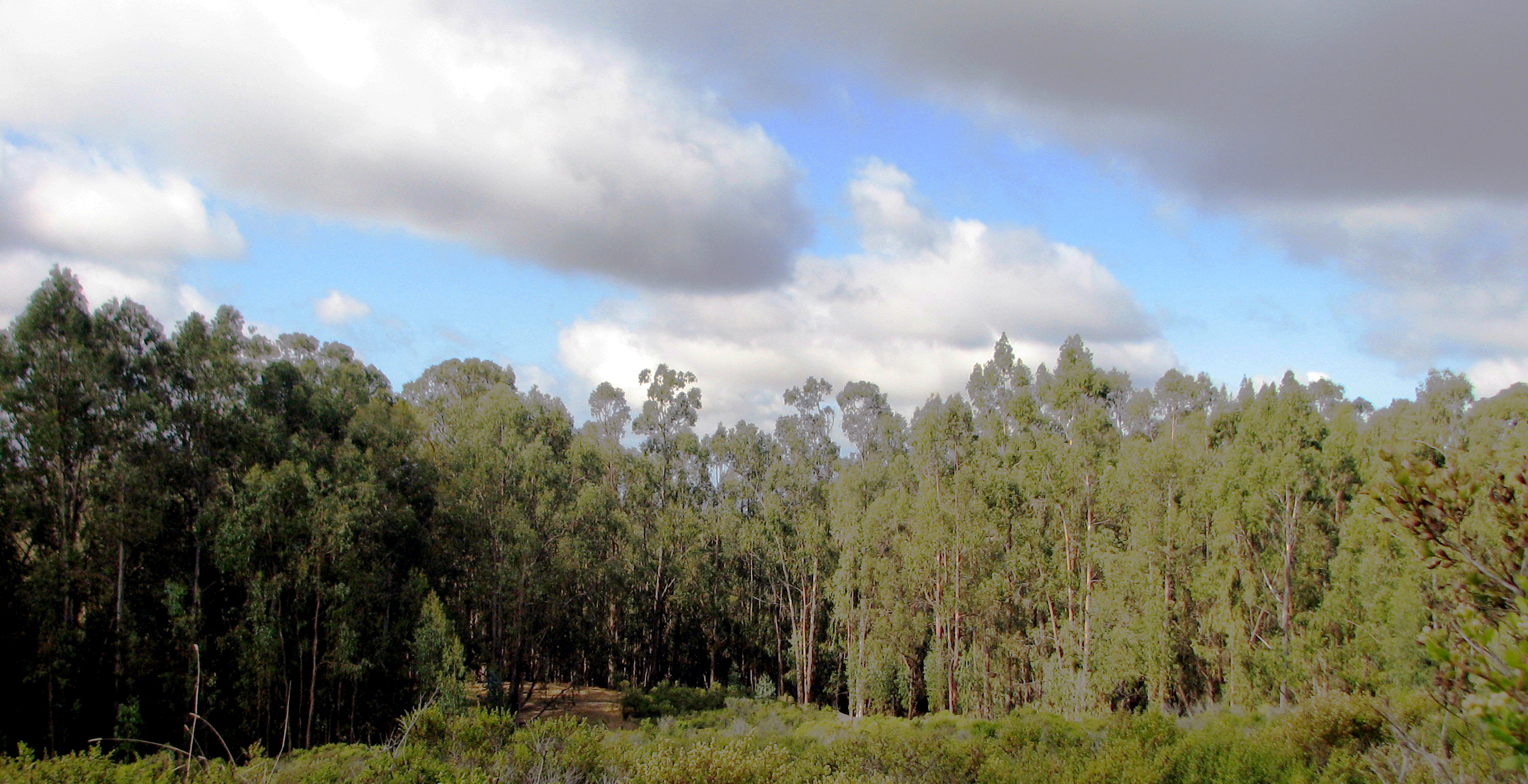
This eucalyptus forest at Chabot Park will be thinned to about 60 trees per acre.
This estimate does not include the Monterey pines and acacia that will be removed by EBRPD, for which inadequate information is available to provide an estimate.
EBPRD plans to cut the trees into wood chips which will be scattered to cover 20% of the project to maximum depth of 4-6 inches. The remainder of the wood will be burned in piles. Other non-native vegetation will be destroyed with herbicides and/or prescribed burns. These prescribed burns will not be funded by FEMA.
EBRPD’s plans to convert the project area to native vegetation are similar to the plans of both UCB and Oakland. EBRPD also does not plan to plant project areas with native vegetation. EBRPD also plans to use herbicides on the stumps of eucalypts and acacia which we estimate will require a mind-boggling 3,286 3,356 to 6,572 6,713 gallons of herbicide.
Million Trees’ assessment of these projects
We have surely exhausted your patience with the mind-numbing detail needed to describe these projects accurately. Therefore, we will provide only a brief outline of our assessment of these projects:
* These projects are more likely to increase the risk of wildfires than to reduce that risk.
By distributing tons of dead wood onto bare ground
By eliminating shade and fog drip which moistens the forest floor, making ignition more likely
By destroying the windbreak that is a barrier to wind driven fires typical of wildfires in California
By expanding the oak-bay woodland being killed by Sudden Oak Death, thereby adding more dead wood
* These projects will damage the environment by releasing hundreds of thousands of tons of carbon dioxide into the atmosphere from the destroyed trees, thereby contributing to climate change.
* These projects will endanger the public by dousing our public lands with thousands of gallons of toxic herbicides.
* Erosion is likely on steep slopes when the trees are destroyed and their roots are killed with herbicides.
* Non-native vegetation such as broom, thistle, and hemlock are more likely occupants of the unshaded, bared ground than native vegetation which will not be planted by these projects.
* Prescribed burns will pollute the air and contribute to the risk of wildfire, endangering lives and property.
* These projects are an inappropriate use of the limited resources of the Federal Emergency Management Agency which are for the expressed purpose of restoring communities destroyed by disasters such as floods and other catastrophic events and preparing communities for anticipated catastrophic events. Most of the proposed projects in the East Bay are miles away from any residences.
Update: Please visit THIS post for the current status of these projects. In summary: East Bay Regional Park District is implementing its original plans. City of Oakland is developing a new “Vegetation Management Plan.” UC Berkeley is suing to re-instate its FEMA grant funding so that it can implement its original plans.
How to participate in this decision-making process
The Hills Conservation Network has created a petition to oppose these projects. It is available HERE.
You can also participate in this decision. FEMA will host three public meetings in May 2013:
Tuesday, May 14, 2013, 2:00 p.m. – 4:00 p.m., Richard C. Trudeau Center, 11500 Skyline Boulevard Oakland, CA 94619
Tuesday, May 14, 2013, 6:00 p.m. – 8:00 p.m., Richard C. Trudeau Center, 11500 Skyline Boulevard Oakland, CA 94619
Saturday, May 18, 2013, 10:00 a.m. – 12:00 p.m., Claremont Middle School, 5750 College Avenue Oakland, CA 94618
Comments on this document must be submitted by June 17, 2013. You may submit written comments in several ways:
These public lands belong to you and the money that will be used to implement these projects is your tax dollars. So, please tell the people who work for you what you think of these projects.
*********************************
(1) Calculation of estimated tree removals by East Bay Regional Park District, Update: We understand the weakness of this estimate. Unfortunately, the DEIS does not provide sufficient information to improve its accuracy. Again, our apologies.
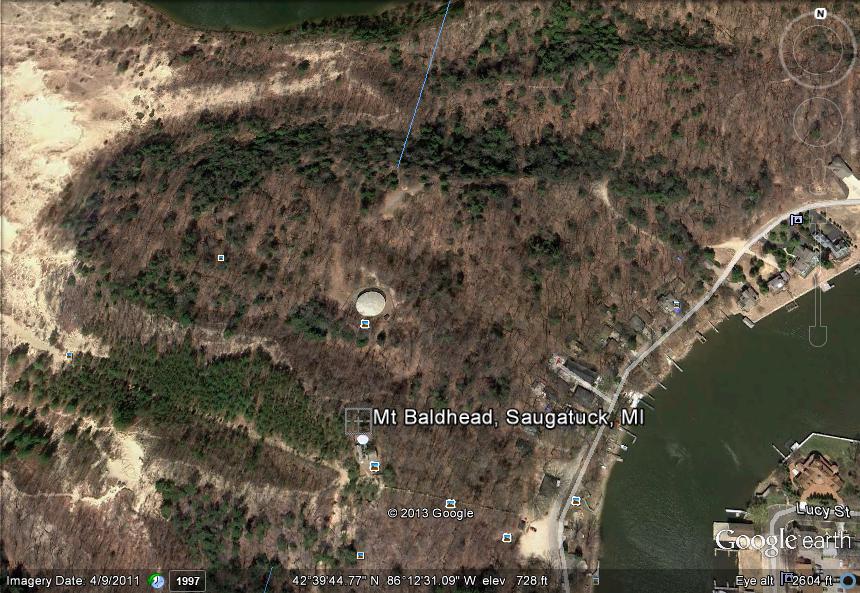
One of our readers sent us a link to an article about a “restoration” project gone awry in his neighborhood. Mount Baldhead is a city-owned park in Saugatuck, Michigan. US Fish & Wildlife funded a $700,000 federal grant to eradicate non-native plants on Mount Baldhead and several other municipal parks in the area. The grant was used to hire “certified applicators” to spray the non-native plants with imazapyr. Mount Baldhead was sprayed in summer 2010 and again in fall 2011. In spring 2012, the native oaks and maples, under which the non-native plants had grown and were sprayed, began to show signs of damage. Now a significant portion of the native forest is leafless and barren.
Mount Baldhead, Saugatuck, Michigan. A clearer view of the damage is available in the article to which we provide a link above. We were denied permission to publish that picture.
The soil on Mount Baldhead is being studied to determine how far the pesticide has seeped into areas where it was not sprayed. This information may predict the extent of the eventual damage to the native forest. The ultimate fate of the trees that have been damaged is not known. There is no antidote to the pesticide. Will the trees survive? We don’t know yet.
What does it mean to be a “certified applicator” of pesticides?
This story is of interest to us because imazapyr is being widely used in the San Francisco Bay Area and its use has increased substantially in the past year.
Because imazapyr is being used heavily, we have read the manufacturer’s label for the formulated products (Habitat and Polaris) and the federally mandated Material Safety Data Sheet.
Therefore, we know that imazapyr should not be sprayed under trees you do not want to kill. This is a product that is mobile in the soil. It is capable of traveling from the roots of the plant on which it is sprayed into the roots of adjacent plants on which it has not been sprayed, killing or damaging plants that were not the intended targets of the spraying.
These incidents make us ask what, if anything, it means to be a “certified applicator” of pesticides. Does the certification require the applicator to read the manufacturer’s label? If so, does the certification require the applicator to actually follow the directions on the manufacturer’s label? Clearly, this isn’t happening and there don’t seem to be any consequences for the “certified applicator” who kills plants and trees that he/she wasn’t hired to destroy. So, we conclude that such certification is meaningless.
The Million Trees mantra
Native plant advocates believe their projects benefit the environment. We do not see the benefit they claim. This is what we see:
• Increasing use of toxic pesticides is required to kill non-native vegetation. These pesticides are inherently hazardous and their incompetent use makes them even more hazardous.
• The wildlife that lives in our open spaces is being poisoned by these pesticides and they are losing their homes and their sources of food.
• The results of these projects do not justify these dangerous practices. The projects often look more dead than alive.