The Global War on Non-Native Trees

“In some cases, removal of urban trees because they are non-native may represent an ‘over-shoot’ where the removal of non-natives becomes an end unto itself… the non-native trees being removed are not necessarily highly invasive, and removal is more driven by a desire for native species rather than any real or perceived problems caused by the non-native species.”

An international team of academic scientists studied the many conflicts around the world between those who find value in introduced trees and those who demand their destruction. (1) Team members were from Australia, France, New Zealand, and South Africa.  Professor Marcel Rejmanek at UC Davis was the only American on the team.

Professor Rejmanek is well known to us as the author of the chapter about eucalyptus in Daniel Simberloff’s encyclopedic tome about biological “invasions.”  Rejmanek said, “…eucalypts are markedly less invasive than many other widely cultivated trees and shrubs…they have been orders of magnitude less successful as invaders than pines and several other widely planted trees…Where eucalypts have invaded, they have very seldom spread considerable distances from planting sites, and their regeneration is frequently sporadic.  He noted that eucalyptus is useful to bees and hummingbirds and I add here that it blooms throughout winter months when little else is blooming in California.  He said,  “Conclusions about positive or negative environmental and economic impacts of eucalypts are often anecdotal, highly controversial and context dependent.”    Professor Rejmanek’s assessment was instrumental in my effort to convince the California Invasive Plant Council to remove blue gum eucalyptus from its list of invasive species.  Cal-IPC downgraded its assessment of invasiveness of blue gum eucalyptus from “medium” to “limited” in response to my request. 

Professor Rejmanek is also the author of the most recent report on plant extinctions in California, published in 2017.  At that time there were 13 plant species and 17 sub-species native to California known to be globally extinct and another 30 species and sub-species extirpated in California but still found in other states.  Over half the globally extinct taxa were reported as extinct over 100 years ago.  Although grassland in California had been converted to Mediterranean annual grasses by grazing domesticated animals nearly 100 years before then, most of the plants now designated as “invasive” in California were not widespread over 100 years ago.  Only one extinction mentions “invasive species” as one of the factors in its disappearance.  Rejmanek speculates that livestock grazing is the probable cause.  He said, “Indeed, one needs quite a bit of imagination to predict that any native plant species may be driven to extinction by invasive plants per se.”

This recap of Rejmanek’s expertise about so-called “invasive” trees and plants establishes his credentials as a reliable witness as the co-author of “Conflicting values:  ecosystem services and invasive tree management,” which I will summarize for readers today.

Setting the stage for conflict

As Europeans colonized the new world in the 18th and 19th centuries, they often brought trees from home with them, motivated primarily by an aesthetic preference. When the colonial era came to an end, nationalism during the 19th century encouraged a new appreciation of indigenous flora.  When planting their own gardens and farms, America’s founding fathers had a strong preference for planting native trees.  While fighting the Revolutionary War, George Washington wrote to the caretakers of his farm at Mount Vernon instructing them to plant NO English trees, but rather to transplant trees from the surrounding forests.

Sources of conflict

By mid-20th century, this preference for indigenous trees escalated to the current belief that non-native trees are threatening indigenous ecosystems.  Conflict arises when there is a “failure to account for, assess, and balance trade-offs between the eco-system services or, at times, a failure to agree on the relative value of particular services.” (1) The study identifies the tree species that are the focus of such conflicts around the world and the ecosystem services those species provide:
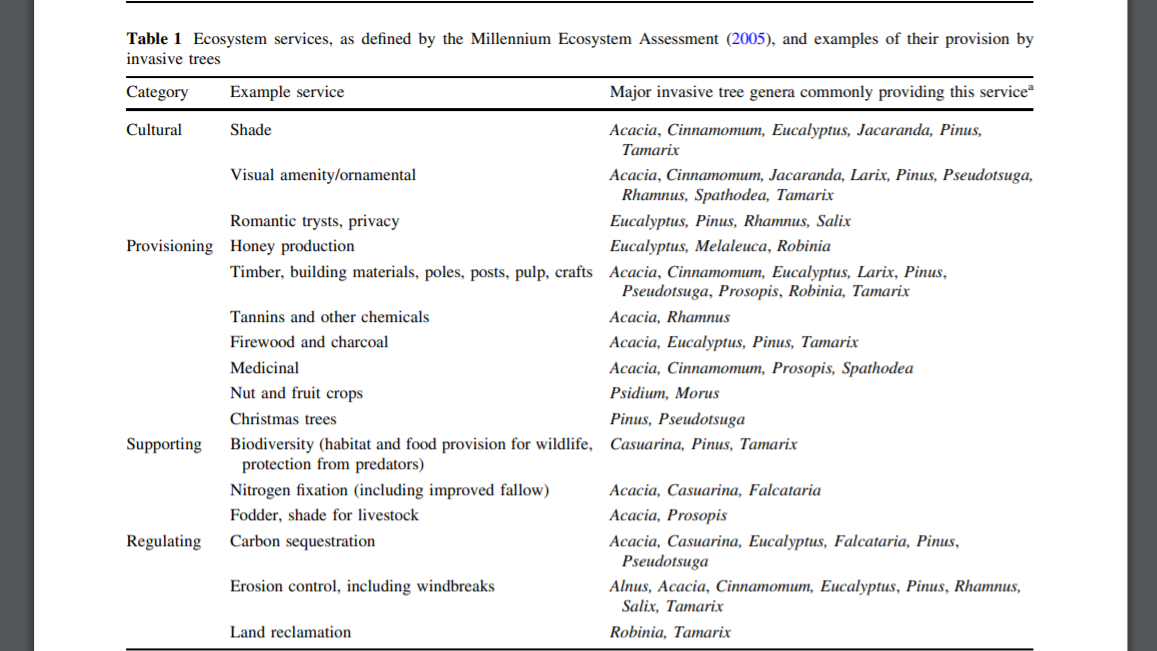
Conservation Sense and Nonsense has reported on many of these conflicts around the world:

  • The stated purpose of the destruction of forests in Chicago was the “restoration” of grassland that existed prior to the arrival of Europeans.  Conservation Sense and Nonsense described the conflict regarding that destruction in one of my first articles in 2011 because the issues were similar to those in the San Francisco Bay Area. The debate raged in Chicago for over 15 years, but the destruction of the forest was finally accomplished, despite opposition.  Likewise, in San Francisco after 20 years of conflict, the eradication of eucalyptus forests is being achieved.
  • In 2012, we republished an article by Christian Kull about the practical value of acacia trees to Vietnamese farmers and their opposition to the attempt to destroy them.
  •  We republished an article in 2014 about opposition to the destruction of willow trees in Australia that were planted to control erosion.  Willows are one of many examples of a tree that is considered valuable in North America where it is native and hated in Australia where it is not. The authors of the article described the arguments used to justify the project, ‘Sure, it makes a big mess and causes erosion, and nutrient release, and carbon emissions, and local temperature increases, and loss of habitat, but it’s necessary because we’re going to make Australia a place for natives-only again.’
  • Conservation Sense and Nonsense published a guest post by Matt Chew in 2017 about the eradication of tamarisk trees that were introduced for erosion control in southwestern US.  In that case, the survival of an endangered bird is threatened by this misguided attempt to eradicate tamarisk by introducing a non-native insect.
  • Conservation Sense and Nonsense published a guest post in 2015 by a South African who objected to the destruction of jacaranda trees.  In that case, the beauty of these iconic trees was the primary objection to their destruction.
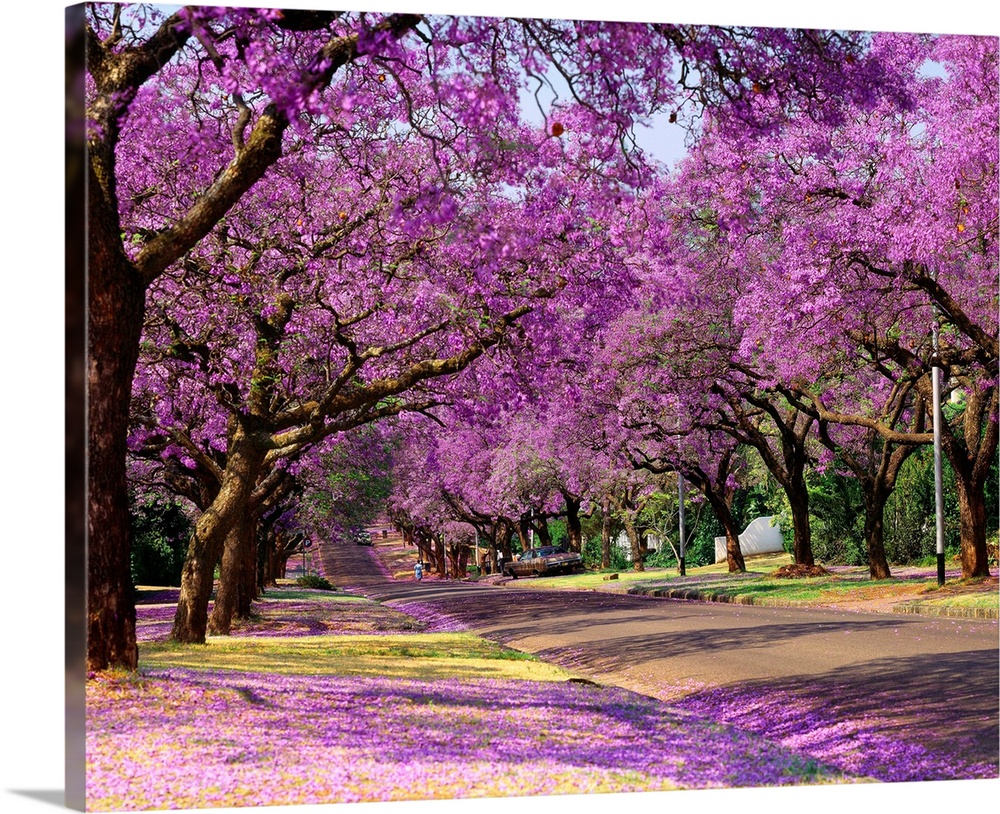
Jacaranda trees in Pretoria, South Africa

Many similar conflicts around the world are described by the study, which categorizes the conflicts as focused in three areas:  urban and near-urban trees; trees that provide direct economic benefits; and invasive trees that are used by native species for habitat or food.  I will focus on conflicts in urban and suburban areas because they are close to home.

Where is conflict greatest?

The study searched for examples of such conflicts around the world and found that most were in developed countries where ecological knowledge has suggested that eradication is necessary and democracy is strong enough to enable dissent.  Such conflicts are well documented in urban areas where many non-native trees have been introduced. Based on my experience with many of these urban conflicts, I can agree with the authors of the study that they are “frequently vitriolic, as seen in letters to editors, public protests, websites, and blogs.” (1)

How NOT to reduce conflict

The authors of this study dismiss suggestions that “educating” those who object to eradication projects can reduce conflict.  Their assessment of why that approach intensifies conflict is consistent with my own reaction to being lectured about the claimed benefits of eradication projects:

“However, the concept of ‘education’ implies that opponents of tree removal are inherently ignorant or unaware and discounts the importance of their views and values.  Sceptics of environmental issues are frequently highly educated and scientifically literate, with conflict driven by fundamental values, not lack of knowledge.  Further, what one party in a conflict views as education can be viewed as propaganda by those with opposing priorities.” (1)

The authors suggest that the planning process for such projects must be a two-way dialogue that recognizes shared values, such as a strong commitment to conservation of the environment.  The authors describe some of my own reservations about eradication projects:

“In some cases, removal of urban trees because they are non-native may represent an ‘over-shoot’ where the removal of non-natives becomes an end unto itself…Objective evaluation of the ecological services affected may not result in the removal of non-native trees being justified.  Indeed, in some cases the non-native trees being removed are not necessarily highly invasive, and removal is more driven by a desire for native species rather than any real or perceived problems caused by the non-native species.” (1)

There is no doubt that the demand to destroy eucalyptus in California is a case in which removal has become an end in itself that is not justified.  These are some of the accusations used to justify the destruction of eucalyptus that have been disproven by academic scientists without getting eucalyptus off nativists’ hit list.
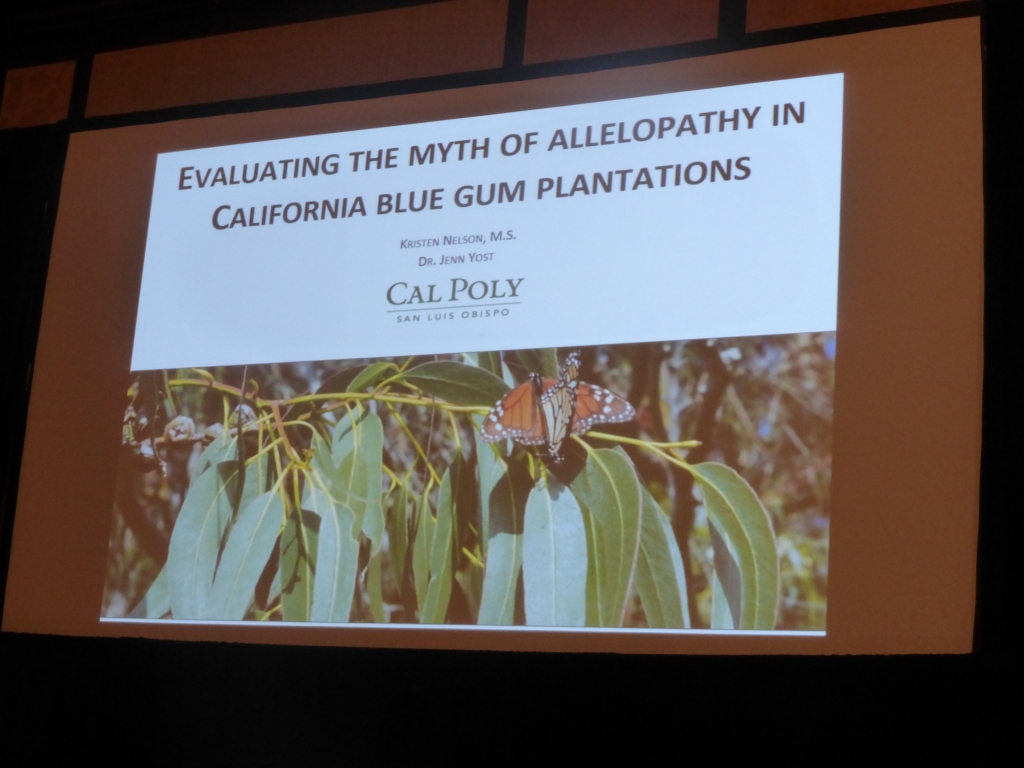
Source: Conference of California Native Plant Society, 2018

Pessimistic conclusion

The study concludes that we should expect plant invasions around the world to increase and that increased wealth and democracy will make conflicts about tree eradications more widespread.  The authors “suggest that conflict should be seen as a normal occurrence in invasive species removal…Avoiding conflict entirely may be impossible…”

I can’t disagree with the authors of this study about the poor prospects of resolving conflict regarding the destruction of non-native trees that are the heart of our urban forest in California.  However, I am grateful to the authors for their understanding of the issues and their respect for introduced trees as well as those who advocate for their preservation. They understand that lectures by those who demand that trees be destroyed despite the functions they perform are condescending and exacerbate conflict rather than resolving it. 

A Postscript

Jake Sigg has been the leader of the crusade to destroy eucalyptus forests in the San Francisco Bay Area for over 30 years.  He and I have debated this issue many times, without resolution.  In his newsletter of January 20th, Jake seems to acknowledge the futility of our debate as well as his motivation to create a native landscape. It seems he has reached the same conclusion as the authors of the international study of the inevitability of conflict about the destruction of non-native trees, although he concedes that he won’t quit trying…and neither will I. 

“For years I’ve been fighting tree huggers, who understandably don’t want to cut healthy trees down.  The blue gums are handsome brutes.  In my eye I see the rich diverse native biological communities that they displaced; those I fight with don’t see that and don’t value that.  So you can see the communication problem at the beginning.  The same consideration plagues many contentious issues in the world.

How do you explain this to them?  Mostly, you can’t; you do what you are able to do.  This is not an age for listening to fellow beings.  I find it hard to do.  David Brooks, a favorite, wrote a fraught opinion piece in today’s 
NYT.  He has just about thrown up his hands, as have I—except that I can’t—and neither can Brooks.”
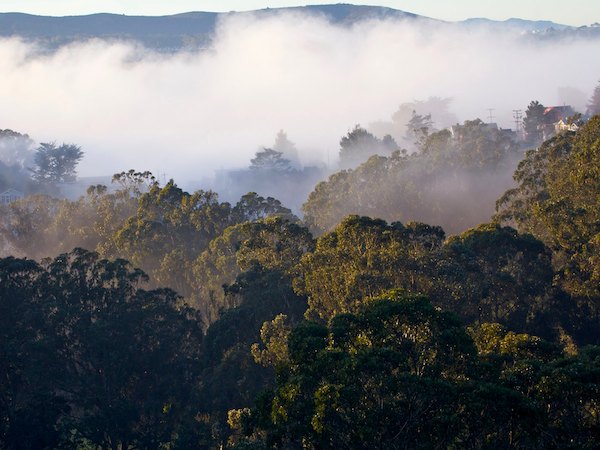
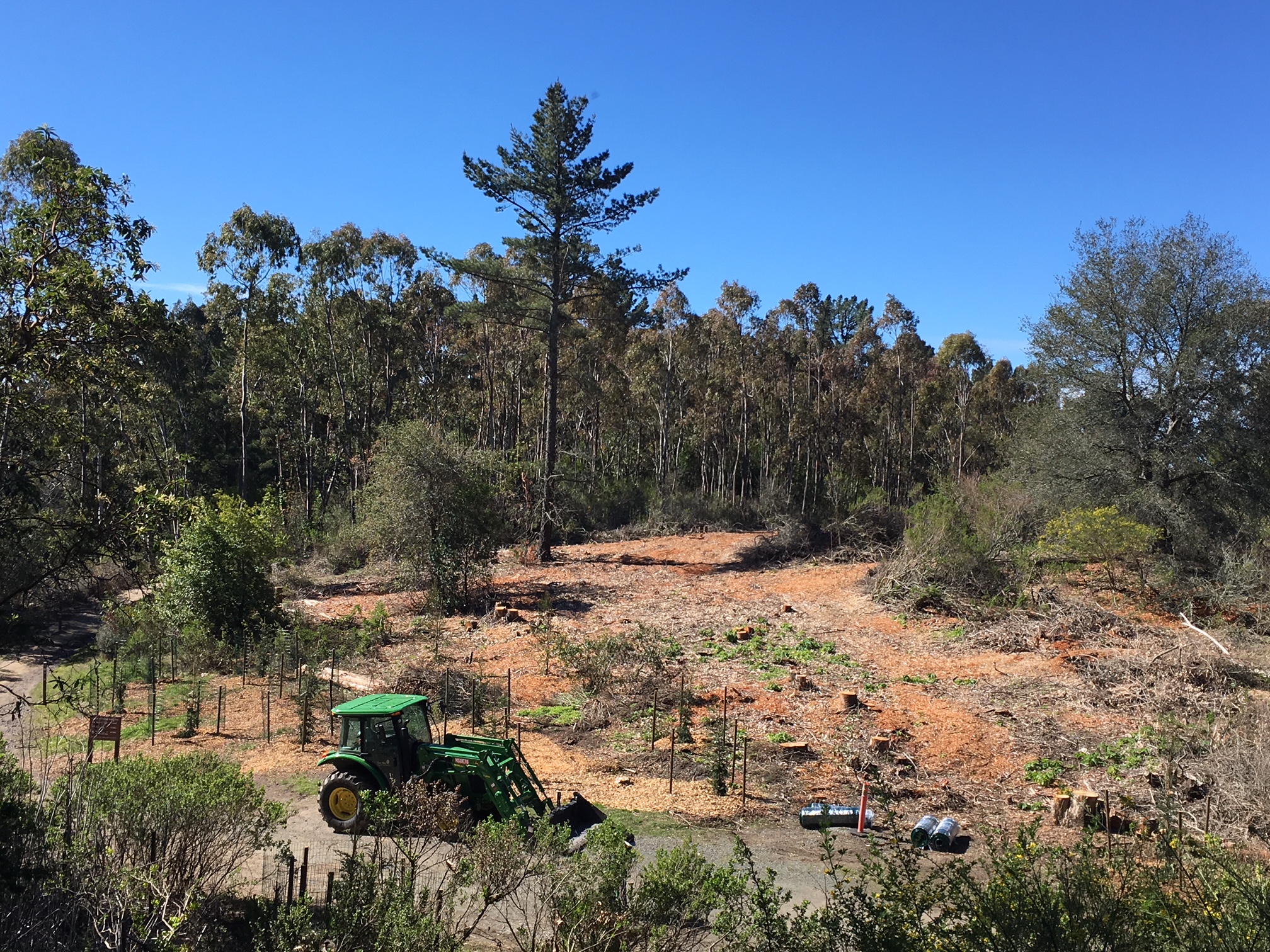
Eucalyptus canopy on east side of Glen Canyon Park, taken from Turquoise Way December 2012, before tree destruction escalated beyond riparian areas. Glen Cayon Park is one of 33 parks in San Francisco where most eucalyptus trees are being destroyed because they are not native. Courtesy San Francisco Forest Alliance

  1. Ian Dickie, et. al., “Conflicting values:  ecosystem services and invasive tree management,” Biological Invasions, 2014.

The need for diverse urban forest and the obstacles to achieve that goal

Matt Ritter is a professor of biology at Cal Poly San Luis Obispo and Director of Cal Poly Plant Conservatory.  He is the author of several books about California’s unique flora, including A Californian’s Guide to the Trees Among Us.  He is considered an expert on the horticulture, ecology and taxonomy of the Eucalyptus genus.

Click on picture to view Professor Ritter’s presentation

In October 2021, Professor Ritter gave a presentation to the California Urban Forests Council, entitled “Underutilized Species for the Future of Urban Wood and Urban Forestry.”   He began by explaining why it is important to identify new tree species for our urban forest.

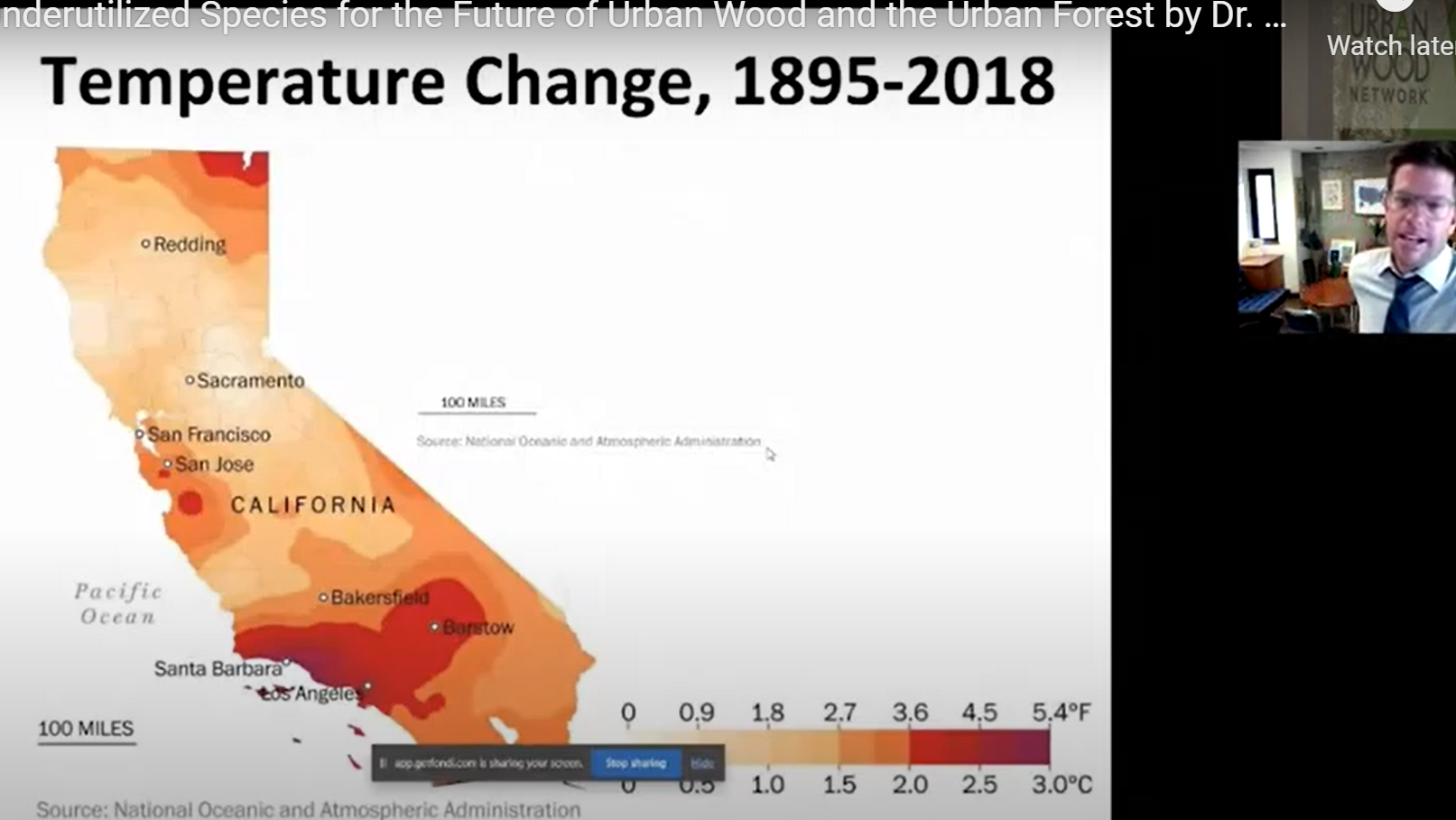
  • “Baja is moving to Oregon,” said Ritter to set the stage.  Within 50-80 years trees living in California now will no longer be adapted to the anticipated warmer, drier climate.  Trees killed by wildfire in California are not returning.  Forests are quickly converting to grassland and shrub.  As of 2018, California had lost 180 million trees to drought, disease, bark beetles, heat, and wildfire, which is nearly 5% of the total tree population in California.  Adding subsequent years to date, we have probably lost 7% of all of our trees.
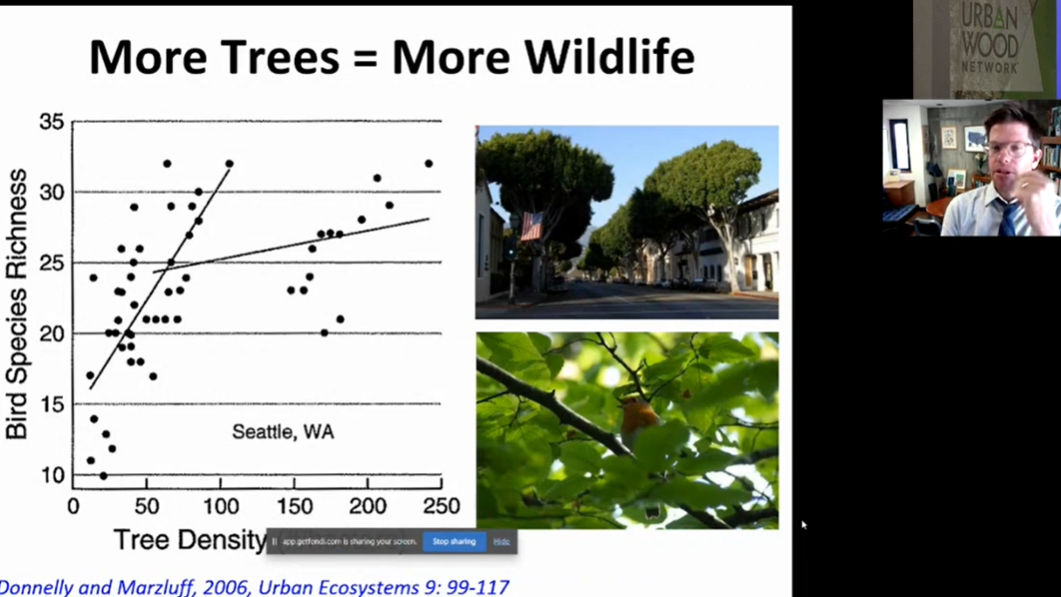
  • Trees in urban areas will help Californians cope with warmer conditions because they cool our cities and reduce energy consumption.  Fewer trees will mean a lower quality of life, for us and for birds.  The loss of our trees reduces carbon storage, which contributes to more climate change. 

Ritter then explained why we must diversify tree species in our urban forests.

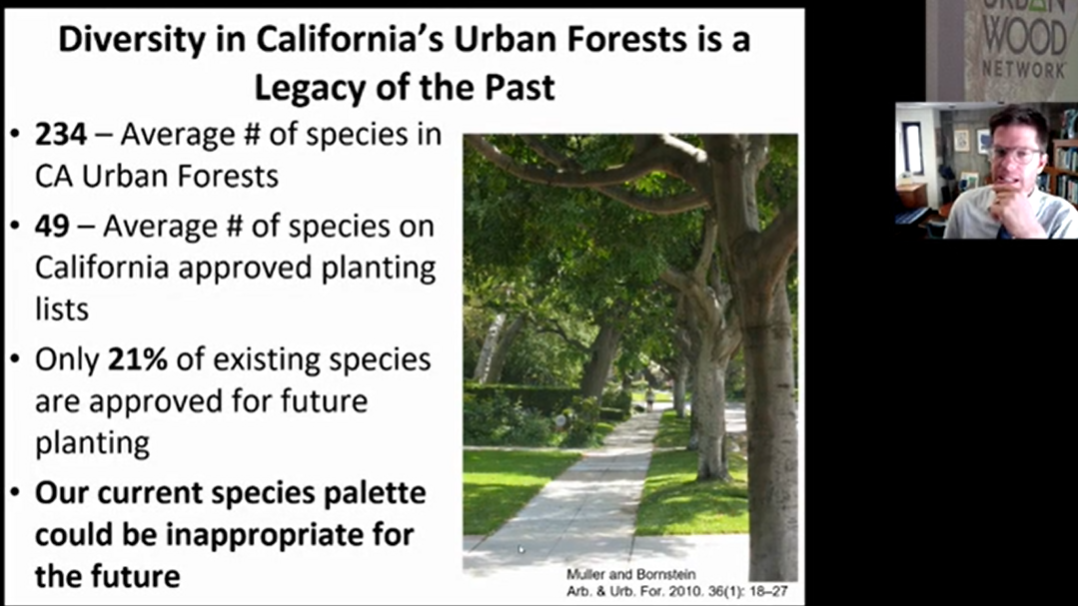
  • There are over 60,000 tree species in the world and only 7% of tree species are found in urban areas around the world.  In California our urban forests are even less diverse.  There are only 234 tree species on average in California’s urban forests.  The average number of approved tree species for planting in California’s municipalities is only 49 and few species on those approved lists are native to California.
  • Diversity of tree species ensures greater resiliency that enables our urban forests to survive changing conditions.
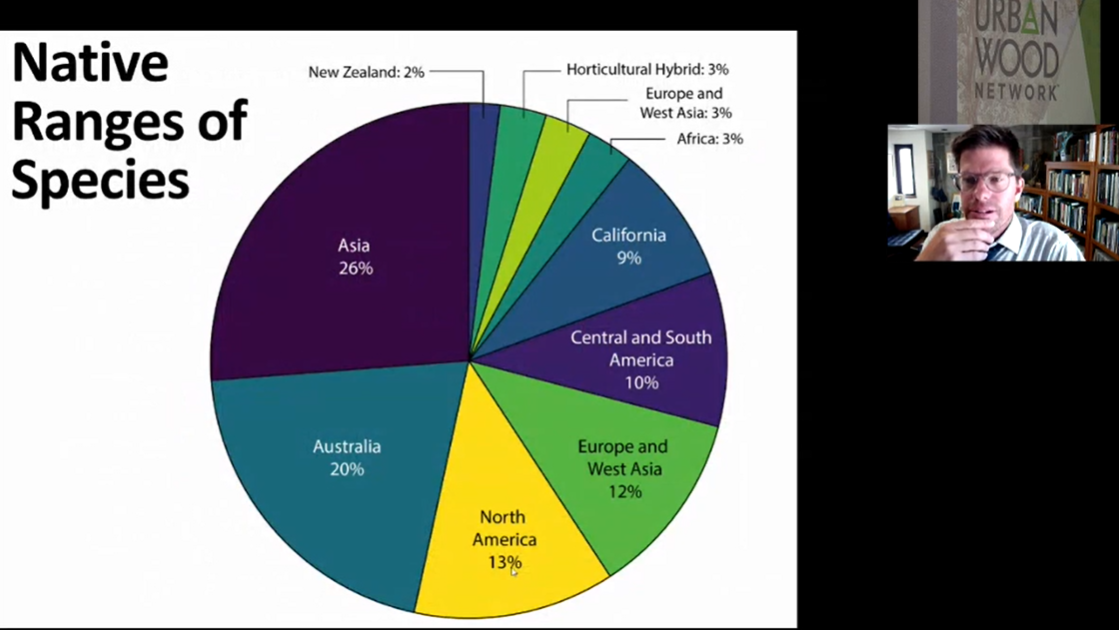
  • Only 9% of tree species in California’s urban forests are native. 
The native ranges of tree species in California’s urban forest.

An inventory of Oakland’s urban forest (street trees, medians, and landscaped parks only) was recently completed.  With 535 tree species, the diversity of Oakland’s urban forest is greater than average for California.  With 14% native trees, Oakland’s urban forest is more native than average. There are 59 species on Oakland’s list of approved trees, of which only 4 are native to Oakland.  The most significant finding of Oakland’s tree inventory is that our urban forest is only 64% “stocked,” meaning that of existing tree wells, only 64% are currently planted with trees.  When trees die in Oakland, they aren’t being replaced.  I don’t doubt there is a will to plant trees in Oakland.  I assume it is a question of means in a city with more pressing needs than resources.

Ritter and his colleagues at Cal Poly have created a website called SelecTree to help Californians choose the right tree for the right site and conditions.  There are 1,500 tree species described on SelecTree, using 60 characteristics, such as drought tolerance.  SelecTree rates blue gum eucalyptus “medium” for drought tolerance, the same rating as native coast live oak and bay laurel.  Ritter clarified that drought tolerance on SelecTree is a measure of how much water the tree species uses.  Claims that eucalyptus uses more water than native trees is bogus, like most bad raps about eucalyptus.  

Ritter recommended specific tree species, based on their drought and heat tolerance.  He said that when diversifying our urban forests “we have to think about Australia” because it is the hottest, driest, flattest, and oldest place on the planet, which is another way of saying that tree species in Australia have survived terrible conditions that are comparable to the challenging conditions in urban environments.

Ritter recommended oak species that are native to Texas; eucalyptus and closely related tree species; and several tree species in the legume family, especially acacia.  In each case he mentioned the suitability of tree species based partly on the quality of its wood.  Apparently, I’m not the only person in California who is disturbed by huge piles of wood chips wherever trees have been destroyed.  Ritter also thinks we should be thinking about how we can use wood when trees are destroyed, rather than building potential bonfires.  

Obstacles to diverse urban forests in California

When Professor Ritter took questions from the audience, we learned that the main obstacle to a diverse urban forest in California, adapted to our climate conditions, is the myopic focus of native plant advocates:

Question:  “Are we introducing new pathogens to our natives by importing new species?”

Answer:  There are many laws and rules that restrict the importation of plants to prevent that from happening.  We also import only the seeds of plants, not grown plants.  The seeds are sterilized and they don’t carry the pathogens that may exist on grown plants in their native ranges.

Question:  “Do we know how quickly birds and insects adapt to new species?”

Answer:  “No we don’t, but who cares?  We are facing a climate emergency.   We have 50 years before life in our cities becomes hell.  We have a responsibility to protect the quality of life in our cities.  We should stop developing the wild, but cities are different.” 

Ritter anticipated a question that is often a concern of native plant advocates by saying we should not be concerned about “weediness,” AKA “invasiveness.”  He said, “That should be far down on our list of priorities of what to worry about.  We need to be primarily concerned about what tree species will grow in our changed climate.”

Rhetorical Question:  “But insects need native plants!

Answer:  Ritter instantly recognized the mantra of Doug Tallamy.  He replied that it is not well established that there are more insects living on native plants than on introduced plants.  He mentioned a single study that inventoried plant and animal species in eucalyptus compared to oak forests, presumably Dov Sax’s study which concluded:  “Species richness was nearly identical for understory plants, leaf-litter invertebrates, amphibians and birds; only rodents had significantly fewer species in eucalypt sites.  Species diversity patterns…were qualitatively identical to those for species richness, except for leaf-litter invertebrates, which were significantly more diverse in eucalypt sites during the spring.” 

Rhetorical Question:  “We are still dealing with a legacy of blue gum eucalyptus in the Bay Area.  Why should we repeat that mistake?”

Answer:  Ritter agreed that blue gum eucalyptus is “inappropriate” in many places where it was planted in the Bay Area, but we’re not planting blue gums.  There are 800 eucalyptus species and many are ideal for our conditions.  He said, “Why not plant eucalyptus?  It would be dumb not to plant suitable eucalyptus species just because it shares a name.”

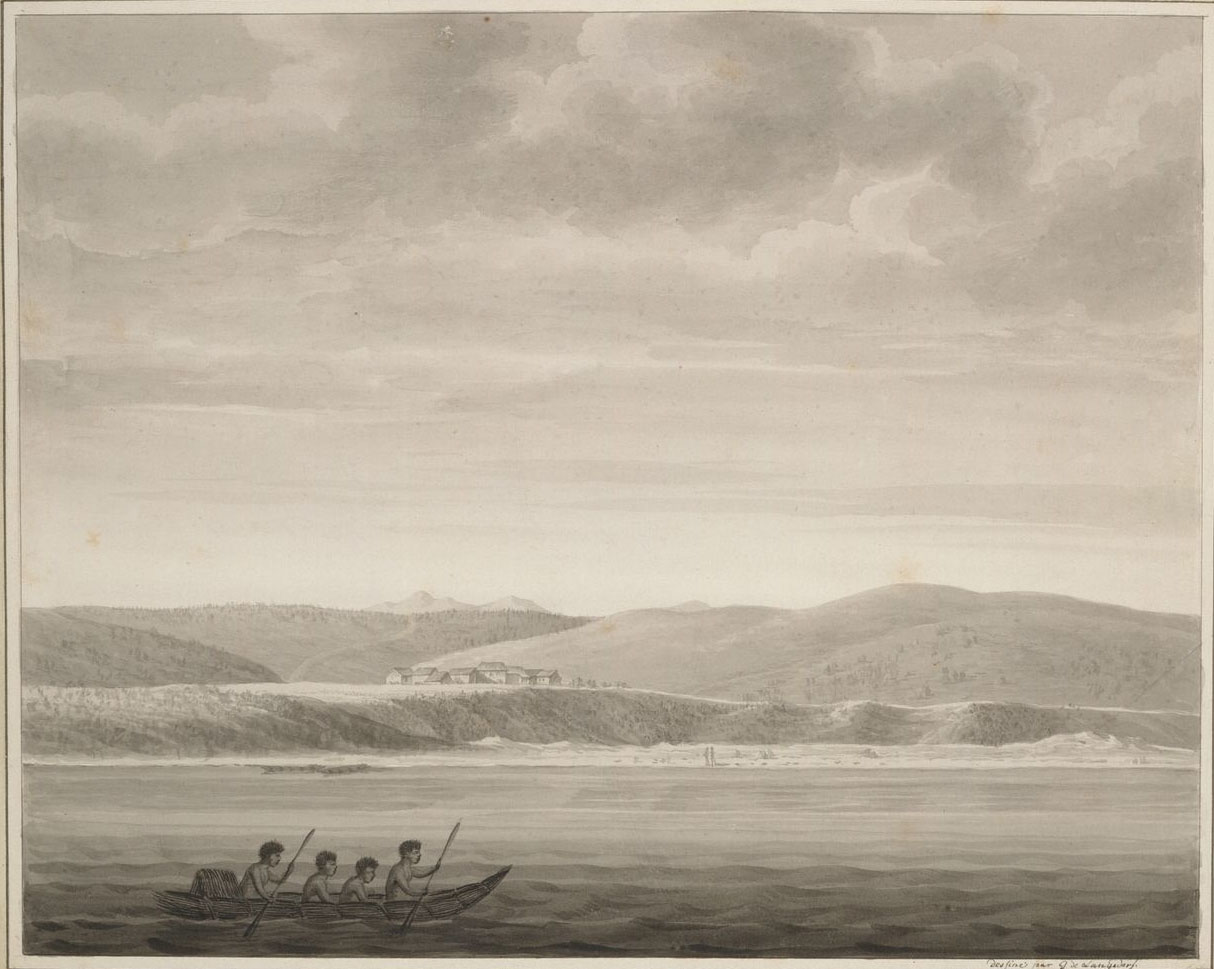
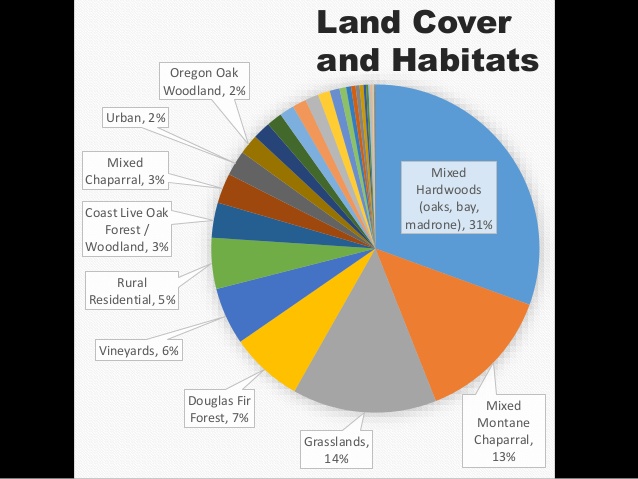
Ritter added that, “Planting only natives just doesn’t work in San Francisco.  There would be no trees in Southern California because we don’t have very many native trees in California.”  The pre-settlement coast of California was virtually treeless in most places and that’s a fact. For example, a study of historic vegetation in Oakland, California reported that only 2% of pre-settlement Oakland was forested with trees. “Vegetation before urbanization in Oakland was dominated by grass, shrub, and marshlands that occupied approximately 98% of the area.” (1)

San Francisco in 1806 as depicted by artist with von Langsdoff expedition. Bancroft Library

Oakland as a case in point

The San Francisco Chronicle recently published an article about a guerilla tree-planter in Oakland who is planting native oak trees on public land, wherever he wants.  Oakland’s Director of Tree Services, David Moore, gently suggests that many of these tree plantings are ill-advised:  “‘There is a part of all of us that loves with our hearts the coast live oak tree because of its heritage, the symbolism of our city, and just the legacy that they have,’ Moore said. ‘But we have to diversify, and we are diversifying to other ones that are recommended to be more adaptable to climate change…The reality is that we have created a world that is not the native conditions of these plants,’ Moore said. ‘If we want trees to survive in these non-native conditions, we have to pick trees from around the world that can survive these conditions.’…Moore said oaks, while beautiful, are not the ideal tree for today’s hot, dry and cramped urban landscape. Without careful and costly maintenance, he said, oaks could destroy sidewalks, block light from street lamps and grow their branches into streets and walkways, creating hazards for motorists and pedestrians. The city still plants oaks, but mainly in parks rather than streets because that’s where they do better, Moore said…”

Stalemate

So, here we are.  We have a pressing need for a more diverse urban forest that is adapted to present and anticipated conditions, but we are paralyzed by the ideological commitment of native plant advocates who are demanding that we destroy our urban forest because it is predominantly non-native.  In a recent edition of Nature News, Jake Sigg said, “Hysterical tree planting is worse than a waste of time and resources…”

I am grateful to Professor Ritter for being bluntly frank with members of the arborist community who should know better.  Dare we hope they learned something from that presentation? 

I wish you Happy New Year.  Please join me in my hope for a more peaceful year.  Thank you for your readership.


(1) Nowak, David, “Historical vegetation change in Oakland and its implications for urban forest management,” Journal of Arboriculture, 19(5): September 1993

TAKING ACTION: The Forest Action Brigade requests correction of the public record regarding lifespan of eucalyptus

The Forest Action Brigade (FAB) has given Million Trees permission to publish their letter to the Park Advisory Committee of the East Bay Regional Park District.  FAB asks that the public record be corrected regarding the lifespan of eucalyptus and related issues.  The Park Advisory Committee was given misinformation regarding the status of eucalyptus trees in the parks by the Acting Fire Chief.  

The Park District does not have a single certified arborist or forester on staff.  The Park District needs such expertise to inform the park staff and to avoid making mistakes, such as destroying healthy trees and planting trees where they will not survive because the horticultural conditions for the trees are not suitable.

When the public was given the opportunity to make suggestions for projects to be included in the renewal of Measure CC parcel tax, hiring a qualified arborist was one of the suggestions that park advocates made.  That suggestion was ignored, as were most of our suggestions.  The Park District is responsive to a narrow constituency, such as the Sierra Club, Audubon Society, and California Native Plant Society.  

Please join us in objecting to the unnecessary destruction of healthy trees in our parks:  Park Advisory Committee c/o sclay@ebparks.org; Board of Directors c/o ybarial@ebparks.org.


June 20, 2018

Park Advisory Committee
East Bay Regional Park District

Dear Members of PAC,

On May 21, 2018, Acting Fire Chief Aileen Theile explained the park district’s strategy regarding eucalyptus removal and its justification for that strategy to the Parks Advisory Committee:

“Tsutsui asked about the life cycle of the eucalyptus plantation. Theile replied they have a lifespan of 50-60 years, and most of the trees were planted about 50-60 years ago. Those planted 50 years ago are failing on a regular basis. Theile continued eucalyptus trees actually do not do well in plantations. They need to compete for sunlight and the trees within the grove are weak. If the outer trees begin to fail, the inner trees are unable to withstand the wind because they have historically been protected by the outer trees. The Park District is trying to remove the fuel ladder, by creating a break between surface fuels and fires that get up into the tree canopy. Tsutsui asked how long is mitigation needed. Theile explained there will probably not be many eucalyptus plantation trees left in the next 50 years.” (Minutes of PAC meeting, 5/21/18)

We are writing to correct several misstatements of fact in Chief Theile’s testimony to the Park Advisory Committee:

Theile:  “[eucalyptus] have a lifespan of 50-60 years…”

That statement is not accurate.  It is an extreme underestimate of the lifespan of eucalyptus.

Blue gum eucalyptus and all other species of eucalyptus are native to Australia.  They were brought to California shortly after the Gold Rush of 1849.  Since they haven’t been in California 200 years, we don’t know how long they will live here.  But how long they live in Australia is obviously relevant to answer that question because longevity is specific to tree species.  We can expect some variation by climate, but not much, and the climate of Australia is similar to the climate in California with wet, mild winters and hot, dry summers.

We know that blue gums live in Australia about 200-400 years because Australian scientists tell us that:

Growth Habits of the Eucalypts by M.R. Jacobs, (Institute of Foresters of Australia, 1955, 1986): Blue Gum eucalyptus lives in Australia from 200-400 years, depending upon the climate.” In milder climates, such as San Francisco, the Blue Gum lives toward the longer end of this range.

That reference was corroborated by John Helms, Professor Emeritus of Forestry at UC Berkeley and an Australian who said in response to our question about blue gums in California, “Blue gums would commonly live for 200 – 400 years, although I presume that some might live longer.”

We also asked the Australian National Botanic Gardens.  They said, “It’s possible that the average lifespan of a native species growing in the wild in Australia would differ to the average lifespan of the same species introduced in northern California, since introduced plants can often “escape” their natural predators when such introductions occur.”

In other words, since eucalyptus trees have more predators in Australia than they do in California, we should expect them to live longer here.  This is called the “predator release” hypothesis.  Ironically, that hypothesis is used by nativists to support their claim that eucalyptus is invasive in California. It’s only logical to apply that hypothesis to the question of how long blue gums will live in California.

However, using actual experience in Australia to predict the future of blue gums in California requires some speculation.  Therefore, we turn to the question of how long they have lived in California for guidance.  There are countless examples of eucalyptus in California over 150 years old that are still very much alive and well.  Here are a few local examples:

  • Eucalyptus, Mills College, Oakland 2015

    The Grinnell Eucalyptus Grove on the UC Berkeley campus was planted in 1877. Most of that grove is still alive and well.  https://www.berkeley.edu/news/multimedia/2004/01/trees.html

  • Eucalyptus was planted as a windbreak at Mills College shortly after it relocated to Oakland in 1871.  Those trees are very much alive.
  • Mountain View Cemetery in Oakland, California was designed by Frederick Law Olmsted in the 1860s.  Like most of the East Bay, the site was treeless. Olmsted’s design was an eclectic collection of mostly non-native trees, including blue gums.  The cemetery is on steep, windward facing hills, where the windbreak provided by blue gums is particularly valued.
  • There are equally old blue gum eucalyptus on the Stanford Campus and many other places on the San Francisco peninsula. 2.2 miles of El Camino Real planted with blue gum eucalyptus in the 1870s were put on the National Register of Historic Places in 2012.

Cal Poly maintains a website that evaluates trees in California, called SelecTree.  SelecTree states that the lifespan of blue gum eucalyptus is “greater than 150 years.”  That estimate is the longest category for longevity on the SelecTree website. (https://selectree.calpoly.edu/)  It is the same estimated lifespan for Coast Live Oak and many other trees, according to SelecTree.

Theile:  “…most of the [eucalyptus] trees were planted about 50-60 years ago.”

That is also an inaccurate statement.  The Park District’s “Wildfire Hazard Reduction and Resource Management Plan” (2009) states, “In the early 1900s, plantations of eucalyptus and pine were planted for hardwood production and to forest the primarily grass-covered hills in preparation for coming real estate development.”  (page 5)

The first master plan for the Park District was published in 1930:  “Proposed Park Reservation for East Bay Cities.”  That publication contains photos of eucalyptus at Lake Chabot, Skyline Ridge and Wildcat Canyon.  https://www.ebparks.org/civicax/filebank/blobdload.aspx?BlobID=23514

Theile:  “Those planted 50 years ago are failing on a regular basis.”

Sibley Volcanic Reserve. Photo by Larry Danos, March 2018

If that statement is accurate, we have no evidence of its accuracy.  In the past 9 months, eucalyptus trees have been destroyed throughout the Park District.  When visitors inquire, they are told the trees were hazardous.  In some cases, the areas were supposed to be thinned in accordance with the Park District’s “Wildfire…Plan.”  At Sibley Volcanic Reserve, for example, large areas of over an acre were clear cut in March 2018 where the plan was to thin.  We know the trees weren’t dead because the stumps of the trees were sprayed with herbicide, as indicated by blue dye.  If the trees were in fact dead, it would not have been necessary to spray the stumps with herbicide to prevent their resprouting.  We asked for an arborist’s evaluation of the condition of the trees before they were destroyed.  We received no response to our request for this information.  In other words, claims that eucalyptus trees are dead or dying are unsubstantiated.  Available evidence suggests that healthy trees are being needlessly destroyed.

Tree failures are most likely to occur where the Park District has thinned the trees.  The trees that remain are subjected to more wind.  The herbicide that is used to prevent the destroyed trees from resprouting is mobile in the soil and it damages the soil by killing beneficial microbes and the mycorrhizal fungi that are essential to tree health.  The roots of the trees are intertwined, enabling the herbicide to damage the roots of the trees that remain.  If, indeed, there are tree failures, they are undoubtedly being caused by the Park District’s tree removals and associated herbicide use.

Theile:  “…eucalyptus trees actually do not do well in plantations.”

This is an inaccurate statement.  In fact, densely planted trees protect one another from the wind and they share available resources.  Peter Wohlleben in The Hidden Life of Trees explains:

“…in nature, trees operate less like individuals and more as communal beings. Working together in networks and sharing resources, they increase their resistance…This is because a tree can be only as strong as the forest that surrounds it…Their well-being depends on their community, and when the supposedly feeble trees disappear, the others lose as well.  When that happens, the forest is no longer a single closed unit.  Hot sun and swirling winds can now penetrate to the forest floor and disrupts the moist, cool climate.”

“Theile explained there will probably not be many eucalyptus plantation trees left in the next 50 years.”

That is apparently an expression of the Park District’s willful intentions.  The eucalyptus trees will be gone in 50 years because the Park District apparently intends to destroy them all, not because they are dead or dying.  Rather because that’s what the Park District wants to do.

For the record, we state our purpose:

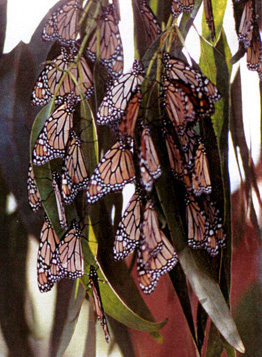
Monachs in eucalyptus, Pacific Grove Museum

We are opposed to the unnecessary destruction of healthy trees, because it serves no useful purpose.  Trees deep inside our parks pose no fire hazard to residential areas.  They are storing thousands of tons of carbon that will contribute to climate change when released into the atmosphere.  Wildfires are becoming more intense and frequent because of climate change.  Therefore destroying hundreds of thousands of trees causes wildfires rather than mitigating them.  The trees perform many other useful functions.  They provide food and habitat for birds, bees, and butterflies.  They reduce air pollution.  They provide shade and protection from wind, making visitors to the parks more comfortable.  The herbicide use associated with tree destruction damages the environment and is an unnecessary health hazard to wildlife and the public.

[redacted]

Please add this letter to the record of the Park Advisory Committee meeting of May 21, 2018.

Thank you.

Forest Action Brigade

CC: EBRPD Board of Directors; Aileen Theile

Action Opportunity: Draft of Oakland’s Vegetation Management Plan

The City of Oakland applied for a FEMA pre-disaster mitigation grant in 2005 to clear-cut all non-native trees on 122 acres of city owned property in the East Bay hills, based on the claim that it would reduce fire hazards.  FEMA cancelled that grant in September 2016 in settlement of a lawsuit against the project. 

The City of Oakland began the process of writing a new plan to reduce fire hazards in the hills by hiring a consultant to develop a Vegetation Management Plan in November 2016.  The new plan will be much more comprehensive than the original plan, covering 1,925 acres of open space and 308 miles of roadside in Oakland.  Oakland also made a commitment to an open public process to develop the plan.  A survey of public opinion was conducted and two public meetings were held in 2017. 

A draft of Oakland’s Vegetation Management Plan is now available HERE.  There are detailed maps of the areas that will be covered by the plan.  We suggest you take a look at those maps to determine what effect the plan will have on your neighborhood and the parks and open spaces you visit.

 A public meeting about the draft was held on May 23, 2018 and written public comments will be accepted until June 11, 2018. Comments may be submitted in the following ways: Download comment card; Email VMPcomments@oaklandvegmanagement.org; Mail:  266 Grand Avenue, Suite 210, Attn: Ken Schwarz, Oakland, CA 94610.  We hope you will participate in this public process that will determine the future of much of the landscape in the Oakland hills.

We are publishing an excerpt of the written public comment of one of our readers, which we hope will help you understand the issues and to write a comment of your own.  Asterisks indicate where some detail has been omitted.  You can see the entire public comment HERE: Oakland Draft Vegetation Management Plan – public comment

 Million Trees


Ken Schwarz
Horizon Water & Environment
266 Grand Avenue, Suite 210
Oakland, CA 94610

I am broadly supportive of the Draft Vegetation Management Plan (DVMP) because:

  • It will create defensible space around structures in Very High Wildfire Hazard Severity Zones.
  • It will clear easily ignited vegetation on roadsides in places where fire hazards are greatest.
  • It sets priorities for implementation in places where fire hazards are greatest.

These three elements of the plan will reduce fire hazards while limiting destruction of trees and vegetation and being fiscally responsible.

My public comment will identify some weaknesses in the plan and make specific suggestions for improving the plan with the goal of minimizing fire hazards as well as collateral damage to the environment.

The 300-foot “buffer” zone is unnecessarily destructive.  California law requires 100-feet of defensible space around structures.  The DVMP proposes extending defensible space along roadsides and around structures to 300-feet, the length of a football field.  Such a wide clearance of vegetation greatly exceeds California fire code and is therefore unnecessarily destructive.  In a recently published op-ed in the Los Angeles Times, two academic scientists confirm our understanding of how to keep our communities safe:  “The science is clear that the most effective way to protect homes from wildfire is to make homes themselves more fire-safe, using fire-resistant roofing and siding, installing ember-proof vents and exterior sprinklers, and maintaining “defensible space” within 60 to 100 feet of individual homes by reducing grasses, shrubs and small trees immediately adjacent to houses. Vegetation management beyond 100 feet from homes provides no additional protection.”[1]

The buffer zone should be eliminated, reduced in size, or reduced to Priority 3 so that it is less destructive and costly. 

*************************

The description of herbicide use in the draft is unnecessarily vague, because it provides no information about what herbicides will be used and the health and environmental hazards of specific herbicides.  Nor does it explain how, where, or why herbicides will be used.

Instead of providing that information, the plan describes the public’s opposition to herbicides as “social stigma,” which implies that our opposition is a baseless prejudice against herbicides.  In fact, our opposition is based on scientific information about the dangers of herbicides and those dangers must be acknowledged by the final version of this plan.

The dangers of herbicides are well documented and well known. ****** Here is a brief list of some of the most recent studies that conclude that glyphosate products are very dangerous to the health of animals and humans:

  • The International Agency for Research on Cancer classified glyphosate as a “probable human carcinogen” in 2015. The IARC is composed of an international team of scientists convened by the World Health Organization of the United Nations.
  • The State of California responded to that news by requiring all glyphosate products sold in the State to be labeled as carcinogens. The State was sued several times by the manufacturer of Round Up—Monsanto–to prevent the labeling requirement.  The State of California recently won in the state court of appeals[2].  Unless Monsanto appeals and wins in the State Supreme Court, all glyphosate products will be labeled as carcinogens in California.
  • US National Toxicology Program recently conducted tests on formulated glyphosate products for the first time. In the past, tests were conducted only on the active ingredient…that is glyphosate alone. The formulated products that are actually applied as weed killers contain many other chemicals, some of which are not even known. The head of the National Toxicology Program Laboratory, told The Guardian newspaper the agency’s work is ongoing but its early findings are clear on one key point. “We see the formulations are much more toxic. The formulations were killing the cells. The glyphosate really didn’t do it,” DeVito said. A summary of the NTP analysis said that “glyphosate formulations decreased human cell ‘viability’, disrupting cell membranes. Cell viability was ‘significantly altered’ by the formulations, it stated.”[3]
  • The Global Glyphosate Study is being conducted by six scientific institutions all over the world. ******* This international consortium of scientific institutions recently published preliminary resultsof their study: “The results of the short-term pilot study showed that glyphosate-based herbicides (GBHs) were able to alter certain important biological parameters in rats, mainly relating to sexual development, genotoxicity and the alteration of the intestinal microbiome, at the ‘safe’ level of 1.75 mg/kg/day set by the U.S. Environmental Protection Agency (EPA).”[4]  In other words, at doses deemed safe by the US EPA, significant negative health effects were found in animals used in testing.
  • The German Agriculture Minister announced on April 17, 2018 that she was finalizing a draft regulation to end use of the weed-killer glyphosate in household gardens, parks and sports facilities, and to set “massive” limits for its use in agriculture.[5] Germany is one of 25 countries that have issued outright bans on glyphosate, imposed restrictions or have issued statements of intention to ban or restrict glyphosate-based herbicides, including Roundup  Countless US states and cities have also adopted such restrictions. [6]
  • Marin Municipal Water District quit using all pesticides in 2015. In a letter to East Bay Municipal Utilities District, a member of the Board of MMWD explains why that decision was made.  (Attachment 2)  MMWD hired scientists at UC Davis to conduct a study of the biological persistence of glyphosate.  They found that glyphosate persisted for at least 84 days when applied to foliage, and perhaps longer after the study ended.

Garlon with the active ingredient triclopyr is more toxic than glyphosate.  Garlon is the herbicide that is used to prevent eucalyptus and acacia from resprouting when the trees are destroyed.  Its use was also specifically allowed for that purpose by Oakland City Council Resolution 79133.   Although the DVMP does not mention its use, we assume—unless specifically told otherwise by the final version of the VMP—that Garlon will be used to control resprouts.

  • Triclopyr is an organochlorine product, in the same family of pesticides as DDT, which was banned in the US in 1972. Organochlorine products bioaccumulate and are very persistent in the environment.  Nearly 50 years after it was banned, DDT is often found in the ground, in the water, and in people’s bodies.[7]
  • Organochlorine products are endocrine disrupters. The Pesticide Research Institute did a risk assessment of triclopyr for the California Invasive Plant Council.  They reported that triclopyr “poses reproductive and developmental risks to female applicators.” [8]
  • The Pesticide Research Institute did a risk assessment of triclopyr for Marin Municipal Water District in which they informed MMWD that birds and bees are both harmed by triclopyr and mycorrhizal fungi in the soil are damaged by triclopyr.[9]

More research has been done on Round Up than on Garlon because it is more widely used.  It is more widely used, partly because it is actually less dangerous than Garlon (it is also a non-selective plant-killer).  Because of the toxicity of Garlon, several public land managers in the Bay Area have made a commitment to controlling resprouts without using herbicides: ******** Marin Municipal Water District,  Marin County Parks and Open Space, UC San Francisco, and East Bay Municipal Utilities District (the supplier of our drinking water).

*************************

There is no evidence that eucalyptus is inherently more flammable than native trees. ******** Eradicating non-native trees and shrubs will not reduce fire hazards because they are not inherently more flammable than the native vegetation that will remain.  Therefore, the reduction of fuel loads must be based on flammability, NOT the nativity of the flammable species.  The nativity of plant species is irrelevant to reducing fire hazards and must be abandoned as criterion for destroying plants and trees.

Vegetation that burned in the North Bay fires of October 2017 was almost exclusively native. Source: Bay Area Open Space Council

I support the thinning of eucalyptus, acacia, Monterey pine and cypress to reduce fuel loads, as long as the canopy is intact.  ******** When the canopy is intact, the forest floor is shaded which retains moisture that retards ignition and suppresses the growth of easily ignited weeds. The DVMP proposes to thin the targeted non-native trees to distances of 35 feet, creating gaps in the canopy of 10 feet within the 300-foot “buffer zone.”  The distance between the trees must be reduced to 25 feet to maintain the canopy.  In addition to reducing fire hazards, maintaining the canopy will also be less destructive and will reduce the amount of stored carbon released into the atmosphere.

Tilden Park, October 2016. East Bay Regional Park District has thinned this area to distances of 25 feet between remaining trees. The forest floor is still shaded because the canopy is intact.

My greatest disappointment in the DVMP is its proposal to remove all individual non-native trees where they presently exist in native vegetation outside the “buffer zone.” ******** Removing non-native trees in riparian areas and in redwood groves as proposed by the DVMP is not fire hazard mitigation because fire hazards in those areas are minimal.

*****************************

Furthermore, destroying healthy trees damages the trees that remain because the herbicide that is used to prevent eucalyptus and acacia from resprouting is mobile in the soil and it is known to damage mycorrhizal fungi in the soil that is essential to the health of the native trees.  ******* It is not possible to destroy isolated trees without damaging neighboring trees in close proximity. ****** Studies show that eucalyptus trees in native forests are not doing any damage to neighboring trees. ********

If individual non-native trees within native vegetation are not doing any environmental damage and do not increase risk of fire they should not be destroyed because destroying them WILL damage native vegetation.  Please leave them alone!

 Putting the DVMP into the long-term big picture

Finally, I suggest that we all take a step back from the details of the DVMP and consider the proposal in the context of the entire environment.  The final VMP must minimize damage to the environment while mitigating fire hazards because:

  • The climate has changed and it will continue to change. When the climate changes, the vegetation changes.  That is one of the axioms of ecology and it will continue to be.  If non-native plants and trees are better adapted to the current and anticipated climate, we should abandon futile attempts to force plants to live where we want them to live.
  • If we want trees in California, we must look to the future, not the past. 130 million native conifers have died in California since 2010. 5-10 million oaks in California have been killed by Sudden Oak Death. The future of redwoods in California is in jeopardy because they require a lot of water and they don’t tolerate wind.

********************

A climate change specialist at the US Forest Service tells us in a recent study that native tree species are the most vulnerable to climate change. USFS found that native trees are more vulnerable to the changes in temperature, precipitation, growing season, and other effects of accumulating greenhouse gases. The assessment found that 88 percent of invasive tree species are expected to prove resilient in the changing climate, ranked with low vulnerability, compared to 20 percent of natives.[10]

  • We are contributing to climate change by destroying healthy trees that are storing tons of carbon that will be released into the atmosphere as the destroyed trees decay. The primary reason why wildfires are more frequent and more intense is because of the warmer, drier climate.  Therefore destroying more trees than necessary increases fire hazards because we are exacerbating climate change by destroying more trees than necessary.
  • It is a fiction that destroying trees will release less carbon than the wildfires imagined by those who demand their destruction. According to a recently completed study at Oregon State University, “wildfire is not the biggest source of climate-warming carbon dioxide in Oregon forests—logging and wood products are.”[11]

*******************

The trees that will be destroyed in Oakland will not be used as lumber, which means they will contribute even more carbon to the atmosphere.  Timber that is used for building retains its stored carbon until the building deteriorates or is destroyed.

  • The herbicides that are used to destroy vegetation and prevent trees from resprouting damage the soil and pose serious health risks to animals and humans. The more vegetation and trees the VMP destroys, the greater the damage caused by herbicides.  Therefore, we must minimize the amount of vegetation that is destroyed as much as possible if herbicides are used.

We achieve nothing if the damage we do to the environment and to ourselves is greater than real or imagined reduction in fire hazards.

Thank you for your consideration.

Resident of
Oakland, California
June 2018


[1] http://www.latimes.com/opinion/op-ed/la-oe-hanson-miller-governor-fire-orders-20180525-story.html

[2] https://www.sfgate.com/news/article/State-can-label-widely-used-herbicide-as-possible-12849147.php

[3] https://www.theguardian.com/us-news/2018/may/08/weedkiller-tests-monsanto-health-dangers-active-ingredient

[4]https://sustainablepulse.com/2018/05/22/monsanto-in-epic-fail-with-attempted-attack-on-global-glyphosate-study/?utm_source=newsletter&utm_medium=email&utm_campaign=gmos_and_pesticides_global_breaking_news&utm_term=2018-05-23#.WwhUfkgvyUl

[5] https://sustainablepulse.com/2018/04/17/germany-moving-ahead-with-plans-to-restrict-weed-killer-glyphosate/?utm_source=newsletter&utm_medium=email&utm_campaign=gmos_and_pesticides_global_breaking_news&utm_term=2018-04-18#.WwhWWUgvyUl

[6] https://www.baumhedlundlaw.com/toxic-tort-law/monsanto-roundup-lawsuit/where-is-glyphosate-banned/

[7] https://www.sciencealert.com/ddt-consistently-found-in-humans-study

[8] https://www.pesticideresearch.com/site/pri-resource-centers/weed-management-resource-center/herbicide-risk-comparisons/workers/

[9]http://www.marinwater.org/DocumentCenter/View/254/HRA_Chap4_Triclopyr_1_1_2010

[10] https://www.forbes.com/sites/jeffmcmahon/2018/04/15/hug-your-native-trees-goodbye-thanks-to-climate-change/#4ad4a4176abd

[11] https://www.hcn.org/articles/climate-change-timber-is-oregons-biggest-carbon-polluter

Renewal of Measure CC is an opportunity to determine the future of parks in the East Bay

In 2004, voters in Alameda and Contra Costa counties approved Measure CC, a parcel tax, to provide additional funding to East Bay Regional Park District for “Park Access, Infrastructure and Safety Improvements, Resource-Related Projects, and Reserve for Unknown Events.”  Measure CC also stipulated that “the overall commitment to natural resources shall be no less than 30% of the revenue raised by the entire measure.” (1) Measure CC is projected to provide about $47 million in the 15 years of its life. (2)

The park district is planning to put Measure CC on the ballot for renewal next year.  It’s time to look at how the park district spent our tax dollars and decide if we want to continue to give them our tax dollars for another 15 years.  If you want Measure CC funding to be used differently, now is the time to tell East Bay Regional Park District what you want…BEFORE the ballot measure is written.

Fuels Management vs. Resource Management?

The park district budgeted $10.2 million of Measure CC funding for “fuels management,” about 22% of the total available funding from Measure CC.  To date, the park district has appropriated $8.8 million of that budget allocation and spent $6.3 million.

The park district describes “fuels management:”  “All vegetation/fuels management projects for fuels reduction are in coordination with the protection and enhancement of wildlife habitat in fuel break areas and are therefore considered to be resource related.” (2)  In other words, the park district considers destroying vegetation and cutting down trees a part of its “commitment to natural resources.”

These descriptions of Measure CC projects illustrate the close relationship between fuels management and resource management: 

  • “Assess and remove hazardous trees, promote native tree regeneration.” (2)
  • “Manage exotic plant species and promote fire resistant natives to reduce the risk of wildfires.” (2)
  • “Manage vegetation for fuels reduction in coordination with the protection and enhancement of wildlife habitat in fuel break areas to provide defensible space and meet Hills Emergency Forum flame length standard.” (2)

The park district’s policies and practices are based on mistaken assumptions:

  • There is no evidence that native plants and trees are less flammable than non-native plants and trees. In fact, available evidence suggests that native landscapes in California are highly flammable.
  • Most monarchs in California spend the winter months roosting in eucalyptus trees. These trees are being destroyed in East Bay parks where monarchs have roosted in the past, such as Point Pinole.

    There is no evidence that destroying non-native trees will “enhance wildlife habitat.” In fact, wildlife habitat is being destroyed by “fuels management” projects.

The destruction of non-native trees is also controversial because the stumps of the trees and shrubs that are cut down must be sprayed with herbicide to prevent them from resprouting.  The park district used an average of 26 gallons of Garlon each year from 2000 to 2015 and 39 gallons in 2016, for that purpose.

There is a wide range of opinions about the tree removals that the park district has done since their program began in 2011, after approval of the “Wildfire Hazard Reduction and Resource Management Plan” and the associated Environmental Impact Report.  At one extreme, some people want the park district to destroy ALL non-native trees on its property.  They consider “thinning” inadequate. The Sierra Club is in that camp and has sued to enforce their wishes.  At the other extreme, some people don’t want any trees to be removed, although most would make an exception for dead and hazardous trees.

Tilden Park, Recommended Treatment Area TI001, June 5, 2016. This in one of the projects of East Bay Regional Park District, in process

After observing the park district’s tree removal projects, I have reached the conclusion that they represent a middle ground that I can accept because in many cases the canopy is intact and the forest floor is still shaded.  The shade retains the moisture that retards fire ignition as well as suppresses the growth of weeds that ignite more easily during the dry season.  In the 20+ years that I have defended our urban forest, I was always willing to accept a compromise and the park district’s methods look like a compromise to me.  I still have concerns about tree removals and they are explained HERE.  You must reach your own conclusions.

So, what’s the beef?

Unfortunately, coming to terms with the park district’s tree removals has not resolved my misgivings about how Measure CC money has been used.  In a nutshell, I believe that the park district’s “resource management” projects are based on outdated conservation practices.  I believe the park district is trying to re-create historic landscapes that are no longer adapted to environmental conditions.  Their projects are often not successful because they do not take the reality of climate change into consideration, nor do they look to the future of our environment.  They are stuck in the past.

One of the projects funded by Measure CC is typical: the effort to eradicate non-native spartina marsh grass from all park properties. The park district has been participating in the effort to eradicate all non-native spartina marsh grass from the entire West Coast for 14 years.  In the first few years, EBPRD aerial sprayed from helicopters several hundred gallons of herbicide per year.  Now the quantity of herbicide is about 25 gallons per year.

California Clapper Rail

We have known for several years that the eradication of non-native spartina has decimated the population of endangered California rails.  In 2016, a paper was published in a peer reviewed scientific journal about the huge declines in the rail population that were caused by the eradication of spartina.

The reason why the rails have been harmed by the eradication of their habitat is that non-native spartina provides superior cover for the rail.  The non-native species of spartina grows taller, more densely, and it doesn’t die back in the winter as the native species of spartina does.  When the rail begins its nesting season, there is no cover for the birds.  They are therefore being killed by their many predators.

The fact that non-native spartina provides superior cover for the birds is related to a second issue.  Non-native spartina provides superior protection from winter storm surges compared to the native species which provides no protection, even when it grows and it is NOT growing.

The US Geological Survey recently reported that sea level on the Coast of California is predicted to rise as much as 10 feet in just 70 years.  USGS predicted that 67% of Southern California’s beaches are expected to be lost by the end of the century.  Marsh grass for coastal protection is more important than ever.

The third issue is that eradicating non-native spartina has not resulted in the return of native spartina.  Even when extensive planting has been done, native spartina does not provide habitat or storm surge protection in the San Francisco Bay Area.  We should be asking if pouring hundreds of gallons of herbicide on the ground might be a factor in the unsuccessful attempt to bring native spartina back to the Bay Area.

Finally, recently published studies that compared native with non-native marsh grasses and aquatic plants with respect to the ecological functions they perform.  These studies both say, “If you look at the role of exotic water plants in an ecosystem, you won’t find any significant differences compared to indigenous species.”

The spartina eradication project is an example of conservation that no longer makes sense.  It damages the environment with herbicides.  It destroys the habitat of rare birds.  It exposes our shoreline to strong storm surges and rising sea levels.  Native vegetation does not return when it is eradicated.

Looking forward, not back

The parks are very important to me.  I visit them often and I treasure those visits.  I would like to vote for Measure CC.  I hope that the measure on the ballot will give me a reason to vote for it.

I will be looking for a revised definition of “resource management” in the ballot measure, one that acknowledges that climate change is the environmental issue of our time and that conservation must be consistent with the changes that have already occurred, as well as look forward to the changes that are anticipated in the future.  Specifically, “resource management” must respect the landscape we have now, which means not trying to eradicate it, particularly by spraying it with herbicides.  Resource management projects must be based on reality, rather than on fantasies about the past.

Opportunities to tell EBRPD what you want from Measure CC

East Bay Regional Park District is holding public meetings about Measure CC to give the public the opportunity to provide input regarding future park needs and priorities:

November 4, 10-12, Harrison Recreation Center, 1450 High St, Alameda

November 8, 2:30-4:30 pm, David Wendel Conference Center, 1111 Broadway, 19th Floor, Oakland

EBRPD asks that the public RSVP by sending an email to Monique Salas at msalas@ebparks.org or call 510-544-2008.

If you can’t attend, please send written feedback here:  publicinformation@ebparks.org.  Please tell East Bay Regional Park District what you want Measure CC funding to pay for. 


  1. Full Text of Measure CC
  2. Agenda of Park Advisory Committee, June 26, 2017. Scroll down to Measure CC Renewal Spending Plan

InfoWar: UC Berkeley bombards us with propaganda against trees

First we must recapitulate the long history of UC Berkeley’s destruction of non-native trees on its property.

UC Berkeley (UCB) started destroying non-native trees on its property in the East Bay hills in 2000 and continued destroying trees until 2005, when it applied for FEMA grant funding to complete the destruction of all non-native trees.  UCB published detailed reports of its first phase of tree destruction, which reported the destruction of about 18,000 trees on 150 acres on Panoramic Hill, Claremont Canyon, Frowning Ridge, Chaparral Hill, and Lower Strawberry Canyon.

UCB completed the first phase without completing an Environmental Impact Report, which is what enabled it to avoid informing the public in advance of the destruction.  When UCB applied for FEMA funding it expected to be able to continue those projects without completing an environmental impact report. UCB’s FEMA grant application proposed to destroy 54,000 trees on 284 acres in Strawberry and Claremont canyons and Frowning Ridge. But the public was now alerted to UCB’s intentions and objected to the project being done without environmental review.  After completing the Environmental Impact Statement required by federal law, the FEMA grant to UCB was cancelled after a successful legal challenge of the project. 

UCB tried to implement its plans with its own funding without completing an Environmental Impact Report, as required by California State law.  Again, they lost a legal challenge that prohibits it from implementing its plans without an EIR. 

UCB’s most recent demonstration of its continued commitment to destroying all non-native trees on its property was a legal complaint filed in June 2017, which demands that FEMA reinstate the grants that were cancelled about one year ago.  At the same time, UCB has launched a new public relations effort to convince the public to support its projects.  In this post we will take a closer look at UCB’s recent round of propaganda.

New “informational” signs in Strawberry Canyon

We learned of new “informational” signs along the fire trail in Strawberry Canyon in July 2017, but we don’t know precisely when they were installed.  Those who often visit Strawberry Canyon tell us the signs are recent. This sign about “biodiversity” is an example of the message UCB is sending to the public.

Many of the statements on this sign are inaccurate:

  • Monarch butterflies roosting in eucalyptus tree.

    The sign claims that native plants “provide food and habitat for native wildlife” but that non-native plants “provide food and habitat for other non-native species.” Neither of these statements is accurate.  If a native plant provides food and habitat for native wildlife, it also provides both to non-native wildlife.  Conversely, if a non-native plant provides food and habitat for non-native wildlife, it also provides both to native wildlife. The notion that wildlife makes such distinctions is ridiculous.  Wildlife does not know or care what humans consider native or non-native.  If the plant is edible, it is food.  If the plant provides cover, it is useful habitat.

  • The sign also claims that the roots of native plants are deep, but the roots of non-native plants are shallow. These are equally ridiculous statements.  The depth of roots may vary, but that variation is completely unrelated to whether or not the plant is native.

Tree roots

Nativists often claim that the roots of eucalyptus trees are shallow (except when they claim they are very deep in order to make the opposite case that they use more water than other tree species).  So, we will digress briefly to provide some information about tree roots from a reputable, scientific source.

According to a study of tree roots by Harvard’s forestry research institution, Arnold Arboretum, (1) tree roots vary little by species.  The configuration of tree roots varies somewhat over the life of trees.  Early in their life, trees often have a deep tap root, but the tap root is slowly replaced by a wide, lateral network of fine roots around the perimeter of the tree, usually far wider than the tree canopy.  To the extent that the root system varies, it is more a reflection of soil conditions.  If the soil is very compact or the tree is planted in a rock or concrete basin, the width of the root system will be physically constrained.  If the tree is unstable in the ground, it is usually because of where it has been planted.

UC Alumni Magazine gins up fire hysteria

 In June 2017, the UC alumni magazine published an article in defense of its plans to destroy all non-native trees in the East Bay hills.  (Available here: UC Alumni Mag – Glen Martin interviews Scott Stephens)  Curiously, this article appeared in an edition devoted to climate change and adaptation to the changing climate.  You might think that concern about climate change would predict a greater respect for our urban forest, which stores the carbon that will contribute to greenhouse gases when the trees are destroyed.  Again, don’t look for consistency in the nativist viewpoint.  You won’t find it.

Here are a few of the absurd statements made in the article in the alumni magazine:

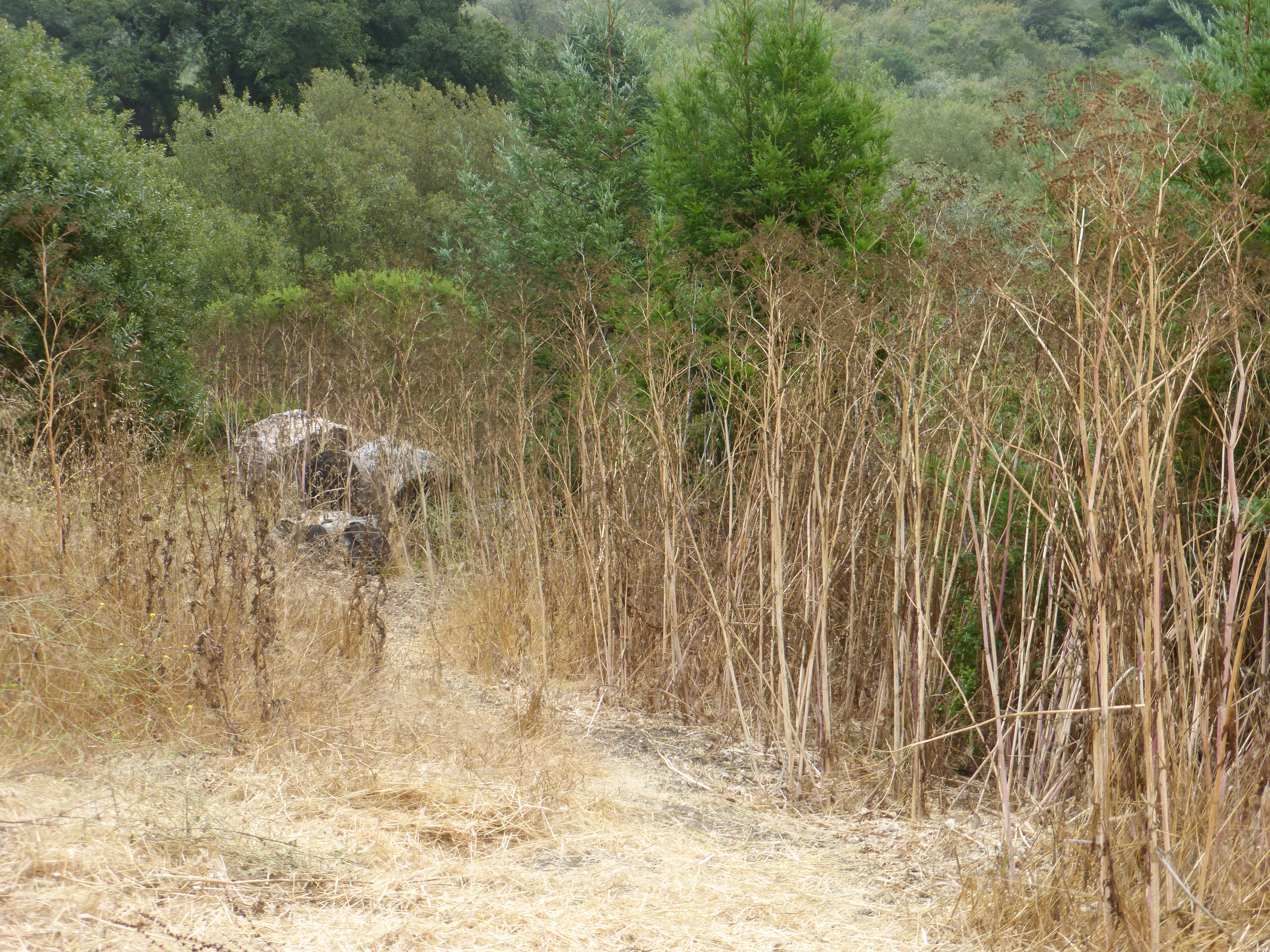
  • The article claims that the 150 acres where UCB destroyed trees over 15 years ago are now covered in native trees and shrubs that “came in” on their own when the trees were destroyed. All of these areas are easily visited and observed.  They are occupied by non-native weeds and piles of wood chips.  Here is a picture of one of those areas taken on August 6, 2017.

Site 29. The tall, dry weeds are the remains of poison hemlock that dominates this site where eucalyptus was destroyed by UCB. Shade is lost when trees are destroyed and weeds thrive in the full sun. The weeds dry out during dry summer months and become fuel for summer fires.

  • The article repeats the ridiculous claim that eucalypts are called “gasoline trees” in Australia. The word “gasoline” is not used in Australia.  As in all British Commonwealth nations, what we call gasoline is called petrol.  Calling eucalyptus trees “gasoline trees” is an American rhetorical device.  A native plant advocate probably made it up, then it was shared in their closed community until it became a “fact” in their minds.  It is a means of generating fear.  It is a tool used by native plant advocates to support their demand to destroy all non-native trees in California.
  • The article describes the huge die off of native conifers in California, caused by climate change and related infestation of native bark beetles and it predicts that they will be replaced by different species of trees that are adapted to present climate conditions. These observations are made with no apparent understanding of how it contradicts UCB’s strategy here in the Bay Area.  If the climate is changing in California and its landscape must change along with it, why is UCB trying to install the landscape that existed here 250 years ago?

UCB’s latest propaganda installment

The recent fire in the East Bay Hills was another opportunity for UCB to gin up the fear machine against non-native trees.  The fire started on Grizzly Peak Blvd where UC Berkeley destroyed 1,900 eucalyptus trees on 11 acres in 2004.  When the trees were destroyed, the ground was quickly colonized by non-native annual grasses and the road was lined with the trunks of the trees they had destroyed.  The dried grass and the dead logs were the fuel of the fire that started on August 2, 2017.  The fire was stopped when it crossed the road into the eucalyptus forest in Tilden Park.

This area on the west side of Grizzly Peak is known as Frowning Ridge. It is one of the first areas that was clear-cut by UC Berkeley over 10 years ago. Destroying the trees did not prevent the grass and shrubs from igniting in the August 2017 fire. Pictures of that area before and after the trees were destroyed are available here: https://milliontrees.me/2013/06/08/guest-article-about-fema-projects-by-a-student-of-the-forest/

UCB now writes in its alumni magazine that there was no major damage to property and no loss of life because of UC’s “fuels management program” that destroyed the trees.  The fire risk to life and property was increased by the “fuels management program,” as facts on the ground tell us.  Scott Stephens, speaking for UCB, speculates that the fire “would have thrown embers miles ahead, starting hundreds of spot fires that would also burn explosively and merge.  That’s what happened in 1991.”

In fact, that’s NOT what happened in 1991.  The only source of embers identified by the FEMA Technical Report on the 1991 fire was “brush.”  That report also says the maximum distance of the fire spread was less than 3 miles, so if embers started spot fires, they did not travel many miles.

A study by US Forest Service of embers starting spot fires during wildfires all over the world included the 1991 fire.  The only known ember reported in the ‘91 fire was a wooden shingle from one of the homes that burned.  That study said of urban fires in California, “In the wildland-urban interface fires in California—Berkeley in 1923, Bel-Air in 1961, Oakland 1991—wooden shingles which were popular in California as roof material, assisted fire spread. Wooden shingles increase fire hazard owing to both ease of ignition and subsequent firebrand production.” (2)

But here is the kicker to this rewriting of fire history by Scott Stephens.  Less than a month ago, Stephens was interviewed about the many wildfires in California this year.  He blamed the wildfires on the heavy rains that produced a lot of grass and he said forests are less likely to burn: “UC Berkeley Fire Science Professor Scott Stephens says most of the fires so far have been in grassland areas that were revived from the rain, then dried out early during triple-digit heat waves… He says forests are better at retaining moisture and the Sierra will be more resilient this year because of the rains.” 

Stephens knows what is causing wildfires in California, but he chooses to misrepresent the fire in the East Bay Hills last week, presumably in the service of UCB’s desire to destroy our urban forest.  Perhaps it is naïve of me to expect more from a faculty member at California’s most prestigious research and educational institution.  But I find it disappointing.

Please join Million Trees in rejecting fear as the maker of public policy.  Be suspicious when you are asked to be afraid of something.  Are you being manipulated?  Do the fear mongers have ulterior motives? 


  1. Thomas O. Perry, “Tree Roots:  Facts and Fallacies,” Arnold Arboretum, Harvard University
  2. Eunmo Koo, et. al., “Firebrands and spotting ignition in large-scale fires,” International Journal of Wildland Fire, 2010, 19, 818-843

Integrated Pest Management is a sham!!

Many thanks to Marg Hall for this guest post about the pesticides being used by the supplier of our drinking water in the East Bay and for the research she did to inform the public that there is a BIG gap between written policies and the reality of pesticide use on our public lands.


One day last winter, I came upon a crew cutting down about 50 eucalyptus trees on what appeared to be EBMUD lands in the East Bay hills. (East Bay Municipal Utility District, EBMUD, manages the local drinking water lands and infrastructure.) Knowing that rain was predicted, and that the standard procedure is to apply the nasty herbicide Garlon to the cut tree stumps to prevent re-sprouting, I stopped to ask the workers about the job.  The contractor (Expert Tree Service) refused to answer my questions, even the most basic one: who hired them?

Tree removals done by EBMUD on Grizzly Peak Blvd
Tree removals done by EBMUD on Grizzly Peak Blvd (prior to the incident reported by Marg Hall)

I thought it an especially bad idea to apply Garlon in the drinking water watershed during the rainy season, so I stopped them by simply refusing to leave the work area until I got some answers. It was easy. I was polite but firm. The police were called. After being threatened by the contractor with per-minute fines for delaying the work, and a trip to jail from the police, I left them to their destruction. This is how I became interested in the management of EBMUD lands.

On a personal note, I had just been diagnosed with breast cancer. Ironically, I’d been looking for hiking trails where I didn’t have to confront the risk of cancer-causing pesticide applications. The whole situation made me very grumpy.

Following up, I was assured by EBMUD staff that they do NOT allow contractors to apply herbicides to cut eucalyptus stumps, and that very few, in fact almost no, herbicides are used in the drinking watershed lands. OK, that sounded pretty good. Wanting to verify this claim, I filed a public records request to EBMUD.

Aerial spraying pesticides on public parks

Meanwhile, we (FAB, The Forest Action Brigade, a grass roots group with which I am affiliated) heard of a plan by East Bay Regional Park District (EBRPD) to aerial spray from a helicopter (yes, you read that correctly!) an herbicide named Milestone (which is prohibited for use in New York State because it is very persistent and mobile in the soil). This was to be done in Briones Park, an area that directly supplies two creeks that feed into the Briones water reservoir.

Mobilizing public support, we were able to stop that spraying, but among our growing concerns we now added the safety of our drinking water. Even though this spray was planned by the East Bay Regional Parks District (EBRPD), the staff from the Water District (EBMUD) knew about it, and didn’t try to stop it…until we raised the issue.

Management of wastershed land by supplier of our drinking water

Last summer, EBMUD invited public comment on a draft update of their Watershed Management Master Plan. In this document, an Integrated Pest Management (IPM) program was referenced (available here: ebmud-ipm-program). Curious, we obtained copies of this document.

On paper it looks pretty solid. Like most IPM programs, this one contained written assurances that only minimal pesticides will be used, and then only as a last resort. Quarterly meetings of the IPM committee would provide oversight, meet and compile reports of pesticide usage. Among committee goals are: approve pesticide use requests, ensure consistency among work groups regarding pest management, and advise on pest management strategies. The guidelines require that pesticides be used only after certain damage thresholds are reached, with follow-up evaluations of effectiveness, and documentation of adverse side effects on non-targeted organisms.

Reading this leads one to the conclusion that the land management practices are just a step below organic gardening practices. With such controls and alternatives, what could possibly go wrong?

Control of pesticide use is more theoretical than real

As I soon learned when I started asking for public records, the IPM program as outlined in the EBMUD Watershed Management draft plan is a “paper only” plan. The oversight committee has not met in 15 years, and in fact only actually met for several years (the program started in 1996). There has been no oversight, no annual report, and wildly inconsistent use has developed over the various work units at EBMUD. They do follow minimal state reporting and training requirements, but that’s it.

I found no comprehensive evaluation of pesticide use, no analysis of levels of use, or experiments with alternatives, as one would expect in an “integrated” approach. Instead I received pages and pages of daily logs by individual workers documenting pesticide use. There appear to be no restrictions on use as long as the applicators documented applications, and the pesticides used were on the approved list of pesticides. The list of approved pesticides is long and includes known carcinogens.

Since nobody at EBMUD was keeping track, several of us embarked on a labor-intensive project to sort through records ourselves and tally an annual pesticide total. We focused on EBMUD properties in Alameda and Contra Costa Counties and usage for the year 2015. We were disheartened by our findings. In these areas, EBMUD made 647 applications by truck, backpack or by hand of herbicides totaling over 700 gallons and 205 pounds.

We compared the use of pesticides by EBMUD with those used by EBRPD.  EBRPD used significantly less herbicide than EBMUD in 2015. EBRPD used 193 gallons of herbicide (glyphosate, Garlon, Oryzalin) in 2015 (and smaller quantities of specialty herbicide for specific projects).  EBRPD has 120,536 acres of property compared to only 28,000 acres of EBMUD property.

Many environmentalists concerned about pesticide use had thought EBMUD carried out a more environmentally respectful philosophy of land management. This is not true. While the Watershed and Recreation work unit reported using only 8 gallons of pesticides that year, they constitute only one of several work units. EBMUD staff in the Watershed and Recreational work unit believe that is the sum total of pesticides used in “the watershed” and that pesticide usage is low. While some of the maintenance operations are outside of the drinking water watershed lands, some are not. Nevertheless this distinction is meaningless since all land is a “watershed” whether it drains to Briones reservoir or the San Francisco Bay. Furthermore, applications of pesticide are routinely done in areas open to the public.

One such application was documented last fall by someone walking on a public road in her neighborhood who took this video (If the video won’t play for you, try clicking on this link to the video HERE:

https://youtu.be/3mRpcZFPCdc?t=2

In it you see vast quantities of Roundup (glyphosate), applied from a truck-mounted tank using a garden hose. That method of application explains why the volume of EBMUD’s pesticide use is so high.  Competent and responsible pesticide applicators use a spray nozzle to reduce the flow and spread the herbicide more evenly.

Inexplicably, the worker was soaking bare ground along the side of a road. It is pointless to apply Roundup to bare ground.  It is a foliar spray that must be applied to actively growing plants.  It has no effect on seeds, roots, or tubers in the ground.  This is explained clearly on the manufacturer’s label for the product.

This spraying was done in a residential neighborhood (Carisbrook Road, Montclair area of Oakland). No pesticide application notices were posted before, during or after the application in violation of EBMUD’s IPM guidelines, which say, “If there is likely to be public contact with the area to be sprayed with pesticide, adequate notification or posting should be conducted.”

Carisbrook Reservois on Carisbrook Road in Montclair, Oakland, where pesticides were sprayed by East Bay Municipal Utilities District
Carisbrook Reservoir on Carisbrook Road in Montclair, Oakland, where pesticides were sprayed by East Bay Municipal Utilities District

The video was sent to EBMUD board members. EBMUD’s response was a defense of this application as consistent with existing policy and regulation. They also claimed that the herbicide was not sprayed on a pedestrian path.  In fact, the spraying occurred on a public road in a residential neighborhood that was used as a path by those who live in the neighborhood, such as the woman who recorded the video.

How to achieve REAL control over pesticide use on public land

That raises the obvious question: if this pesticide application is acceptable, what good is an IPM program except as a means to mislead the public into thinking we are being protected?

There’s an easier, simpler way to obtain the kind of protection we need: Forget IPM. Institute a total ban. No pesticides.  PERIOD.  It can be done.

Marin Municipal Water District has banned all pesticide use on their properties.  Organic farmers do it. Why not demand this from our local land managers?

Public Policy is in OUR hands

In recent decades, public land managers have been using public tax money to apply more and more pesticides in public spaces. In the years ahead, as the Republicans dismantle the Environmental Protection Agency, destroying what little (pathetic) regulation that we now have, we local activists will need to do our own protecting.

It starts here, in our own backyards. We know there is tremendous popular support for this. People really don’t like to be exposed to pesticides when they visit public parks. Robust local activism is our only hope. Yes, we can!!

Marg Hall

Embers start spot fires: The real and the imagined stories

Bay Nature recently published an article about the 1991 fire in the East Bay Hills and the closely related belief that such a fire can be prevented in the future by destroying all non-native trees.  To Bay Nature’s credit, it was a more balanced article than most.  Although the article was heavily weighted in favor of those who want to destroy all non-native trees in the hills, several defenders of our urban forest were also interviewed.

However, the article contains a fantasy about future fires that feeds into the fear of fire that has been fostered by those who advocate for removing all non-native trees:

“A strong wind begins blowing over the hills from the east. And then somehow—maybe a spark from a car, maybe a tossed cigarette—the whole dry, airy mess catches fire.  Now the flames on the ground are 30 feet high and even higher off the boughs, roaring like a jet engine. At the fire’s edges, trees appear to explode as the volatile oils in their leaves reach their boiling point and vaporize. The heat of the fire forms a convection column, with 60-mile-per-hour winds that rip burning strips of bark from the trees and toss them upward. This is another of blue gums’ talents—its bark makes ideal braziers. Tucked away inside a rolled-up strip of bark, a fire might live for close to an hour and fly 20 miles.” (1)

Although we have read many times in the plans to destroy trees that eucalyptus casts embers starting spot fires, we have never seen such an extreme description of how far embers could travel while still on fire and capable of starting a spot fire.  So, we tracked down the source of this theoretical scenario with the help of the author who cited this as the source of the theoretical scenario:  “The potential for an internally convoluted cylinder of bark to be transported tens of kilometres in a continuously flaming state is indicated by the sample that maintained flaming combustion for the entire experiment…This would correspond to a flameout time of almost 2000 s for a sample 2700 mm long, a lofted height of 9600 m and a spotting distance of ~37 km.” (2)

First let’s translate that quote into measurements we commonly use to appreciate how extreme this particular test was:  “This would correspond to a flameout time of almost 33 minutes for a sample 9 feet long, a lofted height of 6 miles and a spotting distance of 23 miles, traveling at 41 miles per hour.”  That is a very long ember, lofted a great distance at a great speed (but NOT 60 mph), staying lit for a long time (but NOT “close to an hour”).  

Theory vs. Reality

The study that was the source of the extreme prediction in Bay Nature about the distance that burning embers can travel was conducted on samples of Eucalyptus viminalis bark (NOT Blue Gum Eucalyptus, E. globulus) “tethered in a vertical wind tunnel.”  These are not real-world conditions.  So, how does this theoretical study compare to real-world conditions?

The FEMA Technical Report about the 1991 fire in the East Bay Hills contains a map of the full extent of the 1991 fire.  As you can see on this map, the maximum distance from the northern-most edge of the fire to the southern edge of the fire is less than 3 miles…not remotely close to 20 miles.  In other words, embers could not have started fires 20 miles away because the fire wasn’t even close to 20 miles long.

1991-fire-map-2

The FEMA Technical Report doesn’t tell us what the wind speeds were during the 1991 fire, although they describe the wind as being strong at several times during the fire.  If there is any evidence that winds were as much as 60 miles per hour, it’s not evidence we have been able to find.  We found a source of wind speeds measured on the Bay Bridge, including historical records.  This website says the strongest wind measured since 2010 was 31 miles per hour in April 2013.  That suggests that 60 mph winds are probably unusual in the San Francisco Bay Area.

The FEMA Technical Report doesn’t report any observations of firebrands or burning embers from eucalyptus.  The report mentions embers twelve times, but identifies the source of those embers only once.  In that one case, the source of embers was “a growth of brush”….not a eucalyptus tree or any tree, for that matter.  There are anecdotal reports of finding debris from the fire as  far as San Francisco, but no reports that the debris was still on fire or that it started another fire.

US Forest Service study of embers in actual fires

US Forest Service participated in a comprehensive study of “spotting ignition by lofted firebrands” based on actual wildfires all over the world, including the 1991 fire in the East Bay Hills. (3)  There is nothing in that study that corroborates the claim that eucalyptus bark embers are capable of travelling 20 miles while remaining lit and therefore capable of starting spot fires:

  • “In the wildland-urban interface fires in California—Berkeley in 1923, Bel-Air in 1961, Oakland 1991—wooden shingles which were popular in California as roof material, assisted fire spread. Wooden shingles increase fire hazard owing to both ease of ignition and subsequent firebrand production.
  • “Unlike the flying brush brands which are often consumed before rising to great heights, the flat wood roofing materials soared to higher altitudes carried by strong vertical drafts…”
  • The only specific firebrand found in the 1991 Oakland Hills fire was found approximately 1 km (.6 mile) west from the perimeter of the fire, “though it may have travelled several  kilometres [1.86 mile].” It was a cedar shingle.  Here is a photograph of that shingle:  ember-1991-fire-2
  • Cylinder shaped embers do not travel as far as flat particles. Firebrands in the shape of cylinders were found to have a maximum spotting distance of 2050 meters, because “cylinders always fall tumbling.”
  • “The increased burning time inherent in larger firebrands was cancelled out by an increased time of flight because larger firebrands move more slowly.”
  • In a study of 245 extinguished fires, experiments and simulations, and observing 48 wildfires, “The longest spotting distance was observed as 2.4 km.”

This comprehensive study of actual wildfires all over the world finds no evidence of embers capable of travelling 20 miles while still burning and starting spot fires.  It reports that wooden shingles were the only observed burning embers in the 1991 fire and that wooden shingles are particularly vulnerable to being lofted as embers in a wildfire.  There are countless houses in the East Bay Hills covered in wooden shingles, yet instead of addressing that obvious source of embers, we are destroying blameless trees.

Developing the Cover Story

Claims about the extreme flammability of eucalyptus have escalated in the past 15 years as opposition to destroying trees and associated pesticide use has escalated.  Nativists have become increasingly dependent on flogging the fear factor as their other storylines have been dismantled by empirical studies and reality:

  • Monarch butterflies roosting in eucalyptus tree.
    Monarch butterflies roosting in eucalyptus tree.

    The “invasiveness” of eucalyptus has been downgraded by the California Invasive Plant Council from “moderate” to “limited,” their lowest rating. There is little evidence that eucalyptus is invasive unless planted along streams and swales that carry their seeds.

  • There are many empirical studies that find that all forms of wildlife—such as insects and birds—are served equally well by both native and non-native plants. Some iconic species—such as Monarch butterflies, bees, hummingbirds, hawks, owls—are dependent upon eucalyptus for winter nectar and safe nesting habitat.
  • Huge global studies of biodiversity report that the introduction of non-native species has resulted in no net loss of biodiversity. This is particularly true of introduced plants.  There is not a single instance of extinction caused by a non-native plant in the continental United States.
  • Climate change is making nativism increasingly irrelevant. California’s native conifers, oaks, and redwoods are dying by the millions.  Unless we want a treeless landscape, we must plant tree species that are capable of tolerating changed climate conditions.

    Owl nesting in eucalyptus, courtesy urbanwildness.com
    Owl nesting in eucalyptus, courtesy urbanwildness.com

These studies have left nativists with few tools to justify the eradication of non-native plants.  We can see the development of the FIRE!! cover story in the archives of the conferences of the California Invasive Plant Council.  In 2004 Cal-IPC held a workshop regarding exotic trees and shrubs.  Over 30 representatives of major managers of public lands attended, such as National Park Service, San Francisco’s Natural Areas Program, Marin County Open Space, etc.  The record of this meeting reflects the dependence upon fire to justify the eradication of non-native shrubs and trees:  “Golden Gate National Recreation Area:  ‘inform public ahead of time; use threat of fire danger to help build support for invasive plant removal projects.’”  The Golden Gate National Recreation Area—a National Park–advises other land managers to frighten the public into accepting the loss of their trees. 

Subterfuge is also recommended to land managers to hide the eradication of shrubs and trees from the public:  “To avoid public upset, drilling around into tree buttress roots and injecting 25% glyphosate…Trees die slow and branches fall slowly, so won’t pose an immediate hazard.”  In other words, land managers were advised to kill trees using a method that won’t be visible to the public. 

Perhaps most disturbing of all is that those who attended this workshop admit that they don’t really know if eucalyptus trees are more flammable than native vegetation and some doubt that they are:  “People are afraid of fire.  Help them understand Eucalyptus trees and other invasive plants are very fire hazardous.  Is there any solid research about Eucalyptus and fire?  Are Eucalyptus and brooms any greater fire danger than native chaparral?”  In other words, even those who wish to destroy non-native shrubs and trees seem to understand that fire is a cover story for which no supporting evidence exists. The evidence has been fabricated to support the cover story.

We now seem to live in a fact-free world in which various interests can make things up and distribute them on the internet with impunity.  The mainstream press is dying and is being replaced by fact-free social media.  If we are to protect ourselves from such manipulation, we must drill down into these storylines.  In the case of eucalyptus, we have debunked the myth that it is more dangerous than the replacement landscape.  Now it’s up to us to disseminate that information far and wide as an antidote to fear-driven nativism. 


  1. Zach St George, “Burning Question in the East Bay Hills: Eucalyptus is flammable compared to what? Bay Nature, October-December 2016
  2. James Hall, et. al., “Long-distance spotting potential of bark strips of a ribbon gum (Eucalyptus viminalis), International Journal of Wildland Fire, 2015, 24, 1109-1117
  3. Eunmo Koo, et. al., “Firebrands and spotting ignition in large-scale fires,” International Journal of Wildland Fire, 2010, 19, 818-843

FEMA funding for East Bay tree destruction is cancelled!

We republish with permission a Huffington Post article by Jennifer and Nathan Winograd about the cancellation of FEMA funding for the destruction of hundreds of thousands of trees on the properties of UC Berkeley and the City of Oakland.  We are grateful to the Winograds and to the thousands of people who participated in the effort to prevent these projects from being implemented, including the Hills Conservation Network, which bravely filed the expensive lawsuit that resulted in this outcome.

It remains to be seen if the City of Oakland and UC Berkeley will implement their plans using other fund sources.  We therefore urge our readers to continue to follow the issue until we have some assurance that the plans have been abandoned.

The Winograds have also provided the following introduction to their Huffington Post article, which explains that this outcome could have been avoided if those who demanded the destruction of our urban forest had been willing to engage in a meaningful dialogue about the projects.

“Many of us tried to engage in meaningful dialog with Bay Area politicians and land managers about our objections to the clear cutting and poisoning of the hills. We were rebuffed. Some, like Mayor Libby Schaaf, did not even extend the courtesy of a reply. Others, like Dan Kalb, Oakland City Councilmember, calls anyone who disagrees with him “stupid.” We tried to engage the media — local newspapers, television and radio, magazines — and with few exceptions, our objections were largely ignored. When we were mentioned, we were ridiculed. Refusing to give us a fair hearing, the Contra Costa Times and San Francisco Chronicle claimed we were indifferent to public safety. Regardless of how many experts — including the U.S. Forest Service, the EPA, and former firefighters — substantiated our concerns, they remained defiant, insisting that even more forests should be clear cut and more poisons be spread. With local politicians, the media, and proponents refusing to engage in reasonable dialog, this left opponents no choice but to force the discussion in a court of law. That lawsuit, filed by Hills Conservation Network, ultimately prevailed with FEMA, which withdrew millions of dollars in funding to the City of Oakland and UC Berkeley. That’s a good thing and here’s why:”


FEMA Pulls Funding for Oakland, Berkeley Clear Cutting

Eucalyptus forest, Lake Chabot

The City of Oakland just lost millions of dollars in federal funding. Given what the intended use of that money was for, that’s a good thing. Combined with similar funding for UC Berkeley and the East Bay Regional Parks District (EBRPD), over 400,000 trees across seven Bay Area cities were to be chopped down and thousands of gallons of cancer-causing herbicides spread on their stumps to prevent regrowth. Slated for eradication were the vast forests above the Caldecott Tunnel and Caldecott Field, North Hills Skyline, Strawberry and Claremont Canyons in Berkeley, and 11 regional parks including Sibley, Huckleberry, and Redwood in Oakland. Costing nearly $6 million, the plan would have radically transformed the character and appearance of the Oakland hills. Why?

The Scripps Ranch Fire of 2003 burned 150 homes but none of the Eucalyptus abutting those homes.

If you believe proponents, it is because the trees pose a heightened risk of fire. Since the infamous Firestorm of 1991 which burned scores of homes and killed 25 people, they have worked tirelessly to turn public opinion in the East Bay against Eucalyptus and Monterey Pine trees. Chief among their claims is that these trees were to blame for the ferocity of that fire because they are alleged to possess unusually high quantities of volatile oils that make them more flammable and prone to shooting off embers which enable the spread of fire. These claims have been repeated so many times they are often regarded as self-evident, even though the evidence does not support them, nor does the history relating to the ignition and spread of past fires. Indeed, the 1991 fire itself (and a later 2008 fire) started in grasses, the very sort of vegetation that clearcutting is intended to proliferate throughout the hills. In fact, the stated aim of the deforestation effort is to replace Oakland forests containing species of trees that are among some of the tallest in the world with shallow grasses that are highly susceptible to fire and which the EBRPD admits are “one of the most dangerous vegetation types for firefighter safety due to the rapid frontal spread of fire that can catch suppression personnel off guard.”

In a report highlighting the heightened fire risk which would have resulted from this plan, David Maloney, former Chief of Fire Prevention at the Oakland Army Base, criticized the spread of misinformation about these trees as motivated by native plant ideology, calling it “a land transformation plan disguised as a wildfire hazard mitigation plan” that will “endanger firefighters and the general public” and “be an outrageous waste of taxpayer money.” And he’s not alone in his concerns.

The U.S. Forest Service objected, saying it would “increase the probability of [fire] ignition over current conditions” because “removal of the overstory trees can introduce changes to the environment which increase fire behavior in undesirable ways.”

The U.S. Fire Administration Technical Report on the 1991 Fire led to the conclusion that removal of the trees would lead to growth of highly flammable brush species, noting that “brush fuel types played a significant role in the progression of the fire” and that brushland made up “a large portion of the available fuel.”

The Environmental Protection Agency stated that it is predicated on “extensive use of herbicides” and “risks posed to human health and the environment from that use.” It went on to express concern about the “potential impacts of climate change,” including “the length and severity of the fire season.”

FEMA itself admitted that the plan would result in “unavoidable adverse impacts … to vegetation, wildlife and habitats, protected species, soils, water quality, aesthetics, community character, human health and safety, recreation, and noise.”

During the summer, 5,200 California firefighters battled 14 fires across the state. The vast majority of the fires were in grass and brush, with a few in so-called “native” Oak woodlands.

But you would not know any of this by reading Bay Area newspapers, watching Bay Area television news programs, listening to local radio stations, reading local magazines, or hearing Bay Area politicians. These are discussions those who oppose this plan tried to engage in with the Mayor, the Oakland City Council, the media and even plan supporters in order to find a compromise, but were rebuffed. Instead, the “need” for deforestation and herbicide use was deemed “self-evident” and opponents were labeled as indifferent to public safety who debased the memory of those who died in the 1991 Firestorm.

In the absence of public discussion about the expertly substantiated criticism that the plan would have increased rather than reduced fire risk, exposed citizens to huge amounts of dangerous chemicals, released over 17,000 metric tons of greenhouse gases into our environment, poisoned and displaced wildlife, radically altered the appearance of our parks, threatened homeowners values by degrading the aesthetics upon which those values depended, eliminated erosion control for hillside homes, and caused a variety of other harms, the public was denied information that would have allowed them to make a sound and informed choice. This troubling bias does not honor the memory of those who died in that tragic fire 25 years ago; it shames it. Their loss should have served to embolden our resolve to prevent a recurrence of their tragedy through rigorous public debate, rather than hobbled us with emotionally charged rhetoric that stifled discussion before it was allowed to begin and threatened to turn the response to that fire into the root cause of yet another disaster.

For while opponents sought to elevate the discussion on this plan to prevent a future tragedy, local media, politicians, and supporters proved themselves incapable of moving beyond a narrative that was so sensationalist and even after more than two decades, so raw, that the abandonment of caution, reason, and critical analysis were paradoxically and counterproductively portrayed as the moral high ground. It left opponents no choice but to force the discussion in a court of law, a point of view that ultimately prevailed with FEMA. Whether the Mayor, City Council, deforestation advocates, and Bay Area media outlets learn from their failings going forward remains to be seen. But one thing is abundantly clear. If the result of the lawsuit proves anything, it proves opponents of deforestation and poisoning were right.

Another attack on our urban forest by a public land manager

East Bay Municipal Utilities District (EBMUD) is the public utility that supplies our water in the East Bay.  To accomplish that task, EBMUD manages thousands of acres of watershed land.  Like most open space in the Bay Area, the vegetation on EBMUD’s land is a mix of native and non-native species.

Lafayette Reservoir, one of many EBMUD properties in the East Bay

EBMUD is revising its Master Plan.  The draft Master Plan renews its commitment to destroying all eucalyptus and Monterey pines in favor of native vegetation.  The draft Master Plan is available HEREEBMUD is accepting written public comments on the draft Master Plan until September 2 extended to Friday, September 16, 2106.   Comments should be sent to watershedmasterplan@ebmud.com or by mail to Doug Wallace, EBMUD, 375 11th St, Oakland, CA 94607.

EBMUD held a public meeting about its draft Master Plan on Monday, August 15, 2016.  That meeting was attended by over 200 people.  Most of the crowd seemed to be there to defend their access to EBMUD trails by bicycles. 

There were 10 speakers who defended our trees against pointless destruction and the consequent pesticide use to prevent their resprouting.  As usual, the Sierra Club came to object to increased access for bicycles and to demand the eradication of our trees.  As usual, claims of extreme flammability of non-native trees was their stated reason for demanding the destruction of the trees.  Update:  HERE is a video of speakers at the EBMUD meeting for and against tree destruction and pesticide use. 

If you are watching the news, you know that there are now eight wildfires raging in California.  All of these wildfires are occurring in native vegetation.  The claim that non-native trees are more flammable than native trees and vegetation is nativist propaganda. 

Furthermore, our native trees are dying of drought and disease.  This article in the East Bay Times informs us that 70 million native trees have died in the past four drought years and that the millions of dead trees have substantially increased fire hazards.  In other words, it is profoundly stupid to destroy healthy, living trees at a time when our native trees are dying and pose a greater fire hazard.

We are grateful to Save the East Bay Hills for permitting us to publish their excellent letter to EBMUD about their misguided plans to destroy our urban forest.  We hope that their letter will inspire others to write their own letters to EBMUD by September 2, 2016.  Save the East Bay Hills is a reliable source of information about our issue.  Thank you, Save the East Bay Hills for all you do to defend our urban forest against pointless destruction.

Update:  Save the East Bay Hills has also created a petition to EBMUD that we hope you will sign and share with others.  The petition is available HERE.

Sign the petition!
Sign the petition!


saveeastbayhills

August 15, 2016

Douglas I. Wallace
Environmental Affairs Officer
Master Plan Update Project Manager
East Bay Municipal Utility District
375 11th Street
Oakland, CA 94607

Dear Mr. Wallace,

This letter serves as our response to the East Bay Municipal Utility District’s invitation for the public to review and comment on the draft of the East Bay Watershed Master Plan (“Draft Master Plan”) update. There is much in the plan to recommend itself and much that leaves a lot to be desired.

We are grateful that the Draft Master Plan recognizes the value of trees regardless of their historical antecedents, specifically noting that,

“Eucalyptus trees provide a source of nectar and pollen that attracts insects, which in turn serve as a prey base for birds and other animals. Hummingbirds and many migratory bird species feed extensively on the nectar. In addition, eucalyptus trees produce an abundant seed crop. These tall trees are used as roosting sites for birds. Bald eagles have roosted in eucalyptus groves in the San Pablo Reservoir watershed, and a great blue heron rookery exists in the eucalyptus trees at Watershed
Headquarters in Orinda. A great blue heron and great egret rookery was active near the northern arm of Chabot Reservoir in the recent past.”

The Draft Master Plan recognizes, “the ecological value and likely permanence of certain nonnative species and habitats,” including Eucalyptus and Monterey Pine. It recognizes that these two species of trees, especially Monterey Pine “provide stability to watershed soils” and “provide erosion control with a widespreading root system.”

It recognizes that they provide “protection from solar exposure, wind, and noise.”

It recognizes that they “provide biodiversity value (bald eagle and other raptor species) on District watershed lands.” For example, “Monterey Pine seeds provide food for small rodents, mammals and birds…”

It cites to the EBMUD Fire Management Plan which recognizes the value of trees in mitigating fire: “They do not represent a significant fire hazard when the understory is maintained for low fire intensities… Stands that are well spaced with light understory, proper horticultural practices, and maintenance of trees, e.g. spacing and above-ground clearance, can serve to minimize fire hazard.”

It admits that removing the trees would lead to inevitable grasses and shrubs which increase the risk of fire: “The most susceptible fuels are the light fuels (grasses, small weeds, or shrubs)…”

Finally, it recognizes that these tall trees occupy a very small portion of District lands: 1% for Eucalyptus and 2% for Monterey Pines.

Given their immense beauty, the habitat they provide, their mitigation against fire, the erosion control, all the other recognized benefits, and the fact that they occupy such a small percentage of overall District lands, why does the Draft Master Plan propose that they be eradicated over time?

The answer appears to be nothing more than perceived public will:

“As this species is considered a nonnative pyrophyte, regional pressure is present to reduce the number of Monterey Pine stands.”

“As a nonnative pyrophyte, eucalyptus plantations are a target of regional public pressure for removal.”

This is a misreading of the public will. The Draft Master Plan is elevating the nativist agenda of a loud, vocal minority over good sense, good science, ecological benefit, protection against fire, and the desires of the vast majority of residents and users of District lands. How do we know?

The City of Oakland, the University of California, and the East Bay Regional Park District have also proposed eradicating Monterey Pine and Eucalyptus trees and of the 13,000 comments received by FEMA during the public comment period following its draft plan, roughly 90% were in opposition by FEMA’s own admission. Moreover, over 65,000 people have petitioned the City of Oakland to abandon its effort to remove the trees.

That EBMUD does not hear from people who find beauty, shade, and benefit in the trees is not because they do not care; rather, it is because most members of the public do not understand the extent to which these trees are under siege by nativists, nor the level of cooperation these individuals are receiving from public lands managers to see their vision prevail.

For most members of the public, it simply strains credulity that those tasked with overseeing our public lands would cooperate with efforts to destroy not only large numbers of perfectly healthy trees, but given their height and beauty, trees that are the most responsible for the iconic character of East Bay public lands and the appeal of our most beloved hiking trails. And for what end? To treat our public lands as the personal, native plant gardens of those who subscribe to such narrow views. In short, there is no widespread desire to get rid of these trees and they should not be removed.

Indeed, the Draft Master Plan recognizes several “emerging challenges” as a result of climate change including, but not limited to, “increasing average temperatures, prolonged droughts, erosion, decreased soil moisture, and augmented risk of fires.” Tall trees like Eucalyptus and Monterey Pine help mitigate these challenges. For example, fog drip falling from Monterey Pines in the East Bay has been measured at over 10 inches per year. In San Francisco, fog drip in the Eucalyptus forest was measured at over 16 inches per year.

Moreover, Eucalyptus trees are an important nesting site for hawks, owls and other birds and are one of the few sources of nectar for Northern California bees in the winter. Over 100 species of birds use Eucalyptus trees as habitat, Monarch butterflies depend on Eucalyptus during the winter, and Eucalyptus trees increase biodiversity. A 1990 survey in Tilden Park found 38 different species beneath the main canopy of Eucalyptus forests, compared to only 18 in Oak woodlands. They also prevent soil erosion in the hills, trap particulate pollution all year around, and sequester carbon.

Many of these benefits are especially important in light of Sudden Oak Death which the Draft Master Plan admits is an ongoing challenge and is likely to increase because of climate change. If Sudden Oak Death impacts oak woodlands and EBMUD intentionally cuts down Eucalyptus and Monterey Pine which are proving themselves more suitable for the environment, it risks a treeless landscape, which would not only be a loss of beauty and loss of wildlife habitat, but exacerbate the challenges already faced by EBMUD as a result of climate change.

We also object to the Draft Master Plan accepting the labels “native” and “non-native” and making decisions based on that fact alone. “Non-native” and “invasive species” are terms that have entered the lexicon of popular culture and become pejorative, inspiring unwarranted fear, knee-jerk suspicion, and a lack of thoughtfulness and moral consideration. They are language of intolerance, based on an idea we have thoroughly rejected in our treatment of our fellow human beings — that the value of a living being can be reduced merely to its place of ancestral origin.

Each species on Earth, writes Biology Professor Ken Thompson, “has a characteristic distribution on the Earth’s land surface… But in every case, that distribution is in practice a single frame from a very long movie. Run the clock back only 10,000 years, less than a blink of an eye in geological time, and nearly all of those distributions would be different, in many cases very different. Go back only 10 million years, still a tiny fraction of the history of life on Earth, and any comparison with present-day distributions becomes impossible, since most of the species themselves would no longer be the same.”

This never-ending transformation — of landscape, of climate, of plants and animals — has occurred, and continues to occur, all over the world, resulting from a variety of factors: global weather patterns, plate tectonics, evolution, natural selection, migration, and even the devastating effects of impacting asteroids. The geographic and fossil records tell us that there is but one constant to life on Earth, and that is change.

Even if one were to accept that the terms “native” and “non-native” have value, however, not only do they not make sense as it relates to Monterey Pine and Eucalyptus, but the outcome would not change for three reasons. First, Monterey Pine and Eucalyptus provide numerous tangible benefits as previously discussed, while the claimed “problem” of their foreign antecedents is entirely intangible. That a plant or animal, including the millions of humans now residing in North America, may be “non-native” is a distinction without any practical relevance beyond the consternation such labels may inspire in those most prone to intolerance; individuals, it often seems, who demand that our collectively owned lands be forced to comply to their rigid and exiguous view of the natural world. What does it matter where these trees once originated if they provide such tremendous beauty and benefit here and now?

Second, the fossil record demonstrates that Monterey Pine are, in fact, “native” to the East Bay. (See, e.g., http://evolution.berkeley.edu/evolibrary/article/montereypines_01.) Monterey Pine fossils from the middle Miocene through the Pleistocene have been found in several East Bay locations. Similarly, since Eucalyptus readily hybridizes with other species, many experts now claim that California Eucalyptus hybrids could rightly be considered native, too.

Of more immediate concern, however, is that the five narrowly defined “native” stands of Monterey Pine — the Año Nuevo-Swanton area in San Mateo and Santa Cruz Counties, the Monterey Peninsula and Carmel in Monterey County, Cambria in San Luis Obispo County, and Guadalupe and Cedros Islands off Baja California in Mexico — are in danger. In light of escalating temperatures due to climate change, to save Monterey Pine requires “a new foundation for conservation strategies of the species and its associated ecosystems. If Monterey pine has long existed in small, disjunct populations and if these have regularly shifted in location and size over the California coast in response to fluctuating climates… then it would be consistent to extend our conservation scope…” “Areas not currently within its [narrowly defined so-called] native range could be considered suitable habitats for Monterey pine conservation.” (Millar, C., Reconsidering the Conservation of Monterey Pine, Fremontia, July 1998.)

As tree lovers and environmentalists in Cambria are banding together to determine how, if at all, they can save their precious remaining Monterey Pines now dying from drought in record numbers, here in the East Bay – less than 224 miles away – land managers at EBMUD are considering plans to willfully destroy them in record numbers. It is ecologically irresponsible and for those of us who dearly love the stunning, even arresting, beauty of these trees, it is also truly heartbreaking.

Third, and perhaps more importantly, removing Eucalyptus and restoring “native” plants and trees is not only predicated on the ongoing use of large amounts of toxic pesticides, it does not work, a fact acknowledged by cities across the country. In the last ten years, the City of
Philadelphia has planted roughly 500,000 trees, many of which are deemed “non-native” precisely because “native” trees do not survive. “[R]ather than trying to restore the parks to 100 years ago,” noted the City’s Parks & Recreation Department, “the city will plant non-native trees suited to warmer climates.”

For all these reasons, we oppose the elimination of Monterey Pine and Eucalyptus, even if phased over time as proposed, and likewise oppose EBMUD’s participation in the destruction of similar Pine and Eucalyptus forests in the Caldecott Tunnel area, in partnership with outside agencies. We ask that these be stricken from the Master Plan.

Finally, we oppose the ongoing and, if the trees are cut down, potentially increasing use of pesticides and ask that a ban on their use be put in effect in the final Master Plan, for the following reasons:

● Extremely low levels of pesticide exposure can cause significant health harms, particularly during pregnancy and early childhood.

● Children are more susceptible to hazardous impacts from pesticides than are adults and compelling evidence links pesticide exposures with harms to the structure and functioning of the brain and nervous system and are clearly implicated as contributors to the rising rates of attention deficit/hyperactivity disorder, widespread declines in IQ, and other measures of cognitive function.

● Cancer rates among children are increasing at an alarming rate and pesticide exposure contributes to childhood cancer, as well as other increasingly common negative health outcomes such as birth defects and early puberty.

● Approximately 4,800,000 children in the United States under the age of 18 have asthma, the most common chronic illness in children, and the incidence of asthma is on the rise. Emergence science suggests that pesticides may be important contributors to the current epidemic of childhood asthma.

● Animals, including wildlife and pets, are at great risk from exposure to pesticides, including lethargy, excessive salivation, liver damage, blindness, seizures, cancer, and premature death.

● Pesticides contain toxic substances, many of which have a detrimental effect on animal health, including pets, raptors, deer, and other wildlife, which is compounded when the bodies of poisoned animals are ingested by subsequent animals.

● The U.S. Environmental Protection Agency has recommended non-chemical approaches, such as sanitation and maintenance.

These concerns are compounded by the fact that pesticides are to be administered near reservoirs, threatening the safety and integrity of our water supply and the water supply of the plants and animals who also depend on it. These reasons are why the Marin Municipal Water District removed the use of herbicides from further consideration in its Draft Plan and maintained the pesticide ban it has had in place for several years.

Pesticides are not only dangerous, they are also incredibly cruel. Rodenticides, for example, are opposed by every animal protection group in the nation because not only do they kill animals, but they do so in one of the cruelest and most prolonged ways possible, causing anywhere from four to seven days of suffering before an animal finally comes to the massive internal bleeding these poisons facilitate. This long sickness period often includes abnormal breathing, diarrhea, shivering and trembling, external bleeding and spasms, suffering and death that is perpetuated when their dead bodies are ingested by subsequent animals, such as owls and raptors. Put simply, EBMUD should not be in the business of targeting any healthy animals, trees, and plants for elimination; and doing so by pesticides harms animals well beyond the target species, including humans.

In summary, public agencies overseeing public lands have a responsibility to minimize harm and reject radical transformations of those lands and the ecosystems they contain, especially in absence of any clear public mandate. Not only have these lands been handed down in trust from prior generations for us to enjoy, preserve, and bequeath to future generations, but there is a reasonable expectation on the part of most citizens that those overseeing our collectively owned lands not undertake agendas to destroy large numbers of healthy trees, kill healthy animals, and poison our environment. Regardless of how Eucalyptus and Monterey Pine trees may be maligned by the extreme few, they are beloved by the many, being in large part responsible for the East Bay’s beauty, iconic character and treasured, shady walking trails and picnic areas.

In the case of EBMUD, this orientation is even more alarming and a violation of the public trust because it elevates the ideological driven, nativist agenda of the few above the agency’s primary mandate and interests of the many: ensuring the integrity and safety of our water supply and the plants and animals who reside there. Adopting plans to alter pre-existing landscapes through the use of toxic pesticides in order to placate unreasonable and xenophobic demands on lands that contain the public’s precious reserves of drinking water is a deep inversion of priorities.

We respectfully request that these proposed ends and means be stricken from the Master Plan.

Very truly yours,
Save the East Bay Hills