Sierra Club cannot hide behind its smokescreen

On August 25, 2015, opponents of the projects in the East Bay Hills which will destroy hundreds of thousands of trees staged a protest at the headquarters of the Bay Area chapter of the Sierra Club and delivered a petition.  The petition (available HERE) asks the Sierra Club to quit advocating for deforestation and pesticide use in the San Francisco Bay Area and to drop its lawsuit which demands eradication of 100% of all non-native trees on 2,059 acres of public land in the East Bay.  The protest was successful as measured by the size of the crowd and the even-handed media coverage of the protest.
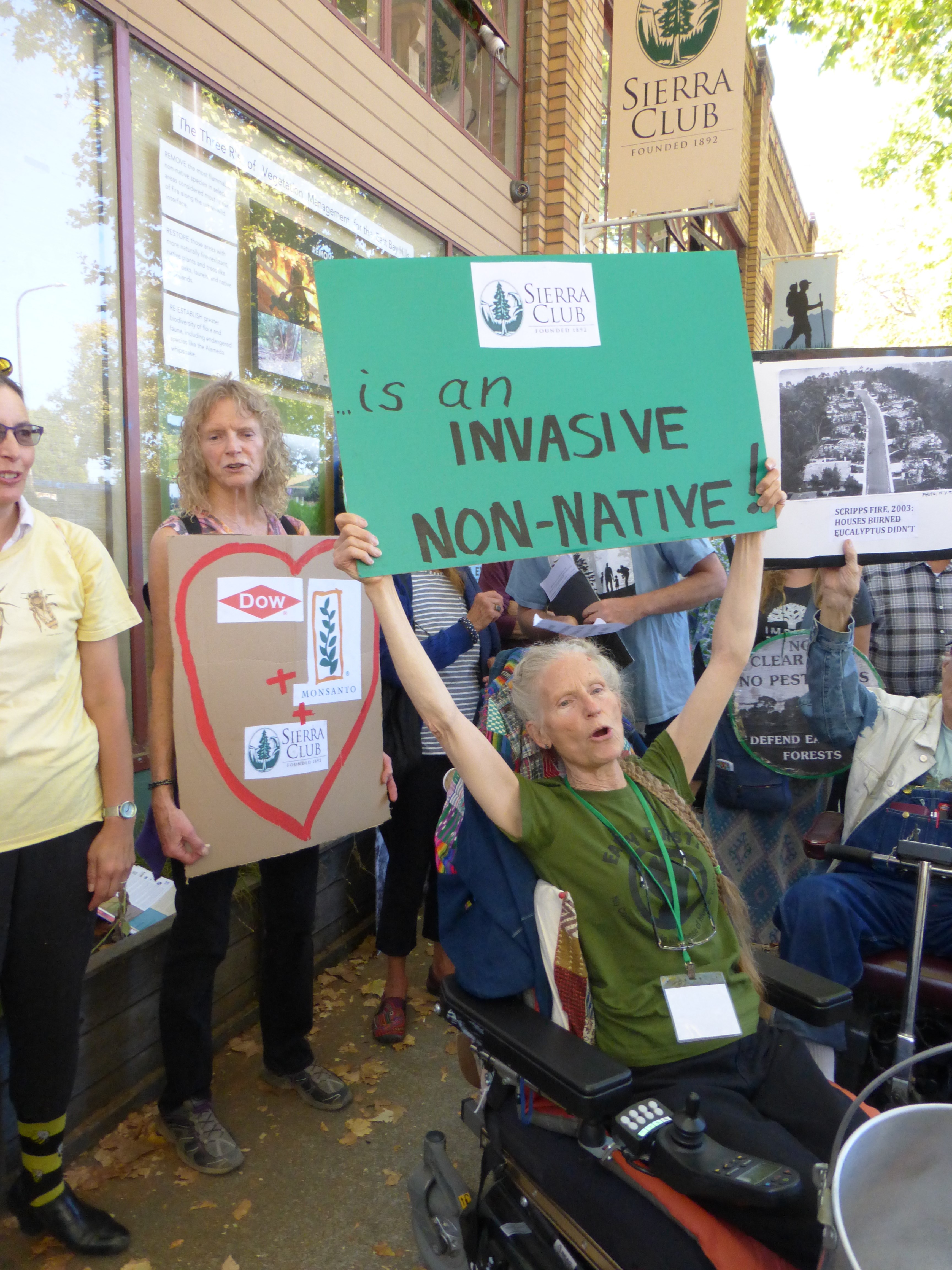
Sierra Club protest, August 25, 2015. About 80 people attended the peaceful protest.

Update:  HERE is a 14 minute video of the demonstration at Sierra Club headquarters on August 25, 2015.  The video includes an attempt to discuss the issue with a Sierra Club staff member.  Note the factual rebuttals to some of the claims the staff member makes in that conversation.  Also, note the final rallying cry, “Poll your membership on this issue.”  We will report soon on the follow up to that request.  Please stay tuned.  

However, although the protest has produced a flurry of defensive propaganda from the Sierra Club, it has not created new opportunities for dialogue with them.  We tried to get the issue on the agenda of the Conservation Committee following the protest and once again our request was denied. We were also denied the opportunity to publish a rebuttal to articles in their newsletter about the projects. It is still not possible to post comments on the on-line version of the Yodeler, although each article dishonestly invites readers to “leave a comment.”

And so, open letters to the Sierra Club are the only means of communication available to us.  Here are our replies to the latest round of propaganda published in the Yodeler on September 16, 2015 (available HERE).  Excerpts from the Sierra Club article are in italics and our replies follow.


“The preferred strategy for vegetation management in the East Bay hills entails removing the most  highly flammable, ember-generating trees like eucalyptus in phases — only in select areas considered most at risk for fire along the urban-wild interface.”

Preferred by whom?  Neither fire experts nor the public think this project is a good idea, let alone the Sierra Club’s more extreme version of the project demanded by its suit.  Over 13,000 public comments on the Environmental Impact Statement were sent to FEMA, of which 90% were opposed to this project according to FEMA.  More recently, a petition in opposition to this project has over 64,000 signatures on it.  This project is NOT the “preferred strategy for vegetation management in the East Bay hills.”

Eucalyptus is not more flammable than many other trees, including native trees: 

  • A study by scientists in Tasmania found that the leaves of blue gum eucalypts were more resistant to ignition than other species of Tasmanian vegetation tested. The study credits the “hard cuticle” of the leaf for its ability to resist ignition. (1)
  • The National Park Service, which has destroyed tens of thousands of eucalypts and other non-native trees, states that eucalyptus leaves did not ignite during a major fire on Mount Tam.  (2)
  • The leaves of native bay laurel trees contain twice as much oil as eucalyptus leaves (3)  and the fuel ladder to their crowns is much lower than eucalyptus, increasing the risk of crown fires. The “Wildfire Hazard Reduction and Resource Management Plan” of the East Bay Regional Park District states explicitly that bay laurel is very flammable and recommends selective removal.
  • Eucalyptus contributed more fuel to the 1991 fire in Oakland because a deep and prolonged freeze the winter before the fire caused eucalyptus and other exotic vegetation to die back. The dead leaf litter was not cleaned up, which contributed to the fire hazard.  Such deep freezes are rare in the Bay Area.  There has not been such a freeze for 25 years and another is unlikely in the warming climate.
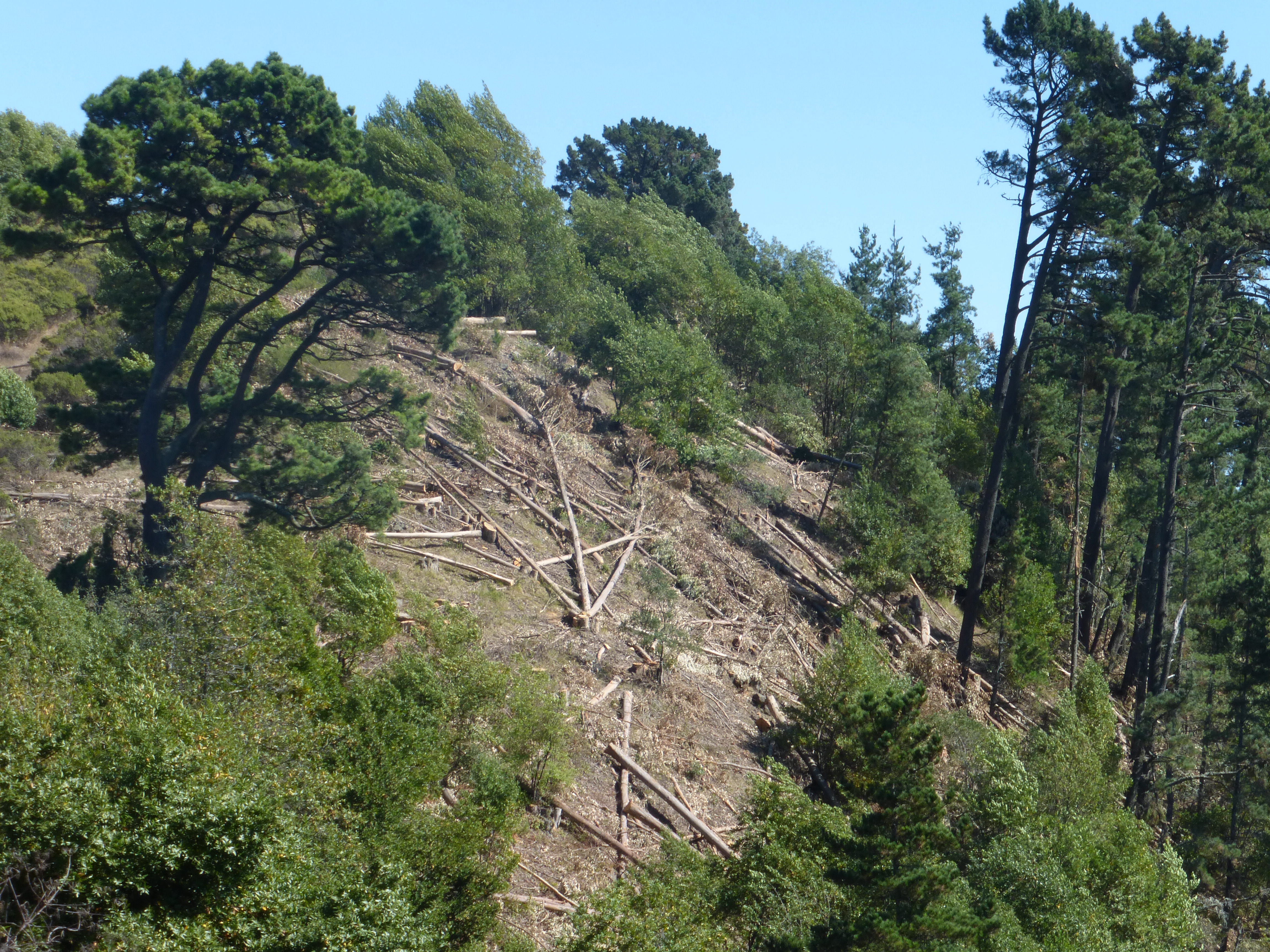
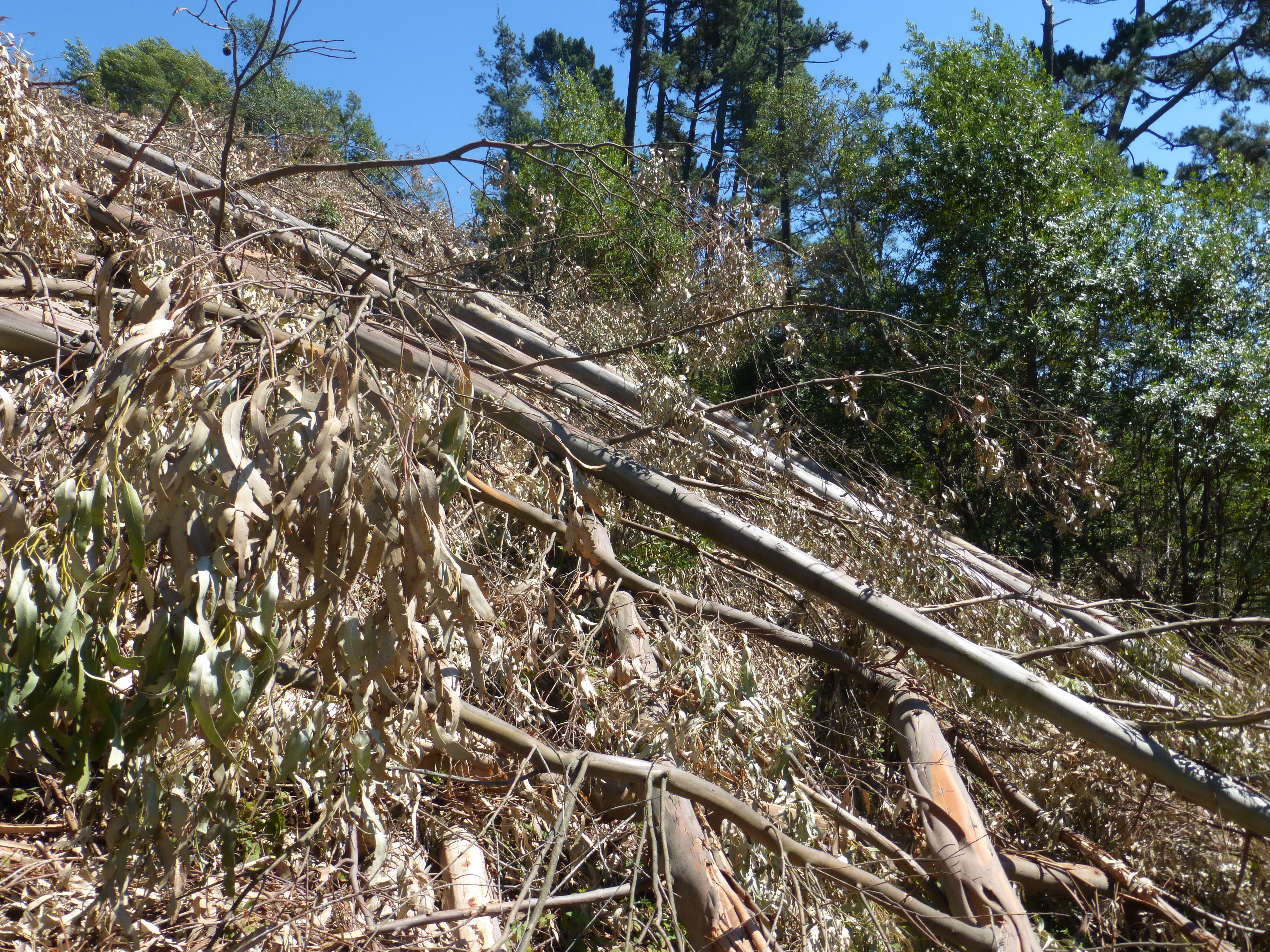
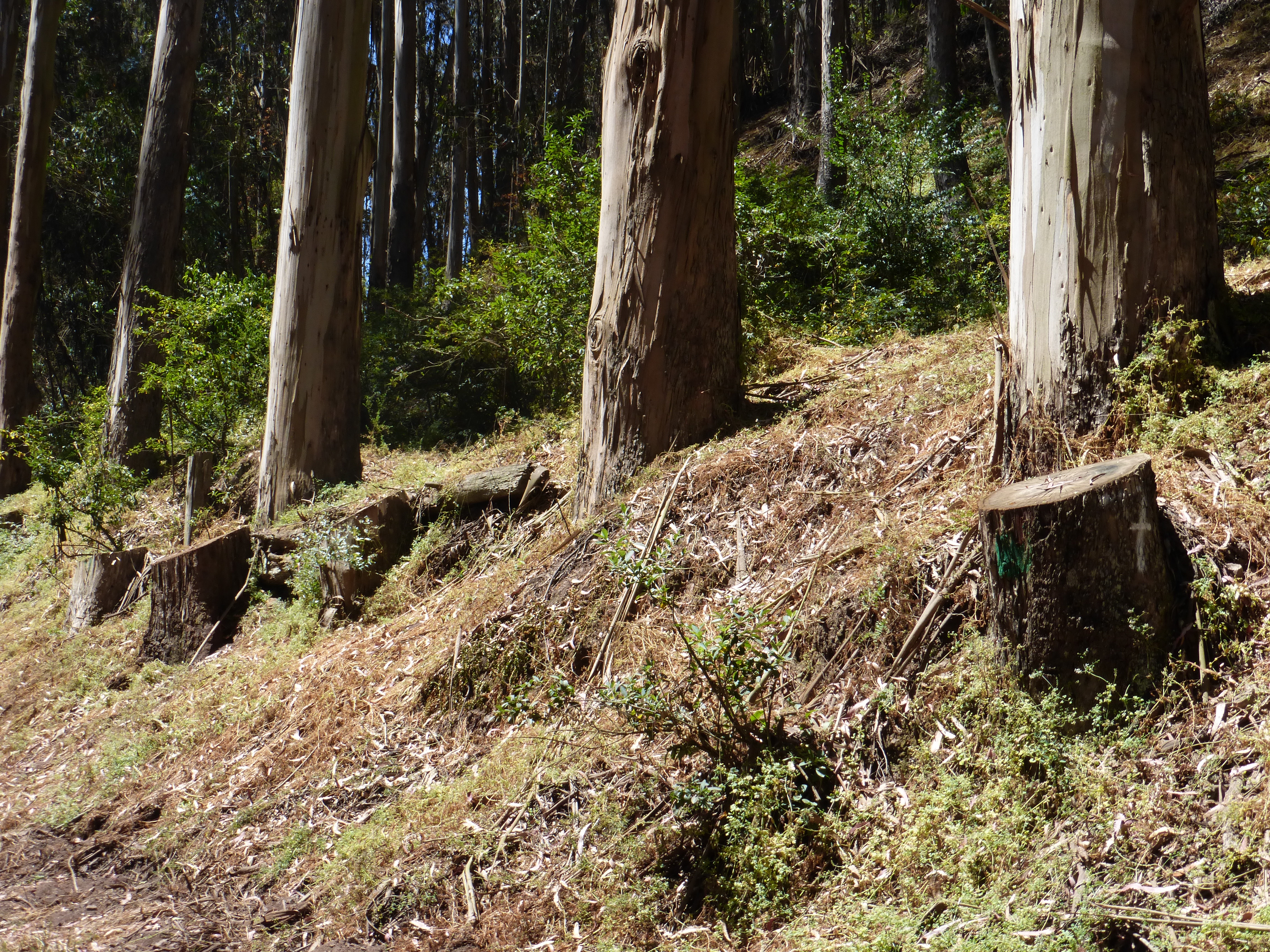
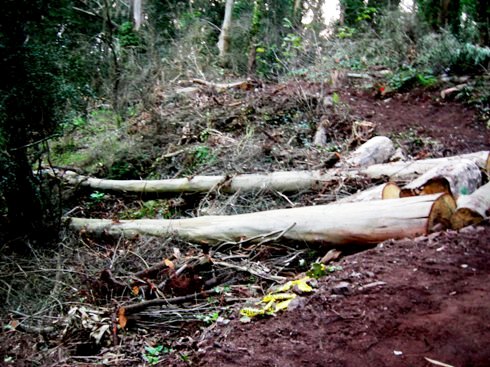
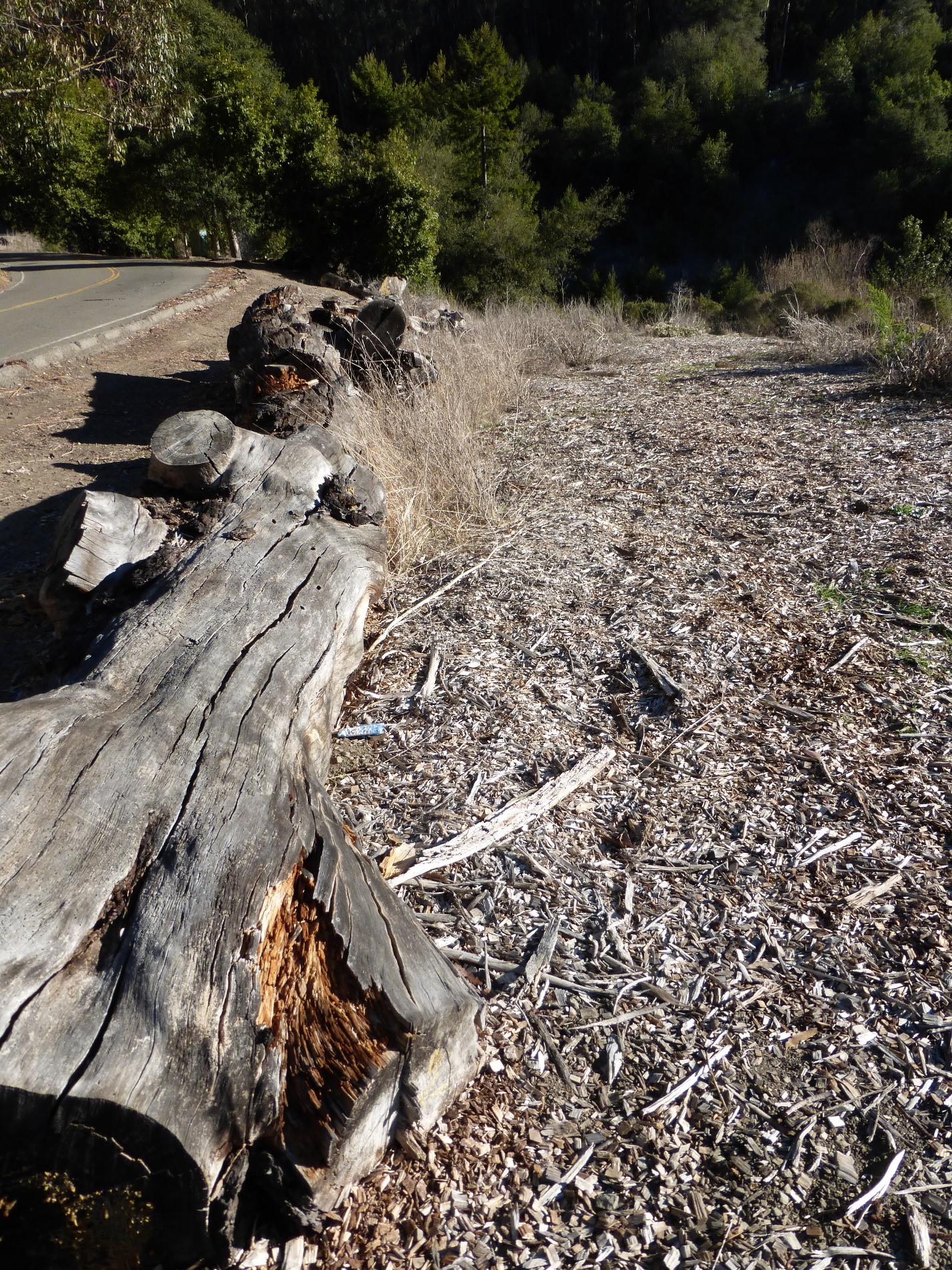
    Eucalyptus logs line the roads where UC Berkeley has destroyed trees. Do they look less flammable than living trees?
    Eucalyptus logs line the roads where UC Berkeley has destroyed trees. Do they look less flammable than living trees?
  • Ordinarily, eucalyptus does not contribute more fuel to the forest floor than native oak-bay woodland. This is confirmed by the National Park Service, which includes logs in the calculation of fuel loads. (2) Logs are extremely difficult to ignite.  The so-called “fire hazard mitigation projects” are leaving all the eucalyptus logs on the ground when the trees are destroyed, suggesting that they aren’t considered a fire hazard.  The National Park Service also separates the fuel loads of oaks and bays, which when combined are equal to the fuel load of eucalyptus.  Since our native woodland in the East Bay is a mixture of oaks and bays, it is appropriate to combine them when comparing their fuel loads to eucalyptus.
  • Eucalypts are sometimes blamed for casting more embers than native trees because they are taller than the oak-bay woodland. However, redwoods are as tall, if not taller, and they were also observed burning in the 1991 fire:  On Vicente Road, “Two redwoods up the street caught fire like matchsticks.” (4)  Yet, the Sierra Club is not suggesting that redwoods be destroyed to eliminate the risk of casting embers.
The Sierra Club now says the trees will be removed “in phases,” yet in its suit against the FEMA grants it objects to the phasing of tree removals.  The main focus of their suit is opposition to the “unified methodology” which proposes to remove trees over the 10 year period of the grant on only 29 acres of the total project acreage of 2,059.  To those who objected to this project, that small concession is little consolation, but for the Sierra Club it was a deal-breaker.  Their suit demands that all non-native trees be removed immediately on all project acres. 

If the Sierra Club withdraws its suit against the FEMA projects, it is free to tell another story, as it attempts to do in its Yodeler article.  As long as that suit remains in play, the Sierra Club is stuck with that version of reality.

“Once the flammable non-native trees are removed, less flammable native species can reclaim those areas and provide for a rebound of biodiversity. This model of fire prevention can summarized as the the [sic] “Three R’s”:

REMOVE the most flammable non-native trees in select areas most at risk for fire;

RESTORE those areas with more naturally fire-resistant native trees and plants; and

RE-ESTABLISH greater biodiversity of flora and fauna, including endangered species like the Alameda whipsnake.”

This is a stunning display of ignorance of the project as well as the natural history of the San Francisco Bay Area:

  • The FEMA projects do not provide for any planting or funding for planting after the trees are removed. FEMA’s mission is fire hazard mitigation, not landscape transformation.  The scientists who evaluated the FEMA projects said that a native landscape is not the likely result of the project:  “However, we question the assumption that the types of vegetation recolonizing the area would be native.  Based on conditions observed during site visits in April 2009, current understory species such as English ivy, acacia, vinca sp., French broom, and Himalayan blackberry would likely be the first to recover and recolonize newly disturbed areas once the eucalyptus removal is complete.  These understory species are aggressive exotics, and in the absence of proactive removal there is no evidence to suggest that they would cease to thrive in the area, especially the French broom which would be the only understory plant capable of surviving inundation by a 2-foot-deep layer of eucalyptus chips.” (5)
  • The US Forest Service evaluation of the FEMA projects stated that the resulting landscape would be more flammable than the existing landscape: “Removal of the eucalyptus overstory would reduce the amount of shading on surface fuels, increase the wind speeds to the forest floor, reduce the relative humidity at the forest floor, increase the fuel temperature, and reduce fuel moisture.  These factors may increase the probability of ignition over current conditions.” (6)
  • The US Forest Service evaluation predicts that the resulting landscape will be “a combination of native and non-native herbaceous and chaparral communities.” Despite the overwhelming evidence that wildfires in California start and spread rapidly in herbaceous vegetation such as dry grass, the myth persists that all non-native trees must be destroyed to reduce fire hazards.  An analyst at CAL FIRE has explained to the Center for Investigative Reporting that the reason why wildfires were so extreme this summer is because of the heavy rains in December 2014, which grew a huge crop of grass:  “The moisture did little to hydrate trees and shrubs. But it did prompt widespread growth of wild grasses, which quickly dry out without rain.  ‘They set seed, they turn yellow and they are done,’ said Tim Chavez, a battalion chief and fire behavior analyst with CAL FIRE. ‘All that does is provide kindling for the bigger fuels.’” (7) We know that more dry grass starts more wildfires, yet the Sierra Club demands that we destroy the tree canopy that shades the forest floor and produces leaf litter, which together suppress the growth of the grasses in which fires ignite. 
  • The claim that native plants are “naturally fire resistant” is ridiculous. Native vegetation in California—like all Mediterranean climates—is fire adapted and fire dependent. The wildfires all over the west this summer occurred in native vegetation.  There are over 200 species of native plants in California that will not germinate in the absence of fire and persist for only 3-5 years after a fire. (8) Although all native vegetation is not equally flammable, many species are considered very flammable, such as coyote brush, bay laurel, and chamise.  To say otherwise is to display an appalling ignorance of our natural history.
    When did "environmentalism" devolve into demonizing trees?
    When did “environmentalism” devolve into demonizing trees?
  • There is no evidence that the destruction of our urban forest will result in greater “biodiversity.” There are many empirical, scientific studies that find equal biodiversity in eucalyptus forest compared to native forests.  There are no studies that say otherwise, yet the Sierra Club and their nativist friends continue to make this claim without citing any authority other than their own opinions.  (9, 10, 11)  Bees, hummingbirds, and monarch butterflies require eucalyptus trees during the winter months when there are few other sources of nectar. Raptors nest in our tall “non-native” trees and an empirical study finds that their nesting success is greater in those trees than in native trees.
The Sierra Club’s 3Rs can best be summarized as “repeat, repeat, repeat.”  Their 3Rs are based on 3 Myths:  (1) eucalyptus trees are the most serious fire hazard; (2) “native” vegetation is categorically less flammable than “non-native” vegetation, and (3) native vegetation will magically return to the hills when trees are clearcut and the hills are poisoned with herbicide.  All available evidence informs us that these are fictions that exist only in the minds of the Sierra Club leadership and their nativist friends.

 “The Sierra Club’s approach does NOT call for clearcutting. Under “Remove, Restore, Re-establish” thousands of acres of eucalyptus and other non-natives will remain in the East Bay hills. Our proposal only covers areas near homes and businesses where a fire would be most costly to lives and property. In fact, removing monoculture eucalyptus groves and providing for the return of native ecosystems will create a much richer landscape than the alternative — thinning — which requires regularly scraping away the forest floor to remove flammable debris.”

The Sierra Club’s suit against FEMA demands that all eucalyptus and Monterey pine be removed from 2,059 acres of public property.  While it is true that the project acres are not 100% of all land in the East Bay, with respect to the project acres, it is accurate to describe the Sierra Club’s suit as a demand for an immediate clearcut of all non-native trees.
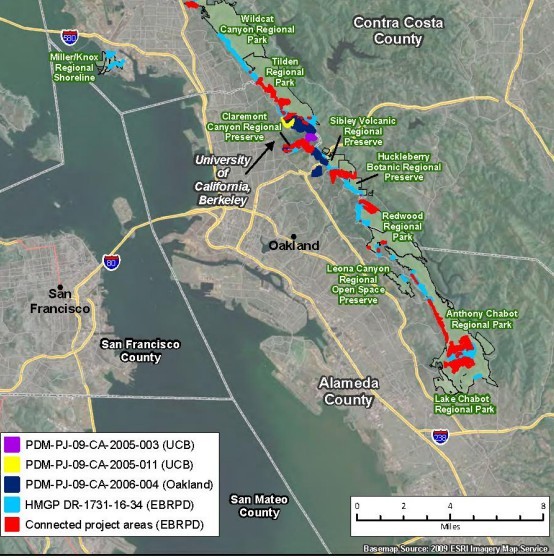
FEMA Project Areas
FEMA Project Areas

Most of the project acres are nowhere near homes and buildings.  They are in parks and open spaces with few structures of any kind.  CAL FIRE defines “defensible space” required around buildings to reduce property loss in wildfires.  CAL FIRE requires property owners to clear flammable vegetation and fuel within 100 feet of structures.  Using that legal standard, the FEMA project should not require the removal of all trees from project acres.

As we said earlier, Sierra Club’s description of the landscape that will result from the removal of the tree canopy is contradicted by scientists who evaluated the FEMA project.  And their prediction that “thinning” would “require regularly scraping away the forest floor to remove flammable debris” is not consistent with the predictions of those scientists who have advised that the loss of shade and moisture resulting from the complete loss of the tree canopy will encourage the growth of flammable vegetation and require more maintenance than the existing landscape.

“Our preferred approach does NOT focus on eucalyptus merely because they are non-natives. Rather, it is because they pose a far higher fire risk than native landscapes. Eucalyptus shed ten to fifty times more debris per acre than grasslands, native live oak groves, or bay forests — and that debris, in the form of branches, leaves, and long strips of bark, ends up draped in piles that are a near-optimal mixture of oxygen and fuel for fire. Eucalyptus trees ignite easily and have a tendency to dramatically explode when on fire. Also, eucalyptus embers stay lit longer than embers from other vegetation; coming off trees that can grow above 120 feet tall, those embers can stay lit as the wind carries them for miles.”

The Sierra Club’s suit demands the eradication of Monterey pine as well as eucalyptus.  The scientists who evaluated the FEMA projects stated that there is no evidence that Monterey pine is particularly flammable and they questioned why they were targeted for eradication:  “The UC inaccurately characterizes the fire hazard risk posed by the two species however…Monterey pine and acacia trees in the treatment area only pose a substantial fire danger when growing within an eucalyptus forest [where they provide fire ladders to the eucalyptus canopy].  In the absence of the eucalyptus overstory, they do not pose a substantial fire hazard.”  (5)  It is not credible that the Sierra Club’s demand that these tree species be entirely eradicated has nothing to do with the fact that they are not native to the Bay Area.  If flammability were truly their only criterion, they would demand the eradication of native bay laurel trees.  If fear of lofting embers from tall trees were their only concern, they would demand the eradication of redwoods.

As we said earlier, redwoods looked as though they were exploding when they ignited in the 1991 fire.  And we are seeing wildfires all over the west this fire season in which native trees look as though they are exploding when they ignite.  That’s what a crown fire looks like, regardless of the species.

It defies reason to think that an ember is capable of traveling miles and still be in flames on arrival.  In fact, Sierra Club’s suit says “non-native trees can cast off burning embers capable of being carried up to 2,000 feet in distance.”  That’s a fraction of the distance the Sierra Club now claims in its hyperbolic description of the issues in the Yodeler.  Surely we can all use a little common sense to consider how unlikely it is that a fragment of a tree small enough to be carried in the wind could travel miles while remaining on fire.  Likewise, we must ask why fragments of eucalyptus trees are likely to burn longer than any other ember of equal size.  We are not provided with any reference in support of these fanciful claims other than the opinions of the authors.

“Any herbicide use to prevent the regrowth of eucalyptus once they’ve been cut down (they quickly sprout suckers otherwise) would be hand applied in minimal amounts under strict controls. Any herbicide application must undergo a full environmental review to prevent impacts on humans, wildlife, and habitat. There are also methods other than herbicide that can be used to prevent regrowth, and the Sierra Club encourages the agencies that manage the land where fire mitigation occurs to explore these alternatives to find the most sustainable, responsible option.”

Once again, the Sierra Club is stuck with the public record which describes the FEMA projects:

  • East Bay Regional Park District has stated in the Environmental Impact Statement for the FEMA project that it intends to use 2,250 gallons of herbicide to prevent the regrowth of eucalyptus.  (12)  This estimate does not include the herbicides that will be used by UC Berkeley or the City of Oakland.  Nor does it include the herbicides that will be needed to kill flammable non-native vegetation such as fennel, hemlock, broom, radish, mustard, etc.  Surely, we can all agree that thousands of gallons of herbicide cannot be accurately described as “minimal.”
  • The Sierra Club now seems to be suggesting that further environmental review will be required for herbicide use by this project. They are mistaken in that belief.  The Environmental Impact Statement for this project is completed and it admits that the project will have “unavoidable adverse impacts” on “human health and safety” and that there will be “potential adverse health effects of herbicides on vegetation management workers, nearby residents, and users of parks and open space.”  The Sierra Club’s smoke screen cannot hide that conclusion.
  • The FEMA grants have been awarded to the three public land owners and they explicitly provide for the use of herbicides to prevent eucalyptus and acacia from re-sprouting. There is nothing in the Environmental Impact Statement that indicates that “methods other than herbicide can be used to prevent regrowth,” as the Sierra Club now belatedly opines in its latest propaganda.  If the Sierra Club wants other methods to be considered, we could reasonably expect they would make such a demand in their suit against FEMA, along with all their other demands.  They do not make such a demand in their suit.  Therefore, claims that other methods are being explored are not credible.
  • Sierra Club’s claim that herbicides will be applied “with strict controls” is not credible because there is no oversight of pesticide application or enforcement of the minimal regulations that exist in the United States. After 25 years of working for the EPA, E.G. Vallianatos wrote in 2014 of his experience with pesticide regulation in Poison Spring:  “…the EPA offered me the documentary evidence to show the dangerous disregard for human health and the environment in the United States’ government and in the industries it is sworn to oversee…powerful economic interests have worked tirelessly to handcuff government oversight.”

The Sierra Club has also explicitly endorsed the use of herbicides in the public comments they have submitted on these projects and in other articles in the Yodeler:

  • Sierra Club’s written public comment on Scoping for the FEMA EIS: “We are not currently opposed to the careful use of Garlon as a stump treatment on eucalyptus or even broom when applied by a licensed applicator that will prevent spread into adjacent soils or waters.”  Norman La Force (on Sierra Club letterhead), September 12, 2010
  • “There is no practical way to eliminate eucalyptus re-sprouting without careful use of herbicides.” Yodeler, May 25, 2013

Obfuscation and insincere backpedaling

The latest Yodeler article about the FEMA projects is a lot of hot air.  It makes claims about the issues for which it provides no evidence and for which considerable contradictory evidence exists.  It contradicts previous statements the Sierra Club has made.  Most importantly, as long as Sierra Club’s suit remains in play, the demands the Sierra Club makes in that public document cannot be denied.  If the Sierra Club wishes to back away from its previous positions, it must start by withdrawing its suit, which demands that 100% of all non-native trees in the FEMA project areas be destroyed immediately.  Withdrawal of the suit would be a most welcome start on the long healing process that is required to mend the damage the Sierra Club has done to its reputation as an environmental organization in the San Francisco Bay Area.  However, the Sierra Club will not be able to reclaim its status as an environmental organization without renouncing all pesticide use on our public lands. 

The Sierra Club has isolated itself from reality.  Its leadership refuses to speak with anyone with whom they disagree.  They have become the victims of incestuous amplification.  They apparently do not read the documents they use to support their opinions.  For example, the Sierra Club suit claims the California Invasive Plant Council (Cal-IPC) has classified blue gum eucalyptus as “moderately” invasive.  In fact, Cal-IPC’s rating of blue gum eucalyptus is “limited.”  This reflects the fact that a study of aerial photographs of Bay Area parks and open spaces, taken over a 60 year period find that eucalyptus and Monterey Pine forests were smaller in the 1990s than they were in the 1930s.  (13)

We will send our petition soon to the national leadership of the Sierra Club.  If you have not yet signed our petition, we hope you will consider doing so now. 


  1. Dickinson, K.J.M. and Kirkpatrick, J.B., “The flammability and energy content of some important plant species and fuel components in the forests of southeastern Tasmania,” Journal of Biogeography, 1985, 12: 121-134.
  2. “The live foliage proved fire resistant, so a potentially catastrophic crown fire was avoided.” http://www.nps.gov/pore/learn/management/upload/firemanagement_fireeducation_newsletter_eucalyptus.pdf
  3. Ron Buttery et. al., “California Bay Oil. I. Constituents, Odor Properties,” Journal Agriculture Food Chemistry, Vol. 22, No 5, 1974.
  4. Margaret Sullivan, Firestorm: the study of the 1991 East Bay fire in Berkeley, 1993
  5. URS evaluation of UCB and Oakland FEMA projects
  6. FEMA DEIS – evaluation of US Forest Service
  7. https://www.revealnews.org/article/rampant-california-wildfires-can-be-blamed-on-last-decembers-rain/?utm_source=Reveal%20Newsletters&utm_campaign=2d4c52ebf5-The_Weekly_Reveal_09_24_159_23_2015&utm_medium=email&utm_term=0_c38de7c444-2d4c52ebf5-229876797
  8. Jon Keeley, Fire in Mediterranean Ecosystems, Cambridge University Press, 2012
  9. https://milliontrees.me/2011/02/04/biodiversity-another-myth-busted-2/
  10. https://milliontrees.me/2013/04/09/biodiversity-of-the-eucalyptus-forest/
  11. https://milliontrees.me/2013/11/22/invertebrates-such-as-insects-are-plentiful-in-the-eucalyptus-forest/
  12. See Table 2.1 in Appendix F: http://www.fema.gov/media-library-data/1416861356241-0d76d1d9da1fa83521e82acf903ec866/Final%20EIS%20Appendices%20A-F_508.pdf
  13. William Russell and Joe McBride, “Vegetation Change and Fire Hazard in the San Francisco Bay Area Open Spaces,” Landscape and Urban Planning, 2003
A retired university planner critiques the FEMA projects in the East Bay Hills

We recently finished reading all of the 13,000 public comments on the FEMA draft EIS.  FEMA says that about 90% of the comments are opposed to the project and having read the comments that seems about right. 

It was a very rewarding experience to read the comments and we recommend it to anyone who is discouraged or doubtful that we can prevent the destruction of our urban forest in the East Bay (available HERE).

There were many excellent comments, many from people with specific expertise and knowledge of the issues that inform our opposition to these projects.  We plan to publish a few of them, as we obtain permission from their authors.  Today, we publish the public comment of Christopher Adams, with his permission.  We hope you are as impressed with his astute analysis as we are.


 Comments on Hazardous Fire Risk Reduction, East Bay Hills, CA,

Draft EIS

Prepared by Christopher Adams

Introduction:

My comments here are made solely in my capacity as a private citizen, but I think it is germane to state my background. I am a retired university planner, and for several years I directed the office which was responsible for review of every environmental document prepared by all the campuses and other facilities of the University of California. In addition, I was directly involved with the drafting, the public hearings, and the response to comments and preparation of two major Environmental Impact Reports, prepared under the California Environmental Quality Act for a UC campus. I also live near the EB Hills in an area subject to wild fires and share the concerns of others about the risk of fire.

Summary:

The Hazardous Fire Risk Reduction, East Bay Hills, CA, Draft EIS is a deficient document, beginning with its basic premise. While purportedly for the purposes of fire management, the proposed actions appear to be mostly motivated by a dream of a restoring the EB Hills to some imagined Eden prior to the European and American colonization of California. Instead of applying scientific and policy analysis to the impacts of the proposed actions the DEIS authors appear to have decided that the proposed clear cutting and herbicide measures are the right ones for fire protection and then cherry‐picked evidence, whether in the description of existing conditions or the possible alternatives solutions, which supports this conclusion. The DEIS rejects out of hand fire management alternatives that do not involve clear cutting and massive application of herbicides. In so doing the DEIS is a classic example of post hoc rationalization. Unless the DEIS is re‐issued with corrections and additions responding to the comments below, I believe that FEMA is seriously exposed to potential litigation. More significantly, if FEMA does not consider other less draconian and less expensive fire management measures, it will not be serving the interests of the citizens most impacted by fire danger, not to mention the taxpayers who will ultimately foot the bill.

Specific Comments:

The DEIS fails to note the existence of native trees which are specifically susceptible to the effects of one of the herbicides proposed for use. Section 4.2.2.2.1 notes that the native trees in the woodlands include madrone (Arbutus menziesii). However, in Section 3.4.2.1.1 Strawberry Canyon‐PDM there is no mention of madrones in the list of trees in the “native forest” (first paragraph of section). This is a significant omission, because there are madrones in Strawberry  Canyon, yet in the third paragraph of this same section one of the two herbicides proposed for use to stifle stump regeneration is Stalker (imazapyr) which has been identified elsewhere as being used specifically to eliminate madrones. According to the EPA Reregistration Eligibility Decision for Imazapyr: “Imazapyr use at the labeled rates on non‐crop areas when applied as a spray or as a granular to forestry areas present risks to non‐target plants located adjacent to treated areas.” (1)

The DEIS fails to acknowledge the growing threat of French broom in the UCB area.

While the presence of eucalyptus, Monterey pine, and acacia is repeatedly discussed, there is almost no mention of the rapid invasion of French broom. It is mentioned only in passing and without its scientific name in the discussion in Section 4.2.2.2.3 under “Northern Coastal Scrub.” While French broom has been rapidly increasing in the upper slopes of the Strawberry Canyon PDM and Claremont PDM areas, there is no mention of it at these locations in the DEIS. This plant is an active pyrophyte which chokes out native vegetation, can be poisonous to livestock, and is of limited benefit to native animals. The increase in sunlight from the proposed removal of large amounts of eucalyptus will encourage its spread. There is no mention of the fire risk from French broom in the discussion of fire risk in Northern Coastal Scrub, Section 4.3.3.2.5, and I could find no mention of its removal anywhere in the document.

The UCB project description does not explain if a fuel break is planned in the UCB areas and if so to describe it.

Section 1.1.1 UCB states that it will follow the “same general approach…which is included in Oakland’s grant application (see Section 1.1.2 below).” In Section 1.1.2 it is stated there the Oakland PDM would “create a fuel break on the west side of Grizzly Peak Boulevard north and east of the Caldecott Tunnel [presumably this means the west entrance to the tunnel].” UCB Strawberry Canyon properties also abut Grizzly Peak Boulevard, so the statement of “the same general approach” implies that UCB also proposes a “fuel break,” but none is described. Since the term “fuel break” implies clearing to the bare soil, with potential significant environmental impacts, this is a serious omission.

The DEIS fails to consider the impact on global climate change by the wholesale destruction of trees. The DEIS states that for UCB Strawberry Canyon alone 12,000 trees will be destroyed. Because trees absorb CO2 at an average rate of 13 pounds per year, this represents a potential loss in CO2 absorption of 78 tons per year. Given the growth patterns of native trees in Berkeley, which tend to be riparian or to grow on north facing slopes in a widely scattered pattern, the number of replacement trees will not come close to compensating for those destroyed. The difference should be estimated and calculated.

The DEIS fails to consider an actual and accomplished fuel management program when dismissing the alternative described in Section 3.3.1.1.

The Lawrence Berkeley National Laboratory (LBNL) is located on 175 acres on the north side of Strawberry Canyon immediately adjacent to the UCB and EBRPD areas described in the DEIS. LBNL, which is managed by the University of California, employs more than 4,000 persons on this site in laboratory buildings and with equipment that is worth several billion dollars. LBNL has recently completed a fire management program which is essentially what is described in Section 3.3.1.1 of the DEIS, Removal of Brush, Surface Fuels, Lower Limbs and Small Trees. The entire project was completed within the LBNL maintenance budget without special grants and has given the laboratory a great deal of fire security, according to its professional fire personnel. Yet there is no reference to this in the DEIS. The LBNL program is further described in the following links. This first links to a powerpoint slides; the second to a video discussion of the slides. http://www.lbnl‐cag.org/docManager/1000000159/Berkeley%20Lab%20Fire%20Safe%20Vegetati on%2C%20Lab%20Fire%20Marshal.pdf

http://www.lbnl‐cag.org/Content/10024/preview.html

The links convey much more effectively than my comments how an alternative to massive clear cutting and massive application of herbicides will effectively accomplish the goal of managing fire in the East Bay Hills.

The DEIS is incomplete and verging on the dishonest about the use of herbicides.

“Management of resprouts without herbicides is expensive….and thus was removed from further study.” This ignores the management of resprouts used successfully by LBNL as described in the above referenced powerpoint and video. There is no study about the use of herbicides at the scale proposed, e.g. 12,000 trees in Strawberry Canyon alone, on human populations, let alone native plants and animals.

The DEIS fails completely to discuss the realities of encouraging native plants after the clear cutting and heavy and repeated application of herbicides.

1) Restoration ecology is barely in its infancy, yet this DEIS expects us to accept on faith alone that when the clear cutting is done and the slopes sprayed with herbicides the native vegetation will miraculously reappear.

2) At the present time live oaks and bays are common on the north side (south facing side) of Strawberry Canyon under eucalyptus. This is probably because the fog drip from the eucalyptus and the shade encourage their growth in what would otherwise be a very dry area. Compare, for example, on slopes of similar aspect in portions of the EB Hills behind El Cerrito or Fremont. There is nothing in the DEIS to explain how native trees will increase or survive after the clear cutting has destroyed their source of water and shade.

3) Because of the abundance of deer in Strawberry Canyon and adjacent areas, small trees need to be protected against browsing. (See the LBNL powerpoint for an illustration of wire protective cages. http://www.lbnl‐ cag.org/docManager/1000000159/Berkeley%20Lab%20Fire%20Safe%20Vegetati on%2C%20Lab%20Fire%20Marshal.pdf) The DEIS says nothing about preventing deer browsing.

4) California native oaks of several species, including Quercus agrifolia are subject to the fungal disease Sudden Oak Death Syndrome (SODS), which has been found in the East Bay Hills. The DEIS fails to discuss the existence of SODS or its impact on replacement vegetation after the clear cutting and application of herbicides.

5) The DEIS states that “alleopathic oils” in the leaves and bark of eucalyptus suppress the growth of other vegetation. Yet the DEIS fails to state how covering slopes two feet deep with eucalyptus slash will not inhibit growth of new “native” plants.

6) Native California bunch grasses have largely been supplanted by European annual grasses, many of which form mats which choke out other plants. Similarly native shrubs such as coyote bush (Baccharis species) are being supplanted by invasive plants such as broom. The DEIS fails to explain how native plants will succeed in competition for sun and water with these plants.

The DEIS fails to consider the aesthetic impact to views from the trails and roads within the canyon and from houses near it after the clear cutting.

Section 4.12.2 of the DEIS states that a goal of the UCB LRDP (2005) is to “Maintain the visual primacy of the natural landscape in the hill campus” but there is no mention of the impact of clear cutting on this natural landscape. The north side of the lower portion of Strawberry Canyon forms the main campus of Lawrence Berkeley National Laboratory (LBNL). While individual buildings at LBNL are attractive in design, the overall effect of the site is essentially industrial, similar to an office park one might see along a freeway. The views of LBNL from the fire road that winds through the canyon are now largely screened by the large trees which will be destroyed by clear cutting. The trees also offer cooling shade to those using the area for recreation. The fire road is a major recreation amenity for UCB students, employees, and neighbors, used daily by hundreds of hikers, joggers, dog walkers, and mountain bikers. Removal of most of the trees as proposed will completely change the views enjoyed from the fire road. The DEIR provides absolutely no analysis of this impact either verbally or by providing illustrations of any viewing point in Strawberry Canyon. Most of the discussion of Section 5.8 is oriented to views over the hills from high points to the bay, which indeed may be improved by clear cutting. There is no discussion of views from within the areas to be clear cut and no reference to Strawberry Canyon.

The DEIS bases its list of plant species slated for destruction on incomplete and inaccurate botanical and fire danger information.

The authors of the DEIS seem not to understand the difference between “native” and “endemic” and they seem to have arbitrarily selected some “native” plants to extirpate while keeping others based on criteria having little or no relationship to fire hazards. Section 3.4.2.1.1 states that “Non native trees, including all eucalyptus, Monterey pine, and acacia would be cut down.” The Jepson Manual  (2), which is the definitive source for California plants divides the state into geographic areas. According to Jepson Monterey pines (Pinus radiata) are native to California, and while not endemic to the EB Hills, they are native in the geographic area CCo, which includes both portions of Monterey County and the EB Hills with similar climatic conditions. Coast redwoods (Sequoia sempervirens) are also found in Strawberry Canyon but not as an endemic. They are also native to the geographic area (CCo). In contrast to Monterey pines, however, Coast Redwoods appear to escape destruction by clear cutting; at least there is no mention of such action in the DEIS. Another native and Strawberry Canyon endemic, California Bay (Umbellularia californica), is specifically listed in the DEIS to be retained. But in a publication of the University of California Cooperative Extension (3) it is listed as a “High Fire Hazard Native Tree.” Note that these comments are not meant to imply favoring destruction of redwoods or bay trees but to further illustrate the inaccurate information and the arbitrary nature of the DEIS conclusions. Similarly cypress species which grow in parts of Strawberry Canyon are also listed as pyrophites in this UC document, but the DEIS does not propose their extirpation.

The DEIS fails to consider the impact on Strawberry Creek of run‐off from the predicted massive amounts of slash, from the standpoint of hydrology and flood control or the impact on the biota of the creek.

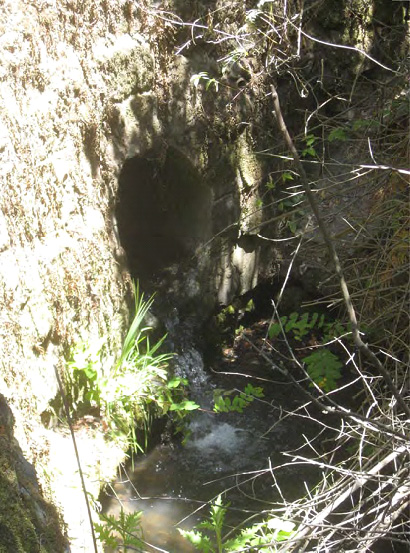
Section 3.4.2.1 of the DEIS states within Strawberry Canyon there will be clear cutting on 56 acres and that the downed trees will be chipped and left on 20% of the site at a depth of 2 feet. Based on these numbers the cumulative amount of material on the ground will be 975,744 cubic feet (.2 x 56 x 43,560 x 2). If merely 1% of this material is washed away in a storm, which seems a very conservative estimate considering the slopes where the material would be placed, there could be more than 1,000 cubic yards of slash material washed into Strawberry Creek. The DEIS does not discuss the impact on the biota of the creek of this potential massive amount of new material. Nor does the DEIS discuss the impact of this material on stream flow in storm conditions. Given that the culverts in the lower levels of the creek, near the Haas Clubhouse and the University Botanic Garden, are only about 9.5 square feet in cross section (See Figure 1.), there is a strong likelihood that the slash material would block the culverts and cause flooding. Section 3.4.2.1 states that “if the site yields a large number of large tree trunks,” some “may” be removed or used for other purposes than left on the site; however, the DEIS fails to state the criteria for determining what the “large number” is that would trigger such action. The hydrologic and ecological impacts are presumably left to the loggers to evaluate.

FEMA comment - Adams 1 copy

Figure 1, Culvert on lower fire trail, near Botanic Garden


The DEIS implies that trees other than eucalyptus, Monterey pines, and acacias will not be cut, but current actions in Strawberry Canyon suggest that UCB will cut anything at any time regardless of environmental regulations. The DEIS must be amended and re‐issued to include other UCB actions as part of cumulative impacts.

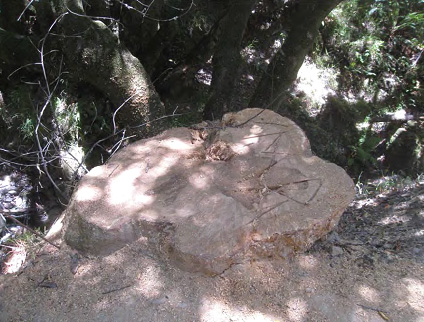
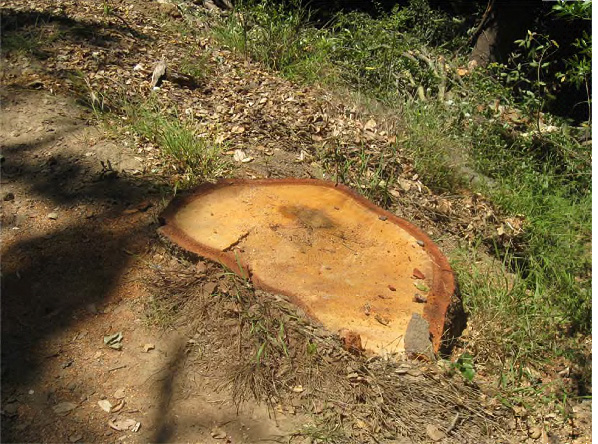
During the past week (June 6‐13, 2013) I have personally observed the cutting of at least six healthy, mature California live oaks, bays, and cypresses in Strawberry Canyon. (See Figures 2 and 3.) The oaks were particularly magnificent, and their destruction is tragic. I am familiar with the needs for passage of fire trucks as I own woodland property on a narrow privately maintained road. None of the trees just cut would have prevented passage of trucks, but I was told by one of the tree cutters that the excuse was “Fireman.” To my knowledge this cutting was done without any compliance with the California Environmental Quality Act (CEQA), which is the state equivalent of NEPA and applies to all UCB actions. This cutting constitutes a violation of the CEQA Guidelines Section 15304, which states that exemptions from CEQA apply only to actions “which do not involve the removal of healthy, mature, scenic trees.” If UCB is flagrantly cutting trees now, while the DEIS is out for public comment, what can we expect once the NEPA process is completed?

FEMA comment - Adams 2 copy

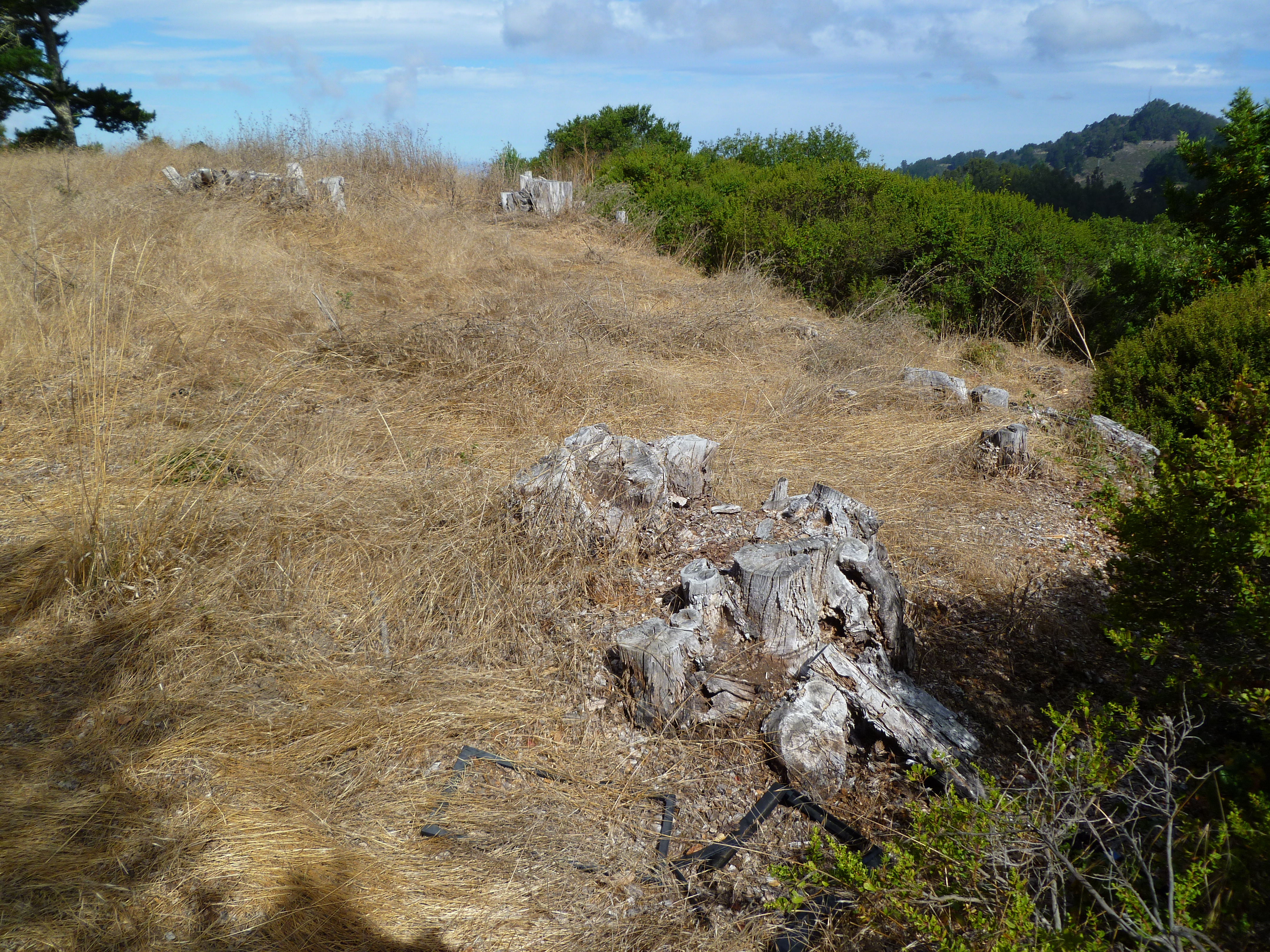
Figure 2. Bay stump on lower fire trail, cut on or about June 11 2013, diameter +/‐42”

FEMA comment - Adams 3 copy

Figure 3. Live oak stump on lower fire trail, cut on June 10, 2013, diameter +/‐ 38”

(1) EPA 738‐R‐06‐007, 2006

(2) The Jepson Manual of Vascular Plants of California, 2nd Edition, UC Press, 2012

(3) Pyrophytic vs. Fire Resistant Plants, FireSafe Marin in Cooperation with University of California Cooperative Extension, October 1998


Thank you, Mr. Adams, for taking the time and trouble to write this excellent public comment on the FEMA draft EIS.


Hills Conservation Network files suit to stop FEMA grants in East Bay Hills

Ten years after UC Berkeley, City of Oakland, and East Bay Regional Park District applied for FEMA grants to fund the destruction of hundreds of thousands of non-native trees on 1,000 acres of public open space, FEMA announced its final decision on Thursday, March 5, 2015.  FEMA’s announcement of that final decision, which was sent to those who commented on the draft plans, implied that the projects had been revised to be less destructive.  In fact, those who take the time to read the final version of the plans will learn that the original plans are fundamentally unchanged in the final version.

East Bay Regional Park District (EBRPD) will destroy about 90% of the trees in its project area, as originally planned.  “Thinning” is not an accurate description of EBRPD’s project.  UC Berkeley (UCB) and City of Oakland will destroy 100% of all non-native trees on their project properties.  On a small portion of UCB and Oakland property (29 of 460 acres), tree removals will be phased over the 10-year project period.  In other words, the final version of these projects will destroy as many trees as originally proposed by the grant applicants.  However, FEMA has refused to fund tree removals on Frowning Ridge (185 acres) because UC Berkeley removed hundreds of trees there before the Environmental Impact Statement was complete, in violation of FEMA policy.

UC Berkeley destroyed hundreds of trees on Frowning Ridge in August 2014, before the Environmental Impact Statement was complete.

The Hills Conservation Network (HCN) filed suit to prevent the funding and implementation of these projects on March 6, 2015.  Below is the press release announcing HCN’s suit.  Please contact the Hills Conservation Network if you wish to contribute to the cost of this suit:    http://www.hillsconservationnetwork.org/HillsConservation3/Blog/Blog.html or email inquiries@hillsconservationnetwork.org


Hills Conservation Network

Preserving the East Bay Hills

March 6, 2015                                                                                                          

For Immediate Release

HCN announces lawsuit against FEMA EIS

Today the Hills Conservation Network, an Oakland, CA based environmental non-­‐profit, filed suit against the Federal Emergency Management Agency, also naming the Regents of the University of California, the City of Oakland, and East Bay Regional Park District in the suit.

The suit was filed in opposition to the Record of Decision released March 5, 2015 finalizing FEMA’s decision to award approximately $7.5 million in fire risk mitigation grants. The suit contends that the Environmental Impact Study used as part of the grant process was significantly flawed, and as such cannot be used to justify awarding these funds.

The lawsuit argues that FEMA did not consider a reasonable range of alternatives and reached unsupportable conclusions in deciding to allow the three agencies named in the suit to remove large numbers of healthy trees, with the goal of eradicating certain species of non-­‐native trees (acacia, Monterey pine, eucalyptus) by the end of ten years.  HCN proposed a more nuanced approach that would have resulted in higher levels of fire risk mitigation at a much lower cost and with far less environmental damage than the current plan that calls for the removal of well in excess of 100,000 healthy trees that provide shade canopy (preventing the growth of highly flammable weeds) as well as storing tons of carbon that contribute to the greenhouse gases warming our planet.

This step marks the latest chapter in this process that began in 2005. During the Draft EIS review in 2013 approximately 13,000 comment letters were received by FEMA, 90% of them opposed to the proposed projects. In response to this public outcry FEMA reworked the EIS, and while the Final EIS is somewhat less destructive than the Draft EIS, it essentially calls for the same level of environmental damage, but over a longer time period.

The Hills Conservation Network is an Oakland, California based 501c3 comprised of residents of the Oakland hills that were directly affected by the 1991 fire. Several members of the group lost their homes in this conflagration and have committed themselves to driving change in Oakland to ensure that similar events never happen again. Members of HCN have been involved in the Grand Jury investigation of the ’91 fire and in developing enhanced emergency response capabilities in Oakland.

Please direct inquiries to Dan Grassetti at 510-­‐849-­‐2601.

################

Final Environmental Impact Statement for FEMA projects in the East Bay is NOT an improvement!

On December 1, 2014, FEMA published the final Environmental Impact Statement (EIS) for the projects in the East Bay Hills which propose to destroy hundreds of thousands of non-native trees.  FEMA’s email announcement of the publication of the EIS implied that the projects had been revised.  Two of the agencies applying for FEMA grants—UC Berkeley and City of Oakland—had originally proposed to destroy all non-native trees on their properties.  The third agency –East Bay Regional Parks District—had proposed to thin non-native trees in most areas and destroy all in a few areas.  FEMA’s email announcement of the final EIS implied that both UC Berkeley and City of Oakland would be required to use the same “thinning” strategy as East Bay Regional Parks District.

After reading the final EIS, the Hills Conservation Network (HCN) is reporting that FEMA’s email announcement was rather misleading.  In fact, both UC Berkeley and City of Oakland will be allowed to destroy all non-native trees on their properties.  In a small sub-section (28.5 acres) of their total project acres (406.2 acres), UC Berkeley and City of Oakland are being asked by FEMA to destroy the trees more slowly than originally planned.  However, they will all be destroyed by the end of the 10 year project period.

HCN has analyzed the EIS and consulted legal counsel.  The following is HCN’s assessment of the EIS and their plans to respond to FEMA.  We publish HCN’s assessment with their permission.   Note that HCN is asking the public to send comments to FEMA and they are raising funds to prepare for a potential legal suit.


 “After having reviewed the Final EIS in depth and having consulted with various stakeholders, HCN has concluded that the Final EIS, in spite of FEMA’s efforts to improve it from the Draft version, remains unacceptable.

While FEMA has made some modifications to portions of the EIS in response to the enormous number of comments submitted last year [more than 13,000], the fact remains that if implemented in their current form, these projects would remove essentially all of the eucalyptus, pines, and acacias from the subject area. While for portions of the area FEMA is now proposing that there be a phased removal of these species, the fact remains that the objective is ultimately to convert the current moist and verdant  ecosystem into one dominated by grasses, shrubs, and some smaller trees. This will forever alter the character of these hills that so many of us have grown up with, know and love.

But worse than that, these projects would actually increase fire risk, destabilize hillsides, cause immense loss of habitat, release significant amounts of sequestered greenhouse gases, and require the use of extraordinary amounts of herbicides over a large area for at least a decade.

Additionally, by preemptively clearcutting 7 acres of Frowning Ridge in August of this year, UC not only made a clear violation of FEMA rules but also essentially negated the accuracy and relevance of the EIS. While FEMA acknowledges this in the EIS, they still want to move forward with a document that may no longer accurately reflect the reality of the current environment, the cumulative impacts of these projects, and any of the other factors that underpin the EIS process.

For these reasons, HCN will be submitting a comment letter to FEMA asking that the EIS be pulled back, reworked, and recirculated….at a minimum. Additionally, we are currently exploring legal options should the EIS be finally released on January 5, 2015 in its current form. One way or another, we are committed to ensuring that the will of a small number of influential people doesn’t result in the loss of a treasured resource to the vast majority of us (both human and other).

We ask your support in sending additional comment letters to FEMA [ebh-eis@fema.dhs.gov] and most importantly that you consider making a tax-deductible contribution to HCN. While we wish we did not have to do this, the fact is that the only way we can have a shot at preventing this irreparable harm from happening is by hiring lawyers, and that is what we will do. This takes money, so please do what you can either by sending a check to HCN at P.O. Box 5426, Berkeley, CA 94705 or by making a donation through our website at http://hillsconservationnetwork.org/HillsConservation3/Support_HCN.html.”

Thanks again for all your support,

Hills Conservation Network

FEMA has published the final Environmental Impact Statement for projects in the East Bay Hills

Readers of Million Trees will recall some of the most controversial projects in the San Francisco Bay Area which propose to destroy hundreds of thousands of trees in the East Bay Hills.  The owners of these properties—UC Berkeley, City of Oakland, and East Bay Regional Park District—applied for grants from the Federal Emergency Management Agency (FEMA) to fund these projects, based on the claim that fire hazards would be reduced  by the projects.  Detailed descriptions of the proposed projects as originally planned are available HERE

The public comment period on the Draft Environmental Impact Statement closed in June 2013.  FEMA has announced the publication of the final Environmental Impact Statement (EIS), which is available HERE FEMA now reports that it received more than 13,000 public comments and informs us that the final EIS reflects the concerns expressed in the public comments as well as the analysis of “subject matter experts.”  We haven’t read either the public comments or the final EIS yet, so we are only quoting excerpts directly from FEMA’s announcement so that you have this information as soon as possible.  If you read these documents, we welcome your reaction to them. 


Here are excerpts from FEMA’s announcement of the final EIS (emphasis added):

“One of the major revisions to the draft EIS influenced by information gathered during the public process is that FEMA will not fund the proposed methodology of eradicating designated tree species without a phased approach.  The originally proposed eradication methodology to completely and immediately remove the “overstory” was deemed not to satisfy the purpose and need for the grant of fire reduction, and therefore did not meet hazard mitigation program eligibility requirements.

Identifying and analyzing implementation options is another required element of the National Environmental Policy Act (NEPA) decision-making process that must be explored before federal funding can be awarded.  Based on input and issues raised during the public comment process, and in consultation with the grantee, sub applicants, and cooperating federal agencies, FEMA revised the vegetation management methodology for two of the three sub applicants – City of Oakland and UC Berkeley.  The revisions align the majority of proposed projects with a thinning alternative, the approach originally proposed by East Bay Regional Parks District as described in the Draft EIS.

The thinning approach has been scientifically validated by subject matter experts to effectively reduce fire risk.   The revised vegetation management methodology will result in fewer trees being removed in any single year in certain areas, with the same total fuel reduction accomplished by the conclusion of the project.  The EIS considers the overall impacts to the environment based on the amount of land treated and consequent impacts to resources.  Each grant applicant is responsible for their ongoing land management practices and determination for how much vegetation will be removed to accomplish their fire reduction goals within the scope of the vegetation management approach defined in the EIS.  Clear-cutting, a logging practice, is not part of the methodology considered in the EIS for any of the projects.


The final EIS and response to comments are available on the web at:   http://ebheis.cdmims.com/FinalDocuments.aspx

and will also be made available at http://www.fema.gov/environmental-historic-preservation-documents.

The public also may view hard copies of the EIS at the following locations:

  • Oakland Main Library, 125 14th Street Oakland, CA 94612
  • Oakland Rockridge Library, 5366 College Avenue Oakland, CA 94618
  • Berkeley Main Library, 2090 Kittredge Street Berkeley, CA 94704
  • San Leandro Main Library, 300 Estudillo Avenue San Leandro, CA 94577
  • Richmond Main Library, 325 Civic Center Plaza Richmond, CA 94804
  • FEMA Region IX Headquarters, 1111 Broadway, Suite 1200, Oakland, CA 94607-4052
  • East Bay Regional Park District, 2950 Peralta Oaks Court, Oakland, CA 94605-0381
  • City of Oakland, Office of the City Clerk, Oakland City Hall, 2nd Floor, 1 Frank H. Ogawa Plaza, Oakland, CA 94612
  • California Governor’s Office of Emergency Services, Hazard Mitigation Grant Program Unit 10390 Peter A. McCuen Blvd First Floor Sacramento, CA 95655


Escalating war on trees in the East Bay

The Federal Emergency Management Agency (FEMA) has been considering grant applications for “fire hazard mitigation” in the East Bay since 2005, when the first of these applications was submitted. After years of debate about whether or not the projects achieve the stated purpose and at what cost to the taxpayers and the environment, FEMA finally agreed to resolve the controversial issues by mandating an environmental impact review, which began in 2010. The Draft Environmental Impact Statement (DEIS) was published in April 2013 and the public comment period on that draft closed in June 2013.

FEMA tells us they received over 3,500 public comments on the draft, so needless to say it is taking some time to analyze and respond to those comments. Based on questions raised by public comments, FEMA sent questions to the applicants in October 2013, requesting clarification of their project plans. The applicants responded in November 2013, by revising their project plans. UC Berkeley and the City of Oakland responded that they now plan to “thin” rather than to remove all non-native trees, consistent with the original intentions of East Bay Regional Park District. FEMA now predicts that the final EIS will be published around the end of 2014.

Grant applicants are champing at the bit

The applicants for these grants are getting restless for award of the grant which will fund the removal of tens of thousands of trees or more. We recently reported to our readers that UC Berkeley began to destroy trees on its property in late August 2014, before the grant has been approved. The trees that were destroyed are still lying on the ground, looking like bonfires waiting to happen.

Some of the hundreds of trees destroyed by UC Berkeley in August 2014

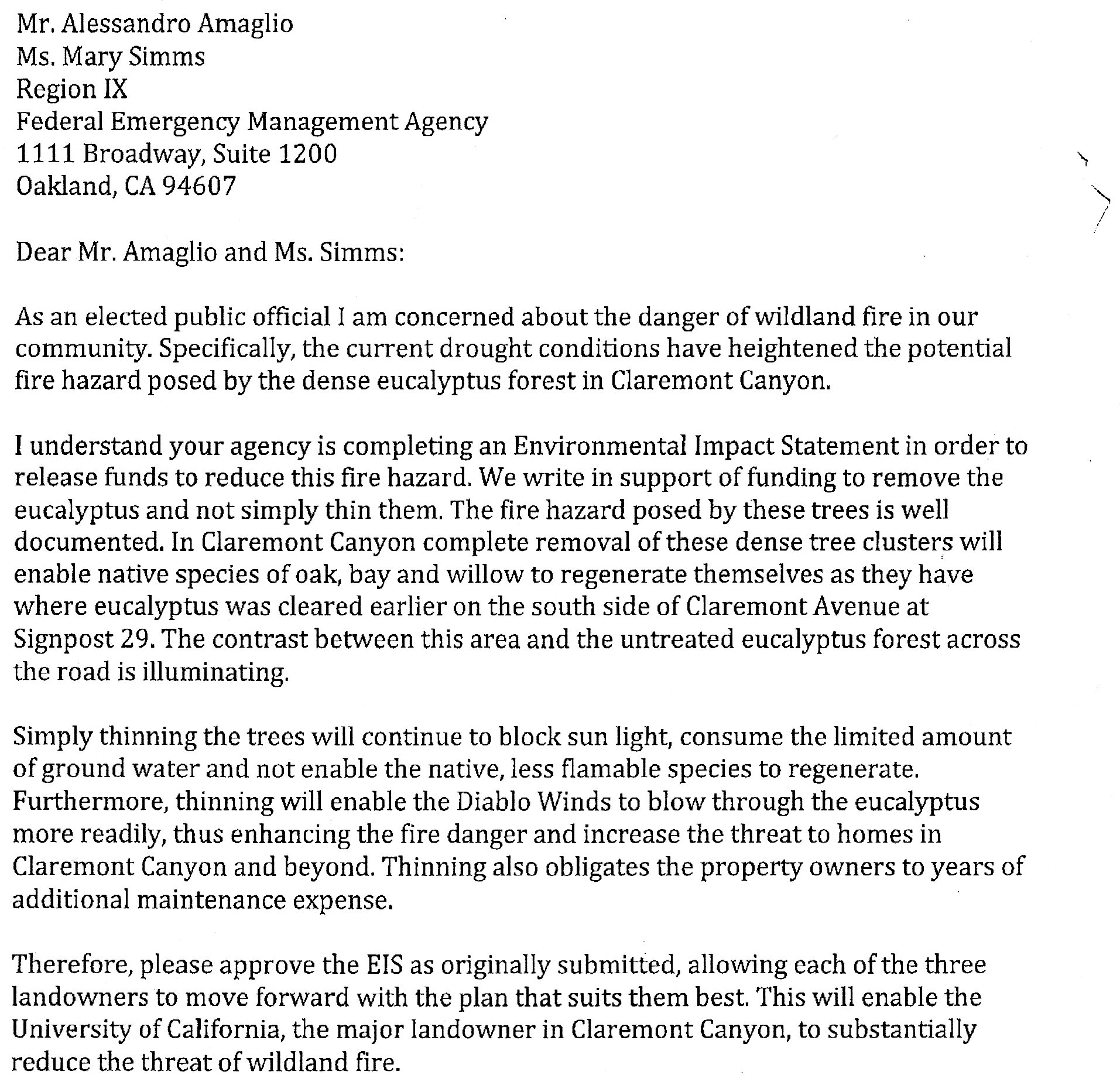
More recently, Claremont Canyon Conservancy has successfully recruited 12 East Bay elected officials to ask FEMA for immediate release of the grant funds, as well as “complete removal” of all eucalyptus trees, rather than thinning as originally proposed by East Bay Regional Park District and as revised by the City of Oakland and UC Berkeley in November 2013. This request was reported by the San Francisco Chronicle, Contra Costa Times, and ABC TV news. Based on these news sources, as well as the website of the Claremont Canyon Conservancy, we can report that the following East Bay elected officials have signed this request:

City of Oakland
Jean Quan, Mayor of Oakland
Dan Kalb, Oakland City Council
Rebecca Kaplan, Oakland City Council
Larry Reid, Oakland City Council
Libby Schaaf, Oakland City Council

City of Berkeley
Tom Bates, Mayor of Berkeley
Jesse Arreguin, Berkeley City Council
Laurie Capitelli, Berkeley City Council
Susan Wengraf, Berkeley City Council
Gordon Wozniak, Berkeley City Council

State of California
Nancy Skinner, State Assembly
Loni Hancock, State Senate

We have an unsigned copy of a letter to FEMA:

Pols letter to Amaglio

– end letter –

We cannot report with confidence that all these politicians sent the same letter because Oakland Councilman Dan Kalb is the only politician who has responded to our public records request. Mr. Kalb’s request is similar, but requests “funding to remove a substantial number of the eucalyptus trees.” Mr. Kalb’s letter seems to acknowledge that requesting removal of all eucalyptus trees would be inconsistent with the City of Oakland’s November 2013 revision of its original grant application; he says, “I know that the City of Oakland has submitted some revised language as requested by [FEMA].” The elected officials who signed the above letter do not seem to realize that their request contradicts the agreement with FEMA in November 2013 to thin rather than to remove all non-native trees on their properties. Or perhaps they have changed their minds.

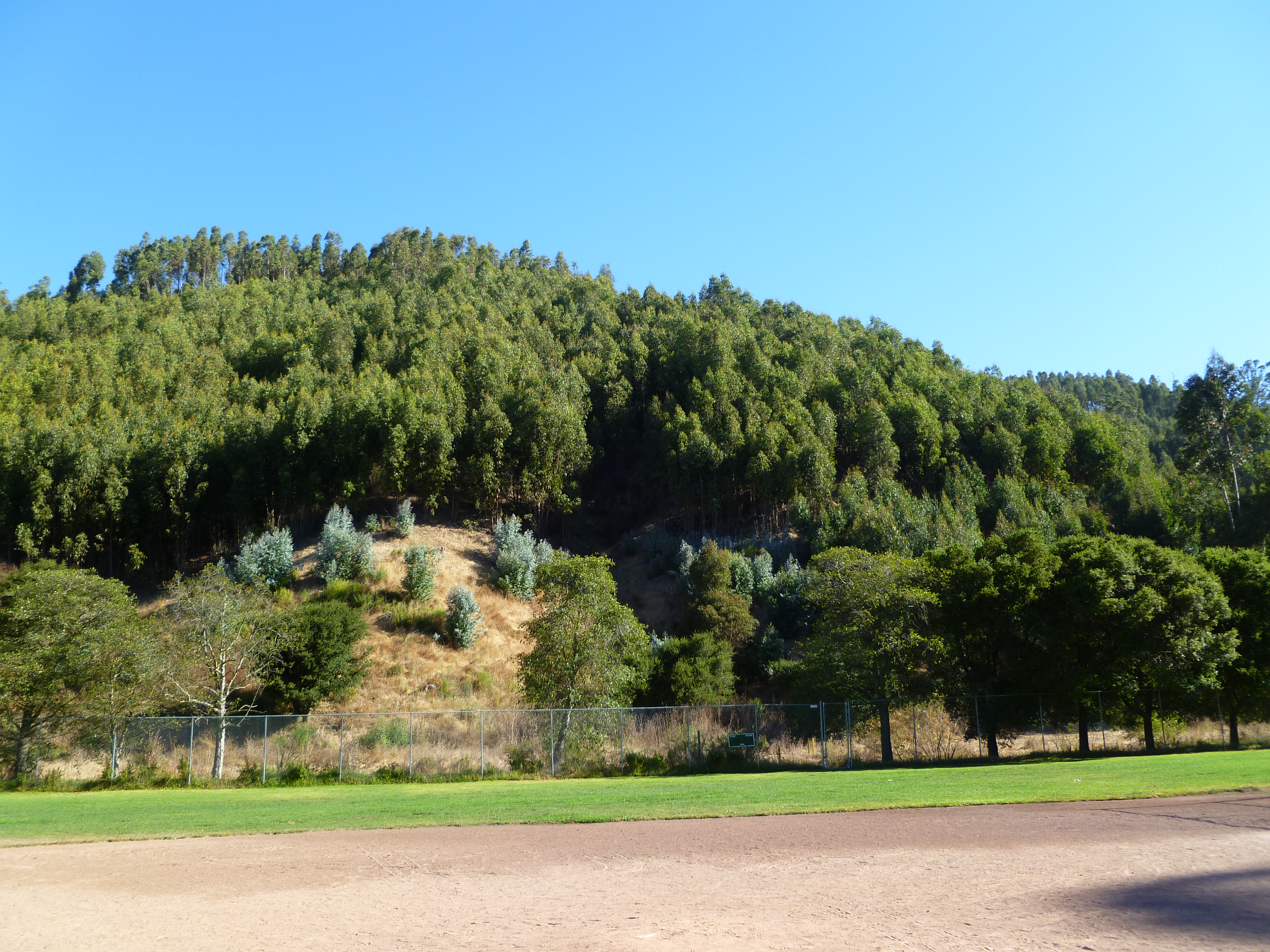
This eucalyptus forest at the North Oakland Sports Facility will be  destroyed by the City of Oakland.
The City of Oakland wants to destroy this eucalyptus forest at the North Oakland Sports Facility. Note that where they have destroyed eucalyptus in the past, they have not controlled the resprouts. The grey-green small trees near the base of the hill are eucalyptus resprouts.

Stunning display of ignorance

We are rarely surprised by the extreme views of native plant advocates, but the letter sent by East Bay elected officials is a stunning display of ignorance, mendacity, or both:

  • The claim that native plants are less flammable than non-native plants is entirely fallacious. The indigenous landscape of California is highly flammable as is demonstrated by wildfires throughout California every year. In virtually every case, those wildfires occur in native landscapes.
  • This statement is not even superficially logical: “thinning will enable the Diablo Winds to blow through the eucalyptus more readily, thus enhancing the fire danger…” Obviously, destroying ALL the trees will provide even less of a barrier to Diablo winds.
  • The public record does not support the contention that eucalyptus is more flammable than any other type of vegetation. HERE is a report of the public record of the 1991 Oakland wildfire.
  • Oaks and bays have indeed grown in Clarement Canyon since eucalypts were removed there because it is a riparian corridor where trees are sheltered from the wind and water is funneled to them. However, that is not typical of regrowth after removal of the tree canopy in most locations where eucalypts have been removed. The more likely outcome is non-native annual grasses, as explained HERE by the environmental consultant who evaluated the plans of UC Berkeley. Since fire ignites more readily in grass, fire hazards are not reduced by this transition.
Non-native annual grassland now occupies most of the area where UC Berkeley destroyed 18,000 trees about 10 years ago.

News sources also interviewed Jon Kaufman, a spokesperson for Claremont Canyon Conservancy who expressed his frustration that their desire for the destruction of non-native trees in the East Bay Hills is being delayed by FEMA: “With fire season approaching, it’s a good time to remind FEMA they need to get off their asses.” His insulting approach cannot be called a charm offensive.

Mr. Kaufman is quoted as making the following misstatement of fact: “But Kaufman said no spraying would be involved and that herbicide will be applied topically to the stumps with a brush.” We have heard native plant advocates make this claim many times. Perhaps some of them even believe it. FEMA asked for clarification from grant applicants about their plans for herbicide applications in October 2013. The applicants replied in November 2013 that they will apply Garlon according to the manufacturer’s label.

Mr. Kaufman’s claim that herbicide will not be sprayed is contradicted by the manufacturer of Garlon, DowAgra. The manufacturer describes the method of cut-stump application: “Treat the exposed cambium area and the root collar (exposed bark on the side of the stump) down to the soil line. Be sure to treat the entire circumference of the tree. To ensure effective control on large trees, also treat any exposed roots (knees) that surround the stump.” This method is illustrated on the manufacturer’s website by videos of the applicator using spraying equipment.

The herbicides needed to destroy non-native vegetation are also foliar sprayed, as described by the Draft EIS. It is a fiction that non-native trees and plants can be eradicated without spraying herbicides. The use of large quantities of herbicides is nearly as controversial as the loss of our urban forest.

Are you a voter in Oakland or Berkeley?

If you are a voter in Oakland or Berkeley and you care about the preservation of our urban forest and/or object to the hazards created by spraying our public lands with herbicides, you should know that some of the politicians who signed the letter to FEMA are on the ballot on November 4, 2014. You can take their support for clear cutting all eucalyptus in the Oakland/Berkeley hills into consideration in your vote. Better yet, you could write to them to tell them your opinion of their misguided support for removing all non-native trees on public property. We do not expect our public officials to be experts in horticulture or fire science. However, we think it is irresponsible for public officials to endorse the position of a particular interest group without making an effort to inform themselves of opposing viewpoints.

Here is a list of the candidates you will find on your ballot:

City of Oakland – Candidates for Mayor
Jean Quan http://www.oaklandnet.com/contactmayor.asp
Rebecca Kaplan atlarge@oaklandnet.com
Libby Schaaf lschaaf@oaklandnet.com

City of Berkeley – Candidates for City Council
Jesse Arreguin – District 4 – running unopposed

There is also a petition in opposition to these destructive projects available HERE.

The only logical resolution

One wonders how FEMA can now award grants to the City of Oakland or to UC Berkeley. In November 2013, these public agencies told FEMA, in writing, that they will thin rather than clear cut all non-native trees on their properties. In August 2014, UC Berkeley destroyed all eucalyptus trees on a portion of the project area, which should be a demonstration of UCB’s intentions. Actions speak louder than words, even written words.

In the case of the City of Oakland, elected officials in positions of authority, including the sitting Mayor of Oakland, have contradicted the City of Oakland’s written commitment to FEMA to thin rather than to clear-cut by asking FEMA to immediately release grant funds to clear-cut all eucalyptus from their properties.

How can FEMA trust these agencies to do what they have said in writing they intend to do? The only logical response to the request of these elected officials is to inform UC Berkeley and the City of Oakland that they have effectively rescinded their grant applications.

Is UC Berkeley building a bonfire during fire season?

If you are watching the news, you know that wildfires are raging all over California. One of those fires destroyed most of the small town of Weed a few days ago. The San Francisco Chronicle reported that fire and made a rare acknowledgement of the flammability of native California vegetation: “…the native fuels adapted over thousands of years to the lightning-caused fires that regularly broke out in California. The most problematic in a drought situation, he said, are manzanita, younger ponderosa pine trees and incense cedars. The three are all highly flammable and close to the ground, creating a fuel ladder from the grass to the overstory trees.” The article also noted that fires usually start in grasses and are then fanned by high winds into wildfires that destroy everything in their path.

Yet, the fiction continues in the San Francisco Bay Area that only non-native trees are to blame for wildfires and that they must all be destroyed to reduce fire hazards. In fact, when the trees are destroyed, the unshaded ground is quickly populated by grasses that are the type of vegetation in which virtually all of our fires start.

In the height of fire season, UC Berkeley has recently destroyed many trees in the East Bay Hills and left them lying on the ground to dry out. These huge piles of dead vegetation look like bonfires waiting to happen. We are grateful to our readers for alerting us to this new round of destruction. They have given us permission to publish their letter to the Federal Emergency Management Agency and UC Berkeley. We hope you will consider writing your own letter to express your concern.


Alessandro Amaglio [alessandro.amaglio@dhs.gov]
Region IX Environmental Officer
Federal Emergency Management Agency
Oakland, CA

RE: East Bay Hills – Environmental Impact Statement – FEMA – RIX

Dear Mr. Amaglio,

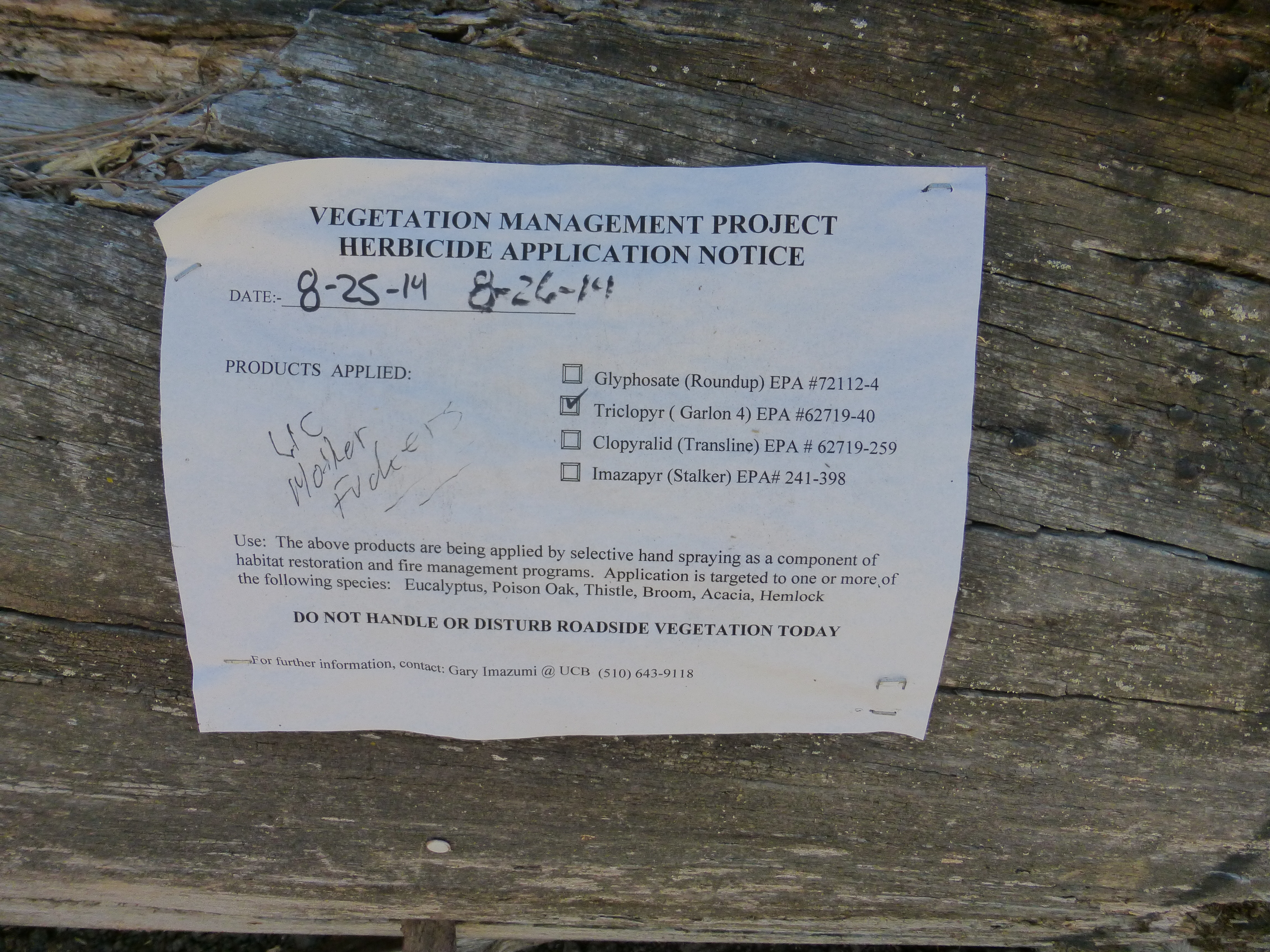
We are writing to tell you that UC Berkeley is in the process of destroying eucalyptus and some pine on its property. Judging by the Pesticide Application Notice posted on Grizzly Peak Blvd near South Park Drive, the trees were destroyed August 24-26, 2014. The scale of the removals is not entirely visible because the property goes down a steep slope that we could not cover. Based on what was visible to us, it appears that at least 100 trees were destroyed on a few acres.

P1010390

We believe the trees are being destroyed within the area for which UC Berkeley has applied for a FEMA grant to remove all non-native trees. We have used the maps in the Draft EIS to make this determination. Therefore, it seems appropriate that FEMA should be informed about this.

P1010400

While we visited the property on Monday, September 15, 2014, we could hear chainsaws in the distance but could not determine where the sound was coming from. Therefore, we suspect that more trees are being destroyed, but cannot determine exactly where.

P1010384

The Pesticide Application Notice gave the name of a person at UC Berkeley (Gary Imazumi) who is responsible for this project. (For the record, we are not responsible for the graffiti scrawled on that sign.) We have contacted him and asked for more information about the entire scale of the project and a timeline for its completion. We have also asked him what will be done with the huge piles of dead vegetation that are now lying on the ground. We have not received a response to our questions.

This incident raises the following questions and concerns:

  • Has the Draft EIS for the FEMA grants to UC Berkeley for tree removal been approved?
  • Has the FEMA grant to UC Berkeley been awarded?
  • If the EIS and/or the grant have not been approved, can UC Berkeley be reimbursed for expenses it incurs prior to the award of the grant?
  • The trees that UC Berkeley destroyed on August 24-26 are still lying on the ground several weeks after they were cut down. They have not been chipped or hauled away.  The Draft EIS made a commitment to chip the destroyed trees and distribute them on the ground.  Is there any time frame for this disposition of the destroyed trees?  Should the public expect dead trees to spend weeks or more on the ground after they are cut down?
  • As you know and the daily news confirms, we are now in the height of fire season. Does it seem consistent with fire hazard mitigation to use chainsaws at this time of year, particularly after several years of drought?
  • Does it seem consistent with fire hazard mitigation to leave dead vegetation lying on the ground during the height of the fire season? Does FEMA believe that dead vegetation is less flammable than living, standing trees?

P1010396

We understand that some of these questions are rhetorical and we don’t expect answers to any but the first three questions. The rhetorical questions are not intended to put you in an awkward position. They are intended to express our opinion of UC Berkeley’s hypocritical claim that destroying living trees will reduce fire hazards. We just want FEMA to know what is happening and to take it into consideration before finalizing the EIS and/or awarding the grant, if FEMA has not already done so.

Thank you for your consideration.

[Concerned citizens of Oakland]

Cc: Gary Imazumi, Manager, Grounds Operations, UCB [garyi@berkeley.edu]
Sal Genito, Associate Director, Grounds, Custodial, Environmental Services, UCB [salgenito@berkeley.edu]
R’obert Newell, Acting Assistant Vice Chancellor, Physical Plant, UCB [rbnewell@berkeley.edu]


Update:  On December 1, 2014, FEMA published the final Environmental Impact Statement for the “Fire Hazard Mitigation Grants” in the East Bay Hills.  As a result of UC Berkeley’s premature removal of trees in the project area prior to the publication of the EIS and prior to the award of the grants, the final EIS says that UC Berkeley will not be awarded grant funding for the Frowning Ridge portion of their grant application.  The following is an excerpt from the Executive Summary of the final EIS (page 17) which is available HERE.  However, we should not assume that this prohibition will remain when the EIS is officially approved by the “Decision of Record” on January 5, 2015, because we assume it is being challenged by those who support this project.

“In August 2014, UCB undertook environmental treatment measures on approximately 7.5 acres of the 185.2-acre project area at Frowning Ridge. According to UCB, they felled 150 eucalyptus, Monterey pine, and acacia trees, and applied an herbicide to eucalyptus and acacia stumps. In undertaking these actions prior to issuance of the final EIS, UCB failed to comply with both the specific conditions of the grant and also the NEPA requirement which limits applicant action during the NEPA process under 40 CFR 1506.1. Both required UCB to refrain from action until FEMA had completed its environmental review. As a result, the Frowning Ridge project area is no longer eligible for PDM program grant funding.

Nonetheless, the environmental analysis of the impacts of the proposed action at Frowning Ridge has not been removed from the final EIS because it is part of the review and consideration that FEMA has undertaken in concluding whether to fund the proposed actions. FEMA will continue to work with the U.S. Fish and Wildlife Service and the National Marine Fisheries Service to determine whether UCB’s unauthorized work at Frowning Ridge negatively affects UCB’s other projects at Strawberry Canyon and Claremont Canyon and will make further decisions regarding these projects in the Record of Decision.”


California Invasive Plant Council sticks to its guns aimed at eucalyptus

Monarch butterflies roosting in eucalyptus tree.

In December 2013, one of our collaborators in the effort to save our urban forest from pointless destruction submitted a request to the California Invasive Plant Council to reconsider its evaluation of blue gum eucalyptus (Eucalyptus globulus) as “moderately invasive.” 

The California Invasive Plant Council (Cal-IPC) has responded to that request with a draft reassessment which is available here:  http://www.cal-ipc.org/ip/inventory/eucalyptus.phpCal-IPC’s draft maintains the same over-all rating of blue gum as “moderately invasive.”   Cal-IPC is inviting “substantive comments and questions” by July 31st to info@cal-ipc.org.

Today we are publishing with permission the cover letter of a public comment that will be submitted by one of our collaborators.  We hope it will inspire you to write your own public comment by the deadline of July 31, 2014. 


From the perspective of humans, there are pros and cons to most species of plant and animal.  E. globulus is no exception to this general rule.  Cal-IPC reaches a negative conclusion regarding blue gum by exaggerating negative issues and de-emphasizing or omitting positive issues.  Cal-IPC now acknowledges that blue gum has “low invasive potential” only in specific conditions and that its population in California is stable, but it has introduced new issues and intensified others so that it can maintain its overall rating of “moderately invasive.”  I remind Cal-IPC that its name is Invasive Plant Council, not fire council or hydrology council.

Cal-IPC also fails to take into consideration the negative side-effects of attempting to eradicate eucalyptus.  There are environmental benefits associated with leaving blue gums alone.  These damaging consequences of eucalyptus removal should appear on the “asset” side of the ledger:

It is also not in Cal-IPC’s strategic best interests to continue to advocate for the eradication of eucalyptus in California:

  • As the eradication projects get progressively more destructive, the public’s negative reaction to the destruction becomes progressively more aggressive.  There are now thousands of us all over the State and all over the country, working to stop this destruction and we are often effective in preventing these projects from being approved or funded.  An op-ed in the New York Times in September 2013, expressed support for our opinion that the word “invasive” has become a destructive tool and is inappropriately applied to eucalyptus in California.
  • The scientific community has also become progressively more critical of the attempts to eradicate eucalyptus.  Last fall, Nature  magazine quoted several well-known academic scientists in an article that criticized plans to destroy 30,000 eucalypts on Mount Sutro in San Francisco.  In May 2014, the CEO and Chief Scientist of the Nature Conservancy expressed their opinion on TNC’s website that destroying eucalypts in California is unnecessary.
  • Since blue gum eucalyptus is no longer available in nurseries in California and has not been planted for many decades, it has no long-term future in California.  To the extent that eucalyptus is a problem, it is a problem that will resolve itself in time.

Cal-IPC’s continued support for these projects is no longer in the mainstream of scientific or public opinion.  Removing eucalyptus from Cal-IPC’s “hit list” would significantly improve Cal-IPCs chances of success with the plants that remain on its inventory of invasive plants.  The public is unlikely to expend the same amount of energy opposing the eradication of broom, for example.

Cal-IPC has an opportunity to defuse a controversy that is handicapping the success of its venture.  Cal-IPC would be wise to abandon its crusade aganst blue gum eucalyptus.

Update:  On March 13, 2015, the California Invasive Plant Council published its final reassessment of Blue Gum Eucalyptus (available HERE).  Cal-IPC has downgraded its rating of invasiveness and ecological impact from “moderate” to “limited.”  Although the detailed assessment is less than perfect, the over all rating itself is an improvement.  Thanks to those who sent comments to Cal-IPC.

Relentless war on eucalyptus

A new front has opened in the relentless war on eucalyptus in California.  The drought has given native plant advocates an opportunity to develop a new narrative to justify their demands for eradication of eucalyptus.  The opening gambit in this new strategy is an item in Jake Sigg’s “Nature News” of May 16, 2014:

“The prolonged drought of the last 2-3 years seems to be taking its toll.  The Tasmanian blue gums in Glen Canyon along O’Shaughnessy Boulevard strongly show drought stress.  The stress is more evident from the high cliffs above O’Shaughnessy than it is at ground level.  Thinning crowns and discolored foliage was striking.  And that was before the recent heat wave.

Barring substantial rains–unlikely, but not impossible–the trees are in serious trouble.  The City could have an emergency situation and no money to address it.”

 Recap of the war on eucalyptus

When public land managers began the war on eucalyptus in the 1980s it did not occur to them that the public would object.  So deep was their prejudice against eucalyptus, that they assumed the public shared their opinion.  The first two massive projects in the 1980s on National Park Service and State Park properties were greeted with angry public protests.  Land managers quickly learned that it was not going to be as easy to eradicate eucalyptus as they had thought.  They developed a series of story-lines to justify their projects, which were designed to convince the public that the eradication of eucalyptus is both necessary and beneficial.  This is a summary of some of their cover stories with links to articles that debunk them:

Based on our experience, we were immediately suspicious of the new claim that San Francisco’s eucalyptus forest is dying of drought.  We know that our predominant species of eucalyptus—Tasmanian blue gum—grows successfully throughout California, all the way to the Mexican border in climates that are much hotter and drier than the Bay Area.  We also know that the central and north coast of California is foggy during the dry summer months, which doubles the amount of annual precipitation in the eucalyptus forest.  All reliable sources of horticultural information describe blue gum eucalyptus as drought tolerant.  Frankly, we couldn’t see how our eucalyptus could be dying of drought.

What is wrong with our eucalyptus forest in Glen Canyon?

 The picture became clearer when Jake Sigg posted the following on his “Nature News” on June 12, 2014:

“The June 10 newsletter [see below*] included an editorial on an evolving catastrophe, mostly involving our numerous plantations of Tasmanian blue gums.  The editorial focused primarily on the plantations on O’Shaughnessy Blvd in Glen Canyon and on Mt Sutro, and included a photo of a grove of Mt Sutro dying trees.  Here is a photo of the Glen Canyon plantation, taken from above the high cliffs on O’Shaughnessy.  The damage is most visible from high, looking down.

The discoloration of leaves was very dramatic, but the foliage color and condition is not fully conveyed in the photograph.  Some trees defoliated entirely in the prolonged winter dry spell.  Look very closely at the juvenile blue leaves of the coppice shoots; anything that appears faintly bluish are new coppice shoots which grew in response to the late rains we had in February and March.  Once you see coppice shoots on old trees you know the trees are in trouble.  These trees are in double jeopardy, as they invested energy in new shoots, but were betrayed by another dry spell which, under normal circumstances, will last until autumn.  Note that you can now see the grassland through the trees; that slope was not previously visible.  Even a casual inspection of these groves reveals dead, dying, and stressed trees, and under normal circumstances we will have four or five months of dry.  The fire situation is serious right now and is likely to become worse.”

View of west side of Glen Canyon Park from Marietta Drive, June 2014

With more specific information in hand about what Jake Sigg is looking at, we went to see for ourselves.  We could see what he was describing from a vantage point on Marietta Drive, west of Glen Canyon Park.  We could see lighter colored leaves, but they were more localized than Jake Sigg’s description implied.  We didn’t feel qualified to speculate about why the leaves were lighter colored so we recruited an arborist to help us figure out what is happening there.  We were fortunate to enlist the help of a certified arborist who has been responsible for urban forests on public lands in the Bay Area for several decades.  This is what we learned.

Epicormic Sprouts

Looking through binoculars from our vantage point on Marietta Drive, the arborist said immediately, “Those are epicormic sprouts.”  The leaves of epicormic sprouts are distinctively lighter colored than the darker green of mature eucalyptus leaves.  They are also a more rounded shape than the long, pointed mature leaves of eucalyptus.  This is how Wikipedia describes epicormic sprouts:

“Epicormic buds lie dormant beneath the bark, their growth suppressed by hormones from active shoots higher up the plant.  Under certain conditions, they develop into active shoots, such as when damage occurs to higher parts of the plant. Or light levels are increased following removal of nearby plants.”

Epicormic sprouts on trees in Glen Canyon Park, June 2014

The remaining question was why some of the eucalypts, were producing these epicormic sprouts, when most were not.  We went down to O’Shaughnessy Blvd to get a closer look, hoping to answer that question.  This is what we learned:

  •  The understory of non-native shrubs between O’Shaughnessy Boulevard and the trees with epicormic sprouts has been cleared in the past year.  We could see the dead brush piled up next to the trees.  We had to wonder how people who claim to be concerned about fire hazard could think such huge piles of dead brush were nothing to be concerned about.
Remains of dead non-native brush destroyed along O'Shaughnessy Boulevard, June 2014
Remains of dead non-native brush destroyed along O’Shaughnessy Boulevard, June 2014
  • We could see the stumps of some of the dead brush and we wondered if the stumps had been sprayed with herbicides after they were cut.  Pesticide use reports for Glen Canyon indicate that O’Shaughnessy was sprayed several times in the past year, twice with products containing imazapyrImazapyr is known to be harmful to trees if sprayed in proximity to their roots.  The trees with epicormic sprouts were downhill from the understory shrubs that were destroyed, in the probable direction of water and herbicide flow.
  • We found several trees that had been girdled in the past and are now dead.
Girdled tree in Glen Canyon Park, now dead, June 2014

The trees in Glen Canyon Park

Then we walked into Glen Canyon Park from its southern end.  It’s not a pretty sight.  Many huge, old eucalypts have been destroyed.  When they were destroyed, their stumps were immediately sprayed with herbicide to prevent them from resprouting.  The stumps are simultaneously painted with dye so that workers can tell which trees have been sprayed.  The dye is no longer visible, but regular visitors took photos of the painted stumps before the dye faded.  The spraying of the stumps do not appear on the pesticide use reports of the Recreation and Park Department.  We assume that’s because the spraying was done by the sub-contractors who destroyed the trees.

Poisoned and dyed eucalyptus stump, Glen Canyon Park, 2013. Courtesy San Francisco Forest Alliance

The arborist who walked in the forest with us said, “The painting of stumps with RoundUp or Garlon in proximity to trees that are being preserved can kill the neighboring preserved tree. Stumps near living, residual (preserved) trees should not be painted with RoundUp or Garlon if the stumps are within 40’ of mature, blue gums that are slated for preservation.”  If the remaining trees are damaged by herbicides, their mature leaves fall and epicormic sprouts will then emerge as the tree recovers.

Some of the stumps of the trees that were destroyed in Glen Canyon Park in 2013. Taken June 2014

While the trees were being destroyed in 2013, the Natural Areas Program was eradicating non-native vegetation in the Canyon.  They sprayed ivy, blackberry, and valerian with Milestone, which is another herbicide that is known to damage trees if sprayed near their roots.  In addition to these official applications of herbicide in this park, there is a long history of unauthorized, illegal herbicide applications by “volunteers,” more appropriately called vandals.

We saw a lot of epicormic growth in the Canyon, sprouting from stumps that must be cut back and resprayed with herbicides.  It usually takes several retreatments to successfully kill the roots of eucalypts that are destroyed.  We also saw epicormic growth from eucalypts that had been severely pruned and were also exposed to a great deal more light because they had lost the shelter of their neighboring trees.

Epicormic growht, Glen Canyon Park, June 2014
Epicormic growth, Glen Canyon Park, June 2014

Wrapping up

The trees in Glen Canyon are reacting to the traumas to which they have been subjected:  the loss of their neighbors that were either girdled or cut down thereby exposing them to more light and wind, the loss of the shelter of their understory, the application of herbicides known to be harmful to trees.

The good news is that there are still plenty of trees in Glen Canyon that have not yet been destroyed and they are in great shape.  Here is the view of the tree canopy in Glen Canyon taken from the east side of the park near Turquoise Way.  The first picture was taken in December 2012 (before the current round of tree destruction in Glen Canyon Park) and the second picture was taken in May 2014.

Eucalyptus canopy on east side of Glen Canyon Park, taken from Turquoise Way December 2012, before tree destruction began. Courtesy San Francisco Forest Alliance
Same perspective of Glen Canyon tree canopy, taken May 2014. Courtesy San Francisco Forest Alliance.

These trees are doing just fine because the Natural Areas Program has not yet gone that deeply into the park.  But NAP intends to destroy many more trees in Glen Canyon (and elsewhere) when the Environmental Impact Report (EIR) for their management plan (SNRAMP) is finally approved.  Then we will see more consequences of the destructive practices of the Natural Areas Program and we will probably hear more bogus explanations for that damage.

We expect the EIR to finally be considered for approval at the end of 2014.  [Update:  now predicted for fall 2015] We will do whatever we can to convince San Francisco’s policy makers that they should approve the “Maintenance Alternative” which would enable NAP to continue to care for the native plant gardens they have created in the past 15 years, but prevent them from expanding further.   We hope that our readers will help to accomplish this important task.


*Jake Sigg’s Nature News of June 10, 2014, introduced the theories of Craig Dawson about the health of the Sutro Forest.  Mr. Dawson’s speculations are different from Mr. Sigg’s and we will not address them in this post.  You can find an analysis of Mr. Dawson’s theories on Save Sutro Forest HERE.

Quibbling with Jared Farmer’s “Trees in Paradise”

As we said in our most recent post, we respect Jared Farmer’s comprehensive history of eucalyptus in California as told in his book, Trees in Paradise.  However, we take issue with several of  his assessments of projects that are still on the drawing board.  Since these projects have not yet been implemented and final approval of them is still pending, for the record we will detail our quibbles in this post.

San Francisco’s Natural Areas Program

Farmer trivializes the plans of San Francisco’s Natural Areas Program to remove 18,500 trees over 15 feet tall and countless smaller trees on 1,100 acres of park property managed by San Francisco’s Recreation and Park Department.  This is his description of their plans:

“Unfortunately, poor PR and misinformed criticism initially created the impression that the greenery of Golden Gate Park would be clear-cut.  In truth, less than 5 percent of the city’s crown jewel had been rezoned.  Even so, some neighborhood groups opposed any cuts anywhere; they wanted to ‘integrate’ the blue gums instead of “exterminating” them.  (And they didn’t want to give up any place where they could take their dogs off-leash.)

Most of these trees on Mount Davidson will be destroyed if the plans of the Natural Areas Program are implemented.

Mr. Farmer has not done his homework about San Francisco’s Natural Areas Program.  The disputed tree removals are not in Golden Gate Park.  He’s right that few acres of Golden Gate Park have been designated as “natural areas.”  Most of those acres are oak woodland, which no one would dispute are appropriately designated for preservation of native species.  There aren’t many tree removals planned in Golden Gate Park.  It therefore has not been one of the areas that are disputed by critics of the Natural Areas Program. The most controversial “natural areas” are places like Mount Davidson where the plans propose to destroy 1,600 trees, including many Monterey cypresses, of which even eucalyptus-haters are fond.  Mr. Farmer chooses to defend a “natural area” that isn’t being disputed.

Mr. Farmer repeats one of the accusations of native plant advocates that critics of the Natural Areas Program “oppose any cuts anywhere.”  This is an exaggerated description of most critics of the Natural Areas Program.  Those who have been engaged in the 15-year effort to negotiate for a less destructive program have offered many compromises over the years.  The number of planned tree removals have not been reduced during that long debate.  It would be more accurate to say that supporters of the Natural Areas Program do not want any trees in the “natural areas.”

He also repeats one of the most popular “cover stories” of native plant advocates in San Francisco that all criticism of their plans originates with dog owners.  In fact, NAP is controversial among dog owners and for good reason.  There are only 118 acres of legal off-leash areas in the 3,500 acres of San Francisco’s park land.  The Natural Areas Program claimed 80% of those acres as “natural areas:”  “Approximately 80 percent of the SFRPD off-leash acreage is located within Natural Areas.”  (SNRAMP, page 5-8).  The Draft Environmental Impact Report (DEIR) for the Natural Areas Program proposes to close or reduce the size of several off-leash areas.  The DEIR provides no evidence that these areas have been negatively impacted by dogs.  It also states that all off-leash areas in the natural areas are subject to closure in the future if it is considered necessary to protect native plants.  Since NAP has offered no evidence that the proposed immediate closures are necessary, it is reasonable to assume it will offer no evidence if it chooses to close the remainder of the 80% of all off-leash areas in San Francisco located in “natural areas.”  We know from the DEIR public comments that NAP supporters demand their closure.

There are many reasons why people are opposed to the Natural Areas Program (NAP) and similar native plant “restoration” projects.  The loss of access to parks for walking one’s dog is only one of them.  It is the reason most often cited by defenders of NAP because there is little sympathy for that particular use of parks; it is a way of belittling our concerns.  In fact, this isn’t an issue in some of the most controversial “restoration” projects, such as Mount Sutro where no effort is being made to restrict access to hikers accompanied by dogs.  Yet, opposition to that project is even greater than opposition to NAP because more trees are in jeopardy.

About 50 trees were destroyed in the Interior Greenbelt, the "natural area" on Mount Sutro, in 2010
About 50 trees were destroyed in the Interior Greenbelt, the “natural area” on Mount Sutro, in 2010

The most common reason for opposition to NAP is the removal of healthy trees.  A closely related reason which motivates many others is that large quantities of herbicides are being sprayed in our parks for the purpose of killing non-native vegetation. Herbicides are also needed to prevent eucalypts from resprouting after they are cut down.  Mr. Farmer makes no mention of the huge quantities of herbicides that are required by the “restoration” projects that destroy eucalyptus.  Some critics of these projects are primarily concerned about the loss of habitat for the animals that live in and/or use the existing vegetation.

According to the US Forest Service, San Francisco has one of the smallest tree canopies in the country.  Only 12% of San Francisco is covered by a tree canopy.  Only Newark, New Jersey has a smaller tree canopy.  San Francisco is an extremely cold and windy place.  As Mark Twain famously said, he had never been colder in his life than he had been in San Francisco on a summer day.  Our trees are our protection against that wind.  Destroying them will make San Francisco an even more uncomfortable place.  Trees are an asset everywhere, but in San Francisco they are more than that.  They make an inhospitable climate livable.  The completely artificial landscape of Golden Gate Park would not exist without the windbreak of non-native trees at its Western, windward edge that enabled the transformation of barren sand dunes into a verdant park.

Golden Gate Park in 1880.  The trees are about 10 years old.  In the distance, looking south, we see the sand dunes of the Sunset District.  That's what most of Golden Gate Park looked like before the trees were planted.
Golden Gate Park in 1880. The trees are about 10 years old. In the distance, looking south, we see the sand dunes of the Sunset District. That’s what most of Golden Gate Park looked like before the trees were planted.

Despite Mr. Farmer’s inaccurate assessment of San Francisco’s Natural Areas Program, we consider his chapters about eucalyptus in California very informative and we recommend Trees in Paradise to our readers.  The controversy regarding eucalyptus in California is complex and we cannot expect to agree with everyone about every facet of the issue.  Critics of ecological “restorations” in the San Francisco Bay Area are a broad coalition with a range of opinions.  We welcome Mr. Farmer into our big tent.