In 2003, when the great debate with native plant advocates about the future of San Francisco’s public parks reached a fever pitch, the California Academy of Sciences stepped into the fray by publishing this article in their quarterly publication, California Wild. This article was written by Gordy Slack, free lance science writer and former editor of California Wild.
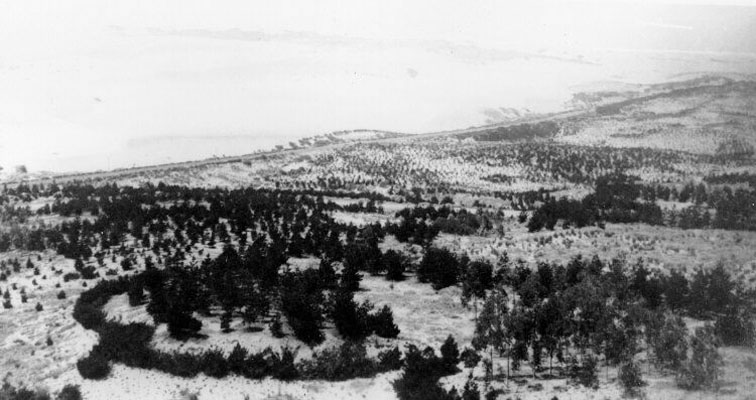
As you will see, “Evolution in the Park” (1) urges the public to consider that the parks of San Francisco have been transformed over the past 150 years from predominantly barren sand dunes to green oases of non-native trees and plants. Using Golden Gate Park as an example, Mr. Slack reminds us that the non-native trees provided the windbreak needed to protect the entire landscape which we admire today. The park has changed and it will continue to change, because nature is dynamic. The forces of evolution are stronger than human desires to freeze-frame our world.
At the time, we were deeply grateful to Mr. Slack and to the Academy of Sciences for taking a position on the controversy. We remember thinking that the opinion of this prestigious institution would surely settle the controversy. But we were mistaken, because native plant advocates would not even read this article, let alone heed its message.
As the Environmental Impact Report for the Natural Areas Program undergoes revision and the controversy heats up again, we reprint “Evolution in the Park.” We can only hope that someday reason will prevail.
******************************
“When San Francisco officials asked the great nineteenth-century landscape architect Frederick Law Olmstead how to turn the wind-scoured dunes of the western half of the city into a green, rambling park, he was happy to offer advice: Don’t bother, he said, it’ll never work.
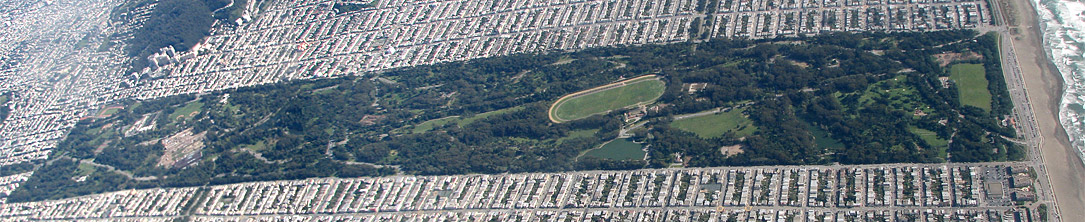
They went ahead anyhow, establishing three-mile-long, 1,107-acre Golden Gate Park on April 4, 1870. The decades that followed saw an almost unbelievable transformation under the strong hand of the park’s first superintendent, William Hammond Hall. He shaped glades and grew forests, dug lakes and planted lawns, until people nearly forgot that under the acres of grass and trees and shrubs lay mountains of sand.
The invention of Golden Gate Park was an amazing engineering and horticultural accomplishment, but it was not an environmental one—at least not in the sense of conserving native natural resources. If the California Native Plant Society (CNPS) had existed then, it would never have allowed Hall to spread tons of exotic barley seed over the dunes as part of his plan to “reclaim” them. The barley achieved what Hall wanted—to create favorable conditions for the thousands of alien trees and shrubs he would soon plant. And yet the CNPS now meets in Strybing Arboretum and botanists love the park. Everyone does. It would seem as silly to criticize the park’s blue gum trees for being out-of-towners as it would be to criticize most of us for being exotics. The park is as much an urban invention as the parking lot or the shopping mall, only much better. There is nothing wild about it…except what goes on there.
Nancy de Stefanis is the Director of San Francisco Nature Education, a group that leads nature studies in Golden Gate Park. She is perhaps best known for her discovery in 1993 that great blue herons were nesting in the park’s Stow Lake, and for her efforts to protect those nests from raccoons and other threats (California Wild, Summer 2002). A few days ago, on an early morning walk in the park, she saw a great blue plucking endangered red-legged frogs out of a pond. She saw feral cats, gray squirrels, and a three-foot-long box turtle. All this, and she had intended to look for birds! She saw those, too: an albino robin, varied thrushes, ravens, white- and gold-crowned sparrows, and a courting pair of red-tail hawks doing loopty-loops and dives. She saw a bevy of seven California quail running through Strybing Arboretum, the only population of quail left in the park. “It was incredible,” she said. “We saw 25 bird species easy.”
Anyone who’s spent much time in Golden Gate Park has wild stories to tell. My own favorite took place a few years ago, after I’d pulled an all-nighter at the magazine and was tired enough to sleep dangling off of Half Dome. Half Dome was too far away, so I walked a few hundred yards east on Middle Drive and up a tiny path back to Lily Pond. I walked the perimeter looking for a place to sleep. The pond had steep vegetated banks all around except for a small, reasonably sloped patch of dirt on the east side. I kicked away some guano, put a newspaper under my head, and fell asleep.
I woke up half an hour later; something soft was tickling my arm. I raised my head slowly to find myself surrounded by mallards. There must have been 20 and they filled every inch of the dirt patch around me. One nestled comfortably between my outstretched arm and my torso.
Each duck had its head swiveled and tucked into the feathers on its back. When I lifted my own head, the birds next to me raised and turned theirs as well, and a couple of them stirred, causing a chain reaction of awakenings in the ultimate morning-after surprise. No one lost his or her cool, though. I tiptoed out of their realm and headed back to work, downy feathers clinging to my sweater and my hair. That was how I became the Man Who Sleeps with Ducks.
Raymond Bandar, a field associate in the Academy’s Department of Ornithology and Mammalogy, grew up in Golden Gate Park and has a thousand wild stories to tell. He says that in the 1940s, when he was a boy, it was a “biologist’s paradise.” He spent long summer days hunting for garter snakes, alligator and fence lizards, bush rabbits, Pacific pond turtles, weasels, and red-legged frogs. Peacocks roamed free in the park, and there Bandar courted his wife, Alkmene. They took long, moonlit walks from the beach to the park’s entrance on Stanyan, stopping to spoon in the Valley of the Moon.
Most old-timers like Bandar long for the good old days, when the park was “less manicured.” It’s hard to tell if this is because the park used to be wilder, or because the old-timers were. But there’s no doubt that the park refuses to cooperate by holding still. As Heracleitus said, “You can’t step into the same river twice.” (Or as Cratylus, Heracleitus’s follower, trumped, ‘You can’t step into the same river once.’)
The park’s “ecosystems” are a moving target, changing with park administrations and larger cycles of growth and death. In recent years, the Parks Department has cleared away much of the undergrowth that had been protecting ground-nesting birds—and homeless humans. Other forces originate outside the park but have an influence by increasing, diminishing, or eliminating the animals that live within. If there are no peregrines anywhere else in California, there aren’t going to be any in Golden Gate Park either.
Late Academy ornithologist Luis Baptista used to talk about the 1980s in the park. California quail were common then, running here and there on urgent business. Native bush rabbits lived here, too. The rabbits are now gone and the quail nearly so. I’ve heard speculation that the rabbit population may have collapsed partly under predation by humans, too. But both are most likely victims of the park’s shifting food web.
Raptors returned when their populations rebounded from the DDT poisoning that largely ended four decades ago. Recently, red-tailed, red-shouldered, and Cooper’s hawks have moved in, according to Douglas Bell, a biology professor at California State University in Sacramento. The park is now “probably a sink for white-crowns” he says. “It draws them in, but because of the intense predation, their survivorship is very low.” But even bigger players in the songbird and quail equation are the park’s resident feral cats. According to Baptista and Bell, white-crowned sparrow deaths in the park are probably due mostly to cats.
In addition to feral cats and other predators, floral changes affect park wildlife as well. Many of the Park’s trees are reaching climax now, says Peter Dallman, who is writing a natural history guide to Strybing Arboretum. The big trees are falling or are being cut down in anticipation of their natural collapse. The pygmy nuthatch, a bird that nests in the park’s climax Monterey pine forest, will likely flee the park when those trees come down.
Today, raccoons are plentiful. So are ravens, though Bell remembers that not long ago no ravens nested here. Exotic cowbirds have arrived, too; they lay their eggs in the nests of other birds, which then raise ravenous cowbird chicks, often at the expense of their own young. Squirrels are multiplying out of control, says Dallman.
Cat populations are strong, but not as strong as their political lobby. The bison herd, introduced to the park in 1894, remains stable at eleven. But the reintroduced grizzly bears (Bandar remembers when there were at least two sad grizzlies in cages in the park’s southeast corner) are long gone. The last Golden Gate grizzly, Monarch, is now stuffed and on exhibit in the Academy’s Wild California Hall.
These changes and conflicts raise some uncomfortable questions about the park and its mission. By what standard can the costs or benefits of these changes be measured? Should we be trying to restore Golden Gate Park systems and populations that are at bottom artificial? Should we simply maintain the species we prefer, and get rid of, or let slip away, the unpopular ones? Should “maximum diversity” be the goal, and mandate mediations of conflicts that arise between incompatible species, such as cat and quail?
To maintain quail in the park for the long term, for instance, would require “intensive and sustained human intervention,” says Bell. “We’d have to rely on the full range of wildlife management techniques.” Predation would have to be monitored and protective habitat cultivated. New quail stocks would have to be introduced, and electrically charged wire cages (through which the quail could fit, but not cats or ravens or raptors) could be built around nesting areas. But without heroic and constant human support, the quails’ days in the park are numbered.
Like its creation, the park’s future will be shaped by human invention, its progression determined by our priorities.”
(1) Gordy Slack, “Evolution in the Park,” California Wild, Spring 2003 [reprinted with permission of author]