We are publishing a guest article by Sydney Ross Singer, Director, Good Shepherd Foundation. Dr. Singer has been a tireless defender of non-native species in Hawaii, where he lives. Nativism in Hawaii is even more destructive than similar projects in the San Francisco Bay Area.
***********************
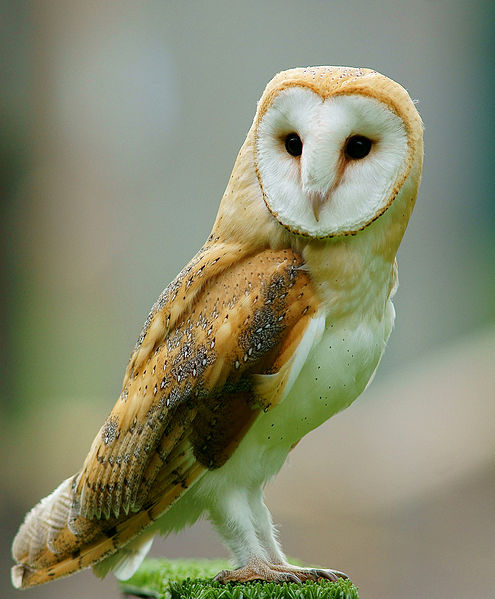
Barn Owl. Creative Commons 2.0 Generic.
Tens of thousands of innocent Owls and Egrets will be executed in Hawaii by the US Fish and Wildlife Service unless President Obama issues a pardon.
Cattle egrets and barn owls are an important part of Hawaii’s environment, consuming large amounts of rodent and insect pests as they were meant to do when first introduced by the government to these islands back in the 1950′s. They are protected by international migratory bird treaties, and are admired and prized by people wherever they are found.
Unfortunately, they are now being targeted for destruction statewide by the same invasive species eradicators who are killing our other introduced wildlife.
Egret. Creative Commons Share Alike.
Currently, whenever there is a conflict between egrets or owls and endangered species or airports, there have been permits required for their control in the local area where they are a problem. The US Fish and Wildlife Service has proposed lifting this permit requirement to allow the egrets and barn owls to be killed anywhere they are found, even if they are not causing any problems. It is killing the innocent today to prevent a potential problem in the future.
This is a reminder of ethnic cleansing and genocide. It is not what our great nation is about.
This slaughter of innocent egrets and owls is a crime against nature and against the people who live with and admire these magnificent birds. Making matters even worse, one of the methods that will be used to kill the birds is to attract them to slaughter areas by broadcasting their bird calls. Owls will be attracted from miles away to be shot. Egret colonies will be massacred for no reason other than their existence in Hawaii.
This “final solution” for the egrets and owls, not only controlling them where they are a problem but everywhere they live throughout the Hawaiian Islands, can only be stopped by President Obama issuing a stay on their execution. It is the Federal Government’s Fish and Wildlife Service that wants to allow unlimited open season on these birds. It is up to the President of our country to intervene on the behalf of these innocent, magnificent creatures.
As much as we dislike the destruction of plants and trees simply because they are not native, the extermination of animals is far more disturbing. There are presently two such proposed projects in the news to which the public has reacted angrily. We will start with the project in the San Francisco Bay Area which plans to kill ground squirrels and gophers in a public park in Berkeley. In this case, the animals are native. They will be killed because public land managers have decided they MIGHT be a problem in the future.
The squirrels and gophers of Cesar Chavez Park in Berkeley
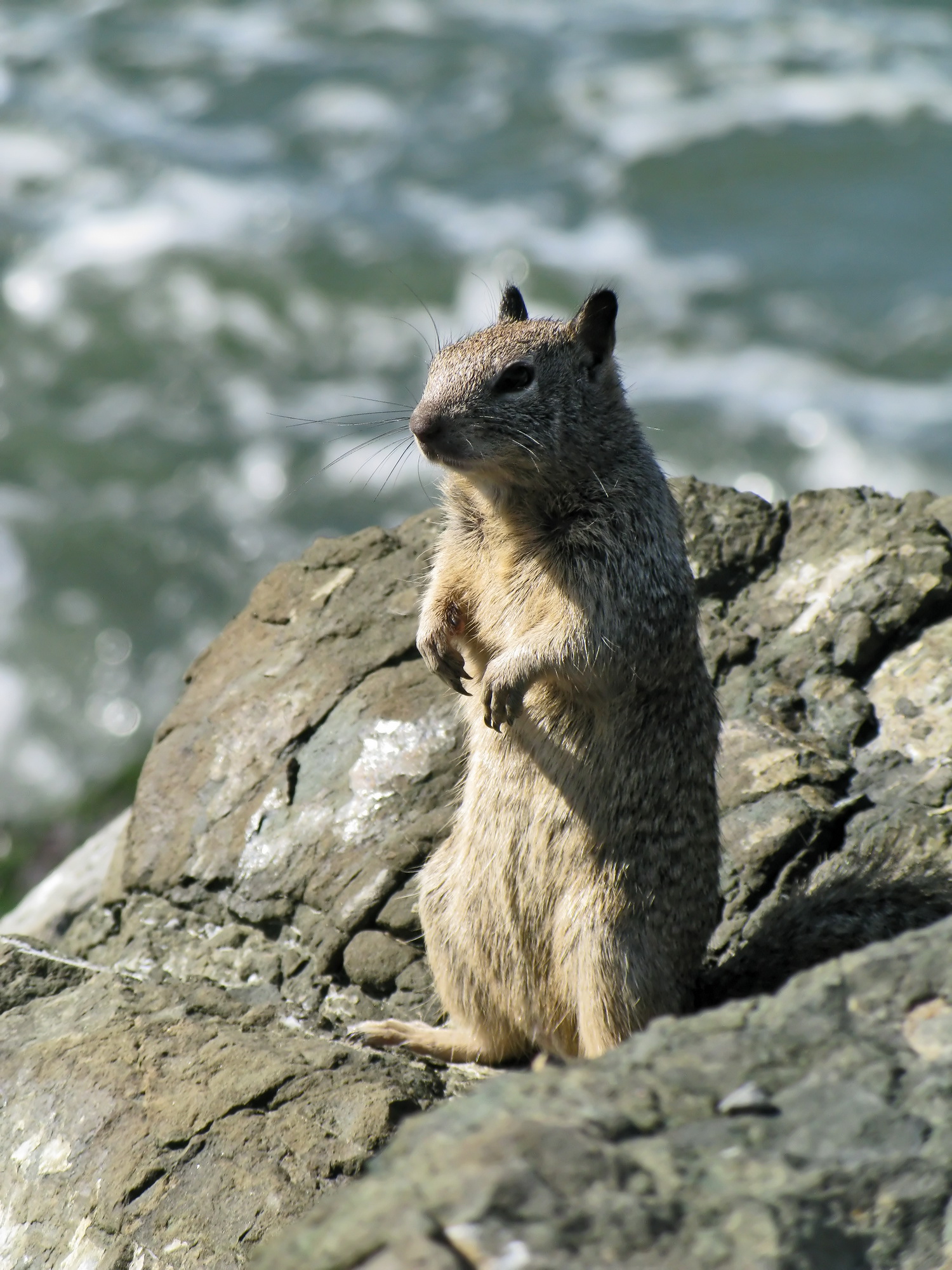
California Ground Squirrel at the Berkeley Marina. Creative Commons – Benefactor 123
Cesar Chavez Park is the former garbage dump of the city of Berkeley, built on landfill. When the dump was closed in the 1990s, the garbage was not removed. It was capped with clay which was intended to contain whatever toxins were in the garbage. Then two feet of soil was put on top of the clay so that vegetation could be planted in the park. Small animals moved into the park, as we should expect.
The population of squirrels and gophers is now considered too big by land managers. Although there is no evidence that the burrows of the animals have penetrated the clay cap, the officials who are responsible for the water quality of the bay are apparently concerned that they MIGHT burrow through the clay cap: “…they are getting perilously close to the clay cap that covers the landfill. If the rodents penetrate that barrier, dangerous toxins like gasoline, lead, iron, herbicides and pesticides, could leach into the bay. So the city needs to reduce the animal population to lessen the risk, according to city spokesman Matthai Chakko. ‘We haven’t had any of the materials inside the landfill escape into the bay and we don’t want that to happen,” said Chakko. “We are trying to solve a problem before it happens.’” (1)
The population explosion is being blamed on park visitors feeding the squirrels. Squirrel-feeders have been interviewed by the media. They defend their right to feed the squirrels, which is a source of pleasure for them. It should not be too difficult to understand that many people prefer feeding squirrels to killing them. (However, we do not encourage people to feed wildlife in public parks and open space because the animals usually pay the price.)
Some media sources also blame off-leash dogs for exacerbating the problem. The San Francisco Chronicle claims that off-leash dogs dig into the animals’ burrows, making them larger. There is a small, legal off-leash area in the center of the park. We have walked around the perimeter of this park many times. Although we have seen dogs being walked on-leash on the trail around the park, we have never seen an off-leash dog outside the legal off-leash area. Another media source reports that most of the burrowing animals live on the outer edge of the park which is consistent with our observation. Furthermore, making the burrows larger at the surface, doesn’t get them any closer to the clay cap two feet below the surface. Therefore, the scenario imagined by the Chronicle is not consistent with the facts. (1)
This project is similar to many others to which we object:
There is no evidence that there actually IS a problem. These animals should not be killed without such evidence.
IF there is a problem, it is one created by humans: We should have predicted the presence of burrowing animals when we closed this dump. An impenetrable cap on the garbage should have been installed. If an impenetrable cap was not physically possible, the garbage should have been removed. IF feeding the animals is contributing to the population surge, humans are the problem, not the animals. We do not assume that feeding the animals is, in fact, contributing to the problem. It sounds like more finger-pointing to us. (However, we agree that people should not feed wildlife in public parks because the wildlife usually pays the price for the pleasure of humans. We suggest that people channel that impulse into a sanctioned form of animal welfare such as volunteering in your local animal shelter or wildlife rescue organization.)
There is no evidence that dogs are contributing to the problem either. They are yet another scapegoat for a problem created by humans….IF, in fact, there IS a problem.
Humans have a very short-term perspective on nature. We often perceive problems in nature that are short-term and we over-react to them because we have a desire to control nature. In fact, surges in animal populations usually resolve themselves without our interference when the animals exhaust available resources. Humans often do more harm than good when we attempt to control nature and these attempts are usually futile because nature is far more powerful than we are.
We should set priorities when we address environmental issues. Untold thousands of chemicals are being drained into the bay every day according to the San Francisco Regional Water Quality Control Board: “’However, there are a number of chemicals that are showing up not too far from levels of concern, and that’s the bad news,’ said Tom Mumley. assistant executive officer of the San Francisco Regional Water Qaulity Control Board, ‘There’s a really big, long list of chemicals that we haven’t measured yet, or we don’t have good thresholds to interpret whether the concentrations out there are something to be alarmed about or not,’ said Jay Davis, a senior scientist at the San Francisco Estuary Institute. More than 100,000 chemicals are registered or approved for commercial use in the United States.” (2) While we merrily pour toxic chemicals down our drains and spray our public lands with pesticides, does it make any sense to worry about the POSSIBILITY that a few squirrels could be burrowing into a former garbage dump?
Update March 27, 2014: Berkeleyside (an excellent on-line news source for Berkeley) reports that the Berkeley City Council put the plan to kill ground squirrels and gophers at Cesar Chavez Park on hold indefinitely, pending further study. Berkeleyside reports that the Water Quality Board notified the City Council in writing that they did NOT order Berkeley to kill the animals, contrary to the claims of the Berkeley officials proposing the plan. There is absolutely NO doubt that this decision is a direct result of thousands of people contacting Berkeley to protest the plans. It pays to speak up, folks!
The swans of New York
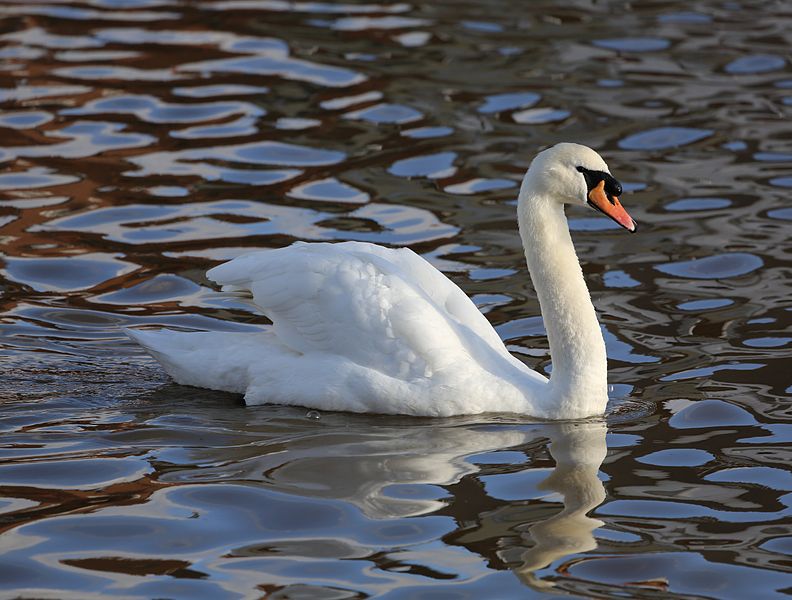
Mute Swan. Creative Commons – Share Alike
The State of New York has announced its intention to exterminate all mute swans in the state. The mute swans were introduced in the 1880s because at that time people thought them beautiful. Now some people have apparently changed their minds. People calling themselves bird-advocates have decided that because mute swans aren’t native to the United States, they must be killed.
According to an op-ed in the New York Times,this bizarre plan to kill this and other non-native species of birds originates with the Audubon Society and other organizations advocating on behalf of birds (apologies for the contradiction). They succeeded in revising the Migratory Bird Act in 2004, to remove protections from all non-native birds in the United States. This policy was based on an ASSUMPTION that the mere existence of non-native birds is a threat to native birds. Like all similar projects to exterminate a non-native species, the State of New York provided no evidence that the mute swans are a threat to native birds. The proposal merely stated that the swans are “aggressive” and that they eat aquatic vegetation.
Since there are only about 2,200 mute swans in the State of New York, one wonders how much of a problem they could be. They are called “invasive,” as are most non-native species, but their small population suggests this is an exaggeration.
The comments on his op-ed about the swans are revealing. There is almost no support for killing the swans. Here is one of the few supporting comments from a typical nativist, using the usual arguments about how there MIGHT be a problem in the distant future: “Not-so-weird” says “A century is not nearly enough time for wetlands to adapt to the presence of a new species. Thousands or millions of years would be more appropriate. As we wait to see what happens, we could lose any number of native species whose ecosystem services we have yet to fully understand or appreciate. The science does not need to be complete for the safest, most responsible course of action to be removing mute swans from our wetlands in the most humane way possible.” It’s difficult to imagine our environment thousands or millions years from now, but we doubt that mute swans will be a concern in the unlikely event that there will be humans around to worry about them.
Don’t we have enough problems?
There is no shortage of real, serious problems in our environment. One wonders where our public servants find the time to dream up problems that don’t exist. We suggest that they put their over-active imaginations to rest and focus on solving existing problems rather than fabricating them. And while they’re at it, we would appreciate it if they would quit pointing fingers at animals when diagnosing problems most of which are caused by the actions of humans.
We recently republished an article from the Garden Rant blog about the overuse and misuse of the word “invasive” to describe plants. That article objected to the exclusive use of that pejorative word to describe non-native plants, when native plants often behave in exactly the same way. The article also pointed out that the behavior of plants varies depending upon local conditions such that labeling any plant “invasive” beyond a specific locality is bound to be inaccurate.
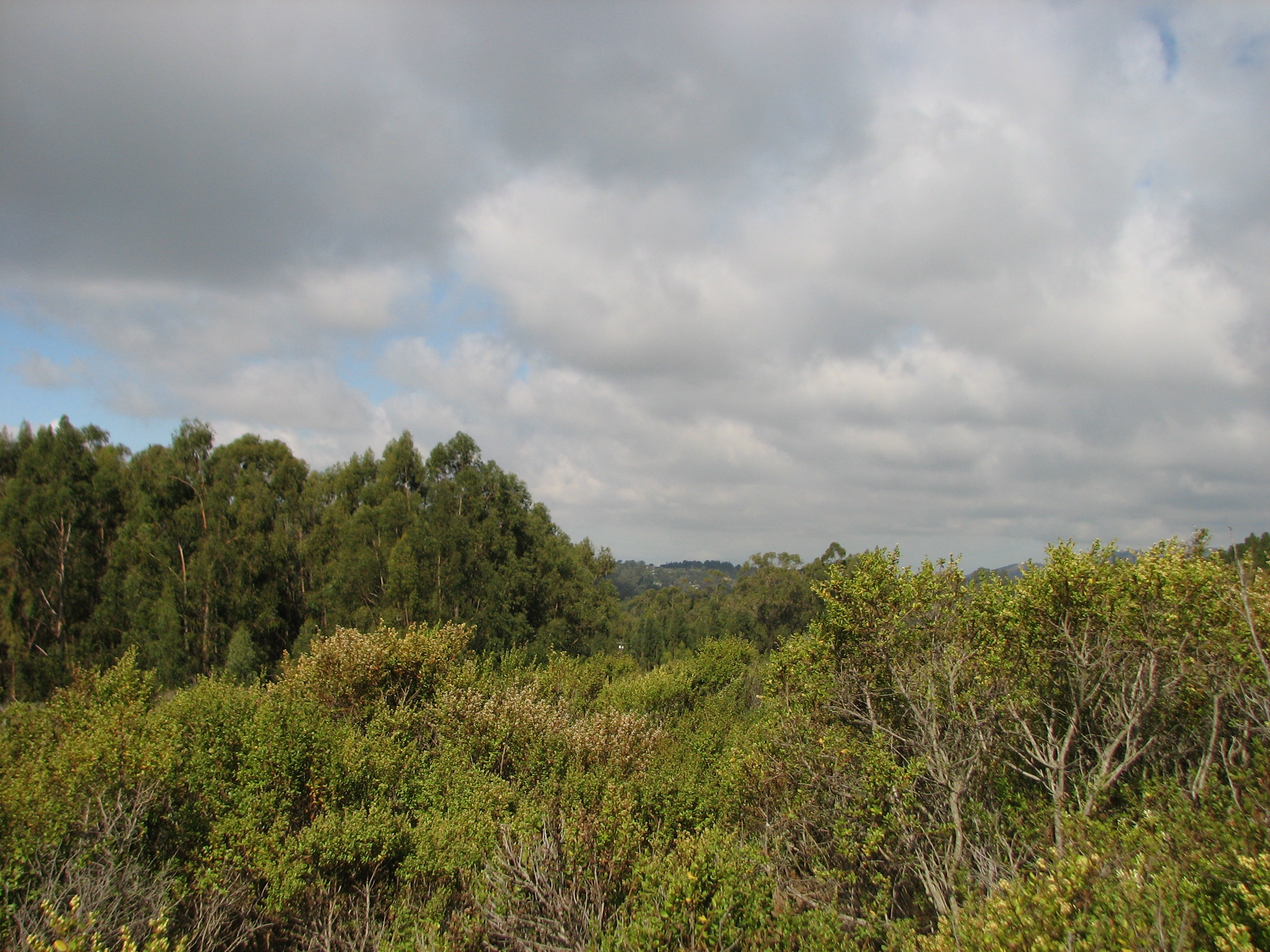
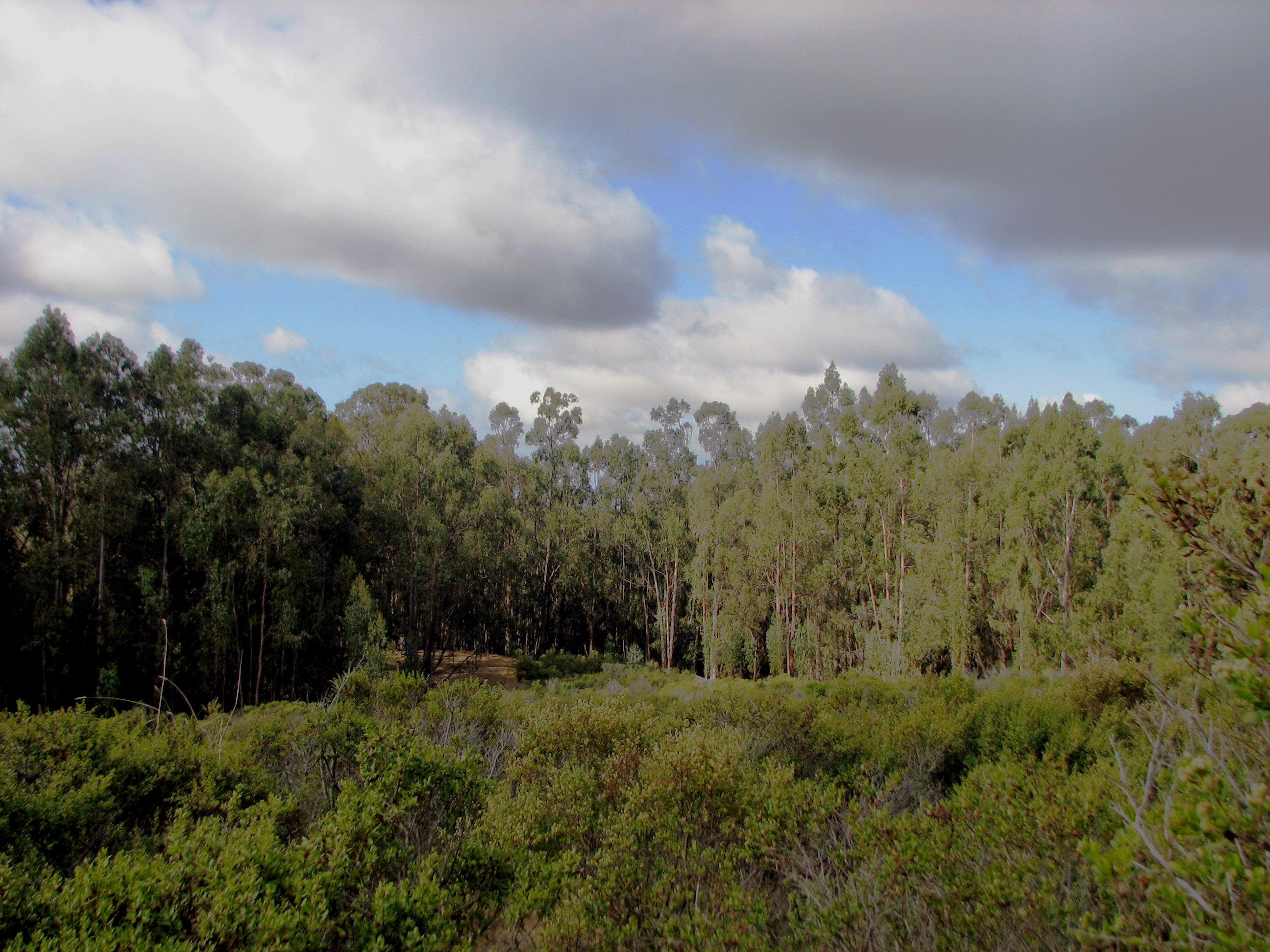
A huge expanse of coyote brush at Lake Chabot, an example of a native plant that would be called “invasive” if it were not native.
Today we will tell our readers about a new study which explains why the word “invasive” is causing confusion.(1) Four scientists in Zurich, Switzerland conducted structured interviews with 26 academic invasion biologists and landscape professionals and found no consensus about the definition of “invasive.” Nor is there any agreement about the definition of “native,” which is surely contributing to the confusion about the appropriate use of the word “invasive.” Finally, the authors of the study compared this lack of consensus with the scientific literature of invasion biology. They found a conspicuous discrepancy between the uncertainty expressed in the interviews with experts and the conservation policies that are theoretically based on the scientific literature.
And the eucalyptus forest behind the coyote brush at Lake Chabot which is called “invasive” but in fact, rarely invades.
What is the difference between native and non-native species?
Although there was some agreement amongst invasion biologists that non-native species arrived with the help of humans, there was less agreement about the timing and location of arrival. Some said non-natives arrived after the last glacial period (about 10,000 years ago) and others said after 1500 A.D. (post-Columbian exchange). Landscape professionals were more likely to say that species are native which arrived prior to the life-span of humans, a significantly shorter period of time, obviously. This is consistent with the tendency for landscape professionals to consider human perception the source of such categorization.
There was little agreement about a spatial definition of native species. Some invasion biologists define native species within the context of political units (such as countries) while others use biogeographic definitions such as continents or on either side of a continental divide.
There is also disagreement about the means of movement used to define a species as non-native. Some invasion biologists consider species non-native if their range has changed as a result of climate change because of the anthropogenic origin of contemporary climate change. Such movement is now rapidly occurring so this particular definition is likely to result in the changed status of many species presently considered native, a change that is likely to make them targets for eradication.
When is a non-native species “invasive?”
There was little agreement about the criteria for calling a non-native species “invasive.” Some invasion biologists did not think that an “invasive” species need behave any differently than a native species to be categorized as “invasive.” Others believed it is appropriate to call a non-native species “invasive” if it spreads, even if that species has no negative impact on the ecosystem. When asked to evaluate the impact of non-native species, more invasion biologists and landscape professionals considered the impact “neutral” (56%) than those who considered the impact “negative” (32%). Invasion biologists tended to assess the affect of non-native species more negatively than landscape professionals.
The interviewees were then asked on what they based their judgment of the impact of non-native species. This is perhaps the most telling question of all. Both groups of experts lamented the absence of empirical evidence of the impact of non-native species: “In almost a third (32%) of all assessments, experts could not recall any effects of non-native invasive species on ecosystem services.” Most admitted that their judgment was based on “intuition” informed by their “general knowledge” or “extrapolating” from related knowledge: “most experts were prepared to assume that non-native invasive species have a generally negative effect upon native biodiversity.” (emphasis added)
Are non-native “invasive” species a serious problem?
This is the question for which the answers of invasion biologists and landscape professionals were most divergent. Invasion biologists consider non-native “invasive” species a serious problem which is underestimated by the public and politicians. In contrast, landscape professionals said the problem is overestimated: “…particularly due to anxiety and xenophobic feelings among the public.”
The consequences of this lack of clarity
The authors of this study then examined the publications of invasion biologists to see if this lack of consensus is apparent in the scientific literature of invasion biology. They observed that invasion biologists start their publications with a definition of non-native and invasive species, but “in the rest of the text this definition was rarely strictly applied.” They tend to use the terms “non-native” and “invasive” interchangeably. They compare the spreading of native species to non-native species without indicating that the native species is also invasive.
The authors conclude that both the categorization of species as native or non-native and their designation as “invasive” are largely value judgments that reflect cultural values, not scientific judgments. They suggest that invasion biologists “acknowledge the uncertainties and engage transparently with stakeholders and the public in deliberations about conflicting opinions. Here invasion biologists should take the role of ‘honest brokers of policy alternatives,’ taking into account different prevalent values and policy preferences rather than adopting the role of ‘issue advocates.’”
In other words, the conservation policies which are theoretically based on the scientific literature of invasion biology should acknowledge the uncertainty that pervades the discipline. Given that uncertainty, the value judgments of the public should be on an equal footing with the value judgments of those who have a vested interest in the projects that are destroying existing landscapes. There are alternatives to those destructive projects and the public’s opinion must be taken into account in considering those alternatives.
Of course, we agree. As we have said many times on Million Trees, invasion biology is not a scientific discipline. Rather it is a set of value judgments based on a belief that native species (whatever they are) are superior to non-native species. This is not just a question of semantics. Many species are being killed because of what someone chooses to call them and irreparable damage is being done to our environment in the process of killing them.
We are republishing an article from the Garden Rant blog with permission of the author, Susan Harris. Susan is a professional garden writer who lives in the Washington DC area. Garden Rant is an award-winning garden blog with a huge readership of garden writers, landscape professionals, and home gardeners. They report over 80,000 readers per day.
In this article, Garden Rant enters the controversial debate about the arbitrary use of the word “invasive.” We agree that this word is both over-used and misused. However, this is more than a semantic debate. It’s an important debate because the word is being used to justify huge destructive projects that are damaging the environment by needlessly attempting to eradicate non-native plants, using polluting methods such as herbicides and prescribed burns.
If you have never debated with native plant advocates, you might find the comments posted to this article of interest. They are typical of the many dialogues we have had with native plant advocates in the past.
*********************************
This is a long-simmering rant about the many ways the term “invasive” causes confusion, and more. DO weigh in with alternatives, pushback, and rants of your own.
“Invasive” as synonym for “nonnative”
Google “native versus invasive” and the 5.6 million hits confirms my observation that this is a common usage, and it’s led to a common misperception in the public that the opposite of native is indeed invasive. QED: nonnatives ARE invasive. Even regular garden writers sometimes use this juxtaposition, which should more accurately be “native versus nonnative” or I guess, “exotic.”
That great leveler, Wikipedia, confirms this problem about the term “invasive”: “The first definition, the most used, applies to introduced species (also called “non-indigenous” or “non-native”) that adversely affect the habitats and bioregions they invade economically, environmentally, and/or ecologically.” At least their second definition is more accurate and even includes native species like deer. No argument there.
Defining away the invasive behavior by natives
Can native plants be invasive? Sure, as evidenced by the above-mentioned deer or in the plant world, wild grape. But when native plants are termed invasive someone invariably pipes up to correct the writer because by definition, they’re nonnatives only. And sure enough, legally, by the official U.S. government definition, only nonnative plants can be deemed invasive – for purposes of qualifying for money to remove them. The 1999 Federal Executive Order on Invasive Species defines an invasive species as a “species that is not native to a particular ecosystem…”
Invasive plant lists covering large regions – even continents!
We all know that plant behavior depends on the exact conditions the plant is growing in, as well as more broadly, the region. So some plants that behave well in the North are overly vigorous in the South. Or some, like the infamous purple loosestrife, are vigorous in wet spots, not in dry ones. Examples abound.
Spirea and Doublefile Viburnum (L), Lespedeza (R)
Yet this site by the U. Georgia and many other sources, including the National Park Service, don’t distinguish by region, and the resulting list of “invasives” includes these surprises to gardeners near me: several viburnums, two verbascums, several veronicas, red and white clo0ver, Japanese yew, 3 spireas (MOST on the market), various salvias, willows, nandina, grape hyacinth, Miscanthus sinensis (without specifying that it’s only the early-bloomers that spread), Lespedeza thumbergii, Pee Gee Hydrangea, cotoneaster, and strangely, littlestem bluegrass (Andropogonvirginicus). Yet native thugs like trumpet creeper are encouraged and they’re not invasive?
That designation of Spirea really bothers me because it’s such a self-sustaining, easy, low-maintenance and well behaved shrub, one I’ve grown for 30+ years with no signs of trouble. And yet another source – the USDA National Invasive Species Information Center – also targets Spirea Japonica and says this about it: “Spreads rapidly and forms dense stands that crowd out native species.” This and other contradictions between official reports and in-garden experiences growing targeted plants is puzzling to me.
Adding to the overly broad regionality of invasive-plant designations, there’s a new book on invasive plants, written for a national audience.
Shouldn’t invasiveness be designated locally? And sometimes, for certain conditions?
“Invasive” used instead of “spreading”
I’ve heard garden-club members describing their passalong plants at plant swaps as “invasive” if they spread at all. Which leads to said garden club being accused of encouraging the use of “invasives,” among other things.
Methods of “invasion” all lumped together
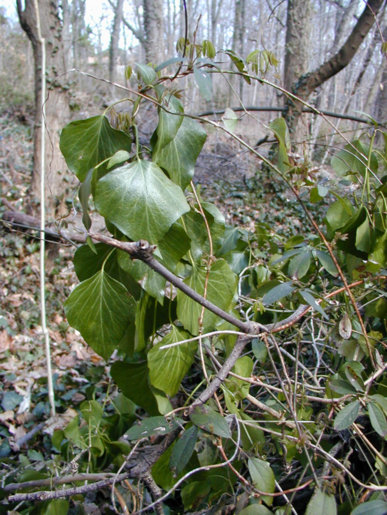
Mature Ivy
The USDA lists these characteristics of invasive plants: “produce large numbers of new plants each season; tolerate many soil types and weather conditions; spread easily and efficiently, usually by wind, water, or animals; grow rapidly, allowing them to displace slower growing plants; spread rampantly when they are free of the natural checks and balances found in their native range.”
Yet some of those qualities are valued in the garden – especially tolerance of many conditions. And for the gardener on a budget, especially one trying to replace their lawn with another groundcover, spreading is a good thing and it’s usually described more positively as “fills in quickly.”
What if the standard were: Does the plant spread in a way that causes harm to natural areas? For example, plants that are spread by birds, like English ivy, so that the seeds can go everywhere and harm natural areas. Unlike Spirea and Nandina that spread by rhizome and produce a couple of offspring every year, if that – just like Itea does? Or if it’s simply spreading in the garden, is it impossible to control, like running bamboo?
For example, “Invasive Species of Concern” in Maryland includes mostly plants we’d all agree are thugs and not even considered garden plants, but daylily? As a sun-lover, it won’t spread into the woods and even out in the sun, how hard is it to dig up?
Or a plant could be harmless in a townhouse garden on Capitol Hill but potentially harmful if planted on the edge of a forest.
I wish there were several terms used to describe spreading behavior by plants, rather than the single term “invasive.” How’s a gardener to choose between groundcovers like pachysandra, periwinkle and English ivy, when they’re lumped together as equally thuggish when only one of them will grow virtually to strangle trees, set seed and spread indiscriminately?
More science-based info, please
In researching the topic of “native versus exotic” I came across one example of the type of reporting on invasive species I’d like to see more of – based on research, not scare tactics. Just one quote from this article by Cornell will piss off some readers, but here goes: “A small percentage of plants exhibit invasive tendencies, while the majority of plant introductions are benign or beneficial.”
Solutions for “invasiveness” coming?
Plant breeders are hard at work breeding out invasiveness in popular garden plants, as reported on the Native Plants and Wildlife Gardens blog. Though controversial, especially among native-plant advocates, this type of breeding is recognized by pragmatists as a step in the right direction.
On December 14, 2013, the New York Times published an article entitled “The Selling of Attention Deficit Disorder.” Attention Deficit Hyperactivity Disorder (ADHD) is a neurological disorder that was identified about 50 years ago. The number of children taking medication for ADHD has soared from 600,000 in 1990 to 3.5 million presently.
Advertising in popular magazines such as People and Good Housekeeping suggest that medication for ADHD is needed to cure childhood forgetfulness and impatience and promises that schoolwork will improve and family tensions will be reduced. These are empty promises for symptoms that are normal child behavior. One of the manufacturers of ADHD medication recently paid to publish 50,000 copies of a comic book that uses superheroes to convince children that these medications will make life easier for them.
These seductive promises have proved very profitable for the pharmaceutical industry: “Sales of stimulant medication in 2012 were nearly $9 billion, more than five times the $1.7 billion a decade before.” But the industry is not satisfied with these results. Now they are marketing these medications to adults. Sixteen million prescriptions for ADHD medications were written for adults between the ages of 20-39 in 2012, nearly triple the number of prescriptions written just five years before.
As disturbing as this example of the insidious power of advertising is to convince us that we need something they are selling, it is hardly an isolated example. On a typical evening in front of the TV, men are told that a variety of medications will improve their sex lives and women will be told that a good night’s sleep is just a pill away.
Advertising is also used to improve the image of industries that the public would otherwise think badly of. For example, energy ratepayers are paying for a television campaign that tells us how much P.G. & E.– the monopoly provider of electricity and natural gas in Northern California–cares about our safety. Yet, the mainstream media informs the public of the many breaches of public safety by P.G. & E. In 2010, 37 homes and 8 lives were lost in San Bruno when an underground gas pipeline exploded. The pipeline had been badly built, not inspected, and not repaired. Subsequent investigations of P.G. & E.’s records proved that such neglect and incompetence is rampant throughout their system and continues to this day. Money that could be spent on our safety is being spent on advertising. Such manipulation of the public’s attitudes with advertising is the American industry standard.
Is the pesticide industry fueling the demand for ecological “restorations?”
Readers are surely wondering by now what this has to do with the mission of Million Trees. Clearly the manufacturers of pesticides are the beneficiaries of the ecological “restorations” that destroy non-native vegetation with herbicides (herbicides are one type of pesticide). From the standpoint of the industry, the more plants that are labeled “invasive” the better. And since new plants are always being introduced—either intentionally or unintentionally—it’s a winning business model to label every new plant “invasive.”
We don’t have a lot of evidence to support our theory that the pesticide industry is one of the sources of support for invasion biology and ecological “restorations.” Two of the 31 members of the National Invasive Species Advisory Committee are employed by companies that manufacture pesticides. One member is employed by Dow AgroSciences which manufactures Garlon, the most frequently used herbicide to prevent the resprouting of non-native trees after they are destroyed. The other member is employed by Syngenta which manufactures pesticides and biocontrols which are another method used to destroy vegetation by introducing insects or plant diseases.
Is it inappropriate for the pesticide industry that benefits from the designation of “invasive” species to participate in setting federal policy regarding those species? Undoubtedly there are arguments on both sides of that question.
Shelterbelt began the eradication of non-natve vegetation in Glen Canyon in November 2011
Admittedly, it’s a stretch to say that invasion biology was created to increase demand for pesticides and other products and services needed for ecological “restorations.” We can’t and won’t say that. But we invite our readers to wonder with us if some aggressive investigative reporting would find more evidence that it’s a factor. Wouldn’t it help to explain why invasion biology persists despite the lack of scientific evidence to support it?
Monarch butterflies overwintering in California are using predominantly tall non-native trees, especially eucalyptus. There is no evidence that the monarchs overwintered in California prior to the planting of these non-native trees, contrary to the claim of Cal-IPC.
In this post, we will look at the “evidence” provided by Cal-IPC that Blue Gum eucalyptus is invasive in California. Here is how Cal-IPC described the “local rate of spread with no management” of Blue Gum eucalyptus:
“Once a tree matures and produces seed, it can produce a profusion of progeny within a few years; doubling of stand area within 10 years possible but not well documented Without quantitative data, this response is conservative; stands have certainly expanded far beyond initial plantings in many locations, based on unpublished photodocumentation (1, 2) and personal observations (3)” [numbers refer to cited “references”]
And here is the “evidence” Cal-IPC provides in support of this rather dire prediction of the invasiveness of Blue Gum in California:
“Potts, Michael. 2003. About this edition. Caspar News. Online @ http://casparcommons.org/Press/News0305.htm. 2. Site Stewardship Program, Parks Conservancy. Unpublished photographs of Oakwood Valley, Marin Headlands, Golden Gate National Recreation Area. 3. Warner, PJ. 2004. Personal observations from 1980-2004 working in and adjacent to Eucalyptus stands in Marin, Sonoma, and Mendocino Counties, CA. 707/937-9172; pwarner@mcn.org.”
With the exception of an article in “Caspar News,” all evidence provided by Cal-IPC is unpublished. Although the one written source is described as “Caspar News,” in fact its title is “Caspar Newsletter.” The edition of this newsletter that is cited is the first unprinted edition of the “Caspar Newsletter.” Some of the unpublished “evidence” cited by Cal-IPC is described as “personal observations” of Peter Warner, who is the author of the Cal-IPC assessment for Blue Gum eucalyptus.
Therefore, the only source of information about the invasiveness of Blue Gum that we can evaluate is the one that is available on the internet HERE.
First a word about the town of Caspar, which is located 4 miles north of Mendocino on the coast of California. According to the 2010 census, it has a population of 509 souls. We celebrated New Years Eve there many years ago in a rocking bar, so we have fond memories of it. It is a lovely little town. We mention its small size to put its newsletter into perspective. It’s hardly mainstream journalism.
The article in the “Caspar Newsletter” starts with the recommendation of Peter Warner to eradicate all eucalyptus in Caspar:
“In this newsletter you find several articles written by strong advocates of dire means, including the authoritative Eucalyptus indictment written by State Parks’ expert on managing exotics Peter Warner, who advocates a draconian solution: cutting and then careful application of a dire chemical to eliminate every tree.”
In other words, the “Caspar Newsletter” is merely a repetition of Peter Warner’s agenda to eradicate eucalyptus and poison them with herbicides to prevent them from resprouting. It’s not an independent source of information.
Photographic evidence of invasiveness?
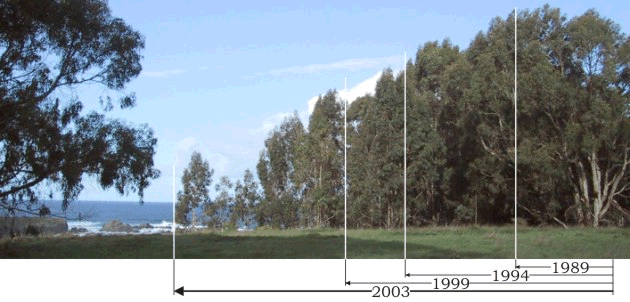
The only photographic evidence of the invasiveness of Blue Gum eucalyptus provided by Cal-IPC’s assessment is in the article in “Caspar News:”
“Eucalyptus encroaching on the ocean view”
There are three problems with this photograph with respect to the claim that it is evidence of the invasiveness of eucalypts:
We are asked to trust the memory of the photographer about the history of this eucalyptus grove. Credible evidence of spread of the eucalyptus grove would provide dated photographs taken at each period of time represented in this photo, i.e., 1989, 1994, 1999, and 2003.
We see the ocean in the far distance, west of this grove of trees. As the forest approaches the ocean, we see that the trees are smaller. This is as we would expect, because the wind from the ocean has suppressed the growth of the trees on the windward side of the grove. The fact that wind suppresses the growth of trees was established by Joe R. McBride in his study of trees in the San Francisco Presidio which the Presidio contracted with him to conduct: “Wind at the Presidio affects tree growth, form, and mortality. Exposure to winds in excess of 5 mph usually results in the closure of the stomata to prevent the desiccation of the foliage (Kozlowski and Palhardy, 1997) Photosynthesis is thereby stopped during periods of moderate to high wind exposure resulting in a reduction in tree growth…Eucalyptus showed the greatest reduction in growth with trees at the windward edge being only 46 percent as tall as trees on the leeward side.” (1) (emphasis added)
The photographer asks us to believe that the eucalyptus forest is spreading towards the ocean. Given that the seeds of eucalyptus are dispersed by gravity and wind and that the wind is coming from the ocean, we would not expect the eucalypts to spread towards the ocean, but rather on the leeward side of the forest.
In other words the “evidence” provided by the Cal-IPC assessment that E. globulus is very invasive is not supported by the evidence that is provided.
It is possible to document invasiveness with photographic evidence. We have provided our readers with two such examples that indicate that Blue Gum eucalyptus is not invasive in the San Francisco Bay Area:
In “Vegetation Change and Fire Hazard in the San Francisco Bay Area Open Spaces,” William Russell (USGS) and Joe McBride (UC Berkeley) used aerial photos of Bay Area parks taken over a 60 year period from 1939 to 1997, to study changes in vegetation types. They studied photos of 3 parks in the East Bay (Chabot, Tilden, Redwood), 2 parks in the North Bay (Pt Reyes, Bolinas Ridge), and one on the Peninsula (Skyline). These photos revealed that grasslands are succeeding to shrubland, dominated by native coyote brush and manzanita. Eucalyptus and Monterey pine forests actually decreased during the period of study. In those cases in which forests increased in size, they were native forests of oaks or Douglas fir. In other words, they found no evidence that non-native trees are invading native trees or shrubs.
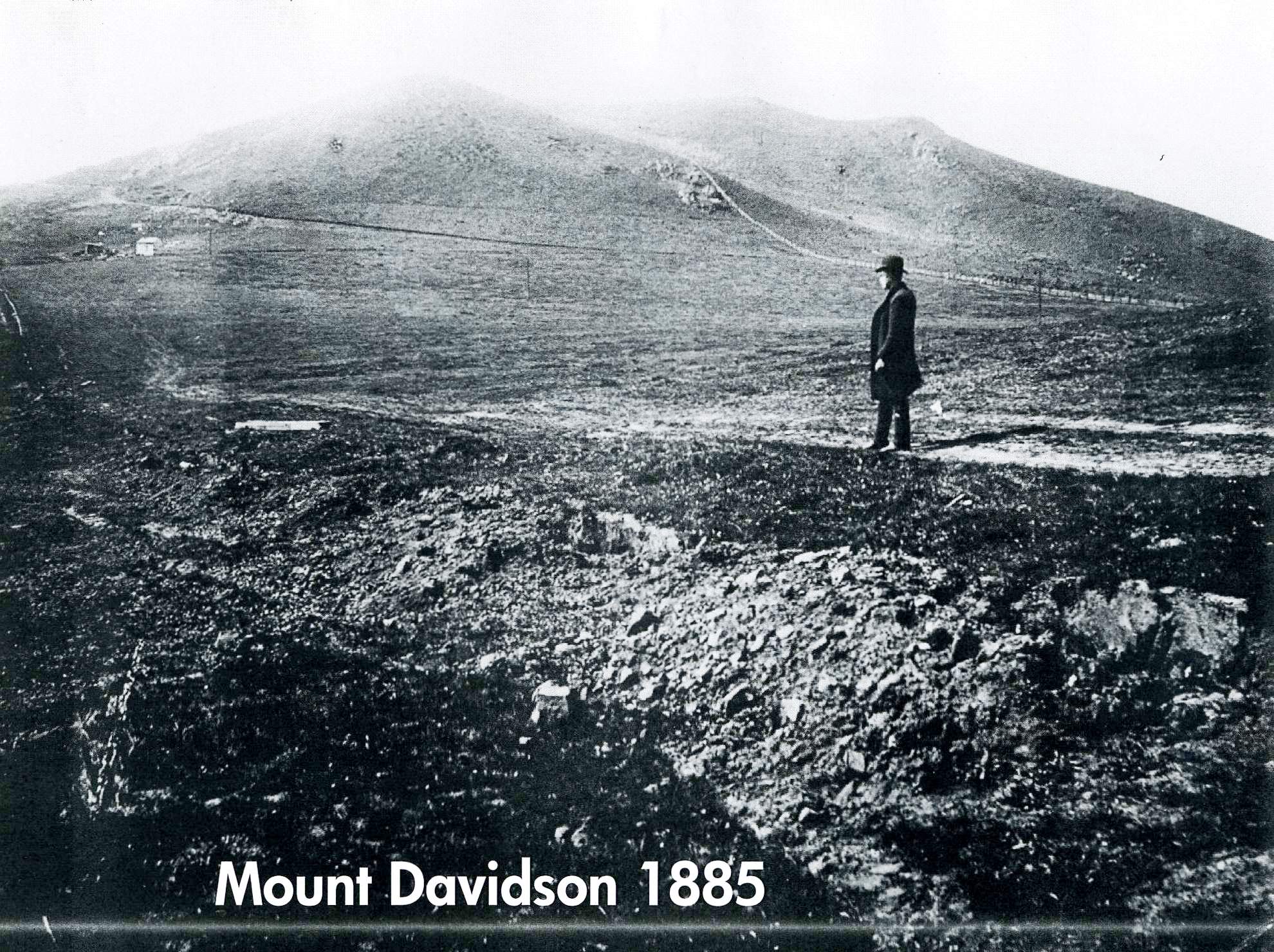
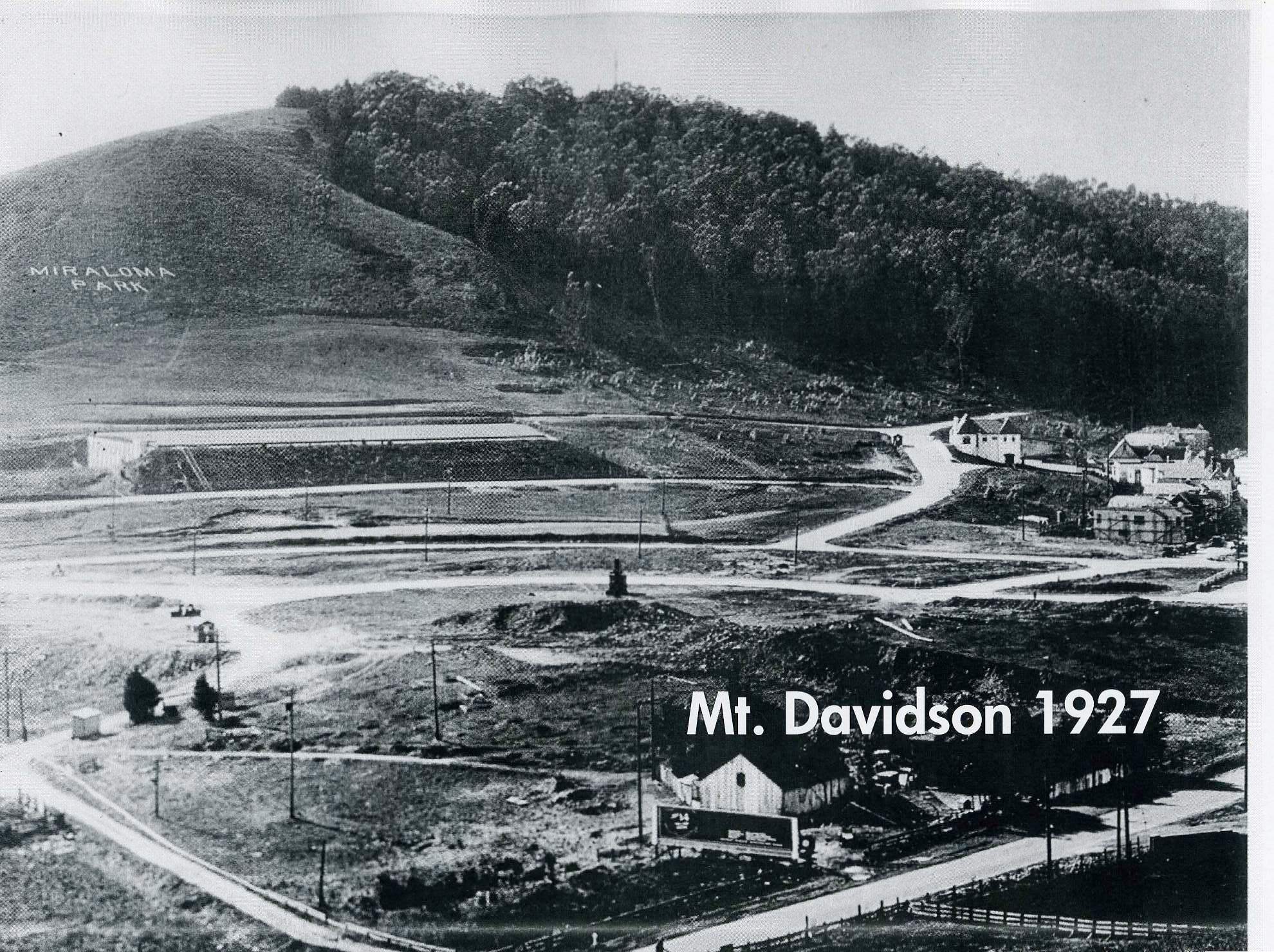
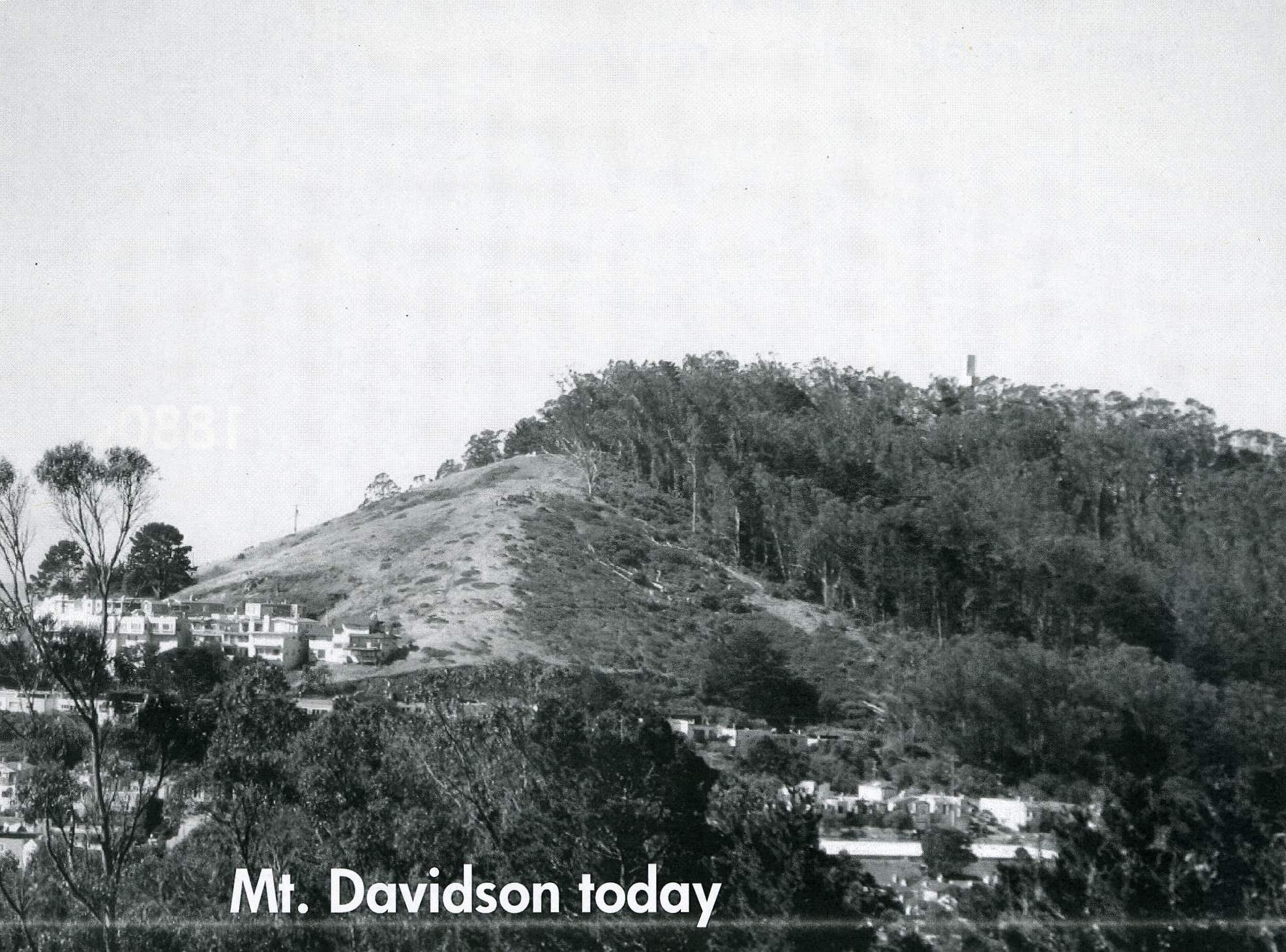
Another example of photographic evidence that E. globulus is not invasive is from Mount Davidson in San Francisco. Adolph Sutro purchased Mount Davidson in 1881. He planted it—and other properties he owned in San Francisco—with eucalyptus because he preferred a forest to the grassland that is native to the hills of San Francisco. Here are historical photos of what Mt. Davidson looked like in 1885, 1927 and 2010:
Since Sutro didn’t own all of Mt. Davidson, there was a sharp line between the forest and the grassland when this photo was taken in 1927.
Over 80 years later, in a photo taken in 2010, there is still a sharp line between the forest and the grassland. We see more trees in the foreground where residential areas have been developed and home owners have planted more trees, but the dividing line on the mountain is nearly unchanged.
There is one well-documented case of significant expansion of planted E. globulus on Angel Island. Using historical records of planting of E. globulus on 23.6 acres as well as observations of uniform spacing of those plantings, McBride et. al., determined that E. globulus spread to 86.1 acres. The trees were planted starting in the mid-1870s to 1933 and their spread was measured in 1988. The authors of the study reported that most spreading occurred in areas of high soil moisture, such as swales, and in disturbed areas such as road cuts. This is also the only documented case of significant expansion of planted E. globulus mentioned in the US Forest Service plant data base. (2)
The one exception to the general rule that Blue Gum eucalyptus has not been invasive in California is consistent with what we know about Angel Island and about the limitations of seed dispersal and germination rates of Blue Gum eucalyptus:
Angel Island is an extremely windy and foggy place because it is located in the San Francisco Bay, close to the Golden Gate to the Pacific Ocean, where wind and fog enter the bay.
Eucalyptus seeds are dispersed by gravity and wind. Therefore we can expect seeds to travel further in a very windy place.
Optimal soil moisture increases the success of seed germination. Fog drip increases soil moisture and spreading of the eucalyptus forest on Angel Island occurred in drainage swales, where moisture would be greatest.
How invasive is Blue Gum eucalyptus?
Blue Gum eucalyptus is rarely invasive. The only documented case of significant spread of eucalyptus forest occurred in ideal conditions for seed dispersal and germination. Therefore, Cal-IPC’s claim that Blue Gum eucalyptus is extremely invasive is exaggerated at best and fabricated at worst.
If our readers are aware of any other documented cases of spreading of eucalyptus, we invite them to inform us. We are committed to accurately informing ourselves and our readers of the reality of invasiveness of Blue Gum eucalyptus.
**************************
(1) “Presidio of San Francisco, Wind Study, First Phase,” Joe R. McBride, circa 2002, page 6. (unpublished, contracted study)
(2) “Focused Environmental Study, Restoration of Angel Island Natural Areas Affected by Eucalyptus,” California State Parks and Recreation, July 1988, pg 47 & 51.
Nature is considered one of the top journals in science globally. So, we were very excited about the article they published in their September 2013 edition about Mount Sutro. (1) The article starts with every bogus claim UCSF makes to justify the destruction of the forest, i.e., that it is flammable, that it is diseased, that it will store more carbon when most of it is destroyed. We have responded to those claims many times on Million Trees, so we won’t repeat those arguments here. (We have provided links to our articles about each of these issues, so you can read them if you wish by clicking on each issue.)
Sutro forest before recent tree removals. Courtesy Save Sutro
After faithfully repeating UCSF’s storyline, Nature turns to the opposite side of this debate, starting with the welcome introduction of critics of the Sutro project as “environmentalists and ecologists” for whom “a hardline devotion to preserving native ecosystems is giving way to a more post-modern idea of what constitutes a natural landscape.” The author of the Nature article interviewed scientists who agree with this new perspective:
“’Mount Sutro is part of a larger story,’ says Richard Hobbs, an ecologist at the University of Western Australia in Crawley. ‘What some people see as a weed-filled blot on the landscape, others see as something extremely valuable, worthy of managing in its own right. People are increasingly moving away from the belief that a native ecosystem is always best….There is a lot of tension about how to deal with situations like these right now,’ he says. ‘With so much non-native habitat, the old views — that everything must be natural — no longer apply.’”
“In the early 1990s, Patricia Kennedy of Oregon State University in Corvallis helped to develop management guidelines for northern goshawks. She found that the raptors do not strictly need old-growth forests; land used for timber harvesting can work, too. She says that, at the time, accepting the idea felt like a move to the ‘dark side’. ‘The whole culture in wildlife biology and conservation circles has been that you can’t approximate Mother Nature,’ she says. But those ideas are changing today, with altered ecosystems such as Mount Sutro’s providing a case in point.”
“Joe Mascaro, an ecologist at Stanford University in California [2] who has been publicly critical of UCSF’s management plans, says that Mount Sutro has long since given way to a completely new ecosystem. ‘Restoring it to an original state would be borderline impossible, so why stop the succession that is already in place?’”
“Resistance to such a heretical idea runs deep among ecologists, but growing numbers are embracing altered ecosystems in the name of pragmatism. ‘You can reach more win–win situations if you don’t insist on purity,’ says Katharine Suding, an ecologist at the University of California, Berkeley, who specializes in restoring human-affected areas. ‘It doesn’t have to be a natural versus non-natural dichotomy.’”
Same section of Sutro forest after tree and understory removal at the end of August 2013. Courtesy Save Sutro
The reaction of native plant advocates
As pleased as we were to hear from the international scientific community, we didn’t fully appreciate the significance of the article until we read the reaction of native plant advocates in Jake Sigg’s Nature News:
“On Sep 15, 2013, at 4:13 PM, Peter Brastow wrote (re NYT editorial on Mt Sutro):
‘Yes, and recall that the NYT article linked to an awful piece in Nature. I see this as PhD Academicians liking the sound of their own voice, and certain members of the media who, likewise, don’t actually know anything about on-the-ground land management. To boot, their arguments support continued environmental destruction around the world, whether for palm plantations, bio-fuel production, cattle grazing, suburban development, you name it. Do you think these same people advocate letting the Amazon rainforest be clearcut from end to end?’” (Jake Sigg’s Nature News, September 21, 2013)
It seems that native plant advocates disliked the Nature article as much as we liked it. This comment from a prominent native plant advocate in San Francisco is more evidence of the growing gap between restorationists and the scientists of invasion biology who spawned the native plant movement. We have noted before the inevitable tension between theoretical science and its practical application and in the case of ecological restoration in the Bay Area, it is becoming more and more distant from its scientific underpinnings.
What is San Francisco’s Biodiversity Program?
You might think that the loss of scientific support for the projects in the Bay Area which are attempting to convert non-native to native landscapes would weaken the local native plant movement. You would be mistaken. Peter Brastow, the author of this comment, is employed by the City of San Francisco as the Director of Biodiversity in the Department of the Environment. The creation of this program and the selection of Mr. Brastow as its first director suggest official endorsement of these projects and imply their expansion beyond their present footprint. This is the mission of San Francisco’s Biodiversity Program according to the Department of Environment’s website:
“The mission of the Biodiversity Program is to conserve the biodiversity, habitats and ecological integrity of San Francisco’s natural environment, toward a comprehensive watershed- and ecosystem-based natural resources management, stewardship and education program.
Our approach is to advance collaboration and coordination for biodiversity policy development and interagency conservation planning and management.
San Francisco’s indigenous biodiversity exists among diverse open lands and habitats in a complex urban geography of parklands, natural areas, urban forests, community gardens and backyards. The scope of the program includes protection of all of the City’s biological diversity and natural lands, and for strategic integration of nature conservation best practices into planning, implementation and education for the built environment.
We hope to raise the bar on integrating considerations for nature and biodiversity into the operations of every City Department as well as into every aspect of city life, including making significant increases in public and City employee awareness.”
Our interpretation of this vague, abstract description is that the goal of San Francisco’s Biodiversity Program is to extend the native plant restorations of the Recreation and Park Department’s Natural Areas Program to all city departments and all city-owned open space, perhaps even to your backyard.
We are equally alarmed by the dismissal of scientists by the Director of Biodiversity, Peter Brastow, as people who like to hear themselves talk. This suggests that the Director of Biodiversity isn’t listening to the rapidly changing science of invasion biology. You might wonder what Peter Brastow’s qualifications are to enable him to dismiss academic scientists as a resource for the application of invasion biology to native plant restorations. You can visit his resume on the internet to satisfy that curiosity.
Pot-calls-kettle-black
For the record, we are not supporters of the “environmental destruction” of which Mr. Brastow accuses the scientists who are quoted in the Nature article. We do not “advocate letting the Amazon rainforest be clearcut from end to end,” as Mr. Brastow claims. We are confident that no one else with whom we collaborate does so either. The only clearcutting we have witnessed first-hand was done in response to the demands of native plant advocates; these projects have already destroyed 18,000 non-native trees in the East Bay hills and are determined to clearcut about 80,000 more. This looks like a classic case of “pot-calls-kettle-black.”
“Nonnative berries may not provide the nutrition that particular native birds require.”
“Nonnative fruiting plants could bring birds into a wildland habitat new to them, not necessarily with a good outcome. Birds might flock to a new area, feast on the new food source till it’s gone, but then not find enough food for so many birds in the rest of the habitat.”
“Nonnative plants alter wildland communities ‘in more complex ways than simply providing food for birds.’ A bird-dispersed nonnative fruiting shrub, for example, ‘can form underbrush or thickets in areas that previously lacked an understory…Birds may find their nesting sites disrupted, more cover for predators, etc.’”
Our initial reaction to thesedire predictions was that they wereentirely speculative. The consistent use of the word “may” to describe the consequences of non-native plants suggested that supporting evidence was absent. It seemed that, as usual, the nativist ideology was casting a dark pall on nature.
We were reminded of one of our first encounters with a nativist over 10 years ago. On a tour of a park in San Francisco, he claimed that non-native plants in San Francisco were creating a “sink” which he defined as attracting migratory birds into a climate to which they were not adapted, where they would eventually freeze to death. I pointed out to him that it does not freeze in San Francisco. He was unaware of this fact.
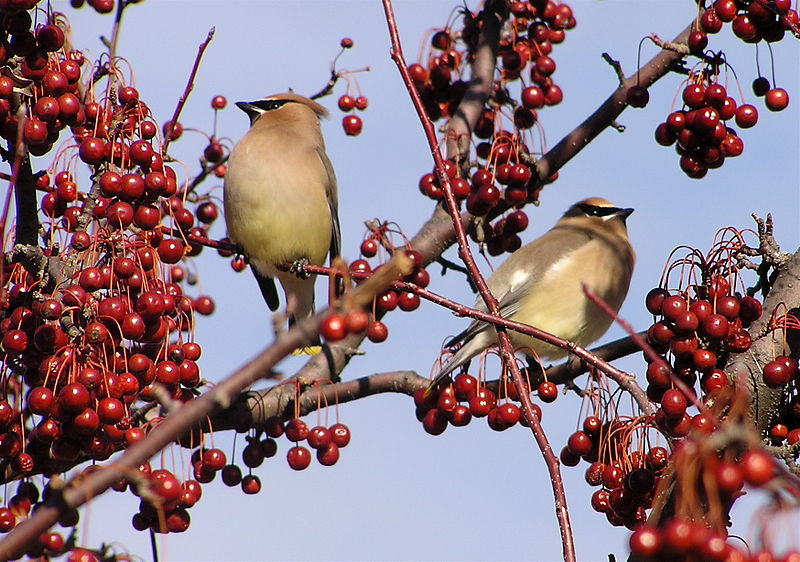
Cedar waxwings in crab apple
Secondly, we reacted to the implication of the Chronicle article that birds are passive in nature and incapable of making good choices for themselves. The suggestion is that birds are unable to discern nutritious food from “junk” food and incapable of choosing a safe nesting site to raise their young.
Thirdly, since every plant is native somewhere, we found the suggestion that non-native plants are nutritionally inferior to native plants illogical. Are we to believe that where these plants are native, birds are malnourished?
Where is the evidence?
And so, we decided to see if we could find any actual evidence that supports these statements. We started by looking at the research work of the ornithologist quoted by the Chronicle gardening columnist, Clare Aslan. She earned her Ph.D. in Ecology at UC Davis in 2010. Her Ph.D. project is described in a publication the year her degree was awarded: “Avian use of introduced plants: Ornithologist records illuminate interspecific associations and research needs.” (1)
In this publication, Ms. Aslan tells us that her project was essentially a questionnaire that was sent to over 1,000 non-professional bird watchers in four American states (California, Florida, New York, and Washington). These bird watchers were presumed to be skilled because they were members of Ornithological Societies of North America. Responses were received from 173 of these bird watchers, of which 51% were from California. Respondents reported 1,143 interactions between birds and plants. “Interact” is defined as the full range of bird behavior: eat, nest, perch, glean, etc.
The objectives of the questionnaire were: (1) to evaluate patterns of bird use of non-native plants to determine the role the birds play in dispersal of “invasive” plants; (2) to examine the food web and guilds formed by bird interactions; and (3) to determine gaps in empirical research to inform future research efforts.
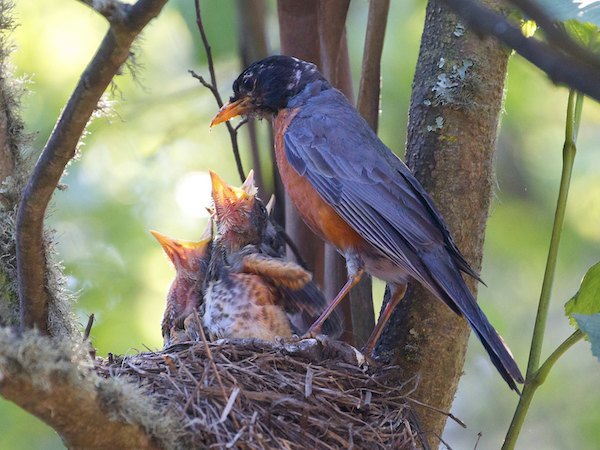
Robin and chicks. Courtesy SF Forest Alliance
Respondents to the survey reported that 47% of observations of feeding by 139 bird species were of seeds or fruits of non-native plants. Thirty-five percent of all “habitat interactions” were with non-native plants and 26% of all nesting activity was in non-native plants. If non-native plants are harming the birds, nearly half of them must be in danger of starving to death!
Ms. Aslan tells us nothing about the relative nutritional value of non-native plants compared to native plants in this publication. In her concluding paragraph, she suggests that her primary finding is that more research is needed to understand the role that birds play in the dispersal of “invasive” plants which has “direct application for invasion prevention.”
Perhaps Ms. Aslan was misquoted by the Chronicle garden columnist. If not, Ms. Aslan does not seem to have any empirical evidence to support her statements about the negative impact of non-native plants on birds.
Research about birds’ food preferences
Million Trees is always looking for the happy ending. Consequently, our next step was to search the scientific literature for evidence that birds are being harmed by non-native plants. It was not difficult to find several reassuring articles about the food preferences of birds:
One study found that birds do, indeed, have food preferences and their preferences are based on many factors, including color, size, and availability. However, “In addition to these factors the nutritional composition of fruit pulp also influences selection of fruits by birds.” (2)
Another study found that what birds choose to eat depends somewhat on their migratory patterns. They choose foods with more fat content immediately prior to a long migratory journey over “major ecological barriers” such as seas and deserts. (3)
In a native eastern forest in the United States, most of the nutritionally best fruit was eaten early in the season, prior to the beginning of the migration. Over-wintering birds were then left to eat the fruit that remained. (4)
Finally, a study of fruit in the tropics showed that fruit that is more conspicuously colored and/or displayed seemed to be compensating for lower nutritional value than less conspicuous fruit. The authors speculate that these are the evolutionary trade-offs that enable plant species to survive. (5)
All of these studies suggest that the birds know what they are eating and why. We find no reason to fret on behalf of the birds that are eating non-native seeds and berries. In fact, the eradication of some of the best food sources—such as Himalayan blackberries—may be a greater cause for concern. And, once again, we find the extreme negativity of nativism to be a bigger problem, with respect to the damage being done to the environment in the guise of saving the planet from the harm they have imagined.
*********************************
(1) Clare Aslan and Marcel Rejmanek, “Avian use of introduced plants: Ornithologist records illuminate interspecific associations and research needs,” Ecological Applications, 20(4), 2010.
(2) E.W. Stiles, “The influence of pulp-lipids on fruit preference for birds,” Vegetatio, Volume 107-108, Issue 1, 1993
(3) F. Bairlein, “Nutrition and Fruit Selection in Migratory Birds,” Bird Migration, Springer Berlin Heidelberg, 1990
(4) John W. Baird, “The Selection and Use of Fruit by Birds in an Eastern Forest,” The Wilson Bulletin, Vol 92, No 1, March 1980
(5) Nataniel Wheelwright and Charles Janson, “Colors of Fruit Displays of Bird-Dispersed Plants in Two Tropical Forests,” The American Naturalist, Vol. 126, No 6, December 1985
One of the basic tenets of invasion biology is “ecological niche theory.” According to that theory, every species occupies a specific niche to which it is adapted. That niche provides all the biological resources the species needs for its survival and reproduction.
A corollary to that theory is that when non-native species are introduced to that “niche” the native occupant is the loser in the inevitable competition for available resources. The intruder has the advantage in this competition because its predators have not usually been introduced at the same time. This is the “predator release” corollary.
Bumblebee on Cotoneaster, Albany Bulb
Adherents to ecological niche theory therefore routinely predict the demise of native species whenever non-native species are introduced. Often, their belief in this inevitable competition leads them to see what they expect to see. The prediction that the introduction of the European honeybee to the New World would eventually decimate populations of native bees is an example of this mindset. Since honeybees were introduced to the New World over 400 years ago, it seems reasonable to expect to see some evidence of this consequence by now.
Seeing what we expect to see
Forgotten Pollinators was published in 1996, at the height of popularity of invasion biology. (1) We consider it a valuable, interesting book, but we were not impressed with the chapter devoted to the belief of the authors that the European honeybee is competing with native pollinators, to the detriment of native pollinators. Although the authors interviewed several other scientists who shared that belief, they were unable to offer any empirical evidence that supported their belief.
One of the studies cited in Forgotten Pollinators quantified the amount of nectar and pollen consumed by honeybees and compared that to the quantity of nectar and pollen required by native bumblebees. Based on those calculations, they predicted the demise of bumblebees based entirely on the amount of nectar and pollen consumed by honeybees. The study arrived at the preposterous conclusion that a single honeybee hive could reduce the population of bumblebees by 38,400.
This dire prediction is based on the assumption that there is a finite amount of pollen and nectar available. Therefore, every scrap of food collected by a honeybee is a scrap of food taken from a bumblebee. It also assumes that the bumblebee loses the competition 100% of the time and neither insect is capable of expanding its range in the unlikely event that there is in fact a finite amount of food available. This type of “zero-sum” thinking pervades the nativist ideology, e.g., a job taken by an immigrant is presumed to be taken from a resident.
Looking for bad news…finding good news
White Sweetclover
The federal government has invested in many careers and large sums of money to prove the assumptions of invasion biology as well as funding eradication projects based on those assumptions. For example, the University of Alaska, Fairbanks was awarded a federal grant for $493,000 to test the hypothesis that the existence of non-native sweetclover is drawing pollinators away from wild native food sources such as cranberry and blueberry bushes. After several years, researchers have concluded, “…there’s usually room for everybody.” (2)
The researchers monitored 20 sites for two years. They observed that the sweetclover patches “were actually attracting three times as many pollinators to native plants as they would otherwise get.” The sweetclover attracted many different types of pollinators, including moths, flies, and wasps. Consequently there were many more cranberries in the “invaded” patches and equal quantities of blueberries.
Suspicious of those findings, the researchers moved their project to a controlled setting. Then they got mixed results, which seemed to depend upon variations in the weather.
Researchers are still intent to find negative consequences of the existence of sweetclover. Now they are hoping to prove that the sweetclover is changing the composition of the soil, which they predict will eventually “crowd out” the native plant species. Will they keep looking until they can report bad news?
Empirical evidence is absent
After reading this good news about the exoneration of sweetclover in the nativist blame game, we decided to revisit the accusations made by Forgotten Pollinators about honeybees causing the decline of native bee populations. Our search of scientific literature published after the publication of Forgotten Pollinators in 1996, was very revealing and is best represented by a review article published in 2004, “Impact of the introduced honeybee on native bees: A review.” (3)
The review analyzes 28 studies conducted all over the world about the impact of honeybeeson populations of native bees. This is a summary of the analysis:
“Although previous studies investigating indirect measurements have been cited as evidence of competition between honey bees and native bees, many of these studies were compromised by low replication, confounding factors or poor interpretation. Studies that are well designed and implemented may find the potential to impact negatively on native bees but the use of indirect measurements does not reveal [their impact on] long-term survival of native bees.
More direct studies of the impact of honey bees on native bee survival, fecundity or population density have shown little evidence that the presence of honey bees has any impact on native bees.” (3)
As we often do on Million Trees, we conclude with this rhetorical question: How does invasion biology survive in the absence of empirical evidence that supports its hypothetical assumptions?
*********************
(1) Stephen Buchmann & Gary Paul Nabhan, Forgotten Pollinators, Island Press, 1996
(2) “Invasives pollination study shows mixed results for Alaska berries,” Fairbanks Daily News-Miner, August 23, 2013
(3) D.R. Paini, “Impact of introduced honey bee (Apis mellifera) on native bees: A review,” Austral Biology, (2004) 29, 399-407.
Nearly a year ago, we told our readers about a study of 371 publications testing the hypothetical assumptions of invasion biology, aptly entitled “Support for major hypotheses in invasion biology is uneven and declining.” The hypothesis least studied was “island susceptibility” which predicts that invasive species are more likely to become established and have major ecological impacts on islands than on continents. This hypothesis has considerable intuitive appeal because species that evolve in isolation are more likely to diverge from their ancestors in response to specific conditions which predicts a large number of endemic species unique to that island. In fact, the results of 9 studies of the island susceptibility hypothesis found that only 11% of those studies supported the hypothesis.
Subsequently, we were able to tell our readers about two specific examples of studies of islands where introduced species significantly increased biodiversity and benefited native species. In Puerto Rico, Ariel Lugo found that non-native trees were restoring depleted agricultural soils and providing shelter to native trees. In Hawaii, Joe Mascaro found that non-native trees were performing the same ecological functions as native trees and that non-native trees capable of nitrogen-fixing were creating soil on barren lava flows, greatly accelerating revegetation.
Ascension Island
Ascension Island
Ascension is another example of an island on which biodiversity has been increased significantly by the introduction of non-native species. Ascension is in the Atlantic Ocean, roughly midway between South America and Africa. It has therefore been crucial for hundreds of years to travelers to resupply their long voyages. The British claimed it as a naval base in 1812. It was vital during World War II as a base for both American and British warships and submarines. It now has a huge air strip used by American and British military.
Ascension emerged from the ocean as a volcano about a million years ago. The volcano was active until about 700 years ago. There was therefore little vegetation on the island when it was first occupied by the British 200 years ago. They introduced domestic animals as well as agricultural crops needed to supply their ships making the voyage across the Atlantic Ocean. Many unintended hitchhikers also made the voyage to Ascension, such as cats and rats.
“Naked Hideousness”
Green Mountain, Ascension. Creative Commons
By the time of the visit of Charles Darwin to Ascension in 1836, little of the sparse natural vegetation remained. Darwin complained of the “naked hideousness” of the island. Returning to England, Darwin convinced his friend and fellow botanist Sir Joseph Hooker that Ascension would benefit from the introduction of plants and trees: “The idea was that the new vegetation on the mountaintop would scavenge moisture from the passing clouds. Further down the slopes, planting would encourage soil growth” on the barren lava. (1)
Drawing from the collection of Kew Gardens in London, Joseph Hooker shipped trees from all over the world to Ascension: “By the late 1870s Norfolk pines, eucalyptus, bamboo, and banana trees grew in profusion at the highest point of the island, Green Mountain, creating a tropical cloud forest.” (2)
Ascension Today
Yale Environment 360 recently published the report of a visitor to the man-made tropical forest on Ascension, Fred Pearce. (1) He is a British freelance writer. His guide on Ascension was the island’s conservation development officer, Stedson Stroud. Stroud told him that except for a few native ferns, everything on the island today has been introduced. He acknowledged that as a conservationist he might be expected to be engaged in an effort to eradicate all the non-native species. “But if he did, there would be almost nothing left. And in any case, he mused, he is presiding over something profoundly interesting—a functioning ecosystem to which a ragbag of species shipped in from all over the world thrive as if they had been together for millennia.” (1)
There are 300 introduced plant species on Ascension, adding to the 25 native plant species of which 10 are endemic (unique to Ascension). Three native plant species are said to be extinct. However, “…many of the endemics seem to get on remarkably well with the motley collection of invaders, says Stroud. The ferns that once clung to the bare mountainside now prosper on the branches of introduced trees like bamboo. Stroud showed [Pearce] ferns that he believes now thrive only on the mosses that grow on such branches…And Stroud says the vegetation captures more cloud moisture just as Hooker had hoped, even though rainfall has declined in the lowlands around.” (1)
The message that some scientists don’t want to hear
The conservation officer interviewed by Pearce expressed his frustration that scientists visiting Ascension are not interested in the thriving ecosystem on Green Mountain. Conservation research is still hung up on native ecosystems because the “…standard theory [is that] complexity emerges only through co-evolution…According to mainstream ecological theory, this cloud forest really should not exist. Certainly it should not thrive. Complex forest ecosystems are believed to take millions of years to develop…” But the fact is, the cloud forest on Green Mountain “strongly suggests that even highly biodiverse ecosystems may often be accidental, temporary, and versatile.” (1)
Pearce concludes that there are practical implications for conservationists who are trying to reassemble the complex ecosystems that have been lost. We might have better results from simply letting nature take its course. Most visitors to our cloud forest in San Francisco, Mount Sutro, would probably agree with that strategy. How could destroying 90% of the forest and its understory on 75% of the acres be an improvement over what we have now?
Update: Professors Daniel Simberloff and Donald Strong have posted a “counterpoint” to Fred Pearce’s article about Ascension Island. It is available here.
Professor Simberloff is one of the most notable academic proponents of invasion biology. Professor Strong is the creator of the project to eradicate all non-native Spartina marsh grass from the entire West Coast of the US.
Their counterpoint looks like rhetorical flailing to us. Although littered with detail, its argument seems convoluted and ultimately leaves one wondering if they are making any point other than their deep desire to defend their academic turf.