Parks for the future, not the past

East Bay Regional Park District is preparing to put a parcel tax on the ballot in 2018 that will extend the funding of park improvements for another 15 years.  The public has been invited to tell the park district what improvement projects should be funded by the parcel tax in the future.  We are publishing a series of such public comments that we hope will inspire the public to submit their own suggestions to the park district. 


TO:         publicinformation@ebparks.org

CC:         Board of Directors

FROM:  Park Advocate

RE:          Suggestion for Measure CC Projects

Climate change is the environmental issue of our time.  The climate has changed and it will continue to change.  If park improvement projects are going to be successful, they must have realistic goals that take into consideration the changes that have occurred and the changes anticipated in the future.

The restoration of native grassland is an example of a project that is not realistic, given current environmental conditions.  Grassland in California has been 98% non-native annual grasses for over 150 years.  Mediterranean annual grasses were brought from Mexico to California by the cattle of the Spaniards in the early 19th century.

David Amme is one of the co-founders of The California Native Grass Association and was one of the authors of East Bay Regional Park District’s “Wildfire Hazard Reduction and Resource Management Plan” while employed by EBRPD. In an article he wrote for Bay Nature he listed a few small remnants of native grasses in the East Bay and advised those who attempt to find them, “As you go searching for these native grasses, you’ll see firsthand that the introduction of the Mediterranean annual grasses is the juggernaut that has forever changed the balance and composition of our grasslands.”   That article is available HERE.

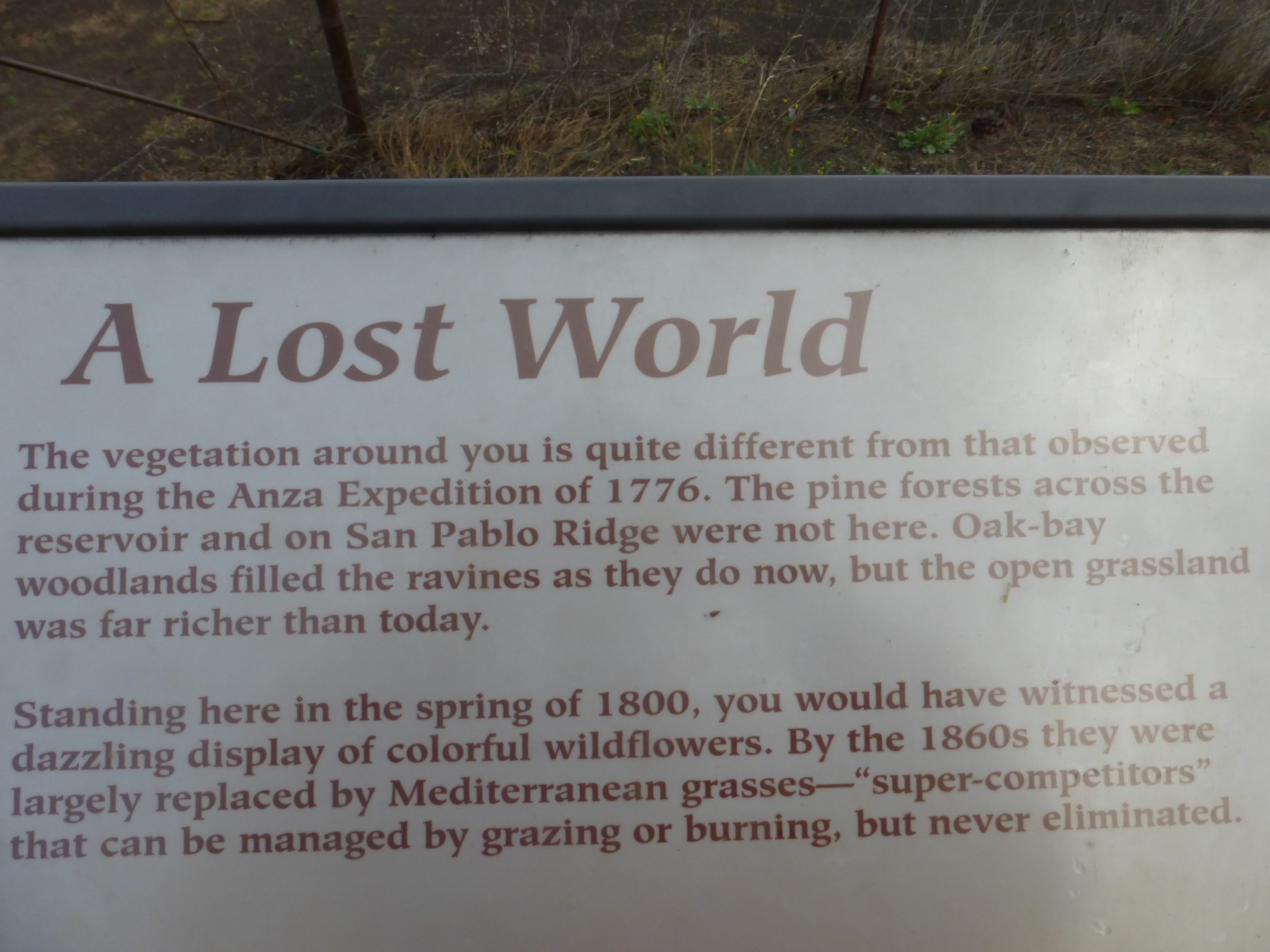
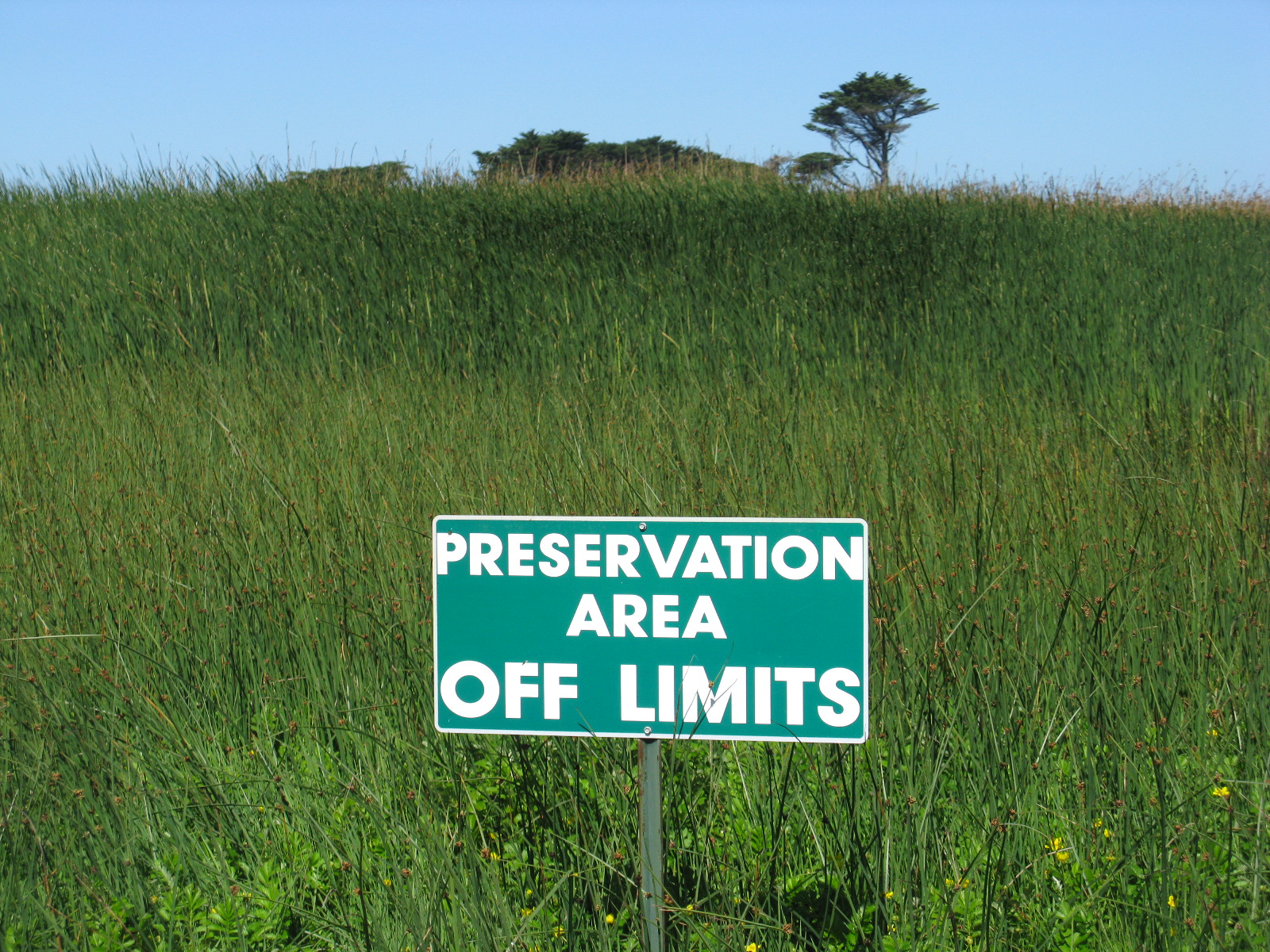
The park district seems to understand the futility of trying to transform non-native annual grassland to native bunch grasses.  Here are two signs in two of the EBRPD’s parks that acknowledge the reality of California’s grassland.

Serpentine Prairie, April 2017
Tilden Park, Inspiration Point, October 2016

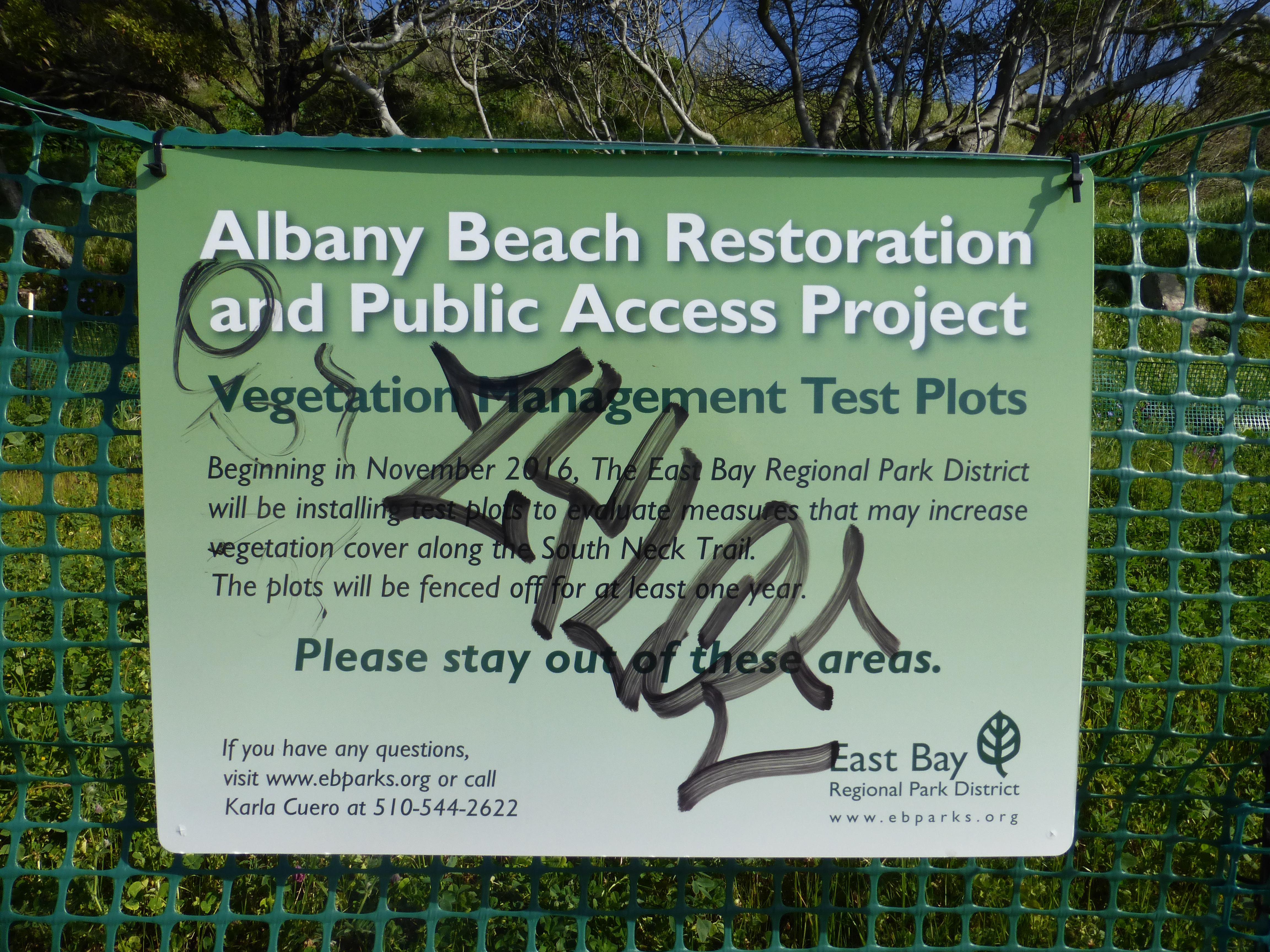
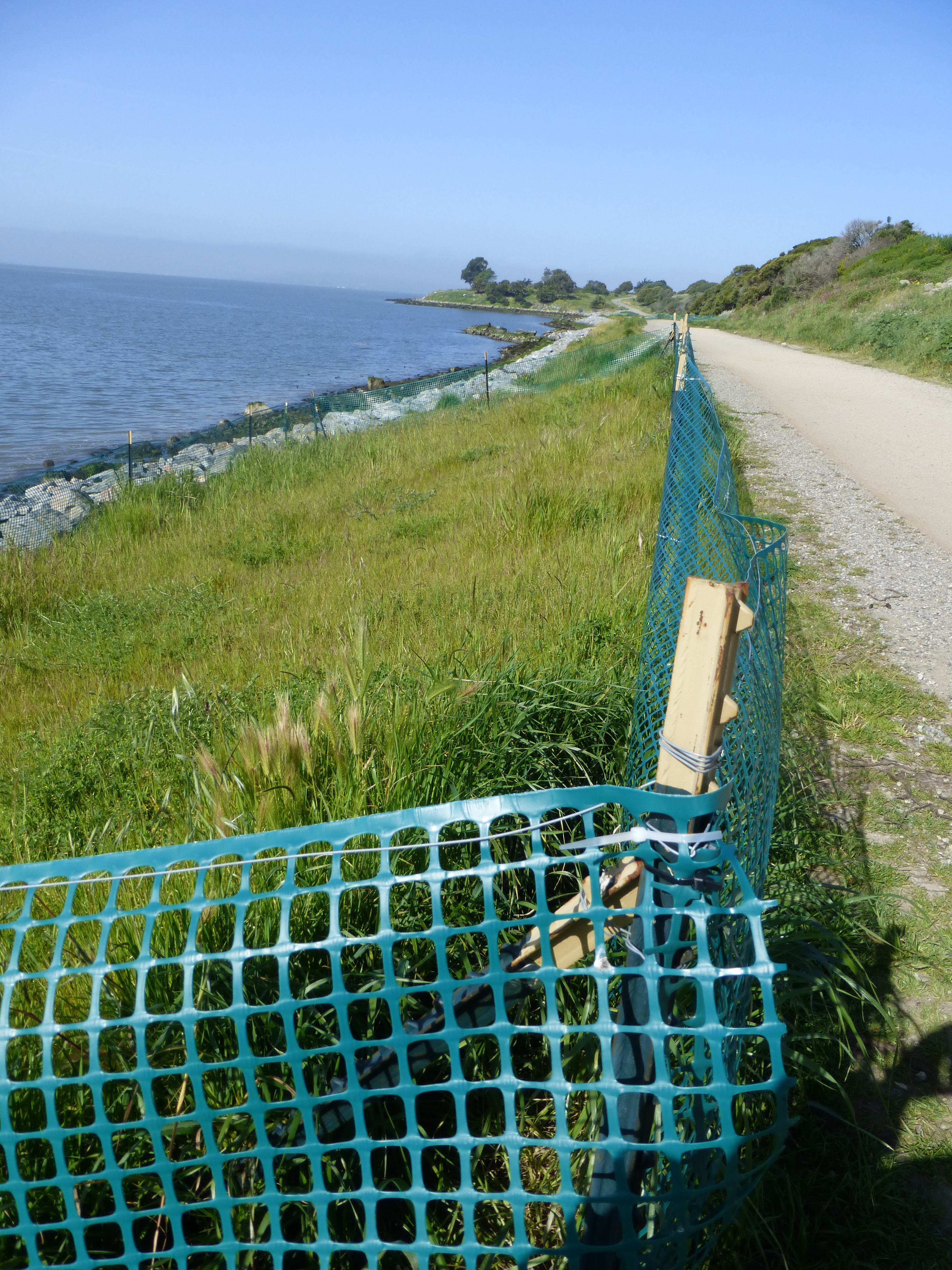
Yet, despite this acknowledgement, the park district continues to expand its efforts to transform the parks into native grassland.  Park visitors recently observed a failed experiment to introduce native grasses to one of the parks.  Six plots of ground were fenced.  Two of the plots were control plots in which whatever non-native weeds had naturalized were allowed to grow unmolested.  Two of the plots were mulch/seeded with native grasses and two of the plots were fabric/seeded with native grasses.  There was no observable difference in plant composition or abundance between the seeded and unseeded plots.  There was no observable difference in the outcome of the two different seeding methods that were used.  In other words, native grasses were not successfully introduced to this park.  My correspondence with the EBRPD employee who was responsible for this project is attached.

Albany Bulb, April 2017

The park in which this experiment was conducted is Albany Bulb.  Albany Bulb is the former garbage dump of the City of Albany.  It was built on landfill in the bay.  The soil is not native and there were never any native plants on it.  It does not seem a promising candidate for a native plant “restoration.”  Unfortunately, Albany Bulb is not an atypical park along the bay.  There are many other parks along the bay that were built on landfill and in which the park district is attempting to establish native plant gardens.  This does not seem a realistic objective for these parks.


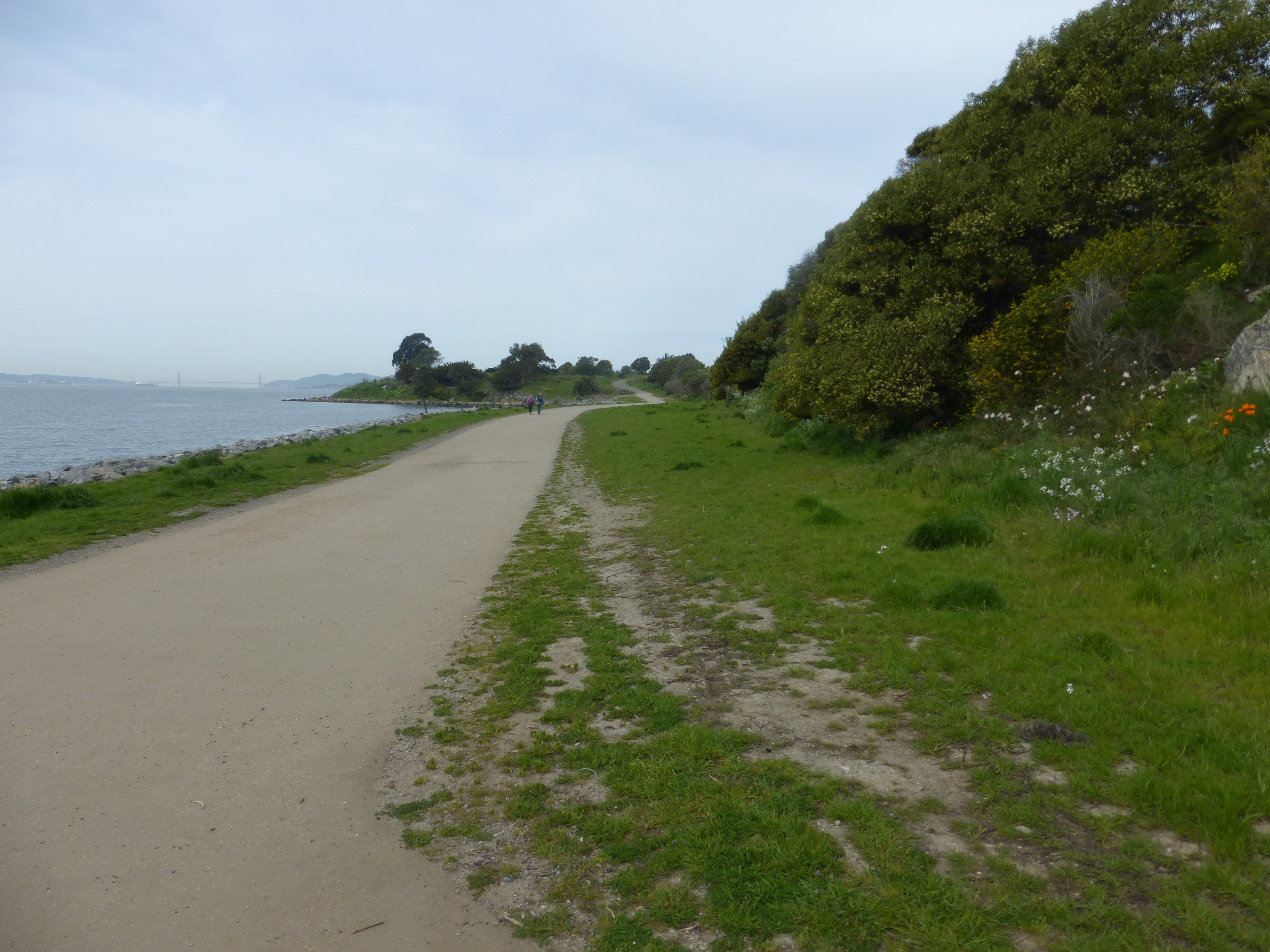
Albany Bulb April 2018

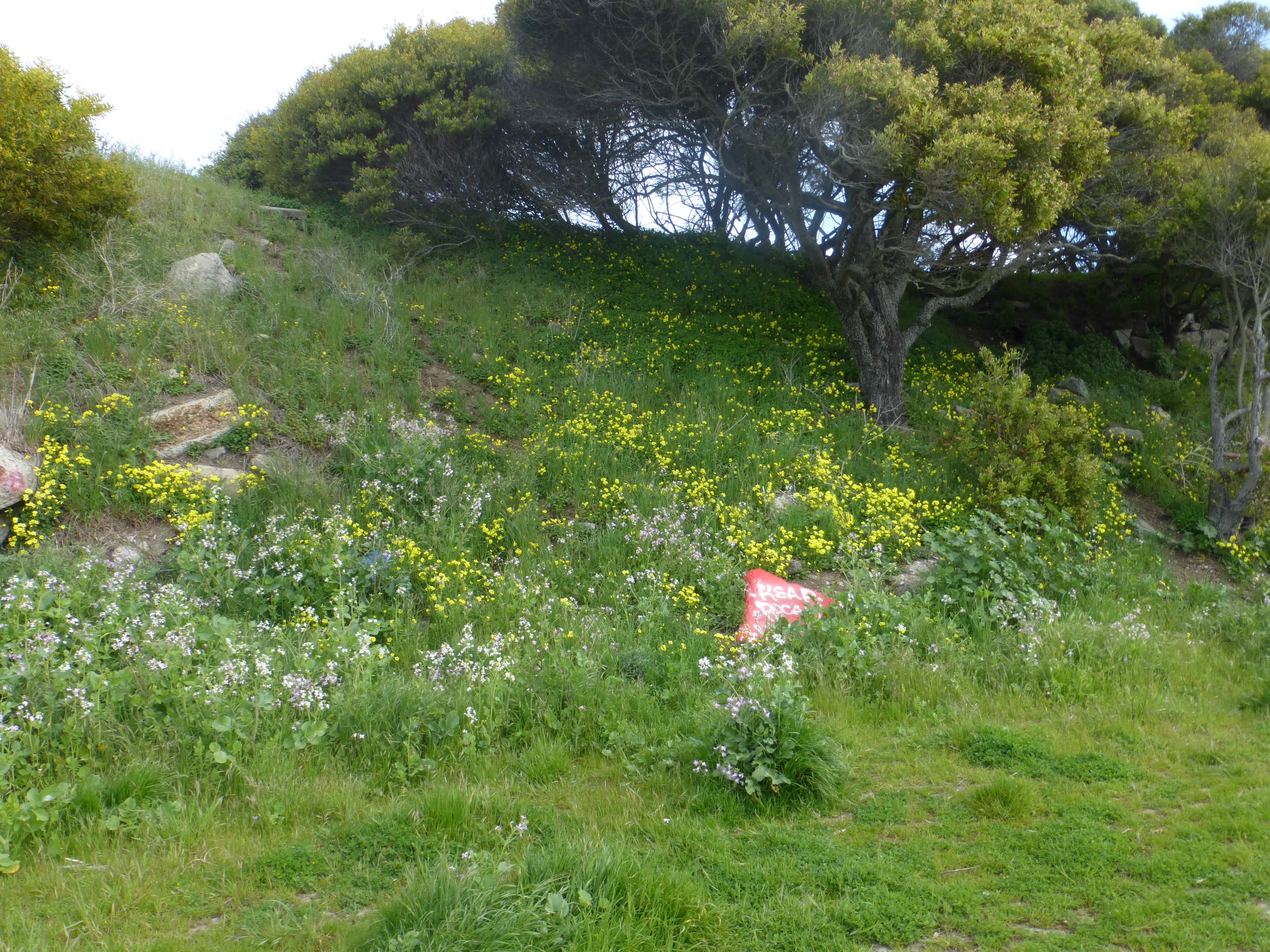
Update:  One year after the experimental planting of native wildflowers at Albany Bulb, there is no evidence of that effort.  The trail-sides are mowed weeds and the upslope from the trail is studded with blooming non-native oxalis and wild radish. 

Albany Bulb. Non-native wildflowers. April 2018

Albany Bulb will soon be closed to the public for a major “improvement” project.   Albany Landfill Dog Owners Group and Friends expects the park to be closed for about one year.  They are unsure if the park will allow dogs off leash when the park re-opens.  More information about the “improvement” project is available on their website:  http://www.aldog.org/announcements-2.  They suggest that you sign up on their website to be notified of the progress of the project and the status of the re-opening of the park.


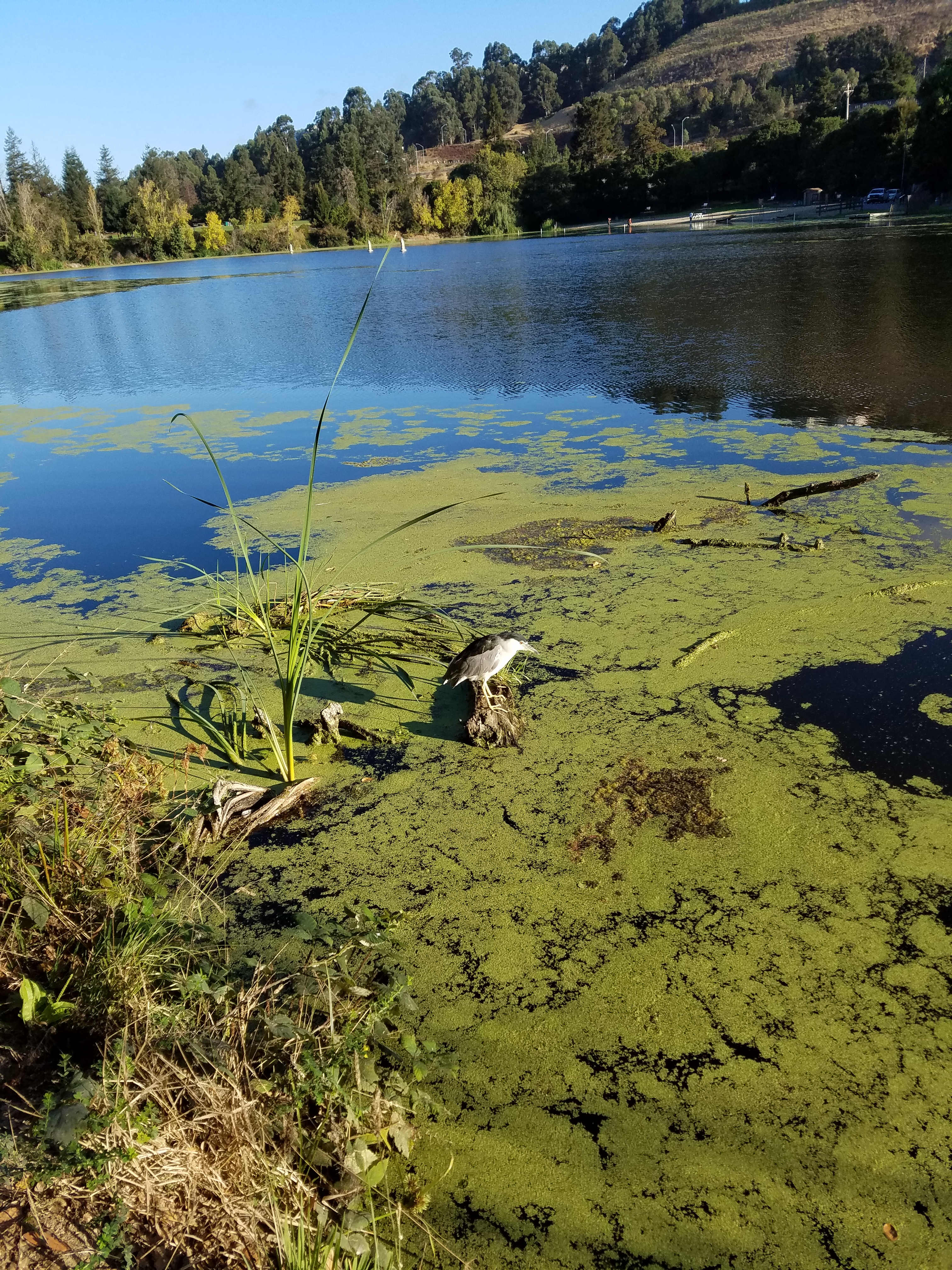
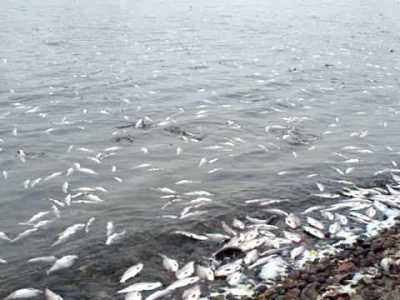
This is not to say that there aren’t many worthwhile park improvement projects that are both realistic and needed.  Dredging Lake Temescal is an example of a worthy project.  As you know, Lake Temescal was a popular place for people to swim until recently.  In the past few years it often has been closed to the public because of toxic algal blooms.  The algal blooms are caused by two closely related factors.  The water is warmer than it was in the past because of climate change and the lake is shallower than it was in the past because of sediment deposited into the lake.

Black crowned night heron in algal bloom, Lake Temescal, April 2017

The park district has tried to address this issue by using various chemicals to control the growth of the algae.  Although that has occasionally been successful for brief periods of time, it is not a long term solution to the problem.  Furthermore, it is a good example of why the park district uses more chemicals than necessary.  If the park district would address the underlying cause of the problem—that is, the depth of the lake—it would not be necessary to keep pouring chemicals into the lake.  Dredging Lake Temescal should be a candidate for Measure CC funding.

And so I return to the point of this suggestion for Measure CC:  Please plan projects that take into consideration the reality of climate change, that address the underlying causes of environmental issues, and that have some prospect for success.

Thank you for your consideration.


Send your comments regarding Measure CC renewal to publicinformation@ebparks.org

Send copies to staff and board members of East Bay Regional Park District
Robert Doyle, General Manager rdoyle@ebparks.org
Ana Alvarez, Deputy General Manager aalvarez@ebparks.org
Casey Brierley, Manager of Integrated Pest Management cbrierley@ebparks.org

Board of Directors:
Beverly Lane, Board President blane@ebparks.org
Whitney Dotson wdotson@ebparks.org
Dee Rosario drosario@ebparks.org
Dennis Waespi dwaespi@ebparks.org
Ellen Corbett ecorbett@ebparks.org
Ayn Wieskamp awieskamp@ebparks.org
Colin Coffey ccoffey@ebparks.org

The consequences of dune “restoration” in coastal California

It is my pleasure to publish a guest post about dune “restorations” in Humboldt County that began about 30 years ago.  Like most “restorations,” these projects are primarily destroying non-native plants.  More often than not, they don’t plant native plants to replace the plants they destroy, although the stated goal is to “restore” native plants.

 Uri Driscoll tells us why the non-native plants were planted over 100 years ago and the consequences of removing them.  According to Mr. Driscoll’s Facebook page, he has lived in Arcata, Humboldt County since 1983.  He has had a life-long interest in outdoor recreation, horses, organic farming, and conservation.  He is a member of Arcata’s Open Space and Agriculture Committee.

 If you live in the San Francisco Bay Area, you might think these projects are not relevant to us.  In fact, they have everything to do with us because there are many similar projects here and the issues with those projects are similar. 

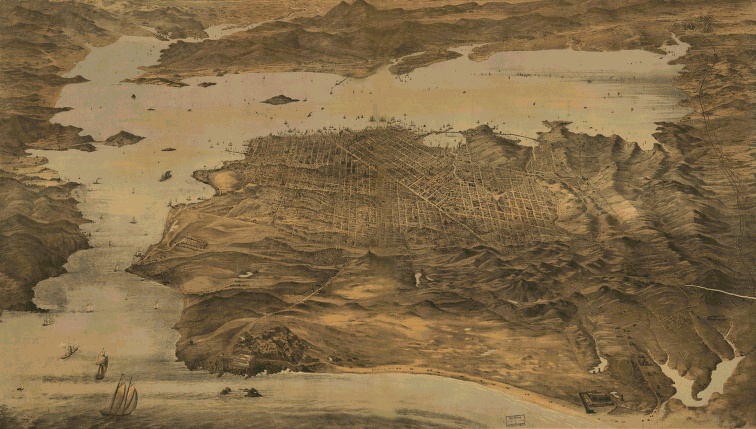
Bird’s eye view of San Francisco in 1868. US Library of Congress

 The San Francisco peninsula was about one-third barren sand dunes when Europeans first arrived at the end of the 18th century.  About 30 years ago, native plant advocates decided they wanted whatever open space that still remains on the peninsula to be returned to pre-settlement conditions, including sand dunes where they existed in the past.

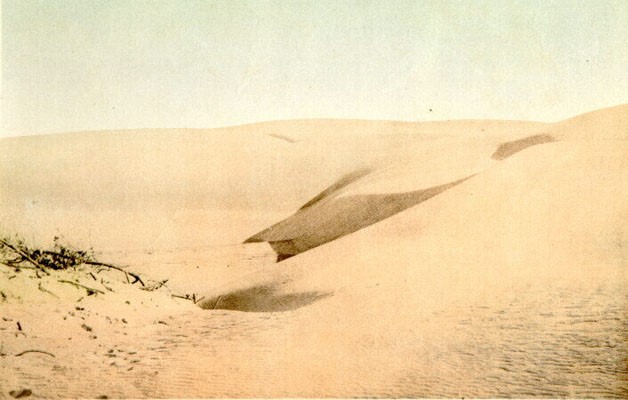
These are the sand dunes in San Francisco where Golden Gate Park was built by creating a windbreak by planting trees. The windbreak stabilized the sand dunes and made it possible to plant and sustain vegetation behind the protection of the windbreak. San Francisco Public Library, historical photo collection.
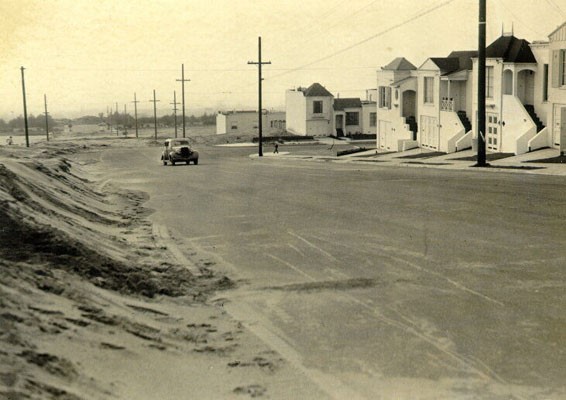
Pacheco & 32nd Ave, San Francisco, 1943. San Francisco Public Library, historical photo collection

As residential neighborhoods in San Francisco were developed, iceplant and European beach grass were planted on the sand dunes to hold the sand in place.  Native dune plants are not capable of stabilizing sand for long, before strong winds move the sand beneath them.  In fact, the long term survival of native dune plants is dependent upon these disturbances. 

Trees were planted on the windward side of residential areas to protect them against the wind.  Sand on the leeward side of the trees was stabilized by the windbreak.  One of the first dune “restorations” in San Francisco proposed to destroy about 4,000 trees in the Presidio in order to restore an endangered dune plant, Lessingia germanorum.  The purpose of destroying the trees was to enable the sand to move again, ensuring the long-term survival of a native dune plant that exists only on the San Francisco peninsula.

Iceplant has been removed from several sand hills in residential neighborhoods, dumping sand on the properties at the base of the hills.  The Great Highway, which separates Ocean Beach from the residential Sunset District is often closed because of drifting sand after removal of beach grass.

In fact, everyone living on the coast of California should have an interest in the preservation of our sand dunes because they are our first line of defense against rising sea levels and the intense storms associated with climate change.  If non-native plants and trees are needed to maintain the stability of our sand dunes, so be it.  Competing agendas must take a back seat to the safety of our coastal communities.

Million Trees


Stable Dunes or Native Plants?

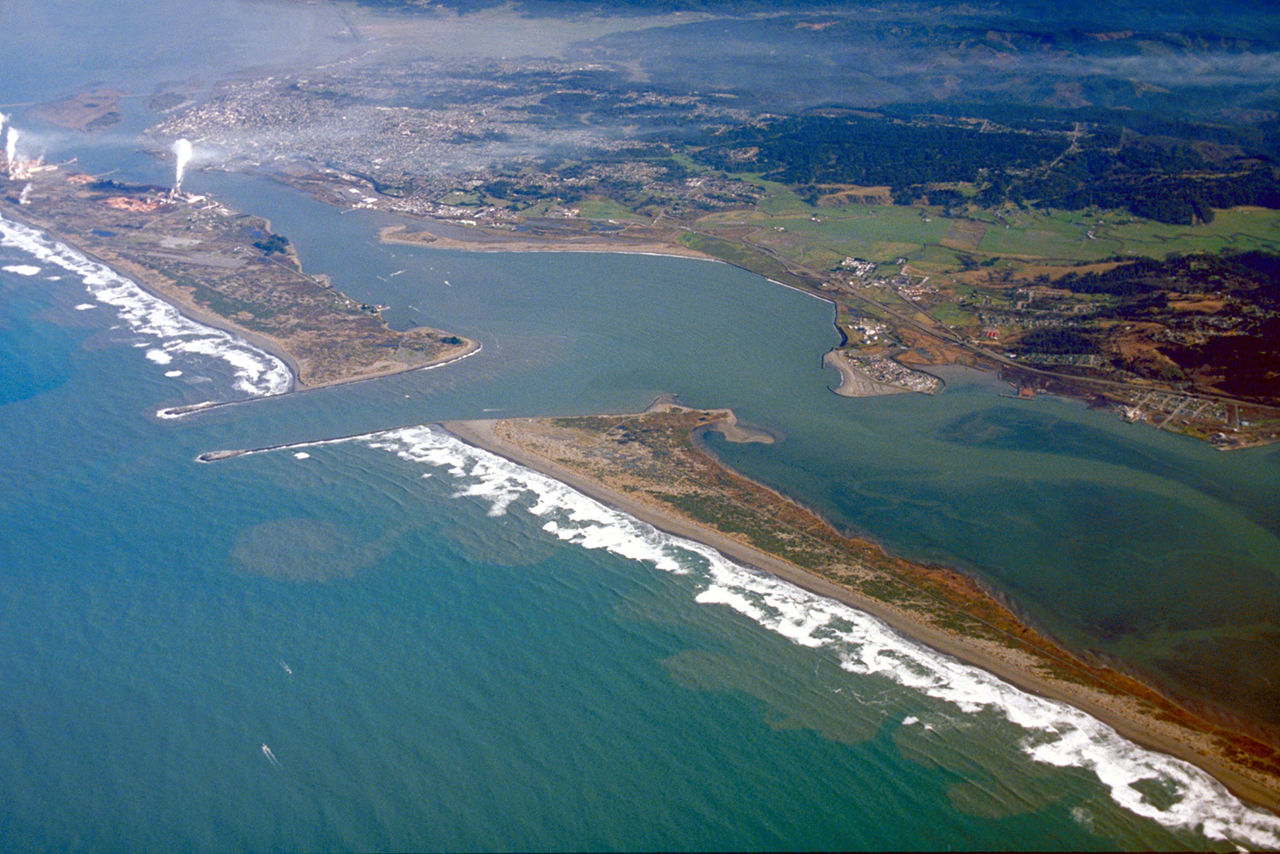
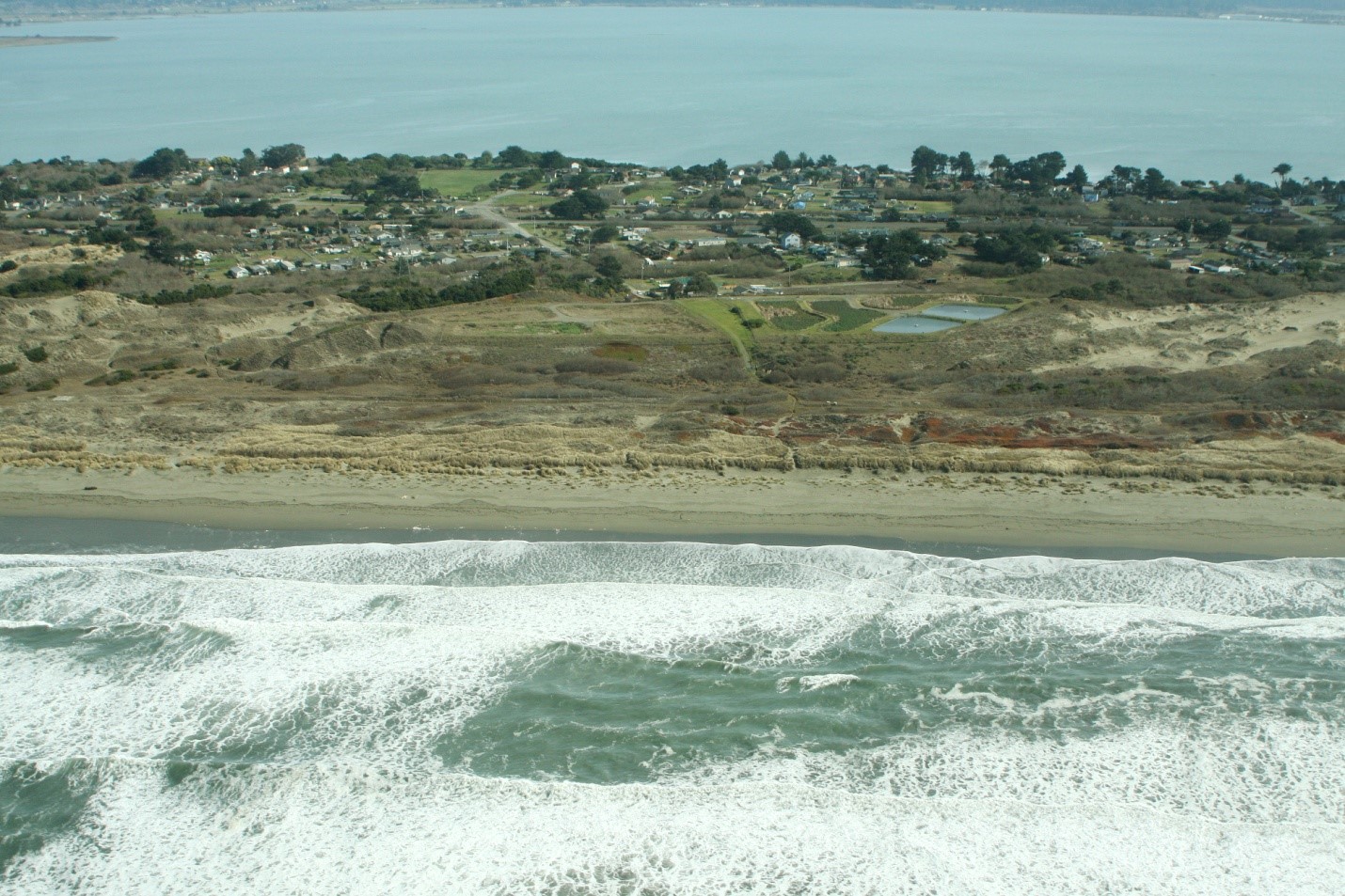
The North and South Spits of Humboldt County are the physical barrier between Humboldt Bay and the Pacific Ocean.  After the introduction of European beach grass (Ammophila arenaria) in the early 1900’s there has been a substantial stabilizing effect on the dunes as they grew wider and taller.  Prior to the establishment of the grass our dunes consisted of wide expanses of unvegetated, open, moving sand. This is in sharp contrast to the variety of plant cover we have today.

Humboldt Bay

In the 1980s public land managers began removing European beach grass with the goal of restoring native vegetation.  This is the story of the consequences of their projects.

Foredunes (the sand ridges parallel to and closest to the shore) with open, actively moving sands have a very high potential for accelerated erosion.  The foredunes of the North Spit and South Spit are still extremely vulnerable to accelerated erosion caused by disturbances to the vegetation.  A beach and dunes management plan and Environmental Impact Report (EIR) was developed in 1993 to address such issues.

Of greater concern, waves have washed over the foredunes on both spits where waves have breached the foredune where vegetative cover had been removed.  Repeated overwash events would significantly and immediately impact the only access road to the South Spit and the municipal water main and water treatment facilities on the North Spit.

These dunes could again be set in motion by removal of the protective cover of native and non-native vegetation.  Indeed, the intention to remobilize dunes was identified in the Conditional Use Permit application Bureau of Land Management (BLM) submitted for vegetation removal at Table Bluff County Park, a portion of the South Spit.  However, those intentions are contrary to the local Humboldt Bay Beach and Dune Management Plan and accompanying EIR.

The danger is that the South Spit’s dune topography is characterized as typically low and narrow.  With erosion and subsequent lowering of the foredune that occurs following vegetation removal, the right combination of concurrent high-magnitude seismic subsidence and wave attack could cause collapse of the land barrier between the Ocean and Humboldt Bay.  With anticipated sea level rise we would see this risk multiply.  

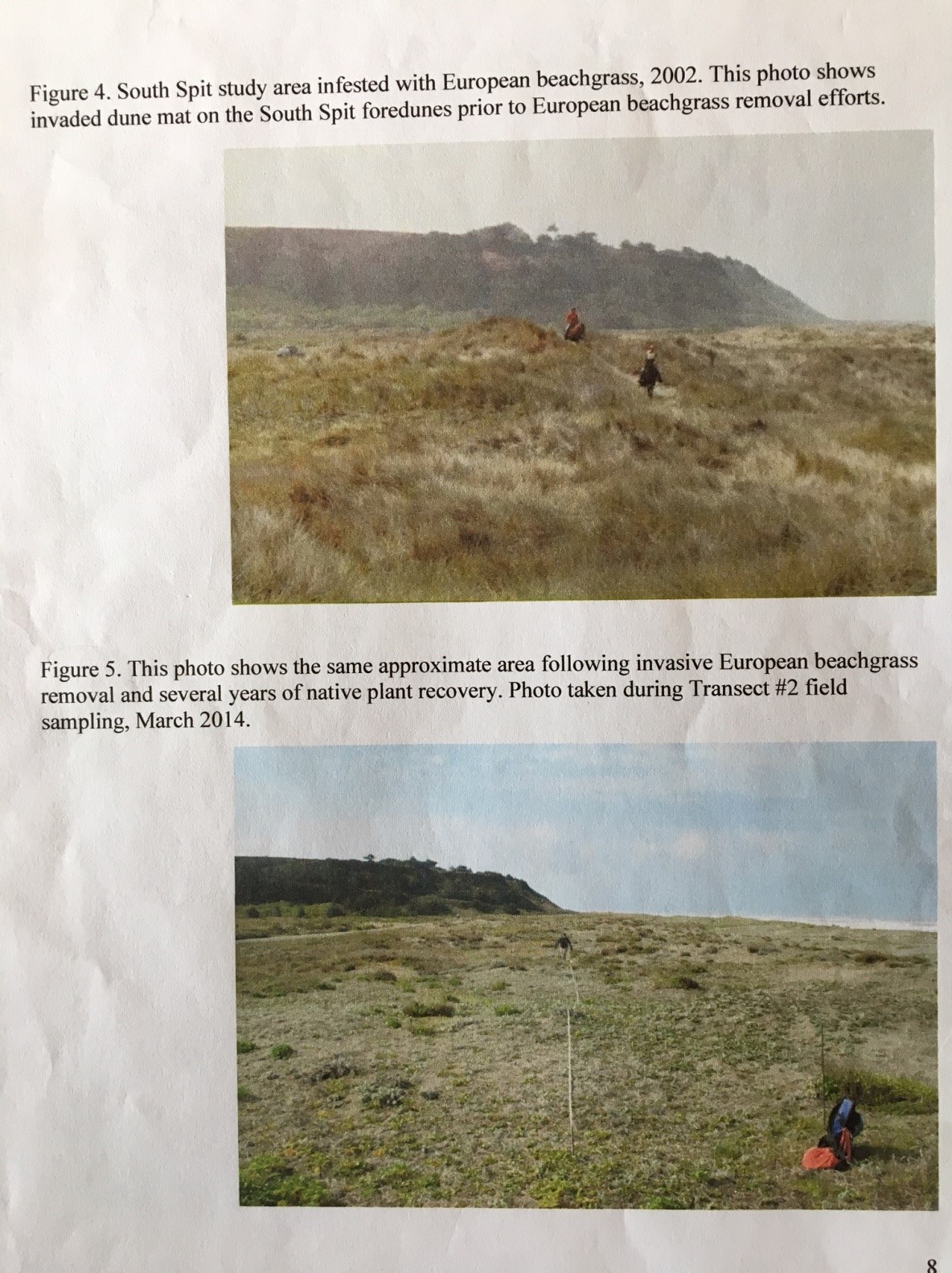
Source: 2008-2014 BLM monitoring report

The problem is that the previous and on-going work to remove European beach grass from the North and South Spits (in the effort to restore natural conditions and processes) has not and does not provide for the immediate re-establishment of other comparable  vegetative cover to trap moving sand and prevent accelerated dune erosion.  By not including this mandated mitigation measure, there is a real, legitimate potential for significant, cumulative environmental impact.

Why was European beach grass introduced?

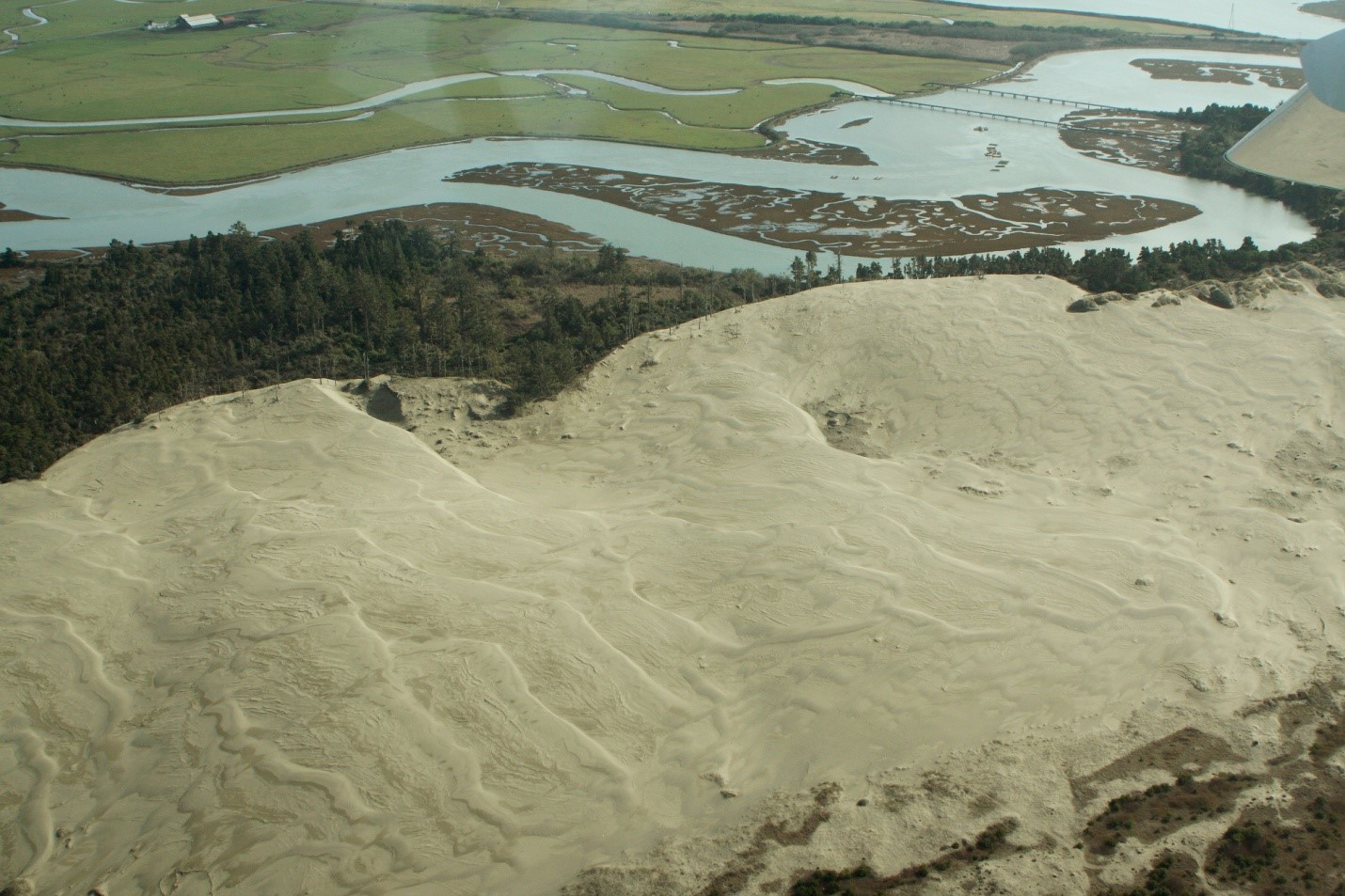
The important thing to understand is that this specific type of beach grass (Ammophila arenaria) was introduced in Humboldt County in the early 1900’s.  It was done in order to stabilize dunes to protect growing communities and infrastructure. It had the additional benefit of creating extensive coastal wetlands and wildlife habitat.  By collecting sand from the beach the grass builds protective and multiple parallel ridges and accompanying deflation planes. These depressions behind the ridges act as sheltered nurseries for new plant and animal life. This process can take several decades but is reversed rapidly after the grass is removed. Such an effect has happened not only in Humboldt County but also in Point Reyes where valuable wetlands and organic pastures have been smothered by destabilized sand.

Why was European beach grass removed?

When the efforts to remove the non-native, albeit naturalized grasses began in the early 1990’s invasive biology was in its infant stages. Not much was known about the impacts from the eradication efforts of dominant species.  But to some it was important to return coastal areas to the pre-beach grass era so native plants would not be out-competed.

Every movement needs a poster child.  About this same time a cute little shore bird named the western snowy plover became just that.  Even though it is registered as a threatened species on the west coast, other parts of the country and Mexico have significant and stable populations.   We were told by local biologist Ron LaValley that the non-native grass needed to be removed to recover the local plover’s populationThis claim contradicted his original report showing plover eggs nestled in the non-native grass.  He was later convicted and sent to jail for falsifying data and embezzling a million dollars from similar projects involving the spotted owl.

Recognizing that manual eradication was very expensive and time consuming, California State Parks decided to bulldoze 40+ acres of Little River State Beach to provide plover breeding areas. Unfortunately, as Humboldt State Professor Mark Colwell noted in his 2008 report “importantly, eggs often fail to hatch in restored areas.”  This is largely because ravens and crows find it easy to locate the nests in open sand areas.

The Lanphere-Christenson Dunes Refuge director Eric Nelson determined during a 2016 Climate Ready project that the foredunes were being excessively eroded by the 25 California Conservation Corp (CCC) workers who were digging out beach grass.  His decision to spray glyphosate and imazapyr instead of hand removal was carried out despite public opposition.  It remains unclear whether, despite acknowledging excessive erosion from manual eradication efforts, the refuge will return to using that method again.

Lanphere Dunes and Mad River Slough

The public takes notice of the consequences

Some of us who live near these project areas and use them for recreation started noticing native tree mortality and changes to the landforms caused by removing the stabilizing grasses.   We started doing some initial research.  We began looking into coastal development permits, beach and dunes management plans and monitoring reports.  Our findings revealed the project areas that actually had permits also had mitigation requirements.  Those included immediate replanting and strict monitoring to make sure topography and landforms were not altered.  When we inquired about the monitoring and replanting programs we found those to be significantly deficient and in some cases non-existent.

Taking action

Our next step was to approach the various regulatory agencies.  US Fish and Wildlife Service, California Department of Fish and Wildlife and the State Water Board should be interested in the freshwater wetland infill we were witnessing.  The Harbor District and the municipal water district have a major interest in securing the two 42-inch industrial water mains protected by the same beach grass that was being removed.  The Manila Community Service District maintains a waste water treatment facility on the dunes.  We thought the California Coastal Commission would certainly want to know that these unauthorized alterations to coastal landforms were taking place. We felt sure the County planning department that issued some of the permits would take enforcement action.

The town of Manila’s water treatment facility

We brought photo and research documents from Oregon and Washington (2 and 3), made presentations and had meetings, site visits and sent email communications to no avail.

We stepped back and took a look at the board of directors for the non-profit called Friends of the Dunes (FOD) that has been promoting the grass removal from the very beginning.  They had grown from a small, broken down 400 square foot building with a net worth of about $20,000 in 2004 to 60 + acres of ocean front property with a 3000 square foot building and a net worth of over $3.4 million in 2014.  The board of directors at the time consisted of employees of most of the agencies listed above.  We understood then why we were running into so many road blocks.

Our community is well known for environmental activism.  So why the hesitation of local environmental organizations like the North Coast Environmental Center (NEC), Environmental Protection Information Center, and Bay Keeper to call out such impacts caused by bulldozers, herbicide spraying and wetland infilling?  We can only presume that the banner of “restoration” has been used as a blindfold.

Some significant successes….more to do

We have had worthy successes.  Through our efforts the California Coastal Commission has asked the Bureau of Land Management (BLM) for a new determination to address the impacts related to the Ocean Day activities involving 1000 school children digging grasses from the dunes.  So far, the BLM does not think it needs to provide that.  BLM puts on the event but the Coastal Commission bankrolls it.  We do not know yet what the Commission’s response will be to that refusal.

The town of Manila has stopped grass removal activities in its management area and has supported the planting of native pine trees (Pinus contorta, contorta) in the dunes, which we did last February.  The County planning department is engaged and acknowledges that there has been no contract with the California Conservation Corp or BLM for prior grass removal at the County Park and will not allow any more vegetation removal until a Memorandum of Understanding is developed.

The Coastal Commission has committed to reviewing the authorization allowances for BLM’s grass removal over the rest of the South Spit.  The existing Plan states a two-acre area would be subjected to grass removal strictly for monitoring purposes not the mile long area subjected to eradication to date.  BLM contends that authorization extends over the whole 800-acre Spit but have not been able to provide supporting documents.

The North Coast Environmental Center and even the Friends of the Dunes (FOD) took a position against spraying herbicides on the dunes.

Former board members of the FOD that are regulatory agency officials have resigned their director positions.

Communities around the country are hosting events to plant beach grasses like the ones that have been removed here.  Recognition of the incredible value of stabilized dunes is becoming more wide spread.  The “non-native” label is becoming more questioned.

Setting new goals and looking ahead

For us on the North Coast of California we need a much more cost effective and precautionary approach than tearing out plants that have beneficial attributes.  We need to allow the beach grass to do its job of stabilizing and protecting our dunes.  As we allow it to do that, the beach grass “declines in vigor” (4).  When that happens, other plant and animal species utilize those protections from the harsh winds and tides of the Pacific and establish heathy vibrant wildlife habitat. Our local and migratory wildlife depend on it. And so do we.

Uri Driscoll, Arcata, California


We commend the people of Humboldt County for paying attention to the damage that is being done to their public land and we congratulate them on the progress they have made to prevent further damage.  We are impressed with the methodical approach they have taken to convincing public land managers to reconsider the goals of the project and the methods being used to accomplish them. 

We wish them the best of luck with their efforts.  We are grateful to Uri Driscoll for taking the time and trouble to share this story with our readers.

Million Trees 


(1) South Spit Interim Management Plan 2002.

(2) Evaluating Coastal Protection Services Associated with Restoration Management of an Endangered Shorebird in Oregon, U.S.A.  Lindsey Carrol

(3) Sally Hacker, Oregon State University http://rsif.royalsocietypublishing.org/content/12/106/20150017

(4) The Nature Conservancy Element Stewardship Abstract For AMMOPHILA ARENARIA,  Andrea Pickart

The final episode in the 20-year saga of San Francisco’s “Natural Areas Program”

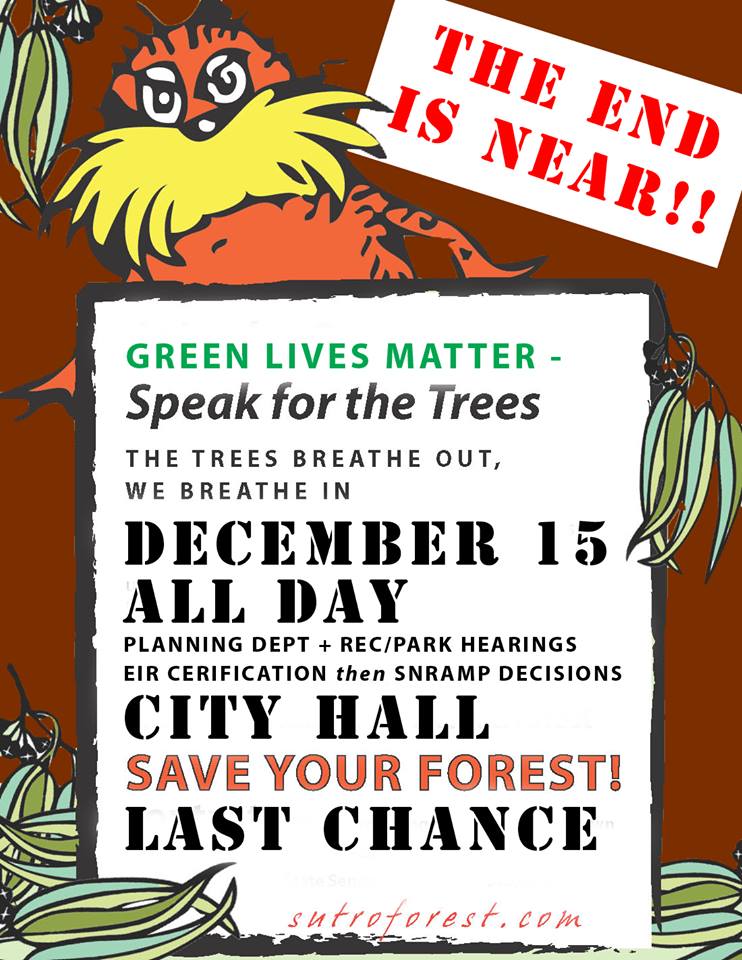
the-end-is-nearOn December 15, 2016, the San Francisco Planning commission will hold a public hearing to consider certification of the Environmental Impact Report for the Natural Areas Program. If the EIR is certified, the Recreation and Park Commission will consider formally adopting the management plan for the Natural Areas Program at the same hearing.  The Recreation and Park Commission will have the option of adopting one of the alternatives to the management plan.  The San Francisco Forest Alliance will ask that the Maintenance Alternative be adopted by the Recreation and Park Commission because it is the “environmentally superior” alternative which will destroy the least number of trees and use the least amount of pesticides. 

If you can attend this hearing and make public comment, please contact the SF Forest Alliance (sfforestnews@gmail.com) for the details about where and when the hearing will take place.  If you can’t attend the hearing, please consider sending an email to the Recreation and Park Commission (recpark.commission@sfgov.org) by Monday, December 12, 2016 (the deadline for submission of written public comments to be included in the agenda packet of the commissioners). 

We lived in San Francisco for nearly 30 years and our local park was designated a “natural area” in 1997.  Based on our experience with the Natural Areas Program, we have sent the following email to the Recreation and Park Commission.  We hope that our letter will help you write your own public comment.


Subject:  Approve the Maintenance Alternative for SNRAMP

Dear Recreation and Park Commissioners,

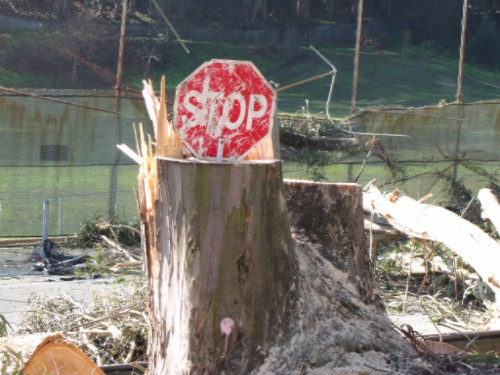
Since the Natural Areas Program was created 20 years ago, hundreds of healthy trees have been destroyed and over one thousand trees died slowly after being surreptitiously girdled by vandals calling themselves native plant advocates in the 32 so-called “natural areas.”  Hundreds of gallons of herbicide have been sprayed on harmless plants, many that provided valuable habitat and food for wildlife.  Trails have been closed and big signs installed instructing park visitors to stay on the trails that remain. Fences have been installed in some parks to enforce those restrictions.

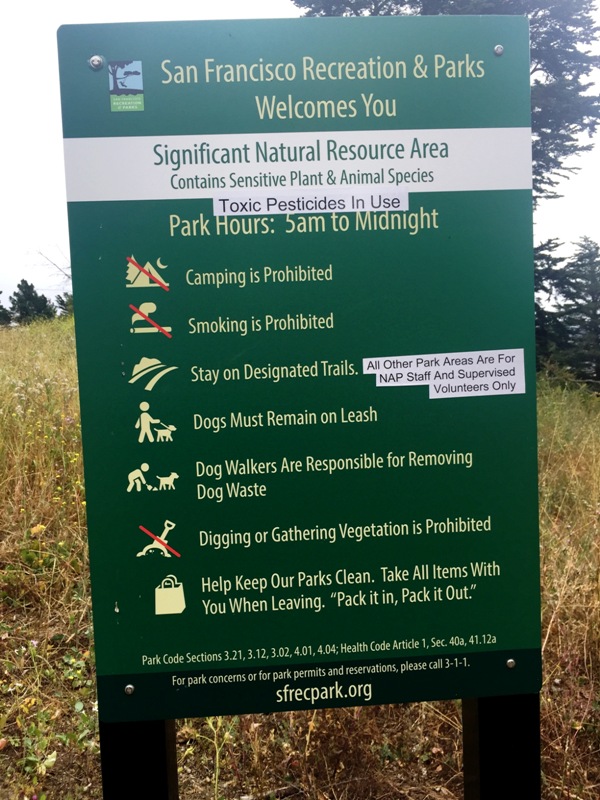
This sign in a "natural area" has been altered to express the public's opinion of the Natural Areas Program. Courtesy San Francisco Forest Alliance.
This sign in a “natural area” has been altered to express the public’s opinion of the Natural Areas Program. Courtesy San Francisco Forest Alliance.

After all that destruction and restriction, what has been accomplished?  Non-native plants have been repeatedly eradicated in the “natural areas” and native plants were planted.  These native plant gardens have repeatedly failed:  the native plants die and the non-native plants return, in some cases many times.  Native trees have been planted in a few “natural areas” but most have died, despite being irrigated during an extreme drought.  After wasting millions of dollars and the associated labor, there is little to show for that investment after 20 years.

Therefore, I am writing to ask the Recreation and Park Commission to vote to adopt the Maintenance Alternative as provided by the Environmental Impact Report that was 10 years in the making.  The Maintenance Alternative would enable the Recreation and Park Department to continue to take care of the “natural areas” they have already created, but it would prevent further tree destruction, further restrictions on recreational access, and require fewer pesticide applications.

Besides the obvious lack of success of the Natural Areas Program after 20 years of effort, there are many other reasons why it would be wise for the Recreation and Park Department to quit throwing good money after bad money.  Here are some of those reasons:

  • The Natural Areas Program was predicated on the mistaken assumption that native plants are superior to non-native plants as habitat for animals. In fact, in the past 20 years multitudes of empirical studies have been conducted that prove that wildlife has no preference for native plants.  Wildlife is just as likely to use non-native plants as they are native plants.
  • The Natural Areas Program also assumed that greater biodiversity would be achieved by eradicating non-native plants. They were mistaken in that assumption as well.  Studies have been conducted all over the world in the past 20 years that find no decrease in plant biodiversity resulting from introduced plants.
  • The climate has changed since Europeans arrived in the Bay Area in 1769 and it will continue to change. The plants that existed here in the distant past are no longer adapted to current conditions.  The ranges of native plants and animals must change if they are to survive in the long run.  Therefore, demanding that historical landscapes be re-created serves no useful purpose.
  • The native trees of California are dying by the millions. The US Forest Service informs us that 102 million native conifers have died in the Sierra Nevada in the past 6 years.  University of Cambridge recently published a study about Sudden Oak Death in which they reported that 5 million oak trees have died in California since 1995 and that the epidemic is “unstoppable.”  There are SOD infections in Golden Gate Park and the Arboretum.  The US Forest Service tells us that Coast Live Oaks will be virtually gone from California by 2060.  A study of redwoods predicts that its native range will shift north into Oregon by the end of this century.  In other words, if we want trees in California, many of them will have to be non-native trees adapted to a hotter, drier climate. 
  • Environmental conditions in a densely populated urban area such as San Francisco are also incompatible with the unrealistic goals of the Natural Areas Program. The heat island effect of urban areas exacerbates climate change.  Increased levels of soil nitrogen caused by the burning of fossil fuels promotes the growth of weeds.

The Natural Areas Program was a good idea that has outlived its usefulness.  We may try to keep it alive for sentimental reasons, but expanding it would be rewarding failure.  Please adopt the Maintenance Alternative.

Thank you for your consideration.

stop-destroying-trees

Subirdia: Birds adapt to the Anthropocene

christmas-holly-4This article is our Christmas present to our readers.  We celebrate the holidays with good news about the birds living in cities all over the world.

Subirdia was written by John Marzluff, an academic ornithologist at University of Washington. (1)  He reports many years of his research and that of his graduate students about the birds that live in urban and suburban Seattle as well as surrounding forest reserves.  He also reports on countless studies of bird populations in similar settings all over the world.  All of those studies reach remarkably similar conclusions.

It took me a long time to read this book because its introduction was off-putting.  Virtually every plant and animal was preceded by the qualifier of “native” or “non-native.”  The implication of the introduction was that the most important feature of every plant and animal is whether or not it is native.  As our readers know, we consider the nativity of plant and animal species largely irrelevant.  All plants and animals are at home in our ideal nature.

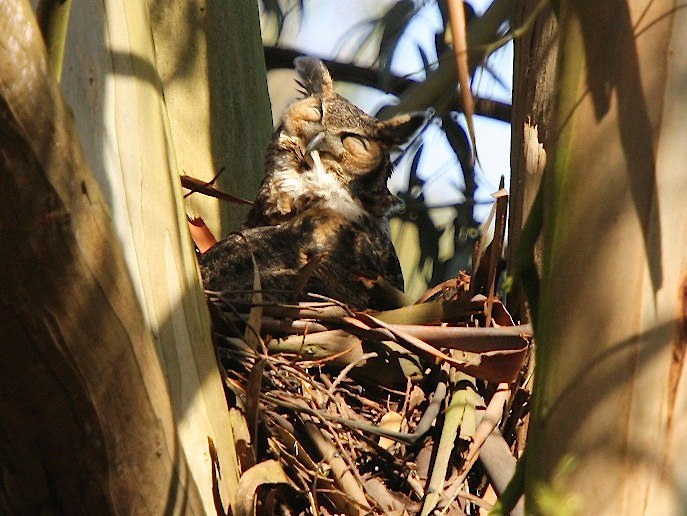
Owl nesting in eucalyptus, courtesy urbanwildness.com

When I finally got around to reading Subirdia I was pleasantly surprised.  Although the author has a preference for native plants and animals, in fact, his research and that of others does not justify his obsession.  Where birds are actually found in the greatest numbers is where the habitat is most diverse, not necessarily exclusively native.

Suburbia is very birdy

The conventional wisdom is that cities are inhospitable places for birds and other wildlife.  After all, haven’t we paved over much of their habitat, interrupted their movements by fragmenting their habitat, and drained or covered water resources? In fact, bird populations in urban areas all over the world are both plentiful and diverse.

After years of counting numerous bird species in his hometown of Seattle, the author of Subirdia wondered if Seattle might be unique because it is heavily forested.  After conducting similar surveys in 10 cities around the world, Marzluff is convinced that birds are successfully adapting to rapid urbanization of human society.  The urban centers of cities in North and Central America, New Zealand and Europe support an average of 23 bird species.  He found the least number of bird species (11) in Auckland, New Zealand and the greatest number (31) in St. Andrews, Scotland.

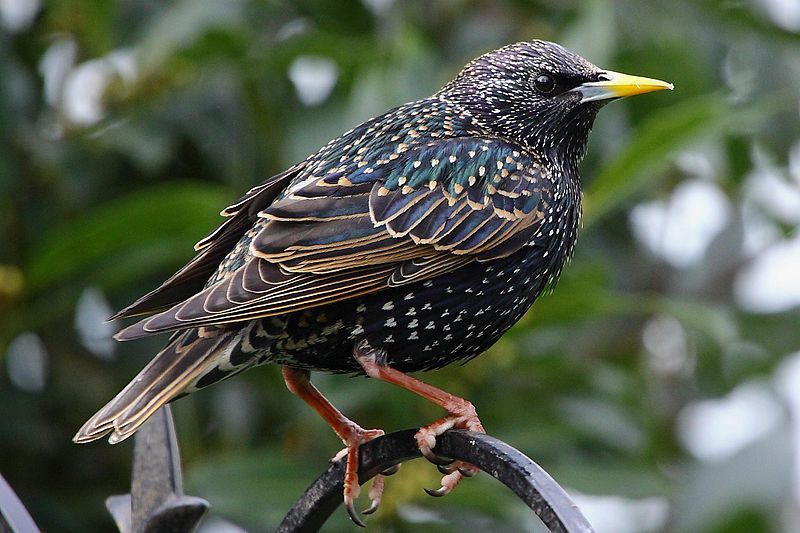
Starling in breeding plumage. Creative Commons - Share Alike
Starling in breeding plumage. Creative Commons – Share Alike

Another popular myth about the loss of bird diversity in the Anthropocene is that the globalization of human civilization produces “homogenized” nature.  That is, many people believe that bird populations may not be in decline, but there are a few hardy species that dominate everywhere.  Again, Marzluff’s studies do not corroborate that belief.  Five bird species are found in cities all over the world (house sparrows, starlings, Canadian geese, mallard ducks, and rock pigeons).  However, these ubiquitous species are not the predominant bird species he found in cities.  Of the 151 different bird species he found in the 10 cities he visited, 75% of them were unique to each of the cities.   “Homogenization is barely perceptible.” (1)

Comparing bird populations in cities with nature reserves

Marzluff also compared bird populations in cities with undeveloped nature preserves.  Once again, cities still look like good homes for birds.  He finds twice as many bird species in Ketchikan, Alaska as in the nearby wildlands along the Naha River, “a remote wilderness fifty miles away…that required powerboat, kayak, and hiking to attain.” (1)

He also visited Yellowstone National Park, a 2.2 million acre protected area within an undeveloped ecosystem of nearly 20 million acres, where he counted 26 bird species in four days.  From there, he flew to New York City where he counted 31 bird species in Central Park in only three days.  Historical records of bird surveys in Central Park and Yellowstone National Park indicate that about 200 bird species have been found in both parks since the late 19th century.  “From a bird’s perspective, a large park created by human hands or by nature is not all that different.”  (1)

Accommodating birds in cities

Marzluff’s concluding chapters advise city dwellers how to encourage and support birds.  His “ten commandments” for accommodating birds make no mention of planting native plants or eradicating non-native plants:

  • “Do not covet your neighbor’s lawn.”
  • “Keep your cat indoors.”*
  • “Make your windows more visible to birds that fly near them.”
  • “Do not light the night sky.”
  • “Provide food and nest boxes.”
  • “Do not kill native predators.”
  • “Foster a diversity of habitats and natural variability within landscapes.”
  • “Create safe passage across roads and highways.”
  • “Ensure that there are functional connections between land and water.”
  • Enjoy and bond with nature where you live, work, and play!”

Marzluff expresses a strong preference for native plants throughout his book, but his research in Seattle is inconsistent with that preference:  “The forests of Seattle and its suburbs now embrace 141 species of trees, including 30 native species and ornamentals from North and South America, Europe, Asia, and Africa.  Some are problematic invaders, but in total they provide a diverse menu of foods and nesting and roosting sites for birds.”  (1)

Why a preference for natives?

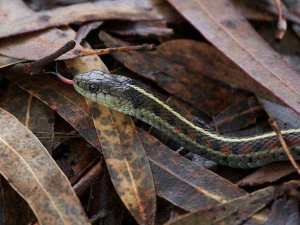
Garter snake in eucalyptus leaf litter. Courtesy Urban Wildness

Another academic scientist in Washington State, Linda Chalker-Scott, directly addresses the vexing question of why public policies which mandate the use of native plants have proliferated despite the lack of evidence that they are superior in any way.  She focuses on this question:  “Do native and nonnative woody species differ in how they affect species diversity?”  Her literature search found 120 studies from 30 countries that quantified the biodiversity of birds, insects, mammals, reptiles, and other plants in woody plants and trees in urban landscapes.

The analysis of these studies reveals that “the science does not support the supposition that native plantings are required for biodiversity…it is clear that an automatic preference for native trees when planning in urban areas is not a science-based policy.” (2) The assumption that native plants are superior to non-native plants is based on these misconceptions:

  • The definitions of native and alien species are value judgments, not science-based concepts.
  • Native plants are often poorly suited to environmental conditions in urban areas, such as compacted soil and changes in the climate. Conversely, introduced plants are often well suited to these urban conditions.
  • Many introduced plants provide valuable ecological benefits. For example, they often provide food, pollen, and nectar resources during winter months when native plants are dormant.
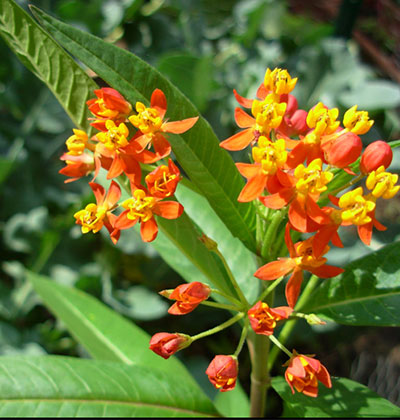
  • Tropical milkweed is not native to California. (Asclepias curassavica) Creative Commons
    Tropical milkweed is not native to California. (Asclepias curassavica) Creative Commons

    Doug Tallamy is the academic scientist most closely associated with the native plant ideology. His claim that insects require native plants is based on his mistaken assignment of nativity to an entire genus, when only a few species within that genus are actually native.  For example, there are over 35 species of milkweed in the genus Asclepias, but only two species are native to California.  Most members of the milkweed family are useful to monarch butterflies.  It is therefore not accurate to claim that monarchs require native plants.  They have lived all over the world for over 200 years in some places where there are no native species of milkweed.

Chalker-Scott’s meta-analysis of 120 studies concurs with Mr. Marzluff:  “The published research overwhelmingly identifies diversity, structure, and function as the most important vegetation characteristics for enhancing community biodiversity…In fact, sometimes landscapes require the inclusion of exotic trees and control of natives to maintain diversity.” (2)

Doing more harm than good

Our readers know that we do not begrudge the preference of native plant advocates for native plants.  We encourage them to plant whatever they want.  We only ask that they stop destroying the plants they don’t like.  That request is based on our belief that they are doing far more harm to our public lands than any perceived benefit of native plants.  Much of that harm is caused by the widespread use of herbicides to destroy non-native vegetation.  These herbicides are known to damage the soil and they migrate in the soil, damaging neighboring plants that are not targeted.  These issues are surely a factor in the conspicuous lack of success of their “restorations.”  There is also mounting evidence of the toxicity of herbicides to bees, birds, and other animals including humans.

But there is another, equally important reason why we object to the futile attempts to eradicate non-native plants.  They are providing valuable habitat for wildlife.  Even when they are replaced by native plants after being destroyed, the animals that depended upon them are not necessarily restored to the landscape.  In fact, few projects plant natives after the eradication of non-natives.

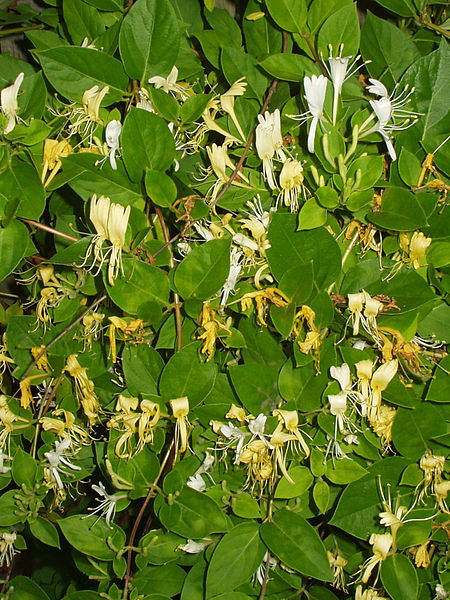
Japanese honeysuckle. Attribution William Rafti

A recently published study (3) of the removal of Amur honeysuckle (Lonicera maackii) is an example of the loss of valuable habitat.  The hypothesis of this study was that “invasion of urban habitats by exotic plants was the underlying mechanism driving changes in bird-plant networks.”  The study tested this hypothesis by comparing forest plots dominated by honeysuckle with those in which honeysuckle had been removed and the surrounding forest habitat replicated.  They measured nesting birds, nest predators, and nest survival.

They found that the lowest overall nest survival rates were found in the plots in which honeysuckle had been removed.  In other words, “…removal of invasive honeysuckle from urban forests did not restore network structure to that of rural landscapes.”  The authors concede, “This finding was not consistent with our original hypothesis that invasion of forests by the exotic Amur honeysuckle was responsible for the urban-associated changes in bird-plant networks.”  They conclude, “The degree to which native communities can be restored following removal of exotic plants remains unclear.” 

Actually, we think it is quite clear that eradicating non-native plants does not benefit man or beast. We marvel that the fantasy persists that there is some theoretical benefit to killing harmless plants, despite the consistent lack of evidence of any benefit and the considerable evidence of the harm of such attempts. 


*Like most ornithologists, Marzluff comes down hard on cats as killers of birds in his book.  However, he cites just one study about predation of fledglings.  The study used radio transmitters to determine the fate of 122 newly fledged birds over a period of two years.

The results do not justify the demonization of cats:  “Only 20 percent of radio-tagged birds died during our study.  Birds such as Cooper’s hawks and mammals such as Townsends’ chipmunks, ermine, and Douglas squirrels were the most likely predators.  The most notorious of all bird predators, the out-of-the-house cat, was implicated in only one death, though we could never be entirely sure which mammal or which bird had killed the fledging.”  (1) Marzluff credits a neighborhood coyote for controlling the cat population.  Frankly, that doesn’t make sense.  Chipmunks and squirrels are just as likely to be prey for the coyotes.

We have reported on similar studies which reach the same conclusions.  A meta-analysis of 8 studies of nest predators of song birds in North America used video cameras to identify the predators of 242 depredation events.  Only one of those nest predators was a cat.

We have no objection to the general advice to keep your cat indoors. (We have never had a cat and don’t plan to.)  However, we think that estimates of birds killed by cats are greatly exaggerated.  Humans seem to have an unfortunate desire to look for scapegoats and cats seem to fit the bill for bird lovers.

  1. John M. Marzluff, Welcome to Subirdia, Yale University Press, 2014
  2. Linda Chalker-Scott, “Nonnative, Noninvasive Woody Species Can Enhance Urban Landscape Biodiversity,” Arboriculture & Urban Forestry, 2015, 41(4): 173-186
  3. Amanda D. Rodewald, et. al., “Does removal of invasives restore ecological networks? An experimental approach,” Biological Invasions, March 2015

Public opposition to pesticide use in our public parks

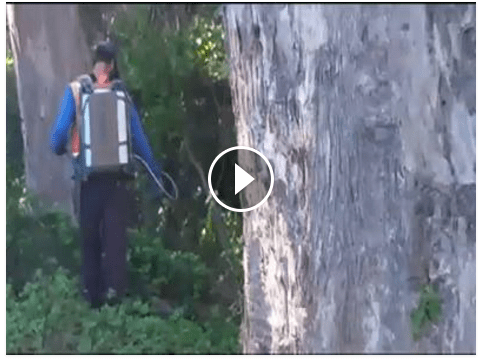
On November 19, 2015, a visitor to Mount Davidson park in San Francisco video recorded a pesticide application that is available here:

glyphosate spraying on Mt Davidson - nov 19, 2015

One of the people who saw that video reported several concerns regarding that pesticide application to the city employees who are responsible for the regulation of pesticide use in San Francisco.  Here is the email he sent to Kevin Woolen in the Recreation and Park Department and Chris Geiger in the Department of the Environment:

To:  Kevin Woolen  kevin.woolen@sfgov.org

Dear Mr. Woolen,

I understand that you are responsible for the records of pesticide applications on properties managed by San Francisco’s Recreation and Park Department.  I have heard you speak at public meetings, so I am aware that you have some expertise in that area.  Therefore, I am writing to you about a pesticide application on Mt. Davidson on November 19, 2015.  That pesticide application was recorded by this video:  https://www.facebook.com/ForestAlliance/videos/934479473312166/?fref=nf

I have several concerns about this pesticide application:

  • One of the herbicides that was sprayed was Stalker with the active ingredient imazapyr. I notice that most of the spraying was done around a tree, which was not a target of the application according to the posted Pesticide Application Notice.  As you may know, imazapyr is not supposed to be sprayed under and around non-target trees according to the manufacturer’s label:  http://www.cdms.net/ldat/ld01R013.pdf:  “Injury or loss of desirable trees or other plants may result if Stalker is applied on or near desirable trees or other plants, on areas where their roots extend, or in locations where the treated soil may be washed or moved into contact with their roots”

Here is a newspaper article about unintentional damage done to trees by spraying an imazapyr herbicide beneath them:  http://www.mlive.com/news/grand-rapids/index.ssf/2012/09/no_quick_fix_for_herbicide_dam.html

  • The Pesticide Application Notice says that the application method will be “spot treatment/daub cut stem.” This does not seem to be an accurate description of the application method on November 19th.  It seems that “backpack sprayer” would be a more accurate description of this particular pesticide application.
  • The Pesticide Application Notice says that Himalayan blackberries were one of the targets of this Pesticide Application. As you know, birds and other wildlife cannot read the signs that are posted to warn the public about these applications.  Can you assure me that the Himalayan blackberries were no longer fruiting?  Does the Recreation and Park Department have a policy against spraying vegetation when there are fruits eaten by birds and other wildlife?  If not, would the Recreation and Park Department consider adopting such a policy?
  • Although Garlon was not used in this particular pesticide application, it is often used in San Francisco’s so-called “natural areas.” Therefore, it is worth mentioning that Garlon is also known to be mobile in the soil and there are documented incidents of it damaging non-target trees when it has been sprayed on the stumps of nearby trees after they were destroyed.

Thank you for your consideration.  I hope you will share my concerns with the staff and contractors who are engaged in these pesticide applications.

Cc:  Chris Geiger  chris.geiger@sfgov.org

This is not an isolated incident.  Park visitors in San Francisco have been complaining for years about pesticide use in parks that were designated as “natural areas” over 15 years ago.  Ironically, those areas were never sprayed with pesticides before being designated as “natural areas.”  In fact, they really were natural areas prior to being officially designated as such.  Plants and animals lived in peace in those places before being “managed” by people who are committed to eradicating all non-native plants in many of San Francisco’s parks.

What can you do about it?

If you are opposed to pesticide use in San Francisco, or you object to the pointless destruction of harmless plants that are useful to wildlife, here are a few things you can do to express your opinion and influence the public policy that allows pesticide use in the public parks of San Francisco:

  • You can join over 11,000 people who have signed a petition to prohibit the use of pesticides in public parks. The petition is HERE.  The San Francisco Chronicle reported on pesticide use in San Francisco’s parks and the petition against that use.  (Available HERE)
  • You can sign up HERE to be notified of the annual meeting in which pesticide policy in San Francisco is discussed for subsequent approval by the Environment Commission. That meeting has been scheduled in December in past years.  Update:  The annual meeting has been announced.   “Annual Public Hearing on Pest Management Activities on City Properties and San Francisco’s Draft 2016 Reduced-Risk Pesticide List 4:30-7:00 pm
    Wednesday, December 16, 2015 Downstairs Conference Room, 1455 Market St. (near 11th St.; Van Ness MUNI stop)”  The meeting agenda is available HERE.
  • You can apply for one of the two vacant seats on the Environment Commission. These seats have been vacant for nearly a year.  In the past, the Environment  Commission has actively promoted pesticide use in San Francisco’s “natural areas.”  Qualifications and duties of commissioners are available HERE.
  • Appointments to the Environment Commission are made by Mayor Ed Lee. If you don’t want to serve on the Environment Commission, you can write to Mayor Lee (mayoredwinlee@sfgov.org) and ask him to appoint people to the Commission who do not support the use of pesticides in San Francisco’s public parks.

The parks of San Francisco belong to the people of San Francisco.  They have paid to acquire those properties for public use and they are paying the salaries of those who are “managing” the parks.  If you don’t like how parks are being managed, you have the right to express your opinion.  Our democracy works best when we participate in the public policy decisions that affect us.

What does this have to do with the East Bay?

Our readers in the East Bay might wonder what this incident has to do with you.  Parks in the East Bay are also being sprayed with herbicides for the same reasons.  HERE are reports of pesticide use by the East Bay Regional Park District.

Many of the pesticide applications on the properties of EBRPD are done by the same company that sprayed herbicides on Mount Davidson on November 19, 2015.  That company is Shelterbelt Builders.  You can see their trucks in the above video.  Pesticide use reports of San Francisco’s Recreation and Park Department often report that pesticide applications were done by Shelterbelt.

Shelterbelt began the eradication of non-natve vegetation in Glen Canyon in November 2011

Shelterbelt Builders is based in the East Bay.  One of its owners is Bill McClung who is a member of the Claremont Canyon Conservancy and a former officer of that organization.  The Claremont Canyon Conservancy is the organization that is demanding the eradication of all non-native trees on public land in the East Bay Hills.  Here is a description of Mr. McClung’s responsibilities on Shelterbelt’s website:

“Bill McClung joined Shelterbelt in 1997 to help refocus Shelterbelt on native plant restoration and open land management/fire safety.  After his house burnt down in the 1991 Oakland Fire, this former book publisher became interested in how wildland and fire are managed in the East Bay Hills.  He became a member of the Berkeley Fire Commission in 1994 and has a strong interest in the vegetation prescriptions of the Fire Hazard Program & Fuel Reduction Management Plan for the East Bay Hills issued in 1995 by the East Bay Hills Vegetation Management Consortium and the East Bay Regional Park District Wildfire Hazard Reduction and Resource Management Plan Environmental Impact Report of 2009/10.  He has managed many properties in the East Bay where wildfire safety and native habitat preservation are twin goals, and continues to work on interesting and biologically rich lands in the Oakland Hills.”

Claremont Canyon Conservancy

The Claremont Canyon Conservancy held their annual meeting on November 15, 2015.  Oakland’s Mayor, Libby Schaaf, was one of the speakers.  Although she took questions at the end of her presentation, one of the officers of the Conservancy called on the questioners.  There were many people in the audience who are opposed to the FEMA projects that will destroy over 400,000 trees in the East Bay Hills and many of us tried to ask questions.  With one exception, the person controlling the questions only called on known, strong supporters of the FEMA project.  Therefore, those who wished to express their opposition to the FEMA projects to the Mayor were denied that opportunity.  Fortunately, there were many demonstrators outside the meeting who could not be denied that opportunity.

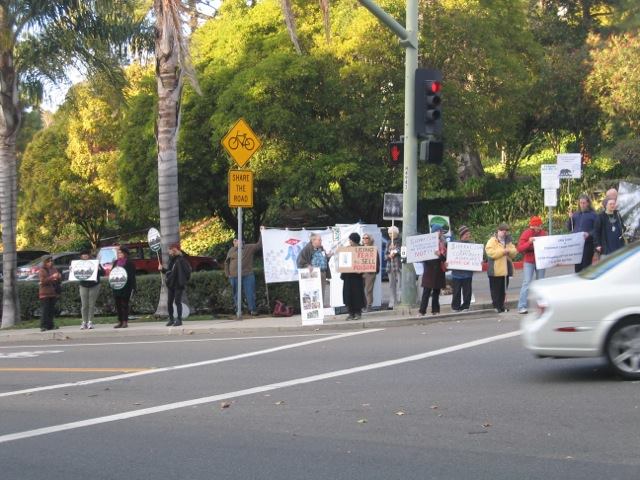
Demonstration at meeting of Claremont Canyon Conservancy, November 15, 2015

Norman LaForce was the other main speaker at the meeting.  He is an elected officer of the Sierra Club and he identified himself as one of the primary authors of the project to destroy all non-native trees in the East Bay Hills.  (An audio recording of his complete presentation is available here: https://milliontrees.me/wp-content/uploads/2015/11/norman-laforce-sierra-club-11-15-15.m4a ) This is the paraphrased portion of his presentation specifically about the herbicides that will be used by the FEMA project:

“Part of the FEMA program will be to use herbicides in a concentrated, careful program of painting or spraying herbicides to prevent the trees from resprouting. It may need to be done more than once but ultimately the suckers give up.   There is no other way to do that cost effectively.

People are saying that glyphosate causes cancer.  Radiation causes cancer but when people get cancer they are often treated with radiation.  Nobody tells them they can’t have radiation because it causes cancer.

There are a lot of people of a certain age in this room who are probably taking Coumadin as a blood thinner for a heart condition.  Coumadin is rat poison.  Nobody tells them they can’t take Coumadin.*

You must take dosage and exposure into consideration in evaluating the risks of pesticides.

Nature Conservancy used glyphosate on the Jepson Prairie.

State Parks used Garlon on Angel Island when they removed eucalyptus.

The European Union says that glyphosate does not cause cancer, so I don’t know if it does.  I’m not going to take a position on that.

Now they are saying that red meat causes cancer.

We need to put aside the question of pesticides.  They will be used properly.  We must proceed in a scientific manner.”

We leave it to our readers to interpret Mr. LaForce’s justification for pesticide use.  He seems to be suggesting that pesticides are good for our health.  There are instances in which pesticides do more good than harm, but using them to kill harmless plants in public parks isn’t one of them, in our opinion.  Since many chemicals accumulate in our bodies throughout our lives, it is in our interests to avoid exposure when we can.  If we must take Coumadin for our health, that’s all the more reason why we should avoid unnecessary exposure to rat poison when we can.

Connecting the dots

We have tried to connect the dots for our readers.  Here are the implications of what we are reporting today:

  • Pesticide applications in San Francisco are probably damaging the trees that are not the target of those applications. The food of wildlife may be poisoned by those pesticide applications.
  • You can influence the public policy that is permitting pesticide use in San Francisco.
  • The same company that is spraying pesticides in San Francisco is also doing so in the East Bay.
  • That company is also actively engaged in the attempt to transform the landscape in the San Francisco Bay Area to native plants. They have an economic interest in native plant “restorations.”
  • The Sierra Club is actively promoting the use of pesticides on our public lands.

*Coumadin is prescribed for people who are at risk of heart attack or stroke caused by blood clots.  Coumadin thins the blood and suppresses blood coagulation.  Rat poison kills animals by bleeding them to death.  There is a fine line between preventing blood clots and bleeding to death.  Therefore, people who take Coumadin have frequent blood tests to check that the dosage is at the optimal level.  Rat poisons are killing many animals that are not the target of the poison.  Animals such as owls, hawks, vultures are often killed by eating dead rodents that have been poisoned.  We should not conclude that rat poison is harmless because humans are using it in carefully controlled doses.  Herbicides being sprayed in our public lands are not being closely monitored as Coumadin use is.


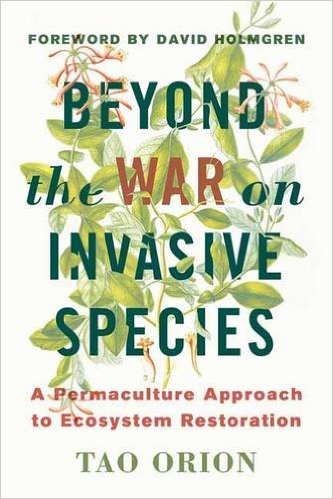
Beyond the War on Invasive Species

Tao Orion is the author of Beyond the War on Invasive Species:  A Permaculture Approach to Ecosystem Restoration, the latest in the rapidly growing literature about the futile and destructive attempts to eradicate non-native species.  Ms. Orion will give a workshop at a PLACE for Sustainable Living on Thursday, September 17, 2015:

“Rethinking Invasive Species from a Permaculture Perspective”

Thursday, September 17, 2015, 6-8 pm

PLACE for Sustainable Living

1121 64th St, Oakland, CA 94608

Donations $12-$25 requested

Update:  This is the answer PLACE for Sustainable Living gave to a question about wheelchair accessibility:  “It is not wheel chair accessible yet – we have carried wheelchair persons up the steps with their wheelchairs – we can arrange for that. And the yard is filled with chipwood, wheel chairs have rolled over fine, but not sure if everyone in them can push through. Our friend, male, can push through fine.”  Please contact PLACE for Sustainable Living directly if you have specific questions about accessibility.  (addendum dated 9/10/15)

Update #2:  Ms. Orion’s presentation has been cancelled because the venue is not wheelchair accessible.  CUIDO (an organization which represents disabled people) asked that it be moved to a facility with wheelchair accessibility or cancelled.  Such a facility could not be found, so it has been cancelled.  

Update #3:  Some adjustments have been made in plans for Ms. Orion’s presentation which are apparently acceptable to at least some members of the disabled community.  Ms. Orion has therefore decided against cancelling it.  Sorry for the confusion.

Ms. Orion is visiting the Bay Area from the Willamette Valley in Oregon, where she has a small farm in the country.  She has a degree in agroecology and sustainable agriculture from UC Santa Cruz and she has studied at the Columbines School of Botanical Studies in Eugene, Oregon.  She teaches permaculture design at Oregon State University and a non-profit sustainable-living educational organization.  She has also worked as a permaculture designer for ecological restorations.

Beyond the War on Invasive Species

Beyond the War on Invasive SpeciesThe first chapter of Ms. Orion’s book is a breakthrough because it is an explicit indictment of pesticides used by so-called “restoration” projects.  Although previously published books were critical of invasion biology and the ecological industry it spawned, pesticides were barely mentioned in them.  In contrast, it is primarily the use of pesticides in ecological “restorations” that convinced Ms. Orion that the war on invasive species is doing more harm than good.

Concern about unwanted plants – AKA weeds – is as old as human engagement in agriculture, that is, thousands of years old. And most of the plant and animal species now considered “invasive” were introduced by humans to serve a variety of purposes, including aesthetics, such as mute swans and multiflora roses.  Some of these introduced plants and animals had unintended consequences such as competing with native plants and animals for available resources.  Concern – even regret – about these introductions has increased greatly in the past 25 years.  Attempts to manage these introductions has escalated from import limitations to fines and penalties and finally to attempts to eradicate plants and animals with pesticides.

The role of the pesticide industry in the escalating war on “invasive” species

Ms. Orion turns to the public record to make the case that the current focus on eradicating introduced species using pesticides was influenced by business interests.  She points out that the federal Invasive Species Advisory Committee is a consortium of academic, professional, and business interests, including at least two people who are employed by manufacturers of pesticides.  They make invasive species management policy recommendations to the National Invasive Species Council (NISC), created by Executive Order in 1999.  The federal government is spending over $1 billion annually on research and control of “invasive” species, including pesticide applications.

National Invasive Species Council

The NISC is modeled after the California Exotic Pest Plant Council, created in 1992.  That Council is now known as the California Invasive Plant Council (Cal-IPC).  Cal-IPC brought together representatives from government agencies and non-profit environmental organizations, as well as manufacturers of pesticides and spray equipment:  “Monsanto has sponsored Cal-IPC since its inception and both DuPont and Dow AgroSciences have also supported the group.”  (1)

The first annual conference of Cal-IPC in 1993 featured an employee of Monsanto, Dr. Nelroy Jackson.  Jackson’s presentation to Cal-IPC stated that “chemical weed control is the optimal method for control and removal of exotic plant species during…most native habitat restoration projects.” 

Jackson’s involvement in escalating attempts to eradicate introduced species is troubling, but is not the only example of such collaboration between the “restoration” industry and the manufacturers of pesticides.  The Weed Science Society, which advocates for “research, education, and awareness of weeds in managed and natural ecosystems,” has employees of Dow Agrosciences, Syngenta, and Dow Chemical on its board of directors.  Those manufacturers of pesticides, as well as Monsanto, Bayer Crop Science, Dupont, and BASF Corp are also donors to the weed society, at the highest levels of donations.

The manufacturers of pesticides also influence the “restoration” industry by investing and participating in the consulting firms that write environmental impact reports for ecological “restoration” projects, such as Tetra Tech (which wrote the draft Environmental Impact Report for San Francisco’s so-called Natural Areas Program).

The manufacturers of pesticides influence public policy regarding ecological “restoration” by making large tax-deductible contributions to many land-grant universities that conduct research on agriculture:  “A 2012 Report from Food and Water Watch found that nearly 25% of funding for agricultural research at public universities comes from private companies.”  (1) This is one of many reasons why there is so little research done on non-chemical approaches to ecological restoration.

As disturbing as this collaboration between the government and the pesticide industry is, the evidence of the relationships between trusted non-profit environmental organizations and corporate interests is even more so.  Nature Conservancy, National Audubon Society, and Ducks Unlimited all have close relationships with the manufacturers of pesticides and receive funding from them.

Ms. Orion then describes the use of pesticides by the “restoration” industry.  She also describes some of the damage pesticides are known to do, such as killing microbes in the soil and binding minerals in the soil.  She describes the persistence and mobility of pesticides in the environment.  She describes the inadequacy of testing and regulation of pesticides in the United States.  These issues are well known to the readers of Million Trees, so we won’t repeat them here, but new readers can click on the blue links to visit posts about those issues.

All introduced species are presumed to be harmful

Ms. Orion’s next chapters are more similar to the books that precede hers.  There are several examples of specific “invasions” that illustrate the point that “invasive” species are usually symptoms of changes in the environment, rather than causes of those changes.  Attempting to eradicate them does not reverse the changes in the environment and often causes more environmental damage.  “Invasive” species are often performing valuable ecological functions that are not understood until they are eradicated.  We have reported many examples of these issues and won’t repeat them here.  However, Ms. Orion’s telling of the history of Asian Carp in the Mississippi River and the Great Lakes was new to us and is well worth a retelling.

Song dynasty painting attributed to Liu Cai (c.1080–1120). Contains various types of fish and other marine animals, such as goldfish, perch, catfish, carp, minnows, bass, and shrimp.

Asian carp has been a mainstay in the diet of the Chinese for several thousand years, according to their historical literature.  Asian carp are well adapted to aquaculture techniques, so they have the potential to replace or supplement other sources of protein.  They were introduced to the Midwest in the early 1800s and they spread throughout the Mississippi River many decades ago.  Although they are prevalent in the Mississippi River, they have not driven any native fish to extinction.  Yet, despite their usefulness and the lack of evidence that they have caused any harm, they suddenly became the latest invasion crisis when it was feared they would soon enter the Great Lakes.  A government fisheries biologist put that fear into perspective:

“We are trying to keep invasive Chinese carps out of the Great Lakes, to protect an invasive (yet purposefully stocked) Pacific salmon fishery, which was stocked as a management tool to control hyper-abundant alewifes, another invasive fish species, because the native piscivore, the Lake Trout, was nearly wiped out by another invasive species, the sea lamprey, because people built the Welland Canal around Niagara Falls to promote intercontinental shipping deep into the Great Lakes basin.” (1)

It makes the head spin to follow the “logic” of this sequence of events, which we paraphrase, “we solved one problem by creating another, then we solved that problem by creating another…ad infinitum.“  This is an ecosystem that has been radically altered by man, including reversing the flow of the Chicago River which connects the Mississippi River to the Great Lakes to solve Chicago’s sewage problems.   The water is warmer, polluted with agricultural runoff, and there is no longer a seasonal, cleansing water surge.  These changes in the environment set the stage for the arrival of Asian Carp in the Great Lakes.  The habitat for native fish has been radically altered such that removal of Asian carp from the river is an irrelevant, inconsequential improvement of habitat needed by native fish.

Despite what would seem overwhelming evidence that Asian carp could be a valuable food source and that being rid of them is unlikely to benefit anyone, here is a brief list of what has been done so far to try to prevent them from entering the Great Lakes:

Fish kill using rotenone. http://www.encyclopedia.com/doc/1E1-X-rotenone.html
  • US Army Corps of Engineers constructed a submerged electric fence to shock and kill the fish as they enter the Great Lakes. The fence cost millions of dollars but is largely ineffective.
  • The Illinois Department of Natural Resources dumped 2,200 gallons of rotenone into sanitary and ship canals feeding into the Great Lakes. This poison kills all gilled animals. The result:  “Among the tens of thousands of dead fish, researchers found one Asian carp.” (1) This fiasco cost $3 million.
  • Other researchers have suggested a system of strobe lights and bubble and sound barriers to stop the northward migration of Asian carp.

Permaculture philosophy

Ms. Orion’s closing chapters reflect her training in permaculture design.  She considers the tending of the wild by Native Americans a model for ideal stewardship of the land.  And she advocates for land management strategies that reflect the realities of our changed environment and are sustainable into the future.  We will let her speak for herself:

“Holistic restoration planning requires an honest accounting of what has come to pass as well as a comprehensive view of what we can do about it.  The problems are complex, and the solutions are likely to be more so…Navigating from a paradigm that views invasive species as scourges to one that looks at them as opportunities for deeper ecological and economic engagement will take time and commitment, especially because the old paradigm is so entrenched politically, economically, and academically.  The tide is shifting though, as more and more of us are coming to realize that the herbicide-based eradication approach to restoration is outmoded—a futile attempt to regain an imagined past—and we need to be focusing our time, resources, and energy on adapting to the future.” (1)

Please show your support for Tao Orion and her book by attending her workshop on Thursday, September 17th.


(1) Tao Orion, Beyond the War on Invasive Species:  A Permaculture Approach to Ecosystem Restoration, Chelsea Green Publishing, 2015 

A retired university planner critiques the FEMA projects in the East Bay Hills

We recently finished reading all of the 13,000 public comments on the FEMA draft EIS.  FEMA says that about 90% of the comments are opposed to the project and having read the comments that seems about right. 

It was a very rewarding experience to read the comments and we recommend it to anyone who is discouraged or doubtful that we can prevent the destruction of our urban forest in the East Bay (available HERE).

There were many excellent comments, many from people with specific expertise and knowledge of the issues that inform our opposition to these projects.  We plan to publish a few of them, as we obtain permission from their authors.  Today, we publish the public comment of Christopher Adams, with his permission.  We hope you are as impressed with his astute analysis as we are.


 Comments on Hazardous Fire Risk Reduction, East Bay Hills, CA,

Draft EIS

Prepared by Christopher Adams

Introduction:

My comments here are made solely in my capacity as a private citizen, but I think it is germane to state my background. I am a retired university planner, and for several years I directed the office which was responsible for review of every environmental document prepared by all the campuses and other facilities of the University of California. In addition, I was directly involved with the drafting, the public hearings, and the response to comments and preparation of two major Environmental Impact Reports, prepared under the California Environmental Quality Act for a UC campus. I also live near the EB Hills in an area subject to wild fires and share the concerns of others about the risk of fire.

Summary:

The Hazardous Fire Risk Reduction, East Bay Hills, CA, Draft EIS is a deficient document, beginning with its basic premise. While purportedly for the purposes of fire management, the proposed actions appear to be mostly motivated by a dream of a restoring the EB Hills to some imagined Eden prior to the European and American colonization of California. Instead of applying scientific and policy analysis to the impacts of the proposed actions the DEIS authors appear to have decided that the proposed clear cutting and herbicide measures are the right ones for fire protection and then cherry‐picked evidence, whether in the description of existing conditions or the possible alternatives solutions, which supports this conclusion. The DEIS rejects out of hand fire management alternatives that do not involve clear cutting and massive application of herbicides. In so doing the DEIS is a classic example of post hoc rationalization. Unless the DEIS is re‐issued with corrections and additions responding to the comments below, I believe that FEMA is seriously exposed to potential litigation. More significantly, if FEMA does not consider other less draconian and less expensive fire management measures, it will not be serving the interests of the citizens most impacted by fire danger, not to mention the taxpayers who will ultimately foot the bill.

Specific Comments:

The DEIS fails to note the existence of native trees which are specifically susceptible to the effects of one of the herbicides proposed for use. Section 4.2.2.2.1 notes that the native trees in the woodlands include madrone (Arbutus menziesii). However, in Section 3.4.2.1.1 Strawberry Canyon‐PDM there is no mention of madrones in the list of trees in the “native forest” (first paragraph of section). This is a significant omission, because there are madrones in Strawberry  Canyon, yet in the third paragraph of this same section one of the two herbicides proposed for use to stifle stump regeneration is Stalker (imazapyr) which has been identified elsewhere as being used specifically to eliminate madrones. According to the EPA Reregistration Eligibility Decision for Imazapyr: “Imazapyr use at the labeled rates on non‐crop areas when applied as a spray or as a granular to forestry areas present risks to non‐target plants located adjacent to treated areas.” (1)

The DEIS fails to acknowledge the growing threat of French broom in the UCB area.

While the presence of eucalyptus, Monterey pine, and acacia is repeatedly discussed, there is almost no mention of the rapid invasion of French broom. It is mentioned only in passing and without its scientific name in the discussion in Section 4.2.2.2.3 under “Northern Coastal Scrub.” While French broom has been rapidly increasing in the upper slopes of the Strawberry Canyon PDM and Claremont PDM areas, there is no mention of it at these locations in the DEIS. This plant is an active pyrophyte which chokes out native vegetation, can be poisonous to livestock, and is of limited benefit to native animals. The increase in sunlight from the proposed removal of large amounts of eucalyptus will encourage its spread. There is no mention of the fire risk from French broom in the discussion of fire risk in Northern Coastal Scrub, Section 4.3.3.2.5, and I could find no mention of its removal anywhere in the document.

The UCB project description does not explain if a fuel break is planned in the UCB areas and if so to describe it.

Section 1.1.1 UCB states that it will follow the “same general approach…which is included in Oakland’s grant application (see Section 1.1.2 below).” In Section 1.1.2 it is stated there the Oakland PDM would “create a fuel break on the west side of Grizzly Peak Boulevard north and east of the Caldecott Tunnel [presumably this means the west entrance to the tunnel].” UCB Strawberry Canyon properties also abut Grizzly Peak Boulevard, so the statement of “the same general approach” implies that UCB also proposes a “fuel break,” but none is described. Since the term “fuel break” implies clearing to the bare soil, with potential significant environmental impacts, this is a serious omission.

The DEIS fails to consider the impact on global climate change by the wholesale destruction of trees. The DEIS states that for UCB Strawberry Canyon alone 12,000 trees will be destroyed. Because trees absorb CO2 at an average rate of 13 pounds per year, this represents a potential loss in CO2 absorption of 78 tons per year. Given the growth patterns of native trees in Berkeley, which tend to be riparian or to grow on north facing slopes in a widely scattered pattern, the number of replacement trees will not come close to compensating for those destroyed. The difference should be estimated and calculated.

The DEIS fails to consider an actual and accomplished fuel management program when dismissing the alternative described in Section 3.3.1.1.

The Lawrence Berkeley National Laboratory (LBNL) is located on 175 acres on the north side of Strawberry Canyon immediately adjacent to the UCB and EBRPD areas described in the DEIS. LBNL, which is managed by the University of California, employs more than 4,000 persons on this site in laboratory buildings and with equipment that is worth several billion dollars. LBNL has recently completed a fire management program which is essentially what is described in Section 3.3.1.1 of the DEIS, Removal of Brush, Surface Fuels, Lower Limbs and Small Trees. The entire project was completed within the LBNL maintenance budget without special grants and has given the laboratory a great deal of fire security, according to its professional fire personnel. Yet there is no reference to this in the DEIS. The LBNL program is further described in the following links. This first links to a powerpoint slides; the second to a video discussion of the slides. http://www.lbnl‐cag.org/docManager/1000000159/Berkeley%20Lab%20Fire%20Safe%20Vegetati on%2C%20Lab%20Fire%20Marshal.pdf

http://www.lbnl‐cag.org/Content/10024/preview.html

The links convey much more effectively than my comments how an alternative to massive clear cutting and massive application of herbicides will effectively accomplish the goal of managing fire in the East Bay Hills.

The DEIS is incomplete and verging on the dishonest about the use of herbicides.

“Management of resprouts without herbicides is expensive….and thus was removed from further study.” This ignores the management of resprouts used successfully by LBNL as described in the above referenced powerpoint and video. There is no study about the use of herbicides at the scale proposed, e.g. 12,000 trees in Strawberry Canyon alone, on human populations, let alone native plants and animals.

The DEIS fails completely to discuss the realities of encouraging native plants after the clear cutting and heavy and repeated application of herbicides.

1) Restoration ecology is barely in its infancy, yet this DEIS expects us to accept on faith alone that when the clear cutting is done and the slopes sprayed with herbicides the native vegetation will miraculously reappear.

2) At the present time live oaks and bays are common on the north side (south facing side) of Strawberry Canyon under eucalyptus. This is probably because the fog drip from the eucalyptus and the shade encourage their growth in what would otherwise be a very dry area. Compare, for example, on slopes of similar aspect in portions of the EB Hills behind El Cerrito or Fremont. There is nothing in the DEIS to explain how native trees will increase or survive after the clear cutting has destroyed their source of water and shade.

3) Because of the abundance of deer in Strawberry Canyon and adjacent areas, small trees need to be protected against browsing. (See the LBNL powerpoint for an illustration of wire protective cages. http://www.lbnl‐ cag.org/docManager/1000000159/Berkeley%20Lab%20Fire%20Safe%20Vegetati on%2C%20Lab%20Fire%20Marshal.pdf) The DEIS says nothing about preventing deer browsing.

4) California native oaks of several species, including Quercus agrifolia are subject to the fungal disease Sudden Oak Death Syndrome (SODS), which has been found in the East Bay Hills. The DEIS fails to discuss the existence of SODS or its impact on replacement vegetation after the clear cutting and application of herbicides.

5) The DEIS states that “alleopathic oils” in the leaves and bark of eucalyptus suppress the growth of other vegetation. Yet the DEIS fails to state how covering slopes two feet deep with eucalyptus slash will not inhibit growth of new “native” plants.

6) Native California bunch grasses have largely been supplanted by European annual grasses, many of which form mats which choke out other plants. Similarly native shrubs such as coyote bush (Baccharis species) are being supplanted by invasive plants such as broom. The DEIS fails to explain how native plants will succeed in competition for sun and water with these plants.

The DEIS fails to consider the aesthetic impact to views from the trails and roads within the canyon and from houses near it after the clear cutting.

Section 4.12.2 of the DEIS states that a goal of the UCB LRDP (2005) is to “Maintain the visual primacy of the natural landscape in the hill campus” but there is no mention of the impact of clear cutting on this natural landscape. The north side of the lower portion of Strawberry Canyon forms the main campus of Lawrence Berkeley National Laboratory (LBNL). While individual buildings at LBNL are attractive in design, the overall effect of the site is essentially industrial, similar to an office park one might see along a freeway. The views of LBNL from the fire road that winds through the canyon are now largely screened by the large trees which will be destroyed by clear cutting. The trees also offer cooling shade to those using the area for recreation. The fire road is a major recreation amenity for UCB students, employees, and neighbors, used daily by hundreds of hikers, joggers, dog walkers, and mountain bikers. Removal of most of the trees as proposed will completely change the views enjoyed from the fire road. The DEIR provides absolutely no analysis of this impact either verbally or by providing illustrations of any viewing point in Strawberry Canyon. Most of the discussion of Section 5.8 is oriented to views over the hills from high points to the bay, which indeed may be improved by clear cutting. There is no discussion of views from within the areas to be clear cut and no reference to Strawberry Canyon.

The DEIS bases its list of plant species slated for destruction on incomplete and inaccurate botanical and fire danger information.

The authors of the DEIS seem not to understand the difference between “native” and “endemic” and they seem to have arbitrarily selected some “native” plants to extirpate while keeping others based on criteria having little or no relationship to fire hazards. Section 3.4.2.1.1 states that “Non native trees, including all eucalyptus, Monterey pine, and acacia would be cut down.” The Jepson Manual  (2), which is the definitive source for California plants divides the state into geographic areas. According to Jepson Monterey pines (Pinus radiata) are native to California, and while not endemic to the EB Hills, they are native in the geographic area CCo, which includes both portions of Monterey County and the EB Hills with similar climatic conditions. Coast redwoods (Sequoia sempervirens) are also found in Strawberry Canyon but not as an endemic. They are also native to the geographic area (CCo). In contrast to Monterey pines, however, Coast Redwoods appear to escape destruction by clear cutting; at least there is no mention of such action in the DEIS. Another native and Strawberry Canyon endemic, California Bay (Umbellularia californica), is specifically listed in the DEIS to be retained. But in a publication of the University of California Cooperative Extension (3) it is listed as a “High Fire Hazard Native Tree.” Note that these comments are not meant to imply favoring destruction of redwoods or bay trees but to further illustrate the inaccurate information and the arbitrary nature of the DEIS conclusions. Similarly cypress species which grow in parts of Strawberry Canyon are also listed as pyrophites in this UC document, but the DEIS does not propose their extirpation.

The DEIS fails to consider the impact on Strawberry Creek of run‐off from the predicted massive amounts of slash, from the standpoint of hydrology and flood control or the impact on the biota of the creek.

Section 3.4.2.1 of the DEIS states within Strawberry Canyon there will be clear cutting on 56 acres and that the downed trees will be chipped and left on 20% of the site at a depth of 2 feet. Based on these numbers the cumulative amount of material on the ground will be 975,744 cubic feet (.2 x 56 x 43,560 x 2). If merely 1% of this material is washed away in a storm, which seems a very conservative estimate considering the slopes where the material would be placed, there could be more than 1,000 cubic yards of slash material washed into Strawberry Creek. The DEIS does not discuss the impact on the biota of the creek of this potential massive amount of new material. Nor does the DEIS discuss the impact of this material on stream flow in storm conditions. Given that the culverts in the lower levels of the creek, near the Haas Clubhouse and the University Botanic Garden, are only about 9.5 square feet in cross section (See Figure 1.), there is a strong likelihood that the slash material would block the culverts and cause flooding. Section 3.4.2.1 states that “if the site yields a large number of large tree trunks,” some “may” be removed or used for other purposes than left on the site; however, the DEIS fails to state the criteria for determining what the “large number” is that would trigger such action. The hydrologic and ecological impacts are presumably left to the loggers to evaluate.
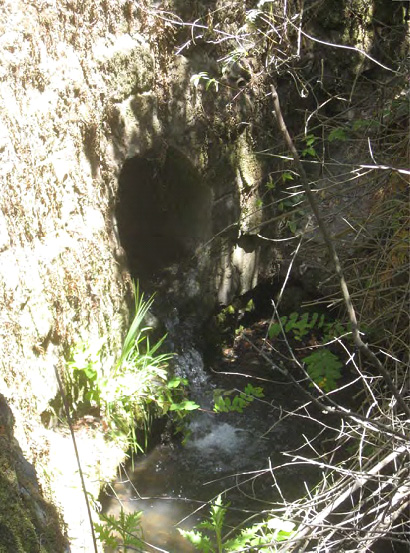
FEMA comment - Adams 1 copy

Figure 1, Culvert on lower fire trail, near Botanic Garden


The DEIS implies that trees other than eucalyptus, Monterey pines, and acacias will not be cut, but current actions in Strawberry Canyon suggest that UCB will cut anything at any time regardless of environmental regulations. The DEIS must be amended and re‐issued to include other UCB actions as part of cumulative impacts.

During the past week (June 6‐13, 2013) I have personally observed the cutting of at least six healthy, mature California live oaks, bays, and cypresses in Strawberry Canyon. (See Figures 2 and 3.) The oaks were particularly magnificent, and their destruction is tragic. I am familiar with the needs for passage of fire trucks as I own woodland property on a narrow privately maintained road. None of the trees just cut would have prevented passage of trucks, but I was told by one of the tree cutters that the excuse was “Fireman.” To my knowledge this cutting was done without any compliance with the California Environmental Quality Act (CEQA), which is the state equivalent of NEPA and applies to all UCB actions. This cutting constitutes a violation of the CEQA Guidelines Section 15304, which states that exemptions from CEQA apply only to actions “which do not involve the removal of healthy, mature, scenic trees.” If UCB is flagrantly cutting trees now, while the DEIS is out for public comment, what can we expect once the NEPA process is completed?
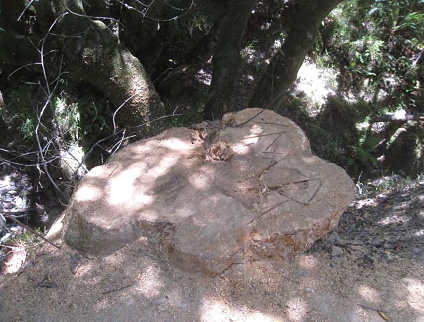
FEMA comment - Adams 2 copy

Figure 2. Bay stump on lower fire trail, cut on or about June 11 2013, diameter +/‐42”
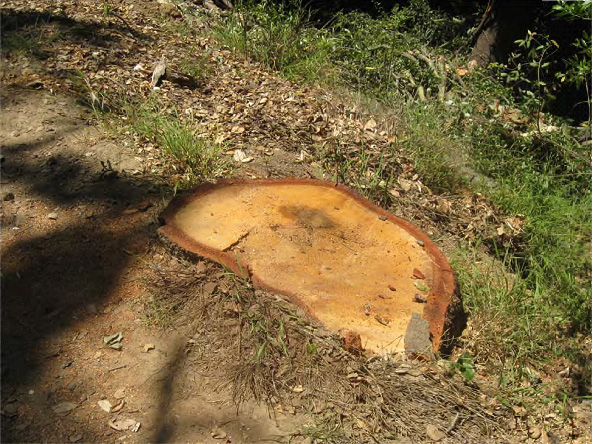
FEMA comment - Adams 3 copy

Figure 3. Live oak stump on lower fire trail, cut on June 10, 2013, diameter +/‐ 38”

(1) EPA 738‐R‐06‐007, 2006

(2) The Jepson Manual of Vascular Plants of California, 2nd Edition, UC Press, 2012

(3) Pyrophytic vs. Fire Resistant Plants, FireSafe Marin in Cooperation with University of California Cooperative Extension, October 1998


Thank you, Mr. Adams, for taking the time and trouble to write this excellent public comment on the FEMA draft EIS.

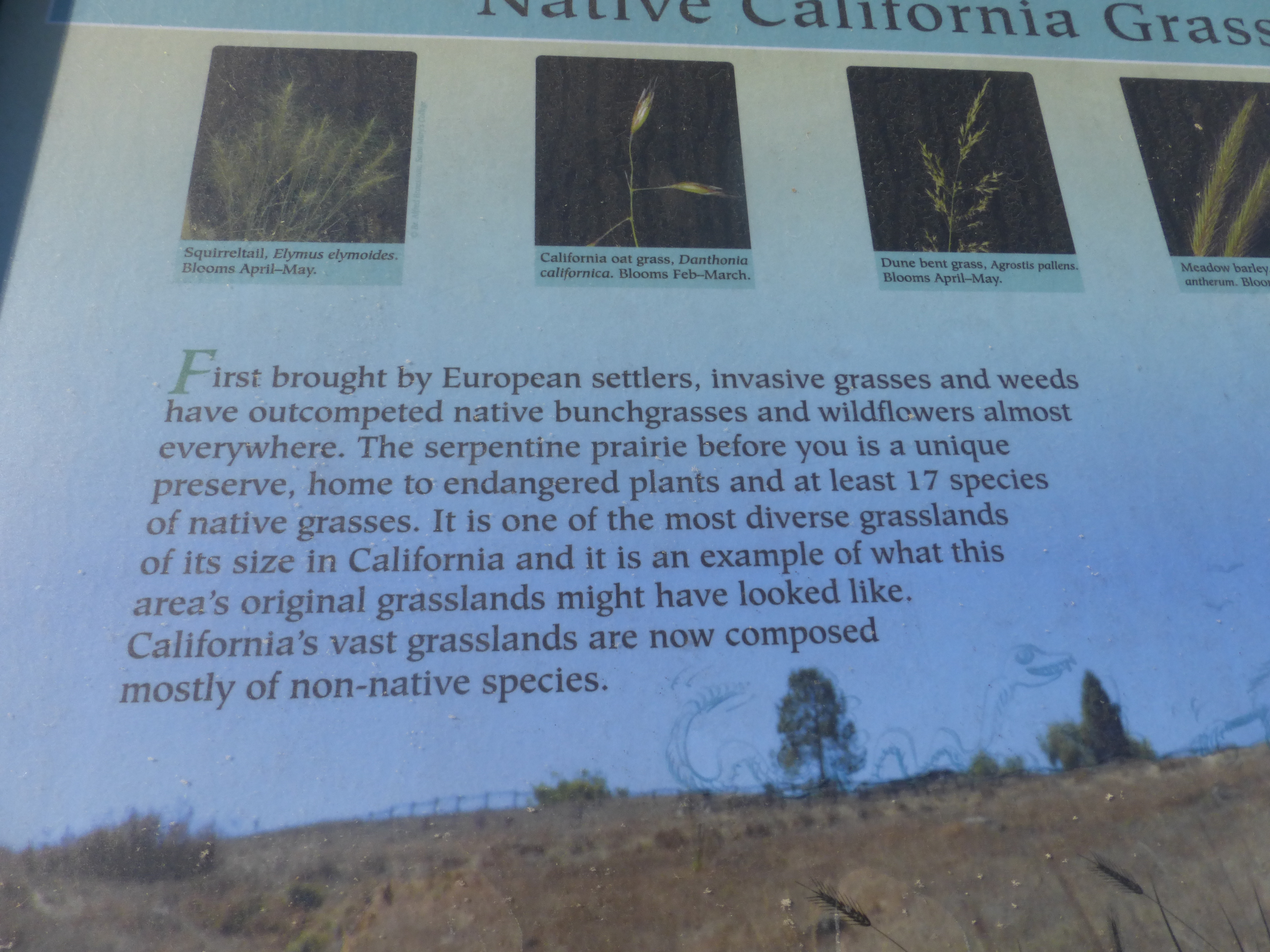
 

“Tending the Wild:” Our changing relationship with nature

We recently introduced our readers to a book about the land management practices of Native Americans in California, Tending the Wild:  Native American Knowledge and the Management of California’s Natural Resources.  (1) Drawing from this valuable resource, we will describe how the relationship of humans with nature has changed several times since the arrival of humans in California approximately 12,000 years ago.  We will conclude by raising questions about our current relationship with nature, as reflected in our land management practices.
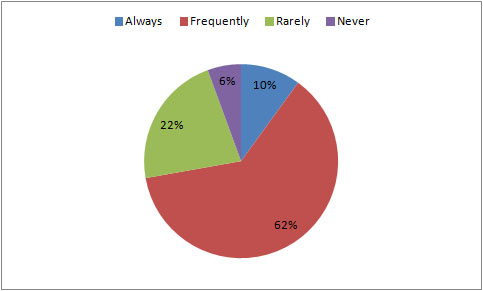
The relationship of Native Americans with nature

Basket CA Native AmericanWe will let the author of Tending the Wild speak for Native Americans, based on her extensive research of their culture and land-management practices:

“Although native ways of using and tending the earth were diverse, the people were nonetheless unified by a fundamental land use ethic:  one must interact respectfully with nature and coexist with all life-forms.  This ethic transcended cultural and political boundaries and enabled sustained relationships between human societies and California’s environments over millennia.  The spiritual dimension of this ethic is a cosmology that casts humans as part of the natural system, closely related to all life-forms.  In this view, all non-human creatures are ‘kin’ or ‘relatives,’ nature is the embodiment of the human community, and all of nature’s denizens and elements—the plants, the animals, the rocks, and the water—are people.  As ‘people,’ plants and animals possessed intelligence, which meant that they could serve in the role of teachers and help humans in countless ways—relaying messages, forecasting the weather, teaching what is good to eat and what will cure an ailment.” (1)

We emphasize that Native American culture considered humans a part of nature because this viewpoint provides contrast to modern interpretations of the relationship between humans and nature. 

Exploitation of nature by early settlers

When Europeans began to establish settlements in California in the late 18th century, they brought with them an entirely different viewpoint about their relationship with nature.  Natural resources were to be exploited and humans were the master of the natural world which was in their service.

Western pioneer ranch
Western pioneer ranch. Painting by John Olson Hammerstad, 1842-1925.


The first phase of European settlement was the importation of huge herds of livestock by the Spanish coming from Mexico:

“During the Mission era…grazing was among the activities that caused the greatest damage.  Coastal prairies, oak savannas, prairie patches in coastal redwood forests, and riparian habitats, all rich in plant species diversity and kept open and fertile through centuries of Indian burning, became grazing land for vast herds of cattle, sheep, goats, hogs, and horses owned by Spanish missions and rancheros.  By 1832 the California missions had more than 420,000 head of cattle, 320,000 sheep, goats, and hogs, and 60,000 horses and mules…overgrazing eliminated native plant populations, favored alien annuals, and caused erosion…A great variety of alien [plant] species were introduced inadvertently during the Mission Period.  Research has shown that European forbs and grasses…were brought into California at this time, contained in adobe bricks, livestock feed, livestock bedding, and other materials.  Soon these alien [plants] overwhelmed the native species, markedly changing the character and diversity of grasslands and other habitats west of the inner Coast Ranges.”  (1)

Tending the Wild reports that during this early phase of European settlement, Native Americans were quick to adapt to the changing landscape.  They incorporated useful new plants into their diets.  Likewise, we see today new plants and animals quickly enter the food web.


Hydraulic gold mining in California.

These changes in the landscape paled in comparison to the exploitation of the land that began in 1849 when gold was discovered in California and the huge influx of Americans of diverse European descent arrived.  Here are a few examples:

  • “…by the 1870s ‘more men made their living in the broader geography and economy of farming—48,000—than in all the mines of the Sierra footholls—36,000.’ To accommodate the acreage devoted to growing crops, marshes were drained, underground water was tapped by artesian wells, streams and rivers were dammed and diverted for irrigation, and lands were fenced.  In the process huge tracts of former native grasslands, riparian corridors, and vernal pools were converted to artificial, human-managed agricultural systems.” (1)
  • “Five million acres of wetland in California have been reduced by 91% through diking, draining, and filling for agriculture, housing, or other purposes.” (1)
  • By 1900, 40% of California’s 31 million acres of forest were logged.
  • “By the early 1900s, the numbers of marine mammals, wildfowl, elk, deer, bear, and other birds and mammals had been so drastically reduced that Joseph Grinnell would write, ‘Throughout California we had been forcibly impressed with the rapid depletion everywhere evident among the game birds and mammals.’” (1)
  • Between 1769 and 1845, the population of Native Americans in California dropped from an estimated 310,000 to 150,000. Between 1845 and 1855, the population of Native Americans dropped from 150,000 to 50,000.

Romanticizing Nature

Meanwhile, in Europe and the East Coast of the US, a new view of nature was being articulated.  The Romantic movement viewed nature as an escape from the stress of urban life, a tranquil retreat from civilization.  In California, John Muir was strongly influenced by Romanticism: 

“Muir and those with similar views responded to the destruction and exploitation of California’s natural resources with a preservationist ethic that valued nature above all else but which defined nature as that which was free of human influenceThus while he championed the setting aside of parks as public land, Muir also contributed to the modern notion that the indigenous inhabitants of the state had no role in shaping its natural attributes.” (1)

Muir was unable to fit Native Americans into his idealized view of nature.  He wrote this account of Miwok Indians in the Sierra Nevada in 1869:

“’We had another visitor from Browns’ Flat to-day, an old Indian woman with a basket on her back.  Her dress was calico rags, far from clean.  In every way she seemed sadly unlike Nature’s neat well-dressed animals, though living like them on the bounty of wilderness.  Strange that mankind alone is dirty.  Had she been clad in fur, or cloth woven of grass or shreddy bark, like the juniper or libocedrus mats, she might have seemed a rightful part of wilderness; like a good wolf at least, or bear.  But no point of view that I have found are such debased fellow beings a whit more natural than the glaring tailored tourists we saw that frightened the birds and the squirrels.’” (1)

Sharp Park, Pacifica, CA.  Photo by Erica Reder, SF Public Press
Sharp Park, Pacifica, CA. Photo by Erica Reder, SF Public Press

In this romanticized view of nature, humans are not welcome Humans defile the purity of nature.  This is the prevailing viewpoint today among those who consider themselves environmentalists, park advocates, and conservationists.  They advocate for “wilderness” where “humans may visit, but not remain.”  They post signs, advising visitors to look but not touch.  Their “restoration” projects put nature behind a fence.  They complain about immigration.

The condescending attitude articulated by John Muir toward Native Americans was instrumental in our ignorance of their land management practices.  Europeans considered Native Americans primitive and therefore did not expect to learn anything useful from them.  Europeans imported and grew their own food from their original homes because they were unaware of how local food sources could be grown and used.  Our knowledge of Native American culture is recent and it comes too late to ever be fully informed because those who tended the land are long since gone.  Furthermore, this new knowledge of land management practices of Native Americans is not well known, certainly not among native plant advocates who are attempting to re-create a landscape which was created by methods they do not understand.

Redefining ecological “restoration”

The author of Tending the Wild admires Native American culture as well as the landscape that was created by their land management practices.  Therefore, she concludes her book with a proposal that we adopt their land management methods:

“What then, should be the goal of ecological restoration?  Restoring landscapes and ecosystems to a ‘natural’ condition may be impossible if that natural condition never existed…Restorationists must at the very least acknowledge the indigenous influence in shaping the California landscape.  This chapter advocates an additional step—using indigenous people’s knowledge and methods to carry out the restoration process, to return landscapes to historical conditions and restore the place of humans in this continuing management.”  (1)

In our previous post, we described some of the land management practices of Native Americans, particularly the importance of setting fires.  Adopting these management practices for ecological restorations would require us to make a permanent commitment to setting fires.  Fires pollute the air, release greenhouse gases into the atmosphere, and endanger lives and property.  Therefore, this is surely not a proposition that can be reasonably applied to our densely populated urban parks.  The maximum population of Native Americans prior to the arrival of Europeans is estimated to have been 310,000.  The population of California was estimated to be over 38 million in 2013.  Land management practices that were appropriate for a human population of only 310,000 are not appropriate for a population of over 38 million.

Furthermore, the land management practices of Native Americans were useful for their culture.  They tended the landscape in order to feed, clothe, heal, and house themselves.  If that specific landscape is no longer useful for those purposes, why would we consider it an ideal landscape?  In what sense would it be superior to the landscape that occurs naturally without setting fires or intensively gardening our open spaces?

A more realistic paradigm is needed

We believe a more sustainable paradigm for managing nature is needed.  Although we won’t presume to define this new paradigm, we will suggest some parameters:

  • Humans are as much a part of nature as any other animal. Therefore, conservation goals must accommodate the presence of humans.  However, humans must respect plants and animals as equal partners in achieving conservation goals.
  • Since we live in a free society, we must assume that human populations will grow in proportion to the choices of humans. And since we are a nation of laws, we must assume that immigration will occur as allowed by our laws.  Conservation goals must be consistent with the realities of human population density.
  • Conservation goals should look forward, not back. Goals should reflect the changes in the environment that have already taken place and anticipate the changes that are expected in the future.
  • The distinction between native and non-native species should be only one of several criteria to determine whether a species “belongs here.” If plants and animals are sustaining themselves without human subsidy, we should acknowledge and appreciate the functions they perform in the ecosystem.  This approach will reduce the use of herbicides, now being used to eradicate plants perceived to be “non-native,” in our parks and open spaces.
  • Conservation goals should be realistic within the confines of available resources and in competition with other priorities.
  • There are pros and cons to every change we make in the landscape. Whenever we alter the landscape, if our land management methods damage the environment by using pesticides, killing animals or destroying their food resources and homes, contributing to greenhouse gases, restricting recreational access, etc., we must have solid evidence that the benefits to the environment will be greater than the damage we foresee.  If there is no net benefit, we should leave it be.

Can you add to or suggest revisions of this list of a new conservation ethic?  Surely there are as many opinions as there are readers of Million Trees.  We would like to hear your ideas.


  1. M. Kat Anderson, Tending the Wild: Native American Knowledge and the Management of California’s Natural Resources, University of California Press, 2005 (This is the source of most of the information in this article.)

A defensive tirade from invasion biologists

Pesticide use by land managers in California.  Source California Invasive Plant Council
Pesticide use by land managers in California. Source California Invasive Plant Council

An international team of invasion biologists has just published a defense of their academic turf, invasion biology.  (1) Daniel Simberloff, an American member of the team, is the most relentless defender of the crusade to eradicate all non-native species, wherever they are found, all over the world.  Their publication acknowledges the mounting criticism of this crusade and attempts to respond to that criticism, but what is most notable is what is missing from their attempt to defend their opinions.  They make no mention of the harmful methods used to eradicate non-native species:

Keep these damaging methods in mind as we visit the hypocritical and contradictory arguments used to justify the projects for which these invasion biologists advocate.  They set up “novel ecosystems” as the straw man to which they compare the goals of invasion biology.  They define novel ecosystems as “a new species combination that arises spontaneously and irreversibly in response to anthropogenic land-use changes, species introductions, and climate change, without correspondence to any historical ecosystem.”

“Lack of rigorous scrutiny”

Their primary criticism of the concept of “novel ecosystems” is that it has not been “subjected to the scrutiny and empirical validation inherent in science” and its definition is “impaired by logical contradictions and ecological imprecisions.”   These criticisms apply equally to invasion biology.

Hypothesis n % of supporting studies % of decline in support
Invasional meltdown

30

77%

41%

Novel weapons

23

74%

25%

Enemy release

106

54%

10%

Biotic resistance

129

29%

5%

Tens rule

74

28%

10%

Island Susceptibility

9

11%

25%

Although support is strongest for the invasional meltdown hypothesis, recent studies are less supportive than early studies, indicating substantial decline in supporting evidence.  Declining evidence of invasional meltdown is consistent with the fact that exotic species are eventually integrated into the food web which reduces their populations, stabilizing their spread. There is apparently little evidence that islands are more susceptible to invasion than continents and few studies have been done to test the hypothesis.

If empirical validation and semantic precision are required to establish the credibility of scientific hypotheses, invasion biology has failed that test.

“Precautionary principle of conservation and restoration”

These invasion biologists define the precautionary principle of conservation and restoration as follows:  “we should seek to reestablish –or emulate, insofar as possible—the historical trajectory of ecosystems, before they were deflected by human activity.”  This is an unusual use of the precautionary principle, which is more typically defined as avoiding damage to the environment by not using potentially harmful methods, even in the absence of solid evidence of such harm.  The precautionary principle was not used when the following “restoration” projects were defined or implemented:

Ivy in the Conservatory in Central Park, New York City

In 1996, Daniel Simberloff made this statement in his publication about the hazards of biological controls:  “…are there any protocols for biological-control introductions that would prevent all disasters?  Probably not…” (2) Yet, in 2013, he expressed his support for the introduction of non-native insects to control cape ivy at a conference at UC Davis sponsored by the California Department of Food and Agriculture.  Although cape ivy is despised by native plant advocates, it is not an agricultural pest and therefore causes no economic damage to ecosystems, unless money is wasted on attempts to eradicate it.

“All ecosystems should be considered candidates for restoration”

In response to those who find value in novel ecosystems, these invasion biologists find none.  They reject the possibility that there is ever a point at which it may not be possible to re-create a historical landscape.  They continue to believe that ANY and ALL radically altered landscapes CAN and SHOULD be considered candidates for restoration.  Their only caveat to this universal goal is that “damaged ecosystems…should be evaluated for feasibility, desirability, and cost-effectiveness, on a case-by-case basis, so that informed and science-based policy decisions can be made, in consultations with scientists, restoration practitioners, stakeholders, and advisors.”

These criteria for potential “restoration” have nothing to do with reality:

  • Most projects in the San Francisco Bay Area have not provided cost estimates when they were planned. The public demanded cost estimates for the projects of the Natural Areas Program in San Francisco, but these demands were ignored.  Therefore, “cost-effectiveness” is not usually considered when these projects have been shoved down the public’s throat.
  • We consider the public to be “stakeholders” in decisions to radically alter our public open spaces. We are the visitors to these areas and our tax dollars pay for their acquisition, maintenance, and “restoration.”  Yet, managers of public land are consistently making those decisions without taking the public’s opinion into consideration.  Most projects are planned and executed without any public participation.  In the few cases in which there are environmental impact reviews, the projects are implemented regardless of overwhelming opposition of the public.

 “Human-damaged ecosystems can be at least partially restored”

The demonstrated futility of “restoration” projects is one of many reasons why there is waning public support for attempting them.  Yet, invasion biologists who authored this diatribe claim that “restored sites recovered on average 80-86% of biodiversity and ecosystem services…and showed improvements of 125-144% over degraded ones.”  This claim is contradicted both by other scientific studies and by experience with local projects:

  • “…this paper analyses 249 plant species reintroductions worldwide by assessing the methods used and the results obtained from these reintroduction experiments…Results indicate that survival, flowering and fruiting rates of reintroduced plants are generally quite low (on average 52%, 19%, and 16% respectively). Furthermore, our results show a success rate decline in individual experiments with time.  Survival rates reported in the literature are also much higher (78% on average) than those mentioned by survey participants (33% on average).” (3)
  • Dunnigan Test Plot, Augusst 2011.  The result of an eight-year effort to restore native grassland.  Does it look "biodiverse?"  ecoseed.com.
    Dunnigan Test Plot, August 2011. The result of an eight-year effort to restore native grassland. Does it look “biodiverse?” ecoseed.com.

    There is frequently a discrepancy between the success rates claimed in papers and those actually observed. For example, Cal-Trans gave researchers at UC Davis $450,000 to restore 2 acres of non-native annual grassland to native grassland.  UC Davis researchers spent 8 years and used multiple methods to achieve this transition.  When they ran out of money, they declared success in their published report.  They defined success as 50% native plants which they expected to last 10 years before being entirely replaced by non-native annual grasses again.  Do you consider that a success?

  • On a more anecdotal level, we watch established landscapes that have required no maintenance in the past being transformed into weedy messes by failed “restoration” projects. Then, adding insult to injury, we hear those who are responsible for these failures tell us how successful they are.

“Inadequate political will”

The authors of this publication conclude:

“No proof of ecological thresholds that would prevent restoration has ever been demonstrated.  Often the threshold that obstructs a restoration project is not its ecological feasibility, but its cost, and the political will to commit to such cost.” (1)

We are reminded of an old football adage:  “The best defense is a good offense.”  In other words, invasion biology is under fire, but the reaction of invasion biologists is to demand more….more money, more effort, and the commitment of public land managers to “restore” all ecosystems, regardless of what the public wants.  And in support of that aggressive strategy, they refuse to acknowledge the damage that is being done to the environment and the animals that live in it, by the projects they demand.

The authors of this defensive tirade have hammered another nail in the coffin of invasion biology.


  1. Carolina Murcia, James Aronson, Gustavo Kattan, David Moreno-Mateos, Kingsley Dixon, Daniel Simberloff, “A critique of the ‘novel ecosystem’ concept,” Trends in Ecology and Evolution, October 2014, Vol. 29, No. 10
  2. Daniel Simberloff and Peter Stiling, “How Risky is Biological Control?” Ecology, 77(7), 1996, pp 1965-1974
  3. Sandrine Godefroid, et. al., “How successful are plant species reintroductions?” Biological Conservation,   144, Issue 2, February 2011

Where does it end?

It is our pleasure to republish with permission a post from the website of Flood Creek Non-Nativist Landcare Group.  Flood Creek is located in Braidwood, New South Wales, Australia.  Across Australia, Landcare is a popular volunteer-based environmental movement which enjoys general support from government in the form of occasional financial grants. Over the last 25 years, many Landcare groups have undertaken projects with the stated goal of eradicating non-native plants based on a belief that native plants and animals would benefit.  That strategy will sound familiar to our readers, as will the damage to the environment which it causes.  

The Non-Nativist Landcare Group is a small team of people with a history of participation in Landcare who want to foster a discussion of current nativist approaches to environmental management, and question their outcomes.  Based on their experiences with conventional Landcare projects, the Non-Nativist Landcare Group has concluded that these often do more harm than good.  The Group describes their mission:   “Above all, this discussion is inspired by the goal of taking a more ecologically-based and functional approach to Australian socio-ecological systems and their health. We seek to highlight the inconvenient-truth that rational environmental management can never be based upon a simple mantra of “natives good, non-natives bad”. Extermination is rarely an effective way to promote landscape diversity and resilience.”

Please visit their website and wish them well in their effort to find a less destructive approach to land management.


When you look at the willful and wanton environmental destruction conveyed in these photographs you must ask yourself: ‘how could anyone do this in the name of environmentalism?’ After all the disturbance we’ve already inflicted upon this biosphere, how is this really helping?

Flood Creek 1


In this example of willow demolition, the trees were cut down and dragged away and the stumps were poisoned. Then (for some unfathomable reason) a drainage ditch was excavated into the floodplain. In the photo below, the main flow-line is 40m off to the left.

Flood Creek 2

Apart from the economic motives at play (a theme for a future post), I can think of only one reason why an ‘environmentalist’ might condone this kind of damage and disturbance. It must be to do with that old adage, ‘the end justifies the means‘.

The reasoning seems to be: ‘Sure, it makes a big mess and causes erosion, and nutrient release, and carbon emissions, and local temperature increases, and loss of habitat, but it’s necessary because we’re going to make Australia a place for natives-only again.’

So that’s the end we’re aiming for: a ‘native-only’ Australia. And these photos show the means we must accept along the way.  It seems we’re just going to remove all of the non-natives from this continent so the environment is back to ‘pristine’ again and then we can stop with the chainsaws and excavators and herbicides in the name of ‘saving’ the environment.

Flood Creek 3

We just want 1788-Australia back. Presumably without the dingoes and without the previous intrinsic Aboriginal management; plus with a few minor additions like cattle; and sheep; and horses; and apples; and asparagus; and hops; and wheat; and rice; and trout; and tomatoes; and lettuce; and cats; and dogs; and goldfish; and maybe just one or two other things, but that’s it! And we want all the ‘invasive’ natives, like Cootamundra Wattle, and Sweet Pittosporum, and Kookaburras to know their place and to go back where they were when Europeans first arrived….And stay there forever and ever….And not move just because the climate or fire regime has changed. And this won’t happen by itself so we’ll need funding and legislation and heavy machinery. And we’re going to fix it all ‘real good’ without knowing what it was actually like or exactly what species existed in many parts of the country back in 1788. And….and…..

Flood Creek 4

….And then again……When you think about it…..Are we ever actually going to achieve anything even remotely approaching a native Australia?…..really?

I doubt it.

And I’d doubt the sincerity (or sanity) of anyone who says that we could. Surely nobody actually believes this?

So, given this impossibility, it seems pretty reasonable to ask ourselves: ‘how can the end justify the means, when it’s clear there really is no conceivable end?’ If it just goes on and on forever, then how do we justify these means to no end at all? How do we live with this permanent state of expensive self-congratulatory environmental vandalism?

More importantly, given how well-supported the above activities currently are, how do objecting grassroots Landcarers begin to articulate new ways to work with the adaptive living-landscapes around us? And how do we influence the direction of our own movement so that participation in Landcare is not assumed to mean support for this destruction?


All the death and destruction in these photographs is familiar to us here in the San Francisco Bay Area.  The only difference is that the trees that were destroyed in this project were willows, which are native in California, but not native in Australia.  That difference helps us appreciate the arbitrariness of nativism, which treats eucalyptus as demons and willows as the “good” trees in California.  

We have yet to witness a “restoration” that wasn’t far more destructive than constructive.  And based on our experience in the San Francisco Bay Area, we can venture an answer to the rhetorical question, “Where does it end?”  It doesn’t end because every “restoration” is quickly occupied again by the plants that were destroyed by herbicide applications.  As long as the objective continues to be to kill everything non-native and re-populate a landscape with native plants, the project will never be complete. 

 Therefore, it only ends when the goal is revised and/or the effort is no longer funded.  And the only way to achieve that revised goal is for the public to object to the destruction of their public lands.  So, if you are tired of witnessing these destructive projects, speak up!  Tell your elected representatives that you don’t want your tax dollars spent on the pointless ruin of public open space.