The San Francisco Natural Areas Program (NAP) plans to destroy thousands of trees in San Francisco’s parks. The Draft Environmental Impact Report (EIR) for NAP’s destructive plan reaches the bizarre conclusion that removing thousands of trees will have no significant impact on the environment. This conclusion is based on several fictional premises. In this post we will examine one of those premises: that all the trees that are removed will be replaced within the natural areas by an equal number of trees that are native to San Francisco.
The EIR supports this fictional premise by falsely reducing the number of trees that will be removed by:
Not counting trees less than 15 feet tall, despite the fact that the US Forest Service survey of San Francisco’s urban forest reports that the trunks of most (51.4%) trees in San Francisco are less than 6 inches in diameter at breast height, the functional equivalent of trees less than 15 feet tall.
Not counting the hundreds of trees that were destroyed prior to the approval of the NAP management plan at Pine Lake, Lake Merced, Bayview Hill, Glen Canyon parks, etc.
Not counting tree removals proposed by the “Maximum Restoration Alternative” which the EIR says is the “Environmentally Superior Alternative.” [ETA: The Planning Department later admitted that this is a mistake in the EIR. The “Maintenance Alternative” is the “Enviromentally Superior Alterantive.”]
However, even artificially reducing the number of tree removals does not make “one-to-one” replacement a realistic goal.
The natural history of trees in San Francisco
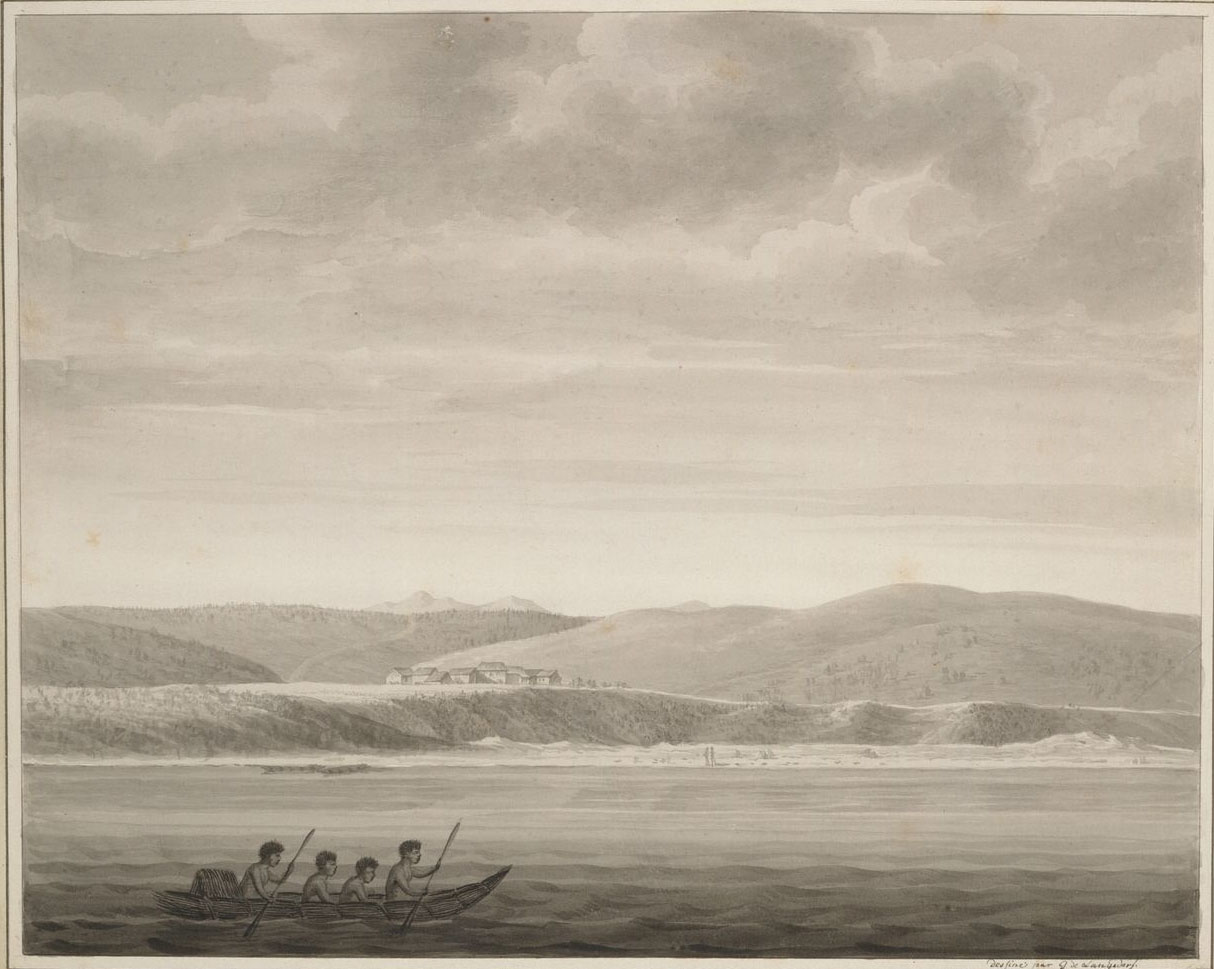
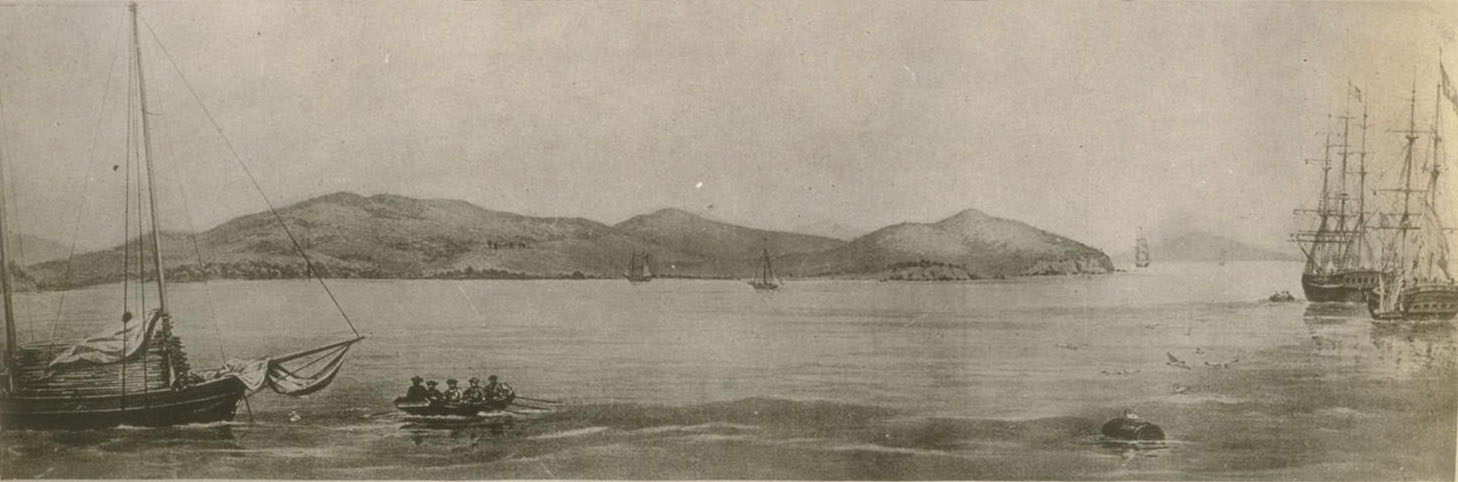
The primary reason why we know that it will not be possible to grow thousands more native trees in the natural areas in San Francisco is that there were few native trees in San Francisco before non-native trees were planted by European settlers in the late 19th century. San Francisco’s “Urban Forest Plan” which was officially adopted by the Urban Forestry Council in 2006 and approved by the Board of Supervisors describes the origins of San Francisco’s urban forest as follows:
“No forest existed prior to the European settlement of the city and the photographs and written records from that time illustrate a lack of trees…Towards the Pacific Ocean, one saw vast dunes of sand, moving under the constant wind. While there were oaks and willows along creeks, San Francisco’s urban forest had little or nothing in the way of native tree resources. The City’s urban forest arose from a brief but intense period of afforestation, which created forests on sand without tree cover.”
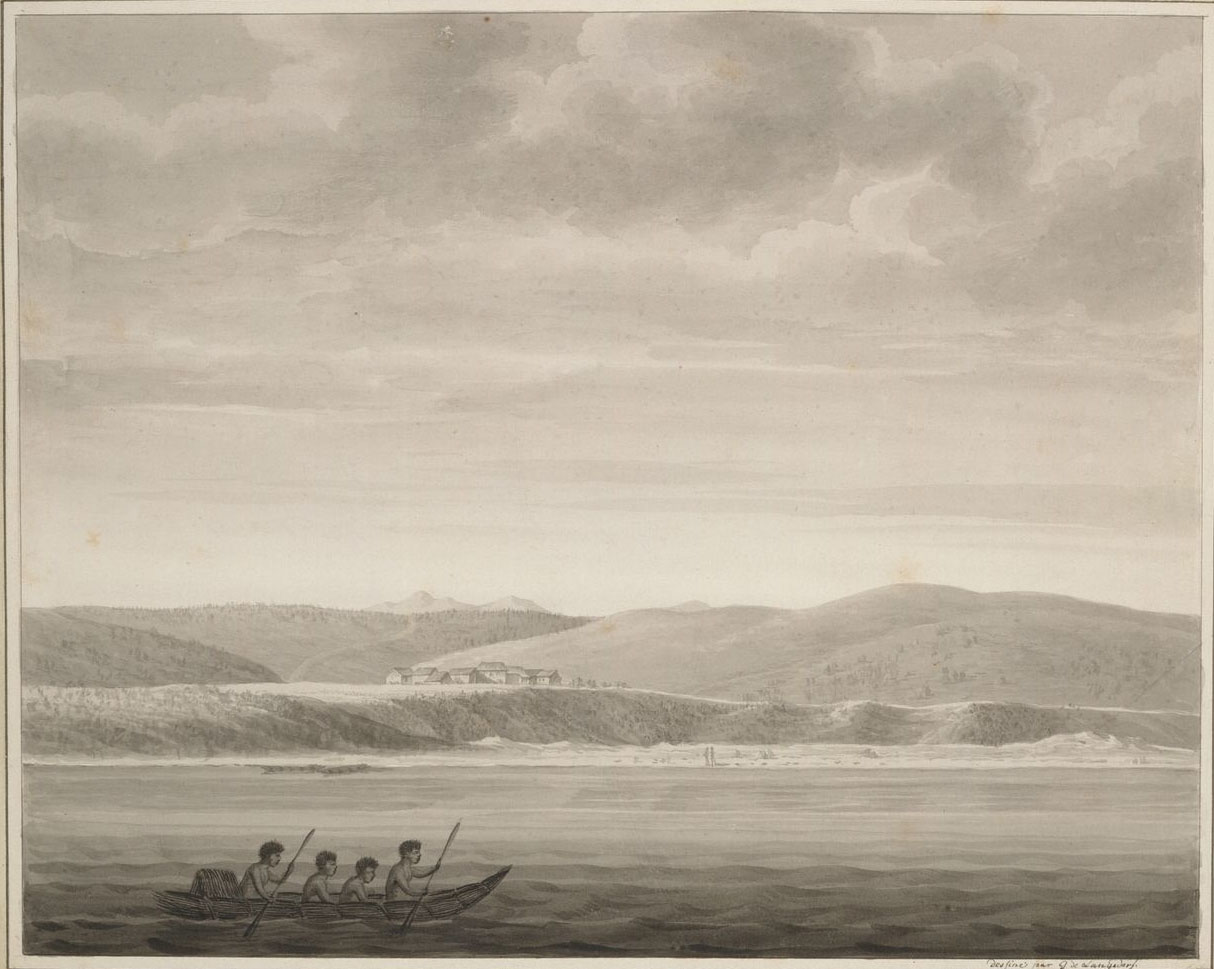
San Francisco in 1806 as depicted by artist with von Langsdorff expedition. Bancroft Library
The horticultural reality of trees native to San Francisco
More importantly, the reality is that even if we want to plant more native trees in San Francisco, they will not grow in most places in San Francisco. We know that for several reasons:
There are few native trees in San Francisco now. According to the US Forest Service survey of San Francisco’s urban forest only two species of tree native to San Francisco were found in sufficient numbers to be counted in the 194 plots they surveyed: Coast live oak was reported as .1% (one-tenth of one percent) and California bay laurel 2.1% of the total tree population of 669,000 trees.
The city of San Francisco maintains an official list of recommended species of trees for use by the Friends of the Urban Forest and the Department of Public Works. The most recent list categorizes 27 species of trees as “Species that perform well in many locations in San Francisco.” There is not a single native tree in that category. Thirty-six tree species are categorized as “Species that perform well in certain locations with special considerations as noted.” Only one of these 36 species is native to San Francisco, the Coast live oak and its “special considerations” are described as “uneven performer, prefers heat, wind protection, good drainage.” The third category is “Species that need further evaluation.” Only one (Holly leaf cherry) of the 22 species in that category is native to San Francisco.
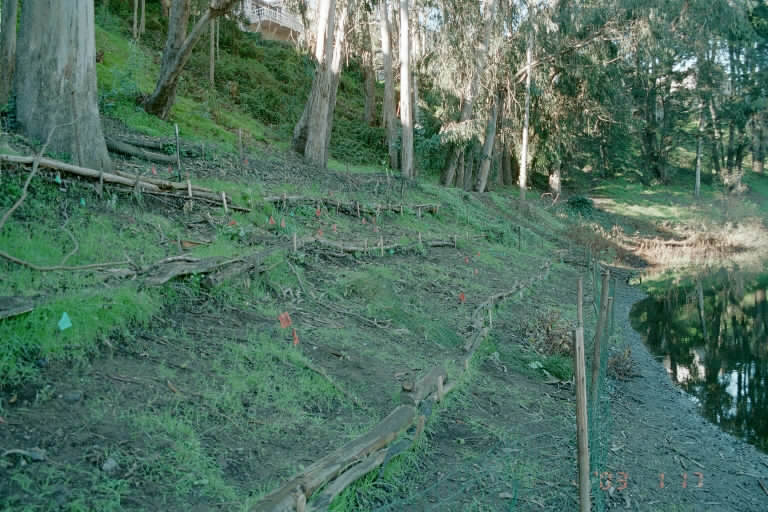
Finally, where native trees have been planted by NAP to placate neighbors who objected to the removal of the trees in their neighborhood parks, the trees did not survive.
Will NAP plant trees that won’t survive?
Given what we know about the horticultural requirements of the trees that are native to San Francisco, what are we to think of the claim that all non-native trees removed by the Natural Areas Program will be replaced by native trees? Is there any truth to this claim? Will native trees be planted that won’t survive? Or will they just not plant the trees that they claim will be planted?
We turn to the management plan for the Natural Areas Program for the answer to this question. In fact, the management plan proves that NAP has no intention of planting replacement trees for the thousands of trees they intend to destroy. The “Urban Forestry Statements” in Appendix F of the management plan contain the long-term plans for the natural areas in which trees will be destroyed. All but one of these specific plans is some variation of “conversion of some areas of forest to scrub and grasslands.” The exception is Corona Heights for which the plans are “converted gradually to oak woodland.” The Corona Heights natural area is 2.4 acres, making it physically impossible to plant thousands of oaks in that location.
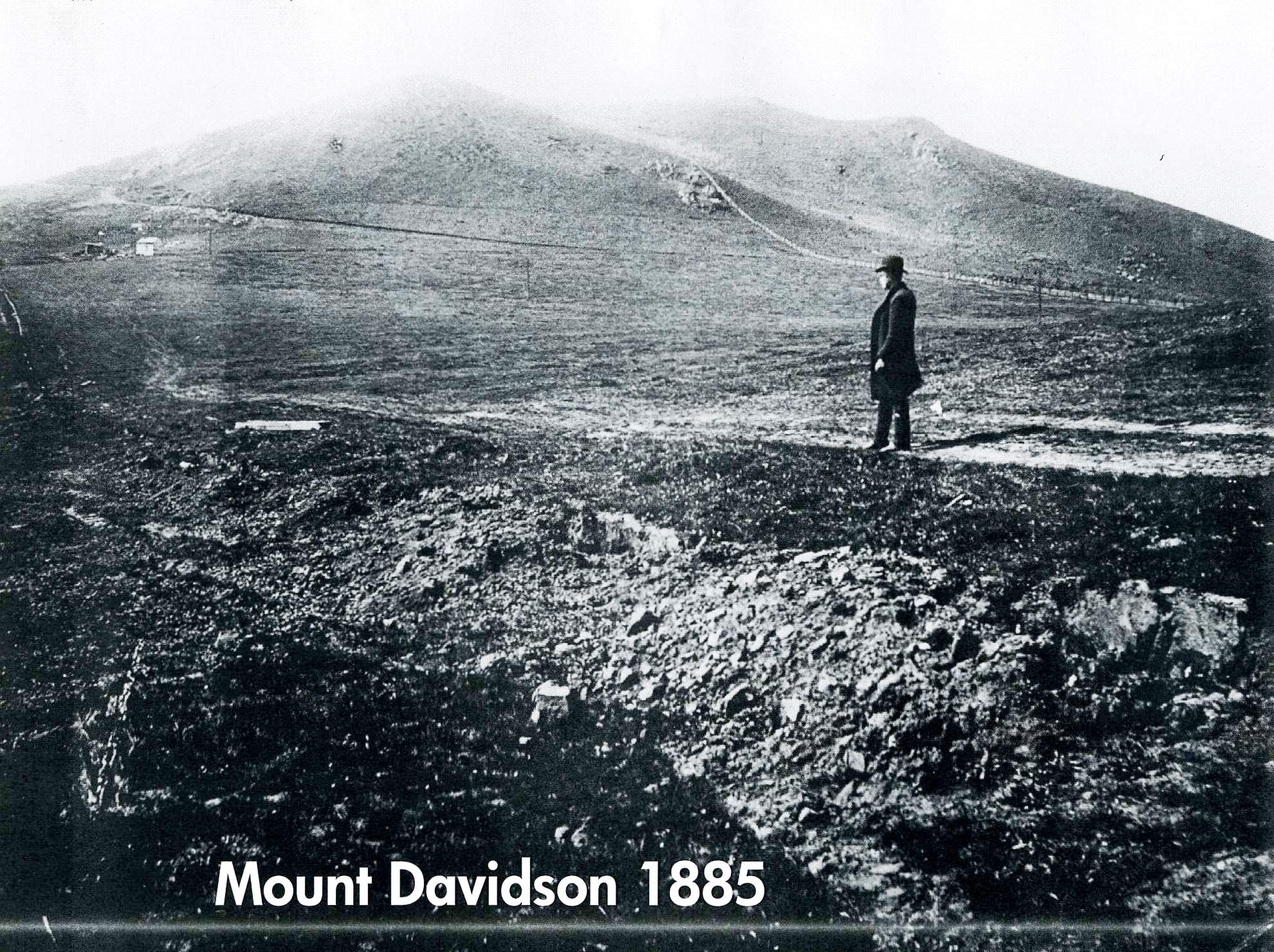
NAP plans to destroy 1,600 trees over 15 feet tall on Mt. Davidson and more if the EIR is approved.
Putting the magnitude of the proposed tree removals into perspective
It isn’t easy to confront public policies. We all have better things to do. So, before we leave this issue, let’s consider the magnitude of the loss of thousands of trees in San Francisco. We turn to the survey of San Francisco’s urban forest by the US Forest Service to put the proposed tree removals into perspective:
There are only 669,000 trees in San Francisco, with a tree cover of only 11.9% of the land. Of the 14 cities in the US reported by this survey, only Newark, New Jersey has a smaller tree canopy, covering 11.5% of the land.
Most of these trees are small: 51.4% have trunk diameters of less than 6” at breast height.
The highest densities of trees are found in San Francisco’s open spaces, such as parks.
The trees and shrubs of San Francisco remove 260 tons of air pollutants (CO, NO₂ , O₃, PM₁₀, SO₂) per year
The trees of San Francisco now store 196,000 tons of carbon. Stored carbon is released into the atmosphere when trees are destroyed and as they decay as chips or logs on the ground.
In San Francisco, the blue gum eucalyptus stores and sequesters the most carbon (approximately 24.4% of the total accumulated carbon stored and 26.4% of annual rate of carbon sequestered). Most of the trees that have been destroyed in the past and will be destroyed in the future by NAP are blue gum eucalyptus.
If you care about the trees of San Francisco, please keep in mind that the public will have an opportunity to comment on the proposal to remove thousands of trees in the city’s parks. There will be a public hearing on October 6, 2011, and the deadline for submitting a written comment is October 17, 2011*. Details about how to comment are available here.
*[ETA: The deadline for written comments has been extended to October 31, 2011, at the request of the Planning Commission.]
Fifteen years after San Francisco’s Natural Areas Program (NAP) began operation and 5 years after its management plan was approved, the Draft Environmental Impact Report (EIR) has finally been published. We will briefly summarize the history of NAP, describe the plans as they were approved in 2006, and conclude with a comparison between those plans and the proposal in the EIR to aggressively expand NAP.
The Management Plan for the Natural Areas Program
In 1995 the Recreation and Park Commission approved the designation of 31“natural areas” in parks managed by the city of San Francisco. This designation committed 25% of the city’s park acreage in San Francisco, 33% including the city of Pacifica to the Natural Areas Program.
Most park visitors were unaware of this designation until 5 years later when they finally had access to a draft of the management plan after a lengthy battle to make it available. At that point, many park visitors could see where the Natural Areas Program was headed and many of them reacted negatively to the prospect of the destruction of non-native trees and restrictions on recreational access in popular, heavily visited parks.
The result of the long debate with the public was a revised management plan that separated the natural areas into three “management areas.” These management areas (MAs) set priorities for the restoration of parkland to native plants: MA-1 was the highest priority, MA-2 the second priority, and MA-3 the lowest priority. The appeal of these priorities to critics of NAP was the commitment that there would be no tree removals in the MA-3 areas and that no legally protected species would be planted or reintroduced there, which might require further access restrictions in the future. Forty-two percent of the total 1,080 acres of natural areas was designated as MA-3.
The management plan* was approved in 2006, after two days of public hearings at which about 200 public comments were heard by the Recreation and Park Commission. Supporters of NAP outnumbered critics of the program. The main message of the critics of the program was that the acreage committed to natural areas should be reduced to places in which native plants existed, which would not include acreage designated MA-3.
There were two trivial caveats to the approval of the program: defining the circumstances under which cats could be removed from the natural areas and specifying that tree removals must be done by the Urban Forestry Division of the Recreation and Park Department (RPD). These are some of the main features of the approved management plan:
Tree removals. 18,500 trees over 15 feet tall were designated for removal in MA-1 and MA-2 areas. In addition, non-native trees under 15 feet tall would be removed in these areas, but were not quantified because the plan did not define them as “trees”
Trails. 10.3 miles of trails were designated for closure in these areas. That represented 26% of all trails in the natural areas.
Dog Play Areas are those areas in parks that have been officially designated for off-leash recreation. The NAP management plan identified several dog play areas that would be monitored for possible closure in the future if necessary to protect native plants. Those dog play areas were in Bernal Hill, McLaren and Lake Merced parks.
The Environmental Impact Report of the Natural Areas Program
Five years after the approval of the management plan, the Environmental Impact Report (EIR) has finally been published. The EIR identifies 4 alternatives to move forward with the implementation of the plan. The EIR identifies the “Maximum Restoration Alternative” as the “Environmentally Superior Alternative” described as follows:
“This alternative seeks to restore native habitat and convert nonnative habitat to native habitat wherever possible throughout the Natural Areas, including all management areas.”
[ETA: This article has been updated by a more recent post which reports that a mistake has been found in the Draft Environmental Impact Report (DEIR): The “Maximum Restoration Alternative” is not the “Environmentally Superior Alternative” as the DEIR claims on page 2. The “Maintenance Alternative” is the “Environmentally Superior Alternative” as the DEIR says on page 526. The mistake on page 2 has been reported to the Planning Department. The Planning Department has acknowledged the error on page 2 and has made a written commitment to correct the error in the Final Environmental Impact Report. Unfortunately, this correction will not be made until the public comment period is over.]
In other words, the preferred alternative would do away with the priorities identified in the management plan and treat all three management areas the same. These are the specific implications of this proposal as described by the EIR:
Trees.Non-native trees would also be removed in the MA-3 areas. The number of trees over 15 feet tall that will be removed will exceed 18,500, but the EIR does not quantify how many trees will be removed.
Trails.More trails would be closed in the MA-1 and MA-2 areas, but the EIR is not specific about how many miles of trail will be closed.
Dog Play Areas. All dog play areas in MA-1 and MA-2 areas would be closed. This will close the dog play areas in Buena Vista and Golden Gate (Southeast) parks and what little remained of McLaren (Shelley Loop) and Bernal Hill after the closures mandated by the management plan. Dog play areas in MA-3 areas will be monitored and closed in the future if necessary to protect native plants. The EIR predicts that all of these closures in addition to the anticipated closures of GGNRA properties to off-leash dogs will result in heavier usage of the dog play areas that remain.
Golf Course at Sharp Park would be further reduced by expanded habitat for endangered species.
Other access restrictions. Legally protected species will be introduced in MA-3 areas, which may require further restrictions on access in the future.
The other alternatives identified in the EIR are:
“No Project Alternative – Under this alternative, the SFRPD would continue with the management activities authorized under the 1995 management plan.” This alternative will close the dog play areas that were monitored since the management plan was approved in 2006: the Mesa at Lake Merced, portions of Bernal Hill and McLaren (Shelley Loop).
“Maximum Recreation Alternative – This alternative seeks to restore and improve recreational access to the Natural Areas wherever it does not interfere with the continued existence of native species and federally or state-listed sensitive species.”
“Maintenance Alternative – This alternative seeks to maintain the current distribution of native and nonnative habitat and species throughout the Natural Areas. Under this alternative there would be no conversion of nonnative habitat to native habitat; other features of the Natural Areas would be retained.”
Rewarding Failure
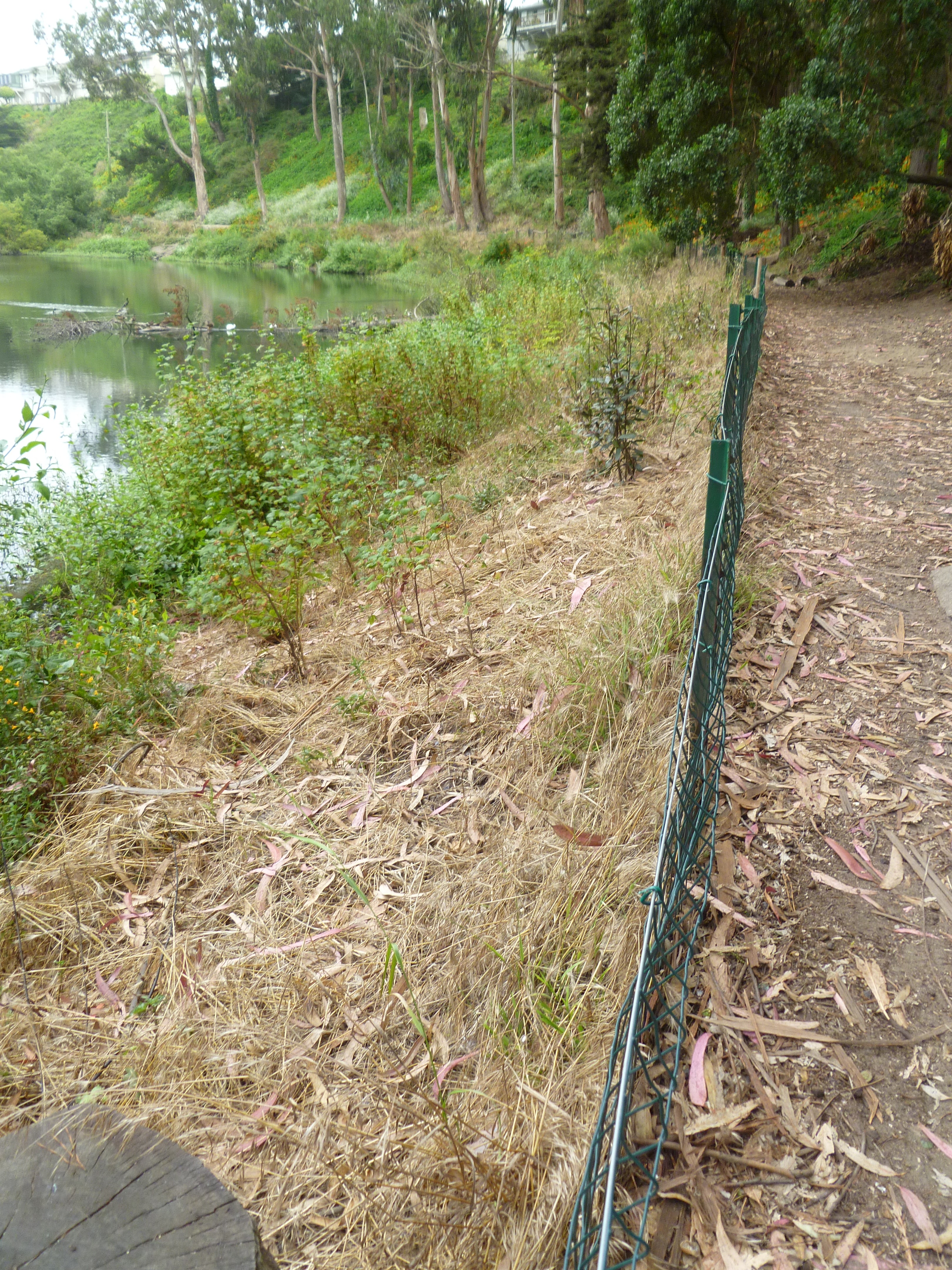
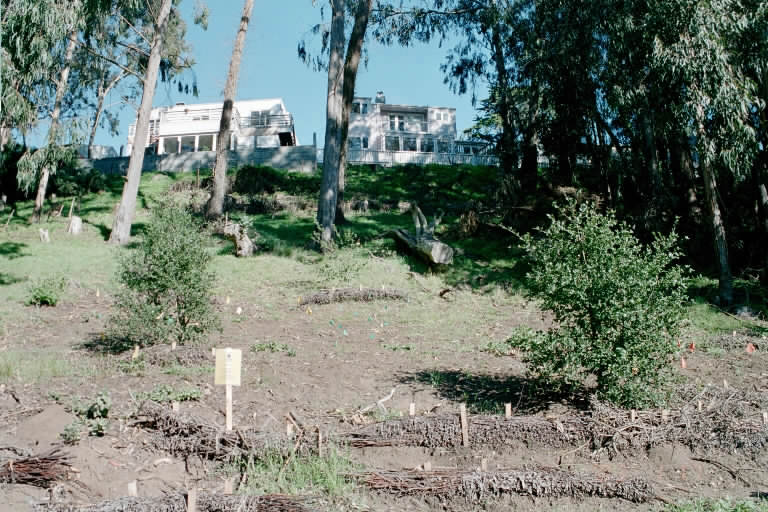
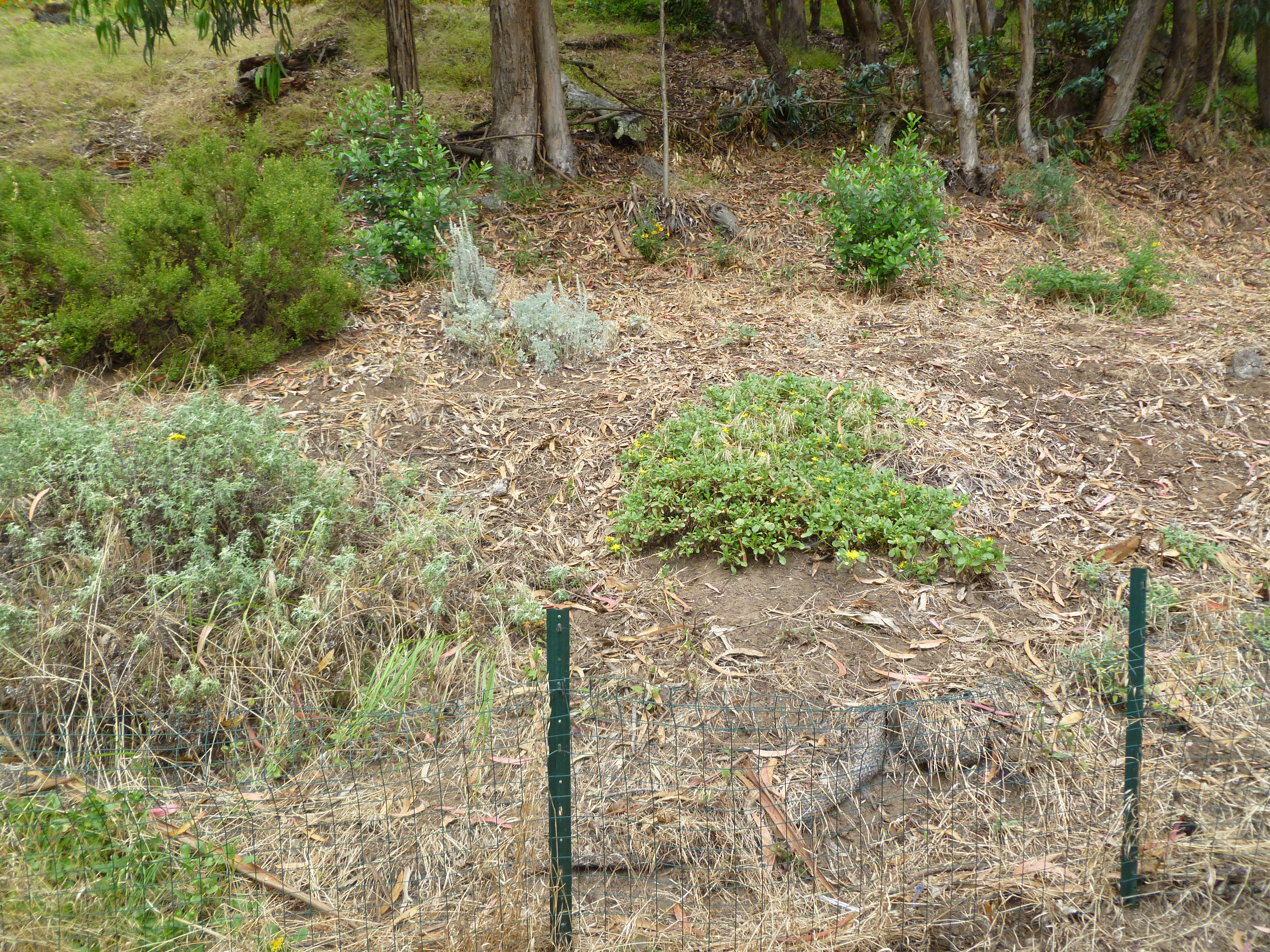
Park visitors who have been watching the restoration efforts of the Natural Areas Program for the past 15 years might be surprised that NAP apparently wishes to expand its restoration efforts. Repeated clearing of non-native plants and planting of native plants has been spectacularly unsuccessful. Here’s a photo history of the effort at Pine Lake in Stern Grove:
One of several clearing and plantings of south shore of Pine Lake, 2003The results, south shore of Pine Lake, 2011North shore of Pine Lake, 2003
Results, north shore Pine Lake, 2011
If NAP has been unable to successfully restore 58% of acres of natural areas (MA-1 and MA-2) they have been actively working on for the past 15 years, why would they want to expand their empire by adding MA-3 acreage to their agenda, committing them to actively restoring all 1,080 acres of natural areas? Aren’t they biting off more than they can chew?
Where will the money come from to fund this expanded effort?
Although NAP and its many supporters believe that this lack of success is because they haven’t been adequately funded, the NAP staff is one of the only divisions in the Recreation and Park Department that hasn’t been cut in the past 10 years. While other gardeners have been laid off, the NAP staff has remained the same size. How many gardeners will it take to expand their restoration efforts to the MA-3 areas as the EIR proposes? Remember that the MA-3 areas are 42% of the total NAP acreage. Will NAP be given a 42% increase in their staff? One wonders where the money for such an increase in staff would be taken from.
How much more herbicide will be used in this expanded effort?
Will a 42% increase in actively management NAP acreage require more herbicide use? The Natural Areas Program applied herbicides to the so-called “natural areas” 69 times in 2010. Most of those applications were of the most toxic herbicide (Garlon) for which the Natural Areas Program was granted exceptional permission to use by the Department of the Environment. How much more herbicide must be used by NAP if they actively manage the MA-3 areas? The EIR is curiously silent on this question.
Public Comment Opportunities
The public will have two opportunities to comment on the EIR and its “environmentally superior alternative” which will aggressively expand the restoration efforts of the Natural Areas Program, require more tree removals and recreational access restrictions, probably cost much more, and probably increase the use of herbicides.
“A public hearing on this Draft EIR and other matters has been scheduled by the City Planning Commission for October 6, 2011, in Room 400, City Hall, 1 Dr. Carlton B. Goodlett Place, beginning at 1:30 p.m. or later. (Call 558‐6422 the week of the hearing for a recorded message giving a more specific time.)”
“Public comments will be accepted from August 31, 2011 to 5:00 p.m. on October 17, 2011*. Written comments should be addressed to Bill Wycko, Environmental Review Officer, San Francisco Planning Department, 1650 Mission Street, Suite 400, San Francisco, CA 94103. Comments received at the public hearing and in writing will be responded to in a Summary of Comments and Responses document.”
“If you have any questions about the environmental review of the proposed project, please call Jessica Range at 415‐575‐9018.”
*[ETA: The deadline for written comments has been extended to October 31, 2011, at the request of the Planning Commission.]
If you have an opinion about the expansion of the Natural Areas Program proposed by the Environmental Impact Report you would be wise to speak/write now. It is your last opportunity to do so.
We recently published an article about the Berkeley Meadow, a 72-acre fenced pen for native plants and animals. In response, one of our readers alerted us to a video cartoon about the Berkeley Meadow which we recommend to you. “Grandpa Takes the Kids to the Plant Zoo” captures the absurdity of this “restoration” project.
The sentiments expressed by the children in this video remind us of an article published in 2004 about similar restoration projects in Chicago and San Francisco. “Urban Park Restoration and the ‘Museumification’ of Nature” was written by Dr. Paul Gobster after he visited the Bay Area as a visiting professor at UC Berkeley, collaborating with colleagues in landscape architecture.
Dr. Gobster is a social scientist with the US Forest Service, stationed in the Chicago area and the editor of a book* about the restoration movement there. The restorations in Chicago are similar to those in the San Francisco Bay Area because both places were primarily grassland prior to the arrival of Europeans. Restorations in both areas therefore require the destruction of most trees. In the Chicago area, many of the trees are native because of the natural succession of grassland to shrubland and finally to forest. The fires of Native Americans that sustained the grassland were stopped at the time of settlement.
In “Museumification,” Dr. Gobster expresses his opinion of the restorations in the San Francisco Bay Area and in Chicago:
“…it is my contention that little headway has been made in exploiting the key role urban parks might have in strengthening the ties between nature and culture. To the contrary, some current attempts at ecological restoration in urban parks may distance people from the experience of nature even further than did earlier naturalistic designs, leading to a form of detached observation not unlike what one might experience in a museum. Instead of providing a bridge between nature and the city…park restoration can lock nature inside the gates of paradise and leave people on the outside looking in.”
Dr. Gobster is particularly concerned about the impact of “museumification” of parks on children who should be the primary beneficiaries of our parks. Their earliest experiences with nature may foster a lifelong interest in nature or an alienation from it.
“The wild and weedy nature that existed in many of these urban park areas prior to restoration provided [a setting for unstructured play]…Now displaced by a more ecologically diverse yet more fragile nature, these kinds of activities are discouraged just as they are in more manicured park settings. Children are much less likely to attain satisfying nature experiences through passive forms of interaction and thus may be disproportionately affected by such changes. The result of this museumification is that we are creating a significant gap in the spectrum of nature experiences available to urban children precisely at the nearby places where children stand the best chances for getting acquainted with nature. Thus while striving to achieve authenticity in the restoration of ecosystems we may be sacrificing the authenticity of children’s nature experiences.”
Children discovering nature. NPS photo
In “Grandpa Takes the Kids to the Plant Zoo,” we see that the kids are uninterested in looking at the plants on the other side of the fence. They ask Grandpa to take them elsewhere so they can play. Grandpa must also ask them not to touch the few plants within reach because they have been sprayed with herbicides. The park is not accessible to the kids because it is behind a fence and it has also been sprayed with herbicides, so it’s not a safe place for them to play. In the East Bay Regional Park District, for example, herbicide use in its restoration projects (AKA “resource management”) increased 300% in 2009. Herbicides had not been sprayed in the Serpentine Prairie prior to 2009, when it was fenced for “restoration.” Now it is sprayed with herbicides, mowed, planted, and is due for periodic prescribed burns to prevent its succession to shrubs and subsequently to oak woodland.
When we alienate children from nature, we jeopardize the future of our parks. If parks are not viewed as useful places, they will not enjoy the support needed to sustain them. And if nature is not viewed as valuable, we undermine the public’s support for preservation of the environment. As adults debate the merits of native plant restorations, they should keep in mind the needs of children because the future of our public lands is in their hands and children are unable to speak for themselves in the public policy arena.
* Gobster & Hull, eds., Restoring Nature, Washington DC, Island Press, 2000
Thanks to Professor Gordon Frankie (UC Berkeley), we have learned a lot about the bees in the Bay Area. He has been studying our bees for over 20 years and has made a wealth of interesting information available on his website.
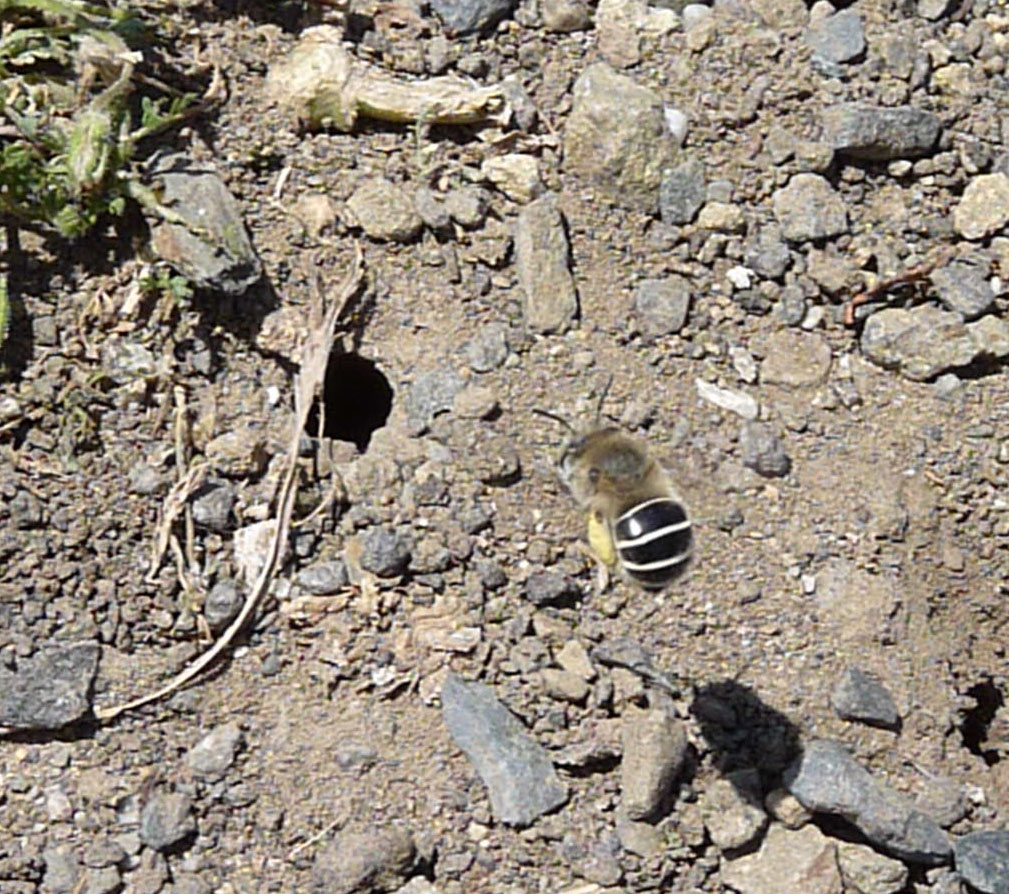
Native bee (Anthrophora urbana) approaching nest in ground at Albany Bulb
Unlike the European honeybee, our native bees are usually solitary. That is, they do not live in social colonies such as the hives of the European honeybee. Most (60-70%) California native bees live in small nests in the ground. Although they may produce enough honey to feed their own young, they don’t store an excess of honey like the honeybee.
Professor Frankie has identified one of the biggest challenges to native bees in urban gardens, “Mulch Madness.”
“[If] you happen to be one of the many ground-nesting bees that looks for garden sites for digging small tunnels where you will lay your eggs in individually-made brood cells that you will provision with pollen and some nectar, [you have a new problem in urban gardens]…Something has happened in recent years to those favored bare dirt sites that makes your task much harder and oftentimes impossible. MULCH MADNESS has arrived and has become a highly promoted ‘eco-friendly’ method for suppressing weeds, conserving water, and unknowingly discouraging ground-nesting bees!”
Anyone who is familiar with native plant restorations knows that most are covered in a thick layer of mulch. When tree removals are required for a restoration, the mulch is usually composed of the chips of the trees that have been cut down. The projects of UC Berkeley for which UC is applying for FEMA funding (based on its claim that the clear-cutting of all non-native trees will reduce fire hazards) say specifically that the clear-cut areas will be covered with 24 inches of mulch composed of the chips of the destroyed trees.
The UC Berkeley projects also claim that native vegetation will return to these clear-cut areas without being planted, based on an assumption that the seeds of native plants are dormant in the soil. One wonders how these seeds would be able to germinate when covered with 24 inches of mulch, or how the sprouts could penetrate it. Their proposal contains the fanciful suggestion that squirrels will plant the acorns of oaks in the mulch, which may be true of the oaks, but is an unlikely scenario for the many other native plants and trees which UC claims will populate their “restorations” without being planted.
Accommodating bees in native plant restorations
In the unlikely event that native plants would emerge from this tomb of mulch, they won’t find a population of bees to pollinate them in the future because bees will not be able to populate these projects: “bees will not dig through a thick layer of mulch.”Frankie suggests that “about 50% of your garden be left in bare dirt for the bees and other organisms.” Studies indicate that it will take between 10 and 15 years for 24 inches of mulch to decompose.
Native plant restorations also require the use of herbicides. A particularly toxic herbicide, Garlon, is used to kill the roots of the non-native trees after they have been cut down. If the stump isn’t sprayed with this herbicide immediately, the tree will resprout. The plans for the UC Berkeley projects say that retreatment with this herbicide is required twice per year for 10 years. Although insecticides are considered one of the primary reasons why bee populations are declining in the United States, less is known about the effect of herbicides on bees and other insects, because testing of these chemicals is minimal. Some scientists believe that all pesticides (both insecticides and herbicides) are more harmful to bees and other animals than we presently know.* Professor Frankie recommends against the use of all “synthetic chemicals” in a garden in which bees are welcome.
Would native plant restorations benefit from more bees?
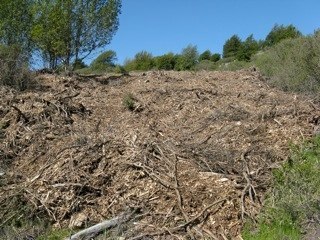
The restorations with which we are familiar in the San Francisco Bay Area are often unsuccessful. That is, they are not usually populated by native plants unless they have been intensively planted, weeded, and irrigated. Few managers of public lands have the resources for such intensive gardening. UC Berkeley has been clear-cutting non-native trees on its properties for about 10 years, so we can visit some of those areas to see the results of such projects. They are now weedy messes, as shown in this photograph.
Results of clear-cutting non-native trees, UC Berkeley project
The use of heavy mulches and herbicides in native plant restorations raises these questions: Would using less mulch and herbicide attract more bees? Would more bees benefit the native plants? Would restorations be more successful if they were more attractive places for bees? We don’t claim to know the answers to these questions. However, we don’t think that the managers of these projects know the answers either.
Would scientific methods produce more successful native plant restorations?
What the managers of these projects call “adaptive management,” we call “trial-and-error.” There is no science involved in these projects. Control areas are not set up to test questions such as “Will a more bee-friendly environment benefit our projects?” We think a more methodical approach to these efforts would be less wasteful and more successful. If we could see more success, perhaps we would be less opposed to what seems like the needless destruction of non-native trees. As it is, the consistently poor results do not justify the destruction that we witness.
* Schacker, Michael, A Spring without Bees, Lyons Press, Guilford, Connecticut, 2008.
“The draft ROSE talks about the benefits of open space for physical fitness through exercise and recreation, but these one can do on city streets and in gyms.”
– The Yodeler, June 29, 2011
In the same article, the Sierra Club redefines “recreation” as follows:
“…the draft [ROSE] neglects the values of respite, quiet contemplation, and undisturbed wildlife viewing… The document does not talk about the one thing that only parks can provide, the experience of nature.” Ibid.
In other words, in the opinion of the Sierra Club, public parks are for the benefit of plants and animals. The public is welcome to look at the plants and animals, so long as they do not disturb them in doing so. However, if the public seeks more active forms of recreation, such as playing ball, hiking, or riding a bike, the Club invites them to take to the streets or join a gym.
Having debated park issues with the leadership of the Sierra Club many times and observing their advocacy closely, we are well aware of their rather narrow view of the purpose of parks. However, we think it is unlikely that most Sierra Club members realize that their organization is actively trying to prevent all traditional forms of recreation in their parks. We therefore shine a bright light on the role that the Sierra Club plays in turning urban parks into native plant museums. In “Fortress Conservation: The loss of recreational access” we described three specific examples of parks in the San Francisco Bay Area in which recreational access has been restricted as the result of advocacy and lawsuits by the Sierra Club and other organizations which share their view.
“Active” vs “Passive” Recreation
We were originally introduced to the Sierra Club’s objectives for our urban parks in the Bay Area with the terms, “active” and “passive” recreation. The Sierra Club advocates for “passive” recreation, which it defined in its article about the ROSE as “respite, quiet contemplation, and undisturbed wildlife viewing.”
The Berkeley Meadow
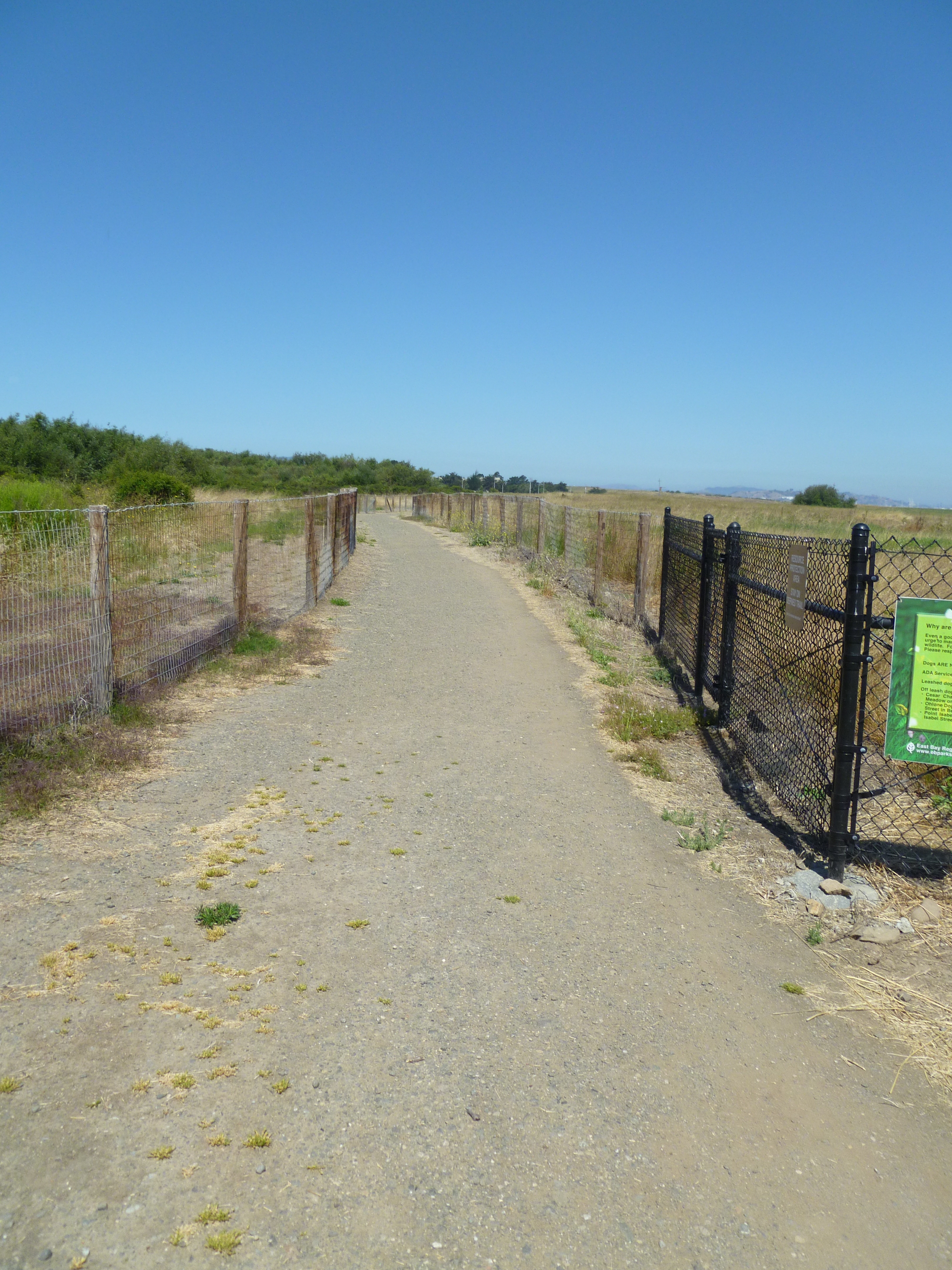
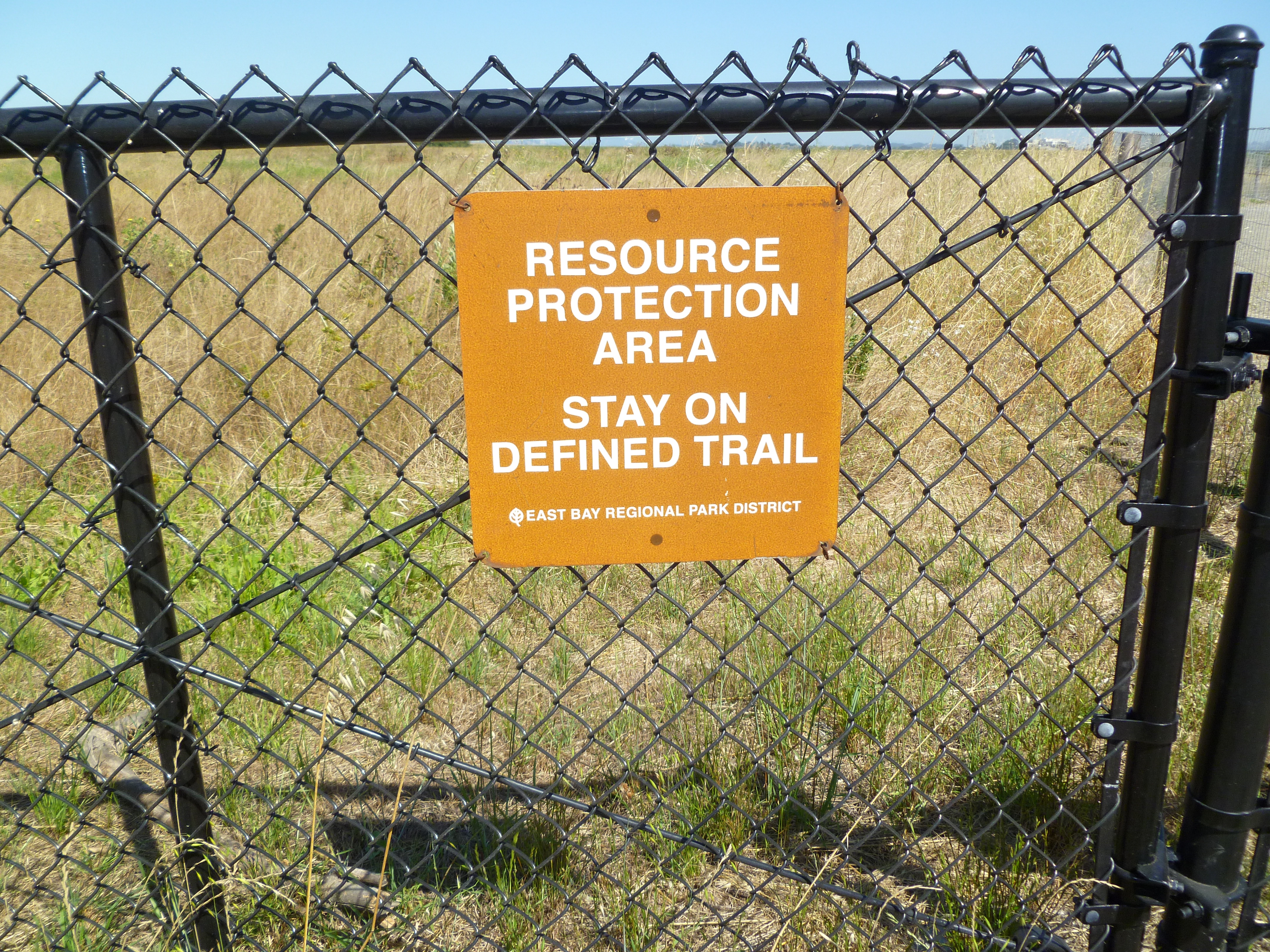
We visited a park today which is an example of what the Sierra Club has in mind. The 72-acre Berkeley Meadow at the foot of University Ave in Berkeley is one of many parks in the Bay Area that reflects the wishes of the Sierra Club. The Berkeley Meadow is part of the Eastshore State Park that is owned by the State of California, but operated by East Bay Regional Park District. The Berkeley Meadow was at one time part of the San Francisco Bay, until it was created with landfill and used as a city dump until the 1960s. The East Bay Regional Park District “restored” the meadow over a period of 5 years at a cost of $6 million. It is now a huge fenced pen with a fenced trail running diagonally through it. Bicycles and dogs on leash are both prohibited from using this fenced path. One wonders what harm could come to the plants and animals that reside on the other side of the fence. The meadow is predominantly non-native annual grassland, with willows in wetter portions of the meadow and some coyote bush scrub in the grassland. (see video cartoon about the Berkeley Meadow: “Grandpa takes the kids to the plant zoo.”)
The Berkeley Meadow
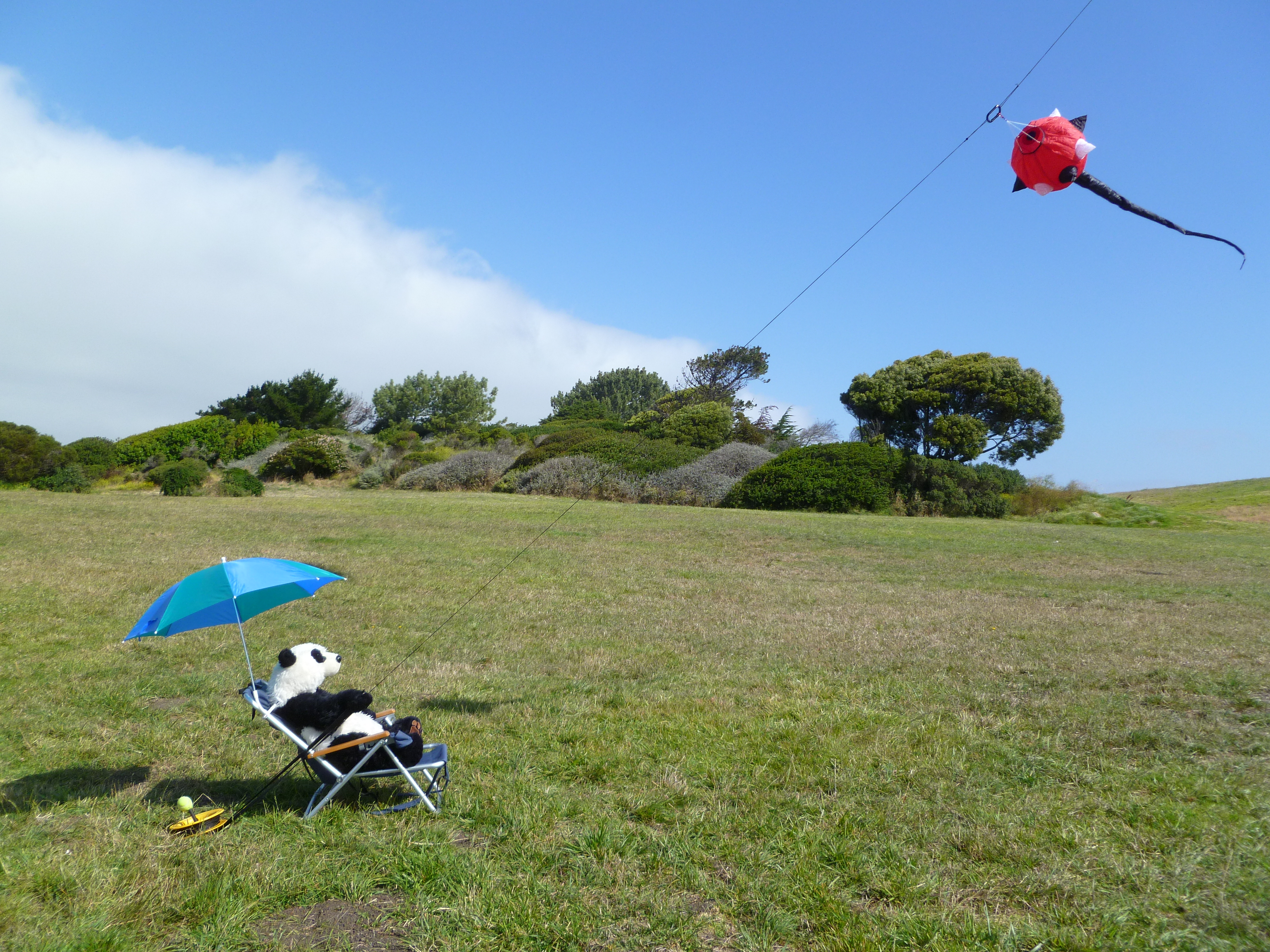
Cesar Chavez Park due west of the Berkeley Meadow provides a multiuse contrast. Cesar Chavez Park is a Berkeley city park, NOT a park owned by East Bay Regional Park District. This 90-acre park provides a wide variety of recreational opportunities, including a popular kite-flying area, an off-leash dog park, a restricted “natural area” (predominantly non-native plants), and a fenced area in which burrowing owls nest half of the year. The unfenced paths are used by bicycles, joggers, people walking, some with dogs on leash. Cesar Chavez is a successful park, enjoyed by a wide variety of visitors every day. The Sierra Club made every effort to prevent this multi-use park from accommodating all forms of “active” recreation.
Multiuse recreation at Cesar Chavez Park: a panda flying a kite
Environmentalism has been hijacked by extremists
Let us be perfectly clear about our opinion of “active” vs “passive” recreation. We do not object to parks such as the Berkeley Meadow in which human access is severely restricted. What we object to is that the Sierra Club wishes to turn all parks in the Bay Area into native plant and animal reserves in which humans are not welcome, except as passive observers. This is an example of the extremism that has earned environmentalists the reputation of being unreasonable.
In 2004, the authors of the controversial paper entitled, “Death of Environmentalism” reported that “The number of Americans who agreed that, ‘Most of the people actively involved in environmental groups are extremists, not reasonable people,’ leapt from 32 percent in 1996 to 41 percent in 2000.” Peter Kareiva, Chief Scientist of the Nature Conservancy, in his recent talk in San Francisco sponsored by the Long Now Foundation (a summary of this talk is available on the Save Sutro website), reported that over half of those surveyed in 2011 now agree that “environmental groups are extremists, not reasonable people.” This loss of support for environmentalism is a great tragedy, for there is much legitimate work to be done by environmental organizations which are now distracted by tangential issues such as creating native plant museums in our urban parks.
The goal of native plant restorations in the San Francisco Bay Area is to replicate the landscape prior to the arrival of Europeans. This strategy is based on the assumption that the landscape was not radically altered by Native Americans that lived in the Bay Area for approximately 13,000 years before Europeans arrived.
Though there were a few early explorers sailing along the coast of California, none were known to have entered the bay or set foot on the San Francisco peninsula until Don Gaspar Portolá in 1769. Portolá, a captain in the Spanish army, was appointed governor of Alta and Baja California and assigned the task of establishing colonies here.
When Portolá set out on that mission in 1769, his destination was Monterey, which had been described in “glowing terms” by an explorer 167 years earlier. Only because Portolá lost his way, did his party travel further north to stumble onto San Francisco Bay. When Portolá realized he had gone too far north, he sent his men ahead. They walked along Ocean Beach until they reached the Golden Gate, where they could see from the headland cliffs the entire panorama of San Francisco Bay in November 1769. (1)
This was not the destination Portolá was looking for. They quickly turned around and left. San Francisco was not occupied by Europeans until 1776 when the presidio (Spanish for “fort”) and mission were established. Ironically, the same year that America declared its independence from Britain on the East Coast, the West Coast was just being occupied by the Spanish.
The first European settlement on the East Coast was in Jamestown, Virginia in 1607, nearly 200 years earlier than the West Coast. Therefore the target landscape of native plant restorations on the East Coast is nearly 200 years earlier than those on the West Coast.
These pre-settlement dates are selected by native plant advocates as the “ideal landscape” based on their assumption that the population of Native Americans was small and their impact on the landscape minimal. However, many archaeologists have concluded that by the time of the first European settlement on the East Coast in 1607, the native population had been nearly eradicated by disease brought to them by the earliest European explorers over one hundred years earlier. This suggests that the landscape found in 1607 was in fact not the pristine landscape it is presumed to have been because the Native American population had been significantly larger than that which early settlers found when they arrived. (2)
Although there is less evidence of such early epidemics on the West Coast, archaeologists speculate that there may have been a similar decimation of the native population by disease introduced by early explorers before European settlement of the Bay Area in 1776.
We have an interest in what Bay Area landscape looked like in 1769/1776 because this is the landscape that native plant restorations are aiming for. The oldest surviving description of the San Francisco Bay is by a sailor into San Francisco Bay, Don José Canizares in August 1775. He described the East Bayas “broken hill country with very little woodland, bay trees and oaks here and there making up what there is.” He described San Pablo Bay as “bordered by rough hill country without trees except for woodlands in two coves to the southwest, the rest isbarren, irregular, and of melancholy aspect.” (3)
“Spanish establishment of San Francisco in New California” artist to von Langsdorff expedition, 1806. Bancroft Library
Other early visitors to San Francisco described the landscape they saw:
“…the sides of the hills, though but moderately elevated, seemed barren, or nearly so; and their summits were composed of naked uneven rocks.”
– George Vancouver, 1792
“…we rode onward to the Mision [sic]. The road thither is through loose sand, and is not good for either walking or riding. The surroundings are mostly bare, and the hills covered in places with low shrubs, afford but little of anything interesting.”
– George Heinrich von Langsdorff, 1806
“The fogs, which the prevailing sea-winds blow over the coast, dissolve in summer over a heated and parched soil, and the country exhibits in autumn only the prospect of bare scorched tracts, alternating with poor stunted bushes, and in places with dazzling wastes of drift sand.”
– Otto von Kotzebue, 1815
Yerba Buena (now San Francisco) in the Spring of 1837. First known print of San Francisco. Bancroft Library
“Beyond, to the westward of the landing-place, were dreary sand-hills, with little grass to be seen, and few trees, and beyond them higher hills, steep and barren, their sides gullied by the rains.”
– Richard Henry Dana, in Two Years Before the Mast, 1835
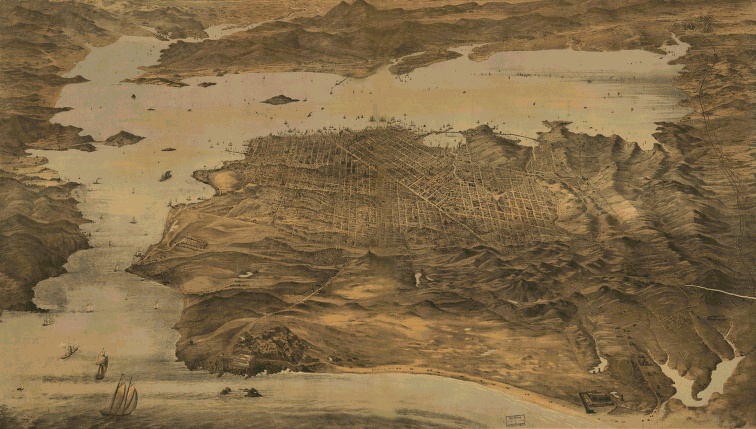
Bird’s eye view of San Francisco in 1868. US Library of Congress
These historical facts and observations of early visitors to the San Francisco Bay Area raise these questions in our minds:
Is there any historical or horticultural logic in selecting the landscape of 1769/1776 as the goal of native plant restorations?
Is the landscape of 1776 more aesthetically pleasing than the landscape of today?
Does the landscape of 1776 seem to be more “biodiverse” than the landscape of today?
How have conditions changed since 1776? How do air quality, climate, and soil conditions compare to those that existed at that time?
If growing conditions have changed significantly since then, can we expect the same plants to survive?
(1) Lewis, Oscar, San Francisco: Mission to Metropolis Howell-North Books, Berkeley, CA, 1966
(2) Mann, Charles, 1491: New Revelations of the Americas Before Columbus, Vintage Books, New York, 2005
(3) Cunningham, Laura, A State of Change: Forgotten Landscapes of California, Heydey Books, Berkeley, CA, 2010
Laura Cunningham’s book, A State of Change* is a remarkable achievement, reflecting a lifetime of observing nature, informed by formal training in paleontology and biology and finally depicting that knowledge in oil paintings of the historical ecology of California.
Ms. Cunningham introduces her theme with the title of her book. California is the state that changes and is always in a state of change. She acknowledges the physical forces of geology and climate as well as the biological interactions of plants and animals as she describes the dynamic qualities of nature. She treats the complexity of these interactions with respect, frequently declining to reach conclusions because of the speculation that would be required to do so.
Although we will touch on just a few themes of her book which are relevant to the mission of the Million Trees blog, we encourage readers to give this book the complete read it deserves.
Sustainability of native plant gardens
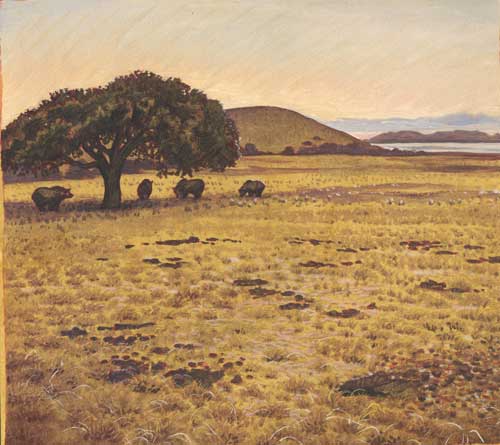
Site of the El Cerrito Plaza with the Albany Hill in the background, centuries ago. Oil painting by Laura Cunningham, with permission
Ms. Cunningham tells the charming story of her first experience with native plant restorations as a teenager in the hills of Berkeley/Richmond in the mid-1980s. With her parents’ permission, she dug up the lawn in their backyard so that she could plant native grassland. She started with the seeds of native grasses that she collected locally and later transplanted native bunch grasses from nearby properties slated for development. After several years of regular weeding and new planting, her small plot resembled the grassland she had envisioned.
When she finished her education at UC Berkeley and began to work further away, her grassland slowly succeeded to shrubs and non-native plants, a process she describes as follows:
“Visiting deer brought weed seeds in on their fur, scrub jays planted live oak seeds into the grass, and flying finches dropped the seeds of Himalayan blackberry in the yard. The latter, a thick, tenacious vine, slowly formed great thickets over the grasses, shading them out in places. The food web had won, although I had learned a lot in the process. I dug up the yard again, back to bare dirt, and gave it back to my parents.”
This personal story is consistent with other local experiences reported on the Million Trees blog:
In “Wildlife” we report the extensive use of non-native plants by wildlife, which then spread the seeds of the plants. This is another natural process that cannot be prevented.
Fire Ecology of California
Those who continue to believe that non-native plants are more flammable than native plants should read Ms. Cunningham’s book, which describes at length the important role that fire plays in California’s ecology. She introduces this topic with the heading, “Chaparral: Burning Like a Torch of Fat.” Charcoal deposits in ancient sediments prove that wildfires in California’s brushlands have occurred frequently for hundreds of thousands of years. Some shrubs, such as chamise, contain resinous leaves that encourage burning. Others, such as ceanothus and manzanita require the intense heat of a fire to germinate. Others will germinate only in the ashes of a fire. As we have said repeatedly on the Million Trees blog, eradicating non-native plants and trees will not eliminate fire from California.
Ms. Cunningham also reports on the modern debate about reducing wildfires in California. Although we are very familiar with this debate, we have not read so clear a presentation of it as Ms. Cunningham provides.
One “camp” in this debate believes that the suppression of wildfires in California has resulted in fuel loads that are much greater than in the past and therefore result in bigger, more damaging fires. This camp believes that fire danger can be reduced by allowing smaller fires to burn and conducting periodic prescribed burns.
The opposing view is that fire suppression has been largely unsuccessful and therefore fuel loads are not substantially greater than they were historically. Wildfires are attributed to hot, wind-driven fire in which fuel load is irrelevant; that is, everything will burn in a wind-driven fire. Although this is the historical fire regime, fires are causing more loss of lives and property in modern times only because of the development of residential communities in the wildland-urban interface. This camp therefore sees no point in prescribed burns and proposes to reduce risk to lives and property by limiting residential developments in wildlands and creating defensible space around residences by eliminating most vegetation.
With humility, Ms. Cunningham declines to choose a side in this debate, acknowledging there is much compelling evidence to support both views.
The Million Trees blog prefers the theory that wildfires are caused by hot winds rather than accumulated fuel loads because our perspective is limited to the San Francisco Bay Area. We don’t think prescribed burns are appropriate in a densely populated urban setting where both pollution and risk of wildfire are major concerns. And, based on our local experience, the only fires that have become raging wildfires are those that were wind-driven. We advocate for reducing fire hazards by creating defensible space and routine maintenance of flammable vegetation litter.
Historical Ecology
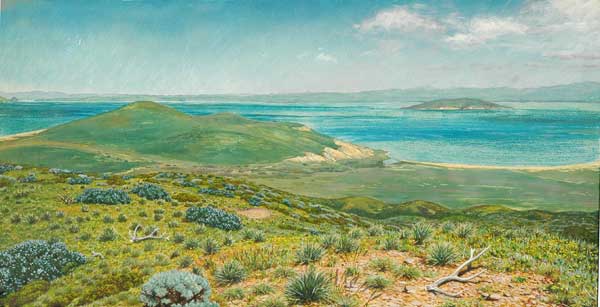
San Francisco 500 years ago, looking eastward from the top of Nob Hill. Oil painting by Laura Cunningham, with permission
We are grateful to Ms. Cunningham for giving us permission to publish two of her historical paintings of California. These paintings enable us to confirm that trees were not a conspicuous part of the landscape of the Bay Area. The dominant landscape was grassland and shrubs. Although there may have been more trees if the landscape had not been frequently burned by Native Americans, based on our knowledge of horticultural requirements of native trees, we believe that even in the absence of fire there would have been few trees. The native trees will not tolerate the wind on the hills of San Francisco. Even in places where trees are sheltered from the wind, they must have access to sufficient water to become established.
When native plant advocates demand that non-native trees be destroyed, they frequently claim that non-native trees will be replaced by native trees (even without being planted in some cases). We assume their claims are based either on strategy (i.e., promising “replacement” trees in order to diffuse the opposition of those who like trees) or on ignorance of California’s natural history.
With deep respect, we acknowledge Ms. Cunningham’s impressive knowledge of California’s ecological history and the accomplishment which her book represents. Our thanks to Ms. Cunningham for sharing her lifetime of study and observation of nature with us and rendering that knowledge so beautifully in her paintings.
* Cunningham, Laura, A State of Change: Forgotten Landscapes of California, Heydey Books, Berkeley, California, 2010
We have received many comments from native plant advocates regarding carbon storage. These comments defend projects in the Bay Area to destroy non-native forests and “restore” native plants by claiming that native plants will actually sequester more carbon than the forest that they propose to destroy. As always, we are grateful for comments that give us the opportunity to research the issues and report what we have learned about this complex and important subject.
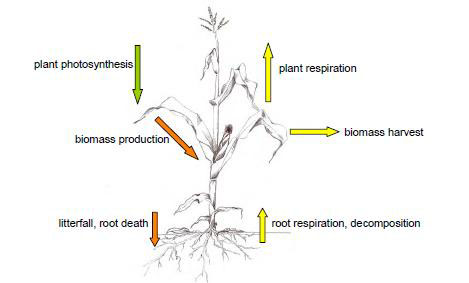
Carbon cycling in a terrestrial plant-soil system
The storage of carbon in plants and soil occurs as plants and soil exchange carbon dioxide (CO₂) with the atmosphere as a part of natural processes, as shown in the following diagram (1):
Green Arrow: CO₂ uptake by plants through photosynthesis
Orange Arrows: Incorporation of Carbon into biomass and Carbon inputs into soil from death of plant parts
Yellow Arrows: Carbon returns to the atmosphere through plant respiration and decomposition of litter and soil Carbon. Carbon in plant tissues ultimately returns to atmosphere during combustion or eventual decomposition.
Rates of carbon uptake and emissions are influenced by many factors, but most factors are related to temperature and precipitation:
Higher temperatures are associated with faster plant growth, which accelerates photosynthesis and carbon uptake.
Higher temperatures also accelerate decomposition of plant materials, thereby accelerating the return of stored carbon into the atmosphere.
The effect of moisture in the soil on decomposition can be graphed as a “hump.” In extremely dry soils, decomposition is slow because the organisms that decompose vegetation are under desiccation stress. Conditions for decomposition improve as moisture in the soil increases until the soil is very wet when lack of oxygen in the soil impedes decomposition.
Although temperature and precipitation are important factors in carbon storage, they don’t change appreciably when one type of vegetation is replaced with another. Therefore, these factors aren’t helpful in addressing the fundamental question we are considering in this post, which is “Does native vegetation store more carbon than the forests that presently occupy the land in question?”
Where is carbon stored?
Source: U.S. EPA, 2018
Much of the carbon stored in the forest is in the soil. It is therefore important to our analysis to determine if carbon stored in the soil in native vegetation is greater than that stored in non-native forests. The answer to that question is definitely NO! The carbon stored in the soil of native vegetation in Oakland, California is a fraction (5.7 kilograms of carbon per square meter of soil) of the carbon stored in residential soil (14.4 kilograms in per square meter of soil). (9) Residential soil is defined by this study as “residential grass, park use and grass, and clean fill.” This study (9) reports that the amount of carbon stored in the soil in Oakland is greater after urbanization than prior to urbanization because Oakland’s “wildland cover” is associated with “low SOC [soil organic carbon] densities characteristic of native soils in the region.”
Native plant advocates have also argued that the carbon stored in the soil of perennial native grasslands is greater than non-native trees because their roots are deeper. In fact, studies consistently inform us that most carbon is found in the top 10 centimeters of soil and almost none is found beyond a meter (100 centimeters) deep. (1, 4) In any case, we do not assume that the roots of perennial grasses are longer than the roots of a large tree.
Another argument that native plant advocates use to support their claim that native perennial grasslands store more carbon in the soil than non-native trees is that native grasses are long-lived and continue to add carbon to the soil throughout their lives. In fact, carbon stored in the soil reaches a steady state, i.e., it is not capable of storing additional carbon once it has reached its maximum capacity. (1)
It is pointless to theorize about why grassland soils should store more carbon than forest soils. The fact is they don’t. In all regions of the United States forest soils store more carbon than either grassland or shrubland soils. (9, Table 5)
We should also describe Oakland’s native vegetation before moving on: “Vegetation before urbanization in Oakland was dominated by grass, shrub, and marshlands that occupied approximately 98% of the area. Trees in riparian woodlands covered approximately 1.1% of Oakland’s preurbanized lands…” (5) In other words, native vegetation in Oakland is composed of shrub and grassland. When non-native forests are destroyed, they will not be replaced by native trees, especially in view of the fact that replanting is not planned for any of the “restoration” projects in the East Bay.
The total amount of carbon stored within the plant or tree is proportional to its biomass, both above ground (trunk, foliage, leaf litter, etc.) and below ground (roots). Since the grass and shrubs that are native to the Bay Area are a small fraction of the size of any tree, the carbon stored within native plants will not be as great as that stored in the trees that are being destroyed.
Whether we consider the carbon stored in soil or within the plant, the non-native forest contains more carbon than the shrub and grassland that is native to the Bay Area.
Converting forests to grassland
If we were starting with bare ground, it might be relevant to compare carbon sequestration in various types of vegetation, but we’re not. We’re talking about specific projects which will require the destruction of millions of non-native trees. Therefore, we must consider the loss of carbon associated with destroying those trees. It doesn’t matter what is planted after the destruction of those trees, nothing will compensate for that loss because of how the trees will be disposed of.
The fate of the wood in trees that are destroyed determines how much carbon is released into the atmosphere. For example, if the wood is used to build houses the loss of carbon is less than if the wood is allowed to decompose on the forest floor. And that is exactly what all the projects we are discussing propose to do: chip the wood from the trees and distribute it on the forest floor, also known as “mulching.” As the wood decomposes, the carbon stored in the wood is released into the atmosphere: “Two common tree disposal/utilization scenarios were modeled: 1) mulching and 2) landfill. Although no mulch decomposition studies could be found, studies on decomposition of tree roots and twigs reveal that 50% of the carbon is lost within the first 3 years. The remaining carbon is estimated to be lost within 20 years of mulching. Belowground biomass was modeled to decompose at the same rate as mulch regardless of how the aboveground biomass was disposed” (8)
Furthermore, the process of removing trees releases stored carbon into the atmosphere, regardless of the fate of the destroyed trees: “Even in forests harvested for long-term storage wood, more than 50% of the harvested biomass is released to the atmosphere in a short period after harvest.” (1)
Will thinning trees result in greater carbon storage?
Native plant advocates claim that thinning the non-native forest will result in improved forest health and therefore greater carbon storage. In fact, the more open canopy of an urban forest with less tree density results in greater growth rates. (3) Although more rapid growth is associated with greater rates of carbon sequestration, rates of storage have little effect on the net carbon storage over the life of the tree. (6) Net carbon storage over the life of the tree is determined by how long the species lives and how big the tree is at maturity. These characteristics are inherent in the species of tree and are little influenced by forest management practices such as thinning. (6)
More importantly, even if there were some small increase in carbon storage of individual trees associated with thinning, this increase would be swamped by the fact that over 90% of the urban forest will be destroyed by the proposed projects we are evaluating in the East Bay. The projects of UC Berkeley and the City of Oakland propose to destroy all non-native trees in the project areas. The project of the East Bay Regional Park District proposes to destroy all non-native trees in some areas and thin in other areas from 25 to 35 feet between each tree, reducing tree density per acre by at least 90%. No amount of “forest health” will compensate for the loss of carbon of that magnitude.
Responding to native plant advocates
The vegetation that is native to the Bay Area does not store more carbon above or below the ground than the non-native forest.
Chipping the trees that are destroyed and distributing the chips on the ground will not prevent the release of carbon from the trees that are destroyed.
Thinning the trees in our public lands will not increase the capacity of the trees that remain to store carbon.
————————————————————————————————–
Bibliography
Anderson, J., et. al., “The Potential for Terrestrial Carbon Sequestration in Minnesota, A Report to the Department of Natural Resources from the Minnesota Terrestrial Carbon Sequestration Initiative, February 2008.
Birdsey, Richard, “Carbon storage and accumulation in United States Forest Ecosystems,” USDA Forest Service, General Technical Report WO-59, 1992
Environmental Protection Agency, “Inventory of U.S. Greenhouse Gas Emissions and Sinks: 1990-2008,” April 15, 2010., EPA 430-R-10-006
Fissore, C., et.al., “Limited potential for terrestrial carbon sequestration to offset fossil-fuel emissions in the upper Midwestern US,” Frontiers in Ecology and the Environment, 2009, 10.1890/090059
Nowak, David, “Historical vegetation change in Oakland and its implication for urban forest management,” Journal of Arboriculture, 19(5): September 1993
Nowak, David, “Atmospheric Carbon Reduction by Urban Trees,” Journal of Environmental Management, (1993) 37, 207-217
Nowak, David. Crane, Daniel, “Carbon storage and sequestration by urban trees in the U.S.A.,” Environmental Pollution, 116 (2002) 381-389
Nowak, David, et.al., “Effects of urban tree management and species selection on atmospheric carbon dioxide,” Journal of Arboriculture 28(3) May 2002
Pouyat, R.V. (US Forest Service)., et.al., “Carbon Storage by Urban Soils in the United States,” Journal of Environmental Quality, 35:1566-1575 (2006)
The Sunday New York Times of April 3rd published an op ed in defense of non-native plants. In “Mother Nature’s Melting Pot” Professor Hugh Raffles (New School) reminds us that our country was built by immigrants. Despite our origins, we also have a long tradition of opposition to immigration. As each generation becomes established, it wishes to pull up the welcome carpet to new immigrants. During times of economic crisis this anti-immigration sentiment is particularly strong.
Professor Raffles notes the extension of this anti-immigration sentiment to non-native plants and animals. Just as immigrants have contributed to the dynamism and creativity of our society, non-native plants are contributing to our natural world as, “They arrive unannounced, encounter unfamiliar conditions and proceed to remake each other and their surroundings.” (1)
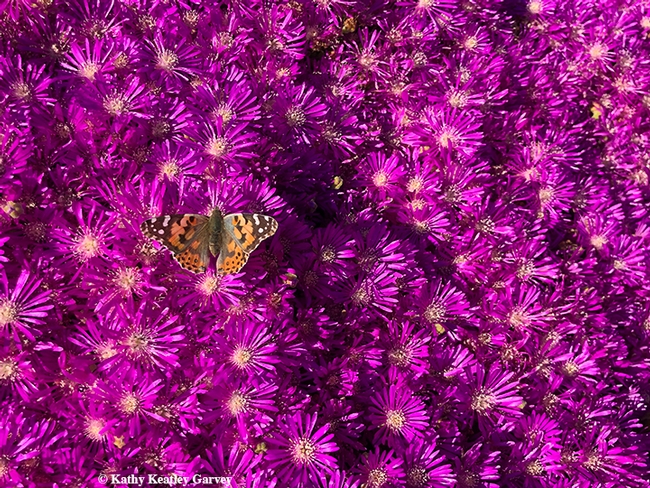
He provides many examples of non-native plants and animals that benefit both humans and native animals, including several examples that are locally relevant. He reminds us that the eucalyptus is a rare source of winter nectar for the honeybees that were imported in the 1600s and now pollinate about one-third of our food crops. He also reminds us that ice plant can stabilize sandy soils that might otherwise inundate our roads and neighborhoods as they shift in the wind.
Painted Lady butterfly on ice plant. Bug Squad, UC Davis
He notes that attempts to eradicate non-native plants and animals are often futile once the species become firmly established and that attempts to do so often harm the environment. Here in the San Francisco Bay Area we are acutely aware of the harm being done by attempts to eradicate non-native plants. We witness hundreds of thousands of healthy, mature trees being needlessly destroyed. We see acres of park land being sprayed with toxic herbicides. We watch precious recreational space being fenced off for “restorations” in places that are completely artificial, yet also entirely natural in the sense that they are sustained without being actively gardened.
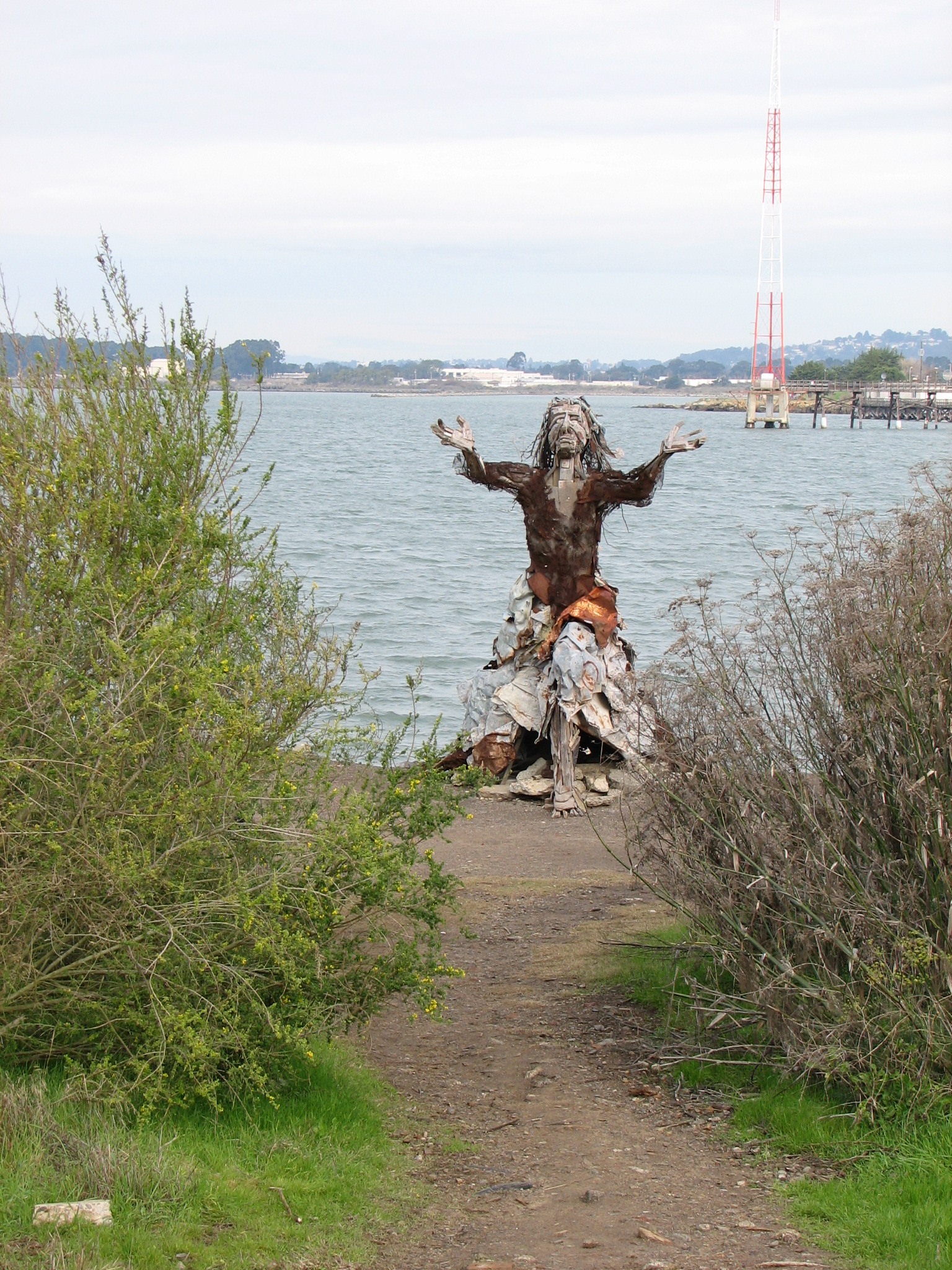
The most recent example is the announcement that the Albany Bulb (in Albany, CA) will soon be transformed into a native plant garden. The Albany Bulb is composed of landfill that was used for decades as a city dump and is now a heavily used park, populated by art created from the junk that remains from the dump. Non-native plants and trees thrive there without any care. It is pointless to destroy this valuable artistic and recreational resource, yet native plant advocates demand its “restoration.”
Sculpture of “Albany Bulb Greeter”
Professor Raffles makes the logical connection between anti-immigration sentiment and the native plant movement’s commitment to the eradication of non-native plants and animals. This connection is relevant in the Bay Area because a prominent leader of the native plant movement here is strongly opposed to immigration.
Jake Sigg has been an officer in the local chapter of the California Native Plant Society for many years. He was a gardener in San Francisco’s Recreation and Park Department for 31 years. He was awarded the “Jake Sigg Award for Vision and Dedicated Service” by the California Invasive Plant Council in 2003. This award was named for him, “For years of tireless service and leadership on invasive plant issues in California.”
For many years, Mr. Sigg has published a “Nature News” newsletter several times each week. This newsletter is widely distributed throughout the Bay Area and is a valuable source of information about nature-related activities. It is also Mr. Sigg’s podium from which he expresses his opinion on a range of topics. In most issues, he expresses his deep concern about immigration, both legal and illegal.
“Virtually All Of California’s Problems Can Be Traced Back To Too Many People…Virtually All Of California’s Population Growth In The Last 10 Years Was Due To Immigration…If We Don’t Do Something About Immigration, Our Problems Will Get Much Worse.” April 2, 2011, Nature News
He is equally concerned about related issues such as granting visas to workers with unique skills and granting citizenship to children born to undocumented immigrants.
“The Ever Expanding Pool of Cheap Labor and the Case For Fewer Visas By Joe Guzzardi” January 25, 2011, Nature News
“Current U.S. policy results in over 300,000 additional citizens from anchor babies each year. The demographic impact is far greater because their families stay and bring in additional relatives. Anchor babies are eligible to sponsor their illegal alien parents and other relatives when they turn 21. Moreover, taxpayers pick up the tab for the medical costs and subsequent welfare outlays because of the child’s citizenship status. ACTION NEEDED Please ask your Congressional representative to co-sponsor HR 140.” January 13, 2011, Nature News
And so, we conclude that Professor Raffles is not making an idle philosophical connection between the native plant movement and anti-immigration sentiment. There IS a connection because we see it discussed repeatedly by a prominent voice in the community of native plant advocates. Occasionally, one of Mr. Sigg’s allies challenges his opinion on this subject. However, such a debate is apparently rare in his community of interests.
We thank Professor Raffles for making explicit what is implicit in the native plant movement. We believe that the connection between the eradication of non-native plants and animals and opposition to immigration should be acknowledged and discussed. The desire to be rid of immigrants—both plants and animals, including humans—is grounded in a need to find someone or something to blame for problems that we are unprepared to face or are powerless to change.
In the case of human immigration, our living standards are declining primarily because of the globalization of the economy. Building a wall around our country will not isolate us from the fact that developing countries with lower standards of living are presently more economically competitive.
Likewise, eradicating non-native plants and animals will not prevent the climate change and associated changes in air and water quality that make those newcomers more competitive than the natives that thrived in a different environment, one that is gone and is unlikely to return. In fact, the destruction of healthy, mature non-native trees is exacerbating the climate change that will ultimately exterminate many species of native plants and animals.(2)
(1) Hugh Raffles, “Mother Nature’s Melting Pot,” New York Times, April 3, 2011
(2) “Multitude of Species Face Threat of Warming,” New York Times, April 4, 2011
We were first introduced to the native plant movement about 12 years ago when we began to notice that trees were being destroyed in our parks in San Francisco, but we couldn’t comprehend the scale of the project until we were finally successful in getting access to the first draft of the management plan for the Natural Areas Program in San Francisco. Frankly, we were appalled by the planned destruction and restrictions on recreational access outlined in those plans.
Hoping to understand the motivation for a project that didn’t make sense to us, we began to read about the native plant movement. The first book we read was about “restoration” efforts in Chicago(1) which began in the late 1970s and apparently is one of the first projects in the country, influencing all others. We were immediately struck by the similarities between our experiences in the Bay Area with those in Chicago.
The pre-settlement landscape was arbitrarily selected for replication in both places, despite an acknowledgement that the prairie and oak savannah were artificially maintained by frequent fires used by Native Americans. Man had prevented the natural succession of grassland to shrubs and ultimately to forest.(2)
“Restorationists” in both places were essentially hobbyists, using trial-and-error strategies that rejected scientific methods of controlled experiments as too slow for their urgent mission. The phrase “adaptive management” was adopted in San Francisco to describe these unscientific strategies.
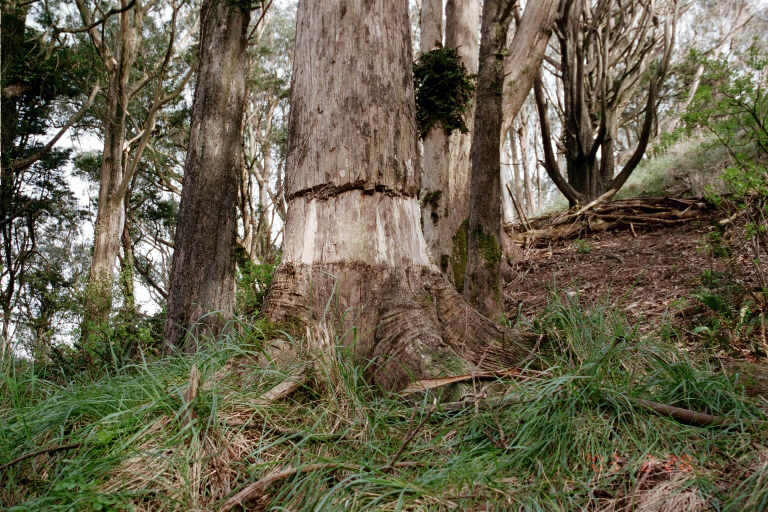
Stealth methods were used in both places to hide controversial practices from the public.(3) Trees (in Chicago, both native and non-native trees) were girdled to kill them and the scars hidden from view. In Chicago, all activities (broadcast and brush pile burns, herbicide use, etc) were conducted behind visual screens. In San Francisco, volunteers use herbicides they are not authorized to use.
Girdled tree, San Francisco
In both cases, “restorationists” developed a sense of ownership of the land that denied alternate views or even the authority of the theoretically official managers of the land. As one of the local leaders said in a public hearing in San Francisco, “We know what to do and we want you to leave us alone to do what needs to be done.”
In Chicago and in the Bay Area, the criticisms of these “restorations” are also similar:
We do not want to destroy healthy trees whether native or non-native
We do not want to use toxic herbicides
We do not want to pollute our air or take the unnecessary risks associated with prescribed burns
We do not want to kill animals whether they are native or non-native
We value the landscape that exists and we do not consider a landscape that is exclusively native superior to it. We have an inclusive view of nature, based on an acknowledgement of its dynamic quality. We reject the arbitrary division of nature into “good” and “bad.”
We believe that our public lands are owned by everyone, not just those who choose to volunteer in them
Ten years ago, we were encouraged to learn that the critics of the Chicago “restorations” were successful in getting a moratorium in 1996 on destruction in the areas being contested. The moratorium was theoretically for the purpose of negotiating a compromise between “restorationists” and their critics.
When we were recently contacted by restoration critics in Chicago, we weren’t at all surprised to learn that the effort to reach agreement had failed. The moratorium was lifted in most places in 1999 with the exception of a small, contested area where the moratorium was lifted in 2006. We weren’t surprised because although we have participated in many efforts to negotiate with “restorationists” we have found that they are unwilling to compromise.
Every scrap of park land originally claimed as a “natural area” in San Francisco is still under the jurisdiction of the so-called “Natural Areas Program.” Nearly 15 years after the inception of the Natural Areas Program, there is still no environmental impact review, yet herbicide use continues unabated and trees are destroyed when funds are found to pay for their removal. And in the East Bay, grant funding of restoration projects has been delayed for over 5 years because project managers will not budge from their demand to clear-cut all non-native trees.
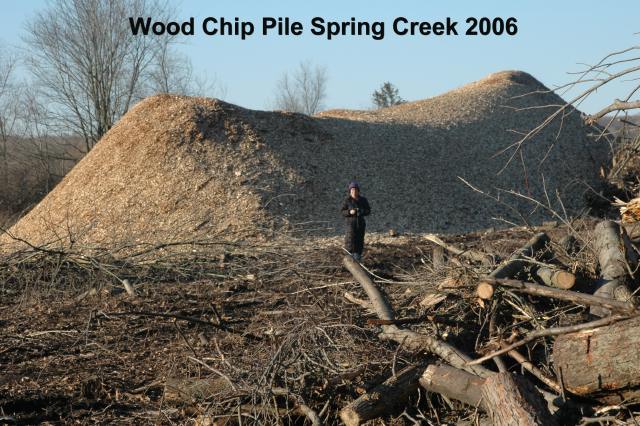
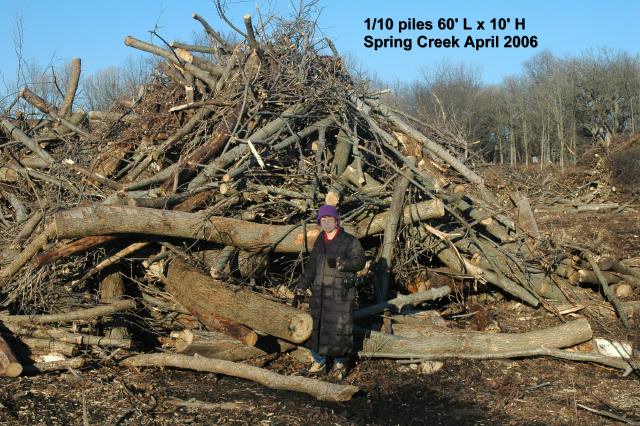
Here are photos of the consequences of the “restoration” effort in Chicago:
Photos courtesy Natural Forest Advocates, Chicago
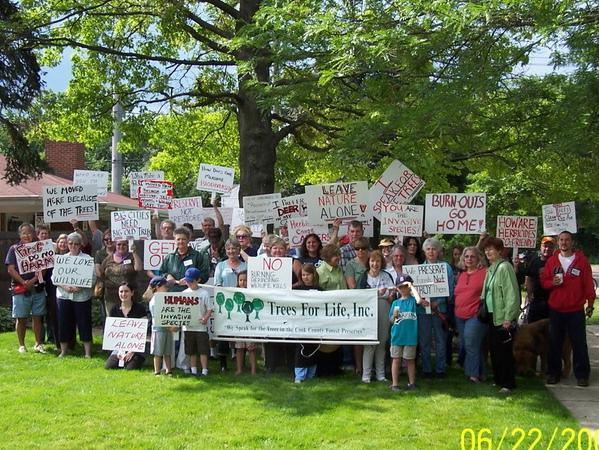
And here is a photo of one of the efforts to bring shame onto the destruction:
Since this photo was taken, the managers of public land have quit announcing prescribed burns and work days in advance, hoping to prevent crowds such as this from gathering in protest. Keeping their eyes and ears open, the critics gather as quickly as they can when they learn of a burn or a work day.
We hope you will visit their website and sign their petition to encourage them in their challenging task.
We are dedicated to preserving our public lands for the benefit of the animals that live in them and the humans who enjoy them. We will use every means available to us to prevent as much destruction as we can. We impatiently wait for science to catch up with our effort to bring this destructive movement to a halt by educating the public about the futility of trying to destroy deeply entrenched non-native species, the damage that is done in that futile effort, the value of a diverse ecology composed of both native and non-native plants and animals, and the changes in the environment that inevitably result in a changed landscape.
(1) Restoring Nature, editors P. Gobster and B. Hull, Island Press, 2000
(2) Miracle Under the Oaks: the revival of nature in America, William K. Stevens, Pocket Books, 1995

 Conservation Sense and Nonsense