Over 10 years ago, Mark Speyer wrote one of the first guest articles for Conservation Sense and Nonsense about mulberry trees, one native to North America and the other introduced by American colonists because it is the host plant of silk worms. That article was a hit! It has been viewed by over 8,600 readers. It is still entirely relevant to the mission of Conservation Sense and Nonsense and I recommend it to you. You will find it HERE.
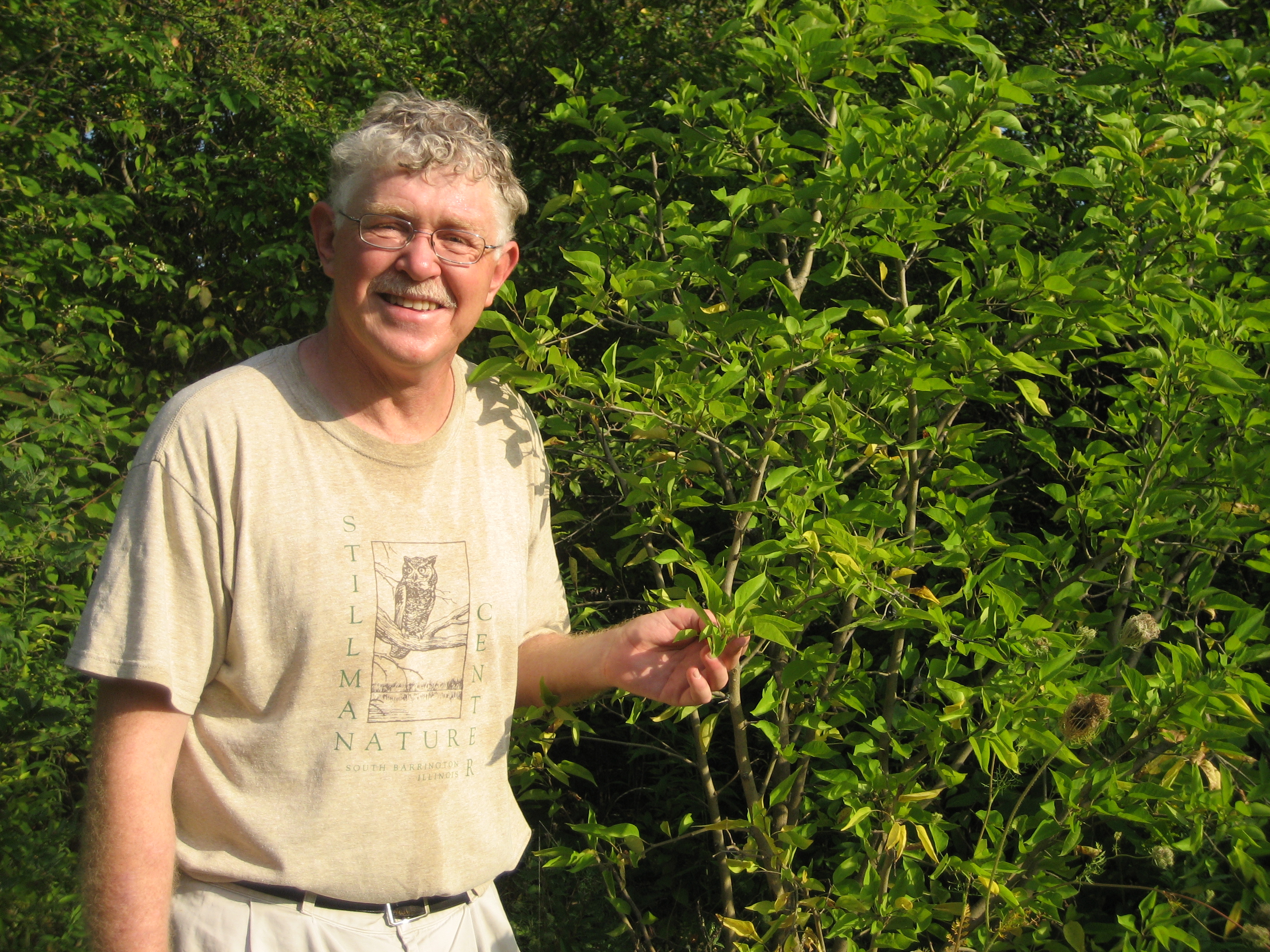
Mark Spreyer
I am grateful to Mark for giving me this opportunity to publish his guest article about willows, some native to North America and one introduced. As in the case of introduced mulberry trees, some willow species are native to China.
Much of China and North America have been in the same latitude since the evolution of angiosperms. As a result of climate similarity and geographic proximity, many of our plant species considered native in Eastern North America are also native to China. These paired species in the same genus are called disjuncts. There are many woody disjuncts in China and North America (magnolias, persimmons, hickory, catalpa, dogwood, sweetgum, tuliptree, tupelo, sassafras, Virginia creeper, etc) as well as many herbaceous disjuncts (ginseng, lopseed, mayapple, skunk cabbage, etc.).
They are different species from their Chinese counterparts because they have been separated long enough to change as a result of genetic drift and in response to a new environment, but are in the same genus and plant lineage and therefore chemically similar. These plant species made their way from China to North America by natural means, such as being carried by birds, animals, wind and ocean currents.
In contrast, Chinese species of mulberries and willows were intentionally introduced to North America. Mulberries were brought with the hope of making silk and weeping willows were brought to grace our gardens with their beauty. Some say they don’t belong here because they were brought by humans. Others say that is a meaningless distinction. Whether brought by birds or brought by humans it is a distinction without a difference because humans are as much a part of nature as birds.
I’ve been writing nature columns for many years and I hope to write them for years to come but sometimes, the writing doesn’t come easy. The other evening, was one of those difficult times.
As I reached for a bottle of aspirin to alleviate a headache, it hit me– willows.
You see the scientific name for the willow genus is Salix and the main ingredient in the original 1899 aspirin was salicin, an extract from willows.
I’m not going to attempt to sort through the dozens of North American willows and their confusing hybrids. I don’t have enough aspirin for that. I’d like to concentrate on two of the willow trees, weeping and black, as well as a few of the willow shrubs.
Weeping Willow (Salix babylonica)
Unlike black willows, weeping willows aren’t native to this continent. The scientific name is somewhat misleading. This species originates from northern China, not the Middle East. Examples of Salix babylonica can be found growing along the famed Silk Road trade routes between China and Europe. The weeping willow arrived in Europe around 1730. It traveled to N. America courtesy of colonization. The weeping willow also landed on the W. Coast via Japan.
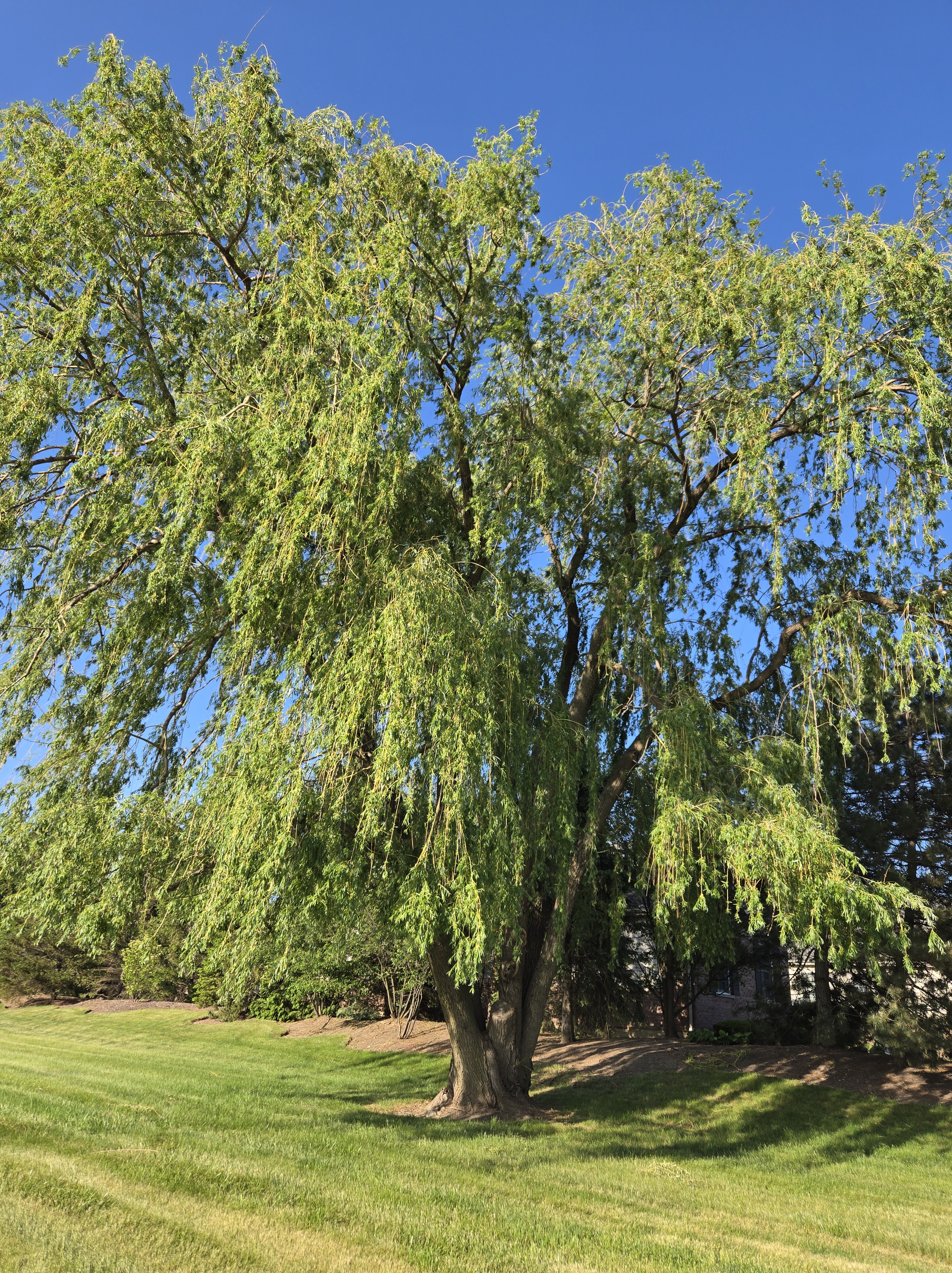
Weeping willow along a highway in suburban Chicago. Photo by Susan Allman
Its graceful, long, slender, drooping branches makes the weeping willow an easy tree to identify. This pendulous growth habit earned this willow its common name. Not surprisingly, the tree is a popular choice for landscapers and gardeners. It is also the choice of pollinators such as specialized bees and butterflies. If planted in full sun, this rapid grower can reach a height of sixty feet.
In addition, weeping willow tolerates soils that are somewhat acidic to alkaline. Finally, it thrives in low areas and wet spots where other trees might drown. Decades ago, my father and I planted two weeping willows in a sunny wet pocket on the property. They grew fast and sucked up the water, just as we had hoped. You see they are designed to do just that.
Like all willows, weeping willows are easily started from a sprig. Just stick it in some water and watch the rootlets sprout. When you think of where willows grow– along rivers, streams and other places prone to flooding– this asexual method of reproduction is a handy adaptation.
If a flood washes away a bank and the willow that grew on it, odds are one of its branches will end up on a spit of mud or in a shallow pool downstream. With the passage of time, that branch will take root and a new willow will be on its way.
In this country, most weeping willows are male clones and thus produce no fruit. Since reproduction for a willow is as easy as dropping a twig in running water, these clones can be found growing where no human planted them.
Black Willow (Salix nigra)
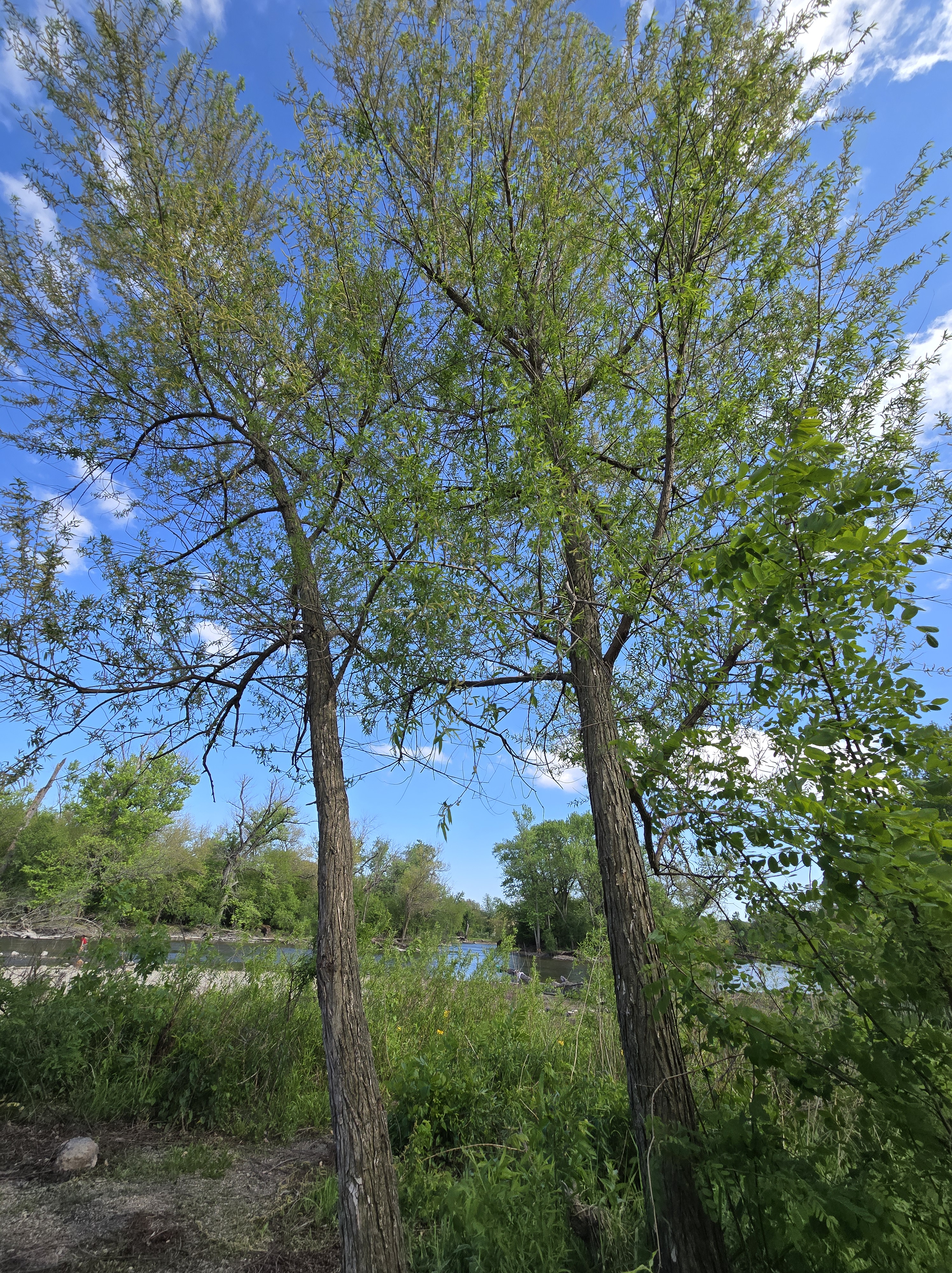
Rather plant a native species? Then, this next tree is for you. While some may appreciate the graceful form of a weeping willow, give me the craggy old coot of the willow family, the black willow. One of the world’s largest willows, it varies in appearance with where it is growing. Along an eastern seaboard stream, it is a tree reaching a height of forty to fifty feet. In the southern reaches of the Mississippi River’s floodplain, a black willow can reach a height of 100 feet in a mere forty years.
Two black willows near the Fox River in northern Illinois. Photo by Susan Allman.
Here at the Stillman Nature Center we had a couple of sprawling specimens of our own. They had large forks, beginning low down, each fork leaned outward giving the tree a “slouching picturesqueness” as Donald Culross Peattie wrote.
Black willow has many alternate names such as American, brittle, and, a favorite of mine, scythe-leaved willow. I like it because the botanical term for willows’ long narrow leaves is lanceolate or lance-shaped. Lances and scythes belong together, don’t you think?
Brittle is another appropriate name. Its slender reddish-brown twigs are flexible at first. As they age, the twigs become darker and brittle at the base. Anyone who has sat at a picnic table or parked a boat under a large black willow, will soon find these items decorated with fallen black willow twigs.
Unfortunately, willows are short-lived, rarely living past 85. But, as I’ve watched our willows here at Stillman, I have some questions about that figure.
For example, one of our largest black willows came down in a heap some years ago. After the chainsaws were done, all that was left was the short, thick trunk and a few feet of each main branch that the trunk divided into.
Was the tree dead? Not quite. As the years passed, flexible yellow branches grew from one of the large “dead” arms. Nutrients and water were obviously flowing from the roots and through the tissues of this “goner.”
So when is a tree dead? A newspaper story provided an answer that fits our willows. The article was about the fate of a sequoia. At the time, the tree was at least 2,500 years old, “We don’t know if it’s dying or not,” said an interpretive ranger at Sequoia National Park, “One branch with green leaves connected by live tissue to one root is all that’s needed for a tree to be considered alive.”
Of course, the Sequoia’s trunk remained standing unlike our willow’s old trunk that was down and decomposing.
Shrubby Willows
Most willows don’t have large trunks since they exist as shrubs. This is not the place to sort through them all. A partial list would include goat, Bebb, narrowleaf, sandbar, and, the florists’ favorite, pussy willow.
Pussy willow in spring. Photo by Lara Sviatko.
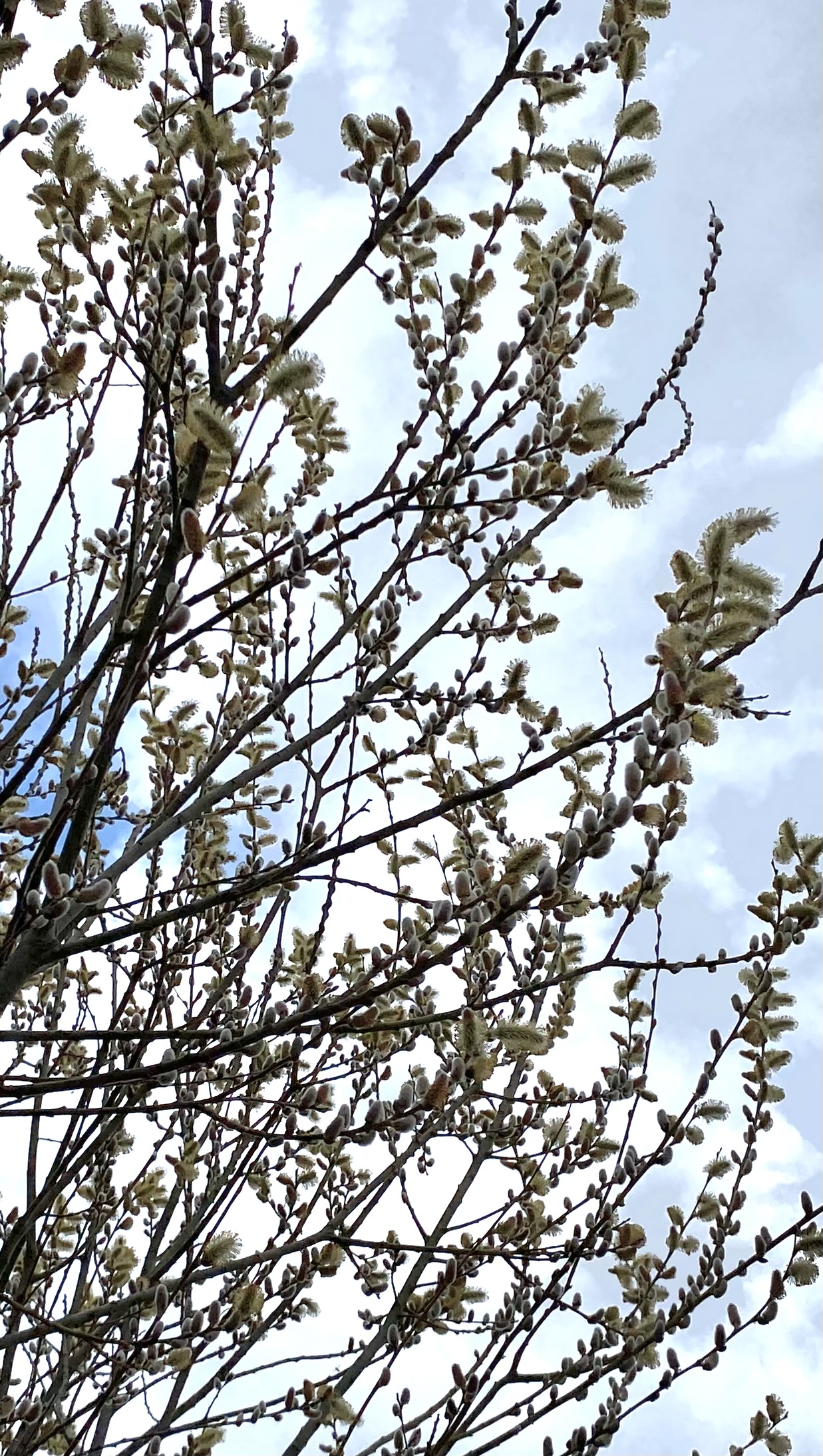
The native pussy willow (Salix discolor) is a boreal species that can occasionally be found growing in northeastern Illinois. As you might have guessed, it inhabits wet areas such as floodplain forests, marshes, and shrubby swamps.
Because willow thickets are within reach, deer, elk and domestic livestock will feed on willow leaves and twigs. This brings me back to where I started. Peoples from N. America to ancient Greece made teas and other medicines from willow bark to treat joint pain and other ailments. So, are animals eating willows just to fill their stomachs or to ease their aches and pains as well? The next time I run into a talkative deer, I’ll ask.
“Life finds a way, if given a chance.” – The Light Eaters
The Light Eaters was written by Zoë Schlanger, a science journalist who covered climate change before writing Light Eaters. (1) She explains her pivot to botanical science as a retreat from the oppressive gloom of climate change. It proved a wise choice, as she found much to cheer us in the remarkable capabilities of plants to adapt to challenges, defend themselves against their predators and competitors, and collaborate with their plant and animal neighbors.
Ms. Schlanger believes that botanical research has lagged behind other biological inquiry partly because of a detour unwisely taken by journalists in the 1960s and 70s that projected human traits onto plants, such as intelligence and consciousness. Humanizing animals and plants is considered a dangerous source of bias by scientists. When scientists described plant behavior in human terms, they were often ridiculed by their colleagues and their research projects weren’t funded. Researchers of the capabilities of plants have been trained to avoid anthropomorphic terms to describe plant behavior. Although Ms. Schlanger tried to observe that rule, I will give myself more leeway because most of my readers are not scientists.
Plants don’t have the mobility that enables them to fly or run away from threats. We might think of them as handicapped compared to the mobility of animals. But what they lack in mobility, they more than make up for with their ability to make they own food from sunlight by photosynthesizing. And with the energy that sunlight provides, plants can create the food—such as pollen, nectar, and fruit—that entices insects and other animals to help them reproduce. So how do plants protect themselves without fleeing from their predators? That’s what Light Eaters is about.
I don’t know the source of this photo. It was sent to me in an email by someone who found it on Facebook.
How do plants perceive threats and react to them?
Plants can sense that they are being attacked by an insect in a variety of ways. They can sense the vibration of the chewing, which is closely related to how animals hear. The attack can also trigger an electrical impulse which can travel throughout the entire plant.
Plants emit chemicals in response to the attack on their leaves and roots. The chemicals can repel the insect by making the plant unpalatable. In a sense, the plant is producing its own pesticide, which has the potential to replace synthetic pesticides.
The chemicals are also wafted into the air to serve as warning signals to their plant neighbors, who can then produce their own chemicals in preparation for attack. Some plants can distinguish between an attack that threatens individuals and those that threaten the entire community. They can tailor their warning messages accordingly, to send messages only to their relatives or to the entire plant community. When plants are sprayed with herbicides, these chemical messages are masked by herbicides. (2) Likewise, pollution can also muddle the chemical messages of plants and reduce their ability to perceive and respond to threats. (3)
Plants sometimes demonstrate a preference for their relatives in other functions as well. They can make room for the roots of close by relatives and move branches to avoid shading their relatives. They can also vary these accommodations depending on available resources, making room when there is plenty of water, nutrients, and light, but not when there’s not enough.
Such warning signals can also be sent via the underground root network, which connects plants in a community to one another through the network of mycorrhizal fungi that attach themselves to plant roots. That network is also used by the community of plants to share resources, such as moisture and carbohydrates produced by photosynthesis. The fungal network enables both communication and sharing of resources. Herbicides that are carried to the roots of trees damage the fungal network, depriving trees of the nutrients they need to survive. (4) The widespread use of these herbicides by native plant “restorations” is one of many reasons why these projects rarely result in new landscapes of native plants.
Can plants hear?
One of the first discoveries of the ability of plants to find what they need is the ability of tree roots to grow in the direction of water sources. Mycorrhizal fungi attached to the roots of plants are clearly involved in guiding that connection. Over 450 million years ago, the evolution of fungi enabled plants to move from water to land by delivering moisture from soil to roots of plants, greatly increasing abundance and diversity of plants. About 80% of plants today receive much of their nutrients and moisture through mycorrhizal fungi. (5)
Now there is evidence that plants may also be able to hear the sound of water to direct the growth of roots. The researcher who made that discovery encased the roots of a plant in plastic pipe so that the roots could not sense the availability of moisture. The plastic pipe formed a “Y” to give the roots the option of growing in one direction or the other. The researcher played a recording of running water at the end of one pipe. The roots grew in the direction of the recording of running water. This is still a controversial discovery, because other researchers have found it difficult to replicate.
The replication of breakthrough scientific discoveries is one of the ways that science moves forward. It is a not a reliable method of confirming or rejecting a new discovery because there are always many variables operating simultaneously that are difficult to control, particularly in field studies, and researchers have rarely identified all the variables involved in the phenomenon they are observing.
The academic career of David Rhoades is an example of the dangers of being too far ahead of your academic colleagues and a reminder of the conservatism inherent in academic science. Rhoades was a chemist at University of Washington and the author of a study that made the first report of warning signals that plants under attack send to their neighbors via volatile chemicals in the atmosphere.
The forest on Rhoades’ campus was being killed by tent caterpillars. He studied the spread of the caterpillars until the insect infestation was stopped by the chemicals that the unaffected trees infused into their leaves. The chemicals killed the caterpillars and the spread of the insect in the forest was stopped. Backed by a mountain of carefully accumulated data, Rhoades concluded: “This suggests that the results may be due to airborne pheromonal substances!”
Rhoades was met with resistance to this new information from his colleagues. Then he had trouble replicating his original study. When his grant applications were rejected, he gave up. He left academia and taught chemistry in a local community college to make a living. Years later, other researchers figured out why he was unable to replicate his original study. The airborne chemicals that trees produce are seasonal. Rhoades’ original study was done in the spring and Rhoades was trying to replicate the study in the fall. The scientists who eventually confirmed Rhoades’ finding did so in the laboratory where conditions are easier to control.
Plants collaborate with animals to protect themselves and reproduce
The Light Eaters reports many remarkable observations of interactions of plants and animals. Here is a sampling of these stories:
If bumblebees emerge from hibernation before plants begin to bloom, the hungry bee bites the plant’s leaves to trigger the bloom that delivers the nectar the bees need.
Plants must use their limited resources to make pollen and nectar. Some plants can ration the delivery of the pollen and nectar that attracts their pollinators by timing the delivery with the anticipated arrival of the pollinator. The plant estimates the time of arrival of the insects based on its memory of past visits.
Bats find the plants they pollinate by using echolocation sonar to locate them in the dark. Some plants that are pollinated by bats have evolved saucer-like petals that act like a satellite dish to receive the sonar ping to help bats find them.
Some corn, cotton, tomato and tobacco plants can emit chemical distress signals to summon tiny parasitic wasps to kill caterpillars such as tobacco budworm and corn ear worm.
Many orchids are pollinated by wasps. Some orchids attract wasps by mimicking the chemical pheromones of the female wasp. The orchid is pollinated by the attempt of the male wasp to mate with what he supposes is a female wasp.
Some plants form partnerships with ants by secreting a sugary substance that feeds the ants, who eat the insect predators of the plant.
Can plants see?
The observation that plants are capable of mimicking animals and other plants is not new. In the early 1900s, a Russian agronomist observed that weeds in food crops have sometimes mimicked the food crop and thereby evaded the hand-weeding that was the method used by farmers to eliminate competition for their crop. Rye, oats, and lentils were initially considered weeds of wheat and rice. Over time, they evolved the seed heads that qualified them as food crops.
More recently, weeds that are killed by herbicides within crops that have been genetically modified to be resistant to the herbicide have engaged in mimicry at the biochemical level to also become resistant to the herbicide. Those who engage in chemical warfare against plants do not seem to understand that it’s a war they can’t win because evolution will enable plants to develop resistance to their poison.
Like many of the remarkable capabilities of plants, scientists can observe the phenomenon, but they are rarely able to explain the mechanism that makes it possible, beyond the evolutionary force of natural selection, which achieves a better adapted plant or animal through a series of mutations and genetic and epigenetic drift. Each change in the species is a trial balloon. If the change works, it’s a keeper. If it doesn’t, it’s in the dustbin with some 99% of the estimated 5 billion species that have lived on Earth. The dominant evolutionary force is random, irrepressible, complex change. The notion that humans are capable of stopping evolution is absurd.
In 2014, a Peruvian ecologist discovered a vine in the Chilean rain forest that is capable of quickly taking on the shape of almost any plant that it grows beside. Nicknamed the chameleon plant, many tests proved that the vine can mimic many different species of plants. Presumably this mimicry enables the vine to become invisible in the sense that it blends in with whatever plants it grows amongst. It’s a disguise, if you will, that protects the plant from its predators.
The chameleon vine is able to mimic plants that are native to their locations as well as plants that are foreign to the region. In other words, mimicry is not the result of a long evolutionary co-existence. This finding is another blow to the nativist myth that plant and insect associations are the result of co-evolution that makes insects dependent on native plants. The associations between plants and insects evolved long before the plants and insects moved into new regions. Plants and insects retain that association as they change in response to their new environment and as the result of mutations and genetic drift.
Until recently, there was a debate among scientists about how the chameleon plant morphs itself into an entirely different shape. One school of thought speculates that plants have an organ that performs much like our eyes. Another school of thought is that horizontal gene transfer (6) from the bacteria inhabiting the plant being copied to the plant doing the copying achieves this transformation.
A study (7) published in 2022 seems to support the hypothesis that some plants have some type of organ that functions like our eyes. The study found that the chameleon vine was capable of mimicking an artificial leaf. The plastic leaf contains no chemicals or bacteria.
In conclusion
The Light Eaters reports many other capabilities of plants that aren’t covered in this article. If it’s a topic of interest to you, the book is well worth reading. It’s well researched and well written. It is also thoughtful because it asks us to ponder the philosophical question of whether or not this new(ish) knowledge of plants adds up to intelligence, consciousness, and agency. Ms. Schlanger dodges that question by reminding us that there is not consensus agreement about what any of those descriptions actually mean.
Now we must add a few caveats that we hope will put this important topic into perspective:
Not every plant species has all of the capabilities described in The Light Eaters.
Those that do have such capabilities may not consistently use them because every plant is responding to a specific environment in a specific place. Plants are inseparable from their environment. A plant that has plenty of water and plenty of light behaves differently than plants with less resources. Sweeping generalizations about plants are usually ridiculous. For example, it makes no sense to claim that native berries are more nutritious than non-native berries. (8)
Plants have the potential to develop such capabilities, depending on their specific circumstances.
Without a brain or a nervous system, plants seem to organize a response to stimuli by functioning as a decentralized network.
The Light Eaters says as much about science as it does about plants. There are fads in science, just as there are fads in every human endeavor. Presently, much scientific investigation of botanical phenomenon is focused on genetics, which has misled the public to underestimate the plasticity of plants and animals. In fact, the genome of a species is a flexible repertoire, with many genes unexpressed until triggered by a change in the environment in which the plant lives. For many characteristics of species, the environment is a more powerful influence than genes.
Science is better at observing than it is at explaining. Explaining requires speculation and academic science studiously avoids speculation. The reader of scientific studies is often left in a quandary. Conclusions are often a contradictory list of maybes with a plea for funding for further investigations. That’s one of many reasons why science journalism is important to the general public’s understanding of scientific issues. Ms. Schlanger goes out on a limb for us by speaking in comprehensible terms that many scientists refuse to use. Thank you, Ms. Schlanger, for helping the public understand the plant world.
Shortly before publishing this article and after I had drafted my article, I received the following review of The Light Eaters from Arthur M. Shapiro, Professor Emeritus of Ecology and Evolution, UC Davis. He has given permission to add his review to my article. – Conservation Sense and Nonsense
“Elizabeth Kolbert has a collective review of Schlanger and two other, similar books–“The Nation of Plants” by Gregory Conti and “Planta Sapiens” by Calso and Lawrence–in the new NY Review of Books (Oct.3). Her review is only lightly snarky because it’s clear she doesn’t know quite what to make of the “plant neurobiology” fad.
“When I read Schlanger (I haven’t read the others) I dug back into my library to find my copy of “The Secret Life of Plants” by Peter Tompkins and Christopher Bird (1973). I doubt that Kolbert realizes that the current fad is a rerun of the 70s! Unlike Schlanger and perhaps the others reviewed by Kolbert, Tompkins and Bird is packed with overt woo-woo and makes little attempt to be “science-based.” The frank woo-woo is very 70s. But the underlying motivation for both waves is the same: philosophical panpsychism, the notion that consciousness is ubiquitous in Nature.
“There is nothing in the actual data discussed by Schlanger that obliges one to embrace panpsychism. The main reason to do so is that one WANTS to. That is, for some (many?) people it is very reassuring to believe that at least the biosphere, if not the entire universe, is sentient. (This has resonances with the Gaia Hypothesis.) This notion is an integral part of a number of cultural cosmologies, of which the most familiar to most Americans is probably Native American, broadly speaking. In the 70s many hippies embraced the Native American notions of “tree people,” “stone people,” etc. Some still do.
“Remember that I have taught community ecology for some 50 years, with an emphasis on coevolution. Things like inducible anti-herbivore defenses (chemical or morphological) and communicable defensive messages (plant pheromones, if you will) come as no surprise. Rather, they are predictable consequences of natural selection: if something can evolve, it probably will. There is no logical necessity to invoke intelligence or consciousness to account for them. If you want to, go right ahead. But don’t call it science!
“I have never had a chance to pull up a mandrake plant. In the Middle Ages it was widely believed that if you did it would shriek, and the sound if heard would drive one mad. Thus one must cover one’s ears when doing so. Now, that is framed as a testable hypothesis!
“Are you familiar with the walking fern? If not, Google it. I am very fond of it, but never for a moment would I claim it has the property of wanderlust.“
Arthur M. Shapiro, Professor Emeritus of Ecology and Evolution, UC Davis
Zoë Schlanger, The Light Eaters: How the Unseen World of Plant Intelligence Offers a New Understanding of Life on Earth, Harper Collins, 2024. The Light Eaters is the source of information in this article unless otherwise noted.
Behrend*, J.E., & A.L. Rypstra (2018) Contact with a glyphosate-based herbicide has long-term effects on activity and foraging of an agrobiont wolf spider. Chemosphere 194:714-721 doi: 10.1016/j.chemosphere.2017.12.038


 Conservation Sense and Nonsense