Sierra Club: Puppetmaster of Destruction

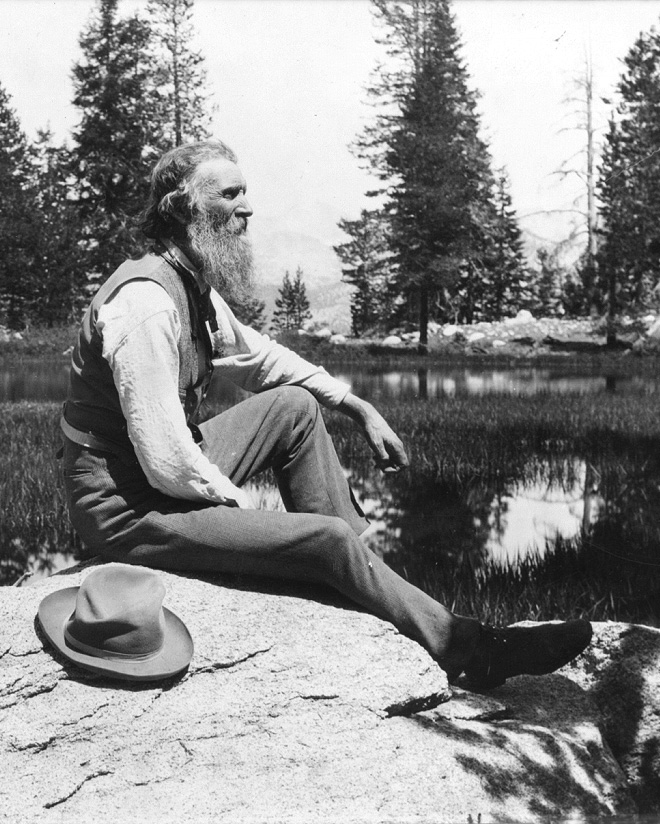
John Muir is the founder of the Sierra Club. He would disgusted by the Club's advocacy for deforestation. He planted eucalyptus trees on his property in Martinez. He was as fond of eucalyptus as those who fight for their preservation.
John Muir is the founder of the Sierra Club. He would be disgusted by the Club’s advocacy for deforestation. He planted eucalyptus trees on his property in Martinez. He was as fond of eucalyptus as those who fight for their preservation.

We are grateful to Marg Hall, member of the Forest Action Brigade for this guest post about the role the Sierra Club is playing in the destruction of our urban forest and the poisoning of our public lands.


For the past year, members of the Forest Action Brigade have been spotlighting the Sierra Club as part of a larger campaign to stop the destruction of the trees in the East Bay Hills. This article answers the question: “Why focus on the Sierra Club?”

Long associated with environmental stewardship, the Sierra Club is a major player in local politics. Because so many Bay Area residents prioritize environmental protection, the Sierra Club enjoys lots of political capital, a ton of money, a deep bench of litigators, and the respect and fear of local politicians. They also have an entrenched leadership that pretends to be democratic, but in fact pushes around grass roots environmentalists, suppresses internal debate and dictates to local land managers.

As readers of Million Trees well know, the SF Bay Chapter of the Sierra Club supports deforestation and the use of pesticides in the East Bay Hills. Some of us have concluded that they not only support this project, but are a major behind-the-scenes driver.

I first heard about the Club’s support for local deforestation about 6 years ago at a FEMA scoping hearing for the project Environmental Impact Statement.  Naïve me, I thought, “Oh good! the Sierra Club is here, and certainly they will weigh in on the right side of this issue.”   This is where my education began. The speaker representing the Sierra Club explained that they support this project and of course they will use pesticides, because that’s the only way to rid our parks of unwanted vegetation.  Wow! Pesticides?  “Unwanted plants”?

Until then, I had been a Club member for a number of years, thinking that the Sierra Club did good things. Before voting in our very complicated local elections, I’d check to see who and what they endorsed.  I supported bond measure CC (which the EBRPD uses in part to fund their eucalyptus tree removal) back in 2004 because, well, what could be wrong with increasing funding for the East Bay Regional Parks District (EBRPD)? Nowhere in the ballot measure did they mention pesticides.  And as a former building inspector, the “fire hazard” reduction part sounded good. I thought the discussion in favor of native plants meant not planting English style lawns or plants in your garden that need lots of water. That sounded reasonable for a water scarce region.

Like so many of my neighbors, I’m neither a botanist nor a wildlife biologist, but I love the local parks and visit them almost daily.  I trusted the Sierra Club to “protect” the environment. I suspect a lot of folks do the same.  Now, after delving deeply into this local issue, I know better.  The local Sierra Club has a fanatical obsession with eradication, with waging a war on non-native plants in our local parks. This agenda drives much of their work. Many voters follow their lead, basing decisions in the voting booth on blind faith. Politicians go along with the Sierra Club agenda in order to gain Club endorsement.  Land managers must follow the lead of their elected bosses.  All one needs to do is invoke the label “non-native,” and weapons of war are deployed: ground troops of weed pullers, tree cutters, pesticide sprayers, imported “biologics” (bugs and germs), and even, on occasion, aerial bombardment of pesticides. Other mainstream environmental organizations (The World Wildlife Fund, Audubon Society) also participate in this war, but it’s the local Sierra Club that provides the propaganda and the political clout behind this horrible deforestation plan. It’s the Sierra Club that sits down on a regular basis with the managers of the East Bay Regional Park District to dictate the terms under which they must operate.  And when the EBRPD fails to fall in line, the Sierra club pulled out the big guns and sued in an attempt to force them to cut down all of the eucalyptus trees in the project areas, rather than a “thinning” plan that EBRPD preferred.

Here’s an example of the kind of hold that the Sierra Club has over the EBRPD.  Through a public records request, we obtained a letter (dated April 28, 2015) to the parks district governing board from Norman LaForce, long time Chairperson of the Sierra Club’s Public Lands Committee. The letter laid out in great detail the kind of compliance he expects in order for the EBRPD to obtain Sierra Club endorsement of Measure CC renewal (which expires in 2020).  Mr LaForce is perhaps the single most influential person promoting the local club’s nativist agenda. (emphasis added)

“The Sierra Club played a major and key role in the creation of Measure CC and the projects for which money would be spent….

“…Vegetation management that restores native habitat is less costly than programs that merely thin non-natives.  Native habitat that is restored in the fire prone areas that are currently eucalyptus plantations is less costly to maintain on an annual basis than a program of thinning non-native eucalyptus and other non-native trees.

“Hence, the Sierra Club believes it is critical that in any renewal of Measure CC funding for vegetation management should be increased for the removal of non-natives such as eucalyptus and their replacement with restored native habitat. If the Park District wants to continue with a program that merely thins the non-native ecualyputs (sic) and other non-ntaive (sic) trees, then it must find other funds for those purposes. Future tax money from a renewal of Measure CC funds should not be used to thin eucalyptus but must be allocated to the restoration of native habitat.”

The letter goes on to detail the Sierra Club’s position on a variety of other issues and projects, most of which involve “restoration”, which sounds good, but is a code word for removal of non-native plants by any means necessary, including the use of herbicides. Here’s a link to the complete letter:  Sierra Club dictates terms of Measure CC endorsement

I want to it make clear that we are environmentalists.  We support some of the same goals as the Sierra Club: opposition to XL pipeline, fracking, refinery expansion, use of coal, environmental racism.  We are not right wing climate deniers—one of the arguments Sierra Club uses to marginalize us.  The Sierra Club is on the wrong side of this issue and we want them to stop bullying local officials into this war against trees. John Muir, who loved eucalyptus trees, would weep at this travesty.

Marg Hall, Forest Action Brigade

Site 29: A preview of the implementation of FEMA grants in the East Bay Hills

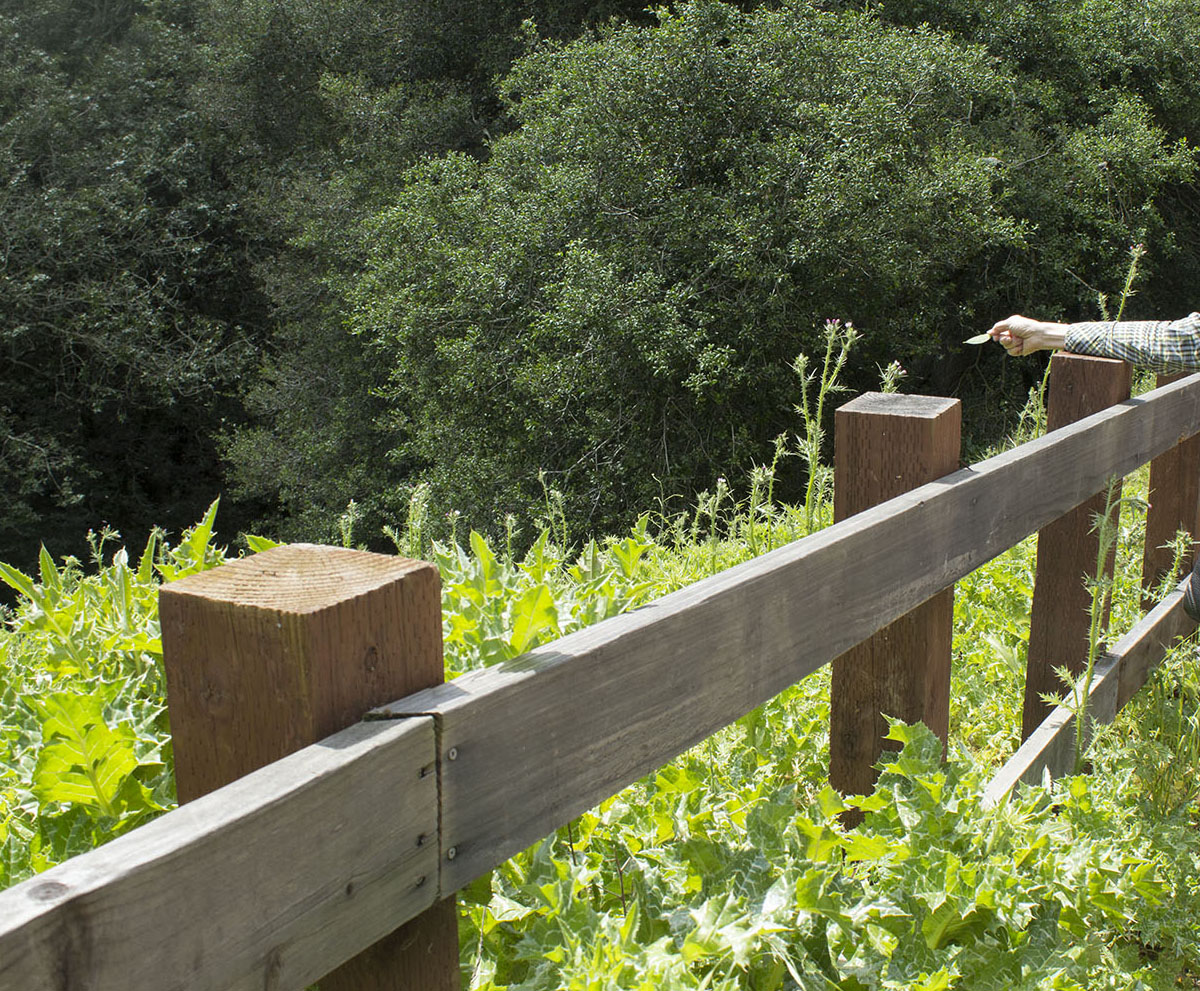
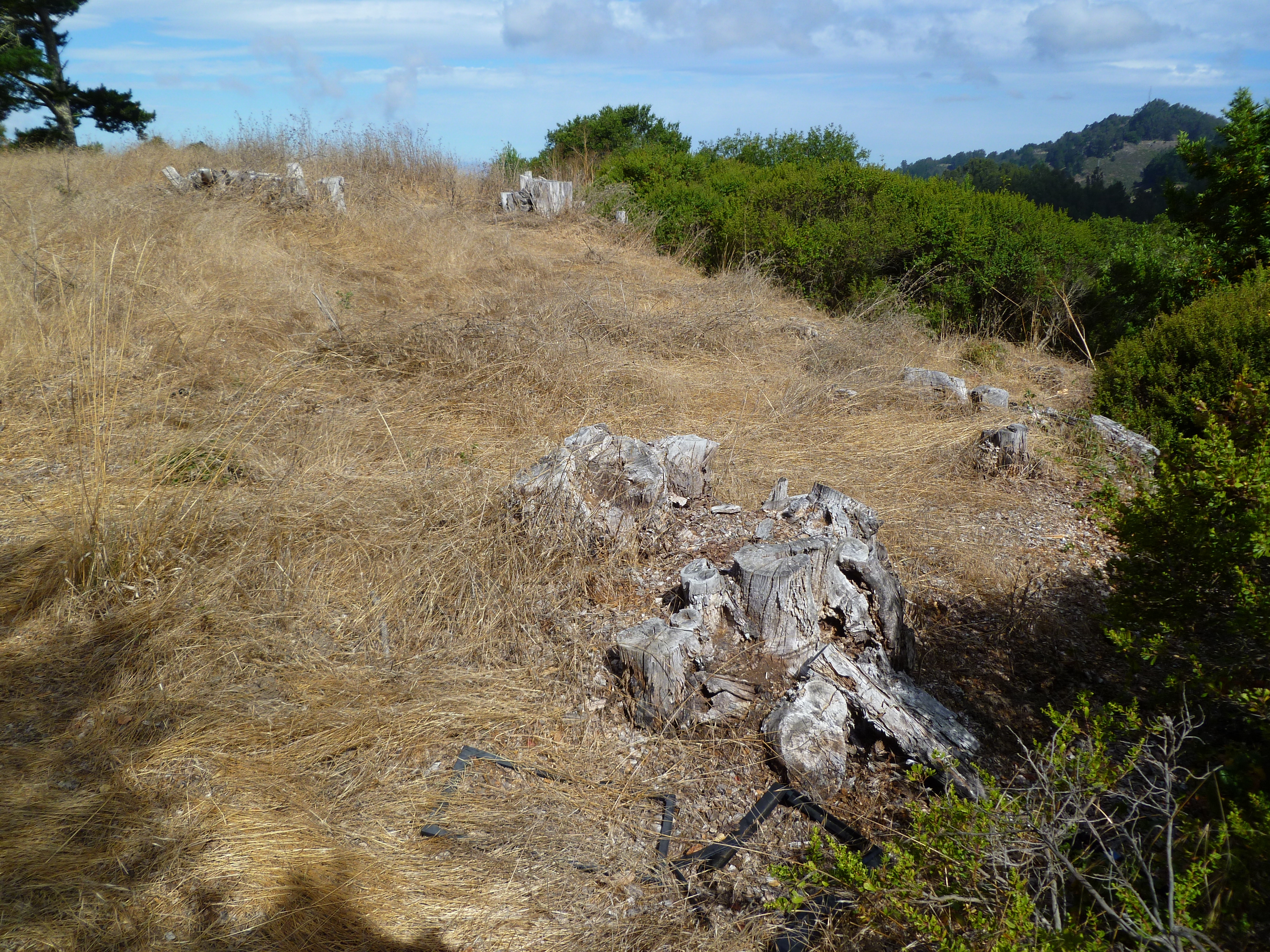
Site 29, May 2016
Site 29, May 2016

Site 29 is identified by the mile marker on Claremont Ave, just west of the intersection with Grizzly Peak Blvd.  All the eucalyptus trees were destroyed there about 10 years ago.  The trees that were destroyed were chipped and piled on site as mulch intended to prevent the growth of weeds.  The trunks of the trees line the road, log reminders of the forest that was destroyed.

The site was adopted by the Claremont Canyon Conservancy (CCC).   CCC has planted many redwood trees there and they consider it their showcase for their advocacy to destroy all eucalyptus trees in Claremont Canyon and elsewhere in the East Bay Hills.  The Sierra Club and CCC have collaborated in the effort to convince the public that if the eucalyptus trees are destroyed, a lovely garden of native plants and trees will replace the eucalyptus forest.  They also want you to believe that their garden will be less flammable than the eucalyptus forest.

There are several flaws in this rosy prediction.  The first problem is that Site 29 is ecologically unique.  It is a riparian corridor with a creek running through it.  Therefore, more water is available there than on the sunny hills where eucalyptus forests grow.  It is a canyon with steeply sloping sides that provide protection from sun and wind, which helps retain moisture.  In other words, conditions at Site 29 are ideal for the landscape that CCC and its friends are trying to achieve.

Claremont Canyon Conservancy sign says, "“These coastal redwoods…have been planted by volunteers as part of a habitat restoration to create a native and fire-resistant environment in Claremont Canyon.” The sign is planted in wood chip mulch and obscured by poison hemlock and milk thistle, which are both non-native.
Claremont Canyon Conservancy sign at Site 29 says, ““These coastal redwoods…have been planted by volunteers as part of a habitat restoration to create a native and fire-resistant environment in Claremont Canyon.” The sign is planted in wood chip mulch and obscured by poison hemlock and milk thistle, which are both non-native.

Site 29 is also unique because CCC has planted many trees there and they have sponsored many work parties to maintain the site.  CCC has not made a commitment to plant all 2,000 acres of the East Bay Hills on which all non-native trees will be destroyed by the FEMA grant projects.  Nor have any of the land owners made a commitment to plant those acres after the trees are destroyed.

So, given the ideal landscape conditions, the planting, and maintenance invested by CCC, how successful is Site 29?  Is it a lovely native plant garden?  Is it less flammable than the eucalyptus forest it replaced?  This is our photo essay of Site 29 that answers those questions.  But photos can be deceiving, so we invite you to visit yourself.  Just drive east on Claremont Ave until you reach mile marker 29, park your car beside the road and take a walk.

The reality of Site 29

Milk thistle at Site 29, April 2016

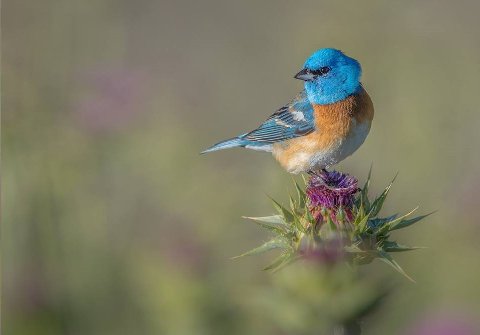
When we visited Site 29 in late April the milk thistle was thriving, but not yet in bloom.  The striking zebra pattern of the leaves makes it an attractive plant, in our opinion, and this lazuli bunting seems to agree that it is a plant worthy of admiration.  It is, however, not a native plant.

Lazuli bunting at Rancho San Antonio on milk thistle, April 2016. Courtesy Greg Barsh

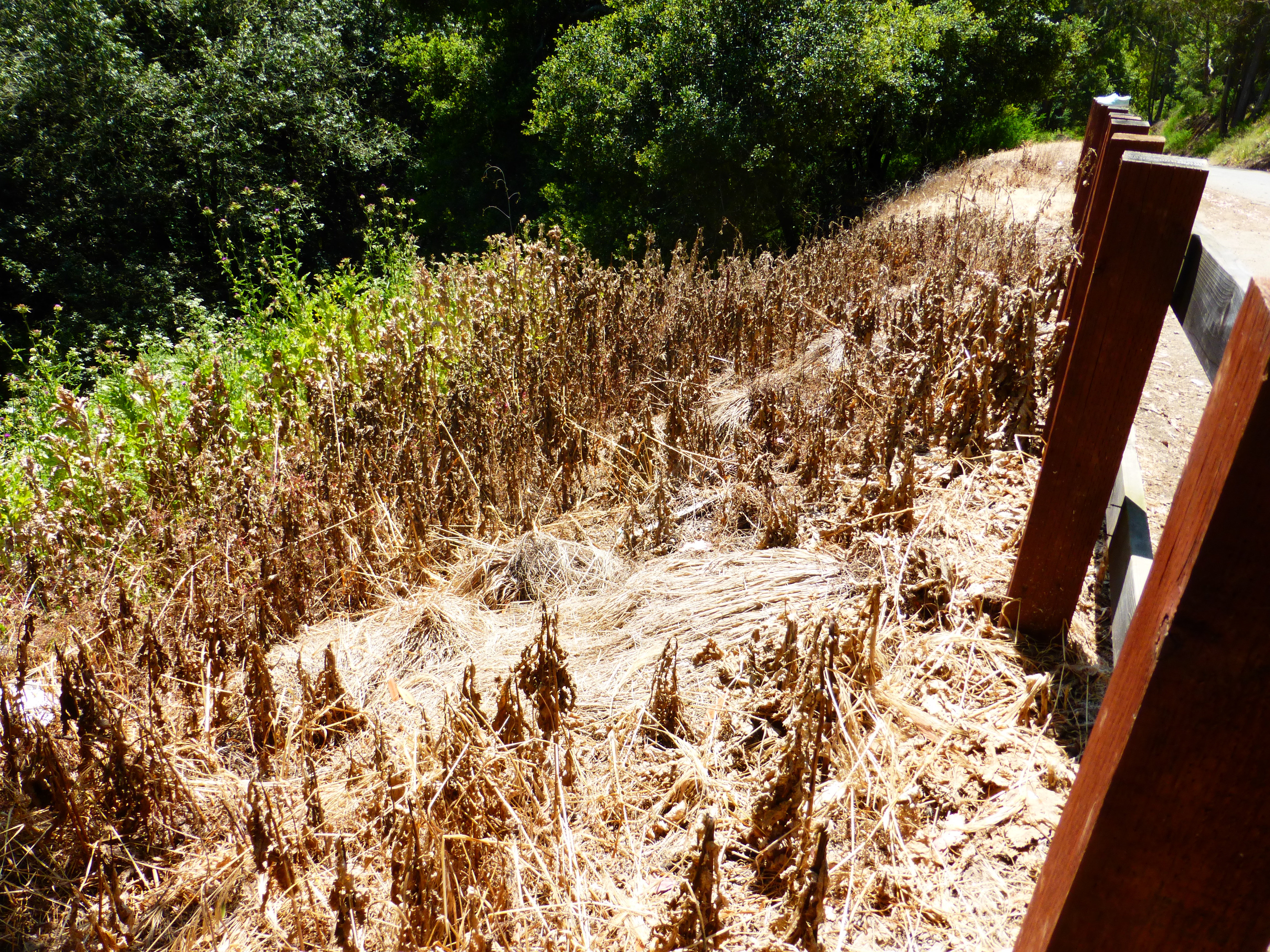
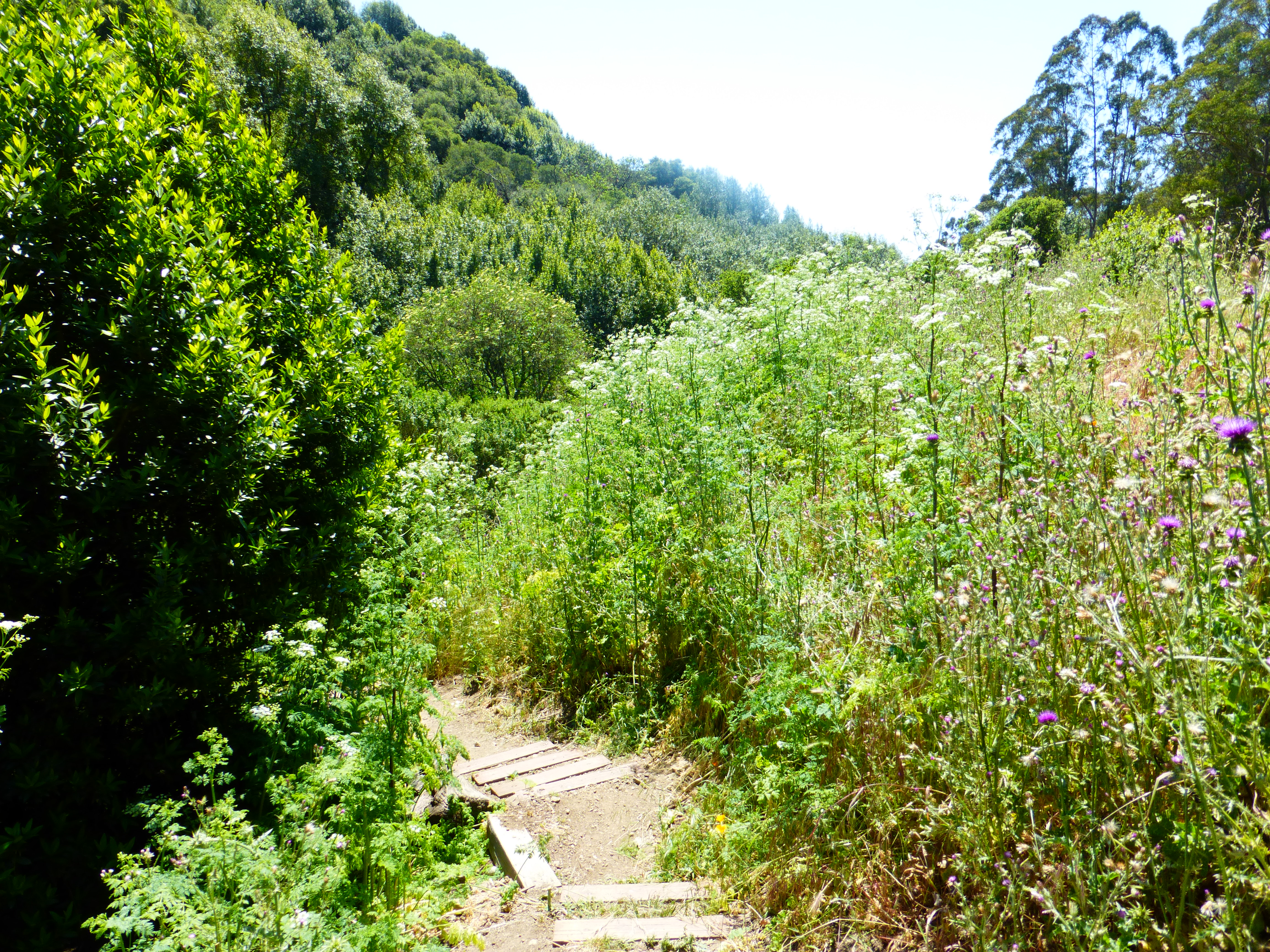
When we visited Site 29 a month later, in late May, it was a very different scene.  The milk thistle had been sprayed with herbicide along the road, to a width of about six feet, providing a stark contrast between the dead vegetation and the still green weeds.  Poison hemlock now grows along the trail into the canyon to a height of about 8 feet, joining the thistles as the landscape of Site 29.  The piles of wood chips are still visible, but are mostly covered with non-native annual grasses and other weedy shrubs.

Dead milk thistle, Site 29, May 2016
The trail down into the canyon is lined by 8-foot tall poison hemlock at Site 29.

More fantasies face harsh realities

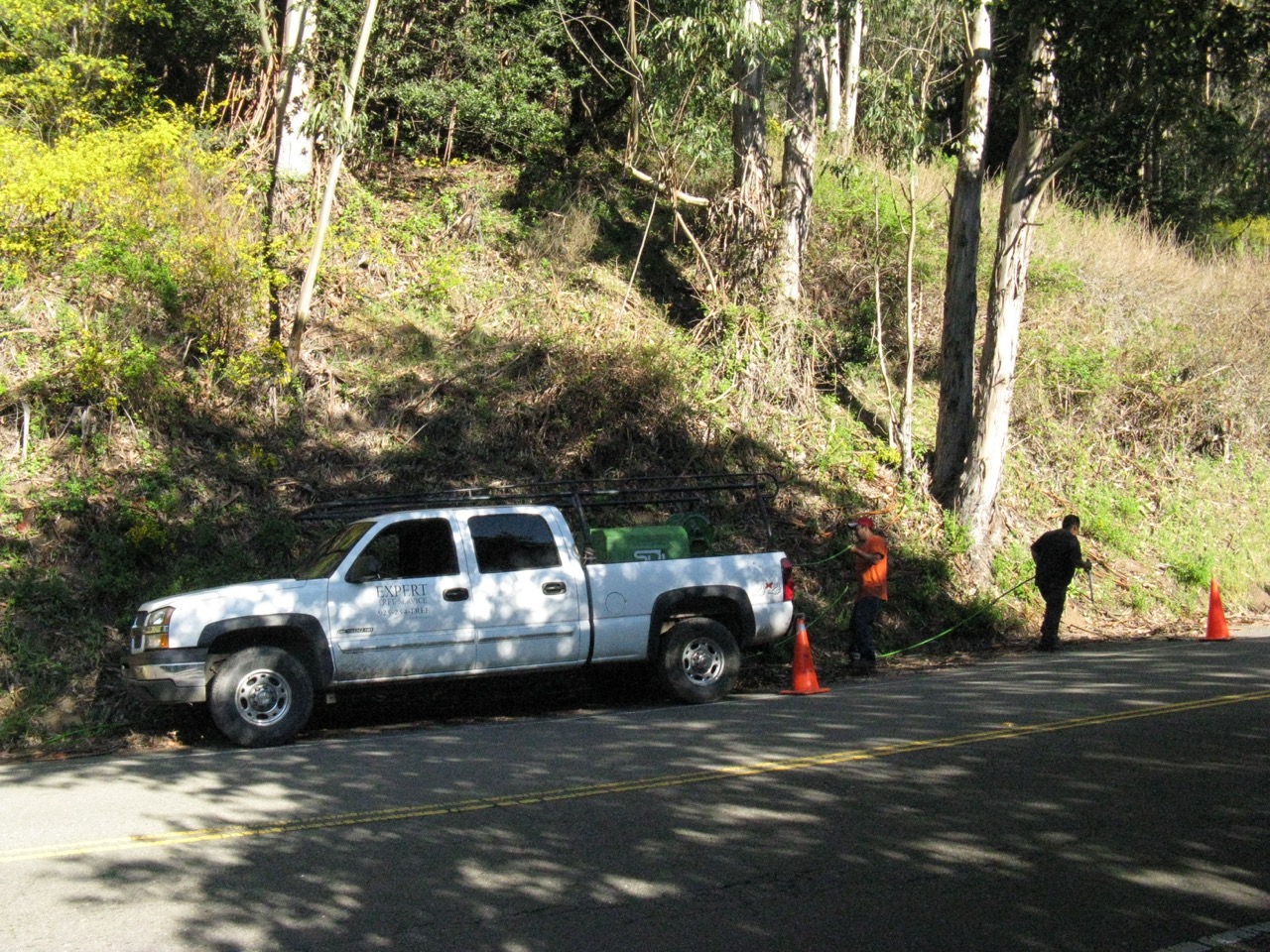
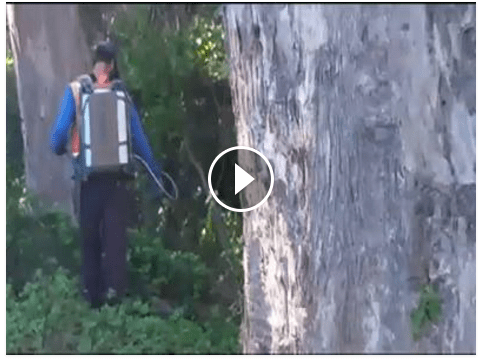
The contractors who apply herbicides on UC Berkeley properties have been photographed many times spraying herbicides at Site 29 and elsewhere.  When they are observed spraying herbicides there are not any pesticide application notices to inform the public of what is being applied and when the application is taking place.  So, unless you see them doing it, you don’t know that you are entering a place that has been sprayed with herbicide.  Several days later, you know that herbicides have been applied only because the vegetation is dying and soon looks dead.

Herbicide spraying at mile marker 29 on Claremont Ave.
Herbicide spraying on UC Berkeley property on Claremont Ave.

When the Environmental Impact Statement for the FEMA projects was published, the land managers claimed they would use “best management practices” in their pesticide applications, including posting notices in advance of spraying that would remain in place during the spraying and for some time after the spraying.  That assurance turns out to be meaningless.  Herbicides are being applied without any public notification before, during, or after application.

We were under the mistaken impression that posting application notices was required by California law.  We therefore asked those who observed herbicide applications without posted signs to report the incidents as violations of California law.

The Alameda County Agricultural Department is responsible for enforcement of California’s laws regarding pesticide use in Alameda County.  They have informed us that no notices of pesticide application are required for non-agricultural applications of glyphosate (RoundUp) or Garlon (triclopyr; the herbicide sprayed on the stumps of trees that are destroyed to prevent them from resprouting).  The manufacturers of these products say they dry within 24 hours, which is the definition of when re-entry is permitted.  Notification is not required for pesticides for which re-entry is permitted within 24 hours, even while the pesticide is being sprayed.

Would you like more Site 29s?

The eucalyptus forest at Site 29 was destroyed over 10 years ago.  Therefore, it is a preview of what we can expect when eucalyptus is destroyed on 2,000 more acres of public land in the East Bay Hills.  So, what can we learn from Site 29?

Site 29 had every advantage:  plenty of water, protection from wind and sun, planting of native trees, and maintenance by a volunteer neighborhood association.  Even with all those advantages, unshaded areas in which trees were destroyed at Site 29 are dominated by non-native weeds that are more flammable than a shady eucalyptus forest.  And because the weeds are flammable, they must be repeatedly sprayed with herbicides along the roads where ignition is most likely to occur.  Dead vegetation is more flammable than living vegetation, so the logic of the spraying seems muddled.

Most of the 2,000 acres of public land on which eucalyptus forests will be destroyed do not have a water source, or protection from wind and sun.  Nor will trees be planted or maintenance provided.  They are going to look much worse than Site 29 and they will be more flammable.

Site 29 is an opportunity for us to say,”NO, this is NOT the landscape we want.  PLEASE do not destroy our eucalyptus forests!!”

GIVE US A VOTE!! Results of letter to Sierra Club members

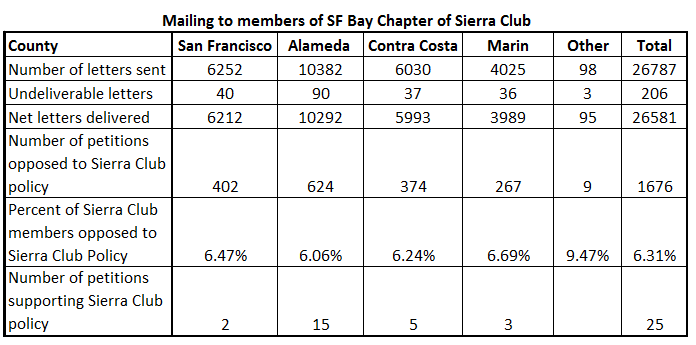
Our readers will recall that California law enabled a member of the Sierra Club to send a letter to over 26,000 members of the San Francisco Bay Chapter of the Sierra Club about the chapter’s support for deforestation and pesticide use in the East Bay Hills. Today we’re reporting the result of that letter and the next step in the long, tortuous path to changing the chapter’s policy on these issues. The letter and enclosed postcard petition are available HERE and HERE: Letter to Sierra Club members and Letter to Sierra Club members – postcard petition

To date, this is the number of postcard petitions that have been received:

sierraclub petition table

Since many couples have joint memberships, the actual number of Club members who signed the postcard petition is greater than the number of postcards.  The postcard petitions represent the opposition of 1,823 members to Sierra Club policy.  Many members also added written messages on the postcard petition, which are available HERE: Petition Comments


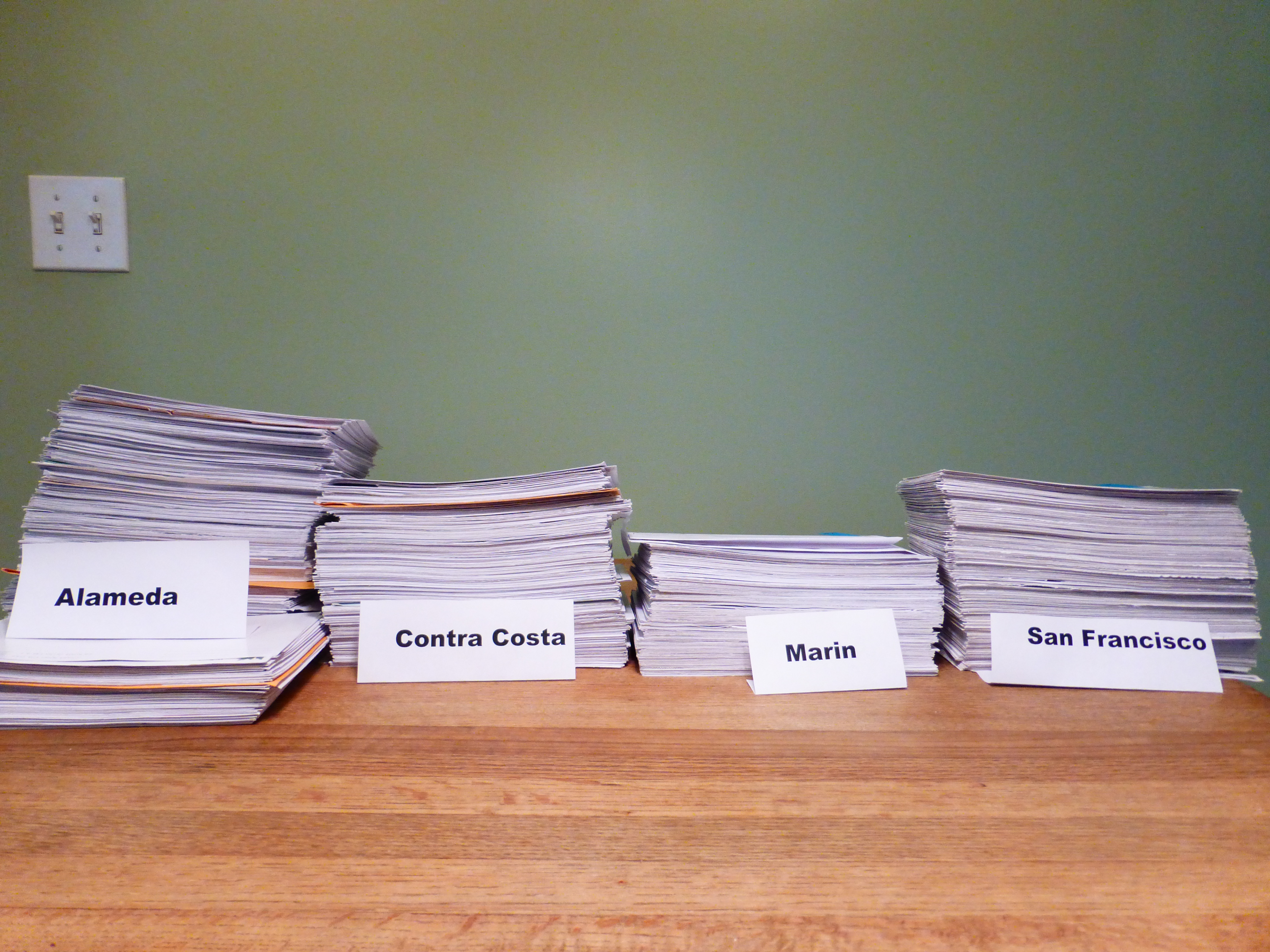
Postcard petitions to Sierra Club

The Sierra Club is now obligated to give us a VOTE on this issue!

According to the Sierra Club bylaws, critics of the Club’s policy regarding the destruction of our urban forest and pesticide use are now entitled to a formal vote on the issues.  The Sierra Club reports:  “More than 45,000 members nationwide voted” in the 2016 election for the Club’s National Board of Directors.  Let’s say 46,000 voted.  Two percent (2%) of 46,000 is 920. Nearly twice as many (1,823) Sierra Club members have indicated their opposition to the Club’s policy regarding the destruction of our urban forest and pesticide use.   Thus the results of the postcard petition now obligate the Sierra Club to conduct a formal vote on the issues:

“11.2. Except as provided in Bylaw 5.10, whenever a number of members of the Club equal at least to two percent (2%) of the number of ballots cast at the immediately preceding annual election for Directors shall request in writing that a resolution be adopted by the Club, the Board may adopt the resolution by majority vote, unless the petition specifically requests a vote of the membership or such a vote is required by law or these Bylaws; if the resolution is not so adopted, the Board shall certify it to the Secretary for a vote of the members.”

The author of the letter to Sierra Club members informed the leadership of the Sierra Club of the number of postcard petitions received and requested a formal vote on the issues, as provided by the Club’s by-laws.

How to get the attention of the Sierra Club?

We have planned a demonstration at the national headquarters of the Sierra Club on Monday, June 13, 2016, at noon.  Unless the Sierra Club agrees to conduct a formal vote on the issues before that date, we plan to tell the Sierra Club to let its members decide whether the Club should continue to support deforestation and pesticide use on public lands.

Noon 12:00 pm
Monday June 13, 2016
2100 Franklin St. (at 21st Street), Oakland
Sierra Club National Office (13th Floor)
(Close to 19th Street BART Station)

We hope that those who care about deforestation and pesticide use in the East Bay will join us for this peaceful demonstration.  A leaflet that you can print and post or distribute for this demonstration is available HERE: Flyer for demonstration  Please help us make the case that the bylaws of the Sierra Club obligate the club to give the membership a formal vote on these issues.

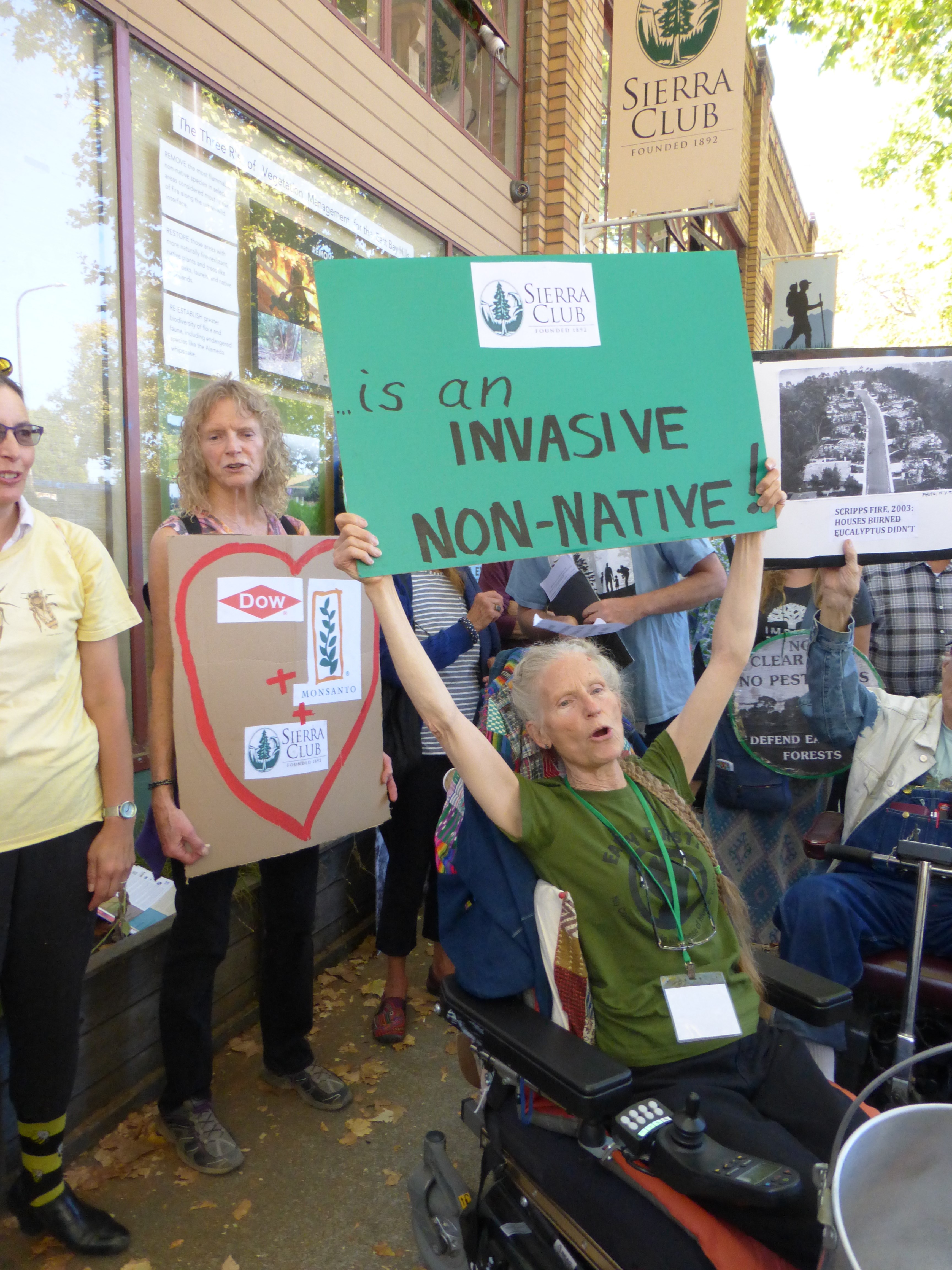
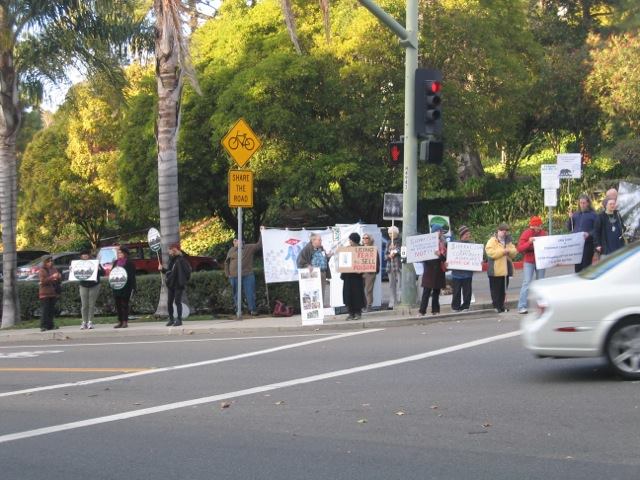
Sierra Club protest, August 25, 2015. About 80 people attended the peaceful protest.
Sierra Club protest, August 25, 2015. We delivered an on-line petition to Bay Chapter headquarters of the Sierra Club on these issues that now has over 2,800 signatures on it.

Why focus on the Sierra Club?

Opponents of the deforestation projects in the East Bay Hills may wonder why so much time and energy is spent on trying to change the policy of the Sierra Club on this matter.  Sometimes, Million Trees wonders too.

So, we will take a minute to explain that the Sierra Club has filed a lawsuit that demands immediate eradication of 100% of non-native trees on over 2,000 acres of public land.  East Bay Regional Parks District (EBRPD) is the biggest of the three land owners engaged in these projects.  EBRPD prefers to thin its eucalyptus forests from an average of 650 trees per acre to about 60-80 of the biggest trees per acre.  Although that seems to be the destruction of too many trees, it is clearly preferable to destroying EVERY non-native tree (eucalyptus, Monterey pine, and acacia) on about 1,600 acres of park land in the East Bay, which is what the Sierra Club lawsuit demands.   The other two land owners (UC Berkeley and City of Oakland) have always planned to destroy 100% of the non-native trees on about 500 acres of their land.  The Club’s lawsuit demands that they do so immediately, rather than phase some of the tree removals over a period of 10 years.

Furthermore, the Sierra Club is influential with public policy makers, including elected officials.  We believe that some decision-makers would be less likely to support these destructive projects if the Sierra Club would quit demanding the destruction of our urban forest.  In a liberal, environmentally conscious community such as ours, the Club’s promise of endorsement (or threat of non-endorsement) of a particular candidate for elected office is a powerful tool to impose the Club’s will on our decision makers.

Finally, we believe that the policy of the local chapter of the Sierra Club that demands destruction of much of our urban forest and douses our public lands with pesticides compromises the important mission of the national Sierra Club.  The national Sierra Club is appropriately focused on addressing the causes of climate change.  Climate change is the environmental issue of our time and the Sierra Club is one of the most important tools we have to address that issue.  Deforestation is a major cause of climate change.  The policy of the local chapter is therefore a contradiction of the mission of the Sierra Club.

Dialogue with native plant advocates

We believe that greater dialogue with native plant advocates would create more opportunities to find a compromise that would resolve the conflict about deforestation and pesticide use on our public lands.  Unfortunately, in the many years in which we have been engaged in the effort to prevent the destruction of our urban forest, we have found few such opportunities.

The Sierra Club is an extreme example of an organization that has isolated itself from all dissenting views on this issue.  Therefore, we were very excited that a member of the Sierra Club was able to send a letter to members, which we hoped would create new opportunities for dialogue with the Club and its allies on this issue.  (That letter is available HERE: Letter to Sierra Club members )

We are publishing today one of the responses that the author of the letter to Sierra Club received from a Sierra Club member.  We will also publish the reply to that letter.  We believe this dialogue is an example of the danger of isolating ourselves from those with whom we disagree.  When we refuse to discuss the issues, we deprive ourselves of opportunities to learn and we exacerbate conflict.

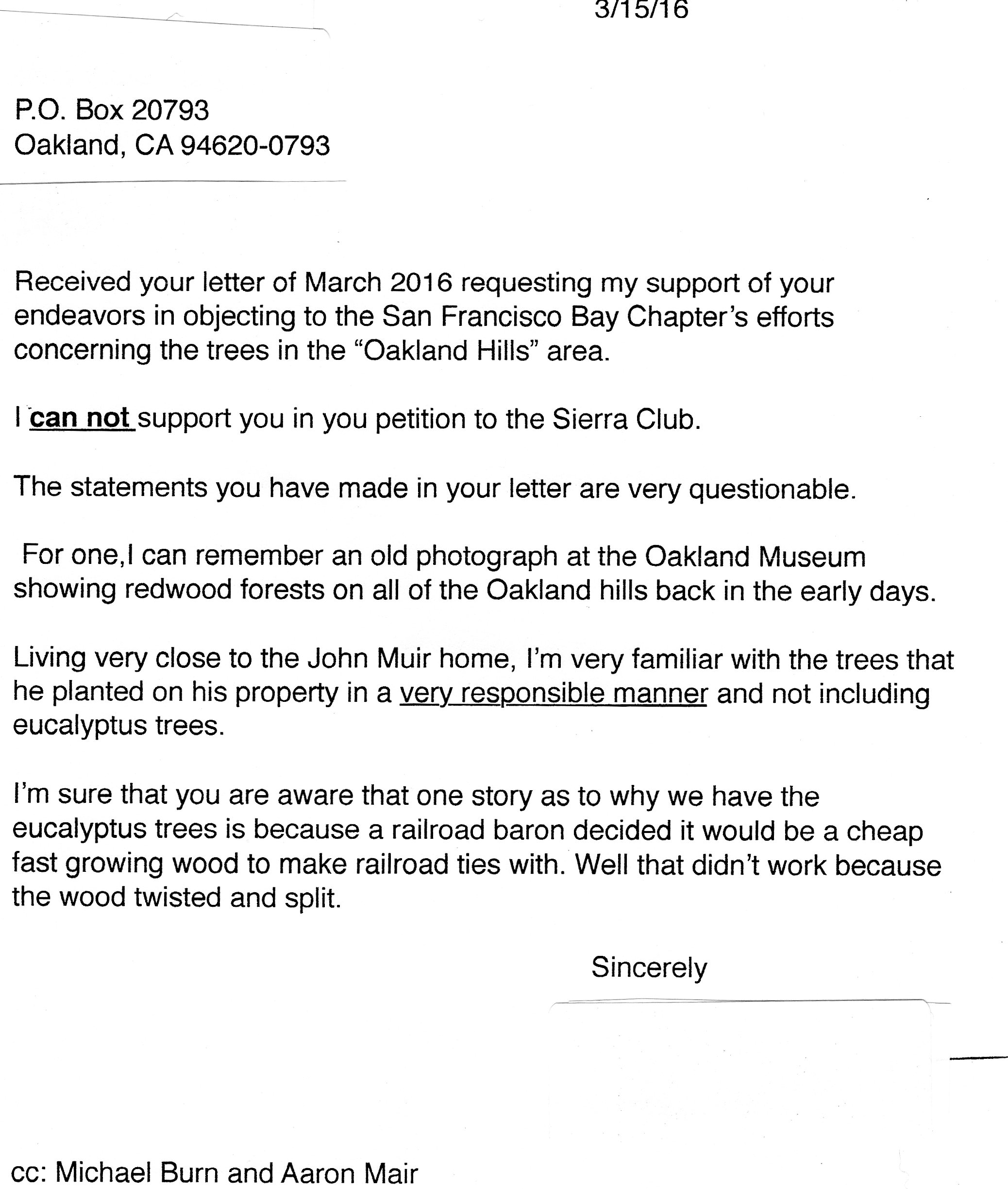
This is the letter sent by a native plant advocate to the author of the letter sent by a fellow Sierra Club member (we have removed his name because we do not have permission to publish):


img014 (1)


And this is the reply to that letter.  We have removed the author’s name because the letter was sent on behalf of hundreds of people who share her views.  Using her name more than necessary, inappropriately personalizes the issue.  This should be a public policy debate, not a personal vendetta.

Thank you for your letter of March 15, 2016, regarding my letter to Sierra Club members in the San Francisco Bay Area.

I am writing to provide you with the documentation about which you have questions:

Attachment A:  David Nowak’s “Historical Vegetation Change in Oakland…” states that, “Trees in riparian woodlands covered approximately 1.1% of Oakland’s preurbanized lands — redwood stand 0.7%, and coast live oak stand 0.5%.  Original forest cover is estimated at 2.3%…”  David Nowak has been employed by the US Forest Service since earning his Ph.D. degree from UC Berkeley.

I also recommend another visit to the Oakland Museum where you will find a touch screen map of historic vegetation of Oakland and surrounding communities in the East Bay.  It will confirm that the East Bay hills were not forested prior to settlement.

Attachment B:  The Environmental Assessment for the Strentzel-Muir Gravesite Plan at the John Muir National Historic Site in Martinez, California confirms that John Muir planted eucalyptus on his property.  The document also confirms the intentions of the National Park Service to retain eucalyptus on the property.  The entire document is available here:

Click to access Strentzel-Muir-Gravesite-Plan.pdf

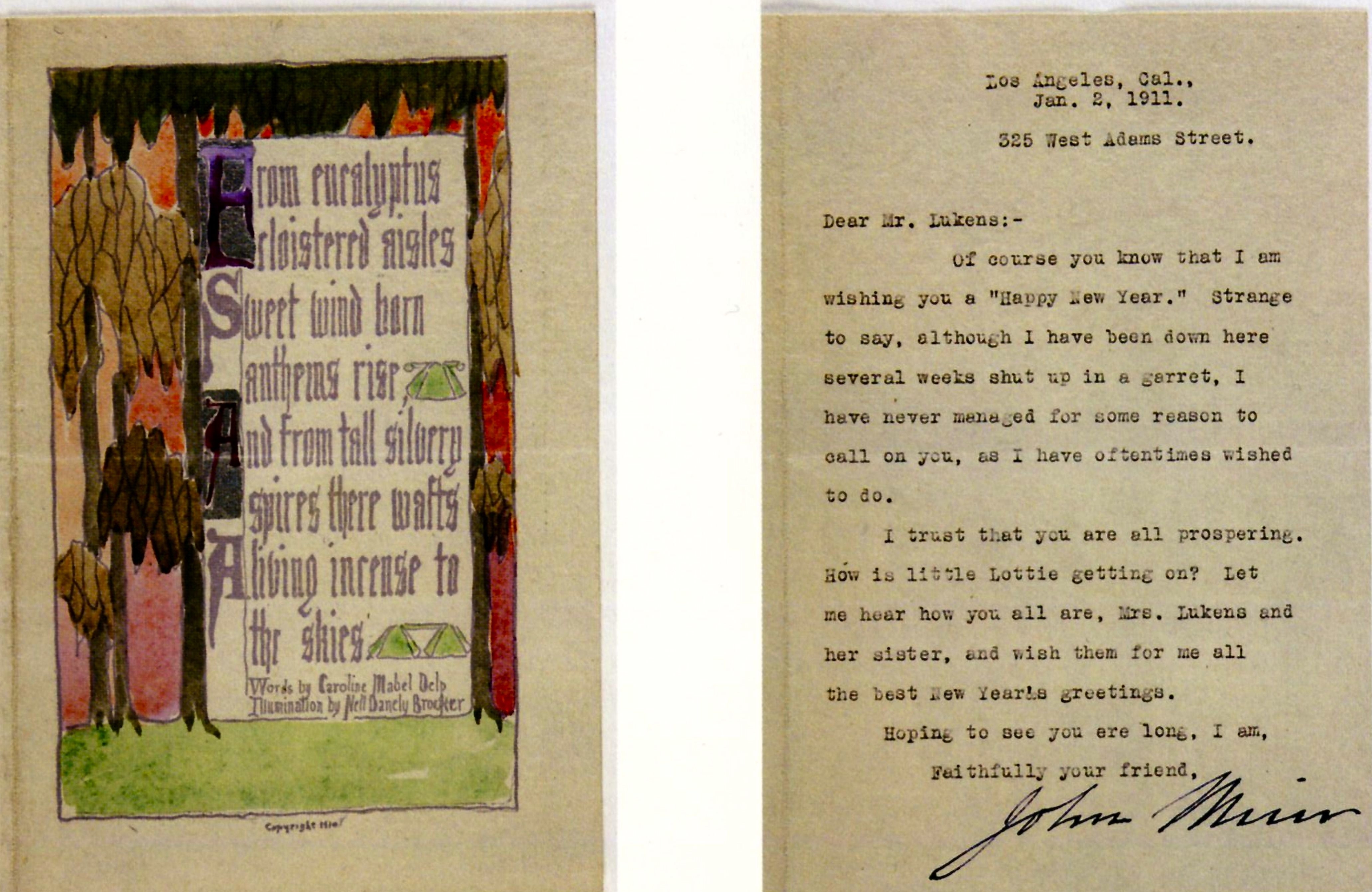
Attachment C:  This is a holiday greeting card sent by John Muir to a personal friend in 1911, in which he depicts eucalyptus and describes it in poetic verse.

Christmas Card from John Muir

There are many reasons why eucalyptus was planted in California.  I recommend the history of the trees of California by Jared Farmer, Trees in Paradise:  A California History, for a more complete understanding of why eucalyptus was planted in California.  Mr. Farmer also describes John Muir’s fondness for eucalyptus.

We all have a right to our opinions, Mr. [redacted].  However, it is not in anyone’s interests to be misinformed of the facts regarding our urban forest.

Please let me know if there are any other statements in my letter for which you require documentation.

Sincerely,

[redacted]

Cc: Michael Brune and Aaron Mair

No, this is NOT an April Fool’s joke.  These are actual letters sent by actual people.  We will publish a more comprehensive report of feedback from Sierra Club members to the letter from a fellow member in late April.

Another opportunity to influence the Sierra Club to STOP advocating for deforestation and pesticide use

On February 8, 2016, letters were sent to members of the Sierra Club in San Francisco from another Club member.  That letter is available HERE:  Letter to Sierra Club members.  The letter contained a postcard petition on which members were invited to express their opinion of the Club’s support for deforestation and pesticide use in the San Francisco Bay Area.  That petition is available HERE:  Letter to Sierra Club members – postcard petition.

The author of the letter reports that she has received 380 postcard petitions from Club members in San Francisco, indicating their opposition to the Club’s policy on these issues.  Only ONE postcard expressed support for the Club’s policy.  The letter was sent to 6,252 members, but undeliverable letters resulted in a net of 6,216 letters received.  This suggests that at least 6% of Club members in San Francisco are opposed to the Club’s policy.  Here are some (not all) of the comments that members wrote on their postcard petitions to the Sierra Club:

“SF native is windy sandy hills with poison oak!”

“Should the Sierra Club continue with its current position, I will cancel my membership” [several similar comments]

“If this native plant bullshit continues I’ll donate my dues to save the eucalyptus grove”

“I am strongly opposed!! (and have been for months)”

“Sierra Club member since 1975.  The idea to destroy our trees is absurd.  What would Golden Gate Park be without trees?  Sand Dunes!”

“These people would cut down every tree on SF streets & Golden Gate Park”

“Fanatical purists!  Should we plant more poison oak?!”

“If you want to go back to the habitats before get rid of people, buildings & cars.  Chop down & poison those instead of plants that were here before you were born.”

“I read your arguments for supporting this senseless destruction, and found them anachronistic and short-sighted…a 19th Century approach to conservation.”

“This same kind of “restoration” has been tried on a pilot basis in Glen Canyon, near my home, and has failed miserably.”

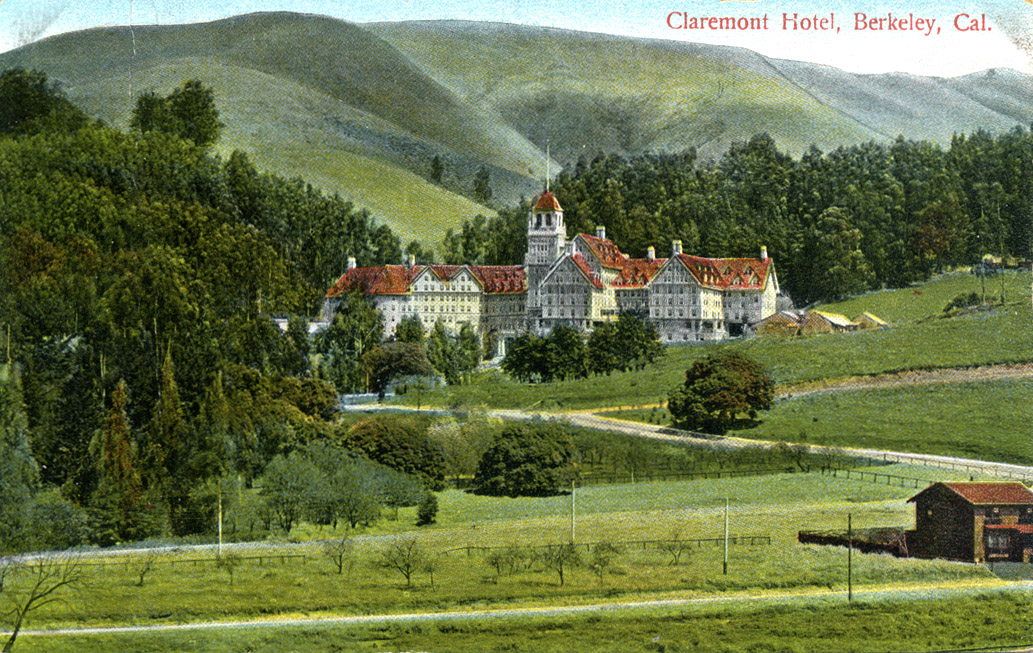
East Bay Hills
This antique postcard of the Claremont Hotel shows the treeless landscape of the East Bay Hills that the Sierra Club demands be recreated by destroying all non-native trees.

The author of the letter intended to send her letter to all members of the San Francisco Bay Chapter of the Sierra Club.  The Bay Chapter includes Alameda, Contra Costa, and Marin Counties, in addition to San Francisco City/County.  Unfortunately, the staff of Sierra Club did not understand the composition of the Bay Chapter and therefore her letter was initially only sent to members in San Francisco.  It took one month to correct that error.

The letter was sent to over 20,000 Club members in Alameda, Contra Costa, and Marin Counties on March 8, 2016.  We will report the response to the letter in April.

What you can do to influence the Sierra Club

Meanwhile, there is something Sierra Club members can do to influence the Club’s policies.  The national Sierra Club is conducting its annual election of Board Members now.  Ballots have been sent to all Club members with the roster of candidates.  The roster of candidates and an electronic ballot are also available HERE.  You must vote by April 27, 2016.  If you are a Sierra Club member, we suggest that you look carefully at the qualifications and opinions of the candidates before making your choice.

To help you make the best choice, a member of our team has asked all candidates the following questions:

  • What is your opinion of destroying non-native trees?
  • What is your opinion of pesticide use in public parks and open spaces?

Here are the replies that were received from the candidates:

Susana Reyes

What is your opinion of destroying non-native trees? “Just the mere thought of cutting a tree upsets me greatly. I can’t offer a position about destroying non-native trees without considering the different factors that may come into play – like climate conditions, types of landscape, threats to biodiversity, invasive or not, fire threats – just to name a few. It also depends on the land management practices in the areas where non-native trees exist. There ought to be other options to destroying non-native trees. I would think very carefully about destroying non-native trees especially if only a fraction display traits that harm or displace native species and disrupts the ecological landscape”

What is your opinion of pesticide use in public parks and open spaces?  “I strongly oppose pesticide use in our parks and open spaces. I am all too familiar with herbicide “Roundup” for example and its use to stop unwanted plants. Another one is rodenticide which is used to kill rats in parks/open spaces. In Los Angeles, our beloved mountain lion, P22, who calls Griffith Park home, was sickened last year with mange as this poison worked its way up the food chain. Many of the chem Research has shown links to certain types of cancer, developmental disorders, and physical disabilities. Pesticides end up in our drinking water, watersheds, and rivers/lakes. The use of toxic pesticides to manage pest problems has become a common practice around the world. Pesticides are used almost everywhere and therefore, can be found in our food, air, and water.”

Robin Mann

“Let me just note that I am running for reelection to the Board because I believe I can contribute to the Club’s progress towards its major goals for the environment and for ensuring a strong and effective organization into the future. 

Being a strong and effective organization, in the case of the Sierra Club, requires among other things ensuring a broad and engaged grassroots presence everywhere.  And we know that strong grassroots engagement necessarily means people coming together to resolve local issues that often have competing considerations.  Our policies and our approach generally allow some latitude to ensure the local context is being taken into account.  I wouldn’t want to try to dictate the solution for all situations. 

My understanding from my work with the Club’s efforts to strengthen resiliency in the face of mounting climate change impacts is that restoring native vegetation is desirable, and can contribute to restoring greater ecological balance.  And my understanding from my work on the ground with organizations doing habitat restoration is that sometimes HERBICIDES are needed as a last resort to enable newly planted natives to become established. 

If you are speaking of herbicides being used in public parks and open spaces, my view is they generally should not be used for maintenance purposes as non-toxic alternatives are available.  For habitat and vegetation reestablishment I would defer to those designing the project with the expectation that herbicides would be minimized, used responsibly, and any exposure to park users avoided. 

If you are speaking of pesticide use for insects or other “nuisance” species, I expect that in most instances a non-toxic management alternative is available, and so the burden should be on the public entity to justify use of a pesticide for maintenance purposes.”

Luther Dale:

“I have to say I do not know the context of these issues nor knowledge sufficient to give you a good answer. There are so many environmental issues and I accept that I can’t be knowledgable about them all. I do know a lot about some issues and know how to listen and learn about issues new to me. Thanks for your passion about these and other environmental problems and for your work to care for the earth.”

Mike O’Brien:

What is your opinion of destroying non-native trees?  “I have strong concerns about invasive species crowding out and changing native ecosystems in detrimental ways.  That said, we have already made significant and irreversible impacts to many ecosystems.  I don’t believe a policy of eliminating all non-native trees simply because they are non-native makes sense at this point.  Rather, it should be taken on a case by case basis where we consider what the impacts are of the non-native species and any work should typically be done in conjunction with a plan to restore native trees and habitat.”

What is your opinion of pesticide use in public parks and open spaces?  “Strong preference to zero use of pesticides. There have been occasions where serious threats from invasive species have proved practically impossible to overcome without targeted use of pesticides, but this should be a rare exception as opposed normal operating” procedure.

Judy Hatcher:

“As you probably noticed from my candidate profile, I’m the ED of Pesticide Action Network, so I’m not in favor of pesticides–especially highly hazardous ones–in public spaces or anywhere else. I think the issue of non-native trees is specific to particular contexts and environments. But it’s unfortunate that the damage non-native plants and animals cause lead communities to demand increased use of pesticides and herbicides, which have negative consequences for human health as well as for the natural environment.

PAN focuses on industrial agriculture, so we don’t do a lot around non-native plants except for how they impact farming (hello, RoundUp!).”

If there are other environmental issues of concern to you, you can also ask the candidates questions:

Susana Reyes,  susanareyes1218@gmail.com

Robin Mann, robinlmann@gmail.com

Joseph Manning, josephmanning92@gmail.com

David Scott, david.scott@sierraclub.org

Luther Dale, lutherdale@hotmail.com

Mike O’Brien, mjosierraclub@gmail.com

Judy Hatcher Judyh08@gmail.com

PARTICIPATE in democracy!

As the presidential primary election rages on around us, we are reminded of how important it is to participate in our democracy.  When we don’t participate, we are handing our power to those who do.  Our country and our environment are in peril.  Please step up and exercise your rights by voting in the election of the national Board of the Sierra Club if you are a member.

Mopping up the last load of Sierra Club propaganda

This is the last in a series of rebuttals to the Sierra Club’s “pre-buttal” to a letter from a Sierra Club member to members of the San Francisco Bay Chapter of the Sierra Club about the Club’s support for deforestation and pesticide use on our public lands.

The truth about how much herbicide will be used

Sierra Club misrepresents volume of herbicide use:  “If used, herbicide would be applied in minute quantities under strict environmental controls.”  (1)

Courtesy Hills Conservation Network

East Bay Regional Park District (EBPRD) informs us in the Draft Environmental Impact Statement (DEIS) for the FEMA project in the East Bay Hills that it intends to use 2,250 gallons of herbicide on its project acres to destroy non-native vegetation and prevent the trees they destroy from resprouting.  You can see the detailed table of their intended herbicide use for yourself by looking at the DEIS. (2)  On what planet would 2,250 gallons be called “minute quantities?”

EBRPD intentions were to “thin” non-native trees, not destroy them all.  The Sierra Club has sued EBRPD to force them to destroy ALL non-native trees on their project acres.  If the Sierra Club lawsuit is successful, EBRPD will be forced to destroy MORE trees than it wanted to destroy.  That means it will be forced to use EVEN MORE herbicide than it intended to use, i.e., MORE than 2,250 gallons.

EBRPD is only ONE of the three public land owners that are participating in the FEMA project.  The other two public land owners (UC Berkeley and City of Oakland) intend to destroy ALL non-native trees on their project acres.  That means they will have to use EVEN MORE herbicide than EBRPD intended to use per acre of project area.

Sierra Club fabricates an argument we have not made:  “Comparing this use of herbicide to the regular broadcast spraying of farmland elsewhere is a misrepresentation of fact.” (1)

This is a red herring, intended to confuse you with an argument that no one has made in opposition to this project.  We have not likened pesticides used for these projects with agricultural use of pesticides.  We aren’t being given a choice between agricultural pesticides and pesticides in our parks.  The Sierra Club is asking us to accept additional pesticides in our parks on top of the agricultural pesticides we are already exposed to and over which we have no control.  Since many pesticides accumulate in our bodies over our lifetimes, additional pesticide exposure results in greater toxicity and potential for damage to our health.

Horticultural fiction

Sierra Club fantasizes about the post-project landscape: “Concerns about not planting trees to replace those being removed miss the mark. Replanting is not necessary. (1)

Knowledgeable organizations do not share the Sierra Club’s fantasy that native trees will magically emerge from 2 feet of eucalyptus wood chip mulch to colonize the bare ground.  Here is a partial list of the environmental consultants, governmental agencies, and environmental organizations that have refuted this fiction:

  • URS Corporation is the environmental consultant initially hired to complete the environment impact review of the FEMA projects. Their report said:  “However, we question the assumption that the types of vegetation recolonizing the area would be native.  Based on conditions observed during site visits in April 2009, current understory species such as English ivy, acacia, vinca sp., French broom, and Himalayan blackberry would likely be the first to recover and recolonize newly disturbed areas once the eucalyptus removal is complete.”
  • The US Forest Service evaluated the FEMA projects. This is their prediction of the post-project landscape: “a combination of native and non-native herbaceous and chaparral communities.”
  • The California Native Plant Society predicted the post-project landscape in its written public comment on the Draft Environmental Impact Statement (DEIS) with this rhetorical question: “What mechanism is being instituted by FEMA in this DEIS to guarantee a commitment of money and personnel for management of greatly increased acreages of newly created annual weedy grassland?”
  • The Audubon Society predicted the post-project landscape in its written public comment on the DEIS: “There is no support for the conclusion that native vegetation will return on its own.  This plan may not result in an increase in native trees and plants…Heavy mulching will delay or prevent the growth of native species.”
Trees were destroyed here by UC Berkeley over 10 years ago. The landscape is now non-native annual grasses. This is the typical outcome of tree removals on sunny hills without a water source.

Sierra Club and Claremont Canyon Conservancy (CCC) repeatedly refer to Site 29 on Claremont Blvd as a model for the FEMA projects.  They fail to acknowledge that Site 29 is not representative of most FEMA project areas because CCC planted native trees (primarily redwoods) on Site 29 and the microclimate of Site 29 is not typical of other project areas.  Site 29 is a riparian corridor—there is a creek running through it—so there is more available water than in most project areas.  It is also protected from wind and sun by hills on north and south sides of the site.  CCC has not made a commitment to plant native trees on 2,000 acres of the FEMA project areas and even if it did, it could not expect the same results in radically different microclimates such as sunny, windy ridge lines with no available water source.

Fundamentals of carbon storage

Sierra Club does not understand the fundamentals of carbon storage:  “Carbon sequestering and erosion control will not be reduced by removing eucalyptus trees… Indeed, reducing the fire danger by removing the eucalyptus will do much to prevent the release of tons of carbon that occurs during a wildfire. [x]” (1)

Sierra Club continues with the fiction that non-native trees will burn while native trees will not.  There is no evidence behind that story, and much evidence to the contrary.  The numerous wildfires throughout California each summer demonstrate that native trees and shrubs are extremely flammable—easily ignited and burning vigorously once ignited.  Native trees, shrubs, and grasses also release their stored carbon when they burn.  The NSF article cited by the Sierra Club in support of its bogus statement does not suggest that prospectively destroying forests is a means of preventing carbon loss.

Destroying eucalyptus trees will release hundreds of thousands of tons of carbon stored in those trees. That’s a simple, inarguable fact.  There are no plans to replace the eucalyptus with “native trees.”  A small portion of the carbon released by eucalyptus destruction may be recaptured by the grasses and shrubs that will grow in place of the eucalyptus, but the net loss of stored carbon to the atmosphere from the eucalyptus is huge and permanent.  Further, the eucalyptus would have continued to store even more carbon if left in place.  That future carbon sequestration is also lost.

The DEIS for the FEMA-funded projects tries to minimize the loss of stored carbon from destruction of eucalyptus by quantifying only carbon loss from the destruction of tree trunks, ignoring leaves, branches, roots, understory, forest floor litter, and soil.  But even they acknowledge, “…the planned growth of oak and bay woodlands and successional grassland containing shrub islands would not sequester as much carbon as the larger eucalyptus and pines and the denser coastal scrub that would be removed.”  (DEIS 5.6-11)

Killing habitat needed by wildlife

Sierra Club does not know who lives in our urban landscapes:  “Native landscapes provide habitat for much more diverse ecosystems.” (1)

There are many studies that find that our non-native landscape provides valuable habitat and no studies that say otherwise:

  • Most California natives in cultivation are of no more butterfly interest than nonnatives, and most of the best butterfly flowers in our area are exotic.” (3)
  • “[T]he science does not support the supposition that native plantings are required for biodiversity…it is clear that an automatic preference for native trees when planning in urban areas is not a science-based policy.” (4)
  • “Three types of trees were used most frequently by roosting monarchs [in California]: eucalyptus (75% of the habitats primarily Eucalyptus globulus), pine (20% of the habitats primarily Pinus radiata), and cypress (16% of the habitats primarily Cupressus macrocarpa)” (5)
  • “In the first half of the 20th century, the Anna’s Hummingbird bred only in northern Baja California and southern California. The planting of exotic flowering trees provided nectar and nesting sites, and allowed the hummingbird to greatly expand its breeding range…Anna’s Hummingbird populations increased by almost 2% per year between 1966 and 2010, according to the North American Breeding Bird Survey…Thanks to widespread backyard feeders and introduced trees such as eucalyptus, it now occurs in healthy numbers all the way to Vancouver, Canada.” (6)
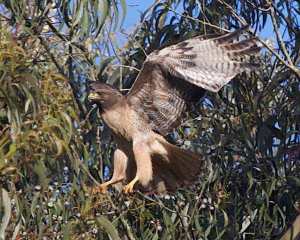
  • Red-tailed hawk nesting in eucalyptus. Courtesy urbanwildness.org
    Red-tailed hawk nesting in eucalyptus. Courtesy urbanwildness.org

    “Fourteen of 27 nests in 1994 and 38 of 58 nests in 1995 were in exotic trees, predominantly eucalyptus. Nesting and fledging success were higher in exotic trees than in native trees in both years, owing in part to greater stability and protective cover.  Most nest trees in upland areas were exotics, and even in riparian habitats, where tall native cottonwoods and sycamores were available, Red-shouldered Hawks selected eucalyptus more often than expected based on availability.”  (7)

  • A study that compared species diversity and abundance of plants, invertebrates, amphibians, birds, and rodents in eucalyptus forest with oak-bay woodland in Berkeley, California reported this finding: “Species richness was nearly identical for understory plants, leaf-litter invertebrates, amphibians and birds; only rodents had significantly fewer species in eucalypt sites.  Species diversity patterns…were qualitatively identical to those for species richness, except for leaf-litter invertebrates, which were significantly more diverse in eucalypt sites during the spring.” (8)

We could provide many more citations from studies that consistently find that our existing non-native landscape is essential to wildlife and that destroying it will be harmful to wildlife, particularly considering the enormous amount of herbicide that will be used.  We ask this common-sense, rhetorical question, “How could destroying most of our landscape provide a more diverse ecosystem?”  It defies logic.

Environmentalism gone awry

If the Sierra Club would replace a few of its lawyers with a few scientists, perhaps we would not be having this debate.  Environmentalism has gone astray because it is not knowledgable about some basic scientific issues, such as carbon storage, the toxicity of herbicides, and the habitat needed by our wildlife.  Climate change is the environmental issue of our time.  If an environmental organization does not understand the fundamentals of carbon storage it is not capable of doing its job.  The Sierra Club must improve its knowledge of the Bay Area environment or it will fade into irrelevance in the struggle to protect that environment.


(1) http://sierraclub.org/san-francisco-bay/hillsfacts

(2) See Table 2.1 in Appendix F: http://www.fema.gov/media-library-data/1416861356241-0d76d1d9da1fa83521e82acf903ec866/Final%20EIS%20Appendices%20A-F_508.pdf

(3) Arthur Shapiro, Field Guide to Butterflies of the San Francisco Bay and Sacramento Valley Regions, University of California Press, 2007

(4) Linda Chalker-Scott, “Nonnative, Noninvasive Woody Species Can Enhance Urban Landscape Biodiversity,” Arboriculture & Urban Forestry, 2015, 41(4): 173-186

(5) Dennis Frey and Andrew Schaffner, “Spatial and Temporal Pattern of Monarch Overwintering Abundance in Western North America,” in The Monarch Butterfly Biology and Conservation, Cornell University Press, 2004.

(6) Cornell Ornithology Laboratory https://www.allaboutbirds.org/guide/annas_hummingbird/id

(7) Stephen Rottenborn, “Nest-Site selection and reproductive success of urban red-shouldered hawks in Central California,” J. Raptor Research, 34(1):18-25

(8) Dov Sax, “Equal diversity in disparate species assemblages:  a comparison of native and exotic woodlands in California,” Global Ecology and Biogeography, 11, 49-52, 2002.

Who supports the Sierra Club agenda?

John Muir is the founder of the Sierra Club. He would disgusted by the Club's advocacy for deforestation. He planted eucalyptus trees on his property in Martinez. He was as fond of eucalyptus as those who fight for their preservation.
John Muir is the founder of the Sierra Club. He would be disgusted by the Club’s advocacy for deforestation. He planted eucalyptus trees on his property in Martinez. He was as fond of eucalyptus as those who fight for their preservation today.

In this post we continue to deconstruct the Sierra Club’s “pre-buttal” to the letter from a Sierra Club member to fellow members.  We will examine the following claim that other environmental organizations support the Sierra Club’s agenda to destroy all non-native trees on 2,000 acres of public land in the East Bay Hills, and to use pesticides to do it:

“Members should know that this strategy also has the support of many fire experts and other environmental organizations, including the Golden Gate Audubon Society, the California Native Plant Society, and the Claremont Canyon Conservancy.” (1)

In 2009, Sierra Club, Golden Gate Audubon Society, and the California Native Plant Society co-signed an “Environmental Green Paper” entitled “Managing the East Bay Hills Wildland/Urban Interface to Preserve Native Habitat and Reduce the Risk of Catastrophic Fire.”  This suggests that at that point in time, these three organizations were in agreement about those issues.

However, by the time the Draft Environmental Impact Statement (DEIS) for the FEMA projects that will implement that policy was published in 2013, their public comments on the DEIS suggest that their opinions diverged significantly.  Here are some of the comments they made that suggest substantial disagreement with the planned project.

California Native Plant Society predicts the result of FEMA projects

California Native Plant Society (CNPS) public comment on the DEIS (excerpt):

“The FEMA grants require monitoring and weed maintenance for years to come. Yet the FEMA grants do not supply funding for any of the follow up weed abatement. The East Bay Regional Park District, City of Oakland, and UC Berkeley have great trouble keeping up with acres of weedy species now in their stewardship purview. There just isn’t money available for comprehensive management of weedy invasives. This is demonstrated by the many acres of weedy ‘fuels managed’ areas, including fire roads. What mechanism is being instituted by FEMA in this DEIS to guarantee a commitment of money and personnel for management of greatly increased acreages of newly created annual weedy grassland?” (2)

The rhetorical question asked by CNPS suggests that they share our skepticism about the outcome of the FEMA projects.  The project is not providing any funding for planting native plants or maintaining them in the long run.  CNPS seems to agree with us that the likely outcome of this project will be non-native annual grasses.

The CNPS comment also seems to share our opinion that the annual grasses that are the likely colonizers of the bare ground will be a fire hazard:  “…exotic annual grassland, known for drying out the top layer of soil, and extending the fire season with dried out flashy surface fuel that can act like a fuse to ignite other areas.”  (2)

The CNPS prediction of the landscape resulting from the FEMA grants is in stark contrast to the rosy prediction of the Sierra Club.  The Club claims that native plants will magically emerge from the bare ground after non-native plants and trees are destroyed, without being planted.

Audubon Society “does not support” the FEMA project

Audubon Society’s public comment on the FEMA DEIS identifies many of the same issues that have been raised by critics of the project:

“The proposed tree removals may lead to colonization by broom or other invasive plants with little value to native birds and wildlife, unless native plants are reintroduced.  Although the amount of herbicide to be used on each tree is rather small, the total amount to be used by the project is very large. We believe that alternative methods to prevent resprouting should be used near water and perhaps in other specific circumstances…There is no support for the conclusion that native vegetation will return on its own.  This plan may not result in an increase in native trees and plants…Heavy mulching will delay or prevent the growth of native species.” (3)

In fact, the Audubon Society states explicitly that it does not support the plan as proposed by the DEIS (emphasis added):

“In spite of our approval of the general concept of the plan, the Golden Gate Audubon Society does not support this plan as drafted for the following reasons:

1) The plan calls for the removal of both non-native and native trees and brush with no plans to replant cleared areas with native vegetation;

2) The plan would use herbicides indiscriminately, rather than relying on more benign control of re-sprouting where herbicides are contra-indicated.” (3)

Clearly, the Audubon Society does not agree with the Sierra Club about the FEMA projects.  The Audubon Society agrees with the critics of this project that dangerous amounts of herbicide will be used and the outcome of the project will not be a landscape of native plants.  While the Sierra Club keeps telling us that “minimal amounts of herbicide will be used,” the Audubon Society has done its homework and can see that huge amounts of herbicide will be used.

Who supports the Sierra Club’s position on the FEMA grants?

The California Native Plant Society and the Audubon Society do not agree with the Sierra Club about the FEMA projects.  The fact that they did not join the Sierra Club’s lawsuit demanding 100% eradication of non-native trees in the project acres is another indication that they do not share the Club’s opinion of the projects. 

Update:  Although CNPS did not join the Sierra Club lawsuit against FEMA, it has indicated its support for the suit on its website:   “The East Bay Chapter of the California Native Plant Society strongly supports the litigation action by SPRAWLDEF and the Sierra Club, against FEMA’s surprising Record of Decision regarding fuels management in the East Bay Hills.” 

Despite the fact that CNPS understands that the resulting landscape will be predominantly highly flammable non-native annual grasses, it apparently wants all non-native trees to be destroyed.  We don’t understand why CNPS was surprised by the final version of the Environmental Impact Statement, since it was virtually unchanged from the draft on which they submitted a written public comment.

We learned of CNPS’s support for the Sierra Club lawsuit from a member of the Club’s leadership.  Although this information doesn’t literally contradict what we have reported, we post it here in the interests of full disclosure. 

Although the Claremont Canyon Conservancy agrees with the Sierra Club about the FEMA projects, we note that they did not join the Club’s lawsuit either.  The only organization that joined the Sierra Club lawsuit is SPRAWLDEF (Sustainability, Parks, Recycling, and Wildlife Legal Defense Fund). (4) SPRAWLDEF (5) is a non-profit organization created and run by Norman LaForce, the Sierra Club officer who claims to be one of the primary authors of the FEMA projects (6).  SPAWLDEF has sued other public agencies, including the East Bay Regional Park District.

Update:  SPRAWLDEF’s tax return for 2011 reports $250,000 of income for legal settlements from environmental lawsuits.  The tax return is signed by Norman LaForce.

The role of lawsuits in the funding of environmental organizations

Lawsuits against the various governmental agencies have become an important source of revenue for environmental organizations.  The Center for Biological Diversity (CBD) has mastered this strategy.  The New York Times reports (7) that CBD had filed 700 lawsuits when the article was published in March 2010, and they were successful in those suits 93% of the time, according to CBD.  Those suits forced the government to list 350 endangered species and designate 120 million acres of critical habitat for their recovery.  Revenue generated for CBD by these suits was $1.4 million in 2008, compared with $7.6 million from contributions and grants.

Sharp Park, Pacifica, CA. Photo by Erica Reder, SF Public Press

Brent Plater is a former CBD lawyer who created a non-profit in San Francisco, Wild Equity Institute.  He has sued San Francisco several times about Sharp Park, where he believes that closing the golf course would benefit the endangered red-legged frog.  He has not succeeded in making that case to our judiciary, losing every case. Despite losing, he and his collaborators were awarded $385,809 for “legal expenses” by the court, according to the San Francisco Chronicle: “It turns out that Plater and his organization can win by losing.  Take the ruling in U.S. District Court on July 1, 2013, which, by any measure, rates as a legal smackdown of the institute. As Judge Susan Illston said in her ruling, ‘plaintiffs did not prevail on a single substantive motion before the Court.’” (8)   So, even when they lose, they can walk away with a sizeable chunk of change.  To be clear, it is the taxpayers of San Francisco who paid Wild Equity for suing the City of San Francisco.

So, ponder for a minute the interesting relationship between SPRAWLDEF and the Sierra Club.  The person who connects them is Norman LaForce, who is both a lawyer and an officer in the Sierra Club.  If these organizations prevail in their lawsuit against FEMA, will Norman LaForce share in the spoils?  One wonders.


(1) http://sierraclub.org/san-francisco-bay/hillsfacts

(2) https://www.fema.gov/media-library/assets/documents/100411.  FEMA DEIS, Appendix R, Part 1, page 681

(3) https://www.fema.gov/media-library/assets/documents/100411.  FEMA DEIS, Appendix R, Part 5, page 3834

(4) Sierra Club and SPRAWLDEF lawsuit against FEMA available HERE:  Sierra Club lawsuit against FEMA projects

(5) http://www.buzzfile.com/business/Sustainability,-Park,-Recycling,-and-Wildlife-Legal-Defense-Fund-(sprawldef)-510-526-4362

(6) https://milliontrees.me/2015/11/27/public-opposition-to-pesticide-use-in-our-public-parks/

(7) http://www.nytimes.com/gwire/2010/03/30/30greenwire-brazen-environmental-upstart-brings-legal-musc-82242.html?pagewanted=all

(8) http://www.sfchronicle.com/bayarea/nevius/article/Nevius-6378333.php

The court’s award of legal expenses is available here:  https://docs.justia.com/cases/federal/district-courts/california/candce/3:2011cv00958/239217/189.  The award seems to have been made in recognition of the fact that the lawsuit forced the Recreation and Park Department to apply for a permit for park maintenance that results in an “incidental take” of red-legged frog eggs.


Will the real “gasoline tree” please stand up?

The Sierra Club has said many silly things in defense of its lawsuit demanding 100% destruction of all non-native trees on 2,000 acres of public land in the East Bay Hills, and Million Trees has responded to many of them (1).  Now Sierra Club has provided a new batch of ridiculous statements in its “pre-buttal” to the letter from a Chapter member to fellow Chapter members.

The winner of the intense competition for silliest statement

Sierra Club’s silliest statement:  “Eucalyptus trees are called “gasoline trees” in Australia for their tendency to explode in fireballs at very high temperatures.[ii]” (2)

You would not hear such a statement in Australia about ANY tree (eucalyptus or otherwise) because Australians do not use the word “gasoline.”  What Americans call “gasoline,” is called “petrol” in Australia (and Britain, New Zealand, etc.).  (3)

So, the next question is, do Australians call eucalyptus trees “petrol trees?”  The answer is, “NO, they do NOT call eucalyptus trees “petrol trees.”  A Google search for “petrol tree” directs the searcher to an article about a tree that is being grown in Australia as a source of diesel fuel.  The Brazilian tree Copaifera langsdorfii produces “natural diesel.”  Australian farmers have planted 20,000 of these trees with the expectation that “in 15 or so years they’ll have their very own oil mine growing on their farmland.” (4)

The Sierra Club provides a citation for its statement about “gasoline trees.”  The citation is a paper by Carol Rice, the primary author of the East Bay Regional Park District’s “Wildfire Hazard Reduction and Resource Management Plan.”  So, we might expect her to claim that eucalyptus is very flammable and she does.  However, she does not call them “gasoline trees” (nor does she claim that Australians do) nor does she claim that eucalyptus “explodes in fireballs.”

Wildfires in Mediterranean climates

The Sierra Club also provides a brief film clip of a wildfire in Australia.  The film clip is narrated by an American who claims that “firemen call eucalyptus gasoline trees.”  We hear Australians describing the fire, but they don’t say anything about “gasoline trees.”

Let’s compare that film clip in Australia with wildfires here in California.  Our most recent local wildfire was in September 2015, in Lake County about 100 miles north of San Francisco.  The Lake County fire destroyed about 1,200 buildings, killed 4 people, and burned over 76,000 acres.  HERE is a film clip of that fire, taken from the dashboard camera of a county sheriff driving through the fire.

Wildfire in California. Bureau of Land Management
“Native” trees burning in a Wildfire in California. Bureau of Land Management.

As we would expect, the Lake County fire looks very much like the fire in Australia because that’s what wildfires look like.  Most start in dry grass and move quickly through the fine fuel.  If it is a wind-driven fire, it will move into tree canopies and it will jump over roads.  The fire in Lake County burned predominantly native vegetation.  You will not see any eucalyptus trees burning in the film clip of the fire.

Wildfire behavior in California and southern portions of Australia are similar because their climates are similar.  They share a Mediterranean climate in which winter rains produce copious herbaceous vegetation that dries out during the long, dry summer months.  The green grass of winter becomes the fine fuel of summer.  It ignites easily and if conditions are right (high winds and temperatures and low humidity) quickly becomes a wildfire in which everything burns.  The native vegetation that survives these conditions must be adapted to periodic fire.  Therefore, native vegetation in California and in Australia are both adapted to periodic fire.  Destroying our non-native vegetation will not reduce fire hazards because native vegetation is equally flammable.

Many native trees are as flammable as eucalyptus trees. The leaves of native bay laurel trees contain twice as much oil as eucalyptus leaves.  A cord of native oak wood contains more BTUs (measure of heat energy) than a cord of eucalyptus wood.  Native redwoods are taller than eucalyptus and are therefore as likely to cast embers over long distances.  There is as much fine fuel in the oak-bay woodland as there is in the eucalyptus forest.

What is a “gasoline tree?”  It is a rhetorical device.

A Google search for “gasoline tree” turns up a mixed bag of American nativists using that term to describe eucalyptus, and sites about tree species being grown for biofuel as a substitute for gasoline.

Calling eucalyptus trees “gasoline trees” is a rhetorical device.  A native plant advocate probably made it up, then it was shared in their closed community until it became a “fact” in their minds.  It is a means of generating fear.  It is a tool used by native plant advocates to support their demand to destroy all non-native trees in California.   Name-calling does not alter the fact that if the trees are removed, the landscape will be much more flammable. They will be replaced by grasses and shrubs that will be easily-ignited fine fuels and result in fast-moving fires.

Preview

This is the second of a series of articles, debunking the latest batch of inaccurate statements made by the Sierra Club in its “pre-buttal” to the letter from a Club member to other Club members.  Stay tuned!


(1) https://milliontrees.me/2015/10/09/sierra-club-cannot-hide-behind-its-smokescreen/

https://milliontrees.me/2015/10/30/who-are-the-climate-change-deniers/

https://milliontrees.me/2016/02/12/despicable-behavior-the-sierra-club-sinks-to-a-new-low-2/

(2) http://sierraclub.org/san-francisco-bay/hillsfacts

(3)  Australian dictionary:  http://www15.uta.fi/FAST/US1/REF/aust-eng.html

(4)  http://www.treehugger.com/renewable-energy/the-diesel-tree-grow-your-own-oil.html


Despicable behavior: The Sierra Club sinks to a new low

If you’re a member of the San Francisco Bay Chapter of the Sierra Club, you will soon receive a letter from a fellow Club member exposing the Club’s advocacy for deforestation and pesticide use on public lands in the Bay Area. It will also contain a postcard which you can return to express your opinion of the Club’s policy.

The Sierra Club is worried. They’ve already issued a “pre-buttal” in the form of a note tucked into their newspaper, the Yodeler (available here: SierraClub – Yodeler Insert) that directed members to read their on-line “pre-buttal.”  Their “pre-buttal” is factually inaccurate, for which the national Sierra Club takes no responsibility.

Herbicide spraying in one of the project areas

Why would they allow an opposing letter through to their membership?

The Sierra Club didn’t allow the member’s letter to go to their mailing list out of any interest in members hearing both sides of the story. It’s the law.

California State law requires that non-profit organizations with elected boards, such as the Sierra Club, enable their members to communicate with fellow members. This doesn’t mean they release their members’ contact information. The letter must be given to the non-profit organization, which uses a third-party direct mailing company. In this case, the mailing was arranged with the national headquarters of the Sierra Club, which manages the mailing list of the entire membership.

The Bay Area Chapter of the Sierra Club has 6,300 members, so it is expensive to take advantage of this privilege. All the more reason to be outraged by the fact that the Chapter pre-emptively sabotaged this effort to communicate with its membership.

Here’s the story

We will let the author of the letter to the Chapter members tell you what happened by publishing her report to the many people who are collaborating in the effort to prevent the destruction of our urban forest (emphasis added):

January 27, 2016

Friends, I am writing to tell you the fate of my letter to the members of the San Francisco Bay Chapter of the Sierra Club. My letter has not been sent yet, but it probably will be soon. The local chapter inserted a printed letter into the published version of the Yodeler informing members that they would be receiving my letter. That letter told them to go to the Chapter website to see a point-by-point “pre-buttal” to my letter. That is available on-line HERE.

I sent the staff in the national headquarters the email below and copied the Chapter staff who signed the letter in the Yodeler. You can read that email to see what I asked for. Now I have had a conversation with Bruce Hamilton who is in the legal office of national headquarters and I am writing to tell you the final outcome:

Mr. Hamilton freely admits that he gave my letter to the Chapter before my letter was sent. He did not see anything wrong with having done that. He says that the national headquarters assumes no responsibility for what the Chapter has done nor anything they say in their “pre-buttal.” I pointed out that I have provided evidence that the Club has refused to meet with us. He says the national headquarters takes no responsibility for ascertaining the facts. He has refused to request that the Chapter remove their “pre-buttal” from the website or revise it in any way. I told him that I would consult a lawyer about what “remedies are available to me.” [Redacted personal information]

So that is the fate of my letter to the members of the local Chapter of the Sierra Club. One hopes that members will now be so curious about my letter that they may actually read it! [Redacted personal comments]

In solidarity,

Mary McAllister


From: Mary McAllister
Sent: Wednesday, January 27, 2016 6:50 AM
To: michelle.epstein@sierraclub.org ; bruce.hamilton@sierraclub.org
Cc: Michelle Myers

Subject: Letter to members of the San Francisco Bay Chapter

Dear Mr. Hamilton and Ms. Epstein,

As you know, I have been trying to arrange a mailing to the members of the San Francisco Bay Chapter for some months. My letter has not yet been sent, yet the Bay Chapter has preemptively sabotaged my letter with an insert in the printed Yodeler alerting people to read the Chapter’s on-line prospective rebuttal to a letter that has not yet been sent.

The on-line “pre-buttal” starts by claiming that the Sierra Club has never refused to meet with me. I have attached [available here:  sierra-club-petition-to-national-leadership] my letters to the Sierra Club requesting a meeting that were sent in November. Those letters were sent certified and I have the return receipts, proving that the Club received my request for a meeting. The Club did not reply to those letters.

Also, below is my email correspondence with a member of the Chapter Conservation Committee attempting to get this issue on the agenda of the Conservation Committee in September 2015. This request was also ignored or denied. Since no one responded to me, I do not know which. [These emails are available here: Sierra Club – Conservation Committee]

These are just two of the most recent attempts to discuss this issue with the Chapter. I have a much longer paper trail of attempts that go back several years, including an email from someone representing Mr. Brune.

If the Chapter and/or the national Club are now willing to meet with us, I am still ready and willing to do so.

Meanwhile, I ask that the on-line “pre-buttal” be removed until my letter is actually sent and received by Chapter members. The well has already been poisoned, but this is the only remedy available to me at this time.

When my letter has been sent and received by members, I hope that the Chapter rebuttal will be more accurate than what is presently on-line. The Chapter leadership has been sent a multitude of studies, reports from environmental consultants and government professionals such as the US Forest Service. They therefore know—or should know—that nothing they are saying in their “pre-buttal” is accurate. I would be happy to present all these materials to you and others in a meeting.

I am one of hundreds of people who have been fighting for the preservation of our urban forest in the San Francisco Bay Area for nearly 15 years. Please understand that although I am required by law to make this request as an individual member, I do so on behalf of thousands of people who share my commitment.

Mary McAllister

The bottom line

We are still trying to get the facts out to all Sierra Club members, and to all those who recognize that its views are out of step with the environmental realities of the 21st century.

We hope that those who are still members of the Bay Area Chapter of the Sierra Club will read the letter from a fellow member and send the postcard expressing their opinion of Chapter policy regarding deforestation and pesticide use. Thank you for reading this post.

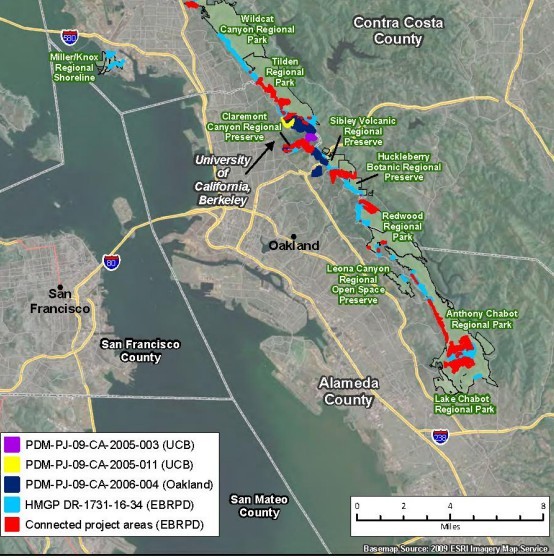
As a reminder: The map below shows all the areas that are affected by this massive deforestation scheme that will fell nearly half a million trees. It’s a travesty that the Sierra Club is not only supporting these projects, but has also filed a lawsuit demanding that they be even more destructive than planned.

FEMA Project Areas
FEMA Project Areas

Public opposition to pesticide use in our public parks

On November 19, 2015, a visitor to Mount Davidson park in San Francisco video recorded a pesticide application that is available here:

glyphosate spraying on Mt Davidson - nov 19, 2015

One of the people who saw that video reported several concerns regarding that pesticide application to the city employees who are responsible for the regulation of pesticide use in San Francisco.  Here is the email he sent to Kevin Woolen in the Recreation and Park Department and Chris Geiger in the Department of the Environment:

To:  Kevin Woolen  kevin.woolen@sfgov.org

Dear Mr. Woolen,

I understand that you are responsible for the records of pesticide applications on properties managed by San Francisco’s Recreation and Park Department.  I have heard you speak at public meetings, so I am aware that you have some expertise in that area.  Therefore, I am writing to you about a pesticide application on Mt. Davidson on November 19, 2015.  That pesticide application was recorded by this video:  https://www.facebook.com/ForestAlliance/videos/934479473312166/?fref=nf

I have several concerns about this pesticide application:

  • One of the herbicides that was sprayed was Stalker with the active ingredient imazapyr. I notice that most of the spraying was done around a tree, which was not a target of the application according to the posted Pesticide Application Notice.  As you may know, imazapyr is not supposed to be sprayed under and around non-target trees according to the manufacturer’s label:  http://www.cdms.net/ldat/ld01R013.pdf:  “Injury or loss of desirable trees or other plants may result if Stalker is applied on or near desirable trees or other plants, on areas where their roots extend, or in locations where the treated soil may be washed or moved into contact with their roots”

Here is a newspaper article about unintentional damage done to trees by spraying an imazapyr herbicide beneath them:  http://www.mlive.com/news/grand-rapids/index.ssf/2012/09/no_quick_fix_for_herbicide_dam.html

  • The Pesticide Application Notice says that the application method will be “spot treatment/daub cut stem.” This does not seem to be an accurate description of the application method on November 19th.  It seems that “backpack sprayer” would be a more accurate description of this particular pesticide application.
  • The Pesticide Application Notice says that Himalayan blackberries were one of the targets of this Pesticide Application. As you know, birds and other wildlife cannot read the signs that are posted to warn the public about these applications.  Can you assure me that the Himalayan blackberries were no longer fruiting?  Does the Recreation and Park Department have a policy against spraying vegetation when there are fruits eaten by birds and other wildlife?  If not, would the Recreation and Park Department consider adopting such a policy?
  • Although Garlon was not used in this particular pesticide application, it is often used in San Francisco’s so-called “natural areas.” Therefore, it is worth mentioning that Garlon is also known to be mobile in the soil and there are documented incidents of it damaging non-target trees when it has been sprayed on the stumps of nearby trees after they were destroyed.

Thank you for your consideration.  I hope you will share my concerns with the staff and contractors who are engaged in these pesticide applications.

Cc:  Chris Geiger  chris.geiger@sfgov.org

This is not an isolated incident.  Park visitors in San Francisco have been complaining for years about pesticide use in parks that were designated as “natural areas” over 15 years ago.  Ironically, those areas were never sprayed with pesticides before being designated as “natural areas.”  In fact, they really were natural areas prior to being officially designated as such.  Plants and animals lived in peace in those places before being “managed” by people who are committed to eradicating all non-native plants in many of San Francisco’s parks.

What can you do about it?

If you are opposed to pesticide use in San Francisco, or you object to the pointless destruction of harmless plants that are useful to wildlife, here are a few things you can do to express your opinion and influence the public policy that allows pesticide use in the public parks of San Francisco:

  • You can join over 11,000 people who have signed a petition to prohibit the use of pesticides in public parks. The petition is HERE.  The San Francisco Chronicle reported on pesticide use in San Francisco’s parks and the petition against that use.  (Available HERE)
  • You can sign up HERE to be notified of the annual meeting in which pesticide policy in San Francisco is discussed for subsequent approval by the Environment Commission. That meeting has been scheduled in December in past years.  Update:  The annual meeting has been announced.   “Annual Public Hearing on Pest Management Activities on City Properties and San Francisco’s Draft 2016 Reduced-Risk Pesticide List 4:30-7:00 pm
    Wednesday, December 16, 2015 Downstairs Conference Room, 1455 Market St. (near 11th St.; Van Ness MUNI stop)”  The meeting agenda is available HERE.
  • You can apply for one of the two vacant seats on the Environment Commission. These seats have been vacant for nearly a year.  In the past, the Environment  Commission has actively promoted pesticide use in San Francisco’s “natural areas.”  Qualifications and duties of commissioners are available HERE.
  • Appointments to the Environment Commission are made by Mayor Ed Lee. If you don’t want to serve on the Environment Commission, you can write to Mayor Lee (mayoredwinlee@sfgov.org) and ask him to appoint people to the Commission who do not support the use of pesticides in San Francisco’s public parks.

The parks of San Francisco belong to the people of San Francisco.  They have paid to acquire those properties for public use and they are paying the salaries of those who are “managing” the parks.  If you don’t like how parks are being managed, you have the right to express your opinion.  Our democracy works best when we participate in the public policy decisions that affect us.

What does this have to do with the East Bay?

Our readers in the East Bay might wonder what this incident has to do with you.  Parks in the East Bay are also being sprayed with herbicides for the same reasons.  HERE are reports of pesticide use by the East Bay Regional Park District.

Many of the pesticide applications on the properties of EBRPD are done by the same company that sprayed herbicides on Mount Davidson on November 19, 2015.  That company is Shelterbelt Builders.  You can see their trucks in the above video.  Pesticide use reports of San Francisco’s Recreation and Park Department often report that pesticide applications were done by Shelterbelt.

Shelterbelt began the eradication of non-natve vegetation in Glen Canyon in November 2011

Shelterbelt Builders is based in the East Bay.  One of its owners is Bill McClung who is a member of the Claremont Canyon Conservancy and a former officer of that organization.  The Claremont Canyon Conservancy is the organization that is demanding the eradication of all non-native trees on public land in the East Bay Hills.  Here is a description of Mr. McClung’s responsibilities on Shelterbelt’s website:

“Bill McClung joined Shelterbelt in 1997 to help refocus Shelterbelt on native plant restoration and open land management/fire safety.  After his house burnt down in the 1991 Oakland Fire, this former book publisher became interested in how wildland and fire are managed in the East Bay Hills.  He became a member of the Berkeley Fire Commission in 1994 and has a strong interest in the vegetation prescriptions of the Fire Hazard Program & Fuel Reduction Management Plan for the East Bay Hills issued in 1995 by the East Bay Hills Vegetation Management Consortium and the East Bay Regional Park District Wildfire Hazard Reduction and Resource Management Plan Environmental Impact Report of 2009/10.  He has managed many properties in the East Bay where wildfire safety and native habitat preservation are twin goals, and continues to work on interesting and biologically rich lands in the Oakland Hills.”

Claremont Canyon Conservancy

The Claremont Canyon Conservancy held their annual meeting on November 15, 2015.  Oakland’s Mayor, Libby Schaaf, was one of the speakers.  Although she took questions at the end of her presentation, one of the officers of the Conservancy called on the questioners.  There were many people in the audience who are opposed to the FEMA projects that will destroy over 400,000 trees in the East Bay Hills and many of us tried to ask questions.  With one exception, the person controlling the questions only called on known, strong supporters of the FEMA project.  Therefore, those who wished to express their opposition to the FEMA projects to the Mayor were denied that opportunity.  Fortunately, there were many demonstrators outside the meeting who could not be denied that opportunity.

Demonstration at meeting of Claremont Canyon Conservancy, November 15, 2015

Norman LaForce was the other main speaker at the meeting.  He is an elected officer of the Sierra Club and he identified himself as one of the primary authors of the project to destroy all non-native trees in the East Bay Hills.  (An audio recording of his complete presentation is available here: https://milliontrees.me/wp-content/uploads/2015/11/norman-laforce-sierra-club-11-15-15.m4a ) This is the paraphrased portion of his presentation specifically about the herbicides that will be used by the FEMA project:

“Part of the FEMA program will be to use herbicides in a concentrated, careful program of painting or spraying herbicides to prevent the trees from resprouting. It may need to be done more than once but ultimately the suckers give up.   There is no other way to do that cost effectively.

People are saying that glyphosate causes cancer.  Radiation causes cancer but when people get cancer they are often treated with radiation.  Nobody tells them they can’t have radiation because it causes cancer.

There are a lot of people of a certain age in this room who are probably taking Coumadin as a blood thinner for a heart condition.  Coumadin is rat poison.  Nobody tells them they can’t take Coumadin.*

You must take dosage and exposure into consideration in evaluating the risks of pesticides.

Nature Conservancy used glyphosate on the Jepson Prairie.

State Parks used Garlon on Angel Island when they removed eucalyptus.

The European Union says that glyphosate does not cause cancer, so I don’t know if it does.  I’m not going to take a position on that.

Now they are saying that red meat causes cancer.

We need to put aside the question of pesticides.  They will be used properly.  We must proceed in a scientific manner.”

We leave it to our readers to interpret Mr. LaForce’s justification for pesticide use.  He seems to be suggesting that pesticides are good for our health.  There are instances in which pesticides do more good than harm, but using them to kill harmless plants in public parks isn’t one of them, in our opinion.  Since many chemicals accumulate in our bodies throughout our lives, it is in our interests to avoid exposure when we can.  If we must take Coumadin for our health, that’s all the more reason why we should avoid unnecessary exposure to rat poison when we can.

Connecting the dots

We have tried to connect the dots for our readers.  Here are the implications of what we are reporting today:

  • Pesticide applications in San Francisco are probably damaging the trees that are not the target of those applications. The food of wildlife may be poisoned by those pesticide applications.
  • You can influence the public policy that is permitting pesticide use in San Francisco.
  • The same company that is spraying pesticides in San Francisco is also doing so in the East Bay.
  • That company is also actively engaged in the attempt to transform the landscape in the San Francisco Bay Area to native plants. They have an economic interest in native plant “restorations.”
  • The Sierra Club is actively promoting the use of pesticides on our public lands.

*Coumadin is prescribed for people who are at risk of heart attack or stroke caused by blood clots.  Coumadin thins the blood and suppresses blood coagulation.  Rat poison kills animals by bleeding them to death.  There is a fine line between preventing blood clots and bleeding to death.  Therefore, people who take Coumadin have frequent blood tests to check that the dosage is at the optimal level.  Rat poisons are killing many animals that are not the target of the poison.  Animals such as owls, hawks, vultures are often killed by eating dead rodents that have been poisoned.  We should not conclude that rat poison is harmless because humans are using it in carefully controlled doses.  Herbicides being sprayed in our public lands are not being closely monitored as Coumadin use is.